The independent newspaper of Washington University in St. Louis since 1878 THURSDAY, FEBRUARY 25, 2021
VOLUME 142, NO. 15
DORM PLANTS
How to make sure your plants do not wither and die (Scene, pg 4)
WWW.STUDLIFE.COM
SWIM IS BACK
SHORT FILMS
Breaking down one junior’s return to action after nearly a year without competition (Sports, pg 6)
The journey from class assignment to fledging streaming service (Cadenza, pg 9)
SU develops Mentorship Match program ‘A step in to foster connections during pandemic the right
direction’: WU expands medical amnesty policy to include drugs GABBY HYMAN STAFF REPORTER
GRAPHIC BY CHRISTINE WATRIDGE
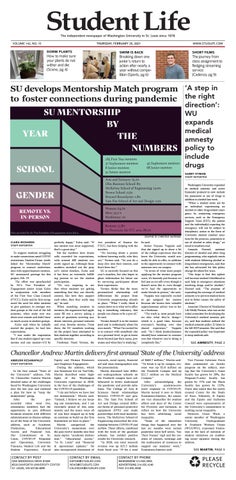
CLARA RICHARDS STAFF REPORTER To support students struggling to make connections amid COVID restrictions, Student Union established the ‘Mentorship Match’ program to connect underclassmen with upperclassmen mentors. SU announced pairings for this project, Feb. 19. The effort was spearheaded by SU’s Vice President of Engagement junior Arjan Kalra in conjunction with members of the First Year Class Council (FYCC). Kalra said he first recognized the need for older students to give guidance to younger student groups at the end of the fall semester, when some new students were remote and didn’t have as much access to student groups. Kalra said when he initially started the project, he had low expectations. “I was under the impression that if one student signed up—one mentee and one mentor—I’d be
perfectly happy,” Kalra said. “If one student was more supported, that’s a great step.” But the numbers have drastically exceeded his expectations, with around 400 students currently signed up. Although those numbers stretched out the project’s initial timeline, Kalra said it has been an extremely fulfilling process to see the student participation. “It's very inspiring to see that when students are getting something that they can directly control, like how they support each other, then they really step up,” he said. When matching mentors to mentees, the organizers had applicants fill out a survey asking a series of questions covering academic interests, personal interests and even favorite movies. From there, the SU members working on the project have attempted to link students together according to specific interests. Freshman Noah Vermes, the
vice president of finance for FYCC, has been helping with the matches. “It's learning about a person without knowing really, who they are,” Vermes said. “So you do a deep dive into their interest, and that’s been fun.” SU is currently focused on this year’s matches, but also hopes to glean information for future use by surveying participants about their experiences. Vermes thinks that the more personalized relationship will differentiate the project from University programming already in place. “What I really think it comes down to is what we're offering is something voluntary, that people can choose to be a part of,” he said. Vermes himself is in the mentee pool and is enthusiastic about his own match. “What I'm excited for is to connect with somebody else on a personal level, to get to know them beyond just their name, pronouns and what they’re studying,”
he said. Junior Nayana Vuppala said that she signed up to share a bit of the college experience that she knew the University would normally be able to offer, in addition to the opportunity to connect with someone new on campus. “In terms of what most people applying for the mentor program want, it's honestly just because we feel just as cut off—even though it doesn't seem like it, even though we’ve had the opportunity to make friends in person,” she said. Vuppala was especially excited to get assigned her mentee because she knows how valuable upperclassman advice was to her as a freshman. “The truth is, most people have no idea what they’re doing— which is a good time, because everyone’s bonding over that shared experience,” Vuppala said. “So I think [underclassmen should] have someone to reassure you that whatever you’re doing is completely fine.”
Washington University expanded its medical amnesty and active bystander protocol to now include the possession or use of drugs in addition to alcohol last week. “When a student seeks aid for an individual experiencing an alcohol or other drug-related emergency by contacting emergency services, such as the Emergency Support Team (EST), the patient and the individual(s) reporting the emergency will not be subject to disciplinary action in the form of University student conduct sanctions for the presence, possession or use of alcohol or other drugs,” an email to students read. Amanda Harmel, assistant director of alcohol and other drug programming, who regularly meets with students following alcohol or drug-related emergencies, said that she has advocated for this policy change for about five years. “Our hope is that this update will increase student’s likelihood to seek help in emergency situations involving drugs and/or alcohol,” Harmel said. “The purpose of expanding the coverage of medical amnesty is to prevent student harm and to better ensure the safety of students.” Associate Director of Residential Life Molly Pierson, who was on the initial committee for developing the University’s medical amnesty policy, said that students utilized the medical amnesty policy 32 times in the fall 2019 semester. She said that the expanded policy was important to keep students safe.
SEE AMNESTY, PAGE 2
Chancellor Andrew Martin delivers first annual ‘State of the University’ address ANIRUDH KESANAPALLY STAFF REPORTER In his first annual “State of the University” address, Feb. 16, Chancellor Andrew Martin detailed some of the challenges faced by Washington University over the last year and outlined a plan for how to “keep the momentum” going. After the prerecorded video went live, community members had the opportunity to join different breakout sessions with different administrators to discuss subtopics of the State of the University address, such as Academic Distinction, Educational Access and Financial Aid, Our Commitment to St. Louis, COVID-19 Response and Operations, University Finances, Student Life and the Student Experience, Racial
Equity and Human Resources and Employee Engagement. During the address, which was broadcast live on YouTube, Martin described some highlights of the Washington University experience in 2020, in the face of the challenges of the COVID-19 pandemic. “I do not believe we have lost our momentum,” Martin said. “Indeed, I believe we are keeping our momentum, and I am extremely proud of this community and the many ways all of you have stepped up to help us continue to build on the firm foundation we have in place.” Martin categorized the University’s momentum over the past twelve months into four main topics: “academic distinction,” “educational access,” “in St. Louis” and “financial & operational updates.” He also incorporated discussion of
research, racial equity, financial aid and class demographics into the presentation. Martin discussed how different undergraduate schools on the Danforth campus have collaborated to better understand the pandemic and provide solutions. The College of Arts & Sciences found relationships between COVID-19 and gender. The Sam Fox School of Art and Design created different forms of personal protective equipment (PPE) and made partnerships with local manufacturers. The McKelvey School of Engineering researched the relationship between COVID-19 and airflow. These efforts, combined with the work of the graduate schools, has yielded positive results for University research. “In 2020, our total research revenue was up $25.5 million from fiscal year ’19 for a total
of $660.7 million,” Martin said. “To break it up by campus, revenue was up $3.8 million on the Danforth Campus and up $22.7 million on the Medical Campus.” After acknowledging the University’s academia-centered response to COVID-19, Martin turned it over to Mark Kamimura-Jiménez, the associate vice chancellor for student affairs and dean of the Center for Diversity and Inclusion, to reflect on how the University has been addressing racial inequality. “Some of the immediate things that happened over the last six months were racism pandemic town hall series, ‘Say Their Names’ vigil and the creation of courses, trainings and the reallocation of resources to support our students’ work,” Kamimura-Jiménez said.
CONTACT BY POST
CONTACT BY EMAIL
CONTACT BY PHONE
ONE BROOKINGS DRIVE #1039 #320 DANFORTH UNIVERSITY CENTER ST. LOUIS, MO 63130-4899
EDITOR@STUDLIFE.COM NEWS@STUDLIFE.COM CALENDAR@STUDLIFE.COM
NEWSROOM 314.935.5995 ADVERTISING 314.935.4240 FAX 314.935.5938
Vice Provost Adrienne Davis then commented on faculty progress on the subject, stating that the University’s Asian faculty has grown by 28%, the Hispanic/Latinx faculty has grown by 71% and the Black faculty has grown by 133%. Davis also noted that the newly created Center for the Study of Race, Ethnicity, & Equity and the Equity and Inclusion Council were representative of the University’s commitment to tackling racial inequality. However, Grace Ward, a senior member of Washington University Undergraduate & Graduate Workers Union (WUGWU), expressed frustration at the lack of mention of student initiatives on combating racial injustice during the address.
SEE MARTIN, PAGE 3
2 STUDENT LIFE
EM MCPHIE & TED MOSKAL | SENIOR NEWS EDITORS | NEWS@STUDLIFE.COM
theFLIPSIDE FLIPSIDE THU 25
MOSTLY CLOUDY 48/30
MON 1
MOSTLY SUNNY 51/32
FRI 26
MOSTLY SUNNY 53/37
TUES 2
CLOUDY 58/33
PARTLY CLOUDY 60/43
AM RAIN/SNOW SHOWERS 53/35
WU professors awarded $400K for Alzheimer's research by the Rainwater Foundation
SUN 28
SAT 27
WED 3
MOSTLY SUNNY 58/38
EVENT CALENDAR THURSDAY 25 “Misogynoir”: American Contempt Towards Black Women and How to Change It Virtual Event, 12:30 p.m. In this discussion speakers will draw from their field specific insights to discuss Black women’s experiences in the United States. Leveraging contemporary and historical examples, they will offer frameworks for understanding structural bias, harassment and violence against Black women and contemplate opportunities to disrupt it. The Brown School is pleased to co-sponsor this program with the Center for the Study of Race, Ethnicity and Equity. Hostile Terrain 94: Toe Tag Workshop Virtual Event, 1 p.m. This is a socially-distanced opportunity to participate in this political art project by filling out toe tags with the names and identifying information of migrants who have died trying to cross the border between Arizona and Mexico. Crossing a national border can cost a human being their home, their belongings and, sometimes, their life. By an accident of birth these individuals were on the “wrong” side of the border and died while trying to cross over.
FRIDAY 26 Public Tour: ‘The Autonomous Future of Mobility’ Virtual Event, 12 p.m. Student educators design and lead virtual tours featuring several artworks in the Kemper Art Museum collection, showing images of the artworks through screen sharing and answering participant questions. This tour presents a selection of works from the Teaching Gallery exhibition The Autonomous Future of Mobility, curated by Constance Vale, assistant professor of architecture in the Sam Fox School. The exhibition examines the car’s legacy over the past century as depicted in art and visual culture, offering a view toward today’s emerging technological developments and exposing vulnerability in the face of the horsepower and political power that drive mass movement. Sharing Your Data Virtual Event, 12 p.m. This workshop will focus on sharing data for long-term access and reuse based on the principles of FAIR (finable, accessible, interoperable, reusable) data. Participants will receive tips, tools and resources for preparing data for sharing, data review and curation, transparency, data citation and data preservation. Today’s emerging technological developments and exposing vulnerability in the face of the horsepower and political power that drive mass movement.
SATURDAY 27 Webinar: Taiwanese-Language Films during the Cold War Virtual Event, 2 p.m. Professor Chris Berry will join for a webinar discussion in conjunction with Taiwan-language film festival when EALC showcases two Taiwanese-language films: Six Suspects and The Best Secret Agent. Over 1000 Taiwanese-language films were made between the 1950s and 1970s, but only about 200 survive. It was not until recently that these films were archived, restored and made available to English-speaking audience. Despite the restricted budget, Taiwanese-language films are imbued with creative energy and savvy perspectives on Taiwan society. Professor Berry will guide participants through the production history and culture of this unique group of films, and discuss the spy/detective genre in relation to the Cold War background, followed by a Q&A session.
MONDAY 1 Architecture Faculty Lecture: Zeuler Lima Virtual Event, 6 p.m. Associate professor Zeuler Lima will deliver an online lecture titled Lina Bo Bardi Draws: Pictures at an Exhibition. Lima is the author of the acclaimed biography Lina Bo Bardi about the Italian-born Brazilian architect (Yale University Press, 2013), with several worldwide lectures and deferential reviews, including in The New York Review of Books. He has contributed extensively to national and international journals, museum catalogues and book editions and is co-editing a forthcoming anthology of texts by architects from Latin America for the Museum of Modern Art (New York). Energy & Israeli Foreign Policy: A Virtual Israeli Center Series with Elai Rettig Virtual Event, 7 p.m. Major offshore natural-gas discoveries in 2010 created many economic and foreign policy opportunities for Israel, but also set in motion a series of escalating clashes between the countries of the region. This talk will discuss the politics over gas production and gas exports in the East Mediterranean Sea, and examine what options Israel has in the near future. Elai Rettig is the Israeli Institute Teaching Fellow in Israeli and Environmental Studies at Washington University in St. Louis. In this three-part study, Rettig will explore the interplay between energy security and foreign policy in Israel from 1948 to the present.
THURSDAY, FEBRUARY 25, 2021
TED MOSKAL SENIOR NEWS EDITOR Dr. David Holtzman and Dr. Celeste Karch of Washington University received the Rainwater Charitable Foundation’s prize for Outstanding Innovation in Neurodegenerative Research and the prize for Innovative Early-Career Scientist, respectively, Feb. 22. Holtzman, who currently serves as the chair of Washington University’s department of neurology, was recognized primarily for his research with the apoE4 protein, which is a major genetic risk factor for Alzheimer’s disease. Holtzman specifically studies how apoE4 modulates brain damage caused by the “tau” protein, as well as the connection between neurodegenerative diseases and sleep. Karch, who is an associate professor of psychiatry, was recognized for her work studying the MAPT gene in order to develop potential therapeutic methods for preventing neurodegenerative disease. Karch often works with induced pluripotent stem cells to better understand tau genetics. Holtzman and Karch received $250,000 and $150,000, respectively. Both noted that the funding from these awards will be particularly useful because they come with fewer strings attached than many of the grants that they often rely on for funding. “I think it’s going to give us this opportunity to go after high risk projects that can really get us closer
to a cure, and [pursue] those ideas that are challenging, and that are maybe difficult to find in traditional mechanisms where you need to provide a lot of demonstration that it works,” Karch said. “And so I think we’ll be able to explore some really innovative areas and develop new tools that we can make available to the community.” In particular, Karch hopes to focus on developing better tools for screening the sample cell lines that she works with, while Holtzman plans to look into new treatments for neurodegenerative disease by controlling the levels of apoE4 in cells. “We’re trying to come up with new ways to modulate the level of apoE4 with both a small molecule approach like a drug therapy approach, as well as the gene therapy approach,” Holtzman said. “So I’d like to see if we can get those two things really to a higher level.” Both Holtzman and Karch are members of the Tau consortium, a program funded by the Rainwater Foundation that promotes collaboration between scientists researching neurodegenerative diseases. Holtzman credited the Tau consortium as a significant factor in the success of his research. “It really led to an incredible amount of collaborations between groups that probably wouldn’t have been collaborating before,” Holtzman said. “And so that really stimulated many of us, including me, to really ramp up our research and use some approaches…
COURTESY OF DR. DAVID HOLTZMAN
Dr David Holtzman received $250,000 in funding for his research with the apoE4 protein’s role in modulating brain damage.
AMNESTY from page 1 “In any crisis situation, the last thing you want is people assessing ‘Okay, was it just alcohol or were drugs included?’ and instead for students to know that that policy applies regardless,” Pierson said. According to Kirk Dougher, associate vice chancellor for student support and wellness, the key driver of the policy change was “to bring it into alignment with our peer institutions.” Dougher anticipated that the expanded policy will
impact student life in small ways. “The frequency of situations where this policy will be needed is not high,” Dougher said. “However, when it is, it will be quite important that those that are considering calling to help the medical condition of a fellow student do not see conduct as a reason not to make that call.” Student Union Speaker of the Senate junior Gaby Smith said that the expanded policy “will encourage students to contact the resources
COURTESY OF DR. CELESTE KARCH
Dr Celeste Karch was awarded $150,000 for her work studying the MAPT gene to develop therapeutic treatments for neurodegenerative diseases.
that we wouldn’t necessarily have done as a single lab.” Karch, who began her postdoctoral career at Washington University, also credited the University’s supportive and collaborative environment. “Part of the reason why [I chose to work at WU] was because I just love the environment,” Karch said. “Literally, the first moment that I interviewed for this postdoctoral position was just the openness that people had, and sharing their ideas and, and sharing their skills and helping everyone to push their projects forward. Part of what I love about science is the community and the ability to look beyond your initial question and look forward, and I think Wash U really enables that.” As recipients of the awards, Holtzman and Karch will both present their research at the EuroTau 2021 conference. Karch expressed excitement about this opportunity, as well as gratitude to the Rainwater foundation for supporting her work. “[Receiving the award] was really surreal,” Karch said. “I was just so blown away and just really honored. I think this is an organization that has really been supporting and valuing the top science in the field. They’ve been just a model of collaborative science and accelerating science towards a cure. And to be identified as an early career investigator, and to get this award... I was just so honored.”
that they need when they are in dangerous situations.” “We hope that the policy will reduce hospitalizations due to students holding off on seeking help,” Smith said. “This will really emphasize the harm-reduction approach that the University seems to be taking on issues of alcohol and drug use in medical emergencies...We believe that it is important to reduce barriers to accessing resources on campus, and we feel that this is a step in the right direction.”
TUESDAY 2 Rethink: Smashing the Myths of Women in Business Virtual Event, 5:30 p.m. Please join Andrew Simon, AB ’63, and Andi Simon, co-founders of the Simon Initiative, for a panel discussion featuring alumnae who have smashed the myths of women in business. Panelists will share how they opened the possibilities in their professional careers and personal lives by being authentic, taking risks and pushing past the obstacles placed before them. They will tell their stories of innovation, building businesses, changing and challenging the long-held beliefs about what they can and can’t do, and becoming the best they can be and inspiring other women to do the same. STEPHEN HUBER | STUDENT LIFE
Emergency Support Team member Gaby Gonzalez and her colleague rush to an intoxication call in Liggett Hall to help stabilize the intoxicated student in September, 2014.
THURSDAY, FEBRUARY 25, 2021
EM MCPHIE & TED MOSKAL | SENIOR NEWS EDITORS | NEWS@STUDLIFE.COM
STUDENT LIFE 3
MARTIN from page 1 “We heard a lot from Martin and others about committees and vague terms like inclusion and equity, but nothing about the concrete proposals put forward by student activists, including disarmament and abolition of WUPD, greater support for the Prison Education Program, more structures of support for Black students, divestment of the University endowment from the private prison industry, changes to curriculum or increased wages for Wash. U.’s lowest paid workers, many of whom are people of color,” Ward said. “Those are things the University could actually do to advance racial justice. We don’t need more committees.” After Davis spoke, Chancellor Martin described data regarding the class of 2024. “At Wash. U, we have an outstanding class of 2024, which includes 1806 students compared to 1735 for class of 2023 as of the same date. An additional 118 students elected to take a gap year and will join the Class of 2025,”
Martin said. Martin also mentioned the projected numbers for the incoming class of 2025. With 33,000 first-year applications, a 20% increase from the previous application cycle, next year’s class is predicted to break previous records. Financially, Martin described the sacrifices that had to be made during the pandemic. Martin said that “budget cuts, furloughed employees and reduced hours for others, reduction in salary for some and not paying a typical retirement match for a time due to costs of shutdowns and losses” were just some of the costs the University dealt with over the last year. According to Martin however, the outlook for next year is improving. This is namely due to an endowment that has performed relatively well and positive research funding and medical revenues. Martin said that these factors allowed the University to present merit raises and offer $100 million in financial aid, as well as an undergraduate tuition increase that is the
lowest in fifty years. Ward, as a Ph.D. student, pointed out the lack of universal distribution of these positive results for university workers over the last year. “Faculty and some staff in the medical school were given a $750 bonus at the end of last semester to thank them for their exemplary work during the pandemic, but this bonus was not extended to Ph.D. students working in labs in the medical school, many of whom continued to go onto campus to conduct in-person research during the worst phases of the pandemic,” Ward said. “If we had structures—like unions—to check the power of administrators, I think we’d have heard a pretty different State of the University address, one that included the accomplishments, struggles and concerns of the majority of people who actually make this institution work.” The presentation also detailed updates regarding the relationship Washington University has with the St. Louis region. This has been a recent initiative of
COURTESY OF PUBLIC AFFAIRS
Martin addressed Washington University’s progress in the last year through four categories: “academic distinction,” “educational access,” “in St. Louis” and “financial & operational updates” in addition to how COVID-19 has impacted the University.
the University to be more involved with the area, garnering the slogan “In St. Louis, for St. Louis.” “Hank Webber has recently pivoted to executive vice chancellor for civic affairs and strategic planning with a sharp focus on regional, equitable economic development, community engagement and partnership
with these neighbors and civic and community leaders,” Martin said. Outside of administrative changes, the University community has played a key role in helping the region this past year in areas such as patient care, student initiatives and housing healthcare workers during the summer. In
terms of civic engagement, the University was ranked 3rd in student voter registration nationally for the 2020 election. “Given the way we have adjusted, rebounded and grown in the last year alone, it gives me immense confidence that we can do anything as long as we do it together,” Martin said.
Sabrina Spence Social Media Director
Adrienne Levin Coleman General Manager a.coleman@studlife.com
Copyright © 2020 Washington University Student Media, Inc. (WUSMI). Student Life is a financially and editorially independent, student-run newspaper serving the Washington University community. Our newspaper is a publication of WUSMI and does not necessarily represent the views of the Washington University administration.
EDIT ORʼS
NOTE
COMES OUT EVERY FRIDAY THE STUDENT LIFE
PODCAST VOLUME 142, NO. 15 Emma Baker Editor-in-Chief editor@studlife.com
Kya Vaughn Senior Forum Editor forum@studlife.com
Curran Neenan Senior Photo Editor photo@studlife.com
Matthew Friedman Associate Editor
Dorian DeBose Josh Shapiro Senior Sports Editors sports@studlife.com
JJ Coley Isabella Neubauer Copy Chiefs copy@studlife.com
Isabella Neubauer Sabrina Spence Senior Cadenza Editors cadenza@studlife.com
Vivienne Chang Kathleen White Engagement Editors
Jayla Butler Kya Vaughn Managing Editors Em McPhie Ted Moskal Senior News Editors news@studlife.com Benjamin Simon Senior Scene Editor scene@studlife.com
Mia Goldberg Design Chief design@studlife.com
HN Hoffmann Jaden Satenstein Christine Watridge Multimedia Editors
Nathan Springman Website Editor Jamila Dawkins Forum Editor Christine Watridge Spencer Linenberg Jaime Lee Clara Richards Kamala Madireddi Reilly Brady Designers
Tammy Dunsford Advertising Sales Supervisor dunsfordt@wustl.edu
4 STUDENT LIFE
SCENE
BENJAMIN SIMON | SENIOR SCENE EDITOR | SCENE@STUDLIFE.COM
THURSDAY, FEBRUARY 25, 2021
WU sophmore Roy Antoine bakes everything from donuts to caramel cake. And then he gives it all away. OLIVIA POOLOS STAFF WRITER With a muscular frame well suited for his sport of choice, rugby, and pursuing a major in mechanical engineering, sophomore Roy Antoine isn’t the person you’d expect to have a soft spot for baking cinnamon rolls. Yet, he does. And Antoine doesn’t just stop there—he’s also fond of whipping up donuts, beignets and caramel cake, to name just a few of his many culinary creations. Antoine started baking during his first semester at Washington University in the Eliot A dorm kitchen. Before baking, however, Antoine started out as a chef. Being an athlete at Washington University, he wanted simple protein and vegetable-heavy meals that were hard to find in the campus dining halls. While he started simple, he said that he got more into the process because he found he enjoyed the process and flow of cooking. Yet, Antoine admitted, he has had a sweet tooth since he was a kid, and the temptation of freshlybaked goods was too good to resist. He began experimenting with recipes for
pastries and found he had a knack for it. But since Antoine was cognizant of his health, he didn’t bake as much as he liked. “I didn't want to try to dedicate too much time to something I can't eat too much of,” he said. It didn’t take long before he found the solution to his problem — hungry college kids. “I used the dorm kitchens and people were in there, so I just gave it out,” Antoine explained. Once the University sent everyone home in March of 2020, Antoine said that quarantine and online school slowed his baking frenzy to a crawl. Now, however, living in an apartment off-campus with his roommate, Antoine is taking full advantage of his personal kitchen. “We came to St. Louis before school started—so you’ve got to fill the time somehow,” he said. Antoine has also kept his practice of giving away much of what he bakes. “We were thinking maybe we should start selling them for profit, maybe, just help out with rent or something,” he said, “but I don't mind just doing it for free. Antoine claims that
PHOTO COURTESY OF ROY ANTOINE
About a month ago, sophomore Ray Antoine baked an array of donuts, including blueberry, chocolate and glazed. Instead of eating them himself, Antoine decided to hand them out at the Bear’s Den. “I’m trying to make positive space,” Antoine said. Though Antoine started packages, which contained with enough of the raw to moisture. Too dry, and brownies, candy and either ingredients in bulk, he isn’t baking only a year ago, the crust becomes brittle he’s already well-versed stuffed bear or rose — the spending much money on and breakable. Too wet, in the ins and outs of latter of which was ransupplies. He also is aware and you can’t roll it out pastry dough. It’s not difdomly assigned. He said, that the gift of baked without sticking. And ficult for him to dive into over email: “I gave it out goods adds sweetness to don’t even get him started impassioned spiels of the to those who wanted one. a year that sorely needs a on premade crusts: “It’s technical side of baking, For every box, they took I little extra joy. not authentic!” also gave ‘em some cook“There’s COVID, there’s especially when it comes Antoine has developed to his nemesis: pie crust. ies I baked.” political stuff, there’s other less-typical baking “[My roommate] is This spring, Antoine social stuff,” Antoine said. habits too –– he likes to lactose intolerant, so I and his roommate are “I’m trying to make posibake alone, typically withcan’t use a lot of real butconsidering selling pizzas tive space.” out music or radio in the ter. And when it comes on the side to help cover Antoine is also includbackground. He doesn’t living costs. But until then, ing himself in that positive to pastry dough you don't believe in cake frosting necessarily want to skimp Antoine is content with space—baking is meditaeither, but “glazes are out on what the recipe his current routine: “for tive, an escape from hours fine,” he said. calls for,” he said. Antoine me personally, my thing is of engineering classes and Antoine's most recent went on to lament the [to] bake for fun, and give something to look forward project was a plethora it out,” he said. to on weekends. of Valentine’s Day care delicate balance of flour
Rooted in St. Louis: How to grow plants from your dorm room THOMAS HUMPHREY STAFF WRITER This series will highlight the plant life of Wash. U. and of St. Louis, the people who put them there and why you should pay more attention to the greenery around you. Humans evolved living among plants for millions of years––we feel more comfortable around them. As a college student in the urban Midwest, you are not in your natural habitat. Many of you do not see nature often. This can change. Just get a plant. It is that simple. But maybe now reading this article you are yelling, “No! Plants are difficult to grow indoors! All my plants die! They are too expensive!” Well, strawman reader I
invented to prove a point, you are wrong. Plants can be easy, cheap and greatly improve your surroundings. You just need a few pointers. Let us first delineate your plant issues. The number one issue of most first-time indoor plant owners is simple: Overwatering. It is a tough problem, not one that stems from neglect but rather from enthusiasm for a plant you are trying to keep alive. I know you love your plant, but you need to give it some space. Once a week should be enough for most, or until the soil is totally dry. Otherwise, the roots will rot, and your plant will die. The same goes for fertilizer––once a year max, if that. Plants are pretty resourceful, so if you give them space to
grow, then they will. The other main issue is light, but it is really not that difficult either–– east-facing windows are bright direct light, the others are medium or low direct, everything else is indirect. That is about all you need to know about it, and most nurseries will have indoor plants labeled accordingly. Get well-draining indoor soil, a pot and you are ready. It really is so easy if you are hands off. I think way too many people limit themselves to succulents because they think they could not grow anything else. This is so wrong. Get a pothos instead; that winding vine is just as easy to maintain, and infinitely more exciting. Most importantly, they grow fast. For an impatient person that does
WE ARE OPEN with safe social distancing practices. We offer curb side pick-up.
LIVE GLASS BLOWING BY LOCAL ARTISTS
CHECK OUT OUR NEW SITE
WWW.EMPORIUMSMOKESHOPSTL.COM
WE CARRY DELTA 8 PRODUCTS
Open Monday through Saturday, 10am to 9pm • Sunday 11am to 8pm
6254 DELMAR BLVD IN THE LOOP
THOMAS HUMPHREY | STUDENT LIFE
Plants are a way to bring some life into a dorm or apartment. From right to left: String of Hearts succulent, Heartleaf Philodendron (closely related to pothos), wild-propagated English Ivy and Wintercreeper, Yucca Stalk and Echinacea and Chamomile sprouts grown from seed.
not want to wait months to see new growth, they are perfect––you might see a new leaf on one of these the same week you bring it home. They are also easy to propagate. Propagation is just jargon for cutting off a piece of plant to make a new one. It’s incredible that you can just cut off a hunk of green, stick it in water, and boom, new plant. This is where growing gets fun––where you get to experiment. If there is one thing you should take away from this article it’s that you should be experimental with your plants. One of my favorite plants is a winter creeper that I propagated from a vine in a sewer grate behind my apartment, which I planted in an old tomato can. Cost zero dollars and zero cents. And in that case, who cares if it dies? I can make 20 sewer vines for free, and if one of them lives it is a net positive. Experimenting is the fun
part, and failing is fun, as long as you fail while trying something new. I will leave you with a few more ideas: • Seeds are cheap, and do surprisingly well indoors. • You do not need to mist your plants, all that will get you is mold.
• The internet has a lot of information––do research. • Talk to your plants and play them some music. There are excellent albums specifically designed to be played for your green friends. • That is all. Go get some nature and bring it inside.
THOMAS HUMPHREY | STUDENT LIFE
A seed packet costs somewhere around three dollars, and watching the growth process from start to end is fascinating. These chamomile sprouts have since grown to over a foot tall, and have produced enough flowers to make my own tea.
THURSDAY, FEBRUARY 25, 2021
BENJAMIN SIMON | SENIOR SCENE EDITOR | SCENE@STUDLIFE.COM
STUDENT LIFE 5
Shoeless and shivering: Freshmen share their fire alarm blunders REILLY BRADY STAFF WRITER I was convinced that I would make it through all of last semester without experiencing a fire alarm. While friends had complained about multiple fire alarms, I boasted that, despite being in the most populated building, I had never had to deal with one. At 3:15 p.m. on Dec. 17, 2020, just two days before my flight home, my Zoom class was interrupted by a piercing noise––the fire alarm. In my hurry to leave, I left my Zoom camera on and forgot both shoes and a jacket. A few minutes later, my suitemate joined me, her hair soaked from the shower she had to hastily jump out of. The cause of the chaos? Someone had burned food in a microwave on the third floor of Umrath. Seeing students gathered outside of a building during a fire alarm––some without coats, some without shoes, some half asleep––is a common sight on the South 40. Because of COVID-19 and online classes, students have spent more time in their rooms, increasing the likelihood that they may need to evacuate their building due to a fire alarm. Four freshmen share fire alarm stories from their time on the South 40.
The sleeping suitemate Freshman Jake Oscherwitz is a light sleeper. His suitemate, freshman Vinay Viswanathan, on the other hand, enters a “comatose state” when he sleeps. Every morning, Oscherwitz can hear Viswanathan’s repeated alarms through the wall. Oscherwitz rarely checks the time in the morning: When he hears his suitemate’s first alarm, he knows that it is 8:30 a.m. When he hears the
next alarm, he knows that 10 minutes have passed, and this continues in 10-minute intervals until his suitemate finally wakes up. Viswanathan’s heavy sleeping tendencies had never been more than a lighthearted joke between the two suitemates. However, his habit of snoozing through alarms became potentially dangerous on Dec. 4, 2020, when the fire alarm was set off at around 2:30 a.m. in Lien House. Oscherwitz woke up to a piercing sound that interrupted his dream. Disoriented, his first thought was, “Am I going to die?” before making the connection that the strange sound was the fire alarm. He quickly sprinted out of bed and threw on two sweatshirts. Covering his ears, he ran through the connected bathroom to check on his suitemate, who was still in bed, fast asleep. “I’m shouting at him, shaking him,” Oscherwitz said. “After like 30 seconds, there was nothing. He just turned over. I kept shaking him for another two minutes, and he was just out.” Oscherwitz realized that his efforts were futile. Though he did not know if there was an actual emergency, the lack of smoke in the air gave him enough confidence to leave the building without his suitemate. Once outside, he glanced around, hoping to see his suitemate, but Viswanathan never appeared. Viswanathan had been up until around 2 a.m. studying for an exam, and he had probably only been asleep for a few minutes when the fire alarm went off. When he awoke the next morning, he learned about the incident while checking his phone. “There was a video of everyone outside of Lien, and that was the first time I had heard about it. I was so
confused,” Viswanathan said. Oscherwitz filled him in on what happened, but Viswanathan did not blame Oscherwitz for leaving him behind. “He definitely did not have any ill intentions of leaving me to die…If there was a blazing fire and [if] there was smoke, I would trust that he would wake me up and get me out,” Viswanathan said.
Pink socks, Lady Gaga and a fire alarm Freshman Maddie Hoffmann hates shoes. For her, shoes are “too much work.” Whether she is wandering around her building or walking to the clock tower to pick up food, she avoids wearing shoes as much as possible. While Hoffmann admitted that rarely wearing shoes is a bad habit, her dislike of shoes had never been a problem until Jan. 27, when the fire alarm in Koenig House suddenly went off. On that Wednesday afternoon, Hoffmann was in the elevator, coming back from dropping off her laundry. As usual, she was not wearing shoes, and she was blasting “Alejandro” by Lady Gaga through her AirPods. At first, she assumed the noise was a “weird beat” in the song. She soon realized that what she had thought to be a peculiar musical choice by Lady Gaga was actually Koenig’s fire alarm. But by the time she understood what was happening, Hoffmann realized that she did not have time to go back to her dorm, and she headed for the exit with just pink socks on her feet. Unfortunately, it had just snowed, and Hoffmann stood on the wet ground in the 20- degree weather as she waited for the fire department to arrive.
HN HOFFMANN | STUDENT LIFE
“It felt like forever. It had been at least 10 minutes if I had to guess. They took their sweet time getting there,” Hoffmann said. Luckily, there was no fire. Upon returning to her room, Hoffmann turned on her shower, soaking her feet under the hot water until the feeling in her toes returned. Despite the miserable experience, Hoffmann is stubborn in her ways. She still hates shoes. “I’ve decided to ignore the signs the universe is giving me, and I will continue being the way that I am,” Hoffmann said.
The mid-quiz fire alarm Before starting every quiz and exam in her chemistry class last semester, freshman Mary Falstin was instructed to hold her calculator, periodic table and formula sheet up to her computer screen. Falstin and her fellow students often had to wait five or more minutes for the professors to check each item through Zoom, during which students would try to calm their nerves and bring their focus to the task at hand.
Once the assessment began, the students hoped that everything would go smoothly in the unfamiliar online setting. Unfortunately for Falstin, everything did not always go so smoothly. On Oct. 28, 2020, at around 11:20 a.m., the fire alarm suddenly went off in Eliot B in the middle of one of Falstin’s chemistry quizzes. Once she realized that finishing the quiz would be impossible under the circumstances, she decided to message her professor through Zoom before exiting her building. The possible implications of leaving the Zoom call midquiz added to Falstin’s stress. “If you get up from your computer, they are going to think that you’re going to get something or look at something, so I was stressed…that they were going to think that I was cheating,” Falstin said. Luckily, the professor allowed her to take a make-up quiz that night at 8:30 p.m. This second quiz had different questions and was harder for Falstin than the original quiz. Falstin was also upset that she had been completely unprepared for the event. “Most of the time right now, we’re not really in
a controlled setting or a controlled environment, so literally a multitude of things could happen, but we were never really given direction as to what to do whenever anything like that happens,” Falstin said. This wasn’t the only instance of frustration that Falstin had with her chemistry class last semester. After her suitemate tested positive for COVID-19 two weeks before Thanksgiving, Falstin spent multiple days in communication with Habif to figure out what to do, giving herself no time to study for her chem exam. She asked for an extension, but the department denied her request. Falstin’s frustrations in both situations were not due to the inconveniences themselves, but in the lack of leniency that she was given, considering how COVID-19 has significantly impacted and restructured college life. “We’re accommodating when they’re not prepared, but they’re never accommodating whenever we’re not prepared,” Falstin said.
READ MORE AT STUDLIFE.COM
6 STUDENT LIFE
SPORTS
DORIAN DEBOSE & JOSH SHAPIRO | SENIOR SPORTS EDITORS | SPORTS@STUDLIFE.COM THURSDAY, FEBRUARY 25, 2021
BY JOSH SHAPIRO SENIOR SPORTS EDITOR
From professional table tennis to WU’s first pandemic-era meet JOSH SHAPIRO SENIOR SPORTS EDITOR
competed since February of last year.
If Kevin Hao was rusty after an extended break from competition, he didn’t show it. In the Washington University swimming and diving team’s first meet since the onset of the pandemic, a win over Rose-Hulman last Saturday, the Michigander finished with three first place medals and set numerous personal records. Hao, a junior studying computer science, has featured prominently for the Bears over the past few seasons. In addition to the many top finishes and athletic accolades he has racked up during his time at Wash. U., he is also a UAA All-Academic athlete. Student Life called Hao to learn more about the Bears’ first swim meet and Hao’s swimming background. This interview has been edited for length and clarity.
SL: Everyone must’ve been very amped up to finally compete again.
STUDENT LIFE: Last weekend the swimming team had its first meet of the year. What was the week leading up to the meet like? KEVIN HAO: It was definitely super up in the air until like, Thursday afternoon, which was two days before the meet. We had no idea if we were going to swim [because] the coaches the whole time were like, oh, we’re moving forward in the process but nothing is certain yet. So we just kind of had to keep on training. We’ve been training for so long that we were kind of used to it. If another meet gets cancelled, so what, right? But then on Thursday, we found out it was actually happening, and I think a lot of us were excited and most of us were super nervous because literally we haven’t
KH: We were definitely very excited. On Friday, our coach rested us a little bit. On Saturday, we woke up, and I could barely sleep because I was just like so excited and nervous. And then once we got to the meet, it kind of just brought everything back. Even though we didn’t shake hands with the other team, just being in that setting brought back a lot of good memories and a lot of good times. Once we started competing, everyone was cheering for each other with masks on, and it just felt so fun again and brought back those memories. A lot of people did way better than we expected. Especially the freshmen, and it was their first meet. Finally, after five months of training, we get to see some of them do really well. And I definitely surprised myself going for a couple personal bests. And at the end of the meet, our coach, Brad [Shively], seemed kind of emotional. He was like, you know, it just means so much for you guys to try so hard and be out there for each other. SL: You placed first three times and recorded three best times. There must not have been too much rust despite the long layover. KH: I trained a lot over winter break. I had a couple of mock races. It wasn’t like with a full team or anything, but I’ve just been keeping my racing mentality up. So I felt okay. The only reason why I was nervous is because I felt like I could have gotten
a personal best time at that meet. So I really wanted to reach that goal. And that’s kind of what made me nervous. But racing and competitions are what I’ve been doing for so long that it’s like, you know, kind of just another meet. SL: Have you ended up stepping into more of a leadership role this year? KH: Both out of necessity and also just the fact that I’m an upperclassman, I felt like I needed to take more responsibility. And I think one of my main motivating factors this season was actually the fact that, because it was such an irregular season, I didn’t want the freshmen to slack off in any way. What drove me at practice and what kind of pushed me to be fast every single day was like, you know, I need to show these freshmen that, despite everything that’s going on, it’s not an excuse to go slow or to not try or give up. I definitely took that upon myself. And especially at the meet on Saturday, we had no senior guys. I mean, we had one senior diver, we had no senior guys swimming. So it was really up to the junior class to step up. SL: When did you start swimming? KH: I’ve been swimming since I was five. I have an older sister and she swam. And my dad just kind of transferred all the knowledge he had with her onto me. So I’ve been competing since I was like seven. I’ve always just really enjoyed the sport. I definitely played a lot of sports growing up, like soccer [and] I played professional table tennis. And I
COURTESY OF KEVIN HAO
Hao stares out over the pool ahead of a meet against Saint Louis University in September of 2019. He set multiple personal records at the Bears’ season-opening meet against Rose-Hulman, Feb. 13.
was also into basketball, but I wasn’t very good. Among all those sports, swimming has been the thing I’ve always been doing. Back in middle school, when I was really focused on table tennis and swimming, I injured my arm playing table tennis. I was like, okay, I can’t play table tennis and I also couldn’t really swim. I kind of fought through my injury for three years, and that’s how I really knew swimming was for me. Because even though I couldn’t really swim for three years, that’s all I really wanted to do. SL: What ended up bringing you to Wash. U.? KH: When I was looking for colleges, I was looking for schools that were good and had an engineering school. Also, I knew I wanted to swim in college. So I just looked at D-III and Wash. U. has always been a very good swim team. But coach Brad, he’s also from Michigan and he actually went to high school like ten minutes down the road from me. He was always so nice and so fun to talk to. And like he would always
send me [texts] like, ‘hey, nice job.’ He was always just super open and super communicative. When I visited, everyone was so nice and so welcoming that Wash. U. just felt like the right place for me to go to.
go for insane times. With the other three strokes, you know, the taller, the bigger, the better. But breaststrokers can be very short and still be very successful. I still like the longer distances because I just think it’s a more interesting race.
SL: Is there a particular stroke or distance you really enjoy?
SL: Is there a professional athlete you look up to?
KH: Yeah, definitely breaststroke. I swam the 100 and 200 breaststroke. Growing up, I was never really like the strongest kid, so I didn’t have the explosiveness or the strength to swim shorter distances. So my 200 was actually a lot better than my 100. But now I’m in college and I’ve been lifting a little bit, I’ve developed the strength to pull off a pretty decent 100. But breaststroke has always just felt kind of natural for me. It could be because my oldest sister was a breaststroker. So again, my dad kind of transferred her knowledge onto me. And I also just think it’s the most interesting stroke, because, if you look at the top athletes or the top breaststroker in the world, they can all have different techniques and still
KH: I actually really like watching Caleb Russell swim, just because he’s so dominant and he’s so detailoriented. People say he has the best start in the world. That’s such an interesting thing to be known for, because you know, the start doesn’t really matter. But his start is just so good that he’s already won the race. I definitely like Michael Phelps. You know, he was so insane, so dominant. What he did at Beijing was really just like a fairy tale. By the slimmest of margins, he did what he did, and it was just really inspiring. I also watched The Last Dance about Michael Jordan. And that blew my mind. After watching that documentary, I wanted to be a Bulls fan in the 90s.
drink. dine. play.
WEEKLY BAR, RESTAURANT AND FUN GUIDE
V LARGE SPECIALTY OR UNLIMITED TOPPING PIZZA
13
$
WE ARE THE DELIVERY EXPERTS!
7018 PERSHING AVE 314-726-3030 CLAYTON/WASH U
99
EACH CODE: 9025
OPEN LATE! SUN-THURS 10:30AM-12AM FRI & SAT 10:30AM-1AM
Subscribe to our free e-newsletter... head to studlife.com now and sign up!
Wherever you are, stay connected: Social icon
Rounded square
FACEBOOK.COM/STUDLIFE
@ STUDENTLIFENEWSPAPER
Only use blue and/or white. For more details check out our Brand Guidelines.
@STUDLIFE
STUDLIFE.COM
THURSDAY, FEBRUARY 25, 2021
DORIAN DEBOSE & JOSH SHAPIRO | SENIOR SPORTS EDITORS | SPORTS@STUDLIFE.COM
STUDENT LIFE 7
‘Every day I feel like there’s a little bit more light’: Anthony Azama on the uneasy yet hopeful start for this semester’s sports DORIAN DEBOSE SENIOR SPORTS EDITOR Toward the end of a recent 20-minute conversation with Director of Athletics Anthony Azama, he sounded tired. “I would say over the last 11 months, this is definitely the toughest time of my life,” he said. “I could probably say that for a lot of the administration and coaches as well. Because we’ve not been able to do what we’re passionate about, what we enjoy.” For 11 months, the athletic department has worked tirelessly to scrounge up what little normalcy remains during the pandemic. Each part of the department – from sports medicine to communications to event management
– has been, to quote Azama, “burning it on both ends” to ensure that student-athletes can have something. Not necessarily a season, or even a few games. Just something. Figuring out what that something can be has taken a toll on the department. However, the alternative – another season where Azama is required to inform national championship contenders, promising young teams and seniors in their final years that their season must end – is too brutal to fathom doing twice. The athletic department has been working with Washington University’s COVID monitoring team to put together a plan for competition that prioritizes the health, safety and wellbeing of athletes, coaches
and staff. For sports with low risk of transmission, such as swimming and track and field, those competitions are coming soon. Last weekend, Wash. U. bested Rose-Hulman in a swim meet, the first in-person competition that the Bears have participated in since March. Not everything will be the same when competition resumes: in addition to the basic game contract that schools sign, there will be additional agreements around testing. Spectators will more than likely sparse, increasing the importance of quality streaming for eager fans and families wanting to see the Bears back in action. Competing with other local colleges appears to be another option for Wash.
U. this semester. Schools like Fontbonne University, Webster University and Greenville University might be viable opponents thanks to their proximity. “Obviously we’re not signing anything until the COVID monitoring team gives us a green light, but our coaches have been very proactive in having conversations with local competition in a certain mile radius, because obviously we would do no overnights to be able to give our student-athletes a chance to compete,” Azama said. After a long year, things are looking up for the Wash. U. athletic department. Sports are taking place. Teams are practicing. There appears to be ample reason for optimism about the winter and
CURRAN NEENAN | STUDENT LIFE
Director of Athletics Anthony Azama (center) talks to Chancellor Andrew Martin during a basketball game against the University of Rochester last season. For weeks, Azama has worked to provide athletes some sort of competitive experience this spring.
the spring. If exhaustion laced Azama’s voice when we spoke, it was weaved with equal parts hope. “I just want to work every day with this leadership team and with these coaches to see how we can understand that
it’s a pandemic but how we can create some semblance of normalcy,” Azama said. ”Ultimately, being able to compete at the end of the day is challenging, but every day I feel like there’s a little bit more light into the tunnel.”
Skip free or die trying: My run-ins with the world of two-legged transportation DORIAN DEBOSE SENIOR SPORTS EDITOR I’ve never been a runner. At no point have I ever felt any inclination to run, or even jog. Not much of a walker either. It’s too much effort and it’s too slow. Walking is so slow that I sometimes wish I was running instead only to remember how much worse that would be. I’m a godawful pedestrian. I move slowly, mournfully, woefully, wishing that I was merely at my destination with no effort. And when I reach my destination, I spend my time there dreading the walk home. My ideal form of navigating the world would be the same way I navigate my bed. An elaborate series of bounces and rolls
accompanied by groans and soft chuckles. If I woke up one day and found that the sidewalks had been replaced by mattresses and scooting was now the preferred form of movement, I would assume I’d died and went to heaven. Or maybe Hell—once I have mattress sidewalks, what else is there to really enjoy? The world is too broken and gritty for mattress sidewalks. That’s a Teen Titans GO! idea and we’re living in a Zack Snyder world. So here I remain, in a world where sidewalks are made of sidewalks, wandering lethargically wishing that places would come to me instead. There was a time when I moved my body with joy. It feels like yesterday. A decade and a half goes by so fast
you’ve hardly got time to toss out the teddy bears before the beer bottles pile up. I still didn’t like walking or running or jogging, but when I was seven, I was a skipper. I loved to skip. I would skip through school. I would skip around playgrounds. I would skip around grocery stores, weaving around the cereal aisle before my mom made me hold the cart with one hand. And even then, scolded and shackled, I still skipped softly along. I loved skipping so much as a child. In pee-wee football practices, when we’d go through our pre-violence calisthenics, I looked forward to all our skipping-adjacent warm-ups. High knees, shuffling, carioca; that was the cat’s pajamas. For years, I skipped through the world happily.
Then one day, probably in late elementary school or middle school, when kids are too busy trying to be cool to actually be cool, my gait went from bouncy to lame for the final time and I didn’t even notice. My light-up sketchers were replaced by New Balances. My unironic Tap-Out T-shirt became an ironic Tap-Out T-shirt then a post-ironic Tap-Out T-shirt. The rhythm of childhood fades to be replaced by the trudge of adulthood. It’s my own fault; I know that. I chose to act all cool and walk like the adults before me. I could have resisted, been the man who skipped around high school and college. But I forfeited that wish because I “wanted friends” and “would get tired.” Pathetic.
There used to be all these amazing ways for us to get around the world: skipping, prancing, galloping, crabwalking, etc. Walking was reserved for the somber occasions: you galloped to recess, you walked inside. And the world as an adult is a never ending series of somber occasions, but frankly, I wish I could skip anyway. I wish I could skip into a bank and look pensively at my savings as I make another ill-advised withdrawal. I wish I could skip into class three minutes late having already missed some very important detail that will assuredly cause me a great deal of grief in a few months. I wish I could skip through a Walmart as I look around for Miralax. What wouldn’t I give to
skip free of worry? Probably neither of my legs because that seems a bit like a monkey’s paw, but I’d definitely give my left arm to skip judgement-free. In reality, there’s nothing I could give that would let me skip. I’m destined to this slow-moving life, too lazy to run, too jaded to enjoy the sluggish speed. My skipping window has long passed. But I hope that one day, when I’m old and awaiting the end, I’ll shed my feeble fears and skip regardless of observer opinion. And then, when I am liberated from the chains of society, I will prance freely through the plains of Kansas. Some will mistake me for a buffalo. The pure of heart will know I’m just a man unencumbered by the weight of the world.
SPONSORED BY:
puzzle
mania
Minor in the Business of the Arts
your AD here
Open to all undergrads. Find out more. olin.wustl.edu/arts
sandraphilius@wustl.edu
FORUM
8 STUDENT LIFE
KYA VAUGHN | SENIOR FORUM EDITOR | FORUM@STUDLIFE.COM
THURSDAY, FEBRUARY 25, 2021
STAFF EDITORIAL
How to make the most of your wellness days
I
n lieu of a Spring Break this semester, due to the ongoing pandemic, the University opted to provide students with three wellness days, the first two of which are next week, March 2 and March 3. The policies put in place during these wellness days are meant to ensure that students receive as much of a break as possible given the circumstances. So, the Student Life Editorial Board members share their tips on how to unwind during the wellness days.
Start your New Year’s resolution
Like most of you, I did my 2021 New Year’s Resolution for a maximum of five days. We all really tried, but life just gets in the way. Well, there’s no better time to restart that resolution than during wellness day, whether that is drinking more water or to live more boldly. After all, we’re not that far into 2021…right? — Vivienne Chang, Director of Engagement
Schedule a Zoom with friends Even in the midst of a pandemic, Wash. U.
students always seem to be absurdly busy. That can make it hard to schedule plans with friends. But now all our schedules have been cleared for a whopping two days, so take advantage of this time to check in on your loved ones through a Zoom call, walk or another COVID-safe activity. I mean, we only get three days to be well this semester. Might as well make them fun! ––Jaden Satenstein, Multimedia Editor
Take a nap I will be the first to admit that I don’t have the healthiest sleep schedule. School is
hard and it’s tiring. Plus, it’s been so cold and it’s been hard to take a break. Well, now’s the time. You can sleep for two whole days with nothing to do—no meetings, no due dates and no rehearsals. It might feel weird to just be still and not be busy, but you have my permission to just stay in bed. —Sabrina Spence, Senior Cadenza Editor
for it. Everyone knows it’s a fact: We’ve spent way too much time on our computers. Your brain, your eyes, probably even your computer needs a break. So I propose that, on this wellness day, you step away from your screen, step away from your work and take the day to recharge by having zero work-related temptations in front of you. –– Benjamin Simon, Senior Scene Editor
Don’t go on your computer Cook something involved I know. This is a pipe
dream. I probably won’t do it either. But it seems like a good goal. I’ll try to strive
If you’re like me, you eat most of your meals on
campus using meal points. While there are lots of good options for campus food, the full satisfaction of making your own food— especially indulgent foods with long preparation times—is truly one-of-akind. So next week, pop by the grocery store and grab the ingredients for that recipe you’ve always wanted to try. If you’re dorm-bound, head over to the nearest full kitchen and get cookin’! Simmer a soup, ferment a bread dough, bake a threelayered cake! By the end of the day, it will all have been worth it. — Jamila Dawkins, Forum Editor
Oh, the places we’d go (in space!) FORUM STAFF
O
n Feb. 18, NASA’s Perseverance rover touched down on Mars nearly 7 months after its launch in July of 2020. Among the rover’s missions is to search for signs of ancient life, and it’s intended to spend approximately two years on Mars before it begins its return back to Earth. In honor of this monumental step in space exploration, the members of Forum staff share the additional planets that they, too, would like to visit.
Mercury I would definitely visit Mercury, mainly because of its temperature. I’ve never been a fan of the St. Louis cold, but with life on Mercury, I wouldn’t have to think about that, seeing as the planet can get up to 800°F during the day. Although Mercury is
the closest planet to the sun, it’s not the hottest— that would be Venus—but it’s warmer than here and for that, Mercury is my first pick of planetary travel. Plus, it’s the smallest planet in our solar system—what’s more fun than a pocket-sized planet? - Kya Vaughn, Managing Editor
Gliese 581c This planet is obviously not in our solar system, but it is very similar to Earth. One of the reasons I was immediately drawn to it is because it is pink. Earth but pink? It can’t get better than that. Not to mention, it’s located amongst the Libra constellation, which is my sign. It is positioned so that one side of the star is always facing another star that radiates heat, and the opposite side is always facing away. This means that there is a warm and a cold side—you can decide
your climate every day! - Gracie Hime, Staff Writer
Tres-4b Tres-4b would pose some logistical challenges to get to—it’s 1,400 light years away—but also is worth the travel time. It’s one of the largest planets ever discovered yet has a very low density, making it puffy. As someone who thinks it would be fun to stroll on the upper cloud layer as I look out of a plane window, I think that Tres-4b would be the perfect place to fulfill my cloud-walking dreams. - Clara Richards, Staff Writer
Venus Surface temperatures hot enough to melt lead, high volcanic activity, clouds of sulfuric acid, immense atmospheric pressure, named for the Roman goddess of love. I consider myself a romantic and I’m from Florida,
so I think this planet is a good match for me. - Thomas Humphrey, Staff Writer
Jupiter Jupiter is the coolest planet, no question. It’s the largest in the solar system, meaning it has the most area to explore. With the iconic Great Red Spot, a visit to Jupiter would never get boring. Plus, it’s objectively awesome. If I’m going to visit a planet, I might as well visit the most impressive one out there––go big or go home! - Reilly Brady, Staff Writer
Pluto Okay, I know that Pluto has been demoted into the shameful class of “dwarf planet,” but let me live in July of 2006 for a minute. Way out there on the edge of the Kuiper Belt, Pluto is far, far away from any virus or Zoom meeting that now defines our
CHRISTINE WATRIDGE | STUDENT LIFE
pandemic days. Pictures of the little guy show a beautiful reddish sphere, devoid of any type of life—human or alien. I just want a little peace and quiet and to be 3.25 billion miles away from the garbage fire that is Earth right now. - Olivia Poolos, Staff Writer
Saturn Imagine you woke up late for a class or an interview. You stumble through your dorm or apartment, pulling on socks and frantically
stuffing things into your backpack. You make it outside, and on your way to wherever you’re headed, you look up. Seven icy rings span the sky. What I’m saying is, living on a planet with visible rings would make the little things seem a lot cooler. (Note: I am choosing to disregard the fact that Saturn is a gaseous planet, and cannot be walked on, let alone stumbled through on one’s way to class.) - Jamila Dawkins, Forum Editor
Stop giving the south the cold shoulder RYAN RICKS STAFF WRITER
B
etween the snow, the ice and the bitter cold, the South is looking pretty unrecognizable right now. Texas has been hit especially hard— nearly 70 people have died, and millions of people throughout the week were without power and clean water. Although conditions are starting to improve, in some places the conditions are so grim that hospitals are without running water, an issue that would already be bad during normal times but is especially bad during a pandemic.
The South isn’t the only thing getting cold. No, with Tweets and comments from people in chillier regions telling Texans to suck it up and other general minimizations of the situation, it’s clear to see that some hearts have also been frozen over. I can’t believe I have to say this, but what’s happening in the South, what’s happening in Texas, is not funny. Sure, we all love to make our jokes about the South, but those only work when they’re about things like music or food—things that don’t really matter. And before anyone comes up with the same
OUR VOICE: EDITORIAL BOARD Staff editorials reflect the consensus of our editorial board. The editorial board operates independently of our newsroom and includes members of the senior staff and forum section editors. Editor-in-Chief: Emma Baker Associate Editor: Matthew Friedman Managing Editors: Jayla Butler, Kya Vaughn
tired arguments of “It’s just a joke,” or “It’s how we cope,” or some other inane and uncreative remark, I’d like to say that I could not care less about whatever excuse you try to make for yourself. You already showed your true colors when you prioritized cracking jokes over caring about human lives. It seems to me that this appalling lack of empathy stems from a sense of superiority, if the waves of “I’m better than you” radiating off of comments made by people in colder climates are any indication. And if it isn’t feeling superior over geography, it’s superiority
Senior Forum Editor: Kya Vaughn Senior Scene Editor: Benjamin Simon Senior Sports Editor: Josh Shapiro Senior Cadenza Editors: Isabella Neubauer, Sabrina Spence
Copy Chief: Isabella Neubauer Director of Engagement: Vivienne Chang Forum Editor: Jamila Dawkins Multimedia Editors: HN Hoffmann, Jaden Satenstein, Christine Watridge
over political leanings. Browse Twitter for a few minutes and it won’t be long before you come across a name with a blue checkmark beside it making some sort of statement that amounts to blaming Texas citizens for their suffering—a take that is wrong on so many levels that I have a hard time keeping track of how someone could be this tone-deaf. No matter where the sense of superiority comes from, the fact of the matter is that it’s present and it’s troubling. Even more troubling than the lack of empathy from regular citizens is the lack of empathy
from those who actually have the power to do something about the situation in Texas. Seriously, let’s talk about this. Let’s talk about how woefully unprepared Texas power plants were for a winter storm like this, despite long-standing recommendations. Let’s talk about how some politicians tried to shift the blame of power failures onto renewable energy, like wind turbines, and are promoting the use of fossil fuels, which, spoiler alert, are one of the reasons why Texas is experiencing this climate emergency in the first place. Let’s talk about
YOUR VOICE: SUBMISSIONS We welcome letters to the editor and op-ed submissions from our readers. Submissions may be sent to letters@studlife. com and must include the writer’s name, class and phone number for verification. Letters should be no longer than 350 words in length, and readers may
how instead of trying to help the public that elected him, Ted Cruz traveled to Cancún, during a global pandemic no less. While millions of people in Texas were left to survive without power in freezing conditions, Cruz got to relax at a luxury resort. Instead of wasting time making snarky comments that amount to nothing more than revealing one’s own inflated ego, what we should be doing is holding those who are actually responsible for this mess accountable and helping those who are affected by what is proving to be a natural disaster.
OUR WEB POLICY also submit longer op-eds of up to 750 words. We reserve the right to print any submission as a letter or op-ed. Any submission chosen for publication does not necessarily reflect the opinions of Student Life, nor does publication mean Student Life supports said submission.
Once an article is published on studlife. com, it will remain there permanently. We do not remove articles or authors’ names from the site unless an agreement was reached prior to July 1, 2005.
CADENZA
THURSDAY, FEBRUARY 25, 2021
ISABELLA NEUBAUER & SABRINA SPENCE | SENIOR CADENZA EDITORS | CADENZA@STUDLIFE.COM
STUDENT LIFE 9
Not worth the hype: Why the Snyder Cut won’t fix anything GRADY NANCE STAFF WRITER It was not until my second viewing of 2016’s “Batman v. Superman: Dawn of Justice” that I admitted to myself how terrible it was. Me, a greasy high school sophomore and burgeoning DC comics zealot, wanted to worship every minute, to witness the sublime genesis of the DC cinematic universe with my favorite fictional trinity leading the charge. But after the initial shock of spectacle subsided, what remained for me, and most fans, was a loud, disorienting, three-hour headache that tried to replicate the thematic prestige of Christopher Nolan’s Dark Knight trilogy while at the same time stretching itself paper thin in efforts to set up a half-dozen future DC titles. Nothing worked, from the contrived conflict between our heroes—who, despite never meeting, have a profound, murderous hatred for one another*—to the haphazard stabs at symbolism, to the emotionally barren third act where our heroes, suddenly simpatico again, face off against a cave troll with eye beams. The only redeeming factor was Zack Snyder’s beautiful cinematography, furthering the sense that this movie was simply an attractive image with no substance behind it, a board room sales pitch whose emotional depth mirrored that of the poster used to advertise it. Years later, my mother still tells me it is the worst movie I have ever dragged her to—except Alvin and the Chipmunks. I have to agree. The resounding lesson I drew from this experience was Snyder’s inability to tell a coherent story and his fundamental misunderstanding of the characters. I was heartbroken, trying to
reconcile my lost faith for the franchise with the knowledge that more ill-prepared movies were already on the way. It was like taking the bones out of a baby’s legs and then telling it to run before it’s even stood up for the first time. And yet, fans demanded he be given a shot at redemption with the “Ultimate Edition,” a chance for the director to “realize his true vision” with a longer cut of the movie (sound familiar?). Unsurprisingly, thirty additional minutes and an R rating did nothing to curb the film’s crippling structural issues. Suffice it to say that at this point, I trusted Zack Snyder with my beloved characters about as much as I trust an overfed infant not to catapult his semi-digested lunch onto my favorite sweater (I know, lots of infant imagery, but considering Warner Bros. acts like its audience has the mental capacity of a toddler, I thought it appropriate). Flash forward to 2017’s “Justice League,” when Snyder had to step away from the film due to family tragedy. It was reported that the theatrical cut, released to tepid reviews from audiences, featured only about a quarter of the content he shot. Further reports suggested the existence of an alternate cut of the film that was more attuned to Snyder’s original vision— thus, the legend of the “Snyder Cut” was born. Two years of Twitter rumblings erupted into a full-blown movement when actors like Ben Affleck and Gal Gadot pledged their support for the director and insisted that the fabled second version did, in fact, exist. Finally, in February 2020, Warner Bros decided to breathe life into the project by announcing that the Snyder Cut would be produced by the
man himself and released on the upcoming HBO Max streaming service. Supporters of the movement rejoiced and have since been building anticipation for the project, which releases in less than a month, on March 18. Supporters of this film, I think, see it as the ultimate Schrodinger’s superhero movie: We don’t know if Snyder’s vision truly would’ve been better unless we actually watch it, and with such high potential for these characters, fans desperately wanted it to happen. But in reality, we know what lies in store. We may not have seen the cut, but we’ve seen everything around it—the chaotic reshoots, the disarray in production and most importantly, Snyder’s previous movies. What in the world could Snyder have shot—and subsequently have had cut by another team—that could rectify the staggering inadequacies of the original film and the universe as a whole? Are there solo movies for Flash, Cyborg and Batman on the cutting room floor that flesh
out their characters to the point where we care about them? Can this movie erase the atrocious “save Martha” scene from our memories? Is Batman played by anyone who is not Ben Affleck? (context: I do not like Ben Affleck). This project feels like Warner Bros trying to patch the holes on a ship that is on fire, sinking and lost at sea. Despite my infatuation with the DC multiverse, I struggle to imagine a world where the Snyder cut— even with its four-hour(!) runtime—can fulfill the fans’ desire for an Avengers-like spectacle when the necessary groundwork and character development simply has not been done. The 2017 “Justice League” did not fail because Darkseid didn’t show up; it failed because nobody making the film bothered to convince the audience why we should care about anyone or anything happening on screen. To the believers in Snyder and this film, I ask: is just seeing these characters on screen enough? Is a black Superman suit, a Joker cameo and the mere
appearance of Darkseid really what you want? If it is, head to your local comic shop and pick out an action figure. While you’re there, pick up a major DC title from the shelves and appreciate what it feels like when creators respect the legacy of a character and find inventive ways to tell a new story. I will, of course, watch it, but I’ve buried my expectations low in hopes that it can’t possibly disappoint me. Perhaps the best way to watch this is to treat it like any other low-budget thriller: enjoy the mindless action, laugh at its saccharine emotional stakes and put on “The Dark Knight” when it’s over. *I can’t hold it in any longer. I have to say it: BATMAN DOES NOT KILL. I won’t apologize for demanding that the most core element of my favorite character be left untainted by a director with an obvious gore fetish. Batman ostentatiously ripping through a crew of goons with his tank of a Batmobile does not thrill me if it undermines the very foundation of his identity;
haunted by the death of his parents, his motivation stems from a desire to prevent his trauma from ever happening to another—he is a savior and a protector, not a murderer. Despite Snyder’s apparent infatuation with one half of Frank Miller’s “Dark Knight Returns,” which I assume was his only source of reference based on his treatment of the character, Batman does not become more interesting behind the barrel of a gun. The enduring intrigue of the Dark Knight comes from his absolute refusal to cross that line, understanding that he becomes something different, something his parents would be ashamed of, if he passes it. But for argument’s sake, let’s concede that Batman does, on occasion, kill people: why is the Joker alive? Or Harley Quinn? How about Lex Luthor, the giggling, Zuckerberg-ian mastermind who orchestrated a bombing of the Capitol building? Batman’s entire motivation in this universe becomes one massive logical fallacy that prevents meaningful storytelling from occurring.
How two juniors are building a new home for short films SABRINA SPENCE SENIOR CADENZA EDITOR Have you ever wondered what it would be like if your favorite streaming service actually listened to your feedback? If your recommendations could be more personalized and suited to what you actually want to see? Now, there’s an option for that. Lumiere Shorts is a “curated streaming platform” co-founded by Olin Business School students and friends juniors Zac Styka and Trey Checkett. Through this venture, they found a love for short film as a medium. Student Life sat down with Styka to discuss the project and his newfound love of the abbreviated cinematic arts. With an app and a website, Lumiere Shorts provides easy access to personalized content. Whereas the big names in streaming provide you with magnitudes of content immediately after asking you for a few of your favorites, this short film-centered platform shows you what you want to see through a two-step curation process. The first step deals with your preferred genre of film, but the second step is where things really get personal, through the use of identifying “story types” to get a
better sense of what the viewer is looking for. From sci-fi to tear-jerkers, there’s something for you. “Most of our content is kind of more in the indie scene, kind of more like grassroots, arthouse, very artsy, very cinematic,” said Styka. “Almost all of the filmmakers that we work with are college students or kind of up-and-coming, in a sense that we don’t have any films that are going to be by people whose names you would necessarily recognize unless you’re a big fan of film.” But how do two business students take an interest in film, and short film more specifically? It starts with an assignment. Checkett took a class that went through a simulated pitch for a business idea—if you performed well, you were given the encouragement to pursue it. “A streaming platform was always something that we’d [Styka and Checkett] been interested in doing,” Styka said. So he and Checkett began working together in the late spring. They already had the passion for the business plan, but the passion for film would come later. “The passion and drive at this stage is now so high, that it kind of happened in reverse order,” said Styka. “We dreamt up
the idea and then found the passion, but now the passion is really what’s driving it. Originally we looked at it as a good opportunity, but now we look at it as a good opportunity that we now have a great interest in.” For the past eight months, the two have been hard at work creating this platform, but it’s not just a means for people to develop an appreciation for short film, nor is it primed tobecome the next Netflix. Lumiere Shorts is just as much about film as it is about community. Inspired by the supportive and teamoriented atmosphere of the short film community, Styka and Checkett dove into their roles. According to their mission statement, Lumiere Shorts “strive[s] to grow with immensely talented directors, producers, actors, film crews, etc. to help them achieve their ultimate goal of being a part of the next big blockbuster film.” Whether or not the artists aspire to be the next big name in Hollywood or continue pursuing the art of short film, Lumiere Shorts wants to be that stepping stone if necessary, or that platform to launch the career of an up-and-coming filmmaker. Partnering with creatives from not just all over the country but
COURTESY OF ZAC STYKA
Junior Zac Styka, one of two Olin Business School students who founded Lumiere Shorts.
international artists as well, Lumiere Shorts is making a name for itself in the short film industry. International participants aside, at its core, Lumiere Shorts is an endeavor and a labor of love invested in by Washington University students, and that’s the audience they would love to become more involved with.
“It’d be great if we could go to some of [the classes in the Film and Media Studies department],” said Styka of a more developed relationship with the University. “We’re just like them—students at Wash. U. that have a passion for film. Maybe they want to be an actor or a director, maybe they don’t want to do any of those
things but think it’d be cool to be involved in some way.” From Styka’s perspective, it’s not about the experience as long as the passion and genuine interest is there. Lumiere Shorts is a testament to the idea that an enthusiasm for something can come from anywhere, even the most unlikely of places.
THURSDAY, FEBRUARY 25, 2021
10 STUDENT LIFE
BE A VOICE IN UNIVERSITY GOVERNANCE AT WASHU. VIRTUAL INFORMATION SESSIONS WITH THE CURRENT UNDERGRAD REPS TO THE BOARD OF TRUSTEES ARJAN KALRA AND SOPHIE SCOTT THURSDAY, MARCH 4 10 A.M. MONDAY, MARCH 8 10 A.M. IF YOU WISH TO ATTEND, PLEASE EMAIL:
KATHY_LEWIS@WUSTL.EDU
AND LET HER KNOW WHICH SESSION YOU PLAN TO ATTEND. SHE WILL THEN PROVIDE YOU WITH A ZOOM LINK.
APPLY TO BE AN UNDERGRADUATE REPRESENTATIVE TO THE BOARD OF TRUSTEES STUDENTS.WUSTL.EDU/UGREP/ APPLICATION DEADLINE MARCH 11, 2021 @ 5:00 P.M.