February 19, 2026 Student Life newspaper at Wash U in St. Louis
BAD BUNNY BOWL
Unpacking the politics of the halftime show. (Forum, pg 4)
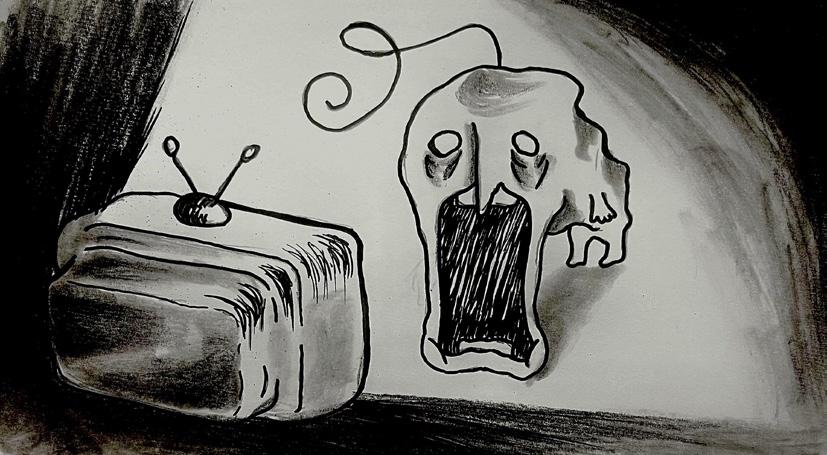
PLAYING THE ODDS
Students experiment with sports gambling. (Scene, pg 6)
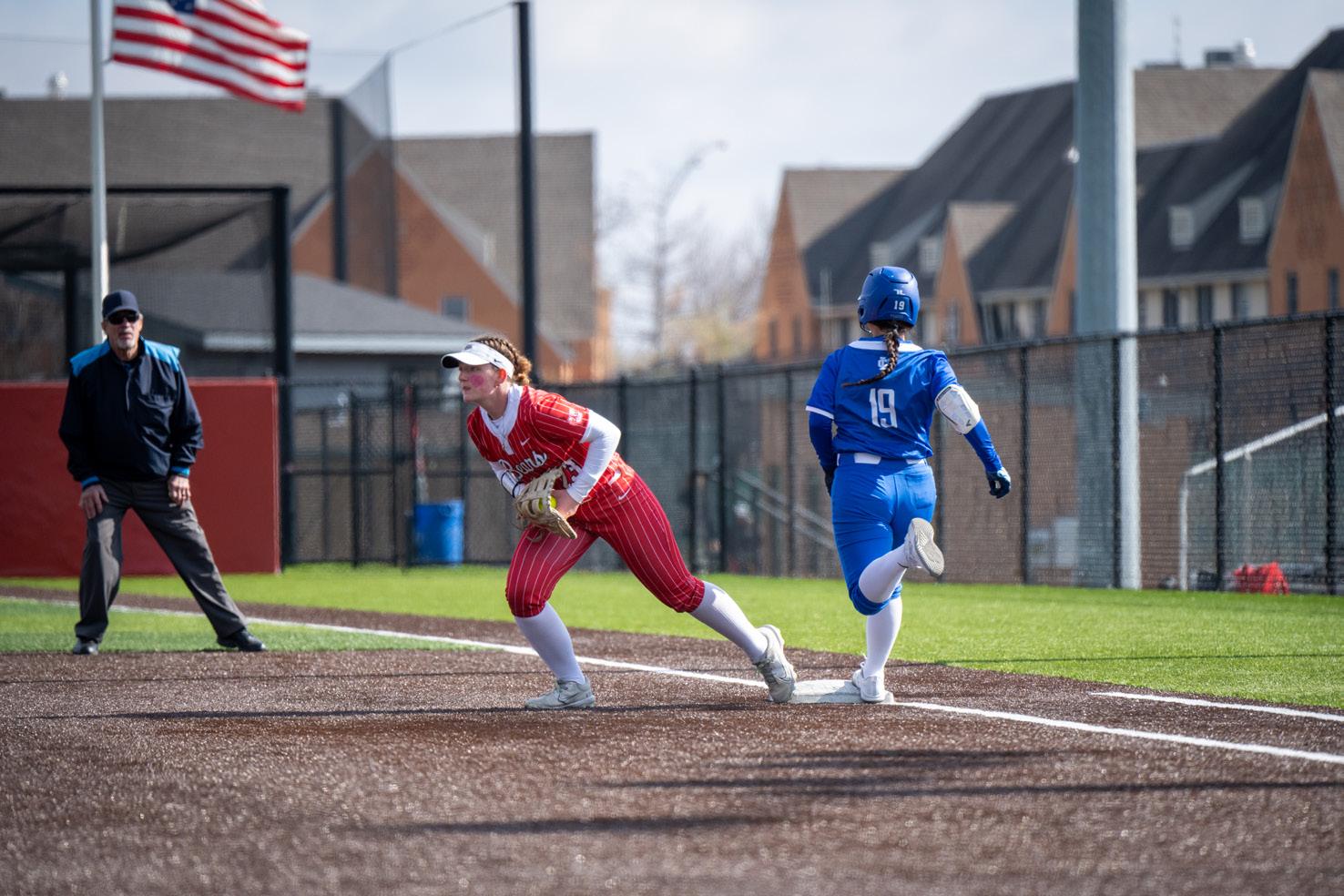
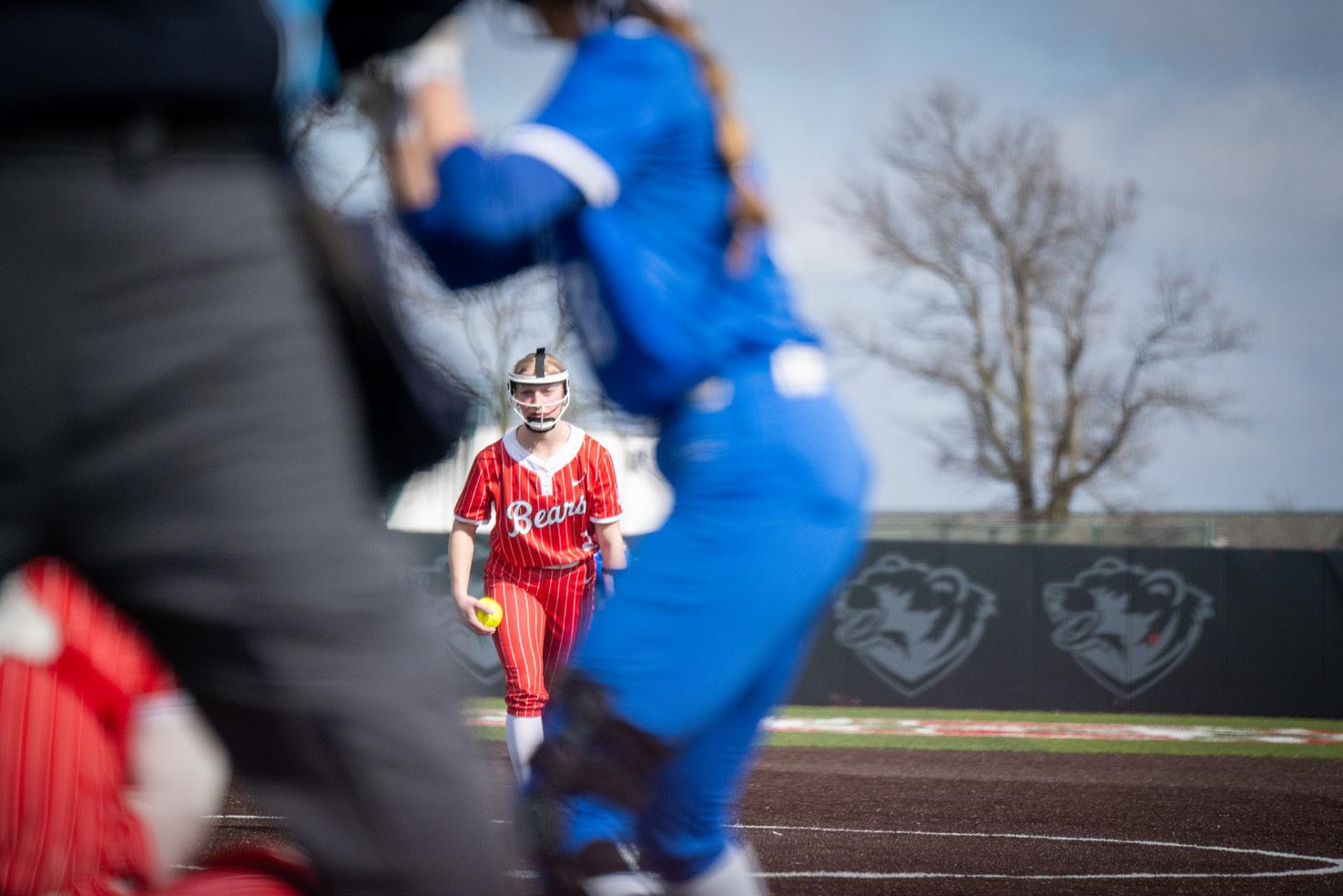
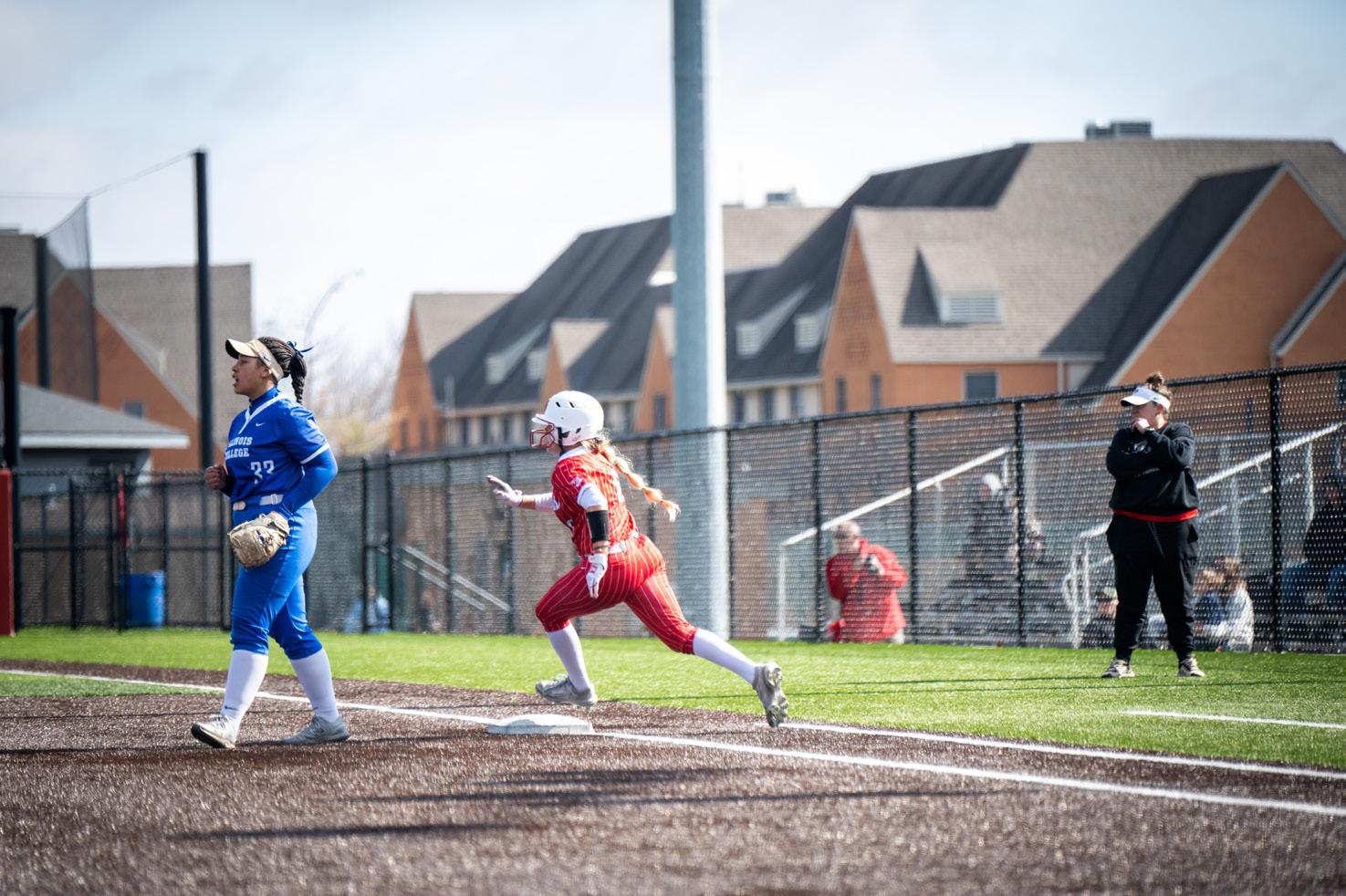
OPENING DAY
With first-years’ contributions, softball sweeps Illinois College. (Sports, pg 8)
Mayor Cara Spencer urges a unified approach to city issues WashU experts discuss unrest in Minneapolis
St. Louis City Mayor Cara Spencer discussed the city’s struggles with isolated governance in a fragmented region amid issues with funding and disaster response in Hillman Hall’s Clark-Fox Forum on Wednesday, Feb. 18.
The majority of the talk was spent answering audience questions, which touched on divisive topics like the recent tornado, the presence of Immigration and Customs Enforcement (ICE) in St. Louis, and data centers coming to
the city. The event was part of the Gephardt Institute’s Civic Café series, where community leaders are invited to share their stories of civic engagement.
Spencer repeatedly returned to the difficulties facing St. Louis and the idea of connecting with neighbors. She pointed to fragmentation between the city and county of St. Louis as a factor that weakens the city’s ability to address issues like poverty, disaster response, and racial divisions.
“We are missing that civic infrastructure, in my view, and it’s not as strong, as woven together, and as collaborative as it should be,” Spencer said. “Some of those
challenges that we all face don’t know borders.”
Spencer said that this fragmentation can worsen the issues the city is already facing.
“The city carries the region’s poverty,” Spencer said. “The city carries the region’s homeless population in general, and we have the lowest tax base in the region. It’s an impossible task to be taxing some of the lowest-income residents in the region to be able to meet the highest needs, and we have to be thinking as a region.”
School District of Clayton eyes temporary usage of WashU-owned Fontbonne property
referendum, passing on Tuesday, April 7.
The School District of Clayton is considering using the former campus of Fontbonne University as a temporary space, according to a St. Louis Post-Dispatch article published on Feb. 17. The Fontbonne campus, which was purchased by WashU in 2024 and is located just south of the South 40, could serve as a replacement while the district renovates the current Glenridge Elementary campus. The elementary school renovation plans are contingent on the passage of a ballot proposition this spring.
In the article, Monica Obradovic reported that this proposal had been discussed amongst the district officials. WashU Executive Director for Strategic Initiatives, Erika EbsworthGoold, told the Post-Dispatch that “preliminary discussions” had occurred but that nothing was final. Glenridge Elementary has, according to the Post-Dispatch, faced issues such as “aging plumbing and electrical systems, as well as moisture and air-quality issues.”
Gina Tarte, chief communications officer of the School District of Clayton, wrote in an email to Student Life that many of these plans hinge on Proposition O, a $135 million zero tax rate increase bond
“If approved, Prop O would fund several important projects, including the full renovation of Glenridge Elementary School, which has served the community for nearly a century,” Tarte wrote.
Tarte also said that these conversations about using Fontbonne University’s campus as a space for the elementary school are ongoing.
“District leaders have toured the Fontbonne University campus multiple times to assess its suitability as an elementary swing space and have been in communication with the City of Clayton as part of this exploratory process,” Tarte wrote. “While these conversations are ongoing and no decisions have been made, the District is committed to keeping our school community informed.”
WashU announced its plans to acquire Fontbonne University’s campus in 2024 after the latter’s closing, and no plans have been announced for the space. However, the University has discussed using it as a space to house students.
Chancellor Andrew D. Martin said the University’s acquisition of Fontbonne was a rare possibility in an interview with Student Life on Feb. 5.
“The ability for the University to acquire Fontbonne campus was a generational opportunity,” Martin
said. “It is one that we don’t regret today and won’t regret in 10 years or 50 years or 100 years, because of all [the options] it gives us with regard to future purposes, which can include student residential space, academic space, or other University uses.”
Martin also said that, given the financial pressures the University is facing, the University is thinking strategically about how to use Fontbonne.
“We have slowed down our capital planning process because of the stress the University budget has been under over the last year, and we’re going to begin that process slowly to really understand what our options are and begin to decide how to use that campus as part of a long-term plan, which is something that served us very well when we began developing the South 40 about 50 years ago,” Martin said.
Ebsworth-Goold repeated the same statement to Student Life that she provided to the Post-Dispatch.
“At this time, we do not have an overall plan for potential use of the former Fontbonne campus; additional study and analysis are required,” Ebsworth-Goold wrote.
She also emphasized the University’s desire to support the local school system.
“WashU always strives to be a good neighbor and community partner,” Ebsworth-Goold wrote.
Amid rising tensions in Minneapolis surrounding Immigration and Customs Enforcement (ICE) raids and reports of public brutality, a panel discussion was held on Tuesday, Feb. 17, examining the significance of current social movements and the role civic action has played in shaping their impact locally and across the United States.
WashU’s Departments of African & African American Studies and American Culture Studies held a discussion about the current social movements in Minneapolis and across the U.S. The panelists were Vetta Sanders Thompson, E. Desmond Lee Professor of Racial and Ethnic Diversity at WashU’s Brown School; Andy Andrews, sociology professor and director of graduate studies in sociology; and Sherita Love, a facilitator at Crossroads Antiracism Organizing and Training in St. Louis, sat down to share how civic action has contributed to the significance of these movements. The event was moderated by Kia Caldwell, professor of African & African American Studies.
Since the start of 2026, ICE has killed two bystanders in Minneapolis, inflaming a social movement throughout the city as people protest ICE’s actions. The discussion opened with panelists reflecting on the significance of this moment, marked by growing unrest in Minneapolis and across the nation. Love began by recognizing similarities between activism today and past movements, highlighting past successes, and encouraging people to try to learn from them today.
Love also stressed the importance of continuing the movement even when the initial spark dies down.
“We learn lessons from those who came before us. Who matters? Who doesn’t? Who gets to say what justice is and what it’s not?” Love said. “And what do we do in the interim, when the cameras go away, when this is no longer a headline?”
Andrews analyzed the different protest movements throughout the first and second Trump administrations, noting the inability of movements to capitalize on previous opportunities to create long-term political, cultural, or social change. He explained that although the Trump administration has attempted to suppress protest efforts through heightened violence, this has instead created more anti-ICE sentiment.
“There have been moves by the Trump administration that, in a sense, have played into the hands of weakening its larger project,” Andrews said.
Sanders Thompson then analyzed the situation from her background in psychology, explaining the mental toll that social movements take on participants. She said that as protesters are put on the front lines, handling difficult situations and often police brutality, it is a mental challenge for all those involved.
“What I see as a [clinical] psychologist is the potential for a mental health crisis,” Sanders Thomspon said.
She continued by explaining the reduction of resources for psychological support in the U.S. and warning how that may affect protesters. She cautioned people considering partaking in activism to be mindful of their own mental health.
“The significant level of anxiety, stress, and trauma that have occurred under this administration, with the funding cuts that we have seen, completely stripped the major agencies responsible for community response to mental health,” Sanders Thompson said.
The floor was then opened to audience questions, with one attendee asking whether the current period resembles any previous moment in U.S. history or if the present circumstances are unique. Love argued this period in American history is truly unprecedented, claiming that checks and balances in the U.S. have been broken down and that the Trump administration has discarded the rule of law.
“How long can we not think of this as a fundamentally different moment?” Andrews said.
When asked how individuals can best engage in activism, the panelists emphasized that there are many different ways to participate in social movements. Andrews explained that if front-line protesting is not something that you are willing to do, there are other forms of “low-cost activism” that people can engage in. He said this could mean engaging in social media work and volunteering in ways that aid protesters without joining them.
Sanders Thomspon stressed the importance of self-care and setting limits.
“Everyone can’t do everything,” Sanders Thompson said. “You need to figure out where you fit.”
Another audience member asked how individuals can cope with feelings of hopelessness when it seems that much of the government they once knew and trusted has eroded. Sanders Thompson emphasized the importance of unity and continuing the current effort.
“As long as hope is present, people will act,” Sanders Thompson said. “When people are so overwhelmed that they won’t activate anymore, that’s when hope is lost.”
WILLA MARKS CONTRIBUTING WRITER
RACHEL BENITEZ-BORREGO | STAFF PHOTOGRAPHER Mayor Spencer speaks with the moderators Dana Chapnick and Aliyah Wilcox at Wednesday’s event.
BENJAMIN MCKINLEY | CONTRIBUTING PHOTOGRAPHER
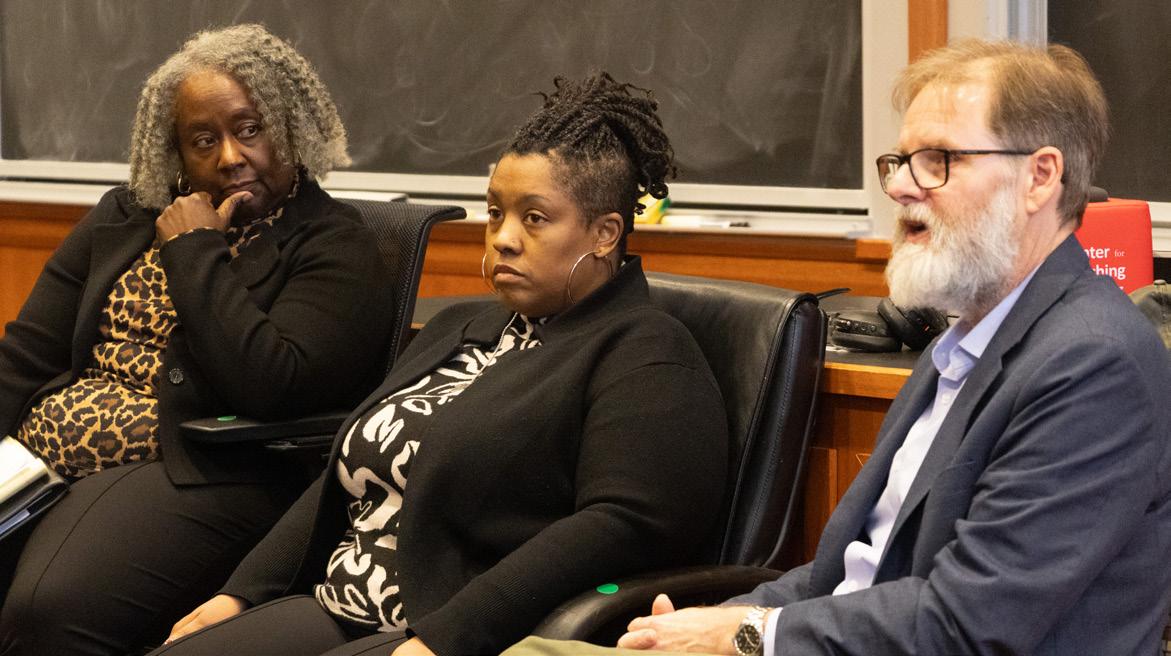
Panelists Sanders Thompson, Andrews, and Love analyze the impact of the recent protests in Minneapolis.
New York University’s Helga Tawil-Souri reimagines infrastructure and mapping in Palestine
PRANATHI MURTHY
OLIVIA SALINGER STAFF WRITERS
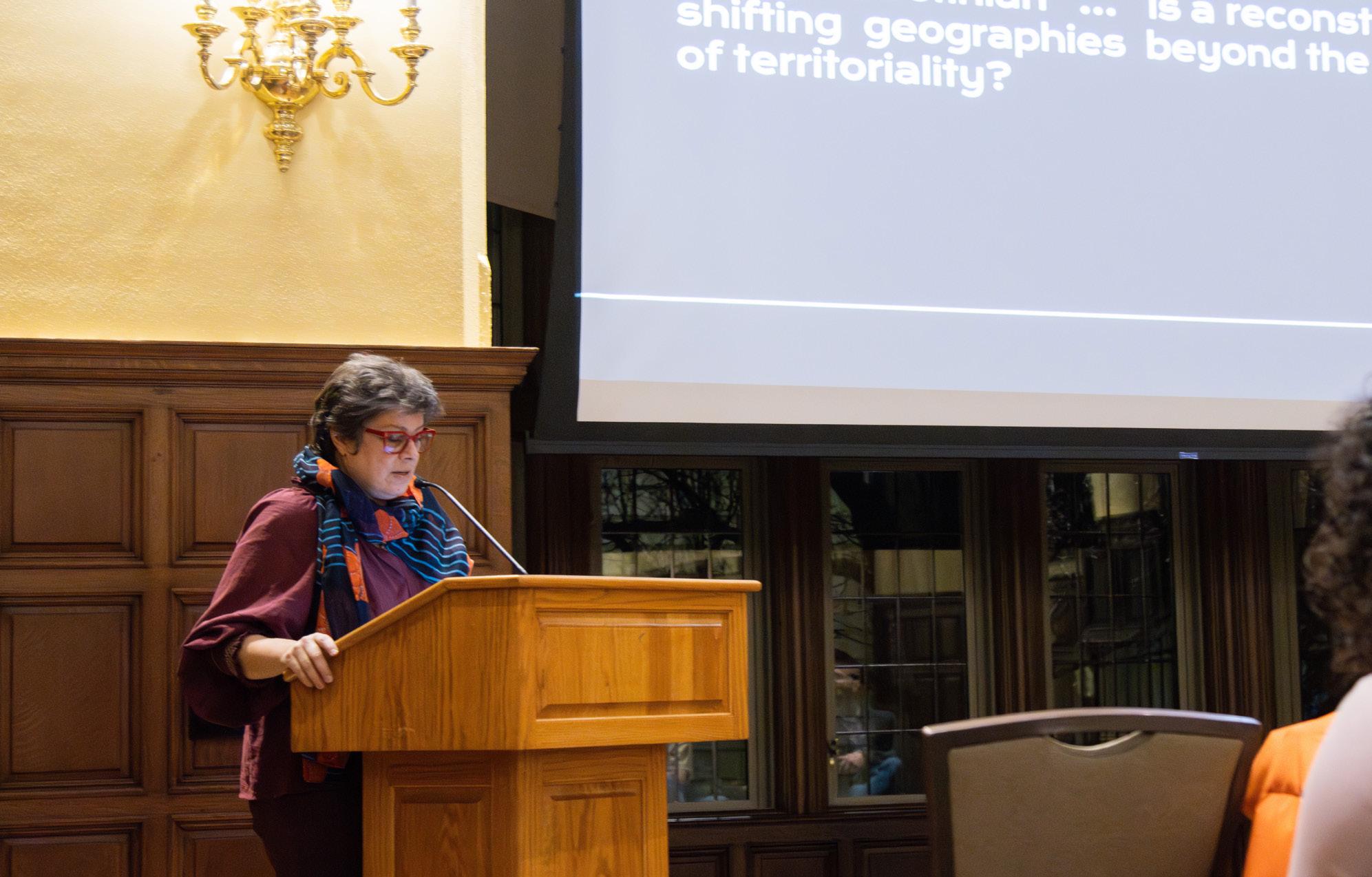
Palestinian-American scholar Helga Tawil-Souri, co-editor of “Producing Palestine” (2024) and “Gaza as Metaphor” (2016), gave a lecture entitled “Spacing Palestine: Mapping and Speculative Infrastructures,” which examined how Palestinian identity should be understood beyond fixed territory and through shifting geographies, diaspora, and alternative technological systems, Feb. 12.
The event, hosted by WashU’s Department of Jewish, Islamic, and Middle Eastern Studies (JIMES), centered on what it means to be Palestinian.
“What if we allow ourselves to embrace that being Palestinian is a reconstitution of shifting geographies beyond the confines of territoriality?” Tawil-Souri said.
Tawil-Souri, who is also an associate professor of Middle East and Islamic Studies at New York University, argued that Palestinian life is defined by the ongoing negotiation between mobility, constraint, and displacement and belonging rather than an attachment to a single fixed geography.
“Palestinians live with and in constant tension about space. There really is no one correct, central, or authentic departure point from the nominal geography of Palestine,” she said. “It is the disappeared places. It is the shrinking contemporary reality of the territories. It is
the pan-territorial experience of exile. It is an uncertain future.”
From this framework, Tawil-Souri turned to mapping as a way for Palestinians to negotiate memory, loss, and presence beyond territorial confinement.
“Movement within, out of, and into Gaza is largely determined and constrained by Israel,” she said. “So too is communicative movement. All electronic communications are under the complete control of Israel.”
Tawil-Souri proposed the Internet Pigeon Network (IPN) as a potential communication infrastructure, utilizing homing pigeons to carry digital data between Gaza and external landing points in countries like Jordan and Egypt. The concept imagines locally built pigeon networks as alternative infrastructures of communitybuilt connection, replacing centralized communication infrastructure.
“The pigeons would replace that last mile or middleman supplier, where Israel is constantly in control of that sort of infrastructure and that communication,” Tawil-Souri said. “By relying on pigeons rather than cables, the IPN decreases the network’s dependence and complexity, replacing agency in the community that it serves. It limits Israel’s surveillance capability and the profits that it extracts by the dependence that it enforces.”
Jonathan Judaken, professor of history and chair of the JIMES department
MAX SILBERG | CONTRIBUTING PHOTOGRAPHER
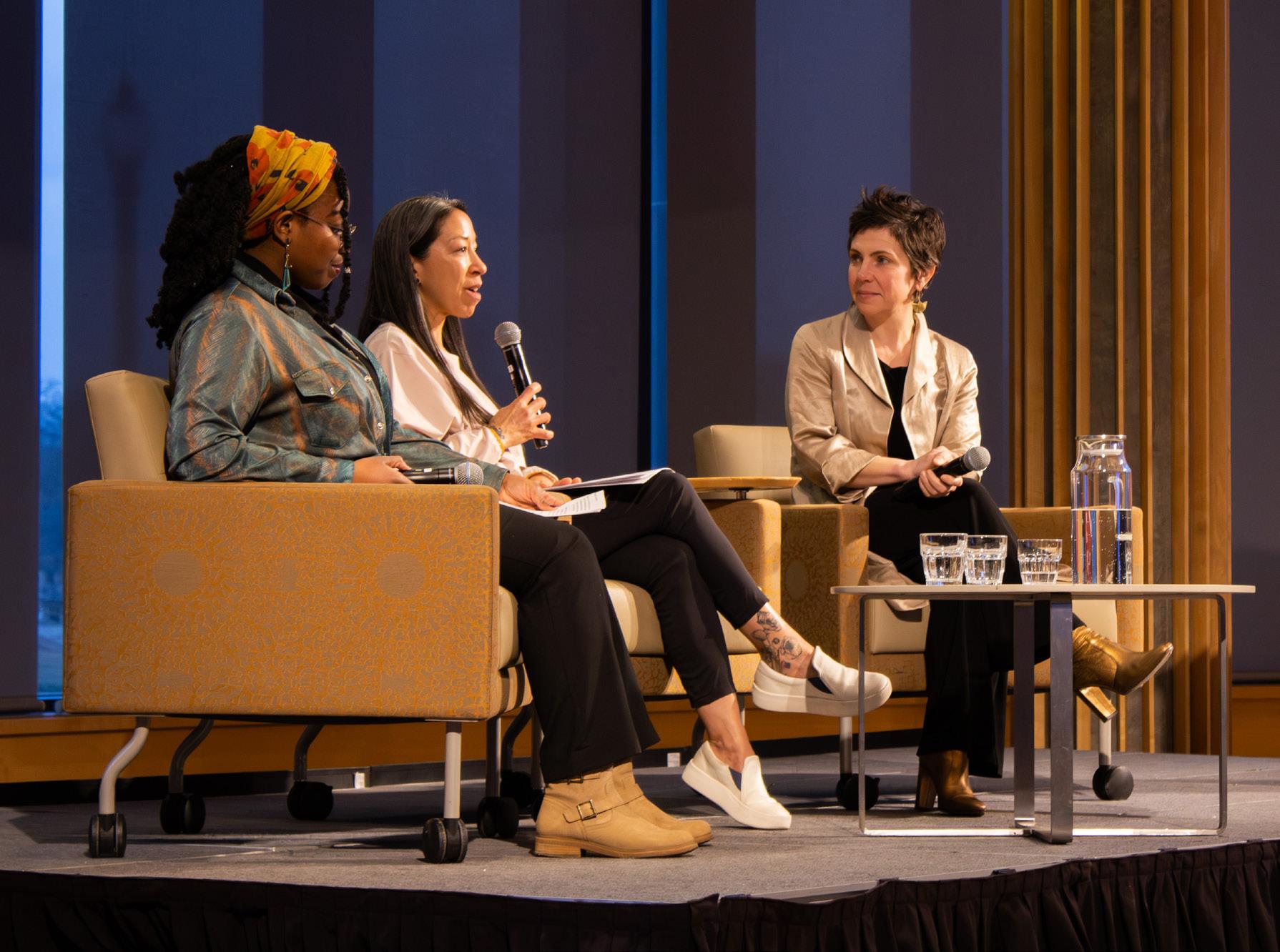
Helga Tawil-Souri talks about reimagining Palestinian infrastructure and mapping through the speculative International Pigeon Network.
at WashU, said his initial reaction to the lecture’s speculative infrastructure example was one of catastrophe since it suggested going back to ancient technologies as a means of communication. However, he said TawilSouri reframed his perception during the discussion, emphasizing the acceptance of new possibilities for communication rather than thinking of it as a catastrophe.
“Her response to my question about that felt really positive, like it’s not postapocalyptic, because this is all about how we can think beyond catastrophe, before catastrophe, and open ourselves to new possibilities that
don’t end up leading down that path,” he said.
Judaken added that the lecture’s themes extend beyond the Israel-Hamas war.
“It’s not only in the context of Israel-Palestine or of Gaza that we need to think about the kinds of issues that were discussed,” he said. “Whether that’s the question of rethinking our identities, rethinking the way we think about space and time, or rethinking the ways in which we communicate with other people, which were three parts of her talk.”
An attendee, Dylan Zielonko, said the talk shifted his assumptions about how the region of the Middle East is typically discussed.
WashU introduces new biochemistry major for fall 2026
Chemistry for the Life Sciences, will replace the original one-year physical chemistry sequence required for biochemistry students in the chemistry department.
WashU will introduce a new joint biochemistry major in fall 2026, combining the previously separate tracks in the biology and chemistry departments into a single program. For the Class of 2030, the major will replace earlier biochemistry tracks, while those in the preexisting tracks will have the option to switch into the new major.
Previously, students pursuing biochemistry selected either the molecular biology and biochemistry (MBB) specialization in biology or the biochemistry specialization in chemistry. Although both shared foundational courses, the upper-level requirements and research opportunities differed by department.
According to Joseph Jez, Spencer T. Olin Professor in Biology and former department chair, the redesign reflects the evolving scope of the field.
“The separate tracks don’t reflect modern biochemistry, which spans atoms to organisms,” Jez wrote in an email statement to Student Life.
“Each track lacked something that could be complemented by the other.”
The new major retains the traditional foundation of introductory biology, chemistry, physics, and calculus, but restructures the core curriculum. While the two-semester biochemistry sequence is still required, a new course, Physical
Additional coursework in math or data science beyond introductory calculus will also be required. Jennifer Heemstra, Charles Allen Professor of Chemistry and chair of the chemistry department, said this reflects the increasing role of large-scale data in modern research.
Students can be more biologyleaning or chemistry-leaning,” Heemstra said. “This flexibility was intentional, so that each student can tailor the major to their own interests and career goals.”
The program honors and research capstone requirements have not yet been finalized and may take the form of either a written thesis or an oral presentation.
Heemstra said students who declare before a decision is made will be allowed to com-
“The separate tracks don’t reflect modern biochemistry, which spans atoms to organisms. Each track lacked something that could be complemented by the other.”
“A very high proportion of research at the interface of chemistry and biology relies on large datasets,” Heemstra said. “Students need training in statistics and data analysis to handle this effectively.”
Beyond the core, students must complete 24 units of upper-level coursework, including at least one advanced laboratory course. Unlike the previous tracks, students may now choose upper-level courses from both the biology and chemistry departments.
“In the advanced electives, there is no defined balance.
plete either approved option. Departmental awards are also still under discussion; for now, Ram Dixit, George and Charmaine Mallinckrodt Professor and chair of the biology department, wrote that students in the new major will remain eligible for prizes through the biology department, for now.
Arowyn Casenhiser, a sophomore currently in the biology department’s MBB specialization, said she is still considering whether to switch into the new biochemistry major. She described the program as offering a
chance to expand academic choices beyond one particular department.
“I like that the major allows students to take courses from both departments instead of being confined to just one,” she said.
Casenhiser acknowledged that while the new program offers flexibility, there are still aspects she wants clarified. She emphasized that the research capstone’s structure is a key factor in deciding whether to switch, as she feels it will directly affect the type of research experience she can gain.
“I want a capstone that gives students hands-on research experience,” she said. “That’s really important to me, since I’ve been doing research since high school and I’m planning [on doing] an MD-Ph.D. track.”
Assistant Dean for PreHealth Advising, Steve Findley, noted that while the major offers a different structure and new course options, it is not expected to significantly alter students’ preparation for medical school.
Heemstra emphasized that students switching into the new biochemistry major from existing tracks will have a clear pathway.
“If students have already taken courses in one of the existing majors, we want to make this easy,” Heemstra said. “We encourage them to reach out to me, Professor Jez, Professor Dixit, or either of the directors of undergraduate studies, and we will help identify the best pathway.”
“The thing that was very surprising to me was, maybe, considering the state of Palestine from perhaps a stateless perspective,” Zielonko said. “A lot of conversation is very much based on rigid borders, and to hear one that was more post-border was interesting.”
Samira Saleh, a senior majoring in sociology and Spanish, explained that this talk recontextualized her Palestinian identity.
“I’m Palestinian. It [is] something I’ve been definitely navigating at WashU amidst our political climate and tensions surrounding this issue,” Saleh said. “A lot of the discourse about this
issue surrounds the importance [of] land, and that’s something that has always been really symbolic in the Palestinian identity. Learning how to possibly reach a point where an identity can be formed without land is really eye-opening.”
Tawil-Souri said part of the work of activism is to continue talking about Palestine even when it is hard to do so.
“It’s really important to keep talking about Palestine, particularly as more repression and suppression and silence seem to be happening,” Tawil-Souri said. “[Especially] in this moment where it has just kind of fallen off the mainstream media.”
Pentagon considers cutting tuition aid for active-duty graduate students at WashU and 33 other universities
ZACH TRABITZ MANAGING NEWS EDITOR
The Department of Defense (DOD) may cut off tuition assistance for active-duty service members pursuing graduate education at WashU, along with dozens of other elite universities, according to a memo signed last week by Secretary of Defense Pete Hegseth.
Harvard University was the only university explicitly named in the Pentagon memo, but graduate programs at other elite universities, like WashU, Brown University, and Columbia University, may also be affected, according to a list compiled by the army and reviewed by CNN.
“In two weeks’ time, components of all of our departments — Army, Navy, and Air Force — will evaluate all existing graduate programs for active duty service members at all Ivy League universities and other civilian universities,” Hegseth said in his Feb. 6 video posted to X.
In an accompanying press release, the Pentagon said graduate programs will be evaluated on whether they are worth the tuition as compared to public universities.
“The goal is to determine whether or not they actually deliver cost-effective strategic education for future senior leaders when compared to, say, public universities and our military graduate programs,” the press release said.
According to WashU’s Office of Military & Veteran Services, the Danforth Campus is home to numerous military-connected students, including active-duty service members, veterans, reservists, and military family members. The University also participates in a range of DOD-affiliated educational pathways, including ROTC programs and federally funded scholarship initiatives such as the Air Force Health Professions Scholarship Program. Julie Flory, vice chancellor for WashU Marketing and Communications, declined to comment.
‘Labor of Love’: WUGWU Valentine’s Day cards to chancellor highlight student concerns
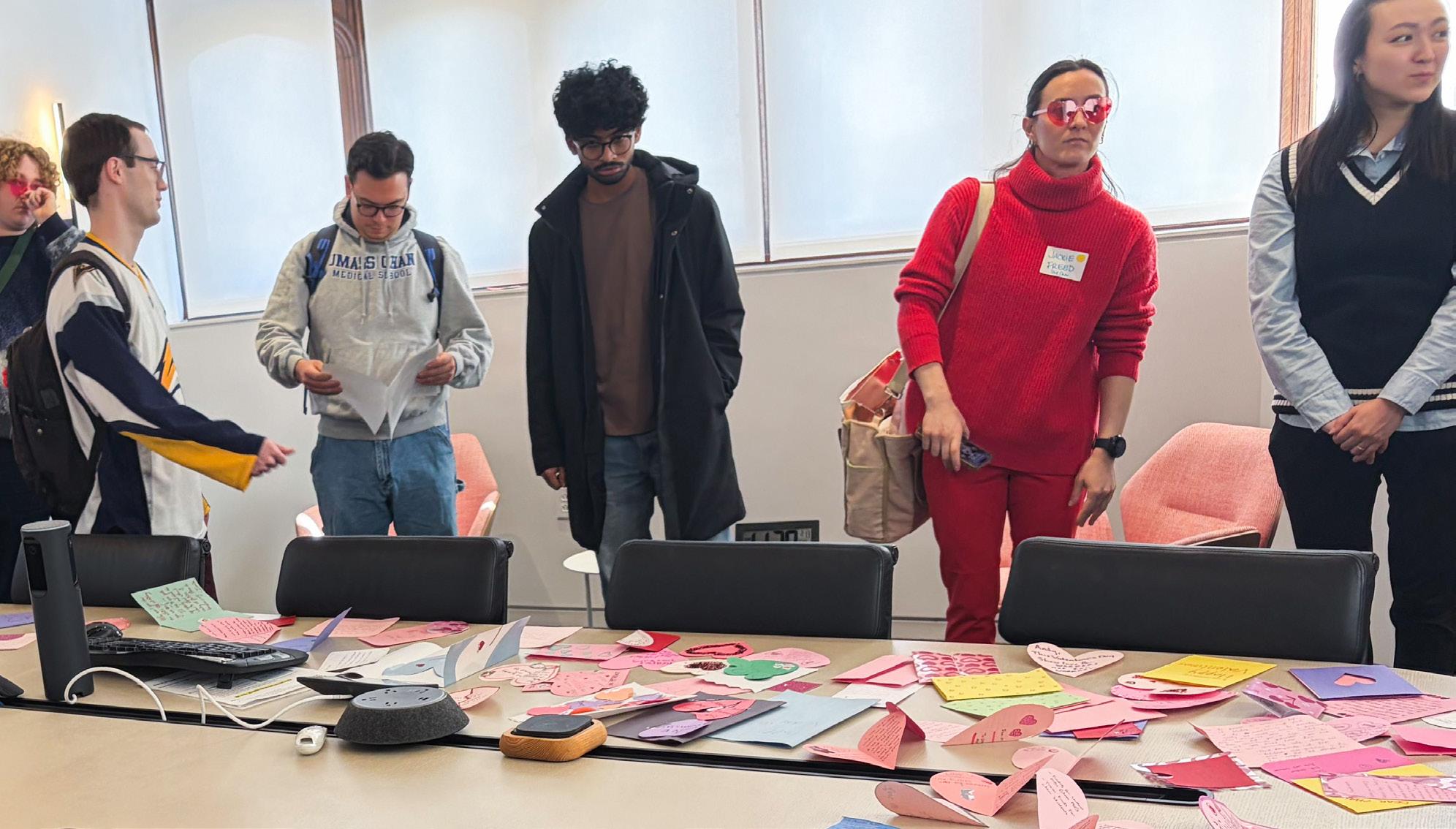
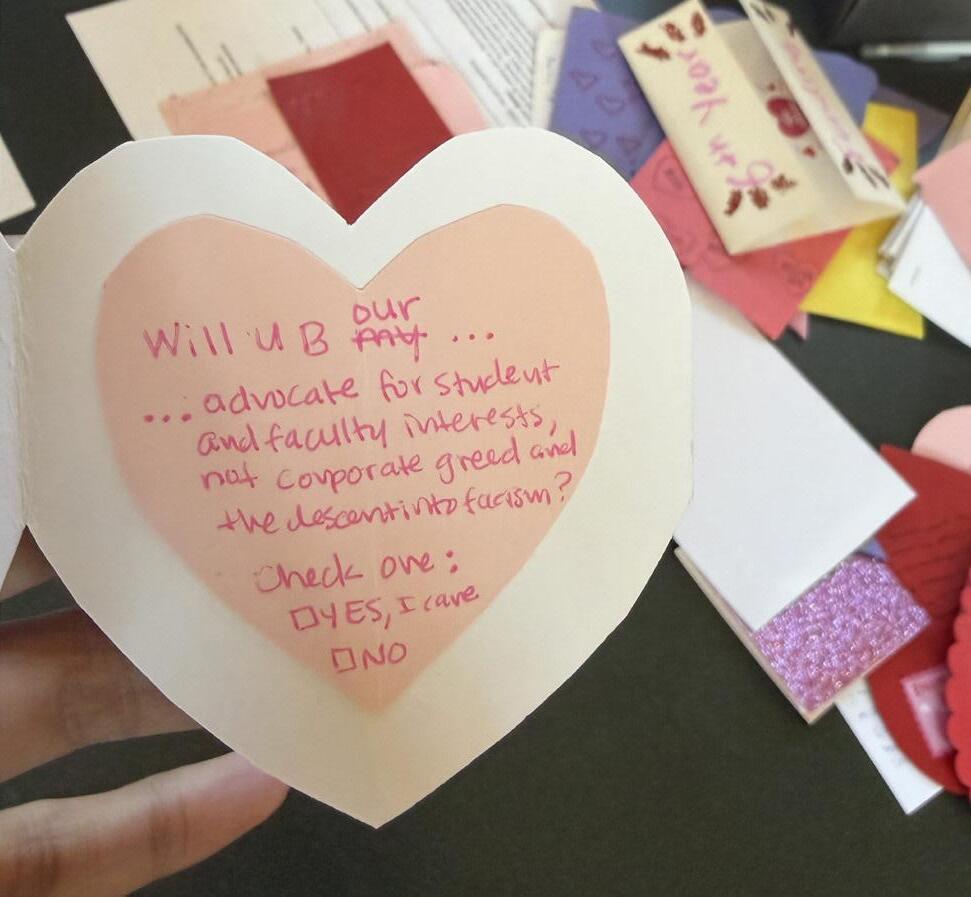
Approximately 20 members of the Washington University Graduate Workers Union (WUGWU) delivered 150 handmade Valentine’s Day cards to the chancellor’s suite in Brookings Hall on Friday, Feb. 13.
WUGWU collected the cards from graduate students, many of which describe improvements they would like to see at WashU.
Holly Rosewood, a Ph.D. student in the history department, said that even though many of the cards detailed policies that WashU could improve, she ultimately described the efforts as a “labor of love.”
“We all want to be here, and we want to be creating educational spaces,” Rosewood said. “We all want the University to do better. That’s why we’re taking the time.”
Because Chancellor Andrew D. Martin was out of town due to travel, Joshua Walehwa, associate vice chancellor and chief of staff,
received the cards and listened to student statements, which focused on areas to improve University support for graduate students. Walehwa said he planned to read the cards and later share them with Martin.
“The timing is off in terms of the chancellor not being here, but I just appreciate your thoughtfulness,” Walehwa said to the students who delivered the cards.
Since its founding in 2016, WUGWU has advocated for WashU to recognize graduate students as workers for their labor as researchers and instructors and to provide employee benefits.
“I study labor history, so I know without a doubt that what we do is work, even though we may not be classified as workers,” Rosewood said. “[We] want to be treated as real employees, and have benefits that reflect that, whether that’s better healthcare, vision care, childcare. [Just] reciprocating care that we give to the University,” Rosewood said.
Sherlyn Contreras, a Ph.D. student in Plant & Microbial
Biosciences, said they believe WashU does not extend enough support to first-generation students.
“I’m a child of immigrants,” Contreras said. “I’m first-gen, in all ways. … As we move up in education, we feel the most impact of not being supported. I was displaced during May, in the tornado, and the one [housing option] WashU kept pushing out was a $60 per night stay. That’s more than Airbnb.”
The cards also raised concerns introduced by the current political climate, particularly about threats to immigrant students from Immigration and Customs Enforcement (ICE). Jackie Freed, a Master of Social Work student, expressed a greater need for emergency preparedness for possible interactions with ICE.
“The University should be providing clear guidelines on what to do if ICE does enter campus because we have seen that [at] other universities. They are now apparently allowed to go into churches and schools,” she said.
Walehwa acknowledged that several participating students wanted greater clarity on WashU’s level of commitment to immigrant students so they can set realistic expectations about the University’s response.
“What I’ve heard from this conversation is ‘If there is an approach [to ICE], we’d like to know,’” Walehwa said.
Students also expressed concerns about funding cuts in the College of Arts & Sciences. John Naughton, a Ph.D. student in the math department, pointed to the elimination of 6th-year funding for Ph.D. students across disciplines.
“[It] is really going to reduce the ability of students currently here to finish their research programs and to be competitive in an increasingly difficult job market,” Naughton said. “It’s also going to affect [the] ability to attract more excellent graduate students in the future.”
According to Naughton, the University also cut stipend lines, contributing to a smaller cohort for math Ph.D.
SPENCER
from page 1
Spencer said rebuilding from the tornado on May 16, 2025, has been a particularly difficult task for the city, given a lack of funding, especially as federal money promised to the city for disaster relief hasn’t yet been disbursed.
“We don’t have a longterm funding source,” Spencer said. “We don’t have the funds right now to rebuild, but we are pushing for them.”
She added that the tornado response has brought together the city, county, and state, something she said feels like a turning point.
“I am very hopeful because the region is coming together and is willing to have dialogue in ways that I haven’t seen,” Spencer said. “The state is working with the city; St. Charles County
is picking up the phone when I call, and vice versa.”
Spencer said that the response has required considerable effort and continued communication.
“We’re having to build relationships where they didn’t exist before, and being willing to really come to the table over and over again … to understand where our goals overlap and to be able to be willing to work past differences,” Spencer said.
Spencer said that this communication is paramount, both on a governmental and interpersonal level. She added that it has informed her approach to governance.
“The answer really is just to listen to your neighbors,” she said. “Being informed by your community [and] willing to change your mind is so important.”
While the evening began with pre-written questions from the Gephardt moderators, most of the event was filled with questions from the audience. Spencer’s willingness to answer over a dozen audience questions impressed some in attendance, including Erika Porter, a Master of Social Work student at the Brown School.
“I didn’t expect her to be able to answer every question because we hit her with questions from different areas, but she was approachable, friendly, and she appeared transparent,” Porter said.
One of the areas the audience asked about was Spencer’s response to the continued debate over the new data center located near the Armory building. Spencer said that her job as
mayor is to find as much utility for the city in a situation where her hands are somewhat tied.
“I know that rates will increase for [those that live in St. Louis] when data centers go in, whether they go in the city of St. Louis or they go in St. Charles or beyond. The question is, will the city benefit, from a tax perspective, or in some other meaningful way, by having [a data center] in the City of St Louis?” Spencer said. “To some extent, we know they’re coming. We know they’re here.”
Another audience member asked whether Spencer had any desire to run for state or federal-level office.
“I don’t have any ambitions to go beyond [mayor], particularly because I love the nuts and bolts of municipal government,” Spencer
students, from 11 in 2022 to four in incoming classes. He added that this reduction has had a trickle-down effect on undergraduate students taught by Ph.D. students.
“The caps on our smallest discussion sections have increased from [21] students to 32 students,” he said. “It really affects the ability of the students to participate and to learn to the fullest extent, and to the extent that they deserve.”
Walehwa said he believes that the University’s actions reflect a commitment to longterm planning.
“I cannot speak on behalf of the chancellor, but what I do know is that leadership is committed to WashU now and WashU in the future,” Walehwa said. “[Leadership considers] how we can be good stewards and make sure that folks in the future get the privilege of doing what you are doing right now,” he said.
The WashU Investment Management Company describes its commitment to longevity as “willing to take calculated risks and innovate in the long-term best interests of the University.”
Ty Easley, a Ph.D. student
said. “When you get into bigger systems, it becomes much more ideologically based, and I’m more focused on how to make government work better on the local level. I love my job.”
to the WashU community, offering a call to action to engage directly with the city of St. Louis and to choose to live permanently in St. Louis.
leave campus on a regular basis and participate in the
in the math department, questioned whether continued dialogue with the Trump administration truly supports longevity.
“The administration’s public actions give the impression that it believes capitulating to fascism is a good thing for its long-term longevity,” Easley said. “And that is a wildly ahistorical belief.”
Bobby Huggins, a Ph.D. student in computer science and engineering, said that long-term planning should extend beyond finances.
“[Financial security] is not sufficient. The important thing is that we protect our academic values, our commitment to academic freedom, [and] to creating a welcoming environment for all students,” he said.
Huggins hopes that the conversation with University leadership will extend beyond the Valentine’s Day demonstration.
“We appreciate that someone was there to hear out our concerns, but it was important to us to speak with someone who was able to give concrete answers,” Huggins said. “We hope to hear back from the chancellor’s office publicly.”
economy, where you can support local businesses and to get to know the surrounding municipalities,” Spencer said. “You’re getting world-class education here in St. Louis, some of the best in the world. We would love to root you here and to keep you here and to build an economy that is not only nurtured by your presence, but furthered by Nicholas Demba, Junior News Editor, contributed
The annual search for editor-in-chief of Student Life has commenced Student Life editors interview applicants and submit one or more applicants to the Board of Directors which makes the final decision
SONAL CHURIWAL | STAFF WRITER
SONAL CHURIWAL | STAFF WRITER
Members of WUGWU presented Valentine’s cards at the chancellor’s suite that outlined desired changes for the University.
WUGWU’s cards highlighted concerns over benefits, threats to immigrant students, and stipend reductions.
FORUM
Bad Bunny’s halftime show was political
JALEYSHA LUNA CONTRIBUTING WRITER
As I watched Bad Bunny remove his earpiece and walk off the field, I smiled. His performance was one full of lively music, beautiful choreography, and wonderful sights. I couldn’t help but feel proud and impressed. After all, he delivered a beautiful message. It wasn’t until my screen lit up with a text from a friend, “I wish Bad Bunny’s performance was more political,” that confusion clouded my thoughts. My friend, whom I had just talked to about the politics behind Bad Bunny’s Grammy acceptance speech, thought his performance wasn’t political enough. It occurred to me that several aspects of Bad Bunny’s performance might be overlooked without prior knowledge of Puerto Rican history. As a Puerto Rican, I thought the performance was lovely, but the best part was the history, storytelling, and parallels drawn between past resilience and current struggle. Bad Bunny’s halftime performance at the Super Bowl was not only a beautiful display of culture and pride but also one of political resistance from past to present.
The performance opened as Bad Bunny emerged from
a sugarcane field. To many, this design seemed random, possibly because sugarcane is tropical, but it is much more profound. Sugarcane has been a central part of Puerto Rico’s history for centuries. Introduced to the island in 1523, sugar immediately became a huge industry in Puerto Rico. For centuries, it was at the center of Puerto Rico’s economy. By the 1600s, it was more profitable than gold. This crop, integral to Puerto Rico’s economy, was founded on exploitation and oppression.
In the 1940’s, Puerto Rico’s government ruled against sugarcane holdings that were larger than 500 acres, and since a majority of sugarcane plantations were this size, the Puerto Rican government bought a large amount of these holdings with the intention of redistributing the land. Though the redistribution varied in success, the industry began to fade soon after.
Bad Bunny’s choice for the set to be surrounded by sugarcane showcases its historical importance to Puerto Rico’s economy. The actors in the opening scene, cutting the sugarcane and seemingly working in the fields, are a reminder of how this industry came along. Throughout the show, Bad Bunny carries the Puerto
Rican flag various times. This isn’t shocking — anyone who knows Puerto Ricans knows we display our flags at every given opportunity.
The version he carries, however, is different from the standard flag. Bad Bunny carries a flag with a shade of blue significantly lighter than its usual navy. This isn’t a malfunction but a purposeful statement.
After becoming a U.S. territory in 1898, Puerto Ricans responded by starting an independence movement. By the 1930s, the movement gained momentum, and people flew the Puerto Rican flag as a sign of resistance and national identity.
In 1948, Law 53, “La Ley de la Mordaza,” made engaging in expressions of Puerto Rican nationalism illegal. Owning the flag could result in up to 10 years in prison or a $10,000 fine. Police and the National Guard could even enter homes without a warrant if they suspected a flag was being displayed. In 1952, the navy blue version of the flag was adopted to match the flag of the U.S. and established as the island’s official flag. Law 53 was repealed in 1957 after nine years, but not before many were arrested and suffered a loss of freedom and representation.
Today, flying the original version of the flag is
still associated with Puerto Rican independence, and it remains a prideful display of national identity. Bad Bunny choosing to display this version throughout the halftime show is a rebellious act of resilience and a display of history.
In a later segment, Bad Bunny takes a shot from a woman. This woman is the owner of Toñita’s Caribbean Social Club in Williamsburg, Brooklyn. Toñita opened her club in 1974 as a meeting place for local baseball players and families, and over time, it became a safe space for Puerto Ricans and Latinos in the community. Over the years, Williamsburg has felt the effects of gentrification, and Toñita has said that she’s been offered money to shut down the club and sell. However, she has no intentions of doing so. Toñita’s act of refusing to leave her neighborhood in Brooklyn is a politically charged act of resistance against the effects of gentrification, and her social club remains one of the last Latino social clubs in New York. Bad Bunny’s decision to include Toñita in his performance of the song “NUEVAYoL” is one that highlights the presence of Latinos in gentrified areas and the importance of resistance
and continued presence.
While climbing a power line, Bad Bunny later performs his song “El Apagón,” which directly translates to “The Blackout.” The song is about dealing with consistent blackouts and having a good time regardless. Puerto Rico has been facing frequent blackouts and a power crisis for decades due to consistent hurricanes and storms. Even without hurricanes, Puerto Rican residents lose an estimated 27 hours of power a year due to blackouts. The visual of climbing the power lines, combined with the song, was a beautifully paired homage to the perseverance of Puerto Ricans, even when
dealing with the effects of terrible natural disasters. Throughout his performance, Bad Bunny presented parts of Puerto Rican history when communities persevered through resistance. In a time when Latino communities are struggling, this performance feels especially meaningful. Though the majority of the history displayed and provided is specific to Puerto Ricans, his message was greater than just us; it was as big as all the Americas. Bad Bunny’s performance was political; it was a reminder to communities everywhere that in times of struggle, unity is needed when fighting for justice.
Holding space: Affinity suites need accessibility
The Ann Whitney Olin Women’s Building, one of the many beautiful brownstones of Danforth Campus, stands at three gorgeous stories tall and is home to the Center for Diversity & Inclusion North Offices, which include the Office for International Student Engagement (OISE); some of the dance and drama studios; the sorority suites; and the affinity group suites.
On paper, this seems like an incredible space, right?
There’s just one massive problem, one that is shared by a select few old buildings on campus: It does not comply with the Americans with Disabilities Act (ADA).
There are stairs leading up to the main entrance, which lack the buttoncontrolled doors found on nearly every entrance and exit at WashU. The accessible entrance, located at the back of the building, leads to the basement. The only way to the ground floor is via a key-operated chair lift, which requires a student to call facility services and wait for the assistance of another person. This lift only allows for entrance to the main floor. The ADA states that buildings with more than one floor must be vertically accessible. For the Women’s Building to meet that requirement, each floor would need a chair lift, escalator, or elevator to allow for access to all floors.
Students with mobility aids are therefore unable to reach floors beyond the basement and main level, and they can only
reach the main level with the assistance of another person. All of the actual community spaces are on floors two and three. Those with chronic pain, fatigue, or asthma may have the mobility to reach the suites, but not without exertion that can cause a flare-up or asthma attack, leading to days out of class spent recovering. These people cannot access the benefits of the communities located in the Women’s Building, like meetings or events.
When not every community member can access a space, the space cannot serve as an authentic or beneficial resource for the community. The purpose of the affinity and sorority suites is to create an environment where students can feel supported by others with whom they share an identity. When even one person is excluded from that space, it prevents the sense of safety and community from reaching everyone who may need it.
Because of the lack of accessibility, few organizations actually use their suites for purposes of gathering and community, as they were intended. Some affinity groups and sororities use their suites as open community spaces; others, like the Asian Multicultural Collective, use theirs to practice various cultural activities.
After 2024, many of the suites decided to stop using their spaces to meet so that they could better serve all of their community members. Pride Alliance, the group that I am a part of — along with the other LGBTQ+ groups that share the Pride Suite — abandoned our space on the third floor to meet
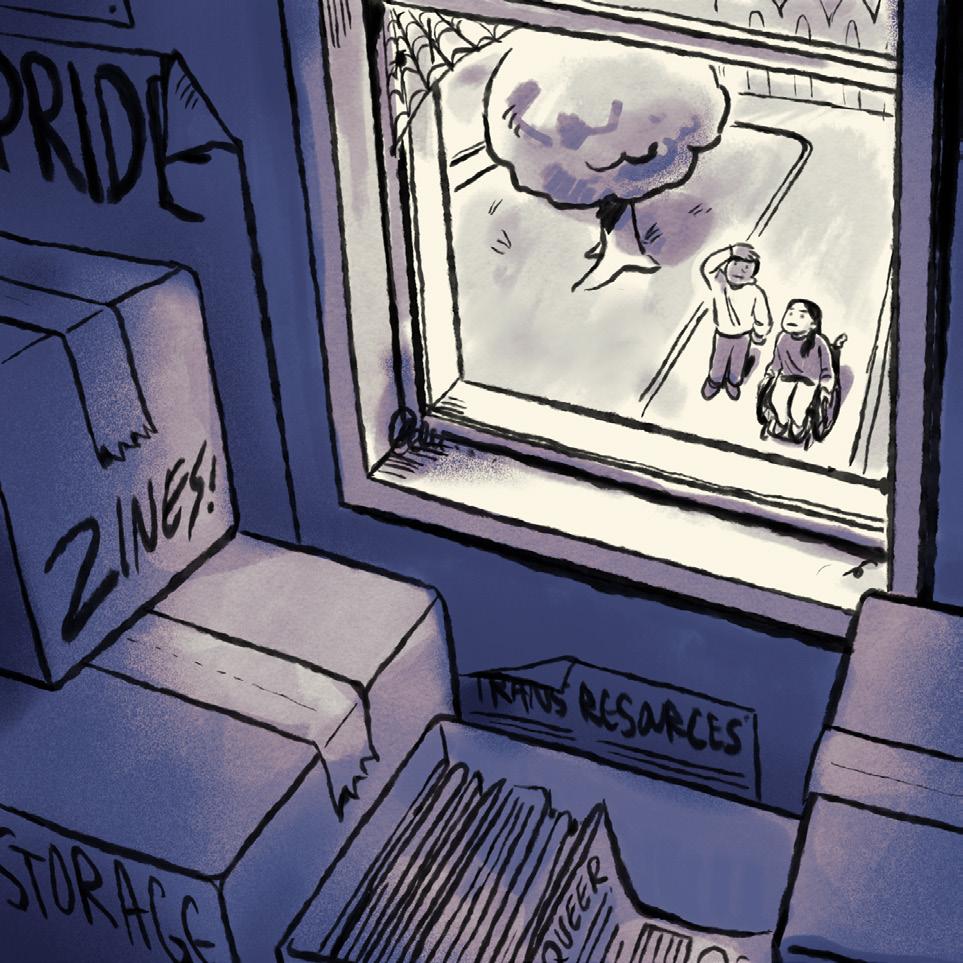
elsewhere on campus. Most groups use their suites solely for storage, including my own.
Pride Alliance, the umbrella LGBTQ+ group on campus and one of five student-run organizations serving the queer community, has its suite on the third floor of the Women’s Building. We, alongside Transcending Gender (who serves the genderqueer community), Ace&Aro
groups and their events, to the small collection of 26 zines made and distributed by Pride Alliance throughout the years, I discovered a long-forgotten trove of decor and supplies for programming.
Throughout this process, I couldn’t help but mourn the loss of what must have been a vibrant community space. When I arrived at WashU in fall 2024, the Pride Suite had been glo-
(who serves our asexual and aromantic spectrum students), MedQ (the premed LGBTQ+ group), and oSTEM (the STEM field pre-professional LGBTQ+ group), are run by queer students, for queer students. Pride Alliance likely started in the early 2000s and has had the suite since around that time.
As vice president (and a man with too much time on his hands and a bonedeep urge to sort things), I took it upon myself to create an updated inventory of the items in the suite. From flyers and tri-fold poster boards advertising long-disbanded student
rified storage for about a year already. Instead of having a dedicated space for programming, we reserve spaces in the Danforth University Center. This adds another layer of organizational complexity associated with planning events. Activities and programming meant to build community and togetherness end up feeling detached and ephemeral, our presence temporary in whatever room we use. I never got the chance to experience the suite when it was alive and full of queer WashU students. So, I phoned a friend. Senior Aspen Groves
has been an active leader and trailblazer of the queer community on campus since her first year. Given her experiences as both a general and an executive member of various organizations, I reached out to her to learn about the old community dynamics in the Pride Suite. Groves told me that some of her first queer experiences on campus were during Transcending Gender meetings in the suite. She reflected on how it felt to have a space dedicated to LGBTQ+ students on campus.
“It felt good to have the space. It was a safe space during meetings and outside of them. During a time where the Missouri government was becoming very openly anti-trans, the Pride Suite was a space for trans people all across campus to come together and remember that we had a community and that we had people to lean on,” she said.
Even with her positive experiences, Groves expressed pride in our community for choosing to move out of an inaccessible space.
“Myself and several of my friends have had issues accessing the suite while it was still in use. The suite is inaccessible to anyone with mobility issues, conditions like chronic fatigue, or even something like asthma … We realized that the suite wasn’t accessible to everyone in our community ... I obviously want a physical space for queer and trans students at WashU, but I’m very proud of the queer community at WashU for putting its people first and moving to more accessible locations,” she said. The saddest part about
the loss of this suite is that it’s entirely fixable. There have been rumors of an elevator getting installed in the Women’s Building for years now, but no sign of any planned construction. The construction budget has been ambiguous, as WashU cancelled the active work to improve Mudd Field and the building of Riney Hall in the spring of 2025, but it also just announced the construction of the new Alumni House and the South 40 housing expansion for underclassmen. It seems that the Women’s Building is at the bottom of WashU’s priorities for improvements. I believe this is likely because the building only has the capacity for studio dance classes. The University makes less money from improving accessibility in the Women’s Building than it would from a building that would provide more space for lecture or lab classes. WashU needs to create a concrete, actionable plan to improve accessibility for the affinity suites. Students and staff in the near future deserve these spaces. We all deserve these spaces, and that means equal access. This isn’t only an issue of accessibility: If the University is not meeting the needs of the students with disabilities in the affinity groups, it is not committing to its institutional goal “to build an inclusive, equitable, respectful, ethically-principled environment for living, teaching, learning and working for the present and future generations.” WashU needs to do better for all of its affinity students and sorority groups.
THESEUS KREICBERGS CLASS OF 2028
JANAE CRESPO | CONTRIBUTING ILLUSTRATOR
REID KELLERMANN | CONTRIBUTING ILLUSTRATOR
From script to set: On production with WashU Film Club
GABE CERDA CONTRIBUTING WRITER
It is 10:30 p.m. on a Sunday, and the Danforth University Center looks empty. But upstairs, a crowd of actors and extras are chatting to pass the time. Purple and blue light floods their faces, and the wall behind them is lined with silver streamers.
Suddenly, the director yells out:
“Quiet on set!”
A hush falls over the room. Nobody makes a sound.
“Camera rolling.”
“Rolling!”
“Sound speeding.”
“Sound speeding!”
“Slate in… and action.”
The lead actress exchanges a few words of dialogue with another actor. In the background, the extras dance in silence. Then she walks off, the camera trailing behind her. The actress’ footsteps are the only sound in the room.
“Cut!”
The room relaxes.
“And that’s a wrap!”
The WashU Film Club had just finished recording for their new rom-com short film, “Meant to Be.”
Although shooting began that Friday afternoon, in many ways, the making of this film began over a year before.
Junior Nicole Backal, director and writer of “Meant to Be” and PR chair of the Film Club, said that the idea for this film came to her over winter break in 2024.
“[I] was obsessing over the idea of meet-cutes and moments like that, [ones] that we romanticize,” she said.
After writing the script last spring, the film was first pitched to the members of the WashU Film Club, but it was not picked up. However, the club tries to do
two productions every year, one per semester. So, Nicole Backal pitched the idea again last semester, and the club voted to make a film based on her screenplay.
Once the spring semester began, so did preproduction.
According to sophomore Dania Backal, a producer for the film, preproduction requires a lot of coordination.
“We have been working on preproduction for several months, which involves scouting out locations [and] actors. We host auditions. We have been working on getting the equipment here,” Dania said.
Through auditions, the producers were able to find their lead and supporting actors. However, the process was not entirely smooth.
Last-minute casting decisions and scheduling issues made it difficult to guarantee that everything and everyone would be in place once production started. Nicole Backal also said they ran into some location issues.
“Obviously, we’re on a college campus, but finding places where you can shoot is still challenging,” Nicole said.
This meant the production team had to leverage the support of Film Club members and their friends to find spaces where not only could they film, but which could also meet the aesthetic requirements of the project. For instance, the second day of production took place in a dorm that did not belong to anyone on Film Club because no one in the club had a room that met the vision of the film. The cast and crew for the production, numbering around 10, could be seen huddled around each other in the hallway of Nemerov House, adjusting sound
Mania PUZZLE PUZZLE
and light equipment, giving feedback on each shot, and quieting when the cameras started to roll. Nicole Backal emphasized the importance of preproduction.
“The past two months have been spent working all day on making sure this weekend happens,” she said.
After the preproduction process has been finished, a production call notice is sent out to the members of Film Club. Here, members volunteer to assist with cinematography, sound, editing, lighting, or can fill in wherever they are needed.
First-year Kelsey Espenshade said being a production assistant (PA) means helping out on set however she can.
“[I’ve done] slating, the board that people have and clap down. I worked on the calendar [props] this morning; yesterday I helped on camera,” Espenshade said. “It’s kind of odd jobs all around, depending on where I’m needed.”
On production is also junior Muqing Niu, the camera operator and cinematographer. As a cinematographer, Niu has the responsibility of realizing the director’s aesthetic vision for each shot. For him, this means relying on instinct but also communicating with the director to understand what their vision for the film is.
Each job has different challenges. For Niu, the hardest part is keeping a line of communication open with the director and understanding the vision of the film. For sophomore President Abigail Brinkmeyer, who, along with her role as president, works as the supervisory editor on the project, this means being aware of how the shots will
work together when editing the final cut, as well as keeping track of what shots the editing team has to work with.
“Every experience is different,” Niu said. “You always meet different people, get into different troubles, and try to fix [them].”
For the director, the challenges associated with the job are no less plentiful. As Nicole Backal explains, a key part of a director’s success is translating her screenplay and ideas, through the actors, cameras, and sets, into a
finished product.
“At the end of the day, I have to tell other people what my vision for the film is and not have them guessing,”
Nicole Backal said. “That includes making a shotlist, which is just an attempt at planning every single shot that is going to happen, … figuring out the casting call, when we can shoot, what we can do. Trying to make sure that we shoot every single scene this weekend.”
Even when everyone is on set, making a movie is a slow and intensive process.
2/12 WINNERS
“Some shots might be five seconds long but sometimes take an hour to film,” sophomore Gaurish Agrawal, a PA, said.
Despite the challenges and setbacks, Nicole Backal finds that, all things considered, the process is an incredibly rewarding one.
“When you are in that moment where you are taking a shot, and it looks good, and the actors are getting it, and the scene is perfect, and it’s everything you imagined, it is so rewarding.”
First Place:
“Exam 1 has been graded, click to view notification” Tamia Prioleau, Current WashU Student
Second Place: SLU announces new satellite campus being built in Seattle titled St. Louis University in Washington. Leo Penny, Current WashU Student
Third Place: Me watching the dumpster fire that is the American government.
Kelsey Weiss, WashU Faculty/Staff
Scan the QR code to enter your submission by 11:59 p.m. on Tuesday.
LIAM THOMAS MCMANAMAN | STAFF ILLUSTRATOR
ERICA SHI | STAFF ILLUSTRATOR
Sports betting comes to campus
SARA GELRUD SENIOR SCENE EDITOR
“Brilliant,” my mother messaged me a few weeks ago on Instagram. When I opened her message, I expected the post she was referring to would be a video of Rick Beato explaining a rock song or maybe even an update on the world of figure skating (two things we love talking about). To my surprise, her “brilliant” was in reference to an ad for the sports betting app Fanatics, featuring Kendall Jenner.
An abundance of sports betting ads has flooded streaming platforms, YouTube, and social media since sports betting became legal in Missouri just two months ago.
“It was weird seeing LeBron [James] on my For You page telling me to bet instead of seeing him dunk on somebody,” junior Julián Villamil said. Villamil placed his first bet just a few hours before our conversation.
“It was wonderful,” he said. “I just won 20 minutes ago. I got 48 bucks like that off my first three-leg parlay.”
In a recent Student Life poll of 206 WashU undergraduates, only 39 (18.9%) have ever placed a sports bet on an app, and roughly half of those who said yes have also placed sports bets during class.
While Villamil has seen various ads promoting sports betting over the past two months, his initial reason for placing a sports bet had nothing to do with a basketball star telling him to. Instead, it was because he needed the money.
According to Villamil, after mentioning to a friend that
he was broke, she told him that her boyfriend won $300 over the weekend on bets he placed on Fanatics. After this conversation, Villamil quickly set up an account and easily linked it to his bank. His friend’s boyfriend sent Villamil $100 in bonus bets, which helped him win $48 from his first parlay (a wager that involves placing multiple varied bets on the outcome of a single game. For example, both the Patriots must win the game and Drake Maye, their quarterback, must complete three touchdowns for the bet to cash.)
“I wish I had bet $100 knowing that I would have won a lot more. But I feel like that’s part of how people get addicted,” Villamil said.
Bonus bets through referrals are a popular way for many to get into betting. Sportsbooks market them as risk-free, enticing first-time bettors to place their first wager. They can cast feelings of false security by making it appear as though a bet will almost definitely cash out in profit, which is not always the case. Bonus bets let individuals boost small wagers with large credits and reap the profits only, not the stake from the bonus.
For example, a bettor can deposit $5 to use a $20 bonus bet for a game at 2-to-1 odds of winning. If it wins, the bettor receives $40 in profit. If the bet loses, the bettor does not incur a monetary loss. Only the $20 bonus credit is lost.
“Most of my friends who made accounts when it got legalized just made the account for the bonuses, and now they’re out of [sports betting],” senior Jeremy Li said.
Percentage of students that have placed a sports bet
Upon Missouri’s legalization of sports betting –– which came as a result of an amendment that passed in the Nov. 2024 election by a slim margin of 0.05% –– Li took advantage of the multitude of bonus bets being offered by different sports betting platforms.
“I made around $2,500 in a couple weeks. But since then, I’ve instantly cooled off from that,” Li said. Now, Li describes himself as “a casual sports bettor” who will place small bets of $5 on games he is especially invested in.
WashU Professor of Economics and Director of Graduate Studies in Economics, Jonathan Weinstein, explained how sportsbooks ensure they always come out on top.
“[Sportsbooks] take a percentage of every bet, effectively. So if you have a game that is effectively equal, both sides are equally likely to win, then if you risk losing $110, you only gain $100,” he said. “But in the way that the payoffs work, the sportsbook will take 5% of the money. So for every million dollars in bets that they take in, they’re keeping about 5%, or $50,000, which is a very healthy profit margin.”
When states legalize sports betting, they collect tax revenue from the industry. Under the Missouri tax code, 10% of profit derived from sports betting is allocated to education and gambling addiction services.
Prior to legalization, sports betting was initially estimated to generate between $20 million and $28 million annually for Missouri. In the first month after legalization,
however, the industry only generated $521,000 in tax revenue, despite $543 million being cast in bets. This is primarily because most of the money cast in bets were from bonus credits, so no money was collected from them. The annual estimation will most likely be realized when new users start betting real money.
Weinstein likened sports betting to trading on the stock market, with the main difference being the percentage of the transactions they keep for themselves: “[The] stock market would be under 1% and sportsbooks are a minimum of 5%,” he said.
More complicated bets, such as parlays with multiple legs, yield an even higher percentage in transaction costs for the sportsbook.
“So what all this means is, in the long run, almost every individual bettor will lose … if you get half your bets right, then you lose. You have to get substantially more than half in order to gain,” Weinstein said.
Despite parlays being the type of bet most statistically improbable to win, they are one of the most popular kinds of bets students place.
Villamil, for example, said he enjoys betting on parlays more than placing straight bets.
Some students prefer to avoid the risks and dangers of sports betting while still joining in on the fun with hypothetical bets. Junior Sanjana Rentala places hypothetical bets with her friends back home as a way to stay connected with them.
“We’ll text each other being like, ‘I would take the under on this,’ but we won’t
actually put money down on it,” she said. “And I have a friend who has a whole other salary just from sports betting. And he makes more money now than his dad because of his sports betting.
… I think that in reality the amount of people that are actually profitable in gambling and sports betting is the 1%, ” Rentala said.
Rentala is correct to assume that a low percentage of players actually win big, while everyone else incurs a net loss.
“Some people really are so knowledgeable about the game that they can actually predict the games better than the market. And that is not easy. Probably less than 1% of all the people betting are good enough to do that,” Weinstein said. “No one should go in assuming that they’re good.”
Rentala’s reason for not betting, despite having a wildly successful friend, is straightforward: “I’m not gonna lose money on something stupid like that. I would be so mad at myself,” she said.
Weinstein emphasized that anyone placing a bet should always be prepared to lose.
He advises that individuals should only bet after setting a fixed budget they are comfortable with losing entirely. Doing so requires discipline, helping to prevent individuals from losing large sums of money and staying aware of their expenses while enjoying the risk of the game.
“When it comes to sports betting, the risk is fun. And I would say it’s not just about the risk. It’s about creating stakes that get you engaged in the emotional flow
5% of women who responded have placed a sports bet
of the game,” Weinstein said. Senior Deven Rozario thinks that betting on sports could create worthwhile advantages for bettors who are disciplined enough to avoid getting addicted to the rush of winning or losing. Unlike Li, who places bets on sports, Rozario bets on prediction markets through Kalshi, a trading platform regulated by the Commodity Futures Trading Commission. Kalshi has been legal in all 50 states since its launch in 2021 but only recently began to include sports betting.
“I feel like the people at WashU are very risk-averse … So if this helps you break out of that shell, become less risk-averse and be more entrepreneurial, I think it’s the best thing you can do, especially if you’re making educated plays about what you’re doing,” Rozario said. In a similar manner, Weinstein compared placing occasional low-stakes bets to completing the crossword puzzle in the morning. “It’s like a mathematical puzzle trying to work out what the best bet is to place.” Among those who place bets at WashU, there is a common consensus that betting is best practiced as a social activity to have fun with friends. Both Li and Villamil keep spreadsheets of their net wins and losses, with hard boundaries set on how much money they are willing to lose before stopping.
“I think that’s an important nuance to know, that sports betting shouldn’t be something that you use to make money. It should just be something to give you a little dopamine,” Li said.
36% of men who responded have placed a sports bet
9.7% of respondents who have placed a sports bet report having placed a bet during class
‘Wuthering Heights’ review: Stunning style with a lacking script
Sketching out a period romance should be easy, and “Wuthering Heights” has all the genre’s trademarks: there are rainsoaked kisses, an impossibly rich man next door… but also a fireplace made out of plaster hands?
Writer-director Emerald Fennell’s screen adaptation of the classic Emily Brontë novel opened this past Valentine’s Day. The film is defined by its rich and moody atmosphere drenched in enough fog and shadows to make Dracula jealous, but beneath that exciting gothic atmosphere, the central love story leaves you wanting more.
The script sets up our starcrossed lovers rather clumsily, when the joyfully immature
Catherine “Cathy” Earnshaw (Charlotte Mellington) meets a young boy (Owen Cooper) her father (Martin Clunes) has adopted. Fennell’s script stumbles through the exposition, hitting all the preordained beats of the pair giggling under the sheets, escaping their gambling father, and hiding out from a rainstorm in a field.
But this is not a typical romance.
Cathy forces her newly adopted brother to accept the same name, Heathcliff, that her late brother had. That dynamic, combined with the fact that Heathcliff soon takes up the role of a stable boy in the employment of her father, creates a slightly unsavory romance that sows the seed for the rest of the twists in “Wuthering Heights.”
Cathy and Heathcliff’s relationship deepens as they grow up into young adults and are replaced by Margot Robbie and Jacob Elordi, respectively.
The first act finishes with Cathy receiving a marriage proposal from her new, rich neighbor, Mr. Linton (Shazad Latif). She finds Heathcliff brooding as he, of course, sweatily cuts logs in a shadowy corner.
What choice does Cathy have? Will their wealth gap keep them apart? Will Cathy choose the rich man or the one she has known since her youth? These questions form the foundation of “Wuthering Heights.” While they may not be groundbreaking, it is from these questions that the script chooses to go
somewhere unique.
Throughout the film, and especially as new locations are added, Suzie Davies’ (“Saltburn”) stunning production design paints a rich portrait of England not tied to a specific period. While somewhat controversial, Davies embraced that choice, saying, “It was most important to distill how Catherine felt, rather than doing your classic period drama. It was about finding the accuracy of that feeling.”
Her highly stylized sets range from a house built out of a mountain to solid, blood-red floors and a room with walls made of suspiciously skin-like leather panels.
When combined with Linus Sandgren’s (“La La Land”) moody cinematography characterized by deep shadows, reflections, and beautiful tracking shots through fog and Jacqueline Durran’s (“Barbie”) costumes which stitch tulle, frills, and plastic into timebending dress concoctions, the world of “Wuthering Heights” is wonderful, wacky, and truly original.
With a score by Anthony Willis (“Saltburn”) and songs by singer Charli xcx, the music provides an additional layer
of gravitas and gothic intrigue with well-held notes and distorted orchestral sounds.
As Cathy and Heathcliff grow apart and are then forced back together, the story grows weirder and more intriguing. Possession and obsession become the focus of the story as the film strays from a traditional romance.
When Nelly (Hong Chau), a house servant for Cathy, begins interfering in her and Heathcliff’s relationship, the story reaches its most interesting point. Chau gives Nelly significant depth and portrays her with so much emotion, even as she is constantly being sidelined by those who are meant to care for her.
But no matter how propulsive “Wuthering Heights” might be, it starts to splinter apart when its weirdness takes center stage in the final act. Fennell struggles to bring the audience along with her, and the characters licking tears off one another or seeing sensual images in bread kneading do not entirely stick the landing.
As Cathy makes her choice but agonizes over the consequences, she cannot quite bring herself to move on and remains caught between the
two men. Charli xcx’s “Chains of Love” plays in the background, repeating the line “I shouldn’t feel like a prisoner.” Unfortunately, the script veers back into the realm of predictability and wraps everything up with wind-blown horse rides and a montage of extended kisses.
“Wuthering Heights” does not handle all of its romantic twists perfectly, and the stunningly artistic sets, costumes, and music can only do so
much. In trying to balance both the crowd looking for a predictable period romance between two movie stars and those looking for a subversive or unique take on the genre, the film ultimately pleases neither. Still, the ride is worth it. Exploring this wonderfully weird and oddly compelling “Wuthering Heights” might just be right up your alley, even if it is not the classic romance it appears to be on the
JAKE ISENBERG STAFF WRITER
LUCIA THOMAS | STAFF ILLUSTRATOR
THOMAS |
SPORTS
With crucial victories over Carnegie Mellon and Case Western, men’s basketball bounces back to boost playoff hopes
RILEY HERRON EDITOR-IN-CHIEF
Eleven games into a “14-round prize fight,” as WashU men’s basketball head coach Pat Juckem described WashU’s University Athletic Association (UAA) schedule Friday, WashU is still standing tall. After being knocked down in a pair of road losses last weekend, the Bears picked themselves off the mat, landing critical wins over Carnegie Mellon University and Case Western Reserve University on Feb. 13 and 15.
“To not get too high or too low, to stay the course, I just give so much credit to the guys [and] their resilience,” Juckem said after the win over Carnegie Mellon on Friday.
With the pair of victories, WashU improved to 5-6 in conference play, the fifth-best mark in the elite eight-team division. The Bears — ranked 21st in the NCAA Net Power Index, the official metric used by the NCAA to determine postseason spots — are still on the right side of the Division III bubble with three games left to play.
Though the wins came against the two weakest UAA squads, a weekend sweep can be hard to come by in the highly competitive UAA, and the Bears’ performances give WashU
the momentum it needs going into a challenging end-of-season stretch against three teams they dropped games to earlier this season.
WashU 73, Carnegie Mellon 64
The Bears’ weekend started with a win over Carnegie Mellon, a team who they had lost to in a 64-61 nail-biter on Jan. 16. This time around, WashU once again held the Tartans to 64 points, but put up 73 of their own to take a much-needed victory.
The Tartans took an early 10-4 lead Friday night, but the Bears tied the game up at 12 before exchanging points for much of the first half. In the final minutes of the opening period, the Bears began to show their mettle, opening up a 35-26 lead off of back-to-back buckets by first-year guard Josh Kim.
The Bears continued the momentum into the second half, extending their lead to 56-39 with 12 minutes to play. The Tartans wouldn’t go away though, scoring 8 straight points to narrow the gap to just 9 points. However, the margin would never get closer than nine, as WashU held off their visitors throughout the final 10 minutes. Sophomore forward Connor May scored 8 points in the final six minutes, and WashU
closed out the 73-64 win to improve their overall record to 14-7.
In a back-and-forth UAA battle, the small things can make all the difference.
WashU retrieved 13 offensive rebounds, compared to just six for their visitors, and turned them into points, scoring 11 on second-chance opportunities. After the game, head coach Pat Juckem pointed to the Bears’ grit as a key factor.
“In our shootaround today, Theo Rocca, who’s a freshman [guard], was like, ‘Guys, it’s just about toughness.’ This is a great competition, everyone’s really good, it’s just about who’s gonna make the tough plays,” Juckem said.
The Bears’ rebounding effort was led by senior point guard Yogi Oliff, who logged 10 boards alongside five assists. May also grabbed eight rebounds while scoring a team-high 17 points.
WashU 92, Case Western 80
Two days later, the Bears returned to the court for a matchup with Case Western, who WashU beat 100-93 on Jan. 18. In another high-scoring affair, the Bears outlasted the Spartans, relying on a strong second half to pull out a 92-80 victory.
Early on, the Bears struggled to contain Case Western senior guard
Anand Dharmarajan, who scored a career-high 35 points in the game. The St. Louis native excelled in his return to the Gateway City, scoring three three-pointers in the first four minutes as the Spartans jumped out to an early 11-5 lead.
The Spartans extended their lead to 11 after an and-1 layup put them up 39-28 with just under four minutes to play in the half, but the Bears narrowed the deficit on a 10-1 run to go into the half trailing 40-38.
The game remained within five points for the majority of the second half, but WashU finally pulled away from their opponents with eight minutes to play.
A 17-6 run gave WashU an 87-77 lead, and solid free throw shooting enabled the Bears to hold on for a much-needed 92-80 victory.
WashU’s bench excelled in the win, with Kim and senior guard Will Grudzinski combining for 34 points off the bench. Kim logged a career-best 21 points, while fellow point guard Oliff added a career-high 23 points alongside eight rebounds.
Like on Friday, the Bears’ guards excelled once again, with the pair of Kim and Oliff forming a formidable partnership.
“[Kim]’s been dynamic, and we started playing him alongside Yogi [Oliff]. It’s taken a little bit of a load off Yogi at a time,” Juckem
No. 16 women’s basketball falls to Carnegie Mellon, beats Case Western
MATT EISNER
MANAGING SPORTS EDITOR
On Jan. 16 and 18, the WashU women’s basketball team traveled to Carnegie Mellon University and Case Western Reserve University.
WashU lost to Carnegie Mellon with a late Tartans scoring run and rebounded to defeat Case Western two days later.
One month later, in a replay of these University Athletic Association (UAA) fixtures,
history repeated itself. The No. 16 Bears fell to Carnegie Mellon 72-59 on Feb. 13 and withstood a late Spartans attack to defeat Case Western 81-76 on Feb. 15.
While the loss to Carnegie Mellon hurt the Bears’ NCAA Power Index rating and their chances to host games in the upcoming NCAA tournament, they still have a chance to strengthen their resume in the upcoming weeks. With just three games left in the regular season, the Bears enter
a crucial stretch on a high note after beating Case Western.
“Being in the UAA and having back-to-back games means that you can’t linger on your losses,” junior center Lexy Harris said. “We didn’t think about [the loss to Carnegie], and we didn’t let it impact the way we played against Case Western.”
Carnegie Mellon 72, WashU 59
In the first 35 matchups between WashU and
Carnegie Mellon since the Tartans started their women’s basketball program in 2007, the Bears won every single time. But in the four games they’ve played since last season, Carnegie Mellon has flipped the script and gone 4-0.
The first quarter was a lowscoring affair, with Harris and junior guard Catherine Goodwin producing most of WashU’s offensive production. The defensive game continued until the tail end of fourth quarter, when Carnegie Mellon broke away. The Tartans went on a 21-0 run to end the game, stunning the Bears by forcing six turnovers, shooting 64% from the field, and knocking down three timely 3-pointers in the final quarter.
Harris recorded a doubledouble in the win with 20 points and 12 rebounds. Goodwin scored 12 points but otherwise, the team struggled to produce offensively.
WashU 81, Case Western 76
The Bears rebounded nicely to beat a struggling Case Western team, managing the Spartans’ late offensive outburst. For most of the contest, WashU kept a narrow lead over Case Western. They led by 8 points at halftime, thanks to a rebounding effort which Harris fronted.
“The points come with rebounds,” Harris said. “We’re ensuring that we play super physically, having a lot of effort, and making sure that we’re playing hard.”
The Bears narrowly stayed ahead for the entire game, save for a 47-second Case Western advantage in the second quarter. Harris led the way once again, recording 27 points and 12 rebounds for her second double-double of the weekend. Junior guards Sidney Rogers and Alyssa Hughes both recorded three 3-pointers, while senior forward Jordan Rich led the Bears with 14 rebounds.
With six seconds left in the fourth quarter, the Spartans made a final push to take the lead, coming within one pos session of the Bears. With two timely free throws from Goodwin, however, the Bears sealed their 81-76 victory.
Next weekend, the Bears will travel to face No. 1 New York University (NYU) on Feb. 20. NYU recently broke the 1998-2001 WashU women’s basketball teams’ record for the longest consecutive win streak in Division III women’s basketball history, and the Bears are looking for revenge after falling to NYU on Jan. 23. The Bears believe that if any team can break NYU’s 84-game streak, it’s them.
“I really think we’re the team that’s going to beat NYU’s streak,” Harris said. “I think it’s super exciting to have the chance to beat them on their home court.”
The Bears will also face Brandeis University on Feb. 22 before closing the regular season against the No. 19 University of Chicago on Feb.
BRI NITSBERG | MANAGING PHOTO EDITOR
With only 11 practices under its belt, No. 24 softball defeats Illinois College in season opener
LEWIS RAND SENIOR SPORTS EDITOR
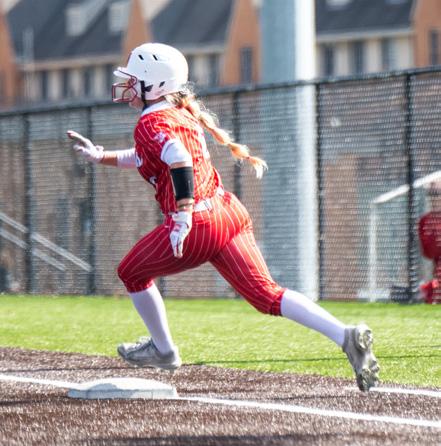
The No. 24 WashU softball team had just 11 practices this spring to prepare for their season opener. Still, the Bears swept opponent Illinois College, 8-1 and 3-2 respectively, on Sunday, Feb. 15.
“It feels great,” head coach Casey Cromwell said of the win. “We haven’t had a ton of practice. We’ve been outside a couple of times. So we were excited about some of the things that we’ve seen in the first, like, 10 or 11 practices that we’ve had, but we were excited to get on the field and see what we need to go back on and work on.”
The Bears entered the 2026 season coming off one their most successful seasons in recent memory. The
Bears went 17-1 in conference play in 2025, won their first University Athletic Association (UAA) title since 2017, hosted the Super Regional and regional rounds of the NCAA tournament and advanced to the Regional Final.
WashU began the weekend with a dominant 8-1 win over the Lady Blues.
After trailing Illinois College by 1 in the first four innings, the Bears scored seven runs in the fifth inning to pull ahead 7-1. One more run in the sixth secured the first win of the Bears season.
All eight runs were scored by different players, showing the Bears’ depth on opening day. In her first collegiate start, first-year Jessi Szafoni pitched all seven innings, threw five strikeouts, and gave up no
earned runs.
Less than an hour after their win, WashU returned to the field for their second game of the afternoon.
After giving up a run in the first inning, the Bears responded with a home run from first-year Emmy May to tie the game 1-1 in the fifth. The Lady Blues responded in the fifth with a home run to go ahead 2-1.
Behind 2-1 at their final turn at bat, WashU found its groove in the final frame. After first-year Katie Fung and senior Sydney Schneider reached base, first-year Julia Sullo hit a double to tie the game at 2. Two batters later, junior Kennedy Grippo hit a single to send Fung home and clinch a doubleheader sweep.
Junior Hattie Bond pitched all seven innings
for the Bears, giving up only two earned runs and punching out four batters.
The season opener showed the depth of WashU’s new first-year class in their collegiate debuts. Two first-years, May and Szafoni, both were named University Athletic Association Player of the Week in their collegiate debut.
“Our returners have done a fantastic job leading this group of first-years, but this first-year group was supposed to be impressive,” Cromwell said. “[The firstyears] are supposed to come in and make an impact. … If you didn’t see a highlight from one of those first-years today, I think you’ll see it next week, or, you know, it’s soon to come, at least.”
WashU will continue its pre-conference play against Wartburg College
and Greenville University on Feb. 21 before facing Wartburg and Millikin University on Feb. 22.
Going into the busy weekend of games, the Bears will emphasize giving their pitching staff more on-field experience and opening their focus, according to Cromwell.
“Wartburg is fast, they like to run, and they like to create chaos,” she said.
“One thing that stood out to me was [our] communication and the relays in and some of the faster, high paced things that happened, I think we get a little narrow focus, … so being able to listen and communicate when things get crazy [is our goal], and [Wartburg is] going to create chaos next weekend.”
Cromwell’s goals for the season are not only to
win the UAA, a feat they accomplished for the first time since 2017 last year, but also to advance past the first round of the regional tournament. The Bears open UAA play on March 20 against Case Western Reserve University. They will also face ranked opponents No. 8 Texas Lutheran University, No. 9 East Texas Baptist University, the No. 11 University of Wisconsin–Whitewater, and No. 15 Emory University this season.
“I think we’re trying to get past that first round of regionals,” Cromwell said. “This the senior class last year had gone to a regional three times. So I think the big thing for us this year is we want to win first and foremost. We put our focus a little bit closer. We take care of it week by week.”
BOBBY KAPLAN | STAFF PHOTOGRAPHER
The softball team started its season strong with two wins over Illinois College last weekend.