The independent newspaper of Washington University in St. Louis since 1878 THURSDAY, FEBRUARY 18, 2021
VOLUME 142, NO. 14
GREENHOUSE
People are not the only ones trying to survive these frigid temps (Scene, pg 4)
WWW.STUDLIFE.COM
WINTER WORKERS
SCHOOL SPIRIT
The story behind clearing more than six inches of snow (Scene, pg 5)
Yearning for sports that could bring a community together (Sports, pg 6)
St. Louis struggles with communication, equity and SU passes efficiency in the COVID-19 vaccination process amendment to disband Class Councils, centralize authority and responsibility ORLI SHEFFEY NEWS EDITOR
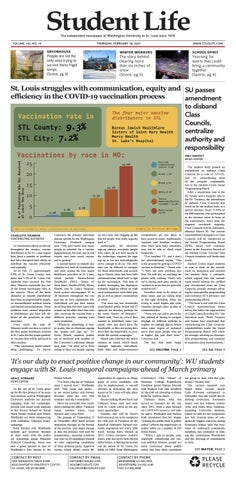
CHARLOTTE KRAMON CONTRIBUTING REPORTER As vaccination efforts accelerate throughout the country, vaccine distributors in the St. Louis region have faced a number of problems that have disrupted their ability to distribute the vaccine efficiently and equitably. As of Feb. 17, approximately 9.3% of St. Louis County residents and 7.2% of St. Louis City residents have received the first dose. Missouri reportedly has one of the lowest vaccination rates in the country. Three of the main obstacles to smooth distribution have been an unpredictable supply, an uncoordinated medical system and limited communication. These problems have created disparities in distribution and have left the future of the pandemic in state uncertain. Every week, the state of Missouri sends vaccines to each of the four major healthcare systems in St. Louis, but the actual quantity of vaccines that will be delivered is often unclear. “This uncertainty makes scheduling challenging,” Dr. Steven
Lawrence, the primary infectious disease advisor for the Washington University Danforth campus said. “You don’t know how many people to schedule for a vaccine [appointment], because you’re not exactly sure how much vaccine you’re getting.” A second barrier to smooth distribution is a lack of coordination and unity among the four major healthcare providers in St. Louis, which include Barnes-Jewish Healthcare (BJC), Sisters of Saint Mary Health (SSM), Mercy Health, and St. Luke’s Hospital. Each system encompasses 10 to 20 locations throughout the city and has its own registration list. Individuals can put their names on all four lists, but their name will remain on the other three lists even after receiving the vaccine from a different provider, creating even more confusion. “Whenever something is easy to access, like an electronic signup list, people will sign up,” Dr. Kevin Hsueh, assistant professor of medicine and member of the University’s infectious disease unit, said. “So what we’ve been seeing is there are people signing
up very early and clogging up the lists for people who really urgently need it.” Additionally, the electronic sign-up process overlooks people who either do not have access to the technology required for signing up or are not technologically savvy enough to do so. The websites can be difficult to navigate for these individuals, and according to Hsueh, there has been little communication about how to sign up for vaccination. This lack of unified messaging has disproportionately negative effects on both rural communities with older people as well as poorer communities of color. “Our state has had chronically underfunded public health aid IT agencies for decades, perhaps for the entire history of Missouri,” Hsueh said. “And so, even if they wanted to [distribute more vaccines], they just don’t have the bandwidth, or they are saying they don’t have the bandwidth, to coordinate the vaccine campaigns.” Hsueh also criticized the heavy reliance on email, which disadvantages high-risk individuals. Both older and under-resourced
communities are less likely to have access to email. Additionally, essential and frontline workers, who often have busy schedules, may not be able to check email frequently. “I’ve watched TV, and I don’t see advertisements saying, ‘This is the process for getting a COVID vaccine in Missouri,’” Hsueh said. “I have not seen anything like that. No web ads, no anything, no phone calls, nothing. That’s why we’re having such poor uptake of vaccines in areas that are generally underserved.” Providers seem to be aware of these issues and are taking steps in the right direction. More are trying to reach higher risk communities through other modes of communication. “Now, you can call to get on the list, instead of having to navigate through six different websites to register on multiple places, which takes some degree of technical savvy that many people who are at higher risk just don’t have,” Lawrence said. The fact that most major
The student body passed an amendment to disband Class Councils by a vote of 537-152, Feb. 16, redistributing most of the councils’ responsibilities to the Student Union Social Programming Board. After a unanimous vote in the SU Senate and a majority vote in the SU Treasury, the amendment to disband Class Councils was voted on by the student body in a special election. Since 77.93% of the 689 students who participated in the election voted in favor of the amendment, more than the required two-thirds majority, Class Councils will be disbanded, effective March 30. The current responsibilities delegated to Class Councils will be transferred to the Social Programming Board (SPB), which will centralize power in the Executive Branch of the Student Union. Current Class Council members will finish their terms. Student Union urged students to vote in favor of the amendment on Instagram and emailed the student body a rationale, which argued that the amendment would address the unfilled and uncontested seats on Class Councils, provide stronger advising for class-specific programming and centralize SU’s advocacy and programming efforts. “The issue is not with the Class Council representatives themselves, but rather the organization of Class Councils within SU,” the statement read. “Both Treasury and Senate have concluded that restructuring the Class Councils’ responsibilities under the Social Programming Board will allow for stronger advising on class-specific programming and continue to maintain class representation.”
SEE VACCINE, PAGE 2
SEE SU, PAGE 3
‘It’s our duty to enact positive change in our community’: WU students engage with St. Louis mayoral campaigns ahead of March primary GRACE KENNARD NEWS EDITOR As the city of St. Louis gears up for the first primary of its mayoral election, several Washington University students are actively engaging with the campaigns. Second year social work students at the Brown School of Social Work Helmi Henkin and Kelsey Wulfkuhle are both volunteering with candidate Tishaura Jones’ campaign. Both Henkin and Wulfkuhle initially got involved because of their work with the political consulting group Missouri Political Consulting. Jones was also a guest speaker in one of Wulfkuhle’s first classes at the
Brown School. “I’ve been a big fan of Tishaura since I moved here,” Wulfkuhle said. “She came and spoke… in my social justice and human diversity class my very first semester and she’s wonderful.” There are currently four candidates running for office: Tishuara Jones, Andrew Jones, Cara Spencer and Lewis Reed. The passage of Proposition D in November 2020 made several important changes to the format of the election. One major change is that the primary will now be non-partisan, meaning residents can vote on all candidates instead of only supporting candidates of their political party. Approval voting, which allows voters the
opportunity to approve or disapprove of every candidate, will also be implemented. A run-off election to determine the next mayor of St. Louis will take place on Apr. 6. Recent polling shows Reed and Tishaura Jones neck and neck with St. Louis voters as the primary approaches. Notably, this will be Reed’s third mayoral run as he completes his 14th year as President of the Board of Aldermen. Spencer currently represents the city’s 20th ward, having been elected in 2015. Utility executive Andrew Jones, who has never held elected office before, is making his second run for mayor of St. Louis. He holds an MBA from Washington
University’s Olin School of Business. College Republicans President junior Matias Mayesh told Student Life that members of the club are planning to phone bank for Andrew Jones. Tishaura Jones, who has served as treasurer for the city since 2012, touts a plan focused on COVID-19 recovery and public safety. Wulfkuhle and Henkin both mentioned that her slogan “putting the public back in public safety” reflects the importance of public safety on a number of different fronts. “When I talk to people, and, especially considering the current political climate, people are most concerned about public safety and how these candidates
CONTACT BY POST
CONTACT BY EMAIL
CONTACT BY PHONE
ONE BROOKINGS DRIVE #1039 #320 DANFORTH UNIVERSITY CENTER ST. LOUIS, MO 63130-4899
EDITOR@STUDLIFE.COM NEWS@STUDLIFE.COM CALENDAR@STUDLIFE.COM
NEWSROOM 314.935.5995 ADVERTISING 314.935.4240 FAX 314.935.5938
are going to deal with this pandemic,” Henkin said. The current mayoral race began when current mayor Lyda Krewson announced in November that she would not be seeking re-election. Krewson’s tenure was not without controversy and many local residents, including University students, joined in calls for her resignation last fall. Among some of constituents’ biggest concerns during Krewson’s tenure were the evictions of unhoused community members, her resistance to closing the contentious Workhouse and her doxxing of constituents in June.
SEE MAYOR, PAGE 3
2 STUDENT LIFE
EM MCPHIE & TED MOSKAL | SENIOR NEWS EDITORS | NEWS@STUDLIFE.COM
theFLIPSIDE FLIPSIDE THU 18 CLOUDY 22/3
FRI 19
SAT 20
MOSTLY SUNNY 24/11
CLOUDY 35/24
TUES 23
MON 22
SUNNY 53/32
MOSTLY SUNNY 44/34
SUN 21
RAIN/SNOW SHOWERS 38/26
WED 24
PARTLY CLOUDY 49/34
THURSDAY 18 Bloodied Waters, Hidden Histories: Race, Terror and the Unmaking of Freedom Virtual Event, 4:30 p.m. Professor Sowande’ Mustakeem (History) discusses her book “Slavery at Sea: Terror, Sex, and Sickness in the Middle Passage” (University of Illinois Press, 2016), revealing for the first time how the institution of slavery took critical shape at sea. The book was recognized with a 2017 Wesley-Logan Prize (American Historical Association) and a 2020 Dred Scott Freedom Award (Dred Scott Heritage Foundation). The talk will be followed by a Q&A. Harnessing the Immune System to Fight Disease Virtual Event, 4 p.m. This month at Precision Medicine Thursdays, University of MO-Columbia researchers Haval Shirwan and Esma Yolcu will present new therapeutics and technology to prevent cancer and improve the safety of bone marrow transplants often used in cancer treatment. Haval Shirwan will discuss development of a biologic that uses the immune system to prevent cancer in high-risk individuals. Esma Yolcu will discuss a technology that has the potential to improve bone marrow transplants by preventing Graft-vs-Host Disease, a deadly disease that is a major risk factor of these transplants.
FRIDAY 19 Building and Extending Community-Engaged Research Virtual Event, 10 a.m. The Collaborative for Community-Centered Conversations, known as Collaborative Café, is a discussion and support network for those interested in community-engaged health research and practice. Community partners are encouraged to attend. Sports & Society Reading Group with Theresa Runstedtler Virtual Event, 2 p.m. Theresa Runstedtler, an acclaimed academic and author of Jack Johnson, Rebel Sojourner: Boxing in the Shadow of the Global Color Line will discuss her work in progress, tentatively titled Black Ball: The ABA, the Slam Dunk, and the Struggle for the Soul of Basketball in the 1970s (under contract with BoldType Books, Hachette), which examines how Black players transformed the professional hoops game, both on and off the court.
SATURDAY 20 ‘Early Onset Depression: Causes, Consequences and Treatment’ Virtual Event, 11 a.m. A part of the MLA Lecture Series. “Unprecedented times” is a phrase of this moment, encompassing the pandemic, political division, the Black Lives Matter movement, and their reverberations. Research and art help to understand. Deanna Barch’s research underscores the need to address the proliferation of instances of mental illness during the pandemic.
MONDAY 21 Public Tour: ‘Figures of Myth and Legend’ Virtual Event, 2 p.m. Student educators design and lead virtual tours featuring several artworks in the Kemper Art Museum collection, showing images of the artworks through screen sharing and answering participant questions. This tour considers how artists working in various artistic mediums have connected figures from ancient Greek and Roman mythology to their own historical contexts.
VACCINE from page 1 vaccine sites are in populated, wealthy, urban areas makes it even harder for poorer communities to get vaccinated. “It’s taken a little bit of time to get the infrastructure in place to be able to bring the vaccine to the communities that need it, rather than to have them have the communities who need it come to other central, predominantly wealthier or more white areas,” Lawrence said. “There is not always a Walmart next door,” Hsueh said. There are still several other factors causing disparities in vaccine distribution, particularly for many members of the Black community. As of February 16, 8.4% of the white population in Missouri had received a vaccine compared to just 3.6% of the Black population. One reason for this gap could be that the medical field is predominantly white in the state. Missouri is still in phase 1B, tier 2 of its vaccine rollout plan. Phase 1A consisted of healthcare workers, nursing homes, patients, staff, and their families. Phase 1B tier one includes first responders, and tier two includes people over the age of 65. Another potential factor is the historic distrust
of the healthcare system by the Black community, due to its history of institutional racism. Lawrence said that building trust takes time, but it is difficult to build trust in the middle of a pandemic that has only exacerbated inequality in the healthcare system. While many who need the vaccine are unable to get it, others find themselves in the opposite situation. Healthy people are getting the vaccine by using connections and going to vaccination sites before they throw out extra doses. Lawrence noted that while the issue is complicated, it is virtually impossible to guarantee that all early vaccinations are given to high-risk people, especially since the vaccines have to be used immediately after they’re thawed. “I think most of us would agree that the biggest sin of all is to throw away a vaccine,” he said. Fortunately, pharmaceutical companies are continuing to develop new vaccines. Nevertheless, both Lawrence and Hsueh emphasized the importance of continuing to take precautions. Most estimates indicate that approximately 80% to 85% of people need to be vaccinated in order for
‘Disrespectful and hypocritical’: WU community remains divided on the future of Greek Life as sorority recruitment begins JAYLA BUTLER AND OLIVIA DANNER STAFF REPORTERS
EVENT CALENDAR
communities to reach herd immunity. That is unlikely to happen until late summer at the earliest, but more likely later in the year. Lawrence added that so far, public health measures on the Danforth campus have been “wildly successful.” While sporadic cases are inevitable, big outbreaks are “completely preventable” if people adhere to public health guidelines. “Eventually, probably the last thing to change is going to be the masking, because that’s what works the most,” Lawrence said. Hsueh shared a similar message, underscoring the effectiveness of mask wearing and social distancing. “The vaccine is just another layer,” he said. “Just because the vaccine is beginning to roll out doesn’t mean that people can relax other measures. We, as a nation, need COVID to go away as fast as possible. I think all of us want our lives to go back to normal, as fast as possible. And what that means is that, in the short term, we have to maintain all these sort of somewhat crippling interventions to make that happen. And while no one likes it, it is absolutely necessary for the greater good.”
THURSDAY, FEBRUARY 18, 2021
The Women’s Panhellenic Association hosted the first virtual events of a monthlong, individualized sorority recruitment process this week, touting a list of reforms designed to make the process more equitable in the face of an ongoing movement to abolish Greek Life at Washington University. Over 220 students registered to participate in recruitment at the time of publication, a decline from the 431 who signed up in 2020. Some of the biggest changes to the recruitment process this year include a waived registration fee and a more informal process that allows potential new members (PNMs) to choose the chapters they visit. The organizations will also participate in a Continuous Open Bidding (COB) system, in which each sorority will hold several open, informal events, of which PNMs can attend as many as they desire. Closed events, accessible by invitation only, will occur afterwards. Seven sororities will participate in this process, after Pi Beta Phi and Alpha Omicron Pi both disbanded in recent months. Remaining membership in each of these chapters has dwindled over the past year, ranging from five active members to 42. Most sororities had over 100 members before the start of the movement to abolish Greek Life over the summer. Two Zoom panels were held within the last week in anticipation of the recruitment process. One panel, titled “Why I Dropped,” featured former sorority and fraternity members who encouraged students to consider alternatives to Greek Life. WPA’s panel, held the day before, featured current sorority members who aimed to do the opposite, encouraging students to participate in recruitment. At Sunday’s panel, required for everyone registered to rush, WPA leadership outlined how recruitment will work and elaborated upon their decision to stay in their sororities despite the vocal abolition movement. 240 students attended the panel. “I deeply acknowledge Greek Life has harmed countless marginalized groups, but personally I've taken the perspective that while there is no way we can go back and reverse those harms, we can work to create a better community for the future,” junior Roberta Wasserman, the panelist representing Kappa Kappa Gamma (KKG), said. “For me, leaving my organization without attempting to improve it really did feel like running away and like I wasn't really solving anything.” Attendees were allowed to submit questions of their own through Zoom’s Q&A function. Representatives gave live answers to some of the questions and typed out answers to others in the chat. “How can you expect Black students to want to join a system that has been explicitly labeled racist and violent?” one anonymous attendee wrote. “No matter what reforms you claim to make, Black students called for this to end and you are insisting, fighting, for it to stay. How is that not violent?” Sophomore Adrianna Patacsil, Delta Gamma’s representative, answered the question by speaking about her experience as a BIPOC woman attempting to reform
her chapter. “At this point, we feel that we can make that change if we’re the ones leading that change…And if I don’t see that change happening within my chapter, and also WPA, that is something that is a deal-breaker for me,” Patacsil said. “But as of now, I'm seeing that change happening within WPA and in my chapter, so I have decided to stay. And I want to make that clear that my values will not change throughout this process and throughout this whole experience.” An attendee also pointed out that some of the panelists’ use of language was not gender-inclusive, saying that it was harmful and didn’t show that the organizations supported queer students, to which WPA Advisor Autumn Shepherd responded in the chat, “Thank you for this feedback!” Towards the end of the panel, Wasserman reminded PNMs that recruitment is not a binding process and at any point, they can choose not to continue rushing. “It’s your choice,” Wasserman said. “If you go to an open event and don’t like it, no harm no foul. That’s totally fine. If you accept a bid and then decide that you don’t like it, same thing. The process is meant for you to find a community…If you don’t feel like you’ve found that, or if you don’t think that it’s a good fit for you, there’s no problem with that.” WPA chapters are each implementing their own reforms. These reforms focus on cost-reduction, diversity inclusion and equity and increased internal accountability. The advertised reforms and other information provided in the WPA panel solidified freshman Caroline Ferry’s decision to rush. “I’m definitely rushing,” Ferry said. “That doesn’t mean I’m necessarily going to join a sorority…I think reform is better than abolishment because I think it gives everyone an opportunity to grow and learn from this.” She also said that she hadn’t heard about the Why I Dropped panel. “I do sometimes think maybe I’m being completely naive to think that reform is possible,” Ferry said. Junior Cassie Vaden, former vice president of risk management of Pi Beta Phi and moderator of the Why I Dropped panel, also attended the WPA panel. “We suspected chapter leaders, many of whom were in their organizations for just two months before the pandemic began last March, would not be entirely transparent about Greek Life and the climate on campus. They weren’t,” Vaden wrote in a statement to Student Life. She wrote that she, along with the panel’s other organizers, wanted to provide a more complete understanding of the experience of being a part of Greek Life at the University and put freshmen in a better position to decide for themselves. At the “Why I Dropped” panel, the four panelists discussed the racism, sexism, classism and interpersonal violence that Greek Life perpetuates and alternative opportunities to finding community on campus. 79 students were in attendance at its peak. Another important topic where the two panels differed was the possibility of reforming Greek Life. “What I failed to realize until summer was just the fact that every type
of reform that you can even think of has been tried and it’s all failed,” sophomore Ray McIntyre, a former member of Beta Theta Pi, said during the panel. “I would just much rather work towards something that I believe is actually going to work than put my efforts toward something that I don’t trust or believe in,” senior Shayna Finkelstein, a former diversity and inclusion chair of Pi Beta Phi, said. Freshman Gemma Pleas, who attended the abolition panel, stated she is not rushing, because she believes Greek Life does not align with her identity, and she already has found community on campus as a member of the track team. “As a Black person, I never intended to rush, because I just feel like it wasn’t the right space for me personally, with my identity. Obviously there’s other Black people who rush, but personally, for me, I didn't want to,” Pleas said. Pleas also pointed to the historical exclusivity of Greek Life. “It seems like reforms aren’t really going to solve the root cause of the problem,” Pleas said. Across both panels, a major question raised by panelists and attendees was whether or not Greek Life is fundamentally different from other selective student groups. Junior Cat Emanuel, the former KKG president, said during the panel that the recruitment process is inherently biased. “Nothing is random…In an institution that is historically, primarily evaluating rich, straight white people, there’s no way that it's ever going to be inclusive,” Emanuel said. Junior Maya Gonzalez, the former co-diversity and inclusion chair of KKG, said in an interview with Student Life that because many of the recruiting strategies are based on quick judgements, existing racial biases are often perpetuated. “The majority, at least, come in with the best intentions in terms of really trying to be equitable, trying to be inclusive and really trying to attract diversity, especially from populations that might feel marginalized in a rush setting,” Gonzalez said. “But I think the system itself is so fast-paced [and] competitive that when you’re going through the rush process, you end up feeding into the psychological phenomenon of ‘birds of a feather flock together’ and when you combine that with the racial history of a very unequal America, you end up with a rush process that’s just really hard to make equitable.” Gonzalez added that she was surprised and disappointed to see that recruitment was continuing this year. Interim Vice Chancellor of Student Affairs Rob Wild said that questions of access and bias within selection and recruitment processes are not exclusive to fraternities and sororities. “Not every group is going to be open to every student,” Wild said. “And that is true of fraternities and sororities as much as it’s true of a cappella groups and other student groups on our campus. I think anytime you have selection involved, there’s an opportunity for bias and exclusion.” Campus Life Executive Director Leslie Heusted wrote in a statement to Student Life that 37% of all student groups on campus have a membership selection process of some sort.
SEE GREEK, PAGE 3
THURSDAY, FEBRUARY 18, 2021
EM MCPHIE & TED MOSKAL | SENIOR NEWS EDITORS | NEWS@STUDLIFE.COM
STUDENT LIFE 3
SU from page 1 Junior Anne He, the executive vice president of SU, said that there is a “general lack of interest” in Class Councils after freshman year. The Junior Class Council does not exist this year because no juniors chose to run for a position, and the Sophomore Class Council (SCC) only had two of five positions filled through the election. She said that transferring the Class Council responsibilities to the SPB would allow SU to more efficiently fulfill its mission of “Advocate, Allocate, Program.” “The Social Programming Board is highly experienced in programming and are highly specialized in working to make events as accessible and well attended as they
can be,” Speaker of the Senate junior Gaby Smith said. The First-Year Class Council (FYCC), however, has been highly active since its election in the fall. In collaboration with SCC, FYCC has held monthly mental health panels with topics ranging from imposter syndrome to relationship and sexual violence. FYCC also hosted social events over Zoom, such as Bear-adise, and held a panel over winter break for remote freshmen moving to campus in the spring. Both Jo Palisoc, FYCC vice president of public relations, and SCC President Miri Goodman were initially disappointed by the amendment. “I wasn’t surprised that
it was something that we’re considering,” Goodman said. “I was surprised that they were considering it at that moment, especially with COVID and because we have had such an effective first-year and sophomore class councils this year. It’s unfortunate that it’s happening now because I would love to keep serving.” “We were disappointed because Student Union execs believed that Class Councils were expendable,” Palisoc said. “We just thought the inefficiency was somewhere else.” Palisoc said that she thought the inefficiency was related to a lack of training for Class Council members, and to combat that, the FYCC planned
to make a handbook for future Council members. The FYCC had also met with the equivalent freshman councils at other universities, such as Vanderbilt University and Johns Hopkins University, to brainstorm initiatives that could be implemented across universities in order to support freshmen. “Our main problem with getting rid of class councils was that, especially during COVID, it was important now more than ever that each class had its own representation that was specific to them,” Palisoc said. “No one knows the problems that us freshmen are facing more than the freshmen themselves.” Smith, however, said that she was not worried about decreased
representation of freshmen in the Student Union. “In my entire time on Student Union, first-years have actually been overrepresented in the Senate, and they comprise well over one-fourth of the Senate body,” Smith said. “We see first-years being especially interested in joining [the] Senate, and we also have Senate committees that are open to the entire student body, and first-years, historically, have been the individuals highly interested in those.” Anne He added that SPB will create two new positions: Director of First-Year Programming and Director of Senior Programming. Since freshmen and seniors have historically required the most programming and
have had the most contested elections, He said that those positions will ensure specific representation for those grades. Ultimately, after discussions with members of SU’s executive board, both Palisoc and Goodman stood behind SU’s decision to advance the amendment. “In the end, we know that execs are looking out for Wash. U.,” Palisoc said. “We know that whatever they decide, they’re doing it in the interest of the students. Most of them have been on Student Union for a long time for multiple terms, which does give them reliability.” “If it needs to happen, I understand completely, and I will support transition,” Goodman said.
getting involved in different causes when I moved here,” Wulfkuhle said. Henkin echoed similar calls to acknowledge the history of the University in the region. “Wash. U. has a history of exploiting the city and exploiting the poorer parts of the city...creating these programs where students can build up their resumes or get their skills, or whatever, but then they're not sustainable partnerships,” Henkin said. Politics aside, Henkin and Wulfkuhle stressed the importance of Wash. U. students being informed voters and community members. “You’re going to graduate…move away and whatever
you voted for is going to have a lasting impact on St. Louis, and so you need to be making educated decisions about what
you’re doing,” Wulfkuhle said. “I think that it's our duty to enact positive change and contribute to positive change
in our community and give back to the community, which includes the city,” Henkin said.
MAYOR from page 1 For Wulfkuhle, many of the issues that caused controversy during Krewson’s tenure will continue to play an important role in the race to determine her successor. She specifically discussed the fate of the Workhouse, vaccine rollout and other areas of COVID-19 response, the Board of Aldermen elections and potential redistricting of wards. Both Wulfkuhle and Henkin also noted the importance of racial equity in this election. Henkin spoke about the inequities being exposed by COVID-19 infections, deaths and access to care. “Unfortunately, there’s these systemic inequities that
exist,” Henkin said. “The majority of St. Louis people in super poor districts are people of color, and Tishaura is looking to recognize this issue and find solutions to these persistent problems.” Wulfkuhle also noted that being a social work student at the Brown School has pushed her to ensure she’s giving back to the St. Louis community in a way that programs at the University often fail to do. “The Brown School gets a lot of flak for taking a lot from the community and learning from the community and then not giving back to the community, and so that’s not a cycle I really wanted to contribute to, and so I started
TED MOSKAL | STUDENT LIFE
Supporters of mayoral candidate Tishaura Jones, including some WU students, gather at an event.
GREEK from page 2 “I think the important question to ask of all of our student groups, including our sororities and fraternities, is to fully understand the reasons why that process exists and what purpose it serves for the organization,” Heusted wrote. “And if there is not a meaningful answer to that question, change can exist.” When asked if that bias manifests itself differently in Greek Life compared to other student groups, Wild said, “In the last eight months…you predominantly are hearing it right now in student conversation with fraternities and sororities. I think that’s where the campus
conversation is right now. But I think I’d be naive to say that it doesn’t potentially exist elsewhere.” Wild also said that he has recently met with WPA leadership, and they expect to announce more opportunities to create campus dialogue along this issue within the coming weeks. Vaden ultimately expressed that she was satisfied with how the Why I Dropped panel went, and maintained her position that recruitment should not happen this spring. “The decision to continue with recruitment is frankly disrespectful and hypocritical,” Vaden wrote. “It’s disrespectful
because of the concerted effort and continued calls, by BIPOC especially, to point out the harms inherent to Greek Life. There are so many reasons people deactivated this summer.” She wrote that, as a member of Campus Life’s Co-Curricular Advisory Board, she saw that even among those advocating for reform, there still is not a solidified consensus about which reforms to implement. “Rome wasn’t built in a day, and bringing on new students who have no prior knowledge of what reforms have been tried (and failed) in chapters already is illogical,” Vaden wrote.
Emma Baker Editor-in-Chief editor@studlife.com
Kya Vaughn Senior Forum Editor forum@studlife.com
Curran Neenan Senior Photo Editor photo@studlife.com
Matthew Friedman Associate Editor
Dorian DeBose Josh Shapiro Senior Sports Editors sports@studlife.com
JJ Coley Isabella Neubauer Copy Chiefs copy@studlife.com
Isabella Neubauer Sabrina Spence Senior Cadenza Editors cadenza@studlife.com
Vivienne Chang Kathleen White Engagement Editors
CHECK OUT OUR WEBSITE
FOR SPECIAL DEALS! ACKERMANTOYOTA.COM
2020 HAMPTON AVE. ST. LOUIS, MO 63139 AT THE INTERSECTION OF HIGHWAY 44 314-351-3000 Toyota Care is a no cost maintenance program that covers the first 2 years or 25k miles, whichever comes first. The Ackerman For Life is valid only at Ackerman Toyota and is non-transferable. Offer contains 1 oil change maximum, per calendar year, when Toyota Care expires. Offer good to primary owner only.
VOLUME 142, NO. 14
Jayla Butler Kya Vaughn Managing Editors Em McPhie Ted Moskal Senior News Editors news@studlife.com Benjamin Simon Senior Scene Editor scene@studlife.com
Mia Goldberg Design Chief design@studlife.com
HN Hoffmann Jaden Satenstein Christine Watridge Multimedia Editors
Sabrina Spence Social Media Director Nathan Springman Website Editor Jamila Dawkins Forum Editor Christine Watridge Jaime Lee Spencer Linenberg Kamala Madireddi Clara Richards Designers
Adrienne Levin Coleman General Manager a.coleman@studlife.com Tammy Dunsford Advertising Sales Supervisor dunsfordt@wustl.edu
Copyright © 2020 Washington University Student Media, Inc. (WUSMI). Student Life is a financially and editorially independent, student-run newspaper serving the Washington University community. Our newspaper is a publication of WUSMI and does not necessarily represent the views of the Washington University administration.
SCENE
4 STUDENT LIFE
BENJAMIN SIMON | SENIOR SCENE EDITOR | SCENE@STUDLIFE.COM
THURSDAY,FEBRUARY 18, 2021
Rooted in St. Louis: The WU greenhouse, where plants never die THOMAS HUMPHREY STAFF WRITER Deep winter might seem like a bad time to start a series about plants. It's true that all the plants outside are dead or in retreat, and the world is bleak and grey. But what if I told you there is another world, where the plants never die, where seasons never change, where mankind is the master of plants in view. Well, if I told you that I would be lying, or at least exaggerating. However, there is a place where all of this is attempted, where lush cornstalks and obscure succulents mingle in unseasonable warmth and humidity—the Washington University greenhouse, the Jeanette Goldfarb Plant Growth Facility. Situated behind the Life Sciences Building, this 10,000 square foot facility began operating in 1987, replacing an older greenhouse located in what is now the parking lot behind the current one. I had an opportunity this week to tour the greenhouse, to see their specimens and experiments and to find out how they maintain their leafy domain. The sensation as I entered evoked the blanket of humidity I feel leaving Orlando airport when visiting home—a welcome feeling when the weather outside is in the single digits. The greenery, too, sits in stark contrast to the wintery hell of dead trees and snow-smothered plants outside. The greenhouse facilities are primarily dedicated to growing and maintaining research plants. They have
forests of corn taller than I am, and rooms filled with wild clovers and sorghum. These plants are used not only in botanical research, but also cross over into anthropology and history. One plant being studied, little barley (Hordeum pusillum), is a “lost crop”—once cultivated by indigenous peoples in North America, it now only exists as a perennial weed. Studying little barley sheds light on the process and practice of domestication in the past, marrying archaeology and genomic science. Some of the most impressive plants are part of the Wash. U. greenhouse collection, often brought back from professors in the field. They have huge 30-year-old jade plants and veritable forest of cacti and succulents, some of which are still unidentified. “Some of these have been here for so long that we don't know where they came from” explained greenhouse assistant Hammy Sorkin; “a lot of succulents have hybrids that aren’t even restricted to the same genus.” Despite their ability to control climatic conditions and growth of hundreds of plants, some mysteries remain inscrutable. They have a makeshift swamp with carnivorous Equisetum and Venus fly traps (as an aside, now I know from personal experience that having a plant wrap its lips around your finger is a deeply disconcerting feeling). A coffee bush in one room is producing berries. The prize of the collection is a Ponytail Palm, which some
THOMAS HUMPHREY | STUDENT LIFE
A coniferous sapling is flanked by Spanish Ivy and another “Air Plant.” These plants do not have roots and absorb their water from the atmosphere. Above the sapling is some of the technology that keeps the greenhouse functioning.
readers might be more familiar with as a small desk plant, that reaches the ceiling. The palm was the first plant brought into the new greenhouse facilities in 1987, and almost died near the beginning. Now, in the words of greenhouse supervisor Mike Dyer, “If it ever leaves here, it will have to be pulled out by a helicopter.” Other specimen plants have particular benefits for humans—take for instance the Ehretia cymose, a medicinal plant from Ghana brought to Wash. U. by professor Memory Elvin-Lewis. A poultice made from this wild looking tropical tree can be applied topically to stimulate bone-healing. Yet not is all peachy keen in the greenhouse, for enemies lurk in the shadows. Corn smut fungus, thrips, aphids, flies and other pests stand ready to devour and destroy plants, and left unchecked they
could decimate this closed ecosystem. That is the key word, ecosystem; you cannot think of these plants as discreet organisms, but rather to succeed in maintaining them you must become mother nature in absentia, using biological factors to solve biological problems. You have to work with the plants, and their predators, and their predator’s predators. Growing plants is not just about the plants, it's about their environment, insects and fungi, humidity, light, temperature, dirt and a million other factors. A greenhouse is not just a room with plants in it, it is a parallel world, an alternative manmade ecosystem. So how does that work with respect to the aphids, the most pernicious of greenhouse pests, so merciless as to suck all of the sap from plants until death? For one, they set up cotton plants as decoy
targets. The bugs find the cotton plants more appealing than others and attack them first. This decoy buys time for the heavy artillery units to come in: Parasitic wasps, Aphidius. Wasps are some of the evilest creatures on earth, so brutal in their methods that they made Charles Darwin question his belief in a benevolent god. They are perfect greenhouse mercenaries. The Aphidius are released into the greenhouse, and target the Aphids immediately, laying their eggs directly into the Aphids’ bodies. The young wasps then develop inside of the living bodies of the Aphids, in what must be an incredibly painful process, perhaps a fitting punishment for the crime of trying to eat all of Wash. U.’s clovers. They eventually die and become dry desiccated husks of their former bodies. These aphid shells are known to greenhouse growers as
“Aphid Mummies.” Gross right? Well if you don’t like bugs, we have technology. Grow rooms, the hyperbolic time chambers of gardening. Above the greenhouse these sealed metal boxes stimulate plant growth in the most highly controlled conditions. Less natural, but incredibly effective. “We grow Arabidopsis here,” said Mike Dyer. “It’s a green rat”––the botanical equivalent of laboratory mice. He went on to explain the spectrum of interest in greenhouse work; “some people are into all the tech… giant new shiny boxes.” The technologies and processes we have developed to grow plants are manifold, and at Wash. U. we use them all to the fullest. Life perseveres, whether it be in a metal box, a lush greenhouse or even the snowy wilderness of winter, from which spring will soon emerge.
Our favorite on-campus study spots SCENE STAFF Since the pandemic, almost everyone has had to find new on-campus study spots. Olin Library isn’t open. Graham Chapel is filled with study cubbies. And now there are gigantic white tents invading Mudd Field. We compiled a list of our favorite spots to break away from the pandemic and get some work done in the meantime.:
Parkside Cafe Museum cafés are my happy place: They’re
almost all monochromatic with pointy furniture and intimidating coffee menus. Parkside at Shnuck’s Pavilion offers the exact same ambiance without expecting a precursory trudge through some exhibition––you get to fast forward to the finish line. It’s an especially satisfying choice for deceivingly sunny days when it’s just a little too cold to study outside. If I arrive before 2 p.m. I most definitely get a salmon burger. I order with the touch screens because it ensures the barista says my name when the order is complete, and the pandemic
has taught me to capitalize on any opportunity for intimacy. Propping myself up along the window facing Brookings, I can be pretty productive. The noise level is pretty static, lying comfortably in between 3 -p.m. Bear’s Den and Whispers, which makes attending Zooms very doable. The bathrooms and water fountains are nestled in a dimly lit hallway a level below, providing a soothing respite from the grind with a four-minute round-trip travel time. Parkside closes at 4:00 p.m. and is inaccessible on the weekends, but that’s
GRACE BRUTON | STUDENT LIFE
Parkside Cafe, which opened with the rest of the newly reopened East End in the summer of 2019.
okay, there can be no good without evil. – Izzy Bruckman, Contributing Writer
Second floor of the Edison Theatre I grab lunch at Subway in the Edison Theatre every Monday and Wednesday when my class ends at 2:15. After purchasing my food, I climb the stairs to the second floor and sit at a small round table. I always move the chair so that it faces the window and from this view, I can see Umrath Hall. During this time of year, the rooftops are covered in fluffy white snow. I don’t enjoy being in cold weather, but viewing it from a distance allows me to appreciate the elegant contrast of the red brick with the untouched snow on the rooftops. I study here in -between classes, sometimes listening to music, sometimes appreciating the silence of the often empty second level. Through the archway opening of Umrath Hall, I can see other students pass by, but it is never a distraction––the scenery is peaceful. I rarely run into people at this location, which allows me to better concentrate on my work and have some time to myself. – Reilly Brady, Staff Writer
My Dorm Room To say that my favorite study spot during the pandemic has been my dorm room would probably be an answer that surprises no one. Before anyone writes me off as a hermit who never leaves their room, I want to make it clear that I actually have some reasons for this that don’t have to do with me being anti-social. My dorm has everything a good study spot needs—low noise level, ease of access and a place to do my work. Now that it’s winter, the fact that my desk is two steps away from my bed only cements my dorm’s status as being the best study spot for me. I may be used to cold weather, but I don’t particularly care for donning three to four layers of clothing to go do something I could do in the comfort of my room. Another thing I don’t exactly care for is my glasses fogging up, which they always do without fail whenever I have to go out wearing a mask, and, wouldn’t you know it, alone in my dorm is the only place on campus that I can be mask-free. Lastly, and perhaps most importantly, I can eat snacks when studying in my dorm. I don’t know about everyone else, but for me sometimes the only way to get through a tough study
session is a box of CheezIts. – Ryan Ricks, Staff Writer
Danforth University Center Goldberg Formal Lounge I have always enjoyed studying in the Tisch Commons portion of the DUC. Even though it isn’t as lively this year, I like hearing the chatter, I like knowing that there’s still a little bit of energy left on campus. But as a humanities major who can’t read or write without complete silence, Tisch Commons doesn’t result in much productivity. So I started going to the Goldberg Formal Lounge instead, a small room tucked away on the second floor of the DUC. Not many people know about this space (I didn’t even know its name until I wrote this paragraph). It’s built like one of those fancy in-home libraries without the books. There’s a fire pit, a piano, high ceilings, wooden floors and lots of windows. I need windows. I hate feeling boxed in when I’m working. I need something that can take me out of the workspace and allow me to drift off––even if I have to peek around pandemic-made partition boards to do so. – Benjamin Simon, Senior Scene Editor
THURSDAY, FEBRUARY 18, 2021
BENJAMIN SIMON | SENIOR SCENE EDITOR | SCENE@STUDLIFE.COM
STUDENT LIFE 5
Shoveling the snow: How WU clears campus overnight IZZY BRUCKMAN CONTRIBUTING WRITER St. Louis’s wintry mixes transform campus into a 169-acre snowglobe. The powder frosts naked trees in even dollops, fans out like a doily over Graham Chapel and neatly cakes each walkway’s periphery –– accentuating the absence of it on the beaten path. Though walkway accessibility often goes unacknowledged, rallying salters and shovellers in the hours anticipating snowfall is a considerable undertaking. The University’s Grounds Manager, Christopher Anderson, spoke on this process, noting he works with a group of five members of Grounds Services to develop their “plan of attack,” he wrote in an email to Student Life.
Salting preparation widely varies depending on the nature of the impending weather. Pre-salting is a rarity for low-temperature weeks such as this one –– it would be a simple waste of product. The department, in partnership with Focal Pointe Outdoor Solutions, approaches all salting procedures with caution. Wary of the toxic effects oversalting has on aquatic animals and their ecosystems, bulk salt is only ever used where clearance is absolutely necessary. Anderson commented: “When we do apply bulk salt, we use it on the roads, firelanes, parking lots, and garage-tops.” A gentler magnesiumsalt blend is applied almost everywhere in-between. If a forecast calls for sleet or freezing
CLARA RICHARDS | STUDENT LIFE
A truck plows through the snow on the Danforth campus. Organizing the removal of more than six of snow is no easy task –– it takes lots of people, lots of vehicles, and lots of hours. Snow blanketed campus this week as frigid temperatures prevented melting.
rain, practically every inch of campus, from bridges to sidewalks to hidden passages must be
coated in salt. For each anticipated snowfall, it is typical that two salt trucks are running with
CLARA RICHARDS | STUDENT LIFE
When a snowstorm hits, people work morning to night making sure the roads are clear and the sidewalks are filled with salt.
around thirty outsourced landscaping individuals scattered across the grounds at all times. Certain off-campus properties are tendedto as well, such as the Loop Lofts, Rosedale and Greenway. Yet, salting is just the prelude to the grueling process of snow-blowing. Monday’s blizzard brought just under eight inches, necessitating sustained, round-the-clock maintenance. Even at midnight, subcontractors from Focal Pointe were out on the South 40, still blowing snow. When a storm comes, these late night hours aren’t out of the ordinary, and some workers may be on duty through the night. To pass the time, South 40 subcontractors evaded the sub-zero temperatures by camping out in their landscaping truck, listening to the radio and watching the flurries
diligently accumulate on a path they had just plowed. It’s a monotonous and frigid waiting game to preserve safety on campus. Whether shoveling the driveway is an extreme source of contention back home, or you’ve just experienced your first snowfall, take time to appreciate the unsung dedication of the Grounds Services department on your next perfectly-paved trek to the dining hall. Work hours are practically incalculable for salters, snow-blowers, and managers alike, and the finicky nature of weather adds an extra level of unpredictability. Anderson noted that miss-forecasts are common occurrences, but he assured his team “has decades of experience, so we know what to do when this happens.” They never slip-up, so you don’t have to either.
SPONSORED BY:
puzzle
mania
Minor in the Business of the Arts
your AD here
Open to all undergrads. Find out more. olin.wustl.edu/arts
sandraphilius@wustl.edu
SPORTS
6 STUDENT LIFE
DORIAN DEBOSE & JOSH SHAPIRO | SENIOR SPORTS EDITORS | SPORTS@STUDLIFE.COM
THURSDAY, FEBRUARY 18, 2021
JOSH SHAPIRO SENIOR SPORTS EDITOR
Sophomore Tami Wong on the outlook for spring softball COURTESY OF TAMI WONG
Last year's softball season was only nine games, and it was her rookie year, but Tami Wong still found a way to make her mark on the Washington University Bears. She started in all nine games and led the team with a .500 batting average, driving in eight runs and making it to the all-UAA team. But Wong is used to the spotlight. Now a sophomore, she grew up next door to Wash. U. in nearby Alton, Ill., and is currently majoring in Biology. She led the St. Louis area with a .625 batting average in her senior year of high school, and was named a St. Louis Post-Dispatch Scholar Athlete of the Year. Student Life sat down with Wong to talk through her journey to Wash. U. and her approach to this season. This interview has been edited for length and clarity.
SL: Was Wash. U. always on your radar as a place you wanted to come play at? TW: Well, I always wanted to choose like a good college first. And I think I was really lucky to find Wash. U., which has good softball and school, so I thought that was really cool. And when I first came to campus, obviously Tempur-Pedic mattresses, I always have to mention that. And I heard the food was good. And then don't we have a high ranking ResLife? But when I got here, it was super cool. The team was really cool, and it just kind of felt like home.
SL: That makes sense. Did you play travel softball growing up or did you just play for your school?
TW: Yeah, I started [travel SL: How did you get into softball in the first place?
TW: My brother played baseball whenever we were like, really small. My mom didn't even know what softball was. But I was like, ‘Oh, I'm gonna go hit the ball with the bat.’ So then she signed me up for like, you know, tee-ball, softball stuff. And then my brother actually doesn't play baseball anymore. He plays soccer now. Yeah, I just kind of stuck with it. And it's like a fun way to escape and just play. I met a lot of cool people through it.
softball] in 12-U with one organization I kind of just grew up [with], which is really cool. They really helped me a lot. It was a lot of traveling. I'd say it started probably at 14, maybe it got super serious at 16. I remember our summers were just filled with softball. Like every weekend, we'd go somewhere new like Tennessee, Colorado, Georgia, Alabama. Once we went to California, that was really cool. Good opportunity. Now we're here. SL: How has the softball team adopted its practices
to meet the challenges of COVID-19?
TW: Well, I mean, we just want to play. Like, we just want to practice and we just want to get out there doing things. And we haven't really been able to. I remember right before Christmas break or Winter Break and Thanksgiving Break, they cut us off at least two weeks because of COVID. But right now, we would be practicing like six times a week, but they cut us down to four, and working out time, too. So I guess we're just doing as much as they let us do.
SL: What do you think the chances are of having a season this year?
TW: Yeah, that's what we're hoping. Technically nothing's cleared yet, but we have a schedule set up, [though with] less games than we want. But hopefully enough. I think the problem is, [Softball head coach Michelle Venturella] explained this to us, is that most teams are playing all conference games and no non-conference games. But everyone in our conference is like NYU, Emory, Carnegie, so we'd have to travel a lot. So we're just trying to find people who will take us as—like, this is kind of harsh—but as leftovers. We're just trying to play any games that we can. SL: How has it been
for freshmen who came in and basically have just been doing remote school the entire time?
TW: Yeah, I feel really bad for them. But at least the freshmen we have this year, they’re super outgoing, super fun. So I [think] they're okay, I hope they're okay. But, yeah, I feel bad. They don't deserve this. I feel freshman year was, like, really fun for me, so I feel a little bit bad that they have Zoom University now.
SL: Has there been a moment from the past year or even in the time you've been here—it could be before the pandemic—that you really enjoyed, like a memory from being with the team or being with your teammates?
TW: I guess there are a whole bunch of little traditions we do. Last year we did Friendsgiving, which we didn’t do this year. I'd say just like the little things we do, like we hung out together for Mardi Gras, that was fun. This past Winter Break, we all kind of wrote something that we appreciated about each other and sent it in, and we all received it in the mail. So it's kind of like a gift giving season. But yeah, just the little times we can hang out are all fun just because it's fun being around each other anyway, we kind of feed off of each other.
know why, but I thought it was the funniest thing I've ever seen.
SL: Have picked up any pandemic hobbies?
you
SL:
I bake an unnecessarily unhealthy amount. I feel in quarantine I was like, ‘Oh, I saw another muffin recipe,’ ‘Oh, let's try this cookie recipe,’ ‘Oh, let's bake a cake,’ which I've never done before. But I mean, like you just got to follow instructions, I guess. So that was fun. And then I discovered a lot of music, which was really nice. Oh, and I also got a bad TikTok obsession. Like a really bad TikTok obsession that's coming back to bite me right now. This might sound really dumb. There's this one TikTok that was like, ‘Oh, if you laugh at this picture, then like your humor is broken,’ right. And it was just like a piece of toast on like, a cup or something. I don't
TW:
Softball is one of the smaller teams. Do you see an advantage in that?
TW: Oh, I mean, obviously we want to have more people just in case of injuries and everything. But I don't think it's been super detrimental. Having a smaller team actually makes it easy to be closer with people. And like, forge those relationships better. So I think we've been managing. It's always stressful whenever someone goes down, and you're like, ‘Oh, we have literally one backup.’ But I don't know if you know this, but we have like 10 freshmen coming in next year. So yeah. This might be our last chance of being a small team. So I guess I'll enjoy it. But I don't think it's been bad. It's been pretty fun. We've been pretty close to the sophomores or juniors now, like last year. And we only have two seniors, so it's easy to all be together.
Imagining the benefits of a new era of Wash. U. pride JOSH SHAPIRO SENIOR SPORTS EDITOR Imagine, for a moment, that you are sitting in the upper deck of Washington University's brand new Danforth Stadium. The Bears have just won their first Division I football game in school history, and thousands of students have decided to rush the field. A few are lying face-down in the end zones. Flasks litter the field. The pandemic has long since subsided, and as a proud Bears alum, you’ve
done your part in packing the stadium every Saturday. I’ll be frank: I feel like a fraud writing this article. For one, our athletes are extremely talented. While they may not get the schoolwide recognition they deserve, Wash. U players and coaches pour their blood, sweat and tears into every single season. As someone who willingly committed to Wash. U. knowing that our university had little semblance of school spirit, I have no claim to credibility in my yearning
for Division I sports. I also think that continuing college sports the way Division I schools have been operating during this pandemic is probably a recipe for more public health disasters. Athletes without masks and fans cramming into undersized stadium bathrooms doesn’t inspire much confidence or enthusiasm. But I’ve reached my breaking point. I’m tired of starting at Zoom screens all day. I’m exhausted by the idea of yet another virtual birthday party. And I’m
WE ARE OPEN with safe social distancing practices. We offer curb side pick-up.
out of good ideas: it turns out that binging Netflix doesn’t alleviate my screen time overdose and that long, directionless walks in the park don’t translate well to zero-degree weather. For months, I’ve been getting by watching professional sports teams that quite honestly stink. My prized New York Mets missed the playoffs. And the Daniel Jones-led New York Giants were rebuffed by a stubborn Philadelphian who gambled and lost his head coaching job betting on Nate Sudfeld. Freaking Nate Sudfeld. Something has still been missing though. Despite my teams’ ups and downs, I’ve felt more disconnected than ever from my fellow sports
fans. Walking up and down my block, there are no 7 Line Army yard signs, nor are there very many friendly strangers donning Giants caps (and masks). You can feel the lethargy on a stroll through the icy cold Danforth campus. Students traveling alone with their backs hunched and bags tucked in, waiting for the arrival of what we all so desperately yearn for: a united cause to get behind. As much as everyone enjoys the university-wide emails we get from Andrew Martin and Beverly Wendland (except when it’s a tuition increase), I think we can do better. I want to stroll down Skinker Boulevard wearing jerseys with the names of
my favorite Bears athletes. I want the privilege of watching a world-class marching band morph into all sorts of letters and shapes during the halftime show. I want to high-five random classmates when Wash U. waltzes into the endzone for touchdowns. I want to jeer and boo loudly when opponent squads dare enter our beloved stadium. And yes, I want to storm the field when we win. I know it is dumb, even beyond stupid. I’ll let you pick your own choice of venomous descriptors. But I don’t care. All I want right now is to be a fan among many at Wash. U. sporting events. To have something to care about, and other people to share it with.
Check out our newly revamped website www.sunshinedaydream.com
FREE SHIPPING ON ORDERS OVER $30 Come check out our CBD selection Brands we carry: BeLeaf Life Oils - Missouri Grown! • Eclipse Green Roads • JustCBD • Koi • Rescue CBD Open Monday through Saturday, 10am to 9pm • Sunday 11am to 8pm
6303 DELMAR BLVD IN THE LOOP
Follow us on
and on
@sunshinedaydreamstl
@sunshinedaydream420 for updates.
VIA CREATIVE COMMONS / KEN LUND
University of Nevada fans storm the field after beating Fresno State in the 2020 MAC championship.
THURSDAY, FEBRUARY 18, 2021
FORUM KYA VAUGHN | SENIOR FORUM EDITOR | FORUM@STUDLIFE.COM
STUDENT LIFE 7
STAFF EDITORIAL
A
Extended medical amnesty keeps WU community safe
s of Feb. 1, Washington University’s medical amnesty policy has extended to not only protect students involved in alcohol-related emergencies, but now drug-related health emergencies as well. Calls to the Emergency Support Team (EST) that involve use or presence of an illegal substance no longer come with a guarantee of university disciplinary action, and the the Student Life Editorial Board is in strong support of the policy change. The University’s first implementation of a medical amnesty policy was formalized in May
of 2015. What used to be gray territory was solidified into certainty that calling an emergency line in the case of an alcohol-related emergency would result in non-punitive follow-up meetings and wellness measures after the individual received help. Once a student completed the tasks discussed in those wellness meetings, they would be exempt from any permanent conduct violation on their record. The policy never explicitly stated that amnesty would be granted for drug-related emergencies but it did state that amnesty would not be granted for the distribution of drugs. This
vagueness had the potential to lead students to assume that calling campus emergency services in a situation involving drugs would result in disciplinary action, so it enabled students to avoid seeking help in potentially dangerous situations. Rather than encouraging safe behavior, the policy facilitated an environment of distrust where students might put themselves at risk Consequently, there are few downsides to an extended medical amnesty policy. Minimizing vagueness in a clearly-outlined policy shifts university intentions to a side of harm reduction, which aligns with the work of
both the Habif Health and Wellness Center and trained student Peer Health Educators. Encouraging student safety through a promise of amnesty in substance-involved emergencies removes the burden from students of having to choose between saving a friend’s life and the legal consequences that that friend may have to endure as a result. In life-or-death medical emergencies, the means by which the emergency happened shouldn’t prevail over the means by which the emergency can be resolved. The Student Life Editorial Board appreciates that this new medical amnesty policy reflects this
truth. The updated policy still openly states that students are not exempt from the legal proceedings of any local law enforcement that may become involved, especially if these incidents occur off campus. Despite what some critics of the policy change may say, the updated policy does not encourage students to partake in illicit activities, but it does encourage students to seek help knowing that they will be protected from university sanctions. The policy simply allows these students to stay closer to their WU home and to have a safe lifeline to reach out to in dire straits.
The policy change seems to follow in the footsteps of recent events and conversations. When shipping student belongings back last spring, it was announced that no conduct charges would be brought against any student found to have an illegal substance among their possessions. Student Union, as well, has long advocated for an expansion of the amnesty policy. Regardless of how many administrative conversations had to take place for the change to be made, student safety should always come first, and we commend the University for taking strides to protect student health.
Pushing against a culture of greed JULIA ROBBINS STAFF EDITOR
A
few months ago, I was working on a Student Life article in the Simon Courtyard when I overheard a rather obscene conversation. An upperclassman was interviewing someone for what seemed to be a business school organization, likely a business fraternity if I had to guess. Seeing as the courtyard was so silent and I was about 8 feet away from the pair, I was slightly eavesdropping into the interview. Given the circumstances, it would have been harder not to. Most of the interview was fine. I learned some good information about what the underclassman would want to do if he had a year to
do anything without being concerned about money, and who he’d want to have dinner with if he could choose anyone throughout history. But then the conversation shifted. It was around the time that the upperclassman asked the younger student why he wanted to go into the business world, to which the underclassmen responded that he enjoyed critical thinking. As good as that answer might have seemed at the time, it seemed almost angelic once the older student responded. The older student first said that, essentially, he just wanted money. No Mother Teresa, but fine. He continued on his rationale, and that’s when things went south. The upperclassmen admitted to being aware of the fact that the world
of finance he wants to join helps the rich get richer while taking from the poor, and he said he was fine with that as long as he was getting more wealthy. The younger student just laughed along. I was appalled to hear a peer admit that they’re fine hurting underprivileged people as long as it benefits them. But this conversation alluded to something larger: What kind of toxic culture has people laughing along to incredibly overt inhumanity just to fit in? Students need to check each other. No one should feel content in listening to what that student said, not to mention him feeling comfortable enough to say it out loud to someone else. Cultures where that kind of privileged and greedfueled mentality exist breed
people who go out into the world to take on jobs that exacerbate injustices and do little to bolster equity. This is not to say that most of the business school is made up of students like the one I heard. I’d surely hope and assume that this student is an anomaly. Yet seeing that younger student laugh along and thank his interviewer for his honesty makes me feel like this culture of unfettered greed is pervasive in certain segments of the school. It’s up to students to not propagate it and to quash it when they hear it. This mentality shift requires thinking about what a truly fulfilling life consists of. A project done by Harvard Business School in 2013 asked members of its class of 1963 about their life lessons. These are people
who have led incredibly successful business careers, who have walked through life with one of the most well respected business degrees that there are, people who have had doors opened to them that most could only dream about. Yet, Douglas T. Tansill—one of the alums from the class of 1963—said this: “There is no substitute for integrity. In a world where greed and taking shortcuts seem to be major themes, there is nothing that can replace one’s reputation. The ability to look back on life and say, ‘I did it the right way’ is a treasure. There is no do-over when you lose your integrity and reputation.” What Tansill stated is something that is transferable to all of us. No amount of ethics courses in college could truly make
someone believe that helping other people is a more fulfilling way to conduct oneself than living life with complete greed. That mentality can only come from evaluating what brings us fulfillment, and in the long run, it’s unlikely that endless amounts of money will bring someone true fulfillment. And even if you don’t believe me, a 19-year-old without a ton of life experience, if I were you, I’d believe the class of 1963, people who’ve lived through 4 of my lifetimes. So do good, even if it’s for the self-interested reason of wanting to feel good about your life. Remind others that lives of greed don’t move the needle much in terms of feeling satisfied and content. And, please, don’t laugh when people say they’re fine hurting vulnerable people.
Paying your interns is not a waste of resources CLARA RICHARDS STAFF REPORTER
U
npaid internships are exceedingly common, especially in the political world. Teams of organizers need young, ambitious college students. It’s the anomaly, not the standard, when a national or state congressional internship opportunity provides funded opportunities for students. Julia Greensfelder, a current senior, has worked in various intern positions in both the United States government and the United Kingdom parliament. Under these internships, she learned how to hone in those research skills to make deliverables for a boss instead of a professor, a tool which has served her well as she looks for opportunities after
graduation. But the most important thing she learned in any internship, she said, was how to advocate for herself. “I was neglected in a ton of my internships, like, I was not given substantive work,” she said. “Internships are there to teach you what you don’t like, and to teach you what you do like, and to teach you how to advocate for yourself within a working environment.” Certainly, these are important skills, but it’s also important to consider the costs that they come at: namely, the inequity of providing opportunities for people who already can afford to forfeit pay for experience. Arik Wolk, a senior who has worked on a senate campaign, acknowledged that when considering what he’s gained from his work experience. “I don’t want
to discount the value of the experience that I got working or that anyone would get working on a campaign. But I don’t think that that outweighs the necessity of creating a more accessible entry into democratic politics,” said Arik Wolk. Paid opportunities, while hard to find, incentivize employers to be more intentional about the work that they’re giving their employees. Senior Noah Finkelstein is an intern for the special projects on the community engagement team at the Center of Policing Equity. While he was given significant responsibility from his position, he also gained both experience and fulfillment from being part of the larger conversation about racial justice. While originally he was in the position as an unpaid worker, the
Editor-in-Chief: Emma Baker Associate Editor: Matthew Friedman Managing Editors: Jayla Butler, Kya
who cannot can have far reaching effects on who is involved in our political system. “Internships, unpaid internships, on principle, I think are exploitative and wrong. I don’t think they should exist, because they create these vast inequities,” said Greensfelder. She continued on a hypothetical, stating the possibility that someone could qualify for an internship simply because their parents could afford the opportunity. It’s especially ironic granted the push for a higher minimum wage that’s being promoted by the same senators and house members who didn’t see the need to pay their own interns, the people who helped these officials reach their positions. The hypocrisy of this is staggering, especially with the funds that
YOUR VOICE: SUBMISSIONS
OUR VOICE: EDITORIAL BOARD Staff editorials reflect the consensus of our editorial board. The editorial board operates independently of our newsroom and includes members of the senior staff and forum section editors.
organization has since compensated him and organized for the internship to be paid. “But I was happy to be doing it for free, because it felt like really important work.” Ultimately though, that shouldn’t have to be a stipulation. We should be moving towards a work environment where students and young people should be paid exactly because they’re doing such important work. Students are helping to make campaigns successful, make nonprofits successful and make people money. So why aren’t they themselves compensated for the substantive work that is pushing these projects forward? Many students simply cannot afford to work for free, and the gap that is created between students who can afford to work for free and those
Senior Scene Editor: Benjamin Simon Senior Sports Editors: Dorian DeBose, Josh Shapiro
Senior Cadenza Editors: Isabella Neubauer, Sabrina Spence
Copy Chiefs: JJ Coley, Isabella Neubauer Forum Editor: Jamila Dawkins Directors of Engagement: Vivienne Chang, Kathleen White
Vaughn
Multimedia Editors: Jaden Satenstein,
Senior Forum Editor: Kya Vaughn
Christine Watridge, HN Hoffmann
We welcome letters to the editor and op-ed submissions from our readers. Submissions may be sent to letters@studlife. com and must include the writer’s name, class and phone number for verification. Letters should be no longer than 350 words in length, and readers may
are accessible to recent campaigns. For example, the three most well-funded senate races in the 2020 election cycle raised $408,450,819 dollars in total, yet none of them paid their field interns during the cycle. Wolk introduced an important point— that some smaller senate campaigns, like Deb Lavender’s campaign in Missouri, paid canvassers fifteen dollars an hour to work for her campaign, according to a College Democrats newsletter. “Deb was advocating for a higher minimum wage and was living up to that. So I think if you can do it with a state senate campaign—obviously, you need a great finance director—but I think it shows that it can be done.”
READ MORE AT STUDLIFE.COM
OUR WEB POLICY also submit longer op-eds of up to 750 words. We reserve the right to print any submission as a letter or op-ed. Any submission chosen for publication does not necessarily reflect the opinions of Student Life, nor does publication mean Student Life supports said submission.
Once an article is published on studlife. com, it will remain there permanently. We do not remove articles or authors’ names from the site unless an agreement was reached prior to July 1, 2005.
8 STUDENT LIFE
CADENZA ISABELLA NEUBAUER & SABRINA SPENCE | SENIOR CADENZA EDITORS | CADENZA@STUDLIFE.COM
THURSDAY, FEBRUARY 18, 2021
Disney+ finally added Whitney Houston’s Cinderella last week. What else is the streaming service missing? SABRINA SPENCE SENIOR CADENZA EDITOR Media conglomerate Disney created or now owns almost every favorite childhood film. From princesses to monsters, Disney has done it all, and when streaming service Disney+ appeared on the scene, it felt like everything was clicking into place—all
of the fan-favorites in one spot. But that wasn’t the case. One important movie was missing. Some (myself included) would call it the peak of cinema and the best example of what a diverse cast looks like. On Feb. 12, Disney+ added “Cinderella” (1997) to its digital archives. This film, produced by Whitney Houston and starring Brandy as the titular character, Bernadette Peters as the stepmother and Houston as the fairy godmother, was the first live-action Cinderella film and while it is Roger and Hammerstein’s variation and not Disney’s, Disney still aired it as part of “The Wonderful World of Disney” television series. Not putting this particular Cinderella film on their streaming service
until now was a serious misstep, and it prompted me to think about the other movies and television series that Disney+ is missing.
The Muppets’ Wizard of Oz I used to love this film. At one point, I preferred this version to the 1939 film starring Judy Garland. Why? Because Ashanti played Dorothy and Queen Latifah played Aunt Em. The film departs from the original story in a few ways—Dorothy wants to go to Hollywood and be a singer, and they don’t own a farm but a diner. Considering that Disney+ released a new Muppets television show last year—”Muppets Now”— it would make sense for them to release a fan-favorite such
as this one. “The Muppets’ Wizard of Oz” was also part of “The Wonderful World of Disney” when it was released as a TV movie like the 1997 “Cinderella” so it could be coming soon, although nothing has been released to verify that claim.
Life-Size Most people will remember this film, which was released in 2000 also as part of “The Wonderful World of Disney.” Tyra Banks stars as Eve Doll and Lindsay Lohan as Casey Stuart. Lohan’s character tries to resurrect her dead mother using magic but instead brings her doll to life. What could be better than watching Tyra Banks pretend to be human with Lindsay Lohan by her side? Nothing. A “Life-Size”
sequel was released on Freeform in 2018 with Tyra Banks reprising her role. The sequel is on Disney+, but the original is not.
I loved to experience over and over again. It would be a smart move on Disney’s part to add this to their platform.
Cory in the House
Selma, Lord, Selma Before the 2014 film starring David Oyewolo and Oprah Winfrey, there was “Selma, Lord, Selma.” Jurnee Smollett’s character, Sheyann, is inspired by the words of Dr. Martin Luther King, Jr. and decides to take part in the march herself. Aired on ABC as part of—you guessed it—“The Wonderful World of Disney,” I had this film on DVD and would watch it every February. There was something about watching a child take part in such a monumental and historic event that
The only TV show on this list, I would be remiss if this title didn’t make an appearance. “That’s So Raven” is on Disney+ and its spin-off, “Cory in the House,” should be in the lineup as well. While Disney says that it’s coming soon, it’s not coming soon enough. Personally, I would love to watch Kyle Massey reprise his role as Cory Baxter and continue to participate in his hilarious money-making schemes while living under the roof of the most powerful figure in the country. You cannot have Raven without her brother.
‘To All The Boys: Always & Forever’ isn’t perfect, but it didn’t need to be ISABELLA NEUBAUER SENIOR CADENZA EDITOR Note: This is not a spoiler-free article. If you read this, you will be spoiled. It was always going to be difficult to wrap up Netflix’s rom-com movie series, “To All The Boys.” The movies, based on the book series by Jenny Han, center around high schooler Lara Jean Covey and her boyfriend Peter Kavinsky. The first film gained fame for its fun cheesiness (and that it starred Noah Centineo during his big break didn’t hurt). The second, which I reviewed last year, was similarly cheesy but less fun. But here’s the thing about high school—it doesn’t last forever. That’s the central issue at the heart of the series’ third and final installment: “To All The Boys: Always
& Forever.” Peter has been offered a lacrosse scholarship to Stanford University, and he can’t say no. Lara Jean has a picture-perfect life planned out for them: they’ll go to college together and stay together for the rest of their lives. There was a montage. It was cute. But disaster strikes when she doesn’t get in, and it’s only made worse when she visits New York University and falls in love. I wasn’t expecting to like this movie. I’ll get that out here right away. I wasn’t the biggest fan of the second movie, and my attitude toward rom-coms has changed a lot in the last year—and not for the better. “Always & Forever” wasn’t perfect. It couldn’t be; it’s a cheesy Netflix rom-com about high schoolers. But it felt a lot more genuine than the second installment, and I connected
with it a lot more. Maybe that’s just because I remember going through some of what Lara Jean went through— making plans for a perfect life and seeing it all fall through. Not getting into my top school, or my second choice, but still finding the one that was right for me. But I think it was more than that. This movie was about Lara Jean learning to live in the moment. She’s still not there by the movie’s end, hence the title, but that’s okay. She stepped outside the box, both on her family vacation to Seoul and the school trip to New York City. She watched her movie montage break apart and didn’t let it break her. I wasn’t thrilled with the ending. There were a lot of things I wasn’t thrilled with, actually, from the way Lara
Jean had been building her life around a boy to the way nearly half of the movie felt like watching someone else go through a breakup. But enough of the movie was good that I’m not even mad about it. Kitty’s online boyfriend was cute. Lara Jean’s dad’s wedding was sweet. I loved that Chris and Gen made up. The scene on the train with the pink couch made me nostalgic for the beginning of my college career. I don’t remember any previous plotline about Peter and his dad (perhaps it was simply too forgettable), but the resolution was nice even if its presence was confusing. The plotpoint gave Peter a life outside of Lara Jean and high school, which, especially after a movie series largely about Lara Jean’s family, I was grateful for.
Did I wish Lara Jean and Peter had stayed broken up? Maybe. But hey, maybe we need a little bit of hope. It is a movie, after all. Nobody knows what the future looks like right now. I guarantee the actual class of 2021 won’t have huge parties or an unmasked graduation ceremony like
Lara Jean’s fictional class of 2021 did. But in a time where we can’t possibly know what’s next, it’s nice to think it could be always and forever—not only between Lara Jean and Peter, but with all of the movie’s relationships, romantic and otherwise, and maybe our own too.
drink. dine. play.
WEEKLY BAR, RESTAURANT AND FUN GUIDE
V LARGE SPECIALTY OR UNLIMITED TOPPING PIZZA
13
$
WE ARE THE DELIVERY EXPERTS!
7018 PERSHING AVE 314-726-3030 CLAYTON/WASH U
99
EACH CODE: 9025
OPEN LATE! SUN-THURS 10:30AM-12AM FRI & SAT 10:30AM-1AM
Subscribe to our free e-newsletter... head to studlife.com now and sign up!
Wherever you are, stay connected: Social icon
Rounded square
FACEBOOK.COM/STUDLIFE
@ STUDENTLIFENEWSPAPER
Only use blue and/or white. For more details check out our Brand Guidelines.
@STUDLIFE
STUDLIFE.COM