
SITUATIONSHIP
STRUGGLES
How to quit texting your ex-fling. (Scene, pg 4)

PAWS ON PARADE
St. Louis’ furry friends kick off Soulard Mardi Gras. (Photo, pg 7)

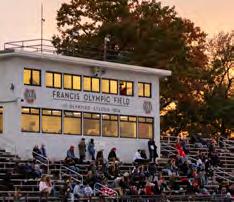
PARTY LIKE IT’S 1904 Olympic events to return to St. Louis, 124 years later. (Sports, pg 11)
STRUGGLES
How to quit texting your ex-fling. (Scene, pg 4)
St. Louis’ furry friends kick off Soulard Mardi Gras. (Photo, pg 7)
PARTY LIKE IT’S 1904 Olympic events to return to St. Louis, 124 years later. (Sports, pg 11)
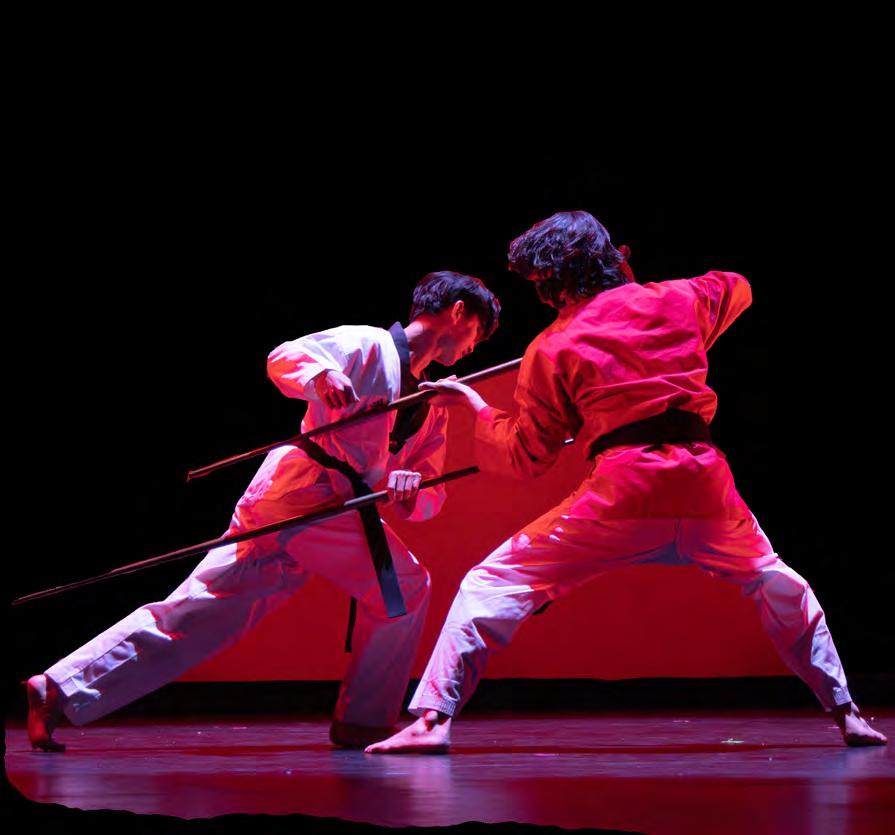
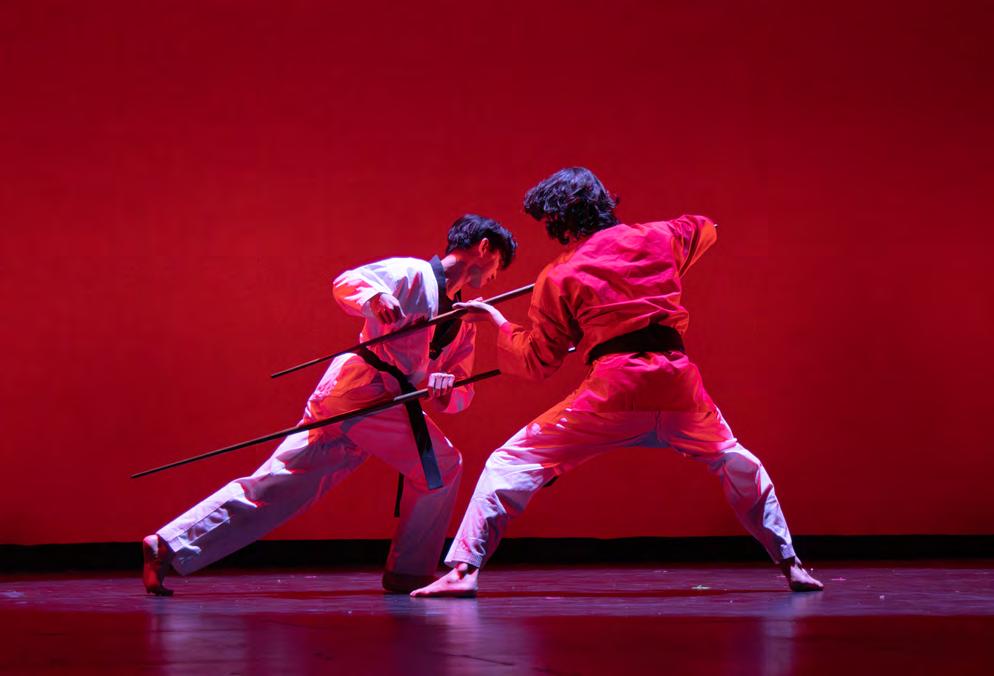
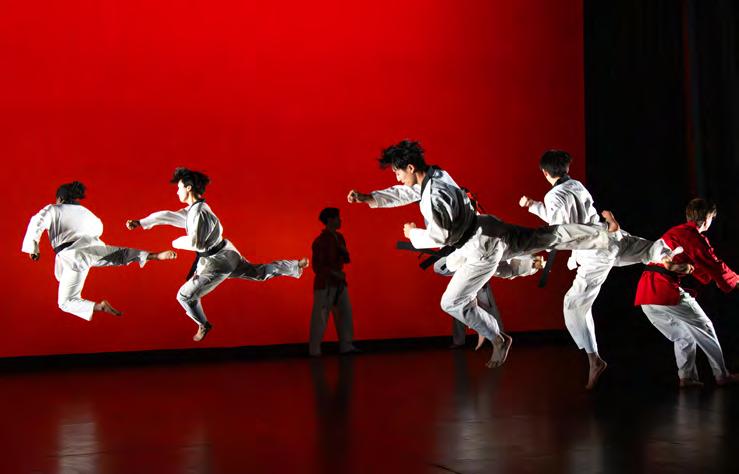
The 30th Lunar New Year Festival (LNYF) performance graced Edison Theatre last weekend to sold-out crowds. The culmination of a year’s worth of planning and practices, this year’s “Boundless Horizons” show celebrated the Year of the Horse. The show featured 11 performances of Eastern and Southeastern Asian arts, including Tinikling, Lion Dance, Taekwondo, Wushu, Yoyo, and much more. This year, the student-run production partnered with the Ferguson-based nonprofit EarthDance, an organic farm that brings local produce and agricultural knowledge closer to St. Louis.
A man has been charged with 15 counts of invasion of privacy after allegedly photographing more than a dozen people inside women’s restroom stalls at Olin Library.
Prosecutors said the defendant, Dennis Dill, 30, photographed women in various stages of undress inside Olin restroom stalls on Nov. 19 and Nov. 25. Dill, who is unaffiliated with WashU, allegedly took the photos by placing his phone in a side pocket of his backpack and pushing the backpack into adjacent stalls.

WashU’s Brown School will be the first in the nation to fully fund practicum credits and offer living stipends for all Master of Social Work (MSW) students starting this upcoming fall semester. The Practicum Support Award will cover the costs of both the foundation and concentration practicums, totaling 960 hours needed to complete WashU’s MSW.
According to Tyler De Shon, associate dean for academic affairs and enrollment management at the Brown School, the new award covering practicums tuition will translate to approximately $15,000 of tuition coverage for a full-time MSW student. Additionally, he wrote in an email to Student Life that each student will also receive a $500 living stipend each month during the fall and spring semesters.
The financial stresses of unpaid practicums are pervasive amongst social work students, as this fieldwork is a graduation requirement for both a bachelor’s and master’s in the field. For students hoping to become clinical social workers, a master’s is mandatory in every U.S. state. This year at WashU, a full-time MSW student’s annual cost of attendance, which includes tuition, housing, food, and more, totals $77,922.
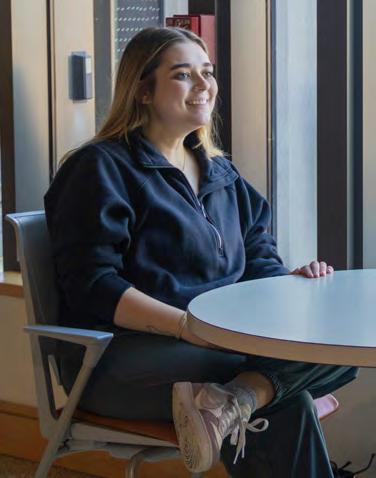
Anna Steensma, first-year MSW student at the Brown School, said that given these financial stressors, the stipend will be instrumental for her.
some scholarships, I’m very grateful for them, but federal student loans are the only reason I’m here. It’s amazing that the dean and the rest of the higher-ups at the Brown School recognize that [tuition] is a lot of money for anyone to be paying.”
According to Fortune, many MSW students rely on loans to finance their education. The U.S. Bureau of Labor Statistics (BLS) cited the median pay for social workers in 2024 as $61,330, with lower and upper bounds of $41,580 and $99,500, respectively.
In 2017, George Washington University Health Workforce Institute and School of Nursing reported that the field has experienced profound growth, a trend expected to continue well into the 2030s, according to the BLS. Many students going into social work pursue a master’s degree to further their career goals, despite the high cost.
According to De Shon, a “relatively small portion” of MSW students at WashU were already receiving financial aid for their practicum through the Practicum Support Award, which was $2,500 for the first two semesters they completed their practicum.
De Shon further clarified that the new award system has replaced any previous practicum support.
Surveillance footage indicates that Dill was in a women’s restroom on the first floor of Olin for about five hours on Nov. 19. Corner 17 employees confronted Dill on Nov. 25 after noticing suspicious activity in the restroom stalls. Soon after, the Washington University Police Department arrested Dill and launched an investigation into his actions, during which officers obtained a warrant to search his phone.
Prosecutor Melissa Price Smith said Dill was already on probation for a similar offense at Southwestern Illinois College (SWIC) when he allegedly photographed women at Olin Library. SWIC is located in Belleville, Illinois, where Dill is a resident.
“We have no evidence that [the images] were distributed or disseminated out into the public,” Frisella said.
Price Smith said the case is timely because of what it reveals about safety and privacy in society.
“I think this case, like so many of the cases that we have here and that are in the news, is unfortunate,” she said. “It’s unfortunate that this is the world we live in. It’s unfortunate that we have to look around when we walk to our cars. It’s unfortunate that, after this story, I think we all feel that we need to look up and down when we are in literally a restroom stall. That’s not somewhere we should have to worry that we don’t have privacy.”
Price Smith also took the opportunity to address the WashU community.
“This is a call out to these students or faculty that believe they may have been a victim of Mr. Dill,” she said.
Price Smith commended WUPD for its investigation into the suspect’s actions at Olin, even though it was slowed by the interruption of Winter Break.
“They really had to do a lot of legwork to find the victims, to find this individual, to get the evidence search warrant for his phone, all of those things they did an excellent, excellent job in terms of WashU security,” she said.
“I’m very transparent about how I fund my school because I don’t think there’s enough transparency about that,” Steensma said. “The only reason I’m able to attend school is because of student loans. I do have
“Students who may have received awards for practicum support in the past will now receive the same benefits as all MSW students under the new model beginning in fall 2026,” De Shon wrote in an email to Student Life. “These benefits are in addition to any scholarships students receive. Under the previous system, practicum support came from existing scholarship funds. Under the new system, both the stipend and practicum tuition coverage are new, added benefits.”
De Shon said the new award is not tied to tuition increases and that overall tuition increases are made at the University level.
First-year MSW student Emma Murphy said that having an additionally funded semester has benefited her
“Honestly, when I first heard the news about the Brown School funding practicums, I wondered, ‘Oh, is this just a publicity thing?’” Murphy said. “I was skeptical, and I thought this might just be a new name for the already-existing financial assistance for practicum. And in some regards, that is a little bit of it. The amount of money that I am getting this semester versus next semester isn’t actually changing at all. However, this new award is adding financial support to my final spring semester, as well as some tuition assistance that I didn’t expect.”
Murphy also said that, given the Brown School’s prestige in the field of social work, she hopes the decision will influence other social work schools to fund their practicums
“I’m grateful for whatever they’ll give us,” Murphy said. “Anything’s better than where we were at, and this is a big step. I feel like WashU has a lot of sway [with its MSW program]. They have prestige, so I’m hopeful that by taking this step, it expands more broadly across the nation.”
Steensma said that, even though some may think $500 a month seems little, for her, it will make a big impact.
“Some people may say, ‘Well, what’s that going to pay for?’ For me, that takes care of more than half of my portion of rent. It’s more than I can say any other school I’ve attended has done,” Steensma said. ZOE
SEE MSW, PAGE 3
“You would hope that somebody being on probation would help them to realize they needed to change their ways,” she said. “Whereas, not only does he not seem concerned about being on probation, he’s actually escalated and doing it even more. That, to me, is a red flag.”
Of the 15 counts filed against Dill, 14 are classified as Class E felonies and one as a Class A misdemeanor. The 14 counts are considered felonies because they happened “during the same course of time,” while the misdemeanor occurred on a different day, according to Price Smith.
Dill is currently held at the St. Louis County Jail, located on the uppermost floors of the Buzz Westfall Justice Center, where Price Smith gave a press conference about the case on Feb. 5. He is held on a $100,000 cash-only no surety bond.
Price Smith assigned Assistant Prosecuting Attorney John Paul Frisella to serve on the case.
One of the victims — who asked to be anonymous for safety reasons — told Student Life in December that her experience of being photographed was highly distressing.
“This whole thing [was] a little traumatizing. I’ve seen it in the news, but I did not expect that it would happen [to] me or anyone I know,” she said. “I kind of have an ‘Oh, my God’ mindset; I have to check everywhere I go now.” She added that she hopes coverage of the case will prompt women to be more aware of their surroundings and take steps to protect their safety
When asked to elaborate on the psychological aspects and fear surrounding the case, Frisella said that, to his knowledge, the images found on the suspect’s phone had not been circulated.
According to Missouri Case Net, the two attorneys working on Dill’s defense thus far are Daniel A. Juengel and Anna Marchiony, both of Frank & Juengel Law Group P.C. Marchiony filed a motion for bond reduction on Feb. 5, which was heard on Feb. 11 at 10:00 a.m. by Judge Julia Pusateri Lasater, who is presiding over the case.
Price Smith emphasized the importance and impact of a victim’s decision to come forward.
“The power of a victim’s voice is so incredible,” she said. “Once a victim discloses, [they] are no longer anyone’s victim … When these people come forward, it is taking their voice back.”
If you believe you or someone else you know may have been a victim of Dill, contact WUPD at (314) 935-5555. You can report a crime in retrospect anonymously through the Silent Witness Form at https://police.wustl.edu/contact/ silent-witness-form/.
The Sexual Assault and Rape Anonymous Helpline (S.A.R.A.H) provides confidential and anonymous support and can be reached at 314-935-8080 from 4 p.m. to 8 a.m. during the fall and spring academic semesters. There are counselors at the Relationship and Sexual Violence Prevention (RSVP) Center, located in Seigle Hall, Suite 435, available confidentially to any University student. The office can be reached at 314-935-3445 or by email at rsvpcenter@ wustl.edu. The National Sexual Assault Hotline can be reached at 1-800656-4673 or via online chat at https://hotline.rainn.org/online 24/7.
To reach Title IX, students can contact Title IX Coordinator Jessica Kennedy at 314-935-3118 or go to the Title IX Office in Umrath Hall 001.
‘Courage is collective’:
visits WashU
LAUREN SMITH STAFF WRITER
Author and feminist philosopher Judith Butler spoke to a crowd of about 200 members of the WashU community about their most recent book, “Who’s Afraid of Gender?” and the future of world democracy in the Clark-Fox Forum in Hillman Hall on Feb. 3.
Butler is a gender theorist and distinguished professor at the University of California, Berkeley’s graduate program in Comparative Literature, recipient of the Andrew Mellon Award for Distinguished Academic Achievement in the Humanities, and a member of the advisory board for Jewish Voices for Peace. They are the author of over 15 books, most notably “Gender Trouble” (1990), which proposed the concept of gender performativity — the idea that gender is a set of performed and learned actions rather than an inherent way of being.
Butler described the current political moment as tumultuous, pointing to Immigration and Customs Enforcement vans on the streets of U.S. cities, the United Nations’ declaration of Israel committing a genocide in Gaza, and federal attacks on transgender rights.
They emphasized that focused attention to current events is key to preventing these horrific acts by governments from becoming the norm.
“I have suggested we may be feeling anxiety and alarm, that we also have to keep such events from becoming normal,” Butler said. “But does that mean we have to be on alert all the time? I want to
say that we have to be focused and attentive, but refuse to be undermined by anxiety if we are to elude, oppose, and dismantle such powers.”
Butler argued that those who seek to resist conservative power need to create a future that supporters of conservative power would want to live in as well.
“My wager is that those who would like to expose and defeat this [conservative] power have to ask themselves, ‘For what passionate principles do we stand, and how do we craft, display, and circulate them such that people will see what we offer?’ The kind of world in which they desire to live, to live in common,” Butler said.
Butler said this strategy involves implementing imagination as a political tool.
“This requires linking our political movements with the work of the imagination and creating an imaginary that allows us to think experimentally and hopefully about the new coordinates for a world that makes democratic life irresistible along the way,” they said.
Senior Ash Withrow said Butler’s talk made them rethink their idea of dismantling power.
“Power is not formulaic in how it acts, but that’s how it presents itself, and how we can sort of dismantle it is through the ability to reimagine and recontextualize and recreate,” they said.
Senior Marissa Mathieson said she greatly appreciated Butler’s messages of community in the face of attacks on higher education.
“Beyond the talk about the literature and their book and all of the scholarly work they’ve done, I think the most important part [is] about

Humanities’ 2026 Faculty Book Celebration.
social change and social justice, and hearing talks about [that] reminds us how imperative it is to stay together in a time like this, no matter how much is changing around us,” she said. “One line that stuck out to me was that ‘courage is collective,’ and I think that, especially when education is being reprimanded and taken away in a lot of different forms and aspects, that this is a time that we need to push forth against it and stay together to continue in the pursuit of education.”
Butler’s lecture was accompanied by two shorter introductory presentations by WashU faculty members celebrating the release of their new books. René Esparza, assistant professor in the Department of Women, Gender, and Sexuality Studies (WGSS) spoke about his book “From Vice
to Nice: Midwestern Politics and the Gentrification of AIDS,” which deals with the Midwest’s reaction to the AIDS crisis and argues that policies enacted during this time to counteract the spread of AIDS fueled gentrification in St. Paul and Minneapolis. In his book, Esparza details the history of seemingly progressive LGBTQ+ politics in the Midwest and argues that although gay men were the ones advocating for these policies, white gay men who assimilated well into Midwestern cultural values and severed ties with sex workers and racial minorities to achieve their means.
Anca Parvulescu, Liselotte Dieckmann Professor in Comparative Literature, presented on her new book “Face and Form: Physiognomy in Literary Modernism,” which connects
transatlantic modernist literature’s obsession with the human face to the vast array of current technological and medical advances dedicated to improving, categorizing, and identifying faces.
Parvulescu links physiognomy (the pseudoscientific idea that the face reflects a person’s character) as an access point to current politics of societal belonging in an era of Instagram filters, normalized plastic surgery, and airport security checkpoints based on facial recognition technology.
She emphasized the relevance of the humanities to democracy today, speaking about the need for protesters to protect themselves from facial recognition to avoid repercussions from the government.
“I ask myself as a literary critic, ‘What can literary
studies and the humanities more generally contribute to [today’s political] conversation?’” Parvulescu said. “Just a look at the books published this year here at WashU should be enough to flag such questions … [Yet] we, again and again, have to justify our existence and so-called ‘advocate’ for the Humanities.”
In response to the increased pressure humanities departments across the country face to justify their existence amidst the federal government’s cuts to higher education funding, Butler echoed Parvulescu’s defense of the humanities.
“Washington University has always had a strong reputation in the humanities, especially its graduate programs,” Butler said. “Let’s make sure they stay strong, well-funded, and well-respected.”
LEXI LAWSKY STAFF WRITER
Next fall, the Olin School of Business will launch three new specialized master’s programs (SMPs) in Business of Sports, Wealth Management, and AI for Business. According to Professor of Finance and Vice Dean of Education, Todd Gormley, the programs will meet the needs of employers and prospective students.
An SMP is a more targeted and faster-paced program than a traditional MBA. Instead of a two-year MBA, students can choose to do an SMP, which is typically only one year. Two of the new programs, Wealth Management and AI for Business, are nine-monthlong programs, and the Business of Sports program is 16 months, which includes a summer internship.
“[SMPs] are designed for individuals with very clear areas where they want to upskill, which is different from the MBA, which focuses on leadership skills and provides exposure to all functional areas of business,” Gormley said.
Planning for the programs began in the summer of 2024, and they were approved by the University in summer 2025. Gormley wrote that while faculty led the program design process, industry partners informed the curriculum and skills taught in each program to prepare graduates for
real-world business.
“One shift we’ve heard clearly from students is a growing interest in shorter, more specialized programs that allow them to upskill in a specific area and move efficiently into the workforce,”
Gormley wrote. “That includes recent undergraduates who want to strengthen their credentials to land their first job, as well as working professionals who want to pivot or uplevel their careers without committing to a traditional two-year program.”
This Olin expansion is occurring during a time of layoffs and budget cuts across the University and a goal of operating at a $7.4 million deficit for the 2026 fiscal year.
Durai Sundaramoorthi, professor of practice in data analytics, said that despite this constraint, Olin will continue to advance education.
“Even during times of constrained resources, it’s critical not to lose momentum in areas that are shaping the future of business education,” Sundaramoorthi said. “That commitment to forward-looking programs is one of the reasons Olin continues to stand out as a leading business school.”
Sundaramoorthi worked closely with a task force of Olin faculty to develop the AI for Business program.
“Because the degree can be completed in two semesters, it’s an excellent opportunity for seniors and recent graduates to gain
in-demand AI skills quickly, as well as for experienced professionals who want to upskill and stay competitive in the job market,” Sundaramoorthi said.
Research and consulting with alumni and industry professionals from organizations including Alibaba, Amazon, Bayer, Schnucks, Syngenta, and Wells Fargo Advisors influenced the decision to make an AI-specific program, Sundaramoorthi said.
“AI is rapidly reshaping how businesses operate and how jobs are performed,” Sundaramoorthi said.
“Today, organizations are looking for graduates who can actually use AI in their day-to-day work — not just understand it conceptually.”
For the wealth management SMP programs, Olin faculty worked closely with employers to ensure the curriculum covered materials sought in potential future hires, Director of the Corporate Finance and Investments Platform, Timothy Solberg, said.
“I went out and met with major employers — Edward Jones, Wells Fargo Advisors, Moneta Investment Group, Stifel — and many smaller firms to find out what they were looking for in a WashU grad, and what was important to them,” Solberg said.
The Wealth Management SMP is a redesigned version of the three-semester Wealth and Asset Management Masters.
“We took out the heavy
technology, the STEM orientation, after consulting with a lot of the employers in the area in the wealth management industry,” Solberg said. “They didn’t need as much technology as they needed direct training in investment management and in understanding investment policy, taxation, and estate planning.”
Major wealth management firms told Solberg that they wanted employees with “behavioral finance” skills to understand why people are making investment decisions.
“The Baby Boom generation is at the point of estate planning and passing on a lot of assets. Up to $14 trillion of wealth in the next five years will be going to children and grandchildren or to philanthropic ventures,” Solberg said. “The wealth advisory firms are very keen on keeping tabs on this money and managing it where appropriate across generations, and so the behavior of the investors is very important.”
While the program’s first class of students has not been formalized, Solberg thinks that the program will attract three main types of people: students who graduated without a degree in business or economics who will have to complete basic prerequisites before entering the wealth management program, students with a business degree, and people who have already worked in the field but want a higher
level of understanding.
Director of the Business of Sports Program, Patrick Rishe, worked with other faculty as well as alumni working in sports business to develop the curriculum for the SMP. The new program will combine elements of the current Business of Sports undergraduate minor with new specialized courses.
“We had built this wonderful undergraduate program where we knew we had something special, and so we were fairly confident that if we expanded to the graduate level, we would be able to recruit students and place these students,” Rishe said.
The Business of Sports program consists of 39 credits of preexisting undergraduate and graduate Olin classes as well as four new classes: Sales Strategies in Sports, Business of Sports Media, Business of Women’s Sports, and Business of Sports Gambling.
“We will be the only school in America, to my knowledge, that will be offering both a business of women in sports class and a business of sports gambling class,” Rishe said.
Jamie Weinstein, vice president of membership and premium service at the Miami Dolphins and a WashU women’s softball alum, will teach the Sales Strategies in Sports course in the new program.
“I’m incredibly excited to return to my alma mater to teach sales strategy
— especially in the first year of the graduate program. As a former student-athlete and someone who built a career in sports after earning a graduate degree in sports management, this feels like a full-circle opportunity,” Weinstein said.
Rishe said that the target cohort size for the inaugural class of the Business of Sports program is 15 to 20 students and that, ideally, the program will be self-financing. So far, the program has recr uited both students with business knowledge and students with none at all, Rishe said.
However, due to the similarity between Olin undergraduate classes and the SMPs, it is doubtful that current Olin students will be a part of the Business of Sports program, Rishe said.
“We intentionally wanted this to be a national program, and our recruiting efforts reflect that,” Rishe said.
Faith Fehrman, a current senior at St. Norbert College in De Pere, Wisconsin, will be joining the Business of Sports master’s program in August 2026.
“Ultimately, I joined this inaugural class because of WashU’s extensive professional network and deep-rooted connections in the sports industry,” Fehrman said. “The faculty’s commitment to helping students cultivate these relationships has made my career aspirations feel truly attainable.”
Neirdorff Family and Centene Corporation Dean of the Brown School, Dorian Traube, said the funding was made possible through multiple efforts.
“It was a combination of University resources and a number of donors,” Traube said. “No one does something like this on their own.”
Traube went on to state that the entire WashU community has been very supportive of the Brown School and its work — a relationship that is rare in the academic world, according to the dean. WashU adopted “institution-wide” commitments to building up its region through economic, educational, and healthrelated avenues, calling the initiative “In St. Louis, For St. Louis.”
“The Brown School is central to WashU,” Traube said. “‘In St. Louis, For St. Louis’ is a very social work
perspective.”
She also shared that the new funding will not affect the number of accepted students to the Brown School. In fact, Traube hopes to grow the program to 200 students.
The Brown School’s mission to continually support students will not end here.
Traube shared that her personal “north star” is for the Brown School to be completely tuition-free by the end of her tenure as dean.
Lorien Carter, alumna of the Brown School and now a professor of practice, feels that the new funding will allow MSW students to take part more deeply in the Brown School social scene instead of missing out due to having to support themselves financially.
“There is something really special about the community that gets built here,” Carter said.
Carter also expressed hope that financial stress would have less of an impact on choosing practicum sites, some of which are paid and others unpaid, and would help improve students’ academic experience.
“The agencies [that MSW students complete practicums at] are still able to get the support that they need … [and] our students still get to ask for learning opportunities because the funding is coming from the Brown School,” Carter said. “Students … won’t be sacrificing learning for laboring.”
Steensma said she wants to go into hospital work to support victims of interpersonal violence after graduating. She said the Brown School’s support is why she’s able to reach her goals.
“I really want to work in a hospital. I’m really passionate about domestic violence,
or inter personal violence,”
Steensma said. “I’m a survivor myself, and I want to work on bridging the gap between survivors receiving
services at hospitals and hospitals giving them the services that they deserve.
I’m really grateful that the Brown School has the health
track, and that’s also what attracted me. I honestly, at the end of the day, owe everything professionally to the Brown School.”



Dear Scene,
I can’t stop myself from texting my ex-situationship. Every day I am pulled back into this vicious cycle, and I can’t help myself. Please, please, please tell me how to stop reaching out once and for all.
Kindly, Delusional
Dear Delusional,
You are simply a moth drawn to a flame, blameless in this terrible system that is casual romance. Maybe you are madly in love with this individual, or you’re just not over how things ended. Either way, your situation is quite understandable and relatable. You have bridged the first step to recovery: admitting you have a problem.
If your boo is replying and you keep falling into a repetitive trap, slipping back into unlabeled land, then all you need is a moment of self-reflection. Of course, it will take some time, but ask yourself why this situationship even happened. Is it the person you want? The validation? Or the company? If it’s the person, let yourself fully go through the break-up. I know what you are thinking: “Well, it is not a breakup because it wasn’t official.”
I don’t care. Let yourself feel every feeling, cry, watch “The Notebook” while eating ice cream, and rant to your friends — it is healthy. As for the validation, find an emotional nicotine patch to quit getting validation from romance. Find a campus crush, talk to someone you like, or get a celebrity obsession (Hudson Williams is right there). It does not have to be romantic; you might end up with a new friend and develop fulfilling platonic


February 27–July 27, 2026

dynamics. I’m not saying it will be easy, but you have to start taking back your life and step away from someone who is bad for you.
If it’s the company you are craving, please just find someone else. Believe me, you can find another person to fill that void. Get Tinder, Hinge, Bumble, whatever floats your boat.
If your not-so-significant other is ignoring or begrudgingly communicating with you, then it is time to get real, rip the band-aid off, and be honest with yourself. First things first, what even is a situationship? Is this some failed talking stage that you can’t let go of? A friendswith-benefits gone wrong? Or something that was only casual for the offending
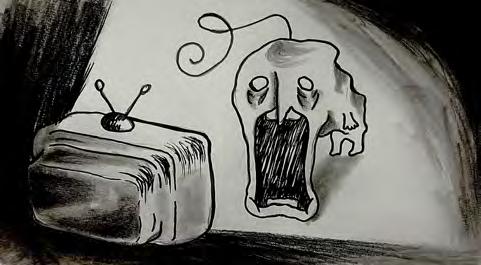
party? If so, reframe. This was not a situationship but just a dead-end, which is okay. We need rejection to grow. If it did not work out, it was not meant to. Maybe you have already tried everything. Somehow, you have attempted every sane option to sever this toxic attachment, and it has not worked. Well, it is time to cringe. Every time you are tempted to send an impromptu message, just picture the other person receiving it, turning to their friends, showing their screen, and getting a collective groan. You are the groan-inducer, the “omg-why-are-they-stilltexting-lol-so-embarrassing” of someone’s life, and you need to stop. Pretend that you are the main character in
a TV show, and everyone is turning their face away from the screen every time you reach out to That Person™. Cringe yourself out of your own actions. It might sound bizarre, but just soaking in the imaginary embarrassment avoids doing it in real life. Truthfully, there is no one way to get over a person. Whatever your unique situation is, let yourself be human. There is so much pressure to move on that it becomes nearly impossible to do so in a healthy way. Trust one thing: You will not get over them if you keep them in your life. You have power; use it.
Your fellow romantics, Scene
A sleepy student’s guide to the best napping spots on campus
WILL WASHKO STAFF WRITER
“There is more refreshment and stimulation in a nap, even of the briefest, than in all the alcohol ever distilled” — Ovid
Stayed up late studying? Need a break between classes? There’s nothing more refreshing than a quick nap. If you’re too tired to make the pilgrimage back to your dorm (no shame, we’ve all been there), here are a few places on campus that are perfect to nod off:
Indoor napping spots:
Olin basement: Let’s get this one out of the way. You can squeeze yourself into those strange doggie beds on the second sub-level, but I wouldn’t recommend it. They are moderately comfortable, but the experience, in my expert opinion, is far too cramped and exposed for a truly excellent nap. If you do plan to nap in Olin, I would recommend the orange seat and footrest combos on the second floor, or the big orange armchairs on the third floor. As an added bonus, people tend to be very productive around you. That way, you can work vicariously through everyone around you as you nap. 7/10
Crow Library:
My personal favorite. This space is quiet, cozy, and just far enough away from the bustle of campus to feel like a spa retreat. The library’s
second floor has these wonderful, overstuffed beanbags, perfect to flop on and forget about everything. It is completely antithetical to any kind of productivity. Truly a napper’s Eden. 9.5/10
Caleres Lounge, Hillman Hall:
There is a small cluster of couches on the third floor of Hillman Hall, and, in the warmer months of the year, nappers can expect not only a gorgeous view of the East End of campus, but also easy access to Hillman’s rooftop garden, providing a luxurious indoor-outdoor nap experience. There are, however, a few problems with this spot. The climb is difficult (three flights of stairs!), and the couches are in the middle of the room, which feels a little exposed. The couches are also backless, so napping semi-reclined is not really an option here. 7.5/10
DUC Fun Room:
The couches in the DUC Fun Room are one of the most comfortable surfaces on campus, if not the most comfortable. However, as the day goes on, the Fun Room becomes too busy and noisy for comfortable napping. It is ideal for a short nap after an early morning class, but gets too congested for afternoon or evening naps. Regardless, the morning naps are divine. 7.5/10
Bonus - DUC wall couches:
There are two wall couches built into the outside walls of the DUC Fun Room. They are covered in murals, and have a surprisingly comfortable cushion — perfect for lying down! For taller nappers, I would advise you to steer clear of these. They are quite cramped. I also have never seen anyone sit or lie in these alcoves, so proceed with caution. If Crow Hall is a napper’s Eden, then this is a tall napper’s Purgatory. 5.5/10
Outdoor napping spots:
Contrary to my expectations, WashU students do go outside — at least enough to make use of a select few outdoor napping spots. They are pretty terrible in the colder months, but they will become slightly more tolerable in the coming spring.
South 40 JKL hammocks: Itchy. Isolated. Uncomfortable. Do not nap here. 4/10
Hillman hill: Despite the silly name, the short, grassy slope next to Hillman is a wonderful option during the warmer months of the year. Lay down a blanket, prop your backpack behind your head, and bask in the sun. Alternatively, walk across the path to the hill under Brookings for a nice shady sleep. 7.5/10
JAKE ISENBERG STAFF WRITER
Getting a concussion knocks most people out and ruins their whole winter break. But for sophomore Felix Harari, professionally known as FLXX, his head injury during a vacation led to him producing “the best beat [he’s] ever made.”
That track he produced post-concussion would become “step wit me,” a smooth hip-hop track released this past November. “step wit me” is the lead single from his upcoming album “L.E.D.,” which will be released on March 13.
Harari, an Olin student with a minor in the business of entertainment, is a music producer from Brooklyn, New York. But because he’s a producer and not a rapper, you won’t hear his voice on any of the three singles he’s released so far. Harari considers his role to be that of a curator, who sends out beats and instrumentals to artists with the hope they’ll use them for their tracks.
“I see it like a puzzle, like you’re taking little pieces and creating your own kind of thing,” Harari said. “I’m always challenging myself to create something new … When I make music, especially with samples, it’s really like building a puzzle or a LEGO set. I see it as a physical thing. I’m not just imagining notes in my head, I’m visualizing where each sound is going to be and putting it in the right spot.”
With multiple generations of musicians in his family, Harari started piano lessons at a very young age.
“My grandpa played violin
in the Russian army,” Harari said. “My grandma was my piano teacher, and my greataunt also taught me piano … By the time high school came around, I was very sick of it.”
Still, Harari has remained fascinated by music and often considers new ways to create.
“I’m definitely always thinking about music,” Harari said. “People have voices in their heads; I have sounds in my head. Not really like beatboxing but tapping my fingers along to some sort of rhythm I had or whatever it was, just creating in my head.”
A summer camp friend’s producing skills pushed Harari to start learning the process. Harari initially taught himself production with just the Koala Sampler mobile app before he progressed to a more advanced program, with YouTube tutorials guiding his way.
“It was a very good way for me to start learning the basics of where drums should go and what sounds to use, simple mixing techniques. And then after the summer, I got back home, and I downloaded FL Studio on my computer. Then I just became obsessed with it,” he said. That obsession became a constant, and Harari often feels producing music as a full-body sensation, which pushes him to create a similar feeling for his audience.
“When I create, I’ll be visualizing where everything should go, but my body will also be moving,” Harari said.
“I’ll hear a sample or a melody, and I’ll bob my head in a certain way or tap my feet in a certain way. How ever my body physically moves is
how I want the music to be because music should move people.”
Harari has continued his music education at WashU, taking courses including Composition Workshop and Digital Audio & Multitracking: An Introduction to Electronic Music. In the latter, he met another WashU student, Christian Bean Royal, who goes by the stage name of Beany Bop. After hearing one of Harari’s beats in class, Royal was inspired to collaborate with the producer.
“A few weeks later, he sent me back a demo that was insane,” Harari said.
“It was the first time I heard someone rap so perfectly and capture the exact feeling I wanted when I created it.”
Harari had sent over the backing track for what would become “step wit me,” and their collaboration has proven extremely successful.
“I really, really love that beat. [‘step wit me’] is definitely my favorite. I still think every few months I have a new magnum opus, but right now it’s definitely still my magnum opus.”
Since then, Harari has continued collaborating with a variety of artists whom he has connected with online. This includes Danielle Carr and Newman on the relaxed and moody track “Breaking Bread,” which came out on New Year’s Day, and the West Coast-inspired “Come Alive,” featuring Mac Infinity and Maji, released on Jan. 29. All those tracks will appear on his soon-tobe-released debut album
“L.E.D.”
After his first head injury resulted in “step wit me,”
a second concussion led to him creating a new EP, titled “Lovestruck!,” which will be released soon.
But producing isn’t all smooth sailing. Harari has had to dismiss artists from projects, ask them to rewrite verses, and manage each of his tracks from conception all the way to their public release.
“I always have in the back of my mind, ‘Oh, I have to make sure to text this person today and to make sure this thing gets done,’” Harari said. “But then once I get the verse, and once I have everything finished, it’s very rewarding. And it feels great
to be able to create a project with 20 different artists, which is [the] total for the album.”
In “L.E.D.,” Harari wants to create a West Coastinspired LP full of vivid sounds and textures.
“I’m making it in my college dorm room with my LED lights and everything, but it’s also that the whole album is very bright and [a] throwback [to the] 2000s. When I listen to the beats I created for it, I just feel like it’s all full of bright colors, like neon,” Harari said.
Harari prefers to listen to albums from start to finish and hopes to create an
emotional journey across “L.E.D.’s” track listing not only for his listeners, but also for himself. “I decided that the first track on the album would be called ‘Let ‘Em Doubt’ and the last one would be called ‘Let ‘Em Die,’” Harari said. “The album is a progression from when I first started making music. There was a lot of doubt. Then, throughout the process of creating the album, from going from the first track to the last track, it’s like letting that part of me die off. Because you can’t do something great if you doubt yourself.”





















As a newspaper, we are thrilled that Student Love, or our “sex issue,” is so well-received on campus. We love the creativity and humor that comes along with it, from the naked club photos to scandalous sex stories. The fun and silliness of Student Love are undoubtedly part of the issue’s purpose, but they are not its primary focus.
Student Love is made to spark conversations about sex beyond the articles. We hope to make space for conversations about all of the joys and complexities of sex and relationships, including the serious ones. The more we talk about sex and relationships, the more vocabulary and understanding we build
around our own sexual experiences, preferences, and current or future relationships. We often only talk about sex in a binary — either centering sex positivity or sexual violence — dismissing the nuances of sex and relationships. Even these two phrases come with their own ambiguity. Talking about sex and relationships is not easy for many people; we each grew up with various levels of comfort and education about these topics. The ambiguity of labels like “hookup,” “situationship,” or “exclusive” can make it hard to define sexual and romantic relationships and boundaries, especially for those who
have less knowledge about sex. Moving beyond these labels through conversations about our feelings and experiences helps us define what we need for a healthy and enjoyable relationship.
Society pushes a narrative that sexual violence is a black-and-white situation, when in reality, most people’s experiences are the gray in between. Talking and listening in both serious and more lighthearted discussions about sex supports survivors in processing and sharing their experiences. In these conversations, we validate and learn about our own and others’ boundaries, preventing future sexual violence.

It is not only our responsibility to normalize conversations about sex and relationships, but also the WashU administration’s to facilitate these conversations for students. Our campus has strong resources for sexual violence survivors, including the RSVP Center and the S.A.R.A.H. hotline. Still, current sexual health programming, including The Date and Beyond Sex Ed, has received criticisms from many students, including sur vivors, for presenting limited perspectives of what sexual violence is and how it can be avoided.
WashU should strengthen these programs by consulting student survivors and the greater student body, but educational programs still cannot cover every sexual encounter or experience. These limitations make it all the more important for students with diverse viewpoints and experiences to discuss sex. While we hope students will facilitate these conversations on their own, the University should also integrate time for discussion into its programming.
Student Love is grounded in the importance of open and honest sexual conversations. When sex is a taboo subject, we foreclose necessary dialogue about the complexity of sex and romance, including its potential for joy, pleasure, or harm. Sexual violence is exacerbated when people lack comprehensive understandings of sexual health and communication and when survivors do not
feel comfortable or validated in talking about their experiences.
Our sex issue is the first step towards opening these conversations, and now it is up to you to continue them.
Staff editorials reflect the opinion of the majority of our editorial board members. The editorial board operates independently of our newsroom and includes members of the senior staff.
Bri Nitsberg, Managing Photo Editor
Sylvie Rich ards, Managing Forum Editor
River Alsalih i, Senior Forum Editor
L yn Wilkins, Junior Forum Editor
David Ciorba, Senior Forum Editor
Amelia Raden, Senior Forum Editor
Kate Th eerman Rodriguez, Senior Forum Editor
Sydney Tran, Editor-in-Chief
Riley Herron, Editor-in-Chief
Mason Sutton, Special Issues Editor
Mac Motz, Photo Editor
Ella Giere, Photo Editor
Isabella Diaz-Mira, Photo Editor
Will Rosenblum, Managing Scene Editor
Elizabeth Grieve, Senior Scene Editor
Soph ie Schwartz, Senior Scene Editor
L aurel Wang, Senior Scene Editor
Soph ia Hellman, Senior Scene Editor
Hannah La Porte, Junior Scene Editor
Bea Augustine, Managing Design Editor
Matt Eisner, Managing Sports Editor
Anna Crook, Junior Sports Editor
Ian Heft, Senior Sports Editor
AnaElda Ramos, Managing Illustration Editor
Th e Sexual Assault and Rape Anonymous Helpline (S.A.R.A.H.) provides confidential and anonymous support and can be reached at 314-935-8080 from 4 p.m. to 8 a.m during the fall and spring academic semesters.
There are counselors at the Relationship and Sexual Violence Prevention (RSVP) Center, located in Seigle Hall, Suite 435, available confidentially to any University student. The office can be reached at 314-935-3445 or by email at rsvpcenter@ wustl.edu.
The National Sexual Assault Hotline can be reached at 1-800-6564673 or via online chat at https://hotline.rainn. org/online 24/7.

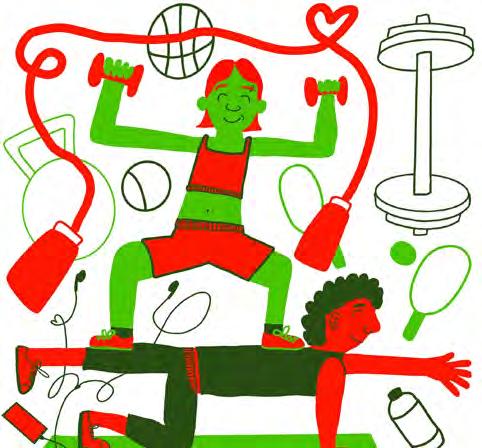
Looking back at my various conversations with peers at WashU, there is a constant that connects women and feminine-presenting first-year students: gym anxiety. These feelings are not exclusive to WashU or to the female experience, nor are these anxieties rooted in individual motivation. Instead, this “out-of-place” feeling is systemically manufactured and not just in your head.
On college campuses, women and female-presenting
folks tend to be vastly outnumbered in the weight section, are less likely to lift, and experience more body image anxiety. As a result, women often make sense of the discomfort they feel by interpreting the gym as a masculinized, surveilled space. By challenging these assumptions, actively dismantling (often unconscious) systemic biases, and fostering a community of respect and compassion, the gym can become a more inclusive space that welcomes all individuals — regardless of identity, ability, or background. Like any other type of
On game day, my house buzzes with energy. My mom sits on the edge of her seat, yelling at the screen. My dad has a glass of wine and a hand over his eyes.
Football is a microcosm of American culture — the good and the bad. In preparation for the Super Bowl, I reflected on my tumultuous relationship with sports and football. Over the past few years, the ritual of sitting on the couch with my friends and family, the game in the background and wings on the table, has become something I look forward to.
Sports always felt like a “guy thing” growing up. However, the gender divide has seemingly faded with age; more of my female friends are interested in sports than ever. I interpret this as both a consequence of my aging out of stereotypes and a decrease in the prevalence of such generalizations in our generation.
Being interested in sports as a woman is more normalized than ever. Yet, the smaller prejudices toward female sports fans are more difficult to call out, and therefore respond to, than overt intolerance.
The constant discomfort of being a female sports fan is in no way a consequence of any individual’s behavior. Instead,
years of gender-based discrepancies from the media and older generations have accumulated to make something about enjoying football as a woman feel off.
There’s an element of performance that sullies every conversation I have about sports. The “not-likeother-girls” phenomenon in popular culture — portraying girls who participate in traditionally masculine interests as purposefully acting “not like other girls” for male validation — has made me doubt the authenticity of my fanhood, even when I’m watching a game by myself. I feel like a fraud, and then feel a subsequent desire to prove my enthusiasm, which only feels more performative.
In fact, it seems like there’s no way to avoid conforming to some stereotype.
Every month, there’s a new term coined used to put down women, from “not like other girls,” to “popular girl humor,” to “bridezilla.”
Talking to men feels like walking on eggshells, attempting not to betray my gender in some meaningless way.
The confidence that comes with being a male sports fan is their birthright. I will always be less sure of myself discussing players, even if I spend weeks memorizing stats and analyzing games: gender norms tell me I don’t belong in the conversation.
anxiety, gym anxiety is entirely personal. You could be new to the gym or returning, unfamiliar with the equipment, trying new things, worried that everyone is judging you, or petrified of gym culture — gym anxiety comes in all forms. More likely than not, fellow gymgoers have felt these same emotions of inadequacy and insecurity — myself included. Rather than treating discomfort as a personal failure, I had to validate these emotions.
Simply put, avoidance is not the answer, and although you cannot change the culture alone, you can change how much power it has over you.
For credibility’s sake, I have been lifting since my first year of high school. Living in a couple of different places growing up, I have overcome many gym landscapes. From military fitness centers to Planet Fitnesses, I have seen gym anxiety affect many people. I spent most of my sophomore year in a vicious ruminating cycle, overcome by a self-conscious haze. Admittedly, I have had plates fall from a low bar mid-thrust, sweat drip from every crevice of my body, and injured myself mentally and physically, leading to a complicated relationship with my body that I was able to control.
Before I discovered my love for football, I never felt jealous of traditionally masculine activities. I’d always loved traditionally feminine ones, but even more so, the ritual of spending that time with the women in my family: late-night tea and cookies, long car rides, and anecdotes while peeling potatoes. My female community is indispensable.
But recently, I’ve discovered a new community that I love. While watching football, I love yelling at the TV, game day snack plates, and hugging my dad during a touchdown.
Sometimes, I feel like I can’t love both at the same time. I have a subconscious urge to separate and hide certain aspects of my personality in different environments and with different people. This experience is not unique, but instead, encapsulates the experiences of many women in the sports community.
Football is built on masculinity. The sport itself is played by men, and the fandom has always been male-dominated. As an American male, being interested in football is proof of one’s manliness. Its existence as a symbol of masculinity makes it difficult for women to feel like they belong in the audience.
The male domination of football has a larger effect than just making women feel

Nonetheless, I have compiled a list of reassuring affirmations that I wish I had heard as a first-year student: Start short and small. Getting more confident in the gym starts with small changes to your routine: I recommend picking a less busy time (this can be anywhere from 6-9 a.m., 11 a.m.-1 p.m., or 7-11 p.m., in my experience), bringing a friend, fueling yourself with a pre-workout meal, familiarizing yourself with the layout, setting personal boundaries for social interaction (i.e., while lifting, try to avoid glances and conversation), using a distracting tool to focus on something besides the people around you (i.e., music or a podcast), or claiming a corner for stretching either on the elevated track, Studio 1904, the strength training area, or a crevice of your choosing. If you’re unfamiliar with Sumers Recreation Center, you can explore its amenities and note what you prefer.
You can’t run till you walk.
Beginning a routine is the hardest part of getting comfortable in the gym, yet it’s integral for consistency and to
like they don’t belong as fans: it also makes them unsafe.
In the 2023 Super Bowl, an ad made it seem as if the channel had changed from the game. Many anecdotes surfaced of women describing the fear and abuse following the commercial. In fact, football is inextricably linked with gender-based violence. The National Institutes of Health report that upset losses lead to an increase by 10% in domestic violence
reduce further intimidation.
I suggest that you walk on the elevated track at Sumers, smack around in the boxing alcove, stretch in the threecourt gym, dissociate with the lights off in Studio 1904, fall asleep in the sauna offered in the downstairs locker room, or follow an exercise video on YouTube. Results in the gym don’t show up overnight — give yourself grace as you experiment.
Find joy in moving your body — the gym does not have to feel like a chore.
You can make the gym fun with a comfortable and cool outfit or uplifting music.
Research and create a simple plan before your visit, pick up a small weight, acquaint yourself with specific motions, and try something new every time, making note of what feels correct or incorrect.
You cannot hate yourself into loving yourself.
Start by taking the pressure off of comparison and remind yourself that shifty eyes do not mean animosity. Struggling to find the love in yourself?
Practice complimenting someone new, and, more than likely, they will reciprocate the love.
against women. It’s difficult for women — myself included — to participate in a fanhood that actively contributes to violence against our gender. Of course, this culture of violence has larger detriments than just its effects on female sports fans, but it indicates the widespread effects of the hypermasculine culture in football.
We need to combat the idea that sports are a male
The cardio plaza is comfortable, but the strength training area needs some love too.
Lifting weights in a malecentered gym can be daunting, yet the machines are optimal for essential strength training and reducing the risk of injury. Having access to these machines may not be the same as feeling included, but you can foster inclusion by asserting yourself within the space. Ask trainers or use Google, YouTube, or Fitbod for help when necessary.
Most importantly, the gym is all about you, your goals, and your wellness.
The same egocentrism, or “main character syndrome,” that makes you worry about how you look is making them worry about themselves, not you; you are far more than a passing glimpse in someone else’s set, and your value has nothing to do with how you work out in Sumers.
Celebrate Body Acceptance Week at WashU Rec with me by fostering a shift toward selflove rather than insecurity, whether through moving your body at Sumers or otherwise.
event. If we no longer define football by manliness, we could decrease the element of masculine performance that contributes to violence and make the environment more welcoming to possible female fans.
I urge everyone, especially male sports fans, to discard their preexisting notions of what it means to be a fan. Open yourself up to a vision of a game day that looks more unconventional:

Escape with your sweetheart to The Cheshire for a charming boutique hotel experience and romantic get-away. Enjoy the timeless elegance of our historical hotel’s luxurious accommodations, modern amenities and superb culinary pleasure with on-site dining and cocktails.
Stay the evening, stay the night, at the Cheshire.
“He bribed me,” Halpern said. “He said to me, … ‘If you’ll go with me to a basketball game tomorrow night, I’ll buy you a hot dog.’”
Claire Halpern and Michael Greenfield might be WashU basketball’s biggest fans.
On game days, the married couple is decked out in reds and greens. When the Bears are in the playoffs, they wear a special pair of socks for the postseason. They go to every basketball game, even attending the away games if they’re within driving distance.
Halpern and Greenfield seem like the common “super-fan archetype.”
They’re the kind of diehard fans you may spot at a Cardinals game or maybe at a Big Ten basketball matchup, but at a Division III school like WashU, they are quite the oddity.
Greenfield taught at WashU School of Law for 53 years before retiring in 2023, but he did not start attending basketball games until 2005.
A casual follower of WashU sports before, he first convinced Halpern to attend a game with a small incentive.
Since that game, the two have become lifelong fans, sticking by the team for its highest and lowest moments.
Halpern and Greenfield are diehard supporters WashU basketball, consistently attending games since before the current first-years on the teams were born.
Their enthusiasm for the program extends to both the men’s and women’s teams.
“It’s like asking which child is your favorite,” Halpern said. “The women … to me, it’s more artistic. The men’s [is] more physical.”
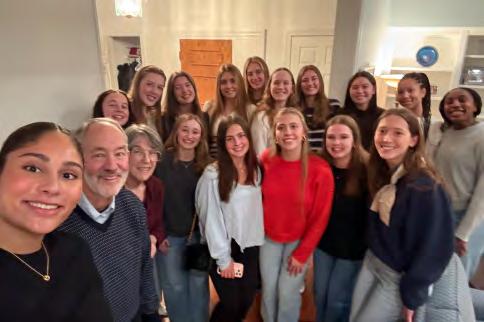
Wins and losses aside, their relationship extends beyond fandom, with the two regularly hosting the teams for dinner. Since the basketball teams typically play over WashU’s winter break, when dining halls are closed, players often have to rely on team-issued sandwich coupons to eat. In 2010, Halpern and Greenfield started hosting the basketball teams for
dinner over break.
“We learned that over winter break, there’s no food service, which just shocked me,” Halpern said. “So we started hosting the team just so [the players] could have one normal meal over break.”
When asked about memorable games, two in particular came to mind.
The first one they described was a women’s game against the University of Chicago.
“We were down 9 points with 47 seconds left, and we won,” Halpern said. “We intentionally fouled the same woman; she kept missing … We gave the ball to Erica Hunt, who made back-toback threes. Wow.”
The second was the first round of the men’s playoffs hosted by WashU in 2018.
“We had an outstanding team, and we got beat on a buzzer beater by Aurora [University],” Greenfield said about the game.
While they love seeing the team in person, away games haven’t been as enjoyable when watched online. With the University Athletic Association’s shift to FloSports, a
subscription-required streaming service for games, accessing the games has been very difficult. Together, the couple says the platform makes it harder to feel connected to the games they’ve followed for decades.
“The broadcast is not so good. … There are pauses, and it’s out of sync with the video and the audio,” Greenfield said.
“Also, I don’t like the
price,” Halpern said. “If an alum wants to just turn in for a particular game, there doesn’t seem to be a onegame access option.”
But for Greenfield and Halpern, the heart of being a fan has never been about the broadcast: It’s the small, heartfelt gestures between the team and fans that make every game worth attending.
“I will tell you, [at] the end of [the] game … [the
women’s basketball team] turning around and sort of applauding [the fans] is lovely,” Halpern said. The couple continues to follow the teams closely this season, pair of postseason socks in hand, ready for what the Bears may accomplish. Editor’s note: Cecilia O’Grady is a member of the women’s basketball team and a staff writer for Student Life.
BEE AUSTIN
TENLEY SEIRER STAFF WRITERS
A sweep, a stumble, and a statement made: WashU men’s tennis is a team built to compete.
The Bears opened their spring season with two

strong matches against the No. 35 University of Wisconsin–Whitewater and No. 1 Denison University. With a dominant win over Whitewater and a narrow loss to 2025 NCAA champions Denison University, WashU is ready to make a comeback this spring.
WashU vs. Wisconsin–Whitewater
The men’s tennis team kicked off their season with a blowout, sweeping No. 35 Wisconsin–Whitewater 7-0 at the Vetta Sunset Tennis Center to open the spring dual-match slate on Jan. 31.
After a shaky finish to last spring’s season, the Bears were looking to secure an early win.
“We really didn’t quite have the results we wanted last year,” senior Case Fagan said. “So to start the spring season on such a strong note was definitely a big positive for us.”
The match started off securing the doubles points. Seniors Eric Kuo and Colin Scruggs set the tone with a 6-2 victory, followed up by Fagan and Colin Fox’s 6-3 win. Firstyears Hans Deng and Ethan Wu closed out the doubles matches with a 7-5 win.
The Bears’ mental and physical preparation was a large part of their strong start.
“You’re out there in the court pretty much all on your own if you’re playing singles, so the clarity and the confidence that [the team’s sports psychologist] adds is essential,” Fagan said, “We’ve been practicing with him along with our coach, [and they] have been really key to our success in the fall, and will be as well this spring.”
The Bears’ preparation shone in the singles play where Fagan cruised to a 6-0, 6-1 victory at No. 3 singles. Junior Nathan Tam followed with a 6-2, 6-0 win at No. 5.
“It was really important to just go out there and make the serve and return, which is one of the main things our coaches have really been focusing on,” Fagan said.
The match-clinching point came from sophomore Coleman Merce at No. 4 singles. The team’s culture would remain a central focus as they took on last year’s NCAA Division III champions, Denison University.
“Having the right mindset with every practice and match [is important] … since tennis really is an individual sport,” Fagan said, “You really need to focus on the team aspects of it. You win as a team and lose as a team.”
WashU vs. Denison
WashU went on to face No. 1 and defending Division III national champion, Denison, on Feb. 7. The Bears last beat the Big Red in the 2022 NCAA Tournament, but since then, Denison has dominated the Bears in their last two match-ups. Coming off a sweep against UW–Whitewater the previous weekend, the Bears went into their contest against Denison hoping to bring the same energy and momentum.
“We knew that we were playing pretty good, but obviously Denison is the number one team in the country,” sophomore Avi Mahajan said. “We were definitely a bit nervous since we didn’t really know if we had that level to compete with them … but we knew that our team was really good this year, and we thought we should just go out and try to show [Denison] what we can really do.”
Initial concerns for the Bears were quickly erased as WashU’s three doubles teams went 2-1, setting a commanding tone early on.
At No. 1 doubles, Fox and first-year Jeremy Sieben beat a pair 7-5 who had reached the NCAA quarter and semifinals. Denison evened the score after clinching a victory at No. 2 doubles. Despite this, the Bears continued fighting with Kuo and Scruggs, No. 3 doubles, winning by a nailbiting two points 7-6 (8-6).
“It was super hype watching [Kuo and Scruggs],”
Mahajan said. “It went to a tiebreak, and everyone was getting really hype and cheering them on. We were showing the energy, and it actually turned out that we got the doubles point, which was great for confidence going into the singles.”
By winning the majority of the doubles match-ups 2-1, the WashU went into the singles play leading 1-0. Denison bounced back quickly once singles play got underway, beating the Bears decisively in the No. 1, No. 3, and No. 5 positions to take the lead 3-1. WashU continued to battle, though, as Scruggs put another point on the board for the Bears, 6-3, 7-5 at No. 2 singles. Nearing the end of the showdown, Fagan lost an incredibly tight match at No. 4 singles, fighting to win the second set 6-0 and then ultimately losing 4-6 in the third. Sophomore Mahajan was the last Bear battling out on court and came out with a huge win at No. 6 singles, winning 6-3, 5-7, and 10-4 in the super tiebreaker to seal the match.
“This was one of my first big matches of the season,” Mahajan said. “I went into it with not much pressure since I just wanted to play my best tennis and try to win for the team. I felt a lot of energy coming from the teammates and the spectators, and I used that to drive me towards a win.”
Denison went 4-2 in singles play, ultimately beating WashU 4-3. Although the Bears lost the match-up, they showed their strong fight against a formidable opponent and also their potential for the coming spring season.
“I felt like we competed really well, and it was really close,” Mahajan said. It was just like a couple of points that could’ve changed the match, so I was happy with the performance.”
The Bears will face outof-conference Division I opponent Saint Louis University next on Feb. 14 at 4 p.m.
CHRISTIAN KIM
JUNIOR SPORTS EDITOR
On the back of three straight conference wins, the No. 13 WashU women’s basketball team came up against an exact repeat of last week’s fixtures: No. 23 Emory University on Friday and the University of Rochester on Sunday. History may never repeat itself, but it was déjà vu for the Eagles and Yellowjackets as they both lost these games by almost identical scores last week. The Bears, who beat Emory 63-56 and Rochester 66-53 over the weekend, improved to 16-4 on the season and 7-2 in conference play as they enter the tail end of the season.
WashU vs. No. 23
Emory
Despite a similar score to last week’s game against Emory, the Bears enjoyed more control of this particular contest. With this win, WashU improved to an impressive 6-2 in University Athletic Association (UAA) standings, good for joint-second in the conference.
Flipping the script from last Friday, the Bears were the ones to get off to a hot start, converting eight of 15 shots from the field. Junior center Lexy Harris, who finished as the team’s leading scorer, picked up six points in the first quarter. They also limited Emory to a subpar 20% field goal accuracy, jumping out to a 17-10 lead.
However, the Eagles fought and erased the deficit in the second quarter. New substitutions helped Emory score five
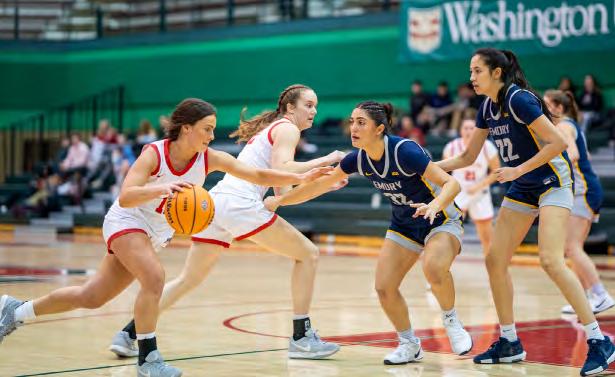
threes as the Bears’ offensive momentum seemed to slow down just a bit. Going into halftime, the Bears were hanging on to a slim one-point margin, up 30-29.
Though the Eagles jumped ahead with an early 10-1 run, the Bears made a quick turnaround, fighting back and regaining the lead that they would never relinquish again. Harris continued to dominate in the paint, and junior guard Catherine Goodwin converted several layups.
Heading into the fourth quarter, the Bears got out to as much as an 11-point lead and finished the game relatively comfortably 63-56. Harris got her second double-double against Emory in one week, with 22 points and 17 rebounds, and junior guard Sidney Rogers scored 17. Outscoring the Eagles 40-20 in the paint, the Bears extended their conference winning streak to four in a row heading into Sunday’s rematch against Rochester.
WashU vs. Rochester
Two days later, the Bears once again came out victorious against the Yellowjackets, winning 66-53 to take sole control of second place in the
UAA after UChicago lost earlier in the day.
The game started off with each team trading points, but the Bears quickly started building a lead. Harris continued her strong form, scoring 10 in the first quarter. The Bears also shot 3-4 from three as the team got out to a 25-14 advantage. However, Rochester fought back in the second quarter, going on a 15-5 run and cutting the lead down to 4 as the Bears struggled with scoring.
In the third quarter, the Bears were able to right the ship. Though their shooting accuracy fell to 28% from the field, the Bears took advantage of points handed to them by Rochester, converting six points via free throws. With one quarter left until a weekend sweep, WashU led 53-44.
The fourth quarter was relatively quiet as both teams shot under 20% from the field. As the Yellowjackets were trying to chase the game with the minutes slipping away, the Bears nailed eight out of eight free throws to ice the game and extend their winning streak to five.
WashU took advantage of Rochester’s mistakes, grabbing 20 points
JACOB RITHOLZ
IAN
One hundred and twentytwo years ago, the third-ever modern Olympic Games took place on Francis Olympic Field. In two years, St. Louis will again play a role in hosting the Olympics, with Energizer Park, home of St. Louis City SC, hosting soccer matches for the 2028 Summer Games.
In early February, the 2028 Los Angeles Olympic and Paralympic Games Committee announced that St. Louis will be one of six additional venues outside of host city Los Angeles that will host soccer matches in the group and knockout stages of the Olympic Games. St. Louis is joined by New York City, Columbus, Nashville, San Jose, and San Diego.
St. Louis is one of three American cities (along with Los Angeles and Atlanta) to have hosted the Summer Olympic Games. The 1904 St. Louis Olympics were the third-ever games in the modern era, and they took place in part on WashU’s campus. St. Louis will join Los Angeles, Paris, London, Tokyo, and Athens as the only host cities to host events in multiple summer Olympic Games.
The announcement comes amid a time of growing soccer culture in Missouri. St. Louis City SC has gained increasing popularity since its creation in 2023, while neighboring Kansas City has already scheduled matches for this year’s upcoming FIFA World Cup.
Today, WashU’s Francis Field is the oldest still-inuse Olympic facility in the world. In 1904, Francis Field held events in 11 sports, including archery, soccer, and wrestling, while Francis Gymnasium (now Sumers Recreation Center) hosted boxing and fencing.
The current Olympic Games are far different from the games that St. Louis previously held. The 1904 competition was far smaller, with just 15 countries represented, and held in conjunction with the 1904 World’s Fair. The St. Louis games also left behind a complicated and troubling legacy, including “anthropology days” where indigenous people from around the world were forced to participate in sports for the amusement of Americans, among other displays of racist caricatures of foreign cultures.
According to political science professor Zachary Bowersox, who has conducted research on the Olympics and teaches the course “Sports, Policy, and Politics,” the 1904 Olympics were “the worst Olympics of all time” due to both racial prejudice and their poor execution of events. The marathon was an especially egregious example of terrible planning, taking place during the hottest part of the day, on a dusty road, with minimal water supply. Only 14 of 32 runners finished. The athlete initially declared the winner was later disqualified for hitching a ride during the race
Bowersox made it clear that while he expects some of the history of
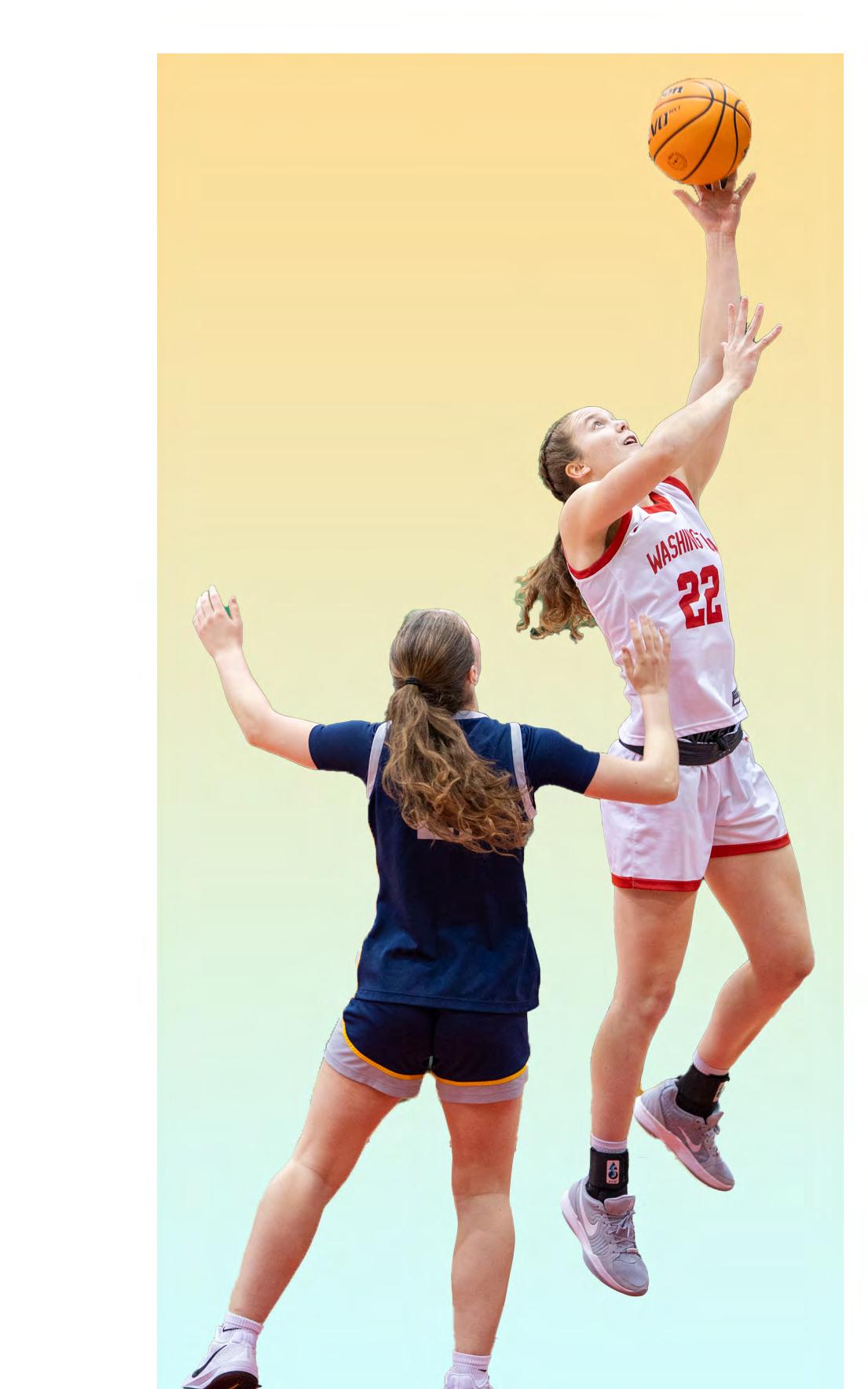
from turnovers. Harris led the Bears with 18 points, followed by 14 from Rogers and 10 from senior forward Jordan Rich.
Next weekend, the Bears stay at home to face Carnegie Mellon University on Friday, Feb. 13, whom they lost to earlier in the season, and Case Western Reserve University on Sunday, Feb. 15, whom they previously beat. With only five games left in their conference season, WashU will look to keep up with No. 1 New York University to stay second in conference standings.
the 1904 Games to be celebrated, other parts may be minimized.
“The last thing you want is people bringing up … the segregation of the audience or anthropology days,” he said. “Yes, we’re going to celebrate [Francis] Field. Talk about that history. [But] how much of the Olympic experience of 1904 do we celebrate?”
Bowersox also explained that he expects certain facts about the 1904 Games to be omitted in any commemoration of the Games.
“There’s probably going to be some commercial interest … in keeping the story and the narrative sanitized,” he said.
Hosting an Olympic Games across multiple cities is also a relatively new phenomenon, but it has become more common in recent years as cities are reluctant to front the cost of infrastructure for the entire competition.
Bowersox sees this multicity Olympic model as a trend that will grow in the future and allow cities like St. Louis to gain some economic benefit with little risk.
“This could be a solution for St Louis or other small cities, or even larger cities that just don’t take on the whole cost, as a scaled way to engage the Olympics,” he said. “[It could] reduce burden, but also potentially provide a scaled financial return,” he said.
The Olympic Committee has yet to release details about the timing and specifics of the matches. More details are expected to come this April.

ROMAN PETERSON STAFF WRITER
After sweeping No. 5 Emory University and the University of Rochester at home the weekend prior, the WashU men’s basketball team struggled on the road, where they suffered consecutive late-game losses in a gut-wrenching weekend away from home.
WashU vs. Emory
The WashU men’s basketball team fell at Emory on Friday, Feb. 6 in a thrilling comeback effort, coming up short in overtime, 81-72. The loss comes in a highly anticipated rematch, just a week after WashU took down the Eagles at home, stripping them of their No. 1 ranking As soon as the game began, WashU found themselves playing catch-up. After scoring four points in the first minute, the Bears went scoreless for six minutes, as Emory jumped out to an early 14-point lead.
After sophomore forward Anthony Przybilla knocked down a couple of free throws around the 12-minute mark to end Emory’s 14-0 run, the Bears regained their composure and gradually chipped away at the lead.
Emory resisted, with a quick run of their own, only for first-year guard Joshua Kim and senior center Calvin Kapral to respond with consecutive jumpers to bring the game within seven. This thrilling
back-and-forth play would continue through the remainder of the first half, where the Bears brought it as close as four. Emory ended the half on an andone jumper to extend their lead back to seven.
Going into the second half, both offenses were operating on a high level, but it was clear that whichever side could rally their defensive efforts first would come away on top. This seemed to be the goal for both Emory and WashU, as they held each other scoreless in the first few minutes of the half.
The first points after halftime would come from an unlikely source — Kapral, on his first three-pointer of the season. He would follow this bucket with a crafty lay-in, bringing the game within just two points.
From that point, WashU clearly had the momentum. Each Emory bucket and defensive stop was met with a swift response. With five minutes remaining, the Bears would go on a 7-0 run, capped off by a pullup three from sophomore forward Connor May, and an ensuing Eagles timeout. At this point, with a 7-point lead and just over three minutes to go, WashU took its foot off the gas pedal. Sloppy ball handling and weak closeouts on three-pointers allowed Emory to bring the game back within one point.
With the Bears clinging to a one-point lead, a foul from junior guard Ryan Cohen sent Emory to the line with seven seconds to
go in the game. They hit the first, but, luckily for WashU, bricked the second. Cohen missed a wild three at the buzzer, sending WashU to their first overtime bout of the season.
Unfor tunately for WashU, Emory’s momentum carried into overtime. They hit a big three at the beginning of the period, and only let up one field goal in extra time, enroute to a decisive victory over the Bears.
WashU’s defensive acumen was palpable throughout the game, but could not make up for their inefficiency on the offensive end. With the loss to Emor y, the Bears fell to 13-6.
On Sunday, Feb. 8, the Bears fell to the University of Rochester with a brutal second-half collapse. This was their second heartbreaker of the weekend, after Friday’s overtime loss to No. 5 Emory.
At first, both teams appeared stagnant. Approaching five minutes played in regulation, WashU and Rochester had four combined field goals. After a media timeout, however, the Bears got red hot, forming a pronounced margin. The Yellowjackets would make some headway on the deficit later in the first half, cutting it to single digits at one point, but a jumper from freshman guard Theo Rocca and a couple of crafty steals from senior guard Yogi Oliff propelled the Bears to an
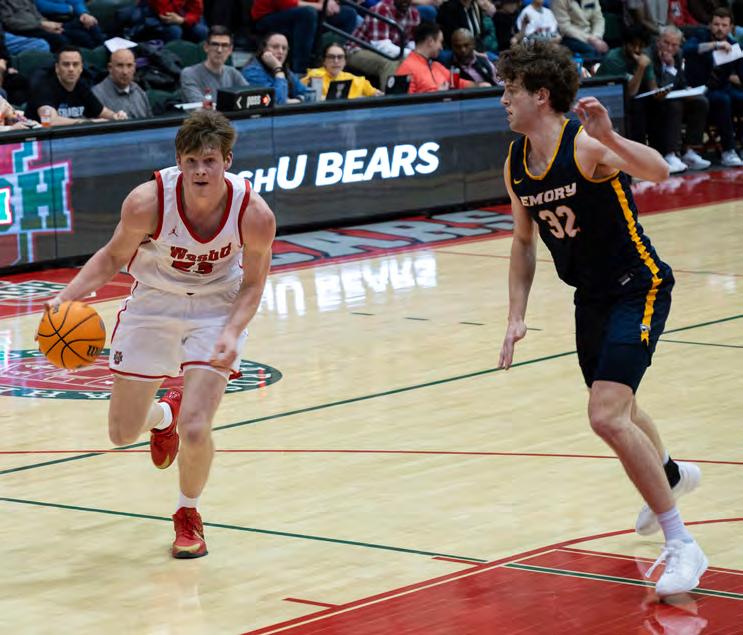
11-point lead at halftime.
However, unlike before, each WashU bucket was met with a response from the Yellowjackets. Soon, Rochester would begin to string together stops, quickly eroding WashU’s formerly commanding lead. A couple of steals and fastbreak layups cut the lead to just six, forcing a Bears timeout. From that point, the game became an intense tug-of-war match, with momentum shifting each possession. Kim was outstanding in this stretch, as he ke pt the Bears’ head above water with two layups and a pair of free throws. Cohen and Przybilla also put points on the board in an effort to regain control of the game.




The Bears’ efforts proved to not be enough, as the momentum pendulum swung Rochester’s way, and they tied the game at 59 with just over nine minutes remaining in the game. Rochester refused to give in, and responded with a 5-0 run. During this stretch, the Bears turned the ball over three times and missed a pair of free throws. Coming down to the wire, the Bears retained a tenuous one point lead. With under a minute to go, the Yellowjackets stole the ball in the frontcourt. A fastbreak layup attempt was met with a herculean block from Kapral, but was rebounded by the Rochester offense, who kicked the ball out for a back-breaking three, giving
Rochester its first lead of the game.
The ensuing possession saw the Bears move the ball fluidly, setting up a good corner look for Cohen, which missed front-rim. After a few Yellowjacket free throws and another empty WashU possession, the final buzzer sounded with Rochester up, 76-72. This loss ended Rochester’s eight-game losing streak to WashU. The Bears are now 13-7, and will look to get back in the winning column in a huge matchup against conference rival Carnegie Mellon University on Friday, Feb. 13, at 5:30 p.m.