The independent newspaper of Washington University in St. Louis since 1878 THURSDAY, FEBRUARY 11, 2021
VOLUME 142, NO. 13
STUD BROWSER
WWW.STUDLIFE.COM
Check out this year’s issue of Student Love
‘Our safety hangs in the balance’: Students SU and demand WU take action to prevent sexual violence Title
Mine host town hall explaining WU’s Title IX guidance for student groups TED MOSKAL SENIOR NEWS EDITOR
MORAD SULIMAN | STUDENT LIFE
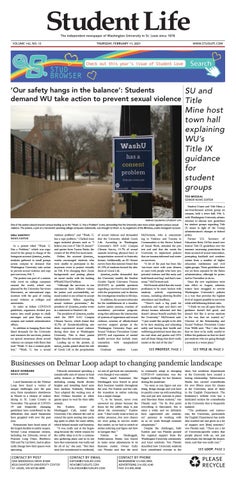
One of the posters placed around campus leading up to the “Wash. U. Has a Problem” event, demanding that the University take more action against campus sexual violence. The protest, a part of a movement spanning college campuses nationwide, was brought to Wash. U. by organizers of the @metoo_washu Instagram account.
ORLI SHEFFEY NEWS EDITOR In a protest titled “Wash. U. Has a Problem,” which was organized by the group in charge of the Instagram account @metoo_washu, students gathered in small groups across campus to demand that Washington University take action to prevent sexual violence and support survivors, Feb. 7. The protest was part of a nationwide event on college campuses around the world, which was planned by the University Survivors Movement, an international organization with the goal of ending sexual violence at colleges and universities. In order to follow COVID-19 guidelines, organizers divided protesters into small groups to chalk messages and post flyers across campus and outside administrative offices. In addition to hanging flyers that listed demands for the University and resources for survivors, protesters spread awareness about sexual violence on campus with flyers that read “Wash. U. has a consent problem,” “Wash. U. has a sexual
violence problem” and “Wash. U. has a rape problem.” Chalked messages included phrases such as “I believe you even if Title IX doesn’t” and quotes from Tarana Burke, the creator of the #MeToo movement. Online, the account @metoo_ washu encouraged students who were unable to participate in the in-person event to protest virtually on Feb. 8 by changing their Zoom backgrounds and posting photos on social media with the hashtag #WashUHasAProblem. “Although the survivors in our community have different visions for justice and accountability, we stand united in our refusal to accept administrative failure regarding sexual violence prevention,” the president of @metoo_washu wrote in a statement to Student Life. The president of @metoo_washu cited the 2019 AAU Campus Climate Survey, which found that 42.5% of female-identifying students experienced sexual violence during their time at Washington University. This is three points higher than the national average. Leading up to the protest, @ metoo_washu posted about the role of Greek Life in the perpetuation
of sexual violence and demanded that the University abolish Greek Life. According to Washington University’s 2019 AAU Campus Climate Survey, 15.7% of sexual assaults involving physical force or incapacitation occured in fraternity houses. Additionally, an SU Senate survey from this summer found that 65.13% of students favored the abolition of Greek Life. @metoo_washu demanded that the University modify the Student Gender Equity Grievance Process (SGEGP) to prohibit questions regarding a survivor’s sexual history with the perpetrator and to shorten the investigation timeline to 60 days. In addition, the account advocates for the establishment of a transformative justice process, creation of mandatory prevention programming that addresses the intersection of systems of oppression and sexual violence, creation of affinity-based survivor support groups at the Washington University Rape and Sexual Violence Prevention Center (RSVP) and expansion of mental health services that include more counselors with marginalized identities. Graduate student Laura
McDermott, who is concentrating in Violence and Trauma in Communities at the Brown School of Social Work, attended the protest and said that she wants the University to implement policies that are trauma-informed and center on survivors. “A lot of the past has been like ‘survivors meet with your abusers or meet with people who have perpetrated violence and like unity and hold hands and hug’ and that’s nonsense,” McDermott said. McDermott added that she wants professors to be more lenient with students actively experiencing trauma, including allowing flexible attendance and deadlines. “There’s such a big push for academia and rigor and that’s not always trauma informed and that doesn’t always benefit anybody but the University,” McDermott said. “I just would like people to be able to be here studying and educating safely and having their health and well-being prioritized more than status and clout and grades and GPA and all those things that don’t really matter at the end of the day.”
SEE PROTEST, PAGE 2
Student Union and Title Mine, a survivor-focused activist group on campus, held a town hall, Feb. 4, with Washington University administrators to discuss new guidelines for student groups regarding Title IX issues in light of the Trump administration’s changes to federal policy. Former U.S. Secretary of Education Betsy DeVos issued new federal Title IX guidelines over the summer increasing protections for those accused of sexual misconduct, prompting backlash and condemnation from a number of higher education institutions and civil rights groups. These guidelines have not yet been repealed by the Biden administration, although he promised in November to do so. Since the new regulations went into effect in August, administrators have struggled to rewrite Washington University’s policies in a way that provides the highest level of support possible to survivors while still following federal rules. “I think we can all agree that the guidance doesn't feel good, and doesn't feel like it serves students in the way that we wanted to,” Director of the Relationship and Sexual Violence Prevention Center Kim Webb said. “But I also think that we have to be really careful to follow the guidance so that we don't put students who are going through a process in a worse place.”
SEE TITLE IX, PAGE 3
Businesses on Delmar Loop adapt to changing pandemic landscape GRACE KENNARD NEWS EDITOR Local businesses on the Delmar Loop have faced a variety of unique challenges over the past year, from mandatory shutdowns in March to a closure of indoor dining in St. Louis County in November. The spread of COVID19 and frequently changing guidelines have contributed to the difficulties that small businesses have grappled with over the past year. Restaurants have faced some of the largest hurdles to safely reopen. Several Loop restaurant owners, including Joe Edwards, owner of Peacock Loop Diner, Blueberry Hill and Pin Up Bowl, had to physically change how their spaces were operating.
Edwards mentioned spending a considerable sum of money to fund safety features at Blueberry Hill, including raising booth divider heights and installing hand sanitizer stations. Similarly, Mission Taco adapted the waiting area at their Delmar location to allow guests space to wait for their table outside. Jen Kaslow, owner of Meshuggah Cafe, noted that University City allowed the cafe to extend the patio seating into parking spots to allow for more tables, which helped morale and business. “It was really sad at the beginning because the whole reason for the coffee shop is to be a community gathering place and so to not have that community was really sad for all of us,” she said. “But then once [we transitioned to outdoors],
we sort of got back our community even though it was outside.” Many small businesses like Meshuggah were forced to pivot their business models throughout the year. For Kaslow and her cafe, the transition to online ordering was a major change. “I, to be honest, never even answered my phone because the focus for the coffee shop is just about the community,” Kaslow said. “I don’t really want to have an online presence...but zero chance we were going to survive under that model, so we had to switch to online ordering and figure out how to navigate that.” Similar to Meshuggah, Subterranean Books was forced to make some adjustments to its business model. Owner Kelly von Plonski said that the need
to constantly adapt to changing COVID-19 restrictions was the biggest challenge for her business during the pandemic. “As soon as you figure out one thing, things change and you have to quickly come up with something else and put new systems in place and fine-tune those systems,” von Plonski said. “So by this point everything is fine-tuned, but it takes a while and we definitely have appreciated our customers’ patience in working with us as we work through constant adaptations.” Despite the challenges, both Kaslow and von Plonski praised the regional support from the Washington University community and local residents. Von Plonski described how University students have contributed revenue to the
CONTACT BY POST
CONTACT BY EMAIL
CONTACT BY PHONE
ONE BROOKINGS DRIVE #1039 #320 DANFORTH UNIVERSITY CENTER ST. LOUIS, MO 63130-4899
EDITOR@STUDLIFE.COM NEWS@STUDLIFE.COM CALENDAR@STUDLIFE.COM
NEWSROOM 314.935.5995 ADVERTISING 314.935.4240 FAX 314.935.5938
store, but academic departments at the University have created a lasting relationship. Subterranean Books has carried coursebooks for over fifteen years for classes at the University, most of them in the English Department. The bookstore’s website even has a dedicated section for coursebooks at the University that is frequently updated. “The professors and instructors, the University, particularly the English Department has really also reached out and given us a lot of support over [this] semester,” von Plonski said. “There are a lot of University-specific orders that people placed with us, not just individuals, but through the department, and that was really nice.”
SEE LOOP, PAGE 3
2 STUDENT LIFE
EM MCPHIE & TED MOSKAL | SENIOR NEWS EDITORS | NEWS@STUDLIFE.COM
theFLIPSIDE FLIPSIDE THU 11 CLOUDY 22/9
FRI 12
PARTLY CLOUDY 18/8
MON 15 CLOUDY 13/0
TUES 16
SAT 13
PM SNOW SHOWERS 13/-5
MOSTLY CLOUDY 20/6
SUN 14 CLOUDY 9/-4
WED 17
PARTLY CLOUDY 27/11
EVENT CALENDAR THURSDAY 11 Explore Faculty Papers with the University Archivist Virtual Event, 4:30 p.m. Ever wonder what faculty do with their papers when they retire? Some come to University Archives where they are cared for and made available to researchers. Join University Archivist Sonya Rooney to hear about different faculty material, how they got to the Archives, and how they have been used. Skandalaris Startup Webinar: Women in STEM Virtual Event, 2 p.m. In celebration of International Women and Girls in Science Day, we are hosting a panel discussion with Skandalaris’ newest Expert on Call, Cheryl Watkins-Moore, Cristina de Guzman Strong, assistant professor of Medicine at Washington University and a former LEAP winner, and Margo Edwards, a WashU alum who currently serves as the Director of the Applied Research Laboratory at the University of Hawaii at Manoa. The panel will discuss what motivated them to pursue the study of science in medicine and applied research and will share how young women and girls can do the same!
FRIDAY 12 Picturing Lagos: Photography and African Visual Histories Virtual Event, 12 p.m. The invention of the daguerreotype in 1839, ushered in a modern era of visual practice that marked a major turning point in African (and African Diaspora) visual history. This technological precursor to photography paved the way for the parallel advent of the camera and colonial rule on the continent, notably in the British economic and imperial center of West Africa: Lagos (Nigeria). Offering a brief overview of my manuscript, Picturing Lagos: Photography and Place in a West African City, 18611950, this talk explores the important but understated role that photographs played in the development of key social institutions—the colonial government, the church and the press.
THURSDAY, FEBRUARY 11, 2021
Dr. Shantay Bolton to join WU as chief administrative officer TED MOSKAL SENIOR NEWS EDITOR Dr. Shantay Bolton, Tulane University’s vice president and deputy chief operating officer, will join the Washington University community as executive vice chancellor for administration and chief administrative officer, Jul. 1. Bolton will succeed Henry S. Webber, who held the position since 2008, but was named Washington University’s first executive vice chancellor for civic affairs and strategic planning in August. After this announcement, a search committee composed of eight faculty members and administrators spent the fall identifying the top candidates to replace Webber. At Tulane, Bolton oversaw business operations, human resources, leadership development, employee engagement and more. As the founder of Tulane’s Leadership Institute, Bolton sought to diversify the University’s management by nurturing and training
future leaders. She also oversaw a major departmental merger, led Tulane’s “return to work plan” for COVID-19 and took on a number of other responsibilities during her four years at the University. Civic engagement has also been a major priority for Bolton, who serves on the New Orleans workforce development board. As a faculty member of the American Association of Blacks in Higher Education’s (AABHE) Leadership Mentoring Institute, she has also helped Black professionals develop the necessary skills to work in senior management positions. As a result of this work, the New Orleans newspaper The Gambit named her one of its “40 under 40 overachievers and do-gooders” in 2019. According to Bolton, her commitment to engaging with the New Orleans community during her time at Tulane lines up with Chancellor Andrew
Martin’s mantra that Washington University is “in St. Louis and for St. Louis.” “It is with great humility and genuine enthusiasm that I accept the vote of confidence entrusted in me by Chancellor Martin and the Wash. U. community to lead the administrative operations of such a globally prestigious institution,” Bolton wrote in a statement. “No matter what awaits us in the journey ahead, I am beyond confident that we can find success together, In St. Louis, For St. Louis!” Bolton’s academic qualifications include both a bachelor’s degree in psychology and a master’s degree in counseling psychology from Alabama A&M University, as well as a doctorate in organizational psychology with a concentration in industrial psychology from Walden University and an MBA from Florida International University. She is also a St. Louis native and a graduate of Vashon High School.
SATURDAY 13 Public Tour: ‘Art, Untitled’ Virtual Event, 11 a.m. Student educators design and lead virtual tours featuring several artworks in the Kemper Art Museum collection, showing images of the artworks through screen sharing and answering participant questions. On February 13, Lingran Zhang (Arts & Sciences ‘21) explores the practice of titling artworks, considering how the “Untitled” label shapes viewer responses to a range of modern and contemporary artworks from the collection. ‘Monumental Anti-Racism’ Virtual Event, 11 a.m. A part of the MLA Lecture Series. “Unprecedented times” is a phrase of this moment, encompassing the pandemic, political division, the Black Lives Matter movement, and their reverberations. Research and art help to understand. Geoff Ward’s work on antiracism links to the racial inequity spotlighted by the Black Lives Matter movement, as well as COVID-19’s disproportionate effect on people of color. COURTESY OF THE SOURCE
MONDAY 15 Book Talk with Jessica Johnson Virtual Event, 4 p.m. Join Washington University Alumna, Jessica Johnson, as she talks about her new book, Wicked Flesh. Johnson draws on archival documents scattered in institutions across three continents, written in multiple languages and largely from the perspective of colonial officials and slave-owning men, to recreate black women’s experiences from coastal Senegal to French Saint-Domingue to Spanish Cuba to the swampy outposts of the Gulf Coast.
TUESDAY 16 Chancellor Martin’s First Annual State of the University Virtual Event, 2 p.m. Join Chancellor Andrew D. Martin as he delivers his first annual State of the University address. The virtual event will be recorded for those who are unable to attend. Immediately following the address, students, faculty and staff are invited to join university leaders for breakout Q&A sessions via Zoom. Combination Microfinance and HIV Prevention Interventions for Women Engaged in Sex Work Virtual Event, 12:30 p.m. Join ICHAD for the next Speakers Series with Susan Witte, professor of Social Work, Columbia School of Social Work, who will speak on “Combination Microfinance and HIV Prevention Interventions for Women Engaged in Sex Work: What Do We Know Works? Where Do We Go from Here?” Witte’s presentation will review the state of the literature, including ICHAD’s current study on combination interventions for women engaged in sex work, reflect on unanswered questions and consider some of the theoretical and methodological challenges that may inform future studies.
WEDNESDAY 17 A Killing Cure: Education, Segregation and the Meaning of Health When Black Communities Disappear Virtual Event, 7 p.m. As part of the Ilene Katz Lowenthal and Edward Lowenthal Symposium Series, the Department of Education welcomes featured speaker Noliwe Rooks, who is the W.E.B Du Bois Professor at Cornell University. After her presentation, Rooks will be joined by Amber Jones (Harris-Stowe State University), Jerome Morris (the E. Desmond Lee Endowed Professor of Urban Education at the University of Missouri - St. Louis), and Michelle Purdy (Washington University in St. Louis) for a conversation that connects the themes from her work to the local context in the St. Louis region.
Dr. Shantay Bolton will begin as Washington University’s chief administrative officer July 1. Bolton currently serves as Tulane University’s vice president and deputy chief operating officer.
PROTEST from page 1 Junior James Cevasco, who also attended the protest, emphasized that he thinks sexual violence has become too normalized at Washington Unviersity. “We all see the statistics and the graphics and stuff like that and we just kind of all act like that’s just part of college,” Cevasco said. “But the fact that every single individual person can be affected by this hugely is not something that people should just push aside.” Although @metoo_ washu began as an account run by one person in June, it now has more than 3,000 followers and a team of members who have anonymously shared the stories of 117 Washington University survivors. Similar Instagram accounts have been created at many universities across the world, and the @metoo_washu protest was coordinated with a broader, international coalition: the University Survivors Movement (USM). According to Grace Verbrugge, a junior at Gettysburg College and Public Relations Co-Chair, USM now includes 50-60 Instagram accounts across the United States and in countries such as
the United Kingdom, Scotland and Ireland. Verbrugge said that as an international coalition, USM serves as a collective community to connect organizations with each other and create organized events, such as protests, vicarious trauma trainings and social media outreach trainings. “We need to make sure that we’re not only providing survivors on our campuses with the resources they need to heal and feel safe, but we’re also providing organizers with methods for advocating for those survivors and advocating for educational change,” Verbrugge said. Verbrugge spoke to the mental health impact of running these Instagram accounts, explaining that many organizers experienced burnout by the end of September. “I think one thing that students don’t really understand is that it’s more than just collecting and sharing stories,” Verbrugge said. “It’s about looking at the trends and the stories and saying what this is telling us about how our school operates and what we are going to do about it. It can be very emotionally draining, especially because
most of the people running these accounts are survivors themselves.” Acknowledging this, Verbrugge added that she is inspired by survivors who are unable to speak out about the sexual violence they have faced. “What inspires us is the people who want to be fighting this fight and can’t because they’re in a position where they are too vulnerable and fear retaliation,” Vebrugge said. “We provide them with a voice.” Both Verbrugge and the president of @metoo_ washu said that they hope to spread awareness about the administrative failures to provide adequate sexual violence prevention and support for survivors on college campuses. “By doing this, we hope that we will not only get attention on the issue, but that students will be made aware of administrative negligence because a lot of them often don’t realize how administrations continue to fail survivors,” Verbrugge said. “A lot of schools are actively gutting resources, they are shaming survivors into silence or they’re further re-traumatizing them until they give up on the process.”
THURSDAY, FEBRUARY 11, 2021
EM MCPHIE & TED MOSKAL | SENIOR NEWS EDITORS | NEWS@STUDLIFE.COM
STUDENT LIFE 3
TITLE IX from page 1 The University’s guidelines encourage student groups to develop clear expectations for behavior of members as well as direct steps for accountability in the case that these expectations are not met. However, these guidelines limit the actual actions that student groups are permitted to take against members accused of any type of sexual misconduct. “In accordance with federal Title IX regulations, if the allegations against a member involve interpersonal violence, sexual harassment, sexual assault or other sexual misconduct, student groups may not impose sanctions or take any action with respect to the membership status (e.g., suspension, removal, etc.) of the member without the member being found responsible after a University investigation through the applicable University office,” the guidelines read. While a University investigation is being conducted, student groups will have no avenue to take any action against an individual accused of sexual misconduct. Additionally, if a survivor chooses not to open an investigation, the same restrictions will apply. However, according to Director of Campus Life Leslie Heusted, student groups can address these restrictions by including sections in their constitutions that mandate punishments for those who fail to disclose that they have been accused of sexual misconduct.
“We suggest some wording that can be placed in a constitution or a bylaw [that] would be an expectation requiring student members to acknowledge or report if they…have been reported to have performed anything against [the] Code of Conduct,” Heusted said. “If a member decides that they want to be a member of your group, and they agree to that as an expectation and then they choose not to share that information, that could be subject to some consequences that are spelled out in your constitution.” Title IX Director Jessica Kennedy also added that in certain cases where the immediate health and safety of a student was determined to be at risk, the University could step in to use “emergency removal” for the accused individual. “That's an area where we would not necessarily have to wait for the completion of the grievance process,” Kennedy said. “But we would have to be able to make that very specific finding, where it's no longer just enough to be about psychological harm. It [using emergency removal] requires this threat to physical health and safety, arising from the allegations of sexual harassment.” Kennedy also mentioned that student group leaders can “request” that a member accused of sexual misconduct leave their group, but added that attempts to “pressure” that member to leave would violate the University’s guidelines.
CURRAN NEENAN | STUDENT LIFE
Student Union and Title Mine hosted a town hall to clarify how the new Title IX regulations—put into effect over the summer of 2020— will impact groups on campus. “I think we can all agree that the guidance doesn’t feel good, and doesn’t feel like it serves students in the way that we wanted to,” Director of the Relationship and Sexual Violence Prevention Center Kim Webb said. “But I also think that we have to be really careful to follow the guidance so that we don’t put students who are going through a process in a worse place.”
Student Union President and town hall host junior Ranen Miao expressed concern over treatment of survivors under these guidelines, although he acknowledged that they were the best that administrators could offer without violating federal policy, “I think that [the guidelines] really are not trauma-informed and they really increase the difficulty for survivors to come forward and report their cases, both in terms of the reforms to the Title IX reporting process and in terms of what universities can do to hold perpetrators accountable and making
sure that there are sufficient protections in place to protect protect and defend students on our campus,” Miao said. Even if President Biden decides to repeal the Trump administration’s guidelines, Kennedy estimated that it could take up to two years to fully repeal them and put new ones in place. If the guidelines are not fully repealed, Kennedy said that one likely scenario would be that the Department of Education might indicate its intention not to enforce certain harmful parts of the current guidelines, which would put Washington University in a precarious
situation. “I don't know that the University will make any significant changes without those regulations being changed,” Kennedy said. “And it might be something where we'd have to read between the lines. And we would do that on a case-bycase basis and try to make a decision about what we saw as harm that we thought could be easily eliminated versus the things that we think we should leave in place…So it's something that we would evaluate if and when that time comes.” Regardless of what path the University takes, Miao said that student activists,
especially Title Mine and the University Survivors Movement, would not stop advocating for stronger guidelines. “Our top priority would be restoring all the previous [Obama era] protections,” Miao said. “But we would still want to lobby the federal government to enhance these protections, because on campuses across America, there are students who are still not being heard. And there aren't strict enough incentives for universities to fully conform to those guidelines. We want to make sure that we're able to…push for much stronger regulations.”
meant to show her and the staff ’s appreciation for their support. “The Wash. U. students have been amazing and we
talk about it all the time,” Kaslow said. “The group of customers, the Wash. U. students, that we’ve had through this has been so
lovely, so patient, so understanding and really loyal, and it’s been an amazing experience…You really have no idea the impact on the business it has. It really gives another employee a job.” Besides dining in at a restaurant or cafe, several Loop business owners also noted the importance of following virus precautions. Edwards mentioned that local residents, University students and faculty have been respectful of COVID-19 guidelines thus far, while Mission Taco co-owner Adam Tilford encouraged the whole community to follow safety guidelines and added that supporting businesses from a distance is also an option. “The biggest thing that the St. Louis community can do is to wear masks, social distance and slow the spread of the virus,” Tilford said in a statement to Student Life. “Try dining during off-peak hours when dining rooms are at their lowest capacity. If you don’t feel comfortable dining in, we also appreciate support for carry
out and even picking up gift cards to use at a later date.” A report conducted by Yelp found that over 160,000 small businesses had closed between April and Sept. of 2020, 60% of which permanently closed their doors. Von Plonski and Edwards both emphasized how supporting local businesses can help vitalize one’s community. “We fully recognize that there are lots of options out there and appreciate when people do choose to shop with us,” Von Plonski said. “Whether it’s online, over the phone, in person, however they want to do it because that money truly does go back into the St. Louis community…not to mention, it literally puts food on our table.” “I think supporting the independent businesses that thrive in the Loop under normal conditions, anyway, is really important,” Edwards said. “The more they can enjoy buying right in person and not online, that’ll support all these businesses and the street will thrive and be vibrant.”
Adrienne Levin Coleman General Manager a.coleman@studlife.com
Copyright © 2020 Washington University Student Media, Inc. (WUSMI). Student Life is a financially and editorially independent, student-run newspaper serving the Washington University community. Our newspaper is a publication of WUSMI and does not necessarily represent the views of the Washington University administration.
LOOP from page 1 Similarly, Kaslow at Meshuggah expressed her gratitude to the loyal University students who dine outside the café or
pick up orders. A recent promotion of a buy one get one free breakfast bagel during the first week of classes for students was
CURRAN NEENAN | STUDENT LIFE
Subterranean Books, located in the Delmar Loop. In partnership with the University, the bookstore has carried required readings for several Wash. U. classes for over fifteen years, receiving significant support from the English department.
VOLUME 142, NO. 13 Emma Baker Editor-in-Chief editor@studlife.com
Kya Vaughn Senior Forum Editor forum@studlife.com
Curran Neenan Senior Photo Editor photo@studlife.com
Matthew Friedman Associate Editor
Dorian DeBose Josh Shapiro Senior Sports Editors sports@studlife.com
JJ Coley Isabella Neubauer Copy Chiefs copy@studlife.com
Isabella Neubauer Sabrina Spence Senior Cadenza Editors cadenza@studlife.com
Vivienne Chang Kathleen White Engagement Directors
Jayla Butler Kya Vaughn Managing Editors Em McPhie Ted Moskal Senior News Editors news@studlife.com Benjamin Simon Senior Scene Editor scene@studlife.com
Mia Goldberg Design Chief design@studlife.com
HN Hoffmann Jaden Satenstein Christine Watridge Multimedia Editors
Sabrina Spence Social Media Director Nathan Springman Webmaster Jamila Dawkins Forum Editor Christine Watridge Jaime Lee Spencer Linenberg Kamala Madireddi Clara Richards Designers
Tammy Dunsford Advertising Sales Supervisor dunsfordt@wustl.edu
SCENE
4 STUDENT LIFE
BENJAMIN SIMON | SENIOR SCENE EDITOR | SCENE@STUDLIFE.COM
THURSDAY, FEBRUARY 11, 2021
He studied at WU. Seventeen years later, he’s on ‘The Amazing Race’ SAMRA HASEEB STAFF WRITER People find adventure in a variety of spaces. Many travel internationally, some run in races, but a select few travel around the world in a globalscale race––“The Amazing Race.” Washington University alumnus Chee Lee (’04) competed on the most recent season of “The Amazing Race,” the reality television series where teams of two race around the world solving clues and completing crazy challenges of any form, from watermelon launching to mountain climbing. Over the course of four weeks––traveling by foot, plane, hot air balloon and more––competitors strive to avoid elimination and win the grand prize of one million dollars. Lee was introduced to “The Amazing Race” by his race partner and wife Hung Nguyen, who has been a longtime fan of the show. Once they started watching together around 2011, Lee got hooked. “Ever since then it was just appointment viewing for us every single week whenever it was on,” said Lee. What drove the couple to actually audition, though, was the realization that there would never be a “right time” to pursue this dream. After putting together the script and filming their audition video, the first submission came back with a rejection. “And so we applied with the same
video again the next season,” continued Lee, “and got rejected again. It wasn’t until like our fourth or fifth try that we finally got called back.” The persistence proved to be worthwhile though, because Lee and Nguyen went on to finish second place in the race, just short of winners Will Jardell and James Wallington. Finishing in second place requires incredible dedication and teamwork. But unlike a typical race, one cannot exactly train for “The Amazing Race.” Every aspect of life is tested in a totally unanticipated way, so there was no distinct thing that Lee and Nguyen did to prepare. Lee elaborated, “You just try to expose yourself to as many different things as possible to at least get yourself being comfortable with being uncomfortable.” Four years of college invites a fair share of life exposure and uncomfortability, so naturally the question arose over whether attending Wash. U. gave Lee any extra edge in the race. His answer was not quite a ‘yes,’ but not completely a ‘no’ either. Lee was on Wash. U.’s tennis team as well as a member of Raas, one of the Indian competitive dance teams. He also double majored in Computer Science and Finance. Lee shared that his extracurricular involvements probably assisted him during more physically oriented challenges, but there was no specific class he took
that proved particularly integral. “It’s just more as long as you get involved in as many different experiences as possible, that should set you up well for the race,” said Lee. But even if you tried to check every box beforehand, “The Amazing Race” would still surprise you. Every day brought new cities and new ventures, his favorite being Kazakhstan and India. His favorite challenge of the competition, however, took place cooking in Brazil, when the teams took a boat to a “completely off-thegrid indigenous tribe” and attempted to replicate a local dish. This challenge was quite a culture shock for Lee. “I didn’t even realize that these tribes still exist in the world,” he admitted. After exploring places like Kazakhstan and India and completing challenges of no limitation, it is interesting to recognize that Lee and Nguyen returned back home to routine life––and could not say anything about the show. “We signed like stacks of paperwork, just promising that we won’t tell,” Lee explained. Lee and Nguyen’s season of “The Amazing Race” filmed over the span of four weeks in November of 2018, but episodes did not air on CBS until late 2020. The couple had to keep their performance a secret from everyone for two years, including their own daughters. When the season finally
aired and they watched as a family, Lee and Nguyen’s daughters were so excited to see how their parents did. “And as soon as soon as an episode would end, they were like, ‘Oh my gosh, I can’t wait for another week!’” shared Lee. “The Amazing Race” may have forced Lee and Nguyen to maintain prolonged secrecy, but it also left the couple with enriched perspectives on life. “With my wife, she has a much greater appreciation for things like humanity and the kindness of people,” Lee said. “No matter what country you’re in, or what language you speak, at the end of the day, people just want to live their best life and want to try to find happiness for themselves and their families, right? We’re really not that different in the grand scheme of things.” For Lee, there occurred a shift in how he prioritized his time. “I care more about spending time with my family than I did before,” he said. “Before I was maybe more focused on work and things like that. But now like, you know, I just realized life is short. And on my deathbed, I’d rather have memories of family than those of being at a computer.” The significance of memories with loved ones was evident amidst the race too, as competitors grew closer to their partners but also to rival pairs. “There’s this mutual
COURTESY OF CBS
WU alum Chee Lee and his wife Hung Nguyen participate in the 11th and final leg of the ‘Amazing Race’ at the Superdome in New Orleans. They finished second in the 32nd season of the TV show, which aired throughout the fall and winter of 2020.
understanding that, hey, we’re going to be competing against each other when it’s go-time,” remarked Lee. “But once the leg is over, once the race is over, there’s no reason why we can’t be friends.” And unlike other seasons, Lee and Nguyen’s season of competitors have stayed close even after the show–– whether it be through physical reunions, virtual Among Us games, or even just messages in the groupchat. “We’re a really tight cast, which I’m told is unusual,” said Lee. Lee and Nguyen’s cast might also be the last one for a while, as the season after theirs had to stop filming halfway through because of COVID-19. This, in conjunction with recent years of declining viewership, is concerning avid supporters of “The Amazing Race” like Lee. He explained, “I think in addition to being an incredible adventure for the racers
themselves, I really do think it showcases what true humanity is all about.” So if and when the opportunity arises, Lee provided some advice for anyone looking to enter “The Amazing Race.” “When you’re making your audition video, be truthful. Don’t make up anything about yourself or what you’ve done,” he said. Lee recommended preserving authenticity while still emphasizing the “quirks of your personality.” The Amazing Race embarks competitors on a whirlwind journey nothing short of surreal, yet at the end of the day these are still everyday people. In future seasons it could be the kid in your psychology class breakout room, the girl behind you in line for food or it could even be you! If Chee Lee is any indication, “The Amazing Race” and Wash. U. alumni have got a solid track record going.
CHECK OUT OUR WEBSITE FOR SPECIAL DEALS! SALES - SERVICE - PARTS
45,000 sq. foot showroom • 93% satisfaction rating and growing • 10 minute drive from Campus
ACKERMANTOYOTA.COM
2020 HAMPTON AVE. ST. LOUIS, MO 63139 AT THE INTERSECTION OF HIGHWAY 44
314-351-3000
Toyota Care is a no cost maintenance program that covers the first 2 years or 25k miles, whichever comes first. The Ackerman For Life is valid only at Ackerman Toyota and is non-transferable. Offer contains 1 oil change maximum, per calendar year, when Toyota Care expires. Offer good to primary owner only.
THURSDAY, FEBRUARY 11, 2021
BENJAMIN SIMON | SENIOR SCENE EDITOR | SCENE@STUDLIFE.COM
STUDENT LIFE 5
Students grapple with their decision to receive the vaccine RYAN RICKS STAFF WRITER Quick, easy, painless. That is how freshman Hailey Weiss described her experience getting the first dose of the COVID-19 vaccine. The shot was so painless that at first, she wasn’t even sure that she got it, the only thing assuring her being the sight of blood under her bandage. As an Emergency Medical Technician (EMT) in her home state of Maryland, Weiss was able to get the vaccine in accordance with her county’s rollout plan. The second dose is different, often coming with a host of side effects that the first one lacked. For Weiss, this meant 40 hours of headaches, chills, and a fever that topped
out at 103 degrees, the highest she’s ever had. But the side effects haven’t stopped the students who’ve gotten the vaccine from feeling good about it. “Now that I’m vaccinated,” explained freshman Julia Strauss, who recently got her second dose of the vaccine in Michigan due to working at a COVID testing site, “I definitely feel a lot safer being around other people, going about my daily life and everything.” In some students’ experience, however, this newfound security feeds into feelings of guilt about getting the vaccine in the first place. Being college students, they never expected that they would get the vaccine so early. And while they’ve already had their
chance to get the vaccine, the shot is growing increasingly coveted by the day. This has led to delays in vaccinating the people who really need it as private sign-ups for vaccinations have, at least in Weiss’ case, been repeatedly shared to the public, forcing them to be remade over and over again. As communicated in a university-wide email on Wednesday, these kinds of incidents have affected the University too. According to the email, people have been walking into vaccine clinics meant only for first responders and individuals with high-risk. “I do know that the only reason I was able to get it was because of my parents’ positions as physicians. I think that other people have
it worse than me,” said firstyear student Sylvia Duarte, who got her vaccination in Houston, Texas. Duarte explained that she felt guilty about being able to get a vaccine while her mother’s clinic, which serves mostly minority and low-income patients, hasn’t received any vaccines. “A lot of people that should get it aren’t getting it,” Durante said. Duarte isn’t alone in having their vaccination weigh on their conscience. Freshman Duryn Dunbar, another Houston native, has also found that feelings of guilt have been undermining her happiness at getting the vaccine. She especially feels this way, she explained, when she has to tell her friends why she won’t be on campus for a few
days during the third week of classes, since she has to go back to Houston to get the second dose of the vaccine. “I wish it could be a secret,” Dunbar said. For some, the best way of coping with the guilt has simply been acknowledging that they got their vaccine fairly under their state or county’s rollout plans, and didn’t cheat the system. “I have to remind myself,” Dunbar said, “it’s not like I paid money to get the vaccine, I was in phase 2.” However, even with this acknowledgment it can still be difficult for students who’ve been vaccinated to feel good in doing so. This is the case for freshman Jessica Boyd, who received her vaccine through her online volunteering position at a medical
clinic in St. Louis. “My job doesn’t justify me getting it,” Boyd said, “but I don’t necessarily think it’s unfair because I feel like at this point, it’s going to be a little random going forward.” Ultimately, the only method to assuage the guilt that seems to stick is knowing that getting the vaccine was a reasonable decision. Getting the vaccine is a choice that makes them and everyone around them safer, so why wouldn’t they have taken it? “I realized that anyone in my position, if they were able to get the vaccine, would get the vaccine,” Duarte explained, “I think that should be the case for anyone—if they have the chance to get the vaccine, they should definitely take it.”
Love in a pandemic: Datamatch creates match-making survey for third year REILLY BRADY STAFF WRITER While the pandemic has brought unexpected changes to life at Washington University, students can find comfort in knowing that one tradition remains intact: Datamatch, the relatively new yet highly popular matchmaking survey, will be making its annual appearance at Wash. U. for the third year in a row. Datamatch is a program that “matches” participants with around five to 10 fellow students. The matches, which are guaranteed to be mutual, are determined by the answers each participant gives in the initial survey. This survey, which opens at 12:01 a.m. on Feb. 7 and closes at 12:01 a.m. on Feb. 14, Valentine's Day, involves a variety of questions that are often comedic
and specific to Wash. U. Participants will receive their matches on Valentines Day, allowing them to exchange social media usernames or communicate on the website through the chat feature. Senior Michael Dizon, current president of Datamatch at Wash. U., is responsible for bringing the survey to Wash. U. Three years ago, Dizon reached out to Harvard University, the creator of the Datamatch program. Alongside a friend, Dizon created flyers, wrote questions and released the survey to Wash. U. undergraduates. To his surprise, the survey was extremely successful in just its first year. “I actually only thought that a couple hundred students would do it, but the enrollment just shot up the second it launched, and we ended up having maybe 3,300 students do it that first
year,” Dizon said. Since then, Datamatch has expanded: Now an official club, its 21 current members are responsible for designing flyers, maintaining the website, creating questions, publicizing the survey and planning events. This is Dizon’s last semester working on Datamatch. As the founder, Dizon has been able to watch Datamatch grow over the years. “Starting this silly dating service and [having] it blossom into this huge campus event, it’s something I really never would have expected,” Dizon said. New features this year aim to enhance the Datamatch experience. One major addition is the “Crush Roulette,” a feature that allows participants to submit one pair of names that will have an increased likelihood
of being matched together. This opens up a range of possibilities, as participants can set themselves up with a crush or even create drama by setting up a friend with a known enemy. The Datamatch team has been able to flourish despite the limitations of the pandemic, but some elements of the Datamatch experience have been altered due to virtual settings. While a typical semester would feature the Datamatch Cafe, an event in which matches can meet in person and bond over food and hot chocolate, the event will not be occurring this year due restrictions on in-person events. However, Datamatchers are currently planning virtual events, such as an escape room. Datamatch members also provided some suggestions for COVID-safe ways to meet
matches: freshman and new Datamatcher Orli Hellerstein suggested “cold walks” to Forest Park; Dizon recommended that students “get creative” through virtual dates such as cooking the same meal and dining together through Zoom. This year’s survey may just be getting started, but the Datamatch team is already preparing for next year. As the upcoming president, junior Gabriella Cooperman has many aspirations for the club, such as receiving more funding from Student Union in order to potentially host more events. According to Cooperman, last year’s Datamatch survey engaged more than 50 percent of the school. “I like to brag that we have more engagement than [Student Union] elections,” Cooperman said. Despite only receiving
$150 to cover printing costs, that has not deterred Datamatch from pursuing future goals. They recently created a petition calling for increased funding that would go towards a Datamatch prom next year. If the petition receives at least 1,027 signatures by Feb. 24, the motion will be included on the Student Union’s spring 2021 ballot, opening up the possibility for even more Datamatch traditions on campus.
READ MORE AT STUDLIFE.COM
SPONSORED BY:
puzzle
mania
Minor in the Business of the Arts
your AD here
Open to all undergrads. Find out more. olin.wustl.edu/arts
sandraphilius@wustl.edu
2019
6 STUDENT LIFE
SPORTS
DORIAN DEBOSE & JOSH SHAPIRO | SENIOR SPORTS EDITORS | SPORTS@STUDLIFE.COM THURSDAY, FEBRUARY 11, 2021
ATHLETE OF THE WEEK
BY DORIAN DEBOSE SENIOR SPORTS EDITOR
Going the distance with junior runner Jacob Ridderhoff Junior Jacob Ridderhoff is a mid-distance runner on the track team. He hails from the suburbs of Chicago and studies mechanical engineering. Ridderhoffs have been a presence in the athletic department for nearly a decade: Jacob's sisters Rebecca and Jessica were members of the track and field and soccer teams, respectively. Jacob himself is a formidable competitor: a three-time All-American who runs on both the track and cross country teams. This week, Student Life talked to Jack about how he approached the 20202021 season, growing up with athletic siblings and his hopes for upcoming seasons. Student Life: After the
season ended last year, did you keep training through the spring? Jacob Ridderhoff: Yeah, [head coach Jeff] Stiles sent stuff out for us to do during March and April when we would have been having a track season. It was harder for me to get a lot of stuff done without seeing a purpose, so to speak. There [were] no competitions or anything coming up. He sent training out and I did it to the best of my ability. Sometimes [it was] a little more lenient, just because he was realizing that emotionally and mentally, some people just kind of needed a break, especially when COVID was a lot more restrictive
in those months. In May, June and July, the focus kind of shifted towards cross country. And I felt a lot more motivated and I had a lot tougher training to do because I was hoping that we would have a season for cross country in the fall, and [that] ended up getting canceled, but I didn't know that yet so I was still working pretty hard. SL: After the cross country season was canceled, did you still have that purpose in training? How did that affect you? JR: After coming back to school and seeing a lot of the rules of the school had made for us and other athletes and students in
general, I think I had kind of expected the season to be canceled. And obviously [I was] witnessing other universities in D3 cancel their seasons and my high school friends who run in college having their seasons canceled, so I was thinking that probably was going to happen for us, too. So when it did happen, it wasn't a huge letdown because you know, it obviously wasn't a shocker. But it just kind of put things in perspective that it was out of my control. I just kind of stuck to what I knew, which was just doing training that the coaches would send out and I mean just doing it to the best that I could because that's all I really could control.
SL: Were either of your siblings also home during the pandemic? JR: No, they actually both live in St. Louis, they graduated from Wash. U. a few years before I did. So they live in this area and they work, so they end up just staying in their place.
stuff sometimes it's a good motivation to see that like "Oh, well they've done college athletics and they can handle the workload so I don't really have an excuse to back off a bit," but it wasn't as much of an influence on me because they weren't really around. SL: Were y'all competitive growing up?
READ MORE AT STUDLIFE.COM
SL: Gotcha. I asked because I know that they were also Wash. U. athletes. I was wondering if they'd been motivators for you during COVID. JR: Yeah, when we've been home together sometimes, like over Christmas, or when it has overlapped with their schedules and
The Super Bowl taught me a lesson that had nothing to do with football GRADY NANCE STAFF WRITER
medium heat buffalo wings and blue cheese should be.
I had even thought ahead. Three hours before, I signed onto the Buffalo Wild Wings website in anticipation of an influx for the big game. I placed my order—ready at 6:10 p.m., it told me. That already being 40 minutes into the most anticipated night of the sports year, I had hoped to barrel down I-64, adopt a brisk walk into the restaurant, pick up my order and be back faster than a juiced-up Tyreek Hill chasing down the rogue ostrich that stole his chain. Alas, like the fickle football gods that pluck the heartstrings of poor football fans, especially those of Eagles fans like myself, life is cruel and cold, and the only thing I feel right now is the hollow pit in my stomach where
6:05 p.m. — Arrival: I pull into the parking lot and stop my car in a 15-minute spot—my first mistaken assumption of the evening. The brittle winter wind hounds me as I hustle from my car to the refuge of the building, where I find no fewer than a dozen hungry patrons like me waiting for their orders. I don’t panic: This has happened before, and I almost always am out within a few minutes. More consolation comes in the excess of TVs lining the walls, where I can keep up with the game. I don’t have a dog in the fight, but watching Brady, the undisputed GOAT (as much as it pains me to say), go up
against the NFL’s brightest young star in Patrick Mahomes is every football fan’s dream. Unless you’re a Patriots fan, in which case you probably feel an uncomfortable mix of nausea, nostalgia and extreme envy. ‘Even if I don’t make it back until the second quarter, I’ll have watched most of the first here,’ I think. After a few minutes, the attendant, disheveled and anxious, emerges from the back to inform us that they are behind, and that we should return to our cars in order to follow COVID guidelines—they will call us when our food is ready. I hate to abandon the gorgeous displays, but I trust that my faith in the establishment will not be marred on this special night. Inside,
though, a crack begins to form. 6:35 p.m. — Return to Brick and Mortar: half an hour and no call. TikTok and illegal Reddit streams of the game occupy my next 30 minutes before craving overcomes reason. My stomach leads me back to the scene, a wounded soldier listening to phantom pains, hoping for something that isn’t there. To no surprise, my order—under the pseudonym Steamboat Billy—is nowhere near completion. I choose to huddle myself among my kind: the frustrated Chiefs fans, the DoorDash drivers, the families, eyes fixed on the kitchen door with an uncanny mixture of ire and anguish. My only
reprieve is the return of the screens, from which I can watch Brady’s Bucs execute a flawless drive ending in a second touchdown to Rob Gronkowski. Even as an Eagles fan, I’ve always admired Gronk. He has uncanny on-field awareness and steamrolls through defenses like no other tight end in history, but his personality makes me feel like he still believes in Santa. And much like the readiness of my order, Brady continues to defy time; he’s as sharp as ever. 7:25 p.m. — Reality Sets In: It’s been over an hour, and the wings I’ve salivated over seem about as tangible as the holding calls against the Chiefs. I’ve spoken to the new attendant, equally
battered, about my order to no avail. My friends wait at home, but their empty stomachs cannot compare to my utterly defeated soul. What should’ve been an timeless evening of food and football vanished in the smoke of wings not mine. Standing among the similarly damned patrons, I resign myself to writing this as a testimony of my trials. If I ever leave this wretched establishment, with or without these ephemeral morsels of poultry and sauce, I hope my plight serves as a warning: order ahead or face the consequences. Better yet, make your own food and stay home. The Halftime Show just ended, and at this rate, I hope to be back home by Week 1 in September.
drink. dine. play.
WEEKLY BAR, RESTAURANT AND FUN GUIDE
V LARGE SPECIALTY OR UNLIMITED TOPPING PIZZA
13
$
WE ARE THE DELIVERY EXPERTS!
7018 PERSHING AVE 314-726-3030 CLAYTON/WASH U
99
EACH CODE: 9025
OPEN LATE! SUN-THURS 10:30AM-12AM FRI & SAT 10:30AM-1AM
Subscribe to our free e-newsletter... head to studlife.com now and sign up!
Wherever you are, stay connected: Social icon
Rounded square
FACEBOOK.COM/STUDLIFE
@ STUDENTLIFENEWSPAPER
Only use blue and/or white. For more details check out our Brand Guidelines.
@STUDLIFE
STUDLIFE.COM
THURSDAY, FEBRUARY 11, 2021
FORUM KYA VAUGHN | SENIOR FORUM EDITOR | FORUM@STUDLIFE.COM
STUDENT LIFE 7
STAFF EDITORIAL
The Devos Title IX guidelines need to go This article contains mentions of sexual assault and interpersonal violence.
L
ast summer, Education Secretary Betsy Devos issued new Title IX regulations that greatly altered the way students and administrators nationwide interact with situations regarding sexual misconduct and interpersonal violence. As Student Life reported this week, these changes are already having an extensive impact on campus. They have limited students’ and University administrators’ ability to take action when necessary and added hurdles for survivors seeking justice, making an already deeply flawed Title IX process even more challenging. The Student Life Editorial Board finds the policy changes reprehensible and urges everyone
on campus to campaign for change. These regulations were put in place in order to “ensure fairness and due process for those accused of sexual violence.” However, a majority of sexual assaults are never reported, and a minority of sexual assault reports are false, between 2% and 10%. This would mean that anywhere between 90% and 98% of sexual assault reports are legitimate claims of survivors. Since the data strongly supports the claims of survivors, we ask: why are further regulations being issued to support perpetrators? Under the regulations put in place, the University is additionally limited in its ability to assist survivors, thus granting perpetrators more leniency. Regarding its ability to assist survivors, the University is limited as it must follow regulations in accordance
with federal guidelines. Consequently, the responsibility largely falls on student groups and individuals, although they too are limited in what they are allowed to do; student groups are prohibited from taking action against individuals who have been accused of sexual misconduct while a University investigation is underway. Knowing this, University administrators suggested that student groups take it upon themselves to introduce constitutional rules against sexual misconduct and dishonesty regarding Title IX investigations in order to allow student groups some form of control over cases of sexual misconduct that may occur within their organization. This effectively puts the onus on student groups and survivors to try and navigate an already difficult process, and it limits the power that these student
groups have to act. Furthermore, as Student Life reported earlier this week, it is possible that even if President Biden repeals these regulations, between repealing the current regulations and writing the new ones, it could take up to two years before this process would be complete. That is two years that student groups, the University and survivors are limited in their ability to find justice. Two years that perpetrators will be granted more freedom. That is two years too many for so many to endure. While these regulations remain, we need to match our fight to repeal the guidelines with an effort to support those in our lives who have experienced sexual assault or interpersonal violence. The Student Life Editorial Board is appalled by the DeVos Title IX regulations,
and we are disheartened to see such a tremendous reversal of some of the progress that has been made to protect survivors. However, we recognize that this issue extends beyond the University, and that it affects students and survivors across the nation. This is not the fight of the individual, or the fight of Wash. U. alone. This is an issue that affects all of us— all students, all faculty and staff—all across the nation. The fight is ongoing, and we must continue to stand with and advocate for ourselves and our peers. Particularly in light of this week’s University Survivors Movement protest on campus, as students, we must continue to make it known that we do not find these policies reflective of the efforts of many to protect survivors. We must continue to support groups like Title Mine and
@metoo_washu who consistently fight and advocate for survivors. To the University, we ask that you do what you can when you can. We urge that you remember your commitment to the Wash. U. community to address and prevent sexual assault on campus. Continue to speak up against these wrongs, and continue to show us that you’re committed to preventing sexual misconduct at our institution. Interpersonal violence is real, and it affects us all. Too many of our peers have had to share their stories, and we thank them for doing so. As we said in November, our work isn’t over. We must acknowledge the problems that persist at our institution, and we need to continue to make it clear that we do not stand for them. We must fight together, for each other.
You, too, may be a tool of imperialism JAMILA DAWKINS FORUM EDITOR
I
n mid-January, Kristen Gray, a queer Black woman and a selfproclaimed “digital nomad,” was deported back to the United States after spending a year living in Bali. Gray gained international attention after posting a Twitter thread encouraging fellow Americans to move to Bali, describing perks like cheap housing, low cost of living and LGBTQIA* friendliness as reasons to make the move. Then she linked her e-book—titled “Our Bali Life is Yours”—which described how to follow in her footsteps, including tips on how to enter Indonesia during a pandemic. Her thread and eventual
deportation prompted a dual outrage online from both Indonesians and Americans. Indonesians were angered by Gray’s invitation to gentrify and imperialize Bali by taking advantage of the exaggerated worth of USD in Indonesia. Gray advertised her stay in Bali as a “luxury lifestyle” and bragged about the treehouse that she had been living in (only $400, a steal compared to her $1,300 apartment in Los Angeles), leaving out the poverty that many Balinese experience there, as well as the fact that rich foreigners and expatriates continue to push out natives by raising housing prices. She labeled Indonesia as queerfriendly—which it very well may be for her, as a foreigner with economic leverage in
a tourism-dependent city— but in reality, LGBTQIA* Indonesians are still fighting to be free from discrimination, derision and persecution. She used the small experiences she had in a tourist spot to summarize the whole of a vibrant and varied city, and then invited other Americans to similarly gentrify those same areas that had welcomed her. Indonesians were right to be mad. The other source of outrage, however, was less justified. Many Americans rose in defense of Gray, citing racism and homophobia as the root of the anger that had risen over Gray’s Twitter thread. Faced with an honest conversation about the privilege that Americans have in countries
that they use for tourism, they rerouted the conversation to themselves, in spite of the history America has of imperialization in Indonesia. To be clear, I am not suggesting that anti-Blackness doesn’t exist in Indonesia, or removing it totally as a motivator of the response towards Kristen Gray. But it’s worth acknowledging that many Americans—including some Black and queer Americans—were unable to engage properly with a discussion on American privilege, imperialism and the power dynamic between westerners and natives in countries like Indonesia. Witnessing this back and forth on the nature of privilege and who can wield it, I couldn’t help but think
about the Wash. U. community. The frame of mind that led Kristen Gray to exploit Bali is not dissimilar from the mindset of American tourists in countries that seem “exotic,” exciting, and non-permanent after the vacation weekend is over. Many students here would admit to or even vehemently agree with the privilege they experience in St. Louis, in Missouri and in the US as a whole. But I don’t know how many have thought closely about the effect their tourism dollars have on the countries they have visited for Spring Break. I don’t know how many can relate the privilege they have at home to the privilege they have when they go abroad. Now that vaccines are emerging, many of us are
looking ahead to the end of this pandemic. I know I’m already making plans about the things I’d like to do and places I’d like to see once I no longer have to worry about contracting or spreading COVID-19. But as we look ahead towards resuming our various global travels, it’s important to remain critical about it. A resort is not representative of a country; a weekend in a city is not comparable to a lifetime contending with the long-term virtues and vices of a nation. Countries—especially those known for and dependent on tourism—are not playgrounds for rich foreigners, nor should they have to cater to you. We cannot afford to ignore the impact we have on the places we visit.
When it comes to COVID-19, our actions matter REILLY BRADY STAFF WRITER
J
ust a few days ago, on Feb. 5, I received an email from the Office of the Vice Chancellor informing me that a 15-person, off-campus party had resulted in 10 positive COVID-19 cases. Aside from my frustration that Wash. U. students continue to be irresponsible, I also reflected on what might be leading to these gatherings in the first place. Is this a problem with how Wash. U. is handling COVID-19, or is something else potentially at fault? If this is an issue with Wash. U. policy, other schools with better policies would probably not be having problems with COVID-19 spreading at maskless gatherings, right? However, this is an issue at many colleges across
the country, regardless of how strict or loose their COVID-19 policies are. Johns Hopkins University recently reported a cluster of almost 60 COVID19 cases resulting from an off-campus party. Prior to this event, Johns Hopkins required students to get tested twice a week, and they are now increasing that to three times a week, a much more frequent testing policy than Wash. U.’s system of testing once every two weeks. Johns Hopkins University also put restrictions on all gatherings, both indoors and outdoors, while Wash. U. has allowed students to gather in small numbers as long as masks and distancing are maintained. Despite these differences in policy, both schools have experienced various clusters of COVID-19 cases due to maskless gatherings. So, if it’s not directly linked to
strict policy differences, why are these gatherings still happening? While policy does play a role in how COVID-19 is handled at college campuses––and I have had my fair share of frustration with Wash. U.’s COVID-19 policies and lack of communication––it ultimately comes down to individual responsibility. No matter the policies, if students cannot take it upon themselves to be responsible, COVID-19 will continue to spread. And no, maintaining a “bubble” with your friends does not necessarily count as being responsible. Besides the possible exception of those living together, creating a “bubble” does not guarantee COVID-19 safety, as confusion over how a “pod” or “bubble” is defined can potentially lead to unsafe
interactions outside of that so-called bubble. Even if you are living with others, if you know that you acted carelessly with people outside of those you live with, it is your responsibility to communicate with those you are living with to ensure that others will not be negatively affected by your actions. The entirety of the oncampus population is also not a safe “bubble.” Students go off campus, opening up the possibility of catching the virus and bringing it back to the school. Going off campus isn’t necessarily the problem––it’s the level of responsibility that students exhibit at those off-campus locations that matters. Going to a maskless bar or a maskless gathering at an apartment are actions that could possibly impact the rest of the school or even the wider St. Louis
OUR VOICE: EDITORIAL BOARD
YOUR VOICE: SUBMISSIONS
Staff editorials reflect the consensus of our editorial board. The editorial board operates independently of our newsroom and includes members of the senior staff and forum section editors.
We welcome letters to the editor and op-ed submissions from our readers. Submissions may be sent to letters@studlife. com and must include the writer’s name, class and phone number for verification. Letters should be no longer than 350 words in length, and readers may
Associate Editor: Matthew Friedman Managing Editor: Kya Vaughn Senior Forum Editor: Kya Vaughn
Senior Scene Editor: Benjamin Simon Senior Cadenza Editor: Isabella Neubauer Copy Chiefs: JJ Coley, Isabella Neubauer Multimedia Editors: Jaden Satenstein, Christine Watridge, HN Hoffmann
Director of Engagement: Kathleen White
community. On an optimistic note, COVID-19 cases in the U.S. have been declining as more people across the country are getting vaccinated. COVID19 cases in St. Louis are also steadily declining. Every day, we get closer and closer to the home stretch; the end is in sight. However, that does not mean we can be irresponsible. And when the time comes, get the vaccine––another important act of individual responsibility. While individual responsibility is key to remaining safe during COVID-19, I acknowledge that some of Wash. U.’s policies have been inconsistent and often confusing. Miscommunications surrounding getting tested and quarantine procedures are frustrating. Upon returning to campus this semester, I had to spend over $100 to change
my flight to an earlier time because I learned through a group chat that testing closed at 4 p.m. Had the University communicated times and procedures more effectively, this problem likely could have been avoided. These inconsistencies are aggravating, and Wash. U. needs to improve its system of communication with the student body to be more clear about testing and COVID-19 rules. However, if students don’t make an effort to be individually responsible, various policies––clearly stated or not––have no effect. Students, let’s do better. For us to be able to keep COVID19 cases low, every single one of us has to be putting effort into wearing masks, limiting gatherings and being constantly aware of how our actions could affect ourselves, other students and the St. Louis region as a whole.
OUR WEB POLICY also submit longer op-eds of up to 750 words. We reserve the right to print any submission as a letter or op-ed. Any submission chosen for publication does not necessarily reflect the opinions of Student Life, nor does publication mean Student Life supports said submission.
Once an article is published on studlife. com, it will remain there permanently. We do not remove articles or authors’ names from the site unless an agreement was reached prior to July 1, 2005.
8 STUDENT LIFE
CADENZA ISABELLA NEUBAUER & SABRINA SPENCE | SENIOR CADENZA EDITORS | CADENZA@STUDLIFE.COM
THURSDAY, FEBRUARY 11, 2021
Junior Kaylyn Webster featured in Memphis art exhibition LYDIA MCKELVIE STAFF WRITER Junior Kaylyn Webster, who hails from Memphis, TN, is a Studio Art major concentrating in painting and minoring in African American Studies. Her paintings, which depict African-American subjects using symbolism and motifs drawn from art history, are featured in the exhibition “dis/ contented realities” at Urevbu Contemporary in downtown Memphis, the first physical exhibition in
the space after a year-long hiatus. Student Life talked to Webster about her influences, her print business and how events of the last year have affected her work. Student Life: What made you decide to be an artist? Kaylyn Webster: Ever since I was young, I tried a lot of things in the visual and performing arts. I used to dance, I used to play violin and I did art. I was also a ComDes [Communication Design]
major freshman year. But I just loved painting too much, so I went with studio art. SL: What do you like about oil paint as a medium? KW: I love the quality of it. I am able to capture realism that I wasn’t able to before. It’s just smooth like butter. [She laughs]. I love oil. I actually learned to use it freshman year in a class with [Associate Professor of Art] Jamie Adams where I was the
only freshman, so I was glad I took it.
all? I saw you had a few quarantine-themed pieces!
so that really influenced my art.
SL: What would you say are your biggest artistic influences?
KW: Yeah, 2020 in general has been a lot, with quarantine and with the Black Lives Matter movement happening, or ramping back up, with the muder of George Floyd, of course. That impacted, I think, everyone. So that, plus the stress of being home and trying to stay healthy, trying to stay alive and survive the pandemic, and social justice issues, police brutality, things like that, it was a tough year,
SL: Tell me about this group exhibition you’re going to be a part of.
KW: Other artists would be Kehinde Wiley, Harmonia Rosales and Kevin “WAK” Williams. But I think what’s going on in our social and political landscape really inspires what I do. SL: Has what’s been going on in the last year influenced your work at
READ MORE AT STUDLIFE.COM
Arlo Parks’ first album brings empathy at a time of trouble GRACIE HIME STAFF WRITER The smooth and musical poetry of Arlo Parks’ “Collapsed in Sunbeams” brings listeners an uplifting yet existential perspective into the younger generation’s life. Through her unique expression of melancholy, she captures the feeling that many people in Gen Z experience: a response to criticism in an elegant and tasteful yet pointed way. The alternative indie/ neo-soul genre fits Parks’ voice perfectly. Throughout her album, she takes moments to talk instead of sing, reinforcing the poetic aspect of her work. She first speaks so vulnerably in the album’s titular track, “Collapsed in
Sunbeams.” There are two specific lines that encapsulate the essence of the album in her introduction–“Stretched out open to beauty however brief or violent” and “Making peace with our own distortions.” These truly reflect the authentic beauty that Parks’ album brings. One cool aspect of the album is that there are instrumental low-fi songs at the end, which are perfect for studying. The flow from song to song is natural, yet each track still holds its own. I can confidently listen to the album all the way through without any skips, though I feel like “For Violet” hits a little bit of a lull. It prepares listeners for a somber ending, but for me, it isn’t in an ideal place. I would
have preferred it being one of the last songs. The front of the album definitely packs a punch. It brings a lot of energy, so I suppose it makes the ending intentionally conclusive. The best song is “Caroline,” as the outstanding chorus harmony showcases Parks’ vocal talent. This is true for nearly all of the tracks, but “Caroline” especially accentuates Parks’ storytelling. In an interview in Genius, Parks explained that her music writing began by telling stories about people she doesn’t know. She would observe random people in the world around her and try to understand what they were experiencing. She told Genius that she “recalled
this argument that I’d seen taken place between a couple on Oxford Street,” and she became inspired. She asked, “What caused it? Did the relationship end? Why was their relationship exploding out?” The song “For Violet” is another example of her reflecting on observations. Through storytelling, she captures emotions that strangers might be feeling and makes them universal. Parks’ album gets a lot of its inspiration from classic rock and indie/alternative artists including Sufjan Stevens, the Beatles, Frank Ocean and Unknown Mortal Orchestra. This combination of artists is seen throughout the album, and her influences can be picked out and attributed to
different brilliances. Although her album is very cohesive, she uses a diverse range of musical techniques that tune into different musical genres and eras. From the groovy and almost jazzy “Just Go” to the strings in “Black Dog,” Parks stays consistent in her cool softness. It never seems straining, and I think that was exactly her point. Parks talks about very personal and sympathetic topics throughout the album. Probably the most sensitive track, “Black Dog” touches on her experience with depression. Not only does she talk about her experience of it affecting someone she loves, but also how hard it is to be the supporter. She knows it is hard, and “Black Dog”
focuses on that feeling of seeing a friend in pain. Line one starts with “I’d lick the grief right off your lips,” and continues “It’s so cruel what your mind can do for no reason.” She sees the pain and wishes to help, but as a spectator can only do so much. This feeling of sympathy and innocent love carries throughout the album. “Collapsed in Sunbeams” is a tranquil and pure interpretation of modern alternative, R&B and pop. Parks’ unique sound is good for the soul, and the lyrics speak to the realities of life, especially for those close to her age. Parks’ album was phenomenal and provided the support and understanding that many of us need right now.