December 4, 2025 Student Life Newspaper, WashU in St. Louis
Increases to H-1B visa fee threaten job opportunities for international workers at WashU
ZOE RHODES STAFF WRITER
In September of this year, the Trump administration announced a new price tag for H-1B visa fees: $100,000. This means that American universities now have to pay $95,000$98,000 more than what they used to for each new international employee they bring to the U.S. on an H-1B visa. (The previous fees ranged between $2,000 and $5,000.) Several months later, there are new signs of what the future of H-1B visas could look like.
WashU, as of fiscal year 2025, is the third-largest employer of H-1B visa employees in Missouri.
Chancellor Andrew D. Martin shared with The New York Times that WashU sponsors roughly 285 H-1B employees per year, though these numbers have fluctuated considerably in the last seven years.
According to U.S. Citizenship and Immigration Services (USCIS), WashU had 385 H-1B beneficiaries approved in fiscal year 2025.
Nearly 70% of all WashU postdocs hail from countries outside the U.S., although not all postdoctoral appointees are on a H-1B visa, and the new fee will not affect those who already hold an H-1B visa.
The H-1B visa is a document petitioned and paid for by employers allowing foreign nationals holding at least a bachelor’s degree to work in the U.S. in an occupation that needs workers. Although the new fee was initially intended to crack down on technology firms within the IT industry, it has affected the higher education realm.
If the potential guest worker is filling a role with national interests, their employer can apply for an
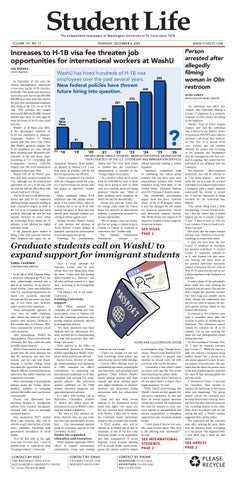
WashU has hired hundreds of H-1B visa employees over the past several years. New federal policies have thrown future hiring into question.
exemption. However, Brad Sandler, an attorney at Stinson LLP, a law firm based in Clayton, said he felt this exemption was not effective.
“There’s no guidance. I’ve checked with my colleagues across the country; I haven’t found one person who has gotten an approval,” Sandler said.
Many employers hiring H-1B employees also hire people already living in the United States, either on a student visa or on an H-1B with another company, or those who had already gone through consular processing to obtain a green card.
Melanie Keeney, WashU School of Law alumna and attorney at Tueth Keeney Cooper Mohan & Jackstadt, said that the proclamation would not impact this group.
Following the proclamation,
Martin told The New York Times in October that the University’s administration is currently in the “trying-to-figure-it-out phase.”
“In a world in which we’re on the hook for $100,000 for each of these visas, we’re going to have to think very, very carefully about our hiring practices,” Martin said. “Most of these positions aren’t positions for which we can hire domestically.”
Martin also told the Times that the change could make the United States less attractive to international students, a perspective seconded by Keeney and Sandler.
“We are going to lose out on people that are going to choose to go to Canada or Europe or Australia or somewhere else,” Sandler said.
The National Postdoctoral Association released an
official statement making a similar argument.
“America’s competitors must be celebrating this radical policy position that lets them steal away extraordinary workers who would otherwise bring their skills to the United States,” Executive Director and CEO Thomas P. Kimbis wrote.
The presidential proclamation argues there has been “systemic abuse” of the H-1B program, which it says has damaged the job market for American natural-born citizens and threatened national security.
The White House also argued H-1B visas have resulted in lower wages for American workers.
Person arrested after allegedly filming woman in Olin restroom
ALIZA LUBITZ INVESTIGATIVE NEWS EDITOR SEE VISAS, PAGE 2
Graduate students call on WashU to expand support for immigrant students
In the fall of 2024, Qimeng Duan, a third-year anthropology Ph.D. student, unknowingly reversed into a gate at an autoshop. As an international student, Duan was unfamiliar with U.S. reporting requirements for minor car accidents, especially because she did not notice any damage. A few hours later, however, police arrived at her apartment.
Duan subsequently appeared in court twice for traffic violations, after which she believed all legal matters were resolved. However, a few months later, in February 2025, Duan unexpectedly received a third court summons.
After approaching WashU for legal guidance, Duan was told by the University that they could not assist in traffic-related matters.
When Duan arrived in court one month later, the clerk informed her that the summons was sent erroneously, and her case was closed. Despite a resolute ending, Duan described the experience as extraordinarily difficult, knowing that minor infractions like traffic violations can complicate visa status.
With increasingly anti-immigrant policies under the Trump administration, mistakes in navigating systems like traffic court can become consequential.
Duan’s case illuminates how sweeping changes in immigration policies have touched immigrants’ everyday lives, even on seemingly unrelated matters.
One anonymous Ph.D. student from Latin America, who will be referred to as Carlos for fear of retaliation, expressed frustration with government surveillance of social media.
“For the first time in the eight years that I’ve been here, I need to double-check or triple-check what I’m going to share,” Carlos said.
Once a vocal advocate for Palestine, Carlos said he now refrain from even liking posts about the issue. Carlos said that posting about Palestine is a “hard no,” and all other political content is a “gray area,” according to his immigration attorney.
“I’m taking a risk at any point,” Carlos said.
Existing University support
Julie Flory, assistant vice chancellor for marketing and communications, wrote to Student Life that the University prioritizes supporting students personally affected by immigration policies.
“It’s most important that these students have the information they need, and that we’re communicating in a way that prioritizes their wellbeing,” she wrote.
Flory deferred to the Office of International Students & Scholars (OISS) regarding how WashU determines which students are affected.
Rachel Krein, director of strategic communications and operations in OISS, reiterated the office’s commitment “to supporting our international community to be fully compliant with evolving U.S. immigration policies.” She referenced updates published on the OISS website, education programs, and appointments with advisers.
In a Q&A with Student Life in September, Chancellor Andrew D. Martin also talked about the importance he sees in WashU’s international student population.
“We want to find talented students wherever they are and make sure they have opportunities to come here … Our international students bring an enormous amount to this University,” he said.
Desire for expanded education and resources
While students appreciate OISS’s efforts to support international communities, Duan said existing
resources are not enough.
“That’s not enough. It’s just very basic knowledge about policy,” she said about the current OISS offerings.
Current OISS offerings focus on maintaining visa status, preparing for visa interviews, and providing travel guidance. Duan believes WashU should provide students with legal counsel and more detailed know your rights workshops on students’ freedoms and protections during interactions with law enforcement officers.
Duan said that while several students in her department shared know your rights “red cards,” she has not received such information from WashU. Carlos said he wishes the University would disseminate resources like red cards more broadly.
A Ph.D. student, who will be referred to as Daniel due to fear of retaliation, is one of the few Latin American people in his department and feels unsupported. A recent Supreme Court decision allowing ICE to racially profile means immigrants and citizens could be subject
to investigative stops. Though he is a citizen, Daniel is now fearful of ICE, and he continues to grapple with whether he should carry his birth certificate with him for his safety.
“I remember a time when I called my sisters, and I was like ‘Hey, if you don’t hear from me, please check.’ … It got to the point where I did have to tell my sisters there’s a chance that I might disappear,” he said.
While Daniel acknowledges that WashU’s hands are tied against federal policy regulations, he also said there are several support measures within their control. He emphasized the need for avenues to voice concerns directly to administrators and discuss opportunities to strengthen support for Latin American students locally.
“I don’t know if they’ve ever actually come out and asked, ‘Hey, how is this affecting your community?’” he said.
An individual was taken into custody after reportedly filming a Corner 17 employee in a women’s restroom in Olin Library, according to the employee.
WashU Chief of Police Angela Coonce said that the individual was arrested by the WashU Police Department (WUPD) after officers received a call about their behavior on Tue. Nov. 25 at around 10:30 a.m. Coonce did not confirm whether the person was recording in the restroom and emphasized that the investigation into their conduct is ongoing. She added that the individual is not affiliated with the University.
The employee — who requested anonymity and will be referred to as Y for safety reasons — said that while she was in a stall, the arrested individual in an adjacent stall pushed a backpack with a phone attached underneath the divider to record her. Y said her experience of being recorded by the individual was difficult.
“This whole thing [was] a little traumatizing. I’ve seen it in the news, but I did not expect that it would happen [to] me or anyone I know,” Y said. “I kind of have an ‘Oh, my God’ mindset; I have to check everywhere I go now.”
She added that she hopes women will pay more attention to their surroundings to ensure their safety.
Y may not have been the first Corner 17 employee to encounter the arrested individual. A second Corner 17 employee, referred to as X, told Student Life that someone wearing the same shoes as the arrested individual repeatedly pushed a backpack into her stall on Nov. 19. X noted that she did not see a phone attached to the backpack on that day.
X took a photo of the individual’s shoes while they were pushing the backpack into her space. She said the shoes caught her attention because they were large and possibly men’s shoes, though she emphasized that she did not want to assume the person’s gender identity based on this limited information.
X returned to the restroom area with a coworker soon after the incident in hopes of identifying the individual. The coworkers waited outside the restroom for 30 to 45 minutes, but no one wearing the shoes she had photographed exited during that time.
On the morning of Tuesday, Nov. 25, Y used the women’s restroom near Corner 17. While she was in a stall, she noticed a backpack being pushed toward her; a phone in its side pocket appeared to have its camera pointed in her direction. She also noted that the shoes the person wore in the stall neighboring hers matched the ones X had photographed the previous week.
Y returned to Corner 17 and told her coworkers. They decided to monitor the bathroom to determine what was happening. The group waited outside the restroom area and kept others from entering, warning them that they believed someone was recording women in the stalls. After 30 to 45 minutes with no one exiting the stall, a WashU student suggested they call the police.
The individual left the restroom soon after, wearing the same shoes seen the previous week. According to Y, the person “was disguised with a very short wig, a mask on, and glasses.”
VISAS
from page 1
Additionally, in response to these allegations of abuse, the Department of Labor (DOL) launched investigations into employers that are suspected to be in violation of the guidelines for H-1B visas, an effort named “Project Firewall.”
As reported by the DOL via Facebook, the DOL has launched nearly 200 investigations as of the beginning of this November.
ARREST
from page 1
Y said she confronted the individual about allegedly recording her. The person then tried to leave Olin. Y said she then grabbed the individual’s backpack to prevent them from leaving before police arrived, while another Corner 17 employee blocked the door.
Senior Mia Powell was sitting in Corner 17 when the individual tried to escape. She said WUPD officers reached the scene about 10 minutes after they were called and at
“This broader expansion of the immigration enforcement system, and this attempt to just make it more and more difficult to come to the United States, and make it a more and more inhospitable place for immigrants to live,” Schachter said.
She also stated there’s a need to center the opinions of WashU’s international community.
“I would like to see the treatment of immigrants … and international students, faculty, staff, workers … being
Professor Ariela Schachter, the associate chair of the sociology department, spoke with Student Life about her belief in the importance of protecting and cultivating WashU’s diversity. Schachter said the White House’s policies on migration create an atmosphere of fear.
least four police cars were outside the building. Upon arriving, the police instructed the individual to remove their wig, patted them down, and questioned them. Later, the person was handcuffed and put into a police car, according to Powell.
Vice Chancellor for Marketing and Communications Julie Flory told Student Life that the arrested individual has been referred to the St. Louis
more essentially part of that conversation,” Schachter said.
Sandler said the effects of the $100,000 visa fee could extend beyond WashU and have consequences for rural hospitals in Missouri.
“Rural hospitals rely heavily on foreign med techs in their pathology labs, nurses and doctors. … They have excellent credentials. They provide critical services,” Sandler said. “There aren’t enough Americans out there to fill those positions currently.”
Both Sandler and Keeney discussed the possibility of the government issuing
County Prosecuting Attorney.
Y told Student Life that she believed the person may have been on campus before because they seemed “familiar” with the area.
After the incident, Y’s boyfriend found a post on the WashU subreddit from August in which an anonymous user wrote that someone had been recording in the women’s restroom in Green Hall.
“There was a man filming
INTERNATIONAL STUDENTS
from page 1
Frustrations with University communications
Nikita Gupta, a Ph.D. student in Biochemistry Biophysics and Structural Biology, expressed frustration at the lack of transparency regarding Student and Exchange Visitor Information System (SEVIS) record terminations.
“I remember making a spreadsheet from 40 different news articles to keep track of how many [students] were deported or terminated … and the numbers just kept growing really fast,” Gupta said.
Gupta said she grew increasingly anxious, especially because WashU did not release updates about SEVIS record terminations. Students cannot check their own records, so they rely on the University to inform them if their record is terminated. When SEVIS terminations ultimately hit WashU in April 2025, there was just “radio silence,” according to Gupta.
“I don’t know why it never came out, what the University was doing about it, what kind of resources they had access to. … Nothing,
just zero communication,” she said.
Other universities have published routine updates on SEVIS terminations, detailed immigration guidance, and assured students that the administration was routinely checking SEVIS records.
Gupta described WashU’s reluctance to timely publicize the number of terminated visas as “entirely unnecessary” and “wilful abandonment.”
In May, Martin informed the Faculty Senate Council that nine WashU student visas that were revoked had been reinstated, and he stated that immigration is a “high priority.” Later, in a September interview with Student Life, Chancellor Martin said that 11 students who faced visa terminations had been reinstated.
“OISS was proactively looking and scanning databases so we would catch it and be able to notify these students and then connect them with resources,” Martin said in the September Q&A.
An anonymous Ph.D. student from Nigeria, who will be referred to as Ryan due to fear of retaliation, expressed
frustration about WashU’s “rhetorical company speak” about immigration, which he believes doesn’t provide substantive support.
“What does it mean to be in school and have to keep your eyes at the door?” Ryan said. “What does it mean to be in school right now and be possibly abducted off the streets? There’s no one talking to us about that. So we are just sort of sitting ducks.”
Ryan says that while immigration policies are more “Draconian” under the Trump administration, he does not believe it was significantly better before.
“The atmosphere has never been friendly,” Ryan said.
In 2023, Ryan’s father passed away in Nigeria, but he could not return home due to strict visa policies.
“I could not go home because it was in summer, and if I had to go home, I needed to schedule a visa interview to get a visa to return,” Ryan said. “School was starting in September, so I decided to stay in the U.S.” Scope of legal support
In Krein’s statement to Student Life, she
industry-wide exemptions to the fee — such as in medicine or education — as a possible solution to these shortages.
There have been, as of November 2025, two lawsuits filed to nullify the new fee. Oct. 3 saw the filing of Global Nurse Force v. Trump, wherein the industries not intentionally targeted by the fee, such as healthcare workers and higher education researchers, filed a joint lawsuit against the fee. The U.S. Chamber of Commerce’s later case, filed in late October, says the fee is in violation of the Immigration and Nationality Act.
women with a camera hidden in a backpack placed near the stall divider in Green hall second floor women’s bathroom,” the post reads. “I noticed the backpack there intermittently for several weeks but didn’t think much of it. On 8/12 there were multiple women talking to a WashU police officer about it, apparently they saw the camera and called them. I figured there would be an email or something about it but haven’t
encouraged students to contact OISS if they encounter difficulties, including changes to visa status, routine checks with ICE, or interactions with federal agencies.
“OISS staff will work directly with the student to understand the situation, provide guidance within the scope of the University’s role to assure compliance, and recommend that the student seek advice from an immigration attorney as warranted,” Krein stated.
Legally complex issues, such as civil detention or ICE checks, however, do not fall within the outlined role of maintaining compliance. According to Gupta, OISS staff previously informed students that they are not equipped to assist with such matters.
“We can help students understand underlying context, clarify documentation or status questions, and connect them with appropriate resources, internally and externally,” Krein wrote.
Gupta and others said the University should create a defense fund to support immigrants seeking
“They each have meritorious arguments as to why the whole fee proclamation is not going to hold up legally,” Sandler said. “There’s court rulings that everyone can benefit from.”
Despite the U.S. Supreme Court historically shying away from national injunctions, Keeney believes these H-1B cases could flip the script.
“While the Supreme Court has pulled back on national injunctions, if a court finds a violation of the Administrative Procedures Act, a national injunction is an open question,” Keeney wrote. Other organizations, like the American Immigration Council, contend that the H-1B visa is not used to replace American workers with guest migrant workers. They say their data suggests that the jobs being filled by H-1B workers would not have been filled by American workers. In the context of the visa fee and its potential effects, Schachter addressed the international community at WashU directly. You are valued members of our community. You belong here,” she said.
heard anything so FYI.”
Student Life reached out to the user who made the post but has not received a response. Student Life also reached out to Coonce about the potential incident at Green Hall, who did not confirm or deny whether the incident took place.
“These are active investigations so there is no additional information available at this time,” Coonce wrote in an email to Student Life.
legal counsel. Institutions, including New York University, Yale University, and Rutgers University provide immigrant students with free legal counsel.
Carlos believes that WashU could better support immigrant students with more visible communications and resources.
“[OISS] has some resources they are trying to share … but it’s all under the table. … Maybe that’s just playing in politics, but from a giving support point of view, I think showing a strong face against administration or showing all graduate students ‘Hey, we actually care, and we’re proud and loud about it’ could go some way to even just give a little more sense of safety,” he said.
Mental health
Students also spoke about political turbulence harming their mental health.
Carlos said it’s difficult to work productively if “the world is on fire,” emphasizing the need for academic leniency. Carlos said it’s hard for citizens to empathize with the mental stress for immigrants.
The incident in August is not reported in the WashU Crime Log. Coonce told Student Life via email that she encourages all WashU community members to contact WUPD if they observe suspicious activity.
“Anyone who believes they may have information regarding suspicious activity in a bathroom at Olin Library or anywhere on campus is asked to contact WashU PD.”
“When [my friends] talk about it, it feels like ‘This is such an interesting discussion.’ It is awful, obviously, but it’s still a discussion. Whereas for me, it feels a lot more personal,” he said.
Tianmeng Lan, a secondyear anthropology Ph.D. student from China, echoed that immigration policies amplify mental stress. She is thankful that she could see a Mandarin-speaking therapist at Habif who was familiar with her struggles.
“Other therapists cannot easily understand our feelings. And we only have a small group of international therapists. … I feel they’re overworked,” she said.
Conclusion WashU’s graduate population is over 40% international students, many of whom rely entirely on WashU’s guidance for visa compliance.
“Your community is very clearly telling you what they need to hear from you, and you refuse to listen, and instead demand that they feel safe based on your expectation of what should make them feel safe,” Gupta said.
‘Yes,
SCENE
The three student troupes making up WashU’s improv scene
“Everything you see tonight will be made up on the spot: every scene, every line, and every character will be for tonight and tonight only,” the groups announced to their excited audience.
Nine times a semester, McDonnell Hall 162 is transformed from a lecture hall into a stage. The room is packed with students filling every seat, staircase, and open aisle to watch their peers create characters and stories, bits and scenes, all in front of their very eyes. They have come to see improv.
There are three improvisational comedy groups on campus: K.A.R.L. (no one knows what it stands for), Mama’s Pot Roast (MPR), and Suspicious of Whistlers (SPISH). They have carved out a comedic niche for themselves and, along the way, have amassed a cult following of supportive peers. Performances are heavily anticipated and marveled at by fellow students. These three troupes have significant overlap socially and regarding performance; however, each group has a unique, standalone history and energy, which draws different types of student improvisers to them.
Each show is roughly an hour long, in which the improv groups play a variety of rotating games. On campus, there are two types of improv performed at shows: long-form and short-form. Long-form skits are around 15 to 20 minutes and have a more fleshed-out narrative arc and character development. Short form skits are three to seven minutes long and tend to be punchy and sharp.
The composition of each show varies by group.
“You go to K.A.R.L. to see dialogue, you go to SPISH to see narrative, and you also hopefully go to Pot Roast for those,” junior and musical chair of MPR, Eli Litman, joked.
MPR is the only group on campus that performs both long- and short-form improv, while K.A.R.L. performs strictly short-form and SPISH performs strictly long-form.
The groups’ individual ethos and histories impact their style of improv. The oldest group on campus is MPR. Co-founded in 1991 by Peter Sarsgaard — a well-known actor and producer — MPR emerged from an “improv renaissance” in the ‘90s and
2010s, as described by sophomore Winston Mattson, MPR’s president. SPISH was created in the fall of 2003 by two sophomores and a firstyear who wanted to create a long-form improv troupe, so they contacted their friends and held two rounds of open auditions.
K.A.R.L. — which was created in 2003 by students who had auditioned for Mama’s Pot Roast and not gotten in — draws heavily from sketch comedy group Upright Citizens Brigade (UCB), which developed in Chicago in the ‘90s and included notable comedians like Amy Poehler and Adam McKay. UCB prioritizes the repetition and callback of a joke or a bit, which is something junior Ella Rodriguez claims inspires the group. Rodriguez is co-public relations chair, social chair, and Pandamonium chair for K.A.R.L.
MPR stands out from the other comedy groups at WashU by embracing both long- and short-form comedy, and Litman and Mattson describe it as the most outlandish of the three groups.
“Pot Roast is out there. It’s weird. We do lean the most absurdist these days out of the groups,” Litman said.
The way MPR leans so much into whimsy speaks to how distinct each improv group’s focus is.
“[SPISH] talks a lot about how we are storytellers. … We really get to sit with the characters we create. And sometimes that’s terrifying. But it’s also really rewarding,” sophomore and co-PR chair of SPISH, Elliana Lilling, said.
Across the board, improvisers expressed a strong loyalty to and intimacy with their specific troupe, and many also described feeling drawn to performing improv. For Litman and Mattson, connection with the audience is partially what makes improv so compelling; the obstacle of winning attendees over keeps them coming back for more.
“[College improv is] like the uncool younger cousin of stand-up; we kind of have to win the audience over a little bit, and I think that adds to the challenge. And so when you do get that laugh, it means more,” Mattson said.
He continued to explain how creating an environment where people can come together in joy and humor is a way to give back.
“To me, there is almost a virtue to it. I’m here to bring people joy and lighten their
semesters a little bit. If I can make you laugh, that is a win. Having people come to shows and laugh at us and laugh with us, it’s a real joy,” Mattson said.
K.A.R.L. captain and senior Ben Faden emphasized the importance of the audience members enjoying themselves.
“Laughter in a show, for me, at least, is like breath. Like you can feel when the audience is laughing because you just know it and everything feels good … and that’s how you know a show is good; it just comes out, and it just feels good,” Faden said.
It is palpable for everyone in the room when the air at an improv show is charged with the magnetism of a rapt audience anxiously anticipating the unexpected.
“It’s more fun when the room is packed. Laughter bounces off people around you.” Rodriguez said.
“And the hotter and sweatier the room gets, the funnier we get,” junior and co-public relations and social chair of K.A.R.L., Ari Schlanger, said. Litman echoed how powerful it feels to sense the audience’s enjoyment. Although he initially was not planning on doing improv in college, Litman was sucked into it via other comedy channels on campus, and he found that the creativity and quick thinking of MPR members stood out to him.
“I feel like improv is just like jazz for millennials, where you’re just making stuff up … It’s a skill and … it’s really rewarding to get positive feedback from other people, people you know and people you don’t,” Litman said.
Sophomore Kennedy Hack-Juman, the co-president of SPISH, seconded that improv requires expertise and finesse, with long-form having its unique set of difficulties. She explained how long-form requires remembering a lot of information at once about the character while infusing the story with an intro, climax, conclusion, and conflict.
“[Long-form is] a different beast. I think SPISH prides itself on attacking that challenge even though none of us come in with long-form practice,” Hack-Juman said.
While the newbies frequently do not have a background in long-form, the group’s expertise is bolstered by six hours of practice a week and the deep trust that helps support scenes. This closeness is something Lilling echoed as one of the newer members of
SPISH, explaining that when she was admitted into the group, she was immediately asked if she would be joining them on their annual trip to Chicago. Despite their lack of familiarity, the decision to go was an easy one to make.
Hack-Juman has been doing improv since age six and describes it as “the most free space I’d ever come into contact with.”
“Having unconditional support from your scene partners is not something that happens in day-to-day life. It kind of only happens in this space where you’re told to stop thinking about yourself. ... The focus is the scene, it’s not you,” Hack-Juman said.
Junior and co-president of SPISH, Noah Zelin, also mentioned the consuming and selfless nature of improv.
“Everybody comes from different places, but the one
thing we have in common is that we’re willing to buy into this thing that is improv, where you kind of give up yourself, and you’re vulnerable,” Zelin said. This strong community has been deliberately rebuilt post-pandemic, both within the individual improv groups and across campus, according to Rodriguez. She also spoke specifically to how they are still working on bringing back some traditions. This year, on March 28, K.A.R.L. is hosting Pandamonium, which was once one of the largest college improv festivals in the Midwest. For this festival, K.A.R.L. invites improv teams from across the region for a one-day event, during which they practice with random teammates, receive coaching from professionals, and then perform at night.
Zelin echoed Rodriguez’s
point about the value of an extensive and rich comedy community, expressing how improv is inherently a social effort.
“It’s not about being clever. It’s more about building something larger than yourself, supporting your scene partners. You are not trying to be funny; the funny kind of just happens when you follow the rules of improv,” Zelin said. This was evident at the last K.A.R.L. show, where the group was told to take inspiration from the word “soda” to tell us how they like their romantic or sexual partners. In between the quips of her teammates, Rodriguez bounced forward, already grinning.
“I like my partners how I like my soda: Mount-and-do.” And the room erupted.
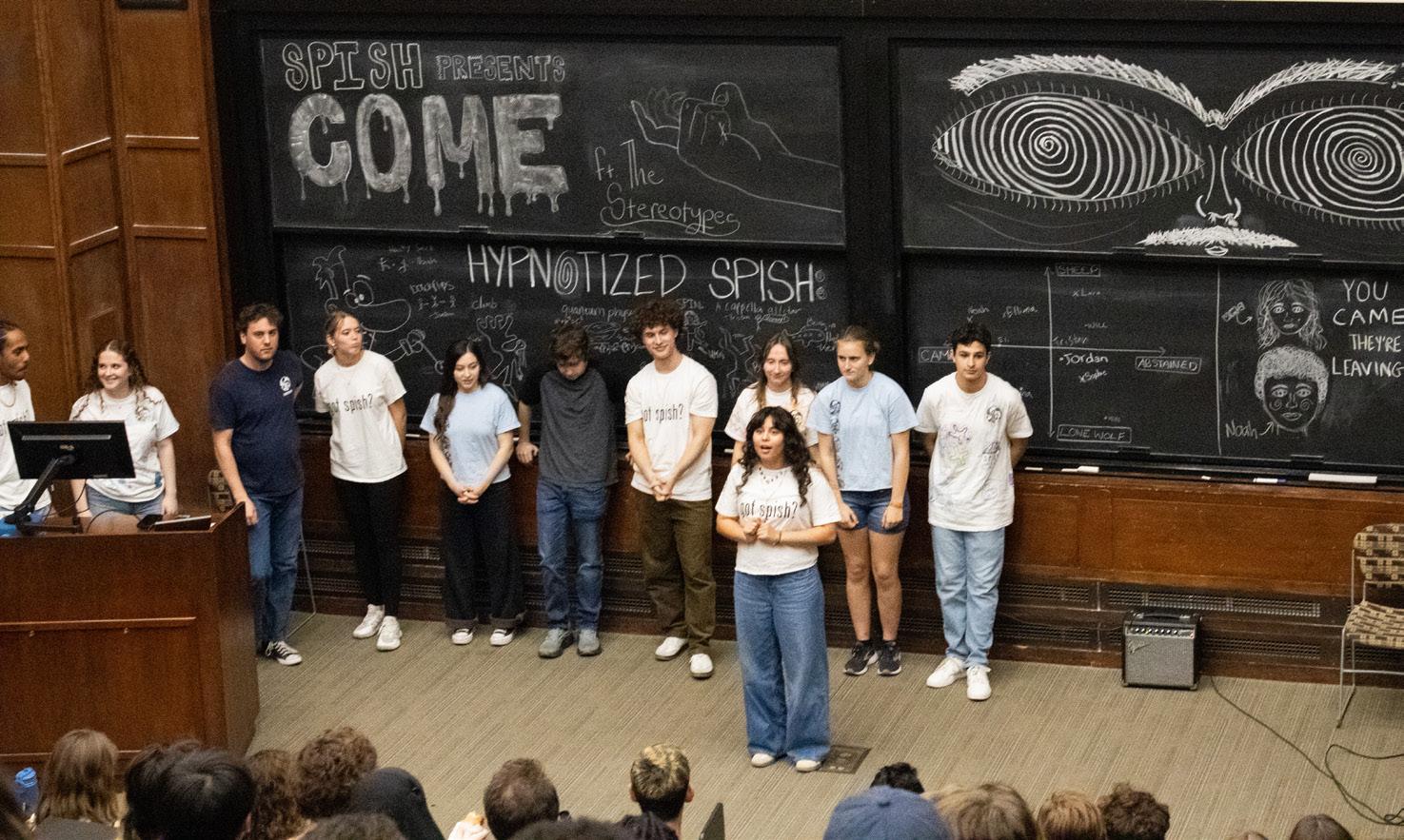
SPISH improv member Uma Simhan takes the stage in McDonnell Hall 162.
JUN RU CHEN | CONTRIBUTING PHOTOGRAPHER
Voices that endure: Former Israeli hostage Eliya Cohen speaks about finding the glimmer in
the darkest of situations
Around 300 students packed Graham Chapel this past Tuesday to listen to stories of horror, heartbreak, and resilience from former Israeli hostage Eliya Cohen and his fiance and Nova Music Festivalsurvivor, Ziv Abud. Their accounts detailed the strength it took to endure unimaginable loss and trauma while also highlighting the importance of honoring the courage of others.
This speaker event was organized by student leaders on the Chabad Board; Chabad Jewish Agency for Israel Fellow, Hodaya Butz; and members of Student Union Treasury.
The discussion was moderated by senior Ilan Barnea alongside Butz and marked the first time a surviving Israeli hostage has visited campus to share their story.
“The 1,200 individuals killed and 254 taken hostage during the massacre might seem like a lot. … Each one is an individual story and an individual face. If we were to have every person who has a story from Oct. 7 talk, we probably never would have left Graham Chapel in the first place,” Barnea said.
The event’s large turnout, with 300 students taking a moment to step away from the fast-paced demands of school and life in the last week of classes to hear Cohen and Abud’s stories, sparked praise from Chabad Rabbi Hershey Novack.
“It was a tough week. … Tonight, I was particularly inspired by the large number of people who came. I spoke to one student who came for the opening 10 minutes and then went to the chem exam, and I thought that was particularly heroic,” Novack said.
Cohen was 26 years old when he was kidnapped from the Tribe of Nova Music Festival in Southern Israel on Oct. 7, 2023. That day, Hamas breached the border into Israeli territory, killing over 1,200 people, over 800 of whom were civilians, and taking an additional 254 hostages, among them 12 Americans.
When Cohen and Abud first heard the gunshots and saw havoc breaking out, they retreated to a nearby bomb shelter, which has now become known as the “Bunker of Death,” as 49 people were crammed into this small space intended for just 10. Hamas militants quickly
realized that Israelis were hiding out and began throwing grenades and firing hundreds of rounds of ammunition at the shelter, which was designed to only withstand missile attacks. Because of Cohen’s actions in shielding Abud and himself with the already deceased bodies around them, she was one of only seven people who were not kidnapped or killed in the shelter that day.
“For me, it was a very scary moment. I don’t remember too much. I lost consciousness again and again,” Abud said.
Hamas militants noticed that Cohen was still alive, kidnapping and dragging him into the Gaza Strip while livestreaming the entire abduction and posting it on GazaNow. This video and similar ones were later seen by millions worldwide. Once in Gaza, Cohen was held in a residential area.
“When I first arrived [in Gaza], the civilian people beat us, cursed us, and threw rocks at us,” Cohen said. “The house was a regular civilian house. Outside, there were children playing in the garden,” Cohen said.
After two months,
doing anything to pass the time. Weeks after their initial meeting in the tunnels, Goldberg-Polin was notified by Hamas that he was slated to be released. Cohen learned later that Hamas had lied to Goldberg-Polin and had actually transferred him to a new location, ultimately
the background, and I asked the other people, ‘What is that? It sounds like chains.’ They asked me if I had been chained yet. I said no. They told me ‘Don’t worry, just wait.’
Then the terrorist came in and started tying us together with chains and big locks. From that day
had spent the last year and a half fiercely advocating to secure his release.
“My mom said [Abud] survived 505 days like this. She looked out for you. She went everywhere. I told her without a photo, I’m not going to believe you. She takes out her phone, opens Instagram, and shows me
“Now whenever I am with somebody, I love to say that I want just one more minute to talk with them. Just one more minute, because so many people didn’t come back home that night and I don’t have any more minutes to talk with them.”
Cohen was taken to a mosque, a sacred space intended for religious prayer, that contained an entrance to the web of Hamas’s extensive underground tunnel network.
Cohen was held here for the next 14 and a half months in a tunnel 100 meters below ground, measuring 2.6 feet wide by 6 feet tall.
In a room within the network of tunnels, Cohen met other Israeli hostages taken on Oct. 7 also held by Hamas. One was Israeli-American Hersh Goldberg-Polin, whose mother, Rachel Goldberg-Polin, has served as a leading voice in the American movement to free those captured by the militants.
Cohen and GoldbergPolin quickly developed a close relationship, exchanging stories and
killing him in August of 2024. Nonetheless, it was time for the two to say goodbye.
“Before he left, Hersh gave me a book in English, and he told me, ‘Eliya, keep it. I don’t know how much time you will be here, but keep it. It will keep you strong.’ I told Hersh, ‘Bro, I don’t know how to read English. I know nothing,’” Cohen said. “I didn’t know how to speak any English before this, but look at me now.”
Cohen studied the English book GoldbergPolin left with him every day and taught himself English during his time in captivity.
Despite the sense of renewed comfort he felt reuniting with other Israelis, Cohen described the continued presence of Hamas’ cruelty.
“I heard something in
on, I was tied by my legs for 505 days.”
In addition, Cohen faced prolonged starvation and other inhumane conditions.
“In this tunnel, there was no light, no food, no water. We lay on the floor all the time, and they just gave us one can of food each day for four people. After some days, they told us they won’t give us food anymore. We had to lick the walls of the tunnels just to feel a drop of water, just to survive,” Cohen said.
After enduring 505 days of horror, Cohen was released in a deal on Feb. 22, 2025 that saw 33 Israeli hostages exchanged for over 2,000 Palestinian prisoners. The reunion with his family was filled with overwhelming joy, and that happiness grew exponentially when he learned Abud was still alive and
a picture of Ziv fighting for me. I started to cry, I couldn’t believe [that she was alive],” Cohen said.
Junior and Chabad Co-President Matthew Isaacs was particularly touched by how Cohen and Abud grappled with the separation and uncertainty of each other’s conditions.
“They didn’t know each other’s fate for 505 days, and Eliya didn’t know whether he was going to make it out alive, and yet, he was able to power through that. So it kind of puts things in perspective for me,” Isaacs said.
This shift in outlook was shared by others in the audience, like senior and Hillel Board President, Charlie Weingarten.
“My main takeaway was the same thing that I took away from listening to [former hostage] Eli Sharabi speak at the St.
Louis Jewish Community Center [JCC], which was the strength and the hope that these people have after everything that they have been through. They are still here, and they are still sharing their story,” Weingarten said.
Chained down within the cramped tunnel corridors, imagining a light at the end of the tunnel is what kept Cohen strong.
“We really wanted to keep our hope going during captivity. We started looking for even the smallest good things that were happening to us. If one of the terrorists that we hated didn’t come and shout at us or if we got an extra spoon of [food], that was a good thing,” Cohen said. “If you are looking for a good thing, you will find it.”
Seeking to find the positives even in the darkest of places, Cohen’s perseverance and story reminded the 300 in attendance of the importance of supporting one another through hardship. The event concluded just as it began, with Abud honoring the over 1,000 lives that were cut short on Oct. 7. She reminded the audience of the voices that were silenced and the stories that have been left unfinished.
“Now, whenever I am with somebody, I love to say that I want just one more minute to talk with them. Just one more minute, because so many people didn’t come back home that night, and I don’t have any more minutes to talk with them,” Abud said.
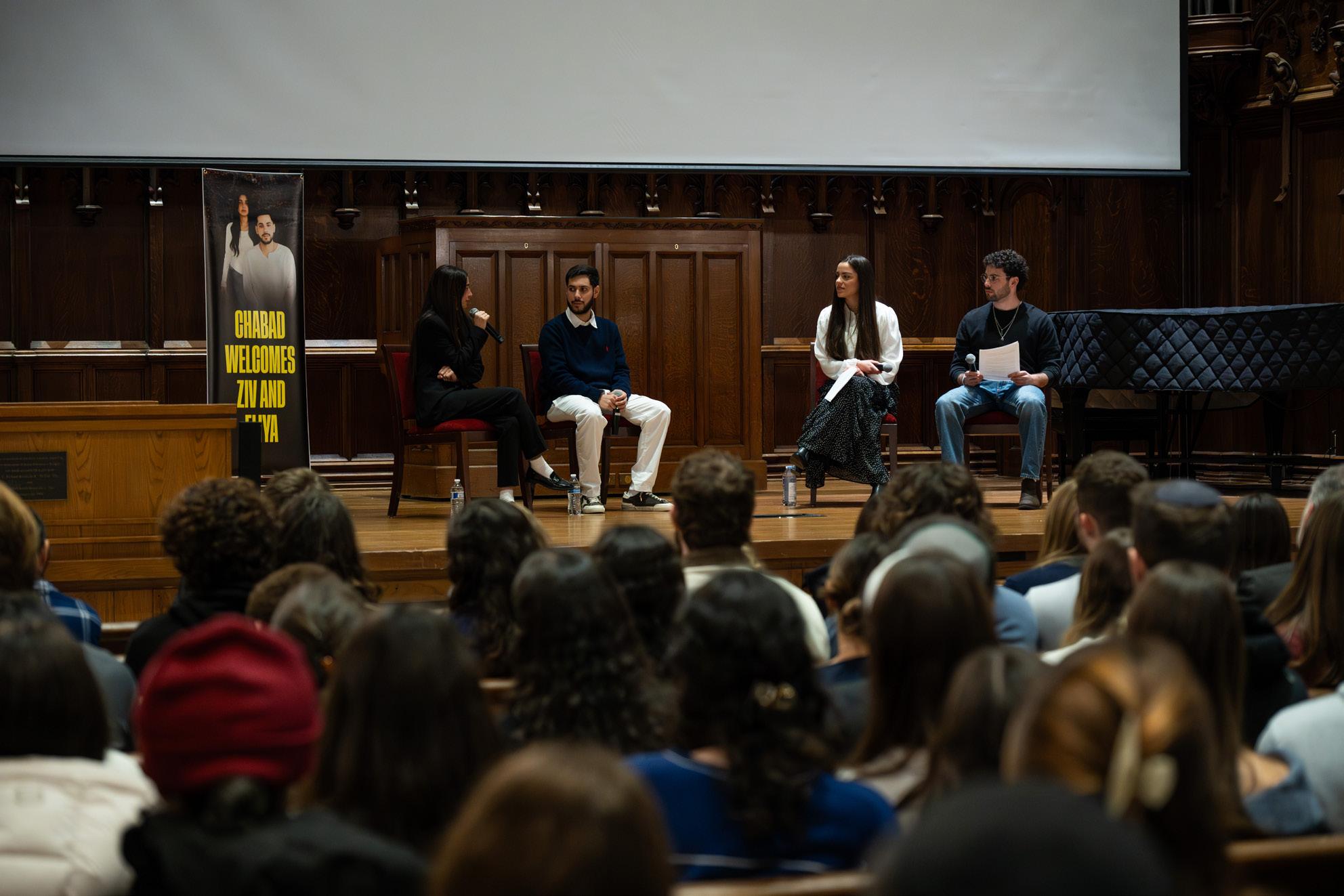
Former Israeli hostage Eliya Cohen and his fiance, Oct. 7 survivor Ziv Abud, shared their experiences during an event hosted by Chabad.
BRI NITSBERG | MANAGING PHOTO EDITOR
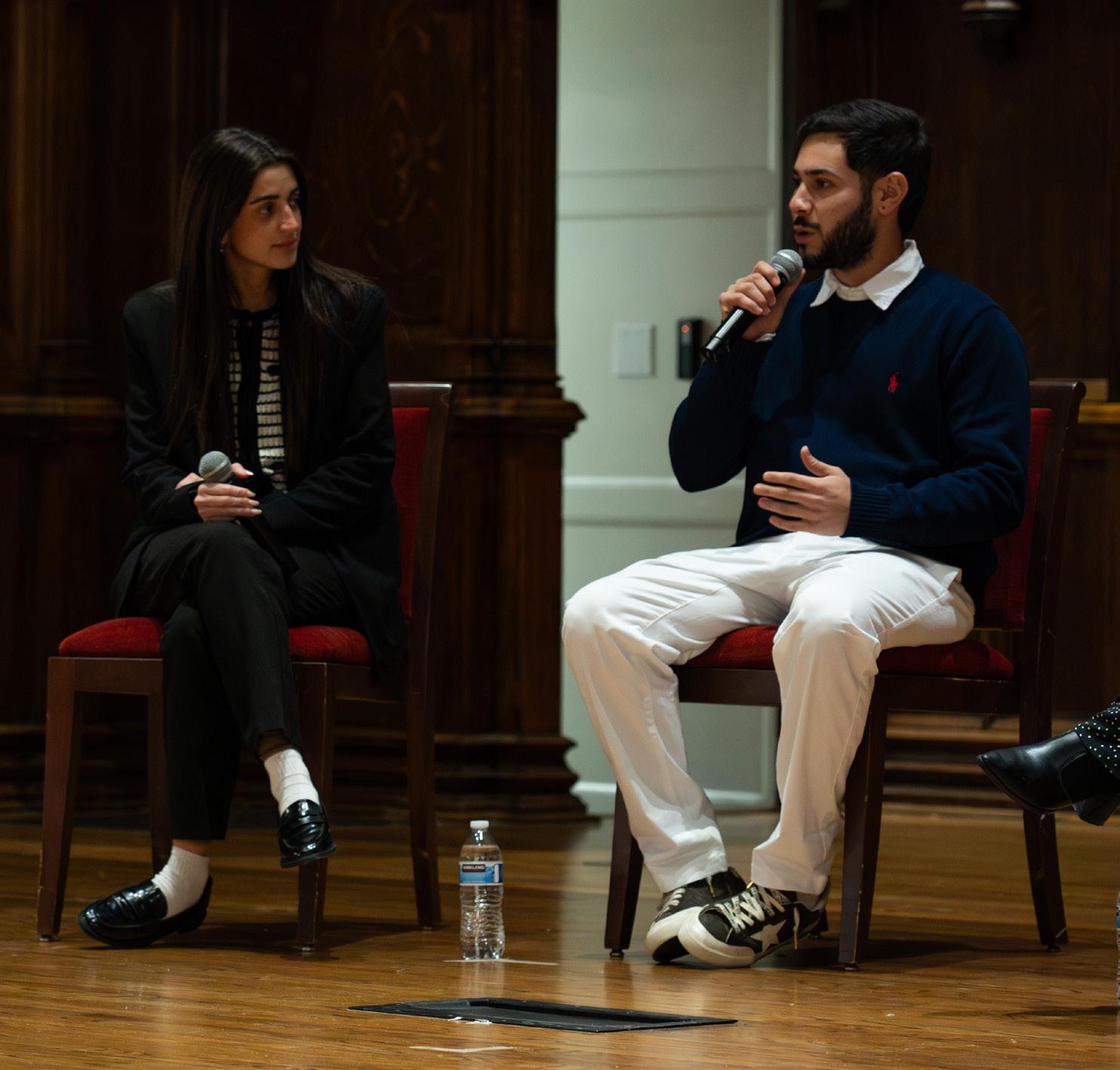
Former Israeli hostage Eliyah Cohen and Nova Music Festival survivor Ziv Abud sit side by side recounting their stories from Oct. 7.
BRI NITSBERG | MANAGING PHOTO EDITOR
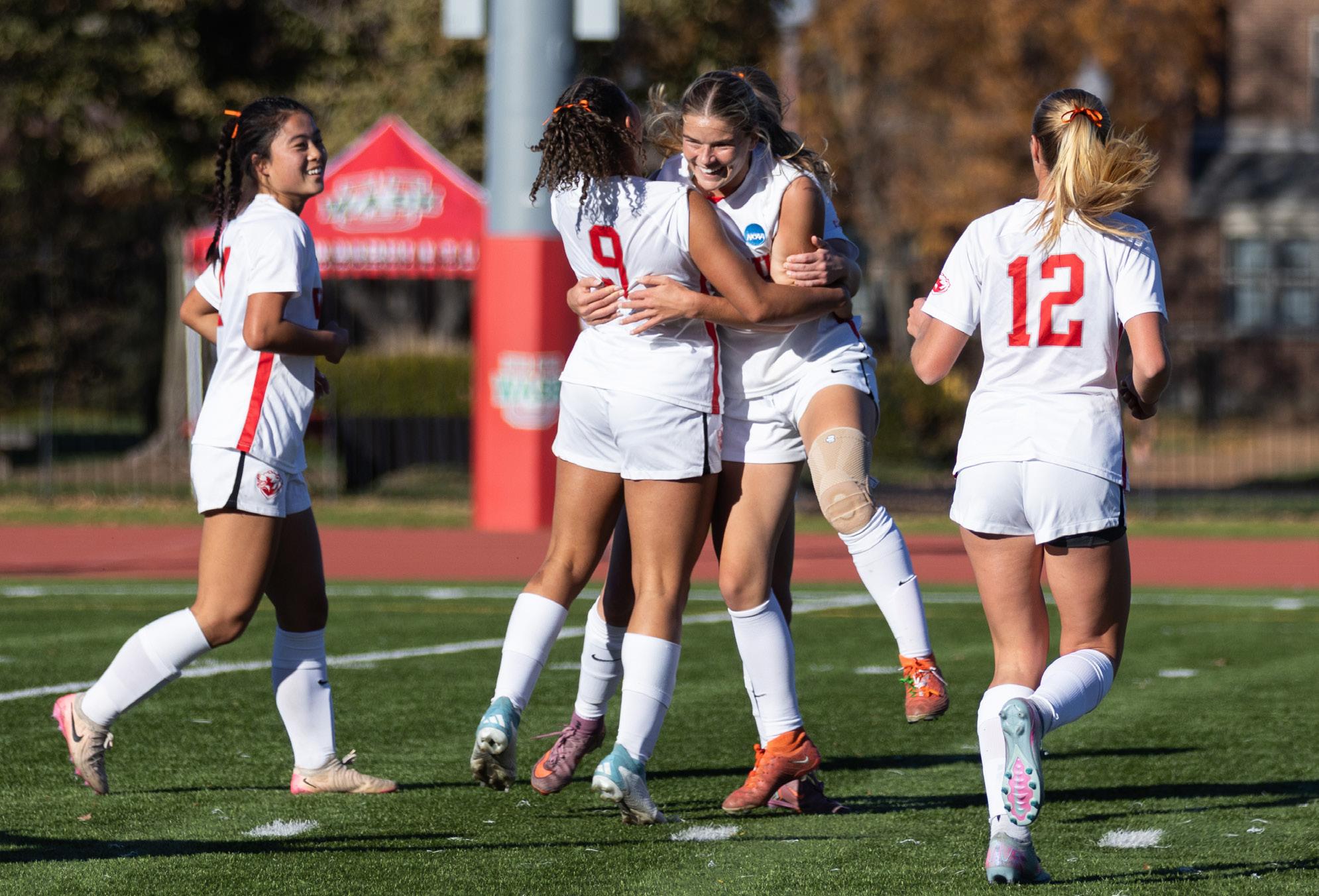
They say good things come in threes: For the third consecutive season, the WashU women’s soccer team will play in the Final Four, with WashU in pursuit of its third national championship in program history. WashU will face their University Athletic Association (UAA) rival, the No. 7 University of Chicago, at 2 p.m. on Dec. 4 in Salem, Virginia with a second consecutive title in their sights.
“We’re trusting what we do,” junior forward Madi Foley, the winning goalscorer in the Bears’ Elite Eight win, said. “The preparation that we’re putting in is paying off, so we can rely on each other, rely on our plan, and trust that what we’re doing can help us in these tough games.”
WashU has dominated its opponents on both sides of the ball throughout the first four rounds of the NCAA tournament. In the first two rounds, the WashU offense exploded to outscore Wilmington College and North Central College by a combined 12-1 margin. In the Sweet 16 and Elite Eight rounds, the Bears’ defense recorded two clean sheets against two top-10 teams. WashU defeated the No. 8 Massachusetts Institute of Technology (MIT) 1-0 in regulation in the Sweet 16 but needed a dramatic, overtime winner to beat Messiah.
Five Bears — senior forwards Ella Koleno and Grace
SPORTS
Ehlert, junior midfielder Anna Rosato, and sophomore forwards Cami Colpitts and Olivia Clemons — have each scored twice in the tournament. On defense, the backline of senior Kaci Karl, junior Keira Smyser, and sophomore Addi Soroka have held opponents to just one goal in four games. Clemons, Ehlert, and midfielders junior Sophie Viscovich and sophomore Kate Martin were named first-team All-Region VIII by the United Soccer Coaches after the season.
“We’ve got a couple of key partnerships on our roster,” head coach Jim Conlon said after WashU defeated MIT. “Some people might be the primary headers, some people might be the primary goalscorers, but on any given day, I think the efforts of our women complement each other well.”
The Bears’ Final Four opponent is arguably the team that came closest to breaking WashU’s 47-game unbeaten streak this year: conference foes UChicago. WashU women’s soccer has played more games against the Maroons than any other team in program history, but the conference rivals have only played each other in the NCAA tournament once. The lone matchup was last season, when a late Clemons goal sent WashU to the Final Four. Most of UChicago’s top players — forward Mary Stuart Kerrigan and midfielders Lucy Harrison-Caldwell and Jamie Nguyen — were on the field when WashU
eliminated them last year.
The Maroons advanced to the Final Four with a win over Carleton College.
The Bears and Maroons played to a 1-1 draw in their final regular season game on Nov. 8. Despite a late onslaught of WashU offense, the UChicago defense held WashU to just one goal and converted an early penalty kick to get on the scoresheet. The Bears’ draw with UChicago was just their fourth tie in the last two seasons. To beat the Maroons in Salem, WashU will have to continue generating lots of shots and be more clinical in
finishing its chances.
The winner of the WashU-UChicago match will face either No. 2 Emory University or No. 3 Tufts University in the national championship game. As a fellow UAA member, both WashU and UChicago faced Emory in the regular season. WashU beat Emory 2-1 on Oct. 26 — Clemons scored an 81st-minute winner to knock off Emory, the thenNo. 1 team in the nation.
The Eagles beat the No. 6 Pomona-Pitzer Colleges to advance to the Final Four.
Despite boasting a powerhouse reputation in Division
III women’s soccer, the Bears have never faced Tufts, who won the always-competitive New England Small College Athletic Conference (NESCAC) championship this season. The Jumbos knocked off conference opponent No. 12 Middlebury College and the University of Mary Washington to claim their spot in the national semifinals.
While the field is tough, the Bears are looking ahead to the challenge and trying not to let their prior success affect their mindset in this year’s tournament.
“It’s a privilege to be back
in the Final Four, but [the team] has emphasized that it’s about this season,” Karl said. “As much success as we’ve had in the past, we’ve got to focus on this team and what we are going to do this year.” The Final Four and national championship games will be hosted by Roanoke College in Salem, Virginia. WashU’s opening matchup with UChicago will take place on Thursday, Dec. 4, at 2 p.m. CT, and the national championship will be on Saturday, Dec. 6, at 11 a.m. CT. Both games can be streamed for free on the NCAA website.
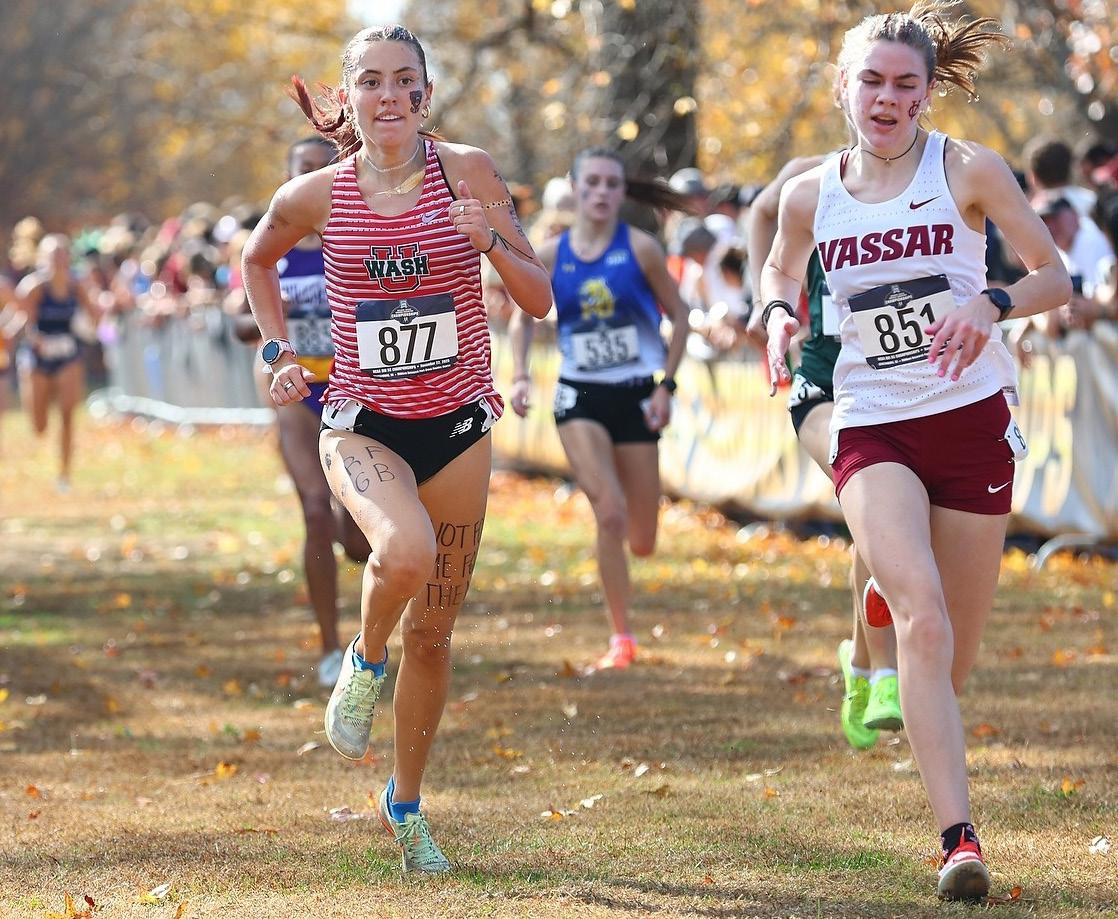
The No. 7 women’s and No. 16 men’s cross country teams’ seasons culminated at the Division III national championships on Nov. 22. With top-20 finishes, both teams outperformed expectations but fell short of a national title. Despite being ranked 11th and 25th entering the race, the women’s and men’s teams placed seventh and 16th out of the 32-team field, respectively.
Sophomore Lucinda Laughlin finished in 16th place with a time of 21:27.8 and received D-III women’s cross country Midwest Athlete of the Year honors by the United States Track and Field and Cross Country Coaches Association (USTFCCCA). Laughlin credited the Bears’ success to their team-focused mentality.
“There’s a team culture that we have, showing up for each other and how we all want to run for each other,” Laughlin said. “The pressure is kind of off of us individually because we want to run for someone else and not for ourselves.”
No. 7 women’s team
Coming into the meet, the Bears felt more nerves than usual ahead of the race they had been working toward all season.
“Usually, if I’m nervous, it’s excited nervousness. This time it was more like, ‘Oh, I’m actually nervous,’” Laughlin said. “On the [starting] line, I remember being like, ‘It’ll be awesome,
no matter what happens, it’s already cool to be here.’ Putting all my positive attitude and mentality into one race is really important.”
The team showed up for each other throughout the course, allowing for the nerves to dissipate and the focus to come back to running for the team.
“We had a bunch of people on the track and cross country team come and watch the race, and they wrapped almost every corner of the course,” Laughlin said. “You could always hear them, and that was pretty special.”
Cheered on by their teammates, the runners were able to attack the race and finish strong, coming out in seventh place, improving upon their 10th place finish from the previous year.
“I felt really great about our weekend,” head coach Jeff Stiles wrote in a statement to Student Life. “We really showed up and competed tough on the biggest stage. I was extremely proud of how we executed our race.”
Senior Jillian Heth came in 24th, only 11 seconds behind Laughlin, with a time of 21:38.8. Both runners received NCAA AllAmerican honors for their top finishes in the race. After the meet, Stiles received his third USTFCCCA Midwest Coach of the Year award as head coach of women’s cross country.
Seniors Heth, Katie Rector, and Riley Clark ran their final race at nationals. The seniors showed tremendous growth in recent weeks, with Heth running her two best races of
her college career with a second place finish at regionals and an impressive personal record of 24th. Stiles said that Clark broke her foot in July but persisted and ran her three best races this season, finishing with her strongest race at nationals.
Despite falling short this year, Laughlin believes that the Bears can continue the progress they made this season into future years.
“I’m excited,” Laughlin said. “I think that we can even just keep improving. Because last year we got 10th, and this year we got seventh. So I think we can just keep moving up in nationals; I think it will be pretty cool.” No. 16 men’s team
WashU ran its youngest team in over 25 years at the championship, with six of the seven runners being first-years or sophomores. The young squad led the team to 16th place, which was a highlight of the tournament for Stiles.
“Nationals was an incredible freshman performance,
the best I have seen in my 25 years at WashU,” Stiles wrote.
“This bodes very well for our future.”
First-year Max Sudrzynski finished in 62nd place with a time of 24:57.5, and senior Conor Daly placed 67th at a pace of 24:59.5. Despite running ahead of their times at the Midwest Regional, firstyear Rishi Shadaksharappa and sophomore Sean Green placed towards the middle of the pack at nationals. Still, the young team showed promise for the men’s cross country teams future.
Both teams celebrated successful seasons in 2025, placing higher than their ranking at the national tournament. While many cross country athletes will participate in the indoor track and field season, Stiles is encouraged by his teams’ performance at nationals for next year’s outdoor season.
“We were
Fantasy front-runner:
I accidentally dominated my fantasy football league
In September, I received a message in a Student Life group chat asking who wanted to join a fantasy football league. In my four years working on the paper, I have promptly ignored all sports messages that came through — fantasy football, intramural leagues, March Madness brackets. I love taking photos of sports, but watching them is generally not my thing.
When I originally got that message this year, I marked it as read and went back to whatever I was doing at the time. A couple of days later, I got a text from my fellow photo editor, Ella Giere, asking if I wanted to make a fantasy team with her. My first thought was something along the lines of “immediately no, I have only ever sat through an entire football game once.” But after some consideration, I figured there was nothing to lose. It’s our senior year — why not give it a shot?
Ella and I were added to the new fantasy football Slack channel, consisting of 10 guys and just one other girl. At this point, the extent of our combined football knowledge was that Travis Kelce is on the Chiefs, and that’s about it. So appropriately, Ella named our team the Taylor Swift Fan Club.
The following week, we were at Student Life’s weekly Wednesday production night, which is when the majority of the editorial staff comes together in the Student Life office. Someone messaged in
the fantasy Slack channel that we would be drafting our teams that night. This immediately sent Ella and me into a spiral — we only had about 30 minutes to prepare for this monumental occasion. Sitting on the couch together in the office, Ella and I spent our time studying: watching a lot of TikToks from the creator Mackenzie Brooks (@kenzbrooksbets), who teaches women who don’t typically follow sports about fantasy football. During this time, I furiously took notes about which positions to draft and in which rounds. This also required me to learn what the positions of a football team even are in the first place.
When the time came for the draft, all 12 teams convened in the office’s conference room. Sitting next to each other, Ella
had the ESPN website pulled up and ready, while I had my notes app (with detailed TikTok notes, of course) and a screenshot of a ranked list of players.
Throughout the draft, Ella and I were screaming names at each other (again, we were sitting right next to each other), enthusiastically high-fiving after each round, and taking long, deep breaths to handle the stress. After one round, Editor-in-Chief
Riley Herron — former Managing Sports Editor and massive sports fan — said that we took a player he wanted, which gave us confidence because if he wanted the player, we knew we were doing something right.
After learning from our research that you weren’t supposed to choose a tight end — Travis Kelce’s
position on the Chiefs — in the first few rounds of the draft, we ultimately made the tough decision for the sake of our team to hold off on choosing him. Later on, Kelce got auto-drafted to someone else’s team, which was a massive blow to the Taylor Swift Fan Club. At some point during the rounds for choosing our bench players (after an entire two hours of staring at lists of football players), the two of us got bored and let it auto-draft the rest of our team.
Our first week in the fantasy season, we had a crushing defeat. Although this dampened our spirits, we were determined to do better in the future. Of the 12 teams in our league, most were either editors of the Sports section or actually followed football. Many times, someone
would offer up pity advice to Ella and me because of our lack of sports knowledge. They would tell us when we made a mistake dropping a player, advise us on potentially unwise trade requests from fellow StudLifers, and so on.
While we started off with a loss, as the weeks went on, we found ourselves winning consistently. All of a sudden, in a fantasy league filled with sports fans and two Swifties, we were in first place, having won 11 out of 12 games after week one. Week after week, we moved players around using only the projected points that ESPN provided, because we didn’t know what any of the other stats meant. And somehow, it worked out in our favor.
By week 10, after being in first place since week three, we were the only team with
While we started off with a loss, as the weeks went on, we found ourselves winning consistently. All of a sudden, in a fantasy league filled with sports fans and two Swifties, we were in first place, having won 11 of 12 games after week one.
a guaranteed spot in the playoffs already.
I did not take this victory lightly. Each week, when I attended the Sports section’s meetings (for photo purposes only, because again, I am not a sports fan), I made sure to bring up my fantasy victories as many times as possible. When I went home for Thanksgiving, every single family member heard about it. The words, “This is my greatest accomplishment all semester” (I ran a marathon earlier this semester and still stand by this sentence) and “I should put this on my resume,” have come out of my mouth multiple times over the course of this football season to anyone who will listen to me. I don’t actually know when the playoffs start or how they work, but I am determined to keep our first-place standing and win the StudLife fantasy football championship. While we would win absolutely nothing, the bragging rights alone are worth more than any prize we could have come up with. Plus, Ella and I are already in talks about participating in the StudLife March Madness bracket challenge next semester.
ZOE RHODES STAFF WRITER
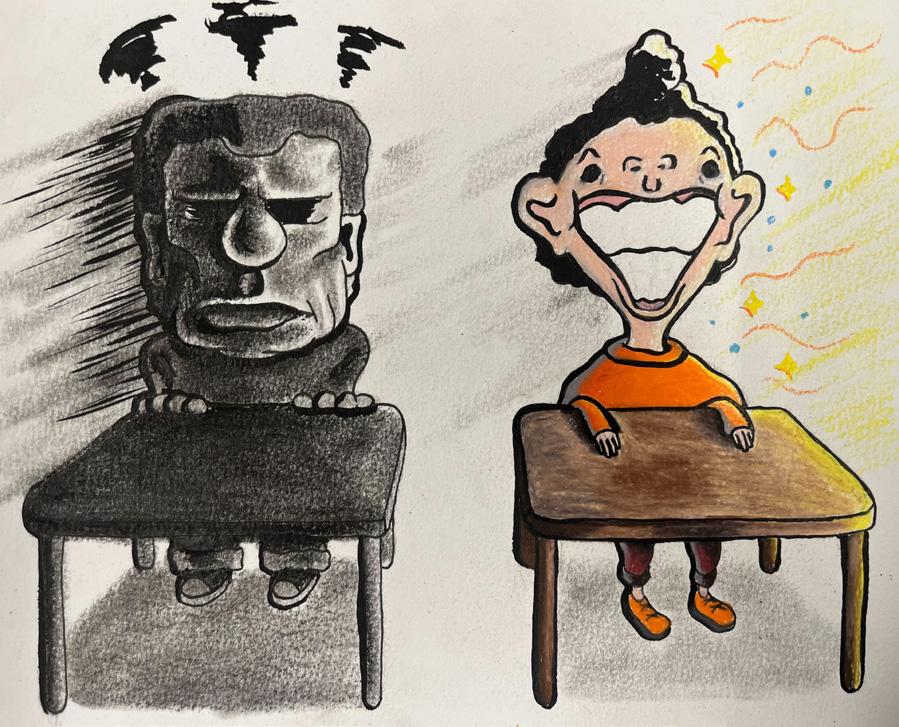
Terms like “big,” “fattie,” and “big back” are part of our vernacular now — and they’re more harmful than you probably want to admit.
“Oh, so y’all big.” – a student’s response to my Ampersand class wanting to cater three different options of cuisine.
This summer, “SkinnyTok” flooded millions of screens. You may not be familiar with the name, but you might recognize it as the side of TikTok and general social media that glorifies being the smallest size possible and condemns body positivity. While SkinnyTok raged on, I worked at my favorite place on earth: a tiny sleepaway summer camp in the beautiful Texas Hill Country. I spent mealtimes carefully watching all of my middleschool-aged campers eat. I grabbed bowls of cereal and subtly placed them next to girls I was worried about, and I said over and over and over, “We don’t use words like ‘biggie’ at camp.”
Our words, especially our humor, stick with others. The sentiments impact the people around us, our self-image, and, most importantly, younger people.
My self-image when I was younger was almost entirely defined by the body norms I was exposed to by other people, and I know the case is the same for countless others.
My intention is not to police our humor — I want to make it better. I want us to be able to laugh without making a new generation insecure.
Maybe you’ve seen a SkinnyTok video or two. If not, consider yourself lucky. As someone who tries to be careful with the media I consume, I’ve seen an inordinate number of videos “advising” me against the liquid calories of my favorite coffee or the high sugar content of fruit and preaching the holy grail that is cottage cheese. It is worth mentioning that even attempting to control the media we see is somewhat
FORUM
fruitless. Algorithms primed for continued engagement can force youth to see media they didn’t want to see, such as SkinnyTok. I’ve been mulling over how to present this argument for months. Perhaps I just couldn’t take a joke. But then I started mentioning this idea to my friends — isn’t it weird that society stopped caring to be empathetic about body image? When we were growing up, especially during our middle school years of the 2010s, society reached an all-time high for body positivity. It makes sense that hearing the words “big back” bounce around our dining hall, aimed at kids getting seconds, sent me into a slight panic. When I was their age, commenting on someone else’s body or eating habits was one of the biggest social no-nos I had learned.
I’ve been discussing the social shift in “body talk”
with students and professors a lot recently. Just as fashion can act as an indicator for the state of the economy, I believe that social acceptance of body hatred often reflects popular political sentiment. Conservatism in the last five years has grown alongside fatphobia. Many right-wing influencers are cornerstones of SkinnyTok, preaching diet culture and modesty, and spreading fatphobia. Additionally, the new market of weight-loss drugs available to the middle class (making weight a “solvable issue,” which it wasn’t before), as well as the ascension of “gym culture” among Gen Z, could all have a part in the genesis of “fattie” coming into the public consciousness. There is nuance and important context necessary to break down before diving into our collective usage of language like “biggie” and
“fattie,” both in person and on platforms like TikTok. One of the most important notions to keep in mind is the societal favoritism of thinness.
“I was actually so big.” – a girl I know describing her Sunday night Uber Eats order in retrospect, showing a photo of the evidence next to her smiling and slightly embarrassed face to prove it.
The results of fatphobia, even in the subtlest of deliveries, are far-reaching and more severe than you may think at first. Today, globalization, social media, and political polarization have widened the spread and proliferation of fatphobic sentiments. Fatphobia can even threaten careers. A handful of hiring managers, according to Wall Street Journal research from 2023, factored weight and size into
their hiring decisions, and fatphobia disproportionately affects women. A student-led study at Fordham University found that artificial intelligence generative models worsen fatphobic rhetoric and the psychological connection between thinness and morality, as they produced images of plus-sized individuals in response to negative prompts at a much higher rate than positive prompts. Discrimination and classism pervade every inch of how society views our bodies; the above examples are simply the most accessible examples of this.
“I’ve been having a lot of ‘you’re fat’ thoughts recently.” – a conversation between one of my best friends and me, standing in line at Corner 17, glancing at the cheesecakes beside us.
The results of “biggie” language (and fatphobia in general) exist outside of academic discussion. I’d like you to know that the danger in not only using, but also accepting the use of terms like “big,” “fattie,” and more, isn’t something that can only be represented by studies and social media trend analysis. Maybe it doesn’t feel like a big deal when you or a friend (or anyone) makes a “fattie” joke, but it may to someone around you. There is a now commonplace rhetoric that eating something not nethealthy is inherently bad. For some, joking about their “cheat” meal could have spiraling repercussions for their own self-image behind closed doors.
And of course, many make the argument that some people just “can’t take a joke.” They’re “snowflakes.” In a maelstrom of dangerous noise that equates being skinny to being moral, I encourage you to consider that it is that deep. Belittling yourself for simply eating is that deep.
It is not bad to be plussized, and describing your body type does not need to be negative or self-deprecatory. Many people have reclaimed the word “fat,” for example. However, phrases like “big back” and “fattie” are negative or a joke. I’m tired of my campers being scared to eat. They should be allowed to be excited about s’mores for dessert and when my co-counselors and I call “seconds!”
I would love to see WashU students realize the harm of their subtly body-negative language. We owe it to ourselves and to younger generations to set a better standard for how we talk about our bodies. Gen Z humor has shifted in a myriad of ways over short periods of time; I believe we can shift it once more. Next time you want to call yourself a “biggie” for ordering in, consider the impacts of the joke. You might get a few laughs, but you also may get a pang of self-consciousness. We don’t need to self-deprecate. We don’t need the word “biggie.”
The world wants you to hate your body again. Don’t listen.
CHARLIE WEINGARTEN CLASS OF 2026
“Hi, you! Yes, you, scrolling on your electronic device! Do you hate your body? I bet you do, and if you don’t, you should! Try this supplement for hair growth, weight loss, de-bloating, and fewer wrinkles. Try these wall pilates exercises to burn those extra stubborn 20 pounds of fat! I promise, if you simply buy the latest tummy-sucking, hair-oiling, pore-pulling, teeth-whitening, lashgrowing product, you, too, can look like you’ve had thousands of dollars of plastic surgery like me!”
This is the messaging that I, and many others, have once again been inundated with across social media platforms. I picked up on the trend relatively slowly. In the summer of 2025, body-positivity influencers began to post about
their weight-loss journeys and started to peddle their GLP-1 miracle cures. XL and L sizes started disappearing from shelves, and brands stopped hiring models with diverse body types. Websites and packaging have been rebranded with messaging about guiltfree foods and shapewear to suck in all those nasty, flabby bits you should hate. Men with beards eat steak and eggs and raw milk off of wooden cutting boards while telling you why you’re a fat piece of sh*t for not working out for three hours every day.
The algorithm is clear: We want you to hate your body again. My pitch? Don’t listen. Trust me, I know the overwhelming “hate yourself” messaging all too well; it’s the only thing I was told as a girl who grew up morbidly obese, broad-shouldered, and taller-than-average in Los Angeles. I was constantly
being subliminally — and not so subliminally — told that my body was not only wrong, but hideous. All of the movies, shows, and advertisements that I watched ridiculed women who were half my size for being “too fat” for love. It led me to desperately search for ways to shrink myself into conformity. For three years, I not only struggled, but was applauded for slowly destroying my body. After all, as legendary supermodel Kate Moss put it, “Nothing tastes as good as skinny feels.”
Now, as I sit and watch the hideous beast that is Hollywood eating disorders and body trends rear its head during a cultural return to conservative values, I am reminded of the mindset I have fought so hard to recover from, and it frightens me. Because once you emerge from the smoke and mirrors that are GLP-1 advertisements,
lack of brand inclusivity, and influencers showing you how you can pay to look, “feel,” and conform better, you begin to see this industry for what it is: a means of control.
To be clear, I take absolutely no issue with the idea of cosmetically altering your appearance to feel more comfortable in your body. If that is what it takes for you to feel like the best version of yourself and you have the extra cash on hand, I say go for it. My issue lies within the idea that there is no way you cannot be beautiful without medical intervention, that you are worth less if you do not stretch or starve yourself to fit a norm. I promise that even with the latest trending cosmetic procedure or weight-loss fad, you will not feel good within your own skin until you learn to love yourself just as you are — no scalpels necessary. Let me tell you a secret:
Perfection is fleeting. If you fit into the beauty standard today, I guarantee that you will not in another year, six months, two weeks, tomorrow. Because that is how this industry makes its money, by preying on your insecurities that they have created. The only thing you can do to cheat the system? Learn how to be unapologetically, emphatically, unabashedly you. So, how can you get there? For me, the most successful strategy has been the integration of radical kindness into my everyday life. Having a bad day? Look in the mirror and say one thing you love about yourself. Feeling hopeless and angry at the world? Give someone a compliment and take comfort in the small joy it brings them. To the extent you can control, replace the energy it takes to hate yourself with the much more cost-productive time
ANNA DORSEY
it takes to bring simple light to someone’s world. This moment is an impossible-to-navigate challenge, a rapidly flowing river of uncertainty and fear. Truly, the last thing you should be worrying about is what falsely-made manicured box others can shove you into. What matters is that you have the strength to fight for the things that matter most to you. Manufactured selfhatred by companies that stand to profit off of your misery is a scam. Chasing the ever-moving target of perfection is exhausting. Becoming “the standard” of looks is a farce. And anything that tells you to be anything other than yourself is selling you a nightmare wrapped in a papery-thin dream. When the world wants you to hate your body again, I beg of you: Don’t listen.
ANNA DORSEY | ILLUSTRATION EDITOR
A different kind of Diwali light
DHRUV GOYAL CONTRIBUTING WRITER
In college, I feel the distance from my home, parents, and culture most prominently during festive holidays. During Diwali, when an expensive flight or an upcoming exam keeps me from going home, the homesickness really sets in. Most of the semester, I am irritated by my parents constantly calling me and asking about my day, how my exams went, or whether I drank too much at a party. The only time I care to call my folks is when I need money for DoorDash, but Diwali is a completely different time. During Diwali, I ache to be with my family and celebrate the return of Lord Ram.
I grew up in India with a devout Hindu mom and sister and a secular but culturally Hindu dad. Diwali was a time when my folks took off time from work, I got off of school, and my entire family wore traditional Indian clothes.
We decorated the walls of our house with marigold torans and string lights. We decorated the floors with rangoli (a floor art made from colored powders, rice flour, flower petals, or sand). We prayed to Lord Ganesha and Mother Lakshmi, seeking the wisdom to move through the challenges that stand between us and our goals.
We lit diyas as a symbol of Lord Ram and his family, who represent virtue and truthfulness, entering our home and blessing us with the power to rise above our evils. Finally, we lit fireworks — not for any deeper meaning, but simply for the joy of it (and to annoy my mom, who disapproves of how expensive fireworks are).
WashU’s large and prominent South Asian association, Ashoka, and their celebration of Diwali were a part of my “Why WashU” essay. I experienced the Diwali celebration with Ashoka as a member for the past two years. Though I admire and enjoy much of it, something still feels missing from the event, beyond just my family. Growing up, the purpose of Diwali was not to celebrate my culture, but rather to celebrate faith, and specifically Ramayana, the ancient South Asian epic narrating the exile and return of Lord Rama and Goddess Sita.
Don’t get me wrong, I love when Ashoka decorates the front of Edison Theater with flower garlands, string lights, and artificial diyas. The dresses in the fashion show, the dance performances — from the energetic, fast-paced Bhangra and Dandiya to the graceful classical dances and music from traditional Hindu conservatories
— all feel like an extraordinary representation of the vibrant culture and tradition of my land. By directing ticket proceeds to Sankara Nethralaya’s vision-restoration work for underprivileged people in India, the show takes on an even more meaningful dimension.
Still, after attending the event, I cannot help but ask the question, “Has Diwali ever been about celebrating my culture?”
The answer to that, at least in my experience, is no. The intention of Diwali at WashU is to showcase Indian culture, not to celebrate what Diwali meant to me growing up. Diwali, or Deepawali, as it is called in different Indian languages, is about celebrating the return of Lord Ram to Ayodhya after defeating the tyrannical King Ravana. The holiday honors the prosperity and principles that the story of the Ramayana teaches the living generations of India, or arguably the subcontinent (the broader South Asian region historically linked by shared traditions, before the partition in 1947).
Diwali at WashU focuses more on the present traditional and contemporary Indian culture, sidelining the Ramayana aspect.
The story of the Ramayana is so deeply embedded in India that different religions have developed
their own versions of it — the Jain version is called “Paumacariya,” the Buddhist version, “Dasaratha Jataka,” and the Islamic version is called “Mappila Ramayanam.” In all of them, the core story remains the same: Lord Ram, along with his wife and younger brother, is exiled from his kingdom to fulfill his father’s promise. During the exile, Ram faces and defeats multiple demons; the evil King Ravana eventually kidnaps Ram’s wife, Sita, and Ram joins forces with the forest-dwelling tribes to defeat the king and return to his kingdom. This is the basic plot, though there are countless elements, interpretations, and layers. Every culture that traces its roots back to India, or in the case of Islam, migrated to India, has a version of the Ramayana, showing how influential the text has been across cultures.
Ramayana’s influence on Indian culture is undeniable. It has taught countless moral lessons to both children and adults across India, including myself. Javed Akhtar, an atheist poet from India, called the Ramayana not just a religious text but a part of India’s “cultural heritage” and a symbol of “love and unity.”
Ashoka rightly honors the spirit of Diwali by donating its profits to a meaningful cause, but
sidelining the Ramayana’s cultural significance in favour of a more secular showcase of Indian culture doesn’t resonate with me. Diwali means more than dressing up in Indian attire, enjoying sweetmeats, and having fireworks and performances. It is a day to recall the story that has, for generations, affirmed India’s belief that knowledge and goodness prevail over the ignorance of power and corruption. Even a simple acknowledgement of the Ramayana — whether in the performances or in the speeches — would do justice to the festival.
MAC MOTZ | STAFF PHOTOGRAPHER
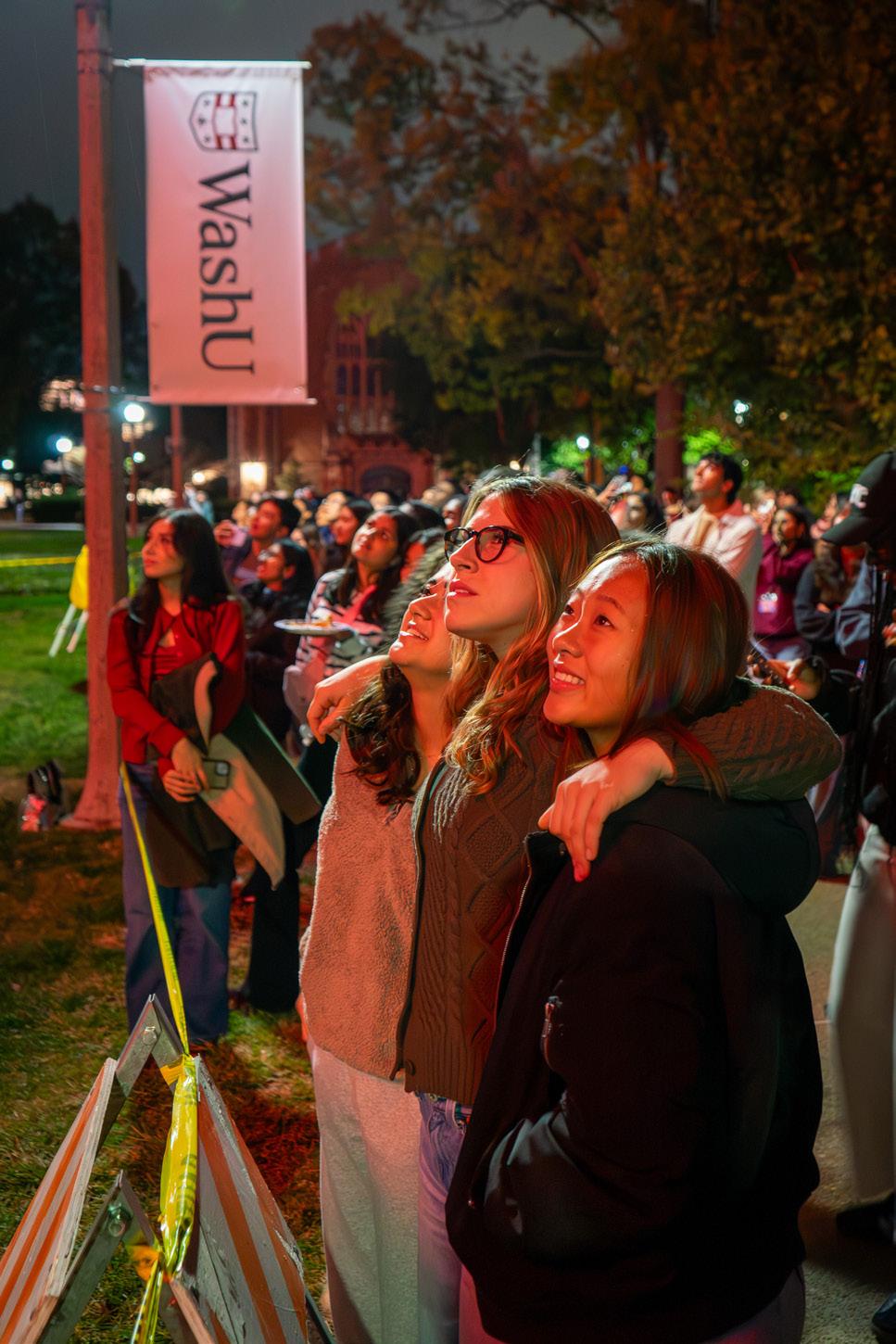
MAC MOTZ | STAFF PHOTOGRAPHER Students watch fireworks over Mudd Field from Edison Courtyard, where this year’s Diwali Fireworks celebration was held.
As night fell, a Firework show was shot off over Mudd Field.