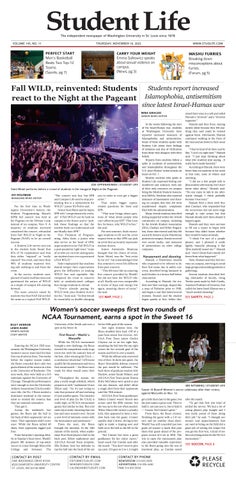
The independent newspaper of Washington University in St. Louis since 1878 THURSDAY, NOVEMBER 16, 2023
VOLUME 145, NO. 11
PERFECT START
WWW.STUDLIFE.COM
CARRY YOUR WEIGHT
Emma Sulkowicz speaks about sexual violence on campus. (News, pg 3)
Men’s Basketball Beats Two Top-12 Teams. (Sports, pg 7)
Fall WILD, reinvented: Students react to the Night at the Pageant
Students report increased Islamophobia, antisemitism since latest Israel-Hamas war NINA GIRALDO SENIOR NEWS EDITOR
ZOE OPPENHEIMER | STUDENT LIFE Saint Motel performs before a crowd of students in the inaugural Night at the Pageant. AVI HOLZMAN MANAGING NEWS EDITOR
For the first time in Washington University’s history, the Student Programming Board’s (SPB) fall concert was held at the Pageant on the Delmar Loop instead of on campus, Nov. 9. A majority of students surveyed considered the concert, rebranded from Fall WILD to Night at the Pageant (NAP), to be an overall success. A Student Life survey sent out to the student body found that 81% of 54 respondents said that they either “enjoyed” or “really enjoyed” the event, and more than 90% of students reported feeling safe walking to and from the event. In the survey, students complained of audio malfunctions and questioned the nature of WILD as a staple of campus life moving forward. The main concern raised by students was that NAP did not feel the same as a typical Fall WILD.
“The concert was fun, but SPB and Campus Life need to stop pretending this is a replacement for WILD,” junior Eli Perlin said. Senior Sam Block said he hopes SPB will “comprehensively evaluate” if Fall WILD can be held on campus in the future and to “publish those findings so that the student body can understand and not blindly hate SPB.” Vice President of Programming, Abby Sode, a junior who also serves as the head of SPB, urges students to see Fall WILD in a post-pandemic light since “none of us who are current undergraduate students have ever experienced a Fall WILD.” Sode emphasized that students should temper their expectations given the difficulties in making WILD free and equitable. She compared the event to concerts held at similarly-sized colleges that charge students to attend. “You’re already paying for WILD with your Student Activities fee,” Sode said. “So that would be essentially us double-charging
you in order to even get a bigger artist.” That raises bigger equityrelated questions for Sode and SPB. “That now brings about questions of ‘what about people who can’t afford to pay $35?’ That’s not fair. So hence, why WILD is free,” she said. For next semester, Sode encourages students to fill out the artist request form so that SPB can pick an artist that accurately represents student desires. Junior Antoinette Manteau thought that the choice of artist, Saint. Motel, was the “best artist by far yet” but acknowledged that this semester’s event felt different from past concerts. “This felt more like an amazing free concert provided by WashU but did not have the WILD vibe at all. Really not even comparable in terms of hype and energy but again, amazing choice of artist,” she said.
SEE NAP, PAGE 2
WASHU FURRIES Breaking down misconceptions about furries. (Forum, pg 5)
In the weeks following the start of the Israel-Hamas war, students at Washington University have reported increased instances of Islamophobia and antisemitism. Some of these students spoke with Student Life about their feelings of isolation and fear of vilification from those who disagree with their beliefs. Reports from students follow a spike in incidents of antisemitism and Islamophobia throughout the U.S. since Hamas’ initial attacks on Israel on Oct. 7. Muslim students who spoke to Student Life expressed feeling outnumbered and unheard, with one of their only resources on campus being the Muslim Student Association (MSA). Students also reported instances of harassment and doxxing on campus that they felt went unaddressed despite complaints filed with the administration. Many Jewish students described feeling supported within the Jewish community on campus, including by the Jewish Student Association (JSA), Chabad, and Hillel. Regardless, those interviewed said they felt scared by rhetoric at pro-Palestinian protests on campus, threats received over social media, and instances of antisemitism on other college campuses.
Harassment and doxxing
Haniah, a Palestinian student who requested to be referred to by their first name due to safety concerns, described being harassed in mid-October in a lecture hall before class started. According to Haniah, the student saw their earrings, shaped like a map of Palestine prior to 1948, and began a rant that lasted several minutes. Haniah said the student began quietly at first, before they
raised their voice to a yell and called Haniah a “terrorist” and a “terrorist supporter.” Haniah said they froze, staying mostly silent because they felt anything they said could be twisted against them. Afterwards, Haniah continued walking to the front of the class and sat down in their usual seat. “I had to kind of sit there and be like, ‘I can’t cry right now,’” Haniah said. “I just kept thinking about what [the student] kept saying…It really hurts inside honestly.” According to Haniah, there were fewer than ten students in the room at that time, none of whom said anything. “I did see a few people talk to [that student afterwards], but I don’t know what about,” Haniah said. “No one came to talk to me afterwards though, I think probably because I was teary.” Haniah filed a form with Student Conduct, who responded that the occurrence did not seem large enough to take action but that Haniah should alert them should it happen again. Haniah said they were nervous to fill out a report to begin with because they didn’t know whether they would be taken seriously. “I think I’m sort of a people pleaser, and I phrased it really lightly, basically phrasing it like ‘[this student] teased me,’” Haniah said. “And I think that’s totally different from what happened.” Now, Haniah said they feel nervous on campus, swerving to avoid large groups and avoiding protests or gatherings. Several students described feeling distrustful of faculty, citing Twitter posts made by Seth Crosby, Assistant Professor of Genetics, that called the latest Israel-Hamas war a “much needed cleansing.”
SEE SAFETY, PAGE 2
Women’s soccer sweeps first two rounds of NCAA Tournament, earns a spot in the Sweet 16 RILEY HERRON LEWIS RAND SPORTS EDITOR STAFF WRITER
Entering the NCAA DIII tournament, the Washington University women’s soccer team had hit their first run of adverse form. Two weeks before the regular season ended, the Bears conceded their only two goals allowed of the season in a loss to the University of Rochester. The next week, they were held to a 0-0 stalemate against the University of Chicago. Though the performances were enough to win the University Athletic Association (UAA) conference title, the No. 2 Bears needed a dominant weekend in the tournament to remind the country that they are national contenders. They got it. Across the weekend’s two games, the Bears put the ball in the back of their opponents’ net six times. Their opponents didn’t score once. While the Bears tallied 40 shots, their opponents logged just four. From Saturday’s opening whistle to Sunday’s final tweet, WashU played 180 minutes of top-notch soccer to cruise through Maryville College and Sewanee: The
University of the South and earn a spot in the Sweet 16.
First Round – WashU v. Maryville While the NCAA tournament brought a new challenge, the Bears entered the competition ready to go toe-to-toe with the nation’s best of the best. After winning the UAA — a conference which had 7 of 8 teams qualify for the postseason and win a first-round match — the Bears were ready for what would come their way. “Throughout the season, we play a really tough schedule, which prepares us well,” sophomore Grace Elhert said. “So it’s just trying to take that pressure off and realizing it’s just another game. The intensity and level of play [in the UAA] is really high, so NCAA tournament games feel similar to that. But a lot more [is] at stake, knowing that one loss and your season’s over. So just a new level of intensity comes with the tournament and postseason.” From the start, the Bears brought the intensity. In the 14th minute of the match, when sophomore Kaci Karl played a ball to the back post, fellow sophomore and All-UAA Second Team recipient, Ella Koleno, beat her defender to tap the ball into the back of the net
for her fifth goal of the season. Just eight minutes later, the Bears doubled their lead. Off of a pass from senior Jess Greven, AllUAA First Team junior Gaelen Clayton cut in on her right foot, smashing the ball into the top right corner for her seventh goal of the season and first in over a month. While the offense only converted two of their 16 shots into goals, the Bears’ formidable defense ensured the pair would be sufficient. The back three of graduate student Ally Hackett, senior Sarah Neltner, and All-UAA First Team junior Emma Riley McGahan were quick to put out any chances, and didn’t allow a single shot from their opponents until the 78th minute. All-UAA First Team goalkeeper Sidney Conner wasn’t forced into action until the 80th minute, but she was up to the test when needed. When Maryville earned a penalty kick, they appeared to have a window back into the game. Conner quickly shut it down, diving to her right to make a leaping save and hold on to the ball as she fell to the ground. “Sid Conner has been a great goalkeeper for her entire career,” head coach Jim Conlon said after the match. “You don’t want to give up a pen. If it goes to 2-to-1, it might
BRI NITSBERG | STUDENT LIFE Sweet 16 Bound! Women’s soccer celebrates after their victory against Maryville on Nov. 12. get a little dicey late in the game, but she just makes a great read. Then to hold it, not just save it, but to hold it — I mean, Sid Conner’s great.” From there, the Bears cruised, finishing the game with a 2-0 victory and yet another clean sheet. WashU has still conceded just two goals all season–a mark that puts them four goals ahead of the program record of 6 set in 2018. The win to open the tournament play also provided valuable experience to the Bears going into the rest of knockout play, as Conlon noted
CONTACT BY POST
CONTACT BY EMAIL
CONTACT BY PHONE
ONE BROOKINGS DRIVE #1039 #320 DANFORTH UNIVERSITY CENTER ST. LOUIS, MO 63130-4899
EDITOR@STUDLIFE.COM NEWS@STUDLIFE.COM CALENDAR@STUDLIFE.COM
NEWSROOM 314.935.5995 ADVERTISING 314.935.4240 FAX 314.935.5938
after the match. “To get that first win kind of settled the nerves. We had a lot of young players play tonight and I was really proud of them doing their job,” he said. “I thought our seniors and upperclassmen that are used to being on the field did a good job of setting the tempo but you get the first win, it kind of settles everything down for the NCAA tournament.”
SEE SOCCER, PAGE 8
NEWS
2 STUDENT LIFE
THURSDAY, NOV 16, 2023
AVI HOLZMAN | MANAGING NEWS EDITOR | NEWS@STUDLIFE.COM
Flu vaccination no longer required at WashU MIREYA COFFMAN SAUMITH MENON QUINN MOORE CONTRIBUTING WRITERS
Washington University has reverted its flu vaccine policy to the pre-COVID pandemic standard. The flu vaccine, along with the COVID-19 booster, is now “highly recommended’ instead of required. The reversal also means that students will no longer need to have the flu or COVID-19 vaccines to enroll in classes, effective this year. Executive Ddirector of the Washington University Health and Wellness Committee, Dr. Cheri LeBlanc, said that the Uuniversity had originally mandated flu shots in order to prevent a “twin pandemic” of the flu and COVID-19, following the guidelines of the COVID-19 Medical Advisory Group. Leblanc said the University still held flu shot clinics at the Habif Health
and Wellness Center, with no additional cost to students. Habif is also hosting COVID vaccination clinics, with the next one being on Dec 1. The recent policy shift by the University has sparked a range of opinions among the student body. Sophomore MJ Jones said she is pessimistic about the effect of a shift in vaccine requirements. “The fact that even fewer people are going to be vaccinated seems like it’s going to be very negative on the student body,” Jones said. Senior Benjamin Yi also said that, while it is nice that WashU is encouraging the flu vaccine, he has also seen an uptick in the number of people getting ill. “My friend got sick three times this year,” Yi said. The COVID vaccine is also no longer required to enroll at WashU, making the shift to ‘highly recommended’ as of July 1, 2023. MJ Jones said she is in favor of a vaccine mandate
for the University. “I totally understand autonomy, but I do think we’re one of the more permissive universities when it comes to COVID vaccinations,” Jones said. “I think some stuff, like flu vaccinations, you just have to do to make the student body safer.” “I would enforce a bit more on the COVID vaccine than the flu vaccine,” first-year Yahir Dominguez said. “In my case, I haven’t had the flu vaccine in a while and I have never gotten the influenza virus since then.” The impact on these policy changes will be observed as the school year progresses. It is yet to be seen if the lack of a requirement will result in more students becoming sick. “I still feel [safe], mainly because WashU still takes the steps of precaution for when somebody actually does get like the COVID infection,” Dominguez said. Anna Calvo, a freshman, said that not requiring the flu
LYDIA NICHOLSON | STUDENT LIFE A student walks into the Habif Health & Wellness Center on the South 40. shot will not make a “huge difference” because most students would choose to get the vaccine anyways. First-year Cameron Gratz said he’s not particularly worried about the new vaccine policy. “I do trust people to make
the right decisions, even if it’s not required,” Gratz said. “Maybe not as comfortable as I would be if there were a requirement, but I don’t feel unsafe. In the end, the lack of University-mandated flu and COVID vaccines places
SAFETY
NAP
from page 1
One Jewish student, a junior who chose to remain anonymous out of concern for safety and will be referred to as X, reported receiving several threatening messages via Instagram days after Oct. 7. One of these messages, sent from an unknown
the health of students in their own hands. Jones said she hopes students still get vaccinated. “I just think it’s like seatbelts on cars,” Jones said, “Like some stuff you just got to do so everyone’s a little bit safer.”
from page 1 account, said, “Just know people like you and everyone else at the Jewish rally today are the reason why we are antisemitic.” X said she knew that the message was sent by another University student because the message referenced a
chat between University students that X had been involved in. Another message to X regarded an Israeli family killed in the Oct. 7 attacks, saying that the family deserved it. “I’ve received a lot of horrible messages online, and I
Democracy Awakening: Notes on the State of America
December 4 7:00-8:30PM Graham Chapel Reception following
Please register at rap.wustl.edu
Heather Cox Richardson Historian and founder of Letters from an American
don’t know when that’s going to be translated in real life,” X said. “I’m always anxious and anticipating something will happen, so right now I have tried to eliminate any sign that I’m Jewish on my body.” One Muslim student, a junior who requested to remain anonymous out of concern for her safety and will be referred to as Y, said she was doxxed after an interaction with Barstool WashU and several other students after responding to a proIsrael Instagram story posted by the account on Oct. 7. The Instagram story posted by Barstool had a picture of the Israeli flag and read “Now and always, we stand with the people of Israel.” Y responded: “tf is this?? Stick to the shitty memes, you’re gonna regret this one.” Y said she felt the story isolated students who were not pro-Israel, and that she meant that Barstool would regret posting the image because they would lose support. Student Life confirmed with screenshots that, after a brief back-and-forth conversation, Barstool messaged Y that they had contacted the lab Y works in, citing her workplace by name. “They stalked me and found information about me and that made me extremely uncomfortable,” Y said. “It made me feel like I was under some type of microscope.” Y said they knew other students who also responded to Barstool’s story, but she was one of the few commenters who wears a hijab. Y said that she felt her profile picture, in which she is wearing a hijab, could have influenced Barstool’s response. “I really feel like my identity was used against me – for them to think that I was trying to threaten them, because they just view me as dangerous,” Y said. “I feel like that influenced how they interpreted my message.” The Barstool account did not respond to requests for comment from Student Life. In the following days, a screenshot of Y’s original message — with her name and Instagram handle — was circulated by students online. Y said that these interactions, combined with the news and social media
discourse on the war, took a significant mental toll on her. Coming back onto campus, Y went to the Office for Religious, Spiritual and Ethical Life, who told Y that there was nothing they could do because there was no specific violation of University rules. In a statement to Student Life, Reverend Callista Isabelle, Director for Religious, Spiritual and Ethical Life, wrote that students who have experienced bias, prejudice, or discrimination should file a report with the Center of Diversity and Inclusion. “I’m here to support students of any/no religious or spiritual background, whether they’re seeking support for their religious practices or accommodation needs, looking to connect with a community, or wrestling with spiritual questions,” Isabelle wrote. “I’m a confidential listening ear for students who want to talk about anything (religious or not).” Y said the only tangible resource the Office for Religious, Spiritual and Ethical Life could offer was the Washington University Police Department (WUPD), which Y felt could not provide the support she needed. Because the MSA does not have any faculty support, Y found they could only confide in their peers. Y described feeling hopeless, outnumbered, and without resources. She also feels nervous to be back on campus and has stopped walking around late at night. Other students voiced a fear of being monitored and doxxed, referencing the Canary Mission, a site that blacklists any individual determined to “promote hatred of the U.S., Israel and Jews on North American college campuses and beyond,” as one reason to fear voicing their pro-Palestine beliefs.
Read the rest online:
Manteau’s sentiments were shared by senior Renee Fuller who has not been able to go to past WILDs due to religious conflicts but found this year’s ticketing process frustrating. “I really enjoyed it,” Fuller said. “It was a bit annoying that it was off campus and we had to specifically register and pick up tickets. Overall I had a good time. I loved the atmosphere, and the band was really fun! I also was happy that it wasn’t on a Friday night because I haven’t been able to go to WILD in the past because of religious observance of the Sabbath, so it was fun to be able to go finally.” SPB Concerts Director Ruby Cover, a sophomore, expressed a similar sentiment regarding ticket distribution and hopes to improve the process for future events. “It is just very tedious and time-intensive, where we were manually going through the responses looking at copies of people and just making sure that everyone was entered into the lottery only once.” Cover said she views the event as a success and was happy to see students enjoying the event. “It was fun to see other students get into it because they were around other WashU students getting to see live music.” One issue multiple students had with the event was the delay between the opener and Saint Motel coming on for the event. According to Cover, she was told that the delay would initially last five minutes, but it was extended to around 45 minutes. She sees it as “one of those odd outlier events” that ideally does not happen again. For SPB, the event was the first of its kind that the group hopes to build upon for the future. “I think that event was a success, especially since it’s our first time doing something like that,” Sode said. “It’s a trial run, and obviously there are things that we can improve on for next time, but I think for it being a new thing it went pretty well.”
AVI HOLZMAN | MANAGING NEWS EDITOR | NEWS@STUDLIFE.COM
THURSDAY, NOV 16, 2023
STUDENT LIFE 3
Center for Diversity and Inclusion puts on Transgender Awareness Panel
Foreign-policy expert discusses whether the identities and mistreating was given at birth or the ones do not have to limit peoU.S. and China are transgender people at WashU that I feel most comfortable,” ple, according to Kimoto, highlights how the university they said. who views their transgender destined for conflict does not see transgender peoSchisher finds joy and identities as more than an
TANVI GORRE STAFF WRITER
The Center for Diversity and Inclusion (CDI) held a Transgender Awareness Panel to discuss the transgender experience specifically at Washington University, Nov. 13. Sophomore Aspen Schisler organized the panel, which was made up of Dr. Tasmin Kimoto, an assistant professor of Women Gender, and Sexuality Studies; AJ Robinson, a subject librarian at WashU; and two undergraduate students. The University stopped providing gender-affirming care for all minors at its transgender center on Sept. 11 which has raised concerns for the trans community according to AJ Robinson. “It gives me a lot of questions about the institution’s priorities and what things are considered liabilities and I guess who is considered a liability,” Robinson said. According to May, an undergraduate panelist who asked to only use her first name, the contrast between uplifting those with trans
ple as people. “The institution has a use for us, but they don’t support us as a living, breathing, inherently politicized people,” May said. “Our home is not the institution, our home is the movement and our home is with the community.” For instance, pronoun circles, which is where each person in a group has to provide their pronouns to the group, can make transgender students feel singled out at WashU, according to May. “I think we can do things differently such as not doing the mandatory ‘Are you transgender?’ check at the beginning of every class,” said May. However, one panelist, who is not out to their family, enjoys being able to share their pronouns with members of the WashU community. “It’s a point of pride for me to be able to say my pronouns and not feel abject horror at the reaction and not have to decide whether I am going to have to use the pronouns I
beauty in her trans identity, but according to her “not everyone views it that way.” Robinson came out as trans at WashU last year and asked HR to send an email to library staff about Robinson’s transgender identity. According to Robinson, they responded “[c]an you just talk to people who you work with?” When Robinson first started working at WashU, they did not come out to their coworkers because they didn’t want their identity to impact how other people view them. “I needed people to know me as a competent worker before they know me as the trans worker,” said Robinson. Dr. Tasmin Kimoto felt that their transgender identity was over-emphasized as an undergraduate and PhD student but their experience has changed as a faculty member at WashU. “I’m proud to not be an event for people,” said Kimoto. Transgender identities
orientation. “Part of my sense of my gender is the particular kinds of care work that you do and taking care of one another,” said Kimoto. May says part of her gender identity is intertwined in activism, not only in transgender rights but also in rights for minority groups. Kimoto also thinks it is important for transgender people to let go of the history of transgender identity and simply enjoy life. “I also tend to like trans joy, like reading stupid sh*t and learning how to do silly things,” said Kimoto. Kimoto acknowledges that it is hard to ignore the history of the transgender community, but that history should not prevent people from trying to make change. “Students always ask, ‘is everything terrible?’” said Kimoto. “It’s a lot harder to just sit there and feel hopeless when you’re actually working together with other people on something.”
Emma Sulkowicz reflects on political activism journey LUKE MYERS ODESSA BUELL STAFF WRITER CONTRIBUTING WRITER
Political activist Emma Sulkowicz discussed her journey to becoming a performance artist at the panel “Carry Your Weight: Sexual Violence on Campus” on Thursday, Nov. 9, at Graham Chapel. During the panel, Sulkowicz shared how college students can get involved in sexual assault activism, the responsibility of university students, and the importance of incorporating joy into activism. Sulkcowicz began the event by discussing how she got involved in political activism, specifically about sexual violence. In 2013, Sulkowicz was sexually assaulted by a classmate at Columbia University. Sulkowicz and multiple
other survivors of the same perpetrator reported the assault to Columbia, but she said that adequate action was not taken. The group then reported the assaults to the New York City Police Department where they said they were subject to victim blaming and inappropriate lines of questioning. Sulkowicz’s said that her experience with sexual assault and the lack of support provided by Columbia and the police prompted the creation of “Carry That Weight,” a performance art piece that would double as her senior thesis. In this performance, Sulkowicz vowed to carry her mattress wherever she went for as long as she attended the same university as her assaulter, incentivizing the University to take action. Sulkowicz explained how carrying around a 50-pound mattress in her performance art piece was demonstrative
of the experience of sexual assault survivors. “You’re taking this cumbersome object that is in the bedroom and struggling to put it out in front of the world for everyone to see,” Sulkowicz said. Sulkowicz said that she created rules that she had to adhere to in her performance art. She could not ask anyone to help her carry the mattress, but if people offered to assist her, she would accept. “So much of the work of bringing this kind of story out into the light is that it’s a struggle and no one wants to help you,” Sulkowicz said. “So I was like, this is more appropriate to how it feels and what it’s like.” Sulkowicz also said that she was happily surprised by her peers’ positive response to the piece. She said that people helped her, and she formed many meaningful connections because of it that served as part of her healing journey.
“I was having these extremely intimate conversations with strangers because of this role, because people were so motivated to jump in and help,” Sulkowicz said. Some of Sulkowicz’s peers waited outside her dorm building in the mornings to carry the mattress with her.
Read the rest online:
JAMIE NICHOLSON | STUDENT LIFE Ryan Hass of the Brookings Institute spoke about the future of U.S.-China relations on Nov. 14. on the South 40. LUKE MYERS STAFF WRITER
Ryan Hass, Director of the Brooking Institution’s John L. Thornton China Center, delivered a lecture at Washington University that addressed concerns over a future conf lict between the United States and China, Nov. 14. Prior to joining the Brookings Institution, Hass served as a Foreign Service Officer for 15 years, working in various countries such as China, Taiwan, South Korea, and Mongolia. He subsequently served as the director for China, Taiwan, and Mongolia to the National Security Council (NSC). Hass’ lecture tackled three major questions of concern: What exactly are the U.S. and China competing over? How will this competition play out in the coming years? How close are we, actually, to the brink of conf lict today? Hass prefaced his speech by noting that the Nov. 15 meeting between President Biden and President Xi will be the first in over a year. “What is unique about this moment is this is the first time that this [topic]
has had such political salience,” Hass said. In his lecture, Hass said that political beliefs in the U.S. have historically differed by party in regards to perspectives on China. He said that 76% of Republicans and only 30% of Democrats have generally believed that China is the largest national security threat to the United States. However, Hass said that in recent years, calls for bipartisan awareness of China as a national security threat have increased. According to Hass, half of all Americans now view China as the largest national security threat, overtaking Russia. Hass said that China’s economic expansion has coincided with many historical setbacks in the United States, and that China has emerged as a challenger to the United States’ once unrivaled hegemonic status.
Read the rest online:
BRI NITSBERG | STUDENT LIFE Activist Emma Sulkowicz spoke in Graham Chapel on Nov. 9 in an event titled “Carry Your Weight: Sexual Violence on Campus.”
VOLUME 145, NO. 11 Via Poolos Clara Richards Editors-in-Chief editor@studlife.com Avi Holzman Managing News Editor news@studlife.com Annabel Shen Managing Scene Editor scene@studlife.com Reilly Brady Managing Forum Editor forum@studlife.com Hussein Amuri Managing Sports Editor sports@studlife.com
Ved Patel Managing Chief of Copy Sydney Tran Head of Design Tuesday Hadden Ryan Davis Heads of Illustration James Ellinghaus Nina Giraldo Senior News Editors Elle Su Zoe Oppenheimer Senior Photo Editors photo@studlife.com Alice Gottesman Senior Scene Editor
Mia Burkholder Cathay Poulsen Chiefs of Copy Jared Adelman Managing Multimedia Editor Ian Heft Elias Kokinos Riley Herron Sports Editors Sylvie Richards Jasmine Stone Senior Forum Editors Amelia Raden Jordan Spector Junior Forum Editors
Jamie Nicholson Junior Photo Editor Zara Shariff William Labrador Junior Scene Editors Lily Taylor Zach Trabitz Aliana Mediratta Junior News Editors Brooklyn Hollander Samantha Elegant James Surnamer Natalia Jamula Reya Mehta Copy Editors Camden Maggard Social Media Editor
Tim Mellman Newsletter Editor emailedition@studlife.com Clara Richards Reilly Brady Designers Tony Tong Senior Web Editor Sanchali Pothuru Multimedia Editor Adrienne Levin Coleman General Manager a.coleman@studlife.com
Sarah Huff Advertising Sales Manager huffs@studlife.com
Copyright © 2023 Washington University Student Media, Inc. (WUSMI). Student Life is a financially and editorially independent, student-run newspaper serving the Washington University community. Our newspaper is a publication of WUSMI and does not necessarily represent the views of the Washington University administration.
4 STUDENT LIFE
SCENE
THURSDAY, NOV 16, 2023
ANNABEL SHEN | MANAGING SCENE EDITOR | SCENE@STUDLIFE.COM
Soundcheck to South 40: Songyee Park makes her WashU debut AMANDA YOUNG STAFF WRITER
Songyee Park is luminescent. On stage for K-pop girl group Woo!ah!’s debut performance in a sparkling oversized jersey over white safety shorts, her movements are perfectly in sync, hitting every bouncy “bada bada bing” with precision. She beams in frames of kaleidoscopic glamor shots, surrounded by disco balls and party streamers. Throwing the camera a charismatic wink, she proclaims that “no matter what others say / without hesitation / I just go,” as her group mates play with sparklers and Polaroid cameras. Underneath her cover of Yoon Mirae’s “Black Happiness,” the comments section gushes over her voice and visuals with a mirage of heart emojis, praising her as the “golden member” of the group. The Songyee Park under the fluorescent lights of an overbooked Olin study room on a Thursday evening is something closer to the real person. This is the first time she’s really talked
to anyone about her experience, she tells me. A few friends back at her old high school in Korea knew (plus a K-pop superfan in her class), but she doesn’t go around sharing it as her icebreaker fun fact. She wonders how people started talking about the K-pop idol on campus in the first place, and I tell her that the WashU admissions team had mentioned her during a January Zoom for early-decision students. She hadn’t been on the call and didn’t know that WashU was going to use that specific tidbit of information until a friend had frantically texted her. Still, she’s willing to share about her stint as a K-pop idol. As one of the relatively few former idols with a frank willingness to criticize the “dark side” of a highly idealized industry, her perspective is rare. Even so, it sometimes seems that the shadow of the industry that bodily shaped her adolescence looms over her. Throughout our interview, she speaks with what I first read as hesitance and later
saw as a careful, measured balance of the words she chose. She often looks skyward during her sentences, as if seeking guidance about the right, PR-friendly phrasing, even during her harshest criticisms of the industry. “Sometimes, I feel guilty for telling. Like it’s supposed to be hidden, to protect the fantasy,” she said when asked about why she hasn’t spoken very publicly about her stint in the industry before. And on the surface, it seems Park’s path to WashU took somewhat of a turn in the fantastical. Park was born in Virginia, crisscrossing the country between Los Angeles and New Jersey before moving with her family to Korea at the age of 10. Throughout middle and high school, she developed a love for dance, joining school music clubs and posting her own covers on Instagram. It was there, online, that she was discovered by talent scouts for NV Entertainment, who reached out to her via DM. “I thought it was fake,
The College Chef’s Handbook: A dorm-friendly apple pie ELIZABETH GRIEVE CONTRIBUTING WRITER
at first,” said Park. Receiving an unsolicited message from a brand new, unestablished company inviting her to audition was strange, and Park had never considered the option of becoming an idol before. “I wasn’t ready. I hadn’t prepared anything.” Laughing, Park sheepishly said, “My audition song was ‘All I Want for Christmas’ by Mariah Carey because it was November-ish.” Despite its last minute nature (or maybe inspired by the holiday cheer), Park’s audition impressed the judges enough that they told her she’d not only gotten into the company, but secured a debut spot in their upcoming girl group; this was unheard of in an industry notorious for its meticulous system of intense, years-long training and obsession with perfection. For most K-pop hopefuls, the training period begins in the preteen years, when trainees are plucked from home to live in companymanaged dorms. Trainees face immense pressure from their companies to drop out
CONTRIBUTING WRITER
ILLUSTRATION BY CLAIRE YANG but still delicious. Whether you are staying here on campus, or if you are going home as well, I trust you’ll find this recipe just as inviting as I do.
Apple Pie (Dorm-friendly version) This pie has three components: the pie crust, the apple filling, and the crumble topping. For an easier variation, you can either buy the filling or the crust premade. But, if you’re up for the challenge, making all three parts yourself gives the tastiest results. To make this pie dorm friendly, the easiest way to bake it is either in a sheet pan (making a ‘slab’ pie) or a muffin tin (making individual pies). You can also omit the crumble topping and make hand pies — where you place the apple filling in small circles of pie crust and then fold the crust in half, crimping the edge together with a fork - this is the sheet pan method. In addition, both the pie crust and the crumble top are typically made using a pastry blender. Since this is a more specialized piece of equipment, using forks works perfectly fine. For the ingredients, Paws and Go has apples, flour, and sugar, so the only items you may need to buy from the grocery store are butter, cinnamon, and brown sugar. For the pie crust, you will need 1 stick (½ cup) of cold
butter, 1 and 1/3 cups of flour, a pinch of salt, and a few spoonfuls of iced water. The key to making pie crust is keeping the butter very cold, so that the dough becomes flaky once you bake it. To make the pie crust, first slice your butter into small cubes, and then return it to the refrigerator, so that it is cold. In the meantime, measure out your flour and salt. Once the butter is chilled again, toss it in the flour mixture, using forks to break up the butter into smaller and smaller pieces. Keep doing this until the butter can’t be cut up any more (the mixture should look like very small crumbles of sand). To make the dough come together, add some cold water, spoonful by spoonful, just until the dough forms. Using any cylindrical object, roll the dough out in the shape of your pan, and place the dough inside it. You do not need to grease the pan. Place your crust-lined pan in the refrigerator until all of the other parts of the recipe are ready.
Read the rest online:
of school, replacing their education with long, grueling hours of training in singing, dancing, rapping, acting, and foreign languages. Despite all their work, little of a trainee’s future is guaranteed. In a relentlessly competitive industry full of determined bright-eyed hopefuls, a trainee could be praised one day, then cut from the company the next. “Some [trainees] were called back, they trained again, and then they still
got cut again,” Park said. “I feel like it’s really cruel for everyone because they’re all young. If they go back to school, they need to catch up with everything, and they don’t know what to do.”
Read the rest online:
Wait, what’s NAP? A student review of SPB’s Night at the Pageant WILL ROSENBLUM
As the days grow shorter and the nights grow colder each week, I’m counting down until Thanksgiving, a much-needed break before the end of the semester. As I make plans to return home, my parents have tasked me with setting the menu and cooking for our family’s Thanksgiving. Although cooking for 15 people isn’t necessarily a leisurely break, I couldn’t be happier — as much as I enjoy the challenge of dorm cooking, cooking in a full kitchen is a nice change. While I equally enjoy cooking and baking, I can’t deny my favorite parts of Thanksgiving are the pies. They’re the epitome of fall baking. My grandmother, who comes from a long line of bakers, has one of the best apple pie recipes (I might be a little biased). Passed down through generations in her box of recipe cards, she was kind enough to share this treasured recipe with me. The rich, spiced apples are complemented by the light, flaky crust. And unlike other recipes, my grandma’s recipe has a crumbly streusel topping that adds the perfect amount of sweetness and caramelization. When I think of comforting recipes, I think of this pie. With break coming up next week already, I thought it was the perfect time to revisit this recipe. What’s great about this recipe is that it’s customizable enough to make a bunch of different variants (including a brown-butter apple tart, which I will be making once I get home). This week, I am making this pie dormstyle, so that my friends who aren’t going home for break can still have a Thanksgiving pie. So, the recipe I am sharing is my newest take on my grandmother’s classic: simple enough to make in a dorm,
ILLUSTRATION BY SOPHIE LEONG
On Nov. 9, the Social Programming Board (SPB) hosted Saint Motel at The Pageant, a venue on the Loop, as a free event students could sign up for on Nov. 9. It was in place of Fall WILD, which was canceled last year due to budget and location concerns. I first heard about NAP on Oct. 27, the Friday morning before Halloween, when the SPB mysteriously appeared in my inbox. It was an email titled “SPB Presents a Night at the Pageant: NAP!” So, I opened it. It started with a few paragraphs explaining how Fall WILD could not be provided like it was before, out on the lawn. WILD, short for Walk In, Lay Down, would be NAP — at least this time. In summary, it’s a rebrand coming from the fact that since not all students could attend, “Fall WILD” would not be the right label. At this point, I thought: “Okay, I’ll take it. There’s space for 2,000, and it’s walkable. SPB reserved the whole venue and provided transportation. The band is Saint Motel, known for a few songs such as “My Type,” “Cold Cold Man,” and “Sweet Talk.” Saint Motel fits somewhere around the American indie pop genre, so it’s a different pace than last spring’s headliner, Flo Milli, but they still fit with mine and a large group of students’ tastes. And, the biggest reason: it’s a free concert. Sign me up!” At this point, some of my friends thought: “Okay, that’s in less than two weeks. There’s limited space, and I have an exam that day, two papers to write, and it’s on a Thursday. So…I will not be signing up today.” For many, NAP was not
going to work out, and even if tickets were free, there was still no guarantee that they could get one. So, maybe they moved on, and remembered the silver lining: there’s always Spring WILD. For those of us who went, the first step was getting there. SPB provided shuttles there and back, but encouraged us to walk, as seats were limited. We showed up with our IDs and tickets, ideally the ones we had reserved beforehand and picked up a few days before. Walking into The Pageant, I saw that the front space was filled but there was still plenty of room near the middle and back. Before the main act, people were still walking in and those less interested in the opener were talking to each other. For an indoor concert, it wasn’t too packed or too empty, but that might depend on where you stood — rows near the back were also at a higher level than the front, so being able to see performers was not an issue. J. Maya was the opener, who I had never heard of before. She is an up-and-coming artist as well as a recent Survivor contestant, where she told us she met fellow musician Sifu. After bringing out Sifu to play guitar, she performed a hard-hitting song “Achilles Heel” and brought up the crowd’s energy as they anticipated the headliner. The wait dragged on, but eventually Saint Motel began with a few of their hits, including “Puzzle Pieces,” “For Elise,” and “Move.” It was a surprise to hear the phrase “Go Bears!” come out of lead singer AJ Jackson’s mouth, and then even more shocking when he asked how many of us were premed. After a few little conversations with us, you could tell the crowd was warming up to
the band — Saint Motel had made an effort to learn about us, and we appreciated that. Jackson went on to talk about meeting his bandmates in college, as they were all film majors. He also attempted to come up with a motto for us. “WashU doing?” was one of them. Dressed in business casual, Saint Motel gave the impression of a professor trying to stay hip. But, you know, a well-liked professor. The show went on. After more hits such as “Cold Cold Man,” Saint Motel performed some of their new releases, including “Fine Wine” and “Everyone’s A Guru Now.” For the entire night, the screen behind the performers was off, probably due to technical issues, but colorful, flashing stage lights made up for any lack of spectacle. Coming into the concert, I was not expecting as much excitement as there was, but when AJ Jackson said, “JUMP!” you best believe we jumped. At the same time, Jackson gave us cues and harmonies to match their songs. So, even if you didn’t know the songs, you could still sing along, which was one of the best parts of the concert, in my opinion. Near the end of the show, the crowd reached a high point in energy. For their encore, they played one of their top songs, “My Type,” which was, of course, a big hit. Saint Motel’s music may not be on top of the charts, but its crowd work, energy, and attention to detail made the night a special one. The wait was rough, many seats empty, and surely no Walking In and Laying Down, but it was enjoyable all things considered. Upperclassmen have all the right to say it’s not anything near Fall WILD, but for many of us who went, it was a memorable experience.
FORUM
STUDENT LIFE 5
REILLY BRADY | MANAGING FORUM EDITOR | FORUM@STUDLIFE.COM
THURSDAY, NOV 16, 2023
Everything you know about furries is wrong NATALIA JAMULA & DAVID CIORBA CONTRIBUTING WRITERS Sitting in the Center for Diversity and Inclusion, Washington University freshman Casper was discussing furries’ role in building the internet when a stranger interrupted: “I don’t buy it. Furries?” they chuckled. “What?” Casper chose to be interviewed in the Center for Diversity and Inclusion because of negative stigmas and safety risks often directed at their community. Casper is a furry. There are no requirements for identifying as a furry, as he explained, “The one thing you have to do to be a furry is say you are a furry.” The interviews conducted for this article feature the voices of three anonymous WashU students who are members of the furry community: first-year student “Casper,” junior student “Blu,” and graduate student “Cour.” According to the National Library of Medicine, furries are people who are exceptionally interested in anthropomorphic or cartoon animals. They frequently create fursonas, or manifestations of themselves as those animals. The community bonds over these depictions, art, and each others’ fursonas. Some practice fursuiting — wearing costumes that resemble human-like creatures.
Furries seem to be a touchy subject, but why? On a campus where inclusion is central to our university’s goals and where there’s “something for everyone,” how did furries get left behind? The interviewees’ perspectives challenge misconceptions about furries, such as the furry identity being central to their lives and that all partake in sexual activity relative to the community. Members outside the community must improve their attitudes and predispositions regarding furries. Truly, the furry community varies in its member’s involvement. Similar to fandoms like anime or cosplay, members are self-labeled and choose their own levels of participation. While Casper has possessed multiple fursuits over the years, Cour owns a simple sketch of his fursona. With varying extents of membership, furries are not tied down to a single community or identity. Outside of the fandom, furries are artists, programmers, writers, and researchers. Casper draws the overlap between furries and sci-fi, contextualizing many furries’ fields of study in Computer Science with their accomplishments in building everything from online chat rooms to the Moderna Vaccine and their part in building the Internet. Many furries are artists, including Casper
himself, who has built a profitable side hustle selling fursuits. Further, Blu is a Data Science major and Cour is in graduate school for astrophysics interested in pursuing academia. Cour acknowledged the future for furries in art, as he knows a furry who works as an animator for DreamWorks. While creating fursuits, art, and videos can be a profitable hobby in itself, furries’ creative anthropomorphic design skills are valuable assets to society’s markets in film, costumes, and entertainment. Just as the furry community is not rooted solely in fursuits, it is neither dependent on sexual activity. Because fursuits are expensive, awkward, and sweaty, for many, getting frisky in fur seems entirely undesirable. Casper laughingly explained, “Yeah, that’s a huge risk for heatstroke. Genuinely, that concerns me.” Of course, there are corners of the community that contain adult themes; however, this is no different from any other fandom. Cour, Casper, and Blu all stated that they do not partake in furry-related sexual activity. It is no secret that stigmas around the community compel members to gather in private. The furry community has struggled to control its public image, especially as right-wing politicians spew false reports
of furries asking schools to place litter boxes in their bathrooms to accommodate students who identify as animals. This sensationalist misinformation has led to backlash and misunderstanding directed toward the furry community, ranging from stigmatizing jokes and chat room raids to physical assaults. In fact, Casper mentioned that the fandom has had to develop physical assault response protocols due to increasing safety risks, such as immediately taking off their headpiece if faced with aggression. At WashU, there are over 460 student organizations to build community and establish social connections. While the furry fandom has existed since the early-to-mid-1980s, it flourished with increasingly virtual connections over the COVID-19 pandemic. Furries on campus mostly stick to online group chats on Discord, Twitter, Furaffinity.net, or informal meetups and conventions. This discretion is due to the risk of backlash or violence from non-members in public. To combat these stigmas, local efforts like the Gateway FurMeet (a furry convention in St. Louis) and the convention panel, “How to Survive College as a Furry,” should be celebrated as these local, public transportationfriendly meetups support
ILLUSTRATION BY ADEL CYNOLTER a long underrepresented community. With the help of furries facilitating local meetups and continuing to have brave attitudes to defend the community from misconceptions, the furry fandom can be a thriving safe place for many members. Indeed, a large percentage of the fandom’s patrons are neurodivergent or identify as LGBTQ+. Regarding contact information, furries who go to WashU can message community leader @crapsketches on Telegram about more fur-meets throughout the semester. For its members, the furry community
provides refuge, support, and connections, and with increasing member turnout, their club is considering becoming WashU-official. As Casper said, “Furries are normal people. There are furries at WashU, and they are human beings just like anyone else.” Even amid backlash, furries remain positive, support an inclusive environment where people can be themselves, respond compassionately to ignorance, and showcase themselves as valuable people. These students are creative, accomplished, and worthy of being treated like anyone else.
SPONSORED BY:
PUZZLE PUZZLE Mania
At the Movies
Crossword by @alexunickel on Letterboxd
ACROSS 1 Thanksgiving boat contents? 6 Actress Zellweger of "Bridget Jones's Diary" 7 Subject of Sofia Coppola's new film "Priscilla" 8 "Garfield: A ____ of Two Kitties" 9 Rose of Guns N' Roses
1
ACROSS 1 Exec. role for a McKelvey alum 4 Throat-clearing sounds 6 Topic of discussion in an Sol ut i ont o accounting or l astweek’ spuzzl e: economics class 7 Photography student's assignment 8 KWUR has to broadcast one every 30 minutes (abbr.)
1 1/ 16/ 23
DOWN 1 Scholar-_____ion 2 America's 2nd largest state by land mass 3 Greek letter and Rolex rival 4 "Feliz cumpleanos _ __" ("Happy birthday to you") 5 Opposite of
3
4
6
7
8
DOWN 1 "Barbie" director Gerwig 2 Take it easy 3 Item dropped on Wile E. Coyote 4 Bridal cloth 5 Meg Ryan's repeated shout in an iconic "When Harry Met Sally" scene
Only You Can Prevent Forest Fires
2
9
Only You Can Prevent Forest Fire Crossword by Alex Nickel
1
2
C
3
T
O
4
5
A
H
E
M
S
T
A
X
E
S
I
M
A
G
E
P
S
A
6
7
8
5
6 STUDENT LIFE
THURSDAY, NOV 16, 2023
REILLY BRADY | MANAGING FORUM EDITOR | FORUM@STUDLIFE.COM
OPINION SUBMISSION
Stop the killing in Gaza, and end aid to Israel BRET GUSTAFSON PROFESSOR OF ANTHROPOLOGY There is no justification for Israel’s slaughter of innocent people in Gaza. The complicity of the United States government in this mass killing is equally inexcusable. The events of Oct. 7, including horrible attacks on civilians, are no excuse. One need not be Jewish, Israeli, Palestinian, or have a PhD in Middle East Studies to have an opinion on what is right and what is wrong. And what Israel is doing in Gaza is wrong. But we are told that criticizing Israel is antisemitic. Or, absurdly, that the 11,000+ dead are guilty because they are Hamas or “animals.” The babies in the incubators are Hamas? Entire families murdered
in their homes? The fifty journalists who have been murdered by Israel? The doctors are animals? And on it goes. The United States government’s credibility on democracy and the rule of law has always been shaky. By supporting Israel’s war crimes and the ongoing illegal settlements and the theft of Palestinian lands in the occupied West Bank, U.S. credibility has dissolved completely. Yes, war crimes. Amnesty International (AI) and Human Rights Watch (HRW) have detailed war crimes, from the use of white phosphorous to the bombing of schools and hospitals. AI and HRW, along with the Israeli human-rights organization B’Tselem, had already documented Israel’s crimes of apartheid. Israel has
murdered over 100 members of the United Nations staff in Gaza. And we are to believe the Israeli ambassador to the UN, who says that those staff members, too, are Hamas? Absurd and criminal. Opinion submissions published in Student Life have denounced antisemitism and declared Israel’s innocence and victimhood. We should all denounce antisemitism. But innocence and victimhood? That tests the limits of credulity. In 1948, the Israeli state was created through the seizure of Palestinian land, the killing of 15,000 people, and the removal of 700,000 Palestinians from their homes, many pushed into Jordan and Lebanon, others crowded into the Gaza Strip and the West Bank. The result? A wealthy and powerful military state
with control over Palestinians in Gaza and in the West Bank. That does not sound like innocence and victimhood. Nor does it sound like democracy. Despite what we are told, there is no democracy for Palestinians in Gaza or the West Bank, nor for Palestinian citizens of Israel. There is no reason the U.S. should be aiding Israel and abetting war crimes. Yet the massacre of innocents goes on. Children with their legs amputated. A mother weeping with the body of her child in her arms. Men consoling orphans, shocked and traumatized, trembling in fear, covered with the dust from bombedout buildings. Bodies lined up on the floor. Families murdered by Israeli F-16s while trying to seek safety. What kind of humanity
— or perverse hatred, cruelty, depravity, or racism — must one embrace to justify this killing? We are told that Israel had no choice. No choice? How about ending the illegal settlements in the West Bank? How about ending the embargo on Gaza? Of course, this is not how settler colonialism works. The end goal, it appears — as voiced by Israeli officials themselves — is to complete what was started in 1948: the displacement of all Palestinians from what was, in 1947, known as Palestine. This looks like genocidal intent. Read the Genocide Convention yourself, which cites acts committed with the “intent to destroy, in whole or in part, a national, ethnical, racial or religious group” and the creation of “conditions calculated to bring
about its physical destruction in whole or in part.” It’s curious that WashU’s lawyers have stayed silent. Do we not teach the rule of law? And WashU’s doctors? Crickets. WashU med students take an oath with the words “I will empower the unheard” and “advocate for healthcare as a human right.” Nowhere does it say “I will turn my head in silence while hospitals are bombed and doctors and patients are killed by a government that is enabled by our own.” Cease fire now. Stop military aid to Israel. Exchange the prisoners for the hostages. And yes, from the river to the sea, may all peoples in the land once known as Palestine someday live in freedom. Per veritatem vis.
OPINION SUBMISSION
Supporters of campus repression exploit the Israel/Palestine situation MICHAEL ALLEN SENIOR LECTURER, ARCHITECTURE, LANDSCAPE ARCHITECTURE AND URBAN DESIGN LECTURER, AMERICAN CULTURE STUDIES Last week, Columbia University suspended both the Students for Justice in Palestine (SJP) and the Jewish Voice for Peace (JVP) organizations for violations of campus policies. This followed Brandeis University’s suspension of its own SJP chapter. I would console these suspended student groups by confirming that no action worth leading should not rankle the establishment. These student groups will not be silent, because they will be vocal outside of the official channels. However, the official suppression of these groups seems to be part of a disturbing trend that fundamentally has nothing to do with Israel or Palestine. Recently, Israeli Consul Yuval Donio-Gideon demanded the cancellation of a course at Bard College by appealing directly to Bard College President Leon Botstein. The course is called
“Apartheid in Israel-Palestine,” and is taught by Nathan Thrall, a Jewish scholar who fears that Israel is violating the definition of “apartheid” found in international law. Thrall offers the course as an effort to study the issue, not to instill a particular conclusion. Nonetheless, beyond the Israeli Consul, the course caught the ire of Bard College trustee and major donor Robert Epstein, who then resigned as a trustee. This could all be some quaint academic scuffle if it were not for the fact that the Ulster County Jewish Federation president — representing Bard College’s county in New York — accused Nathan Thrall of being manipulated by funding from George Soros. Soros donated to an organization that has supported Thrall’s research, but not the course itself. Of course, George Soros is a contemporary trope of antisemitic politics. Soros supposedly exerts metaphysical power over members of Congress, prosecutors, and professors. He is a Jewish bogeyman that animates the far right and is a cudgel
against efforts toward racial and class justice in this country. Supporters of former president Donald Trump often dog whistle Soros’ name when referencing the prosecutors who have brought charges against him. It is bizarre that any Jewish group would join in this far right smear tactic. Unfortunately, there seems to be an increasing embrace of right-wing narratives among people who otherwise would refute them. Wartime often opens a space for extremism to become normalized. For instance, through an Instagram story, Amy Schumer shared an article from the right-wing Campus Reform that alleged the influence of Arab-state university funding over student activists for Palestine. The article that Schumer posted accused SJP chapters at Cornell of acting upon Qatari funding and those at American University of acting upon Saudi Arabian funding. Of course, the Arab state funding went to various funds at universities, and came through subsidiaries. It never flowed directly into student group coffers. The same universities simultaneously
received funding from the usual mix of corporate, individual and foundation dollars. Campus Reform could illuminate the overall influence of donations on academic life, but instead it has latched onto the war to agitate against student expression. The insinuation that students are puppets of shadowy figures and governments, however, is an insult toward students everywhere. Students are organizing according to their own understanding and free will, not through coercion. The attacks on student groups, on the other hand, demonstrate that a lot of powerful actors want students in fact to cower to the demands of political might and donor power. These efforts did not begin on Oct. 7, but have been active for a long time. Campus Reform has been agitating against critical thinking at universities for years, with the scandal du jour changing from critical race theory to gender-neutral sports to Israel depending on what issue is most useful for challenging student freedom to think, perceive and organize.
Florida Governor Ron DeSantis, an overt opponent of academic freedom, earlier this year worked to secure rules suppressing critical race theory and diversity, equity and inclusion initiatives at his state’s public institutions, alongside steps dismantling tenure of faculty. Since Oct. 7, DeSantis has used a state anti-terrorism law against Students for Justice in Palestine chapters at the University of Florida and the University of South Florida. Just this week, Florida started to walk back its decision, but are demanding groups endorse nonviolence to prevent further action. Of course, DeSantis already used his power to install leaders at Florida’s New College that have moved to eliminate the gender studies department. The DeSantis agenda relies on demonizing the humanities in particular and professors generally. We all should be wary of efforts to use legitimate grief and fear over the war to advance an old agenda that aims at the freedom that makes academic life so valuable. Supporters of Israel need to reject their newfound
friends whose real mission is to make college students and faculty servile to authoritarian regimes and nationalist sentiment. There are many good debates to be had among students and faculty with free speech upheld for all. In the face of current events, those debates are necessary for the prospective peace of humanity. Respectful dialogue is happening, and thankfully the powerful forces trying to use financial intimidation and political power to influence campus discourse are not stopping it. The pressure of the 21st century may well be against democracy and toward simplification of political issues, but most people at universities in the US still want to engage each other. We are fortunate at Washington University in St. Louis that we have not faced the censorship of debate other institutions are facing. May we keep it that way, and love each other. Part of the key is to reject the advances from fast friends whose real goals would take everyone’s liberties away, regardless of their perspective.
EDITORIAL COMIC
ILLUSTRATION BY MEL M.
CAPTION CONTEST
Caption this! Enter this week’s contest
11/16 WINNERS
Scan the QR code to enter your submission by 11:59 pm on Monday.
First place yeah that’s my boy greg. Benjamin Broker, Current WashU Student Second place Andrew Tate slithering out of the abortion bucket. Neel Kulkarni, Current WashU Student ILLUSTRATION BY EILEEN KIM
ILLUSTRATION BY TUESDAY HADDEN
THURSDAY, NOV 16, 2023
SPORTS HUSSEIN AMURI | MANAGING SPORTS EDITOR | SPORTS@STUDLIFE.COM
STUDENT LIFE 7
Men’s basketball opens with wins against nationally-ranked DIII competition ELIAS KOKINOS SPORTS EDITOR
In the vibrant world of Washington University sports, the esteemed title of “Scholar Champions” harmoniously fuses academic brilliance with athletic prowess. So, as the curtain rose on the inaugural Scholar’s Classic tournament in New York, the collective anticipation among men’s basketball enthusiasts soared — logically expecting nothing less than a triumph for the Bears, the quintessential scholars of the court. Over the past weekend, the Bears, true to their title as Scholar Champions, secured consecutive victories against top-ranked DIII teams. This unique tournament, tailormade for the scholarly elite, witnessed the Bears — who were ranked #22 in the preseason poll — schooling #11 ranked Swarthmore College with a remarkable 20-point victory on Saturday, Nov. 11. The next day, riding high on this academic-athletic synergy, they entered a hard-fought battle against #12 ranked Johns Hopkins University. After a back-andforth affair that culminated in an impressive second-half surge by the Bears, WashU ultimately clinched a victory by 6 points, leaving them as the only team to win both of their games in the Scholars Classic. In their season-opener against Swarthmore — a team that made it all the way to last year’s Final Four — the
Bears wasted no time asserting their dominance, with juniors Hayden Doyle and Drake Kindsvater guiding the charge. Doyle led the effort with a career-high 23 points alongside a team-high nine rebounds, while Kindsvater poured in 20 points on over 58% shooting to complement his five rebounds. But while Doyle and Kindsvater led the team in scoring, the Bears also answered the uncertainties surrounding their frontcourt. After losing three of their four primary big men from last season, the Bears entered the seasons with questions about filling the void. The answer? A group effort. Sophomore Calvin Kapral, who earned the starting nod, junior Kyle Beedon, and freshman Jake Davis all logged vital minutes. The trio helped turn the area of uncertainty into a difference-making strength Saturday night, as the Bears out-rebounded their opponents 36-27 and outscored them 50-30 in the paint. Despite the impressive offensive efficiency, the true game-changer emerged in the realm of defensive fundamentals, with the Bears limiting Swarthmore to just 56 points, their third-lowest tally in a game since the start of the 2021-2022 season. As Doyle pointed out, these fundamentals were marked by “Disrupting their rhythm a little bit, pressuring the ball and kind of trying to make them uncomfortable, so they can’t get into the actions that they wanted to get into.” Echoing Doyle’s
sentiments, head coach Pat Juckem described the team’s defensive approach, stating, “Our guys exuded aggression, confidence, and a sense of connection. Even when Swarthmore made shots, they were shots we could accept. They’re an exceptional team, and they’re capable of making tough shots. We minimized our defensive breakdowns and forced them to take contested shots.” WashU’s defense has long been a strength of the team and a key to their success. Last season, the Bears allowed just 62.1 points per game on average, the best mark in the highly competitive University Athletic Association (UAA). They also boasted an impressive 19-1 record when they held opponents below 70 points, a feat they were able to accomplish in both games this weekend. Though this year will be their first without Charlie Jacob, the two-time UAA Defensive Player of the Year who graduated last year, their performances from this weekend indicate that their defensive capabilities are not going away despite losing last year’s keystone player. Following the victory over Swarthmore, the team had a quick turnaround of less than 24 hours before they faced Johns Hopkins the following day. Unlike Saturday’s game, where the Bears went into halftime with a large lead and sustained it throughout the second half, WashU faced an 11-point hole when Sunday’s first-half buzzer rang. Despite this challenge, Coach Juckem
remained confident, reflecting and reminding the players to stay focused on their pregame plan. “We thought it wasn’t that we weren’t playing hard enough or executing properly. So we focused on what we call the blueprint, how we attack, reminding [the players] that, ‘Hey, we have to do XYZ more.’” These words set the stage for an impressive strategic turnaround. The Bears, determined and disciplined, implemented the necessary changes. The result? A remarkable comeback, marked by an 18-5 run, erased the deficit and propelled WashU to seize control of the game. As Doyle puts it, “The vibe from the guys and coaches was like, ‘Stay cool, just focus on the next play.’ I mean, there’s no 11-point magic trick, right? So, we just had to keep grinding, making those smart moves. And we did pretty darn well. Defensively, we turned up the energy—more hustle, tighter on the ball.” The players, guided by the blueprint and fueled by their coach’s confidence and trust in them, managed to hold off a late Johns Hopkins effort to move to 2-0 on their season. While Kindsvater and Doyle were again the leading scorers with 14 and 12 points, the offensive weight was carried more evenly in the second game. Sophomore guard Yogi Oliff scored 10 points, as did Beedon in a career-high game, and sophomore sharpshooter Will Grudzinski added nine,
ELLE SU | STUDENT LIFE
Sophomore Yogi Oliff shoots during a 2022 home game, junior Hayden Doyle looks behind him.
six of which came from three-pointers. Following these results, the Bears eagerly anticipate the 39th annual Lopata Classic, a tournament hosted at WashU. The upcoming home slate opens with a 7
p.m. tip-off against Babson College on Friday. After establishing their national relevance with two statement wins over top-12 ranked teams, the Bears will hope to keep the momentum flowing into their home opener.
Football caps off season, honors seniors in 35-23 win over Carroll MATT EISNER STAFF WRITER As head coach Aaron Keen brought his team to a huddle at the 50-yard line after Saturday’s game, something in the air felt off. Keen’s players weren’t celebrating their big win in a game that clinched the Bears’ fifth straight season with seven or more wins. As friends and family rushed the sidelines to greet the players, the mood on Francis Olympic Field was reflective, nostalgic, maybe even somber. “Not many teams in the history of Washington University football have won seven games,” Keen said. “For that to be disappointing to the guys on our roster tells us a lot about this team.” The Bears picked up that seventh win on Saturday afternoon with a 35-23 win over Carroll University. Their season is officially over, as rival CCIW programs North Central and
Wheaton received bids to the NCAA Division 3 football tournament, while Augustana will play in Culver’s Isthmus Bowl next weekend. While the lack of playoff football this year is a disappointing result for a season where the Bears carried high preseason expectations, they ended on a good note with a resilient win against an upstart Carroll team. WashU hit the ground running in the first quarter, as freshman Levi Moore found the end zone for a rushing touchdown. This was the third week in a row in which Moore was successfully deployed for a short-distance goal-line rush, a versatile weapon for a WashU offense that will be without graduate student quarterback Matt Rush next year. At the beginning of the second quarter, Carroll fired back, tying the game at seven with 10 minutes to spare in the half. But WashU drove right back down the field,
“This team is a group of guys that pour themselves into hard work and into bettering each other. [WashU football] is going to go down as one of the best experiences of my life.” - Collin Hoyhtya, senior wide reciever
with Rush finding Collin Hoyhtya for the senior receiver’s final touchdown at WashU. Two minutes before halftime, WashU elected to punt after an unsuccessful drive. Hoping to run out the clock, sophomore punter Andrew Grisack placed a perfect ball within five yards of the end zone. In a turn for the Bears, Carroll’s receiver fumbled the reception, and senior receiver Gabe Sirek jumped on the ball for a turnover in prime Carroll territory. Rush ran in for an easy touchdown to give WashU a two-score lead. A last-minute Carroll field goal brought the game to 21-10 at halftime. After a touchdown reception from junior Kenneth Hamilton extended the Bears’ lead to 17 at the onset of the third, Carroll came storming back. Carroll found the end zone at the end of the third quarter, but missed the extra point, making the score 28-16. After taking possession back and driving downfield, Hamilton fumbled and Carroll recovered the football. It took just one play for the Pioneers to score, as Carroll receiver Mikey Coleman took a pass for 43 yards to the house. Now, with WashU up by just five points, the game became very tense — and the sizable legion of Carroll fans, who seemingly made the trip all the way from Waukesha, Wisconsin, became very loud. Despite the mounting pressure, the Bears didn’t quit. “We put ourselves in some bad positions during the game,” Keen said. “But I was really proud of
CLARA RICHARDS | STUDENT LIFE
Senior Collin Hoyhtya makes a first-down catch hurled from fifth-year QB Matt Rush.
the way our guys handled it mentally. They didn’t tuck tail and run or dump their heads down in situations where it would be really easy to do so.” When freshman defensive lineman Henry Murr appeared to intercept a Carroll pass in the fourth quarter, It seemed like WashU got their big break. But the referee threw a flag against WashU for roughing the passer, overturning Murr’s pick and moving the play up 15 yards. A subsequent Carroll reception brought the play to the goal line, where it looked like Carroll could take the lead. No matter what the Pioneers’ offense called, however, the Bears were able to stop them. Carroll tried everything they could, including an incomplete pass broken up by junior Andrew Dotson and even Carroll’s own version of the Philadelphia Eagles’ famed “tush push” play — everything, stuffed by the WashU defense.
As junior Josh Hartman brought down Carroll’s running back on fourth down, the WashU sideline went berserk, and the fans in the stands behind them matched their energy. On the next drive, the Bears moved into Carroll territory before Hamilton ran the football in for a gamesealing 22-yard touchdown. With a 35-23 lead, the Bears held on for the last minute, ending the season on a high. With their win on Saturday, Bears football finishes their 2023 season with a 7-3 record. The Bears recorded wins against Hendrix, Millikin, Carthage, North Park, Illinois Wesleyan, Elmhurst, and Carroll, while falling to Augustana, North Central, and Wheaton. WashU’s three losses came to the three teams that finished above them in conference standings. Before the game, WashU honored football’s fourteen
graduating seniors and fifth-year students, fueling a lot of the nostalgia at Francis following the game. Many key contributors from this season’s team, including Rush, Hoyhtya, Sirek, kicker Chris Vartanian, and linebacker Matthew Schmal, have likely played their final game in a WashU uniform. This senior class had their NCAA eligibility most directly affected by the COVID-19 pandemic, a quality which Keen believes is a testament to the seniors’ investment in the program. As WashU football looks to the future, the graduating class will forever look back fondly on their time as WashU football student-athletes. “This team is a group of guys that pour themselves into hard work and into bettering each other,” Hoyhtya said. “[WashU football] is going to go down as one of the best experiences of my life.”
8 STUDENT LIFE
HUSSEIN AMURI | MANAGING SPORTS EDITOR | SPORTS@STUDLIFE.COM
Kuo’s individual win at Golfweek October Classic wraps up season of mixed results LEWIS RAND STAFF WRITER
Entering the final day of the Golfweek October Classic on Oct. 17, junior Sydney Kuo stared down a four-stroke gap between her and the leader. Kuo would quickly close that gap, shooting a tournament-low score of 67 (five under par) and placing first by three strokes. The reigning PING WGCA Division III Player of the Year also notched individual victories at the Illinois Wesleyan University (IWU) Fall Classic (Sep. 16-17) and in both of her matches at the UAA Championship (Oct. 18). While the Bears were ultimately unable to match their success from last spring, when they finished second at the NCAA tournament, they managed to finish in the Top 10 at each tournament, clinching a three-stroke victory in the IWU Fall Classic against a field of 19 teams. Unlike the spring season, which culminates in the NCAA Championship, the fall season is a time for golfers to shake off the rust from the summer and get back into the groove of life as a student-athlete. “I think the fall is a bit more of a warm-up, sort of, for the spring — because the spring is when we have our NCAA Championship, which is for all the marbles,” senior co-captain Caraline Oakley said. The more relaxed pace also offered players an opportunity to reevaluate their individual goals and focus on certain aspects of each player’s game. With two new freshmen, Reagan Robinson and Amy Beanblossom, the Bears have also focused on continuing to build a strong team culture. “Like any team, we focused on team bonding,” Oakley said. “Golf is an individual sport, but there is a team aspect. So it’s knowing that we’ll be
there for them no matter how they play, no matter how they do.” The team members’ support of each other extends onto the course, adding an aspect of team camaraderie in what is often thought of as an individual sport. “You know that after that round on hole number 18, they’re going to be sitting on the top of the hill by the green cheering for you, no matter what you just putt in for,” Robinson said. “It’s just great to have that community.” This sense of camaraderie extends past tournaments to practices, where the Bears dedicate much of their focus on their short game (shots taken within 100 yards of the green). While driving has posed few to no problems for the Bears, short game proved more tricky throughout the season. “Golf is a wonderful sport, but there are times where you have some good days on the golf course and the putts are all dropping, and sometimes the putts don’t drop, and a couple times this past fall our putts didn’t drop,” Head Coach Dave Reinhardt said. The Bears worked throughout the season to improve their short game through practices and drills dedicated to working on those shorter-range shots. “Short game is very important in golf,” Oakley said. “So this year, throughout the fall, we had one to two practices a week that were purely short game…to really home in on those skills.” Sophomore Tiffany Chan echoed this sentiment, noting that the Bears’ focus on short game has allowed her to have low-scoring rounds, including a season-low round of 73 on the final day of the Golfweek October Classic. The team spent, according to Chan, three hours each Friday afternoon focusing solely on short game during the fall season.
“I definitely think it does take a little more time than in previous years, but I definitely think it has benefited my game as a whole — and I would say [that] because of it, I [got] to shoot well on that last day at Golfweek,” Chan said. “I definitely think it has benefited me in the long run.” Past short game, the Bears used the fall as an opportunity to focus on their individual and team goals. For Kuo, this fall offered an opportunity to focus more on just the game of golf while still being tremendously successful on the course. “This year, I’ve kind of redirected my focus a little bit — [...] I still want to play good golf, but I also want to be able to excel in the other parts of my life,” Kuo said. “To see that I’ve been able to balance a lot of other things alongside golf and [been] able to get a win, even though my goals were different, was really fulfilling.” Chan also noted the opportunity that every season provides for reevaluating goals. Building off of an up-and-down fall season, she hopes to not only perform well, but also “to go with the flow of the season and just enjoy the season.” While the Bears may have finished strong this fall, they did fall short of some of their fall goals. “Our goal is — you know, in a true, tangible sense — is a top-three finish of each tournament,” Reinhardt said. Regardless, the team — filled with new and returning talent — is optimistic for the spring season. “I think going into the spring, we’re definitely motivated to do better because we know what we are capable of from our finish last year,” Oakley said. “And as a team, we are hungry for that National Championship.”
THURSDAY, NOV 16, 2023
SOCCER from page 1
ELLA GIERE | STUDENT LIFE
Striker Ella Koleno charges past Maryville defenders in their first-round game.
Second Round – WashU v. Sewanee The Bears continued their dominance the next night, defeating the Sewanee Tigers 4-0. After a dominant first 20 minutes of play, they found the breakthrough when Koleno set up Ehlert for the opening goal. “Ella ran onto a long ball, took it downfield, [and] I tried to follow to support her. She had a great pass back to me, then I didn’t feel a lot of pressure on me. I saw it was just me and one defender, so I took a touch and then just took a hit. Luckily got a nice bounce off the crossbar in,” said Ehlert after the match. Twelve minutes later, Ehlert, who has been named to All-UAA Second Team, did it again. After beating two defenders, she unleashed a left-footed strike from outside of the box that sailed into the top right corner of the net. The goal, Ehlert’s seventh of the season, puts her level with Clayton atop the WashU scoring charts. As the ball hit the net the crowd of students, parents, and Bears fans erupted. Throughout the first two rounds, WashU fans have shown up for the Bears in numbers. “The crowds have been unbelievably great,” Conlon said. “Love the parents and the St. Louis community, but I think our WashU community and student body has really shown out and I really appreciate the love we have been getting from them.” From there, the Bears never looked back. Throughout the one-sided affair, they dominated possession, and Sewanee rarely managed to even reach the Bears’
defensive half. In the 74th minute, the Bears added one more goal to their lead. After junior Meryl McKenna was fouled in the box, the referee quickly pointed to the penalty spot. Greven lined up to take the shot for the Bears, and just like she did against Rochester earlier in the season, took care of business. The ball sailed into the bottom left corner of the goal, propelling the Bears lead to 3-0. With five minutes left in the game, freshman Julia Moore received the ball and charged down the field through the Tigers’ defense, holding off defenders and sending a last-minute pass to graduate student Madeline Allburn who tapped the ball in for the fourth and final goal of the game. Making her debut in NCAA tournament play, Moore seized the opportunity to help seal victory for the Bears. “It was a lot of excitement going in, I knew I needed to make a difference. The opportunity presented itself with a great ball from Reagan and then I just slotted it to [Allburn] who had a great finish,” Moore said after the match. The Bears held on to the 4-0 scoreline, outshooting their opponents 24-2 and not allowing a single shot on goal. Though the Bears were led by impressive individual performances, the wins were the products of an all-around team effort. Across the two games, 24 different players saw the field, and just like the regular season, the Bears were able to count on highquality showings from all of them.
“We can kind of run teams into the ground with our depth,” said Ehlert, a message that Conlon echoed. “I think that’s the great part about this selfless team is hey, you can just call my number and I’ll do my job,” the coach added. “We have a lot of people that can do a lot of different things based on what our opponent might throw at us.”
Sweet 16 With the two wins, the Bears clinched a spot in the NCAA Sweet 16 for the 18th time in program history, and established themselves as a team to watch out for in the national tournament. The Bears will face a tougher test when they take on No. 17 Calvin University, on on Friday, Nov. 17 on Francis Field. The winner will then play either No. 11 University of Wisconsin-La Crosse or No. 21 Loras College on Saturday with a Final Four spot on the line. For the fourth season in a row, the Bears have made it to the second weekend of the tournament. This year, however, they will hope to become the first team since 2018 to advance past the Elite Eight. Though next weekend will undoubtedly bring steep challenges once again, Ehlert and the Bears are looking forward to it. ”The team’s super psyched, super pumped. Excited to be playing once again at home for this coming weekend,” she said. “We have a couple of days here to prepare, sharpen our tools focusing on how we can play the best. We’re excited. Looking forward to the Sweet 16.”
drink. dine. play.
WEEKLY BAR, RESTAURANT AND FUN GUIDE
VIEW OUR MENUS & ORDER ONLINE
Located in the Delmar Loop! Open daily, from 7am until 2pm Dine-in, carry-out & delivery!