The independent newspaper of Washington University in St. Louis since 1878 VOLUME 148, NO. 1
THURSDAY, AUGUST 27, 2026
WWW.STUDLIFE.COM
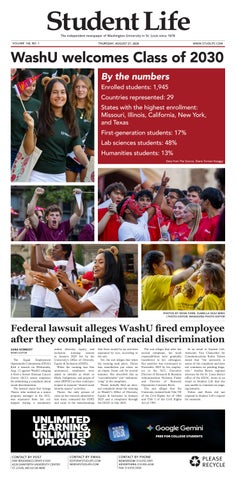
WashU welcomes Class of 2030 By the numbers Enrolled students: 1,945
Countries represented: 29 States with the highest enrollment: Missouri, Illinois, California, New York, and Texas First-generation students: 17% Lab sciences students: 48% Humanities students: 13% Data from The Source, Diane Toroian Keaggy
PHOTOS BY ERAN FANN, ISABELLA DIAZ-MIRA | PHOTO EDITOR, MANAGING PHOTO EDITOR
Federal lawsuit alleges WashU fired employee after they complained of racial discrimination ZANA KENNEDY NEWS EDITOR
The Equal Employment Opportunity Commission (EEOC) filed a lawsuit on Wednesday, Aug. 12 against WashU alleging it fired a former Siteman Cancer Center (SCC) senior employee for submitting a complaint about racial discrimination. The lawsuit states that Amega Thaier, who worked as a senior program manager at the SCC, was separated from her colleagues during a mandatory
CONTACT BY POST
online diversity, equity, and inclusion training session in January 2025 led by the University’s Office of Diversity, Equity & Inclusion (ODEI). When the training was first announced, employees were asked to identify as white or Black, Indigenous, and people of color (BIPOC) so they could participate in separate “shared racial identity spaces” activities. Thaier, the only person of color on her research administration team, contacted the ODEI and came to the understanding
ONE BROOKINGS DRIVE #1039 #320 DANFORTH UNIVERSITY CENTER ST. LOUIS, MO 63130-4899
that there would be no activities separated by race, according to the suit. Yet, the suit alleges that when the training took place, Thaier was nonetheless put alone on an empty Zoom call for several minutes. She described this as “uncomfortable” and “dehumanizing” in the complaint. Thaier initially filed an internal complaint about the training to WashU’s Office of Diversity, Equity & Inclusion in January 2025 and a complaint through the EEOC in July 2025.
CONTACT BY EMAIL EDITOR@STUDLIFE.COM NEWS@STUDLIFE.COM
The suit alleges that after her second complaint, her work responsibilities were gradually transferred to her colleagues. Her position was terminated in November 2025 by her employers in the SCC, Executive Director of Research & Business Administration Nicholas Fisher and Director of Research Operations Courtney Beers. The suit alleges that the University violated both Title VII of the Civil Rights Act of 1964 and Title I of the Civil Rights Act of 1991.
CONTACT BY PHONE
NEWSROOM 314.935.5995 ADVERTISING 314.935.4240 FAX 314.935.5938
In an email to Student Life, Associate Vice Chancellor for Communications Kedra Tolson stated that “the university is aware of the complaint and does not comment on pending litigation.” Andrea Baran, regional attorney for the St. Louis district office of the EEOC, wrote in an email to Student Life that she was unable to comment on ongoing lawsuits. Fisher and Beers did not respond to Student Life’s request for comment.
NEWS
2 STUDENT LIFE
TANVI GORRE AND COBY RINKE | MANAGING NEWS EDITORS | NEWS@STUDLIFE.COM
THURSDAY, AUG 27, 2026
WashU- and Vanderbilt-commissioned report on the humanities comes under fire LEXI LAWSKY NEWS EDITOR
A recent report commissioned by WashU and Vanderbilt on the politicization of humanities research has generated significant pushback from humanities professors, the WashU chapter of the American Association of University Professors (AAUP), and the director of the WashU Center for the Humanities, among others. The report affirms the value of humanities research and argues that rigorous research continues in fields like anthropology and sociology. Nevertheless, it concludes that many humanities departments have prioritized pursuing political goals over seeking objective truth and knowledge. Critics have raised questions about the source of the
report’s funding, the preexisting beliefs of the authors, its philosophical focus, the report’s use of artificial intelligence (AI), and what WashU intends to use the report for. For instance, the WashU chapter of the AAUP wrote in a statement that the report did not divulge the source of its funding or potential conflicts of interest. “[These are] standard practice for any work of humanistic or social scientific scholarship. In sum, the report is itself a clear example of ‘politicized’ research that its authors attempt to decry,” the statement reads. The University declined to comment on how much funding was allocated for the report and where such funding came from. In an email to Student Life, NYU philosophy professor and lead author of the report Paul Boghossian wrote that he was told that the
“Relativism (in the precise sense in which we define it) comes up because it is often used to justify a politicized approach to humanistic research. In the form in which it is invoked by some humanistic scholars, it is quite problematic.” –– Paul Boghossian
committee’s work was funded determined the outcome of Despite finding some methentirely by internal University its work. odological issues with the funds with none from exter“Relativism (in the precise report, Assistant Professor of nal donations. sense in which we define it) Philosophy David Kinney is Following the release of comes up because it is often open to some of the report’s the report on June 10, Provost used to justify a politicized claims. Mark D. West emphasized in approach to humanistic “I think there are some a letter to faculty that the goal research. In the form in which fields in the humanistic social of the report is to start con- it is invoked by some human- sciences and humanities versations, and WashU has istic scholars, it is quite where a certain relativism no plans to fire or discipline problematic,” he added. about the truth is completely faculty. However, even the results taken for granted, and that’s Chair of African and of a committee of nine schol- actually a very controversial African American Studies ars reflects just one opinion, position among the people Shanti Parikh is concerned with the selection “The report is itself a clear of Boghossian as head of the commission, given his example of ‘politicized’ longstanding philosophical commitments, including his research that its authors critiques of social construcattempt to decry.” tivism, epistemic relativism, social justice, and postcolonial –– WashU chapter of the AAUP thought, and his defense of absolute objectivity and truth. “If you hire a consultant, says Director of the Center who study the truth,” Kinney and you tell that consultant, for the Humanities Stephanie said. ‘I’m hiring you because I like Kirk. However, Kinney takes the way you do this,’ that con“You could easily assemble issue with the timing of the sultant hears their mandate,” a group of people who are report and what it might Parikh said. “As [Vanderbilt] equally as eminent as some mean for any attempts at Chancellor Daniel Diermeier of these people are, and they future conversations. He explained in an interview would have come up with wishes that he was given the with The Chronicle of Higher something completely differ- opportunity to engage in Education, he selected Paul ent,” she said. workshops on the topic of Boghossian to lead the comBoghossian also had a pre- relativism in the humanities mission precisely because he vious scholarly relationship before its publication. was ‘extremely impressed’ with Diermeier. In an email “It’s very hard to have a by Boghossian’s views. … If to Student Life, he wrote genuine scholarly conversawe put [Boghossian’s] work that they “had been talking tion with this report when against this report, they would about some of these issues for people feel like their liveliprobably be very isomorphic.” a while. 30 years ago I com- hoods are being threatened Responding to the critique, mented on the Sokal hoax and when people feel like Boghossian wrote that since which raised similar issues their value to the University the committee consisted of about the humanities. So the is being threatened,” he said. nine scholars, no one person question whether there is a Parikh also questioned the problem here is not new.” timing of the report’s release, In 1996, NYU physics pro- given that faculty are leaving fessor Alan Sokal submitted a campus. faux article to a cultural stud“If this was supposed to be ies journal, Social Text, to test a conversation starter, why the journal’s rigor. The article was it released during the was published after a lack of middle of the summer when peer review, and the affair we can’t have this conversabegan international conver- tion?” she said. sation regarding the rigor of Kirk is currently working the humanities, including with other humanities profesBoghossian’s newest report. sors to organize a forum for Another issue is the new people to engage thoughtfully report’s use of AI to survey with the report, she said. large bodies of text and iden“I imagine that such a tify themes. Boghossian said forum would be an excitthe exact use of AI tools will ing opportunity to exchange be specified with the release ideas, and we’re excited that of internal reports, which the Provost is interested in have yet to be published. co-sponsoring the event,” she Parikh questioned the com- wrote. mission’s use of AI. The report cites as evi“Analysis is greatly shaped dence a 2021 presidential by the questions that you ask address to the American AI and what you’re look- Anthropological Association ing for in the first place. So by Akhil Gupta, an anthroif researchers are interested pologist at UCLA. In the in evidence of politicization, address, Gupta claims anthrorelativism, social justice, pology is distinct from other those assumptions are going social sciences because it has to shape what AI returns to a political project to “chalyou,” Parikh said. lenge the culturally dominant
James Baldwin Review presents the annual
James Baldwin Through the Prism of Love Nicholas Boggs | writer, literary critic
Friday, November 13 4–6 pm Emerson Auditorium Scan QR code to attend
common sense of capitalist consumerism.” As director of the Center for the Humanities, Kirk said that the humanities fields at WashU maintain the highest standards for research, requiring peer review and “the intense scrutiny of a national and international community of scholars that continues throughout their career.” “Humanities disciplines are methodologically plural, but all aim for a rigorous reconstruction of the full, complex, and diverse reality of human history and culture,” Kirk added. “Everything we say must be supported by concrete evidence.” Dwight A. McBride, professor of African and African American Studies and senior advisor to the chancellor, published an opinion piece in Inside Higher Ed, critiquing the report. Women, people of color, and other marginalized groups were previously excluded from academia, and thus, when included, McBride writes, “they asked questions that earlier generations of scholars often ignored because the people most affected by those questions were themselves excluded from the production of knowledge.” Associate Professor of Mathematics Steven Frankel said the report attacks views that the authors themselves have manufactured and are not what most humanities scholars actually believe. “The authors of the report have imagined a caricature of an opponent, with very specific beliefs about the philosophy of truth, and then argued with that person in their heads. A more appropriate title would have been ‘Report on an Imaginary Argument with Dead Philosophers.’” Despite finding logical and methodological issues with the report, Frankel still worries that it may become an excuse for critics of higher education and may affect public perception of research in the humanities. “It’s something that people can use to confirm their preexisting beliefs that there’s something wrong with humanities or with higher education, and so it, without giving any actual content or evidence, feeds a specific viewpoint. I think that’s very unhelpful.”
THURSDAY, AUG 27, 2026
TANVI GORRE AND COBY RINKE | MANAGING NEWS EDITORS | NEWS@STUDLIFE.COM
Letter from the editors LAUREL WANG LEWIS RAND EDITORS-IN-CHIEF
Welcome (or welcome back) to campus! As we begin the fall semester, we want to take a moment to introduce ourselves. Student Life is WashU’s independent student newspaper. We are written, edited, created, and published by undergraduate students and are editorially independent from the University. Our staff covers the people, places, issues, and events that make up the WashU community. We also want to take a moment to explain what we do here at Student Life. Throughout our time at
WashU, institutions of higher education across the country have experienced dramatic changes. Student journalism continues to play an important role not only in training the next generation of journalists but also ensuring our community remains informed about the place where we learn, work, and live. Our reporting is done by our team of undergraduate reporters, writers, and editors and our editorials represent the opinions of our editing staff. We also welcome opinion submissions from members of the University community. Student Life publishes a print edition on Thursdays during the academic year, a daily newsletter every morning, and special
STUDENT LIFE 3
issues throughout the year. Student Life is always looking for writers, editors, designers, illustrators, photographers, newsletter creators, puzzle-makers, videographers, meteorologists, social media managers, and more — no experience necessary! There is a place for you in our office, and we’re so excited to meet all of you throughout this academic year. If you are interested in joining our team, reach out to join@studlife.com or come check out our open house in DUC 320 on Wednesday, Sept. 2. You can sign up for our open house and find a detailed list of section meeting times on our Instagram, @studentlifenewspaper.
ISABELLA DIAZ-MIRA | MANAGING PHOTO EDITOR
Student Union Executive Council announces goals to end block funding, cut student fundraising taxes, and more ELLA MESHOULAM NEWS EDITOR
Student Union (SU) announced their list of 30 term pledges in an email to the student body on Tuesday, Aug. 25. SU pledged to end block funding, cut taxes for student group fundraisers, and more, with the goal of encouraging club growth and success. These are broken down into short-, medium-, and long-term goals that the current SU body hopes to enact throughout the course of the year. Senior and SU President Romen Der Manuelian explained that the majority of these goals intend to cut down on the SU paperwork that student organizations need to complete. “There’s too much bureaucracy. The rules are too complicated,
and that’s really the core mission of what our [executive branch] is trying to address: making SU simple and working,” Der Manuelian said. One of SU’s goals is to end block funding permanently. Student groups such as Uncle Joe’s, Campus Y, and EST have previously used this electoral process to fund larger budgets and student-facing roles. In the coming year, Der Manuelian shared that SU will explore and decide on the options for funding groups that previously relied on block funding. SU is currently working with EST, Uncle Joe’s and Campus Y to determine transition plans. The groups will either be funded as normal student groups or as an Executive Entity of SU, meaning they can appeal to SU’s vice president of finance
for funding throughout the year. EST became an Executive Entity after the organization lost its block funding last spring. Senior and EST President Isabella Gonzales said this framework gives EST more flexibility. “We previously believed that block funding was the most beneficial option for EST but have found the new designation of an Executive Entity to be more adaptive,” Gonzales wrote in an email to Student Life. “Block funding has always been a large undertaking for the EST team, and being an executive entity presents an opportunity to focus on programming and service.” Der Manuelian explained that the block funding’s ineffectiveness has been a long-term concern for SU as it requires unnecessary
paperwork and opens risky loopholes. “Block funding doesn’t work from an efficiency standpoint, it doesn’t work from a practical standpoint, and there are multiple examples to show how it’s a very inflexible system that’s deeply inefficient,” Der Manuelian said. All other groups, which aren’t funded through block funding, won’t experience any financial or budget changes. Senior and Campus Y Student Director Sydney Buffett indicated that moving away from block funding would likely not have any impact on the organization’s allocated budget. “This change would likely not influence the budget we put together for Campus Y, but the process of getting the budget approved would be much
less intensive,” Buffett wrote in an email to Student Life. In their email, SU also pledged to cut student fundraiser taxes. Previously, if any amount of SU funds were used to finance student group fundraisers, SU collected a tax of 80% of the event’s total revenue, even if it exceeded SU’s initial funds. The newly proposed tax cuts would limit SU to only collecting the money they had initially provided. While this would allow student groups to raise money more easily, SU wrote in their email that they hope the new policy will result in lower ticket prices for on-campus fundraising performances. This email came as part of SU’s ongoing efforts to more clearly communicate their work with the student body. Last year,
they introduced a liaison system that provided each student group with their own assigned senator and treasurer. An open town hall will be held this fall for students to voice their opinions regarding the changes. Der Manuelian felt that it was important for students to be informed on SU’s work in order to foster democratic engagement. “They can hold us accountable to change the things that they elected us to do,” Der Manuelian said. “We want people to be voting in elections. We want people to run for office. … We want them to know what we’re actually doing because every student pays the student activities fee, and they should know where their money’s going, who’s advocating for them, and why.”
Eden Levi Senior Staff Designer
Adrienne Levin Coleman General Manager a.coleman@studlife.com
CAPTION CONTEST Scan the QR code to enter your submission by 11:59 p.m. on September 1st.
Caption this! Enter this week’s contest
KEVIN KAN | ILLUSTRATION EDITOR
VOLUME 148, NO. 1 Laurel Wang Lewis Rand Editors-in-Chief editor@studlife.com Tanvi Gorre Coby Rinke Managing News Editor news@studlife.com Hannah La Porte Managing Scene Editor scene@studlife.com Dion Hines Managing Forum Editor forum@studlife.com Hannah Much Managing Sports Editor sports@studlife.com Kate Westfall Managing Design Editor designers@studlife.com
Amelia Spencer Special Issues Editor Ava Giere Managing Chief of Copy copy@studlife.com Lucia Thomas Managing Illustration Editor Isabella Diaz-Mira Managing Photo Editor photo@studlife.com Reeya Sharma Managing Social Media Editor Quinn Moore Managing Newsletter Editor emailedition@studlife.com Alan Knight Managing Multimedia Editor
Sara Gelrud Sophie Schwartz Jake Isenberg Elle Ludwin Scene Editors River Alsalihi Kate Theerman Rodriguez Lyn Wilkins Maddie Morgan Leilani Billups Forum Editors Eliza Stulman Bee Austin Harper Nix Ben Ollendorf Sports Editors Kate Matthews Kat Ziwot Social Media Editors
Eran Fann Mac Motz Alex Dering Photo Editors Bea Augustine Jack Warren Tillie Szwartz Design Editors Victor Huang Selina Son Nicholas Demba Lexi Lawsky Ella Meshoulam Zana Kennedy Zoe Rhodes News Editors Ashwin Nair Audrey Tebow Newsletter Editors Kevin Kan Marceline Lee Illustration Editors
Jenise Fussell Designer Jack Yang Senior Web Editor
Sarah Huff Advertising Sales Manager huffs@studlife.com
Andrew Tian Echo Dong Georges Gewargis Junior Web Editors Julie Kassin Chief of Copy Kayslay Cudjoe Copy Editor Campbell Crum DEI Editor
Copyright © 2026 Washington University Student Media, Inc. (WUSMI). Student Life is a financially and editorially independent, student-run newspaper serving the Washington University community. Our newspaper is a publication of WUSMI and does not necessarily represent the views of the Washington University administration.
4 STUDENT LIFE
SCENE HANNAH LA PORTE | MANAGING SCENE EDITOR | SCENE@STUDLIFE.COM
THURSDAY, AUG 27, 2026
Dear Scene,
I’m going to be in a single suite and I’m really worried about getting lonely. Everyone I met during Bear Day seems to be in doubles with roommates they already love. Am I stuck being alone for the rest of the year since I won’t have a built-in friend to spend time and go do stuff with? I know people make friends outside of their dorm, but how do I do that? I’m actually clueless! — Socially-Distanced Student AVA AYAD CONTRIBUTING WRITER
Dear SociallyDistanced Student, From a former first-year who lived in a modern single, I had the same thoughts going through my head as I noticed how many of those around me were besties with their roomie(s). Although choosing suitemates instead of roommates does not mean you will never have a chance at being friends with them, it can at times feel impossible to connect with anyone when friend groups are often made up of people from the same residential community (mainly out of sheer convenience). But fear not: This column will give you some easy, proactive ways to start making friends all over campus fast! Before I get into all the tips and tricks of how to spread your wings as a
social butterfly, it’s important to remember that a lot of success at making and maintaining meaningful friendships relies on personal effort. Of course, any interpersonal relationship is a two-way street, but the more you actively put yourself out there and keep striking up conversations with people, the higher the probability of meeting that one person you need to make life better. In other words, never stop trying! Why limit your social options by being scared? While that may seem easier said than done, as it did for me in my first year at WashU, the more you “hype up” the act of making friends in your head, the less likely you are to actually go out and do something about it! Trust me, once you take that first step in socializing, even if it’s as small as saying “hi” to someone you know from a class in passing, the next steps will feel less and less daunting over time. One of the most obvious
but effective ways to start meeting new people is by going outside! Yes, just leaving the comfortable solitary confinement of your room once a day after you are done with classes is a great opportunity to run into familiar faces or introduce yourself to completely new ones. A super easy approach is attending events offered by Ursa’s Nite Life and Campus Life! I guarantee you will be able to find an activity going on any day of the week by following them on social media or paying attention to their flyers posted around campus. My personal recommendation on how to get out of your dorm is Zumba, especially if you like to dance. I cannot emphasize how beneficial the BearFIT classes offered at Sumers Recreation Center, Zumba specifically, were for my physical and mental health during my first year. Admittedly, it was due in no small part to an amazing instructor, King Ausar, who teaches on Fridays and
Sundays every week. Those who have met him will tell you he is such a wise, kind, and motivational speaker. I mean that literally, too. After each session, he gives a speech ripe with words of affirmation and often pairs everyone up to get people who would otherwise be strangers talking to each other. If you want to make friends and stay active in the process, I cannot think of a better solution. Another super simple way to meet several people at once is by going to Bear’s Den on the South 40 during dinner rush. Friend groups will form long stretches of tables to sit together, and even if you have only met one person in said group, the dining hall is a relaxed, casual setting where anyone can become close. Especially during finals, co-studying in and out of Bear’s Den is yet again a natural excuse to reach out to people with whom you want to be friends. On that note, don’t forget to always ask for someone’s phone number, Instagram, or Snapchat if you want to keep in touch! Lastly, it’s no surprise that joining different student organizations and clubs can naturally lead to making
friends. Be on the lookout for booths that fit your passions at the activities fair held every semester, as well as general board meetings where you can get to know the current and future club members without the pressure of fully committing yourself to multiple groups. I found that choosing a few clubs you really enjoy over several that you don’t have enough time or dedication for is often the more sustainable route when it comes to forming lasting friendships and feeling like part of a community on campus. As a whole, treat your first year of college as a test run. These early stages of your WashU career are opportunities to develop your social skills, resulting in some fulfilling friendships along the way. Not everything will be set in stone by the end of spring semester anyway, so try not to worry yourself with how many friends you do or don’t have and just make the most out of every conversation. Good luck!
Your social cheerleaders, Scene
Need saving? Scan here!
MARCELINE LEE | ILLUSTRATION EDITOR
Three movies you might have missed this summer LAUREL WANG EDITOR-IN-CHIEF
“Tony”
SLAM UNDERGROUND
REVOLUTIONARY Friday, August 28 | 7–10 pm
FREE
For guests 18+. Scan the QR code for more details!
For most of A24’s “Tony,” all you see of the titular chef is a curly black mop of hair. It’s the summer of 1975, and Anthony Bourdain — the world-traveling culinary critic, brilliantly acerbic writer, and the epitome of cool — is simply Tony, a 19-year-old dishwasher cutting his teeth in the kitchen. Bourdain, played by Dominic Sessa, is a slouching, awkward teenager, lying about a scholarship, grandiose about his writing, and spending his days serving up platters of fruits de mer to summering patrons and his nights pining after a girl from high school. Set in beautiful, bustling Provincetown, Massachusetts, the film serves up scene after scene of dusky sunsets or the shimmering harbor, but leaves viewers wanting in terms of substance. With the choice of all of Bourdain’s life, why this particular summer? He possesses none of his characteristic charm or innate sense of cool, and the movie decides to take creative liberty (read: makes up) a cute, tidy ending in which everyone learns a lesson and becomes friends again. Ultimately, this movie falls victim to the most pretentious critique of all — the book was better.
“The Invite” “The Invite” opens with an Oscar Wilde quote that reads, “One should always be in love. That is the reason one should never marry.” But it’s a different quote, often misattributed to Wilde, that captures more of the movie’s essence: “Everything in the world is about sex, except sex. Sex is about power.” An adaptation of Cesc Gay’s 2015 play, “Els veïns de dalt,” the entire film takes place during a dinner party between two couples in their shared apartment building. Art-school-gradturned-harried-mom Angela (Olivia Wilde) is all wide eyes and flustered, distinctly birdlike gesticulation, while her husband, Joe (Seth Rogen), is a musician who finds his career curdled into that of a one-hit-wonder marooned in an unremarkable life. Upstairs, the bohemian Pína (Penélope Cruz) and Hawk (Edward Norton) keep the couple awake with their rowdy sex life, a constant point of tension, though only for Angela and Joe. It’s a little early to say for sure, but the four actors put themselves in the running for strongest performances of the year. When Pína and Hawk come to dinner, a series of mishaps turn the night into a claustrophobic nightmare. But it’s only once the dinner party detours into a swinging foursome that the two couples are truly able to confront themselves and each other. Wickedly funny
and quietly cathartic, “The Invite” revels in the conclusion that “sex is about power.”
“One Night Only” Months before the release of “One Night Only,” skeptics abounded. A world where unmarried people are allowed to have sex one night a year? Why? What about mutual masturbation? How would they (whoever “they” were…) even monitor that? Just a few minutes into Callum Turner and Monica Barbaro’s performances, though, you’ll stop stressing about all the logistical details and just allow yourself to enjoy the ride of a fantastical, ridiculous premise. The movie doesn’t try to answer any of these questions. It just throws its hands up and accepts the circumstances as the hellish reality we’re in now, so why not try and get some laughs in while we still can? In a way, it’s the perfect rom-com for 2026: set in politically inert hell, chock-full of product placement, chronically online, and conspiratorially concerned over birth rates. It’s a world where messy twentysomethings live in tiny studio apartments furnished entirely by Urban Outfitters and features cameos from all your favorite niche not-so-microinfluencer faves. Maybe all the references to Tubi originals and Skyrizi ads will age the film quickly, leaving behind only the marks of a terrible moment we’ll want to forget. But for “One Night Only,” there’s always next year.
THURSDAY, AUG 27, 2026
HANNAH LA PORTE | MANAGING SCENE EDITOR | SCENE@STUDLIFE.COM
STUDENT LIFE 5
Leaving the WashU bubble HANNAH LA PORTE AMELIA SPENCER MANAGING SCENE EDITOR SPECIAL ISSUES EDITOR
Just like any university campus, WashU has a lot to offer to students. For some, this might be persuasive enough to spend all four years within the blocks of the Danforth Campus. But let us be the first to tell you: You have to explore our city. The campus is a great place to come home to, but without exploring St. Louis, you will not have taken full advantage of your college experience. WashU’s official name is Washington University in St. Louis. It is accompanied more recently by the slogan “In St. Louis, for St. Louis,” a commitment adopted by Chancellor Martin to be an active partner in the city by leveraging the strengths of the University. All of this marketing might lead to the assumption that WashU lies exclusively within the city bounds, but in reality we are located on the boundaries of multiple municipalities. The counties which surround WashU offer so much entertainment, dining options, and excitement. Just a few minutes’ walk from campus, in University City, is the Delmar Loop, a location so dear to student hearts’ that it can feel like an extension of campus. Forest Park also lies one street away from campus. This expansive space covers 1,300 acres (it’s bigger than Central Park!) and is home to the Saint Louis Art Museum, the zoo, the history museum, The Muny, and so much more, most of which is free! Each of these attractions are great to explore when you first arrive at WashU. But there is an entire city beyond these locations that is so important to the culture of WashU. Each place offers a new adventure and the city should never be underestimated as a great location to take family or friends. We know that sometimes,
getting off campus is no easy feat. Without a car, you must rely on friends, Ubers, or public transportation to get around. The Metro and bus system, while convenient for certain locations, can be frustrating to navigate (Don’t forget to register for your new U-Pass!). We spent a lot of our first year navigating Enterprise Car Rentals, taking the Metro, and begging upperclassmen friends to give us rides. Whether you are from St. Louis or from hundreds of miles away, navigating the city can be difficult in this new environment, and we have a few suggestions that could make this daunting task more approachable. Here are some of the best ways we have found to get off campus.
new foods and interviewing chefs across St. Louis. Club sports teams travel across the state to competitions. Whether you join a club dedicated to leaving campus or simply one that offers off-campus activities, clubs can be a great way to explore the city.
Get a job or volunteer across St. Louis During my (Hannah’s) first month at WashU, I ventured into DeMun and began working at Clementine’s Creamery, where I’ve continued to work for the past two years. Although it may seem like
some of your time allows you to explore our city while also giving back. We have friends who volunteer at hospitals, food banks, and more across St. Louis, and each of them come back knowing more about the area and community.
Ask your friends with cars to explore
experiencing as a college student. Hannah was born in Los Angeles and moved to St. Louis to attend WashU, but she now loves exploring the city. No matter where you fall on the spectrum of familiarity with St. Louis, we sincerely hope you will explore your home for the four years you are here!
A last suggestion is to foster connections with upperclassmen, who may have cars, or just a life
Join clubs One great option to explore new areas of the city, and the greater Midwest, is to join a club which takes you off campus! WashU has more than 400 recognized student groups, many of which operate away from campus, for a range of niches and activities. If you want to explore the Midwestern outdoors, consider joining Wilderness Project during your first fall break, or Outing Club during any semester! There are also clubs which focus on community service, like Campus Y, which hosts programming across campus. Many students get involved with programs like America Reads, tutoring kids in reading and math at public schools across the city. Student groups also frequently host activities and events off campus. Asian Multicultural Collective hosts an annual “Taste of Asia” event, shuttling students to local cultural restaurants and grocery stores. Ski Club arranges student discounts and hosts trips to local mountains. Students in Spoon University WashU take trips to local eateries, trying
working a job does the opposite of giving you time to explore off campus, being at Clementine’s allowed me to interact with community members from all over St. Louis and Missouri, and I have made random connections all across the city. This past year, I also worked on a few local political campaigns, and that allowed me to go to events across St. Louis, meeting and talking to people from all over and learning more about the community I go to school in. For less timeconsuming opportunities, consider volunteering at local organizations! Finding an organization you are passionate about and giving
away from campus. These relationships are a great way to explore parts of St. Louis that you may not be aware of. Connections with upperclassmen are a great way to quickly become acquainted with the city, as they have already done the exploring for you! We are writing to you from two perspectives. Amelia has lived in St. Louis for practically her entire life, and has a deep appreciation for the city — both from her childhood, and this new version she has had the privilege of
LUCIA THOMAS | MANAGING ILLUSTRATION EDITOR
NR - Shut Eye ACROSS 1 Meower 4 It's shot with a bow 7 Mazda sports car 8 Groups of two 9 Power ___
PUZZLE Mania Where in WashU?
DOWN 1 "___ Rock" (Disney show with Joe Jonas and Demi Lovato) 2 Opera solo 3 Thomas the Tank Engine, for one 5 Una y ___ vez (over and over again) 6 Black and yellow insect that can sting multiple times
1
2
3
4
5
6
7
8
9
Can you recognize where this building is on campus?
Sub-titles MAC MOTZ PHOTO EDITOR
The words in these movies were replaced with synonyms. Can you identify the original titles?
1. Shriek
6. Trinket Tale
2. Oblivous
7. Interior Exterior
3. Mandibles
8. Filthy Boogieing
4. Celebrity Fights
9. Brawl Society
5. Dozen Mad Guys
10. Absent Gal
Watch out for the answers in our next issue! MAC MOTZ | PHOTO EDITOR
6 STUDENT LIFE
FORUM DION HINES | MANAGING FORUM EDITOR | FORUM@STUDLIFE.COM
THURSDAY, AUG 27, 2026
OPINION SUBMISSION
WashU’s financial mismanagement is jeopardizing our education REBECCA DUDLEY GLORIA FALL PHD CANDIDATES, ANTHROPOLOGY
When you say you go to WashU, how do people respond? How does that feel? The best feeling, we think, is when someone understands the top-notch quality of education given here. That we have the opportunity to receive this education is a gift and a privilege. But WashU’s recent financial decisions have hurt our education and will be detrimental to the education of future students. We need WashU to prioritize education. Here’s what’s happening: WashU is wasting money on educationally irrelevant investments, taxing Arts & Sciences (and its other schools) to make up for its deficits, and defunding what matters. The waste is profound. As of December 2025, StudLife reported that WashU has spent over $265 million on Workday. This year, they’ve spent $23.8 million, plus yearly licensing fees of $5.7 million. Workday’s many flaws are too numerous to fully list but include: not being able to cross-list classes, inaccurately counting completed credits, useless course guide search functions, and an
unintuitive, complicated interface. When staff try to resolve these issues, their requests initiate weeks-long opaque processes. Perhaps the failures of Workday as an HR and finance system-cum-course registrar comes down to its design: Workday touts itself as “unifying HR and Finance on an open, trusted platform powered by AI, [to deliver] high-impact outcomes our customers can count on.” In its own words, it’s built for business, not education. While bleeding cash on Workday, WashU continues to invest elsewhere. It recently bought Fontbonne University ($39 million) and announced purchases of the St. Louis College of Pharmacy and 6200 Forsyth, a soon-to-be new administrative building. Though Chancellor Andrew D. Martin has blamed the University’s financial issues on Trump’s attacks on higher education, these issues stem from WashU’s decisions and policies. WashU’s Central Fiscal Unit (CFU) bills the University’s schools for services rendered, like the transition to Workday. Though the University blames school costs and federal funding cuts for the $7.4 deficit in 2026, higher bills from the CFU for the
fourth year in a row indicate this deficit must be related to financial decisions that preceded the Trump administration. To cover its deficit, WashU has instituted austerity measures. In fall 2025, the University eliminated nearly 200 jobs while implementing massive layoffs during increasingly financially unstable times for many. (Is this what it means to be “In St. Louis, For St. Louis”?) Heartbreakingly, these layoffs included subject librarians who had been with WashU for decades. These experts were unceremoniously fired with no notice and required to leave campus that day. This outrageous treatment shows us something about how WashU thinks about education. Through our contacts in the Washington University Graduate Workers Unions (WUGWU), the Faculty Senate, and WashU’s chapter of the American Association of University Professors, we have learned that many Arts & Sciences faculty, staff, and graduate students did not receive standard keeping-upwith-inflation raises at the end of 2025. This is painful for graduate students, most of whom are already paid $8,000 below the cost of living for a single childless person in St. Louis, despite the fact that many graduate
students have dependents. When the Faculty Senate asked the administration, WashU refused to confirm whether central administration officers and the executive resource committee received their raises. WUGWU also found that many graduate students early in their programs have had their six-year funding packages reduced to five, which also applies to all incoming PhD students. And the number of students admitted per cohort has been reduced by nearly 50%. WUGWU also found that master’s-seeking graduate students have seen financial aid cuts and tuition increases. For undergraduates, the University increased tuition to $71,310 per year excluding fees. It is a slap in the face of any tuition-paying student, who now gets less for more. Then there is the disappearing act of Arts & Sciences’ new building, Riney Hall. Despite breaking ground on the project in spring 2025, WashU abruptly changed course over the summer. Students arrived back on campus as if no construction had ever started. While Martin gestured at Trump policies to justify Riney’s cancellation, no specific budget numbers
have been provided. Given the purchase of Fontbonne and other announcements, one cannot help but suppose that what had been slated as the new home of the Department of African and African American Studies and the Department of Sociology was deemed too politically risky, rather than too expensive. Riney’s cancellation co-occurred with the abortive effort to establish a task force to explore the consolidation of six departments and programs, all of which engage with politically charged subject matter in today’s anti-intellectual atmosphere. For graduate and undergraduate students, this means that we’ll have fewer courses to choose from, taught by less qualified instructors. There will be fewer qualified graduate student instructors (many of whom teach and assist in undergraduate courses) and fewer associate professors and non-tenure-track faculty. Because of a shrinking graduate school, graduate students will have fewer peers to learn from and grow with and subsequently smaller professional networks. We’ll be less prepared for the job market. We’ll be scrambling to pay our bills, feed ourselves, and, for many, care for our families.
Graduate students now receiving five years of funding will miss out on valuable training and be less equipped for a job market in academia as they compete with those who were given six years to complete their degrees (like at Emory and Vanderbilt, and most other R1 institutions across the country). These actions demonstrate a deprioritization of education. WashU has prioritized administrative buildings over spaces for scholarship like Riney Hall. It has invested a quarter of a billion dollars into an integrated HR-financecourse-registration system (which still struggles to deliver), yet fired some of the most expert librarians on campus. It is defunding Arts & Sciences programs. We see these decisions echoed in other WashU deprioritization of genuine learning, like the embrace of artificial “intelligence” and treating cheating with modest consequences for students and cumbersome processes for instructors. We believe that education is a gift of time to become a deeper version of yourself. To learn how to think. To learn something about the world. To learn how to engage with that world in a meaningful, careful, intentional way. WashU must prioritize genuine education.
Maintaining our voice in the years after student arrests DION HINES MANAGING FORUM EDITOR
In early April, Professor William J. Maxwell held a one-man demonstration outside of Olin Library in protest against the current war against Iran. His sign called for peace during these times of turmoil and inhumanity. I took Maxwell’s course on James Baldwin last semester. Throughout his career, as Maxwell taught us, Baldwin often wrote about resistance — specifically in the context of racial oppression — and
argued that protesting is an American right. He asserted that he loved America and, because he loved it, he “insisted on the right to criticize her perpetually.” Maxwell, as Baldwin’s student, insisted upon his own right to critique America with his demonstration, a right that many of us at WashU seem to have forgotten. Even though Maxwell has made it clear that he doesn’t see his demonstration as something heroic, the act itself is commendable. Though the fact that someone reported his protest to WUPD is
concerning, it comes as no surprise. It’s merely a sign of WashU’s current attitude toward protesting on campus. I am only focusing on Maxwell because he is a recent example. There have been a few demonstrations in the last couple of years, but after the administration’s response to the attempted encampment in protest of the genocide in Gaza (a term a UN commission and experts agree on), our campus has grown meek. Over one hundred people — including WashU students and faculty — were made
examples of with arrests and court summons. Now, it seems to me that we are afraid to express dissent. This fear is quite understandable. WashU showed students and faculty that they are willing to take extreme measures to mitigate protests on campus. As Chancellor Andrew D. Martin wrote in response to the attempted encampment, “To those who plan to continue to come to campus with the intention of disrupting our education and research mission and violating our policies, please know we will respond proportionately
SAM POWERS | STUDENT LIFE Former SU Speaker of the Senate Sonal Churiwal gives a speech at the April 20, 2024 pro-Palestine protest.
each and every time. You will not do this here.” Like our government, University administration uses police presence and legal repercussions as a fear tactic against protesting, but we should not and cannot let them scare us into advocating for change. It is as important now as it has ever been to express dissent against administrative decisions on both a federal and University level. The Trump administration has brought about a resurgence of alt-right ideology, and, consequently, people are much more outspoken with their bigotry — namely xenophobia, racism, and transphobia. We have seen instances of anti-Black racism on our own campus in the past with campus response to the “BD egging incident” and recently with an antiBlack AI image that was shared on Sidechat, both of which are evidence that WashU is not an exception to prejudice — I would like to highlight that it has never been. Although our federal and University administrations have shown us that they will not support any sign of dissent, we cannot afford to be deterred. There are issues that we need to address on our campus. WashU continues to prioritize its finances over the wellbeing of its students and faculty — which has been exhibited through the 300 faculty layoffs, two of them
being long-time subject librarians. University administrators have yet to show that they will take adequate action against prejudice on campus. The only way that we will see change is by making ourselves heard, whether it be by making signs or shouting chants or writing letters or, when we won’t be heard in any other capacity, tearing some sh*t up. A question that many people ask themselves regarding protests is, “What are we actually going to accomplish with this? Will higher-ups even listen to us?” Might I remind you that the combination of departments didn’t stop until students and faculty expressed vehement disagreement? There would be no African & African American Studies department at WashU if not for a sit-in held by Black student activists and other student allies. With protest, we accomplish showing administrators that we dissent. We accomplish pushing them toward administrative change. With everything happening in the world and on our own campus, we should exercise our freedom of expression, not our right to remain silent. We must show our administration that, in spite of their insistence otherwise, we will do this here.
THURSDAY, AUG 27, 2026
SPORTS HANNAH MUCH | MANAGING SPORTS EDITOR | SPORTS@STUDLIFE.COM
STUDENT LIFE 7
FALL SPORTS PREVIEW HARPER NIX SPORTS EDITOR
The Bears are getting ready to kickstart the 2026-27 school year! Here are some things to know as we look at the fall season ahead:
Men’s and Women’s Cross Country After a seventh-place finish in the 2025 NCAA Championships, the women’s team looks to maintain their dominant presence in the running world. The squad will look to junior Lucinda Laughlin, Midwest Region champion and Athlete of the Year, to lead the Bears this season. WashU also returns senior Avery Nason and juniors Lauren Raley and Maddy Lee, all of whom competed in nationals last year. The men’s team finished 16th in the 2025 NCAA Championships and will look to improve their podium placing this season. The team will return many experienced underclassmen athletes who competed in nationals last year, including sophomores Charlie Houck, Rishi Shadaksharappa, and Gavin O’Connor, as well as juniors Sean Green and Ben Lorenz.
Golf After two consecutive fifthplace finishes in the 2026 NCAA D-III Championship, WashU golf is eager to continue its positive momentum. The program has strong upperclassmen leadership on and off the course in senior Reagan Robinson, senior All-America Honorable
Mention Amy Beanblossom, and junior Nicole McGuire. Sophomores and top-50 2026 finishers Jessy Young and Saxon Skinner look to continue their already impressive collegiate careers. The team welcomes first-years Jessica Liu and Eliza Meltzer.
Volleyball Volleyball finished the 2025 season in the Sweet 16 of the NCAA Division III tournament against the University of Wisconsin– Oshkosh. This was the deepest postseason run the program has made since 2016. The team will return five seniors to lead the Bears, including Second Team AllAmerican Leah Oyewole and Honorable Mention All-American Ellie Laird. Oyewole led the team with 3.73 kills per set in 2025, while Laird put up an astounding 5.26 digs per set. However, there is much uncertainty regarding the team’s fate after graduating star setter Sam Buckley. With eight first-years, the team welcomes a lot of new blood, but the Bears must step up to fill Buckley’s shoes if the team wants to continue their four-year streak of making it to the D-III tournament.
Women’s Soccer Looking for a three-peat, women’s soccer enters the 2026 season as back-to-back national champions (2024 and 2025), holding three consecutive University Athletic Association (UAA) titles (2023, 2024, and 2025), and without having lost a game since December 2023. The team’s juniors and sophomores are undefeated in a
BRI NITSBERG | STUDENT LIFE Junior Olivia Clemons charges down the field against Westminster College last season. WashU uniform. The program’s returning classes hold an ample amount of talent. A class of 10 seniors will lead the team, including senior midfielder Sophie Viscovich and senior defender and midfielder Keira Smyser. Junior forward Olivia Clemons is the catalyst for the Bears’ offense, earning her First Team All-America, UAA Offensive Player of the Year, and several other honors. Five first-years, as well as two junior transfer students, join the dynasty from Division I programs Saint Louis University and the University of Missouri.
Football The 2026 season for WashU football is a wild card, as the team has changed conferences from the College Conference of Illinois and Wisconsin (CCIW) to the North Coast Athletic Conference (NCAC). This means the Bears face a whole new array of competitive opponents this year, as the
TAMIAH WOODFORK | STAFF PHOTOGRAPHER Sophomore Nia Jones tips the ball over the net.
conference boasted a record of 53-20 overall and had three bowl game appearances in 2025. However, the Bears have an ample amount of talent — demonstrated by their 8-3 record in 2025. Recently, senior offensive lineman Brady Cavan was named to the D3football.com Preseason All-America Third Team. Senior wide receiver Makael Carter is also entering the season hot after leading the team in receiving with 48 catches for 755 yards in 2025. The team welcomes 38 firstyears to the squad.
Men’s Soccer Men’s soccer enters the 2026 season with a UAA conference title to defend. As 2025 UAA champions, the team made an impressive postseason run in the 2025 Division III NCAA Tournament, reaching the Sweet 16. With a senior class of 11, the Bears have ample upperclassmen leadership and experience. Senior defender Quentin Gomez and senior goalkeeper Cal L’Hommedieu specifically have a strong presence on
the pitch, proven by the opponent average of 0.84 goals per game last season. Senior forward Ethan Wirtschafter is a prominent contributor to the Bears offense, scoring 14 goals in 18 games last year. The program welcomes five first-years and assistant coach Gavin Kalish, previously the assistant men’s soccer coach for the Division I Saint Louis University.
SEE SPORTS, PAGE 8
8 STUDENT LIFE
SPORTS from page 7
Additionally, Director of Athletics Anthony J. Azama announced last spring that the department is upgrading several varsity locker rooms, the equipment room, and the Field House. The equipment room is set to expand by 1,100 square feet and will feature more mobile storage units. This renovation will increase the efficiency and holding capacity of the equipment space. The locker room project will provide seven women’s teams with new
THURSDAY, AUG 27, 2026
HANNAH MUCH | MANAGING SPORTS EDITOR | SPORTS@STUDLIFE.COM locker rooms — an effort to “build on the Bears’ mission of equity between all sports,” according to a statement made by WashU Athletics. The Field House also received a renovation, including a repainting of the walls as well as new lighting and sound systems. Entering the 2026 season as the winners of the 202526 Learfield Directors’ Cup, WashU has proven it is an elite competitor. This fall season has many exciting Bears sporting events in store, starting Tuesday, Sept. 1, with men’s and women’s soccer season openers at home.
JONAH GLASS | STAFF PHOTOGRAPHER
Sophomore Sebastian Valdes dribbles past a defender.
WashU brings home first Directors’ Cup in University history BEN OLLENDORFF ELIZA STULMAN SPORTS EDITORS
For the first time in its history, WashU won the Learfield Directors’ Cup for the 2025-26 school year. This prestigious honor is the ultimate measure of success for a university’s athletic program. The Bears outperformed over 400 NCAA Division III schools across the country for the title. WashU has placed among the top 10 for the past 22 years, including 16 top-five finishes. The long-awaited victory represents WashU’s commitment to excellence beyond academics and in athletics. “There are very few universities out there that can do what we WashU do in the fact that we’re an elite academic institution, but also our athletic programs have an opportunity in each one of their sports to win a national championship,” said men’s basketball head coach Pat Juckem. WashU earned points from its national championship victories by the women’s soccer and women’s indoor track and field teams. Women’s tennis and women’s outdoor track and field both finished in second place, propelling
the Bears to win the Cup. All of the varsity teams at WashU except one made the NCAA tournament and ranked among the top 20 in the nation for their respective sport. The all-around success of the athletic program last school year allowed WashU to record a total of 1,266.50 points, defeating Tufts by a close margin of 14 points. WashU is the eighth school to win the award since its introduction to D-III athletics during the 1995-96 academic year. Historically, Williams College has dominated the award, winning the Cup 22 times. The Learfield Directors’ Cup is awarded to schools from each NCAA division level and the National Association of Intercollegiate Athletics (NAIA). WashU accompanies the University of Texas at Austin (D-I), Grand Valley State University (D-II), and the University of the Cumberlands (NAIA) as winners for their respective divisions. “The Ohio State University athletic director congratulated me,” said WashU Director of Athletics Anthony Azama. “He said Ohio State has never won this award. Then I got hit with the reality that this is rare. WashU is one
WashU won the Learfield Directors’ Cup for the first time in history. of the few places where you can come and earn a worldclass degree, compete for championships, and be prepared for postgraduate opportunities.” Winning this award proves that WashU’s investment in its varsity athletic programs is not going unnoticed. Recently, the school has upgraded multiple teams’ locker rooms while also updating the lighting and walls in the Field House. These projects are funded with help from the
W Club, the booster support club for WashU athletics. The new improvements to facilities, along with successful athletic programs, attract top athletes to WashU, including Division I transfers like graduate students Ana DiMaria from the University of Missouri (women’s soccer) and Coleson Messer from Vanderbilt University (men’s basketball). “For all the sports, the athletic department makes sure that we have the
BRI NITSBERG | STUDENT LIFE
equipment that we need, the facilities that we need, the resources for both school and also for mental health and nutrition,” said Regan Cannon, a senior and defender on the women’s soccer team. The Learfield Directors’ Cup has put WashU’s name on the map and reinforces the University’s commitment to continue raising the bar for D-III athletics. “I think [winning the Cup] just justified all of the shared sacrifice to do
something that only seven other schools have done,” said Azama. Throughout the 2026-27 school year, the Bears are looking to keep their foot on the gas and earn their second consecutive Directors’ Cup. The University will host a celebratory event in Tisch Park on Sept. 23 to commemorate the victory of WashU’s student-athletes and athletics staff.
drink. dine. play.
WEEKLY BAR, RESTAURANT AND FUN GUIDE