The independent newspaper of Washington University in St. Louis since 1878 THURSDAY, APRIL 8, 2021
VOLUME 142, NO. 21
BLACK SPACES What the pandemic has meant for the places many Black students gather on campus (Scene, pg 3)
WWW.STUDLIFE.COM
MUDD THEATER Our review of the show that drew so many people to Mudd on blankets last weekend (Cadenza, pg 5)
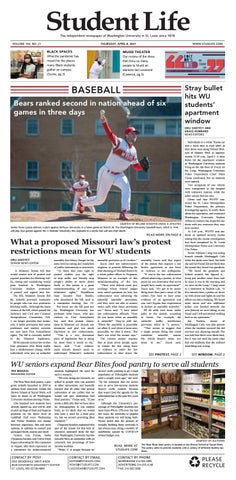
BASEBALL
Bears ranked second in nation ahead of six games in three days
Stray bullet hits WU students’ apartment window ORLI SHEFFEY AND GRACE KENNARD NEWS EDITORS
COURTESY OF MELANIE SCHAEFER | WASH. U. ATHLETICS
Senior Ryan Loutos delivers a pitch against DePauw University in a home game on March 20. The Washington University baseball team, which is 14-0, will play four games against No. 4 Webster University this weekend in a series that will test their depth.
READ MORE ON PAGE 8
What a proposed Missouri law’s protest restrictions mean for WU students ORLI SHEFFEY SENIOR NEWS EDITOR A Missouri Senate bill that would restrict acts of protest and expand penalties for blocking traffic, rioting and vandalizing would pose burdens to Washington University student protestors if passed and signed into law. The bill, Missouri Senate Bill 66, initially provided immunity to people who run over protestors blocking traffic. Although the latest version of the bill, which passed the Judiciary and Civil and Criminal Jurisprudence Committee, Feb. 1, no longer provides that immunity, it holds provisions that some professors and student activists say may limit First Amendment rights. The bill is currently stalled in the Missouri legislature. SB 66 amends current law so that lone protesters who block traffic face a misdemeanor charge, while individuals who join an unlawful
assembly face felony charges on the same level as rioting and vandalism of public monuments or structures. “To think that your right to protest enables you the right to stop traffic and literally stop people’s ability to move about freely in this nation is a gross misunderstanding of our constitutional rights,” Republican State Senator Rick Brattin, who introduced the bill, said in a committee hearing, Jan. 25. But many say the bill goes too far. Washington University law professor John Inazu, who specializes in First Amendment law, said that protest restrictions in Missouri are already too strenuous and give too much discretion to law enforcement. “This is a very draconian piece of legislation that is doing far more than it needs to do,” Inazu said. “Law enforcement already doesn’t seem to understand Missouri’s unlawful
assembly provision as it’s written.” Inazu cited law enforcement’s response to protests following the fatal shooting of Michael Brown by a white police officer in Ferguson, Missouri as an example of this misunderstanding of the law. “There were federal court proceedings where federal judges were asked questions on how law enforcement was enforcing the unlawful assembly provisions, and they were not able to answer under oath what those provisions are,” Inazu said. “I have asked law enforcement officials, ‘How do you know when an assembly is unlawful?’ They’ve told me, ‘When the assembly is peaceable we allow it, and when it turns nonpeaceable, we shut it down.’ But that’s not what the statute says.” The current statute requires that at least seven people agree to violate the law using force or violence in order for law enforcement to shut down the
assembly. Inazu said that aspect of the statute that requires a collective agreement to use force or violence is too ambiguous. “If you’re the law enforcement official observing a protest, at what point do you determine that seven people have made an agreement?” Inazu said. “It’s got to be something more than just a sense of the crowd...You have to have some evidence of an agreement and you can’t bypass that requirement to declare an assembly unlawful.” SB 66 adds even more ambiguity to the statute, according to Inazu. For example, the unlawful traffic interference provision refers to “a person.” “That seems to suggest that a single person doing this could constitute unlawful assembly, which doesn’t make any sense to me,” Inazu said.
SEE PROTEST, PAGE 2
Individuals in a white Toyota car and a truck shot at each other as they drove west along Delmar Blvd. east of Skinker Blvd. at approximately 11:45 a.m., April 3. A stray bullet hit the apartment window of Washington University students living on the 4th floor of Everly on the Loop, Washington University Police Department Chief Mark Glenn confirmed, but no students were injured. Two occupants of one vehicle were transported to the hospital with unknown injuries, while the other vehicle fled the area. Glenn said that WUPD contacted the St. Louis Metropolitan Police Department, the primary investigating agency, to notify them about the apartment, and contacted Washington University Student Affairs to connect the impacted students with any resources they may have needed. At 2:45 p.m., WUPD sent students an updated security memo stating that the on-site investigation had been completed by St. Louis Metropolitan Police and University City Police. Junior Addison Liang was eating brunch outside Meshuggah Cafe when the shots were fired, but both she and her friend did not think that the sound they heard was gunshots. “We heard the gunshots and looked around, but figured it… [was] just another noise from traffic since it was in the morning and we were on the Loop,” Liang wrote in a statement to Student Life. “A few minutes later, a police car drove up with sirens and lights on and the officer ran into a building. We heard more sirens and saw additional police cars headed towards the area [where] we were sitting, so my friend and I left and started walking back to my apartment.” Jen Kaslow, owner of Meshuggah Cafe, was also present when the incident occured but did not hear any alarming sounds. She was told that there were shots fired, but it was not until the patio emptied out suddenly that she realized something was wrong.
SEE WINDOW, PAGE 2
WU seniors expand Bear Bites food pantry to serve all students TED MOSKAL MANAGING EDITOR The Bear Bites food pantry, a program initially launched in 2019 to address food insecurity within the Brown School of Social Work, will open its doors to all Washington University students starting Friday. One hundred new students have already signed up, and will be able to pick up bags of food and hygiene products on the lower level of Goldfarb Hall every Wednesday and Friday. Students can choose between vegetarian, fish and meat options, in addition to canned and packaged foods, snacks and more. Seniors Lila Puziss, Sasha Chapnick-Sorokin and Gwen Klein began advocating for this expansion in August, after their experience on a committee for under-resourced
students highlighted the need for such a resource. “We were doing our research, we talked to people who run pantries at other universities, and basically learned that all other elite private universities of our caliber that we would call peer institutions had food pantries,” Puziss said. “It just seems a little silly that we have similar demographics in our student body, so it’s likely that we would also have a need for a food pantry, but we weren’t providing [that resource].” Chapnick-Sorokin explained that part of the reason for this lack of resources stemmed from the fact that Washington University has historically been an institution with an extremely low percentage of lowincome students. “Wash. U. is unique because we
weren’t really pushing to get a high population of Pell-eligible students until a couple years ago,” she said. “So the resources that are necessary to serve low-income students haven’t really existed, because that wasn’t [on] the agenda for the administration in the past five years or so.” Although the University’s percentage of Pell-eligible students has risen from 8% to 15% over the last five years, the networks to support these students are still being built. Puziss noted that the process of actually building these networks is not always easy, citing a number of roadblocks caused by COVID-19 related budget cuts. COURTESY OF LILA PUZISS
READ MORE AT STUDLIFE.COM
The Bear Bites food pantry is located at the Brown School of Social Work. The pantry aims to provide students with a variety of different healthy options.
CONTACT BY POST
CONTACT BY EMAIL
CONTACT BY PHONE
ONE BROOKINGS DRIVE #1039 #320 DANFORTH UNIVERSITY CENTER ST. LOUIS, MO 63130-4899
EDITOR@STUDLIFE.COM NEWS@STUDLIFE.COM CALENDAR@STUDLIFE.COM
NEWSROOM 314.935.5995 ADVERTISING 314.935.4240 FAX 314.935.5938
2 STUDENT LIFE
JULIA ROBBINS & ORLI SHEFFEY | SENIOR NEWS EDITORS | NEWS@STUDLIFE.COM
theFLIPSIDE FLIPSIDE THU 8
PM SHOWERS 60/49
FRI 9
MOSTLY SUNNY 76/50
SAT 10
AM SHOWERS 63/45
TUES 13
MON 12
PARTLY CLOUDY 59/40
PARTLY CLOUDY 70/42
SUN 11 SUNNY 74/49
WED 14
PARTLY CLOUDY 62/39
EVENT CALENDAR THURSDAY 8 Thursday 8 Caring for the LGBTQI+ Umbrella: A Primer for All Providers Virtual Event, 12 p.m. Tassy Hayden is originally from rural Missouri and came to St. Louis to attend both college and medical school at Washington University. She completed her residency at the University of Massachusetts in Worcester, and practiced as a board-certified family medicine physician in Jefferson County for the past three years before joining Southampton Healthcare in St. Louis. She has a special interest and expertise in caring for the LGBTQIA* community, especially gender-affirming care. Coral Courts Lecture: Toni L. Griffin Virtual Event, 6 p.m. Toni L. Griffin, professor in practice of Urban Planning at Harvard University Graduate School of Design and founder of Urban Planning and Design for the American City, will deliver the annual Coral Courts Lecture. Griffin’s practice looks at spatial and racial justice within urban environments. Her Just City Index is a roster of values cities can use to develop visions for becoming the most just spaces for their residents. She has intimate knowledge of St. Louis thanks to her winning—and paradigm busting—entry in the Choteau Greenway Competition, which focused on the city’s existing segregation lines, rather than the competition’s stated goal of focusing on the east-west connection. She is a provocative thinker and doer on the role of design and planning in creating more just social conditions.
FRIDAY 9 Theatrical Jazz and Phases of Black Womanhood in Batiste’s “Blue Gold & Butterflies” Virtual Event, 4 p.m. This presentation blends the creative and scholarly in a consideration of Batiste’s play “Blue Gold & Butterflies.” Batiste reflects on the critical goals of her creative efforts to capture the history of a family and the impacts of trauma, choice and change. A goddess, a ghost and a memory accompany a mother and daughter on their journeys through self realization. Lasting affective shift becomes a goal that lurks deeper than self reflection and beyond generational legacy. Our characters both love through and rely on the the maladaptations they strive to change. Through poetry, the play happens in multiple temporalities at the same time as the women strive to pass down intergenerational love. In prose and play, the women reach towards a collective way of relating to each other as well as to knowledge and ambiguities of self. Repetitions and resonances across generations emerge in meetings with the past, with spirit and with the ancestors to ask what it means to survive trauma and live with loving intention.
BRIAN CUI | STUDENT LIFE
Everly on the Loop, where a stray bullet from a shootout on Delmar Blvd. struck the students’ window Saturday.
WINDOW from page 1 “We were really busy [and] the patio was full,” Kaslow said. “Then I noticed the entire patio started to clear out, and so tables that were filled with people were gone and then shortly after that all the police cars started speeding down Delmar and filling Delmar.” Some patrons did not return for their food, she added, while also commenting on the number of families at the cafe that morning. “It felt like an informal parents weekend,” Kaslow said. “A lot of parents [were] having breakfast at Meshuggah with their kids and I was like ‘I’m sorry this is not indicative of St. Louis.’ I’ve never seen anything like that in the Loop, and I know that people definitely feel hesitant about the Loop, but I’ve never experienced this.” Although WUPD sent officers in the afternoon to assist with the investigation, Glenn said that the event seemed random and did not indicate a need for increased
police presence in the future. “This is a random event; it’s what we’re seeing now, and we’re still early in the investigation,” Glenn said. “We really don’t know what precipitated this incident, or what led up to it, or if it just happened right then and there.” Kaslow also said she thinks this was an isolated incident that won’t affect business long-term. “I’m not [concerned] because I think the Loop has always had this sort of reputation and has gone through having a worse reputation and then regaining a sense of stability, but for me, it hasn’t really changed,” Kaslow said. Although a different gunman fired a shot at West County Center, a popular shopping mall for Washington University students, April 2, Glenn said the recent incidents do not seem to be connected. He emphasized, however, that students need to be alert of
‘During times of adversity we become like social magnets’: How the pandemic has affected WU extroverts and introverts differently JULIA ROBBINS SENIOR NEWS EDITOR
With many large campus events such as WILD, ThurtenE and cultural celebrations canceled due to the pandemic, a largely online school year has taken a toll on students’ performance and mental health. This lack of access to in-person stimulation has hindered students’ wellbeing and ability to perform to varying extents. According to Washington University psychology professor Tim Bono, the ways students are impacted by the altered state of the world are at least somewhat predicated on where they tend to draw energy. This phenomenon is rooted in the psychology behind introversion and extroversion, and how personality types can affect an individual’s reaction to the conditions of the pandemic. “There’s this inverted U-shape that depicts performance, whether we perform well, and feel good about ourselves and how much environmental stimulation is around us,” Bono said. According to Bono, introverts require less stimulation than extroverts to reach their peak performance. “Extroverts have a higher optimal level of arousal, which means that if you put an extrovert in an environment that is completely austere and silent and there’s nothing going on... the extroverts are like ‘I need energy, I need other people around,” Bono said. For freshman Kelsey Kloezeman, who defines herself as an introvert, the lack of external stimulation has been less of a burden on introverts than extroverts this year. “I’m glad I’m not as much of an extrovert because then I think I would be struggling a lot more,” Kloezeman said. “I feel kind of lucky because I don’t crave being around people all the time.” Kloezeman said that it has been a bonus to feel less social pressure during the pandemic. “It’s nice because now I have an excuse to not have to be out all the time, because sometimes it was just so draining,” Kloezeman said. While the feeling of being drained from social interactions has largely lessened for introverts during the
PROTEST their surroundings and “be ready to take some action to protect yourself and protect those around you.” “Even when you’re out just having fun, if something happens, you have to be ready to get yourself to safety, wherever it is, within wherever you’re at,” Glenn said. “Know where you would go in the event of an emergency…When you go into a shop or you go into a restaurant, know where the back entrances are if you have to get out of the building.” Liang said she was satisfied with the level of communication from WUPD on the day of the incident, noting that she was alerted through her email before any local news outlets. If WUPD gets additional information out of the investigation that would be helpful for the community to stay safe, Glenn said they will update the student body with another security memo.
THURSDAY, APRIL 8, 2021
Junior Matias Mayesh, the president of College Republicans, however, argued that there need to be specific penalties for certain acts of protest. “People depend on the roadways and are just going about their lives,” Mayesh said. “You have to weigh different concerns, but we can’t just have no disincentive to doing so. The same goes with vandalism: There has to be some sort of mechanism to discourage that.” Mayesh said that “officers really are well within their rights to arrest a lot more people, and it just seems like [SB 66 is] giving more specificity to what exactly people could be arrested for.” SB 66 also prevents municipalities from decreasing their law enforcement budgets by more than 12% relative to the proposed budgets of other departments in the municipality; chief law enforcement officers could, under the new legislation, initiate action for injunctive relief to protect
pandemic, extroverts have had a different experience. Normally, extroverts can surround themselves with increased stimulation by going to places like busy restaurants where they can derive energy. But that is no longer the case. “The pandemic is now putting people in situations where there’s just not much going on,” Bono said. “You can’t just go to a crowded coffee shop, because coffee shops, even if they are open, are not allowed to be crowded.” That change is taking a particular toll. “There is some evidence to suggest that this is, again it’s affecting everybody, but it’s especially affecting extroverts, who usually work at their peak performance when there’s a lot of stimulation in the environment,” Bono said. Though many stimulating environments are off limits, extroverted students have found ways to get some of the stimulation they need. “Sometimes I’ll just sit in Risa or BD,” freshman Riley Endries, a self-defined extrovert, said. “Even though I know I’m not gonna be as productive to do work in those places, just hearing people and having people around me, definitely energizes me a little bit.” In addition to practices for the track team and pickup ultimate Frisbee games, Endries has also derived energy from sending direct messages to people on Zoom. “I Zoom DM people all the time,” Endres said. “There have been times where I can’t find what the professor sent to the group, cause it’s buried under a lot of Zoom DMs.” The issue of becoming distracted in class, whether that it be Zoom direct messaging or scrolling through social media, can sometimes be correlated with levels of extrovertedness. Students who function better with higher levels of stimulation can find it more difficult to stay focused in a Zoom class, Bono said, and it has also been more difficult for some students to complete homework outside of class. “There were numerous times where my mom would get on me in senior year and be like ‘Riley you need to do your work,’ and I’m like, ‘Mom, I literally can’t. I need people,’” Endres said. In addition to the unique
burdens that the pandemic has placed on extroverted students, introverted individuals have also faced challenges. Most notably, Bono said that introverts are less inclined to seek out social connections than extroverts, which can pose a challenge for some. “Sometimes just part of their quiet and more reserved nature means that they’re not necessarily going to be putting as much effort and energy into [reaching out to people],” Bono said. However, Bono said that the necessity for social connection is still universal. “The strength of our connections to other people is hands down the strongest predictor of our well-being at any time, but especially during times of adversity we become like social magnets; we want to connect with other people,” Bono said. Bono suggested that introverts try making it a point to reach out over text to friends, because that connection could help improve students’ moods. Another important aspect of life that people have lost to some degree during the pandemic is looking forward to good experiences, Bono said. “Another source of happiness for us in our lives is just anticipation, and there just have not been as many events that we’ve been able to anticipate at Wash. U.,” Bono said. In a normal year, Bono noted that students can look forward to WILD, ThurtenE and cultural celebrations that are unable to happen this year. While the events that introverts and extroverts look forward to may differ, anticipation is a global source of joy, Bono said. Quizzes and work have to be “balanced by fun things to look forward to, and the pandemic has taken away the ability to look forward to all those other things.” Bono suggested that people try to recall fond memories and look forward to creating new ones in the future, because the memory or anticipation of an event can bring additional joy into one’s life. “This is temporary. This has been a terrible year, year and a half,” he said, “but remember, you’ve had a lifetime of experiences up to this point, and one day we will get back to that.”
from page 1 their budgets. Washington University history professor Kristoffer Smemo said it is important to examine exactly where state legislators proposed expanding ambiguity in the law. “The point is to provide that level of ambiguity in areas [relating to the rights of protestors], while on the other end provide very strict guidelines around say... protecting police budgets,” Smemo said. “Comparing those two, I think would be quite revealing as to what is being explicitly protected or implicitly protected.” Smemo also pointed to the racialized history of protests in Missouri leading up to SB 66. “[The bill] is part of a much longer history of trying to prevent protests from otherwise disrupting the gears of a rather thoroughly racialized political economy,” Smemo said. “The protest movements that we’ve seen in St. Louis historically have been organized around winning
freedom.” Sophomore Maurice Wang, a member of Wash. U. for Abolition, added that people often protest when they do not otherwise have a voice in a situation, whether it be a result of voter suppression or a cause on campus. “Protesting really is the ability for some people to get those in power to actually finally listen to them,” Wang said. “Not everyone has the ability to vote...A lot of communities don’t have a voice in [the] Senate or don’t have a voice in Congress, [and] when we’re talking about Wash. U., even why we protest for instance, you know, we don’t really have a voice in the Board of Trustees. There’s two representatives: They don’t have any voting powers, [and] they don’t have any actual ability to make administrative change.”
READ MORE AT STUDLIFE.COM
THURSDAY, APRIL 8, 2021
SCENE
OLIVIA POOLOS | SENIOR SCENE EDITOR | SCENE@STUDLIFE.COM
STUDENT LIFE 3
‘Not a lot of spaces that are safe for Black students here at Wash. U.’: The pandemic reaffirms the importance of Black affinity places on campus ignored,” Kusi said. Black spaces, like the table at the DUC, were some of the only places where Kusi felt she could freely talk about her experiences with microaggressions with people who would understand where she was coming from. “The Black table was really great for me, because just being able to sit down and vent about my day or whatever was going on to anybody that would listen and get their unfettered feedback was extremely validating,” Kusi said. “[It] was great just knowing that I’d always have somebody to lean on, even if it was a stranger.” Sophomore Renée Austin also counted on the Black table at the DUC as a place where she could always feel included. “There are not a lot of spaces that are safe for Black students here at Wash U.,” she said. Freshman Jebron Perkins has only heard stories about the currently-dormant Black table. Perkins said he first heard mention of the table from an upperclassman student he met at the first “Abolish WUPD” protest this year. “She was emphasizing the importance that we do go to the Black table at the DUC, and that we maintain that as a Black space for Black students, because if we don’t, it will get taken over,” he said. Perkins witnessed this phenomena for himself during the first few weeks of school in the fall. He said that at the very beginning of the year, Black students would congregate at the playground area in the South 40 to meet each other and chat. “We went like every day the first week, but we started showing up just a little bit less, and instantly there [were] always other people there,” he said. Austin feels bad that the class of 2024 hasn’t been able to fully experience Black spaces on campus. “I think they haven’t had a proper, more immersive introduction to the Black community here at Wash. U. due to COVID,” she said. Though the Black upperclassmen have attempted to reach out to the freshmen through social media and group chats, Austin admitted that it’s harder to really connect. “These online interactions with each other—we haven’t been able to continue developing relationships
in the same way,” she said. With the future of the Black table up in the air, many students brought up concerns about it being taken over by non-Black students, either intentionally or unintentionally. “I don’t like the idea that students would purposely try to disrupt the Black table or other spaces that we’ve tried to create here on campus,” Austin said. “But it is a very tangible reality that there are students here that either don’t understand why we would feel a need to have those spaces, or very possibly there are students who actively do not want us to have the safe spaces.” Perkins is concerned that students might not grasp the need for Black students to carve out places for themselves, and wouldn’t understand the importance of keeping the Black table. “There’s so many nonBlack [students] at this school that believe we live in some kind of post-racial society,” he said. “They might go and be like, ‘You guys don’t need to self-segregate yourselves.’” Even though Perkins doesn’t believe the majority of students are racist, he says there is a possibility of the table at the DUC being knowingly taken over. “It’s not malicious in intent, but you know, the road to hell is paved in good intentions,” he said. Kusi is hopeful that the center DUC table will come back as a space for Black students. “As a senior, if our campus is open, I plan to continue to sit there, and I know it’s really important to some of my other peers in the Black community,” she said. Speaking to the concerns of other Black students about the table being intentionally claimed by non-Black students, Kusi encouraged non-Black students at Wash. U. to engage in some active introspection about their privilege, and to learn from Black students about their experiences, especially those students who might take over current Black spaces. “If somebody feels the need to do that, I think they should question why the idea of space where Black students feel comfortable [is] so threatening,” Kusi said. “Why do Black students feel the need to retreat within our communities at this university?”
Reilly Brady Jamila Dawkins Senior Forum Editors forum@studlife.com
Jade Leslie Sarah Wang Senior Design Editors design@studlife.com
Jayla Butler Em McPhie Ted Moskal Isabella Neubauer Managing Editors
Grady Nance Clara Richards Senior Sports Editors sports@studlife.com
Brian Cui Curran Neenan Senior Photo Editors photo@studlife.com
Julia Robbins Orli Sheffey Senior News Editors news@studlife.com
JJ Coley Gracie Hime Senior Cadenza Editors cadenza@studlife.com
JJ Coley Grady Nance Senior Copy Editors copy@studlife.com
OLIVIA POOLOS SENIOR SCENE EDITOR As sophomore Abayomi Awoyomi describes it, walking into Washington University’s Danforth University Center last year meant one could always find a group of Black students—up to 15 at a time—crowded around the large octagonal table in the center of the dining area. Students would be chatting and laughing, either just stopping by or parked there for a few hours. This year, of course, the dining scene has changed. The DUC table was removed during first semester, and now has returned split up by plexiglass dividers. With virtual classes, upperclassmen who would frequent the table now have little reason to come to campus. The lack of visible a Black community has been felt by students who pass by the table, now often empty. For Awoyomi, who says that most of his social life involves interacting with other Black students, having a place to consistently gather on campus was important to him, especially on a campus that has a predominantly white population. According to Wash U’s most recent data on racial demographics, only about 10% of students identify as Black. “I knew coming here that this is a PWI [Predominantly White Institution], and that there was not going to be a lot of Black folk, but it still came as a shock,” he said. Junior Nana Kusi had a similar shock when coming to campus her freshman year. For her, Wash U.’s location in St. Louis, one of the most segregated cities in the US, played a part in how she felt she fit in on campus. “There’s a very unique experience of being Black in St. Louis,” she said. “Coming here was one of the first times that I was keenly aware that I was being treated differently because of my Blackness.” Kusi recalled being one of the only Black students on her freshman floor, and seeing a slur involving the KKK written on a common room whiteboard. She was told that the only thing that could be done was to take the whiteboard down. “That was one of the first times that I saw that even blatantly racist incidents that made me feel uncomfortable as a Black person could largely be
MORAD SULIMAN | STUDENT LIFE
Junior Nana Kusi sits at the “Black table,” an octagonal table in the DUC where Black students congregated before the pandemic.
VOLUME 142, NO. 21 Matthew Friedman Editor-in-Chief editor@studlife.com
Olivia Poolos Senior Scene Editor scene@studlife.com
Vivienne Chang Senior Engagement Editor
Ani Kesanapally Senior Diversity, Equity and Inclusion Editor HN Hoffmann Kamala Madireddi Jaden Satenstein Senior Multimedia Editors Sabrina Spence Senior Social Media Editor Nathan Springman Senior Web Editor Grace Kennard News Editor
Reilly Brady Kamala Madireddi Clara Richards Designers Adrienne Levin Coleman General Manager a.coleman@studlife.com Tammy Dunsford Advertising Sales Manager dunsfordt@wustl.edu
Copyright © 2021 Washington University Student Media, Inc. (WUSMI). Student Life is a financially and editorially independent, student-run newspaper serving the Washington University community. Our newspaper is a publication of WUSMI and does not necessarily represent the views of the Washington University administration.
4 STUDENT LIFE
SCENE
THURSDAY, APRIL 8, 2021
OLIVIA POOLOS | SENIOR SCENE EDITOR | SCENE@STUDLIFE.COM
Art, marketing and an internship with ‘The Late Show’: 2021 seniors talk about finding jobs during COVID-19 JUSTIN MORENO STAFF WRITER The COVID-19 pandemic has changed all aspects of our lives, and for seniors, that means the job application process. Graduation serves as the point where one begins true independence, no longer tethered to parents. For many, they will leave hometowns and start off somewhere new to begin their careers in a changed and still struggling world. Aliyah Blackburn, Allison Bass, Olivia Prunier Herman and Sydni Weisberg shared their journeys with Student Life. The dilemma of an artist Virginia Woolf rises from the sea and Donald Trump smiles smugly within an inferno. Aliyah Blackburn’s webpage is filled with art covering topics from politics to history to storytelling, all of it demonstrating the passion and creativity of the artist. Blackburn is a student in the Sam Fox School of Design and Visual Arts, majoring in Communication Design, with an emphasis in illustration. She’s also minoring in Art History and Archaeology. Her journey in Sam Fox started with an interest in graphic design, but she soon realized that her true passion resided with drawing people after her first drawing class at Wash. U. Blackburn has also been working at the Mildred Lane Kemper Art Museum
in the marketing department for four years. Although her journey after graduation is still hazy, Blackburn said that “one good thing to come out of this is a lot more jobs are willing to be remote. There are some jobs that will say, this job is initially being offered remotely. There is a lot more flexibility.” For the last few semesters, Blackburn’s class instruction has included preparation regarding “how the real world will look.” As she is planning to become a freelance artist, this includes skills such as how to read a contract and deal with taxes. Although once scared of the idea of being a freelance artist, she has since become more comfortable with the thought after hearing testimonies from her professors. Many have told her that the time right after college is the perfect time to pursue freelance artistry, which means she will sell her art to willing buyers. Still, she often finds it hard to completely commit to a career in freelance artistry due to its uncertainty and lack of security. “The idea of having a day job also sounds great because of health benefits and just stability,” she said. “I’ve talked to alumni in the past who were like, ‘I’ve had this day job that I really enjoyed’ and it took me four years [before] I was like, ‘Oh, I can do freelance on the side.’’ That is what this career really entails—the willingness to be flexible and search out for
any opportunities. One of her career aspirations is in the publication industry; as she pursues a second major in English, Blackburn has found a love of blending storytelling with art. Her capstone project is creating a short picture book about Pearl Hart, a woman who robbed a stagecoach in Arizona in 1899. Her dream job, she said, “would be to create my own graphic novel or [make] illustrations for big name publications.” ‘I feel like it’s a sign that it’s the company that I’m supposed to work at’ Alison Bass applied to Wash. U. as an Architecture major. Now she studies marketing. “It was way more artsy than I had thought,” she said. When her friend recommended marketing as a creative yet analytic field, she fell in love. During her sophomore year, Bass cofounded the Washington University Marketing Association (WUMA). During her time as president of WUMA, Bass helped bring in former Wash. U. alums to help members of the club learn about the different aspects of marketing and have the opportunity to network. It was during her sophomore year that she became aware of Nielsen Corporation, a global marketing research firm, and that sparked her interest in market research. Bass’s initial application
PHOTO COURTESY OF ALLISON BASS
Despite having an internship canceled by COVID, Allison Bass is pursuing her dream marketing job.
started when she went to the career fair and networked with recruiters. She applied for an internship the summer following her junior year, received an interview and was accepted. However, due to COVID, her internship was canceled, and she had to quickly find another internship. During the pandemic, Bass still decided that she wanted to intern and work at Nielsen, her dream job. “Every person I talk to at Nielsen, I really enjoy talking with and I don’t finish the informational calls feeling like I’m not good at interviews,” Bass said. “I feel like it’s a sign that it’s the company that I’m supposed to work at.” Bass did more extensive networking for her second round of applications to Nielsen even though she had a leg up and an earlier interview season than others since she had been previously accepted. However, the previous year had been “so much more personable.” This year, Bass had to do a two-hour interview over Zoom, something she regarded as being extremely exhausting. For Bass, connection to recruiters was easier when in-person and she was able to show her true personality. ‘Everything is temporary’
PHOTO COURTESY OF ALIYAH BLACKBURN
Senior Aliyah Blackburn is preparing for life as a freelance artist.
Open Monday through Saturday, 10am to 9pm • Sunday 11am to 8pm
6303 DELMAR BLVD IN THE LOOP
Traveling to Chile at the beginning of January, Sydni Weisberg expected to spend six months abroad. It would be a time to immerse herself in another culture and practice her Spanish. However, the pandemic uprooted her experience and left her packing her bags to return home early. Weisberg is an Anthropology major on the Global Health and Environment track with a minor in Women, Gender, and Sexuality studies. On campus, she is a part of LIVE (Leaders in Interpersonal Violence Education). Now, her goal is to “spend a couple years abroad,” since she feels like the period after graduation is the perfect time to do so, before she becomes more settled and decides whether or not to return to school. “I would like to go back to school at some point, but I don’t want to do that for at least a year or two, since I want to know for sure what I want to go back into school for rather than just jumping into something,” she said. Weisberg is optimistic that once the pandemic is over, she’ll have more career
options available to her. “I’m still totally unsure of what I want to do next year, but one of the things I was thinking was being an assistant English teacher in Spain…A friend had mentioned it and it sounded really cool, so I started doing some research about it.” Although Spanish is not required for the program, Weisberg hopes to use her time in Spain to practice her Spanish after studying it for some time in school. Fortunately, COVID has not changed too much of her application processes since she was mainly interested in abroad opportunities, which would have involved video interviews anyway due to distance. “Everything is temporary,” Weisberg said. “I’m trying to keep that mindset going into next year since I don’t know what I want to do. I just need to make a decision for the next year or two and then I can re-evaluate.” An internship with “The Late Show” Olivia Prunier Herman is a Film and Media Studies major who will be interning for “The Late Show” this upcoming summer. “I am in the improv group called Suspicious of Whistlers and I’m also head writer currently for Kids on Campus, which is a Wash. U. sketch comedy group,” she said, laughing. “So, you know, the path to late night television and comedy has always kind of been something I’ve been interested in.” Prunier Herman has a passion for comedy and loves sitcoms such as “New Girl,” in which she is “fascinated by the character work.” She also has great admiration for shows such as SNL and hosts
like Stephen Colbert. Her ongoing interest in the field inspired her to apply to be an intern for “The Late Show” on CBS. The application is “on the CBS interface and you submit your application and resume, like the normal things that are always in an online submission process,” Prunier Herman said. “And then, you know, you always [have] to know somebody.” Prunier Herman used a connection with one of “The Late Show” assistants as an opportunity to get in touch with one of the top producers of the show, who later asked to meet with her. After flying to New York to meet with the producer, she met with the internship team right after having an informational interview with the producer. “It’s kind of like a rotational program,” she said. “So like every couple of weeks, you’re with a different part of the production process. One week you’re with the writers’ room, one week you’re…helping with productions,…another week you’re working [on] digital content.” The internship had actually been Prunier Herman’s plan for last year, but due to the pandemic, it was pushed to this summer and will be virtual, with the possibility of going into the office weekly if it becomes safe to do so. For life after interning at “The Late Show,” Prunier Herman hopes to someday work her way up to being able to direct, write and produce her own late night TV show or sitcom. In an industry that still features few women in positions of power, she said she would want to use her position “to help other women get into the industry more.”
StudLife
IS HIRING! We’re looking for a junior social media editor and a junior engagement editor. D ETAILS H ERE:
CADENZA JJ COLEY & GRACIE HIME | SENIOR CADENZA EDITORS | CADENZA@STUDLIFE.COM
THURSDAY, APRIL 8, 2021
STUDENT LIFE 5
Covid Mysteries: An interesting comeback for the performing arts ISABELLA NEUBAUER MANAGING EDITOR
I think I can safely say that watching “Covid Mysteries” was one of the stranger experiences of my life. I have seen (and reviewed) a lot of theater, both from student groups and the Performing Arts Department, over my three years at Washington University. I have never seen anything like “Covid Mysteries.” Let’s set the scene: “Covid Mysteries” was the first live theater I, or anyone at Wash. U., has seen in over a year—for me, it’s been since “Men on Boats” in Feb. 2020. It was outside, with the audience sitting six feet away from each other on a roped-off section of Mudd Field. It was a beautiful day, just on the hot side of comfortable, and I sat down on the
grass to watch. Around me, dozens of others did the same. During the pre-show music, I sat among my peers in the sun and reflected that I hadn’t realized how much I’d missed this. But things did not remain idyllic. “Covid Mysteries” was a reinvention of the 14thcentury York Cycle Mystery Plays, which cover the creation of the world through the second coming of Jesus. “Covid Mysteries” didn’t go quite that far—it stopped just before the crucifixion—but it also somehow managed to be set in the present. The Virgin Mary worked at a hospital, the archangels were on a basketball team and God was inspired to become human, thus creating Jesus, because of the COVID-19 pandemic. If you read that and thought, “What the
BRIAN CUI | STUDENT LIFE
Jake Steinberg, left, and Dylan McKenna in the Performing Arts Department’s production of “The Covid Mysteries,” re-enacting the biblical narrative of Abraham.
f---?!” you would come close to my state of mind while watching this work of theater. There is absolutely no way “Covid Mysteries” can be concisely summed up, so let me present you with a variety of scenes. God (Ph.D. student Stephen Reaugh), wearing a white bathrobe, narrates to the audience, complaining of his loneliness and isolation. The archangels—Mike (sophomore Isabel Koleno), Gabe (junior Jake Steinberg), Rafe (Dylan McKenna), Uri (senior Naomi Blair) and Lucifer (freshman Inara Khan)—dance with God to “September” by Earth, Wind & Fire while the Earth is created. Or, while a green carpet and a blue tarp are brought around from behind the pageant wagon, anyway. The angels, minus Lucifer, hold up Beanie Babies to convince God to spare the animals before the Flood (Noah and his wife are sock puppets, by the way). Mary (Blair) is on break from her shift at the hospital, where she is caring for dying COVID patients, when Mike tells her she will be the mother to God. Take what you will from that. Every scene was ridiculous, and purposefully so. The York
BRIAN CUI | STUDENT LIFE
The cast of “The Covid Mysteries” performs with live audience at Mudd Field on Saturday, April 3, while practicing social distancing. The play is the Performing Arts Department’s first live performance since the pandemic.
Cycle Mysteries are, to the modern reader, painfully boring. They were meant to inspire increased devotion through the representation of religious scenes, especially with what’s called affective piety: connecting to the divine by relating to Jesus’s humanity. That’s not what a modern-day audience is going to do. We, as a society, just aren’t that wholly devoted to (Catholic) Christianity anymore. There are, also, a lot more non-Christian people in the audience of “Covid Mysteries” than
there would have been in 1300s England (Jewish people were expelled from England in 1290, along with adherents of other minority religions). The constant, overthe-top humor, though, didn’t lend itself to the play’s moments of emotional sincerity. At times, the two felt separate—as though the commentary on isolation and loss didn’t quite mesh with the general hilarity of the show. It’s hard to take them seriously, but we have to. We can’t joke about COVID and the death toll it has
caused, and “Covid Mysteries” realized that. It also sought to provide much-needed levity during—and I hate even typing this—these trying times. It just wasn’t quite able to do both. That’s not to say “Covid Mysteries” wasn’t fun—it was. But it was so strange that I spent a long time after leaving Mudd Field trying to figure out what, exactly, I had just watched. I’m still not entirely sure.
SPONSORED BY:
PUZZLE PUZZLE Mania
Gateway to Business SUMMER PROGRAMS FOR NONBUSINESS STUDENTS
CLASSES START MAY 24
Choose from analytics, entrepreneurship & healthcare
olin.wustl.edu/ summergateway
4/8/21 LAST WEEK’S PUZZLE SOLVED:
Solution to last week’s puzzle: 4/8/21
4/8/21
6 STUDENT LIFE
CADENZA
THURSDAY, APRIL 8, 2021
JJ COLEY & GRACIE HIME | SENIOR CADENZA EDITORS | CADENZA@STUDLIFE.COM
Demi Lovato’s ‘Dancing with the Devil’ showcases angelic vocals and powerful storytelling JJ COLEY SENIOR CADENZA EDITOR Right on the heels of her YouTube documentary series of the same title, Demi Lovato released her seventh studio album, “Dancing With the Devil… the Art of Starting Over,” on April 2. The stunning
album is a testament to both her powerhouse vocals and her resilience after years of struggling with substance abuse and mental health issues. Much like the docuseries, “Dancing With the Devil,” finds Lovato opening up in ways she never has before, and this vulnerability is wonderfully executed.
The album opens with “Anyone,” a powerful ballad that reads like a cry for help; the melancholy song features just the piano to accompany Lovato’s incredible vocals. In the pre-chorus she croons “a hundred million stories and a hundred million songs, I feel stupid when I sing. Nobody’s listening to me.” Not only is this line heartbreakingly beautiful, but it is an incredibly vulnerable confession from a singer; to feel foolish performing the craft you made a name for yourself with is a special kind of pain. Perhaps the best song on the album, this opening track excellently showcases Lovato’s sheer talent, even in the midst of her pain. After two more songs, one about her 2018 overdose— the first title track, “Dancing With the Devil,”—and the other, a love letter to her little sister, the album starts over in a sense. “Intro,” is the fourth song on the album, followed by “The Art of
Starting Over,”—the second title track. While still discussing heavy topics, the album takes a noticeably more positive turn after the intro, showing audiences that this is a turning point in Lovato’s life and career. One of the album’s fan favorites is “Met Him Last Night,” which features Ariana Grande. Continuing the theme first orchestrated in “Dancing With the Devil,” the song catches the two pop stars singing “I seen the devil yeah I met him last night/ had conversation yeah I think he’s alright.” In an interview, Lovato said Grande wrote the song for her, and Grande’s influence shines through in the duet. While the lyrics are a bit repetitive, the production is very smooth, and it ultimately is a delightful collaboration from two of our generation’s most talented stars. Despite its 22 sprawling tracks, “Dancing With the Devil,” lacks one coherent
sound; “Melon Cake,” a buoyant track about overcoming her eating disorder, sounds like it could have been penned by Katy Perry, and numerous other tracks remind me of songs I’ve heard before. Some may see albums with varied sounds as a flaw, but in Lovato’s case, it is actually a strength. At a certain point, an artist’s work becomes less about creating their own sound and more about using the sounds the industry has already endorsed to remind us just how great they are. Another standout track is “My Girlfriends are my Boyfriend,’’ featuring breakout rap star Saweetie. Rather than celebrating Lovato’s newly realized queer identity—you’ll find that on the twelfth track, “The Kind of Lover I Am,”—the song is an ode to Lovato’s best friends, whose companionship is more fulfilling than any romantic relationship. The upbeat song seems made for
TikTok dances, and Lovato’s catchy lyrics along with Saweetie’s confident verse are sure to stick in your head. “Good Place,” the final song on “Dancing With the Devil…the Art of Starting Over,” is a beautiful, stripped tune about how even after choosing “drugs over love, money over trust,” she’s finally found a sense of peace. The events of the past few years have definitely affected and changed her, but she’s still here, ready to share her authentic self with the world. On the song’s chorus, she sings “no longer have to save face/ reconciled with okay,” and overall, the album is about this healing process. No matter how dark her past may have been, “Dancing With the Devil,” encompasses the catharsis that comes with accepting one’s flaws and realizing that things don’t have to be perfect to be good.
Homecoming Voices series brings PAD alums back to WU ISABELLA NEUBAUER MANAGING EDITOR Writing plays to be performed during a pandemic is a difficult task; restrictions are uncertain and may be subject to change. But despite the circumstances, the four Homecoming Voices playwrights primarily expressed excitement. After more than a decade away from the college, Washington University playwriting alumni return virtually with specially commissioned one-act plays, which will go live on the Performing Arts Department website on April 9. They have had to adapt— meaning Zoom rehearsals, limited cast members and
strict distancing requirements. But ultimately, those restrictions spurred creativity. “It was almost fun to imagine something that was flexible. I had to think about and ended up writing about people who were really physically limited because of the restrictions there, and that just added some great boundaries to the writing,” said playwright Liza Birkenmeier, a graduate of the class of 2008. “I sometimes think if you put parameters on things it makes it more interesting,” agreed playwright Chauncey Thomas, a graduate of the class of 2006. “It’s like I have 8000 ideas and 7000 of them aren’t going to work, so this limits what I need to put my
attention on.” Though Thomas does write plays, he described himself as primarily an actor. “Carter [Lewis, Wash. U. playwright in residence] fondly referred to me as ‘the playwright who got away,’” he laughed. Thomas’s play, “The Nicest White People That America Has Ever Produced,” isn’t something he describes as complete. That’s for two reasons: One, there are still changes to be made, which he has been implementing during Zoom rehearsals, at one point even completely changing the ending to the play. And two, this isn’t the whole play. “I actually don’t have one-act ideas. I’ve never had
a one-act idea in my life,” Thomas said. “And so this scene, for me it’s actually part of a longer play.” That longer play was sparked by the events of the past year, especially the interactions he had with white friends in the wake of George Floyd’s killing last May. Those interactions along with a series of social media posts eventually turned into the play, which he describes as being about “the dynamic that I feel like I see between Black people and progressive white liberals.” He continued, “…I wrote a play about friendship, but racism is the set piece.” Though he said he feels he has the ability to explain
racial issues without, in his words, “triggering white fragility,” he emphasizes that “this play is not my TED Talk. My TED Talk would be peaceful. This is a play— it’s gotta be conflict. It’s not going to be a lesson in what to do. But I kind of hope that there’s more cohesion than friction.” Playwright Nastaran Ahmadi, of the class of 2000, also utilized conflict through words rather than actions. Her play, “Amateurs,” is the story of a reconciling brother and sister. “I took that real life experience of mine—of having a sister that I have that kind of relationship with—and I put it into an extreme
circumstance where they’re raised by a single parent, so they have learned and grown to rely on each other all the more, and then bumped it up a notch.” The siblings in her play have a single parent, and the sister feels abandoned after the brother left her to care for their ailing parent.
READ MORE AT STUDLIFE.COM
drink. dine. play.
WEEKLY BAR, RESTAURANT AND FUN GUIDE
Mobile-only ordering
V LARGE SPECIALTY OR UNLIMITED TOPPING PIZZA
13
$
How to order for pickup with Grubhub:
WE ARE THE DELIVERY EXPERTS!
1 Scan code to download the app 2 Affiliate with your campus 3 Order for pickup then dig in
7018 PERSHING AVE 314-726-3030 CLAYTON/WASH U
99
EACH CODE: 9025
OPEN LATE! SUN-THURS 10:30AM-12AM FRI & SAT 10:30AM-1AM
Hey!
Make sure you
play our newest puzzle! Visit the Puzzle Mania page, brought to you by
Subscribe to our free e-newsletter... head to studlife.com now and sign up!
Wherever you are, stay connected: Social icon
Rounded square
FACEBOOK.COM/STUDLIFE
@ STUDENTLIFENEWSPAPER
Only use blue and/or white. For more details check out our Brand Guidelines.
@STUDLIFE
STUDLIFE.COM
FORUM
THURSDAY, APRIL 8, 2021
STUDENT LIFE 7
JAMILA DAWKINS & REILLY BRADY | SENIOR FORUM EDITORS | FORUM@STUDLIFE.COM
STAFF EDITORIAL
M
Our class recommendations for Fall 2021
aybe it feels like the semester has only just started, but in reality, registration time has arrived once again. In just a few weeks, many of us will be waking up at the crack of dawn to secure a seat in our dream courses, our niche electives and our most dreaded area requirements. It’s always hard to fill out the registration worksheet, and with so much uncertainty around next semester’s in-person learning policy, it’s even harder to know which classes to choose. If you, too, are feeling lost in the metaphorical sauce of the many courses offered here at Wash. U., we are here to help. Here are the Editorial Board’s recommendations for classes to enroll in this fall–– remote, hybrid, or otherwise.
Archaeological Fantasies and Hoaxes: L48 Anthro 212 This was the first Anthropology class I took at Wash. U., all the way back in my first semester. I took it as an elective, not expecting much to come of it. But after a semester of listening to Professor Friedel passionately explain why ancient alien conspiracies are racist and scrutinize the representation of archaeology in the Indiana Jones franchise, as well as getting to write a 14-page final paper on “The Mummy” (1999), I declared an Anthropology major. I’ve never had such a good time in a lecture class, and as a bonus, there isn’t much work required. — Isabella Neubauer, Managing Editor
Introduction to Women, Gender, and Sexuality Studies: L77 WGSS 100B I believe that every Wash. U. student should take this class. If you are interested in taking classes in Women, Gender, and Sexuality Studies, this introductory course both sets up key information and serves as a helpful prerequisite for almost all other WGSS classes. If you are not familiar with WGSS, you should still take this class––it genuinely changed how I see the world. I had no clue what WGSS was before taking the class, and it’s now my favorite area of study. The concepts taught in this course are applicable to a wide variety of subject
areas. I found myself referencing readings from this class in almost every other class I was taking. The workload is reasonable, and all of the professors are great, too! –– Reilly Brady, Senior Forum Editor
Great Philosophers: L30 Phil 125C Regardless of what you are studying or your background in philosophy, this class is both engaging and a super beneficial experience. It gives you a basic rundown of history’s monumental philosophical movements and questions and highlights the most impactful philosophers everyone should know. This class is built around discussion and debate, but it also
provides a good introduction to persuasive writing. I took this last semester with Professor Koziolek and he was amazing. He fosters a really productive discussion environment in addition to his helpful strategies for understanding the key information in a text. This class will definitely challenge you as a reader and critical thinker, but I think that is part of the reason I loved it so much; it really makes you think. — Gracie Hime, Senior Cadenza Editor
Literary Modernities in Europe and America: Text and Traditions: L14 E Lit 3050 I’ve only taken a few English classes so far, but this
was by far one of my favorites. We’ve read so many books that I have always wanted to pick up but just have never had the time. In class, we have journeyed through “Don Quixote,” “Robinson Crusoe” and “Madame Bovary,” discussing everything from chickens to shipwrecks along the way. Through those conversations, I feel like I’ve gotten such a good overview of the changing standards of literature, and I know that in my other humanities classes, I’ll be able to call upon everything that we’ve read to better understand other works. —Clara Richards, Senior Sports Editor
READ MORE AT STUDLIFE.COM
Maybe there’s something we can learn from the wellness days JAMILA DAWKINS SENIOR FORUM EDITOR
W
hen the University rolled out its plan for the spring semester and its wellness days, I was among the skeptics. Knowing the struggles of last semester, I was not optimistic about three days—let alone two—being able to replace what Spring Break does for students’ mental health and rejuvenation. Then, the week of the wellness days came. Sunday rolled around; I looked at my calendar, and there they were—two days of blissful nothing. Before allowing myself to get too excited, I checked Canvas and found an even better gift: My course load for the week had been relaxed significantly, nearly cut in half. What I had to look forward to wasn’t merely two days without class, but two actual days off.
I realized that despite being much longer, the Spring Breaks of the past hadn’t been much of a break at all, but instead just a suspension of classes. Before the break, I’d be swamped with project deadlines and essay drafts, and afterward, quizzes and exams awaited me to ensure I hadn’t forgotten anything during my time off. I couldn’t remember a Spring Break where I didn’t have impending deadlines hanging over my head. Rather than a real period of rest, Spring Breaks were a clock ticking down to the delayed ambush of more assignments as soon as I returned. This is why, although the empty spaces on my calendar were a welcome reprieve, what I found myself appreciating most about the two days off in March was the way my professors handled them. All of my professors followed the guidelines on assignments, with
some even relaxing deadlines more than they were required to. When we returned on Thursday and my professors asked how we spent our wellness days, I could honestly say that I spent them well—that I took care of myself, and that I didn’t have to worry about a looming midterm assignment that was worth an inordinate amount of my final grade the whole time. With a crowded semester schedule and little time to waste, it’s understandable that professors feel the need to assign work over breaks, not only to keep their students fresh but keep the pace of their curriculum. But unfortunately, in most cases, all of our professors employ this tactic at the same time, leading to a pileup of work that can feel insurmountable. The concentration of work before and after a break makes it hard to actually destress,
disconnect and reset—for students and, I imagine, for professors. This is important during any semester, but especially during this formulaic and impersonal remote/hybrid semester. The restrictions on workload and the reporting system around the wellness days were able to counter that. How the first two wellness days went for me is how they are supposed to go. I’ve heard from other students who were assigned more work than was supposed to be allowed, and I’m sure that not all of my peers found the days as restful as I did. To be clear, the wellness days system is still a sparse solution to the overwhelming problem of student mental health. We have to do more to protect students and professors alike from the burnout of these endless semesters. However, the policy of keeping course work light around a break and the accountability
GRAPHIC BY HN HOFFMANN
rooted in that system was one product of these “uncertain times” that we should take with us into a postCOVID-19 academic year. Did my wellness days apply a metaphorical Band-Aid over all of the ailments of a remote and pandemic-ridden semester? No. But they made my room a little cleaner. I got ten episodes deep into a TV show that I had wanted to start for ages. I deep-treated my hair
and had a three-hour-long conversation with my mom. For those two days, taking care of myself wasn’t a treat or a nice surprise but the one and only order of the day. It’s a mindset I’ve been trying to take with me outside of my wellness days, but I needed them to remind me of what that felt like. I’ll be looking forward to the next one.
Why the WU Admissions fitness posts were problematic CLARA RICHARDS SENIOR SPORTS EDITOR
E
arlier this spring, the WashU 360 blog, a forum where current students post articles about their lives at the University, published an article titled “Staying Fit on Campus.” It covered content on staying fit on campus and originally slid under the radar of many current students. On April 3, the WashUAdmissions Twitter page published the article alongside a caption explaining that the “amazing” Wash. U. food sets a foundation for “the dreaded ‘Freshman 15’ to strike.” The tweet was taken down 24 hours later after criticism from students on Twitter, and the original post was replaced with a message about “newfound freedom in
regard to individual health and fitness.” Granted, the WashUAdmissions blog seems to have found and corrected their mistake, although a day too late for the account’s 1440 Twitter followers. However, the post was extremely problematic; exercise should not be contextualized as compensatory for any meal choices, and the social media publication process should be seriously reevaluated given the audience that the posts are reaching. The fact that the Wash. U. food is “amazing”––whether that means delicious, healthy or just wide-ranging—should have absolutely no relation to the amount of exercise a student does. The “Freshman 15” is an antiquated sentiment that should not be promoted by any school publication. Fluctuation in weight
is completely natural, especially in young adults, and that label encourages a culture of dieting that is very harmful for a students’ body image. We should instead strive toward a culture of body positivity that acknowledges how fluctuations in weight can be linked to muscle gain, among many other factors. Weight loss and gain aren’t as simple as consumption of calories. There’s not a lot of recent data about body image within a college environment, but a study published in 2011 found that eating disorders on college campuses increased from 23.4% to 32.6% for women and 7.9% to 25% for men over thirteen years. The lack of current data isn’t entirely surprising—in my own experience, it is a prevalent issue that isn’t talked about enough on campus. In high school, I
ran cross country and track, sports where low body weight is (very problematically) seen as a path to faster times. As an athlete, I’m constantly striving to get stronger, and I know that good nutrition is an important factor in that. But I get comments all the time about how much I’m eating, whether at restaurants or on campus, and it impacts me. I know that I’m fit, yet in the back of my mind, I can’t ignore the voice that says that I need to eat less to run faster. And I know that I’m not alone in this constant internal struggle between body image and nutrition. I’m completely aware that the author’s phrasing in the original article was probably just a semantic choice. More likely than not, they were just trying to highlight two positive elements of
the school—the food and the fitness facilities—and didn’t consider the impact of that short introduction. What is frustrating, from a student’s perspective, is that the Admissions blog chose to promote it with those specific messages. It’s hurtful to current students and is not an appropriate message for prospective students. The most problematic content published—the original Twitter post—was taken down. However, Twitter as a social media site relies substantially on up-to-date information being at the top of each user’s feed. Older tweets are often not even shown on the feed with the expectations that they will quickly become outdated and irrelevant. So the fact that the post was up for a day is still concerning.
YOUR VOICE: SUBMISSIONS
OUR VOICE: EDITORIAL BOARD Staff editorials reflect the consensus of our editorial board. The editorial board operates independently of our newsroom and includes members of the senior staff and forum section editors.
Senior Sports Editors: Clara Richards,
Editor in Chief: Matthew Friedman Managing Editors: Isabella Neubauer,
Spence
Em McPhie, Jayla Butler Senior Forum Editor: Jamila Dawkins, Reilly Brady
Satenstein
Grady Nance
Senior Cadenza Editors: Gracie Hime Senior Copy Editor: Grady Nance Senior Social Media Editor: Sabrina Senior Multimedia Editor: Jaden Senior Scene Editor: Olivia Poolos
We welcome letters to the editor and op-ed submissions from our readers. Submissions may be sent to letters@studlife. com and must include the writer’s name, class and phone number for verification. Letters should be no longer than 350 words in length, and readers may
Ultimately, exercise should not be done with the goal of losing weight or compensating for food consumed in University dining halls. It should be done with the goal of increasing fitness and mentally decompressing, among many other benefits. Wash. U. has so many opportunities for students to pursue whatever sport or exercise goals that they choose—something I realize every day when I go to the gym with my roommate or watch students play baseball on Mudd Field on my walk back—which is why it was especially disappointing to see that message. There is so much to promote about the University’s fitness facilities that isn’t harmful to the body images of both current and prospective students.
OUR WEB POLICY also submit longer op-eds of up to 750 words. We reserve the right to print any submission as a letter or op-ed. Any submission chosen for publication does not necessarily reflect the opinions of Student Life, nor does publication mean Student Life supports said submission.
Once an article is published on studlife. com, it will remain there permanently. We do not remove articles or authors’ names from the site unless an agreement was reached prior to July 1, 2005.
8 STUDENT LIFE
SPORTS
CLARA RICHARDS & GRADY NANCE | SENIOR SPORTS EDITORS | SPORTS@STUDLIFE.COM
THURSDAY, APRIL 8, 2021
Baseball, on 14-game win streak to open season, remains second in the nation after sweep of No. 5 Aurora CLARA RICHARDS AND GRADY NANCE SENIOR SPORTS EDITORS The Washington University baseball team yet again remained at the No. 2 spot in the nation this week after they won two games against No. 5 Aurora College to extend their undefeated season. The Bears have been knocking on the door of the top spot recently with consistent wins against tough competition; two more wins against a top five opponent on Friday apparently was not enough proof that the Bears are DIII’s best team. The current occupant of the top spot, Trinity University (Texas), has not lost a game since capturing the No. 1 position, but they also have yet to play a team that was at any point ranked in the top 25 this season. Given Wash. U.’s undefeated start and highquality victories, it begs the question of what it will take for the Bears to unseed Trinity and regain the No. 1 spot they occupied last season.
As Wash. U. faces its most trying test yet this week with six tough games in three days, including four against No. 4 Webster, Trinity will face 8-17 Schreiner University in a threegame set. For now, the team can only focus on maintaining their near-flawless play and hope that the voters eventually reward them. Coming into last week’s matchup, the Washington University Bears against the Aurora Spartans, both teams were undefeated. Wash. U. swept the doubleheader in commanding fashion, winning 3-2 and 6-2 in the games on Friday afternoon. “Going into those two games, we knew they’d be out for blood. So we knew we’d have to really take it to them,” said junior firstbaseman Bo Anderson. Riding their undefeated streak, the pressure was on the Bears to compete against a strong Aurora team away from home. “It was pretty nervewracking because we had an opportunity to do something really great. Beating a number
five team—sweeping them and advancing 14-0 you know, that’s just kind of always on my mind,” said freshman Clayton Miller. The first game was fastpaced; senior pitcher Ryan Loutos continued his dominant season, pitching eight sharp innings of one-run ball, tallying 12 strikeouts on the way. Senior outfielder Johnny LaMantia came around to score in the top of the fourth on junior Zac Styka’s double, and the Bears tacked on two more runs in the fifth inning to establish a 3-0 lead. A determined Aurora team was able to surge back, scoring in the eighth and ninth innings and capitalizing on an error from the Wash.U. fielding team. “That just shows that any small mistake in the field can cause a small amount of chaos,” said Anderson. The final score was 3-2, as the Bears just managed to hold off a comeback to secure the win. The second game remained scoreless until a breakout second inning for the Bears. With two outs and a runner
ALSO IN SPORTS TRACK AND FIELD KEEPS WINNING IN FIRST AWAY MEET WOMEN’S GOLF WINS ILLINOIS COLLEGE CLASSIC MEN’S TENNIS SWEEPS COMPETITION IN 3 CONTESTS SOFTBALL SPLITS GAMES AGAINST ILLINOIS WESLEYAN READ MORE AT STUDLIFE.COM
on third, the announcer looked at the lineup and said, “What Aurora doesn’t want is Tim Van Kirk to come up to the plate with runners on third.” Soon after, Van Kirk stepped up to the plate and proved the announcer right, hitting a single that allowed Andrew Huang and Henry Singer to score. But the inning didn’t end with him; Clayton Miller, the only freshman in the lineup, doubled to center field, scoring Van Kirk—who had already stolen his way to third—easily. The train of offense kept rolling as Caleb Durbin doubled to bring Miller around. “It was a really key moment—after that, their dugout was pretty quiet,” said Anderson. Anderson himself hit a solo home run to put the icing on a strong offensive performance from the Bears, with a final score of 6-2. In the preseason, the Bears stressed the small details of their performance, and that showed on the field with the seamless way they maximized their scoring opportunities. Van Kirk stole six more bases, giving him the UAA lead with 16 total. Currently, four out of the top five players in the UAA for stolen bases are Bears. The Bears have been dominant so far, but this weekend will pose a challenge to the team’s depth that they haven’t encountered yet this season. Their schedule is packed, with a Friday doubleheader against Westminster and two more doubleheaders on Saturday
COURTESY OF MELANIE SCHAEFER | WASH. U. ATHLETICS
The Bears congregate ahead of a March 20 home game against DePauw University. They are 14-0 on the season.
and Sunday against No. 20 Webster. Webster has proven to be a tough opponent in the past; Wash.U. has beaten them this season, but in a 12-inning game that lasted over four hours. Webster currently is 18-4 and is coming off of a stellar Saturday after hitting eight home runs in one doubleheader. Unlike Wash.U., Webster will also come into the Saturday doubleheader fresh, having Friday to rest their top players. The Bears will need to stay sharp, string together hits and minimize errors with an opponent who will capitalize on any opportunity. If anything, the three doubleheaders this coming weekend will test how durable this Wash.U. team is. Loutos has a 0.76 Earned Run Average, yet he can only start one of six upcoming games. The lineup is likely to change, with untested faces suddenly taking on critical roles in what seems like an inflection point in
their season. But Anderson is confident that the whole team will rise to the occasion. “We have that depth. And I think that’s just one thing that has separated us from other teams. When we are facing that adversity—when pitchers aren’t hitting their spots or when guys aren’t hitting well—we have 31 other guys on the team to back us up,” he said. Miller is also excited for the opportunity for the younger players to potentially play this weekend. There have been relatively few chances for those underclassmen to get on the field with the upperclassmen playing so well, but they have “a really good team with a lot of depth,” he said. “It’s one thing to say there’s pressure— it’s another to say that the pressure affects us.” Editor’s Note: Senior Sports Editor Grady Nance was a member of the Washington University baseball team during the 20182019 year.