April 30 2026 Student Life Newspaper at WashU in St. Louis
Faculty respond to +AI initiative
LEXI LAWSKY NEWS EDITOR
Many members of WashU’s faculty remain unaligned over artificial intelligence (AI) use, collaboration, and the development of this technology. After the launch of the provost office’s +AI academic initiative to integrate AI into the classroom, divisions concerning AI and opinions on the University’s largely positive position on the technology continue.
Vice Dean of Undergraduate Affairs in the College of Arts & Sciences Erin McGlothlin said that she has been aware of the development of an AI-forward learning and teaching program for over a year. As part of the Undergraduate Education Advisory Committee, McGlothlin has worked to design a set of AI principles for Arts & Sciences undergraduate students and faculty to follow, which were sent out to instructors on Monday and will be circulated to Arts & Sciences students at the beginning of the fall semester.
“The WashU Center for Teaching and Learning has been helping faculty think through AI and teaching, but there hasn’t been a coordinated effort within Arts & Sciences until now, and that coincides, I think, with a greater desire on the part of both faculty and students to have guidance regarding AI,” McGlothlin said. The principles emphasize student learning as the key objective.
College has historically functioned as a means to achieve career opportunities, according to McGlothlin. This has taught students that product is more important than process, which may incentivize cheating and AI usage. In order to prevent wrongful uses of AI, professors need to reemphasize the importance of learning for the sake of learning to students.
However, in the future, McGlothlin thinks that students who “master AI” rather than “letting AI master them” will be more prepared.
“In 20 years, the person who has advanced thinking skills will be more successful in their career. We cannot allow AI to make all our decisions for us; rather, we have to develop critical thinking and communication skills. So the person who hasn’t cultivated the necessary cognitive capacities is going to be lower level, just doing the inputting, outputting stuff,” McGlothlin said.
or research skills will vanish. But the truth is that people adjust, that they learn how to use Google or other search engines as a tool to do better in terms of academic work and research,” Naseh said.
Associate Professor of Art History and Archaeology Ila Sheren used AI as a framing device for conversations in her “New Media, New Technologies” course this semester on learning and ethics to explain to her students the importance of doing the work themselves.
“I don’t ban AI in the classroom because it’s impossible to enforce, and I feel like if you have a rule that you can’t enforce, you’re setting yourself and the students up for failure,” Sheren said.
Sheren has noticed that most of her students, especially those in the Sam Fox School, do not need much convincing, as they are worried about the future of AI in art and what it means for their careers.
“I have tons of comm des [communication design] majors in this class, and … they already see AI taking their career prospects and stealing work from other artists,” Sheren said.
Sheren personally has had her work stolen by AI companies to train their large language models (LLMs), and is part of the Anthropic lawsuit, in which the authors of books pirated by Anthropic are suing for the nonconsensual use of their work to train Anthropic’s Claude AI models. McGlothlin’s books have also
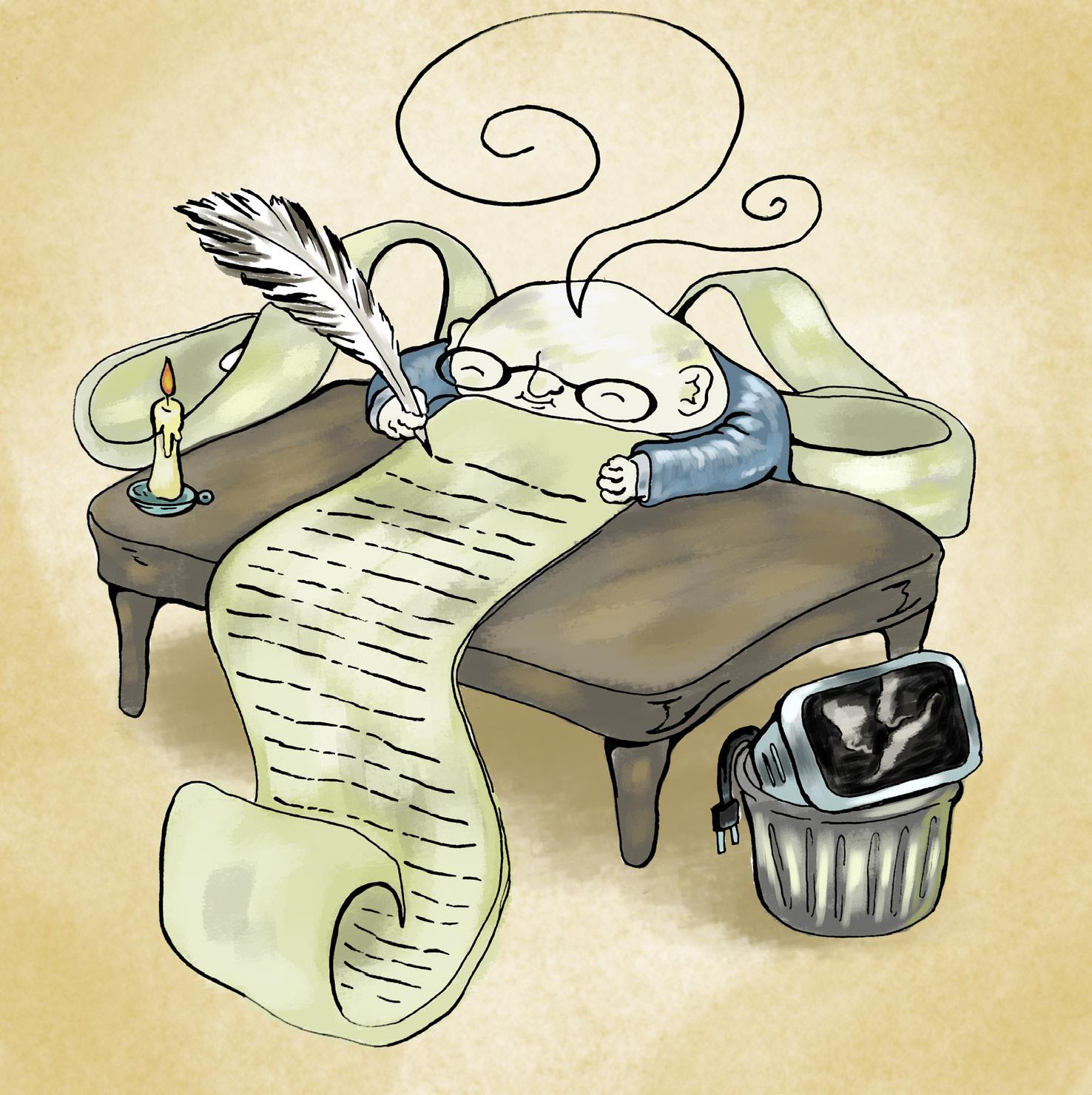
THOMAS | MANAGING ILLUSTRATION EDITOR
very identity that the writing skills I spent decades developing have become completely downgraded and no longer seen as important,” McGlothlin said.
Teaching Professor in College Writing Eileen G’Sell has mixed feelings about the “generalized positive tenor at the University,” especially for first-year students, which she primarily teaches.
“The reason why I am ambivalent is not because I am against AI in every application. To be so would be a bit naive at this point. It’s crystal clear to me that across disciplines, AI can be incredibly useful to aspects of research. That being said, one of my big concerns is that, with the overall positive vibe from the University, students are getting really mixed messages,” G’Sell said.
Naseh also believes that students are confused by the range of AI acceptance between professors.
“This is a message to my colleagues: I hope that they can find a common ground to be unified in front, because I think we are also making the students very confused right now with different approaches and we are conveying different value messages. If one of us appreciates AI, one of us advocates against it, it is just a very confusing environment that students need to navigate,” Naseh said.
Over the past two years, G’Sell has noticed a decline in the longtext writing and reading abilities of incoming students. This change worries G’Sell and has motivated
“If AI is not used to further student learning, then it’s not being used effectively.”
Assistant Professor and Founding Director of the Forced Migration Initiative at the Brown School Mitra Naseh, views the emergence of AI as comparable to previous technological advances.
“When Google search started, at the time, there were academics against it. They believed that students will never use libraries again, or they will miss the opportunity for critical thinking,
been stolen and input into the models, and she is also part of the lawsuit.
In addition to dealing with AI as a professor, McGlothlin has also seen and felt that AI has damaged the perceived importance of academic research.
“We became professors because we believe in this intellectual enterprise, and it’s an attack on us. In fact, it feels like an attack on my
her to change her AI policy from some allowance with brainstorming to a complete usage ban.
“I never expected to become this kind of teacher. In the past I was the ‘quirky culture critic’ teacher that really embraced the role of writing in online forums, and encouraged creative fervor in the class,” G’Sell, who teaches a “Navigating New Media” writing class, said. “Because of
how rampant LLM reliance has become, I’ve instead had to adopt really strict policies. If I don’t, students have such competing definitions of what is allowed.”
While G’Sell has become stricter with AI policies, she has also become more lenient on grammatical, punctuation, and mechanical errors, which she would have docked points for in the past.
“I don’t want students to have any excuses for not writing in their own voice,” G’Sell said.
To best utilize AI tools, G’Sell thinks that students first must learn how to read and write at a high level on their own. G’Sell has noticed that, far too often, some students view AI not as a collaborator but rather an authority figure.
“Obviously, this approach is dangerous for so many reasons. In terms of faculty-student interactions, some students address faculty as though we are similar to Claude. It can feel uncanny — I’m a human being, not an obsequious responder to prompts,” G’Sell said.
While Sheren understands that AI is a necessary tool for some fields and careers, she does not view the University-wide AI initiatives as beneficial.
“I have an engineering student in my class right now who is absolutely against the use of AI in a class like ours and probably would supplement their coding with [AI] in their own classes. I would leave it to the STEM faculty to explain exactly how it’s useful in those contexts, but no, I don’t think applying a universal standard at the University makes any sense,” Sheren said. “The +AI initiative, at least from faculty that I talk with in my own circle, it feels as if it’s not really helpful and it feels like we’re just going to endorse AI all the time and not really think about which disciplines do need to push back against its use.”
Professor of Spanish and Second Language Acquisition
Joe Barcroft points out similarities between language processing systems in humans and AI when opportunities present themselves.
He also gave an example of how AI might be used to promote second language acquisition provided that some important considerations are addressed.
“Presenting words in a second
language using multiple voices or using multiple talkers, this kind of acoustic variability we’ve demonstrated can have really strong positive effects on second language vocabulary learning. So what a nice opportunity to be able to use AI, ask it ‘Create me six different voice types, or six different talkers,’’’ Barcroft said. “The issue is, who are those talkers? How is AI getting its information? Who are the larger stakeholders that are making the decisions about how that information is being generated? And so forth.”
When it comes to using AI to learn content, however, Barcroft is cautious about other types of pitfalls.
“I think instructors are very protective of their students. And the last thing we would want is to guide you to use this tool and then it leads you to erroneous information,” Barcroft said.
In fact, the deadline for the summer cohort training on faculty learning AI has been extended, possibly due to a lack of interest. Sheren said that summers for faculty are meant to be a time to rest and a time to do research, and the “carrot” for joining the AI training cohort has not been enticing enough for professors like Sheren.
Barcroft completed the AI Canvas course and felt that it did a good job defining ethical uses of AI and could serve as a good introduction for professors who might be more skeptical about using the technology in the classroom.
“I think it would be worthwhile to do the course, and they’ll have maybe even a greater appreciation for what they’re doing and not doing as it relates to AI,” Barcroft said.
McGlothlin has chosen to offer an AI option for the final project of her Ampersand course, “Representations of the Holocaust in Literature and Film.” There are two parts to the project — a reflection essay and a presentation plan or another form of teaching about Holocaust representation. For the second component, students can choose to have AI draft a presentation script and then add to it and write a critique of the initial output.
Naseh does not fault students for using AI on assignments since the tool is easily accessible. Instead, she has her students complete activities that are not transferable to AI, such as home visits for refugees in the area.
“My colleagues might hate me for this, but if [the] outcome of a class is an essay that can be generated by AI, I will question the value of that course. We need to update our courses to be able to bring value beyond something that can be generated by AI.”
Regardless of how faculty navigate AI in their individual classes, McGlothlin believes student learning should remain centered in professors’ minds.
“If AI is not used to further student learning, then it’s not being used effectively,” McGlothlin said. “So, it shouldn’t be that we pivot to AI just because that’s what everybody’s doing, or pivot to AI because the tools are shiny, or pivot to AI because it’s easier. It should always be: What are we doing to develop students’ cognitive skills, their abilities, their knowledge?”
LUCIA
‘And that’s our show’: Kids On Campus wraps up another semester of laughs
LILY RULNICK STAFF WRITER
What do you get when you combine an evil AI robot, a ‘roided up T-ball player,’ and live music?
If you guessed Kids on Campus (KOC), you would be correct.
KOC, WashU’s only sketch comedy group, put on their semesterly show from April 16-18 in the Village Black Box theater. This semester, KOC was led by co-head writers junior Ella Rodriguez and sophomore Jack Krupnick.
“Since my first semester in school, Kids On Campus has been my favorite thing that I’ve done,” Krupnick said. “Getting the chance to be the person behind it and
really watch it come together has been incredible.”
The show opened with a sketch written by junior Patrick Riley and centered around a medieval-inspired sword fight. The two head writers then took the stage to deliver their “Saturday Night Live”-style monologue, concluding their address with an enthusiastic recitation of the KOC classic: “Live from St. Louis, it’s Kids On Campus!”
In total, the show consisted of 21 live and prerecorded sketches submitted by student writers. According to Krupnick, the first three months of the show’s preproduction are spent teaching club members how to write sketches. Therefore, while it may
seem like KOC hopefuls might need prior sketch comedy experience, even those without experience can contribute, as Krupnick emphasized.
“The whole point is that the first three months of the club are just teaching [people] how to write a sketch and not be funny, but rather figure out what will work,” Krupnick said.
“Sketch comedy is a muscle that you can exercise,” Rodriguez added. “I showed up to college with no muscle there, and I learned it, and it’s super fun, and [now] we teach people how to do it.”
For many KOC members, the club is an important outlet separate from their academic obligations.
“Kids On Campus gave
me a space separate from everything else to be creative,” said sophomore Sophia Malik, a KOC lighting designer turned actor. “I’m a bio major and a psych major, and those can be a lot of hard STEM, classic organic chemistry and calc and all of these things. So it’s such a good outlet for me to express myself creatively.”
Of the 21 sketches included, there were clear crowd favorites. One that the audience could not get enough of, entitled “I Don’t,” centered around a proposal gone wrong. It also happened to be Rodriguez’s favorite in the show.
“I think it’s really visually funny with the switching back and forth, and the lines from each [person] really
compliment each other, and there’s a lot of physicality in it, but also it’s just very ridiculous and exciting and high energy,” Rodriguez said.
Another highlight was “Never Go To Bed Angry,” which introduced the concept of a “sound sommelier” and made audience members realize that they might just need a human Alexa in their lives. “Baseballfather,” Krupnick’s favorite sketch, had the crowd roaring with laughter as little Timmy transformed from a young T-ball player to an artificially-enhanced baseball pro.
The show’s recurring segment, “Semester in Review,” covered hot topics on the WashU campus and led the performance into its 15-minute intermission. From
The Kid LAROI’s upcoming WILD performance to Mizzou’s up-and-coming theater program, the “Weekend Update” style sketch provided a summary of many once-viral-on-Sidechat subjects.
In addition to onstage sketches, the show also featured several prerecorded video sketches. One sketch, co-written by first-years Hannah Dorval and Will Benjamin, detailed one woman’s series of disastrous first dates.
“The fact that it was a video sketch made it so that there could be very quick changes in the scenes, which would not have been possible in a regular stage sketch,” Benjamin said. The show’s sketches were interspersed with performances from the KOC band, which played instrumental versions of popular songs. In between sketches, the audience danced along to covers of “Espresso” by Sabrina Carpenter, “This Love” by Maroon 5, “I Will Survive” by Gloria Gaynor, and more.
While the line to get into a KOC show could take anywhere between thirty minutes to three hours, each night’s packed performance is proof of its popularity. The show is a representation of the myriad of talent within the student body.
“I’m so grateful that people come and wait for so long,” Malik said. “I hope everyone who wanted to see it [could] see it.”
In the age of AI, the humanities department should consider changing its course structures
I’m a women, gender, and sexuality studies (WGSS) major and prehealth student at WashU, and in my time here, I have both seen and experienced the heavily prejudiced view STEM students have of the humanities. Being a STEM student, especially on the pre-professional track, implies that you are hardworking, intelligent, and likely to succeed. Humanities students, on the other hand, supposedly have a lighter and easier load since they “only have to read and write essays.”
Many of these narratives come from students who take humanities courses solely to fulfill their humanities and social contrasts graduation requirements. For them, humanities classes are simply a box to check rather than a space to engage with in a genuine way. And with the advancement of artificial intelligence (AI), it’s now
easier than ever to avoid genuine engagement with class material. Essays can be written with AI, readings can be summarized rather than actually read, and in-class discussions can be skipped or superficially participated in with little consequence. The problem is not that humanities courses lack rigor, but that their current structure allows students to bypass it, especially with AI, which reinforces the perception that they are easy. If a student can rely on AI and still walk away with a passing grade, then the problem is not just about individual laziness. It’s about what is lost: the opportunity to embrace critical thought. Courses stop being a space where students wrestle with their intellectual thinking and become mechanisms to produce the right academic performance. Students start to view engagement in humanities classes as optional, unlike engagement in STEM classes,
where most grading structures more clearly depend on exam performance. This prejudice that the humanities have nothing to offer is reinforced by the assumption that students can get through them with little effort.
Humanities classes are a two-way street of learning, growth, and knowledge exchange between the instructor and the student. These classes are not simply about writing a 900-word essay; they are about understanding, through that essay, how power, social structure, language, and other factors shape people’s lives. They deal with identity, politics, culture, art, and systems that create the world as we know it. Students are already expected to invest effort. But this essay-based structure may also allow students to not engage in in-class discussion and to use AI wherever they can throughout the course.
When grades are heavily based on essays, it creates a system in which a generally
well-written paper can pass. A student can rely on summaries and a few reference quotes instead of close
4/23 WINNERS
First Place: Hay, listen man, I am pasture understanding. I am anything but stable, I need finals to end.
Sean Henry, Current WashU Student
Second Place:
Me, 4 homework assignments in and an hour of studying in realizing that horsing around may be the only viable option at this point…
Sean Henry, Current WashU Student
Third Place:
Just a lil study snack nothing to be worried about Leo Penny, Current WashU Student
reading. Thus, the issue is not that the humanities lack rigor but that a student can succeed in a course while skipping the parts that make it rigorous. Even when instructors try to respond by using AI detection tools, that doesn’t really resolve the underlying issue of disengagement with course content. Those tools are inconsistent and often inaccurate, which make it difficult to rely on them as a real solution. It cannot just be about catching students after the fact anymore, but about whether we can design a course structure that doesn’t allow students to rely on AI.
If we want the humanities to be taken seriously, the structure has to be modified. Essays shouldn’t be the bulk of how students
are evaluated. More weight should be placed on discussion, in-class engagement, and the ability to think through ideas in real time. Assignments that require direct interaction with the material, whether through presentations, debates, or in-class writing, make it harder to rely on AI or stay at a surface level. The goal of the humanities isn’t just to produce writing. It’s to produce thinking. The irony is that the humanities are among the most important classes students take. They shape how we understand ourselves and others. The classes make us better people. But until humanities courses are structured to respond to the demands of our AI-driven era, they won’t be treated that way.
PRANATHI MURTHY STAFF WRITER
LIAM THOMAS MCMANAMAN | STAFF ILLUSTRATOR
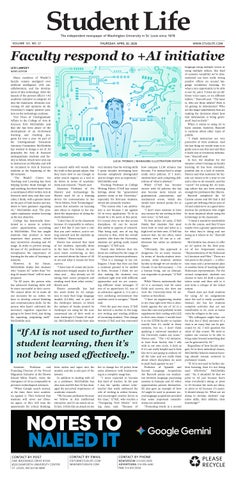
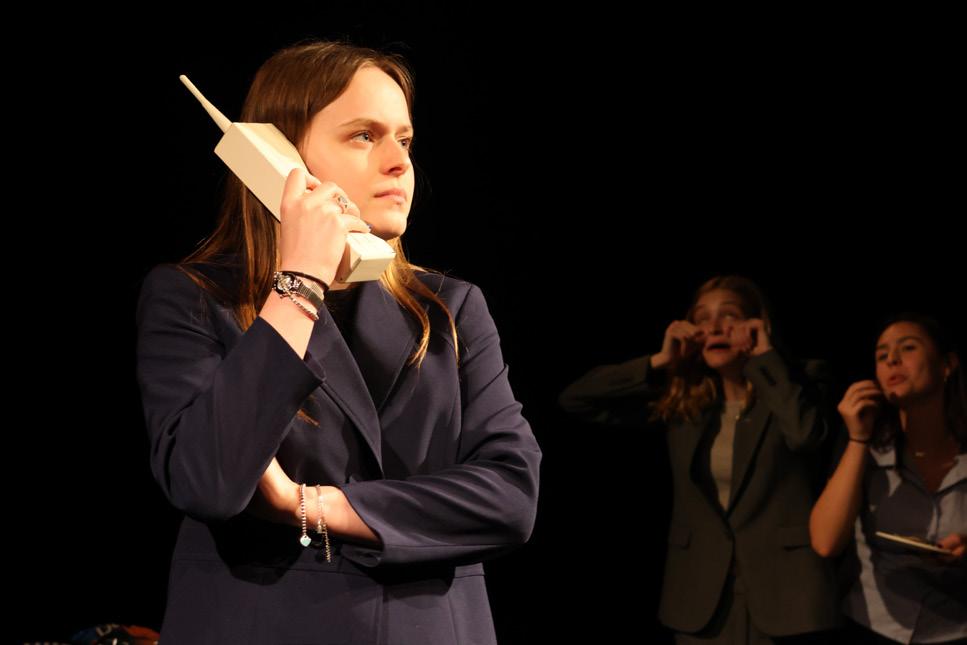
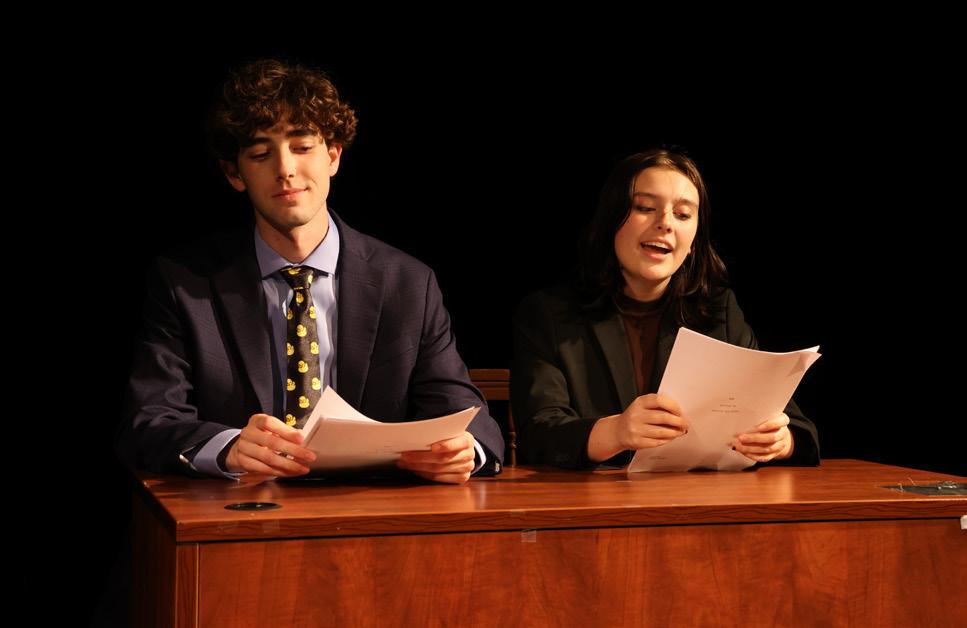
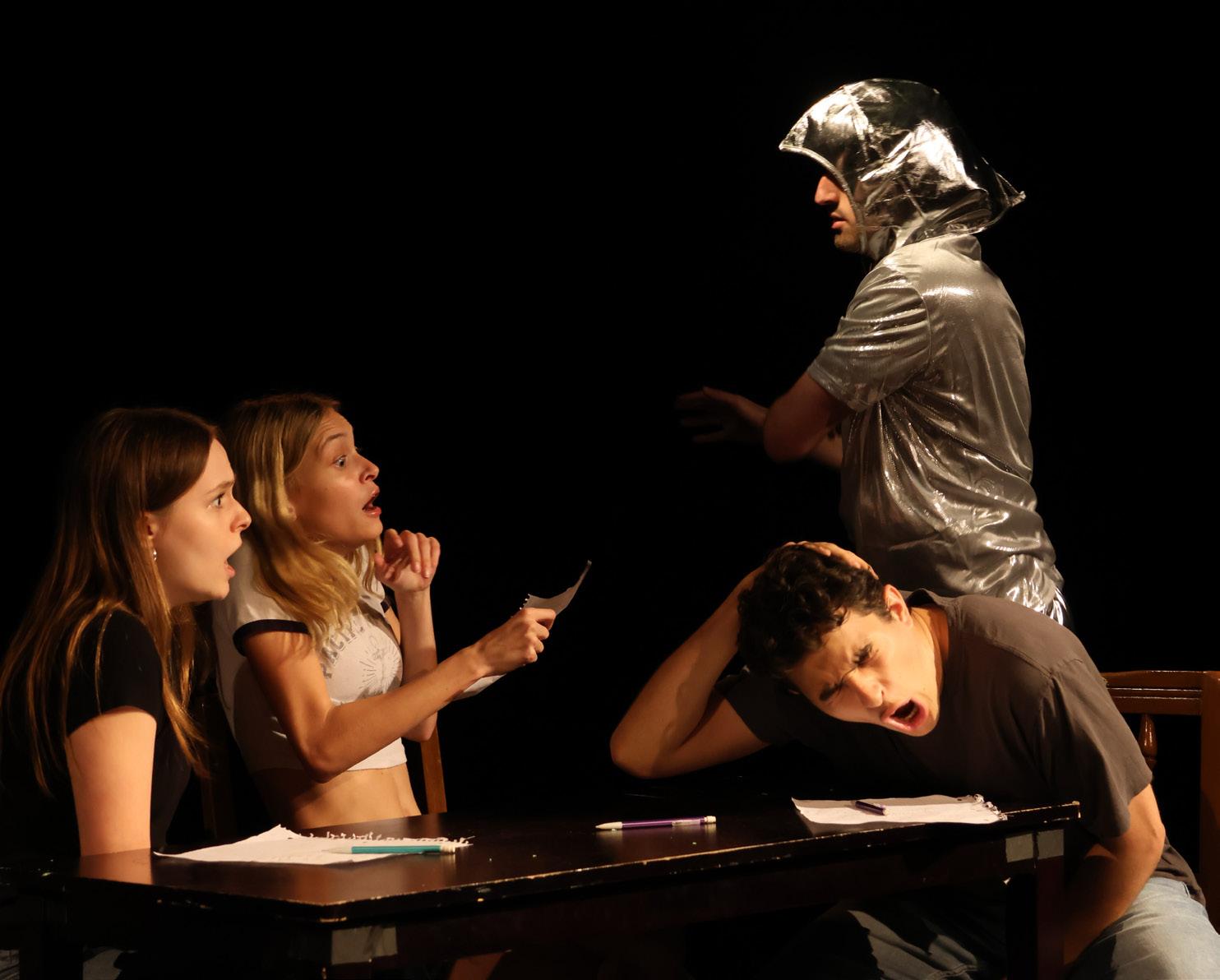
Kids on Campus actors perform various skits during their semesterly show.
In the last decade, the University Athletic Association (UAA) has only known one champion in women’s outdoor track and field: WashU.
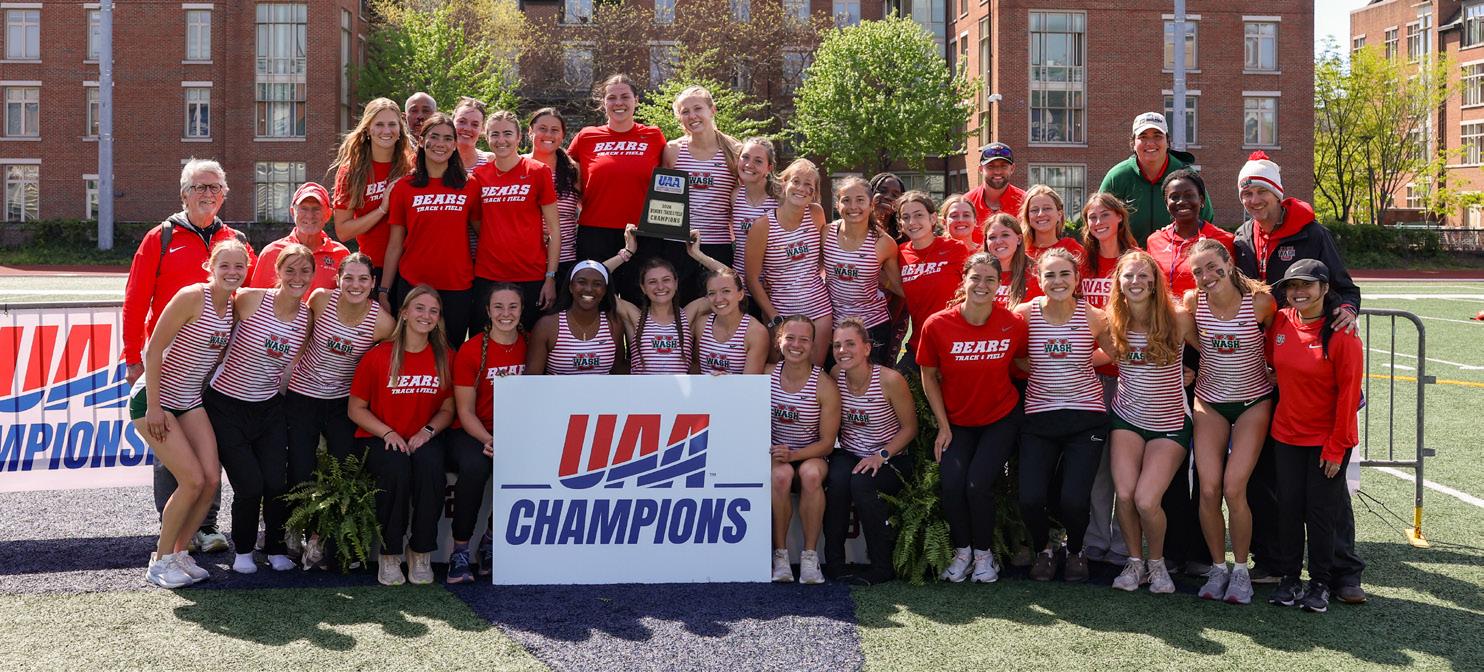
On April 25 and 26, the No. 2 WashU women’s track and field team successfully defended 10 years of history to claim the 2026 UAA title with 221 points. After securing the indoor championship earlier this year, their victory marked the 15th back-to-back indoor-outdoor conference win in program history.
But headed into the meet, the Bears were fixated on the present, not the past.
“The word ‘compete’ is kind of our main word that we’re focused on,” first-year Kate Delia said. “It’s definitely really exciting to run in [the UAA championship], but we put the past behind us and just go out there and compete.”
On the men’s side, No. 16 WashU finished in third place with a total of 148 points, returning to the podium after a fourth-place finish in 2025.
The women’s team started strong with four first-place finishes on the first day of competition. The 4x800-meter
relay team of junior Caroline Echols, senior Cate Stevens, sophomore Lauren Raley, and Delia took the UAA title with a commanding time of 9:00.08, over 10 seconds faster than the runner-up.
“The 4x800 was not long after the 800 prelims,” Delia said. “So everyone who was in the 4x800 had just run in the 800. So it’s very hard to go all out, but also make sure you’re saving a bit for the next day. But I think all of us managed to balance that pretty well.”
On the individual side, senior Riley Clark won the 3,000-meter steeplechase with a time of 10:38.19, improving on her second-place finish last year by 22 seconds.
The Bears secured two more victories in field events, with senior Jenae Bothe winning shotput and senior Mackenzie Walker taking the pole vault title. WashU took three out of the top five spots in pole vault, with first-year Campbell Pallera coming in second and junior Meredyth Barr finishing fourth. Day two brought only more success for WashU, which claimed another first-place finish in the 4x100-meter relay, propelled by performances from junior Julia Coric, junior Maya Davis, sophomore Hailey Weir, and senior
Mania PUZZLE PUZZLE
Jasmine Wright. Wright continued to dominate on the individual side, winning the field in both the 100- and 200-meter dash. WashU swept the 200-meter dash podium, with Weir taking second and senior Kylie Spytek securing the thirdplace finish.
The 4x400-meter relay team of sophomore Quinn Bird, junior Cate Chrisopher, Coric, and Spytek took the UAA title with a time of 3:47.92.
Spytek also finished second in the 400-meter race, while Weir was close behind at third. The Bears continued to impress in the middle-distance races, with Delia winning the 800-meter run with a time of 2:08.57.
The Bears secured three more first-place finishes. Sophomore Lucinda Laughlin dominated in long-distance events, winning the 1,500meter run and securing her second UAA title in the 5,000meter run. Junior Olivia Theisen also took the high jump victory, clearing 1.65 meters.
The men’s team finished third, finding their success mostly on the field and in middle and long distance races. WashU began the meet on a high note with first-year Charlie Houck taking third
in the 10,000-meter run and junior Will Liu finishing second in the 3,000-meter steeplechase.
The Bears continued to overpower the field in pole vault, with senior Hayden Kunkel winning the title and junior Peter Lichtenberger securing second place, both clearing 4.88 meters — Kunkel cleared in fewer attempts.
WashU wrapped up the first day with an narrow win in the 4x800-meter relay. The team consisting of senior Brandon Brazil, senior James Corbett, first-year Rishi Shadaksharappa, and junior William Frohling won by only six-tenths of a second, recording a time of 7:41.20.
But Frohling wasn’t done
yet. The next day, he backed up his indoor title of 1:54.24 with a 1:54.54 first-place finish in the outdoor 800-meter race. Frohling was also the second leg of a 4x400-meter relay team that, along with performances by Brazil, senior Dayton Lasack, and senior Alek Zavadoski, took third place.
The Bears concluded the meet with four more third-place finishes in the 4x100-meter relay, the 1,500meter run, javelin, and high jump to secure the overall third-place title.
After the UAA Championships, both teams’ focus will now shift to the NCAA Championships from May 21 to 23. While the standings are still subject to
change, currently the women have 13 individual qualifiers as well as the 4x100 and the 4x400, while the men have five.
WashU has three more meets on the schedule to continue improving and qualify more athletes. Their next opportunity will come on May 2 at the Gary Wieneke Memorial meet in Champaign, Illinois.
“It’s definitely good to have these meets before nationals, to just stay in that competing mindset,” Delia said. “Even anyone who is already qualified for an event is trying to secure their spot and knock a couple seconds off to make sure that they’re going into nationals in a good spot.”
The WashU women’s track team celebrates their 10th straight University Athletic Association Title.