April 23, 2026 Student Life Newspaper, WashU in St. Louis
Changes to McKelvey PhD admissions bring an end to lab rotations
GIERE STAFF PHOTOGRAPHER
For decades, the lab rotation has been a chance for incoming PhD students to shop around, test mentors, and find their fit before committing to four or more years of research. That option disappeared at WashU’s McKelvey School of Engineering in the 2025-2026 admissions cycle, leaving some of its PhD students with limited autonomy over their research.
All of McKelvey’s PhD programs have transitioned away from rotational admissions this year, moving to a fully directadmit model where incoming PhD students are matched with a single faculty advisor before setting foot on campus. The shift mirrors a broader national trend driven largely by one factor: funding. McKelvey is not alone. Across the country, some engineering PhD programs have been making the same shift.
Previously, McKelvey funded PhD students for a full year before moving them onto faculty research grants. Under the new model, that transition happens faster, which requires students to be attached to a specific principal investigator (PI) and project from the start. Jai Rudra, associate director of graduate studies for McKelvey’s biomedical engineering (BME) department, put a finer point on the savings.
“By taking away the rotation system, I think it’s about $40,000 per student saved, and that includes stipend and health and
all that,” Rudra said.
With an average incoming BME class of around 25 students, Rudra said the department saves about a million dollars.
Rudra said the University eased into the program through stages, with rotations shrinking from 10 months to six before being eliminated.
“It was not like the ax was brought down,” Rudra said. “We were ready for this for almost a year and a half.”
How it used to work
Under the rotational model, incoming students could spend half a semester with one professor, then half a semester with another professor, before choosing a permanent lab.
For Sarah McMahon, a current undergraduate researcher preparing to begin her PhD at McKelvey, the process was designed to prepare students for one of the PhD’s most consequential and least discussed variables: the advisoradvisee relationship.
“If you don’t have a good advisor, you’re not going to have a good experience, and you might even drop out,” McMahon said. “It’s so dependent on their ability to help you and how you guys match.”
The political reality no one warns you about
To Student X, a first-year PhD student in McKelvey who chose to be anonymous out of fear of retaliation from supervisors, the PhD placement process is far more political than prospective applicants
realize, and the stakes of getting it wrong are significant.
“What no one really tells you about a PhD program is how political it is,” Student X said.
“It’s not like [if] you have the best grades and the most research experience, you get to go into your top [choice] lab. It is very much funding-oriented.”
PhD students are paid through their PI’s grants, and a professor, for instance, who has already committed funding to incoming direct admits may have no room to absorb a student looking to move to their lab.
The problem is especially acute under direct admissions. If a PI has already committed funding to incoming direct admits, they may
have no room to absorb a student looking to transfer labs.
“If a PI knows they have two direct admits coming in, they’re like, ‘I can’t take someone who’s already here,’” Student X said.
“If you can’t find another PI with funding, you’re kind of screwed.”
The problem is compounded by how difficult it is for prospective students to vet a lab from the outside. Student X said that when they tried to reach out to current graduate students for candid feedback before applying, they got little response.
“It was kind of a shot in the dark,” Student X said. “If you ask the current graduate students, they’ll be like, ‘Don’t do this,’ or they’ll be like, ‘OK, he’s actually a
good PI, his one issue is X, Y, and Z.’” Who benefits from direct admissions?
Administratively, the shift is less about saving costs and more about research alignment, according to Katharine Flores, vice dean of graduate education for the McKelvey School of Engineering.
“From that perspective, there isn’t a big impact on long-term financial planning,” she said. “The determining factor for cohort size is still tied to the availability of research grant dollars.”
SU FY27 budget increases overall student group funding, cuts NAP
PRANATHI MURTHY STAFF WRITER
Student Union (SU) approved its Fiscal Year 2027 (FY27) general budget of approximately $4.8 million, a 3.2% increase from the $4.65 million allocated for Fiscal Year 2026 (FY26). For the upcoming fiscal year, more funding will be redirected from large-scale SU-run programming toward student groups.
SU’s Social Programming Board (SPB) saw its budget drop from $802,935 in FY26 to $642,999 for FY27. The largest factor in this decrease was the discontinuation of Night at the
Pageant (NAP), the fall semester concert that replaced fall WILD in 2023. The event cost around $143,000, according to former SU Vice President of Finance Meris Damjanovi ć , who said the decision was based on cost efficiency.
“NAP was removed from the budget because the cost per person of the event did not justify the total cost. It was a cost per person that we wouldn’t accept from a student group programming an event of that size,” he said. “We did the three-year trial run of NAP, and it didn’t end up paying [off] like we had hoped it would.”
The FY27 budget allocated about $2.87 million to student
groups through budgets, appeals, and executive appeals, up from roughly $2.53 million in FY26. $1.61 million of the $2.51 million requested for student organizations’annual budgets was allocated, resulting in a funding rate of 64.15%.
Funding outcomes differed widely. While environmental and sustainability groups received 89.30% of their requested funding, and religious and spiritual groups received 82.33%, service and community engagement groups received only 22%.
Additionally, social justice organizations received none of the $6,903.49 they requested. Sports clubs and cultural groups received around 68.22% and 69.79% of their requests, respectively.
Former Budget Committee Chair Palladium Liang said this shift in funding reflects SU’s goal of funneling more funding decisions into the appeals process.
“Whatever money we allocated, we had to be extremely confident that groups would spend it all,” Liang said. “If they need more, we encourage all these service groups to come back … to appeal for more money.”
To achieve this, the Budget Committee took several steps to reduce funding this year, notably factoring in student organizations’ likelihood of spending
allocated money, introducing stricter requirements on travel funding, and halting funding for fundraising events. Additional changes include a $20-per-person cap on food for most events, caps on venue costs across all groups, and the elimination of funding for individual memberships entirely.
Engineers Without Borders (EWB), a service and community engagement organization, received no funding for FY27. The group had requested $77,417.55 for FY27 and had previously been allocated about $39,000 for the current FY26, which SU later retracted, according to junior Nate Sapp, president of EWB.
Sapp said the decision was largely based on the structure of the group’s projects. The organization works on the design and oversight of international infrastructure projects, such as the Bulubandi Primary School in Iganga, Uganda, and St. Francis Healthcare at Jinja, Uganda, and relies on licensed contractors to carry out construction while students lead the design and project management.
“The Budget Committee views giving money to contractors as a giveaway, and they don’t see that as directly benefiting WashU students,” Sapp said. SU also cited the group’s past
poor spending history as a factor in its decision, writing: “Budget Committee does not feel comfortable funding a group to hire contractors to build the entire project because it is a giveaway. Giving away/donating items to the on-site engineer who would be rendering a service to benefit non-WashU undergraduates.”
Despite the setback, EWB leaders said they understand SU’s reasoning and plan to continue working with the organization in the future.
“We understand where they’re coming from and we look forward to working with them in the future to rebuild our relationship,” Sapp said.
Both Liang and Damjanovi ć said the FY27 budget reflects an effort to prioritize long-term financial stability and ensure that funds are actively used rather than left unspent. Damjanovi ć emphasized that budgeting decisions extend beyond numbers alone.
“Your main goal when you’re balancing a budget should be the long-term financial health of SU,” Damjanovi ć said. “It’s impossible to make everybody happy, but the general budget is a compromise, and I think we’ve struck a good one for Fiscal Year 27.”
SPB did not respond to Student Life’s request for comment.
ELLA
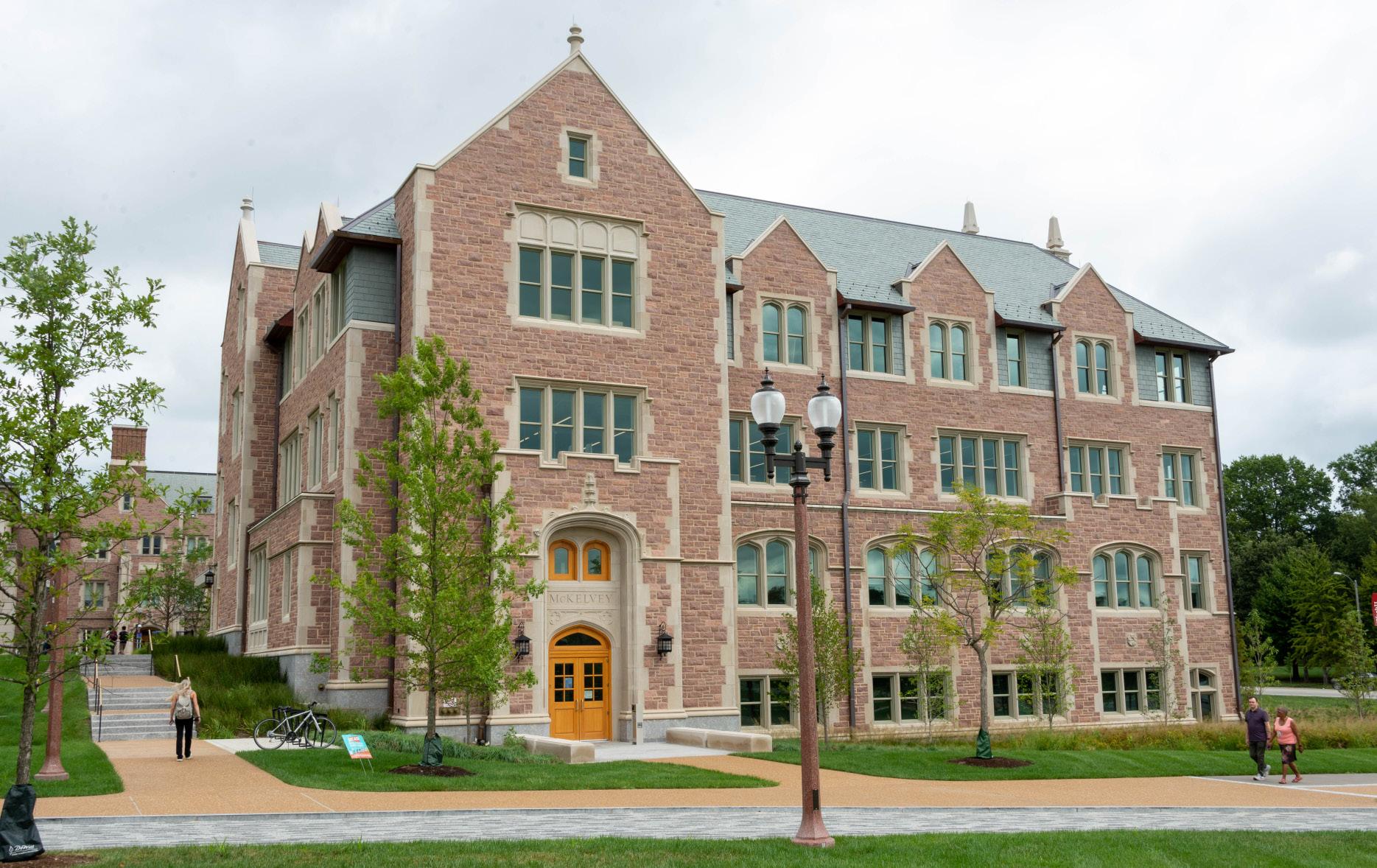
McKelvey PhD programs recently shifted from a lab rotation system to direct admission.
NATHAN SPRINGMAN | CONTRIBUTING PHOTOGRAPHER
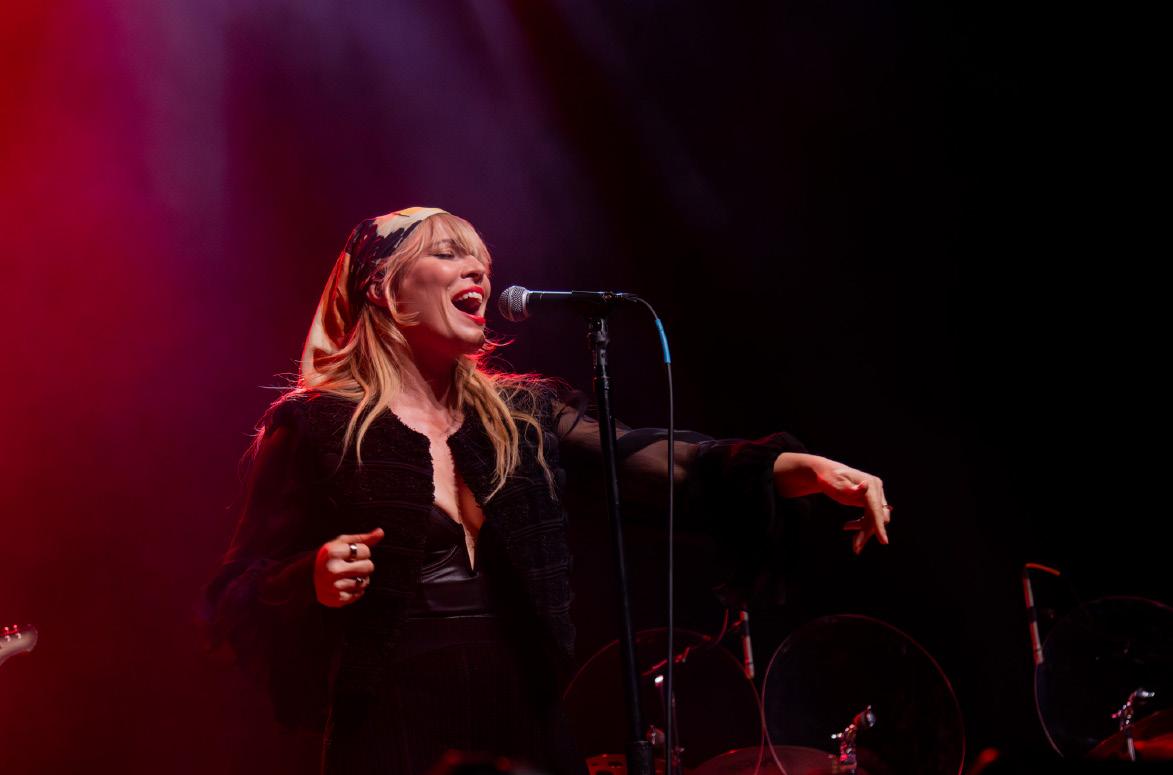
Natasha Bedingfield performs at last year’s Night at the Pageant, a tradition terminated this year in order to allocate more funds to student organizations on campus.
ERAN FANN | PHOTO EDITOR
NEWS
Amanda Nguyen — activist, astronaut, and author — speaks at WashU
FLANNERY POON STAFF WRITER
Content warning: This article contains discussion of sexual misconduct. Resources and helplines can be found at the end of the article.
For someone who’s been to space, Amanda Nguyen is incredibly down to earth. Nguyen, a sexual assault advocate and the first Vietnamese woman to go to space, spoke about her journey during a fireside chat on Thursday, April 16.
The event was sponsored by Cross-Cultural Connections, the Relationship and Sexual Violence Prevention (RVSP) Center, and the Gender Equity and Title IX Compliance Office for Sexual Assualt Awareness Month. It was hosted in collaboration with the Asian Multicultural Collective and the Vietnamese Student Association.
Nguyen shared her story of advocacy and hope after she was raped while pursuing her undergraduate degree at Harvard University in 2013. She spoke on how she created the Survivors’ Bill of Rights Act of 2016, advocated for the passage of a United Nations resolution protecting persons who have experienced sexual misconduct globally, and founded Rise, a civil rights nonprofit that advocates for the rights
MCKELVEY
from page 1
In practice, most PhD students were already funded through faculty research grants, meaning cohort sizes have long expanded or contracted based on available funding. Under direct admission, that structure remains the same but grant support simply begins earlier.
For departments, the math is straightforward: Direct admissions makes funding commitments more predictable. For students, the picture is more mixed. On the upside, direct admits get moving on research immediately. There is no reorientation lag and no need to repeat the same onboarding processes in two different labs. Student X noticed a real gap between themselves and their directadmit peers during their second rotation.
“They had so many more actual deliverables, and I was having so much imposter syndrome because I didn’t feel like I was up to speed with them,” they said.
But momentum is not the same as fit, according to McMahon. And for students entering a niche research area with only one viable faculty match, the stakes of a poor placement are especially high. McMahon said she was only able to accept direct admission with confidence because she had worked alongside her future advisor for two years as an undergraduate.
“If it didn’t work out with the one professor, I would have been kind of lost at what to do next,” McMahon said.
That risk in PI matching may be shaping who applies and who is admitted.
Rudra observed that a large share of students in the first
of sexual assault survivors.
The first step in her journey, Nguyen said, was rage. After completing the sexual assault forensic exam, which took over six hours, she was forced to navigate a Massachusetts law that allowed sexual assault evidence kits, commonly referred to as “rape kits,” to be destroyed after six months if the survivor didn’t file a police report. Nguyen reached out to peers, professors, old bosses, and others in her network for help drafting the Survivors’ Bill of Rights Act. The bill focuses on the protection of “rape kits,” free medical exams, and notifying the survivor of their rights in the legal process.
“The pain we feel inside of us is power,” Nguyen said. “If we can recognize how powerful it is, our own stories, our own feelings and direct it somewhere, it can change the world.”
Nguyen spoke about feeling that she was an “accidental activist” and explained her dream was always to go to space. However, after the Survivors’ Bill of Rights Act was passed unanimously in Congress, she decided to continue her activism work on the global level.
“When I passed the federal law, we heard from over a million people saying, ‘Hey, we’re also working on this in our area of the world. How can we grow
direct-admit cohort in the BME program already had ties to WashU.
“I would say at least 12 [of 22] were preexisting student body [and staff] at WashU, or they were WashU undergrads,” he said.
The pattern Rudra observed was reflected schoolwide. Flores confirmed that offers declined across McKelvey for the fall 2026 cohort, attributing it to faculty being “very conservative about committing to support the incoming students immediately.” She expects numbers to recover as faculty grow more comfortable with the new recruiting rhythm.
The advisor relationship: Everything depends on it
Both McMahon and Student X came to the same conclusion: the advisoradvisee relationship is the single most important factor in whether or not a PhD goes well, and it is also the hardest thing to evaluate before you arrive.
At certain high-profile programs, McMahon said, prominent advisors can go weeks or months between meetings with their students.
“PhD students didn’t really work out unless they found a good postdoc, because the experience was so … you just get lost,” she said, paraphrasing her advisor’s account of the culture at one institution where he did postdoctoral research.
What McMahon wanted, and what she said incoming students should actively seek, is an advisor willing to engage frequently and substantively — not just to sign off on work, but to think
this movement?’” Nguyen said. “And I saw this unique opportunity and time to keep pushing for survivor rights, because momentum is so ethereal, and it’s so important in coalition building and also in social movements.”
Senior Sonal Churiwal said she hoped Nguyen’s experience could open a dialogue for students to discuss the issue of sexual assault at WashU, especially during Asian American Heritage Month and Sexual Assault Awareness Month.
“We know that [sexual assault] is an issue at every campus, and that includes WashU,” Churiwal said. “It’s really important for us to recognize how multiple marginalized communities are impacted by sexual violence, and not just Asian American communities. Any communities of color, immigrant communities, queer communities.”
Beyond her activism work, Nguyen achieved her original dream of becoming an astronaut and traveled to space on the Blue Origin allwomen space flight in 2025. She published her story in her memoir “Saving Five” in March of 2025.
The space journey was a crucial point in Nguyen’s life. She spoke about her decision to bring her hospital band from the day she was raped into space with her, despite it being a reminder of past
through problems alongside their students.
“You learn the most from the conversations about random topics,” McMahon said. “It’s really nice to have someone willing to sit and talk with you through it.”
Under the new system, students have fewer opportunities to find the right fit.
“If you don’t know how the PI is, or the lab culture in the group you’re joining, and then you get there, and you’re like, ‘Oh crap, actually this is not what I envisioned. This person’s not a good mentor,’” Student X said. “That’s why I was scared of doing direct admit.”
Research by Stanford researcher Chris Golde found that doctoral attrition has long identified the advisor relationship as one of the primary reasons PhD students leave their programs. Doctoral turnover rates have hovered around 40% to 50% for nearly four decades and can be a high cost to students, departments, institutions, and society. Under a rotational system, students have a structured opportunity to identify a poor fit before it becomes a yearslong commitment. Under direct admissions, that safety net disappears and the consequences of a mismatch fall almost entirely on the student.
A national shift — but not a universal one
McKelvey is not alone. Across the country, engineering PhD programs have been quietly moving away from rotational admissions, driven by the same pressure its students identified: funding. But the picture at peer institutions is more varied
trauma. She described that when the one-minute buzzer went off, signaling the end of the journey, it sounded just like the heart monitor from the hospital. At that moment, she was brought back to her “survivor self,” Nguyen said.
“I had struggled with [the hospital band] because I wanted this rocket launch, on the pinnacle of my career, to have the escape velocity so that I wouldn’t be known for the trauma that I have the rest of my life,” Nguyen said. “But in that moment, I realized we don’t have to choose between our pain and our success or joy, that we can embrace all parts of ourselves, and that I could be both an astronaut, a scientist, and an activist and a survivor in that moment.”
Sometimes activism can feel like a lot of effort and little change, Nguyen said. Yet she still has a sense of hope and that is what sustains her.
“Anger is fuel and fuel runs out. What’s left when it’s gone? It’s hope. It’s hope that sustains movements. And I get that hope from, it sounds really basic, but from small actions every day where I feel like we still have agency,” Nguyen said. “That’s the greatest blessing that I have, which is to wake up every day and feel like anything is possible. We can absolutely change the world.”
The Sexual Assault and Rape Anonymous Helpline (S.A.R.A.H) provides confidential and anonymous support and can be reached at 314-935-8080
between 4 p.m. and 8 a.m. during the fall and spring academic semesters. There are counselors at the Relationship and Sexual Violence Prevention (RSVP) Center, located in Seigle Hall, Suite 435, available confidentially to any University student. The office can be reached at 314-935-3445 or by email at rsvpcenter@ wustl.edu.
The National Sexual Assault Hotline can be reached at 1-800-6564673 or via online chat at https://hotline.rainn.org/ online 24/7. To reach Title IX, students can contact Title IX Coordinator Jessica Kennedy at 314-935-3118 or go to the Title IX Office in Umrath Hall 001.
than a simple trend toward direct admission would suggest.
Even within McKelvey, the shift wasn’t uniform. Flores emphasized that the transition was not imposed from above.
“The school did not apply a top-down direct admission plan on all of the programs,” she said. “We asked each of the programs to develop an approach that would work best for their local situation.”
Admissions directors met repeatedly to compare approaches, and differences still remain across departments. A follow-up meeting is already scheduled to assess what worked and identify best practices after the first direct-admit cycle.
Peer institutions reflect the same variability. Stanford’s Chemical Engineering PhD programs still require first-year students to rotate through multiple labs before committing to an advisor. This is a deliberate choice that signals the rotational model is not impractical at scale, just increasingly rare. Johns Hopkins Biomedical Engineering, by contrast, has moved decisively toward direct matching, with rotation offers now reserved primarily for students funded through National Institutes of Health (NIH) training grants.
That divide points to the underlying dynamic: Rotations tend to survive where external fellowship funding makes them financially viable. When funding from the NIH, U.S. National Science Foundation (NSF), or Department of Energy becomes scarcer or more competitive, programs lose the flexibility to bring students in without
immediately slotting them into a specific grant-funded project.
The cuts are also landing unevenly. Most major external fellowships, including the NSF Graduate Research Fellowship and Department of Defense grants, are open only to domestic students, even as international students make up the majority in many engineering programs. In fall 2025, 71% of McKelvey’s PhD students were international. The result is a system in which a student’s ability to explore labs before committing depends less on academic fit and more on what funding their program has secured, and from whom.
For domestic students, that pressure takes on a personal dimension. Student X described an unspoken expectation to constantly pursue external fellowships — not just for professional development, but to relieve funding pressure on their advisor.
“There is some pressure on the domestic students to be constantly looking for external fellowships so that you can keep your professor happy,” they said.
Dean of McKelvey Aaron Bobick pushed back on the notion that federal funding turbulence would derail the school’s long-term research agenda.
“What’s happening this week is not going to determine our research strategy for the next decade,” Bobick said. “In engineering, the types of areas that we do research in tend to be of tremendous interest on the part of all aspects of the federal government.”
But he acknowledged a specific source of near-term uncertainty.
“There’s this whole question on overhead, which has to do with how you spend the money, and that will impact the ability to spend some of those funds on things that are outside the direct charges for the grant,” Bobick said. “That’s the main uncertainty that we’re operating under.”
What’s lost
Student X was among the last to go through McKelvey’s rotational system. They chose it deliberately, turning down a direct-admit offer from the same program because they wanted the flexibility.
“I didn’t want to commit to a professor and then be like, this doesn’t work,” they said. “I knew I wanted that option.”
Flores acknowledged the anxiety but emphasized that formal pathways still exist.
“If the match does not work out, the programs still have processes for the student to find a different advisor and switch labs, as long as the new advisor is able to support the student,” she said.
But for students like Student X, the availability of that process and the practical reality of navigating it are two very different things. Under the old system, the program absorbed some of that risk, building in structured opportunities to course-correct. Under direct admissions, that risk shifts almost entirely to the student.
“Know what’s good for you,” McMahon said, offering her advice to prospective PhD applicants. “That’s something I struggle to work out, and I’m still working out.”
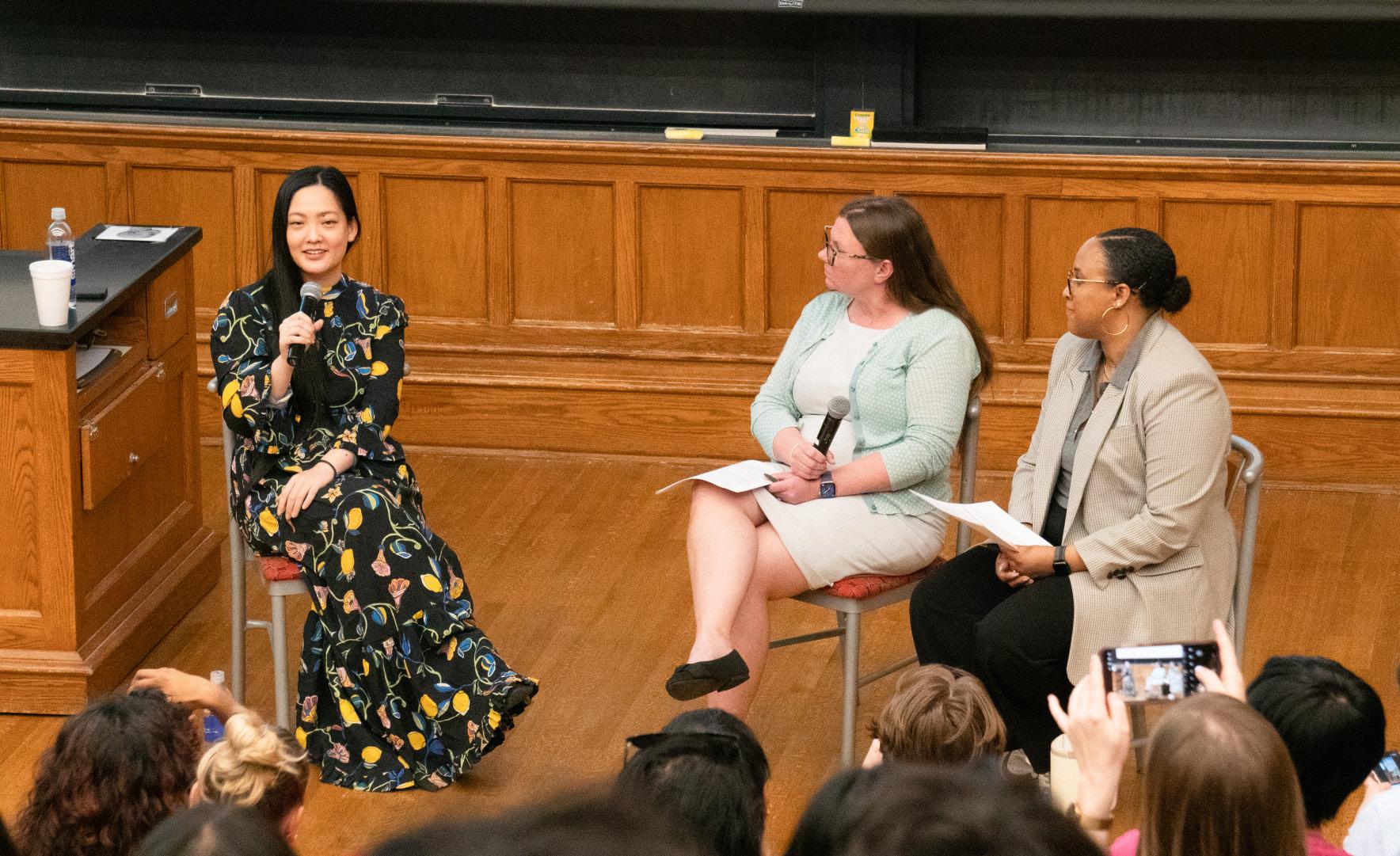
Activist Amanda Nguyen discusses her story with WashU community members.
ALEX DERING | PHOTO EDITOR
SCENE
One senior’s project to build community and preserve memories
As a line of students stretched through the second floor of Seigle Hall, the building buzzed with excitement. Seniors talked to one another about their post-graduation plans, complained about finals, and stressed about filing taxes.
Closer to the front of the line, people fixed their hair, adjusted their clothes, and asked friends, “Should I smile with teeth or without?”
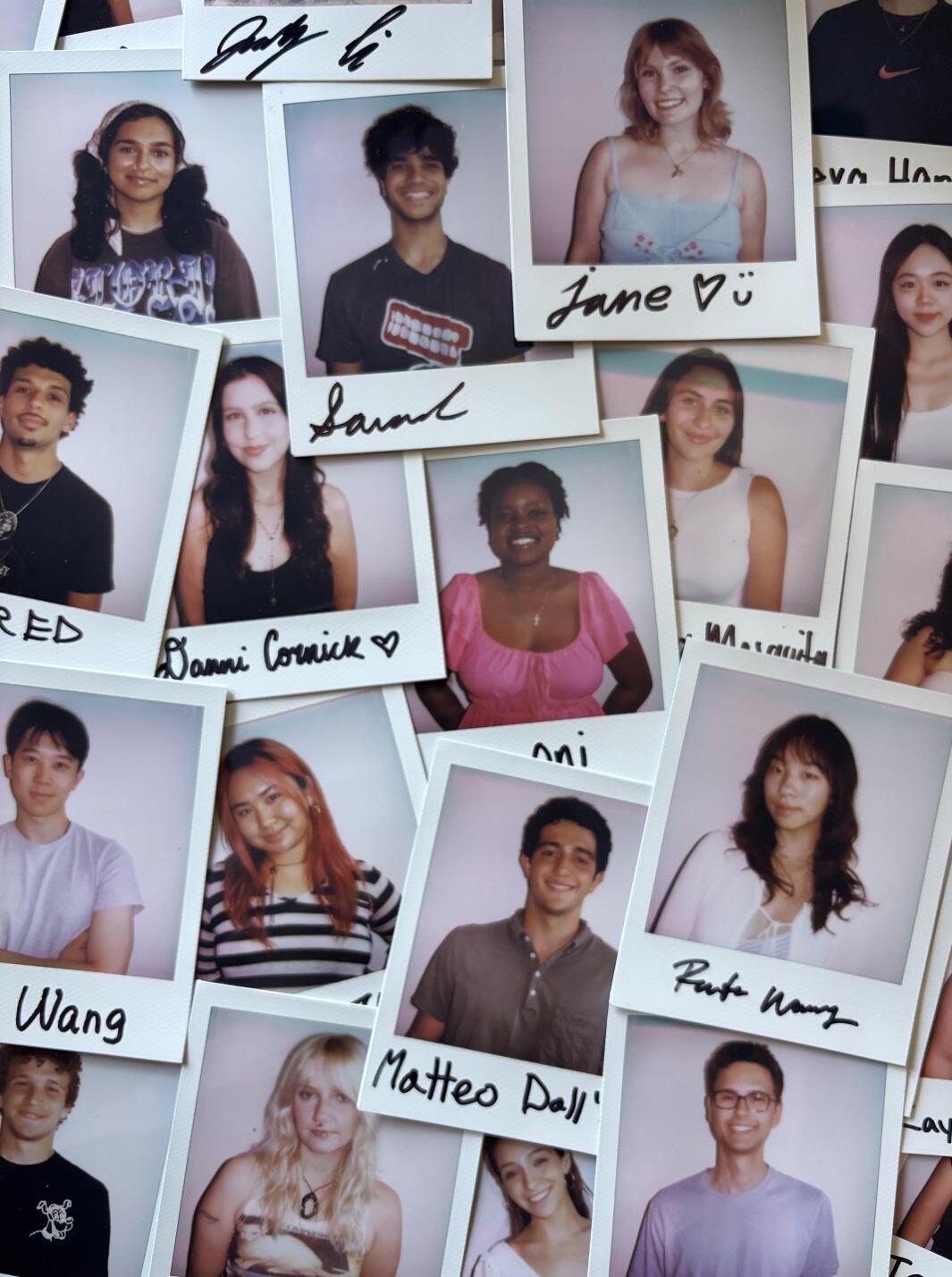
Ultimately, the long line led to senior Judy Li. Equipped with her camera, she greeted each person with an enthusiastic “Hi, how are you?” and a smile. She snapped their picture, handed them the developing Polaroid to sign, then added each photo to the growing stack that would eventually become the senior Class of 2026 yearbook.
Li’s initial vision of the yearbook began last year as small, handmade zines
she planned to give to just her graduating friends. After a conversation with then-senior April Springer, who had told her about WashU’s former yearbook, “The Hatchet,” Li’s project expanded into something more formal and extensive. She compiled photos and quotes from over 200 seniors in the Class of 2025 and created her own yearbook titled “The Washed of WashU.”
“I think what struck me the most about her yearbook project was that this wasn’t even her year that she started it,” Springer said. “She decided to undertake this very massive project to create yearbooks for a community that wasn’t really even necessarily her own.”
After publishing her first edition, Li returned to this year’s “The Washed of WashU: Volume II” with a clearer vision and redesigned multiple aspects of the yearbook. Her 2026 yearbook will include a new layout that features multiple students per page, seniors’ signatures on each photo, and a hardcover format so the book can lay flat. These changes reflect not only an attention to design, but also to how people will experience and interact with the yearbook. Like the project itself, the updates to the yearbook demonstrate Li’s thoughtfulness, care, and
commitment towards her community.
On the surface, the project seems like a onewoman show. Li handles almost everything herself: photographing students, coordinating with a publishing company, and designing the yearbook. However, Li views this yearbook as more of a collective project.
“I couldn’t have done it without people showing up and being curious enough and bold enough to show up to this random yearbook project,” Li said.
Madeleine Pira was one of the curious and bold seniors to participate in Li’s yearbook. She endured the long and winding line of students just to have her picture taken. What made the process worth it for her was the sense of connection the yearbook created.
“I just think it’s important to be part of community in both big and small ways,” Pira said. “I felt like this was a way to do that.”
She noted that the community building began while waiting to get her photo taken as she was “talking to [my friends] while waiting in line and seeing people that I maybe wouldn’t normally see around campus.”
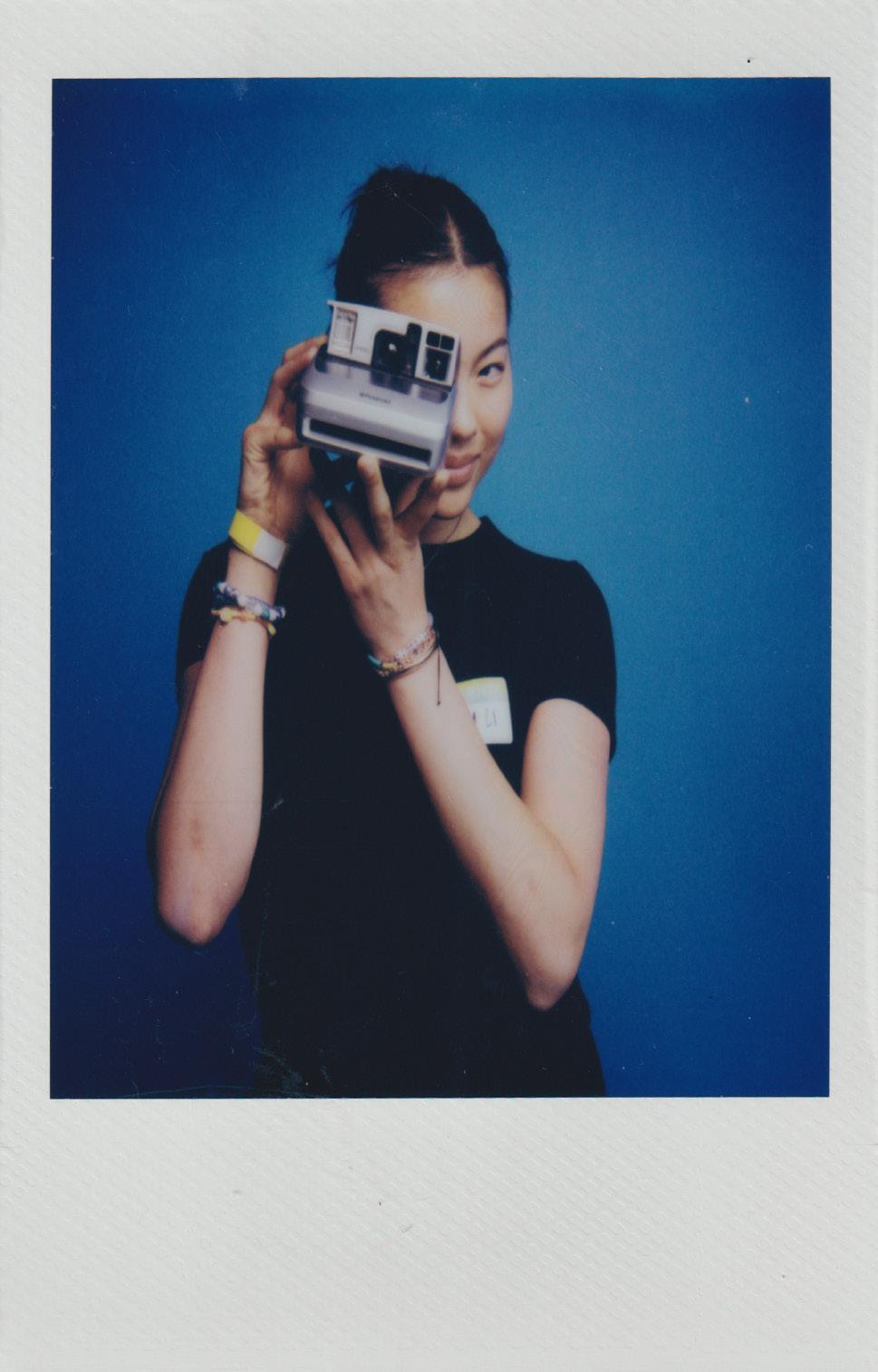
At the center of this project is Li’s Polaroid One600 Classic, which she has owned since high
CAPTION CONTEST
4/16 WINNERS
First Place: How I’m on my way to the final I did not study for and will not pass Al Tyliszczak, WashU alum
Second Place: ain’t nothing gonna break my stride Joana Carvalho, Current WashU Student
Third Place: Everything is normal. Nothing is wrong with my hair. My roommates did not shave it all off last night while I slept. Noa Levy, Current WashU Student
school. For Li, the choice of medium is intentional.
“What I love about the Polaroid is that it’s so instant,” she said. “You can just hand [photos] to them. … It’s like a physical memoir, which I love because we’re in such a digital age right now.”
Li’s appreciation for print media connects directly to the project’s archival significance. A copy of “The Washed of WashU” lives next to volumes of “The Hatchet” in Olin Library’s WashU Archives. Since the last edition of “The Hatchet” was published in 2011, Li’s yearbook fills a void that had been left empty
for over a decade. The overwhelming turnout and excitement for the project signaled a desire for this sort of work within the student body.
“It’s something that people are missing. People want a yearbook,” Li said. Springer sees Li’s yearbook as part of a broader responsibility to preserve WashU’s unique student culture.
“I feel like it’s a little bit incumbent upon us to retain what we know, as future generations will continue going to WashU and will be interested in that history,” Springer said.
ALIANA THOMPSON | STAFF ILLUSTRATOR
JENISE FUSSELL CONTRIBUTING WRITER
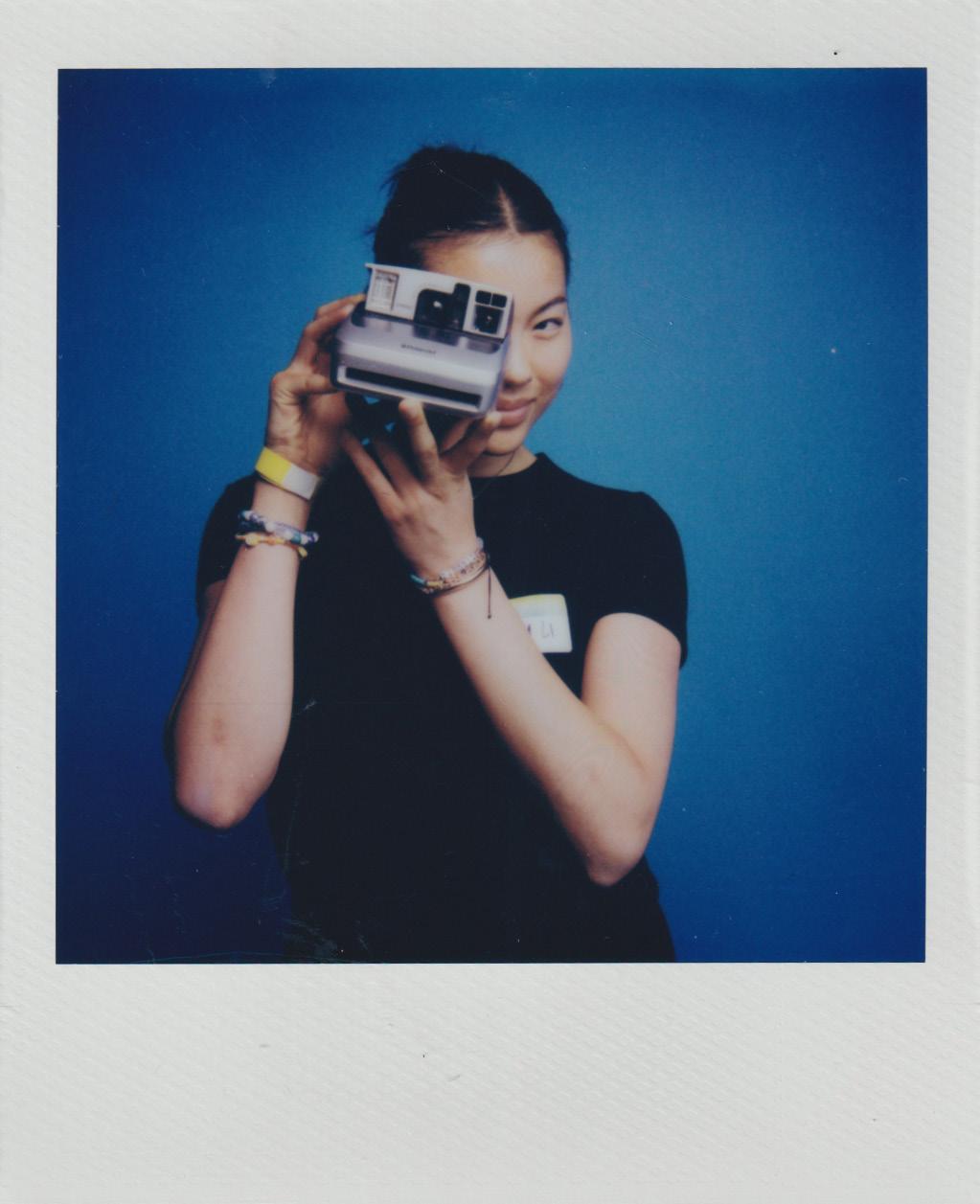
Senior Judy Li poses with her trusty Polaroid One600 Classic.
PHOTO COURTESY OF JUDY LI
Class of 2026 seniors sign their portraits before they are placed into Li’s yearbook.
PHOTO COURTESY OFJUDY LI
110 years later: Commemorating the induction of WashU student film into the Library of Congress
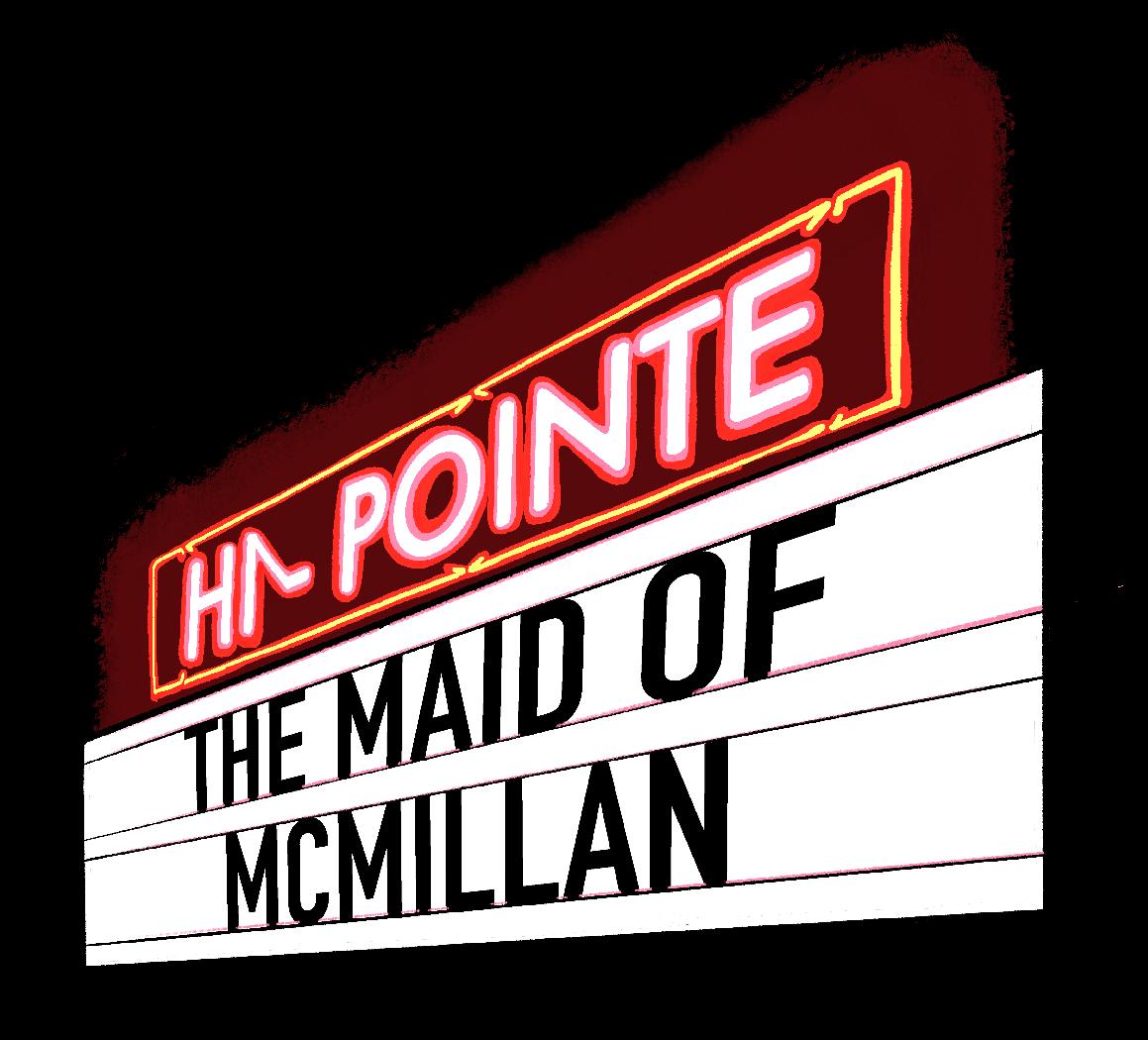
On Sunday, April 19, WashU students and St. Louis film fans sat down at the Hi-Pointe Theatre in Clayton for a glimpse into the past. In 1916, the drama club, Thyrsus, put together a short film named “The Maid of McMillan” as a fundraising effort for the Younivee Surrkuss (the predecessor to ThurtenE Carnival).
“The Maid of McMillan” begins with a charming and self-deprecating note from the producer imploring the audience to look at the film kindly, for it is the first ever student film. The film’s historical importance was cemented at the end of 2025 when it was inducted into the Library of Congress.
“The Maid Of McMillan” tells the tale of Jack Tower (Gordon Morrison, JD 1918), a WashU college athlete, and his romance with Myrtle Maroon, a fellow student who resides in the women-only McMillan residential hall (now an academic building). The film takes many turns, following the characters through shenanigans and escapades, as they attend track meets, climb down from windows, and fight highway ruffians.
The film was directed by
alums George Daniel Bartlett (JD ’20) and Donald Wilson Stewart (JD ’17). Donald later married Dean Marion McDaris (BA ’19), who plays the titular maid. There were also appearances by real members of WashU’s faculty at the time, such as track coach Bill Edmunds and Chancellor Frederic Aldin Hall.
“As it goes, the students got together, they wrote the script in four days, they shot it in four days, [and] they put it together. So for a very rushed job, it’s pretty sophisticated,” WashU’s Curator of Film & Media Lydia Creech, said.
The WashU Film & Media Archive was the result of an initiative by filmmaker and alumnus Henry Hampton, who donated his own collection to the archive.
“Since then, when we’ve acquired new collections or looked to expand, we’ve focused on documentary, civil rights-minded materials (or social issues in general) and production. So what makes our archive unique is that we have all of the materials that go into a film, not just the finished product,” Creech said.
The film equipment needed to create this film would have been very expensive and highly inaccessible. J.D. Wooster Lambert, the cinematographer, happened to
be personally interested in filmmaking, and managed to give the group access to equipment. The film was shot in 35mm nitrate, something that posed a series of issues in later preservation attempts.
“Nitrate [is] the chemical composition of the film material, and it’s infamous for being very volatile. Degrades quickly. It can catch on fire if it gets too hot, so that original was lost at some point in WashU’s history, but they had made a VHS copy, which is not the best fidelity wise, [as in] image quality, and then a 16 millimeter reduction print,” Creech said.
The archive later applied for a grant to digitally scan the film, put it back on 16mm and then blow it back up to 35mm.
“When we say restoration, we’re talking about not just the object, but the experience, or fidelity to the original,” Creech said.
At the end of 2025, “The Maid of McMillan” was officially recognized as the first student film ever produced after it was added to the Library of Congress. While taking 109 years between the film being produced and being awarded this title might seem like a lot, the process of deciding this was harder than it seems, as finding the
definitive first of anything is a difficult task.
“As far as we know, doing the research, going back to the fan magazines, checking with silent film scholars, amateur film scholars, this is the first one that we have found that survived. Because the other thing [with] silent film, [is that] a lot of them are lost,” Creech said.
Nevertheless, after a century of being celebrated at WashU, this important bit of the past is finally being commemorated at a national level as one of the 25 films selected last year.
“The public can, once a year, nominate films that they think should be [in the Library of Congress], and then it goes to a committee and they sit down and decide on the 25 for that year, but none of us nominated it. So what that would mean is somebody from the Library of Congress would have been aware of it, possibly through doing the grant — the National Film Preservation (NFP) grant — because that is a federally funded grant,” Creech said. “Someone at the NFP office or at the Library of Congress would have seen our film and then remembered it and thought it significant enough to nominate it, which [is a] massive honor.”
Current members of
Thyrsus who attended the Hi-Pointe screening left the theater feeling the legacy that the oldest club on campus left behind.
“As soon as we saw the intro, we were like, ‘This is the same. This is us as it is now.’ So if you like the ‘Maid of McMillan,’ you’ll like our other productions,” the PR chair for Thyrsus, sophomore Stella Holidae, said.
Beyond its historical importance, “The Maid of McMillan” is a time capsule to another WashU.
“It’s just fascinating to see that was someone’s life before, and it’s changed so much, and yet it stays the same,” Thyrsus president, senior Alanis Preciado Higgins, said.
“Seeing that in film, whether it’s in black or white, with or without voices, that there’s always that kind of WashU
energy there. I really appreciated being part of that kind of history.”
“The Maid of McMillan” is an invaluable piece of history and a rare glimpse into the lives of students who walked the very same halls as us over a century ago. Each grainy frame preserves the memories of a WashU some of us can only imagine. The film was created before any university had a film department. Its very existence is a miracle, as many silent films were lost, melted down for the war effort, turned to ashes by unstable materials, or victims to the passage of time. The “Maid of McMillan” is available online through the WashU Libraries site.
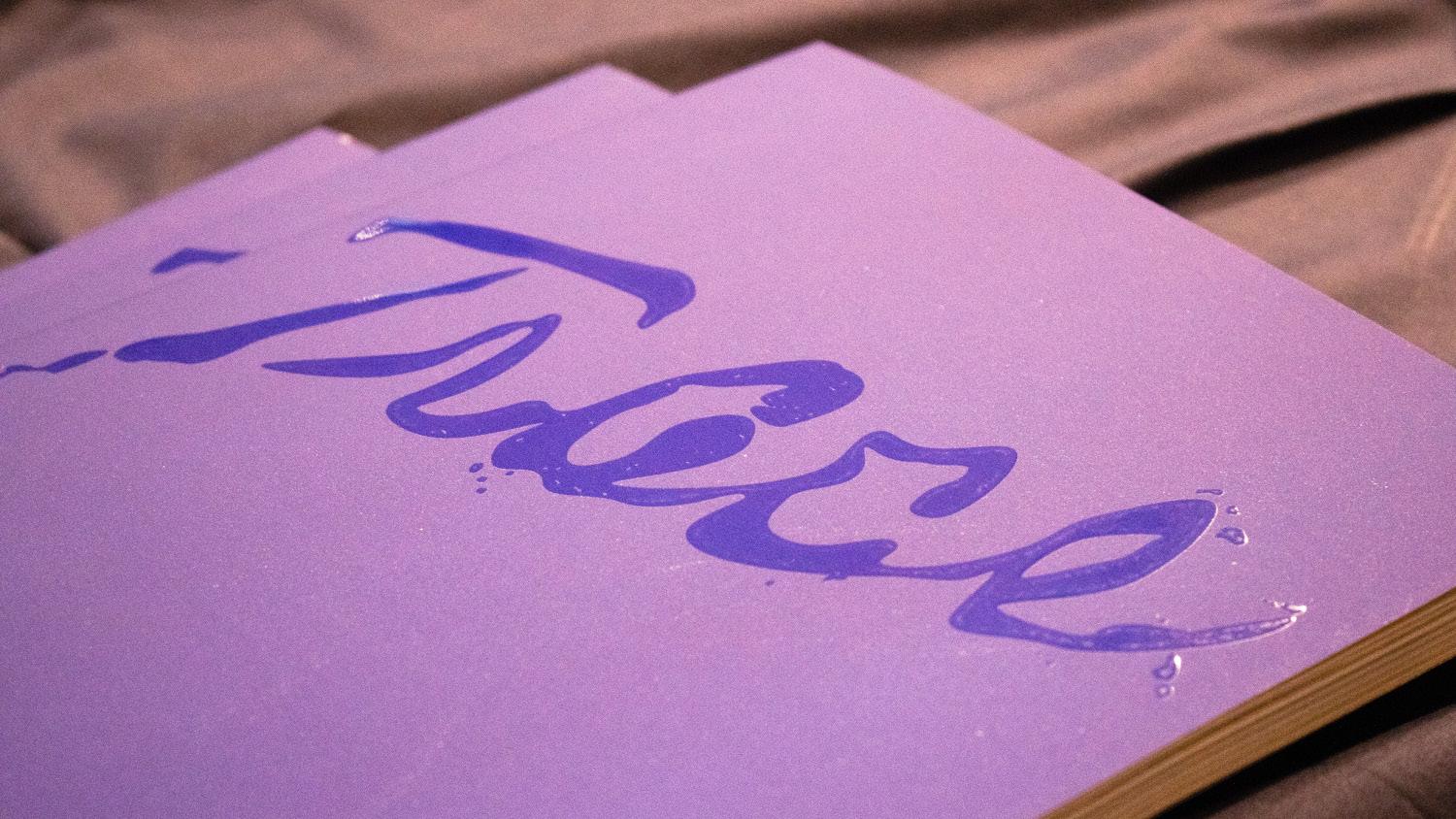
Armour launches 35th edition, ‘TRACE’
HANNAH LA PORTE MANAGING SCENE EDITOR
The creation of a student magazine rarely reflects a single voice. For Armour, one of WashU’s student-run fashion and culture publications, that multiplicity is the point. Built over the course of nine months, each issue exhibits not just the finished product but a process of collaboration, experimentation, and trust.
Production on this season’s issue began, as it always does, with a theme. The concept,
“TRACE,” was decided at the first full-team meeting in June, where the executive board gathered to begin shaping the magazine’s vision. The next step of the process is a pitch-fest, where all members of Armour (roughly 150 undergraduates) propose
editorial concepts over the span of several hours. Ideas are debated, refined, and ultimately distilled into around 20 potential editorials.
From that pool, a smaller selection — typically eight to 10 — make it into the final print edition, while other editorials are published online. This season’s issue includes nine editorials, along with an additional spread dedicated to Armour’s inaugural short film, marking a new creative direction for Armour as it expands beyond print.
The short film, entitled “Where Sight and Sound Falter,” was directed by junior Ethan Kim and produced by Armour. It is the first nonmagazine publication that Armour has sponsored and represents an expansion of creative endeavors piloted by Armour’s current editors-inchief, seniors Max Selver and Seo-eun Kim. They emphasized the work and collective effort it takes to run a publication of this caliber, and the vast range of students and talents that made it happen.
“It’s really a labor of love,” Selver said. “I think we had 167 people contribute to this issue in some capacity — not just in Sam Fox, but across really all of WashU.”
Despite the scale of the operation, much of Armour’s identity lies in its decentralized creative structure. After concepts are selected, creative directors are given the freedom to shape projects according to their visions, and they are entrusted with everything from visual direction to budgeting decisions.
For first-year Morgan Montoya, a creative director, writer, and model, that
freedom was one of the most defining aspects of her experience. She described being encouraged by the executive board to move beyond the confines of WashU’s campus and to engage more directly with the St. Louis community.
“[We’re encouraged] to be a part of the community and to express a message [that is] political, social, or just about how we feel as young adults in life,” Montoya said.
That balance between independence and collaboration appears across all roles in Armour. Evan Guyer, a sophomore who wrote for multiple editorials, emphasized the emotional investment in the projects that build over the course of production.
“It’s like it’s our child,” Guyer said. “I am so excited to see the culmination of all our work. And for it to be this tangible thing, I think is so cool.”
For many contributors, Armour offers a rare opportunity to move fluidly between creative roles. First-year Xavier Mason, who worked as both a creative director and a model, described the experience as both empowering and immersive.
“They gave us … the theme and they were like, ‘Do whatever you want — purchase whatever you want,’” Mason said. “They are supportive of funding whatever you need to do to get the vision done.”
Mason also pointed to the organization’s inclusivity, noting that Armour accommodates a wide range of interests and commitment levels.
“No job is too small, no job
is too big,” he said. “If you want to be a part of Armour, there is a spot for you somewhere. You can find whatever your niche is. … If you’re just wanting to try and test it out, just do it. … Go all in, don’t be scared of it.” That openness is supported by significant institutional resources. Armour operated during Fiscal Year 2026 with a budget of $46,712.37, with $39,779.56 already allocated for Fiscal Year 2027 — funding that enables the scale and ambition of its productions. According to Selver, the support received from Student Union is essential to maintaining both the magazine’s quality and accessibility.
“I feel so grateful that SU gives us the amount of funding and latitude that they do. … We really feel so lucky that we’re able to basically give whatever resources that students need to execute their creative vision,” Selver said. “When you take the financial element out of wanting to execute a project you’re passionate about, … it really makes such a big difference” In an era dominated by digital media, Armour’s commitment to print remains central to its mission.
“I think in this day and age, there’s something that feels very radical about a print magazine because everything is online now,” Selver said. “We feel that it’s important, given the amount of work all our students do, to produce that print magazine so that [people] can have that tactile experience to actually turn their pages and literally hold their work in their hands.”
Additional reporting was contributed by Elle Ludwin.
NICOLE BACKAL STAFF WRITER
ANNA DORSEY | STAFF ILLUSTRATOR
The cover of “TRACE” was designed by junior Evelyn Pae. PHOTO COURTESY OF NATHAN YAP
FORUM
Return to demonstrated interest threatens accessibility
DAVID CIORBA STAFF WRITER
Half a decade ago, WashU’s personal media team, The Source, interviewed Vice Provost for Enrollment Management Ronné Turner. It was a moment of celebration and progress. In the name of equity, WashU adopted a need-blind policy. They even scrapped demonstrated interest within the admissions process.
“All of this together makes us much more accessible to students from a diversity of socioeconomic backgrounds, students who are going to make an impact on our community and the world,” Turner said.
Now, just a few years later, WashU has gone back on its word. For high school students applying for first-year admission in fall 2027, demonstrated interest is back on the table. While the Office of Undergraduate Admissions plans to track applicants’ website searches and who signed onto their email list, the University cheerfully admits, “On the top of our
list (and hopefully yours!) is a campus visit.”
Despite the University’s sentiment, demonstrated interest is, and continues to be, an inequitable policy.
Though WashU’s decision to reinstate the policy comes with nuance, the decision must be critically examined.
WashU’s reestablishment of demonstrated interest comes in the wake of financial struggle and uncertainty. Earlier this year, the University predicted a $7.4 million deficit for Fiscal Year 2026 (FY26). Furthermore, potential shifts in federal research funding models and changes to Medicaid funding implicate an uncertain financial future. Money is short and might get shorter. For WashU, a return to demonstrated interest may ease the burden.
It’s a well-documented move in the higher education playbook. Demonstrated interest favors applicants who are more likely to enroll. That means institutions can deal out fewer admittance letters while ensuring dorms are filled. Additionally, admissions rates drop, and finances
become more predictable.
The return to demonstrated interest is a decision that prioritizes selectivity and financial stability while sidelining equity in the process.
In a 2017 study, researchers found that a mid-sized selective university placed more emphasis on costly contact with the university (campus visits) than others (attending school information sessions) in the admissions process. Those who had the means to make costly contact with the university had a higher chance of getting in. WashU appears to be no different with their largest emphasis on campus visits, a trip that can take a day, weekend, or more. Add on the costs of three meals a day, a place to sleep, and a means of transportation, and it becomes obvious that this policy favors affluent students.
It would be one thing if WashU was unaware of the inequitable implications of demonstrated interest. In her 2021 interview with The Source, however, Turner succinctly encapsulated the policy’s largest drawback,
stating, “We know that demonstrated interest puts students from rural communities, first-generation families, and high schools with low college-going rates at a disadvantage.”
Turner, speaking for WashU admissions, clearly recognizes the inequitable impact of demonstrated interest. WashU decided to reinstate the policy despite their knowledge of how it may alter campus demographics.
The decision comes with an alarming shift in WashU’s student body for the Class of 2029. The percentage of Pell-eligible students, those receiving financial aid, and first-generation students each dropped. As demonstrated interest factors into the Class of 2030’s admissions, these “blips” could very well become trends — curating a space that favors affluent students while discarding those with lesser means.
Famously, WashU has fallen short of supporting socioeconomic diversity in the past. Since then, the University has implemented successful policies (such
as the WashU Pledge and need-blind admissions) to increase its accessibility. In 2024, Chancellor Andrew D. Martin told the Missouri Independent that he prioritized education accessibility as “one of the three pillars of [his] leadership.”
WashU is in a sticky situation. While on one hand, the University has repeatedly emphasized supporting lower-income students, it is also struggling to make ends meet. The return to demonstrated interest may buoy the University, but it comes at the cost of WashU’s commitment to socioeconomic diversity. I don’t argue that WashU should return to its old admissions policy. But it is our responsibility as students to pay attention to the tension between the University’s supposed values versus the real-life impact of its policies, all while keeping finances in mind. For now, I will continue watching to see who WashU favors, and by proxy, what WashU becomes.
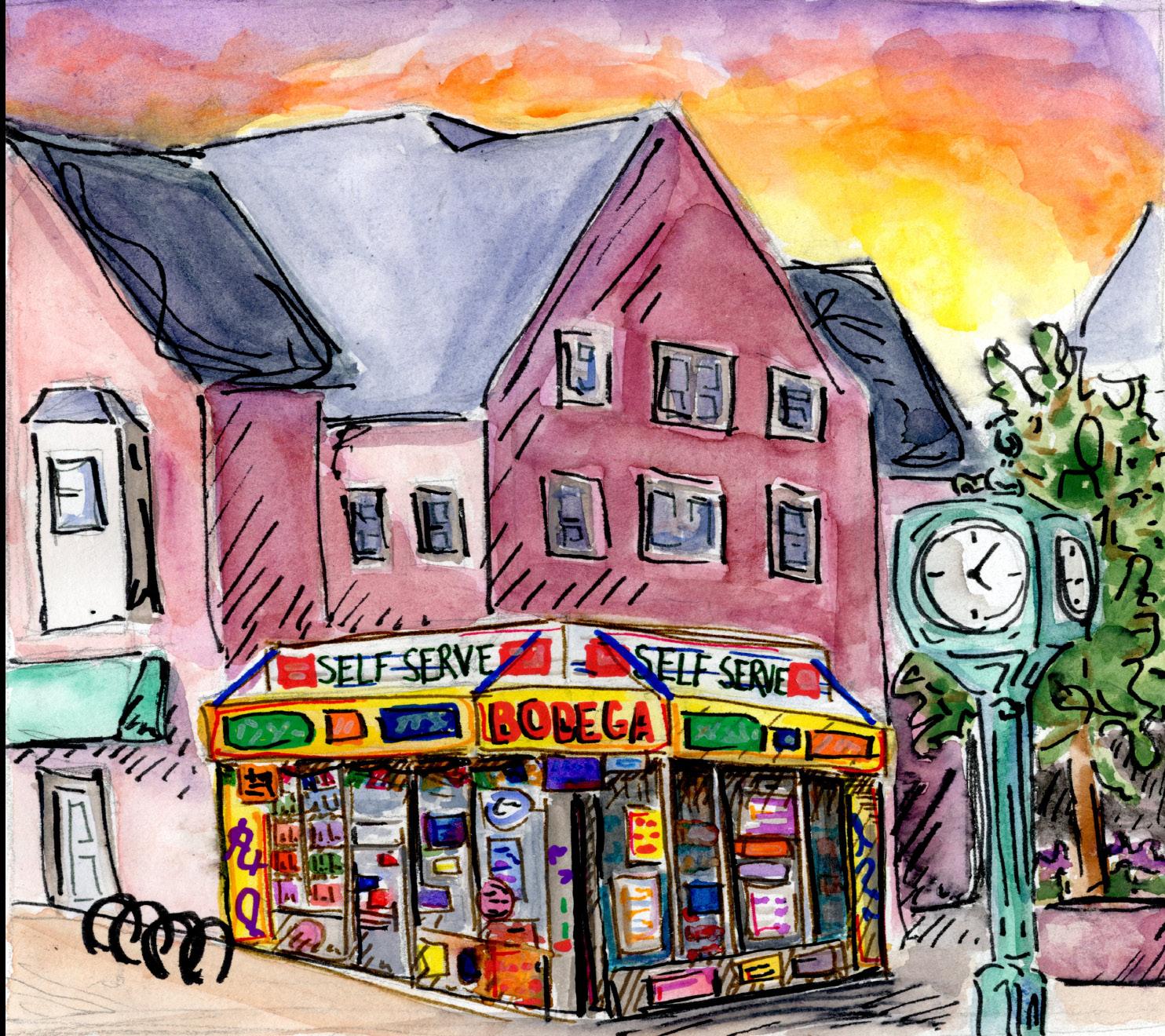
The new Bear Bodega is anything but
LISSY PORTORREAL
CONTRIBUTING WRITER
The other day, walking to my 10 a.m. class, I saw the plastered vinyl stickers next to Ursa’s Fireside calling the new 24-hour convenience store the “Bear Bodega.” I was confused. I had heard lots of rumors about the store, but never once heard of its name. Using the word “bodega” to describe this convenience store contributes to the erasure of Caribbean culture and traditions.
The word bodega originated in Spain during the 1800s and was first used to describe wine cellars. Over time it was adapted and used to describe convenience stores across the Caribbean. In the 1920s, the term was adopted in New York to describe Puerto Rican- and Dominican-owned corner stores which often sold hot food and hard-to-find Caribbean ingredients. Today, there is a lot of debate about what makes a bodega. Some believe it needs to have hot food, others think it needs to be open 24 hours, but there are some ubiquitous aspects of bodegas: They
are small businesses, often family-owned, and always of Hispanic origin.
My hometown, Lawrence, Massachusetts, is about 85% Hispanic and has the second highest concentration of Dominicans in the United States — second only to New York City. Lawrence is a densely populated but small city, and due to its prominent Latine population, it has countless bodegas.
I spent most of my summers as a child at my grandma’s house. Her home sat in the middle of a one way street, but twice a week she sent me — along with my sister and my cousin — up the road to the bodega. Sometimes she would request random ingredients for lunch. Other times, she would hand over a $10 bill to split amongst the three of us. We would stand in the bodega, debating whether to spend the last 50 cents on a fruit barrel juice or a piece of candy. Through this ritual the older man at the counter would often check in with us, ask us about how school was, and tell us to behave for our grandma. If we were short on money,
he would tell us that we could pay next time. Sometimes he would even throw in a few extra SpongeBob SquarePants Krabby Patty gummies — my personal favorite.
The older man behind the counter was nicknamed “Security” due to his knowledge of everyone’s problems and the neighborhood gossip. He would often cover costs, knowing that people would pay him back after their next paycheck.
A bodega is more than just a convenience store — it is a social center. Neighbors would check in with one another, gossip about an ongoing divorce, or ask about your extended family back in the Caribbean.
The 24-hour convenience store follows a push students want for extended dining options. But the Just Walk Out technology follows a greater trend of what some label “convenience culture.” From food delivery apps to AI-driven productivity, there is a constant drive to create the most efficient and convenient business models. This comes at the cost of human interaction and further alienates
workers from consumers.
The new Bear Bodega has no cashiers, no human connection, and no bodega man to take care of the community. It will be nothing like the bodegas I grew up with.
WashU students had the opportunity to submit names
a bodega
for the new 24/7 convenience store through a dining services survey. The winner got a reward. While I am not blaming the student who submitted this name, it was a moment of oversight for WashU to choose it without thinking of the cultural significance that comes with the word “bodega.”
Dining services’ commitment to honor inclusive dining extends beyond accessibility and inclusivity of food choices — they also need to be conscious of how they represent a diversity of cultures.
Engineering students must take ethics
Last month, engineering students were notified that completion of the course “ENGR 4501 - Engineering Ethics and Sustainability” is no longer required for their graduation due to the closure of the Engineering Communications Center (ECC). In our rapidly advancing technological age, it is more important than ever for engineering students to engage with ethical thinking during their education. The McKelvey School of Engineering should reinstate an ethics course requirement for its students. Innovation has always
operated on the frontlines of society’s ethical challenges. New technology stewards progress but can also introduce new ways to enact harm. For example, humanity has undoubtedly benefited from the invention of modern medicine. But would the world be better off if engineers had refused to invent nuclear weapons? There is no direct answer to a question like that. This complexity is precisely why engineering students must take ethics courses. Through learning ethical theories and testing their application to case studies, the next generation of innovators will be inspired to think critically about what they create. Our budding age of
artificial intelligence (AI) makes equipping our upand-coming engineers with ethical mindsets especially important. Prior to the public release of ChatGPT in late 2022, AI likely felt irrelevant to those outside of the tech or engineering world. Not even four years later, hundreds of millions of people use the technology daily. This “AI boom” has meant that its ethical implications are sidelined as companies prioritize capitalizing on demand. Take OpenAI, the company behind ChatGPT: In February, the company eliminated their “mission alignment team,” which ensured that their work on “artificial general
intelligence benefits all of humanity.” And earlier that month, research scientist Zoë Hitzig publicly resigned from her position at the company, citing fears about OpenAI’s increasing use of coercive advertising. In this way, the ECC’s closure represents wider trends relating to the deprioritization of ethical thinking around today’s top innovation — AI. You could argue that one ethics course requirement wouldn’t inspire students to reject their job offers from weapons manufacturers or other questionable companies. If one is not socialized to care about the ethics of their work, perhaps a onecredit class in undergrad
would not make a difference. But do states repeal driver’s education requirements because some people will drive recklessly no matter what? It is inevitable that some students will not care about their engineering ethics class, but the lessons will still resonate with others.
Still, the idea that the engineering ethics requirement was ineffective demonstrates larger issues in the way our society understands the purpose of higher education. With the rise of preprofessional culture in universities across the country, many students don’t view college as an opportunity for transformational personal growth. Instead, they understand higher education as a
transactional step to one’s future job. There is no wonder, then, that McKelvey deprioritized ethics courses in their curriculum.
But college is not just a place to obtain technical skills — it should be an opportunity to develop your values and worldview. Graduation requirements across all disciplines should reflect that premise.
Part of McKelvey’s mission statement is to make a “positive impact on the local community, the country, and the world.” Amidst the budgetary constraints, McKelvey must remember their stated commitment to ethical responsibility.
MARCELINE LEE | ILLUSTRATION EDITOR
ELLA SKYE HEISEL | STAFF ILLUSTRATOR
MADDIE MORGAN FORUM EDITOR
Led by first-years, No. 6 softball sweeps Brandeis, extends win streak to nine
BEN OLLENDORFF SPORTS EDITOR
After making it to the regionals round in the NCAA Division III Championship in each of the past two years, the No. 6 WashU softball team is hoping to make it to the super regional round for the first time since 2007, the year that many of their first-years were born. The team has set a high standard of success as reigning University Athletic Association (UAA) conference champions. So far this season they have a 22-3-1 record and continue to raise the bar from last year’s 34-7 performance.
This doesn’t even reflect the dominance that the Bears have had this year. Since starting UAA play, WashU is 10-2, with seven of its victories ending early due to mercy rule. This leaves the team tied for first in the conference and ranked third in the D-III NCAA Power Index with eight games left in regular season play. If the Bears want to reach their third straight NCAA D-III regional, they’ll have to continue to excel and extend their ninegame win streak.
Out of the 24 members of the team, there are 10 new first-years that have wasted no time in making an impact. First-year outfielder Julia Sullo is batting almost .500, reaching base in 55% of her at-bats, and leading the team with 43 hits.
Off the field, the upperclassmen have played a large role in welcoming the younger players to the team. In turn, the first-years have brought new energy.
“[The first-years] have influenced our team culture
for the better in so many ways this year, kind of in the same way that we upperclassmen have welcomed them into our preexisting team culture,” senior outfielder Sydney Schneider said. “I think that’s why we’re seeing so much success on the field this year, because it really feels like in my four years I’ve never seen such a close-knit, wellconnected team.”
These connections have fueled the team’s offensive play, producing over seven runs per game with a .367 combined batting average that is key to getting runners on base. In addition to the young talent, sophomore catcher Harper Nix, junior outfielder Kristina Donaldson, and senior catcher Alexa Hanish are all batting around .400.
“One of the real strengths of our team is how well rounded we are,” Schneider said. “We have a starting nine, but anyone can come in at any given moment and perform well in the role that they’re given.”
Combined with the explosive offense is some stellar pitching. Junior pitcher Maria Brooks has a 1.33 ERA and 88 strikeouts, resulting in her perfect 12-0 record. The rest of the rotation has also looked strong so far with junior pitcher Hattie Bond and first-year pitcher Jessi Szafoni having 2.36 and 1.80 ERAs respectively. In total, they have shut down their opponents, holding them to just a .203 batting average.
This past weekend the Bears highlighted their skill, sweeping Brandeis University, another UAA opponent. Their game on April 17 started out as a
defensive stalemate. Brooks struck out the side in both the first and second inning.
The Judges got on the board first with a two-run home run in the bottom of the sixth. Down to their final chance, WashU had to get its offense rolling. With runners on the corners, junior second baseman Elena Locascio laid down a successful safety squeeze, bringing in a run.
An RBI double from junior third baseman Kennedy Grippo tied the game at 2-2.
Sullo knocked in an RBI single while junior utility player Julia Nicholus hit another RBI double, putting WashU up. Brooks finished the complete game giving up only five hits and earning the Bears a 4-2 victory.
“The theme of the weekend, and just our season overall, has been our ability to really fight back and want it enough to just string things together and make things happen,” Schneider said.
On Saturday, April 18, during the first game of the doubleheader, WashU controlled the game from start to finish. Sullo started the offensive barrage with an RBI single before stealing home to plate the Bears’ second run of the game. Nix added in by hitting a two-run homer. The Bears extended their lead to 6-0 after scoring two more runs at the top of the fourth inning. At the top of the sixth, Grippo hit an RBI single and Donaldson recorded a two-run double putting WashU up 9-0, resulting in the game ending after just six innings. Szafoni thrived in her best outing of the season so far, a complete game shutout allowing just four hits.
“As we’re moving into the postseason, you can
definitely see that there’s a lot of trust between the players,” Szafoni said. “I know I can trust my defense, and I’ve shown that they can trust me, so I think that’s been helping us a lot.”
In their last game of the series, the Bears once again got ahead. Sullo scored on an unearned run in the first, and an inning later, Hanish knocked in a two-run single. Brandeis responded with an RBI double in the second and two home runs in the third.
Uncharacteristically, the Bears trailed 4-3, but not for long: Nicholus’s RBI double tied the game at 4-4. At the top of the sixth, senior shortstop Jamie Cendana homered and Nicholus scored off an error. Brooks came into the game in relief and managed to hold the WashU 6-4 advantage, picking up her 12th win this year and the Bears’ ninth consecutive win.
There’s still more work to be done before the playoffs, which start in the middle of May. The Bears have three
more series scheduled, two of which are against UAA opponents. Their regular season ends with a key matchup against Emory University, who is currently tied with WashU for first place in the UAA with a 10-2 conference record. WashU has high ambitions, but the team is taking it one practice and game at a time, knowing success is on the horizon.
“I’ve really kind of rallied the team around this quote,
which is, ‘When the goal is to experience, everything becomes a win,’” Schneider said. WashU looks to improve their UAA record, hosting Carnegie Mellon University at home for a three-game series on April 24 and 25. Editor’s Note: Harper Nix is a Sports Editor at Student Life. She did not have any involvement in the writing or editing of this story.
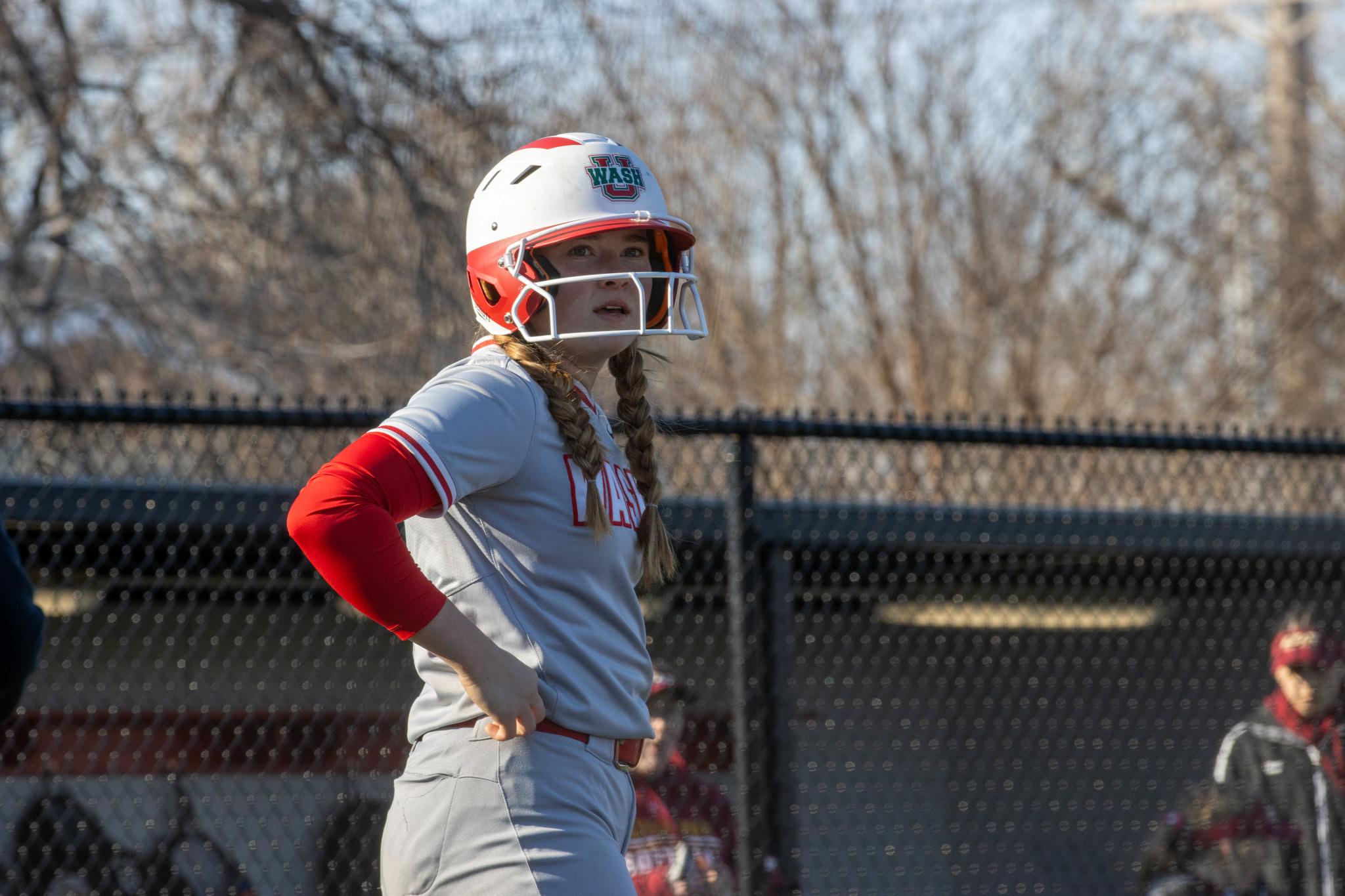
Sophomore utility player Emma Dow waiting for her at-bat.
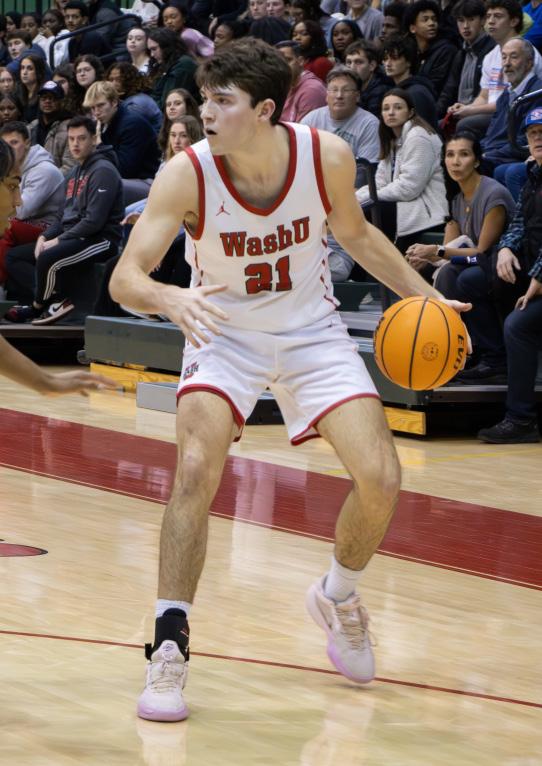
Connor May, men’s basketball standout, to transfer to Yale
MATT EISNER STAFF WRITER
Sophomore forward Connor May, the leading scorer on the WashU men’s basketball team in the 2025-26 season, is transferring to Division I Yale University. May confirmed his transfer in a post on his personal social media pages on Wednesday, April 22, noting that his transfer is pending admissions.
No.
Despite playing most games as the Bears’ sixth man in the 2024-25 season, May won the University Athletic Association (UAA) Rookie of the Year award after averaging nearly 12 points per game in 25 minutes per game. He continued his success in his sophomore campaign, leading WashU with 17.3 points per game and 7.2 rebounds per game en route to being named a
third-team All-American. May and the Bears advanced to the Final Four in 2025 and the Sweet 16 in 2026.
May’s transfer is undoubtedly a big loss to a WashU team that will likely have to rebuild in 2026-27 without May and graduating seniors Yogi Oliff, Calvin Kapral, and Will Grudzinski. Last year, the Bears’ next-leading scorer recorded just
10.8 points per game; the Bears must find a way to replace May’s production in the frontcourt, either by increasing playing time for the four returning forwards on the Bears’ current roster, through first-year recruits, or recruiting in the transfer portal themselves.
May joins a strong Yale team, which was the best team in the Ivy League during the 2025-26 regular season. However, the
Bulldogs lost their bid to Division I March Madness in an overtime thriller against the University of Pennsylvania in the Ivy League tournament. Yale graduated three seniors after the 2025-26 season, including leading scorer and fellow forward Nick Townsend. May could factor into Yale’s rotation as soon as the 2026-27 season.
2 women’s and No. 11 men’s tennis secure weekend
victories, continue historic success against North Central College
CECILIA O’GRADY STAFF WRITER
The No. 2 women’s and No. 11 men’s tennis teams finished the weekend with only one lost match against North Central College at WashU’s very own Tao Tennis Center with a final combined score of 13-1.
Women’s tennis
On Saturday, April 18, the women’s team faced North Central at home. In a strong performance, the Bears finished the day with a 6-1 victory, handing the Cardinals their second loss in a row and seventh of the season.
In No. 1 doubles, senior Eliana Hanna and sophomore Ally Lin won 7-5. Lin went on to win University Athletic Association (UAA) Athlete of the Week.
The momentum continued for the Bears when sophomore Sam Slowik and first-year Lily Brecknock took out their opponents with a 6-1 victory in No. 2 doubles. To close out doubles, sophomore Chloe Brissett and senior Nina Moravek shut out the Cardinals in the No. 3 matchup, 6-0. All six singles matches finished in two sets, with a combined seven points
retirement, causing Hanna to win by default.
During the No. 2 singles, sophomore Caitlin Bui defeated her opponent, scoring 6-0 in the first set and 6-1 in the second. Lin won 6-1 and 6-2 in the No. 3 singles. The No. 4 singles match between senior Amber Edmonds and her opponent resulted in another win for the Bears, with a final match score of 6-0 and 6-2 in her two sets, respectively.
Men’s tennis
Men’s tennis began their matches shortly after the women’s and had a strong showing against the Cardinals ahead of the UAA championships with two singles matches going to three sets — ending the day with a 7-0 victory.
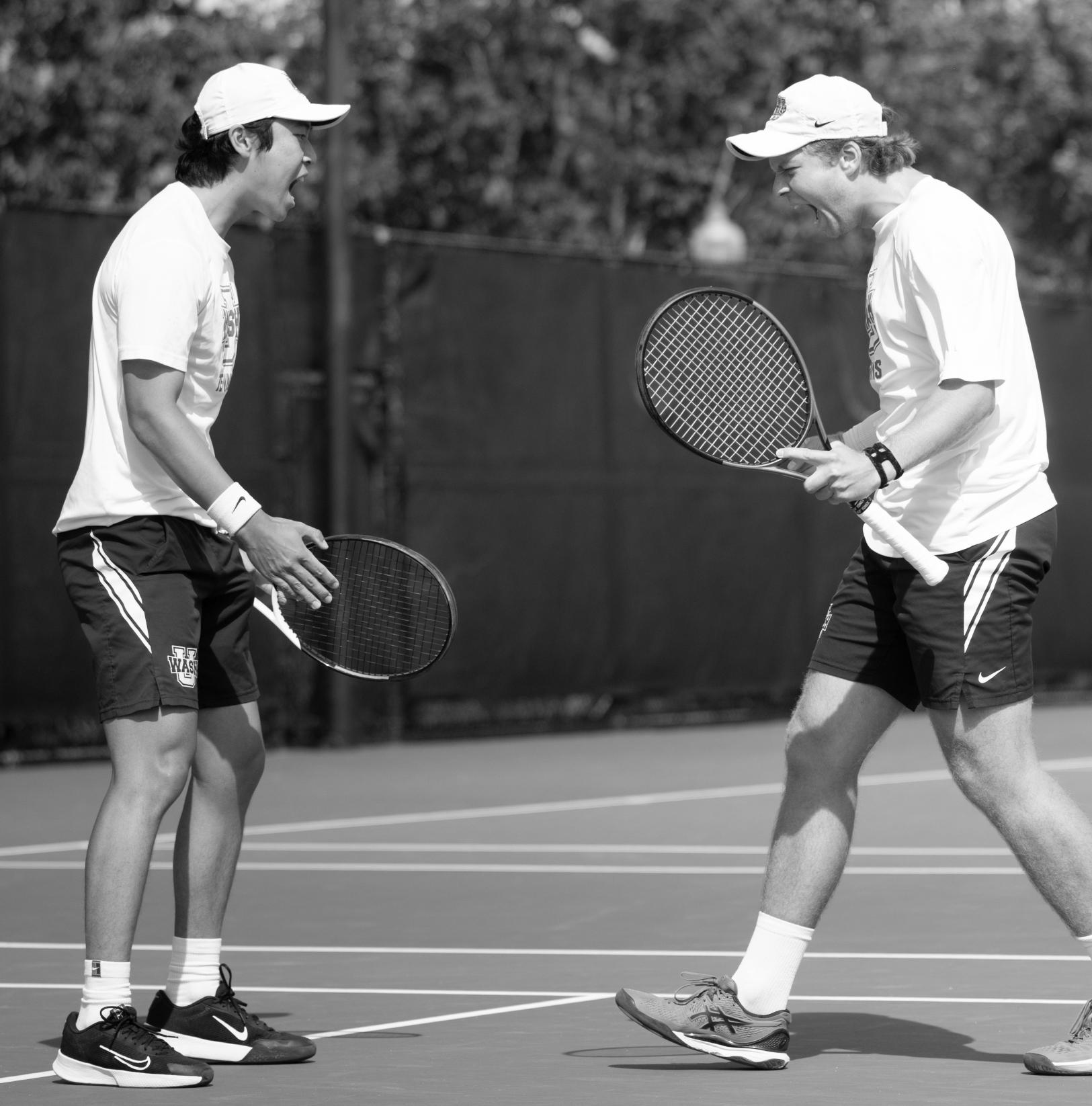
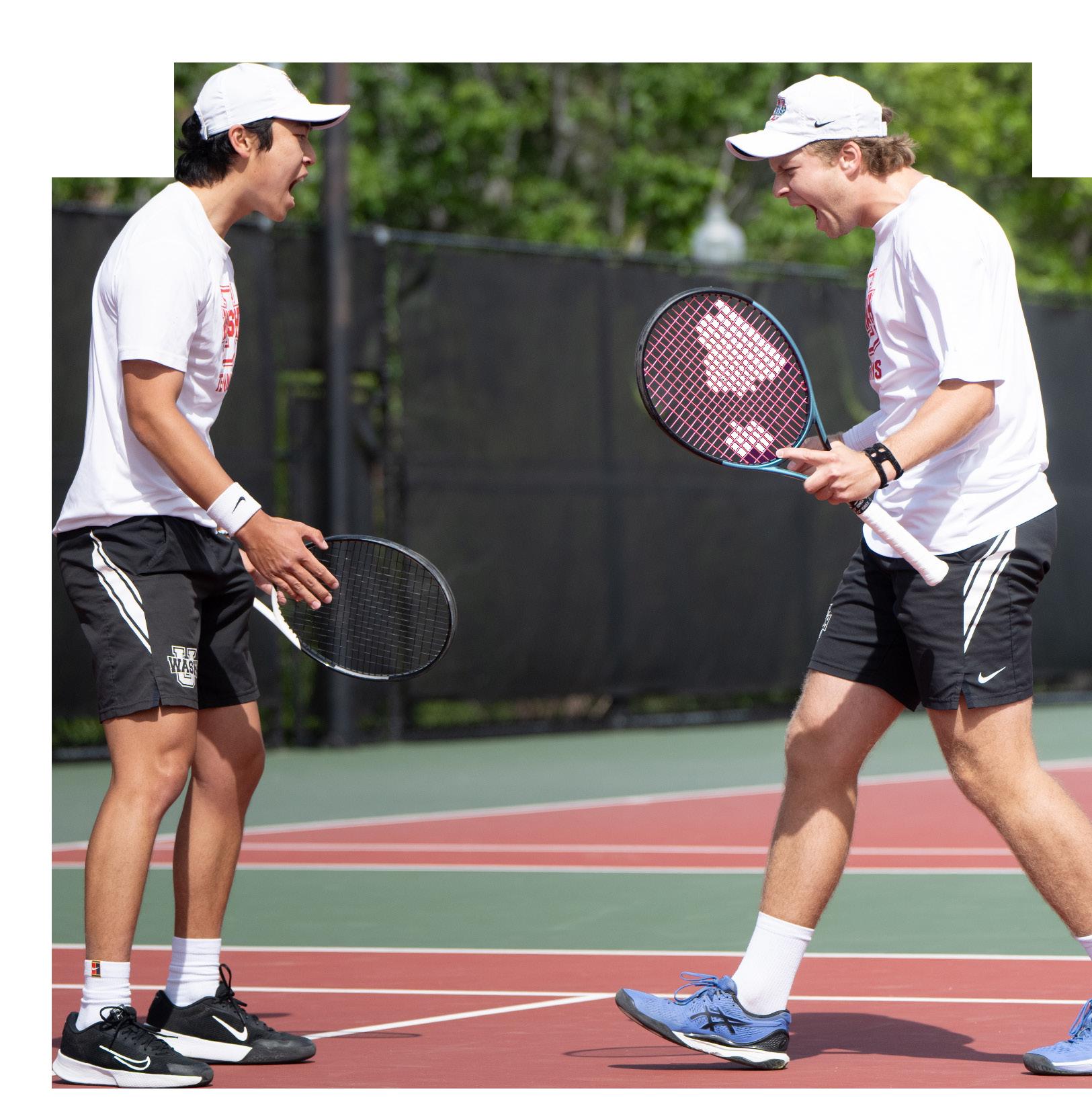
In No. 1 doubles, WashU senior Colin Fox and first-year Jeremy Sieben took the first win of the day for the men with a score of 6-3. Sophomore Drew Koval and junior Nathan Tam took No. 2 doubles and also won with a score of 6-3. Finally, senior Colin Scruggs and first-year Ethan Wu competed in No. 3 doubles and secured the final doubles victory of the day with a score of 6-2 against their opponents.
in the No. 2 singles match. Sieben won the first set 6-4 but fell behind in the second set, only managing 5 to his opponent’s 7 points. However, he managed to finish the match strong, winning the final set 1-0.
In the No. 3 singles match, Fox won his match in two sets, 6-4 and 6-1, respectively. Sophomore Avi Mahajan also beat his opponent at No. 4 singles in two dominant sets, finishing 6-3 and 6-1. Tam finished up the No. 5 singles match with a score of 6-3 in the first set and 7-6 in the second.
Junior Daniel Radke took on the No. 6 doubles match against North Central, which lasted three sets and ultimately came down to a tiebreaker. The first set went to Radke with a 7-6 score, but Radke lost the second set 4-6. Nevertheless, he managed to come out with the victory in a 13-11 score in the tie-breaker match.
After a strong end to the regular season, both teams will compete in the University Athletics Association championships next weekend, April 23-26, in Altamonte Springs, Florida. The women’s team will attempt to improve their 2025 achievement of third place and the men’s team, fifth. The men’s team, who are
Junior Nathan Tam and sophomore Drew Koval celebrate their No. 2 doubles victory.
BOBBY KAPLAN | STAFF PHOTOGRAPHER
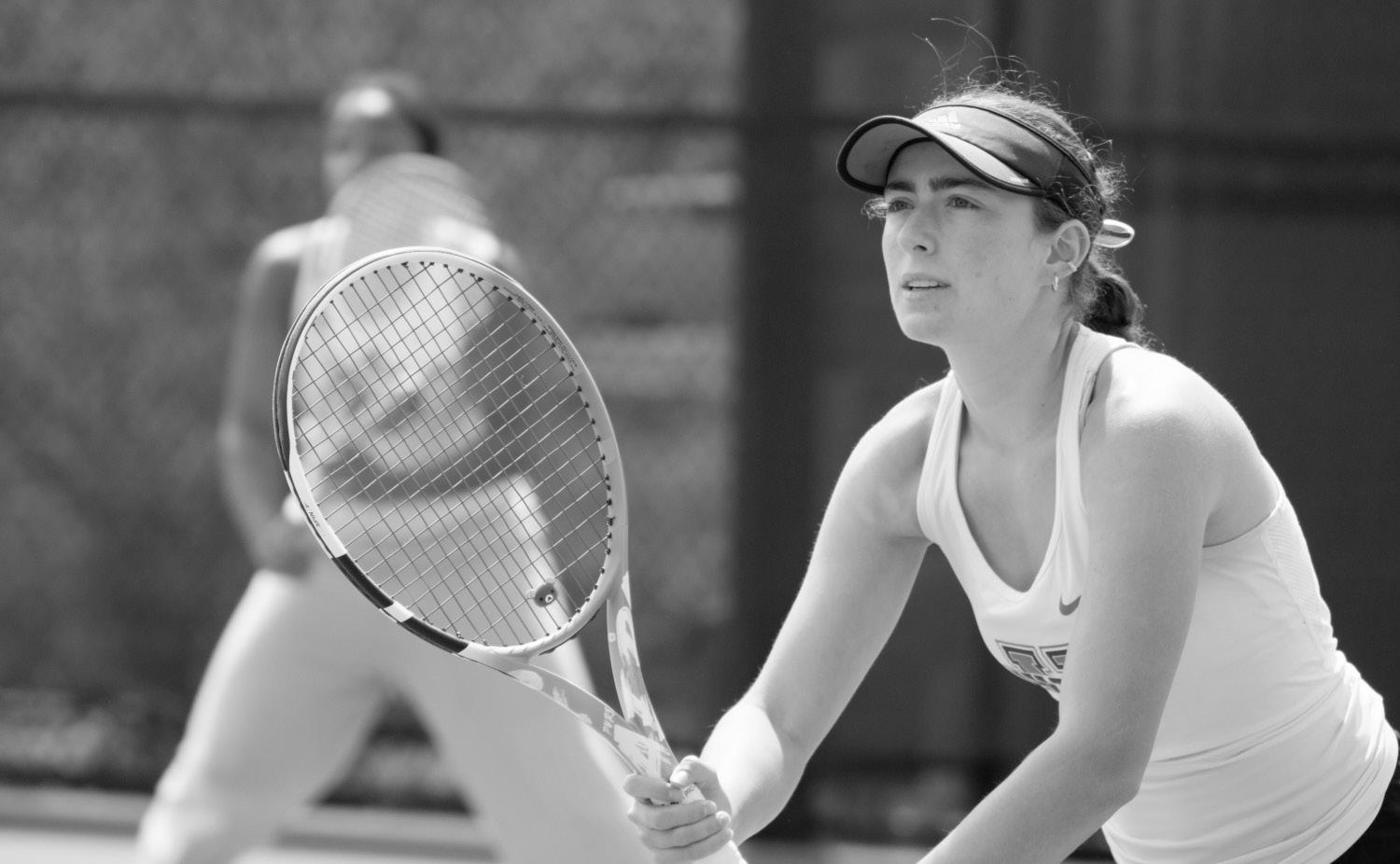
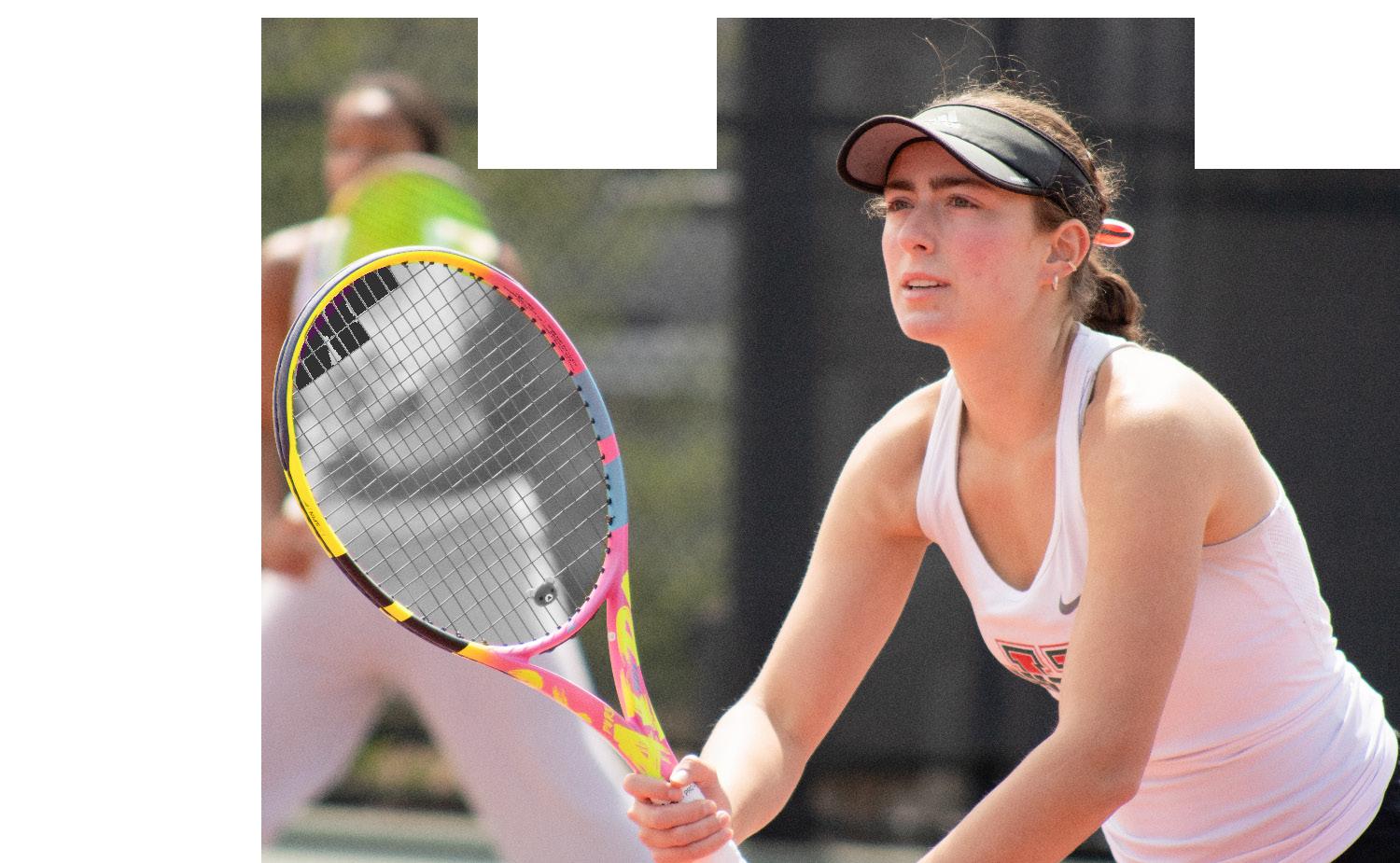
Senior Nina Moravek defeated North Central College in doubles and singles, not letting her opponents win a single set.