
WashU students weigh in on midterm results and ballot items
police funding in Kansas City.
Sophomore Eric Abrahams said he believes legalizing weed will move Missouri forward in racial equality.
949 students and community members voted at the Sumers Recreation Center in the mid term elections this Tuesday, Nov. 8. Voters decided on Senate and House seats, police funding, and the legalization of marijuana, among other ballot items.
The Gephardt Institute for Civic and Community Engagement hosted student bands and provided food and entertainment for people outside of the voting center, and people could sign up for a virtual waitlist to be called in to vote.

In Missouri, Republican Eric Schmitt won a Senate seat; six out of eight House seats went to Republican candidates; and St. Louis Congresswoman Cori Bush won her re-election. Missouri voters also voted yes on Amendment 3 to legalize the sale and possession of marijuana for people 21 and older.
On campus, students turned out to vote for a variety of reasons.
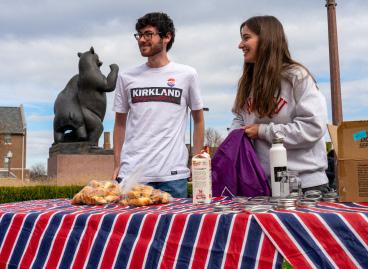
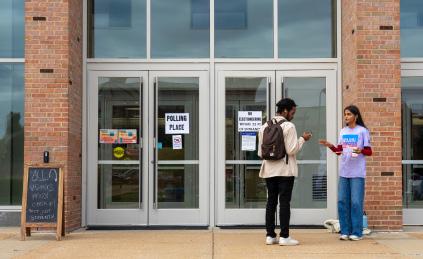
Some out-of-state WashU students voted in Missouri because they believed their vote mattered more here than at home.
“I’m from New York and I’m a Democrat, so I thought that my vote might not count as much if I vote in New York,” Freshman Dani Brinberg said. “[NY is] a clas sic Democratic state and I thought that it would be better to make an impact here.”

Many students felt strongly about two amendments up for vote, including Amendment 3 and Amendment 4, which increased
“It’s going to help to solve some of the inequities that we have in our criminal justice system,” Abrahams said. “I think it’s also going to be a good thing for the economy because it is a pretty powerful industry.”
Some students did not want to support the amendment when major political players, like the Missouri NAACP and Cori Bush, came out against it. According to a St. Louis Post-Dispatch article, Nimrod Chapel Jr., president of the Missouri NAACP, said that the amendment will allow powerful cannabis companies to “[misuse] political power and [take] advantage of working families.”
The Post elaborated that “Amendment 3 would give the first ‘comprehensive’ marijuana busi ness licenses to existing medical marijuana companies…[and] the amendment does not increase the number of available full market licenses’ and calls a program that would give ‘micro’ business licenses to disadvantaged groups ‘very limited.’”
“When a lot of minority lead ers are saying this isn’t good for the community, I’m inclined to defer to their judgment,” Sophomore Andrew de las Alas said.
De las Alas also criticized Amendment 4, citing racial injus tices tied to police activity.
“Any increase to police fund ing, I think, can be interpreted as anti-Black,” he said. “Expanding funding to the police amplifies mili tarization of the police where we don’t need it.”
Despite some students’ hopes
“I
Bechdel, author and cartoonist, speaks on her career, self discovery
cartoonist, received the 2022 Washington University in St. Louis International Humanities Prize, and delivered a lecture on her body of work and her experi ences that inspired it, Nov. 9th.
Awarded biannually, the
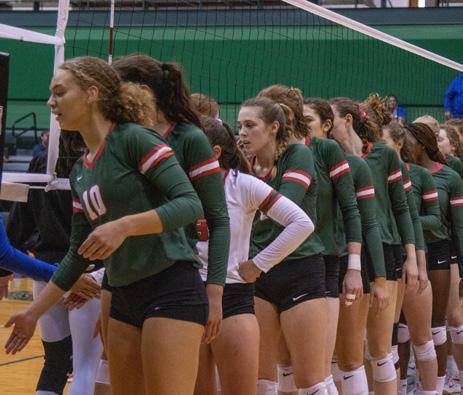
VOLLEYBALL WINS
The team advances to NCAA tourna ment after finishing second at UAAs. (Sports, pg 7)
University of Michigan professor pres ents research on 1918 Ukrainian pogroms
ZACH TRABITZ STAFF WRITERUniversity of Michigan Professor Jeffrey Veidlinger contex tualized and explained Ukrainian pogroms, or organized massacres, and their subsequent responsibil ity in the onset of the Holocaust, Nov. 3.
Veidlinger’s lecture focused on his research in Ukraine on the development of Ukrainian pogroms from 1918 to 1921. Veidlinger, a professor of History and Judaic Studies, visited Ukraine 10 times between 2001 and 2010 to interview Yiddish speakers about their experiences and their fami lies’ experiences.
Veidlinger’s main topic of the lecture was how pogroms, usually occurring against Jewish people, were prevalent in Ukraine both in the form of inter-community violence and military violence. Ultimately, these pogroms were responsible for the deaths of thou sands of Jews.
“There were about 1,500 pogroms in about 500 different locations, resulting in the death of 100,000 people,” Veilinger said. “About 40,000 Jews were killed directly during the pogroms at the time, and another 60,000 died sub sequently as a result of things like starvation or disease caused by the pogroms.”
The lecture featured two video interviews of individuals that Veidlinger interviewed. The pair of videos painted two co-existing pictures of pogroms: the first man spoke of how his local community incited a pogrom, while the second man detailed how the Ukrainian military came to incite a pogrom.
Veidlinger said his research was partly inspired by the photos and stories his father, who fled to the United States from German occu pation in Budapest, would share with him. Veidlinger described one photo, in particular, that pro foundly affected his view of the Holocaust, and how it meshed with everyday life for those living through it.
“It looks like a perfectly nice pic ture of a happy father and his son sitting on the balcony of their Buda pest apartment,” he said. “But you have to look a little bit closer to rec ognize that they’re both wearing yellow stars.”
In a plan to stigmatize and per secute Jews, German authorities forced Jewish people to wear yellow stars so non-Jews could identify them.
Veidlinger explained how com mon stereotypical tropes were used to vilify the Jewish people living in Ukraine, and how these tropes were partly responsible for the vio lence against them.
Humanities Prize is presented to candidates whose lifetime contri bution to the arts made a lasting impact on society. The ceremony boasted a full-capacity event in Hillman Hall with a watch party runoff location and a Zoom that
hosted more patrons. Guests heard from Bechdel on her work surrounding queer identity, family trauma, and sense of self.
Her first novel, “Fun Home:
CONTACT BY POST ONE BROOKINGS DRIVE #1039 #320 DANFORTH UNIVERSITY CENTER ST. LOUIS, MO 63130-4899 CONTACT BY EMAIL EDITOR@STUDLIFE.COM NEWS@STUDLIFE.COM CALENDAR@STUDLIFE.COM CONTACT BY PHONE NEWSROOM 314.935.5995 ADVERTISING 314.935.4240 FAX 314.935.5938 The independent newspaper of Washington University in St. Louis since 1878 WWW.STUDLIFE.COMVOLUME 144, NO. 10 THURSDAY, NOV 10, 2022
The Bears open sea son with exhibition game against Mizzou. (Sports, pg 7)
Q&A with a law pro fessor on reframing discourse surround ing gun control. (News, pg 3)
Read the rest online:
for more progressive victories in Missouri, many still felt content with the national election results.
Political analysts predicted a “red wave,” which would have brought GOP control back to the Senate and House, but Democrats exceeded
expectations.
think it was the Times that said it was like the ‘Red Wave’ was more of a ‘Pink Splash’,” de las Alas said. “I’m happy to see that the country did not adamantly support election deniers.”
LILY TAYLOR, JAMES ELLINGHAUS, ALIANA MEDIRATTA CONTRIBUTING WRITER, JUNIOR NEWS EDITOR, STAFF WRITER
COURTESY OF PHOTO EDITOR HOLDEN HINDES
A student checks in at the Atheltic Center to head to the polls.
Two students stand at the butter churning table to spread enthusiasm for the democratic process.
HOLDEN HINDES | STUDENT LIFE
Balkan Treat Box food truck serves people near the polls.
HOLDEN HINES | STUDENT HINDES
Alison Bechdel, a MacArthur Fellow and acclaimed lesbian
SEE
PAGE
CHLOE HUGHLETT, TUESDAY HADDEN CONTRIBUTING WRITER HEAD OF ILLUSTRATION
BECHDEL,
2
Emmy winner discusses Asian American experience
AMANDA YOUNG STAFF WRITERMichelle Li was best known as a St. Louis news anchor and reporter for KSDK Channel 5 with multiple Emmy, National Murrow, and Peabody awards when #VeryAs ian went viral. Since then, she has started a nonprofit organization called Very Asian Foundation, where she works to amplify and expand Asian stories and experiences through repre sentation and inclusion.
Li spoke to a room full of guests in the DUC’s Gold berg Formal Lounge about her journey, discussing the origin of the hashtag and other topics surrounding Asian American identity, journalism, and her founda tion, on Nov. 4.
When Li shared on a New Year’s Day segment that she ate dumplings to celebrate the holiday, a caller took offense, com plaining that Li was “being very Asian…she can keep her Korean to herself.”
Li recorded herself lis tening to the voicemail and shared it on social media. Immediately, people across the country started using #VeryAsian to share pic tures of their families, multicultural dinners, and celebrations. To Li, being #VeryAsian means “being able to bring your full humanity to spaces.”
She received messages from people around the world who shared that they never felt Asian enough to be recognized as such because they were adopted, multira cial, or had other layers to their identity. “I think that to have maybe an adoptee in the Midwest be this repre sentative voice for an Asian
BECHDEL
A Family Tragicomic”, was adapted into a musical that won five Tony awards, including Best Musical. Bechdel wrote a second memoir, “Are You My Mother?: A Comic Drama,” surrounding her rela tionship
American ‘Very Asian movement’ was impactful to people,” Li said.
A couple of weeks after going viral, Li was a guest on The Ellen DeGeneres Show. There, she received $15,000, which she put toward the establishment of the Very Asian Foundation.
The mission of the orga nization is to “shine a light on Asian experiences through advocacy and celebration.”
“I think that’s really important because shining a light is what journalists do,” Li said.
The Very Asian Foun dation is currently working with We Need Diverse Books on The May Book Project, meant to help schools and libraries build collections of Asian Amer ican youth literature to increase representation in the classroom. The project was initially launched by the Asian American Civic Scholars in St. Louis, but the high schools they contacted turned them down.
“They were really dis appointed by that because it felt like they were invisi ble in the places where they needed to be seen. You rely on your school to see you,” Li said.
She also highlighted the “dual existence” of being Asian American during the COVID-19 pandemic, an experience marked by invis ibility and hypervisibility through racial slurs, physi cal attacks, and “Kung Flu” comments.
Li was invited by WashU China Care, a student group that connects students to Chinese adoptees through out St. Louis and works to improve the lives of Chinese orphans abroad. Li, who grew up in a rural area near
from page 1
with her mother, written after she passed. Bechdel’s longest running comic is “Dykes to Watch Out For,” a comic strip Bechdel self syndicated for 25 years.
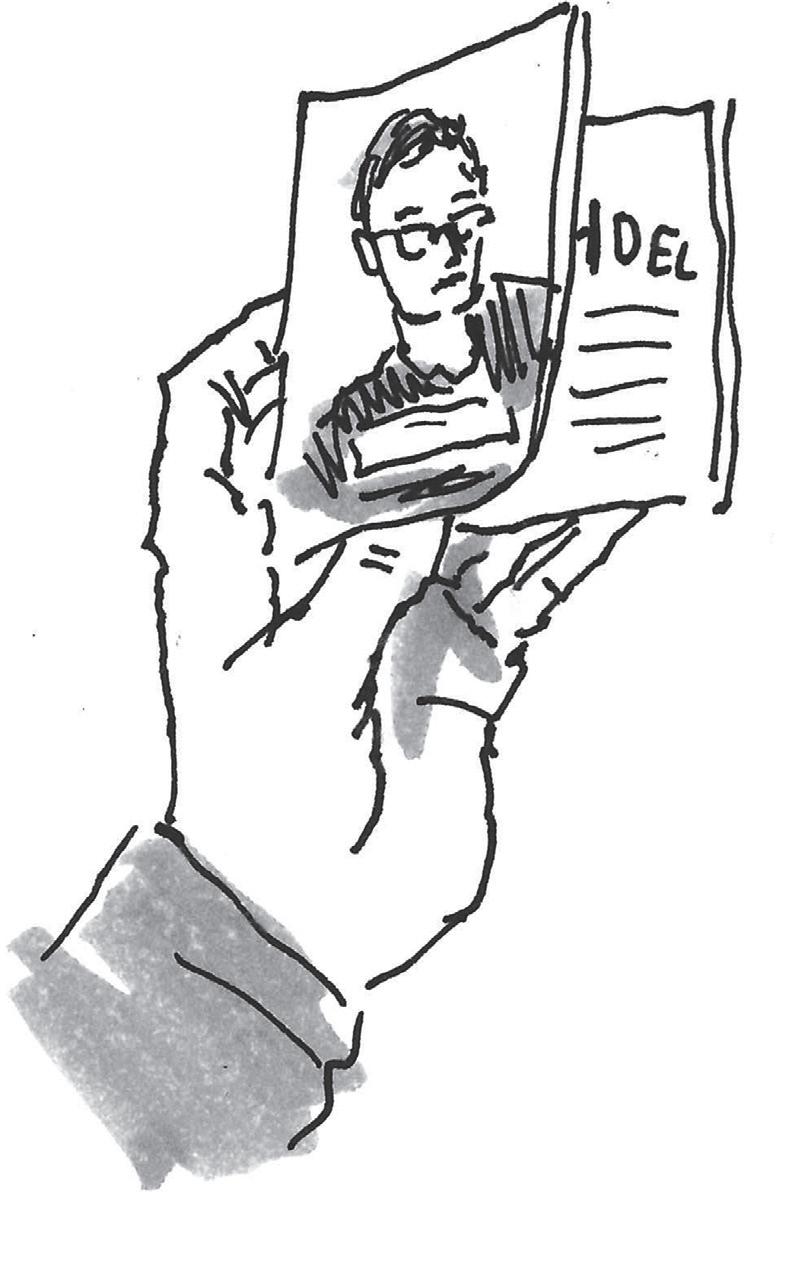
Before the speech, each guest was handed a program printed in zine for mat as they walked into the forum. Two audience members read gender-neu tral tarot cards to pass the time. The forum was filled with almost 200 guests, many of whom milled around discussing
Kansas City, is a Korean adoptee.
“I was the only Asian person in my school. I swore I was the only Asian per son in my county,” Li said, though she has “always been really proud of actu ally being from Missouri and having Midwestern sensibility.”
Sophomore Andrew Wong, a member of China Care’s Advocacy team, said the club brought Li in as a speaker “to educate and inspire the WashU commu nity and the kids we work with on topics like adoption and broader Asian Ameri can issues.”
Li shared that she some times struggled with her Asian American identity. “I always kind of felt like an imposter in my own skin because I knew that, pub licly, I was presenting as an Asian person,” Li said.
However, an interaction with a fellow Asian Amer ican who could not speak her native tongue made her realize that everyone has different experiences and understandings of their identities. “I was like, ‘She has never thought [that] she wasn’t Korean because she didn’t speak the language,’ whereas I took all this time to know the language, and here I was thinking I wasn’t Korean enough…in Amer ica, we all have to be very intentional about what cul ture we bring into our lives.”
Read the rest online:
Lecturer speaks on Western Portrayals of China and the Dragon
JIMMY HU CONTRIBUTING WRITER
University of Mich igan Professor Jeffrey Veidlinger contextualized and explained Ukrainian pogroms, or organized massacres, and their sub sequent responsibility in the onset of the Holocaust, Nov. 3.
Veidlinger’s lecture focused on his research in Ukraine on the devel opment of Ukrainian pogroms from 1918 to 1921. Veidlinger, a profes sor of History and Judaic Studies, visited Ukraine 10 times between 2001 and 2010 to interview Yiddish speakers about their expe riences and their families’ experiences.
Veidlinger’s main topic of the lecture was how pogroms, usually occur ring against Jewish people, were prevalent in Ukraine both in the form of intercommunity violence and military violence. Ulti mately, these pogroms were responsible for the deaths of thousands of Jews.
“There were about 1,500 pogroms in about 500 dif ferent locations, resulting in the death of 100,000 people,” Veilinger said. “About 40,000 Jews were killed directly during the
pogroms at the time, and another 60,000 died subse quently as a result of things like starvation or disease caused by the pogroms.”
The lecture featured two video interviews of individuals that Veidlinger interviewed. The pair of videos painted two co-existing pictures of pogroms: the first man spoke of how his local com munity incited a pogrom, while the second man detailed how the Ukrai nian military came to incite a pogrom.
Veidlinger said his research was partly inspired by the photos and stories his father, who fled to the United States from German occupa tion in Budapest, would share with him. Veidlinger described one photo, in particular, that profoundly affected his view of the Holocaust, and how it meshed with everyday life for those living through it.
“It looks like a perfectly nice picture of a happy father and his son sitting on the balcony of their Budapest apartment,” he said. “But you have to look a little bit closer to rec ognize that they’re both wearing yellow stars.”
In a plan to stigma tize and persecute Jews,
German authorities forced Jewish people to wear yel low stars so non-Jews could identify them.
Veidlinger explained how common stereotyp ical tropes were used to vilify the Jewish people living in Ukraine, and how these tropes were partly responsible for the violence against them.


“The Poles accused the Jews of siding with the Ukrainians,” Veidlinger said. “The Ukrainians accused the Jews of siding with the Poles. The Ger mans accused the Jews of spying for the Russians, and the Russians accused the Jews of spying for the Germans. The Bolsheviks accused the Jews [of] being [bourgeois capitalists], and everybody else accused the Jews of being Bolsheviks. The truth is that Jews’ political loyalties were divided: Jews were not a mass united under one party.”
Read the rest online:
Corrections from last week’s issue:
their favorite Bechdel works; one teacher spoke to another guest, a decadeslong fan of Bechdel’s comics, about assigning “Fun Home” as reading for her class.
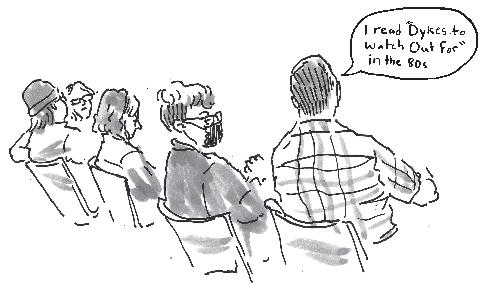
Bechdel started her speech by sharing that “Fun Home” was banned last year in a North Kansas City, MO school district.
“[‘Fun Home’] along with many other books address ing things like race, gender, and sexuality have been getting banned quite a lot recently,” Bechdel said.
She went on to describe her relationship with poli tics as a young person, having came out as a les bian in 1980. “It was also a moment of coming of
age and coming to political consciousness all of a sud den. I found myself on the outside of the system, and I felt very grateful for that stunning perspective. You can’t see how things work when you’re on the inside,” Bechdel said.
Bechdel spoke to themes of self discovery through many mediums. In her adolescence, she immersed herself in the queer
community. As an adult, she processed grief and loss through writing memoirs. Currently, she exercises as a form of loosening up, as documented in her newest mem oir
“The Secret to
Superhuman Strength.” Regarding her body of work, Bechdel said, “‘Dykes To Watch Out For’ was very much about self discovery, self definition, a young person’s project. ‘Fun Home’ and ‘Are You My Mother?’, these books about my parents were about look ing more deeply at the way we separate out from our parents and become our own subjects, and what it means to even have a self.”
JULIA ROBBINS | EDITOR-IN-CHIEF | NEWS@STUDLIFE.COM2 STUDENT LIFE THURSDAY, NOV 10, 2022
The illustration on page two was misattributed. Contributing Artist Sophie Leong created the illustration.
An article about a Pro-Choice Panel on campus incorrectly stated that the panel occurred with support from the University’s Social Pol icy Institute. The panel was supported by the student-run Roosevelt Institute.
LIVE DRAWINGS BY TUESDAY HADDEN | HEAD OF ILLUSTRATION
JULIA ROBBINS EDITOR-IN-CHIEF
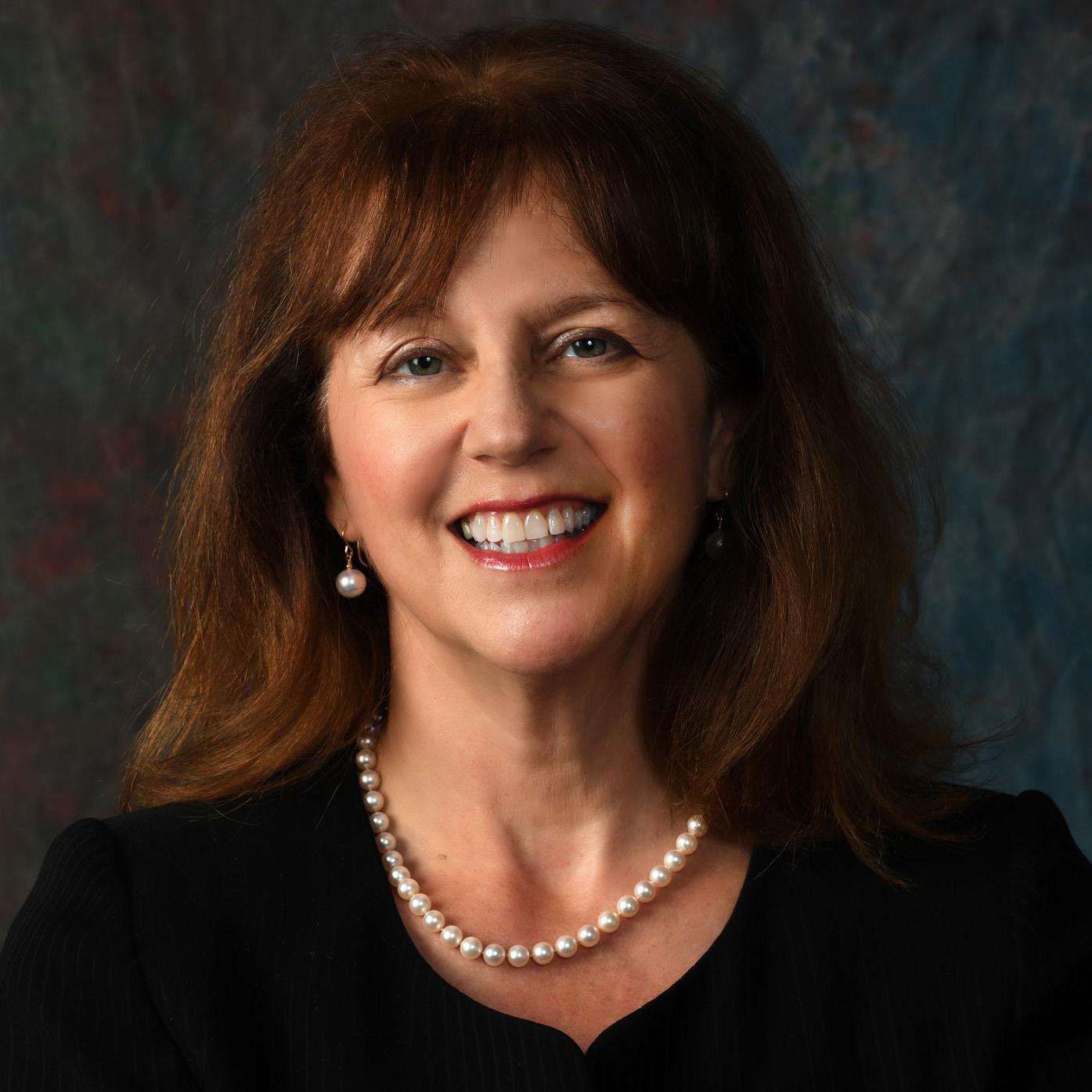
Professor Leila Sadat is the James Carr Professor of International Criminal Law at the Washington Uni versity School of Law and a recipient of the University’s Arthur Holly Compton fac ulty achievement award. She is the Special Adviser on Crimes Against Human ity to the International Criminal Court Prosecu tor, and the Director and Founder of the Gun Vio lence and Human Rights Project and the Crimes Against Humanity Initia tive at WashU. Student Life spoke with Sadat about her research into the field of human rights and gun vio lence following a shooting at a St. Louis high school in October.
SL: Can you talk about the significance of framing gun control as a question of the government’s legal obligations instead of as another piece of policy recommendation?
Sadat: The current focus in the United States is almost entirely on the “rights” of individuals wish ing to purchase and wield arms, which they frame as “gun rights” guaranteed by the Second Amendment of the US constitution.
I like to say there’s no such thing as gun rights because guns don’t have rights, people do. And that’s not just me being profes sorial, it’s a fundamental point. You have to look at the entire framework in which the Second Amend ment is embedded. It is part of a Constitution premised upon the right to life, liberty and the pursuit of happiness, and none of us experiences those rights if we’re shot or terrorized by gun violence.
Moreover, given the scope of the problem, we can’t just look at this through the lens of the rights of the shooters. We have to look at the effect on the victims. And under human rights law, countries have concrete obligations to prevent human rights vio lations even when they’re perpetrated by private cit izens. The United States has clear legal obligations to protect the health and safety of its citizens. So the people who fixate on the Second Amendment are not looking at the United States Constitution in a holis tic way, or at international human rights law which is binding on the United
States under the Supremacy Clause of the U.S. Constitu tion. It is not consistent with the rule of law for individu als to claim that their right to have a weapon, what ever the weapon is, is more important than anything else, including the right to life and safety of thousands of gun violence victims and the millions of school chil dren who are traumatized by gun violence.”
SL: What advice do you have for advocates of gun control to make their dialogue more persuasive to people who have so far been resistant to their calls for change?
Sadat: First, a major ity of Americans support reasonable gun safety laws including universal back ground checks, red flag laws, safe storage require ments, and an assault weapons ban. So the prob lem is not popular support but political power. And even there, I think a cou ple of things have happened to shift the conversation in a more positive direc tion. Unfortunately, there have been so many more mass shootings that people who were on the fence have become quite militant about it. The Parkland shooting I think really was a tipping point, although obviously not enough because the Second Amendment Pres ervation Act, adopted by Republicans in the Mis souri legislature to prevent enforcement of federal gun laws in our State, was enacted just last year. So conversations are shifting, and many States are adopt ing new gun safety laws, but others, like Missouri, are moving in the oppo site direction. The other big challenge to adopting gun safety laws is a reaction ary Supreme Court. I don’t know how else to describe it.
The Court’s decision this summer in the Bruen case, which invalidated one of New York’s fire arm licensing laws, was a step backwards. Ironically, it was issued just as Con gress was adopting the first bipartisan gun control leg islation we have seen in the past 20 years. Yet instead of considering contempo rary realities, including the deaths of more than 40,000 individuals every year from guns, Justice Thomas, who authored the judgment, wrote dozens of pages of 18th and 19th cen tury history to determine the question of whether

today individuals ought to be required to demon strate proper cause to carry a weapon in public. This is a very peculiar theory of constitutional interpreta tion; and not one we really see elsewhere in the world; it is limited to so-called origi nalist scholars and some judges on the federal bench, including the 3 appointed by President Trump, and was used in Bruen to invalidate a law that was more than a Century old, and had not been shown to have been misapplied.
SL: You wrote in your Harvard Law Review article that constant mass media coverage of shoot ings harms the mental health of viewers. How do you think the media can mitigate the potential harm their content poses for viewers?
Sadat: It is preferable for news following mass shoot ings to focus on the victims and the harm that the entire school faces, not on the mental health struggles of the shooter, and journal ists should take care not to glorify the shooter in any way or allow the shooting to become a platform for his or her views. The shooter at Central Visual and Per forming Arts High School wanted his acts to be the big gest and the most impactful; we cannot allow that narra tive to be advanced. Many experts have even suggested that the name of the shooter not be used by the media. Yet we have that especially when the shooter is Cauca sian, the media will often focus on their struggles and their mental health in a way that distracts from the ter rible harm inflicted on the victims and deflects atten tion away from the use of a weapon, the AR 15, that has no place in civilian life. Their legitimate need for medical or mental health treatment should not be part of the public conversation in the immediate aftermath of a mass shooting.


SL: Can you speak to the lasting trauma that school children who have been impacted by shootings might experience?
Sadat: Whether students witness a shooting person ally or learn about one from social media or the news, they are traumatized by these events and experience PTSD, stress, anxiety, and depression. Longitudinal studies have shown that this
trauma can last a lifetime. Instead of school being a place of safety and learn ing, even of joy where kids can look forward to hang ing out with their friends, it becomes a place of fear. The have people in black run ning through the schoolVOLUME 144, NO. 10 NEWS Julia Robbins Editor-in-Chief editor@studlife.com Via Poolos Managing Senior Scene Editor scene@studlife.com Jamila Dawkins Reilly Brady Managing Senior Forum Editors forum@studlife.com Clara Richards Managing Senior Sports Editor sports@studlife.com Ved Patel Managing Chief of Copy copy@studlife.com Sarah Wang Managing Senior Design Editor design@studlife.com Annabel Shen Senior Scene Editor Kellen Wang Emily Hu Head of Design Gracie Hime Cathay Poulsen Chief of Copy Holden Hindes Senior Photo Editor photo@studlife.com Kamala Madireddi Jared Adelman Senior Multimedia Editor multimedia@studlife.com Tuesday Hadden Head of Illustration Tony Tong Senior Web Editor Paige Steuber Senior Web Designer
Copyright © 2022 Washington University Student Media, Inc. (WUSMI). Student Life is a financially and editorially independent, student-run newspaper serving the Washington University community. Our newspaper is a publication of WUSMI and does not necessarily represent the views of the Washington University administration.
Tran
Adrienne Levin Coleman General Manager a.coleman@studlife. com Sarah Huff Advertising Sales Manager huffs@studlife.com JULIA ROBBINS | EDITOR-IN-CHIEF | NEWS@STUDLIFE.COM STUDENT LIFE 3THURSDAY, NOV 10, 2022 WashU Students Move between campuses & around STL using Metro Transit. Get your FREE Pass Here: @STLMETRO Q and A: Reframing the conversation about gun control around human rights
Sydney
Clara Richards Designers
Read the rest online:
COURTESY OF LEILA SADAT
SCENE
WU windsurfer hopes to sail to the Paris games
Summer Olympic Games in Paris, France.
Muller began windsurf ing after attending a summer camp at her local commu nity sailing center in the 8th grade, and she competed on race teams through out high school. Now, she is a member of the Olym pic Development Program (ODP), which provides “world-class coaching sup port to promising American youth sailors in high-perfor mance classes.”
In foiling, athletes use a hydrofoil that goes through the water; iQFoiL refers to the type of windsurfing gear that will be used in the upcoming Olympic cycle. According to Muller, it func tions “kind of like airplane wings” and brings the board out of the water, reducing drag and allowing athletes to move faster.
coaches] knew they wanted to start growing it,” Muller said.
Muller’s windsurfing career has taken her around the world. Last November, she represented Team USA in the inaugural Junior Pan American Games in Colom bia, where she placed third in the race course. One male and one female athlete were chosen from the United States to compete. “It was about my closest taste [of] getting into that Olympiclevel windsurfing,” she said.
more regularly because she was training for a big regatta at the end of November and the beginning of Decem ber. “I was really trying to [maintain] my windsurfing [abilities] to be ready for that regatta,” Muller explained. Recently, she has not been going home to train as often because windsurfing is “such a weather-dependent sport.”
while I’m in school — [it’s] not just about being in St. Louis, [but] just having more time to do everything,” Muller said. “I just had to be confident in the decision of, ‘Even if I don’t end up going to the Olympics, the journey that [I] go on and the things [I] learn about [myself will be] a cool experience.”
Training full-time will give Muller the chance to focus solely on windsurfing.
 AMANDA YOUNG STAFF WRITER
For sophomore Bryn Muller, windsurfing started as “just a fun high school sport.” But it has become
much more than that these days as Muller campaigns for the 2024 Olympic Games. Muller competes in the iQFOiL class as one of ten sailing disciplines that will debut at the upcoming
When Muller started attending ODP camps in 2020, iQFOiL did not yet exist as a sailing class. “It was a little bit casual because we didn’t even know where the Olympic classes were going next, but [the ODP
Muller often trains in her home state of Florida, as well as California, Ore gon, and Hawaii. Missouri, however, does not have the conditions and water access that Muller needs to practice windsurfing, so she main tains her fitness during the school year as a member of the WashU Crew Team. “It's a joke on the crew team. Everyone gets a water-bot tle nickname. Mine is, ‘It's a water sport’ — that I had to come up here and figure out what water sport I could do,” Muller said.
Last fall, she went home
Diwali: A celebration of life
CHLOE CARLISH CONTRIBUTING WRITERAnticipation
The first performance, WU Classical, embodied the meaning of Diwali as “The Festival of Lights.” Sheathed in darkness, they illuminated the stage with light that shone upon vibrantly-colored cos tumes. The color coupled with the masterful choreog raphy secured the attention of the audience from the very first moment.
Themed “A Time Cap sule,” Diwali was both a look toward the traditional beauty of the past and a glimpse of the present moment. The allfemale South Asian dance team WU Garba showcased the time-honored dance form with a lightness of moder nity: they lit up the stage as their matching red-and-black skirts swished in unison to tunes such as “Desi Boyz” by Bob and KK.
This look to the past extended to that of WashU’s Ashoka history. This year’s skit opened with an imme diate reference to the controversy of last year’s

performance, a performance which focused on a group of students forming their own dance team, but that received criticism for misuse of AAVE and jokes about predatory behavior.
This year, the skit opened with the recreation of an Ashoka General Body Meet ing, where members were planning a fictitious perfor mance. One actor claimed that the skit was of little importance, to which another retorted, “That’s not true. Last year, the skit was all any one could talk about!” Having addressed the elephant in the room, the audience laughed and the act moved forward.
The skit portrayed the search for the South Asian community within WashU via an entirely new (fake) liv ing community in fraternity row: Sigma Chai. Within the skit, students found com munity, each with a desire to connect more deeply to Desi culture. The overbearing and hilarious “Nani” character, the grandmother of the Chap ter’s founding member, took care of the residents with a Chai in hand.
“Sigma Chai,” while hilarious, underscored the need for a strong South Asian
community. The skit also touched on white ignorance. One actor played a fictitious (yet incredibly realistic) Dan forth descendant who sought the company of Sigma Chai residents out of a desire for math tutoring.
The contradictions within his racist beliefs — those claims that Indians are doomed to remain “stuck as factory workers” whilst simultaneously pursuing their academic guidance — were incredibly apparent.
The performance further displayed divisions within the South Asian community itself: families’ pressures to conform via a predetermined sexuality or career path and the desire to prove one’s “Indi anness.” The performance maintained the poignancy of the search for cultural belong ing and showcased astute comical writing, with audi ence members laughing until the skit reached what is any WashU student’s ultimate res olution: graduation.
The show continued as Desi culture was simultane ously celebrated and made anew by the fusion acapella group WU Sur Taal Laya. Their rendition of the Bol lywood classic “Deewani
Mastani”
“Even if I go home for the weekend, if there’s no wind, then I can’t train,” Muller said. Needing longer blocks of time to fully commit to her Olympic campaign, Muller will be taking the next three semesters off from WashU.
Muller always planned to take her junior year off because Olympic trials will be held in the winter, at the end of 2023 and the begin ning of 2024. But since there are two important qualifying regattas that Muller wants to train for, she decided to take a leave of absence for the spring semester of her soph omore year as well.
“I need to be full-time windsurfing to have a real shot at trials. I can’t do that
“Even if you're a super seri ous athlete, you've always had school and athletics. I'm really excited to see what it's like to be like a professional athlete, where your only goal is how to get faster on the water,” she said.
Outside of the water, Muller will spend time fun draising for her Olympic campaign and continuing to run a newsletter for the country on iQFOiL, meant to help “try and build the program as a country.”
Muller plans to return to WashU to finish her degree, graduating in May of 2026. Though she hasn’t declared a major, she is interested in math and physics.
Connection over disconnection at Dr. G’s Filipino feast
The annual fashion show was an acknowledgment of the diversity within the Indian diaspora. Models strutted across the stage to a number of Desi songs in garments representing Afghanistan, Nepal, India, Pakistan, and Sri Lanka. Once again, the art of bringing the traditional and the contemporary into con versation with one another was on full display.
Diwali managed to bring together not only members of the South Asian diaspora, but also the WashU community at large. Each performance was executed beautifully, illuminating the importance of communal belonging and the meaning of a connection to one's past and present. As performers returned to the stage for their final bows and applause filled Edison The atre, the audience was once again reminded that, above all, Diwali is a celebration of life.
GRACE TYAU CONTRIBUTING WRITERI joined WashU’s Filipino Culture Club (FCC) on Oct 24 at a dinner hosted by our Vice Chancellor of Student Affairs, Dr. Anna Gonza lez. Though the dinner was at 6:30 p.m., the event truly began when students met at the Clocktower before walk ing over together. Here, I witnessed — among some FCC members and some non-FCC members, between Filipinos and non-Filipinos — automatic and seemingly magical bonds forming.

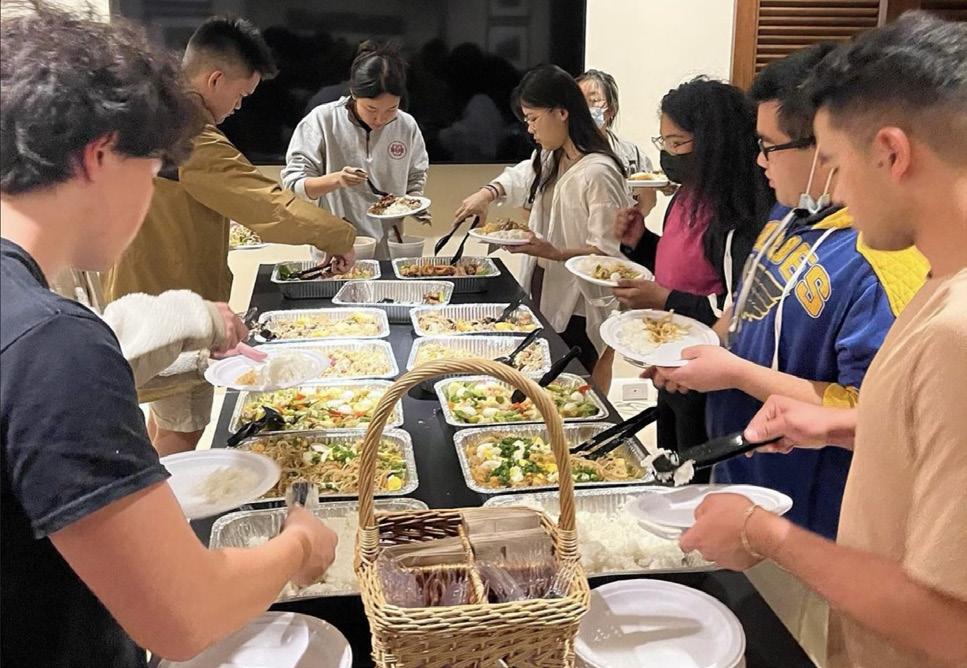
Students conversed about how much they miss Filipino food, as well as deeper topics such as never feeling authen tically Filipino since they didn’t learn much about their culture as a child. Though I’m not Filipino myself, I was fascinated by how immedi ately welcomed I felt by the group.
The conversations con tinued as the group strolled to Gonzalez’s house, less than five minutes from the South 40. Once we arrived, she stood at the door and
By Hsu Yen Ling Directed by Bill Whitaker Translation by Annelise FineganANNABEL SHEN & VIA POOLOS | SENIOR SCENE EDITORS | SCENE@STUDLIFE.COM4 STUDENT LIFE THURSDAY, NOV 10, 2022
THE DUST
November 17, 18 & 19* at 8 p.m. November 19 & 20 at 2 p m A E Hotchner Studio Theatre
Bryn Muller will take the next three semesters off to train for
COURTESY OF BRYN MULLER
buzzed in the air as Edison theater filled to near-capacity on Friday evening for the opening per formance of Diwali.
by Shreya Ghoshal and Ganesh Chandanshive was paired with well-known Western songs such as “Boy friend” by Justin Bieber and “God is a Woman” by Ari ana Grande. The coupling was exquisite.
PAGE 5
SEE FCC,
Filipino Culture Club members help themselves to food pro vided by Dr. Gonzalez at her house.
PHOTO COURTESY OF FCC
Green Eggs and Jam
welcomed each individual, waving us in with a wel coming hello, even hugging some.
We gathered in the liv ing room, and Gonzalez gave a short speech, begin ning with, “All of a sudden, I can’t speak any Tagalog!” She emphasized her desire for everyone there to get to know each other and build community and had the FCC executives introduce themselves.
“With that, really make [yourselves] at home,” Gon zalez said. “We’ll have you here for about an hour, hour and a half, and then we have to kick you all out because I don’t want you all walking [in the rain]…[T]he lights are there, and the tables. And there’s food.” As Gonzalez described the list of food, the group cheered for their favorites.
The feast consisted of lumpia (egg roll), lechon (pork), pancit (noodles), white rice, sisig (made from parts of a pig’s face and belly), and chicken liver (seasoned with calamansi, onions, and chili peppers, which FCC Director of Dig ital Content Strategy, Ria Sharon, described as “awe some” and “yummy”), as well as desserts. As we went through the line, members would take photos of the setup to send to their fami lies later.
Though she said the entire downstairs area was open, most students sat in her back yard under fairy lights. Here, Gonzalez circled around every table, asking each per son “What’s your name? What year are you? Where is home for you?”
Over cheesecake and ube ensaymada, I chatted with Sheryl Mauricio, WashU’s Associate Vice Chancellor for Student Affairs.

“I’ve never seen this
many students come together around Filipino culture,” she said. For students who don’t know how to find Filipino food in the area, there’s a lack of community. “I think [that] for us to be able to share that with the students would be great — for them to have resources when they’re feeling like they’re missing home.”
Mauricio agreed that bonding over shared culture is automatic. “From my per spective, [it’s] like you guys [have known] each other for a really long time,” she said.
Mauricio also said that the Filipino Culture Club and its members are per sonally important to her.
Gonzalez, who is half-Fili pino, stands as an important representation for Filipino students.
“It’s rare [to] have some one at her level who’s Filipino. So, we’re hopeful that this is an opportunity for students to see that they have someone who looks like them in leadership,” she said.
Mauricio admires Dr. G’s commitment to outreach and building relationships with students, and strives to do the same in her work.
“[There are] not many peo ple who look like me. It’s important that, when I meet students who identify like I do, [...] I’m there for them,” she said.
As the dinner wrapped up, FCC members started filling up to-go plates with desserts. After seeing one person’s shirt and anoth er’s necklace, Mauricio took photos and jokingly schemed about possible FCC mer chandise designs.
I found Trish Gomez — FCC advisor and WashU’s Associate Director of Oper ations at the Academy for Diversity, Equity, and Inclu sion — who told me about FCC’s history.
PUZZLE Mania
Gomez told me that the club started in 2020, dur ing the pandemic. The 2020 executive board worked hard to find new executive mem bers who would carry on the legacy of the club.
Current FCC president and junior Alana Depaz has been pleasantly surprised by the amount of interaction and membership that FCC has gotten since the start of the year, despite a smaller Filipino presence on campus.
“I remember I came to WashU freshman year (and it was COVID) and I did not meet a single other Fili pino person…I didn’t know [FCC] existed until spring semester [of] last year,” she said.


The club is also work ing on fundraising for organizations that support the Philippines, as well as outreach with SLU’s Filipino Student Association.
“Our main goal is to build community,” Depaz said. “We’re able to share all the different things that people wouldn’t be able to experi ence without us being here.”
Depaz stressed the fact that FCC is not just for those who identify as Filipino, but for anyone who wants to learn about and appre ciate Filipino culture. The warm feeling that I had on the walk back to my dorm — along with my to-go plate of desserts — made me feel like I was included in the community.
“It’s easy to erase your own culture or history when it’s not the dominant identity of the community you’re in,” Gomez said. “Being in a pre dominately white institution, it feels like you’re othered or like you don’t connect with anyone. But when you have places like this, you just feel so much more connected.”
SPONSORED BY:ANNABEL SHEN & VIA POOLOS | SENIOR SCENE EDITORS | SCENE@STUDLIFE.COM STUDENT LIFE 5THURSDAY, NOV 10, 2022
FCC from page 4
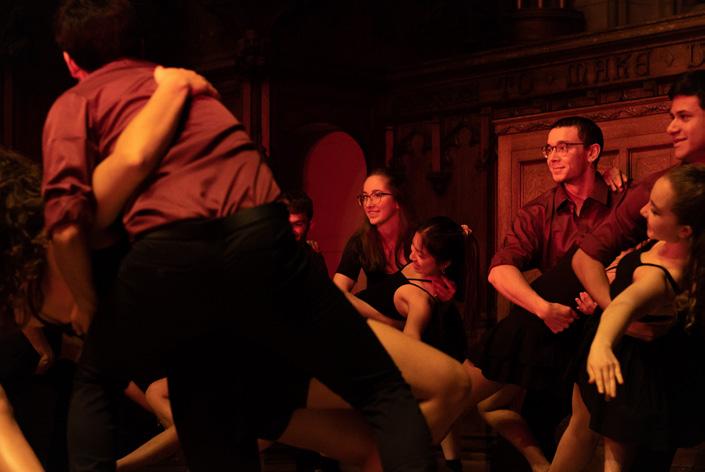
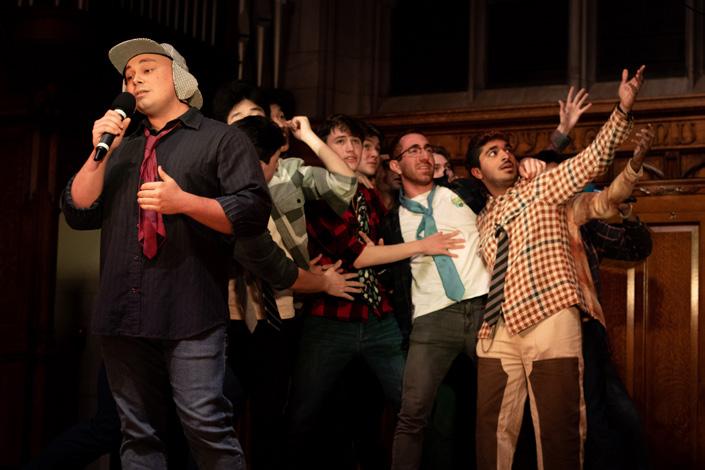
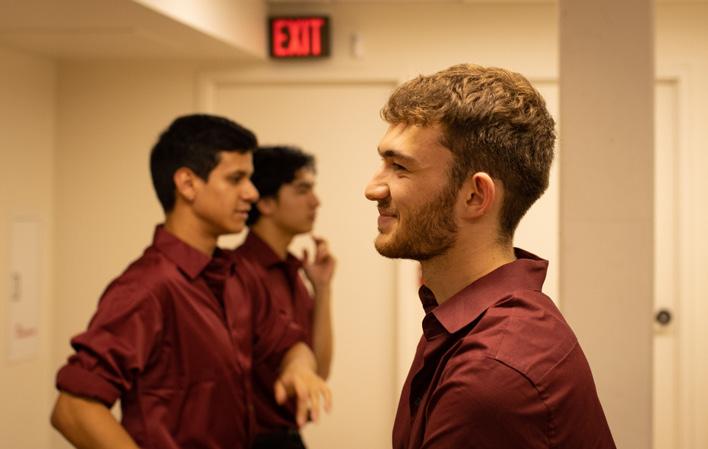
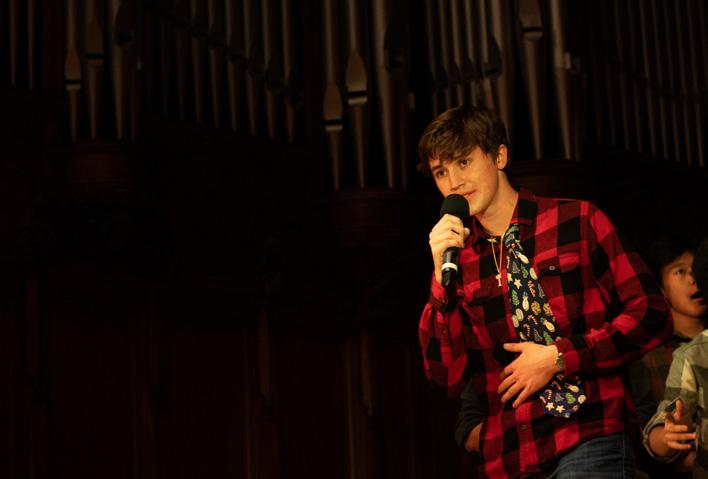
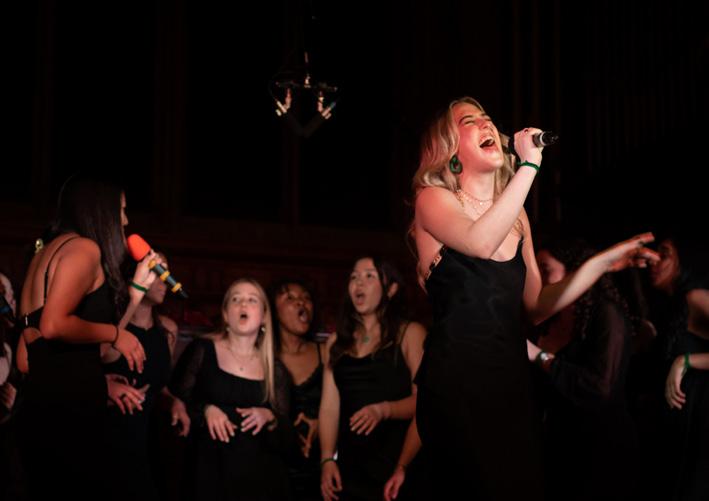
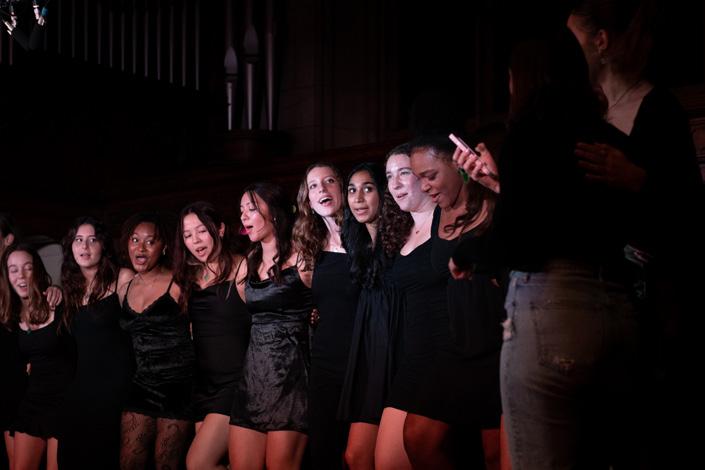
The Evergreens a capella group per formed on Friday and Saturday along with WUSauce, WUHHU, The Stereotypes and the Pikers for the annual Green Eggs and Jam show. The program incorporated sing ing, dancing, and live mixing. A portion of ticket profits from the show were donated to local St. Louis businesses and charities.
Senior Piker Ryan Harrigan performs “Flaws” by Bastille.
WUSauce members warm up in the Gra ham Chapel basement before their opening performance.
WUSauce performs their number.
Sophomore David Donoghue soloed as the Pikers, one of two opening acts, sang “Flash Dance…What a Feeling” by Irene Cara.
Graduated Evergreens joined the stage to perform their alumni song.
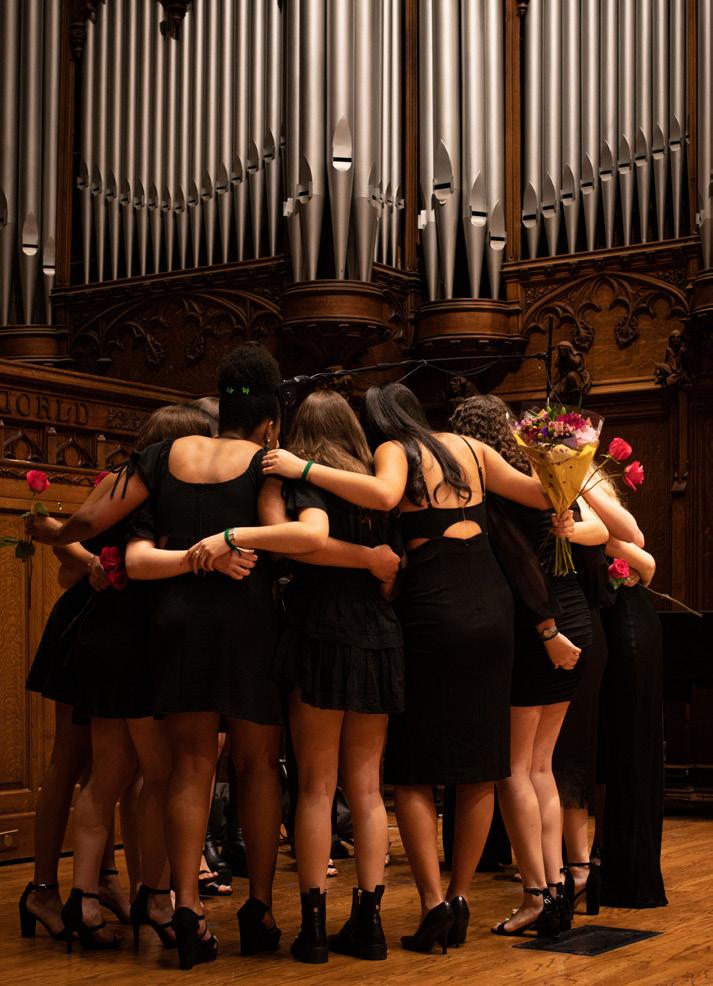
The Evergreens huddle after the show.
Junior Sydney Greer performs “I’ll Be Wait ing” by Adele.
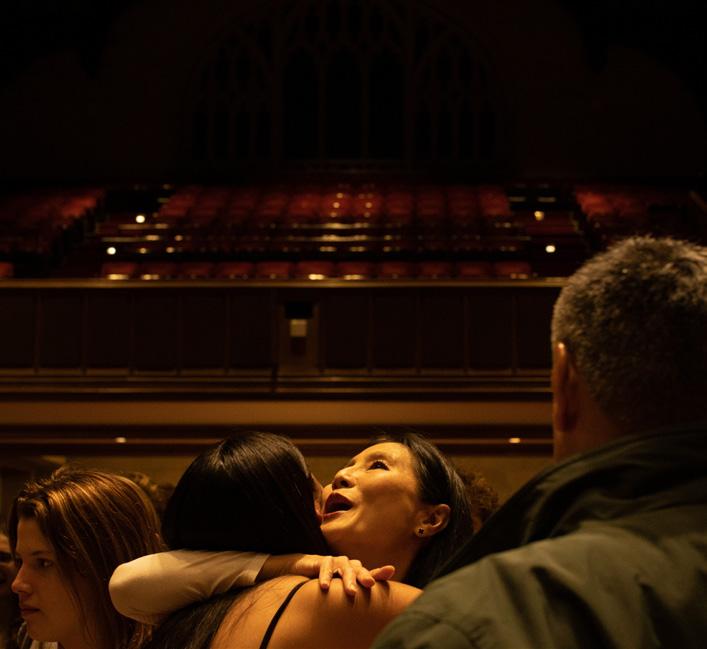
An Evergreen embraces an audience mem ber after the show.
PHOTOS BY CURRAN NEENAN
Caption this! Enter this week’s contest
 HUSSEIN AMURI JUNIOR SPORTS EDITOR
No Nut November: The annual challenge where WashU students decide to take a break from Larkin Love for a month, and, perhaps, Senator Josh Hawley gets bored of destroying our democracy by participating in No Nut November himself?
Over the summer, Hawley, the manly man of US Senate and 100m sprint specialist announced that he was releasing a new book in May 2023. Titled “Manhood: The Masculine Virtues America Needs,” the book will be an extension of a keynote address that he gave at the National Conservatism Conference (NCC) last year. In this address, the Missouri Senator devoted much of the speech to what he called “the Left’s attempt to give us a world beyond men.” He states: “The Left wants to define traditional masculinity as toxic. They want to define the traditional masculine virtues — things like courage, and independence, and assertiveness — as a danger to society.”
In an interview with Axios a week after his NCC speech, Hawley went on to add that he actually wanted to make masculinity a signature of his political campaign, and that he blames pornography and video games for the apparent decline of manhood. It’s a move that isn’t all too surprising, considering many dub him as a Republican 2024 presidential hopeful. “Can we be surprised,” Hawley argued, “that after years of being told that they are the problem, that their manhood is the problem, more and more men are withdrawing into the enclave of idleness and pornography and video games?”
But it is not just Hawley; for years now, conservatives like him have long blamed video games and porn as the reason why men are marrying less, raising fewer kids, and working less. This

obsession with masculinity is a phenomenon that has dominated their sphere as part of the ever-changing conversation regarding gender and sexuality throughout the country. But it is also a phenomenon that is closely aligned with far-right, white supremacist groups such as the Proud Boys, who have enforced stringent rules on pornviewing and masturbation among their members.
The annual challenge of No Nut November, commonly referred to as #NNN, has long dominated college campuses. At its core, #NNN challenges individuals to limit themselves from any sort of sexual activity that results in them ejaculating for the whole entire month of November. But despite the movement’s popularity among young men, it’s a toxic and dangerous one. Because at its core, the movement is embedded in racism, misogyny, and anti-semitism. For many members of the Proud Boys group, anti-porn and antimasturbation movements like #NNN are a path to happiness, a way for one to improve their sex life, and in connection to Hawley, get closer to traditional family values. But, as with anything associated with far-right groups and their agenda, these sentiments that fuel #NNN have produced some grossly misogynistic, racist and antisemitic remarks.
Remarks such as former Ku Klux Klan leader David Duke’s statement that Jews are weaponizing the porn industry as means of revenge against “the Western World” for the injustices done against them “from the time of Romans to the modern day.”
But let’s give Hawley the benefit of the doubt in believing that manhood is in danger. Because to some extent, he is right.
In recent years, a high number of men have indeed been disconnected from their relationships to their families, their significant others and
their communities. And this disconnection is not one without its negatives. The percentage of men participating in the labor force has decreased from 80% in the 1970s to 68% in 2021 as men are struggling to adjust to cultural and economic changes in the 21st century. Economically speaking, numbers like these aren’t a laughing matter.
A Wall Street Journal article used by Hawley himself in his NCC keynote speech goes beyond just the workforce. Titled “A
Generation of American Men Give Up on College: ‘I Just Feel Lost,’” the article dives into the decline of male college enrollment, where in recent years, women make up 60% of college students, while men only make up 40%. This is further contextualized by the fact that compared to five years ago, American colleges and universities have seen a decrease in enrollment of 1.5 million students — and men make up 71% of that number.
And it is not just in the labor force or college campuses. It is also, as previously stated, in relationships. In her book titled “Rethinking Sex,” Washington Post columnist Christine Emba recalls hearing stories from both men and women in relationships about the negative influences pornography is having in their relationship.
So again, despite his crazy rhetoric, Senator Hawley is actually touching on an important subject in America, and one that needs the attention of the public. But manly man of the Senate: you are pointing out a problem, but where is your solution to fix it?
You are absolutely right — men’s interest in the labor force is decreasing, and that has a negative impact on our economy. Fewer men are enrolling in college, and once enrolled, fewer are graduating. A large swath of men cannot seem to recover or find themselves. You talk big game, Senator Hawley, but can you back it up?
Did you back it up by supporting President Biden’s Build Back Better agenda, which intended to increase the Pell grant to low-income, first-generation male students who wish to take the next step in their life chapter by getting a college degree? Beyond that, do you support making community college completely free so these same men you claim to be trying to save don’t go bankrupt or bury themselves in huge piles of loans?
Did you back it up, Senator, by supporting President Biden’s Build Back Better bill, a bill that also aimed to provide millions of American mothers and fathers with parental leave?
Did you, Senator Hawley?
Of course not. Because the issue at hand here is not about saving men and promoting traditional family values. The issue at hand here for Senator Hawley, and many other nationalists like himself, is about protecting the purity of the white race and promoting the misogynistic view that, inherently, men were created to be more assertive, and women more submissive.
They are concerned with the uncomfortable truth that nowadays, interracial marriages are now common and are celebrated everywhere. Because as Kristin Kobes Du Mez, a gender studies professor at Calvin University says, Hawley knows what he’s doing. When he brings up his rhetoric about “shared culture” or “traditional values,” he knows he’s speaking to conservatives — both middle and far-right bases — that are concerned about protecting the purity of the white race, such as the Proud Boys or David Duke himself. They know what this country was like, know what it “ought” to be.
So, Mr. Hawley, you are right: there’s a crisis among men. But if you aren’t willing to do the bare minimum — supporting actual policies that will address the problem you are pointing to — stop talking. Although more
work is needed in achieving the envisioned more perfect union, we don’t need any more setbacks that aim to bring us backward. We don’t need any more setbacks that seek to dehumanize our Jewish neighbors and friends. We don’t need any more setbacks that seek to deny the existence of women beyond their perceived worth as a sexual object.
What we need, Senator Hawley, are policies that seek to address your concerns (that is, the ones we actually face). The solution to our problems are policies that will assure
us that after four years here at a university, people are guaranteed a job and that for those who are using student loans to pay for college, their debt burden can be eased. The solution to our problems are policies that will give people the economic means to start a family (for those of us who wish to) in later years, and that in the future, people won’t live on an inhabitable planet at the mercy of climate change. And since you won’t support these policies, Senator Hawley, in the most respectful way that I can say this: shut the hell up.
As the excitement around Thanksgiving Break grows, it can be easy to lose track of another impending deadline: class registration. Whether you have poured over course listings and have a robust list of classes or this article is your wake up call to poke around the course listings, the Student Life Editorial Board is here to help.
All of the classes listed below are offered for this upcoming spring semester. While every major and program mandatorily adds a few (or maybe more than a few) classes to your schedule, there is always that one spot at that odd time where there is an opening for a class of your choosing. Our advice: seek out a department you otherwise would never take
a class in and find a class title that looks interesting. College is about the only time in life where taking classes in foreign policy, computer science, and music composition at once is an achievable feat.
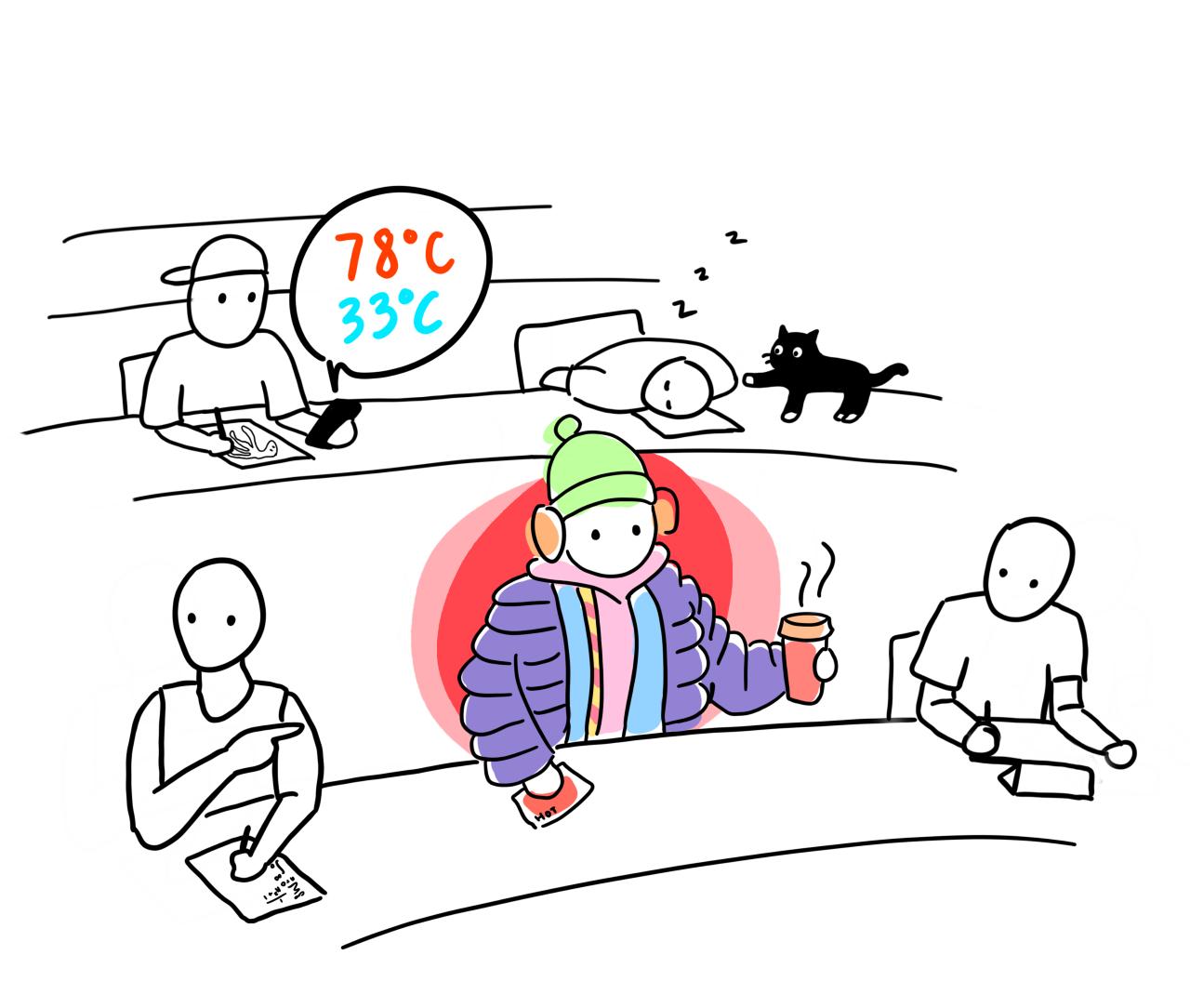
Also, make use of the planning tools that are found in WebSTAC. Keeping track of your academic division and degree requirements on Post-IT notes only works for so long. That said, while it’s important to be cognizant of all the divisional requirements, most people will fulfill all but one or two requirements without consciously selecting classes. Being curious and taking a wide variety of different courses does the job for you!
Lastly, do not fret if you get on a waitlist for that one class you’ve
always wanted to take. Chances are enough people will drop after the first class that you’ll be able to get a seat in the class with no problem. If the waitlist is shrinking a little too slow, reach out to the professor and ask about coming to class as a waitlist student or if they will consider bumping up the enrollment cap. On the flip side, upperclassmen need to be deliberate when shopping for classes. While over-enrolling to get a taste of different classes is normal, make sure to drop classes sooner rather than later so people desperate to take the class don’t get anxious on the waitlist.
Without further ado, here are the Student Life Editorial Board’s recommendations for the Spring of 2023.
L44 Ling 170 —
Introduction to Linguistics
This class was incredibly interesting and refreshing when I took it last spring. You learn about the structures and systematic workings of language itself paired with examples from various languages across the world, and it’s all taught in a fun and digestible way (especially if you take it with Dr. Hyde). I took this class sort of by accident since I had to drop a different class at the time, and it ended up being my favorite class of the semester. Even if you don’t think you are interested in linguistics, I would recommend trying it out just to see what it has to offer!
Poulsen,— Cathay

Chief-of-Copy L14 ELit 395
— Shakespeare (with Professor Ake)
I went into this class taking it as a requirement and came out of it occasionally excited about Shakespeare. Ake makes it fun and comprehensible. If you think words or stories are interesting at all, Shakespeare invented or popularized a lot of what we have today, and reading his plays is awesome because then you start to see them everywhere. It’s similar to the feeling of taking an art history class and then going to the museum and being like “Oh yeah! I know this one!” — except it happens every time you watch a movie or read a book. I also met one of my best friends and current roommate in this class: it brings people together.
Editor
— Topics: Sports, Policy, and Politics
L32 Pol Sci 3171
For anyone remotely interested in the world of sports, I cannot recommend Professor Bowersox’s class enough. Each class usually begins with a roundtable discussion about current events in the world of
— Holden Hindes, PhotographyJAMILA DAWKINS & REILLY BRADY | SENIOR FORUM EDITORS | FORUM@STUDLIFE.COM6 STUDENT LIFE THURSDAY, NOV 10, 2022
FORUM
on the rock” Emmett Campbell | Junior Photo Editor Second Place: “Ain’t I just a little thinker!” Jason Merkel | Casual Student Life reader Third Place: “‘And on your left, you will find our Bunny NFT; it’s a place where WashU students will regularly meet up in the metaverse.’ — Washu Virtual Tour Guide” Sam Horwitz | Current WashU student Managing Forum Editors: Reilly Brady, Jamila Dawkins Managing Sports Editor: Clara Richards Managing Chief of Copy: Ved Patel Photography Editor: Holden Hindes Senior Multimedia Editor: Jared Adelman Chief-of-Copy: Cathay Poulsen We welcome letters to the editor and opinion submissions (or opeds) from our readers. Submissions may be sent to forum@studlife. com and must include the writer’s name and email or phone number for verification. We reserve the right to print any submission as a letter or opinion submission. Any submission chosen for publication does not necessarily reflect the opinions of Student Life, nor does publication mean Student Life supports said submission. OUR VOICE: EDITORIAL BOARD YOUR VOICE: SUBMISSIONS Staff editorials reflect the opinion of a majority of editorial board members. The editorial board operates independently of our newsroom and includes members of the junior and senior staff. STAFF EDITORIAL Our Spring 2023 class recommendations Josh Hawley, No Nut November, and the masculinity problem
First place: “Sh*tter
Scan the QR code to enter your submission by 9:00am on Monday. Scan this QR code to read the rest: 11/17 CARTOON ILLUSTRATION BY RYAN DAVIS ILLUSTRATION BY SOPHIE LEONG 11/10 WINNERS
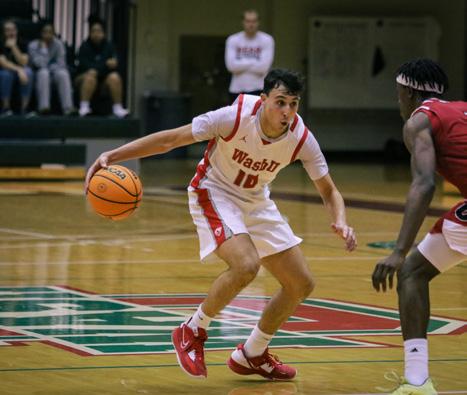
D1 vs D3: WashU men’s basketball faces SEC powerhouse Missouri in exhibition game
RILEY HERRON CONTRIBUTING WRITERAs the Washington Uni versity men’s basketball team walked onto the court at the University of Missouri Thurs day night, head coach Pat Juckem knew one thing for certain: the Bears were going to face a lot of pressure, and not just from Missouri’s fullcourt press.
How his team would respond to that pressure, however, was one of many uncertainties surrounding the WashU program head ing into its first game of the season. The Bears also faced questions about what roles the team’s many young stars will play and how they would replace their two leading scor ers from last season.
Although the visiting Bears lost the preseason exhi bition match 89-61, Juckem was proud of his team’s performance.
“I’m really pleased with how we handled the whole experience. You know, going in, playing an SEC team, they’re going to throw some things at you from a size and athleticism perspective that certainly challenged our con cepts,” he said after the game. “I was very pleased with our approach. I thought our guys represented our program and ourselves very well.”
Missouri, who plays in the Southeastern Conference, one of the most competitive in Division 1, has a much larger program than WashU and the Division 3 teams they normally face.
Juckem said that the game provided the Bears an oppor tunity to test themselves and grow: “We looked at it as an opportunity for our growth as a team. It was a game, but it was an exhibition. We went in with the mindset of we’re going to compete and win every possession we can, and we’re going to be better when we come out of it.”
The Bears lost two of their best players from last season in Jack Nolan, who
was drafted to the NBA G League, and the late Justin Hardy, who passed away due to cancer in May. This year’s version of the Bears squad features many young players ready to step into key roles.
Out of the starting five Juckem chose Thursday, three of them — Drake Kindsvater, Jake Wolf, and defending UAA Rookie of the Year Hayden Doyle — are sophomores. They started the game alongside fresh man guard Will Grudzinski and graduate student Char lie Jacob, who was named the UAA Defensive Player of the Year last season. Juckem said that he is excited to see his younger players grow, stat ing that Grudzinski and the two other freshmen, Yogi Oliff and Calvin Kapral, are “nowhere close to their ceil ings, which is the exciting thing about this team.”
Throughout the early stages of the game, WashU demonstrated it was ready to battle with its in-state foes. Although the hosts scored the first five points of the game, the Bears quickly knotted the score up with a five-point run of their own. This back-and-forth trend continued throughout the first half, although Missouri remained on the front foot for the opening ten minutes.
The Bears eventually clawed ahead of the Tigers for their first lead around the halfway mark of the opening period, as a 7-0 run, which included five points from the veteran Jacob, gave them a 19-18 lead. The Bears converted their hot streak into a 23-20 lead with eight minutes remaining in the first half, but that threepoint lead would end up being both the largest and last one the Bears managed during the contest.
While WashU looked capable of keeping Missouri within striking distance throughout the opening period, the hosts began to pull away about 12 minutes into the game. The Tigers electric offense and potent defense were on full display as the Division 1 side scored 15 straight points across a four minute stretch. Missouri burst out to a 35-23 lead and never looked back, as they would go on to stay in front for the rest of the game and take a 45-30 lead into the break.
Just like the first half, the second one began with the teams exchanging buckets back and forth. Although they were trailing by double digits, the Bears never gave up and managed their best stretch of the game midway through the second half. After trail ing 59-44, two Grudzinski
8-2
Volleyball finishes sec ond at UAA tournament, snags postseason bid
CLARA RICHARDS MANAGING EDITORBy the time the Washington University volleyball team pushed Carnegie Mellon University to a fifth set in the semifinals of the UAA Championships, the Bears had been on the court for eight sets already. They cruised past Rochester University in the first round for a 3-1 win where they recorded 10 kills and 14 blocks. But just hours later in the semifinal match, the Bears traded off sets with Carnegie Mellon for four sets to push the game to a tiebreaker.
buoyed by an attack error from WashU, kept the Eagles in contention. At this point, even a late kill from fifth year Michaela Bach couldn’t save the Bears from losing the first set.
From there, Emory only ceased their lead once in the remaining sets, a 1-2 score in the third set that was quickly answered by four successive points on the board to boost Emory to an untouchable lead. The Bears hit .174 to Emory’s .250 and fell behind in assists and aces. Sells led the team in kills, with 11, while freshman Sam Buckley led the team with 31 assists.
3
Mis souri
Dennis Gates to call a timeout to halt the momentum. Unfortunately for WashU, the SEC stalwarts showed their quality and resil ience, scoring eight straight points out of the timeout to reestablish a 69-52 lead with seven minutes to go.
As the clock wound down, both coaches utilized the opportunity to test out their depth off of the bench. One notable performance for WashU came from senior Nate Bloedorn, who has spent the last two years recovering from a knee injury suffered his freshman season. The forward scored nine points and grabbed four rebounds in ten minutes of action and looks ready to finally be a key contributor to the team this winter.
In the end, Missouri’s star power proved to be too much for the Bears. Mis souri’s senior Kobe Brown, who was recently named a preseason all-SEC selection, led the team with a 25-point double-double and senior Isi aih Mosley, a coveted transfer from Missouri State, tacked
READ MORE AT STUDLIFE.COMIn the final set, the Bears set the tone: no more close, two-point losses. They never relinquished their lead, and an untouchable ball delivered by junior Lily Steinbach brought home the match point for WashU.
“We knew it wasn’t going to be easy and we were going to have to work hard together as a group. It was fun to watch us battle and to hear how supportive our team was on the bench,” said head coach Vanessa Walby about the team effort.
On Saturday, WashU lost to Emory University to finish second in the UAA Championships tournament. The runner-up conclusion is the team’s highest ranking since 2017, when they beat Emory in the title match to claim the UAA championship. In adding two more games to the win column the team cemented its argument to be included in postseason conten tion games, as they secured a Pool C bid to the NCAA tour nament on Monday.
After playing nine sets on Friday, the Bears knew they had a battle ahead of them in Emory, and the Eagles deliv ered. After fighting back from an early deficit, sophomores Zoe Foster and Jasmine Sells nailed four kills and the team drew ahead by three points. But an offensive rally from Emory late in the third set,
The team’s selection show on Monday granted them an at-large bid to the postseason. The Bears’ last postseason victory came in 2018 where they secured a victory against Cornell College in the first round before being defeated by Illinois-Wesleyan. Their num ber one ranking in the region plus their strength of schedule all contributed to their postsea son contention, where Walby said they looked forward to the matchup.
They are set to play Millikin first, a team that they’ve already confronted and defeated. The Bears played the Big Blue in October and came out with a 3-0 win. If they advance past the first round, they could either face Wittenberg University, a team with a 24-3 record that lost 3-1 to Millikin, or Hope, a team that has lost to Wittenberg this season. The most likely scenario would be seeing Wittenberg and WashU play in the second round.
“Nothing in the postsea son will be easy,” said Walby, reflecting about her team’s goals in November. “We look at [the] postseason as a clean slate and fresh start for every one. It is a time to fine tune our skills, pay attention to details and work our system. It is a time to focus on us, have fun and compete hard together as a group.”
CHANAH PARK CONTRIBUTING WRITEREmily Konkus is a senior runner on Washington University’s women’s cross country team. Konkus serves as one of the co-captains of the team, and was the highestplace finisher for the team at the UAA Championships — one of many collegiate career highlights for the ath lete. Konkus gave Student Life insight into the team culture that motivates her to attend every 6:30 a.m. practice, advice she has for younger student-athletes, and her successful UAA weekend competition.
This interview has been edited for length and clarity.
Student Life: Can you give us a little background on your history running cross country?
Emily Konkus: I’ve been running cross country for about eight years now. I started in high school, and my team then was great. My older brother used to run cross country, so it was just a natural fit. I’d known about the sport and had a breakout season late into my freshman fall and fell in love with it. Going into my senior year, I decided that I wanted to run in college, and WashU seemed like a really good fit. [Head coach Jeff Stiles] is a very enthusiastic
coach. When they flew me out for a visit, I fell in love with the team culture — and, of course, the school is great and the academics are awe some. Overall, it was all a good fit.
SL: Walk us through the UAA championships this past weekend.
EK: For UAA, we travel with 10 women and 10 men. Our biggest competition this year was UChicago. They had an extreme depth that I’ve never seen before from them, meaning they have a really solid five. But, even back through their five-ten runners, they’re all a very close pack. They’ve been ranked number one in the division throughout the season, so we knew they were going to be our tough est competition. We definitely had a closer gap in terms of team scores than what we’ve had prior, but I thought we had a really good race strat egy that we executed very well. Also, the whole point of cross country is that you’re building to something great. Conference was just a step in the process to achieve some thing great at Nationals.
SL: How do you mentally prepare to compete?
EK: I think that after over eight years of racing, you defi nitely have a lot of knowledge. And I’ve definitely learned
a lot. Specifically with the team, when you’re not rac ing for just yourself, you think of the fact that you’re on that line with nine other women, and it takes a lot of pressure off of you. I think that’s what has been great about racing in college. [In the past], I would get on the line in high school and say to myself that it was just me on the line and that if I have a poor performance, this is going to be a failure. However, since beginning to race in college, I’ve real ized that every opportunity you have and every race is an opportunity to learn. I think that’s a much better mental ity and represents how I go into it now. Again, everyone is so positive on the team. It’s insane how much good energy there is and how much other people want you to suc ceed. For example, my other training partner Lindsay, who’s also a senior and my co-captain, is always by my side. She holds me up when it doesn’t go well, and I think that is something I’ll look back on [for] many, many years to come with a smile on my face and a lot of joy. Honestly, at this point, I don’t think there’s a lot of mental preparation because I’ve been [on the line] before. I tell myself that I can let the nerves calm down.
SL: Can you tell us a little
bit more about the team culture?
EK: I think the team cul ture is really special and not something that you get across Division III. We’re here spe cifically because we love this sport — no one’s getting paid to do it. Even if you run really well, nothing’s changing. You’re still on the team, but you’re not getting any spe cial treatment or scholarships out of it. In the team culture, specifically, we have a big focus on winning team titles. Of course, everyone wants to excel individually, but I think there’s a focus on winning things as a team and scoring and placing at the national level. Last year, the goal was to get six conference titles across men’s and women’s. The big goal would be to get con sistent national titles across men’s and women’s. The men won indoor last season, so the women are looking to repli cate that sometime this year. Specific team-culture things we do include shorts that have crazy patterns. Everyone will bus up to the Cross Country national meet, and we’ll have 200+ alumni as well as current students and track athletes. Some will paint their bodies red and green and also carry a big flag. It’s the craziest thing I’ve ever seen. I’ve been a part of the cheering squad and also
the people competing — and I think being on both sides of it, you feel as involved, if not more involved being on the cheer side. [Cheering] may be even more fun than com peting; it’s just a whole lot of love. It’s definitely something very special.
SL: Now that you’re a senior and have had many opportunities throughout your collegiate career, what are some of the highlights?
EK: Number one would be the big race that WashU hosts during the outdoor track season. Last year was the first time I had been to it, because we didn’t have a season in 2021. The race is called the Distance Carnival and it’s an evening race, which is always fun because the lights are on at twilight, and there’s a little more hype, and a ton of people come out. I ran the 5K together with this other senior, and it was such a magical race. I started out dead last and I just thought [that] I’d see how it goes. I wasn’t expect ing anything big out of it because it was also the begin ning of the season, but Stiles hypes it up because he says it’s the best competition we see across distance events and is an opportunity to qual ify for Nationals. So, I didn’t go into it with much hope,
but we both ended up having the best races of our careers. Something just clicked, and my legs went on auto-mode. A specific moment I remem ber is when my training partner Lindsay hugged me across the line. She was cry ing tears of joy. It actually ended up being the race that qualified me for the national outdoor meet.
SL: What is your advice to incoming student-athletes?
EK: It’s definitely going to get hard. There will be times when you’re juggling so many plates. However, if you let yourself go through it and lean on the people around you, you’ll find that it’s a really enjoyable experi ence. I don’t want to say that giving up athletics would be a mistake, but I think you’ll end up looking back and seeing how much enjoyment there was, even in the times that it seemed really over whelming, crazy, and hectic.
SL: Our last question is something that we ask every athlete. Would you rather have fish for hands or adopt a child every time you hear Bohemian Rhapsody?
EK: I honestly don’t hear Bohemian Rhapsody that much, so I’d say I’d adopt a child. Fish with hands is for life.
CLARA RICHARDS | SPORTS EDITOR | SPORTS@STUDLIFE.COM STUDENT LIFE 7THURSDAY, NOV 10, 2022
SPORTS
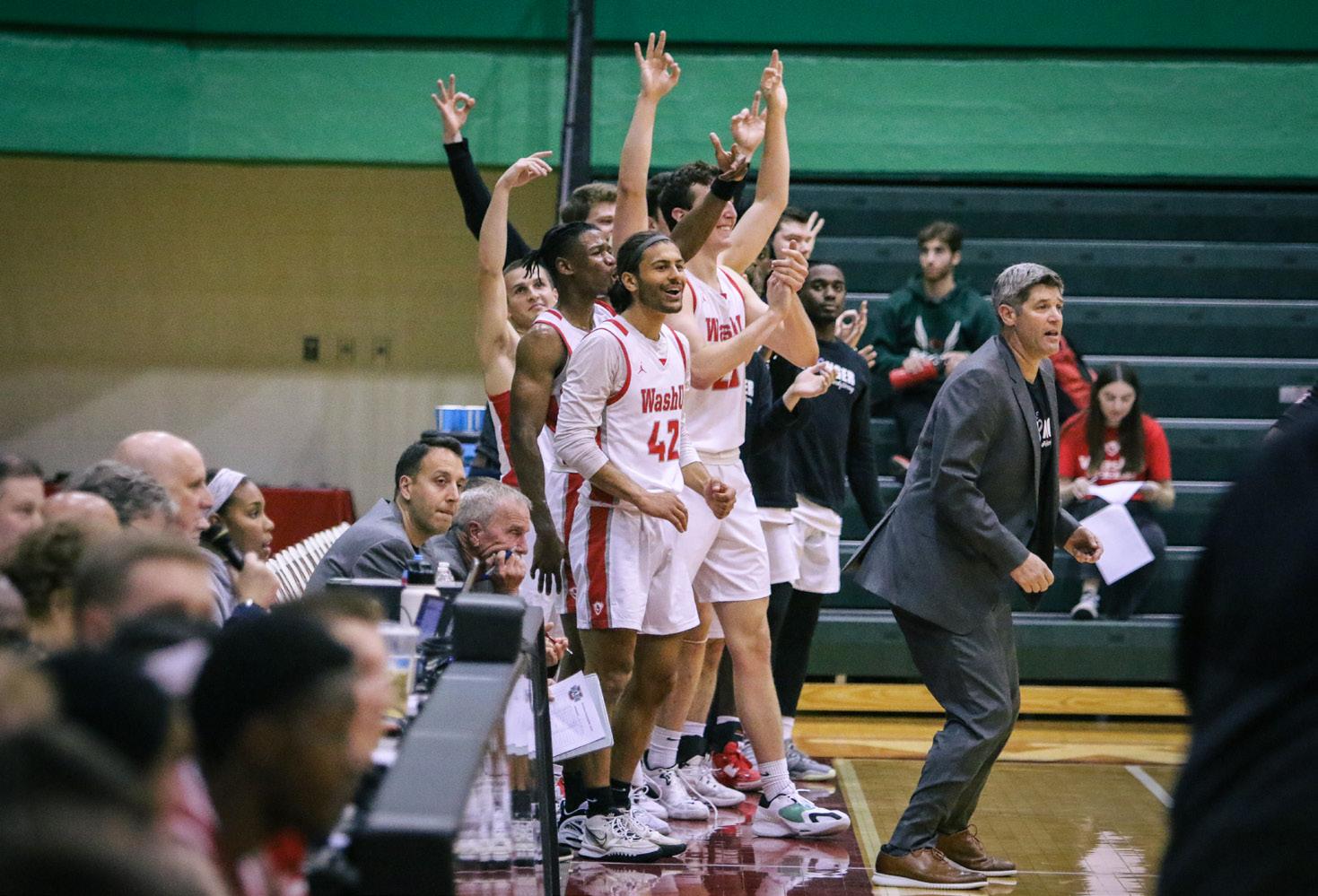
“Just a step in the process”: For cross country’s Emily Konkus, the best is aheadthree-pointers and a Doyle layup cut the Missouri lead down to 9. The run for the Division side forced coach CLARA RICHARDS | STUDENT LIFE The bench celebrates a clean three from Yogi Oliff. “I’m just excited to be out there,” Charlie Jacob, front, said. “I‘m just trying to be present and be grateful for the good moments.”
Men’s soccer falls to #2 Chicago to close out the season
“I just didn’t get enough power on it when hitting it out,” said fifth-year goal keeper Matt Martin. “I was hoping that someone was gonna be there, but when they played the ball, honestly, I was only really focused on the ball.”
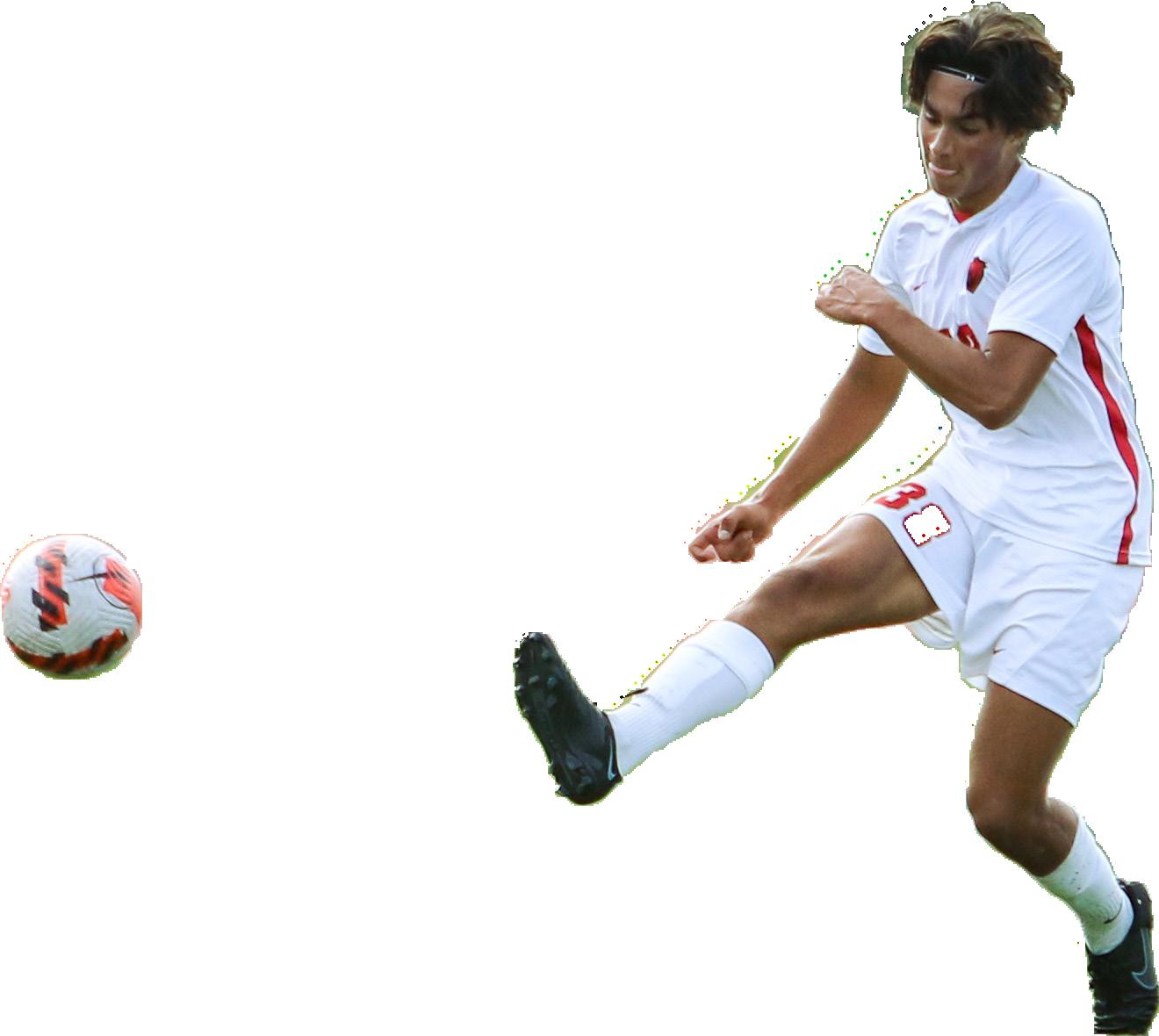
In the 77th minute of the game, a committed Martin aggressively charged off his line to fend off a high, long ball that sailed toward the penalty box. Head to head with a University of Chicago player, Martin successfully managed to punch the ball away from the danger area. But the ball didn’t travel far enough; instead, it fell to the feet of a Maroon player, who then lobbied it straight back into the net, for a 1-0 goal lead for the top-ranked home team.
The Washington University men’s soccer team lost their final game of the season to conference rival University of Chicago with a scoreline 1-0. This was the first time the two sides met since last season, when a decisive home win delivered WashU its first UAA title since 2012 and its first outright title since 1999. But coming into this matchup, circumstances were much dif ferent, with an undefeated Maroon side looking to win its first UAA title since 2019.
With the loss, the Bears finished the season with six wins, six losses, and two ties and ended up in fifth place in UAA standings. The loss was also the Bears third-straight UAA away loss, continuing the trend of challenging away games — the team was 1-6 on the road. On the other hand, the win cemented UChicago’s undefeated regular season
with a record of 16-1-0 as they head back to the NCAA DIII playoff games, having made it all the way to the semifinal game last year.
“I’m absolutely proud of this group and the showing they did today,” said head coach Joe Clarke. “I’m proud of what they did over the course of the year. Not every moment was as good as we could play. We didn’t neces sarily always put all the pieces together like last weekend. We lost those two games against two teams that we were more than capable of beating.That was disappointing for our team. But we still have had a lot of moments in those games where we played good soccer and things just didn’t work out.”
UChicago enjoyed a comfortable first half in the beginning of the game. They dominated possession and shot creation as they ended the half with 6 total shots, 3 of them on target; whereas WashU managed to register zero shots. Due to incredibly windy conditions, the Bears spent much of that time sit ting back, observing all the pressure from the Maroons and waiting for counterat tacks. It was all part of the game plan: to maximize the gusts.
“Our entire plan in the first half was basically with the wind,” said sophomore Eugene Heger. “We wanted the wind to go against us. We wanted to just try to soak up all that pressure, and sit back there and let the wind carry the ball out of bounds. Which I think we carried out really well. We kept them pretty quiet for most of the first half. And then we were able to go into the second half.”
The plan proved to be a success. Despite the Maroon’s
possession dominance and good ball distribution, the Bears kept them at bay with only three shots on target, a feat largely thanks to Martin’s commanding goalkeeping dis play throughout the game.
“Basically between me and the backline, it was gonna be a challenge because of the wind,” said Martin. “Every time they were trying to play the ball in between us it was always hard to judge just because of how volatile the wind was essentially. So I definitely had to be a little more aggressive coming off my line.”
Coming into the second half, the Bears were a more interactive side than they had been in the first half, although UChicago contin ued to dominate possession, ball distribution, and shot cre ation. They finished the half with six more shots, while the Bears managed to post three shots, oneon target.
“Second half, we just wanted to get the ball off the field for territory, and then try and get something out of playing,” said Martin. “But really, we were looking at a lot of counter attacking strategies because we knew that they were going to be able to hold the ball very well.”
Throughout much of that half, the Bears held their own.
reached the feet of a Maroon player, who scored the win ning goal of the game through a volley. The Bears tried to come back, attempting to force the game to overtime, but fell short.
“Probably the most justifi able result would have been a tie,” said Clarke. “Neither team really had many chances. They had a hard time breaking us down really in both halves. They caught one through ball when we were pressing. They hit a long ball, we didn’t get it away and the guy had a fantastic volley.”
In what was arguably a challenging season in terms of building off their success from last year, the Bears navi gated obstacle after obstacle as a team this fall. From injuries that haunted the team right to the very end, losing key mem bers out of their 2021 UAA title-winning team to getting
year, that was a huge thing. I mean, I was out for the first six games this season, so that changed my image of it all.”
Going into next year, the Bears are losing a few important players that have been so vital to getting the program where it is now. The likes of seniors Gavin Morse, Shiv Lamba, Hudson Hazlewood, will be gone. And then, of course, there is the All-American goalkeeper Martin who finished his fifth year of eligibility this season, but now has to hang up his gloves for the Bears. A future WashU Hall of Fame con tender, Martin’s character, humbleness, and sheer love of WashU will be greatly missed by the squad who have played on the pitch in front of him all season.







“For me I feel like I’ve seen this program evolve so much from when I
opponent was the Maroons.
“I would say that for me ending in Chicago, regardless of the result, that’s honestly all you can ask for when you’ve played at this level,” he said.
“There’s like a wide range of teams that you can be play ing, and you always want to play the best teams. They’re number two in the nation right now, so being able to play against one of the best teams in the Division as last game is definitely a great way to go out.”


The Bears are losing a lot this upcoming offseason, but they are also gaining a lot. Throughout the season, freshmen and several rising upperclassmen gained a great amount of UAA experience to be able to learn from. In arguably one of the tough est conferences in DIII men soccer, that experience is essential. Still, there are still things to improve on; to Clarke, not many of those things are as important to him and his coaching staff as scoring goals.
ing wise, but their backline unit also played well; they managed to keep several of Maroon shots from reaching Martin as they did in the first half.
But in the 77th minute of the game, a punch clearance from Martin accidentally

much happier that his last
nitely think at the start of the
“We [have] got to be a better attacking team,” he said. “We need to find a little bit more help on the frontline for guys to score goals. We have guys that are working towards it, and hopefully we’re gonna bring guys in that are really going to challenge them that are already prepared to do that. But that’s really obvi ous, we didn’t score enough goals.”
drink. dine. Wplay. EEKLY BAR, RESTAURANT AND FUN GUIDE STUDLIFE.COM Wherever you are, stay connected: Subscribe to our free e-newsletter... head to FACEBOOK.COM/STUDLIFE @ STUDENTLIFENEWSPAPER @ STUDLIFE 7018 PERSHING AVE 314-726-3030 CLAYTON/ WE ARE THE DELIVERY EXPERTS! CLARA RICHARDS | SPORTS EDITOR | SPORTS@STUDLIFE.COM8 STUDENT LIFE THURSDAY, NOV 10, 2022 GALLERIA 6 C I N E M A S galleria6cinemas com get your tickets now! TWOBLOCKS FROMCAMPUS!7347FORSYTH OPEN UNTIL 1:15 A M Wash U Students Save 25% after 7pm! Thursday Night= STUDENT NIGHT
AMURI JUNIOR SPORTS EDITOR
HUSSEIN