








Student Life Masthead
Letter from the editors
Welcome to the Midwest!
Dorm room packing list
Unexpected items to pack
College advice speedrun
How to be a successful college student: Advice from the Class of 2026
A guide to campus acronyms
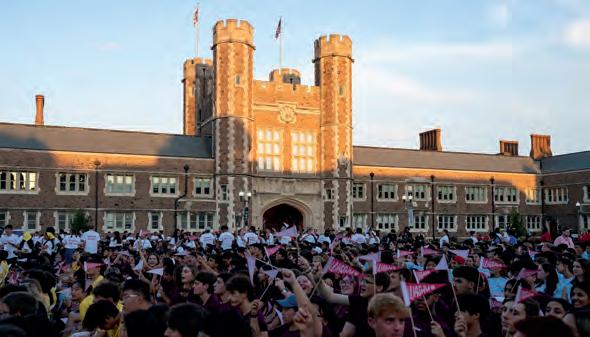
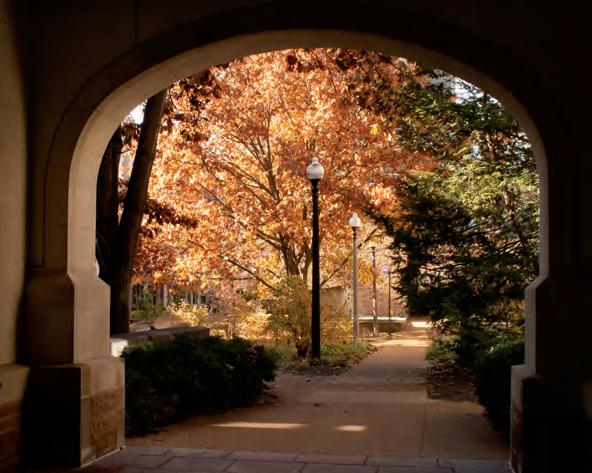
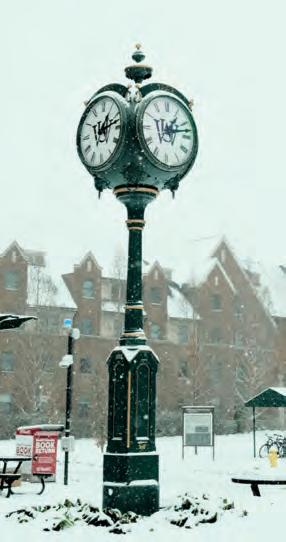
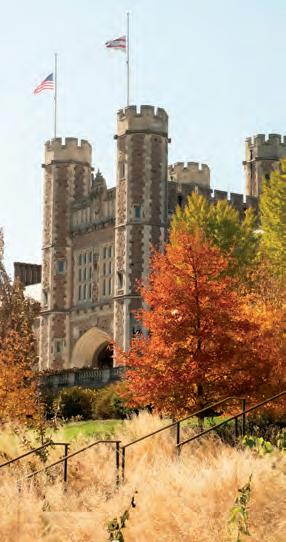
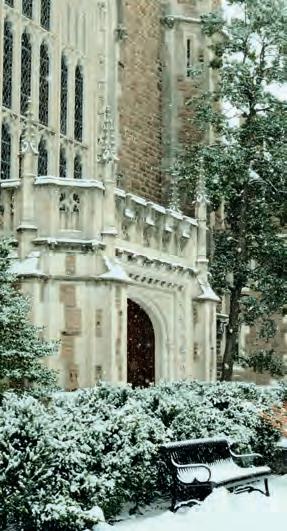
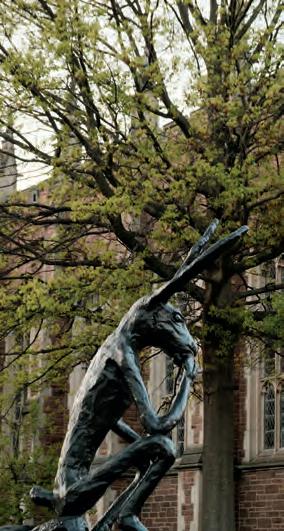
WashU through the seasons
Get your bear-ings: The ins and outs of campus travel
Student Life’s favorite study spots
How to navigate burnout in college
Guide to important class deadlines
Course recommendations
Take a sociology class!
A guide to WashU’s biggest events
A message for Black students
Breaking the ice (before it breaks you)
Don’t let social media fnalize your frst year friendships
Save Me, Scene! A how-to guide for fghting frst-year loneliness
What’s happening? Everything to do at WashU




The St. Louis County and City of St. Louis divide, explained
A beginner’s guide to tornado safety
A guide to sidequests
How to actually make the most of Forest Park
Leaving the WashU bubble
A serial concert-goer’s guide to your new favorite city’s music scene
Guide to St. Louis concerts this fall
Why YOU should care about WashU sports
Fall sports season previews
Watch out for WashU football
What “benchriding” in college has taught me
Student Life’s favorite clubs
The South 40
In defense of traditional dorms
Dorm dining
A guide to vegetarian and vegan dining on campus
Student Life’s restaurant recommendations
Puzzles
Save Me, Scene! College relationships
Meet the Student Life staff!
Don't just learn it. Build it. Join AWS Builder Center today for free training, expert support, and a global community. Everything you need to build your future.

Laurel Wang
Lewis Rand Editors-in-Chief editor@studlife.com
Tanvi Gorre Coby Rinke Managing News Editors news@studlife.com
Hannah La Porte Managing Scene Editor scene@studlife.com
Hannah Much Managing Sports Editor sports@studlife.com
Dion Hines Managing Forum Editor forum@studlife.com
Kate Westfall Managing Design Editor designers@studlife.com
Amelia Spencer Special Issues Editor
Ava Giere
Managing Chief of Copy copy@studlife.com
Lucia Thomas Managing Illustration Editor
Reeya Sharma Managing Social Media Editor
Isabella Diaz-Mira Managing Photo Editor photo@studlife.com
Quinn Moore Managing Newsletter Editor emailedition@studlife.com
Alan Knight Managing Multimedia Editor
Victor Huang Selina Son
Nicholas Demba
Lexi Lawsky
Ella Meshoulam
Zana Kennedy Zoe Rhodes News Editors
Sara Gelrud
Sophie Schwartz Jake Isenberg Elle Ludwin Scene Editors
River Alsalihi
Kate Theerman Rodriguez
Lyn Wilkins
Maddie Morgan Leilani Billups Forum Editors
Eliza Stulman
Anna Crook
Harper Nix
Ben Ollendorff Sports Editors
Eran Fann
Mac Motz
Alex Dering Photo Editors
Bea Augustine
Jack Warren Tillie Szwartz Design Editors
Kevin Kan Marceline Lee Illustration Editors
Ashwin Nair Audrey Tebow Newsletter Editors
Kate Matthews Kat Ziwot Social Media Editors
Jack Yang Senior Web Editor
Andrew Tian Echo Dong Georges Gewargis Junior Web Editors
Julie Kassin Chief of Copy
Eleanor Sterne Kayslay Cudjoe Anna Piasecki Copy Editors
Campbell Crum DEI Editor
Apurva Ganti Head of Recruitment and Training
Adrienne Levin Coleman General Manager a.coleman@studlife.com
Sarah Huff Advertising Sales Manager huffs@studlife.com
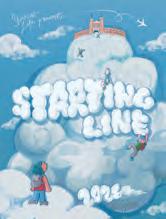
Cover Illustration: Lucia Thomas
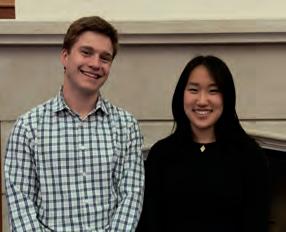
LAUREL WANG
LEWIS RAND EDITORS-IN-CHIEF
Dear Class of 2030,
Welcome to WashU! Congratulations on embarking on your college journey. We’re so incredibly excited to meet you.
Our Starting Line issue is flled with advice for new students, tips for navigating WashU, sports previews for some of Division III’s best athletic programs, and a guide for enjoying St. Louis to the fullest. Starting Line is one of our favorite issues of the year! Not only do we get to relive our frst years, but we also get to share the advice we wish we knew then. We are sure you have already begun to learn about WashU from
endless Facebook and Instagram posts and have been inundated with advice (wanted and unwanted) from friends and family. We understand that this can be overwhelming and we hope this issue will help turn up some advice for you to prepare for the transition to WashU and life in St. Louis.

before, there is a home for you in Student Life. We would love for you to contribute to and join us.
newsletter writers, crossword
If you have any questions about our community, feel free to reach out to join@ studlife.com. Otherwise, we will see you at the Activities Fair and other new student events at the beginning of
feeling lost, bored, searching for a community, or ever have any questions, feel free


AMELIA SPENCER SPECIAL ISSUES EDITOR
I was born in the Pacifc Northwest, but moved to St. Louis at the young, still-yetto-be-fully-sentient age of four. My frst words in St. Louis were, according to my parents, “It’s wicked hot!” We were moving our entire lives from a moving truck into our small brick house in the dead heat of summer, and I stand by this description. It is wickedly hot every summer.
As transplants from the beautiful, temperate, state of Washington, moving to St. Louis was a hard adjustment for my family. But over the years I have come to love not only St. Louis, but the entire Midwest. To me, it is the most beautiful landscape. I can’t picture myself living anywhere else.
The following issue will be full of articles convincing you to take advantage of St. Louis, and WashU-specifc recommendations, but I want to share with you my passion for our entire region. Whether you are new to the Midwest, or just needing some convincing to fall back in love with this part of the country, I can help.
My favorite part of the Midwest is its wilderness. While we do not boast large looming mountains, and we are most certainly landlocked, the wilderness in the Midwest is unbelievably impressive. I grew up spending my summers on my family’s farm in Iowa. The plus side to having no mountains, or hills, is that you can see for miles. There is a distinct beauty in the seas of corn and the big uninterrupted sky. Obviously from WashU you don’t see this part of the Midwest, but there are opportunities to.
In my frst semester at WashU I had the privilege of joining the frst-year fall break backpacking trip and
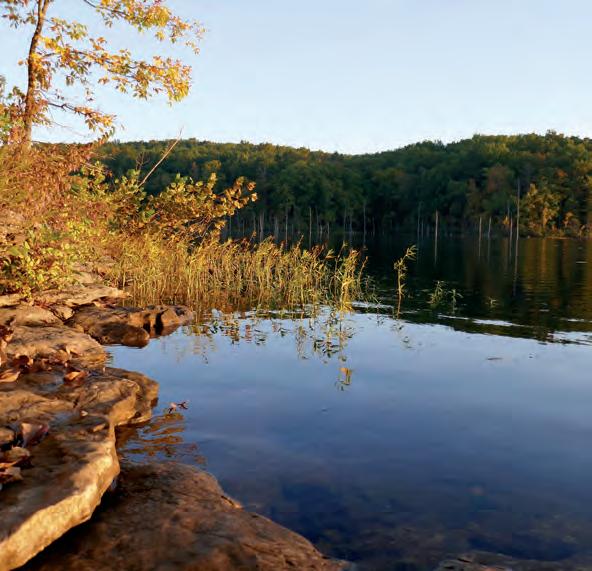
club, Wilderness Project (WP). Through this club, I was able to fall in love with the beautiful nature Missouri has to offer in a whole new way. There are glimpses of this country landscape I grew up with, but I was introduced to new beauties nearby. I found, through this club, one of my favorite places on the planet: a lake and web of backpacking trails in the Mark Twain National Forest called Council Bluffs. I cannot recommend exploring the nature of Missouri enough, whether it be with a club, friends, or alone (safely).
I also fnd St. Louis, and the Midwest, to be the perfect place to live as a college student. The Midwest is humble, it is easy to live in, and — maybe most important to college students — it is cheaper than many other regions. We are so busy as college students. You will undoubtedly fnd yourself spending most of your time on campus. But when you are ready for a change of scenery or need to step away, St. Louis will welcome you. Stroll through a museum and leave after 30 minutes because you didn’t have to pay to get in and it doesn’t matter. Try new activities which challenge you. It’s college: trying new things and hating them is exactly what you should be doing. In St. Louis you can explore and not fall on your face.
The most popular positive stereotype of the Midwest is that everyone is nice. And while I believe that is something you judge person to person, I do fnd tireless friendliness in this part of the country. On a walk from the South 40 to Demun Avenue, a street with coffee, ice cream, restaurants, and a park nearby, you will see your new neighbors. Smile! Wave! Comment on the weather! You will not be disappointed.
Welcome to the Midwest. We are so happy to have you.
KATE WESTFALL MANAGING DESIGN EDITOR
Room
□ Bedside table/cart
□ Bedside lamp
□ Fan
□ Under-bed storage bins
□ Command strips and hooks
□ Hangers
□ Full-length mirror
□ Shoe rack
□ Storage bins
□ Tall lamp
Cleaning
□ Trash can
□ Trash bags
□ Mini vacuum
□ Disinfecting wipes
□ Hand soap
□ Laundry detergent
□ Laundry hamper
□ Dryer sheets
□ Drying rack
□ Mini steamer
Kitchen
□ Reusable water bottle
□ Plastic bags
□ Bag clips
□ Paper towels
□ Snacks
□ Baking sheet
□ Tupperware
□ Plate and bowl
□ Utensils
□ Backpack
□ Pencils and pens
□ Highlighters
□ Permanent markers
□ Dry-erase markers
□ Tape
□ Stapler and staples
□ Scissors
□ Paper clips
□ Post-it notes
□ Pushpins
□ Calculator
□ Planner
□ Pencil case
□ Folders
□ Notebooks
□ Desk lamp
□ Twin XL sheets
□ Comforter
□ Pillows
□ Pillowcases
□ Throw pillows
□ Throw blanket
□ Undergarments
□ Pajamas
□ Shirts
□ Shorts
□ Pants
□ Athletic clothes
□ Bathing suits
□ Professional clothes
□ Jackets
□ Shoes
□ Accessories Technology
□ Phone and charger
□ Tablet and charger
□ Laptop and charger
□ Portable charger
□ Batteries
□ Headphones
□ Extension cord
□ Speaker
Medicine
□ First aid kit
□ Allergy medicine
□ Cold and fu medicine/cough drops
□ Pain medicine
□ Prescription medicine/vitamins
□ Thermometer
Miscellaneous
□ Umbrella
□ Playing cards
□ Sports equipment
□ Musical instruments
□ Board/video games
□ Bike and helmet
□ Earplugs
□ Sleep mask
□ Tool kit
□ Sewing kit
□ Overnight bag
□ Purse/tote bag
□ Winter essentials
□ Picnic blanket
□ Frisbee/hackey sack/spikeball
Bathroom
□ Towels
□ Bathrobe
□ Shower shoes
□ Shower caddy
□ Air freshener
□ Body wash
□ Shampoo
□ Conditioner
□ Shaving cream
□ Razor and blades
□ Deodorant
□ Face wash
□ Moisturizer/lotion
□ Sunscreen
□ Bug spray
□ Hand sanitizer
□ Toothpaste
□ Toothbrush
□ Toothbrush holder
□ Glasses/contacts
□ Tissues
□ Menstrual products
□ Makeup (products, brushes, remover)
□ Hair appliances
□ Nail polish and remover
□ Nail clippers
□ Hair products
□ Hairbrush/comb
□ Hair ties/clips
□ Jewelry and makeup organizer
□ Tweezers
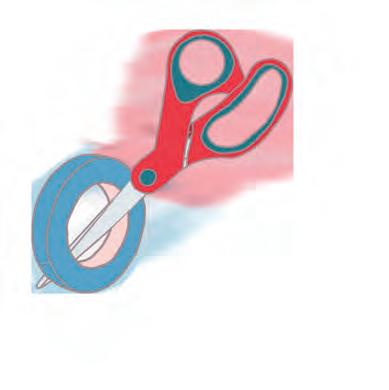
It might be easy to overlook these, but you’ll realize immediately that scissors are a must when moving in and come in handy all the time. As for the painter’s tape, I learned my lesson my frst year that command strips cannot always be trusted — painter’s tape can hold up anything and comes off the walls super easily.
– Bea Augustine, Design Editor
A beanbag chair/extra seating
When living in a suite without a common room, having a place for friends or guests to sit makes the room feel more comfortable and less temporary. Everyone laughs when you bring one… until they are the ones sitting on it every day.
– Kate Mathews, Social Media Editor
Heavy-duty garbage bags
Not for what you think, though: Don’t torture yourself and your move-in squad with the effort of taking all your clothes off their hangers, packing them up, then arriving, unpacking, and re-hanging everything. Simply slip clothes that are already on their hangers into those garbage bags, like you would do with a garment bag. This trick has saved me countless hours of unpacking and more than a few bouts of move-in-day-induced bickering.
– Laurel Wang, Editor-in-Chief
You’ll have many different “categories” of items, such as hats, belts, shoes, etc. Getting a closet organizer, such as the hanging one I had, allowed me to utilise my small closet space more effectively. This was something I had to buy after moving, upon realizing that I didn’t have enough space for everything, so don’t make my mistake.

– Apurva Ganti, Head of Training and Recruitment
Air freshener spray
You. Will. Need. It.
– Zoe Rhodes, News Editor
It is super important to bring one. I got one for $15 at Target, and it helped me avoid getting sick too many times and helped so much with my allergies. I would highly recommend. Just make sure to change the flter at least once a semester.
– Hannah
Much, Managing Sports Editor
One thing I didn’t realize about living on a college campus and walking everywhere is that you have no other option when it is raining besides trudging to class through puddles and sitting, dripping in your lecture. Unless you bring rain boots!
– Amelia Spencer, Special Issues Editor
For when you want to access your electronics and still be in bed! Other than that, the most useful thing to bring is NOTHING — just kidding, but packing light will save you some major headaches on move-out day, especially since you’re bound to collect stuff throughout the year. As a chronic over-packer, less is more in this case, especially when room is limited. Clothing can easily take up all your storage space, so I would be mindful about how many clothes you bring.
– Kate Teerman Rodriguez, Forum Editor

LAUREL WANG EDITOR-IN-CHIEF
Welcome to WashU! You’ve successfully survived the long haul of high school, and we’re so excited you’re here. Look, I get this is an especially busy time for you: There are dorm decorations to buy, roommates to stalk on Instagram, attacks of preemptive homesickness to combat, and sentimental last-summer hangouts with friends to attend. Even reading this far — that’s a good twenty seconds gone! So I’ll cut to the chase: Here are 30 of the hardfought pieces of advice and knowledge I wish I had known, condensed into the most rapid-fre format possible, for the Class of 2030. Ready? Let’s go!
1.
Offce hours are for homework help and gabbing with your professors about anything and everything. Make an effort to go to them!
2. Don’t stack your semester with more than three really heavy academic classes.
3. You have until February of your sophomore year to choose a major. If you decide to change it, you’ll be in good and plentiful company.
4. Take Vitamin C and ginger tea for the frat fu.
5. You’ll do more walking than you think.
6. It is a rule of the universe that you will never end the semester with a perfect number of meal points, but the Gold Plan is a good bet.
7. You’re an adult — you don’t need to ask to use the bathroom in class or raise your hand during discussion seminars. In that vein, you can skip classes (without sending really gross pictures of your broken ankle to your TA as proof), but it’s a dangerous path to start on.
8. Propping your door open may just lead to making awkward eye contact with everyone who walks by, rather than true friendship, but it might be worth a shot anyway.
9. Talk to your roommates before small issues become big problems.
10.
Exams are important, but so are attendance points and assignments.
1. Throwing up makes you feel better far quicker than trying to tough out hangover nausea.
12. Everyone else is just as nervous as you are.
13. You’ll fnd yourself squabbling with your parents a lot this summer, which will peak during move-in, then devolve into mushy feelings right before you part ways; give them and yourself grace.
14.
Wait until after the frst week of class to buy your course materials.
15. Pack for winter snowstorms and 90 degree humidity.
16.
Don’t s**t-talk the Midwest or St. Louis — it’s your home for the next four years. Also, the “I got rejected from my frst-choice college, so I ended up here” conversation gets old fast.
17. Have a picnic blanket and a speaker, or make friends with someone who does.
18.
Come to peace with the fact that your packages will probably get delayed at the mailroom at the most inopportune time. You won’t get notifed about letters, but if you don’t pick them up within three days, they’ll get sent back.
19.
Get a UPass to ride the Metro for free.
20. Write professional emails, complete with the “I hope you’re doing well,” even — especially! — if you don’t really know each other like that.
2.
Know that “midterms season” is a misnomer in that it implies a start and end date; midterms actually start a few weeks into the semester and continue throughout the rest of the term.
23. Call home.
24. Apply for awards, even if you don’t think you’ll get them.
25. Stop checking LinkedIn — it’ll just make you miserable.
26. Study in buildings you’ve never been in.
27. Campus is not as fat as you might believe — take that into consideration if you’re looking to bring any form of wheeled transportation.
28. Eat your veggies.
29. Believe in yourself and your right to be here.
30. College goes by fast; take things slow.
21.
Get a free fu and COVID-19 shot.
We can’t wait to see all the amazing things you accomplish during your time here. Good luck, and we’ll be rooting for you all the way through.

Be fexible, and don’t get lost in the expectations you set as a frst-year. College is a great time for trial and error. If you need to change your major, change it! If you want to try something new, and you end up liking it, do it. Even if you’re not doing exactly what you planned, this is the time to be OK with trying everything!
- Sophia Hellman
Comparison is the thief of joy. Take a moment when you’re comparing your college experience to someone else’s to step back and appreciate what you do have going for you.
Everyone’s college experience has crazy ups and downs, but people generally only share the good stuff. Don’t think you’re any different for having bad days.
- Elena Wierich
You will learn so much in college, but I think arguably the most important thing is everything you learn about yourself. All of your experiences in your four years of college, good or bad, are going to teach you something about yourself. Listen to these things, learn from them, and allow these years to shape you into the best version of yourself.
- Bri Nitsberg
I could go with social/ personal advice, but I think the others have got you covered, so here is the nerdy (academic) stuff.
1. Take at least one fun class that is not connected to your academic focuses.
2. Do not be afraid to take the class that is driving you crazy pass/fail.
3. Attend speaker events — never again will you have this many cool and knowledgeable people coming to speak to you for free.
4. Go to the offce hours. Even if you don’t have specifc questions, just go and get to know your professors.
5. Print out or save readings that stand out to you in classes
and put them into a physical or digital fle folder so you can look back on them for future projects/fun/reminiscing. This is especially valuable if you mark up your readings with highlights/annotations.
- Sylvie Richards
Prioritize your student experience. Acing your classes and getting a job are important, but they aren’t everything. Do fun things like studying abroad if you can, taking a random class, or immersing yourself in a student group you’re passionate about. You might just learn more from those experiences than from ones in the classroom.
- Riley Herron

AMELIA SPENCER SPECIAL ISSUES EDITOR
While there are many things that you may be worried about coming into college, learning WashU’s commonly used acronyms should not be one of them. Below is a guide to some of the most important acronyms to know as you enter your frst year at WashU. With this early introduction, you will be able to better understand the language of WashU to allow you to take advantage of the plethora of services, events, and programs the University has to offer as soon as you arrive on campus.
The Bear’s Den dining hall is located on the South 40, offering a variety of dining options and serving as a popular space among firstyears and sophomores. In addition to the dining hall, the lobby is also home to the Cherry Tree cafe and the Paws & Go “convenience store,” which is often simply called Paws. Pro tip: Taking the stairs near Risa Commons brings you to the South 40 gym, located just above BD.
The Center for Diversity & Inclusion is made up of four offices that are combined into one department: CrossCultural Connections, the Office for International Student Engagement, the Office for Religious, Spiritual & Ethical Life, and Spectrum. These offices are located on the first floor of
the DUC (see below). They aim to foster belonging for all and are great resources for any student looking for support.
The Congress of the South 40 is a student-led organization sponsored by Residential Life. CS40 provides programming for students to help foster community and make new friends. Some favorites include Bear Beginnings orientation week events, specifically the Movie on the Swamp, and the Residential Community Olympics in the spring semester.
The Danforth University Center is a building on the Danforth Campus that houses dining options, including the DUC (pronounced “duck”) dining hall, Ibby’s (a sit-down restaurant that takes meal points), and Cafe Bergson. In the DUC, you will also find Tisch Commons (an event space on the main floor), Campus Life offices, study rooms available to book, and the Fun Room on the second floor (a lounge space with pool and foosball tables, TVs). Scholar Programs, Student Life (StudLife) and Student Union (see below) also have offices on the second and third floors of the DUC.
The Emergency Support Team is a student-run volunteer organization that offers urgent medical assistance on campus 24/7. EST also provides CPR, Active Bystander Training,
and Stop the Bleed courses. You can reach EST by calling 314-935-5555.
Peer-Led Team Learning is a tutoring program available to students taking Calculus I, II, and III, General Chemistry I and II, Principles of General Chemistry I and II, and Physics I and II. It is a program facilitated by an upperclassman Peer Leader which encourages cooperation between students in order to succeed in entry level science and mathematics classes.
Residential Peer Mentoring is another tutoring service offered to students in Calculus and General Chemistry classes. RPM sessions are offered on the South 40 and are available to all WashU students looking for additional help in these courses.
The Relationship & Sexual Violence Prevention Center offers 24/7 confidential counseling and emergency support, as well as informational services to help foster a safe and inclusive campus via trainings and programming. The RSVP center puts on a play called “The Date,” which is a sexual violence prevention program required for all incoming students.
The Sexual Assault & Rape Anonymous Helpline is a free, anonymous, studentrun confidential helpline that offers support to the WashU community in matters such as sexual assault, sexual harassment, and mental and sexual health. Call 314935-8080 to speak with their trained peer counselors.
The Student Union is WashU’s student government. SU is composed of an Executive Board, Senate, Treasury, and Election Commission, all aiming to advocate for the student body. They also work to allocate funds to campus clubs and organizations.
The Washington University Police Department is the team of law enforcement officials on WashU’s campus. WUPD (pronounced “woo-P-D”) are on duty 24/7 and have countless resources for students. To contact, call 314-935-5555 if on campus.
The WashU Student Associate program is a mentorship program in which student leaders welcome and support firstyears during the transition to college. You will receive a WUSA (pronounced “woosa”) who will help support you through your orientation week and the rest of your first year.





•
•


ABDOULAYE FAYE
AVA AYAD STAFF WRITERS
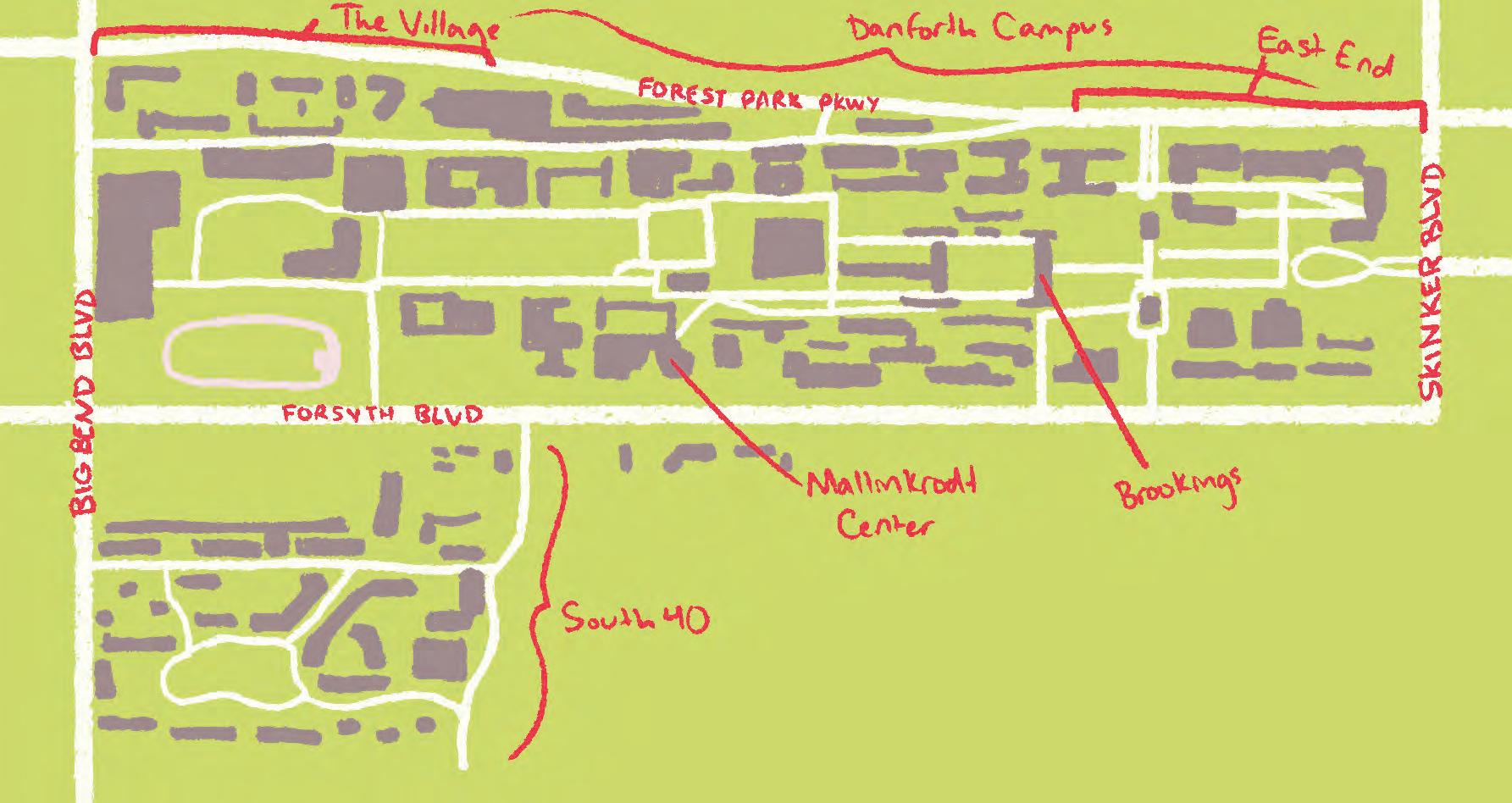
Welcome, new bears, to your personal travel guide for WashU! This article is a one-stop shop to help incoming first-years navigate and discover the various means of transportation available for getting around the Danforth Campus. The main strategy commonly used to navigate WashU’s campuses, and the one we suggest most to first-years, is walking. The Danforth campus specifically might seem intimidating in size and a hassle to navigate on foot, but there are tons
of pathways and not-sosecret shortcuts you can take through or in between buildings to get where you need to go without waiting on shuttle rides.
The first route is what we call the “Tunnel Track.”
This walkway not only connects with other routes but also takes you through the Underpass that runs under Forsyth Boulevard, which separates the South 40 from the rest of the Danforth Campus. The walls are covered in mini murals painted by students from different student organizations to advertise their upcoming events. In order to make your way toward Danforth, you can access the tunnel by crossing Shepley Drive and
continuing straight past the Clocktower by Bear Bodega on the South 40.
If you are living in Lien or Dardick, another quick way to reach the Underpass is by using the top floor of Shepley Garage on the South 40. This parking lot is located between the baseball fields and the residential halls Dardick, Nemerov, and Lien. Toward the end of the lot, there is a small path that intersects with the same trail that leads you straight to the Tunnel Track. That way, you will not have to walk out of the way to the Clocktower.
Once you have reached the end of the Tunnel Track, you will immediately see a fork in the road with two walkways going in
opposite directions. Taking the path on your right will lead toward the Danforth University Center, while going left guides you to Simon Hall, Seigle Hall, Sumers Recreation Center, and Mudd Field. So, choose accordingly based on which side of campus your specific class is closest to. P.S. You can find out where each of your classes are held through Workday under your registered courses!
Speaking of the DUC, if you are already on campus but need to get from lunch to class in two minutes, it’s got you covered. For example, if Mallinckrodt Center is your destination, taking the door past Ibby’s and the dining hall will put you outside in Bowles Plaza

and right in front of the back set of double doors to Mallinckrodt. Additionally, to get to Simon Hall quickly, going through the door of the DUC next to Cafe Bergson will take you to the crosswalk in front of the DUC Garage, along the sidewalk next to Simon’s open parking lot, and into the building.
Alternatively, if you are starting the day by going to Mallinckrodt Center or the front east side of the Danforth campus (around Brookings Hall) for classes, your best bet is walking along Shepley Drive to the corner of Koenig House and

crossing to Wallace Drive. Not only is this method faster than the Tunnel Track if you live in a residential building close to Wallace Garage like Hitzeman, Myers, Hurd, or Eliot, but it’s a great scenic route for nature lovers. You will travel along the Elizabeth Danforth Butterfy Garden, a quaint and beautiful study spot to be productive while also getting your dose of vitamin D!
Besides walking and/or biking, the next best option for getting around campus is to use WashU’s free shuttle service, which operates from 7 a.m. to 11 p.m. on weekdays and from 12 p.m. to 11 p.m. on weekends. The shuttle system has a fleet of buses that provide transportation across all of WashU’s campuses.
The shuttle that specifically roams around the Danforth Campus is called the Campus Circulator; this drops you directly in front of the Mallinckrodt Bus Plaza, putting you one step closer to the DUC. If you are heading toward any club activities that are located on South Campus, using its
designated shuttle bus will get you there in no time. This route can also take you directly to the supermarket, Schnucks, which happens to be right next to the AMC Esquire 7. To reach WashU’s Medical Campus or Clayton, a neighboring county with great food and walking trails, the West Campus shuttle will be your best friend . Plus, if you ever need the Psychological Services Center (PSC) here at WashU, the West Campus route will get you there, too!
Additionally, the shuttle system provides transportation beyond WashU, allowing students to explore around the greater St. Louis area. The Delmar Loop bus takes you to the lively district filled with quirky shops and multicultural dining, commonly referred to as “the Loop.” The shopper shuttle takes you to the Saint Louis Galleria mall and all the way to Walmart in Maplewood. However, this is the only shuttle that provides services once a week on Saturday from 9 a.m. to 6 p.m. To track where each shuttle is and to stay
updated on any scheduling issues, we recommend downloading the TripShot app on your phone. Keep in mind, though, that TripShot is sometimes inaccurate when it comes to exact shuttle times.
However, while the shuttles to and from the South 40 provide a straightshot to Danforth, they are often not the most efficient or reliable method to use, especially when you are in a crunch for time. Most shuttle buses usually arrive at the Clocktower on the South 40 every 15 minutes and occasionally suffer from serious overcrowding and/or delays due to traffic, driver switching, etc. However, when the winter snow hits and temperatures drop, going with the shuttle system may save you the trip to CVS for cold medicine.
Now that you are familiar with all the main routes of getting from the South 40 to Danforth, when the time comes to start classes and extracurriculars, it should be a little less stressful. Safe travels!
Life Sciences Library
I don’t know about you, but sometimes I just need a small spot to study, and if you’re like me, then the Biology Commons is the perfect spot. Located on the main foor of Rebstock Hall, it is typically pretty empty and has plenty of study rooms to choose from (especially if you go down to the Life Sciences Learning Center). If you need a good whiteboard and no distractions, it’s the place to be.
– Tanvi Gorre, Managing News Editor
Kopolow Business Library
This library in Simon Hall is pretty quiet and generally tends to be empty, so it’s a nice spot to get work done. There are also several study rooms you can book for the ultimate lock-in.
big windows, and the border of bookshelves gives it an academic ambience without feeling overbearing or sterile.
- River Alsalihi, Forum Editor
room in Weil
There is a real, living plant wall on the 2nd foor of Weil with a tall ceiling and skylights. It’s often pretty empty, but sometimes there are events. Great spot if you’re a Sam Fox student!
– Kate Theerman Rodriguez, Forum Editor
– Bea Augustine, Design Editor
Holmes Lounge
Located in Eads Hall, right next to Olin Library, Holmes Lounge is one of my favorite places on campus. The gorgeous ceilings and comfy chairs make it one of my favorite places on campus. (And their pop-up lunches on Mondays and Wednesdays are defnitely a bonus!)
– Ella Meshoulam, News Editor
Brown Library
Just a short walk from Olin Library, into an unassuming building, and up a short staircase, you’ll fnd my favorite study spot. Tucked away in January Hall, this library has the ambience of a New England university with its high ceiling and ornate windows. Usually pretty empty as well!
This library feels, to me, like a less intense version of the Law Library, which has a more nerve-wracking silence. Brown Library has several spots to sit directly in the soft light fowing from the
a nap, you can go down one foor to Basement Level B and take a nap on the couch beds. You really can’t beat the convenience.
–
Apurva Ganti,
Head of Training and Recruitment
with nothing but the sound of your own racing heartbeat to accompany you it is especially beautiful in the evening, when the sun sets, and the whole floor is washed in gold light.
- Amelia Spencer, Special Issues Editor
Floor of Olin Library
A slightly controversial take, but studying on the frst foor of Olin provides me with a perfect environment to work, especially later in the afternoon and evening. Light chatter, lots of movement, and the general environment of people working and getting things done give me the motivation I need to get my work done without slacking off.
– Mason Sutton, Designer
I was first introduced to this space by a friend during Bear Beginnings, and the warmth of the students and faculty in the office kept me coming back ever since. If you’re like me and like body doubling or simply being around other people as you work, the CDI is the perfect place. Once you frequent the space enough, you’ll become a familiar face in the office and have a small community on campus.
– Dion Hines, Managing Forum Editor
- Mac Motz, Photo Editor
level
A great, pretty quiet study spot with plenty of desks to really focus. Plus, Corner 17 is right there, so getting a study snack or boba is super easy. Also, if you really need
If you go at the right time (around 6-7 p.m.), you can have an empty and quiet classroom all to yourself.
– Kayslay Cudjoe, Copy Editor
This spot is quite a ways from the center of campus, which is really helpful when you need to study quietly,
BEA AUGUSTINE DESIGN EDITOR
Coming off the school year and into the summer is always a jarring transition from having a jampacked schedule to zero commitments whatsoever. My friends and I often go stir-crazy after one week of doing nothing at home. This summer, however, the relief of summer break was very necessary. I’d been so busy during the semester that I had been dreaming about lying in bed all day since February. Unfortunately, this was because I was experiencing burnout.
Psychology Today defines burnout as “a state of emotional, mental, and often physical exhaustion brought on by prolonged or repeated stress.” It is easy to find yourself facing burnout in college because there isn’t a distinct separation between school, extracurricular activities, and personal life when everything takes place on the same campus. The stressors from one area of your life can easily make their way into other areas and can start to feel overwhelming. Part of going to college is learning how to prevent stressful things from piling up and knowing how to manage the exhaustion if they do. But don’t panic. You’re not alone in figuring it out! These tips can help you navigate burnout in your college experience.
Don’t overcommit yourself
I’ll be the first to say that I fell victim to this in my first two years of college. WashU has so much to offer in terms of classes, clubs, and activities, and WashU students are notoriously ambitious. There will likely come a semester when

you consider taking on a workload of 18 or more credits, and when it does, please consider what your schedule will truly look like when you add time for homework, social activities, and sleeping. It works in some cases but not all, so be realistic. And don’t be afraid to add or drop classes when you can or to take a class pass/no pass.
When it comes to clubs, the number of options can be overwhelming, especially when attending the activities fair. My personal advice is to check out those that interest you — whether that’s through stalking their Instagram accounts or attending a general meeting
— and choose a maximum of two or three that you can see yourself enjoying throughout the semester. It can be tempting to try to be a part of 10 different things, but you might find yourself becoming more involved than you expected with one club or team. To be clear, this is a good thing! But be thoughtful about what you commit yourself to, and be prepared to potentially choose a few highcommitment activities over several low-commitment ones.
Set up effective working environments
You probably discovered
in high school what the best working environment is for you. It can sometimes be difficult to transition to college with these habits, because the urge to hang out with new friends instead of getting homework done is strong when you live close to everyone you know. This is when that lack of separation between school and personal life can be challenging. A good solution is to ask if any friends want to join you in studying somewhere on campus, since working at a desk right next to your bed can be distracting, and working in a common room really means chatting while you pretend to look at your computer.
Setting yourself up with a study location where you can put your phone to the side and get work done while still spending time with friends can be both fun and productive. Being around others can also help you maintain a healthy balance between homework time and social time, since you can always take breaks to chat or grab a meal as a group afterwards.
As important as it is to get your work done in college, it is essential that you allow yourself time away from the stress of classes and clubs. Whether this means spending time alone, rotting in bed, or going out with friends, having downtime is necessary for your wellbeing. You also have to take care of yourself physically and recognize that you can’t function at your best without proper sleep and
regular meals. In the middle of a stressful week, it can feel like you can’t waste a minute sleeping, but that’s exactly how you get to the point of exhaustion where you can no longer do even the simplest tasks. Many people find it helpful to keep to-do lists and calendars to plan time for getting work done, which can be effective as long as you give yourself grace for falling behind your schedule or missing something on the list. Whether you update your Google Calendar meticulously or keep everything written in your brain, be sure to block in time for relaxation and fun. Balance can be hard to achieve, but it is key to the best college experience possible.
In the event that you find yourself burnt out with a pile of assignments to do, you
may feel a combination of incredible stress and apathy. Sometimes, things can get away from you, even if you try to maintain a work-life balance. In these moments, I advise you to turn to the resources offered to you. First of all, communicate with your professors. Many are forgiving and are willing to offer extensions, but they won’t do so unless you ask. Don’t sacrifice your wellbeing for an assignment if you can get a few more days to work on it. You can also turn to friends, family, or trusted faculty to vent about your stress, because sometimes just saying what’s on your mind can make the weight feel lighter. Trust me, everyone has moments like this, and these conversations can go both ways. If you’re both stressed about the same thing, the shared vent can be cathartic. No matter what, just remember that you’ll make it through the burnout,
and there are people all around you, whether friends, professors, or other faculty on campus, who can help when all you want to do is blow off all of your work and lie in bed.
Don’t let this advice preemptively stress you out. College is fun and not just about classes or work! I offer these tips as someone who tends to be overambitious in how much I can fit into my schedule, and in the hope that you can implement some practices of a healthy work-life balance early on, rather than learning about their importance the hard way. WashU has so much to offer, and I recommend taking advantage of it while you can, but be realistic about how much you can do. Set yourself up for success going into your first year by balancing your academic and social commitments with time for yourself.

ELLA MESHOULAM NEWS EDITOR
Your first semester at WashU will provide opportunities to take many types of new classes! With this also comes more choices (and more responsibility) when deciding what classes to take, how to take them, and how to find academic support.
ultimately deciding on what your schedule will look like for the semester.
Because of this, many seats change around during this period, meaning that waitlists often move quickly. If there’s a class that you are excited about but on the waitlist for, don’t be afraid to show up anyways!
Want to change grading?
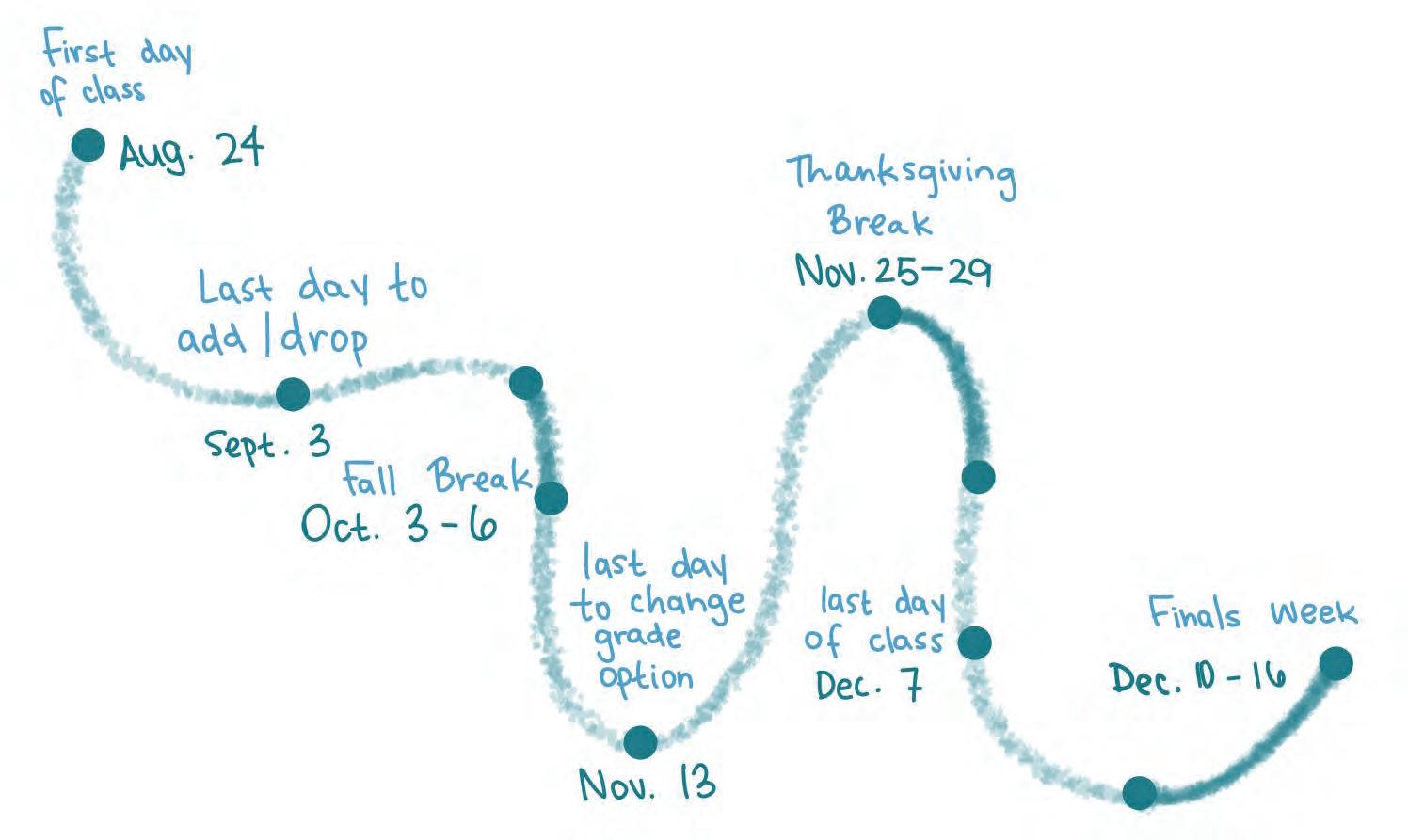
The final date for students to change their classes’ grading options is on November 13, 2026, a couple of weeks after fall break. This means that you can ultimately decide if there are classes you would prefer to take Pass/No Pass (P/ NP) rather than for a letter grade.
one class with the P/NP option. McKelvey students may take up to 6 credits (often 2 classes) of P/NP coursework, provided that they are all electives. These classes will still be counted towards your overall degree, although they may not count towards your major, minor, and other schoolspecific requirements. Your four-year advisors are great resources when navigating whether or not this option makes sense for you! More specific details covering P/NP can also be found through your school’s bulletin.
The Writing Center offers help and guidance for all types of writing and public speaking. Whether you’re working on a project for school, applications, or just for yourself, the experts at The Writing Center are available to guide you through any or all steps of the process! You can register for free oneon-one appointments through their website (writingcenter. wustl.edu) or during walk-in hours which take place Tuesdays and Wednesdays from 2-5 p.m. Walk-in hours begin after fall break and are held in Mallinckrodt 130.
Want to change classes?
The add/drop period is the perfect time to explore your options before fully committing to classes. The period lasts the first couple weeks of the semester, with the last day to drop classes being Sept. 3, 2026. During this time, you can drop any classes you ultimately decide not to take without a withdrawal appearing on your transcript. So show up to as many classes as you want and try out the first couple of days before
This could be a good option to consider if there is a class you want to take with lower stakes, or you would prefer that a lower grade not be factored into your GPA. Each semester, Arts & Sciences, Sam Fox, and Olin students may take
Want to find academic help?
WashU provides many academic support resources throughout the semester. These services come at no additional cost and are there to help in whatever capacity works best for you!
WashU’s Learning Center offers a wide range of resources to support you across many academic disciplines. From structured study groups to individualized tutoring, you’ll have an array of options to choose from that are catered to different learning styles. You’ll be supported by other students who’ve taken similar courses and will help you navigate any questions you may have.
AMELIA SPENCER | SPECIAL ISSUES EDITOR
Lastly, don’t be afraid to reach out and ask for help, support, or just a little bit of guidance! The transition into college looks different for everyone. These resources are here for you, don’t be afraid to use them.
ARTARCH 1061-01 - First Year Seminar: Pleasure and Pain: European Fashion as (Art) History.
I took the version of this course that isn’t a frst-year seminar, but it’s the same structure for both classes. This class is super interesting, and the workload isn’t diffcult. Plus, Professor Gabel is great!
– Bea Augustine, Design Editor
WRITING 2100 Creative NonFiction 1.
This class is perfect for any long-term writers or anyone looking to try something new! Throughout the class, you will be introduced to the genre and produce two works of writing: one memoir piece and one piece of journalism. All the sections have less than 15 people, making it a great chance to meet new people your frst semester!
– Ella Meshoulam, News Editor
PHIL 2060-01 - Biomedical Ethics.
My frst semester, this class convinced me I would be a philosophy major. Ethics classes are a great way to learn to think critically, work through the logic of an argument, and put two perspectives or theories in conversation with one another. Whether you’re a pre-med student, a future STEM major, or completely clueless as to what you’ll end up studying (as I was), Biomedical Ethics will help you engage with fascinating topics tied up in autonomy, inequality, priority, justice, identity, and health.
– River Alsalihi, Forum Editor
SOC 2010 – The Roots of Ferguson: Understanding Racial Inequality in the Contemporary U.S.
I believe everyone at WashU should take this class during their undergraduate studies, especially as students living in St. Louis. Throughout the semester, Professor Rosenfeld
presents concepts that contribute to students’ general understanding of racism as it exists in the United States. He presents concepts (for example, what is race?) and the events leading up to the Ferguson uprisings as a microcosm of the state of racism across the country and uses examples in St. Louis and beyond. It’s a super interesting class and one of the most meaningful ones I’ve taken so far. If you want to learn more about race in the United States and be able to better situate yourself in St. Louis, do not hesitate to take this class!
– Kate Theerman Rodriguez, Forum Editor
ELIT 2811-01 Ampersand: Literary Culture of Modern Ireland
This course was a lifechanging experience for many people in our class, myself included. It is only for frst-years, and it’s known for its culture of community (previous cohorts have since attended each other’s weddings). Uniquely, this Ampersand cohort also takes College Writing together, so you will see the same wonderful people four times a week (but probably more). The professors are kind, devoted to the subject, and genuinely interested in getting to know each student. They hosted us in their homes. We read some of my favorite stories. You will never see snowfall in literature the same way again. You will feel connected to a country thousands of miles away. You will be challenged and also encouraged. You will eat Guinness chocolate cake. You will travel. You will tell everyone about this class, even when you are a senior.
– Ava Giere, Managing Chief
of Copy
ARTARCH 215 - Introduction to Modern Art, Architecture and Design.
As a museum buff (read:
moves around the gallery reading every label on the artwork while making pretentious noises of understanding), I loved getting a chance to really break down the foundations of art history throughout the past few centuries. You won’t see a ton of softly-lit portraiture or marble sculptures here, but you will get a chance to understand the social and political forces that shaped signifcant artistic movements that broke from classical styles. The format of the course makes lecture attendance mandatory, but overall it’s a pretty chill class — a few papers and maybe a feld trip or two. If you’re someone who “just doesn’t get modern art,” thinks Picasso was a wacko (ditto), or even already counts themselves as an art buff, try this class out!
– Laurel Wang, Editor-in-Chief
EEPS 2020 - Introduction to Earth, Environmental, and Planetary Science.
Even if you enter this class with no previous knowledge about the topic, the content is relatively easy to follow and covers many extremely interesting concepts in one semester. From learning about different types of rocks to analyzing new initiatives that combat climate change, you will leave this course with a wide array of unique knowledge about the world around you. All professors in the department are amazing and make this a valuable class defnitely worth taking.
– Julie Kassin, Chief of Copy
Even if your not a fan of horror movies, I still recommend this class Professor Fleury is very passionate and humorous about what he does. You will learn about the history of horror movies, character archetypes, storytelling and
flmography that goes into horror flms. While I can’t speak for myself, some peers in my class who also weren’t fan of horror flms still ended up enjoying this class. And as another bonus, you get to watch movies for credit so that sounds like a win win. Once again even if horror movies aren’t your thing, I’m confdent that you will make friends in this class to make watching them more comfortable and fun.
– Kayslay Cudjoe, Copy Editor
ELIT 3112 - James Baldwin Now.
James Baldwin is an American literary and oratory great, and everyone should be exposed to his work. Professor William J. Maxwell’s class is a wonderful introduction to the world of Baldwin. Through Baldwin’s work, you will be confronted with ideas of a fractured America caused by its refusal to accept its separation from Europe and with questions of what it even means to be American. Please don’t let limited seating or the depth of Baldwin’s work dissuade you from registering. – Dion Hines, Managing Forum Editor
LING 1600 - Introduction to Linguistics.
Linguistics is an incredibly applicable feld to nearly any major, and I found this introductory course to be very informative and beginnerfriendly. Anyone considering majoring in a language would beneft from understanding the makeup of all languages, and anyone who speaks a language will defnitely have their interest piqued by the intricacies of this topic. The professor was incredibly approachable and eager to entertain and talk about his passion. I couldn’t recommend this course enough! –Amelia Spencer, Special Issues Editor
RIVER ALSALIHI FORUM EDITOR

which is normal and often benefcial. In my second semester, I came across a class called Social Inequality in America, taught by Dr. Caitlyn Collins, which changed the trajectory of my college career: This was sociology. I had no concept of sociology when I started school. Even now, there are times when I struggle to explain what it is. My notes from Dr. Collins’ class defne
sociology as “the systematic study of social inequality at the individual, interactional,
The sociology department has allowed me to explore the construction of race in the United States, disparities in healthcare experiences and outcomes across demographics, and structuring forces in different kinds of families. It has had me decode social messaging and representation in popular media, unravel Marx, refect on foundational experiences that created my worldview, and rework the American and world history I learned in grade school. I come into my senior year well equipped to see the invisible structures that guide everyday life, and
in my future law career, So here is my pitch for sociology, even if you already know you’ll major in chemistry or studio art or entrepreneurship. Some tracks, such as pre-med, require some kind of medical humanities, and WashU’s
homogeneous environments, cultivating compassion and challenging the status quo.
Third, sociology can be essential in understanding yourself in the context of the world around you. Since I was a young teenager, I have wanted to understand why people live the way they live, hoping to fnd clarifed solutions in the process. I questioned the way we run schools, communities, healthcare, and governments. I questioned why we treat each other the way we do
they learn. Having a deeper understanding of your own work can help you fnd your most fulflling path and serve patients, customers, or a community more effectively.
Sociological knowledge can also support learning in other departments, providing extra information or invisible, implicit foundations for certain concepts. I have used texts from social theory in French, political science, writing, and philosophy classes.
Second, sociology brings the power dynamics and systems we take for granted into stark light, making them easier to address. If you hope your future work will contribute to a more just world, sociology can give you the tools to talk about inequality and discern the most effective way forward.
Many sociology classes are seminars, which gives students the opportunity to hear one another’s personal refections based on their identities and upbringings. I have witnessed these often vulnerable discussions change the perspectives of those who grew up in
The watered-down answers I received in middle and high school did not satisfy me. People do not “dislike” each other just because of the color of their skin, period, end of story. Gender roles have not always been this way. The way we think about each other does not extend infnitely into the past, and it certainly does not originate from some biological germ inside us. I am forever grateful to the WashU sociology department for teaching me some of the most valuable knowledge I have gained in my life. Whoever you are, WashU student, I hope that you’ll give this feld a chance to enrapture you. Whether your most pressing questions center on socioeconomic class, religion, masculinity, work-family confict, migration, the criminal legal system, medicine, the War on Drugs, colonization, or something beyond the million topics I can think to list, sociology can uncover something that shocks you or that you always felt in your

The Gephardt Institute supports student learning, engagement, and leadership in civic life, all in one place. Ready to begin?
CIVIC ACTION LAB
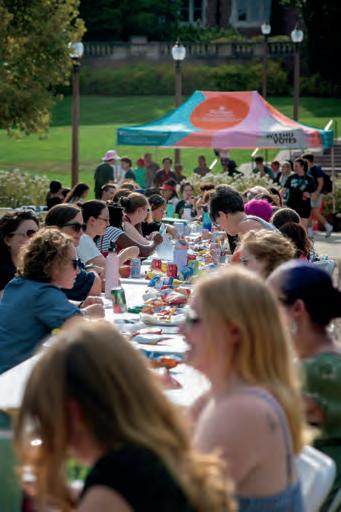
THE LONGEST TABLE
Kick off the school year with hundreds of students, faculty, and staff, over a free meal and civic dialogue focused on co-imagining our shared future. Join us Sept. 2, 5 - 6:30 p.m. in Tisch Park. RSVPs strongly encouraged: TheLongestTable.WashU.edu.
For more civic conversation events, check out our weekly Civic Café program every Wednesday at 5:30 p.m., where we have dinner and dialogue with rotating speakers.
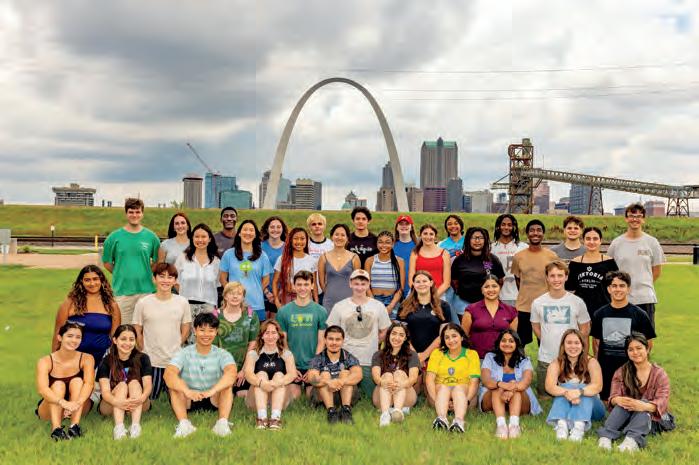
Learn more about how to engage issues you’re passionate about through applied civic engagement classes! Civic Action Lab courses teach practical civic knowledge, skills, responsibilities, and habits of engaged citizenship. Each course includes experiential learning, community leader guest speakers, opportunities to practice different civic skills, and more! Learn more: GephardtInstitute.WashU.edu/EngageDemocracy/Civic-Action-Lab/
Looking for a summer opportunity that makes an impact? This cohort-based 6-month program for undergraduates provides 4-credits of experiential education, civic leadership training, a full-time internship at a local nonprofit or civic organization, and a deeper understanding of St. Louis' context, challenges, and opportunities. Fellows are eligible for a stipend to support summer work. Learn more: GephardtInstitute.WashU.edu/STLFellows
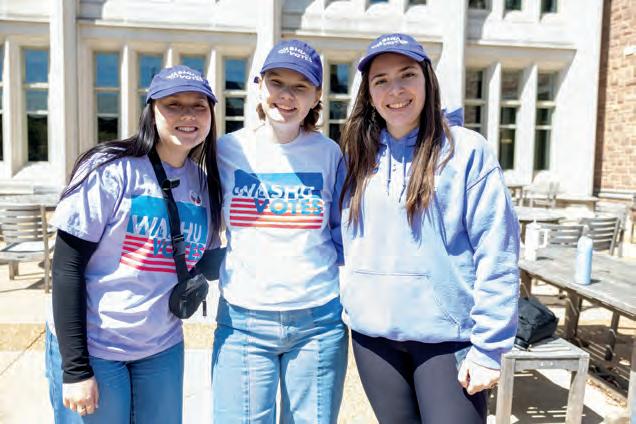
WASHU VOTES is a nonpartisan student organization that promotes voter registration, education, and turnout among undergraduates at WashU. Learn more at WashUVotes.WashU.edu or on Instagram @WashUVotes
Need help registering to vote, making a voting plan, or with general voter education? Visit Vote.WashU.edu to learn more!
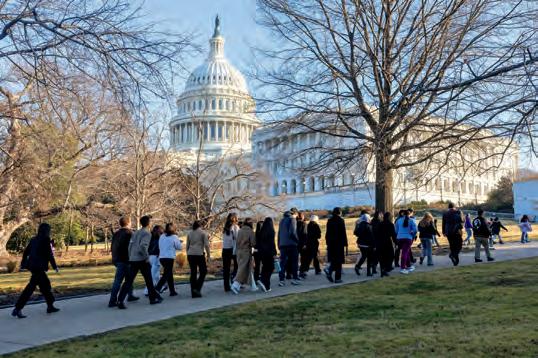
Dive deep into this 14-month leadership program for undergraduates that combines three semesters of coursework (eight credits total), a trip to Washington, DC, learning with St. Louis community leaders, and a self-designed Civic Summer anywhere in the world! Fellows are eligible for a stipend to support summer work. First- and secondyear students are eligible to apply to start the program in Fall 2027. Learn more: GephardtInstitute.WashU.edu/CivicFellows
Scan the QR to follow us and to subscribe to our weekly civic engagement Opportunities newsletter
Visit us at Stix House, 6470 Forsyth Boulevard Learn more at GephardtInstitute.WashU.edu


TANVI GORRE MANAGING NEWS EDITOR
What does one do as a student at WashU? While the conventional answer might be locking oneself in the library and going to Pyramid events on the weekends, WashU has so much more to offer in terms of on-campus programming and events. This article is by no means an attempt to cover all of the events for the year, but here are some of the biggest campus events you should be on the lookout for.
Tickets for WashU’s cultural shows consistently sell out multiple nights in a row in the Edison Theatre on campus, and for good reason. These shows celebrate the heritage and culture of WashU students while also giving back to their respective communities by donating all proceeds to philanthropy every year.
The frst of these cultural shows is Diwali, which is the festival of lights in Hindu culture. Hosted by Ashoka, WashU’s South Asian affnity group, this event brings various styles of dance, fashion, and music from all over India to its show in November. While there are three dates for the show, I
highly recommend going on Saturday night, when you will fnd very enthusiastic alums of the show in the audience. It is a loud and fun night that I wouldn’t want to miss.
Then there is the Lunar New Year Festival in February, which, in my experience, is nothing short of breathtaking. Through dance, acting, and martial arts, this festival brings traditional and modern interpretations of Asian culture to campus in honor of the Lunar New Year. There is so much to love about this show, but I don’t want to give it all away right now. You just have to go to the show to see what I mean.
During Black History Month, we have Black Anthology, a show that merges theater and dance to depict part of the Black experience. Diverging from the multiple-act structure of its peer shows on campus, this show acts as a play with interspersed dance segments, physicalizing its emotional weight. It is moving, beautifully written, and a show that I will certainly attend again this year.
Finally, we have a massive celebration of Latine culture in the form of Carnaval, which takes place every April. From vibrant dances to rhythmic music, this show knows how to bring energy to the Edison Theatre.
In addition to providing a captivating, lively show, each

of these four groups also partners with a philanthropic organization that receives the proceeds from ticket sales.
Thurtene, which takes place in April, is the nation’s oldest student-run carnival. The event features rides, booths from various clubs across campus, and programming for WashU and St. Louis community members.
I know some of us are likely not big fans of rides, but that is no excuse. Walk around, get your face painted, and play carnival games with your friends. It’s a good time that, well, is hard to avoid given it will block the walkway from the South 40 to main campus. However — and I doubt this is a hot take, I think it’s worth it.
The spring semester concert is a classic at several universities across the nation, and WashU is no exception. Walk In, Lay Down, also known as WILD, is our spring concert that formerly allowed students to bring furniture to the show and listen, hence “walk in, lay down.” Unfortunately, that
component of the tradition has since left campus, but the music has not. On the last day of classes each academic year, the Social Programming Board, a branch of our student government, brings a professional opener and a headlining artist to play on Mudd Field. In the past, we have had Flo Rida, The Kid LAROI, and others headline the show. As for my favorite openers, lyaz playing “Replay” on replay was a meta moment I appreciated.
You may be wondering, Tanvi, shouldn’t I be studying for fnals? Well, to that I say you have two to three reading days to prep for your exams or assignments, and you should go have some fun.
While all of these events are amazing on their own merits, they are special because of the people you know in them. You get to watch your friends and classmates do what they love, whether that be dancing or running a booth at ThurtenE. You can get involved in something that brings you joy. To fnd something that gives you purpose is rare, and to be in a community where that is nurtured is even rarer. So hold on to it. Engage with it. I did during my time on campus, and it was one of the best decisions I have made.








LEILANI BILLUPS FORUM EDITOR
For most incoming students, the summer before college is an exciting blur of family celebrations, dorm shopping, social media stalking, and endless conversations about what the future might hold. A new chapter begins to unfold right in front of you, and everything seems bright and hopeful.
However, as classes begin and we get deeper into the semester, this novelty fades, and reality sets in. For Black students, that reality may come as a culture shock or a sudden realization of what it means to be attending a predominantly white institution.
As you navigate WashU, hold tightly to who you are.
Do not shrink yourself to make others comfortable. Do not soften your voice because it carries a perspective others are unfamiliar with. Do not trade away pieces of yourself in exchange for acceptance.
You may find yourself in classrooms where no one shares your experiences. You may hear micro- or macroaggressions that leave you wondering if you should speak up or let them pass for social safety. You may encounter moments that make you feel hypervisible one day and invisible the next. When these moments come, allow yourself grace.
Do not let difficult interactions, uncomfortable classroom discussions, or even institutional shortcomings define your entire experience before

you’ve had the chance to fully live it. The “college experience” is not built in a day, and neither is your community. Give yourself time to find your people, whether that takes a few months or a whole year.
There may be moments when racism reveals itself openly. There may be moments when you feel disappointed by the institution of WashU itself. Those experiences are real, and they deserve to be acknowledged, but they should never convince you that your identity is a burden.
The things that make you different are often the very things that make you valuable — your culture, your history, your perspective, and your voice. These are things you should carry proudly wherever you go, and there are spaces on campus where these aspects of yourself can be supported and embraced.
WashU is home to a vibrant Black community that creates spaces for connection, celebration, and belonging.
Organizations such as Black Anthology provide opportunities to experience powerful performances that showcase Black stories, voices, and talent.
The Association of Black Students welcomes students through events like its annual cookout and continues to foster community throughout the year. The African Students Association celebrates the cultures, traditions, and diversity of countries across the African continent through programming that educates and brings people together. CaribbeanAmerican Student Association is a space for all Caribbean-American students to embrace their culture and identity. Black
Men’s Coalition and Black Women and Femmes Collective provide spaces for Black students to connect. They are reminders that Black students have built community here long before your arrival, and that there is a place for you within these communities and an opportunity for you to better them.
At a time marked by political uncertainty and social division, your voice is needed more than ever. It is needed in classrooms. It is needed in student organizations. It is needed on executive boards, in community meetings, and in the pages of Student Life. Never underestimate the value of your perspective. The experiences you bring with you were shaped by your family, your neighborhood, your culture, and the communities that raised you. Those experiences allow you to see problems differently, ask different questions, and imagine better solutions. WashU does not become a stronger campus when students leave parts of themselves at the door. It becomes stronger when students bring their full selves into every room they enter.
So as you begin this journey, know that there will be challenges. There will be moments of frustration, uncertainty, and growth. There will also be friendship. There will be laughter. There will be opportunities you never expected and memories that stay with you long after graduation.
Most importantly, there will be community. So to every incoming Black student: Welcome, and make this place your home.
SELINA SON NEWS EDITOR
Name, hometown, major, and dorm. By the second day of orientation week, most frst years have been conditioned to recite these facts on command.
As someone from outside of the US, I found the repeating conversation awfully dull: “I’m from Korea.” “Oh wow, that’s so cool.” “Yeah, haha.”
So it’s time to move beyond the NPC banter. Instead, try out these dialogue options for that initial spark of laughter.
WashU offers a variety of frst-year opportunities including ampersand programs and frst-year seminars. Chances are, someone around you is taking that same course. Ask what ampersand they are in or what seminar they chose. Beyond
sparking a conversation, it’s a great way to learn about classes and programs that sparks your interest.
Find someone with the same small or diffcult class
During o-week, I spent an unreasonable amount of time asking whether anyone was taking Calculus III with a specifc professor. As silly as it is, my search for a fellow comrade was how I found my study group and familiar faces to sit next to in lecture.
Everyone says to ask about hobbies, but I advise you to talk about widely known hobbies that might even have a fanbase.
Entering WashU, I was a Formula 1 fan. Asking someone, “Are you an F1 fan?” created an instant bond with other followers. It’s smooth sailing from there as you rant about rivalries or laugh over memes.
Also, F1 is popular enough that people outside the community can still chime in, helping to prevent dreaded awkward silences.
Sometimes, the best way to avoid boring conversation is to exercise your free will.
Some favorites:
What’s your favorite bridge? (Shout out to my friend Brooke Morgan for this one.)
How many pillows is the perfect number for a bed?
Of course, a would-yourather is a must.
Would you rather be a bunny with carrot thoughts or a carrot with bunny thoughts? (Shout out to former StudLife Managing News Editor Zach Trabitz for bringing this to the news meeting.)
Would you rather have fsh for hands or have to adopt a child every time you heard

“Bohemian Rhapsody”? (Zach Trabitz asked this to the 2026 WashU commencement speaker Andy Cohen.)
Who is smarter: the inventor of bread or the discoverer of gravity?
Collect phone numbers, follow Instagram accounts, and say hello to people even when it feels awkward.
For international students, take advantage of the extra orientation days. Some of my closest friends today are people I met during that time, and it helps to have a friend or two also missing the same food from back home.
For everyone, spend time in the common room and show up to events held in the DUC. The proximity effect works and you will fnd yourself forming bonds with the people on your foor. Even if you only stay close to a handful, WashU becomes a brighter campus when it’s flled with familiar faces.
“Don’t trust the frst group of friends you make.” “Your roommate will become your best friend.” “If you don’t fnd a group within the frst couple of weeks of college, you’ve missed your chance to make friends in your frst semester.”
This was what my brain was bombarded with while scrolling on social media for months before I set foot on the South 40. My mind was primed with “collegemaxxing” rhetoric of what smart students were doing to get ahead, how to survive orientation week, but, most importantly to a frst-year in college, how to make friends
that last longer than a week. I already felt behind. I had to go random to fnd a roommate and stayed in my room the frst night only to hear later about a huge informal game and socializing night that I missed on the South 40 Swamp; I felt like I was missing every early opportunity to meet new people.
I skeptically continued to follow the generic advice. I had little faith in orientation activities, but I decided to go to movie night on the Swamp with my roommates. In the middle of the flm, a girl in front of me confused me with her roommate’s friend’s roommate. We found out we both did dance and journalism, consumed the
same media, and both felt behind in making friends here. It was the most genuine conversation I had since arriving. Little did I know this girl would become my future roommate, fellow editor, and one of my best friends at WashU.
She introduced me to a friend group that I have continued to grow closer to in the last year. Over the course of the year, we put on surprise birthday parties, organized a mock version of the reality TV show “The Traitors,” and even managed to schedule a lunch with Dr. G (the Vice Chancellor of Student Success). Within the frst month, my fears of the frst friend phenomenon started to fade away.
This is not to say that frst-years need to make friends during orientation week. I saw many situations play out, from roommates deciding to stick together to people who jumped between groups for the majority of the year before fnding their people. I just happened not to experience any of the scenarios that social media had prepackaged in my brain.
The tips I saw online were also not entirely fruitless suggestions, despite the anxiety and insecurity they caused me in my early friendships. The advice about putting yourself out there to make new connections is some of the best. Leave your door open during the frst
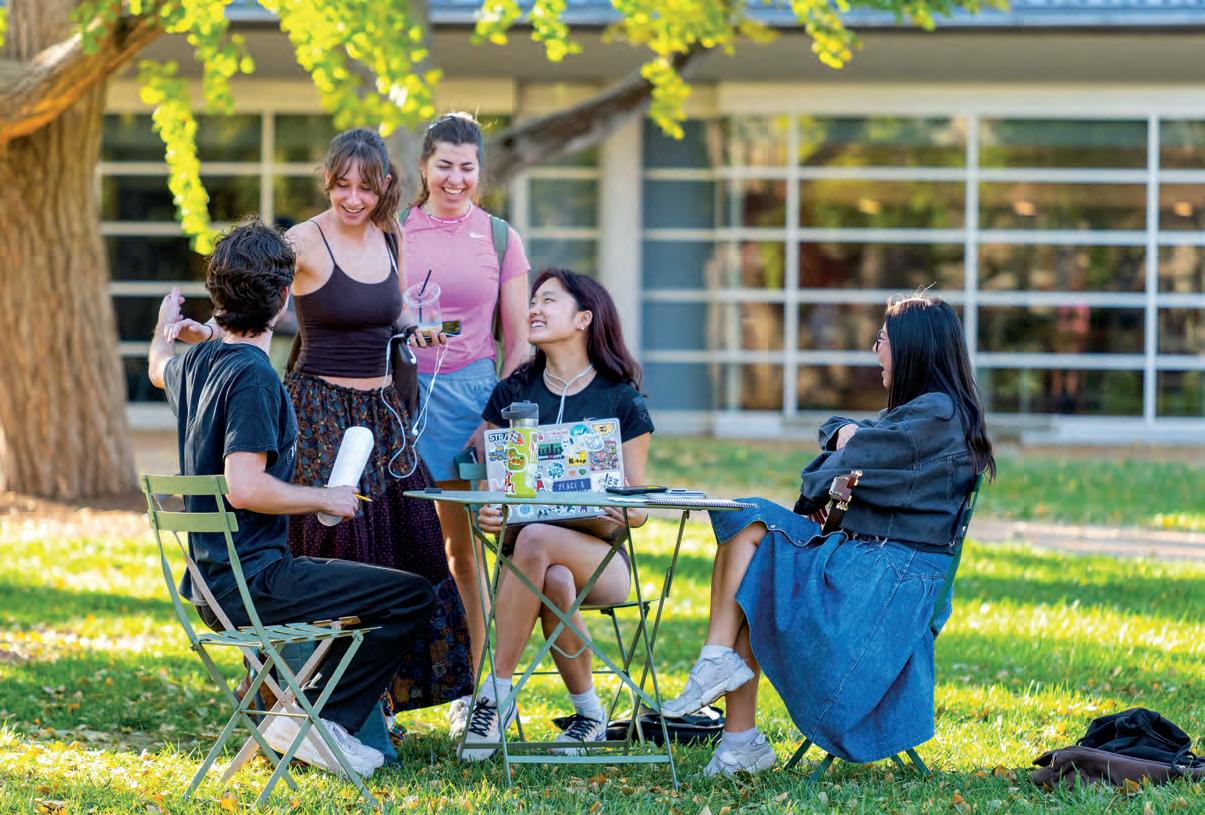
You’re now at the intersection of it all! When the arts and sciences converge, big ideas spark discovery and innovation. Your future is filled with opportunity, and we’re here to help you develop the skills, confidence, and experience to make a meaningful impact in society. Undergraduate and graduate students can stop by our offices in Cupples II and connect with us at @washuartsci .
week. Go to every orientation event. Join clubs that pique your interest. I have found lasting friendships from following this advice, but they weren’t my frst or only lasting friends.
The internet can provide the illusion of a security blanket that can make frstyears feel more comfortable with the college transition process. Social media can provide a platform to meet new people who you end up becoming best friends with before you arrive. On the fip side, it can also connect you with people who turn out to be toxic or increase anxiety about the friend-making process, as it did for me. My advice is to take in any information about making friends in college as neutrally as possible. Trust that you will fnd people to connect with without worrying about arbitrary deadlines like orientation week or the frst week of classes — orientation week is exhausting enough on its own without a friendmaxxing regime. You will meet people on your own time.


The most important part about making friendships is being open. Be open to going out into St. Louis with new people. Be open to talking about different people’s interests and hobbies. Be open to the occasionally uncomfortable or awkward moments of meeting new people. People don’t become friends because they’re perfectly aligned with each other, but because they’re willing to mold to each other.
The internet, as a polarizing force, feeds off of all-ornothing content. The idea that you will either meet your best friends online through the rooming process or never speak to anyone whom you talk to during orientation week is an oversimplifcation. Making friends in college, just like most of life, doesn’t ft into a black-and-white picture or a 30-second TikTok video.

A how-to guide for fghting frst-year loneliness
Dear
Scene,
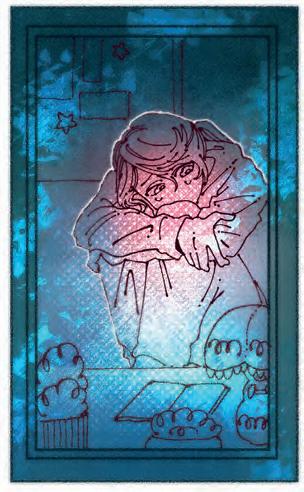
I’m going to be in a single suite and I’m really worried about geting lonely. Everyone I met during Bear Day seems to be in doubles with roommates they already love. Am I stuck being alone for the rest of the year since I won’t have a built-in friend to spend time and go do stuf with? I know people make friends outside of their dorm, but how do I do that? I’m actually clueless!
AVA AYAD
CONTRIBUTING
WRITER
From a former first-year who lived in a modern single, I had the same thoughts going through my head as I noticed how many of those around me were besties with their roommate(s). Although choosing suitemates instead of roommates does not mean you will never have a chance at being friends with them, it can at times feel impossible to connect with anyone when friend groups are often made up of people from the same residential community (mainly out of sheer convenience). But fear not: This column will give you some easy, proactive ways to start making friends all over campus fast!
if it’s as small as saying “hi” to someone you know from a class in passing, the next steps will feel less and less daunting over time.
- Socially-Distanced Student
Before I get into all the tips and tricks of how to spread your wings as a social butterfly, it’s important to remember that a lot of success at making and maintaining meaningful friendships relies on personal effort. Of course, any interpersonal relationship is a two-way street, but the more you actively put yourself out there and keep striking up conversations with people, the higher the probability of meeting that one person you need to make life better. In other words, never stop trying! Why limit your social options by being scared? While that may seem easier said than done, as it did for me in my first year at WashU, the more you “hype up” the act of making friends in your head, the less likely you are to actually go out and do something about it! Trust me, once you take that first step in socializing, even
One of the most obvious but effective ways to start meeting new people is by going outside! Yes, just leaving the comfortable solitary confinement of your room once a day after you are done with classes is a great opportunity to run into familiar faces or introduce yourself to completely new ones. A super easy approach is attending events offered by Ursa’s Nite Life and Campus Life! I guarantee you will be able to find an activity going on any day of the week by following them on social media or paying attention to their flyers posted around campus. My personal recommendation on how to get out of your dorm is Zumba, especially if you like to dance. I cannot emphasize how beneficial the BearFIT classes offered at Sumers Recreation Center, Zumba specifically, were for my physical and mental health during my first year. Admittedly, it was due in no small part to an amazing instructor, King Ausar, who teaches on Fridays and Sundays every week
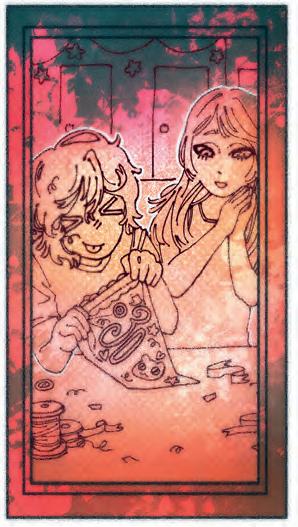
(even in summer!). Those who have met him will tell you he is such a wise, kind, and motivational speaker. I mean that literally, too. After each session, he gives a speech ripe with words of affirmation and often pairs everyone up to get people who would otherwise be strangers talking to each other. If you want to make friends and stay active in the process, I cannot think of a better solution.
Another super simple way to meet several people at once is by going to Bear’s Den on the South 40 during dinner rush. Friend groups will form long stretches of tables to sit together, and even if you have only met one person in said group, the dining hall is a relaxed, casual setting where anyone can become close. Especially during finals, co-studying in and out of Bear’s Den is yet again a natural excuse to reach out to people with whom you want to be friends. On that note, don’t forget to always ask for someone’s phone number, Instagram, or Snapchat if you want to keep in touch!
Lastly, it’s no surprise that joining different student organizations and clubs can naturally lead to making friends. Be on the lookout for booths that fit your passions
at the activities fair held every semester, as well as general board meetings where you can get to know the current and future club members without the pressure of fully committing yourself to multiple groups. I found that choosing a few clubs you really enjoy over several that you don’t have enough time or dedication for is often the more sustainable route when it comes to forming lasting friendships and feeling like part of a community on campus.
As a whole, treat your first year of college as a test run. These early stages of your WashU career are opportunities to develop your social skills, resulting in some fulfilling friendships along the way. Not everything will be set in stone by the end of spring semester anyway, so try not to worry yourself with how many friends you do or don’t have and just make the most out of every conversation. Good luck!
Your social cheerleaders, Scene MARCELINE LEE | ILLUSTRATION EDITOR

HANNAH LA PORTE MANAGING SCENE EDITOR
When I frst got to WashU, I had no idea what events to go to. I spent most of my college application research on factors like academics, the No. 1 ranked dorms, and the weather. Beyond iconic events like WILD, I hadn’t done much research on all the cool things that happen on campus.
Since coming to WashU, some of my most memorable nights have been in McDonnell 162, Risa Commons, the DUC, and more random classrooms and buildings on campus. Although these buildings house academics or serve as study spaces during the school day, they often transform into performance venues for student groups to showcase their talents on evenings and weekends. From comedy and improv to live music, a capella, or dance, WashU has endless entertainment options to offer.
One of the frst things people highlighted about WashU was the variety of cultural performances and events that happened throughout the year. There are four main performances that happen during the year: Diwali in the fall, and Black Anthology, Lunar New Year Festival (LNYF), and Carnaval in the spring. All of these events present music, dance, and culture on the Edison Theatre stage, and are well attended by the entire student body and the WashU community. Make sure to get tickets early, because they will sell out. Additionally, the Asian American Association (AAA) hosts a yearly Night Market with food and performances. Asian Multicultural Organization hosts an annual “Taste of Asia” event that takes students to Asian enclaves plus an annual food truck event on Umrath Lawn in the spring. To learn more about some of these events, check out Tanvi’s article on Page 26.
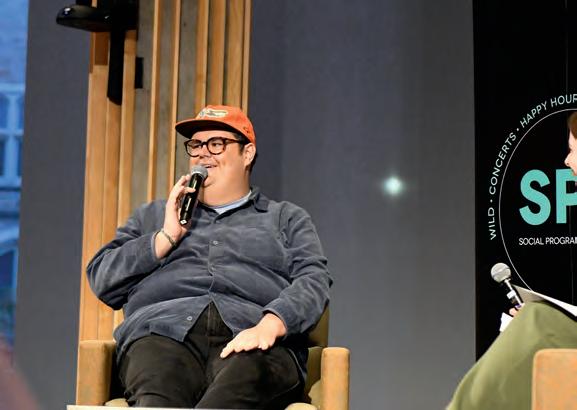
WashU’s three improv groups cover all different kinds of improvisational comedy, ranging from shortform sketches (K.A.R.L.) to long-form sketches (SPISH), or a mix of both (Mama’s Pot Roast). For SNL- style sketch comedy, check out the semesterly show from Kids on Campus (KOC). These performances typically happen in McDonnell 162 or the Village Black Box a few times throughout the semester. Improv shows on campus are highly anticipated: Lines for the show start sometimes over an hour before performances begin, so arrive early.
WashU is home to a variety of fantastic theater performances from its three different theater groups and the Performing Arts Department (PAD). Firstly, PAD is home to dance and drama students, who put on
3 shows throughout the year in Edison Theatre. Cast n’ Crew is a traditional student theater group that operates out of the Village Black Box and puts on three shows a year: two plays in the fall and winter and a musical in the spring. All Student Theatre is a technical theater group that puts on an immersive, haunted house-style show in the fall and a musical on the Brookings Quad in the spring. Finally, Thyrsus, founded in 1895, is the oldest student group on campus. The experimental theater group performs a 24-hour Day Of Shame playwriting and performance festival. There are endless opportunities for theater on campus, through performing, tech, music, design, and more.
Our campus boasts an incredible music scene, with 13 different a capella groups, a local college radio station, and student bands. Each a capella group has a different niche, ranging from Disney

music to Broadway songs, jazz, pop, and more, with some competitive groups and some performance groups. KWUR, WashU’s underground radio station, broadcasts the shows of roughly 80 student DJs every week. Near the start of each semester, the group hosts a “KWUR Week” full of performances, featuring students and local and national headliners. Any student can start a radio show, and live events typically take place at local homes or at venues near campus, like the Duck Room at Blueberry Hill.
WashU Dance Collective puts on an annual show at Edison Theatre in the Spring. WashU Hip Hop Union (WUHHU) is WashU’s premier hip hop dance team and puts on a semesterly showcase that often flls up Tisch Commons or Edison Theatre. WU Sauce is WashU’s performance salsa dance team and WU Fuego is WashU’s performance latin dance team. Both host social dances throughout the year as well as semesterly performances. WU Cypher is a freestyle dance group that hosts competitions and performances throughout
the year. Additionally, there are opportunities for different cultural dances in Diwali, LNYF, and Carnaval. Some groups from these cultural shows even perform or compete throughout the year.
Although we’re not a Division I sports school, athletics are still a part of the WashU experience. Our teams are highly successful and recently won the Learfeld Directors’ Cup, which recognizes the best all-sports program in D-III. During the 2025-26 school year, WashU clinched national championship victories in women’s indoor track and feld and women’s soccer. Attending games is a fun and free way to support your peers. Rep your red and green, and go Bears!
Every semester, affnity groups, clubs, the Social Programming Board, the Kemper Art Museum, the 560 Music Center, and more organizations put on various speaker talks, exhibitions, and performances. Many times they feature famous writers, actors, comedians, or activists. Last year, I had

the opportunity to hear Ocean Vuong, Caleb Hearon, and Judith Butler. Last year, I had the opportunity to hear author Ocean Vuong, comedian Caleb Hearon, and philosopher Judith Butler speak on campus.
There are so many other student-run activities that I can’t even begin to name here! I’ve gone to JuggleFest with the WashU Juggling Club and slam poetry with WUSlam, and I’ve heard countless hours of advice from seniors at KTalks, a quarterly storytelling event put on by students. The point is, there is so much offered at WashU, you just need to know where to look. Instagram is a really good resource, but also remember to look around campus. Posters are everywhere, clubs advertise in the underpass, and people love to talk about events they are hosting.
S40 food trucks. Every Thursday, the South 40 transforms into food truck heaven, with two or three new local food trucks stationed near the Clock Tower. It’s an excellent way to learn about St. Louis restaurants nearby, and, as a bonus, they take
meal points
Well-being Wednesday. Every Wednesday from 11 a.m. to 2 p.m. on Mudd Field, Student Affairs puts on Wellbeing Wednesdays, a series of outdoor activities, food, and experiences designed to support students. Wednesdays often feature a farmers’ market or local farmstands, WashU comfort dogs Bear and Brookie, or a food truck.
Dr. G’s Fun House. Two to three times per year, Vice Chancellor Anna Gonzalez hosts Dr. G’s Fun House, a series of activities, games, and food on Mudd Field or outside the DUC. In the winter, there is often an ice skating rink.
DUC n’ Donuts. On the frst Friday of the month, Campus Life hosts a DUC n’ Donuts for students, handing out free donuts and rubber ducks for all who pass by. It’s a great pick-me-up if you have an early morning Friday class, and building a duck collection is an honorable WashU tradition.
This article is just a short list of the countless activities that happen on campus every single day. Don’t worry if it takes a while to fnd your “thing” — everyone is different! With so many options, you’re bound to fnd something you love.

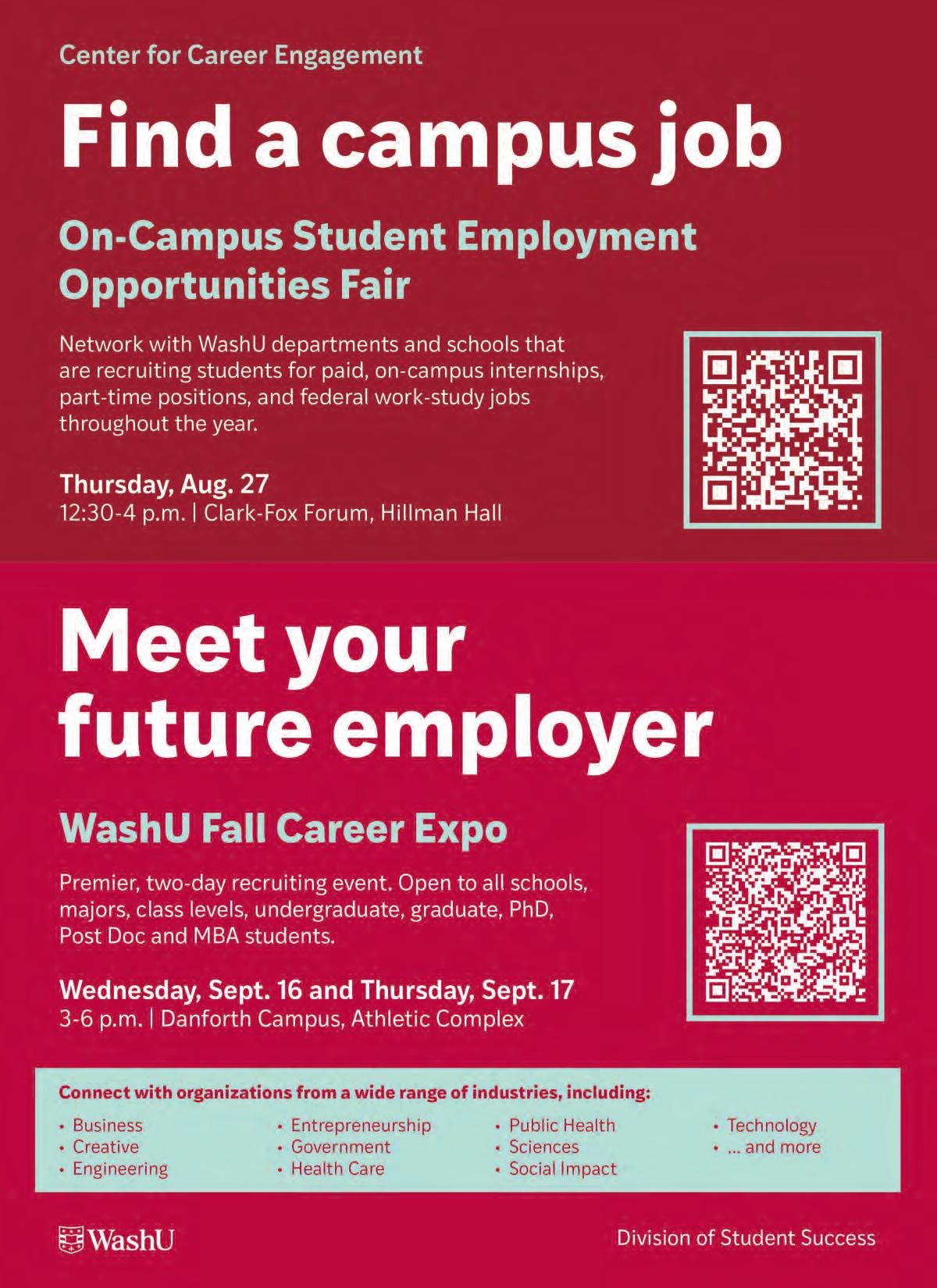
AVA GIERE MANAGING CHIEF OF COPY
When you move into your South 40 dorm for the frst time, you’ll probably cross through several different municipalities in one day, just by walking, and never realize it. You also may not realize how much those municipal borders matter.
For frst-years who aren’t from St. Louis, it is surprising to learn that the City of St. Louis is not part of St. Louis County, but rather a separate authority. Most of WashU’s Danforth Campus is in unincorporated St. Louis County, but the East End of campus, including the Kemper Art Museum, is in the City of St. Louis. The medical campus is entirely within the city. And to make things more confusing, the South 40 falls within University City and Clayton.
The area’s municipal boundaries are more than trivia. The divide between the City of St. Louis and St. Louis County affects crime statistics, police departments, courts, taxes, elections, library systems, and schools. The odd-seeming separation of the city from the county dates back to 1876 and what historians call “The Great Divorce.” Eleven wealthy St. Louis businessmen who wanted more local infuence drew the city’s borders over the course of 52 meetings and put the issue to a vote. Since then, there have been multiple attempts to combine the city and county, but other than the establishment of a shared sewer district, merger efforts have come up short.
The original 1876 ballot measure was mired in controversy. The measure was submitted after midnight on July 3, and legal
documents cannot be fled on national holidays, making the submission illegal. Initially, the referendum to separate the city and county failed, but the Missouri Court of Appeals threw out 4,000 ballots, many of which were marked “no” but showed partially-erased “yes” votes. Some precincts had more “no” votes than there were voters in the precinct. Election offcials who were anti-separation admitted they stuffed ballot boxes, and, after a recount, the measure passed. The City of St. Louis seceded from the county and became, in effect, its own county. According to St. Louis Public Radio, the election fraud of 1876 means it is diffcult to tell whether or not most St. Louisans wanted separation, and in fact it is possible that separation never had majority support.
St. Louis is far different from what it was 150 years ago. At the time, the city was wealthier than the county. The county was mostly farmland, whereas the city was experiencing an economic boom. Today, affuent suburbs make up the county, and the city faces more challenges. Some locals say the relationship between county and city is characterized by a “cultural divide.”
The wealth gap between city and county is likely one reason the two have remained separate through the years, along with other factors, such as St. Louis’ entrenched racial segregation and differences in political leanings. In 2019, corruption allegations tainted the Better Together campaign before it could get off the ground. Better Together proposed a statewide ballot initiative for 2020 that would change
the Missouri Constitution to reunite the City of St. Louis and St. Louis County. But the face of the campaign, the future mayor of the merged metro area, was indicted on federal corruption charges three months after the referendum was announced, sinking the plan.
Early on, there were also concerns that the Better Together plan would diminish Black political power in the city. The city’s population is 42% Black, which would have decreased to less than a third under the Better Together plan, per St. Louis Public Radio. A mayor in north St. Louis County, Reggie Jones, said “never-ever Better Together.”
Most recently, in April of 2026, St. Louis County Executive Sam Page foated the idea of “re-entry,” a moderate approach that would keep key leadership positions separate while consolidating some city and county offces.
For now, the city and county remain separate jurisdictions. When you move in this August, even if you only walk from Kaldi’s Coffee to Brookings Hall, you’ll cross an invisible boundary that has visibly shaped the St. Louis metro area.

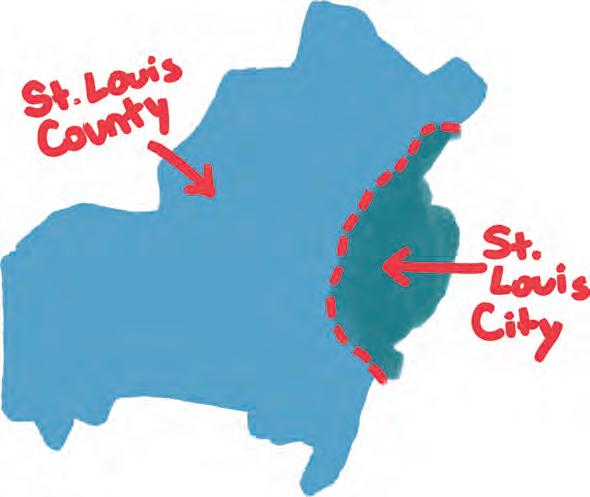

AUDREY TEBOW NEWSLETTER EDITOR
Was “Twisters” (2024) a decent movie? Maybe. Out of the three movies about tornadoes that I can think of, it’s not nearly as good as the original “Twister” (1996), and nobody can beat out the truly incredible cinematic feat that was “Sharknado” (2013). I don’t think the “Twisters” target audience includes tornado know-it-all Oklahomans like my family and I who spent most of the runtime pointing at the screen and whispering, “Actually, that would never
happen,” though, so I’m not sure I get to have an opinion.
Clearly I don’t know much about what makes a good disaster flm, but I have spent my entire life living in Tornado Alley (a zone in the Central United States where tornadoes occur most frequently), so I do know quite a bit about real tornadoes. Coming to WashU, I wasn’t too concerned about the tornado threat here in St. Louis — they were scary, sure, but they were also nothing new. It never occurred to me that many people had not experienced tornadoes until
a tornado warning was issued during my frst semester here back in late 2024, and all I heard about over the next few days were complaints about “fake” tornado warnings and how annoying the WashU alerts were.
In May 2025, St. Louis experienced a devastating, deadly tornado that caused an estimated $1.6 billion in damage. A year later, the city continues to recover and rebuild. Although tornadoes of this scale are exceptionally rare, they should still be taken seriously. So, for all of you non-Tornado Alley dwelling

students out there, I present to you: a beginner’s guide to tornado safety.
Myth: Tornadoes are easy to spot.
Truth: If you ask the average person what a tornado looks like, they’ll usually describe a long funnel with a large cloud of dust surrounding the bottom of it. While some tornadoes might look like this — formally known as cone tornadoes — the truth is that there are many different types of tornadoes, including some clouds that look like tornadoes even though they’re technically harmless. For example, chances are you’ve probably seen a phenomenon called scud clouds, which are wispy, low-hanging clouds that sometimes form funnel-like shapes. This can make them easy to mistake for tornadoes by casual observers. Additionally, real tornadoes might be rain-wrapped (completely obscured from view by heavy rain) or occur at nighttime, making them diffcult to spot.
Even if you can’t identify a tornado, there are warning signs to keep an eye out for. During the day, skies will sometimes look yellow, green, or unusually dark before a tornado or hailstorm. Just be sure not to confuse this with the warmer orange hues that tend to follow after a thunderstorm rolls through in the early evening. Many people describe hearing a roaring sound and feeling their ears pop as a tornado approaches, especially if it’s close by. However, you should never rely on these signs as your main form of warning. Pay attention to National Weather Service
(NWS) weather alerts and pull up a local news channel such as KMOV Channel 4 or KSDK Channel 5 on your phone if you can — you can usually watch these for free by going to their websites, and they often dedicate large portions of their airtime to the weather during severe storm events. Most cell phones also automatically receive tornado warnings through the national Wireless Emergency Alerts system, which sends notifcations during life-threatening events. For WashU-specifc coverage, the WashU Weather Team provides updates on Instagram (@washuweather) during severe weather events, and WashU Emergency Management (@washuready on Instagram) handles the WashU Alert system.
Myth: You should keep your windows open during a tornado to equalize pressure.
Truth: I am begging you not to do this. I don’t know if this is all that common anymore, but it used to be, and the only thing leaving your windows open is going to do is let debris in. Also, if you can see windows at all during a tornado event, you’re probably not in the right place. Assuming you’re inside of a building — and if you’re not, fnd one! — the best place you can be is a basement or severe weather shelter. Given that these aren’t always readily available, though, your next best option is an interior room or a space completely removed from all exterior walls and windows on the ground foor of the building. Ideally, this room will have some kind of sturdy furniture to shelter beneath, such as a heavy table. Distance yourself from objects like bookshelves and large drawers, as these can pose a tip-over hazard if left unanchored to the wall. In WashU buildings, locate a building map near the exits or elevators to help you locate a Severe Weather Refuge Area (SWRA), which are typically
interior hallways. If you’re in a house or apartment, the most interior room will generally be a bathroom (and, if one is available, inside the bathtub), closet, or pantry. Keep essentials with you as well, including your shoes, keys, and phone. Get as low as possible and cover your head with your arms, and protect yourself from falling debris with blankets and pillows.
Myth: If you’re driving when a tornado touches down, seek an overpass for shelter.
Truth: The most famous endorsement of the overpass myth, as it’s now known, came from a broadcast shot by a Kansas television crew during the 1991 Great Plains tornado outbreak. This myth was decisively debunked in 1999, when three people were killed in Oklahoma after being swept out from under overpasses in three separate incidents. (Speaking of “Twisters,” this happens in the opening scene of the flm as well.) Without straying too far into physics territory, winds move faster when they’re suddenly constricted, including beneath overpasses. This makes overpasses one of the most dangerous places you can be during a tornado. The same goes for parking beneath an overpass, which can expose you to tornadic winds and make you a major traffc hazard.
That being said, attempting to outdrive the tornado should be your last resort — unless you race cars for a living, maybe, but you’re not Max Verstappen. Tornadoes can move at speeds of up to 70 miles per hour and tend to make erratic turns as they travel. If you can’t quickly drive to a building or shelter, pull over, abandon your car and lie fat in a ditch or other low-lying area while covering your head with your arms to protect yourself from debris. As is the case with hiding inside of a building, you can also protect yourself with spare blankets or cushions. It
might sound counterintuitive, but a ditch will shelter you from the worst of the debris and high-speed winds, while even relatively weak tornadoes can fip your car over.
Myth: Meteorologists only issue tornado warnings when they are certain that there is a tornado on the ground.
Truth: Often, tornado warnings are issued ahead of what meteorologists anticipate will become a tornado. If you read the text product associated with a tornado warning (which can be done by going to the NWS website or using apps like Weather Channel), for example, it usually includes a line denoting whether the source for the warning was a radar indication, trained spotter sighting, or confirmed tornado. While only about 25% of tornado warnings precede a true tornado on average, that
doesn’t mean the other 75% are completely unfounded. Tornadoes can spin up in seconds — it’s better to play it safe and issue a warning when circulation shows up on the radar than to get a warning out too late and put people’s lives at risk.
Aside from tornado warnings, meteorologists use other forms of weather alerts in tornado forecasting as well. One of these is called a tornado watch, which indicates that conditions may be favorable for tornadoes in the near future. These are relatively common and tend to encompass many counties (anywhere from 30 counties to upwards of 70 — in 2025, the average tornado watch event included about 50 counties) for an extended period of time, typically anywhere from four to eight hours.

You might also see something called a Particularly Dangerous Situation (PDS) watch or warning: the former is issued on days when the risk of tornadoes is very high, while the latter indicates an ongoing tornado that poses a considerable threat to human life and property. (For reference, the original tornado warning during last year’s tornado was upgraded to a PDS warning once the NWS had confrmed that a strong tornado was occurring.) In very rare situations where an ongoing tornado is expected to cause catastrophic damage, the NWS will issue a tornado emergency. Only around 300 tornado emergencies have ever been issued since they were frst created in 1999.
Myth: Tornadoes are measured by wind speed.
Truth: Every tornado in the United States is rated using the Enhanced Fujita (EF) Scale framework, which measures
the tornado’s intensity based on the damage it produced on a scale from EF-0 (light damage) to EF-5 (incredible damage). After a tornado event, scientists go out and survey affected areas before making their determinations based on both observed damage and building construction quality. Although the scale includes associated wind speeds for each rating, those wind speeds are offcial estimates of the wind speed needed to cause certain levels of damage. This is why extremely powerful tornadoes might be rated lower than what you might expect: for example, the widest tornado on record, which took place in El Reno, Oklahoma in 2013, only received an EF-3 rating despite radar-obtained wind speeds of 313 miles per hour because its long track over open terrain meant it encountered very few structures.
Myth: Tornadoes are relatively predictable.
Truth: Tornadoes are arguably one of the most complex weather phenomena that can be produced on earth, and that makes them extremely hard to predict. Meteorologists generally understand how they form, but why they form is more challenging — of two seemingly similar storms, for example, why would only one produce a tornado?
There are a whole host of issues when it comes to detecting tornadoes on the radar as well: gaps in radar coverage, radar’s inability to truly distinguish between circulation in the air and tornadoes on the ground, the time it takes to generate radar products, and so on. It’s not completely untrue to say that you can identify a tornado using radar, but radars can only do so much. This is where storm spotters come in. These are people trained to identify certain severe weather phenomena, including tornadoes, who communicate
in real time with the NWS to help fll in the gaps that radars can’t quite cover.
I have a theory that people tend to confate scientists’ ability to predict hurricanes with their ability to predict tornadoes. Both are extreme weather events. Both of them spin. Both are measured on a fve-point scale. But hurricane warnings are almost always issued 36 hours in advance of landfall, while tornado warnings only have an average lead-time of 13 minutes. The false alarm rate for tornado warnings refects the relative lack of knowledge scientists possess when it comes to tornadoes. Remember that only about 25% of tornado warnings precede a true tornado. If you’ve ever wondered why tornado forecasting seems so erratic, it’s





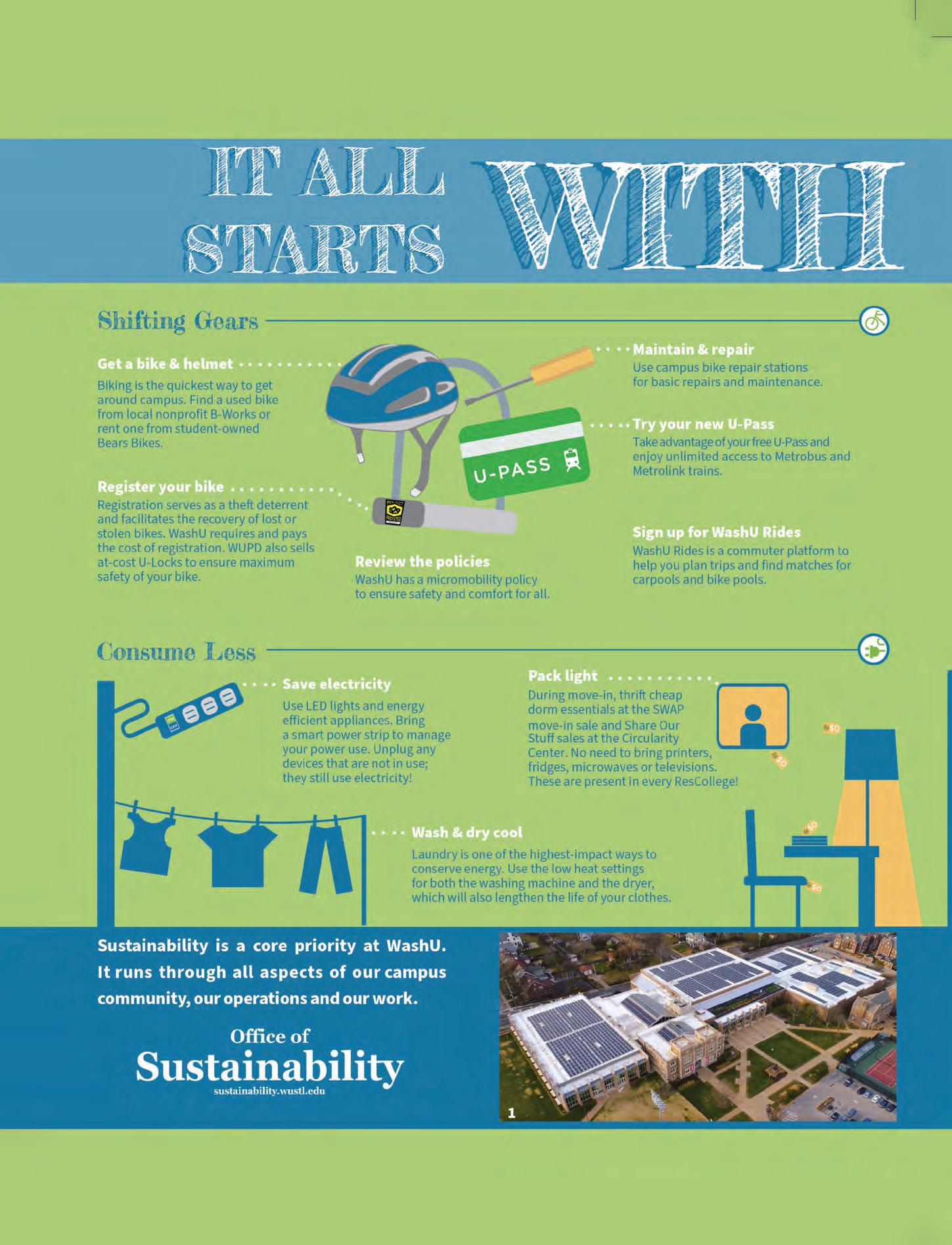
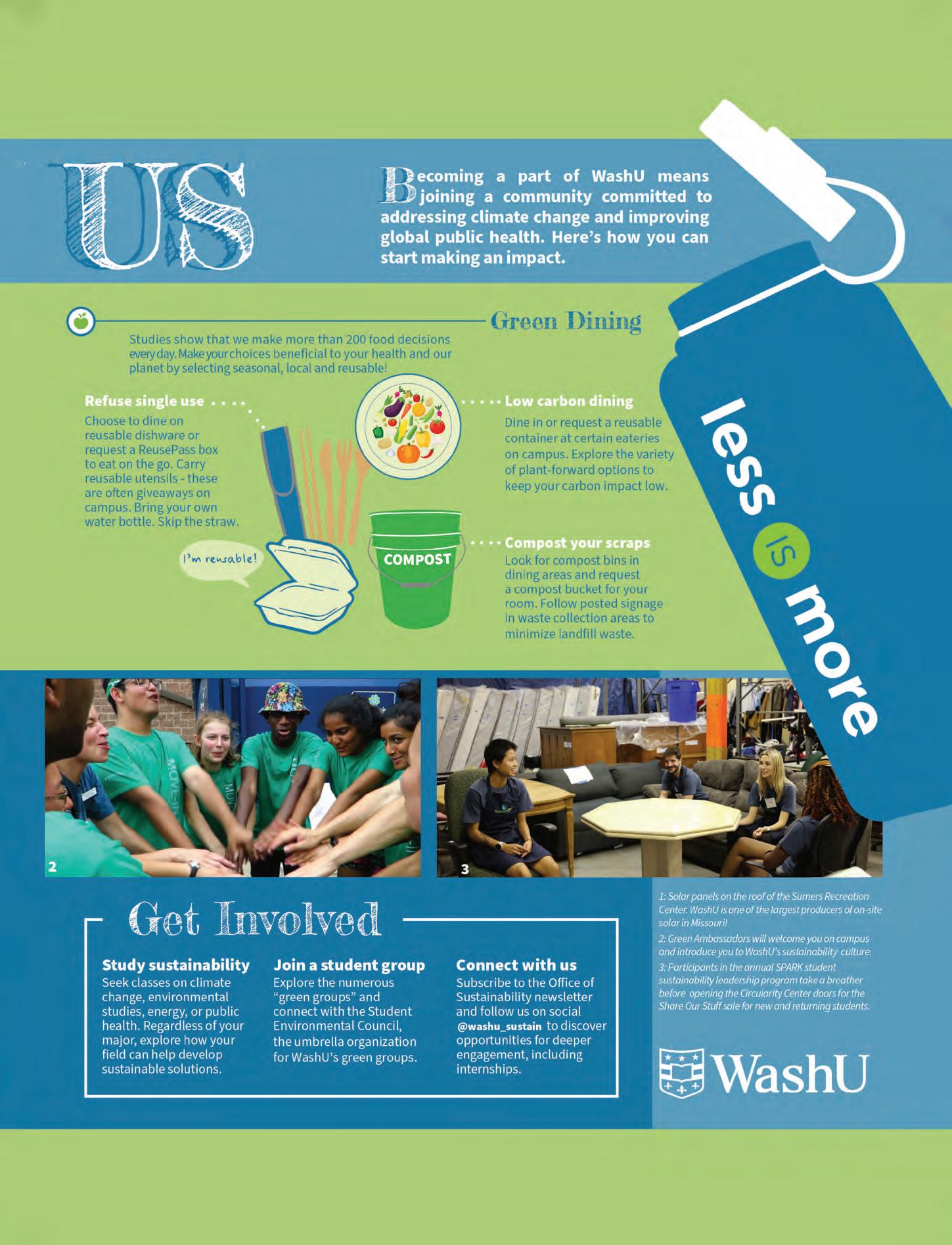
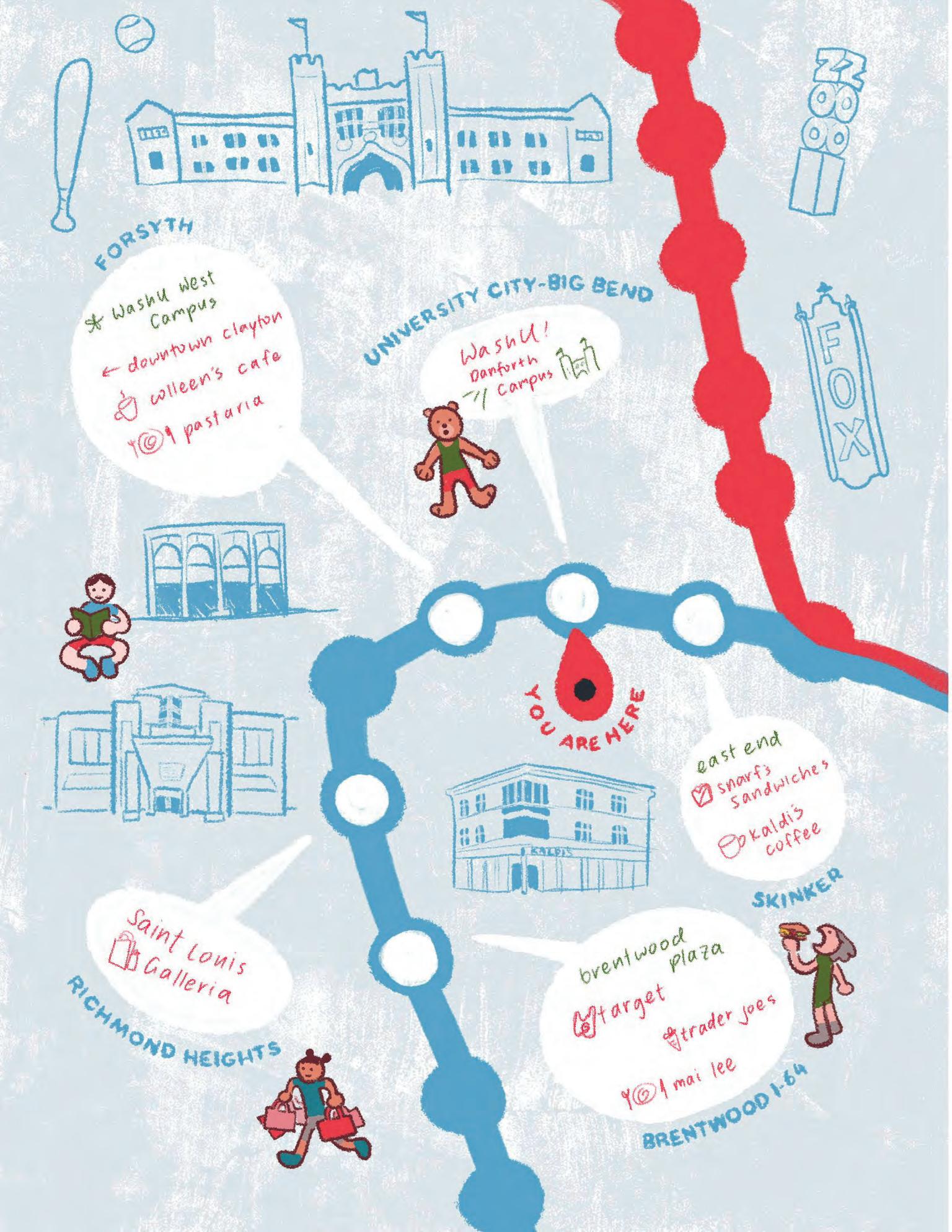
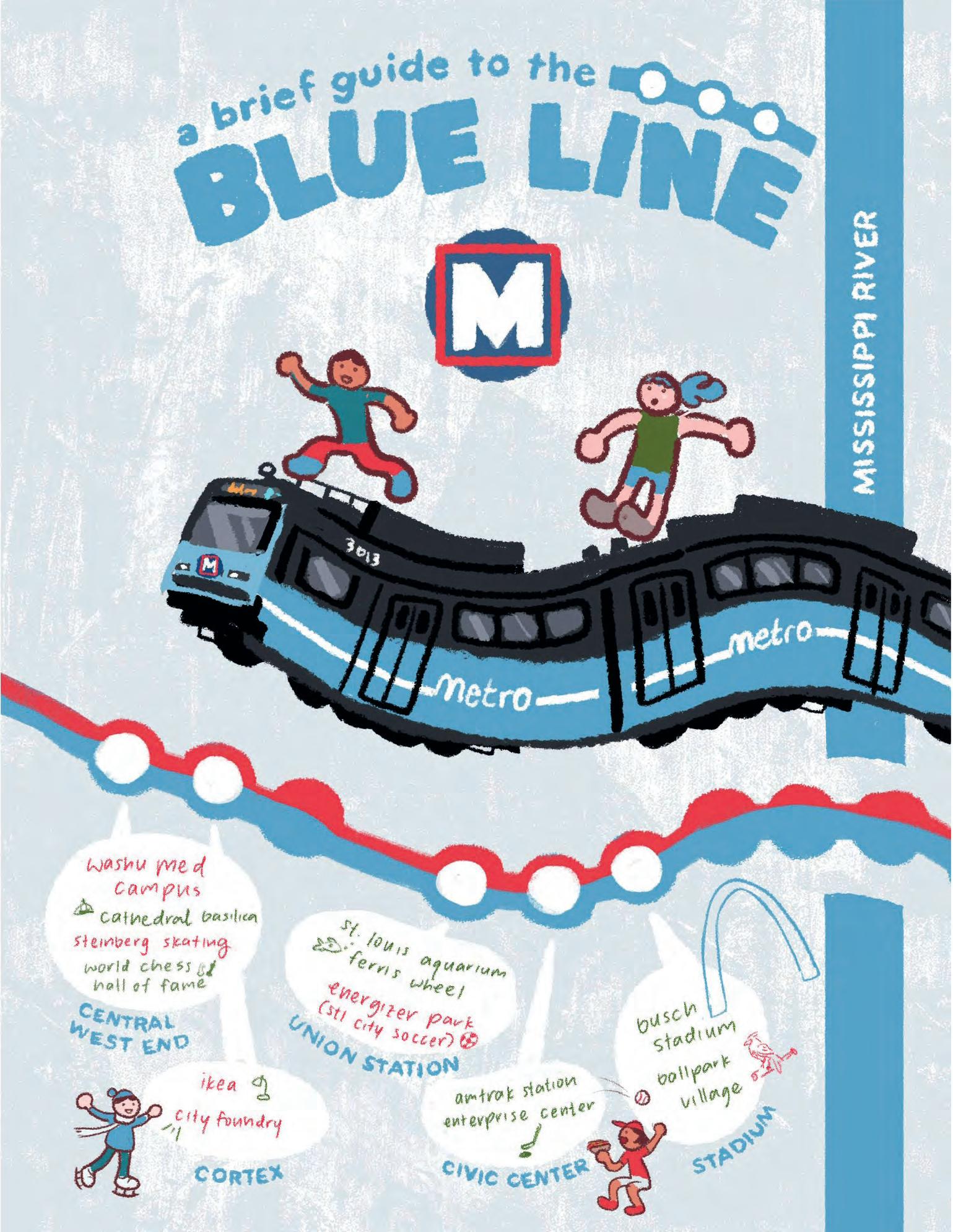
NICOLE BACKAL STAFF WRITER
College life can be a blur, a fun exciting swirl of new friendships, parties, academic anxiety, and strange clubsponsored activities. Yet there comes a moment when the rush calms down and you are left suddenly bored on a Saturday afternoon with nothing to do. Somehow, you have no pressing assignments, no errands, and no set plans with your friends. Of course, this emptiness can happen at any moment, and it is easy to fll it with a task like laundry, but that hardly flls the hole. It is easy to get lost in the WashU environment, but there are plenty of things you can do (solo or accompanied) to get out of the bubble and have a lovely day.
The arts may seem inaccessible from time to time, but St. Louis and WashU offer plenty of opportunities for artistic entertainment. Early in the fall, you can watch free Shakespeare in the Park, or go to SLAM Cinema and watch a free movie in the park. The Hi-Pointe Theatre (accessible through the South Campus Shuttle) offers $10 tickets for students and regularly shows everything from new releases to classic silent comedies. WashU offers plenty of opportunities for artistic engagement from free music performances of the Kemper series to student theater, dance groups, or movie screenings through WashU Cinema.
Watch out for free or discounted student deals

Being a student has some perks like free tickets through Campus Life, 15% off Sushi AI, reduced prices for performances in the Fabulous Fox Theatre, and much more. This comes with everything from free opportunities to watch Blues games to the latest movie screening in the Galleria Mall.


Student groups and organizations are constantly hosting fun and exciting events that might fy under your radar. There are brilliant cultural shows like Diwali, Carnaval, Lunar New Year, Black Anthology, and more. Clubs host activities and fairs all around campus that at the very least might get you a free meal. Graham Chapel regularly has student concerts, fashion shows, and cool speakers like Olandria from “Love Island” and activist wwAmanda Nguyen. Pay attention to accounts like Campus Life (@WashUCampusLife) on Instagram that shout out all sorts of campus happenings and also regularly host events like Tuesday Tea and Wellbeing Wednesdays.

Just 15 minutes from the edge of campus, the Saint Louis Art Museum sits on the top of a hill with a beautiful basin at the bottom. The museum is free and has a vast collection with pieces from around the globe. The walk from campus is very pleasant and is a lovely introduction to Forest Park.
Whether it’s snowy or sunny, ice skating is a fun and simple activity under $10 that can fll up a good couple hours of your day. You can go to the open ice skating rinks during the winter, or drive (rideshare or Enterprise Rent-ACar if you do not have access to your own car) to indoor rinks like the ones in Brentwood and Webster Groves during their sessions. There are also roller skating rinks around St. Louis with more fexible hours if the ice is not your vibe.

Similar to the last one, but more local, you can go to Sumers Recreation Center and request sporting equipment for a variety of sports. You can borrow a ball and practice shooting by yourself, or get a few friends together to play. It doesn’t matter if you are good or not. The point is to enjoy moving your body for a couple hours.
St. Louis is home to the Cardinals, Blues, St. Louis City Soccer Club, and the Battlehawks. Baseball games happen regularly and are fairly cheap (Busch Stadium is accessible through Metro), and recently they started a $30 deal for unlimited treats. Beyond classic sports games, you can always support WashU teams by going to their home games, or catch a Saint Louis University game at Chaifetz Arena.



You can do everything from attending the Battle of the Bands hosted by KWUR, the student radio, to monitoring events sites for niche artists that come to town. Of course, getting tickets for Lorde requires planning months ahead of time, but sometimes you can just buy $30 tickets to watch Madison Beer that day at The Pageant.
Like every other university, WashU has about one million comedy clubs that constantly get together to trip, fall, surprisingly sing, or just crack jokes on stage. You have everything including stand-up, improv, and sketch comedy. If you are feeling fancier, the Helium Comedy Club regularly hosts popular comedians like Gianmarco Soresi and Preacher Lawson.

Sometimes a sleepy weekend morning calls for walking around and shopping for things you don’t need. If you pay attention, there are plenty of neighborhood yard sales, farmers’ markets, and specifc item fairs (clothes, books, etc.) all around St. Louis selling unique stuff. It is a great activity both alone and with company and requires practically no planning. If you can’t fnd any events like these happening, just fnd one of the many unique stores St. Louis has to offer. You can pop into Avalon to thrift, go on a bookstore/library crawl, or fnd a unique neighborhood like Cherokee Street to explore.
When the ebb and fow of your WashU life suddenly stops, you might feel stumped. Sometimes weeks go by and school and friends keep you so busy that you don’t even have to think about your next move. However, there will come a time where you might feel stuck, bored, or simply need a change of pace, and that is when you put in the effort to do something new. Host a picnic, try painting something, buy nail polish, or bake something in the communal kitchen. Even something as simple as exploring campus can turn a dull day into an adventure. Do not let routine turn into a rut.

COBY RINKE MANAGING NEWS EDITOR
Did you know the WashU campus includes a boathouse, a greenhouse, a zoo, a history museum, and a fsh hatchery? OK, not really. But WashU might as well have these things, given you can walk right across the street from campus into Forest Park, which actually does boast all that and more. Approximately 500 acres larger than New York’s Central Park, Forest Park is one of the centerpieces of St. Louis City, and I spend much of my free time running and biking its trails. Though I’m sure the park often ends up on lists of things to do in St. Louis, there is so much more to it than what’s apparent at a frst glance. It goes without saying that I highly recommend WashU students get out to explore everything this amazing park has to offer — even and especially the stuff a little off the beaten path.
Probably the most popular destination for WashU students, the St. Louis Art Museum (SLAM) is only a 15-minute walk from WashU’s East End. The museum itself has ancient Roman statues, Van Gogh paintings, medieval armor, and abstract work, among works from many other cultures and styles. Even better, like all museums in Forest Park, it’s 100% free!
Just outside is Art Hill, a grassy expanse that consistently draws picnickers in the summer and sledders in the winter. At the bottom of the hill is the Emerson Grand Basin, a large fountain pool that you can sometimes ice-skate on in the winter — just make extra sure the ice is thick enough. The basin leads into the PostDispatch lake, where you can rent a boat (or bike) from the nearby boathouse.

The St. Louis Municipal Opera Theatre (Muny) is located near the center of the park and hosts outdoor plays and musicals during the summer. Among the lineup for this year is “Shrek the Musical”. The Muny leaves about 25% of its seats free on a frst-come, frst-served basis — perfect for students studying or working internships over the summer in St. Louis.
The Saint Louis Zoo is another one of my favorite places in Forest Park, and like SLAM, it’s absolutely free. The zoo is huge, housing everything from polar bears to zebras. During the holiday season, it also hosts Wild Lights, where the entire zoo is covered in glittering lights. Defnitely worth a visit!
The Jewel Box is my personal favorite hidden gem (no pun intended) in Forest Park. A tropical greenhouse located near the center of the park, it is also a beautiful example of 1930s Art Deco architecture. Plus, admission is usually only $1, and free on Mondays and Tuesdays before noon. Just west of the Jewel Box is the Anne O’C. Albrecht Nature Playscape, a very pretty and funky garden that’s worth exploring.
Steinberg Skating Rink is a charming outdoor skating rink that offers admission and skate rentals for $16 during the winter. Given the rink is on the far side of the park, it might be best to take the metro to the Central West End and then walk to the rink to start skating.

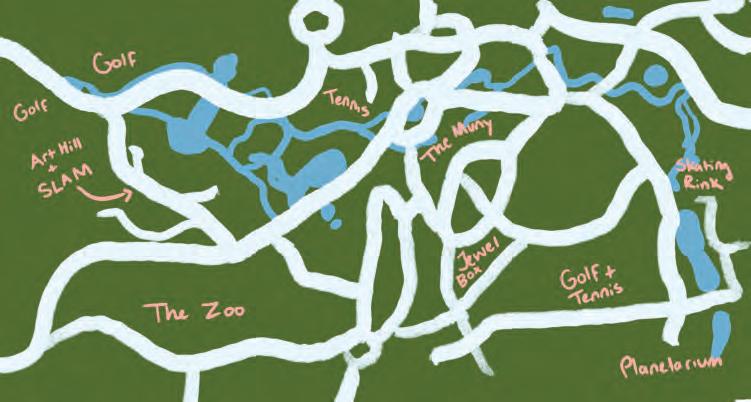
There are two sprawling golf courses in the park, one of them right across the street from WashU’s East End, though be aware that playing nine holes will cost about $25-$35. For those interested in fshing (and who have a valid Missouri fshing license), you can visit any of the many beautiful lakes in the park, although only Jefferson Lake near the Central West End is stocked with fsh. There is also a fsh hatchery in the northeast corner. Finally, the John F. Kennedy Memorial Forest in the park’s southwest
corner is home to some short but charming hiking trails, perfect for anyone who, like me, sometimes just needs a good walk in the woods.
While walking or biking through the southwest corner of the park, you might see the St. Louis Archery Club practicing their Katniss Everdeen impressions and horses belonging to the St. Louis Metropolitan Police Department’s Mounted Patrol Unit. Just past these is the futuristic-looking James S. McDonnell Planetarium, where, along with IMAX movies, you


AMELIA SPENCER
HANNAH LA PORTE
SPECIAL ISSUES EDITOR MANAGING SCENE EDITOR
Just like any university campus, WashU has a lot to offer to students. For some, this might be persuasive enough to spend all four years within the blocks of the Danforth Campus. But let us be the frst to tell you: You have to explore our city. The campus is a great place to come home to, but without exploring St. Louis, you will not have taken full advantage of your college experience.
WashU’s offcial name is Washington University in St. Louis. It is accompanied more recently by the slogan “In St. Louis, for St. Louis,” a commitment adopted by Chancellor Martin to be an active partner in the city by leveraging the strengths of the University. All of this marketing might lead to the assumption that WashU lies exclusively within the city bounds, but in reality we are located on the boundaries of multiple municipalities.
The counties which surround WashU offer so much entertainment, dining options, and excitement. Just a few minutes’ walk from campus, in University City, is The Delmar Loop, a location so dear to student hearts’ that it can feel like an extension of campus. Forest Park also lies one street away from campus. This expansive space covers 1,300 acres (it’s bigger than Central Park!) and is home to the Saint Louis Art Museum, the zoo, the Missouri History Museum, the Muny, and so much more, most of which is free! To learn more about how to take advantage of this amazing park, see our article, “How to actually make the most of Forest Park,” on page 48!
Each of these attractions are great to explore when you
frst arrive at WashU. But there is an entire city beyond these locations that is so important to the culture of WashU. Each place offers a new adventure and the city should never be underestimated as a great location to take family or friends.
We know that getting off campus, especially as a frstyear, is no easy feat. Without a car, you must rely on friends, Ubers, or public transportation to get around. The Metro and bus system, while convenient for certain locations, can be frustrating to navigate (check out page 44 for a handy guide). We spent a lot of our frst year navigating Enterprise Car Rentals, taking the Metro, and begging upperclassmen friends to give us rides. Whether you are from St. Louis or from hundreds of miles away, navigating the city can be diffcult in this new environment, and we have a few suggestions that could make this daunting task more approachable.
Here are some of the best ways we have found to get off campus.
One great option to explore new areas of the city, and the greater Midwest, is to join a club which takes you off campus! WashU has more than 400 recognized student groups, many of which operate away from campus, for a range of niches and activities. If you want to explore the Midwestern outdoors, consider joining Wilderness Project during your frst fall break, or Outing Club during any semester! There are also clubs which focus on community service, like Campus Y, which hosts programming across campus. Many students get involved with programs like America Reads, tutoring kids in reading and math at public schools across the city. Student groups also
frequently host activities and events off campus. Asian Multicultural Collective hosts an annual “Taste of Asia” event, shut tling students to local cultural restaurants and grocery stores. Ski Club arranges student discounts and hosts trips to local mountains. Students in SPOON University WashU take trips to local eateries, trying new foods and interviewing chefs across St. Louis. Club sports teams travel across the state to competitions. Whether you join a club dedicated to leaving campus or simply one that offers off-campus activities, clubs can be a great way to explore the city.

THOMAS | MANAGING ILLUSTRATION EDITOR
hospitals, food banks, and more across St. Louis, and each of them come back knowing more about the area and community.
During my (Hannah’s) frst month at WashU, I ventured into DeMun and began working at Clementine’s Creamery, where I’ve continued to work for the past two years. Although it may seem like working a job does the opposite of giving you time to explore off campus, being at Clementine’s allowed me to interact with community members from all over St. Louis and Missouri, and I have made random connections all across the city. This past year, I also worked on a few local political campaigns, and that allowed me to go to events across St. Louis, meeting and talking to people from all over and learning more about the community I go to school in. For less time-consuming opportunities, consider volunteering at local organizations! Finding an organization you are passionate about and giving some of your time allows you to explore our city while also giving back. We have friends who volunteer at
Ask your friends with cars to help you explore
A last suggestion is to foster connections with upperclassmen, who may have cars, or just a life away from campus. These relationships are a great way to explore parts of St. Louis that you may not be aware of. Connections with upperclassmen are a great way to quickly become acquainted with the city, as they have already done the exploring for you!
We are writing to you from two perspectives. Amelia has lived in St. Louis for practically her entire life, and has a deep appreciation for the city — both from her childhood, and this new version she has had the privilege of experiencing as a college student. Hannah was born in Los Angeles and moved to St. Louis to attend WashU, but she now loves exploring the city. No matter where you fall on the spectrum of familiarity with St. Louis, we sincerely hope you will explore your home for the next four years.
SARA GELRUD SCENE EDITOR
From the fourth day of Bear Beginnings through the frst two months of my frst year, I attended a concert nearly every week. By the end of that year, I attended over 20 shows. Now heading into my junior year, I’ve learned a few tips and tricks along the way. Here are a few I wish I knew in my frst year.
The best way to score cheap tickets is through Concerted.live. Volunteering at a local nonproft for two hours can earn you a free ticket to select shows. This semester, you could volunteer at organizations near campus like the St. Louis Shakespeare Festival, St. Louis Area Diaper Bank, and the Foster & Adoptive Care Coalition. Blondshell offered this opportunity to her fans last year, and this
semester Michigander is also partnering with Concerted for his Oct. 21 show at OffBroadway. Keep an eye on the site as more artists announce their fall tours!
While most of us stream music online, the art of calling in to a radio station in hopes of winning tickets to the week’s most anticipated show is a craft that’s slowly being forgotten. Tune into radio shows like 105.7 The Point (my go-to rock station), 106.5 The Arch, and occasionally your student-run radio KWUR 90.3 FM for ticket giveaways. In case you’re unable to listen in, contests are also frequently posted to stations’ Instagram accounts.
If you enjoy classical music, be sure to take advantage of the St. Louis Symphony Orchestra’s $15 student tickets. Closer to campus, the 560
Music Center (located on the Delmar Loop) frequently hosts an array of classical and jazz performances, including recitals and concerts by visiting world-class musicians, the WashU orchestra, choirs, and jazz combos.
Additionally, don’t forget about the jazz, blues, and jam scene. Enjoy a performance at Blue Strawberry, where you can catch living legends like Bobby Rush, or go to a Jazz Jam on a Wednesday any time from 6 p.m. to 9 p.m. at The Dark Room in The Grandel. If you don’t feel like venturing outside of the WashU bubble (which you should totally be doing at least once a week), take a short walk to the Kemper Art Museum for “Kemper Unplugged,” a monthly show in the museum’s lobby on Friday afternoons.
And one general note: debating going to a show
because you have too much work? Go to the show. Your time in college in a musically rich city like St. Louis is too short not to be having fun, even on a random Tuesday night when your favorite band is playing on the Loop.
I would be remiss not to mention that if you made it to the end of this article, you probably love going to shows as much as I do. If that’s the case and you just so happen to enjoy writing too, join the Scene section of Student Life! Scene encompasses everything from arts and entertainment to club features and profles, including one of my favorites — band interviews! We welcome everyone, from experienced writers to frst-timers, so make sure to come by the offce during our open house in September!

ELIJAH LECKERMAN STAFF WRITER
Friday, Aug. 21:
Jesse Welles with Ratboys at The Pageant (20-minute walk / 10-minute shuttle)
Before classes start on Monday, walk or take the shuttle to the Delmar Loop to see Instagram-famous folk singer Jesse Welles perform at The Pageant. His song “War Isn’t Murder” became popular for its poignant lyrics and political subjects, which will make for an impassioned performance that is sure to be moving.
Sunday, Aug. 23:
Alabama Shakes and Tedeschi Trucks Band at Hollywood Casino Amphitheater (30-minute drive)
Aug. 29 and 30: Esperanza Spalding at City Winery (15-minute drive)
The 2010 GRAMMY’s Best New Artist winner Esperanza Spalding is a contemporary-jazz singer and bassist with one of the smoothest voices you’ll ever hear. Even if you can’t drink alcohol, go to the City Winery to sit down, relax, and listen to the beautiful sound of Spalding’s voice.

Wednesday, Sept. 2:
Ray LaMontagne with The Weather Station at Stifel Theatre (15-minute drive)
Friday, Sept. 11:
Zac Brown Band with Brothers Osborne at Enterprise Center (15-minute drive)
Saturday, Sept. 12:
Kacey Musgraves with Midland at Enterprise Center (15-minute drive)
Singer Kacey Musgraves has been all over the country scene, with a hit song with Zach Bryan, a detour into pop-country with her fourth album, and two songs with the iconic Willie Nelson. Her often mellow songs might lead people to be surprised that she is playing at one of the biggest venues in St. Louis, but her energy will undoubtedly fill the arena.
Wednesday, Sept. 16:
Shaboozey with Brittney Spencer at The Factory (20-minute drive)
Wednesday, Sept. 16:
St. Louis Symphony Orchestra’s Forest Park Concert at Art Hill (20-minute walk)
This Wednesday in September has two distinct concert opportunities for WashU students to choose between. You can opt to
drive 30 minutes to The Factory to hear Shaboozey sing “A Bar Song (Tipsy)” live and dance all night. Or, you can walk to good ol’ Forest Park and watch our city’s orchestra perform their season preview for free on the lovely Art Hill.
Thursday, Sept. 17: Tim McGraw with 49 Winchester at Hollywood Casino Amphitheater (30-minute drive)
Friday, Sept. 18: Pitbull with Lil Jon at Hollywood Casino Amphitheater (30-minute drive)
Two years ago, Pitbull performed at the same venue that he will be returning to and played his numerous 2000s and 2010s bangers. Many WashU students attended (some in Pitbull-esque bald caps) and had a blast, and now he is coming back — so don’t miss out on the opportunity to see the bald legend.
Monday, Sept. 21: BABYMETAL with Halestorm and Violent Vira at Hollywood Casino Amphitheater (30-minute drive)
Wednesday, Sept. 30: Foster The People with Goth Babe at Saint Louis Music Park (30-minute drive)
October:
Wednesday, Oct. 7: Chance the Rapper at The Pageant (20-minute walk / 10-minute shuttle)
If, somehow, his concert is not sold out by the time you read this article, buy a ticket to see Chance the Rapper for the first day back from fall break. Along with his numerous popular collaborations such as “Holy” with Justin Bieber and “All My Friends” with Snakehips and Tinashe, his 2016 mixtape “Coloring Book” is widely regarded as a great rap project and is the reason for this 10th anniversary tour.
Friday, Oct. 9: JPEGMAFIA at The Sovereign (15-minute drive)
Monday, Oct. 12: Suki Waterhouse with Rochelle Jordan at The Pageant (20-minute walk / 10-minute shuttle)
After her song “Good Looking” blew up for its devastating chorus, Suki Waterhouse released her sophomore album “Memoir of a Sparklemuffin.” If you move beyond the cringe title, you will hear a dynamic blend of pop, indie rock, and singer-songwriter elements that are guaranteed to translate wonderfully into a live setting.
Tuesday, Oct. 13: Interpol with DIIV at The Factory (20-minute drive)
Thursday, Oct. 15: Black Country, New Road at Delmar Hall (20-minute walk / 10-minute shuttle)
Friday, Oct. 16: Slow Pulp at Delmar Hall (20-minute walk / 10-minute shuttle)
Slow Pulp opened for Lucy Dacus last year at Stifel Theatre and captured the audience’s attention with soft indie rock bangers like “Falling Apart” and “Idaho.” Luckily, they are returning to St. Louis for a headline show and are going to be performing only a short walk away from campus.
Sunday, Oct. 25: Tank and The Bangas with Ariel J. at Off Broadway (20-minute drive)
Monday, Oct. 26: Sammy Rae & The Friends with Melt at The Pageant (20-minute walk / 10-minute shuttle)
Friday, Oct. 30: Sombr with The Last Dinner Party & Hannah Jadagu at Enterprise Center (15-minute drive)
The world seems very divided on whether to like Sombr or not (even though “Homewrecker” is an outright amazing song), but this concert will be worth it just for the openers alone. Singular pop-rock band The Last Dinner Party will make you move with emotion, and rising indie-pop artist Hannah Jadagu will play beautiful songs that you will be happy to say you heard before she inevitably gets more popular. Just listen to “My Love.”
Indie rockers West 22nd are coming to play at one of WashU students’ favorite venues, which is only a quick shuttle ride away for the South 40. Walk through this classic Delmar Loop restaurant and head to the back into an intimate music venue where West 22nd is sure to deliver.
Saturday, Nov. 7: Kurt Vile and The Violators with Twisted Teens at The Sovereign (15-minute drive)
Monday, Nov. 16: Journey at Enterprise Center (15-minute drive)
Thursday, Dec. 3: Sam Barber at Chaifetz Arena (15-minute drive)
Dec. 12 and 13: The Muppet Christmas Carol in Concert at Powell Hall (15-minute drive)
If you are still on campus for finals, take a study break during the weekend to watch the incomparable muppets on film, while the Saint Louis Symphony Orchestra plays the score under the screen. This winter special will be an ideal way to escape from reading week and into the holiday spirit.
Thursday, Nov. 5: West 22nd at Blueberry Hill Duck Room
(15-minute walk / 10-minute shuttle)
HARPER NIX SPORTS EDITOR
While WashU is a well-known academic powerhouse, the athletics program often takes the backseat. Given that we are a Division III school, many people have the misconception that our varsity sports “are not real.” However, WashU athletics serve the entire student body, not just its varsity athletes.
Sports bring people together. Whether a sporting event is professional or amateur, the collective effervescence it creates is compelling. Attending a game is a fun activity to do with friends, and it is a great place to meet new people. Additionally, many of our athletic facilities are on campus. There’s no need to block out an entire day to attend a match or game; you can simply stop by whenever it is easiest for you!
D-III athletics also provide a unique sporting atmosphere. None of the athletes at our level are allowed to have direct athletic scholarships, and very few have signed a
Name, Image, and Likeness (NIL) deal. This means that most D-III athletes choose to continue playing at a collegiate level because of their love for the game.
This intangible sense of joy makes WashU athletics stand apart from the rest. It’s undeniable. At any game, match, or meet, the athletes having the most fun are always in a WashU uniform — compared to their often quiet, serious, and rather sulky competition.
WashU softball plays improv games on the feld fve minutes before lineups are called. The track and feld team can often be found in face paint and vibrant outfts when cheering on their teammates at meets. No one is louder than the bench of our women’s basketball team, who command the game even if the Bears are trailing behind their opponent. These small, intentional details are what makes WashU varsity teams special. There’s a level of compassion and heart that everyone embraces — even newcomers in the stands.
WashU athletes are also very engaged in communities outside of the athletic
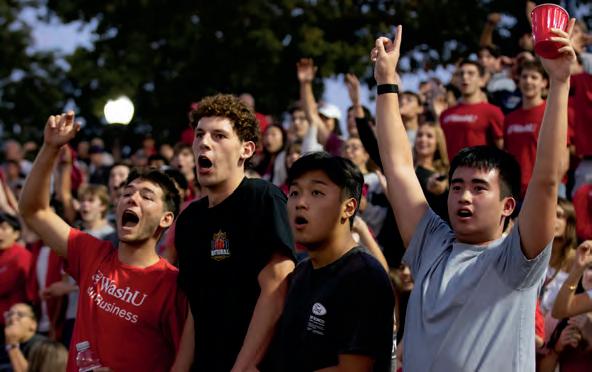
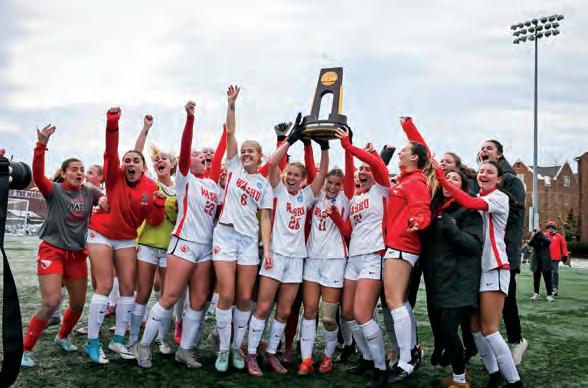
department. Whether it’s a capella, Greek life, or a food drive — D-III athletics gives its athletes time in their schedules to pursue other aspects of the college experience. The ability to engage with fellow students outside the classroom creates a more connected WashU population, which in turn makes games more exciting as one is able to recognize more faces on the feld.
And the best part of it all is that at WashU, we win. This past year, 16 out of the 17 varsity sports WashU offers fnished within the national top 20 rankings. That does not happen at any ordinary school, regardless of division. At WashU, success like this is a standard — dating back to the volleyball dynasty of 1991-1996, when the Bears won six NCAA D-III National Championships in a row. Developing teams that achieve unprecedented milestones is an expectation that we work to maintain every year.
The women’s soccer team has not lost a game in two
years, winning two national championships back-toback in 2024 and 2025. Women’s track clinched its 10th straight UAA conference title this past spring, and men’s basketball advanced to the Final Four in 2025. Additionally, women’s tennis picked up their frst NCAA D-III National Championship title in 2025, and on May 28, 14 members of the men’s and women’s track teams were honored with All-American status — earning fourth and 10th place, respectively.
This coming semester, I encourage members of the WashU student body to start attending more games. Pick up a Student Life sports article every now and then to stay updated on our teams’ seasons, as well as our athletes’ accomplishments. WashU has one of the most elite D-III programs in the country — you don’t want to miss out on the next big things ahead.
Editors Note: Harper Nix is a member of the WashU softball team.




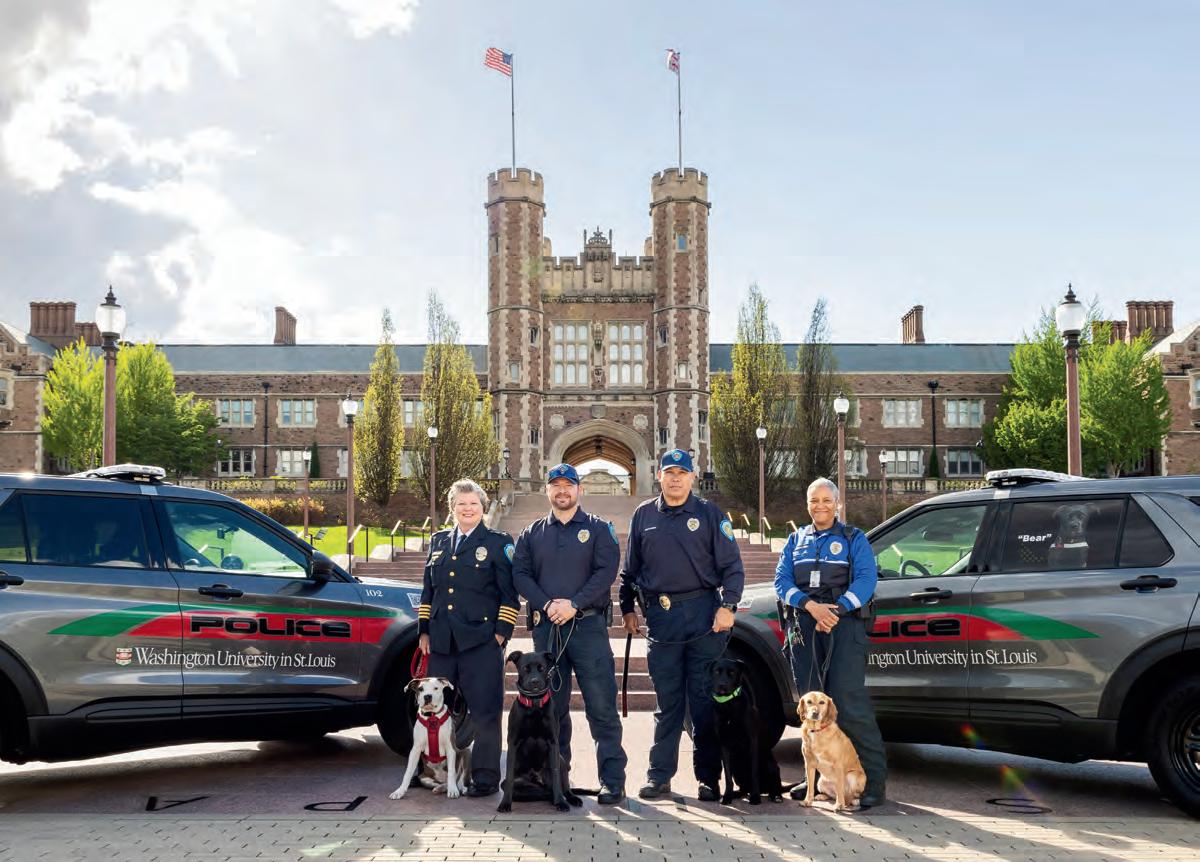

SPORTS EDITORIAL STAFF
HANNAH MUCH, HARPER NIX, ELIZA STULMAN, BEN OLLENDORFF, ANNA CROOK
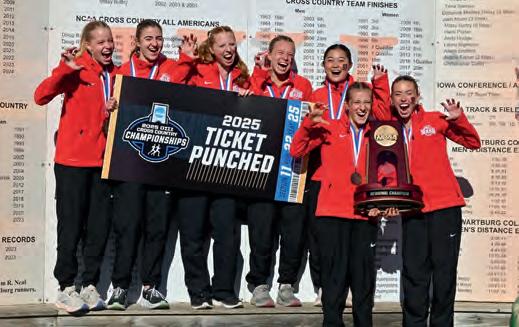
The WashU women’s cross-country team won an at-large bid to Nationals at the NCAA
After the women’s and men’s cross country teams fnished in seventh and 16th, respectively, at the 2025 NCAA Championships, the Bears will look to build upon their success in the 2026 season.
The women’s team graduated four senior runners last year, notably regional runner-up Jillian Heth and Katie Rector. The team will look to the Midwest Region Champion and Athlete of the Year, junior Lucinda Laughlin, to lead the Bears this season. Laughlin was the Bears’ top fnisher at nationals, fnishing in 16th. WashU will also return senior Avery Nason, and juniors Lauren Raley and Maddy Lee, who all competed in nationals last year.
The men’s team graduated fve seniors, including Midwest AllRegion athlete and
standout runner Conor Daly. Sophomore Max Sudrzynski will return after a successful rookie season, in which he was named second team All-UAA and fnished nationals in 62nd place as the Bears’ top male fnisher.
Last season, the team was quite young with four frstyears competing at nationals, including now-sophomores
Charlie Houck, Rishi Shadaksharappa, and Gavin O’Connor. Juniors Sean Green and Ben Lorenz will also return after performing in nationals last season.
Despite graduating top runners from last year, both teams are flled with young returning talent and are poised for a solid run at the 2026 NCAA championships.
With AVCA Second Team All-American Sam Buckley now graduated, who set an all-time program record for assists at 5,394, a question mark remains next to WashU’s volleyball team. The Bears ended their 2025 season ranked 15th in the nation, losing in the NCAA Division III tournament 0-3 to the University of Wisconsin–Oshkosh. Still, this Sweet 16 loss marked the Bears’ deepest tournament run since 2016 — a promising sign looking forward.
Buckley and her classmates’ leadership will be replaced by five seniors, including AVCA Second Team AllAmerican Leah Oyewole
After placing fifth for the second year in a row at the 2026 NCAA D-III Championship, WashU’s golf team looks to continue the momentum going into the 2026-2027 season.
Now that Athena Nguyen and WGCA Second Team AllAmerican and First Team All-UAA Tiffany Chan have graduated, seniors Reagan Robinson and WGCA All-America Honorable Mention Amy Beanblossom will lead the Bears this season.
and AVCA Honorable Mention All-American Ellie Laird.
Oyewole led the team with 3.73 kills per set in 2025, while Laird stepped up in her first year as the team’s starting libero, putting up an astounding 5.26 digs per set.
While Oyewole will power the Bears’ attacks, and Laird will hold down their defense, a key part of WashU’s offense remains uncertain without their star setter. Someone must step up to fill Buckley’s shoes if the Bears want to continue their four-year streak of making it to the D-III tournament.
Robinson and junior Nicole McGuire finished last year’s season ranked among the top 60 players in the country, taking 28th and 59th, respectively.
The team’s schedule has not yet been released; however, the fall matches will be vital in preparing the Bears for the spring season and making the NCAA championship once again.
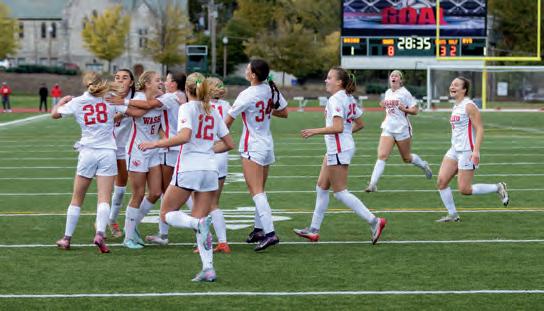
The WashU women’s soccer team secured its second straight national championship title in December 2025 after an undefeated season.
Following their second consecutive undefeated season, WashU women’s soccer continued their reign, clinching both the 2025 University Athletic Association (UAA) conference title and the 2025 NCAA D-III National
Championship. The Bears enter the 2026 season hunting for the rare national championship three-peat, which has only been seen once in D-III collegiate women’s soccer by the University of San Diego between 1995 and 1997.
The graduated class of five led the 2025 Bears’ championship team, including decorated forward Grace Ehlert, who finished last season as Third Team All-America, First Team All-Region, and First Team All-UAA. Defender Kaci Karl was a strong upperclassman voice on the Bears’ defense, playing in all 24 games with 23 starts. Both Karl and Ehlert made substantial contributions toward both the 2024 and 2025 national championship titles. The returning classes hold an ample amount of talent. Senior midfielder Sophie Viscovich concluded the 2025 season with Fourth Team All-America, First Team All-Region, and First Team
All-UAA. Senior defender and midfielder Keira Smyser looks to continue her key role on the Bears’ defense, allowing only 9 goals throughout the 2025 season.
Junior forward Olivia Clemons is the catalyst for the Bears’ offense, earning her First Team AllAmerica, UAA Offensive Player of the Year, and several other honors. The rising juniors and sophomores have never lost a game in a WashU uniform.
WashU women’s soccer has continued to raise the bar every year. The Bears look toward the 2026 season determined to take home the National Championship trophy for the third year in a row.

Coming off their best season since 2007 with a record of 14-4-1, the WashU men’s soccer team is looking to repeat their UAA conference championship. In the postseason, they made it to the Sweet 16 in the 2025 D-III NCAA tournament and ended the season ranked No. 14 with the UAA Coaching Staff of the Year led by head coach Andrew Bordelon. WashU has since announced a new assistant coach for the program, Gavin Kalish, who was previously an assistant men’s soccer coach at D-I Saint Louis University.
With 10 seniors on the roster, the team has a lot of experience coming into their fnal season. Defensive back
Quentin Gomez has won back-to-back All-UAA Defensive Player of the Year awards, contributing to an opponent average of just 0.84 goals per game last season. Behind him is Second Team ll-UAA goalkeeper Cal L’Hommedieu, who recorded nine shutouts last season. First Team All-UAA forward Ethan Wirtschafter dominated offensively, scoring 14 goals in just 18 games. Last year’s UAA Rookie of the Year and Second Team All-UAA midfelders, sophomores Daniel Kochen and Sebastian Valdes, respectively, are also expected to play a vital role on both sides of the ball this season. WashU will have a diffcult schedule this
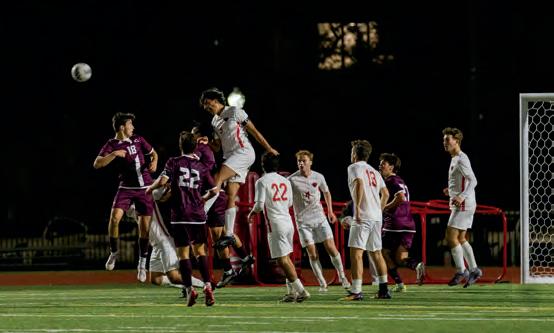
season, facing tough UAA competition, including Emory University and the University of Chicago. This past season, Emory made it to the semifnals of the national championship tournament while WashU narrowly
defeated Chicago in a tightly contested second round match. Now with tournament experience under their belt, this WashU team is ready to be one of the best in the nation once again this year.
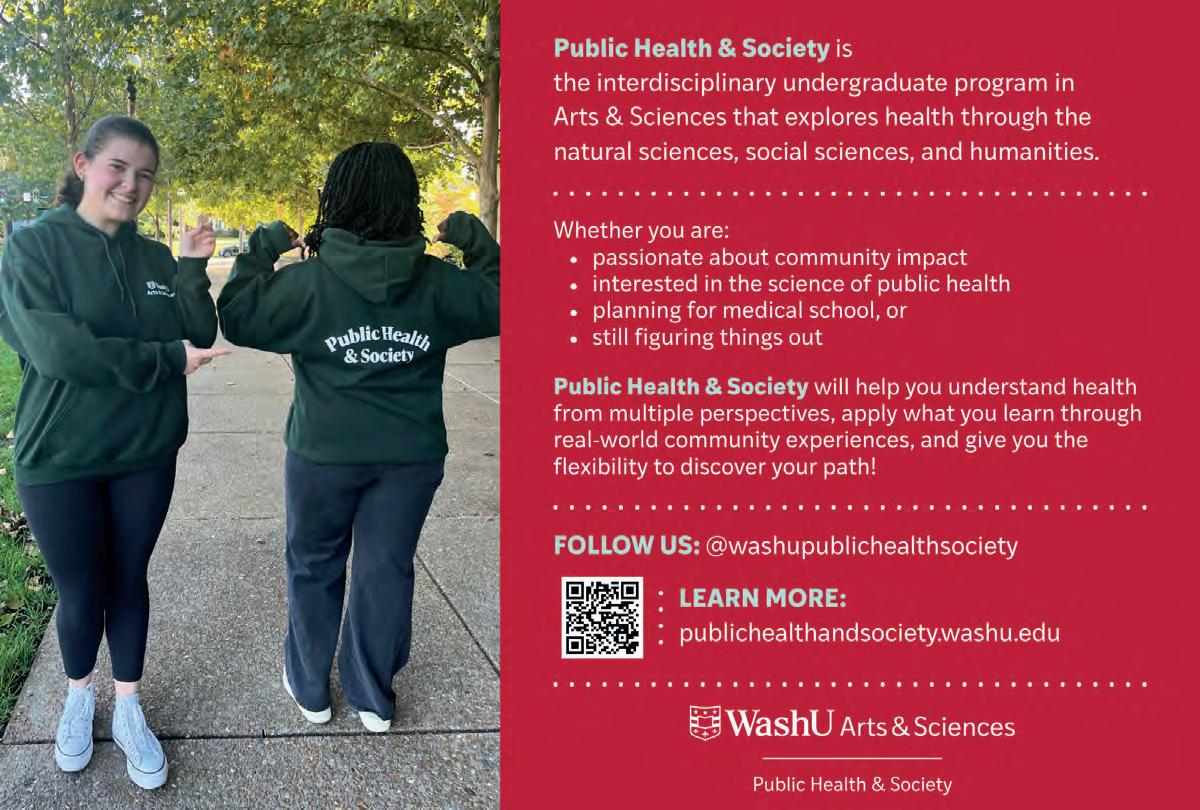
ROMAN PETERSON STAFF WRTER
WashU football is changing conferences from the College Conference of Illinois and Wisconsin (CCIW) to the North Coast Athletic Conference (NCAC) — meaning that, for the frst time in eight seasons, the team is facing a whole new slate of opponents.
Wherever you look, WashU athletics are on the rise. During the 2025-26 school year, WashU added two NCAA Division III National Championship Titles to its repertoire of 29; women’s soccer won its secondstraight national title, and women’s track and feld won its fourth in the last ten years. The Bears also made 18 playoff appearances and earned fve Conference Championship Titles last school year and took home the Learfeld Directors’ Cup. WashU football is no exception — while their program doesn’t necessarily contain the star power or command the name recognition of traditional
D-I powerhouses, there are several reasons to believe that the Bears’ 2026 football season is certainly something to look forward to.
While most of WashU’s teams are part of the University Athletic Association (UAA), its football team has played in the CCIW since 2018.
During its time in the CCIW, WashU football regularly faced conference opponents such as threetime D-III football NCAA champions North Central College, Wheaton College, Illinois Wesleyan University, Augustana College, and Carthage College. WashU remained a steady force at the top half of the conference, compiling a 53-20 record and three bowl game appearances.
After WashU lost its associate membership in the CCIW last year, the school announced a move to the NCAC, beginning in the 2026 school year. NCAC executive director Keri Alexander Luchowski described WashU as an institution that “aligns with the NCAC philosophy of highly competitive athletics
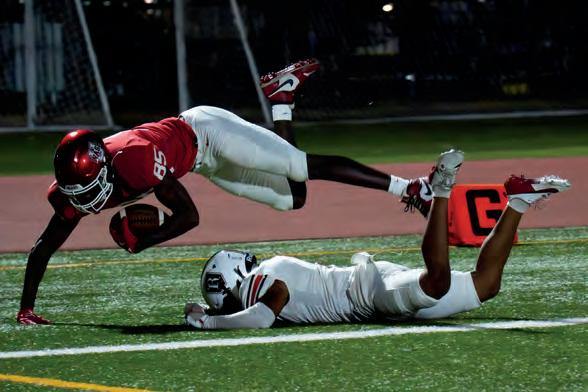
within a rigorous academic environment.”
The NCAC features John Carroll University, Oberlin College, the College of Wooster, Kenyon College, Denison University, Ohio Wesleyan University, Wittenberg University, DePauw University, and Wabash College.
The Bears are 29-45 alltime against their new conference opponents, but haven’t played an NCAC team since 2012. While an adjustment period is inevitable, the current
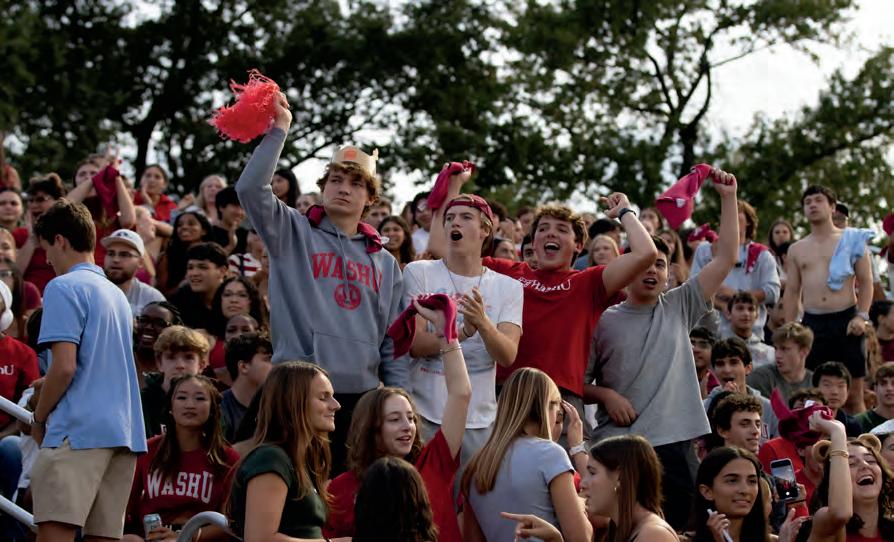
football roster has both the experience and recent track record to suggest that WashU can compete with the best of the conference sooner rather than later.
Much of WashU football’s recent success has stemmed from the leadership of head coach Aaron Keen. A former WashU quarterback and assistant coach, Keen was named head coach in 2020 and has led the Bears to fve consecutive winning seasons during his tenure.
“Everyone associated with our football program at Washington University is excited about the future and our new conference home,” Keen said.
This year, Keen’s offense will run through rising senior Levi Moore, the Bears’ dual-threat quarterback who led the CCIW in rushing touchdowns last season. Moore and the rest of his young offensive core were prolifc throughout the year, leading the Bears to an 8-3 record.
Now, in Moore’s fnal year and the Bears’ frst season in the NCAC, WashU is looking to make a good frst impression against its new conference opponents. Be sure to tune in and watch as the Bears look to establish themselves and potentially clinch a playoff berth for the frst time since 2016.

MADDIE MORGAN FORUM EDITOR
In high school, I was one of the top players on my tennis team’s roster. This past season, as a frstyear on WashU’s women’s tennis team, I played in zero matches. As you can imagine, “benchriding” never felt ideal in the moment, but as I’ve refected on my frst year at WashU, I’ve realized that no longer playing in a top spot has made me grow more as a person than perhaps I ever did in high school.
As you begin your WashU journey, I advise that you abandon the type of mindset that prioritizes external validation. Even if that approach got you through high school, having a fulflling college experience does not necessarily mean being the best at everything anymore. Instead, you should approach college as an opportunity for exploration and personal growth. This is a moment in life in which you can try new things (and fail!) to fnd what makes you happy. In my experience, benchriding hasn’t been so bad after all.
WashU is full of high achievers. Most of the students here, including yourself, were likely in the top of their high school classes and involved in impressive extracurriculars. It’s a canon experience to arrive at WashU and feel alarmed at the reality that nearly all of the students here are (for lack of a better phrase) locked in. Indeed, the college application process rewards students who seem to have fgured out their life story, passions, and plans when they were merely 15 years old. It celebrates those who
were willing to devote their selfhood during high school to gaming the admissions system. While this setup encourages hard work, it also ingrains into students a mindset that values things you can put on your resume or college application over other forms of fruitful exploration.
In my case, by middle school, I knew I wanted to play college tennis, so I dedicated myself to that goal. Weeknights were spent training. Weekends were spent at tournaments. I was driven by the tangible objective of being recruited. Again, this kind of thinking is effective: It inspired me to adopt a strong work ethic. But when I didn’t get the results I wanted in matches or tournaments, I remember that I didn’t always ground myself with the “right things” — how I played tennis because I loved it, or how losses were always opportunities to learn. Instead, I tended to return to superfcial validations: failures were okay because I played a certain position on my high school team, I was this ranking or that, and so on.
Then, I arrived at WashU. I had done it: I made it to college tennis. Suddenly, however, I was in the bottom of our team’s lineup. All of the things I previously used to validate my tennis shortcomings were now irrelevant. I realized that I could no longer highly value results in my approach to tennis, because I was quite literally not getting any playing time.
I noticed, though, that I still looked forward to practice everyday. I still loved the feeling of hitting a clean shot or poaching a volley. Over

the course of this year, my benchriding experience has affrmed for me that I do, in fact, truly love tennis. Being one of the weaker players on our team has solidifed my belief that joy from sports comes from something deeper than winning, and that’s a value that I will carry with me for the rest of my life.
I encourage you to adopt a non-results based approach to your WashU experience. Instead of fnding rooms where you’re the smartest, put yourself in situations where you feel the dumbest — you’ll probably learn more anyway. Instead of only searching for extracurriculars that will look professional on your resume, try activities that bring you joy — you might discover passions that will make your life more meaningful. And instead of berating yourself when things don’t go your way, embrace those moments as chances to learn — you’ll grow in ways
you may not have expected. Of course, there are several unavoidable external measures of validation that will follow you throughout college: GPA, competition for clubs, etc. It would be poor advice to tell you to completely ignore those metrics since they are undoubtedly infuential on one’s life. Nevertheless, if you let those pressures dictate your existence here, then you risk connecting your identity to status signals ultimately out of your control.
Some students here pick classes that are “easy A’s” and others choose classes because they sound interesting, even if they’re hard. You probably know which approach will help you get the most out of your WashU experience. Take it from me — a seasoned benchrider — not always winning can be rewarding too.
Sharing With A Purpose (SWAP)
– Amelia Spencer, Special Issues Editor
Wilderness Project (WP)
– Hannah La Porte, Managing Scene Editor
Washington University
Equestrian Team (WUET)
– Lexi Lawsky, News Editor
KWUR 90.3
– Astrid Burns, Staff Writer
WashU Womxn’s Ultimate (WUWU)
– Bea Augustine, Design Editor
Cast n’ Crew
– Elijah Leckerman, Staff Writer
WashU Garba
– Tanvi Gorre, Managing News Editor
Keyboard Education for
Young Students (KEYS)
– Eran Fann, Photo Editor
Spires Intercollegiate Arts & Literary Magazine
– Zoe Rhodes, News Editor
Film Club
– Sara Gelrud, Scene Editor
Campus Y
Black Anthology
– Laurel Wang, Editor-In-Chief
Night Off
– Mason Sutton, Designer All Student Theater (AST)
– Campbell Crum, DEI Editor
– Dion Hines, Managing Forum Editor
Rural Students
Collective
– Alex Dering, Photo Editor
Kids On Campus
– Kayslay Cudjoe, Copy Editor
WUSlam
– Isabella Diaz-Mira, Managing Photo Editor
TILLIE SZWARTZ | DESIGN EDITOR


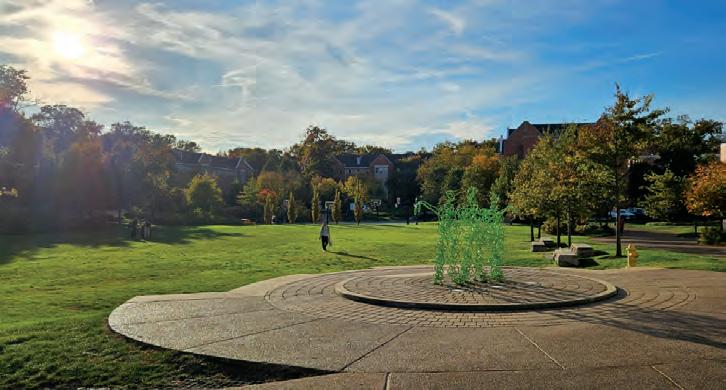
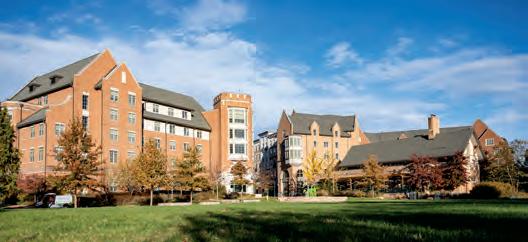
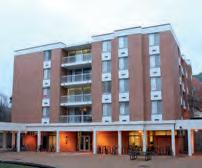
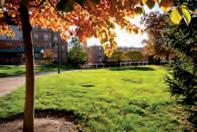
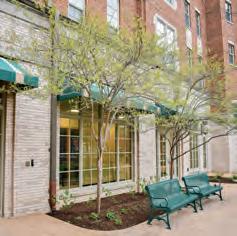
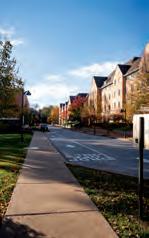
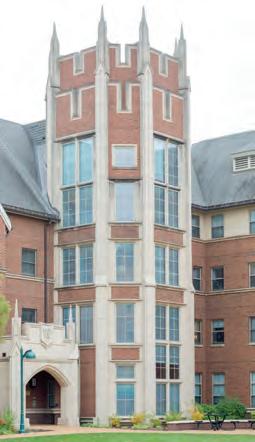
| CLASS OF 2026, CONTRIBUTING PHOTOGRAPHERS, PHOTO EDITOR



CAMPBELL CRUM DEI EDITOR
So you’ve been placed into a traditional dorm. As someone who lived in one of these older buildings last year, I can understand the initial dread, but over time, the benefts of traditional dorms become clear.
I was in Lee Hall for my frst year. It is the only traditional communal dorm for frst-years, where the “communal” label entails sharing bathrooms with your neighbors. The other frst-year traditional dorms are suite-style, with a bathroom shared among 3-5 suitemates. Those residential buildings are Hitzeman, Hurd, and Myers, known collectively as HIG, and Shanedling, Dauten, and Rutledge, known as JKL. When I received my placement
panicked. The internet told me cockroaches roamed the hallways. My friend’s sister, who went to WashU, laughed in my face. I dreaded move-in, but when I was fnally able to step foot into Lee, I was pleasantly surprised. It wasn’t Versailles, but compared to what you’ll see at state schools, it was glamorous.
It is important to remember that WashU is ranked No. 1 in the nation for best dorms. This means that traditional dorms are only “bad” relative to the other dorms at WashU. The communal bathrooms in Lee are cleaned every weekday, and most of the rooms give you more space than you can easily decorate. Even Lee haters will agree that the Lee basement is one of the best spots for a movie night on the South 40. The common rooms on each foor of Lee are no joke, either; most nights, you’d fnd a group from another dorm using
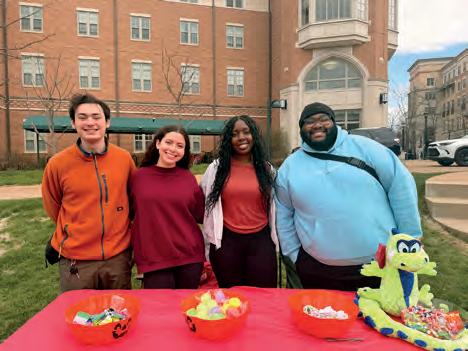
the spaces because of their comfortableness and open space.
Traditional dorms are exceptional at creating residential communities. Since traditional dorms house fewer residents, you are more likely to see familiar faces. This repetition creates stronger ties than the bonds you’ll fnd between students in modern dorms.
During my frst semester, I would sit outside of Lee with my crossword book and strike up conversation with my neighbors. Because of the limited number of residents, I was able to talk to the same people every day. On the other hand, two people in one of my classes only realized they lived on the same foor of Eliot A, a modern dorm, after seven months on campus.
traditional dorms also encourages interaction.
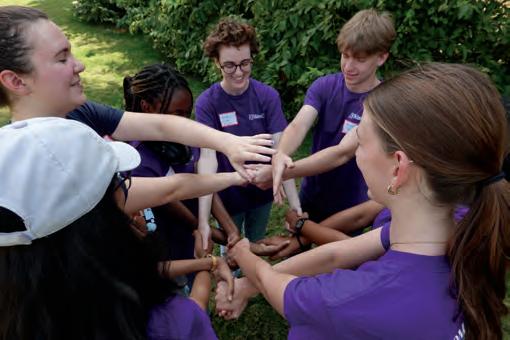
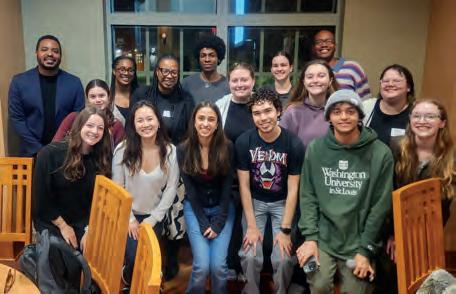


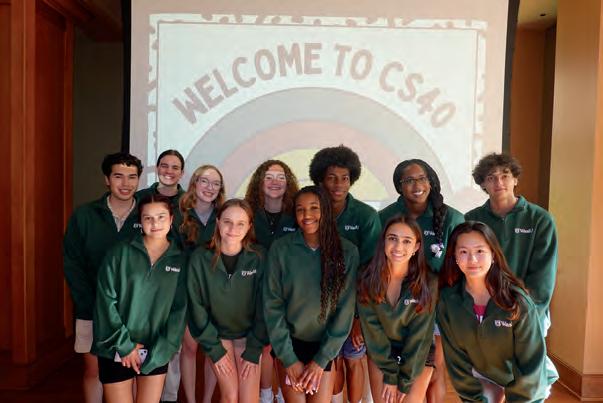
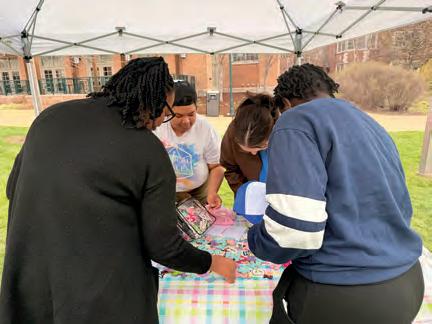
There’s only one entrance to Lee (HIG and JKL buildings only have one to two) and the hallways are mazelike. When leaving the dorm from your room, you’ll run into several people you know. I made one of my closest friends this way. After I was introduced to her by a friend of mine, I started seeing her every time I came and went from Lee. This evolved into talking in the lobby all the time. We then started seeing another group in the lobby when we were there, which led to us all becoming friends.
Though it’s a controversial opinion, I truly believe that HIG, JKL, and Lee create the best frst year experience. Sure, Lee
CS40 is WashU’s residential student government association, where students plan events and advocate for the needs of their residential community.
CS40 is a student led organization sponsored by Residential Life. Leadership opportunities are available to all students who live on campus.
August 17 Movie on the Swamp
September 11 St. Louis Cardinals Game
September 24 Food Festival
October 22 Fall Festival
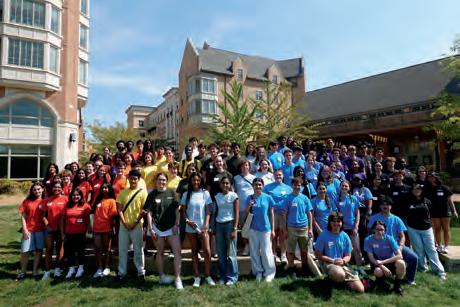

Gain lifelong skills and friends while building something special in your residential community by joining you Community Council.
Learn more at cs40.washu.edu

HANNAH LA PORTE MANAGING SCENE EDITOR
Welcome to college! Back home, you might’ve been an aspiring chef, a pastry connoisseur, or a ravenous snacker. I hate to burst your bubble, but when you get to your Modern Double in whichever dorm you land in, I can guarantee you that you will not have the same resources as you had at home. For some students (myself included), that was a total bummer. However, if you are resourceful, crafty, and willing to take your cooking skills up a notch, you can craft delicious meals without ever stepping foot outside of your room or your dorm, because sometimes, you just need a break from Bear’s Den (BD) or Paws & Go. Read ahead for some
tips and tricks. (Be warned: Sometimes sacrilegious steps must be taken for the sake of our food.)

The go-to meal for the broke, dorm-living college student is a trusty pack of instant ramen. But what if you could take your noodles to the next level? If you’re lucky, Paws & Go or Bear’s Den will be stocked with all the ingredients to elevate your dish. Eggs can be boiled
in a kettle or rice cooker for soft-boiled eggs. Vegetables at the Bear’s Den salad bar (mushrooms, corn, etc.) can be steamed in the microwave or thrown on top of your bowl raw. Chicken tenders from the Grill are a surprisingly good addition to a bowl of ramen. The point is, the possibilities are endless. Get creative!

This was my go-to meal all the time living in the dorms. I had the luxury (I deemed it a necessity) of having a rice cooker in my dorm, and that made cooking meals so much easier. For tuna rice bowls, source a can of
tuna from Schnucks, or Paws if you’re lucky. Keep a bottle of Kewpie mayo on hand (or Paws typically has some regular mayo too), and mix it in with the tuna. For salmon bowls, the canned salmon from Trader Joe’s is an ideal choice. Drain the oil and put it atop rice. For beef bowls, both Trader Joe’s and Costco sell microwave beef rolls or bulgogi beef that are surprisingly delicious. Top any protein bowl off with soy sauce, chili oil, or furikake (sourceable at Paws, United Provisions, Schnucks, or Trader Joe’s). If you have an avocado in stock, add it on top. Or, check out the next recipe for a perfect cucumber topping. These bowls can be eaten straight or scooped into seaweed for mini hand rolls.
Smashed chili cucumbers
This recipe is universally well-liked among my friends, and it has become a staple in my home. Paws & Go sells giant cucumbers that are perfect for the occasion. Cut the big cucumber into smaller pieces, and then smash them into chunks with the side of your knife. Mix with a few tablespoons of soy sauce and sesame oil, add a teaspoon (or more) of chili oil, and drench your cucumbers. (Measurements are loose and can change depending on desired salt or spice levels, or the size of the cucumbers.) Leave them in the fridge for a few hours, and eat them on top of rice or just as a delicious snack.
There are a million and one variations on this recipe. The two most basic ingredients are milk and rolled oats, but even the milk can be swapped out with a non-dairy alternative. From there, you can add Greek yogurt, chia seeds, fruit, spices, cocoa powder, chocolate chips, jam, or nothing at all. Keep in mind that if you add chia seeds, which will absorb liquid, you will need to up the amount of milk so the texture doesn’t become too dry. I like my overnight oats with enough cinnamon to change their color and a few drops of vanilla extract. 1) Measure and pour rolled oats into a glass container. Use a oneto-one ratio of oats to milk. 2) Pour milk directly over the oats (again, one-toone). Stir to ensure the milk thoroughly coats the oats. 3) Mix in your additions. If you’d like a sweetener, a liquid like maple syrup or
honey tends to work better than granulated sugar. Some toppings, like soft fruits, may be best to add when serving, although there are no rules here. 5) Refrigerate overnight in an airtight container, or for at least four to eight hours. Other tips: Steel-cut oats do not work as well as rolled oats. If you need a glass container, buy a Mason jar from Schnuck’s. And if you add yogurt, use about half as much yogurt as you did milk.
Late in my sophomore year, I rediscovered an old hack that my mom used to do to speed up dinner time: microwave baked potatoes! If you pierce a potato and place it in a dish in the microwave for 5-10 minutes with a wet paper towel covering, you will get a perfect baked potato. Bonus tip: you can ransack the salad bar or the grill at BD for any and all accoutrements!
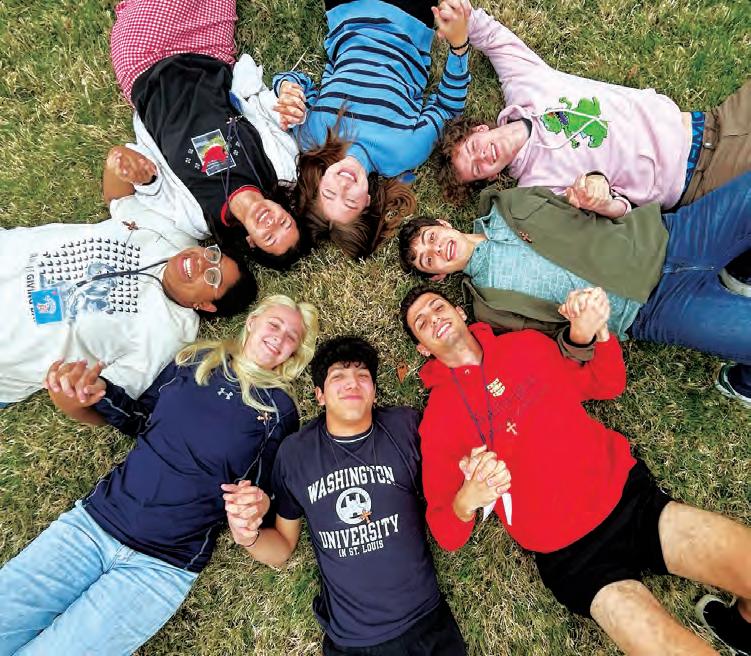
LUCIA THOMAS | MANAGING ILLUSTRATION EDITOR
Dorm cooking is never going to look exactly like cooking at home, and sometimes it requires a little creativity, a microwave (or a rice cooker), and a willingness to bend a few culinary rules. But with a handful of pantry staples or freezer meals on hand, some strategic scavenging from BD or Paws, and a bit of experimentation, delicious meals can be made simply in your dorm room. Happy cooking, and don’t forget to get creative — you might just discover your next favorite meal.
Make life-long friends while developing your spiritual life in a community of faith and fun. Join us for Mass, faith groups, service trips, volunteering, social events & more!
CSC FALL WELCOME SCHEDULE:
• Move-in Mass & Reception → Saturday, 8/15, 4pm
• Swamp Mass & Ice Cream → Thursday, 8/20, 5:30pm
• Welcome Mass and BBQ → Sunday, 8/23, 4:30pm
• FRESHMAN ESCAPE! → Saturday, 8/29, 9am-9pm
For the full schedule, see our calendar at washucsc.org.

Your home away from home
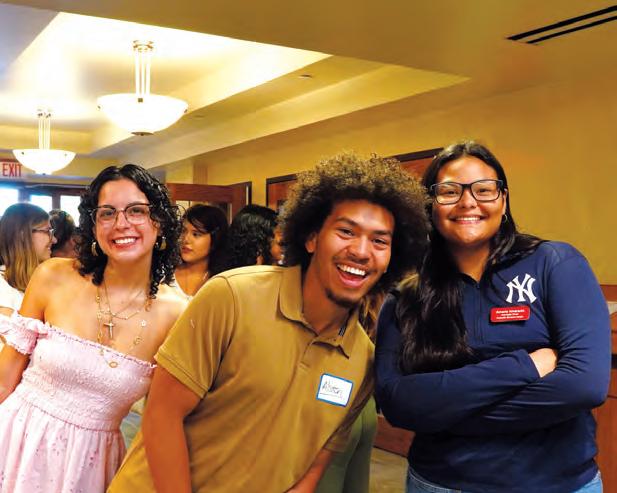
APURVA GANTI HEAD OF TRAINING AND RECRUITMENT
Having been a vegetarian all of my life, one of my main worries when I came to WashU was whether I would have accessible food options at all times. Now that I have a year of experience under my belt, I can confdently say that there are defnitely vegetarian and vegan options available at each restaurant and dining hall on campus. This guide is meant to support you to fnd food more easily and quickly in your frst few weeks. This is not comprehensive, however, and I encourage you to look around! Campus is large and exploring the food scene will bring you to places you would never see otherwise.
Bear’s Den, a.k.a. BD, is the dining hall on the South 40, where you will be living for your frst year at WashU. BD can be hit or miss when it comes to solid vegetarian options and defnitely for vegan options. I always go from station to station to mix and match, especially because the All You Care To Eat model allows you to get as much variety as you want for dinner. My personal favourites are the Build Your Own Stir-Fry station for tofu and noodles. The mashed potatoes from Savory are also awesome (but not vegan). The best way to prepare for BD is to get the Everyday app by Sodexo so you can see the menu before even entering. The menu changes every day.
The DUC is built the same way as BD because they are both dining halls. I would go
to each station in the DUC to see what they have. They consistently serve the same things at each station. For vegetarians, I recommend the pasta from Neapolitan, and for vegans, the falafel from Kalamata is alright, though it can be dry. There is a salad bar in Neapolitan that is popular. The DUC can be tough for plant-based eaters.
Vegetarians: Pizza or pasta from Neopolitan Vegans: Falafel from Kalamata or salad bar from Neopolitan
Qdoba is a classic for me, despite the long lines during lunchtime. While they don’t have tofu or any other meat replacements, the veggies are usually quite good, and the variety of toppings always excites me. A bowl with free guacamole is perfect for vegans, and a veggie quesadilla with the chile crema is a must-try for vegetarians. The only snags are the quality control and the availability of veggies. There have been multiple instances where the beans are undercooked and/or there are no veggies available. Qdoba, in my experience, prioritizes cooking meats, leading to veggies being nonexistent after 4 p.m. This sucks because they are one of the only dining options available on campus after 3 p.m.
Vegetarians: Veggie Quesadilla
Vegans: Veggie bowl or burrito
Ibby’s
Ibby’s is a tough one, unfortunately. Almost all of the entrees are meat-based except for the falafel, which is pretty dry, and the grilled cheese, which is too cheesy
(I know, I know). I do like their tomato bisque for lunch and they have three vegetarian salads, one of which is also vegan. They have one great appetizer, which is bruschetta. The best option is to load up on appetizers, salads, and sides if you want to have a full meal. There also isn’t a vegan dessert, but for my vegetarian friends, get a baked all-nighter. The warm chocolate chip cookie and delicious local ice cream is heavenly.
Vegetarians: Bruschetta, Baked All Nighter, Sweet potato fries
Vegans: Falafel wrap
Collins Farms has salads, paninis, pastries, acai bowls, and drinks. The drinks and acai bowls are the stars of the show for me. I love getting lemonade or dirty sodas, and the acai bowls are super refreshing in the fall heat. There are premade and createyour-own salads available. My gripe with Collins is that there are no tofu options and the bean options that do exist are not seasoned. I’m not a fan of eating chickpeas and black beans straight from the can, which seems to be what Collins offers. There are also only two vegetarian panini options and no vegan ones. One is a grilled cheese and the other is a caprese, containing only cheese, basil, tomatoes, and balsamic vinegar. The caprese is good but just isn’t flling. I would experiment with salad combinations to see what works for you.
Vegetarians: Caprese panini
Vegans: Salads, bagels, acai bowls, smoothies, alternative milk drinks
Coffeestamp is my favorite
lunch spot on campus. I love their cherry tomato quesadilla with their incredible salsa. This is a staple in my diet. They also have great empanadas, including the vegan three sisters empanada, with squash, beans, and corn. They have an amazing hibiscus iced tea (the best drink on campus) and alright horchata. Their pastries, such as the s’mores cookie, are also incredible. I would caution you against the other coffee-based drinks, however. Most people agree that they are pretty favorless.
Vegetarians: Cherry tomato quesadilla, caprese empanada, horchata, s’mores cookie
Vegans: Three sisters empanada, hibiscus ice tea Corner 17
The home of boba! Corner 17 is an absolute staple in my diet due to their incredible fruit iced teas with lots of topping options. I love a passionfruit iced tea with lychee jelly. Their mango pomelo drink is a great vegan option made with coconut milk. They also have cafe drinks and the best matcha on campus (and it’s not even a competition). I love getting an everything bagel and strawberry matcha for breakfast here. For lunch, they have an egg or eggless fried rice, a veggie bun, veggie rice paper roll, veggie dumplings, and mapo tofu. The mapo tofu is by far the most popular among the student body. I love the veggie dumplings the most as they come with a great soy sauce and chilli oil dressing. I would skip the rice paper roll and the fried rice because I found them to be quite bland. Vegetarians: Veggie fried rice, vegetable rice paper roll (has a dairy based sauce)
Vegans: Bagels, cafe drinks (with milk substitutes), lots of
boba options, eggless fried rice, vegetable bun, vegetable dumplings, mapo tofu
Stanley’s Sushi & Tea
Stanley’s has a plantbased sushi option, but I just do not enjoy it. It is quick and convenient because it’s grab and go, but it’s bland and boring. I do enjoy their boba, but Corner 17 outshines it.
Vegetarians: Boba tea (Taro, lavender, etc.)
Vegan: Vegetable Roll
LaJoy’s Coffee Cafe
LaJoy’s has some lemonades and pastries that are good in a pinch, but not a whole lot of plantbased options. They serve local Old Town Donuts, which are incredible and defnitely worth a try for vegetarians. They supposedly have a large variety of smoothies, but they’re often unavailable. Their only plant-based lunch option is a veggie wrap, which I didn’t enjoy.
Vegetarian: Old Town Donuts, Egg & Cheese Breakfast
Sandwich
Vegan: Lemonades, salads, coffee (with milk substitutes), veggie wrap, smoothies
Beast Craft BBQ
Beast Craft is pretty meatbased, as you can probably tell from the name, but they have a few options for vegetarians. They have fries with an incredible fry sauce, a pretty good mac and cheese, a mushroom burger, and plant-based chicken nuggets. This style of food doesn’t entice me very much because I fnd it to be quite heavy, especially before classes. But if this doesn’t bother you, they are defnitely worth checking out.
Vegetarians: Mushroom burger, Mac and cheese, Fry sauce
Vegans: fries, plant based chicken nuggets
This Filipino restaurant has some incredible calamansi mint lemonades with different syrups that are really
refreshing, especially after the hike to get down there. They also have an ube banana pudding, which I found to be quite a good favour combination. They have one plant-based lunch entree, which is a jackfruit adobo rice bowl. I fnd it a bit sour with the atchara, but still a hearty and delicious lunch option.
Vegetarians: ube banana pudding, most items from Liz’s Bakery
Vegans: jackfruit adobo bowl, calamansi mint drinks
Berg is a cafe serving pastries, Kaldi’s coffee, and smoothies. I like their smoothies a lot, though they have a slight powdery taste. I do enjoy a donut or danish from Berg as well. It’s convenient, in the DUC, and a bit boring.
Vegetarians: some smoothies, pastries Vegans: some smoothies, cafe drinks (with milk substitutes)
Subway
Subway is a crucial part of my diet because of their veggie patty. This whopper adds 20 grams of protein to a 6-inch sub, and protein can be hard to come by when you are plant-based. I also love how customizable everything is and their cookies.
Vegetarians: cookies
Vegans: veggie patty
Being plant-based on campus can seem daunting at frst, especially in a world that doesn’t seem to enjoy accommodating us. However, no matter where you are on campus, there will be something nearby to enjoy. Transitioning to college can be a time of nervousness, but I hope this guide will give you one less thing to worry about.. The food we eat fuels our bodies and minds to achieve all that we want to do, and it deserves to be prioritized. To my plant-based friends, stay full and happy!

Basso at the Cheshire
This spot is perfect to grab a bite to eat before seeing a movie at Hi Pointe Theatre, right around the corner. It is located on Clayton Road and has absolutely delicious food and a great atmosphere. While it is on the pricier side, if you go during happy hour, you can get a fairly reasonable meal before the evening showing at the theater.
- Amelia Spencer, Special Issues Editor
Ranoush
Order the chicken wings with batata harra, and chat it up with Gabe. Tell him Dion sent you.
Dion Hines, Managing Forum Editor
Fitz’s on Delmar
While the food tends to be pretty standard, Fitz’s soda is a St. Louis classic, and while you can fnd most of their favors in stores across the city, the location on Delmar has all of their seasonal favors year round! Try their Peach Pop or Pumpkin Pop, or get any of their sodas in a huge ice cream – Mason Suton, Designer
Vegas Wok
Telva at the Ridge Kaldi’s
For those of you who are incoming firstyears, Kaldi’s is a coffeehouse chain in St. Louis frequented by a lot of WashU students, and for good reason. Great breakfast, an endless supply of outlets, and good coffee — what’s not to love? While a lot of WashU students go over the location on Skinker, I highly recommend checking out the DeMun location for the shorter walk and a homey atmosphere.
- Tanvi Gorre, Managing News Editor
An iconic WashU spot. Go for breakfast, brunch, lunch, or even dinner. Everything from their coffee, breakfast burrito, pancakes, and baked goods is just delicious. You’ll likely see other WashU students when you go. This place is perfect, especially if your parents are visiting.
It’s hidden on the end of the Loop, and is still an easy commute from campus. They serve delicious Thai food, and I have always been able to walk in and get a table. Get a curry to share (or eat by yourself) after trying some of their amazing appetizers.
– Elijah Leckerman, Staf Writer
This Balkan-inspired brunch spot in Webster Groves has delicious coffee, dishes, and pastries.
– Maddie Morgan, Forum Editor
Barrio
A local cute and cozy burger and taco spot right next to Clementine’s in Demun! Not a far walk from the South 40 and a nice place to go out to eat without spending too much.
– Kate Teerman Rodriguez, Forum Editor
Mai Lee
Located in Brentwood, they have the most favorful pho and rice porridge that you can smell all the way from the parking lot!
– Tillie Szwartz, Design Editor
This is an awesome spot perfect for birthday dinners, date nights, days when your parents are in town, or any other occasion when you might want a delicious bowl of pasta, a yummy salad, or a refreshing sorbet to end the night. Make sure to get the crispy risotto balls or the tiramisu.
Located on the Delmar Loop, it’s a small place and not super fancy, but I really enjoy their food, and it has reasonable prices for their portions. You can sit inside with your friends or family, or you can sit at the tables outside. They serve fried rice, lo mein, and mei fun with different choices for protein (chicken, beef, shrimp, etc.). It is also the closest place on the Delmar Loop to campus!
– Kayslay Cudjoe, Copy Editor
- Hannah La Porte, Managing Scene Editor
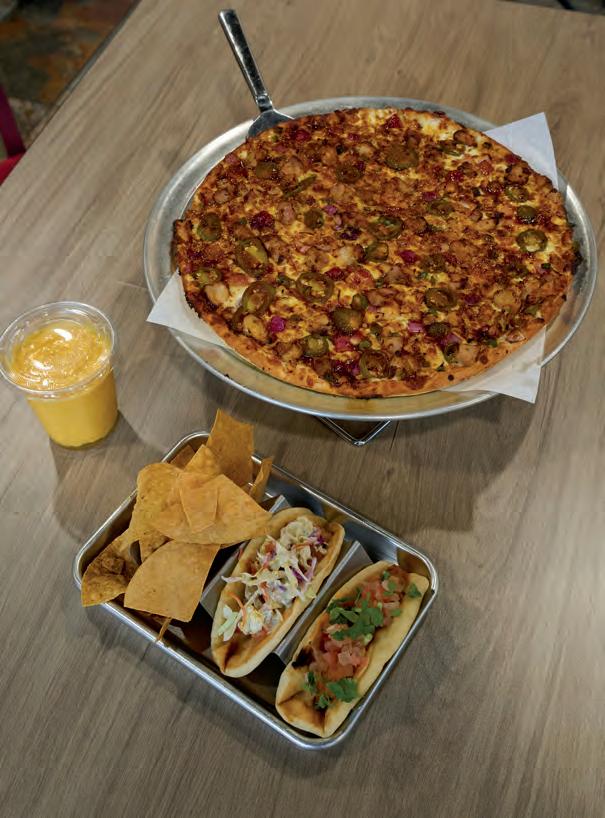
Food. Drink. Shopping. Entertainment. Visit the best mixed-use walkable neighborhood in St. Louis — minutes from Wash U. Only in the Central West End
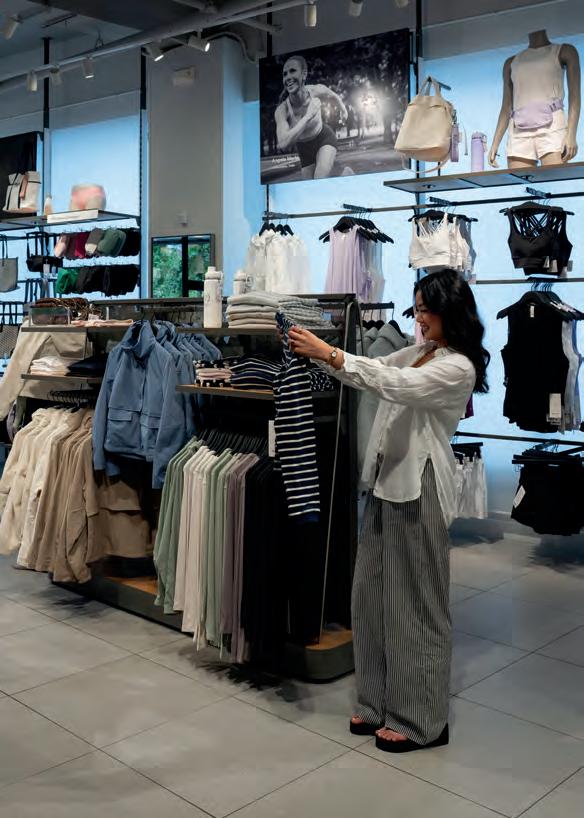
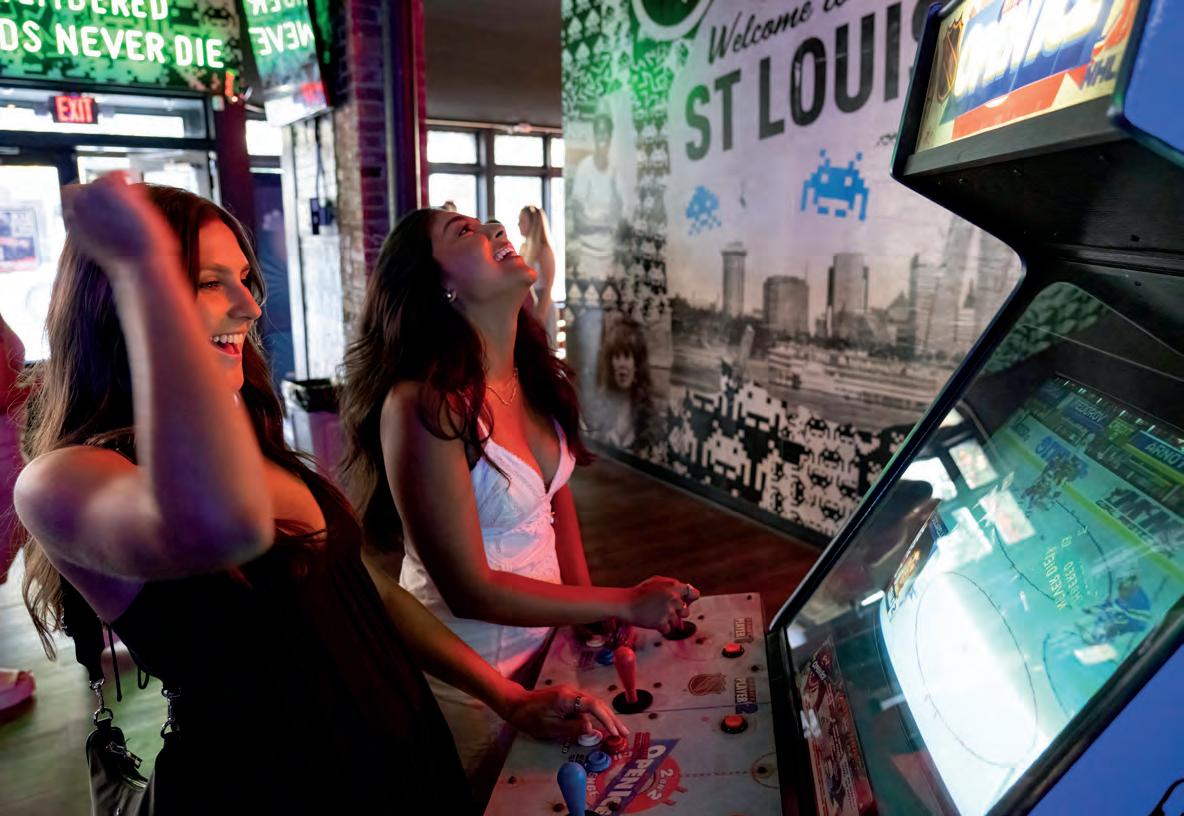

Download the CWE App for exclusive offers
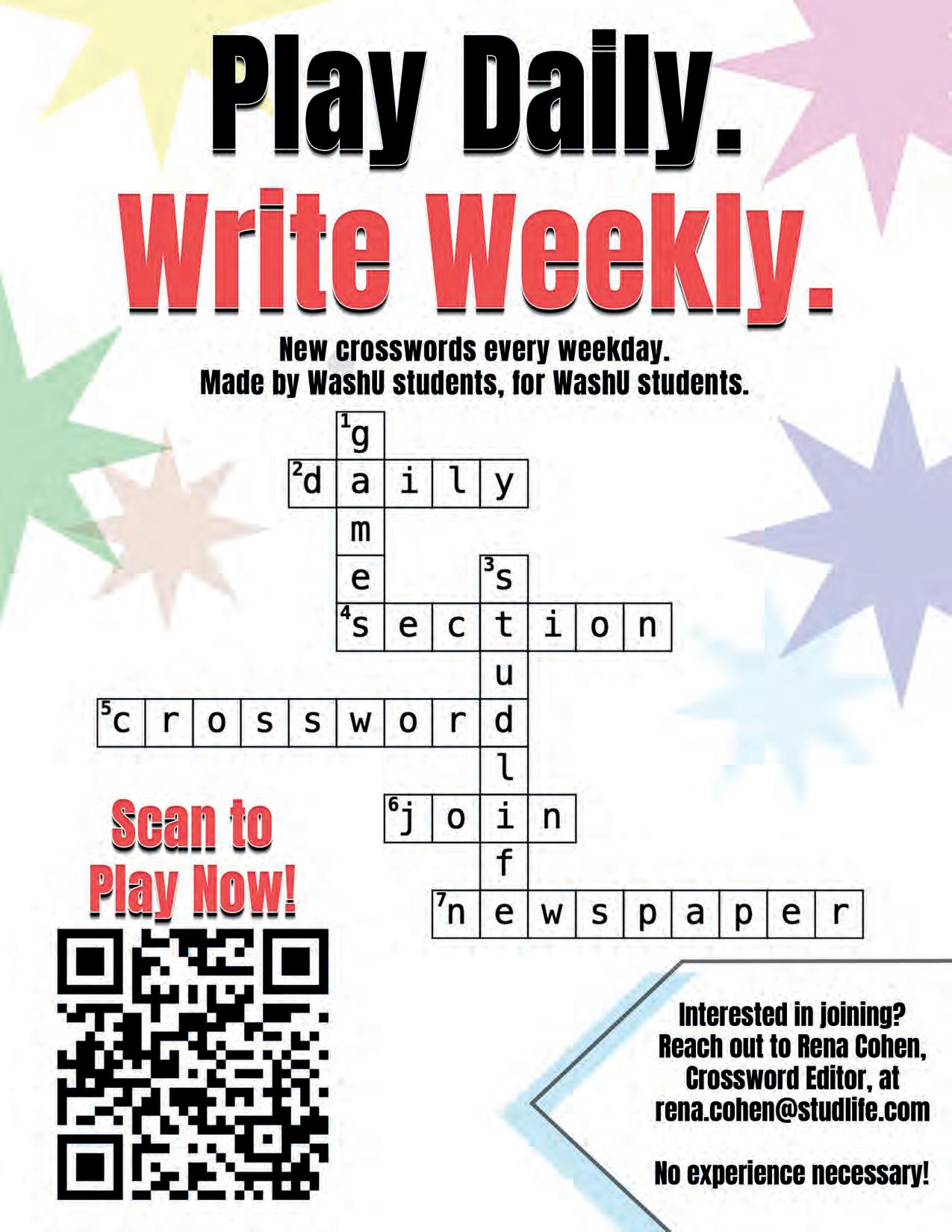
Rena Cohen

1. Baby bear
4. Japanese flm genre
6. Jumped
7. College frst-year, in slang
8. Feature of Spotify, but not Spotify Premium
DOWN
1. Italian goodbyes
2. Offcials at WashU’s Kelly Field, for short
3. Piano-playing sister in “Little Women”
4. ____ Romeo
5. Brainy type

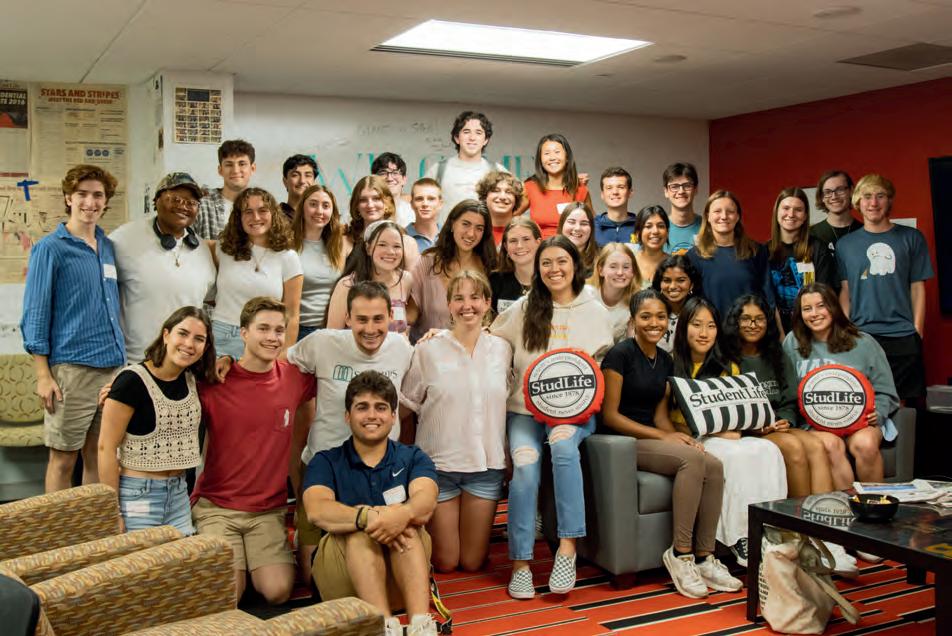







Dear Scene, Me and my partner got together in high school and I have no idea if we should keep dating in college. How do I bring it up to them and what things should I even be thinking about? I need advice PLEASE! - Romantically Reeling
College-bound relationships (to be or not to be?)
AVA AYAD CONTRIBUTING WRITER
You are by no means alone in this struggle. In fact, I faced the very same decision going into my frst year at WashU. The thought of taking this step in a committed relationship can be terrifying. But you’re in good hands, because this column should set you and your partner up for success when navigating “the college conversation.”
Ideally, you and your partner are attending the same college. In that case, that is
one less factor (distance) on your mind. However, that does not mean you should be changing your goals or aspirations to ft into someone else’s life. If you’re going to take away anything from here, let it be that the only person you should let dictate which school you’re going to is YOU! Obviously getting to go to college with your partner is awesome, but that should only be the cherry on top of a relationship sundae. The bottom line is if you and your partner happen to both want to go to the same school, great! But, if not, that is not inherently a dealbreaker for the relationship, depending on

where your priorities land. For me, my boyfriend and I ended up fve hours apart by Amtrak. While I initially thought it would be too hard for us to do long-distance or that we would be statistically unlikely to last through college (yes, I used statistics on him), he convinced me otherwise. His main point boiled down to: If you love someone, why not try? When all is said and done, the worst that can happen is that things don’t work out. Whether that is a risk you’re personally willing to take is up to you and how you feel towards your partner. If you know deep down that the only reason you would ever break up with them would be due to external factors like your academic futures or career pursuits forcing you apart, then this frst year may be the perfect window of opportunity to see how things will go. Better yet, if the relationship does end, you can always look back with no regrets that you never dated them in college. Another prominent factor
to consider, regardless of whether or not you will be dating long-distance, is what you and your partner’s expectations are for this transition in your relationship. For example, how often do you want to text, call, or FaceTime every week? When will dates happen, and will they be in-person or virtual? Going through each of your individual course and extracurricular schedules beforehand is a great place to start when it comes to deciding how feasible or realistic it is to continue the relationship. If neither of you have even brought up college when talking to each other, something as simple as “Hey, I’ve been thinking about what to do when we go to school” is a concise, direct way to begin a real discussion.
Finally, arguably the most important and potentially uncomfortable consideration you need to make is the other possible romantic connections you will be sacrifcing to stay with your
current partner. One of the best things about WashU is getting to meet so many new, exciting people from all over the world. With that comes the likelihood that you may fnd someone you become attracted to or develop a crush on. Although you shouldn’t necessarily feel bad for having these feelings, you do have to recognize that, in an exclusive relationship, the romantic and/or sexual freedom of being “single and ready to mingle” is no longer at your disposal.
If your relationship is open or otherwise non-exclusive, much more consistent communication is going to be required for you both to determine those interpersonal boundaries. In any case, say you do choose your current partner over the possibility of future ones. The best way to ensure your relationship has a strong chance is to clearly defne and agree upon what does and does not count as disloyal behavior. From the grey area that is emotional
cheating to using physical touch with friends, outlining what you and your partner are comfortable with the other doing outside of the relationship is only going to help you both.
Overall, while the decision to keep dating someone from high school into college is anything but an easy one, identifying the major factors you should take into account and coming up with a list of all the pros and cons is less scary when your partner works with you rather than against you. I wish you the best in making a choice, and trust yourself above everything. You got this!
Are you looking for advice? Write to Scene about whatever situation you’re facing! Email scene@studlife.com.



Student Life, also known as StudLife, is WashU’s independent student newspaper. Founded in 1878, it is one of the nation’s oldest collegiate newspapers. Throughout the years, it has reported on issues relevant to the lives of WashU students, covering the news, people, and events that make up this campus. Our paper publishes a regular print issue every Thursday,
as well as special issues throughout the semester and daily newsletter and social media content. The regular issue includes work from our four written sections: News, Scene, Sports, and Forum, as well as photos, puzzles, and illustrations.
Student Life is supported by a fantastic team of writers, illustrators, photographers, designers, and editors. This issue, and
Editor-in-Chief
Laurel Wang is a senior from Cincinnati, Ohio, studying Economics and Writing. Before applying to colleges, she stalked each institution’s student newspaper and very happily landed at WashU. She joined the paper in the fall of her frst year, writing articles on chicken butchering and medieval combat for Scene, and will serve as Co-Editorin-Chief this year. Outside of the windowless StudLife offce, you can fnd her talking about reading Russian lit, toppling over in a Sirsasana, or playing games on her iPad.

issues like it, are produced with the hard work of every member of StudLife.
Below is Student Life’s 2026-27 Managing Team. Our editors have each contributed countless hours to our newspaper and are great contacts for students interested in becoming a part of Student Life.
Lewis Rand is a senior from Birmingham, Alabama, studying Political Science and Economics. Prior to serving as Co-Editor-in-Chief, Lewis was an editor for the Sports section and loves all things WashU and Division III sports. Outside of Student Life, Lewis is a member of ThurtenE Junior Honorary, which plans the nation’s oldest and largest student-run carnival each spring, and Rockwell House. In his free time, Lewis enjoys going for runs in Forest Park and Clayton, exploring St. Louis, and spending time with friends.
Tanvi Gorre is a senior from Westport, Connecticut, majoring in Computational Biology. She has been a part of the newsroom for 3 years and is excited to be back as one of the Managing News Editors for the upcoming year. Outside the offce, you can typically fnd her practicing with her dance team, studying (or writing) in a Kaldi’s near you, or playing board games with her friends.
Coby Rinke is a senior from Briarcliff, New York, majoring in Political Science and Economics. He joined StudLife in his sophomore year and is excited to be one of the Managing News Editors for the upcoming year. He especially enjoys late-night snack runs during newspaper production nights and spending time with his friends he made on StudLife. When not working on the newspaper, Coby can be found running in Forest Park with WashU Run Club, reading philosophy, or climbing one of the Ginkgo trees behind Olin Library.

Hannah La Porte is a junior from Los Angeles, California, majoring in American Culture Studies and Political Science with a minor in East Asian Language and Culture. She is technically the Managing Scene Editor, but throughout the week, you might fnd her in a news meeting, copyediting, or even sitting behind a design computer when she’s allowed. When she’s not in the offce, you can probably fnd her camping, running a Student Union election, or reviewing your resume at the Career Center.
Hannah Much is a junior from Atlanta, Georgia, majoring in Cognitive Neuroscience. Hannah joined StudLife in her frst year and will serve as Managing Sports Editor this year. She loves the community she has found through StudLife. When she is not working on StudLife, you can fnd Hannah trying new food, going on a walk, or watching the (disappointing) Atlanta Hawks. Hannah also works at the Learning Center, is an undergraduate research assistant at a neurodevelopment lab, and is a member of the Gamma Phi Beta sorority.

Dion Hines is a senior from Jackson, Mississippi, double-majoring in Communication Design and English Literature. Dion has been writing opinion pieces for StudLife since his frst year and is thankful for all of the ways the paper has made him grow as both a writer and leader. He believes that children are indeed our future — that we should teach them well and let them lead the way, and thus, he works at a local elementary school as an after-school care counselor. Lately, Dion has been enjoying the simpler things in life, such as 5-mile walks and psychoanalytic video essays about “Love Is Blind”.

Ava Giere is a senior from Burlingame, California, studying English Literature with minors in Spanish and Economics. Ava joined StudLife’s Copy team in the last few weeks of her first year and loves that she gets to read lots of articles, constantly learn new things, and spend time with friends. Outside of StudLife, Ava enjoys working at The Writing Center, hiking, and reading Agatha Christie mysteries.

Kate Westfall is a senior from Salem, Oregon, majoring in Economics and Organizational and Strategic Management with a minor in Public Health and Society. She joined the Design section in her frst year on a whim and has loved being a part of Design and Student Life as a whole ever since. She cannot wait to see all the new Design faces in the coming year and encourages anyone to join, no matter their skill level. Outside of StudLife, you can fnd Kate working one of her many jobs, reading, or cartwheeling in the grass outside her dorm.
Lucia Thomas is a junior from Kansas City, Missouri, majoring in Communication Design with a minor in Art History. Lucia joined StudLife in her frst year in both the design and illustration sections, and now serves as the current Managing Illustration Editor. Her qualifcations include drawing exclusively with her computer trackpad. Outside the offce, you can fnd her working on projects in the Sam Fox studio late at night or spreading student stickers around campus with Silly Squared.

Isabella Diaz-Mira is a senior from Houston, Texas, studying French, Medical Humanities, and Writing on the Pre-Med track. She is currently the Managing Photo Editor, and her favorite events to photograph are the cultural showcases in Edison Theatre. Outside of StudLife, Isabella is a part of WashU Club Tennis, WUSlam, WU Women in STEM, WUFuego, and is a Bear Ambassador and a Howard Nemerov Scholar. She also enjoys boxing, reading, bead embroidery, and crocheting in her spare time.

Alan Knight is a senior from Naperville, Illinois, majoring in Political Science with minors in Music and American Culture Studies. As Managing Multimedia Editor, he produces, flms, and edits videos for Student Life, from campus music segments to the paper’s take on Hot Ones. Beyond hiding on the 3rd foor of the DUC, Alan serves as Treasurer for the Washington University Political Review, sings in the Stereotypes a cappella, and is a Civic Fellow with the Gephardt Institute. When he’s not behind a camera, you can also fnd him on the ultimate frisbee feld with Contraband.
Rena Cohen is a junior from Bloomington, Indiana, majoring in Psychology and minoring in Spanish and applied linguistics. She co-launched the StudLife daily mini crossword during her frst semester at WashU, and she also publishes crosswords in a variety of other news outlets, including the New York Times, the Los Angeles Times, and Apple News+. When she’s not working on puzzles, she loves going to exercise classes, listening to podcasts, and spending time with friends and family.


Amelia Spencer is a junior from St. Louis, Missouri, majoring in Mathematics and German. She began at StudLife as a designer and is very passionate about StudLife, but especially the special issues, such as Starting Line, Best of STL, and Student Libel. Outside of StudLife, Amelia is the Head of Grant Writing for Sharing With a Purpose (SWAP), was a leader in Wilderness Project (WP), and sings in the WashU Concert Choir. She is so excited to meet anyone who is interested in special issues, sustainability, math, or the wilderness of the Midwest.

Apurva Ganti is a sophomore from St. Louis, Missouri, studying Economics and American Culture Studies. She is the Head of Recruitment and Training for Student Life this year. Apurva is interested in economic policy and hopes to one day attend law school. When not writing articles about foot fetishes for Student Life, she enjoys hiking (but not camping), practicing Indian Classical and Latin dances, knitting, and reading American literature. She is a Bear Ambassador, an assistant for the American Culture Studies Department, and a Civic Fellow with the Gephardt Institute.
DEI Editor

Campbell Crum is a sophomore from Claremore, Oklahoma, double-majoring in Sociology and English. He joined StudLife in his frst year, when the Forum section gained a special place in his heart. Campbell is the current DEI editor, working to ensure dignity and proper representation for everyone in the WashU community and St. Louis as a whole. Outside of Studlife, he is president of All Student Theatre, a club known for its spring shows on the Brookings Quad. Campbell loves used books and public transportation. He recommends you eat at Seoul Taco on the Loop (get the burrito!) and Balkan Treat Box in Webster Groves.