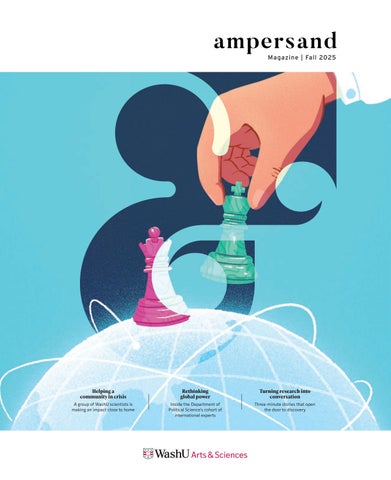
Magazine | Fall 2025
Helping a community in crisis
Rethinking global power
Turning research into conversation
A group of WashU scientists is making an impact close to home
Inside the Department of Political Science’s cohort of international experts
Three-minute stories that open the door to discovery
2
FALL 2025
The Ampersand magazine shares stories of incredible people, research, and ideas in Arts & Sciences at Washington University in St. Louis. It is published semiannually and distributed to alumni, faculty, students, staff, and friends of Arts & Sciences. EMAIL
ampersand@wustl.edu WEBSITE
ampersand.wustl.edu DEAN
Feng Sheng Hu PUBLISHER
Ebba Segerberg EDITOR
Sarah Hutchins MANAGING EDITOR
Samantha Stevenson CREATIVE DIRECTOR
Sudon Choe
PUBLICATION COORDINATOR
Simone Becque ALONG THE FLYWAY
This wood thrush, soaring north, carries a small tag with big meaning. The metal band on its leg links it to a vital scientific effort led by alumna Samantha Matchefts, AB ’87, and the World Bird Sanctuary in St. Louis County. For the past three years, volunteers at WashU’s Tyson Research Center have captured, documented, and released migratory birds navigating the Mississippi Flyway. The team feeds data into a national database tracking species health, migration routes, and environmental shifts. “With migratory bird populations declining worldwide, long-term studies like this one provide bird longevity and migration information that can help scientists and conservation planners,” said Matchefts, who first visited Tyson as an undergraduate in a class led by the late Richard W. Coles, former Tyson director. (Photo: Whitney Curtis)
DIGITAL EDITORS
Kyra Ramsey, Gennie Avellino, KJ Schaeffner LEAD PHOTOGRAPHER
Sean Garcia
CONTRIBUTING PHOTOGRAPHERS
Whitney Curtis, Sid Hastings
DESIGNERS & ILLUSTRATORS
Keren Guo, Andressa Chaves de Oliveira, William Hong, Kristen Wang CONTRIBUTING WRITERS
Jenny Bird, Jeremy Goldmeier, Diane Toroian Keaggy, Talia Ogliore, Liam Otten, Leah Shaffer, Erin Shetler, Chris Woolston EDITORIAL ADVISORS
William Acree, Deanna Barch, Andrew Brown, Thomas Eschen, Sophia Hayes, Peter Kastor, Erin McGlothlin
The ampersand | Fall 2025 3
From the Deanʼs Desk It’s a great time of year for reflection here on the Danforth campus. The seasons are reshaping the landscape, shortening our afternoons and quickening our paces across the quad. The foliage might have faded, but when it comes to discovery and academic excellence, Arts & Sciences is more vibrant than ever. In this issue of Ampersand magazine, we explore the many ways we are building and promoting resilience, from strengthening our academic momentum to making our communities healthier through research and outreach. You’ll read about our top-ranked departments, including political science, and learn how this thriving department is expanding its team of international relations scholars and using cutting-edge, quantitative science to help us understand this critical moment in history (p. 24). Also making headlines for its pioneering research is the Department of Psychological & Brain Sciences, which has been named one of U.S. News and World Report’s top 10 psychology graduate programs in the nation (p. 36). It is more important than ever to showcase the transformative power of research beyond our walls. In this issue, you’ll meet a truly transdisciplinary team of researchers in anthropology, microbiology, hydrology, data science, and environmental engineering, whose research into the damaging health effects of flooding has attracted a significant National Science Foundation grant to advance their work in Metro East communities (p. 14). You’ll also learn about the launch of the new A&S Research Pitch Competition, a fast-paced, standingroom-only event where faculty members shared projects with WashU community members, guests, and potential funding partners (p. 30). This issue also highlights the accomplishments of faculty and students whose work embodies resilience, including a physics graduate student who recently took his concerns about the future of science to Washington, D.C. (p. 34), and an associate professor of chemistry creating “smart” textiles that mimic nature’s ability to mend itself (p. 22). Of course, none of our work in Arts & Sciences would be possible without the generosity of our donors and supporters. This issue includes an inspiring story about physics alumnus Bill Wells, whose work and philanthropy will support future generations of world-class students and faculty through With You: The WashU Campaign (p. 38). I’m proud to share these stories, which remind us that the transdisciplinary nature of our work ensures that Arts & Sciences can be resilient in uncertain times. While the landscape of higher education continues to shift, I am confident in our ability not only to navigate change but also to thrive in it, now and in the future. I hope you finish this issue feeling as inspired and optimistic as I do about the power of Arts & Sciences and the impact we are making in our community.
Feng Sheng Hu Richard G. Engelsmann Dean of Arts & Sciences Lucille P. Markey Distinguished Professor Washington University in St. Louis
4
Table of Contents
FEATURES
14
Helping a community in crisis WashU scientists join forces with residents to tackle flooding, pollution, and health risks in Cahokia Heights, Illinois.
24
Rethinking global power A new generation of political scientists is exploring how nations, movements, and technologies redefine international influence.
30
Pitch perfect Arts & Sciences faculty turn complex projects into compelling, three-minute stories at an inaugural research pitch competition.
The ampersand | Fall 2025 5
AROUND THE QUAD
6
Hollywood calls for a WashU professor
7
Supersizing plant cells
9
10
WashU and MilliporeSigma’s power partnership An undergraduate researcher’s major discovery
STUDY SESSION
CONVERSATION
22
18
A maker’s knowledge
Smart by design
English professor Sarah Weston teaches students the connection between literature and art.
Inspired by biology, chemist Chenfeng Ke is creating novel materials that mimic nature.
ALUMNI SPOTLIGHT
STUDENT SPOTLIGHT
SNAPSHOT 20
Welcoming WashU’s class of 2029
MEMORIES & MILESTONES 36
Psychology breaks into the top 10
34
28
Meeting of minds
Speaking science to power
Two Arts & Sciences alumni turned an early fascination with artificial intelligence into North America’s largest AI conference.
Physics graduate student Bryce Wedig traveled to Washington, D.C., to represent the voices of young researchers.
NOTES OF GRATITUDE 38
The physics of philanthropy
FACULTY BOOKSHELF Associate Professor Joanna Dee Das’s book explores what Branson’s glitzy stages reveal about American identity.
PERSPECTIVE 42
Preparing tomorrow’s public health leaders 40
ampersand.washu.edu
6
Around the Quad News, milestones, and spotlights from across Arts & Sciences at Washington University in St. Louis
(Illustration: Keren Guo)
Hollywood calling The filmmakers behind Netflix’s hit “KPop Demon Hunters” tapped teaching professor Mijeong Mimi Kim to bring authentic Korean cultural details into the film’s vibrant fantasy world. Kim advised on everything from storyboards and animation to dialogue and costume design. She even fact-checked the exact style of a traditional Korean sword — details that didn’t go unnoticed. Her cultural guidance helped the filmmakers tell a story that resonated with Korean audiences and captivated viewers worldwide.
(Illustration: Netflix)
Find expanded versions of all Around the Quad stories.
artsci.washu.edu/ATQ
When the film finally came out, I was nervous. But many Koreans said they were grateful for how authentically their culture was represented. Mijeong Mimi Kim Teaching Professor of Korean Language
The ampersand | Fall 2025 7
Reading between the lines Data scientist Joe Feldman is shedding new light on the hidden costs of childhood lead exposure. Using Bayesian statistical models to account for missing data, the assistant professor of statistics and data science showed that lead’s impact on learning and standardized test scores may be far greater than previously understood. “We seem to have been underestimating the adverse impact of lead exposure on childhood educational achievement,” Feldman said, highlighting the power of these models to reveal the full scope of the risk and the urgent need for broader testing and stronger public health measures.
Supersizing plant cells Kevin Cox, an assistant professor of biology, has figured out how to hit the “enlarge” button on plant cells. By using a special gel, his team can gently inflate the cells, letting scientists see the plants’ inner structures in stunning detail. Working with wall-free plant cells and fast-growing duckweed, Cox adapted this technique, called expansion microscopy, to study how proteins, RNA, and cell organization shape plant life. “This discovery gives us a better understanding of where these genes and proteins are, how they’re functioning, and how they might play a role in cellular response,” Cox said.
8
AROUND THE QUAD
Broadening access to mental health care A WashU-led study of nearly 30,000 students found that eating disorders affect people across all racial and ethnic groups, often going unnoticed. To increase access to needed resources, Ellen Fitzsimmons-Craft, associate professor of psychological and brain sciences, and Denise Wilfley, professor of psychological and brain sciences and of medicine, pediatrics, and psychiatry, are creating a chatbot that delivers self-guided cognitive-behavioral therapy. “My goal has never been to replace people,” Fitzsimmons-Craft said. “I would love it if everyone could access a quality health care provider, but that’s not currently the case.”
Copycat evolution Jonathan Losos, the William H. Danforth Distinguished University Professor, discovered that cats and dogs have evolved surprisingly similar “baby-faced” skulls — even though they went their separate ways 50 million years ago. After studying more than 1,800 skulls, Losos and his team found that Persian cats and Pekingese dogs resemble each other more than their wild ancestors. Selective breeding made them adorable, but those flat faces can also lead to health problems.
The ampersand | Fall 2025 9
Partnership powerhouse WashU and leading science and technology company MilliporeSigma are joining forces to supercharge innovation in science and medicine. Together they’re transforming groundbreaking research — such as PhD student Alex Quillin’s RNA-tracking technology — into tools that could change how we understand and treat disease. The partnership also builds new pipelines for students and scientists ready to shape the future of biotech. “Collaboration is central to our university’s research and scientific success,” said Chancellor Andrew D. Martin. “Partnering with an industry leader like MilliporeSigma will expand our capacity to generate solutions to the world’s greatest challenges.”
Unlocking STEM potential Among his wide-ranging research, economist Ismael Mourifié studies why high-achieving women often steer away from STEM careers. His work shows how stereotypes, limited role models, and wage gaps divert talent and shape opportunities across education and labor markets in Canada, Chile, and beyond. By uncovering these hidden barriers, Mourifié highlights patterns that not only affect just women, but the broader economy and society.
10
AROUND THE QUAD
Tick talk Senior Sam Ko spent her last year at Tyson Research Center chasing tiny critters and found St. Louis County’s first Asian longhorned tick in July 2024. The sesame-seed-sized invader can lay up to 2,000 eggs a week. Ko, an environmental biology major, identified it by its small size and sideways “horns.” Supported by a WashU Transcend Initiative Grant, she helped track the tick and study the germs it may carry, while a larger team works to map its spread and teach the public how to stay safe. “It was cool to make the discovery, but I also knew it wasn’t a good thing to see,” Ko said. “There will be more, and it could have potentially large effects on the ecosystem.”
Building a better antibiotic Associate Professor Timothy Wencewicz and his team tweaked a malaria drug to create powerful new antibiotics. Using tiny chemical “keys,” the antibiotics sneak into bacteria and shut down a vital process in two ways, making it hard for germs to fight back. The lead author, John Georgiades, AB ’24, now a PhD student at Princeton, took over the project as an undergrad and helped bring it to the finish line. The new approach could potentially help fight common infections as well as tough, drug-resistant bacteria, paving the way for smarter, stronger antibiotics.
The ampersand | Fall 2025 11
On a mission WashU is taking the lead in managing the Moon’s most important data. The university’s Geosciences Node, housed in the Department of Earth, Environmental, and Planetary Sciences, has been named NASA’s lead hub for the upcoming Artemis missions, tasked with managing and sharing every ounce of lunar data these historic flights produce. “This is a serious responsibility and a great honor,” said Associate Professor Paul Byrne, director of the Geosciences Node. “These missions will generate invaluable data about the Moon, and WashU will be charged with coordinating and sharing that data with the world.”
From left: Lúcia Lohmann and Toby Pennington
A major boost for plant research WashU and the Missouri Botanical Garden recently welcomed two world-renowned botanists. Lúcia Lohmann, a conservationist known for her Amazonian rainforest research, became the Garden’s president and the George Engelmann Professor of Botany in the Department of Biology. Toby Pennington, a leader in dry tropical forest research, is now the David and Dorothy Kemper Professor in the biology department, a joint appointment with WashU and the Garden. The two institutions “share a rich tradition of discovery in plant science,” said Feng Sheng Hu, the Richard G. Engelsmann Dean of Arts & Sciences, adding that these appointments “underscore our commitment to that rewarding partnership.”
12
AROUND THE QUAD
Top row, from left: Jennifer Wang, Joshua Blodgett, Petra Levin, and Xuehua Zhong. Bottom row, from left: Liz Mallott, Hani Zaher, and Ben Mansfeld
Biology faculty earn record number of prestigious National Institutes of Health awards Seven faculty members in the Department of Biology have received Maximizing Investigators’ Research Awards from the National Institutes of Health, the most the department has earned in a single year since the program began in 2015. The awards provide funding stability and flexibility for high-potential research projects. Recipients include Jennifer Wang, studying centrosome function; Joshua Blodgett, exploring antibiotic production in soil bacteria; Petra Levin, examining bacterial growth and division; and others investigating plant epigenetics, microbiomes, ribosome stress signaling, and circadian impacts on immunity. “This unprecedented recognition reflects the outstanding research across career stages,” said department chair Ram Dixit.
Jen Heemstra (left), the Charles Allen Thomas Professor of Chemistry and chair of the Department of Chemistry, and postdoctoral researcher Joseph Ibukun. (Photo: Sean Garcia)
We can prevent devastating illnesses like cancer by solving the riddle of RNA . RNA, a nucleic acid present in all living cells, is a translator and messenger that turns the genetic code in DNA into proteins. RNA messages are in constant need of editing to keep our cells healthy. When these edits go awry, they can lead to disease. In Arts & Sciences at WashU, Jen Heemstra and her team have developed a groundbreaking test that tracks individual edits in cells. They're now partnering with MilliporeSigma to commercialize this breakthrough and enable scientists around the world to develop new therapies and diagnostics to prevent cancer, neurodegeneration, and other disorders. With you, this is what WashU can do.
Let’s create a more promising future for all. Make your gift today at withyou.washu.edu or by scanning the code.
14
FEATURES
Helping a community in crisis A team of WashU scientists is working together to make a Metro East community a cleaner, healthier place to live.
by
CHRIS WOOLSTON
The ampersand | Fall 2025 15
C
ornelius Bennett’s home in Cahokia Heights, Illinois, should have been a great place for him to enjoy a quiet retirement. He lives in a leafy, low-lying neighborhood just north of Highway 157 and east of Grand Marais Lake. The houses here are widely spaced, but he can still hear his neighbor’s chickens clucking from his front porch. He set up a swing set in his side yard, but there are plenty of days when he won’t let his grandchildren go outside to play. Bennett’s house and yard get swamped with a toxic mixture of rainwater and raw sewage after just a mild rain. The aging sewer system is easily overwhelmed, and wastewater escapes pipes and gutters to invade homes and neighborhoods. “Sewage water goes straight into the ditch right next to my house,” Bennett said. “I’ve got raw sewage in my backyard. It’s happening all over the neighborhood.” Bennett, a plaintiff in a 2020 lawsuit against the city, is not alone in his troubles, and he’s not alone in his fight to make Cahokia Heights a cleaner, healthier place to live. Less than 20 miles away on the other side of the Mississippi, a team of WashU researchers — including anthropologist Theresa Gildner, biologist Liz Mallott, geoscientist Claire Masteller, and engineer Fangqiong Ling — is working to document and explain the public health disaster unfolding in the Metro East area. In 2023, Gildner, Mallott, and Masteller received a seed grant from Arts & Sciences’ Transdisciplinary Institute in Applied Data Sciences to study the intertwined threats of floods and communicable diseases in Cahokia Heights. The team noted that already recurring flooding will likely become more common in other small communities as the climate changes. Cahokia Heights isn’t just a town in crisis; it’s a warning for other places with subpar sewage and drainage systems. Their work is already having a positive impact, thanks to collaboration and support from Equity Legal Services, a local non-profit legal service that represents many of the community members impacted by flooding, and Centreville Citizens for Change, a community nonprofit that has been advocating for changes to the city’s infrastructure through litigation and letters to elected officials since 2018. The findings from Gildner and her team helped inspire local and state governments to allocate $30 million to upgrades to the sewer systems. “The WashU team has really built a partnership with us,” said Nicole Nelson, an attorney with Equity Legal Services. “They’ve been lifesavers.”
Anthropologist Theresa Gildner studies how environmental conditions like flooding and sewage exposure affect community health in Cahokia Heights, a rural community less than 20 miles from the Danforth Campus.
16
FEATURES
Yvette Lyles (left) and Cornelius Bennett are part of a growing group of Cahokia Heights residents pushing for lasting infrastructure improvements and public health protections.
Dangerous water Documenting the health risks faced by residents has been a top priority for the WashU team. Fecal tests conducted by Gildner, an assistant professor of anthropology, showed clear signs of parasitic and bacterial infections in Cahokia Heights residents. One of the bacterial pathogens, H. pylori, can cause ulcers and raise the risk of cancer. The study also documented high levels of intestinal inflammation, a clear sign that contamination was taking a toll. “We were able to show the connection between reported flooding and poor intestinal health,” Gildner said. “The next step is to look for similar connections using objective flooding data.”
news articles about Centreville and Cahokia Heights,” she said. “When I realized the magnitude of the problem, I reached out to Centreville Citizens for Change and Equity Legal Services to see if I could help.” Yvette Lyles, a retired psychiatric nurse, has endured regular flooding at her brick home in Cahokia Heights since she bought it more than 30 years ago. “Thank God Theresa and the others came to do testing,” Lyles said. “It’s inhumane to make us live like this over and over again. We need all the support we can get.” For Lyles, help can’t come quickly enough. “As soon as it rains, you see the storm water coming down the street,” she said. “A hot second later, the raw sewage starts bubbling up. It not only destroys our home, it destroys our health.” Lyles said she has had multiple infections of H. pylori even though she tries to take every precaution, including treating her lawn with disinfecting chemicals and throwing away wet clothes and even pieces of furniture after her house floods. “I buy clothes at Goodwill now,” she said. “What’s the point of buying new clothes when you’ll just have to throw them away?”
A city on the outskirts of St. Louis may seem like an unexpected setting for an anthropologist, but Gildner has long been interested in the ways environmental threats can shape people’s daily lives. She has spent years studying parasitic infections in a tribe in the Ecuadorian Amazon, an experience that left her well-prepared to work with communities along the world’s great rivers, including the Mississippi. “When people think about parasitic diseases, they often picture places like Ecuador, but these problems are becoming increasingly common in the U.S.,” she said. “They’re diseases of poverty.”
A team approach
After arriving at WashU in 2021, Gildner studied the health impacts of flooding in the rural Mississippi Delta. During a class, a graduate student mentioned that nearby communities in Illinois were facing similar problems. “I started gathering
Addressing the public health disaster unfolding in Cahokia Heights and other Metro East towns required the kind of scientific collaboration that’s become a hallmark of WashU research. Gildner recruited Liz Mallott, an assistant professor
The ampersand | Spring 2025 17
of biology, to join the cause. Mallott studies how exposure to floodwater can shape a person’s microbiome, the trillions of gut bacteria that play a crucial role in health and disease. “Changes in microbiomes are associated with many health conditions, including diabetes, cancer, and autoimmune diseases,” Mallott said. “The gut communities are also very sensitive to their environment, including pollutants and outside pathogens.” By studying fecal samples provided by residents, Mallott has shown that people living in the most flood-prone areas of Cahokia Heights have less healthy microbiomes than their neighbors in drier areas just a few blocks away. “The microbiomes of people who experience more frequent or severe flooding are much less diverse, which is troubling,” she said. Mallott is now taking soil samples across Cahokia Heights to identify bacteria and other contaminants that might explain why floodwater is so harmful to human gut health. Mallott feels a deep connection to the residents of Cahokia Heights. “I grew up in Appalachia, another part of the country that has been long neglected,” she said. “These people are our neighbors, and if I can do something to improve their quality of life, I’m happy to do that.” In addition to their studies, Mallott and Gildner have shown residents how to use at-home testing kits to check for contaminants in their water. “A lot of folks in Cahokia are really concerned about their tap water, and we’ve heard a lot of anecdotal stories about people getting sick or developing skin rashes or even burns,” Gildner said. “Most people use bottled water, but they still have to use their tap water for showering.” The team has taken swabs from local sinks and sent them to Fangqiong Ling, an assistant professor of energy, environmental and chemical engineering in McKelvey and an expert in microbial biofilms and water system safety. Ling’s lab is still working to see what germs might be lurking in the water supply. “It’s another way to see how people might be exposed to pathogens after the flooding,” Gildner said. Flooding is the essential problem in Cahokia Heights, so it’s fitting that Masteller, an assistant professor of Earth, environmental and planetary sciences, is part of the team. Before Gildner, Mallott, or Ling had ever set their sights on the biological threats of Cahokia Heights, Masteller received a 2022 NASA grant to study the flood risks block by block, neighborhood by neighborhood. Her work made it possible for the rest of the team to identify specific places most likely to be contaminated by sewage. The work is far from over. In August, the team was awarded a $3.6 million grant from the National Science Foundation to expand their research to better detail the links between climate, flooding, and human health. They will also add another
Gildner worked with assistants Anna Samsonov (center) and Carlyle Chaney (right), who was a postdoctoral research scholar at the time, to examine fecal samples.
collaborator: Bo Li, the Stanley A. Sawyer Professor of Statistics & Data Science and a leading expert in the data of rainfall, flooding, and other aspects of climate. Li will use her statistical knowledge to help predict future flooding hazards and estimate the benefits of any upgrades to the infrastructure. WashU researchers have drawn attention to the problem, but the flooding persists. Even on a dry day, the signs are inescapable: a sinkhole at the end of a driveway, a crumbling roadway, a waterline on a garage door, and the faint, sour smell of ammonia. The neglect that led to the crisis in the first place also continues. As reported by KTVI, the federal budget passed by Congress in March 2025 left out some $67 million for infrastructure projects in Illinois, including more than $1 million that had already been allocated to address sewage problems in Cahokia Heights. Until the wastewater is brought under control, WashU researchers will continue to work with the community, and residents will continue to share their stories. “The people in Cahokia are very organized, and they’re open about their problems,” Gildner said. “They’ve been working tirelessly to advocate for change. I’m glad we can do our part to help.”
18
STUDY SESSION
A MAKER’S KNOWLEDGE For Sarah Weston, the best way to understand literature is simple: Roll up your sleeves and start creating.
by
JENNY BIRD
When Sarah Weston, assistant professor of English, was a college sophomore, she found herself in her parents’ garage etching copper plates, leaving permanent acid stains on the concrete. She was studying William Blake’s poetry and wanted to replicate his illuminated printing process — what Blake called “the infernal method.” The work was messy, difficult, and deeply fulfilling. “As a scholar, I thought, ‘How could I talk about Blake if I didn’t understand the visual side of what he was doing?’” Weston said. Learning Blake’s process helped her see his work in a completely new way. Weston, who joined WashU in 2023, is a scholar of 18th- and 19th-century literature with special interests in Blake, Romanticism, and the history of science and mathematics. She leads BlakeTint, a digital humanities project that tracks how color has shifted in Blake’s illuminated books over time, and recently received an American Council of Learned Societies fellowship to support her book on the history of zeroes and ones in the Romantic age. While Weston long experimented with Romanticera techniques like engraving and paper marbling, she never expected to integrate them fully into her academic career. At WashU, she now brings this hands-on approach into the classroom.
In her survey course on literature from the late 18th century to the present, students begin by designing a plate to accompany one of Blake’s poems. Only afterward do they compare their design to Blake’s, gaining insight into the interplay of word and image. Other assignments ask students to write sonnets and sestinas, create their own version of the yellow wallpaper from Charlotte Perkins Gilman’s story, or compose fairy tales inspired by Anne Sexton. These exercises offer students a “maker’s knowledge,” which deepens their understanding. “When you do things that are hands on, you learn it better and you see new things,” she said. Her newest course, “Scissors, Paper, Pixels: Books and Ephemera, from Blake to AI,” traces bookmaking practices from the 19th century through the digital age. Each week, Weston demonstrates a historical technique — from Blake-style etching to Japanese woodblock printing — which students then replicate. “Because the students create their own illustrations, they read the poems carefully and they’ll come to me with things I didn’t even notice,” Weston said. “I always feel so lucky to be around my students. They’ve made me see Blake in new ways.”
The ampersand | Fall 2025 19
In her toolkit
COPPER PLATE ETCHING AND PRINTMAKING Inspired by William Blake’s “Songs of Experience,” Weston made this thinly etched copper plate as a title page for her own set of poetry using acids, varnish, and feathers to carefully shape the design. Modifying Blake’s process, she etched every word and letter backward on the plate so it would print forward on paper. She then used water-soluble block printing ink to imprint the design onto the paper.
CYANOTYPING Weston mixes potassium ferricyanide and ferric ammonium citrate to create a light-sensitive solution. She uses a flashlight to work in the dark so the paper doesn’t prematurely react to light, then coats it with the solution and lets it dry before exposing it to sunlight with objects arranged on top. Developed in a bath of cool water, the images emerge in a brilliant blue, illustrating a 19th-century technique used by artists and engineers alike.
20
SNAPSHOT
The ampersand | Fall 2025 21
Welcome, WashU ’29!
In August, more than 1,300 new undergraduates gathered in Edison Theatre to kick off their first year in the College of Arts & Sciences. Dean Feng Sheng Hu and Erin McGlothlin, vice dean of undergraduate affairs, welcomed the Class of 2029 — the second-largest in university history. Students received a small stuffed bear with an enamel pin commemorating their participation in orientation before writing postcards to their future selves. (Photo: Sean Garcia)
22
CONVERSATION
Smart by design Chemist Chenfeng Ke creates “smart” materials using nature as a guide.
by
CHRIS WOOLSTON
Why might a chemist take an interest in a hole forming at the knee of a pair of jeans? For Chenfeng Ke, an associate professor of chemistry, it was an opportunity to rethink what fabric can do. What if those threads were a bit stronger or, better yet, a bit smarter? “Smart jeans” are just one of the innovative products Ke has in mind. Looking to biology as his main source of inspiration, Ke uses 3D printing and other techniques to build novel materials with many potential applications, ranging from medicine to clothing. In April 2025, he proposed a new generation of smart fabrics at Arts & Sciences’ inaugural research pitch competition (see p. 30 to read about the competition’s variety of trailblazing ideas). With no shortage of natural compounds for him to emulate, there are many more intelligent materials to come. Ke spoke to the Ampersand about his work and the potential of smart chemistry.
The ampersand | Fall 2025 23
How do natural materials inspire your work in chemistry? We look at the fundamental design principles of DNA, enzymes, proteins, and other biological marvels to understand how they function. We’ll even study whole structures, such as bamboo stalks or crab shells. Then we use 3D printing to attempt to create materials with similar functions. We can’t mimic biology perfectly, mostly because nature doesn’t use 3D printers. But we can get close in some cases. The printer allows us to produce materials in bulk, so we can quickly test their properties for a variety of applications. One of the major thrusts of the lab is producing so-called “smart” materials, which are materials that are sensitive to external inputs such as heat, light, and pressure. The responses are reversible, so they go back to normal when the inputs are removed or reversed. This ability is very common in nature. Human skin is a sort of smart material.
What are some examples of smart materials in your lab? A lot of the work in my lab centers around hydrogels, a family of materials that are mostly water trapped within threedimensionally connected carbon chains. The resulting materials are very strong but flexible, much like living tissues. We’re currently looking at the possibility of creating smart textiles, special polymers that could have applications for everyday clothing as well as protective equipment. The textiles are made of sugars combined with polyethylene glycol, the active ingredient in stool softeners, which together form a fabric of polymer beads that is extremely durable and stretchy.
What other kinds of materials have you created? We’re using nature as inspiration to make lightweight, durable, and porous crystalline materials for water purification. If you use iodine or another chemical to treat water, you want to remove the chemicals after it has killed bacteria or viruses. Our material traps iodine but lets water pass through. We’re actively working with NASA to develop more efficient water-filtering devices for space travel. We’ve also created a substance made of nanotubes that can precisely separate antioxidants from fruit or vegetable juice. This could be useful for collecting and preserving antioxidants for supplements or food additives.
What’s your role in the actual production of new products? My lab doesn’t create fully formed products that are ready for consumers. We want to discover and produce innovative materials that engineers and others can use to make better, cheaper, and more efficient products. We prove that a material can do a particular job, and engineers find a way to bring that function to the real world.
What are your plans for the future? I came to WashU in 2024, so I’m still working on building collaborations with researchers at McKelvey, the School of Medicine, and elsewhere on campus. Being a part of this scientific community will help me come up with more interesting research questions. WashU is at the leading edge of innovation, which is exciting.
The “smart” part is that such textiles could strengthen themselves in response to stress. To see why this is important, consider blue jeans. The knees always wear out first because that’s where the stress is. In jeans made with smart material, the polymer beads would automatically strengthen in the area where it matters most. We’re also thinking about helmets, such as the type a soldier would wear. Helmets need to absorb shock but shouldn’t be so hard that they’re uncomfortable to wear. A smart helmet wouldn’t necessarily be able to stop a bullet, but if a soldier is hit on the head with a blunt object, the helmet could instantly stiffen itself to protect the brain. In his lab, Chenfeng Ke experiments with 3D printing and other methods to craft materials that could find use in a wide range of fields.
24
FEATURES
The ampersand | Spring 2025 25
Rethinking global power The Department of Political Science is building a cohort of international relations scholars uniquely positioned to help make sense of our turbulent world.
by
JENNY BIRD
A change in tariff policy. A shift in trade relations. A wave of public protests in a region long considered stable. At first glance, these events may seem unrelated. But taken together, they reflect a world shaped by the complex ways countries interact through trade, diplomacy, and sometimes conflict. WashU’s Department of Political Science has spent years decoding these global dynamics, assembling a team of scholars who pair deep subject-matter expertise with rigorous, datadriven methods to address the pressing issues of our time. In recent years, the department has expanded its ranks with top international relations scholars specializing in conflict, security, and international political economy, tackling issues including trade and public health. This includes hiring field-leading scholars trained to analyze China — America’s most formidable global competitor — using advanced quantitative methods. “What sets the WashU international relations group apart is its focus on methods and measurement,” said Betsy Sinclair, department chair and the Thomas F. Eagleton University Professor of Public Affairs and Political Science. This mission is more important than ever, she added, in an increasingly partisan world. “Our commitment to rigorous science, regardless of the findings, allows for recommendations to policy-makers grounded in evidence, not wishful thinking.”
(Illustration: Andressa Chaves de Oliveira)
26
FEATURES
The Psychology of Conflict Global conflict isn’t just about armies and alliances; it’s also about fear, identity, and human behavior. Carly Wayne, an associate professor of political science, brings deep regional expertise to today’s global landscape. While much of her work focuses on conflict in the Middle East, her insights reach far beyond the region, offering broader lessons on violence, emotions, and political behavior in times of crisis. Wayne studies the political psychology of conflict, exploring how feelings and thoughts shape behavior when it comes to war and violence. In a recent study, she had subjects complete decision-making tasks in a group setting meant to mirror the feedback loops in a foreign policy crisis. Conventional wisdom dictates that group discussions will lead to better decisions and less bias than if people were acting on their own, but Wayne and her co-authors found that was not the case. In fact, people were actually less likely to change their minds when they were part of a group than when they were on their own. “My research reveals the limits of reason in shaping foreign policy decisions, whether by ordinary citizens or national leaders,” Wayne said. “It shows how identity, emotion, and cognitive bias distort our thinking. When the stakes are life and death, bombs and blood, it’s troubling to see just how far we fall short of a rationalist perspective.” Wayne isn’t the only scholar focused on conflict. Assistant professor Christy Qiu studies civil wars, including rebel strategies, state support for insurgents, and state formation. Professor David Carter examines conflict along national
borders, a key area of contemporary international relations. As a member of the Trust and Public Health research cluster, part of Arts & Sciences’ Incubator for Transdisciplinary Futures, Carter brings an international relations lens to global health. State actors play a key role in population well-being, instituting mandates and guidelines that target behaviors and encourage the treatment of medical conditions. Implementation of crucial, government-sponsored initiatives depends on the public’s belief that the state is trustworthy and has their best interest in mind — positioning trust in government as a central determinant of public health.
The Price of Trade While images of war may dominate headlines, international economics is now a significant driver of global politics and a factor in our everyday lives. Amy Pond, an associate professor of political science, studies global economic forces that have increasingly become kitchentable issues for American families. Her research, co-authored with colleague and Associate Professor Timm Betz, reveals how big corporations operate across borders, how governments protect business interests, and how trade policies influence the broader economy, all of which have become more visible to the public in recent years. A key focus of Pond’s research is market concentration, which is when a few large companies dominate an industry. Concentration affects both economics and politics. Ironically, she said, the biggest firms may need fewer legal protections from the government because their size gives them political power.
The ampersand | Spring 2025 27
This dynamic helps explain debates around tech giants like Google and Meta. Pond said support for antitrust action has grown across party lines in the U.S., although with admittedly different concerns. Democrats worry about political influence; Republicans, though generally supportive of antitrust measures, question whether firms are being unfairly penalized for their success. Pond also studies the toll of political uncertainty. For years, most Americans paid little attention to trade or inflation. That’s changing. “People are getting a better sense of how this stuff works,” she said, as terms like “strong dollar” and “weak dollar” move from academia into everyday conversation. Historically, scholars believed democracies avoided tariffs because they were a visible tax on the economy. Now, tariffs are often framed by politicians as fair responses to global trade. If fully enacted, Pond said, they would raise prices and function like a tax on consumers. Her research suggests that when Americans feel these costs, they’ll respond at the polls. “Economic voting” is one of political science’s strongest patterns: When the economy suffers, Pond said, voters punish elected officials.
Data and Power As China’s global influence grows, understanding the country’s internal policies and international ambitions has never been more urgent — or more difficult. The Department of Political Science is building a faculty cohort uniquely equipped to meet this challenge, combining cultural fluency with advanced data science to track China’s rise in real time. Peng Peng, an assistant professor who joined the department full-time after a year as a postdoctoral fellow, studies the historical roots of Chinese nationalism and nation-building, combining statistical methods with extensive archival newspaper research. “The U.S.-China relationship is one of the most consequential bilateral relationships of the 21st century,” she said. “The well-being of billions of people hinges on how it evolves. While tensions are high right now, there’s a long history of cooperation between the two countries, and I remain hopeful that collaboration can once again define the relationship.” The department has also added two new faculty members, Victoria Shen and Elaine Yao, who are poised to strengthen the department’s expertise in analyzing Chinese data. “In understanding U.S.-China relations, it’s about understanding the quality of the data,” Sinclair said. “We need people who can either look at data from independent, satellitelevel sensing, or we need to measure data that's external to China, because the validity of internal data is suspect.”
Shen, who joined WashU from Stanford, studies environmental governance in authoritarian and developing countries, with a focus on China. She examines how local political incentives shape pollution control, drawing on remote sensing, fieldwork, and restricted-access datasets to assess regulatory effectiveness. Her research helps illuminate how institutions operate within authoritarian regimes. Yao recently earned her doctorate at Princeton. In addition to her expertise on mathematical modeling and authoritarian regimes, she has published research on Chinese propaganda and communication. Her expertise will sharpen our understanding of Chinese politics and help prepare future data-savvy political scientists. Looking ahead, WashU’s Department of Political Science is positioning itself at the forefront of international relations research. By building a faculty cohort that combines methodological innovation with global expertise, the department is laying the groundwork for discoveries that will shape the field for decades to come. As new challenges emerge on the world stage, WashU scholars will continue to generate insights that not only advance academic knowledge but also guide policymakers and equip emerging leaders to understand — and rethink — global power. Sinclair believes the department is well prepared for the demands of these turbulent times. “We’re equipping students to engage directly with the world’s hardest problems,” she said. “Our faculty are pushing the boundaries of research on conflict, trade, and governance — and bringing those insights into the classroom. That combination ensures our graduates are not just observers of global change, but contributors to it.”
28
ALUMNI SPOTLIGHT
Meeting of minds by
CHRIS WOOLSTON
Long before artificial intelligence started dominating headlines, Michael Weiss and Marcus Jecklin, both AB ’12, recognized its potential to transform industries ranging from healthcare to cybersecurity. In 2018, the pair drew on their Arts & Sciences education to create Ai4, an annual event that would grow to become the largest and most impactful AI industry gathering in North America. Weiss, a former WashU English literature major, studied the latest AI trends, technologies, and applications to identify workshop topics and influencers to be keynote speakers. Jecklin’s degree in psychological and brain sciences informed their marketing strategy, a task that required him to stay attuned to how people think and engage. Fast forward to 2025, and it’s clear their intuition and work have made a difference: The latest event, held in Las Vegas in August, drew more than 8,000 attendees, including many leaders from academia and industry. The event was a milestone for the AI industry and the WashU grads. Over the years, Weiss and Jecklin have applied their education, ambition, and talent for organizing large-scale events to a string of successful enterprises. And it all started on the Danforth campus. “I knew the Arts & Sciences curriculum would be a great foundation for whatever I decided to do next,” Jecklin said. Their paths to entrepreneurship weren’t straightforward. Weiss came to WashU from Fort Lauderdale, Florida, with plans to play for the Bears football team and study finance. He made the
varsity squad but found he had different academic interests. “English literature taught me the sort of critical thinking I use every day,” Weiss said. “I’m constantly reading about new developments in industries and making inferences about the trends we can build on.” Jecklin, from Richmond, Virginia, initially enrolled in architecture at Sam Fox. A single psychological and brain sciences course changed his mind. “Psychology, especially cognitive psychology and neuroscience, seemed like an exciting field,” Jecklin said. He also knew early on that he wanted to be his own boss. As a first-year student, he purchased Bears Bikes, a studentrun business that’s part of WashU’s Student Entrepreneurial Program (StEP). “That ignited my passion for entrepreneurship,” he said. The two future business partners met at Sigma Phi Epsilon, a fraternity that attracted other WashU students with entrepreneurial ambitions. After graduation, they moved to New York City with a small group of fraternity brothers and other WashU alumni, where they began their first foray into large-scale events.
The ampersand | Fall 2025 29
Within five years, they had launched a series of events called World’s Fair Nano, which brought together diverse groups of experts for lectures and demonstrations. “They were essentially technology festivals where speakers would talk about the future of almost everything, from space travel to cities to food and beyond,” Weiss said. Next, they co-founded the Fora Group, a company that organizes major technology conferences. In addition to Ai4, Fora established RETCON, a tech-heavy conference for investors, developers, and others in the real estate field. The 2025 gathering attracted nearly 2,000 attendees. Still, Ai4 is the flagship event, not only for Weiss and Jecklin but also for the AI community. “Michael and I have focused more deeply on our product than any other AI event organizer, of which there are now hundreds if not thousands,” Jecklin said. “We see a lot of other entrepreneurs in the space trying to make a quick buck, but it’s obvious that they haven’t done the legwork to truly understand the technology or their customers on a deep level.” That legwork has paid off. Ai4 has become one of the fastestgrowing conference businesses in the world, recently attracting a majority stake acquisition by the private equity-backed CloserStill Media. “A lot of people wanted to learn about this technology and how they could apply it to their industries,” Weiss said. “We knew it would be compelling enough to attract a large audience.” For this year’s convention, they recruited Geoffrey Hinton, the computer scientist and Nobel Prize winner known as the “Godfather of AI,” as a keynote speaker. Fei-Fei Li, a Stanford computer scientist who is widely regarded as the “Godmother of AI,” also gave a featured talk. These AI celebrities were joined by hundreds of other industry leaders, including the heads of AI from a slew of Fortune 500 companies.
Preparing students for careers with AI Ian Bogost, the Barbara and David Thomas Distinguished Professor, led a course last spring exploring how AI is reshaping numerous professions. Conversations with the Arts & Sciences National Council originally sparked the idea, which led to roughly 100 students from across the university attending weekly podcast– style discussions with experts in law, medicine, publishing, consulting, and computer science. The goal wasn’t to accept or resist AI, Bogost said. “The assumption we made was: This is happening. So what does it mean that it’s happening?” “We’re all going through the same moment,” Bogost said. “What’s this weird new tool good for? What’s it not good for? How might we control it? Let’s figure this out together.”
Learn more about the course and watch a conversation between Bogost and Andrew “Boz” Bosworth, chief technology officer at Meta.
artsci.washu.edu/careerswithai
“Anyone who attends Ai4 will walk away with a deep understanding of how AI is impacting their specific industry and job function,” Jecklin said. Weiss now lives in Austin, Texas, while Jecklin has stayed in New York City. They remain closely connected to a network of friends and collaborators from their time in St. Louis, including AI innovators who attended this year’s Ai4 conference. “WashU gave us a community of friends and business partners that we’ve carried into our 30s,” Weiss said. “I even met my wife Ally there.” They’ve made it far since their WashU days. But, in some ways, they said, it’s like they never left. Michael Weiss (center) and Marcus Jecklin (right) with classmate Max Bennett (left), all AB ’12, during their undergraduate years in Arts & Sciences. (Photo: Courtesy of Weiss and Jecklin)
FEATURES
Pitch perfect From smart textiles to sleep science, WashU scholars are learning to distill their most complex ideas into threeminute stories, inviting the public into the process of discovery. by
ERIN SHETLER
The winners of the A&S Innovates Research Pitch Competition, from left, Clarissa Rile Hayward, Gabi Kirilloff, and Keith Hengen.
The ampersand | Fall 2025 31
Keith Hengen took a deep breath. Standing in front of a packed auditorium, he asked everyone to remember the last time they were completely rattled by sleep deprivation. “Hallucinations, loss of language, personality changes,” he ticked off as audience members nodded. “We all know what it feels like when we get so tired that everything begins to unravel. We take for granted that eight solid hours of sleep and, boom, we’re back in business.” As an associate professor of biology, Hengen was used to presenting his groundbreaking research on sleep in academic papers and even a TED Talk. But this was no typical presentation to peers, with nearly an hour of detailed slides. This time, he had to make his case to the public in just three minutes — about as much time as a typical television commercial break. “When time is short, you have to get people’s attention,” Hengen said. “Researchers are used to building up a scientific story. With just a few minutes, you have to turn that on its head. You have to figure out what keeps people up at night and how your work could make an impact on that.” That was the charge for Hengen and nearly a dozen Arts & Sciences research teams participating in the inaugural A&S Innovates Research Pitch Competition, a rapid-fire showcase designed to build momentum and demonstrate the impact of transdisciplinary research. The event — billed as part “Shark Tank,” part “America’s Got Talent” — gave research teams in chemistry, English, political science, art history, and more a chance to pitch their projects to a crowd of more than 100 university and community members with the goal of getting new audiences excited about the many ways research can change lives. “There is tremendous research happening every day in Arts & Sciences,” said William Acree, vice dean of interdisciplinary initiatives and innovation. “We wanted to give our faculty a new platform to showcase and share their work in a way that makes external parties say, ‘I want to be a part of that; it’s going to make a real impact.’” Researchers from the natural sciences, social sciences, and humanities presented projects from smart textiles that can repair themselves through polymer chemistry (see p. 22) to an exhaustive artificial intelligence analysis of police camera footage that could help lower the rate of violent encounters with law enforcement.
At the inaugural competition, audience members voted in real time as researchers pitched their projects in just three minutes, with winners announced live at the event.
32
FEATURES
The audience included a wide range of Arts & Sciences faculty and community members, as well as representatives from WashU’s Office of Technology Management and the St. Louis business community, all of whom voted for their favorite pitches after the event. The top three vote-getters received small cash awards, but most said the real prize was the opportunity to practice communicating their research to broader audiences. “Ultimately, scholarship is about sharing knowledge,” said Shankar Mukherji, an assistant professor of physics who uses quantum science to explore how diamonds could hold a key to diagnosing and preventing metabolic diseases and even cancer. “Everyone should have to do something like this, especially graduate students who need to make sure they can explain what they’ve learned.”
Center for Interdisciplinary Innovation and Entrepreneurship, a WashU resource for creating, launching, and scaling innovation ventures. “The process was helpful because it forced me to say, succinctly and accessibly, what my work is about and why it matters beyond academia, in everyday workplaces and local communities,” said Clarissa Hayward, a professor of political science whose presentation about her upcoming book on the politics of power earned third place. “There’s a real energy that comes from a broad, live audience responding positively to your work. Every time the research resonates, it creates confidence that what we are doing makes a difference.” But is it really possible — and valuable — to boil down years of research into three-minute elevator pitches? For Acree, who spearheaded the event, the answer is a resounding “yes.”
It feels like this kind of event could only happen at a place like WashU. It made me remember why I chose to come here. Keith Hengen
For at least one of the winners, the three-minute format did more than force the team to present its research in new ways. “It actually encouraged us to think about the research itself differently,” said first-place winner Gabi Kirilloff, an assistant professor of English whose work could help fight gender stereotypes in AI language models. “We hadn’t really thought about turning our findings into a product for everyday use until the pitch competition. It really encouraged us to say, ‘OK, if we were going to sell a product based on this research, what would it be?’” The answer? A possible AI application that could help companies and their employees evaluate gender bias in emails, presentations, and other written content. “People would then be able to assess and say, ‘This email I just wrote has some gender stereotypes that I wasn’t aware of and that I don’t want to perpetuate,’” Kirilloff said. “The Research Pitch Competition offered a compelling glimpse into the positive changes Arts & Sciences is driving locally, nationally, and globally,” said Feng Sheng Hu, the Richard G. Engelsmann Dean of Arts & Sciences. “We invited the community to the event to spark even greater momentum in St. Louis’s incredible innovation ecosystem so that people would walk away with a sense of the endless possibilities for impactful research powered by WashU.” In preparation for the event, each of the presenters had the opportunity to attend a workshop with the Skandalaris
“We want to show the impact of what we’re doing to the largest number of people possible, which means we have to be able to communicate in a way that people understand. This is a really important time for public trust in research, and if we want to build trust in what we do here at WashU, the public has to understand what we are doing.” In Hengen’s case, the pitch paid off. He took second place in the competition, and, after it ended, he had fruitful conversations with audience members about securing more funding and support for his work, which explores a brain state called “criticality.” Teaming up with physicists and other biologists, Hengen is developing a theory that explains the role of criticality in health, sleep, and disease. He hopes his insights will eventually help doctors predict and even prevent the development of brain disorders like Alzheimer’s disease. “It feels like this kind of event could only happen at a place like WashU,” Hengen said. “At a giant university, you’re probably not going to be able to get people from all these different departments in a room together. Smaller institutions generally don’t have the level of research we have here. WashU straddles that fence with a supportive, close-knit, small school vibe that has the depth of a large research university. To put those two things on display simultaneously in a way that’s also accessible to the broader community, that’s impactful. It made me remember why I chose to come here.”
The ampersand | Spring 2025 33
In November, Dan Butler, a professor of political science, was one of 11 presenters at Arts & Sciences’ Teaching Innovation Showcase, highlighting his use of Legos to teach civics.
The show goes on Arts & Sciences continues its showcase series, putting fresh, creative teaching methods in the spotlight. After a successful research pitch competition in Spring 2025, the Innovation Showcase Series returned in November with its first Teaching Innovation Showcase, spotlighting inventive approaches to instruction across Arts & Sciences. Like the research competition, the event featured nearly a dozen three-minute “lightning pitches,” each showcasing a creative teaching method that delivers real results. Instructors in sociology, biology, the performing arts, and more demonstrated how they’re reimagining the classroom. Faculty, students, and guests from across WashU and the St. Louis community voted for their favorites. From using Lego bricks to teach political science to fresh strategies for navigating student use of artificial intelligence, each presentation competed for top honors in one of three categories: technology, experiential learning, and transdisciplinary engagement.
Save the Date: The next Research Innovation Showcase, part of the
Innovation Showcase Series, will take place on February 16, 2026, from 5–7:30 p.m.
artsci.washu.edu/innovationshowcase
34
STUDENT SPOTLIGHT
Speaking science to power Physics graduate student Bryce Wedig advocated for the next generation of researchers in Washington, D.C.
by
CHRIS WOOLSTON
As a graduate student in the Department of Physics, Bryce Wedig spends a lot of time thinking about dark matter and distant galaxies. But he’s also deeply tuned into more earthly matters, especially the decisions that shape the future of science. Wedig is the co-president of ProSPER, a WashU graduate student group that promotes science policy and communication. In April, he took his concerns from WashU to Washington, D.C., first as a participant in the American Astronomical Society’s Congressional Visit Days program and on a second trip with the American Association for the Advancement of Science’s Catalyzing Advocacy in Science and Engineering (CASE) Workshop. Here, Wedig reflects on what he learned in D.C., the importance of science advocacy, and how young researchers can make their voices heard.
How would you describe your trips to Washington, D.C.? They were interesting and eye opening. At the American Astronomical Society congressional visit, we spent the first two days learning how federal funding works and how members of Congress control the budget. On the third day, we met with staffers who could share our top concerns with members of Congress. I took the lead in meetings with the Missouri delegation, including staffers working for Senator Josh Hawley, Senator Eric Schmitt, and Representative Wesley Bell, whose district includes most of St. Louis. At the CASE workshop, a group of WashU students from various disciplines — including anthropology, neuroscience, and public health sciences — met with staffers for Senator Hawley and Representatives Ann Wagner and Bob Onder, a WashU alum.
How did you explain the importance of science to the staffers?
Bryce Wedig on his first trip to Washington, D.C., visiting the United States Capitol to advocate for science policy with fellow members of the American Astronomical Society. (Photo: Courtesy of Bryce Wedig)
At both of my D.C. visits, I made the point that basic science forms the foundation of the research and development that helps drive the American economy. A staffer asked me, “How does NASA help Missouri farmers?” I mentioned Landsat, a NASA program that helps monitor crop health and optimize water use. Landsat alone is estimated to have provided $25 billion in direct economic benefits in 2023.
The ampersand | Fall 2025 35
My own research involves observing distant galaxies with space telescopes. Such work could help inspire new image processing algorithms with applications beyond astronomy. But for me, that’s not entirely the point. Understanding the universe is a fundamental human desire, and we shouldn’t stop advancing our knowledge.
What are the main concerns of young physicists and astronomers? Like researchers in other fields, we want robust and sustained federal funding of science. There are reasons to be concerned. The initial proposal for the 2026 federal budget would essentially cancel the Nancy Grace Roman Space Telescope, a cutting-edge instrument that would provide a field of view at least 100 times greater than the Hubble Space Telescope. The telescope is almost finished, so canceling the project would have been a waste of money as well as a tremendous loss to science. We also have specific concerns related to our fields. Researchers who are using ground-based telescopes are worried about the large number of Starlink satellites that can obstruct the view. Radio astronomers are concerned about the growing electromagnetic “noise” created by telecommunications companies. As someone who studies distant galaxies, I’m particularly committed to the eventual launch of the Nancy Grace Roman Telescope.
Were people in D.C. receptive to your message? I think so. The interactions with staffers went well. It’s their job to make you feel heard, but they did seem to understand the importance of investment in basic science research. I’m cautiously optimistic that members of Congress will support us.
Why is it important for graduate students to advocate for science? Graduate students can be very effective advocates. We’re often roughly the same age as congressional staffers, so we can relate to them. More importantly, we’re deeply invested in the future of science, and we know the issues and the stakes as well as anyone. We’re students, but we’re also taxpayers, voters, and constituents. We have a right to be heard.
(Illustration: Kristen Wang)
Bryce Wedig Hometown: Richmond, Indiana PhD Program: Physics Career mission: “I hope to further our understanding of dark matter in galaxies and support science with space telescopes.” Honors and certificates: Future Investigators in NASA Earth and Space Science and Technology; NASA Open Science 101 certificate
36
MEMORIES & MILESTONES
Cracking the code Inside the rise of WashU’s top-ranked Department of Psychological & Brain Sciences, faculty and students are helping shape the field with groundbreaking graduate research. by
CHRIS WOOLSTON
A student scrolls through TikTok after a long day. Another hits the gym. A third rewrites a to-do list, trying to make it all fit. Graduate student Jennifer Beatty, PhD ’25, wanted to know why some students, despite the same stress and the same distractions, seemed better at navigating it all. Alongside Professor Patrick Hill, she surveyed hundreds of college students, including 200 at WashU, and found a common thread: purpose. Students with a stronger sense of purpose weren’t necessarily earning better grades, but they were more likely to manage their time and energy in pursuit of long-term goals. That’s just one of the dozens of insights to come out of WashU’s Department of Psychological & Brain Sciences, which is frequently lauded for its pioneering research on emotion regulation, human memory, clinical science, and lifespan development. Graduate students like Beatty work closely with faculty to explore how people think, feel, and make decisions — and why it matters. Their groundbreaking research has caused others to take notice. This year, U.S. News & World Report named the department one of the top 10 psychology graduate programs in the country, a major milestone for both the department and Arts & Sciences.
The ampersand | Fall 2025 37
“Psychological and brain sciences has the distinct honor of being Arts & Sciences’ first PhD program to break the top 10 in the past two decades,” said Feng Sheng Hu, the Richard G. Engelsmann Dean of Arts & Sciences. “This is an incredible testament to the visionary leadership of department chairs past and present, the immense talent of our faculty, the dedication of our graduate students, and the groundbreaking research we are accomplishing together.” Graduate students are helping lead that research across a wide range of topics. Alison Tuck, working with Associate Professor Renee Thompson, identified how people use social media to manage difficult emotions — and which kinds of online behavior might actually improve mental health. Karysa Britton, in collaboration with Assistant Professor Emily Willroth, investigated whether happiness-related behaviors can reduce dementia risk or slow cognitive decline. Elsewhere, Payton Rule has launched a study on how discrimination affects people with disabilities.
“I’m incredibly proud of the outstanding science and teaching being carried out by our faculty, staff, postdoctoral fellows, and PhD students,” Zacks said. “Mentorship is a cornerstone of our program, and we’re fortunate to work alongside exceptional leaders.” And the ranking isn’t the only sign of the department’s growing star power. As she prepared to graduate with her doctorate in May, Beatty received an impressive four faculty job offers, ultimately choosing to begin her career as an assistant professor in Cal Poly’s Department of Psychology & Child Development. “I feel incredibly accomplished,” Beatty said, adding that her time at WashU allowed her to publish research, travel internationally, and speak at national conferences. “But what I’m most proud of is the person and researcher I became. I learned how to find my voice, value integrity, and stand up for things I believe in. That feels hard earned, and it makes me really proud of where I'm going next.”
Mentorship is a cornerstone of our program, and we’re fortunate to work alongside exceptional leaders. Jeffrey M. Zacks
Under the mentorship of Professor Patrick Hill, Rule, AB ’22, wrote her undergraduate honors thesis on the psychological well-being of people with Charcot-Marie-Tooth disease. “That was my first experience doing disability research, and it solidified my passion,” Rule said. After graduation, she remained at WashU to pursue post-baccalaureate training in psychology. Other projects have focused on the brain’s moment-to-moment activity. Ata Karagoz teamed up with Assistant Professors Zachariah Reagh and Wouter Kool to demonstrate how people build “mental maps” to guide decision-making. Tan Nguyen, working with department chair Jeffrey M. Zacks, the Edgar James Swift Professor in Arts & Sciences, contributed to a computational model that mimics how the brain interprets everyday events. And Xiaojin Ma, with Professor Richard Abrams, showed that under the right conditions, distractions can actually enhance focus — findings with potential implications for radiology, airport security, and more. The department ranked No. 8 on the 2025 U.S. News & World Report list, a significant jump from its previous position at No. 23. The ranking is based on peer assessment surveys sent to department heads and directors of graduate studies across the country.
Psychologists use eye tracking to see exactly where viewers focus as they watch a video. Jeffrey M. Zacks demonstrated the method with postdoctoral research fellow Hayoung Song.
38
NOTES OF GRATITUDE
The physics of philanthropy Alumnus Bill Wells supports the next generation of WashU physicists, building on a long career of community impact.
by
ERIN SHETLER
Bill Wells, PhD ’70, felt a little out of place standing in a Chrysler plant on the outskirts of Detroit. The astrophysicist had helped plan space missions with NASA. He’d sent experimental research equipment into the stratosphere to study cosmic rays. And now, here he was in the mid-1970s, his focus fixed firmly on Earth, helping the Army design a modern tank. “They might not seem connected, but to make a tank that can withstand certain kinds of blasts, you need to know a lot of physics,” Wells said. “You have to know how all the materials interact with charged particles to know if the people and equipment will survive when it counts.” Almost two decades later, after the first Gulf War, President George H.W. Bush invited troops to an event on the National Mall, including many who owed their lives to those tanks. Wells attended and visited with some of them. “I spent an afternoon talking to every tank crew there,” he said. “I knew how the system was supposed to work, but hearing from these soldiers about how it actually worked, that was really something. You rarely get time in your life like that, to feel good about what you’ve done.” Today, the chance to make an impact continues to inspire Wells — this time, through philanthropic gifts to Arts & Sciences. Wells and his wife, Ginny, have made a significant estate commitment to endow the William and Virginia Wells Professorship in Physics, which will help the Department of Physics recruit and retain exceptional faculty members and support the recipients’ teaching and research. Wells, now retired after a long career with the Illinois Institute of Technology Research Institute and Science Applications International Corporation, grew up in a farmhouse in upstate New York, where his father’s generation attended classes in a one-room schoolhouse. Wells took a school bus to the nearest city to attend elementary and high school before earning a physics degree on a partial scholarship at Union College in nearby Schenectady, New York. He applied to WashU on the recommendation of his senior thesis advisor, Winfred Schwarz, AB ’36, MS ’38. At a church dinner for college students his senior year, he met Ginny, who had earned a master’s degree in library science. They married in 1966 and settled in the St. Louis area. Ginny became a librarian at Fontbonne College and Bill rode his bike from their Clayton apartment to WashU to pursue his doctorate in physics. That’s where he met and worked with the late Michael Friedlander, professor emeritus of physics in Arts & Sciences and the cosmic ray researcher who oversaw WashU’s Crow Observatory for many decades. Friedlander, who died in 2021, was Wells’ thesis adviser and one of the original members of the McDonnell Center for the Space Sciences.
Alumnus Bill Wells attended the 2025 physics department reunion on the Danforth Campus. (Photo: Sean Garcia)
“He had a certain integrity that I really respected, not just in how careful he was with his research but also on larger, social issues,” Wells said of Friedlander, who advocated for the above-ground Nuclear Test Ban Treaty of 1963, which prohibited nuclear weapons testing in the atmosphere, in outer space, and under water.
The ampersand | Fall 2025 39
To honor his longtime mentor, Wells established the Michael Friedlander Fellowship in 2018 for a graduate student in the Department of Physics. “A teaching fellowship helped me get through my graduate education, and it’s one thing we can do to help more people get the best education possible,” said Wells, who has maintained strong ties to the Department of Physics over the years and attended the physics reunion on the Danforth Campus earlier this year. Wells describes his retired life as engaged and meaningful. Along with spending time with his family, he volunteers to help seniors with tax returns, supports a mission in Guatemala, and runs a peer-to-peer support service at his church near Washington, D.C. He credits his experiences in Arts & Sciences for contributing to his communityfocused mindset.
Clockwise from left: The late physics professor Robert Walker, left, and Bill Wells inspect a structure that would hold cosmic ray detectors launched from a scientific balloon base in Texas; Bill Wells at work in 1968; Bill and Ginny Wells assemble cosmic ray detection equipment. Bill was a graduate student working in WashU’s laboratory for space physics, and students’ spouses helped with the project. (Photos: Courtesy of Bill Wells and university archives)
The William and Virginia Wells Professorship in Physics supports With You: The WashU Campaign, a fundraising effort dedicated to creating a more promising future for all. Scan this QR code to learn more about the campaign.
withyou.washu.edu
“When I was a graduate student, WashU had a program where the YMCA would take us out to spend the afternoons with kids in Kinloch, Missouri, northwest of St. Louis,” he said. “We’d do homework together sometimes, but a lot of it was just getting outside and having fun with the kids. Sometimes the things that happen outside the classroom can shape you most.” Philanthropy doesn’t have to involve large sums or grand gestures, Wells said. “You don’t have to be a physicist to know we’re all part of something much bigger than ourselves,” he said. “We can all create change in our own small ways. That’s the true gift.”
40
FACULTY BOOKSHELF
Beyond Broadway Branson, Missouri, may not fit the mold of other showbiz hubs, but Joanna Dee Das found that its blend of conservative values and variety-show spectacle offers insight into American identity and the enduring appeal of live performance.
by
JENNY BIRD
Did you know that Branson, Missouri, welcomes more visitors every year than the Louvre? With a population of just over 10,000 people, this small Ozark town annually hosts more tourists per capita than New York City. And in the 1990s and early 2000s, Branson boasted more theater seats than all of Broadway combined. Despite its staggering popularity and cultural influence, Branson doesn’t receive nearly the same attention as America’s other entertainment capitals. Joanna Dee Das, an associate professor of dance, wondered why. “I wanted to understand how a small town in the Missouri Ozarks became such a popular tourist destination,” said Das, who also holds faculty appointments in history, African & African American studies, and American culture studies. “I wanted to know what the performances and the messages they’re sending might teach us about ourselves and the world around us.” In her new book, “Faith, Family and Flag: Branson Entertainment and the Idea of America,” Das explores Branson’s transformation from a small hillside town into a conservative entertainment juggernaut. Her research combines archival
work, field observations, and interviews with performers, residents, and journalists to trace the rise in tourism. It all started in 1907 with Harold Bell Wright’s best-selling novel “The Shepherd of the Hills,” set in the Ozarks, which drew in out-of-towners eager to experience the region and meet its people. Locals started performing a version of themselves for these outsiders, Das said. Meanwhile, nearby Springfield, Missouri, emerged as a hub for country radio, helping to lay the groundwork for the musical legacy that would become part of Branson’s identity. By the late 1960s, local families had opened variety show theaters; two decades later, country music stars such as Roy Clark had joined the scene. Today, Branson’s performers specialize in interactive familyfocused shows that prioritize audience engagement and build a strong sense of community. Das said this kind of theater and its participatory spirit resemble how most performances operated before the mid-19th century. “Variety shows and vaudeville were the original TikTok,” she said. “Our social media consumption today shows the enduring love for a Branson-style show.”
The ampersand | Fall 2025 41
Department of African & African American Studies
Play Harder Gerald Early
Department of Romance Languages and Literatures
A History of Mexican Poetry
Department of Chemistry
Department of English
Labwork to Leadership
Look Out
Jen Heemstra
Edward McPherson
Department of Biology
Department of English
The Social Lives of Birds
Word Made Fresh
Joan Strassmann
Abram Van Engen
Ignacio Sánchez Prado
Browse more books on the digital Arts & Sciences faculty bookshelf.
artsci.washu.edu/FacultyBookshelf
42
PERSPECTIVE
Preparing tomorrow’s public health leaders by
T.R. KIDDER AND LINDSAY STARK
(Illustration: Andressa Chaves de Oliveira)
The year was 2022, and we were still living in the shadow of COVID-19. Like many of our colleagues, we were cautiously gathering for the first time (masked) after virtual classrooms, remote work, and daily headlines that had suddenly made “public health” a household phrase. For many, the term felt new. But for us, it had long been central to our work. It would be easy to say Arts & Sciences’ new Program in Public Health & Society emerged in response to the pandemic. But as researchers in this field, we know that public health isn’t just about tracking outbreaks. It’s about how people live, how systems function (or don’t), and how inequality shows up in bodies and communities. That’s a story that long predates any virus. So, when we were asked to co-develop and direct Arts & Sciences’ new undergraduate program, we didn’t say yes lightly. We understood the challenge. Building something new meant saying no to other things, pulling back from research and service work, and carving out time for something that didn’t yet exist. We had never met before, but it was clear we had a shared vision and a willingness to tackle uncertainty.
Together, we bring a range of experiences that speak to the mission of this program. As an anthropologist, T.R. has spent much of his career studying how long-term historical and environmental changes affect human societies. His work is grounded in understanding how people adapt to social and ecological upheaval, questions at the heart of public health. Lindsay is a globally recognized social epidemiologist whose work focuses on preventing violence and supporting the mental health and well-being of women, children, and displaced populations. She has led landmark studies in some of the world’s most complex humanitarian settings and helped shape global policy around child protection and gender-based violence. She is fearless and loves a challenge. We’ve teamed up to take the hallmarks of an Arts & Sciences education, our extensive field experience, and our passions for interdisciplinary research and mentorship and created a program that prepares students to transform the systems that shape human health.
The ampersand | Fall 2025 43
Here’s what that looks like in practice: Public health is about people and the systems around them. We can’t separate health outcomes from the structural issues that shape them: racism, poverty, environmental injustice, political violence. Public health is “health for everybody,” but that doesn’t mean everyone experiences health equally. By rooting this program in Arts & Sciences, we give students tools to think critically about ethics, inequality, and the broader forces that define well-being. Collaboration isn’t a feature, it’s a foundation. We’ve built the curriculum around cross-campus collaboration. Students hear from epidemiologists and anthropologists, medical professionals and historians. They see how the best solutions come from shared insight. There’s no single path — and that’s the point. Students in this program can go on to pursue medicine, policy, nonprofit leadership, research, business, or roles we haven’t even imagined. That’s why we’ve designed a flexible, individualized structure that allows students to follow their interests while gaining foundational skills. Learning happens in the community, not just in the classroom. We’re fortunate to be in St. Louis, a thriving medical environment that also faces many public health challenges. Our students partner with local organizations, clinics, and
community health leaders. They’re doing fieldwork, service learning, and hands-on research that helps connect theory to practice and shapes their sense of purpose. The first cohort of students began taking foundational courses last fall, and their energy has been contagious. They are tackling everything from housing policy to reproductive health, conducting research in labs and interning with local health departments. In short: They’re off and running. Since that first meeting in 2022, the world has continued to change. But through it all, our belief in this program and in the students who power it has only grown stronger. These difficult moments have demonstrated the true value of what we are building. Every day, we’re preparing students not just for the jobs they might hold, but for the questions they’ll face and the people they’ll serve. We are helping shape a generation of future-ready leaders ready to build a healthier, more equitable world.
T.R. Kidder is the Edward S. and Tedi Macias Professor in the Department of Anthropology in Arts & Sciences and co-director of the Program in Public Health & Society. Lindsay Stark is a professor and director of undergraduate public health education in the School of Public Health and co-director of the Program in Public Health & Society.
CURIOUS ABOUT PUBLIC HEALTH & SOCIETY? Scan the QR code to find out how Arts & Sciences approaches public health through an interdisciplinary lens.
@washupublichealthsociety
NONPROFIT ORG US POSTAGE PAID ST. LOUIS, MO PERMIT NO. 1291
MSC 1094-0105-02 | Washington University 1 Brookings Drive St. Louis, MO 63130-4899
Philosophy in action
The Ampersand is printed with the sustainability of our planet in mind.
High school students can explore big ideas at WashU’s Summer Philosophy Academy. Led by philosophy professor Allan Hazlett, the free, one-week program invites teenagers to debate AI, social media, self-driving cars, and other realworld issues. Through discussions, lectures, and field trips (including to the Mildred Lane Kemper Art Museum), students develop critical thinking, learn to weigh ethical questions, and practice civil discourse.