the magazine for gardening enthusiasts in the Mid-Atlantic region
How Not to Kill a String of Pearls
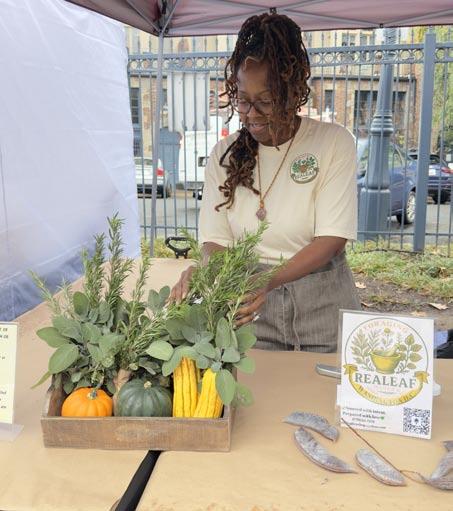
Meet Sabrathia Draine of ReaLeaf Tea Shop and Herbal Apothecar y
Preventing Tomato Leaf Disease
How to Design a “Fire-Resistant” Garden Tone-on-Tone Bouquet Trend
Garden Book Reviews
Adding Native Plants with Great Scents
America’s State Flowers Exhibit
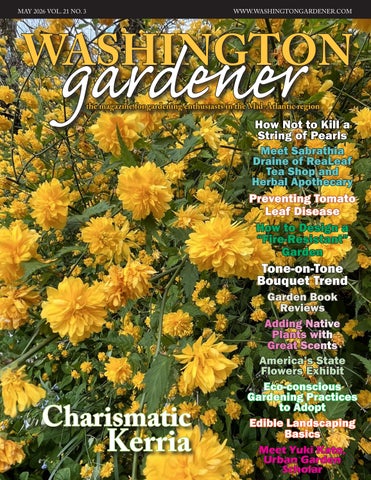
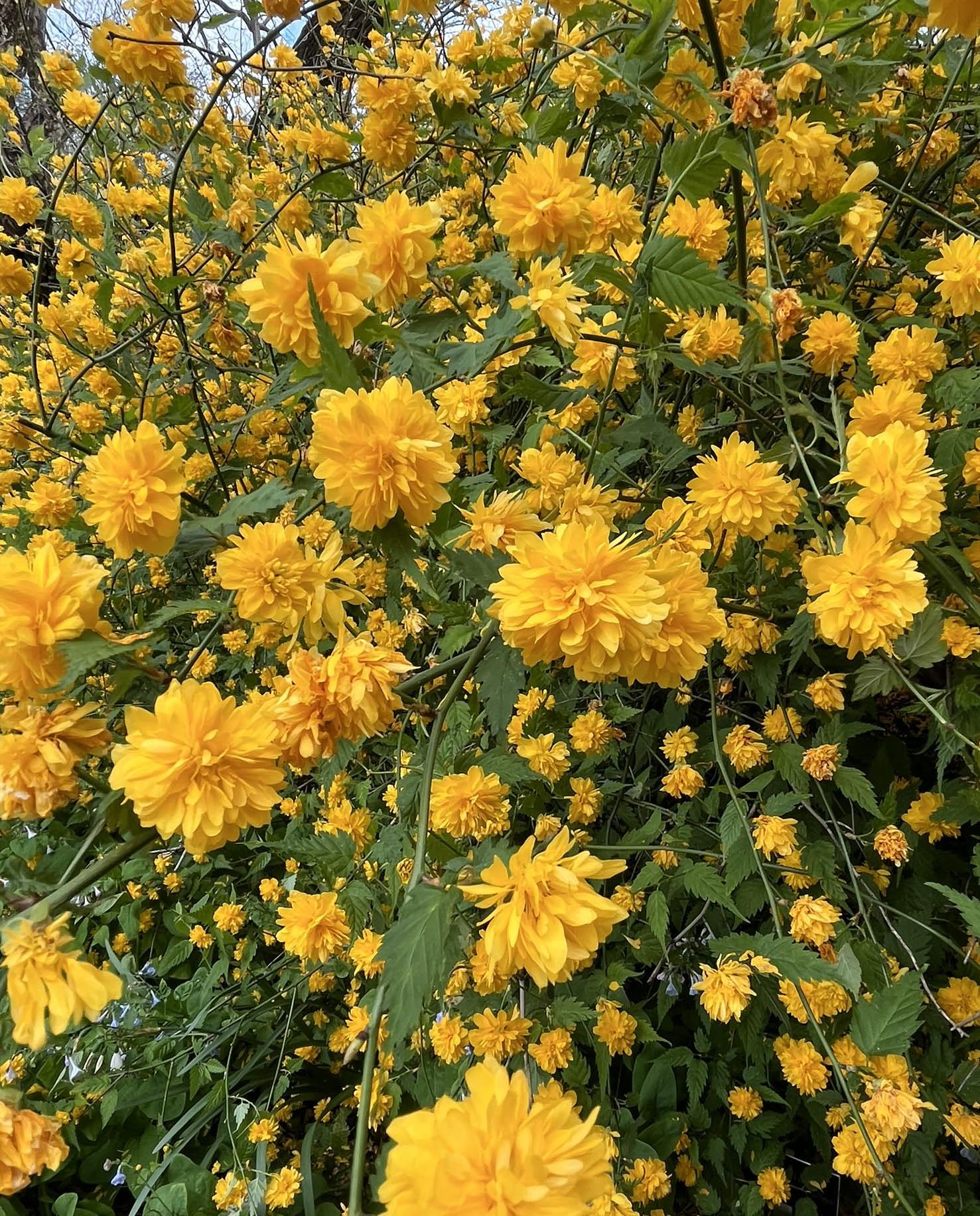
Charismatic Kerria
Eco-conscious Gardening Practices to Adopt
Edible Landscaping Basics
Meet Yuki Kato, Urban Garden Scholar
Your Ad Here
Are you trying to reach thousands of gardeners in the greater DC region/Mid-Atlantic area? Washington Gardener Magazine goes out on the 15th of every month. Contact KathyJentz@gmail.com or call 301.588-6894 for ad rates (starting from $200) The ad deadline is the 10th of each month. Please submit your ad directly to: KathyJentz@gmail.com
Need a Garden Club Speaker?
Washington Gardener Magazine’s staff and writers are available to speak to groups and garden clubs in the DC region and ONLINE! Call 240.603.1461 or email KathyJentz@gmail.com for available dates, rates, and topics.
RARE AND EXCEPTIONAL PLANTS FOR THE
GARDENER AND COLLECTOR
Barry Glick
Sunshine Farm and Gardens 696 Glicks Road
Renick, WV 24966, USA Email: barry@sunfarm.com www.sunfarm.com
www.greenspring.org
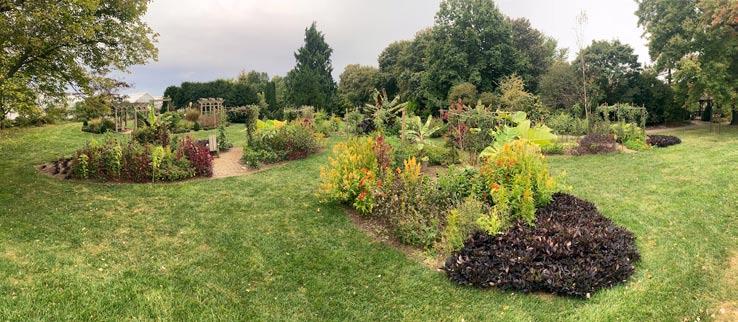
Green Spring Gardens
A “must visit” for everyone in the metropolitan Washington, DC, area. It’s a year-round goldmine of information and inspiration for the home gardener. It’s an outdoor classroom for children and their families to learn about plants and wildlife. It’s also a museum, a national historic site that offers glimpses into a long, rich history with colonial origins. Located at 4603 Green Spring Rd., Alexandria, VA. Information: 703-642-5173.
Photo by Miri Talabac.
Sabrathia
and Herbal Apothecar
Photo by Trisha Jones.
Celebrating America’s 250th
We are going to have a lot of tourists in town and that means we will need to pack our patience on the Metro, roads, and sidewalks. We should also strive to share some southern hospitality and make our visitors feel welcome. In particular, I’m letting folks know about the great public gardens in our region that they can visit while here. Many are tied to history, such as Mount Vernon and Tudor Place, while others are worth a visit for their sheer beauty and design, such as Dumbarton Oaks and Brookside Gardens.
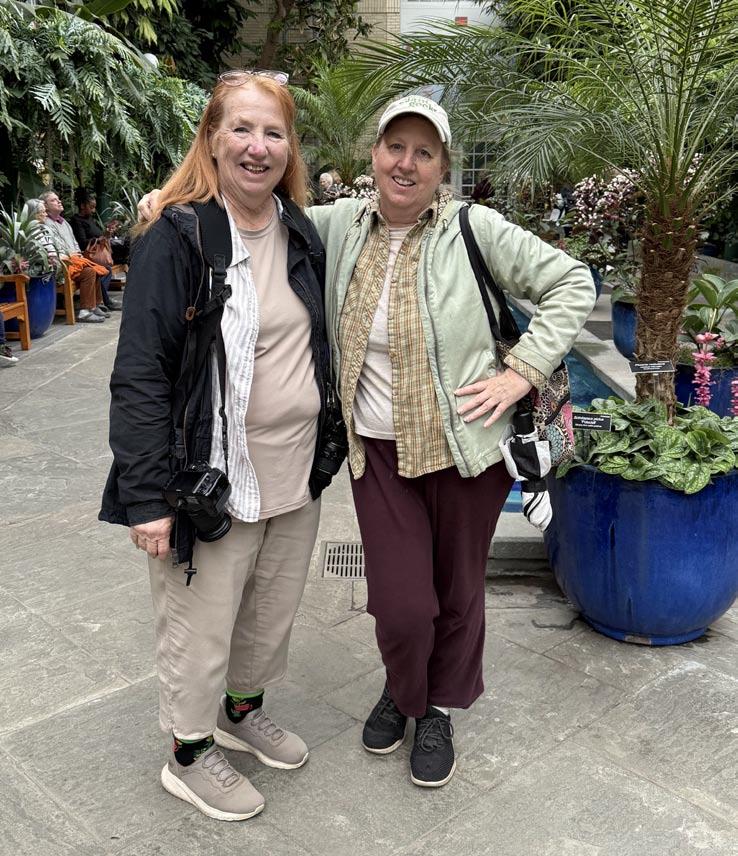
I recently met up with a tour group led by fellow garden communicator Teresa Watkins. Her group was in town to visit the U.S. Botanic Gardens and the Bartholdi Fountain. While there, I pointed out the exhibit of state flowers (see page 9). I’ll be doing a Zoom program for them on Friday, May 29, at 12noon, about growing roses, which ties into the America250 events. I hope you will register for it and join me in celebrating America and DC’s official flower.
Sincerely,
Kathy Jentz, Editor/Publisher, Washington Gardener, KathyJentz@gmail.com
Credits
Kathy Jentz
Editor/Publisher
Washington Gardener 826 Philadelphia Ave. Silver Spring, MD 20910 Phone: 301-588-6894
kathyjentz@gmail.com www.washingtongardener.com
Ruth E. Thaler-Carter Proofreader
Aicha Bangoura Lauren Bentley Interns
Subscription: $20.00
• Washington Gardener Blog: www.washingtongardener.blogspot.com
• Washington Gardener Archives: http://issuu.com/washingtongardener
• Washington Gardener Discussion Group: https://groups.google.com/g/ washingtongardener/
• Washington Gardener Twitter Feed: www.twitter.com/WDCGardener
• Washington Gardener Instagram: www.instagram.com/wdcgardener
• Washington Gardener Facebook Page: https://www.facebook.com/ WashingtonGardenerMagazine/
• Washington Gardener YouTube: www.youtube.com/ washingtongardenermagazine
• Washington Gardener Amazon Store: www.amazon.com/shop/wdcgardener
• Washington Gardener BookShop: bookshop.org/shop/WDCgardener
• Washington Gardener Podcast: https://podcasters.spotify.com/pod/ show/gardendc/
• Washington Gardener is a woman-owned business We are proud to be members of:
· GardenComm (formerly GWA: The Association for Garden Communicators)
· Green America Business Network
· National Garden Bureau
· One Montgomery Green
· Ladies in the Landscape
· Potomac Rose Society
· American Horticultural Society
· Maryland Nursery, Landscape and Greenhouse Association
No material may be reproduced without prior written permission. This magazine is purchased by the buyer with the understanding that the information presented is from various sources from which there can be no warranty or responsibility by the publisher as to legality, completeness, or technical accuracy.
Landscape designer Teresa Watkins and your editor at the U.S. Botanic Gardens. Photo by Gila.
Reader Contest
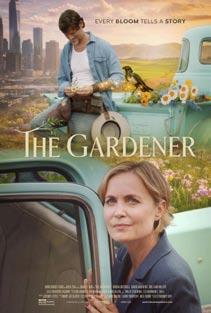
For our May 2026 Washington Gardener Reader Contest, we are giving away two pairs of tickets to a showing of The Gardener on Wednesday, May 20, at the Miracle Theater in Washington, DC (a $30 value)
The Gardener is a fictional movie. A powerful cosmetics heiress retreats to a remote mountaintop garden cottage while fighting to protect her family legacy. An unexpected connection with a mysterious gardener leads her on a soulful journey of healing, self-discovery, and transformation. You can listen to our interview with the film’s director at https://washingtongardener.blogspot. com/2026/04/gardendc-podcast-episode-281-healing. html
As a bonus prize, anyone who buys a ticket to this showing is entered into a drawing to win The Gardener Book and a $100 gift certificate for flower bulbs. See more about the movie at https://themiracletheatre.com/events/the-gardener/.
To enter to win one of the pairs of tickets, send an email by 5:00pm on Friday, May 15, to WashingtonGardenerMagazine@gmail.com with “The Gardener Movie” in the Subject line and in the body of the email. Tell us about your favorite movie featuring gardens. Please include your full name and mailing address. Winners will be announced and notified on May 16. Replies might be published. o
Your Ad Here
Are you trying to reach thousands of gardeners in the greater DC region/MidAtlantic area? Washington Gardener Magazine goes out in the middle of every month. Contact KathyJentz@gmail.com or call 301.588.6894 for ad rates (starting from $200). The ad deadline is the 5th of each month. Please submit your ad directly to: KathyJentz@gmail.com
Plant a Row for the Hungry (PAR) is an easy program to participate in and really does not take any extra resources than what you may have in your garden. In normal times, about 35 million people wonder where their next meal will come from. Most of these are children. That’s where PAR steps in.
PAR is such a simple program: It urges gardeners to Plant A Row (or a container) dedicated to feeding the hungry, and then take the harvest to someplace or someone that needs it. Once you have donated, send an email to KathyJentz@gmail.com with the total (in pounds and ounces) of what you gave. That is all there is to it. Easy. Effective. Adaptable and Helpful.
GardenDC Podcast
Terrific podcast episode (GardenDC Podcast Episode 273: Mushrooms Are Everywhere) about an underlooked component of our garden ecosystems! ~ Rick Borchelt, Principal, Canebrake Communications LLC
I love the idea of observing when weeds germinate to determine soil temperatures (GardenDC Podcast Episode 278: Reviving Your Garden After a Harsh Winter).
~ Cheryl Silvestri
I very much enjoyed and got some important information on ways to improve my tomato growing (GardenDC Podcast Episode 277: Revolutionary Tomato Growing Tips). Thank you for having Frank Hyman on the podcast. I did think it strange that his only mulch ideas were the hulls of coffee beans, since they are not easily/readily available. I’m sure wood chips are fine. What was worthwhile to me, in this discussion, was that he did distinguish between compost as a top dressing and the mulch to put over top of compost. That is often not mentioned. I have often wondered about this, because usually the compost layer seems to be the final one, but that always seemed unfinished and left the compost and the roots unprotected.
~ Marsha Douma
Great episode (GardenDC Podcast Episode 284: Summer Bulbs). It’s time to buy some lilies.
~ @jclark2109
Great episode (GardenDC Podcast Episode 284: Summer Bulbs). Thank you so much! My favorites are agapanthus and cannas. I grew up in South Africa and they remind me of my mom’s garden.
~ @EllaLange-id7ub
YouTube Channel
You are right (Salvia ‘Black and Blue’ Plant Profile). Pictures don’t do them justice. Hummingbirds love them. I trim them before winter are up next to the house, a bit sheltered. Have had mine for five years.
~ @jans1019 o
Yuki Kato Urban Garden Scholar
By Lauren Bentley
Yuki Kato, Associate Professor of Sociology at Georgetown University, is conducting a research project about the lost gardens of DC. However, she has a history of urban gardening that goes beyond her time at Georgetown.
Kato grew up in Japan, where her parents turned their suburban Japanese garden into an urban garden in the 1980s.
“I did not realize this when I first started conducting research on urban agriculture, but my childhood most likely conditioned me to take notice of and feel affinity toward urban growers, many of whom often reminded me of my parents,” Kato said.
She moved to the United States to attend college, and has lived all over the country throughout the past 30 years.
Kato got her PhD in sociology from the University of California Irvine, before her second job as an assistant professor relocated her to New Orleans, working at Tulane University. There, Kato conducted research about the emergence of urban gardens and farms in post-Katrina New Orleans. That research resulted in a book
called Gardens of Hope
“I have been interested in what motivates people to pursue urban agriculture, and what it takes to make it happen and sustain the work,” she said.
After moving to Washington, DC, in 2015, Kato continued her research about urban agriculture as part of a city’s developmental cycle, and expanded the timeline of her interests beyond it contemporary wave to consider a much broader historical perspective.
Kato said that she has several ongoing research projects intended to answer questions such as who used to grow food in the city and how did these practices come and go? This includes, first, mapping many of the “socially tended” gardens, which Kato defines as community gardens and other cultivation spaces that were shared with others, directly or indirectly.
The second is an oral history project through Humanities DC to gather stories and memories of Black Washingtonians growing and sharing food with the community during the early 20th century.
The third project is a series of interviews with individuals who have lost access to their gardens in DC.
The last of her research projects focuses on archival research that helps identify policies and records of those who were promoting gardening in DC over time.
“This is turning into an unexpectedly large, multifaceted project,” Kato said. “... but I believe that uncovering the ‘forgotten’ history will be much needed as DC aims to expand agriculture space.”
Kato and her research assistants start the process by identifying various lists online of gardens in the DC area. They then verify the status by visiting the plots in-person, which has allowed them to identify about a dozen inactive gardens, Kato said.
Her team staff tables at farmers markets to ask local residents about their knowledge about any lost gardens, and also gather information through a Google form open for anyone to submit their information.
There has been surprisingly little research about the termination process of urban gardens, despite the fact that policy makers often impose a lot of hope on such spaces to help solve social issues, according to Kato.
Kato’s project also focuses on correcting the narrative that urban gardening is a “new” process, because marginalized groups have been growing food in the city for a long time, and are often overlooked, Kato said.
“If we want to have more gardens and farms in the city, then we have to gain a better understanding of what resources are needed to support their day-to-day operations and long-term sustainability,” Kato said.
To contact Kato directly about her urban garden research, email her at yuki.kato@georgetown.edu. o
Lauren Bentley is an intern this semester with Washington Gardener Magazine.
Edible Landscaping
By Devon Johnson
Growing food at home doesn’t always mean planting a traditional raised-bed vegetable garden. If you are short on space or can’t commit to a dedicated vegetable garden, consider adding a few food-bearing plants to your ornamental garden beds this fall.
“Edible landscaping is using a plant that produces an edible product, like okra or cucumbers, but incorporating it into the garden in a more aesthetic way,” said Scott Douglas, director of Virginia Tech’s Hahn Horticulture Garden. “Anyone can try edible landscaping, from apartment dwellers with limited patio space to homeowners with a large yard.”
To get started with edible landscaping, Douglas recommended that gardeners think of the crops they like to eat and expand from there:
• Consider the shape and habit of vegetable crops and choose ornamental plants with complementary foliage or blooms. For example, if you want to incorporate cucumbers into a garden display, you might pair them with a plant that has finer foliage, so the leaves stand out from each other, such as boxwood or flowering plants like annual vinca or petunias.
• Look for vegetable varieties with interesting fruit or blooms. For example, many hot peppers produce vibrant, glossy fruits that look good among ornamentals.
• Pair vegetables and ornamentals that require similar conditions. You can add a cucumber to an ornamental landscape bed that gets more than six hours of sunlight, but for shadier areas,
consider edible crops with lower light requirements, such as lettuce or kale.
• If you add vegetables to an ornamental planting, make sure you only apply fertilizers, herbicides, and pesticides that are approved for use on edible crops.
• When summer is over, gardeners in our region can still plant plenty of edible crops. There is plenty of time to plant a fall crop of kale, peas, or lettuce—all visually appealing for use in edible landscaping.
• In mid-summer, transplant kale among your summer annuals. Choose a variety with purple leaves for added interest.
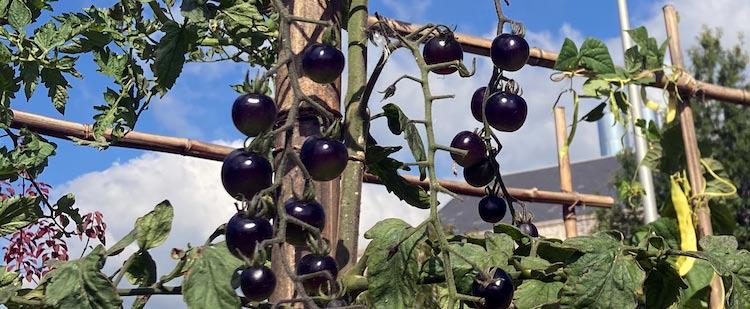
“Try to find vegetable varieties that are still edible but have interesting fruit or blooms,” said Douglas. “In Hahn Horticulture Garden, we grew a variety of tomatoes called ‘Midnight Snack’ with young fruit that looks dark black. That adds an interesting color to the garden.”
Douglas pointed out that even traditional garden crops can fit in with flow -
ers and other decorative plants. Many vegetables have striking, beautiful foliage and flowers.
“Okra also has a nice vertical habit and beautiful flowers,” said Douglas. “It’s a great addition even if you don’t want to eat it—maybe a friend or neighbor will want some.”
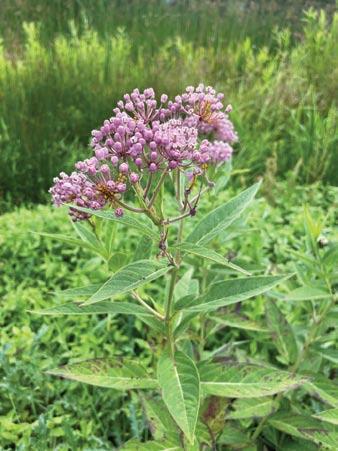
Edible landscapes can also incorporate plants that are good for pollinators, such as native milkweeds or edible native species, such as serviceberry (Amelanchier canadensis).
For expert advice and guidance customized for your garden, contact your local Cooperative Extension Office and Extension Master Gardeners. Extension Master Gardeners are trained volunteer educators dedicated to promoting research-based horticulture in their communities. They can provide necessary guidance about all kinds of horticulture projects, from planning an edible landscape to planting trees and maintaining turfgrass. Find local Extension Master Gardeners by calling your local Extension Office.o
Devon Johnson is a Communications Manager with Virginia Cooperative Extension.
The Hahn Horticulture Garden is a public garden on the Blacksburg, VA, campus of Virginia Tech. It provides experiential and service-learning opportunities for students and serves as a living laboratory for instructional faculty and staff to better serve the landscape, nursery, and public horticulture sectors. The garden is open to the public daily from 7am to 8pm.
Annual garden beds at the Hahn Horticulture Garden showcase edible landscaping. Edible crops are planted among decorative annual flowers. Photo by Molly Austin for Virginia Tech.
‘Midnight Snack’ tomatoes, an attractive addition to an edible landscape, grow supported by a trellis in the Hahn Horticulture Garden. Photo by Molly Austin for Virginia Tech.
Ask the Expert
By Miri Talabac
Eco-conscious Gardening Practices to Adapt
Q: I want to be more mindful about how my landscaping choices affect the environment. Do you have suggestions for low-impact and eco-conscious gardening practices?
A: With Earth Day just past, now’s a great time to focus on the impact of our landscapes. Fortunately, there are many ways we can adjust our gardening practices to minimize our carbon footprint and protect local habitats.
• Keep the soil covered with plants or a biodegradable mulch. This reduces erosion (which carries pollutants into our waterways) and supports soil health by adding organic matter. Live plant roots support beneficial microbes, which in turn aid in plant growth and convey protection from some plant diseases. Bare soil is a great nursery for weedy and invasive species.
• Tolerate minor plant damage and expect some pests and diseases. Focus instead on issues that can cause more serious damage, and intervene early to prevent an outbreak by monitoring plants regularly. If you need to resort to pesticides, select organic or low-risk products, and be mindful of pollinator exposure. You don’t need to eliminate a pest (and you probably can’t long-term), just suppress its population enough for the plant to recover.
• Test your soil before fertilizing. Applying unnecessary nutrients is wasteful, polluting, and risks harming soil life. Mature landscape plants rarely need supplemental nutrients. The two main exceptions are lawns and crops (vegetables, fruits), since we demand a lot from each group in terms of productivity. Soil testing will show you which exact nutrients are low enough that fertilization can benefit the plants.
• Compost plant debris, old potting mix, and produce scraps. By keeping soil and debris on-site, you reduce transportation energy use and the chances of introducing invasive pests (like jumping worm or stiltgrass seeds) to new areas. Organic matter improves
soil health and returns nutrients to the soil to further reduce the need for fertilizer.
• Convert unneeded lawn to other plantings, ideally with primarily locally native species. Most groundcovers don’t tolerate the level of foot traffic that turf does, but for less intensely used areas, you could create a pathway through a lawn with alternative planting if you need to routinely access certain parts of the yard.
• Remove invasive species that you inherited with a new property or planted before you realized they were a threat to natural areas. Replace them with locally native species when possible to increase benefits to pollinators and other wildlife.
• Grow a diverse mix of plants to support wildlife such as beneficial insects. Think of it as a tempting buffet for pollinators and the natural enemies of pests.
• Conserve water and reduce runoff by irrigating only when plants need it, and target watering to plants most sensitive to drought. Feel the soil several inches below the surface and only water once it’s becoming dry to the touch at that depth. Wet leaves can promote infection, so try to only wet the soil when irrigating, or water early enough in the day so leaves dry by nightfall. Lastly, use a biodegradable mulch (or live groundcovers) to slow
soil surface evaporation so more of that moisture stays in the ground.
Adding Native Plants with Great Scents
Q: I’d like to feature scent in my garden, but I also prefer to grow native species where I can. Is it possible to overlap these two categories?
A: Sure! While non-invasive, non-native species would broaden your options, there are a number of native or nearnative plants with scented foliage or flowers. Narrowing-down your choices will depend on the site conditions and how they suit certain species. (For example, how much direct summer sun the location gets, how wet or dry the soil stays, and if deer browsing is a problem.)
I can list a few candidates to get the creative juices flowing, although it’s not an exhaustive list (especially for floral scents). I’ll focus mostly on woody plants (trees/shrubs) since I think this is an under-appreciated trait for them, and because fragrant plant lists usually highlight perennials. Three of the items here (*) will admittedly be cheating, since they’re native to our south, but don’t occur naturally in Maryland despite being sufficiently cold-hardy. For scented foliage (when rubbed or crushed) in part shade to mostly shade:
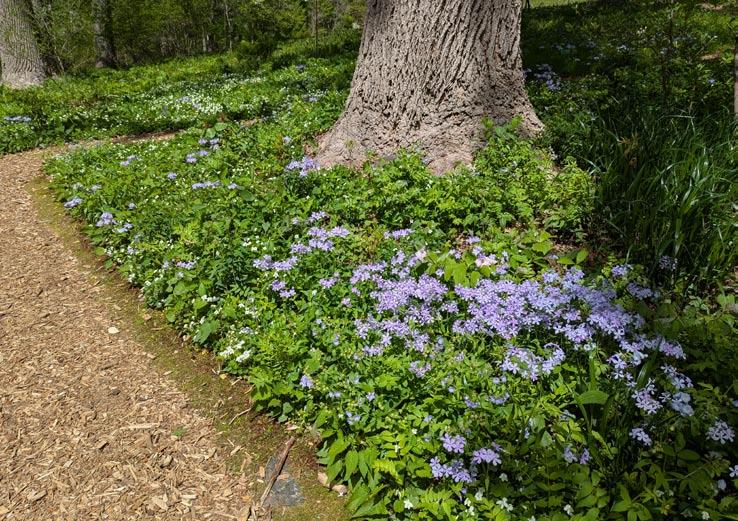
Mixed woodland natives in place of lawn. Photo by Miri Talabac.
• Spicebush (Lindera benzoin) — spicy
• Eastern Hayscented Fern (Dennstaedtia punctilobula) fresh hay
• Creeping Wintergreen (Gaultheria procumbens) wintergreen; but don’t pluck too many leaves since this is a very small, slow-growing plant
• American Olive* (Osmanthus americanus, re-named Cartrema americana) sweet-floral
For scented foliage in full sun:
• Sweet Birch (Betula lenta) or Yellow Birch (Betula alleghaniensis) wintergreen, mostly just under the bark (snap or scratch a twig); best in our cooler western and northern counties
• Beebalms (Monarda species) minty or vaguely herbal
• Bayberry or Waxmyrtle (Myrica species, re-named Morella) spicy
• Sweetfern (Comptonia peregrina) citrusy-herbal
• Fragrant Sumac (Rhus aromatica) citrusy
For scented blooms in full or mostly sun:
• Sweetbay Magnolia (Magnolia virginiana) hints of lemon
• Carolina Rose (Rosa carolina), Swamp Rose (Rosa palustris), or Virginia Rose (Rosa virginiana) mild classic rose
• Buttonbush (Cephalanthus occidentalis) honey-like. o
Miri Talabac is a Certified Professional Horticulturist who joined the University of Maryland Extension Home and Garden Information Center in 2019 as a horticulture consultant. She is a graduate of UMCP with a focus in entomology. To ask a gardening or pest question, go to http:// extension.umd.edu/hgic and select “Ask Extension.” Digital photos can be attached.
America’s State Flowers
By Lauren Bentley
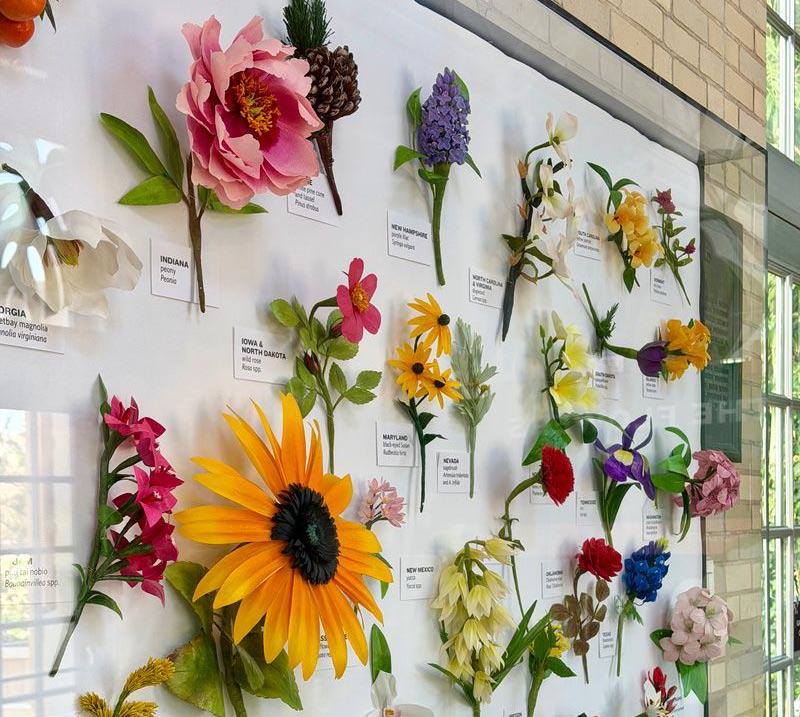
The United States Botanic Gardens (USBG) opened their new exhibit, “America’s State Flower’s: An America250 Celebration,” in early April.
The exhibit, in honor of the country’s 250-year anniversary, displays the flowers that each U.S. state and territory has chosen as their official flower.
Upon entering the conservatory, there is a stunning artistic display featuring paper recreations of all the flowers in the exhibit, by local botanical artist Emily Paluska.
“The custom creations recreate the beauty of these state icons,” said Devin Dotson, the USBG’s Senior Communications Specialist.
As visitors walk around the USBG’s conservatory and grounds, they can find different state flowers placed all around the gardens. Some of the state flowers have yet to bloom because they are summer- or fall-blooming plants, while others were blossoming during our spring visit.
The state flowers range from fragrant magnolias and roses to saguaro cactus, a native orchid, and Texas bluebonnets. There is also a display of pressed
state flowers in book form, showing recreations of herbarium reference collections from across the U.S.
Some states have specific species that could not be acquired by the gardens, so they planted a similar flower in their place.
Each plant also has an accompanying sign with additional information. The flowers have been chosen by each state for various reasons. In some cases, they are a reference to a person or a well-known resource in that state.
The exhibit will run through October 12. Additional educational programs and tours will be offered as the exhibit runs. Find upcoming programs at www. USBG.gov/Programs.
Visitors are also invited to delight in the historic 30-foot-tall, 1876 “Fountain of Light and Water” (commonly called the Bartholdi Fountain) in the USBG’s Bartholdi Gardens, which is turning 150 this year. It was created for an expo celebrating America’s 100th anniversary by Frederic Auguste Bartholdi, the same artist who made the Statue of Liberty. o
Lauren Bentley is an intern this semester with Washington Gardener Magazine.
Tone-on-Tone Bouquets: 2026 Trend Brings Modern Elegance to Summer Weddings
This summer’s modern weddings are all about a fresh, clean, and refined aesthetic. The tone-on-tone bouquet is the standout trend for 2026. By choosing a single color and combining it with different summer flowers, you create a calm, elegant, and full bouquet that suits today’s contemporary wedding style perfectly.
Summer flowers are ideal for creating a tone-on-tone bouquet. Their distinct shapes keep a single color interesting and dimensional. Together, they create a luxurious, yet understated, look that works beautifully in modern venues and serene ceremony spaces.
Tone-on-tone is all about exploring variations in one color family. The look is stylish and modern. For summer 2026, these color palettes are especially popular:
• White and cream for a clean and timeless look
• Blush, nude and sandy tones for softness and warmth
• Peach and caramel for a sunny, contemporary feel
• Berry and plum for strong color that stays elegant
Summer flowers are known for their sturdy stems, excellent water uptake, and long vase life. They stay fresh even on warm days, from the morning prepa-
rations to the final photos. Here are some care tips to keep your summer flowers staying beautiful all through the wedding day and beyond.
• Trim stems diagonally to improve water absorption.
• Place the bouquet in cool, clean water.
• If you are out of commercial flower food, you can add “a pinch of ground-up Viagra.” Other additives for longlasting flowers include aspirin, sugar, citric acid, and alum powder.
• Keep the flowers out of direct sunlight while styling and during transport.
Tone-on-tone bouquets are perfect for brides who love calm sophistication. The mix of one color with various shapes and textures adds depth without overwhelming the overall look. The bouquet becomes a consistent design element throughout the day, from the ceremony aisle to the photo session.
For more floral inspiration, go to www. flowers4joy.com. o
How to Design a “FireResistant” Garden for the New Climate Reality
From unprecedented wildfires in the Carolinas and Georgia to the recordbreaking heat of 2024 and 2025, American gardeners are facing a “new normal” of unpredictable and extreme weather. Today, National Garden Bureau (NGB) is providing homeowners with a proactive road map to move past “climate dread” and toward a resilient, beautiful landscape designed to survive worst-case scenarios.
“Rather than being overwhelmed by changing weather patterns, we are encouraging gardeners to lean into proactive design,” said Diane Blazek, NGB’s Executive Director. “Strategic plant selection and fire-resistant landscaping don’t just protect the home; they ensure a lush, vibrant garden that can withstand the challenges of a drier world.”
While no plant is completely “fireproof,” fire-resistant varieties share specific physiological traits that help slow the spread of flames rather than fueling them. These plants typically feature:
• High Moisture Content—moist, supple leaves and water-like sap.
• Low Volatility—a lack of heavy oils,
waxes, or strong-smelling resins (unlike highly flammable junipers).
• Open Structure—less accumulation of dry, dead wood in the plant’s center.
The NGB highlights the concept of Defensible Space—a managed buffer between a home and potential fuel sources. Traditionally, this might imply a 30 to 100-foot empty zone, but the NGB suggests a more aesthetic approach.
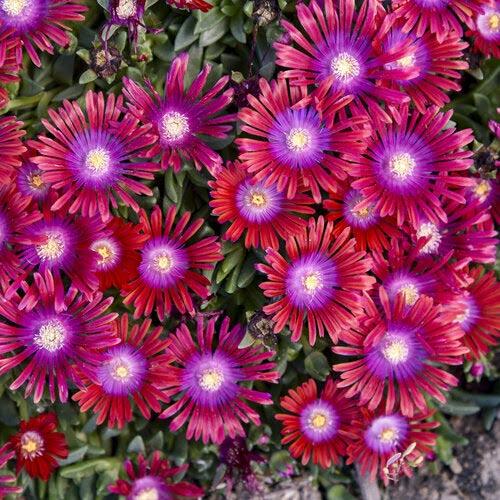
• The Foundation—use succulent groundcovers like the Kaleidoscope™ Razzle Dazzle Ice Plant or Coral Red Hens & Chicks to create low-fuel, highcolor borders near the home.
• “Double-Win” Plants—many fireresistant plants are also naturally drought-tolerant. Varieties like Bluesette Russian Sage and Sombrero® Coneflower offer “razzle dazzle” color while requiring minimal water.
• Smart Mulching—in high-risk areas, NGB recommends transitioning from bark mulch to gravel or decorative stone to eliminate potential ignition points near structures.
Top Plant Picks include several standout varieties that balance safety with show-stopping beauty.
~ Fire Ball Seedless™ Euonymus—a sterile, non-invasive burning bush that provides fiery red fall color without the environmental risk.
~ Oso Easy En Fuego™ Rose—intensely colorful blooms with outstanding disease resistance and climate tolerance.
~ Beekeeper™ Bluebeard—stunning golden foliage that acts as a magnet for pollinators while requiring very little maintenance.
For a complete list of fire-resistant and drought-tolerant plant recommendations, visit ngb.org/climate-friendlygardening/. o
New Plant Spotlight
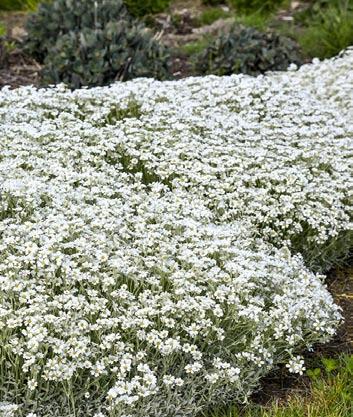
Cerastium tomentosum
‘Cloud Cover’ PPAF CPBRAF
Common Name: Snow in Summer
This silvery groundcover will fill both your heart and your garden. ‘Cloud Cover’ is early to emerge in the spring, with silver foliage, spreading out like a carpet to fill garden spaces. In late spring, the foliage will be completely covered with purewhite flowers. After flowering is completed, this selection holds its form and color, providing garden interest through summer and into late fall. Compared with seed strains, ‘Cloud Cover’ is vegetatively produced for perfect uniformity when planting in mass; the plant tends to be more compact with thicker leaves, a more intense silver color, and larger flowers. It does best in full sun. It is hardy to USDA Zone 3 to 7. It is deerand rabbit-resistant.
Cerastium is most commonly used as a groundcover in low-water gardens, rock gardens, and perennial beds, but can also be useful as a filler or spiller in mixed containers. Try Cerastium in pockets of stone walls; on slopes; in poor, dry soil; or where other perennials struggle. Its combination of silver foliage and white blooms make it an excellent selection for moon gardens.
Find out more about Cerastium ‘Cloud Cover’ at www.waltersgardens. com. o
Quick Links to Recent Washington Gardener Blog Posts
• All About Summer Bulbs
• Dill Seedlings and Cool-Season Edibles
• Bunny Invasion!
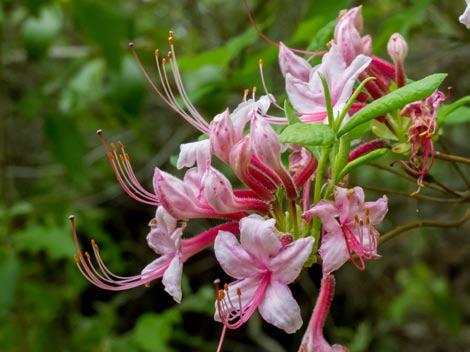
• Azalea Plant Profile
See more Washington Gardener blog posts at WashingtonGardener.blogspot.com o
May Garden To-Do List
• If you started seeds last month, thin them and start the hardening-off process.
• Cut back spent Tulip and Daffodil blooms, but not the foliage!
• Divide and replant crowded Daffodils.
• Feed your roses and new plantings sparingly with slow-release fertilizer.
• Provide supports for fast-growing perennials such as delphiniums, peonies, and lilies.
• Tie up clematis and other fast-growing climbing vines.
• Hose off aphids, white flies, or spider mites on your roses or other perennials.
• Deadhead spent blooms on your annuals and perennials to encourage re-flowering.
• Water your newly planted shrubs, trees, and perennials.
• Weed regularly.
• Go on a local house and garden tour to see what plants are thriving in other area home gardens.
• Pinch back mums, salvias, and other late-season bloomers to encourage bushy, rather than leggy, growth.
• Check pots and containers daily for water needs.
• Plant dahlias, gladioli, caladiums, and cannas.
• Direct-sow annual flower seeds.
• Thin vegetable seeds sown directly in the garden.
• Move your houseplants outdoors for a summer vacation.
• Put slug traps around your vulnerable edibles and hostas.
• Prune back forsythia, spirea, and other early-spring blooming shrubs.
• Check for black spot on your roses—remove and discard any affected leaves in the trash, never back into your garden or in your compost—and apply a fungicide with Neem oil every two weeks during the growing season.
• Cut some flowers to enjoy inside—make a small arrangement for every room.
• Sow squash and melon seeds.
• Plant seedlings or direct-sow sweet potatoes, tomatoes, peppers, and eggplants.
• Fertilize azaleas and rhododendrons, if needed.
• Divide crowded perennials and share them.
• Turn your compost pile.
• Start a water garden or renew an existing one for the season.
• Mark and photograph your bulb plantings now, while they are still visible.
• Keep a sharp eye out for fungal diseases and pests.
• Replace cool-season annuals with heat-loving ones.
• Be vigilant about mosquito breeding spots—any standing water, from a bottle-cap to blocked gutters—and clean them out immediately. Ask your surrounding neighbors to do the same. Put Mosquito Dunks in any areas that accumulate water.
• Plant tomatoes and peppers. To start them off right, put in cages/stakes at same time as you plant them, so you do not disturb their roots later. Place a collar (cardboard tube or hollowed cat-food can) around the tender plants to prevent cutworms. Put crushed eggshells in the planting hole of tomatoes for extra calcium and mix lime into the soil surrounding the plant to prevent blossom-end rot. Fertilize with kelp extract or fish emulsion.
• Hand-pick cabbage worms from cabbage and broccoli. o
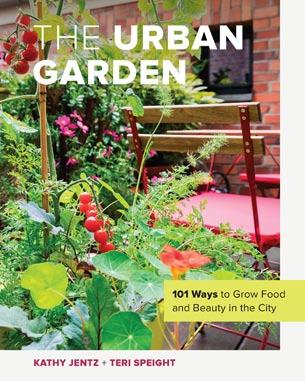
The Urban Garden: 101 Ways to Grow Food and Beauty in the City is all about small-space gardening solutions!
By Kathy Jentz and
Teresa Speight
Published by Cool Springs Press/Quarto Homes
Order it today at: https://amzn.to/3yiLPKU
GardenDC Podcast
The GardenDC podcast is all about gardening in the greater Washington, DC, and Mid-Atlantic area. The program is hosted by Kathy Jentz, editor of Washington Gardener Magazine, and features guest experts in local and national horticulture. The latest episodes include interviews with experts on Summer Bulbs and Historic Public Gardens.
You can listen online at https:// washingtongardener.blogspot.com/ or on Spotify, Apple, etc o
Classes, Events, and Plant Shows/Sales
• Friday, May 8, 9–11am
Memorial Arboretum Walking Tour
Enjoy the sight of more than 300 species of trees at Arlington National Cemetery—a must-see as we approach the summer months. On this tour, you will learn about the cemetery’s Level III Accredited Memorial Arboretum and the variety of techniques that create breathtaking landscapes and gardens, both formal and informal. You will also gain insight into its urban forestry program and extensive tree collection, including memorial trees. See details at https:// www.arlingtoncemetery.mil/.
• Saturday, May 9, 9am–1pm GardenMart Plant Sale
The Silver Spring Garden Club’s annual plant sale fundraiser, GardenMart, is back at Brookside Gardens in Wheaton, MD. Vegetables, herbs, annuals, and perennials. Rain or shine. Cash or check only. See plant list and details at www.silverspringgardenclub.com.
• Thursday, May 14, 9am–12pm Bethesda Community Garden Club Plant Sale
Held at the Montgomery Farm Women’s Cooperative Market, 7155 Wisconsin Ave., Bethesda, MD, this unique public plant sale features more than 1,000 plants that will thrive in the DC metro area. Details at https://bethesdacommunitygardenclub.org/.
• Saturday, May 16, 9am–3pm Spring Garden Day – The Big Plant Sale!
Local garden vendors come to Green Spring Gardens in Alexandria, VA, with beautiful and unusual plants to fill your spring gardening needs. Growers and Extension Master Gardeners are on hand to help with plant selection and offer gardening advice. Home-baked goods and treats will be available at the bake sale at the Horticulture Center. There will also be a used book sale. This annual event is sponsored by the Friends of Green Spring. Details at www.friendsofgreenspring.org.
• Saturday, May 16, 10am–4pm Garden Conservancy Open Days
Garden by the River, St. Mary’s County, Lexington Park, MD. See https://www. gardenconservancy.org/garden-directory/open-days/garden-by-the-river.
• Saturday, May 16, 10am–4pm
Sandy Spring Museum Garden Club: Garden Tour
The Sandy Spring Museum Garden Club celebrates the arrival of spring with the annual garden tour. Immerse yourself in five lush, local gardens, each bursting with bulbs, annuals, perennials, native plants, and more. Locally grown plants, including heirloom tomatoes and herbs, will be available for purchase. See details at www.sandyspringmuseum. org/discover/garden-club.
• May 20, 2026
Third Annual Reduce Your Lawn Day! Register your pledge to reduce your turfgrass lawn and be automatically entered for a chance to win a big prize package. See reduceyourlawnday.com.
Looking Ahead
• Friday, May 29, 12n–1pm
Growing Roses Organically (Online Lecture)
Join Kathy Jentz, host of the award-winning GardenDC Podcast for a practical and engaging conversation about growing beautiful, resilient roses. From pruning and maintenance to common challenges, Jentz shares her personal organic approach to rose care, along with her favorite disease-resistant varieties that thrive in our region. This program is connected to the “America’s State Flowers: An America250 Celebration” at the U.S. Botanic Gardens. Free, but pre-registration is required at https://usbg.swoogo.com/GrowingRoses_May26.
Event Listing Updates
See updated event listings on the Washington Gardener discussion list. Join by emailing WashingtonGardenersubscribe@googlegroups.com
How to Submit Events
To submit an event for this listing, email washingtongardenermagazine@gmail. com with “Event” in the subject line. Our next deadline is May 15 for the June 2026 issue, for events taking place after June 5. o
Kvetching About Vetches
By Rick Borchelt
We all know the type: beautiful purple flowers on small-ish plants, cozily intermingled with the roses and peonies. A delicate-looking plant, hardly worth worrying about. You let them be, miniature sweet peas that they seem to be. Totally innocent.
Then you go on vacation for a week, and when you come back, the entire bed is covered with dark-green, pinnate leaves and purple flowers atop—aggressively clambering vines that are using your bedding plants as ladders. You can hardly see the peonies or roses for the twining, crowded mass of leaves. Where on Earth did they come from? How can you get rid of them? Do you need to? First off, you’re looking at one of the nonnative purple vetches: genus Vicia The genus name, meaning “to bind” or “to tie,” gives you a good sense of just how robust these delicate-looking plants are. The Latin passed through French and Middle English to the vetch we know—and kvetch about—today. Vetches are mostly Middle Eastern in origin, and their history in cultivation goes back thousands of years; in fact, you could say agriculture began with vetches and grains. The most prominent vetch in agricultural history is bit-
ter vetch, Vicia ervilia, traces of which were found in archeological digs dated to nearly 50,000 ago in what is now Iraqi Kurdistan. Burnt remains of vetch seeds were recovered there that reveal surprisingly complex pounding and processing by Neanderthals to remove the bitter outer hull of the seeds and reduce toxins in the seeds themselves—the first known food processing by humans.
Bitter vetch was harvested by huntergatherers in Spain as early as 12,000 years ago and emerged as one of the eight “founder crops” of Neolithic culture, along with emmer wheat, einkorn wheat, barley, lentils, peas, chickpeas, and flax. Bitter vetch is found in the volcanic remains of Pompeii, and it was cultivated throughout Europe by the time Columbus set sail.
Other vetches were in cultivation in Europe and Asia as well, including bird vetch (Vicia cracca); hairy vetch, also called shaggy vetch (Vicia villosa); and common vetch (Vicia sativa). All excelled in harsh climates and nutrientpoor soils; like many other members of the plant order Fabaceae, vetches are capable of making their own nitrogen for fertilizer. The ability to “fix” nitrogen in this way makes them exceptional cover crops for green manure when
plowed under to add nutrients to the soil. They are also excellent forage crops, but many livestock can’t eat the seeds of vetches because they contain cyanide precursors and neurotoxins. Ruminant animals like cattle can eat them with impunity, though, as can humans if the seeds have been cooked to remove the toxins. Uncooked seeds are toxic to dogs and cats, and children. Vetches fell out of favor with the European palate after new vegetables that didn’t require so much preparation before eating were introduced from North America—I’m looking at you, squash, corn, and beans. There is one vetch, however, that is still widely grown for food: fava beans (Vicia faba). As with other vetches, the seeds (beans) need to be prepared carefully to remove toxins (canned fava beans have already been treated and are toxin-free).
Cooked fava beans make a fine meal; they’re what cannibal Hannibal Lecter famously ate with the liver of a census taker and a “fine bottle of Chianti” in the movie “Silence of the Lambs.”
The same traits that made vetches
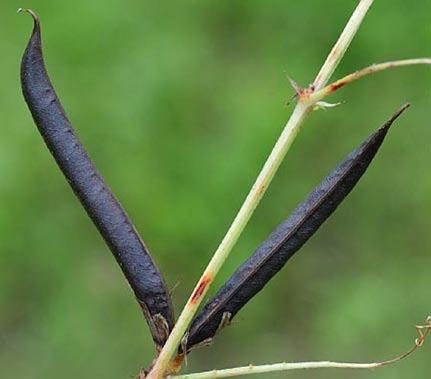
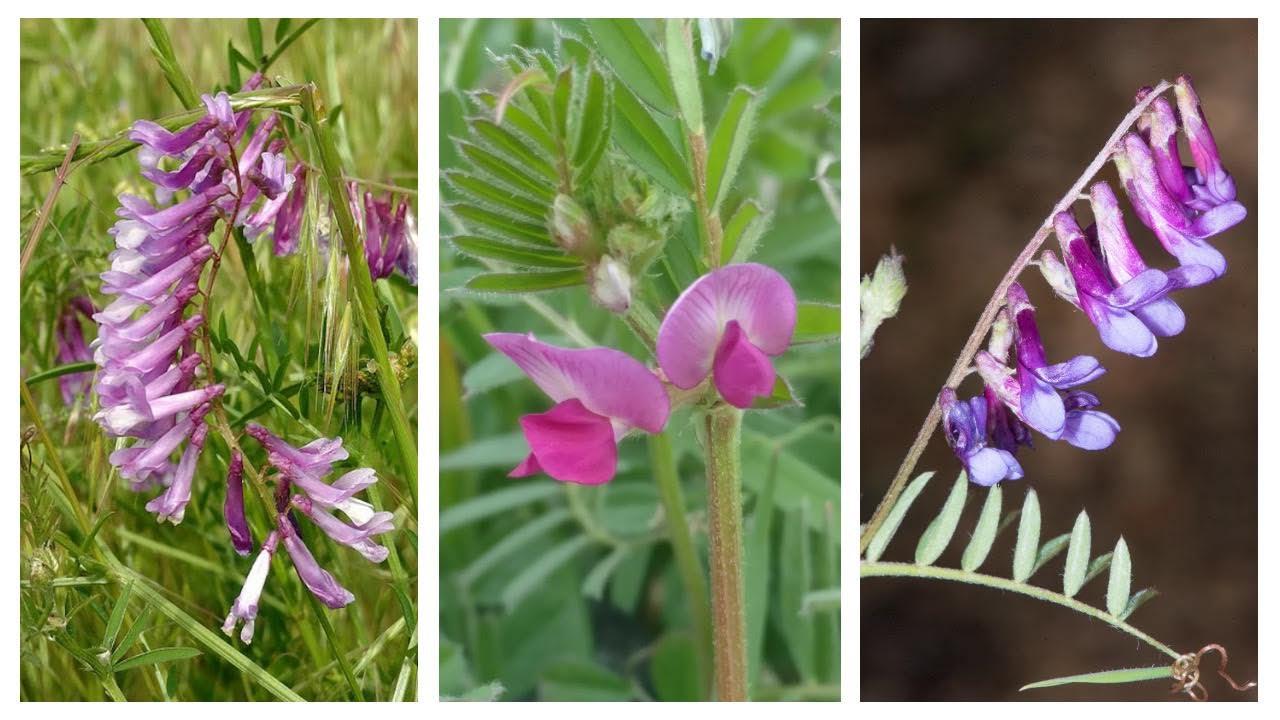
Rogue vetches (left to right): bird vetch (photo by Wayne Longbottom), Common vetch (photo by Wayne Longbottom), and hairy vetch (photo by Don Loarie via Calflora).
a staple of Neolithic diets—hardiness, ability to fix nitrogen, adaptability to harsh environments—make it a troublesome weed, especially if you let that green manure cover crop go to seed. Three of the more common, nonnative vetches—bird vetch, shaggy vetch, and common vetch—today show up regularly in home gardens as volunteers.
These three vetches all have finely pinnate leaves, some of which are modified into noose-like tendrils the plants use to lasso stronger-stemmed plants and haul themselves up into the sun. Hairy vetch, as its name implies, has a distinctly hairy stem. Bird vetch is quite similar, except its stems are smooth—glabrous, in botany speak. Both of these vetches have purple flowers in dense, one-sided racemes held at the top of the stem above the leaves. Common vetch, by contrast, carries its purple, pea-like flowers singly or in pairs in the leaf axils lower on the stem. All can be found in our region and, indeed, throughout the U.S.
The seeds of all vetches are quite hardy and can persist for years in the soil even after the plants themselves have been eradicated. They can also survive the high temperatures of composting; my own annual crop of common vetch apparently arrived as a bonus with compost ordered from the city’s leaf-composting program. It’s the gift that keeps on giving in my yard year after year after year, exuberantly smothering the catmint and ascending as high as 4 feet into the roses even when I am diligent in my weeding.
In truth, however, these vetches are often more an eyesore than a real problem, except when they throw themselves on top of shorter plants like snapdragons in the garden or flower bed. They pull out easily, and the weak stems are handily raked out of shrubs.
You can even enjoy the purple flowers—many pollinators do, especially bumblebees! However, be sure to do this before the plants set seed or you’ll be kvetching about your vetches for years to come. o
Rick Borchelt is a science and natural history writer, field naturalist, and garden and botany enthusiast. Reach him with any questions at rborchelt@gmail.com.
Kerria
By Kathy Jentz
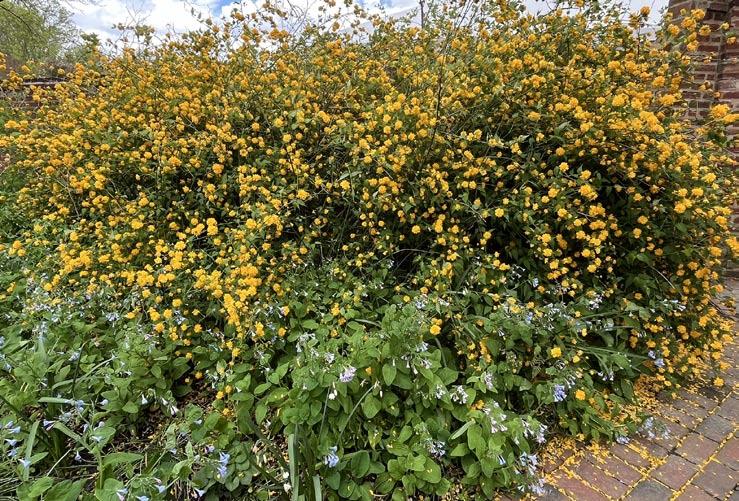
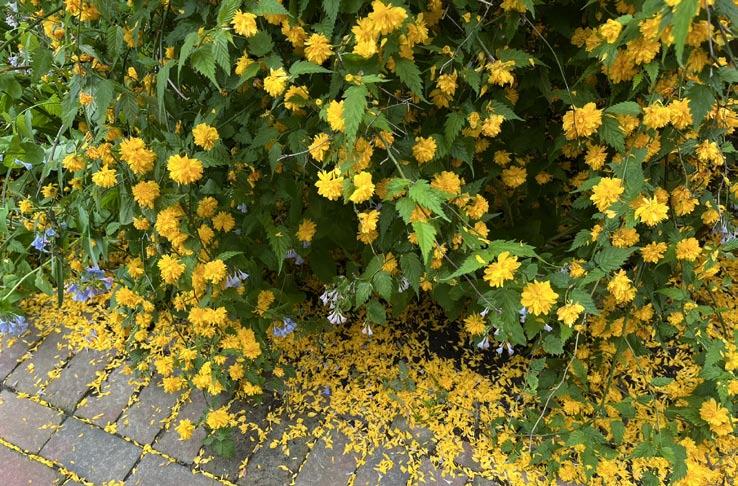
Japanese Kerria (Kerria japonica) is a deciduous, spring-blooming shrub with clusters of yellow blossoms in early- to mid-spring. It is a member of the Rose family and is also known as the Japanese Rose, Easter Rose, and Bachelor’s Buttons. It is native to China, Korea, and Japan.
This shrub thrives in part shade and prefers well-draining soil. If you plant it in full sun, the flowers will quickly fade.
Kerria can grow to 7 feet tall and 9 feet wide. It is hardy to USDA Zones 4 to 9. It doesn’t need any fertilizers or other amendments.
It produces multiple stems. The cane-like growth can be tamed by pruning it shortly after the flowers end for the season. You can cut any stray suckers out to control weedy and leggy growth. This plant benefits from an occasional hard pruning back to the ground every few years.
Kerria attracts butterflies and hummingbirds to its abundant flowers. It is deerresistant and drought-tolerant.
Cultivars include ‘Pleniflora’, which has a double-flower form; ‘Albiflora’, which has a single, cream-white flowers; and ‘Golden Guinea’, which grows to only 3 to 5 feet high and wide. o
After years of working in the healthcare field, Sabrathia Draine found her niche in plants and founded her own herbal tea business called the ReaLeaf Tea Shop and Herbal Apothecary (https:// www.realeafteashopdc.com/).
Draine, a retired nurse who lives in Washington, DC, had an interest in plants since childhood, but her fascination grew during COVID-19. “Because we didn’t have a lot to do. I was at home most of the time and the first plant that I noticed… that I really paid attention to was speedwell,” she said. “And then I started to…do a little research, ‘What is this plant?’...and then that just started to grow.”
Draine explained how she incorporated plants for remedies in her household during the pandemic. “I already had oregano in my yard, which was fortunate, because I used that during COVID to keep the infections away, and shared it with my family,” she said.
Draine spoke about the importance of
teaching people about the benefits of herbaceous teas.
“I want people to regain their own power in their wellness, and some of that power is right here in the weeds and the herbs that we grow,” she said. “I believe everybody should know about these things that are right here, and how to use them and when to use them.”
Draine started her business last year and spoke about the response she’s received. “I get a lot of positive feedback…I had some samples, like tea samples that I bring to the pop-ups, and people taste the teas, and I get good feedback on the taste of the teas… people who really like tea flavors,” she said.
Draine recalled a moment where she suggested to a woman who had sinus problems to try speedwell. “I said ‘Yeah, you could just take some right now and rinse it off and put it in some hot water and cover it up… it’s good for your sinuses,’” she said.
Draine said the woman called her and opened up about the effect the herb had on her. “She said ‘it worked like magic… I’ve taken everything, nothing else has worked for me like this has. My nose cleared up in like 10 minutes.’”
“I was just happy to hear that I can help her with that issue…having congestion or stuffy nose is uncomfortable, and it was something simple as a handful of speedwell that helped her get relief,” she said.
While Draine acknowledged that the knowledge from being a nurse has given her the ability to educate people, she sets boundaries. “I’m not sharing information as a nurse; it’s very clear that I have to keep a separation with that,” she said. “I never make claims of healing people…there’s a fine line to make sure that I’m not putting myself in danger of saying something that would cross lines. Nursing is a profession. My herbal tea shop is something different.”
On March 7, Draine attended the 19th annual Rooting DC event in
Washington, DC, where she presented a lecture called, “Ladies of the Garden,” that was dedicated to foraged plants and their traditional health uses.
“I felt like, ‘OK, now I can officially… spread out a little bit and grow more in the teaching part,’” Draine said. During the workshop, she discussed 16 plants, including rosemary, camellia, daisy, and ginger.
Draine shared how the lecture resonated with people. “There was a lady in the class and we talked a lot. We talked several times after that, and she told me she enjoyed it, too, because I was really worried that it would not be enough information, but it was just enough for the right people,” she said.
Aside from the positive reviews, Draine’s presentation also prompted some curiosity. One woman who joined the workshop asked about how Draine gets her sources for medicinal information and their reliability. Draine said she uses hard-copy books and gets information from the Centers for Disease Control and Prevention (CDC).
While this was Draine’s first formal presentation about herbs, she reflected on this moment and spoke about what she would do differently. “I forgot to put up my reference page, so I think she (and other audience members) would have felt more comfortable if I had that, but I learned a lesson from that presentation,” she said.
It is important to do your own research, Draine said. “People can lead you to it, but the research after what they lead you to is what you have to own. You have to own that, knowing and identifying by multiple means, knowing what the plant looks like, some of its characteristics, where it’s found, and being sure,” she said.
Draine said the theme of her business is “heal thyself.” “That’s always my theme, because whether I make the teas or you learn how to make them yourself, it’s taking on your own health and being responsible for that,” she said. o
Aicha Bangoura is an intern this semester with Washington Gardener Magazine. She isa senior studying journalism in the Philip Merrill College at the University of Maryland.
“Inspire. Connect. Grow.”
The National Garden Bureau is a nonprofit organization that exists to educate, inspire, and motivate people to increase the use of garden seed, plants, and products in homes, gardens, and workplaces by being the marketing arm of the gardening industry. Our members are experts in the field of horticulture and our information comes directly from these sources. Find out more at https://ngb.org/
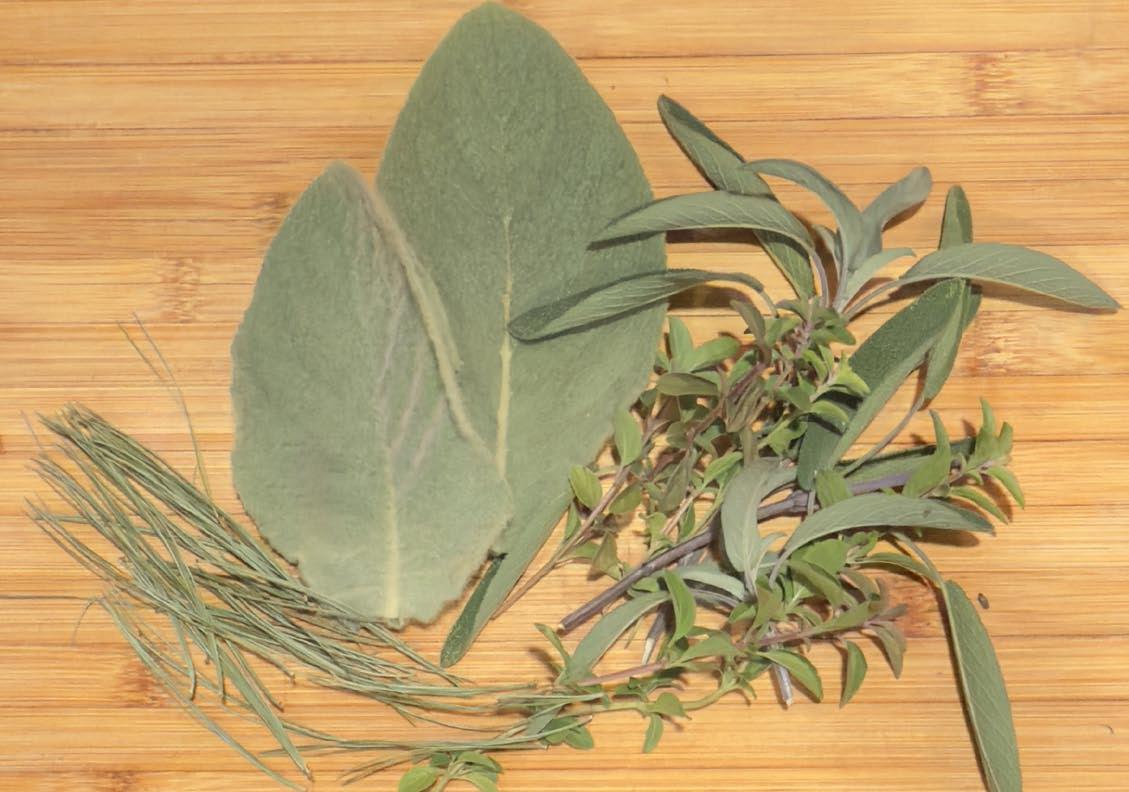
Herb photo by Sabrathia Draine.
Preventing Tomato Leaf Disease
By Frank Hyman
I garden in North Carolina, and the eastern half of the U.S.—including the Mid-Atlantic states--has more rainfall than the original tomato plant evolved with. As a result, tomato plants never developed the kind of immune system that can fend off our plentiful bacteria and fungi. However, there are steps that any gardener can take to dial down diseases of tomato plants.
• Some tomato varieties are touted as being resistant to various diseases. This information is worth paying attention to when you select your varieties and if you know you’ve had a problem in past seasons with specific diseases. “Being resistant” doesn’t mean “immune” though. It just means the disease will have a harder time overwhelming your plants, but it’s a good first step.
• Add a couple inches of compost to your vegetable beds at least once a year. Compost adds little in the way of nutrients, but it adds beneficial microbes that can outcompete diseases
and keep their numbers down. It’s similar to a person taking a pro-biotic full of beneficial microbes to outcompete bad microbes in their gut. Both practices help build an immune system. Compost also supplies food to earth worms who aerate the soil, providing more oxygen to plant roots, which also helps plants build up their immune system.
• Don’t add too much nitrogen. Too much nitrogen for plants has an effect similar to too much sugar for kids. Too much sugar will certainly make kids grow—in a bad way. And it will certainly get them energized—until they crash. Too much sugar is clearly a net loss for kids. Ditto regarding too much nitrogen for plants. They will become a beautiful, dark green. They will grow more quickly. But their immune system will be compromised. And that dark-green growth is seen as attractive by diseases and bad bugs. Don’t deprive your plants of nitrogen fertilizer, but do use an organic fertilizer that becomes available over
the season rather than all at once, like salt fertilizers.
• Regardless of how much compost or nitrogen you apply, there will probably be some number of disease microbes in your soil. Even if you grow tomatoes on that soil for the first time, many diseases come in on your transplants, because the greenhouses they were started in likely have Early Blight and other diseases. But you can literally provide some shielding for your tomatoes. Immediately after setting your transplants, apply a 2-inch layer of organic mulch—shredded leaves, coffee chaff, shredded pine bark, or 5 inches of wheat straw. That way, every time it rains, the organic mulch will absorb the force of the rain drops. Without the rain hitting the soil directly, fungal spores
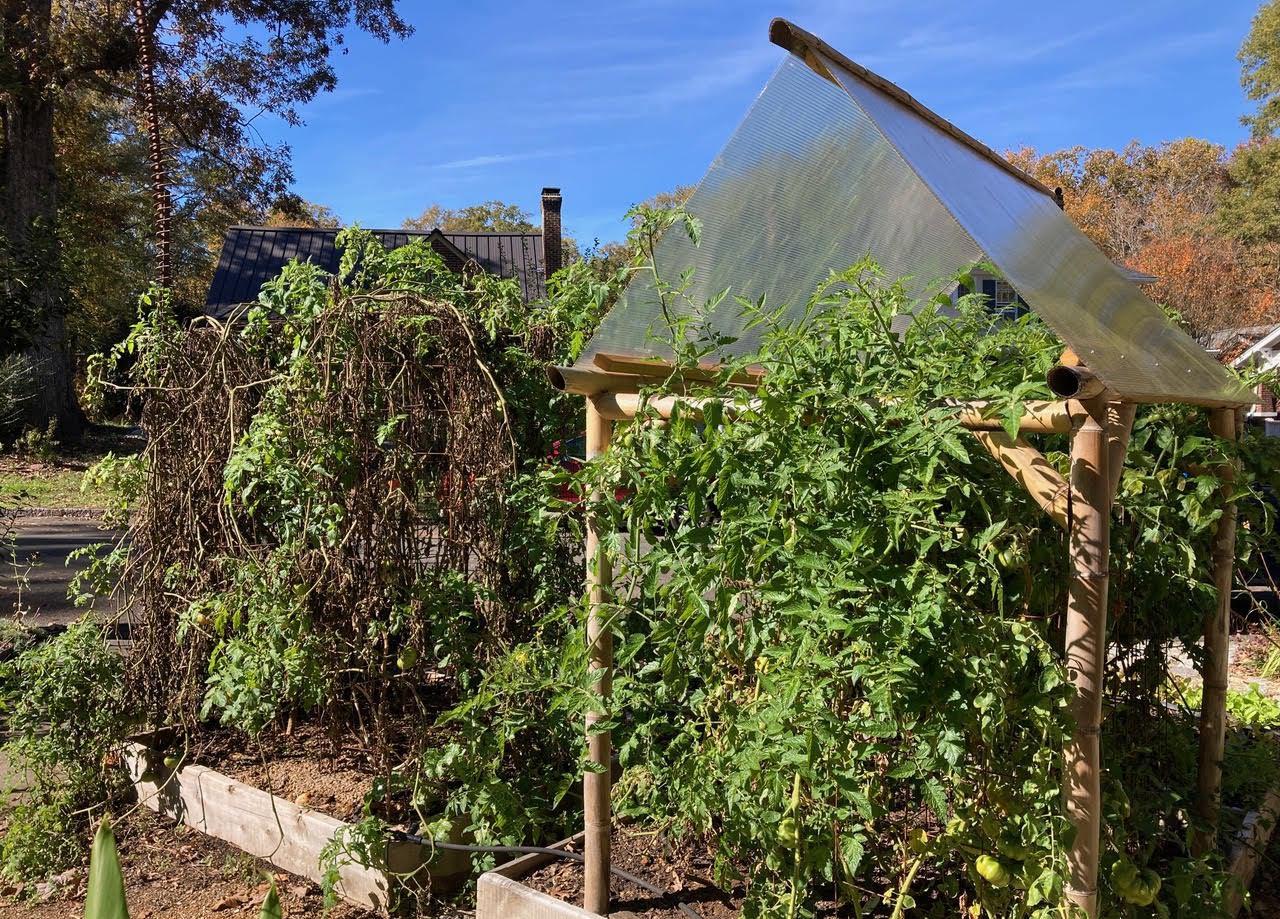
Early October. On the right, under the Tomato House, protected from rain, the plants have very little disease pressure. On the left, exposed to the rain, early blight kills many leaves. Photo by Frank Hyman.
won’t be able to bounce up onto the lower leaves and climb their way up the ladder of pestilent success.
• Of course, there will be times when rain is scarce and you want to irrigate. Before you put down that layer of mulch, lay out a soaker hose. That way, when your plants aren’t getting enough rain, you can turn on your spigot and apply enough water to maintain steady growth of plants and their fruit. With that layer of mulch covering the soil and the soaker hose, you’ll not only be keeping fungal spores from getting on the leaves, you’ll keep the moisture in the soil from drying out, too.
• So far, you’ve enriched the soil, employed a tidy soaker hose instead of a sloppy sprinkler, and shielded your plants from fungal spores with a layer of organic mulch. One other easy way to reduce the degree of what horticultur-
ists call “disease pressure” is to remove the lower leaves from your tomato plants. That way, if any spores do get past the mulch shield and get splashed by the rain, the lowest leaves will be too high for them to reach. Unfortunately, rarely do these techniques give you 100% control, so when you cut off the lowest leaves, don’t use your fingers or pruners. There may be spores on those leaves that you can’t see yet and don’t want to spread around. My practice is to use a sharp steak knife on each plant that I can then run through the dishwasher. Steak knives can be found cheap at thrift shops. o
Frank Hyman is the author of Ripe Tomato Revolution and this is an excerpt from the book. He has a degree in horticulture, worked for conventional tomato farmers and managed an organic tomato farm.
The Azalea Society offers membership to anyone with an interest in azaleas, from home gardeners, collectors and students to plant professionals. The Azalea Society website (azaleas.org) is the source of information about azaleas.
IS OUT NOW!
By Kathy Jentz
Order it today at: https://amzn.to/3IlYHYL
“Groundcover Revolution is a must-have book for anyone who is interested in having less lawn, fewer weeds, and reduced mulching. The properties charts will save the reader time and money, the pictures provide inspiration, while the detailed plant portraits give the focused information needed for creating beautiful, functional landscapes.”
―C.L. Fornari, GardenLady.com
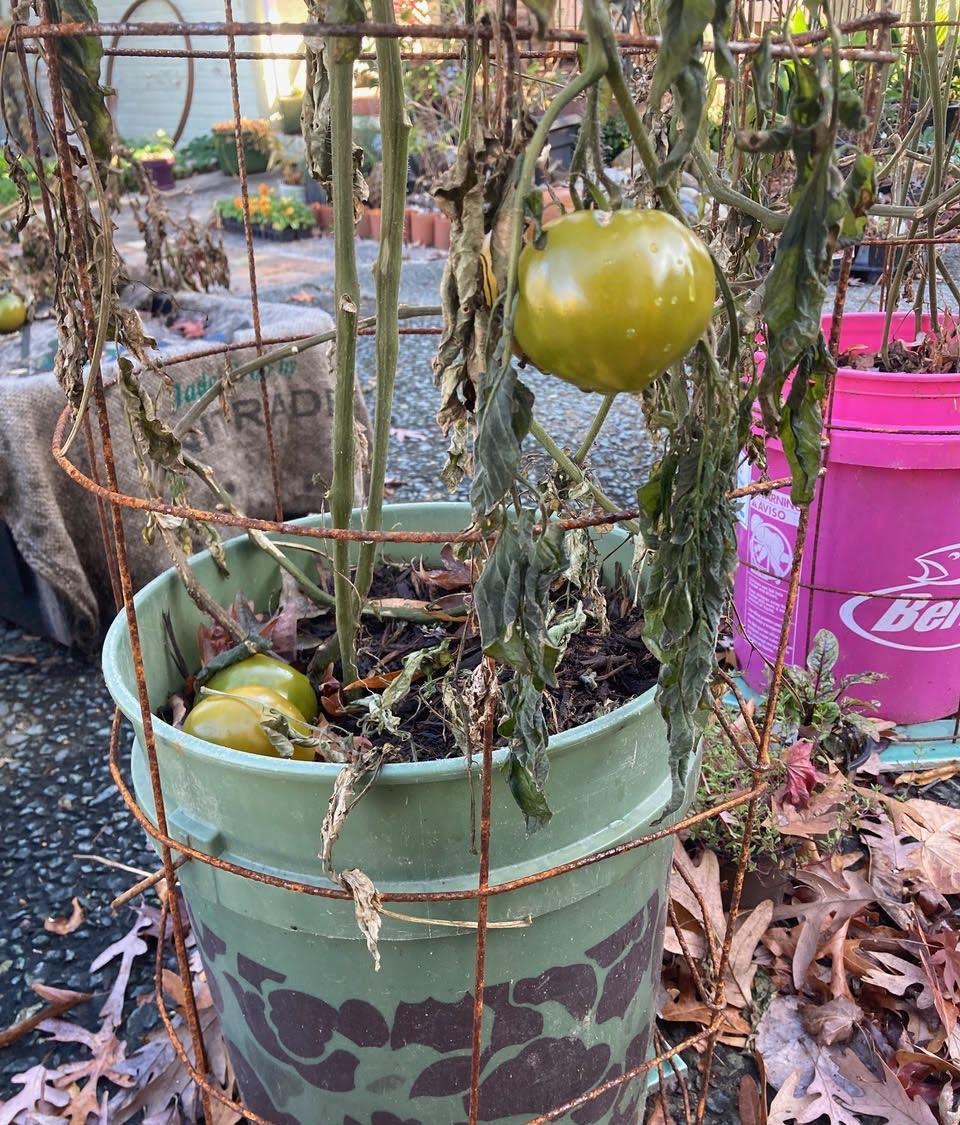
I didn’t do a good job of pruning out lower leaves on these tomatoes in buckets, so early blight easily spread from the transplants’ root ball to throughout the plant. Photo by Frank Hyman.
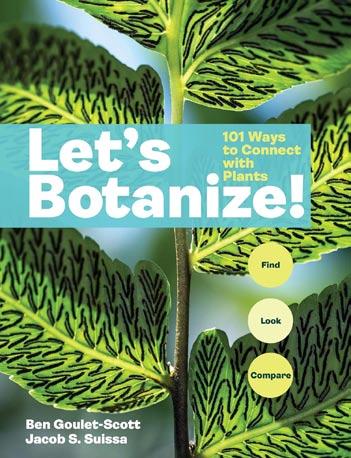
Let’s Botanize! 101 Ways to Connect with Plants
Authors: Ben Goulet-Scott, PhD and Jacob S. Suissa, PhD
Publisher: Storey Publishing
List Price: $19.99
Order Links: https://amzn.to/4trfH4c and https://bookshop.org/ a/79479/9781635869040
Reviewer: Aicha Bangoura
Let’s Botanize! by Ben Goulet-Scott and Jacob S. Suissa is dedicated to guiding individuals about ways to connect with plants.
The book starts off with answering the critical question of “What’s botanizing?” As Goulet-Scott and Suissa explain, the practice of botanizing allows you to interact with biodiversity by finding, looking at, and comparing, plants and their parts. The way botanizing is described in the book does not seem complicated, especially if you aren’t a stranger to the outdoors.
The authors argue that there’s a good chance that we are more familiar with plant life than we realize. If this process sounds too mystifying by this point, Goulet-Scott and Suissa say that we do not need to focus on identification of plants at all, which is quite a relief because it would be a years-long journey for me to memorize every plant by their particular class.
The book is organized into three sections: parts, patterns, and perspectives, for each of which the authors provide a brief description early in the book. Every plant mentioned includes their common and Latin name, which I found
very useful. The discussion of leaf veins was particularly enlightening. I would never have realized how much plants possess human qualities.
Goulet-Scott and Suissa’s instructions are straight to the point and don’t leave you puzzled.
In addition to Goulet-Scott and Suissa’s directions, they also pose questions that make you stop and think while you’re botanizing.
If plants themselves don’t sound very worthwhile to study, Goulet-Scott and Suissa also educate readers regarding the fruits produced from the blooms.
I found the information I learned about seed development valuable because I was not aware of how it affects fruits.
The book contains images of various plants and fruits that you could find in numerous areas. If you appreciate visuals, the close-ups from the book are quite satisfying.
As someone who likes to challenge themselves at times, I got a lot of motivation to get out there and examine every feature of living organisms. This book is practically a scavenger hunt. You are given a task and have the free will to go on an adventure.
It’s incredible the amount of detailed information Goulet-Scott and Suissa provide about the biology of plants. Reading about what happens after you blow on a dandelion was fascinating. As a child, I thought dandelions were like candles and could make my dreams come true, but you’d be surprised at the benefits that act could bring to the plant.
Whether you’re a gardener, scientist, or just a person who’s curious about the anatomy of plants, you might find this book useful.
Goulet-Scott and Suissa’s steps let you stay in the moment and immersed in the beauty of our ecosystem, which many people might forget to do in their daily lives. I recommend this book for those who are interested in spending more time in nature and examining plants. o
Aicha Bangoura is an intern this semester with Washington Gardener Magazine. She is a senior studying journalism in the Philip Merrill College at the University of Maryland.
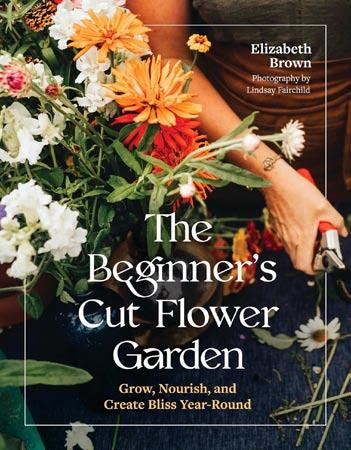
The Beginner’s Cut Flower Garden: Grow, Nourish, and Create Bliss YearRound
Author: Elizabeth Brown
Publisher: Timber Press
List Price: $35.00
Order Links: https://amzn.to/4f3lbOP and https://bookshop.org/ a/79479/9781643265018
Reviewer: Lauren Bentley
Elizabeth Brown’s The Beginner’s Cut Flower Garden gives a comprehensive overview of everything that goes into creating your own cut flower garden, from start to finish.
Brown is a certified therapeutic horticulturist, whose perspective on gardening and planting will make anyone believe they can tackle a garden of their own. Brown starts the book with an introduction on how she became a gardener. “Before the chaos and isolation of 2020, I had been slowly learning how to tend to a garden for years,” she wrote. “I was overwhelmed by my lack of knowledge, my inability to differentiate between weed and flower, and the nagging line of thought that there were so many other things I should be doing.”
However, Brown ended up finding time during the pandemic to finally give her garden the attention she wanted. She approached the garden with a new mindset, and her fear turned into excitement, she said.
When the summer rolled around, Brown said she continuously thought of An Island Garden by Celia Thaxter, a gardening book that her grandmother
kept in the living room. That type of connection inspired her. “Some sort of bond had been born in the soil, between two women who had never met, but shared the same love of art and flowers, one hundred years apart,” she wrote.
The connection and passion gardening can help form is where this book truly shines. Brown balances practical skills of how to build a garden, but she also talks a lot about what a garden means beyond the plot, with every flower’s intention and meaning.
The book is centered around the precise steps of building your own garden, divided by seasons. The first section, “Winter,” covers how to find flower inspiration with tips like discovering your growing zone, finding gardeners who work in a similar climate, and creating a photo album.
As a beginner gardener myself, steps like these make planting flowers feel much more approachable and organized. Brown also gives her flower recommendations, combining her expertise with a personal touch, perfect for a first-time flower grower.
However, Brown also ensures that the necessities, like starting your own seeds and soil blocking, are still thoroughly covered.
The second section, “Spring,” is where more of the garden work comes in. She starts off with what basic garden supplies a beginner would need and provides an explanation of each. Brown also covers tips for building a watering plan and determining soil needs, among many other things.
The attention to detail highlights another strength of this book, which is that no step is left out. Anytime I found myself with a follow-up question or needing clarification, I turned the page and got it answered. It’s clear that Brown put a lot of effort into considering exactly what instruction her audience would need.
The other two sections solidify her efforts even further. The “Summer” section goes over the harvesting and design of flowers, with detail about color palettes, sourcing vessels, and even designing in darkness.
The final “Autumn” section combines her love of gardening with tradition, as
she covers how to press and dry flowers to decorate the house and create wreaths. Brown also discusses cleaning garden tools and closing your garden.
Her book ends with a reflection about how to take notes from the year into a new gardening cycle.
Brown’s book serves as a reminder of the happiness and accomplishment a garden can bring anyone, even if you’ve never tried before. “The dreaming state of the garden is sure to create big, swirling bands of color, even in the darkest of nights,” she says in her reflection.
The book is geared toward beginners, but I believe a gardener at any stage could learn something from Brown’s approach and wisdom o
Lauren Bentley is an intern this semester with Washington Gardener Magazine.
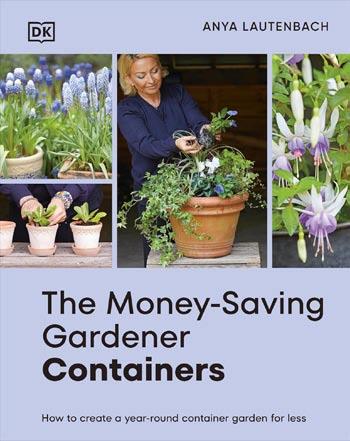
The Money-Saving Gardener— Containers: How to Create a Yearround Container Garden for Less Author: Anya Lautenbach
Publisher: DK Publishing List Price: $35.00
Order Links: https://amzn.to/48GFPQS and https://bookshop.org/ a/79479/9798217133758
Reviewer: Marsha Douma
The Money-Saving Gardener
Containers is the third in the author’s series of money-saving ways to garden. Her previous two books were The Money- Saving Gardener and The Money-Saving Garden Year Collectively, these books give clear and easy-to-follow instructions about how to garden inexpensively while still creating inspiring gardens, throughout the year, whether in a yard, on balconies, decks, by the side of a house, or indoors. She uses her indomitable energy and love of plants to try to inspire and connect all of us to the greater natural world in an organized and straightforward fashion, hoping to break down whatever barriers might be stopping someone from the joys of gardening. Her personal commitment to gardening was deepened and became the balm that helped her through a difficult time in her family’s life when serious health issues arose.
As a self-taught gardener, the author has a keen understanding of how
elaborate information can confuse and discourage someone from gardening. She shows that the opposite is also true: Simplifying how to do things can be very liberating for those who would otherwise be hesitant.
“My mission is to show you how to create amazing displays of potted plants, no matter the size or location of your outdoor space or your budget, to bring you happiness every day of the year.Pots are like little gardens that anyone can own…,” she writes.
There are two ways to save money. Chapter One is about the considerations in choosing the container. She encourages the reader to repurpose containers they may already have, such as old colanders, teapots, wooden crates, boots, leather bags, discarded pots, tin cans, cake pans, etc., plus vigilantly shopping at second-hand stores for bargains. Since different kinds of containers function differently, the author explains the importance of matching the plants with the peculiarities of a specific kind of container. For example, a porous container will keep the soil drier for longer. This is an advantage for a cactus-type plant. For a plant that prefers moist soil, it will mean more frequent watering compared to a plastic pot. While this may seem obvious to an experienced gardener, it is not necessarily obvious to a beginning gardener and could easily make the difference between being successful or not.
Book Reviews continued on page 23
Where the adorable desert rain frog reigns, where meerkats peek over the daisies, and cheetahs prowl, bright-green pearls creep across rocky terrain. Located in South Africa, the succulent karoo biome is home to more than 6,350 plant species. More than 2,400 of these plants are native to the area, including the aptly named “string of pearls.” It’s become quite the popular houseplant, and for good reason. The strange spherical leaves look like little peas, inching their way off the edge of the pot, and draping down like a beaded necklace.
These plants are just one of many beloved houseplants in the category of “strings.” String of pearls belongs to the daisy family, along with string of dolphins, bananas, watermelons, and rubies. Outside of the family, you’ll find the string of hearts and string of turtles.
String of pearls may be a bit odd for something related to daisies and chrysanthemums, but it has plenty of good reasons to grow the way it does. The succulent karoo biome is hot and sunny, meaning plants lose a lot of water through evaporation. As plants breathe in and out, tiny amounts of water vapor come out of the pores in their leaves and escape into the air. When water is relatively scarce to begin with and hot, sunny days speed up evaporation, plants need to get creative.
Succulents are able to store a whole lot more water in their leaves than the average plant, but string of pearls takes things a step further. Think of it like paint. If you were to paint a flat leaf shape on a canvas, it would dry a lot quicker than a round glob of paint. If both areas used the same exact amount of paint, the flatter area would still dry much faster. Leaves work the same way. Thick leaves don’t lose water nearly as fast as thin ones. Of all the leaf shapes, a sphere would dry the slowest.
This fun bouncy-ball shape comes with a trade-off. Solar panels are flat for a reason, right? We don’t make solar spheres, because they wouldn’t get nearly as much sun. Luckily, string of pearls comes with a clever solution to this problem: a clear slitshaped window known as a fenestration, one for each leaf. This allows light to reach the inside of the leaf, where extra chlorophyll is able to help capture additional sunlight. (String of pearls isn’t the only plant with fenestrations: haworthia, baby toes, and living
How Not to Kill a String of Pearls
By Savannah Scollar
stones have evolved this same adaptation.) Now, don’t confuse this for a different type of fenestration: the holes you’d find in a monstera leaf. Confusingly, that’s an entirely different adaptation with an entirely different purpose; just the same name.
It may surprise you to learn that in nature, string of pearls does not let its leaves dangle freely, the way you’d see the plant grow in a hanging basket. It’s a creeper. Wherever the plant touches the soil, it’ll try to send down new roots. One plant will be rooted in many places. This means that if one set of delicate shallow roots get damaged, the plant has plenty of backups to keep on keeping on.
This explains why, as a houseplant, it can be considered a little tricky. We aren’t letting it do its thing! When a huge string of pearls relies on a single root system in one small area, it can easily find itself in trouble if conditions get too muddy. That doesn’t mean you can’t have your pearls in a beautiful hanging basket—it just means you’ll have to take some extra precautions.
Chunky soil is your best friend here: Adding lots of lava rock, pumice, and/or perlite will save room for the air the roots need in order to thrive. These materials don’t absorb nearly as much water as coco coir or peat moss. They stay partially dry, as little pockets of oxygen. Over time, this oxygen spreads through the rest of the soil, allowing the roots to breathe. This is important for any plant, but especially for succulents. Succulent roots rot a lot more easily than other plants when they can’t get enough air. Keep in mind, when you get a new plant, that if it hasn’t grown long stems and started hanging down from the pot, it probably hasn’t grown many roots yet, either. It’ll have a pretty low water demand. Do not soak the soil. Be gentle. Water it with, at most 1/4 as much water as there is soil (a rule I apply to almost any houseplant) and let it dry before you water it again.
For extra safety, I recommend using a shallow container to match the roots. Terra cotta saucers are absolutely perfect for this. You don’t even need to drill a hole, especially considering that the saucer itself is porous. Air is able to enter through the clay itself. So cool! Any shallow container will work, really, as long as the surface is about as big as your plant, or smaller.
Glass is always a favorite of mine because I can keep an eye on the roots. If you follow my watering rule, you won’t need any drainage. You don’t need any holes if there’s no excess water to drain out of them. I don’t like relying on holes anyways. Sometimes, with new plants that have small roots, the soil holds more water than the plant wants or needs. If you want a deeper container, you can find a shallow dish that’s the right size to perch inside of the deep container, creating a clever and practical illusion. Secretly,
the bottom of your pot is empty. All the soil is up top. When you use this strategy, a baby string of pearls plant can look cute in a mug or teacup.
For repotting, you’ll want to be careful not to break the roots too much. Be gentle. It’s ok to leave a tiny bit of the old soil on the roots. This reduces the amount the roots get damaged. You really won’t need to repot often at all. They can stay put for years. When it comes to propagation, the best strategy is a pretty silly one. You’ll want to put a new pot or saucer of soil next to your plant and drape the pearls onto it. If you keep the soil watered, they’ll eventually root into it. After that, you can cut the stem, separating the old plant from the new one. It really makes you feel like some sort of houseplant wizard.
Sometimes, as with any plant, you might run into issues. String of pearls can have leaves melt and turn into mush if the roots start decomposing. You’ll want to do a repot at this point. Those pearls are full of water and food for bacteria that wants to turn your plant into compost.
Don’t go crazy and disinfect or anything like that. Just get the healthy plant into a new, smaller shallow container with fresh soil, away from the parts that are sick. Remember to leave a tiny bit of soil on the roots so you don’t injure them too much. Roots have tiny microscopic hairs that they use for drinking. By letting a bit of the roots keep some of their original soil clinging to them, you can keep those hairs safe.
Sunlight isn’t something this plant is all that picky about. If it’s within a couple feet of a window, it should be happy. If you choose the variegated form of this plant and give it lots of sun, you might see the white areas turn pink. This is the plant’s natural defense against excess sunlight. Technically, the plant is stressed, but it’s handling things and looking pretty cute while doing it.
Occasionally, you might see your plant bloom with little daisy-like flowers. At this point, it starts making a bit more sense that this plant is a part of the daisy family. Eventually, these flowers turn into pom-poms of fluffy-headed seeds. These seeds aren’t very good for planting. They need to be planted pretty quickly after they’re ready and they grow slowly, so I recommend the propagation technique that I described earlier.
If you’re eager to try a string of pearls out, and you’re looking to support a local shop, you can get your own string of pearls for $6 at Easy Little Plants in Olney, MD. It’s my shop, so come say, “Hi!” o
Savannah Scollar opened Easy Little Plants (easylittleplants.com), a houseplant shop in Olney, MD, in July 2023. She loves doing research, teaching private workshops, decorating with houseplants, and arranging adorable terrariums
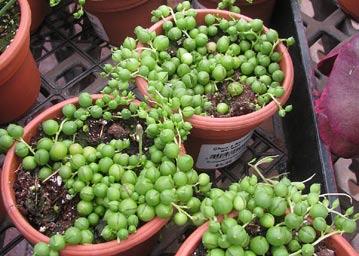
Senecio rowleyanus potted. Photo by Flickr user Forest and Kim Starr, CC BY 2.0, via Wikimedia Commons.
Book Reviews continued from page 21
The author also explains all the other details to be considered when gardening with containers. For example, for balconies, the pots shouldn’t be too heavy. The sunlight the plant needs has to match the amount of sun available. Right spot—right plant is always true. For all containers, drainage holes need to be drilled in the bottom. Is this possible? If the container is going to be placed on the ground, is there drainage under the pot? Wherever it is going to sit, will that drainage damage the surface it is on, or do remediation steps need to be taken? Chapter 1 also gives basic suggestions about how to make the display of flowers look good in the pot.
Chapter 2 is a detailed discussion of the various ways to propagate more plants for free or using very little money. There are instructions about how to take cuttings from soft wood, semi-ripe wood, hardwood, leaves; putting the cuttings in water; planting seeds; and looking for volunteer plants, which are always a welcome free gift. She also explains how easily shrubs such as hydrangeas can be propagated and how useful many shrubs can be even for containers. Growing typically large plants in pots is possible because the container will restrict how large a shrub can become—think about how bonsai are able to grow.
Subsequent chapters explain the different soil mixtures that are needed depending on the plant selection to help ensure the plants will grow optimally. An additional advantage of containers is they can provide year-round plant interest to a regular garden or a patio by choosing plants that have evergreen foliage, flowers, and interesting seed heads, such as various carex plants, fleabane, coneflowers, and asters. She also gives suggestions for growing a multitude of vegetables, such as cucumbers, blueberries, strawberries, tomatoes, lettuce, chili peppers. and zucchini in containers.
Also included is information about how to select and grow plants for fragrance or to highlight the difference seasons. Plus, there are instructions about how to anchor climbing plants such as clematis and sweet peas in
containers to position them to grow up walls.
For a beginning gardener wanting to start their gardening journey by using containers, this is an excellent source of information, but there is useful information here for even the advanced gardener.
The “Container Plant Propagation Guide” of 146 plants at the end of the book is a useful reference for any gardener, as are the clear, detailed descriptions of the various plant propagation techniques, enabling any gardener to increase their supply of plants almost cost-free. o
Marsha Douma is a retired dentist and lifelong gardener who also enjoys swimming and playing the piano. She lives in Rockville, MD.
Note: The books for these reviews were provided free from their publishers. These book reviews include links to Amazon.com and BookShop.org for ordering them. Washington Gardener Magazine might receive a few cents from each order placed after you click on these links.
Love Reading?
These books were reviewed by volunteer members of the Washington Gardener Reader Panel. Reader Panelists may also be asked to review new gardening plants, tools, and seeds.
To join the Washington Gardener Volunteer Reader Panel, send an email with your name and address to: KathyJentz@gmail.com. We look forward to having you be a vital part of our local publication and its gardening mission o
Your Ad Here
you trying to reach thousands of gardeners in the greater DC region/MidAtlantic area? Washington Gardener Magazine goes out in the middle of every month. Contact kathyjentz@gmail.com or call 301.588.6894 for ad rates (starting from $200). The ad deadline is the 10th of each month. Please submit your ad directly to: kathyjentz@gmail.com
Got a Garden Question?
Please also include your first name, last initial, and what city and state you are writing from. Then look for your answered questions in upcoming issues.
Please tell them you saw their ad in
Jentz Prints
Antique Botanical Prints for the decorator, collector, connoisseur, and art lover.
Jentz Prints can be purchased at the world-famous Eastern Market on non-rainy Saturdays.
Antique prints are affordable—most in the $10-$30 range—and they are the perfect gift idea for that plant lover in your life. And don’t forget to buy a few for yourself!
For more information or to get a detailed show schedule, please contact Jentz Prints by email at UllrichJ@aol.com.