g a rdener



Your Ad Here

Are you trying to reach thousands of gardeners in the greater DC region/Mid-Atlantic area? Washington Gardener Magazine goes out on the 15th of every month. Contact KathyJentz@gmail.com or call 301.588-6894 for ad rates (starting from $200) The ad deadline is the 10th of each month. Please submit your ad directly to: KathyJentz@gmail.com

Need a Garden Club Speaker?
Washington Gardener Magazine’s staff and writers are available to speak to groups and garden clubs in the DC region and ONLINE! Call 240.603.1461 or email KathyJentz@gmail.com for available dates, rates, and topics.

RARE AND EXCEPTIONAL PLANTS FOR THE
Barry Glick
Sunshine Farm and Gardens 696 Glicks Road Renick, WV 24966, USA Email: barry@sunfarm.com www.sunfarm.com

www.greenspring.org

Green Spring Gardens
A “must visit” for everyone in the metropolitan Washington, DC, area. It’s a year-round goldmine of information and inspiration for the home gardener. It’s an outdoor classroom for children and their families to learn about plants and wildlife. It’s also a museum, a national historic site that offers glimpses into a long, rich history with colonial origins. Located at 4603 Green Spring Rd., Alexandria, VA. Information: 703-642-5173.
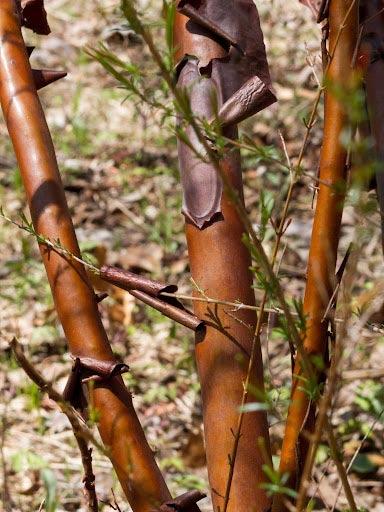
It has beautiful exfoliating bark . Photo by Miri Talabac.

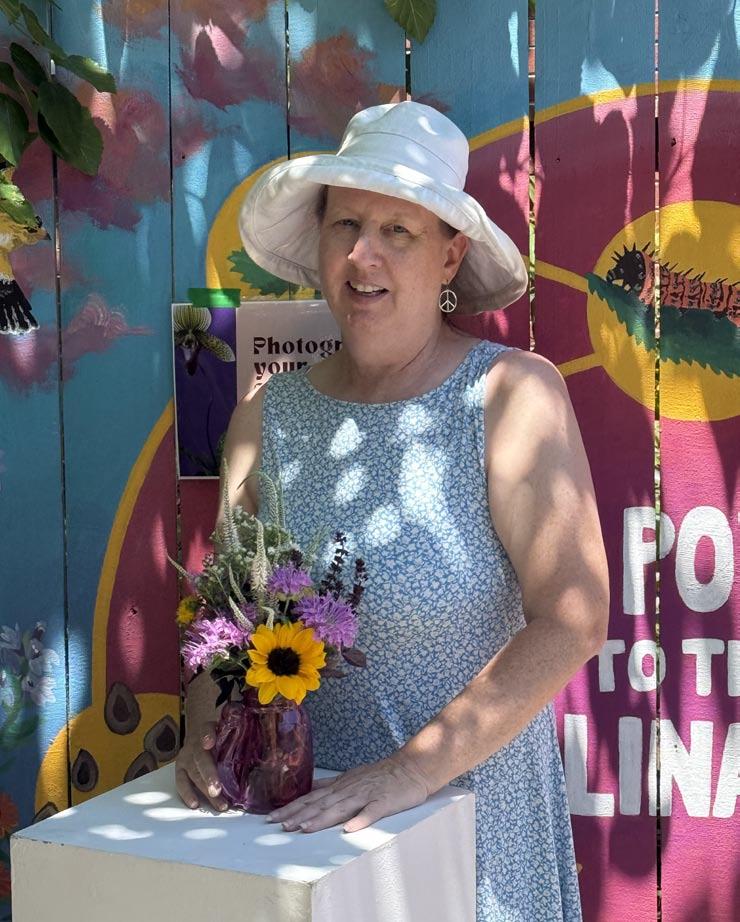
Playing with Flowers
Sometimes my job is really hard.* For instance, a few weeks ago, I signed up for the Flower Potluck at the Swamp Rose Co-Op in Silver Spring, MD. It took place on a hot summer Saturday morning and I really should have been spending that time putting the final edits on the GardenDC podcast episode going out that afternoon. Instead, I wanted to learn what a flower potluck entailed and check out the native plant nursery that was hosting it. Suffice to say, I had a wonderful morning getting to know both local plant businesses, and they will each be profiled in our August issue by our summer interns. The podcast episode went up a few hours late that day, but it was worth it.

Sincerely, Kathy Jentz, Editor/Publisher, Washington Gardener, KathyJentz@gmail.com
*Okay, it was not that hard of a sacrifice. Playing with flowers is always a pleasure. Pictured here is the bouquet I created that morning.
Credits
Kathy Jentz Editor/Publisher
Washington Gardener 826 Philadelphia Ave. Silver Spring, MD 20910 Phone: 301-588-6894
kathyjentz@gmail.com www.washingtongardener.com
Ruth E. Thaler-Carter Proofreader
Maya Hand Koree Perry Interns
Subscription: $20.00
• Washington Gardener Blog: www.washingtongardener.blogspot.com
• Washington Gardener Archives: http://issuu.com/washingtongardener
• Washington Gardener Discussion Group: https://groups.google.com/g/ washingtongardener/
• Washington Gardener Twitter Feed: www.twitter.com/WDCGardener
• Washington Gardener Instagram: www.instagram.com/wdcgardener
• Washington Gardener Facebook Page: https://www.facebook.com/ WashingtonGardenerMagazine/
• Washington Gardener YouTube: www.youtube.com/ washingtongardenermagazine
• Washington Gardener Amazon Store: www.amazon.com/shop/wdcgardener
• Washington Gardener BookShop: bookshop.org/shop/WDCgardener
• Washington Gardener Podcast: https://podcasters.spotify.com/pod/ show/gardendc/
• Washington Gardener is a woman-owned business We are proud to be members of:
· GardenComm (formerly GWA: The Association for Garden Communicators)
· Green America Business Network
· National Garden Bureau
· One Montgomery Green
· Ladies in the Landscape
· Potomac Rose Society
· American Horticultural Society
· Maryland Nursery, Landscape and Greenhouse Association
Volume 21, Number 5 ISSN 1555-8959
© 2026 Washington Gardener
All rights reserved. Published monthly.
No material may be reproduced without prior written permission. This magazine is purchased by the buyer with the understanding that the information presented is from various sources from which there can be no warranty or responsibility by the publisher as to legality, completeness, or technical accuracy.
Your editor at the Flower Potluck at the Swamp Rose Co-Op in Silver Spring, MD. Photo by Maddie Poore.
Reader Contest
For our July 2026 Washington Gardener Reader Contest, we are giving away a copy of Folium: A Gorgeous Compendium of Beautiful Leaves by Jeanne Batiste (prize value: $35, Publisher: Smith Street Books. Publish date: September 1, 2026).
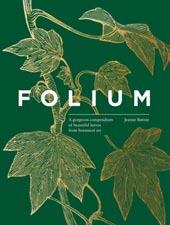
Folium is an exquisite treasury of beautiful foliage from botanical artists through the ages. Immerse yourself in the verdant textures, forms, and moods as each page unveils the majesty of trees and leaves through the eyes of artistic and scientific visionaries. This anthology celebrates the universal language of plants—symbols of life, endurance, and renewal—that have inspired and grounded the human spirit throughout history. This enchanting volume will grace your living space and transport you to a world where branches whisper stories and beauty takes root through time. The author, Jeanne Batiste, is a writer and plant obsessive who lives in London, near her favorite place in the entire world: Kew Gardens.
To enter to win the book, send an email by 5:00pm on Friday, July 31, to WashingtonGardenerMagazine@gmail.com with “Folium” in the Subject line. In the body of the email, tell us what your favorite article was in the July 2026 issue and why. Please include your full name and mailing address. Winners will be announced and notified on August 1. Entry comments might be published. o
Your Ad Here
Are you trying to reach thousands of gardeners in the greater DC region/MidAtlantic area? Washington Gardener Magazine goes out in the middle of every month. Contact KathyJentz@gmail.com or call 301.588.6894 for ad rates (starting from $200). The ad deadline is the 5th of each month. Please submit your ad directly to: KathyJentz@gmail.com

Plant a Row for the Hungry (PAR) is an easy program to participate in and really does not take any extra resources than what you may have in your garden. In normal times, about 35 million people wonder where their next meal will come from. Most of these are children. That’s where PAR steps in.
PAR is such a simple program: It urges gardeners to Plant A Row (or a container) dedicated to feeding the hungry, and then take the harvest to someplace or someone that needs it. Once you have donated, send an email to KathyJentz@gmail.com with the total (in pounds and ounces) of what you gave. That is all there is to it. Easy. Effective. Adaptable and Helpful.
June 2026 issue
My favorite article in this issue was the NeighborNetwork interview with Joe Bozik at the Franciscan Monastery Garden Guild. I live in northeast DC and was a previous member of the Garden Guild as a tour guide for a short period. I like reading about Joe’s career transition (after engineering) and his connection to and love for gardening and bees at the Monastery. I do not know Joe, but look forward to catching him on the grounds one day.
As always, a lovely and informative issue.
~ Dawn Ellis, Washington, DC o
Note: The books reviewed in this issue were provided free from their publishers. These book reviews include links to Amazon.com and BookShop.org for ordering them. Washington Gardener Magazine might receive a few cents from each order placed after you click on these links.

Love Reading?
These books were reviewed by volunteer members of the Washington Gardener Reader Panel. Reader Panelists may also be asked to review new gardening plants, tools, and seeds. To join the Washington Gardener Volunteer Reader Panel, send an email with your name and address to: KathyJentz@gmail.com. We look forward to having you be a vital part of our local publication and its gardening mission. o
Ashley Coates Bishop’s Garden at the Washington National Cathedral
By Koree Perry
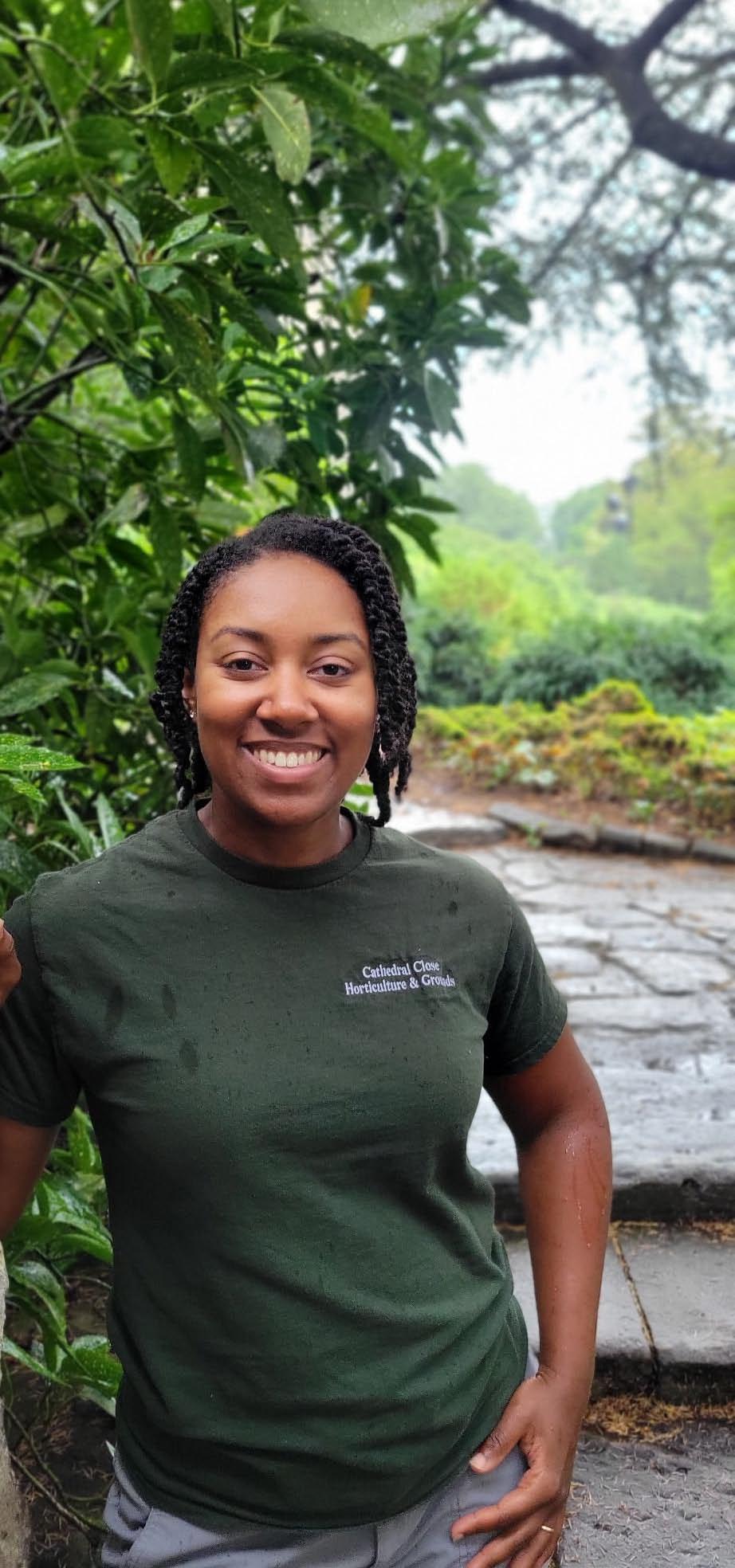
Ashley Coates oversees the Bishop’s Garden at Washington National Cathedral in Washington, DC. Starting out with a garden at her parents’ house and a love for the environment, Coates received her bachelor’s degree in environmental science from Bridgewater College before moving on to obtain her master’s in landscape architecture at Virginia Tech.
Tell our readers a bit about you and your background, and how you first became interested in horticulture and gardening.
I entered the field of horticulture through vegetable gardening and an interest in the environment. When I was in high school, I started a little vegetable garden in my parent’s backyard, growing cucumbers, radishes, shelling peas, and marigolds. I found the field of landscape architecture while researching jobs that fit my interests and desires. It seemed like a nice mixture of working outside and design.
While I was finishing my undergraduate degree, I found internships that helped me learn more about gardening and working in the landscape. That is how I began working in the Bishop’s Garden at the Washington National Cathedral; I started as an intern. After trying a few different positions in the landscape architecture and horticulture fields, I’ve found myself working in the Bishop’s Garden once again.
As for my educational background, I have a B.S. in environmental science with a minor in art from Bridgewater College, and a master’s in landscape architecture from Virginia Tech.
What are your fondest memories of Washington National Cathedral?
My fondest memories of the Washington National Cathedral are when I get to work with the other horticulture and grounds staff members on projects. There are 16 staff members for the almost 60 acres of the National Cathedral Close. Most of the time, the horticulture staff members are working individually in their zones while the turf team is mowing lawn and managing the sports fields. It’s nice to get to spend time with team members I don’t normally get to work with.
There is a lot of camaraderie between us, especially when it comes to mulching the Beauvoir playground or shoveling snow in the winter.
Can you walk us through a full day of your responsibilities and duties at the Cathedral? (What does a normal day of work look like to you?)
A normal day for me begins in our facilities building. I make sure I have my Rite in the Rain® notebook, water, hand tools, and summer interns before driving to the Bishop’s Garden.
On my way to the Bishop’s Garden, I stop at Open City Café to put liners in the trash cans, check the annual pot display, and look over the surrounding landscape. Then, I do my morning walk around the garden to check for anything that might be out of place and to get a feel for what area in the garden needs the most attention for the day. I also use this time to take photos of the garden and look at the layout of the beds for any changes that might need to be made. From there, I gather the appropriate tools and begin working. In the spring and early summer, my tasks are getting the beds weeded and ready for mulch, then mulching, and planting. During mid- to late summer, I am spending more time watering and weeding. Late summer and fall bring another round of planting. This is when we put new bulbs and plants in the Sundial bed for the spring display. I tend to spend much more time inside during the winter, but there is plenty of pruning to do in the garden.
What are some challenges that come with maintaining the Cathedral grounds throughout the seasons or in general?
One of the biggest challenges about working on the cathedral grounds is that there are always people around. The cathedral grounds are made up of Beauvoir Elementary School, National Cathedral School, St. Albans School, the Washington National Cathedral, St. Alban’s Parish, the Bishop’s Garden, five acres of native woodland (Olmsted Woods), Open City Café, and a few private residences. When school is not in session, there are summer camps at the schools and on their respec-
tive sports fields. There are only a few weeks a year when the horticulture and grounds staff can complete large or messy projects.
What role do you think gardens and green spaces play in a city like Washington DC?
Green spaces play a huge role in giving people space to rest and relax outside in the city. It is not uncommon to walk into the Bishop’s Garden or across the front of the National Cathedral and see people lounging on the benches reading a book or relaxing in the grass with their lunch and some friends.
There are lots of people who live in the neighborhood and walk through the garden many times a week. Many of them and others always mention how much of a respite the grounds are in such a bustling city.
Do you garden for yourself? If so, what do you like to grow?
I do garden outside of work. I have a little community garden plot where I continue to build my skills in vegetable growing. I also have some space in my backyard where I am trying my hand at cut flowers this year since the squirrels keep eating any vegetables I try to grow.
What advice would you give to beginners gardeners in the greater DC area?
My advice to beginners is to just get started. The best way to learn how to grow things (ornamentals or edibles) is to just get started and be observant. I find that people get caught up in being too precise in how to keep their plants alive. Most plants are pretty forgiving about their living conditions. Don’t be afraid to kill plants, either. It can be the best way to learn.
What do you do when not working?
I spend time gardening, working out, hanging with my husband, or training my dog.
Anything else you want to add or think would be of interest to our magazine readers about yourself or your work?
Ashley: There are a few things that
I would like to highlight about the Cathedral Close.
There are three opportunities during the week to volunteer on the grounds and in the gardens. If any of your readers are interested in volunteering during the week, reach out to me by email to Acoates@cathedral.org.
We also have summer internships for horticulture and sport turf. The positions are generally posted around January 1 each year on the Protestant Episcopal Cathedral Foundation website (www.pecf.org/employment).
The last thing I would like to highlight is our friends’ group, All Hallows Guild (https://allhallowsguild.org/). There are many ways to volunteer and become involved with the Cathedral Close, and one of those ways is through the All Hallows Guild. o
Koree Perry is an intern with Washington Gardener Magazine this summer 2026 session and is a Baltimore native
The Washington National Cathedral is at 3101 Wisconsin Ave. NW, Washington, DC. The cathedral’s grounds are open daily from dawn to dusk.
The Bishop’s Garden is filled with a variety of colorful plant life and artifacts of historical interest. It was designed by Frederick Law Olmsted, Jr. and later updated by landscape designers such as Florence Brown Bratenahl. The design is inspired by medieval walled gardens. The terraced landscape features artwork nestled amid plants of historical interest, native plants, and plants of the Bible and Christian legends.
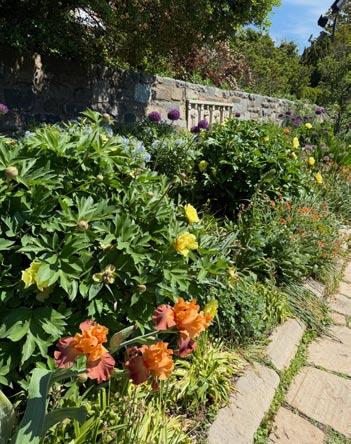
Tips for Transforming a Patio, Balcony, or Deck into an Outdoor Oasis
By Melinda Myers
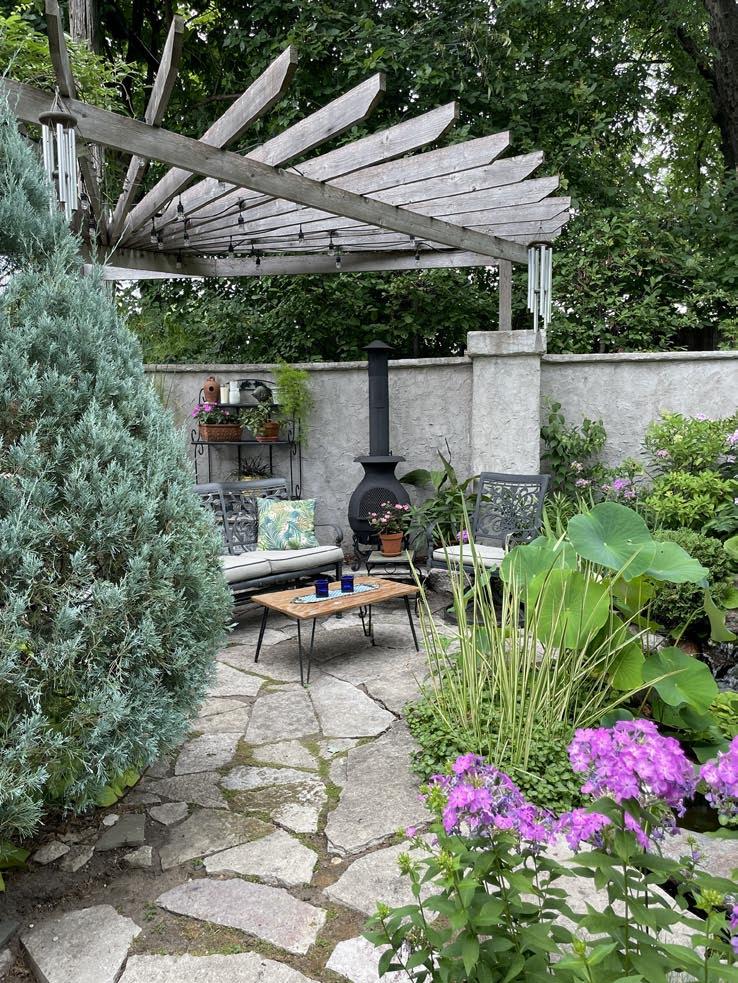
You don’t need much space to create a bit of paradise on your balcony, patio, or deck. Fill the space with a collection of plants that provide texture, color, and privacy. Then add comfortable seating, a fountain, and lighting for additional ambiance and relaxation.
Start by evaluating the space you want to transform and how the surrounding views and noise will affect your enjoyment. Before enclosing the whole space, identify the views you need to screen and those you want to keep. Perhaps a view of your favorite flower garden, the park across the street, or your neighbor’s water feature extends your enjoyment beyond the limits of your garden oasis.
Use tall grasses, large tropical plants, vines trained on trellises, and upright
shrubs and trees to define the space. These can be grown in weather-proof containers if no in-ground planting space is available. Just make sure your balcony or deck can handle the weight of the planters once filled with soil and plants.
Select plants that provide multiple benefits. Look for plants that deliver several seasons of beauty with flowers, colorful foliage, seedheads, and fall color. Include fragrant plants for aromatherapy and those that attract butterflies and hummingbirds to add motion and color.
Decide how you plan to use the space. Are you longing for a quiet area to relax and read, one to entertain, or a space to accommodate all your outdoor activities? Select furnishings with the
color, form, and style that will create your desired look and feel. Then select plants, containers, and accessories that complement the furnishings for your outdoor oasis.
Add a stand-alone or wall-mounted fountain or container water garden to the space. The sound of moving water helps create a sense of peace and relaxation, calming the mind, reviving the spirit, and masking noise pollution.
No need to worry about mosquitoes taking residency in your water feature. Moving water is less appealing and adding an organic product like Summit® Mosquito Dunks® to water features prevents mosquitoes from breeding there. Just toss this donut-shaped cake of Bacillus thuringiensis israelensis (Bti) into the water. This naturally occurring bacteria only kills the mosquito larvae and doesn’t harm people, pets, fish, or wildlife.
Further reduce mosquito problems by lighting a few citronella candles and placing them near you and others enjoying the space. Use a fan to help keep you cool and the weak-flying mosquitoes away.
Extend your enjoyment into the evening with some lighting. Be mindful of birds and night-flying insects by using shields to point light down to the ground instead of up into the night sky. Select lights with lower lumens that aren’t as bright but still provide sufficient light and ambiance for you. Avoid white and blue light; opt for amber and yellowgreens that are less disruptive to birds and night-flying pollinators.
Like any decorating or gardening project, be ready to make needed adjustments. While fine-tuning your design, be sure to take time to relax and enjoy your new space. o
Melinda Myers has written more than 20 gardening books, including Midwest Gardener’s Handbook, 2nd Edition and Small Space Gardening She hosts The Great Courses “How to Grow Anything” instant video and DVD series, and the nationally syndicated Melinda’s Garden Moment radio program. Myers is a columnist and contributing editor for Birds & Blooms magazine and was commissioned by Summit for her expertise in writing this article. Her website is www.MelindaMyers. com.
Pictured Above: A patio transformed into an outdoor oasis and entertainment area.
Photo courtesy of MelindaMyers.com.
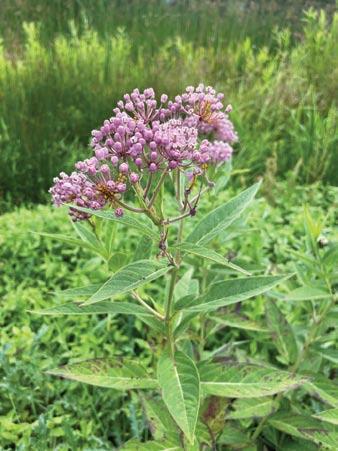
The Buzz in the Woods: Parasitic Native Plants
By Barry Glick
At almost 4,000 feet above sea level, silence is a rarity when strolling through the woods up here. Between the pollinators buzzing around your head, the wind rustling through the trees, and the crackling of dried leaves under your feet, it’s a real symphony of sound. However, there’s another sound, probably a deafening sound, if we could hear it, being produced underground.
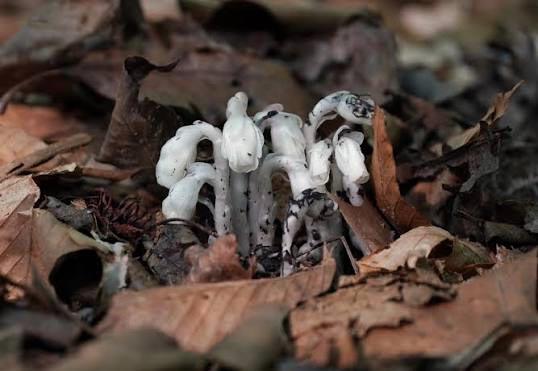
What made me aware of this, was answering questions about Ghost Pipes (Monotropa uniflora), a parasitic plant that doesn’t look like a plant. The only facts that I could accurately report to my questioners were that it’s a plant, not a mushroom or some other type of fungi and you’re not going to believe it, but it’s in the same plant family as Rhododendron and Azaleas and it produces seeds!
Well, “digging” in a little deeper on the good old World Wide Web (WWW, as we know it), I found that there’s another WWW. This similar acronym stands for the “Wood Wide Web.” This being an entity that conceptualizes trees being connected to each other by a network of underground mycorrhizal fungi. Monotropa uniflora and similar “plants” are part of this extensive network and are referred to as “mycotrophic wildflowers.” All of the “green” plants that we’re familiar with are “autotrophic,” meaning that they make their own food.
Monotropa cannot photosynthesize its own food because it lacks the lifeblood of photosynthesis: chlorophyll. It gets its nutrients from the hyphae or threadlike structures underground connecting the trees. Among other chores, mushrooms and plants like Monotropa are the fruiting bodies or “flowers and fruiting bodies” of the hyphae.
There are many other parasitic plants in the woods here in Greenbrier County, WV. “Beech-drops” are parasitic plants that are only found growing off the nutrients of one particular tree species, American Beech (Fagus grandiflora) The roots of the Beech tree secrete chemicals in the soil that trigger the germination of Beech-Drop seeds. Again as with Monotropa, Beech-Drops have no chlorophyll and get all of their nutrients from the roots of the Beech tree.
Another interesting phenomenon is “partially” parasitic plants. I came upon a brilliant-yellow Foxglove-like flower a couple years ago while hiking with a knowledgeable old-timer. True Foxglove is a genus of plants in the “figwort” family. They make great cut-flower plants because they hold up well in a vase. The heart medication Digoxin is made from two species in the genus: Digitalis purpurea and Digitalis lanata. The plant we stumbled on was Gerardia laevigata, now known as Aureolaria laevigata. My friend, Fred Fromheart, said, “Here’s one that you can’t take
home and grow in your flower garden, it’s a parasite.” Well, what a beautiful parasite it was!
Usually, the term “parasite” has a negative connotation, but this beautiful flower shattered that norm. He told me that it is parasitic only on Oak tree roots. Reading up on the plant, I had to chuckle over the two common names: Appalachian Oak-Leach and Entireleaf Yellow False Foxglove.
I read that partially parasitic plants grow on the roots of other plants to siphon water and nitrogen while using photosynthesis to produce their own sugars. I dug a few up and planted them on the roots of a Red Oak in the woods on my farm and they failed to take.
One of the most famous, best-known parasitic plants is Phoradendron leucarpum, a plant that we know as Mistletoe. It’s native to our region. Who could forget that charming scene where Jimmy Stewart kissed Donna Reed under the Mistletoe in the 1946 Classic Frank Capra holiday film, “It’s a Wonderful Life”? Romance under a parasite!
There are many other fantastically interesting parasitic plants here in the Mid-Atlantic USA. Just get out in the woods and see what you can identify. It’s fun, and the hiking will do you some good. o
Barry Glick, a transplanted Philadelphian, has been residing in Greenbrier County, WV, since 1972. His mountaintop garden and nursery is a mecca for gardeners from virtually every country in the world. He writes and lectures extensively about native plants and Hellebores, his two main specialties, and welcomes visitors with advance notice. He can be reached at barry@sunfarm.com, www.sunfarm.com, or 304.497.2208.
Your Ad Here
Are you trying to reach thousands of gardeners in the greater DC region/ Mid-Atlantic area? Washington Gardener Magazine goes out in the middle of every month. Contact kathyjentz@gmail.com or call 301.588.6894 for ad rates (starting from $200).
The ad deadline is the 10th of each month. Please submit your ad directly to: kathyjentz@gmail.com
Keep Lawn Mower Safety in Mind this Summer
With summer and lawn-mowing season in full swing, the Outdoor Power Equipment Institute (OPEI) reminds everyone to keep safety in mind when using lawn mowers, trimmers, chainsaws, and other lawn and yard gear.
“We all want our yards looking topnotch for picnics, parties, and relaxing, but remember to learn the safety features and adopt safe practices when using your mower and other outdoor power equipment. Follow manufacturers’ guidance. It sounds basic, but it’s important,” says Kris Kiser, president and CEO of OPEI, an international trade association representing outdoor power equipment, small engine, utility vehicle, golf car, and personal transport vehicle manufacturers and suppliers.
Get ready first:
• Walk your yard. Before mowing, scan the yard and remove rocks, sticks, toys, and any loose objects that get in the way of mowing and other equipment.
• Check terrain. Note any steep slopes, holes, or low-hanging branches so you can navigate them with care.
• Inspect and service equipment. Check oil and air filters. Look for damaged or missing parts.
• Read and follow the manufacturer’s owner’s manuals.
• Clean and store equipment properly. Wipe off dirt and debris and keep your equipment in a dry place.
Fuel up:
• Use fresh fuel. Never store equipment with fuel in the tank. Storing fuel in hot, humid conditions will make the fuel go stale more quickly.
• Always turn off the engine and allow the mower to cool completely before refilling the tank.
• Charge batteries using an appropriate charger, ideally the charger that came with your equipment, and follow the
manufacturer instructions, including how to store batteries properly. Use equipment safely:
• Never disable, modify, or remove safety devices.
• Always keep kids and pets away from operating equipment.
• Wear closed-toed shoes, long pants, safety glasses, and hearing protection.
• Use caution when mowing on slopes. For more safety information about outdoor power equipment, visit www. opei.org. o
DIY: Make Your Own Cut-Flower Bouquet
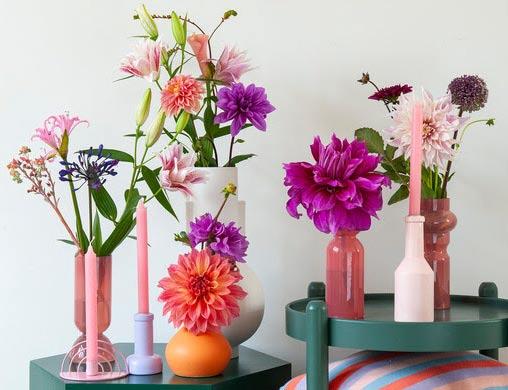
Cut-flower bouquets are wildly popular, and the great thing is that you can easily create them yourself. Add an instant splash of cheer by arranging a few different flowers loosely in a vase. It’s good for your wallet and has a personal touch; something that makes everyone happy!
With their variations in shapes and colors, bulb flowers are ideal for a cut bouquet. Consider dahlias, lilies, callas, and gladioli. Not only are these flowers beautiful, you only need a few of them to make a big impact.
A cut-flower bouquet has a casual look. You can combine a few types of flowers in one bouquet or put individual flowers together in different vases. In addition to your favorite bulb flowers, you can also add some wild grasses and small branches from your own garden. The simplicity and variation in shape and color give your budget-friendly bouquet a relaxed look. Make a cut-flower bouquet special by adding your own twist to it. For example, use flowers that have special meaning to you or experiment with your favorite color combinations. Have fun and good luck. For more information, visit www. flowerbulbs.com. o
Keep Your Orchids Happy All Summer Long
Now that the dog days of summer have arrived, have a plan to keep your orchids thriving. Here’s the secret: This elegant “centerpiece” plant is not a diva. Orchids are easy to keep alive and thriving. With proper care, orchids can live for many months, even years.
Westerlay Orchids in Carpinteria, California, knows a thing or two about orchid care. Hailing from Holland, this farming family produces more than 4.5 million orchids annually, using sustainable growing practices that ensure the highest quality.
Take it from Westerlay; this simple watering plan will keep orchids happy and healthy—with some summer tips added in for the season.
• Check to make sure your orchid is in bright, but indirect, light. Direct light can burn the leaves.
• Keep your orchid away from air conditioning. This rapidly can dry out your plant.
• Check the roots of your orchid. If the roots are green and the bark is dark and moist, watering can wait a few more days. If the roots look gray and the bark is dry, it’s time to water.
• Orchids typically only need watering about once a week, but increase watering to twice weekly if your plant is in direct sun or a hot part of your home.
• Pour water onto the bark in the watertight planter and let the water fill the container to the halfway mark
• Orchids are more active during the summer, so add balanced fertilizer to their water once a month. Orchids have minimal nutritional needs, so use only orchid-specific food and don’t overfeed.
• Let the orchid soak for at least 20 minutes or until the roots are green.
• Remove the orchid from the water and allow the roots to dry. You can pour out the remaining water from the container. Return the orchid to the decorative ceramic (or other container) and enjoy.
• Orchids don’t like direct sun—a humid climate with indirect light is ideal for a healthy plant. Leaf loss or withering leaves means there is too much light, causing the plant’s chlorophyll to deteriorate. A healthy orchid has dark-green leaves. o
Photo courtesy of www.flowerbulbs.com.
Photo courtes y of OPEI .
New Plant Spotlight
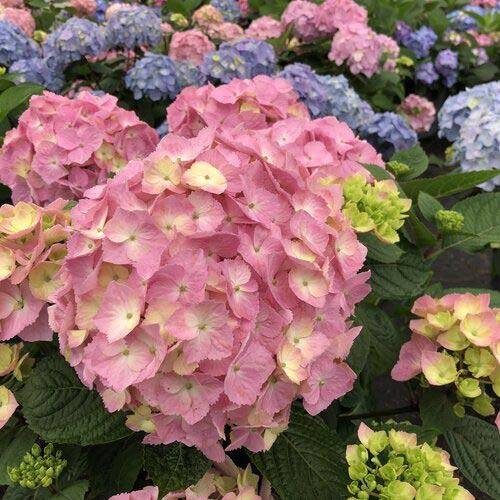
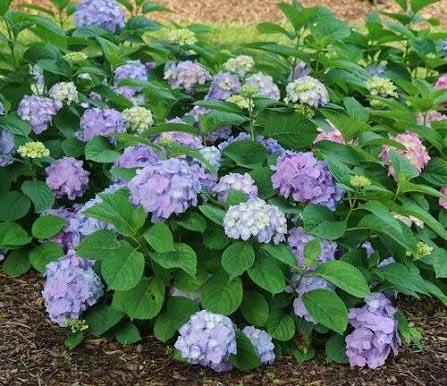
LET’S DANCE SKY VIEW®
Continuous Blooming Hydrangea
Hydrangea macrophylla × serrata
Let’s Dance Sky View hydrangea is unlike any other on the market. For one, it’s a continuous blooming hydrangea, not just a reblooming hydrangea, so not only will it give you more flowers, it will keep them coming all summer long instead of just late in the season.
Second, it has the unique ability to set flower buds on the entire length of its stem instead of just at the tips as others do. This means that even if your plant dies back to the ground from cold weather or is pruned, it will still flower.
Finally, it was selected for thick, glossy, high-quality foliage and an irresistibly tidy habit. It is hardy to USDA Hardiness Zones 4 to 9. It does best in full or part sun. It grows to 2 to 3 feet high and wide. Flowers are ethereal shades of sky blue, purple, and pink.
Find out more at https://www. provenwinnerscolorchoice.com/ o
Quick Links to Recent Washington Gardener Blog Posts
• In Defense of Okra
• Hot Enough for Ya?
• Love-in-a-Mist Plant Profile
See more Washington Gardener blog posts at WashingtonGardener.blogspot.com o
July Garden To-Do List
• The heat of summer is here. Time to start doing chores during early morning or evening. Take a break during the hottest parts of the day.
• Prune Wisteria.
• If your pond water gets low from prolonged drought, top it off with tap water and add a dechlorinator according to package instructions.
• Cut back spent stalks on common daylilies.
• Pinch back any annuals that may be growing leggy.
• Divide and cut back Bearded Iris.
• Check your pond pump for any debris—clean it out every few weeks.
• Weed.
• Cut off any yellowed foliage at the bottom of tomato plants.
• Stake and tie up any tall-growing perennials, such as phlox or delphiniums.
• Wash out birdbaths weekly with diluted bleach solution.
• Water thoroughly, especially if you receive no rain for more than seven days.
• Take cuttings from azaleas, boxwoods, and camellias to start new plants.
• Check your local garden center for mid-summer bargains.
• Hand-pick Japanese Beetles or shake them off over a bucket of dishwater. Early morning is a good time to catch them, while they are still drowsy.
• Re-pot the houseplants you’ve moved outdoors for the summer.
• Pick blueberries at a local pick-your-own farm or visit a local farmer’s market.
• Pinch back any straying strawberry runners.
• Deadhead perennials for a second flush of blooms later this summer.
• Thin out small trees and cut off any suckering branches growing from the bottom, below the root flare.
• Inspect your garden for powdery mildew. If seen, prune back perennials to create needed circulation.
• Annuals are now hitting their peak. Keep them well-watered and add a little liquid fertilizer every few weeks to keep them going through September.
• Check your plants at night with a flashlight for any night-feeding insects like slugs.
• If you find slug damage, set out beer traps or Sluggo pellets.
• Pinch back mums so they grow bushier and won’t flower until autumn.
• Hold off on planting new trees and shrubs until the summer heat has passed.
• Caulk and seal your outside walls to prevent insect entry into your home.
• Harvest regularly from your vegetable garden to prevent rot and waste.
• Put up a hammock or garden bench for enjoying your views.
• Turn compost pile.
• Check out gardening books from your local library to read on vacation.
• Check for any stagnant-water mosquito breeding grounds, especially your gutters. Dump out any water that sits stagnant for more than three days.
• Add Mosquito Dunks to any standing water in your yard, such as birdbaths, downspouts, plant saucers, and gutters.
• Gather roses to enjoy indoors—be sure to make the cut just above a five-leaf unit.
• Harvest onions when tops die back.
• Sow seeds of fall crops such as broccoli, turnips, cauliflower, etc., in late July. o
TOP AREA GARDENING EVENTS
Classes, Events, and Plant Shows/Sales
• Through September 5 Sculpture Garden Extended Hours
The National Gallery of Art has extended Sculpture Garden hours through the summer. The space will remain open until 8pm Wednesdays through Saturdays through September 5, excluding Fridays with scheduled Jazz in the Garden concerts. Admission is free.
A special Sculpture Garden Happy Hour menu offers food and drinks from 5–7pm on these extended-hour evenings. The Sculpture Garden features 22 large-scale works and provides a perfect backdrop for the after-work crowd to relax, eat, and socialize.
• July 16, August 20, & September 17 Extended Summer Evenings at USBG
The United States Botanic Garden (USBG) returns to special summer evening hours each third Thursday in June, July, August, and September of 2026. The garden will stay open until 8 pm for visitors to enjoy golden hour and sunset amid summer flowers and the USBG’s “America’s State Flowers: An America250 Celebration” exhibit along with live music. All areas of the Garden will stay open until 8pm on July 16, August 20, and September 17, 2026.
In partnership with the Friends of the U.S. Botanic Garden, local restauranteur Vintage Views will have lemonade, botanical non-alcoholic mocktails, and snacks available for purchase all the extended evenings. Local frozen treat vendor Here’s the Scoop will have ice cream and sorbet available for purchase. Live music will be offered beginning at 5pm. Entrance to the USBG is free and tickets are not required. Learn more and plan your visit at www.USBG. gov.
• July 18–19
2026 Kenilworth Annual Lotus & Water Lily Festival
Enjoy Kenilworth Aquatic Gardens in Washington, DC, with daily ranger-led talks, viewing of the lotus and waterlily blooms, crafting, and scavenger hunts. See more at https://kenaqgardens. org/.
• Sunday, July 19, 10am–12n
Garlic Festival
Held at the Takoma Park Farmers Market in Takoma Park, MD. Just-harvested and cured garlic is the star of the market and available for sale at vendor stands. It’s the perfect match to all of the market’s fresh seasonal produce. The event includes special guests Tony “The Garlic Guru” Sarmiento and Kathy Jentz, GardenDC Podcast host and Washington Gardener Magazine editor. Members of the Takoma Horticultural Club will also be on hand with gardening tips for the home gardener. Free and open to all.
• Wednesday, July 22, 10:30 am–12n Edible Flowers for Flavor and Health
Join Kathy Jentz, editor of Washington Gardener Magazine, at Brookside Gardens to discover the delicious world of edible flowers. Learn how common garden blooms and herbs can enhance recipes—from rose petal cocktails to calendula cream cheese—while offering health benefits and antioxidants. Explore more than 20 varieties you may already grow, plus exotic options for next season. Dried flowers and herbs will be provided for participants to take home. Fee: $50 or $45 for FOBG members. Register at ActiveMontgomery website https://montgomeryparks. org/events/edible-flowers-for-flavor-andhealth/.
• Thursday, July 29, 6:30–7:30 pm Fall Vegetable Garden Planning
Learn how to grow a productive fall vegetable garden, We’ll discuss what crops thrive in fall; how to plant them while the weather is still warm; and practical techniques for starting seeds, transplanting, and keeping plants healthy. Whether you’re new to gardening or looking to extend your harvest season, you’ll learn to grow vegetables well beyond the summer. Held at the Arlington Central Library, Arlington, VA. Sponsored by Friends of Urban Agriculture and Extension Master Gardeners. Free. No registration required. See https:// arlingtonurbanag.org/.
• Saturday, August 1, 9:30am
Summer Garden Tour
Take an early morning tour of the vibrant gardens at Green Spring Gardens in Alexandria, VA, with a master
gardener guide. Learn about Green Spring’s history, see beautiful plant combinations, and gather ideas for your own garden. Rain or shine. Fee: $12 per person. Register online at http:// www.fairfaxcounty.gov/parks/parktakes.
• Saturday, August 22, 10am–12pm
Washington Gardener Tomato Taste Held at the Silver Spring Farmers Market in Silver Spring, MD.
• Saturday, August 22, 9:00am–4:30pm, and Sunday, August 23, 12:00–2:30pm
Annual Begonia Show and Sale
This free show is sponsored by the Potomac branch of the American Begonia Society. The accompanying sale offers a wide variety of begonias, including tropical and subtropical species. Free. Held at Green Spring Gardens, 4603 Green Spring Rd., Alexandria, VA. See further details at www. friendsofgreenspring.org.
Looking Ahead
• Sunday, September 6
DC State Fair
Online contest entry is now open. Live contests include flower arranging. Held at 700 K Street NW, Washington, DC. Free to attend. See DCstatefair.org.
•Wednesday, September 23
Urban Tree Summit Conference
Learn from an outstanding lineup of industry-leading experts about their research and contributions to urban forestry, conservation, and environmental sciences. Held at the Silver Spring Civic Center, 1 Veterans Place, Silver Spring, MD. Register at https://urbantreesummit.org/.
Event Listing Updates
See updated event listings on the Washington Gardener discussion list. Join by emailing WashingtonGardenersubscribe@googlegroups.com
How to Submit Events
To submit an event for this listing, email washingtongardenermagazine@gmail. com with “Event” in the subject line. Our next deadline is July 20 for the August 2026 issue, for events taking place after August 5 o



Chinese Yam: A Triple-Threat Invasive
By Rick Borchelt
You can often trace how long a history a plant has had with people by the extensive list of common names that come with it: air potato, cinnamon vine, mountain yam, Korean potato, and Indian yam, for instance. And these are just the English names! In its native China, it’s shanyao; in Korea, ma; in Sri Lanka, wal ala; and in Vietnam, cu mai.
In the Washington, DC, area, we know it as Chinese yam (Dioscorea polystachya)—and I suspect by a host of other names not suitable for print, if you’re having the same trouble I am with evicting it from your garden. It’s a triple-threat invasive, capable of spreading by seed, bits of root left in the soil or tossed in the compost, or—most intriguingly—small tubers that develop in axils of the leaves and give rise to the “air potato” moniker.
The Latin name Dioscorea honors Pedanius Dioscorides, the ancient Greek botanist and physician. “Many flowers” is a loose translation of polystachya, which refers to the racemes of many small, inconspicuous white flowers borne along the stem.
Chinese yam is a fast-growing vine in our climate, where it handles our winters with ease because of its deep roots—and what roots they are: thick, starchy tubers a yard or more long,
weighing up to 10 pounds. Chinese yam originated in cold, mountainous regions of China, which accounts for its robust hardiness here in the DMV.
And by fast-growing, I mean really fast: a foot plus a day until it maxes out at about 15–20 feet by midsummer.
Chinese yam has been cultivated as a food crop in Asia for millennia, and today appears in soups, stir fries, sweet desserts (when topped with berries or other fruit), and congees (porridges).
The flavor is somewhere between a sweet potato and a regular potato. Chinese herbalists also credit their yam with a number of medicinal properties and use it to treat diabetes, digestive health, and kidney/urinary problems.
Chinese yam came early to U.S. gardens, apparently in the 18th century. Its invasive tendencies didn’t really come to prominence until the 1980s, but by the early 2000s, state and local governments here in the Mid-Atlantic started sounding the alarm about the unchecked proliferation of this vigorous vine in woods and wild places. The yam’s vines smother native plants with dense blankets of leaves that are seemingly unchecked by natural pests or diseases.
Chinese yam arrived in my yard about a decade ago, probably in a load of
compost or mulch that had not been properly cured. I noticed it early on, and chopped the new growth as it came up and pulled the vines before they got too robust. My diligent efforts kept it mostly subdued, but not exterminated. Then there was that one summer when I couldn’t get out in the yard as much because of work travel, and that’s when this nasty customer took over.
Each vine produces 20 or more small tubers along its length, and each tuber, no matter how small, can—and will— sprout into a new vine. Those vines in my garden did this with abandon during my summer of neglect. Thus began the Chinese yam wars.
Dioscorea polystachya is resistant to standard herbicides like Roundup, owing to those large, deep roots that don’t die easily. I have not experimented with other herbicides, but extension leaflets and invasive weed advice have offered little hope for long-term chemical control.
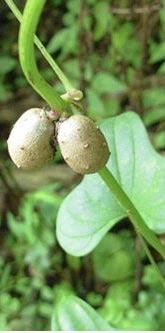
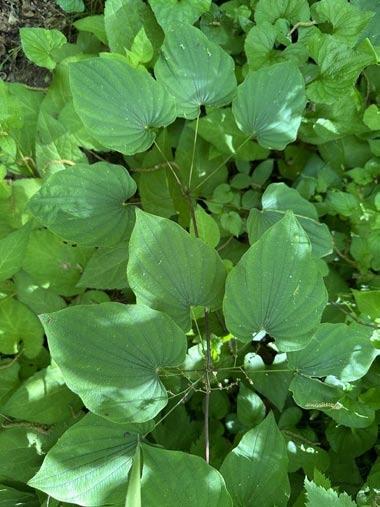
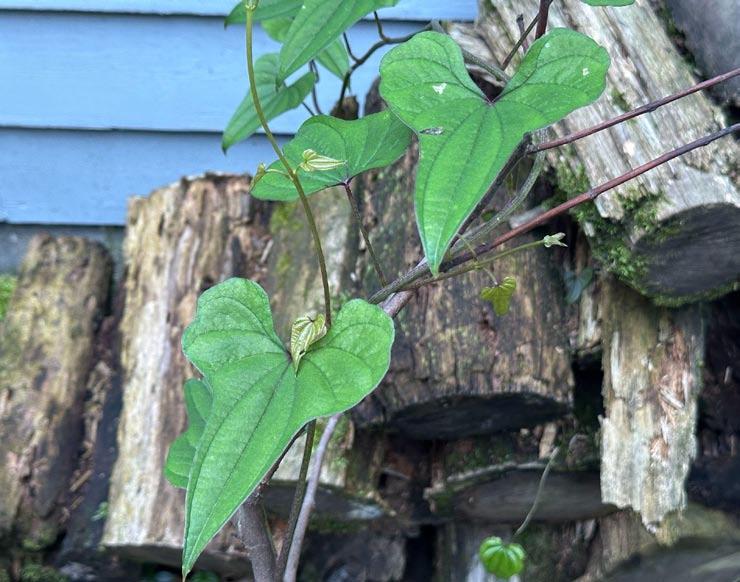
The mature leaves of Chinese yam have been compared to a rat’s snout and ears, twining counterclockwise over anything they can clamber on. Photo by Rick Borchelt.
Beginning in midsummer, viable small tubers form in the axils of the leaves, hence the common name air potato. Photo by Bob Richmond.
Some weed warriors report success with continuous mowing until the root reserves run out, so I’m hopeful that chopping out the new growth and pulling young vines—before they ever set one of their air potato axillary tubers — may eventually prove effective.
A related wild Afro-Asian yam species, Discorea bulbifera, is also a serious invasive in the South, but luckily can’t take our colder winters. As its species name suggests, D. bulbifera also produces axillary tubers. Good control has been achieved in Florida and some other southern states by importing the bright-red air potato beetle (Lilioceris cheni), an insect that feeds exclusively on the aerial tubers of only this yam species and turns them to mush. Unfortunately, no such biocontrol has yet been identified for Chinese yam.
The Eastern U.S. also has a native Dioscorea that is mild-mannered by comparison and typically sticks to its moist woodland environments. Our native wild yam (Dioscorea villosa) can be distinguished from its Asian congener by the direction the vine twines in: clockwise in our native species, counterclockwise in the Chinese yam.
Like Chinese yam, D. villosa produces small white flowers in the axils of its leaves; unlike Chinese yam, these flowers are only faintly scented. (The flowers of Chinese yam are intensely fragrant; the cinnamon scent yields the common name of cinnamon vine.) The lower leaves of native wild yam spring from a whorl of four or more leaves; Chinese yam leaves are opposite on the lower vine and alternate as the vine grows.
For now, my assault on Chinese yam continues apace. I’m out there weekly, chopping out the young plants, which for ID purposes have leaves that are very glossy, broad, and heart-shaped. As the vine matures, the leaves take on a different character altogether that some writers compare to a rat’s long snout and ears. It’s a fitting comparison. o
Rick Borchelt is a science and natural history writer, field naturalist, and garden and botany enthusiast. Reach him with any questions at rborchelt@gmail.com.
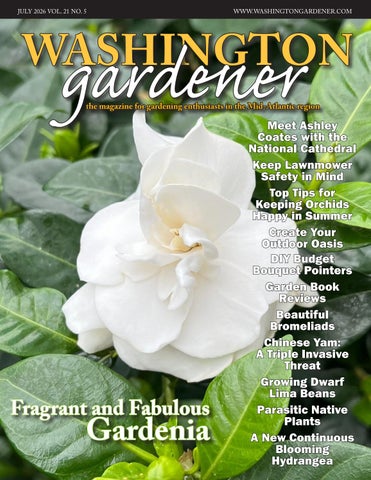
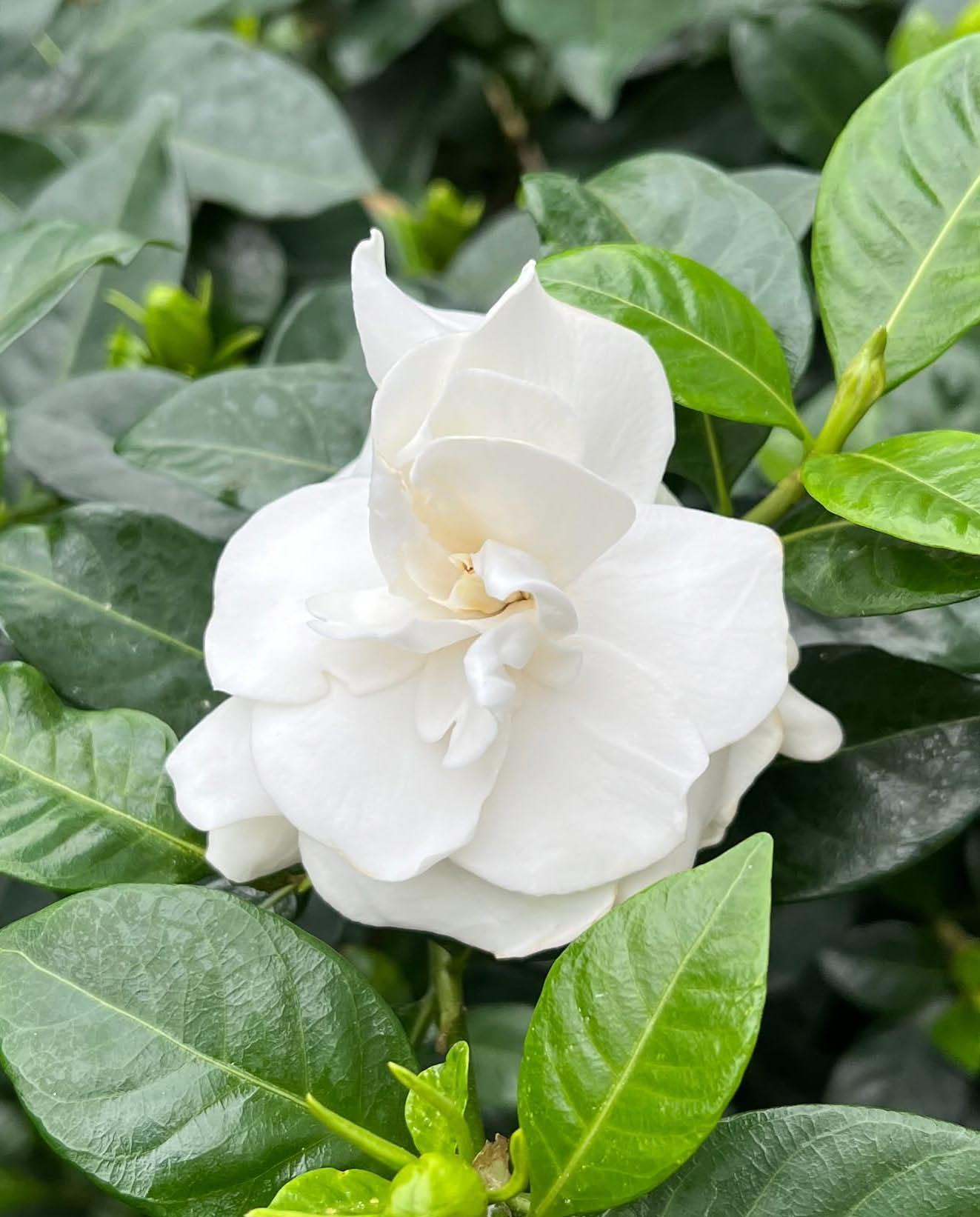
Gardenia
By Kathy Jentz
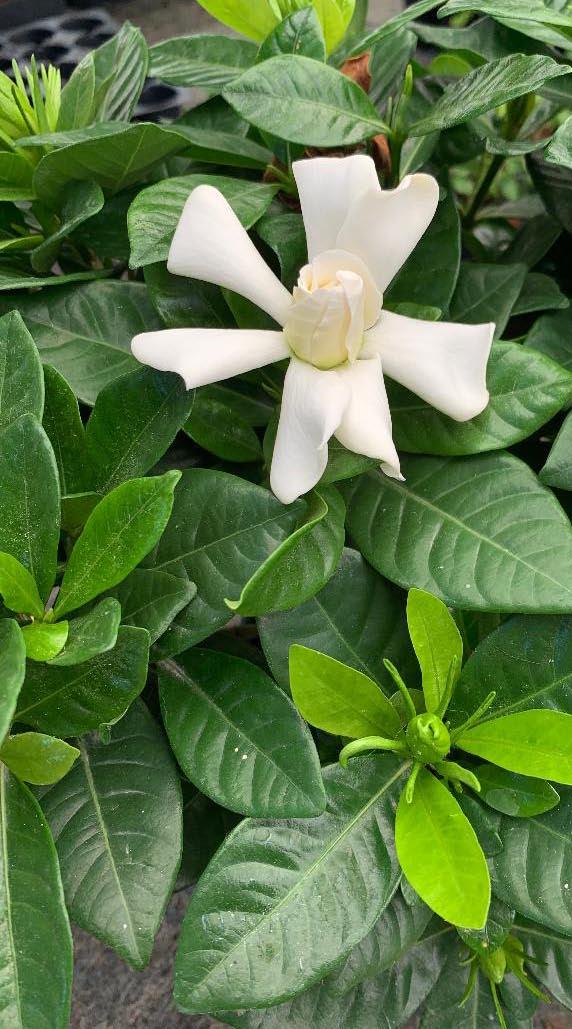
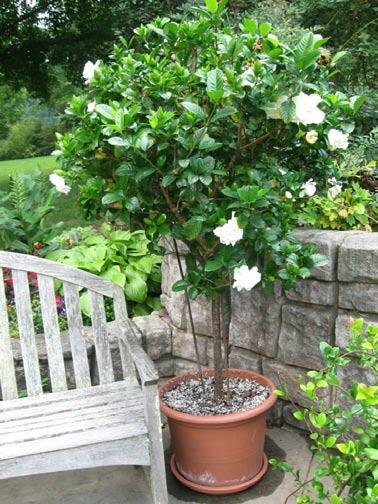
Its leaves are shiny and thick.
Gardenias for the garden are normally around 2 to 3 feet tall and wide, although some Gardenia species can grow to 50 feet high.
It is hardy to USDA zones 7 to 11.
Gardenia is in the coffee family and is native to the tropical and subtropical regions of Africa, Asia, Madagascar, the Pacific Islands, and Australia. Gardenias prefer to grow in part sun to part shade. Ideally, situate them in morning sun and afternoon shade. They need well-draining soil that is fertile and on the acidic side. Do not let Gardenia dry out completely between waterings.
Mulch them well around the root zone and prune out dead branches as needed. You can deadhead the spent blooms to encourage reflowering. Gardenia blooms throughout the summer into fall and makes a good cut flower.
Use an acidic, slow-release fertilizer formulated for acid-loving plants for your Gardenias. Apply the fertilizer around the root zone in spring after the last frost and again six weeks later.
Plant a Gardenia where you can enjoy the scent wafting through your garden. o
Kathy Jentz is the editor of Washington Gardener.
Gardenia (Gardenia spp.) is an evergreen flowering shrub. Its beautiful blooms are usually white or yellow and have a wonderful fragrance.
Neoregelia: A Blast of Color
High up in the South American treetops, the Neoregelia grow, while tadpoles and crustaceans enjoy their own little pools below. Neoregelia may not be a plant you’ve heard of, but it’s extremely important to tropical wildlife. These plants are my favorite type of “tank bromeliad.” The word “bromeliad” refers to a strange family of plants, including both pineapples and air plants. Tank bromeliads, in particular, possess a unique talent: the ability to function as miniature lakes. The water held by these plants is crucial to the life cycles of many small creatures, including one of my favorites, the poison dart frog.
My pet poison dart frogs—Minnie, Dot, Halo, and Nermal—were the inspiration for this article. Frogs can feel safe and cozy, sleeping between the layers of strap-like leaves that form a bromeliad’s rosette. Tank bromeliads and dart frogs have a symbiotic rela-
By Savannah Scollar
tionship, similar to clownfish and anemones: Dart frogs will lay their eggs in the plant’s central pool of water.
When these eggs hatch, the dad will carry the tadpoles on his back, finding each one an individual bromeliad to live in. The mom feeds the tadpoles unfertilized eggs, while the tadpoles add some extra variety to their diet by snacking on some algae. Meanwhile, the plant uses frog poop and other debris as fertilizer. It’s a win-win!
If you’re dazzled by these colorful and resourceful plants and choose to try growing one as a houseplant, you may be shocked by how small their root system is. There’s a good reason for this. These plants don’t need huge, elaborate roots when they have the power to drink through their leaves. That pool at the center isn’t just for frogs, bugs, and crustaceans; it’s also for the plant to drink from. A lot of bromeliads live in trees, so they don’t have all that much
soil to dig their roots into anyhow (if there’s any soil up there at all). Instead, bromeliads mostly use their roots to hold on tight.
Still, when given the opportunity, a Neoregelia plant will happily drink the water its roots are offered. If you’re not a fan of repotting, you’re in luck. Neoregelia never want more than a 4-inch wide pot to rest their roots in. Fun fact: some species live attached to rocks, rather than trees. Neoregelia are able to adapt to survive if they do happen to find themselves on the forest floor. Soil isn’t their preference, but they’ll make it work. For the best odds of a happily potted Neoregelia, orchid bark is the way to go.
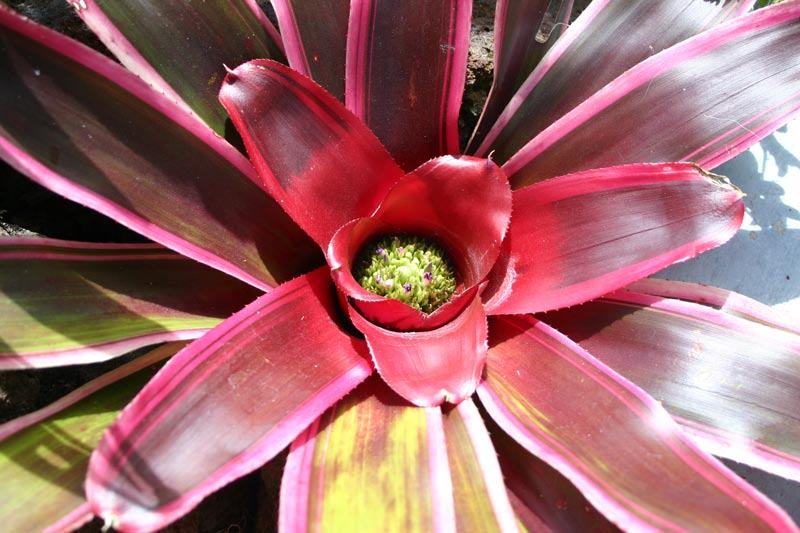
If I had to describe the looks of these plants in one word, I’d say they’re fireworks. You can find them in all sorts of bright colors: red, orange, yellow, hot pink, deep raspberry, neon green, and emerald. With a little more than 100
A colorful Neoregelia potted.
Photo by Codiferous at the English-language Wikipedia, CC BY-SA
via Wikimedia Commons.
species and more than 8,000 cultivars and hybrids recognized by the International Bromeliad Society, you might have trouble choosing just one plant to start with. If you live in the DMV area, you’ll probably have to order your Neoregelia online. The cultivars have all sorts of interesting names: ‘Pop Rocks’, ‘Cat’s Pajamas’, ‘Pink Chiffon’, and ‘Stellar Blast’ stood out to me as particularly fun. You’ve got spiky Neoregelia, smooth ones, miniatures, and even some 3-foot-wide giants.
I decided to pick a Neoregelia for my boyfriend and his beloved crested gecko, Samos. After one of his ferns dried up, I wanted to get him something more resilient, but still visually interesting. The decision of which cultivar to get really is the most difficult thing about this easy-growing plant. Would he like stripes or splatters? Or what about a gradient?
One tricky thing is that the plants can vary in terms of how colorful they are when they arrive. Baby plants tend to be less colorful. They develop their color over time when kept in bright sun. Their colorful leaves act as a big advertisement, helping pollinators find the relatively small flowers. Neoregelia only flower once, so they’ve got to make it count. (After this single bloom, the plant slowly dies.) Still, whether they get pollinated or not, these plants have a backup plan: pups! As the mother plant finishes its life, it puts its energy into cloning itself. What was once one large plant can turn into three to 10 new babies. A plant can go on and on this way, multiplying with each new cycle of genetically identical clones over the span of years or even decades.
If you’re looking for something colorful, different, and out of this world, give Neoregelia a grow.
Savannah Scollar opened Easy Little Plants (easylittleplants.com), a houseplant shop in Olney, MD, in July 2023 She loves doing research, teaching private workshops, decorating with houseplants, and arranging adorable terrariums.
“Inspire. Connect. Grow.”
The National Garden Bureau is a nonprofit organization that exists to educate, inspire, and motivate people to increase the use of garden seed, plants, and products in homes, gardens, and workplaces by being the marketing arm of the gardening industry. Our members are experts in the field of horticulture and our information comes directly from these sources. Find out more at https://ngb.org/



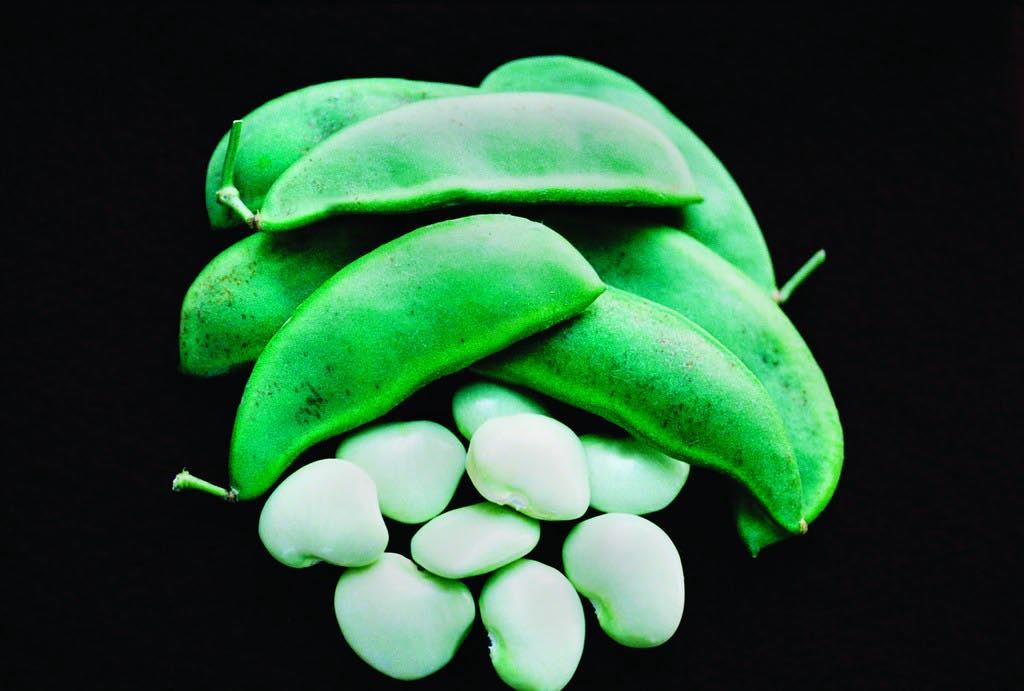
Henderson Dwarf Lima Beans
By Barbara Melera
Lima Beans, also known as Butter Beans, come in large-seeded and smallseeded varieties. They are a very old bean, known to have been in coastal Peru since 6,000 BC. The small-seeded varieties are thought to have originated in Mexico. The large-seeded varieties came from South America. The name “Lima” actually refers to Lima, Peru, where it is rumored that an American Navy admiral was introduced to the beans. He is said to have brought the beans back to New England, where they did not produce well. Somehow, the beans found their way to the Mid-Atlantic where they did much better in the warmer climate.
One of the most charming American seed stories is that of the Henderson Dwarf Lima Bean. There are actually two stories surrounding this remarkable bean. One has it that a pedestrian walking along a road in Virginia in the 1870s found the dwarf plant and sent some of its seeds to Peter Henderson who, at the time, was the leading American seedsman.
The more plausible story begins in the early 1870s. Until the introduction of the Henderson Dwarf Lima, all Lima bean varieties were pole (indeterminate) beans. There were no bush (determinate) Lima varieties. In the early 1870s, an African American farmer,
living near Lynchburg, VA, found a plant that only reached a height of 18 inches in his rows of pole lima beans
It was as vigorous as his pole Limas and produced, on its short bushy stems, nearly as many pods as his pole Limas. He collected the beans from this plant and sent them to a Richmond, VA, seed merchant, explaining his plant’s characteristics.
The Richmond seed merchant sent some of the seeds to Peter Henderson, who immediately became intrigued with the plant and began a development program to better understand the plant’s capabilities and see if the plant would reproduce itself consistently year after year.
The plant met and exceeded Henderson’s expectations, and over the course of about seven years, Henderson built up a stock of seeds that he began to offer for sale to the public in 1885 as the Henderson Dwarf Lima. The introduction was a huge success, and to this day, the Henderson Dwarf Lima is the most popular Lima bean available.
It truly is a wonderful bean. The plants are incredibly prolific and, unlike many bush varieties, produce for a long period. They reach maturity quite rapidly in 60–75 days. They are drought-tolerant and unusually hardy. The beans are smaller than the beans produced by pole varieties, but what they lose in size, they more than make up for in flavor. They have a rich, buttery flavor. I would heartily recommend it for gardens, large and small. It is one of America’s great heirloom vegetables.
How to Grow Limas
With the exception of fava beans, which should be planted as soon as the soil
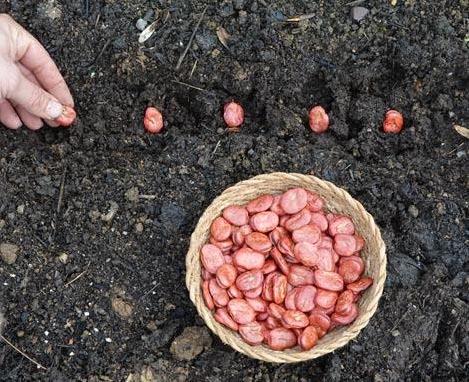
can be worked, all beans require warm soil to germinate. Soil temperature should be near 70 degrees. Beans do best when coated with legume inoculant powder. Legume inoculant powder is a bacterial compound that encourages nitrogen fixation on the roots of the bean plant.
Bush varieties should be planted 1 inch deep and 4–6 inches apart in rows spaced 2–3 feet apart. To produce a longer harvesting season, plant the rows in succession every 2 weeks for 6–8 weeks. Bush varieties can also be planted in containers: 4 plants to an 18-inch barrel or similar plant pot.
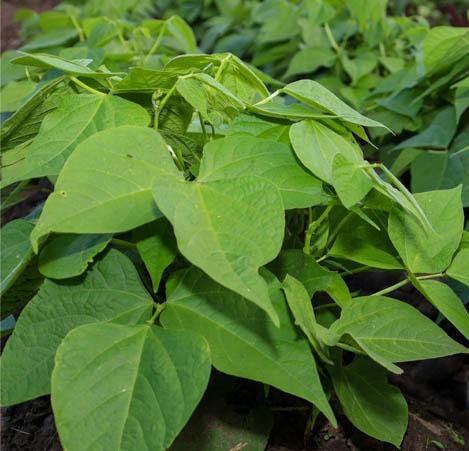
Both bush varieties and pole varieties need to be fed throughout the growing season. An organic fertilizer like Espoma GardenTone is recommended. For container plants, fertilize every 2 weeks. For plants grown in the garden, fertilizing every 3 weeks is recommended.
Although the Henderson Dwarf Lima was not commercially available until 1888, Limas have been a staple of the American diet since the 1700s. Thomas Jefferson first noted planting Limas on April 19, 1777, in his diary known as The Garden Book and again in 1794. By the early 1800s, he was distinguishing between snap beans and Limas.
Horticulturalist Fearing Burr Jr., in his 1863-1865 treatise, Vegetables of America, wrote this description: “The
Lima is one of the latest, as well as one of the most tender, of all garden-beans, and seldom, if ever, entirely perfects its crop in the Northern States. Little will be gained by very early planting, as the seeds are not only liable to decay before vegetating, but the plants suffer greatly from cold, damp weather. In the Northern and Eastern States, the seeds should not be planted in the open ground before the beginning of May; nor should the planting be delayed beyond the tenth or middle of the month. In ordinary seasons, the Lima Beans will blossom in eight or nine weeks, and pods may be plucked for use the last of August, or beginning of September. Only a small portion of the pods attain a sufficient size for use; a large part of the crop being prematurely destroyed by frost.”
Robert Buist did not include the Henderson Dwarf Lima in his Garden Guide of 1882, but they were for sale in both the 1897 and 1912 Guides Americans had to find ways to nourish themselves so they could survive the winters. The staples were beans, beets, cabbage, root vegetables, squash, turnips, onions, garlic, and carrots. These vegetables lasted the longest. The rich, buttery flavor of the limas nurtured generations of Americans and kept them alive through many, many winters. o
Barbara Melera is president of Harvesting History Heirlooms, based in Kill Devil Hills, NC. Harvesting History is a horticultural company founded in 2016 to provide horticultural and agricultural products, largely of the heirloom variety, along with garden tools and equipment.
Barb is a firm believer of products made in the USA, wherever possible. She can be contacted through https://harvesting-history.com.

The Azalea Society offers membership to anyone with an interest in azaleas, from home gardeners, collectors and students to plant professionals. The Azalea Society website (azaleas.org) is the source of information about azaleas.



by Cool Springs Press Order it today at: https://amzn.to/3IlYHYL
“Groundcover Revolution is a must-have book for anyone who is interested in having less lawn, fewer weeds, and reduced mulching. The properties charts will save the reader time and money, the pictures provide inspiration, while the detailed plant portraits give the focused information needed for creating beautiful, functional landscapes.”
―C.L. Fornari, GardenLady.com
Ask the Expert
By Miri Talabac
Summer-Blooming Shrubs
Q: What can I use as a summerblooming shrub, especially if this part of the garden is sunny and somewhat dry? I also sometimes have deer problems.
A: I think St. Johnsworts (Hypericum spp.) are underused, and several species are native here in our area, although some of those might be harder to source. Several of the commonly grown varieties are non-native species and hybrids, although fortunately, wellbehaved ecologically. (The only locally invasive species, Hypericum perforatum, is fortunately not likely to be sold at a nursery.)
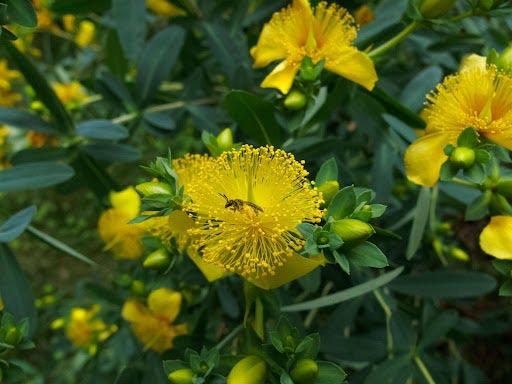
St. Johnsworts bloom anywhere between June and September, prefer direct sun, generally tolerate drought well, and are distasteful to deer.
Blooms are nearly always a vibrant yellow, and some species or cultivars have colorful summer or autumn foliage. A few cultivars have berry-like seed capsules that ripen by fall and make good bouquet accents. I love the bark on native Hypericum densiflorum peeling with a smooth underlayer that’s a rich, warm-toned cinnamonbrown that’s especially showy during winter dormancy.
You’ll find St. Johnsworts sold as both perennials and shrubs, because some species stay low, sprawl like a groundcover, and have stems that aren’t very woody, occasionally dying back in winter as other perennials do. Other species have woody stems and grow to about 3 or 4 feet tall and wide.
Flowers are loaded with pollen but have no nectar, so butterflies will probably detour while bees and flower flies (predators we like to keep in the garden) will visit. Don’t deadhead developing seed capsules if you want to support Gray Hairstreak butterfly caterpillars, which can use Hypericum as a host plant (among a huge variety of other plants).
What Caused a Shade Tree to Fail
Q: I had a shade tree fall recently in a storm. The wood that broke apart doesn’t look rotten. Did something else cause damage?
A: Look for a root wrapped around part of the trunk base, which probably started to “strangle” or girdle the live wood that lies just under the bark on that side of the trunk. Girdling roots can form when a tree was planted too deeply or mulched too heavily by mounding the mulch onto the base of the trunk like a volcano.
When a tree is planted or the area around its trunk base is landscaped, the tree’s root flare needs to remain visible. The flare is the point on the base of the trunk where major roots branch off of the trunk, forming a flared widening where it disappears into the ground as the roots travel horizontally. That flare should sit at, or slightly above, the soil surface, but often it’s buried and hidden by soil or mulch.
Unfortunately, it’s not uncommon for trees sold at nurseries to have their root flarea already covered by too much soil while they’re still growing in the pot (or dug and burlapped). In that situation, gently remove the extra soil until the flare is located and exposed. I’ve used a strong spray from a garden hose to do this, with the tree’s root ball in a wheelbarrow or on a tarp. Once you find the flare, you’ll know the true depth of the planting hole needed so the flare sits at the right level when the root ball is placed into the ground.
If girdling roots have already developed on an established tree, have a certified arborist evaluate it in person. Some roots can be cut to relieve pressure on the trunk, but any that have fused with other wood can create chronic problems. It is a greater risk to tree health and much more costly to try to correct girdling root problems later in a tree’s life than to examine the root structure carefully before planting (and to maintain a tree properly after planting). o
Miri Talabac is a Certified Professional Horticulturist who joined the University of Maryland Extension Home and Garden Information Center in 2019 as a horticulture consultant. She is a graduate of UMCP with a focus in entomology.
To ask a gardening or pest question, go to http://extension.umd.edu/hgic and select “Ask Extension.” Digital photos can be attached.
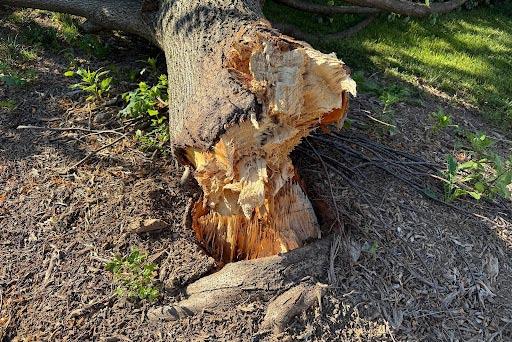
A girdling root contributed to this tree failure. Photo by Emily Clark-Waterson (HGIC).
A bee amid the firework of pollen on a St. Johnswort flower. Photo by Miri Talabac.
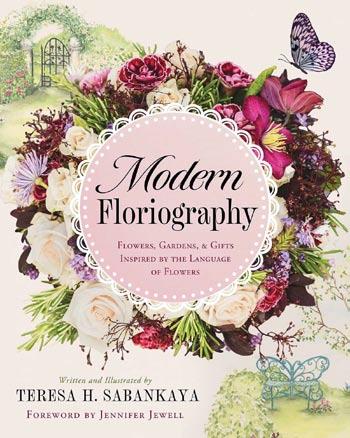
Modern Floriography: Flowers, Gardens, and Gifts Inspired by the Language of Flowers
Author: Teresa Sabankaya
Publisher: Indigo River Publishing List Price: $32.95
Order Links: https://amzn.to/4aHezmh and https://bookshop.org/ a/79479/9781964686677
Reviewer: Lauren Bentley
Modern Floriography offers a vibrant perspective about how flowers, plants, and gardens can be used for expression and communication. This book goes beyond simple arrangement, although that is included, and instead dives into the meaning and passion behind floriography.
Sabankaya is a florist, gardener, teacher, and presenter, the book states. She has a floral studio in Bonny Doon, CA, which provides lifestyle and event services in the Monterey Bay and San Francisco Bay Area. Her florals are designed for weddings and other milestones.
Most known for her modern-day posies, which she defines as bouquets intentionally made to convey a specific message, Sabankaya has a passion for plants, flowers, and their meanings that is made absolutely clear throughout this book.
Sabankaya starts off with an introductory section titled “Getting Acquainted with Floriography,” in which she discusses the symbolism of flowers in many different time periods, such as ancient Greece, Rome, and the Medieval Times.
This continues into part one of the book, which goes over the specific historical meaning of individual flowers. While Sabankaya is an experienced florist, her book contextualizes flowers in a way that allows beginners to fascinate themselves with the deeper meanings of plants.
“For an exceptionally long time, flowers have been messengers of the heart,” she writes.
This is exactly what Sabankaya proves, as she argues that garden spaces created with intention can allow us to heal and celebrate in the second section, “Perpetual Posies and Sitting with Sentiments.”
This section also gives ideas for using floriography as gifts based on different life events or emotions, such as grief and empowerment.
Part three goes into different ways to arrange posies and bouquets. Going into this book, I mostly expected simply that: an extended version of how to create bright, beautiful bouquets. While again, the book certainly accomplishes that, it importantly taught me so much more.
Notably, the fact that when I look at a bouquet, I am now able to see so much more than a gorgeous array of flowers. I think it demonstrates a larger meaning behind many gardens.
She doesn’t leave out any details, either. The section that features bouquet-making also includes selecting a container, ribbon adornment, and sentiment tags.
Sabankaya writes in a way that makes floriography feel accessible at all levels of gardening. Personally, I am a beginner and didn’t feel as though the book expected that I already had a lot of knowledge of floriography. However, I also feel that an expert gardener could find a lot to learn from Sabankaya.
The last section is “The New Languages of Flowers Dictionary,” where she shares the modern meaning behind as many plants and flowers as one can imagine. This is where one would inevitably find inspiration for their own floriography gifts.
Overall, my favorite aspect of this book is that it so clearly demonstrates how floriography, in a sense, is a form
of communication. It is a language that anyone can use to express themselves and messages to others.
Ultimately, this book is a lesson about the symbolic meaning of nature, and how we can share that with others. Sabankaya’s passion and expertise are clear in her attention to detail, but this book is meant for everyone. o
Lauren Bentley was an intern with Washington Gardener Magazine during the spring 2026 semester
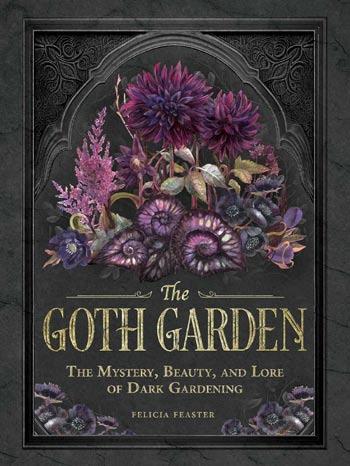
The Goth Garden: The Mystery, Beauty and Lore of Dark Gardening
Author: Felicia Feaster
Publisher: Adams Media
List Price: $20.00
Order Links: https://amzn.to/3R3C8z9 and https://bookshop.org/ a/79479/9781507224472
Reviewer: Koree Perry
Felicia Feaster’s The Goth Garden provides readers with a unique experience in a specific sector of the gardening world: one where it is specifically catered toward goth-aesthetic garden plants. The book includes a brief introduction and history of how and why the gothic aesthetic came to be in the Victorian era, how the presentation of a garden held numerous meanings and symbols of life and death, suggestions for how to design your own goth garden, and an encyclopedia of 50 different types of plants that show mystery and beauty in the environment.
Book Reviews continued on page 22
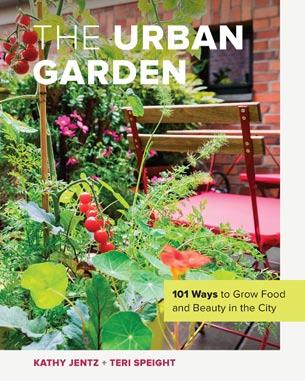
The
Urban Garden: 101 Ways to Grow Food and Beauty in the City is all about small-space gardening solutions!
By Kathy Jentz and Teresa Speight
Published by Cool Springs Press/Quarto Homes
Order it today at: https://amzn.to/3yiLPKU
GardenDC Podcast
The GardenDC podcast is all about gardening in the greater Washington, DC, and Mid-Atlantic area. The program is hosted by Kathy Jentz, editor of Washington Gardener Magazine, and features guest experts in local and national horticulture. The latest episodes include interviews with experts on Landscape Design and Growing Roses Naturally. You can listen online at https:// washingtongardener.blogspot.com/ or on Spotify, Apple, etc o
The Goth Garden provides an expansive and rich history and knowledge of different plants that cater to a specific community while also being a useful guide for other readers who like gardening in general. On the surface, it might not be appealing to the greater gardening community, but to have this as representation of a specific culture that intersects with gardening only expands the growing interest and diversity that the gardening community is gathering. One of the main things that drew me in as a reader was the way. Feaster uses language that fit the gothic theme to truly immerse readers versus just explaining away each plant.
It’s also incredibly helpful that each plant has its own picture in the book. While I am not someone who particularly enjoys this type of aesthetic for my everyday life, learning about each plant and how a garden can be centered around a specific culture was a treat.
One downside after reading was that only 50 plants are included in the book. It’s a shorter reader than other gardening books that may have the same idea of centering around a particular aesthetic. I would have enjoyed seeing some different ways to create these gardens in a picture form and not just through suggestions from the beginning. I’m curious to know what other aesthetics can fit an entire garden theme, and look forward to reading more of Feaster’s work. o
Koree Perry is an intern with Washington Gardener Magazine this summer 2026 session and is a Baltimore native
Ripe Tomato Revolution: Planting and Growing Every Type of Tomato: Beefsteaks, Cherries, Plums, Dwarfs, and Heirlooms
Author: Frank Hyman
Publisher: Cool Springs Press
List Price: $22.99
Order Links: https://amzn.to/4ePJek0 and https://bookshop.org/ a/79479/9780760398890
Reviewer: Marsha Douma
Ripe Tomato Revolution has useful information for both experienced tomato growers and novices. While I am particularly partial to garden books, this book is an especially delightful read. The author writes with humor, and the book often feels like a conversation with the
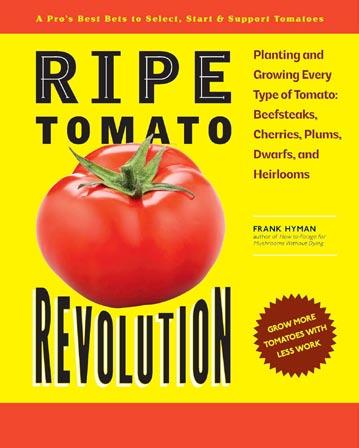
author, rather than a classroom lecture. Physically the book is also a pleasure to use, due to the interesting and colorful layout. The photographs illustrate the essence of the subjects being written about, and the arrangement of facts that are more commonly organized as charts instead look like multiple garden beds. This makes accessing all the information in the book very easy and fun. In the beginning of the book, the author suggests treating the chapters almost as stand alone booklets, and for the reader to choose which sections are the most interesting and useful. Given the scope of the projects and ideas presented in the book, this is good advice to follow.
The usual gardening mantra “right plant right place” unfortunately doesn’t apply if we choose to grow tomatoes. They simply will not like many aspects of growing in the hot and humid MidAtlantic region. The “revolutionary ideas” presented in the book—what this book is mostly about—is how to minimize the stressors your tomato plant faces, and contain their growth habits in ways to harvest the fruit, since as a vine, their preference is to grow unchecked along the ground.
Tomatoes evolved along the mostly dry and sunny coast of Peru and Chile, which have similar growing conditions to the Mediterranean regions. Some of the fixes suggested are easy to implement, others not so much. In addition to being an avid gardener, the author loves carpentry projects, and therefore has created structures to shelter and protect
tomatoes from the extreme summer heat, and from direct rainfall that prevents the soil-borne disease organisms from bouncing up from the wet ground onto the leaves of the plant where it infects them. He also has suggestions and projects for collecting and using rainwater, and structures for composting.
Other techniques the author suggests that are easier to implement are to remove all the bottom leaves to a height of a 1 to 2 feet, and place a thick layer of mulch covering the ground. Also, importantly, the author emphasizes to water using a soaker hose to protect the leaves.
The author does an excellent job of discussing the insect pests that most commonly affect tomatoes and how to control them without using insecticidal sprays. Mainly, he asks us to inspect our plants a couple times each week, so we know what a healthy plant looks like. Then physically remove any bugs that appear, being sure to first let all the helpful bugs looking for a meal in your garden, find these pests and have them for dinner. His often writes that “spraying is not gardening.”
This imminently useful and enjoyable book is well worth reading, and is perfectly timed to maximize our summer harvests. o
Marsha Douma is a retired dentist and lifelong gardener who also enjoys swimming and playing the piano. She lives in Rockville, MD.
A Year of Cut Flowers: Color and Joy for All Seasons
Author: Sarah Raven
Publisher: Bloomsbury Publishing
List Price: $35.00
Order Links: https://amzn.to/4o4ZlNi and https://bookshop.org/ a/79479/9781526683427
Reviewer: Teresa Speight
I am a Sarah Raven fan and this book is simply another outstanding resource for anyone who appreciates growing flowers. As many people have realized the joy of growing your own cut flowers, the author provides an informative text about her experiences.
The art of growing is clearly outlined for gardeners to have floral arrange-
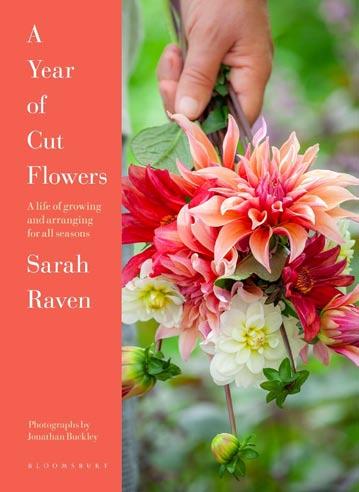
ments in all seasons. Raven uses examples of her journey as a cut-flower grower—including her mistakes along the way. The author explains the art of layering the garden using bulbs, perennials, biennials, and even annuals. Self-sowing annuals are encouraged, and she even provides a list for the reader. While some books only provide short lists, Raven provides essential tips about seed-starting for early to late blooms in the garden.
Raven believes there are five seasons and explains the rationale behind this concept—and it makes sense. Using creative terminology such as the bride, the gatecrasher, or the upper story, the author offers ideas for how to use certain plant material in an effective manner. Using her suggestions of when to harvest, the grower can create abundant arrangements that last a longtime in the vase.
Her garden is in England, yet her suggestions of cut flowers by month are easily adaptable to most growing zones in the United States. When an author cares this much about the success of the cut-flower grower, a book that shares hints and tips throughout is quite meaningful.
This is a book that will stay in my garden room for reference and ideas. o
Teresa J. Speight is native Washingtonian, a mother, grandmother, steward of our land, garden communicator, and history lover. Her website is https://cottageinthecourt.com/.
Your Ad Here
Are you trying to reach thousands of gardeners in the greater DC region/MidAtlantic area? Washington Gardener Magazine goes out in the middle of every month. Contact kathyjentz@gmail.com or call 301.588.6894 for ad rates (starting from $200). The ad deadline is the 10th of each month. Please submit your ad directly to: kathyjentz@gmail.com
Got a Garden Question?
a gardening question you need
Send your questions to KathyJentz@gmail. com and use the subject line
Please also include your first name, last initial, and what city and state you are writing from. Then look for your answered questions in upcoming issues.
to all of our Washington Gardener advertisers. Please tell them you saw their ad in
Gardener!
Jentz Prints
Antique Botanical Prints for the decorator, collector, connoisseur, and art lover.
Jentz Prints can be purchased at the world-famous Eastern Market on non-rainy Saturdays.
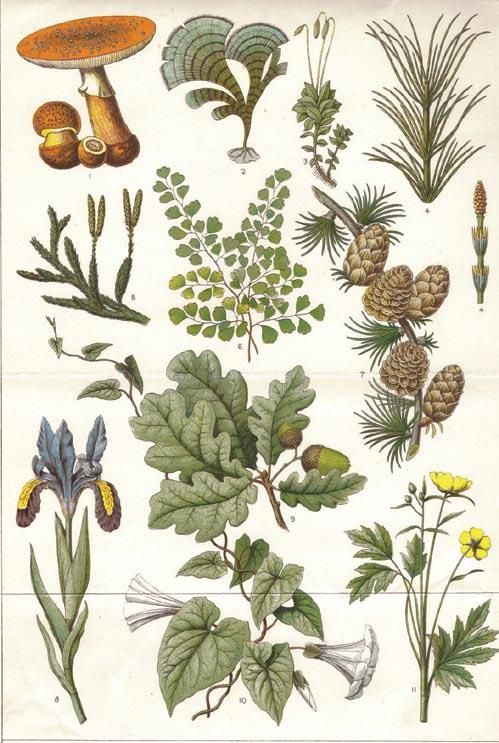
Antique prints are affordable—most in the $10-$30 range—and they are the perfect gift idea for that plant lover in your life. And don’t forget to buy a few for yourself! For more information or to get a detailed show schedule, please contact Jentz Prints by email at UllrichJ@aol.com.