Are you trying to reach thousands of gardeners in the greater DC region/Mid-Atlantic area? Washington Gardener Magazine goes out on the 15th of every month. Contact KathyJentz@gmail.com or call 301.588-6894 for ad rates (starting from $200) The ad deadline is the 10th of each month. Please submit your ad directly to: KathyJentz@gmail.com
Need a Garden Club Speaker?
Washington Gardener Magazine’s staff and writers are available to speak to groups and garden clubs in the DC region and ONLINE! Call 240.603.1461 or email KathyJentz@gmail.com for available dates, rates, and topics.
RARE AND EXCEPTIONAL PLANTS FOR THE DISCRIMINATING GARDENER AND COLLECTOR
Barry Glick
Sunshine Farm and Gardens 696 Glicks Road Renick, WV 24966, USA Email: barry@sunfarm.com www.sunfarm.com
www.greenspring.org
Green Spring Gardens
A “must visit” for everyone in the metropolitan Washington, DC, area. It’s a year-round goldmine of information and inspiration for the home gardener. It’s an outdoor classroom for children and their families to learn about plants and wildlife. It’s also a museum, a national historic site that offers glimpses into a long, rich history with colonial origins. Located at 4603 Green Spring Rd., Alexandria, VA. Information: 703-642-5173.
Invasive Language
Has the language we use about plants that come from elsewhere ever bothered you? It sure has been on my mind in these fraught times, with all the tension about “others” in “our country.” For the past few decades, I have been extremely uncomfortable with the terms we use for native versus exotic plants.
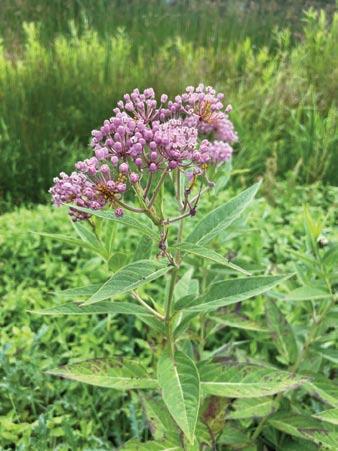
This issue goes beyond being politically correct. The language we use defines our world around us and shapes our views of it. If a plant is called a weed, that is how we see it. If instead of Milkweed, we called it Butterfly Flower, you see how that changes things.
The term “invasive” itself can be seen as problematic because it assigns a motive and an agenda to the plant (or insect, etc.). The fact is, we humans brought over most of these to be used in our landscapes or for agriculture; none of these plants got up and walked here.
The more accurate and neutral terms would be “nuisance plant” or “introduced species.” Other alternatives include “naturalized pest” and “introduced nuisance.”
And what do we call a plant that expands beyond its bounds (as we define them) and is a very successful grower? We use that pejorative word “invasive” again. I suggest “aggressive” is a better fit.
Then there is that other word for plants that don’t behave well in our landscapes: thug. For those of you in older age groups, this terms sounds neutral and accurate, but please realize it is now seen by younger adults as old-fashioned and racist. Better terms would be “yard bully,” “aggressive spreader,” or “noxious weed.”
I believe clarity of language and being precise in our communications can help us put a more positive message forward about our local landscapes. In the above example of our native Common Milkweed, if we used the correct Botanical Latin name Asclepias tuberosa, there is then no confusion and none of those negative weed connotations that our native plants are often associated with.
Similarly, when referring to an “invasive” species such as Asian or Chinese Wisteria, if we call it by its proper Latin name, Wisteria sinensis, then we know exactly the plant we are discussing and we are not calling attention to the “otherness” nor implicating a whole culture or ethnic group with “invasive” motives. Further, the use of adjectives like “alien plant” or “foreign species” is misleading and frankly xenophobic. The simple descriptor of “non-native” is all that is needed.
Sincerely,
Credits
Kathy Jentz
Editor/Publisher
Washington Gardener 826 Philadelphia Ave. Silver Spring, MD 20910
Phone: 301-588-6894
kathyjentz@gmail.com www.washingtongardener.com
Ruth E. Thaler-Carter Proofreader
Aicha Bangoura Lauren Bentley Interns
Subscription: $20.00
• Washington Gardener Blog: www.washingtongardener.blogspot.com
• Washington Gardener Archives: http://issuu.com/washingtongardener
• Washington Gardener Discussion Group: https://groups.google.com/g/ washingtongardener/
• Washington Gardener Twitter Feed: www.twitter.com/WDCGardener
• Washington Gardener Instagram: www.instagram.com/wdcgardener
• Washington Gardener Facebook Page: https://www.facebook.com/ WashingtonGardenerMagazine/
• Washington Gardener YouTube: www.youtube.com/ washingtongardenermagazine
• Washington Gardener Amazon Store: www.amazon.com/shop/wdcgardener
• Washington Gardener BookShop: bookshop.org/shop/WDCgardener
• Washington Gardener Podcast: https://podcasters.spotify.com/pod/ show/gardendc/
• Washington Gardener Plant Store: https://shop.kathyjentz.com/
• Washington Gardener is a woman-owned business We are proud to be members of:
· GardenComm (formerly GWA: The Association for Garden Communicators)
· Green America Business Network
· National Garden Bureau
· One Montgomery Green
· Ladies in the Landscape
· Potomac Rose Society
· American Horticultural Society
· Maryland Nursery, Landscape and Greenhouse Association
Kathy Jentz, Editor/Publisher, Washington Gardener, KathyJentz@gmail.com
All rights reserved. Published monthly. No material may be reproduced without prior written permission. This magazine is purchased by the buyer with the understanding that the information presented is from various sources from which there can be no warranty or responsibility by the publisher as to legality, completeness, or technical accuracy.
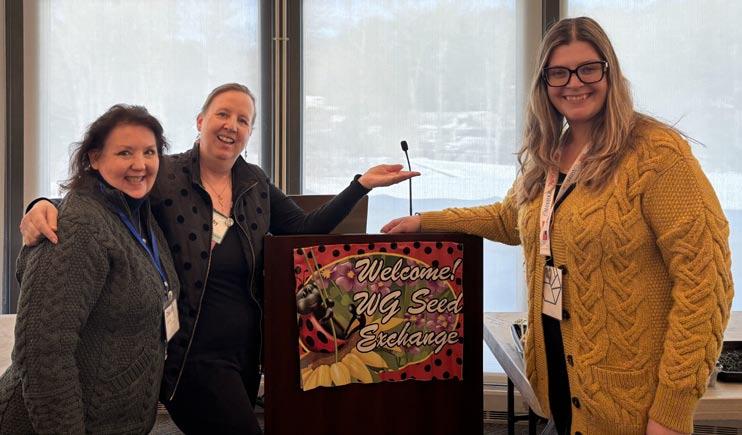
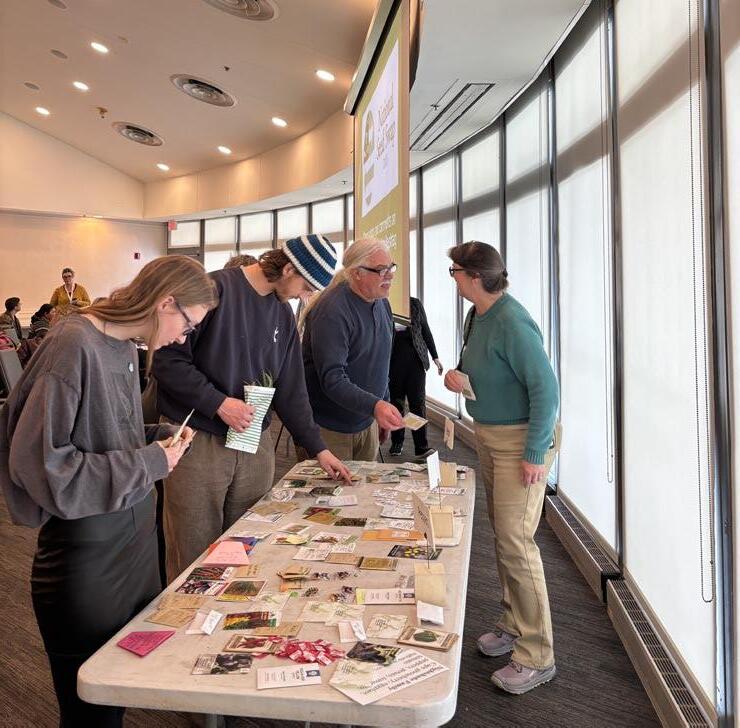
Debby Ward, your editor, and Alex Mudry-Till at the recent Washington Gardener Seed Exchange at Brookside Gardens. Photo by Lauren Bentley.
Reader Contest
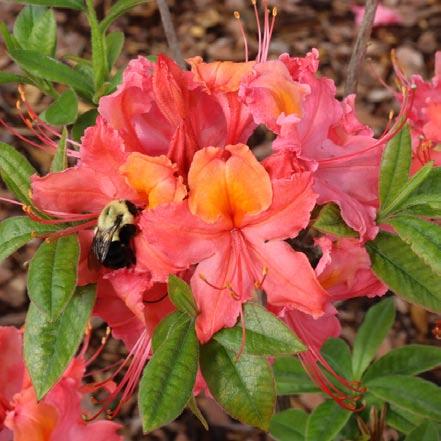
For our February 2026 Washington Gardener Reader Contest and to celebrate 2026 Year of the Azalea, we are giving away a one-year membership to the Azalea Society of America (ASA) and their local chapter (a $30 value)
The Azalea Society offers membership to anyone with an interest in azaleas, from home gardeners, collectors, and students to plant professionals. Local chapters have social activities, garden tours, meetings, and plant sales featuring unusual varieties. National conventions have garden tours, talks by well-known azalea authorities, plant sales, and opportunities to make and renew friendships. The Azalean, the ASA’s quarterly journal, has timely, informative articles about azalea culture, hybridizing, propagation, garden design, new introductions, and chapter activities. This Azalea Society website (https://azaleas.org/) is the source of information about azaleas.
To enter to win the membership, send an email by 5:00pm on February 28 to WashingtonGardenerMagazine@gmail.com with “Azalea Society” in the Subject line and in the body of the email. Tell us what your favorite article was in this issue and why. Please include your full name and mailing address. Winners will be announced and notified on/about March 1. Replies might be published. o
Your Ad Here
Are you trying to reach thousands of gardeners in the greater DC region/MidAtlantic area? Washington Gardener Magazine goes out in the middle of every month. Contact KathyJentz@gmail.com or call 301.588.6894 for ad rates (starting from $200). The ad deadline is the 5th of each month. Please submit your ad directly to: KathyJentz@gmail.com.
Plant a Row for the Hungry (PAR) is an easy program to participate in and really does not take any extra resources than what you may have in your garden. In normal times, about 35 million people wonder where their next meal will come from. Most of these are children. That’s where PAR steps in.
PAR is such a simple program: It urges gardeners to Plant A Row (or a container) dedicated to feeding the hungry, and then take the harvest to someplace or someone that needs it. Once you have donated, send an email to KathyJentz@gmail.com with the total (in pounds and ounces) of what you gave. That is all there is to it. Easy. Effective. Adaptable and Helpful.
Besides citing your resolutions in your letter as editor/publisher (keeping up with weeds, spending at least an hour a day in the garden, and keeping better records), the January 2026 Washington Gardener issue held an important reminder of the value of gardening in the article “Gardening Resolutions for the New Year.” Many find the new year as a time to reflect and reset, and gardening helps hit multiple aspirations as workout and meditation (activities such as planting, trimming, weeding, watering) can contribute to health and happiness.
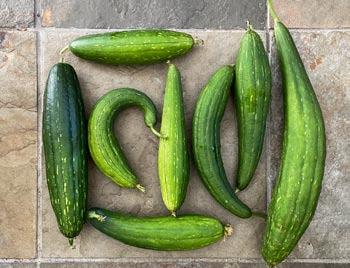
In addition, the annual photo contest is a reminder to document what you nurture and grow. I’m drawn to the unusual and was inspired by an article in a past Washington Gardener magazine issue to attempt to grow loofah. I did not know what to expect but was hopeful, and had to adapt to the long growing season and early cold snap by bringing the gourds inside to continue maturing (by hanging from my pot rack across from my kitchen window). I was successful and have included an image (shown above) of my bounty.
~ Smita Parida, Rockville, MD
I especially enjoyed the article about the Capital Area Food Bank’s garden in the January 2026 issue. I volunteer at United Community’s food pantry and see the importance of providing fresh fruit and vegetables to lower-income residents. I also loved that they involve kids in their garden!
~ Anita Feidler, Alexandria, VA
The January Garden To-Do list was my favorite article in the January 2026 issue. It was a good reminder that gardening is a 12-month hobby and that I should go through my seed stash to clean it out and take an inventory.
~ Sarah Lawler, Hyattsville MD o
Harold Belcher
Azalea Lover and Volunteer
My love of azaleas started when I was a teenager in the 1960s, living in nearby Cheverly, MD. I would go to the U.S. National Arboretum to explore its bounty of plants and wildlife over 450 acres. I used to come to the arboretum to relax, wander around, and see the plants. Much to my delight, no one was there back then, so I had free run to explore. I especially enjoyed climbing Mt. Hamilton by going through the azalea collection. It was wonderful to wander the trails. They were very peaceful.
My love of nature is what cultivated my 60-plus year-long connection with the arboretum and its azalea collection. My mother also had a hand in my love of gardening. She would have me go into our yard to weed, water, and care for her azaleas.
We had different varieties of azaleas planted in our front yard. One of my favorites was, and still is, ‘Coral Bells’. My mom showed me how, and when, to prune azaleas—and when to fertilize them. We would use cotton seed meal as fertilizer.
Bob Hobbs, who moved next door in 1965, was also a lover of azaleas. Bob helped teach me about azaleas while we worked on building a house for one of his pipe organs. Later, Bob and I talked about joining the Azalea Society of America (ASA). I joined the Ben Morrison Chapter of the ASA as a life member, just in time to help with the planning and execution of the Ben Morrison-sponsored ASA National Convention to be held in Bowie, MD. Later, I also joined the Northern Virginia Chapter of the ASA as an associate member. I am also a member of the Potomac Valley Chapter of the American Rhododendron Society and the Friends of the National Arboretum (FONA). I’ve been a member of those organizations for many very enjoyable years.
After I retired from my government career working for the U.S. Navy Department and the Justice Department, my attention turned back to my gardening hobby and spending time at the arboretum. I volunteered to work in the azalea collection with Barbara Bullock. Bar-
bara was the curator of azaleas at that time. She was very helpful and kind in sharing her knowledge of azaleas and offering suggestions to help volunteers with their gardens. While volunteering, I met and made many wonderful friends. I volunteered for more than 10 years and enjoyed every minute of it! I still go back to walk the azaleas and other collections—and see some of the folks whom I worked with while volunteering. While a member of the Ben Morrison Chapter of the Azalea Society of America, I served four terms as the president of the chapter (2006–2010). During my tenure, I worked diligently with other stakeholders and ASA members, to ensure the successful preservation of the historic and cherished azaleas on the Glenn Dale Hillside of the Azalea Collection. A large portion of plants there, as well as in the Boxwood Collection, were slated to be removed— de-accessioned—from the collection, along with staff gardener positions, due to USNA budget challenges hampering collection maintenance. I’d like to think my efforts, along with FONA, and several other organizations, raised awareness and funds helped to preserve some of the most horticulturally valuable and spectacular azalea hybrids developed by the Arboretum’s first director, Benjamin Morrison. o
This profile previously appeared in the Winter 2025–26 issue of The Azalean, the journal of the Azalea Society of America, and has been edited for style and clarity
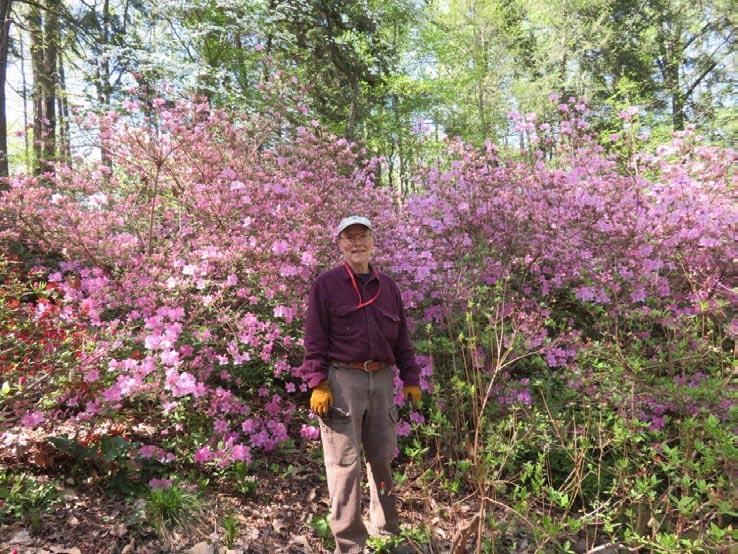
Harold Belcher volunteered at the U.S. National Arboretum’s azalea collection for more than 10 years.
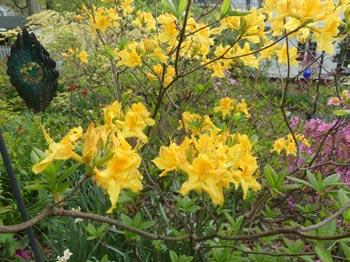
The deciduous Aromi Hybrid ‘Lemonade’ in Harold Belcher’s home garden.
9 Azalea Growing Tips
2026 is the Year of the Azalea. The following tips, courtesy of the National Garden Bureau, will help create bloom-packed seasonal displays of azaleas in your garden.
1. Plant Azaleas at the Right Time
The best time to plant azaleas is generally in early spring or fall. This will give them plenty of time to acclimate before seasonal extremes—summer’s brutal heat and winter’s freezes—set in. In the first year of your azalea’s life in your landscape, watering it regularly will help it get well-established and develop healthy roots. This is particularly important during your azaleas’ first summer in the ground, when soaring temps and droughts can cause stress. Consistent watering plus a 2–3" layer of mulch can help your new azaleas beat the heat and stay well-hydrated.
2. Prune Azaleas at the Proper Time
Prune azaleas right after their spring flowers fade. Pruning later—in summer, fall, or winter could jeopardize the next year’s spring buds, diminishing your blooms. Remove dead or damaged wood from your azaleas anytime using sharp, sanitized pruners to avoid disease spread.
3. Got Full Sun? Opt for One of These Sun-Tolerant Azalea Varieties!
While numerous azaleas benefit from morning sun and afternoon shade, some varieties of azaleas are much more sun-tolerant than others and actually need a certain amount of full sun (again, ideally morning sun) to achieve their maximum blooms. Sun-tolerant azaleas like Encore® Azaleas and Sweet Reward® Coral Azaleas are two such varieties, thriving in 4–6 hours of sun exposure.
4. Prepare the Perfect Soil
Keep your azaleas’ soil pH between 4.5–6.0. Amend with composted leaves, pine bark, pine needles, or peat moss for acidity and drainage. Mulch 2–3" with organic material to protect your azaleas’ shallow roots and retain moisture.
5. Fertilize Azaleas at the Right Time
Fertilize azaleas right after spring bloom using slow-release acid-loving plant food; water the fertilizer in well. Reblooming azaleas in rain-heavy areas with a longer growing season may benefit from a second summer feeding. Resist the urge to fertilize after the start of August.
6. Evergreen Azaleas Can Make Terrific Blooming Hedges!
Living fences have never been more popular, and it’s easy to see why. As home lot sizes shrink and yards become more compact, living fences and hedges offer the privacy homeowners crave, along with the color that plain wooden or plastic fencing can’t match. For a fresh take on a living fence, evergreen azaleas are perfect for the job. With year-round foliage and reblooming varieties that deliver months of blooms, evergreen azaleas are an excellent choice for defining property lines, creating outdoor “rooms,” or screening less attractive features like trash cans and HVAC units.
7. Fill Those Empty Planters with Dwarf Azalea Varieties
Brighten your porch or patio with compact bloomers like Autumn Starburst® Encore® Azalea, with coral-and-white flowers, or Kimono™ Maraschino Azalea with its carmine red blooms. With their showy flowers and handsome evergreen foliage, azaleas have the presence and beauty to shine in a single-variety container planting—no companions needed.
8. Azaleas Make Great Additions to Cut Flower Arrangements
Bring the beauty of azaleas indoors by adding their bright blooms to your cut flower arrangements. Azaleas’ vibrant colors add texture and charm, while their shorter woody stems make them perfect for compact bouquets and table centerpieces. With their elegant branches and attractive green foliage, they can even be displayed as a blooming branch supported by a metal frog or in a slender bud vase.
9. Pollinators LOVE Azaleas!
You may love azaleas, but did you know the pollinators do, too? Bright-pink and red azaleas are magnets for hummingbirds, while white blooms attract fluttering moths, and could even be used in a nighttime moon garden. Early-blooming azalea varieties give overwintered bees a vital first food source, helping kickstart pollinator activity in your garden each spring. o
The Azalea Society offers membership to anyone with an interest in azaleas, from home gardeners, collectors and students to plant professionals. The Azalea Society website (azaleas.org) is the source of information about azaleas.
IS OUT NOW! By Kathy
Published by Cool Springs Press Order it today at: https://amzn.to/3IlYHYL
“Groundcover Revolution is a must-have book for anyone who is interested in having less lawn, fewer weeds, and reduced mulching. The properties charts will save the reader time and money, the pictures provide inspiration, while the detailed plant portraits give the focused information needed for creating beautiful, functional landscapes.”
―C.L. Fornari, GardenLady.com
Washington Gardener Seed Exchange 2026
By Lauren Bentley
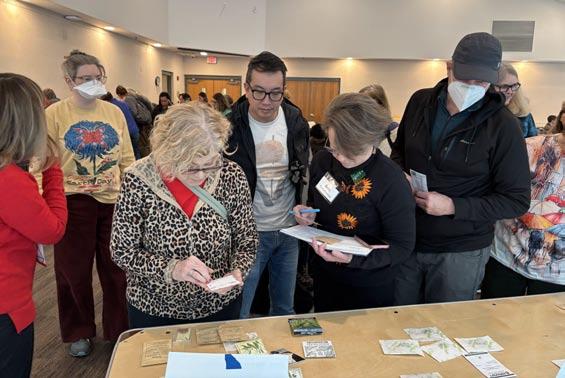
Community members and gardening enthusiasts gathered at Brookside Gardens in Wheaton, MD, for Washington Gardener’s annual Seed Exchange on Saturday, January 31. Participants brought many of their own seeds to share, including native plants, herbs, edibles, annual flowers, and more to celebrate National Seed Swap Day.
At the door, guests received a goody bag and raffle tickets for a chance to win door prizes. They were invited to peruse the “freebie” tables, which were loaded with free garden supplies, books, and catalogs.
After opening remarks from editor Kathy Jentz, attendees heard from two guest speakers: Debby Ward and Alex Mudry-Till.
Ward, owner of Prior Unity Garden, discussed mechanisms of growing lettuce all year long, sharing pictures from her own garden and the ones she maintains for the city of Vienna, VA. Ward gave an overview of the many lettuce varieties she grows and also discussed different maintenance techniques.
Mudry-Till’s presentation mainly focused on how to grow a cutting garden. Mudry-Till founded her flower farm, Quince-Blossom Ridge, with her husband after the pandemic. She covered how she grew flowers in-home, her current process for maintaining them, and some of her favorite varieties to grow by season.
The event also included a name tag competition: Some attendees came
with pre-made name tags, and guests were supplied with materials to decorate name tags as well. Competition entries introduced themselves to the room and explained their clever name tag designs to the audience.
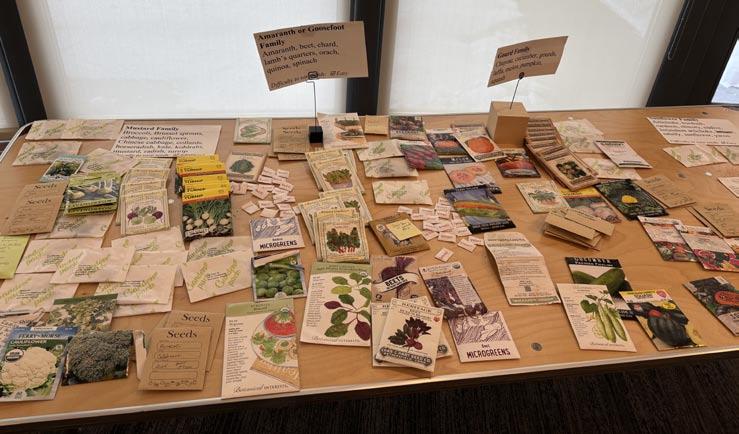
After the competition, participants enjoyed a snack break and previewed the seeds, sorted into table categories by volunteers, to decide which ones they wanted to take later during the swap.
Guests were also able to ask questions of the speakers and each other regarding anything garden-related. Many learned tips for growing new plants, especially throughout the winter months.
After selecting their seeds during rounds of swapping, participants had the opportunity to share and trade if they didn’t get a specific seed they wanted. The day ended with many sharing their varieties, and everyone took home a bag of seeds to grow.
If you missed this event, there will be another one next Saturday, February 7 from 12:30–4pm at Green Spring Gardens in Alexandria, VA. Register online beforehand at https://www. eventbrite.com/e/wg-seed-exchange272026-in-virginia-tickets-197640672 2711?aff=oddtdtcreator or sign up at the door starting at 12n. o
Lauren Bentley is an intern this spring semester with Washington Gardener. She is a senior pursuing a double major in journalism and criminology and criminal justice. She is a Michigan native and enjoys running, reading, and baking.
Blight or Burn? Know the Signs on Your Boxwood
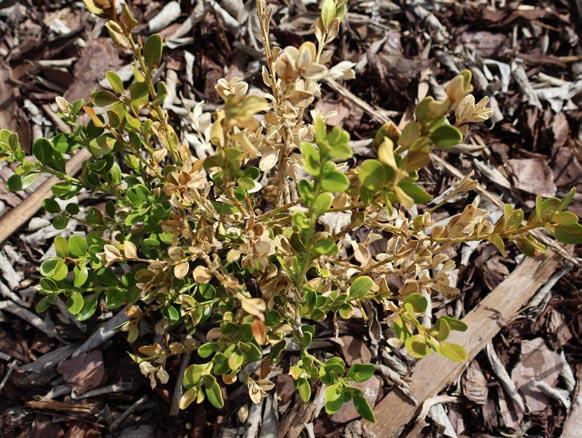
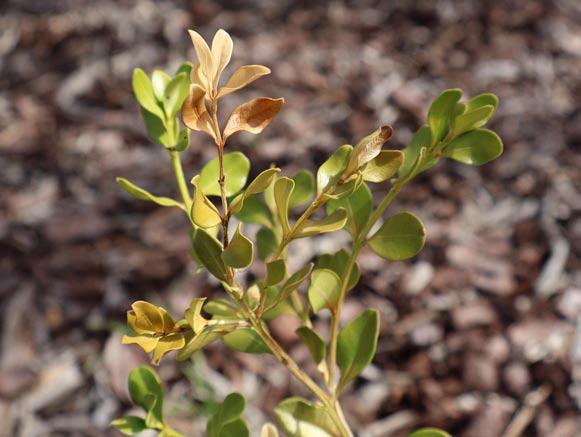
After a harsh winter, you may notice your boxwood foliage is bronzed, brown, or faded. If you’re growing traditional varieties, blight might be the first thing that comes to mind, but not all winter damage is disease.
Often, it’s winter burn: a temporary reaction to cold, wind, and dry air that usually resolves with time and care. Still, it’s important to know the difference, especially if your landscape includes boxwoods that are vulnerable to blight.
Here’s how to tell the difference and which traditional varieties you can replace with new blight-resistant boxwoods, such as Better Boxwood, to eliminate the risk of blight for good.
What is Winter Burn?
Winter burn is not a disease. It’s a form of stress caused when boxwoods lose more water through their leaves than they can take up from the soil (especially when it’s frozen).
What it looks like:
• Browning, yellowing, or whitening of leaf tips
• Often directional (on the side facing wind or sun)
• Winter burn does not produce black lesions on stems and rarely causes permanent damage. It often improves with water, mulch, and spring pruning.
Prevent winter burn by:
• Deep watering in late fall
• Wind protection (burlap or barriers)
• Mulch to regulate soil temps
What is Boxwood Blight?
Boxwood blight is a fungal disease that spreads fast and can devastate an entire planting if not addressed.
What to look for:
• Brown leaf spots with dark edges
• Black streaks or cankers on stems
• Rapid defoliation
• Thinning from the bottom up
• Unlike winter burn, blight requires serious action, including removal of infected material and strict sanitation.
What you can do to minimize boxwood blight:
• Water deeply before a freeze.
• Use mulch to protect shallow roots.
• Consider anti-desiccant sprays in harsh climates.
• Plant in sheltered areas out of winter wind.
• Avoid late-season pruning or fertilizing.
• One of the easiest ways to avoid the worry of blight is to choose plants that are resistant from the start. Better Boxwood is the first series of boxwoods bred specifically for blight resistance, giving you confidence that your landscape is protected, even if symptoms arise.
While winter burn may appear now and then, blight doesn’t have to. If you’re still growing traditional boxwood varieties, they remain at risk, even with the best care.
Boxwood plants are also sensitive to damage from salts used to melt ice on roads or pathways. Select plant-friendly ice melting products and consider placing boxwoods away from walkways that are commonly treated with salts.
Boxwoods are tough shrubs. With thoughtful plant placement and proper care going into the winter months, you can prevent winter damage and keep your plants healthy all year round. o
Text and photos are provided courtesy of Better Boxwood (https://betterboxwood. com/) .
The “Inside Scoop” on Seed Buying to Empower Home Gardeners
As the new year sparks fresh hope for bigger and better gardens, the National Garden Bureau (NGB) is launching a comprehensive educational initiative to help consumers navigate the world of seed-buying. With gardening interest at an all-time high, the NGB’s #SeedFacts resources provide essential tips for successfully purchasing garden products online and understanding the science behind the seed packet.
The surge in home gardening has brought millions of new enthusiasts into the fold. To ensure their success, the NGB has compiled “Seed Facts for Informed Buyers,” a guide designed to take the guesswork out of digital shopping.
“Gardening is about hope and results,” said Diane Blazek, Executive Director of the NGB. “By understanding how to identify reputable merchants and what specific seed terms mean, gardeners can invest their time and money more wisely, leading to more bountiful harvests and beautiful landscapes.”
Here are some key #SeedFacts for the 2026 season:
• Know Your Merchant: The NGB recommends shopping through its “Shop Our Members” portal, a curated group of trusted and reputable retailers.
• Decoding the Packet: Understanding the difference between raw, treated, organic, and pelleted seeds is crucial. For example, multi-pelleted seeds contain multiple seeds in a single coating, perfect for creating full, lush clusters of plants with one planting.
• Freshness Matters: Reputable retailers pack seeds annually for freshness. Home gardeners should look for the
“Packed for [Year]” stamp to ensure high germination rates.
• The “Why” Behind Shipping: The NGB explains the logistics of seed availability, from the time it leaves the breeder to the quality testing required before it hits the consumer’s doorstep.
For those seeking more technical knowledge, the NGB’s “Ask the Experts... about #SeedFacts” series tackles common questions such as why favorite varieties are discontinued (often to make room for newer, diseaseresistant breakthroughs) and why saving seeds from hybrid plants won’t yield the same results as the original crop.
Here are the top seed-shopping tips.
• Shop Early but Stay Patient: High demand can lead to shipping delays; subscribing to a company’s newsletter is the best way to stay updated about inventory.
• Verify Security: Ensure online stores use “https” for secure transactions.
• Check Your Zone: Always cross-reference plant requirements with your local growing zone to avoid disappointment.
• Buy for the Future: Don’t just shop for spring; consider succession sowing by purchasing kale, cabbage, and other fall-crop seeds now.
Note how many seeds are in each package and plan ahead. If you can use 25 of the same tomato variety, that’s great! You can always store leftovers for next year, but be aware that the germination rate will decline slightly, even if seeds are properly stored.
Maybe you could share or swap seeds with a gardening friend. (Note: National Seed Swap Day is the last Saturday of January every year.)
• Try One New Thing: NGB encourages gardeners to step out of their comfort zone each year to discover new favorites.
• Ask Around: Talk to your friends and other gardeners about what they buy and whom they buy from.
• Peruse the Catalog or Website: Get to know that company and what they specialize in. There is a huge variety of companies and each serves an important niche.
• Know Your Limits or Your Garden’s Limits: All experienced gardeners can tell you that buying too many seeds or plants is the most common problem. It’s like an addiction! o
Surprise Your Sweetheart on Valentine’s Day
Valentine’s Day is all about love, surprises, and of course...flowers, but why just give the usual red roses? Score bonus points this year by giving something unexpected: bulb flowers! Tulips, hyacinths, ranunculus, and white grape hyacinths break with tradition with their fresh colors, unusual shapes, and romantic symbolism.
Valentine’s Day is the perfect time to try something a bit different. Bulb flowers and potted flowers are surprising, versatile, and full of different meanings, so go for a bouquet that really stands out, just like your love. Red might represent passion, but did you know that other colors are just as meaningful?
• Purple represents royal love and admiration.
• Pink symbolizes tenderness and playfulness.
• White exudes purity and new beginnings.
Don’t just give a bouquet of flowers, make it personal.
• Include a sweet, personalized card.
• Stick hearts on the potted flowers.
• Divide some flowers among small, pretty bottles and arrange them in a group.
• Hang Valentine’s balloons for the finishing touch.
Bulb and potted flowers are beautiful and last longer than you think.
• Tulips will continue to grow in a vase.
• Hyacinths have a gorgeous scent and stay fresh for a long time.
• Potted flowers are the best and bloom for up to two weeks.
Many bulb flowers and potted flowers are seasonal and often come from local growers. Giving potted flowers as a gift? Put them in the garden after flowering to create a lasting memory.
Find more information about flower bulbs at www.flowerbulbs.com. o
New Plant Spotlight
Hydrangea Centennial Ruby™
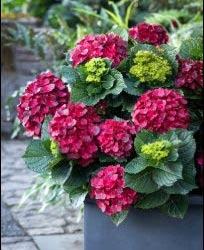
The new year marks a new century of horticultural excellence for Monrovia. The nation’s largest grower of premium shrubs, trees, and perennials is celebrating its 100th anniversary throughout 2026. The milestone will be celebrated in a variety of ways, including the debut of a radiant new hydrangea called Centennial Ruby™. This unique new variety features deep-ruby-red blooms that darken as they mature to create a dramatic, color-shifting display.
Available as a limited edition in 2026, Centennial Ruby Hydrangea is the sparkling gem of the company’s 100th anniversary season. Just like a work of art, the first 5,000 plants will include a special tag, each with a limited-edition number. With a limited quantity of plants available, it is sure to become a collector’s item.
Centennial Ruby combines visual impact with outstanding garden performance. Strong, sturdy stems support large blooms that last more than 100 days. This robust and resilient Hydrangea macrophylla is ideal for changing weather conditions. It stays compact, topping out at 3 feet tall and wide. Its petite size and long-lasting blooms make it the perfect front border or container plant. Centennial Ruby is recommended for USDA Hardiness Zones 4 to 9.
Learn more about Centennial Ruby at https://www.monrovia.com/. o
Quick Links to Recent Washington Gardener Blog Posts
• Meet the Spring 2026 Interns
• Camouflaging with Plants
• The Future is Nuts
See more Washington Gardener blog posts at WashingtonGardener.blogspot.com o
February Garden To-Do List
• Cut some branches (Forsythia, Quince, Bittersweet, Redbud, Willow, etc.) for forcing indoors.
• Put out suet for birds.
• Keep birdfeeders filled and provide a source of water.
• Check outside plants and trees for animal (deer) damage.
• Mist indoor plants and set up pebble trays to increase humidity.
• Rejuvenate Holly bushes and Boxwood with a hard pruning.
• Plan landscape design projects.
• Check evergreens for signs of desiccation.
• Start seeds of cool-season vegetables and flowers.
• Keep ice-melting chemicals away from garden beds. Use coarse sand instead.
• Prune any dead or diseased wood off trees and shrubs.
• Fertilize trees, shrubs, and evergreens.
• Prune roses.
• Begin tilling beds (when the ground is dry enough to work, but not muddy) and work in compost.
• Plant or transplant trees or shrubs, including berries, roses, and evergreens.
• Apply pre-emergent weed control such as corn gluten.
• Protect tender plants by covering them with some type of cloth material, if an unusually cold day/night is in the forecast. Be sure to uncover when it warms up.
• Weed.
• Trim ornamental grasses such as Liriope, Mondo, and Pampas.
• Divide overgrown or crowded perennials such as Daylilies and Shasta Daisies.
• Scan houseplants for insect activity.
• Dust house plants with a slightly damp cloth.
• Clear perennial beds of any dead plant parts and debris.
• Clean and organize the garden shed.
• Clean, sharpen, and oil tools, if not already done last fall.
• Walk your yard to check for heaving plants and bulbs, and place them back in the ground as needed. Cover with more mulch to prevent further heaving.
• Apply dormant oil spray to ornamentals and fruit trees before dormancy breaks.
• Check and tune up power equipment (mowers and trimmers).
• Build garden furniture.
• Spread new gravel on paths.
• Mulch bare areas.
• Design new beds and gardens.
• Pick up new gardening books and magazines for inspiration.
• Start seedlings indoors under grow lights. Some good choices to start early are Peppers, Artichokes, Onions, Beets, Turnips, Cabbage, Kale, and Leeks.
• Put up trellises and teepees for Peas and Beans to climb on.
• Direct-sow early, cool-season crops as soon as ground soil can be worked. Good choices are Peas, Lettuces, Mustards, Onion sets, Kale, and Cabbages.
• Start or turn your compost pile.
• Do an annual soil test and amend soil as recommended.
• Check for snow damage. Gently brush off snow weight, if you must, but it’s better to let snow melt on its own. o
The Urban Garden: 101 Ways to Grow Food and Beauty in the City is all about small-space gardening solutions!
By Kathy Jentz
and Teresa Speight
Published by Cool Springs Press/Quarto Homes
Order it today at: https://amzn.to/3yiLPKU
GardenDC Podcast
The GardenDC podcast is all about gardening in the greater Washington, DC, and Mid-Atlantic area. The program is hosted by Kathy Jentz, editor of Washington Gardener Magazine, and features guest experts in local and national horticulture. The latest episodes include interviews with experts on Biblical Gardens, Goldenrods, and Growing Nuts.
You can listen online at https:// washingtongardener.blogspot.com/ or on Spotify, Apple, etc o
Classes, Events, and Plant Shows/Sales
• Saturday, February 7, 12:30—4pm
Washington Gardener Seed Exchange at Green Spring Gardens in VA Registration is now open at https://www.eventbrite.com/e/wg-seedexchange-272026-in-virginia-tickets1976406722711?aff=oddtdtcreator.
• Saturday, February 7, 10am—3pm
HHS Seed Sale
The Hyattsville Horticultural Society will hold its 14th annual seed sale on the ground floor multipurpose room in the Hyattsville Municipal Building, 4310 Gallatin Street, Hyattsville, MD.
• February 12 and 13
Chesapeake Green
Chessie Green is a two-day event packed full of engaging and informative horticulture education for horticultural professionals. The 2026 symposium will be held at the Maritime Institute. Come for an excellent education and enjoy networking, vendor showcase, and silent auction (to benefit scholarship). See more at https://mnlga.org/page/ ChessieGreen.
• Friday, February 13, 9am–4pm
GreenScapes Symposium
This year’s symposium theme is “Integrating Ecology, Beauty, and Adaptability in Design.” Hosted by Brookside Gardens. This is a live, Zoom event with audience Q&A. Register at https:// montgomeryparks.org/parks-and-trails/ brookside-gardens/special-events/ greenscapes/.
• Sunday, February 15, 2pm European Rose Splendor
The Potomac Rose Society (PRS) is hosting a richly illustrated program presented by PRS members Nicky Sensale and Cynthia Giordano, who traveled together through France and England in search of extraordinary roses and unforgettable gardens. This event is FREE and open to the public. Register or the Zoom link at https://potomacrose.org/. A recording of the Zoom presentation will be posted to the members-only section of the PRS website afterward.
Looking Ahead
• March 6—7
Seeds & Culture: Rural and Urban Agriculture United
The Ujamaa Cooperative Farming Alliance (UCFA) will host its 2026 conference at the University of the District of Columbia, in partnership with 2020 Farmers Co-op. The 2020 Farmers Coop represents urban and rural growers and is committed to the preservation of traditional farming knowledge. The conference is an expression of the UCFA’s mission to bridge communities across geographic and cultural lines through seed, soil, and shared knowledge. Details at https://ujamaaseeds.com/.
• Saturday, March 7, 10am–2:30pm
USBG Production Facility Open House
A rare chance to see the U.S. Botanic Garden (USBG) Production Facility—85,000 square feet under glass divided into 34 greenhouse bays and 17 environmental zones. Come see the facility and the many thousands of plants. You’ll see USBG collection plants not currently on display, including orchids, medicinal plants, carnivorous plants, rare and endangered species, and more. Register for one of the open house times to meet the gardeners, ask questions, and wander through this working wonderland of plants. Event is free; there is a $25 fee if parking spot is needed during event. Friends of the USBG receive a discount with their membership. Register at https://usbg. swoogo.com/PFOpenHouse_2026.
• Saturday, March 21, 9am–3pm 15th Annual Gardening Symposium
See https://loudouncountymastergardeners.org/events/annual-symposium/.
Event Listing Updates
See updated event listings on the Washington Gardener discussion list. Join by emailing WashingtonGardenersubscribe@googlegroups.com.
How to Submit Events
To submit an event for this listing, email washingtongardenermagazine@gmail. com with “Event” in the subject line. Our next deadline is February 15 for the March 2026 issue, for events taking place after March 5 o
Prevent Rabbit Damage in Your Landscape
By Melinda Myers
Rabbits are year-round and frequent visitors to gardens and landscapes. As children, we read about and adored these furry critters. This love of rabbits often faded as we grew older and experienced damage to our gardens and landscapes. Employing various management strategies allows us to co-exist with these cute yet voracious members of our community.
Rabbits eat a wide range of plants, including flowers, vegetables, and weeds throughout the spring and summer. As these plants fade in fall, they begin dining on trees and shrubs. You may find bark gnawed; evergreen needles nibbled; and branches, stems, and buds clipped off the plants.
Their sharp teeth make a clean cut. much like a bypass pruner at a 45degree angle. Rabbit damage usually occurs within 3 feet of the ground, where they can easily reach and dine on the plants. Look for tracks and droppings, often called pellets, if additional clues are needed. The pellets are little, round, hard, and usually yellowy-brown to green.
Our landscapes provide the perfect habitat for rabbits. They tend to concentrate in open grassy areas that have patches of desirable cover like brush piles, shrubs, and gardens that provide an escape from predators.
These short-lived mammals tend to be very productive, giving birth to two to six litters of four or more babies in a season. Diseases, weather, predators, hunters, and cars help limit the number of surviving offspring.
Start by removing hiding places like brush piles, weed patches, and stone piles that provide places for rabbits to live and hide. Work with your neighbors who may not realize they are housing rabbits that are feeding in both of your yards. Leave a few weeds and perhaps some clover in the lawn as an alternate food source for them.
You will find lists of rabbit-resistant plants, but as gardeners know, they will eat just about any plants when populations are high and food is scarce.
Protecting key gardens and plants will help reduce the risk of damage and increase your enjoyment.
Fencing is an effective management strategy but may not be practical or aesthetically pleasing. When employing fencing, be sure it is high enough to keep rabbits out and the openings are 1 inch or less. A 3-foot-tall fence with an outward baffle at the top or one 4foot tall is more effective. Secure the fence tight to the ground or bury the bottom few inches to prevent rabbits from crawling under. Check the gate, adding flaps and sweeps as needed to prevent rabbits from gaining access to the garden.
Use 4-foot-tall cylinders of hardware cloth around young trees and shrubs to prevent damage. Place the cylinder several inches away from the trunk and bury the bottom few inches in the soil to prevent rabbit and vole damage.
Repellents are a less obtrusive option and more practical for many gardeners. Select a product labeled for rabbit control, preferably an organic option like Plantskydd (plantskydd.com). This
odor-based repellent is rain- and snowresistant so you will need to reapply less often. Whenever possible, apply repellents before the rabbits begin feeding and follow label directions for the best results.
Evaluate and adapt your landscape design as needed and continually monitor for damage. Employ various strategies to help reduce rabbit damage while boosting your enjoyment and garden’s productivity. o
Melinda Myers has written more than 20 gardening books, including Midwest Gardener’s Handbook, 2nd Edition and Small Space Gardening. She hosts The Great Courses “How to Grow Anything” instant video and DVD series and the nationally syndicated Melinda’s Garden Moment radio program. Myers is a columnist and contributing editor for Birds & Blooms magazine and was commissioned by Tree World Plant Care for her expertise in writing this article. Her website is www. MelindaMyers.com.
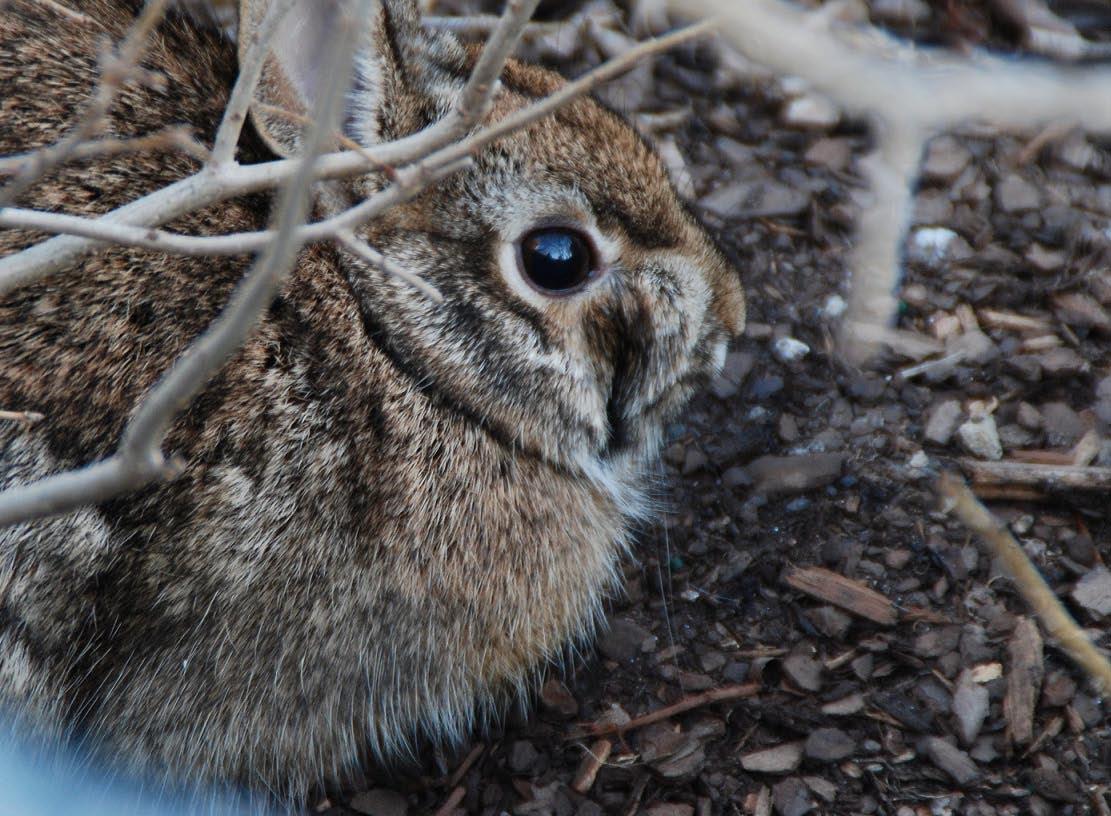
Rabbits eat a wide range of plants, including flowers, vegetables, weeds, trees, and shrubs. Photo courtesy of MelindaMyers.com.
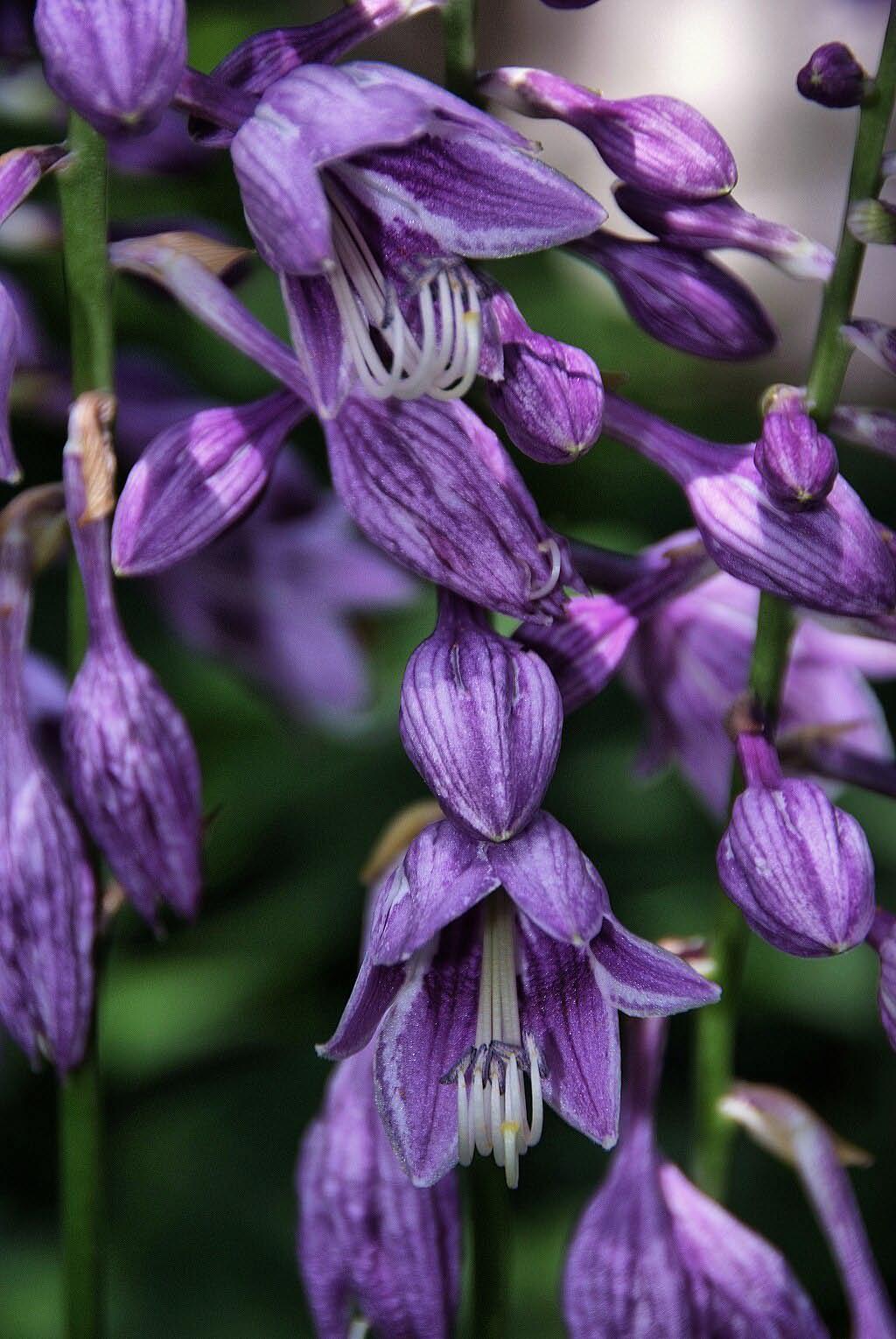
Hosta ventricosa: A Pretty Self-Seeder
Hosta ventricosa, commonly known as the blue plantain lily, holds a distinguished place in horticultural history as one of the earliest hostas introduced to European gardens. This shade-loving perennial, native to China and Korea, made its debut in England around 1790 and has since become naturalized in numerous regions of the eastern United States. The introduction to Europe is credited to George Hibbert (1757–1837).
Hostas are in the family of flowering plants, placed in the order Asparagales of the monocots. This family includes
By Peter Frandsen
asparagus, yucca, bluebell, lily of the valley, snake plant, corn cane, spider plant, and plumosus fern.
What sets Hosta ventricosa apart from most other hosta species is its remarkable ability to reproduce prolifically from seed. The secret lies in a unique reproductive strategy called pseudogamous apomixis. Unlike typical sexual reproduction, Hosta ventricosa produces seeds without true fertilization. The plant is a natural tetraploid (containing four sets of chromosomes rather than the typical two), and while pollination may trigger seed develop-
ment, the resulting seeds are genetically identical to the parent plant—essentially clones produced through seed rather than division.
This reproductive advantage means several things for gardeners and natural areas.
• True-breeding seeds: Unlike most hostas, whose seedlings display unpredictable variation, this hosta produces offspring that look virtually identical to the parent plant.
• Abundant seed production: The plant produces numerous seeds in short, triangular seed capsules that ripen from
At left, Hosta ventricosa photo by Agnieszka Kwiecień, Nova, CC BY-SA 4.0 <https://creativecommons.org/licenses/ by-sa/4.0>, via Wikimedia Commons.
August through September.
• Reliable germination: Seeds require no special treatment and germinate readily under favorable conditions.
• Natural dispersal: While seeds typically fall near the mother plant, they can establish new colonies in disturbed areas, forest edges, and abandoned lots.
Because of its ability to produce seeds so easily, Hosta ventricosa appears on several invasive species monitoring lists. It is classified as an “Invasive Watch” plant in Maryland and several other states. Deer predation limits population growth, since hostas are a preferred browse species. (In fact, you can eat them, too!)
Several biological and ecological factors appear to constrain the invasive potential of this hosta (these same factors apply to the gardener growing hostas).
• Shade requirement: As a shadeloving plant, it cannot invade open, sunny habitats where many aggressive invaders thrive.
• Moisture needs: The plant requires consistently moist soil and struggles in dry conditions.
• Deer palatability: Heavy browsing pressure in many regions prevents establishment and spread.
• Limited dispersal: Unlike winddispersed or bird-dispersed invaders, seeds fall close to parent plants.
• Competition with established vegetation: The plant establishes best in disturbed soils rather than in competition with established native communities.
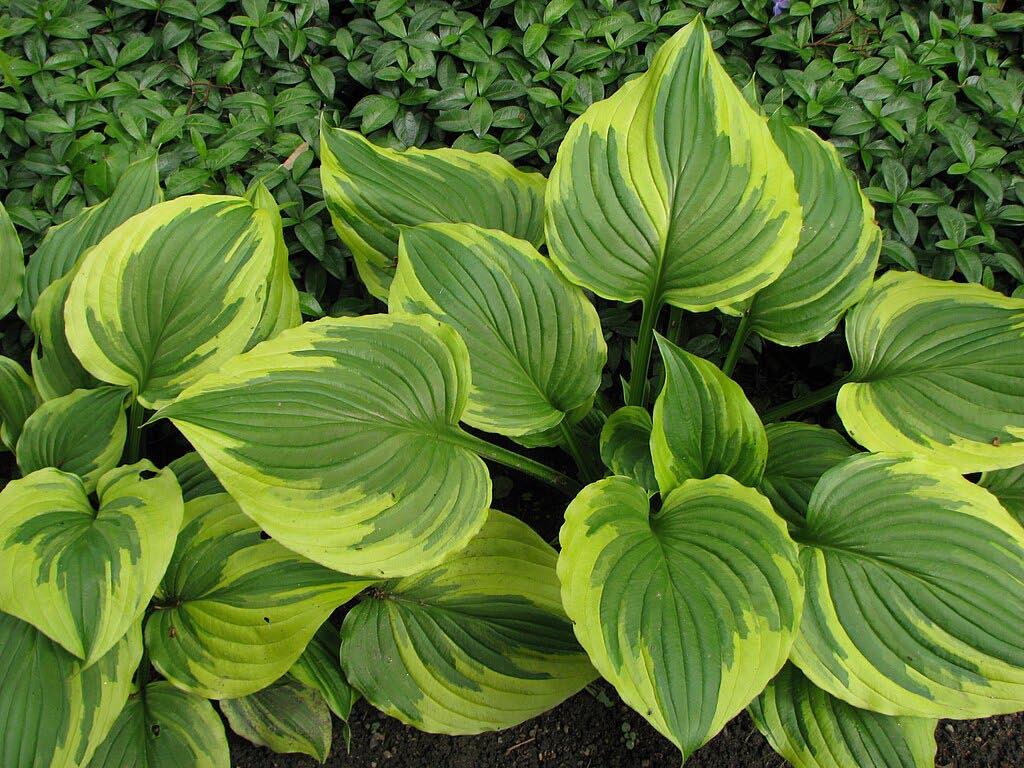
For home gardeners, Hosta ventricosa remains a valuable ornamental plant with lustrous dark-green foliage or variegated (depending on the cultivar) and attractive purple-blue flowers in midsummer.
Those concerned about self-seeding can:
• Remove flower scapes after blooming to prevent seed production.
• Avoid planting them near natural areas or woodland preserves.
• Monitor for volunteer seedlings and remove them promptly.
Finally, obtain plants and seeds from known and reliable sources, especially your local nursery. The pictures illustrating seeds for sale on social media marketing websites look suspicious and are most likely artificial—the flowers are far too large and the colors are oversaturated or unrealistic and not found in nature. o
Peter Frandsen is a lifelong gardener and board member of the Silver Spring Garden Club.
<https://creativecommons.org/licenses/
Hosta ventricosa flower photo above by Carl Wycoff from Nevada, USA, CC BY 2.0
by/2.0>, via Wikimedia Commons.
Cilantro Trials
Text and Photos by Cavit Ireland
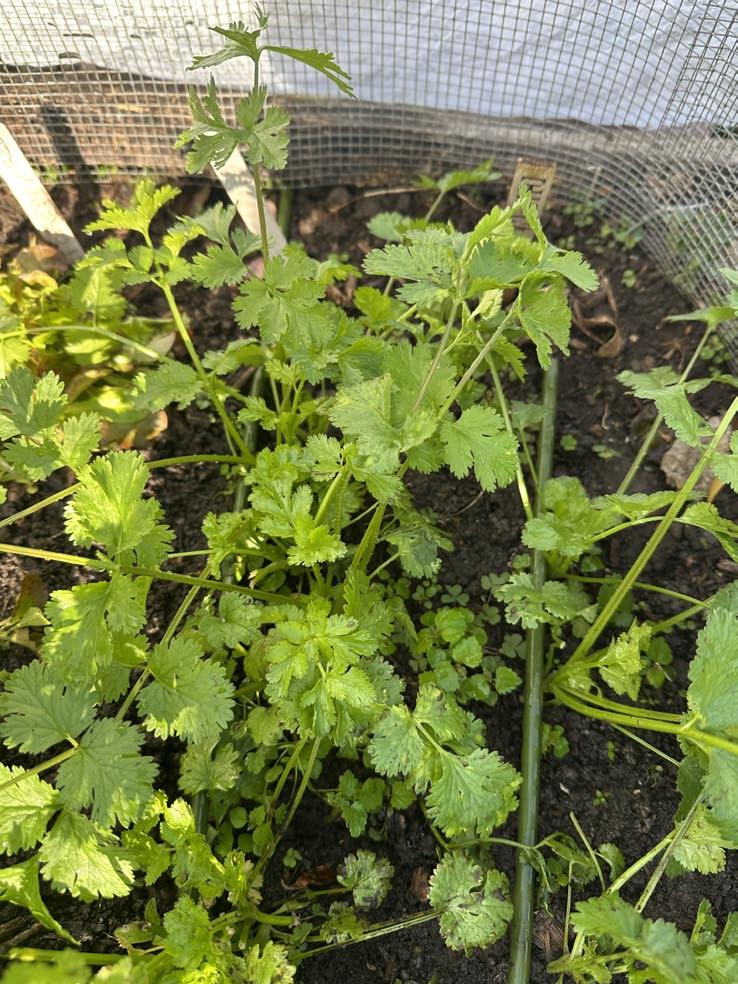
This season, we learned about a tale of two cilantros. One is a traditional cilantro–one we noted as the “regular” kind, and a variety of ‘Moroccan’ cilantro. We grew them side-by-side and under the same conditions. The regular cilantro’s growth responded quite differently from that of the ‘Moroccan’ variety. The experiment was a fascinating comparison of two kinds of the same plant.
The ‘Moroccan’ cilantro sprouted quickly and confidently. Within a week the seedlings germinating, the plants stood a few inches above the soil, while the regular cilantro seeds lay dormant. Soon enough, the ‘Moroccan’ patch was densely covered with a tiny blanket of green foliage. The germination rate was high, leaving very few bare spots between the seedlings. They grew in aggressively and filled in as leafy bunches that looked like they were almost ready to harvest before the regular cilantro made much progress at all. When it finally emerged, the regular cilantro grew in more scattered bunches, slowly making space for itself. The thin row also faced more weeds than the ‘Moroccan’ cilantro. The leaves were slightly thinner and bunches grew less dense. It seemed to grow with restraint, like a slow unfolding, unlike the ‘Moroccan’ cilantro’s burst of life. Such characteristics carried over from the garden into the kitchen. I put both to the ultimate test: Taco Tuesday. Deeply fragrant with powerful flavor, the ‘Moroccan’ cilantro cut through the other foods and came out strong. While the regular cilantro had a similar scent to its counterpart, it brought a gentler taste to the table. It was a subtle boost, blending with the dish quite nicely.
Growing these varieties of cilantro next to each other showed me how the same herb can behave differently. The ‘Moroccan’ cilantro was bold and eager, while the regular cilantro took its time and refined its taste. It also goes to show that small differences can completely transform a meal. o
Cavit Ireland was an intern with Washington Gardener for the fall 2025 semester. He is a rising senior at the University of Maryland studying journalism and hosts Sonic Fruit, a weekly music program on WMUC 90.5.
Cilanto ‘Moroccan’ at left and ‘Slow Bolt’ on the right.
Second-Chance Radish and Lettuce
Text and Photos by Ellen Isaacson
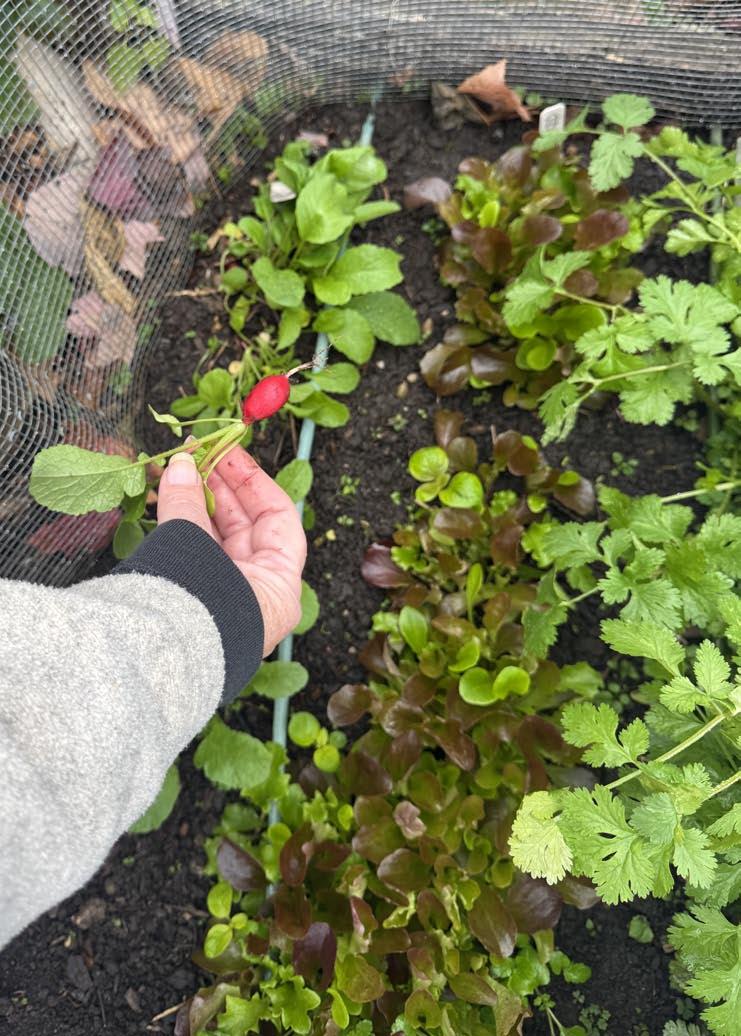
This past fall, alongside the traditional and ‘Moroccan’ cilantro that Cavit Ireland writes about (see page 16), we grew a ‘Sweet Greens & Reds’ Farmers Market Lettuce Blend from Renee’s Gardens Seeds and red ‘Rudolph’ Radishes from the Hudson Valley Seed Company in the community garden. Originally, we planted Buttercrunch Lettuce and Hungarian Landrace Parsley, but they unfortunately did not germinate. The lettuce blend and radishes were grown in the same conditions as the cilantro, with the addition of a cover cloth once the colder months arrived.
Although there was a minor time setback due to the lack of growth from lettuce and the parsley, once the greenand-red lettuce blend and radishes were planted, it was smooth sailing. Every week, after our intern meeting, we would walk over and check in on the garden and our small plot. There was always a little bit of weeding that needed to be done each week around the two seedling rows, but the cool-season weeds were not too aggressive.
It took a couple of weeks until we saw some lettuce seedlings, but once they emerged from the soil, they grew very evenly, filling their entire row. The green was vibrant, and the red of the lettuce blend reminded me of the classic colors that accompany the fall season.
The radish’s bright-pink was a lovely, colorful addition to my salad bowl. I decided to prepare a salad with these two freshly harvested vegetables. I topped it off with a cilantro salad dressing from Trader Joe’s, staying on theme with our plot. It was incredibly fresh and delicious.
Growing these vegetables alongside the two varieties of cilantro made me realize how differently vegetables grow; some are eager to sprout, while others need a little bit more encouragement. Nonetheless, sometimes the best things in life take more time, so I was
happy to see that time paid off when it came to the green-and-red lettuce blend and red radishes. o
Ellen Isaacson was an intern with Washington Gardener for the fall 2025 semester. She is double-majoring in journalism and French language and literature..
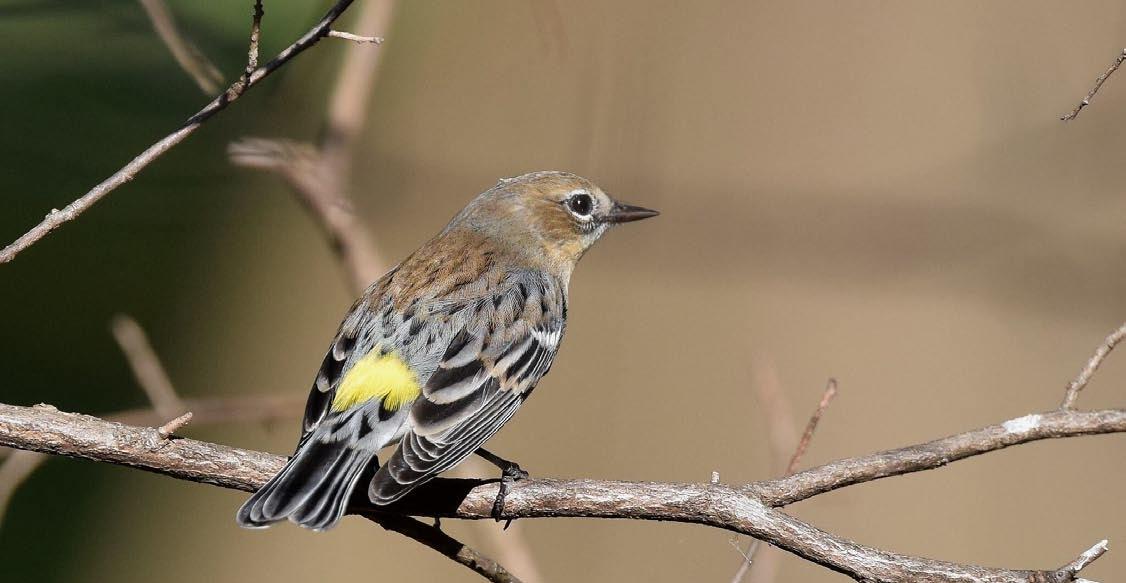
Butterbutt – the winter warbler
By Rick Borchelt
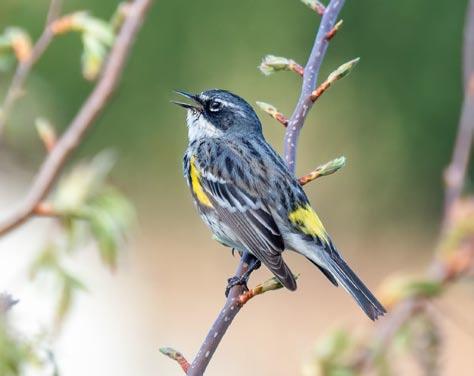
The springtime return of warblers to our area’s yards and gardens is one of the great events of the natural world: showy males in full courtship plumage, shimmering like holiday ornaments among bare branches just beginning to break into bud, or singing dozens of different tunes and lyrics from the cover of the new green leaves.
However, one of these spring warblers has actually been with us all winter long, braving the deep freezes, ice, and snow to greet its songster cousins when these Johnny-come-latelies arrive in spring.
For us in the Washington, DC, area, yellow-rumped warblers (Setophaga coronata) are truly warblers of winter. They typically arrive in October from their breeding grounds in the conifer forests of the northwoods of New England and Canada. They’ll make their winter home here in the Mid-Atlantic and throughout the southeast, some even venturing as far south as Panama. Winter yellowrumps are regularly found in brushy fields, tangles of vines and shrubs, and in shrubby meadows filled with young trees and red cedars.
What gives this warbler the stamina and perseverance to withstand the coldest winters here, when most of the warbler clan has decamped to warmer climes?
The answer lies in a peculiar adaptation to eating wax.
In spring and summer, like most other warblers, yellow-rumps feast on insects, spiders, and other arthropods, often catching them in mid-air sorties or when rapidly (but methodically) inspecting every leaf on a tree or shrub for caterpillars. Come the first hard frosts, yellow-rumps do relish the occasional insect still about, but they turn almost entirely to a more readily available diet of fruits and seeds.
Around the metro area, this diet might include multiflora rose hips, honeysuckle berries, bittersweet, holly—even the waxy berries of poison ivy! Small flocks of yellow-rumps, usually 10 or fewer individuals, can often be spotted moving agitatedly through trees and shrubs, or picking through weedy gardens or field margins for zinnia seeds, poke berries, and other morsels.
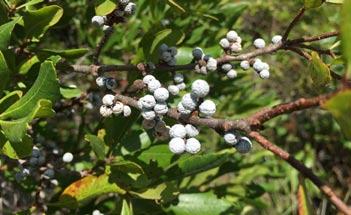
It’s on the Eastern Shore that yellowrumps really show their winter foraging prowess. There, they gather in flocks sometimes numbering into the hundreds, moving through the extensive bayberry stands in the coastal marshes. Bayberries are often the predominant shrub in coastal Atlantic marshes; northern bayberry (Morella pensylvanica) is the common species in the MidAtlantic. In winter, the shrubs are laden with distinctive gray berries.
The gray comes from a coating of wax
over the berry (hence the plant’s other common name, wax myrtle), keeping the berries from desiccating in the nearconstant salt marsh wind. Bayberry candles historically were made from this wax, and their fragrant scent was especially popular at Christmas and New Year’s during the Colonial Revival period, when burning the candles was believed to bring good fortune in the coming year.
Yellow-rumped warblers are one of the few birds capable of digesting the nutritious waxy coating on bayberries and other winter fruits. Photo credit: Famartin.
The wax yields more than luck for the warblers. It’s a nutritious snack—if you can digest it. Only a few birds can do so, yellow-rumped warblers and tree swallows (which winter farther north than other swallows) among them. Calories from wax allow the birds to winter
Even in winter, both sexes of yellowrumped warblers sport a bright-yellow rump, earning the other common name of butterbutt. Photo credit: Andy Reago and Chrissy McClarren, CC BY 2.0.
much farther north than their compatriots, and the bayberry benefits from birds distributing seeds far and wide as they pass through the birds’ guts.
This energy-rich food sustains yellow-rumps through the cold coastal winter until they can return to eating insects, and especially small moths, in the spring. The Latin name Setophaga translates to “moth eating” while coronata references a yellow spot on the bird’s crown that is seldom visible in wild birds.
Even large numbers of these birds moving through the marsh can be hard to spot, given their drab, gray-brown coloration that blends in well with the dull colors of the winter marsh. They’re most often noticed by flashes of bright gold that give the species its common name. The flashing yellow rump earns the birds another nickname from both today’s birders and old-timers from the marshlands: butterbutt.
In addition to the bright-yellow flash of birds in flight, winter flocks are often announced by diagnostic, metallic chek! notes as they forage. The male’s spring song is a weak, rambling, and rather tuneless warble.
Yellow-rumped warblers once were considered two distinct species: myrtle warbler (a nod to their wax myrtle winter diet) in the East, and Audubon’s warbler in the Pacific states. Genetic analysis has confirmed, however, that the two are subspecies rather than species in their own right. Both are medium-sized warblers, ranging between 5–6 inches long, about the size of a house sparrow. In the field or garden, the myrtle warbler subspecies can be told from Audubon’s by its white throat, which in the western subspecies is the same gold as the tell-tale rump. In winter, a few stray Audubon’s warblers make their way to the East Coast and can be picked out with care from flocks of myrtle warblers.
Lucky gardeners who put out suet feeders for winter birds are sometimes rewarded by regular visits from butterbutts who find the fatty food a welcome respite from dry berries and seeds. o
Rick Borchelt is a science and natural history writer, field naturalist, and garden and botany enthusiast. Reach him with questions about this column at rborchelt@gmail. com.
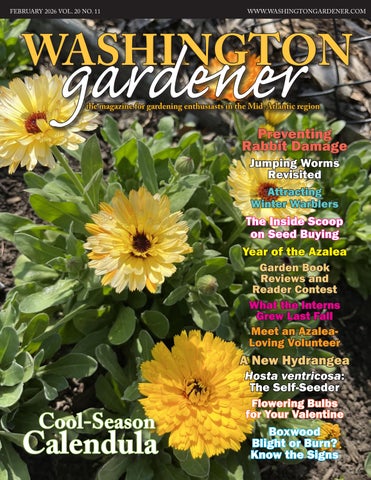
Calendula
By Kathy Jentz
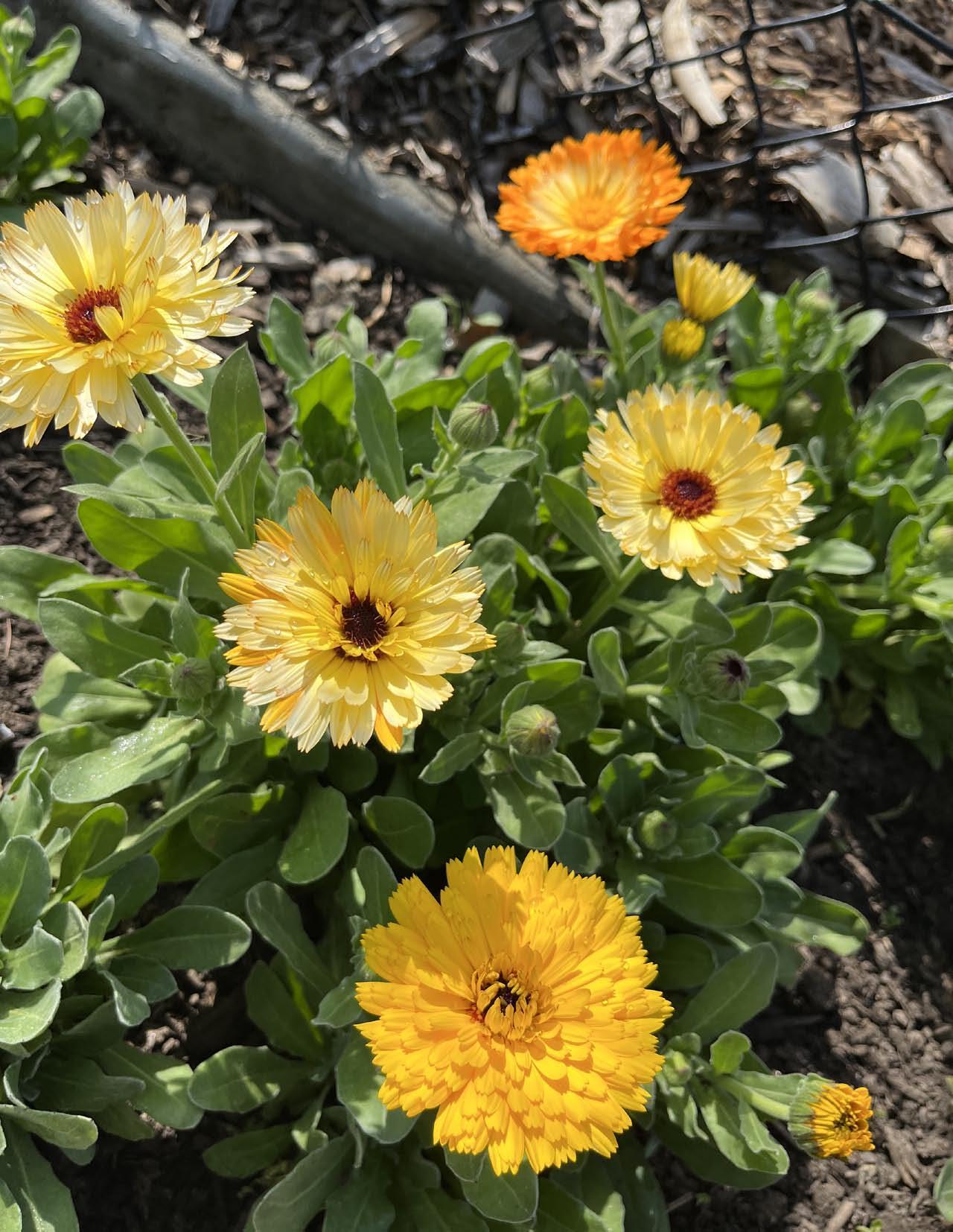
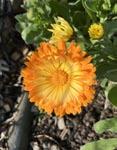
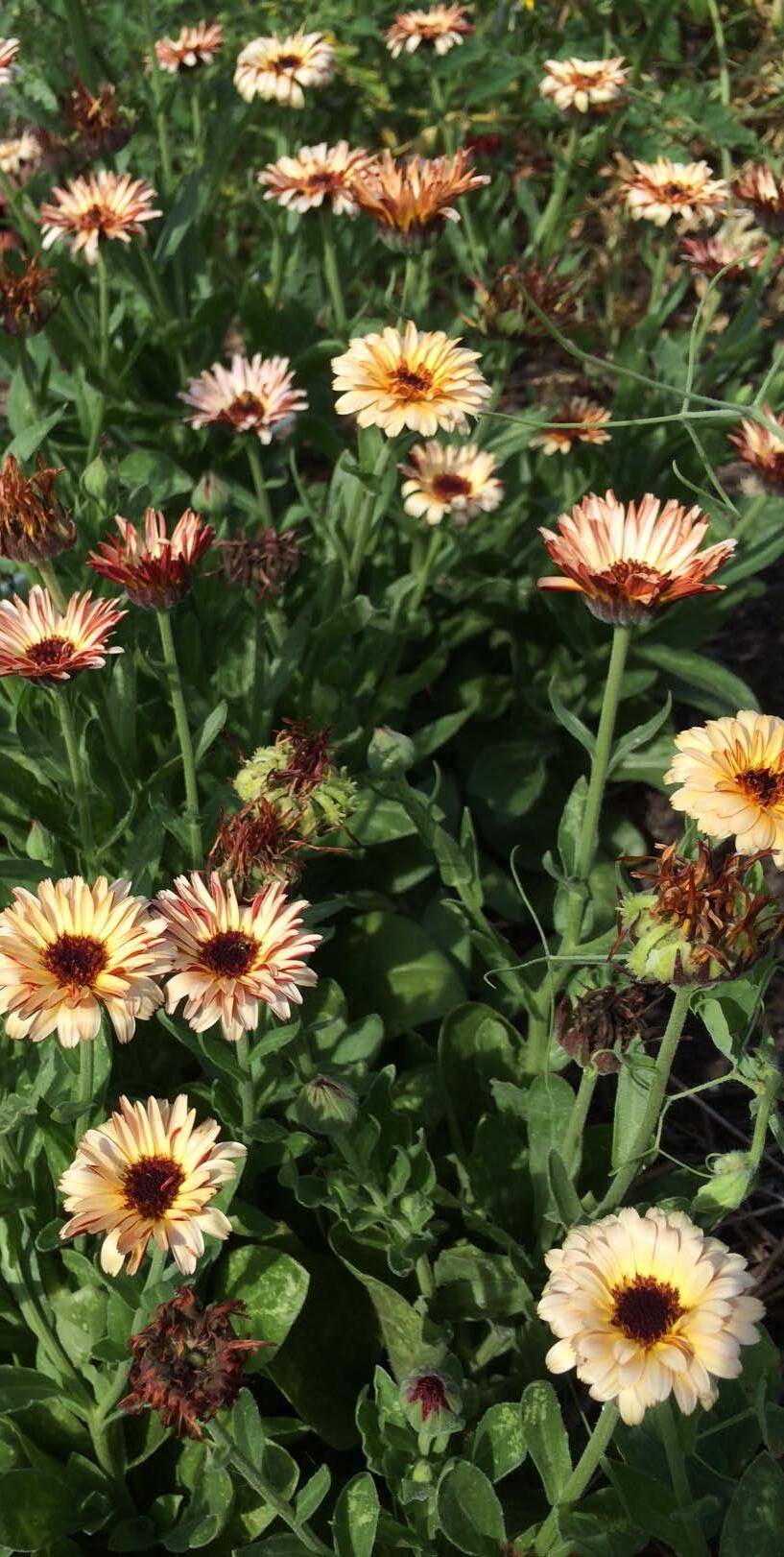
Calendula (Calendula officinalis) also known as Pot Marigold or Poet’s Marigold, it is a half-hardy perennial plant that readily re-seeds itself. It is hardy to USDA Hardiness Zones 2 to 11.
Plant it in full sun and in well-draining, loamy soil. Water it only during periods of drought. Deadhead it frequently to encourage continual blooming. Calendula is also a long-lasting cut flower.
You should occasionally weed around the plants and carefully pull out any new seedlings to pot them up and pass them on to other gardeners.
Calendula was named Herb of the Year in 2008 because it is both edible and beneficial. Snip off the colorful ends of the flower petals to add a pretty accent to any salad or as a decoration on baked goods. It has a very light taste—like a spicy pale honey. The dried petals can be used to color broths, cheeses, and butter. They are a thrifty substitute for the much more expensive saffron spice.
Calendula tends to sulk in the summer heat here in the Mid-Atlantic U.S., but that is just a pause in its robust routine. In my garden plot, I cannot recall any month of the year that it doesn’t have a few blooms opening up. This is a tremendous workhorse that belongs in every edible and cutting garden. o
Kathy Jentz is the editor of Washington Gardener.
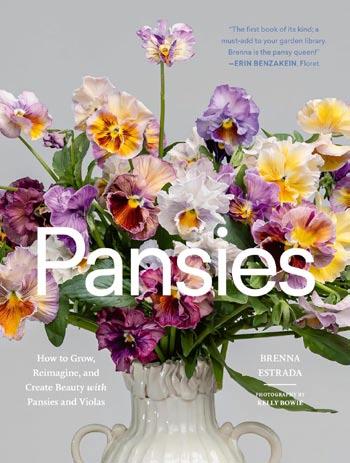
Pansies: How to Grow, Reimagine, and Create Beauty with Pansies and Violas
Author: Brenna Estrada
Publisher: Timber Press
List Price: $30.00
Order Link: https://amzn.to/3NX8Joo and https://bookshop.org/ a/79479/9781643264004
Reviewer: Teresa J. Speight
Many people consider pansies as just an annual to be planted in the cooler seasons of the year. Brenna Estrada takes the reader on a journey into the history of this much-loved flower, sharing how pansies and violas have evolved and have been reimagined in the world of horticulture.
What I found the most interesting was the number of named cultivars in the past, which inspire new forms and color combinations today.
The author lives in USDA Hardiness Zone 8b in the Pacific Northwest, which leaves the reader to know their own growing zone and to use the knowledge the author shares appropriately.
Pansies from seed, like most plants, will need certain growing conditions and soil types for successful results. Did you know that pansies can be used as a beautiful weed suppressant? Allowing pansies to stretch at the base of various plants, encourages longer stems for use in floral arrangements. In 1899, a vase of pansies or viola was considered quite an elegant feature in the home. Pansy and viola flowers bloom in the early spring, enticing pollinators to visit early and often.
Offering a historical perspective, growing tips, and suggested varieties to consider, this book is a terrific resource that invites the reader to reimagine where to plant and how to use pansies and violas o
Teresa J. Speight is a native Washingtonian, mother, grandmother, steward of our land, and history lover. She is the author of Black Flora: Profiles of Inspiring Black Flower Farmers + Florists and co-author of The Urban Garden: 101 Ways to Grow Food and Beauty in the City.
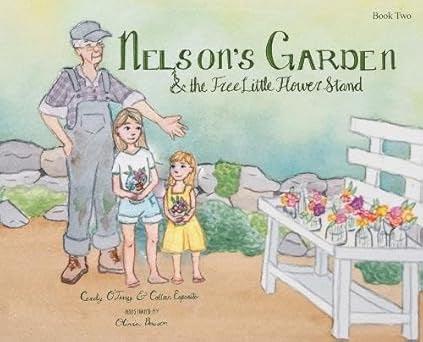
Nelson’s Garden & the Free Little Flower Stand
Authors: Candy O’Terry and Colleen Esposito
Illustrator: Olivia Bosson
Publisher: Briley & Baxter Publications List Price: $23.95
Order Links:https://amzn.to/4khoi6h and https://bookshop.org/ a/79479/9781961978683
Reviewer: Kathy Jentz
Nelson’s Garden & the Free Little Flower Stand is book two of the Nelson’s Garden series, in which sisters Belle and Rosie continue to cultivate a friendship with their neighbor and expert gardener, Nelson McNutt. Together with their mother, Grace, the girls visit his garden every day, ready to learn and eager to soak up as much wisdom as they can. Through cool spring rains and hot summer days, the girls experience the joy of growing flowers in every color of the rainbow ... which gives them an idea! They all work together to bring their new Free Little Flower Stand to life, and as they spread joy throughout their community, they learn that when you put kindness out into the world, it can’t help but take root and grow.
The illustrations by Olivia Bosson
are charming and the authors are a mother-daughter team writing from real-world experience.
Candy O’Terry is a proud member of the Massachusetts Broadcasters Hall of Fame. She is a broadcaster, podcaster, master interviewer, singer, and contributor to Pink Chair Storytellers Magazine. She’s the recipient of 70 local and national awards, but when asked what brings her the most joy, she’ll say: co-authoring this children’s book series with her daughter, Colleen.
A lifelong advocate in the fight against breast cancer, Candy is a recent survivor of the disease, an experience that left her keenly aware of the gift of life and the passage of time. A devoted wife and mother, Candy and her husband Tom live in a lovingly restored colonial home framed in summer by daisies and located about a mile from where Nelson once tended his beautiful garden, proving once again that some stories are destined to be told
This book would make a great gift for a young gardening friend and for anyone looking to inspire the next generation to garden. o
Kathy Jentz edits Washington Gardener
The Bird Poop Garden
Author: Barbara Plantholt Melera
Illustrator: Ginger Triplett
Publisher: Outskirts Press
List Price: $39.95
Order Links: https://amzn.to/4rwZ5Ht and https://bookshop.org/ a/79479/9781977280749
Reviewer: Kathy Jentz
The Bird Poop Garden is a true tale about a flock of crows who, with the guidance of Mother Nature, establish an enchanting garden of beautiful flowers, including Bird Poop Poppies, Bird Poop Sunflowers, and Bird Poop Lupine.
Written from the perspective of a child named Davey visiting his grandparents, the story captures the wonder and magic of how seeds travel, germinate, and transform into colorful, beautiful blooms.
Author Barbara Plantholt Melera coowns Harvesting History, an heirloom gardening company, where she writes extensively about the seeds, plants,
and pollinators historically seen in the gardens of America and the world. She is also the EdibleHarvest columnist for Washington Gardener Magazine.
The Bird Poop Garden is a refreshing and novel way to teach young children and their loved ones about the journey many seeds undertake on their way to becoming stunning flowers.
This book would make a great gift for anyone with young children in their household. o
Kathy Jentz edits Washington Gardener.
Love Reading?
These books were reviewed by volunteer members of the Washington Gardener Reader Panel. Reader Panelists may also be asked to review new gardening plants, tools, and seeds.
To join the Washington Gardener Volunteer Reader Panel, send an email with your name and address to: KathyJentz@gmail.com. We look forward to having you be a vital part of our local publication and its gardening mission. o
Note: The books for these reviews were provided free from their publishers. These book reviews include links to Amazon.com and BookShop.org for ordering them. Washington Gardener Magazine might receive a few cents from each order placed after you click on these links
“Inspire. Connect. Grow.”
The National Garden Bureau is a nonprofit organization that exists to educate, inspire, and motivate people to increase the use of garden seed, plants, and products in homes, gardens, and workplaces by being the marketing arm of the gardening industry. Our members are experts in the field of horticulture and our information comes directly from these sources. Find out more at https://ngb.org/
JumpingRevisitedWorms
By Carol Allen
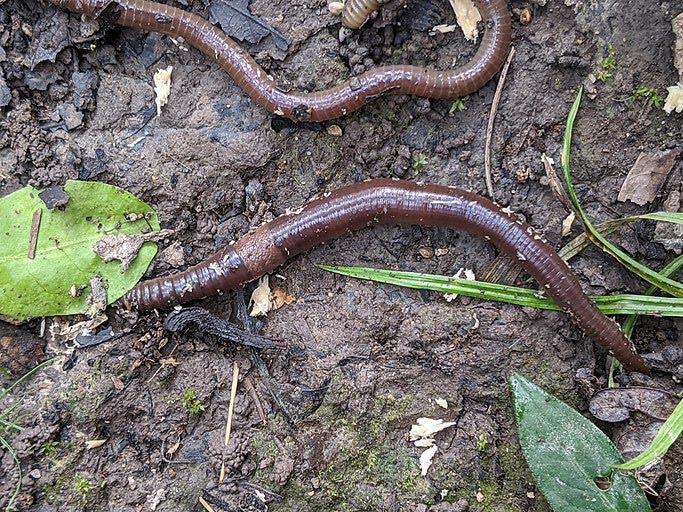
Asiatic jumping worms have been in the news. Since we first wrote about them in the Washington Gardener November 2020 issue, Asiatic jumping worms have been found to be very detrimental to natural systems. Their ability to break down organic matter in the soil rapidly disrupts habitat that supports other earthworms, centipedes, salamanders, and groundnesting birds. They can invade more than 5 hectares (more than 12 acres) in a single year and change both the soil chemistry and microbial communities. In short, they are seriously bad news!
The nursery industry and gardeners are implicated in spreading the pest. Three species make up the common term jumping worm. They can be found being sold as bait worms and may infest earthworm colonies sold for vermicomposting. As gardeners, we can be alert to the signs of jumping worm infestation, either through direct identification or through recognizing the accumulation of damaged soil in pots or in our garden beds.
The exchange of plants through garden clubs or through friendly trading can move these pests into new areas. The
University of New Hampshire (https:// extension.unh.edu/) suggests rinsing off the roots of plants going to a plant exchange or sale and then potting them up in soilless medium. Use a new or thoroughly cleaned pot.
This time of year, jumping worms are in the egg stage. The egg clusters are protected by a cocoon and are about the size of soil granules. Rinsing plant roots will decrease the spread. Be sure to store the newly potted plants off the ground to avoid reinfestation. The rinse water should be either evaporated to dust or treated with boiling water. Dare we flush into sewers or septic fields?
The eggs hatch when soil temperatures reach 50°F consistently. That would be sometime in early May for most years in the DC Metro area. They reach full size in about two months. Since jumping worms inhabit the surface layer of the soil and organic matter, they can be forced to raise to the surface by drenching an area with a solution of mustard and water. According to the University of Maryland, “Mix a third cup of ground, hot, yellow mustard seed (look for Chinese or Asian hot mustard) into
one gallon of water and pour half of the liquid slowly over one square foot of soil you want to test. Wait a few minutes and pour the rest. This will make worms (any earthworms) come to the surface. Identify, collect, and discard jumping worms, if present. The mustard solution will not harm plants or kill the worms.” More from UMD can be found here: https:// extension.umd.edu/resource/invasivejumping-worms/.
The worms could then be collected and killed by placing them in either rubbing alcohol or vinegar.
For a large garden, this could be an exhausting task! What about commercial nurseries? Spreading Asiatic jumping worms would not be ethical, at the very least.
At this time, there are no pesticides that are labeled for the control of jumping worms. This is an important consideration as the off-label use of pesticides can damage soil ecosystems and kill non-target organisms. There are ongoing studies to find a control because this pest is recognized as a serious invasive species in nurseries, natural eco-systems, and in home gardens.
Researchers have been working with several products. The current formulation of Sevin (zeta-cypermethrin) and the fungicide T-Bird 4.5L (thiophanatemethyl) when applied at the maximum recommended rates have shown 80% mortality in two recent trials. More biorational products such as BotaniGard 22WP, Conserve SC (Spinosad), and others showed little to no effect in the same study published in the October 2025 issue of the HortTechnology.
All the home gardener can do is test our soils that show the signs, mechanically remove the adult worms (in season), and prevent spreading the worms from infected gardens to those of our friends and neighbors. o
Carol Allen describes herself as a committable plant-a-holic. She has more than 25 years’ experience in the horticulture industry, with a special interest in plant pests and diseases; is a Licensed Pesticide Applicator in the state of Maryland; and is an ISACertified Arborist. She can be contacted at carolallen@erols.com.
Amynthas agrestis photo by John Abrams, CC BY 4.0 <https://creativecommons.org/ licenses/by/4.0>, via Wikimedia Commons
BACK ISSUE SALE!
YOU CAN REQUEST A SINGLE COPY OF PRINT BACK ISSUES FOR $6 EACH OR ANY 6 BACK ISSUES FOR $24, OR ALL 40+ PRINT BACK ISSUES FOR JUST $100. PRICE INCLUDES POSTAGE AND HANDLING. PLEASE SPECIFY THE ISSUE DATE(S). ORDER MUST BE PREPAID BY CHECK OR MONEY ORDER. SEND ORDERS TO: WASHINGTON GARDENER, 826 PHILADELPHIA AVE., SILVER SPRING, MD 20910
MARCH/APRIL 2005
• Landscape DIY vs. Pro
• Prevent Gardener’s Back
• Ladew Topiary Gardens
• Cherry Trees
MAY/JUNE 2005
• Stunning Plant Combinations
• Turning Clay into Rich Soil
• Wild Garlic
• Strawberries
JULY/AUGUST 2005
• Water Gardens
• Poison Ivy
• Disguising a Sloping Yard
• Kenilworth Aquatic Gardens
SEPTEMBER/OCTOBER 2005
• Container Gardens
• Clematis Vines
• Sponge Gardening/Rain Gardens
• 5 Insect Enemies of Gardeners
NOVEMBER/DECEMBER 2005
• Backyard Bird Habitats
• Hellebores
• Building a Coldframe
• Bulb Planting Basics
JANUARY/FEBRUARY 2006
• Garden Decor Principles
• Primroses
• Tasty Heirloom Veggies
• U.S. Botanic Garden
MARCH/APRIL 2006
• Top 10 Small Trees and Large Shrubs
• Azaleas
• Figs, Berries, & Persimmons
• Basic Pruning Principles
MAY/JUNE 2006
• Using Native Plants in Your Landscape
• Crabgrass
• Peppers
• Secret Sources for Free Plants
JULY/AUGUST 2006
• Hydrangeas
• Theme Gardens
• Agave
• Find Garden Space by Growing Up
SEPTEMBER/OCTOBER 2006
• Shade Gardening
• Hosta Care Guide
• Fig-growing Tips and Recipes
NOVEMBER/DECEMBER 2006
• Horticultural Careers
• Juniper Care Guide
• Winter Squash Growing Tips and Recipes
• Layer/Lasagna Gardening
JANUARY/FEBRUARY 2007
• Indoor Gardening
• Daphne Care Guide
• Asparagus Growing Tips and Recipes
• Houseplant Propagation
MARCH/APRIL 2007
• Stormwater Management
• Dogwood Selection & Care Guide
• Early Spring Vegetable Growing Tips
• Franciscan Monastery Bulb Gardens
MAY/JUNE 2007
• Roses: Easy Care Tips
• Native Roses & Heirloom Roses
• Edible Flowers
• How to Plant a Bare-root Rose
JULY/AUGUST 2007
• Groundcovers: Alternatives to Turfgrass
• How to Pinch, Prune, & Dead-head
• William Paca House & Gardens
• Hardy Geraniums
SEPTEMBER/OCTOBER 2007
• Succulents: Hardy to our Region
• Drought-Tolerant Natives
• Southern Vegetables
• Seed Saving Savvy Tips
NOVEMBER/DECEMBER 2007
• Gardening with Children
• Indoor Bulb-Forcing Basics
• National Museum of the American Indian
• Versatile Viburnums
JANUARY/FEBRUARY 2008
• Dealing with Deer
• Our Favorite Garden Tools
• Delightful Daffodils
MARCH/APRIL 2008
• Patio, Balcony, Rooftop Container Gardens
• Our Favorite Garden Tools
• Coral Bells (Heuchera)
MAY/JUNE 2008
• Growing Great Tomatoes
• Glamorous Gladiolus
• Seed-Starting Basics
SUMMER 2009
• Grow Grapes in the Mid- Atlantic
• Passionflowers
• Mulching Basics
• Growing Hops
FALL 2009
• Apples
• How to Save Tomato Seeds
• Persimmons
WINTER 2009
• Battling Garden Thugs
• How to Start Seeds Indoors
• Red Twig Dogwoods
• Unusual Edibles to Grow in Our Region
SPRING 2010
• Community Gardens
• Building a Raised Bed
• Dwar f Iris
• Broccoli
SUMMER 2010
• Fragrance Gardens
• Watering Without Waste
• Lavender
• Potatoes
FALL 2010
• Vines and Climbers
• Battling Stink Bugs
• Russian Sage
• Garlic
WINTER 2010
• Paths and Walkways
• Edgeworthia
• Kohlrabi
you trying to reach thousands of gardeners in the greater DC region/MidAtlantic area? Washington Gardener Magazine goes out in the middle of every month. Contact kathyjentz@gmail.com or call 301.588.6894 for ad rates (starting from $200). The ad deadline is the 10th of each month. Please submit your ad directly to: kathyjentz@gmail.com
Got a Garden Question?
Got a gardening question you need answered? Send your questions to KathyJentz@gmail. com and use the subject line “Q&A.”
Please also include your first name, last initial, and what city and state you are writing from. Then look for your answered questions in upcoming issues.
SOLDOUT!SOLDOUT!SOLDOUT!
SPRING 2011
• Cutting-Edge Gardens
• Final Frost Dates and When to Plant
• Bleeding Hearts
• Onions
• Flavorful Fruiting Natives
JULY/AUGUST 2008
• Landscaping with Ornamental Grasses
• Edible Grasses to Graze On
• Slug and Snail Control
• Sage Advice: Sun-Loving Salvias
SEPTEMBER/OCTOBER 2008
• Autumn Edibles — What to Plant Now
• Beguiling Barrenworts (Epimediums)
• Best Time to Plant Spring-blooming Bulbs
• 14 Dry Shade Plants Too Good to Overlook
NOVEMBER/DECEMBER 2008
• Outdoor Lighting Essentials
• How to Prune Fruiting Trees, Shrubs, Vines
• 5 Top Tips for Overwintering Tender Bulbs
• Harry Lauder’s Walking Stick
JANUARY/FEBRUARY 2009
• Compost Happens: Nature’s Free Fertilizer
• Managing Stormwater with a Rain Garden
• Visiting Virginia’s State Arboretum
• Grow Winter Hazel for Winter Color
MARCH/APRIL 2009
SUMMER 2011
• Ornamental Edibles
• Urban Foraging
• Amsonia/Arkansas Blue Star
• Growing Corn in the Mid- Atlantic
FALL 2011
• Herb Gardens
• Toad Lilies
• Sweet Potatoes
• Cool Weather Cover Crops
WINTER 2011/EARLY SPRING 2012
• Green Roofs and Walls
• Heaths and Heathers
• Radishes
SPRING 2012
• Pollinator Gardens
• Brunnera: Perennial of the Year
• Growing Yacon
SUMMER 2012
• Tropical Gardens
• Captivating Canna
• Icebox Watermelons
SPRING 2013
• Great Garden Soil
• All About Asters
• 40+ Free and Low-cost Local Garden Tips
• Spring Edibles Planting Guide
• Testing Your Soil for a Fresh Start
• Redbud Tree Selection and Care
SOLDOUT!SOLDOUT!SOLDOUT!
• Squash Vine Borer
SUMMER/FALL 2013
• Miniature/Faerie Gardens
• Beguiling Abelias
• Best Viewing Spots for Virginia Bluebells
MAY/JUNE 2009
• Top Easy Summer Annuals for DC Heat
• Salad Table Project
• Grow and Enjoy Eggplant
• How to Chuck a Woodchuck
• Growing Great Carrots
WINTER/EARLY SPRING 2014
• Ferns for the Mid-Atlantic
• Chanticleer Gardens
• Beet Growing Basics
FRIDAY, FEBRUARY 13, 2026
9 AM–4 PM
INTEGRATING ECOLOGY, BEAUTY AND ADAPTABILITY IN DESIGN
This engaging symposium brings together experts in horticulture, ecology, and design to share sustainable solutions that work—from small gardens to large public landscapes.
Learn how native keystone plants and layered “soft landings” can support pollinators from canopy to ground, and explore regenerative approaches that blend beauty, function, and biodiversity in every setting. Through illustrative real-world case studies, you’ll discover how dynamic, naturalistic plantings can adapt and thrive, and how climate-resilient and diverse plant palettes can strengthen ecosystems in both urban and suburban environments.
SEMINAR TOPICS
� Design by Nature: Dynamic Planting at the Intersection of Horticulture and Ecology
Patrick Cullina, award-winning horticulturist, landscape designer, photographer and planning consultant
� From Canopy to Groundcover: Building Soft Landings with Keystone Plants for Pollinators
Heather Holm, biologist, pollinator conservationist, and award-winning author
� Bridging Design and Ecology: Strategies for Resilient and Engaging Landscapes
Ching-Fang Chen, Landscape Architect, Montgomery Parks (MD)
� Adapting Gardens for a Changing Climate: Building Biodiversity Through Plant Diversity
David McKinney, Curator of Collection and Grounds, Iowa Arboretum & Gardens
GreenScapes will be offered as a series of live online lectures using Zoom with audience Q&A incorporated into the program. Registration includes access to watch recordings of each session after the event.
BrooksideGreen.org 301-962-1451
REGISTRATION INFORMATION
EARLY BIRD FEE: STANDARD FEE: $50/person until Jan 9, 2026
$60/person starting Jan 10, 2026 Register using this link ActiveMontgomery.org (Course PBG0057) or call 301-962-1451.