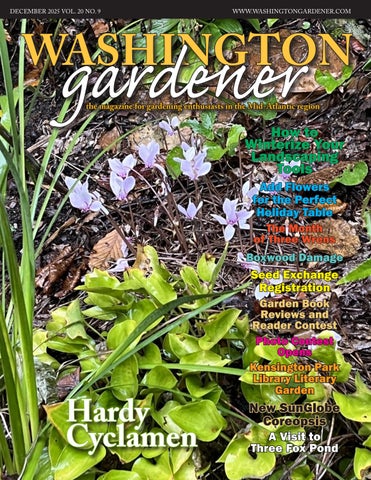
Hardy Cyclamen



Your Ad Here

Are you trying to reach thousands of gardeners in the greater DC region/Mid-Atlantic area? Washington Gardener Magazine goes out on the 15th of every month. Contact KathyJentz@gmail.com or call 301.588-6894 for ad rates (starting from $200) The ad deadline is the 10th of each month. Please submit your ad directly to: KathyJentz@gmail.com

Need a Garden Club Speaker?
Washington Gardener Magazine’s staff and writers are available to speak to groups and garden clubs in the DC region and ONLINE! Call 240.603.1461 or email KathyJentz@gmail.com for available dates, rates, and topics.

RARE AND EXCEPTIONAL PLANTS FOR THE
GARDENER AND COLLECTOR
Barry Glick
Sunshine Farm and Gardens 696 Glicks Road Renick, WV 24966, USA Email: barry@sunfarm.com www.sunfarm.com


www.greenspring.org

Green Spring Gardens
A “must visit” for everyone in the metropolitan Washington, DC, area. It’s a year-round goldmine of information and inspiration for the home gardener. It’s an outdoor classroom for children and their families to learn about plants and wildlife. It’s also a museum, a national historic site that offers glimpses into a long, rich history with colonial origins. Located at 4603 Green Spring Rd., Alexandria, VA. Information: 703-642-5173.


Letting in the Light
At this time of year, as we approach the winter solstice and all the holiday celebrations that surround the loss and then return of the light, I am thinking more and more about the sunlight in my own home landscape and how grateful I am for deciduous trees and shrubs that shed their foliage and let in the light at this crucial time of year.
I’m sure you’ve seen the local news coverage of the three-story addition to a house in Fairfax County, VA, that is completely blocking the sunlight from their unfortunate neighbor. Most of the coverage has been about the ugliness of the addition, but all I can think of is what would happen to my garden (and my own sanity!) if a neighbor did the same to me.
The fact is that plants, animals, and we humans all thrive on natural sunlight and being deprived of it can cause depression; vitamin D deficiency; weaker bones; and an increased risk for certain cancers, cardiovascular disease, and autoimmune conditions.
This winter, I’m making a point of getting out in the garden for a few minutes each day to weed and prune. I’m also joining my cats in their sun naps by curling up next to them with a good garden book. How are you letting in the light this season?
Sincerely,

Kathy Jentz, Editor/Publisher, Washington Gardener, KathyJentz@gmail.com
Credits
Kathy Jentz Editor/Publisher
Washington Gardener
826 Philadelphia Ave. Silver Spring, MD 20910
Phone: 301-588-6894
kathyjentz@gmail.com www.washingtongardener.com
Ruth E. Thaler-Carter Proofreader
Cavit Ireland
Ellen Isaacson Interns
Subscription: $20.00
• Washington Gardener Blog: www.washingtongardener.blogspot.com
• Washington Gardener Archives: http://issuu.com/washingtongardener
• Washington Gardener Discussion Group: https://groups.google.com/g/ washingtongardener/
• Washington Gardener Twitter Feed: www.twitter.com/WDCGardener
• Washington Gardener Instagram: www.instagram.com/wdcgardener
• Washington Gardener Facebook Page: https://www.facebook.com/ WashingtonGardenerMagazine/
• Washington Gardener YouTube: www.youtube.com/ washingtongardenermagazine
• Washington Gardener Amazon Store: www.amazon.com/shop/wdcgardener
• Washington Gardener BookShop: bookshop.org/shop/WDCgardener
• Washington Gardener Podcast: https://podcasters.spotify.com/pod/ show/gardendc/
• Washington Gardener Plant Store: https://shop.kathyjentz.com/
• Washington Gardener is a woman-owned business We are proud to be members of:
· GardenComm (formerly GWA: The Association for Garden Communicators)
· Green America Business Network
· National Garden Bureau
· One Montgomery Green
· Ladies in the Landscape
· Potomac Rose Society
· American Horticultural Society
· Maryland Nursery, Landscape and Greenhouse Association
Volume 20, Number 9
ISSN 1555-8959
© 2025 Washington Gardener
All rights reserved. Published monthly. No material may be reproduced without prior written permission. This magazine is purchased by the buyer with the understanding that the information presented is from various sources from which there can be no warranty or responsibility by the publisher as to legality, completeness, or technical accuracy.
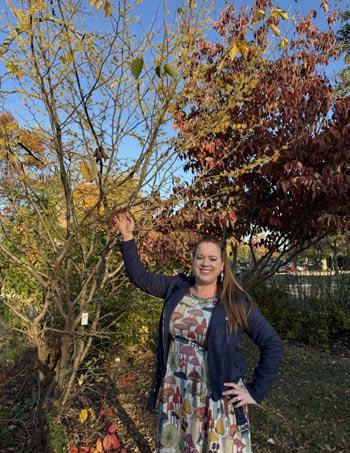
Your editor at the 2025 Brookside Gardens Garden of Lights. Photo by Ellen Isaacson.
Reader Contest
For our December 2025 Washington Gardener Reader Contest, we are giving away a copy of The Birding Dictionary from Workman Publishing (value $15 each, https://amzn.to/4pkgwKH).
What’s a garden without birds? The Birding Dictionary is perfect for the birder always muttering insider jargon like “alpha code” and “zygodactyl.” With equal parts quirky humor and accessible science, it’s a delightful gift for every bird enthusiast. Acclaimed science communicator and cartoonist Rosemary Mosco offers a clever, humorous “dictionary” that’s perfect for any birder. The Birding Dictionary is filled with hilarious and informative definitions for more than 200 birding terms, plus more than 50 witty full-color illustrations. It’s a delightful gift for every bird enthusiast.

To enter to win The Birding Dictionary, send an email by 5:00pm on Wednesday, December 31, to WashingtonGardenerMagazine@gmail.com with “Birding Dictionary” in the Subject line and in the body of the email. Tell us what your favorite article was in the December 2025 Washington Gardener issue and why. Please include your full name and mailing address. Winners will be announced and notified on/about January 1. Replies might be published. o
Your Ad Here
Are you trying to reach thousands of gardeners in the greater DC region/MidAtlantic area? Washington Gardener Magazine goes out in the middle of every month. Contact KathyJentz@gmail.com or call 301.588.6894 for ad rates (starting from $200). The ad deadline is the 5th of each month. Please submit your ad directly to: KathyJentz@gmail.com.

Plant a Row for the Hungry (PAR) is an easy program to participate in and really does not take any extra resources than what you may have in your garden. In normal times, about 35 million people wonder where their next meal will come from. Most of these are children. That’s where PAR steps in.
PAR is such a simple program: It urges gardeners to Plant A Row (or a container) dedicated to feeding the hungry, and then take the harvest to someplace or someone that needs it. Once you have donated, send an email to KathyJentz@gmail.com with the total (in pounds and ounces) of what you gave. That is all there is to it. Easy. Effective. Adaptable and Helpful.
I am a new subscriber. I really enjoyed the plant profile on gentian in the November 2025 Washington Gardener. We have been redoing our backyard with natives suitable for part shade, and I bought two gentians not knowing too much about them. I hope they will thrive in their new home, and am happy to learn more about them from your magazine!
~ Katherine Munchmeyer, Washington, DC
An article in the April 2025 Washington Gardener magazine that really helped me out was “How and When to Repot Houseplants.” I have a large collection of houseplants. While I have done very well in growing many of them, the article gave me many more helpful tips in repotting my plants. Thank you to IndoorGarden columnist Savannah Scollar for the article.
~ Ann Baker, Manassas, VA
I cannot choose just one article this month. I am grateful for the synopsis of Greenscapes, in the March 2025 issue of Washington Gardener, as the day was chock-full of information. I had especially found the local speaker on rainscape planning useful to me personally as my own small rain garden is, after many years, showing evidence it needs some work.
I enjoyed the article on the red-winged blackbird and their winter expansion into more suburban areas that I noticed in December/January annually along with starlings and crackles.
The most moving and heart-appreciative article by Savannah Scollar was ...one that will long remain with me.
Of course, the study of invasive honeysuckle and black plastic...interesting. I could go on...spring ephemerals...my favorite, Virginia Bluebells, are coming up in my yard.
City of Trees seems like a book that belongs on all our bookshelves. And more, of course.
This issue is such a magnificent illustration of your work.
Congratulations on this 20th anniversary issue!
~ Annie Shaw, Greenbelt, MD o
A Story Told in Plants The Kensington Park Library Literary Garden
“If it’s planted and it doesn’t thrive, it’s not meant to be.” This is Karin Johnson Reber’s philosophy when it comes to the Kensington Park Library Literary Garden. Reber and her volunteers rarely plant seedlings. They stick to seeds, which they have found germinate better. These seeds are self-made, having never been watered, and there’s only Mother Earth and her precipitation to thank.
On a chilly but sunny afternoon in early November, Reber showed me around the garden, right next to the Kensington Park Library in Kensington, MD. The plantings were started 10 years ago as part of Reber’s master’s thesis at George Washington University (GWU). During her time at GWU, she studied sustainable landscaping and landscape design. Her thesis focused on a watershed and building a sustain-
able landscape based on her findings. She transformed her thesis into this garden, which then led to a full design plan for the Kensington Literary Garden. She built something beautiful in the process.
Reber is originally from Kensington herself. She’s always been familiar with the local library, and turned that familiarity into a lush vision. She wanted to create a space where residents could come together, learn about native species, and encourage young readers to explore a new passion. The garden’s overall theme is “there’s no place like home,” and Reber incorporates that concept in to all its different interpretations.
Reber chose this theme because it was the perfect combination of the children’s novel The Wizard of Oz, and the outdoors. You might be wondering how the world of Oz connects to the natural world. Reber put it simply: the theme also represents native plants and the homes they provide for the wildlife around them, because for these species, there is also no place like home.
As Reber walked me through the garden, showing me the many different native plants it has to offer, such as common witch hazel and large oak trees, I notice signs placed by the various plants. Reber made all of these signs to tell visitors about the different plantings. The signs include the plants’ common and Latin names, photos of the plants, and animals and insects that are supported by that plant species. I also noticed many small signs
Text and photos by Ellen Isaacson
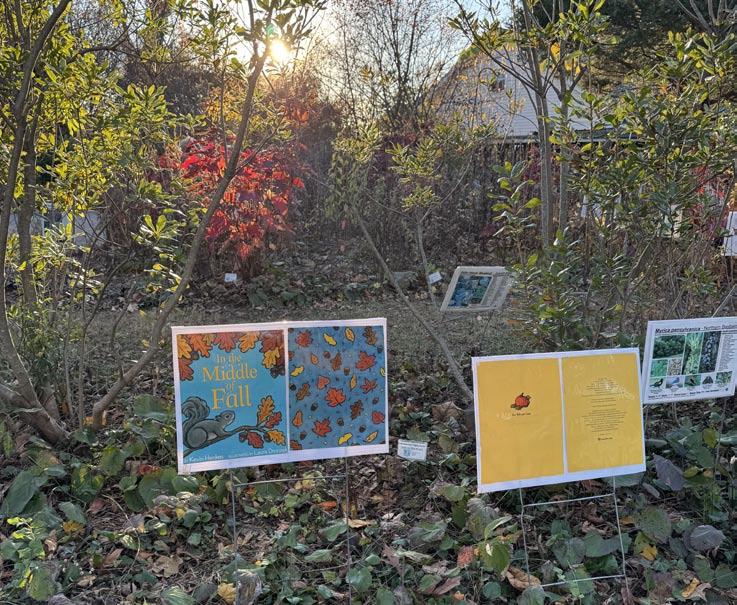
with drawings and words. Once I looked more closely, I saw they were pages from a children’s book; this one was all about fall.
Librarian Marco Scappa does a monthly storybook walk for new readers in the garden, combining the worlds of books and plants. For October, Scappa chose In the Middle of Fall by Kevin Henkes, illustrated by Laura Dronzek. The illustrations from this book were scattered throughout the garden, creating a type of scavenger hunt for young readers to follow. The images included drawings of fall foliage and small brown squirrels.
Although the Literary Garden receives little funding, the difference is made up by donations and loyal volunteers. When the garden first started 10 years ago, volunteers were able to build the garden in just one week, and many of the plants I saw were from that original installation, such as the various native shrubs.
The garden is maintained by a monthly volunteer work day that Reber coordinates. The landscape is open and free to visitors during daylight hours.
Reber told me that they started to see more visitors in the garden once a stone path was built in 2018. The path walks you through the garden and leads you to a bench in the center. As we strolled around the garden, Reber pointed out the different pieces of wooden garden art made by Jason Swain, a
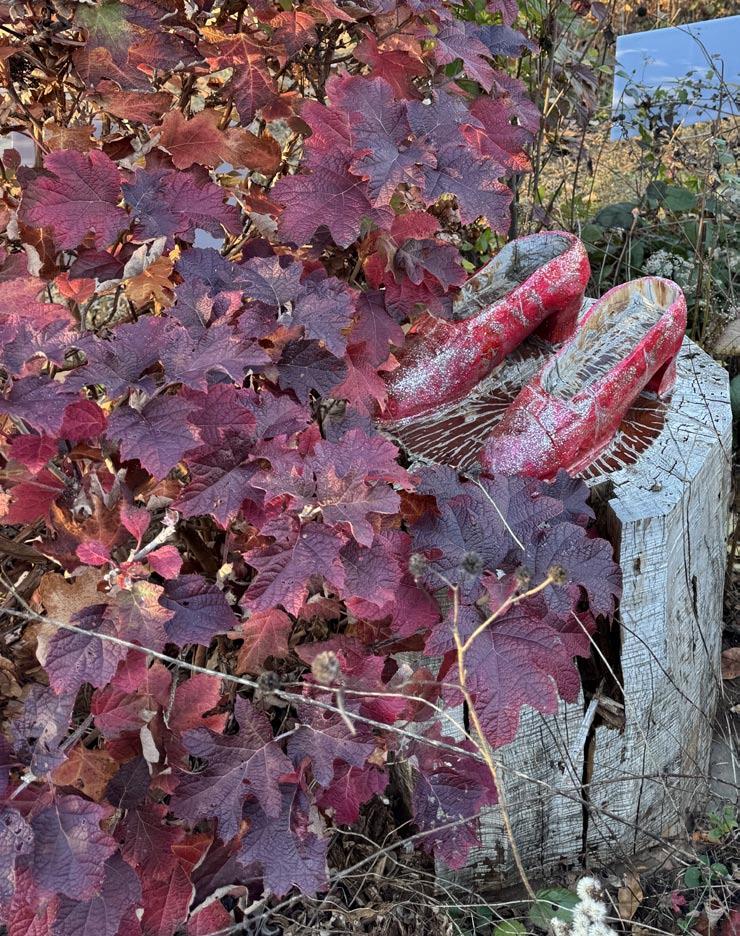
Kensington artist, who is originally from Australia. He carved and painted a sculpture of Dorothy’s ruby slippers and her beloved dog Toto. Reber told me a sweet story about how little kids would come visit the garden, pick the brightred berries off a winterberry holly shrub, and fill Dorothy’s shoes with them. The color coordination made her smile.
Reber currently works as a landscape designer and administrator at Campbell & Ferrara, a landscape design and build company based in Northern Virginia, but she tries to be at the Literary Garden as often as she can. Her next project? She hopes to make the garden more visual and informative by creating graphics of each plot’s landscape. She thinks this will help visitors better identify the different species and stir their curiosity about native plants. She dreams of eventually officially registering the garden as an arboretum, but for now, she’s living in the moment.
Reber admitted that her biggest challenge is, like so many of us, focusing on all the things on her checklist rather than slowing down and enjoying the garden. She hopes that people can visit and slow down for a minute, sit on the bench, read a book, and enjoy the Kensington Literary Garden. o
Ellen Isaacson is an intern with Washington Gardener this fall semester. She is doublemajoring in journalism and French language and literature

The Azalea Society offers membership to anyone with an interest in azaleas, from home gardeners, collectors and students to plant professionals. The Azalea Society website (azaleas.org) is the source of information about azaleas.



IS OUT NOW! By Kathy
Jentz
by Cool Springs Press Order it today at: https://amzn.to/3IlYHYL
“Groundcover Revolution is must-have book for anyone who is interested in having less lawn, fewer weeds, and reduced mulching. The properties charts will save the reader time and money, the pictures provide inspiration, while the detailed plant portraits give the focused information needed for creating beautiful, functional landscapes.”
―C.L. Fornari, GardenLady.com
local
A Visit to Three Fox Pond
By Cavit Ireland

Three Fox Pond is “an oasis of tranquility that unfolds across 14 acres of meticulously landscaped grounds, embodying a harmonious blend of natural beauty and thoughtful design.”
The breathing catalog of plants at Three Fox Pond in Potomac, MD, is the work of two avid gardeners, Ethan and Lynne Assal.
It is a landscape that is willful and serene, yet invites the gentle sway of a breeze. It’s home to bulbous perennials like the electric blue spider lily (Lycoris sprengeri), Japanese maples that glow red in the autumn, and varieties of dahlias in a color palette that holds the rainbow.
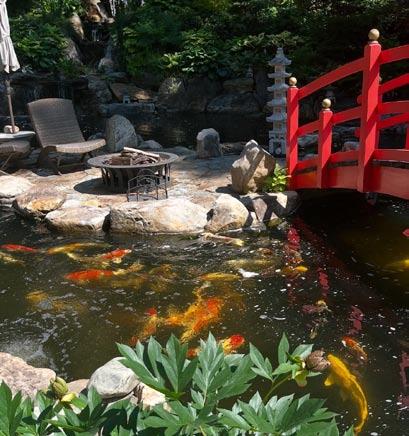
Weaving between hosta ‘Dream Queen’ and tropical cannas is a narrow stone walkway that leads to a clearing on the edge of a pond. It conveys calmness, and emerging from the darkened depths is a school of colorful koi, scales gleaming with hints of the sunset and flaming red streaks. Some are white with black and blue spots, others red and white, while a few look like they’ve been dipped in gold. The Japanese influence reveals itself in the stepped waterfalls and clean,
deliberate architecture. The walkway is arranged so visitors can experience the garden at a calm, unhurried pace. The design is partly influenced by public and private gardens that Ethan and Lynne have visited—particularly Gibbs Gardens in Georgia.
For Three Fox Pond, growth is constant. Plans for expanding the garden area are already underway, with a vision of extending floral coverage to the eastern edge of the property. The project started over the summer, and two new stone bridges and a natural spring now lie as landmarks to guide the layout.
“When it rains, it’ll run down here,” said Ethan, nodding toward the crew at the bottom of spring, framing and hammering stones into the shape of a bridge. It offers a small pedestrian path that steps over the rocky banks where water will flow down the slope of the property toward the northeast corner of the plot.
First, they had to clear away the acres that had been taken over by invasive plants.
“This whole area back here was covered,” explained Ethan as he stood
next to a stump in a leaf-covered clearing. They decided to keep a few stumps around as eerie landmarks and subtle reminders of the transformation taking place.
“It was a disaster—we found so much trash,” said Lynne, “A bicycle, old champagne bottles from the ’70s.”
Another ecosystem of plants is sheltered in a greenhouse on the grounds. An astonishing collection of pitcher plants resides with a plentiful array of tropicals, like the Aechmea ‘Blue Tango’, Hibiscus hybrids, Hawaiian plumeria, and other brightly colored flowering plants thrive in the humidity and give visitors an impressive idea about the high level of gardening that takes place.
Along with invasive plants taking over their space, the native plants outside the fenced areas are also threatened by deer. Smaller plants look like a snack for fawns and when deer come to feast, it hurts the growth.
“The deer eat the small holly trees and it’s hard for the trees to grow out there,” Lynne explained.
The pressure has Ethan and Lynne considering moving back the deer fence that borders the land, in an attempt to improve their plant protection.
Three Fox Pond is also protected by law: It’s part of the Maryland Environmental Trust (MET), which means the land can’t be parceled out and sold. The MET is a long-standing land trust that preserves more than 140,000 acres statewide. It’s a private garden, sometimes opened for tours for gardening groups, including Garden Conservancy tours.
The thoughtful care that Ethan and Lynne put into the landscape is radiated by the simple, profound peace in the formal and informal gardens throughout their landscape.
Three Fox Pond is open to visitors on selected occasions, such as the Garden Conservancy Open Days Program, and to garden clubs upon request. To learn more, go to https://3foxpond.com/. o
Cavit Ireland is an intern this fall semester with Washington Gardener. He is a rising senior at the University of Maryland studying journalism and hosts Sonic Fruit, a weekly music program on WMUC 90.5.

FRIDAY, FEBRUARY 13, 2026 9 AM–4 PM
INTEGRATING ECOLOGY, BEAUTY AND ADAPTABILITY IN DESIGN
This engaging symposium brings together experts in horticulture, ecology, and design to share sustainable solutions that work—from small gardens to large public landscapes. Learn how native keystone plants and layered “soft landings” can support pollinators from canopy to ground, and explore regenerative approaches that blend beauty, function, and biodiversity in every setting. Through illustrative real-world case studies, you’ll discover how dynamic, naturalistic plantings can adapt and thrive, and how climate-resilient and diverse plant palettes can strengthen ecosystems in both urban and suburban environments.
SEMINAR TOPICS
� Design by Nature: Dynamic Planting at the Intersection of Horticulture and Ecology
Patrick Cullina, award-winning horticulturist, landscape designer, photographer and planning consultant
� From Canopy to Groundcover: Building Soft Landings with Keystone Plants for Pollinators
Heather Holm, biologist, pollinator conservationist, and award-winning author
� Bridging Design and Ecology: Strategies for Resilient and Engaging Landscapes
Ching-Fang Chen, Landscape Architect, Montgomery Parks (MD)
� Adapting Gardens for a Changing Climate: Building Biodiversity Through Plant Diversity
David McKinney, Curator of Collection and Grounds, Iowa Arboretum & Gardens
GreenScapes will be offered as a series of live online lectures using Zoom with audience Q&A incorporated into the program. Registration includes access to watch recordings of each session after the event.
BrooksideGreen.org 301-962-1451
REGISTRATION INFORMATION
EARLY BIRD FEE: STANDARD FEE: $50/person until Jan 9, 2026
$60/person starting Jan 10, 2026
Register using this link ActiveMontgomery.org (Course PBG0057) or call 301-962-1451.
How to Winterize Your Landscaping Tools
Winter is just around the corner, and while most of us are busy preparing our homes and vehicles for the cold months ahead, it’s important not to forget about our trusty landscaping tools. These essential tools help us maintain our lawns throughout the year, and neglecting them during the winter can lead to costly repairs or replacements come spring.
Sod Solutions (https://sodsolutions. com/) has shared this checklist of supplies you’ll need, with step-by-step instructions about how to protect your lawn care tools from the harsh winter elements.
Before you begin the winterization process, it’s essential to assess the state of your landscape tools. Check each tool for signs of wear and tear, damage, or rust. Make a list of the types of lawn tools you have, such as lawnmowers, trimmers, leaf blowers, and edgers, and identify their vulnerability to winter damage. For example, metal parts are more prone to rust, while fuel systems can suffer from coldrelated issues like fuel freezing, gasket seals cracking, or over-cooling that can result in piston scuffing and other issues.
To winterize your yard work tools effectively, you’ll need a few essential supplies:
• Cleaning materials—brushes, rags, and cleaning solutions to remove dirt, debris, and oil.
• Fuel stabilizer—to prevent fuel from deteriorating during storage.
• Oil—for changing the oil in your engines.
• Lubricants—for maintaining moving parts and preventing rust.
• Sharpening tools like a blade sharpener or drill attachment—to keep blades and cutting surfaces sharp.
• Storage solutions—covers or shelters to protect your tools from the elements. Safety should always be a top priority when handling lawn tools. Wear appropriate safety gear, such as gloves and safety goggles, when performing maintenance. Before cleaning any gas-powered tools with a blade, for example, make sure you remove the spark plug first to keep the tool from kick-starting
accidentally. Read the manufacturer’s guidelines for each tool to ensure you follow their safety procedures.
Cleaning your lawn tools thoroughly is the first step in winterizing them. Remove dirt, grass clippings, and other debris using a brush or compressed air. Wipe down the surfaces with a rag and a suitable cleaning solution. For lawnmowers, trimmers, and other garden equipment, refer to the manufacturer’s instructions for detailed cleaning and maintenance procedures.
Properly managing fuel and oil is essential to preventing engine damage during winter. Drain the fuel tanks or add a fuel stabilizer to prevent deterioration. Change the oil according to the manufacturer’s recommendations and check and replace air filters as needed. These steps will help ensure your engines start smoothly when spring arrives:
• Drain the gas tank and then run the engine until the fuel system is empty for long-term storage or stabilize the fuel for short-term storage.
• Generally, you will need to remove the oil drain plug, drain the oil into a container, replace the drain plug, and refill the engine with the recommended oil.
• Replace the oil filter at least once a season; more often under heavy use.
• Check the air filter once a season or every 25 years of usage.
Maintaining sharp blades and cutting surfaces is vital for effective lawn care. Dull blades can damage your grass and plants, making them more susceptible to disease. Safely sharpen your tools’ blades using the appropriate sharpening tools, following the manufacturer’s guidelines or seeking professional help if needed.
Lubrication plays a crucial role in preventing rust and corrosion. Apply lubricants to moving parts, such as hinges, springs, gears, or any other moving parts/surfaces that might be susceptible to rust as recommended by the manufacturer. In addition, protect surfaces susceptible to rust by applying a rust-inhibiting product.
Proper storage is the final step in winterizing your yard work tools. Find an ideal storage space, such as a shed or garage, to protect your tools from extreme cold, moisture, and snow. Use covers/shelters for added protection. o
Add Flowers for the Perfect Holiday Table
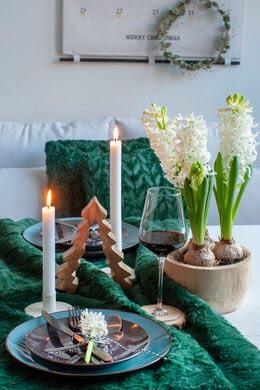
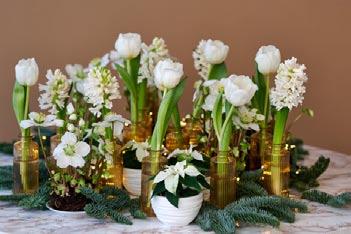
White tulips (Tulipa) are a symbol of light and new life, and a true holiday classic. A festive holiday table wouldn’t be complete without them. Combine a vase of tulips with potted bulb flowers for an extra-festive atmosphere.
Around the holiday season time, you can choose from various pre-forced and potted flowers, such as hyacinths (Hyacinthus), tulips (Tulipa), grape hyacinths (Muscari), and amaryllis (Hippeastrum). Amaryllis is particularly eye-catching, thanks to the size of its flowers.
Prefer something a bit more subtle? A cut amaryllis in a vase with freshly sprouted green leaves is also a beautiful symbol of new life.
Create a fairytale holiday atmosphere with white or pastel-colored flowers, or opt for shades of red or purple to give your holiday table a warm, stylish look.
Displaying bulb flowers in a collection of glass vases is also an easy way to create a festive atmosphere. Similarly, you can compile a collection of different potted flowers. Vary the heights and varieties for a luxurious look. Prefer just one floral feature on the table? Then choose a gorgeous bunch of tulips or a pretty bowl containing various potted blooms. Complete the festive atmosphere with a string of fairy lights or a garland of golden stars.
Make sure your flower arrangements aren’t too tall. You want to be able to see your dinner guests across the table during dinner.
Don’t just decorate the dining table, but all the other tables as well. It’s a great way to immerse the whole house in the holiday spirit. Go for a decorative bowl with a flower bulb mix on a low table, a big bouquet of tulips on a side table in the hall, and small pots of flowers on the breakfast table.
Find more information about flower bulbs at www.flowerbulbs.com and www.flowers4joy.com. o
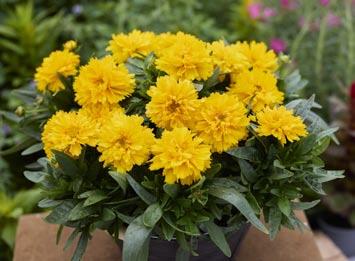
New Plant Spotlight
SunGlobe Coreopsis (Coreopsis grandiflora)
New 2026 AAS Winner
Bring brilliant, season-long color to your sunny spots with this outstanding coreopsis. Praised by All-America Selections (AAS) judges for its great habit and impressive bloom quantity, this variety is a true workhorse in the garden.
It produces tons of fluffy, goldenyellow, semi-double flowers on sturdy stems slightly earlier than comparisons. The plant maintains a tidy, compact, and densely branching form, delivering multiple flushes of vibrant gold from spring through fall. Ideal for borders or containers, this coreopsis is built to perform, making it a fantastic addition to any landscape.
Days to First Flower from Seed: 90
Duration Type: Perennial
Hardiness Zone: 4–9
Light Needs: Full sun, partial sun
Water Needs: Slightly dry
Dead-heading Recommended: Yes
Staking Required: No
Pollinator-Friendly: Yes
Container: Yes
Hanging Basket: Yes
Common Name: Tickseed
Plant Habit: Mounded
Plant Height: 12–14 inches
Plant Spread: 12–14 inches
Foliage Color: Green
Bloom Time: Late spring through fall
Bloom Color: Golden yellow
Bloom Size: 1.5–2.5 inches
Bloom Type: Double rosette
This plant was bred by Hem Genetics. For more information, visit https://all-americaselections.org/ product/coreopsis-sunglobe/. o
Quick Links to Recent Washington Gardener Blog Posts
• Katsura Tree Plant Profile
• Gifts for Gardeners
• Second Chance Radish
See more Washington Gardener blog posts at WashingtonGardener.blogspot.com o
December Garden To-Do List
• Keep watering your poinsettias and give them plenty of light. Ensure they are away from drafts and that pots drain freely.
• Last chance to plant bulbs or, if you have waited until the ground is frozen, pot them up for forcing indoors.
• Gather holiday greens. Some, like holly and boxwood, respond to being pruned by growing thicker.
• Feed birds and provide them with a fresh water source.
• Check houseplants, and any plants you brought indoors for the winter, for insects.
• Provide some special protection to tender or early-flowering plants like Camellias.
• Stake newly planted large trees or shrubs to protect them from winter winds.
• Check any tropical or summer-blooming bulbs, corms, tubers, and bare root plants in storage for rot or desiccation.
• Apply scale and dormant oil treatment to evergreens.
• Spread ashes from wood fires on your vegetable beds.
• Keep succulents and cacti on the dry side.
• Water fresh-cut Christmas trees daily.
• Gently remove layers of snow from outdoor evergreens with a broom.
• Start organizing your pile of incoming garden catalogs.
• Keep an eye out for damage to tree bark from rabbits and deer.
• Spray broadleaf evergreens with anti-desiccant to prevent dehydration.
• Use the branches from your Christmas tree as bedding mulch or a windbreak.
• Keep watering newly planted trees and shrubs as needed.
• Cover strawberry beds with straw or pine needles.
• Prune stone fruit trees such as cherries, plums, and peaches.
• Clean, sharpen, and store your garden tools.
• Reduce fertilizing of indoor plants (except Cyclamen).
• Set up a humidifier for indoor plants, or at least place them in pebble trays.
• Continue to rotate houseplants to promote even growth.
• Attend a local garden club meeting.
• Start new indoor plants from cuttings—try an easy one, such as violets.
• Check the plants under tall evergreens and under the eaves of the house to see that they have sufficient moisture.
• Weed. Weed. Weed.
• Pick a budding gardener to give some inspirational garden books and magazines, then watch the new gardener blossom.
• Store your fertilizer and seeds in rodent-proof containers.
• Do any filling and grading needed around your yard. The soil will settle during the winter months.
• Vent cold frames on sunny days.
• Avoid walking in frozen planting beds.
• Remove and destroy gypsy moth egg masses.
• Clean your gutters.
• Prune maples, dogwoods, birches, elms, and walnuts—only if needed.
• Consider using alternatives to de-icing salts, such as sand, beet juice sugars, light gravel (grit), or non-clumping kitty litter. De-icing salts around driveways and sidewalks can harm your garden plants and turf. o

The Urban Garden: 101 Ways to Grow Food and Beauty in the City is all about small-space gardening solutions!
By Kathy Jentz and Teresa Speight
Published by Cool Springs Press/Quarto Homes
Order it today at: https://amzn.to/3yiLPKU
GardenDC Podcast
The GardenDC podcast is all about gardening in the greater Washington, DC, and Mid-Atlantic area. The program is hosted by Kathy Jentz, editor of Washington Gardener Magazine, and features guest experts in local and national horticulture. The latest episodes include interviews with experts on Garden Design, Gifts for Gardeners, and Sedums.
You can listen online at https:// washingtongardener.blogspot.com/ or on Spotify, Apple, etc o
Classes, Events, and Plant Shows/Sales
• Saturday, December 6, 10:30am–12n
Winter Sowing Workshop
Ever wanted to have more native plants in your landscape? Learn the benefits and techniques for winter sowing, and take home sown seeds to add to your garden next year. Held at the Baltimore County Agricultural Center & Farm Park. Registration required for attendance: https://www.eventbrite. com/e/winter-sowing-workshop-tickets16604584489.
• Thursday, December 11, 6:30–8:30pm
Tudor Lights: Christmas at Tudor Place
Kick off the holiday season with a visit to the historic Tudor Place house in Washington, DC, where decorations and installations that set a festive tone offer a unique glimpse at collection items with a special holiday twist. Prepare for some sparkling fun. Wander through the garden, illuminated with holiday lights, creating a magical evening atmosphere. Conclude your evening with cocktails and seasonal refreshments. Members: $25 | Non-members: $55. Register at https://tudorplace.org/.
• Saturday, December 13, 12n–5pm Edgewood Community Farm Holiday Market
Expect plenty of handcrafted gifts and live entertainment at this Third Annual Holiday Market & Festival. Children’s activities include ornament painting, holiday coloring, and story time. Get warm around the fire pits, drink cocoa and cider, and soak in some holiday cheer. Held at 2304 2nd Street, NE, Washington, DC 20002. Free.
• Nightly through January 4, 2026
Meadowlark’s Winter Walk of Lights
Take a magical half-mile stroll through Meadowlark Botanical Gardens illuminated with nature-themed and animated displays along a fully accessible paved trail. Guests can enjoy hot drinks and s’mores by the fire pit, and even bring their pups on select pet-friendly nights. Tickets are $18 online ($22 at the door), with free admission for
children under age 2. Details at https:// www.novaparks.com/events/winterwalk-of-lights.
• Saturday and Sunday, December 20–21, 5:30–8:30pm
Christmas Illuminations at Mount Vernon
Mount Vernon celebrates the season with its beloved Christmas Illuminations, a festive evening event featuring mansion tours, illuminated historic spaces, 18th-century holiday activities, and a spectacular fireworks display over the Potomac at 8:00pm. The experience includes holiday greetings from General Washington, artisan vendors, seasonal food and drinks, music, games, and even a visit with Aladdin the Camel. Tickets are $58 for adults, $36 for children, with members receiving a 20% discount and kids 5 and under admitted free. Details at https://www.mountvernon.org/.
Looking Ahead
• January 7–9, 2026
MidAtlantic Nursery Tradeshow MANTS is one of the largest private trade shows serving the horticulture industry. Held at the Baltimore Convention Center in Baltimore, MD. Early-bird registration is now open at MANTS.com.
• Saturday, January 31
Washington Gardener Seed Exchange at Brookside Gardens
Details on page 14.
• Saturday, February 7
Washington Gardener Seed Exchange at Green Spring Gardens
Details on page 14.
Event Listing Updates
See updated event listings on the Washington Gardener discussion list. Join by emailing WashingtonGardenersubscribe@googlegroups.com
How to Submit Events
To submit an event for this listing, email washingtongardenermagazine@gmail. com with “Event” in the subject line. Our next deadline is December 10 for the January 2025 issue, for events taking place after January 5 o



20TH ANNUAL PHOTO CONTEST
You’ve seen those gorgeous garden photos published in magazines and newspapers. Enter this year’s competition and have a chance of getting your images published, too. Whether you take the photos in your own backyard, a nearby public garden, or while visiting friends and family in their local gardens, there are so many photographic opportunities to be found. Let’s show off the best in DC-area gardening!
This contest offers an opportunity for all photographers to present their best shots of gardens in the greater Washington, DC, area. Contest entries will be judged on technical quality, composition, originality, and artistic merit.
More than $500 in prizes will be awarded. Winning images will be published in Washington Gardener Magazine, displayed during the Washington Gardener Seed Exchange, and appear in a local photo exhibit.
SUBMISSION GUIDELINES
Each entrant is limited to a total of 10 images. Each electronic file must be identified with your last name and the entry category. For example, BeeJonesGC1.jpg or JoeSmith-SW2.jpg.
All photographs should accurately reflect the subject matter and the scene as it appeared in the viewfinder. Nothing should be added to an image and, aside from dust spots, nothing should be removed. Cropping and minor adjustments to electronic images to convert RAW files are acceptable. AI submissions are not permitted.
If an image is selected as a finalist, a high-resolution digital file might be required before finalizing our results. Digitally captured images should be taken at the camera’s highest resolution (3 megapixels or larger). For preliminary judging, digital files must be submitted in JPEG format sized to 1,000 pixels on the longest side at 300 dpi. If photos are taken with a film camera, they must be scanned and submitted in JPEG format sized to 1,000 pixels on the longest side at 300 dpi. Contest entries can be submitted via email to DCGardenPhotos@aol. com. Use the subject line “WG Photo Contest” and include an entry form for each image in your email’s text field.
Entries can also be sent in on a CDROMs. Please verify their integrity by making sure they are readable and not damaged. We reserve the right to disqualify any disk that is unreadable or defective. Please check your CDs with the latest virus-detection software. We will disqualify any disk that appears to contain a virus or a suspicious file. Label each CD and case with your full name. We strongly suggest mailing CDs in protective cases. We are not responsible for disks damaged during shipping. No CDs will be returned, but they can be picked up after judging. Send your entries and entry fee to: Washington Gardener Photo Contest, 826 Philadelphia Ave., Silver Spring, MD 20910. Mailed entries must be received by January 20, 20256. You can print out blank entry forms from the Washington Gardener blog (WashingtonGardener.blogspot.com) or from our Facebook page.
We will verify all entries, so please ensure your email address is included on all items.
Entrants must not infringe on the rights of any other photographer, landowner, or other person. Photos involving willful harassment of wildlife or destruction of any property are unacceptable.
The entrant must have personally taken the photo. By entering, you state this is your work and it is free of copyright elsewhere.
Failure to comply with any contest guidelines will lead to disqualification.
COPYRIGHT NOTE
Your entry in this contest constitutes your agreement to allow your photographs and your name, city, state, and photo description texts to be published in upcoming issues of Washington Gardener and used for other related purposes including, but not limited to, Washington Gardener Photo Contest promotions and online, live presentations, and gallery exhibits. Entrants retain ownership and all other rights to future use of their photographs.
CATEGORIES
Each entrant is limited to a total of 10 images. You may submit a few in each

category or submit all 10 in one category.
Photos must have been taken during the 2024 calendar year in a garden within a 150-mile radius of the Capitol Building in Washington, DC.
• Garden Views (GV): Beautiful, dramatic, or unusual perspectives of a garden landscape, including wide shots showing the setting. Subject can be a private or public garden.
• Garden Vignettes (Vig): Groupings of plants in beds or containers, unusual color or texture combinations, garden focal points, and still scenes. Subject can be photographed in a private or public garden.
• Small Wonders (SW): Tight close-up images or macro shots of single flowers, plant parts, fruits, vegetables, etc. Subject can be photographed in a private or public garden.
• Garden Creatures (GC): Images of insects, birds, frogs, pets, etc., in a private or public garden setting.
PRIZES
Prizes include gift certificates to area camera stores, gardening tools, new plant introductions, and much more. If you would like to be a prize donor or sponsor, contact us today.
WINNERS’ OBLIGATION
Photo contest winners will need to provide high-resolution versions of their images for publication and an 11x14 print suitable for framing. Winners may be asked to provide additional information for press and media coverage.
CONTEST ENTRY FEE
The entry fee is $20.00 or $15.00 for current Washington Gardener Magazine subscribers. The fee includes up to 10 total image submissions per entrant. Please send a check or money order made out to “Washington Gardener” or a payment via www.PayPal.com to DCGardenPhotos@aol.com.
DEADLINE
Entries are due by midnight on January 20, 2026.
QUESTIONS?
or email
o
Seed Swapping Planting Tips
Expert Speakers
Goody Bags
Door Prizes
Washington
Gardener
Magazine
presents the 21st Annual Washington Gardener
Seed Exchanges
on Saturday, January 31, 2026, 12:30–4:00PM National Seed Swap Day! at Brookside Gardens in Wheaton, MD
Registration is now open at https://www.eventbrite.com/e/21st-annual-washington-gardener-seed-exchangeon-saturday-jan-31-2026-tickets-1976404850110?aff=oddtdtcreator and on Saturday, February 7, 2026, 12:30–4:00PM at Green Spring Gardens in Alexandria, VA
Registration is now open at https://www.eventbrite.com/e/wg-seed-exchange-272026-invirginia-tickets-1976406722711?aff=oddtdtcreator

Overview
Washington Gardener magazine, the publication for DC-area gardening enthusiasts, is hosting the 21st annual Washington Gardener Seed Exchange at Brookside Gardens and Green Spring Gardens. These seed swaps are in person and face to face. You bring your extra seeds and swap them with other gardeners. Everyone will leave with a bag full of seeds, new garden friends, and expert planting advice.
When
Two Seed Exchanges will be held: Saturday, January 31, 2026, in MD and Saturday, February 7, 2026, in VA from 12:30–4:00PM (Foul weather that day? Call 240-603-1461, for updates about possible snow/ice delay.)
Where
We are holding a duo of Seed Exchanges one week apart on opposite sides of the Washington Beltway. We urge you to attend the one closest to you.
One exchange will be held at Brookside Gardens, 1800 Glenallan Ave., Wheaton, MD. The other will be at Green Spring Gardens, 4603 Green Spring Road, Alexandria, VA.
How to Register
You can easily register online at Eventbrite.com. Be sure to select the correct date and location for the Seed Exchange you are going to be attending. You can also fill out the form on the opposite page. Send the form, along with payment, to Washington Gardener, 826 Philadelphia Ave., Silver Spring, MD 20910, Attn: SE Registration. Please make checks out to “Washington Gardener.” Registration fee is $20 per person. Friends of Brookside members, Friends of Green Spring members, and current Washington Gardener subscribers receive a discount rate of $15 per person. We strongly urge you to register in advance. There is a limit of 100 participants at each location!
We are GREEN!!!
Garden Book and Seed Catalog Exchange
Seed Exchange attendees are encouraged to bring their used or new garden books and seed catalogs to swap and share at this year’s event. We also ask you to bring your own water bottle or reusable mug and a home-made nametag. We will have a “best nametag” contest, so get crafty!
Hashtags #GardenDC and #SeedSwapDay
Washington Gardener Magazine’s 21st Annual
Seed Exchange Details
If You Have Seeds to Bring and Swap
Please package them in resealable plastic zipper or wax sandwich baggies. Put an average of 20 seeds per baggy—more for small seeds like lettuce, fewer for large seeds like acorns Label each baggy with a white sticker (such as Avery standard 5160 address label sheets) giving all the information you have about the seeds. If known, include the plant’s common and scientific names; its soil, sun, and watering needs; and its origins—where and when you collected the seeds. If you don't know all the information, that is okay; just provide as much as you can.
Yes, you can bring unused or opened commercial seed packs.
If You Don’t Have Any Seeds to Swap
Come anyway! Even if you don’t have any seeds to trade, you are welcome to attend. We’ll have plenty of extra seed contributions on hand and many attendees will be there just to learn, network, and prepare for next year’s seed collecting.
Education Program
Expert speakers from the local gardening community will give short talks about seed collection and propagation tips. There will be ample time for individual Q&A throughout the program with the featured speakers and invited experts as well.
Schedule
(Note: This schedule is subject to change.)
12:00-12:30 Registration check-in
12:30-12:40 Introductions
12:40-1:20 Gardening talk
1:20-1:55 Gardening talk
2:00-2:15 Snack break and room reset
2:15-2:30 Seed Swap preview time
2:30-3:00 Seed Swap
3:00-3:30 Photo Contest winners*
3:30-4:00 Door prizes and closing talk
How Do We Swap?
As you check in, staff will collect your seeds and place them at the appropriate seed category tables. You will be assigned a random seed swap number. There will be a short period for attendees to preview all the seeds brought in and available for swapping. You will be called in by your number to pick a seed pack from each of the category tables (if desired).
After the initial seed swap is complete, attendees are free to take any of the leftover seeds and to trade seeds with each other. Dividing of packets is encouraged and extra baggies with labels will be on hand for that purpose.
What Types of Seeds?
Seed swap categories will include natives, edibles, herbs, exotics, annuals, perennials, and woodies (trees/shrubs). If you can pre-sort your seeds in advance into the seven major categories that fit the best, that would help us speed up the process on the swap day.
Door Prizes! Goody Bags!
Each attendee will receive a goody bag at the seed swap. The bags include seeds, publications, and garden items donated by our sponsors. In addition, we have some incredible door prizes to give away especially for area gardeners
If your organization would like to contribute seeds or garden-related products for the goody bags and door prizes, contact KathyJentz@gmail.com by January 20.
*See photo contest details on page 13.
21st Annual Washington Gardener Seed Exchange Advance Registration Form
Please fill out this form and mail with your check/money order to: Washington Gardener Magazine, 826 Philadelphia Ave., Silver Spring, MD 20910
Name:
Street Address:
Email:
Seed Exchange Date and Location: January 31 at Brookside Gardens February 7 at Green Spring Gardens (We will only use your email address for Seed Exchange notices and will never share them with anyone else.)
Seed Exchange Attendee Fee: $20.00 __________ Discount (if eligible*): -$5.00
Optional: Washington Gardener Magazine Annual Subscription: $20.00 __________ TOTAL_____________
*The following groups are eligible to pay the discount attendee rate of $15.00; please CIRCLE if one applies to you:
• Washington Gardener Magazine subscribers
• Friends of Brookside Gardens members
• Friends of Green Spring Gardens members
A portion of the event proceeds will go to benefit the Seed Savers Exchange for preserving heirloom varieties.
What Is Damaging My Boxwood Leaves?
By Carol Allen
The holidays are often the time we turn our thoughts to decorating our homes with natural greens. If you are lucky to own or have access to a stately old boxwood, then you have a ready supply of holiday decor.
When gathering your greens, note that boxwood are kept in the best health by selectively thinning the interior small branches rather than by an overall shearing. Thinning or “plucking” allows sunlight to penetrate to the interior of the shrub and stimulates desired interior growth. Plucking can be done in the late fall and the results of your labors can end up as lovely wreaths and swags for your holiday decor.
Although our attention is usually directed to boxwood foliage in the December holiday season, the most common leaf-marring insects strike in the spring. Boxwood leafminer (Monarthropalpus flavus) and boxwood mites (Eurytetranychus buxi) are two of the worst offenders.
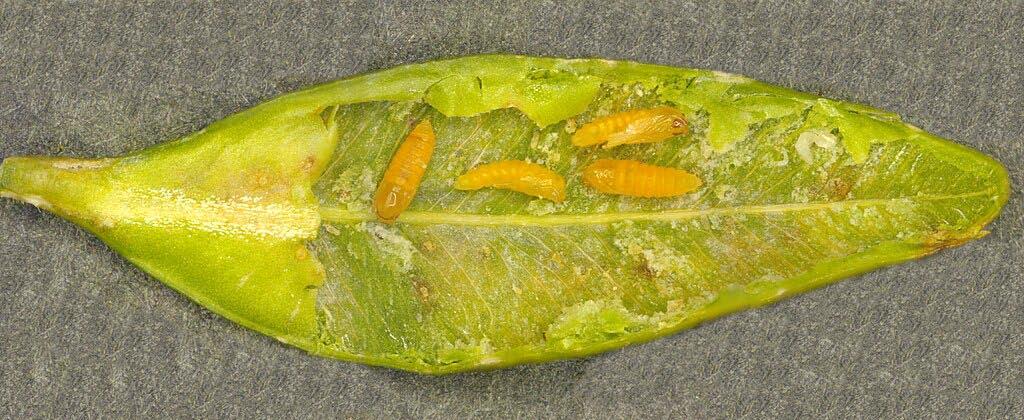
The boxwood leafminer is a small, orange midge that lays its eggs on the under side of the newly expanded leaves. In our area, that occurs in late April to early May and is a significant pest in the Mid-Atlantic. The larvae
hatch out within about three weeks and feed on the interior of the leaf. The damage is not easily observed until well into the summer, when the blister-like tunnels can be seen.Leafminers overwinter and pupate inside the leaves. By then, the tunnels have turned an unsightly brown, making the leaves unusable for decorations.
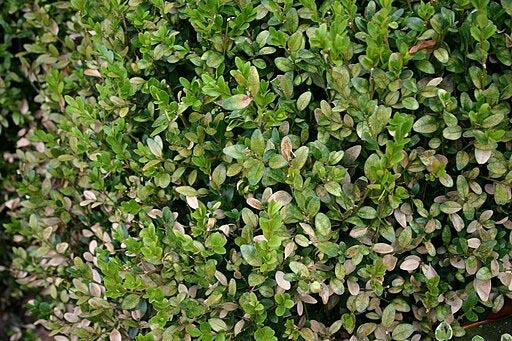
Boxwood mite damage. Photo by SB_Johnny, CC BY-SA 3.0 <http://creativecommons.org/licenses/by-sa/3.0/>, via Wikimedia Commons.
If you are starting a new planting, seek out boxwood varieties that are resistant to leafminer. For established plants, the leaves can be sprayed with Spinosad* and/or horticultural oil when the adult insects emerge. A systemic pesticide,* such as dinotefuran or imidacloprid, can be effective where those
pesticides are available. In Maryland, they can only be applied by a licensed pesticide applicator.
Boxwood mites are very difficult to see, but their stippling damage can be quite obvious. The mites will feed on both the upper and lower surfaces of the leaf in a line-like pattern. The damage looks like small scratches when viewed with a hand lens. The eggs hatch in mid-spring and the nymphs go through several stages of feeding, then resting. This cycle can take between 18–21 days. There are multiple generations per year.
At least two applications of insecticidal soap, horticultural oil, or a labeled miticide can be applied 10 to 14 days apart starting in May. An application of dormant oil can also be applied in late winter to aid control.
If you want your boxwood to supply you with holiday greens, good culture and pest control are the way to go. o
Carol Allen describes herself as a committable plant-a-holic. She has more than 25 years’ experience in the horticulture industry, with a special interest in plant pests and diseases; is a Licensed Pesticide Applicator in the state of Maryland; and is an ISACertified Arborist. She can be contacted at carolallen@erols.com.
*Read the label and follow all directions.
Pupae of the boxwood leafminer inside a boxwood leaf. Photo by Gubin Olexander, CC BY-SA 4.0 via Wikimedia Commons.
November 21, 2025, through January 4, 2026 (Closed November 24–27, December 24–25, January 1)
Brookside Gardens transforms into a magical winter wonderland for the annual Garden of Lights display. Stroll through the one-half mile, outdoor, walk through exhibit and enjoy the twinkling lights and glimmering one-of-a-kind displays adorning the flowerbeds and grounds throughout the 50 acre horticultural gem in Wheaton.
• Shop for unique seasonal items at the Gift Shop
• Hot chocolate and light snacks available for purchase
Tickets: Timed-entry tickets available at GardenofLights.org
• Sun - Thur: $13.99 per person (includes $1.99 service fee)
• Fri - Sat: $16.99 per person (includes $1.99 service fee)
• Ages 5 and under are free
• Visitors must arrive within their half-hour time slot
• Advance sale tickets only

BROOKSIDE GARDENS 1500 and 1800 Glenallan Avenue | Wheaton, Maryland 20902 301-962-1400 | BrooksideGardens.org
The Month of Three Wrens
By Rick Borchelt
Every few years, we get an autumn where the season seems suspended in mid-October: cool, but not cold; no strong storms; weeks on end of identical weather forecasts for bright sun and light breezes.
It’s years like this when I keep watch in my yard for the wren trifecta.
Most readers will be familiar with the chattering northern house wren that arrives in mid-spring to claim any small nest boxes you’ve installed. The teakettle-teakettle-teakettle calls and harsh scolding from Carolina wrens is a year-round soundtrack in suburban yards and gardens, even though the individual characters may change as northern birds take up winter residence here and local birds fly farther south to warmer climes.
It’s a rare autumn indeed when the house wrens hang around late into the season, the Carolina wrens continue to sing at full volume and winter wrens arrive from the north early enough to join their two cousins. This is one of those autumns: As I write this in early November, winter wrens have shown up in my brush pile right alongside the other two.
Chances are, even though they are pretty common here during the cold season, you’d never know winter wrens are around.
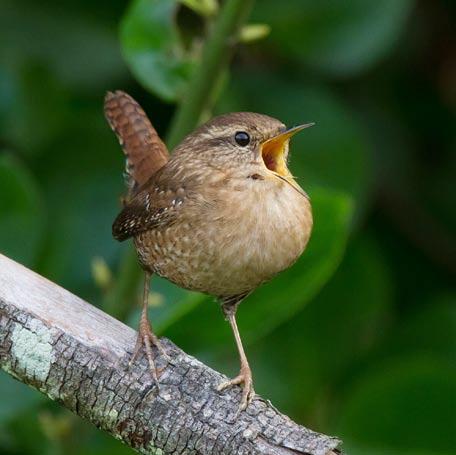
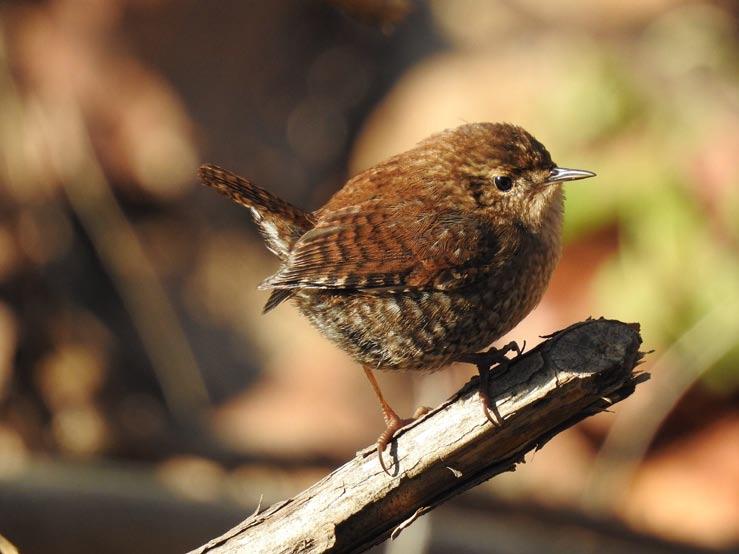
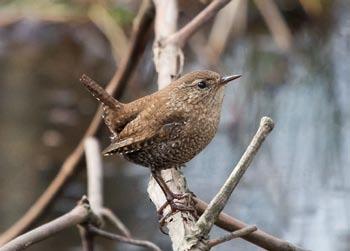
Winter wrens (Troglodytes hiemalis) are the skulkers of the wren world. For starters, they’re our smallest wren, about 3.5 inches of brown fluff weighing less than two quarters. Winter wrens are often mistaken for mice—the small birds creep in and out of heavy cover provided by brush piles, fallen trees, rotting stumps, or stacks of firewood.
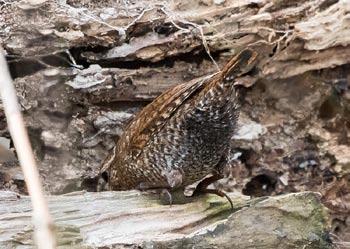
birds popping in and out of holes and crevices in the brush. The species name hiemalis is Latin for wintry, or of the winter.
And here in the DMV, unlike our other wrens, winter wrens are a quiet winter bird. If they vocalize at all, they produce a distinctive sharp one- or two-note tik or tik-tik while prowling along a log or tree trunk. It’s a different story entirely when winter wrens are in their northwoods breeding grounds amid ancient forests of hemlock, spruce, and fir. The male wren flies up onto a low, exposed perch and pours forth an amazingly loud, complex, and melodious avian symphony. Naturalist John Burroughs, in his 1910 essay collection In the Catskills, describes the winter wren’s aria as being delivered by a “tremulous, vibrating tongue of silver.”
When the male sings, his entire body shivers and trembles with the effort, and while he is looking for a mate in the spring, this performance may go on from early dawn to deep dusk. You can scroll through a selection of winter wren calls and songs at https://www. allaboutbirds.org/guide/Winter_Wren/ sounds
In the Mid-Atlantic and Southeast, winter wrens come by their name honestly, showing up in the fall and departing again in early spring. They’re often off and gone before house wrens migrate back—seeing all three suburban wrens together is a rare occurrence. Winter wrens are not built for flying very far or quickly; they have short stubby wings so unsuited for long flights that these wrens seldom use them once they’ve reached their winter or summer destinations, preferring to hop and clamber around in the brush.
Once winter wrens pick a spot to hunker down, they stay put for the season. Many other migratory birds move around to escape the worst snow and ice, but winter wrens often perish during extreme cold or storms. It’s one reason they tend to prefer the shelter of dense brush and deadfall trees.
The winter wren’s scientific name of Troglodytes gives a good clue about this behavior. It’s a mash-up of Latin, from trogle (hole, mouse-hole) and dyein (to go in, dive in). That’s exactly what they look like in real life—dark, mouse-like
Until molecular genetic research was published in 2010, we considered our winter wren and the Eurasian wren to be the same species, Troglodytes troglodytes. Colonial Americans transferred their affections to what seemed
The cocked tail, warm brown body with a finely barred breast and belly, and tiny bill identify this winter wren—that is, if you ever get a good look at it! Photo by Tparkslope via Creative Commons.
This is the view of winter wrens you are most likely to see: skulking in brush and exploring holes and crevices. Photo by Ashley Bradford, Monticello Park.
to them an identical wren here in the colonies, but thankfully didn’t import the Irish tradition of hunting a wren at Christmas and carrying its corpse around from house to house until someone forked over money to bury it. In Ireland, “wren hunting”—with faux wrens these days—is still celebrated on St. Stephen’s Day, December 26. The tradition is memorialized in an old carol about the wren hunt, sung by the Clancy Brothers at https://www.youtube. com/watch?v=SX9FNTwTtw0
“The wren, the wren, the king of all birds, St. Stephen’s Day was caught in the furze, Although he was little, his honor was great, Jump up, me lads and give us a treat.”
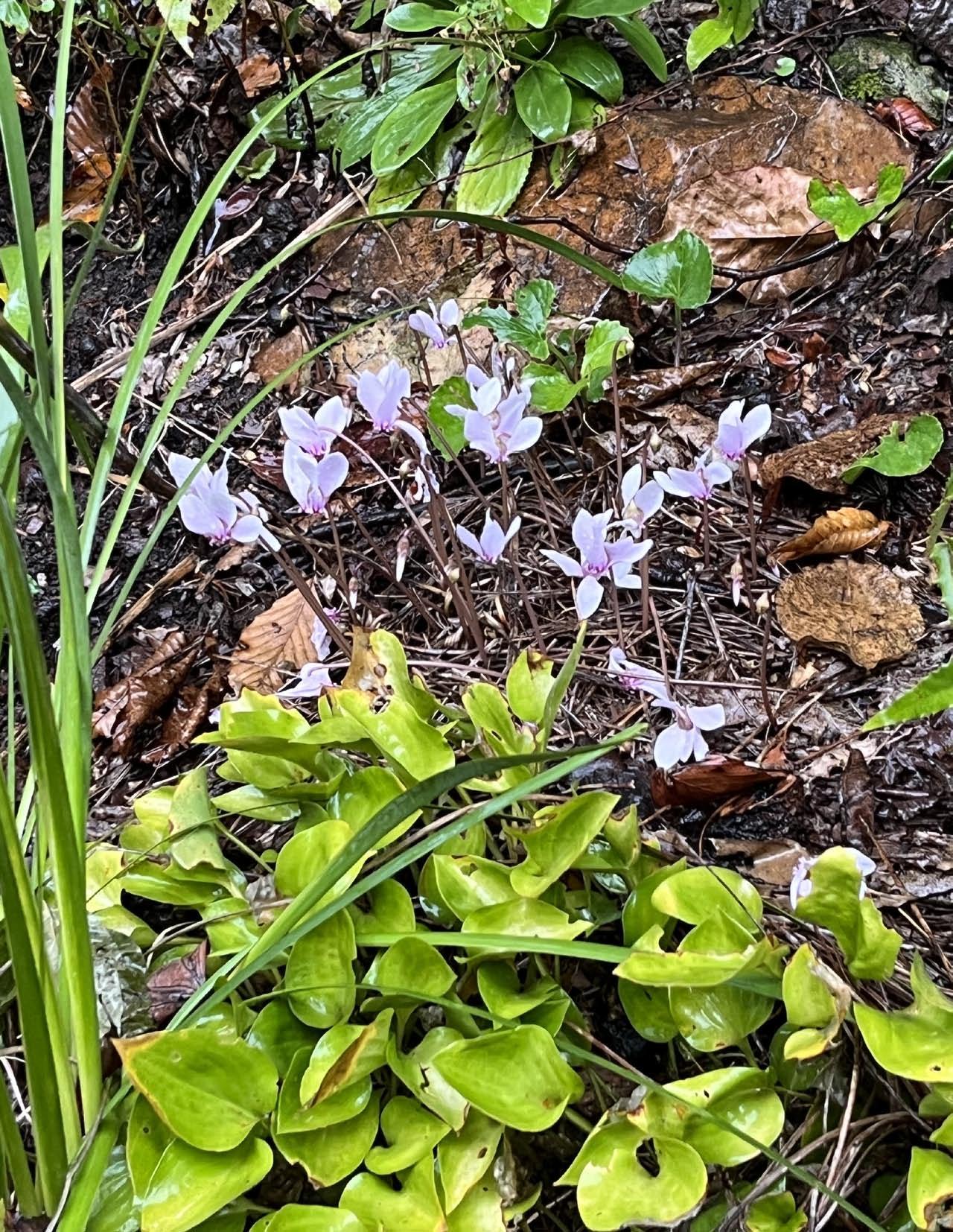
Hardy Cyclamen
By Kathy Jentz
The wren’s moniker of “King of All Birds” comes from a mythical contest among the birds to see who could fly the highest. The eagle, of course, was odds-on favorite and ascended higher than any others into the sky until he tired, at which point, a clever, tiny wren popped out of the feathers on the exhausted eagle’s back and continued to fly even higher, besting the eagle in the contest.
This holiday season, you might go hunting for our own secretive King of All Birds. If you or your neighbors have a cut tree for decoration, think about using it to start a brush pile in your back yard—the wrens will thank you, and so will all manner of other winter birds! o
Rick Borchelt is a science and natural history writer, field naturalist, and garden and botany enthusiast. Reach him with questions about this column at rborchelt@gmail. com.
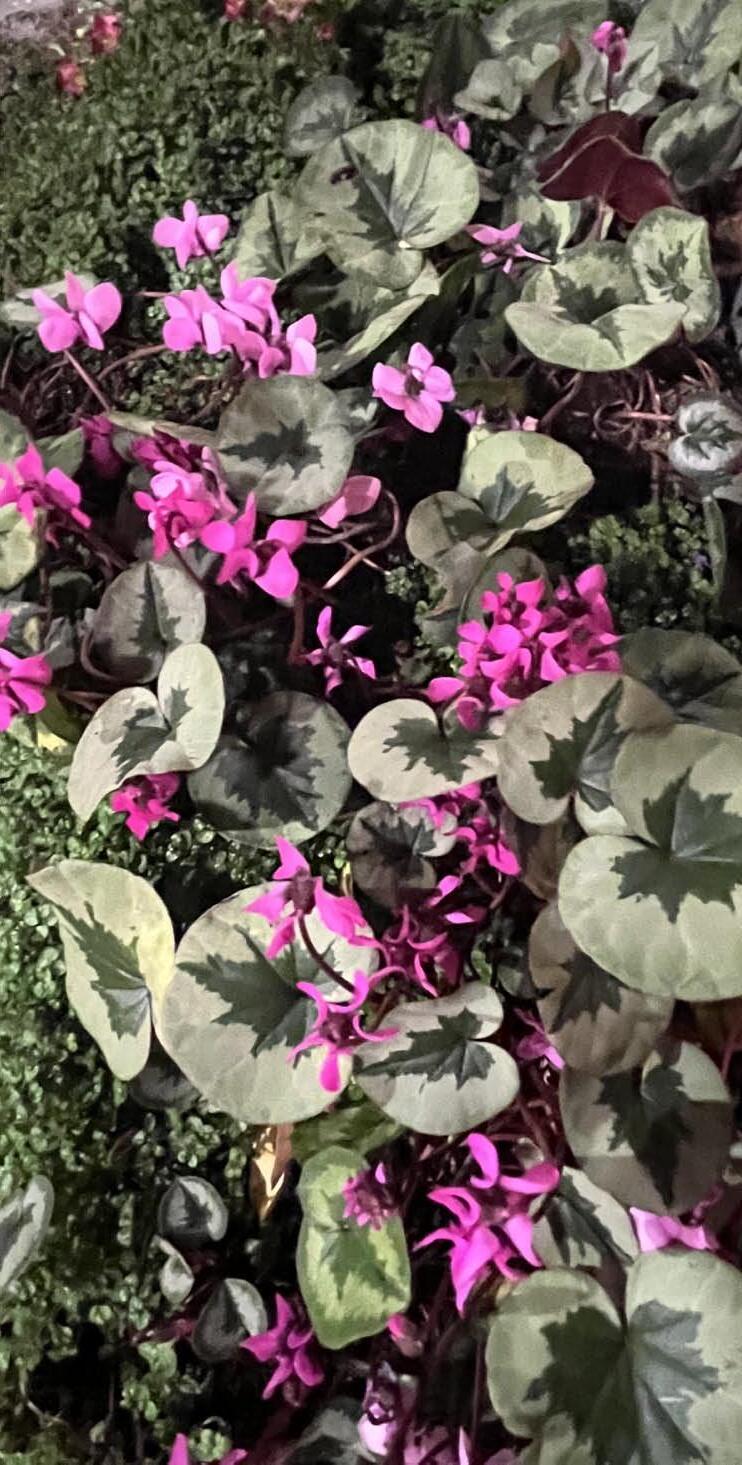
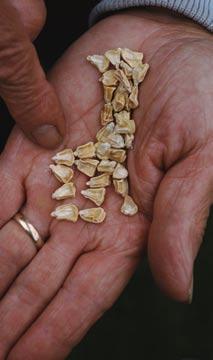
Hardy Cyclamen are flowering perennials that typically bloom from fall to spring. The blooms range in color from white to pink, magenta, red, or lavender.
They are members of the primrose family. Cyclamen are native to Europe and the Mediterranean, where they typically grow on rocky slopes. Hardy Cyclamen species can grow in USDA zones 4 to 9. The gardenhardy species include Cyclamen hederifolium, Cyclamen cilicium, and Cyclamen coum
They prefer to grow among the root zones of trees or shrubs. Because they are often small in size, they should be placed on the edges of pathways or on shaded slopes so you can see and enjoy them. Their leaves are heart- or kidney-shaped with marbled variegations. Many people collect them just for the attractive foliage.
Cyclamen go dormant in the summer. The plants grow from a round tuber and should be placed in soil with good drainage so they don’t rot. It is especially important that they stay relatively dry during the summer months.
Common names for Hardy Cyclamen include Alpine Violet and Persian Violet, although they are neither a violet nor from Persia. Another common name for them is Sowbread. because pigs like to dig up and eat the tubers. Interestingly, Hardy Cyclamen are considered deer-resistant. Hardy Cyclamen are bee-pollinated and can be propagated by division or freshly collected seeds. o
Kathy Jentz is the editor of Washington Gardener
The short, stubby wings on winter wrens tells you they are not built for longdistance flight. Photo by Ashley Bradford, Monticello Park.
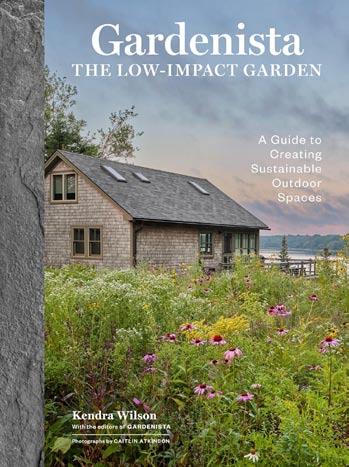
Gardenista: The Low-Impact Garden: A Guide to Creating Sustainable Outdoor Spaces
Author: Kendra Wilson
Publisher: Artisan Publishers
List Price: $40.00
Order Links: https://amzn.to/4ip24ye and https://bookshop.org/ a/79479/9781648293610
Reviewer: Andrea Siegel
With nature-based, sustainable, lowimpact gardening, we are aiding whom we share our outdoors with—insects, birds, pollinators, other wildlife—and crafting a habitat where they thrive, as we think about all the life our gardens can support.
That’s the focus of the recently published Gardenista: The LowImpact Garden: A Guide to Creating Sustainable Outdoor Spaces. In 350 stunning and inspiring photographs, the book immerses us in these gardens as it introduces us in accompanying text to what we should know about them. These photos show readers that wherever they live—urban, suburban, rural, and in varied climates and growing conditions, this type of gardening can have natural beauty. Most of the gardens depicted rely on diverse plants native to the region or sustainable in it, and that’s what sustains native wildlife. Especially pleasing for gardeners: captions that identify the plants in the photos, particularly helpful if you want to know what goes together well. These gardens aren’t no maintenance, but have lower maintenance.
There is, of course, more to this book. Gardenista was founded online in 2012, and is a resource for gardening, outdoor living and the like.
The volume has five sections, plus a varied resource list, and is a worthy guidebook for gardening as caretakers of the outdoor life in our immediate environment.
The first section shows 12 low-impact landscapes, each packaged with multiple photos, a discussion of its features and their use and usefulness, plus practical tips from the people who created the garden. These packages could be quite helpful for the gardener who seeks to fashion something similar, and they cover a large range of growing conditions, terrains, and challenges.
The second section is about functional low-impact gardens, which are useful as well as pretty, for example absorbing stormwater and reducing waste. The third section, about low-impact elements, gets into such matters as keystone species, collecting seeds locally, mini-meadows, invasive species, composting, and more. The advice from experts is on target, even if you already know a lot of it.
The fourth section spotlights 50 garden tools and accessories. There are no prices for these, but it is fun to window-shop even if you don’t want a worm composter or already own a nail brush, although yours may not look as upscale as the one in the photo. The fifth section is about small changes that make a difference. Among them are using fallen twigs and branches to assemble a variety of brush piles for wildlife (I’m not sure I want a snake hut, but the bird and bug one has possibilities), and adapting lighting to help insects harmed by nighttime bright lights. A resource listing at the end is useful.
The book may come across as preachy, especially to readers who prefer formal gardens over wilder, natural ones, or don’t subscribe to the book’s premise.
What’s presented here is part of the current trend of less lawn and more native plants, less controlling of nature and more nature-based gardening, a less-manicured landscape and more reliance on organic sustainability, less
perfect plants and more insects nibbling on them, and the like.
Much of what’s here seems doable by gardeners, some perhaps with assistance. Extensive landscapes, like acres of meadow, can be scaled down; portions of many gardens can translate to other sites or modified for different plants. The natural pool with waterfalls off boulders is appealing, but seems like a larger project, while a fountain featuring plants that filter its water appears doable for Mid-Atlantic yards. In that vein, I would have wanted to see a landscape from our area, although there are featured gardens within driving distance. Most of the gardens are from within the United States.
Overall, the book has a lot of takeaways that encourage creativity and is a good resource for those looking to move their property toward biodiversity and native habitat. o
Andrea Siegel is a master gardener in Maryland.
In Botanical Time:
The Extraordinary Lifespans of the World’s Oldest Living Plants
Author: Christopher Woods
Publisher: Chelsea Green
List Price: $40.00
Order Link: https://amzn.to/4pDNrJY and https://bookshop.org/ a/79479/9781645023159
Reviewer: Cavit Ireland
In Botanical Time by Christopher Woods tells the story of plants on Earth that have evolved to stand the test of time, and his commentary on the natural world puts into perspective just how long our planet has been around. He explores what features give certain plants the ability to live for thousands of years. This book is a meditative reflection on the profound length of the natural clock. Woods asks the reader to experience the world outside of the human calendar, in the calm, complex rhythms of botanical time.
Woods’ writing has a sense of wonder, highlighting how brief humanity’s existence is compared to nature’s aspens, pines, and cypresses.
The passage of time is a central character, along with the search for light and patterns of season, areas Woods explores with close attention, backed

by years of dedication to the subject. He sees the beauty in bloom while also appreciating the breakdown of cyclical, seasonal themes. He encourages readers to understand the importance of death and rebirth, the leaves that fall on frosty ground, and the flowers awaiting their springtime resurgence.
The book begins by celebrating the slow emergence of life, discovering the delicate seedlings that hold enough strength to push through the cracks in the soil and unfurl. Each plant’s life begins humbly, sometimes arriving in unexpected ways. Staying organized by species and landscape that preach longevity, Woods introduces readers to the sacred trees of Japan, ancient bristlecones of the Great Basin that keep thousands of years of history in their ring, and the giant sequoias whose sheer size is intimidating.
The voice Woods writes with is reflective and lyrical, not like a botanist simply collecting and cataloging specimens. He weaves cultural stories within the trees, and readers can learn the significance of yews near medieval churches, monarchs and monks using trees as landmarks, and why some ancient groves became havens for pilgrimage.
Baobab trees, cycads, and olives enter almost as eternal beings, at least from the perspective of humanity. These are rooted figures that have witnessed the rise and fall of civilizations, watching as the vast landscape remains longer than any empire. Then there’s the desert-dwelling Welwitschia,
which lived for a millennium on two leaves alone, a symbol of persistence in scarcity.
Woods uses the eons of history to draw upon the unprecedented challenges these plants face. Urgency comes with stress from climate change, deforestation, and rapid human expansion. There are trees that have survived ice ages, volcanic winters, and tectonic shifts but are now being threatened in the span of a single human lifetime.
Although it looms, the tone of the book isn’t scared or mournful, but knowledgeable and steady. Woods approaches plants but with gentle humility, shepherding readers into the notion that endurance requires effort, resilience, and care.
In Botanical Time encourages readers to reconsider; slow their pace; and focus on their relationship to location, seasons, and time. Reading this book puts time in a new perspective, softened and expanded. The natural world is older, wiser, and more intricate than we realize. o
Cavit Ireland is an intern this fall semester with Washington Gardener. He is a rising senior at the University of Maryland studying journalism and hosts Sonic Fruit, a weekly music program on WMUC 90.5.
Garden to the Max: Joyful, Visionary, Maximalist Design
Author: Teresa Woodard
Photography: Bob Stefko
Publisher: Timber Press
List Price: $40.00
Order Links: https://amzn.to/4rKjPwz and https://bookshop.org/ a/79479/9781643262284
Reviewer: Marsha Douma
Garden to the Max is an easy book to get lost in. The photographs are stunning, the text that highlights the important plants in the gardens is helpful, and the bios of the gardeners whose gardens are featured make it all more personal. The subtitle of this inspiring book, Joyful, Visionary, Maximalist Design, aptly describes the essence of the fantastic gardens chosen for inclusion.
The author, Teresa Woodward, explains that…“maximalist stye dates back centuries, from the lavish styles of the Baroque era and the embellished

Victorian days to the opulent Art Deco …heyday…it embraces strong colors, textures and layers …as intentional …as any design trend.”
But perhaps Dolly Parton summed up the maximalist movement the most succinctly with her well-known quote: “I could get away with less, but I like more.” These gardens are all about more for every garden feature you can think of.
These carefully planned gardens belong to garden artists. Some are general architects or landscape architects in particular, designers of all sorts, garden installation contractors, or owners of garden businesses. These gardens have mostly been years in the making. The gardens are so elaborate that they left me with a variety of both mundane thoughts such as who waters all those pots, to enormous admiration for the imagination, dedication, and hard work on the part of the gardener creators. The skills and effort required to select, amass, and then grow the substantial plant collections that make up these gardens is impressive. Think about some of the most fantastic gardens you have ever seen. That is what this book is about.
The book is well-organized. The 20 gardens selected from around the country are divided into five categories depending on their dominant style. There are gardens both large and small. For example, the first garden in the book is on a small urban lot whose plantings are for the pollinators. Another city garden is a 700-square-
foot patio filled with 300 potted plants from around the world. Yet another urban garden emphasizes biodiversity. There is a gorgeous home and garden worthy of an English manor, a gorgeous rose garden, a garden centered around magnificent old southern oak trees, a Japanese-inspired garden heavily planted with mosses, a water-themed garden, desert gardens, and a few tropical gardens—two of which are, surprisingly, in Indiana and Pennsylvania. There is almost any category you can imagine. With the holidays coming, this would certainly be a welcome gift for your gardening friends who like to dream, as well as for yourself, if you need encouragement to go big. o
Marsha Douma is a retired dentist and lifelong gardener who also enjoys swimming, tennis, and playing the piano. She lives in Rockville, MD.
The Houseplant Guide: How to Easily Select & Maintain Indoor Plants
Author: Lee Miller
Publisher: HortLife Publishing Order Link: https://amzn.to/44reYWQ and https://bookshop.org/ a/79479/9798991876407
List Price: $29.95
Reviewer: Ellen Isaacson Inspiration can be grown inside just as well as it can be grown outside. In The Houseplant Guide: How to Easily Select & Maintain Indoor Plants, author Lee Miller introduces readers to the wide variety of houseplants they may come across during their next garden store visit, and hopes to expand their horizons. Miller is a landscape designer, consultant, garden coach, blogger, and lifelong gardener who wishes to share her homey tips and tricks with the gardening community.
Like many gardening books, this one is friendly to seasoned and beginner gardeners. Miller encourages readers to bring more of the outdoors into their homes, not only because of the beauty of houseplants but also because of the health benefits that accompany them. According to Miller, houseplants serve an important purpose in purifying the air in our homes through the absorption of pollutants and the release of oxygen. She states that studies have shown that the presence of houseplants can help

reduce stress and improve your overall mood, and who wouldn’t want that?
“Once you know what works best for the plant, growing it is easy” is Miller’s philosophy for her sixth book. Throughout this work, Miller includes more than 120 in-depth houseplant profiles. She provides a comprehensive guide in alphabetical order in the first chapter, starting with the African Violet plant, and ranging all the way to the Zebra plant.
She provides information about these plants’ lighting and soil preferences, as well as their moisture and humidity needs. One of the most common houseplants Miller covers is the Boston Fern. This plant requires bright, indirect sunlight; moist soil; and high humidity.
Miller recommends placing your Boston Fern near a window with filtered lighting and fulfilling its humidity needs by placing it in a kitchen or bathroom where steam is regularly released.
Each plant profile is accompanied by a photo of the plant and its Latin name. In the remaining eight chapters, Miller categorizes houseplants by specific interests, such as “Flowering Plants,” “Air-Purifying Plants,” “Cacti, Succulents, & Epiphytes,” “Pet-Friendly Plants,” etc. Any houseplant questions that a gardener may have, Miller can probably answer.
Aside from the colorful photos of an assortment of houseplants covered in this book, Miller also includes information about how to deal with pests, browning leaves, pruning, and propagation. She provides personal tips about how to keep your indoor garden the healthiest and the happiest.
I recommend buying this book if you are houseplant-grower and as a gift for the houseplant-lover in your life. o
Ellen Isaacson is an intern this fall semester with Washington Gardener. She is doublemajoring in journalism and French language and literature.
Note: The books for these reviews were provided free from their publishers. These book reviews include links to Amazon. com and BookShop.org for ordering them.
Washington Gardener Magazine might receive a few cents from each order placed after you click on these links
“Inspire. Connect. Grow.”
The National Garden Bureau is a nonprofit organization that exists to educate, inspire, and motivate people to increase the use of garden seed, plants, and products in homes, gardens, and workplaces by being the marketing arm of the gardening industry. Our members are experts in the field of horticulture and our information comes directly from these sources. Find out more at https://ngb.org/


BACK ISSUE SALE!
YOU CAN REQUEST A SINGLE COPY OF PRINT BACK ISSUES FOR $6 EACH OR ANY 6 BACK ISSUES FOR $24, OR ALL 40+ PRINT BACK ISSUES FOR JUST $100. PRICE INCLUDES POSTAGE AND HANDLING. PLEASE SPECIFY THE ISSUE DATE(S). ORDER MUST BE PREPAID BY CHECK OR MONEY ORDER. SEND ORDERS TO: WASHINGTON GARDENER, 826 PHILADELPHIA AVE., SILVER SPRING, MD 20910
MARCH/APRIL 2005
• Landscape DIY vs. Pro
• Prevent Gardener’s Back
• Ladew Topiary Gardens
• Cherry Trees
MAY/JUNE 2005
• Stunning Plant Combinations
• Turning Clay into Rich Soil
• Wild Garlic
• Strawberries
JULY/AUGUST 2005
• Water Gardens
• Poison Ivy
• Disguising a Sloping Yard
• Kenilworth Aquatic Gardens
SEPTEMBER/OCTOBER 2005
• Container Gardens
• Clematis Vines
• Sponge Gardening/Rain Gardens
• 5 Insect Enemies of Gardeners
NOVEMBER/DECEMBER 2005
• Backyard Bird Habitats
• Hellebores
• Building a Coldframe
• Bulb Planting Basics
JANUARY/FEBRUARY 2006
• Garden Decor Principles
• Primroses
• Tasty Heirloom Veggies
• U.S. Botanic Garden
MARCH/APRIL 2006
• Top 10 Small Trees and Large Shrubs
• Azaleas
• Figs, Berries, & Persimmons
• Basic Pruning Principles
MAY/JUNE 2006
• Using Native Plants in Your Landscape
• Crabgrass
• Peppers
• Secret Sources for Free Plants
JULY/AUGUST 2006
• Hydrangeas
• Theme Gardens
• Agave
• Find Garden Space by Growing Up
SEPTEMBER/OCTOBER 2006
• Shade Gardening
• Hosta Care Guide
• Fig-growing Tips and Recipes
NOVEMBER/DECEMBER 2006
• Horticultural Careers
• Juniper Care Guide
• Winter Squash Growing Tips and Recipes
• Layer/Lasagna Gardening
JANUARY/FEBRUARY 2007
• Indoor Gardening
• Daphne Care Guide
• Asparagus Growing Tips and Recipes
• Houseplant Propagation
MARCH/APRIL 2007
• Stormwater Management
• Dogwood Selection & Care Guide
• Early Spring Vegetable Growing Tips
• Franciscan Monastery Bulb Gardens
MAY/JUNE 2007
• Roses: Easy Care Tips
• Native Roses & Heirloom Roses
• Edible Flowers
• How to Plant a Bare-root Rose
JULY/AUGUST 2007
• Groundcovers: Alternatives to Turfgrass
• How to Pinch, Prune, & Dead-head
• William Paca House & Gardens
• Hardy Geraniums
SEPTEMBER/OCTOBER 2007
• Succulents: Hardy to our Region
• Drought-Tolerant Natives
• Southern Vegetables
• Seed Saving Savvy Tips
NOVEMBER/DECEMBER 2007
• Gardening with Children
• Indoor Bulb-Forcing Basics
• National Museum of the American Indian
• Versatile Viburnums
JANUARY/FEBRUARY 2008
• Dealing with Deer
• Our Favorite Garden Tools
• Delightful Daffodils
MARCH/APRIL 2008
• Patio, Balcony, Rooftop Container Gardens
• Our Favorite Garden Tools
• Coral Bells (Heuchera)
MAY/JUNE 2008
• Growing Great Tomatoes
• Glamorous Gladiolus
• Seed-Starting Basics
SUMMER 2009
• Grow Grapes in the Mid- Atlantic
• Passionflowers
• Mulching Basics
• Growing Hops
FALL 2009
• Apples
• How to Save Tomato Seeds
• Persimmons
WINTER 2009
• Battling Garden Thugs
• How to Start Seeds Indoors
• Red Twig Dogwoods
• Unusual Edibles to Grow in Our Region
SPRING 2010
• Community Gardens
• Building a Raised Bed
• Dwar f Iris
• Broccoli
SUMMER 2010
• Fragrance Gardens
• Watering Without Waste
• Lavender
• Potatoes
FALL 2010
• Vines and Climbers
• Battling Stink Bugs
• Russian Sage
• Garlic
WINTER 2010
• Paths and Walkways
• Edgeworthia
• Kohlrabi
you trying to reach thousands of gardeners in the greater DC region/MidAtlantic area? Washington Gardener Magazine goes out in the middle of every month. Contact kathyjentz@gmail.com or call 301.588.6894 for ad rates (starting from $200). The ad deadline is the 10th of each month. Please submit your ad directly to: kathyjentz@gmail.com
Got a Garden Question?
Got a gardening question you need answered? Send your questions to KathyJentz@gmail. com and use the subject line “Q&A.”
Please also include your first name, last initial, and what city and state you are writing from. Then look for your answered questions in upcoming issues.
Please tell them you saw their ad in
SOLDOUT!SOLDOUT!SOLDOUT!
SPRING 2011
• Cutting-Edge Gardens
• Final Frost Dates and When to Plant
• Bleeding Hearts
• Onions
• Flavorful Fruiting Natives
JULY/AUGUST 2008
• Landscaping with Ornamental Grasses
• Edible Grasses to Graze On
• Slug and Snail Control
• Sage Advice: Sun-Loving Salvias
SEPTEMBER/OCTOBER 2008
• Autumn Edibles — What to Plant Now
• Beguiling Barrenworts (Epimediums)
• Best Time to Plant Spring-blooming Bulbs
• 14 Dry Shade Plants Too Good to Overlook
NOVEMBER/DECEMBER 2008
• Outdoor Lighting Essentials
• How to Prune Fruiting Trees, Shrubs, Vines
• 5 Top Tips for Overwintering Tender Bulbs
• Harry Lauder’s Walking Stick
JANUARY/FEBRUARY 2009
• Compost Happens: Nature’s Free Fertilizer
• Managing Stormwater with a Rain Garden
• Visiting Virginia’s State Arboretum
• Grow Winter Hazel for Winter Color
MARCH/APRIL 2009
SUMMER 2011
• Ornamental Edibles
• Urban Foraging
• Amsonia/Arkansas Blue Star
• Growing Corn in the Mid-Atlantic
FALL 2011
• Herb Gardens
• Toad Lilies
• Sweet Potatoes
• Cool Weather Cover Crops
WINTER 2011/EARLY SPRING 2012
• Green Roofs and Walls
• Heaths and Heathers
• Radishes
SPRING 2012
• Pollinator Gardens
• Brunnera: Perennial of the Year
• Growing Yacon
SUMMER 2012
• Tropical Gardens
• Captivating Canna
• Icebox Watermelons
SPRING 2013
• Great Garden Soil
• All About Asters
• 40+ Free and Low-cost Local Garden Tips
• Spring Edibles Planting Guide
• Testing Your Soil for a Fresh Start
• Redbud Tree Selection and Care
SOLDOUT!SOLDOUT!SOLDOUT!
• Squash Vine Borer
SUMMER/FALL 2013
• Miniature/Faerie Gardens
• Beguiling Abelias
• Best Viewing Spots for Virginia Bluebells
MAY/JUNE 2009
• Top Easy Summer Annuals for DC Heat
• Salad Table Project
• Grow and Enjoy Eggplant
• How to Chuck a Woodchuck
• Growing Great Carrots
WINTER/EARLY SPRING 2014
• Ferns for the Mid-Atlantic
• Chanticleer Gardens
• Beet Growing Basics
Jentz Prints
Antique Botanical Prints for the decorator, collector, connoisseur, and art lover.
Jentz Prints can be purchased at the Downtown DC Holiday Market. through December 23, 2025.
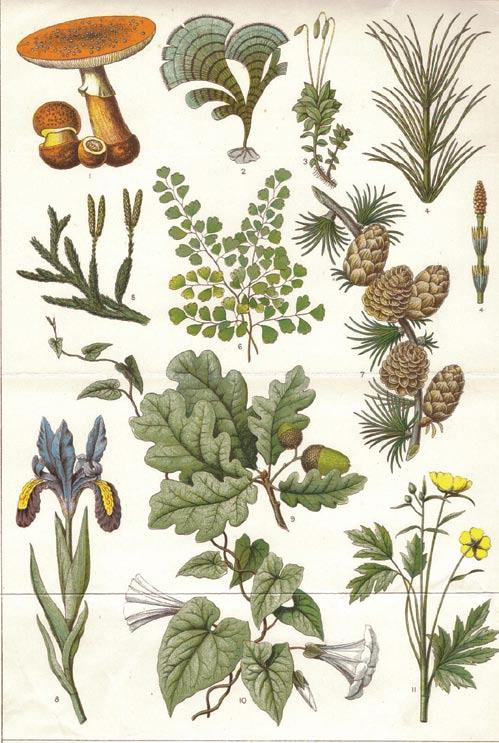
Antique prints are affordable—most in the $10-$30 range—and they are the perfect gift idea for that plant lover in your life. And don’t forget to buy a few for yourself!
For more information or to get a detailed show schedule, please contact Jentz Prints by email at UllrichJ@aol.com.