AUGUST 2026 VOL. 21 NO. 6
WWW.WASHINGTONGARDENER.COM
WASHINGTON
gardener
the magazine for gardening enthusiasts in the Mid-Atlantic region
Lovely and Luscious
Lisianthus
Meet the Flower Potluck Founders How Glyphosate Affects Bees Managed Landscapes Help Combat Summer’s Biggest Challenges Growing Salsify: The Oyster Plant Murmurations About Starlings Garden Book Reviews Is Gardening the Secret to Longterm Exercise? Summer-blooming Bulbs for Shady Gardens Raise Your Garden to New Heights Millipedes’ Ancient Origins A New False Sunflower
RESOURCESsourc
o oo o oo Need a Garden Club Speaker?
Washington Gardener Magazine’s staff and writers are available to speak to groups and garden clubs in the DC region and ONLINE! Call 240.603.1461 or email KathyJentz@gmail.com for available dates, rates, and topics.
RARE AND EXCEPTIONAL PLANTS FOR THE DISCRIMINATING GARDENER AND COLLECTOR Barry Glick Sunshine Farm and Gardens 696 Glicks Road Renick, WV 24966, USA Email: barry@sunfarm.com
�����������������������������
www.sunfarm.com
����������������������������������������
��������������������� ���������������� ����������������� �������������� ��������������� ��������
Your Ad Here
Are you trying to reach thousands of gardeners in the greater DC region/Mid-Atlantic area? Washington Gardener Magazine goes out on the 15th of every month. Contact KathyJentz@gmail.com or call 301.588-6894 for ad rates (starting from $200). The ad deadline is the 10th of each month. Please submit your ad directly to: KathyJentz@gmail.com. 2 WASHINGTON GARDENER AUGUST 2026
Green Spring Gardens
A “must visit” for everyone in the metropolitan Washington, DC, area. It’s a year-round goldmine of information and inspiration for the home gardener. It’s an outdoor classroom for children and www.greenspring.org their families to learn about plants and wildlife. It’s also a museum, a national historic site that offers glimpses into a long, rich history with colonial origins. Located at 4603 Green Spring Rd., Alexandria, VA. Information: 703-642-5173.
INSIDEcontents
FEATURES and COLUMNS
14
Winter starlings are lightly speckled with white “snowflake” feathers and brightyellow beaks that turn somewhat darker. Photo by Richard Orr.
o
Got a Garden Question?
Send your questions to KathyJentz@gmail.com and use the subject line “Q&A.” Then look for your answered questions in upcoming issues.
6 The Flower Potluck is a monthly outdoor event bringing together flower enthusiasts to “build arrangements, community, and power.” Photo courtesy of Flower Potluck.
15
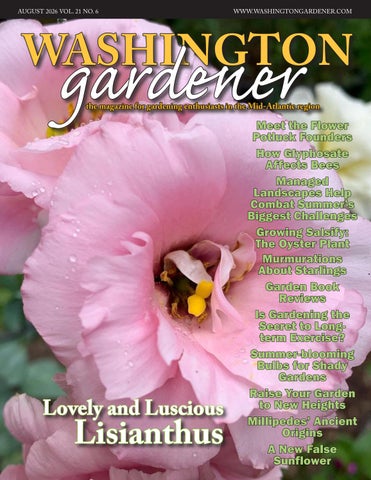
Lisianthus is a flowering biennial in the gentian family that makes an ideal cut-flower choice. It is difficult to start from seed, so most gardeners purchase plugs or started seedlings.
BIRDwatch 14 Starlings BOOKreviews 20-23 Productive Garden, Hydrangea Pruning, Still Life, French Country Cottage, Gardens That Can Save the World EDIBLEharvest 18-19 Salsify, the Oyster Plant GARDENbasics 8 Elevating Garden Beds INSECTindex 9 Millipedes GREENliving 16-17 Glyphosate and Honeybees HORThappenings 23 Edible Flowers NEIGHBORnetwork 6-7 Flower Potluck Founders NEWPLANTspotlight 11 False Sunflower ‘Forged in Fire’ PLANTprofile 15 Lisianthus TIPStricks 10 Summer Bulbs for Shade, Gardening for Exercise, Managed Landscapes
DEPARTMENTS
ADVERTISINGindex BLOGlinks EDITORletter GARDENDCpodcasts LOCALevents MONTHLYtasklist NEXTissue READERreactions RESOURCESsources
23 11 4 21 12 11 3 5 2
ON THE COVER Lisianthus flower in a private garden in Takoma Park, MD. In our next issue:
Tropical Inspiration A Native Plant Co-Op A Weedy Vine
Click on the “subscribe” link at washingtongardener.com AUGUST 2026 WASHINGTON GARDENER 3
Credits
EDITORletter
Kathy Jentz Editor/Publisher Washington Gardener 826 Philadelphia Ave. Silver Spring, MD 20910 Phone: 301-588-6894 kathyjentz@gmail.com www.washingtongardener.com Ruth E. Thaler-Carter Proofreader Maya Hand Koree Perry Interns Subscription: $20.00
Your editor at the Garlic Festival at the Takoma Park Farmers Market in Takoma Park, MD. Photo by Koree Perry.
Garlic Tales
The annual Garlic Festival is held mid-July in Takoma Park, MD, and it is not a big event—just a few tables where we give out garlic growing tips along with garlic guru Tony Sarmiento, the Takoma Horticultural Club, and a chef at the market. Truthfully, the chef gets most of the attention. As soon as folks see him or her giving out garlic-inspired recipe samples, a line forms. It is hard to compete with free food, but luckily we get to take breaks and taste the garlic dishes, too. The most fun part for me is when Tony and I go around and judge the best garlic from among the farmers at the market. We award first, second, and third place and take into account size, uniformity, condition, diversity, and artful display. That last part is the really imporant, since we eat with our eyes first! I bought some of the first-place garlic, to use as my seed garlic when planting this fall. I hope you will save a sunny spot in your garden to grow some garlic of your own this year! Sincerely,
Kathy Jentz, Editor/Publisher, Washington Gardener, KathyJentz@gmail.com 4 WASHINGTON GARDENER AUGUST 2026
• Washington Gardener Blog: www.washingtongardener.blogspot.com • Washington Gardener Archives: http://issuu.com/washingtongardener • Washington Gardener Discussion Group: https://groups.google.com/g/ washingtongardener/ • Washington Gardener Twitter Feed: www.twitter.com/WDCGardener • Washington Gardener Instagram: www.instagram.com/wdcgardener • Washington Gardener Facebook Page: https://www.facebook.com/ WashingtonGardenerMagazine/ • Washington Gardener YouTube: www.youtube.com/ washingtongardenermagazine • Washington Gardener Amazon Store: www.amazon.com/shop/wdcgardener • Washington Gardener BookShop: bookshop.org/shop/WDCgardener • Washington Gardener Podcast: https://podcasters.spotify.com/pod/ show/gardendc/ • Washington Gardener is a woman-owned business. We are proud to be members of: · GardenComm (formerly GWA: The Association for Garden Communicators) · Green America Business Network · National Garden Bureau · One Montgomery Green · Ladies in the Landscape · Potomac Rose Society · American Horticultural Society · Maryland Nursery, Landscape and Greenhouse Association
Volume 21, Number 6 ISSN 1555-8959 © 2026 Washington Gardener All rights reserved. Published monthly. No material may be reproduced without prior written permission. This magazine is purchased by the buyer with the understanding that the information presented is from various sources from which there can be no warranty or responsibility by the publisher as to legality, completeness, or technical accuracy.
READERcontt
Reader Contest
For our August 2026 Washington Gardener Reader Contest, we are giving away a pair of Digz gardening gloves to three lucky winners (prize value: $18). Durable, comfortable, and designed for high performance, Digz Gardener gloves are the perfect choice for those more demanding gardening, landscaping, and outdoor projects. The highly abrasion-resistant palm keeps your hands safe from scrapes with extra padding around the knuckles for added protection. The four-way stretch spandex is breathable for all-day comfort and an adjustable cuff for a snug fit. See more at https://www.digzgardening.com/products/gardener-gloves. To enter to win the gloves, send an email by 5:00pm on Friday, August 31, to WashingtonGardenerMagazine@gmail.com with “Digz Gloves” in the Subject line. In the body of the email, tell us what your favorite article was in the August 2026 issue and why. Please include your full name and mailing address. Winners will be announced and notified on September 1. Entry comments might be published. o
Your Ad Here
Are you trying to reach thousands of gardeners in the greater DC region/MidAtlantic area? Washington Gardener Magazine goes out in the middle of every month. Contact KathyJentz@gmail.com or call 301.588.6894 for ad rates (starting from $200). The ad deadline is the 5th of each month. Please submit your ad directly to: KathyJentz@gmail.com.
READERreactions
July 2026 issue I had two favorite articles in the July Washington Gardener issue. First was the profile of Ashley Coates and the Bishop’s Garden at Washington National Cathedral. It is fun to learn about different horticultural jobs and imagine myself in a totally different profession than the one I actually lived! The second article was the “Ask the Expert” answer about the causes of girdling tree roots and how to avoid them at planting time. I had always assumed these were just unavoidable flukes of root growth. Good to learn something new to avoid problems down the road. ~ John Rebstock, Cheverly, MD My favorite article from the July 2026 Washington Gardener was the Lima bean article. I love growing beans, so quickly! The idea of a petite, fruitful bean plant is very exciting. Can’t wait to try! ~ Alyson Pinkos, Brunswick, MD My favorite article from the July 2026 Washington Gardener was the To-Do list as that always reminds me of tasks I may have forgotten about. ~ Shirley M. Jones, Washington, DC o
Love Reading?
Plant a Row for the Hungry (PAR) is an easy program to participate in and really does not take any extra resources than what you may have in your garden. In normal times, about 35 million people wonder where their next meal will come from. Most of these are children. That’s where PAR steps in. PAR is such a simple program: It urges gardeners to Plant A Row (or a container) dedicated to feeding the hungry, and then take the harvest to someplace or someone that needs it. Once you have donated, send an email to KathyJentz@gmail.com with the total (in pounds and ounces) of what you gave. That is all there is to it. Easy. Effective. Adaptable and Helpful.
These books were reviewed by volunteer members of the Washington Gardener Reader Panel. Reader Panelists may also be asked to review new gardening plants, tools, and seeds. To join the Washington Gardener Volunteer Reader Panel, send an email with your name and address to: KathyJentz@gmail.com. We look forward to having you be a vital part of our local publication and its gardening mission. o AUGUST 2026 WASHINGTON GARDENER 5
NEIGHBORnwork
Flower Potluck Founders
By Koree Perry MaríaEmilia Morazán and Maddie (Madeleine) Poore began Flower Potluck (https://flowerpotluck.org/) in 2022 for those in the DMV area, providing monthly events for anyone who enjoys flowers and building community. Their next potluck is October 10, with sliding scale donations collected and given from each workshop to important causes such as the Palestinian Youth Movement and Smyal. Morazán believes in the magic of third spaces to build community and organize. She discovered how much we can learn about power, respect, gentleness, beauty, and pleasure from flowers. She loves a freaky, sinister-looking orchid. Poore delights in bringing people together to play and be creative. Her love of flowers traces back to childhood, making arrangements with her florist nana, June. She believes flower arranging can be a meditative practice for getting in touch with your desires, crafting things to your personal taste, and following what you find beautiful. She loves a frilly iris or a reflexed tulip. We recently caught up with Morazán, who answered a few questions for our readers. Tell us about yourself and your background, and how you first became interested in gardening. I am a long-time plant lover and now florist with a small floral business: Flowers by Princess Hi Hi. I started by watching tutorials, talking with Maddie about flowers, and practicing at home. Flower Potluck has also been a space where I’ve been able to hone my craft. Gardening has come to me later in life and I am just now getting into it. What was the inspiration behind starting Flower Potluck? Initially, we started Flower Potluck as a way to make flower arranging more accessible and communal. Flowers can be really expensive, but the idea behind Flower Potluck is when everyone contributes what they can, there’s an abundance to be shared. Flowers can be store-bought, home-grown, or foraged and contributed to the potluck.
6 WASHINGTON GARDENER AUGUST 2026
NEIGHBORnwork We also wanted to create an accessible and COVID-safer community event, along with a creative way to fundraise for mutual aid efforts in our community. The event being masked and sliding scale donation-based allows us to accomplish all these things, along with creating a space for joy and connection. Why is Flower Potluck important to you? Flower Potluck is important to us because it is a place where we can play with flowers and build community and solidarity at the same time. All our events raise money for social causes and having the opportunity to come together to share flowers for an abundant selection, be with one another while we arrange, while simultaneously raising money for causes we care about is such a positive feeling/experience. Can you walk us through a full day of your responsibilities when planning and going through with a Flower Potluck Event? We’ve been hosting Flower Potluck monthly for four years, so set-up and break-down have really gotten boiled down to a science. We pack our supplies: a backdrop, sheers, floral mechanics, extra vases, masks and COVID tests, computer, etc. We set up the workstations and the photo area, and we’re done.
Do you face any challenges when hosting a workshop or other event? Sometimes numbers are unpredictable—we’ve been over capacity a few times, and then other times had only 20 people show up. In your opinion, how do gardens and green spaces help people in the DMV/greater DC area? Flowers are so powerful! I have never ever seen flowers not improve a situation after being introduced. They have this incredible way of disarming people and helping people connect with one another. People everywhere (including the DMV) really need connection as we work to keep each other safe during these times.
The Azalea Society offers membership to anyone with an interest in azaleas, from home gardeners, collectors and students to plant professionals. The Azalea Society website (azaleas.org) is the source of information about azaleas.
What advice would you give to beginners gardeners in the greater DC area? I have more advice for beginner florists than gardeners. It’s one of my goals to start growing more flowers. I’d love to grow native plants, as well as care for some orchids. How can our readers contact you? Email us at flowerpotluckdmv@gmail. com or follow us on Instagram @flower. potluck.dmv. o Koree Perry is an intern with Washington Gardener Magazine this summer 2026 session and is a Baltimore native..
GROUNDCOVER REVOLUTION IS OUT NOW! By Kathy Jentz
Published by Cool Springs Press
Order it today at: https://amzn.to/3IlYHYL
“Groundcover Revolution is a must-have book for anyone who is interested in having less lawn, fewer weeds, and reduced mulching. The properties charts will save the reader time and money, the pictures provide inspiration, while the detailed plant portraits give the focused information needed for creating beautiful, functional landscapes.” ―C.L. Fornari, GardenLady.com AUGUST 2026 WASHINGTON GARDENER 7
GARDENbasics
Raise Your Garden to New Heights By Melinda Myers
Elevated and raised-bed gardens can expand your planting options and make planting and maintenance easier and more convenient. You’ll be able to plant, weed, and harvest with minimal bending or even from the luxury of a chair or bench. Elevated gardens are basically containers on legs. You can find plans to make your own or purchase one from your local garden center or garden supply retailer. Consider one on wheels or add your own for ease of moving. You’ll be able to move your garden into the sun or shade as needed each day or out of the way when you entertain. Set the garden in place first. Once filled with soil, it will be very heavy and difficult to move unless you have added wheels. Those who garden on a balcony should confirm the space will hold the weight of the elevated garden bed once 8 WASHINGTON GARDENER AUGUST 2026
it is filled with moist soil and mature plants. Including raised beds in your gardens and on or near your patio is another way to increase planting space and easier access. Purchase a prefab raised bed or make your own from a longlasting material such as interlocking block, fieldstone, plastic lumber, or naturally long-lasting wood. Consider the available space, your gardening goals, and one that provides a comfortable height for gardening. Select one with corners or edges suited for sitting or narrow sides to allow easy access from a garden bench. Line the bottom of your raised bed with hardware cloth to reduce the risk of animals burrowing into your garden. Lay the hardware cloth over the ground and bend it up along the inside of the raised-bed walls. Add a liner of land-
scape fabric to keep the soil in place when placing your raised bed on a patio. A 3- or 4-foot width makes it easy to reach all parts of the garden for planting, weeding, and harvesting. Raising your planting bed at least 8 to 12 inches improves drainage and provides an adequate space for most plants to root and grow. If you want to minimize bending, go higher or add benches to increase your gardening comfort and ease. Once your raised bed is complete or elevated garden is in place, fill it with quality planting mix. You can calculate the volume of soil that is needed yourself or use one of the many soil calculators available online. Check the soil moisture regularly because the limited soil mass and increased exposure to wind, heat, and sunlight make raised beds dry out more quickly than in-ground gardens. Reduce the need for frequent watering by incorporating a certified organic and sustainable soil amendment, like Wild Valley Farms wool pellets. Research found adding these pellets, made from 100% wool waste, helps reduce watering by 25% and increases air space in the soil for better plant growth. You’ll only need a 1-pound bag of these wool pellets to cover about 30 square feet if you add the pellets as you plant or it is enough to amend 12 gallons of soil when mixing it in thoroughly, following label directions. Further boost your gardening success by selecting the best plants suited to the growing conditions and your gardening goals. In no time, you’ll be enjoying the flavor and beauty these gardens provide. o Melinda Myers has written more than 20 gardening books, including Midwest Gardener’s Handbook, 2nd Edition and Small Space Gardening. She hosts The Great Courses “How to Grow Anything” instant video and DVD series, and the nationally syndicated Melinda’s Garden Moment radio program. Myers is a columnist and contributing editor for Birds & Blooms magazine and was commissioned by Wild Valley Farms for her expertise in writing this article. Her website is www.MelindaMyers.com. Pictured above: Raised-bed gardens make planting, weeding, and harvesting easier. Photo courtesy of MelindaMyers.com.
INSECTindex Millipede (Narceus americanus annularis complex), Government Island, Stafford, Virginia, Photo by Judy Gallagher, CC BY 2.0, via Wikimedia Commons.
Millipedes By Carol Allen
We generally don’t give millipedes a second thought unless they are swarming in our basements or sheds. In our region, we typically see one of a few different species. They are harmless and are important detritovores. A detritivore feeds on decaying leaves and rotting wood, breaking it down into even smaller pieces of organic matter. These small animals play a vital role in recycling plant waste. In fact, our world of rich soils and abundant plants wouldn’t exist without them. Researchers at Virginia Tech and other international collaborators recently revealed that millipedes preceded vertebrate species onto land by an astonishing 80 million years. In a world that contained no flowering plants and no animals such as we know them, millipedes fed on decomposing moss and other primordial organic matter. They literally paved the way for higher orders of plants and animals. Locally, there are 38 distinct species. They inhabit damp areas such as compost piles, under mulch, and in leaf litter. There may be as many as
hundreds per square yard in the forest floor, depending on moisture level and food availability. If you were to meet an American giant millipede (Narceus americanus-annularis), you would remember the encounter because they can be up to 4 inches in length. Their body is very round and when disturbed, they curl into a ball. They don’t really have a million legs, but can have between 180 and 240 individual legs. The recorded record is more than 300. N. americanus are known to dig burrows by passing each grain of soil from leg to leg along the length of their body and depositing it behind them. Like all millipedes, they need a damp or very humid environment. Besides the defensive curl, the American giant millipede has evolved a type of chemical warfare. Each segment of their bodies contains an ozopore through which the millipede releases a noxious substance containing benzoquinones. This substance can cause chemical burns in the humans who mishandle them. Other species of millipedes release a defensive product containing
hydrogen cyanide when threatened. In any case, it pays to avoid handling or irritating these animals. The American giant millipede also differs from other species by creating a nest of shredded leaves for its one egg. The female then curls around the nest and broods the egg until hatching. Once hatched, the young millipede is on its own, maturing in a year or two. A smaller (and more common) species is the one who takes refuge in our moist basements: the greenhouse millipede (Oxidus gracilis). It is native to Asia. Most reach barely an inch in length. They are still important in recycling organic matter by eating rotting leaves and aerating the soil. They provide food for predatory insects, birds, reptiles, and small mammals. o Carol Allen describes herself as a committable plant-a-holic. She has more than 25 years’ experience in the horticulture industry, with a special interest in plant pests and diseases; is a Licensed Pesticide Applicator in the state of Maryland; and is an ISACertified Arborist. She can be contacted at carolallen@erols.com. AUGUST 2026 WASHINGTON GARDENER 9
TIPStricks
Managed Landscapes Help Combat Summer’s Biggest Challenges
10 WASHINGTON GARDENER AUGUST 2026
Photo courtesy of www.flowerbulbs.com.
Summer brings challenges that homeowners and communities dread: scorching heat, dusty conditions, sudden and heavy storms, and (in some regions), increased wildfire risk. According to the TurfMutt Foundation, properly managed landscapes are one of the most effective—and often overlooked—tools for addressing these seasonal concerns. “People often think of parks, yards, and other green space as merely decorative, but they are one of the hardestworking assets in our communities,” said Kris Kiser, President and CEO of the TurfMutt Foundation. “They help communities stay cooler, cleaner, and more resilient throughout the summer months. That’s a pretty impressive return from something some may take for granted.” Here are four key benefits that our parks, backyards, schoolyards, and other managed green spaces do for us. • Cool the Air Trees, shrubs, turfgrass, and other plants combat the urban heat island effect through shade and evapotranspiration, the process by which plants release water vapor into the air. This natural cooling effect provides relief from summer heat and cools homes, businesses, and neighborhoods. • Capture and Filter Stormwater Summer storms can deliver large amounts of rain unexpectedly and quickly. Healthy, managed landscapes act as living sponges, slowing rainfall’s effects by capturing and filtering water before it enters streams, rivers, and groundwater supplies. This also reduces runoff and erosion, and helps with localized flooding. • Capture Dust and Other Matter Landscapes help improve air quality by trapping dust, pollen, and particulate matter that would otherwise circulate during dry summer conditions. • Reduce Fire Risk In areas vulnerable to wildfire, properly maintained landscapes can serve as effective fire breaks, and strategic landscape design and ongoing maintenance can create defensible space around homes and businesses. Regular mowing, pruning, irrigation, and removal of
dead vegetation reduces the fuel for fire and helps reduce its spread. “Also, never forget the important benefit of actively growing trees, shrubs and turfgrass capturing carbon dioxide and producing oxygen,” said Kiser. “Healthy green spaces also support pollinators, wildlife, and overall ecosystem health.” The TurfMutt Foundation encourages homeowners, businesses, and communities to care for and maintain their green spaces properly so they can continue delivering these important environmental and quality-of-life benefits throughout the summer and beyond. For more information about managed landscapes, visit TurfMutt.com. o
Is Gardening the Secret to Long-term Exercise?
While there are many ways for older adults to stay active, maintain mental wellbeing, and engage with others, one hobby stands out for its simplicity and accessibility: gardening. A new study from Mather Institute shows evidence that gardening supports older adults’ physical and psychosocial wellbeing, while also offering insights into how more people can participate. One key finding from the online survey of more than 2,000 adults 55 and better is how much physical activity gardeners get. The Centers for Disease Control and Prevention recommends older adults spend at least 150 minutes of moderate aerobic physical activity or 75 minutes of vigorous physical activity each week. Many older adults who garden far exceed these guidelines, averaging approximately five hours of gardening per week, and the majority maintain it over the decades. Beyond physical wellbeing, gardening was also linked to better psychosocial outcomes in older adults. Those who garden have a stronger sense of purpose, satisfaction with life, and sense of gratitude when compared to nongardeners. Older adults who garden reported engaging in significantly more healthy behaviors on average compared to nongardeners, such as seeing dentists and getting enough sleep. To download this year’s full gardening report, visit MatherInstitute.com. o
Summer-blooming Bulbs for Shady Gardens
Not every garden is bathed in sunlight, but that’s okay. Bulb flowers that flourish without too much sun can create a vibrant, colorful summer display even in full or partial shade. Choose the right flowers and you’ll transform darker corners into lovely focal points full of color. • Begonias are the real champions of shade. Their lush flowers range from soft pink to deep red or bright orange, and bloom continuously from early summer to fall. They thrive in borders, pots, or hanging baskets and bring instant cheer to even the most sheltered spots. • Calla lilies also do well in the shade. Their elegant calyx-shaped flowers and glossy leaves bring a modern look to the garden or balcony. Plant them in a large pot or combine them with perennials for an interesting contrast. • The Gloriosa or flame lily is a great choice for those who want a bit of exotic flair. The fiery flowers appear to float above the foliage and add a playful touch to sunny and shady spots. • Finally, there is the unusual pineapple flower (Eucomis) with its starshaped flowers arranged in exotic, pineapple-like clusters (shown above). They do well in pots or borders in light shade and are striking accents in the summer garden. Plant these bulbs to enjoy a summer full of flowers—even without full sun. For more, visit www.flowerbulbs.com. o
GARDENnews
Quick Links to Recent Washington Gardener Blog Posts • How to Photograph Your Garden
• Organic Rose Talk • Lantana Plant Profile
See more Washington Gardener blog posts
at WashingtonGardener.blogspot.com o
New Plant Spotlight
August Garden Task To-Do List
‘Forged in Fire’ False Sunflower
Heliopsis helianthoides This North American native prairie plant thrives in heat, drought, and even heavy clay soils, making it an excellent choice for tough garden situations. Growing to about 2½ feet tall, ‘Forged in Fire’ is a mid-size selection that fits easily into a wide range of landscape designs while attracting a steady stream of pollinators. ‘Forged in Fire’ is a False Sunflower notable for its dense, darkly colored habit and large, burnt-orange “eyes” on the flowers. The eye-zone is most prominent as the flower opens, starting as a dark burgundy and lightening as the flower matures. Each flower is semi-double, with the additional petals prolonging the life of the flower while leaving the center open to visiting pollinators. Dark-green foliage has excellent mildew resistance. Heliopsis have traditionally been an excellent tall perennial for the middle or back of the flower border. It has a bushy, well-branched form and glossy, deep-green, triangular leaves—a real workhorse in the garden! Use this plant in combination containers, as a cut flower, or to attract butterflies to your garden. Find out more about ‘Forged in Fire’ at https://www.waltersgardens. com/. o Photos courtesy of Walters Gardens.
• It is harvest time and a good time to start taking stock of what worked well for you this season and what didn’t. • Buy raspberries and peaches at a local pick-your-own farm or local farmer’s market. • Let the lawn go dormant for now; it will green back up in the coming rains. • Check your local garden center for end-of-summer bargains. • If your pond water gets low from prolonged drought, top it off with tap water and add a dechlorinator according to package instructions. • Wash out birdbaths weekly with a diluted bleach solution. • Water thoroughly, especially if you receive no rain for more than seven days. • Turn your compost pile weekly and don’t let it dry out. • Start shopping for spring bulbs. • Divide and cut back Bearded Iris and Peonies. • Check your pond pump for debris and clean it out every few weeks. • Watch for slug damage and set out traps or Sluggo bait. • Check for mosquito breeding grounds. Dump out any water that sits stagnant for more than three days. • Weed and weed some more. • Cut back any leggy Asters or Mums. • Take garden photos and make notes in your garden journal. • Start collecting plant seeds for next year and for trading. • As the days get cooler, plant hardy Mums. • Prune evergreens to get them in shape for fall/winter. • Hand-pick or cut out any bagworm cocoons. • Harvest your herbs often and keep them trimmed back to encourage leafy growth. Dry them indoors if you can’t use them right away. • Bring Christmas Cactus and Poinsettias indoors if you took them out for the summer, in preparation for holiday blooming. Fertilize them and put them where they’ll get 10 hours’ bright light per day. • Inspect for powdery mildew. If seen, prune back perennials to create needed circulation. Discard properly (i.e., not in your compost bin). • Clean your hummingbird feeders and add new sugar-water every three days. • Renew your container plantings, which may be looking a bit ragged at this point. Pinch back overgrown plants. Pull out any spent ones and pop in some substitute annuals or Mums. Keep them well-watered and add a little liquid fertilizer every few weeks to keep them going through early autumn. • Switch your deer-deterrent spray. • Start seeds for fall annuals, such as Pansy, Calendula, and Kale. • Plant fall crops such as Chinese Cabbage, Lettuce, Radish, Mustard, Broccoli, Kohlrabi, Cauliflower, Turnips, and Beets. • Order Garlic, Onions, and Shallots for fall planting. • Attend a county fair and enter some of your garden bounty. • Preserve gourds and dry flowers for display in the fall. • Apply grub control to your lawn. • Divide Hostas and Daylilies. • Deadhead Garlic Chives before they go to seed. They make nice cut flowers. o AUGUST 2026 WASHINGTON GARDENER 11
TOP AREA GARDENING EVENTS Classes, Events, and Plant Shows/Sales •Saturday, August 8, 10am–12noon Expert Is In: Vanilla On-site Drop-in Program at the U.S. Botanic Garden (USBG) in Washington, DC. Want to know more about vanilla? Drop by the Garden Court in the USBG Conservatory to talk with Dr. Elizabeth Stulberg, Microbiologist, Agriculture Scientist, and Science Policy Advisor. You’ll learn about the vanilla orchid, explore how vanilla is made, and discuss why vanilla is such a special and valuable plant product. Bring your questions and connect with a plant science professional in this Expert Is In program. Free. No registration needed. See more at https://www.usbg.gov/. • Wednesday, August 19, 6:30–7:30pm Benefits & Applications of Biosolids for Gardens Did you know that every time you flush, you participate in one of the world’s greatest recycling programs—one that helps restore soils and grow healthy lawns and gardens? Bloom, a local, affordable compost alternative rich in organic matter and nutrients, boosts soil health and offers improved plant growth, drought resistance, waterholding capacity and more. Samples will be available to try at home. Held at the Arlington Central Library, 1015 N. Quincy Street, Arlington, VA. Sponsored by Friends of Urban Agriculture and Extension Master Gardeners. Free. No registration required. See details at https://arlingtonurbanag.org/. • Saturday, August 22, 9am–12noon Wild Edible & Useful Plant & Mushroom Walk Learning to identify and build relationships with plants is one of the most enriching ways we can deepen our personal nature connection journey. Come along to enjoy a walk in nature and meet a variety of edible, medicinal, and useful plants in all seasons. Location: Lanham, MD. View Details at https:// www.ancestralknowledge.org/ • Saturday, August 22, 9:00am– 4:30pm, and Sunday, August 23, 12noon–2:30pm 12 WASHINGTON GARDENER AUGUST 2026
Annual Begonia Show and Sale This free show is sponsored by the Potomac branch of the American Begonia Society. The accompanying sale offers a wide variety of begonias, including tropical and subtropical species. Free. Held at Green Spring Gardens, 4603 Green Spring Rd., Alexandria, VA. See further details at www. friendsofgreenspring.org. • Saturday, August 22, 10am–12noon Washington Gardener Tomato Taste Held at the Silver Spring Farmers Market in Silver Spring, MD. • Wednesday, August 26, 6pm Urban Foraging, Cider Tasting and Cyanotype Printing Held at ANXO, 711 Kennedy NW, WDC. Discover delicious wild plants growing underfoot, sample award-winning cider, and create a botanical sun print using foraged plants. Join forager, author, and instructor April Thompson for a unique workshop combining urban foraging, botanical art, and cider tasting at ANXO—DC’s award-winning cidery and the first to operate in the nation’s capital since Prohibition. Register at https://www.eventbrite.com/e/urbanforaging-cider-tasting-and-cyanotypeprinting-tickets-1320699199859. • Sunday, September 1, 7pm Kathy Jentz “Groundcover Revolution” Talk & Book Signing Held at Meadowlark Botanical Gardens in Vienna, VA. More details soon at https://www.novaparks.com/. • Saturday, September 12, 10am–1pm FOBG Plant Sale The Friends of Brookside Gardens (FOBG) hosts their annual plant sale fundraiser at Brookside Gardens in Wheaton, MD. Members get in early for the best selection. You can come early and join FOBG at the sale. New memberships on that day will continue through October 2026. Plant list will be up at www.friendsofbrooksidegardens. org in early September. • Sunday, September 6, 11am–6pm DC State Fair Online contest entry is now open. Live contests include flower arranging. Free Flower Arranging Talk at 1pm. Held at
700 K Street NW, Washington, DC. Free to attend. See DCstatefair.org. • Tuesday September 8, 2:30–3pm Gardener’s Focus Tour: Native Garden Explore the Collections and Research Center native garden at Hillwood Gardens, featuring a bio-retention pond with garden section manager and coordinator Cicily Arnsworth. Tickets are distributed at the Ellen MacNeille Charles Visitor Center on opening each day. This 30-minute tour is limited to 15 and meets in the visitor center conservatory. Details at https://hillwoodmuseum.org.
Looking Ahead •Wednesday, September 23 Urban Tree Summit Conference Learn from an outstanding lineup of industry-leading experts about their research and contributions to urban forestry, conservation, and environmental sciences. Held at the Silver Spring Civic Center, 1 Veterans Place, Silver Spring, MD. Register at https://urbantreesummit.org/. • Thursday, October 22, 7–8:30pm Getting Your Garden Ready for Winter Online Class Overwhelmed by winter garden to-do lists? Learn which chores are essential and which you can safely skip as you prepare your garden for the cold months ahead. Discover cost-saving tips and tricks for battening down the hatches before a bad winter hits. Speaker: Kathy Jentz, author of The Urban Garden, editor and publisher of Washington Gardener Magazine. Fee: $15. Register at https://mdmontgomeryctyweb. myvscloud.com/webtrac/web/ Course #PBG0245 300001.
Event Listing Updates
See updated event listings on the Washington Gardener discussion list. Join by emailing WashingtonGardenersubscribe@googlegroups.com.
How to Submit Events
To submit an event for this listing, email washingtongardenermagazine@gmail. com with “Event” in the subject line. Our next deadline is August 20 for the September 2026 issue, for events taking place after September 5. o
April 1 to September 7, 2026 | Daily, 9 am to 3 pm Step into Brookside Gardens’ South Conservatory and experience the beauty of hundreds of live butterflies fluttering around you. Learn about the stages of metamorphosis, the important role butterflies play in a healthy ecosystem, and how you can ensure butterflies thrive in your own garden.
All visitors must have a ticket for a specific date and entry time.
Tickets:
• Under age 3: Free • Ages 3 to 12: $10.99 Tickets available mid-February. (ticket fee $9 plus $1.99 service charge) For more information visit: • Ages 13+: $15.99 MoCoParks.org/butterfly (ticket fee $14 plus $1.99 service charge)
BROOKSIDE GARDENS 1800 Glenallan Avenue | Wheaton, MD 20902 301-962-1420 | BrooksideGardens.org AUGUST 2026 WASHINGTON GARDENER 13
BIRDwatch
Murmurations About Starlings By Rick Borchelt
Starling murmuration at dusk. Photo by Conni Nielsen via Wikimedia Commons.
Starlings: You either love them, or you hate them. How you feel may depend on whether you live in North America or Great Britain. Let’s get the maligning of starlings out of the way first. Yes, they are an introduced, invasive species in the U.S., often dislocating native birds from their nest sites (including nest boxes), even smashing the eggs or killing the original nestlings in the process. They’ve been an ecological disaster. Yes, they make quick and efficient work of those suet cakes you bought for woodpeckers, chickadees, nuthatches, and titmice. The suet in my feeders lasts about a day once the starlings discover it. But… did you know that Mozart was so impressed with starling vocalizations that he kept one as a pet? Or that they played an important role in Celtic mythology? Or that Roman soothsayers predicted the future from their flight patterns? Or that they are now becoming so rare in their native England that they’re on the endangered species list there? The European starling (Sturnus vulgaris) is a squat, robin-sized bird usually associated in the U.S. with cities, suburbs, and farms. During the nesting season, it’s unusual to see them far from these human settlements; during winter, though, they congregate in open spaces in massive flocks numbering in the hundreds of thousands. Sturnus is the name by which Roman naturalist and author Pliny the Elder 14 WASHINGTON GARDENER AUGUST 2026
knew starlings when he wrote extensively about their migration, vocalizations, and flock behavior in Book 10 of his “Natural History”; vulgaris in Latin simply means common. The father of modern taxonomy, Linnaeus, adopted this existing moniker when he formally named the starling in 1758. The Welsh knew the starling as drudwy, by which name it appears in an important medieval epic, “The Mabinogion.” This saga recounts how a Welsh princess, Branwen, trained a starling to speak and carry a message to the king of Britain, her brother, to rescue her from her abusive Irish husband.
Adult starlings in summer sport a glossy, iridescent plumage and bright-yellow beak. Photo by Bill Hubick.
Mozart, fascinated by starlings’ abilities to mimic other birds, mechanical sounds, and human speech, acquired a pet starling that could mimic the opening of the musician’s Piano Concerto No. 17. Mozart had the starling for three years, according the bird a funeral with pomp and ceremony when it died. Starling’s mimicry abilities complement an extensive repertoire of squeaks, squawks, whistles, and clicks that make up starling “song.”
The male and female starlings look alike except for subtle differences in the color of the eye, but they do have notable seasonal changes. In spring and summer, their feathers are iridescent black, especially around the head and neck, while the rather wicked-looking beak is a contrasting brilliant yellow. By August, new feathers are growing in to replace the glossy black plumage; these white-tipped winter feathers look as if they carry a dusting of light snow. Young birds fresh out of the nest are dull brown—I get a lot of queries from BirdWatch readers at this time of year asking me about the strange new birds they’re suddenly seeing in their summer yards! Starlings are often seen marching shoulder to shoulder across lawns and other grassy places in summer, stabbing the turf with their saber-like beaks. They use a special technique called gaping to prize out their favored food: the grubs of Japanese beetles. They plunge their beak into the ground and open it wide in the dirt; their eyes are positioned so they can look down the beak as they gape to see if they’ve unearthed a grub or earthworm. By late summer, resident starlings begin to congregate on local telephone wires, sometimes lining up for a quarter mile or more. In winter, they’re joined by starlings that summered farther north, swelling our population in the DMV. Starlings have been with us here in the States since the 1870s, but the most successful introduction effort
Juvenile starling photo by Rick Borchelt.
seems to be an 1890 release of about 60 birds in Central Park by Eugene Schieffelin, president of the aptly named American Acclimatization Society. The purpose of the society was to introduce and “acclimatize” European fauna and flora—most especially birds— to American shores. House sparrows and starlings were among the society’s success stories; they didn’t do as well, though, with skylarks, chaffinches, European robins, and nightingales. Today, there are somewhere in the vicinity of 150 million starlings in North America, and it’s safe to say you have them in your yard or garden. Their large winter flocks are well known here and in Europe for their synchronized wheeling and dipping mass flights, poetically called murmurations. Indeed, Roman augurers relied on the size, shape, and movement of murmurations to foretell important events like wars, famines, and political fortunes. Scientists have studied murmurations for centuries, trying to unlock the complex behaviors that allow starlings to fly without mishap in these dense, choreographed flocks. The birds apparently maintain their cohesion by coordinating with their closest seven neighbors, and that tight cohesion ripples through the flock with remarkable precision. Washington Gardener readers can often see these spectacular aerial dynamics in winter at dusk in Delmarva’s wide-open fields and marshes. In their native England, starlings are in steep decline: There, they are still mostly woodland birds and have lost much of their historic habitat to urbanization and loss of old-growth forests. Ironically, starlings in their adopted lands (such as ours) may prove the salvation of the species. o Rick Borchelt is a science and natural history writer, field naturalist, and garden and botany enthusiast. Reach him with any questions at rborchelt@gmail.com.
PLANTprofile
Lisianthus By Kathy Jentz
Lisianthus (Eustoma grandiflorum) is an annual cut-flower plant with blooms that are typically pink, blue, purple, or white. Single forms resemble tulips, while double forms look like roses. Lisianthus is also known as Eustoma, Prairie Gentian, Tulip Gentian, or Texas Bluebell. Lisianthus will bloom starting in summer into fall. Lisianthus sold at garden centers are typically potted, dwarf variations, so they don’t get too leggy and flop before they bloom. Because they can be difficult to start from seeds, most cut-flower growers buy started plugs to grow them out. Some growers disbud the first two flowers on Lisianthus to allow the plant to develop more fully. Lisianthus can be planted in the garden in early April because they can tolerate a light frost. It prefers to grow in full sunlight in well-draining soils. They do well planted in combination with Zinnias. It is hardy to USDA Zones 8-10 Lisianthus is native to Mexico and the Great Plains of the United States. Lisianthus can sometimes be confused with the separate species that has the Latin name Lisianthius, which is found in the Caribbean and Central America, but there is no visual similarity between the two plants. They can grow anywhere from 20 to 30 inches tall in the garden, so they need to be supported. Most cut-flower growers use a horizontal netting, typically strung about a foot high above the plants. Lisianthus can also benefit from a 10-10-10 dry fertilizer. o Kathy Jentz is the editor of Washington Gardener.
AUGUST 2026 WASHINGTON GARDENER 15
GREENliving
Laura McHenry observes bees drinking from feeder. Photo by Laura McHenry for Virginia Tech.
Researchers Show How Common Herbicide Affects Honeybee Brains and Behavior By James Mason Cultivating flowering plants for pollinator gardens, commercial farms, or home landscapes often relies on the use of herbicides to manage unwanted weeds. Honeybees are attracted to these locations and play a critical role in their success. What happens when foraging bees pick up a dose of weedkiller? Research from Virginia Tech, supported by a grant from the National Institute of Food and Agriculture and a graduate student grant from the university’s Department of Entomology, found exposure to glyphosate—a common weed killer—disrupts honeybee foraging and threatens the long-term stability of hives. 16 WASHINGTON GARDENER AUGUST 2026
The study, published in the Journal of Experimental Biology (https://journals. biologists.com/), was led by Associate Professor Margaret Couvillon and PhD student Laura McHenry in the College of Agriculture and Life Sciences’ Department of Entomology. Glyphosate, the active ingredient in many agricultural weedkillers, is a pesticide bees are likely to encounter while foraging. The chemical works by blocking an enzyme in weeds to inhibit photosynthesis. Because honeybees don’t have that enzyme, glyphosate was long thought to be harmless to them. “We were interested in investigating the impact of glyphosate, the most widely used pesticide in the world,
on the behavior and brains of honeybees, important pollinators that might encounter the weedkiller as they forage in the landscape,” said Couvillon. While glyphosate exposure isn’t normally lethal to honeybees, researchers worried that contact with the chemical might cause sublethal impairments. These impairments would best be described as an unintended side effect, similar to over-the-counter antihistamines causing drowsiness while fighting allergy symptoms. To test this idea, the research team set up artificial feeders—one with glyphosate and one without it. Honeybees were trained to forage at these feeders, and their behaviors were moni-
GREENliving tored over time. After just three days, researchers tracked a reduction in foraging of 13 percent and changes in bee brain chemistry—but only in the bees exposed to glyphosate. “For a colony, a 13 percent reduction in foraging can be consequential,” Couvillon said. “If the entire colony was exposed, this could lead to decreased pollination effectiveness and reduced honey production, risking colony survival, and long-term stability.” In addition to measuring foraging, Couvillon’s lab measured changes in brain chemicals such as amino acids and neurotransmitters. Changes were observed that correlated with glyphosate exposure, which could link the neurochemical balance of the bees and foraging effectiveness.
Exposure to glyphosate reduces bees’ ability to forage and risks hive stability
Implications for Pollinator Health
This discovery raises the question: What can be done to protect our pollinators from these ubiquitous chemicals? According to Couvillon’s team, the goals should be regulation, strategy, and further understanding. “Understanding how weedkillers affect beneficial insects like pollinators will help us make more strategic regulatory choices about when and where to use them for maximum benefit and minimum harm,” said McHenry, now a postdoctoral researcher at Penn State, who conducted the study while a PhD student at Virginia Tech. By understanding the impact glyphosate-based weedkillers have on honeybees, the research suggests that further examination of how these chemicals interact with bees’ biology is needed. Because bees are one of the world’s most important pollinator species, and glyphosate is one of the world’s most-applied herbicides, the impact of the chemical on the bees could be greater than previously realized. o
A marked honeybee drinks a sugar solution containing glyphosate from a feeder. Photo by Roger Schürch for Virginia Tech.
James Mason is the communications coordinator for the Department of Entomology at Virginia Tech News. He writes and shares updates about insect research, campus events, and science programs.
AUGUST 2026 WASHINGTON GARDENER 17
EDIBLEharvt
Salsify: The Oyster Plant By Barbara Melera
Salsify (Tragopogon porrifolius) is a hardy, long-season perennial vegetable that has a creamy, deliciously flavorful root. It has been cultivated for centuries in southern Europe and around the Mediterranean. In the United States, it has never gained widespread popularity, but has always had a very loyal following among a devoted few who know what to do with it and the flavorful secrets this root vegetable holds. Salsify is rich in fiber and key minerals such as potassium. The root was one of the favorite items in Thomas Jefferson’s garden. According to the Thomas Jefferson Demonstration Garden blog, a stew made with the roots can help soothe the gallbladder and liver. Salsify came to the New World with the colonists and was grown throughout New England and the Mid-Atlantic. As mentioned above, salsify has never been a popular American vegetable. Its long growing season and poor storage capabilities make it difficult, but this rare vegetable, also known as the Oyster Plant, adds a flavor to soups and stews like no other. Another name for it is oat root. 18 WASHINGTON GARDENER AUGUST 2026
Salsify looks something like a skinny parsnip, but unlike parsnip, it is not very sweet. Its rich, unique flavor has been likened to oysters. Salsify does not keep long after it is harvested. It is recommended that salsify be left in the ground and harvested as needed. Salsify can be sown in the early spring for a fall-winter crop and in early fall for a following-year spring crop. In the spring, plant as soon as the ground can be worked. Soil should be deeply spaded before planting and amended with bone meal for stronger root development. Add lime to sweeten the salsify. Rows should be 18 inches apart. When seedlings are 2 inches high, thin them, leaving 4 inches between plants. Salsify needs exposure to frosts to sweeten, so do not harvest until after a few frosts. Introduced in the 1860s, ‘Mammoth Sandwich Island’ produces 8- to 9inch long, creamy-white, tapered roots that are 1–2 inches in diameter at the shoulders. The roots originally came from a group of 11 uninhabited, subArctic islands in the southern Atlantic. Unlike the salsify native to the Northern Hemisphere, the Sandwich Island salsi-
fy was incredibly winter-hardy, the roots could winter over in the ground. ‘Mammoth Sandwich Island’ was an improved salsify developed by the Robert Buist Seed Company and made available to the public in the late 1800s. The roots were much longer and fatter than any previously available salsify. Fearing Burr in his treatise, Vegetables of America, described the salsify vegetable in his usual way; its growth habits, soil needs, etc., but then he went on to focus an unusual amount of attention on how the vegetable was used: “The roots are prepared in various forms; but, when simply boiled in the manner of beets and carrots, the flavor is sweet and delicate. The young flower-stalks, if cut in the spring of the second year and dressed like asparagus, resemble it in taste, and make an excellent dish. “The roots are sometimes thinly sliced, and, with the addition of vinegar, salt, and pepper, served as a salad.” Robert Buist also devoted some discussion to how salsify should be prepared in his Garden Guides: “Very generally known as the Oyster Plant; the roots are boiled like carrots or
EDIBLEharvt
“Inspire. Connect. Grow.” The National Garden Bureau is a nonprofit organization that exists to educate, inspire, and motivate people to increase the use of garden seed, plants, and products in homes, gardens, and workplaces by being the marketing arm of the gardening industry. Our members are experts in the field of horticulture and our information comes directly from these sources. Find out more at https://ngb.org/
‘Mammoth Sandwich Island’ Salsify etching from 1897 Buist’s Garden Guide.
parsnips, or half-boiled and grated fine, made into small flat balls, dipped in a batter, and fried like oysters, of which their flavor greatly partakes.” Salsify, although not universally popular with Americans, certainly had a unique history in this country. This root vegetable was included in all the major seed catalogs of the 1800s. ‘Mammoth Sandwich Island’ has been the most popular cultivar for more than 160 years! o Barbara Melera is president of Harvesting History Heirlooms, based in Kill Devil Hills, NC. Harvesting History is a horticultural company founded in 2016 to provide horticultural and agricultural products, largely of the heirloom variety, along with garden tools and equipment. Melera is a firm believer in products made in the USA, wherever possible. She can be contacted through https:// harvesting-history.com.
��������������������� ������������������������������������������������������� ������������������������������������������������ ������������������������������������������������������� �������������������������������� � �������������������������������������� � ������������������������������������������ � ������������������������������������������������� ��������� � ����������������������������������������������� � ����������������������������������������������������
AUGUST 2026 WASHINGTON GARDENER 19
BOOKreviews
Still Life: A Photographer’s Journey Through Grief and Gardening Author: Jane Fulton Alt Publisher: MW Editions List Price: $40.00 Order Links: https://amzn.to/3Shuule and https://bookshop.org/ a/79479/9781969303005 Reviewer: Koree Perry Love, grief, reflection, and remembrance take a new form in Jane Fulton Alt’s Still Life: A Photographer’s Journey Through Grief and Gardening. It presents itself as less of a book and more of a journey of introspection into an experience that everyone will have in life, but turns it into something beautiful by showing the progression and different facets of Alt’s late husband’s garden. Alt is a grieving widow first and photographer next, showcasing plants of all varieties as a way to remember her husband Howard, while simultaneously bringing attention to the abundance he left her. Alt herself says in the book that she was not a gardener before his death, and yet, with stunning visuals of the flowers she has kept for him, she shows that her love carries on even after his passing. Still Life: A Photographer’s Journey Through Grief and Gardening is not the typical book that gardeners would expect. Instead, it takes readers through Alt’s sorrow in a way that is unique and powerful beyond the usual gardening books out there. A foreword and single-quote pages are included, but the main focus of the book is the plants themselves rather than how to grow them, which plants look best where, or other things that a typical gardening book is centered around. 20 WASHINGTON GARDENER AUGUST 2026
Something that I particularly enjoyed about the book was the way Alt captured the photos and her expert use of how the light and shadows bent around each plant. As I progressed through it, I noticed that the lighting seemed to have more space on the plants photographed by the very end, symbolic of triumph after grief. There’s barely anything to read until the ending essays from James Baraz, Douglas Tallamy, and W.M. Hunt (save for the different quote pages sprinkled in among the photos), yet each page captivates with the beauty of the plants. The book features an index at the end of all the plants photographed, along with acknowledgments for everyone who helped Alt along the way, starting with her late husband. It’s a great piece to show just how intersectional nature is with human experience and an even more important display of love and life. o Koree Perry is an intern with Washington Gardener Magazine this summer 2026 session and is a Baltimore native.
Hydrangea Pruning, What Stays, What Goes, and When Author: Lorraine Ballato Publisher: B&B Publications List Price: $26.99 Order Links: https://amzn.to/4q0QbCo and https://bookshop.org/ a/79479/9780982039465 Reviewer: Andrea Siegel When and how do you prune a hydrangea? That’s a tricky question. Unlike the many other shrubs, where one way of pruning works just fine for all, hydrangeas are different. Does your hydrangea bloom on old wood or new wood? Does your hydrangea require a minimalist or maximalist type of pruning? Can you prune whenever you get around to it? Does any of this matter? Yes, it does matter. If you lop off the old wood when it should stay or the new stems when you should let them grow, or if you snip away at your hydrangea at the wrong time of year, your hydrangea will, sadly, be bloomless for the upcoming season. Here’s where Lorraine Ballato’s slim new volume, Hydrangea Pruning, What Stays, What Goes, and When, steps in to eliminate the confusion. Ballato, a
professional horticulturist who has previously written about hydrangeas and has been an instructor and speaker about other plants as well, has put together a guide that is highly organized, easy to read, and very easy to follow. It is not geared toward gardeners at any particular level of experience; it’s geared toward all. Pruning, whether for an oak tree or an oakleaf hydrangea, requires an understanding of the plant’s needs and growing cycle and learning the best pruning practices for it. Ballato addresses the six types of hydrangeas that are popular in the United States. Proper pruning varies among hydrangeas, and her book is a detailed how-to about pruning for each hydrangea family. However, it goes beyond that. It includes important facts about hydrangea growing that are related to pruning, giving readers explanations for why a particular hydrangea benefits from a particular pruning style, and why knowing when to prune is important. (To learn more about hydrangea gardening, a reader could turn to Ballato’s earlier book, Success With Hydrangeas, A Gardener’s Guide, or other guides to hydrangea growing.) The author begins with basics, which include identifying the different hydrangeas, tools, the critical distinctions between old wood and new wood bloomers, growth cycles, and the like. The many photos here and throughout
BOOKreviews the book can assist people in identifying their resident hydrangeas or those they want to obtain. The main section’s chapters tackle the pruning for each hydrangea species. Each chapter is illustrated to show what to look for regarding pruning that kind of hydrangea. There are some musts, such as getting rid of dead wood and damage, but there’s also advice about such things as how to prune to control floppy stems, enhance the bush’s shape, or leave flowerheads for winter interest. With the current interest in container gardening, the discussion of pruning potted hydrangeas is timely. Chapters contain tips, warnings, and checklists featuring key information. The organization lets gardeners turn to the chapter on the hydrangea that interests them most. A third section deals with troubleshooting. Beyond the work of pruning, the book and its photos remind us of the many colors and shapes of blooms on a plant that is popular—and carefully pruned— in many countries. o Andrea Siegel is a Master Gardener in Maryland.
The Productive Garden: An Essential Guide Toward Self-sufficiency Author: Stephanie Hafferty Publisher: Frances Lincoln List Price: $32.99 Order Link: https://amzn.to/4xnOeCD and https://bookshop.org/ a/79479/9781805703242 Reviewer: Marsha Douma The Productive Garden is a comprehensive how-to/DIY garden book. The author explains in the introduction that her goal is to help the reader grow whatever amount of food is interesting or possible. Complete sustainability is very difficult, and not what this book is about. She importantly explains in the beginning, that her methods are based on the permaculture theory of farming: “Permaculture is a means of living sustainably, designing a lifestyle that works in harmony with the environment, reducing dependency on the limited resources of our planet.” The author devotes the first half of the book to the mechanics of growing food. She starts with the importance
of soil, and how to maintain its viability in various ways, including making one’s own fertilizers and mulches from plants already in the garden to avoid commercial, i.e., chemical, fertilizers. Permaculture theory is ancient and basic. Historically, people observed that soils that were regularly enriched with various organic matter, which we now understand nourish the existing microbiota in the soil, grew healthier plants. My Farmer’s Almanac handbook for growing vegetables explains in detail, all the necessary minerals soils need to nourish healthy plants, the pH optimal for various crops, how to test one’s soil profile, and how to amend it if necessary. This usual discussion of soil is not part of this author’s system of gardening. Permaculture, instead, advocates that nurturing a healthy soil is best done by growing a variety of crops; regularly enriching the soil with compost and other mulches; and being sure the soil is always supporting some plants, including green manures if nothing else is growing at the time for whatever reason, including seasonal limitations. Disturbing the soil as little as possible, what has come to be called no-till growing, is an important part of permaculture’s theory for growing healthy plants and maintaining a healthy soil ecosystem. The author gives a complete explanation of how to garden using this no-till goal. The theory is when farmers and gardeners do this, soil will take care of itself, much like it does in nature. Getting to where Book Reviews continued on page 22
The Urban Garden: 101 Ways to Grow Food and Beauty in the City is all about small-space gardening solutions! By Kathy Jentz and Teresa Speight
Published by Cool Springs Press/Quarto Homes
Order it today at: https://amzn.to/3yiLPKU
GardenDC Podcast
The GardenDC podcast is all about gardening in the greater Washington, DC, and Mid-Atlantic area. The program is hosted by Kathy Jentz, editor of Washington Gardener Magazine, and features guest experts in local and national horticulture. The latest episodes include interviews with experts on Flower Photography, Okra, and Water Gardens. You can listen online at https:// washingtongardener.blogspot.com/ or on Spotify, Apple, etc. o AUGUST 2026 WASHINGTON GARDENER 21
BOOKreviews the soil can be self-sustaining; when the starting point is degraded, is more complicated. That scenario is a different discussion not addressed here. Once the author explains how to care for the soil, she tackles how to grow one’s chosen vegetables from seed. She does an excellent job of methodically going through this process, so someone who has never grown a plant from seed, and then propagated it to fruition, can be successful. In the next portion of the book, the author gives details for growing the main categories of vegetables the reader is most likely to want to grow. I thought this grouping of the vegetables was an efficient way to describe the overall characteristics of the plant groups. However, a new gardener may want to look for additional information on how to grow these crops from another source. Even though tomatoes, potatoes, peppers, and eggplant are in the same Solanaceae family, they have their own peculiarities. Hafferty completes the book with many ways to use one’s harvest in the home, so as not to waste anything. It is what she calls the “homegrown pantry.” These are all delightful items, including chutneys, flavored oils, and vinegars, along with body care and household cleaning items. While the general principles of permaculture are universal, some of the practices the author has found successful, since she lives and gardens in the UK, may not be completely applicable to those of us in the Mid-Atlantic U.S. However, the book has a lot of information for most any gardener looking to grow vegetables more sustainably. o Marsha Douma is a retired dentist and lifelong gardener who also enjoys swimming and playing the piano. She lives in Rockville, MD.
Note: The books reviewed in this issue were provided free from their publishers. These book reviews include links to Amazon.com and BookShop.org for ordering them. Washington Gardener Magazine might receive a few cents from each order placed after you click on these links. 22 WASHINGTON GARDENER AUGUST 2026
the home, as a whimsical touch, or for entertaining when using blooms found anywhere. Allison believes that every room deserves a floral arrangement—even if it is just a small bouquet. I could not agree more. This is more than a coffee table book. It is a book to escape reality and dream of blooms everywhere…at any time of the year. o Teresa J. Speight is a native Washingtonian, a mother, grandmother, steward of the land, garden communicator, and history lover. Her website is https://cottageinthecourt.com/.
French Country Cottage in Bloom Author: Courtney Allison Publisher: Gibbs Smith List Price: $40.00 Order Links: https://amzn.to/4wIqkBL and https://bookshop.org/ a/79479/9781423662594 Reviewer: Teresa Speight What a fabulous book to fall in love with. Reading this book was quite an experience. With each page, every photo was filled with inspirational possibilities of how to use florals in different settings. Courtney Allison has written a book that invites the reader to rethink the possibilities of using flowers throughout the home and more. Each chapter provides not just beautiful photography, but also ideas that are easy to try. Creating a floral crown and using chicken wire in lieu of a frog to hold arrangements in place are just two of the ideas mentioned, along with reusing everything from candy jars, copper molds, and everyday mugs. The author offers ideas about how to gather from whatever is in season to bring floral beauty into the home. My favorite chapter is entitled “Cottage Garden Inspirations.” Carefully considering what one might use in bouquets is simply a great idea. The desired blooms of your dreams can often be grown in your very own garden. Favored blooms that cannot be grown are often found locally. Allison gives the reader permission to use grocery store flowers (which is often frowned on). The reader can see how beautiful the arrangements are, whether for in
Gardens That Can Save the World Author: Lottie Delamain Publisher: Timber Press List Price: $35.00 Order Links: https://amzn.to/4fWAYxE and https://bookshop.org/ a/79479/9780760398890 Reviewer: Maya Hand I appreciate the conceptual and photographic breadth of this coffee table book. It discusses the value of cultivating gardens that increase biodiversity, conserve water, sequester carbon, reduce pollution, enhance mental wellbeing, educate youth, improve public health, and promote social equity. In the book, award-winning garden designer Lottie Delamain documents 65 gardening projects from around the world, offering inspiration that spans from Milan’s “green lungs in the sky”— two high-rise residential towers covered with more than 10,000 plants—to permaculture practices that increase food security in the barren mountain plains of Ladakh in Kashmir. Delamain also profiles 10 gardening advocates, including a psychiatrist/psychotherapist, a technologist, landscape designers, horticulturists, professors, and entrepreneurs. The book is well-organized. It is split into five chapters: Repair, Empower, Nourish, Heal, and Reimagine. It begins with a foreword by writer and conservationist Isabella Tree, followed by an introduction and a “How to use this book” section that explains the chapters and provides a thematic color code in case readers want to approach the text with that in mind. The themes, corresponding to colored lines next to subtitles throughout the book, are “climate resilience,” “biodiversity boost,” “men-
BOOKreviews
ADVERTISINGindex
Your Ad Here
Delicious Edible Flowers By Maya Hand tal wellbeing,” “emotional resilience,” “urban growing,” “building community,” “contemporary take on tradition,” “material use and innovation,” “educate and empower,” and “food security.” Delamain also includes a glossary at the end that defines 37 key terms. The photos, credited to many photographers, include landscapes, wide shots of gardens of various scales, plant closeups, and the people developing and engaging with these growing spaces. If reading by chapter or theme is not your mood, you can flip through these beautiful images and stop on one that sparks your curiosity. I also think Delamain writes skillfully. She not only provides comprehensive snapshots of projects and the people who built them, with engaging stories that are concise enough to each fit on one page, but she uses language beautifully in the book’s introduction and chapter introductions. Her words flow, at times poetically, and effectively describe the significance and nuances of the topics she covers. This book is for gardeners and nongardeners alike. As a non-gardener who is interested in learning more about horticulture, environmental solutions, and ecology, and enjoys uplifting stories about people and communities, I really liked this book. o Maya Hand is a summer intern with the Washington Gardener. She is an aspiring science journalist/writer studying journalism at the University of Maryland with a minor in science, technology, ethics, and policy. She enjoys dancing, eating international cuisines, spending time with family, listening to podcasts, and connecting with nature.
About 20 local gardeners gathered in the Brookside Gardens’ Visitor Center on July 22 to attend an edible flowers class led by Washington Gardener Magazine editor Kathy Jentz. The session, “Edible Flowers for Flavor and Health,” featured discussions about more than 10 edible flowers and herbs, including growing tips, health benefits, preservation methods, and recipes. Jentz talked about homemade simple syrups, which can be used in beverages, baked goods, and other desserts. A simple syrup can be made with any edible flower or herb. For flowers, Jentz recommends Roses, Lavender, Violets, and Lilacs. Herbal options include Basil, Mint, and Sage. Jentz also covered different ways to dry flowers and herbs. Jentz shared nine recipes for teas, mocktails, and cocktails, as well as recipes for Calendula cream cheese fruit dip and savory yogurt Borage dip. In addition to flavor, many of the plants in these recipes provide health benefits. For example, Wild Violets contain vitamins A and C, and several Rose species and cultivars are rich in antioxidants. Some edible plants also serve nonculinary purposes. For instance, Calendula has anti-inflammatory properties that calm insect bites, rashes, and other skin irritations. Class attendees had the opportunity to sample Hibiscus tea with Lavender simple syrup, Rose petals in syrup, and Elderflower-Orange preserves. o Maya Hand is an intern with Washington Gardener Magazine this summer 2026 session and is a Carroll County, MD, native.
Are you trying to reach thousands of gardeners in the greater DC region/MidAtlantic area? Washington Gardener Magazine goes out in the middle of every month. Contact kathyjentz@gmail.com or call 301.588.6894 for ad rates (starting from $200). The ad deadline is the 10th of each month. Please submit your ad directly to: kathyjentz@gmail.com.
Got a Garden Question?
Got a gardening question you need answered? Send your questions to KathyJentz@gmail. com and use the subject line “Q&A.” Please also include your first name, last initial, and what city and state you are writing from. Then look for your answered questions in upcoming issues.
Advertising Index
A big THANK YOU to all of our Washington Gardener advertisers. Please tell them you saw their ad in Washington Gardener! Azalea Society of America Brookside Butterfly Experience Easy Little Plants GardenDC Podcast Green Spring Gardens Groundcover Revolution Jentz Prints Maryland Biodiversity Project MD Dept of Ag MD HGIC MG Handbook National Garden Bureau Nature Forward Plant-a-Row GardenComm Sunshine Farm & Gardens Tomato Taste 2026 The Urban Garden Book Washington Gardener Speakers Water Becomes a Garden
7 13 2 21 2 7 24 2 19 2 19 2 5 2 17 21 2 2
To advertise with us, contact KathyJentz@gmail.com or call 301.588.6894 today.
Next deadline: August 20
AUGUST 2026 WASHINGTON GARDENER 23
Jentz Prints
Antique Botanical Prints for the decorator, collector, connoisseur, and art lover. Jentz Prints can be purchased at the world-famous Eastern Market on non-rainy Saturdays.
Antique prints are affordable—most in the $10-$30 range—and they are the perfect gift idea for that plant lover in your life. And don’t forget to buy a few for yourself! For more information or to get a detailed show schedule, please contact Jentz Prints by email at UllrichJ@aol.com. 24 WASHINGTON GARDENER AUGUST 2026