SEPTEMBER 2026 VOL. 21 NO. 7
WWW.WASHINGTONGARDENER.COM
WASHINGTON
gardener
the magazine for gardening enthusiasts in the Mid-Atlantic region
Serving up Nectar:
Wine Cups
6 Exceptional Plant Picks for Mid-Atlantic Gardens Invasive Threats What to Do with Stacks of Plastic Plant Pots Growing Leeks: An Ancient Plant Dealing with Honeyvines Garden Book Reviews What You Can Grow to Support the Common Buckeye Butterfly Lesser-known Spring Bulbs Evergreen Plantings 5 Reasons to Plant a Tree this Fall Two New Meadow Rue Plants
RESOURCESsourc
o oo o oo Need a Garden Club Speaker?
Washington Gardener Magazine’s staff and writers are available to speak to groups and garden clubs in the DC region and ONLINE! Call 240.603.1461 or email KathyJentz@gmail.com for available dates, rates, and topics.
RARE AND EXCEPTIONAL PLANTS FOR THE DISCRIMINATING GARDENER AND COLLECTOR Barry Glick Sunshine Farm and Gardens 696 Glicks Road Renick, WV 24966, USA Email: barry@sunfarm.com
�����������������������������
www.sunfarm.com
����������������������������������������
��������������������� ���������������� ����������������� �������������� ��������������� ��������
Your Ad Here
Are you trying to reach thousands of gardeners in the greater DC region/Mid-Atlantic area? Washington Gardener Magazine goes out on the 15th of every month. Contact KathyJentz@gmail.com or call 301.588-6894 for ad rates (starting from $200). The ad deadline is the 10th of each month. Please submit your ad directly to: KathyJentz@gmail.com. 2 WASHINGTON GARDENER SEPTEMBER 2026
Green Spring Gardens
A “must visit” for everyone in the metropolitan Washington, DC, area. It’s a year-round goldmine of information and inspiration for the home gardener. It’s an outdoor classroom for children and www.greenspring.org their families to learn about plants and wildlife. It’s also a museum, a national historic site that offers glimpses into a long, rich history with colonial origins. Located at 4603 Green Spring Rd., Alexandria, VA. Information: 703-642-5173.
INSIDEcontents
FEATURES and COLUMNS
14 Even before the large green seed pods appear, globe-like flower clusters and opposite leaves mark honeyvine as a milkweed and distinguish it from similar weedy vines in our area. Photo by Rick Borchelt.
o
Got a Garden Question?
Send your questions to KathyJentz@gmail.com and use the subject line “Q&A.” Then look for your answered questions in upcoming issues.
6 The Pennsylvania Horticultural Society has announced their picks for the 2026 Gold Medal Plants. They include Amsonia tabernaemontana ‘Storm Cloud’, Photo courtesy of PHS.
10
Woodland crocus (Crocus tommasinianus) blooms early; naturalizes easily; and works well in lawns, borders, and under trees. A refined crocus with a natural appearance. Photo courtesy of iBulb.
ASKtheexpert 16-17 Black Bugs, Deer-Resistant Native, Supporting the Common Buckeye Butterfly BOOKreviews 20-21 Folium, Medicinal Herbs, Thomas Jefferson’s Flowers EDIBLEharvest 18-19 Leeks GARDENbasics 8 Evergreen Plantings GOINGnative 9 Invasive Threats GREENliving 22 What to Do with Pot Stacks NEWPLANTspotlight 11 Two New Meadow Rue Plants PLANTpicks 6-7 PHS Gold Medal Plants PLANTprofile 15 Wine Cups TIPStricks 10 Lesser-known Spring Bulbs, 5 Reasons to Plant Trees WEEDwatch 14 Honeyvine
DEPARTMENTS
ADVERTISINGindex BLOGlinks EDITORletter GARDENDCpodcasts LOCALevents MONTHLYtasklist NEXTissue READERreactions RESOURCESsources
23 11 4 21 12 11 3 5 2
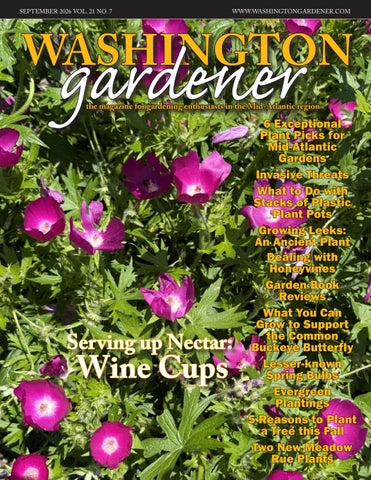
ON THE COVER Wine Cups in a public garden in Buffalo, NY. In our next issue:
A Local Fig Trial
A Native Plant Co-Op How to Make a Mosaic Tile
Click on the “subscribe” link at washingtongardener.com SEPTEMBER 2026 WASHINGTON GARDENER 3
EDITORletter
Credits Kathy Jentz Editor/Publisher Washington Gardener 826 Philadelphia Ave. Silver Spring, MD 20910 Phone: 301-588-6894 kathyjentz@gmail.com www.washingtongardener.com Ruth E. Thaler-Carter Proofreader Maya Hand Koree Perry Interns Subscription: $20.00
Your editor at the Portland Rose Garden in Portland, OR. Photo by Jenny Rose Carey.
A Trip to the West Coast I’m just back home from speaking at the FarWest Conference and attending the GardenComm annual meeting—both took place in Portland, Oregon. As part of the GardenComm programming, we toured beautiful private gardens, garden centers, and public gardens. We also visited several plant breeders and growers. Many of the perennials, shrubs, and trees in our Mid-Atlantic gardens originate in the Pacific Northwest (PNW), so it was especially interesting to see their cooler, but also extremely dry summer growing conditions there, which are followed by a monsoonlike fall season and then relatively mild winters. Oh, how I envied some aspects of their climate. The roses there seem to grow disease- and pest-free with ease; the spectrum of evergreens there is legendary; fruit trees are abundant along city streets; and, contrary to rumor, they can grow tomatoes in the PNW (I saw them in home gardens with my own eyes!). However, I noticed few magnolias or crapemyrtles and other plants I associate with summer below the Mason-Dixon line. I thoroughly enjoyed my trip, but I was glad to be home and surrounded by familiar flower faces. I am sharing some of the hundreds of photos I took on the trip on our Facebook page and @WDCgardener on Instagram. Enjoy! Sincerely,
Kathy Jentz, Editor/Publisher, Washington Gardener, KathyJentz@gmail.com 4 WASHINGTON GARDENER SEPTEMBER 2026
• Washington Gardener Blog: www.washingtongardener.blogspot.com • Washington Gardener Archives: http://issuu.com/washingtongardener • Washington Gardener Discussion Group: https://groups.google.com/g/ washingtongardener/ • Washington Gardener Twitter Feed: www.twitter.com/WDCGardener • Washington Gardener Instagram: www.instagram.com/wdcgardener • Washington Gardener Facebook Page: https://www.facebook.com/ WashingtonGardenerMagazine/ • Washington Gardener YouTube: www.youtube.com/ washingtongardenermagazine • Washington Gardener Amazon Store: www.amazon.com/shop/wdcgardener • Washington Gardener BookShop: bookshop.org/shop/WDCgardener • Washington Gardener Podcast: https://podcasters.spotify.com/pod/ show/gardendc/ • Washington Gardener is a woman-owned business. We are proud to be members of: · GardenComm (formerly GWA: The Association for Garden Communicators) · Green America Business Network · National Garden Bureau · One Montgomery Green · Ladies in the Landscape · Potomac Rose Society · American Horticultural Society · Maryland Nursery, Landscape and Greenhouse Association
Volume 21, Number 7 ISSN 1555-8959 © 2026 Washington Gardener All rights reserved. Published monthly. No material may be reproduced without prior written permission. This magazine is purchased by the buyer with the understanding that the information presented is from various sources from which there can be no warranty or responsibility by the publisher as to legality, completeness, or technical accuracy.
READERcontt
Reader Contest
For our September 2026 Washington Gardener Magazine Reader Contest, we are giving away a set of three grow bag pots (value $30). These fabric garden bags are made of quality nonwoven fabric material, sturdy and breathable, providing an ideal growing environment for plants and flowers. The grow bags are 1-gallon sized. They have handles sewn on for easy transport. The nonwoven material provides good drainage for plants, allowing roots to breathe freely and plants to grow faster and more vigorously. When not in use, they can be folded flat and stored easily. They are reusable for at least three growing seasons and are machine-washable. To enter to win the grow bags, send an email by 5:00pm on September 30 to WashingtonGardenerMagazine@gmail.com with “Grow Bag Pots” in the Subject line and in the body of the email. Tell us what your favorite article was in our September 2026 issue and why. Please include your full name and mailing address. Winners will be announced and notified on/about October 1. Replies might be published. o
Your Ad Here
Are you trying to reach thousands of gardeners in the greater DC region/MidAtlantic area? Washington Gardener Magazine goes out in the middle of every month. Contact KathyJentz@gmail.com or call 301.588.6894 for ad rates (starting from $200). The ad deadline is the 5th of each month. Please submit your ad directly to: KathyJentz@gmail.com.
READERreactions
August 2026 issue I loved the article “Murmuration about Starlings” by Rick Borchelt. I appreciated that he mentioned that starlings have a positive effect on the environment, at least from a gardener’s perspective, since they dig for grubs of Japanese beetles. After reading the article, I went for a walk in my neighborhood and saw a lot (murmuration?) of starlings on a neighbor’s lawn (digging for grubs?) and on the roofs of several houses. So fun to see the birds in action! ~ Robin Yaure, Fayetteville, PA My favorite article in the August issue of Washington Gardener was “Salsify: The Oyster Plant.” I liked the combination of information about nutrition (high in potassium and fiber), cultivation (long season, can be planted in the fall for a spring harvest or very early spring for a fall harvest; a short keeper once harvested), where it’s favored (southern Europe and Mediterranean countries), its place in U.S. history (Thomas Jefferson’s garden), and possible medicinal properties (soothing the liver and gallbladder) — all things I was completely unaware of before I read it. In addition, it was well-written and engaging. ~ Rae Benedetto, Great Falls, VA My favorite article in the August issue of Washington Gardener was “Murmurations About Starlings,” I particularly enjoyed the history of these birds. ~ Maryanne Salm, Washington DC
Garden Movies Plant a Row for the Hungry (PAR) is an easy program to participate in and really does not take any extra resources than what you may have in your garden. In normal times, about 35 million people wonder where their next meal will come from. Most of these are children. That’s where PAR steps in. PAR is such a simple program: It urges gardeners to Plant A Row (or a container) dedicated to feeding the hungry, and then take the harvest to someplace or someone that needs it. Once you have donated, send an email to KathyJentz@gmail.com with the total (in pounds and ounces) of what you gave. That is all there is to it. Easy. Effective. Adaptable and Helpful.
My favorite movie with gardens in it is “Grey Gardens.” It makes me feel better about my own messy garden, LOL. ~ Claire Wade, Arlington, VA I really enjoyed the ethereal and wispy Italian gardens of “Call Me By Your Name.” The gardens were the perfect dreamy backdrop to this darn good movie. ~ Lynette Wright o SEPTEMBER 2026 WASHINGTON GARDENER 5
PLANTpicks
2026 PHS Gold Medal Plants The Pennsylvania Horticultural Society (PHS) has announced its 2026 Gold Medal Plant winners, a curated list of standout plants now available at garden retailers in the region. Established in 1979, the Gold Medal Plant program celebrates beautiful, easy-to-grow plants selected for their durability and ability to thrive in Mid-Atlantic conditions. Selections are based on criteria, including ease of cultivation, multiple seasons of interest, commercial availability, regional suitability, and value to wildlife. The Gold Medal Plant Program helps gardeners make confident planting choices. Each year, a panel of horticulturists, growers, and garden experts evaluates both new and time-tested varieties, selecting plants that perform well in a range of conditions and offer real value in the landscape. Since the program’s inception, PHS has named more than 150 Gold Medal Plants. Including this year’s winners, all plants are indicated for their hardiness in zones 4 to 8 on the USDA’s hardiness zone map, making them ideal choices for the Mid-Atlantic region. “The PHS Gold Medal Plant program provides gardeners with trusted plant recommendations that are both reliable and visually compelling,” said Andrew Bunting, Vice President of Horticulture at PHS. “This year’s selections offer strong seasonal interest, adaptability across a range of garden conditions, and meaningful ecological benefits, making them well-suited for gardens throughout the Mid-Atlantic region.” To learn more about this year’s Gold Medal Plants, or view previous year’s winners in PHS’s online database, please visit: phsonline.org/for-gardeners/gold-medal-plants.
6 WASHINGTON GARDENER SEPTEMBER 2026
Amsonia tabernaemontana ‘Storm Cloud’ Perennial Amsonia tabernaemontana ‘Storm Cloud’, commonly known as bluestar, is a native perennial that is one of the first Amsonia to emerge and bloom in the spring. It produces deep inky-purple stems, followed by darker-than-usual blue flowers. Its summer foliage eventually loses most of its darker tones but remains attractive through fall, when it occasionally develops a yellow color. This reliable, deer-resistant plant forms a dense, clumping mound almost like a small shrub and is suitable for smaller gardens. This species can also take a little more shade and moisture than others while remaining adaptable to full sun and drier soils as well. It typically reaches a height of 24–30 inches and a width of 36–42 inches and is hardy in zones 4 through 8.
Chionanthus retusus ‘Tokyo Tower’ Tree Chinese fringetree (Chionanthus retusus) ‘Tokyo Tower’ is a small to medium-sized upright tree with an abundance of fluffy white flowers in the spring. In the fall, the flowers mature into blueberry-like fruit and dark-green foliage that turns bright yellow. It is suitable for small gardens and is noted for its upright and fastigiate habit. It can also be used as a street tree since it is tolerant of urban conditions. It grows 12–15 feet tall and 4–6 feet wide and is hardy in zones 5 through 9. Symphyotrichum laeve ‘Bluebird’ Perennial Symphyotrichum laeve ‘Bluebird’, smooth aster, is an herbaceous perennial in the aster family that is native to central and eastern USA. It is a musthave for the garden due to the lateseason blooms and the many pollinators it attracts. It is covered in daisy-like, purplish-blue flowers from September to late fall. This aster is easy to grow in well-drained average garden soil with full sun to partial shade. It is drought-tolerant once established and can be used in perennial borders, a pollinator garden, or naturalized areas. ‘Bluebird’ can grow to be 3–4 feet tall and 24 inches wide and is hardy in zones 4 through 8. Daphniphyllum macropodum
PLANTpicks
Shrub Daphniphyllum macropodum, also known as false Daphne, has shiny green leaves with attractive pink petioles—the stems that attach the leaves to the main branch. It is a great, broadleaved evergreen shrub that tolerates sun and shade, especially dry shade. It exhibits considerable resistance to deer. It typically grows to be 15–25 feet tall and is hardy in zones 6 through 9. Juniperus virginiana
‘Taylor’ Tree Juniperus virginiana ‘Taylor’ is a native tree commonly known as Eastern red-cedar. It is a popular choice for landscapes needing a tall, slender, evergreen screen or accent, especially in situations where space is limited. ‘Taylor’ is known for its drought tolerance and resistance to deer, making it a relatively low-maintenance option. It can grow to 15–25 feet tall and 4 feet wide and is hardy in zones 4 through 8.
The Azalea Society offers membership to anyone with an interest in azaleas, from home gardeners, collectors and students to plant professionals. The Azalea Society website (azaleas.org) is the source of information about azaleas.
Sorghastrum nutans Golden Sunset™ Perennial Sorghastrum nutans Golden Sunset™ is commonly called Indian grass. This native grass has olive-green foliage and golden-yellow flowers that attract butterflies. It is a very vigorous grass and works well when interplanted with native perennials and other native grasses. It is deer-resistant, and its blue-green summer foliage transitions to shades of yellow-orange and golden tan as autumn arrives. It grows to be 4–6 feet tall and 3 feet wide and is hardy in zones 3 through 9. o The Pennsylvania Horticultural Society (PHS), an internationally recognized nonprofit organization founded in 1827, uses horticulture to advance the health and well-being of the Greater Philadelphia region. PHS programs create healthier living environments, increase access to fresh food, expand access to jobs and economic opportunity, and strengthen deeper social connections between people. PHS’s work spans 250 neighborhoods; an expansive network of public gardens and landscapes; year-round learning experiences; and the nation’s signature gardening event, the Philadelphia Flower Show. PHS provides everyone with opportunities to garden for the greater good as a participant, member, donor, or volunteer. For information and to support this impactful work, please visit PHSonline.org.
GROUNDCOVER REVOLUTION IS OUT NOW! By Kathy Jentz
Published by Cool Springs Press
Order it today at: https://amzn.to/3IlYHYL
“Groundcover Revolution is a must-have book for anyone who is interested in having less lawn, fewer weeds, and reduced mulching. The properties charts will save the reader time and money, the pictures provide inspiration, while the detailed plant portraits give the focused information needed for creating beautiful, functional landscapes.” ―C.L. Fornari, GardenLady.com SEPTEMBER 2026 WASHINGTON GARDENER 7
GARDENbasics
Evergreen Selection, Planting, and Care By Melinda Myers
Screen unwanted views, buffer traffic and other noise, create privacy, and add year-round beauty to the landscape with evergreens. Combine them with deciduous trees and shrubs, perennials, and annuals for multiple seasons of beauty. Plus, enjoy the seasonal changes, as well as visiting pollinators and songbirds. Use taller evergreens as a backdrop for flowering plants. Their green foliage provides a beautiful backdrop for flowers and fruit-laden plants, ornamental grasses, and fall color. Create a focal point or vertical interest in a garden bed or landscape with evergreens that feature interesting form or texture. Group several together to provide songbirds with shelter and a safe place to raise their young. Don’t let a lack of space deter the planting of evergreens. Dwarf varieties are perfect for smaller landscapes and planting beds. Combine these with other small-scale shrubs, perennials, and groundcovers for additional seasonal interest. As always, match evergreens to your growing conditions and climate. Make sure the plants selected are hardy and will thrive in the sunlight and moisture provided. Junipers are heat- and drought-tolerant and animals tend to leave them be. Hemlock is one of the few evergreens that tolerates the shade and is available in a variety of sizes and shapes.
8 WASHINGTON GARDENER SEPTEMBER 2026
Give these and other evergreens planted in an exposed location a bit of shelter from winter winds and sun. Arborvitaes, yews, false cedar (Chamaecyparis), and rhododendrons are some of the favorite evergreens of gardeners—and deer. Protect new plantings by surrounding them with a cylinder of hardware cloth sunk into the ground and at least 4 feet high. Applying wildlife protection, including repellents, before critters start feeding increases the chance of success. Consider applying an organic rain- and snow-resistant repellent, such as Plantskydd (plantskydd.com), at planting. This odor-based repellent helps prevent damage, and its rain- and snow-resistance means it needs to be reapplied less often. Just follow the label directions for the most effective control. Make sure new plantings receive sufficient moisture during the first few years as they become established. Apply enough water to moisten the top 12 inches of soil when the top 4 to 6 inches feel dry. Individual trees need 10 gallons of water for every inch diameter of trunk, measured at 4.5' high. Apply the water to the area under the dripline and several feet beyond for evergreens. Spread a 1- to 3-inch layer of woodchips, shredded bark, leaves, or evergreen needles over the soil surface. The finer the mulch material, the thinner the layer needed. Pull the mulch away from
tree trunks and stems of shrubs, perennials, and annuals. Organic mulches insulate plant roots from temperature extremes, conserve moisture, suppress weeds during the growing season, and improve the soil as it breaks down. Winter preparation starts at planting and continues into fall and even winter in milder parts of the country. Evergreens continue to lose moisture throughout the winter, even when the soil is frozen or dry. Continue to water evergreens, moisture-loving plants, and new plantings as needed when the temperatures are in the 40s and the soil is dry and not yet frozen or covered with snow. Investing time in proper plant selection and year-round care will help healthy, attractive evergreens thrive for many years. o Melinda Myers has written more than 20 gardening books, including Midwest Gardener’s Handbook, 2nd Edition and Small Space Gardening. She hosts The Great Courses “How to Grow Anything” instant video and DVD series, and the nationally syndicated Melinda’s Garden Moment radio program. Myers is a columnist and contributing editor for Birds & Blooms magazine and was commissioned by Tree World Plant Care for her expertise in writing this article. Her website is www.MelindaMyers.com.
Pictured above: Evergreens with interesting form and texture can serve as a focal point in garden beds. Photo courtesy of MelindaMyers.com.
GOINGnative
Invasives Outcompeting Native Plants By Barry Glick I hope that the title of this article/ subject matter isn’t too alarming, but maybe it should be. It becomes more apparent to me lately, on an almost daily basis, that the average person on the street, especially in the cities, is totally unaware of the crisis, or should I say crises, occurring in our nation’s forests, parks, streets, farms, and backyards. The majority of the problems are man-made and have occurred primarily through naïvety, coupled with a lack of thorough scientific investigation and/or research, but most of all, a lack of common sense. For example: My first encounter with one of these problems was when I bought my farm in 1972 and signed up for our local USDA cost-sharing program. Oh, boy: free money from the government! The big program that they were promoting at the time was the Tordon 10K program. This program was designed to give the general public, mostly farmers, ranchers, and wood lot managers, a remedy for a problem that they—the USDA specifically—had themselves caused: Rosa multiflora. The “Multiflora Rose,” as we now know it, is an aggressive, invasive species of rose that is native to Asia, but since it’s not native to this part of the world, it hasn’t evolved with nature’s inherent checks and balances. It has no predators here to keep it under control. As it turns out, Tordon 10K is an inactive, historical soil-applied pellet herbicide containing Picloram, designed to
kill broadleaf weeds, brush, and deeprooted trees on non-cropland sites. Because of its high persistence in soil and potential to damage off-target vegetation, the specific Tordon 10K pellet formulation is no longer manufactured or registered for use. Importantly, it has also been linked to early-onset colorectal cancer. Another example is Chestnut blight, the killer of the “Queen of American Forests.” When I first moved here, there were these huge, hollow shells of trees everywhere in the woods. The locals called them “Chestnut snags.” Folks talked about the blight that had killed off all the Chestnut trees, but back then, Google didn’t exist, so it was difficult to find out exactly what they were talking about. Now we know that the Chestnut blight fungus, Cryphonectria parasitica, was brought to North America around the turn of the 20th century on imported Japanese and Chinese Chestnut seedlings. Nurseries shipped these Asian trees for breeding, and the fungus hit the U.S. forests when the infected stock was planted, first showing up in New York’s Bronx Zoo in 1904. It took roughly 40 years, from 1904 until about 1940, for the blight to wipe out the American Chestnut as a canopy tree. The biggest trees killed were the mature specimens that had grown up to about 100 feet tall, with trunks around 10 feet in diameter. Fortunately for Mother Nature, who needs a helping hand once in a while, the American
Kudzu on trees. Photo by Scott Ehardt, Public domain, via Wikimedia Commons.
Under Attack:
Chestnut Foundation has been conducting several successful breeding programs aimed at creating a fungusresistant American Chestnut. The last I checked, they were 95% there. Sorry to be such a bearer of bad news, but this is some serious stuff, and I’ve barely scratched the surface here. Here’s a short list of some of the other things that keep me up at night: • Emerald Ash Borer (Agrilus planipennis) — Wiped out an entire species of trees. • Japanese beetles (Popillia japonica) — Chomping their way through American gardens and forests. • Kudzu (Pueraria Montana) — A cure for alcoholism in Asia that is climbing on and smothering our native trees. • Japanese Wineberries (Rubus phoenicolasius) — Delicious fruit that will take over your land. • Garlic mustard (Allaria petiolata) — A horrible, ugly, biennial weed with a lovely sounding scientific name. • Hemlock Woolly adelgid (Adelges tsugae) — Oh, so that’s what those white furry things are, drifting slowly around our heads and destroying our native Hemlocks. • Autumn Olive (Eleagnus umbellata) — A woody invader with a lovely fragrance and attractive red berries that birds and other wildlife eat and drop the seeds. • Chinese Silver Grass (Miscanhtus sinensis) — We all wanted “Pampas grass” up north. Now we have a selfseeding monster with sharp edges that nothing will graze on. • Japanese Knotweed (Reynoutria japonica) aka “Mile a Minute” — The name says it all: A somewhat attractive, deep-rooted nuisance. • Japanese Stilt Grass (Microstegium viminuem) — I’ve saved the worst for last if there is, in fact, a worst! But wait: unfortunately, there’s more. Stay tuned. o Barry Glick, a transplanted Philadelphian, has been residing in Greenbrier County, WV, since 1972. His mountaintop garden and nursery is a mecca for gardeners from virtually every country in the world. He writes and lectures extensively about native plants and Hellebores, his two main specialties, and welcomes visitors with advance notice. He can be reached at barry@sunfarm.com, www.sunfarm.com, or 304.497.2208. SEPTEMBER 2026 WASHINGTON GARDENER 9
TIPStricks
Photo courtesy of www.flowerbulbs.com.
Top 10 Distinctive Flowering Bulbs for a Surprising Spring
Tulips, hyacinths, and daffodils are familiar favorites. Every spring, they take center stage in the garden. Yet there is so much more to discover: Lesser-known spring-flowering bulbs bring surprise, a natural look, and a garden full of character. Think of Fritillaria meleagris, Chionodoxa, and Scilla siberica, as well as species such as Ipheion, Puschkinia, and Eranthis. These overlooked bulbs show just how versatile spring can be. What makes these bulbs so special is their subtle appearance. Not large, showy flowers, but refined shapes, soft colors, and an almost wild charm. They bloom early in spring, often before perennials really get going. This brings life to the garden at the moment you want it most. Many of these species are ideal for naturalizing. They feel at home in borders, under shrubs, along paths, or in lawns. Plant them in groups to create a playful, natural effect that becomes more beautiful every year. Spring bulbs to know and grow: • Snake’s head fritillary (Fritillaria meleagris) is a true eye-catcher. The nodding, bell-shaped flowers with their distinctive checkered pattern give the garden an almost fairy-tale atmosphere. They bloom in purple or white and prefer a lightly moist location. • Chionodoxa, also known as glory-of-the-snow, blooms very early in 10 WASHINGTON GARDENER SEPTEMBER 2026
the season. The small, star-shaped flowers in blue, white, or pink are perfect for brightening larger areas and naturalize easily. • Siberian squill (Scilla siberica) delivers an intense burst of blue that instantly energizes the spring garden. This strong bloomer thrives under trees and shrubs, and reliably returns year after year. • Dog’s tooth violet (Erythronium) adds elegance to the garden. The graceful flowers with recurved petals and often marbled foliage perform well in a sheltered spot in partial shade. • Camas lily (Camassia) brings height and structure. The tall flower spikes with star-shaped blooms flower slightly later in spring and form a beautiful transition toward summer. • Winter aconite (Eranthis hyemalis) blooms very early in spring. The brightyellow flowers are often among the first to appear and immediately create a fresh spring feeling. • Striped squill (Puschkinia scilloides) is a subtle spring bloomer with paleblue flowers and a characteristic dark stripe (pictured at left). Perfect for calm color combinations and natural plantings. Spring-flowering bulbs are planted in fall. This is the moment to plan ahead for spring. Choose a spot that suits the species, in sun or light shade. By combining different types, you extend the flowering period and keep the garden interesting longer. After flowering, allow the foliage to die back naturally. This allows the bulb to store energy for the following year. With minimal maintenance, these bulbs deliver a surprising result every spring. By choosing lesser-known springflowering bulbs, you give your garden a personal and contemporary feel. They invite you to look more closely and experience spring step by step. Those who dare to move away from the familiar discover just how rich and atmospheric the early gardening season can be. Get inspired, combine different species, and give these distinctive bulbs a permanent place in your garden. This way, spring begins with new surprises every year. For more inspiration and information, visit www.flowerbulbs.com. o
5 Great Reasons to Plant a Tree This Fall
Fall is the perfect time to get outside and plant a tree, according to the TurfMutt Foundation. For 15 years, the foundation has advocated for the care and use of yards, parks, and other green spaces. “Planting a tree this autumn gives its roots a head start, ensuring it can survive the winter and thrive in the spring, and those trees will work hard for you all year long,” said Kris Kiser, President & CEO of the TurfMutt Foundation. Here are five reasons why you should plant a tree this fall. • The Best Time to Plant Cooler temperatures and increased rainfall during autumn creates the perfect condition for roots to grow and get established before the ground freezes. This allows the tree to focus its energy on building a strong foundation for next spring and summer. • Your Improved Health Studies show that connecting with nature can significantly improve health and well-being. According to the Arbor Day Foundation’s Canopy Report, people who engage with green spaces daily are happier and score higher in their mental and physical health than those who spend less time outside. • Mother Nature’s HVAC Trees help keep energy costs low yearround. The USDA Forest Service notes that properly placed trees can reduce 20–50 percent in energy used for heating and decrease air conditioning needs by 30 percent. • Environmental Superhero Trees are one of nature’s best helpers. A single tree produces nearly 260 pounds of oxygen annually, and just two mature trees provide enough oxygen for one person to breathe for a year. • Wildlife Habitat Trees are important for local wildlife, especially since nature starts in our backyards and community parks. Planting native trees in particular helps support local ecosystems by providing consistent food and habitat, from fall nuts and berries to spring blooms. To learn more about the many benefits of trees, download the International Backyarding Fact Book at https://www. turfmutt.com/. o
GARDENnews
Quick Links to Recent Washington Gardener Blog Posts • Meet the Fall 2026 Interns
• Harvest Time • Devil’s Trumpet Plant Profile See more Washington Gardener blog posts
at WashingtonGardener.blogspot.com o
September Garden To-Do List
New Plant Spotlight Meadow Rue ‘Cotton Candy’ & ‘Cotton Ball’ Looking for something truly unique to freshen up spring offerings? Thalictrum ‘Cotton Candy’ (below) and ‘Cotton Ball’ (pictured above) deliver an eye-catching combination of texture, durability, and garden versatility. These Thalictrum aquilegifoliumtype selections bring a light, airy look to the landscape with their signature wispy, cloud-like blooms—almost like something out of a Dr. Seuss illustration. Despite their delicate appearance, both varieties are impressively upright and sturdy, with dark stems that highlight the flowers. Ideal for dappled shade, these perennials are also adaptable enough to handle full sun, making them a go-to solution for those hardto-design, in-between light conditions. Their full, well-proportioned foliage clumps provide substance in the garden even before bloom. Find out more about these two new Meadow Rue plants at https://www. waltersgardens.com/. o
Photos courtesy of Walters Gardens.
• Keep an eye out for the first frost date. In Zone 6, it is expected between September 30 and October 30. In Zone 7, it is predicted for between October 15 and November 15. • Divide and transplant perennials—in particular, peonies and iris. • Pick apples at a local pick-your-own farm or visit a local farmer’s market. • Pot up rosemary and chives for over-wintering indoors. • Take cuttings from coleus and begonias to propagate and overwinter indoors. • Look out for poison ivy vines, which will turn crimson in the fall and be easy to distinguish from other vines. • Check your local garden center for end-of-summer bargains. • Put netting over your pond to prevent the accumulation of leaves and debris. • Start feeding birds to get them in the habit for this winter. • Attend a local garden club meeting or plant exchange. • Pick mature tomatoes and peppers to ripen on your window sills. • Turn your compost pile weekly and don’t let it dry out. Work compost into your planting beds. • Remove undeveloped or shriveled fruit from fruit trees and compost them. • Plant evergreens for winter interest. • Plant garlic bulbs. • Collect plant seeds for next year’s planting and for trading at the annual Washington Gardener Magazine Seed Exchanges. • Plant hardy mums and fall-season annuals. • Fertilize your lawn and re-seed if needed. • Dig up your Gladiolus, Canna, Caladiums, and other tender bulbs; cut off foliage; let dry for a week; and store for the winter. • Transplant trees and shrubs. • Harvest your herbs often and keep them trimmed back to encourage leafy growth. • Bring in houseplants if you took them outdoors for the summer. • If your conifers start shedding their needles or your spring bulb foliage starts peeking out of the ground, don’t worry. This is normal for our autumn cycle. • Leave hummingbird feeders out until October 15. • Start bulb plantings of early-spring bloomers at the end of the month. • Watch your pumpkins/squash. Harvest them when their rinds are dull and hard. • Divide ornamental grasses. • Cut herbs and flowers for drying indoors. • Plant strawberries in a site with good drainage for harvesting next spring. • Look out for slug eggs grouped under sticks and stones—they are the size of BBs and pale in color. • Plant cover crops in vegetable gardens and annual beds (for example, rye, clover, hairy vetch, and winter peas). • Begin conditioning the Poinsettias and Christmas cacti to get them ready for the upcoming holiday season. • Bring Amaryllis indoors before a hard freeze. Repot every other year at this time. Store in a cool, dark place and do not water until flower buds or leaves emerge. • Your summer annuals will be reviving now with cooler temps and some rain. Cut back any ragged growth and give them some fertilizer. They should put on a good show until the first hard frost. o SEPTEMBER 2026 WASHINGTON GARDENER 11
TOP AREA GARDENING EVENTS Classes, Events, and Plant Shows/Sales • Sunday, September 6, 11am–6pm DC State Fair Online contest entry is now open. Live contests include flower arranging. Free Flower Arranging Talk at 1pm. Held at 700 K Street NW, Washington, DC. Free to attend. See DCstatefair.org. • Tuesday September 8, 2:30–3pm Gardener’s Focus Tour: Native Garden Explore the Collections and Research Center native garden at Hillwood Gardens, featuring a bio-retention pond with garden section manager and coordinator Cicily Arnsworth. Tickets are distributed at the Ellen MacNeille Charles Visitor Center on opening each day. This 30-minute tour is limited to 15 and meets in the visitor center conservatory. Details at https://hillwoodmuseum.org.
Leslie Lewis, Soil Food Web School board member, and founder of Living Systems Soil, LLC , will present an exclusive deep-dive into the microscopic world beneath our feet. During this session, you will discover how to move beyond conventional fertilizer-based gardening toward a more self-sustaining ecosystem. The online talk is hosted by the Potomac Rose Society and held via Zoom. Register for free at https://potomacrose.org/events. •Wednesday, September 23 Urban Tree Summit Conference Learn from an outstanding lineup of industry-leading experts about their research and contributions to urban forestry, conservation, and environmental sciences. Held at the Silver Spring Civic Center, 1 Veterans Place, Silver Spring, MD. Register at https://urbantreesummit.org/.
• Saturday, September 12, 10am–1pm FOBG Plant Sale The Friends of Brookside Gardens (FOBG) hosts their annual plant sale fundraiser at Brookside Gardens in Wheaton, MD. Members get in early for the best selection. You can come early and join FOBG at the sale. New memberships on that day will continue through October 2027. Plant list will be up www.friendsofbrooksidegardens.org in early September.
• Friday, September 18, 1:30–2:30pm Garden Talk: Grow Spectacular Bulbs Bulbs can turn an ordinary garden into extraordinary. Learn about the enchanting world of bulbs and their cousins— corms, tubers, and rhizomes—and how they can add beauty to your garden. Now is the time to plant. Learn how from Extension Master Gardeners. Fee: $12 per person. Code: 9FF.LTLY. Held at Green Spring Gardens, 4603 Green Spring Rd., Alexandria, VA.
• Saturday, September 12, 7:45am– 3pm MNPS 2026 Conference: Diverse Landscapes of Maryland’s Piedmont and Western Shore Held at the University of Maryland, College Park, MD. The Maryland Native Plant Society’s fall conference features presentations, workshops, and field trips so you can learn more about our native plants and their habitats. Discover the unique landscapes of Maryland’s Piedmont and Western Coastal Plain, from globally rare ecosystems such as magnolia bogs to the resilient and prevalent oak-hickory forests. Details at https://www.mdflora.org/.
• Friday, September 18 to Sunday, September 20 National Capital Orchid Society 2026 International Show & Sale Held at the Montgomery County Fairgrounds, Gaithersburg, MD. Tickets are $10–20 for adults. Details at https://ncos.us/upcoming-events/.
• Sunday, September 20, 2pm Nature’s Network: Harnessing the Soil Food Web ~ A New Paradigm for Rose Culture 12 WASHINGTON GARDENER SEPTEMBER 2026
• September 25–27 National Capital Dahlia Society Annual Show Held at Brookside Gardens Wheaton MD. Details at nationalcapitaldahlia.org. • Saturday, September 26, and Sunday, September 27, 9am–4pm both days “Shining Through the Years,” 75th Anniversary Flower Show Hosted by the National Capital Area Garden Clubs at the U.S. National Arboretum. Free and open to the public.
Looking Ahead • October is Urban Agriculture Month in Arlington, VA. They’ll celebrate all month long with special events and activities around the county with garden volunteer days, yoga/fitness classes, educational talks, seed giveaways, and more. More info: https://arlingtonurbanag. org/2026-urban-agriculture-month/. • Thursday, October 22, 7–8:30pm Getting Your Garden Ready for Winter Online Class Overwhelmed by winter garden to-do lists? Learn which chores are essential and which you can safely skip as you prepare your garden for the cold months ahead. Discover cost-saving tips and tricks for battening down the hatches before a bad winter hits. Speaker: Kathy Jentz, author of The Urban Garden, editor and publisher of Washington Gardener Magazine. Fee: $15. Register at https://mdmontgomeryctyweb. myvscloud.com/webtrac/web/ Course #PBG0245 300001. • Sunday, November 8, 2–3:30pm Dealing with Mammal Pests in the Garden Join Kathy Jentz, publisher of Washington Gardener Magazine and host of the GardenDC Podcast, as she shares her tips and tricks for gardening alongside hungry critters. Learn proven and humane tactics for gardening with deer, rabbits, squirrels, rats, groundhogs, and other creatures that are attracted to both edible and ornamental gardens. Fee: $19 per person. Code: 27C.SZ65. Held at Green Spring Gardens, 4603 Green Spring Rd., Alexandria, VA.
Event Listing Updates
See updated event listings on the Washington Gardener discussion list. Join by emailing WashingtonGardenersubscribe@googlegroups.com.
How to Submit Events
To submit an event for this listing, email washingtongardenermagazine@gmail. com with “Event” in the subject line. Our next deadline is September 20 for the October 2026 issue, for events taking place after October 5. o
2026 Urban Tree Summit
Shaping the future of urban forestry to create greener cities and healthier communities.
WEDNESDAY, SEPTEMBER 23, 2026 | SILVER SPRING CIVIC CENTER
Learn. Connect. Grow. Hosted by Casey Trees and Montgomery Parks, the Urban Tree Summit is an annual conference focused on urban forestry and conservation.
• Hear from industry-leading experts on cutting-edge research and practices
Join forestry professionals, municipal arborists, nonprofit leaders, researchers, specialists, and volunteers from across DC, Maryland, and Virginia for a day of learning, networking, and collaboration.
• Explore our exhibition hall featuring local partners, sponsors, and vendors
• Earn CEUs for all sessions
• Network with fellow professionals and environmental leaders
Whether you're a seasoned expert or new to the field, the Urban Tree Summit is your opportunity to stay informed, make connections, and be inspired.
Learn more and register at
urbantreesummit.org
SEPTEMBER 2026 WASHINGTON GARDENER 13
WEEDwatch
Honeyvine: A Honey of a Milkweed By Rick Borchelt
Honeyvine also serves as a monarch caterpillar host, another clue to its close kinship with the milkweeds. Photo by Rick Borchelt.
“By their fruits ye shall know them.” This Biblical advice from the Sermon on the Mount is often as good a botanical adage as it is a moral one. Take honeyvine, for example. Superficially, honeyvine (Cynanchum laeve) looks like many other troublesome viny weeds in area gardens. It’s a native perennial that, despite getting a slow start each spring, can reach 15 feet or more by fall. The only thing that sets it apart at first glance are the darkgreen leaves that may have a bluish cast, earning it another common name: bluevine. The flowers are mostly inconspicuous inch-wide clusters of cream or pink in the axils of the leaves. You’re most likely to see the vine clambering over chain-link fences in the company of Chinese yam, bindweeds and morning glories… that is, when it’s not smothering your roses, azaleas, and other shrubs. 14 WASHINGTON GARDENER SEPTEMBER 2026
Unless you’re weed-whacking your way through the shrubbery, you probably won’t notice honeyvine until fall, when suddenly you find an abundance of thick, smooth, 3- to 4-inch green pods dangling where the flowers had been. Lots of pods—pods that turn brown and split open in early fall, packed to bursting with fluffy white hairs that parachute away in the slightest breeze, each carrying a brown seed in search of a new garden plot to invade. Sound familiar? It should. The pods are nearly identical to the pods developing about now on your milkweed plants. That’s because, all other appearances to the contrary, honeyvine is a climbing milkweed (which is another of its common names). Yes: By its fruit ye shall know it as a milkweed. The genus name Cynanchum comes from two Greek roots that roughly
translate as dog-strangler, hinting at a possible past use of related European Cynanchum species to poison animals. Like many milkweed family members, honeyvine has some toxic properties; specifically, cardenolide alkaloids and cardiac glycosides. Common standard milkweed has these same toxins, and they confer protection to the brightly colored monarch butterfly and its caterpillars, which feed on the milkweed and concentrate the poisons in their bodies, making them distasteful to bird predators. Naive fledglings that snag a mouthful of monarch caterpillar or butterfly learn quickly that if they don’t vomit them up, they’ll suffer all manner of digestive and heart problems that could prove fatal. Be aware that if you handle honeyvine, these toxins may cause skin or eye irritation. Eating the leaves or pods in large amounts can be lethal, so even if you have it growing someplace where it doesn’t strangle your other plantings, you might think twice about leaving it be, especially if you have curious young ones around who try to experience the world through their taste buds. In addition to honeyvine, our region has other vining milkweeds, including two native species and one introduced, invasive one. The native species are maroon Carolina milkvine (Matelea carolinensis) and climbing milkvine (Matelea obliqua). Both are considered species in need of conservation in the DMV. Neither is likely to be confused with honeyvine unless the leaves have already fallen; they have the same spiny pods as common milkweed. The species name laeve for honeyvine means smooth in Latin, referring to its smooth seedpods. You can tell the blooming Matelea species by their small, purple flowers. The introduced, invasive species is black swallow-wort (Vincetoxicum nigrum), which wears its toxicity on its sleeve, so to speak, right in its genus name. The Latin root vince means conqueror or beater, with the whole genus name translating to poison-conqueror, ironically for its supposed value as an antidote to snakebite in medieval European herbalism. It’s currently rare in the DMV, but has the potential to be a major invasive weed.
PLANTprofile
Wine Cups By Kathy Jentz
The smooth seedpods and leaves of honeyvine. Photo by Rick Borchelt.
Black swallow-wort is presumed to have escaped from greenhouses at Harvard in the mid-1850s and has since conquered (pun intended) most of the Northeast. This vine is very prolific: A single meter of its dense mats can produce more than 2,000 wind-borne seeds every year. Honeyvine, like its herbaceous milkweed cousins, is a favored and underappreciated host for monarch butterflies, especially where common milkweed isn’t all that common. Many people deliberately grow it for this reason. Black swallow-wort, on the other hand, is what ecologists call an “oviposition sink” for monarchs. It’s actually more attractive to egg-laying monarch females than either honeyvine or standard milkweeds, but there’s a catch: The caterpillars that hatch and feed on swallow-wort die. Black swallow-wort infestations should be reported promptly to your local extension service office for advice about exterminating them. Honeyvine can be a honey of a plant in the garden or a horticultural sticky mess. If you want to grow it, treat it properly (and keep it out of the mouths of toddlers and livestock). Train the vines up fences or other structures and keep them off other plants. Remove the seed pods while they are still green to prevent seed dispersal in the wind. Dig up any errant seedlings that you don’t want, being careful to remove the entire root crown. It’s a hardy plant, so you may have to do this several times to finish strangling it, rather than the other way around. o Rick Borchelt is a science and natural history writer, field naturalist, and garden and botany enthusiast. Reach him with any questions at rborchelt@gmail.com.
Wine Cups (Callirhoe involucrata) have dark-pink, chalice-shaped flowers that give them their common name. They are also known as Purple Poppy Mallow, Finger Poppy Mallow, or Buffalo Rose. The foliage resembles hardy Geranium leaves, so the plant is often misidentified as being one. They are a Mallow family relative and native to central North America. Wine Cups are hardy to USDA Zones 4 to 8. They grow to about 1 foot high and 1 to 3 feet wide. They do best in full sun, planted in well-draining sandy or loamy soils, but can also tolerate clay soils. They are a low-maintenance perennial that is drought-tolerant and heatresistant. They were named a Plant of Merit by the Royal Horticultural Society. Wine Cups can fit well in a mixed planting, weaving among other plants, or can be planted en masse to spill over a rock wall or front of a flower border. They attract many pollinators and are the larval host of the Gray Hairstreak Butterfly. They are deer-resistant and have few pest or disease issues. They can go dormant in summer after blooming, but will re-emerge the following spring. They can be started from seeds or softwood cuttings, or purchased as small plants. They do not transplant well, due to their deep tap root. o Kathy Jentz is the editor of Washington Gardener.
SEPTEMBER 2026 WASHINGTON GARDENER 15
KNOWitall
Ask the Expert By Miri Talabac
What Are Those Shiny, Black Bugs? Q: What are these somewhat-glossy black bugs on my perennials? They seem to wander over the spent flowers of several species, but I don’t see any damage. A: I suspect you’re seeing a ⅛- to ¼ -inch long oval insect that has a very slim white margin around the edge of its body. Those are White-margined Burrower Bugs (Sehirus cinctus), a widespread native species that can be seen throughout the growing season. It’s fond of members of the mint family (Lamiaceae), a large group that contains many popular perennials. Lately, I’ve seen these insects on native Obedient Plant (Physostegia virginiana), and in the spring, on the ubiquitous non-native weed Purple Deadnettle (Lamium purpureum). These bugs are occasionally numerous, but they do not cause noticeable damage or harm to garden plants and can be ignored. At worst, they might reduce seed viability since they use piercing-sucking mouthparts to ingest the juices from inside developing seeds. Their feeding would only affect a fraction of a plant’s seed production, however. The adult bugs overwinter under leaf litter, and lay their eggs in the soil in the spring. An interesting feature of this insect is its maternal care of the young, which is quite rare in the insect world. The female brings seeds from mint-family plants down to the young for a few days until they can fend for themselves.
Deer-Resistant Native Plant for Sunny Spots Q: What native perennial would you suggest for a drier, sunny spot that doesn’t get too large and deer don’t like? Something summer-blooming would be ideal. A: One candidate that I think needs to be cultivated more is Flowering Spurge 16 WASHINGTON GARDENER SEPTEMBER 2026
White-margined Burrower Bug adult on Obedient Plant. Photo by Miri Talabac.
(Euphorbia corollata). This native species grows wild across much of the state (and the Eastern U.S.) and flowers in summer, peaking around August. Deer avoid members of the Spurge family due to their latex-like sap, which also could irritate skin or eyes with direct exposure. Just as you would with its Poinsettia relative, site Flowering Spurge with caution if someone is likely to pick or break off stems or get sap on their face.
Flowering Spurge in full bloom. Photo by Miri Talabac.
Flowering Spurge is a fairly wispy plant and doesn’t take up much space by perennial standards, reaching at most about 3 feet tall but generally not growing very densely. Like a living bouquet accent, its small, white, baby’s-breathtype flower clusters combine well with larger, richly colored flowers. For added appeal, I’ve seen specimens develop
showy red-orange fall foliage. Site conditions should be sunny (or mostly sunny) and well-drained, but otherwise, it doesn’t seem too picky. I’ve read that it develops a taproot and doesn’t transplant well once established, so plant it where you want to keep it. This species finally seems to be entering the horticultural trade, so hopefully it will get easier to find. I’m trying my first two specimens in mixedspecies containers since I don’t have in-ground garden space available yet. I hope the Spurge will overwinter without problems. If you have the option, growing perennials in the ground is always more reliable in terms of hardiness, but with Flowering Spurge’s potential for cold tolerance being well below what Maryland experiences (given its native range), that bodes well for withstanding winter in a container.
What to Grow to Support the Common Buckeye Butterfly Caterpillar Q: A few of these brownish, eye-spotted butterflies have appeared on my lateflowering perennials this year. I don’t remember seeing them earlier in the summer. What plants can I grow for their caterpillars?
KNOWitall
“Inspire. Connect. Grow.”
Common Buckeye on Aster flowers. Photo by Miri Talabac.
A: This is a Common Buckeye Butterfly (Junonia coenia), a beauty I have encountered almost exclusively in late summer and fall, even though they’ve been observed in our region throughout the growing season (between the spring and fall frosts). I appreciate the nuanced colors and patterns in their wings, and the large eyespots definitely stand out. It’s also interesting how much the colors and patterns on the undersides of their wings (visible when the wings are closed) can vary from one individual to another. Their caterpillars feed on a variety of native and non-native plants, including some we consider weeds. They use members of the Plantain, Figwort/Snapdragon, and Vervain/ Verbena families (Plantaginaceae, Scrophulariaceae, and Verbenaceae, respectively). I don’t encounter Buckeye caterpillars often, but have seen them on plantain (the lawn weed, not the banana), Asarina, Russelia, and Anagalis. They also feed on wild petunia (Ruellia humilis) and Frogfruit (Phyla nodiflora). I find the caterpillars quite beautiful with their metallic blue-black spines. You can look up other specific host plant candidates (when they are listed beyond family level) on various web resources or in butterfly field guides. o Miri Talabac is a Certified Professional Horticulturist who joined the University of Maryland Extension Home and Garden Information Center in 2019 as a horticulture consultant. She is a graduate of UMCP with a focus in entomology. To ask a gardening or pest question, go to http://extension.umd.edu/hgic and select “Ask Extension.” Digital photos can be attached.
The National Garden Bureau is a nonprofit organization that exists to educate, inspire, and motivate people to increase the use of garden seed, plants, and products in homes, gardens, and workplaces by being the marketing arm of the gardening industry. Our members are experts in the field of horticulture and our information comes directly from these sources. Find out more at https://ngb.org/
��������������������� ������������������������������������������������������� ������������������������������������������������ ������������������������������������������������������� �������������������������������� � �������������������������������������� � ������������������������������������������ � ������������������������������������������������� ��������� � ����������������������������������������������� � ����������������������������������������������������
SEPTEMBER 2026 WASHINGTON GARDENER 17
EDIBLEharvt The Giant Musselburgh Leek.
Leeks: An Ancient Vegetable By Barbara Melera
The Leek (Allium ampeloprasum var. porrum) is native to the Mediterranean and parts of Asia and has been an important food crop for many cultures for millennia. It is a member of the Onion family, with a flavor that is much more refined, subtle, and sweet than the standard onion. Wild leeks called ramps more closely resemble scallions and have a much harsher flavor than their cultivated cousins. Leeks have been cultivated for more than 3,000 years. In the Book of Numbers in the Bible, after the children of Israel left Egypt, leeks were one of the foods mentioned as being greatly missed.
Cultivating Leeks
Leeks are great vegetables to plant in the fall from USDA Hardiness Zones 3 to 10. In the colder hardiness zones of 3 to 6, plant leek seeds in late August or September. Leeks are easy to grow from seed. Soil should be deeply spaded before planting. Turn your garden soil, rake it smooth, and then use your finger to draw a line in the soil 18 WASHINGTON GARDENER SEPTEMBER 2026
approximately 1 inch deep. Sprinkle the seed along the line and cover with soil. Soak the soil and keep it moist until germination occurs, which will happen in approximately 7–10 days in the summer. Once the seedlings are 2 inches high, thin them to 3 inches apart. Fertilize with a high-phosphorus and -potassium fertilizer every 2 weeks for six weeks (3 applications). They will sprout looking like a line of straggly onion greens and then the plants will die back completely with the winter cold. In the spring, slightly stronger, but still scraggly, greens will emerge from the soil. Then they will take off and grow into beautiful, strong, stately leek stalks. Be sure to thin the seedlings in the fall, leaving about 3 inches between plants. Leeks require a very long growing season. They can be sown in the early spring for a fall crop. In the spring, plant as soon as the ground can be worked. They can also be sown in late summer
and harvested the following spring and summer. You can begin to harvest leeks that were planted from seed this fall in July of next year. In Zones 7–10, plant the seeds no earlier than mid-October. They will sprout and grow into leeks maturing in late February or early March (Leeks take about 130 days to mature.). You should definitely harvest by mid-March because they will become woody and unpleasant if left in the ground longer.
Using Leeks
Leeks are delicious in soups, salads, and stews, and as a mild replacement for onions in sauces. Connoisseurs prefer leeks with long white bottoms. To achieve this effect, you need to cover the bottom half of the plant with mounded soil or straw to keep the sun from turning the plant green. (I don’t care about the whiteness of my leeks. I love them any way they come out of the soil.) Leeks were known to have a soothing effect on the throat. Emperor Nero
EDIBLEharvt ate leeks frequently to clear his voice before singing recitals. His fondness for leeks was so well-recognized that he bore the nickname Porrophagus, which means “Leek-eater.”
Leeks in History
It is believed that the Romans brought the Leek to the United Kingdom, where it flourished because of the cold climate. The Welsh are said to have worn the Leek as a sign of recognition of each other when they battled the Saxon army and defeated them in AD 540. Even Shakespeare knew the Leek. Leeks are extremely cold-hardy and remain perfectly edible even after freezing and thawing. ‘Giant Musselburgh’ was introduced in 1870. The 9–15 in. stalks of ‘Giant Musselburgh’ are 2–3 in. wide.
It is not clear when the Leek arrived in America. Bernard McMahon mentioned the Leek at least three times in his important book, The American Gardener’s Calendar 1806, describing in detail planting, transplanting, and seed saving. Thomas Jefferson planted leeks in his gardens starting in 1812. Jefferson’s 1812 notation in his Garden Book listing leeks he planted Despite the efforts of many of America’s leading 19th-century seedsmen to educate the American gardener about the considerable assets of the Leek including flavor, ease of growth, hardiness, and insect-resistance, Americans were slow to adopt the Leek as part of their diets. Robert Buist, as early as 1882, was making this comment in his garden
guides: “This vegetable is especially desirable for soups, and is considered by many to have a better flavor than the Onion…transplanted plants always produce the largest Leeks.” David Landreth, in the Landreth Seed Company’s 1848 catalog, made this point: “The Leek is a hardy biennial, a native of Switzerland. The whole plant is used in soups and stews, but the blanched stem is most esteemed. There are three varieties cultivated in England of which the London or Flag Leaved is deemed the best…” In 21st-century America, Americans have come to love this vegetable and especially the exquisitely delicious Leek and Potato Soup that appears in most good cookbooks. o Barbara Melera is president of Harvesting History Heirlooms, based in Kill Devil Hills, NC. Harvesting History is a horticultural company founded in 2016 to provide horticultural and agricultural products, largely of the heirloom variety, along with garden tools and equipment. Melera is a firm believer in products made in the USA, wherever possible. She can be contacted through https:// harvesting-history.com.
Love Reading?
Leek etching from the 1882 Buist Garden Guide.
These books were reviewed by volunteer members of the Washington Gardener Reader Panel. Reader Panelists may also be asked to review new gardening plants, tools, and seeds. To join the Washington Gardener Volunteer Reader Panel, send an email with your name and address to: KathyJentz@gmail.com. We look forward to having you be a vital part of our local publication and its gardening mission. o SEPTEMBER 2026 WASHINGTON GARDENER 19
BOOKreviews tions and guidance about all the things someone needs to know to start their own garden. This book would be the perfect gift for anyone interested in medicinal herbs and horticulture who does not know where to start on their journey. o
How to Grow Medicinal Herbs: An Illustrated Beginner’s Guide to Growing, Harvesting, and Making Herbal Remedies at Home Author: Vanessa Minton Publisher: Simon & Shuster List Price: $20.00 Order Links: https://amzn.to/4iMIqOT and https://bookshop.org/ a/79479/9781507225998 Reviewer: Koree Perry How to Grow Medicinal Herbs by Vanessa Minton offers readers a full beginner’s guide to how to start and tend a garden in a way that is easily digestible and enjoyable to go through. The book covers everything a beginning gardener would need to know, such as how to understand the USDA growing zones and dealing with pests (whether bugs or weeds). Minton is the at-home gardener, chef, and educator behind social media’s From The Garden. She lives in central Texas. The visuals for each plant were helpful, especially if gardeners need to know what to expect for what they are growing. Beyond that, Minton gives various ways for how to use each plant, either for health benefits or simply for different food and drink recipes. Everything needed for someone just starting out and wanting to know how to use plants for their best purposes is in this book. Out of all the books I’ve read in the past few months about gardening, this has to be the most helpful for novices such as myself. Even without bringing the medicinal benefits into the equation, Minton gives clear instruc20 WASHINGTON GARDENER SEPTEMBER 2026
Thomas Jefferson’s Flowers: Historic Gardens at Monticello Author: Peggy Cornett Publisher: University of Virginia Press List Price: $24.95 Order Links: https://amzn.to/4h7zfaF and https://bookshop.org/ a/79479/9780813953519 Reviewer: Koree Perry Peggy Cornett’s Thomas Jefferson’s Flowers: Historic Gardens at Monticello gives a rich exploration of Thomas Jefferson and his expansive gardening hobby. Heavy with history about the former president, as well as all of the plants that were grown at Monticello, including the ones that he documented while he was alive, this book is a must-read for any avid historical fan or gardener. The book takes readers through the different gardens, farms, and agricultural landscapes that Jefferson visited and maintained during his lifetime. Cornett is the curator of plants at Thomas Jefferson’s Monticello, and has worked there since 1983, beginning as the associate director of gardens and grounds. Detailing his life, political moves, and his friends and family dynamics that grew alongside the flowers talked about in the book, Cornett’s writing makes each description of the flowers seem as though they are part of Monticello’s identity, rather than simply a list of historical facts. Those who enjoy learning about niche aspects of history will enjoy Cornett’s skillful navigation of linking horticulture to the past. (Some thing that may be beneficial to see in the future, or just in general, would be a short collection of environmental or gardening histories tied to other historical figures similar to Jefferson and his status.) In the index of plants and flowers in the second half of the book, the stunning visuals give readers a peek into the types of things Jefferson would
have actually seen during his lifetime, adding a thoughtful touch to an already informative book. Beyond the visuals with each plant listing, the book feels even more like a history read with the images Cornett added in the chapters themselves, such as pictures and passages from Thomas Jefferson’s journals, botanical drawings, directional plans of various gardens, and portraits of people from this time who contributed to Jefferson’s horticultural journey. More than the facts in the book, I found it interesting to read about how much gardens and the environment affected Jefferson’s life and how skillfully Cornett weaved the two together for readers to stay engaged with how much information she provided. o Koree Perry is an intern with Washington Gardener Magazine this summer 2026 session and is a Baltimore native.
Folium: A Gorgeous Compendium of Beautiful Leaves Author: Jeanne Batiste Publisher: Smith Street Books List Price: $35.00 Order Links: https://amzn.to/4i89rfz and https://bookshop.org/ a/79479/9781923503168 Reviewer: Maya Hand Folium is a beautiful coffee-table book filled with botanical illustrations by artists who include Pierre-Joseph Redouté, Mary Vaux Walcott, James Shirley Hibberd, and Edward Joseph Lowe. These are accompanied by quotes from the
BOOKreviews
writings of poets, novelists, and essayists, including Charles Dickens, Paulo Coelho, Jane Austen, and Rudyard Kipling. I wanted to reach for this book immediately when I saw it, admiring the textured gold leaves against a forest green, canvas-like cover. The pages are thick, matte, and slightly off-white, with that nice new-book smell as you flip through them. Jeanne Batiste is a London-based writer and plant enthusiast who lives near her favorite place: Kew Gardens. Batiste has curated a collection of art featuring a variety of leaves, trees, and foliage, a portion of which also have flowers and fruits. Most of the artwork is scientifically detailed, making the book aesthetically cohesive. A quote often relates to a plant on the adjacent page and adds a tone of reflective admiration or joy to the art. Most of the illustrations are of plants that are set against the off-white background of the pages, while others consist of plants on a solid color block. Occasionally, the art is a botanical wallpaper-like pattern, such as “Quercus” by William Morris. Each work has the title, artist, and common names of the featured plants. The artwork titles are the Latin names of species, subspecies, cultivars, and hybrids. Meanwhile, many pages list multiple common plant names as well. For example: “Indian shot | African arrowroot | edible canna | purple arrowroot.”
By my count, the book contains 280 pieces of artwork and 20 pages of quotations. I was a bit confused, then, by the back cover’s statement that the book “features more than 300 leaf illustrations.” I flipped back through to check whether some pages contain multiple artworks. I didn’t find any in a quick flip, although it’s possible. Pieces like Ernst Benary’s “Brassicaceae” depict several plants separated by white space, but according to my research, the piece is considered a single work rather than several works combined on a page. Someone seeking detailed botanical information, art history, or information about artists might find this book superficial because it does not contain narratives beyond the quotes. However, Folium is perfect if you’re looking for a visual meditation about nature or an introduction to botanical art. For that, I highly recommend it! o Maya Hand is a summer intern with the Washington Gardener. She is an aspiring science journalist/writer studying journalism at the University of Maryland with a minor in science, technology, ethics, and policy. She enjoys dancing, eating international cuisines, spending time with family, listening to podcasts, and connecting with nature.
Note: The books reviewed in this issue were provided free from their publishers. These book reviews include links to Amazon.com and BookShop.org for ordering them. Washington Gardener Magazine might receive a few cents from each order placed after you click on these links.
Got a Garden Question? Got a gardening question you need answered? Send your questions to KathyJentz@gmail.com and use the subject line “Q&A.” Please also include your first name, last initial, and where you are writing from. Then look for your answered questions in upcoming issues.
The Urban Garden: 101 Ways to Grow Food and Beauty in the City is all about small-space gardening solutions! By Kathy Jentz and Teresa Speight
Published by Cool Springs Press/Quarto Homes
Order it today at: https://amzn.to/3yiLPKU
GardenDC Podcast
The GardenDC podcast is all about gardening in the greater Washington, DC, and Mid-Atlantic area. The program is hosted by Kathy Jentz, editor of Washington Gardener Magazine, and features guest experts in local and national horticulture. The latest episodes include interviews with experts on Flower Photography, Okra, and Water Gardens. You can listen online at https:// washingtongardener.blogspot.com/ or on Spotify, Apple, etc. o SEPTEMBER 2026 WASHINGTON GARDENER 21
GREENliving
What to Do with Stacks of Plastic Flower Pots?
Are you wondering to do with stack upon stacks of extra plastic plant pots? Maybe you were saving them for potting up plant divisions for a plant sale or garden club plant swap, but the pots now far outnumber your intentions? Local gardener Ann Lafferty recently researched donating plastic pots for a family member with a huge amount of clean pots. Here is who she found that might take them in our region. • JR Wright—bedding plants/farm stand, family business. They can use anything; all kinds of plastic pots. The location has a big bin out front for used plastic pots. It is a busy business and hard to get someone on the phone. Location: 12621 New Hampshire Ave., Silver Spring, MD. • USGS Bee Lab—The lab supports research on native bees and grows native plants in that effort. They can always use pots. 22 WASHINGTON GARDENER SEPTEMBER 2026
The contact person is Sydney Shumar at sshumar@usgs.gov. Location: 12100 Beech Forest Road, Laurel, MD. • Ginkgo Nursery—It’s a solid plant shop, worth visiting anyway, and if you go on the weekend, you can hit Eastern Market. It has a pot swap shelf; you can contribute and take clean plastic pots. Location: 911 11th St. SE, Washington, DC . • Bona Terra—A native plant nursery. They will also welcome donations of plastic pots. They said, “We have not purchased new plastic pots since 2020, and with pot returns and donations, we can continue to avoid contributing to the economy of new disposable plastic. If you would like to donate pots, please refer to our Accepted Pots Guide (https://bonaterradc.com/ faqs/?v=0b3b97fa6688) before bring-
ing them to be sure they conform to our nursery system; we have no way of disposing of pots that we cannot use. You can drop off pots at our office in Washington, DC, or at our nursery in Indian Head, MD.” You can also recycle your pots along with cans and bottles if your local government accepts them; these are the details of the nursery pot recycling program in Montgomery County, MD. “We’ve discovered that the term ‘flower pot’ is limiting,” said Susanne Wiggins with the Montgomery County Division of Solid Waste Services. “Perhaps ‘plant pot’ or ‘nursery pot’ would be more descriptive?” We recommended going with “nursery pot” and confirmed that they do take all colors of plastic pots, including branded ones. They do not take film-plastic 4- and 6-packs. “A rule of thumb is that if the container is flimsy/crinkly, then it is not accepted,” said Wiggins. “The pots will be recycled just like the other plastics we accept. The plastic items are chopped up into small pieces, rinsed, and then formed into plastic pellets. Those pellets are then used to make new plastic items.” Plastic containers that had “garden products” in them are not accepted. These include pesticides, herbicides, and fertilizers. “This applies even when the containers are rinsed,” noted Wiggins. “The workers on the sorting line have no way to know whether or not a hazardous product container has been rinsed, or whether any liquid in them is the actual product, so, to avoid shutting down the sorting line because of a hazardous product cleanup situation, our program does not accept this container type.” Learn more about plastics in gardening by listening to the GardenDC Podcast Episode 191: “Plastics in Gardening” on Spotify, Apple, YouTube, or at https://washingtongardener.blogspot. com/2024/04/gardendc-podcast-episode-191-plastics.html. You can also read more about the Healthy Pots, Healthy Planet initiative the April 2021 issue of Washington Gardener Magazine: https://washingtongardener.blogspot. com/2021/04/april-2021-issue-of-washington-gardener.html. o
ADVERTISINGindex
Your Ad Here
BACK ISSUE SALE!
YOU CAN REQUEST A SINGLE COPY OF PRINT BACK ISSUES FOR $6 EACH OR ANY 6 BACK ISSUES FOR $24, OR ALL 40+ PRINT BACK ISSUES FOR JUST $100. PRICE INCLUDES POSTAGE AND HANDLING. PLEASE SPECIFY THE ISSUE DATE(S). ORDER MUST BE PREPAID BY CHECK OR MONEY ORDER. SEND ORDERS TO:
Are you trying to reach thousands of gardeners in the greater DC region/MidAtlantic area? Washington Gardener Magazine goes out in the middle of every month. Contact kathyjentz@gmail.com or call 301.588.6894 for ad rates (starting from $200). The ad deadline is the 10th of each month. Please submit your ad directly to: kathyjentz@gmail.com.
WASHINGTON GARDENER, 826 PHILADELPHIA AVE., SILVER SPRING, MD 20910
MARCH/APRIL 2005 • Landscape DIY vs. Pro • Prevent Gardener’s Back • Ladew Topiary Gardens • Cherry Trees
MAY/JUNE 2007 • Roses: Easy Care Tips • Native Roses & Heirloom Roses • Edible Flowers • How to Plant a Bare-root Rose
MAY/JUNE 2005 • Stunning Plant Combinations • Turning Clay into Rich Soil • Wild Garlic • Strawberries
JULY/AUGUST 2007 • Groundcovers: Alternatives to Turfgrass • How to Pinch, Prune, & Dead-head • William Paca House & Gardens • Hardy Geraniums
JULY/AUGUST 2005 • Water Gardens • Poison Ivy • Disguising a Sloping Yard • Kenilworth Aquatic Gardens
SEPTEMBER/OCTOBER 2007 • Succulents: Hardy to our Region • Drought-Tolerant Natives • Southern Vegetables • Seed Saving Savvy Tips
SEPTEMBER/OCTOBER 2005 • Container Gardens • Clematis Vines • Sponge Gardening/Rain Gardens • 5 Insect Enemies of Gardeners
NOVEMBER/DECEMBER 2007 • Gardening with Children • Indoor Bulb-Forcing Basics • National Museum of the American Indian • Versatile Viburnums
NOVEMBER/DECEMBER 2005 • Backyard Bird Habitats • Hellebores • Building a Coldframe • Bulb Planting Basics
JANUARY/FEBRUARY 2008 • Dealing with Deer • Our Favorite Garden Tools • Delightful Daffodils
JANUARY/FEBRUARY 2006 • Garden Decor Principles • Primroses • Tasty Heirloom Veggies • U.S. Botanic Garden MARCH/APRIL 2006 • Top 10 Small Trees and Large Shrubs • Azaleas • Figs, Berries, & Persimmons • Basic Pruning Principles MAY/JUNE 2006 • Using Native Plants in Your Landscape • Crabgrass • Peppers • Secret Sources for Free Plants JULY/AUGUST 2006 • Hydrangeas • Theme Gardens • Agave • Find Garden Space by Growing Up SEPTEMBER/OCTOBER 2006 • Shade Gardening • Hosta Care Guide • Fig-growing Tips and Recipes NOVEMBER/DECEMBER 2006 • Horticultural Careers • Juniper Care Guide • Winter Squash Growing Tips and Recipes • Layer/Lasagna Gardening
SUMMER 2009 • Grow Grapes in the Mid-Atlantic • Passionflowers • Mulching Basics • Growing Hops
MARCH/APRIL 2008 • Patio, Balcony, Rooftop Container Gardens • Our Favorite Garden Tools • Coral Bells (Heuchera)
T!
U MAY/JUNE 2008 DO SOL • Growing Great Tomatoes UT! O • Glamorous Gladiolus LD ! SO • Seed-Starting OUT Basics D L •SFlavorful Fruiting Natives O
JULY/AUGUST 2008 • Landscaping with Ornamental Grasses • Edible Grasses to Graze On • Slug and Snail Control • Sage Advice: Sun-Loving Salvias SEPTEMBER/OCTOBER 2008 • Autumn Edibles — What to Plant Now • Beguiling Barrenworts (Epimediums) • Best Time to Plant Spring-blooming Bulbs • 14 Dry Shade Plants Too Good to Overlook NOVEMBER/DECEMBER 2008 • Outdoor Lighting Essentials • How to Prune Fruiting Trees, Shrubs, Vines • 5 Top Tips for Overwintering Tender Bulbs • Harry Lauder’s Walking Stick JANUARY/FEBRUARY 2009 • Compost Happens: Nature’s Free Fertilizer • Managing Stormwater with a Rain Garden • Visiting Virginia’s State Arboretum • Grow Winter Hazel for Winter Color
JANUARY/FEBRUARY 2007 • Indoor Gardening • Daphne Care Guide • Asparagus Growing Tips and Recipes • Houseplant Propagation
MARCH/APRIL 2009 UT! D O Tips • 40+ Free and Low-cost Local Garden SOL ! T • Spring Edibles Planting Guide OU • Testing YourSSoil OLDfor a Fresh Start T! Selection and Care UTree • Redbud O LD Viewing Spots for Virginia Bluebells • Best SO
MARCH/APRIL 2007 • Stormwater Management • Dogwood Selection & Care Guide • Early Spring Vegetable Growing Tips • Franciscan Monastery Bulb Gardens
MAY/JUNE 2009 • Top Easy Summer Annuals for DC Heat • Salad Table Project • Grow and Enjoy Eggplant • How to Chuck a Woodchuck
FALL 2009 • Apples • How to Save Tomato Seeds • Persimmons WINTER 2009 • Battling Garden Thugs • How to Start Seeds Indoors • Red Twig Dogwoods • Unusual Edibles to Grow in Our Region SPRING 2010 • Community Gardens • Building a Raised Bed • Dwarf Iris • Broccoli SUMMER 2010 • Fragrance Gardens • Watering Without Waste • Lavender • Potatoes FALL 2010 • Vines and Climbers • Battling Stink Bugs • Russian Sage • Garlic WINTER 2010 • Paths and Walkways • Edgeworthia • Kohlrabi SPRING 2011 • Cutting-Edge Gardens • Final Frost Dates and When to Plant • Bleeding Hearts • Onions SUMMER 2011 • Ornamental Edibles • Urban Foraging • Amsonia/Arkansas Blue Star • Growing Corn in the Mid-Atlantic FALL 2011 • Herb Gardens • Toad Lilies • Sweet Potatoes • Cool Weather Cover Crops WINTER 2011/EARLY SPRING 2012 • Green Roofs and Walls • Heaths and Heathers • Radishes SPRING 2012 • Pollinator Gardens • Brunnera: Perennial of the Year • Growing Yacon SUMMER 2012 • Tropical Gardens • Captivating Canna • Icebox Watermelons SPRING 2013 • Great Garden Soil • All About Asters • Squash Vine Borer SUMMER/FALL 2013 • Miniature/Faerie Gardens • Beguiling Abelias • Growing Great Carrots WINTER/EARLY SPRING 2014 • Ferns for the Mid-Atlantic • Chanticleer Gardens • Beet Growing Basics
Got a Garden Question?
Got a gardening question you need answered? Send your questions to KathyJentz@gmail. com and use the subject line “Q&A.” Please also include your first name, last initial, and what city and state you are writing from. Then look for your answered questions in upcoming issues.
Advertising Index
A big THANK YOU to all of our Washington Gardener advertisers. Please tell them you saw their ad in Washington Gardener! Azalea Society of America Easy Little Plants GardenDC Podcast Green Spring Gardens Groundcover Revolution Jentz Prints Maryland Biodiversity Project MD Dept of Ag MD HGIC MG Handbook National Garden Bureau Nature Forward Plant-a-Row GardenComm Sunshine Farm & Gardens The Urban Garden Book Urban Tree Summit Washington Gardener Speakers Water Becomes a Garden
7 2 21 2 7 24 2 17 2 17 2 5 2 21 13 2 2
To advertise with us, contact KathyJentz@gmail.com or call 301.588.6894 today.
Next deadline: September 20 SEPTEMBER 2026 WASHINGTON GARDENER 23
Jentz Prints
Antique Botanical Prints for the decorator, collector, connoisseur, and art lover. Jentz Prints can be purchased at the world-famous Eastern Market on non-rainy Saturdays.
Antique prints are affordable—most in the $10-$30 range—and they are the perfect gift idea for that plant lover in your life. And don’t forget to buy a few for yourself! For more information or to get a detailed show schedule, please contact Jentz Prints by email at UllrichJ@aol.com. 24 WASHINGTON GARDENER SEPTEMBER 2026