ADVERTISING SUPPLEMENT
KOREA TODAY Lockdown Changes Businesses P2
Picnics Along Han River P3
Chosun Daily Washington
TEL. 703-447-9460 THURSDAY, August 27, 2020
Domestic Tourism, Retail Rebound in Korea
Close to 100,000 people visited ahead.” One airline staffer said, “It’s Jeju Island last weekend just ahead almost impossible to find empty seats of peak summer holiday season. on flights to Jeju at the weekends.” According to the Jeju Tourism AsOnline shopping mall Gmarket sociation, 99,161 people visited the analyzed travel product sales trends southern resort island over the week- in the first six months of this year and end, and 99.7 percent of them were found that overseas travel declined Koreans. 75 percent on-year but domestic hotel As far as Korean visitors go, num- and other accommodation bookings bers have therefore returned to 98.7 rose 27 percent. percent of the usual for this time of The result is a marked improveyear, whereas in March and April ment in Korea’s notorious tourism they plummeted to only 53 percent deficit. While the number of inbound of the usual numbers. tourists has declined sharply, KorePrivate consumption ground to a ans are going nowhere else. virtual standstill in April due to the According to the Bank of Korea, coronavirus epidemic, but consumer Korea’s tourism deficit fell 20.9 persentiment started to improve gradual- cent on-year in April to US$344.5 ly in May and is even showing signs million. Credit card usage overseas of rebounding sharply. Only overseas during the first quarter of this year travel is largely still impossible. also plunged 23 percent to $3.6 bilLuxury hotels on Jeju including lion but in Korea is rose 2.5 percent Lotte and Shilla are fully booked ev- to W205.8 trillion (US$1=W1,201). ery weekend, while car rental comAs the lockdown eases, sales at panies have seen reservation rates department stores and other offline return to peak-season levels after retailers are up as well. plummeting by more than a third. Lotte Department Store’s sales inA staffer at one car rental company crease four percent on-year from June said, “We are booked full three weeks 1 to 28, while sales at its discount re-
tail outlets increased 14 percent after plunging 12 percent and four percent in April and May. Over the same period Hyundai Department Store also posted a 6.6 percent sales increase in its branches and 21.4 percent in discount outlets. A department store staffer said, “Consumers who aren’t able to buy products overseas appear to be spending money in Korea.” As ever, luxury products are leading the trend. Shinsegae and Lotte duty-free shops’ websites were swamped recently when the two chains dumped their leftover luxury inventory at huge discounts. Golf clubs are booked to levels not seen in 15 years. The owner of one golf course in Pocheon, Gyeonggi Province, said, “It’s become almost impossible to book during peak hours on weekends, and it’s tough to find open slots even on weekdays now.” According to travel agency Very Good Tour, domestic golf package sales increased fourfold this month compared to a year ago.
‘Parasite’ Cast, Invited to Join U.S. Motion Picture Academy The cast and production staff of Motion Picture Arts and Sciences in executives who have distinguished themselves by their contributions to filmmaker Bong Joon-ho’s multi- the U.S. The academy on Tuesday extend- theatrical motion pictures.” Oscar-winning film “Parasite” have “Parasite” stars like Choi Woo-shik, been invited to join the Academy of ed invitations to “819 artists and Jang Hye-jin, Jo Yeo-jeong, Lee Jung-eun and Park So-dam received invitations, as did the film’s seven key staff including producer Kwak Sin-ae and co-writer Han Jin-won, who won the Academy Award for Best Original Screenplay with Bong in January this year. Lee Hyun-min, an animation supervisor of Walt Disney’s “Frozen 2,” and Yi Seung-jun, who directed the Oscar-nominated documentary “In the Absence,” were also invited.
Young Koreans Spend Less and Save More Koreans in their 20s and 30s are spending less and saving more while often juggling two jobs. Their goal is to retire when they are in their 40s. According to a poll by job search portal Incruit last month, one out of three salaried workers in their 30s said they fall into the category. This contrasts starkly with the socalled “YOLO” (you only live once) mindset, which flourished only recently. But these days, many young salaried workers are using their sur-
plus cash to buy stocks, real estate or start their own businesses. “My dream is to earn a lot of money and retire when I’m in my early 40s,” said a 29-year-old employee of an IT company in southern Seoul. Instead of heading out for a drink with coworkers in the evening, he spends free time working out how to make money. He has invested W60-70 million into gold, electronically-traded funds and stocks. Since last year he has also been
freelancing and earns another W1 million to his W3 million monthly income (US$1=W1,203). Kwon Do-hyung, a retirement consultant, said, “Such people actively reject working just for the money.” But their futures can be less than rosy. Kim Tae-gi at Dankook University said, “You need to carefully calculate the worth of your assets and your know how before you retire and assess how long you can continue generating earnings.”
Biotech Company, Psomagen Expands from Consumer to Clinical and Public Health Markets with a Robust Business Structure and Advanced Technology
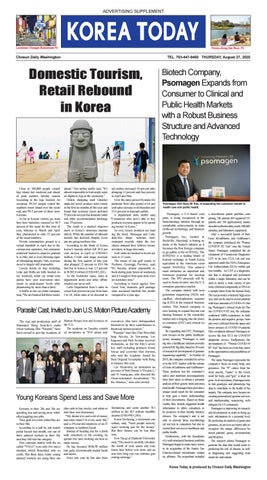
Psomagen CEO Ryan W. Kim, is expanding the consumer market to health care and public health.
Psomagen, a U.S.-based company, is being recognized in the biotechnology industry through its remarkable achievements in stateof-the-art technology, and business growth. Psomagen, Inc., located in Rockville, Maryland, is hitting its stride in the biotech industry as it becomes the first foreign company to go public in the KOSDAQ. The KOSDAQ is a trading board of Korean exchange in South Korea, equivalent to the American counterpart NASDAQ. This achievement embodies an important and enormous potential for development. The IPO proceeds will be used to boost its entry into the U.S. consumer genomics market. The company started with nextgeneration sequencing (NGS) and capillary electrophoresis sequencing (CES) in the research business market. This biotech company is now looking to expand beyond conducting business in the researcher market and is forging into the direct to consumer (DTC) and clinical exchange. By expanding into DTC, Psomagen now focuses on the public healthcare sector, meaning “Psomagen is turning into a healthcare solution provider powered by big data, based on 16 years of research & development of genome sequencing capability”. In October of 2019, the company extended its services to the DTC market with the release of Gene &GutBiome and GutBiome+. These products test the consumer’s saliva and intestinal microorganisms from their stool, to obtain a personal analysis of their genetic traits and intestinal health. Psomagen then provides a unique result report for the consumer to help gain a better understanding of their microbiome. Based on those results, they include suggested health information to allow consumers to be proactive in their healthy lifestyle choices. The company’s aim is not only to provide these microbiological test kits to consumers but also to extend their services to healthcare and public health. Furthermore, with the foundation of a well-structured business portfolio, Psomagen began to make more waves in its acquisition of the former San Francisco-based microbiome company, uBiome. The acquisition included
a microbiome patent portfolio comprising 246 patents (60 registered US patents and 186 applications), anonymizedmicrobiome data, nearly 300,000 samples, and laboratory equipment. After a successful launch of their Gene &GutBiome and GutBiome+, the company introduced the “Psoma COVID19 RT Test” into the United States. Psomagen completed the development of Coronavirus Diagnostic LDT in its own CLIA Lab and was approved under the FDA’s Emergency Use Authorization (EUA) within just two months. An LDT is a diagnostic test that is designed and performed within a single laboratory and can be used to detect a wide variety of proteins, chemical compounds, or DNA in a sample taken from the human body. The test provides extremely high accuracy and can be used to screen patients with trace amounts of COVID-19. During Psomagen’s clinical trials for Psoma COVID-19 RT test, the company confirmed 100% consistency in both the positive and negative groups. Samples were collected from the upper and lower airways of COVID-19 patients. This revolution allowed Psomagen to receive the first EUA for COVID19 diagnostic service. Furthermore, the development of “Psoma COVID-19 RT Test” has been an event that caters to the opportunities and possibilities of Psomagen. The name Psomagen represents the company’s focus on mind, body, and genomics. The “P” comes from the word psyche, “soma” is the Greek word for body, and “gen” is short for gene. In its next phase, Psomagen aims to link genotypic and phenotypic big data to contribute to the health of humanity. The company now focuses on creating personalized genome services and implementing sequencing technologies for US consumers. Psomagen is improving its research and development in order to bring genetic information to a personal level. By perfecting its analysis of genes and genomes, its services are better able to recognize the unique differences between patients’ genes, environments, and lifestyles. The research allows Psomagen to generate the data that would assist in predicting the risk of disease, as well as diagnosing and suggesting treatments for individuals.
Korea Today is produced by Chosun Daily Washington
ADVERTISING SUPPLEMENT
P2 BUSINESS & ECONOMY
Lockdown Changes Fortunes of Sports-Dependent Businesses
The coronavirus epidemic is causing the country. Golf courses with their seismic shifts in the landscape of sports- easy social distancing are fully booked dependent businesses. both on weekdays and weekends Previously thriving stores around and revenues are soaring at nearby baseball stadiums are suffering as restaurants. matches take place without spectators, Pubs and snack carts around Jamsil with the commercial areas surrounding Baseball Stadium in Seoul were stadiums in Seoul as well as Busan, almost empty at around 10 p.m. on Daejeon and Gwangju hit hard. Tuesday. The owner of one restaurant Despite emergency relief money in the neighborhood said, “Things handed out by the government to weren’t this bad even during the Asian small businesses, stores and restaurants financial crisis. The minimum wage around baseball stadiums are still hike and baseball games being played suffering. without spectators have simply been But lockdown has proved a boon devastating for business.” for shops around golf courses across The situation is the same around
Most of Korean MultipleHome Owners Make Properties over to Children A record number of apartments The breakdown makes the trend were nominally gifted across the even clearer. country in the second quarter amid Some 4,425 apartments were tougher curbs on multiple-home gifted in Seoul, fully double the owners. 2,274 a year earlier. And upscale Instead of payGangnam topped ing the exorbitant the list with 647 taxes they are gifts, followed by threatened with, Seocho (500) and many savvy ownGangseo (352). ers of multiple The trend is homes simply put expected to conspare ones in the tinue. name of their chil“Many clients dren. are saying they’re According to the willing to gift Korea Appraisal Board on Wednes- their homes to children before the day, a total of 18,696 apartments government increases gift and acquiwere gifted during the April-June sition taxes,” a tax accountant said. period across the country, the most “Believing that apartment prices will since records began in 2006. keep going up, they want to gift asThe previous record was 18,259 sets to children rather than selling in the third quarter last year. them.”
1 in 3 Korean Companies Switched to Remote Working One out of three companies in Korea switched to remote working since the coronavirus epidemic began. The Korea Chamber of Commerce and Industry released a survey recently of some 300 companies, which showed that around 34 percent of businesses are currently allowing employees to work from home. That is four times more than before the epidemic hit. More than 70 percent of the workers are satisfied, and more than half of the companies said that work efficiency is almost the same as before.
baseball stadiums outside Seoul. Oh Se-kyun (40), who owns a grilled-duck restaurant near Hanwha Life Insurance Eagles Park in Daejeon said, “I laid off four out of six workers after customer traffic ground to a halt.” And a realtor working near Sajik Baseball Stadium in Busan said, “After people stopped coming to baseball games, rents in the area declined 10 to 20 percent.” According to analysis by Korea Credit Data, which offers accounting and business management services to around 660,000 small businesses in the country, sales in restaurants around
Samsung Already Preparing for 6G Mobile Connectivity Samsung is already drawing up the broad outlines of 6G mobile services before much of the world has set up 5G networks. In a white paper Tuesday titled “The Next Hyper-Connected Experience for All,” the electronics giant predicts that 6G services will be commercially available in around 2030. Connections are expected to be another 50 times faster than 5G. “Both humans and machines will be the main users of 6G,” the company said. “6G will be characterized by provision of advanced services such as truly immersive extended reality (XR), high-fidelity mobile hologram and digital replica.” But many hurdles need to be overcome, not least the limited computing power of current mobile devices and security and privacy concerns. Samsung intends to use its edge in 5G technology to take the lead in the 6G era by boosting research and development.
Bikes in High Demand Amid Epidemic
Jamsil Stadium declined 26 percent in the week from June 22 to 28 compared to a year ago. By comparison, the commercial district of Bangi-dong just 2.5 km away saw revenues drop only 18 percent, while the average decline across Seoul was 14 percent. Around Daejeon’s baseball stadium, sales plunged 32 percent compared to an average 13 percent decline in the city. But business is booming near golf courses. Sales in restaurants in Icheon, Gyeonggi Province, where four golf clubs are clustered, have surpassed last year’s levels for eight weeks running since the middle of May. One restaurant staffer there said, “Customers keep coming in from 5 a.m. on weekends.” Most golf courses around the country are fully booked almost every day, and many have confidently raised their rounding and caddie fees to benefit from the situation.
Demand for bicycles has spiked since the outbreak of coronavirus. The Korean bike industry, which had been suffering a downturn due to the availability of public rental bikes, received a welcome fillip. Bikes have become a favorite means of exercise and transportation amid social distancing. According to a report by Hana Bank in May, sales of bikes across the country increased 45 percent on-year in the first quarter. Normally, the first quarter of a year is the slowest season for bike sales because of cold weather and smog. In fact, sales fell four percent in January, when the epidemic still had not made much of an impact. But they jumped 36 percent in February and 69 percent in March after the virus began to spread rapidly and people began to avoid public transportation. E-bikes are especially popular with commuters. Their sales soared 34 percent on-year in the first quarter, according to Samchuly Bicycle, the largest bike maker in the country. Samchuly, which suffered a loss of W5.2 billion in the fourth quarter of last year, posted an operating profit of W1.5 billion this first quarter (US$1=W1,201).
800,000 Jobseekers Preparing for Exams The number of young jobseekers studying for various exams rather than simply applying to companies has hit a record high amid the recession and coronavirus epidemic. According to Statistics Korea on Wednesday, about 804,000 young people aged 15 to 29 are studying for exams for various jobs after graduating or dropping out of school, up a whopping 90,000 from a year ago. The largest proportion or 28.3 percent are preparing for civil service exams, followed by written tests set mostly by big companies
(24.7 percent) and qualifications for technical jobs (20.6 percent). So far this year only 3.77 million young people have succeeded in landing jobs, down 183,000 onyear and the lowest number since 2013. The youth employment rate stands at a staggering 42.2 percent. It normally takes an average of 10 months for a young person to land their first job, and many then are dissatisfied with their work. The biggest group or 35 percent earn somewhere between W1.5 million and W2 million in their first month (US$1=W1,198).
Could ‘Pence Rule’ Help Prevent Sexual Harassment? The sexual misconduct accusa- izing or simply fired them to avoid men and, in a decision reminiscent of darkest Saudi Arabia, female civil tions against late Seoul Mayor Park temptation or false accusations. The drastic measure has even servants in the city must now be acWon-soon have renewed focus on the outlandish gender segregation found its way into government of- companied by a male guardian when meeting with the mayor. practiced by U.S. Vice President fices. Gimje Mayor Park Joon-bae in Many women are furious to be paMike Pence. The eponymous “Pence Rule” North Jeolla Province has replaced tronized in this way. One 28-year-old states that the pious vice president all female staff in his office with female office worker in Bucheon west will never eat alone with a woman other than his wife and will not attend functions featuring alcohol without her by his side. Some companies here have adopted the Pence Rule to guard against endemic sexual harassment in the workplace and enforced afterwork drinking sessions, but it is not only men who complain that this was a panic reaction to the “Me Too” movement. Women have in some cases borne the brunt because their male bosses excluded them from any office social-
of Seoul said, “If the Pence Rule is justified, there is another solution: fill all high-ranking posts with women. I get really angry when people think that the gender of the victim is the problem that must be eradicated.” One 25-year-old corporate secretary said, “This incident was clearly caused by the former mayor’s mistakes and it is appalling that others are trying to pin the blame on the very existence of female temptation.” Other politicians here have discussed the Pence Rule, but the outcome has been ambivalent. In Mach 2018, the government said that excluding female workers citing the Pence Rule violates equal opportunities regulations. The National Assembly tabled two bills aimed at ensuring that women do not suffer discrimination in hiring due to their gender, but they failed to pass.
Korea Today is produced by Chosun Daily Washington
P3 LIFE & CULTURE
ADVERTISING SUPPLEMENT
Lockdown Brings Fad for Picnics Along Han River A growing number of people are picnicking along the banks of the Han River as they avoid bars, restaurants and other enclosed spaces due to the coronavirus epidemic. That has led to a boom for businesses that cater to them, delivering increasingly sumptuous assortments of food and drink. Noodles and fried chicken have been a picnic staple for some time, but now businesses have started to
deliver things like wine and tapas. Food delivery app Baedal Minjok lists around 100 restaurants that deliver wine and hors d’oeuvres to Han River parks in Banpo and Yeouido districts. Lee Eun-ho (33), who runs a wine bar in Yeouido, said, “We started delivery services two months ago after a decline in customers due to the epidemic. Now around 30 to 40 percent of
How Koreans Historically Fought Hot Weather
our customers order takeout and many of them are in sitting somewhere in the Han River park.” Of course the picnics are eminently instagrammable. Lee Hye-jin (33) said, “I’ve always enjoyed outdoor activities and decided to have some wine with my friends in a park along the Han River without worrying about coronavirus. I posted a photo on Instagram and got so many likes.” Koreans in the past used to eat steaming bowl of red bean porridge, certain foods to beat the hot and commonly eaten in winter these muggy weather and stay healthy. days, was also traditionally eaten In traditional medicine, exces- on summer hot days, as the red sive sweating leads to a drop in color of the porridge was thought body temperature, which requires to be dispel evil spirts and protect replenished heat. from infectious diseases. Cold body temperatures cause But people in the past also fastomach and liver problems, so it is vored cold desserts such as sweet better to avoid too much cold food or melon with ice and watermelon drinks and eat hot dishes instead. dipped in cold water. Those fruits Samgyetang, or chicken soup were believed to be effective in with ginseng is one of them. A helping people rehydrate.
Hanbok Evolves with Modern Designs, Materials
More Older Koreans Tie the Knot
Traditional Korean attire or han- spired designs and materials in their bok is a beautiful sight on tradi- collections. tional holidays like Seollal but has Pants on global runways have benot always been the most practical come baggy like the ones in men’s attire on a daily basis. hanbok. Fashion designer Chang But now new designs and mate- Kwang-hyo said, “We are seeing rials are transforming hanbok to fit wide pants become more popular, into the day-to-day lives of Koreans, which shows that a growing numand even foreign fashion designers ber of foreign designers are being have started featuring hanbok-in- inspired by the lines and curves of
Marriages among people in their population. People over 50 are Korea’s 20s to 40s continue to decline, but the baby boomers and were born between exact opposite is happening among 1955 and 1963, before the government those in their 50s. started to try and limit the number of According to Statistics Korea, the children Koreans had. number of women over 50 who tied According to Statistics Korea, the the knot increased from 14,932 in number of people aged over 50 in2017 to 15,725 last year. That contrasts creased from 19.42 million in 2017 to sharply with the decline in marriages 20.12 million in 2018, while people among women under 50 from 249,523 under 50 dwindled from 32.62 million to 223,434 over the same period. to 32.18 million. The trend is the same for men, risThe last factor, according to experts, ing from 20,464 to 21,510 among the is that more and more Koreans are getover-50s. ting married later in life because they Experts cite three main reasons. focus on their careers first. First, divorce keeps rising, so many One 51-year-old businessman in of the new older couples are probably central Seoul recently tied the knot on their second marriage. Government with a woman 11 years his junior. “I data shows that the number of men didn’t have time to get married bewho tie the knot again after divorcing cause I devoted myself to running my rose from 18,338 in 2017 to 18,863 in family business since my 30s,” he said. 2019, while the number increased from “I took my time and started looking for 14,027 to 14,710 among women. a marriage partner in my late 40s and Another factor is the sheer number of I think that’s how I was able to find a people over 50 compared to the overall nice person.”
traditional Asian dress.” Chanel, Dior and Carolina Herrera have all praised hanbok and featured designs inspired by it. New materials are being used to make hanbok that is wearable in everyday life. Kim Young-jin, who designed the costumes for the 2018 hit TV series “Mr. Sunshine,” said, “By using new materials, I wanted to create clothes that work in day-to-day life while still retaining the DNA of hanbok.” A growing number of people are buying accessories to go with it. According to Lotte Department Store, sales of retro scarves, hats and other hanbok-related accessories rise 30 to 40 percent during traditional holiday seasons, from less than five percent in other times of the year. Even hanbok-inspired pet clothes are in vogue, with sales up 40 to 50 times.
Homebound Koreans Buy More Appliances, Furniture Sales of furniture and home ap- soared 85 percent, refrigerators 34 ger screens than smartphones.” W203.8 billion set in 2019. At Simmons, high-priced beds pliances are increasing as Koreans percent and TVs 10 percent. They The same trend was apparent for Hanssem, Korea’s largest fur- costing between W3 million and spend more time at home due to the had plummeted in April but re- beds and furniture. Simmons Bed- niture maker, is expected to see W4 million accounted for more than coronavirus epidemic, and high-end bounded sharply in May and June. ding Company achieved record second-quarter earnings this year half of its sales, and sales of beds products are leading the trend. Sales of tablet PCs also rose three monthly sales of W23 billion in surpass the level reached a year ago. priced at over W5 million are also Pent-up consumption is leading percent on-year in March, 16 per- May of this year (US$1=W1,200). Stock analysts forecast Hanssem’s increasing. to increased spending on home ap- cent in April, 45 percent in May and Alarm bells rang in April, when second-quarter revenues to reach A Lotte Hi-Mart staffer said, “Expliances, from dishwashers to tablet a whopping 60 percent in June. Huh sales plummeted almost 30 percent W450 billion, up around 10 percent pensive products like 65-inch OLED computers. Jae-min, a staffer at Lotte Hi-Mart, on-year, but they rebounded quickly on year. TVs are selling better.” Industry At electronics retailer Lotte Hi- said, “As more and more people the following month. Consumer spending used to be watchers say newlywed couples are Mart, dishwasher sales surged 135 stay home and watch YouTube, Simmons now projects sales to spread out between many different splurging on home appliances since percent on-year from June 1 to Netflix and other online media, de- reach W220 billion this year, sur- products but is now focused on a set they cannot travel overseas for their 22, while sales of air conditioners mand is rising for devices with big- passing the previous record of range of goods for home use. honeymoon.
Coronavirus Blights Koreans’ Summer Holiday The coronavirus epidemic has blighted many people’s summer holiday plans and is virtually guaranteed to keep them in the country. Employment portal Job Korea asked 1,023 salaried workers about their vacation plans, and only 9.1 percent said they intended to go anywhere this summer, while 59 percent said they are watching the situation and have not made plans yet. Some 22.9 percent said they do not plan to go anywhere, and 6.4 percent had postponed their plans. One 41-year-old parent of two children said he is staying home. “The summer vacation has been shortened for my children and the coronavirus situation prompted us to postpone our vacation plans until after October,” he said.
But he said he worries about other vacationing families. “Many parents are concerned when they hear about a classmate going to a water park or Jeju Island,” he said. “Children grow jealous, and parents worry about possible infection.” A 32-year-old worker is wondering where she should go on holiday with her husband. As of Thursday, people who travel within Korea are not required to place themselves in selfquarantine after returning home. A staffer at the Ministry of Health and Welfare said, “Only people who crossed paths with confirmed cases or display symptoms themselves are required to go into self-quarantine and get tested.” But some private kindergartens and nursery schools are are imposing
their own cautionary measures, asking children who have been out of town for trips to stay at least a week at home before returning to the schools. “If we go on holiday I won’t be able to send my child to nursery school for a week afterwards, and this has made me seriously weigh the benefits of
available at korean.visitkorea.or.kr. It advises vacationers to wear face masks at all times and maintain safe distances from others. Operators of swimming pools are advised to take reservations or implement time limits on visitors to prevent overcrowding. Kim Jin-yong, a physician at Incheon Medical Center, said, “Swimming pool water is disinfected with chlorine so viruses are destroyed quickly. The problem with crowded swimming pools is infection through droplets from the breaths of carriers.” Experts advise vacationers to staying home,” the 32-year-old said. stay away from popular restaurants Some people are keeping their and opt for less crowded venues plans very quiet to avoid alarming the instead. “The biggest threat comes neighbors and are not uploading any from removing face masks,” Kim holiday photos on their social media. said. “Distances between tables The Korea Tourism Organiza- should be at least 1 m, and if that’s tion asked epidemiologists to come not possible, choose another resup with a guide for safe vacationing taurant.”
Korea Today is produced by Chosun Daily Washington
P4 ADVERTISEMENT
ADVERTISING SUPPLEMENT