
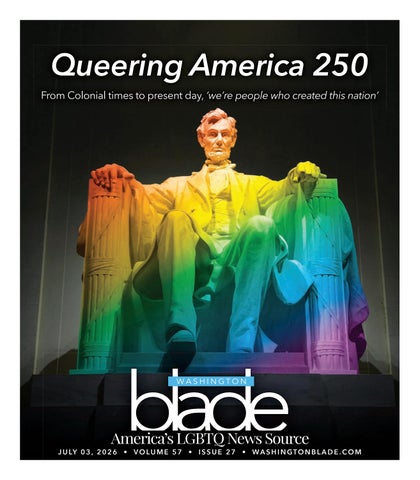
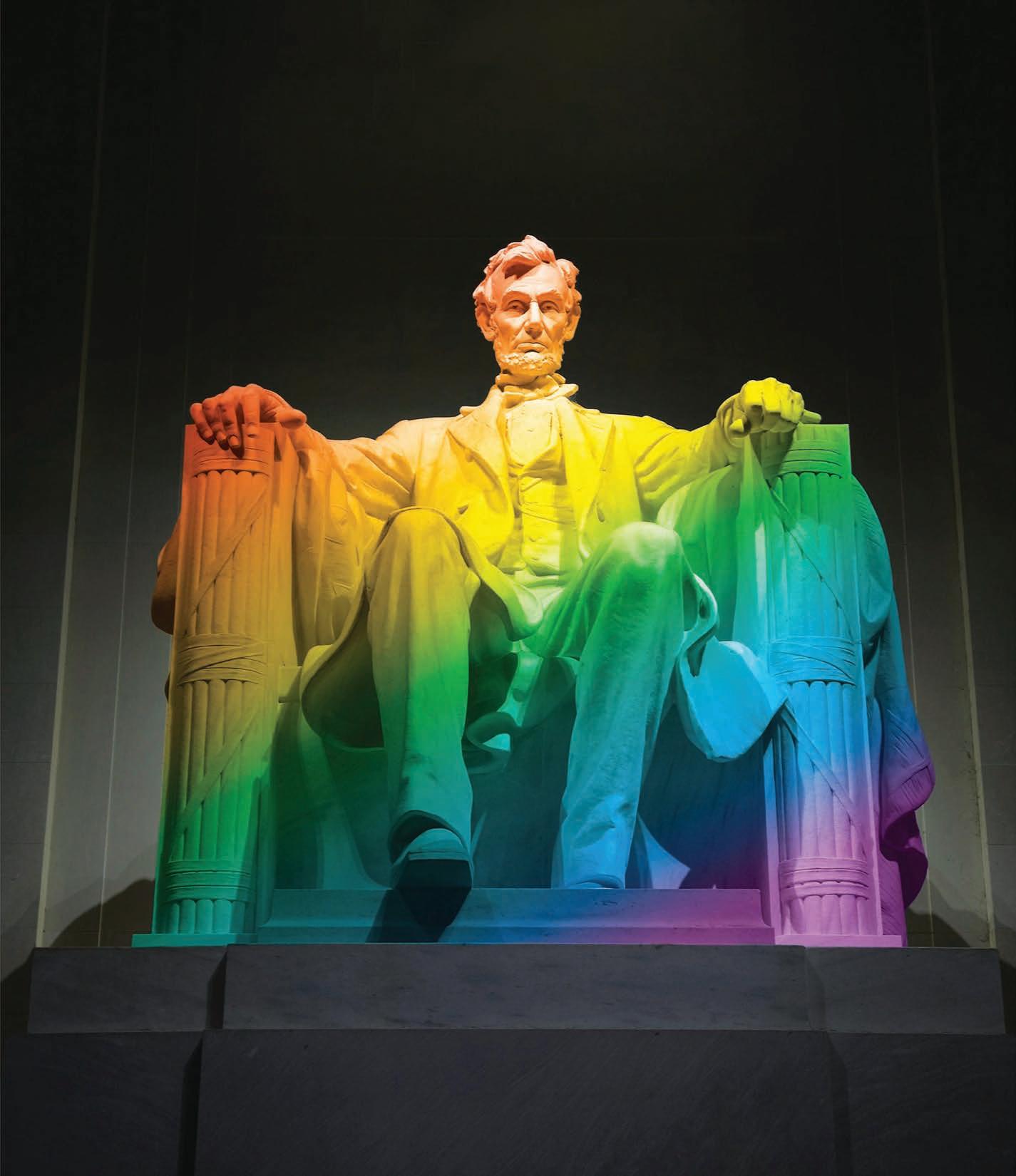
From Colonial times to present day, ‘we’re people who created this nation’





















8084 CONTRIBUTING
ISAAC AMEND, TINASHE CHINGARANDE, PETER ROSENSTEIN, PATRICK FOLLIARD, TERRI SCHLICHENMEYER, JOE PHILLIPS, EVAN CAPLAN, ANKUSH KUMAR, ESTEBAN RIOSECO, TOM SITUMO, AYMAN ECKFORD
CREATIVE DESIGN/PRODUCTION
MEAGHAN JUBA production@azercreative.com
SALES & ADMINISTRATION
DIRECTOR OF SALES & MARKETING
BRIAN PITTS bpitts@washblade.com ext. 8089
CLASSIFIED ADVERTISING/ADMINISTRATION
PHILLIP G. ROCKSTROH prockstroh@washblade.com ext. 8092
NATIONAL ADVERTISING
RIVENDELL MEDIA
212-242-6863; sales@rivendellmedia.com
For distribution, contact Lynne Brown at 202-747-2077, ext. 8075. Distributed by Southwest Distribution Inc.
All











long been at forefront of
Centuries of progress, from the ‘queen of drag’ to Bayard Rustin
By MICHAEL K. LAVERS
(Editor’s note: This essay is from the Blade’s new glossy magazine, titled ‘Queering America 250,’ a look back at the many contributions that LGBTQ people have made to the founding of the country through the present day. You can find the magazine here: Annie’s, As You Are, Bunker, Crush, DIK Bar, District Eagle, Green Lantern, Her Diner, Jane Jane, JR.’s, Icon, Kiki, Larry’s Lounge, Little Gay Pub, Nellie’s, Number Nine, Pitchers, Red Bear Brewing, Shakers, Sinners and Saints, Spark Social House, Fireplace, Thurst, Trade, Uproar, Whitman-Walker Health, Destination DC, Mayor’s Office of LGBTQ Affairs, DC Center, SMYAL, HRC, Bite the Fruit, 350 Bakery, Logan 14 Aveda Salon Spa, Vida Fitness U Street and Logan Circle, Freddie’s Beach Bar, Destination Tomorrow. The magazine is also available at D.C. and Northern Virginia libraries and online.)
The District of Columbia has been at the forefront of the LGBTQ rights movement for more than a century.
William Dorsey Swann — a former slave who became known as the “queen of drag” — in the 1880s became the first person to lead a gay advocacy group in the country. Swann was also the first American to legally advocate for the rights of LGBTQ people.
Bayard Rustin, a Black gay man, organized the 1963 March on Washington at which Martin Luther King Jr. gave his “I Have a Dream” speech at the Lincoln Memorial. Frank Kameny, a civilian astronomer with the U.S. Army Map Service who lost his job during the so-called “Lavender Scare” in the decades after World War II, led the first LGBTQ rights protest in front of the White House.
Upwards of 100,000 people participated in the first National March on Washington for Lesbian and Gay Rights in 1979. The second March on Washington for Lesbian and Gay Rights, which took place at the height of the AIDS epidemic, drew more than 700,000 people to the nation’s capital in 1987. Almost a million people took part in the third March on Washington for Lesbian, Gay, and Bi Equal Rights and Liberation of 1993.
Washington in 1973 became one of the first cities in the country to explicitly ban discrimination based on sexual orientation when the D.C. Council passed Title 34. It became part of the D.C. Human Rights Act. Gender identity and expression was added to it in 2006.
D.C. in 2010 became the first jurisdiction south of the Mason-Dixon Line to extend marriage rights to same-sex couples.
Here are three figures who placed D.C. at the vanguard of the country’s LGBTQ rights movement.
William Dorsey Swann
Swann in the 1880s led the House of Swann. Channing Joseph, a professor at Princeton University, in an article he wrote for The Nation in 2020 noted gay, formerly enslaved gay men danced and cross-dressed at balls that House of Swann organized. Police regularly raided these parties, and arrested Swann several times. The National Star on Jan. 13, 1896, noted a judge sentenced Swann to 10 months in jail.
“This is the case in which a number of men, white and colored, were found in this place, which Judge Miller characterized as a ‘hell of iniquity,’” reported the newspaper. “William Dorsey Swan, the colored man at whose house, No. 1504 L Street, Northwest, a ‘drag’ was raided about two weeks ago, and who was convicted in the Police Court last week of a charge of keeping a disorderly house, was sentenced to 10 months in jail by Judge Miller today.”
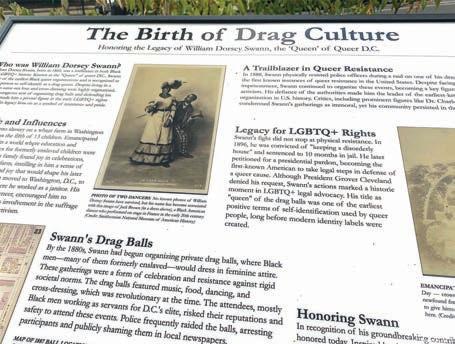
President Grover Cleveland denied Swann’s pardon request. Swann died in 1925.
The D.C. Council in 2023 designated Swann Street, N.W., in Dupont Circle in honor of Swann. The D.C. Department of Parks and Recreation last August installed a marker in T Street Park at the intersection of Swann and T Streets and New Hampshire Avenue in Dupont Circle.
“In 1896, he was convicted of ‘keeping a disorderly house’ and sentenced to 10 months in jail. He later petitioned for a presidential pardon, becoming the first-known American to take legal steps in defense of a queer cause,” notes the marker. “Although President Grover Cleveland denied his request, Swann’s actions marked a historic moment in LGBTQ legal advocacy. His title as ‘queen’ of the drag balls was one of the earliest positive terms of self-identification used by queer people, long before modern identity labels were created.”
The native New Yorker was a U.S. Army veteran who served in Europe during World War II. Kameny moved to Washington in 1956 when he began to teach astronomy at Georgetown University. He became a civilian astronomer with the U.S. Army Map Service the following year.
Two San Francisco police officers on Aug. 26, 1956, detained Kameny and accused him of engaging in “lewd and indecent acts” in a men’s bathroom. Kameny later pleaded guilty and paid a $55 fine. A judge also sentenced him to six months probation.
The U.S. Army Map Service in 1957 fired Kameny during the “Lavender Scare” in which the federal government terminated thousands of employees who it suspected were LGBTQ. The U.S. Supreme Court in 1961 declined to hear his appeal. (Then-Office of Personnel Management Director John Berry, a gay man who later became the U.S. Ambassador to Australia during the Obama-Biden administration, in 2009 formally apologized to Kameny on behalf of the federal government.)
Kameny on April 17, 1965, led the first LGBTQ rights protest in front of the White House that the Mattachine Society of Washington — the city’s first politically active LGBTQ rights group that he co-founded — organized. The picket took place more than four years before the Stonewall Riots in New York.
President Richard Nixon in 1970 signed the District of Columbia Delegate Act, which allowed Washingtonians to elect a non-voting delegate to the U.S. House of Rep-
resentatives. Kameny the following year became the first openly gay person to run for Congress. He later founded the Gay and Lesbian Alliance of Washington.
Kameny in 1977 was among the group of gay and lesbian activists who met with President Jimmy Carter in the White House. The meeting is the first time a president sat down with a group of LGBTQ advocates. Kameny died on Oct. 11, 2011.
Marion Barry
The so-called “Mayor for Life” was a larger-than-life figure who shaped the city’s politics for decades. Barry also had a complicated history with the LGBTQ community.
Barry was president of the D.C. State Board of Education in 1972 when it approved a resolution against discrimination in public schools based on sexual orientation. Barry, who won a seat on the D.C. Council in 1974, supported Gay Pride Day, which later became known as Capital Pride, and opposed Anita Bryant’s “Save Our Children” campaign that ultimately succeeded in overturning an ordinance in Dade County, Fla., that banned anti-gay discrimination.
Barry during his 1978 mayoral campaign visited gay bars in D.C. The Washington Blade previously reported that his strong support from LGBTQ voters in the city proved pivotal in his election.
“Barry followed through by appointing gays to all kinds of important positions throughout the government,” former GLAA President Craig Howell told the Blade in a previous interview. “He put us on the map politically speaking, and he really led the field as far as any other mayor in the country. Nobody was more pro-gay or did more for us than Marion Barry did.”
Barry in 1983 became the first mayor in the U.S. to award a city contract for HIV/AIDS-related services. Jim Graham, a gay man who served on the D.C. Council from 1999-2015, was its president at the time.
“There was a lot of pressure on Barry not to give it to Whitman-Walker,” Graham later told the Blade. “He decided that we were in the best position on the merits and we should get it. And that was an act of political courage at the time, and I’ve never, never forgotten what he did.”
FBI agents and Metropolitan Police Department officers on Jan. 18, 1990, arrested Barry at the Vista International Hotel after a surveillance camera caught him smoking crack cocaine. A judge sentenced him to six months in prison after a jury convicted him on a drug possession charge.
Barry in 1992 returned to the D.C. Council after he defeated Wilhelmina Rolark, a four-term incumbent, in the Ward 8 Democratic primary.
Rolark, who chaired the Council’s Judiciary Committee, consistently blocked a bill that sought to repeal Washington’s sodomy law. Barry was among the Council members who voted for the statute’s repeal in 1993.
Washingtonians in 1994 once again elected Barry mayor. Congress in 1995 created the District of Columbia Financial Control Board that oversaw the city’s finances. Barry left office in 1999.
Ward 8 voters in 2004 returned Barry to the D.C. Council.
Barry in 2009 opposed a marriage equality bill that David Catania, the first openly gay person elected to the Council, introduced. The only other Council member who did not support the measure was Yvette Alexander, a Democrat who represented Ward 7 from 2007-2017.
‘We’re people who created this nation’
By CLINTON ENGELBERGER
(Editor’s note: This essay is from the Blade’s glossy magazine ‘Queering America 250.’ Copies are available around the city and online.)
If you were told about a gay general leading soldiers during the Revolutionary War, you’d think it’s the fictional plot of the next steamy arthouse movie coming to a theater near you.
But it’s not fictional –– that’s the story of Baron Friedrich von Steuben. LGBTQ relationships and identities existed in the Colonial era, they just looked a little different.
Stories like these shaped the modern LGBTQ community, but rarely get told with the depth they deserve. Mark Segal, activist and founder of the Philadelphia Gay News, said it’s vital for queer history to be taught, especially as America’s 250th birthday approaches.
“One of the issues that is very sad in our community is that we don’t look at our own history,” Segal said. “If we look at our own history, we will realize very quickly that we’ve been a part of the fiber of this nation for many years. We’re people who created this nation.”
Segal’s point is prevalent even when just walking around D.C. In Lafayette Park, you’ll find a statue of von Steuben and a plaque listing his wartime accomplishments.
The identities of those in the Colonial era of America paved the road toward acceptance and community, but not without brutal punishments, well-kept secrets and different social values.
From romantic friendships to openly gay marriages, here’s an overview of what an 18th century LGBTQ community looked like
Identity and sexuality in Colonial America
LGBTQ relationships, though not labelled with modern terms, came in all shapes and sizes during the 18th and 19th centuries.
Some engaged in same-sex sexual or romantic relationships without being able to label their feelings. Others engaged in acts, such as two men walking arm in arm, that modern society would label as queer but at the time were viewed as socially acceptable.
These acts may be labeled as queer today, but Tyler Putman, manager of gallery interpretation at the Museum of the American Revolution, said the colossal difference in social expectations of the 18th century doesn’t mean that people of that time would agree.
“If you live in a society where the labels are different, you can think about yourself and become different things just because these are the things available,” Putman said. “We know that people had sex with people of the same sex in the 18th century, but many of those people probably would not have identified as being unusual or queer because they were living in a world that they constructed that had a whole different set of expectations.”
Queerness was also prevalent among soldiers. During the Revolutionary War, there’s one known case of a soldier being prosecuted for “attempting to commit sodomy” named Frederick Enslin. However, Putman said it’s likely many more cases occurred during the war since soldiers were living in close quarters for eight years.
Some kept their same-sex relationships shrouded in secrecy to avoid retaliation. Others, especially after the Revolutionary War, engaged in “romantic friendships.”
These friendships weren’t seen as queer, but their tenderness and vulnerability has given historians an insight into how they resembled LGBTQ relationships during
this time.
Men in romantic friendships would share the same bed, write flattering letters to one another and spend their days together. They would typically then take wives and start families. They’d still remain distant friends with one another, but their relationships would begin to strain as their duties as husbands took over.
These relationships were acceptable due to the differing social standards. Putman said that people today can identify the queerness of romantic friendships because of how engrained the LGBTQ community is in modern society. During the 18th century, there weren’t as many social stipulations for how men’s friendships could look.
Another reason for the acceptance of romantic friendships, as well as homosexual tendencies, was from social oblivion. In the modern sense, Segal said everyone has that “crazy aunt” or “eccentric uncle” that no one gives much thought about. Those who expressed modern queer tendencies during the 18th century were seen as just that –– unique characters that no one questioned.
Furthermore, family members or close friends who did discover these secret relationships didn’t want to make it public due to the severe consequences of openly queer relationships or sexual activity. They found it best to turn a blind eye to it.
Depending on which colony or state one lived in, punishments for same-sex relationships or sexual intercourse –– and even heterosexual anal intercourse or masturbation –– could lead to castration, banishment, or the death penalty.
Colonial queerness didn’t only present itself as physical intimacy and sexuality, as some didn’t conform to social gender expectations. In lesbian relationships, it was common for one partner to dress and pass as a man, with some even joining the army in a male disguise.
Beyond understanding the prevalence of LGBTQ relationships in the Colonial era, Segal said knowing the icons and figures of the time is crucial in giving life to these historical accounts and inspiring youth to accept themselves.
“I never want to see a young LGBT person go through what I did growing up, feeling the way that we all did, that society will abandon us, that we won’t be able to have the position in society that we want to have,” Segal said. “That goes down to various professions. LGBT youth who want to go into the military, shouldn’t they know about Leonard Matlovich? Shouldn’t they know about von Steuben?”
The list of queer icons pre- and post-Revolutionary War is extensive, but it fails to paint the full spectrum of identity and sexuality during this time.
Putman said studying the historical influence of figures modern society would define as queer is difficult because sexuality isn’t something you can easily identify in paintings as you would race or gender. There needs to be documentation in order to draw those connections.
This means that the history of queer African Americans during the Colonial era has mostly gone unrecorded since they were largely held as slaves or servants during this period, according to Putman.
One of the few recorded examples of an African American challenging gender expectations was Cathay Williams, who dressed as a man and joined the army. She was eventually caught and honorably discharged, but later joined an all-Black regiment that would become part
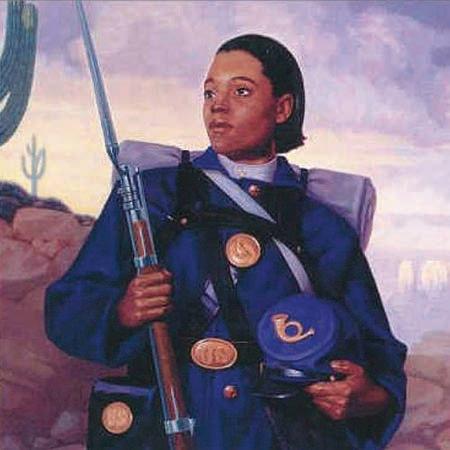
of the Buffalo Soldiers.
Women like Deborah Sampson and Anna Maria Lane also subverted gender expectations by dressing as males and joining the army.
The journals, letters and court records are what historians have to piece together to reveal what an 18th century LGBTQ community looked like.
Letters reveal the romantic friendship of Charles Sumner, who had romantic friendships with Henry Longfellow and Samuel Howe in 1837. Both eventually got married, leaving Sumner feeling isolated.
Before marrying, Howe wrote to Sumner: “I find my heart yearning more and more for something to love even more than I love you my dear Sumner: but till I find it let me be all yours.”
Sumner was encouraged by Howe and Longfellow to get married, but he never found a relationship or marriage that lasted long term. Instead, he spent his days wallowing and yearning for the time he used to spend with the two men.
During the Revolutionary War, at a time when the American army was low on food and morale, a Prussian military man was called into help. Baron Friedrich von Steuben was allegedly dismissed from the Prussian military for homosexuality. Benjamin Franklin recommended von Steuben to George Washington, downplaying rumors of his sexuality.
After fleeing his home country, von Steuben accepted Franklin’s proposal and joined the military to whip the undisciplined men back into shape. Both Franklin and Washington knew of von Steuben’s sexuality, but found it irrelevant to his military qualifications.
Von Steuben also threw sexually charged parties to socialize with troops, with one party requiring the men not to show up in a “whole pair of breeches.” He grew close to two other men, William North and Benjamin Walker, with whom he legally adopted upon returning home so he could live with them. Von Steuben stands today as one of the earliest examples of a somewhat openly gay man in this era, and receives little mainstream recognition for turning the war around.
“George Washington made it clear: without von Steuben, there would be no United States of America,” Segal said.







Plans to focus on running Crush bar, other ventures
FROM STAFF REPORTS
Longtime Washington Blade employee Stephen Rutgers announced he is stepping down after 14 years to focus on other ventures, including his part ownership of the popular Crush bar.
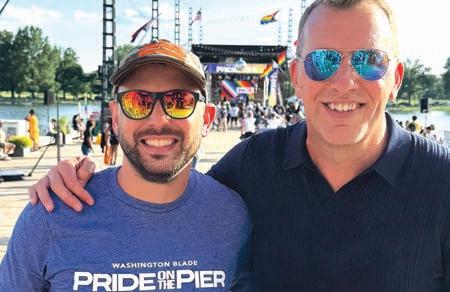
Rutgers was hired by the Blade in 2012 to help plan Pride festivities and over the years was promoted to director of sales and marketing. In addition to his broad set of responsibilities, Rutgers planned the annual Pride on the Pier celebration at the Wharf, which has exploded in popularity over the seven years since its launch.
“Watching Pride on the Pier grow from a new community event into one of D.C.’s signature Pride celebrations has been incredibly rewarding,” Rutgers said. “Expanding Pride on the Pier into a two-day festival for WorldPride in 2025 was definitely a career highlight. Seeing thousands of people come together to celebrate our community while supporting the Blade’s mission is something I’ll always be proud of.”
Rutgers described his biggest challenge as navigating the changing media landscape.
“More than ever, we’ve had to remind our community that local journalism matters and that it needs their support,” he said.
He added that he’s most proud of helping to ensure the Washington Blade is positioned to thrive for the next 50 years. “I was fortunate to be part of the Blade during its 50th anniversary — a milestone that reflects its incredible history and impact,” Rutgers said. “The Blade has been an important voice for the LGBTQ community for more than five decades, and
knowing I played a small part in helping its future is most important to me.”
Blade Publisher Brian Pitts praised Rutgers for juggling multiple responsibilities.
“We wish Stephen all the best,” Pitts said. “For the past 14 years, Stephen has been a vital part of the Blade, handling many things — marketing and advertising, sponsorships, and Blade signature events. We will all miss him.”
Blade Editor Kevin Naff thanked Rutgers for his years of service to the community.
“After 14 years, it’s hard to imagine the Blade without Stephen and his boundless energy and creativity,” Naff said. “He’s one of the hardest working and most dedicated people I’ve ever known and he will be missed. But change is the only constant and I know Stephen will move on successfully to new challenges and the Blade will expand on Stephen’s important work.”
As for what’s next for Rutgers, he said he plans to focus on Crush as well as his real estate business.
“I’ve always been someone who likes to stay busy,” Rutgers said. “For the past 12 years, I’ve balanced my work at the Blade and in real estate. Two years ago when I opened Crush, I never realized just how much time and energy it would take. The passing of my father earlier this year also gave me a new perspective. It reminded me that life is short and that it’s important to make time for the people and experiences that matter most. Stepping away from the Blade will allow me to focus on those ventures while also creating more balance in
Montgomery County police charged both with killing mother of
By LOU CHIBBARO JR. | lchibbaro@washblade.com
Two women identified as a couple who have been wanted by Montgomery County, Md. police for allegedly killing the mother of one of them in her Silver Spring home on May 22 were arrested on June 10 in Ohio, according to a police statement
The little-noticed statement released on June 11 says Vanessa Wahanganisa Tjongarero-Henderson, 29, of Clarksburg, Md., and Samantha Raebel, 36, of Phoenix, Ariz., who police earlier described as “girlfriends,” were apprehended by police in Genoa, Ohio after a local resident recognized them from news media coverage of the murder.
In their initial statement on June 4 announcing their investigation of the murder, Montgomery County Department of Police said they had charged the two women with first-degree murder for the death of Hilde Henderson, 67, who was the mother of Vanessa.
“Through the course of the investigation, detectives identified Henderson’s daughter, Vanessa Tjonhgarero-Henderson, and Vanessa’s girlfriend, Raebel, as the suspects,” the police statement said. It said detectives obtained an arrest warrant for the two women for first-degree murder and asked the public for help in locating them.
“A nationwide search was launched for the suspects, with media coverage extending throughout Ohio, Nashville, and
of them
Phoenix,” the most recent statement on June 11 announcing the two women’s arrest says. “Major Crimes Division detectives received multiple tips from several states before the two women were ultimately located in Genoa, Ohio,” it says.
It adds that an autopsy determined the cause of Hilde Henderson’s death was blunt-force trauma injuries brought about by a murder. Police have yet to disclose whether they have determined a motive for the murder.
“Tjongarero-Henderson and Raebel are currently being held at the Ottawa County [Ohio] Detention Center awaiting extradition to Maryland,” the statement concludes.
A spokesperson for the Office of the Montgomery County State’s Attorney, which prosecutes criminal cases in the county, told the Washington Blade the extradition was still pending and the two women had yet to be brought back to Maryland for prosecution as of June 29.
CBS News reported on June 16 that shortly after the two women fled almost 500 miles to Genoa, Ohio, they met a local resident at a fast-food restaurant and asked her for help, claiming they were homeless.
“They said they were living in Maryland,” CBS News quoted the resident, Adrienne Behrman, as saying. “They had taken what little money they had and left a toxic living situation, and they were headed to Arizona,” Behrman told CBS.
my life. After 14 incredible years, it feels like the right time for a new chapter.”
Naff said that for now Rutgers’s responsibilities will be divided between existing staff along with several new freelance contractors.
“The Washington Blade plays a unique role in our community’s fight for equality,” Rutgers said. “It’s the only LGBTQ news organization with White House credentials, giving it direct access to the people and institutions shaping policies that affect our community. The Blade continues to hold elected officials accountable, report on the issues that matter most to LGBTQ people, and tell the stories that often go uncovered by mainstream media.
“The Blade has been my family for most of my adult life. For 14 years, it has been part of my daily routine, so it’s going to feel very strange waking up and not logging on each morning.”

According to the CBS report, Behrman, who allowed the women to temporarily stay in her home, became suspicious that the stories they were telling her did not add up.
When one of them asked her for cigarettes and offered to reimburse her through the online Cash App payment platform, Behrman learned the woman’s real name—Henderson—through the app. Behrman then did an online search, “and that is when everything unraveled,” CBS reports, saying the search led to multiple press reports that the women were wanted for murder.
After leaving her home with the two women inside she called 911 to report the location of two people wanted for murder, CBS reports, adding that at least six police cars arrived and used a loud speaker to order the women out of the house and arrested them.
“I just hope the family and friends who knew the mother can have some peace,” Behrman told CBS News.
‘Narrow decision focused on the unique context of sports’
By JOE REBERKENNY | jreberkenny@washblade.com
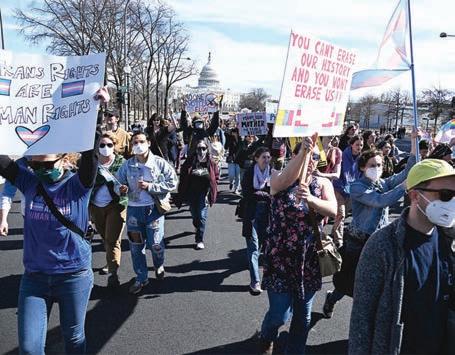
The Supreme Court’s decision Tuesday to uphold state laws barring transgender girls from competing on girls’ school sports teams represents a setback for transgender rights, but attorneys who argued the case say the ruling is considerably narrower than many initial reactions suggested.
Shortly after the decision was released, attorneys with the American Civil Liberties Union — which represented the plaintiffs in the case — held a press call to explain what they described as the limited scope of the Court’s opinion. While the ruling allows states to exclude transgender girls from girls’ school sports teams, they said it stops well short of creating a nationwide ban or dismantling broader legal protections for transgender people.
Joshua Block, senior counsel with the ACLU’s LGBTQ & HIV Project, said the majority intentionally confined its analysis to school athletics.
“[The majority] issued a narrow decision focused specifically on the unique context of sports. It didn’t issue a broader decision saying that Title IX in general didn’t protect transgender students. It didn’t say that other states couldn’t make a different policy choice and allow transgender girls to participate with cisgender girls, and it didn’t issue a sweeping ruling saying that under the Constitution it’s perfectly fine to discriminate based on transgender status.”
Block said one of the opinion’s most significant takeaways is that it leaves decisions about transgender participation in school sports largely in the hands of states.
“It leaves the rest of the legal rights of transgender people where the court found them.”
He stressed that the ruling authorizes states to adopt restrictions but does not require them to do so.
“It’s very important to emphasize that this isn’t a national mandate to ban trans athletes everywhere. It’s a fight that’s going to continue state by state, school by school … it really says that a state may discriminate, not that they must discriminate. States, schools, and athletic associations should be taking every step to ensure that athletic opportunities exist for transgender girls.”
Beyond athletics, Block said the opinion’s most important legal consequence may lie in its treatment of the Equal Protection Clause.
“What the court said is that even applying that heightened standard, we’re going to establish what’s effectively a new rule of the Equal Protection Clause, saying that you can’t bring this sort of as-applied challenge to a law that is valid for most people.”
Even so, he argued that the Court repeatedly framed transgender participation in sports as a policy issue for state governments rather than a constitutional mandate.
“Over and over and over again it talks about how states may exclude transgender girls, not that they must, and over and over and over again it says that this is a policy question that should be decided by the people in their different communities and their representatives.”
Block also rejected the idea that the ruling endorses the Trump administration’s broader efforts to restrict transgender rights.
“I have no doubt that the Trump administration will try to declare victory and say that this decision supports the lawless policies they’re pursuing, but I think anyone
reading the decision can see otherwise.”
The White House nonetheless celebrated the decision, calling it a victory that would “protect women and girls.”
“The Court’s decision is a landmark victory for common sense, biological reality, and for the millions of women and girls who deserve a level playing field. By upholding laws protecting female athletic competition, the Court confirmed that states may preserve the fairness, safety, and equal opportunities that Title IX was enacted to guarantee.”
Medical researchers and LGBTQ advocates dispute the administration’s characterization of the evidence. A 2021 study published in the Journal of Sports Medicine found no scientific evidence for supporting these laws that categorically ban transgender women from participating in women’s sports.
Critics have also argued that enforcement of such laws could create new risks for athletes. Researchers have warned that sex-verification requirements may expose students to invasive examinations and discrimination.
A 2016 USA Today investigation found that at least 368 young gymnasts reported experiencing sexual abuse over a 20-year period. More than 100 coaches and gymnastics officials were accused of abuse, yet USA Gymnastics failed to track predatory coaches, allowing many to continue working with children. LGBTQ advocates argue that requiring athletes to undergo genital inspections or other forms of sex verification could place young athletes at even greater risk.
Advocacy organizations said the decision, while limited legally, will have significant real-world consequences for transgender youth.
Chris Mosier, a transgender athlete and board member of Point of Pride, said the ruling extends beyond sports.
“The Supreme Court’s decision today isn’t driven by fairness or dignity in sports. It’s an attack on our community’s right to live freely and authentically in every part of our lives. Young people, regardless of whether they’re cis or trans, deserve the joy of sports: to build friendships, to move their bodies and have fun on the field.
To every trans athlete out there: you have a community standing behind you. No politician or law can take away your joy or power. We will get through this as our community has always done: together.”
Brian K. Bond, CEO of PFLAG National, emphasized that states remain free to adopt inclusive policies despite the Court’s decision.
“The Court rules best when it listens to the needs of marginalized people: trans people belong, on and off the field. While we celebrate the Court’s decision to uphold the Fourteenth Amendment and affirm that every person born in the United States is a citizen, the Court today added an asterisk to allow discrimination against transgender student athletes. Our country has been here before, and frankly, you would think this Court would have learned.”
“For PFLAG families, today’s decision in BPJ means that transgender athletes can continue to be affirmed for who they are in places where the law allows – and invigorates our LGBTQ+ and allied community to expand those protections. The parents, families, allies and LGBTQ+ people of PFLAG will continue to advocate for our trans loved ones to have the freedom to be themselves, everywhere. Trans people belong, and deserve to have access to the benefits of sport like everyone else.”
Allen Morris, policy director at the National LGBTQ Task Force, called the decision “devastating” but noted that it does not establish a nationwide sports ban.
“Today’s decision is devastating and the impact to clear. While this is not a nationwide ban on transgender participation in sports, the Court has given states a legal pathway to attempt to discriminate against trans individuals from full participation in school sports and all aspects of life.”
“This ruling is not just about sports: it’s about valuing and protecting the safety, security and constitutional rights of transgender people. By allowing states to draw a categorical line based on “biological sex,” the majority has chosen deference to exclusion and political beliefs over transgender students’ lived realities. There is already a dangerous rise in state-based violence growing across the country, and we’re overcoming this issue at each turn.”
Melanie Willingham-Jaggers, CEO of GLSEN, said the decision sends a broader message about transgender students’ place in schools.
“We are deeply disappointed by the outcome of this decision. This ruling represents another significant setback for transgender youth across the country, limiting their ability to fully engage in school life. Exclusion from these spaces shapes not only athletic access, but the broader message about who should be valued and included in our schools and societal ecosystem.”
“School sports are much more than competition. They are about belonging, forming a community, and the opportunity to grow and thrive alongside peers. Preventing youth from taking part in everyday activities undermines these fundamental values. We continue to see efforts to regulate discrimination under the guise of fairness, despite the lack of evidence that inclusive policies harm women’s sports. Access to these experiences is critical to students’ well-being and development.”






‘Criminalizing LGBTQI+ individuals undermines democracy globally’
By JOE REBERKENNY | jreberkenny@washblade.com
Massachusetts Congresswoman Ayanna Pressley sent a letter to Secretary of State Marco Rubio urging the Trump-Vance administration to take urgent action to defend LGBTQ people across the globe, including in countries that are violating international human rights protections for LGBTQ individuals, putting at risk the safety of civilians and U.S. citizens working, living, and traveling abroad.
The letter, which the Washington Blade got an exclusive preview of prior to its sending, criticizes the Trump-Vance administration’s foreign policy direction at the State Department, arguing that it has moved to roll back LGBTQ protections that have long been part of the U.S.’s global human rights posture.
“Criminalizing LGBTQI+ individuals undermines democracy globally, as well as U.S. national security. Thus, we urge the State Department to take adequate measures to speak out against this criminalization and protect U.S. citizens abroad, including your staff, who may be detained or harmed under such laws, policies, and practices,” Pressley, a Democrat who represents roughly three-fourths of Boston and much of the city’s suburbs, said. “U.S. civilians, diplomatic personnel, military members, and nonprofit workers on the ground providing health care and disaster support will be affected and have their safety threatened if the U.S. does not take action. Even U.S. citizens perceived as being part of the LGBTQI+ community and traveling or living in those countries may be used as bargaining chips. This is a serious U.S. national security concern.”
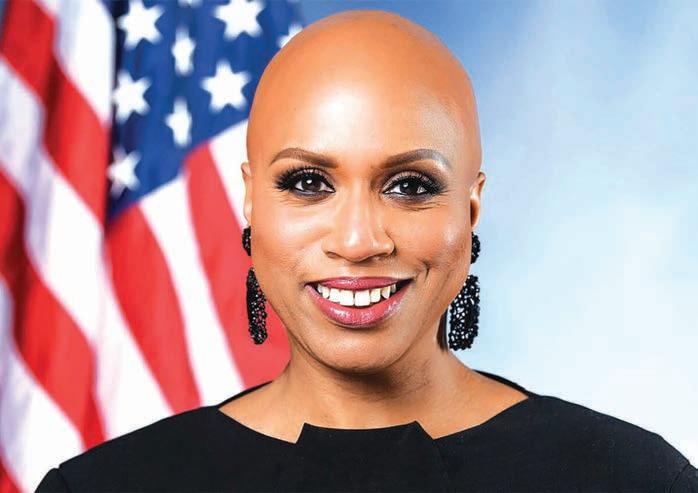
In the letter, Pressley underscores what she describes as a global escalation in criminalization and violence against LGBTQ people, noting that one-third of countries still criminalize consensual same-sex sexual relationships and that 12 countries impose the death penalty. She argues that these conditions make LGBTQ travelers, diplomats, and aid workers particularly vulnerable, and calls on the State Department to reassert U.S. leadership in defending human rights abroad.
“Every person deserves to live authentically, yet several countries are violating international human rights laws that protect LGBTQI+ individuals,” she said. “One-third of countries around the world criminalize same-sex consensual acts between adults, and 12 countries allow LGBTQI+ people to be executed for being themselves.”
She also invokes the role the U.S. has played in promoting democratic values internationally, arguing that LGBTQ rights should remain central to that mission.
“Historically, the United States has played a critical diplomatic role in promoting democracy and freedom for all individuals, including LGBTQI+ persons. The U.S. should be a world leader promoting human rights domestically and globally.”
In a separate statement included in the letter, Pressley emphasized both the moral and national security implications of the issue, warning that rising anti-LGBTQ laws abroad are endangering lives and require a coordinated U.S. response.
“Every person deserves to show up as their true, authentic selves here in the United States and in countries across the globe — and that includes our LGBTQI+ community members,” she said.
“However, we are witnessing a deeply concerning rise in human rights violations and criminalization of LGBTQI+ individuals in other countries, endangering the lives of civilians and U.S. citizens. It is incumbent upon the United States to protect our LGBTQI+ siblings at home and abroad not only for our national security but for the safety and freedom of LGBTQI+ people everywhere.”
The letter goes on to press the State Department for concrete action, including a public reaffirmation of U.S. commitments to LGBTQ human rights, the restoration of LGBTQ analysis in annual country reports, and clearer guidance for Americans traveling abroad. It also seeks clarity on whether the department is tracking cases of U.S. citizens detained or harmed under anti-LGBTQ laws and what proactive steps are being taken to warn and protect LGBTQ travelers.
While she is not a member of the Foreign Affairs Committee, Pressley remains highly active in international affairs and global policy.
While the letter focuses on current policy, it also lands in the broader context of Secretary of State Marco Rubio’s long anti-LGBTQ record. Rubio, a former senator from Florida, has consistently opposed same-sex marriage, calling the federal Respect for Marriage Act, which he voted against, a “ stupid waste of time.” He has also expressed support for efforts to overturn Obergefell v. Hodges, the U.S. Supreme Court decision that legalized same-sex marriage nationwide.
During his time in the U.S. Senate and as a Florida political leader, Rubio has a long anti-LGBTQ track record. He defended state policies that LGBTQ advocates say target queer and transgender people, including Florida’s Parental Rights in Education law — commonly known by critics as “ Don’t Say Gay” or “ Don’t Say Trans” — which restricts classroom discussion of sexual orientation and gender identity.
He has also drawn criticism for his voting record, including a 0/100 score from the Human Rights Campaign’s Congressional Scorecard, reflecting opposition to expanding federal civil rights protections for LGBTQ people and for opposing adoption rights for same-sex couples
Now serving as secretary of state, Rubio has overseen changes at the State Department that LGBTQ advocates say have reduced visibility and protections for transgender people, including the removal of trans-specific references from parts of the department’s public-facing materials and travel guidance. He has also been linked to broader restructuring efforts involving U.S. foreign assistance programs, including the U.S. Agency for International Development, which has historically supported global HIV prevention and LGBTQ rights initiatives in regions such as sub-Saharan Africa , Central Asia, and Latin America.
Those cuts and shifts, critics argue, have weakened programs like PEPFAR — credited with saving millions of lives worldwide — and reduced U.S. support for LGBTQ communities facing persecution abroad. The program is credited with saving at least 25 million lives
Pressley’s own record stands in contrast, with a 100/100 on HRC’s Congressional Scorecard and a long history of legislative and advocacy work centered on LGBTQ equality. In recent years, she has secured federal funding for The Pryde , an affordable housing development for LGBTQ seniors in Boston, and has repeatedly pushed for expanded civil rights protections, including support for the Equality Act and the Equal Rights Amendment.
She has also advanced policy efforts aimed at LGBTQ survivors of violence, trans, and nonbinary individuals navigating credit and legal systems, and broader protections under housing and civil rights law — framing her work as part of a sustained effort to ensure LGBTQ people are included in federal policy at every level.




















































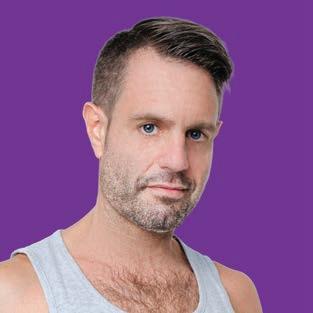



Photo: Erik Kvalsvik
is a D.C.-based museum worker and public historian.
D.C. queer faith leaders commit to exist, resist, persist
Pride Interfaith Service features remembrances, celebration
Last month, Center Faith hosted the 43rd annual Pride Interfaith Service titled “In Faith We Exist. Resist. Persist!” at St. Mark’s Episcopal Church in Washington, D.C. Amid torrential downpours, queer leaders and people of faith from Muslim, Catholic, Episcopalisn, Unitarian Universalist, Jewish, Pagan, and many other communities gathered in a church immediately behind the John Adams building.
In the two-hour service, leaders spoke about the power of faith in the fight for LGBTQ rights and against Chrisitan nationalism, all while honoring three lifelong leaders in the D.C. LGBTQ interfaith community.
The service began with Rev. Michelle Morgan welcoming everyone to St. Mark’s Episocal Church, followed by greetings from Robert Sanchez, representing The DC LGBTQ+ Community Center, Japer Bowles, representing the D.C. Mayor’s Office of LGBTQ Affairs, and Danielle Goldstone, representing the Interfaith Council of Metro Washington.
Rev. Ebony Peace, a United Universalist community minister and one of the service organizers, welcomed everyone with a blessing:
“Today in this interfaith worship service, we celebrate our existence. We honor those past and present who resist oppression. We acknowledge today that the fight for freedom and dignity is not over. We will be here. We will not be silent, and we will not back down.”
Representatives from diverse faith traditions followed by creating and blessing the space with a libation ritual by Rev. Elder Dr. Akosua McCray from Unity Fellowship Church of Washington, DC, a recognition and grounding in the elements by David Dashifen Kees from The Firefly House, along with readings from Aura Kaiser (DC Queer Muslims), Daisaku Leslie (Sokka Gakkai International), and Jonah Richmond and Rachel Dubin from Jewish temples throughout the Washington, DC area.
Rev. Cathy Alexander and her partner Dr. Carla Sherrell shared an offering on love, an interpretation of 1 Corinthians 13 and a contemporary meditation by Rev. Tess Baumberger on behalf of the Metropolitan Community Church in DC, followed by words of joy by Rev. Thomas Wieczorek from the National Catholic Church and silent meditation led by Joe Izzo from the Friends Meeting of Washington.
After songs and responsorial affirmations, Bishop Mariann Budde, who is perhaps best known for delivering the homily at the January 2025 interfaith prayer service immediately following Donald Trump’s second presidential inauguration, spoke at the service. In her gentle but determined voice that reverberated throughout the space, she asserted that “I’m here tonight to affirm the unshakable goodness of each person here and of every person, and to say without equivocation that what needs to be resisted by each and everyone one of us is anything that would negate that goodness, that would cause any of us to feel less than worthy of love and belonging.”
She was followed by a beautiful call and response song led by Cantor Ze’evi Tovlev from Temple Shalom titled “The Birds Don’t Know.” As Cantor Tovlev sang the words “I will sing a song of mourning, I will transform and let go,” this service shifted to recognizing--as it had when Elder Akosua McCray led the libation ritual, all the queer and trans elders who have gone before us, including one of the honorees this evening: SaVanna Wanzer who passed away in April of this year.
SaVanna Wanzer was one of the original founders of DC Trans Pride and DC Black Trans Pride. As one of the first leaders creating transgender programming at DC Black Pride, she fought to represent and celebrate her lived experiences, and as a Black trans woman living with HIV, she regularly volunteered for DC’s Whiteman-Walker Health clinic and became the first recipient of its Robert Fenner Urquhart Award recognizing her service. What many people do not know is that Wanzer was an active member and ordained Deacon at Westminster Presbyterian Church, which hosted the first Transpride event in Washington, DC.
At this year’s service, she was honored by Rev. Danielle Dufoe, a Presbyterian minister who is the first Black trans woman to complete both divinity and seminary school, who called the fierce advocate and friend both “mother” and “champion.”
“We need folks like SaVanna, and we need folks like Jesus,” Dufoe said, “who says no man takes my life but I lay it down for the sake of salvation. And SaVanna is saying no man took my life. I laid it down for beloved community.”
Following a remembering of Wanzer’s life, Rev. Dr. Wallace Charles Smith recognized Bishop Cheeks, affectionately known as “Rainey,” is a native Washingtonian who founded Inner Light Ministries in Washington, DC in 1993. Before his time as an ordained minister, he was the lead coordinator for the famous DC “Clubhouse,” where the LGBTQ+ community found both social and spiritual refuge in a space that was totally drug and alcohol free. Continuing the spirit of the “Clubhouse,” he founded Us Helping Us, an organization supporting African Americans who live with HIV/AIDS that fought shame and stigma inside and outside of the LGBTQ+ community.
CONTINUES AT WASHINGTONBLADE.COM
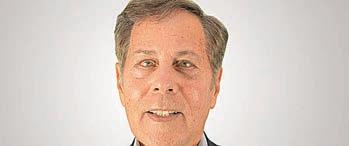
PETER ROSENSTEIN
is a longtime LGBTQ rights and Democratic Party activist. He writes regularly for the Blade.
There’s some overlap but also major policy differences
I recognize people come to their opinion of the Democratic Socialists of America Party, a party different from the Democratic Party, usually based on their own backgrounds.
I am a progressive Democrat. A first generation American; gay, and Jewish. My parents were refugees from Hitler, my mother from Austria, my father from Germany. My father’s parents were killed in Auschwitz. I have spent a lifetime working for civil rights, women’s rights, disability rights, and since I came out at the age of 34, LGBTQ rights. I was a union member when I taught school in Harlem. I worked for one of the most progressive members of Congress, Bella S. Abzug (D-N.Y.). Bella understood how to move forward the progressive issues she worked on. She won the right for women to get their own credit cards, without their husband’s signature. She is responsible for the curb cuts we see on every corner. She was the first to break the highway trust fund for mass transit. She fought against the Vietnam War, and to impeach Nixon. She introduced the first Equality Act for the LGBTQ community. She was named a whip by Tip O’Neill in her third term in Congress, not because she gave up her fight for progressive causes, but rather because she could get things done. She understood what compromise meant, and used it to move forward the progressive issues she fought for.
So, people must understand, members of the Democratic Socialists of America (DSA), are their own party, they are not automatically part of the Democratic Party. They have their own platform, different from the Democratic Party platform in many ways. Yes, the two overlap in many areas. But the differences are clear.
DSA was founded in 1982 from a merger of the Democratic Socialist Organizing Committee (DSOC), and the New American Movement (NAM). The merger was seen as a symbolic healing of the rift between the Old Left, represented by DSOC’s social democrats and trade unionists, and the New Left, represented by NAM’s activists who emerged from the social movements of the 1960s. Initially led by Michael Harrington, the DSA continued DSOC’s strategy of “realignment” by working within the Democratic Party to push it to the left, functioning as a small advocacy group for its first three decades. After the 2016 presidential campaign of Sen. Bernie Sanders, a self-identified democratic socialist, and independent, never a Democrat, and the election of Donald Trump, the organization’s membership swelled from about 6,000 members in 2015 to 100,000 in 2026. This growth gave DSA a much younger and more activist base, which shifted its strategy toward one centered on building an independent political force. DSA’s platform calls for reforms such as a Green New Deal, single-payer healthcare, and tuition-free higher education, with a long-term aim of social ownership and democratic control of the American economy. They support defunding the police. DSA’s foreign policy is non-interventionist, strongly supporting spending cuts and footprint reductions to the U.S. military while also supporting pro-Palestinian and anti-Zionist causes. That includes the abolishment of the State of Israel from the ‘river to the sea.’
As a progressive Democrat, I support universal healthcare, and have since Hillary Clinton introduced it to Congress when she was first lady in 1993. I support expanding Medicare, ensuring the solvency of the Social Security System, and making housing, childcare, and education, affordable for everyone. As a Democrat all my life, I supported Democrats who believe in the same things.
This may enrage many, but in my opinion one of the biggest mistakes the Democratic Party made was allowing independent, Democratic Socialist Bernie Sanders, to run in their presidential primary in 2016. When they did, they shared their voter lists, and enabled Sanders to get a foothold in the party without actually being a Democrat. He ended up screwing Hillary Clinton’s chances to be president. He attacked her throughout the entire primary, and even after she secured the nomination, he kept attacking, and wouldn’t endorse her for 30 days. When he finally did, he traveled the country, in essence pretending he was campaigning for her, when in actuality he was building his own brand, and writing his book. So yes, the independent, Democratic Socialist, Bernie Sanders, who has accomplished nothing in a 40-year congressional career, carries a lot of responsibility for helping to elect Donald Trump.
Today we have Mamdani, mayor of New York, who proudly calls himself a Democratic Socialist of America. He is a charismatic leader, and helped a number of Democratic Socialist candidates in New York win their primaries. One who he endorsed for the state Senate in Queens, is Democratic Socialist Aber Kawas. She is the one who said the United States brought the 9/11 terror attacks on itself, believing we asked for and are responsible for the nearly 3,000 people killed.

By MATT MINTON


(Editor’s note: This essay is from the Blade’s glossy magazine ‘Queering America 250.’ Copies are available around the city and online.)
As America turns 250 this year, what better time to look back on the defining LGBTQ pop culture moments in our country’s history? Here are our picks for 40 of the top pop culture moments along with a few honorable mentions. In today’s volatile political climate, these selections are a reminder of the power that comes with fair representation in the films, shows, and music we consume every day. As with all such lists, these choices are subjective but offer a good overview of our community’s progress.
• “Moonlight” wins Best Picture — after the wrong movie is announced
When Barry Jenkins’s acclaimed indie “Moonlight” won the 2017 Best Picture Oscar (in a famous fiasco in which “La La Land”was accidentally named the winner), it was a landmark moment for Black and queer cinema, and stories told on a personal, intimate scale. At just $1.5 million, the film reportedly had the lowest budget of any Best Picture winner in history.
• “Angels in America”premieres on Broadway and wins Pulitzer Prize
Tony Kushner’s “Angels in America: Millennium Approaches”premiered on Broadway in 1993, going on to win the Tony for Best Play alongside three other awards; the second part, “Perestroika,” opened in fall 1993 to similar acclaim. The show explored AIDS during the Reagan era and remains one of the most ambitious theater productions in Broadway history.
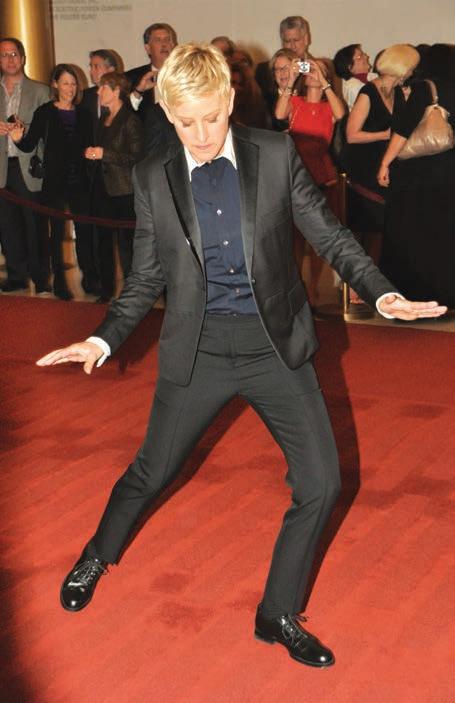
• Ellen comes out on TV
Although Ellen DeGeneres has unfortunately tainted her legacy after allegations of harassment on the set of “The Ellen DeGeneres Show,” she made LGBTQ history in 1997 after coming out as gay on her sitcom “Ellen,” and on the cover of Time magazine. In that famous “Ellen”episode, DeGeneres told Laura Dern, “Susan, I’m gay!”
• “All in the Family”makes history by featuring gay character in 1971
One of the most successful American sitcoms, “All in the Family,”made history by featuring a gay character in the Season 1 episode “Judging Books by Covers,” which debuted in 1971. The episode featured a character named Steve (Phil Carey) who explains that he is gay, much to the shock of the lead character Archie (Carroll O’Connor), one of Steve’s old football friends.
• “Roseanne”sparks outrage after airing “Don’t Ask, Don’t Tell” episode
In Season 6, “Roseanne”aired an episode that featured a same-sex kiss between Roseanne (played by Roseanne Barr) and Sharon (played by Mariel Hemingway), prompting outrage from ABC, the network airing the show. (Read more about this history through the Blade’s interview with “Roseanne”writer Stan Zimmerman.)
• “Dawson’s Creek”becomes first primetime show to feature gay kiss
In Season 3, “Dawson’s Creek”became the first primetime network show to include a gay kiss. The episode featured characters Jack (played by Kerr Smith) and Ethan (played by Adam Kaufman) sharing a passionate on-screen moment. The show’s creator, Greg Berlanti, is out and proud himself, and helped usher in a new era of LGBTQ representation on teen-centered shows.
• The smash hit that is “Heated Rivalry”
Talk about an unexpected hit. One of the more recent entries on this list, the Canadian show “Heated Rivalry,” was adapted from a novel by Rachel Reid and became an overnight sensation after releasing on Crave and HBO Max at the end of 2025. The show’s leads, Connor Storrie and Hudson Williams, instantly became stars to watch at every awards season event.
• “Schitt’s Creek”sweeps the Emmys for final season
“Schitt’s Creek”had gone unrecognized at the Emmys, but pulled off a clean sweep with nine wins for its sixth and final season. The moment was made all the more impactful since that season happened to finish airing during the pandemic — seeing Dan Levy, Eugene Levy, Catherine O’Hara and Annie Murphy all take home awards was a true feelgood moment for a show celebrating queer love.
• Pop divas penning queer anthems
Many pop divas have paid tribute to their gay fans, everyone from Diana Ross to Taylor Swift. Lady Gaga’s “Born This Way” was released in 2011 and debuted at #1 on the Billboard 200. Rolling Stone named it the most inspirational LGBT song of all time in 2023. In 1997-1998, two divas released iconic hit songs: Cher with “Believe” and Janet Jackson with “Together Again,” a No. 1 hit that paid joyful tribute to her friends who died of AIDS. More recently, Chappell Roan became one of the 21st century’s defining artists with the release of her solo album, “The Rise and Fall of a Midwest Princess,” in 2023. The album included multiple catchy hits, including the smash “Pink Pony Club.”
• “Will & Grace” starts airing
“Will & Grace”started airing in 1998 and brought a gay lawyer’s (played by Eric McCormack) romantic and personal journey into millions of households. The show ran on NBC for eight seasons and also starred Debra Messing, Sean Hayes, and queer icon Megan Mullally.
• Michaela Rodriguez wins Golden Globe for “Pose”
For her work as Blanca Evangelista in Ryan Murphy’s “Pose,” Michaela Rodriguez made history as the first trans person to win a Golden Globe. While the 2022 ceremony was private that year, Rodriguez took to Instagram to celebrate the gravity of the moment: “This is for the LGBTQAI, Black, Latina, Asian, the many multi beautiful colors of the rainbow around the freaking world. This not just for me, this is for y’all.”
• Alex Newell and J. Harrison Ghee make Tony Awards history
In 2023, Alex Newell and J. Harrison Ghee made Tony Awards history after becoming the first nonbinary actors to win competitive awards. Ghee won Lead Actor in a Musical for their performance in “Some Like it Hot,” while Newell won Featured Actor in a Musical for their work in “Shucked.”
• New Queer Cinema
In the ‘90s, notable filmmakers like Todd Haynes, Gregg Araki, and Tom Kalin were part of the blossoming New Queer Movement, coined by B. Ruby Rich in the Village Voice. These films challenged traditional norms and paved the way for a new manner of imagining queer bodies on camera.
• “Paris is Burning” debuts in 1990
In 1990, Jennie Livingston’s groundbreaking documentary “Paris is Burning”brought audiences right into New York City’s drag ball scene, featuring queens Dorian Corey, Pepper LaBeija, Willi Ninja, Octavia Saint Laurent and Venus Xtravaganza. The film would later inspire the creation of “Pose”and is considered one of the most essential queer documentaries ever made.
• “But I’m a Cheerleader” becomes a cult classic
The term “cult classic” gets overused now — “But I’m a Cheerleader”is a true example of one. Although the film was under appreciated by critics when it debuted in 1999, queer movie fans have since embraced its campy tone, which was ahead of its time. The cast included Natasha Lyonne, Clea DuVall, Melanie Lynskey and, of course, RuPaul.
• “Common Threads: Stories from the Quilt” wins documentary Oscar
In 1990, “Common Threads: Stories from the Quilt” won the Oscar for Best Documentary. Directed by Jeffrey Friedman and Rob Epstein, the film told the story of the NAMES Project AIDS Memorial Quilt and how it honored the lives lost to HIV/AIDS. The film even recently screened at the Academy Museum and continues to leave an impact.
• Caitlyn Jenner comes out as trans
For those not in the LGBTQ community, Caitlyn Jenner was likely one of the first trans people they saw come out publicly. Jenner graced the cover of Vanity Fair after coming out in 2015, capturing the world’s attention, although the former Olympic gold medalist’s legacy has become more complicated in recent years after supporting bans on trans people in sports.
• James Ivory wins Oscar for writing “Call Me by Your Name”
At 89, James Ivory became the oldest Oscar winner in 2018 when he took home the Best Adapted Screenplay
Oscar for penning “Call Me by Your Name,” the acclaimed adaptation of André Aciman’s novel that starred Timothée Chalamet and Armie Hammer. Ivory previously wrote the 1987 queer classic “Maurice.” It was a big night for “Call Me by Your Name”at the 2018 Oscars as, in addition to the film’s adapted screenplay win, Sufjan Stevens performed his nominated song “Mystery of Love”in a tender, heartbreaking performance. That year, the song was up against “Remember Me”from “Coco”(which won) and “This is Me” from “The Greatest Showman.”
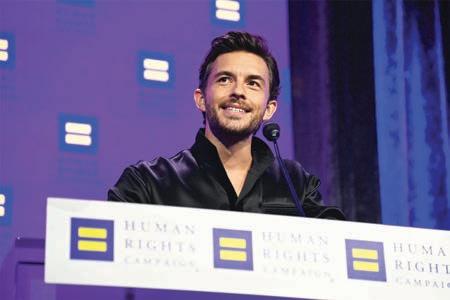
• Jonathan Bailey makes history as People’s “Sexiest Man Alive”
“Wicked” star Jonathan Bailey made history as the first openly gay man to be chosen as People’s “Sexiest Man Alive” in 2025. “There’s so many people that want to do brilliant stuff who feel like they can’t,” he told the magazine, “and I know the LGBT sector is under immense threat at the moment. So it’s been amazing to meet people who have the expertise and see potential that I could have only dreamed of.”
• RuPaul wins first Emmy for hosting “Drag Race” RuPaul won his first Emmy in 2016 for hosting “RuPaul’s Drag Race,” and continued to dominate that category through 2023. The last two years, Alan Cumming has won the award for “The Traitors, representing a new era of reality TV. Upon winning the award in 2016, RuPaul said backstage, “I really didn’t expect this.”
• Lil Nas X comes out on last day of Pride 2019 Lil Nas X came out on the last day of 2019 Pride, although he humorously tweeted “deadass thought i made it obvious.” The announcement came at a peak in his career after releasing “Old Town Road.” In 2021, his hit single “MONTERO (Call Me By Your Name)” also made waves after the rap-country artist seduced the devil in the memorable music video.
• “Brokeback Mountain” almost completes awards season sweep
Ang Lee’s “Brokeback Mountain”was a landmark queer film and nearly swept the 2006 awards season, winning top awards at the Golden Globes, BAFTAs, Producers Guild and Directors Guild Awards. Despite famously losing Best Picture in a shocking upset to “Crash,” “Brokeback Mountain” is the film that has stood the test of time, and Heath Ledger and Jake Gyllenhaal’s performances remain heartbreaking. Some anonymous voting members of the Academy later told news outlets that they couldn’t vote for a “gay film” for Best Picture.
• Hitchcock’s ‘gay’ films
Iconic filmmaker Alfred Hitchcock made several films with gay subtext. Although audiences and critics may not have realized it at the time, modern audiences have rediscovered films like “Rope” and “Strangers on a Train” for their gay themes.
• Two of TV’s gay firsts in early ‘70s
The 1973 PBS show “An American Family” followed the Loud family, including eldest son Lance, who came out as gay to his family during the show’s run and, thus, became what is widely believed to be the first openly gay “character” on television, as well as the first gay character on an early example of reality television, as ABC reported. Meanwhile, the ABC sitcom “The Corner Bar” featured the first recurring gay character on TV in 1972.
• Netflix reboots “Queer Eye”for the modern era
In 2018, Netflix rebooted the popular Bravo show “Queer Eye for the Straight Guy” for a new generation of fans, bringing together Antoni Porowski, Bobby Berk (later replaced by Jeremiah Brent), Jonathan Van Ness, Karamo Brown and Tan France for weekly makeovers. The reboot was titled simply “Queer Eye” and its final season aired in January 2026.
• Billy Porter makes Emmys history with “Pose”nod In addition to his iconic red carpet looks, Billy Porter is remembered for becoming the first openly gay Black man to
be Emmy-nominated in the Lead Actor in a Drama Series category. He would go on to win this category in 2019, and was nominated the following two years.
• Sean Baker releases “Tangerine”in 2015
Ten years before winning four Oscars for “Anora,” Sean Baker released “Tangerine,” a low-budget film shot entirely on the iPhone 5S. The two trans stars were Mya Taylor and Kitana Kiki Rodriquez, who were new to acting; Baker cast the two after meeting them at the Los Angeles LGBTQ Center.
• “30 Something” depicts two men in bed
On Nov. 7, 1989, ABC hit show “30 Something” created a firestorm of controversy when it aired an episode featuring two male characters, Russell and Peter, in bed just after having sex. They did not touch on camera but the outrage led some advertisers to pull out of the episode and ABC did not rebroadcast it.
Madonna brings vogueing into the mainstream
Pop icon Madonna has been a queer ally since the 1980s, standing up to everyone from the pope to the Boy Scouts. But she reached peak gay on 1990’s “Vogue,” which brought ballroom culture into the mainstream. Madonna later brought vogueing to the most unlikely place: the Super Bowl during her 2012 halftime performance. Her film “Truth or Dare” brought her mostly gay and out backup dancers to mainstream cineplexes across the world.
• Kim Petras wins a Grammy
In 2023, musician Kim Petras became the first openly trans person to win a Grammy.
• “LA Law” airs same-sex kiss
In 1991, hit show “LA Law” aired a kiss between two women — lesbian CJ Lamb (Amanda Donohoe) and lawyer Abby Perkins (Michele Greene). Advertiser boycotts ensued. The scene is blamed for a rise in shows airing “lesbian kiss episodes” to boost ratings.
Elton John comes out
Elton John has been a ubiquitous presence in popular music since the 1970s. He came out as bisexual in a 1976 Rolling Stone interview and later as gay in 1992. He went on to marry his partner, David Furnish. Elton John is regarded as an iconic and leading figure in the LGBTQ movement, raising hundreds of millions of dollars for AIDS research via his Elton John AIDS Foundation.
Laverne Cox makes history
Laverne Cox, breakout star of “Orange Is the New Black,” became the first transgender person ever to be featured on the front cover of Time magazine in 2014. She later made more history after becoming the first out trans person to score an Emmy nomination.
• The enduring popularity of camp
Gay audiences have always embraced camp and this list would be incomplete without acknowledging perhaps the four greatest camp classic films of all time: “The Wizard of Oz” (1939), “What Ever Happened to Baby Jane” (1962), “The Rocky Horror Picture Show” (1975), and “Mommie Dearest” (1981). “Oz” brought us Judy Garland and hence the expression “friend of Dorothy.” “Baby Jane” was, of course, best known for its pairing of feuding divas Joan Crawford and Bette Davis. Tim Curry’s portrayal of FrankN-Furter in “Rocky” remains iconic 50 years later and was recently rebooted for Broadway with Luke Evans wearing the bustier. And Faye Dunaway’s career may not have recovered but her over-the-top performance in “Dearest” caused us all to reconsider wire hangers. (Honorable mentions: “Sunset Boulevard,” “All About Eve.”)
• Drag balls of the 19th century
Drag culture has its origins in ancient Greek theater, when women were barred from acting, forcing men to play female roles. The first documented drag balls in America were held in the 1860s in Harlem. William Dorsey Swann, a former slave, became the first known figure to use the term “queen of drag,” hosting balls in D.C. in the late 19th century.
• “Billy Elliot”nabs 10 Tony Awards
In 2009, it was “Billy Elliot” all night at the Tony Awards, taking home 10 trophies including for Best Musical and Best Actor (which David Alvarez, Trent Kowalik and Kiril Kulish shared). The musical was adapted from the 2000 film directed by Stephen Daldry, which itself was adapted from a 1999 play titled “Dancer” by Lee Hall.
Androgynous pop stars challenge gender norms
Modern pop stars often flaunt gender norms but it wasn’t always safe to do so. Three stars who did it best were David Bowie, Boy George, and k.d. Lang. Bowie famously came out as bisexual and performed in androgynous costumes in the 1970s. Boy George’s breakout hit “Do You Really Want to Hurt Me” in 1982 upended audience expectations of a male pop singer. And Lang, who came out in 1992 as a lesbian, challenged norms, perhaps most memorably on the cover of Vanity Fair with Cindy Crawford in 1993.
• Newer queer-themed movies hit and miss at box office
Adapted from the 2015 book “Simon vs. the Homo Sapiens Agenda,” the 2018 film “Love, Simon” brought a young high schooler’s coming out story to the big screen. The film managed to gross $66.7 million worldwide on a $17 million budget, and led to the spin-off show “Love, Victor,” which ran for three seasons. In 2023, Casey McQuiston’s hit novel “Red, White & Royal Blue”was turned into an Amazon original movie starring Nicholas Galitzine, Taylor Zakhar Perez and Uma Thurman. The film received solid reviews and was the #1 movie on Prime Video’s platform upon release, drawing more subscribers to the platform. At the other end of the spectrum, “Bros” became the first R-rated gay romcom to be released by a major studio, Universal Pictures. While the film was not a box office hit, it helped pave the way for more studio films positioning openly queer actors as romcom material, and it made a huge splash when it premiered at the Toronto International Film Festival.
• Oscar’s biggest queer winners
John Schlesinger won Best Director for Midnight Cowboy in 1970. Sir John Gielgud is recognized as the first openly gay actor to win an Oscar for 1982’s “Arthur.” Howard Ashman won for Best Original Song (“Under the Sea” and “Beauty and the Beast”) in 1990 and 1992 respectively. Elton John won Best Original Song for “Can You Feel the Love Tonight” from “The Lion King” in 1995. Alan Ball won Best Original Screenplay for “American Beauty” in 2000. And Dustin Lance Black won Best Original Screenplay for “Milk” in 2009.
• Little Richard comes out, goes back in Little Richard was a leading pioneer of rock ’n roll, bursting into national prominence with his 1955 hit song “Tutti Frutti.” “I’m not gay now but I was gay all my life,” he once told David Letterman. Richard acknowledged being gay but later said he wanted to “overcome it,” citing his religious beliefs.
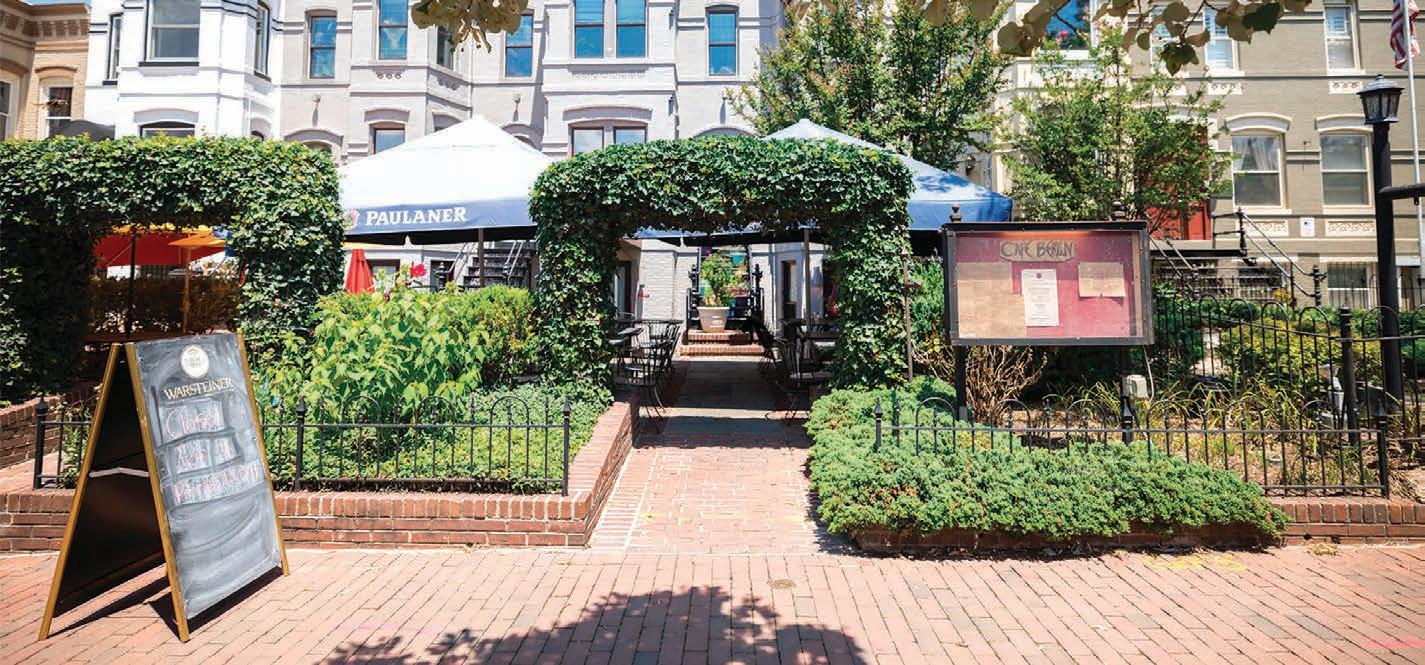
Toast the season with authentic German fare, cold biers, and our intimate biergarten. Closed July 4TH — so join us before or after the fireworks.
SUNDAY, WEDNESDAY & THURSDAY: 2-10PM | FRIDAY - SATURDAY: 2-11PM | CLOSED MONDAYS & TUESDAYS
By JOHN PAUL KING
When one watches movies for a living, it’s as easy to fall into routine as it is with any job. Each movie is different, of course, each with its own characters, its own viewpoint, and its own story – (or at least its own variation on one), but in so many other ways, they have a tendency to be very much the same.
This is because there is an entire “language” of filmmaking, established from the earliest days of cinematic storytelling, a process so subtle that most of us are barely aware of it: the image directs our attention, the script provides the shape and structure of the story, and the actors are our stand-ins, allowing us to “experience” the reality of the film through a transference of identity that occurs so reflexively that we don’t even notice it’s happened.
That’s why it can be such a jolt when we come across a movie that doesn’t follow the expected rules, and we can’t think of a better recent example than Avalon Fast’s “Camp,” which drew attention as it made the rounds at last year’s festival circuit and embarked on a series of screenings in select cities beginning on June 26.
Fast, 26, is a queer Canadian filmmaker who specializes in “Girl Horror” (a genre that centers female experience), and who has already become a prominent force in the “new queer indie” movement. Her first feature, “Honeycomb,” got a Sundance “virtual” screening, and she’s appeared as a performer in films like Alice Maio Mackay’s “The Serpent’s Skin” and leading trans filmmaker Jane Schoenbrun’s yet-to-bereleased Cannes hit, “Teenage Sex and Death at Camp Miasma.” With “Camp,” however, she stakes her claim to territory in a burgeoning field of queer/trans/feminist cinema to
BOOKS
establish herself as a formidable “brand” of her own.

Rooted in a blend of trope-ish horror conventions and presented in a dreamy, ethereal style that elevates feeling over cognition, it’s the story of Emily (Zola Grimmer), a young woman accidentally responsible for two horrific tragedies, who feels hopelessly trapped by guilt and shame. At the suggestion of her father (Mike Tan), she takes a summer job as a counselor at a camp for “troubled” young people like herself, where she is quickly embraced and assimilated by the core group of female counselors – most of them “hot weirdos” who are more interested in all-night partying and a kind of home-grown witchcraft than they are in the wholesome camp activities they supervise during the day. Her initial response to this new environment is guarded, but as the summer goes on she comes to feel a strong connection to her fellow counselors, beginning to hope that she has – at last – found her place among a “family” that accepts her despite the life-shattering incidents that have come to define her sense of self. Yet at the same time, she becomes ever more aware of a call to confront and quiet the ghosts of her misfortunate past – even if it requires an unthinkable sacrifice. Dreamy and purposefully opaque when it comes to differentiating between real experience and metaphysical reflection, Fast’s movie draws us in from the start with its edgy mix
Cox’s memoir recounts horrific abuse as a
By TERRI SCHLICHENMEYER
OK, let’s just say it: You’re tired of lies.
They come from above, behind, from either shoulder. They’re repeated, laid out in a line, told as if they’re true but they’re not. You wish people would stop lying to you. As in the new memoir “Transcendent” by Laverne Cox, you wish you could tell the truth about yourself.
Sissy.
If the bullies in the neighborhood weren’t constantly calling Laverne Cox that name, then Cox’s mother was. “Sissy,” was just one word, though; the others were worse. The boys would say those things while they beat Cox, when they could catch her. Her mother screamed at her gentle child who didn’t like “boy” activities.
Even at eight years old, says Cox, “I was a prim and proper lady.”
Despite the verbal abuse about her perceived feminine behavior and a furtive, failed attempt at conversion therapy, Cox’s mother sent her and her brother to the Alabama School of Fine Arts, where Cox learned to dance. It was a lifeline for her, and the talent gained there helped Cox get into college in Indiana. From there, Cox expected to find fame and fortune in New York City.
And yet, the abuse she suffered as a child held Cox back, and the words “There is something wrong with me” became a daily mantra.
“I didn’t know how to say it.” Cox says. “I’m a girl.” There were therapy sessions to get to that point, as Cox
learned the language and skills needed to speak the truth. Landing a sense of style helped, as did her brother’s support, a handful of friends, and happy, scent-infused memories of her mother’s make-up table.
At each step, Cox says, “I was expressing myself, I was also allowing myself to edge closer to my girlhood.”
Let’s start here: “Transcendent” is a difficult read – not for style, but for substance.
From her earliest memory of being sexually abused as a toddler; to verbal and physical abuse from many sources; to what, judging by photo captions, seems perhaps like forgiveness, author Laverne Cox glosses over nothing. Be ready, in other words, for pages and pages of memories that, like a roller-coaster, will make you cringe and want to hide your eyes, although doing so would be a mistake.
As this book progresses, Cox’s story does, too. We see a child who knows a truth but has no words for it. The child becomes a teen with a bursting sense of self, then a young adult who craves love as she’s stretching her wings. By the time Cox advances to writing about her career and the abuse is (mostly) over, readers will breathe a well-deserved sigh of relief. Whew, you’ve winced through a harrowing tale to reach a satisfying but not complete update.
Fans of Cox’s work will want “Transcendent,” as will anyone who’s transitioned, is thinking about it, or loves someone who has. It’s a rough read, but a necessary one, then, and that’s no lie.
of visual atmosphere, blending an aesthetic that combines home-movie nostalgia with the ironically whimsical flourishes of the digital age to establish a tone that feels like a half-forgotten memory reconstructed in the form of an Instagram “reel.” It’s a potent effect, creating an overall aesthetic of surreal impressionism in which the plot advances more through mood and fragments of subjective experience than through concrete narrative form; at times, it feels untethered, yes, but it always manages to orchestrate its seemingly disjointed perspective into a shape that makes sense — even if we’re not quite sure how or why, or even what is actually happening.
The effect is cumulative, as the story becomes less bound to logic and realism while leaning further into a perspective that favors the arcane and mysterious over the rational and concrete. And while that might prove frustrating for viewers expecting a more traditional kind of “horror,” it provides for an experience that’s more likely to satisfy the kind of fans who appreciate being left to provide their own interpretations. The most obvious comparison would be with the work of David Lynch; there’s clearly an influence there for Fast’s darkly intuitive approach, which goes beyond the obvious parallels of its “Twin Peaks”-ish setting (the forest is most definitely a character here) to emulate the stream-of-consciousness narrative flow that marked much of Lynch’s late-career work.
“Camp” is far from imitative, however. While it may share some traits with the work of Lynch and other masters of contemporary surreal horror, it creates a unique “vibe” by allowing its own creative feminine energy to take the lead.
CONTINUES AT WASHINGTONBLADE.COM
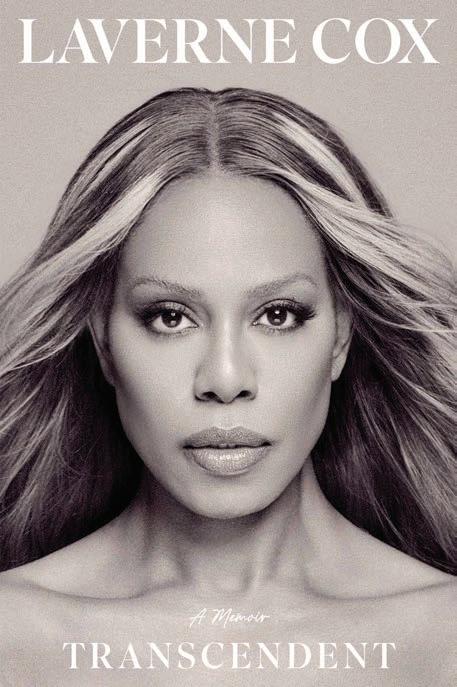
‘Transcendent: A Memoir’ By Laverne Cox | c.2026, Gallery Books | $30 | 238 pages

Maryland city holds LGBTQ celebration
(Washington
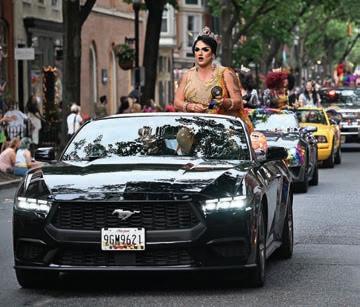
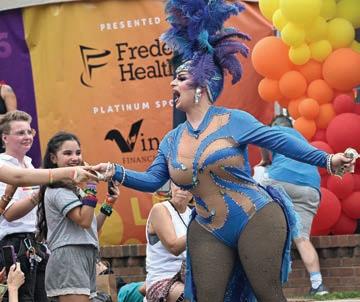

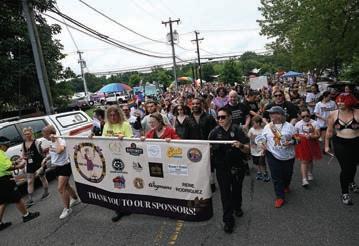
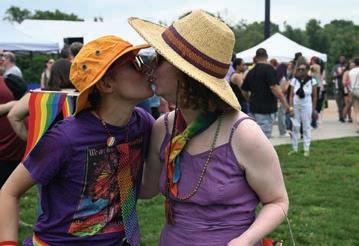
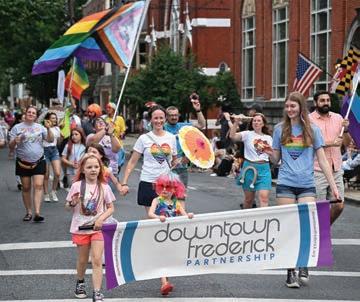
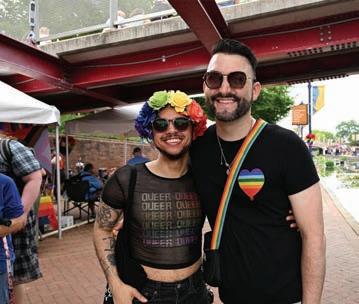
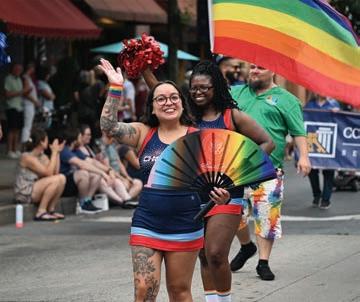
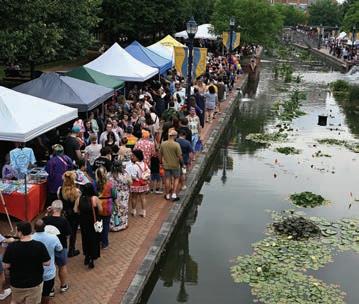
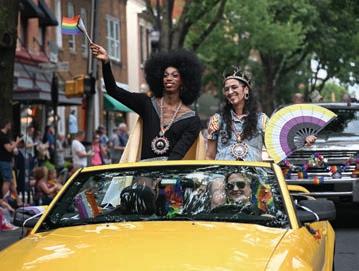
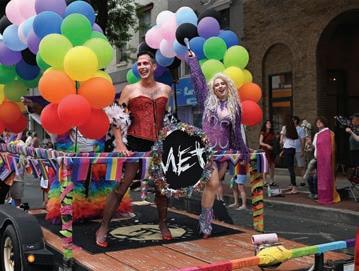
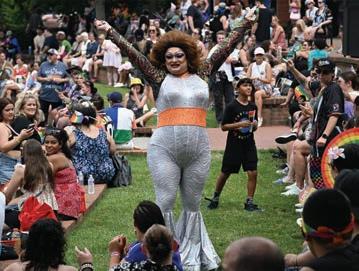
LGBTQ celebration held in historic Virginia town
(Washington Blade photos by Michael Key)
The sixth annual Fredericksburg Pride March was held in downtown Fredericksburg, Va. on Saturday, June 27. Stafford County Board of Supervisors Chair Deuntay Diggs led the march. The Fredericksburg Pride Festival took place at Riverfront Park after the march. Bree Fram was the featured speaker.
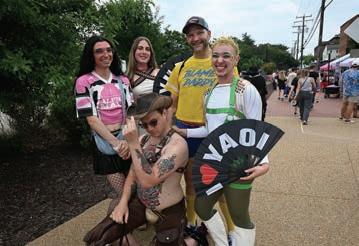
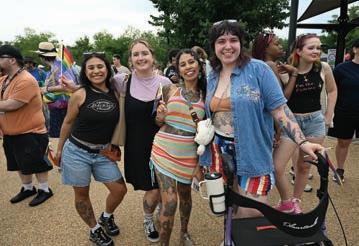
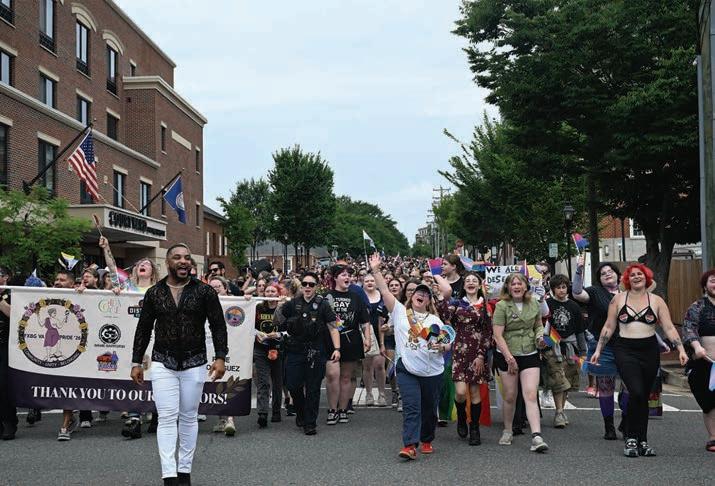
‘My
By PATRICK FOLLIARD
Discernment. It’s a thing some people have, explains playwright Aurin Squire, especially when you’re gay or Black in America (Squire is both).
“You instinctively know when the mob is teaming up for the best interests of the powers that be. You can feel it in the air.”
In his sharp new satire “My Favorite Sociopath,” Squire writes about life experiences but set in a different time and place: It’s the 1990s, early days of the 24-hour news cycle, and three ambitious journalism students are pursuing success in D.C.
And now, Squire’s play, along with other new works, are making their world premieres at the annual Contemporary American Theater Festival (CATF) at Shepherd University in historic, queer-friendly Shepherdstown, W.Va. (just a 90-minute drive from D.C.).
“All of my plays are queer in some way,” says Squire, 46. “This one touches on harmless and dangerous lies. The characters are on the spectrum sexually, and it’s interesting how all that falls out.”
And he’s given it a lot of thought.
“Already as a kid, it seemed to me that the rage against rap music and sex was coming from closeted people resisting their own urges and temptations. For me, it was interesting to see a witch hunt led by witches. Queer peo-
ple can always call out a lie.”
Since September, Squire has also been working with a TV show about the tech industry set in Silicon Valley. He says, “It seems the general flow of the tech industry is that humanity and civilization is finished and it’s just about accumulating as many goods as possible before everything collapses. In fact, those who are profiting actually agree. But for those who disagree, they believe the solution is to build bigger gates, but activists believe we can stop this”
Yet, he’s learned from folks associated with the show. “Many say the quickest way to divorce yourself from any responsibility or regulations — smash and grab. Otherwise, you have to stop and think and regulate your desires for greed and power”
Squire possesses a penchant for pithy titles. He laughs, explaining the first thing he wrote as a student at Juilliard was “Obama-ology,” the comedy with contemporary message. While a lot of people liked the name, it didn’t necessarily vibe with the author. He concedes that he chooses names based on “easy to remember” and titles that won’t be easy to lose as a file.
Another is “Defacing Michael Jackson,” a coming-of-age dramedy set in rural Florida in 1984, specifically Squire’s native town
Opa-locka, Miami, a fantastical place famed for its fanciful Moorish revival architecture.
Living in the shadow of exotic structures, he wasn’t particularly fazed. Squire says “It wasn’t until returning to visit after my freshman year at Northwestern University in Chicago that I realized how weird it was: When you grow up in a place, you take surroundings for granted no matter how over the top.”
Now based in New York (where for two happy years, 2017-2019, he shared digs with drag king Murry Hill), Squire returns frequently to Miami to be with family, but this summer has been filled with both work and travel.
Currently, he’s in Shepherdstown with CATF shaping up “My Favorite Sociopath.”
Later this summer he will travel to South Africa for research, followed by a silent writing retreat in Santa Fe, N.M.
Much of Squire’s work reflects the Latino, African, Caribbean, African-American, and Jewish cultures he grew up around in South Florida.
When asked if today’s winds of anti-multiculturalism worry him, he replies, “No, because that’s going to pass. Most people don’t like, people are seeing the negative results of it, and the young people coming up despise it. White male gamers were tricked momentarily through the algorithms into voting
against their own interests and they’re now seeing how it’s not working out for them.
“Conservatives always try to stop progress and eventually they always lose. It’s just a question of where we’ll be in the middle of the end of civilization before that happens. I’d like to hope we can turn the ship around before then.”
In addition to “My Favorite Sociopath,” CATF summer season features three other world premieres (Lisa D’Amour’s comedy “The Smoker,” “Refugee Rhapsody” by Yussef El Guindi, “Best Line Wins: A Play Inspired by the Improvised Lives of Elaine May & Mike Nichols” by Beth Kander) and “¡VOS!” by Christina Pumariega.
CATF runs from July 10-Aug. 2 in three venues on the Shepherd University campus: Frank Center, Marinoff Theater, and Studio 112.
‘My Favorite Sociopath’ Contemporary American Theater Festival July 10-Aug. 2 | Shepherdstown, W.Va. | Catf.org
There are other options if Rehoboth prices are scaring you off
By JUSTIN NOBLE
Look, we love Rehoboth. We will always love Rehoboth. Queer folks have been flocking there since the 1940s, and with scores of LGBTQ-owned businesses and a Pride calendar packed tighter than the boardwalk in July, “Rehomo” earned its crown fair and square.
But let’s be honest with each other: trying to buy property there right now feels a lot like trying to get a reservation at the one good restaurant in town on a Saturday in August. Everyone wants in, inventory is tighter than your swim trunks after Labor Day brunch, and the prices have officially entered “are you kidding me” territory.
So here’s a thought: What if you didn’t fight the crowd? What if, instead, you let Rehoboth keep doing its glorious, chaotic, glitter-bomb thing and you quietly built your beach life 15 minutes away for considerably less drama and considerably more square footage? Here are four towns ready for their close-up.
Lewes: The Charming Overachiever
Lewes is what happens when a beach town actually has its life together. Historic charm, walkability, proximity to Cape Henlopen State Park, less crowding, and a strong year-round
community. Unlike towns that turn into ghost towns after Labor Day, Lewes maintains a real community all year long, which is more than we can say for some situationships.
And right now, the market is practically begging you to make a move. It’s one of the most desirable and stable markets in the county — built for buyers thinking long-term, not flippers, and Sussex County overall has flipped into genuine buyer’s market territory for the first time in years. Translation: you finally get to be the one with leverage.
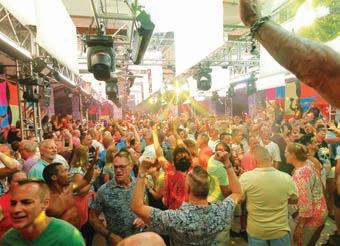
Bethany Beach: My Personal Pick
Full disclosure: I own in Bethany. So consider this section a little biased — and also the most honest thing I’ll tell you in this whole article.
When I drive down from D.C., I’m not looking for more of D.C. I love this city, but I also love leaving it — and yes, some of the people in it too (you know who you are, and so do I).
Bethany gives me that full exhale. It’s quiet in the way that actually means something: fewer crowds, slower mornings, a soundtrack that’s mostly waves instead of nightlife. It leans hard into its “quiet resort” reputation, with low property taxes and a limited geographic footprint, and it is not the least bit sorry about it.
But quiet doesn’t mean isolated. I’ve got a genuinely excellent food scene nearby, real shopping, and a string of charming neighboring beach towns — and when I do want a taste of Rehoboth’s energy, it’s a short, easy drive away. I get to choose my dose of chaos instead of living inside it.
And here’s the part that matters most for this article: the price. If you’ve looked at Rehoboth listings and quietly closed the tab in despair, I need you to hear this — you can ab-
solutely afford a beach house. It just doesn’t have to be in Rehoboth. Bethany’s average home value sits around $848,592, which is still real money, no question — but it buys you more house, more land, and more peace than the same budget gets you closer to the boardwalk. Bethany is welcoming too, just without Rehoboth’s decades of built-in queer institutional history — and for plenty of us, that trade-off is more than worth it.
Fenwick Island: Small Town, Big Flex Fenwick rarely gets mentioned and, frankly, it should be insulted. It’s tiny, it’s quiet, and it has beach access without the carnival energy. The market data tends to lump it in with Bethany, where single-family oceanfront homes clear $1 million while entry-level condos start in the $600s — proof that “under-the-radar” doesn’t mean “bargain bin,” it means “fewer people fighting you for it.”
Justin Noble is a Realtor licensed in D.C., Maryland, and Delaware with Monument Sotheby’s International Realty. Reach him at Justin. noble@sothebysrealty.com or 302-897-7499













FERNANDO’S CLEANING
Residential & Commercial Cleaning, Reasonable Rates, Free Estimates, Routine, 1-Time, Move-In/Move-Out 202-486-6183

COUNSELING FOR LGBTQ
People. Individual/Couples counseling with a volunteer peer counselor. GMCC, serving our community since 1973. 202-580-8861 gaymenscounseling.org No fees. Donation requested.
THANK YOU FOR READING THE BLADE!
ROOMMATE / DC
Capitol Hill NE,14th & F Sts NE. Only a younger male. Share bathroom, kitchen, living space & W/D in the house. $950/month + utils + deposit Call 202-397-7132
RENT / REHOBOTH
REHOBOTH- SMALL 2 BR partly furnished house in quiet wooded area 2 miles from downtown. Wood floors, W/D and central A/C. Monthly rent $1800 + utilities. No Pets 302 226-0303
/ GEORGETOWN STUNNING 1BR + DEN APT

w/ 16’ ceilings - modern kitchen - 1½ half baths - full size washer/dryer-w extra storage in the Den - 1/2 bath off Den. Ensuite elegantly finished in white marble, double sinks, walk-in shower - full wall of custom closets. 1042 SQF. Parking in the alley w easy access through private entrance. Husband & I are a LGBTQ+ Friendly & Affirming Household. No Pets. FIRST MONTH RENT FREE! Email: larskontzDC@gmail.comLars 202-368-9742

LOGAN CIRCLE GRAND DAME STRAIGHT OUT OF THE GILDED AGE,
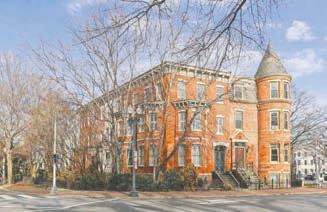
this circa-1890 stately Grand Dame commands a premier position overlooking life on Logan Circle. With two sides of broad bay windows on 3 levels, bathing the home in natural light--each framing beautiful views of the park--and a coveted fenced and private courtyard, you’ll have a front row seat to this historic neighborhood in downtown DC. 6 bedrooms/3 baths and private entry to lower level living. Reduced to $2.1M Andy Alderdice 301.466.5898 andy4homes@gmail.com Long & Foster Real Estate 202-234-4100 Luxury Real Estate SpecialistLicensed in MD, DC & VA Integrity. Experience. Commitment. Local

FOR SALE / DC GRAND VICTORIAN LOOKING FOR A NEW OWNER WITH IMAGINATION AND GUTS!

Detached, elegant, many old world features located in Takoma DC -- one of DC’s prime zip codes. High ceilings, transom windows, original wood floors, large front porch and a huge back yard that could be entertainment central. Off street parking plus a 2-car garage. Farmers Market, MetroBus, MetroRail, restaurants, shopping -- all a short stroll away! Listed for $875,000. Renovated homes in the area valued at $2M and more! Needs YOU to bring it up to its full potential. COME AND SEE FOR YOURSELF!
Takoma Park area. Looking for friends nearby to hang out, dinner, movies, drinks, etc, etc, etc. Bracey611dc@gmail.com
FOR MEN TALL, WHITE, FAIRLY GL
pretty well hung male with a hungry ass, iso tall, white, athletic, well hung alpha male. Eager to ride me. If this fits you, my ass is yrs for the taking. Sincere responses, please text me. I will get back to you. Avail. 24 hrs a day. CALL OR TEXT: 240-457-1292