
— SPECIAL REPORT —
2023/09/06
A WAVERING POLITICAL LANDSCAPE IN SPAIN
KATJA-ELISABETH HERRMANN
The Spanish elections held on the 23rd of July 2023 attracted the attention of many from all across Europe. Less than a year before the European elections, Brussels looked closely at the polls highlighting the fragile balance between The Spanish Socialist Workers‘ Party (PSOE), a centreleft liberal party and the People‘s Party (PP), a centreright conservative party. With Spain holding the rotating presidency of the Council of the European Union until December 2023, the next coalition government may set the tone for decisive topics from climate policy to migration at the European level.
Refreshed perspective
A snap general election was called by the Socialist prime minister Pedro Sánchez after PSOE’s declining performance in the local and regional elections held on May 28. The snap election of July 23rd witnessed a revised posture of the Spanish electorate inciting culture wars rage. Topics such as LGBTQ+, women’s rights and energy took centre stage during the election campaigns, but narratives inciting nationalism, regionalism and anti-migration also dominated public discourse.
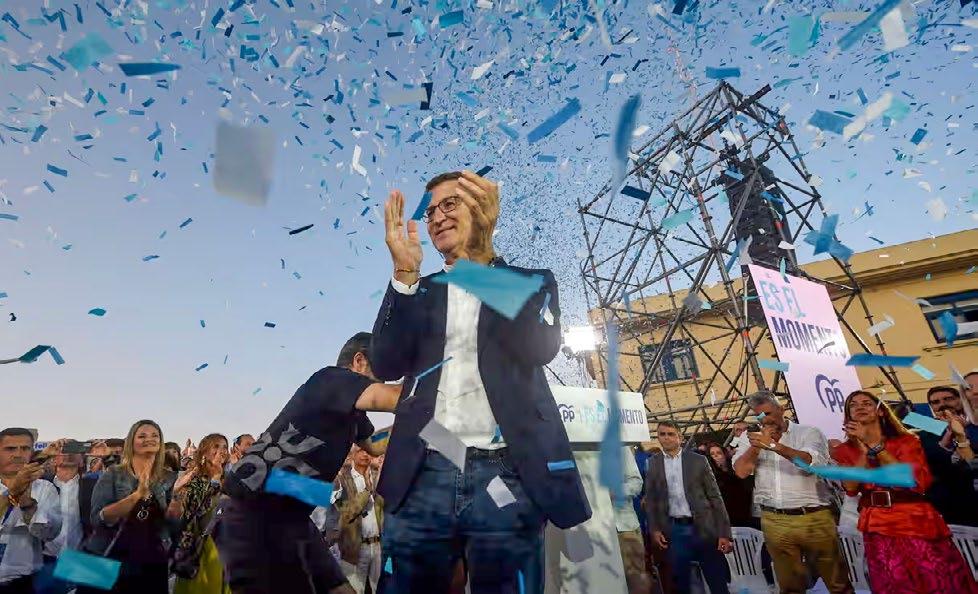
During a cardiac round of vote count late in the evening on Sunday 23rd of July, Spaniards and many observers around Europe witnessed the closing of the election ballots slightly favouring the PP by just a marginal number of votes translating to 33 per cent of the vote against PSOE’s 31.7 per cent of the vote. In a turn of events, the vote cast by citizens abroad became the deciding factor in the final round of Spanish elections. The expat vote count is tallied five days after the in-person vote is held. As a result, Prime Minister Pedro Sánchez (PSOE) lost one of the seats of Parliament to the PP in the constituency of Madrid. The expat vote led the conservative PP, led by
Alberto Núñez Feijóo, to garner 136 seats in Parliament against 126 allocated to the PSOE. This refreshment of the vote count positions the PP in a favourable position to secure a government of coalitions together with Vox and the party of the Canary Islands.
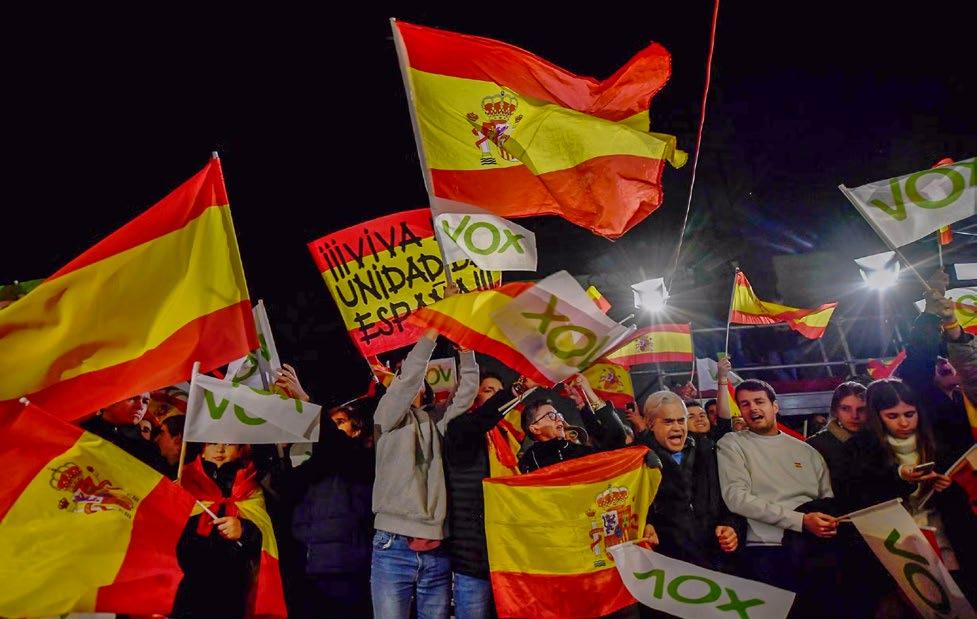
However, against the general expectation of a strong centre-right coalition government between PP and Vox, Spaniards sent an unambiguous message that they don’t want Vox to co-govern alongside the People‘s Party (PP), a far-right conservative party. Founded in 2003 as a spin-off by defecting PP members, Vox’s emerging far-right political front has been widely criticized for its strong stands against migration, LGBTQ+ rights, women‘s rights, and climate change. Naturally, conservatives across Europe watched the July 23rd vote closely, expecting the rise of a Spanish right-conservative government in alignment with far-right tendencies witnessed across Europe. A PP coalition with Vox would most likely see the party’s leader (Vox), Santiago Abascal as his deputy prime minister. However, this scenario is yet to be determined by an agreement set between
2 www.warsawinstitute.org Special Report A WAVERING POLITICAL LANDSCAPE IN SPAIN
Vox and PP later in August.
Against this backdrop, the Spanish electorate‘s choice to cast the majority of their votes for the PSOE is best explained as a ‘vote of strike’. This is not the first time that the ‘vote of strike’ is being cast when the citizenry vote for the ‘least worse’ in an effort to prevent the rise of a political front. In these occurrences, the rationale for the vote does not come from a natural alignment with a party’s political agenda or the proposed reforms, but rather from a rational desire to stop the rise of an undesired coalition. Such political inclinations also approached as pragmatism over principles, can have far-reaching consequences for the stability of the Spanish economy and political order.
A PP-Vox alliance’s failure had been seen on earlier occasions, for example in the Extremadura region of south-west Spain, María Guardiola, who leads the conservative People’s Party (PP) in that region tore into the far-right Vox party for its denial of gender-based violence, its demonisation of migrants and its attacks on the LGBTQ+ community. 1 A week later these statements, Guardiola was sworn in as Extremadura’s president after forming a coalition with Vox. Moreover, the countless efforts of Pablo Casado (former leader of PP), made against Vox were gradually changed as polls shifted in their favour thus, creating a strategic opportunity for a governing coalition between PP and Vox over time. The PP’s shifting attitude toward Vox on numerous occasions not only projected greater uncertainty in the elections but also diminished trust in the electorate who eventually did not know what or for who they were voting for or against.
Moreover, the initial election polls during the months of May and June saw a round of political alienation from both fronts. On the days prior to the elections and on the eve of the elections,
misinformation was also a recurring issue to be wary of as “debunked videos claiming to show election workers stuffing the ballot box circulated widely on Facebook and Twitter” 2 . Despite this, none of the actions were attributed to a particular political party.
The Spanish Socialist Workers‘ Party (PSOE) was not able to achieve the absolute majority (176 votes) either. Thus, the prevailing option was not the preferred choice either, making it harder for the Spanish to celebrate a united government. Thus, a climax of political stagnation lies in the Spanish peninsula waiting for Parliament to reconvene in mid-August. The list of uncertainties is long, as it is the list of possibilities to form a government. However, the probability of a coalition government formed between the PP and the PSOE is less than a realistic estimation. An intensified polarization of the Spanish electorate could naturally become a force of extremes and a clear sign of a changing political landscape in Spain. However, this is not as plain as it seems.
A closer look at the Spanish elections details a strife between two political stands that in an unprecedented ‘falling short’ event must now come to a political agreement in a ‘pact’ with minority parties (usually regional parties). A brief compendium of Spanish electoral history sees the Spanish Socialist Workers‘ Party (PSOE) preference for forming coalition governments with minority parties from around Spain, including the Basque Nationalist Party (PNV), the Galician Nationalist Bloc (BNG), and the Republican Left of Catalonia (ERC), and The Basque delegation (EH Bildu). The latter stands for the recognition of the Basque Country as an independent state. In contrast to the PNV, EH Bildu was founded in 2011 and continues to have strong ties with ETA (‚Basque Homeland and Liberty‘), a Basque separatist organization responsible for several
1. Sam Jones, “How Spain’s conservatives joined forces with far-right Vox” The Guardian (July 21, 2023).
2. Méabh McMahon, Elly Laliberte, and Rina Zhubi, “Brussels, My Love? Why Europe should care about the Spanish elections?” Euronews (July 29, 2023).
3 www.warsawinstitute.org Special Report A WAVERING POLITICAL LANDSCAPE IN SPAIN
domestic terrorist attacks. From the proposed candidates set forth in the elections, 44 EH Bildu candidates have been found guilty of terror-related crimes on its electoral lists for upcoming regional elections in Spain, and 7 of them were convicted of murder. 3 Against this backdrop, “regional movements are poised to make further
gains in Spain’s increasingly fractioned political landscape.” Regional movements are emerging as decisive fronts in Spanish politics, for instance, Teruel Existe without whose support, Prime Minister Pedro Sánchez wouldn’t have been able to form the country’s first coalition government four years ago. 4
Market Effect
Spain is the European Union’s fourth-largest economy, therefore, political uncertainty has a natural say in market fluctuations. Spanish elections and the results presented after the expat vote counts are predicted to bring instability to
the Spanish market. Let alone due to the uncertainty of a coalition government, the country‘s fiscal policy, banks and green energy transition are in focus.
3. Laura Llach, “Spanish elections re-open deep wounds, as ETA terrorists run for political office” Euronews (May 19, 2023).
4. Aitor Hernandez-Morales, “Spanish election: The forgotten regions could decide who wins” POLITICO (July 21, 2023).
4 www.warsawinstitute.org Special Report A WAVERING POLITICAL LANDSCAPE IN SPAIN
AFP
A closer look at market conditions indicates a drop in Spain‘s Ibex (.IBEX) index by as much as 1.8%, with a banking sub-index at one point down nearly 3%. (.IBEXIB). With Spanish shares dropping, investors become more reluctant to inject money into the market. A slowing economy in a post-pandemic era is more likely to become less resilient to economic shocks. With Spanish summers getting drier and hotter, energy has a major electoral voice. The rising energy prices affect mostly end-consumers and larger companies reliant on a steady energy supply.
Looking at the individual proposals, while the PSOE’s energy policy continues to support the closure of nuclear plants by 2027-35, the PP’s posture supports the extension of existing and/ or construction of new power plants. Spanish nuclear energy forms 20.3 per cent of the general
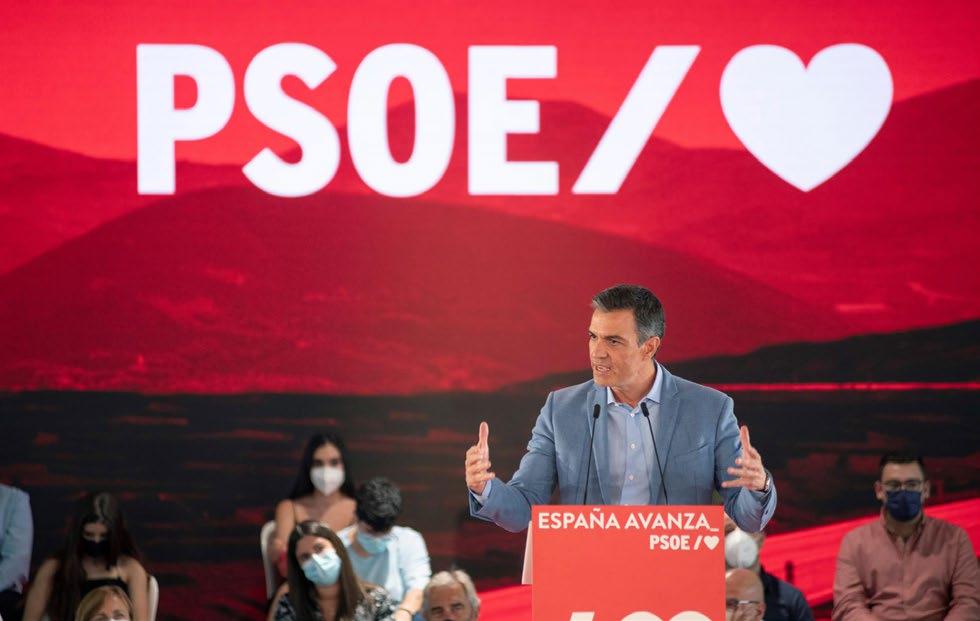
energy mixture of the territory. Thus, any policy concerning nuclear energy must enjoy nationwide support, particularly from major industrial end users such as Acciona Energía, Endesa and Iberdrola.
Moreover, according to reliable outlooks, the Spanish economy will begin to slow down after a rebound of its tourism industry over the summer. Against this backdrop, Spain‘s economy ‘has outperformed that of other eurozone countries over the past year but is still weighed down by structural weaknesses such as high debt, low productivity and a rigid labour market.” 5 A decreasing pattern is likely to continue to grow uncertainty after the coalition agreement set after the Spanish Parliament votes on a new coalition government.
5 www.warsawinstitute.org Special Report A WAVERING POLITICAL LANDSCAPE IN SPAIN
EFE, JOSÉ MANUEL PEDROSA
5. Wouter Thierie, “Spanish elections unlikely to hamper growth outlook” ING (July 12, 2023).
Europe Effect
Spain holds the rotating presidency of the Council of the European Union until December 2023. Just a month in the presidency, the Spanish leadership has pushed forward two out of its four pressing agenda issues including a long-delayed trade deal with South America‘s MERCOSUR bloc and an EU-wide migration deal.
In conjunction with the market effect, the elections and the Spanish presidency will expect the reactivation of EU fiscal rules in 2024, limiting the fiscal space for the next administration and risks of fiscal slippages during the upcoming legislature. 6 In practice, the renewed
fiscal rules will limit or mitigate the risk of a disruptive change in policy or incoming administration.
There is no doubt that the conclusion of Spain’s election will set the tone across the EU ahead of next year’s European Parliament election expected to also be a cardiac event amidst a rising far-right front.
6 www.warsawinstitute.org Special Report A WAVERING POLITICAL LANDSCAPE IN SPAIN
6. Javier Rouillet and Nichola James, “Spanish Elections: Main Implications Under the Most Likely Political Outcomes” DBRS Morningstar (20 June 2023).
MIGUEL RIOPA AFP GETTY IMAGES
Conclusion
Spain suffers from a fragmented electorate that has progressively alienated political opposition from the core values that once glued Spanish society. This is largely because a ‘vote of strike’ has been cast against a governing coalition between PP and Vox, however, it is equally valid to say that the electorate no longer whats the governing coalition of Pedro Sanchez, thus, landing in a political stalemate. Against this backdrop, what we see today is an emerging front of political secession in Catalonia, the Basque country, and Galicia plays once again a decisive role in securing a functioning government of coalitions while rising as a prominent alternative to
the strifes between leftist and rightist.
As the Spanish Parliament reconvenes in mid-August, its first task on its agenda will be to observe the respective proposals from each forming coalition and vote on a new government. A failure to reach a voting consensus for the leading candidates is likely to be resolved during a subsequent round of elections scheduled for December 2023. Without a concealable agreement, a fragmented parliament will signify a tremulous political vacuum - a perfect recipe for the rise of extremism and further polarisation.
Sources Hernandez-Morales Aitor, “Spanish election: The forgotten regions could decide who wins” POLITICO (July 21, 2023).
https://www.politico.eu/article/kingmakersspains-hyperlocal-parties-Vox-sanchez-guitarteteruel/
Jones Sam, “How Spain’s conservatives joined forces with far-right Vox” The Guardian (July 21, 2023). https://www.theguardian.com/world/2023/ jul/21/how-spains-conservatives-joined-forceswith-far-right-Vox
Llach Laura, “Spanish elections re-open deep wounds, as ETA terrorists run for political office” Euronews (May 19, 2023). https://www.euronews. com/2023/05/19/spanish-elections-re-open-deepwounds-as-eta-terrorists-run-for-political-office
Lynch Suzanne and Cristina Gonzalez. “Spanish election aftermath and the watering down of the EU’s anti-SLAPPs law” POLITICO (July 27, 2023). https://www.politico.eu/podcast/spanish-electionaftermath-and-the-watering-down-of-the-eusanti-slapps-law/
McMahon Méabh, Elly Laliberte, and Rina Zhubi, “Brussels, My Love? Why Europe should care about the Spanish elections?” Euronews (July 29, 2023). https://www.euronews.com/myeurope/2023/07/29/brussels-my-love-why-europeshould-care-about-the-spanish-elections
Vinocur Nicholas,“Spanish election puts Europe on edge” POLITICO (July 21, 2023). https:// www.politico.eu/newsletter/brussels-playbook/ spanish-election-puts-europe-on-edge/
7 www.warsawinstitute.org Special Report A WAVERING POLITICAL LANDSCAPE IN SPAIN
Morel Sandrine, “Spanish elections leave Europe wavering between relief and fear of deadlock” Le Monde (July 25, 2023).
https://www.lemonde.fr/en/international/ article/2023/07/25/spanish-elections-leaveeurope-wavering-between-relief-fear-ofdeadlock_6066553_4.html
Thierie Wouter, “Spanish elections unlikely to hamper growth outlook” ING (July 12, 2023).

https://think.ing.com/articles/spain-upcomingelections-present-limited-risks-to-the-growthoutlook/#a1
Rouillet Javier and Nichola James, “Spanish Elections: Main Implications Under the Most Likely Political Outcomes” DBRS Morningstar (20 June 2023). https://www.dbrsmorningstar. com/research/416078/spanish-elections-mainimplications-under-the-most-likely-politicaloutcomes
Author: Katja-Elisabeth Herrmann
Katja-Elisabeth works as a research fellow at the Warsaw Institute. She graduated with an MA in Transatlantic Affairs from the College of Europe (Warsaw, Poland) and the Fletcher School of Law and Diplomacy at Tufts University, cross-registering as a student at the Harvard Kennedy School of Government (Boston, MA). Additionally, Katja-Elisabeth holds a BA in International Relations and International Organizations, which she combined with a degree in International and European Law (LLB) from the University of Groningen.
Her research is mainly devoted to transatlantic security and defense topics, particularly emerging and disruptive technologies. She was recently awarded the Squire Patton Boggs Foundation public policy fellowship in 2022 to conduct research on U.S. domestic politics and the Three Seas Initiative. She is also interested in cybersecurity and crisis management.
She recently presented her research at the Fletcher School on semiconductor technologies’ political and industrial landscape in the U.S. and the EU. She will continue her research, focusing on the challenges and opportunities for military procurement for NATO allies.
8 www.warsawinstitute.org Special Report A WAVERING POLITICAL LANDSCAPE IN SPAIN
The opinions given and the positions held in materials in the Special Report solely reflect the views of authors.
Warsaw Institute
Wilcza St. 9, 00-538 Warsaw, Poland +48 22 417 63 15 office@warsawinstitute.org
COPYRIGHT
©
2023 Warsaw Institute
SFINANSOWANO
PROGRAMU ROZWOJU ORGANIZACJI OBYWATELSKICH PROO1A NA LATA 2018-2030.
ZE ŚRODKÓW NARODOWEGO INSTYTUTU WOLNOŚCI - CENTRUM ROZWOJU SPOŁECZEŃSTWA OBYWATELSKIEGO W RAMACH RZĄDOWEGO
