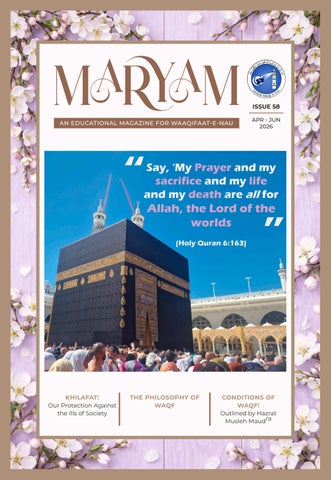
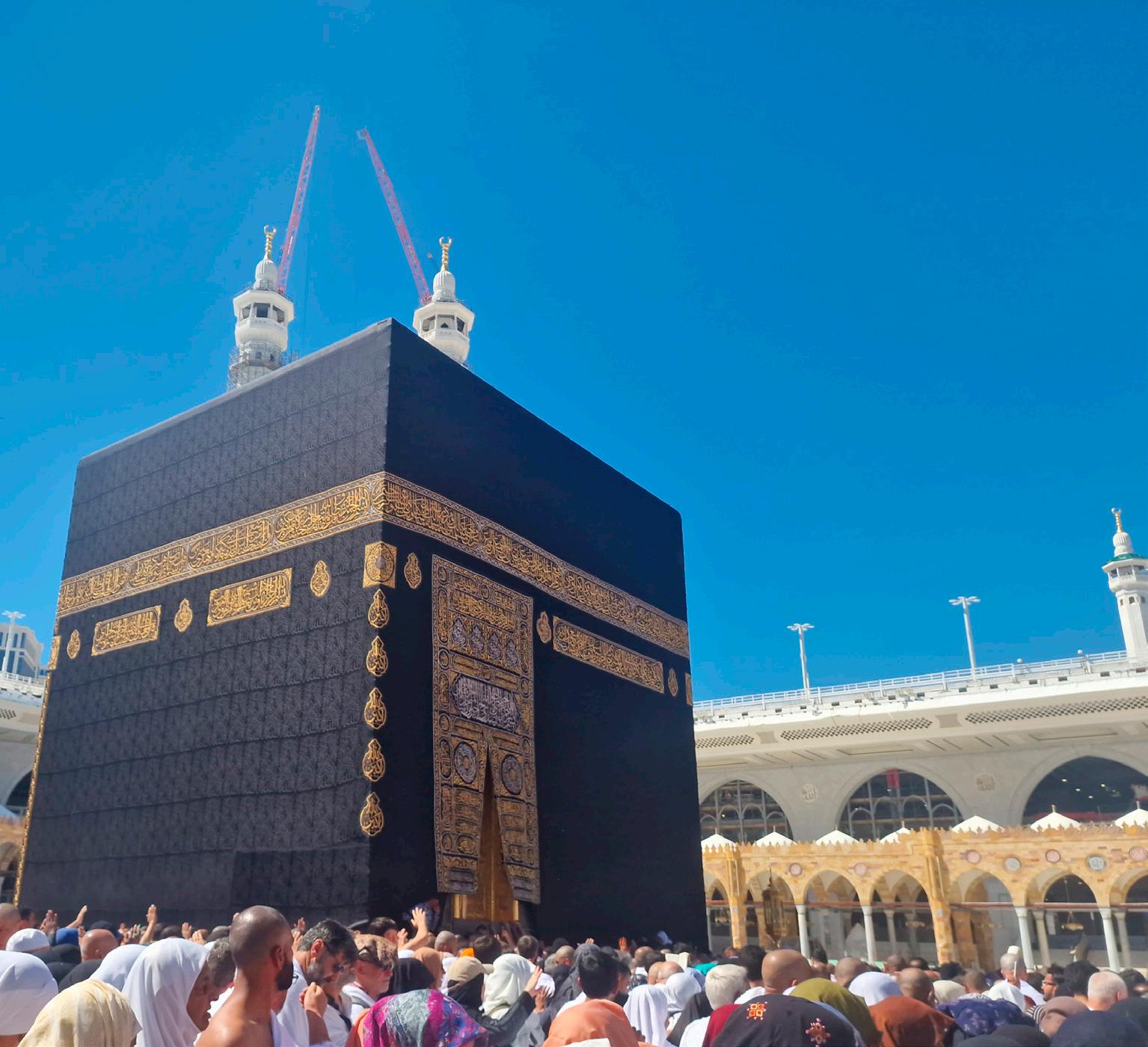
Say, ‘My Prayer and my sacrifice and my life and my death are all for Allah, the Lord of the worlds
Khilafat: Our Protection Against the Ills of Society
(Holy Quran 6:163) “ “
the PhilosoPhy of Waqf
Conditions of Waqf: Outlined by Hazrat Musleh Maudra
“Your pursuit of knowledge shall serve as a resounding answer to those who falsely claim that Islam does not value the education or empowerment of women and girls. Thus, as you progress through school, college, or university, do not have the mindset that your education is merely a means of getting a job or earning money. Rather, Ahmadi students should consider their education as an opportunity and platform to spread the beautiful teachings of Islam through the excellence of their character and the strength of their moral values.”
Hazrat Mirza Masroor Ahmad, Khalifatul Masih Vaba, National Waaqifaat-e-Nau Ijtema UK, 26 April 2025 www.reviewofreligions.org/46708/becoming-a-beacon-of-light/ https://www.alhakam.org/scottish-waqifaat/
from the editor
Imagine a group of people who are lost in a forest, surrounded by many dangers, with multiple paths before them, but only one leading to safety. Unable to agree on a path, they argue, remaining trapped and lost. This is a depiction of life without Khilafat. Khilafat is the guiding light that provides unity and direction. It is a blessing we are ever grateful to have in our lives.
Hazrat Mirza Masroor Ahmad, Khalifatul Masih Vaba has explained that Khilafat is not a mere symbol; it is a living, guiding leadership that provides a unifying system – team, structure, and direction – for the entire Jama’at. This is clearly visible in the Ahmadiyya Muslim Jama’at today: it is spread across more than 200 countries yet remains united under one banner and one Khilafat. (Mulaqat with AMWSA and members of the National Lajna Amila, Canada - Taken from a summary prepared by Al-Hakam, www.alhakam.org/students-from-amwsa-canada-19october-2025)
In his Friday Sermon on 30th May 2025, beloved Hazooraba said:
“We must remain frmly attached to Khilafat and be prepared to make every sacrifce for the establishment and support of the system of Khilafat. If we continue to do so, then we will remain connected to Khilafat until the Day of Judgement; our future generations will also remain attached to it, and they will continue to receive its countless blessings.”
May Allah enable Waaqifaat-e-Nau to be at the forefront of making those sacrifces, so they become exemplary servants of Khalifatul Masih, Ameen.
In this edition of Maryam Magazine, readers can enjoy insightful articles written by Waaqifaat-e-Nau, such as ‘Khilafat: Our Protection Against the Ills of Society’, ‘The Philosophy of Waqf’, ‘Understanding Women’s Health’, and ‘Waqf in the Field: A Journey of Waqf, Guidance Growth’.
Hina Ahmedi
ENGLISH EDITOR
Do you have any comments, suggestions or want your article featured in our next edition?
Email us at: chiefeditor@maryammagazine.org
meet the team
CHIEF EDITOR
Zanubia Ahmad
ASSISTANT CHIEF EDITORS
Dure Jamal Mala
Nayla Muzamil
ENGLISH EDITOR
Hina Ahmedi
ENGLISH SUB-EDITOR
Hamooda Arif
EDITORIAL BOARD
Sabah Un Noor Tahir
Hibba-Tul Mussawir
Maleeha Mansur
Meliha Hayat
Salma Manahil Malik
Tahmeena Shamim Tahir
Mashel Chaudhry
Samina Yasmeen Arif
Amatul Wakeel Maha
Sameera Mirza
Kashifa Qamar
Safna Nabeel Maham
COVER DESIGN
Wardah Burhan
PAGE DESIGN & SETTING
Soumbal Qureshi
Atiyya Wasee
Hina Farooqi
Zara Tahir Ahmad
Wardah Burhan
Printed Under The Central Waqf-E-Nau Department
MANAGER
Luqman Ahmad Kishwar
PRINTERS
Warner Midlands
APRIL - JUNE 2026 | ISSUE 58
03. The Holy Qur’an
04. Hadith
05. Writings of the Promised Messiahas
06. Tarbiyyat Page: Mastering Restraint – Turning to Prayers Amid Social Media Provocation
09. A Prayer that Must Precede the Recitation of the Holy Qur’an
10. The Philosophy of Waqf | Tooba Khokar
14. Khilafat: Our Protection Against the Ills of Society | Adeeba Hadi
21. The Grace of God | Quote by Hazrat Khalifatul Masih Ira
22. Waaqifaat-e-Nau Express Their Love for Beloved Hazooraba | Handwritten Notes by Waaqifaat-e-Nau 7 Years and Under
24. Kids’ Spread
31. Story: The Bundle of Sticks
32. Conditions of Waqf Outlined by Hazrat Musleh Maudra | Touba Khurshid
38. “…Deep in My Heart Lies Love and Affection for All.” | Quote by Hazrat Khalifatul Masih IIIrh
39. “Allah the Almighty Always Accepted My Prayer.” | Quote by Hazrat Khalifatul Masih IIIrh
40. How Khilafat is a Shield Against the Challenges and Ills of Society ersonal e ections by Waaqifaat-e-Nau
45. Poem: Allah is the Creator of All | Muneefa Ahmad
46. Comic Strip: Writing Letters to Hazrat Khalifatul Masihaba
50. Understanding Women’s Health | Laiba Malik
54. “With Every Letter I Receive, I Pray There and Then…” | Quote by Hazrat Khalifatul Masih Vaba
56. Waqf in the Field: A Journey of Waqf, Guidance and Growth | Alia Huda Saqib
62. Book Recommendation: Obey the Khulafa with True Sincerity | By Hazrat Mirza Bashir-Ud-Din Mahmud Ahmad, Khalifatul Masih IIra
The Holy Qur’an
(Al-An`am: 163-164)
Translation: Say, ‘My Prayer and my sacrifice and my life and my death are all for Allah, the Lord of the worlds. ‘He has no partner. And so am I commanded, and I am the first of those who submit.’
(English translation by Hazrat Maulvi Sher Ali sahibra)
Hadith
(Sayings of The Holy Prophet)
(May Peace and Blessings of Allah be upon Him)
THE SWEETNESS OF FAITH
TRANSLATION:
Hazrat Anasra narrated that the Prophetsaw said: “There are three qualities which are such that one who has them tastes the sweetness of faith: [1] that Allah and His Messenger are dearer to him than anything besides them; [2] that when he loves someone, he loves him purely for the sake of Allah; [3] that he loathes reverting to disbelief as much as he abhors being hurled into fire.”
Writings of the Promised Messiahas
THE PURPOSE OF ISLAM IS TO PRODUCE MANY AN ABRAHAM
“The purpose of Islam is to produce many an Abraham. Hence, each and every one of you ought to strive to become Abrahamas. I truthfully proclaim before you that you must not worship saints, become a saint yourself; do not worship spiritual guides, become a spiritual guide yourself.
Come forth on these avenues. No doubt, they are narrow pathways but when a person treads these paths, they are blessed with comfort and tranquillity. However, one must enter
through this gate lightened of all their burdens. Those who carry large baggage over their heads will be faced with difficulty. If you wish to pass, you must throw away the baggage of your worldly attachments and of giving precedence to the world over religion. If our community wishes to please God, it ought to discard this weight. You must definitely bear in mind that if you are bereft of loyalty and sincerity, you will be judged a liar and cannot be deemed righteous in the presence of God Almighty. If this is the case, those who abandon the way of loyalty and follow a course of treachery will be destroyed even before their enemies. God can neither be deceived Himself, nor can anyone else deceive Him. Therefore, it is necessary for you to inculcate true purity and sincerity.”
Malfuzat - Volume IV, p.260, Hazrat Mirza Ghulam Ahmad, the Promised Messiah and Mahdias
MASTERING RESTRAINT:
Turning
to Prayers
Amid Social Media Provocation
“It is not our job to use inappropriate language”
• Taking advantage of social media, opponents of today use extremely foul language against the Ahmadiyya Muslim Jama’at. They spew lies and filth against the Promised Messiahas, which injure the sentiments of Ahmadis when they hear them.
• Then, in retaliation, some Ahmadis respond to them in a wrongful manner. Though they may be well-intentioned, they end up using such language that can be taken in the wrong sense.
• It is not our job to use inappropriate language or to respond in a manner where we inadvertently use language that can become the means of degrading anyone in any way, which the opponents can then take advantage of and go on to say that – God forbid – we dishonour the Holy Prophetsaw or his companions.
“Every Ahmadi should avoid saying anything that creates a wrong impression or has the potential to leave a wrong impression in any way”
• Some Ahmadis think they have exhibited great honour by giving a particular response – this is their response upon asking them.
• However, this so-called honour is, in fact, ignorance.
• If an Ahmadi says such things that can be taken to mean the wrong thing in any way, then they are actually becoming a means for defaming the Promised Messiahas and the Jama’at.
Tarbiyyat points taken from the Friday Sermon delivered by Hazrat Mirza Masroor Ahmad, Khalifatul Masih Vaba on 6 June, 2025
“YOU MUST REMAIN PATIENT AND ALWAYS EXHIBIT PATIENCE”
• The Promised Messiahas states, “You must remain patient and always exhibit patience.”
• The Promised Messiahas says: “They can issue edicts of disbelief, file false cases, and concoct different types of false accusations and slander; they can exert all their efforts against me, and they will witness who the ultimate decision will be in favour of.”
“THEY MAY TRY WHATEVER THEY PLEASE, BUT ALLAH THE ALMIGHTY IS WITH THE PROMISED MESSIAHAS, AND
SO THEY SHALL WITNESS WHO WILL ULTIMATELY PREVAIL”
• The Promised Messiahas states: “If I were to start caring about their cursing, then it would take away from the task which God has entrusted to me. Therefore, while I do not care for their abusive language, I advise my Community that it would behove them to hear their curses and endure them, and under no circumstances should they respond to cursing with cursing, because that eliminates blessings. They should exhibit examples of patience and forbearance and demonstrate their high morals.” (Malfuzat, 1984, Vol. 3, p. 180)
“IF THEY WANT TO SEARCH FOR ANSWERS, THEN THEY SHOULD CONSULT THE SCHOLARS OF THE JAMA’AT”
• If they (Ahmadis) want to search for answers, then they should consult the scholars of the Jama’at, those who possess an in-depth knowledge of the literature of the Jama’at, and the responses given should be powerful, and they should emphatically refute the allegations being raised.
“YOU MUST ACT ACCORDING TO THE TEACHINGS OF THE PROMISED MESSIAHAS, WHICH IN REALITY ARE THE TRUE TEACHINGS OF ISLAM”
• Otherwise, whilst being a part of the Jama’at, you will be defaming it.
• May Allah the Almighty save us from the evil of the mischievous and also grant sense to those who display their false “honour” and at times become the means of spreading disorder and restlessness because of the language they use.
INSTEAD OF RESPONDING ON SOCIAL MEDIA, PROSTRATE BEFORE ALLAH
• Instead of responding on social media, if we were to prostrate before Allah the Almighty, offer our prayers with absolute devotion and sincerity, and develop such pain in our prostrations that swiftly stirs the honour of Allah the Almighty, then we will quickly attain much better results than what these people seek to attain by giving responses.
“OUR MORALS MUST BE OF THE HIGHEST AND LOFTIEST STANDARDS”
• Those who do not have lofty morals do not honour their pledge of allegiance to the Promised Messiahas
• Therefore, we must analyse ourselves; everyone should assess themselves and ponder and instead of giving inappropriate responses, focus on prayers.
May Allah the Almighty enable all of us to do so and turn the opponents’ evil back onto them and protect us against them. [Ameen]
Link to Friday Sermon:
A Prayer that Must Precede the Recitation of the Qur’an
Muslims are bidden always to begin the reading of the Holy Book with a short prayer, soliciting God’s protection against Satan. God says in 16:99: When thou recitest the Qur’an, seek refuge with Allah from Satan, the rejected.
Here, refuge or protection implies:
1
2
3 that no evil should befall us that no good should escape us that after we have attained goodness, we may not relapse into evil
Thus, by seeking the protection of God while reciting the Qur’an we pray, frstly, that we may not miss any teaching of the Qur’an through weakness or negligence or in consequence of our sins, or under the infuence of evil company; secondly, that we may not fail to correctly understand it any teaching of the Qur’an; thirdly, that, having understood it, we may not relapse into ignorance.
The prescribed words for the prayer are:
“I seek refuge with Allah from Satan, the rejected”,
which must precede every recitation of the Qur’an.
The Holy Qur’an with English Translation and Commentary, Hazrat Mirza Bashir-ud-Deen Mahmood Ahmadra, Vol. 1, Chapter 1 – Al Fatihah, pp.3-4 new.alislam.org/library/books/quran-english-fve-volume-1
THE PHILOSOPHY of Waqf
Tooba Khokhar
Love is an essential part of the human experience. It gives us a sense of direction, and an object to attain. In our search for our polestar, we devote ourselves to many things. There was a time when the most elaborate temples would be built in Mesopotamia and Greece to worship those considered to have become divine in a practice known as apotheosis. And in our ‘secular’ age (or so we like to think), these ancient rituals and rites find continuity in the cult of celebrity we see around us.
There are many today who would make idols of others or pledge their troths to the glamour of the world as they pursue wealth and status. However, these practices are destructive and decaying to the human spirit within us. They bring about only restlessness and discomfort, because something that is itself temporary cannot bring lasting comfort. In his sermon on Waqfe Nau delivered on the 28th of October 2016, beloved HazoorMay Allah be his Helper noted that:
“Frequently today, dramas [TV programs] have become idols, as has the internet and pursuits of this world. In other instances, desires [have become idols]. Then, [the Promised Messiahas] states that a person is not even aware that he is worshipping idols while he is doing so within the depths of his being.”1
We must be cautious about what we devote our time, attention, and energy to. It is easy to fall into meaningless pursuits that cannot bring any real fulfilment. And although we can sometimes be absorbed with trivial things, our hearts and souls are nevertheless invested with a knowledge of beauty, truth, and goodness. If our hearts are pure, they will always be drawn to their Creator and seek the comfort they know lies only with Him. In fact, the Promised Messiahas describes this realisation of the heart as the first step towards true spiritual devotion:
“The work of the heart begins when a person becomes devoted to God. At such a time, all the inner faculties and authorities of man cease to exist, and the rule of the heart gains a power and strength. It is then that a human being may be deemed complete. It is this very state in which a human being becomes an embodiment of the verse:
‘I have breathed into him of My Spirit’ (Al-Hijr 15:30).”2
However, how can we attain this connection with the Divine? If we consider that our hearts are devoted to Him, how can we make our actions testament to this devotion? Naturally, where there is passion so must there be action. The Promised Messiahas gives us a clear set of instructions in this regard:
“God Almighty states in the Holy Qur’an:
This means, ‘those who strive in Our path - We guide them in Our ways.’ (Al-Ankabut 29:70). Therefore, engage in spiritual effort on the path of God, being wholly devoted to Him, so that His ways may be opened to you, and so that you may tread these pathways and attain the pleasure that is found in God.”3
Therefore, it is our duty to strive in the path of God by doing what would please Him. In Chapter 6, verses 163-165 of the Holy Qur’an, our Noble Prophetsaw was taught a beautiful prayer about devotion to God:
Say, ‘My Prayer and my sacrifice and my life and my death are all for Allah, the Lord of the worlds.
‘He has no partner. And so am I commanded, and I am the first of those who submit.’
Say, ‘Shall I seek a lord other than Allah, while He is the Lord of all things?’…
This brief prayer captures the essence of human endeavour, that its true orientation should be towards Allah. It lays out its reasoning in the most beautiful and logical way: why would we choose to give ourselves to anyone other than Allah when He is the Master of all? Whatever it is that we seek, everything is abundant in His Divine Treasury. If we desire peace, beauty, love, fortune- where else can we obtain them other than the Lord of all things? However, these verses also give a blueprint to attaining that connection with Allah: giving our devotion to Him.
The Promised Messiahas explains that this devotion should be one of complete dedication to our Lord:
One is taught to become so completely annihilated in God that one becomes imbued in the hue that is characterised by the words: ليــتبت
- ‘Devote thyself to Him with full devotion’ (Al-Muzzammil 73:9).4
The question of God and religion is a timeless one that absorbs many people who walk through this earth. Interestingly, The Times did a survey earlier this year that found that members of Gen Z were less likely to identify as atheists than their middle-aged parents and more likely to consider themselves spiritual.5 Recent studies have also found that religiosity and spirituality can promote wellbeing and have a positive impact on mental health.6
However, it is only Islam that provides a complete set of practices that include prayer, worship, fasting as well as a moral framework for beautifying our conduct and establishing a connection with the Divine. Within the Islamic faith, Waqifaat-e-Nau have additional blessings beyond this too: we have a clearly defined purpose as members of a scheme that was initiated to make us devotees of God.
The Promised Messiahas emphasised that: “One is taught to give precedence to God Almighty over all else. These are the objectives that one must seek to achieve.”7 It is this love of God that our parents exhibited when they devoted us as Waqf, and it is this devotion that we must carry when we choose to renew our pledge.
The philosophy of Waqf is simple, it is leading a life that is defined by devotion to God. In practical terms, this means increasing our religious knowledge, developing our characters, and remaining faithful to the institution of Khilafat.
It also involves striving to realise our own potentials, by refining our talents and skills so that they can be put to use for a noble cause. In his sermon on Waqfe Nau, beloved Hazooraba explained:
Waqifeen-e-Nau should improve not only their level of sacrifice but also their standards of worship, loyalty, and dedication. In order to fulfil their pledge and the pledge of their parents, they should utilise all of their talents and abilities—they should strive for the sake of faith and its loftiness. Only then Allah, the Almighty, blesses [these efforts] and Allah does not leave anyone without reward.8
This is our jihad as Waaqifaat-e-Nau, to strive to follow the instructions laid out by beloved Hazooraba. And as Hazrat Mirza Tahir Ahmad, Khalifatul Masih IVrh who founded the scheme of Waqfe Nau, so beautifully described in a sermon he delivered on the 3rd of April 1987 in which he launched the scheme: “‘jihad’ does not mean only the jihad with the sword. According to the Holy Qur’an, every effort that is made in search of the Beloved is jihad.”9
There are many who are in search of the Beloved, however there are few who have the privilege of devotion in this practical way. And indeed, it is incumbent upon us to gather what blessings we can through it.
As the Promised Messiahas described:
The fact, however, is that when a person devotes himself entirely to Him, He finally has to manifest His Hidden Being. This is the mystery disclosed by this hadith:
[I was a hidden treasure, and I willed to be recognised.]10
Waqf is a path through which we can devote ourselves and gather many blessings in return. However, we must not lose sight of the fact that devotion to the Beloved is the greatest blessing. It should be our prayer as Waaqifaate-Nau that we are able to offer this devotion with sincere hearts, so that it becomes a means for us to draw closer to our Creator.
Hazrat Mirza Masroor Ahmad, The Essence of Waqf-e-Nau, p. 13
Hazrat Mirza Ghulam Ahmad, Malfuzat Vol II, p. 121
Hazrat Mirza Ghulam Ahmad, Malfuzat Vol III, p. 199
Hazrat Mirza Masroor Ahmad, The Essence of Waqf-e-Nau, p. 11
Hazrat Mirza Tahir Ahmad, Sermons on Waqf-e-nau, p. 6
Hazrat Mirza Ghulam Ahmad, Malfuzat Vol VII, p. 320-1
Khilafat: Our Protection Against the Ills of Society
BY ADEE BA H A Di
Worldly leaders are often focused on gaining wealth and material possessions, indulging in the pleasures that society has to offer. Many pursue power for personal beneft rather than for the well-being of the people they lead. Rarely do such leaders truly care for their people or sincerely aim to protect them from the path of self-destruction. In contrast, the concept of Khilafat presents a different model of leadership -one based on moral responsibility, service to humanity, and the protection of society from moral and social ills.
The Promised Messiahas appeared at a time when materialism was rapidly spreading across the world, faith was weakening, and Islam was facing intense criticism and opposition from many directions. In this critical era, the Promised Messiahas was sent to restore the spiritual essence of Islam and guide humanity back towards righteousness. He sought to protect humanity from the moral and spiritual decline of society, showing us a path that shields us from the ills of injustice, hatred, and immorality prevalent in society.
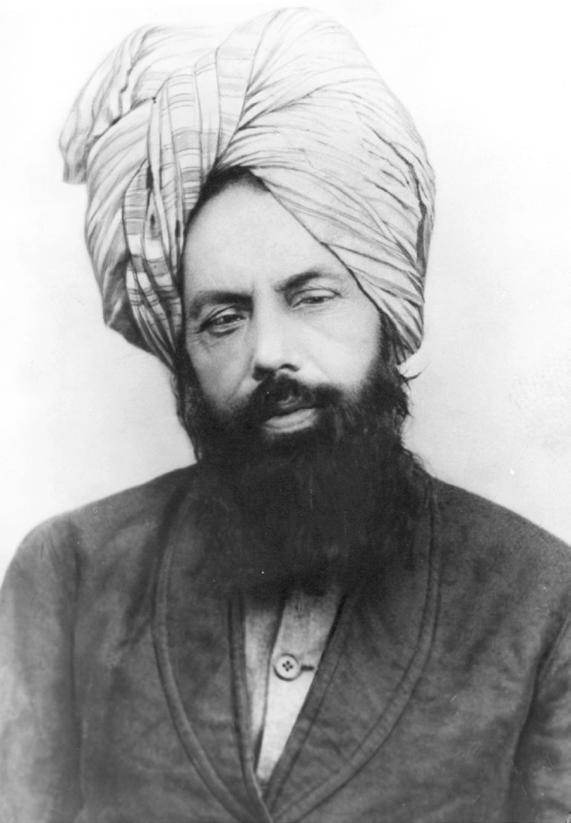
The Promised Messiahas states: “I am the citadel of security for this age. He who enters therein will be secure against thieves and robbers and wild beasts. He who seeks to remain away from my walls will be confronted with death from every direction, and even his dead body will not be saved. Who is it who enters my citadel? Only he who discards vice and adopts goodness, and gives up crookedness and treads along the path of truth, and frees himself from the bondage of Satan and becomes an obedient servant of Allah the Almighty.” 1
These words serve as a reminder that tr e sec rity in an age flle with moral confusion lies in turning towards righteousness and obedience to God, which can only be achieved by accepting the Imam Mahdi of the time and
entering this covenant of Bai’at at his hands. It is only under the divine guidance of Khilafat that we can remain safeguarded from the moral and spiritual ills of society.
Right now, in the present en ironment, e are fghting a battle that is gro ing fercer ay by day, because the enemy, satan, with all his might and power, is trying to spiritually destroy us. While all other shields have been rendered ineffective, it is the Promised Messiahas who is the citadel of security for this age, and within this, the Khalifa of the time serves as the enduring shield.
This battle is that of the nafs, of temptations, wrongdoing, and it is the hardest battle that we can fght, beca se yo ha e to burn yourself and your desires to win. Especially in this western environment, where everything is so open, where materialism is “god”, where youngsters in schools or universities have to go the extra mile to avoid vice.
Pressures from society begin at an early age, often starting in school, where peer pressure and the fear of bullying push young people to adapt to social norms. In this str ggle to ft in an be accepte , many are led down a path of dishonesty and gradually distance themselves from God. Modesty and Taqwa are often forgotten in the race to excel and gain approval from others.
To remind ourselves of our true purpose in life and to avoid being overwhelmed by these social pressures, it is essential that we remain connected to Khilafat. We can strengthen this connection by regularly listening to the Friday Sermons and by reading the books of the Promised Messiahas. Through these teachings, we are reminded of what heas expected from his Jama’at and how we can stri e to f lfl o r tr e p rpose in life. Therefore, it is our responsibility to re ect pon the or s of the Promised Messiahas and make a conscious effort to live by them, so that we may remain spiritually protected.
With the world literally at the brink of war, where countries are fring missiles ay an night in this ongoing horri con ict o r beloved Imam has continuously been warning of the grave dangers and increasing risk of a global con ict his message of peace an reconciliation is more vital than e er to ay
In a recent Friday Sermon, Hazooraba stated: “We must also re ect upon the system which Allah the Almighty has established in this era for us to achieve this very purpose. What is that Divine system which we can adopt to safeguard ourselves from these circumstances and instead become united as one nation? The system established by Allah the Almighty was He sent the Promised Messiahas to form a united Ummah.” 2
Hazooraba gave us clear guidance: “Nevertheless, as Ahmadis, we must strive and also pray that Allah the Almighty may unite the Muslim Ummah [Muslim World] and protect them from the mischief and injustices they are currently facing.” 2
With the rise of digital media, tr th is often bl rre by con icting and biased narratives. People around the world are in a state of confusion, consuming and sharing the controversial propaganda shown in the media in search of the truth. In such an environment, where people are struggling to differentiate right from wrong, hilafat pro i es one nife leadership with continuous guidance from our beloved Imam based on Islamic teachings, leaving not a shred of doubt in our minds and protecting us from the misleading information circulated on social media.
It is indeed a great blessing of God that Khilafat has been established amongst us; a divinely appointed leader, a man of God, who from the depths of his heart, prays for us and the world. A light that guides us through the most challenging trials of life, a source of divine guidance and protection that embraces not only us but also our children, who are growing up under the blessed umbrella of Khilafat and itnessing frsthan its ab n ance of blessings. Hence, it becomes the responsibility of every Ahmadi Muslim to obey Khalifatul Masih’s each and every command so that we may be safeguarded from the ills of society today.
obey Khalifatul Masih’s each and every command so that we may be safeguarded ills of society today.
Beloved Hazooraba, in his address at the National Lajna & Nasirat Ijtema UK “We are living in a time of ever-rising materialism and worldliness being intelligent, and despite having eyes to see with, most people of spiritual and moral blindness, in which they consider anything glistens to be made of gold. They fail to realise how superficial and remain ignorant of the far-reaching consequences and harm caused materialism.”3
Beloved Hazooraba, in his address at the National Lajna & Nasirat Ijtema UK 2021, stated: “We are living in a time of ever-rising materialism and worldliness where, despite being intelligent, and despite having eyes to see with, most people are living a life of spiritual and moral blindness, in which they consider anything that shimmers or glistens to be made of gold. They fail to realise how superfcial they have become and remain ignorant of the far-reaching consequences and harm caused by rampant materialism.”3
How? By following his exhortations and trying to act upon them with all our strength. Because a battle can only be won if each and every soldier moves with the command of the general. So, whenever Hazooraba draws our attention towards something, it is vital that we act upon it as we cannot get this guidance anywhere else.
If we truly wish to be saved from all of this, then we need to stand behind Imam. How? By following his exhortations and trying to act upon them with Because a battle can only be won if each and every soldier moves with the general. So, whenever Hazooraba draws our attention towards something act upon it as we cannot get this guidance anywhere else.
Allah the Almighty states in the Holy Qur’an:
Allah the Almighty states in the Holy Qur’an:
And whatsoever the messenger gives you take it and whatsoever he forbids from that. (59:8)4
And whatsoever the Messenger gives you, take it; and whatsoever he forbids you, abstain from that. (59:8)4
The Holy Prophetsaw mentioned that when the Messiah comes, he will distribute we realise that this task has been carried on by his Khulafa, and our beloved word is indeed of those treasures which are worth procuring. So now it is down we gather and benefit from them.
If we truly wish to be saved from all of this, then we need to stand behind the shield of our Imam.
The Holy Prophetsaw mentioned that when the Messiah comes, he will distribute treasures, and we realise that this task has been carried on by his Khulafa, and our beloved Hazoor’saba every word is indeed of those treasures which are worth procuring. So now it is down
How immensely blessed and fortunate we are that we are able to write to our Hazooraba for guidance and prayers, even about the smallest worries that weigh hearts. With complete love and humility, we place our concerns before our he receives each and every letter with deep compassion and care. It is as though we carry begin to lift the very moment we put pen to paper. In that simple anxieties begin to disperse, replaced by a profound sense of peace and reassurance,
to us how much we gather and beneft from them
How immensely blessed and fortunate we are that we are able to write to our beloved Hazooraba for guidance and prayers, even about the smallest worries that weigh upon our hearts. With complete love and humility, we place our concerns before our Imam, knowing that he receives each and every letter with deep compassion and care. It is as though the burdens we carry begin to lift the very moment we put pen to paper. In that simple act of writing, our anxieties begin to disperse, replaced by a profound sense of peace and reassurance, knowing that our beloved Imam is praying for us and guiding us. This beautiful bond between Khilafat and the believers is a priceless blessing, one that cannot be found in any worldly organisation or system of leadership anywhere in the world. It is only Khilafat in this day and age which shields us from the many ills and anxieties of society.
In an era where people have become engulfed with following trends on social media, various harmful innovations have become a norm an often in ence the way people celebrate important moments in life he a nting of wealth, beauty and extravagance to get likes and increase a following has become common practice. In such a society where gender reveals, lavish bridal showers,
extravagant mehndi and raunak events have become so widespread despite having nothing to do with Islamic teachings, Khilafat serves as a shield against such innovations by providing us with guidance on every aspect of life, enabling us to distinguish between cultural practices and true Islamic teachings.
Hazooraba in a Friday Sermon stated:
“In today’s world, particularly under the in uence of the Western environment, many wrongful notions infltrate our minds, and some of us become entangled in inappropriate behaviours.”5
The Promised Messiahas said:
“Any opinion that contradicts the teachings of the hadith falls into the category of innovations. It is better to abstain from rituals and innovations, for they gradually alter the essence of religious law. The best approach is to devote the time spent in such practices to pondering over the Holy Qur’an.”5
By taking Bai’at, we pledge allegiance to the halifa of the time, we commit ourselves to certain spiritual and practical standards and conditions that we must follow. These responsibilities re ire real sacrifces from a sincere believer, but the rewards
an benefts are so great that the sacrifces feel small in comparison They ensure we remain on the path about which God has said.
times a day, children should recite it at least 33 times; and younger children should repeat after their parents three or four times. Alongside this, one should recite Istighfar 100 times.”
“The path of those on whom hou has bestowed hy blessings, those who have not incurred hy displeasure, and those who have not gone astray.” (1:7)6
We should all remind ourselves an re ect on a oor saba blessed guidance in his Friday Sermon 23rd August 2024, where he instructed all Ahmadis to recite these divinely inspired prayers daily as a means of safeguarding ourselves from the trials and challenges of the present age. Hazooraba in his Friday Sermon, stated:
“Hazrat Khalifatul Masih IIIrh sa a vision in which an elderly gentleman said to him, “If every member of this community recites the roo times
“I seek forgiveness from Allah, my Lord, for all my sins and turn to Him.”
“Furthermore, I wish to add that one should recite:
“Holy is Allah and worthy of all praise, Holy is Allah, the Great. O Allah bestow Your blessings on Muhammad and on the people of Muhammadsaw.”
He then said those who are of a mature age, between the ages of , sho l recite it at least
“O my Lord, everything serves You. So, O my Lord, protect me and help me and have mercy on me.”
100 times. [Recite this], especially during these days and generally going forward.7 In this vision, Hazrat Khalifatul Masih IIIrh as shown that if you do this, then you will enter a secure fo rt, in which Satan can never enter. The walls of the fort are made of iron, which reach the heavens. Thus, no crack will remain through which Satan can enter.”8
It becomes ever clearer that our true protection lies in strengthening our bond with llah an remaining frmly attached to Khilafat. It is now down to us to ensure by turning to these prayers and obeying
References:
1Hazrat Mirza Masroor Ahmad n on itions of ai at an Responsibilities of an Ahmadi. pp.193–195.
2Friday Sermon, Hazrat Khalifatul Masih, 6th March 2026
3Safeguarding Yourself From the Toxic Glamour of the World. Address at Lajna Ima’illah UK National Ijtema 2021. Available at: https://www.alislam.org/ articles safeg ar ing yo rself from toxic glamo r of orl
On one occasion Hazrat Khalifatul Mash Ira observed:
“Salvation is won through the grace of God, and His grace is attracted by righteous conduct. Thus, faith alone is not enough, it must be accompanied by righteous action. The Christians do not appreciate this.”
Thereupon, someone asked: “What type of conduct is needed for Khilafat?” He answered:
“KHILAFAT IS A
SORT OF VICE-PROPHETHOOD, AND BOTH ARE GIFTS OF GOD. I CONCEIVE, HOWEVER, THAT THIS GRACE IS ATTRACTED BY THE SERVICE OF HUMANITY AND I HAVE BEEN INSPIRED BY THIS SENTIMENT SINCE MY EARLY YOUTH. I HAVE ALWAYS BEEN KEEN TO SERVE EVERYONE WITHOUT DISTINCTION OF CASTE, CREED, COUNTRY OR NATIONALITY BOTH INTELLECTUALLY AND PRACTICALLY.”
Hazrat Maulvi NooruddinKhalifatul-Masih Ira, Sir Muhammad Zafrulla Khan, p.204
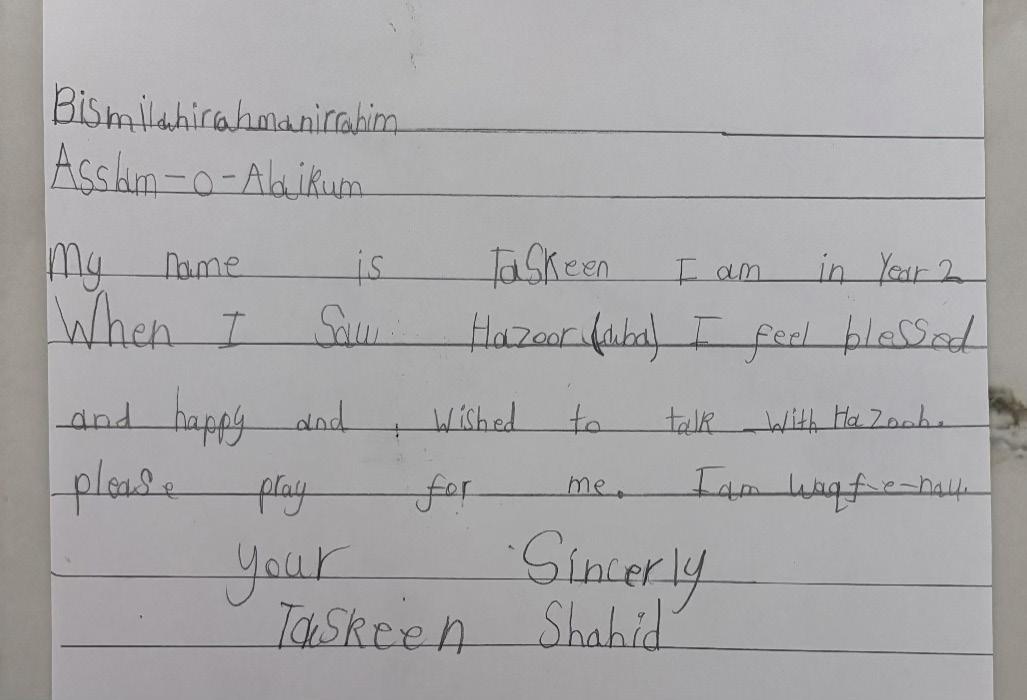
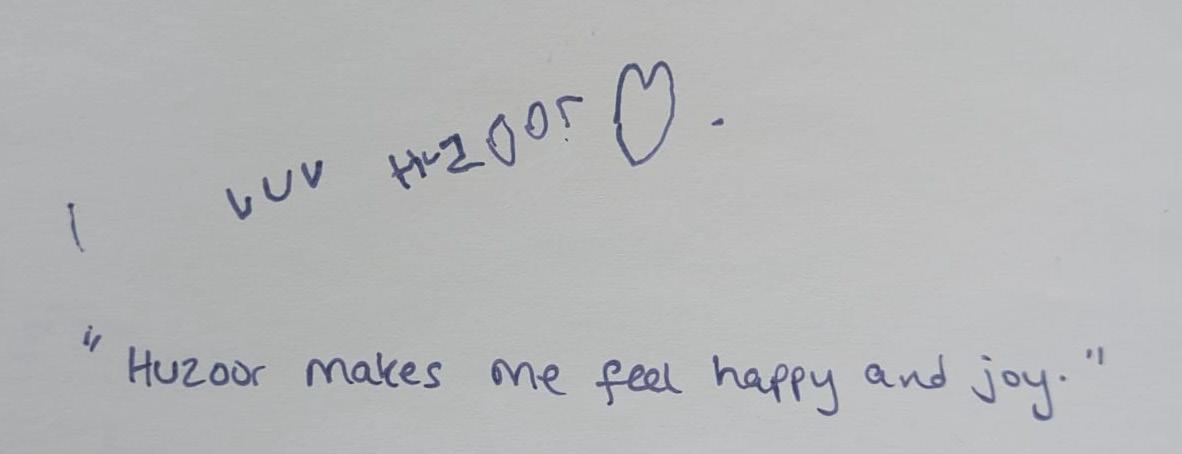
Waaqifaat-e-Nau Express Their Love for Beloved Hazooraba
Waaqifaat-e-Nau, 7 years old and under, expressed their heartfelt sentiments about Hazooraba in handwritten notes.
Taskeen Shahid, 6 years old. First letter to Hazooraba
Maha Waseem, 4 years old
Hania Ahmedi, 7 years old
Sara Mahmood Malik, 5 years old
Kids’ Spread
CONDITIONS OF BAI’AT
1. Abstain from Shirk (association of any partner with God) right up to the day of his/her death.
Circle the speech bubbles below that show shirk:
“I pray to Allah for Help”
“I have lots of sons who will take care of me in my old age”
“It’s alright to pray to idols for help”
“My future will be perfect because I have lots of money”
“I have Allah to thank for all my blessings”
2. Keep away from falsehood, fornication, adultery, trespasses of the eye, debauchery, dissipation, cruelty, dishonesty, mischief and rebellion.
3. Regularity in offering the five daily prayers, including efforts for Tahajjud (night prayer), invoking blessings on the Holy Prophetsaw, and seeking forgiveness daily.
Match the prayer name to the tme and number of total raka’ats:
Mid afternoon to 20 minutes before sunset
Nightfall (dusk) to midnight Dawn (first light of the day) to 15 minutes before sunrise
Mid-day to the time of Asr
4. Causing no harm to any of God’s creatures, particularly Muslims, through any means.
Story
‘“Those who spend in prosperity and in adversity, and those who supress anger and pardon men; and Allah loves those who do good.’ (Surah Al-e-Imran 3:135)
It was by virtue of this verse that a slave of Hazrat Imam Husainra, won his freedom. It is said that the slave erroneously dropped something hot (it could have been water) on Hazrat Husainra. He looked at him angrily. The slave was intelligent and knew the Holy Qur’an as well. He promptly quoted the part of the verse about the suppression of anger.
‘…and those who suppress anger…’
Hazrat Husainra said, ‘You are right; I suppress my anger.’ Now the servant thought that though the anger had been brought under control, it would still remain in his heart. It was possible that he would be chastised for some other mistake later. So he quoted the second part of the verse:
Hazrat Husainra said, ‘I have forgiven you.’ The slave’s knowledge and promptness gave him immediate benefits.
Extract taken from - Conditions of Bai’at and Responsibilities of an Ahmadi, p.78-79
5. Remaining faithful to God in all circumstances, being resigned to His Decree even in suffering.
Fill in the blanks:
“A loved one of God sells his being in the …....…....... of God. In return, he earns the ……....…. of God. Such are the ones upon whom the special ……....…… of God descends.”
Word bank: way, pleasure, mercy
Philosophy of the teachings of Islam, Ruhani Khaza’in, vol. 10, p. 473
6. Adhering to the Holy Qur’an and the sayings of the Holy Prophetsaw, refraining from un-Islamic customs and lustful inclinations.
True and False questions:
If we follow the Holy Qur’an in our daily life, our bad habits can slowly go away.
True / False
The Holy Prophet Muhammadsaw showed us how to live by his actions and sayings.
True / False
It is okay to follow un-Islamic customs if they are a part of society and culture.
True / False
7. Giving up pride and vanity, living with humility, cheerfulness, forbearance, and meekness.
8. Prioritising faith, the honour of faith, and the cause of Islam above life, wealth, honour, children, and other loved ones.
Down:
1. The promise we make at the beginning of meetings and Ijtema.
2. Staying calm and patient even when something upsets you.
4. Showing respect and value for your faith.
7. Being humble and not thinking you are better than others.
Across:
3. Feeling too proud and forgetting to be kind to others.
5. Thinking you are better than others and showing it.
6. Belief in Allah and trusting Him above everything.
8. Listening to Huzooraba and the teachings of the Holy Qur’an and acting upon them.
Across: 3.pride 5.arrogance 6.faith 8.obedience
Down: 1.pledge, 2.forbearance 4.honour 7.humility
9. Serving God’s creatures for His sake and endeavouring to benefit mankind.
Below are some examples of good deeds you can do to benefit mankind:
Help your parents at home
Smile and greet someone kindly Help a classmate or sibling
To pray for someone else share food with the needy Give sadaqah
10. Enter a bond of brotherhood with the Promised Messiahas, pledging obedience in good matters for Allah, and remaining faithful until death with strong devotion.
Fill in the blanks:
“You are making this contract to uphold the religion of Allah the Almighty and to convey and …..................… the religion of Islam to all corners of the ….........….. This bond can only be successful and long-lasting if you …..........…… to be ….............…. in everything good and keep this pledge until death. You should be mindful that this bond does not remain inactive, but should become every day.”
Word Bank: obedient, stronger, world, pledge, spread
Conditions of Bai’at and Responsibilities of an Ahmadi, p.170
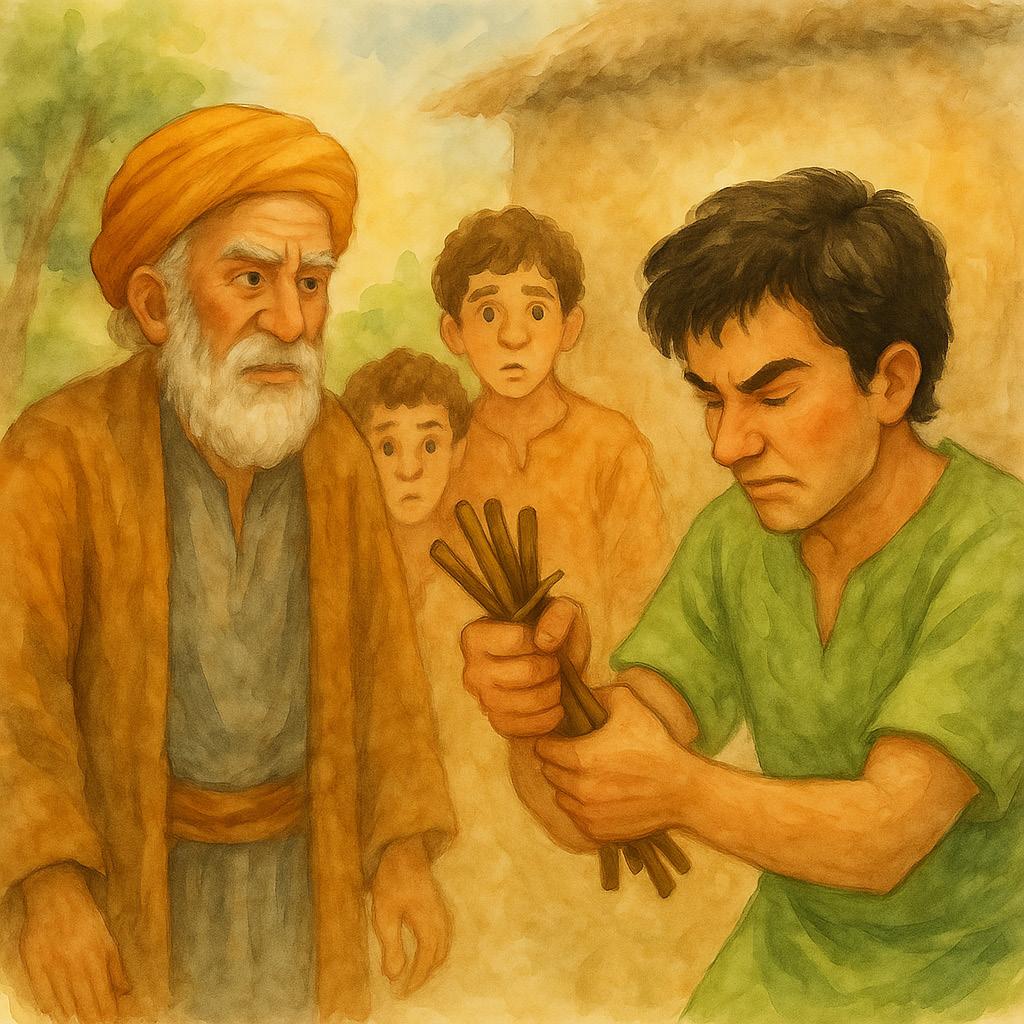
The bundle OF Sticks
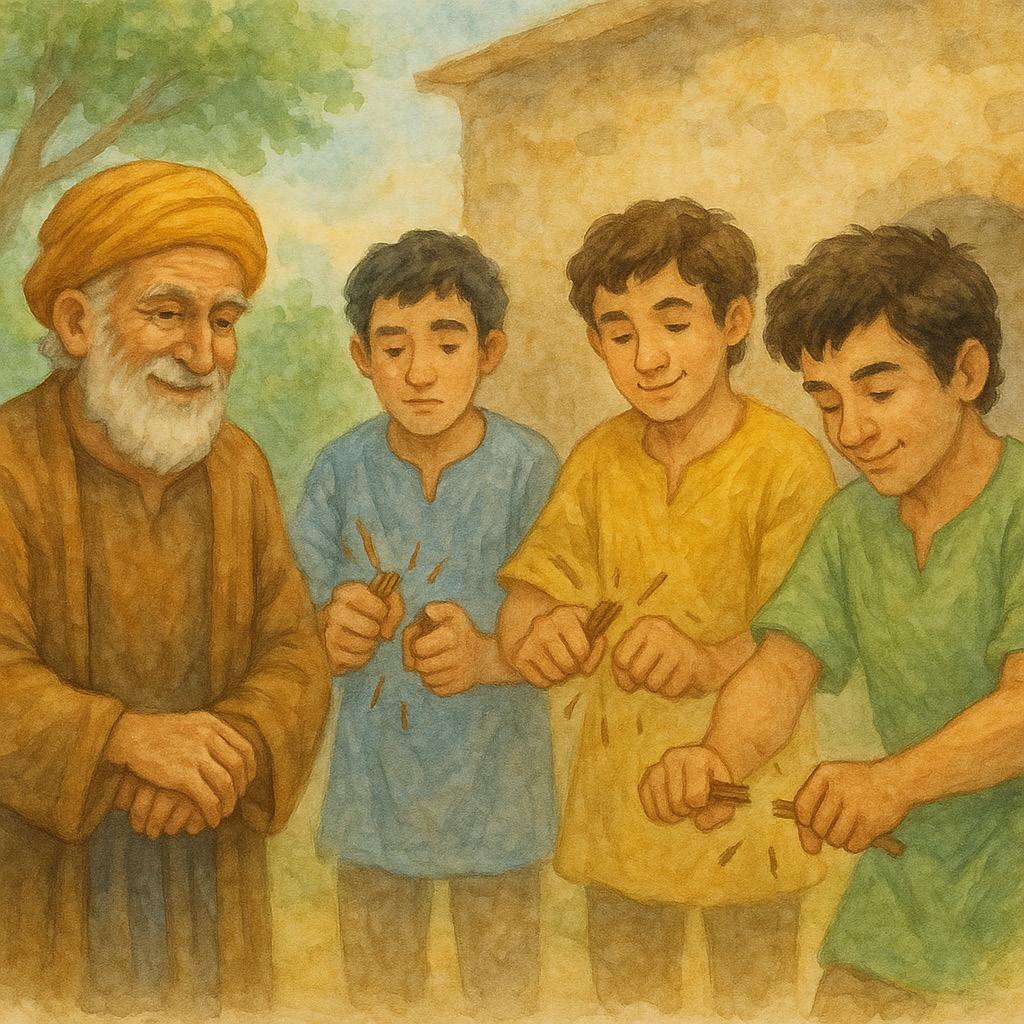
An old man had several sons who were always arguing. As he grew older, he wanted to teach them an important lesson.
One day, he asked his servants to bring him a bundle of sticks.
He handed the bundle to his eldest son and said, “Try to break this.”
The son squeezed, pulled, and twisted, but no matter how hard he tried, the bundle wouldn’t break.
Each of his brothers tried as well, but none of them could do it.
Then, their father untied the bundle and gave each son a single stick.
“Now, break them,” he said. The sons easily snapped their sticks in half.
Their father smiled. “Do you see? When the sticks were together, they were strong. But alone, they were weak. The same is true for you—if you stand together and help each other, you will be strong.”
And from that day on, the brothers learned the power of working together!
“SAy, ‘My PrAyer AND My SACrIFICe AND My lIFe AND My DeATh Are All FOr AllAh, The lOrD OF The WOrlDS”
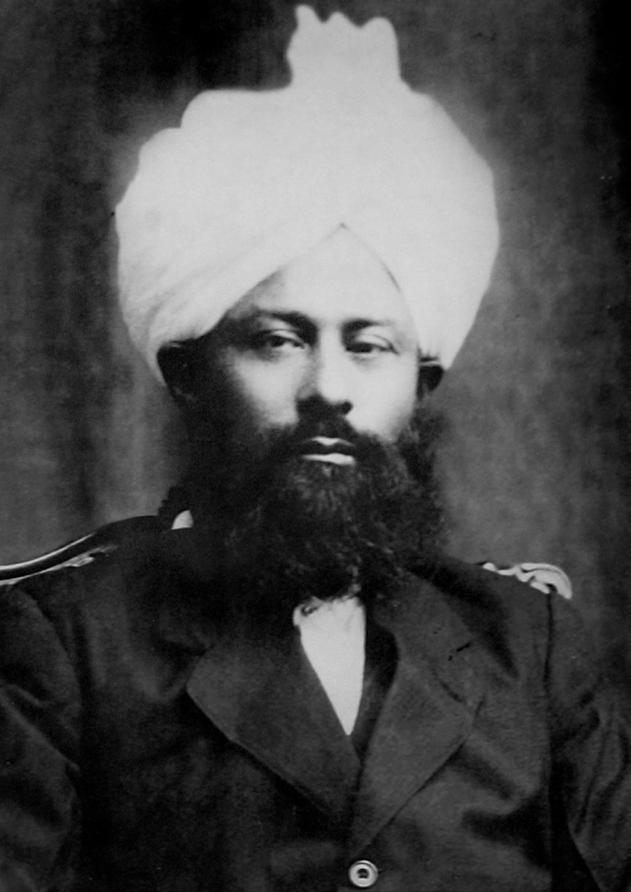
Allah commands in the Holy Qur’an, “Say, ‘My Prayer and my sacrifice and my life and my death are all for Allah, the Lord of the worlds” (6:163). Expounding on this verse, Hazrat Musleh Maudra states that the actions in our entire life is embodied in the following four words: prayer, sacrifice, life and death and God has asked the Holy Prophetsaw to proclaim that all phases of his life were devoted to God alone1. This verse embodies the spirit of waqf. Allah states in the Holy Qur’an that He has exalted the rank of those who strive with their wealth and their persons above those who stay idle at home. He has promised good for those who strive in His path and made them much more entitled of His mercy and forgiveness (4:96-97)2. This essence of sacrifice or waqf has existed since the time of Hazrat Adamas, and the prophets of Allah have set the perfect example in this regard3
Hazrat Musleh Maudra outlined conditions and principles that highlighted sacrifice, piety, and the propagation of Islam3. During his Friday Sermon of December 1917, he appealed to members of the community to dedicate their lives for the purpose of the propagation of Islam. He explained, “While I say devote your lives, I also say that deeply reflect over this before taking this step because you would have to affirm that you have relinquished your lives. There will be some problems from some friends and relations or maybe your own inner self will prompt you to withdraw. Therefore, take this step after deep reflection and prayers” 3. Over the next many years, he urged members of the community to dedicate their lives for the propagation of Islam in various capacities and for different lengths of time depending on the conditions of the time. For example, in light of business needs, he announced waqf’ for business whereby those who dedicate themselves will be appointed to different locations to run their business under Daftar Tajarat3 . He urged parents who wish to dedicate their children to first ensure that their children memorise the Holy Qur’an, as it will serve as a great asset for a missionary to be a Hafiz-e-Qur’an3
“WhIle I SAy DevOTe yOur lIveS, I AlSO SAy ThAT DeePly reFleCT Over ThIS beFOre TAkINg
ThIS STeP beCAuSe yOu WOulD hAve TO AFFIrM ThAT yOu hAve relINQuISheD yOur lIveS. There WIll be SOMe PrObleMS FrOM SOMe FrIeNDS AND relATIONS Or MAybe yOur OWN INNer SelF WIll PrOMPT yOu TO WIThDrAW. ThereFOre, TAke
ThIS STeP AFTer DeeP reFleCTION AND PrAyerS”
Purifying Inner Self
Hazrat Musleh Maudra provided invaluable advice to Muballigheen (missionaries). One of the points he emphasised was the importance of purifying the inner self to attain nearness to Allah. He states, “ The first requirement to purifying the soul is that one continues to remove all evil and impure thoughts from the heart” 4 . Hazoorra explained that one cannot protect oneself from evil and impurity until he does not gain knowledge about what Allah likes and dislikes4. If enjoinments and prohibitions are known, then one should strive to act upon them and strive to make good habits a routine. One should continually remind himself of the acts or deeds that were beneficial to him and those that proved detrimental. He gave an example, “Let us assume there is an individual who is extremely short tempered. He should, at the opportune time, reflect, ‘I get angry very quickly. This is an evil deed. It is an obstruction to my spiritual progress. Hence, I shall never ever commit this deed’4
Striving for Taqwa
Hazoorra emphasized the importance of striving for Taqwa (righteousness). He shared that this can be achieved by engaging in daily istikhara to seek guidance, continuous praise of Allah and engaging in salat abundantly6. One should devote some time from the day, even if it’s only fifteen or twenty minutes to retreat into quietness and solitude to remember Allah5
Allah states in the Holy Qur’an, “Fear Allah, and follow His commandments to the full. Allah does not bestow success on those who are disobedient” (5:109). It is evident from this verse that Taqwa is simply
another name for obedience5. Hazoorra explains that the spirit of obedience is not only crucial for religious progress but also for worldly progress as well5
Prioritising Prayers
Hazoorra highlighted that remembrance of Allah should be of utmost importance5. It is important to offer the obligatory prayers on time. Prayers may be combined under certain circumstances; however, Hazoorra remarked that some members of the community rush to combine prayers and make it a habit5. This is not correct. Hazoorra states that “if someone becomes upset because you leave for the prayer in the middle of a discussion, then so be it. There is no need to pay heed to such people” 5 . If a person fails to adhere to this, they will eventually lack the ability to draw people towards themselves. When someone is occupied with preaching, sometimes he may neglect prayers, which is not acceptable. Work has to be carried out in moderation and at the right time and place. A person should not neglect their own wellbeing at the expense of doing good for others5.
Preaching with Humility
In matters of preaching, one should be careful that it doesn’t corrode one’s heart5. For example, if someone might feel superior and proud if they are able to silence an opponent during an argument. On the other hand, if one’s words prove ineffective, it may cause unease or despair5. Therefore, one should show complete humbleness to God when responding to an opponent during Tabligh and pray fervently for Allah’s guidance and knowledge6. One should show humbleness even after success7.
Even though the Holy Prophetsaw possessed the most excellent virtues and he always held pious discussions, yet whenever he sat in any gathering, he would recite Istighfar5. He taught people the etiquette of reciting Istighfar when sitting in a gathering to prevent their hearts from corroding. He set an example for us by demonstrating the correct way to talk and behave5.
Offering Tahajjud
Hazrat Musleh Maudra emphasised the need to go to sleep early so one could wake up for Tahajjud6. “O thou who art bearing a heavy responsibility,
stand up in Prayer at night except a small portion thereof—Half of it, or make it a little less than that, or make it a little more than that—and recite the Qur’an slowly and thoughtfully” (73:2-5). Hazoorra explains this verse by stating that the rust which is built up in the heart from the dealings of everyday life should be removed by standing for prayer at night and continuously supplicating with complete humbleness5.
Straightforward in Speech and Writings
Hazrat Musleh Maudra advised that one should be clear and straightforward in their speech and writings so one doesn’t face any embarrassment while stating the fact later7. In addition, one should continually self-assess6. Advising the missionaries, he said that a missionary should maintain a record of their activities, which places they visited, what kinds of topics they addressed, reasons for opposition and what resonated with people6. This will serve as a beneficial tool for progress and helpful for those succeeding5
Study, Ponder and Examine the Holy Qur’an
Hazrat Musleh Maudra advised that one should never think that their knowledge is complete because this thinking fosters arrogance and causes the heart to rust6. One should study, ponder and examine the Holy Qur’an himself5.
Read and Study Books of the Community
Hazoorra advised to constantly read and study the books of the community5 This meant reading and studying the books of the Promised Messiahas and others with such concentration that one could present a reference immediately if needed5. Hazrat Musleh Maudra emphasised the importance of language mastery6. He stated, “While learning Arabic and English is essential, make an effort to acquire proficiency in Urdu. Without complete mastery of a language, your ability to influence others remains limited.”6 Hazoorra stated that one should expand their knowledge beyond religion6.
Only Trust Allah
Hazoorra advised that one should only trust Allah and turn to him for his needs5 He shared that in his own experience, whenever he needed something, Allah provided its means one way or another or at times the need itself is eliminated as a result of prayer5. The primary benefit of putting one’s trust in Allah is that a person does not become dependent on others. The second benefit is that people are drawn towards them, and God Himself creates a system of support for them through other people5.
Maintain Harmony and Peace Between People
Hazoorra placed great importance on maintaining harmony and peace between people. He advised that one should not show any partiality when there is a dispute between two people5. He urged the quick administration of the solution or remedy if a moral disease was identified. However, Hazrat Musleh Maudra advised that if a person can be better reformed by concealing their faults, there is no harm in that either5. Furthermore, he advised on keeping righteous company so that one can truly benefit and grow stronger in his faith5
Preach with a True Zeal, Passion and Dedication
Hazoorra advised to preach others with a true zeal, passion and dedication. He stated that one cannot achieve success unless there is fervour in their preaching5. Hazrat Musleh Maudra said ‘Show the person listening that you are even ready to sacrifice your life for the message you preach; that what you say and believe is not something that has simply been handed down to you, but rather it came from your own conscious effort and deliberation’. 5
Protect Yourself Against Laziness
Hazoorra advised that one should protect himself against laziness, for it affects the soul. So, it is important to engage in some form of regular training, such as walking7.
‘ShOW
The PerSON
lISTeNINg
ThAT yOu Are eveN reADy TO SACrIFICe yOur lIFe FOr The MeSSAge yOu PreACh; ThAT WhAT yOu SAy AND belIeve IS NOT SOMeThINg ThAT hAS SIMPly beeN hANDeD DOWN TO yOu, buT rATher IT CAMe FrOM yOur OWN CONSCIOuS eFFOrT AND DelIberATION’.
ONe ShOulD be WIllINg TO ACCePT hIS MISTAkeS, ShOW hIS ACCePTANCe OF A PArTICulAr
SITuATION Or MATTer, AND TO reCTIFy hIS MISTAke ACCOrDINgly
Show Compassion and Sympathy
He warned against ridiculing others because people will end up losing respect and regard5. One should be willing to accept his mistakes, show his acceptance of a particular situation or matter, and to rectify his mistake accordingly4. Compassion and sympathy should be shown to both Ahmadis and non-Ahmadis5. Hazoorra highlighted the importance of speaking the truth, but it has to be disclosed with wisdom, embracing honesty as a guiding principle, staying steadfast in the face of adversity, and sacrificing with firm commitment7. He emphasised focusing on prayers to seek Allah’s guidance and making it a powerful tool to increase spiritual strength and become recipients of Allah’s blessings7.
References:
1. The Holy Qur’an with English Translation and Commentary, Vol. 2, p. 950 & 951
2. The Holy Qur’an with English Translation and Commentary, Vol. 2, p. 690 & 691
3. The Devotion of Life and its Importance and Blessings, Dr Iftikhar Ahmad Ayaz, OBE., p. 185, 186, 190, 198, 220 & 221, https://new.alislam.org/library/books/devotionof-life/info
4. 11 Ways to Purify the Soul - (Irfan-e-Ilahi, Anwar-ul-Ulum, Vol. 4, p. 371, 372, 373 & 383) https://www.alislam.org/articles/11-ways-to-purify-soul/
5. Advice to Missionaries, by Hazrat Mirza Bashir-ud-Deen Mahmood Ahmad, Khalifatul Masih IIra, p. 2, 3, 4, 7, 8, 15, 16 & 31, https://new.alislam.org/library/books/ advice-for-missionaries/info
6. Twenty Pearls of Wisdom from Hazrat Musleh-e-Maud’s ‘Guidance for Missionaries’ Part I - Al Hakam (Zarreen Hidayat Baraye Muballigheen, p. 5, 10, 23-24, 30, 31, 45, 74-75, 87) - https://www.alhakam.org/twenty-pearls-of-wisdom-from-hazratmusleh-e-mauds-guidance-for-missionaries/
7. Twenty pearls of wisdom from Hazrat Musleh-e-Maud’s ‘Guidance for Missionaries’ Part II - Al Hakam, Zarreen Hidayat Baraye Muballigheen, (p. 105-106, 111-112, 125, 168) - https://www.alhakam.org/twenty-pearls-of-wisdom-from-hazrat-musleh-emauds-guidance-for-missionaries-part-ii/
“I OFTEN
PRAY DURING SAJDA [PROSTRATION],
‘O
GOD, IN RESPECT OF THOSE WHO HAVE WRITTEN TO ME, PLEASE RELIEVE THEM OF THEIR ANXIETY, SICKNESS OR WORRIES ABOUT THEIR EXAMINATIONS. In respect of those who wanted to write to me but could not, please shower Thy Mercy on them as well. And please show Mercy on those who become averse or lazy.’
I SAY THIS PRAYER BECAUSE I HAVE A RELATIONSHIP WITH EVERYONE AND DEEP IN MY HEART LIES LOVE AND AFFECTION FOR ALL.”
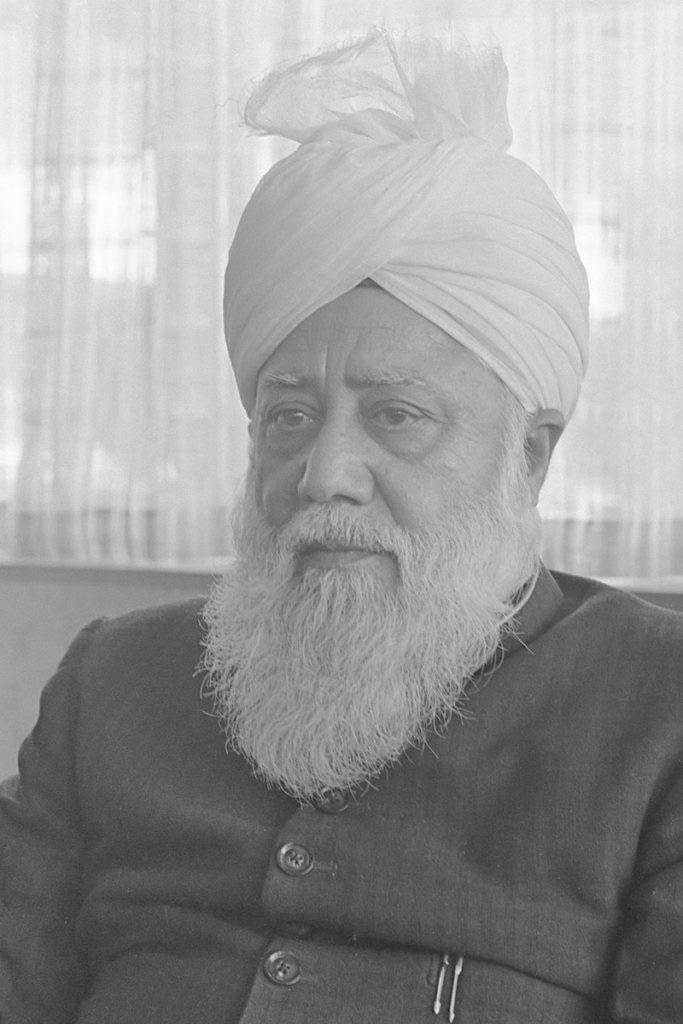
Hazrat Mirza Nasir Ahmad, Hazrat Khalifatul Masih IIIrh
A Glimpse into the Life of Hazrat Khalifatul Masih IIIrh, B.A. Rafiq, p.10 https://new.alislam.org/library/ books/life-hazrat-khalifatul-masih-iii
Read A Glimpse into the Life of
Hazrat Khalifatul Masih IIIrh here:
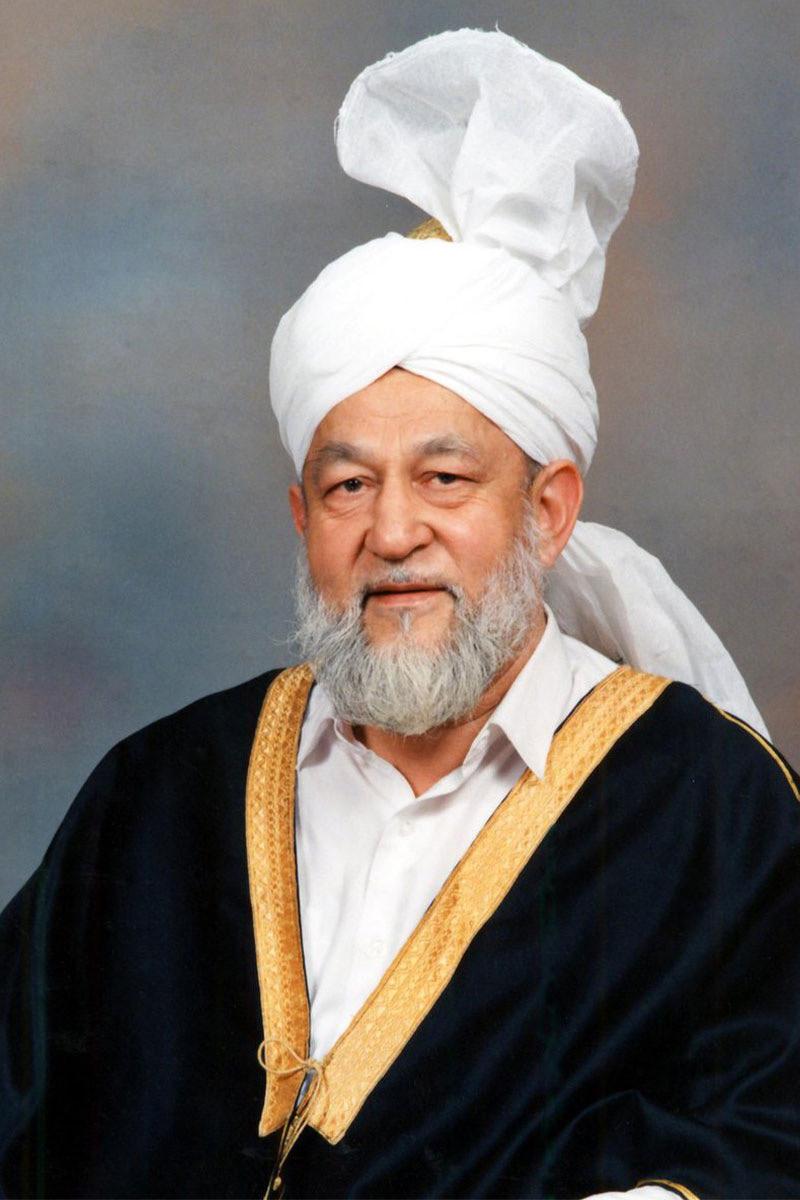
“WHENEVER YOU FACE A DIFFICULTY, YOU SHOULD PRAY TO ALLAH THE ALMIGHTY. IF YOU CREATE A HABIT OF PRAYING TO ALLAH, THEN AT THE TIME OF EVERY DIFFICULTY YOU WILL FIND EXTRAORDINARY HELP FROM ALLAH. THIS IS SOMETHING I HAVE EXPERIENCED ALL MY LIFE AND NOW WHEN I HAVE REACHED OLD AGE, I CAN TELL YOU THAT WHENEVER I NEEDED SOMETHING AND I PRAYED TO ALLAH FOR IT, I WAS NEVER LET DOWN. ALLAH THE ALMIGHTY ALWAYS ACCEPTED MY PRAYER.”
Hazrat Mirza Tahir Ahmad, Khalifatul Masih IVrh
Khalifatul Masih IVHazrat Mirza Tahir Ahmad, p.47-48
Waaqifaat-e-Nau Personal Reflections:
How Khilafat is a Shield Against the Challenges and Ills of Society
Khilafat has always guided me through difficult moments in my life, and whenever I need clarity or direction, I write to Hazoore-Anwaraba and place my trust in his guidance. As a Waqifaa-e-Nau, seeking Hazoor’saba advice on my future career is an important responsibility, and it brings me a sense of ease, as I firmly believe that Hazooraba understands what is best for me better than I do myself. Although I have always been afraid of needles and blood, my parents and grandparents have long hoped that I would become a doctor, and Hazooraba has also emphasised the need for more doctors within the community. With these thoughts in mind, I wrote to Hazooraba, expressing my concerns and uncertainty. Reading the letter that I received in reply brought me a deep sense of relief; I felt reassured that Hazoor’saba prayers were guiding me, and I became confident that nothing could stand in the way of my goal. While I still feel some hesitation regarding needles and blood, I no longer see it as an obstacle, but instead something I can overcome with time, effort, and faith. This experience has strengthened my faith in Khilafat and made me realise that with the guidance of Hazooraba, I can always persevere and push past my fears.
Shafia Munir, Canada
How can one person love millions, yet make me feel as though I am the only one he is praying for? To me, this is the miracle of Khilafat. It is the gift in my life that leaves me shocked and grateful every time I experience its blessings.
Hazooraba has been a shield for me so many times, protecting me despite the millions he holds in his heart. There have been moments in my life where I felt I was drowning in difficulty, but after receiving Hazoor’saba guidance, the struggle simply vanishes. It is the ultimate helping hand; suddenly, the water that felt so deep feels as though it was never there at all. I have even felt the weight lift the moment I sit down to start writing a letter to seek his prayers. Before it is even sent, it’s as if the heart finds peace and the problems start solving themselves. I cannot offer enough shukr for this refuge, and I pray we all are able to strive to please Allah by fulfilling all of Hazoor’saba expectations of us. Ameen.
Ambreen Saboor, UK
Khilafat has always been a source of guidance and protection in my life. Throughout our life we have so many pressures and negative influences; the guidance of Khilafat helps me stay connected to my faith, which allows me to make better decisions. Listening to the sermons of Khalifatul Masih and following his advice reminds me to remain patient and to pray regularly. I feel extremely blessed that I can simply write a letter to Hazooraba with any issues or concerns. Just knowing that I can seek prayers and guidance instantly gives me a feeling of relief. Khilafat creates a feeling of unity and security because we know we are never alone in facing the challenges of the world.
Umimah Aleem, USA
USA
Around 2012, Hazoor-e-Anwaraba cautioned against the adverse uses of Facebook, especially posting personal pictures on this online platform. When the guidance came out, there were many who were confused by it because they viewed Facebook as a harmless tool for social connection. I heard opinions, from Ahmadis as well, on both ends of the spectrum. Deep down in my heart, I knew that as Khalifa-e-Waqt is a divinely appointed leader, his guidance had to be of benefit so I refrained from posting personal content on Facebook. Fast forward to the age of AI and deep digital manipulation of audio and video files, and Hazoor-e-Anwar’saba foresight and guidance from years before have proved to be words of divine wisdom indeed. This is how God protects us through Khilafat.
Sabahat Khalil, Canada
To belong to the Jama’at of the Akhireen, that blessed community praised by the Holy Prophetsaw and enshrined in the Holy Qur’an itself, is a gift I feel most profoundly through the institution of Khilafat. There is a peace, a sukoon, that comes from knowing you are held; that somewhere, a man of God remembers you in prayer before he sleeps, no matter which corner of the world you live in.
Last year, I went through something rather traumatic and doubt began to cloud my heart while questions weighed heavily on my soul. So, I did what every Ahmadi, but most especially every Waqf-e-Nau, should know they can do: I wrote to Hazooraba. I poured out my worries, my conflicts, my uncertainties. The reply that reached me was not a formality. It was a detailed, tender answer to every question, a gentle light cast over every shadow. Even the act of writing had brought relief; the reply brought a joy I struggle to put into words and a gratitude to Allah Ta’ala for making me one of those fortunate enough to live under this blessed institution.
As a law student, I am trained to seek justice and to recognise principled voices that stand firm against the tide, and I find, always, that Khilafat was there first. Hazrat Khalifatul Masih IVra warned the world of the consequences of the Iraq war with a clarity that history has since vindicated. Hazrat Khalifatul Masih Vaba has, since 2003, written to heads of state, addressed world leaders, and carried the torch of peace with unwavering resolve. In a world fracturing at every seam, Khilafat is not merely a spiritual comfort. It is a fortress, a compass and a father’s outstretched hand.
Chaudhry Muhammad Ali Muztar Arifi
Asifa Badar, France
FRANCE
As a Waqifa-e-Nau who has been brought up in the West, I truly believe that Khilafat has been a huge source of protection for me in so many ways. Living in a society where it only takes a small moment of negligence to lose your path, having that constant guidance is something we should never take for granted.
I think, if each one of us takes a moment and really think about it, we will realise how Khilafat has saved us from so many ills. As far as I’m concerned, I can actually see this protection in my everyday life. I see this protection when I’m with my friends and I’m able to tell which activities I should be part of and which ones I should avoid. I see it in the way people naturally understand their boundaries around me. When they see that I’m a Muslim girl who wears hijab, they already know what kind of behaviour or jokes are not appropriate around me. I see this protection when I notice people around me are constantly stressed, trying to deal with everything on their own. Meanwhile, I have the comfort of turning to Allah, sharing my worries with him, writing a letter to Hazoor aba for his guidance and feeling that instant sense of peace and relief afterwards. Even reciting the prayers that Hazoor aba has guided us towards brings an instant calm to my heart.
As Ahmadi Muslims, we’re always reminded to prioritise deen over duniya through Jalsas, Ijtemas, and tarbiyyati classes. Especially beloved Hazoor’s aba Friday sermon every week, along with his continuous guidance on both big and small matters, is such a blessing that I’m extremely grateful to Allah for. It’s a reminder that we’re never alone in facing the challenges of society.
Khilafat acts as a shield, protecting us and guiding us at every step. Alhamdulillah for the blessing of Khilafat.
Khafia Akram, France
MAURITIUS
Born Ahmadi and dedicated to the scheme of Waqf-e-Nau, my identity has always been tied to my faith. I was but an adolescent trying to navigate the challenges of this harsh, modern world. It is hard to not give into the temptations around and without constant guidance, how easy is it to falter! There was a time when I felt my life lacked direction; I began to stray from my true essence, blinded by a lack of self-awareness and influenced by misguiding friendships.
Yet, Allah’s Mercy encompasses everything, for it is He who gave me a strong sense belonging to Jama’at-e-Ahmadiyya, which ultimately prevented me from going down a dark path. Every local Jama’at meeting, every Ijlas, every Waqf-e-Nau class, every Ijtema constantly reminded me of the essence of being an Ahmadi. The mere gathering among sisters in faith is enough to witness the beauty and strength of this Jama’at.
I began writing to Beloved Hazooraba more frequently. His advice to remain engaged in Zikr-e-Ilaahi and to continuously perform Istighfar pulled me away from worldly lures until I found my path again. Having recognised the weight of my past missteps, I now earnestly try to live by the words of Hazrat Khalifatul Massihaba. Hazooraba reminded us in a Friday Sermon: “You should continually seek the help of Allah by repeating the prayer... ‘Guide us on the right path.’” Studying the Holy Qur’an with commentary daily opened my eyes to the beauty of this Holy book and increased my relationship with my Creator. Similarly, reading some books of the Promised Messiahas made Hazoor’saba wisdom very clear; I realised that every piece of advice he provides is exactly what is needed to remain steadfast.
Battling the inner self through daily challenges is not easy, but this struggle, this Jihad, is what defines us as those who have accepted the Promised Messiahas and Imam Mehdi of the age. We are fortunate to be under the divine guidance of Hazrat Mirza Masroor Ahmadaba. It is my earnest prayer that I – and indeed all Ahmadis – never take this immense blessing for granted.
Arifa Shania Noor Hosany, Mauritius
IS THE CREATOR OF ALL
The distant breeze
The dancing of the trees
Allah is the Creator of all
The jungle creeks
The mountain peaks
Allah is the Creator of all
The whistling of the wind
The sun setting as it dimmed
Allah is the Creator of all
The planets in the sky
So far but they comply
Allah is the Creator of all
By Muneefa Ahmad, Aged 10
Writing Letters to Hazrat Khalifatul Masihaba
Afa and Zayd’s Special Letter
Mash’Allah, you’re colouring so nicely.
Now, shall we write a letter to Hazooraba today?
Ami, why do we write to Hazooraba?
Allah gives us a Khalifa to guide us. Hazooraba is our Khalifatul Masih. He is like a spiritual father who loves and prays for us. It is important that each of us keeps in touch and forms our own special bond with Hazooraba
What shall we write about, Ami?
You can write about anything in your heart.
I want to tell Hazooraba I love Khilafat.
You can ask for prayers, guidance, or simply share your feelings.
I’ll ask Hazooraba to pray for my test.
His Holiness, Hazrat Mirza Masroor Ahmad, Khalifatul Masih V (aba)
Islamabad
Sheephatch Lane Tilford GU10 2AQ
When we build a relationship with Khalifatul Masih, our hearts feel peaceful, and our connection with Allah grows stronger.
Illustrations: Wardah Burhan
Subscription Contacts:
To subscribe to the Maryam Magazine contact your National Secretary Waqf-e-Nau
UK- Abdul Quddus Arif sec.waqfenau@ahmadiyyauk.org
Canada - Musleh Shanboor waqfnau@ahmadiyya.ca
USA - Mirza Harris Ahmad national.wn@ahmadiyya.us
Australia - Syed Wadood Janud waqfenau.australia@amj.org.au
Mauritius - Mohsin Ahmad Ramjeet waqfenaumauritius@gmail.com
Sierra Leone - Shahid M. Korjie waqfenau.sl@gmail.com
New Zealand - Muhammad Yaseen yasinsec681@hotmail.com
France - Usama Chaudhry waqfenau@ahmadiyya.fr
UNDERSTANDING
Women’s health is a multifaceted and deeply important area of medicine. Many women’s health issues are extremely complex, involving interconnected biological, hormonal, social, and environmental factors; these often carry both physical symptoms and
Beyond PMS: Understanding PMDD
and its impact
LAiBA MA L iK
In today’s society, women are often labelled as “hormonal” and are expected to manage feelings of irritability, emotional sensitivity, or anger without question. They are told to adapt, to cope, and to stay in control. But how often do we stop to consider women’s health itself?
Most people are familiar with premenstrual syndrome (PMS), a common part of the menstrual cycle. However, far less attention is given to those who experience symptoms that are far more severe. Some women live with Premenstrual Dysphoric Disorder, more commonly known as PMDD. This is a serious condition that goes beyond typical PMS.
What is PMDD?
PMDD is a severe hormone-related mood disorder that causes intense emotional and physical symptoms. These can include extreme mood changes, anxiety, irritability, fatigue, and feelings of deep emotional distress. These related symptoms usually appear one to two weeks before menstruation and are not only mentally and physically exhausting for the woman, but also for the people the woman is close to, due to the drastic change in behaviour.
or many omen, M signifcantly interferes ith aily life, affecting relationships, work, and overall wellbeing as the body reacts intensely to hormonal changes.
How PMDD Afects a Woman’s Body & Mind
PMDD affects far more than just emotions. The condition impacts both the body and the brain, often making everyday tasks feel overwhelming in the days leading up to a period.
Emotionally, women with PMDD may experience intense mood swings, heightened sensitivity, irritability, or anxiety. These emotional changes can feel s en an iffc lt to control, often lea ing omen feeling misunderstood or judged by those around them.
Physically, PMDD can cause extreme fatigue, headaches, bloating, muscle pain, and changes in sleep or appetite. These symptoms are not imagined or exaggerated; they are the result of real hormonal and neurological changes occurring in the body.
The combination of emotional and physical symptoms can make it iffc lt to maintain normal ro tines, affecting pro cti ity, relationships, and overall quality of life. For many women, the most challenging part is knowing these symptoms will return each month.
Why Does PMDD Happen?
Although PMDD is linked to the menstrual cycle, it is not caused by abnormal hormone levels. Instead, research suggests that women with PMDD are more sensitive to normal hormonal changes, particularly ct ations in oestrogen an progesterone
These hormonal shifts can affect brain chemistry, especially serotonin, a chemical responsible for regulating mood, sleep, and emotions. When serotonin levels are disrupted, emotional symptoms such as irritability, anxiety, and low mood can intensify.
Genetics can also play a role since PMDD is more common among women with a family history of mood disorders. Stress and previous mental health challenges can increase vulnerability, but PMDD itself is a biological condition; not something a woman can control through willpower alone.
Managing PMDD and Finding Support
PMDD can feel overwhelming, many women are able to manage their symptoms with the right support and treatment.
Lifestyle changes such as regular exercise, balanced nutrition, and consistent sleep can help reduce symptom severity. Stress-management techniques, including mindfulness and journaling, may also provide relief ring iffc lt ays
Medical support is often essential. Healthcare professionals may recommend hormonal treatments or medications that help regulate mood and hormone responses. Tracking menstrual cycles and symptoms can also help women anticipate changes and seek timely support.
Equally important is emotional understanding. Conversations with trusted family members and friends can help reduce stigma and ensure women receive the support they need. PMDD is real, and acknowledging its impact is a crucial step toward better care.
Breaking the Silence Around PMDD
M is more than a iffc lt phase of the menstr al cycle it is a serious health condition that deserves recognition, understanding, and proper care. For too long, women’s pain has been minimised or dismissed as “hormonal,” leaving many to suffer in silence.
By increasing awareness of PMDD, we challenge outdated stereotypes and create space for honest conversations about women’s health. When women are listened to, believed, and supported, their quality of life can improve dramatically.
Understanding PMDD is not just about the monthly cycle. It is about acknowledging that women’s physical and mental health matter.
Now that we understand more about women’s health, it is important that we continue to educate ourselves, especially as young girls, about our bodies and overall wellbeing. By recognising symptoms that do not feel normal an feeling conf ent eno gh to seek me ical support, we can take an active role in protecting our health.
WITH EVERY LETTER I RECEIVE, I PRAY THERE AND THEN AS I READ EACH LETTER, THAT MAY ALLAH BESTOW HIS GRACE AND BLESSINGS.
The Promised Messiahas also said when he received letters, he read the letters one by one, and prayed as he read each letter.
“FURTHER, IN SAJDAH (PROSTRATION) I PRAY FOR PEOPLE AND THINK OF THE MANY REQUESTS THAT PEOPLE HAVE SENT TO ME
IN THE
HUGE NUMBER
LETTERS I RECEIVE.
OF
Some people are ill, some people have financial issues, there are marital issues between husbands and wives, or other problems people are facing, and I pray that may Allah alleviate all of them from their difficulties.
I ALSO PRAY FOR THOSE WHO HAVE NOT WRITTEN TO ME FOR PRAYERS AND I PRAY FOR THE ENTIRE JAMA’AT.
“In my sajdah, nawafil [voluntary prayers] and tahajjud [voluntary pre-dawn prayers], I PRAY FOR EVERYONE.
“At night when I say Quls or Ayatul Kursi before sleeping and blow (with my breath), I pray to Allah thinking of Ahmadis wherever they are and pray for them that may Allah bless them and have mercy upon them. Just like all parents, when making these prayers at night blow on their children before they sleep, when
I SAY THESE PRAYERS AT NIGHT, I BLOW ON THE WHOLE JAMA’AT, WHO ARE LIKE MY CHILDREN.”
Hazrat Mirza Masroor Ahmad, Khalifatul Masih Vab
Launch of ‘The Existence Project’, Review of Religions - A Special Interview with the Worldwide Head of the Ahmadiyya Muslim Community www.reviewofreligions.org/29082/launch-of-the-existence-project-a-specialinterview-with-the-worldwide-head-of-the-ahmadiyya-muslim-community/
Waqf in the field
A Journey of Waqf, Guidance & Growth
ALIA HUDA SAQIB
Everyone in the world searches for purpose, a sense of direction that gives meaning to effort an str ggle et, not e eryone fn s it, let alone lives it. For a Waqf-e-Nau, however, the story begins differently. Purpose is not something we wait to discover; it is something we are entrusted with from the very beginning. It lies in service, in humility, and in a quiet but constant devotion to something greater than ourselves. In many ways, that understanding has shaped my journey.
From as early as I can remember, there was always an internal motivation to be useful, to ensure that whatever abilities I was given were developed and se for the beneft of others, especially for the ama at My early years of e cation re ecte this in simple but meaningful ways. Creativity found its place in contributing to San‘at-o-Dastkari [Trade and Industry] exhibitions, where we would prepare handicrafts with care and dedication. Eloquence was nurtured through Ijtemas and speech competitions, where I learned to express ideas with conf ence ca emically, orke iligently, an with the prayers and support of those around me, I was able to achieve strong results.
However, after junior high school, the journey became less straightforward. Transitioning into senior high school, especially one of the top schools in Ghana, came with new challenges. I had always loved science and mathematics, and subjects like chemistry and biology came naturally to me. Physics, however, was different. It was as though I had encountered something my mind could not immediately grasp. While my classmates progressed through chapters, I found myself struggling to understand the very basics. or the frst time, experience hat it felt like to be completely unsure, to sit in a classroom without answers.
hen the frst semester res lts ere han e back, sa s an s across my s b ects, ntil reache physics. There, on my paper, was a grade I had never seen before: an F. Even though part of me had anticipated it, I had still hoped for something ifferent hat moment as iffc lt t felt as though something I had always relied on, my ability to understand and perform academically, had suddenly failed me.
In those days, I found myself questioning deeply. Why was this happening? Why did something that others seemed to grasp so easily feel so distant to me? Yet, through that experience, I came to understand two important lessons he frst as that sometimes challenges are placed in our path not to stop s, b t to p sh s closer to llah an to ele ate our effort. The second was that while we rely on llah, e are also expecte to stri e an to p t in the effort necessary to grow.
With that realisation, I began to approach physics differently. I sought help where I needed it, spent more time practising, and most importantly, turned to prayer with greater sincerity. I began writing for prayers to Hazrat Khalifatul Masihaba specifcally regar ing my st ies s a a ifa e Na , felt a rene e etermination that this iffc lty o l not efne my limits, nor o l it become a barrier in my path of service.
The improvement was gradual. The next semester, although I did not pass, my marks had increased. That was enough to remind me that progress, even if small, is still progress. Step by step, I began to understand the subject better. What changed most was not just my effort, but my perspective. I started to see the universe, its laws, and its forces as part of the intricate an perfect system create by llah With this realisation, physics no longer felt like a barrier; instead, it became a means of re ection ach chapter gre more fascinating than the last, and every formula deepened my appreciation for the precision and harmony ithin llah s creation
y the time the fnal est frican examinations approached, I had developed both a stronger grasp of the subject and a deeper reliance on llah hen the res lts ere release , as overwhelmed with gratitude. I had achieved excellent grades, including in physics, which enabled me to gain admission into the University of Cape Coast.
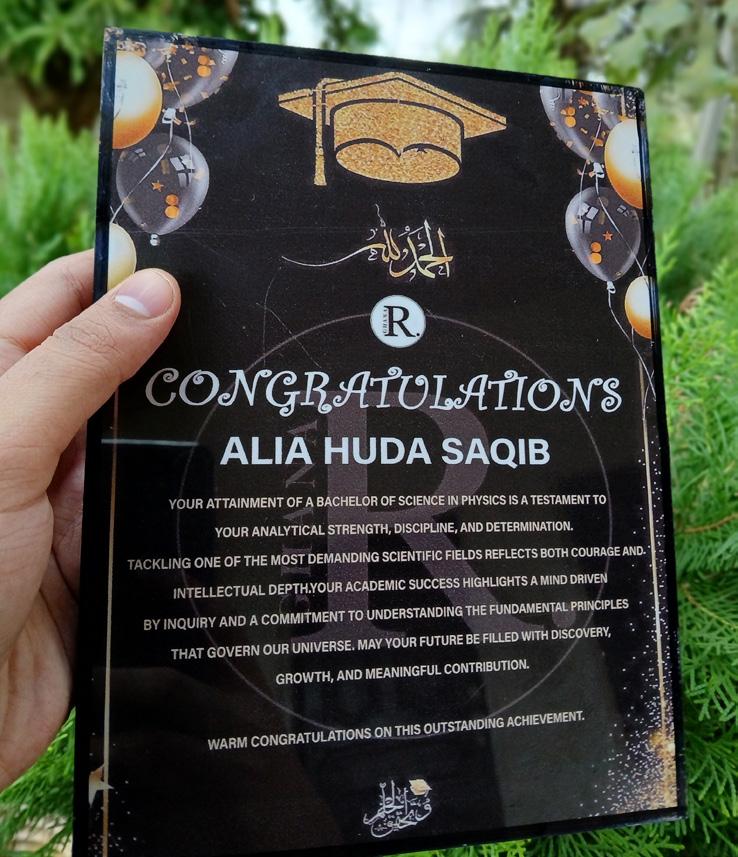
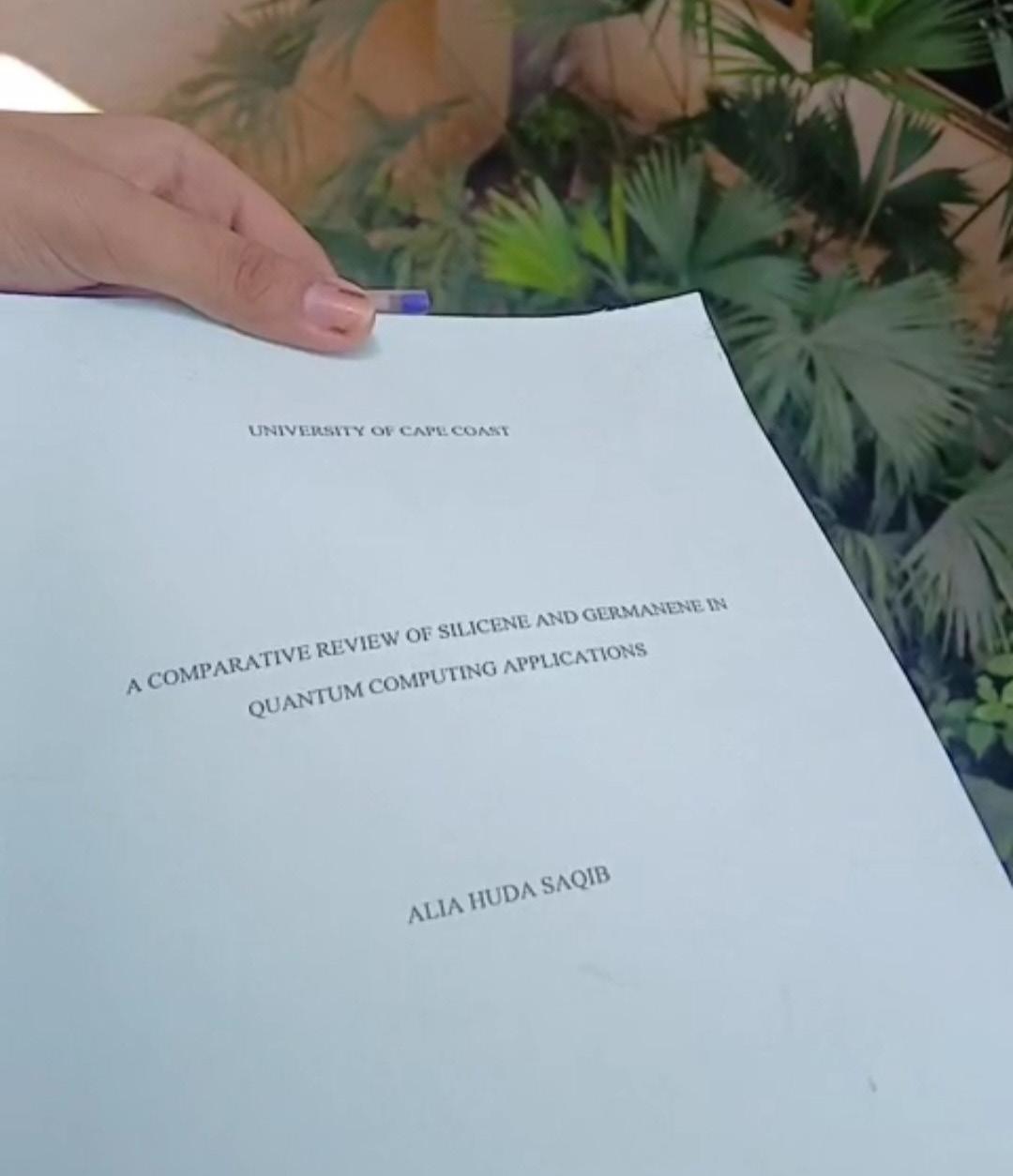
Perhaps unexpectedly, I chose to pursue physics at university. This was not a decision driven by a desire to prove something to others, but rather by a recognition of the growth I had experienced and the support I had witnessed throughout that journey. It was a choice rooted in trust, that if contin e to stri e sincerely, llah would continue to guide me.
University life brought its own set of challenges and opportunities. In my frst year, oine the ebate society with a simple intention: to improve my conf ence an o ercome stage fright in front of a larger audience. However, as time went on, debate became more than just an activity. It introduced me to new ways of thinking, exposed me to discussions on global issues, and helped me develop skills I had not anticipated.
alancing ebate ith an intensi e science program was not always easy. There were times when I had to miss classes to attend competitions, and this was not always well-received by my epartment t one point, after receiving permission from the Dean to represent my university at a tournament, I was informed by a lecturer that I would not be allowed to make up a missed quiz. In that moment, I once again turned to prayer, asked for prayers from my family, and wrote for prayers to Hazooraba. Shortly after, the situation changed, and I was given the opportunity to complete the assessment. Experiences like this reinforced my belief that sincere effort, co ple ith reliance on llah, ne er goes unnoticed.
There were many such moments, times when things seemed uncertain, yet resolved in ways I could not have planned. During my search for an internship at the hana tomic nergy ommission, face iffc lty in fn ing a connection or reference s ea lines approache , the uncertainty and anxiety grew in me. However, it was through a simple and extremely unexpected conversation with a friend that an opportunity presented itself, allowing me to secure a placement. It was a reminder that help can come from places we do not anticipate.
longsi e aca emic gro th, my involvement in debate and public speaking continued to develop. In my second year, I was selected to represent my university in a national championship that included both debate and public speaking. Public speaking was unfamiliar territory for me, and I approached it with hesitation. However, with encouragement and a simple piece of advice from my mother to consistently recite the prayer,
“My Lord, open out for me my breast, And ease for me my task, And loose the knot of my tongue, That they may understand my speech.”
[Holy Qur’an 20:26-29]
I found a sense of calm and clarity. eciting this prayer on the fnal stage, by the grace of llah, as able to win the championship even though I had not thought it to be possible at all. That experience taught me that tr e conf ence oes not come from certainty in oneself, but from reliance on llah
My Lord, open out for me my breast, And ease for me my task, And loose the knot of my
I continued to develop my debating and public speaking skills throughout university, recognising that they were not just personal pursuits but tools for service. These skills enabled me to deliver speeches at M S meetings an later ga e me the opportunity to speak at a Tabligh symposium organised by the Review of Religions. The ability to articulate my thoughts with clarity and conf ence also allo e me to ser e the ama at more effectively, particularly through the Review of Religions exhibitions, where I had the privilege of presenting at Jalsa Salana Ghana. I began to see how personal development could align with Jama’ati responsibilities.
n my fnal year, as entr ste ith the role of president of the debate society. One of the goals we set as to participate in the an frican ni ersities Debating Championship (something our university ha not pre io sly n ertaken e to fnancial constraints). The process of securing funding was challenging and required persistence, planning, and contin o s prayer y the grace of llah, the effort was successful, and we were able to represent our ni ersity internationally at gan a he experience itself, along with the achievements that followed, was a collective effort and a blessing that I remain grateful for.
Looking back, what stands out most is not any single achievement, but the consistent thread of guidance and support that ran through every stage of the journey. There were moments of ease and moments of iffc lty, b t each playe a role in shaping both my perspecti e an my p rpose s a a ifa e Na , I have come to understand that the journey is not about perfection, nor is it about always succeeding. It is about striving sincerely, seeking guidance, and remaining committed to service. The challenges we face are not interruptions to our path, in fact, they are part of it.
fter gra ating s ccessf lly from ni ersity, one thing remains clear: when we align our intentions ith ser ice an place o r tr st in llah, e en the most uncertain paths can lead to growth, purpose, an f lflment May llah enable all of s to fn o r true potential and serve the Jama’at to the best of o r capabilities meen
Obey the Khulafa with True Sincerity
BY HAZRAT MIRZA BASHIR-UD-DIN
Obey the Khulafa with True Sincerity is the English rendering of Khulafa ki Sachey Dil se Ita‘at Karo (Khutbat-eMahmud Vol. V), an address delivered by Hazrat Mirza Bashir-ud-Din Mahmud Ahmad, Khalifatul Masih IIra, on 29 June 1917.
This profound essay explores the importance of obedience and sincerity to Khalifatul Masih, the successor of the Promised Messiahas. As we explore the signifcance of expression and understand the importance of mindful communication, Hazrat Khalifatul Masih IIra reminds us of the etiquettes of presenting ourselves before khilafat an to holehearte ly embrace the decisions made by the khalifa of the age