An Educational & Tarbiyyati Magazine for Waqifeen-e-Nau


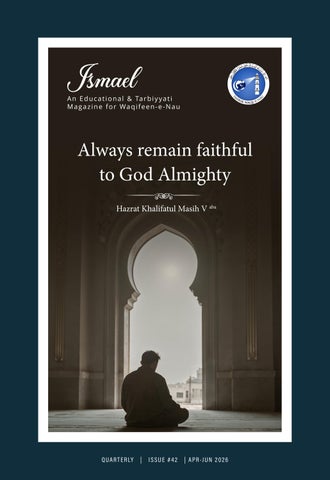
An Educational & Tarbiyyati Magazine for Waqifeen-e-Nau
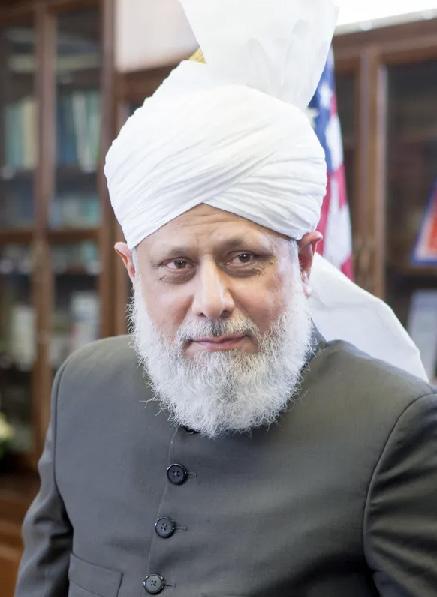
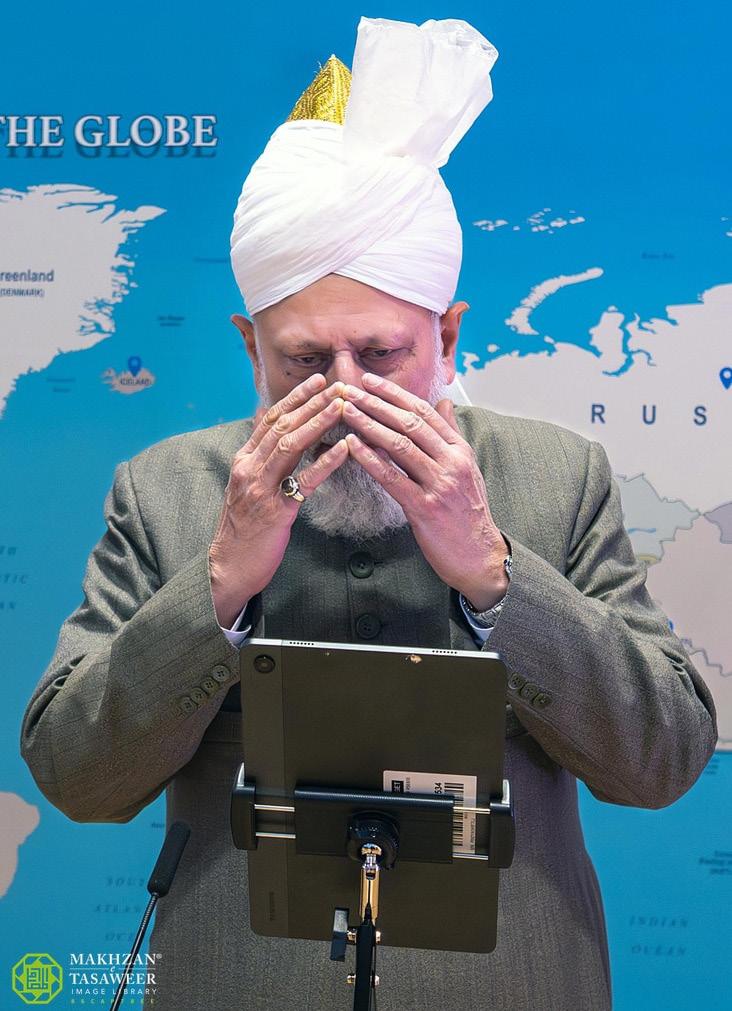
Hazrat Khalifatul Masih V aba
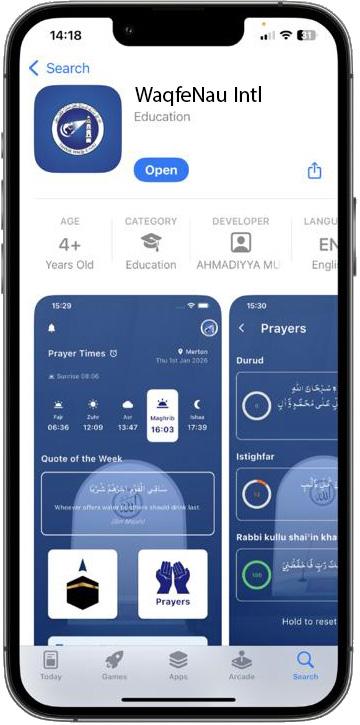


To subscribe to the Ismael Magazine contact your National Secretary Waqf-e-Nau
UK- Abdul Quddus Arif sec.waqfenau@ahmadiyyauk.org
Canada - Musleh Shanboor waqfnau@ahmadiyya.ca
USA - Mirza Harris Ahmad national.wn@ahmadiyya.us
Australia - Syed Wadood Janud waqfenau.australia@amj.org.au
Spain - Tarik Ataul Munim nac.sec.waqfenau@islamahmadia.es
Belgium - Munir Ahmed Anjum waqfe.nau@ahmadiyya.be
Ghana - Hafiz Abdullah Mohammad Sani waqf-e-nau@ahmadiyya.org.gh
Switzerland - Jariullah Zafarullah Sahib waqfenau@ahmadiyya.ch
Ireland - Attaur Rehman Khalid waqfenau@islamahmadiyya.ie
Mauritius - Mohsin Ahmad Ramjeet waqfenaumauritius@gmail.com
Sierra Leone - Shahid M. Korjie waqfenau.sl@gmail.com
New Zealand - Muhammad Yaseen yasinsec681@hotmail.com
France - Usama Chaudhry waqfenau@ahmadiyya.fr








Chief Editor & Manager: Luqman Ahmed Kishwar
Assistant Manager: Farrukh Raheel
English Editor: Touqeer Tanvir
Urdu Editor: Farrukh Raheel
Editorial Team: Farukh Arshad
Talat Syam
Content manager: Noman Ahmed
Proofreading: Sadiq Ahmed Humza Sikander
Cover design: Aleem Ahmad
Designing Team:
Fazle Umar Shahid (Lead Designer)
Masroor Ahmad
Printers: Warners Midlands

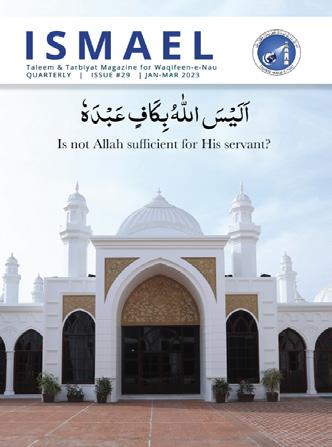

By the grace of Allah Ta'ala, Waqifeen-e-Nau are now spread across the globe, many of whom are studying in their respective fields while others have already fulfilled their pledge of dedicating their lives for the Jama’at. There are many who are Missionaries, practising Doctors, Television producers, Architects, Graphic designers, Engineers, Accountants and much more.
Ismael is an international magazine, which was launched in 2012 by Hazrat Khalifat-ul-Masih the fifthaba specifically for the Waqifeen-e-Nau around the world. At this auspicious occasion, addressing the Waqifeen-e-Nau Huzoor-e-Anwaraba wrote:
“The magazine has been named as “ISMAEL”, which reminds us of the sacrifices made by Hazrat Ismaelas and by Hazrat Hajiraas who spent their lives in a desolate and barren place and instituted exceptional standards of sacrifices for the sake of religion. Likewise, it is expected of every Waqf to uphold the covenant of Waqf (dedication) made by their parents even before their birth, who have in turn themselves reaffirmed the same.”
Waqifeen-e-Nau can contribute by sending articles regarding their respective fields of studies. This magazine is published on a quarterly basis as a platform for the Waqifeen-e-Nau to get in touch and express what they have always wanted to. To subscribe to this magazine, you can contact your National Waqf-e-Nau Secretary. You can also read and download the magazine online at: www.waqfenauintl.org/ resources/ismael
Remember, this magazine is for the Waqifeen-e-Nau, prepared by the Waqifeene-Nau. Everyone is welcome to send their articles, contributions and comments. Ismael magazine is the central magazine for Waqifeen-e-Nau from around the globe.

Among the believers are men who have been true to the covenant they made with Allah. There are some of them who have fulfilled their vow, and some who still wait, and they have not changed their condition in the least;
The Holy Quran 33:24

Hazrat Anasra related that the Holy Prophetsa said: God’s messenger seldom addressed us without saying “He who is not trustworthy has no faith, and he who does not keep his covenant has no religion.”
Mishkat al-Masabih 35 9

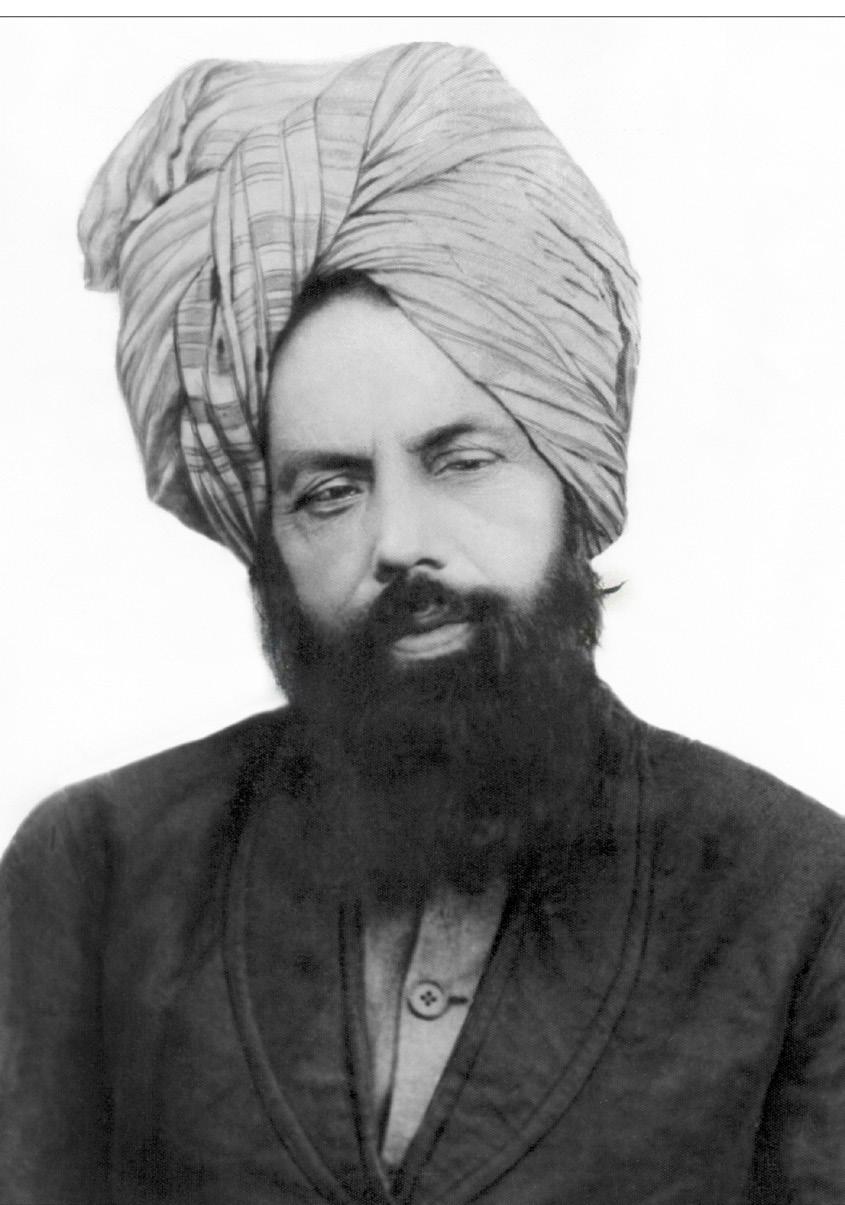
The seed of sacrifice that was sown by Abrahamas in a hidden manner was exhibited by the Holy Prophet, peace and blessings of Allah be upon him, in the form of flourishing crops—and this, in reality, is the great secret in this day. Abraham, peace be upon him, was even ready to slaughter his son to fulfil the commandment of God Almighty. This was a hidden indication of the fact that man ought to become wholly devoted to God; and one’s own life, and the blood of one’s children, and one’s kith and kin, ought to appear insignificant in the face of God’s command. Just observe the many great sacrifices that were offered in the era of the Messenger of Allah, peace and blessings of Allah be upon him, who perfectly exemplified each and every pure teaching. The wilderness was filled with blood. It was as though streams of blood began to flow forth. Fathers spilt the blood of their children and sons killed their fathers, and both were happy—in fact even elated—in laying down their lives and being hacked to pieces in the cause of Islam and God. But now reflect, except for fun and enjoyment, entertainment and amusement, what has remained of spirituality?
This Eid-ul-Adha is greater than the Eid that precedes it, and people

generally refer to this as the ‘Greater Eid’ as well, but reflect and do tell me, how many people, as a result of this Eid, are actually moved to purify their soul, cleanse their heart, partake of spirituality, and endeavour to absorb the radiance and light that is present in this duha (time of brightness)? he Eid of Ramadan represents a struggle—a personal struggle— and the effort of the soul. But this Eid, also referred to as the ‘Greater Eid’, possesses a grand and magnificent spirit within itself. Alas! Due attention has not been given to this deeper reality. One immense favour of God Almighty—Whose mercy is manifested in many ways—upon the community of Muhammad, peace and blessings of Allah be upon him, is that this blessed community exhibited in itself the deeper essence of everything which existed in previous religious communities in the form of a shell or a husk.
— Malfuzat, Vol. 2, page 206-207 —
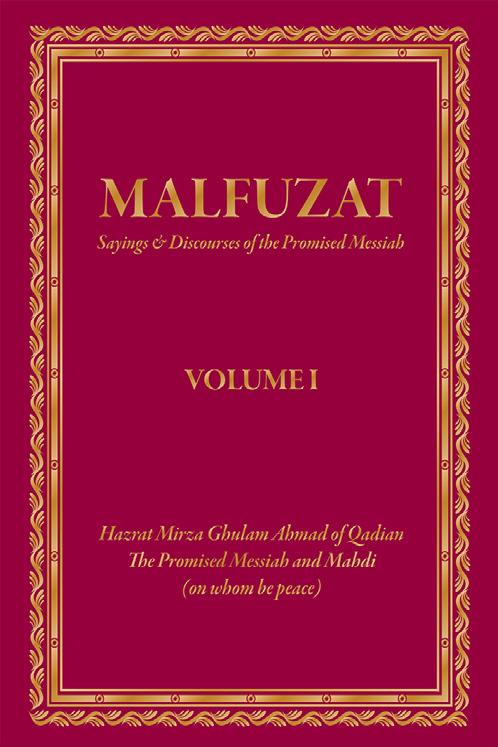
Malfuzat refers to the pure and insightful discourses of Hazrat Mirza Ghulam Ahmad of Qadian, the Promised Messiah and Mahdi, peace be upon him, which he delivered in his sacred gatherings or during the sessions of Jalsa Salana. These words were intended for the purification of his companions’ souls, their spiritual and moral training, establishing a living relationship with God Almighty, teaching the knowledge and wisdom of the Holy Qur’an, as well as reviving Islam and upholding the Shariah of Muhammad, peace and blessings of Allah be upon him.

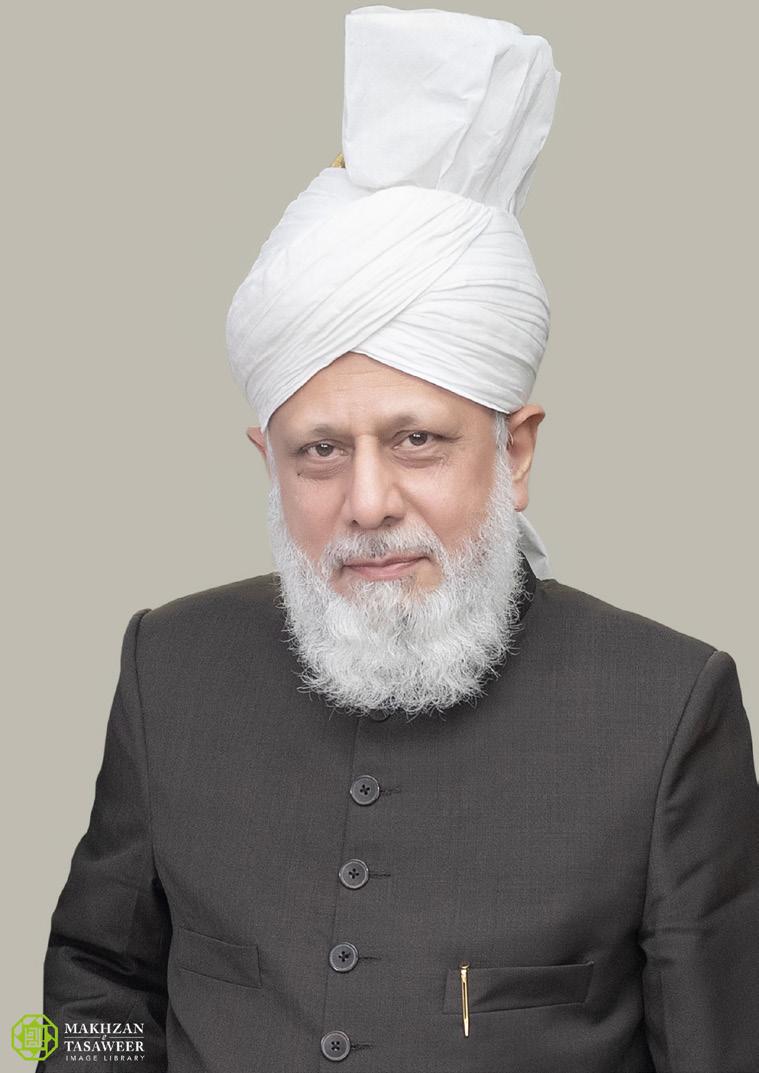
The covenant you have made demands absolute faith and trust in Allah and requires you to constantly strive to build a living connection with Him. It demands that you be ready for
“And of Abraham who fulfilled the commandments.”
In relation to this verse, the Promised Messiahas said that Allah the Almighty has testified to the supreme obedience and sincere
loyalty of Hazrat Ibrahimas because he not only made a pledge, but also fulfilled it. As I have said, your pledge is of utmost seriousness and magnitude. In essence you have affirmed before God that you will be ready for every possible sacrifice and hardship for His sake and will, until your dying breath, seek to serve your faith.
I firmly believe that if every member of the Waqf-e-Nau scheme, with purity of heart, lives up to this pledge, then together you can bring forth a great spiritual revolution in the world and liberate society from the chains of moral decay in which it has become shackled. However, for this you will need the help and love of Allah the Almighty, and to attain.

‘Strive to achieve the pinnacle of your chosen path’


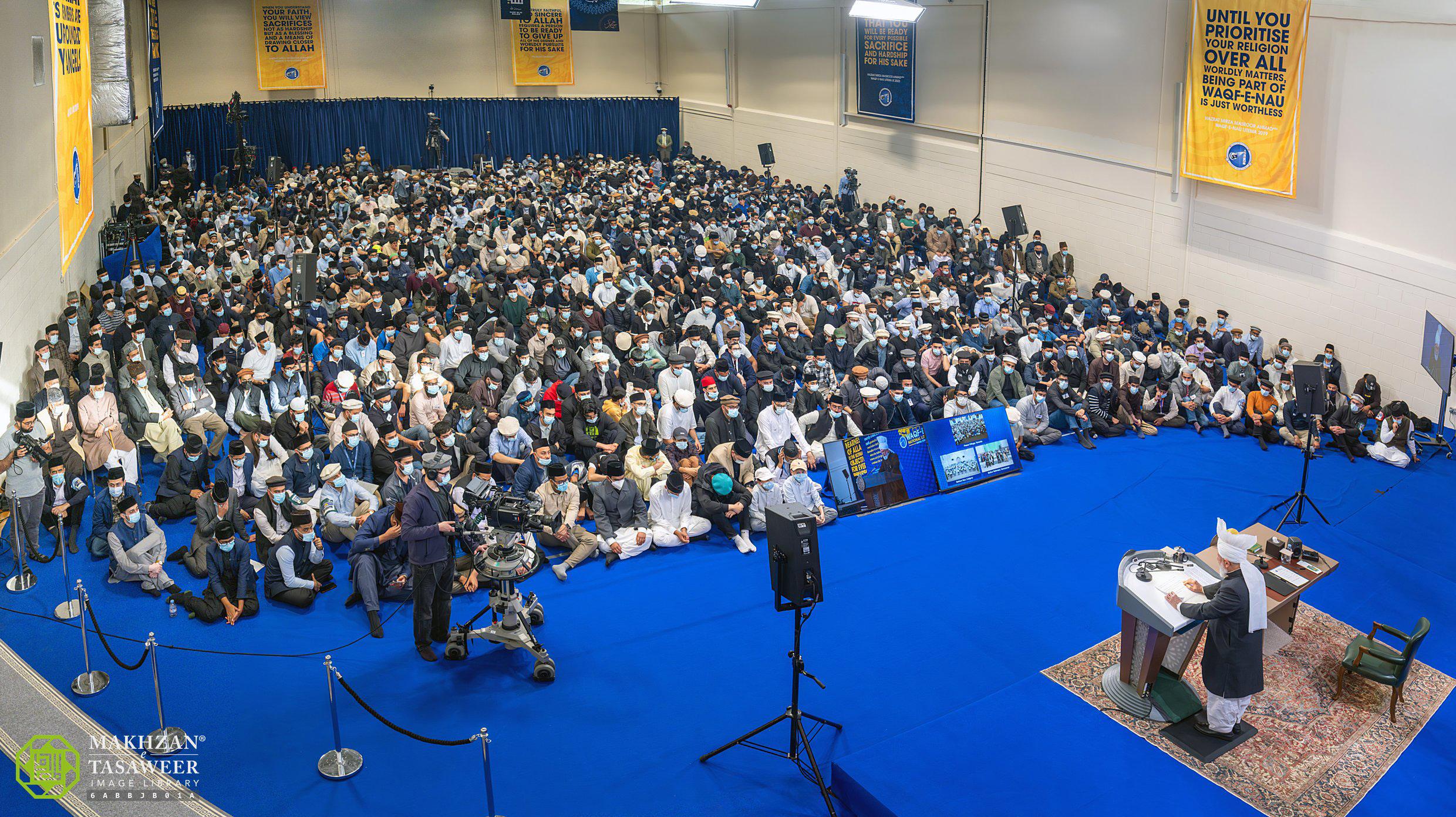
Huzoor addresses Waqifeen-e-Nau at UK Ijtema 2026
On Sunday, 26 April 2026, at approximately 5 pm local time, Hazrat Mirza Masroor Ahmad, Khalifatul Masih V, may Allah be his Helper, presided over the UK Waqf-e-Nau Ijtema 2026 at Islamabad, Tilford, UK.
After conveying assalamu alaikum, Huzooraba invited Ehsan Ahmad Sahib to recite a portion of the Holy Quran – Surah Ar-Ra’d, Ch.13: V.20-23. Ghaalib Khan Sahib then presented the English translation of these verses. Abdul Haye Sarmad Sahib subsequently recited an Urdu poem of the Promised Messiahas, followed by its English translation presented by Frasat Cheema Sahib.
Hazrat Amirul Momineenaba then invited Abdul Quddus Arif Sahib, Secretary Waqf-e-Nau UK, to present the Ijtema report.
He expressed his gratitude to Huzooraba for gracing the occasion with his esteemed presence and for the opportunity to hold the ijtema in Islamabad. He stated that the participants were divided into age-based groups, each participating in its respective activities. The sessions at the Ijtema covered topics such as the role of MTA International in tabligh and tarbiyyat, an introduction to Jamia Ahmadiyya UK, responding to allegations, and inspirational convert stories. The total number of male waqifeene-nau was 2144, which is 62% of

the total number of waqifeen-enau. With guests, the attendance was a total of 2700.
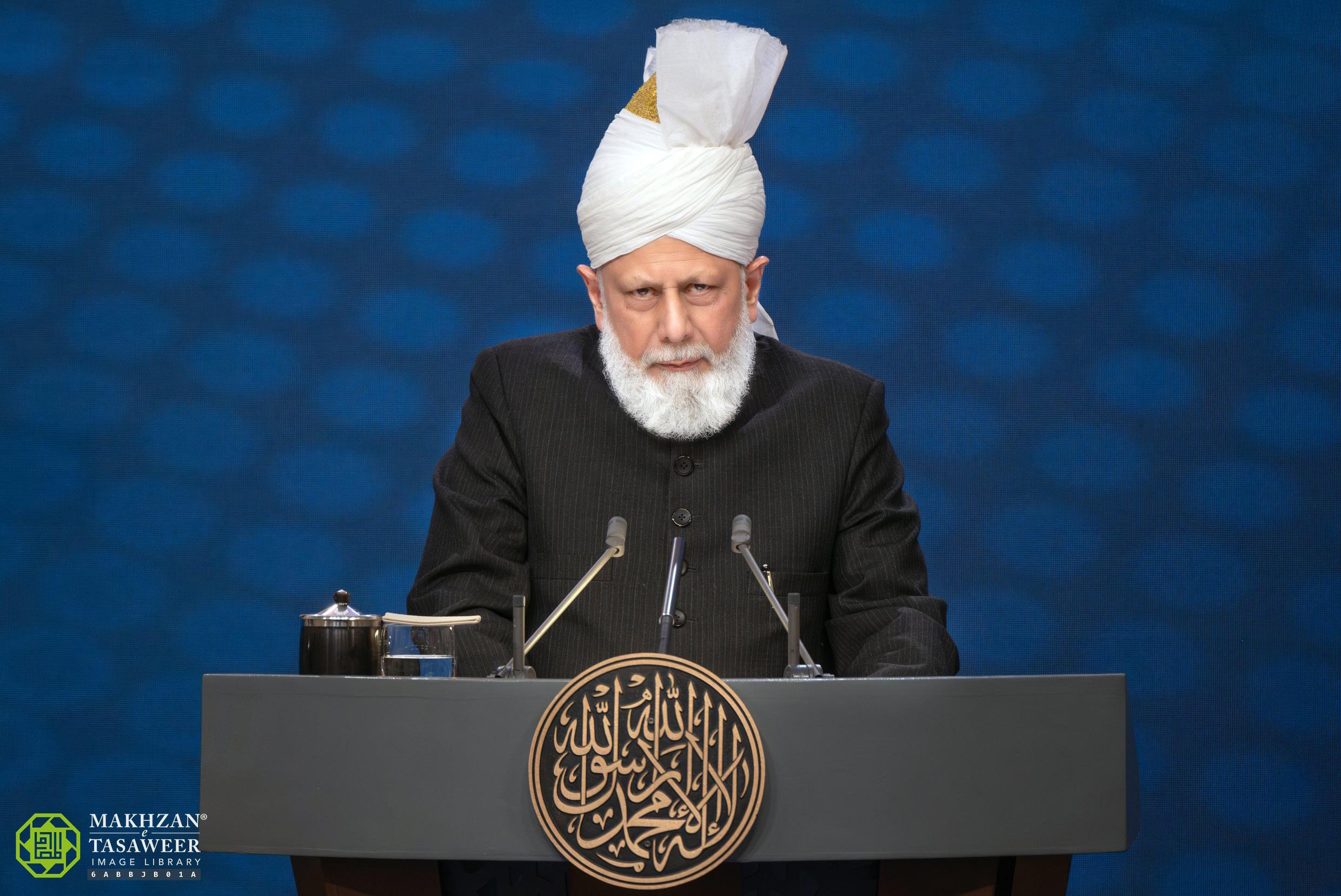
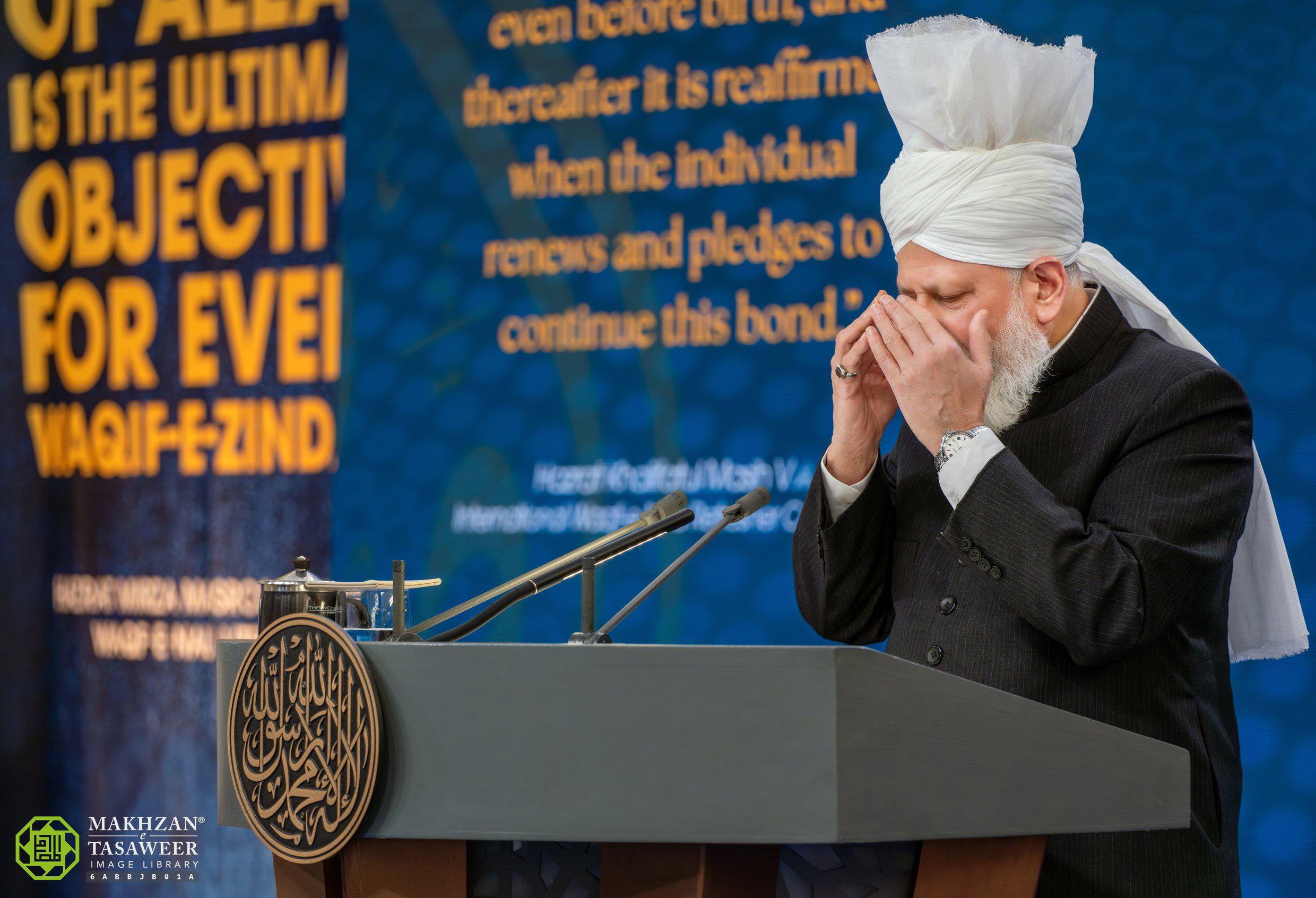
Huzooraba then took to the podium and, after reciting the tashahhud, ta’awwuz and Surah al-Fatihah, Hazrat Amirul Momineenaba commenced his address. A brief summary of this address is presented below:
As waqifeen-enau, you hold a unique distinction that you are part of a group of people whose parents, prior to your birth, made a sacred vow to dedicate your lives to the service of the Jamaat. And then, having reached maturity, you have independently chosen to renew this bond. In this way, you have transformed that parental pledge into your own lifelong mission. This is not a path of compul-
sion. Upon reaching an age of understanding, the Jamaat gives each member the option to either reaffirm the parents’ pledge or withdraw from the scheme. If you choose to leave, you are not guilty of any sin, nor should you be judged in such a way.
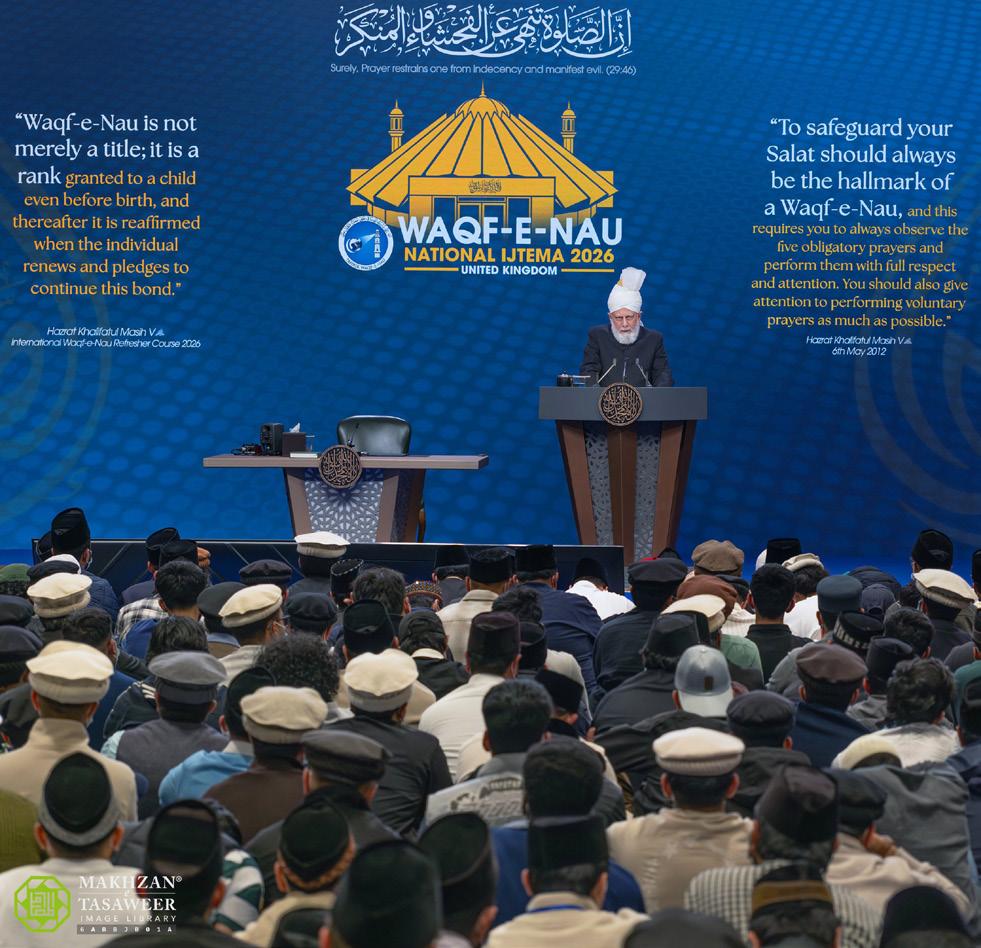
If you are open and honest, and say you are unable to fulfil your waqf, it is your right. Over the years, a number of people have expressed their desire to withdraw from the scheme, and they are excused. While they are allowed, they must not forget their responsibilities as Ahmadi Muslims and strive to honour the conditions of bai’at and the rights of Allah the Almighty and mankind.
Those who willingly renew the pledge must strive with complete sincerity to fulfil it, recognising
that the standard of devotion which is expected of a waqf-e-nau exceeds that of other Ahmadis.
Huzooraba said that, as this Ijtema is specifically for waqf-e-nau, he will outline the core values you must seek to instil in yourselves to fulfil your duties and become outstanding servants of the Jamaat.
Having reached maturity, many of you are now married and have children of your own, so you must recognise that now is the time to fully manifest and fulfil your pledge. Huzooraba said he will outline the expectations of the Promised Messiahas about fulfilling our religious duties and attaining the ranks of true believers.
As waqifeen-e-nau, your mindset must be that you are the primary recipient of these instructions, and must strive to fulfil them with greater zeal and devotion than anyone else. If you do, you will live as true Ahmadi Muslims and fulfil your pledge as a waqf-e-nau.
The Promised Messiahas emphasised that his followers must manifest the highest moral stand-
ards and etiquette at all times. A person must never allow their emotions to overpower their speech or conduct, nor must they ever let them incite them to injure the feelings of others. He further explained that Allah desires for those who have associated themselves with him to be beacons of moral excellence for others to emulate.
Therefore, as waqf-e-nau, you must not only manifest such morals yourself, but also become catalysts for the reformation of others, too. While every Ahmadi must strive for this, the responsibility for waqifeen-e-nau is greater. As you have not only accepted the Promised Messiahas but also vowed to stand on the frontlines of service and to give precedence to your faith over all worldly matters.
If you fail to uphold your basic duties, the world will rightly wonder as to how it is that you claim to prioritise your faith but the standard of your worship remains poor, as well as your conduct. People will dismiss your claims as hollow and insincere. It is your duty to set a compelling,
powerful example for others so they are naturally inclined toward you.
Furthermore, the Promised Messiahas instructed that our belief in the oneness of God (tawhid) must be unshakable. A true believer must be so confident in Allah’s power that it instils within him a fear that he must never commit an act that may displease Him. When the world looks in your direction, they should know that the followers of the Promised Messiahas are those who exhibit superior morals and are consumed by the awe of Allah’s greatness and mercy. The Promised Messiahas said that his followers must excel in righteousness and taqwa. Every action must be governed by these two things. This is a theme, Huzooraba said, that he often addresses in his Friday Sermons. The Promised Messiahas taught that taqwa is the essence of Islamic teachings and fundamental to our faith. Allah the Almighty commands us about the importance of taqwa in the Holy Quran on over one hundred occasions. The Promised Messiahas taught that righteousness
requires our words and deeds to exist in complete harmony. If this is not the case, it means hypocrisy has entered our hearts, and we do not fear displeasing Allah.
You must all reflect upon whether you are truly striving to achieve these high standards. If you have exhibited moral weaknesses in the past, you must pledge from this moment that you will strive to bring about a spiritual transformation in your life. The doors to Allah’s mercy are always open to those who seek them. The Promised Messiahas explains that Allah has bestowed upon us many faculties and abilities, but they are not given to be wasted, and rather are for a noble purpose. We must use them in pursuit of goodness, and never for evil or immoral purposes.
Today, we often hear about the technological revolution that has taken place in recent decades. Yet instead of propelling humanity forward, these modern technologies all too often drive people towards vices and corrupting forces. The internet, social media, gaming and other platforms are fuelling a tide of immorality and
misinformation. They are polluting minds and propelling young people onto a destructive path.
In the face of such destructive influences, you must exercise absolute self-control and discipline. Instead of surrendering your moral values, you must maintain control over your emotions and ensure your God-given abilities are used for good. Those who do so will be rewarded by Allah. In the Holy Quran, Allah says that surely success comes to the believers. For this success, salat is fundamental, as taught by the Promised Messiahas. The prayers must be offered with complete sincerity, and the focus should be on Allah alone. They must not be
rushed. When you begin every namaz, your mindset should be that you are entering the throne of Allah in order to present all your desires and needs before Him.
You should immerse yourself so fervently in prayer that tears naturally fall from your eyes as you submit and bow down before your Creator. Beseech Him for His help and mercy so that you may be among the righteous and that you are able to abstain from sin. This is the key to success, which leads to the acceptance of one’s prayers.
In today’s world, people are very quick to voice frustration and lament their misfortune without
exhibiting patience or self-reflection. People are quick to complain about worldly desires that have not immediately been fulfilled; however, the Promised Messiahas taught us that our greatest concern over all worldly worries should be whether we are truly walking on the path of righteousness.
He taught that if a person is truly grief-stricken over their spiritual state and yearns for Allah’s love above all else, they will find that success and prosperity will flow toward them. The Promised Messiahas further stated that if a person strives to attain the pleasure of Allah, the definitive path to follow is that of the Holy Quran. By following its teachings, not only will such a person attain spiritual peace, but they will also win the hearts of their families, neighbours, peers and their wider societies.
Thus, always remember that the Holy Quran is our greatest and foremost guiding light. Immerse yourself in the study of the Quran and seek to act upon all of its Divine commands. Allah has clearly defined right from wrong.
If you inculcate these Quranic teachings into your character, others will naturally gravitate towards you, and your words will have a powerful effect.
Sometimes, complexes emerge among young people that lead them to feel they must conceal their faith to fit in with society. However, remember that others will respect and value you if you are sincere in your faith and practice what you preach. Therefore, submerge yourselves in the Quran’s heavenly light and strive to act upon every one of its injunctions.
On another occasion, the Promised Messiahas stated that to have a strong and positive effect on the hearts and minds of others, you must first better your own state and make sure your actions are governed by righteousness. A person must always seek to eliminate their weaknesses and always seek instruction directly from the Holy Quran to discern right from wrong.
Furthermore, the Promised Messiahas urged his followers to pursue knowledge, teaching
that true intelligence and understanding correlate directly with righteousness and that wisdom and foresight are unattainable without turning towards Allah. It is easy to claim to believe in Allah, but in order to prove that claim, we must turn towards Him at all times.
An atheist or non-believer may credit their hard work, intelligence and personal efforts for their achievements. Certainly, if they work hard, they will attain a degree of success. However, because they are bereft of divine guidance, their faculties can only take them so far. Hence, if an atheist and a sincere believer work in the same field, the believer who seeks Allah’s guidance and help will achieve far greater success.
In terms of our Jamaat, so far we have had only one truly outstanding example of an Ahmadi who reached the pinnacle of the scientific world, Dr Abdus Salam Sahib. In all his works, he drew inspiration from the Holy Quran at every step. Today, with the grace of Allah, many Ahmadis are excelling in academia,
research and a wide range of professional disciplines. Their work is being recognised by their peers, and their contributions are having a positive impact in their respective fields.
Yet, there is much further to go. Our Jamaat must seek to produce many more people who, whilst bearing witness to the Glory of Allah, scale the peaks of human knowledge. It was during the time of Hazrat Khalifatul Masih IIIrh that Dr Abdus Salam Sahib won the Nobel prize. Huzoorrh himself had a great passion for learning and education, so he launched a scheme urging Ahmadis to excel in science and to strive to follow in the footsteps of Dr Abdus Salam Sahib.
Huzoorrh said that achieving this required Ahmadis to relentlessly pursue excellence in their fields whilst also striving to develop an intimate bond with Allah the Almighty. The believer who dismisses Allah’s help and believes his achievements to be a result of his efforts alone shall be guilty of hypocrisy. Hence, to succeed, a believer must act upon Allah’s commands and combine
this with hard work and sincere prayer.
If an Ahmadi pursues knowledge in this way, they will witness Allah’s blessings rain down on them, and they will be granted success after success.
Regarding the pursuit of knowledge, the Promised Messiahas stated that some religious clerics believed that science led people away from God. The Promised Messiahas rejected this opinion categorically and said that human knowledge and enlightenment emanate from Allah, and hence, there is no reason to fear scientific discoveries. He urged his followers to learn modern sciences and affirmed that rationality and reason were entirely in keeping with the teachings of Islam.
The Promised Messiahas taught that believers should acquire scientific knowledge and not harbour any sort of anxiety or inferiority in this regard, explaining that reason and knowledge descended from Heaven as a form of spiritual light. He gave the example that when rain falls from Heaven, its effect depends
on the soil it lands upon – if it falls on fertile ground, the earth benefits and produces fragrant flowers and rich crops. If it drops upon barren land, there is no result. The same is true, the Promised Messiahas said, with human intelligence. If a person sincerely believes Allah to be the Creator of the worlds and seeks to sincerely understand his creation, then Allah opens their minds in a way that enables them to surpass others. Their minds become a fertile ground.
The Promised Messiahas refuted those clerics who said science was dangerous and to be shunned, describing the souls of such clerics as trembling in the face of philosophy and modern research. They feared science because they did not understand it, nor did they possess the wisdom to know that it went hand in hand with the teachings of Islam. Hence, the Promised Messiahas urged his followers not only to pursue scientific knowledge but to harness their discoveries in support of Islam and to prove its truth.
This is a great challenge for all
waqifeen-e-nau. Whereas atheists try to use science to disprove the existence of God, it is your duty to use it to prove His existence. Seek to dismantle the allegations laid against religion through the power of reason and rationality. Regardless of your chosen path, you must strive to achieve its pinnacle. Thereafter, whenever you achieve success or make a breakthrough, proclaim to the world that the knowledge you gained was inspired by the Word of God, and that the practical manifestation of Allah’s teachings is revealed through science, nature and the world around us.
so infatuated by their knowledge that instead of getting closer to Allah, they join the ranks of those who believe science and religion oppose one another. As a result, they focus purely on secular knowledge and distance themselves from God. Therefore, as waqf-e-nau, you must heed this warning and remain vigilant from all forms of pride. Crucially, you must never miss any of the five daily prayers.
At the same time, never let the pursuit of knowledge breed arrogance or take you away from your faith. The Promised Messiahas warned that some people become
You must read and study the Holy Quran on a daily basis, as well as read the books of the Promised Messiahas and other religious books. Moreover, the Promised Messiahas said we must adopt the highest moral standards within our homes. Thus, treat your family with love and compassion, and ensure that such an atmosphere remains in your home at
all times.
Huzooraba said that as the Ijtema draws to a close, he wishes to conclude by reminding us that the Promised Messiahas taught us that the key to attaining all forms of success and prosperity is righteousness. Strive to adopt this by acting in accordance with the commands of Allah at all times. Only then will we gain the nearness of Allah and the rewards and blessings of our faith. Only then will our homes be content, only then will we become true role models, and only then will we do justice to the pledge of
waqf-e-nau.
At the end, Huzooraba prayed: May Allah the Almighty enable you to understand what I have said, and may you act upon it so that you fulfil the purpose of your lives and guide others towards Allah the Almighty. May you all prove to be a source of lasting benefit for all of mankind, and may you fulfil the demands of being a waqf-e-nau and serve the cause of Islam Ahmadiyyat with the utmost distinction throughout your lives. Amin.
Hazrat Amirul Momineenaba then led everyone in silent prayer.
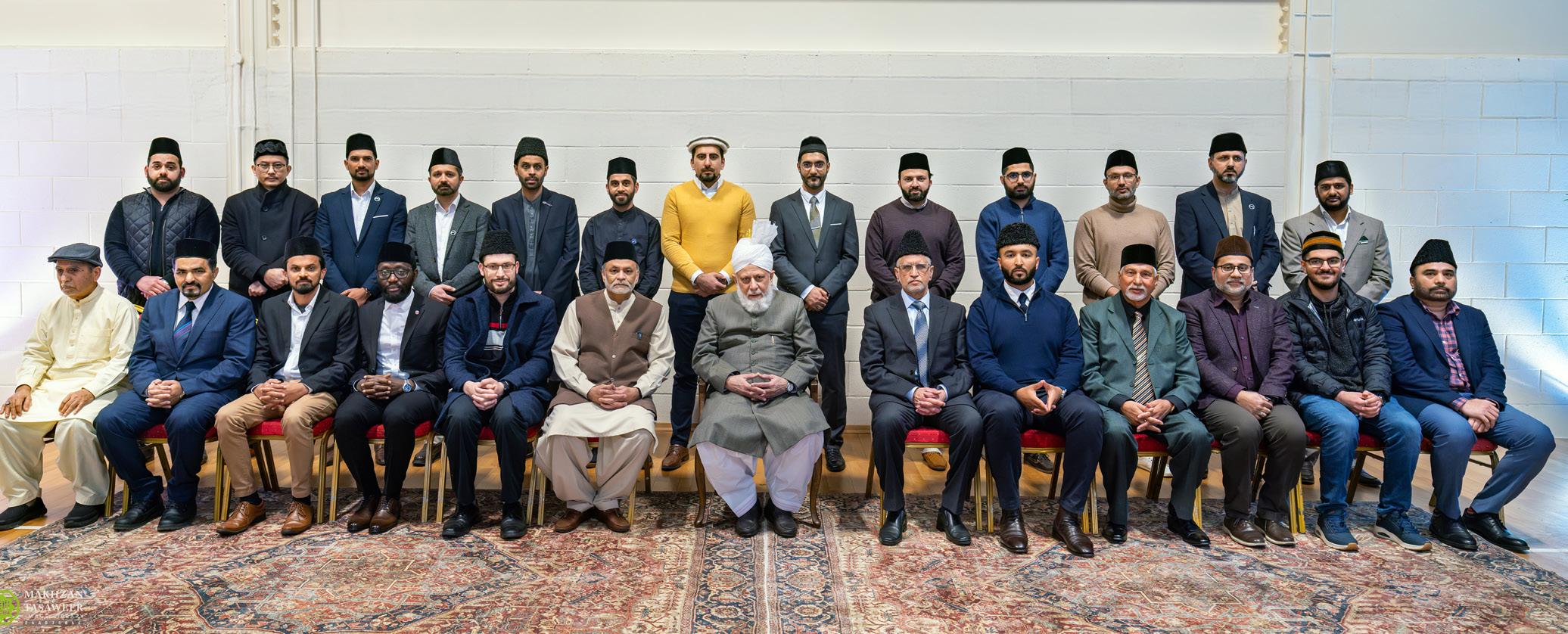
Invaluable guidance imparted by Hazrat Khalifatul Masih Vaba on the occasion of the Second International Waqf-eNau Refresher Course, on 17 January 2026 at Masroor Hall in Islamabad, Tilford, UK
All of the secretaries who have gathered here should not merely come, sit in the gathering, listen to the lectures, and then depart. Rather, you must also implement these things.
Explain to the Waqifeen-e-Nau their responsibilities. Some Waqifeen-e-Nau will formally enter into the service of the Jama’at, while some Waqifeen-e-Nau are working in their respective fields. You must explain to such individuals that they are to undertake this work only after seeking due permission. Regardless of the work they are doing, just because the Jama’at does not require their services at the present time does not mean that they have become entirely independent.
As members of Waqf-e-Nau, they
must understand their responsibilities. Fulfilling the rights of worship, increasing in religious knowledge, acquiring knowledge of the Holy Qur’an, and serving the Jama’at are all essential matters that you must instil in the mind of every Waqf-e-Nau. I have come to know that in some countries there are individuals who do not wish to continue their Waqf – in fact they themselves write to me as well. Therefore, the names of all such individuals should be sent to the central Waqf-e-Nau Department here, so that their names may be removed from the list.
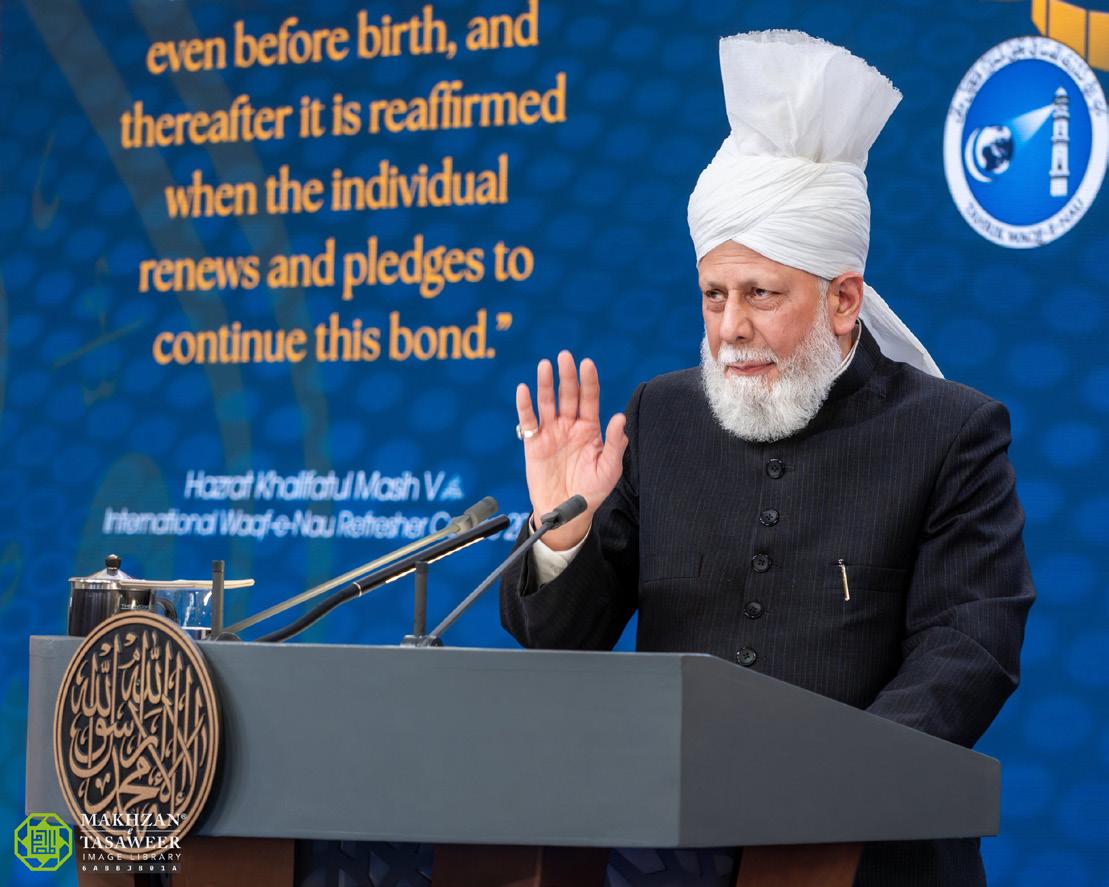
“Waqf-e-Nau” is not merely a title; it is a rank granted to a child even before birth, and thereafter it is reaffirmed when the individual renews and pledges to continue this bond. Those who are unable to continue must, in any case, be removed. Those who pledge to continue should also understand their responsibilities.
Many things will have been conveyed to you, much of which you would already have known. In any case whatever you have learnt here and are taking back with you must also be implemented. There is a need to organise the Waqifeen-e-Nau. If this team of Waqifeen-e-Nau, which numbers in the thousands, is properly organised, then the work of the Jama’at in every country – whether in Tabligh or in Tarbiyyat, among both men and women – can increase manifold.
Thus, pay particular attention towards this. I trust that you will endeavour to act upon whatever you have learnt here and will organise your teams of Waqifeene-Nau with a renewed effort.
May Allah the Almighty grant you the ability to do so.
May the peace and mercy of Allah be upon you all.
Watch proceedings of Refresher course by scanning this QR code

By Jalees Ahmad Ahsan
The word Waqf (فقُو) is an Arabic term meaning dedication, devotion, or consecration — the act of setting something aside entirely for a noble and sacred purpose. In the context of the Ahmadiyya Muslim Community, Waqf refers to the voluntary offering of oneself, one’s time, or dedicating one’s expected child for the cause of Allah and the service of Islam.[1]
The literal meaning of Waqf is dedication, and the purpose of the Waqf-e-Nau scheme is for parents to dedicate their children for the propagation of Islam even before their birth. After the child is born, the duty of parents does not end — they must ensure their child’s upbringing is conducted in the best manner, keeping them attached to the Khalifa of the time and maintaining a responsibility towards the Jama’at. [1]
Hazrat Mirza Masroor Ahmadaba, the Fifth Khalifa and worldwide head of the Ahmadiyya Muslim Community, has described the essence of Waqf as follows: Waqf means to fulfil the rights of Allah the Almighty, the rights of His creation, and to constantly strive to advance one’s knowledge and to raise one’s moral and spiritual standards. It means to practise religion at all times and in all circumstances.[2]
“And let there be among you a body of men who should
invite to goodness, and enjoin equity and forbid evil. And it is they who shall prosper.”
Holy Quran, chapter 3, verse 105 Hazrat Khalifatul Masih Vaba cited this Quranic verse in a Friday Sermon specifically addressing the requirements of Waqf-e-Zindagi and the aspirations of the Waqf-e-Nau scheme. The verse establishes the Quranic command that a dedicated body of believers must always be present to call humanity towards goodness.[3]
“It is not possible for the believers to go forth all together. Why, then, does not a party from every section of them go forth that they may become well versed in religion...”
Holy Quran, chapter 9, verse 122
This second verse, also cited in the same sermon, reinforces that a devoted group must continuously dedicate itself to acquiring deep religious knowledge and guiding others — forming the spiritual and scriptural foundation upon which all forms of Waqf in Ahmadiyya Muslim Community rest.[3]
The spirit of Waqf in the Ahmadiyya Muslim Community traces back to its founder, Hazrat Mirza Ghulam Ahmadas, the Promised Messiah and Mahdi. He was himself the supreme embodiment of total dedication — devoting every waking moment to the revival and propagation of the true teachings of Islam.[2]
At the inauguration of Madrassa Ahmadiyya, the Promised Messiahas articulated his vision for an institution that would produce devoted servants of Islam. As recorded and cited by Hazrat Mirza Masroor Ahmadaba in his Friday Sermon of 22nd October 2010:[3]
Hazrat Mirza Masroor Ahmadaba has further described the personal example of the Promised Messiahas in the following terms: during his life, the Promised Messiahas devoted every day and every night for the sake of Islam, continuing to work until he felt on the verge of collapse from exhaustion, resting only briefly before returning to his mission. Till his final breath, every moment of his life was spent fulfilling his divine purpose.[2]
The most far-reaching and spiritually distinct form of Waqf in Ahmadiyyat is Tahrik Waqf-e-Nau. On 3rd April 1987, after receiving divine guidance, Hazrat Khalifatul Masih IVrh called upon Ahmadi parents to offer what Hazrat Mirza Masroor
“This Madrassa should become a source of propagation of Islam. It should produce such scholars and boys who dedicate their lives and abandon worldly employments and objectives to adopt service of faith.” [3]
Ahmadaba has described as their most prized possession — their yet-to-be-born children — in the way of Allah, committing them to the cause of Islam, the propagation of Ahmadiyyat, and service to mankind.[8]
The goal was both ambitious and spiritually profound: to raise a generation that would willingly sacrifice everything for the sake of God and shoulder the responsibility of the Jama’at as it entered its second century. Thirty nine years after the initiative was launched, there are already over 85,000 Waqf-e-Nau members across the world, and the number continues to grow every day.[4]
In launching the scheme, Hazrat Khalifatul Masih IVrh drew a parallel with the Quranic story
of Hazrat Maryamas, whose mother dedicated her unborn child in the way of God before she was born — a supreme act of faith and devotion. Just as that dedication produced one of the greatest servants of God, so too does the Waqf-e-Nau scheme aspire to raise devotees of the highest spiritual calibre.[5]
The Waqf-e-Nau scheme has since entered its second generation. As Hazrat Mirza Masroor Ahmadaba noted at a 2016 Ijtema address: those who received moral training as members of Waqifaat-e-Nau have now become mothers themselves and are including their own children in the scheme — an extraordinary testament to the depth and continuity of this devotion across generations.[7]
Hazrat Mirza Masroor Ahmadaba has repeatedly and emphatically stressed that a Waqf is only of genuine value if it is grounded in a sincere connection with Allah the Almighty. The primary means of building that
relationship is through Salat — the five daily prayers. He has stated clearly that those who fail to offer their prayers regularly render their Waqf entirely meaningless and futile.[2]
“To safeguard your Salat should always be the hallmark of a Waqfe-Nau, and this requires you to always observe the five obligatory prayers and perform them with full respect and attention. You should also give attention to performing voluntary prayers as much as possible. You should recite the Holy Qur’an daily and learn its translation and deeper meanings.” [1]
Furthermore, it is a religious obligation upon every Ahmadi Muslim man to offer his prayers in congregation. Those living within a reasonable distance of a mosque or Salat Centre must make every effort to attend congregational prayers, and this should be a daily and paramount feature of their lives.[2]
A Waqf-e-Nau is expected to 30
embody exemplary moral character at all times. Hazrat Mirza Masroor Ahmadaba has described the twin obligations of a Waqf as fulfilling Haqooq-Allah (the rights of Allah) and Haqooqul-Abaad (the rights of Allah’s creation) to a standard far higher than that expected of ordinary Ahmadis.[2]
“Our Waqf-e-Nau should be selfless in nature and never selfish. You should consider how you can help others and fulfil their rights, rather than worrying about your own needs or entitlements. A Waqf-e-Nau should never be the cause of pain for others, instead they should always be kind, compassionate and caring.” [9]
Humility and forbearance are also identified as essential qualities of a true Waqf. His Holiness has cautioned that some Waqfe-Nau fall into the error of believing that the title alone confers special status. He has stated plainly that having one’s name on the Waqf-e-Nau list is of no value in itself — it is only through moral and spiritual excellence, and by prioritising faith over all worldly matters, that a
Waqf-e-Nau becomes truly special in the sight of Allah.[2]
The responsibilities of Waqf do not rest solely on the children. Parents who enter their children into the Waqf-e-Nau scheme carry a profound and ongoing responsibility. Hazrat Mirza Masroor Ahmadaba has stated that from the very moment they dedicate the life of their unborn child, parents should pray fervently that Allah enables their child to fulfil the demands of Waqf.[2]
Guidance from Waqf-e-Nau
International drawn from addresses by Hazrat Khalifatul Masih IVrh and Hazrat Khalifatul Masih Vaba emphasises that parents must inculcate love and truthfulness in their children’s hearts from an early age. Parents themselves must be role models in prayer, in recitation of the Holy Quran, in high morals, and in loyalty to the Jama’at system.
As His Holiness has stated: no amount of verbal training will be effective until the parent’s own
words and actions are in conformity with what they teach.[8]
Hazrat Khalifatul Masih IVrh used a vivid metaphor to convey the seriousness of the commitment: he described a fairground ride with a warning sign at the final point of no return — and said that parents must prepare their children now to have the courage to pass through that gate of complete and irrevocable dedication when the time comes.[8]
Parents should also encourage their children at a young age to attend auxiliary programmes so that when they become older, they are attracted to the Jama’at themselves. Hazrat Mirza Masroor Ahmadaba has stated that, “Some believe that because they are Waqf-e-Nau, they are exempt from attending their respective auxiliaries programs—if they are a girl, that of Nasirat or Lajna, or if they are a boy, that of Atfal or Khuddam; as if to say, “Our auxiliary is a completely separate auxiliary.” If this idea is in anyone’s heart, it is wholly incorrect. Any Jama’at officer, even if he be the Jama’at Amir, is a
member of the auxiliary concomitant with his age. Thus, every Waqf-e-Nau girl and boy must remember that they are a member of the auxiliary that corresponds to their age—whatever their age may be, they are required to take part in their programs. And for those who do not take part, the respective auxiliary head should make a report. And if this does not reform the [child], then such a child will be removed from the Waqf-e-Nau scheme.” [8]
Hazrat Mirza Masroor Ahmadaba has identified one of the most vital responsibilities of Waqfe-Nau as the intellectual and spiritual defence of Islam in the modern age. He has stated that Waqf-e-Nau members should excel in learning Islamic teachings by studying the Holy Quran and the books of the Promised Messiahas, which will provide them with the intellectual and spiritual knowledge to respond to allegations made against Islam.[9]
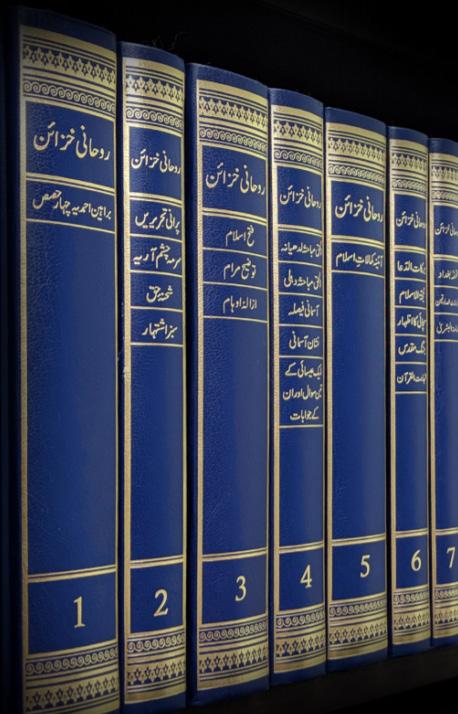
“In today’s world people are attacking Islam from all directions and so as Waqf-e-Nau, you should be on the front lines defending your religion. However, this is not the era of the Jihad of the Sword — we are living in an age where people are attacking Islam through literature, through the media, through the internet and through other similar means, and so, it is your duty to counter the allegations made against Islam in
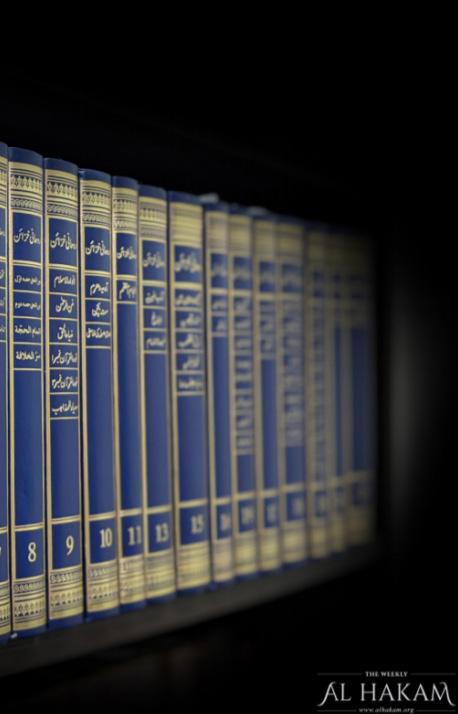
a like manner.” [9]
This emphasis on knowledge-based service is central to the purpose of the Waqf-e-Nau scheme. The scheme has led to the opening of Jamia Ahmadiyya institutions in several new countries, through which a significant number of missionaries — many of whom are Waqf-e-Nau — are being trained to propagate the true teachings of Islam and ensure the moral training of the
members of the Jama’at.[6]
There has been an instance in my life which truly reflects how Waqf has affected me in a positive way. As a young Khadim, I am committed and devoted to performing Tabligh and serving the Jama’at, therefore, I decided that after I complete my A-Levels, I would go to Jamia.
However, since I’m a Waqf-eNau, I sent a letter to Beloved Huzooraba asking him if I should go Jamia or University, and I added that I prefer to go to Jamia. As I was waiting for a response from Beloved Huzooraba, Jamia’s application deadline was getting close, so I applied to Jamia, passed the entry exam and then passed the interview. I got a letter from Jamia on 12th July 2025 that Beloved Huzooraba has approved my name for Jamia.
Now as the summer holidays were ending, I received a letter from Beloved Huzooraba himself on 19th August, dated 16th July, where he stated that Beloved
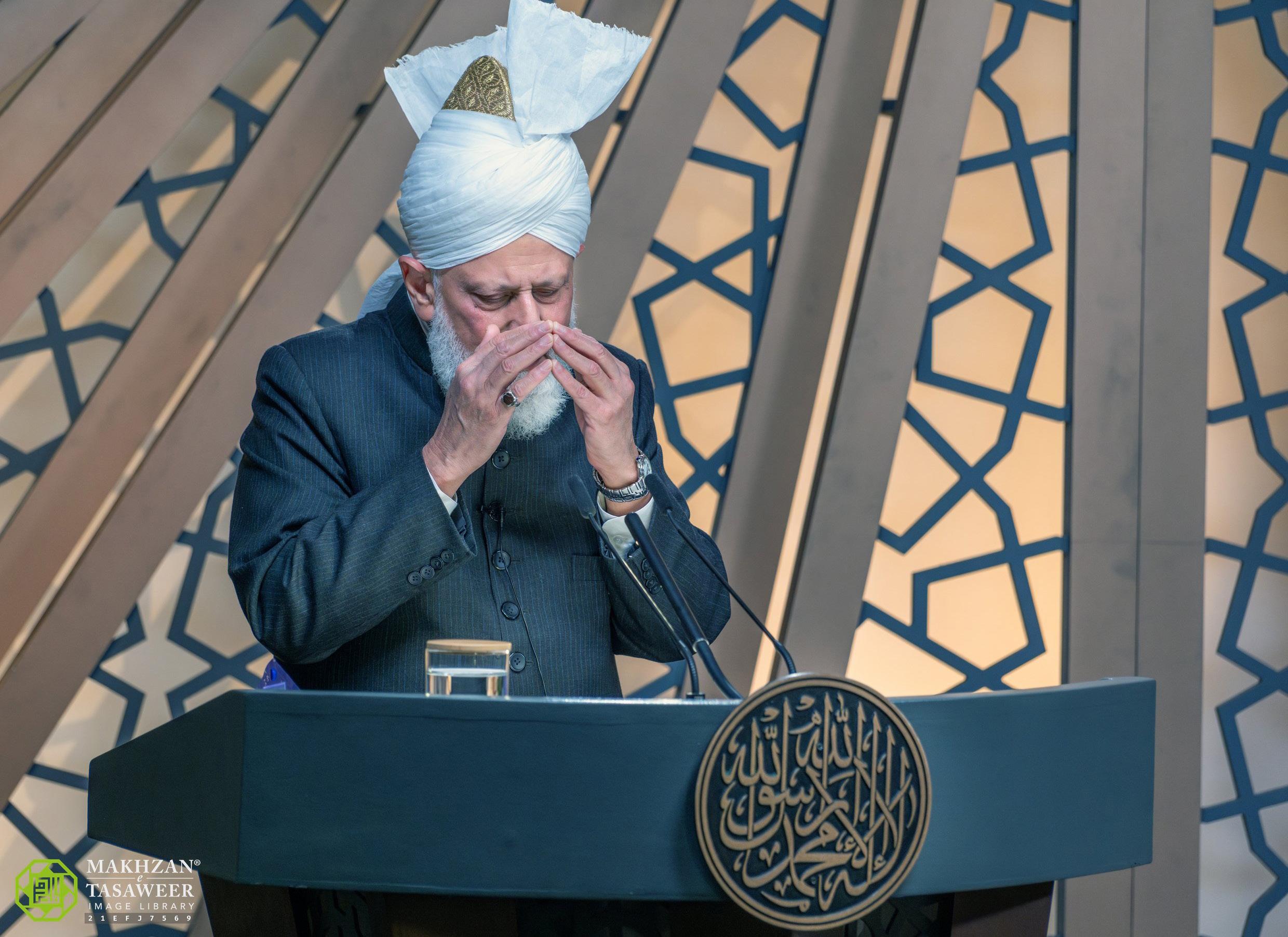
Huzooraba acknowledges the fact that I want to go Jamia, however it is recommended that I go to university. At this point, I was confused as Beloved Huzooraba approved my name to go to Jamia yet 4 days later he wrote a letter saying that I should go to university. My dad and I explained the situation to Jamia, and we were advised to write to Beloved Huzooraba.
As we were preparing what to write to Beloved Huzooraba, we got a call from Markaz that we have been given a Mulaqat with Beloved Huzooraba on 30th
August. Our Mulaqat was meant to be in January 2026. This was nothing short of a miracle that we had been granted a Mulaqat with Beloved Huzooraba at a time when we needed it.
Prior to the Mulaqat, I felt a big change in my heart that I don’t want to go to Jamia anymore since I preferred to follow Beloved Huzoor’saba advice over my wish, however I kept that to myself. During the Mulaqat, I explained the situation to Beloved Huzooraba and he asked me where I wanted to go. To this, I responded that I want Beloved
Huzooraba to decide. Then, he told me to lower my face mask and the second I did, he said that it looks like I want to go to university. Before I could say anything, Beloved Huzooraba repeated 3 times that it would be better for me if I go to university. Now Alhamdulillah, I am finishing my first year of Chemistry at King’s College London. I have prayed to Allah to loosen the knot on my tongue so that I can become confident in spreading the message of Islam and becoming a role model for my peers. Alhamdulillah with Beloved Huzoor’saba prayers, I am now the President of the KCL Chemistry Society and a Student Ambassador for Chemistry. Never in my life would I think that I would end up in this position as I was fully determined on becoming a Murrabi and I wasn’t talkative or confident at all. This is the true meaning of Waqf, that you are willing to change everything about your life, you are willing to change who you are, you are willing to do whatever you are told in just a blink of an eye, for Khilafat and the betterment of the Jama’at.
1. Waqf-e-Nau International. Guidance for Waqifeen-e-Nau [Internet]. Waqf-e-Nau International; [cited 2026 Apr 5]. Available from: https://www.waqfenauintl.org/guidance-for-waqifeen-e-nau/
2. Ahmad MMM. Fulfilling the Pledge of Waqf. Address at the UK National Waqf-e-Nau Ijtema; 2019 Apr 7; Baitul Futuh Mosque, London. Al Islam [Internet]; [cited 2026 Apr 5]. Available from: https://www.alislam.org/articles/ fulfilling-pledge-of-waqf/
3. Ahmad MMM. Friday Sermon: Requirements of Waqf-e-Zindagi and Waqf-e-Nau [Internet]. Al Islam; 2010 Oct 22 [cited 2026 Apr 5]. Available from: https://www.alislam.org/friday-sermon/2010-10-22.html
4. A testament to continued divine support: Huzoor highlights a year of global progress in second-day address at Jalsa Salana UK 2025 [Internet]. Al Hakam; [cited 2026 May 6]. Available from: https://www.alhakam.org/second-dayaddress-at-jalsa-salana-uk-2025
5. Ahmad MMM. The Essence of Waqf-e-Nau. Friday Sermon 2016 Oct 28. Translated and published by Ahmadiyya Muslim Community [Internet]. Al Islam; [cited 2026 Apr 5]. Available from: https://www.alislam.org/book/ essence-of-waqf-e-nau/
6. Ahmad MMM. Training of the Waqf-e-Nau – Duties of Waqf-e-Nau Secretaries. Address at the International Waqf-e-Nau Refresher Course; 2019 Dec 7; Islamabad, Tilford, UK. Al Islam [Internet]; [cited 2026 Apr 5]. Available from: https://www.alislam.org/articles/training-of-waqf-e-nau-duties-of-secretaries/
7. Ahmad MMM. Address at the National Waqf-e-Nau Ijtema for Lajna and Nasirat 2016 [Internet]. Al Islam; 2016 Feb 27 [cited 2026 Apr 5]. Available from: https://www.alislam.org/articles/address-at-national-waqf-e-nau-ijtema-for-lajna-nasirat-2016/
8. Waqf-e-Nau International. Guidance for Parents [Internet]. Waqf-e-Nau International; [cited 2026 Apr 5]. Available from: https://waqfenauintl.org/guidance-for-parents/
9. Ahmad MMM. Head of Ahmadiyya Muslim Community Addresses Muslim Youth Event (Waqf-e-Nau Ijtema) in London [Internet]. Al Islam Press Release; 2017 Mar 2 [cited 2026 Apr 5]. Available from: https://www.alislam. org/press-release/muslim-youth-event-waqf-e-nau-ijtema-london-2/

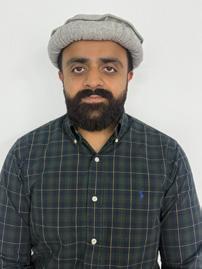
Can you please tell us a bit about how you have been serving within the Jama’at in various capacities?
Alhamdulillah, I have had the opportunity to serve the Jama’at in various capacities over the years. From a young age, I remained involved in local Jama’at activities, particularly within Atfal-ul-Ahmadiyya and Khuddam-ul-Ahmadiyya. I served in roles related to Tarbiyyat, Tabligh, and Taleem. I then had the blessed opportunity to study in Jamia Ahmadiyya UK. I graduated in 2022 Alhamdulillah. Our class then had the chance to do Hifazat-e-Markaz duties in Islamabad under Khuddam-ul-Ahmadiyya for about a year. There we spent most of our time doing security duties as well as part time work in the various offices situated in
Islamabad (Tilford, UK). We were also blessed to have a few classes with Huzoor-e-Anwaraa, which were very enlightening. By the grace of Allah, Huzoor-e-Anwaraa graciously appointed me to serve in MTA Translation as my very first posting after becoming a Murabbi.
You are a Waqf-e-Nau and Missionary serving in MTA, how did you come to the decision you want to devote your life for the Jama’at?
Being a Waqf-e-Nau, the foundation for dedicating my life was laid by my parents, but the true understanding and personal conviction developed gradually. Through prayers, guidance from Khilafat, and personal reflection, I came to realise the great responsibility and honour of serving faith. Seeing the global needs of the
Jama’at and the blessings attached to Waqf strengthened my resolve to devote my life sincerely.
What is your current role in MTA, and what does a typical day look like for you?
Currently, I am serving in MTA primarily in translation. My day typically involves translating programmes, and other religious material, ensuring accuracy and clarity while preserving the original spirit. Alongside this, there may be coordination with our editing team, reviewing translations, and sometimes live translation duties, which require focus and preparedness.
Is there anyone who specifically inspired you to devote your life?
deeply influenced me. Observing their sincerity and unwavering commitment inspired me to follow a similar path.
What has been the most rewarding experience for you working in MTA and translating?

The greatest inspiration has always been Khilafat, particularly the guidance and example of Khalifatul-Masihaba. Additionally, the lives of devoted Missionaries and the sacrifices of early members of the Jama’at have
One of the most rewarding aspects is knowing that even a small effort in translation can help convey the message of Islam Ahmadiyyat to people across the world. When you realise that your work is enabling someone to understand a sermon or teaching in their own language, it brings a deep sense of fulfilment and gratitude.
Can you share an experience where you felt your work made a real difference?

There have been occasions when individuals have expressed that a particular translated programme or sermon helped clarify their understanding of a particular matter. Knowing that my work played even a small role in that process was incredibly humbling and reinforced the importance of sincerity and excellence in service.
For a Waqif-e-Nau who is interested in pursuing a similar field, what guidance would you give him? How can you pursue this field?
Firstly, focus on building a strong connection with Allah through prayer and sincerity of intention. Alongside that, develop your skills whether in languages, writing, media, or communication. Seek guidance from Khalifatul-Masihaba and remain consistent in small acts of service. Opportunities come to those who show dedication, humility, and a willingness to learn.
How are you still keeping in touch with Khalifatul-Masih Vaba and why is it important
to have that bond with Khalifatul-Masih Vaba?
Maintaining a bond with Khalifatul-Masihaba is essential for spiritual growth. I try to stay connected through listening to sermons, watching MTA regularly, writing letters for prayers, and striving to act upon his guidance. This connection provides direction, strengthens faith, and keeps one aligned with the true objectives of Waqf.
What message would you like to give to all Waqf-e-Nau reading this magazine?
Waqf-e-Nau is a huge blessing and responsibility. Always remember the purpose of your dedication and strive to fulfil it with sincerity. Be regular not only in your five daily prayers but also your nawafil. Stay attached to Khilafat, prioritise your faith over worldly matters, and continuously seek to improve yourself spiritually, morally, and intellectually. If you remain steadfast, Allah will open ways for you to serve His Deen in the best manner.
Lukman A Sunmonu, PhD | Secretary, Waqf-e-Nau, Nigeria
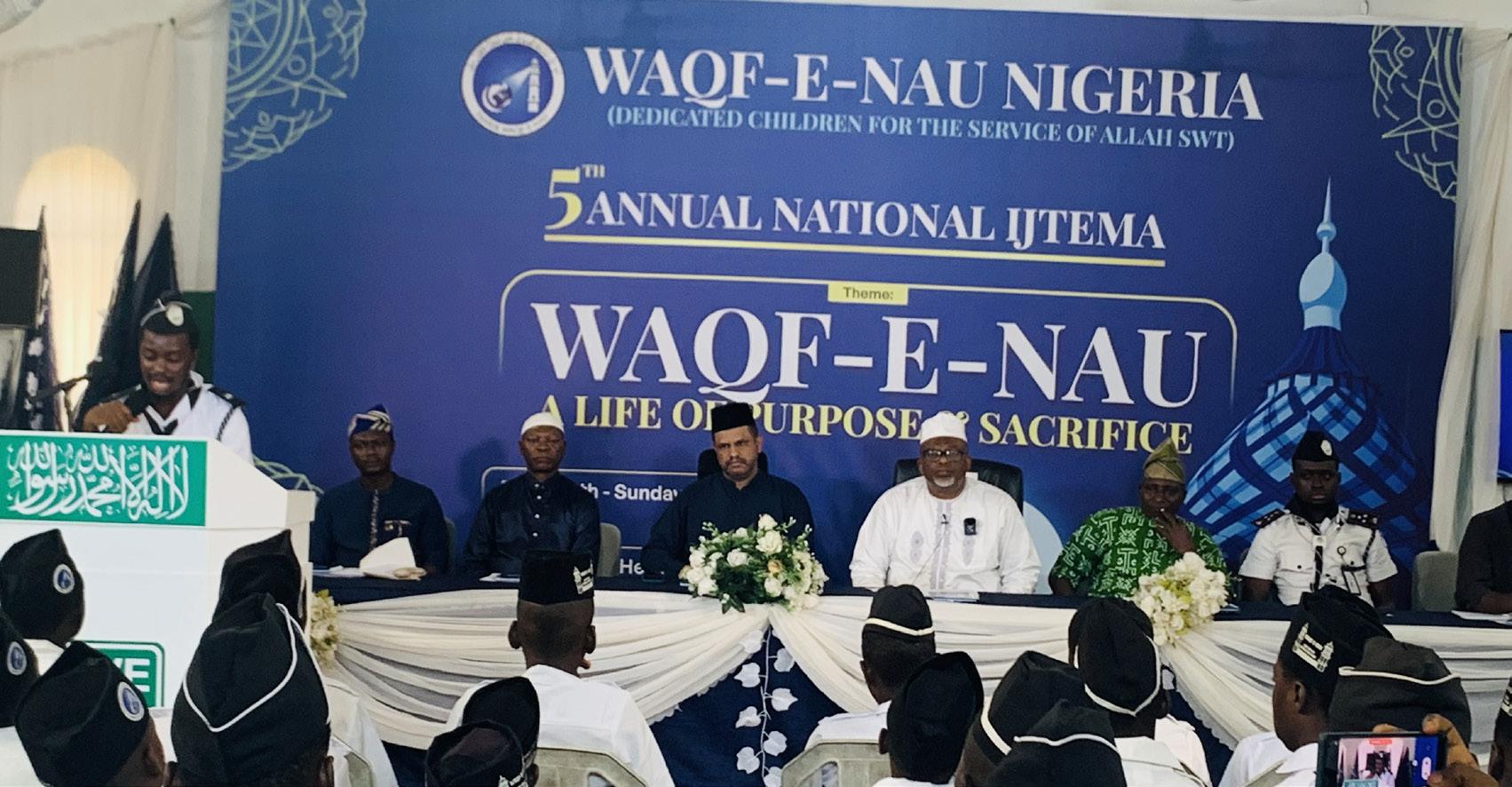
Alhamdulillah, by the grace and mercy of Allah, the 5th Annual National Waqf-e-Nau Ijtema 2026 was successfully held from 17–19 April 2026 at the Ahmadiyya Muslim Jama’at Headquarters, Ojokoro, Lagos, Nigeria.
The Ijtema was organised under the theme “Waqf-e-Nau: A Life of Purpose & Sacrifice”, aimed at strengthening spiritual development, discipline, and commitment among Waqifeen-e-Nau and Waqifaat-e-Nau .
A total of 363 participants (174
Waqifeen-e-Nau, 189 Waqifaat-eNau) attended. Also in attendance were parents, secretaries, and officials. It was noted that the northern and eastern regions were not represented, and efforts are underway to ensure wider inclusion in future.
The programme commenced with registration and Friday prayers, followed by structured activities including guidance sessions, rededication orientation (15 participants submitted forms), educational programmes, and a quiz-based examination drawn
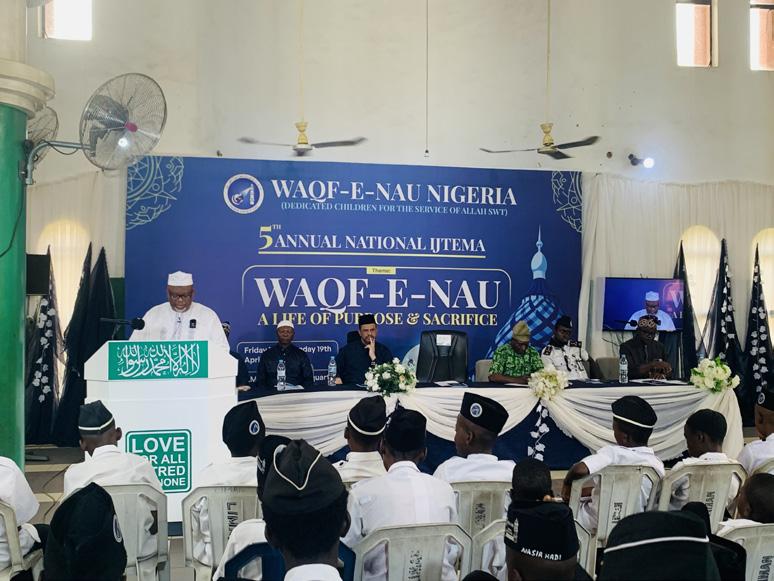
from the approved syllabus.
The formal opening session, chaired by the Respected Amir Sahib, Ahmadiyya Muslim Jama’at, Nigeria, Alhaji Azeez Folorunso ALATOYE Sahib, included the reading of a special message from Hazrat Khalifatul Masih Vaba. In his message, Huzooraba emphasised strengthening faith, attaining nearness to Allah, fulfilling the pledge of Waqf with sincerity, and drawing inspiration from the obedience of Hazrat Ibrahimas. His Holinessaba also cautioned against neglecting the responsibilities of Waqf. The programme included lectures, Ta’lim activities, Qur’an recitation, and a National MASQ based Quiz Competition. The closing session featured an address by the Missionaryin-Charge titled “What Makes a Waqf-e-Nau Special”, reinforcing
sincerity, obedience, and sacrifice, and drawing guidance from Huzoor’saba address of 28 October 2016 in Canada.
The structured use of MASQbased assessments proved effective in ensuring fairness and enhancing learning outcomes. Spiritually, the Ijtema strengthened participants’ connection with Allah and Khilafat, while reinforcing the identity and responsibilities of Waqifeen-e-Nau.
The programme was successfully coordinated by the National Working Committee with strong support from all stakeholders. Key strengths included participation, programme structure, and educational delivery. Areas for improvement include logistics, time management, and pre Ijtema preparation.
Plans are in place for an appraisal meeting, expanded regional engagement, and improved follow-up systems.
Alhamdulillah, the Ijtema achieved its objectives of spiritual renewal, education, and strengthened commitment among participants.

By Qasid Mashhood Ahmed
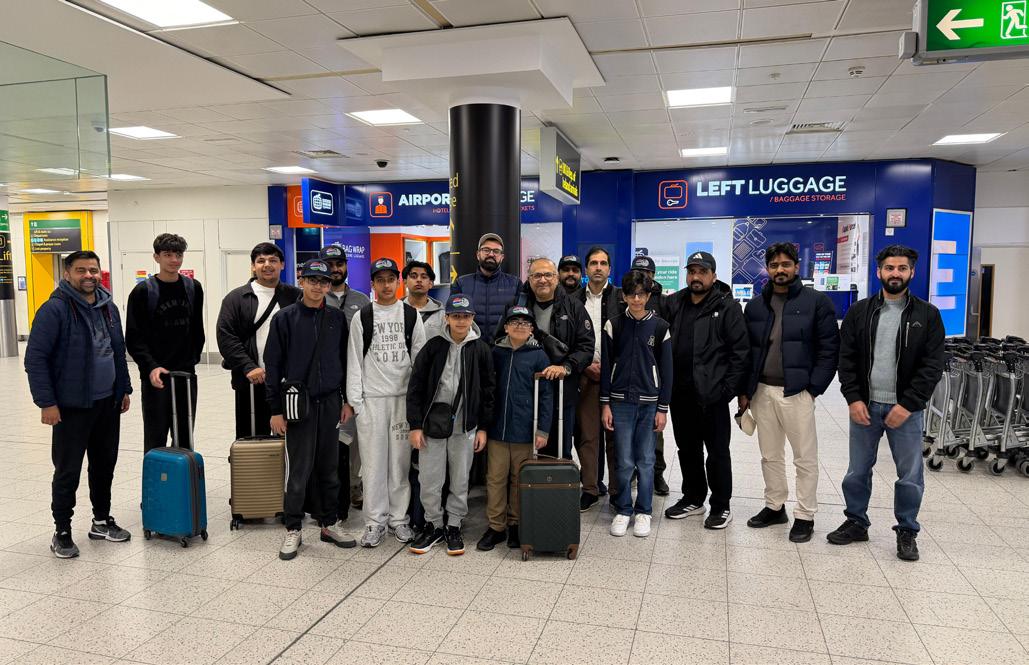
Earlier this year, a group of Atfal embarked on a deeply meaningful trip to The Gambia — one that would leave a lasting impact on every individual involved. This journey was not simply about travel, but about service, learning, and witnessing firsthand the realities faced by communities in need.
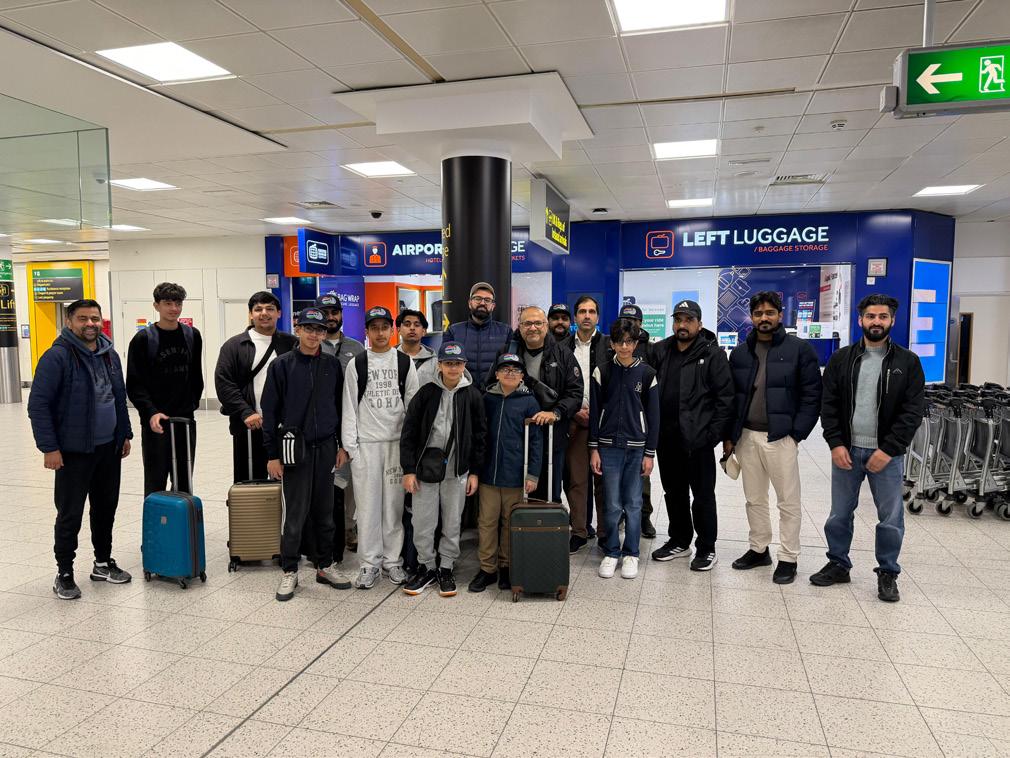
Throughout the trip, we had the opportunity to visit several hospitals and schools. These visits were both eye-opening and humbling. In the hospitals, we observed the
dedication of healthcare workers striving to provide care despite limited resources. It became clear how vital even basic medical supplies and infrastructure are, and how easily they can be taken for granted elsewhere.
Our visits to local schools were equally impactful. We met bright, eager students who demonstrated an inspiring passion for education, despite facing challenges such as overcrowded classrooms and limited learning materials. Their enthusiasm reminded us of the value of education and the importance of supporting access to it worldwide.
One of the most significant parts of our journey was fundraising for a village called Murre Kunda. After raising funds, we were blessed with the opportunity to personally visit the village. This experience allowed us to truly understand the daily struggles

faced by its residents. The lack of access to clean water was particularly striking. We saw how obtaining water required significant time and effort, and how this challenge affected every aspect of life — from health to education and overall wellbeing. It became clear to us that water is not just a necessity, but a lifeline that many still struggle to access. We also witnessed that they have a deep passion for football which we experienced when we played football with them.
Despite these hardships, what stood out most was the incredible resilience and warmth of the people. The hospitality we received from the Gambian Jamaat was truly sublime. We were welcomed with open arms,
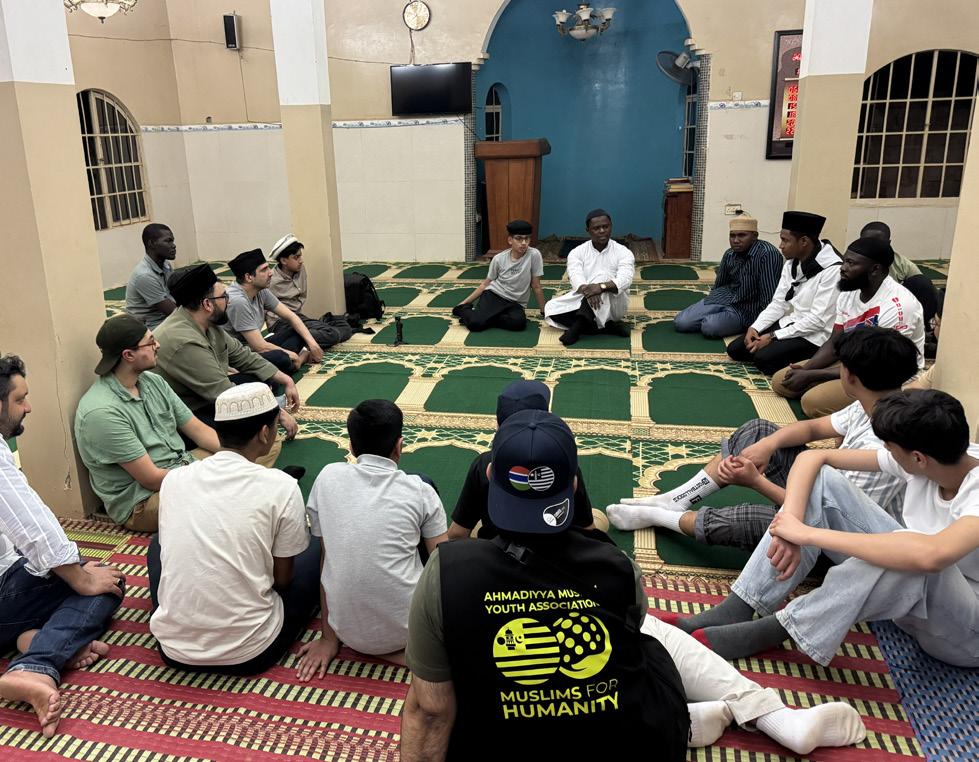
generosity, and kindness that went far beyond expectation. Their spirit of brotherhood and gratitude left a deep impression on all of us as well as their love for Khilafat.

The local Jamats repeatedly requested one thing when we visited them which was to please convey our Salam to beloved Huzoor.
This trip was more than a journey across continents — it was a journey of the heart. It taught us the importance of compassion, the value of service, and the responsibility we carry to help those in need. The memories, lessons, and connections made during this trip will stay with us forever, inspiring us to continue serving humanity wherever we can.

By Dr. Mubariz Ahmed Rabbani


In the Hadith literature, it is narrated that there have been 124000 prophets (e.g. Musnad Ahmad). Most of them appeared in different parts of the world before the 2nd century CE i.e. before the death of Prophet Jesusas. At times they appeared back-to-back and sometimes simultaneously in the same place as in the case of the Biblical prophets in the Holy Land - the ‘age of prophets’ in the literal sense. It is, however, clear that the identity of the vast majority remains currently shrouded in mystery. It is generally assumed that the 500-600 years long period between the death of Prophet Jesusas and the claim of the Holy Prophetsa of Islam in the year 610 CE was left completely devoid of any divinely appointed prophets. The Holy Quran, however, does not support this interpretation:
“And never did We destroy any township but it had Warners”
(Ash-Shu’ara’: 209)
Other verses, likewise, express the belief that Allah the Almighty raised prophets or warners in every nation or people (see AnNahl: 37 and Fatir: 25).
The Promised Messiah and Mahdias supported this belief:
“God also made it clear in several places in the Holy Qur’an that His Messengers have been appearing in different lands all over the world. In fact He did not neglect any people or any country ”
(Message of Peace: 9)
Hazrat Musleh Maudra explained further:
“A complete belief in one God cannot be achieved without recognising that Allah the Almighty raised prophets in Egypt, Iran, India, China, Japan, Europe, and the Americas”
(Anwarul-Uloom volume 10: 568)
There are countless ancient communities that perished during the above-mentioned time interval – many of which we find engaged in extreme forms of idol worship and immoral acts of behaviour such those of the Peruvian Moche culture and Roman Pompeiian territory. As such, it is unreasonable to suggest a complete cessation of prophethood during this time.
Having said that, the Holy Quran does indicate that this time interval did witness a decline not only in the number of prophets but also in the intensity of their message and impact. The Holy Quran says:
“O People of the Book! there indeed has come to you Our Messenger, after a break in the series of Messengers, who makes things clear to you lest you should say, ‘There has come to us no bearer of glad tidings and no Warner.’ So a bearer of glad tidings and a Warner has indeed come to you. And Allah has power over all things”
(Al-Ma’idah: 20)
It is obvious that this verse addresses the people of the book specifically i.e. Jews and Christians, thereby leaving the door of prophethood open in other nations. There is, however, another point to bear in mind that further supports the idea of prophets appearing during this time interval or break. In his five-volume commentary (volume two, p. 614-615), Hazrat Musleh Maudra examined, using
the Arabic lexicons, Aqrab and Lane, the key word فترِة or interval (the noun-infinitive from فترِ) in the above-cited verse, providing several interpretations to explain the word including languor, remissness, weakness or feebleness. Hazrat Musleh Maudra adds:
“As generally believed, no Prophet appeared among Jews and Christians after Jesus. According to some historians, however, three Prophets did appear after Jesus, and according to Kalbi, Jesus was followed by four Prophets, one of them, Khālid bin Sinān al-ʿAbs, appearing in Arabia. It was with regard to Khalid bin Sinān that the Holy Prophet is reported to have said, ‘He was a Prophet to whose message his people paid no heed’”
(Muhit)
Studies of the Islamic literature, such as by the historian Hawting Gerald1, reveal additional individuals who are reported to have been prophets during the fatra. They include Ḥanẓala bin Ṣafwān who is believed to
have been sent to the people of al-Rass in Yemen and Riʾāb bin Zayd who appeared to the tribe of ʿAbd al-Qays. There is another interesting narration, which supports the argument in favour of the appearance of at least some prophets specifically during the second half of this time interval.
Hazrat Imam Jafar Sadiqas states:
“There was a period of five hundred years between Prophet ʿĪsā [Jesus] (peace be upon him) and the Messenger of Allah, Prophet Muhammad (peace be upon him). Out of these five hundred years, for two hundred and fifty years there was neither a prophet nor a manifest scholar” (Kamal al Din wa Tamam al Niʿmah: 193)
Similarly, al-Mas’udi writes:
“Many people between Christ and Mohammad, in the Fatrah, professed the unity of God, and believed that he sends prophets. But whether there has been a prophet amongst them or not is controverted”
(El-Mas’udi’s Historical encyclopaedia: Meadows of gold and mines of gems, v. 1: 126)
The purpose of this article
is, therefore, to try to detect additional traces of the appearance of prophets during this under-explored time interval in an attempt to shed light on the aforementioned debate. Compared to other parts of the world, the evidence for the appearance of prophets in northwest europe remains elusive and meagure. But a careful study of the extant historical Welsh, Irish and Scottish literature, provides some indications of a potential prophet of God, who appeared in northern Britain in the 6th century CE – a figure whose fame and respect reached other parts of Europe as well. Just as there was a period of ignorance (Jahiliyya) and spiritual decline in Arabia in the 6th century CE, so was there a period of what some historians call ‘dark age’ in Britain at the same time. Through the literary sources including early Welsh manuscripts, poetry, and the study of the British countryside, various historians, such as Nikolai Tolstoy2, have reached the conclusion that the character of Myrddin Wyllt (also known as Lailoken, Suibhne, and
later as Merlin of the Arthurian tradition) was, indeed a historical figure who lived in what are now the Lowlands of Scotland beyond Hadrian’s Wall (an area known as ‘The Old North’) back in the sixth century CE. This area was never directly occupied by the Romans, staying relatively untouched.
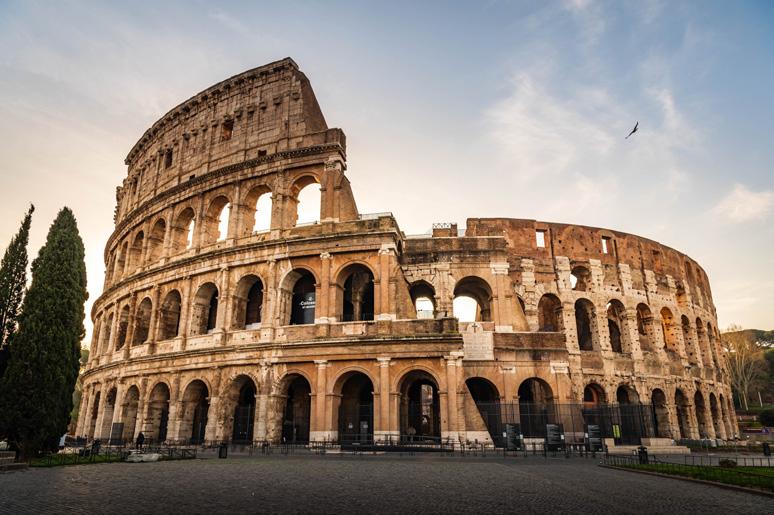
After the Roman withdrawal from Britain in the early 5th century CE, various small kingdoms (more or less united by language and culture) arose in the North who were the descendants of indigenous tribes from the Roman period and before. The kings of the North reigned in glory, fighting with each other and others. Life swirled around the courts of the kings. Of the ordinary people, whose labours sustained the princely household, very little is known. This was reportedly a ‘semi-barbaric’
time and ‘savage’ landscape characterised by conflict, plagues, famines, political fragmentation and economic decline. There was also vigorous paganism flourishing at the time, which was openly practised (Tolstoy 1985). It is within this chaotic context in which we seem to witness the appearance of Myrddin Wyllt. He was born reportedly in the year 540 CE or shortly before. According to the Welsh sources, Myrddin was a noble warrior and a member of Gwenddolau’s court - a northern king. There, he lived an aristocratic life. But after Gwenddolau’s death (and other dear ones) in the battle of Arfderydd (the texts do not imply CE dating, but the year is generally calculated as 573 CE), Myrddin lost reason or becomes inspired and retires to the Forest of Celyddon, suffering hardship and distancing himself from human society. In the earlier Scottish sources (which reached Wales later), he hears a voice talking to him and sees a heavenly vision before his withdrawal into the woods. He is being pursued by the men of
Rhydderch (the tyrant enemy king) and hides from them in the apple-tree. The apple-tree has some kind of power that conceals it from people. We also seem to find references to symbolism and metaphors in the poetry. The apple-trees, for example, may be, according to historians, a metaphor for the fates of princes, the Otherworld, or the gift of immortality. Yet there are no references to the apple-trees or Myrddin’s pigling assistant in the earlier Scottish tales. Some textual sources, likewise, reveal that Myrddin lived among the forest wolves and addressed an aged wolf as his dear companion. Wolves, like pigs, were objects of a devotional cult among the ancient native inhabitants of the land i.e. the Celts, being seen as companions of a god. Several Celtic saints are said to have tamed wolves (Tolstoy 1985). If we assume that pigs and wolves did also form a part in the life of Myrddin, could they possibly just be more metaphors or could they denote moral character sketches? Could the term ‘wolves’, for instance, represent a people or
some companions of Myrddin (just as the Prophets Jesusas and Krishanas used the words ‘sheep’ and ‘cow’ to refer to their people respectively? In later Welsh tradition, Myrddin, in fact, uses symbolic language such as the word ‘boar’ in a prophesy to refer to a foreign political ruler (Tolstoy 1985).

Eventually Myrddin discovered a spring on the top of a certain mountain in the centre of the Caledonian Forest, surrounded on all sides by hazels and dense thorns. This is where he sought refuge and settled down, which historians have identified with today’s Hart Fell site. The place overlooked a major highway much visited by travellers. N. Tolstoy asks, “He must have had visitors and followers, or else how was his poetry preserved for posterity? Large sections of the population looked to him for
mantic wisdom and prophesy”. For example, Myrddin’s sister, Gwenddydd, is mentioned in some of the poems, and speaks with Myrddin as he tells of things to come. Tradition locates the site of his death and burial some miles away from his dwelling place on the mountain (Tolstoy 1985). There are numerous traits in the character of Myrddin that imply him being a prophet of God. There are many qualities that prophets share with one another as can be inferred from the study of the Islamic scriptures and other sources. The surviving textual material, though limited, fragmented and interpolated, depicts Myrddin as a man who used to be a shepherd or herdsman for some time. He too is said to have undergone a three-days fast before becoming a prophet. He also performs prayers and seems to refer to God and heaven (though later Christian editorial revisions cannot be ruled out here). The poem Ymddiddan Myrddin a Thaiesin has Myrddin declare himself as a prophet. He was credited with being the author of prophecies,
in particular, about the rise and fall of kings and dynasties. In addition, some details of his story find parallels in the lives of other prophets such as Mosesas, the Buddhaas, Isaiahas and Jesusas. He has been referred to as a prophet, seer, poet, madman, wizard –titles that we often find in relation to prophets of God.
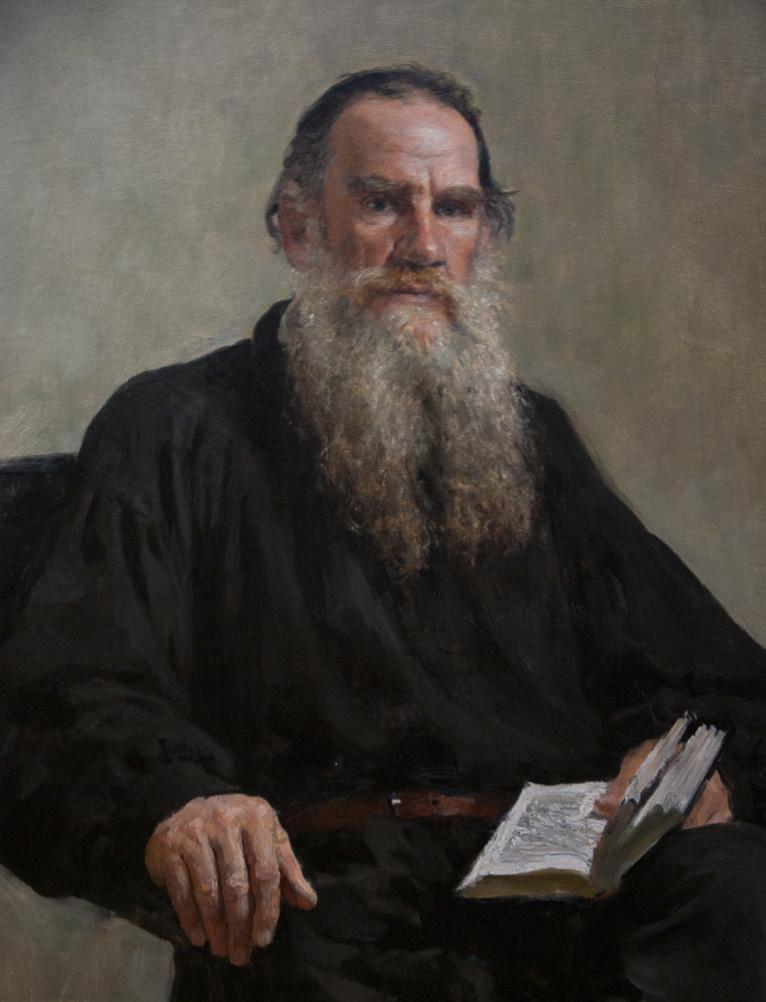
N. Tolstoy believes that Myrddin, “was a druid, an authentic prophet, surviving in a pagan enclave of the North after the collapse of Christenised Roman Britain”. P. H. Goodrich writes, “But the roots of his legend [Myrddin Wyllt] predate any historical person, since they derive from Leo Tolstoy

(among others) the IndoEuropean type of the priest-king, the shaman or holy man, the convention of the wild man, the model of the biblical prophets, and the widespread conviction that natural and supernatural elements can intermingle in the physical world”3.
J. Markale agrees and emphasises to “the enormity of Merlin’s part as a prophet,” as he is one who “has the task of enlightening humans concerning their destiny”4.
In conclusion, the analysis of the character of Myrddin Wyllt within the historical narrative of early medieval Britain challenges the widespread perception that
N. Tolstoy adds, “There was certainly a time when Myrddin was regarded as possessing some sort of unique spiritual authority or significance in Britain”. In fact, there is an interesting statement recorded in a triad in The White Book of Rhydderch that says, ‘The first name that this Island [Britain] bore, before it was taken or settled was Myrddin’s Precinct’. Critical in-depth studies are, hence, needed in the future to reveal more information in relation to the life of Myrddin Wyllt, the precise nature of his message and teachings.
the centuries between Prophet Jesusas and the claim of the Holy Prophetsa of Islam did not witness the rise of any prophets and messengers. By drawing on the Quranic evidence, the statements of the Promised Messiahas and Khulafa, the historical record and cross-cultural comparisons, this article carefully proposes that divinely guided prophetic figures may have continued to appear
– though in less prominent forms during this under-explored time interval. The discussion on the figure of Myrddin, preserved mostly in the form of legendary tales yet bearing striking resemblance to well-documented prophetic personalities, opens the door for further scholarly investigation while at the same time many figures still await critical studies.
As Hazrat Khalifatul-Masih IVra remarked:
“If you try to search for prophets among a great people, you will definitely be able to identify them”
(Urdu Tarjamatul Quran Class 226, Surah Fatir)
References:
1. Hawting, G. R. 2017. Were there Prophets in the Jahiliyya? In: Islam and its past. Jahiliyya, late antiquity, and the Quran, pp. 186-212.
2. Tolstoy, N. 1985. The Quest for Merlin. Brown and Company: London.
3. Goodrich, P. H. 2003. Introduction to Merlin. In: Merlin: A Casebook, Peter H. Goodrich and Raymond H. Thompson (eds.), pp. 1-90.
4. Markale, J. 2003. Master and Mediator of the Natural World. In: Merlin: A Casebook, Peter H. Goodrich and Raymond H. Thompson (eds.), pp. 410-426.