LinkedIn: WA Police Union instagram.com/wapoliceunion
PUBLISHED BY WA Police Union
639 Murray Street, West Perth WA 6005 (08) 9321 2155
ADVERTISING WA Police Union (08) 9321 2155
DISCLAIMER WAPU (‘Publisher’) advises that the contents of this publication are the sole discretion of the WA Police Union and the magazine is offered for information purposes only. The publication has been formulated in good faith and the Publisher believes its contents to be accurate, however, the contents do not amount to a recommendation (either expressly or by implication) and should not be relied upon in lieu of specific professional advice. The Publisher disclaims all responsibility for any loss or damage which may be incurred by any reader relying upon the information contained in the publication whether that loss or damage is caused by any fault or negligence on the part of the Publishers, its Directors or employees.
COPYRIGHT All materials in this publication are subject to copyright and written authorisation from WAPU is required prior to reproduction in any form.
ADVERTISING Advertisements in this journal are solicited from organisations and businesses on the understanding that no special considerations other than those normally accepted in respect of commercial dealings, will be given to the advertiser. All advertising is undertaken in good faith and WAPU takes no responsibility for information contained in advertisements.
JAKE HENDRY
MATT GREN
AARON HICKEY
PETER BIRCH RUSSEL COWIE
CINDY MORGAN
STAFF
SARAH MORRIS Chief Executive Officer
MATTHEW PAYNE Research Officer
MATT HUDSON Field Officer
PHIL JACK Finance Manager
ANTAYA ADEBAHR-STRAHAN Industrial Officer
KEVIN MCDONALD Field Officer
BROWN Member Services Officer
NARISHA MAHARAJ Communications Specialist
SEAN LEVY Industrial Officer
KYLIE DAY Field Officer
ANGE NAUMOSKI Member Services Officer
BRANCH PRESIDENTS
Academy
Air Wing
Armadale
Avon
Bunbury Australind
Cannington
Anthony Pymm
Julian Martin-Robins
Warren Dowbysch
Kristi McEvoy
Jason Gentili
Katie Valentine
Causeway Contact WAPU
Central Great Southern Antony Caracatsanis
Central Midlands Michael Paterson
Central West Coast Contact WAPU
Commissioned Officers Martin Voyez
Crime Support & Services
East Kimberley
Matthew Lewis
Lindsay Garratt
Eastern Goldfields Luke Mayhew
Eastern Wheatbelt Contact WAPU
Financial Crimes
Fortescue
Peter Birch
Corey Jouana
Fremantle Paul McKee
Gascoyne Renno Castro
Geraldton Chad Butler-Henderson
Great Southern
Stuart Rogers
Joondalup Brad Marron (Secretary)
Leeuwin Naturaliste Contact WAPU
Licencing Enforcement Contact WAPU
Lower South West Contact WAPU
Major Crime
Jim Merttens (Vice President)
Mandurah Kurt Weedon (Vice President)
Maylands Complex Djordje Kandic
Midland Michael Ruffell
Midland Workshops Jeanette Maddison
Mirrabooka Tom Mirco
Multi Functional Police Facility Michael Sedgman
Murchison Adrian McKeown
North Eastern Goldfields Contact WAPU
North Pilbara Adam Simmons
Northern Rog
David Mills
Offender Enforcement Branch Victoria Southam
PAO Property Josh McDougall
Perth Alex Wright
Perth Watch House Dylan Armstrong
Professional Standards Contact WAPU
Prosecuting
Robert Malcolm
Protective Service Officers Wade Van Luyn
Road Policing Group Matt Gren
Road Policing Group South Steve Smith (Vice President)
Rockingham Kwinana Dayna Rigoir
Serious & Organised Crime
Sex Crimes
Michael Le Poidevin
Bec Robinson
South East Eyre Owen Redgrave
South West Hinterland Contact WAPU
Southern ROG
State Operations Command
Steve Kent
Craig Anderson
Traffic Enforcement Group North Contact WAPU
Upper Great Southern Neil Bohnen
Water Police
West Kimberley
West Pilbara
Westralia Square
Steve Bradley
Simon Hibble
Ian Zuidema
Glen Dinsdale
GARY KEENAN Field Officer
LEESA CAVANAGH Member Services Officer
PENNY
MARTINA MALEY Corporate Affairs Officer
BRAD SINCLAIR Finance Officer
TARRYN SMITH Finance Officer
HILDA JANZEN Project Manager
STEPHEN FARRELL Secretary
CEO SARAH MORRIS
Our mission is to ensure that your Union remains strong, strategic, and ready for what lies ahead.
FOCUSED, UNITED, AND MOVING FORWARD
As we step into 2026, WAPU is focused on future-proofing our Union. The pressures of policing are not easing. The demands on our Members are not slowing.
Our mission is to ensure that your Union remains strong, strategic, and ready for what lies ahead. That means protecting your entitlements, strengthening our position, and making sure every Member is supported both now and into the future.
Planning for the next three years
In late January, the WAPU Board of Directors, our CEO, and nominated staff met to commence development of a three year strategic plan.
We examined the external pressures shaping policing, including political, economic, technological, and environmental factors. We also looked inward, drawing directly from Member feedback provided in the recent Member survey.
From that process, ten strategic ambitions were identified to guide our focus over the next one to three years:
Increase membership
Increase Member engagement
Ensure all branches and roles are active
EBA bargaining
Improve branch official provisions
Increase pay
Enhance WAPU Member resources
Share wins and successes
Improve holiday homes
Enhance discounts and benefits
These ambitions are about long-term strength.
They do not replace our daily work advocating in disputes, supporting injured Members, negotiating industrial matters, or responding to urgent welfare concerns. That work continues every day.
Detailed initiatives will be developed to give effect to each of these ambitions, and Members will be kept informed as that work progresses.
We acknowledge that the outcome of strategic planning leads to assessing the operational and budgetary impacts, the more we want to achieve for our Members, the more capacity we will need to find.
The WAPU team handle an incredible amount every day so working through each of our initiatives carefully to ensure we can deliver what we promise is vital.
But strategy matters. Growth matters. Engagement matters. A Union that plans is a Union that leads.
The WAPU team handle an incredible amount every day so working through each of our initiatives carefully to ensure we can deliver what we promise is vital.
A modern Union for a modern membership
Future-proofing WAPU is not just about advocacy. It is also about accessibility and connection.
Our new website is now live, with our Member Portal due to be rolled out in stages soon. This is more than a cosmetic update. It is about giving Members direct access to their Union in a way that is simple, secure, and available around the clock.
Through the Member Portal, you can update your details, manage your information, and access Union resources in one place.
Holiday homes can now be booked online 24 hours a day, seven days a week. That functionality is about convenience, but it is also about strengthening engagement.
When your details are current, our communication improves. When engagement increases, our collective voice strengthens. Modern systems allow us to respond faster, advocate smarter, and represent you more effectively.
Behind the scenes, governance and internal systems are also being strengthened. A strong Union must be visible in advocacy and solid in its foundations.
The reality on the ground
Government messaging may suggest stability. Members know the lived reality.
Fatigue is real. Workload continues to grow. Experience is leaving the organisation. Community expectations are rising.
WAPU will continue to call out what needs to be said. We will advocate for better conditions, stronger protections, and genuine investment in policing.
We want collaboration. We always have. But collaboration must deliver outcomes.
Together, as always
Your Union is active. Your Union is strategic. Your Union is not standing still.
Every entitlement we defend, every reform we push for, and every gain we secure is built on collective strength.
When we stand united, outcomes shift.
Thank you for the work you do every day under pressure and often without recognition. WAPU will continue to stand beside you firmly, consistently, and without compromise.
Together we stand.
UPDATE TO WAPU RULES
BY STEPHEN FARRELL, WAPU SECRETARY
With the rollout of our new CRM system, Stella, a review of several WA Police Union rules was required, particularly those relating to membership and finance.
These updates ensure the system can operate effectively while keeping our processes current and practical for Members.
At the 2025 Annual Conference, delegates endorsed these changes and also approved a number of additional updates to strengthen and modernise the rules.
These include:
Clarifying eligibility for retired Members
Modernising the requirements for termination of membership
Improving readability through grammatical updates
Providing for one member of the Board of Directors to be a Police Auxiliary Officer (PAO)
Further outlining the Board’s ability to establish Standing Committees and define their role
Updating the duties of the President, Senior Vice President, Secretary and Chief Executive Officer
Allowing the Board to pay life insurance benefits to a Member’s estate where no nomination has been received
Members who would like to review the full details can now access the updated rules on the WA Police Union website.
ON DUTY, OFF DUTY, WHENEVER YOU NEED US. PROUDLY SUPPORTING THE WA POLICE COMMUNITY
Paywise has a long history supporting WA Police, from salary packaging to community partnerships, and we’re here to make your benefits simple, accessible, and tailored to the realities of police work.
With our head office based in Perth, Paywise is deeply connected to the people and communities we serve.
And now, as a Novated Leasing Provider, Paywise continues that commitment with the same focus we’ve always had – making it easier for WA Police officers to access financial benefits, backed by local service you can rely on.
Support designed for the realities of police work
You need support that fits your world. That’s why Paywise operates a 24/5 call centre, including weekend availability, so help is always within reach when your schedule doesn’t align with typical business hours. Whether you’re exploring your options or need assistance with your account, our team is ready to help.
Why salary packaging and novated leasing matters
Salary packaging can help you make the most of your income by paying certain eligible expenses before tax, which may reduce your taxable income.
READY TO GET STARTED?
Visit paywise.com.au/wa-police to learn more.
Dedicated WA Police support –led by Kane Bowra
To make things easier, Kane is your dedicated Paywise specialist for all WA Police Members. With over a decade of experience, Kane provides clear, practical support whether you’re comparing novated leasing options, wanting to understand your salary packaging benefits or reviewing an existing arrangement.
Kane also hosts weekly webinars exclusively for police officers, designed to be straightforward and relevant, with plenty of time for questions. If you or your team prefer in person support, Kane is available for station visits and WA wide events, bringing advice directly to you.
Sponsored by
Novated leasing is a cost effective way to finance a vehicle by bundling your car and running costs into one regular payment, managed as part of your salary.
The potential savings and convenience depend on your personal circumstances, and that’s why tailored advice matters.
If you’re looking for a provider that’s local, committed and genuinely connected to WA Police, we’d love to help. Join a webinar, book a station visit or reach out to Kane for a personalised chat.
With Paywise, you’re supported by people who understand your world, and are proud to stand beside you.
BANKING
SUPPORTING OLDER FAMILY MEMBERS WITH DIGITAL BANKING
Common challenges and solutions
Helping parents adopt digital banking can be rewarding but often comes with challenges. Here’s some of the common obstacles faced and the practical ways to address them.
1. Lack of digital literacy
Many older people aren't familiar or comfortable with smartphones, apps, or online interfaces.
It may be obvious but start with the basics. Using simple, jargon-free language, teach your loved one how to use a smartphone or tablet first. Demonstrate key actions slowly, then let them practice with your guidance and repeat to build confidence.
2. Fear of fraud and scams
Your loved one might be worried about falling victim to an online scam or fraudulent activity. Remind them of important signs to watch out for, such as requests to provide online banking passwords, security codes, pins or tokens over the phone, or receiving any financial requests that have a sense of urgency to them.
You can also ease their worries by encouraging the use of two-factor authentication on important online accounts. Remind them to always STOP, CHECK, and PROTECT.
3. Complex interfaces (accessibility)
Small fonts, confusing layouts, or too many features and buttons can be overwhelming for a new web user. Many websites now house accessibility features to help users of all abilities navigate them with ease.
You can increase text size using your browser’s zoom function (for example, by pressing Ctrl and + on Windows or Command and + on Mac), which enlarges text and images on the page. Most browsers also allow you to adjust display settings, such as contrast and text size, in their preferences.
Help your loved one navigate the web more easily by bookmarking the sites and pages they will regularly visit, in their browser. It’s a simple solution for avoiding typos in the address bar or navigating to the wrong website via a search engine.
4. Low trust in technology
There is a general distrust of online platforms or the belief that digital just isn't safe. As simply as possible, explain how digital banking is protected with encryption and regulations. Share how banking online can be more secure than carrying cash to and from an ATM or branch.
To build their trust, start with small, low-risk actions like checking account balances or setting up automatic transfers between accounts.
5. Resistance to change
The ‘I've always done it this way’ mindset can be common so it’s important to acknowledge that this is an understandable feeling. It can help to demonstrate specific benefits that digital banking offers, such as avoiding trips to the bank or post office to pay bills and the convenience of 24/7 access. Make it a collaborative process. Let them feel in control, not forced.
6. Limited support from banks
Some banks may not offer enough customer support for beginners. Here at P&N Bank, we have a range of services to make banking with us easy – for everyone. We have an uncomplicated internet banking option, and a simple mobile app. Our Perth-based contact centre is available Monday to Saturday so our customers can call and speak to a real person, and we still have branches available too.
At P&N, we're here to help. If you or someone you support needs a little extra guidance with digital banking, our team is always available to talk things through and provide practical support.
For more, visit pnbank.com.au or scan
Sponsored by
SHOULDN’T COME AT PUBLIC HOLIDAYS A COST
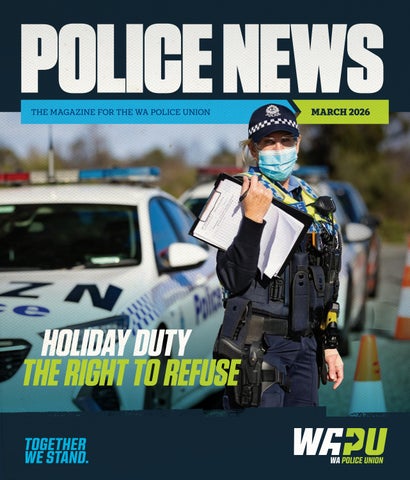
WA Police officers serve the community every day of the year. That includes public holidays when most Western Australians are spending time with loved ones, celebrating important cultural events, or enjoying a well-earned break.
Policing never stops, and WAPU recognises the dedication Members show in delivering that service.
However, public holiday entitlements remain a growing concern for officers across Western Australia. As more Members find themselves rostered to work on public holidays, questions are being raised about whether the current system is fair, sustainable, or reflective of the demanding role police perform.
The reality of public holiday work
Under current industrial arrangements, WA Police officers do not receive additional remuneration for working public holidays. The government’s position is that one of an officer’s six weeks of annual leave is intended to recognise the requirement to work these days.
WAPU has consistently raised concerns about this approach. In simple terms, the number of public holidays now exceeds the leave allocated to cover them. This leaves officers effectively working additional public holidays each year without appropriate recognition or financial compensation.
Operational demands, staffing pressures, and evolving service expectations are also contributing to Members being rostered more frequently on public holidays.
For many officers, this is no longer an occasional requirement but an increasingly regular part of their roster.
Time in lieu limitations
Another issue Members need to be aware of is how time in lieu currently operates. Officers only become eligible for public holiday time in lieu after having completed in excess of six public holiday shifts in a calendar year.
This threshold can create frustration and confusion. Members may work multiple public holidays before receiving any benefit in return, reinforcing concerns that public holiday work is not being properly recognised. In many other sectors, employees receive penalty rates or additional leave for each public holiday worked, highlighting the gap between policing and broader community standards.
Understanding your right to refuse
Following extensive advocacy and discussions with government representatives, WAPU confirmed in 2025 that Members have the right to refuse working public holidays if they choose to do so.
This advice ensures Members understand their workplace rights and feel supported when balancing professional responsibilities with personal wellbeing.
WAPU recognises every Member’s circumstances are different. Some officers may choose to work public holidays, while others may have valid reasons to decline.
The important message is that Members have the right to make an informed choice.
New public holidays, new concerns
The introduction of additional public holidays, including Easter Saturday and Show Day from 2028, has added further complexity to this issue. While recognising important community events is widely supported, increasing the number of public holidays without improving police entitlements risks widening the gap between community expectations and fair compensation.
WAPU’s position is clear. If additional public holidays are introduced, industrial arrangements must also be improved to ensure officers are treated fairly.
Documenting your reasons matters
Members considering declining public holiday work should ensure their reasons are clearly documented in the official refusal request form. It is important that all relevant details are included in the form itself rather than relying on informal conversations or emails.
Accurate and detailed information strengthens transparency and supports WAPU’s ongoing advocacy. The clearer Members outline their circumstances, the stronger the collective case becomes when pushing for reform.
Legitimate reasons to decline public holiday work
There are several valid reasons why Members may decide public holiday work is not appropriate for their circumstances.
A key concern is the lack of overtime or penalty rates recognising the expectation to work these days. Many Members feel the absence of additional compensation undervalues their contribution.
Fatigue is another critical factor. Policing is physically and mentally demanding, and adequate rest is essential for both officer wellbeing and community safety.
Family responsibilities also play a significant role. Members may be primary carers for children or dependent family members, particularly on public holidays when support services may be unavailable or significantly more expensive. These are genuine pressures that should be recognised.
The role of district rostering
District rostering arrangements can provide valuable guidance when Members are assessing whether they are reasonably required to work a public holiday. Reviewing local rosters may show sufficient staffing levels already exist to maintain operational coverage.
Members working in non-primary first responder roles, or positions that historically did not require public holiday attendance prior to 31 January 2025, may also have strong grounds to support a decision to decline.
WAPU encourages Members to review local staffing arrangements carefully and include any relevant information in their refusal request.
Standing together for fairness
Public holiday entitlements remain a key priority for WAPU in current and future industrial negotiations.
The Union continues to push for reforms that properly recognise the work officers perform throughout the year.
This includes advocating for arrangements that better reflect community standards, such as penalty rates, improved leave entitlements, or a combination of both.
Know your rights and stay informed
Members are encouraged to familiarise themselves with their rights and obligations regarding public holiday work. Understanding available options allows officers to make informed decisions that balance operational requirements with personal wellbeing.
A full list of recognised reasons for declining public holiday work is available via the WAPU website (Scan code below). Members are encouraged to review this information carefully and ensure all relevant reasons are included when submitting a refusal request.
WAPU will continue standing beside Members and advocating strongly for fair public holiday entitlements.
WA POLICE FORCE NOW
The oldest in the nation
New national data has confirmed a significant demographic shift within the WA Police Force. The latest Productivity Commission Report on Government Services (ROGS) shows WA now has the oldest police workforce in Australia.
The findings raise important questions about workforce sustainability, operational capacity, and the long-term wellbeing of Members.
New national workforce data reveals ageing trend
For the first time, ROGS has collected comparative age data across police agencies nationwide.
The 2026 report shows that 31.6% of WA Police operational staff were aged 50 years and older in 2024-25.
This was the highest proportion of any Australian jurisdiction.
A
study found that Police officers aged 50 years and older often have invaluable knowledge and experience about the role. But those same officers also tend to have a higher level of accumulated injuries, psychological stress, leading to burnout and stress.
The need for long term workforce planning
The emergence of WA as the nation’s oldest police force highlights the importance of strategic workforce planning. Recruitment alone is unlikely to resolve demographic challenges if attrition and retirement rates continue to rise.
The data also confirms WA Police had the highest proportion of nonoperational staff aged 50 and over. While the figures are not broken down between sworn and unsworn staff, operational sworn officers accounted for approximately 78% of WA’s 8,361 full time staff equivalent positions. This means a substantial portion of the frontline workforce is now approaching traditional retirement age.
WA Police also had the highest proportion of non-operational staff aged 50 years and older.
WA facing a demographic crunch in policing
A University of Technology Sydney study released last year found that police officers aged 50 years and older often have invaluable knowledge and experience about the role.
But those same officers also tend to have a higher level of accumulated injuries, psychological stress, leading to burnout and stress.
The ROGS data suggests that up to one-third of WA Police officers may retire within the next 10 years.
Combined with the declining rate of operational sworn officers, the current level of staff shortages and operational strains within WA Police are only likely to worsen.
This will only make the WA community more vulnerable to crime and reduce public confidence in law enforcement.
Retention strategies, career longevity programs, and improved working conditions are critical to supporting Members at all stages of their careers. Workforce planning must also consider knowledge transfer, mentoring pathways, and ensuring operational experience is passed on to the next generation of officers.
ROGS provides an evidence base that reinforces what many Members have been raising for years. Workforce demographics are changing, and sustainable policing requires proactive planning rather than reactive responses.
Supporting Members through workforce change
The data confirms that WA Police Members continue to deliver high quality policing despite structural workforce pressures. It also demonstrates why ongoing advocacy for staffing, wellbeing, and workforce sustainability remains essential.
An ageing workforce reflects decades of commitment from Members who have dedicated their careers to community safety. Ensuring those Members are properly supported while building a strong future workforce is critical to maintaining effective policing across Western Australia.
WAPU will continue to use evidence-based research to advocate for policies that protect Members, strengthen workforce planning, and support the long-term capability of the WA Police Force.
THE BLUE POPPYSTUDY
An examination of Post Traumatic Stress Disorder (PTSD) in WA Police Officers
By
In 2023, the PTSD Research Foundation of Western Australia, in partnership with the WA Police Union, conducted research into the prevalence of PTSD among WA Police officers. The findings are confronting. This article shares the key results with the officers who contributed and those who continue to serve.
Early in my career, around 2.00am one summer morning in 1987, my partner and I pulled up behind a white ute on the outskirts of Boulder. I was six months into the job and eager. What I encountered that night stayed with me for years. For a long time afterwards, I found it difficult to look into vehicles at night without reliving what I had seen.
At the time, I didn’t recognise it, but this was likely my first experience of what we now understand as post-traumatic stress. Over a policing career, officers attend scenes and witness events most people never encounter. Some memories fade. Others do not.
PTSD among police is not unique to Western Australia. Research consistently shows police experience higher rates of PTSD than many other emergency service roles. The reason is largely cumulative exposure, repeated
contact with violence, death, serious injury, child abuse, road trauma, and threats to personal safety. While trauma has always been part of policing, operational demands and community violence have intensified in recent decades.
Understanding PTSD
PTSD can develop after exposure to actual or threatened death or serious injury. Symptoms may include intrusive memories, nightmares, flashbacks, hypervigilance, emotional numbing, irritability, and avoidance behaviours. For police officers, avoidance is rarely possible. The job requires returning to similar environments and situations repeatedly, compounding exposure over time.
PTSD also affects mood and thinking. Officers may experience guilt, anger, shame, or detachment from others. These effects often extend beyond the workplace into family life and relationships.
Several participants in the Blue Poppy Study shared deeply personal accounts. One officer described a violent confrontation that marked the end of their career. Another recounted attending a traumatic incident involving a child who resembled their own son – an experience that resulted in years of recurring nightmares before eventually receiving a PTSD diagnosis.
These stories are not isolated. They reflect the lived experiences of many in the job.
Why this study was needed
For many years, the true extent of PTSD within WA Police was unknown. In 2018, it was confirmed that the WA Police Force did not maintain central statistics on officers diagnosed with PTSD. Around the same time, national research estimated approximately 10% of police and emergency service personnel met criteria for probable PTSD, but state-specific data was not reported.
The Blue Poppy Study sought to understand the situation in Western Australia, specifically, how common PTSD symptoms are, what officers are exposed to, and what factors influence mental health outcomes.
Although initially endorsed by WA Police, the study continued after support was withdrawn, with the Police Union facilitating access to members. Participation was voluntary and anonymous, and approximately 18.5% of serving officers completed the survey.
The goal was simple: not to identify individuals, but to understand how officers are coping.
Participants completed an anonymous electronic survey incorporating established psychological measures assessing trauma exposure, PTSD symptoms, psychological distress, wellbeing, and perceived support. Only limited demographic information was collected to preserve anonymity.
Dr Daniel Talbot, former Sergeant, WA Police
90% OVER have seen DEAD BODIES
Exposure to Trauma
The results confirm the scale of trauma exposure in policing:
Over 90% of participants had seen dead bodies during their career.
Around 15% had seen more than 100.
72% had witnessed serious assaults.
80% had attended serious road trauma.
53% had witnessed someone dying in front of them.
More than half had attended a homicide within the past 5 years.
These are precisely the types of repeated exposures known to increase the risk of PTSD.
PTSD and psychological distress
One of the most striking findings was the rate of probable PTSD. More than 38% of participating officers met the criteria for probable PTSD using a recognised screening tool. While this does not represent a clinical diagnosis, it indicates symptom levels consistent with the disorder and comparable to other international studies using similar measures.
Psychological distress was also high. Nearly a quarter of participants reported severe distress, and many others reported mild to moderate distress. Overall wellbeing scores were low, with fewer than 4% reporting high wellbeing and around half showing signs of poor wellbeing.
These figures suggest that while officers continue to perform their duties, many are doing so while managing significant psychological strain.
The role of support
Support systems emerged as a critical factor.
Participants reported their strongest support came from spouses or partners, followed by colleagues. Support from supervisors was rated lowest. Importantly, officers who reported stronger peer and supervisory support had lower PTSD symptom scores.
This finding reinforces a simple but powerful message: workplace culture matters. Strong peer networks and supportive leadership can reduce the severity of trauma-related symptoms.
Factors linked to higher PTSD symptoms
The study identified several factors associated with higher PTSD symptoms:
• Greater exposure to traumatic incidents
• Longer service and older age
• Being divorced, separated, or widowed
• Lower levels of workplace support
Trauma exposure was the strongest predictor, particularly incidents involving death, serious injury, or abused children.
Relationship status also played a role, suggesting personal support networks outside work can influence resilience.
Broader trends
The research also examined long-term data trends. Over the past 30 years, sick leave among WA Police officers has tripled. During the same period, serious assaults in the community have also increased significantly. These trends appear closely linked, suggesting higher trauma exposure and operational pressures may be contributing to increased stress and absenteeism.
While the workforce has grown, so too have the demands placed on officers.
What this means
The Blue Poppy Study paints a concerning picture of mental health within WA policing. The rate of probable PTSD identified is substantially higher than earlier Australian estimates and significantly higher than rates seen in the general population.
However, given the frequency and intensity of trauma exposure reported, the findings may not be surprising.
The study highlights the importance of: Accessible, evidence-based treatment
Strong peer support networks
Supportive supervisory practices
Ongoing monitoring of officer wellbeing
PTSD is not a one-off issue. It requires sustained attention, research, and practical intervention.
Looking forward
As with any voluntary survey, the findings may not represent every officer. Some may have been more inclined to participate, while others may have chosen not to. Nevertheless, the results provide meaningful insight into the experiences of a substantial group of serving officers.
Policing will always involve exposure to trauma. Ensuring officers are supported by their organisation, their colleagues, and the broader system is essential.
Behind every statistic is a person who has carried experiences most people never will. With the right support and understanding, recovery is possible. And acknowledging the scale of the challenge is the first step.
WA'S
THINNING POLICE FRONTLINE
Productivity Commission’s 2026 Report
The Productivity Commission’s recent 2026 Report on Government Services reveals that WA Police Force has the nation’s lowest proportion of sworn officers in a frontline role.
WA’s rate of frontline officers also continues to languish well below pre-COVID-19 pandemic levels.
Report on Government Services – Police
The Productivity Commission has published the Report on Government Services (ROGS) annually for more than 30 years. ROGS provides information about the equity, efficiency, and effectiveness of government services across Australia. This includes statistics about police agencies for each state and territory.
One of the Productivity Commission’s key police metrics is the number of full-time equivalent (FTE) employees for each agency. ROGS counts the number of sworn officers, unsworn officers, and civilian staff as well as classifying them by ‘operational’ or ‘nonoperational’ status.
Operational employees are those whose primary duties involve delivering policing services directly to the public or supporting external law enforcement outcomes. Not surprisingly, the vast number of operational employees are sworn officers performing frontline duties such as responding to calls, investigating offences, maintaining public order, and traffic management.
Lowest proportion of operational sworn officers in the nation
According to the report, WA Police had 7,105 sworn officer FTE positions in 202425. Of these, 91.3 per cent were classified as operational. This was easily the lowest proportion of any Australian jurisdiction.
7,105 sworn officers
Equally concerning is that WA’s proportion of operational sworn remains well below those that existed prior to the COVID-19 pandemic.
It is no coincidence that this fall occurred with the historically high levels of resignations among WA Police sworn officers in recent years.
WA POLICE – % SWORN FTE IN AN OPERATIONAL ROLE
MEMBERS AND THE COMMUNITY FEEL THE CONSEQUENCES
In recent years, WAPU Members have consistently raised the ongoing impact of staff shortages, unpaid overtime, work-related stress, fatigue, and inequitable rosters.
The latest ROGS data validates these complaints and points to the immense pressure currently faced by Members.
Declining rate of frontline officers
Looking deeper into the report reveals another concerning trend.
WA’s rate of operational sworn officers relative to population has generally been declining since it last peaked nine years ago.
WA’s population increased by almost 18 per cent from 2016-17 to 2024-25. But its rate of operational sworn FTE fell by more than 7 per cent over the same period from 230 officers per 100,000 population to 213 officers per 100,000 population.
Fewer frontline officers, fewer frontline hours
WAPU compared the ROGS data with that contained in WA Police Annual Reports. Regression analysis reveals a 56.3 per cent positive correlation between the rate of operational sworn FTE and the number of sworn officer hours available for frontline policing over the last 10 years. The shown correlation should be considered moderate. But it nonetheless indicates that fewer operational sworn FTE will also result in them spending less time on frontline duties.
The Cook Government trumpets the high number of police recruits in recent years as a success. But these numbers have failed to offset the large number of officer resignations as well as WA’s growing population.
The declining rate of operational sworn officers does not just mean increased work pressures for Members.
Community safety is put at risk with fewer officers being able to promptly respond to public calls for assistance. This only has the potential to undermine public confidence in WA Police as well as putting lives at risk.
The ROGS data provides an important evidence base for workforce discussions. It highlights that WA officers are continuing to deliver high quality policing despite structural resourcing challenges.
For WAPU, the data reinforces the importance
of advocating for sustainable staffing levels, improved workforce planning and policies that prioritise Member wellbeing and frontline capability.
Members deserve to know that these issues are being raised at the highest levels. Reliable data strengthens our ability to push for meaningful change and ensures decision makers cannot ignore emerging workforce pressures.
For a police officer, sick leave isn't a luxury– it’s an essential industrial safety net. However, the WA Police Union is seeing a troubling trend where medical advice from private specialists is being overridden by employer-appointed doctors.
This shift isn't just an administrative hurdle; it is creating financial uncertainty and emotional distress for Members when they are at their most vulnerable.
A benefit that should protect our people
Every police officer knows that sick leave is not a luxury. It is a relative and appropriate industrial safety net. Clause 38 of the WA Police Force Sworn Officer Industrial Agreement recognises this by providing Members with access to 168 calendar days of paid sick leave when supported by a medical certificate. Members can also access up to five single days without a certificate, acknowledging that not every illness requires a trip to the doctor.
This entitlement is substantial yet tenuous, as the agreement and the Police Force Regulations state that this entitlement ‘may’ be granted. It reflects the understanding that policing is physically demanding, mentally draining, and at times traumatic.
Members are regularly exposed to situations most people will never encounter in their lifetime. Injuries, stress, and long-term health conditions are unfortunately part of the profession.
However, what we are increasingly hearing from Members suggests that the reality of accessing paid sick leave is becoming far more complicated than the spirit of the Agreement intended.
When medical advice is being questioned
WAPU have seen time and time again that a single appointment with a doctor employed by WA Police results in the opinion of the WA Police doctor superseding the historical medical opinions of an officer’s private specialists. From WAPU’s perspective, it raises concerns around the impartiality of WA Police doctors and the financial motivations of the Employer.
In some cases, these employer doctors have formed different views about an officer’s fitness for work. When this occurs, Members are reporting that their sick leave entitlements are being challenged or rejected altogether, especially when following the advice or recommendations of their long-term treating doctors.
For Members who are already dealing with injury or illness, this can be deeply distressing. Many Members feel caught between conflicting medical opinions while also worrying about their income, career, and their future in policing.
We are currently receiving at least three Member enquiries each week relating to sick leave disputes. That number alone shows this is not an isolated issue. It is becoming a consistent concern across the workforce.
The real impact on Members and their families
Sick leave disputes are not just administrative matters. They carry very real consequences for Members and their loved ones, something seemingly lost on WA Police.
When paid sick leave is questioned, Members can suddenly face financial uncertainty, which in itself causes many issues for Members.
Members who cannot safely return to work may feel pressured to do so earlier than recommended by their treating medical professionals. That creates risks not only for the individual officer but also for their colleagues, the broader community and WA Police.
There is also the emotional toll. Many Members tell us they feel disbelieved or unsupported during periods when they are at their most vulnerable. Policing already requires resilience and strength. Facing challenges to legitimate medical advice can compound stress and slow recovery.
Appointments with high level specialists can involve lengthy waiting periods and significant personal cost. Members are also on many occasions required to recount and relive very distressing circumstances ‘again’ or manage complex medical and employment processes while dealing with their underlying health condition.
Even after obtaining further specialist advice, the final determination regarding fitness for work can still rest with the employer.
This is one of the most frustrating elements Members report. Many feel they are doing everything possible to support their recovery, yet the outcome remains uncertain.
What we are increasingly hearing from Members suggests that the reality of accessing paid sick leave is becoming far more complicated than the spirit of the Agreement intended.
Medical retirement
The Police Act provides a medical retirement pathway to those Members who are recommended by the Commissioner of Police as medically unfit. For some Members, the prospect of medical retirement is welcomed.
What causes uncertainty is that WA Police do not have a timeframe in which medical retirement, once initiated, must be concluded.
Pursuant to the medical retirement protocols contained within the Police Act, it is the Commissioners decision if and when an officer is to be considered for medical retirement.
If the Commissioner is relying on the opinions of non-impartial WA Police appointed doctors, how can Members that should be medically retired be correctly identified?
Seeking further specialist opinions
In some circumstances, Members have been advised to seek further specialist assessments to support their medical position. While additional expert opinions can strengthen a case, this process often comes with challenges.
Why this matters for every officer
This issue is not limited to Members currently dealing with injury or illness. It has broader implications for the entire policing workforce, regardless of rank or age.
Every Member deserves confidence that if they are injured or become unwell due to the demands of the job, their ‘employer’ and their industrial entitlements will support them during recovery.
Sick leave provisions exist because policing carries unique risks and Members can’t avail themselves to traditional Workers Compensation entitlements. If Members begin to lose confidence in these protections, it can affect morale, wellbeing, and workforce retention.
It also sends a concerning message about how workplace injuries and psychological health conditions are viewed by WA Police. Early and supported recovery is widely recognised as the best pathway back to work. Disputes and uncertainty can undermine that process.
HOW THE UNION IS SUPPORTING MEMBERS
The WA Police Union is actively assisting Members navigating sick leave disputes.
Our Industrial team provides advice, advocacy, and representation to ensure Members understand their rights and options; matters are escalated by seeking legal representation when required.
We are closely monitoring patterns emerging from Member reports and engaging with WA Police to raise these concerns at multiple levels. The experiences shared by Members are vital in helping us identify systemic issues and advocate for fair and consistent processes.
Importantly, Members should never feel they have to face these situations alone.
What Members should consider
If you are dealing with a medical condition affecting your ability to work, there are several steps that may assist in protecting your position:
Ensure your treating doctor or specialist clearly outlines your diagnosis, treatment plan, and work capacity.
Keep copies of all medical documentation and correspondence.
Seek advice from the Union if you have concerns about being requested to attend employer medical assessments or if your sick leave is questioned.
A conversation that needs to continue
The growing number of Members raising concerns about sick leave decisions highlights the need for ongoing discussion and review. Paid sick leave is a critical workplace protection designed to support Members through injury and illness, not create additional barriers during recovery.
Our Members dedicate their careers to protecting the community, often at significant personal cost. It is essential that workplace systems reflect that commitment by providing fair, transparent, and supportive processes when Members need them most.
No Member should feel unsupported when it comes to their health, wellbeing, and future in policing.
INDUSTRIAL AGREEMENTS
It goes without saying that WA Police human resources, our Members, deliver all necessary frontline policing services to the community. Members respond to calls for help 24 hours a day, 365 days a year, across the entirety of the State.
They investigate crime reports, charge offenders and prepare court briefs, search for lost people, attend car crashes, plane crashes, boating incidents and bushfires, among a neverending multitude of duties.
Like many employees, Members work within planned rosters, are paid fortnightly wages and allowances, take leave when able, and operate under a range of workplace conditions that are fully prescribed within the WA Police Sworn Officer and Police Auxiliary Officer Industrial Agreements. These Industrial Agreements are legislation binding on all parties. They should be black and white, crystal clear and non-negotiable.
A critical document, but is it understood?
Given the Industrial Agreements are the preeminent documents dictating how Members are engaged, including specific rostering practices, prescribed terms, pay and conditions, you would expect all WA Police supervisors and managers to have a strong working knowledge of them.
But do they?
Surprisingly to some, but not to others, many supervisors and managers are not conversant or contemporary in their understanding of the documents that govern how the human resources they manage are remunerated and what entitlements apply.
Breaches of the Industrial Agreements are routinely reported to the WA Police Union, whose primary role is to advocate on behalf of aggrieved Members.
It is not, however, the role of the Union to train WA Police supervisors and managers on the content of the Agreements or how they apply in practice.
This begs the question... are police supervisors and managers, an integral part of the policing machine, trained in this aspect of their roles? And importantly, who is responsible for that training? Let’s park that question for a moment.
Complex, comprehensive and the law
The current Industrial Agreements are up to 130 pages long, containing approximately 60 clauses, 466 sub-clauses, and numerous inter-related provisions, schedules and explanatory tables. They are all-encompassing documents, critically important to the proper management of Members’ conditions and entitlements.
No different to the Criminal Code, the Police Act or the Criminal Investigation Act, the Industrial Agreements are the law.
While supervisors and managers receive training and education across many legislative areas, there is no training provided in respect to the Industrial Agreements.
It would be unrealistic to expect anyone to memorise these documents in their entirety. However, it is essential that supervisors and managers have a working knowledge of them and apply them correctly when required.
Unfortunately, all too often this does not occur. Like any piece of legislation, where provisions are silent, interpretation frequently falls to the disadvantage of the employee.
Breaches of the Industrial Agreements reported to the WA Police Union
MISSED MEAL BREAKS
A common example
One regular example is missed meal breaks. Frontline tasking is so demanding that officers rarely get the opportunity to take a full 40 or 50-minute meal break on eight or tenhour shifts. Many eat at their desks while submitting incident reports, preparing briefs, or making and taking calls.
Clause 11.8(d) of the Industrial Agreement sets out the entitlement, with Schedule F15 prescribing the missed meal allowance of $10.
Supervisors and managers are required to manage Members’ ability to take their meal breaks uninterrupted.
While there are many occasions where meal breaks cannot be taken due to service delivery demands, Members report to the Union that they are often actively discouraged from claiming their legitimate missed meal entitlements.
What may not be well understood is that supervisors and managers can be prosecuted for knowingly breaching the Industrial Agreement and may face fines out of their own pocket if convicted in the Industrial Magistrates Court.
Approved overtime and Member choice
Another common issue relates to approved overtime. Once overtime is approved, it is at the Member’s discretion to take it as payment or as time off in lieu. Clause 13.12 clearly sets out this provision.
Once overtime is approved, the supervisor or manager’s decision-making role ends. Whether overtime is paid or taken as time off in lieu is not their decision. Any interference with a Member’s preference may place the supervisor or manager in breach of the Agreement, with potential prosecution and personal fines if convicted.
Rest days and lawful entitlements
More recently, WA Police demonstrated a misunderstanding, if that is what it could be called, when disciplinary action was linked to Members planning to take rest days in a manner not to the employer’s liking.
After unsuccessful attempts by the Union to resolve the issue through discussion, the matter was taken to the Industrial Relations Commission for conciliation and clarification.
Pleasingly, the Industrial Commissioner provided guidance to WA Police, resulting in a retraction or clarification issued to Members.
This assured Members they would not be subject to disciplinary action when appropriately availing themselves of lawful entitlements.
Clause 31 of the Industrial Agreement relates to rest days. These days are significant in supporting Member wellbeing and are taken at times chosen by Members, not the employer.
So, who is responsible for training?
Returning to the earlier question, who is responsible for training WA Police supervisors and managers in relation to the Industrial Agreements?
The answer appears to be no one. There is currently no training provided by WA Police in this critical area. Could this be why interpretations are so often incorrect and almost always to the disadvantage of Members?
As stated at the outset, rosters, wages, allowances, leave and workplace conditions are fully prescribed within the Industrial Agreements and form the framework of Members’ working lives.
Perhaps WA Police should consider providing training to supervisors and managers in these important responsibilities, so that when Members are out there on the coalface, their supervisor or manager truly has their back.
2026 PFA National Police Bravery Awards
‘Exceptional acts in exceptional circumstances.’
The Police Federation of Australia’s National Police Bravery Awards are now open.
This award has been developed for police and nominations are sought from officers across the country.
While police work is inherently dangerous… some actions stand out.
Do you know someone who has performed an exceptional act in exceptional circumstances?
Selection criteria
1. The nominee must be a sworn police officer from an Australian police jurisdiction.
2. Nominees must have undertaken an outstanding act of courage or bravery, by selflessly putting themselves in harms way to protect others, going well beyond the call of duty.
3. Where feasible, the incident should have occurred in the past twelve months, however exceptions could include if the matter is subjudice or if other unavoidable delays have occurred.
The National Police Bravery Awards will be presented in: Canberra on Wednesday 28 October 2026.
How to enter
The online nomination form is available at: awards.pfa.org.au NOMINATIONS CLOSE
30 JUNE 2026
2025 Winners Amy Scott, Michael Hutchinson, with the Attorney-General, The Hon. Mark Dreyfus KC.
Explore your new MEMBER PORTAL & WEBSITE
The WA Police Union continues to invest in improving how we support and connect with Members, and we are excited to share that our new website is live, with plans to roll out the new Member Portal in stages.
This is a major step forward in making Union services more accessible, easier to use, and available when you need them. The new platform has been designed with Members at the centre, giving you greater control over your information and making it simpler to access the services and support available to you.
A new digital experience for Members
The new website introduces a refreshed look and feel, designed to make finding information quicker and more intuitive.
We know policing is unpredictable and demanding, and Members often need to access information outside traditional office hours. The new layout focuses on accessibility, helping you locate important updates, benefits information, and support services more efficiently.
Alongside the website refresh, the new Member Portal will provide a secure space where you can manage key aspects of your membership in one convenient location.
The portal will be available around the clock, giving Members the flexibility to access services when it suits their schedule.
Why updating your details matters
One of the most important features of the new portal will be the ability for Members to update their personal and employment details directly.
Keeping your information current helps ensure you receive important Union communications, updates on workplace matters, and access to the correct entitlements and services.
Accurate records also allow the Union to provide faster and more effective support when Members need assistance with industrial, legal, or welfare matters.
This is particularly important if you have recently changed roles, moved locations, updated contact details, or altered your employment arrangements.
Taking a few minutes to review and update your information will help ensure the Union can continue to support you when it matters most.
More convenience, including 24/7 holiday home bookings
The new Member Portal will reduce the need for Members to complete manual forms or contact the Union for routine updates. Members will be able to access services, forms, and key information in one central location, improving convenience and reducing delays.
A major new feature will be the ability to book Union holiday homes through a live online system.
Members will be able to check availability and make bookings in real time, 24 hours a day, seven days a week. This removes the need to wait for business hours and provides greater flexibility when planning leave and family time.
The website and portal will work together to create a more consistent and streamlined experience. Whether you are looking for information about Member benefits, booking access, or general Union updates, the new system is designed to make the process faster and easier to navigate.
These improvements are about giving Members greater control, while also allowing Union staff to focus more time on supporting Members through complex workplace, industrial, and welfare matters.
Scan to access the new website
The Union remains committed to evolving alongside the needs of Members. Once the portal is live we encourage all Members to familiarise themselves with the new features and ensure their details are current. Look out for more updates on the Member Portal developments in your email.
Explore the new website today!
SCHOOL HOLIDAY BALLOT APPLICATION OPENING SOON! WAPU Holiday Homes
Planning ahead for a wellearned break with the family is something many of our Members look forward to each year.
The upcoming School Holiday Ballot for December 2026 to January 2027 will soon be opening, giving serving officers the opportunity to secure a stay at one of the WAPU Holiday Homes during the busy summer period.
The ballot will be available on the WAPU website from 13 April 2026
This ballot is open to serving Members only, and applications must be completed online. It is important to note that paper or email applications will not be accepted, so please make sure you lodge your ballot through the website once it opens.
How the school holiday ballot works
Bookings during this period follow the same format Members will be familiar with from previous ballots.
Stays are 7 nights only Saturday 2pm check-in to Saturday 10am check-out
Members may select up to four locations per week
This process helps give everyone a fair chance during what is always a very popular time of year.
Key dates to remember
BALLOT OPENS 13 April 2026
BALLOT CLOSES 11 May 2026
Draw and notification
After the ballot closes, successful Members will be notified automatically via email from the new Member database.
Notifications will be sent to your preferred email address on file, which by default is your private email address. It is a good idea to make sure your details are up to date before the ballot opens.
A reminder for Members
WAPU Holiday Homes are one of the benefits of membership that many officers and their families value highly. Demand during school holidays is always strong, so if you are thinking about applying, mark the opening date in your calendar now.
INVESTING IN OUR FUTURE Anne-Margaret Smith
Celebrating the 2026 WA Police Union School Scholarship Recipients
For nearly three decades, the WA Police Union School Scholarship program has quietly supported Member families during one of the most important and often expensive stages of a child’s education.
Since its introduction in 1997, the program has helped ease the financial pressure of secondary schooling, allowing students to focus on their studies while recognising the dedication and service of their parents.
In 2026, the Union is proud to once again support Members by awarding scholarships to students entering both upper and lower secondary school. These scholarships are about more than financial assistance. They are about acknowledging the sacrifices police families make every day and investing in the next generation.
This year, two students have been awarded Upper Secondary School Scholarships valued at $5,000 each. These scholarships support students as they enter the senior years of schooling, a time that often comes with increased academic pressure and additional costs such as specialised subjects, technology, and study resources.
Congratulations to Kacey Johnson, who is entering Year 11 and is the child of Member PD10654 Philip Johnson, and Marley King, who is also entering Year 11 and is the child of Member PD16321 Caleb King. The Union recognises the hard work that has brought both students to this important milestone
and wishes them every success as they move into their senior studies.
Three students have also been awarded Lower Secondary School Scholarships valued at $3,000 each. Transitioning into secondary school is a significant step for any student, and these scholarships aim to help families manage the additional costs that come with starting this new chapter.
Congratulations to Aiden Bott, entering Year 9 and the child of Member PD12001 Paul Bott, Anne-Margaret Smith, entering Year 8 and the child of Member PD16384 Jane Smith, and Claire Coton, entering Year 8 and the child of Member PD11016 David Coton. The Union is proud to support these students as they continue their educational journeys.
At a time when many families are feeling the impact of rising living costs, initiatives like the School Scholarship program remain an important part of how the Union supports Members beyond the workplace. Policing is not just a job. It is a commitment that affects entire families. Providing meaningful support to Members and their children is one way the Union continues to stand alongside those who serve our community.
The WA Police Union congratulates all 2026 scholarship recipients and looks forward to seeing what they achieve in the years ahead. Their dedication, determination, and potential reflect the strong values shared by police families across Western Australia. Supporting Members and their families will always remain at the heart of what we do.
Dave Flaherty President - WA Police Union
Congratulations Anne-Margaret Smith
Congratulations Claire Coton
THE ORIGINAL NOVATED LEASING AND SALARY PACKAGING PROVIDER FOR WA POLICE
Welcome to Maxxia WAproviderPolicefor over 15 years
Maxxia is one of Australia’s largest salary packaging providers who specialise in providing workplace benefits that deliver genuine taxsavings to our customers.
Novated leasing the Maxxia way
Novated leasing allows you to use your pre-tax salary to pay for your car and its running costs. With access to a wide network of dealers, we’ll help you secure a competitive price on your chosen car — new or used — with no GST* on the purchase price.
Thanks to our vast dealer network we’re confident in our pricing. With Maxxia’s Price Beat Promise, if you find a better price on a car, we won’t just match it—we’ll beat it + .
HOW SALARY PACKAGING WORKS FOR YOU MAX YOUR PAY
Your employer has chosen Maxxia as your workplace benefits provider to bring you the best possible salary packaging experience.
Salary packaging in a nutshell
Salary packaging lets you pay for things like a car as well as work-related expenses with money from your salary before tax. This could be a hassle-free way to reduce your income tax and access more of your money.
Drive away in a new car
Have you been thinking about getting a new car and wondered how you were going to pay for it? Well, novated leasing from Maxxia could be just what you’re looking for.
Novated leasing lets you salary package the cost of getting into and running a new car with some of your before-tax dollars –and potentially lower your taxable income.
New or used, we can help you find the car you want and negotiate with dealers to secure a great price that doesn’t include GST on the purchase price or any upfront fees.
Once you’ve decided on the car you want, we will set up a salary packaging account. Then we can arrange a budget for your lease payments and running costs like fuel, registration, insurance and maintenance. The cost of everything is bundled into one regular payment drawn from your salary each pay.
What else can you salary package?
→ Remote area benefits
Don’t work in a major city? You might be eligible for remote area benefits that cover the cost of interest you pay on your mortgage; rent you pay; electricity or gas; and purchasing a property or land to build a home.
→ Laptops and tablets
If you’re in the market for a laptop or tablet that you use mostly for work, you can buy it outright and salary package the purchase cost.
→ Self-Education
Courses, journal subscriptions and reference books.
→ Professional memberships and subscriptions
Work-related memberships (including WAPU fees) and newspaper/magazine subscriptions.
→ Relocation Expenses
If your employer requires you to move for work, you could be eligible to salary package the costs of relocation including connecting your utilities.
→ Financial advice fees
For advice relating to salary packaging.
→ Airport lounge memberships
Additional Benefits
Maxxia Rewards
The Maxxia Rewards program gives you discounts and benefits at hundreds of retail outlets, department stores, attractions, travel, cinemas and restaurants nationwide. It’s free to join, so go to www.maxxia.com.au/ rewards and register today.
Where can I find out more?
Visit Maxxia’s website at www.maxxia.com.au to learn more about salary packaging, including simple calculators to help you determine your potential savings. Or by phoning the Maxxia Customer Care team on 1300 123 123
NOVATED LEASING
Sponsored by
Complimentary initial 30-minute chat about your legal issue & a 10% fee discount* for WAPU members, their families and retired members.
* Conditions apply
Leading Australian law firm, Tindall Gask Bentley is the legal services provider for members of the WA Police Union.
CRIMINAL
& DISCIPLINARY
• The Corruption and Crime Commission
• Courts of Inquiry
• Criminal and disciplinary matters
FAMILY & DIVORCE
• Children’s issues
• Child support matters
• Property settlements
• “Pre-nuptial” style agreements
To arrange a preliminary in-person or phone appointment contact us on (08) 9211 5800
LOSS OF CONFIDENCE PROCESSES WHY EARLY LEGAL ADVICE MATTERS FOR WA POLICE OFFICERS
By Daniel Weekley, Senior Associate & Criminal Practice Leader SA & WA
Being told that the Commissioner has lost confidence in you is one of the most serious situations a WA Police officer can face.
A Loss of Confidence (LOC) process can end your career, affect your reputation, and create significant stress for you and your family. Despite this, many officers do not fully understand how the process works or realise how important it is to get legal advice as soon as they are notified that it has started. The LOC process is one of several mechanisms by which the Commissioner can terminate an officer’s employment. It is designed to be a separate and specific process which captures a certain type of circumstance. It is not designed to replace normal disciplinary action, performance management, or unfitness for duty. However, we are increasingly seeing situations where these discrete issues are grouped together and then improperly used to justify a LOC decision.
In many recent cases, officers are presented with a long list of concerns, complaints or historical issues and are then told that, taken together, these matters mean the Commissioner has lost confidence in them and is considering termination. This approach raises serious concerns about fairness and an abuse of process by the Commissioner.
Why the loss of confidence process is so risky
The Police Act creates a defined process for allegations of misconduct. The purpose of police misconduct is clear – it provides the Commissioner a process to maintain professional standards and discipline an officer (i.e. sanction them) to enforce those standards. The process provides a level of procedural fairness – that is, notification of the alleged misconduct, an opportunity to challenge the evidence and allegations, and an outcome.
Unlike a formal disciplinary process, a LOC process does not always clearly set out what the officer is said to have done wrong. It does not afford the same opportunity to challenge allegations. LOCs often present previous complaints as ‘substantiated’ and then relies upon them to justify removal. Officers may be asked to respond to dated and vague complaints or allegations.
Concerningly, we are increasingly seeing the Commissioner construct a case for removal by LOC by creating what can only be described as a dirt file – a long list of complaints sometimes decades old – and then presenting that dirt file to the officer for comment on why they should remain employed. Creating and relying on such dirt files is arguably a misuse of the disciplinary process and an improper basis for LOC.
This creates a real risk that officers are not treated fairly, particularly where:
→ Allegations are vague or not clearly explained
→ Past matters are raised again, even though they have already been dealt with
→ Officers are effectively punished twice for the same conduct
→ Contested, disputed, or unproven past complaints are presented as substantiated facts
→ Performance issues are used as a reason to dismiss an officer, rather than being managed through training, support or performance plans.
Of particular concern is the risk that the LOC process is used to avoid the usual disciplinary system, which has clearer rules and protections for officers.
Why getting legal advice early is critical
If you are told that a LOC process has started, it is not something to deal with on your own. Early legal advice can be crucial in protecting your position.
If you’d like advice about your medical retirement entitlements, or if your application has stalled, please contact our team on (08) 9211 5800, or email me at dweekley@tgb.com.au.
A lawyer can help to:
→ Make sure the process is fair and transparent
→ Require WAPOL to clearly particularise any allegations or concerns
→ Challenge the use of old or previously resolved matters
→ Push back where dismissal is being considered instead of proper performance management
→ Ensure the Commissioner is using the loss of confidence process for the right reasons and in the right way.
Getting advice early often allows problems to be addressed before decisions are made. It also ensures you are not responding to serious allegations without understanding your rights and options.
Protecting your career and your future
A Loss of Confidence decision can have lasting consequences, even beyond policing. Officers who have committed years of service to the community deserve to be treated fairly, especially when their employment is at risk.
If you are notified that a LOC process is being considered – or if you are concerned it is being used instead of proper disciplinary or performance processes – it is important to get advice as soon as possible.
Daniel Weekley and the team at TGB Lawyers regularly assist WA Police Union Members with Loss of Confidence matters and other employment and disciplinary issues. We are here to support police officers with any legal issue, confidentially and without judgement.
If you need advice, don’t wait! Early support can make a real difference.
Sponsored by
join the health Fund members actually love
THE SILENT CONDITION AFFECTING POLICE
Six million Australians have hypertension (high blood pressure) – an alarming figure that has doubled in the age range of between 35–44 compared to a decade ago, according to the Australian Bureau of Statistics (ABS).
It jumps again, dramatically, between ages 45–54, and peaks at 75 years.
While the risk of high blood pressure is known to increase as you age, it affects all age groups.
Furthermore, a recent ABS study revealed 73.7% of all adults measured with high blood pressure didn’t realise they had high blood pressure because of a lack of symptoms.
That’s why early monitoring and intervention, as early as age 35, is the key to prevention and management.
Increased risk of high blood pressure for police
High blood pressure is a condition where the force of blood against artery walls is consistently too high.
This makes the heart work harder, causes damage to vessels over time, and increasing the risk of heart attack, stroke and kidney disease.
It’s often called the ‘silent killer’ because it usually has no symptoms.
For shift workers, such as police officers, studies have shown an increased risk of cardiovascular and sleep disorders.
This is due to circadian rhythm disfunction and poor nutritional choices. Police are also exposed to traumatic events, which increase the likelihood of alcoholism, obesity, depression, and insomnia – all of which are linked to heart troubles.
There are ways to lower blood pressure
Smoking, being overweight, a sedentary lifestyle and consuming a diet high in fat and salt (and low in protein and fibre) can increase the likelihood of high blood pressure.
Stress is also a major cause of high blood pressure.
While there is blood pressure medication available, the best shield against high blood pressure is maintaining a healthy lifestyle.
→ Lose unnecessary weight
→ Cut back on alcohol and avoid smoking
→ Exercise more to keep arteries flexible and reduce activity in the sympathetic nervous system
→ Manage stress to reduce the release of hormones that spike blood pressure
→ Consider if you need help from a medical specialist
→ Organise regular check-ins with your GP who can do blood pressure tests and if required recommend a blood pressure monitor at home
Cover like no other
Police Health understands the unique health needs of the police community, because we’ve been looking after them for over 90 years.
To get Police Health's cover, call us on 1800 603 603. Other tips include:
Sponsored by
RETIRING MEMBERS
VALE
6162 Lysle Cubbage
6260 Geoffrey Stewart
6512 Alexander Ryan
6650 Gregory Beck
6747 Darryl Gaunt
6781 Sean Togher
6808 Bernard Hush
6920 Andrew Martin
7174 David Markey
7223 Terry Townsend
7563 Mark Ninyett
7793 Mark Chamings
7830 Neil Berkley
8056 Russell McMahon
8063 Jennifer Sara
8100 Julie Smith
8472 Jeremy Ashworth-Preece
8512 Stephen Page
8580 Tanja Wentzel
8651 Wayne Godwin
8799 Matthew Sullivan
9287 Danny Vincent
9669 Aaron Kendall
9889 Michael St John-Ayre
9912 Jillian Cartmell
9960 Andrew Gough 10338 Gary Scrimshaw
10432 David Millard
10620 Aldo Arco
10687 Paul Hancock-Coffey 10876 Adam Rackham
10966 David Johnston
11781 Frederick Clapton 11817 Andrew Nicol 13236 Mark Sutton
13241 Anthony Welch 13354 Lisa Hudson 13582 Tadeusz Wrona 13609 Mark Williams
13781 Stephanie Bochorsky 14944 Hugo Gill 15230 Jaimee Elphick 99757 Philip Wong
RESIGNING MEMBERS
9126 Andrew Cooper
9480 Simon Sustek 11921 Glen Dinsdale 12068 Nicholas Moors
13206 Marc Mansas
13479 Alyce Wilkinson 13529 Shaun Francis 15125 Griffin Burbidge
15177 Stuart Mosley
15257 Scott Mason
15304 Julienne Carter
15564 Brendan Gibson
15975 Jayden Elphick
16480 Louis Dupond
16793 Kathryn Barone
18089 Archer Larwood 18262 Jacob Nixon
19115 Daniel Slinger
19305 Anthony Guascone
19366 Dominic McAuley
19413 Tom Grimes
19483 Robert Brown
19624 Marc Whitford
19783 Nigel McKee
19790 Matthew Sandover
19901 Thomas Harrison
RETIRED
2778
LESLIE HANCOCK
Senior Inspector Aged 95
DOD 15/12/2025
3152
PETER EVANS Inspector Aged 96
DOD 25/12/2025
3563
GRAEME LACEY
Senior Sergeant Aged 82
DOD 6/1/2026
3921
KENNETH GREGSON Inspector Aged 81
DOD 8/12/2025
19905 Jack Franklin
19918 Christopher Salmond
19964 Sher Dil Hashimi 20127 Lucy Craven 20142 Sarah Cross 20235 Sophie Good 20240 Thomas Coombs 51541 Jacob Doygun
54308 Dylan Armstrong 54538 Bailey Anderson 57873 Dylan Atkins
4088
DONALD GREY
Senior Sergeant Aged 77
DOD 1/2/2026
4315
CHRISTOPHER O'REILLY
Sergeant Aged 83
DOD 28/1/2026
5244
GRANT WAINWRIGHT
Senior Constable Aged 70
DOD 8/12/2025
5305
PATRICK SMITH
Sergeant
Aged 92
DOD 28/9/2025
Supporting first responders and their families
Whatever you’re going through, and wherever you’re located, Fortem are here to support you.
Fortem Australia is dedicated to supporting the mental health and wellbeing of first responders, their families and former first responders who have left service within the past 10 years.