P L A C E S
MOR E R OUN D ED THA N YO U EVER IMAGI N ED
P E O P L E
I N F O R M A T I O N
E N T E R T A I N M E N T
P L U S
O C T O B E R 2 0 2 6
U G
18
10
07
R
E
CO
N
TE
N
1 0/ 2 0 2 6
L UP A F R 22 VO RO S L N 33 G U T: RE N M T 42 W AT EE US I TA RI T53 CO NE N HA : S HA LL TE G 56 SI VE E X RV S C S, 67 O W TI ES M F O E US T TH 70 N RE LL HE S TBE E C 77 KN A RE O B I N VE ES M O G M 78 BU CIP T N W E E S N SI 83 G O D N A ES F T ED 86 RE RD RE EN S S HE 88 A HI NO M IN TA DS V O S R G 91 N PH TO AT TT I U R O PS H 94 Y TE OT N O W 97 TH CHN GR O RK A EN O 99 PH M S O A Y N 10 G EY ND O 1 N 10 AG ING M 6 AT OW EN LE A T N ER DA G D A S L FI N A LL Y. ..
TS
07
42 36
12
F
12
E
CH
A
T
U
R A E b S S SO sol ING ut 24 Th M el CA y U i w STL JO s m CH or on T 28 N IN th ES ew T th O a C ’ H FO s vi E fri E s 36 Ho OD en CL spe LE BR it c d U s i al pi FO s, G B A s t E fe TE 38 Pr TT alit RA ha st re o y iv Y I d al pl S CU du NG i s u c n 45 s in IN t M LT er g us U TO e t R st eu A he A P s F 46 m RIN Pa TE ms L F u yi R E t T st ha E M ng T -h ts D 50 av at HE Ho AK IN e te SU erv bo nt e TH w t G M u o io IT ok M 60 p Br E ge W n E P g t R in re gi RIV t yo OR o s S A a R ki UN tf ur K 64 Th CH ng AT nc oo th E bu e ar d e O CH st ITE e sin F p o C ne ro FI 72 He AN rie T es e C f U e s s ds ss E m th RA 48 adi GIN io ng es at L G na Jo H s M s i O a n PL ls in h O ge us URS land AC ape OD to ov ge ES in ... ou S er th A rt er rrá ow bi ns da 18
42
78
22
A
START OFF PLUS
Susi Rogol-Goodkind, EDITOR
+351 965 581 831 | susi@rogol-goodkind.com
C O N T A C T S MARTIN GOODKIND
KIM COLLEY
Publisher +351 963 146 398 martin@algarveplusmagazine.com
Art Director +44 (0)7973 426196 dk.colley@btinternet.com
(COST OF CALLS AT YOUR MOBILE PROVIDER’S RATE)
Vale Telheiro 94, 8100-334 Loulé. Printed by Jorge Fernandes Ldª AlgarvePLUS is published monthly. 6,500 copies are made available through a hand-picked distribution network from Tavira to Porches, Almancil, the Golden Triangle, Loulé, São Brás, Santa Bárbara and Silves. Copyright 2026. All rights reserved. Reproduction of any written material or illustration in any form for any purpose other than short extracts for agreed review purposes, is strictly forbidden. AlgarvePLUS does not accept liability for loss or damage to any materials submitted for publication, or claims made by advertisers. The views expressed by interviewees or contributors do not necessarily reflect those of the Editor or AlgarvePLUS. algarveplusmagazine.com
facebook.com/algarveplusmag
instagram.com/algarveplusmagazine
l ALGARVE P L U S
Autumn is here. Or is it? So many of us, in our previous chapters, saw October as the time for crunchy golden leaves, bracing fresh air, cool walks and hot dinners. But here and now it’s a continuation of the summer months. Shorter days and later mornings, perhaps; a little less time for washing to dry outside; fewer visits to the pool. But the grass is getting greener, no question, the plants are needing less water, and there’s more discussion about what’s on the bucket list to tackle than there is about which beach to visit.. And with that in mind, this issue of AlgarvePLUS is something of a celebration – we have more about the places waiting to be discovered: from a whole new breed of boutique hotels that put home-grown originality as a top priority, to tastes ready to tempt you, clubs worth joining, friends worth making, and festivals worth attending. And importantly, we have more than ever to say about the people here – the businesses they are launching, the products they are developing, the lifestyle they are loving and why. This time round, we’ve studied the architecture of the Algarve, learned a little more about the history of this country of ours, visited places with an astonishing story to tell and museums with amazing collections. And we have gone to the experts in different fields for knowledge-shares that will help others. Yes, it is quieter; yes, it is cooler; and yes, there is so much to fascinate, and now is exactly the right time to take on a fresh challenge. Our contributors are the stars of AlgarvePLUS and we thank them, as always, for unlocking so many keys.
05
Welcome
ESTABLISHED FOR OVER 20 YEARS IN THE ALGARVE
JUST A FEW OF THE GALLERY ARTISTS
The very best place in the Algarve to find contemporary and decorative art, fine ceramics and so much more.
WWW. CORTEREALARTE .COM
NEW THINGS PLUS
Prime time The Primates collection of art vases by Elena Salmistraro features vibrant colours, textures and patterns to bring the apes to life. Produced in fine ceramic and enriched with coloured glazes and precious metals, the range is available in a number of striking colourways. micucci.store/pt
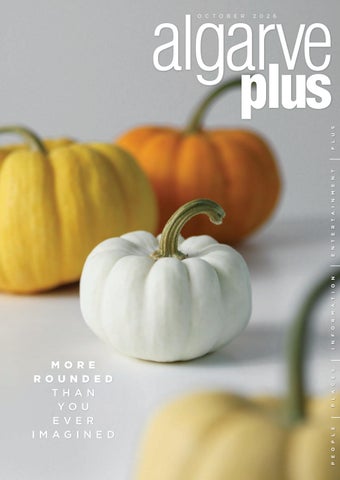
F R O N T COV E R : It’s pumpkin time. Not just for Halloween, but for dinner tonight!
IF YOU HAVE ANYTHING YOU WOULD LIKE TO SHARE, EMAIL susi@rogol-goodkind.com
ALGARVE P L U S
l
07
Gems galore Drawing inspiration from nature and an affinity for water, designer Tamara Comolli combines organic silhouettes with the vast spectrum of colours found in the world’s most beautiful gemstones. The result is an unmistakable aesthetic that continues to captivate luxury jewellery lovers around the globe. The Aurora collection, on show in Tamara’s store in Vila Vita Parc’s VLife Shopping Plaza in Porches, features a dazzling array of 51 vibrant gemstones. tamaracomolli.com / vilavitaparc.com
ALGARVE P L U S
l
08
Wood woof Taking your pooch away with you? The KONA CAVE® folded Travel Bed is a game changer. Thickly cushioned, it delivers real comfort and includes an outer pocket for on-thego essentials. Available in two sizes, in plaid with a fluffy wool lining. €164.34. konacave.com
Frothy This milk frother could be just what your cappuccino, latte macchiato or café latte have been missing. The barista will help you prepare drinks with hot chocolate or milk foam; in a choice of colours, it is the must-have kitchen accessory. €189, by SMEG, from Simple Taste, in Almancil, Albufeira and Lagos. simpletaste.pt
The historic Italian brand Buccellati, founded in 1919, known for its fine jewellery, watchmaking and silver pieces, recently opened a boutique on Avenida da Liberdade, Lisbon. A beautiful store with two floors – one of which is dedicated to home pieces. buccellati.com
Belt up This elastic woven belt is all about relaxed style and allows for a shift in size. Made by Billybelt, with a cowhide leather finish and zinc alloy buckle, it comes in a huge number of plain colours and the new season’s colour and pattern mixes. €36. From Casa Vostra Home in Almancil, for a great eat and shop experience. casavostrahome.com
Light fantastic. Handmade by Luis Boto, this statement piece in tempered steel has green glass beads that twinkle with the candlelight. From Corte-Real.corterealarte.com
NEW THINGS PLUS
#KOZIICARE
#KOZIILOVE
TAVIRA | OLHÃO | LAGOS KOZIISHOP.COM
Loved again This compact Japanesestyle chair has been upcycled by the team at Kit and Caboodle in Alcantarilha, using primer red Annie Sloan paint and gold stencilling. Reupholstered with a grey fabric, it seriously looks the business. 77cm high and 65cm wide. €189. kandc.pt
C
One of a kind Pretty Natural Portugal creates handcrafted soy candles, hand-poured in the peaceful countryside of the Alentejo. We love the unique glass votives that are thoughtfully sourced from local charity shops, giving pre-loved pieces a second life and reducing waste. €30. prettynaturalportugal.wordpress.com
Not so dumb Exercise in style with oak wood and steel dumbbells, useful for strength training and toning exercises, €27.99–€69.99. From a selection in the gym collection at Zara Home. zarahome.com
Eau eau eau Inspired by the evocative spirit of Os Lusíadas, this Pomegranate Blossom & Ginger eau de toilette captures the moment when discovery becomes contemplation. €36. Essencias de Portugal. essenciaspt.com
M
Y
CM
MY
CY
CMY
K
HELPING PLUS
Don’t face it alone O C TO B E R I S B R E A S T C A N C E R AWA R E N E S S M O N T H . P I N K R I B B O N S A P P E A R I N S H O P W I N D O W S A N D O N S O C I A L M E D I A D R AW I N G AT T E N T I O N TO A D I S E A S E T H AT W I L L A F F E C T M A N Y O F U S , W H E T H E R T H R O U G H O U R O W N D I AG N O S I S O R T H AT O F S O M E O N E W E L OV E
B
ALGARVE P L U S
l
10
EHIND EVERY awareness campaign
are people dealing with the reality of cancer: the diagnosis, treatment and uncertainty, and the aftermath of a changed life when and if ‘cured’. A cancer diagnosis can suddenly make life revolve around appointments, tests and treatment. Medical care understandably becomes the priority. At the same time, partners may become carers, family members may be dealing with their own fears, and friends may want to help but not know what to say or do. For Ana Andrés, president of Associação Dar Amor, that reality became particularly stark during the COVID pandemic. Andrés was undergoing cancer treatment at the Instituto Português de Oncologia (IPO) when pandemic restrictions prevented her and others from returning home for a period. They were facing cancer, and separated from much of their usual support network. During that time, Andrés began making small tissue hearts carrying motivational words such as ‘faith’, ‘healing’, ‘love’, ‘light’ and ‘hope’, which she gave to people undergoing treatment. Other patients joined her. A room that had previously been empty became a place where people gathered to make the hearts together. The activity gave patients an opportunity to be together and support one another during an already difficult period. They made a promise that those who survived would continue what they had started. Dar Amor grew from that experience. Today, the Algarve association supports people with cancer, but also their families, friends and caregivers. Its work includes sharing circles, emotional and social support, awareness initiatives, wellness activities, social gatherings and educational programmes. It also provides assistance with social and legislative issues. The handmade hearts continue, too, with volunteers making them for others. Dar Amor is itself a collective effort. A multidisciplinary team of professionals and friends from different fields contributes on a voluntary basis, each bringing different skills to the association. Psychologist Ana Marisa Brito is one of them. She wrote Coração das Emoções – Heart of Emotions – and offered
Dar Amor’s work includes sharing circles, emotional and social support, awareness initiatives, wellness activities, social gatherings and education.
Wo rd s: E L I S A B E T H L E O N A R D
the project to Dar Amor. It now takes place in schools and paediatric hospital wards. Education is another part of the association’s work. In September, it organised a daylong seminar at the Museu de Portimão called Doença Oncológica: Um Diagnóstico Não É um Destino – Cancer: A Diagnosis Is Not a Destiny. It began with basic but important questions about cancer: what it is, how it develops and where people can find support. The programme also addressed subjects including risk factors, quality of life after diagnosis, physiotherapy, physical activity, complementary therapies and psychological aspects of treatment and recovery, before concluding with a discussion where participants could ask questions and share experiences. Together, those subjects reflect how much can accompany a cancer diagnosis beyond medical treatment itself. And the needs of one person may be very different from those of another. Someone may be looking for practical information or trying to understand what assistance is available. Someone else may need to talk about what they are experiencing. A supporting partner, relative or friend may eventually realise that they need help themselves. “Asking for help is nothing to be ashamed of,” says Brito. “It is a way to avoid walking the path alone and to make things easier.” Dar Amor, she explains, is available either to provide assistance itself or to help direct someone to the appropriate person or place. “You just need to contact us,” she says. Breast Cancer Awareness Month makes cancer particularly visible each October. But awareness has greater value when people know what to do with it – whether that means seeking help for themselves, recognising that someone supporting another may also need support, or helping organisations that provide assistance. You can support Dar Amor by becoming a member, volunteering, or making a donation. Anyone seeking assistance can contact the association at associacaodaramor@outlook.pt or via Facebook and Instagram. Asking for help does not require knowing exactly what help you need. Sometimes the first step is simply making contact.
E L I S A B E T H L E O N A R D T: 9 2 4 0 4 2 2 0 6 / E : e l i s a b e t h @ vo l u n t e e r i n g . p t / vo l u n t e e r i n g . p t
KETTAL - COSAPOTS - POINT - ETHNICRAFT
DISCOVER A CURATED COLLECTION OF OUTDOOR FURNITURE AND DECORATIVE OBJECTS FROM THOUGHT-LED, WORLD-RENOWNED BRANDS.
VISIT OUR OUTDOOR LIVING DESIGN STORE - SURROUNDED BY MEDITERRANEAN GARDENS & FARM TO TABLE RESTAURANT - AUSTA
RUA CRISTÓVÃO PIRES NORTE ALMANCIL - ALGARVE DUNAS-LIVING.COM @DUNASLIVING
ALGARVE P L U S l
12
VISIT PLUS
CHASING CASTLES
I M A P P E D O U T A R O U T E O F M O R E T H A N 1 , 0 0 0 K I LO M E T R E S , PAC K E D M Y F I L M I N G G E A R I N T O M Y L O YA L R E N A U LT K A D J A R , F O L D E D D O W N T H E B A C K S E AT S F O R E M E R G E N C Y S L E E P I N G A R R A N G E M E N T S A N D S E T O F F T O C H A S E P O R T U G A L’ S F R O N T I E R C A S T L E S . I N 1 5 0 9 , D U A R T E D E A R M A S H A D A R O YA L C O M M I S S I O N T O D O J U S T T H AT. I H A D A Y O U T U B E C H A N N E L , A F L A S K , A N D A F A I R LY O P T I M I S T I C M AT T R E S S
ALGARVE P L U S
l
13
Wo rd s: N I C K R O B I N S O N , A L G A R V E A D D I C T S
ALGARVE P L U S
l
14
I
T STARTED, as these things often do, with very little sleep and a slightly ridiculous idea. In the summer of 2023, I climbed up to Monsanto before sunrise. Monsanto is one of those Portuguese villages that seems to have been dreamt up by a giant with a fondness for granite. Massive boulders lie scattered across the hillside like abandoned marbles, and the houses don’t so much sit beside them as squeeze themselves politely underneath. At the very top, panting slightly and trying to look a lot more heroic than I felt, I found the ruins of a castle once controlled by the Knights Templar. The sun was only just beginning to stretch its fingers across the valleys, and there, set into the rock, I came across a bronze plaque, bearing a fascinating bit of history. It told the story of Duarte de Armas, a royal squire, cartographer and very patient man who in 1509 was ordered by King Manuel I to travel the length of Portugal’s frontier and document its castles, walls and military defences. No drone. No Google Maps. No heated seats. No service-station coffee. Just horses, parchment, ink, danger, dust and an absurdly ambitious royal brief. Five centuries later, I was standing on that granite peak, and I had one of those dangerous little moments where an idea slips quietly into your brain and refuses to leave. What if I followed his route? What if I were to go looking for the castles he saw? What if I tried to understand why this quiet border, now crossed so casually, once mattered enough to be fortified stone by stone, hill by hill, tower by tower?
Starting off The journey began where the Guadiana River meets the Atlantic, at Castro Marim. If you want a dramatic opening scene, this is hard to beat. The castle rises above the salt marshes, with Spain winking at you from across the water and the Algarve light doing that ridiculous golden thing it does so well.
Previous page: Monsaraz village and its famous castle, in the Évora district. This page, above left: Porta de Beja entrance portal into Serpa castle; right: A detail of the walls of the castle in Ouguela, Évora, classified as a national monument. Opposite page: Mértola, another town and castle in the Alentejo that cannot fail to fascinate
I arrived during the town’s medieval fair. So instead of solemnly contemplating frontier warfare, I wandered into a lively swirl of costumes, music, grilled meat, craft stalls and people pretending to be significantly more medieval than they actually were. Duarte de Armas would probably have arrived to inspect crumbling walls and military readiness. I arrived and ate a bifana with my family friend Paula. Castro Marim has been passed around by almost every ambitious civilisation that ever fancied a foothold in southern Iberia. Phoenicians, Greeks, Carthaginians, Romans, Vandals, Muslims, Christians, Templars – all of them understood the same thing. This was not just a pretty hill with a view. This was a doorway. Control the river. Control the salt. Control the crossing. Control the edge of the kingdom. That, I realised, was the whole story of the Portuguese frontier. These castles were not decorative. They were answers to fear. From Castro Marim, I drove north along the Guadiana to Alcoutim, where I spent my first night sleeping in the car. The Kadjar was reasonably comfortable. I had snacks. I had a phone charger. There is something strangely liberating about reducing your life to a back seat and a sleeping bag. Alcoutim is one of the most fascinating little border towns in Portugal, staring directly across the river at Sanlúcar de Guadiana in Spain. Two villages, two castles, two countries, one lazy river between them. Today, you can zip across in a boat or even fly over the border on a zipline, if that appeals. The old fortification at Alcoutim goes deep into
the Islamic period. It was once a fortified palace, home to a Muslim lord, controlling river movement and access to local mining wealth. Archaeologists have found traces of a refined life here – ceramics, eating implements, musical fragments, board game pieces. Not just soldiers and swords, then, but people passing time, eating, playing, listening, worrying, waiting.
road from Beja, then known as Pax Julia; later, Muslim builders strengthened the fortifications with rammedearth walls. Then Christian kings took over, reused, rebuilt and reinterpreted what came before.
On to Mértola
In Moura, the history turns even more turbulent. The town was captured by Christian forces in 1166, lost almost immediately, then retaken before the year was out. In 1190 it fell again to the Almohads under Abu Yusuf Yaqub al-Mansur, before finally being reclaimed by Christian forces in 1217. One year the church bells ring. The next, the call to prayer returns. And all the while, the same families are trying to survive as history tramples around above their heads.Today, Moura is also famous for water. Água Castello was originally sourced below the castle. I liked that. A town once defined by war and siege now known for bubbles.
Further north, the Guadiana led me to Mértola, a different beast altogether. It does not merely sit on history. It appears to have swallowed it whole. Roman Myrtilis. Islamic Martulah. Christian frontier town. River port. Trading post. Museum town. Mértola is not one layer of history but a stack of them, all visible at once if you know where to look. Paula, the owner of Hotel Museu, part of Hotel Beira Rio, told me one of those stories that makes you immediately look at a place differently. Inside the castle, she said, there was once a deep tunnel running down towards the river. During a siege, defenders could use it to reach water, even bring horses down to drink. That detail stayed with me. Sieges. We tend to think of banners, armour, catapults, men shouting from battlements – but really, a siege is thirst. It is waiting. It is heat, fear, rationing, sickness and wondering whether the people outside the walls are more patient than those within. In Mértola, the castle is beautiful. But the tunnel is the story.
Next, Serpa From there, the journey left the easier romance of the river and entered the open Alentejo, where the land broadens, the villages thin out, and the sky becomes enormous. The weather also turned against me. By the time I reached Serpa, the rain was hammering down and I found myself sheltering under the castle entrance, only to discover that the castle was closed. It was Monday. There is something deeply Portuguese about building an extraordinary medieval castle, preserving centuries of history inside it, and then quietly closing it one day a week. Still, Serpa has plenty to say. The Romans fortified the area to protect the
And now, Moura
Moving on Then came Noudar. The road to Noudar is not so much a road as a test of your suspension and commitment. The tarmac disappears, and for ten kilometres I crawled along a rutted dirt track through cork oaks, scrubland and glorious middle-of-nowhere silence. No cafés. No traffic. No handy little pastelaria appearing just when morale needs it. Just the sound of tyres crunching over stones and the growing suspicion that I had driven out of modern Portugal entirely. And then it appeared. Noudar Castle rises from a schist hilltop between the Ardila River and the Ribeira de Múrtega. The same colour as the earth. The same
ALGARVE P L U S
l
15
VISIT PLUS
VISIT PLUS
crucial Guadiana crossing and endured conquest, reconquest, Spanish occupation, earthquake damage and eventual abandonment. Now, wonderfully, Juromenha is being brought back to life through renovation. These places need to be used, loved, argued over, photographed, slept in, eaten beside and occasionally rescued from brambles.
Discovering more
ALGARVE P L U S
l
16
Castelo de Alandroal, in the village of Alandroal in the Alentejo, dates back to the 13th century. This medieval fortress is typical of the Gothic fortifications of the period
mood as the landscape. Noudar changed hands repeatedly as Portugal and Spain struggled for control. Eventually, like so many medieval strongholds, it became obsolete. Firearms changed warfare. Artillery changed architecture. Remote castles lost their purpose. The frontier moved on, and Noudar was left to the wind. But my goodness, what a place to be left. From Noudar I pushed on towards Mourão, arriving just as the setting sun lit up the castle’s ravelins. These triangular outworks belong to a later military age, when castles had to adapt to gunpowder and geometry became a form of survival. By then I had managed four castles in a single day and was feeling rather pleased with myself, which is usually the moment hunger enters the story. In Mourão I found an unpretentious local spot serving bochechas de porco – pork cheeks – at a price so reasonable it felt like a clerical error. That night, I slept in the Kadjar again. I had become oddly fond of my mobile bedroom. Seats down. Mattress inflated. Camera batteries charging. Duarte de Armas had horses. I had cruise control.
Another day The next morning, I woke between Mourão and Monsaraz, with the vast Alqueva lake stretching across the landscape. This, of course, was a view Duarte de Armas never saw. In his time, there was no great inland sea here. The Alqueva Dam is a modern intervention, completed in the early 2000s, that transformed this dry corner of the Alentejo with water, electricity, agriculture and tourism. It is strange to travel a 500-year-old military route and find yourself confronted by a 21st-century megaproject. Monsaraz, perched high above the lake, may be one of Portugal’s most photogenic villages. It is almost annoyingly beautiful. Whitewashed houses, stone lanes, wide skies, castle walls and views that make everyone reach instinctively for their phone. Romans, Visigoths, Muslims, Christian kings and Templars all passed through here. But that morning, I was mostly thinking about coffee. I found it further north in Alandroal. A dark galão escuro, strong enough to restart the brain, was taken while watching locals dismantle the remains of a festival. Alandroal, Terena and Juromenha all form part of that extraordinary defensive logic shaped under King Dinis, who took the frontier seriously. Terena became part of a strategic line of castles. Juromenha guarded a
Elvas is where the whole frontier project suddenly expands from medieval romance into military genius. This is not just a castle town. It is a fortified system. Walls, bastions, outworks, forts and a massive aqueduct all combine into one of the most impressive defensive landscapes in Europe. Elvas was recognised as a UNESCO World Heritage site in 2012, and rightly so. Everything about it feels designed to make an invading army lose confidence. The walls seem to multiply. The angles confuse you. The scale becomes absurd. By the time I reached Campo Maior, the journey had shifted again from admiration to tragedy. Campo Maior’s castle was the site of many conflicts, but the event that lingers most is not a battle. In 1732, lightning struck the castle keep, where the garrison’s gunpowder was stored. Eighty-four tons of gunpowder and thousands of grenades exploded. The devastation was almost unimaginable. More than a thousand houses were destroyed. Hundreds died. Thousands were injured. A castle exists to protect a town. In Campo Maior, for one terrible moment, the castle became the thing that destroyed it. That afternoon, I passed through more fortifications – Ouguela, Arronches, Assumar, Monforte – names that deserve their own journeys. But time was running, and so was I. By the end, I had visited 20 castles out of the 62 connected to Duarte de Armas’s great frontier survey. Three days of driving, filming, climbing, eating badly and occasionally eating magnificently. And still, 42 castles left to find. But what stayed with me most was not the number. It was the silence. Today, the Portuguese-Spanish border barely announces itself. A blue EU sign, a change in road markings, maybe a different fuel price. No guards. No gates. No shouting from battlements. For centuries, though, every hilltop mattered, as did every river crossing. The castles remain, but their purpose has changed. Swallows nest in the walls. Children ride bicycles below towers built for archers. Tourists take sunset photos from battlements where soldiers once watched for dust clouds on the horizon. In some towns, the old walls now frame cafés, festivals, hotels and quiet evening walks. That, perhaps, is the most Portuguese thing about the whole journey. The country survived, and then it softened. Duarte de Armas set out in 1509 to record the edge of a kingdom. Five hundred years later, I followed him, chasing ruins across a peaceful frontier. I thought I was looking for castles. But I realised I was really looking for the line between fear and memory.
www.artcatto.com
Dom Pattinson ArtCatto Gallery in Loulé
ALGARVE P L U S
l
18
Wo rd s: L A U R A S H E A
SO MUCH TO
CELEBRATE F R O M R E L I G I O U S C E L E B R AT I O N S T O F O O D A N D D R I N K F A I R S T O M U S I C A N D C U LT U R A L E V E N T S A N D F E S T I V I T I E S L I N K E D T O H I S T O R Y, T H E A L G A R V E O F F E R S A N AC T I O N - PAC K E D AG E N DA Y E A R R O U N D . C H E C K O U T O C TO B E R H A P P E N I N G S
Wo rd s: L U C Y M A Y E R
MUST GO PLUS
classes, and coastal clean-ups. The best part? Over 150 of them were free.
LAGOA MAGIC FEST 2026
SAGRES BIRDWATCHING FESTIVAL
2-5 October Sagres The 17th Sagres Birdwatching and Nature Activities Festival will turn this little corner of the western Algarve into Europe’s birdwatching capital as ornithology enthusiasts return to what is widely regarded as one of the most important nature observation events in Portugal. The festival is organised by the Municipality of Vila do Bispo in partnership with SPEA which is BirdLife’s partner in Portugal, and Associação Almargem. Every
year has a featured species, and this year it’s the Razorbill, or Alca torda. It’s a real privilege to be able to spot this magnificent seabird which is native to the North Atlantic and Greenland but migrates south along the entire Portuguese coast during autumn and winter. Its post-breeding migration begins precisely this month, making the festival the perfect window to spot this impressive diver, a bird capable of plunging tens of metres below the surface to catch sardines and anchovies. There’s also an impressive selection of marine wildlife on display. Last year’s festival featured 275 activities, ranging from guided birding walks and boat trips to photography workshops, illustration
8-10 October Lagoa Something a little bit different from your traditional festival is the Lagoa Magic Fest, an enchanting event that sees the whole of Lagoa come alive with illusion for three days. Various free pop-ups will take place throughout the town’s streets and in schools, culminating in a Grand Gala on the final evening at the Carlos do Carmo Auditorium. It’s definitely one that will awaken the imagination of little minds, with live magic tricks and the chance for participants to get up close and involved, but it’s an event that will elicit a certain degree of awe and wonderment from the older visitor, too. The festival has been curated by local
l ALGARVE P L U S
On until 5 October Vila Vita Parc Biergarten, Porches Oktoberfest is the biggest social event in Bavaria’s calendar but it’s one that’s celebrated the world over. Vila Vita Parc will once again create its own Biergarten giving visitors the opportunity to celebrate in style, but with an Algarve twist. There are the classics like Erdinger Weissbier and Bratwurst, accompanied by a traditional and rousing Bavarian Oompah band, but that’s just the start of the gastronomicdelights. The menu is based on the ‘food-for-beer’ and ‘butcherto-table’ concept and features an array of dishes which will delight all true Bavarian gastronomy lovers. I’ve taken a sneak peek at what’s on offer: dishes like crispy Bavarian blue cheese with potato rösti and blueberries, vegetarian Schupfnudeln pasta with roasted vegetables, sautéed with basil and almond pesto, and a ‘giant’ beef chop for two with crunchy potato salad with fennel, sweetchilli and nuts. Vila Vita Parc is rightly proud of its offering and says the real star of the menu is the extraordinary selection of German beers as well as the Porches Craft Beer (the Algarve twist). So, it’s time to get your lederhosen and dirndls ready and head to Vila Vita Parc. Prost!
19
OKTOBERFEST
MUST GO PLUS
illusionist Paulo Cabrita. He’s part of The Museum of Magic Portugal, which is home to an important national and international magic collection. It includes literary works, unique devices, photos and iconic posters. Last year’s festival brought together performances from six world-class illusionists, each undertaking two performances per day with their own diverse styles of magic and illusion, with the sole aim of bringing a sense of wonder to the historic streets of Lagoa, which are magical in themselves.
ALGARVE P L U S
l
20
SOCA WKNDR 15-19 October Albufeira, Praia da Oura and Areias de São João This world-renowned music festival celebrates and combines the vibrant energy of Soca music and Caribbean culture; it was founded to bring the infectious rhythms of Soca to global audiences and has toured the world, with Portugal joining the line-up in 2024. The festival is well-known for its immersive experiences, featuring DJ sets from top Soca artists, themed parties, and cultural showcases that encapsulate the essence of the Caribbean. In Albufeira, the four-day festival will feature eight official events across day and night, with a fusion of music, dance and community, creating an atmosphere reminiscent of traditional Caribbean celebrations. Soca is shorthand for ‘soul of calypso’ and is a form of high-energy dance that can trace its origins to Trinidad and Tobago in the 1970s. It is characterised by fast tempos and prominent basslines, and Albufeira is the perfect place to host this party of music, dance and the Caribbean.
SANTA IRIA FAIR 15-25 October Largo de São Francisco, close to Faro Marina Santa Iria is billed as the oldest and largest fair in the Algarve. A traditional family event with over 500 years of history, it’s named after and celebrates Saint Irene of Tomar, a seventh-century Portuguese nun who, according to legend, was martyred and her body was thrown into the Nabão River. Although there is a lot of history attached to this festival, there is also a
lot of fun. Visitors can expect a carousel, bumper cars, a Ferris wheel which allows you to see Faro in all its glory, live music and stalls selling handmade gifts. There’s plenty of food and drink to sample from classic Bifana to artisan beer. The event is thought to attract around 200,000 people over its course and while some choose to go just to enjoy the offerings, Santa Iria is a religious festival at heart and typically launches with a celebration of Mass at the 16th-century Catholic Misericórdia Church followed by a procession featuring Saint Irene’s image through the fair’s grounds.
FESTIVAL DA BATATA-DOCE (SWEET POTATO FESTIVAL) 28-30 November Aljezur You may have been to many food festivals in your time, but have you ever been to one dedicated entirely to the humble
sweet potato? This is exactly what Festival da Batata-Doce is. The lively three-day event gives thanks to the region’s famous sweet potato harvest and the farmers who produce it. You’ll find everything that can possibly be created from this vegetable at this food festival, including soups, pastries, and even puddings. Aljezur is the perfect place to grow sweet potatoes because of its unique environmental conditions – the area is known to have mild winters, warm summers, and a strong Atlantic coastal breeze that keeps the region much cooler than inland Algarve. Its tubers are famous for their distinct taste and, importantly, are produced organically and free of chemicals. The region’s famous Lira variety is PGI (Protected Geographical Indication) certified. Last year some 40,000 people attended the festival where 35 tonnes of sweet potatoes were cooked. Expect competitions, cooking demonstrations, concerts and mountain bike tours.
BECAUSE YOUR TIME HAS VALUE
We’ve spent over 20 years maximising the potential of exceptional properties and the experiences they create, so you can focus on what matters most. Contact us for your free rental projection.
E. listwithus@sandyblue.com
We accept only a limited number of properties each year.
sandyblue.com
ALGARVE P L U S
l 22
FOOD PLUS
PLAYA, Marina de Olhão T H I S R E S TA U R A N T A N D B A R I S R E G A R D E D A S A H O T S P O T O N T H E N E W E S T D E V ELO P M ENT O F S H O P S A N D C A FÉ S O P P OS ITE O LH ÃO ’ S R E A L M A R I N A H OT E L . L E S S H U R R I E D T H A N T H E M O R E C E N T R A L A R E A A R O U N D T H E M A R K E T S , A N D W I T H P L E N T Y O F PA R K I N G O P T I O N S ( P H E W ) , P L AYA W I L L M A K E A N Y N E W C U S T O M E R A R EG U L A R . J OÃO E D UA R D O C A N ’ T G E T EN O U G H O F IT
O
PENED IN June
2022 by Paula and João Gonçalves and Rafael Loch, this is a restaurant and bar that boasts a distinct personality and a food style that is quite different to the usual offerings of beach-view eateries. Yes, you’ll find classic fish dishes like seabass, salmon, and tuna, adventurous plates such as black rice with prawns, and meat specials including steaks and burgers on the lunch and dinner menus, but Playa’s reputation, and faithful clients are the result of inspired Latin American flavours and a twist on traditional Mexican cuisine. Fresh local ingredients are used whenever possible, combined with selected products from Latin America – the beef comes from Uruguay, for example, and the corn tortillas come from Mexico.
Tacos – we loved the surf-andturf options and also the duck – and quesadillas – try the roast beef and bean varieties, which are a feature on the menu, along with dishes such as burritos with chicken, shrimp or pumpkin. When your order arrives at the table, it is hard to say no when others in your party want a taste, so start off with shared dishes – classics like guacamole, homemade croquettes, and toasted totopus, which comes with four sauces. If you are in the mood for soup, the gazpacho is cold, spicy and refreshing. Rafael has several years of experience in bars and restaurants in the Algarve, while João and Paula came from a different background, with solid experience in operations management and marketing from careers in large companies in Portugal, Brazil and the US. That combination of hospitality and management experience has been
FOOD Latin American influences and wonderful twists on Mexican favourites
DECOR Comfortable, relaxed and stylish. Eat on the terrace for incredible views out to sea
€ PRICE Lunch, and dinner, around €25 a head, plus drinks
very important to the way Playa has been shaped and is run. A staff of around 15, half of whom are in the kitchen, ensures great, friendly service. And they remember you and make you feel your decision to return is the best ever. The location of Playa adds to its appeal. Sit there, look out to the vast expanse of blue sea, and every day seems like a holiday. It is quiet and peaceful; think sunshine and aromas of food cooking. And check out what those at the table next to you have been served, you may want to order the same. Sharing boards for two or three are certainly worth considering, especially when paired with a shrimp and mango salad or a goat’s cheese special (we voted this the best ever). The wines are mainly Portuguese and well priced, which makes a very pleasant change. But you must leave room for the desserts. The selection includes delicious fried churros, served warm and with two sauces, a spicy chocolate mousse, the essential crème brûlée, and a rice pudding with vanilla ice cream. Top of the list for us is Playa’s mango and mint cheesecake – a wonderful close to a very satisfying meal. Not enough time to sit down? You can pre-order for collection, provided of course, that the kitchen has time to accommodate your request.
P L AYA , M a r i n a R i a C e n te r, Av. 5 d e O u t u b ro , Lo j a s 9 e 1 0 / T: 9 6 6 4 3 8 5 5 4 / E : g e r a l @ p l a y a . p t / W : p l ay a . p t / O P E N e ve r y d ay, 1 2 h 0 0 –2 2 h 0 0 / B a r & E s p l a n a d a a té à s 2 h 0 0
PRAÇA DA REPÚBLICA 69-75 LOULÉ | PORTUGAL
MARC 15.10 LAGRANGE FROM
Marc Lagrange, “Eskimo Girl“, 2001
TAKE PART PLUS
JOIN THE CLUB
ALGARVE P L U S
l
24
A S AU T U M N H ITS TH E A LGARV E A N D S U N -SOA K E D AC TIVITI E S A R E N OT H I G H O N T H E A G E N D A , W H AT A B O U T H O O K I N G U P W I T H A S O C I A L C L U B T H AT W I L L K E E P Y O U F R O M B E C O M I N G A C O O L - W E AT H E R C O U C H P O TAT O ?
Wo rd s: D E B B I E R E Y N O L D S
ALGARVE COFFEE CLUB Founder Gerard McGuirk says the Algarve Coffee Club is all about connection, balance and support and the reason he started it was quite personal. “I had moved back to Portugal after living in Hong Kong, and I was experiencing many of the frustrations that people moving to or living in Portugal will probably recognise,” he says. “I have a non-EU partner, and I found myself trying to navigate a system where finding the right professional when you needed one could be surprisingly difficult. “I seemed to spend endless hours waiting for people who either didn’t turn up, didn’t return calls or couldn’t actually provide the help I needed.” Realising that he couldn’t be the only one experiencing these frustrations, his idea was to create an environment where people could come together, share their experiences and, most importantly, share the names of people they had used and trusted. The first Algarve Coffee Club event was held in Vilamoura in January 2025 and what started as a small, simple social coffee group has now grown into a
community of more than 2,798 members. “As the community has grown, so has the idea,” says Gerard. “We’re now developing our ‘Meet the Professionals’ events and building what will be a Trusted Business Directory based on genuine member recommendations. “I organise the Algarve Coffee Club, with the support and involvement of our members and the wider local community, and its success is in creating genuine win– win partnerships,” he says. The Coffee Club has regular social meetups on alternate weeks, and stages two major events every month. “But the Algarve Coffee Club isn’t only about physical events. I also make daily social media posts to keep the community
“We’re now developing our ‘Meet the Professionals’ events and a Trusted Business Directory based on genuine member recommendations.”
“The response was so positive that we knew we had created something special. From there, we started to raise things up, making every event completely different; for example, our following event was an 80s disco night at a wine farm in Tavira with retro food that included chilli con carne and prawn cocktails.” Today, the guest list has grown to around 350 members – of various ages, both locals and expats – all wanting something more than “just another dinner out” and looking forward to discovering what might be coming next. “Our ambition is to create one unforgettable event every month in the eastern Algarve from September through to May, taking the Secret Supper Club to different venues and transforming each one into a new experience,” explains Sarah.
“We’re also searching for the perfect venue to bring one of our most ambitious ideas to life...an Alice in Wonderland-inspired Secret Supper.” “We already have our eye on a beautiful boutique hotel for one of our upcoming events, and we’re also searching for the perfect venue to bring one of our most ambitious ideas to life... an Alice in Wonderland-inspired Secret Supper. “Think about curiouser and curiouser cocktails, unexpected entertainment, wonderfully eccentric décor and a dining experience where nothing is quite what it seems. It’s about bringing people together, discovering beautiful and unexpected places, celebrating food, wine, music and local talent – and creating memories that people will be talking about long after the last glass has been poured.” To join, see facebook.com/p/SecretSupper-club-Algarve-61592243456926/ E: sarahemorgan36@gmail.com
l
“It all started over a coffee in a little café in Tavira,” says retired professional Sarah Morgan. “I was talking with a friend in the hospitality business about how much quieter the town becomes during the winter months and how we could find a way to bring people together while also investing in our local community. We were keen to create opportunities for local and young talent to showcase their skills and be part of something exciting.” They came up with the idea of a Secret Supper Club, a series of unique dining experiences held in different locations, each with its own menu, theme and style. “For our very first event, we managed to squeeze in just 20 people,” says Sarah. “We created an incredible 11-course menu and, honestly, we weren’t quite sure what to expect! But it was a huge success.
ALGARVE P L U S
active and make sure there is always something relevant happening within the group,” says Gerard. The format of the physical events varies. Some are relaxed coffee mornings, while others are networking events, area visits, talks, property-related events or Meet the Professionals events. “We also have members who organise activities around shared interests, like our Sunday motorcycle trips, which take members out across southern Portugal to explore different places together,” says Gerard. “Although Albufeira remains an important base for us, we’re expanding into other parts of the Algarve. We want members to experience more of the region and to meet people outside of their immediate area. The common thread is people coming together, building friendships and making the most of life here in Portugal.” Recent events included one in September in Silves in support of the Rotary Club, and upcoming are Meet the Professionals in October and November. “We are currently looking at events around Almancil and Vilamoura in the central area, Tavira in the east, and Carvoeiro and Lagos towards the west,” Gerard explains. “Going into the autumn and winter months, I particularly want to focus on expats who may be living alone. “Last year I lost two of my siblings, both of whom lived on their own. My sister had wonderful friends around her here in the Algarve, but her situation made me think about the older members of our community who may have lost a partner, need practical help, or simply find themselves alone. “We want to create connections before people actually need them, so that members know where they can turn for friendship, information and, importantly, practical support.” Join through the Algarve Coffee Club Facebook group or contact Gerard directly on WhatsApp at +351 924 079 683 or by email at algarvecoffeeclub@gmail.com
25
SECRET SUPPER CLUB
TAKE PART PLUS
ALGARVE P L U S
l
26
THE CHARITY LUNCH GROUP The group in its current guise began last November, although its origins date back several years. Founder Alison Geers, who is ably assisted by her husband James, and Fiona Dunlop, told me that it began as a monthly lunch group to raise money for a local dog charity called The Tiny Shelter. “The purpose of the shelter is to help and hopefully re-home some of the many unfortunate dogs that are here in the Algarve,” said Alison. “Tiny Shelter is still the main beneficiary of funds raised through the lunch club, but as it has expanded significantly over the past 12 months, we are now also able to help some other charities in the region.” The lunches are arranged monthly with partner restaurants in the area and sometimes include entertainment from local singers and raffles or auctions to raise additional funds for the worthy causes. Alison says anyone who cares about helping distressed animals would be interested in supporting the group. “The lunches are also a great forum for meeting new friends and socialising with likeminded Algarve residents.” She said members were largely retirees and predominantly of UK and Irish origin, but that anyone is welcome. “Recent event highlights have included lunches where we’ve had a full house of 80 people and a four-hour boat cruise along the Algarve coast, which had a long waiting list and subsequent disappointed members,” said Alison. The October event is lunch at São Domingos restaurant in Galé on 24 October. November’s event will be on the 28th of the month, although the venue is yet to be confirmed. The Christmas lunch is on 12 December at O Pescatore in Seis Marias, Albufeira. The lunch format is usually a €25 set menu provided by the partner restaurants including beer, wine and soft drinks. December is generally a Christmas special at €50 per head. “In addition to the set fee, we ask members for a donation to the charities. The events are usually released two weeks in advance and tend to sell out within a few days,” says Alison. To join visit Facebook page Charity Lunch Group or contact Alison Geers directly on Facebook.
MEDITERRANEAN GARDENING ASSOCIATION PORTUGAL
Project board member Rosie Peddle is quick to point out that the association, known as MGAP, is not a social club, but it does host several events through October to June of the following year. “Obviously, our association is aimed at gardeners, but there is definitely an enjoyable social element along with the sharing of knowledge and experience that leads to creating sustainable gardens and landscapes with minimum water use,” she explains. MGAP was formally incorporated in February 2014 and is a fully legal entity registered with the relevant government, tax and social security sections. “It was important for us to have this recognition so that we could continue to interact with our local community and local council authorities in order to provide our volunteers with the appropriate legal framework for our activities,” says Rosie. “All management functions are undertaken by volunteers. We now have
a group of 12 key volunteers providing specialist skills.” The events programme includes private garden visits, informative talks, social events and some larger public access events, which normally happen monthly across the Algarve and Alentejo. “We welcome anyone who is new to gardening in the challenging conditions of southern Portugal. Those who are more experienced are also welcome as one of our main aims are to share our experiences of making beautiful sustainable gardens and learn from each other. “Many of our members are part of the wider expat community who have been keen gardeners in their previous locations but realise there is much to learn about gardening in the Algarve.” The next event is the annual Mediterranean Garden Fair in Lagoa on 17 and 18 October and there will be three training days in autumn with professional trainer Jessica Gomes. “There are also monthly events covering a general interest in both ornamental and edible garden making, with all the info on our website pages,” says Rosie. She adds that members have access to an international seed scheme, an advice service, an online library and support for their new projects. “We are a friendly group that welcomes all levels of knowledge and interest in the wonderful gardens and richly diverse landscapes of the Algarve. Our aims and objectives include encouragement to work with nature. We send out regular newsletters with info on events and other gardening activities. To be added to the distribution list, email mgapaccts@gmail.com To become a member, visit mgaportugal.org/membership
“MGAP members have access to an international seed scheme, an advice service, an online library and support for their new projects.”
THE ALGARVE TRAVEL CLUB A shared passion for travel, culture and community were the seeds that grew The Algarve Travel Club, which had its inaugural meeting in August. It is organised by a collaborative team consisting of Beth Bucker (founder of Beyond the Path, focusing on sensory, photography, and cultural journeys for women 50+); Caroline Bergman (safari specialist for Africa with Sandfire Safaris); and Clare CollinsDoyle (travel agent with Independent Travel Experts, providing travel logistics and strong connections to the British community). Beth explains that the Travel Club’s purpose is to connect Algarve residents through in-person social events and curated group trips. Coming to the Algarve from Brazil after her husband of 40 years passed away, Beth learned that it wasn’t easy finding new friends and that travelling solo is not always the best option. “We exist to ensure that no one has to explore the world or enjoy the Algarve alone,” says Beth. “We offer a true community before setting off on a journey: we organise talks, wine tastings, and exclusive member discounts with partner hotels and spas. We travel in small groups (six to ten people) at a relaxed pace, focusing on authentic experiences, both locally and abroad.” Meetings take place on the third Wednesday of every month in welcoming spots across Tavira, Loulé, Lagos, and surrounding areas. Details for each gathering and location are shared in the invitation posted on the Facebook page. Members are mostly between 45 and 70+ years old, bringing together British, North American, Northern European and other residents living in the Algarve “We also welcome younger members and digital nomads,” says Beth. “Experienced travellers can provide lots of advice to younger travellers who are just starting out with their exploration of the world.” To join, follow the Facebook page or email Beth at betybucker@gmail.com
@amarafairways
amararestaurant.pt | +351 289 357 579 Four Seasons Fairways, Avenida André Jordan 37, Quinta do Lago
ALGARVE P L U S
l
28
Gourmet forays
EAT AWAY PLUS
T H A N K S T O M Y H U S B A N D D AV I D , A N Y R O A D T R I P B E C O M E S A SERIES OF MEALS WITH SOME SCENERY IN BET WEEN . A WEEKEND AW AY B E C O M E S B R E A K F A S T, E A R LY L U N C H , L AT E L U N C H , D I N N E R A N D , S O M E H O W , A L AT E - N I G H T S N A C K . J O I N M E O N T H E J O U R N E Y. . .
Wo rd s: E M M A C A M P U S , D E S I G N E S C A P E S
Opposite page: Lunch at Morgado do Quintão. This page, left clockwise: strawberry picking at Casa Mãe in Lagos, where its vegetable garden is central to its identity; Esmee of Helder Farm Studios in the south Alentejo; Esmee’s salads; gathering new crops at Casa Mãe
W
HEN WE travel, relaxing by the pool or a cosy evening in is not an option. There is always somewhere to eat. A beautiful hotel room and a bottle of wine on the terrace? Lovely, but no – wait – there is a little tasca 20 minutes away that apparently makes the best cabidella (chicken blood stew) in the region. Sleeping until nine and having a leisurely hotel breakfast? Absolutely not. There is a bakery around the corner that has been making pastéis de chaves since 1978 and, frankly, we need to be there before they sell out. Some of our most memorable and magical experiences on these adventures have introduced us to incredible stories about Portugal, about its cultural tapestry and culinary history and, most importantly, to some of our closest confidants, friends and inspirations. It has meant that I no longer particularly want to travel somewhere simply because it has a beautiful hotel. I want to know what nourishes it – what grows there, who’s cooking, is there a vegetable garden? What are the local communities producing? Can we visit them? I want that perfect tomato, a warm loaf of bread, grilled fish, a plate of eggs, a glass of wine made a few kilometres away. Food that tastes like the place you are in. Outside of Portugal, Le Doyenné on the edge of Paris is a perfect example.
And Finca La Donaira in Andalusia takes the idea even further, bringing together regenerative agriculture, animals, wellness, hospitality and food into one extraordinary ecosystem. Portugal feels increasingly ready for this kind of travel, perhaps because the ingredients for it were already here. What is changing is the way we are being invited to experience them…
A sleepover with the winemaker In the spirit of chronology of consumption, let’s start with what’s in our glass. ‘Wine tourism’ used to mean a tasting, a walk through the vines and perhaps a bottle to take home. But now, increasingly, the most interesting wine destinations are doing something much more immersive: you aren’t simply visiting the vineyard, you are connecting with the land itself. That feels particularly relevant in the Algarve, where a new generation of wine estates and rural stays are making the connection between vineyard, kitchen and table feel completely natural. Morgado do Quintão is one of my favourite examples. You can come for the wine,
EAT AWAY PLUS
ALGARVE P L U S
l
30
Far left, clockwise: Sociedade Rural in the Alto Alentejo; perfect eggs on toasted homemade sourdough toast, made by Claudia; Fazenda Azul, that is centred around gardening, cooking and a slower way of living, complete with vegetables, sheep and chickens
obviously, but you can also stay onsite amongst the vines, eat there, meet the people behind the project and experience the landscape through the food on your plate and the wine in your glass. Their new event series of ‘fire feasts’ is exactly the sort of experience the Algarve has been crying out for and their beloved farm-to-table lunches reinforce the point. Further west, Atlas Land in Aljezur offers a more intimate expression of the same idea. Italian surfer and natural winemaker Filipo opened up a cottage amongst a pocket of his vines on the wild Atlantic coast, offering guests a chance to disappear into the landscape for a few days. You can even join him for a sunrise harvest or for a tasting from the tanks in the cellar – it doesn’t get more personal than that. Filipo’s little house belongs to a category of small-scale Portuguese stays that I find increasingly compelling, where eating and drinking isn’t an ‘experience’ that has been added to the itinerary as there is no need to manufacture a farm-to-table moment when you are already surrounded by the farm. Then there is Monte Casteleja in Lagoa,
where staying amongst the vines offers yet another way to experience one of the Algarve’s only organic and biodynamic projects. There is an option to join Guilherme, the characterful owner and winemaker, for a farmer’s lunch, tasting a few wines and driving away, but you can also choose to spend the night in his adega amongst the landscape that produced them.
Hotels where the garden matters Next, the plate. What I increasingly look for in a hotel has very little to do with the room itself. A good vegetable garden tells you a surprising amount about a place. It gives a hotel a sense of seasonality and a connection to its surroundings; you can see where part of your breakfast or dinner has come from, rather than everything arriving neatly through the back door. The Algarve has some particularly good examples of this, where gardens, citrus trees, herbs and vegetable patches have become part of the hospitality. Although in a town, Casa Mãe in Lagos has long been one of the more interesting design hotels in the region precisely because it never felt like a hotel that happened to have a restaurant. Its vegetable garden is central to its identity, bringing parts of the estate together and creating a tangible connection between guests, growing and cooking. In one of the more popular destinations in the Algarve, where hotels can so easily become interchangeable, that sense of place matters. In the East, Octant Vila Monte offers a slower, more atmospheric version of the Algarve. Set amongst gardens and citrus trees, it captures a different side of the region: less beach club, more country house. It is the kind of place where the food feels woven into the wider experience.
Then there is Amaria on the West Coast near Odeceixe, a place which takes the idea of food as hospitality in a particularly personal direction. The vegetable garden and vineyards are part of the constantly evolving story, but so is the cooking itself. Last time we stayed, co-owner Phoebe brought a distinctly domestic quality to the experience, taking over the kitchen to prepare dinner herself. The food feels less like a ‘chef’ prepared it and more like something more wholesome and nourishing – ingredients grown by her, recipes designed by her, surrounded by piles of cookery books, all taken on a convivial long table in the living room.
The Algarve’s foodie retreats The idea of immersing yourself in someone else’s world of food travel is evident in the rise of the foodie retreat. There is something about stepping away from the restaurant table and into the kitchen, garden or farm that makes food feel less like something we consume and more like something we participate in. The Algarve and neighbouring Alentejo are particularly well suited to this. Fazenda Azul was created by Willemien van der Veen, who fell in love with a white farmhouse surrounded by nature and turned it into a place centred around gardening, cooking and a slower way of living, complete with vegetables, sheep and chickens. And at Helder Farm Studios, Esmee Brandwijk and Laurens Smit left the Netherlands just months into their relationship and moved to South Alentejo, transforming an abandoned farm into a creative retreat where guests can get properly involved, including in week-long hands-on cooking experiences. There is the new Algarve arrival, too, Christie Knight’s food-filled yoga retreat, where the culinary side comes with serious restaurant pedigree. Her partner, Andy Frantzeskos, was formerly head chef at ROVI, Ottolenghi’s London restaurant, and next year they will host a series of themed retreats in Portugal. All three offer something increasingly rare in travel: participation rather than consumption. And honestly, that sounds like quite a good holiday to me.
Beyond the Algarve One of the best things about food travel in southern Portugal is that the journey doesn’t have to end at the Algarve’s borders. The Alentejo is particularly
well suited to this new generation of food travel. Its agricultural landscape, vineyards, olive groves, cork forests and strong culinary traditions provide exactly the raw material these experiences need. São Lourenço do Barrocal near the hilltop village of Monsaraz is perhaps the ultimate expression of the landscape-led stay in the Alentejo. The estate, the architecture, the agricultural history and the food all feel part of the same story. For something more under-theradar, I recently discovered the Sociedade Rural in the Alto Alentejo and national forest, the Serra de São Mamede. Created by Lisbonites Miguel and Claudia Villax on 32 hectares of previously semi-abandoned land, it is a beautiful example of what happens when a farm is treated as the starting point rather than simply the backdrop. Claudia, who comes from food publishing, has created a vast organic garden; the kitchen uses its vegetables, farm olive oil and other local produce to create fresh, seasonal food. There are self-guided maps for meditation walks through the olive groves and ancient oakwoods, natural ponds, foraging and other experiences that encourage you to actually engage with the land. Perhaps what connects all of these places is that none of them are simply about eating. They are about staying somewhere because of what grows there. Travelling because there is a particular lunch worth making the journey for. Booking a room because you want to spend a morning in the kitchen. And perhaps, ironically, that is why I am becoming less interested in the word ‘foodie’. It suggests someone who travels in order to eat. What I am interested in is travelling somewhere because food tells you something about the place – what grows there, what people value, how they gather, what they have preserved and what they are changing. It might be a Michelin-starred restaurant in the Algarve. It might be a plate of grilled fish in a village. It might be a farm lunch, a vegetable garden, a bottle of wine beside a fire or a bifana eaten standing up because you were told you simply had to try it. The old model of gastronomic travel was: choose a destination, then find the best restaurant. The new model is increasingly: choose the experience, and let the destination follow. Now is the time to discover what is waiting.
T H E A L L N E W T E M P U R P R O ® S M A R TCO O L™
OUR MOST ADAPTIVE COOLING MATTRESS EVER
WITH
20% MORE
PRESSURE RELIEF THE FUTURE OF SLEEP IS HERE
NEW OPENING
TEMPUR PRO ® COOLQUILT™ Our most adaptive cooling mattress ever. Inside, our new TEMPUR® Advanced Material relieves 20% more pressure*, adapts even better and absorbs more motion. While our innovative SmartCool™ Cover is cool-to-the-touch and absorbs excess heat to keep you feeling cool and fresh. Come and discover this unique TEMPUR ® feel and enjoy a different shopping experience in Algarve.
COME VISIT US Based on internal tests comparing TEMPUR Original with TEMPUR Advanced Material, conducted by Dan-Foam ApS between February and July 2021 ®
®
TEMPUR STORE
Estrada Vale De Éguas, 18 B 8135-033 ALMANCIL
Direct: (+351) 289 374 629 Mobile: (+351) 927 705 489
GPS coordinates: 37.094941 / -8.044454
T H E R E I S A D E E P LY H I S T O R I C L O V E A F F A I R B E T W E E N T H E B R I T I S H A N D P O R T U G U E S E W I N E . F O R C E N T U R I E S , B R I T I S H M E R C H A N T S , P O E T S A N D A R I S T O C R AT S H AV E C R O S S E D T H E S E A S T O S E E K O U T T H E F I N E S T N E C TA R S O F T H E I B E R I A N P E N I N S U L A . L E T ’ S TA K E A J O U R N E Y T H R O U G H T I M E A N D C U LT U R E T O D I S C O V E R M O R E
Wo rd s: L Í V I A M O K R I CELEBRITIES CELEBRATE The pop legend of the Algarve: Sir Cliff Richard
We cannot talk about British star power in Portuguese winemaking without starting right here in the Algarve. For decades, the pop icon Sir Cliff Richard was the ultimate ambassador for Southern Portuguese wine. Driven by a deep personal love for the Algarve lifestyle, Sir Cliff established the famous Adega do Cantor (The Singer’s Winery) in the rolling hills of Guia, near Albufeira. Sir Cliff was certainly no hands-off investor and for many years he could be seen getting his hands dirty during the annual grape harvest, passionately involved
in creating his own premium wines. His signature labels, Vida Nova and Onda Nova, became massive hits, winning international awards and putting regional Algarve wines squarely on the map. Although he handed over the keys of the estate to local business minds a few years ago, Sir Cliff’s pioneering spirit remains legendary. garrafeiraportela.pt/products/ quinta-do-miradouro-vida-novareserva-tinto-2018-0-75?_pos=3&_ psq=vida+nova&_psid=5d7d651d8&_ ss=e
THE SCREEN STARS WHO CRIED OVER SYRAH Dominic West and James Purefoy
If you want to know how deeply a Portuguese wine can move someone, you only need to look at British actors Dominic West and James Purefoy. West, famous for his roles in The Crown, teamed up with Purefoy (star of Rome and Altered Carbon) for the hit television documentary series, The Wine Show. Their mission was to travel across Portugal and discover what makes its wine scene so incredibly magical. As they journeyed through the country, Dominic West fell head over heels for the rugged charm of the Alentejo, calling it one of the most stunning and underrated wine
l ALGARVE P L U S
TOASTING THE INFLUENCERS
33
WINE PLUS
WINE PLUS
THE TITLED DYNASTIES
ALGARVE P L U S
l
34
landscapes on the planet. But it was James Purefoy who stole the show with an admission that went viral among wine lovers. While visiting the beautiful Herdade do Maroteira estate in Alentejo, Purefoy tasted their famous Cem Reis Syrah Reserva. “It’s the first time a wine has ever made me cry,” he admitted. Since that unforgettable television moment, both actors have become unofficial ambassadors, telling the British public that Portugal is hiding some of the best-kept secrets in the wine world. garrafinhas.pt/produto/ cem-reis-reserva-syrahtinto2023/
THE TV CHEF WHO SPARKED A SUPERMARKET STAMPEDE James Martin
Sometimes, a single sentence from a trusted celebrity can completely change the fortunes of a winery. That is exactly what happened when British TV chef and culinary expert James Martin, took a sip of a humble Portuguese red on the popular BBC show Saturday Kitchen. The wine in question was Porta 6, a vibrant, easy-drinking red blend from the Lisboa region, packaged with a quirky, colourful label showing a traditional Lisbon tram. Live on national television, Martin took a sip, looked directly into the camera and declared it: “one of the best red wines I have tasted in the tenyear history of this show.” Within hours of his comment, supermarkets and wine shops right across the United Kingdom were completely cleaned out of Porta 6. The wine merchant’s website crashed due to overwhelming traffic, and a massive national wine shortage ensued. Martin’s casual endorsement turned a hidden Portuguese gem into a household name overnight. That’s power, no question. portugalvineyards.com/en/ lisboa/5359-vidigal-porta-6red-2024-5601996547897. html
While modern celebrities bring a flash of contemporary glamour, the relationship between Britain and Portuguese wine was built over centuries by a unique group of British aristocratic and merchant families. In 1703, with the signing of the Methuen Treaty, preferential trade tariffs were granted to Portuguese wines entering Britain. British entrepreneurs rushed to the steep terraces of the Douro Valley, establishing dynasties that still rule the Port wine industry today.
THE ROYAL FAMILY OF PORT The Symingtons
If there is an absolute royal family in the world of Port wine, it is the Symingtons, whose story began in 1882 when a young Scotsman, Andrew James Symington, arrived in Porto. Through hard work, vision, and strategic marriages with AngloPortuguese families, he laid the foundation for an empire. The Symingtons are the single largest landowners in the breathtaking Douro Valley, producers of Graham’s, Dow’s, Warre’s, and Cockburn’s. garrafinhas.pt/en/product/ warres-fine-wine-reserveport/
THE ARISTOCRATS OF VINTAGE Taylor, Fladgate and Yeatman
For those who appreciate the finer things in life, the name Taylor Fladgate represents the pinnacle of luxury Port. Founded in 1692 by an English merchant, Job Bearsley, the company grew through generations of alliances between the Taylor, Fladgate, and Yeatman families. Recognised as the kings of ‘Vintage Port’ – the rarest and most collectable style of Port wine, made only in exceptionally perfect years – the family also pioneered the luxury tourism market in Porto by opening The Yeatman, an exquisite, wine-themed luxury hotel in Vila Nova de Gaia. portugalvineyards.com/ en/vintage-port/12183taylors-vintageport-2017-5013626115916.html
THE BARON OF PORT The Croft family
The Croft family history predates the official creation of the Port wine trade, stretching
back to 1588 – the year of the Spanish Armada. The Crofts became influential in both British and Portuguese political history. In fact, their contribution to the alliance between the two nations was so great that the British Crown officially rewarded them with noble titles. The Croft brand remains a symbol of aristocratic prestige; its Ports include the world’s first-ever Pink Port. portugalvineyards.com/en/ pink-port/727-croft-pinkport-5602418002963.html
THE MASTERS OF MYSTERY AND MARKETING The Sandemans
In 1790, a young, ambitious Scotsman named George Sandeman set up a wine merchant business in London with a small loan from his father. He quickly expanded to Porto, and through brilliant marketing, he created a global icon, ‘The Don’ – the mysterious figure wearing a widebrimmed Spanish caballero hat and a flowing black cape. The brand is owned today by Sogrape, but the legacy of blending British theatrical flair with Portuguese winemaking is etched into history. portugalvineyards.com/ en/aged-tawny/5489sandeman-tawny-10-yearsport-5601083002124.html
THE TEXTILE BARON WINE KINGS The Grahams
William and John Graham were wealthy textile barons in Scotland who moved to northern Portugal in 1820 to establish a cotton trading business. But fate had other plans. When a business associate was unable to pay a debt, he offered the Graham brothers 27 barrels of premium Douro wine as payment. Intrigued, they tasted the wine, realised its extraordinary quality, and decided to abandon the textile industry entirely, pouring their family fortune into acquiring some of the finest, sun-drenched vineyards in the Upper Douro, creating Quinta dos Malvedos. garrafeirapepe.pt/loja/ garrafeira/vinho-do-porto/portograham-s-quinta-dos-malvedosvintage-2018/
GETTING INTO PRINT V E R I T Y, T H E F A C E B E H I N D T H E I N S TA G R A M A C C O U N T M Y A L G A R V E L I F E A N D T H E W E B S I T E O F T H E S A M E N A M E , TA K E S US THROUG H THE WHY AND HOW OF MAKING A COFFEE-
ALGARVE P L U S
l
36
TA B L E B O O K A B O U T W H E R E S H E L I V E S
I
F YOU told me five years ago that I would be living in the Algarve, Portugal, I would have believed you, as it was already a discussion underway. But if you told me five years ago that I would be releasing a coffee-table book on the Algarve, I would probably have responded with: “Yeah, nah.” So how did I get here? After finishing a law degree in 2014, I left my hometown of Sydney, Australia, for London, where I worked in energy regulation. Fast forward a few years, to a post-COVID world, two young children and no family ties in London, and it felt like a good time for the next adventure. I had left my office job and was running a start-up supplement business for pregnant and postpartum mums, and my husband had also ventured out with his own business, so we didn’t need to be physically in London anymore. My husband, born in Brazil, is also French, so we had a few options for where we could go. The two front-runners were France and Portugal. However, my father-in-law was alone in Paris, and we wanted to be closer to him. We suggested Bordeaux, but he was keener on Portugal, and it felt like the best choice for us all. Plus, as an Australian, I was missing the sunshine and sandy beaches… just a bit. We moved to the Algarve in August 2022. After enjoying a few sunny weeks, the reality of the change started to sink in. I’m not going to lie; it was a bit lonely. My son was only one, so I spent a lot of time at home, researching things for me to drag my husband and children to do at the weekend. While the tourist holiday life here may be pretty obvious – pool, beach, boat, seafood, etc. – the
everyday life as a new migrant was harder to settle into. So, without much thought, I created an Instagram account and slowly started sharing the restaurants, cafés and events I went to, in case they were of use to anyone else. Turns out, they were. But what does all that have to do with a book? You must be thinking: “Is it a travel book or guide to the Algarve?” Well, no, actually – but it did start that way. After a few slow and unproductive weeks of writer’s block and staring blankly at the screen, I was very thankful to have the epiphany that a guide or travel-style book has an expiry date. Restaurants, cafés and beach clubs open and close. I wanted to create more of a timeless piece. Something that captures the Algarve beyond tourist clichés. Showcasing the everyday beauty of its bougainvillea and beautifully tiled buildings. The dramatic shift in coastline, energy and vibe from the west coast down to the south east. Something that you can pick up and say, “Ahh, that looks cool, we should go there,” only to turn the page and find yourself saying, “Awww, I love that place. Remember that time when…?” I love interior design, nice things and pretty places. So, I have accumulated a few coffee-table books in my travels. You know the ones: thick, heavy books on your table or bookshelf, that you pull out to brag to a visitor about a place that you have been to, are going to, or just love. In all my travels around the Algarve, I hadn’t seen one. So, in perhaps a hyper-caffeinated or quasi-mid-life-crisis moment, I thought: shall I just make one? So welcome to ALGARVE; A Costa. An art book, with over 270 images exploring the Algarve’s coast. Inside the cover and sprinkled throughout the book are hand-painted blue icons from a Portuguese artist – hats, chairs, pastel de natas – as
well as a coastal map showing the journey the book takes. The road trip begins in Odeceixe, where the Algarve meets the Alentejo, before cruising the west coast’s humble beach and fishing towns, all the way to the main tourist attractions that make up central Algarve. We finish in the quieter eastern regions of Olhão, Tavira and Vila Real de Santo António. The book is in English and Portuguese, and my husband, who was also my translator, asked “why A Costa and not the whole Algarve?” My initial response was that I felt it was too much for one book. I mean, it already weighs over 2kg. I figured I had squeezed a whole coastline into this one, so how could I show the beauty of the coast and leave enough space for the land and all the history that comes with it? But there is always time for another journey… A Terra? This book is not a history or geography lesson, nor is it intended to be a guide or review. It is simply a collection of all the beautiful little things from a beautiful place. One thing I have learnt over the years is that everyone has different tastes, desires and experiences. So, while you may love a hotel, restaurant or café, it might not be someone else’s cup of tea. The book is for those who may call the Algarve home and want to share it with their friends; for those for whom it is a dream destination; and for all the people who have a special place for it in their heart. I hope that for someone who lives here, it reminds them of a place they love but perhaps haven’t looked at in quite the same way for years. For a visitor, I hope it brings back a memory. And for someone who hasn’t yet been, perhaps it creates that dangerous little thought: “let’s visit the Algarve…”.
A L G A R V E ; A C O S TA i s av a i l a b l e f o r p r e - o rd e r t h ro u g h m y a l g a r ve l i f e . c o m
ALGARVE P L U S
l
37
PUBLISHED PLUS
feed Cultural
S O M E P L AC E S YO U V I S I T TO A D M I R E W O N D E R F U L A R T. O T H E R S T O E N J O Y G R E AT F O O D . W H E N T H E T W O C O M E T O G E T H E R , Y O U H AV E T H E B E S T O F B O T H W O R L D S U N D E R T H E S A M E R O O F. A D D T H E S E TO YO U R B U C K E T L I S T F O R YO U R N E X T V I S I T TO L I S B O N
Wo rd s: S A N D R A G AT O
PLEASURE PLUS
T
RUE, ART feeds the soul, but after a few hours spent walking and admiring unique pieces, the body needs nourishing, too. So, if the museum or gallery or exhibition space you’re visiting also happens to have a great café or taste-tempting restaurant, the experience is immersive. We invite you to discover three such places in the capital where you can take your time basking in both physical and mental nourishment.
ALBÚ AT FUNDAÇÃO ALBUQUERQUE The Albuquerque Foundation in Sintra, just 35 minutes from Lisbon, is one of Europe’s newest and most distinctive cultural projects. It is housed in a renovated 18thcentury quinta – Quinta de São João – that had been the family’s summer home since the 1990s; the Foundation was created by Brazilian collector Renato de Albuquerque, 98, and his granddaughter Mariana Teixeira de Carvalho. Renato, a former civil engineer and construction entrepreneur, bought his first piece of ceramics at a small countryside auction in São Paulo in the 1960s. Today, his collection numbers over 2,600 pieces and is considered one of the most
significant private holdings in the world of Chinese porcelain, particularly Ming (13681644) and Qing (1644-1911) dynasty wares. It includes rare ‘First Orders’ – the earliest Portuguese commissions from China in the 16th century decorated with European iconography – crab-shaped tureens, imperial taste pieces, as well as Japanese ceramics, lacquers and China Trade paintings. Some of these pieces have previously been loaned to The Met in New York and the V&A in London. The estate was transformed into a museum that links heritage and contemporary architecture. It features a light-filled underground gallery for the permanent exhibition, a glass pavilion for contemporary art, a beautiful library, artist residency quarters and a visible porcelain reserve. Completing the experience is Albú – Bakery & Delibar, the Foundation’s on-site restaurant. Open Tuesday to Sunday, 10am to 6pm, with free access even without a museum ticket, Albú offers a light menu, daily specials and Luso-Asian-inspired dishes that echo the collection. Guests can eat indoors or on the terrace overlooking the gardens and the contemporary pavilion, making it a destination in its own right. Albuquerque Foundation R. António dos Reis 189, Sintra T: 219 231 370 W: Albuquerquefoundation.pt
ÀCAPELA AT MACAM MACAM stands for Museu de Arte Contemporânea Armando Martins. Opened a year ago, it is Lisbon’s newest major cultural institution and the first museumhotel in Portugal. Situated in the BelémAlcântara’s Art District, it occupies the monumental Palácio dos Condes da Ribeira Grande, built in 1701 and for most of the 20th century home to Liceu Dona Amélia – one of the busiest high schools in the city in the 80s and 90s. The building was in ruins when businessman and collector Armando Martins bought it in 2006. After five years of restoration and a new wing built by architect Carlos Matos, the complex now displays one of the most significant contemporary art collections in Portugal. It proudly stands as a house where the private becomes public. Armando Martins began collecting art at the age of 18, buying his first original work – a painting by Rogério Ribeiro – in 1974. Today the collection exceeds 600 works. Galleries 1 and 2 present the permanent collection: from Portuguese masters like Paula Rego, Amadeo de Souza-Cardoso, Almada Negreiros, Maria Helena Vieira da Silva and José Malhoa to international figures like Marina Abramovic, Thomas Struth, and Carlos Aires.
ALGARVE P L U S
l
39
Opposite page: Top: MACAM, with its 5-star hotel, where Àcapela restaurant is a treat; centre: a perfectly composed light salad at Clara, in Brotéria; left below: Chinese treasures at Albuquerque Foundation. This page: left and below: Albú at Fundação Albuquerque
PLEASURE PLUS
venue. Divided into three levels, it has a ground-floor lounge with a small stage – and hosts concerts, literary readings and live art with bar service. A mezzanine and an exclusive upper lounge under frescoed cherubs are just for hotel guests. Behind the altar, Spanish artist Carlos Aires’ installation Trinity slides open to reveal a suspended Christ and video projections. An unforgettable spot for a cocktail indeed, MACAM is also an impressive 64-room 5-star hotel where original artworks hang in every room, with a rooftop infinity pool overlooking the Tagus River, an amazing library (the dream of any book lover) and a shop. So much more than a museum, it is an exceptional experience where you can sleep, eat and have fun inside the collection. MACAM R. da Junqueira 66 T: 218 727 400 W: macam.pt
ALGARVE P L U S
l
40
Galleries 3 and 4, in the new wing across the sculpture garden, host temporary exhibitions. Led by chef Tiago Valente and pastry chef Lara Figueiredo who makes her own edible art, the museum’s restaurant reinterprets traditional Portuguese cuisine with products from its own kitchen garden and from other Armando Martins estates outside Lisbon. On the menu of the main restaurant, the dessert A Mulher da Laranja, a tribute to Eduardo Viana’s 1914 painting The Woman with the Orange, Martins’ personal favourite painting of the whole collection, is an absolute must. The more casual MACAM Café offers light meals – like homemade sandwiches and juices, quiches and, of course, ‘pastéis de nata’. Unmissable is The Deconsecrated Chapel – à Capela Live Arts & Bar: the palace’s 18th-century chapel has been brilliantly converted into a bar and performance
This page, right: The many levels within MACAM, the capital’s newest major cultural institution and the first museum-hotel in Portugal; below: the sculpture garden at MACAM. Opposite page: Brotéria, in the Palácio dos Condes de Tomar, boasts the café Clara
CLARA CAFÉ AT BROTÉRIA Right in the heart of Bairro Alto, with amazing views over Lisbon, stands Brotéria, the cultural house of the Portuguese Jesuits. It is housed in Palácio dos Condes de Tomar, a 16th-century palace that has been the home of counts, the Royal British Club and, for decades, the Municipal Newspaper Library. Since 2020, it has been a cultural refuge from the big city outside. The project takes its name from Brotéria, the oldest cultural magazine in Portugal still running, founded by the Jesuits in 1902 and originally dedicated to the natural sciences. The name itself is a tribute to botanist Félix de Avelar Brotero. Today, the magazine is devoted to contemporary thought, but the house has expanded that mission: to be, as they claim, “a house of culture mindful of the city and those who inhabit it.” With 13,000 books and a library particularly strong in theology, philosophy, literature and history, Brotéria offers several silent reading rooms ideal for study and work. It also has a secondhand bookstore, a gallery with regular contemporary art exhibitions, curates film cycles and hosts talks on many different subjects including AI, literature and politics. The soul of the house is, in fact, its patio – a cosy, quiet secret garden in the middle of Bairro Alto (but away from all the hustle and bustle). Recently, that patio has become home to Clara Café, the new project of chefs Diogo Noronha and mixologist Fernão Gonçalves.
Noronha is one of Lisbon’s most respected chefs: he trained at The French Laundry (USA) with Thomas Keller and at El Celler de Can Roca (Spain), and worked in well-known Lisbon restaurants like Pesca, Rio Maravilha and Brilhante. Clara presents itself as a daytime café, the perfect place to go for a bit of quietness and to enjoy the famous Lisbon light. The menu is intentionally comprises light choices and focused on seasonal produce: you can go for a poached egg with red onion marmalade, a tomato toast with herbs from the garden, or Noronha’s signature lemon cake with olive oil and saffron. Fernão Gonçalves pairs it all with an interesting
selection of refreshing cocktails and wines from small wineries. Besides being a café where everyone is welcome, Clara is also Brotéria’s ‘canteen’ – a place where readers, students, artists and neighbours meet. Entrance is free – so browse the library, visit the exhibition and stop for a bite. It’s a kind of secret garden in the middle of town, open to those who need quietness, admire beautiful buildings and loves creative dishes. Brotéria R. de São Pedro de Alcântara 3, 1250237 Lisboa T: 912 763 274 W: Broteria.org
DIVINE-HOME.EU T: + 351 289 090 862 / AMI: 11606 info@divine-home.eu
Sur vivors of the summer heat T H E D Y N A M I S M O F F R E N C H A R T I S T H E R V É L E N O U V E L’ S C U R R E N T E X H I B I T I O N AT G A L E R I A C Ô R T E - R E A L A L L O W S C O L D , D A R K C O L O U R S T O C O L L I D E W I T H W I L D LY V I B R A N T T O N E S . H I S I NTE R NAL VI S IO N O F A SCE N E OVE RWH E LM S R E ALIT Y
ALGARVE P L U S
l
42
Wo rd s: C A R O L Y N K A I N
l
OR QUARTER of a century Hervé Lenouvel has been portraying the vitality of nature; his work has been compared to fauvist artists such as Matisse and Gauguin. Born in Brittany, he grew up close to an unusual environment that inspired his esoteric interests.
The forest of Brocéliande
attractive and least explored. Between the folds of the mountains there are hidden valleys sheltering lush, dense areas of ancient forests consisting of oak trees and horse chestnuts. There are streams and brooks, and where there is water, there is human habitation. The rustic houses are made entirely from granite; their roofs are covered with moss, and there are low doorways where it seems Bilbo Baggins could easily appear. These houses have no connection to Tolkien; he never visited, and nor has Hervé, but the countryside is rooted in the area’s traditions and is an inspiration in itself.
This ancient woodland is a beautiful retreat, closely associated with the legend of King Arthur and the Knights of the Round Table. Merlin’s tomb and the Valley of No Return are said to be located amongst the trees. The forests of the Algarve It is hardly any wonder that the place had such Most dense forests in the Algarve are located on the Serra a profound effect on the young Hervé Lenouvel when he and his de Monchique and the Serra de Caldeirão. The trees lined family made daily visits, passing the Château de Comper where up in row upon row have very different relationships with Viviane, the Lady of the Lake, supposedly resided. The love each other than the miscellany of those growing randomly in story of Merlin and Viviane is woven into many of the forest’s an ancient woodland. landmarks. This is where Hervé first encountered a sense of An environmentalist would probably complain that these are spirituality and the power of nature. not ideal species, since they are mostly pine or eucalyptus, grown Today the so-called Golden Tree marks the spot where a purely for commercial purposes. Due to the lack of diversity they fire broke out in 1990 and almost destroyed the forest. It is do not provide suitable habitats for wildlife and both species of tree a reminder of what has happened to so much forested land readily burn, making them vulnerable to summer fires. in France this summer. Statistics indicate that roughly From Hervé’s perspective, whatever the shortcomings of pine and 0.27% was destroyed; by comparison, although in Portugal eucalyptus, it is the impact of their density and relationship with each fewer hectares were destroyed, at 0.78% the percentage is other that excites him. Research suggests that trees do communicate actually higher. and it is their impenetrable connection with each other that comes across in his paintings. Hervé exhibits widely in the UK, France and Canada. Through East The forests of Caramulo West Fine Art, his work is also seen in the USA. To see his new paintings Located in central Portugal, this mountainous region in Portugal, take the short journey to Galeria Corte Real in Paderne. of granite and schist is one of the country’s most
G A L E R I A C O R T E R E A L i s s i g n p o s te d f ro m B o l i q u e i m e , F e r r e i r a s a n d P a d e r n e . O P E N T h u r s d ay to S u n d ay f ro m 1 1 h 3 0 – 1 6 h 3 0 / T: 9 6 1 5 2 8 6 7 9 / W : c o r t e r e a l a r t e . c o m
ALGARVE P L U S
F
43
PROMOTION PLUS
HYPERBARIC OXYGEN THERAPY Supports healing | Accelerates recovery | Boosts energy Enhances performance | Improves focus Promotes well-being
Accelerate your body’s natural healing processes. Book now on: Almancil | vidapura.com | +351 918 189 002 | @vidapuraalgarve
LOOKING GOOD PLUS
The cost of tanning A F T E R M A N Y M O N T H S O F S U N S H I N E , WA R M T E M P E R AT U R E S , S E A S A LT, SWIMMING POOLS AND AIR CONDITIONING, OUR SKIN OFTEN TELLS A V E R Y D I F F E R E N T S TO R Y F R O M T H E B E A U T I F U L S U M M E R M E M O R I E S W E H AV E C O L L E C T E D . N O W ’ S T H E T I M E TO P U T T H I N G S R I G H T
M AG I C B E AU T Y R u a d o C o m é rc i o 1 6 4 , A l m a n c i l / T: 9 2 7 5 9 9 2 8 3 / W : m a g i c b e a u t y a l m a n c i l . c o m
45 l
becomes more noticeable after summer. Sun exposure can stimulate excess melanin production, making existing sun spots or uneven skin tone appear darker. Fortunately, autumn is one of the safest and most effective seasons to begin treating pigmentation. Bio-microneedling is also an effective way to support skin renewal. This treatment uses microscopic spicules derived from marine sponges, which are gently massaged into the skin to stimulate the natural cell turnover process. While the skin’s normal renewal cycle takes around 28 to 30 days, this process can be accelerated to around seven days. As older surface cells are shed, the complexion may gradually appear brighter, smoother and more even, while signs of pigmentation, uneven texture and sun damage can be significantly reduced. It is equally important to remember that healthy skin starts with consistency rather than quick fixes. Daily sun protection should remain part of your skincare routine throughout autumn and winter, especially if you are treating pigmentation. UV rays remain active even on cloudy days, and protecting your skin helps preserve the results of professional treatments while preventing the possibility of future damage. Hydration also starts from within. Drinking enough water, maintaining a balanced diet rich in antioxidants and using quality skincare products at home all contribute to healthier skin. There is no question about it: professional treatments work best when they are combined with good daily habits. Every person’s skin is unique, and there is no universal treatment that suits everyone. A professional skin consultation can help identify your skin’s current needs and create a personalised plan based on your concerns and long-term goals. Sometimes just a few carefully selected treatments are enough to restore the skin’s natural vitality. As we welcome the beauty of autumn in the Algarve, it is worth taking a moment to care for the skin that has protected us all summer long. With the right combination of hydration, gentle renewal and ongoing protection, your skin can recover beautifully from the summer months and continue to look healthy, radiant and resilient throughout the rest of the year.
ALGARVE P L U S
W
HILE A sun-kissed complexion may look healthy on the surface, prolonged UV exposure can leave the skin dehydrated, stressed and more vulnerable to premature ageing. Fine lines may appear more noticeable, pigmentation can become darker, and the skin often loses the fresh, plump appearance it had before the heat of the summer season. Autumn is therefore the perfect time to give your skin the attention it deserves. Rather than focusing solely on correcting visible changes, this is the ideal season to restore hydration, support the skin’s natural repair processes and prepare it for the cooler months ahead. One of the most common concerns I see after summer is dehydration. It is important to understand that dehydrated skin is not the same as dry skin. Dehydration simply means that the skin lacks water. Even oily skin can become dehydrated after months of sun exposure, resulting in tightness, dullness and a loss of that all-important elasticity. Professional hydration treatments can make a remarkable difference. One of my favourites is the Oxygen Aqua Facial, a treatment designed to deeply cleanse the skin while infusing it with intensive hydration and oxygen. The result is a complexion that feels refreshed, smoother and visibly more radiant. It is suitable for almost every skin type and is particularly beneficial after the summer months when the skin needs a gentle recovery programme rather than aggressive treatments. Another excellent option is DEP, which stands for Derma Electroporation. Unlike traditional needling, DEP is a completely needle-free technology that uses controlled electrical impulses to temporarily increase the permeability of the skin, allowing active ingredients such as hyaluronic acid, peptides and vitamins to penetrate much deeper than with topical application alone. This advanced treatment helps improve hydration, supports collagen production and leaves the skin looking healthier, firmer and more luminous without downtime. Pigmentation is another concern that often
Healthy skin starts with consistency rather than quick fixes. Daily sun protection should remain part of your routine throughout autumn and winter
Wo rd s: M A N U E L A D ’ O L I V E I R A , M A G I C B E A U T Y
46 l ALGARVE P L U S
MAKING IT WORK S TA R T I N G A N E W B U S I N E S S C A N B E C H A L L E N G I N G AT T H E B E S T O F T I M E S , B U T B E I N G YO U R OW N B O S S A N D TA K I N G C O N T R O L O V E R Y O U R E ARNINGS ARE J UST T WO OF THE A D VA N TA G E S . W H AT I S C R U C I A L T O P U T Y O U O N T H E P AT H T O S U C C E S S I S D E F I N I N G YO U R AU D I E N C E A N D YO U R M E S S AG E . D E S I G N E R S UZ I STEINHOFEL IS A DRIVING FORCE
Wo rd s: L U C Y M A Y E R
S
UZI STEINHOFEL has been working with leading brands in Portugal for over 30 years offering her expertise via her company Design Works. She has helped well-known names like Kit & Caboodle, Vendici Properties and Pine Hills Vilamoura, tailoring her approach to meet individual objectives, be they a website launch, branding advice or creating new signage to make a business really stand out. Suzi’s expertise in the Algarve is unmatched, with brands – both established and new – lining up to work with her. “I deal with everyone from low-budget start-ups to high-end businesses, as well as long-standing companies that have been with me for decades,” she says. And just like the clients, the sectors are diverse, from resorts and property developments to beauty salons, schools and linen suppliers. “It’s all about understanding and appreciating the value of good design, clear communication and a strong brand,” she says. You may have driven past Four Seasons Fairways in the heart of Quinta do Lago. It is instantly recognisable by its branded signage which primarily
ALGARVE P L U S
l
47
BUSINESS ADVICE PLUS
The right message, presented in the most appropriate style to represent a brand and reach the right audience, is vital and must form the basis of a launch plan and ongoing promotional activity. To meet with success, all avenues should be considered and evaluated at the start
ALGARVE P L U S
l
48
BUSINESS ADVICE PLUS
When building a name and creating an image, originality is a crucial component. A brand must stand out in its marketplace if it is to make an ongoing impression and grow within its chosen sector. And every aspect of design and promotion must work together to be meaningful and broaden the appeal of a product or service. One-off activities do not promise to deliver results
welcomes guests as they drive into the resort but at the same time isn’t out of place within its lush and scenic golf course surroundings. This is a great example of how Suzi has worked to create a brand that is well-known but elegantly understated. It began back in 2010 when Four Seasons Fairways set out to establish its own identity, setting itself apart from the other Four Seasons resorts in the Algarve. Suzi was right there at the start to guide the rebrand – starting with the logo and a comprehensive overhaul of visual communications. Every detail was updated and upgraded to reflect the resort’s unique and luxurious identity. Today, Four Seasons Fairways remains an ongoing project for her, requiring continuous advertising, social media, billboards, websites, print materials and general awareness campaigns. One thing that is of utmost importance to Suzi when guiding and advising a client about the pitfalls of launching a business is flagging up common mistakes. “When it comes to the launch,” she says, “there can be a rush to get something out there. Smaller start-ups often focus on the visual side first and forget the importance of having a clear strategy behind those visuals. Also, there is a tendency to rely heavily on pre-made templates from platforms such as Canva, and that can be hard to make a business stand out.” This is where Suzi’s knowledge comes into play; her approach is to first understand the business, its goals, its competitors and, most importantly, what it can offer the market that makes it different or better. Once those foundations are in place, her team can start developing the creative and visual side of the brand, making sure it speaks to the right audience and sets the business apart.
I asked Suzi how a company should control promotional budgets and decide where they spend their sometimes limited, but always hard-earned cash. Most of her clients don’t have a fixed annual marketing budget, so she looks at what needs to be done to achieve their goals, and paces the work throughout the year in line with their income and priorities. Every project Suzi undertakes has a clearly defined value, so the client knows exactly what they are investing in before she starts. Alternatively, she will agree on a package of work which can then be delivered over an agreed period of time. “I think good design and good advice should be accessible to businesses of different sizes – it doesn’t always have to mean doing everything at once,” she says. “For me, it starts with developing a strategy to get the business on the right path and establishing the most appropriate message and tone. Design then needs to reflect that strategy, followed by consistency across the brand and the right marketing and advertising activity. Success isn’t always about one particular campaign or one piece of design. It is about whether everything is working together to achieve the business’s goals.”
Clear thinking A stumbling block can be confusing messages. Suzi says there are clear ways of avoiding these and being able to concentrate on your brand rather than getting sidetracked. The first is to start with the strategy, establish a clear line of communication and then build the brand around it. “In the early stages, a new business may need to try different ways of communicating in order to discover what resonates with its audience. That’s perfectly normal,” she says. “Once the audience is defined, the communication can become focused and the products or services can be refined to meet those needs.” There is also no one-size-fits-all answer when it comes to advertising. “It depends on the size of the business, its objectives, its audience and, of course, the budget available. The temptation for many new businesses is to start with channels that appear to be free: WhatsApp groups, Facebook, LinkedIn and Instagram. These can all be useful, but ‘free’ doesn’t necessarily mean effective.At a time when everything appears to be digital, traditional or mainstream media are still extremely effective and shouldn’t automatically be dismissed in favour of digital channels. The question shouldn’t simply be ‘Where can we advertise for free?’ but ‘Where are our potential customers, and what is the most effective way of reaching them?’ “Social media has a time and place, and as with everything, there are pros and cons,” says Suzi. “Businesses often underestimate the downsides. Social media is not a strategy in itself; it is simply a channel. Its positives are definitely reach, visibility, targeted advertising and the ability to communicate quickly. But there are downsides too: it is extremely time-consuming, there is no guarantee you will reach the right people, maintaining consistency is demanding, and it can become a distraction from actually running the business. Likes and followers don’t necessarily translate into customers, and the pressure to constantly create content can also dilute a brand. “For a new business in particular, social media can require a huge amount of time and effort, with no guarantee that the content will reach the market you actually want. Before deciding that you need to be on Instagram, Facebook, LinkedIn or TikTok, you need to know who you are trying to reach, what you want them to do, and whether that particular platform is actually where they are looking. In other words, good old-fashioned market research is essential. “A beautifully branded Instagram account with 10,000 followers isn’t necessarily more valuable than a well-positioned website that generates 20 genuinely qualified enquiries. The key is to use social media because it makes sense for your business – not simply because everyone else is doing it.”
Solid advice Suzi’s top tips for business are these: “Get the foundations right before rushing to market. Understand your business, define your strategy, know your audience and invest in a brand that reflects what you want to achieve. And if you hire a designer, trust them to design.” Remember, too, that good client feedback is an essential part of the process. “You need to know their concerns. If the menu isn’t easy to read, the packaging doesn’t feel premium enough, or the brand isn’t connecting with your audience – those are problems I’m here to solve,” she says. Suzi can help businesses work out what they want to say, who they need to say it to, and how they can stand out from their competition and then turn that thinking into a strong, consistent and professional brand. For a new start-up, her team can save a huge amount of time, money and trial and error. For an established business, it can help bring clarity, refresh its image and make sure the brand still reflects where the business is going. Crucially, Suzi is not afraid to challenge an idea if she thinks there is a better way of achieving the end result. Ultimately, her job is to make her clients look good, communicate clearly and give their business the best chance of being noticed by the right people. We couldn’t agree more. D E S I G N WO R K S . T: 9 1 7 2 0 3 8 5 0 / E : d e s i g n @ s u z i s t e i n h o f e l . c o m W: designworks .com . pt
PROMOTION PLUS
B I S C A I A & C O , A P R I VAT E O F F I C E I N ALMANCIL , OPENS THIS MONTH . FOU NDED BY S Í LV I A B I S C A I A , I T S E R V E S I N T E R N AT I O N A L FA M I L I E S A N D I N V E S TO R S W I T H I N T E R E S T S IN PORTUGAL THROUGH A SINGLE POINT O F C O N TA C T C O O R D I N AT I N G E V E R Y T H I N G T H AT A L I F E E S TA B L I S H E D H E R E R E Q U I R E S : T H E P R O P E R T Y, T H E M O V E , T H E L E G A L A N D FISCAL STRUCTURE , THE CONSTRUCTION, THE A R C H I T E C T U R E A N D D E S I G N , T H E D AY-T O D AY S T E W A R D S H I P O F T H E A S S E T S
THE PRIVATE OFFICE
ALGARVE P L U S
l
50
Wo rd s: J O A N A K A T Y A
S
ÍLVIA BISCAIA is a lawyer of three decades and was CEO of the Portuguese operations of a Norwegian investment group for ten years, responsible for a residential development and the hotel operation between Vale do Lobo and Quinta do Lago. Few people are as knowledgeable as Silvia. “The Golden Triangle is one of the most expensive residential areas in southern Europe. It has been attracting a sophisticated international audience for 50 years – first the British, then the Irish and the Nordics, then the French and the Germans. And in recent years the Americans have arrived in great numbers,” she explains. “Now more than ever before, and given that Portugal has recently replaced the former non-habitual resident regime with a new incentive for research and innovation, that the tax treaty between Portugal and the United Kingdom has been renegotiated, and that the rules on succession and on international corporate structures have tightened across Europe, it is vital that prospective buyers seek the best possible professional advice, especially as the local offering is fragmented between agents, lawyers and managers.”
About the Private Office The expression ‘Private Office’ is familiar in London, New York and Oslo, but almost unknown in the Algarve. A Private Office is the single interlocutor who takes on the whole set of
stakeholders with whom conversations are needed in order to make an investment real. It does not replace specialists: it selects them, aligns them, verifies them and answers to the client for the result. The image the founder uses is that of the conductor, not the orchestra. “We coordinate. You live.” What distinguishes it from a consultancy is that it coordinates every process attached to each project, across all areas: Strategic advice. The conversation that comes before any house is viewed: what the family wants, over what horizon, with what family and asset structure. Legal and fiscal matters. Asset structuring, succession, residence and tax regimes, cross-border planning. Provided by BVA (Biscaia, Viegas e Associados) or by specialists in the client’s country of origin, always coordinated from here. Property. Market analysis, identification of assets, liaison with a licensed estate agency, and oversight of the transaction from beginning to end. Architecture, interiors and art. Bringing together the right architects, builders, craftsmen and specialists for each project, and overseeing execution. Property and asset management. Maintenance, works, letting, the everyday life of a house that is often empty. Settling in and practical life. Schools, healthcare, household staff, insurance — what makes the difference between arriving and settling in. Where a client already has their own advisors, Biscaia & Co works alongside them. It does not ask for exclusivity.
Creating the setting The nearing-completion Biscaia & Co Private Office that sits on the road from Almancil to Quinta do Lago offers something unique – an environment with a distinct personality: that of a gallery and a place of culture and art before that of an office, intended to be a networking hub. Inside, it is largely open. A lounge at the entrance instead of a reception desk. A meeting room and an open-plan work area at the rear. A plans chest for the large-format works on paper, an outdoor courtyard where late-afternoon gatherings take place, and a small area for vernissages. The materials are few and they repeat: oak, natural bouclé, wool, stone, paper. A system of movable panels circulates through the space, which allows the
l
The mission of Biscaia & Co is to deliver the highest possible level of proven expertise to its clients, an audience comprising international families who are buying, building or already own property in the Algarve. “They arrive above all by recommendation, from another client, from a lawyer in London, from a family office, from an advisor in their country of origin,” Silvia says. “We are not about a high-volume service, or a service for those looking for the lowest price. We are here for those who have already understood that the real cost of a bad decision in Portugal is not measured in fees. This is the network that we offer: the architects, the contractors, the site supervisors, the notaries, the banks, the craftsmen. We know who does what well and, importantly, who does not.”
ALGARVE P L U S
The focus
51
Artworks on display in the Private Office of Biscaia & Co in Almancil will include paintings by Silvia, and photographs by Daryl Gabin
Mediterranean Garden Fair
17 & 18 October 10h-17h Nurseries | Plants Arts & Crafts | Talks & Free Workshops
PARQUE MUNICIPAL (FATACIL) LAGOA Sponsors: PORTUGAL RESIDENT | DESIGNWORKS Organisation: Mediterranean Gardening Association Portugal (MGAP) with the support of: Câmara Municipal de Lagoa.
exhibition to be changed and invites visitors to walk through it. The atmosphere is at once highly professional and perfectly polished, designed to create a feeling of involvement by those who work there, and those seeking the right guidance. And that gallery feel will achieve so much. Through the year there will be temporary exhibitions with work by artists, conversations with authors, evenings that exist for their own sake. The stated ambition is modest in scale and serious in intent: not to be another window of listings, but a small, living institution on a road along which everyone passes, where connections and lifelong relationships begin.
ABOUT THE FOUNDER Sílvia Biscaia began in criminal law and moved into corporate law, mergers and acquisitions, construction litigation, international taxation and asset structuring. She is a founding partner of BVA, which will continue to provide legal services to those prospective clients of Biscaia & Co who may seek them. As CEO of the Portuguese companies of the Norwegian group Awilhelmsen, Silvia was responsible for the residential development and operation of a five-star resort in the stretch between Vale do Lobo and Quinta do Lago. She coordinated the licensing of a 141-unit tourist development, executed the deeds for all of them, served as board member and company secretary of the group’s companies, and designed and executed the sale of the management company to the resort’s owners when the Norwegian group left Portugal. Along the way she led two residential developments from beginning to end. At SeaBreeze Residences, she challenged an already approved two-bedroom scheme on the basis of market research, presented the board with a revised business plan to convert the development predominantly to three-bedroom units through a municipal alteration, selected the contractor by comparative tender, and oversaw off-plan sales in direct contact with every buyer. At Dunas Douradas Beach Villas, six houses designed by architect Jutta Hoehn, she negotiated the works contract, managed the supervision, sold the villas and delivered every unit within the contracted deadline, through the pandemic, with successive replacements of the crews on site. A SeaBreeze buyer would later acquire the development company and entrust its management to her. It is perhaps the best indicator of how this practice works: the relationships outlast the transactions. At the same time, Sílvia has been developing a body of artistic work, painting mainly in acrylic on Arches paper and on canvas. Having travelled to more than 200 destinations, the work is a reflection of exactly that: memory, colour and form. She exhibits and sells under her own name, through silviabiscaia.com and Instagram @silviabiscaia.art, and in the physical space of Biscaia & Co.
B I S C A I A & C O Av J o s é d o s S a n to s Fa r i a s , 9 4 , A l m a n c i l T: +3 5 1 2 8 9 3 9 8 4 9 3 / E : i n f o @ b i s c a i a . c o / W: biscaia .co / Insta: @biscaia .co O P E N I N G : 2 3 O c to b e r, 1 6 h 0 0 –2 2 h 0 0 From 26 to 3 1 October there will be da ily A rt & Wine evenings, 16h00–19h00
TASTES PLUS
1
CATAPLANA DE PEIXE
F E W T H I N G S I N L I F E A R E G UA R A N T E E D, B U T W H E N I N P O R T U G A L , YO U K N OW T H AT Y O U W I L L F I N D S U N S H I N E , H A P P I N E S S A N D S O M E G R E AT F I S H D I S H E S ! T H I S M O N T H W E L O O K AT S I X F AV O U R I T E S F R O M A C R O S S T H E C O U N T R Y A N D W H AT M A K E S E A C H O N E S P E C I A L . T I M E T O T R Y. . .
Wo rd s: L A U R A S H E A
2
ARROZ DE TAMBORIL Northern Portugal roots Despite being a staple meal throughout the country, this dish is thought to originate in the area of Porto due to the popularity of the trade roots around the 15th century. Expeditions brought back new ingredients such as herbs and spices, as well as fresh recipes to try, and this monkfish rice is the Portuguese version of risotto or paella. Carolino rice must be used to keep it authentic – this short-grain version ensures the flavours are rich and the base stays saucy and moist. Monkfish was an abundant meat and the addition of other seafood from the day’s catch meant this a tasty way to feed the family after being at sea.
l ALGARVE P L U S
FISHING FOR COMPLEMENTS
53
Faro There is no way that you can avoid this treat whilst in the Algarve, and why would you want to? The Cataplana is the name of the striking pot used to cook this speciality, usually made from copper and with a hinged lid which can be sealed to allow the steam cooking to occur. Once opened, a delicious mixture of various shellfish, white fish meat and vegetables in a fragrant tomato and onion sauce is revealed. Thought to take inspiration from the Moroccan tagine, this dish was influenced by the Moorish occupation in the 8th century. Best enjoyed shared with friends and your favourite wine!
TASTES PLUS
3
ESPADA COM BANANA Madeira If you are lucky enough to get a few days in Madeira for a change of scenery, then this is a dish to sample for true island vibes. Based on scabbard fish (espada) which is known for its delicate and subtle taste, the addition of fried bananas and the most delicious passion fruit sauce make for a zesty hit. The incredibly sweet bananas that thrive in the island’s volcanic soil create the ultimate marriage of sea and land and a true taste of the tropical. The scabbard fish has been a constant and reliable catch for Madeiran fishermen thanks to their centuries-old longline fishing expertise.
ALGARVE P L U S
l
54
4 5
BACALHAU COM NATAS Lisbon A newer dish in the list, food buffs put the creation of this meal down to João Ribeiro in the 1930s in the classic kitchens of Lisbon. Cod has always been a hugely important fish to the Portuguese, and the practice of salting it for preservation on long sea journeys dates back to before the 15th century. Bacalhau com natas introduces a French twist, adding in double cream, potatoes, onions and nutmeg. Baked in the oven, imagine a traditional potato dauphinoise, then add in chunks of the most delicious flaked salt cod! A comforting and hearty dish, families often enjoy this during festive celebrations in colder months.
SOPA DE CACÃO Evora, Alentejo The Alentejo region was known for farming and the richness of what the land could provide, but when fishermen returned home or visited on their travels, coastal fish was a welcome offering. The dogfish (cacão) meat could be salted or fresh, and when combined with some home staples and a fragrant broth, this became a filling and satisfying meal for all. Coriander, olive oil, garlic and vinegar create the flavours, and once cooked with the marinated fish this is all poured over stale rustic bread which soaks up the soup and softens, giving the meal bulk and ensuring a hearty eat.
6
ARROZ DE LAMPREIA Coimbra For something completely different, and one which will make most people step outside of their comfort zone, do give this delicacy a try if in the area. Featuring the river-dwelling lamprey caught locally in the Mondego, the meat has a texture similar to beef rather than a white fish. Becoming hugely popular centuries ago during Lent with both royalty and commoners, the lamprey is now an often overlooked protein source. The chunks of this jawless fish are slow-cooked in a heavy sauce of red wine, herbs, spices and blood. The rice is then mixed in to add bulk. Imagine this as a blend of black pudding and squid ink risotto on the palate – be brave and give it a go!
When energy becomes stagnant When our life force is flowing freely, so is our vibe; we can feel alive, present and connected. But when life gets in the way, it can feel as though some of that energy gets stuck. You know the drill: the heaviness that settles in the body when you’re stressed, the knot in the stomach when you’re anxious, the tightness in the chest when you’re holding back emotions. You might tell yourself you’ve moved on, but the body can tell a different story. As psychiatrist Bessel van der Kolk explored in his bestselling book The Body Keeps the Score, difficult experiences can have profound effects on the body as well as the mind. Life Force Kundalini Activation takes a contemporary approach to helping people tune in to what’s happening in the body and explore where their energy might feel stuck.
The emotional release
I
ALGARVE P L U S
l
56
F I MENTION the word Kundalini, you’ll probably have no idea
what I’m talking about. Unless you are a seasoned yogi who’s researched all the different types of yoga, it’s probably not something on your radar. Kundalini wasn’t on my radar either, until eight years ago, but ever since then it’s been my go-to form of yoga to truly de-stress and realign. It has repeatedly been my saviour in tough times, helping me to reframe my thinking and reboot my life force. It’s helped me ditch some of the emotional baggage I’ve accumulated over the years that can often cloud my thinking. So, this summer, I was understandably drawn in when my Instagram algorithm subtly fed me a Kundalini Activation session in the Algarve. It was taking place on what would have been my father’s birthday (he died in the Algarve ten years ago this year) and as luck would have it, I would be holidaying in the Algarve at the same time. It felt like the perfect way to honour my dad, and I duly signed myself up. But this wasn’t Kundalini yoga; it was something totally different and much more accessible to people who haven’t done any yoga at all.
I’d done a Kundalini Activation session once before with a Bali-based practitioner, but it was an online session, and I’ll be honest, I didn’t really feel much. I was fully expecting the involuntary body shaking and emotional releases that I’d seen when Googling “what is Kundalini Activation?” But it didn’t happen. So, I went into my Algarve session somewhat nonchalantly. And just to be clear, this was a paid-for session, I had no intention of writing about it. But what I experienced was what I can only explain as a shift in the way I see my world, and I felt compelled to share it. After starting the session with a mind-focusing round of breathwork, all I had to do was lie on my mat, surrender to the moment, and listen to music for the next 50 minutes. If nothing else, it would be a peaceful break for my overthinking brain. But then, to my surprise, came the involuntary body movements, the uncontrollable emotional releases ebbing and flowing with the sound of the music. It was an experience that left me feeling like I’d just let go of
Finding your life force
L I F E F O R C E , P R A N A , E N E R G Y – W H AT E V E R YO U P R E F E R T O C A L L I T – I S T H E I N V I S I B L E F O R C E T H AT YO G I C T R A D I T I O N S B E L I E V E F LO W S T H R O U G H U S . B U T C O U L D Y E A R S O F S T R E S S , G R I E F A N D E M O T I O N A L B AG G AG E L E AV E U S D I S C O N N E C T E D F R O M I T ? A N D H O W C A N W E L E T I T F L O W AG A I N ?
Wo rd s: S A L L Y D I X O N
WELLBEING PLUS
Opposite page and above: Life Force Kundalini facilitator Liza Aquino offers small group sessions in Almancil and Albufeira, beach gatherings, and free online meditations on YouTube
WELLBEING PLUS
the experience. The result is something she describes as a rollercoaster, moving between more energetic and emotional moments and periods of calm and introspection. The African drums, for example, set me right off, the tears streaming down my face as I felt something shifting deep in my subconscious.
ALGARVE P L U S
l
58
No experience needed
things that have been holding me back for years. Brazilian-born, trauma-informed breathwork instructor and Life Force Kundalini facilitator Liza Aquino was the guide for our small group of eight in a purpose-built yoga dome in Guia. Having lived in Portugal for the past decade, Liza studied psychology in Brazil before completing a Master’s in Social and Organisational Psychology at the University of Algarve. She subsequently spent several years working in HR within the tech industry, which she explains, “didn’t feel like my real purpose. On the outside, life looked successful, but really on the inside I was always feeling that something was missing.” A feeling I’m sure many of us can relate to.
From burnout to breathwork Liza’s experience of the corporate world gave her valuable insight into human behaviour, but it also exposed her to the darker side of the relentless pursuit of performance – burnout. “I worked with incredible people, and at the same time I also saw people burning out while chasing performance, targets, metrics and productivity,” she says. “If I’m being really honest, I was slowly becoming one of them.” Breathwork, meditation, and somatic practices gradually changed the way Liza understood herself and her experience of life. Through her own personal journey, she became a certified breathwork instructor before discovering Life Force Kundalini Activation. And what began as a personal practice to foster greater awareness in her own body became a professional calling.
What to expect “Expect the unexpected” is how I describe it; every experience is unique to the individual. You may get twitching body parts, free-flowing tears, or you may simply have a really good restorative nap. Following some rounds of breathwork to help move away from the constant activity of the mind, the Kundalini Activation part of the session is an immersive experience accompanied by music. And Liza’s playlists are something else; the music was what triggered some of the deepest emotions in me. Each session has its own carefully curated playlist, which Liza selects intuitively while considering the flow, rhythm and energy of
Rather than being something participants have to ‘get right’, the intention is to create space for whatever arises, whether that is stillness, physical sensations, emotional release, memories or moments of insight. Liza says, “There’s no right or wrong way to experience Kundalini Activation; everyone goes through their own process.” Perhaps one of the most important parts of the session happens after the music stops. Participants are given time to journal and reflect on what emerged for them, an aspect of the session where Liza’s psychology background comes to the fore. Although she is clear that Kundalini Activation is not psychotherapy and is not intended to replace psychological or medical treatment, her training shapes the way she creates and holds the space. “I’m very conscious about creating psychological safety, respecting each person’s space, avoiding pressure or expectations,” she explains. Rather than encouraging people to push beyond their limits, she takes a trauma-informed approach, inviting participants to listen to their bodies.
The Algarve effect It’s a philosophy that fits surprisingly well with life in the Algarve. After years of living in Lisbon, Liza found that coming to the Algarve changed her relationship with time and with her own priorities. “The Algarve gives me a very subtle lifestyle and a more slow-paced way of living,” she says. It’s a feeling that I’m totally familiar with, too. There’s something about the combination of sea, sky, space, light, and slower rhythms that encourages the body to unclench and let go; my body always breathes a sigh of relief when I land in the Algarve. For Liza, Algarvian nature has become an extension of her work. During the summer she hosted outdoor breathwork sessions and gatherings by the ocean at sunset. Her regular sessions remain deliberately intimate – groups of up to six people in Almancil and nine in Albufeira, alongside one-to-one sessions and private experiences for friends, couples or small groups. In the weeks after my Kundalini Activation with Liza, which I combined with Harmonic Egg® sessions in Sagres with Sarah (see AlgarvePLUS July issue, at algarveplusmagazine.com), I felt a renewed energy, a lightness that is hard to describe, a positivity I haven’t felt in a long time, and a determination that everything is working out in my favour. If you’re new to Kundalini Activation, give it a try; you never know what you might let go of. Liza also offers free online meditations on YouTube @LifeForceWithLiza.
L I Z A K U N DA L I N I A c t i v a t i o n s e s s i o n s / I : @ k u n d a l i n i . a l g a r v e / W : l i f e f o r c e w i t h l i z a . c o m
As recommended by The Times, Vogue, Conde Nast Traveller, Forbes, The Telegraph + more
FARM-TO-TABLE RESTAURANT HONEST EATING SEASONAL INGREDIENTS
ALMANCIL AUSTA.PT / +351 965 896 278 IG @AUSTA_RESTA
ALGARVE P L U S
l
61
ARCHITECTURE PLUS
From Platibanda to Brise-soleil How three architectural styles shaped the Algarve A N Y O N E V I S I T I N G T H E A L G A R V E F O R T H E F I R S T T I M E S O O N N O T I C E S T H AT I T S T O W N S L O O K S U R P R I S I N G LY D I F F E R E N T F R O M O N E A N O T H E R . W H Y D O E S F A R O L O O K S O M O D E R N W H I L E TAV I R A H A S T H E AT M O S P H E R E O F A N A N C I E N T M O N U M E N TA L T O W N ? A N D W H Y D O E S O L H Ã O H AV E A N A R C H I T E C T U R A L C H A R A C T E R F O U N D N O W H E R E E L S E I N P O R T U G A L ?
Wo rd s: W I L L K O H L E N
MICHEL FIGUET
ECLECTIC, ROMANTIC & REVIVALIST, CIRCA 1880–1935
T
AKE FARO. Behind the imposing city walls of Vila Adentro lies a compact historic centre whose story reaches back to Roman times. Narrow streets wind between whitewashed houses, past a cathedral with its distinctive half-tower and the former brewery on the edge of the old town. Everything speaks of the past. But walk through the classical Arco da Vila and the scene changes almost abruptly. By the harbour stands a stark white hotel; further on, apartment blocks, broad avenues and an abundance of 20thcentury architecture dominate the streetscape. Suddenly Faro seems like a completely different city. Olhão also looks surprisingly modern, but in a completely different way. Here it is not the large buildings that catch the eye, but the houses themselves. Flat roofs with terraces, extensions reached by external staircases, cube-shaped chimneys and rooftop terraces create a unique townscape, with influences from North Africa and the Mediterranean building tradition. The three architectural styles discussed
The architecture of the prosperous middle classes At the end of the 19th century, the Algarve was undergoing profound change. The canning industry was booming, trade was expanding and the arrival of the railway brought the coastal towns into ever closer contact with the rest of Portugal and Europe. And the prosperous middle class commissioned villas, town houses, shops and cafés that were intended not only to be comfortable, but also to make an impression. There was no single style for these new buildings, but a family of styles united by a love of decoration, craftsmanship and historical references. Neoclassical columns appeared alongside Moorish arches, Renaissance details alongside elegant ironwork, and Portuguese ornament alongside French and Italian influences. Richly decorated façades, stone surrounds, elaborate cornices, cast-iron balconies and monumental entrance doors tell the story of a time when a house was also a statement. A typically Algarvian feature of this period is the platibanda. This raised parapet conceals the pitched roof behind a richly decorated crown of stucco, balustrades, pinnacles, vases and geometric patterns. Platibandas had already appeared in the Algarve’s vernacular architecture, but around 1900 they became a defining feature of the homes of the prosperous middle classes. Sometimes classical motifs dominate, sometimes Neo-Moorish or Neo-Manueline influences. So when walking through Faro, Olhão, Loulé or Tavira, do not only look ahead. Look up. A textbook example is Palacete Belmarço in Faro. NeoManueline details, Neo-Moorish motifs, elegant ironwork and richly worked stucco come together in a single composition. A very different example is Villa Marília. Its richly decorated stucco, with Moorish motifs, gives the villa an almost exotic character. Cafés, too, were designed to impress. Café Aliança in Faro, designed by Quintas Júnior and
ALGARVE P L U S
l
here can only be found sporadically throughout the town. For modernism, you need to cross to the other side of the railway; architecture from the dictatorship period can be recognisably traditional, but can also be surprisingly modern. Tavira is the other extreme. The town immediately reveals itself as a historic settlement, with its churches, convents and grand houses. Its roofscape tells a different story, too: traditional pitched roofs, with large and small roof planes sloping in different directions, create an almost picturesque townscape. Jazz legend Duke Ellington once said: “There are really only two kinds of music: good music and the rest.” Perhaps the same could be said of architecture. As soon as you try to define architectural styles, you quickly find yourself in a maze of terms, movements and exceptions. This article focuses on three architectural movements that shaped the Algarve between 1880 and 1975. They did not follow one another neatly and frequently overlapped, but together they tell the story of a region that continually reinvented itself.
61
Left to right: The Palacete Belmarço in Faro with its neo-Manueline details; entrance to the Grand House Hotel in Vila Real de Santo António; Casa Gago Rosa, Faro, where Le Corbusier, Brazilian architecture and the Mediterranean climate come together naturally
ARCHITECTURE PLUS
opened in 1932, still evokes the atmosphere of the grand coffee houses of Lisbon and Porto; Café Calcinha in Loulé belongs to the same tradition. Once you know what to look for, you will find this architecture everywhere. In Faro at Casa 1923, in Olhão at the former Café Mourão and Recreativa Progresso, and along Avenida José Costa Mealha and surrounding areas in Loulé. The municipal market halls of Loulé and Olhão, with their Neo-Moorish influences, also belong to this architectural world. These are buildings that look back to another era, but together they tell the same story: one of growth, new opportunities and the desire to make an instant and ever-lasting impression. Above: Loulé’s unmissable municipal market. Below left: Casa Verde in the main pedestrian street in Faro; right: Casa Folque in Vila Real de Santo António
THE ARCHITECTURE OF A NEW NATIONAL IDENTITY While the prosperous middle classes had already displayed their wealth, from the 1930s Portugal’s rulers took a different approach. Under António de Oliveira Salazar’s authoritarian Estado Novo regime, architecture was expected to express order, restraint and dignity. Thus emerged Português Suave, seen particularly in public buildings – banks, post offices, courts and schools. Symmetrical façades, tiled roofs, stone entrances, pediments and round arches evoked an idealised image of Portugal. The style was strongly influenced by the ideas of architect Raul Lino, whose books and essays on the Casa Portuguesa helped establish an image of the traditional Portuguese house. Once you know the style, it is easy to recognise its symmetry – gently undulating tiled roofs, cornices and small corner towers. In the Algarve, the buildings also acquired a distinct local character through the use of local limestone, often revealing fossilised shells and other marine life.
The most important practitioner of this architecture in the Algarve was Jorge Oliveira. In 1943, Duarte Pacheco, the Minister of Public Works, sent him to Faro to help guide the region’s rapid urban expansion. Oliveira designed numerous public buildings and houses in Faro, Olhão, Portimão and Vila Real de Santo António. In Faro, his work can be seen in the Caixa Geral de Depósitos, with its distinctive round tower, and the adjacent Casa Verde. Step inside this clothing and fabric shop and take a moment to enjoy its 1950s interior. Português Suave was not restricted to public buildings. The primary schools built during the Estado Novo are also typical examples. They were standardised modern school buildings, but whitewashed walls, red tiled roofs, arches, verandas and other regional features gave them a deliberately traditional Portuguese appearance. A very different variant can be found in the east of the Algarve. On the banks of the Guadiana in Vila Real de Santo António stands the impressive Casa Folque, designed by Raul Lino in 1926. The villa has a monumental entrance with columns and mansard roofs, referring to the architecture of the Pombaline period. Designed by Lino for Sebastián Ramirez, the Spanish director of Vila Real de Santo António’s largest canning factory, it is regarded as an important precursor to, and influence on, the later Português Suave style.
Below: The striking concrete Igreja Matriz in Santa Luzia was designed by architect Manuel Gomes da Costa, who created hundreds of buildings from his office in Faro
was Manuel Gomes da Costa. From his one-man practice in Faro, he designed hundreds of houses, apartment buildings, churches and public buildings. His principle was simple: keep the sun out in summer and invite it in during winter. His finest buildings are concentrated around Faro’s market hall, where the Modernist Axis is now recognised as municipal heritage. Walking through the area, you discover dozens of buildings in which modernism has acquired a distinctly Algarvian character. The absolute highlight is Casa Gago Rosa. Here, Le Corbusier, Brazilian architecture and the Mediterranean climate come together naturally. Clean geometric forms are combined with elegant brise-soleils, airy cobogós and a carefully orchestrated play of light and shadow. Buildings such as Edifício Agora, beside the market hall with its two donkeys on the roof, and the Pires & Brito building, show the versatility of Manuel Gomes da Costa. His architecture is modern without being cold, functional without being dull, and international without losing its regional identity. Nowhere in the Algarve is modernism as prominent as in Faro, but Faro is certainly not the only place where it can be discovered. In Loulé, you can find fine examples by Manuel Laginha, while António Vicente de Castro left a distinctive modernist oeuvre in Portimão. Manuel Gomes da Costa’s projects are also widely represented beyond Faro, including in Olhão, Tavira and Vila Real de Santo António. In Santa Luzia, he designed the striking concrete Igreja Matriz. In Santa Catarina da Fonte do Bispo, a former agricultural cooperative has been given a new life as Museu Zer0. That is precisely where the strength of Algarvian modernism lies. International ideas were adapted to the sun, the wind and the way of life in southern Portugal. The Algarve gave modernism a character of its own.
Look around Perhaps this also answers the question we started with. Faro, Olhão and Tavira are not telling different stories. They are telling different chapters of the same story. Today, anyone walking through the Algarve is unknowingly moving through a century and a half of architectural history. The richly decorated platibandas recall the prosperity of the middle classes around 1900; the quiet symmetry of Português Suave reflects a period in which tradition and national identity were central; and the brise-soleils and cobogós of modernism tell the story of a region that looked confidently towards the future after the war. Understand these buildings and you will never see the Algarve in quite the same way again.
WANT TO DISCOVER MORE? Explore the Algarve’s architecture with ArchitourAlgarve’s digital architecture trails on the STQRY Guide app, or download them from architouralgarve.com. Guides on Manuel Gomes da Costa’s architecture in Faro and on Cubist and other architecture in Olhão are available at Gama Rama Gallery in Faro, Museu Zer0 in Santa Catarina da Fonte do Bispo and Clinar bookshop in Olhão.
ALGARVE P L U S
The optimistic architecture of the post-war Algarve After the restrained architecture of the Estado Novo, a new era began in the 1950s. Modernism embraced progress, technology and a better future. Historical styles gave way to light, functional buildings in which space, light and comfort took centre stage. Its great inspiration was the French-Swiss architect Le Corbusier, who described a house as “une machine à habiter” – a machine to live in. Load-bearing walls gave way to columns, floor plans became more flexible, large windows brought in deep daylight and flat roofs became terraces. Ornament disappeared; the function of the building determined its form. In the Algarve, however, modernism acquired a very distinctive character. The sunny climate called for different solutions from those used in Paris or Rotterdam. After the Second World War, many Algarvios also returned from Brazil and Venezuela, bringing not only capital but new ideas about living and building. To recognise Algarvian modernism, look out for three things in particular: brise-soleils, cobogós and deep balconies. Brise-soleils keep out the fierce summer sun, while cobogós – perforated concrete screens originally developed in Brazil – provide shade, ventilation and privacy. The architect who translated these ideas most convincingly
l 63
MODERNISM, CIRCA 1948–1975
64 l ALGARVE P L U S
QA
JIM VAN HEK A NEW CHAPTER
A F T E R 2 5 Y E A R S C R E AT I N G A H U G E LY S U C C E S S F U L C L I E N T- B A S E D B U S I N E S S IN THE GOLDEN TRIANGLE, J I M VA N H E K F E L L I N L O V E W I T H S I LV E S . H E A N D H I S F A M I LY H AV E N O W O P E N E D T H E S E S S I O N , A S A L O N T H AT TELLS A VERY DIFFERENT S T O R Y A N D C AT E R S TO A VERY DIFFERENT
When did you first arrive in the Algarve and what appealed to you? We came from Holland in 2001. At the time, I think we were attracted by what everybody is attracted to – the weather, the light, the lifestyle, the fact that life seemed a little less complicated. But looking back, I think we were also looking for something we didn’t know we were looking for yet. We had been working very hard, running busy salons, and the Algarve gave us the feeling that perhaps life didn’t always have to be lived at that speed. We’re a team: Jim, Suzan, Ralph and Fleur. We’ve built businesses together and, over the years, we’ve all had our part in the journey.
LIFESTYLE. WE ASKED THE QUESTIONS...
Where did you establish your business here? We opened our first salon in the Algarve in Vale do Lobo in 2002. It became busy very quickly, and from there it just kept evolving. We didn’t have somebody else running the show while we stood behind it. From Vale do Lobo we moved to Quinta Shopping in 2006, then to the Conrad Quinta do Lago in 2012. From 2015 until
2026 we were in Almancil. And we developed special services, too. Wigs became part of what we did because there was a lack of available expertise. But once you start doing something like that, you quickly realise it’s not only about the hair. It’s about the person. Someone can walk through the door having lost something that is very important to them – confidence, identity, normality. So you have to approach it differently. You need the technical knowledge, obviously, but you also need to know how to deal with people. That’s always been a big part of our work and continues to be so. What took you to Silves? For a long time, the business came first. The clients came first. Everything was about making sure everybody else was looked after. And that’s not something I regret – it’s what built our reputation. But somewhere along the way, we got caught up in it. We forgot that our own lives were supposed to be part of it, too. We were tired of the pace. Not tired of hair. Not tired of people. We were tired of constantly running. You get to a point where
MOVING ON PLUS
Had you previously given thought to moving more to the west, and inland? Not really. There wasn’t a master plan. It wasn’t that we sat down and said, right, in five years we’re going to move to Silves. It was much more instinctive than that. We just knew something wasn’t working for us anymore. And when you have that feeling strongly enough, you have to listen to it. Suzan, Jim and Fleur, outside No 3, The Session, in Did the idea of moving spark Silves: their joy shows ideas about running your business in a different way? What are you able to offer that you Absolutely. There was a moment when I didn’t before? thought: “I’m part of the rat race, and I Time. That’s probably the biggest didn’t come here to race.” That was the turning point. For years, we’d put everybody difference. The Session is one-to-one, so when you’re here, you’re not sharing the else first. The client. The business. The next experience with five other people. You’re appointment. The next day. And somewhere along the way, our own lives had become the not waiting. You’re not being interrupted. You’re not watching the clock because thing that came last. We didn’t want to stop caring about people. Quite the opposite. We another client is already sitting behind you. We can actually concentrate on you. And wanted to be able to give people everything that’s important to me because I’ve never when they were with us – but without
On a daily basis, are you discovering different aspects of your new home? Every day. But the biggest thing we’ve discovered is the community. People are genuinely warm here. They stop and talk to you. They ask how you’re doing. They notice you. And after years of being in very busy environments, that’s something you notice. It’s nice. Five favourite things about Silves – what would be your choices? The history: You can’t walk around Silves without feeling it. The authenticity: It hasn’t lost itself. The people: The warmth of the community has been a real surprise. The pace: It’s not that nothing happens; it’s that everything doesn’t have to happen immediately. The feeling of the place: You simply feel a little more grounded here. And what services do you offer today? At The Session we offer haircuts and colour for men and women. Everything is strictly one-to-one. It’s adults only, 21+. Come on your own; the appointment is yours. We look after you properly, do what we do best, and then you go back out into the world. That’s really what The Session is. What do you see as style trends for the season ahead? I’ve never been much of a follower of trends. I don’t believe everybody should suddenly have the same haircut because somebody has decided it’s fashionable. I’m an artist. When somebody comes into my chair, I’m not thinking, what’s the trend? I’m thinking, what suits this person? Their face. Their hair. Their personality. Their life. That’s much more interesting to me. A trend lasts for a season. A good haircut should last much longer than that.
T H E S E S S I O N . B y a p p o i n t m e n t o n l y. R u a 2 5 d e A b r i l 3 , S i l ve s / T: 9 1 4 4 5 2 3 1 5 / I n s t a : @ t h e s e s s i o n . p t
65
How did your plan come together for a new concept and a different lifestyle? There wasn’t really a plan. There was a feeling. Then we started talking about it, and in less than a month we had turned it into a business plan and were making it happen. And I think the reason it happened so quickly was because the idea wasn’t complicated. We knew exactly what we wanted. One person. One appointment. No rushing. No distractions. And when that person is with us, they get everything.
wanted to give a half-service. If I’m working on somebody’s hair, I want to be completely involved in it. The difference now is that we can do that without having the rest of the world happening around us.
l
Silves – what captured your heart and imagination? Silves has something that you can’t manufacture. It’s authentic. It has history, character, and people actually live their lives here. There isn’t the same pressure to constantly be somewhere, do something, buy something. And the community has been incredibly warm to us. There is a Portuguese saying I like: Há mais marés que marinheiros – There are more tides than sailors. I think there’s something in that. Things change. Life changes. You don’t always know where the next tide is going to take you. But you have to be willing to move with it.
giving away our entire lives in the process. That’s where the concept of The Session came from.
ALGARVE P L U S
you realise you’re spending your whole life working to maintain the life you’ve built – and you’re not actually living it. And I thought, that’s not why we came to Portugal. In March 2026 we sold the business in Almancil. Then, in June 2026, we opened The Session in Silves. It doesn’t feel like we’re starting again. It feels like we’re finally doing what we’ve learned to do, and in a way that suits us.
The studio-gallery of painter Corine Thinon in Lagos is open to visitors, offering an authentic and welcoming space where the artist works daily. Guests can experience her creative process up close, watching her bring each piece to life. Her paintings, created in oil and acrylic, move between realistic, abstract and impressionistic styles. Visitors are also invited to enjoy personal artistic guidance, helping them find the perfect pieces to complement their homes and individual style, with the option of works tailored to their preferences.
Rua Marreiros Netto 15, Lagos Opens 10h30 - 23h00 (closed Sunday) @art_gallery_corine_thinon ateliercorine.thinon@gmail.com web: corinethinon.com
Freshly-roasted Specialty Coffee
Taste it at: bean17 coffee and more Mercado de Loulé, shop 11 Wenesday to Friday 09:00–13:00 Saturday 08:30–14:00 Facebook: bean17coffee coffee and more
Instagram: bean17coffeeandmore
READS PLUS
Great books L A S T M O N T H I T WA S A C T I O N - PA C K E D T H R I L L E R S A N D TA L E S O F T H E U N E X P E C T E D . THIS TIME ROUND THERE IS A DEFINITE FOCUS ON THOSE PEOPLE DEALING WITH PA R T I C U L A R C H A L L E N G E S T H AT T E S T PAT I E N C E A N D S T R E N G T H
SUZI STEINHOFEL
DAWN ANNANDALE
By Mo Gawdat Published by Bluebird
By Caro Claire Burke Published by Random House
Mo Gawdat is a soft-spoken Egyptian and the ex-CBO of Google X. I first encountered him on a podcast talking to Stephen Bartlett. The subject was Solve for Happy, a book he’d written to help him work through the grief of losing his son after a normal hospital procedure went tragically wrong. Mo comes into life from an engineering point of view so he was compelled to find the equation for happiness which affects us all. And I sincerely believe he got it right. At the start of the book, Mo makes a great suggestion: to write yourself a Happy List, and I found myself writing mine. We tend to think of happiness as something really big, difficult or elusive; something that we can only have at some future date. But what I found to be true is that the things that make me happy tend to be just the little things, everyday things with people I truly love and respect. Being an engineer, Mo found his formula for happiness. “We are happy when our perception of events, minus our expectations of how things should be, turns out to be a positive number,” he says. In other words, it’s our thinking that makes us unhappy when we were expecting something to be better than it seems, according to our perceptions. It’s so simple. It took me a while to wrap my head around this idea. Mo says happiness is our default state. We are born happy. Before we are self-aware, if our basic needs are met, we are happy. It’s true! The book unravels with techniques to help you change your mindset. It was fascinating and I have since gone on to buy it for people who are troubled souls in need of a touch of the happy brush into their own lives.
Yesteryear is a clever, dark and surprisingly unsettling novel that takes a swipe at the glossy world of social media, the ‘tradwife’ movement, and our romanticised ideas about the past. Natalie Heller Mills has built an online empire around her supposedly perfect traditional life: a beautiful farmhouse, a handsome husband, home-cooked food and happy children. To her millions of followers, she represents the ideal woman. Behind the scenes, however, almost everything is carefully manufactured. Then Natalie wakes up one morning to discover that she really is living the traditional life she has been selling online — only it is 1855, and there are no modern conveniences, no carefully curated Instagram posts and no easy escape. What makes the book particularly enjoyable is the contrast between Natalie’s expectations and the harsh reality she encounters. Burke uses plenty of dark humour, but underneath the satire are some serious questions about motherhood, marriage, religion, feminism and the pressure placed on women to perform a particular version of perfection. Natalie is not always an easy character to like, but that actually makes her more interesting. Her increasingly desperate attempts to understand what has happened keep the story moving, while the uncertainty about whether she is trapped in the past, part of an elaborate experiment or something much stranger creates plenty of suspense. Overall, Yesteryear is an inventive and thought-provoking debut. It is funny, disturbing and very readable, with plenty to discuss. It is a particularly good choice for a book club because I suspect everyone will have a slightly different opinion of Natalie – and of what the book is trying to tell us.
l
67
YESTERYEAR
ALGARVE P L U S
SOLVE FOR HAPPY
READS PLUS
BECCY DURES
STRANGE SALLY DIAMOND
ALGARVE P L U S
l
68
By Liz Nugent Published by Penguin
If you are a fan of Eleanor Oliphant Is Completely Fine, then you will definitely be a fan of Sally Diamond. Needless to say, I absolutely loved this book. From the front cover to the main character to the plot and everything in between, the author got this so right. Sally is such a lovable character and, from the very first chapter, the mum in me wanted to jump into the book and give her a hug. The story starts with the death of Sally’s dad, with Sally putting his body into the incinerator because she has taken his words: “put me out with the trash” literally. When local people find out what has happened, Sally is thrust into a world she has always been kept away from. Her dad has shielded her from outsiders, and Sally is almost childlike as she tries to figure out how to behave in society. What follows is a story showing Sally’s growth and strength. As a reader, I was rooting for her the whole way through and was completely sucked into her world. I couldn’t put the book down because I desperately wanted to know if she would get her happy ending. The author has written a powerful book that really makes you think about and appreciate the complexities and differences of those around us. I have already passed this book on to two people to read and would highly recommend adding it to your reading list!
BURFORD HURRY
A BEGINNER’S GUIDE TO DYING By Simon Boas Published by Swift
Sometime last year I came across a couple of letters written in 2014 by Simon Boas to the Jersey Evening Post. They were written with such cheerfulness and with such a profound sense of wisdom and insight by a terminally ill 46-year-old that I was intrigued. Then, with another serendipitous twist, I discovered that as well as writing those two letters Simon had found the time to write A Beginner’s Guide to Dying. I immediately set out to find a copy of the book and with the help of friends a secondhand copy was mine.
It’s a short book and given the fact that it was written when he was ill, a little rough around the edges – Simon describes it as a scrapbook. However, although short it is not scrappy and it doesn’t disappoint. Not only does Simon persuade us that it is important to talk about death and dying, he reminds us how good and miraculous it is to exist and to be alive, and he makes suggestions on how to enjoy every minute of living. Through the lens of death, Simon examines the importance of optimism and equanimity, the significance of regrets and bucket lists and miracle cures. He suggest some dos and don’ts, amongst which he offers advice on how to interact with the dying and look at counseling and psychedelics in the run-up to our departures. Read it to enrich your life. This is a book as much about living as dying.
ALLISON MUPAS
THE THREE-WORD PRACTICE By Sarah Patstone Self-published
There’s a quiet wisdom in this book that doesn’t announce itself. It settles in with the weight of lived experience rather than performed insight, and that restraint is exactly what makes it work. At its centre is an honest reframe: the constant ache or tension so many of us carry isn’t cast as an enemy to defeat, but as a coping mechanism that has been trying to protect us. It’s a compassionate shift, and an accurate one – most of us live disconnected from the neck down, unaware we’re anxious until we’re already overwhelmed. The idea of a gentle, low-resistance gateway that strips away the noise and offers an elegant, repeatable three-day framework to safely witness what is moving beneath the surface is a thoughtful and accessible approach. The practice itself – three words, a clock’s last digit choosing which to explore, three lines written in response – asks nothing of the reader beyond a willingness to notice. Sarah writes from inside the terrain she’s mapping – her own journey through the adoption FOG (Fear, Obligation, Guilt) gives the book a fierce authority. The appendices of feelings, needs and destinations are a valuable addition when words won’t come. I believe this book has the potential to be a gateway for people who have been exhausted by the idea of ‘starting’. The three-word practice is its greatest strength.
What began over a decade ago as a fascination for the beauty and craftsmanship of Portuguese ceramics, has now taken form — seven handpicked pieces that mark the beginning of my very own ceramic journey. The result of an alliance between professional mastery and and my imagination led to pieces that play with matt and glossy contrasts and the elegance of subtle colours. I feel a deep sense of happiness in opening box after box and seeing each piece reflecting the harmony of shapes and tones I had envisioned — and now hold in my hands.
HOMES: Rua das Lojas, Rua 5 de Outubro nº 68 . FASHION AND ACCESSORIES: Largo Dr. Bernardo Lopes, nº5 OPEN: Monday - Friday 10.00 - 18.00; Saturday: 10.00 - 14.00 T: +351 964 222 612 INSTA: martina.loule / martina-loule.com
Caramelised beetroot, sweet potato, toasted cashew and feta salad T O S O M E P E O P L E , S A L A D I S N O T H I N G M O R E T H A N A B AG O F P R E - WA S H E D L E T T U C E S A N D A H A N D F U L O F C H O P P E D T O M AT O E S . T O T H O S E I N T H E K N O W A N D W I T H M O R E S O P H I S T I C AT E D TA S T E B U D S , T H I S R E C I P E F R O M P R I VAT E C H E F A DA M H O L L I N G S W O R T H I S A N AT T I T U D E C H A N G E R . D E L I C I O U S , O F C O U R S E , A N D R E A L LY E A S Y T O P U T T O G E T H E R
RECIPE
of the month...
SERVES 2
PREP 30 MINS
COOK 1 HOUR
I NG R E DI E N T S 2 large fresh beetroot, about 320g 2 tsp olive oil to coat the beetroot A good pinch of salt 2 medium sweet potatoes, about 440g 2 tsp olive oil to coat the sweet potato A pinch of salt 4 tbsp cashews, about 40g 6 tbsps dried cranberries, about 40g ½ an avocado, cubed 2 spring onions, finely chopped 4 tbsp coriander, finely chopped 2 tbsp mint, finely choooed ¾3 cup of feta cheese, about 100g 2 large handfuls of rocket 2 tbsp sesame seeds, toasted Optional extra: pickled pink onions 2 red onions, sliced as thinly as possible Juice of 4 limes 2 heaped tsp of salt For the lemon dressing 6 tbsp lemon juice 6 tbsp extra virgin oilive oil 1 tsp salt 1 tsp agarve
M E T HO D 1 Preheat the oven to 180°C. 2 Peel the beetroot, cube it into roughly 2cm pieces,
3
4 5
6
7
8
coat with one teaspoon of virgin olive oil and a pinch of salt, and bake for 1 hour, tossing now and then, until caramelised at the edges. Do the same for the sweet potato: peel and cube it into roughly 2cm pieces. Coat with the teaspoon of oil and salt, and roast alongside the beetroot for 40 minutes. Once both are cooked, let them rest on the counter for at least ten minutes to cool. Meanwhile, you can pickle your red onions to turn them into those good-looking pickled pink onions. Once sliced, scrunch the onion with your hands in a bowl to break up the layers. Add the lime juice and salt and mix well. Chill for at least 30 minutes before using. This keeps well in the fridge, so it is worth making extra. Now you can toast your cashew nuts and dried cranberries in a dry pan for three to four minutes, tossing often so that nothing catches – what you want is an even, golden-brown finish. Toast the sesame seeds in the same way. Now compose your salad. Tip the roasted beetroot and sweet potato into a bowl. Add the cubed avocado, spring onion, coriander, mint, crumbled feta and the rocket. Scatter over the toasted cashews and cranberries. Add a spoonful of pink onions, if using. For the dressing, combine everything in a jam jar, tighten the lid and shake vigorously until emulsified.
ALGARVE P L U S
l
71
MAKE IT PLUS
A DA M H O L L I N G S WO R T H A l g a r ve P r i v a te C h e f · P r e v i o u s l y N o b u M ay f a i r T: +3 5 1 9 6 4 6 8 6 6 8 6 / W : a d a m h c o o k s . c o m
73 l ALGARVE P L U S
48 HOURS IN
ARRÁBIDA A R R Á B I DA I S O N E O F T H O S E R A R E P L AC E S W H E R E T H E L A N D S C A P E F E E L S A L M O ST TO O B E AU T I F U L TO BE REAL. JUST SOUTH OF LISBON, T H E M O U N TA I N S FA L L D R A M AT I C A L LY T O WA R D S A C OA S T L I N E O F T U R Q U O I S E B AY S , L I M E S T O N E C L I F F S A N D H I D D E N B E AC H E S , W H I L E V I N E YA R D S A N D H I S T O R I C E S TAT E S S I T Q U I E T LY I N L A N D
Wo rd s: P I P PA O ’ K E E F E , P I P PA R O S E T R AV E L
GO THERE PLUS
O
CTOBER IS an excellent month for Arrábida because it allows you to experience the region at a more comfortable and unhurried pace. The summer heat has faded, the beaches are quieter and the hiking trails are easier to enjoy. The countryside begins to take on autumnal tones, while the vineyards are alive with harvest activity and the light becomes softer across the mountains and sea. Arrábida in October is a destination for slowing down without becoming bored. It gives you adventure when you want it, beauty at every turn and the luxury of ending each day somewhere quiet, with a gin and tonic in the hotel garden as the last light disappears behind the hills.
ALGARVE P L U S
l
74
WHERE TO STAY A beautiful base for exploring the Arrábida region is Hotel Casa Palmela, a country-house retreat surrounded by nature and set within the Arrábida area. The hotel combines a sense of history with a relaxed, contemporary approach to hospitality, making it feel more like a private rural estate than a traditional hotel. One of the nicest ways to begin the day is with morning yoga beneath the hotel’s large olive tree. It is an evocative setting: the air still cool, the grounds quiet and the landscape beginning to wake up around you. The property has acres of land to explore, so there is plenty of space for a gentle morning walk, a longer countryside stroll or simply a quiet moment away from everything. Casa Palmela is also pet-friendly, which makes it particularly appealing for travellers who want to bring their dogs along for long walks through the grounds and surrounding countryside. After a day of exploring, return to the hotel garden for a gin and tonic at sunset. With the light falling across the olive trees and the hills, it is exactly the kind of small ritual that makes a stay here feel so restorative. With Casa Palmela as your base, you can combine morning yoga, walks through acres of private grounds, a day exploring the national park, a leisurely lunch at O Farol, a private boat charter along the coast, dolphin watching and tastings at some of the region’s most celebrated wineries. The hotel is also only a short drive from Arrábida Natural Park, which makes it an excellent base for exploring the coast, the mountains and the nearby wine estates.
DAY ONE The national park and the Atlantic coast Begin your first day with a drive through Arrábida Natural Park, one of the most beautiful protected landscapes in Portugal. The road winds through dense Mediterranean vegetation and limestone hills, opening up at various points to panoramic views over the Atlantic and the Sado Estuary. Stop at Miradouro do Portinho da Arrábida for one of the region’s most memorable views. Below, the sea curves around small beaches and sheltered coves, while the green slopes of the Serra da Arrábida rise behind you. October is ideal for taking your time here: the air is cooler than in midsummer, and there is far more space to enjoy the landscape without the peak-season crowds. Continue towards Portinho da Arrábida, one of the most
Previous pages, top left, clockwise: The lighthouse on Cabo Espichel; looking down at Portinho da Arrábida beach; painted beach houses in Sesimbra village; Palmela Castle high on the hill; back streets in Setúbal; lunch at O Farol; a suite in Hotel Casa Palmela. This page, top: José Maria da Fonseca winery; above: Sado bottlenose dolphins
beautiful bays on this stretch of coast. The calm, clear water is ideal for a swim or a relaxed walk along the shore, although access and parking arrangements can vary seasonally, so it is worth checking locally before setting out. For lunch, make your way to O Farol, where the setting is as memorable as the food. With gorgeous views towards the coastline, it is the kind of place where a leisurely lunch feels like the main event of the day. Order local fish or seafood, settle in with a bottle of chilled white wine, and allow plenty of time for the meal. The views invite you to stay. The Arrábida coastline is also an excellent place for water-based activities. Depending on the conditions, you can go swimming, kayaking, stand-up paddleboarding, snorkelling, diving or coasteering. The calmer bays are particularly inviting in October, when the water may still feel warm enough for a swim but the beaches are wonderfully peaceful. For something more exclusive, arrange a private boat charter from Setúbal or the surrounding coast. A private boat gives you the freedom to move between the beaches and coves of Arrábida and the Tróia peninsula at your own pace, stopping for a swim, a picnic or a glass of wine on board. You can also book a private skipper for a sunset cruise, which is one of the most beautiful ways to see the mountains from the water. The region is home to the resident Sado bottlenose dolphins, a small community that lives around the Sado Estuary. Dolphinwatching trips operate from Setúbal and the nearby coast, and sightings are never guaranteed, but being on the water in this landscape is an experience in itself. When the dolphins do appear, often moving alongside the boat, it is a particularly special encounter. Back at Casa Palmela, take a walk through the grounds before
settling in the garden with an aperitivo in hand. October sunsets bring a gentler light, and the transition from a day on the coast to a quiet evening among the olive trees feels wonderfully seamless.
DAY TWO
ALGARVE P L U S
l
73
Vineyards, villages and the Sado On your second day you should explore the wine country around Azeitão and Palmela, both within easy reach of Casa Palmela. This is one of Portugal’s most rewarding wine regions, known especially for Moscatel de Setúbal, as well as a growing range of elegant reds and whites. Begin with a visit to José Maria da Fonseca in Azeitão, one of Portugal’s oldest and most historic wine producers. The atmospheric cellars and museum offer an insight into the region’s winemaking traditions, and a tasting of Moscatel is an essential part of the experience. Nearby, Quinta da Bacalhôa offers something slightly different, bringing together wine, art, architecture and gardens. The estate, associated with a 15th-century palace, is known for its striking tilework, artwork and beautiful surroundings. It is an ideal stop if you enjoy your wine experiences with a strong cultural dimension. If you prefer a smaller and more intimate winery, consider Quinta do Piloto in Palmela or Quinta de Alcube, where tastings feel more personal and connected to the landscape. Make time for Palmela Castle, which sits above the town and offers sweeping views: the village itself is worth exploring, too, with traditional streets, small cafés and shops selling regional products. For lunch, look for a restaurant serving the flavours of the Setúbal Peninsula: fresh seafood, local cheeses, grilled meats. If you have time in the afternoon, head towards the Sado Estuary Nature Reserve, where salt marshes, reed beds and tidal landscapes create an important habitat for birds and marine life. The area is particularly rewarding for nature lovers and photographers, with a quieter, more delicate beauty than the dramatic cliffs of Arrábida.
Photography by Alexandra Hoesen
MORE THINGS TO DO IN ARRÁBIDA Even with only 48 hours, there are plenty of ways to shape the trip around your interests: Hike through Arrábida Natural Park along routes through Mediterranean forest, limestone hills and coastal viewpoints. Visit Sesimbra, a lively fishing town with a castle, harbour and excellent seafood restaurants. Explore the Cabo Espichel cliffs, with their dramatic sea views, sanctuary and wide-open sense of space. Go diving or snorkelling in the Arrábida Marine Park, known for its clear waters and rich marine life. Take a private sailing charter or boat charter along the coast and towards Tróia. Join a dolphin-watching excursion from Setúbal or the Sado Estuary. Visit Azeitão for wine, traditional tortas de Azeitão and local cheese. Walk around Palmela Castle and enjoy views over the vineyards. Spend a quiet afternoon at Casa Palmela, using the grounds, joining a yoga session or reading beneath the olive trees.
BESPOKE Handmade in Germany. Tailored to you. Made to order in your choice of leather and colors, with detachable front pockets to change your look whenever you like. From office to opera, dinner to everyday. One bag, uniquely yours.
Available on request.
HTTPS://THE-B.AG
AV. 5 Outubro 302 8135-103 Almancil Algarve +351 289 395 732
Rua Anneliese Pohl 8400-450 Porches Algarve +351 282 310 100
Lifestyle Shop R. 5 de Outubro 40 8100-683 Loulé +351 967 981 391
GET READY PLUS
WORK IN PROGRESS T H I N K S M A L L , T H I N K I N D E P E N D E N T, T H I N K A DV E N T U R O U S . I N T H E S TA R T O F A N E W S E R I E S I N A LG A R V E P L U S , W E S E T O U T TO D I S C OV E R YO U N G O W N E R - O P E R AT E D B U S I N E S S E S T H AT H AV E S E T O U T TO M A K E A D I F F E R E N C E , S TA R T I N G O F F W I T H WAT E R - W I S E L I TO R A L S E C R E TO I N TAV I R A
S
Wo rd s: D E B B I E R E Y N O L D S
l ALGARVE P L U S
the banks of the river is one of the more unique and peaceful ways I’ve experienced this historic town in the eastern Algarve. Having ‘done’ the Ria Formosa lagoon numerous times on paddleboards, exploring the river that defines Tavira was a totally new experience. It was also a chance to support Litoral Secreto, “a tiny one-person independent business” which was launched in June this year by Jean Dupraz. This charming Frenchman, who worked across the world for UNICEF (United Nations Children’s Fund) for many years, chose Tavira as the place to put down his later-in-life roots. Having bought and renovated a ruin right on the river near the Tavira Skate Park, Jean saw the potential of using the definitive tidal waterway for sightseeing. It took him three years to get the relevant permission, but it was worth the wait. As the only official operator on the river, which downstream from Tavira’s ‘Roman Bridge’ is called the Gilão and upstream becomes the Séqua, the experience he offers is unique and intimate. “It’s more than just about renting a paddleboard or kayak,” says Jean. “We offer private, self-guided experiences allowing people to see historic Tavira from the water and, within the same outing, escape into a surprisingly wild and peaceful natural environment.” He says he is independent by choice, offering direct booking, reasonable prices, personal service and no large groups. “It is about being socially and environmentally conscious and respecting the river and its wildlife. The response
77
EEING TAVIRA unfold along
so far has been extremely positive with excellent Google reviews, but as a tiny new business my biggest challenge is visibility.” But there’s more to Jean’s project than just the business side. “Giving opportunities for every child and reducing inequalities is at the heart of my company,” he explains. “In partnership with local associations, I regularly organise a free children’s day for disadvantaged children, introducing them to paddling activities and providing them with the opportunity to discover the beauty of their city.” There is also a community and environmental side to the project. “I have organised river and shoreline clean-ups and am developing environmental activities involving local young people and the community. My story is about trying to create a different tourism model – personal, independent, connected to the river and giving something back to the place where it operates.”
In booking your private experience, Jean works with the tides depending on which part of the river you prefer to spend more time. We chose a quick paddle to the town’s famous Roman Bridge and then turned on the tide for a relaxing paddle into nature. It was a perfect summer afternoon with only a light wind, so the paddling was not too taxing, and we stopped a few times to enjoy nature and a water break. Jean suggests arriving ten minutes before your start time for the safety briefing and then you are on your own, which, for me at least, beats the frantic keep-up-with-thegroup ethos of these types of tours. Jean also provides a 5kg waterproof bag in which you can store personal belongings, especially your cellphone, which is rather necessary for picture taking and for calling Jean to meet you when you’re almost home. The fleet consists of three double kayaks, six single kayaks, two SUPS and a Sportyak for calm wildlife and birdwatching.
L I T O R A L S E C R E T O R u a J o ã o Va z C o r te R e a l 1 0 6 Tav i r a E : i n f o @ l i t o r a l s e c r e t o . c o m / W : l i t o r a l s e c r e t o . c o m
ALGARVE P L U S
l
78
GARDENING PLUS
A walk through the year R E M E M B E R T H E R A I N S AT T H E S TA R T O F T H I S Y E A R A N D T H E S E E M I N G LY I N T E R M I N A B L E D E L AY O F S U M M E R S U N S H I N E ? T H E W E AT H E R T O O K O V E R M A N Y A C O N V E R S AT I O N A N D P L AY E D A B I T O F H AV O C W I T H O U R T I M E - O U T P L A N S , BUT TO GARDENERS IT INTRODUCED SOME OLD, DE AR FRIENDS
Wo rd s: B U R F O R D H U R R Y
GARDENING PLUS
ZE PASCOAL
W
E HAD been dry for months and the winter downpours earlier this year were all we wanted – and in some cases possibly more than we needed. But it was reason enough to really enjoy the early morning walks with Buddy, my mongrel Brittany spaniel. The pleasure of each day’s walk started immediately as I have a cabana on the Cadoiço river in Loulé, and the sound of the extraordinary rush of water over the waterfall this year pressured me to put my feet on the road and start walking. The walks are always exhilarating, but this year, after those few very wet months, they were exceptional. As usual, the mornings in January were chilly but never too cold to deter the Bermuda buttercups (Oxalis pes-caprae) which had arrived as if by magic. Fields of them, first pale lime green leaves followed by yellow splashes of flowers across empty spaces or between rocks or in crevices and walls. I know they are weeds, but there is something gobsmackingly exciting in their exuberance. I also smile quietly to myself as I think of the gardeners who spend sleepless nights thinking of ways to remove them permanently from their gardens. And then, with the growing warmth of the sun, the ephemeral oxalis gradually melted away and the first leaves of my friends the dandelions (Taraxacum officinale) pushed their tough little heads out feeling it was time for them to
GARDENING PLUS
shine. Their strong and handsome glossy lion’s teeth green leaves were instantly recognisable. They spoke of confidence and pride. I think of the many times one can spot a single dandelion plant growing unexpectedly out of a crack in a whitewashed wall, lovely and worthy enough for a photograph F U R N I T U R E • D E C O R AT I O N • knowing that her handsome leaves, bright yellow flowers or even fluffy seed heads will be in the family album when the visitors return home. But for most gardeners – especially those with lawns – her appearance is greeted with dismay. After all dandelions are ‘weeds’ with strong taproots and so are not easy to pull up or eradicate. However, I feel differently. Dandelions may not look like grass, but we could appreciate them for their other qualities. We could love them for their cheerful yellow flowers or respect them for being indomitable – after all, they have been around for millions of years. Furthermore, they have been appreciated by our early ancestors, who found that their leaves and roots were highly nutritious and packed with vitamins and minerals. They were even used in traditional medicine. Perhaps these considerations are not grounds enough to let them volunteer in lawns. But how about leaving them in paths or in the cracks of pavements?
LIGHTING • OUTDOOR LIVING • INTERIOR DESIGN • C
Oliveira, Tavira ~ Love your home? Why compromi
ALGARVE P L U S
l
80
Food for thought
www.byoliveira.com
New Store Address: Rua Almirante Candido dos Reis, 243, Tavira, 8800-318 (Next door to the Gran Plaza Call: 962 379 584 Email: decor@byoliveira.com @ OliveiraDecor @ Oliveirafurniture
February saw the arrival of clumps of wild spinach (Blitum bonushenricus), sometimes called Good-King-Henry, in the open ground next to the river. The spinach had volunteered this year because the Loulé Câmara had been working on the start of a walkway to accompany the Cadoiço river down to its mouth. Fig and orange trees had been taken out and the soil disturbed, so with our heavy rains the wild spinach plants erupted with 50 centimetres of tall, glossy, bubbly dark green leaves. They grew enthusiastically, reminding us yet again that our local soil is rich clay. I was tempted to cut some leaves and take them back home as they are a very tasty vegetable. In the early days every year, Maurice – a good
Page 78: Common hawthorn (Crataegus monogyna). Page 79, top left clockwise: Ash, grey willow and tamarisk on the Rio Cadoiço; Burford and Buddy; biscuit-coloured stars of seed husks. This page: top right: Purple vipers bugloss (Echium vulgare), and pink Tamarix africana; below: Giant fennel (Ferula communis)
friend who lived in Boa Hora – would arrive with a large bagful of Good-King-Henry. Even today I often spot them volunteering in a friend’s new garden and point out that they are not a weed. And the spinach was not alone. It grew amongst a small field of airy rapeseed (Brassica napus), first pale green leaves and later in clouds of bright yellow flowers. They jostled excitedly upwards with blue-purple splashes of vipers bugloss (Echium vulgare) at their feet. About that time I saw the arrival of grey-leafed bindweed (Convolvulus althaeoides) in the drainage holes of the towering cement retaining walls on the side of the road. Modest at first, but later there were cascades of small pink trumpets tumbling out there and from crevices in the dry stone walls lining the lane, all celebrating the arrival of May. At the end of my walk a couple of large, bright and shiny plastic bushes of giant fennel (Ferula communis) made their very early robust appearance. Their growth promised an extraordinary display in summer.
A plus for the soil Not only had the flowers benefited from the rain, but so had the mato. The almond trees and mastic bushes were so smothered in leaves they were almost unrecognisable. It was also good to see the mantles of leaves on the trees and bushes planted by the Câmara on the river bank a couple of years ago. The mastic bushes (Pistacia lentiscus and P. terebinthus) were thriving, and the
Health & Social Care
Fully licensed & insured
SAAR
H O M E C A R E
narrow-leafed ash (Fraxinus angustifolia) and grey willow (Salix atrocinerea) were now small trees. Their strong growth was also true of the neighbouring shrubby oleander (Nerium oleander), common hawthorn C O M M E R C(Crataegus I A L S E R V Imonogyna), CES strawberry tree (Arbutus unedo) and tamarisk (Tamarix africana). In that short time their growth had changed the whole look of the river bank offering some protection to the mallards that now enjoy that little stretch of water.
ise?
Bursts of colour
With the surge of spring in full spate, the lane was filled with colour and excitement. There were glossy-leafed blue vinca and an exuberance of purple and mauve tree mallows, lavatera and thistles of flowers interspersed with the yellow and gold of different types of dandelions, either more-petalled or with heads of attractive buttercoloured flowers. Everything was softened by fennel (Foeniculum vulgare) and young leafy grasses – and a Shopping Centre) there was enough fennel for me to pick a sprig of ferny leaves and crush them for their anise smell. Later these were followed by the occasional cluster of elegant pale mauve pincushion flowers (Scabiosa atropurpurea) on wire-thin long stalks. At the same time the white flat umbels of wild carrots (Daucus carota) punctuated everything. In fact, the more we edged towards June, the wild carrots looked strangely at odds with the dead and dying plants around them. And yes, I always checked to see whether they had that strange dark blue ‘seed’ looking like a visiting beetle in each centre.
Shades of change A patch of acanthus, aware of the urgency of the coming dry summer sent up prominent flower stalks and with the relentless heat took on a different look. Leaves began to wither and die, as did the flowers. Small bushes once covered with bright petals were replaced with tiny biscuit-coloured stars of seed husks. With her leaves gone, the clean spikes and angles of the handsome field eryngo (Eryngium campestre) were revealed. The grasses in the mato became either beige or silvery. The fennel was still evident but just naked stalks now, stripped of her feathery leaves by passing traffic. A pair of ridiculously tiny verbascums (Verbascum sinuatum) – one white and the other yellow – grew apologetically at the edge of the road just before the pair of giant fennels which had soared skywards on stalks almost as thick as my wrist and now stood over two metres tall, daring the road workers to strim them. They looked so majestic I wondered whether we could plant them as a focal point in the garden. Our summer had arrived and was laid out in all her golden glory. Months of amazing growth provided by the magic of rain, eeverything was now bursting with the seeds of life, waiting for our next deluge. Our sizzling summer had begun. It was time to begin after-lunch siestas, to doze with the buzz of cicadas, to enjoy long summer evenings, to savour the wonder of daily walks, to rest until the first clouds appear and to start planning our plantings for the next year.
We make your Care, our priority 24/7
Always in Pursuit of Excellence
OUR HOMECARE SERVICES INCLUDE: Nursing Care Live in Care Dementia & Alzheimer Care Palliative & End of Life Care Physiotherapy Speech Therapy Occupational Therapy Wound Care Cancer Care Repatriation Services
Transport & Healthcare Escort Private Ambulance Services Respite Care Rehabilitation at home Support during your holiday Special needs / Learning Disabilities Funeral Services Maternity Help
Call Us 961 310 877 ALGARVE - LISBON - CASCAIS
www.saarathome.com
Luxury Retirement Village and
English Nursing and Care Home
The tranquil village of Monte da Palhagueira in the sun-dappled Portuguese hills has elevated luxury retirement living to new heights. A traditional development of beautiful villas, houses and apartments, Monte da Palhagueira offers luxury independent retirement living with the added reassurance of qualified medical assistance on hand should it ever be required. Our English Nursing and Care Home offers a wide range of professional services. From convalescent and respite to full residential care with 24/7 Nursing safety. We offer tailored Person-centric holistic care: it is all about you and your needs.
Contact: Alexandre Neves mdpmanager@amesburyabbey.com montedapalhagueira.pt Tel.: +351 289 990 900
D O I N G U P A H O M E TA K E S T I M E , C R E AT I V E T H I N K I N G , A N D F I N D I N G T H E R I G H T I N T E R I O R D E S I G N E R S . B R AV I N G I T I N T O T H E P R O P E R T Y R E N O VAT I O N A R E N A I S A W H O L E D I F F E R E N T B A L L G A M E T H AT D E M A N D S P AT I E N C E , P AT I E N C E , A N D M O R E P AT I E N C E
Wo rd s: S A L L Y D I X O N
T
HREE YEARS ago, I bought an old derelict farmhouse in the Algarve countryside and it’s pretty much in the same state as when I bought it, apart from making sure the surrounding land doesn’t set on fire. Property matters take time in Portugal; that was the first lesson I learnt early on in this journey. However, things started looking up in 2026 for my (not so) little project and I thought I’d be applying for planning permission this summer. Summer has firmly been and gone, and no plans have been submitted. More on that later.
Bat s@*t crazy
A recent trip to said farmhouse revealed some new residents in situ, not quite what I was expecting. The local farmer has been regularly clearing the land for me (to comply with fire regs) and I met him on site to check out his latest handiwork. It turns out he’d done a stellar job and, for the first time in a long time, I could actually walk around the entire exterior of the house without needing a machete. I decided to peek inside the house just to check how everything was faring while trying to envisage what it might eventually become. That’s when I got divebombed by the new residents – a family of bats. They had clearly decided that an abandoned farmhouse in the Algarve was the place to set up home.
Cute as they are, I wasn’t too happy about the fact they’d chosen to take up residence in what is going to be my bedroom. That was until the farmer told me that bats are a symbol of good luck, which immediately made me feel better about my unexpected housemates. A quick Google session also told me that they are great at eating mosquitoes, a definite bonus. So, my next challenge will be: how do I encourage the bats to stay in the area (not the bedroom, obviously) so my house can be mosquito-free? Bat boxes were what the internet reliably suggested. My architect and structural engineer gave me a slightly funny look when I said at our recent meeting that we’d need to install bat boxes in the nearby trees before the building work commences. But hopefully, the little fellas will be up for relocating to a new pad nearby. In the meantime, at least someone is enjoying the place.
A healthy home Back to the serious stuff, one thing I’m determined to do is renovate the farmhouse using traditional building techniques wherever possible and as many low-to-zero toxin materials as I can. I’ve become slightly obsessed with ‘Building Biology’ and creating a home that is not only beautiful but healthy to live in. I’m genuinely fascinated by how much of what surrounds us inside our homes can potentially affect how we feel and live. We spend an enormous amount of time indoors (albeit slightly less in the warm climate of the Algarve) surrounded by paint, flooring, insulation, piping, fire-retardant finishes, and all the other
ALGARVE P L U S
l
GOING WITH THE FLOW
83
PROPERTY PLUS
PROPERTY PLUS
materials that go into making a home. It makes sense to carefully think about what those materials are, and I’m grateful that I get to decide most of this from scratch given the extent of the renovation. I’m not planning to go as far as making the house a certified Passivhaus, but I’m keen to take some of the principles of this into the renovation of the original farmhouse and the construction of the new extension. Good insulation, energy efficiency, natural materials, ventilation and a comfortable internal environment all year round. Any keen building biologists out there, hit me up! I’m always up for geeking out on all things lowtoxin, healthy, and sustainable. One of my first little wins is finding a zero-VOC (volatile organic compound) paint locally that can be used both outside and inside. It comes from Germany, which seems to be something of a global leader when it comes to low-toxin and sustainable building, so it’s no surprise that I was ridiculously excited to find it available in Portugal. At least it saves me transporting a van load of paint from the UK. I wonder if this level of enthusiasm will continue when I’m several months into the build…
Absolute corker My enthusiasm was taken up another notch when I had my first meeting with the structural engineer at Protecna. After the seismic assessment threw up the news that the farmhouse is going to need considerably more structural reinforcement than anticipated, I was keen to find engineers who understand not just those requirements of the project but also my rather particular ideas about precisely how I want the house to be built. Thankfully, I feel like I’ve found my people at Protecna. We originally discussed using a different material for the external insulation, but when I dropped the non-toxic, health-conscious, sustainable building preference bomb, they fully understood the assignment and suggested a cork-based insulation instead. Happy days. Cork feels like such a wonderfully
Portuguese solution, too, with Portugal being one of the world’s major cork-producing countries; using it in the farmhouse feels like a lovely nod to the landscape around it.
A building with soul And this is really what I’m trying to achieve with the renovation. I don’t want to take an old Portuguese farmhouse and turn it into a generic modern box that could be anywhere in the world. I’m keen to retain what makes it Portuguese, from the traditional features and materials to the way the building works with its surroundings. The original farmhouse is full of quirks – small rooms, changes in floor levels, thick walls, an old fireplace, a traditional bread oven, and stone animal feeding troughs. All these things make the building trickier to redesign, but they’re also the things that give it its soul. And I’m happy that, so far, I have the right team to help me transform it.
Forward planning Which brings me back to the fact that I thought I’d be submitting the plans this summer. I didn’t, and by now I’m almost afraid to predict a date because the moment I do, something invariably happens to move the goalposts. What I hadn’t planned for was the fact that the bathroom layouts and kitchen layout have to be finalised before going to planning; otherwise, that means future costs to change the plans at the câmara and a potential delay in gaining the habitation licence at the end of it all. Making final decisions on tap locations, plug sockets, appliances is not my strong point – I blame it on my creative side – so all of this feels hugely frustrating when I just want to get on with the build. But the reality is none of it can happen until the paperwork catches up. So, while the farmhouse waits, I’m getting on with the things I can control, like thinking about how the spaces will work, researching materials, worrying about seismic reinforcement, obsessing over insulation and, apparently, making contingency plans for bats. At least I’m not the only one who thinks the place has potential!
The original farmhouse is full of quirks – small rooms, changes in floor levels, thick walls, an old fireplace, a traditional bread oven, and stone animal feeding troughs.
ALGARVE P L U S
l
84
A bat family has moved in, and while the next round of building permissions are still to come through, that’s fine for our brave Sally
THE SESSION A P R I VAT E H A I R S PA C E B Y J I M & F L E U R VA N H E K
YOU DON’ T COME HERE FOR A H A I RC U T. YOU COME HERE BECAUSE THE WORLD M OV E S FA S T ENOUGH A L R E A D Y. W E D O N ’ T.
Rua 25 de Abril 3, 8300-184 s i lv e s b y a p p o i n t m e n t o n ly +351 914 452 315
Part 5: The Treaty of Windsor E XCE P T I N TH E CO U NTRY WH E R E TH E Y LIVE , PEO PLE DO N ’ T S E E M TO CAR E ABO UT P O LITIC S . C E R TA I N LY N O T A B O U T T H E O U T C O M E O F R I VA L R I E S B E T W E E N O P P O S I N G P A R T I E S !
ALGARVE P L U S
l
86
Wo rd s: C A R O L Y N K A I N
HISTORY PLUS
The Liberals. Pedro was Emperor of Brazil and the true heir to the Portuguese throne when his father, the King of Portugal died. He ignored his Portuguese responsibilities and abdicated in favour of his seven-year-old daughter Maria da Glória. Arguing that he could not be Emperor of one country and King of another, he declared Maria to be Queen of Portugal and his 24-year-old brother Miguel to be her Regent. He directed that together Maria and Miguel would follow the progressive Constitutional Charter. It relinquished certain powers to Parliament and the electorate and it became the basis of the Liberal cause. Pedro was content that under the Charter, Portugal could take care of itself and he got on with matters of government and life in Rio de Janeiro. The Miguelites. Like any self-respecting younger royal brother, Miguel had ideas of his own! A child bride and the Constitutional Charter did not fit his plans. While Pedro had been enjoying his preferred lifestyle in Brazil, Miguel had been expanding his political thinking at the imperial court in Vienna. He and his influential Spanish mother had been fraternising with the Holy Alliance of Austria, Prussia and Russia. Unlike his now-deceased father, Miguel had fallen under the influence of Metternich, a ruthless aristocrat and an archconservative.
Executing a plan At Lisbon Cathedral, Miguel had prearranged how to deal with the Bible and a copy of the constitution on which he was to swear the Regent’s solemn oath. The Bible was secretly replaced with another book so he could swear the oath without committing a mortal sin! The chosen book, according to those who know, was Os Burros. Following the ceremony, he declared himself the rightful King who had been selected by God. He ran the country, its government and military assisted by his scheming mother and surrounded by an unquestioning administration who were in it for themselves. He found that amongst the uneducated peasant people he could whip up a great deal of enthusiasm. These selfsame people, who would have benefitted from a Liberal code and the opportunity to vote, became his dedicated followers. Becoming further emboldened, he went on to have his Liberal-thinking enemies arrested, banished or imprisoned. Around 150 were executed.
Anyone expressing liberal views knew that their lives were in danger and fled to England where they received a mixed reception. Some army officers who had deserted were temporarily accommodated in Plymouth, but as they arrived across the channel by boat this became an increasingly delicate matter. Through the Treaty of Windsor, Britain and Portugal had a long history of cooperation. Nevertheless, Pedro was in Brazil and unwilling to return to Europe. Britain was a liberal power and Miguel was behaving as an absolute monarch. But did this mean that Britain had to shelter all of Portugal’s dissident Liberals? Where would they be housed? Would the local population tolerate an influx of non-English-speaking migrants? Some argued that accepting them could lead to a war with Miguel and his followers. And if so, who would lead an army against them? After all, Maria da Glória was still a child. Lord Grey, the then PM, did not want to get involved but events helped him when, to his enormous relief, the migrants headed off elsewhere! 87
Background to the tension
Britain dithers
Forced out and welcomed in
l
Republicans: The results of the midterms in the USA will certainly shape the country’s future, and although I no longer have family who live there, I will be glued to my television screen to see what happens. Liberals or Miguelites: In Portugal from 1826 to 1834 the disputes between the two sides resulted in a Civil War: Spiralling into chaos, the conflict went so far that family members turned against each other.Britain’s role: Five hundred years had passed since the Treaty of Windsor was signed between the Portuguese and British. When war broke out in 1828, Britain was forced to make a decision: which side would they support?
With almost perfect timing, in 1831 Pedro returned to the European scene. Forced out by the Brazilians who were sickened by their Emperor, he abdicated and boarded a ship for safe haven on the Portuguese island of Terceira in the Azores. Despite his obnoxious personality due to his royal status, Pedro was an obvious leader for the Liberals. Thanks to the Governor of Terceira, who had remained loyal to him, there was a rallying point for others to join the fight, including the Liberals who had gathered in England. Together they would eventually force Miguel into submission.
Britain’s role and a final outcome Britain’s naval hero Sir Charles Napier agreed to share his expertise with Pedro and the Liberal forces. After training Portuguese seamen, Napier and the Liberal forces excelled at the Battle of Cape St Vincent by capturing many of Miguel’s ships with a much smaller fleet. However, most battles were fought on land and at sea between the two Portuguese combatants. At the end of the war, the result was terrible destruction and an empty treasury. Overall, the two royal brothers were responsible for bringing misery and devastation to their own people.
DATELINE Pedro I of Brazil & Pedro IV of Portugal
1822–1831 Mar–May 1826
João VI King of Portugal (ii)
1816–1826
Maria da Glória (iii) Infanta & Second Reign
1826–1828 1834–1853
Miguel I
1828–1834
Treaty of Windsor, signed
1386
Lord Grey, British Prime Minister
1830–1834
ALGARVE P L U S
P
ICK-YOUR-POLITICS. Democrats or
Jetties & piers
LIGIA GLOVER THE CROSSING Praia do Barril, March 2025 Camera: iPhone 13 Pro AH: “A vertical, perfectly symmetrical shot straight down a suspension footbridge toward its tower, set against a big, dramatic, textured cloudscape – the structure itself is unambiguously the subject, and the composition gives it real monumentality. Sharp throughout, with excellent tonal control between the white ironwork and the moody sky.” 1st place
Different views, different structures, different approaches, but each one powerful in its interpretation of the theme. Judge Avery Holt pinpointed the importance of capturing the subject matter in the right light, and praised the confidence evidenced in this month’s submissions. To discover more about the group, visit algarvephotographersgroup.org
JAN CHAPMAN AMIDST SOW AND LIGHT Fuzeta, March 2025 Camera: iPhone 16 AH: “A view from directly beneath an old wooden pier, its pillars receding in a strong perspective tunnel and raking bars of goldenhour shadow across the sand toward a lone distant figure. The structure is examined from an unusual, genuinely interesting vantage point, and the underlying architecture – piles, cross-bracing, decking – is on full display.” 2nd place To a p p l y f o r m e m b e r s h i p o r c h e c k e x h i b i t i o n d a te s a t t h e M u s e u d o Tr a j e , S ã o B r á s , v i s i t a l g a r v e p h o t o g r a p h e r s g r o u p . o r g
PHOTOG RAPHY PLUS
SHARON JOHNSON
l
89
PIER SANTA MARIA Cabanas de Tavira, March 2026 Camera: iPhone 14 Pro AH: “A genuinely elegant piece of pier photography – a small ladder-pier is silhouetted in the foreground against a sunset perfectly mirrored on still water, boats resting quietly at anchor beyond. Simple, symmetrical, confident, with excellent dynamic range for a sun-in-frame shot and no blown highlights around the disc.” 3rd place
ALGARVE P L U S
SERGIO PEREIRA MAN ON JETTY Póvoa de Varzim, April 2026 Camera: Fujifilm X-T5 AH: “A lone figure in silhouette walks the crest of a weathered concrete breakwater – this is one of the most confident compositions in the set. The diagonal line of the wall carries the eye straight across the frame, and the warm ochre wall against a rich, saturated blue sky is a genuinely striking colour pairing.” 4th place
ROGER FULLER LANDING THE SARDINES Portimão, March 2026 Camera: iPhone 16 Pro AH: “A genuinely evocative piece of pier storytelling – a black-and-white, perfectly symmetrical shot looking straight down a pier, woven wicker fish baskets hanging either side as foreground frame elements. The symmetry and converging lines give the structure real monumentality.” 5th place
EVERYTHING YOU NEED TO PROMOTE YOUR COMPANY FROM START TO FINISH.
t. +351 917 203 850 . design@suzisteinhofel.com . www.designworks.com.pt
TANGO
GROUP
REAL ESTATE
T H E S TA R O F A P P L E ’ S B I G A U T U M N P R O D U C T R E V E A L WA S T H E I R F I R S T F O L D A B L E S M A R T P H O N E , T H E I P H O N E D U O , B O T H S C R E E N S O F W H I C H H AV E T H E S A M E A S P E C T R AT I O A S A 4 PA P E R . T H I S S O U N D S L I K E A M I N O R D E TA I L B U T I T M E A N S T H AT T H E S C R E E N S H AV E T H E M A G I C A L P R O P E R T Y O F T H E U N I V E R S A L PA P E R S I Z E : I F Y O U F O L D I T I N H A L F, T H E A S P E C T R AT I O S TAY S C O N S TA N T
Wo rd s: C H R I S P A R T R I D G E
A
T FIRST glance, the iPhone Duo looks a lot like Samsung’s latest foldable, the Galaxy Z Fold8, with its wide ‘passport’ form factor that has proved widely popular. But the iPhone Duo is subtly different – the main screen is the same aspect ratio as the outside screen, so content can remain the same whichever screen is being used. No stretching or compressing of the text required, and no black bars around the graphics. This feature alone will make life very much easier for software developers. The passport format of the Galaxy Z Fold8 has already proved unexpectedly popular and Apple clearly expects it to be the next new category of folding phone. The iPhone Duo shows Apple’s engineering prowess to the max. The new hinge mechanism has an innovative combination of materials so that it can be opened to various angles and the inside screen has a new glass-based material that reduces the crease to a minimum. Battery life is outstanding but the cameras are disappointing. But the big drawback to the new foldable is the price: the base model will set you back over a whacking two grand and if you want the biggest memory available, then expect to be paying close to €4,000. Yes, €4,000. The product reveal was not all about the folding phone. The other main topic was artificial
ALGARVE P L U S l
An apple a day...
91
JULIAN CHOKKATTU
TECHNO PLUS
TECHNO PLUS
intelligence, which now features on almost every Apple device. The headline push this time around is Apple Intelligence – Cupertino’s bespoke, highly integrated take on generative AI. Rather than sending you off to a third-party app or a browser window, Apple has baked these tools directly into iOS and macOS. We are talking about automated writing aids, smart email summaries, photo cleanup tools that vanish unwanted background clutter, and a Siri that can finally understand a sentence even if you stumble over your words midway through. The implementation is remarkably tidy. Where rival systems feel bolted on, Apple’s AI features feel like natural extensions of the operating system. Crucially, Apple has placed a massive emphasis on privacy: simple queries are processed locally on the device’s Neural Engine, while heavier tasks are sent off to custom ‘Private Cloud Compute’ servers that don’t store your personal data. Is it useful? Yes, particularly the light-touch features like notification summaries and quick proofreading. Apple also launched new versions of the candy-bar iPhones, though if you put the latest of them alongside their immediate predecessors you would be hard-pressed to spot the difference across a room. The chassis remains a masterclass in industrial design – light, durable, and reassuringly expensive to hold. The most noticeable physical addition is a dedicated camera control button on the side of the chassis. It functions much like a shutter button on a traditional point-and-shoot camera: light press to focus, full press to snap, and a soft slide to zoom. It is a delightfully tactile feature for photo enthusiasts, although it does take a day or two of muscle memory to
The base model will set you back over two grand and if you want the biggest memory available, it’s close to €4,000
ALGARVE P L U S
l
92
Apple is fast to develop new products and the technologies that make them stand out. The new iPhone Duo folds, and both screens are the same size. Apple watches are slimmer and easier to read from any angle
stop accidentally triggering it when pulling the phone out of your pocket. Under the bonnet, the new A-series processors are predictably blazingly fast. Battery life gets a welcome boost, too, largely thanks to the silicon efficiency rather than just stuffing a bigger battery into the frame. Apple’s range of wearables gets a quiet polish. The latest Apple Watch sports a slightly slimmer profile and a larger, more readable display at awkward angles – handy if you’re glancing at your wrist while driving or typing. The health tracking suite continues to expand, leaning heavily into sleep analysis and early warning metrics. Meanwhile, the middle-tier AirPods now borrow active noise cancellation features previously reserved for the Pro model. For anyone who spends half their life on a train or an aeroplane, it’s a genuinely great upgrade that makes open-fit earbuds far more useful in the real world. Apple remains the undisputed master of friction-free tech. Everything in its ecosystem works together with an understated elegance that their competitors still struggle to replicate. If you are running an iPhone or working on a Mac from three or four years ago, the cumulative jumps in speed, camera capabilities, battery life, and display quality will make an upgrade feel night-and-day better. You will get a faster machine, sharper photos, and a taste of smart software features that genuinely save a few seconds here and there. However, if your current kit is only a year or two old, there is no need to rush. The hardware plateau is real, and Apple’s greatest trick today isn’t making last year’s tech obsolete—it’s making sure that when you finally do decide to buy, the upgrade feels utterly seamless.
algarve
REMOVALS
EE TE FRUO Q
REMOVALS ❱❱❱ STORAGE ❱❱❱ ONLINE SHOPPING
algarve
REMOVALS
"RELAX, YOUR MOVE IS IN SAFE HANDS"
REMOVALS
• Full or part packing and wrapping service • Weekly service to and from the UK, Portugal, Spain and Dubai • One box to full house removals • Villa to villa moves within the Algarve • •
STORAGE
•
Fully insured, secure and alarmed Warehouses located in the UK, Algarve, Lisbon and Malaga, Spain Storage available for long or short term Removal boxes and packaging materials available to purchase
•
ONLINE FURNITURE SHOPPING
• Shop online with any furniture retailer • We will then deliver your order the following week once we receive it • Call our UK office for a quote • Full customs clearance by our in-house customs team DEPOTS IN MALDON - ALGARVE - LISBON - MALAGA - DUBAI
+44 (0) 1621 850070
@exclusiveremovals
@algarve.removals
00351 289 513 851
00351 968 019 226
SALES@ALGARVEREMOVALS.COM WWW.ALGARVEREMOVALS.COM
dubai
REMOVALS
dubai
REMOVALS
Specialist removal service to and from the UK, Dubai, Portugal and Spain
REMOVALS - STORAGE - AIR FRIEGHT CUSTOM CLEARANCE DEDICATED & SHARED CONTAINERS +44 (0) 1621 850070 +44(0) 7552 783 973 +971 56 634 0101 @dubairemoval
SALES@DUBAIREMOVALS.COM WWW.DUBAIREMOVALS.COM
A
CCORDING TO the Publishers Association, even though
digital entertainment like games and tablets compete for children’s attention, overall sales of children’s books remain robust. And children love to write, too – the BBC’s 500 Words competition for young would-be authors attracts over 45,000 entries! Does it matter whether you read a story in a book or on a screen? The first stories were told by families around a campfire, and never written down at all. Later, children’s books were published as moral lessons to ‘improve’ youngsters’ behaviour. No doubt the introduction of radio, the cinema or TV in every home made some people feel that books would fall out of favour, but this did not happen. Children’s books remain a multi-million-dollar market, even if formats and buying habits are shifting. A good story is a good story and there will always be children who want to listen… or read for themselves. Parents often prefer to give physical books to children – and especially toddlers – as an antidote to an overdose of screen time. Traditional tales are often brought up-to-date with modern or cartoon-style cover illustrations. One agency representing talent in children’s publishing says that “reading can be encouraged by linking it to current interests like music, gaming or sport”. In other words, publishers are rising to the challenge by collaborating with the digital world rather than competing with it.
WORD PERFECT “ K I D S T H E S E D AY S D O N ’ T R E A D … T H E Y A R E T O O B U S Y O N C O M P U T E R S C R E E N S O R M O B I L E P H O N E S . ” H O W M A N Y T I M E S H AV E Y O U H E A R D – O R R E A D – O P I N I O N S L I K E T H AT ? T H E B O O K S W E A L L G R E W U P W I T H , F R O M FA I R Y TA L E S T O A D V E N T U R E S T O R I E S , D O N ’ T A P P E A L T O 2 1 S T- C E N T U R Y C H I L D R E N … O R D O T H E Y ?
A.A. MILNE
Wo rd s: J I L L E C K E R S L E Y
Alan Alexander Milne, born in 1882, was best known as a playwright before he achieved fame as a children’s author in 1926 with the publication of Winnie the Pooh. He wrote adult novels and non-fiction, including contributions to Punch magazine. However, it was the honey-loving ‘bear of very little brain’ with his friends Piglet, Eeyore and Owl who made him truly famous. Based at Cotchford Farm in East Sussex with his wife and their son Christopher Robin, Milne turned the boy’s toys into unforgettable characters, loved by children ever since. The name Winnie-the-Pooh came from Winnipeg, Canada, where a black bear was a military mascot. The second book, The House at Pooh Corner, was published in 1928 and followed by two extremely successful books of poems for children, Now We Are Six, and When We Were Very Young. It is said that the author was not thrilled by the success of these books and it seems that Christopher Robin sometimes resented his father’s exploitation of his childhood. The toys that resulted are now on display in New York and are visited by thousands of fans every year. In 2003, Winnie-the-Pooh came seventh in a BBC poll of the UK’s best-loved novels, and the Ashdown Forest is a tourist attraction to this day. Visitors enjoy a game of ‘Poohsticks’ on the bridge over the river, originally named Posingford Bridge but now called Poohsticks Bridge!
ALGARVE P L U S
l
91
Enid Blyton, born in South London in 1897, was described by her biographer as “the most prolific, successful and yet controversial children’s writer of all time.” Over 600 million copies of her books have been sold, and they have been translated into more than 90 languages. Some critics disapproved of the simple vocabulary she used and the outdated attitudes to such subjects as race and class. But Enid Blyton knew exactly what kind of stories appealed to children. Much of this knowledge came from her career as a Froebel-trained teacher. From the early 1920s she was selling stories, articles and poems for children to the educational weekly Teacher’s World. By 1923 she was earning £300 a year from writing – enough at that time to buy a small house. Twice married, and with two young daughters, by 1940 she had had 11 books published and founded the magazine Sunny Stories. Her first adventure story Five on a Treasure Island introduced The Famous Five, followed shortly by the Secret Seven, the Adventure, Mystery and Barney series, all much loved by their child readers. Little ones were catered for by Noddy Goes to Toyland published in 1949, and its sequels. Enid Blyton’s work rate was amazing; she is said to have written 5,000 words a day, including editing her own Enid Blyton’s Magazine from 1953–1959. Thousands of children wrote to her every week. Enid Blyton died in 1968 but her books fly off the shelves even today, often with updated covers – and her school series about Malory Towers was recently televised.
JUDY BLUME
ENID BLYTON
THEN AN D NOW PLUS
The term ‘young adult’ began to be used to describe books written specifically for teenagers in the late 1960s. Among the pioneers in the field was American author Judy Blume, author of mega-hits like Forever and Are you There God? It’s Me, Margaret, which covered subjects like teenage sex and challenged conventional attitudes to religion in the 1970s. Judy was born in 1938 and began writing professionally in her early twenties. From the start, older children and teenagers loved her books and found it easy to identify with her teenage characters and their issues. Conservative America wasn’t so sure, and the American Library Association says that her books are right at the top of the ‘Most Frequently Banned’ lists, mostly because of their frank descriptions of things like firsttime sex, the struggle to be prescribed – and use – contraception, coping with periods, and coming to terms with religious doubt. Set against that, her books have won awards from the Authors Guild Foundation and the National Coalition Against Censorship. Yale University awarded Judy an honorary D.Litt degree in 2021, describing her as a “gifted storyteller who helps us understand our world and our place in it.” Judy lives in Florida with her husband George, and both work in their own independent bookshop.
Secure Self-Storage with 24/7 access Store it. Access it. Manage it. Your space, your way.
New SERVIC
E
Monitored CCTV and IBC security Automated gate entry with personal access code Easy to book units online Convenient drive-to-door access
T: 00 351 289 393 707 00 351 968 807 244 sales@algarveexpress.com Office hours: Mon-Fri 9am - 5.30pm Armazém 1-3, Caminho Cerro do Galo, 8135-028 Almancil
Where Advanced Skin Science Meets 30+ Years of Expertise Manuela, a German esthetician with over 30 years of experience, offers some of the most advanced antiaging treatments in the Algarve. Specialising in non-invasive lifting, skin regeneration, and highperformance facial technologies, each treatment is tailored to deliver visible, long-lasting results. Book your consultation:
MAGIC BEAUTY Rua do Comércio 164 8135-127 Almancil +351 927 599 283 magicbeauty.info
From cutting-edge devicebased treatments to deeply rejuvenating skin therapies — this is where expertise meets true skin transformation.
ADVICE PLUS
Your money R I C A R D O C H AV E S O F A L L F I N A N C E M AT T E R S I S H E R E T O H E L P P E O P L E U N D E R S TA N D W H AT I S A L L O WA B L E – A N D N O T – W H E N I T C O M E S T O F I N A N C I A L M AT T E R S I N P O R T U G A L . A F M E X P E R T S C A N A DV I S E YO U O N H OW TO D E A L W I T H B OT H B U S I N E S S A N D P E R S O N A L TA X M AT T E R S T O E N S U R E Y O U A R E I N T H E B E S T P O S S I B L E P O S I T I O N
that appears more complex at first sight may ultimately produce a significantly lower overall tax burden.
Q
We sold our apartment in the Verde Lago Resort for €1 million. The property has been rented to tourists through the resort management programme and I have always declared the income as rental income rather than business income. Can I benefit from the Portuguese capital gains reinvestment relief? This is a question we frequently receive from owners of properties located in tourist resorts and mixed-use developments. The Portuguese capital gains tax rules now provide a reinvestment relief mechanism that may reduce or eliminate taxable gains arising from the sale of certain secondary residential properties. Under this regime, taxpayers may reinvest the sales proceeds into other qualifying residential properties intended for long-term rental, provided various conditions are met. One of those conditions is that the new property must be rented under a qualifying residential lease and the monthly rent must not exceed the statutory cap, currently set at €2,300 per month. An often-overlooked requirement is that the property being sold must itself qualify as a residential asset. We reviewed the documentation of this apartment and confirmed that the unit is licensed for tourist use rather than residential habitation. This distinction is critical because the reinvestment relief rules are only available upon the disposal of qualifying residential properties. They do not apply to the sale of commercial or tourist-licensed properties. In this case, the Portuguese Tax Authorities will not allow the capital gains reinvestment relief. The fact that the income was reported as rental income rather than business income does not change the property’s legal classification. This is a common misconception among owners of resort properties. For capital gains reinvestment purposes, the determining factor is not only how the rental income was taxed, but also the legal and licensing status of the asset being sold. Where the property holds a tourist licence instead of a habitation licence, the reinvestment exemption is not available.
S e n d q u e s t i o n s yo u m ay h ave to i n f o @ a f m . t a x f o r p o s s i b l e i n c l u s i o n i n A l g a r ve P LU S . To c o n s u l t d i r e c t l y w i t h t h e e x p e r t s a t A F M , e m a i l i n f o @ a f m . t a x
l 97
I am moving to Portugal and expect to earn around €100,000 per year from IT consulting services. Should I operate as a sole trader or establish a Portuguese limited company? Operating as a sole trader is generally simpler and involves lower compliance and administrative costs. For professionals who expect to withdraw most of their income each year, this can often be an efficient solution, particularly during the first year of the business. However, it is important to understand that a Portuguese company can offer significant advantages: a company provides limited liability protection, facilitates succession planning, and may create opportunities to retain and reinvest profits within the business. A key aspect that is often overlooked is Portugal’s Fiscal Transparency Regime. Where the company qualifies for this regime, it does not pay corporation tax. Instead, the profits are attributed directly to the shareholder and taxed as personal income. If the shareholder qualifies for the TISRI regime (Tax Incentive for Scientific Research and Innovation, often referred to as NHR 2.0), those profits may be taxed at a flat rate of 20%. In addition, because the profits are already taxed in the shareholder’s hands, there is generally no additional taxation when the money is subsequently withdrawn from the company. In practical terms, the profits belong to the shareholder from the moment they are earned, irrespective of whether the money physically remains in the company bank account or is transferred to the individual. Another crucial factor is TISRI eligibility. Many highlyqualified professionals moving to Portugal can benefit from the 20% tax rate, but the regime requires the activity to be performed for an eligible entity. Therefore, individuals working directly for foreign clients as sole traders may not qualify. In many cases, establishing a Portuguese company and carrying out the activity through that company is the only way to access the regime. For this reason, the decision should not be based solely on a comparison between sole trader taxation and corporation tax rates. The interaction between fiscal transparency, TISRI eligibility, social security contributions and future business plans can fundamentally change the outcome. A structure
ALGARVE P L U S
Q
HONEYMOON | FAMILY | CITY BREAK | VILLA | CRUISE | ADVENTURE | SKI | SAFARI Bespoke holidays, designed with you in mind
Bali, Indonesia
Assisting expatriates with their fiscal matters for over 30 years
Tax ConsulTanCy . Tax ServiceS . annual Tax ReTuRns . FiScal repreSenTaTion renTal income . FReelanCeR seRviCes . viSaS RedomiCiliaTion oF ComPanies & more...
We understand your tax implications in Portugal, advise you of the alternatives and help you achieve your goals www.eurofinesco.com . info@eurofinesco.com
+351 913 511 424 @pipparosetravel info@pipparoselifestyle.com
SORTED PLUS
Going legal L E G A L E X P E R T S N E L S O N R A M O S A N D R O B E R TA R A M O S W H O, TO G E T H E R W IT H T H E I R S P EC I A L I S T T E A M AT R A M O S & A S S O C I A D O S I N A L M A N C I L , A D V I S E C L I E N T S O N VA R I O U S I S S U E S . H E R E T H E Y E X P L A I N T H E I M P O R TA N C E O F P R O P E R T Y O W N E R S
A
In my experience, these situations are rarely isolated. Most legal problems do not arise because someone has deliberately done something wrong. More often, they result from assumptions made during the purchase process or from failing to review legal arrangements as circumstances change. Fortunately, many of these problems are preventable. Here are, in my opinion, the five most common mistakes. 1 Assuming the legal system works the same way as it does back home. Whether buyers come from the UK or elsewhere, it is natural to assume that purchasing and owning property in Portugal follows broadly the same legal principles as in their home country. However, the legal framework is often very different. Rules governing ownership, succession, matrimonial property regimes, planning matters, powers of attorney and property transactions can vary considerably between jurisdictions. A decision that makes perfect sense under one legal system may have unexpected consequences in another. The safest approach is to seek advice based on Portuguese law and, where appropriate, its interaction with the law of your country of origin. 2 Assuming the purchase process covered everything.
Many buyers believe that once the purchase has been completed before a notary, every legal aspect of the property has been fully investigated. While Portugal has a solid conveyancing system, the scope of the legal work depends on the investigations carried out before completion. Owners should understand exactly what they have purchased, whether all buildings and alterations have the appropriate legal status, whether the property's registered area is accurate, and whether any restrictions could affect future plans. 3 Failing to review ownership arrangements. The way a property is owned can have important legal consequences. Many foreign buyers purchase jointly with a spouse or partner. Whether through marriage, divorce, relocation, becoming tax resident elsewhere, having children or grandchildren, or acquiring further assets, an ownership structure that was appropriate when the property was purchased may no longer reflect the owner's objectives years later. A legal review can often identify issues while they are still relatively straightforward to address. 4 Leaving estate planning too late. Making a Will in one country does not automatically resolve succession issues elsewhere. Many international families own assets in more than one jurisdiction, and succession can be affected not only by nationality, but by habitual residence and the location of assets. Careful planning can simplify the administration of an estate, reduce uncertainty and make matters much easier
for family members during a difficult time. Reviewing existing Wills and considering whether additional planning is appropriate after purchasing property abroad or following significant life events is a sensible precaution. 5 Never carrying out a legal check. A property purchased 20 years ago may have been acquired under legal, family and financial circumstances that have changed considerably. Legislation may have evolved, family structures may have altered and the owner’s long-term objectives may be very different from those that existed when the property was purchased. A periodic legal review does not necessarily mean that changes are required. In many cases, it simply provides reassurance that everything remains in good order. Final Thoughts The majority of foreign owners enjoy their homes without major legal difficulties. However, the most significant legal problems are often those that remain hidden until a sale, renovation, inheritance or change in family circumstances brings them to light. For that reason, I encourage property owners to think of legal planning as an ongoing process rather than a one-off exercise. Sometimes a modest investment of time in reviewing ownership arrangements, documentation and estate planning can provide lasting peace of mind and help protect one of their most valuable investments. Email questions for Ramos Associados to martin@algarveplusmagazine.com
R a m o s & A s s o c i a d o s S o c i e d a d e d e A d vo g a d o s S P R L Ave n i d a 5 d e O u t u b ro , 1 6 9 – 1 7 1 , 8 1 3 5 - 1 0 1 A l m a n c i l T: 2 8 9 41 3 0 6 3 / E : i n f o @ n r a m o s l a w ye r s . c o m / n r a m o s l a w ye r s . c o m
l
I keep hearing stories about foreign property owners encountering unexpected legal problems years after buying their homes in Portugal. Are these isolated cases, or do they result from common mistakes that people make?
ALGARVE P L U S
Q
99
B E I N G AWA R E O F L E G A L I T I E S W H E N S E L L I N G
The Algarve’s premier Italian restaurant — and your local reference for tasteful living, in collaboration with our interiors and lifestyle shop.
OPEN DAILY · 12PM–11PM
BOOK YOUR TABLE
PIZZERIACASAVOSTRA.COM
+351 289 397 565
AV. 5 OUTUBRO 302, ALMANCIL
DATELINE PLUS
T H I S M O N T H ’ S S P E C I A L S E L E C T I O N O F T H I N G S WO R T H S E E I N G
ART
JISBAR ArtCatto, Loulé 289 419 447, info@artcatto.com artcatto.com Gallery anniversary exhibition On now
FIONA GRAY
In The Pink Praça da República, Loulé 289 462 320, in-the-pink.com 2–10 October The Last Supper, oil, 176x228cm This capsule exhibition celebrates the launch of Roya’s highly anticipated book and features a selection of her paintings that complement its themes and visual language.
ANNALÙ BOERETTO ArtCatto, Vila Vita Parc, Porches artcatto.com
DAGOBERTO Tavira d’Artes Tavira 962 012 111, taviradartes.com Grande Canal – Venezia, oil on canvas, 100x100cm
Galeria Côrte-Real Paderne 961 528 679, corterealarte.com Espadrilles, oil on canvas, 100x100cm.
CAROLA COLLET Knots Sculpture Exhibition Alportel Museum Centre São Brás de Alportel 289 843 711 On until 31 October 14h00–17h00 Wall sculptures and freestanding pieces shape the knot as a symbol of union and wholeness. Bridging the realms of craft and contemporary art, the artist blends materials and techniques to explore interconnections and patterns.
Dreamcatcher Light Sky, Resinglass, Murano glass, paper, ink and ash, 160x160x15cm
ROMAN MARCOV
l
ROYA AKHAVAN
This new solo exhibition is presented by CulturaCollab, an independent art curation and exhibition initiative created to connect artists, collectors and the local community through thoughtfully curated exhibitions, pop-up gallery experiences and events that make contemporary art more accessible. Visitors are warmly invited to attend the opening reception on 7 October, 18h00–20h00.
REPUBLICA 14, OLHÃO republica14.pt On until 1 November Pathways – An Artistic Journey Through Landscape, Nature and Imagination brings together the work of Jessica Dunn, Catherine Ducker, Fiona Gray and Claire Rosso. Through painting and sculpture, each artist reflects a personal journey shaped by observation, imagination, memory and experience.
IF YOU HAVE ANYTHING YOU WOULD LIKE TO SHARE EMAIL susi@rogol-goodkind.com
ALGARVE P L U S
Do Vendôme, acrylic and mixed media on canvas, 150x90cm
101
CulturaCollab The Art House by E&V Rua Dr Marcelino Franco 21 Tavira culturacollab.com 7–30 October
WO RKSH O P S
Loulé Criativo
ALGARVE P L U S
l
102
FB: @loulecriativo, IN: @loule_criativo, W: loulecriativo.pt Visit the website to register for workshops
EMBROIDERY, with Flávia Ferreira
HAND WEAVING, with Susana Mendez
Date: 9 October, 10h00–13h00 Location: Palácio Gama Lobo, Loulé A creative workshop exploring embroidery as a form of expression, where participants can experiment with different techniques and creative possibilities that can be applied to clothing. Fee: €42
Date: 17 October, 09h30–13h30 Location: Oficina dos Têxteis, Loulé An introduction to hand weaving, combining experimentation with different techniques and materials gives participants the opportunity to explore this traditional craft. Fee: €50
TILE PAINTING, with Bernadette Martins Date: 9 October, 14h30–17h30 Location: Oficina do Barro, Loulé This creative experience explores different shapes, patterns and decorative possibilities, naturally with cobalt blue. Fee: €40
Lighthouse art classes 910 410 268 info@lighthouse-artcourses.com lighthouse-artcourses.com
FARO SKETCHWALK 9 October, 09h30–13h00
WEST ALGARVE ART ESCAPE 11–17 October, 15h00–19h00 A six-day watercolour journey with Eugen Chisnicean, travelling through five locations in the West Algarve and painting en plein air. Single-day participation is also possible for those who cannot join the full journey.
TAVIRA SKETCHWALK 20 October, 14h30–18h00
FROM MARKET TO KITCHEN, with Ana Figueiras Date: 31 October, 10h00–15h00 Location: Casa da Cultura de Loulé A culinary experience celebrating the flavours and products of the Serra, from selecting the ingredients at the Mercado Municipal de Loulé to preparing them in the kitchen. Fee: €80
CERAMIC WORKSHOP WITH SARA RAINHA TEIXEIRA
Galeria Meinke Flesseman Portimão 917 937 564 instagram.com/meinkeflesseman/ 10 October, 10h00–12h30 In this hands-on workshop you’ll learn simple hand-building techniques and create your own ceramic piece. Once finished, you’ll decorate it with coloured slips before the gallery takes care of the drying, glazing, and firing. No experience is needed. €70 per participant.
Kit and Kaboodle workshops 289 394 257, Almancil 282 241 594, Alcantarilha kandc.pt Alcantarilha: 14 October Bring your own piece 17 and 24 October Make a drum lampshade Almancil: 15 October Make a drum lampshade 23 October Glaze art a salad bowl
OPEN STUDIOS FARO openstudiosfaro.com 8-11 October
Over four days, the 6th edition of Open Studios opens the doors of workshops, galleries, studios, and cultural spaces across Faro, and even a church. The public is invited to discover the creative processes, working environments and projects of artists and creatives in the city. The programme includes two exhibition openings, creative workshops, talks and guided tours, fostering direct encounters between artists and the wider community. Visit the website for the full programme. Admission is free.
MUSIC
República 14, Olhão republica14.pt Tickets: republica14.bol.pt Visit the website to see other activities 3 October, 21h00 PLASTICINE This world/jazz fusion band challenges musical labels and genres. Their distinctive sound combines progressive rock, funk, jazz and soul, while travelling across different sonic landscapes. 10 October, 19h00–21h30 PAULA SOUSA TRIO The trio presents a repertoire of original compositions in which emotion gives way to an honest artistic freedom, moving beyond conventional aesthetic boundaries. Expect a reinterpretation of Portuguese musical language that reshapes the idea of influences and exchange. 17 October, 19h00–21h30 ANDRÉ ROSINHA SOLO After more than 15 years exploring music and jazz alongside other musicians in the studio and on stage, André Rosinha now embarks on a new path: the solo format. You’ll enjoy this!
24 October, 19h00–21h30 QUARTETO DE GUITARRAS CONCORDIS Formed by Portuguese musicians and guitarists Manuel Toucinho, Pedro Rufino, Jorge Pires and Eudoro Grade, the quartet has developed an innovative artistic path recognised internationally. Their performances combine musical virtuosity with a distinctive approach to Portuguese repertoire. 31 October, 19h00–21h30 JOSÉ PEIXOTO & NUNO CINTRÃO Guitarists and composers José Peixoto and Nuno Cintrão present a journey through their musical universe, performing pieces from Fragmentos Imaginários (2023) and VISITA – Diálogos com Carlos Paredes (2025), while also introducing new compositions,. exploring the dialogue between tradition, contemporary creation and Portuguese musical heritage.
IF YOU HAVE ANYTHING YOU WOULD LIKE TO SHARE EMAIL susi@rogol-goodkind.com
Amigos de Música
TAHITI! is a double bill featuring Leonard Bernstein’s opera Trouble in Tahiti and Pacific Pleasures by Alannah Marie Halay, premiering in Portugal with a libretto by Jorge Balça. Tahiti! tells the story of a young couple, Sam and Dinah, who discover that everything they ever wanted has failed to make them happy. They still have to find their ‘Tahiti’.
These two concerts bring together two pianists, each with their own piano, and pay tribute to Álvaro Cassuto (1938–2026), the Orquestra do Algarve founding conductor, with the revival of his Concertino for Piano and Strings. Diana Botelho Vieira and Raul da Costa then join forces to perform Mozart’s magnificent Concerto for Two Pianos. Music by Edward Elgar and Camille Saint-Saëns also features.
Casa Bela Vista Cerro da Corte 239, Querença For information and to book: algarvelifenature.com Algarve Music Series 4 October Doors open at 17h00 Concert starts at 18h00
FESTIVALS For this month’s festivals diary, check out pages 18-20; for great Halloween events and family fun, visit myguidealgarve.com/events/halloween-in-algarve
912 595 539 hello@figsonthefuncho.com figsonthefuncho.com
PORTUGUESE SPICE ROUTE AND BEYOND
SONGBIRD AMPHITHEATRE
Portimão Old Fish Market 282 470 700 geral@cm-portimao.pt Every Sunday, 21h30, until 12 October The Old Fish Market in Portimão is to be transformed into a genuine fado venue, offering snacks, wines and other drinks, as well as a variety of concerts.
Figs on the Funcho
9–13 October
REDISCOVER ÁLVARO CASSUTO 16 October, 18h00 Grande Auditório da UAlg Gambelas 17 October, 21h00 Cineteatro Louletano (Loulé)
FADO AT THE FISH MARKET
EXPERIEN CES
Duo Kontrast — Sérgio Gladkyy on accordion and Diogo Pardal on clarinet. Tickets: €20
RUI MASSENA
Parent’s House piano solo Figuras Theatre, Faro 289 870 077 geral@teatrodasfiguras.pt 8 October, 21h30 After ten years creating pieces that have become a reference in contemporary instrumental music, the Portuguese maestro and composer returns to the stage to present his new album Parent's House live, released this month by Decca, played in its entirety for the first time in Faro.
This cooking holiday explores how Portugal’s historic spice routes shaped global cuisine, culture, and trade, connecting Europe with Africa, Asia, and beyond through centuries of seafaring exploration. Full details online. 12 October, 10h–6h00
BRUNCH COOKING WORKSHOP En-route to India
Vale do Lobo WINE CONNECTION TASTING EXPERIENCE Vale do Lobo Auditorium 10 and 11 October, 16h00–21h00 In the 6th edition of this event, expect exceptional wines, new discoveries, great flavours, and plenty of reasons to raise a glass. Tickets €20, at eventbrite.com
HALF TERM JUNIOR GOLF ACADEMY 26–30 October, 14h00–16h00 Young golfers will have the chance to refine their skills through personalised lessons with the experienced golf pro from the resort. €150 per child for the five days. Pre-registration is required. Classes take a max of ten.
FESTIVAL FERTIL Parque Ribeirinho Poente Olhão ola@moces.pt 3–4 October, 14h00–23h00 This is the 4th edition of FERTIL – a free festival that brings together environment, community, culture, and innovation for a weekend full of inspiring experiences for all ages. This year sees the beginning of a new chapter at Parque Ribeirinho Poente, in Olhão. Set alongside the beautiful Ria Formosa, this larger venue will allow the festival to grow, welcome more projects, and create an even richer and more inspiring festival experience.
3RD ALGARVE WINE SESSION Hilton Vilamoura As Cascatas Golf Resort & Spa 282 341 393 cva@vinhosdoalgarve.pt The 2026 programme again features two masterclasses, a talk, and from 14h30 Algarve wine tastings for both professionals and the general public. lf you enjoy wine, meeting the people who make it and discovering new ways to appreciate it, this is a day to mark in your diary. This is a popular event, so book early.
AUTUMN MEDITERRANEAN GARDEN FAIR 2026 Mediterranean Gardening Association Portugal mgapfairs@gmail.com mgaportugal.org 17 and 18 October, 10h00–17h00
Fatacil, Lagoa Entry €1
103
TAHITI! 9 October, 19h00 Centro Cultural de Lagos
Award-winning pianist Hélène Tysman from Paris will present a well-known work by Purcell, a partita by Bach and sonatas by Mozart and Beethoven on the Tuesday, and the four ballades by Chopin, and Gaspar de la Nuit and La Valse by Ravel on the Thursday. Wine, fruit juices and canapés are available before the concert and during the interval.
l
289 860 890, info@orquestradoalgarve.com orquestradoalgarve.com Visit the website for the full month’s programme
ALGARVE P L U S
Orquestra do Algarve
Os Agostos, Santa Bárbara, amigosdemusica.org To reserve, email reservasconcertos@gmail.com 27 and 29 October, Doors open at 18h30. Concerts start at 19h00
Amigos do Museu Museu do Traje, São Brás, 966 329 073 admin@amigosdomuseu.com
ALGARVE P L U S
DOCUMENTARY FILM ‘Ghost Elephants’, by Werner Herzog 23 October, 18h00 In English €4 / €2 (Amigos)
ARCHAEOLOGICAL TALK by Prof. Octávio Mateus ‘Algarve and dinosaurs’ 6 October, 14h30 In English Entrance €5
CONCERT Traditional Portuguese music 24 October, 18h00 Free entrance
DOCUMENTARY FILM ‘Grizzly Man’, by Werner Herzog 9 October, 18h00 In English €4 / €2 (Amigos)
CONCERT Entre Tempos (Soprano and piano) 25 October, 16h00 €10 / €8 (Amigos)
ART EXHIBITION: A PALETTE OF COLOURS 10 October, 17h00 Free entrance
SALE OF SECONDHAND BOOKS 29 October, 10h00–13h00 Local products, seasonal fruit and vegetables, the Irene Rolo Foundation with their biscuits, a comics stall and much more. Free entrance
l
100
CONCERT Divas (Blues & Jazz tribute) 3 October, 17h00 €10 / €8 (Amigos)
HELPING HANDS QUIZ 13 October, 19h00 In English €3.50 to take part CONCERT Steam Train (country band) 18 October, 17h00 €10 / €8 (Amigos)
DON ’T
WABI SABI PHOTOGRAPHY EXHIBITION On until 26 November Free entrance
MISS
AFPOP EXPO Portimão Arena 282 458 509, info@afpop.com, expo.afpop.com 3 October: 10h00–18h00, 4 October: 10h00–16h00 Afpop Expo gives your business the face-to-face opportunity to meet with thousands of foreign residents and property owners in a professional and informal environment. The event provides information and services, introduces businesses, and connects them with the local community. OKTOBERFEST - BEER FESTIVAL Vila Vita Biergarten, Porches, 282 381 177 vilavitaparc.com/en/upcoming-events/oktoberfest On until 5 October Great beer, a menu full of Bavarian delicacies and live music from a famous band from Bavaria. Fun is guaranteed at this 12th edition of the event. EUROPEAN LE MANS SERIES Algarve International Motor Racing Circuit Portimão, autodromodoalgarve.com, 9–10 October The European Le Mans Series brings together some of the most competitive teams and drivers in the international endurance racing scene. With prototypes and GTs in action, this event stands out for its combination of speed, strategy, and teamwork throughout races where every decision counts.
EXPERT FINANCIAL SERVICES FOR EXPATS AND BUSINESSES IN PORTUGAL Our dedicated team offers personalised, professional accounting and tax solutions tailored to your specific needs. With deep expertise in Portuguese tax law and international fiscal matters, we ensure your finances are managed with precision, integrity, and care.
Accountancy Tax advice Tax Relocation Services (including the new Tax Incentive NHR 2.0 / IFICI) Fiscal Representation Property Rental Compliance Personal Income Tax +351 281 029 059 | info@afm.tax | www.afm.tax
LAST WORD PLUS
And finally T I M E S H AV E C H A N G E D , N O Q U E S T I O N A B O U T T H AT, B U T P R O G R E S S I S N O T A LWAY S W E L C O M E D B Y T H O S E W H O , L I K E A N T H O N Y M A R T I N , H AV E C A L L E D T H E A L G A R V E H O M E F O R D E C A D E S . B U T B E I N G R E A L I S T I C , M A N Y O F O U R Y E S T E R D AY S A N D T O D AY S B L E N D
ALGARVE P L U S
l 106
T O G E T H E R F O R C O N V E N I E N C E R AT H E R T H A N R E C O L L E C T I O N
T
HERE I WAS, sitting in a pastelaria enjoying my usual bica and sugary something, when I overheard two men at the next table chatting to each other. “Not the same now,” one was saying. “The Algarve has lost its charm, the whole place has changed beyond recognition.” The Algarve, we are told by all, was perfection in the past, the past being that subjective period before any of us arrived. It makes no difference whether we arrived 26, 16 or six years ago; somehow, the Algarve was perfect on the day each of us arrived. It oozed with the life we, in our busy city homelands, could only dream of. Laid back to the point of comatose, all decisions were to be made sometime in the future – unless they were urgent, in which case they would be made within a few days. Ties and jackets were banished to the back of the wardrobe and there were as many horse-drawn carts on the road as cars. At the time, we loved the fact that some days the power would fail, the taps would be dry and the post would not arrive, or if it did, it would be delivered to the wrong house. The phrase “I’ll be there tomorrow” wasn’t to be taken literally; it really did mean sometime in the future. The inconveniences were strangely exciting, being the exact reversal of our previous lives, and easily forgiven when the following evening we would be sitting on an upended log on the beach, watching the sun go down while eating half a chicken with chips for less than 200 escudos, including the wine. This made us feel like true pioneers, real Algarve old-timers; the only qualification for this was to find somebody who had arrived after us. The roads, such as they were, were built for four-legged transport and if you drove up into the Alentejo, people would come out of their houses to wave at you. As if that wasn’t picturesque enough, at lunchtime the locals would be standing outside their houses tending tin barbecues
from which irresistible aromas would drift. But our memories, being selective, have conveniently forgotten that being without power meant keeping buckets of swimming-pool water in each bathroom to fill the toilet cisterns, and that because many roads had no names, deliveries were erratic and you could spend an entire day trying to track down a special delivery. Those are the memories our minds have quietly deleted. When we first arrived, people who had been here for the previous 20 years told us that we’d missed the real Algarve, but so did those who had been here for five. They spoke wistfully of empty beaches, cheap restaurants and villages where everyone knew everyone else. They used the same words we are using now. It is as if we all want to discover paradise, but none of us wants anyone else discovering it after us. We conveniently forget that it was us who changed the Algarve, while resenting the newcomers for continuing the process. We are a strange lot, we immigrants. We revel in nostalgia and tell ourselves things were better in the past, but go into a blind panic when the broadband drops and we can’t get Netflix. And that’s the bottom line: we want to cherry-pick our own utopia. We don’t merely want the Algarve preserved; we want the parts we find picturesque preserved for our benefit. We want the old lady harvesting olives and the fisherman mending his nets because they fit our mental picture of Portugal – while simultaneously wanting Amazon deliveries, fibre broadband, motorways and efficient bureaucracy for ourselves. Perhaps what really annoys us is not that the Algarve has changed, but that it has had the cheek to change without asking our permission. We arrived, mentally photographed the place, and expected it to remain exactly like that forever – preferably with better Wi-Fi, fewer potholes and a decent supermarket nearby. We don’t miss the old Algarve. What we miss is our edited version of it.
We loved the fact that some days the power might fail, the taps ran dry and post was delivered to the wrong house.
Extend your summer with our Sunsational Properties
Of ce + 351 289 355 697
Mobile + 351 919 136 146
Centro O Tradicional - Almancil
info@sevenquintas.com
www.sevenquintas.com
Seven Quintas Property Search Mediação Imobiliária Lda. - AMI 7490
sevenquintas