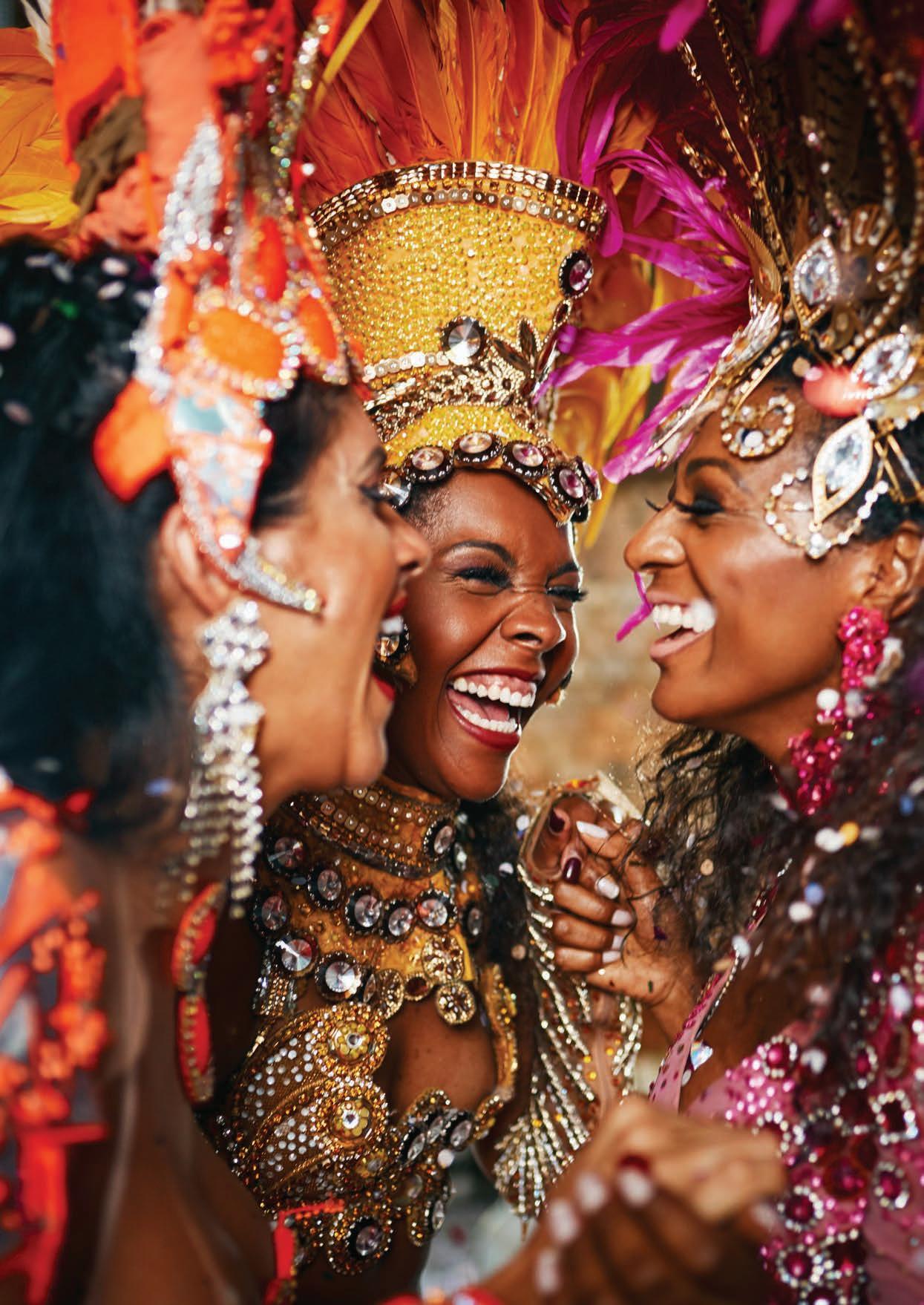
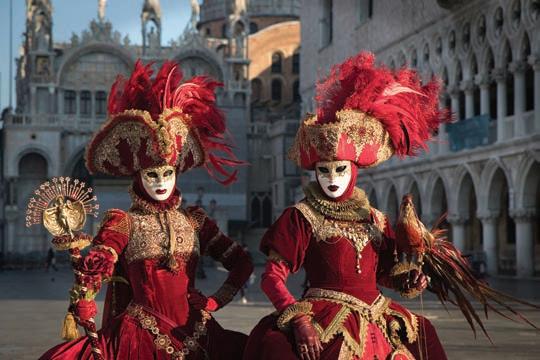
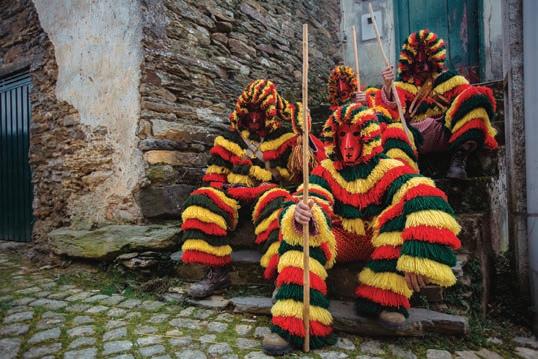
Okay, I have stopped moaning about the rain and am now loving the result of those wintery downpours – the brilliant greens of the wild grasses and moss all around us, the almond trees bursting into blossom, the mimosa ready to spread its sunny yellows. It is amazing that once the clouds drift away and the sky goes back to its brilliant blue, all those cold wet days vanish into past memories.
However, the mud on the roads in the countryside, where they are digging up vast trenches that will house pipes which one day will deliver mains water... now that will not be forgotten, especially as we could be looking at a couple of years before the diggers are done and the road is tarmac’d to a new smoothness. It is frustrating going to visit nearby friends, usually a two-minute journey away, when you have to drive for 20 to go round in a circle. End of that moan... at least for today.
Staying home and keeping warm throughout January did have its advantages, though (track suits all day every day, for one). But they did result in an overindulgence in television’s newest multi-series, binges that led to “Just one more tonight” requests. In this issue, we have gone into Netflix past, present and future (page 43) and it is fascinating reading, and introduces even more bite-sized options. But if live performance is your thing, check out our who’s-on-stage-where feature (page 61) – some super-big names are heading to Portugal. Enjoy this month, enjoy this issue, and enjoy any romance that comes your way on the 14th.
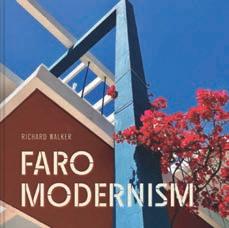
Faro Modernism is the title of a new book by photographer and artist Richard Walker, who has been visiting Faro for more than 20 years, hosted architectural tours, and amassed an astonishing record in this celebration of buildings, heritage and culture. The book is due out in May, but can be pre-ordered now at Batsfordbooks.com
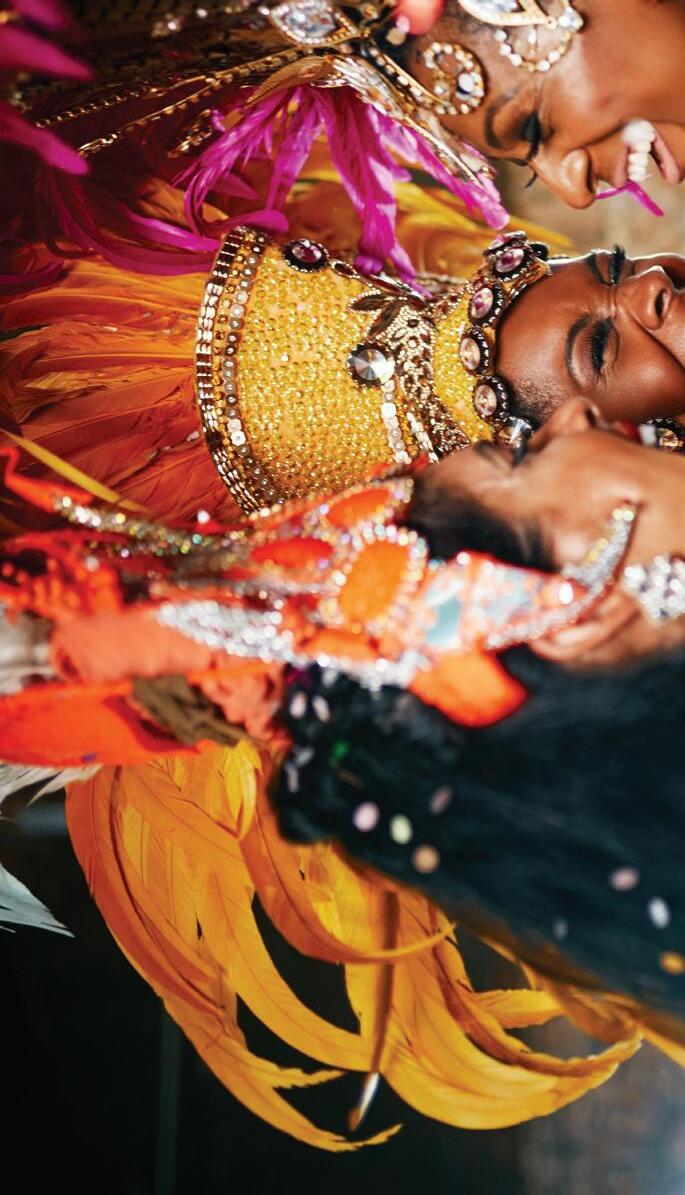
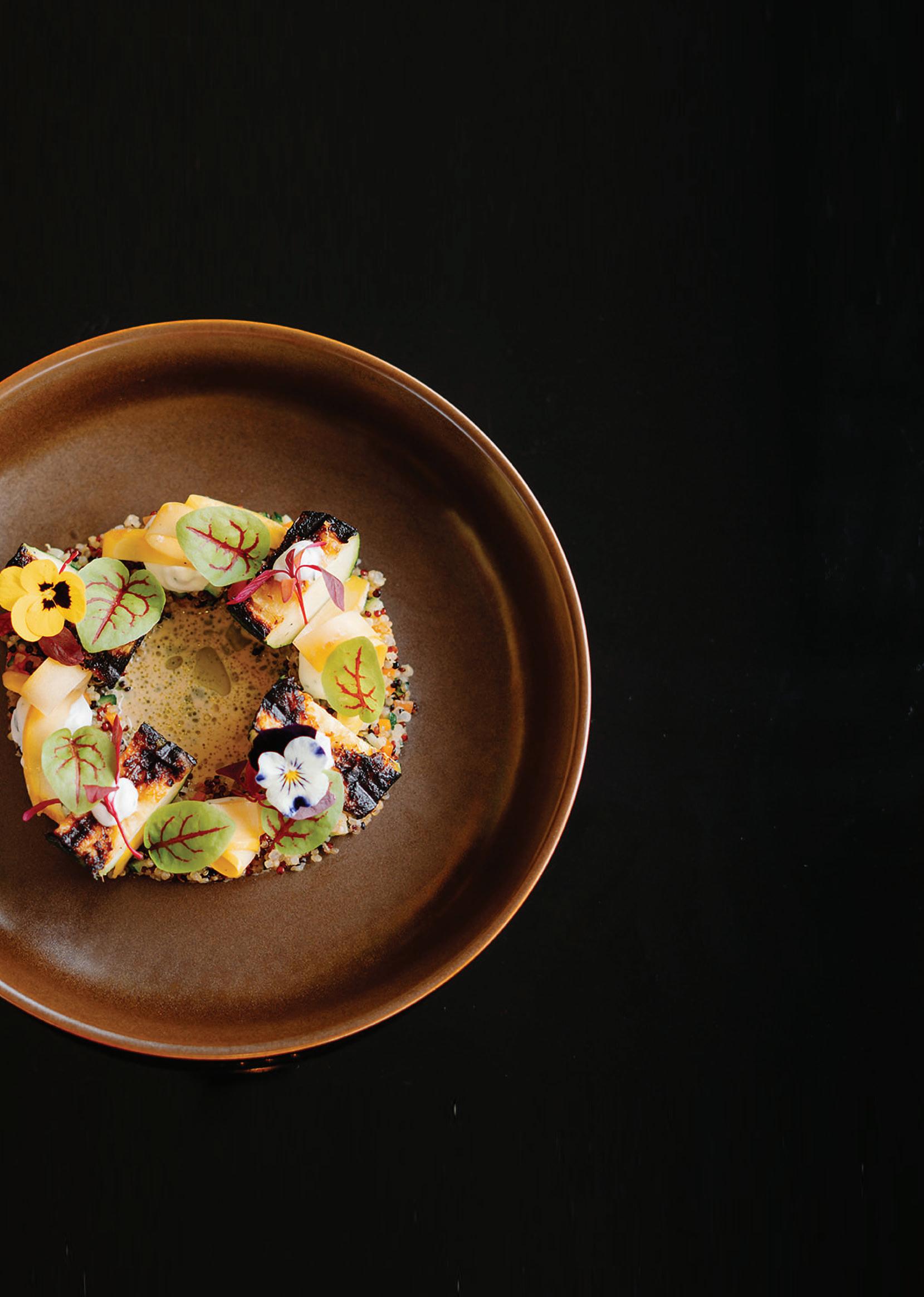
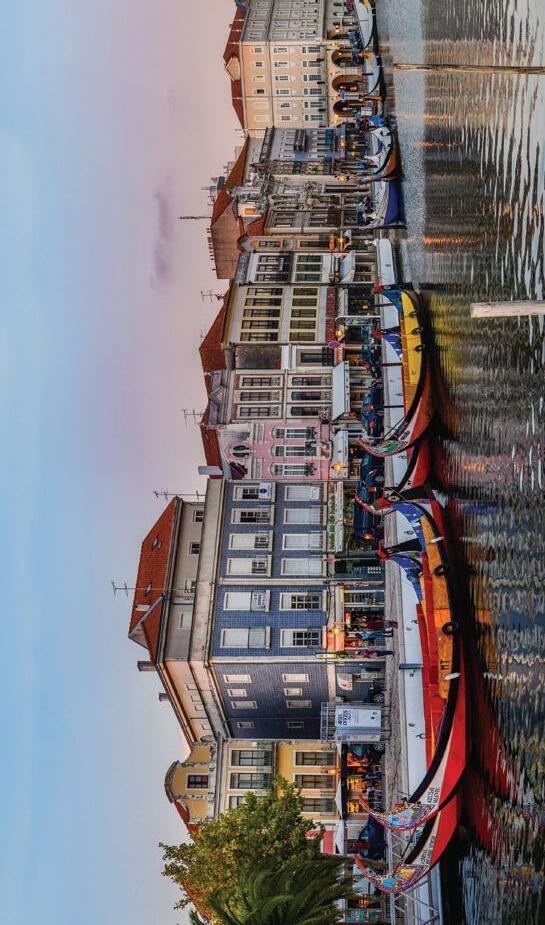
FRONT COVER:
Heart-felt wishes for the month, with great food and plenty of romance.
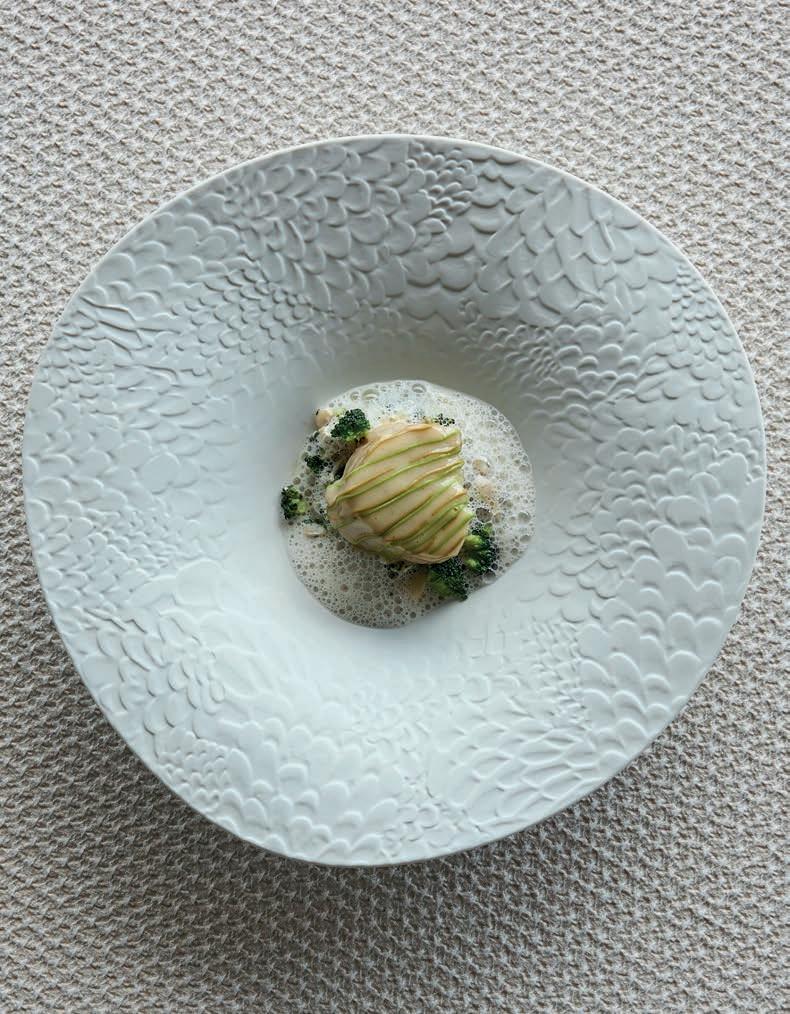
Serra means mountain and is the name of the latest Vista Alegre Chef’'s Collection piece. Developed for the brand by chef Diogo Rocha (from Mesa de Lemos, 1 Michelin Star), it can be used for anything from starters to dessert. The shape is irregular and organic, like the landscape of Viseu, where the chef was born and raised and where he works to this day. The plate is 28cm at the widest point and is priced at €26.31. vistaalegre.com
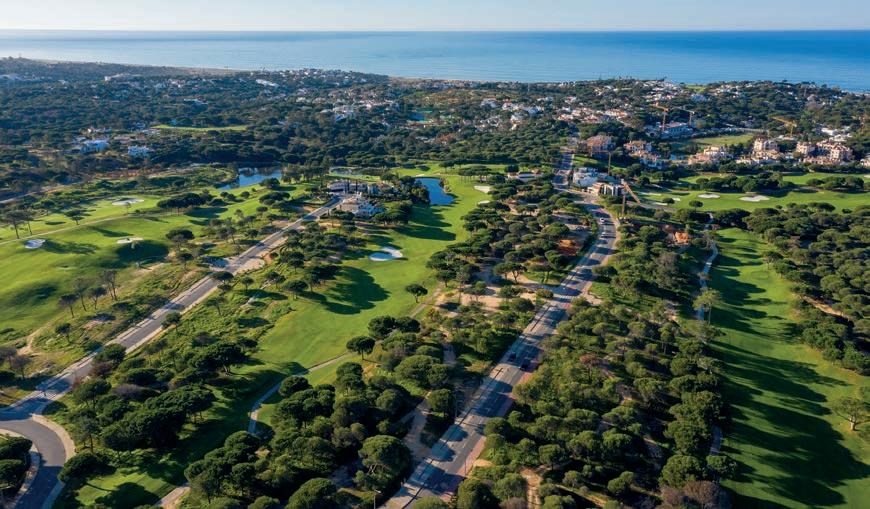
The Portugal Tourist Board – Turismo de Portugal –awarded its coveted ‘ESG Engaged’ seal of approval to the Vale do Lobo resort in December 2025. VdL has delivered a wide range of community initiatives and fundraisers, including charity golf tournaments, fun runs and cycle rides; the resort also contributes annually to a university scholarship, emphasising its support for future generations. On the real estate front, Vale do Lobo is committed to working within internationally recognised BREEAM guidelines for new projects, adopting sustainable management practices in the design, construction, commissioning, handover and aftercare of its properties. The Residences Vale do Lobo, the first new homes to be built by the resort in 20 years, is a prime example of this, showcasing whole life value, responsible construction practices and responsible material sourcing.
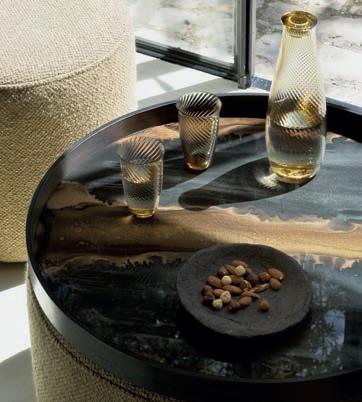
A stunning new collection of organically-styled glass valet trays is now available from Oliveira Décor in Tavira. There are different sizes and designs, all of which add a touch of art and style to any interior. €85 to €175. byoliveira.com
A stunning new collection of organic-styled glass valet trays is now available from Oliveira Décor in Tavira. There are different sizes and designs, all of which add a touch of art and style to any interior. €85 to €175. byoliveira.com
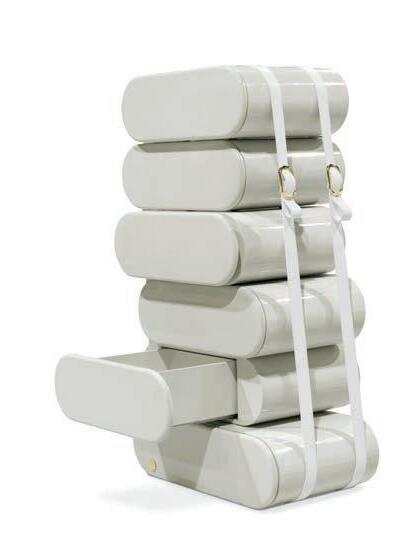
Here’s a way to get small kids to keep their rooms tidy. This whimsical cloud chest of six drawers from Circu looks great and inviting. It is quirky and clever at the same time.
circu.net
#KOZIICARE #KOZIILOVE
tavira - loulé - olhão - lagos koziishop.com
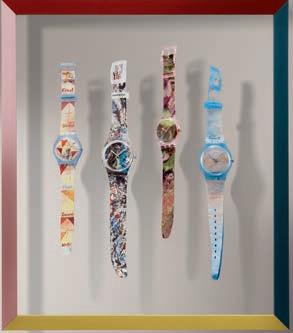
Swatch presents the next chapter of the Swatch Art Journey: the Swatch × Guggenheim Collection — four watches inspired by the works of legendary artists Edgar Degas, Paul Klee, Claude Monet and Jackson Pollock. Created in collaboration with the Guggenheim New York and the Peggy Guggenheim Collection in Venice. Here on the Algarve the collection can be discovered at Boutique dos Relógios in Guia and Faro, and Be On Time in Portimão, priced from €100. swatch.com
A bold fusion of performance and streetwear attitude, these ‘Be Right Back’ trainers are crafted from a technical mix of mesh, synthetic suede, and PU overlays. The sculpted sole provides comfort and stability, while the layered upper delivers a visually striking, futuristic aesthetic. Built for everyday movement with standout style. From Fashion Clinic, €490. fashionclinic.com
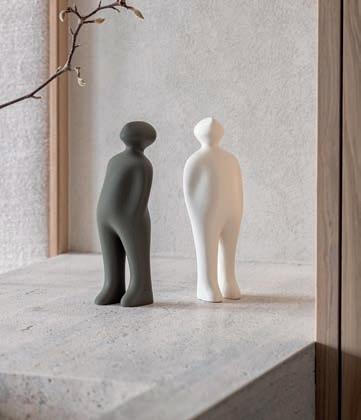
The Visitor is a kind figure whom anyone would welcome with open arms. Smooth lines, a friendly appearance and an extensive colour palette have made this art object an iconic Gardeco favourite since its launch in 2009. The figurine is designed by the Belgian sculptor Guido Deleu and is available in ceramic, skilfully manufactured by hand at the studio Cores da Terra in Brazil, and also in bronze using the lost wax method, a technique that dates back from the third millennium BC. 24cm and 38cm high. From Dunas Living, dunas-living.com
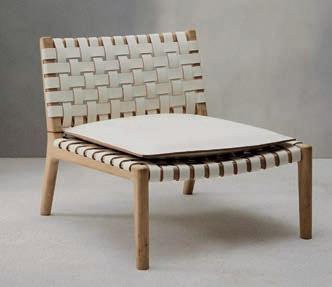
Take a seat, but not just any seat. Zara’s Chair 01, designed by Vincent Van Duysen, introduces leather contrasts and a chic, timeless look. And it comes with its own leather cushion. Choose from cream, or light beige or black. €1,200. zarahome.com
Lighting the way
IAT ITS
BOTH
HEART, THE LIGHTHOUSE PROJECT EXISTS TO BRING LIGHT –
LITERAL AND SYMBOLIC – TO CHILDREN AND FAMILIES WHO
NEED IT MOST.
FOUNDED TO TRANSFORM EDUCATION AND COMMUNITY SUPPORT, THE ORGANISATION HAS BECOME A SAFE HAVEN FOR UNDERPRIVILEGED CHILDREN ACROSS PORTUGAL AND BEYOND
Words: ELISABETH LEONARD
N THE Algarve, particularly in Portimão, The Lighthouse Project runs study-support sessions for students needing extra academic help and guidance. But its mission extends far beyond schoolwork. Through workshops in arts, psychology, health, science, technology, and sports, the project helps children explore their interests, build practical skills, and gain confidence in their abilities.
“We focus on building motivation, responsibility, and good study habits,” says Patricia Norte, Co-founder and Coordinator. “It’s about helping students develop confidence and a positive attitude toward learning.”
Beyond academics, the project fosters belonging. Its cultural and community events bring together families who might otherwise feel isolated, creating moments of connection and joy. What begins as tutoring often grows into mentorship, and what starts as a gathering becomes a network of support. In every sense, The Lighthouse Project shines as both a learning space and a source of hope.
“There would be fewer opportunities for children and families to learn, grow, and feel supported if The Lighthouse didn’t exist,” says Patricia. Many of the children it serves would lose not only academic guidance but also the motivation and self-belief that come from being seen and valued.
Volunteers provide the energy, creativity, and compassion that keep the project running. They teach, mentor, coordinate events, and handle logistics and communication. “Every project – whether an exhibition, a children’s activity, or a fundraising event – relies on people who give their time and skills to make a difference,” says Patricia. “Some students once said that they weren’t good at school. But through reading together or solving small tasks, they slowly gained confidence. What starts as helping with homework becomes an opportunity to restore self-belief and show each child that they matter.”
Volunteering at The Lighthouse Project is more than service – it’s an exchange. Volunteers gain new skills, friendships, and a deeper understanding of how small acts of consistency can change a life.
“Volunteering here isn’t just about giving time,”
Patricia emphasizes. “It’s about joining a community of people who care. Whether you have a few hours or a few months, your contribution truly matters.”
Partnerships are a cornerstone of The Lighthouse Project’s success. In Portugal, it works closely with schools, associations, and community initiatives to support educational and social development. These collaborations ensure its work is grounded in real community needs rather than imposed from outside.
Internationally, The Lighthouse Project partners with organisations in Angola, Zanzibar, and Thailand, sharing knowledge, resources, and project models that empower local leaders.
“Collaboration is central to what we do,” says Patricia. “These partnerships make our work sustainable and community-driven.”
Because The Lighthouse Project is a non-governmental organisation (NGO), sponsors and supporters play a vital role in sustaining its mission.
The project also receives valuable help from partners in Macau, reflecting its growing global network of people who believe in its vision. Still more sponsors are needed – individuals and organisations who share this passion for transformation and want to help build stronger communities.
Through these connections, the initiative has become a model for how communities can lift each other up across borders and stands as a reminder that real change begins with connection – one child, one family, one volunteer at a time. Its programmes blend education with empathy, creating a ripple effect that strengthens entire communities. “The Lighthouse Project is more than a community organization – it’s a network of people committed to bringing light and opportunity where it’s most needed,” says Patricia. “We believe lasting change happens when people come together.”
For anyone wondering how to make a meaningful difference, The Lighthouse Project offers a clear path: lend your time, share your skills, and follow your heart. Every hour volunteered, every resource shared, and every child encouraged adds another spark of light to a community that thrives on hope. Supporting The Lighthouse means investing in education, connection, and compassion –the foundations of a brighter future.
MARVÃO
SIMPLY MARVELLOUS
THERE ARE PLACES IN PORTUGAL THAT DON’T ANNOUNCE THEMSELVES. THEY JUST SORT OF APPEAR. ONE MINUTE YOU’RE ROLLING THROUGH SUN-BAKED ALENTEJO LANDSCAPES, THE NEXT YOU LOOK UP AND BLURT OUT SOMETHING DEEPLY POETIC LIKE: “NO WAY”
Words: NICK ROBINSON, ALGARVE ADDICTS
THAT WAS US – my daughter and I – mid-road-trip, filming a video tour of Portugal for a client, with cameras within arm’s reach and snacks within emergency reach. We’d been clocking kilometres, chasing light, and stringing together those little travel moments that become the backbone of a film: quick roadside coffees, “wait, pull over!” viewpoints, the odd wrong turn that somehow becomes the best turn.
And then Marvão arrived.
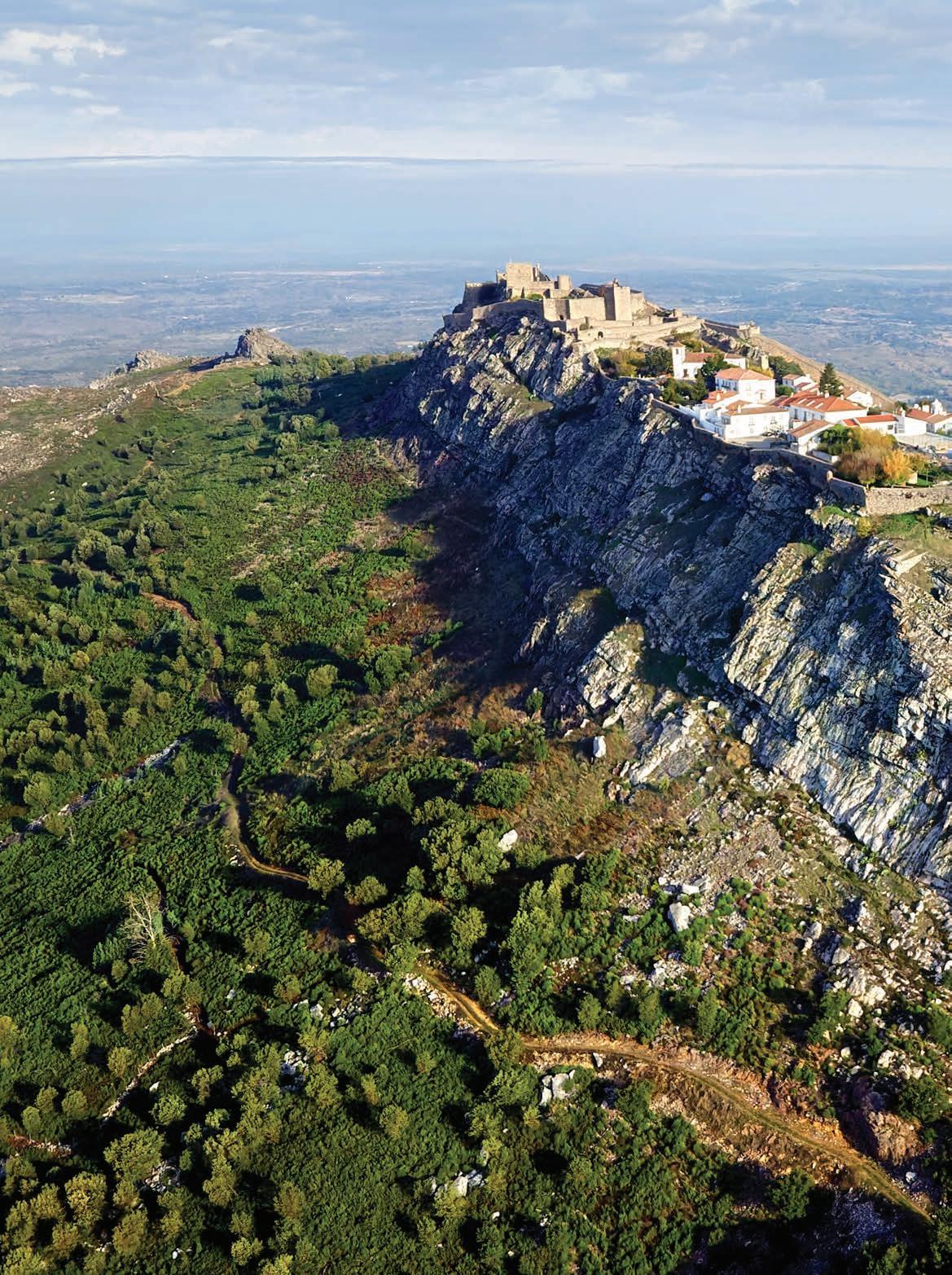
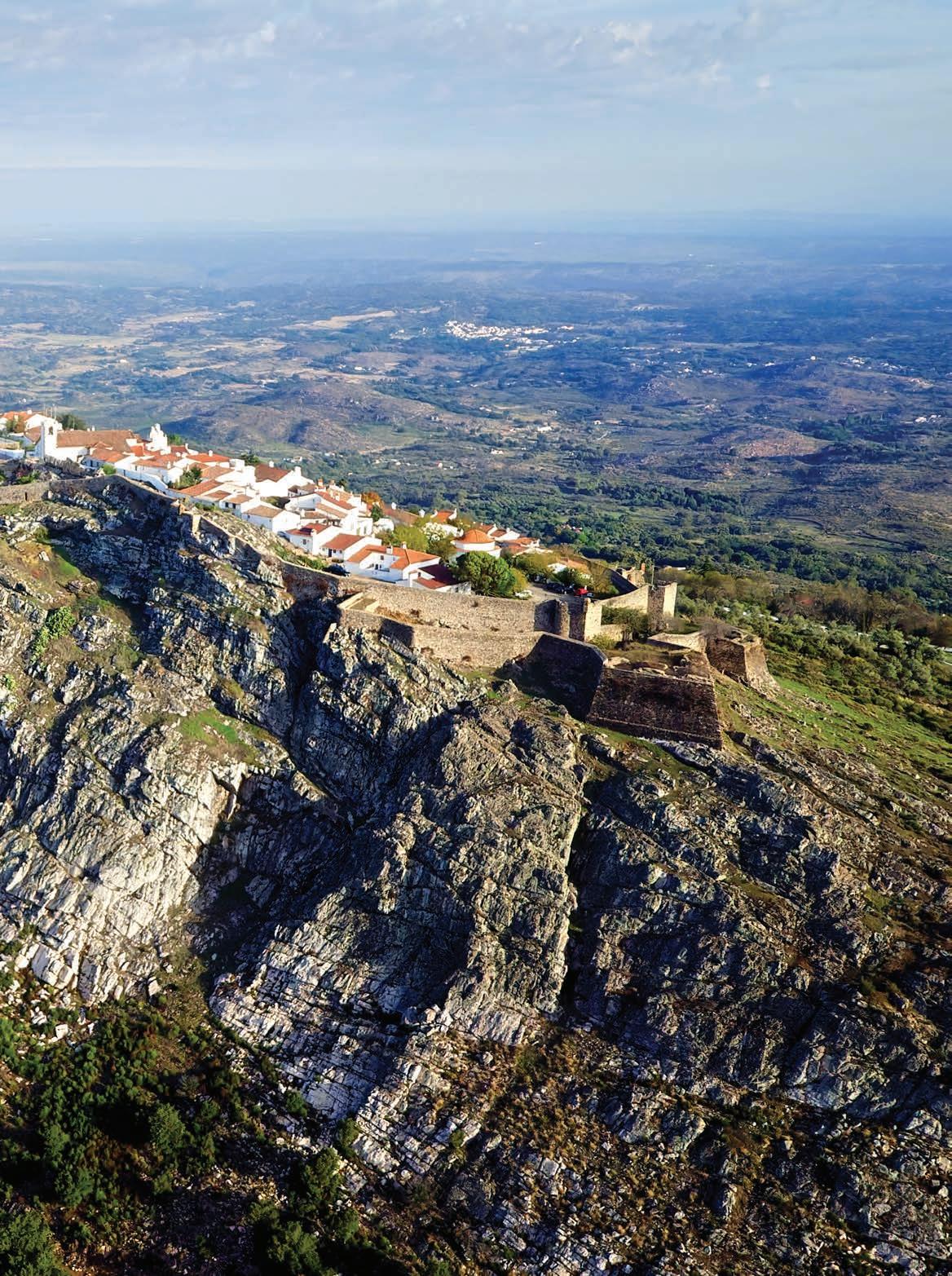
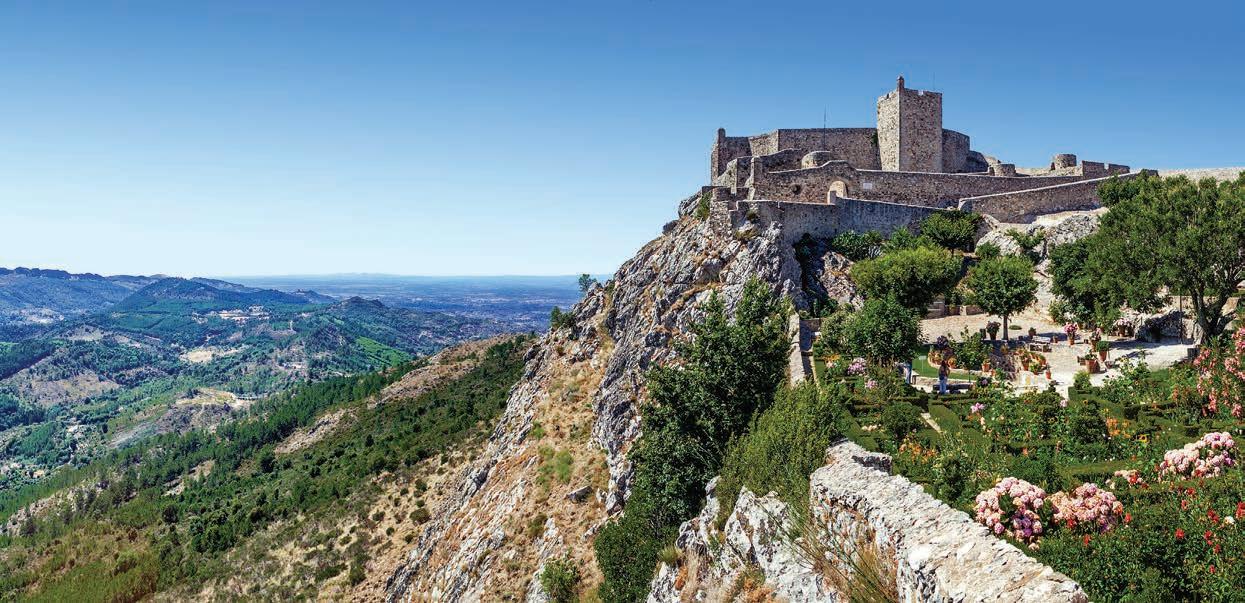
Perched high on a quartzite crag in the Serra de São Mamede, the fortified village looks like it was placed there by a mischievous giant who wanted the ultimate balcony view over Portugal and Spain. The citadel and its walls wrap the entire village like a stony hug, and the castle crowns the top like a final mic-drop. Standing up there, you get it instantly: this wasn’t built to be pretty. It was built to survive.
The climb that rewires your sense of scale
We drove up with that mix of excitement and mild panic you get when you know parking will be character-building. Marvão’s lanes are narrow, the stone is ancient, and your legs will politely remind you that medieval towns weren’t designed for modern hips and camera gear.
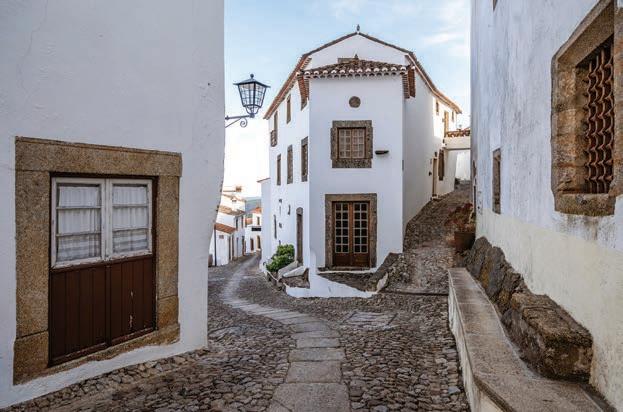
But the ascent itself is part of the spell. Whitewashed houses. Iron balconies. Stone steps warmed by the sun. Every corner feels like it’s hiding a postcard. And then you’re through the gates and inside the fortress world, where the views are so huge they almost
make you quiet. Well, almost quiet.
The Castle of Marvão is famously well preserved, and it sits on the highest part of the ridge – around 867 metres at the keep – so it’s essentially a natural drone shot without the drone.
And because it’s inside the Serra de São Mamede Natural Park, you also get this unexpected version of Alentejo: not endless rolling plains, but high ground, forests, cooler air, and that “wait… are we still in Alentejo?” feeling. The park’s highest point hits 1,025 metres, which helps explain why this area feels like a secret mountain cousin of the region everyone thinks they know.
Ibn Marwan: the rebel behind the rock
Now for the bit that makes Marvão more than just a stunning viewpoint with great walls. Its name is linked to Ibn Marwan alJilliqi, a 9th-century Muwallad rebel leader (local Iberian origins, Islamised in the aftermath of conquest) who pushed back against the Umayyad Emirate of Córdoba. He’s associated with fortifying territory in this border region, and historical accounts connect him to the early construction of the fortress here – often dated to around 876–877 – with the settlement later known as Amaia of Ibn Maruán or Fortress of Amaia.
I love this part, because it flips the usual ‘castle = Christian reconquest’ storyline into something more layered and human: power shifts, alliances, rebellions, and people making hard strategic choices in hard landscapes. Ibn Marwan al-Jilliqi wasn’t building a weekend project. He was building a stronghold in a tense frontier world.
And standing on those ramparts, with Spain laid out in the distance like a map, you understand why this exact rock mattered.
Of course, Marvão didn’t stay in one set of hands forever.
Christian forces associated with King Afonso I took the region from
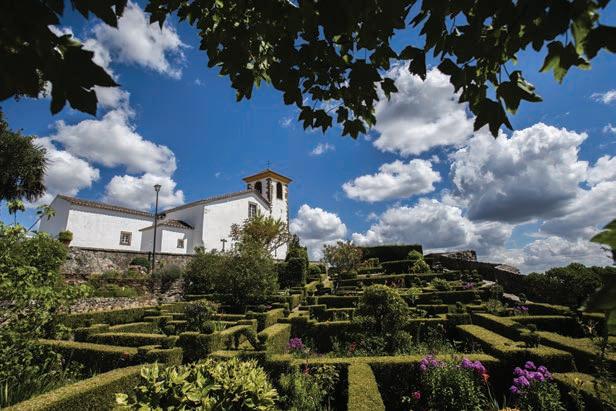
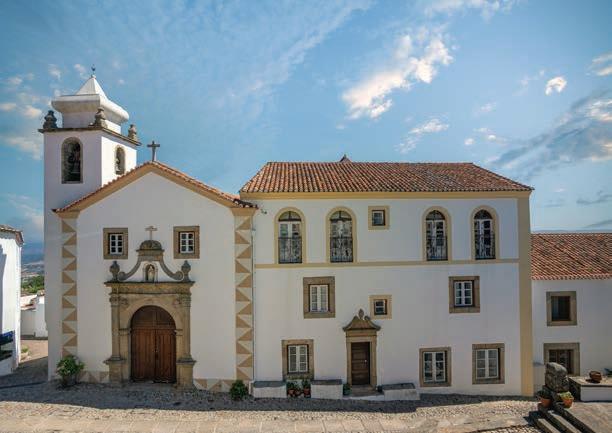
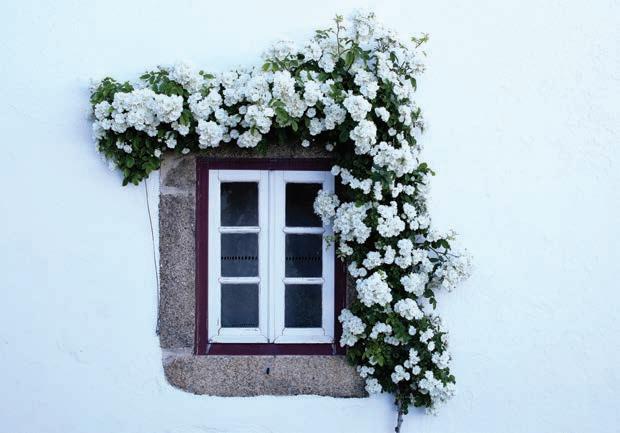
Below: the Castle of Marvão. Opposite page, top left clockwise: manicured gardens around the town; the narrow backstreets have a charm of their own; a lesson in making a special feature around an ordinary window; the old parish church in the village
Every corner feels like it’s hiding a postcard. And then you’re through the gates and inside the fortress world, where the views are so huge they almost make you quiet.
Moorish control sometime in the 1160–1166 window, and by the early 13th century Marvão was firmly within Portuguese territory.
The genius of Marvão is that the geography does half the defending for you. The ridge is steep, the approach is exposed, and the walls don’t mess around. You can walk them and see how the town was designed as a single defensive organism – castle, walls, gates, village – everything playing its part.
The castle experience: what it feels like up there
We spent ages up top because Marvão has that rare quality: it doesn’t just look cinematic, it feels cinematic. The light changes constantly. The wind has opinions. The stone under your hand is rough and sunwarm. Your daughter says: “Imagine living here,” and you do – and it’s half romantic, half “how did anyone carry groceries?”
There’s also something quietly humbling about a place like this. From the comfort of a modern road trip, with air con and playlists, you’re looking at a fortress that existed because life was genuinely precarious.
Border raids, shifting allegiances, sieges, hunger, fear… and yet people built beauty anyway. Even the practical things – cisterns, thick walls, narrow access points – have a kind of brutal elegance.
At one point, we just stopped talking and filmed the horizon. It was the sort of view that makes your brain go wide-angle.
The
ghost city nearby: Ammaia, the Roman echo in the valley
Here’s a little twist that makes the Marvão area even richer: down below, tucked into the natural park are the ruins of Ammaia, a Roman city site near São Salvador da Aramenha.
Ammaia was founded in the Roman period (generally placed around the 1st century AD / late 1st century BC into early Imperial times, depending on the source), flourished for centuries, and later declined – eventually giving way to the fortified logic of places like Marvão. It’s one of those “how is this not more famous?” sites, where archaeology and landscape do a beautiful duet. If Marvão is the eagle’s nest, Ammaia is the buried memory in the trees.
Where we stayed
After a long filming day, we checked into Quinta da Dourada, a rural stay near Portalegre, right in the Serra de São Mamede setting. It’s the kind of place that makes you drop your bags and instantly breathe slower.
The property is positioned as a nature-forward retreat –‘turismo rural’ at its best – and it’s noted for being in the natural park environment. It’s also been recognised for eco credentials (including Green Key references in Booking listings), which fits
the whole vibe: calm, grounded, quietly thoughtful.
And then came the evening.
Hot summer air. That soft late-day gold that makes everyone look like they’ve accidentally wandered into a perfume ad. We ate al fresco on the terrace, with wine and genuinely wonderful food, the kind that tastes even better because you’ve earned it with a day of walking, climbing, filming, and gawking at history.
I remember looking at my daughter across the table and thinking: this is the good stuff. Not the bucket-list bragging rights. Not the perfect itinerary. Just an unforgettable, unrepeatable little slice of Portugal – shared, simple, complete.
What
to do in Marvão (without turning it into a tourist-board checklist)
If you go, here’s the rhythm I’d recommend – especially if you want that “I discovered something” feeling... and who doesn’t?
Plan your timetable carefully to ensure that you arrive later in the afternoon so you get the soft light on the walls and rooftops. The place glows.
Walk the ramparts slowly. Stop often. Let the wind do its dramatic thing.
Climb to the keep for the full geography lesson – this is why Marvão mattered.
Give yourself time to simply wander through the village lanes.
The atmosphere you’ll discover is the attraction.
Pair it with Ammaia if you love ruins and the idea of Roman Portugal hiding in plain sight.
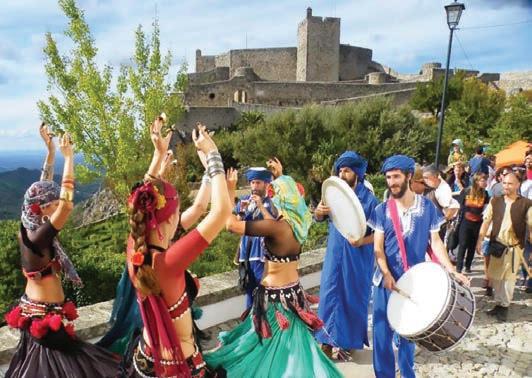
And if you’re the type who likes culture with a bit of theatre, Marvão also hosts an annual Islamic-themed festival often referenced as Al Mossassa, which nods to the town’s Muslimera connections (and yes, Ibn Marwan al-Jilliqi tends to feature prominently in that storytelling).
Portugal Travel Guide
Getting there: the road-trip bonus
Marvão is one of those destinations where the journey is half the joy. Coming up through the Alto Alentejo, you pass through landscapes that feel increasingly wild and elevated as you approach the Serra de São Mamede area. If you’ve been in coastal Algarve mode (beaches, catamarans, grilled fish on repeat), this is a brilliant contrast: inland, cooler, more rugged, and filled with deep-time history.
And once you’re up on that rock, looking out over two countries, you’ll probably say the same thing we did:
“No way.”
Then you’ll grab your camera. Or your phone. Or just your daughter’s arm. Because Marvão isn’t the kind of place you simply visit. It’s the kind of place you take home with you.
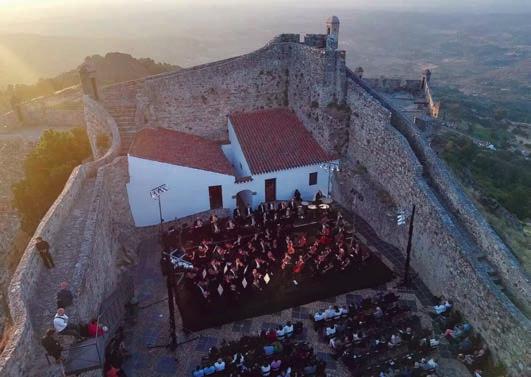
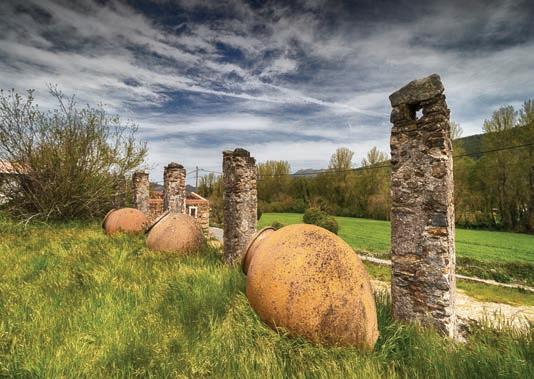
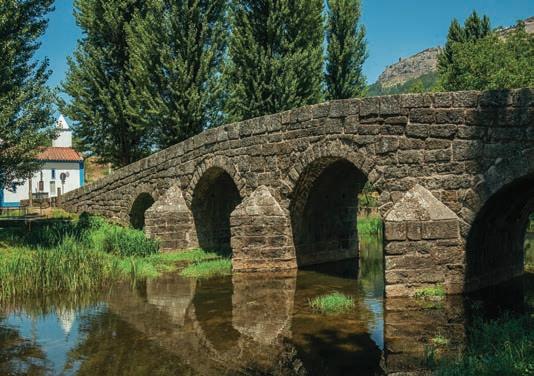
Above, top left clockwise: The 12th edition of the Marvão International Music Festival will take place from 24 July to 2 August 2026; the old Roman stone bridge over the Sever river; the Al Mossassa festival held every year; a visit to the ruins of Ammaia, a Roman city site, is a must
SHOPALOT
FORGET THE COLD WEATHER AND THIS MONTH ’ S COMPULSORY ROMANCE AND INDULGE YOURSELF. A SHOPPING TOUR FROM NORTH TO SOUTH, STOPPING AT THE MOST TEMPTING STORES, IS JUST WHAT WE WANT
Words: SANDRA GATO
SOME PEOPLE call it retail therapy, while others are followers of the ‘shop till you drop’ ethos. Either way there’s no denying the utter bliss of spending a morning browsing around beautiful shops – some of them deserve a visit just to check the scenario. Yes, window shopping also has its pleasures, but nothing beats coming home with a beautiful carrier bag (or several) filled with goodies – clothes, shoes, food, hats… you name it.
Portugal, like most western countries, has no shortage of temples of consumption, ready to welcome us (and our sexy credit cards). From north to south, here is a curated list of some unmissable places to purchase to one’s heart content.
PORTO
Starting with a bang. D’Adélia is a multi-brand high fashion store that firstly opened its doors in São João da Madeira (a city located around 40km from Porto) in 1994, and, later, another one in Porto itself. It sells a selection of the best designer brands in the world – think Etro, Jil Sander, Missoni, Alberta Ferretti, Carolina Herrera – in a lush setting (the beautiful soft carpets, the marble counter, the fresh flowers)… Just entering the store makes you feel like a million dollars. Add to that an extremely personalized service and you understand why D’Adélia has been, for the past two decades, a true ‘destination store’. Ideal to find a look for a special occasion but also everyday high-quality pieces. Prepare yourself also to be dazzled by amazing shoes, incredibly aromatic candles and exclusive perfumes.
Rua Pedro Homem de Melo 420 / Dadeliastore.com
Left: Impressive design choices that Casa do Passadiço in Braga is known for. Below: A Jimmy Choo must- have from Porto’s D’Adélia
LISBON
Being the capital, Lisbon will spoil you for choice, in all imaginable purchase areas. So, let’s move away from fashion and visit the wonderful world of flavours and aromas. For everyone who likes tea – who doesn’t?
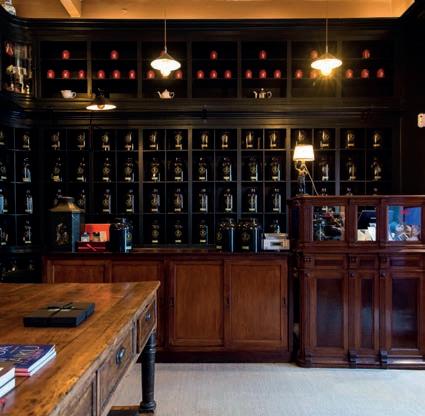
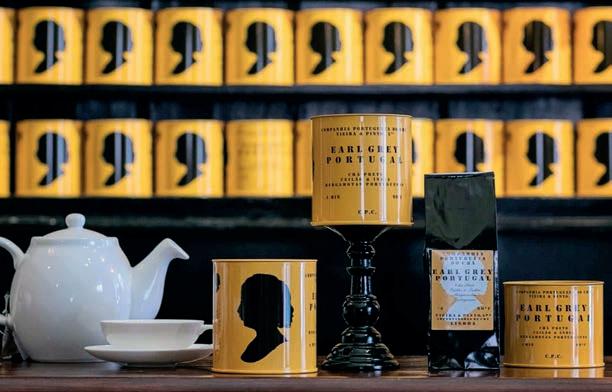
– Companhia Portugueza do Chá is a must. The store itself, originally an old shoe store dating from 1880, is now invaded by the smell of ancient wood and a huge variety of teas. The packaging is amazing and the hard part is to choose between the classic teas and the exclusive blends, some created for commemorative dates (like one with a carnation to celebrate 25 April and the end of the dictatorship in Portugal),or in collaboration with different kinds of projects and brands.
Rua do Poço dos Negros 105 / Companhiaportuguezadocha.com
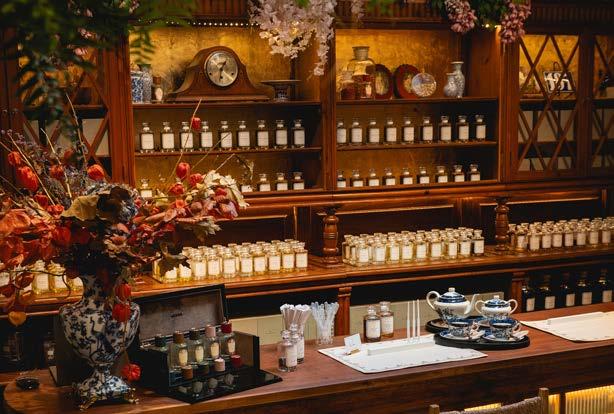
Trust me, you won’t forget Next Memory after entering it for the first time – it will really be your next (very fond) memory. And also because one visit won’t be enough. There is a kind of addiction that comes from being able to choose from such a range of exquisite aromas that present themselves in the form of fragrances (for us and for our home), candles, soaps, body creams, teas, and more. Located in what used to be a pharmaceutical lab dated from 1899, it takes us back to a time when life in Lisbon had a completely different rhythm.
Next Memory is not a shop, it is a perfume atelier, an enchanted place where magic happens. And recently the magic got even better with the opening of The Bespoke Garden, a fragrance customization experience where everyone, guided by their individual history (and the help of Next Memory’s
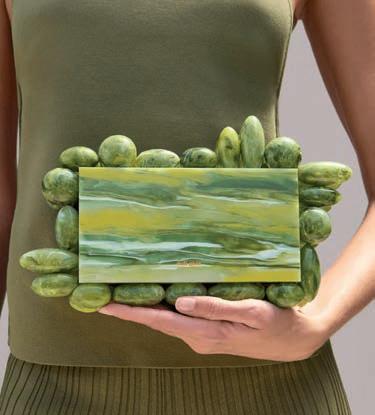
In Lisbon, a visit to Companhia Portugueza do Chá, above left and right, is not to be missed. And at Next Memory you will discover a world of fragrances. The bag, right, is by Cult Gaia, from D’Adélia in Porto. Opposite page, top: ready for a wine tasting at Al-Lagar in
excellent perfume experts), is invited to create their own perfume. A place where all the senses come alive and that makes us want to come back for more… soon.
Rua São José 187 / Nextmemory.eu
BRAGA
When you think stunning interior design made in Portugal, Casa do Passadiço is the name that comes to mind. Run by the sisters Cláudia and Catarina Soares Pereira, it involves not only interior design but also architecture.
Trust Casa do Passadiço with the space (house, room, office) that you want to renovate, and they will present you a thoroughly detailed project that will take in consideration all your needs and (dis)likes.
Although they have showrooms in Lisbon and Porto, it all started in Braga, in 1992, when Catarina Rosas – Cláudia and Catarina’s mother – converted a historic 18th century manor house (a must go!) in an atelier that showcased quiet luxury and contemporary elegance. The team obviously grew but it continues to be a family business – run by women – where everything big or small is selected with the upmost care and good taste.
Largo de São João do Souto / Casadopassadico.com
Tavira. Below left: Casa do Passadiço; right: Casa Tial
MONSARAZ
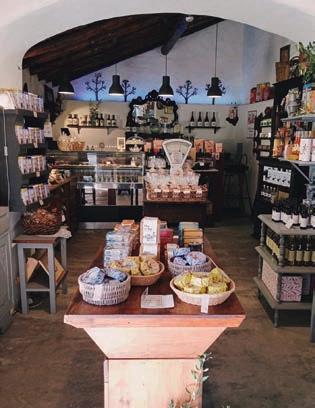
The feeling that Alentejo gives you is unique. Anyone who knows the region well will confirm that in a second. It applies to almost every part of it, but there are places that for reasons difficult to put in words get closer to one’s heart. Monsaraz is one of them. A village of white small houses built up in a hill, surrounded by castle walls, where tranquility is inevitable. As soon as you step into the village by one of its entrances (it’s built inside a fortification so there are ‘doors’) you notice what, from the outside, looks like a deli shop. Casa Tial is, in fact, a gourmet shop, but so much more than that. Once inside, it is like travelling in time to some decades back to a more rural and authentic Alentejo, the one we remembered from our childhood. They describe themselves as a “journey through local flavours, stories and traditions” and that is exactly the mood inside. You can buy local biscuits or jams but also wooden toys or hand painted plates. And it’s also a coffee shop, perfect to recharge after a long walk along Monsaraz’s tiny and beautiful streets. Rua de Santiago 33 / Instagram: casa_tial
TAVIRA
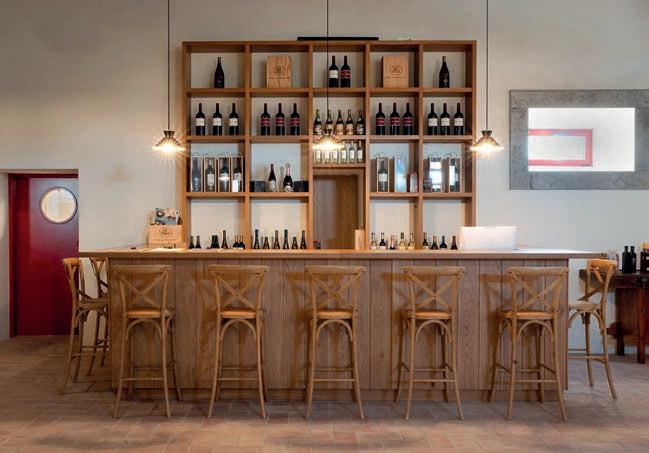
For a long, long time, the words “good wine” and “Algarve” were never pronounced in the same sentence. But fortunately, that completely changed and, nowadays, our more southern region has the wine respect it deserves. It was not only a marketing effort that was made, but also the realization that, although not being Douro or Alentejo, the Algarve has specific wine qualities – climate, terroir, sea proximity –that can translate into incredible wines. Negra Mole, for instance, a local variety, was rediscovered and got a well justified attention. And Al-Lagar, near Tavira, is the place to try (and buy) not only Negra Mole but many other wines produced by Casa Santos Lima, a family-owned company that has been around since the 19th century.
Not far from the ocean and surrounded by vineyards, it is built around an old wine press – also from the 19th century – turned into a wine lover’s haven. A place to enjoy guided wine tastings, light meals (with wine pairing, of course) and tours through the vineyards. And, very important, a wine shop where is possible to find most of the wines produced by the company across the whole country. A perfect plan to still enjoy the warmth of the Algarve those days when going to the beach is not on the cards. Santiago de Tavira, EM1341 / al-lagar.com
D’Alena, Alto do Relógio, Loulé
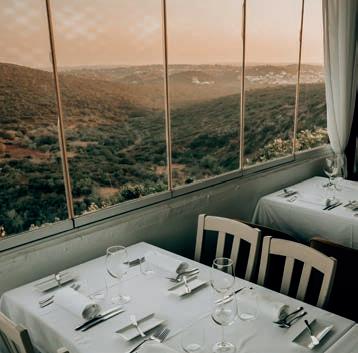
PORTUGUESE FOOD WITH REFERENCES TO FLAVOURS AND TEXTURES COMING THROUGH WITH EVERY SIMPLY-CONSTRUCTED DISH. THE GLASS-SURROUNDED TERRACE LOOKS DOWN ON THE HILLS AND VALLEYS FROM GOLDRA TO THE COAST, MAKING EVERY MEAL EXTRA SPECIAL. JOÃO EDUARDO HAS BEEN BACK TWICE IN TWO WEEKS AND CAN ’ T WAIT FOR THE NEXT VISIT
SOME YEARS ago we went en famille to a restaurant off the usual tourist track in the hills leading up to Betune and Goldra. It was okay, but no more than that, and didn’t warrant going on the restaurant bucket list.
Then in August 2025 it became D’Alena, under the ownership of the Belhaj family, whose Spikes bar and eaterie in Vale do Lobo is well known and a golfer’s favourite.
Two Portuguese chefs, executive chef Fátima Santos and head chef António Tavares, are doing this new venture proud and the serving team delight in keeping customers happy.
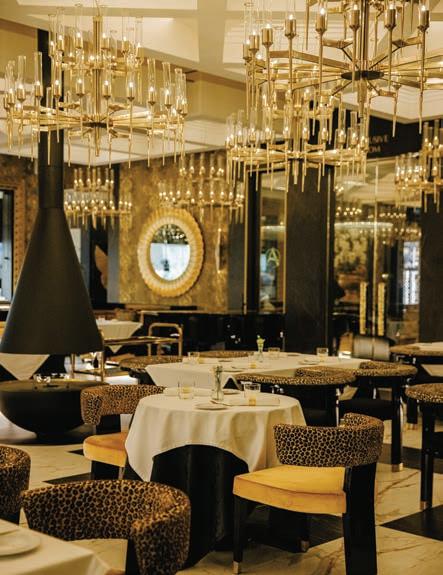
But before we get into the food itself, a round of applause has to go to the team who took charge of D’Alena’s interior design: Kevin Belhaj and Fátima Santos could teach others a lesson in creating a special atmosphere.
There are beautifully-tailored
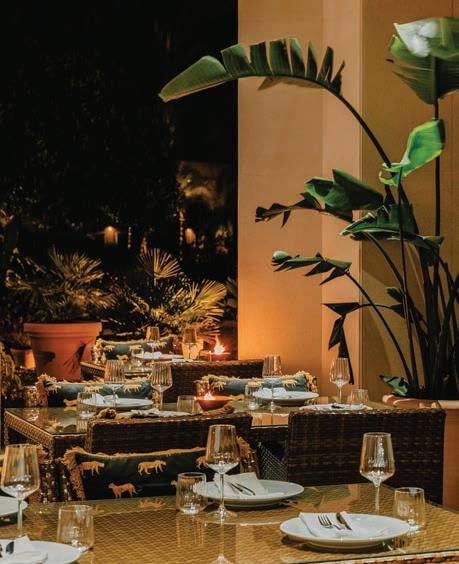
individual seating areas away from the main dining tables; there are decorative shelves with Portugalrelated books and examples of fine ceramics. And that sun-drenched terrace (yes, it wasn’t raining when we went for Sunday lunch) is certainly instagram worthy.
So now, let’s talk food. If like me you cannot say no to couverts, you will adore the breads that come with the usual – but exceptionally good –patés and fresh cheese. The breads come from bakery Bem Parece, known especially for its sourdough, plain and spelt, but also got its wonderful corn bread.
Tempting as it is, go easy on the bread is the message from me, as you want space for what follows. And what follows is a series of taste sensations, southern flavourings that bring out the best in the key ingredients.
The sharing dishes – if you can bear to share – include pork cheeks croquettes that are silky and succulent. Another must-try.
FOOD Portuguese, perfectly balanced, beautifully presented, great sharing starters
DECOR
Great design features, a cosy atmosphere, Spectacular views
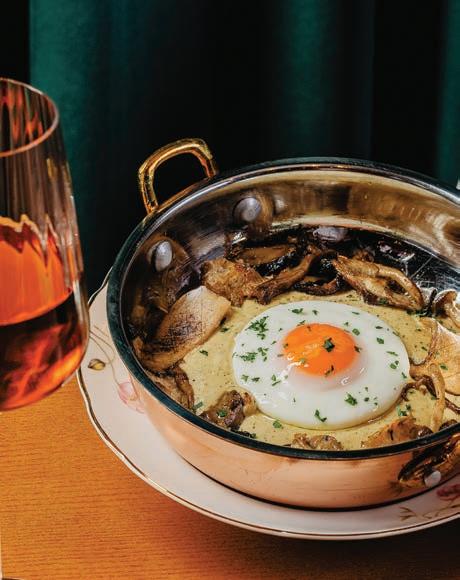
Starters include prawns sautéed in olive oil, garlic and chilli, and Bulhão Pato-style mushrooms with garlic, wine, coriander and lemon – delicious and light a perfect start to the meal.
Taste adventurers will appreciate the Migas de Alheira de Caça. For those who haven’t actually adventured yet, migas translates to ‘crumbs,’ made from stale bread fried with ingredients like garlic, olive oil, and, in this case, game sausage. Hearty stuff, and an Alentejo special.
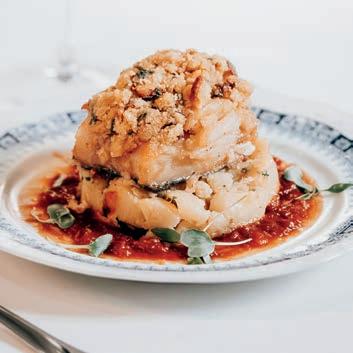
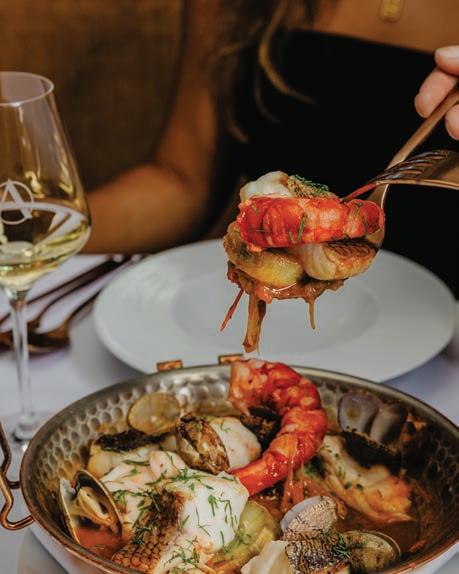
Migas feature again in a main course with codfish and seafood, another winner, alongside the Bacalhau D’Alena, with corn bread and tomato sauce.
One of our group is seriously into risotto and reckons D’Alena’s vegetarian version with mushrooms and parmesan takes a lot of beating.
Meat – there are all the favourites, including lamb shank, slow-cooked veal and precision-grilled black pork.
Worth considering, too, is the ‘Chef’s Suggestion’ menu of starter and main course or main course and dessert, which will set you back just €17.50 a person. Don’t want to miss out on the lemon tartlet with meringue and lemon ice cream? The full three-course meal is €25 and worth every mouthful. And the choice of dishes changes every week.
Reckon on €30 a head to
The special menu changes regularly, and that will have you, like me, coming back for more.
HE PANGEA TRUST wildlife champions don’t want the elephants to remember their previous lives spent as entertainment commodities – but instead look forward to the rest of their lives which will hopefully be long and fulfilled, roaming the land, which is, after all, what they were born to do. There are over 600 elephants in captivity across Europe. Although a large number of EU member states have pledged to ban the use of elephants in entertainment, whether it be at a zoo or in a circus, it is almost impossible for governments to take a tough stance on the trade when there is no viable alternative to emptying these places.
This is where The Pangea Trust, which is funded entirely by donations and private philanthropy, comes in. Its 1,000-acre sanctuary in the Alentejo is modelled on already-established, large-scale sanctuaries in Asia, Africa, and the Americas with the aim of restoring habitat so that native wildlife can thrive and elephants can roam, forage and socialise freely while also receiving individualised care from the elephant experts on hand. And the best part? The initiative is ready to go, and also will be providing jobs and economic stimulus to a very underserved rural area.
After an extensive feasibility study and Europe-wide property search, The Trust acquired the site in the Alentejo, and with government approval, started undertaking habitat construction across the municipalities of Vila Viçosa and Alandroa. Although the team continues to fundraise and is now at the staff hiring stage, the biggest reality bump came in November when it was announced that a female African elephant named Kariba will be one of the first to call Pangea home. Currently living at a zoo in Belgium, Kariba will join Pangea in early 2026, and by the time this article goes to print, she may already be there.
TRUNK CALLS T
WE ARE TAUGHT TO BELIEVE THAT AN ELEPHANT NEVER FORGETS. THAT THEY HAVE EXCEPTIONAL, LONG-LASTING MEMORY FOR PEOPLE, PLACES, AND EVENTS. BUT ONE UKPORTUGAL CHARITY IS HOPING THIS WON’T BE THE CASE AS IT LOOKS TO REHABILITATE AND REHOME A NUMBER OF ELEPHANTS WHO HAVE SPENT THE BEST YEARS OF THEIR LIVES TOURING IN CIRCUSES AND BEING EXPLOITED IN ZOOS
Words: LUCY MAYER
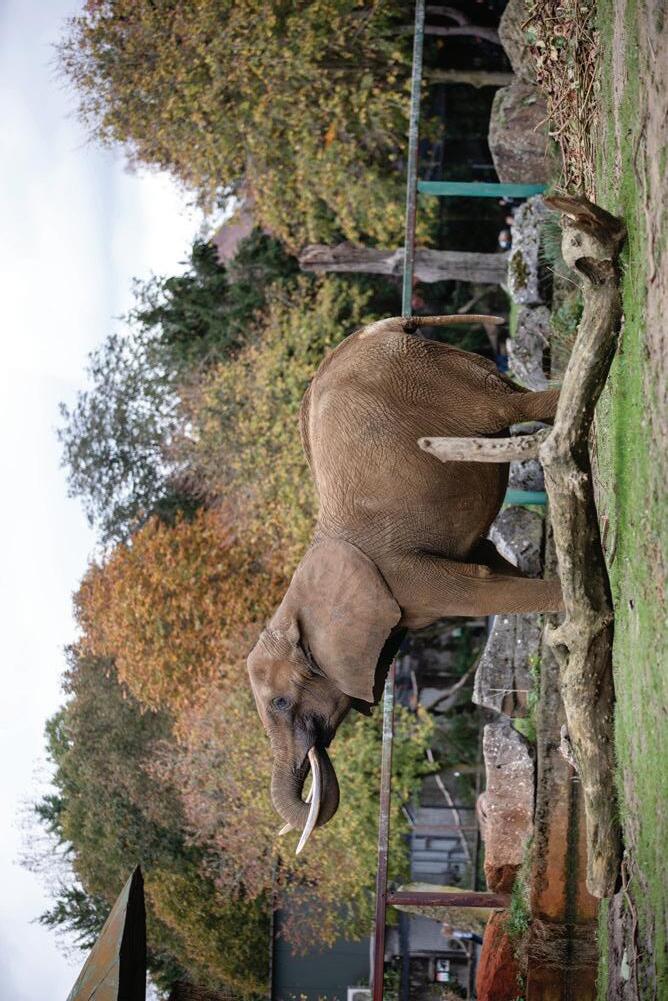
Female African elephant, Kariba, is the first to start a new life, here in Portugal, thanks to the work of the Pangea Trust.
Photography: Gaia
Forward thinking
It is at this point that I find it pertinent to turn to the words of another revered wildlife champion to understand exactly why an elephant sanctuary like this is so important in Europe. It’s a man whom I’ve admired for many years and have been lucky enough to interview on occasion: Will Travers. He is president of the charity Born Free Foundation, and alongside his later father Bill Travers and mother, Virginia McKenna, campaigns to end all animal captivity and “keep wildlife in the wild”. It is a Foundation that was created because of an elephant named Pole Pole who died at the devastatingly young age of 16 at London Zoo in 1983.
Born Free has constantly called for the keeping of elephants in UK zoos to be phased out. There are three living species that are currently recognised: the African bush elephant, the African forest elephant, and the Asian elephant. They have a life span of between 40 and 70 years in the wild, depending on their species, and females have the longest gestation period of any mammal at 22 months.
However, in captivity, the lifespan of an elephant can be greatly reduced depending on its surroundings. According to the 2022 Elephants in Zoos report by Born Free Foundation, the average lifespan of an elephant in a UK zoo was just 20 years. It is Will’s words that stay with me when I am presented with any argument as justification for the keeping of animals in artificial spaces, such as “without zoos, these animals would be extinct”. He told me: “just because we can bring wild animals to the heart of cities, it doesn’t mean that we should or that it’s right”.
Ricky Gervais handpicked The Pangea Trust as one of 22 charities to receive his financial support. He is donating a total of £2.43million to animal charities
Pangea means ‘all Earth’ in Greek, and the Alentejo is known for its rolling plains, privacy, abundance of water and cork trees as well as its slow, relaxed pace of life – much like the plains of Africa. How better to nurture these majestic, gentle giants?
It is because of The Pangea Trust’s work that Portugal must not only be put on the map for its conservation efforts – it must go down in history for them.
The
plan
So it is with great hope that we look to the 402-hectare property – which used to be a eucalyptus plantation and cattle farm –acquired by The Pangea Trust back in 2023 to establish the refuge which will hopefully cater for up to 30 of the previously captive elephants.
It is easy to see why this part of Portugal was chosen following a Europe-wide feasibility study as the best place to rehome them.
But the Alentejo is also kismet; fossilised footprints discovered in the region (near Porto Covo and Vila Nova de Milfontes) are among the most recent records of an elephant species residing in Europe, indicating they were present less than 40,000 years ago. So really, it could be said that they are just returning home.
The sanctuary, as one would expect from a real sanctuary, is not to be open to the public on a regular basis, although its understood there may be annual open days so select people like financial donors and local residents can see how these elephants are settling into their new surroundings.
Welcome support
The sanctuary also received a very welcome Christmas present. Actor and comedian Ricky Gervais handpicked The Pangea Trust as one of 22 charities to receive his financial support. Ricky announced he is donating a total of £2.43 million to animal charities worldwide, taken from the extra profits generated by the Platinum Ticket sales for his record-breaking 2024/25 Mortality stand-up tour. The Pangea Trust will receive £100,000 from that donation. This is a wonderful and encouraging endorsement for the sanctuary. Ricky is well-known to be nononsense when it comes to animal rights, and he chooses his causes extremely carefully.
So, it appears that very soon elephants will once again make Portugal their home. They will be living in a very large open area that is protected by elephant proof fencing, keeping both the elephants and surrounding communities safe.
The importance of their new life, and those who have made it possible, is something none of us, or the elephants themselves, will ever want to forget.
WINTER WARMERS
WPORTUGAL PRODUCES AN EXTRAORDINARY RANGE OF EXPRESSIVE WINES ACROSS A MOSAIC OF TERROIRS, FROM THE SUN-KISSED PLAINS OF THE ALENTEJO TO THE GRANITIC HIGHLANDS OF THE DÃO. WINTER CALLS FORTH THE COUNTRY’S MOST GENEROUS REDS AND ENVELOPING WHITES THAT INVITE YOU TO LINGER, SLOW DOWN, AND SAVOUR THE COLDER DAYS BEFORE SPRING FINALLY BREAKS THROUGH
Words: LÍVIA MOKRI
HEN THINKING
about winter warmers, most oenophiles immediately picture luscious reds – and for good reason. February is a time for wines with structure and concentration, the kind that complement hearty seasonal dishes or serve as a fireside companion all on their own.
ALENTEJO: THE COMFORT CAPITAL
Few Portuguese regions feel as inherently ‘comfort-wine-friendly’ as the Alentejo. The vast, golden landscape and Mediterranean warmth produces reds with ripe fruit, velvety tannins, and approachable roundness. Native varieties such as Alicante Bouschet, Trincadeira, and Aragonês produce wines with dark berry fruit, hints of cocoa, and a generous mid-palate that feels almost tailor-made for cold evenings.
The appeal of Alentejo reds in February lies in their immediacy: you don’t need to wait for them to evolve in the glass. They
are plush from the outset, offering warmth in both flavour and temperament. These wines pair beautifully with winter stews, braised lamb, or even a humble bowl of tomato-rich feijoada.
MY RECOMMENDATION
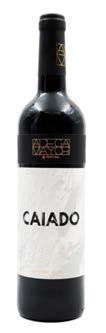
Adega Mayor Caiado Tinto 2023
A young and fruity red wine from the Alentejo region, with notes of fresh red fruit (currant, raspberry, plum), spices (cocoa), and soft tannins. Ideal to accompany everyday meals, snacks, meats, cheeses, and cured meats, being fresh and gastronomic. portugalvineyards. com/en/alentejo/2517adega-mayor-caiadored-2022-5607623012837.html
DOURO: POWER WITH PRECISION
While the Douro Valley is rightly celebrated for Port, its dry red wines have become
some of Portugal’s most compelling exports – especially in winter. Here, steep schist terraces and sun-drenched slopes coax exceptional structure from grapes like Touriga Nacional, Touriga Franca, and Tinta Roriz.
Douro reds tend to be more muscular than their Alentejo counterparts: darker, firmer, and often spicier. They are wines of depth and gravitas, offering notes of black plum, violet, graphite, and dark chocolate. But what truly distinguishes them as winter warmers is their balance. Despite their power, they retain freshness and lift, keeping them from ever feeling cloying. These are wines that shine alongside roasted game, slow-cooked beef, and mushroom-heavy dishes that echo the Douro’s earthy undertones. For a February dinner party, a well-chosen Douro red sets the perfect tone: comforting, elegant, and proudly Portuguese.
MY RECOMMENDATION
Niepoort Diálogo Tinto 2022
A young, fresh, and elegant red wine from the Douro region, with notes of
red fruit, floral and mineral aromas, balanced by good acidity, smooth tannins and a touch of oak, ideal for everyday enjoyment with white meats, pasta and vegetarian dishes, reflecting the simplicity and character of the region.
If Alentejo is about warmth and Douro about structure, the Dão is about finesse, yet it deserves a place in the winter lineup. Protected by mountain ranges and rich in granite soils, the region yields reds with lifted aromatics and vibrant acidity, making them ideal for those who prefer complexity over sheer density.
Touriga Nacional takes a starring role here, joined by Jaen, Alfrocheiro, and Tinta Roriz. Expect aromas of forest fruits, pine resin, dried herbs, and sometimes a whisper of spice.
In winter, Dão reds pair beautifully with roasted poultry, charcuterie, or a creamy mushroom risotto — dishes that highlight their aromatic delicacy without overwhelming it.
MY RECOMMENDATION
Quinta das Marias Lote Reserve Red 2021
This wine has a fruity and floral aroma that harmonizes nicely with its well-balanced acidity. And with a wellstructured body of smooth tannins, this contemporary blend is ideal for every day.
Serve with grilled or roasted meats: beef, pork and lamb. estadoliquido.pt/vinhotinto-quinta-das-mariaslote-reserva-dao
Comfort wines need not always be red. In Portugal, certain white styles – rich in texture, grounded in minerality, and layered with winter-friendly flavours –offer warmth and satisfaction.
ENCRUZADO: PORTUGAL’S WINTER WHITE JEWEL
February may not seem like the ideal time for white wine, but Encruzado proves otherwise. Primarily grown in the Dão,
this grape produces full-bodied whites with elegant structure, often aged on lees or in subtle oak.
The result is a wine with notes of citrus peel, hazelnut, white flowers, and mineral undertones – complex enough to stand up to cold-weather dishes like roasted chicken, creamy pastas, or buttery fish.
Encruzado’s versatility makes it the kind of white you pour when you want something comforting but not heavy, flavourful but not overpowering.
MY RECOMMENDATION
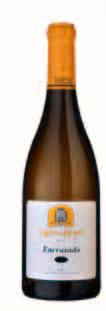
Quinta dos Roques Encruzado White 2023 Raisins, soaked fruit, and some balsamic in a very mature tone. Very smooth in the mouth every round, and mild acidity. A quiet and soft surrounding finish.
This one is excellent as an aperitif, as well as to accompany fish dishes and seafood.
Another winter-worthy white style emerges from Bucelas, a small DOC near Lisbon known for the Arinto grape. Arinto is typically prized for its zesty acidity, but in Bucelas – and especially after some bottle ageing – it develops a richer, more textural personality. Notes of citrus, green apple, and salty minerality give way to deeper flavours of almond, toast, and dried herbs.
This is a white that pairs beautifully with winter seafood dishes, especially bacalhau in its many forms.
MY
RECOMMENDATION
Quinta das Cerejeiras Grande Reserva White 2022
This deep yellow-citrus coloured wine has an elegant and complex aroma of ripe fruit and well-integrated wood notes. In the mouth, it is well-balanced with a silky smooth texture, harmoniously combining ripe fruit with wood.
Very elegant, with good acidity and freshness, it goes very well with fatty fish and soft cheese.
No article on Portuguese winter comfort wines would be complete without mentioning Madeira, perhaps the most cold-weather-friendly wine on the planet.
With its oxidative ageing and volcanic terroir, Madeira offers a spectrum of styles – from the elegant dryness of Sercial to the lush sweetness of Malmsey – all united by remarkable acidity.
In February, Madeira is more than a drink: it’s an experience. A small glass of Bual or Malmsey beside the fireplace delivers a sense of warmth and timelessness that few wines can match. Its flavours – caramel, roasted nuts, dried fruits, coffee, and citrus zest – seem designed for winter nights, whether enjoyed on its own or paired with blue cheese, nuts, or decadent desserts.
MY RECOMMENDATION
Cossart Gordon 10 years
Boal Clear, amber colour with tinges of gold and powerful legs, this one has a bouquet of prunes, almonds, vanilla, wood, and toffee with a smooth, medium-sweet finish and an excellent balance between the fruit and acidity. Very appealing soft hazelnut quality. It is excellent as an after-dinner drink and also very good with fruit, milk chocolate, cakes, and hard cheeses. The wine will keep for several months after opening.
February invites us to seek warmth, depth, and comfort – qualities that Portuguese wines deliver with effortless charm.
Whether you prefer the plush generosity of Alentejo, the sculpted intensity of the Douro, the refined elegance of the Dão, or the timeless coziness of Madeira, Portugal offers a winter wine for every palate and every moment. Now is the time to truly enjoy.
DAVID YARROW IN QUINTA SHOPPING
SÓNIA APOLÓNIA
AT IN THE PINK
AT IN THE PINK FINE PHOTO ART GALLERY IN THE HEART OF LOUL É THE STUNNING WORKS OF LOCAL PHOTOGRAPHER S Ó NIA AP O L Ó NIA ARE ON DISPLAY FOR THE FIRST TIME, AS PART OF A SPECIAL COLLECTIVE
Words: BEN AUSTIN
MANY OF YOU will be familiar with the In The Pink Gallery. Established in 2022 by photography collectors Phil and Anja Burks, it occupies a beautiful classical building with a striking interior on the Praça da República next door to the famed historic Café Calcinha.
In a relatively short period of time, the gallery has established itself as a cultural powerhouse in the Algarve, and in 2024 opened its second location, In The Pink Art Advisory, at Quinta Shopping in Quinta do Lago. The gallery promotes artwork by some of the world’s most sought-after photographers, including David Yarrow, Albert Watson, Rankin and the acclaimed Portuguese photographer Nuno Cera, whose work is currently on show at the gallery and is in the permanent collection of the MACAM museum, Lisbon. Beyond these established names, one of the remits of the gallery is to give a platform to local photographers whose talent is instantly recognised by the Burks. One such photographer is Sónia Apolónia.
Her background, and her focus
A graduate of ETIC (the School of Techologies, Innovation and Creation, Portugal), Sonia’s passion for photography led her initially to a course in Portimão after which she studied fashion photography in Lisbon. She was deeply involved in the creative side of the Apolonia family’s supermarket business, and in its own first-class publication in which she contributed both still life food imagery and architecture, the latter a particular passion where she explores the play of light often within constructed spaces.
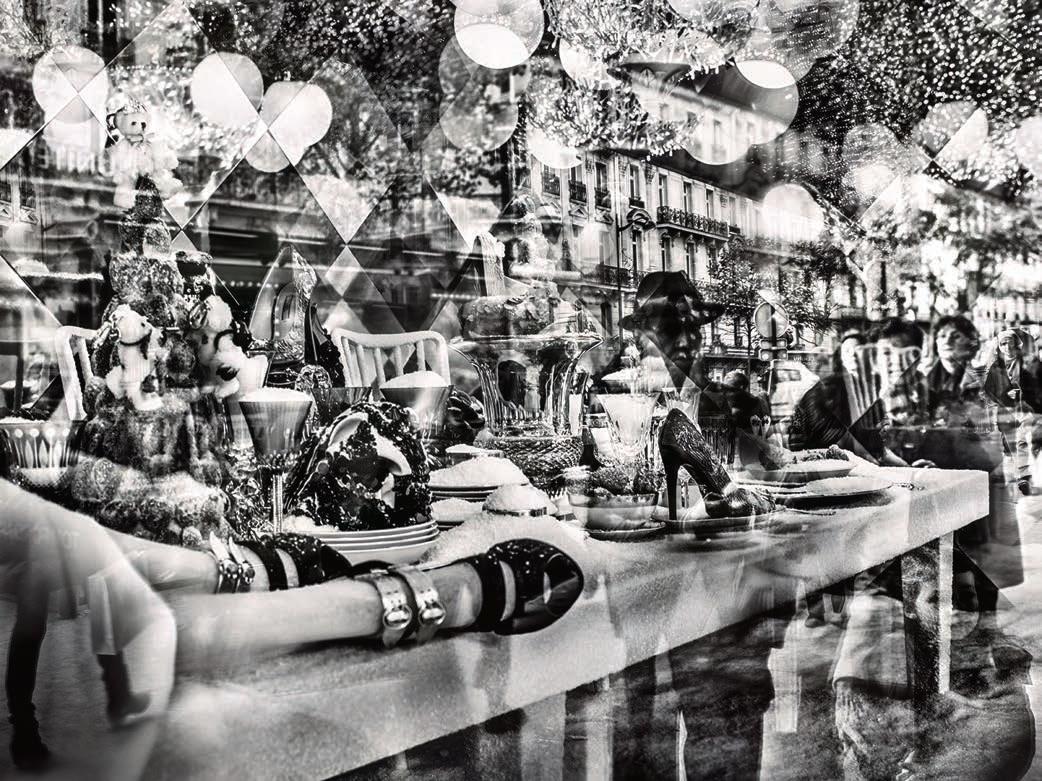
In this exhibition at In The Pink, Sónia presents a small selection of work from the series Sound of Shadows, Echoes of Light and Soul of Fire, all distinctively powerful. With Anima Ignis, Quinta do Lago I (2021), the drama is magnified by the impact of scale, printed at two and half metres. The scene of an out-of-control fire near Quinta do Lago fascinated Sónia and she was drawn to the flames,
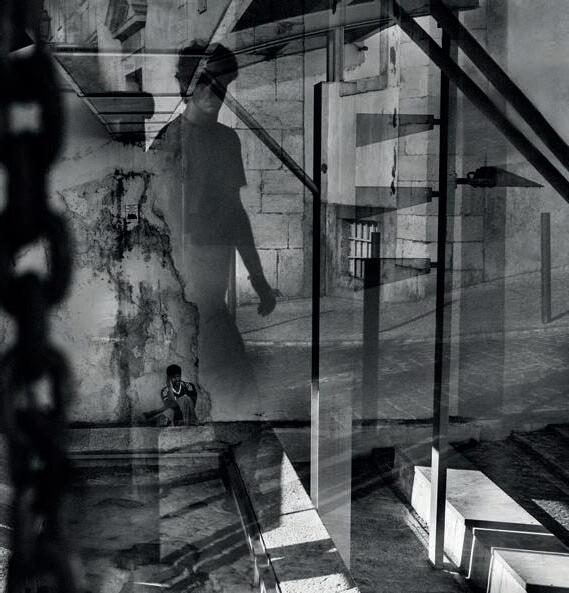
Compositions where light and shadow, and layerings of detail create the character of each, are a feature of Sónia Apolónio’s signature works
until the bombeiros politely asked her to leave for her own safety. The Latin title is telling: Anima means soul, spirit, life, breath and courage; Ignis fire, with metaphorical interpretation being passion, or even of a divine spark within a person. As Sónia states: “The whole scene interested me, like a rebirth or a new life; fire is a potent force, it is warmth and the power of the soul.”
Echoes of Light, Lagoa I (2015) is also fabricated on a large scale and with an equal measure of keen examination. The location is the underground concrete basement of the Apolónia store in Lagoa, where the shaft of warm light directly from above illuminates an area with an iridescent glow. And it is that luminosity that provides a strong contrast to the raw industrial material and the negative space at the edges. Sónia carefully controls the tonal quality of the work – the natural hues of the floor and walls creating an abstract composition that includes muted colours, geometric shapes and patterns. “It is minimal, but there is a lot going on. Spaces have a feeling and that’s what attracts me to certain places, I know that I want to be there,” she says.
The Sound of Shadows is a small-scale
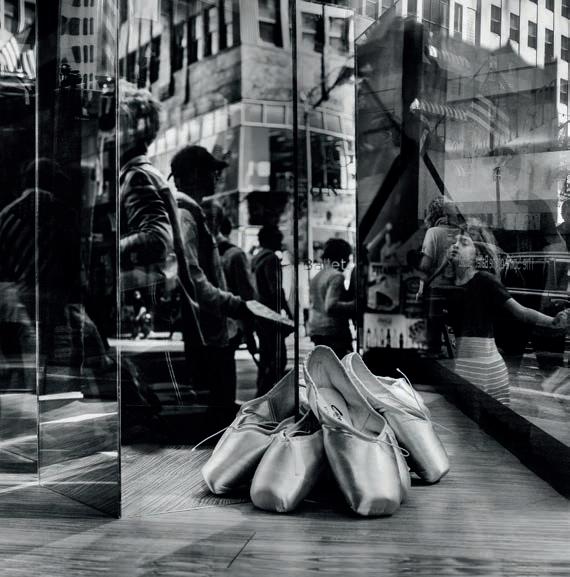
black and white series. These are intimate, fleeting moments of an unknowable narrative. Carolyn, NY, (2013), captures a girl in a shop window reflection, holding her mother’s hand she dreamily glances over at two pairs of pristine ballet shoes on display. In the background New Yorkers go about their business, oblivious to this quiet observation. Sónia’s interest lies in the multiple narratives, the numerous things happening simultaneously. It is the movement, the reflections and the shadow play that gives the image an almost surreal illusionary quality.
Those she admires
It is no wonder that Sónia cites Vivien Maier (1926–2009) as one of her influences, the street photographer whose vast collection of candid photographs were only discovered after her death. Others that Sónia acknowledges as having an impact on her work include Helmut Newton (1920–2004) and Robert Mapplethorpe (1946–1989), who shared a fascination with the monochromatic effects of light and shadow, minimalist compositions with a clear focus on shape and form.
The pieces by Sónia Apolónia currently exhibited at In The Pink are a clear demonstration of her ability and accomplishments. Each series, created some years apart, reveals an artist who is totally absorbed and engaged with the chosen subject matter, from the large format pieces, with their powerful inescapable presence, to the smaller more lyrical black and white works. These are thoughtful examinations of architectural forms, nature’s forces and individual stories.
Light intrigues Sónia, the chiaroscuro, the patterns and the tonal nuisances, the hallucinatory effects of reflections in glass creating multiple points of entry and intrigue.
For many years Sónia hid her light under a bushel, showing her photographs only at home to family and friends, all of whom, rightly so, encouraged her to get her photographs seen by a wider audience. The support, patronage and friendship of Phil and Anja Burks have facilitated this, with her capsule collection at the gallery.
For Sónia, exhibiting her work in the company of illustrious photographers is one of the creative drivers to produce a new series of work for an appreciative gallery audience.
A wild fire fascinated Sónia. This 2021 work that resulted is vast, two and a half metres wide
INSPIRED BY A HANDFUL OF AWARD-WINNING FILMS AND DIRECTORS, THIS MONTH I’M INVITING YOU TO TAKE YOUR OWN CINEMATIC JOURNEY ACROSS PORTUGAL. STEP BACK IN TIME... OR FORWARD! LIVE ROMANTICALLY. TAKE JOY. WALLOW IN MELANCHOLY. THE GENRE IS YOURS TO CHOOSE Words: EMMA CAMPUS, DESIGN ESCAPES PORTUGAL
AWARD WORTHY
NOT MANY of you know that in my former life in London before moving to Portugal, I worked in the world of luxury fashion. February, the glittering Awards Season, was always spent in a flurry of fabric, deep in fittings, or on last-minute planes to LA to deliver dresses to glamorous actresses and stylists stepping onto the red carpet in the latest creations from the designer I worked for.
This time of year still brings a fizz as I scroll through the latest trailers and interviews; as a film buff, I love following new releases, catching up on primed performances, and losing myself in outlandish film sets and stories.
This year, I came to realise that some of the most cinematic moments I’ve experienced haven’t happened in movie theatres at all, but in some of the houses and hotels across Portugal we’ve been lucky enough to visit recently. Spaces so atmospheric they feel less like accommodation and more like film sets. Somewhere between arrival and check-out, you slip into a role and can adopt a character, losing yourself in your imagination.
BUSSACO PALACE
A Wes Anderson wilderness
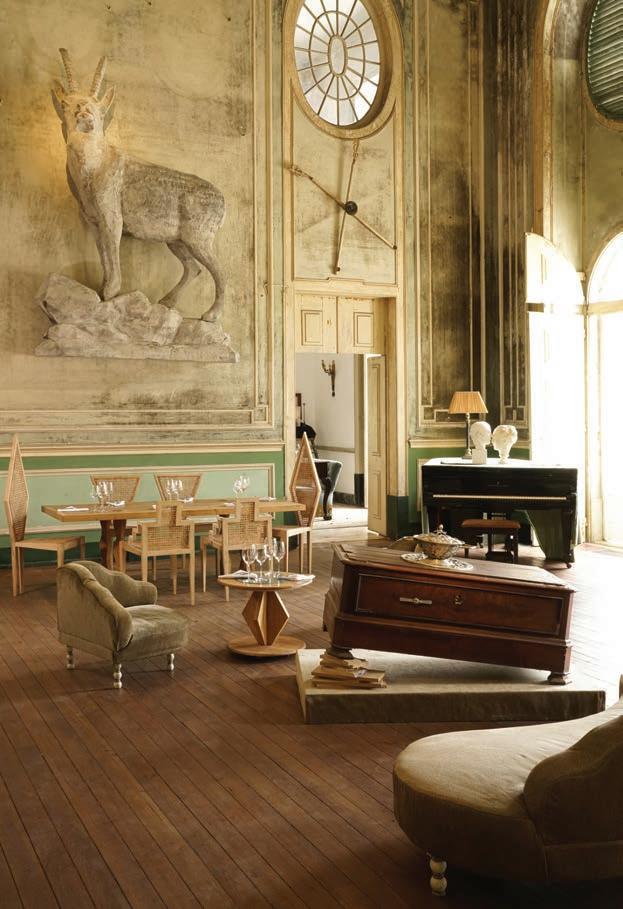
No place in Portugal has quite evoked nostalgic cinematic grandeur for me like the Bussaco Palace, a late-19th-century
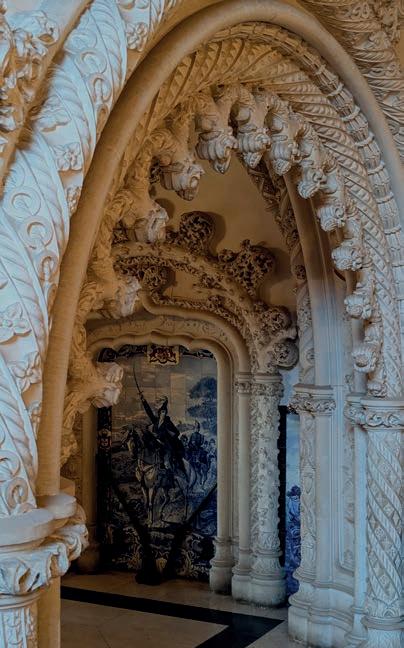
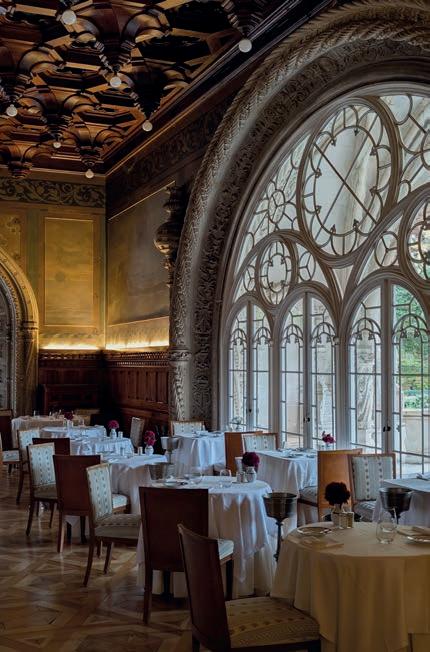
palace set deep within an enchanted forest close to Coimbra. On my recent visit in December, I was overcome with imagining a Wes Anderson film unfolding here: symmetry and whimsy at every turn, each corridor and archway carrying its own quiet narrative – an architectural marvel and a feast of theatrical detail. Yet, it was the smallest, most tactile details that felt the most cinematic... the way the hotel has held on to its objects. The props. The things that most places quietly discard in the name of modernisation. There are telephone boxes tucked into corners that feel frozen in time. Old switchboards sit like relics, even the room keys – weighty, unapologetically physical – insist on being felt in your hand, not slipped invisibly into a pocket.
Then there’s the staff, whose uniforms feel lifted straight from Ralph Fiennes’ pompous frame at the Grand Budapest. Watching them cross the marble floor felt like witnessing a scene change. You momentarily forget you’re a guest; you’re part of the choreography.
In an era where hotels often try to disappear – frictionless check-ins, invisible keys, anonymous design – Bussaco does the opposite. It asks you to imagine a version of yourself who writes postcards, dresses for dinner, and understands the romance of waiting. And like the best Wes Anderson films, it leaves you slightly nostalgic for a world you’re not entirely sure ever existed... except, somehow, it does. Right here, in the forest.
PAÇO DA GLÓRIA
An eccentric gothic fantasy
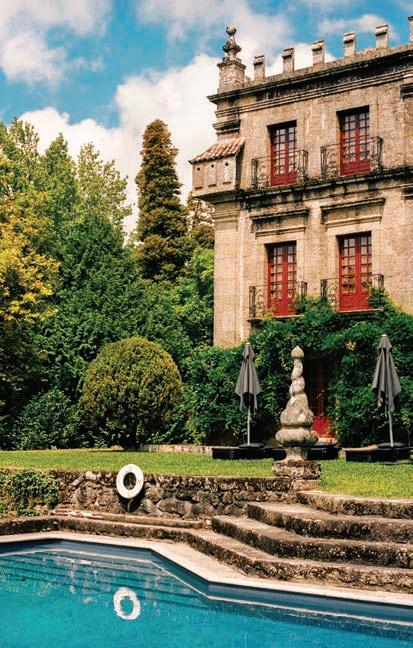
Perched high above the misty Lima Valley in the North of Portugal, Paço da Glória sits as an 18th-century baroque manor where Gothic architecture and eccentric history collide. We arrived through a giant carved granite stone archway in light January drizzle, greeted by gargoyles, soaring arches, and a labyrinthine interior that carries the weight of stories, each corridor whispering secrets of past lives.
My mind went wild as I pictured Mary Shelley penning her recentlyadapted Frankenstein by the lit fireplace (a film set for awards season accolades featuring Jacob Elordi)... a figure caught between grandeur, melancholy, and the uncanny.
Today, Paço da Glória functions as a hotel but also a space for transformative retreats, including grief-focused programmes exploring death, loss, and rebirth, giving its Gothic energy a quietly ritualistic, almost alchemical purpose. But it’s not all somber; the gardens are vibrant and dramatic – formal yet untamed and filled with flowers, intricate paths and hidden corners that feel almost staged for clandestine encounters, filled with theatrical mystery.
I loved hearing that the manor was once rumoured in the village for its raucous, extravagant parties hosted by previous owners. It reminded me of another of last awards season’s heroes, the shadowed decadence of Saltburn, a piece both haunted, yet colourful and exhilarating, where indulgence and spectacle are not just welcomed but expected.
PALÁCIO DO GRILO
A place for ‘Poor Things’
While not technically a hotel, even a few hours spent indulging in Lisbon’s experiential marvel that is Palácio do Grilo feels like walking straight onto the set of Yorgos Lanthimos’ Poor Things, a piece that stormed not just the awards season last year but also the hearts of everyone in Portugal, as Emma Stone sampled her first pastel de nata sat amongst floating trams and teetering Manueline architecture.
The property, which has more than 7,000m², was in the family of the Dukes of Lafões since 1759 until Julien Labrousse bought it in 2020. The crumbling corridors perfectly evoke the film’s surreal, genre-bending sensibility, where history, fantasy, and invention coexist.
Here, 18th-century Baroque grandeur, frescoed
ceilings, gilded mirrors, and secret staircases meet vibrant murals, whimsical sculptures, and playful design interventions, each corner inviting discovery and visual storytelling. Chefs, designers, and creatives animate the space, turning dinners into performative feasts and evenings into immersive, almost theatrical events, making the palace feel alive, mischievous, and endlessly cinematic.
Lisbon’s sunlight filters through tall windows, bouncing across textured walls, while shadows stretch over ornate dining tables, creating the kind of layered visuals that linger in the memory long after the scene ends. Palácio do Grilo is a space where architecture, art, and imagination intertwine, a place that makes Lisbon not just a backdrop, but a character itself, perfectly suited to a story that folds genres, defies expectation, and celebrates the strange, beautiful, and unforgettable.
CASA KAAN
Bricks and ‘The Brutalist’ Brutalism – born from the French béton brut for ‘raw concrete’ – has always been more than an aesthetic: it’s an architectural language of honesty, materiality, and structural truth, stripped of ornamentation and unapologetically present in the landscape.
In 2025, The Brutalist, the Oscar-hailed film about a visionary architect reshaping his life and work in the post-war world, concrete takes on emotional weight, echoing the protagonist’s internal struggles and the way built space can reflect trauma, ambition, and resilience.
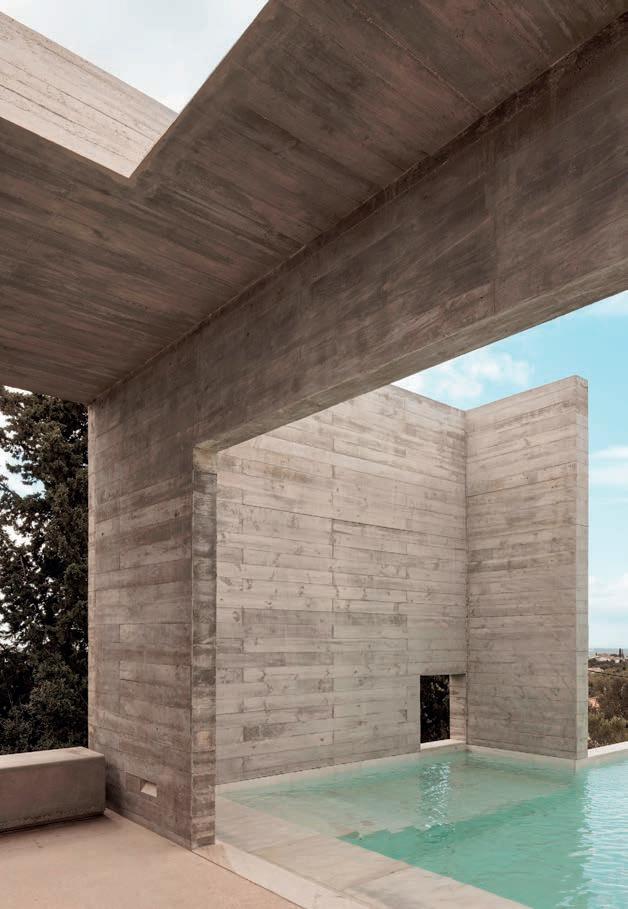
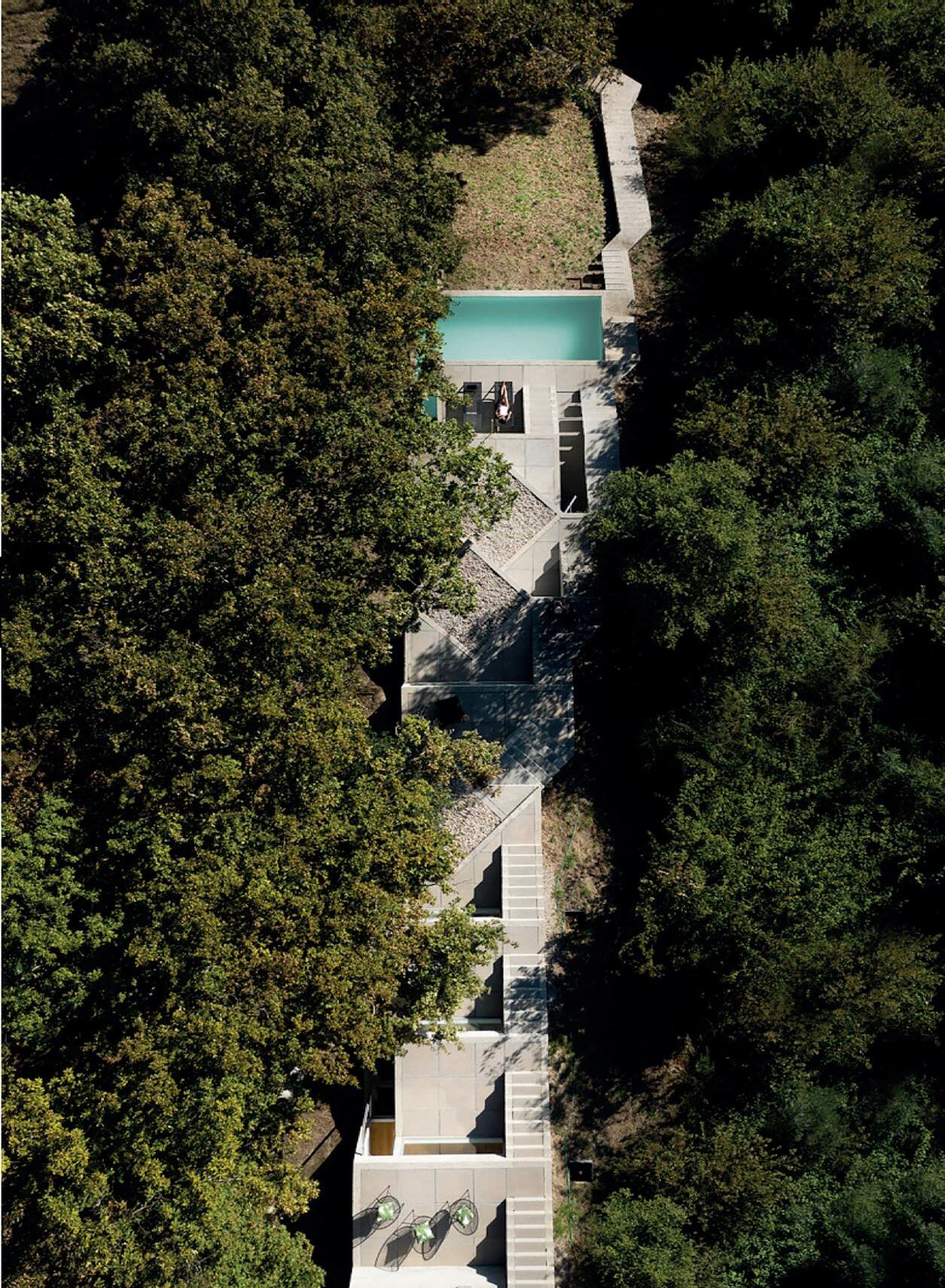
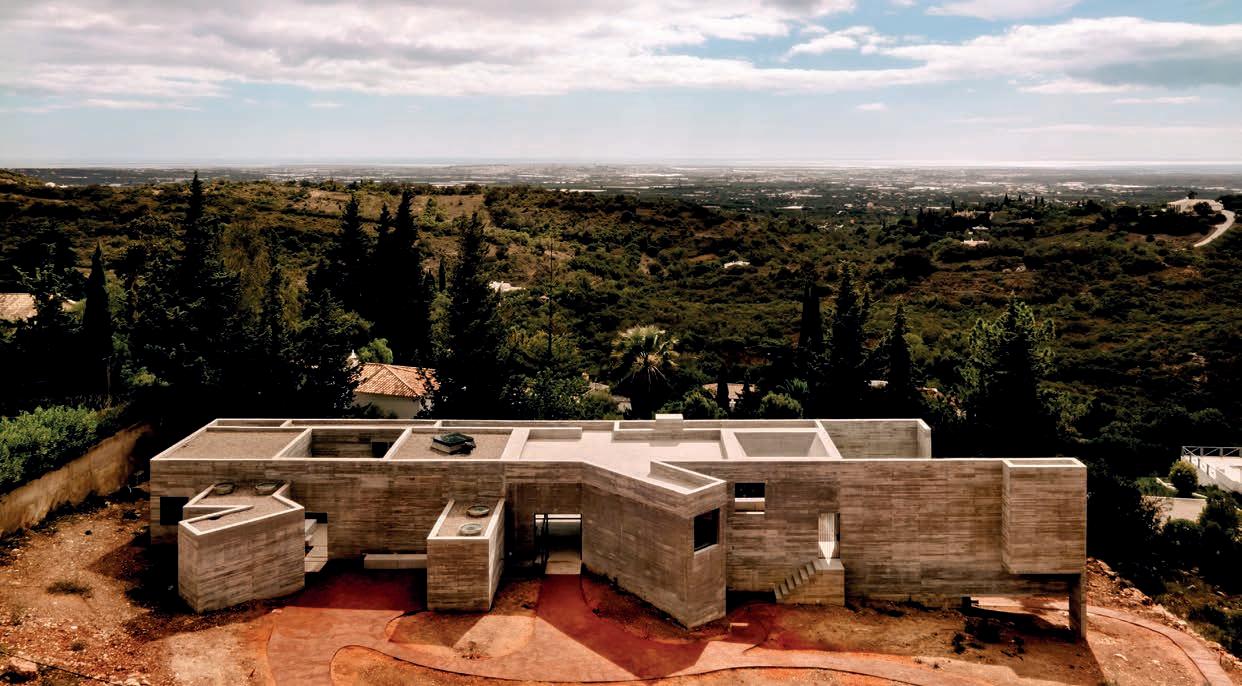
I was immediately reminded of it on discovering Casa Kaan here in the Algarve, designed by Pedro Domingos. Raw materials and clean geometry don’t hide behind decoration; they declare themselves. The house sits boldly against the terrain, its sculptural volumes and exposed concrete speaking a language of permanence and contemplation.
In Portugal today, this stripped-back Brutalist influence resonates strongly with architects. Manuel Aires Mateus’s Casa na Terra in the Alentejo, for example, disappears into the earth with a tectonic silence that feels both prehistoric and futuristic, using concrete and landscape as one. Meanwhile, in the north, Álvaro Leite Siza’s Casa Tolo built in 1999 in Gerês weaves monumental form with the rhythms of natural topography, its patios and stepped terraces articulating landscape and structure as inseparable.
Like the film’s protagonist, who seeks to build structures that carry meaning beyond mere shelter, these Portuguese spaces leverage rawness
to explore presence – how a building sits within its environment and within us.
PARQUE DO RIO
‘Don’t Worry Darling’, let’s go on holiday…
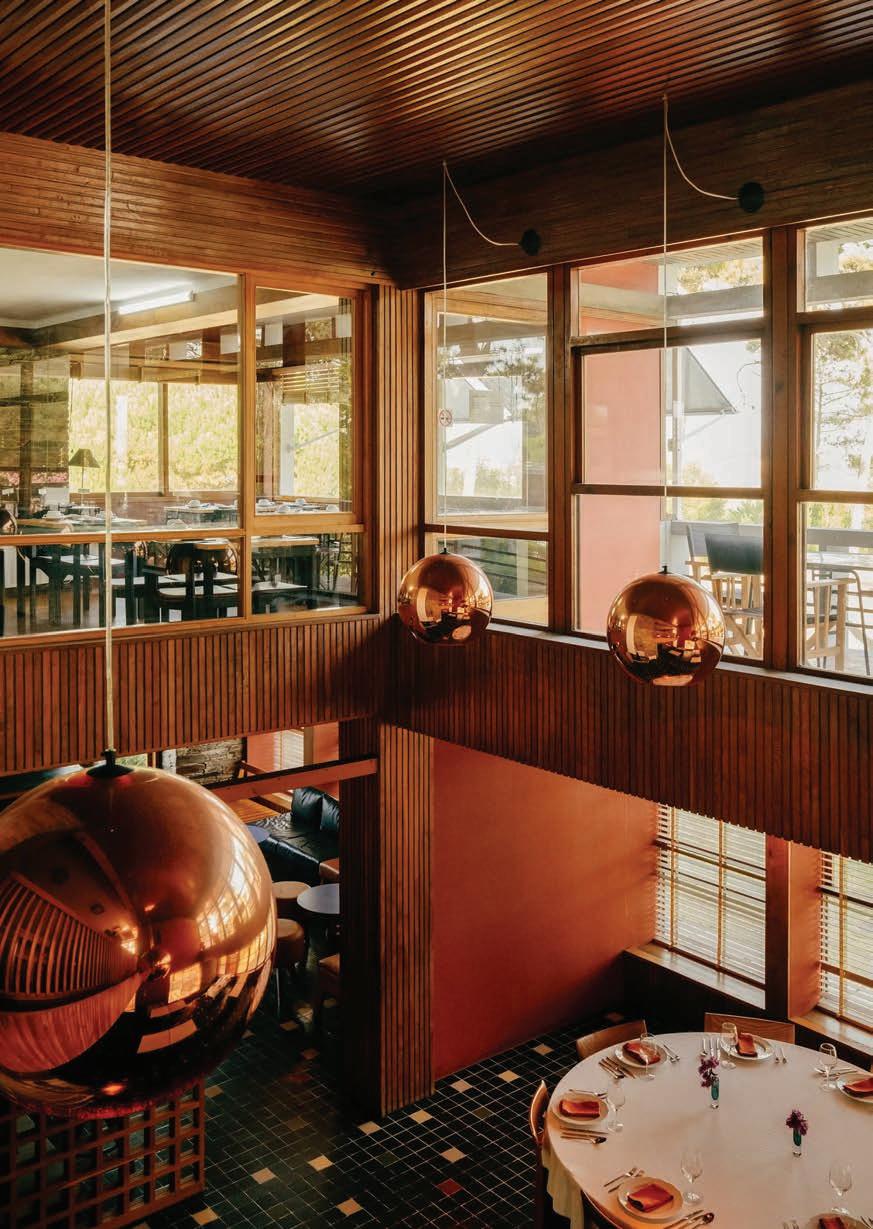
A stay at the mid-century modern paradise of Parque do Rio, near Porto, is like stepping into the world of Don’t Worry Darling – the dystopian, stylistically immaculate drama filmed in Palm Springs and directed by Olivia Wilde, recently celebrated on many ‘glory lists.’ The film follows Alice and Jack, played by Florence Pugh and Harry Styles, as they navigate a seemingly perfect past that conceals tension, control, and secrets.
Designed by architect Júlio Oliveira, Parque do Rio’s sunlit terraces and vintage corridors invite imagination. One can picture frivolous families holidaying here in the 1960s... picnics by the pool, laughter across the lawns, each household quietly carrying its own hidden dramas.
The hotel’s mid-century modern architecture mirrors this duality perfectly: clean lines, open interiors, warm colours and expansive windows create a sense of order and perfection, while subtle imperfections – fading edges, the soft patina of original wooden furniture, and the slightly ageing pool built in 1956 – hint at fragility beneath the polished surface.
Its cinematic resonance extends beyond imagination: João Canijo’s Bad Living (Mal Viver), filmed at the hotel, won the Silver Bear Jury Prize at the Berlin International Film Festival in 2023 using the architecture itself as a character to frame human tension and emotional complexity.
Like the film, Parque do Rio shows how spaces can collapse past and present, perfection and imperfection, into lived experience: tracing its architectural curves or gazing across its river and forest views, you feel the thrill of inhabiting a world where history, design, and hidden narratives intertwine.
Page 36: Parque do Rio, Porto. Page 37: top left, clockwise: Palácio do Grilo, Lisbon; Casa Kaan, Santa Bárbara de Nexe; Casa Tolo, Gerês. Opposite page, left: Paço da Glória; centre and right: the splendid Bussaco Palace, near Coimbra. This page above: Casa Kaan
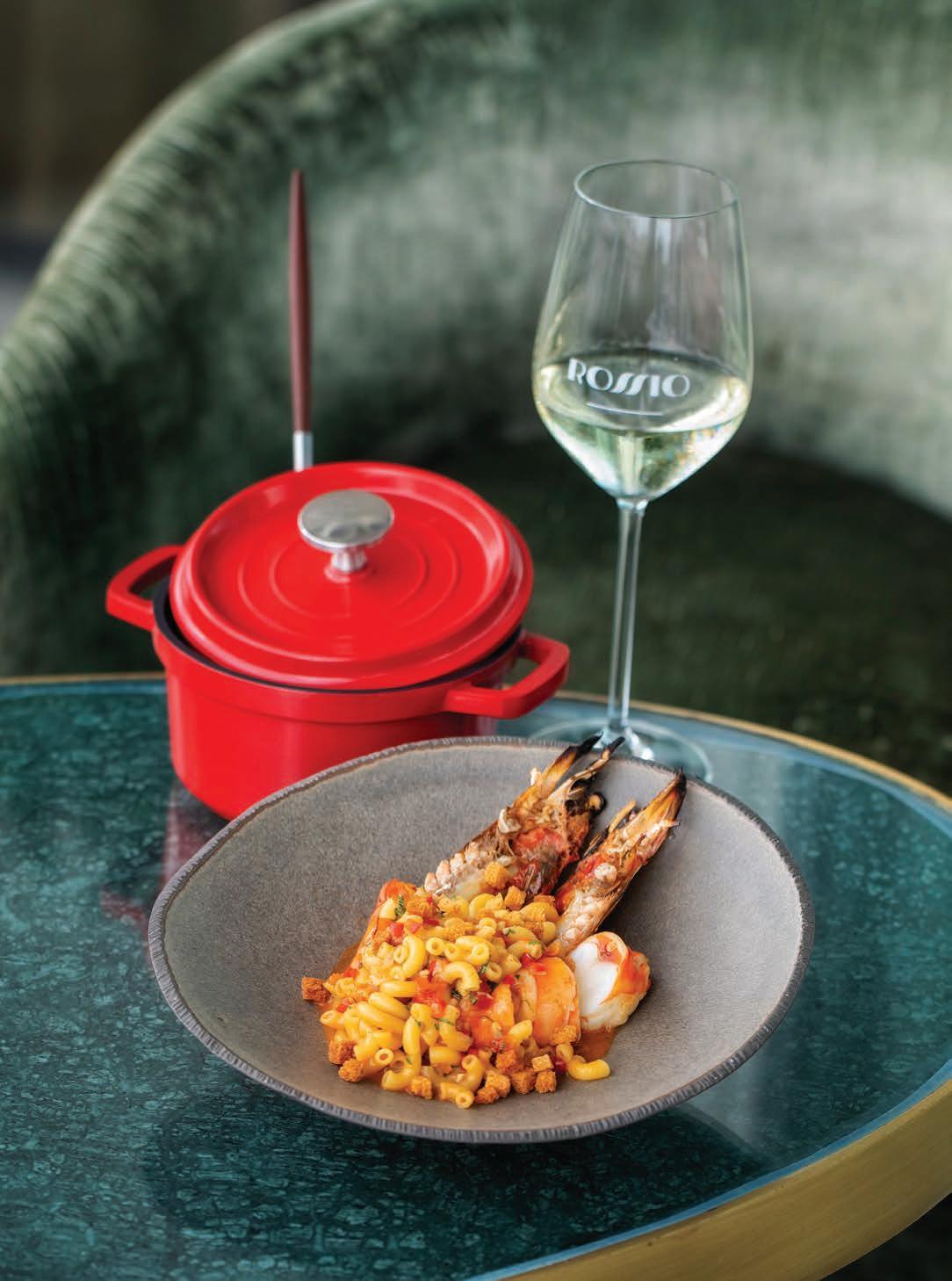
TIGER PRAWN PASTA
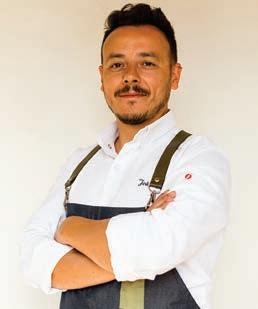
HERE ’ S AN EASY-GOING, QUICK-TO-MAKE SPECIAL FROM JOÃO CORREIA, EXECUTIVE CHEF AT LISBON ’ S ROSSIO GASTROBAR, CELEBRATED FOR HIS TRADITIONAL PORTUGUESE CUISINE APPROACH, WHERE HE INTRODUCES CONTEMPORARY TWISTS AND FRENCH TECHNIQUES SEEKING ALWAYS TO COMBINE FLAVOURS AND TEXTURES
SERVES 4
INGREDIENTS
200g elbow macaroni
800ml seafood stock
12g parsley
20g coriander
12g mint
400g onion
600g red bell pepper
300g chucha tomatoes (plum tomatoes)
50g garlic
20g bay leaves
55ml olive oil
20ml white wine
4 tiger prawns
30g coarse salt
10g black pepper
50g tramezzini bread (soft white bread, without crusts)
METHOD
PREPARATION: 35 MINUTES
1 To make the sofrito, cut the bell peppers, onion, and tomato into a fine brunoise ( Brunoise is a French culinary term for cutting food, especially vegetables, into tiny, uniform cubes, of 3mm or less, achieved by first slicing into thin strips (julienne) and then dicing them). Finely chop the garlic and gently sauté everything in olive oil over low heat, deglazing with the white wine.
2 Add the pasta to the sofrito and glaze for two minutes. Add two parts of stock and cook until al dente, adjusting seasoning as needed. Finish with the herbs, roughly chopped.
3 Peel the body of the prawn. Season with salt and pepper and sear in olive oil, repeatedly basting the head so it warms through without overcooking the body.
4 To prepare the croutons, cut the bread into small cubes and fry in olive oil. Drain well and allow to dry on kitchen paper.
5 To serve, place the prawn, cut into large pieces, at the bottom of a deep plate, splitting the head in half to allow easy access to the interior. Serve the pasta directly from the pot and place a bowl of croutons on the table.
ABOUT THE RESTAURANT
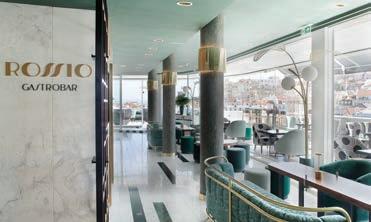
Located in one of the most privileged areas of Lisbon, Rossio Gastrobar combines a triple element of gastronomy, bar and one of the most amazing views of the country’s capital. Here you can get a glimpse of the Castle of São Jorge, the Tagus River, the Central Station or the Rossio Square. Distinguished by a contemporary cuisine, with its own identity based around the gastrobar concept, the flavours are inspired by Portuguese cuisine. The menu is divided into five sections, which include sharing dishes, and there are daily ‘Not on the Menu’ dishes, highlighting fresh and seasonal ingredients. The Chef’s Menu is a five-course tasting menu that breaks with tradition.
KNOWING NETFLIX
WHEN DID YOU LAST GO TO A CINEMA TO TAKE IN A NEW RELEASE? MOST CAN ’ T REMEMBER WHERE, WHEN OR WHAT THEY SAW, BECAUSE TODAY – OR RATHER AT NIGHT – AS CONFIRMED STREAMERS, WE BINGE ON EPISODE-BY-EPISODE BITES, SERVED UP BY THE BIG PLAYERS. NETFLIX HAS THE MENU
Words: LUCY MAYER
THE FACE of the big and little screen is changing rapidly thanks to the advent of streaming services where TV shows and films, old and new, are right at our fingertips. We no longer need to head to the cinema to view the latest big movie, as our love of multi-seasons watching has taken over traditional viewing, meaning we can often get through a whole series in one weekend, before the process of finding another to watch starts all over again. And that, of course, is the whole point of an entertainment subscription service. For example, of the many millions (yes, millions) on offer, there were 87 episodes of the Turkish series, Bride of Istanbul; 94 of Grace and Frankie over seven seasons; and an astonishing – and still continuing – 454 episodes of Grey’s Anatomy covering 22 seasons.
On the platform
There are many TV streaming platforms, from Disney+ and Apple TV to NOW TV and Amazon Prime. But it is generally accepted that the way we view TV today is down to one platform in particular, Netflix. The American-born company launched back in 2007. Earlier attempts at film streaming had been made, but it was the creation of a subscription rental service that really changed the course of history.
Today, Netflix is a streaming giant, available in over 50 languages worldwide (excluding China, Russia, Crimea, North Korea and Syria). It is also much more than your basic streaming service, with its own film production, distribution and video gaming arms servicing over 301 million subscribers as of January 2025. And as of December 2025, Netflix had a market cap of US$400.29 billion, making it the world’s 26th most valuable company by market cap
Before the arrival of Netflix, consumers went to the cinema to view the latest film releases.
according to website, Companies Market Cap data.
But this hasn’t always been the way. When Netflix began life 19 years ago, it was as a DVD rental service. Netflix was founded by Marc Randolph and Reed Hastings in Scotts Valley in Northern California. Hastings was a computer scientist, mathematician and co-founder of a software company, while Randolph had worked as a marketing director and was previously a co-founder of a computer mail-order company. Their initial idea for Netflix was to post VHS tapes out to customers’ homes, but they quickly switched the idea to DVDs because they were more durable and cheaper to ship than a clunky video tape.
Before the arrival of Netflix, consumers went to the cinema to view the latest film releases. Then there was Blockbuster and other physical rental shops where you could go in, peruse the titles available and take your VHS home for a few days before returning it – the same way that a library works. But this new platform model would mean no driving to the shops to pick up and return your rentals as it was all done via the post, and critically, there were no late fees which was a game changer.
Blockbuster eventually filed for bankruptcy in 2010 having, ironically, famously turned down Netflix in 2000, when its founders offered to sell their DVD-by-mail startup for US$50 million.
But back to Randolph and Hastings. When they came up with the idea for the mail-order DVD rental firm, the home video sales and rental industry in the US was valued at an estimated US$16 billion. If they were going to break into it, it needed to be with a groundbreaking and innovative idea.
Netflix eventually launched as the
first DVD rental and sales website with 30 employees and 925 titles available. The first film shipped out was the 1988 comedyhorror, Beetlejuice. The company didn’t have the usual overheads that traditional rental stores did, and while it started off as a payper-DVD rental (where you had to post your disc back in its iconic red envelope and order your next one), it soon moved to the more lucrative subscription model that we use today.
After 25 years, in September 2023, Netflix posted out its last DVD, marking the forever switch to digital. Over 500 billion DVDs had been rented and shipped during that quarter century.
By the mid-2000s data speeds and bandwidth costs had improved sufficiently to allow customers to download movies from the internet. Netflix’s founders latched on to this with a ‘Netflix box’ that could download movies overnight to your PC and be ready to watch the next day.
By 2005, the company had acquired movie rights and designed the box and service, but their model changed once again when it was realised how well online video sharing platform YouTube was doing. At that time, Netflix only had 1,000 films available for streaming, compared to some 70,000 it had made available on DVD. The service, then called Watch Now, at first required Internet Explorer on a computer, but as Netflix began to partner with film studios to license their content and games console producers, customers found they could download films direct to their gaming devices, and by 2010, streaming-only subscriptions emerged, and apps for iPhone and Android followed.
And as they say, the rest is history. There have been rivals to Netflix over the years – probably the most well-known was LoveFilm which was eventually bought by Amazon. But it is Netflix which will be remembered for changing the face of the film and TV rental market.
How exactly does a Netflix subscription work?
As a Netflix member, you are charged monthly on the date you signed up. A Netflix account is for people who live together in a single household and provisions are in place to try and stop the
Above: The cast of Stranger Things, the sci-fi horror series starring Winona Ryder, David Harbour, and Millie Bobby Brown. Set in the 1980s, it is now in its fifth and final season. Below: Marc Randolph, right, and Reed Hastings, founders of Netflix
growing issue of password sharing between unrelated households. Fees here are quoted in pounds sterling. You sign up online, choose a monthly plan (Basic, Standard, Premium, or Basic with Ads) based on features like screens and quality, monthly paying, and stream via the app on any compatible device (TV, phone, computer) with internet access, with account sharing rules applying. You can watch content specific to the Portuguese region, and subscriptions are flexible with no long-term contracts, though content does vary by country.
NETFLIX PLAN 1 – STANDARD WITH ADVERTS. £5.99 PER MONTH.
Advert-supported, all but a few movies and TV shows available, unlimited mobile games
Watch on two supported devices at a time
Watch in Full HD
Download on two supported devices at a time
NETFLIX PRICES HERE
Netflix prices in Portugal range from around €8.99 to €17.99 per month, depending on the plan: the basic plan at €8.99 may have ads/lower quality; the Standard plan priced at €12.99 offers HD, adfree, and two streams; and the Premium plan is some €17.99, with added features like Ultra HD/4K and more streams.
NETFLIX PLAN 2 – STANDARD. £12.99 PER MONTH.
Unlimited advert-free movies, TV shows, and mobile games
Watch on two supported devices at a time
Watch in Full HD
Download on two supported devices at a time
Option to add one extra member who doesn’t live with you
NETFLIX SUCCESSES
LOVE FROM 9 TO 5 (Season 1) – Mexican drama centered on a complicated relationship between an employee and the son of the CEO of an underwear company.
HIS & HERS (Limited series)
Tessa Thompson stars as Anna, a journalist who clashes with a suspicious detective when he investigates a murder in her hometown.
PEOPLE WE MEET ON VACATION
Emily Bader stars as Poppy, and Tom Blyth as Alex, two best friends who, despite living far apart, make sure to spend at least one week together on Summer vacation every year.
NETFLIX PLAN 3 – PREMIUM. £18.99 PER MONTH.
Unlimited advert-free movies, TV shows, and mobile games
Watch on four supported devices at a time
Watch in Ultra HD
Download on six supported devices at a time Option to add up to two extra members who don’t live with you
Netflix spatial audio
Big successes
Netflix has been credited with kick-starting and furthering the careers of many a famous face thanks to its homegrown shows. Millie Bobby Brown became a household name playing Eleven in the American science fiction series Stranger Things, which is now streaming its fifth and final season on the platform where it all began. Anya Taylor-Joy also became an international star through her unique role as chess prodigy Beth Harmon in The Queen’s Gambit (which also did wonders connecting a new audience to the agedold game). Then there are the shows like Emily in Paris, which became a runaway success overnight and is now also in its fifth season, Orange is the New Black, and who can forget The Crown, the drama based on the life of Queen Elizabeth II which in 2021 became the first series to win all seven drama categories at the 73rd Primetime Emmy Awards.
So, with the winter nights upon us and a world of home viewing at our fingertips, let’s find out a few of the highlights that are new on Netflix now for subscription holders in the UK and Portugal.
THE GOOD DOCTOR (Season 7)
Freddie Highmore returns as Dr. Shaun Murphy, a surgeon with autism and savant syndrome.
MACHOS ALFA (Season 4)
Following four male friends in their forties as they navigate their changing world and the women in it.
OS SETE RELÓGIOS
Premiered in January, one of crime writer Agatha Christie’s first espionage thrillers, set in London in the 1920s.
PODE ESTE AMOR SER TRADUZIO?
A new series from Korea, depicting the relationship between a multilingual interpreter and a top actress.
For Coffee Lovers
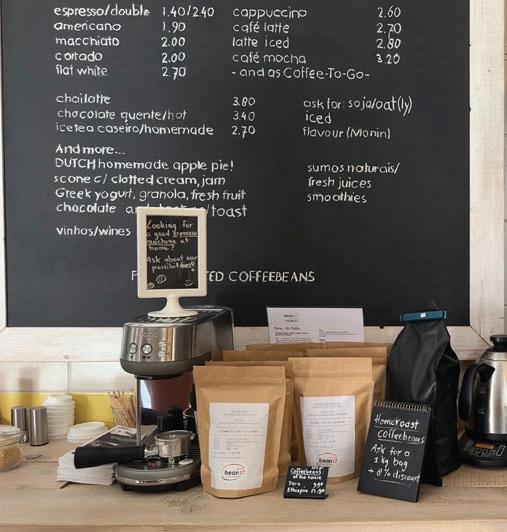
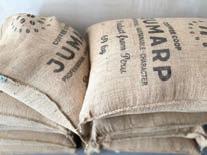
Discover bean17 in Loulé Market! Savour house-roasted Speciality Coffees like espresso or cappuccino, indulge in organic kombucha, and treat yourself to heavenly homemade cakes. Take the magic home with freshly-roasted organic Arabica beans from Peru and Ethiopia. Craving more? There are healthy breakfasts, light lunches, and a curated selection of premium products, including Portuguese olive oil, flor de sal, and more. Come for the coffee, stay for the joy!
Training
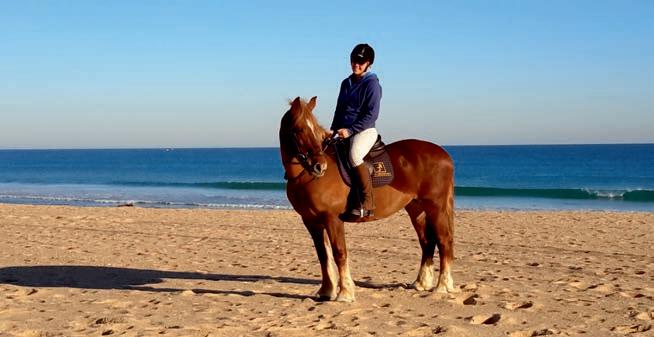
Riding
FASHION FIRSTS
VERITY THENARD, THE CREATOR
BEHIND THE INSTAGRAM ACCOUNT
MY ALGARVE LIFE, SHINES THE SPOTLIGHT ON THE NEWEST AND COOLEST PORTUGUESE FASHION BRANDS
PORTUGAL IS known for its rich textile history, which dates back to the 18th century. However, now the spotlight is shifting to Portugal’s unique collection of burgeoning designers. Portuguese design encapsulates stylish practicality with quality and sustainability, favouring understated elegance, comfortable layering, and quality natural materials. With such a rich textile DNA, expect to see bold prints, mismatched patterns, quality tailoring and style that reflects both tradition and modern coastal life. And keep an eye out for statement accessories, and a recurring pattern throughout – quality. Ready to go shopping? Vamos!
BÉHEN
Béhen was founded by Joana Duarte in 2020 while on a mission to protect Portuguese heritage. Her vision was to merge traditional techniques with fashion, collaborating with artisans across Portugal, to ensure their skills are not only preserved but also passed on to future generations. Elegant, feminine embroidery that works for women and men. behenstudio.com
BENEDITA FORMOSINHO
The brand was launched in 2018 by – you guessed it – Benedita Formosinho, a fashion designer. Its elegant, versatile clothing comes from local producers who value the preservation of the ancestral techniques that they use to create contemporary, classical clothing and a design aesthetic matched with premium quality materials. beneditaformosinho.com
CONSTANÇA ENTRUDO
Introduced in 2019, this is another eponymous brand on a mission to push the limits of how textiles can be reworked and re-shaped. The founder of the design Studio, Constança, previously worked for Balmain, Peter Pilotto, and Marques’Almeida. Its pieces are wearable art that could be described as accessible haute couture. constancaentrudo.com
MARIA RIDING COMPANY
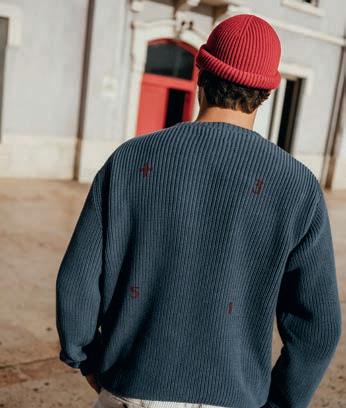
Given its message is finding joy in life, you can expect to get the “looks cool” nod from passers by. What started as a custom motorbike shop evolved into merchandise. and a tribute to the diverse spirit of Portugal. mariaridingcompany.com
SIENNA
This is what the cool girls in Lisbon are wearing. With a focus on small production, creating pieces that last, instead of chasing trends, they opt instead to chase fabrics and details that will make every product stand out. And stand out they do. Expect bright colours, unique silhouettes and creative patterns.
siennainspo.com
GUAJA.
GUAJA was started in 2019 by two sisters and their mother working on their dining table creating sophisticated pieces, with a modern twist. They have a strong focus on sustainability, and their community, sourcing everything locally. guajastudio.com
ISTO
Their motto is “quality over quantity”. Unlike many other brands, Isto does not do seasonal wear. Rather it creates everyday clothes that fit everyday needs. They have one single collection permanently available. So if you’re looking for quality pieces to add to your capsule wardrobe, this is the place to shop. isto.pt
TEMA
Teresa Braga’s Tema collections respect the various shapes of real women’s bodies. It is the antithesis of fast fashion focusing on key goals of sustainability and quality imploring customers to “buy less... but buy better and more durable.” temacreations.pt
+351
+351 is the self-proclaimed “essence of Lisbon”. Given its cult-like following, I would say they’re right. Their collections have a laid-back, comfortable unisex fit and flair –proving that the impossible is possible when it comes to fashion. This label can take you from a surf at Carcavelos to the bustling streets of Chiado. plus351.pt
SPIRIT OF THE SEA
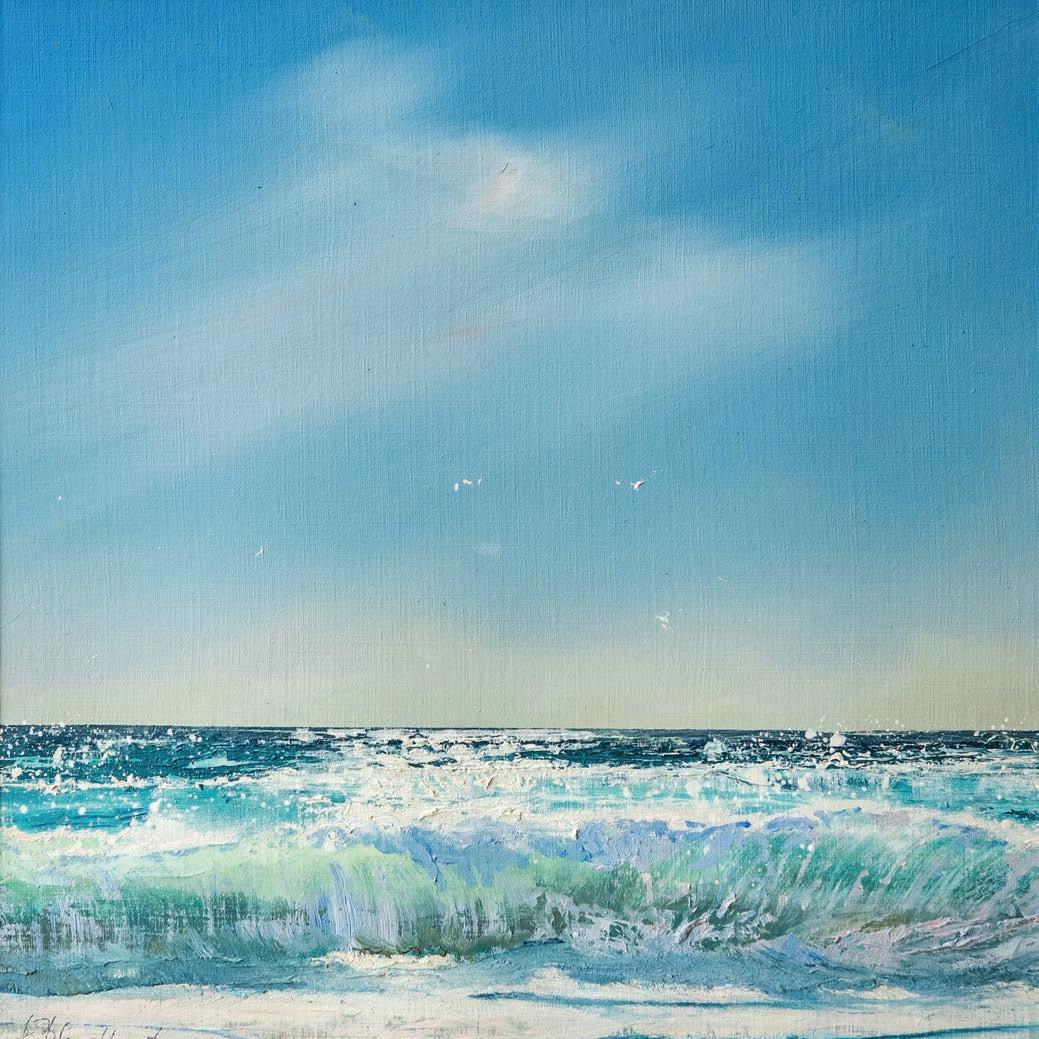
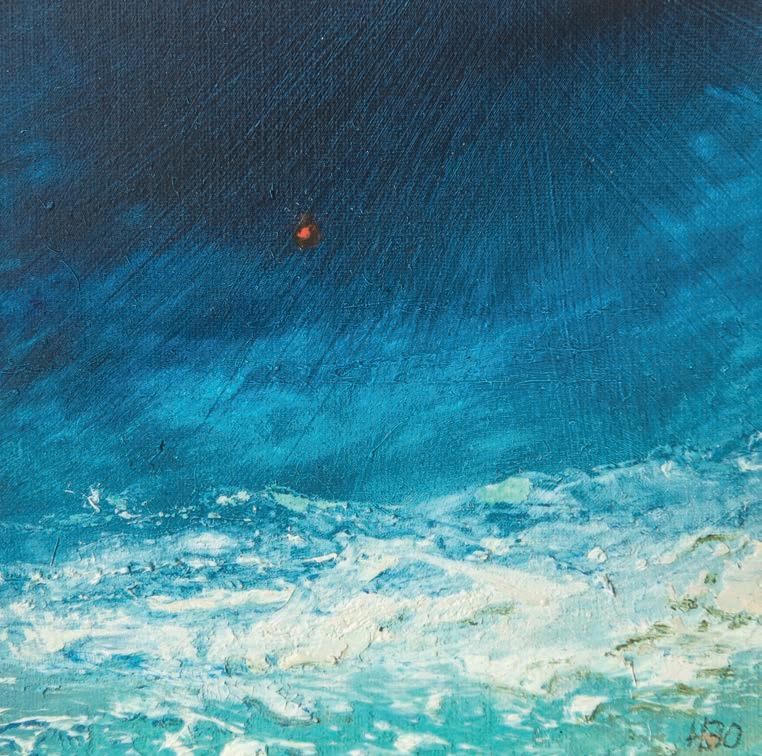
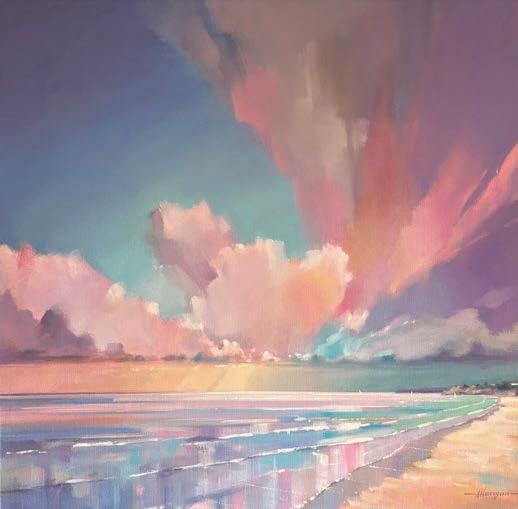
WHEREVER WAVES MEET THE EDGE OF THE LAND, THE POWER OF NATURE IS REVEALED. WHETHER SOFT OR STRONG THIS FORCE OF ‘LAND-WASH’ CAN BE CAPTURED IN A PAINTING, ALTHOUGH IN REAL TIME IT LASTS FOR JUST A MOMENT
Words: CAROLYN KAIN
Slauerhoff “De zee is serker dan het land” – the sea is stronger than the land.
Oosthout Unconstrained, natural ‘en plein air’, giving the appearance of movement by using a variety of paint handling techniques.
BERT OOSTHOUT is a contemporary artist from the island of Curaçau in the Dutch West Indies. Familiar with the warm waters of the Caribbean nowadays he is more likely to be sailing along the coast of the Netherlands in the bracing air of the Wadden Sea. He is equally likely to be sitting nearby on an artist’s stool painting scenes of the great freshwater lake, the Ijsselmeer; the two are separated by a huge dam that closed off the former Zuiderzee. This coastal area of the Netherlands is made up of a string of sand bar barrier islands. It is much larger than the Algarve’s Ria Formosa but as a natural formation it is similar in its structure.
Like most Dutch people living in a country where much of the land lies below sea level, Bert respects the power of the sea. The Netherlands is managed through sophisticated engineering, but with the advance of global warming it is an increasing threat. Bert is widely known for his paintings of seascapes and it’s hardly any wonder since metaphorically speaking brine has run through his bloodstream since the day that he was
born! On the island of Curaçau you’re never far from the sea. He can predict the weather by looking across reflections in the tides. He can view the sea from the line where it meets the horizon and forecast what the waves are saying about tomorrow. He has a special affinity with their movements and undoubtedly there is something supernatural about an artist who creates ‘salt water paintings’ from oil paints!
He is not the only Dutchman to have gained creative inspiration from the sea. Jan Jacob Slauerhoff is one of the most significant Dutch writers of the 20th century. Life as a ship’s doctor brought him to the same conclusion as Bert Oosthout that “the sea is a place of freedom”.
This is the first opportunity to see Bert Oosthout’s paintings in Portugal. His work has recently been recognised and selected by the owners of Galeria Côrte-Real who are delighted to represent him here
He travelled widely, in his case to the Dutch East Indies where he was captivated by the Portuguese territory of Macau. This set him on a literary journey to study the work of the 16th century Portuguese poet Luis de Camões included in this issue of AlgarvePlus. (See Portuguese Wordsmiths, Politicians and Poets, page 82). Slauerhoff is best remembered for his poetry anthologies; written during the 1920s and 30s, they are filled with vivid images of the sea. His ability with words to convey its beauty and strength is matched by Bert Oosthout producing similar compositions with paint.
CARNIVAL
THE ARRIVAL OF FEBRUARY MEANS THE ARRIVAL OF CARNIVAL. FROM FRIDAY 13TH TO TUESDAY 17TH THE STREETS WILL COME ALIVE IN CELEBRATION, NOT ONLY IN PORTUGAL BUT ACROSS THE GLOBE.
MARKING THE DAYS JUST PRIOR TO LENT, CARNIVAL IS A TIME TO FEAST, INDULGE, AND PARTY BEFORE ENTERING THE MORE RESTRICTED DAYS LEADING UP TO EASTER
Words: STEFF TOFT JONES
THE TRUE roots of Carnival are uncertain: some believe that they lie in an Egyptian pagan festival honouring the beginning of the new year and rebirth of nature; that Alexander the Great brought carnival to Greece with the pagan Saturnalian festival, in which traditional male and female roles are temporarily reversed. What seems more likely is that as Christianity spread throughout Europe, Carnival was incorporated into traditional, local seasonal festivals hailing the arrival of spring. Towards the end of winter, foods and meat that had been processed and stored during harvest and autumn reached the end of their life and needed to be consumed, and so people gorged on food: the word Carnival can be broken down to carne and vale –literally meaning the end of meat – a feast before the fasting of Lent. It’s easy to see how Carnival was a means to replace one festival with another new version with religious undertones.
Colonisation and slavery meant Carnival spread further afield. On the island of Trinidad, as a reaction to the introduction of Lent by French colonists, the slaves created their own celebrations incorporating Calypso music, originally aimed at mocking the French. Portuguese colonisation took Carnival to Goa, the only carnival celebrated in India, and of course to Brazil and South America where, as a consequence of the slave trade, South American, European and African traditions combined to create the world-famous Rio Carnival with masked balls, elaborate costumes, garish parades, samba music and flamboyant street parties.
Rio and Mardi Gras in New Orleans are perhaps the two mostcelebrated carnivals. Mardi Gras literally translates as Fat Tuesday and this is the day that sees the culmination of festivities beginning on Twelfth Night.
Thought to have begun in 1699, with the observance of a Catholic tradition by French colonists, parades are organised by local ‘Krewes’. By 1743, traditions of masking, costuming, singing and dancing in the street were already established, despite efforts to prohibit such behaviour. Mardi Gras reflects its French and Creole origins, and whilst its most famous parades take place in tourist areas such as Bourbon Street, this is just a small fraction of the mischief and merriment that brings the city alive.
A different personality
Carnival isn’t limited to these two famous examples being celebrated across around the world, each country having its own slightly different version. In fact, Quebec hosts the third biggest
carnival celebration in the world, making its debut in 1894 with its own Bonhomme (Quebec’s Carnival mascot) in a traditional sash, leading vibrant parades through the streets of Old Quebec.
Whilst the true roots of Carnival aren’t clear, there are themes that unite them all: dazzling, sparkling parades, extravagant floats, giant heads (Cabeçudos), and men dressed as women (Matrafonas). Music, dancing, costume and masks, the interaction of performers and revellers an escape from reality. Just for one night. Political satire and comedy elements provide the opportunity to raise issues of concern locally and globally, including identity, race, gender or the environment. Central to all is celebration of the ending of winter and the lighter days of spring...of life itself.
As Carnival spread across Europe, many adopted the Venetian tradition of mask wearing and indulgent fancy dress parties, coloured with their own traditions and folklore. In Switzerland demon masks are worn and large bells clang to ward off evil spirits. France offers vibrant pre-Lenten festivals featuring parades, masks, music, and indulgent foods like crêpes and beignets.
Major celebrations take place in cities like Nice, famous for its Flower Parades and King Carnival, and Dunkirk, known for its unique fishermen’s traditions, spectacular floats, costumed revellers, and lively street performances. In Switzerland, Fasnacht is celebrated enthusiastically, with different towns embracing their particular heritage. For example, Basel offers a UNESCO-endorsed parade featuring fifes and drums, lanterns and elaborate costumes. Whereas Evolène Carnival is rooted in Celtic/Germanic tradition, with terrifying masks and rituals to banish winter spirits.
And here in Portugal...
So what of Carnival in Portugal and the Algarve? The roots of carnival here are thought to be based in the practice of Entrudo, humorous battles using water, eggs and flour, designated a religious
celebration by King Alfonso III. Many towns also offer a smaller children’s carnival on Friday 13 February, with extravagant parades on the following Sunday and Tuesday 17, which is a public holiday for many, ensuring all can take part in the joyous celebrations. An integral festival in the Portuguese calendar throughout the 20th century, the influence of Brazilian carnival brought about more elaborate parades with samba music, creating a fusion of old and new traditions.
There are several high-profile carnivals throughout Portugal, each one offering a different flavour and experience. The Coretos de Podence, now a UNESCO-recognised tradition in northeastern Portugal, is based in ancient pagan rituals. Coretos dress in vibrant, fringed outfits of red, yellow and green, with masks of tin or leather featuring prominent pointy noses. Around their waists they wear belts of cowbells, and traditionally they run around the streets of Podence ‘rattling’ the young unmarried women, in what is thought to be an ancient fertility ritual.
Nowadays, the Coretos playfully engage with visitors performing symbolic dances, creating a joyful and chaotic experience. The festival ends with the Queima do Entrudo, the burning of a wicker man symbolising the end of winter and the welcoming of spring.
Carnival season begins in Lisbon with a huge party in Terreiro do Paço Square, and the main parade takes place in Cais do Sodré, near the Tagus River, including extravagant floats, dancers adorned in feathers and glitter dancing to samba music. Around the neighbourhoods of the city, impromptu parties and smaller intimate parades abound. As with many carnivals in Portugal, this is a real coming together of local communities and Samba music schools to celebrate the city’s heritage.
Described as ‘Portugal’s most Portuguese Carnival’, Coretos de Podence dates back to 1573, and over the years has evolved into a grand event combining urban and rural characteristics, shaped by
Above top left, clockwise: Big time in Rio with feathers and sparkle; playing politics in Loulé; Coretos de Podence; Venice makes a style statement
French and Italian carnival influences. The history of the region is very much reflected in the carnival featuring satirical floats, vibrant street parties and costume contests. Interaction between masked figures and public is very much encouraged through the throwing of ‘cocotes’, along with parties of masked groups which continue late into Saturday evening. And what sets another Carnival – that of Torres Vedras – apart is its emphasis on local Portuguese music, rather than the Brazilian samba rhythms experienced at other parades.
Considered by many to be the largest and oldest carnival in Portugal, Loulé sees Avenida José da Cost Mealha transformed during this period. With a parade taking place daily from 15h00 to 18h00, Sunday to Tuesday, the town comes alive to samba rhythms with a chaos of colour and sparkle. Again, the Carnival involves a combination of the traditional and modern, a blend of Portuguese and Brazilian. Believed to have its roots in the Batalha Das Flores (Parade of Flowers), in which floats were decorated with handmade and natural flowers from the Algarve, the parade is now recognised for its sheer extravagance, with giant cariacatures (gigantones and cabeçudos) poking fun at Portuguese and international politics whilst reflecting topical issues affecting the Algarve.
And Portimão plays host to a range of balls and parades, with the culmination of a parade along the riverside with up to 13 themed floats on Fat Tuesday. In Armação de Pera the parade, which takes place both on Sunday and Tuesday, follows the traditional Carnaval Trapalhão with comical and satirical floats. Revellers are encouraged to wear disguises and party. Lagos, too, offers another community-orientated Carnival, drawing together local senior groups, children, and families. A particular high spot is the children’s Carnival on Friday, and events organized by local groups like the Clube Desportivo de Odiaxere for a lively, community-focused taste of Portuguese Carnival traditions.
Out of town
Step into some of our smaller towns and villages and you will find that the spirit of Carnival is still alive and well. The themes of community, family and tradition are at the core. Whilst these local carnivals may not offer the spectacle or sparkle of their larger counterparts, the spirit of celebration shines through.
There is Carnival fun to be enjoyed with parades taking place in Alte, Monchique and São Brás. What sets these apart is the level of intimacy. They aren’t on the scale of the bigger carnival parades but they provide a snapshot of Portuguese community, and in Alte local groups such as the Folklore Group come together to celebrate in traditional ways. Still with an emphasis on imagination and satire, it’s an opportunity for Alte to celebrate together with parades and a ball at the Casa do Povo.
Meanwhile, Carnival in Monchique highlights the delight of a community celebrating together with the involvement of local school children and an emphasis on homemade creativity. The challenge of parades moving through rustic hillside streets such as Monchique’s Rua Do Porto Fundo offers a real taste of the Portuguese origins of Carnival
What really draws Carnival together, from the villages of the Algarve to the streets of New Orleans, is the celebration of life and of community. Of lightness during periods of darkness. Of hope for better days to come. Followed immediately by Lent, it highlights the influence of Christianity and paganism before that. But also a delight in celebrating the first hints of spring, and winter drawing to a close. It is an opportunity to sing, dance, eat and make merry – finding joy in uncertainty. What is certain is that in Portugal and the Algarve, whatever your preference, loud and garish, or small and traditional, you can be sure to find an experience of Carnival like no other.
BORN IN PORTUGAL, SHOWN IN PARIS
See the collection at Espaço Luzitano, Faro
From the elegance of classic settings to the free-spirited beauty of bohemian tablescapes. The Vila range, with some ooh-la-la.
NEXT ROUND... AND THE BOOK CHOICE GETS BETTER EVERY MONTH BECAUSE THOSE WHO HAVE CHOSEN THEM WERE TRULY IMPRESSED. INTERESTINGLY, READERS HAVE BEEN EMAILING TO SAY “ MORE, PLEASE ” AND ALSO THAT THEY HAVE BEEN PICKING UP THE LEADS AND BUYING THE RECOMMENDED TITLES
DAWN ALLANDALE
THE KEY TO REBECCA
By Ken Follett
Published by Pan
What an evocative page turner! I don’t love every Ken Follet book, but this I adored. Within a few paragraphs I could smell the spices, feel the heat and hear the noise of Egypt in 1942. Follet’s use of adjectives transports the reader to a world of German spies, deceit, decadence, intrigue, doublecross and unprecedented love.
The hero of the piece is Major William Van Dam whose arch adversary is Alex Wolfe. Throw in the fall of Tobruk, the fight to retain control of Egypt, Field Marshall Rommel and the snobbery and incompetence of nepotism of the British Army and hey presto! The result is a thrilling, terribly grown-up Boy’s Own spy story which will have you feeling exasperated, elated, devastated and delighted.
CHERYL SMITH THE BRIAR CLUB
By Kate Quinn
Published by Harper Collins
The Briar Club is a historical fiction set in Washington DC during the McCarthy era, opening with the shock of a brutal double murder on Thanksgiving Day. The story then takes us back four years, giving us time to truly know the women who live at Briarwood House.
Without giving the game away (and obviously we all know the eventual outcome of World War II), the cat and mouse chase of arriving at the finish line is spectacularly written. I did have a bit of a Google/Chat Gpt thingy after finishing the book and was pleasantly surprised at the accuracy and attention to detail Follet accords this novel. I found the social commentary especially fascinating. The hotch-potch of nationalities, religions and cultures living in relative harmony during war time Egypt seems completely alien to the current Middle Eastern situation, with the exception of the diversity of Israeli citizens but, that’s possibly too contentious for this book review.
I highly recommend The Key to Rebecca as a novel and a snippet of history.
These seven boarders come from wonderfully varied backgrounds: a grumpy ex-pat, a former baseball star, a police officer’s daughter dating a gangster, an elegant Englishwoman, a staunch McCarthy supporter, a senator’s secretary, and a widow with a mysterious past, along with the friends and lovers who orbit their world. Grace, the enigmatic widow, quickly became the heart of the story for me. She is the quiet glue holding the house together, drawing the women into her tiny shoebox room with her sun tea and comforting weekly supper club. The dinners become a sanctuary – moments of connection, camaraderie, and belonging.
I genuinely couldn’t put the book down. Each woman is given her own chapter, allowing a tender look behind the façade into her hopes, burdens, and personal battles – the longing for belonging, the courage to start over, and the quiet bravery of supporting others while navigating one’s own struggles.
A charming extra touch is that the book includes recipes and accompanying songs – perfect if you’re planning a themed book club night. It makes the story feel wonderfully immersive.
This book stayed with me long after the final page, reminding me of the strength found in people—and the power of community to help us rise again.
DANIELA GEORGESCU
THE PUPPY DIARIES
By Jill Abramson
Published by Ulverscroft
Some books simply are not made to be forgotten once we finish reading. They return to our mind in the moments we need them again. The Puppy Diaries by Jill Abramson, subtitled Living With a Dog Named Scout, is one of those books for me. My deep love for animals, especially dogs, is the reason why.
At its heart, this is a story about a dog, but more deeply, it’s about companionship, love that doesn’t need explanations, loss, and the time we return to ourselves. Abramson writes simply, without trying to impress or overwhelm. She focuses on everyday moments, small routines, and the deep bond that grows without needing words. To me, that honesty and simplicity is what makes the book so touching.
What makes it even more special is how it mirrors our own lives. Anyone who has loved an animal knows that they are never “just a pet”. They are witnesses to our routines, our silences, our hardest days and best days. Abramson captures that presence beautifully. The grief she describes is very personal, and easy to relate to.
I go back to this book because it reminds me not to take this love, or love in general, for granted. Each time I read it, it is like a reminder to notice and cherish the small things: walks, moments of silence while I read or work, cuddles, or simply his presence. Abramson’s story helps me understand the value of this connection while it is still alive and growing, but also that love leaves marks, even after it’s gone.
JAN CHAPMAN
THE MISINTERPRETATION OF TARA JUPP
By Eva Rice
Published by Heron Books
This is one of those novels that lingers long after the final page. I enjoyed both the story and Eva Rice’s warm, immersive writing style so much that I immediately ordered two more of her books for my Kindle — Love Notes for Freddie and This Could Be Everything. All three are destined for a future summer re-read.
The novel follows Tara Jupp, who grows up in a Cornish vicarage with seven siblings, haunted by the early death of her mother and ruled by a terrifyingly austere father. At just ten years old, while helping her Auntie Mary cook at the local “big house,” Tara
meets Inigo Wallace – a posh, guitar-playing teddy boy who changes her life. Tara’s extraordinary singing voice becomes their bond, exchanged for copies of New Musical Express, and something deeper than that quietly takes root.
At 17, Tara is swept into the heady glamour of sixties London, accompanied by her dazzling older sister Lucy, and launched toward pop stardom. Chelsea parties, fashion, photographers, songwriters, and recording sessions create a glittering new world, made richer by the clever weaving-in of real life figures from the era.
Yet, beneath the buzz lie shadows: worries about Lucy’s wild beauty and the ache of a broken friendship. Eva Rice beautifully captures a world of mini skirts and rock ’n’ roll, love and heartbreak.
LIVIA MOKRI CORK DORK
By Bianca Bosker
Published by Penguin
What happens when an ordinary wine lover – someone who has never gone beyond asking “dry or fruity?” – decides to enter the most fanatical, snobbish, and surprisingly entertaining corners of the wine world? Cork Dork, by journalist Bianca Bosker, sets out to answer that question with wit, curiosity, and plenty of self-mockery.
Bosker begins as a complete outsider, fascinated by the fact that some people can detect “wet stone,” “barnyard,” or even “grandma’s drawer” in a single sip of wine. Are these people born with superhuman palates, or is it all an elaborate, wellrehearsed bluff? Determined to find out, Bosker throws herself headfirst into the obsessive universe of sommeliers. What follows is a whirlwind of blind tastings, tongue-twisting terminology, and intense sensory training — often with hilariously awkward results.
Cork Dork doesn’t try to teach readers how to taste wine ‘properly’, nor does it lecture about what you should or shouldn’t like. Instead, it offers a playful, behind-thescenes look at a world where taste becomes a science, passion turns into obsession, and a glass of wine can inspire both awe and absurdity. Along the way, Bosker explores bigger questions about expertise, perception, and the human desire to belong to exclusive circles.
Smart, funny, and endlessly readable, this book is perfect for casual wine enthusiasts, curious minds, and anyone seeking an entertaining non-fiction book. Just pour yourself a glass and read along.
Modern Recovery. Intelligent Wellness.
Advanced wellness therapies to support recovery, longevity, performance and everyday health.
Vida Pura is a modern wellness clinic founded and run by two sisters with a shared passion for helping people feel their best. They studied under Dr. Masha Makeeva, a leading expert in Hyperbaric Oxygen Therapy, and became certified practitioners, bringing advanced knowledge and safe, effective care to every session.
Every therapy is personalised and designed to support your body’s natural ability to recover, regenerate, and perform at its best. From Hyperbaric Oxygen Therapy to Red Light Therapy, AI-powered physiotherapy, and IV wellness therapies, Vida Pura blends advanced technology with a calm, welcoming environment — making wellness feel effortless.
“We wanted to create a place where people could prioritise their health without stress, downtime, or complications. Every client leaves feeling seen, supported, and restored.”
OUR SIGNATURE THERAPIES:
Hyperbaric Oxygen Therapy (HBOT)
HBOT involves breathing concentrated oxygen in a pressurised environment. This process increases oxygen availability in the body, which may support cellular repair, circulation and recovery. It is widely used to assist physical recovery, cognitive performance and overall vitality.
Red Light Therapy
Red light therapy uses specific wavelengths of light to stimulate cellular energy production. By supporting mitochondrial function, it may encourage skin renewal, muscle recovery and reduced inflammation, making it popular for both wellness and recovery support.
AI-Powered Physiotherapy
Our AI-powered physiotherapy system combines intelligent technology with guided movement and muscle activation. It adapts to the body in real time, supporting muscle engagement, recovery and neuromuscular balance, while remaining completely non-invasive and personalised.
WHY CHOOSE VIDA PURA:
• Personalised treatments
• Science-led, safety-focused approach
• Calm, private, professional environment
• Suitable for recovery, longevity & daily wellness
all over
ROCKING PORTUGAL
MUSIC STARS OF THE WORLD DESCEND ON PORTUGAL THIS YEAR MAKING IT EXTREMELY DIFFICULT TO CHOOSE YOUR BEST AND BRIGHTEST. HERE’S A LOOK AT WHAT’S ON THE HORIZON.
Words: DEBBIE REYNOLDS
CROSSING ALL genres and generations, it’s a case of being spoilt for choice this year as the music industry’s most popular artists bring their magic to Portugal. From star-studded music festivals to one-off concerts, there’s something for everyone and every reason to get out and experience the joy of watching your favourite artists up close and personal. Add the renowned appreciative Portuguese audiences to the mix and you’re in for an unforgettable occasion. Here’s some of what you can expect:
CYNDI LAUPER
The quirky 80s pop goddess and quintessential performer, famous for anthems like Girls Just Wanna Have Fun, True Colours and Time after Time, makes her debut at the Rock in Rio festival. She is currently on her farewell tour, saying goodbye to fans around the world. In her 40-plus year career she has sold over 50 million records and earned Grammy Awards, a Tony Award (for her score for the Broadway musical Kinky Boots), MTV Video and American Music Awards.
When: June 27. Where: Rock in Rio Lisboa Parque Tejo.
Above: Foo Fighters. Right: Cyndi Lauper
CYPRESS HILL
This influential hip hop band was formed in 1988 in California and became widely known for pioneering Latino representation in rap and advocating the legalisation of cannabis. Their hits include Hand on the Pump, Insane on the Brain and I Ain’t Goin’ Out Like That. With 20 million album sales and three Grammy nominations the band promises rousing production with true Latin flare.
When: June 21. Where: Rock in Rio Lisboa Parque Tejo.
FLORENCE + THE MACHINE
Supporting their latest album, Everybody Scream, the band continues its love affair with Portugal. The indie rock band was formed in London in 2007, led by powerhouse vocalist Florence Welch and keyboardist Isabella ‘The Machine’ Summers. Their debut albums Lungs (2009) topped UK charts with hits like Dogs Days Are Over, blending art pop, soul and rock with eccentric production. When: July 11. Where: NOS Alive at Passeio Maritimo de Alges, Lisboa.
FOO FIGHTERS
Formed in 1994 by Dave Grohl after Nirvana’s disbandment, this charismatic band takes stadium rock to a new level with unbridled energy. Key hits include Learn to Fly, Best of You and Everlong. Winners of 15 Grammy Awards, including Best Rock Album five times, the band also won the first Global Icon award at the 2021 MTV Video Music Awards. Get ready to be treated to relentless stamina, screaming vocals and an electric vibe. When: July 10. Where: Nos Alive Passeio Maritimo de Alges.
4 NON BLONDES
Appearing in Portugal for the first time, the American rock band, led by Linda Perry, recently reunited for a series of comeback concerts. Formed in San Franciso in 1989, they were big on the club scene until their 1993 hit What’s Up (aka What’s Going On?) went global. Started as an all-female line-up, the band now features Roger Rocha on lead guitar. Expect old favourites and new tracks from their upcoming album.
When: June 27. Where: Rock in Rio Lisboa Parque Tejo.
HOOBASTANK
This post-grunge, alternative rock band created hits like The Reason and Crawling in the Dark. They gained worldwide fame with their 2001 self-titled debut album and peaked with The Reason in 2003. Their last album, Push Pull, was released in 2018 and last year they began writing new music, some of which will be introduced to Portuguese audiences this year.
When: June 21. Where: Rock in Rio Lisboa, Parque Tejo.
IRON MAIDEN
The British metal heads return to Portugal with another epic stage production following their sold-out MEO Arena concert last year. The Run For Your Lives World Tour 2026 is set to rock Lisbon for a night of unprecedented grandeur, pyrotechnics and Eddie the Head visuals. Celebrating their 50th anniversary, the band promises all their classic hits – Ides of March, Run to the Hills, Phantom of the Opera and more – in an immersive metal experience.
When: July 7. Where: Estádio da Luz Lisboa.
JETHRO TULL
Portugal features on the map for the massive 2026 Curiosity Tour across Europe and the UK, supporting the band’s 2025 album, Curious Ruminant. The tour features Ian Anderson’s signature flute-driven progressive rock, blending classics like Aqualung, Thick as a Brick and new tracks. Expect elaborate staging with a mix of hard rock riffs, acoustic folk passages and an immersive vibe.
When: March 13. Where: Coliseu de Lisboa.
JOE JACKSON
The Hope and Fury tour, supporting Jackson’s new rock album of the same name, comes to Portugal in October. Often depicted as a “chameleonic artist” who constantly changes his style, Jackson insists that most of his albums are “in his own mainstream” of sophisticated pop songs. The concert will include tracks from his new LatinJazzFunkRock album plus classics like Steppin’ Out and Is She Really Going Out With Him. When: October 17. Where: Casa da Música, Porto. When: October 18. Where: Aula Magna, Lisboa..
JOSS STONE
With a unique mix of soul and R&B, English singer Joss Stone blends reggae, jazz, hip hop and world music elements across her albums creating a versatile and heartfelt sound. Her signature style – barefoot with raw energy –will dominate her Portugal performance. With two Brit Awards and one Grammy Award, she’ll bring her classics like Fell in Love with a Boy, Super Duper Love and You Had Me. When: June 27. Where: Rock in Rio Lisboa Parque Tejo.
Left to right, Cypress Hill; Florence + the Machine; Joss Stone; Lewis Capaldi; Robbie Williams; Rod Stewart; Nick Cave; Katy Perry; Rosalia
KATY PERRY
One of the world’s ultimate pop queens, Perry headlines the Rock in Rio festival with her mind-blowing energy and stage show, bringing her favourite high-energy dance anthems like ROAR, Firework and I Kissed a Girl. Expect a dazzling and theatrical production with fireworks, confetti and outrageous outfits. From her gospel beginnings, this sensational songstress became the first female artist to produce five number one songs in the US with her 2010 album Teenage Dream.
When: June 20. Where: Rock in Rio Lisboa Parque Tejo.
LEWIS CAPALDI
Capaldi makes his debut in Portugal at a sunset beach concert in July, following sold-out concerts around the world. Expect hits like Survive, Grace, Wish You the Best and Love the Hell Out of You. The Scottish singer-songwriter, known for his heartfelt ballads about love and heartbreak, rose to global fame in 2019 with Someone You Loved reaching number one on the US Billboard Hot 100, earning a Grammy nomination and Brit Award.
When: July 18. Where: Praia do Relógio, Figuera da Foz.
LINKIN PARK
After the tragic loss of their lead singer, Chester Bennington, the band returns for a new chapter, with an emotional tribute to their nu-metal and alternative rock legacy. Currently on their From Zero World Tour, supporting new material from their 2025 album alongside classic hits, the American band has achieved global success selling over 100 million albums. The concert promises dynamic lighting, immersive visuals and
crowd sing-alongs to anthems like In the End, Numb and Faint.
When: June 21. Where: Rock in Rio Lisboa Parque Tejo.
NICK CAVE AND THE BAD SEEDS
The Australian rock band was formed in 1983 with a gothic, post-punk sound blending ballads and garage rock. Their music explores dark themes like love, death and redemption across 18 studio albums, with Red Right Hand becoming a worldwide hit. Where the Wild Roses Grow with Kylie Minogue topped charts in multiple countries in the 90s. This will be a show all about storytelling and an intense theatrical experience.
When: July 9. Where: Nos Alive Passeio Maritimo de Alges Lisboa.
PEDRO SAMPAIO
The Brazilian singer, DJ, songwriter and producer rose to fame with hits like Sentadão in 2019 which topped charts in Brazil. His albums Chama Meu Nome (2022) and Astro (2024) have gained him universal appeal. He began producing music at 13 and gained visibility through YouTube remixes before being signed by Warner Music Brazil in 2018. Expect a high-energy performance blending originals with international mashups.
When: June 20. Where: Rock in Rio Lisboa Parque Tejo.
PIXIES
The legendary alternative rock band celebrate their 40th anniversary this year, having influenced a generation of artists, including Nirvana. Expect a tight, no-frills performance, with hits like Where is My Mind, Here Comes Your Man and In
Heaven. It’s all about raw energy and multi-generational audiences enjoying the iconic riffs.
When: July 11. Where: NOS Alive at Passeio Maritimo de Alges in Lisboa.
ROBBIE WILLIAMS
With a spectacular comeback world tour, the enigmatic performer presents his haunting ballads and catchy pop rock. His concert is reputed to deliver high-energy pop spectacles with cheeky banter, crowd interaction and a mix of hits like Angels, Rock DJ and Let Me Entertain You alongside Rat Pack covers like New York, New York. With his raw charm and a tight band, fans can expect an unforgettable experience.
When: August 28 to 30 (exact date to be announced). Where: MEO Kalorama Lisboa Parque da Bela Vista.
ROD STEWART
Sir ‘Do Ya Think I’m Sexy’ Rod is still rocking his socks off in his inimitable style. He tops the Rock in Rio Legends stage with his timeless classics guaranteed to bring back memories. Sing along to hits like Maggie May, Sailing, Have I Told You Lately and all the rest in a concert packed with nostalgia.
When: June 27. Where: Rock in Rio Lisboa Parque Tejo.
ROSALIA
The Spanish artist performs two concerts in Lisbon in April as part of her LUX Tour, supporting her fourth studio album of the same name. This marks her biggest headlining tour yet, spanning 42 shows across 17 countries. LUX, recorded with the London Symphony Orchestra, features
collaborators like Bjork and Carminho with Rosalia’s unique mix of flamenco, R&B and Trap. Expect to hear her breakthrough international smash Con Altura, La Fama and Berghain.
When: April 8 and 9. Where: MEO Arena Lisboa Parque das Nações.
SUEDE
The British glam rock band brings its Antidepressants: Dancing with the Europeans Tour to Portugal in March. Largely considered pioneers of the Britpop movement in the 1990s, the band topped charts with hits such as Trash, Beautiful Ones and Stay Together. Audiences describe the band’s performance as thrilling with minimal banter and soaring vocals.
When: March 19. Where: Super Bock Arena Porto When March 20.
Where: Sagres Campo Pequeno in Lisboa.
SCORPIONS
This 1960s German band evolved from psychedelic rock into a global heavy metal phenomenon known for hits like Rock You Like a Hurricane, Winds of Change and the power ballads Still Loving You and Send Me an Angel. The band is led by original founder guitarist Rudolf Schenker and comes to Portugal as part of its Coming Home 2026 Tour.
When: July 8. Where: Lisboa MEO Arena.
SCISSOR SISTERS
This eminently danceable American pop rock band was formed around New York City’s gay nightlife scene around 2001. Their blend of glam rock and disco spawned hits like I Don’t Feel Like Dancing and Take Your Mama. The band performs as a trio with Jake Shears
on vocals, Babydaddy on various instruments and Del Marquis on guitar and bass. When: July 29. Where: Hipodromo Manuel Possolo in Cascais as part of the Ageas Cooljazz Sessions.
SNOW PATROL
The Northern Irish-Scottish rock band made its world breakthrough in 2003 with the album Final Straw and the hit Run, certified 5x platinum in the UK. They’ve evolved from indie roots to arena rock, especially following tours with U2. Expect hits like Chasing Cars and Take Back the City in a show billed as “electric with pyrotechnics, immersive lighting and raw vocals”.
When: June 5. Where: North Festival at Cidade Desportiva da Maia, near Porto.
TEDDY SWIMS
Known for blending soulful people, R&B and country, his breakout hit Lose Control reached the top 10 in several countries. Since then, the former You Tube sensation has gone mainstream with more hits including The Door and Bad Dreams. For his performances, Swims commands the stage with his raspy, versatile voice shifting genres seamlessly, backed by a tight 8-piece band. When: July 11. Where: Nos Alive at Passeio Maritimo de Alges near Lisboa.
STING
Coming to Portugal as part of his Sting 3.0 World Tour, the mega-hit artist promises an intimate performance on the beach at sunset, highlighting classics from his career with The Police and solos, such as Fields of Gold and Every Breath You Take.
THE CURE
Expect a memorable show from the iconic British post-punk rock band headed by Robert Smith with hits including Friday I’m in Love and Just Like Heaven. Inducted into the Rock and Roll Hall of Fame in 2019, their 14th studio album Songs of a Lost World was released in 2024.
When: June 7. Where: North Festival Cidada Desportiva Maia near Porto
THE KOOKS
This English Indie rock bank known for its energetic sound blends post-punk revival and 1960s influences (think David Bowie). Chart toppers over the years include She Moves in Her Own Way, Naïve and Always Where I Need to Be.
When: March 6. When: Lisboa Sagres Campo Pequeno.
THE WATERBOYS
Formed in 1983 as a Scottish-Irish folk rock band, Mike Scott remains the sole constant member. Probably best known for the haunting The Whole of the Moon and the folksy gem We Will Not Be Lovers, the band, featuring guests like Bruce Springsteen and Steve Earle, released their latest album Life, Death and Dennis Hopper last year.
When: June 6. Where: North Festival Cidada Desportiva Maia near Porto.
THE WEEKND
When: July 17. Where: Praia do Relógio in Figueira da Foz.
Solo Canadian singer-songwriter (real name Abel Tesfaye) performs his alternative R&B/ pop music with a touring band for his After Hours Til Dawn tour extension. His hit song Blinding Lights is currently the most streamed song ever on Spotify. Other hits include Can’t Feel My Face and I Feel it Coming (a collaboration with Daft Punk).
When: September 5 and 6. Where: Estádio do Restelo, Lisboa.
Left to right, Teddy Simms, The Kooks, Sting, The Weeknd
t. +351 917 203 850 . design@suzisteinhofel.com . www.designworks.com.pt
YOUR BASE for 48 hours in Aveiro is MS Collection Aveiro – Palacete de Valdemouro, an SLH hotel: a finely-restored 18th-century mansion in the historic centre, once home to the family of Eça de Queiroz, one of Portugal’s most celebrated writers. Behind its neoclassical façade and monumental staircase, ceilings adorned with delicate stucco and original architectural details turn the hotel into a living art gallery, with each room named after a character from Eça’s novels.
Mornings begin with an unhurried breakfast in the hotel: think just-baked pastries, local cheeses and cold cuts, seasonal fruit and excellent coffee, with a sense of occasion that suits a palacete. Afterwards, drift through the reading room, where shelves are lined with editions of Eça’s work and snippets of his diplomatic correspondence, a quiet nod to the building’s literary past.
The hotel’s fine-dining restaurant, Prosa, was created in collaboration with renowned Portuguese chef Rui Paula and leans into the flavours of the Ria de Aveiro lagoon, the nearby Atlantic and the region’s famous convent sweets. Expect refined plates of seafood, lagoon-inspired dishes and thoughtful wine pairings, all in a setting that feels more salon than restaurant. Between explorations, Moments Spa, with its thermal area,
indoor pool and treatment menu, is exactly where to escape to for a couple’s massage or a late-afternoon swim. Out on the patio, look up: the striking mural Scratching the Surface – Eça, by world-acclaimed street artist Vhils, carves the writer’s face into the wall, a dramatic contemporary counterpoint to the palacete’s historic bones.
DAY ONE
Canals, colour and ovos moles
After breakfast, step straight into the streets of ‘Portuguese Venice’, where slender bridges span the canals and traditional moliceiro boats slide by, their prows painted with whimsical, often cheeky illustrations. Wandering here is half the pleasure: tiled facades, art nouveau details and the soft light bouncing off the water give Aveiro a cinematic quality, especially in quieter winter months.
Pause mid-morning for a ritual that belongs to Aveiro: coffee and ovos moles. These are the city’s signature sweets, created in the 16th century in the Convent of Jesus when nuns needed to use up surplus egg yolks after the whites had gone into starching their habits. The recipe is deceptively simple – silky egg yolk and sugar cooked into a rich, golden paste –but the magic comes in the form: little wafers shaped like shells, fish and other nautical motifs, filled with the ‘soft eggs’. They are intensely sweet, deeply traditional and absolutely worth savouring slowly at a café counter while watching Aveiro wake up.
Next, make your way to Praia da Costa Nova, around 10–15 minutes’ drive from the centre, for a walk by the ocean. Here the enormous sandy beach stretches out in ribbons of dune and sea, a wild, open
48 HOURS IN AVEIRO
AVEIRO IS A CITY MADE FOR SLOW DAYS AND SOFT LANDINGS, ALL PASTEL FA Ç ADES, WATER REFLECTIONS AND THE SWEET SCENT OF SUGAR AND EGG YOLKS DRIFTING FROM HISTORIC PASTRY SHOPS. IN FEBRUARY, WHEN THE ‘ VENICE OF PORTUGAL ’ IS QUIETER AND THE CANALS MIST LIGHTLY IN THE MORNING, IT BECOMES AN ESPECIALLY ROMANTIC CHOICE
Words: PIPPA O ’ KEEFE, PIPPA ROSE TRAVEL
Above, top row, left to right: Fine ceramics from the Costa Nova Collection; the remarkable city train station. Middle row: an example of the city’s art nouveau treasures; traditional moliceiro boats take you along the canals; ovos moles, a local sweet treat. Bottom row: Painted houses in Costa Nova; Parque Infante Dom Pedro
panorama that feels wonderfully restorative in winter. Lining the avenue behind are the famous Palheiros, traditional fishermen’s houses painted in joyful candy-striped colours – reds, blues, yellows and greens – that have made Costa Nova one of the most photogenic corners of the Portuguese coast. Stroll the wooden boardwalks, listen to the Atlantic, and watch as the sunset softens the stripes into a pastel watercolour.
When hunger calls, stay at the beach for lunch at Praia do Tubarão. This local favourite leans into the best of the coast – grilled fish still tasting of the sea breeze, seafood rice rich with prawns and clams, and platters of simply prepared shellfish. Order a bottle of crisp local white and lean into that unhurried, by-the-sea feeling that always seems to taste better in February, when there is more space and more silence.
In the afternoon, back in the centre, take to the water with a boat tour on the canals. Moliceiro rides typically glide through the historic centre, out towards the salt pans and back, offering a gentle introduction to Aveiro’s maritime heritage and lagoon landscape. It is an easy, romantic way to see the city from another angle, blankets wrapped around shoulders if February brings a chill.
DAY TWO
Ceramics, outlets and dinner in town
Dedicate your second morning to Aveiro’s design side. The region is home to Costa Nova, one of Portugal’s most beloved stoneware brands, known for elegant, coastal-inspired tableware in soft hues and tactile finishes. In and around Aveiro you will find Costa Nova ceramic shops showcasing an array of plates, bowls, serving pieces and decorative objects that slot beautifully into both everyday and holiday tables.
If you love a good find, it is worth the short drive out to the Costa Nova Factory Outlet in the industrial zone of Vagos, just outside Aveiro. Here, shelves are piled high with fine stoneware at generous discounts – classic dinner plates, serving platters, oven-to-table dishes and hand-painted ceramics, often up to 70% off regular prices. It is a favourite not only for design-minded travellers, but also for local cafés and hotels sourcing beautiful Portuguese pieces for their tables.
Back in Aveiro, spend the afternoon meandering between the historic centre and the canals: pop into small boutiques, step into the Cathedral, or seek out one of the traditional houses selling ovos moles by the box to take home.
If the weather plays along, another short escape back to Costa Nova for a late walk or coffee by the sea is always a good idea.
For dinner, Aveiro offers a cluster of cosy, contemporary restaurants perfect for a February evening. Restaurante O Bairro serves modern Portuguese dishes in a warm, intimate setting, often spotlighting local fish and seasonal ingredients with a creative twist. Dóri, closer to Costa Nova, leans heavily into seafood, with menus that celebrate what has just come off the boats – ideal if you are returning from a sunset stroll by the ocean. And then there is Restaurante Quatro Nós, a relaxed spot with a welcoming, neighbourhood feel and plates that are generous, unfussy and flavour-forward – a lovely option for couples wanting something laid-back yet still special.
If you prefer to stay ‘at home’, an elegant dinner at Prosa back at MS Collection Aveiro feels perfectly in keeping with the mood of a romantic city break. Afterwards, slip down to the bar for a final glass of Portuguese red, or wander out for a last look at the canals, lights shimmering on the water before returning to your room named after a character from a 19th-century novel.
Why Aveiro in February works
What makes Aveiro such a strong choice for February is the balance it offers: a compact, walkable historic centre wrapped around pretty canals; a dramatic Atlantic beach just minutes away; design-driven shopping in the form of Costa Nova ceramics; and a hotel that feels like a story in itself. The Venice of Portugal nickname may draw you in, but it is the city’s own identity – its literary palacete, its striped Palheiros, its golden ovos moles and its gentle winter light – that makes a 48-hour stay feel quietly, effortlessly romantic.
A haven of calm in a city that has so much to show off that is all its own. The Palacete de Valdemouro has a sparkling history, too – it was once the family home of celebrated writer Eça de Queiroz and today houses his works in the reading room. A meal at the hotel’s Prosa restaurant is another special treat
HAIR ARTIST
ROMANTIC Eats and sleeps
VALENTINE’S DAY CAN BE FRAUGHT WITH PITFALLS. WHERE TO GO? WHAT TO DO? THE RIGHT KIND OF CHOCOLATES, THE ACCEPTABLE NUMBER OF RED ROSES (I BELIEVE A DOZEN SUFFICES) AND, MORE IMPORTANTLY, WHICH RESTAURANT OR ROMANTIC GETAWAY TO WHISK YOUR OTHER HALF OFF TO. GET IT WRONG AND YOU CAN FORGET ABOUT THAT PLANNED LADS ’ WEEKEND TRIP AWAY
Words: BEN AUSTIN
LUCKILY FOR YOU, I have some suggestions that will win you a bunch of brownie points. So, let’s start in lavish style with a dinner for two at Authentic. Pricey? Yes. Worth it? Absolutely. This is a statement restaurant, all glitzy and glam. Versace vibes. A black, white and gold dining area set around a sculptural designed chimney. Marble inlayed flooring, gilt utensils punctuated by red details, such as the napkins. Large bonsai trees are interspaced between display cabinets, showcasing a Remy Martin cognac crystal decanter and Rolex watches. Dripping wealth. At the entrance are impressive wine coolers, boasting bottles of Petrus and a Liber Pater (priced at an eye-watering €42,000). Utter opulence.
The menu matches the grandeur of the décor. Of course, there was Beluga caviar as a starter (30g for €280). For us modest mortals on a press trip, we were served Presunto ham, delicious pork cheek Croquettes and a fresh tuna tartare. The serving staff are first rate. What followed was a real treat for an Englishman in the Algarve – Beef Wellington, one of Gorden Ramsey’s signature dishes. There was a performative quality as the head waiter delicately carved the beautifully latticed outer pastry, revealing the perfectly cooked pink meat inside. The dish came with a superb jus and truffled mashed potatoes. Rich and decadent. The wine was a Duas Quintas from the Douro, which complimented the meal perfectly. For dessert, we were presented with a chocolate cake in the form of a gold bar
Opposite page: An amazing mix of culinary excellence and design style, at Authentic. This page, top left and right: gold and glitter and perfectly served dishes at Authentic. Below, a signature dish of truffled-mash with mushroom from XXL in the Wyndham Grand in Quinta do Lago
From the top down: Vale Valverde near Praia da Luz; the perfectlyformed breakfast; eat out when the sun shines. Looking down on Montimerso Skyscape Country House; and its timescape pool
with a little side of vanilla ice cream. Dubai coded. A glass of fine Port finished the meal off, at which point Chef Ricardo Luz came to speak at our table, then invited us back to the shiny, spotless open-plan kitchen, giving us a chance to meet his excellent and super- professional cooking team.
The aesthetics of Authentic may not be to everyone’s taste, but in terms of a luxury culinary experience in the Algarve it is really quite splendid. There is a large dining outside terrace, ideal for the summer showy season, and a separate VIP entrance with its private parking area... celebrity access only. Authentic scores big in terms of wow factor and is certain to impress.
More low key yet also superlative is the restaurant at the Wyndham Grand – XXL by Olivier, just down the road in Quinta do Lago. The hotel itself is cavernous with stylish apartments rather than rooms. Perfect for golfers off-season and for families in the summer. The large pool and a kids’ play area are a definite draw. XXL is tucked away in the corner of the lobby and has more of a destination feel than a regular hotel dining area. This makes sense given the history and concept behind the restaurant.
In 1994, Vasco Gallego opened XL opposite the Portuguese Parliament building in Lisbon and the restaurant soon became the place of the capital’s cognoscenti, with a classic menu of steaks and soufflés. In 2020 the acclaimed chef and restaurateur Olivier da Costa took over the restaurant. XXL was born keeping the character and tradition whilst injecting culinary innovation and flair. The success of the concept expanded to Quinta do Lago in 2023, and in the following year, to Porto.
The décor speaks of elegance, wood panels and velvet banquettes, perhaps better suited for a city setting although there is an outside terrace for Algarve al fresco dining. The press group were in a private area, slightly set off from the main restaurant area. We were joined by a couple of members of the Wyndham staff, and I had the good fortune to be seated next Joana Silva, Director of Guest Experience. Joana is a petite powerhouse of hospitality, the go-to contact for superstar footballers and celebrities visiting the Algarve.
The meal was superb. For starters we were served The Egg (egg, truffled-mashed potatoes with four varieties of mushroom) followed by a perfectly cooked piece of sea bass on a bed of mashed potatoes, with a caviar-infused sauce. The main course was a delicious piece of tenderloin steak served with small crisp
HONEYMOON | FAMILY | CITY BREAK | VILLA | CRUISE | ADVENTURE | SKI | SAFARI Bespoke holidays, designed with you in mind
WATERWISE GARDENING
OF INTEREST TO KEEN GARDENERS HERE ON THE ALGARVE IS THAT SOME OF THE MOST REWARDING WATERWISE PLANTS ARE SUCCULENTS FROM THE FAMILY OF KALANCHOES (KAL-ANG-KOH-EE). I KNOW THAT IS A MOUTHFUL, BUT IT IS A NAME TO CONJURE WITH. KALANCHOES COME FROM AFRICA AND HER ISLANDS SUCH AS MADAGASCAR AND SOCOTRA. THESE ARE PLANTS THAT MAKE A STATEMENT
Words: BURFORD HURRY
IT’S ON MADAGASCAR that you find those particularly magical baobab trees and the equally intriguing family of Pachypodiums. It is also where the family of kalanchoes are most abundant. Socotra, off the coast of Yemen, not to be outdone, is home to the dragon’s blood trees and myrrh and frankincense.
However, why should I suggest kalanchoes should be of interest for us gardeners here? Well, for one reason kalanchoes come from some of the hottest and driest parts of the world so they are well equipped to grow in our summer drought and heat. Most started life millions of years ago in that part of Gondwana land that was known as Africa, even growing on those bits that eventually broke off to become that mega Indian ocean island Madagascar and the smaller cousin, Socotra.
Apart from kalanchoes’ ability to survive in hot dry gardens, they have other positive qualities we can benefit from. They grow in different ways. Some are suitable for herbaceous borders, others for shrubberies. They have the advantage of having attractive flowers and leaves, the latter in particular are lovely. Usually succulent in texture they can be smooth or velvety and come in a variety of shapes and sizes and colour. In addition to all these plus points, kalanchoes are easily propagated by using leaves or bits of stem.
Most kalanchoes are grown in gardens for their leaves, however where would we be without a Florist Kalanchoe (Kalanchoe blossfeldiana), sometimes known as Flaming Katy, a colourful Madagascan addition to our pot plants with their cheerful tiny blooms? We all know this bushy little perennial with its dark green waxy leaves and its clusters of tiny or single double petalled flowers in a wide range colours.
At home and outside
Florist kalanchoes are found in and around the house and not in the garden but I have one in a clay pot outside in full sun which is covered with bright red flowers in the spring. It’s a glorious burning bush of a Flaming Katy for weeks. It was given to me by a friend, and like all kalanchoes rooted easily and has produced many offspring.
Another form which grows well outside and is a spreader is the Lavender kalanchoe (Kalanchoe fedschenkoi) with her pale lavender grey leaves and floriferous translucent pale flower bracts. Plant her in the front of a flower bed in groups cheek by jowl with one another so they provide a pool of soft colour. There is a variegated form of Lavender kalanchoes which would look good planted in a shadier bed in the same way.
Also in the garden, but contained in a clay or a glazed pot is a small, felty leafed kalanchoe sometimes called a Panda plant (Kalanchoe Tomentosa). In a suitable pot her leaves look particularly attractive. She has many cultivars: silver blue or golden brown, they are some of the most attractive and photogenic of the kalanchoes. Like all other furry leafed kalanchoes the small hairs protect the leaf surface and edges of the plant against the sun.
Larger felty kalanchoes for the garden shrubbery can be found in the Kalanchoe beharensis family from Madagascar. The felt bush is the largest of them and is the most spectacular of all with huge triangular-shaped thick leaves and growing to over two metres in height in the right conditions. As she grows, she needs support so provide a stake for her or plant her so she grows through a low shrub; I have seen an impressively tall one successfully growing at the back of a shady shrubbery in a garden outside Messines.
Kalanchoe Beharensis Glabra is equally large but has slightly smaller smoother darker leaves and has a more serious look about her.
Probably one of the most useful and attractive members of this family of felt kalanchoes is the Oak Leaf variety sometimes called ‘Fang’ kalanchoes because of the strange pointed shape of their grey-felted leaves. Despite the odd protuberances on their leaves they manage to look very handsome, so it’s not difficult to see why they are used in herbaceous borders or in containers, or why they have won prestigious awards from professional plant lovers.
Fang kalanchoes behave like shrubs and have stems that can reach heights of 40 to 90 centimetres. Planted in full sun, where her leaves develop a brownish
Probably one of the most useful and attractive of felt kalanchoes is the Oak Leaf variety, sometimes called ‘Fang’ kalanchoes because of their pointed grey leaves
tinge, or in part shade, she will grow comfortably between or at the back of other succulents or plants like Green Santolina (Santolina rosmarinifolia) or lavender.
When considering using Fang in the garden I inevitably think of Madagascan Silver Spoons kalanchoes (Kalanchoe Bracteata), probably because they are also silvery and shrubby. Their difference is that their leaves are smoother, they are slower growing and when in bloom have airy sprays of attractive brick-red flowers. And they complement their Fang cousins if grown with them.
Wonderful colours
Another shrubby kalanchoe is Kalanchoe Orgyalis (Copper Spoons) which can grow to two metres. Her felted fleshy, ovate brown leaves are covered in fine hairs while their underside is grey. In spring she has sprays of tiny yellow flowers. Whatever the season, her charm lies in the varying shades of her neat brown and gray leaves so she always looks well dressed. Pinch out her early growing tips if you want a shrubby base. I have mine in a large clay pot but I can see her itching to be planted out in a herbaceous border.
One of the easiest and most attractive kalanchoes garden plants is the Flapjack kalanchoe (Kalanchoe luciae). This South African kalanchoe is a very popular plant because of its ease of growth and its flat grey-greenred-rimmed, smooth pancake-like leaves. Olhão has them encircling one of her roundabouts in bright sunshine. My local garage has them growing vigorously in two small flanking beds in deep shade; with no sun they remain shiny glossy green. However, they look most dramatic planted in large groups in full sunshine as this brings out the red colour in them. Drought and cold wintery nights do the same although severe frost will burn the edges of the leaves.
A kalanchoe from South Africa which I am not familiar with but which PlantZAfrica (SANBI) promotes as being a plant “for the low maintenance and waterwise garden” is the round leaf kalanchoe (Kalanchoe rotundifolia). They add that it is “a delightful little plant that puts up a brave show in clumps among trees and shrubs.” Apparently, once established they volunteer in the garden. Hopefully after reading about these impossibly named succulents you will be tempted to grow more of them in your garden, especially as Google suggests that their name probably comes from the Chinese phrase kalan chou or kalan chauy meaning ‘that which falls then grows’. You therefore have no excuse for not finding and growing them. When visiting gardening friends simply go armed with a paper packet and ask for the stem or a leaf of a kalanchoe that takes your fancy. Back home, stick your acquisitions into river sand in a warm spot, water occasionally and once rooted, plant them out. By doing so you will have introduced millions of years of Gondwanaland magic into your garden and enhanced it with all the shapes and colours of kalanchoes. Try them... they are really worth it.
Retirement Village and
Nursing and Care Home
The tranquil village of Monte da Palhagueira in the sun-dappled Portuguese hills has elevated luxury retirement living to new heights.
A traditional development of beautiful villas, houses and apartments, Monte da Palhagueira offers luxury independent retirement living with the added reassurance of qualified medical assistance on hand should it ever be required.
Our English Nursing and Care Home offers a wide range of professional services. From convalescent and respite to full residential care with 24/7 Nursing safety. We offer tailored Person-centric holistic care: it is all about you and your needs.
Contact: Alexandre Neves
mdpmanager@amesburyabbey.com
montedapalhagueira.pt
Tel.: +351 289 990 900
GET A GRIP S
GOOD GRIP STRENGTH PROBABLY ISN’T SITTING PROUDLY ON YOUR NEW YEAR’S RESOLUTION LIST FOR 2026. BUT ONCE YOU’VE READ THIS, IT MIGHT JUST EARN A PLACE ALONGSIDE STEP COUNT, A NEW GYM MEMBERSHIP, AND HITTING YOUR PROTEIN GOALS
Words: SALLY DIXON
PENDING TIME with an early-teen family member over Christmas I was struck by just how fitness-focused this generation has become. It was pretty telling that I gifted him a book on Calisthenics (not the 80s leotard-clad version I remember, I hasten to add!) and he was genuinely thrilled. There’s a group of teens today that are turning playgrounds and parks into their own training grounds. Using their own body weight to master cool skills like pull-ups, handstands, and muscleups. When I think back to my own early teens, this level of fitness barely registered. The Cindy Crawford ‘Shape Your Body’ workout was my limit.
Lessons from a teen
On a car trip over the Christmas holidays, said teen produced a hand grip strengthener he’d bought from
Temu, apparently a key tool in the Calisthenics arsenal. As I casually attempted to demonstrate my own strength (while very much failing), it unlocked a longevity fact from my nutritional therapy training of the link between grip strength and all-cause mortality. Cue this month’s topic to inspire your health and longevity journey.
Why grip strength matters for wellness
If you’ve ever struggled with opening a jar or lugging heavy shopping bags home, you will have felt the impact of grip strength. What was once a niche concern for climbers, gymnasts, and weightlifters, grip strength is now recognised as a powerful marker of health. Research links it to lifespan, chronic disease risk, cognitive function and everyday independence.
The irony wasn’t lost on me when later on that same car journey I had to ask the teen to open a flask for me. Especially given that I’m not averse to throwing some
Declining grip strength often mirrors wider muscle loss (sarcopenia) and can signal future functional limitations long before they become obvious.
weights around at the gym. The following day I was hanging off the nearest bar in the gym, testing out my own grip strength. I used to be able to hold a two-minute dead hang and was mildly miffed that I only managed 30 seconds. Time to work on my own grip strength!
Why focus on grip?
Grip strength is typically measured with a handgrip dynamometer, a simple device that assesses maximum force output, providing a window into musculoskeletal health and overall strength. Large-scale studies involving thousands of adults show that weaker grip strength may be associated with increased risk of cardiovascular disease, fragility, dementia, and even premature death. Why? Because grip strength reflects more than just hand muscles. It mirrors total muscle mass, neural coordination, and the body’s wider resilience, including metabolic, vascular, and neurological functions. Which is why it’s often used as a non-invasive snapshot of wellbeing during routine health assessments.
The science bit
Grip strength relies on seamless coordination between the brain, spinal cord and muscle fibres in the hands and forearms. This integration of muscle power and neural efficiency means grip strength is as much about coordination as it is strength. UK Biobank research involving over 40,000 participants found that people with stronger grip strength scored higher on cognitive tests, reported better wellbeing, reduced depression and anxiety, and had greater volume in key brain regions compared to those with weaker grips. While improving grip strength alone isn’t a magic bullet for longevity, it may be a sensitive indicator of biological ageing and physiological reserve, essentially how well your body might respond to stress, illness, and injury.
Everyday
gains
You don’t need to be a Calisthenics-obsessed teen, a rock climber, or a gymnast to experience the benefits of a stronger grip. From carrying the groceries (or lugging around a 20L bag of cat litter in my case) and lifting children, to typing, cooking and fastening buttons, grip strength determines how easily you navigate daily tasks. As we age, declining grip strength often mirrors wider muscle loss (sarcopenia) and can signal future functional limitations long before they become obvious. While good grip strength might not be as visibly impressive as six-pack abs, it’s definitely worth putting on your 2026 fitness resolution list.
5 exercises to improve your grip strength
Aim for 2-3 grip-focused sessions per week and you’ll be confidently opening your own jars and water bottles in no time!
1 Farmer’s Carry
Hold a heavy weight in each hand (dumbbells, kettlebells, suitcases, or even grocery bags) and walk for distance or time, eg a lap of the garden or the gym floor work perfectly.
2 Towel Wrings
Roll up a towel and twist it as hard as you can, as though wringing out water. Simple, effective, and surprisingly challenging.
3
Plate Pinches
Pinch two weight plates (or heavy books) together between your thumb and fingers and hold for as long as possible. This works your pinch grip strength.
4 Dead Hangs
Gym-goers will be familiar with this one. Simply hang from a pull-up bar with both hands for as long as possible. Progress by increasing your hanging time or experimenting with different grip positions.
5 Wrist Curls and Reverse Wrist Curls
Using light dumbbells, perform wrist curls (palms up) and reverse wrist curls (palms down) to strengthen the forearm muscles directly involved in gripping power.
Customer service and repairs in the sanitary sector
Repair and replacement of xtures and ttings
Installation and maintenance of water softening and water treatment systems
Installation and maintenance of lifting systems and sewage pumping systems
Bathroom renovation and modernization
Pipe cleaning and removal of blockages
Maintenance of all sanitary installations
WORDSMITHS AND POETS
PORTUGUESE IS A RICH HISTORIC MIX OF LANGUAGES. DEVELOPING FROM VULGAR LATIN SPOKEN BY THE ORDINARY ROMAN PEOPLE, IT ABSORBED THE REGIONAL VERNACULAR OF THE LUSITANIANS AND OVER TIME THE ARABS AND THE CELTS
Words: CAROLYN KAIN
Modern-day politicians in Portugal have long been committed to promoting literacy from school age. And they have fine writers, past and present, who are able to capture and enchant a wide audience. Luis de Camões, top left and Fernando Pessoa, right, are admired worldwide
PORTUGUESE is acknowledged to be more difficult to learn than Spanish and many other European languages. Likewise, for the Portuguese, learning a second language is a challenge, yet they are more likely and willing to speak English than people of other nationalities.
This command of English as articulated by Antonio Costa, President of the European Council, gained world-wide admiration when he tackled President Trump over his criticism of Europe.
In an interview with Politico, Trump belittled US allies for failing to control migration, calling Europe a decaying group of nations led by weak people. The response he received from Costa was concise, and more outspoken than most world leaders had been before. Costa told Trump how allies should behave towards each other, and that Trump should not interfere with the EU and its internal affairs, or put external pressure on domestic matters.
Costa, who had been head of the Portuguese government as Prime Minister for nine years and elected into his new role as President of the European Council in 2024, is of Goan descent. He led Portugal’s main centre-left political party from 2014 to 2024 and inevitably holds many views that do not match those of President Trump.
Antonio Guterres, United Nations Secretary General, is another previous Portuguese Prime Minister who holds an international role that requires exceptional language skills. Sometimes described as the world’s top diplomat, he walks a tightrope with President Trump, sometimes praising what he does for peace, on the other hand publicly critiquing his immigration bans and humanitarian principles.
Now completing his second term as Secretary General, his exceptional work for refugees comes to an end when he retires in December 2026.
During Guterres’ time as Prime Minister, Portugal was integrated into the EU and the euro was launched. Any older Portuguese person will remember how Guterres was guided by “the politics of the heart”. He made alleviating poverty a priority putting education and high standards of literacy top of the government’s agenda. Antonio Costa was equally committed to literacy, and throughout his nine years in office the national curriculum put it at the core of every subject.
route to India and became the inspiration for Camões.
After losing an eye in a duel with a Spaniard in Morocco, de Camões set off for more adventures! He decided to make his own ambitious journey. This was an opportunity to experience first-hand the Far East and to write a poem about heroes and great exploits. His personal story as well as his poetry is entirely remarkable.
Leaving from the River Tagus, he arrived in Goa ready to begin to write. But his wander-lust returned and he embarked on an even more ambitious journey. Travelling to the recently settled trading post of Macau in China, he was appointed Superintendent for the Dead and Missing. This position of responsibility put temptation in his way and when he wasn’t writing poetry he misappropriated assets belonging to the dead. He left Macau under a veil of suspicion, but when his ship was wrecked at the mouth of the Mekong River it seemed like he had reached his end.
Far from it! He turned up 2,500km away in Malacca, a possession of the Portuguese East Indies Empire. An arrest warrant was issued outlining his misdeeds in Macau and he was put aboard a ship that took him back to a prison in Goa.
Pinned down to writing poetry in the surroundings of a cell he completed Os Lusíadas while serving his sentence, before finally returning to Portugal via the Island of Mozambique.
Luis de Camões is the Portuguese equivalent of William Shakespeare and equally esteemed
Literacy is the central pillar of Portuguese citizenship, equality and lifelong learning. From the very first year of primary education, poetry is a mandatory literary genre studied at all stages of the national curriculum.
Outstanding names
Luis de Camões is the Portuguese equivalent of William Shakespeare and equally esteemed. Both poets were born in the 16th century and during their lifetimes received recognition for their writing. From there the similarities stop.
Whereas Shakespeare led a sedentary life travelling only as far as London, de Camões was an adventurous globetrotter. His major work – an epic poem, Os Lusíadas (meaning ‘The Portuguese’) – greatly benefitted from his knowledge of the wider world. The narrative is based on Portugal’s maritime feats and especially the voyages of the explorer Vasco da Gama who discovered a sea
Even by present day standards, de Camões was intrepid in his travels and, surprisingly, his dishonest exploits did not devalue his reputation as a poet. On his arrival home, the young King Dom Sebastião called for a recitation of his writing and Os Lusíadas was met with royal accolades. A poem that extolled the glory of Portuguese conquests and the ideal of spreading Catholicism around the world was bound to have appeal.
No lesser figure in the literary world, the Portuguese writer Fernando Pessoa (18881935) is considered to be one of Europe’s most prominent 20th century poets.
To be great, be whole; Exclude nothing, Exaggerate nothing that is not you
Be whole in everything, Put all you are Into the smallest thing you do.
So, in each lake, the moon shines with splendor
Because it blooms up above.
Together with 75 invented characters, Pessoa reveals many different faces. Alongside three of these ‘heteronyms’ – Alberto Caeiro, Ricardo Reis and Alvaro de Campos – he is recognised as one of the four greatest Portuguese poets of modern times. That is quite some achievement in a country where poetry is held in high regard.
Of special interest to those of us who live in the Algarve, Alvaro de Campos is an example of the extent of Pessoa’s knowledge. Born to a Jewish family in Tavira, his invented life story is farreaching. Graduating as a ship engineer in Glasgow, he traveled to places as diverse as Newcastle-upon-Tyne and the Suez Canal.
In his poem Ode Maritima, he praises technology, the rise of machines and industrial civilization. He imagines himself as a woman on the quayside in Lisbon being attacked and raped by pirates. This sadomasochistic fantasy is filled with indecent references when he dwells upon the pleasure that can be gained by the suffering of others. It explains why, when the poem was published, Fernando used Alvaro’s name rather than his own.
SHOWING AFFECTION
DARYL GABIN
I GOT YOU
Almancil, May 2025
Camera: Canon R3
AH: “This photograph excels in emotional clarity. The tight framing and expressive facial features make the feeling of protection and care unmistakable. The blackand-white treatment enhances contrast and emphasizes texture, deepening the emotional impact.
“Expanding the frame to include more context could enhance balance without losing intimacy.”
1st place
This month’s theme sits perfectly in February! Judge, Avery Holt, is a curator and visual culture critic whose work explores the intersection of narrative, place, and perception. With a background in documentary photography and environmental design, Holt has served on juries for international exhibitions and competitions celebrating creative reinterpretations of culture and tradition
GLYN PARRY
AFFINITY
Loulé, December 2025
Camera: Nikon D850
AH: “The close-up composition conveys deep intimacy and long-term affection. The lighting is soft and controlled, highlighting skin texture and subtle emotion. The image communicates tenderness without needing overt gestures.
“However, the framing is extremely tight, which may feel restrictive to some viewers. A small amount of additional space could improve visual comfort. Reducing the vignette slightly might also prevent the image from feeling heavy.”
2nd place
KEVIN SAUNDERS
AMIZADE
Culatra Island, Summer 2025
Camera: iPhone14
AH: “This photograph uses space and symbolism effectively. The shared umbrella suggests protection, companionship, and trust, while the wide composition and leading lines create a sense of journey. The restrained body language makes the affection feel quiet and natural. However, because the subjects are distant and turned away, emotional immediacy is reduced. A slightly closer framing or stronger contrast on the figures could help them stand out more.”
4th place
NIGEL CHAPMAN
AND IT DON’T SEEM A DAY TOO LONG
Moncarapacho, December 2025
Camera: iPhone 16
AH: “The hand-holding gesture powerfully conveys long-term affection and companionship. The pathway functions as a visual metaphor for shared life experiences, and the black-and-white treatment reinforces a sense of timelessness. The composition is balanced and calm.
“Slightly tightening the crop or increasing contrast around the hands could draw attention to the key gesture. A touch more tonal depth would enhance visual separation.”
3rd place
SHARON JOHNSON
BLACK BEAUTY
Golegã, November 2024
Camera: iPhone 14 Pro
AH: “This image presents a unique interpretation of affection through human-animal connection. The mirrored profiles and gentle gesture create a quiet sense of trust. The neutral background and clean lighting allow texture and form to stand out without distraction.
“While technically strong, the emotional intensity is understated. A tighter crop on the faces or a more expressive gesture could increase emotional impact. Slight tonal adjustments might also add warmth to reinforce affection.”
5th place
Secure Self-Storage with 24/7 access
Manuela, a German beautician with 30-years experience, offers the latest technologies at her Almancil salon, including: •Non-invasive Facial & Body Lifting •Anti-Ageing Treatments •Body Sculpting •Hydrating & Oxygen Facials •Peeling Treatments & more
The newest arrival is the mind blowing Space Oxygen Machine which gives you an instant glow!
Ageing can wait and beautiful skin is no coincidence!
Book your complimentary appointment with Manuela.
SHOW TIME
EVERY JANUARY THE WORLD ’ S TECHIES CONVERGE ON LAS VEGAS FOR THE CONSUMER ELECTRONICS SHOW (CES) TO TAKE A PEEK INTO THE FUTURE. AND IF THE 2026 SHOW IS ANYTHING TO GO BY, THE FUTURE IS GOING TO BE DRIVEN BY AI. BET YOU DIDN ’ T SEE THAT COMING
Words: CHRIS PARTRIDGE
WHAT WAS surprising at the Las Vegas show is how AI is set to underpin not just the apps on our smartphones and computers but the hardware such as robots that will increasingly be part of our lives.
AI-powered assistants and robotics were everywhere. Large companies like Samsung and LG highlighted how they are embedding AI deeply into devices from intelligent washing machines to robot chambermaids, their efforts centering on devices that learn your habits and needs so they can anticipate your every demand. Samsung showed off AI innovations intended to make it easier to use home tech, and not before time, I feel.
This reflects a broader industry move: AI is no longer a ‘feature’ but is becoming the standard operating layer beneath many new products, whether in health tech, toys or household robotics.
Robotics took another step from the lab toward everyday use in homes. LG’s CLOiD robot is a fully articulated home assistant
with two arms and five-fingered hands designed to handle chores like folding laundry, loading appliances, and even moving objects around the house, and represents a glimpse of a ‘zero-labour home’ future where robots genuinely assist with mundane tasks, not just vacuuming floors.
Climbing Robot Vacuums
A clear sign of practical innovation was the debut of robot vacuums that can climb stairs and traverse obstacles – a longsought capability that makes autonomous cleaning genuinely useful in multi-storey homes. Early examples showed improved mobility and smarter navigation compared with older models.
AI Pets and Companion Robots
CES revealed quirky robotic companions such as the ‘cyber pet’ OlloNi, a rolling plush-style robot with expressive digital faces and AI-driven interactivity, showcasing how robots are increasingly focusing on social and emotional engagement, not just tasks.
Displays, Visual Tech, and TV Innovations
Also at CES, TVs are always a headline category, and this year didn’t disappoint with next-generation displays that push brightness, colour accuracy, and form factor boundaries.
Ultra-Thin OLED & Mini-LED TVs
LG and other manufacturers unveiled next-generation OLED and RGB MiniLED displays with incredible colour performance, ultra-thin form factors, and improved energy efficiency. Hisense showcased its RGB MiniLED evo technology featuring enhanced professional-level colour accuracy and reduced blue light emissions.
Ultra Short Throw Projectors
If you want a massive screen without a massive TV, projectors like Hisense’s PX4-Pro dazzled with very bright 4K imagery from inches away from your wall. These devices are closing the gap between projectors and TVs in terms of picture quality.
Gaming and Professional Displays
PC gamers and creators had plenty to admire, too – from OLED gaming monitors with nextgen pixel tech to rollable laptop displays that expand screen real estate on demand, such as Lenovo’s Legion Pro Rollable concept.
Compact, Powerful Computers and AI Workstations
Powerful computing isn’t just for desktops anymore. CES highlighted devices mixing desktop-class performance with compact form factors.
Mini PCs and AI Workstations
Minisforum’s AI X1 Pro-470 mini PC stands out as one of the first mini systems powered by AMD’s Ryzen AI-9 HX470 chip, offering workstation-level local AI processing, massive storage support, and professional connectivity in a portable chassis.
In addition, AI NAS servers with built-in language models and enormous storage capacities were shown at CES Unveiled, blending local AI awareness with enterprise-grade storage.
Health Tech That’s Smarter and More Personal
Wearables and health monitoring took a leap forward as well with Biometric smart mirrors and scanners. Devices like longevity mirrors that assess users’ biomarkers, and smart scales measuring dozens of health indicators in minutes showcased how consumer health tech is becoming more sophisticated and AIassisted.
Innovation in Wearables
CES 2026 is where the latest and also the not-yet-launched tech products are launched to a global audience
New fitness bands with voice commands and deeper biometric insights – often without subscriptions –pointed to a future where wearables can be both more personal and more accessible.
Quirky and Unexpected Gadgets
CES is also about fun and strange innovations: Bone conduction lollipops that play music while you eat them – a playful intersection of candy and sound tech.
AI-driven ice cream robots, hair clippers with app control, and voice-masking devices for privacy all showed the whimsical side of the tech world.
Conclusion: CES 2026 — not just Glitz, Real Progress
From humanoid helpers to display breakthroughs and AI on every shelf, CES 2026 demonstrated a clear trajectory: tech is becoming smarter, more context-aware, and more integrated into daily life. What’s especially notable this year is the move from prototype novelty to genuinely practical applications – robotics that can help at home, AI assistants embedded in hardware, health tech that provides meaningful metrics, and display technologies that redefine cinematic experiences. Whether you’re excited about the next household robot or just curious about what’s coming to laptops and TVs in 2026, this year’s CES delivered not just gadgets, but hints of how technology will shape life over the next decade.
On our last trip through the interior of Portugal we came across an old factory. In a basement with large, dimly lit halls and dust in the air, a handful of men and women were working on machines which have been used for generations. Upstairs, the sewing department had meters of woven cloth rolled up and waiting to be cut into warm jackets and scarves. And everywhere piles and piles of blankets in wonky wooden shelves.
I was moved by the warm welcome and the pride of the people working there who already know, that in just a few years, they will be retired and their machines will stand still. But for now, I am pleased to offer a thoughtfully chosen collection of authentic Portuguese craftsmanship.
FASHION AND ACCESSORIES: Largo Dr. Bernardo Lopes, nº5
E
VEN TODAY, when living in an unwed partnership doesn't raise eyebrows the way it once did, people – including the rich and famous – still fall for the romantic idea… the long white dress, the exotic honeymoon, the special touches from flower-girls to fireworks at an average cost in the USA of around US$35,000 and in the UK of something between £20,000 and £25,000. In Portugal, quotes go from €15,000 to €70,000. It is all down to the where’s and when’s, the number of guests, and the degree of lavishness. Ever since the dawn of the film industry, Hollywood stars have led the way in their enthusiasm for serial marriage. Recordbreakers include Mickey Rooney, one of the last surviving stars of the silent movie era, who was eight-times wed, and of course perhaps the best known of all, Elizabeth Taylor. Like Mickey Rooney, she celebrated eight marriages, even if two were to the same ex-husband, Richard Burton. But neither of these superstars quite equalled the record of the glamorous Hungarian-American beauty Zsa Zsa Gabor, who chalked up nine marriages between 1935 and 1986.
N EW CHAPTERS
“LOVE AND MARRIAGE… GO TOGETHER LIKE A HORSE AND CARRIAGE” AS THE OLD SONG HAS IT – SO THIS VALENTINE’S MONTH WE ARE LOOKING AT THE CELEBRITIES WHO TAKE THAT EXPRESSION TO ITS LIMITS. NOT ONLY DO THEY MARRY…BUT THEY KEEP MARRYING AND MARRYING
Words: JILL ECKERSLEY
LIZA MINNELLI
Four-times-wed Liza was born into show-business, the daughter of singing superstar Judy Garland and film producer Vincente Minnelli. As she has often said, she has spent her entire life in public. Success in her chosen profession has meant she is the winner of an Academy Award, a BAFTA, an Emmy, two Golden Globes and no less than four Tony awards – reflecting her triumphs in both film and stage productions as an actress and singer. Her first marriage took place when she was just 21. Her husband was Peter Allen, an Australian entertainer and composer. However, he turned out to be gay and the couple divorced in 1974. Shortly afterwards, Liza married Hollywood producer and director Jack Haley. Although this marriage lasted just five years, Liza said: “I fell in love with Jack when we first met, and I have loved him ever since,” when he sadly died in 1979. She married her third husband, sculptor Marc Gero, in 1979. That marriage ended in an uncontested divorce in 1992. Ten years after that she tried again, this time tying the knot with TV producer David Gest, in a wedding that reputedly cost US$3,500,000. But that marriage, too, ended, after a long legal battle, in 2007. In a frank conversation with TV legend Oprah Winfrey in 2010, Liza said: “I have great taste in film directors and costume designers, but husbands…I keep changing for them, then after about a year, I think, ‘but this isn’t me!”
Above: Liza married Jack Haley Jnr, in 1974. Right: she tied the knot with David Gest in 2002
JENNIFER LOPEZ
As a singer, songwriter, dancer, actress and businesswoman Jennifer Lopez is also credited with breaking barriers for Latin-American women in Hollywood, with success in both movies and the music charts. Coming from New York’s Bronx district – her parents were from Puerto Rico – her hit song Jenny from the Block in 2002 seemed to be telling her own story. As time passed, she became almost as well known for her romances, engagements and marriages as she was for her career successes.
Her first marriage lasted little over a year; her husband Ojani Noa was a Cuban waiter she had met in Miami while filming there. Husband Number Two was a dancer and choreographer called Chris Judd she had met in Spain when he directed a music video for her. That marriage lasted two years. Next came Latin music superstar Marc Anthony whom she married in 2004 after a whirlwind romance. He is the father of her twins, Max and Emme, who were born in 2008. However, six years later J-Lo and Marc divorced, although she later said that collaborating on a Spanish-language album together in 2017 “repaired their relationship”.
The Hollywood rumour machine went into overdrive in the 2020 when Jenny began dating actor Ben Affleck, but the couple – sometimes referred to as “Bennifer” – kept everyone guessing until June 2022 when they married in Las Vegas in a ceremony they described as “exactly what we wanted”. Sadly, they split in 2023 and Jennifer filed for divorce in August 2024, with intense media scrutiny, different priorities, incompatibility and emotional distancing blamed for the split in spite of their ‘deep love’.
NICOLAS CAGE
Actor and film producer Nicolas Cage has a long list of professional achievements including an Oscar and awards from the Screen Actors Guild, the Golden Globes and others. He is also known to be one of the most generous of Hollywood stars with donations to Amnesty International and support for the victims of Hurricane Katrina. However, he also has something of a ‘bad boy’ image, which is, perhaps, the reason for his five marriages to date. He already had a young son from an earlier relationship when he was married for the first time, to actress Patricia Arquette in 1995. This marriage ended in 2001 and a year later he married Lisa Marie Presley, the daughter of Elvis and his wife Priscilla. The couple were married in Hawaii but filed for divorce 102 days later. Their divorce was finalised in 2004. Nicolas’ next marriage was to Alice Kim and their son Kai-El was born in 2005. The couple divorced in 2016. Marriage Number Four – to Erika Kolke – was the most bizarre yet. It took place in Las Vegas in 2019 and Nicolas filed for divorce four days later, claiming that he had been too intoxicated at the time to know what he was doing. Three months later the divorce was finalised and in 2021 he remarried, his bride was Riko Shibata, and their daughter August was born in September 2022. The star of movies like Moonstruck, Peggy Sue got Married and Raising Arizona has been described by critics as “entertaining, charismatic, and wildly flamboyant”. But ideal marriage material? The jury must still be out on that one!
With first wife Patricia Arquette
Your money
RICARDO CHAVES OF ALL FINANCE MATTERS IS HERE TO HELP PEOPLE UNDERSTAND WHAT IS ALLOWABLE – AND NOT – WHEN IT COMES TO FINANCIAL MATTERS IN PORTUGAL. AFM EXPERTS CAN ADVISE YOU ON HOW TO DEAL WITH BOTH BUSINESS AND PERSONAL TAX MATTERS TO ENSURE YOU ARE IN THE BEST POSSIBLE POSITION
QMy company here has accumulated a surplus of over €650,000, which is currently held in an interest-bearing bank account. With five years remaining on my NHR status prior to retirement, I am seeking more effective investment strategies for these funds. What would you recommend?
Firstly, while we can provide guidance on tax matters, we strongly recommend consulting an Independent Financial Adviser for tailored investment advice. From a tax perspective, one viable strategy for deploying your company’s surplus would be to allocate a portion towards a standard retirement plan. Contributions to such a plan are fully deductible as company expenses; however, as both director and shareholder, you would be subject to a personal tax rate of 20% due to this being classified as a benefit in kind because of your NHR status.
Alternatively, should you choose to include your partner as a shareholder in the company (up to a maximum of 25% shareholding in order to preserve the current fiscal transparency regime), the pension plan may be extended to cover both parties. In this scenario, the contributions would remain deductible as company expenses and be exempt from personal taxation, thereby offering significant tax advantages. Access to the pension plan would be permitted when you reach retirement age (or at least 60 years old), or under specific circumstances, including:
Long-term unemployment
Permanent incapacity for work or serious illness (affecting you or a family member)
Payment of mortgage installments for your primary and permanent residence
Death of the plan holder, in which case the value would be transferred to the designated beneficiaries
Should you access the retirement funds prior to reaching the minimum age, and not for any of the reasons stated above, a penalty of between 0.5% and 1% of the amount withdrawn would apply.
It is important to note that any capital gains realised between the time of investment and withdrawal will be subject to taxation at a maximum rate of 21.5%.
QI am buying a property in Portugal. How does IMT (property transfer tax) work, and can foreigners benefit from any exemptions?
IMT is the tax levied when purchasing real estate in Portugal. The amount varies based on:
Whether the property is new or second-hand
Whether it is intended as a primary residence or holiday home
The purchase price
Whether the property is urban or rural
Primary residences benefit from lower IMT rates and a higher exemption threshold, whereas holiday homes are subject to higher rates and are not exempt.
Starting in 2026, buyers without a Portuguese tax residence at the time of the deed will be subject to a flat IMT rate of 7.5% on residential property purchases. Previously, progressive rates similar to secondary residences applied, but now, a fixed rate of 7.5% applies to the greater of the transaction value or the Taxable Property Value (VPT).
Please note that xceptions to the 7.5% rate include the following:
Change of residence: Buyers who become tax residents in Portugal within two years of purchase may request a refund of the difference between the 7.5% rate and the normal progressive rates.
Affordable leasing: If the property is leased at moderate rents (up to €2,300 per month) for at least 36 months within a five year period, the increased rate may not apply or can be refunded.
It’s also important to mention that there is a young buyer’s exemption (IMT Jovem)
Foreigners legally residing in Portugal (with a fiscal address) and under 35 years old may benefit from the IMT Jovem regime. There is a full exemption for properties valued up to €330,539 (updated for 2026). Properties valued between €330,539 and approximately €660,982 will benefit from a partial exemption. The property must be intended as the buyer’s primary and permanent residence (the taxpayer must make sure that changes the tax address to the new property within six months from the purchase)
Send questions you may have to info@afm.tax for possible inclusion in AlgarvePLUS.
To consult directly with the experts at AFM, email info@afm.tax
REMOVALS
REMOVALS
• Weekly removal service to and from the UK, Portugal and Malaga, Spain
STORAGE
• Weekly removal service to and from the UK, Portugal and Malaga, Spain
• Full or part packing and wrapping service
STORAGE
• Storage warehouses located in the UK, Algarve, Lisbon and Malaga, Spain
• Storage warehouses located in the UK, Algarve, Lisbon and Malaga, Spain
• Shop online with any furniture retailer and have your items delivered the following week
• Shop online with any furniture retailer have your items delivered the following
• Full or part packing and wrapping service
• Fully insured, secure and alarmed
• Fully insured, secure and alarmed
• One/multiple items of furniture
• One/multiple items of furniture
• One box to full house removals
• One box to full house removals
• Villa to villa moves within the Algarve
• Storage available for long or short term
• Villa to villa moves within the Algarve
• Storage available for long or short term
• All customs paperwork and procedures taken care by our in house customs experts
QI am an English woman who has lived in the Algarve for more than 20 years with my partner. We were never married, but we lived together continuously for 23 years in a stable and committed relationship. The house we shared was bought in his sole name. Sadly, he passed away last year without leaving a Will. I am still living in the property and always assumed that, given the length of our relationship, I would be legally protected. I have now been contacted by relatives in England who say I may not be entitled to inherit anything. Which law applies, and what are my rights?
ASuccession law is one of the main legal issues that worry foreign residents from Northern Europe living in the Algarve, particularly those from common law jurisdictions, such as United Kingdom and in particular England and Wales. Many assume that long-term cohabitation provides protection similar to marriage, or that their nationality will automatically determine which law applies to their estate.
Unfortunately, these assumptions are often incorrect. Portugal follows a civil law system, which is significantly different from the common law tradition. These differences become especially problematic when someone dies without a Will. Firstly, it has to be determined which Law Applies to the Succession. Since 2015, succession within the EU has been governed by EU Regulation 650/2012 (commonly known as Brussels IV). Under this regulation, the law of the deceased’s habitual residence
Going legal
LEGAL EXPERTS NELSON RAMOS AND ROBERTA RAMOS WHO, TOGETHER WITH THEIR SPECIALIST TEAM AT RAMOS & ASSOCIADOS IN ALMANCIL, ADVISE CLIENTS ON VARIOUS ISSUES. HERE THEY LOOK AT THE IMPORTANCE OF PROTECTING PARTNERS BY HAVING AN APPROPRIATE WILL
at the time of death governs the entire succession, unless a valid choice of law was made in a Will. In this case, as no Will was made, and therefore no choice of English law was expressed.
As a result, Portuguese succession law applies, regardless of the deceased’s English nationality or the location of his family, and I fully understand that this is often a shock to surviving partners.
When someone dies without a Will, Portuguese law applies strict intestacy rules. The estate is distributed according to a legally defined order of heirs, known as herdeiros legitimários: 1. Spouse and descendants such as children, grandchildren; 2. descendants only; 3. ascendants, meaning parents, and siblings and their descendants
An unmarried partner is not included in this list. This means that, under Portuguese law, a surviving cohabiting partner has no automatic right to inherit, no matter how long or stable the relationship was.
De Facto Unions have some protection, but very limited. Portugal does recognize de facto unions but this recognition is very limited in succession matters.
A surviving partner may benefit from a temporary right to remain in the family home and certain social security or pension-related rights. However, a de facto union does not confer inheritance rights over the estate itself. In other words, recognition of the relationship does not equate to ownership or succession rights.
In this scenario, the house was registered solely in the deceased partner’s name. Under Portuguese law, ownership follows registration. As a result, the property
becomes part of the estate and passes to the legal heirs, and not to the surviving partner.
Unless the surviving partner can prove a legal co-ownership, or a financial claim against the estate, eg having invested his or her funds in the property adding to its value, which legal heirs will benefit from, creating a situation of unjust enrichment. This is hard to prove and there is a lot of discretionary power of the courts, on what is and is not unjust enrichment.
Unfortunately, you may have no long-term right to remain in the property, despite having lived there for decades. This is one of the most distressing outcomes faced by foreign residents.
This case demonstrates, in the clearest possible way, why having a Will is absolutely crucial for foreign residents in Portugal, particularly those in unmarried relationships.
If the deceased had made a properly drafted Will; he could have chosen English law to govern his succession, and avoided uncertainty, family disputes, and the risk of leaving his partner unprotected. Without a Will, the law applies automatically and rigidly, regardless of personal intentions or long-term commitment.
This case highlights a recurring problem: long-term partners discovering too late that the law does not reflect their expectations.
The message is clear. If you live in Portugal, particularly if you are unmarried, having a Will is not merely advisable, it is essential. Without one, the law – Portuguese law – not your wishes, will decide what happens to your estate and to those who you leave behind.
Ramos & Associados Sociedade de Advogados SP RL Avenida 5 de Outubro, 169–171, 8135-101 Almancil
Paris People, Limited edition Serigraph, 28x21.5cm
DIOGO EVANGELISTA
Alfaia – Associação Cultural Rua Brites de Almeida, 18, Loulé On until 14 March
The Eclipse visual arts show, curated by Leonor Lloret, focuses on a rare and profoundly symbolic astronomical phenomenon. 12 August 2026 will be one of those occasions.
JASON HALLMAN
ArtCatto, Vila Vita Parc Porches artcatto.com
One Thousand Frames Per Second (1000 FPS), Excavated / carved mixed media on panel, 152x152cm
Starting from the concept of the ancestral cabinet of curiosities, where the collector sought to impose order on the chaos of the world within a single space, Meinke challenged a group of artists to propose their own ways of cataloguing the ineffable, and to view their own production as objects of wonder. This is not merely an art exhibition, but an inventory of shared obsessions.
FONSECA MARTINS
Vale do Lobo d’Artes 962 012 111, taviradartes.com River View, oil on canvas, 100x140cm
ALGARVIAN AZULEJO TILES
Palácio da Galeria, Municipal Museum, Tavira, Until 30 May
You cannot have missed the hand-painted azulejo tiles that adorn churches, fountains, and old manor houses. Some date back to the 16th century, brought by Moorish and Portuguese artisans who turned walls into canvases. These tiles tell stories of religious scenes, geometric patterns, maritime adventures, and this exhibition cannot fail to fascinate
THE ART WORKSHOPS
Loulé Criativo
E: loulecriativo@cm-loule.pt FB: @loulecriativo IN: @loule_criato W: loulecriativo.pt Email Loule Criativo for full details of workshops and courses
INTRODUCTION TO SEWING COURSE
Dates: 19, 20, 21, 26, 27 and 28 February, 19h00–21h30
Location: Palácio Gama Lobo
Partners: Verónica Tomé and Ana Guerra
Registration: v.tome@sapo.pt
Description: Designed for those who wish to take their first steps in this field, learning how to use a sewing machine and master basic techniques. Throughout the sessions, participants will learn essential skills such as fabric types, basic stitches, reading simple patterns and creating small pieces. A practical and accessible course, aimed at encouraging autonomy and creativity.
Fee: €140
CERAMIC PIECE: PINCH POT TECHNIQUE AND DECORATIVE ELEMENTS
Description: Create a unique piece – be it a bowl, vase, or mug – using the pinch pot technique, personalized with decorative elements, such as simple figures, sculpted details, textures, or reliefs.
Description: Participants will be introduced to the fundamentals of this ancient ceramic technique. Through a hands-on approach, they will get to know the materials, learn the first movements on the wheel and experiment with creating simple clay pieces.
Fee: €60
ORANGE AND SWEET POTATO PASTRIES
Date: 21 February, 15h00–17h00
Location: Palácio Gama Lobo
Partner: Ana Figueiras
Registration: mercadoeuetu@ gmail.com
Description: Learn how to prepare two emblematic recipes: orange fritters and sweet potato pastries. Throughout the session, techniques, ingredients and tips associated with these delicacies will be shared, promoting the appreciation of local know-how and culinary traditions. Fee: €40
Teias Arte Local
Artisan Workshops
Rua António Crisógono dos Santos, 31 8600-687 Lagos info@teiaslagos.pt
PAPER FLOWER MAKING
Led by Rita Cosma 7 February, 14h30 –17h30 €25 recortesdejardim@hotmail.com
ART AND WINE EVENING
Led by Samantha van der Westhuizen 7 February, 17h00–20h00 €35 tintintersvdw@gmail.com
CREATIVE WATERCOLOURS
Led by Jaurné van der Westhuizen 21 February, 14h00–16h30 €35 jaurne@icloud.com
CERAMICS BREAKFAST SET WORKSHOP
Led by Vanessa Carrasco 28 February, 14h00–17h00 €45 saramica.ceramics@gmail.com
Got an event coming up?
A workshop, perhaps, an exhibititon or a concert? Let us have the info and we will try to include it. We need it by the 5th of the prior month.
LIGHTHOUSE ART AND ADVENTURE COURSES WATERCOLOUR WINTER WEEKEND
A cosy winter afternoon in gentle light – a moment to slow down and explore. This weekend edition offers two guided four-hour sessions, an immersive approach to watercolour that deepens your technique while keeping the atmosphere calm and inspiring.
MUSIC
FARO INTERNATIONAL GUITAR FESTIVAL
An Irish Celtic Night Figuras Theatre, Faro 289 870 077 teatrodasfiguras.pt 14 February, 18h30
Tickets at bilheteira@ teatrodasfiguras.pt
€22 (1st tier) | €20 (2nd tier)
7 February
República 14, Olhão
republica14.pt, reservas@republica14.pt, All performances 19h00 and 21h30
FRED MARTINS and SANDRA MARTINS
Renowned Rio de Janeiro–based singer, instrumentalist, and composer, Fred Martins has developed his career under the influence of bossa nova, samba, and MPB (Brazilian Popular Music). His compositions have been performed by artists including Ney Matogrosso, Adriana Calcanhotto, Zélia Duncan, Maria Rita, José Miguel Wisnik, and MPB4. In this concert, he partners with cellist Sandra Martins, performing original compositions as well as some classics of Brazilian music.
14 February
ZÉ EDUARDO TRIO with PERICO SAMBEAT
Double bassist Zé Eduardo, together with his trio featuring pianist
Simon Seidl and drummer Marcelo Araújo, invites the outstanding saxophonist Perico Sambeat to perform with them in a highly stimulating concert featuring exceptional musicians.
21 February
PEDRO SANTOS and INÊS VAZ
After Vivaldi’s Four Seasons, which left audiences surprised and captivated by the renewed and intense sound expressed through two accordions, the two virtuoso accordionists, Inês Vaz and Pedro Santos, now present a new concert dedicated to
Amigos de Música
Os Agostos, Santa Barbara, amigosdemusica.org 24 and 26 February
Talented Spanish pianist Salvador Sánchez will perform on two evenings in the start of the Amigos season. Doors open 18h00 and concerts begin at 19h00. Wine, fruit juices and canapés will be available for self-service from 18h15 before the concert, and in the interval.
For programme details, visit amigosdemusica.org – entry donation including refreshments is €30 per person payable in advance by bank transfer (see website). To book, email reservasconcertos@gmail.com For membership enquiries please contact helga.hampton@gmail.com
Astor Piazzolla, one of the most significant influences and artistic references for both of these talented musicians.
28 February DUO EL CAMINO FLAMENCO
With Xavier Llonch on flamenco guitar and Glória on vocals and tap dance, this duo performs a traditional flamenco repertoire: alegrías, tarantos, fandangos de Huelva, colombianas, tangos de Málaga, traditional tangos, bulerías, soleares, sevillanas, and flamenco rumba. Voice, guitar, and dance.
EXPERIENCES
Vale do lobo
FEBRUARY JUNIOR GOLF ACADEMY 16-20 February, 14h00–16h00 valedolobo.com/en/ activities
Young golfers can refine their skills through personalised lessons led by the experienced golf professional from Vale do Lobo. This is the perfect opportunity for children to advance to a new level.
SUNRISE YOGA CLASSES Well Restaurant valedolobo.com/en/ activities
Whether you’re an advanced yogi or someone seeking a unique new training experience, this 60-minute class is for you.
Using a state-of-the-art motorised telescope, have the opportunity to look up and discover the wonders of the universe in an inspiring night beneath the Algarve sky, perfect to share with family and friends, or simply as a moment to contemplate the universe.
Figs on the Funcho
912 595 539, hello@figsonthefuncho.com, Email for February dates
COOKING WORKSHOP + SHARED MEAL
16/02/26 and 23/02/26 11h00–15h00
A hands-on, small-group cooking workshop focused on seasonal, vegetable-forward dishes. The experience ends with a long, shared lunch enjoying the food prepared.
ART WORKSHOP + LUNCH
19/02/26 and 26/02/26 10h00–14h00
A tutor-led art workshop suitable for all levels, at an unhurried pace in a calm setting, followed by a nourishing lunch, shared outdoors whenever the weather allows.
GUIDED WALK + LUNCH
21/02/26 and 28/02/26 10h00–14h00
A gentle guided walk through the surrounding countryside, offering time to notice the landscape and enjoy good conversation. The walk concludes back at Figs on the Funcho with a relaxed, shared lunch.
FAMILY FUN
Amigos do Museu
Museu do Traje São Brás 966 329 073, admin@amigosdomuseu.com
ARCHAEOLOGICAL TALK (in English)
3 February, 18h00
The Kani Shaie Archaeological Project (KSAP), Kurdistan, by Humberto Veríssimo and André Tomé
Tickets: €5
DOCUMENTARY FILM (in English)
6 February, 18h00
Yanuni by Richard Ladkani
Tickets €4 (Amigos €2)
COLLECTIVE ART EXHIBITION
Opens 21 February, 17h00
On until 30 March.
Free entrance
QUIZ HELPING HANDS (in English)
10 February, 19h00
To take part: €3.50
CONCERT – JOÃO BARRETO TRIO
15 February, 17h00
Tickets: €10 (Amigos €8)
FADO
22 February, 21h00
Tickets: €5
To reserve, call Filomena 926 354 516
SALE OF SECONDHAND BOOKS
26 February, 10h00–12h30
Free Entrance
PHOTOGRAPHY EXHIBITION OPENING
Cafés & Café
On until 26 March
Free entrance
QUEREN Ç A SAUSAGE FESTIVAL Church Square, Querença cm-loule.pt, 1 February
One of the region great-fun days, and in honour of São Luis. Apart from all the tasty numbers, there will be street entertainment and stalls with handicrafts and local products.
CASA ROSA, OLH Ã O POP-UP WINTER COFFEE SHOP
Casa Rosa Villa Olhão, Av da República 27, 910 922 106 info@casarosavillaolhao.com, casarosavillaolhao.com
Homemade delights in gorgeous surroundings. You’ll be going back for repeat visits and to socialise.
EXPERT
FINANCIAL SERVICES FOR EXPATS AND BUSINESSES IN PORTUGAL
Our dedicated team offers personalised, professional accounting and tax solutions tailored to your specific needs. With deep expertise in Portuguese tax law and international fiscal matters, we ensure your finances are managed with precision, integrity, and care.
Accountancy
Tax advice
Tax Relocation Services (including the
Fiscal Representation
Property Rental Compliance
Personal Income Tax
And finally
IT SEEMS THAT THE MAN WHO IS FAST TO CRITICISE HIS WIFE ’ S TEMU SWEATER COLLECTION HAS FALLEN VICTIM TO THE ATTRACTION OF ONLINE SHOPPING. ANTHONY MARTIN HAS ADMITTED TO A GOOD FEW MISTAKES SO FAR AND IS BEING INUNDATED WITH VERY SPECIAL
OFFERS
IBOUGHT A NEW frying pan online a couple of weeks ago and now every time I look at my computer there is either someone showing me a scratched Teflon-coated pan and explaining that using one will kill you quicker than a fall from a high building, or a man wearing a spotless white chef’s outfit explaining how, by using a titanium hammered pan, I, too, can become Michelin-star-worthy with women salivating at my feet who, if spurned, will throw themselves off the aforesaid high building.
So I bought the titanium hammered pan, but the women have yet to materialise; perhaps that’s because I didn’t buy the chef’s whites to go with it. But no matter, what is more important is that I should now be able to prepare food worthy of an entire Instagram reel which will bring me enough followers to monetise and cover the ludicrously expensive purchase price.
I just have to peek at social media and suddenly I’m kneedeep in all things culinary, from the foods that will make me 20 years younger, to the scaremongering “never even contemplate having this in your kitchen”. This is a real worry as the countless algorithms floating about in cyberspace are pulling in more information on me than I know about myself –and they don’t forget.
foodie warnings. I have also been singled out to receive ads for strawberry hullers, coffee grinders, gizmos for dicing vegetables and knife sharpeners, although the knife sharpener is a brilliant invention and it only cost the equivalent of ten full sets of new knives. It’s my own fault. I’m only just taking in the old adage “if a thing is too good to be true than it probably is”, and I’m learning the hard way. A few weeks ago, online, I bought two cashmere sweaters, from two different suppliers, and they were cheap – too cheap. They duly arrived and, not wanting to bore you with the details, they were not cashmere as I know it, badly made, not labelled and came without documentation.
It’s my own fault. I’m only just taking in the old adage “if a thing is too good to be true than it probably is” and I’m learning the hard way...
For this we have to thank one Ada Lovelace who, in 1843, wrote the first algorithm for use in a machine developed by Charles Babbage, aka the father of computing – so to you Ada, a huge thank you for teaching my computer to harangue me on a daily basis.
I now dare not click on a daily news page without being shown a film of either Oreo biscuits being blasted with a blow torch or some pink gelatinous mass being fed into a huge machine with steel arms shaping said mass into a food that we are told we must not, on any account, eat. And I am constantly bombarded with dozens of these
I sent them both back to China via DHL, where they refused delivery, and I can’t be the only one this happened to as both companies have shut down their online presence and I am down the cost of goods as well as cost of return and hang my head in shame of my own stupidity.
I would like to think I wouldn’t do that again, but I probably will as it is so convenient, but I shall research the retailer with a little more zeal before indulging in another online shopping binge. But unfortunately, online shopping is – and the sellers know this – very moreish. It’s too easy. It seduces you with its simplicity.
If you are physically shopping in an actual store you handle the goods, if it is clothing you try it on and look at your front and back views in the mirror, you think about your decision, you take out your cash or card and hand it over. You are taking time over your purchase. Online, you see something, think yes and in one click it’s yours. Your card details and delivery address are already known so the site just needs that one click and the sale is confirmed. It is a shopaholic’s nirvana so what’s not to like. Take it from me – there’s plenty, and a few mistakes will get you back into regular retailers.