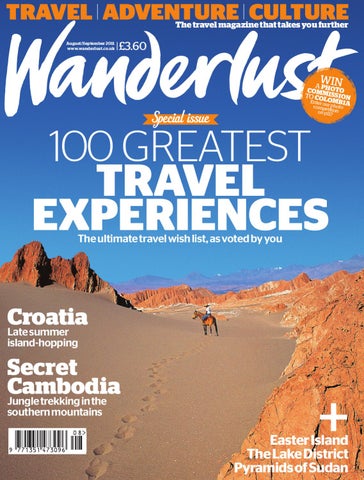
Wanderlust Issue 121 (August/September 2011) 100 GREATEST TRAVEL EXPERIENCES • Cardamom Mountains, Cambodia • Croatia’s islands • Sudan • Sub-Antarctic Islands • Easter Island
TRAVEL I ADVENTURE I CULTURE The travel magazine that takes you further
August/September 2011 www.wanderlust.co.uk
£3.60 WIN
AP COMMHOTO TO CO ISSION Enter oLOMBIA u compe r photo ti on p117tion
Special issue
100 GREATEST TRAVEL EXPERIENCES The ultimate travel wish list, as voted by you
Croatia Late summer island-hopping
Secret Cambodia Jungle trekking in the southern mountains
OFC_Cover_Main.indd 1
+
Easter Island The Lake District Pyramids of Sudan 8/7/11 18:14:57
Contents AUGUST/SEPTEMBER 2011 • ISSUE 121
360°
Navigator
6 | World in pictures From iconic Italian
71 | How to... Stay safe in a crisis – plus advice on avoiding taxi scams and deadly flies 72 | Locals guide to Danish smørrebrød joints 73 | Endangered destinations Seven travel icons that need your attention, now 74 | Health How worried should you be about E coli? Plus news on the latest measles outbreak 76 | Q&A Your queries answered on: flight nerves, safari companies for solo travellers, using last year’s sun cream
chamois to Kenya’s striking tribes and northern India’s organic bridges 14 | Shortcuts The world’s travel news: Cornish tourist tax, Egyptian treasures, Vietnam flights 16 | Go now! Four tempting trips for tomorrow 18 | 10 things to do for free in... Lima! See Peru’s colonial capital on the cheap
20 | Trips to take... to ancient civilisations
Meet moai, excavate Rome and walk China’s Wall
Western Lakes p135
©
81 100 Greatest
Features
Carcassonne p133
©
Travel Experiences revealed…
22 | Obituary: Sir Patrick Leigh Fermor We remember the last great romantic travel writer: a war hero and supreme stylist
24 | Cambodia
Delve into Cambodia’s war-stricken past on a hike through its lush Cardamom Mountains – with an ex-soldier as your guide
40 | Sudan
Rich in history and Saharan sands – but free of tourists: head to this sizzling African nation to see pyramids without the crowds
Colombia p117
52 | Croatia
©
Find the true Adriatic – slow food, sleepy islands, gentle turquoise seas – on an offbeat hop along the glorious Dalmatian coast
62 | Sub-Antarctic Islands
What happens on those outcrops right at the bottom of the map? We meet the creatures that brave the cold
81 | 100 Greatest Travel Experiences
We asked, you answered: here’s the definitive countdown of the best things to do on the planet, as voted by Wanderlust readers. But what will be number one...?
INu! r
Wnter o he Year
©
137 Easter Island
E f T on to to O titi mbian o e h p P om olo re c a C tu w! n win adveo p117 no nt Tur
THE FUTURE Like this map? MAPPING To buy a similar wall map, COMPANY visit www.futuremaps.co.uk 004-005 Contents_sbv3.indd 4
8/7/11 12:52:51
From The Road 35 | Ripping yarn Meet the mountaineer who
climbed the Seven Summits by the age of 22
36 | Letters etc Emails, blogs, photos and
ramblings from YOU from around the world – send in yours to WIN Keen gear!
38 | Experiences Readers share their top travel stories. This issue: a watery encounter with a Nepalese elephant in Royal Chitwan National Park
POCKE T GUID ES The bits
Arrivals
of the guid ebook you really
131 ho chi
minh ciTy
need –
just read , snip and
go…
Pocket Guides
122 | Books Top travel reads, including the tale
of two thrillseekers, a tome of European train adventures and other hot new releases 124 | Guides Five amazing photography apps 125 | Music Meet Dengue Fever: a unique blend of Cambodian pop and psychedelic rock 126 | World diary End the summer on a high with Sri Lankan acrobatics and Egyptian parties 127 | What’s on The best events, talks, TV, DVDs and radio for armchair travellers
131 | Ho Chi Minh City Absorb all that Saigon has to offer using our essential arrival guide
P 131 First 133 carcass P 133 Short24 hours Ho Chi Minh City onne P 135 Great Break Carcasso Soak up nne Unea Saigon P 137 Trave British Escap with new rth medie direct flights l Icon Easte e The West val skulld ern Lake uggery r Islan in south s Go d Stare ern Franc at the statue west for quiete e r lakeland s in the 135 wesTern middle walks of nowh lakes ere
See29 p1
137 easTer
island
133 | Carcassonne Plan a short-break to south-west France’s fairytale medieval city 135 | Western Lakes Get the most out of the lesser-known Lake District 137 | Easter Island How to get there, get around and meet the moai of the far Pacific
131 Ho Chi Minh City
©
33
© ©
24
©
© ©
Croatia
52
Cambodia
40 Sudan Antarctica 62 Sub
004-005 Contents_sbv3.indd 5
8/7/11 12:53:34
008-018_360 degrees_dlv6.indd 10
7/7/11 19:17:13
360 1
I I World in pictures I
INDIA
Living bridges Photographer Amos Chapple “This is one of the living tree-root bridges of India’s north-east. The region is one of the wettest on the planet, receiving around 15m of rain each year. Villagers say the damp air would rot any wooden structures they built so the solution was grown from the roots of the Ficus elastica – a species of fig tree. Young roots are guided across the river in hollowed-out bamboo. When they reach the opposite bank they grip into the soil; supplementary strands are slowly ‘knitted’ into place. Unlike structures of concrete and steel, these bridges actually get stronger over time.” See more images at www.amoschapple.com
008-018_360 degrees_dlv6.indd 11
7/7/11 19:18:24
1 1
1
1
I I I
Cambodia
I Home 1 to the temples of Angkor, Khmer Rouge and an eco-tourism boom 1 I history
I
Fly UK-Bangkok-Phnom Penh; total flight time is around 13 hours plus transfers 1 1
Go Oct-Jan, for cool, dry weather
a taste of cardamom
Cambodia’s Cardamom Mountains were once a stronghold for Khmer Rouge fighters. Now they’re welcoming trekkers in search of quiet trails and wildlife-rich rainforest Words and pictures Nick Boulos
024-031_cambodia_dlv5.indd 24
6/7/11 11:45:28
Cambodia Rainforest picnic A dried-out river bed makes a fine spot for lunch on day 1 of the trek
S
“
eventeen years ago, this was a battlefield. I never thought tourists would come here...” Kan’s solemn words trailed off, leaving images of war and gunfire etched onto the lush hillsides before me. We were sitting on a rocky headland, overlooking flat emerald fields that rose to form gentle peaks in the distance. Peace has now come to south-west Cambodia’s Cardamom Mountains, but the journey has been long and bloody. After the collapse of socialist dictator Pol Pot’s brutal 1970s regime, his followers, the Khmer Rouge, took refuge in these hills. For over a decade they fought bloody skirmishes: many locals were killed, villages destroyed. The last bullet was fired in 1994, but the mountains remained home to pockets of defeated soldiers for another two years, a period that brought rampant logging and poaching. Remarkably though, the Cardamoms have remained a home to many rare animals. Siamese crocodiles lurk in the rivers; elephants and leopards roam the tropical broadleaf forests. Sightings may be rare, but the biodiversity is uplifting. So while the crowds continue to flock to Angkor Wat to the north, tourism is just arriving in this quiet corner of Cambodia. It’s early days, but hopes are high that the Cardamoms could become South-East Asia’s next big trekking destination. I had come to see the potential for myself.
Thailand
Laos
Siem Reap & Angkor Wat
•
Cambodia
Cardamon Mountains
n Phnom Penh
• Chi Phat
Vi
n et
am
South China Sea
Elephants & ex-soldiers After a three-hour drive from the capital, Phnom Penh, and a two-hour jaunt along the Preak Piphot River, I hopped off a motorised fishing boat at the village of Chi Phat. This little community of 500 families is the gateway to the southern Cardamoms, and a real conservation success story. Here, the US-based organisation Wildlife Alliance has been working with locals on a range of eco-tourism projects. Some two million trees have been replanted, and walking trails in previously landmined areas have been carved across the slopes, including Cambodia’s highest peak, Phnom Aural (1,813m). Former soldiers, poachers and loggers are busy mastering English and training as guides and cooks, while many others have opened their homes to tourists, with profits ploughed back into the village. My own hostess for the night, Ming Tha, welcomed me warmly. Her basic but cosy
home was, like every other in the village, raised high off the ground on sturdy wooden stilts. She showed me into her second bedroom, mine for the night ahead of a two-day trek deep into the mountains. From Chi Phat, a network of trails criss-cross the forests and flatlands to reveal sites of significant interest. Our 36km circular route promised a glimpse of rural village life and the region’s ancient heritage. The darkness was still deep as we set off early the next morning. Yawning women in floral pyjamas attended sizzling woks as our small band of walkers, laden with bulging backpacks, passed through the town. Our starting point was 17km downstream, so we embarked on a river journey. Remote villages appeared fleetingly from beyond the swirling grey river mist. A lone fisherman smiled broadly, net in hand, cigarette dangling from his mouth. We soon alighted at a small clearing in the mangroves – time to proceed under our own steam. It was barely 9am yet the sun was already flexing its muscles. Thankfully, the pace was slow, the terrain gentle. Joined by our cook, Mr Crab, and Lok, another guide, Kan led the way. “My life in the army taught me how to be a tour guide,” he said, as we moved through mahogany trees and evergreens. “I learned how to be quiet in the forest to find animals.” Above us was a giant beehive. The call of a gibbon drifted from afar. Evidence of the rich and varied wildlife was everywhere. Our narrowing path became peppered with mini >
‘Former soldiers, poachers and loggers are training as guides and cooks’ 26 | Wanderlust August/September 2011
024-031_cambodia_dlv5.indd 26
6/7/11 11:52:35
Riddles of the sands With its Nile-side pyramids, hieroglyphics and ancient trading routes, northern Sudan is a mesmerising history lesson – without Egypt’s crowds Words & pictures: Lyn Hughes
040_049_sudan_dlv4.indd 41
6/7/11 13:42:52
•
••
a
•
Se
Kerma Pyramids Karima of Meroe Masawwarat es Sufra
d
Arthur Holroyd’s 19th century ‘graffiti’ at Musawwarat
egy pt
Re
S
alam Alaikum. I’d noticed the camelteer approach, and had braced myself for the hard sell. But, like me, he sat quietly in the shade of the pyramid, gazing at the scene below us. Another 40 or so pyramids dotted the sands, in various states of disrepair: the ancient city of Meroe. It was an extraordinary and wonderful view; Sudan’s greatest tourist attraction – yet there wasn’t a visitor, a hawker or a tour bus in sight. My silent companion’s phone beeped as he received a text message. My reverie was broken, and I rejoined my group and our guide, Hatim. Together, we had already travelled 200km from the capital, Khartoum, on the first leg of a tour through northern Sudan. Our convoy of Land Cruisers (the modern-day ships of the
libya
Sudan
n
Khartoum
SUDAN Ethiopia
desert) had spent a long day driving east to Meroe, giving us our first view of the famous pyramids at sunset, rising from the desert like a bad set of molars. Now Hatim led us into a small chapel attached to a pyramid. Sudan’s pyramids are smaller than Egypt’s and of a different construction. Inside there is nothing but rubble; beneath this are the burial chambers, accessed by stairs. A funerary chapel on the east side of each pyramid allowed worshippers to pray and to make offerings. This particular pyramid belonged to a queen. On one side of the chapel there is an image of her alive, and on the other wall, an image of her in the afterlife. In both, she
is depicted with distinctly African features and build; very different from the gods drawn with more familiar Egyptian features. It’s not widely known that Sudan has more pyramids than Egypt. This area of northern Sudan was home to the ancient civilization of Kush, a powerful trading culture with strong links and rivalries with the betterknown pharaohs to the north. For thousands of years, power ebbed and flowed along the Nile between Kush and Egypt, through the region known as Nubia. Countless pyramids remain as legacies of successive kingdoms. There are nearly one hundred here at Meroe alone, the oldest dating back to the 8th century BC, although the area’s heyday was from the 3rd century BC to 3rd century AD. French mineralogist Frédéric Cailliaud brought the pyramids to the attention of the world in 1821, and sparked a graffiti trend by carving his name in the stone. 19th-century politician Arthur Holroyd followed suit (“We’ll see him at every site!” promised Hatim), but the sorry state of the Meroe pyramids is primarily due to an Italian adventurer called Guiseppe Ferlini who visited in 1834. He had a licence to excavate, but was really a treasure-seeker. He decapitated the pyramids in search of bounty and, finding nothing, then dug down into the burial chambers. In Queen Amanishakheto’s >
42 | Wanderlust August/September 2011
040_049_sudan_dlv4.indd 42
6/7/11 13:43:26
dalmatians
With over 1,000 Croatian islands to explore – many featuring tiny guesthouses and new hiking trails – it’s easy to lose the hordes and find the authentic Adriatic Words David Atkinson | Pictures Peter Mallet
Don’t rock the boats The easygoing pace of life at Sutivan harbour – on the island of Brač – has made it a top spot for Split weekenders
Wanderlust August/September 2011 | 53
050-059 Croatia_sbv7.indd 53
6/7/11 16:12:17
CROATIA Footnotes
How to explore Croatia’s southern islands – getting there and getting around once you’re there, plus handy hotel and budget advice Vital Statistics
Capital: Zagreb Population: 4.5 million Language: Croatian; English widely spoken Time: GMT+1 (Mar-Oct GMT+2) International dialling code: +385 Visas: Not required by UK nationals Money: Kuna (HRK), currently around 8.5HRK to the UK£. Euros are widely accepted. ATMs are widely found in larger cities and resorts.
Azure thing The crystal clear waters of the Gradina Peninsula
assi Come o g us innment n Cro with Joi a won Wand atia! e
wee nder rlus to ke fu See nd in D l writin n p128 ubr g for d ovni etai k. ls
When to go Jan Feb Mar Apr May Jun Jul Aug Sept Oct Nov Dec ■ The Croatian coast has a Mediterranean climate, hence spring and autumn are the best time for walking with plenty of sunshine and average temperatures reaching 30˚C. Even in October the sea temperature can be 20˚C. ■ High summer is very busy around the coast with European holiday-makers. It’s too hot for comfortable walking inland. ■ Few visitors in winter. Many villages are dormant as the local families close down cafés and restaurants to head to their winter properties.
Health & safety There are no special health considerations. However, you should take out comprehensive travel and medical insurance before travelling – see www.wanderlustinsurance.co.uk. The Foreign & Commonwealth Office (www.fco.gov.uk) advises travellers not to stray from mountain paths without an experienced guide. If in trouble while out walking, call the emergency number 112. Croatian Mountain Rescue has advice for visitors at www.gss.hr/en/in-case-of-anemergency.htm.
Further reading & information Croatia (Time Out, 2009) Recommended. Walking in Croatia (Cicerone, 2010) The In Your Pocket series has an excellent guide to Brač (plus guides to Split and Dubrovnik); download it free from www.brac.inyourpocket.com. A good selection of Croatian Smand maps is available from The Map Shop (01684 593146, www.themapshop.co.uk). Croatian National Tourist Office 0845 287 2327, www.croatia.hr/en-GB. Also see www. dalmatia.hr for links to Hvar, Brač and Vis, and www.visitdubrovnik.hr for links to the islands of Korčula and Mljet.
Getting there Croatia Airlines (020 8563 0022, www.croatiaairlines.com) flies year-round, up to 12 times a week, from London Heathrow to Zagreb (with connections to Split and Dubrovnik). Return fares start from £149.50; flight time is two hours. For Split, Wizzair (www.wizzair.com) and easyJet (www.easyjet.com) run seasonal flights from London; Jet2.com (www.jet2.com) offers regional connections from Manchester. Expect the flight time to be around two hours 20 minutes. For Dubrovnik, British Airways (0844 493 0787, www.britishairways.com) flies year-round from London Gatwick; easyJet (www.easyjet.com) and Wizzair (www.wizzair.com) have seasonal flights from London, and Jet2.com (www.jet2.com) has regional connections from Belfast, Leeds-Bradford, Edinburgh and Manchester. Flight time is two hours 30 minutes. Alternatively, go by train: travel LondonZagreb, via Munich; the journey takes around 24 hours. Trains from Zagreb to Split (a scenic journey) take around six hours. For planning info, see www.seat61.com.
Getting around The easiest way to explore the southern Croatian islands is by hiring a car in Split or Dubvovik and then ferry-hopping. The key ferry operator is Jadrolinija (www.jadrolinija. hr), which has an English-language website for advance bookings (advisable in high season). Services are reduced from October to May: check timetables in advance. Key services include: Split to Vis town (Vis), two hours 20 minutes, 398HRK (£46); Split to Supetar (Brač), 50 minutes, 186HRK (£22); Sumartin (Brač) to Makarska (mainland), one hour, 186HRK (£22); Orebić (Pelješac Peninsula) to Dominče (Korčula), 20 minutes, 89HRK (£10); Prapratno (Pelješac Peninsula) to Sobra (Mljet), 45 minutes, 180HRK (£21). Prices based on two people plus car, for travel June and October; prices increase July-Sept. When booking, a separate ticket must be bought for the driver and for each passenger in the car. Car hire costs from 360HRK (£42) per day, based on six days, including insurance. Book via Last Minute Rent a Car in Split or Dubrovnik (www.rentacarlastminute.hr). A full tank of petrol will cost you around 500HRK (£58).
60 | Wanderlust August/September 2011
060-061 Croatia_fn_sbv4.indd 60
6/7/11 17:34:47
Splendid isolation Halfway between New Zealand and Antarctica lie a handful of islands, home to massive penguin colonies and feisty sea lions. We dropped in… Words: Adrian Mourby
Watch the birdie Over 170,000 breeding pairs of king penguins have recolonised ‘Macca’ island
Sub-Antarctic Islands
Next stop Antarctica Walkers rest and watch the seals on Enderby island; (right) a young elephant seal fends off the aggressive advances of an elder
64 | Wanderlust August/September 2011
AUSTRALIA NZ
Ta s ma n ia Enderby
•
• •
Campbell
Macquarie
Antarctica We stumbled our way into a Zodiac and headed towards Enderby, the cold spray buffeting our faces and clouding our view. Our expedition leader, Don MacIntyre, had already gone ashore to establish a base away from the aggressive males. As we came to a halt, I could see bulls, females and big-eyed pups covering the beach. Some of the younger bulls had moved to the lush grassland above to cool off. They lay there inert, like large brown rocks. Even on a sunny day Enderby looked bleak and unforgiving. It’s the largest and most northerly of the Auckland Islands, an
archipelago 300 miles south of New Zealand first explored by Maoris in the 13th century and by Europeans in 1806. Like most of New Zealand’s sub-Antarctic territory, Enderby is an eroded volcanic stub, pushed up through the sea between 25 and 10 million years ago. But there’s vegetation on the island now, small forests of southern rata trees, their branches contorted into arthritic poses, as well as tiny pink and white gentians, and ‘megaherbs’ like the pink-flowered Anisotome.
Penguin superhighway Don was on the shore directing everyone up off the beach, away from a route that had been established by rare yellow-eyed penguins. Several of them had appeared on a crest in the dunes and seemed to be taking an interest in us, but Don insisted that we would disorientate them if we crossed their “Penguin Highway”. I’d been reading up about shipwrecks on Enderby (the whole of this region is littered with them, including at least nine around the Auckland Islands). In March 1887 an American barque carrying 24 people ran aground here. Six months later the eight survivors were rescued by an illegal whaler. >
Photos Alamy
A
morning bright and silent. I found we had dropped anchor in the night on the south side of Enderby Island. From our cabin we could make out a landing place known as Sandy Bay. Our ship was a quarter of a mile out but dark objects were visible on the shoreline so I fetched the binoculars: sea lions waddling along the beach. The alpha males are known as ‘beachmaster bulls’. They’re large, the size of brown bears, and can outrun humans. For the last three days we’d been cruising south from New Zealand with the intention of stopping at several of the earth’s most isolated islands, home to seabirds, seals and scientists. The Sub-Antarctic islands of Enderby and Campbell are maintained by New Zealand, while Macquarie is Australian territory. They’re reserved for conservation and scientific work, but landings can be made with prior permission. We were travelling on the Orion, which in the summer runs expedition cruises to the islands from Australia and New Zealand. It also calls in at some of them en route to Antarctica.