IN T HIS ISSUE
The Newsletter for Stewards of Salmonids and their Habitat
DFO & Metro Vancouver 2 Seymour Rockslide Update 3 Elmer Rudloph Profile 4 Streamkeepers Update 4 Welcome Minister Jordan/ Big Bar Landslide Update 5 In Memoriam: Neil Gordon Brookes 5 Becoming A Salmon Person I SEP logo 6 DFO Announcements 7 Eskew Borrow Pit I Salmon Pen Pals 8 Salmon Site-ings 9
VOL 25 > #1 > SPRING 2020
Harnessing passion and the power of partnerships If there’s been one constant theme in each issue of StreamTalk, it’s the importance and power of partnerships and working together. In the Salmonid Enhancement Program’s (SEP) key role in DFO Pacific Region’s work to conserve and manage Pacific salmon stocks, collaboration and partnerships have been part of SEP’s foundation since its formation in 1977. The unique partnerships between the federal, provincial, municipal and First Nation governments, communities, groups and individuals, have helped to rebuild vulnerable salmon stocks and improve fish habitat to sustain salmon through SEP’s focus areas: hatcheries, resource restoration, stewardship and community involvement, the Community Economic Development Program (CEDP) and spawning channels. Such relationships cannot be underestimated; a lot has been accomplished by working together. Being able to harness the passion, expertise and spirit of
collaboration of all those who care about our salmon resources has been particularly valuable when it comes to addressing issues and overcoming challenges. Speaking of challenges, with the COVID-19 pandemic impacting the entire world, Fisheries and Oceans Canada wants to assure Canadians of our commitment to maintaining essential services and delivering on our project requirements while advancing measures to minimize the transmission of COVID-19. While some of SEPs current work has changed in order to meet public health requirements, this edition of
StreamTalk showcases the incredible work of individuals and community and stewardship groups in concert with SEP and other government partners prior to the emergence of the pandemic. Such efforts over time have led to the rehabilitation of water systems and the return of fish, while others will take more time (see Seymour River and Big Bar rockslide updates). Given the interconnectedness of life in the “salmonsphere,” regardless of the scope of the project, or the location, the collective hard work and commitment give us much to be proud of and inspiration and hope for the future. We hope that these good news stories on salmon stewardship bring some positivity and a sense of community during this challenging time. To get through this together, we all must stay apart. Stay safe and stay well. Please visit DFO’s COVID-19 information page for industry and partners. l
DFO and Metro Vancouver—a partnership for the protection and promotion of salmon sustainability In B.C.’s lower mainland area, DFO has had a long history of working closely with Metro Vancouver. A federation of 21 municipalities, one Electoral Area and one Treaty First Nation, Metro Vancouver collaboratively plans for and delivers regional-scale services across 2,600 square kilometres for the 2.5 million residents of the lower mainland. Three Metro Vancouver-managed closed watersheds (Capilano, Seymour and Coquitlam), provide a source of clean, safe drinking water for the region. And with the Lower Seymour Conservation Reserve and 13,614 hectares of regional parks, ecological conservancy areas, park reserves protecting valuable green spaces,
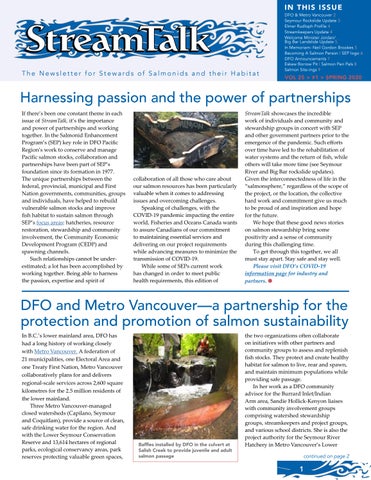
Baffles installed by DFO in the culvert at Salish Creek to provide juvenile and adult salmon passage
the two organizations often collaborate on initiatives with other partners and community groups to assess and replenish fish stocks. They protect and create healthy habitat for salmon to live, rear and spawn, and maintain minimum populations while providing safe passage. In her work as a DFO community advisor for the Burrard Inlet/Indian Arm area, Sandie Hollick-Kenyon liaises with community involvement groups comprising watershed stewardship groups, streamkeepers and project groups, and various school districts. She is also the project authority for the Seymour River Hatchery in Metro Vancouver’s Lower continued on page 2
1
DFO and Metro Vancouver continued from page 1
Seymour Conservation Reserve (LSCR), a DFOsupported project for over 40 years. “Over my 20 years as a community advisor, I’ve been fortunate to work side-by-side with Metro Vancouver staff who share DFO’s commitment to protecting salmon and their habitat,” says Sandie. “Their expertise and support on projects have been invaluable,
particularly in overcoming recent challenges.” (see Seymour River Rockslide update on next page)
Sandie has worked with Metro Vancouver Regional Parks (also in partnership with Vancouver Park Board and other stakeholders) on Spanish Bank Creek—daylighted in 1999, with an off-channel pond created in 2004—and more recent habitat restoration work that took place on another fish-bearing stream in Pacific Spirit Regional Park near the University of British Columbia. l
Pacific Spirit Regional Park Fish Habitat Enhancement Project Metro Vancouver has opportunities to act in partnership with other government agencies, First Nations, park partners and other interest groups to incrementally improve salmon habitat within the region. While Metro Vancouver has some level of legal authority or responsibility for the many streams in the region, it does not have sole jurisdiction, so a partnership-based approach is frequently used. Salish Creek (AKA, Acadia or Hilary’s Creek), is one of the last remaining salmon bearing creeks west of Boundary Road on the Burrard Peninsula. It
Salish Creek before (top) and after
is located in Pacific Spirit Regional Park found within Electoral Area A. As one of the last, seemingly healthy, streams in the area, it is an important legacy relating to the abundant natural fish populations that once occupied the many lost streams of Vancouver. Juvenile trapping in early 2011 confirmed fish in the creek, while a later observation of an adult salmon by a local streamkeeper further confirmed adult fish were able to access the creek. In 2012, the Salish Creek Fish Habitat Enhancement Project was initiated and became part of the Metro Vancouver Ecological Health Action Plan, which includes supporting salmon in the region. The objective of this project was to improve ecological conditions for fish in collaboration with project partners which initially included Metro Vancouver, Musqueam Indian Band, Fisheries and Oceans Canada (DFO), BC Ministry of Transportation and Infrastructure and Spanish Banks Streamkeepers. In 2012, DFO installed a series of baffles in the culvert to improve fish passage conditions for a section of the creek. Planning for the restoration and enhancement of the creek aimed to improve the ecological condition of the stream mainly as overwintering habitat for juvenile salmon and spawning opportunities for adults. This was led by Metro Vancouver Regional Parks (MVRP) with funding provided by the University of British Columbia (UBC), and of course in partnership with Musqueam, DFO. Active engagement with and support of community partner groups including the Wreck Beach Preservation Society, Pacific Spirit Park Society and the Spanish Bank Streamkeepers was also ongoing throughout the project. In 2017, the culvert outflow pool north of NW Marine Drive was deepened, and stream channel characteristics were improved down to the high tide line through the addition of boulders, gravel,
Metro Vancouver Regional Park Hatcheries In addition to the DFO-operated Capilano River Hatchery in Capilano River Regional Park, there are four community-run, public involvement hatcheries situated on Metro Vancouver land: • Terminal Creek Hatchery: Crippen Regional Park (Bowen Island) • Seymour River Hatchery: Lower Seymour Conservation Reserve (North Vancouver) • Tynehead Hatchery: Tynehead Regional Park (Surrey) • Bell-Irving Hatchery: Kanaka Regional Park (Maple Ridge) Hatcheries in park settings play an important role in educating and engaging the public about the importance of salmon to B.C.’s history and local communities, and their role in a balanced ecosystem. Information about hatchery events and programs, including those offered in partnership with local streamkeeper groups, can be found on the hatchery and park websites. Note: information on SEP community involvement hatcheries across the province can be found on the DFO Pacific website.
Education, engagement and events promote ecosystem health Like SEP’s Stream to Sea program, Metro Vancouver Regional Parks offer a range of educational programs and resources for K-12 educators and students, including salmonrelated field trips and activities, as well as free public programs in many of the 22 regional parks. And, several regional parks are prime locations to view spawning salmon in fall. continued on page 3
continued on page 3
2
Metro Vancouver Regional Parks
MRVP Programs
and large woody debris. Riparian areas were also improved through the removal of large tracks of invasive English ivy. Trail improvements such as fencing and re-grading were included to protect the new restoration areas and restocking with native plants and slope bioengineering was completed that fall. Protecting archeological resources was a priority for the project, so a detailed archeological assessment was
Check out Metro Vancouver Regional Parks’ Nature Program Guide, which includes a number of family-friendly salmonthemed events and activities, offered year-round throughout the region. You can also sign up to receive emails relating to MVRP’s nature programs at checkitout@metrovancouver.org and subscribe to MVRP's monthly newsletter highlighting behind-the-scenes stories and Regional Parks news and events. MVRP’s annual Parksfest is a great opportunity for those in the nature education and stewardship community to come together to learn about the efforts of Metro Vancouver Regional Parks and other organizations to protect the diverse natural regional ecosystems, share ideas and explore current issues and common challenges in protecting nature and connecting people to it. The 2019 event featured an afternoon panel session Salmon: Connecting Across Boundaries, exploring the vital role of salmon in local waterways and beyond, with scientists and conservation advocates sharing their latest research. The theme of the next Parksfest will be Climate Change and Parks: Inspiring Hope, Taking Action. Participants will hear from the frontlines about the work being done around climate change within the context of parks and greenspaces.
continued from page 2
continued from page 2
performed, with monitors on site throughout the work. Monitoring of the site by DFO and streamkeepers has shown it is used by juvenile salmonids, and maintenance of the site will be ongoing for several years. With any luck we will find wild salmon returning to the creek to spawn this fall. l
—Robyn Worcester R.P.Bio., etro Vancouver Natural Resource Management M Specialist, Parks and Housing Services, West Area Contractors working on Salish Creek
Video: Restoring a Salmon-bearing Creek in Pacific Spirit Regional Park
Seymour River Rockslide Update
An example of organizations working together, particularly in those situations that can have a long-term impact on fish and their habitat, is the response to the 2014 rockslide on the Seymour River which blocked passage for coho and pink salmon and steelhead trout. The ongoing work to break apart the 50,000-cubic-metre rockslide to restore fish passage to pre-slide levels has been a joint effort of DFO, Seymour Salmonid Society, Tsleil-Waututh and Squamish First Nations, Metro Vancouver, District of North Vancouver, BC Ministry of Forests, Lands and Natural Resource Operations, and other stakeholders. The work started producing results (and excitement)—in late August 2019, volunteers spotted adult coho and steelhead above the rockslide area, having travelled through on their own for the first time since the slide. In early September, the first radio tagged coho was confirmed above the slide. The Seymour Salmonid Society continue their work transporting fish to the hatchery for spawning and for release above the slide to First year of post-slide adult salmon collection on the Seymour River spawn on their own.
Note: In response to the COVID-19 situation, this year’s Parkfest has been postponed. Regional parks programs until the end of May have been postponed or cancelled. As the situation is continuously changing, please check www.metrovancouver. org for the latest information.
3
Elmer Rudolph: A Quiet Salmon Hero “This is not a Saturday afternoon job. The stream needs you.” Wise words from Elmer Rudolph, one of the most dedicated stewardship volunteers I have ever met, and I’ve met many outstanding people over 25 years. He is a passionate man who has not lost any of his desire to help the salmon or his enthusiasm for nature. I asked him what advice he would give to his younger self, and he replied that you should give yourself at least three years to see results; nothing good happens overnight. The work is worth the effort but requires more than an hour or two once a week. We live in a culture now that wants to see instant results. Streamkeeping is a long-term commitment. The difference a small group of volunteers can make is profound, and this is very true of the group which Elmer has been president of for the past 20 years, the Sapperton Fish and Game Club (SFGC). The story of the Brunette River, which was straightened out for the railway, could fill several volumes of a book (including a mention in a 2008 David Suzuki Foundation report—see page 19). I asked Elmer what has changed, and he said the main thing since the group started in 1969 is that people now care. Getting help in Burnaby and New Westminster in 1969 was very difficult. The words environment and ecology were not on the
tips of tongues the way they are today. The group struggled along, and when the DFO created SEP in 1977, the SFGC was among the first groups to join. This was the beginning of the turnaround for the Brunette River which, was sadly seen as a local dumping ground. With the gumboot brigade in full force (as early SEP volunteers were affectionately referred as), the SFGC initially took action on their own, removing garbage and debris from the river. Elmer joined the SFGC in 1984 and spotted the first spawning coho to return to the Brunette after 30 years. The SFGC worked on building fishways along the Brunette system to assist the returning salmon to bypass obstacles and became well known as one of the first to restore a river from being thought of as a “dead” system. Elmer is very proud of this, and he should be. The Brunette has weathered a few spills over the years. The SFGC worked with DFO to identify and reduce sources of pollution along the tributaries to the Brunette River and also campaigned to protect all waterways in the lower mainland. SFGC also pioneered the latest, often experimental, rearing and restoration techniques and technologies. Elmer reflected upon trying Newbury weirs in 1999 to increase the habitat in the Brunette
Joanne Day and Elmer Rudolph
by mitigating the straightening of the system, which had removed natural pools and riffles. Grant McBain from DFO came over from the Sunshine Coast and assisted in the installation, having used Newbury weirs in Manitoba to restore streams previously used for irrigation. The year 2008 was a watershed moment—for the first time in over 50 years, all three historically spawning species of salmon (coho, pink and chum) returned to the Brunette. Thank you, to Elmer, and to all the members of the SFGC, for all you have shared and for making the Brunette River a better place.l
—Joanne Day, Community Involvement and Resource Restoration
Fisheries and Oceans Canada
Stay current and connected Streamkeepers
Update
Check out the Pacific Streamkeepers Federation’s Facebook page to stay up to date on latest news, events, training sessions and surveys, as well as updates on streamkeepers-related policy and regulation developments, and more…it’s your source for everything happening in the streamkeeper world. If you’re missing your streams, you can now take a video walk of a number of B.C. streams.
ZoAnn Morten, Executive Director pskf@direct.ca l www.pskf.ca
4
IN MEMORIAM:
Neil Gordon Brookes
Welcome to the new Minister of Fisheries, “Kupís re Kekasú7” December 10, 1947 – Oceans and the Canadian Coast Guard, November 28, 2019 the Honourable Bernadette Jordan Member of Parliament for South Shore–St. Margarets, Nova Scotia, Minister Jordan brings a wealth of experience and expertise to Fisheries and Oceans Canada. She has served as a Parliamentary Secretary and Minister of Rural Economic Development, as well as Chair of the House of Commons Standing Committee on Fisheries and Oceans. She made a major contribution to the development of the Oceans Protection Plan and has been a strong voice for coastal communities for the removal of abandoned and neglected vessels. Before being elected in 2015, Minister Jordan provided years of valuable service to her community in roles ranging from President of the Atlantic Community Newspaper Association to
Development Officer for the Health Services Foundation of the South Shore, where she raised millions of dollars for health care. Thank you to former Minister Jonathan Wilkinson who is now the Minister of Environment and Climate Change. To learn more about our new Minister, please see her full biography on DFO’s site. You can also read the Minister’s Mandate Letter outlining the policy objectives the Minister will work to accomplish, as well as the pressing challenges to be addressed in the role, including a number of particular interest to B.C. l
Next phase of Big Bar Landslide response underway In January, Minister Jordan visited the Big Bar Landslide site to see first hand the ongoing work to address the landslide discovered in June 2019. An estimated 75,000 cubic metres of rock was deposited into the Fraser River north of Lillooet, blocking passage for salmon migrating upstream. Thanks to the collaborative emergency response of the three levels of government (Federal, Provincial and First Nations), combined with the efforts and support of other agencies, stakeholder groups, and technical experts, thousands of salmon were able to migrate past the landslide site by end of September 2019. In December, DFO awarded the contract to engineering firm Peter Kiewit Sons ULC to undertake remediation work at the landslide site, including breaking up and removing rocks to improve passage for salmon and steelhead stocks during the migration season. Steady progress has been made since work began in January, despite challenging winter weather conditions. The remediation work is expected to be completed by the spring freshet, currently anticipated to take place in mid-to-late March 2020. The Minister also announced two technical working groups of experts from governments, stakeholders, non-profit organizations, and academia, that will help inform comprehensive contingency and remediation plans for alternate fish passage methods and conservation-based enhancement.
Minister Jordan touring slide site and meeting with the Fraser Salmon Management Council
“We know how integral these salmon stocks are to our ecosystem and to the communities up and down the Fraser River. We’re moving swiftly with the next phase of our response, in collaboration with First Nations, the Province of BC, and industry partners, and are hopeful this will lead to a lasting solution for safe fish passage. With the establishment of two new technical working groups, it’s all hands on deck, as we continue working together to protect and restore the health of wild Pacific salmon stocks,” said Minister Jordan.l
DFO landslide response website and information bulletins
Province of BC landslide incident webpage
Like so many, it saddened me to hear of the passing of Neil Brookes, who, in 1979, was one of the founding members of the Kingfisher Interpretive Centre (KCIS) in Enderby. Those of us who were fortunate enough to have him in our lives during his 40 years as a salmon advocate, educator (30+ years as an education coordinator with DFO), and environmental steward know what a true inspiration he was. Neil had a gentle spirit and an infectious passion for his work, sharing his extensive knowledge on nature, Indigenous culture and stewardship with everyone he met—from students, teachers and parents through the Stream to Sea program, to tourists who visited the Interpretive Centre. At times, Neil faced adversity. After the Mabel Lake mudslide damaged KCIS in 2014, he persevered, picked up the pieces, and made it work. We shared many good times at Education Coordinator “camp” meetings. I always knew when I picked up the phone and heard his booming voice, “Jo…anne!” that my day would get a bit brighter after that. How fitting it was that two days before he passed, he was delivering eyed Chinook eggs to classroom aquariums. And, that in 2001, the Splatsin First Nation gave him the name Kupís re Kekasú7— “Caretaker of the Chinook Salmon.” Here he is in a Global News piece from May 2019, educating and sharing the Stream to Sea message. Thank you, Neil, Kupís re Kekasú7, for everything. We’ll miss you. —Joanne Day You can read more about Neil in his obituary and on Kingfisher Centre's Facebook page.
5
Becoming a salmon person
Photo: Shannon Rivest, DFO
Kelly Aitken is on the go. She is one of DFO’s dynamic staff, and her life experiences reflect a lot of what the “salmonsphere” and International Year of the Salmon activities mean to British Columbians. I first met Kelly as a Stream to Sea education coordinator, a role she held for ten years while she also worked at the Quinsam Hatchery in Campbell River–one of DFO’s major facilities in the area—for 14 years. “I really believe that salmon brought me to this role,” says Kelly, “and it allowed my family to move all over the coast.” Kelly truly fell in love with salmon while delivering Stream to Sea lesson plans. She had a passion for the program, and her supervisor at the time mentioned how she would “catch the excitement” when Kelly was working. When asked about salmon now or the role of salmon in British Columbia, her mind goes right back to her time as a Stream to Sea Education Coordinator.
Kelly releasing a seal pup into the waters of Haida Gwaii, Sept. 2019.
Caring for salmon took her into further DFO training and life as a fishery officer. After working as a hatchery tech in Kitimat, in 2012, she moved her family to Port Hardy, and there were more adventures as a fishery officer. Four years in Masset followed (check out this news Kelly with her son Hunter (in white suit) conducting a necropsy on a coverage about Kelly’s work grey whale that washed up on North Beach near Masset rescuing seal pups) where she learned more about the history friends behind when you move, but the of Haida Gwaii and the importance of the link of salmon is an excellent starting point salmon to the Indigenous nations of British to make new friends and get involved in Columbia, before returning to Campbell local community projects. River in late 2019. Kelly is leading by example, and she is Kelly’s love for salmon and their link always open to new ideas and new ways to everything in the ecosystem has also of seeing things. Salmon have shaped and influenced her youngest son, Hunter, changed her life, and in turn, she has given who wants to be out by the ocean and is back, and her family have benefitted from Kelly’s resident “beach geek.” Hunter living on the coast. even assisted with a grey whale necropsy Who knew that the young girl who this summer near Masset and took part in grew up on the banks of Stony Brook in a 4-day Adventure in Oceans workshop Newfoundland would find her future supported by the Campbell River Rotary with the salmon after an early experience Club, for kids interested in oceans careers. swimming with wild Atlantic salmon Her children would help take salmon near Grand Falls. She recalled snorkeling eggs during spawning time and would be as dozens of salmon swam around her. present when Kelly did salmon dissection “We were all one animal, if only for a few biology workshops for students. Kelly feels moments.” She never imagined that would that the Stream to Sea programming has be the start of her journey to becoming a a positive influence on youth; to not only salmon person one day. l gain knowledge but also understanding of —Joanne Day, their role on this planet and the effect they can have, by taking positive actions. Moving around the province has meant meeting many people and making friends. It is also a challenge to leave those new
Community Involvement and Resource Restoration
Fisheries and Oceans Canada
The story of the SEP Salmon You may have seen the Salmonid Enhancement Program (SEP) logo at fish hatcheries throughout the province, but you may not know the story behind its creation. The design of a spawning salmon was created by renowned Indigenous artist MIYANXA (Art Sterritt) in 1978 specifically to express the determined and forward-thinking attitudes of SEP. The Gitxsan artist’s vision of salmon, a coastal peoples’ symbol of regeneration and the cycle of life, is meant to embody all anadromous fish, with the eggs of different
sizes representing all species of salmon. It also has many male salmon characteristics: the slight hump on the back, the hook of the nose and the teeth. The human head releasing the eggs symbolizes the purpose of B.C.’s hatcheries – to enhance Pacific salmon stocks “by people, for people.” Miyanxa was born in Kisgegas, in Northwestern B.C. on the banks of the Skeena River, and trained as a carver and printmaker at ‘Ksan, a historical village, museum and art school. His traditional pieces, created over five decades, can
40
th
be found in many galleries and private collections across North America. His carved totems are on display in several Canadian museums and the lobby of the Vancouver Convention Centre. He has also been involved in several First Nations organizations and negotiations that led to the creation of new conservancies and biodiversity areas within two million hectares of protected land in the Great Bear Rainforest. l
6
DFO Announcements
More Coastal Restoration Fund Projects announced
As part of the third and final call for proposals under the Coastal Restoration Fund, on March 10, more than $13 million in funding was announced for 24 additional projects—eight in B.C.— to help restore and protect aquatic ecosystems on Canada’s three coasts. Since 2017, the $75 million Coastal Restoration Fund has provided or approved funding for 64 partnered programs, (a total of 14 in B.C.) and supported marine mammal response efforts. Indigenous organizations lead over 37 percent of the projects, and almost all projects involve Indigenous Peoples in their design and implementation. Funding is provided under the Oceans Protection Plan, a five-year, $1.5 billion investment in protecting Canada’s coasts and waterways, launched in November 2016.
State of Salmon Aquaculture Technologies study now available
Undertaken in partnership with the Government of British Columbia and Sustainable Development Technology Canada, (SDTC), the State of Salmon Aquaculture Technologies study analyzed four emerging technologies by looking at how they’re being used globally and how they could be adopted in B.C. The study will support implementation of DFO’s commitment to develop a plan to transition from open-net salmon farming in coastal B.C. waters by 2025. SDTC is a foundation created by the Government of Canada to support Canadian companies with the potential to become world leaders in their efforts to develop and demonstrate new environmental technologies that address climate change, clean air, clean water and clean soil.
European Green Crab Early Detection and Monitoring Network Sightings Map The Spring 2019 edition of StreamTalk featured an article about how DFO’s
Aquatic Invasive Species (AIS) program and a network of dedicated citizen scientists have been monitoring the presence of European Green Crab (EGC) in B.C. As part of the AIS program/AIS Management Action Plan, Pacific Region has partnered with the Pacific Salmon Foundation (PSF) to provide an up-to-date map of confirmed sightings of European Green Crabs. This initiative is through The Strait of Georgia Data Centre (SGDC), a collaborative program between the PSF and the University of British Columbia’s (UBC) Institute for the Oceans and Fisheries. PSF and DFO will also work together to develop signage and brochures for distribution this field season. If you would like these materials, please contact Patty Menning, DFO Aquatic Invasive Species Biologist at: AISPACIFIC@dfo-mpo.gc.ca And remember, if you suspect you have found a green crab, take photos but leave the crab where you found it. Email photos and detailed location information to the same email address. Here's a video on what you need to know.
Projects Near Water Webpage
Proponents with development projects taking place in or near water are responsible for understanding the impacts their projects will likely have on fish and fish habitat and taking measures to avoid and mitigate. DFO’s Projects Near Water webpage includes information and services relating to the Fish and Fish Habitat Protection Program and the regulatory process to ensure compliance with protection provisions under the Fisheries Act and the Species at Risk Act. The site outlines the project review process and steps for proponents to follow to help decide if the project requires a review of the proposed works and the undertakings and activities that may impact fish and fish habitat. If DFO determines the project will cause the death of fish and/or harmful alteration, disruption or destruction of fish habitat,
proponents will need to apply for authorization. For projects that don’t impact fish and fish habitat but will likely result in harm, harassment or capture of an aquatic species at risk, (fish, shellfish, crustaceans and marine animals and plants) the project must apply for a Species At Risk (SARA) permit. ICYMI—More ways to ORR DFO Pacific Region’s Conservation and Protection branch is now taking reports of suspicious fishing activity and suspected violations via email. Email reports, including photos and other digital evidence, will go directly to fishery officers via the Observe, Record, Report (ORR) system. As well as the new email: DFO.ORR-ONS.MPO@dfo-mpo.gc.ca, DFO will continue taking reports from the public on the ORR 24-hour toll free line at: 1-800-465-4336 and in the lower mainland at 604-607-4186. ORR is an important enforcement tool in DFO’s work to end illegal activity and contravention of Fisheries Act regulations.
SEP’s new tagging trailer
This past March, the SEP purchased an automated fish tagging trailer. The trailer uses advanced technology to clip adipose fins and inject coded wire tags into juvenile salmonids, making it possible to identify tagged fish when caught in fisheries or stock assessment studies. By purchasing the trailer, the SEP is meeting Canada’s commitments to the coast-wide coded wire tag (CWT) assessment program for Chinook salmon under the renewed Pacific Salmon Treaty (PST). The trailer will be deployed to various hatcheries across British Columbia, the first being Robertson Creek Hatchery in Port Alberni. More information on DFO’s coded wire tag program can be found here.
7
Exstew Borrow Pit—from humanmade hazard to healthy habitat As of August 2019, the fish trap hazard on the Exstew River—created in the early 1970s by the digging for a bridge construction project—has been remediated. Long overdue, but good news for salmon making their way from where the Skeena River meets the Exstew River west of Terrace. Troy Peters from the Northwest Branch of the BC Steelhead Society (BCSS) discovered the problem in 2015. The gravel pit stretched about 70 metres across and was approximately 300 metres long, and at least a metre and a half deep. High river levels during the spring snowmelt usually created a stream that flowed directly into
Salvaged coho
Salmon Pen Pals Students in Haida Gwaii and Quesnel are sharing stories and swapping experiences as they learn about salmon in the classroom. Haida Gwaii Community Advisor Erin Harris shares how “many aspects of the Stream to Sea education program are the same, yet the students are separated by geography and landscape.” After an education coordinator meeting, Erin decided that it might be a great idea to try a pen pal program. Amanda Vibert of the Baker Creek Enhancement Society in Quesnel was also keen to give the concept a try, and the two connected classrooms in each region. Three times a year, three classrooms in Amanda’s area send photos and info about their field trips and fishy artwork to three classes in Skidegate, Haida Gwaii, a community of 780 people, where students have a strong connection
the pit. Juvenile salmonids swimming downstream looking for rearing areas, or on their way out to the ocean, would find their way into calmer water in the pit. Once the river level crested and dropped, they would become stranded. This became a problem as summer sunshine gradually dewatered the pit, so no fish could survive. In some years, the pit would flood in both spring and fall, doubling the mortality. In partnership with DFO, volunteers from the BCSS have been busy over the past four summers, salvaging thousands of stranded coho—ranging from newly emerged fry to out-migrating smolts— cutthroat, and steelhead using minnow traps baited with roe. Salvaged fish were transported by bucket to the river, where they gradually acclimatized to the cooler water before being released. In 2016, DFO dug several water quality test pits using Special Purpose Account funding (fine money) from DFO's Conservation and Protection Program. A year of water testing by BCSS volunteers determined that subsurface water in the pit was not suitable for salmon rearing, and infilling was the best corrective measure and brought this issue to the attention of the Ministry of Transportation as well as the Kitsumkalum First Nation
Looking South West at infilled borrow pit
and McElhanney Engineering. Through a collaborative process, the borrow pit was filled and regraded with about 1,000 truckloads of gravel. The next step is tree planting, scheduled to proceed this year with the Ministry of Transportation’s help. The overall budget for the project is close to $200,000. Community Involvement volunteers recognize the importance of each precious salmon, and that if too many fish are trapped and die early along the way, it could have tragic consequences for salmon. About five percent of coho smolts survive to adulthood, so every fish needs to be given the best chance. The Exstew Borrow Pit is just one example of how working together can increase those chances. l
—Rob Dams, FO Ecosystem Management Branch, D Northern Interior and North Coast
with salmon, the ocean and nature. The students in Erin’s area share their November dissection workshops, spawner surveys, salmon life cycle and habitat studies. Teachers lead classroom discussions on themes such as how human activities affect salmon and the differences and similarities in habitat and food sources where the students live. Each class is learning from the other and connecting Grade 2-3 class at Sk’aadGaa Naay Elementary School enjoying a salmon dissection
through their shared experiences of salmon to facilitate a better understanding of the needs of salmon. Erin observed, “It is interesting for the students to learn how different the habitat is in each area and how the salmon must adapt to thrive.” l
8
Publication: Journal of Ocean Technology (JOT)
The Journal of Ocean Technology (JOT) is a scientific periodical published by the Fisheries and Marine Institute of Memorial University of Newfoundland featuring world-leading research that contributes to responsible ocean utilization and management.
Website: North American Association for Environmental Education (NAAEE)
The NAAEE provides an online platform for environmental education professional development and resources to accelerate environmental literacy and civic engagement to create a more sustainable future.
Blog Post: AI’s Killer (Whale) App
Story behind the partnership between DFO’s Marine Mammal Response Program and Google’s AI for Social Good program and Rainforest Connection to apply artificial intelligence (AI) to protect killer whales in the Salish Sea. A whale detection algorithm was developed to track, monitor and observe the orcas’ behavior and a machine learning model was taught to recognize orca sounds. Read more in this Business in Vancouver article.
Website: Watermark Project
An initiative of Swim Drink Fish, the Watermark Project is a community effort to collect and archive stories about the ways people interact with water to help Canadians understand our dependence on water and water’s influence on our culture. Contributors can name their favourite body of water and submit a story describing how it influenced their life.
Study: Changing estuaries and impacts on juvenile salmon
A Simon Fraser University-led research team has published the results of a study that found significant evidence that human activity in estuaries is impacting juvenile Pacific and Atlantic salmon, based on the review of 167 peer-reviewed studies that identified negative impacts from several stressors, including the effects of flood-protecting tidal gates, pollution and habitat modification.
Website: Global Fishing Watch map
Committed to advancing ocean sustainability and stewardship through increasing transparency, Global Fishing Watch has developed a map to track commercial fishing vessels at sea in near real-time. Registered users can track fishing activity, analyze historical data and upload their own datasets to help support new science and research, boosting the global dialogue on ocean transparency.
To receive StreamTalk by e-mail, please contact Joanne Day at Joanne.Day@dfo-mpo.gc.ca with the subject line “StreamTalk by e-mail.”
StreamTalk
is published collaboratively by Fisheries and Oceans Canada and stewardship, enhancement, education and streamkeeper groups in B.C. and Yukon that care for salmon and their habitat. You will find past issues of StreamTalk here. The current issue can be viewed here. For more information or to submit an article, please contact: Joanne Day Community Involvement and Resource Restoration, Fisheries and Oceans Canada Phone: 604-666-6614 Fax: 604-666-0417 E-mail: Joanne.Day@dfo-mpo.gc.ca Website: www.streamtosea.ca www.pac.dfo Opinions expressed in StreamTalk are those of the authors, and do not necessarily represent those of Fisheries and Oceans Canada or of other organizations that contribute to the newsletter.
Web Portal: Ocean Legacy Foundation (OLF)
OLF is a global B.C.-based non-profit organization with the goal to end ocean plastic waste. Check out their ‘hotspots’ map, add your organization’s clean-up activities to a directory or find out how communities and organizations can apply to their EPIC (Education|Policy|Infrastructure|Cleanup) Plastic Pollution Emergency Response Program which targets ecologically sensitive geographical locations and communities that have a plastic pollution crisis.
FOLLOW US ON TWITTER: @DFO_Pacific @MPO_Pacifique
VISIT DFO ON YOUTUBE
9