fortnightly student magazine
THE WAKE
volume 18 — issue 8
Tan France at Coffman Memorial Union
p. 8
Q&A : Heart to Gold
p. 16
“Pippin”
p. 9
Complaining College Students
p. 21
Lube, Butt Plugs, and Bondage, Oh My!
p. 11
While We Wait
p. 23
1
2
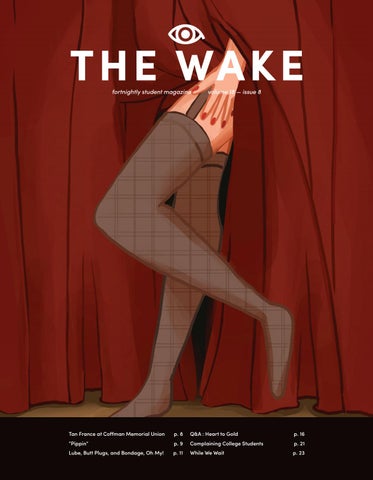
Art by Jennifer Moss
MAR 25 - APR 8
VOLUME 18, ISSUE 9 EDITORIAL: Editor-in-Chief
Tala Alfoqaha
Managing Editor
Chris Shea
Cities Editor
Olivia Hultgren
Voices Editor
Esther Chan
Music Editor
Megan Hoff
Online editor
Callum Leemkuil-Schuerman
Copy editors
MaiLei Meyers Hannah Haakenson
Multimedia Editor
Sebastian Alfonzo
Multimedia Producer
Daniel Elder
Editorial Interns: Hannah Olund, Sylvia Rani, Jimmy Cooper, Emma Chekroun, Kathryn Merta, Abbi Kiesau, Autumn Sanders, Kelsey Bolander, Tosin Faseemo
PRODUCTION: Executive Director
Jamie Rohlfing
Creative Director
Megan Smith
Finance Manager
Ella Hennen
PR/Ad Manager
Sophie Stephens
Social Media Manager
Macie Rasmussen
Art Director
Morgan Wittmers-Graves
Designers
Nicole Faouen Annie Judd Semira Mesfin
Web Manager
Shay Jerabek
Distribution Manager
Cassie Varrige
Production Interns: Jennifer Ta, Claire Redell, Madison Amland Art Interns: Selena Philaphandeth, Emily Jablonski, Bri De Danaan
THIS ISSUE: Writers
Cassie Verrage, Jay Dooley, Maya Ulrich, Sylvia Rani, Joe Kelly, Emma Checkroun, Tosin Faseemo, Allison Colsch, Marley Richmond, Sammy Divito, Ian Karp, ©2018 The Wake Student Magazine. All Rights Reserved.
Megan Hoff, Callum Leemkuil-Schuerman, Madison Amland, Evan Ferstl Art
Established in 2002, The Wake is a fortnightly independent magazine and registered student organization produced by and for students at the University of Minnesota.
1 Joe Price 2 Morgan Wittmers-Graves 3 Emily Jablonski 4 Bri De Danann
The Wake was founded by Chrin Ruen & James DeLong.
Q&A photos courtesy of Heart of Gold
Disclaimer: The purpose of The Wake is to provide a forum in which students can voice their opinions. Opinions expressed in the magazine are not representative of the publication or university as a whole. To join the conversation email talfoqaha@wakemag.org.
The Wake Student Magazine 126 Coffman Memorial Union 300 Washington Avenue SE Minneapolis, MN 55455
Dare, While We Wait, Let’s Try the After, Young the Giant, and Helium art from original sources. Cover and Feature art by Selena Philaphandeth **Correction: Last issue, we published “Pipeline Country” in our creative writing section as written by Lily Foley. We’d like to correct this and credit Lauren Foley for writing the poem.
3
wink! one page magazine
WAKE AWARDS (Better than the Oscars)
BEST MOVIE TO PASS THE BECHDEL TEST Black Panther
MOST NARRATIVELY ENGAGING VINE Jared, 19. Can’t Read.
SADDEST ANIMAL MOVIE Stuart Little
WORST MOVIE TO WATCH WITH YOUR GRANDMA Magic Mike
MOST DELICIOUS LOOKING ANIMATED FOOD Ratatouille
BEST PBS SHOW Cyberchase 4
MAR 4 - 25
INSIDE 6 7 11 16 18
Letter from the Distributor Trivia Night LUBE, BUTT PLUGS, AND BONDAGE, OH MY! Q&A : Heart to Gold Prioritizing Mental Health
20
Farewell to Fair-Weather Friends
23
Ella Mai at Varsity Theater
UPCOMING EVENTS 3/26
3/31
Dessa Live Concert Recording
Mercury Mosaics Vintage Market
Minnesota Orchestra
1620 Central Ave NE
3/28
4/5
How to Survive the End of the World A
Yam Haus and Early Eyes
Join the Women’s Center at the University of Minnesota for a live edition of How to Survive the End of the World, a podcast from the Brown sisters on learning from the apocalypse with grace, rigor and curiosity
C
w/ Last Import Fine Line Music Cafe
Coffman Memorial Union
3/30 Pleasure Activism with adrienne mare brown
B A
First Universalist Church
3/30 Weezer / Pixies Xcel Energy Center B
3/30 The Wizard of Oz (1939 Digital) Parkway Theater
C
THE WAKE
5
Letter from the Distributor Hello readers! I’m writing this letter fully ensnared in the midterm doldrums. The inundation of both icy sleet and lengthy midterm assignments makes me want to curl up in bed and not go outside until the snow has melted. ‘Tis the season for working too much and sleeping too little. Is anyone else counting down the days until spring break finally arrives? As I look around at my friends’ dark under eye circles, I realize that this season is universally exhausting. It’s not just me! As a university, we take pride in our colorful and jam-packed Google Calendars, and measure our days in the amount of work we can get done. We’re like ducks- everything’s calm on the surface, but paddling frantically under the water. Everyone on campus deserves a nap, and probably needs one sooner rather than later. Full disclosure- I’m terrible about taking time for myself. I often need someone to tell me to slow down and take a breath. So let this be an invitation to rest. Dear reader, I urge you to try to Unclench your jaw, relax your shoulders, and let the tension of your daily life melt away. If you meditate, do that! If Netflixing for an afternoon in cozy socks is more your speed, watch away. Lean into the concept of hygge and make a blanket fort, or curl up with a good book. Take a break (perhaps with this copy of The Wake) and check in with yourself. This time of year is stressful, but with self-care, we can survive it. While it may not seem like it right now, we’re hurtling towards the end of the semester. I hope this issue of The Wake Magazine can serve as an amusing, thought-provoking, and comforting diversion from midterm season. Happy reading! Cassie Varrige Distribution Manager
6
MAR 25 - APR 8
CITIES
2
Trivia Night Why do people enjoy trivia? BY JAY DOOLEY You’re sitting in a dimly-lit room, listening to the low murmur of conversation from your friends and the people around you. It’s late in the day, after classes and jobs have drained you of your energy. And yet, you’re still here. It’s become a sort of ritual for you. The laughing and chatter die down as the hosts announce the rules you’ve heard a dozen times before: no phones or other electronics, make sure teams are no bigger than eight, mark answers clearly. Your friends try to think of a clever team name as the first few questions are called out. One by one, a question comes up that makes someone at the table light up, whispering the answer furiously to the rest of the group. Sometimes they’ll rack their brain instead, insisting they know the answer. It’s on the tip of their tongue, but it never comes out. You admit defeat for a moment before the next question throws you all into a frenzy, muttering conflicting answers until one side begrudgingly concedes, making it clear that the other side better be right about this. This is serious business. This is trivia night. Although many see it as a leisure activity, the spirit of competition is at the core of trivia’s enjoyment. Christopher Shea, a student at the University of Minnesota, goes to trivia at New Bohemia in Northeast Minneapolis on Thursday nights with his friends under the team name “The Polite Girls.” They created this name in spiteful response to their fictitious rivalry with “The Rude Boys,” another team
THE WAKE
they set out to beat every week. “We found a group that consistently does well every time,” says Shea, “And we’re just like ‘We hate them.’ We’re going to be their rivals.” This lighthearted competition can infuse a much-needed stress reliever into people’s lives, especially for college students. Whether the prize is movie tickets, free drinks, or a soft pretzel as big as your head, everyone’s competing in a heated battle of wits if they’re looking for it and a low-stakes destressor if they need it. The competitive spirit of trivia doesn’t entirely explain its appeal, though. Jupiter Adams-Phipps, a frequenter of trivia at Coffman Memorial Union on Thursday nights, admits he is not very good at trivia. “I’m bad at pretty much all of the trivia,” AdamsPhipps says with a laugh. “But there’s usually one question that comes up that I know the answer to that no one else does. And then I know that ONE answer.” It’s an inherently satisfying feeling to know something that others don’t, whether your precise knowledge of the topic shines through every round or you guess a single question on a whim. And it feels even better to share that knowledge, impress your friends, and use it to help move your team closer to victory.
people won’t get tired of it easily. Rachel Rubenfeld, another Coffman Trivia Night attendee, has been going with Adams-Phipps and a few of her other friends since freshman year. “We’ve been going for four years, and it hasn’t gotten old,” Rubenfeld says. “At least for our friend group, it has worked nicely.” “That’s part of the trivia thing,” Adams-Phipps added. “That it’s consistent. It’s going to happen every week, and chances are if three people are going to go, eight people are going to go.” Polar vortex or not, trivia has become part of many students lives—and with good reason. These students will continue to brave the cold Minnesota night for the opportunity to learn, grow, and compete with their friends for a long time to come.
At the end of the day, trivia is a pastime that consistently provides a new experience. As long as the questions are new and the topics are different,
7
Huldufólk
CITIES
A “hidden people” art show BY SYLVIA RANI
4
Tan France at Coffman Memorial Union “Queer Eye” is truly about more than just a makeover BY MAYA ULRICH When Tan France walked into the Great Hall of Coffman, with his perfectly coiffed salt and pepper hair, he claimed the spotlight that was given to him. Stepping out of the screen of Netflix’s original series, “Queer Eye,” France looked like the renowned fashion expert that he is on the show. As soon as he sat down in the plushy, mustard yellow chair, he set the tone for how the night was going to go. Immediately, he claimed that the Dasani water bottle given to him was a scam—they have done studies in England that have found that it is actually just regular tap water—and he would not endorse such a thing; he ripped off the label and threw it away, eliciting uproarious laughter from the audience. His next endeavor in charming the college students in front of him was attempting a Minnesotan accent. As he did so, his normally posh British voice became nasally as he stressed the “a” and “r” in car. After really connecting with the audience through his good-natured humor, classy demeanor, and extremely bubbly persona, the moderator started asking France questions that engaged with the intersections of his sexuality, ethnicity, growing up in a South Asian household, and representation in extremely white spaces—especially that of Hollywood. He handled each question with more vulnerability and honesty than was expected of a celebrity figure in a random collegiate space. In this vulnerable state, in a somewhat heartbreaking moment, he stated that he often feels like people in America might think prejudiced things, but they do not say them, compared to in Britain, where they will shout racially charged things at him while he is walking down the street. He said that this has made him feel more at home here than in his home country.
8
At 5’9,” he seems extremely petite compared to his self-proclaimed “white giants” (and Karamo). However, his confidence, personality, and drive to be the representation he never saw in the media has made him a huge force of inspiration in many people’s lives, proving that France’s role in “Queer Eye” is truly about more than just a makeover.
Deep in the rocky Icelandic terrain lie the elusive huldufólk, patiently waiting to bestow gifts of misfortune upon unsuspecting travelers. Shrouded in darkness, they extract revenge on those who dare to disturb their dwellings. Mrakmur is an art label and studio that organizes events where local artists can gather and share their work. Most recently, they hosted an art show devoted to the “huldufólk,” or creatures of the North. More than 50 artists displayed their mysterious, folkloric art at the Artspace Jackson flats. “Huldufólk” means “hidden people” in Icelandic and Faroese, referring to the elves and mystical creatures of folklore. Dark, macabre, and fantastical creations filled the Minneapolis apartment-turned-gallery. Bronze gremlins leered at attendees while Geek Girl Tarot performed readings. Glistening sirens swam through beaded canvases as art goths enjoyed Gastrotruck’s sustainable midwestern cuisine. Studio Payne was there, displaying a variety of morbid yet tasteful items. Described as a store where “arts and oddities meet,” some of the pieces for sale included a taxidermied duck, a baby bat skeleton, and a mouse head preserved in formaldehyde. “I started out the hobby by collecting, and then it became a way to fund my collecting, and then it got out of hand pretty quickly,” said Cameren Torgerud, the shop’s owner. Many of the creatures he displays are roadkill. His collection also includes a hand which was donated to him by the University of Minnesota’s medical research lab. “Everything I make is one of a kind,” he said. Artspace Jackson Flats is an affordable housing project for the Northeast Minneapolis artist community. The project aims to foster artist-led community development through providing spaces where artists can be in close proximity to other creative people. Their next gallery opening will be for the Light Spa on Friday, March 30. 3
MAR 25 - APR 8
CITIES
1
“Pippin” is Something Every College Student Should See A strong director and cast bring the musical to Rarig BY JOE KELLY If there was one thing that dazzled in the University of Minnesota theater department’s production of “Pippin,” it was the dynamic choreography. Pair this along with colorful set pieces and costumes, a vocally strong cast, and you have yourself a great musical production. However, for those who have never seen “Pippin,” the story is a confusing one. Scenes and characters appear out of the blue, leaving behind cause-and-effect storytelling and making it difficult to discern the story’s direction. The musical is inspired by the middle-age story of Charlemagne and his son Pippin, whose history is more speculative than factual. A very lengthy first act showcases the main character’s experiences in finding himself. Interpretive song and dance numbers portray war, drugs, family conflict, and love, while a circus-like entourage follows Pippin around each scene. The narrator, a.k.a. the lead player of the circus group, takes the spotlight whenever Pippin’s life progresses. In the second act, the story finally takes shape. Aiming messages directly at the audience, it fills in parts of the plot that were lackluster in the first act while less emphasis is placed on the spectacle of song and dance. The lead player and the circus entourage are really all inside Pippin’s head, and they encourage anyone to leave their current place in life to pursue the exciting and unknown. However, they lure one to try more and more dangerous things, and at one point in the show, they beckon the audience to join them. They symbolize the drive and insatiable hunger that individuals may have to find something more in their life.
THE WAKE
Source material criticism aside, the show brought in director and choreographer, Joe Chvala, who is well-renowned for his percussive dance group, the Flying Foot Forum, and for directing shows at the Guthrie, Park Square, and Chicago Shakespeare Theater. Chvala’s work paid off in this production of “Pippin” as the cast enveloped the stage with complex dancing and movement that was almost overwhelming at times. Pippin’s lead role had no better fit than Bradley Johnson. In a show that draws connections between college students and a courageous hero, Johnson has the perfect look: slim, young, and innocent. His vocals were nothing short of impressive and blended with the cast perfectly in popular numbers like “Morning Glow” and “Love Song.” Another highlight of the show was Natalie Shaw, who plays Pippin’s eventual lover, Catherine. Although Shaw’s character is supposed to be a widow, she brought refreshing child-like moments and amusing flirtations while breaking the fourth wall. Shaw’s performance was what arguably drove the second act.
Speaking of set pieces, “Pippin” had its fair share of unique parts. A red curtain and lights added to the circus theme, while banners and thrones were brought in for scenes between Pippin and his father and king, Charlemagne. A hula hoop and swing brought actors into the air, bringing one actor to a nerve-racking 10–15 feet above the stage. One of the most impressive pieces was a miniature enclosure that opened in three directions to reveal a bedroom, yet it could be easily rolled off stage. Despite the confusing source material, “Pippin” was enjoyable and fun, while showcasing a story that is relatable to every college student by addressing the dangers of abandoning loved ones to follow abstract dreams. It’s ending argument may be controversial, but the U of M’s production made me fully embrace it. Making the audience support your message is something that not every production can do.
The rest of Pippin’s cast handled the show’s tricky and immense choreography and stage placement fairly well. One main actor struggled to hit the right notes on some vocally challenging songs but was a strong personality and character nonetheless. Songs with the whole cast proved to be immersive with harmonies that never seemed out of place. “Morning Glow,” which ended the first act, exemplified the cast’s unity and was definitely their strongest song. One number, “No Time at All,” incorporated crowd participation by having cast members hold set pieces with lyrics to the chorus, so that anyone could sing along.
9
ART
10
Grow Art by Emily Jablonski
MAR 25 - APR 8
FEATURE
Lube,
Butt Plugs,
and Bondage,
OH MY!
Just another day at your friendly neighborhood sex shop BY EMMA CHEKROUN
THE WAKE
11
FEATURE
Having a part time job in college isn’t uncommon. Some students wait tables, others have jobs through their university, and some, like Haydin Wellens, a junior at the University of Minnesota, work as a cashier at a sex shop. Similar to other students, Wellens goes through his week’s worth of classes before working eight to nine hours on the weekend. Wellens fights exhaustion and tries to keep up with homework while working his late night shifts. The highlight? Much better party stories. Wellens revels in the opportunity to talk about his job. “People will be talking about their jobs, and I usually start out with I work at a sex shop and…” pause for reaction. What usually comes next is smiles and stares of anticipation. That anticipation lingers. There is something exhilarating in talking about and going to sex shops. Staring wide eyed at all the toys and tools that decorate the walls is enough to make anyone feel eager and anxious. While customers may only dedicate a few hours to browsing a sex shop, for those maintaining these glimmering palaces of self-love, it’s a lifestyle.
NOT JUST A JOB Vincent Valcroft, assistant manager at Bondesque near Uptown, said he loves building people up through his work at the BDSM and fetish wear specialty shop. “I get to contribute to something that helps people,” he adds, “to bring greater wellness, meaning, and pleasure into their lives and relationships.” Wellens, cashier at Lickety Split, and Cat Charles, website manager at Smitten Kitten, both said the best part of their jobs was answering questions and giving customers a safe space to ask them. Charles said it’s “delightful and fun” to have sex as the subject manner of work. They enjoy making sex a normal and comfortable topic for shoppers. Education also takes an important role in working at a sex shop. At Smitten Kitten, every employee is trained in the store’s sex ed curriculum. The shop also holds periodic free sex workshops, such as “Anal 101.”
Bondesque also holds workshops centered around BDSM, which Valcroft hopes contributes to a “holistic kink experience” in the store. Meanwhile, Wellens takes on an informal education outside of work, utilizing the internet to be better informed. “I love figuring out how the different toys and interests work,” Wellens said. “Doing research into products on my own time doesn’t really feel like work.” Education is a major way these sex shops pay it forward to the community. A shop’s attitude also has a big impact on its workers and the community. Wellens described how his manager created a position for him when he applied to Lickety Split back in June of 2018 and how that contributed to the family-like workplace he enjoys so much. Valcroft went as far to say at Bondesque it’s “not a sale, it’s a celebration” and described the fun and explorative setting he strives to achieve at the store. When the community you and your store are a part of branches off into a spectrum of gender identities, orientation, and age groups, it’s important to “celebrate people,” Valcroft said.
12
MAR 25 - APR 8
FEATURE
FUNNY MOMENTS Even a community saturated with pleasure and support has its occasional negatives. From drunken shoppers to more dangerous exchanges, it’s not always easy being the purveyors of pleasure. Wellens has had his fair share of run-ins that range from hilarious to horrifying. One particularly frightening story involves a knife and customer named Jelly; “we learned he was called Jelly after the fact,” Wellens clarifies. Jelly became irate, yelling slurs at Wellens’ coworker. Wellens went on to say, “He got super frustrated and pulled out a knife.” He adds, “It was more funny after the fact,” although that seems hard to believe. Wellens’ stories only get wackier from there. At one point, a man came in waving around a sizeable chunk of marijuana for no apparent reason. Drunk frat guys have played leapfrog, Wellens added. “One time a guy bought a cock ring,” Wellens continues, “and tried to put it on in the store.” This patron wasn’t drunk or high—just “very excited,” Wellens clarified.
For Valcroft, there hasn’t really been one defining hard part of his job, except maybe when “the gimp gets loose,” he explained, only half kidding while a devilish smile spread across his face.
But all laughs aside, the world of sex shops, is just that: a world.
THE WAKE
THERE’S A WHOLE WORLD OUT THERE Even sex shop workers encounter kinks they’re not familiar with. A resounding response from all three sex workers, no matter the kink, is that sex shops are a judgment-free zone. Don’t be afraid to have questions, just leave the nitty gritty personal experience out, according to Wellens.
Your kink isn’t that weird, Charles assures. They also encouraged beginners to be open to new experiences and not be discouraged if something doesn’t work out for you.
Valcroft described BDSM and fetish as a “journey,” which the other sex workers agreed with—it’s a journey to find what you like.
Lots of communities are included, so there is a good chance you can find what you are looking for. Smitten Kitten specifically identifies as “queercentered.” Every shop mentioned here has some form of gender expression or cross dressing inventory, gender expression involving toys, and other items for persons in the transgender community to express their identity. This can include strap-ons or realistic artificial penises. A tour of Bondesque illuminates several kinks that fall under the radar of popular culture,
such as sex toys for electrosex, which involves electrostimulation, and is surprisingly safe. There are also tools/toys for medical fetishes and latex fetishes.
And yes, for those interested in feet, Lickety Split sells silicone feet, according to Wellens.
Aside from kinks, a few new things discovered this week through interviews, an anal workshop, and a sex shop tour: silicone lube is not good for silicone sex toys, fetish parties are like raves mixed with fashion mixed with latex, and there is something out there for practically everyone. Most importantly, sex shop workers make a rewarding career not only out of selling toys but also out of making comfortable environments for sexual deviants and newbies alike.
13
ART
14
Final Melody Art by El Meaux
MAR 25 - APR 8
THE WAKE
Final Zephyr Art by El Meaux
15
Q&A
1
Heart to Gold BY TOSIN FASEEMO AND ALLISON COLSCH
Heart to Gold is a punk rock band that has been jamming together for years. Grant Whiteoak plays guitar and vocals, Sidian Johnson plays bass, and Blake Kuether is on the drums. Following numerous demos published on Bandcamp, their debut album, “Comp,” was released in 2018. Since then, they have been playing shows around the country. Read about the inspiration behind the band name and their plans for the future.
: How did you all meet? H: I met Sid through my friend Tom. After that, I met Blake since Tom, Sid, and Blake all went to the same high school so they were relatively connected. : How or why did you guys decide to form a band? H: Blake was in his own band before Sid and I even had the idea of a band, and it stemmed from me and Sid just hanging in mutual circles. Sid told me that he was playing bass and guitar, and I had already been playing guitar for however long. We were really into old-school style punk rock like the Ramones, and we liked the catchy style. It was something easy for us to play and relate to… so while we were messing around we wrote two songs and started jamming together, bass and guitar, I guess out of boredom.
the time, we were really into smoking pot. One night, we were at home with no parents around, lighting up. Later, we were about to go to sleep, and there was this crazy noise that we started hearing. It turns out it was my friend’s mom and her significant other at the time. We all just knew that they were belligerent and super drunk, and my friend opened the door and yelled at his mom and her boyfriend to get them to stop, and when they came in, they were upset at us because the house smelled like weed. The guy was yelling at us, trying to teach us a lesson about being men or something, and it all got very funny for us. I mean, we were high school kids, and this guy was a piece of shit. He got angrier and angrier as we laughed, and when he lunged at us, we threw him back against a dresser. This got him started on another rant, and he just started pointing at his heart, shouting, “Heart to gold! Heart to gold!” Basically, after that, things died down, and I thought that “heart to gold” sounded like a super cool band name.
: What is the story behind your band name?
16
H: Are you ready? This is a very long, long story. So I was in high school with my friends, and at
MAR 25 - APR 8
Q&A
: How did you guys start performing? Like, did you guys start at house parties? H: Well, Sid and I were going to school in Red Wing for guitar building and repair, and we never played shows while we were there in college. Things kind of shifted a little bit, and Sid actually stopped going to school there, but I continued my last year there. We technically played our first show in a weird recreation center. After that, we played a few house shows, and we started playing bars. So we definitely got our recognition by doing that stuff. : What is your dream venue for a live show? H: I want to sell out a show at Madison Square Garden. Sid and Blake say First Avenue. : Who are your musical inspirations? H: Green Day, Fall Out Boy, Nirvana, Rush all come to mind. : What’s the meaning behind your album titled “Comp”? H: We wanted to kind of appeal to everybody who wanted to interpret it in whatever way they wanted to interpret it. Some of the songs on the album “Comp” stem back to when I had written songs… in Red Wing. Once we started putting things together and compiling it, we wanted to make it a self-title, but at the same time, some of those songs weren’t all of us. It was more of a compilation of songs throughout a period of time, so that’s why we went with “Comp.” But we also liked the idea that people could think it was a lot of different things like “computer” or “complicated.”
Dad. We’re just a little more aggressive when it comes to the punk rock aspect. The only reason we got in the show was because I am friends with the band HUNNY, and they invited us to come open for them. Usually, when we play, things are a little more rambunctious, but there, it was more head nods and stares. But it was still great, and it was fun. : At shows, do you usually have people moshing? Is that a reaction you get since other bands might get other reactions? H: It’s all about what you display as a band and what gets you going. I started going to local bands because I love to put my head up, not knowing anyone, and jump into the crowd. That feeling you can get from being with people who will not drop you and are willing to uplift you makes you feel like you are truly participating in the show. And if anyone feels that way when they come and see us, that is all that I can ask for. So it makes it a lot easier for us if the crowd is as into it as we are. : Who would be your ideal artist to collaborate with on a song? H: I want to collab with someone that would bring us to the next tier, someone like Billie Eilish or Hayley Williams. Someone totally outside of our realm. We have a list, Pharrell Williams, Green Day, Fall Out Boy, Rage Against the Machine. : What’s your songwriting process like? H: Very weird, I guess. I come up with riffs all the time, and then I just add foundations for chord progressions, basically. I used to write full songs usually and then have the others put their flavor in it. More recently, it’s been more pieces that we’ll put together and work on until we feel it’s long
enough to be a song, and the lyrics come usually right before the song’s recorded. Sometimes it’s a lengthy process, and things don’t feel complete until the last minute, but that’s just how it rolls sometimes. : How do you combat writer’s block? H: You know, I don’t really deal with writer’s block because I don’t necessarily sit down to write a song. I just like to play my guitar, and if I’m inspired or influenced by something that I’ve been listening to recently, I’ll just improv some stuff while I’m hanging out. Sometimes, I’ll try to set up a song so that it has a certain sound, and I’ll keep that in mind so that I will pick words that associate with that sound or feeling. But I don’t really get upset or worried with writer’s block because the words will come eventually. : Which of your songs is your favorite to perform? H: Sid says “Tony Hawk’s Nephew.” It’s a really fun song to play. Blake’s favorite is “Acne.” I think my favorite song to play right now is “Smo’.” It just makes me feel good because when people are singing along, they’re singing along for a reason. They relate to the lyrical content, and that’s a feelgood moment. : What are your plans for the future? H: We’re going to be out and about all over the country for a while in the summer. It’s going to be fun. We might update our gear a little bit, and hopefully we’ll be making more music. Just roll with the dice and get our music on the radio. Hopefully, we’ll get taken more seriously by the local Minnesota scene, but also by the music scene of the world. Just like other music makes us feel great, we want our music to make people feel great.
: What was it like opening for HUNNY and Hockey Dad at Seventh Street Entry? H: If I’m being frank, it was very cold. It was hard to get the crowd warmed up because we are definitely a lot different than Honey and Hockey
THE WAKE
17
VOICES
3
Prioritizing Mental Health Finding practical ways to take care of yourself. BY TOSIN FASEEMO At the start of my first semester at the University of Minnesota, I was told over and over how important it was to prioritize mental health. My Welcome Week leaders emphasized the value of consistent “mental health days” and “personal self-care.” After many repetitions of these reminders, their well-intentioned advice began to sound like the nagging words of an overbearing parent. I could not understand why they were so insistent on informing us about mental health resources. I figured if I had made it through four years of high school with no issues, four years of college would be a breeze. I came to realize how wrong my assumptions were during my first month of classes. It turned out that college was not the same as high school; it was significantly more difficult. The freedom of college life made it seem like I had more time in the day to sleep and do homework, but I lacked the time management skills required to get things done. As a result, I was constantly scrambling to finish assignments and remained chronically sleep deprived. My support system made up of friends, parents, and teachers was gone, and I didn’t know how to cope. It was in this moment that I recognized I needed help. Prioritizing mental health comes with many challenges. For me, the most significant step was being able to identify a problem. I spent high school
18
juggling my academic, extracurricular, and social responsibilities very well. When I came to college and found that it was no longer easy to balance my various tasks, it was hard to accept. Recognizing that things are not going well is the first step to solving the problem. This is easier said than done, and can require hours or days of meaningful selfreflection. However, the resulting clarity is extremely valuable when moving forward. Another important step is to take charge of your personal well-being. Self-reflection is only valuable when accompanied by action. This doesn’t necessarily mean making drastic lifestyle changes that restructure every aspect of your behavior. Big changes are more difficult to incorporate into daily life, whereas small changes are easier to accomplish. The goal is to take small steps to avoid falling into old patterns and habits that negatively affect your mental state. A personal example of this is based on my sleep habits. I find it very difficult to fall asleep when I am excited or distracted by something. To combat this, I turn my notifications off when I get into bed. This tiny change has helped me get at least an extra thirty minutes of sleep per night, making me more awake and refreshed each morning. It can be very beneficial, though difficult, to sacrifice
other aspects of life in favor of maintaining mental health. Life as a college student is extremely hectic, and it can be easy to say yes to too many tasks throughout the week. There is no shame in turning down an offer to hang out with friends if you feel your academic or professional obligations deserve more attention. Conversely, engaging in social activities can be a great way to relax at the end of a difficult week. The important thing to keep in mind is balance. Finding that balance can undoubtedly be a tedious task, but taking a few steps in the right direction can prevent you from becoming overwhelmed and help reduce stress levels. The stigma around mental health can create the false perception that those who struggle are weak or lazy. This is simply untrue. Everyone struggles at some point, and asking for help is not a sign of weakness or incompetence. If anything, it requires more strength to recognize your problems and seek solutions to fix them. Most importantly, keep things in perspective. Mental stability is extremely valuable, arguably essential, in our intense, fast-paced world. Setting aside time to take care of yourself and recognize personal struggles is not only vital to thriving in college but also a step towards a happier and more balanced day-to-day life.
MAR 25 - APR 8
VOICES
Enjoying the Little Things How to stay positive when it feels like everything is falling apart.
4
BY MARLEY RICHMOND Sometimes it seems like everything that could go wrong, does, and that the world is a dumpster fire of negativity and hardships. Sometimes this feeling comes from the media where calamity has become a commodity in the never-ending cycle of bad news. Sometimes, it comes from the people around us. Sometimes, it comes from inside our own brains. Chemical imbalances, current stressors, or feeling overwhelmed by the surrounding world can all affect our outlook on life, making it difficult to see the good in all that is going on. There is, however, so much positivity in the world waiting to be discovered and recognized. Here’s how to find it: Seek out the Good When days are long, cold, and full of head-hurting amounts of school work, it can be easy to feel down and then to (often unconsciously) seek out further negativity to fit one’s mood. Challenge yourself to fight that instinct and find a more optimistic outlook. Listen to your favorite song, look up wholesome memes, text your friend a picture of a cute dog, or, better yet, go for a walk where you will likely see some pups! Self-care can mean a wide variety of things. Learn what works best for you and what you need in order to cultivate a positive environment. Don’t be afraid to take a break from school or work and give yourself a little love on stressful days. If current events bring you down, search for good news! Media often highlights hardships and conflict, but there is hopeful and bright news out there too, even if it isn’t trending. One example is the Good News Network which highlights inspirational and positive stories. Let Go and Say No In other words, “Marie Kondo” your life; allow yourself to move on from commitments and relationships which do not spark joy. This isn’t to say that you should avoid all challenges or only hang out with your most laid-back friends. However, it is important to recognize responsibilities that drain you significantly more than they positively impact your life. Allow yourself to say no to added pressures when you have enough (let’s be real, too much) on your plate; this will allow you to spend more time and energy on your passions. In addition, learning to support your friends while you take care of yourself is a difficult
THE WAKE
but important balance to find. As they say, put on your own life vest before helping others; you can’t save someone else while you’re drowning. Make a Difference Brightening others’ days can be an easy way to share good vibes and receive some positivity in return. One simple way to do this is through compliments or sharing what you like about those around you. Sometimes, it can be beneficial to ask a friend what positives they see in order to broaden your own perspective. Try asking your friends about what made them smile today or what was the highlight of their week. This can spark a hopeful conversation about the things you both enjoyed and can help you reflect on your own experiences, finding a silver lining while reveling in the joy of others. Volunteering can be another way to make a positive impact by giving back to your community. Offering a helping hand can boost self-esteem and make you feel hopeful and valuable. The University’s Center for Community-Engaged Learning can provide information and connections to a cause you value . Even if you lack the time to volunteer regularly, finding time to help others can be as easy as asking how you can help out. Ask for Help In the end, however, finding and creating joy in everyday life isn’t always easy. Mental health concerns can make it difficult or impossible to just “look at the bright side.” If this feels like the case, professional help can be an important step towards finding happiness. Here at the U, Student Counseling Services and Boynton Health are accessible resources for students who need additional support. Remember that asking for help makes you brave, not weak and that no matter what, the good and the positive can always be found even in the midst of the most difficult times.
19
VOICES
Farewell to the Fair-Weather Friend An examination of all the terrible people in our lives and how to cut them out. 2
BY SAMMI DIVITO Our lives are a collection of the people we meet and the moments we share with them. We forge relationships and hold fast, seeking comfort and companionship from the people around us. The world is often a chaotic, confusing place, and the shelter of a good friend is sought out as one traipses through the turmoil of their dayto-day life. This might explain why it’s so easy for individuals to let terrible people into their lives, allowing this toxic person’s (sometimes unintended) malice tear them apart. These people are aptly named “fair-weather friends” — friends who are only nice when it’s convenient for them. They disappear in times of difficulty and can be cruel when completely unwarranted. Yet, no matter what they’ve said or done in the past, when things go awry in their own lives, they’ll come crawling back, begging for a shoulder to cry on.
own rose-colored glasses, remembering only the good parts and hoping that their now unhealthy friendship will eventually return to its former glory.
Most people have had to deal with at least one of these unfortunate friends in their lifetime. It can be difficult, however, to differentiate the good from the bad — or in this case, the real friends from the fair-weather ones. There are tell-tale signs of a toxic friend: they allow others to constantly reach out and make plans without any reciprocation; they dish out criticism but can’t take any; they lack empathy, and they make others feel small and unimportant. While these may seem like glaringly obvious indicators, it can be easy to overlook or dismiss such behaviors. We stay in bad friendships for many of the same reasons we stay in bad relationships. At one point, that friendship was close to perfect. People blind themselves with their
A bad friend can cause the body to display stressrelated symptoms such as high blood pressure, lowered immunity, depression, lack of self-esteem, and anxiety. In fact, BBC News reported about an Australian study that was conducted over the course of ten years that found that people who were in comfortable, solid friend groups were 22% more likely to live longer. So, at the end of the day, to escape the afflictions of unhealthy friendships, it’s just a matter of finding the strength to tear off that Band-Aid and give your toxic friend the finger. Every person deserves to feel appreciated in their friendships, and they need to give themselves the opportunity to grow. There are thousands of people in the world who are more willing and
20
But it won’t. The depressing truth is that there are unpleasant people out there who simply make crappy friends, and this becomes increasingly difficult to recognize the longer you know someone. Imagine having a best friend since grade school, growing up together, going to college together, and suddenly realizing this person you’ve trusted forever makes you feel insecure and unloved. After countless years of putting trust into this person, they suddenly seem to be straying further and further away from the confidante you once knew. Despite this, that fear of change and conflict is enough to make a person ignore the pitfalls in their friendship.
capable of giving you the love that your fairweather friend never did. The question though, is after finding yourself plagued by a fair-weather friend, what do you do? It would be best to talk to them first; explain how they make you feel and why it’s unfair. Give them a chance to hear your story and try to fix things, but if they don’t change their behavior, which is not uncommon, begin the breakup process. Don’t blame the friend (they often have their own issues) but commence to detoxify your life and move on for the better. Create distance. These people do not have to necessarily disappear completely, but some space needs to be established. Begin focusing on the lighter people in your life — people who lift you up rather than drag you down. Recognize that you are deserving of only kindness. And give yourself time, because, despite the difficulty of losing a friend, one day, you’ll find yourself confidently saying a final farewell to that fair-weather friend.
MAR 25 - APR 8
VOICES
The Never-Ending Saga of Complaining Students We should really be acknowledging our educational privilege while we’re at it.
2
BY ALLISON COLSCH With midterms upon us, the low rumble of groaning protests from students can be heard all across campus. As students suffer through the dreaded papers and exams, the complaints aimed at professors, the university, and the very notion of academia are frequently spewed. However, in these times of high stress and heavy workloads, we often forget the privilege we all possess from being able to receive an education. We can all think of numerous interactions we have had that center around complaining about our classes. Personally, I have started greeting my friends by stating that it is bold of my professors to assume that I should do work while in college. My roommate usually responds with a long, drawn-out groan that ends with profanity. Many of my friendships with classmates have been forged by our mutual annoyance at being asked to complete assignments. In general, we rarely need prompting to voice our displeasure with schoolwork. As a collective, students bond over universal disgruntlement with academics, and the complaining serves as a relatively harmless way to cope with the stress we all face. That coping mechanism does not excuse us from acknowledging our privilege, though. Every student here, despite our widespread diversity, has been given the opportunity to pursue a degree in higher education—a luxury that many others in the nation and around the world cannot enjoy. In several countries, women are not allowed to pursue an education of any kind or the education of men
THE WAKE
is prioritized over that of women. This gender inequality can also apply to people who identify as transgender or gender non-conforming. Though less common than gender-based discrimination, some nations also directly limit access to education based on ethnicity, according to Human Rights Watch. With these various biases, over half of a given nation’s population can be restricted from getting an education, and we are fortunate to avoid such legal restrictions in the United States. In addition to the issue of gender inequality, one of the biggest barriers to education in the world is poverty. To be blunt, education requires some form of massive funding, and for many nations, their money is better spent on resources needed for survival. Numerous impoverished nations lack the basic facilities and supplies needed to properly educate people, and due to the necessary prioritization of other areas, there is rarely a feasible way for the nations to incorporate educational funding into their budgets. A lack of funding for education is also a problem on an individual level. Even countries that do have many wonderful educational institutions deal with the issue of poverty, albeit on an arguably smaller scale. We can see this in the United States where the cost of tuition continues to rise steadily. Despite the U.S. being one of the wealthiest countries in the world, countless Americans are unable to pursue a college education due to low wages and high tuition prices. Although there are opportunities for aid and scholarships to help offset some of the cost for lower income families, they still fail a larger number of individuals. In the end, a college education is
commonly too great of a financial burden to be considered All of this is to say that we, as college students, should be extremely grateful for the opportunity that we have been given. I am not saying that we immediately cease all complaining and grumbling because, to be honest, I am not sure if I am physically or mentally capable of being positive all the time. I am merely suggesting that we each take some time to be appreciative of the privilege we have been granted. This could simply be taking a moment every now and then to recognize that while college can be difficult and stressful, we are still gaining valuable knowledge and experiences that millions can only dream of receiving. By acknowledging the privilege of education, the college experience seems a little less painful and a little more like a blessing. And who knows, maybe we will start limiting our complaints after all.
21
SIX REVIEWS
Young the Giant keeps crowd warm Let’s Try The After at Palace Theatre Broken Social Scene Helium Homeshake BY IAN KARP Montreal-based indie pop project HOMESHAKE released their fourth album in February. “Helium” is an itinerant excursion through Peter Sagar’s lonely musings of camp aesthetic recordings. Sagar sends ricochets of muffled harmonies into an amiable breeze as he describes wandering through conflicting emotions. But as much as the lyrics emphasize an indecisive longing for the comfort and solitude of elsewhere, “Helium” showcases a sanguine composure and resonance in Sagar’s music. Some listeners may find the spacious percussion and lo-fi nonchalance of the album a blasé rendition of choice tracks found in HOMESHAKE’s catalogue. The airiness of “Anything at All” elicits a sense of déjà vu for 2017’s “Wrapping Up,” while the progression of “Another Thing” seems a resigned revamp of 2015’s “Move This Body.” The dribbling of guitar and refrained crescendos of voice are indeed reminiscent of his previous work, while the drawn out euphony of tracks like “All Night Long” and “Other Than” feel like the culmination of seven years of Sagar’s at-home experimentation. This is not to say that Peter Sagar hasn’t refined HOMESHAKE since its conception in 2012, nor that the project has lost its ingenuity. Rather, “Helium” demonstrates the honed peculiarity of Sagar’s sound, fully embracing the idiosyncrasy embodied in his musical approach. The melodic stumbling and rhythmic hesitations on “Helium” should be a welcome addition to any lo-fi, synth-pop fan’s library.
22
Young the Giant BY MEGAN HOFF Even though the temperature dipped below zero, fans packed the Palace Theatre on Feb. 24 to see indie rock darlings Young the Giant. The opener, Sure Sure, had the crowd warmed up quickly with their stage presence and smooth 80s sound. Young the Giant kicked off their high-energy performance with “Oblivion” from their latest album, “Mirror Master.” Lead singer Sameer Gadhia looked dashing in a colorful button-down shirt and high-waisted pants. The band played a solid mix of songs from their discography, with a slightly heavier focus on their new release and their 2016 “Home of the Strange” album. “Titus Was Born” had everyone chanting, “rainwater, rainwater,” while a smattering of old favorites like “Cough Syrup” and “Apartment” brought nostalgia to the performance. At one point, Gadhia tried to moonwalk and fell down so hard that he broke the band’s synth setup. He grooved on the ground, finished the song, and exited the stage. When he returned for the encore, he triumphantly stated, “I’m gonna have a scar.” He lifted up his shirt and flashed the crowd: sure enough, there was a huge red mark on his back. However, that didn’t stop Gadhia from finishing strong.The encore was a spiritual experience. “Tightrope” was an electrical mix of blue and purple lights and snazzy beats, which lent a clublike vibe to the venue. The set concluded with “My Body,” and Sure Sure joined the band onstage, belting out the words with the crowd. After such an enthralling show, fans eagerly await Young the Giant’s return.
BY CALLUM LEEMKUIL-SCHUERMAN Toronto’s sad indie band Broken Social Scene’s new EP only has 5 tracks, so here, briefly, is the most striking feature of each. “Let’s Try The After” begins with squawking seagulls, the sound of the surf, and a few ghostly voices. While the gulls suggest the beach, the song doesn’t have summer’s warmth— it’s colder, perhaps more like spring or winter. These sounds, the track title, and the oceanic collage of the album cover all come together. This is a beach album. When the second track shifts gears into the shimmery, ethereal chorus, some 808s are audible. This makes it one of the few tracks that sounds distinguishable from something released in the mid-2000s. Electronic influences aside, this is a typical Broken Social Scene guitar-and-drums instrumental jam. On the third track, the vocal stylings of bandleader Kevin Drew, who sounds as melancholy as ever, finally appear. Broken Social Scene has always been the premiere band for sad indie kids to dance to, and this track proves they can still successfully defend their title. Prior to minute two, “1972” is mundane and typical, but when the horns kick in the track is lifted to new heights. The jazzy, mournful horns form a perfect counterpoint to the steady drumbeat that drives the song. Unfortunately, the EP sputters out by the end. “All I Want” plods along without building on itself. The chorus is dour and uninspired. It’s a bum note to end on for a very solid EP, but end it must.
MAR 25 - APR 8
SIX REVIEWS
While We Wait 2
Ella Mai at Varsity Theater Ella Mai BY MADISON AMLAND With just an EP, Ella Mai was last seen in Minneapolis as the opener for the 2018 University of Minnesota Spring Jam concert. Now in 2019, she has a new album and is headlining her very first tour. The British R&B singer gave her sold-out crowd a night to remember at the Varsity Theater on Feb. 28. With a full 15 song set, Mai flooded the packed room with her refreshing voice, bubbly smile, and fluorescent yellow tracksuit. Her catchy lyrics about romance, heartbreak, and self-confidence provided the audience with something to relate to. About halfway through, Mai performed “Boo’d Up”—the song that “changed her life.” The 24-year-old artist gratefully said to her crowd, “It’s pretty crazy… I went to the Grammys two weeks ago, and I won one.” Mai won the award for Best R&B Song and was nominated for Song of the Year, along with some of music’s biggest names, including Kendrick Lamar, SZA, Drake, and Lady Gaga. Mai showed off her range of talent by performing a mix of her slower, dreamy ballads like “Naked” and her groovier tracks like “Sauce” and “Whatchamacallit.” The crowd knew every word, acting as her back-up vocals all night long. Ending the concert with her chart-rising hit “Trip,” an energetic R&B track, she left the crowd wanting more. Ella Mai, the Grammy winner with the girlnext-door vibe, is undoubtedly a rising star to keep your eyes on.
THE WAKE
Kehlani BY TOSIN FASEEMO Since the 2017 release of her “SweetSexySavage” album, R&B musician Kehlani has kept busy by featuring on songs for other artists, releasing singles, and dropping hints of an upcoming album on social media. She is also expecting a child. Despite this hectic schedule, she released “While We Wait,” a cleverly titled mixtape to hold her fans over until her next album release. The result is a refreshing reminder of Kehlani’s dedication to her craft. The mixtape begins with “Footsteps,” featuring Musiq Soulchild. His vocals provide a nostalgic tone to the song, reminding listeners of the soulful tunes of the early 2000s. Next is “Too Deep,” which details a casual relationship that becomes serious too quickly. Beginning with “I argue with my side thing/Way more than my main thing,” Kehlani makes it clear that this emotionally draining affair is not something she expected or desired. Her assertive tone continues in the next couple of songs. On “Nunya,” she demands her ex-lovers respect her right to privacy and leave her alone; then she expresses an expectation of genuine commitment from her partner on “Morning Glory.” The next half of the mixtape reverts to a more current sound. “Feels” balances Kehlani’s honest tone with cool, contemporary production. Features from Ty Dolla $ign and 6lack on “Nights Like This” and “RPG” also contribute to this modern vibe. Kehlani’s “While We Wait” mixtape proves the artist’s adaptability, as she combines early and recent R&B influences to create a project that is equal parts classic and inventive. Fans can be certain that her next album will not disappoint.
Dare The Human League BY EVAN FERSTL After the other two founding members of The Human League left the band, Phil Oakey moved forward with lineup changes and a new musical style, culminating in 1981’s “Dare.” This album became the height of the band’s commercial success, loaded with singles and featuring the vocal talents of newly recruited singers Susan Ann Sulley and Joanne Catherall. Through the synthesizers and Oakey’s detached, robotic vocals that dominate the album, “Dare” helped launch the popularity of synth-pop, a genre that would define the decade. The album begins with its best song, “The Things That Dreams Are Made Of,” which works primarily because of its haunting, perfect synthesizer lines despite obtuse lyrics (“Everybody needs two or three friends”). This characteristic repeats throughout the entire album, as the band demonstrates prowess in crafting memorable synth hooks but fails to back them up with much substance. The choruses on “Do or Die” and “I Am the Law” come off as especially inane, comprised of meaningless cliches and surface-level commentary. The album closes with the smash hit “Don’t You Want Me,” which still enjoys frequent radio play today but is the only song on the album where a major part is given to one of the female vocalists. “Dare” is not a bad album by any means. In fact, it’s the closest to a quality release that The Human League ever had in their career. However, it should be remembered primarily for its musical influence and not because the songs themselves have much to say.
23
Interested in writing for the Wake? Come to our remaining pitch meetings to contribute to the mag. Anyone can join!
8PM, Fowell Hall, Room 4
24
MAR 25 - APR 8