A PUBLICATION FROM MONMOUTH MEDICAL CENTER, SOUTHERN CAMPUS
HEALTHY AGING NOVEMBER 2015
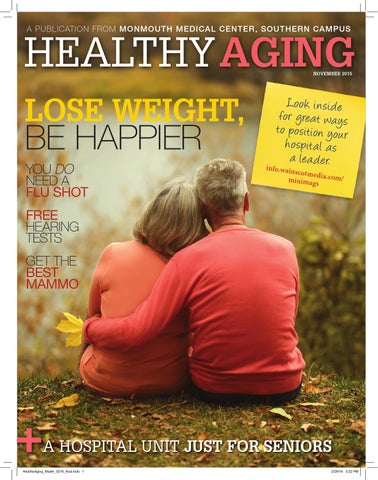
LOSE WEIGHT,
BE HAPPIER YOU DO NEED A FLU SHOT
L k i n s id e f r g re at wa y s t s it i n y u r h s p it a l a s a le a d e r. i n fo .wainsco t medi minimag a.com/ s
FREE HEARING TESTS GET THE BEST MAMMO
A HOSPITAL UNIT JUST FOR SENIORS HealthyAging_Mailer_0216_final.indd 1
2/29/16 3:22 PM
WELCOME LETTER More than 10 years ago I met a woman in her mid-80s on an inpatient unit at Monmouth Medical Center. I had been taking care of her husband, a gentle family patriarch with advanced Alzheimer’s disease. He was close to the end of his life; we could both see that. She told me she wanted to bring him home for whatever time he had left. He was wa three times w her size and unable able to stand st or get ge out of bed g on his is own. own wn. I couldn’t imagine how ho ow this tiny, almo bird-like woman would be able most ab bl to care for him. So I said no. I told her it would d simply be too hard for her—and that’s when she tta taught me one of the most important lessons I have e learned l in my career in medicine, which if I cou count un medical school has spanned 24 years. I quote her h to the best of my memory: “Nothing in life that th ha is really worth something isn’t going to be hard d ssometimes. But it’s those things that are diffcult diff fc that are sometimes the most important.” With Witth that she challenged me to look at things a little di differently. iff I ended up conceding, and I sent him hom home me to her care. A week later she called me early ly in th the morni ing to tell me he had died in her h arms arms, iin their bed, a and to thank me. me e. I shared hared this sto story with the Monmouth Medical Center, Cent Southern Campus, staff, physicians and supporters at the dedication of the hospital’s new Acute Care for Elders (ACE) unit (see page 3) because I think it has a lot to do with the work we will do on this amazing unit. I know each member of our team of professionals has a moment like mine that they can go to in their heads and hearts, when they have learned something from a patient that has changed how they practice. While the dedication ceremony marked an exciting day for us here on the Southern Campus, it was just the beginning. The ACE unit is the frst step in building the Geriatrics Institute at Monmouth Medical Center, Southern Campus, which will debut a state-of-the-art geriatrics outpatient practice. The institute will be the only one of its kind in the United States, housing an outpatient and inpatient program with shared staff and services working to create seamless transitions for our patients and their families in a medically complicated world. It will be a destination for outstanding geriatric care.
DEBUT OF THE
NEW SINGLE ROOMS
THEY’LL MAKE FOR MORE SATISFIED PATIENTS, HAPPIER STAFFERS— AND BETTER CARE.
A
s part of Monmouth Medical Center Southern Campus’ $11 million renovation, three foors in the hospital’s H wing (Heritage Building) have been converted to all-single-room units. In September, a ribbon-cutting ceremony was held on the ffth foor, the frst fully renovated all-single-room foor to open. The frst patients were admitted on Sept. 10. “Single rooms provide a number of clinical benefts,” said Frank J. Vozos, M.D., president and CEO of Monmouth Medical Center. “Patientss who convalesce conval co in single rooms experience speedier recoveries overies due to better tter sleep, reduced red levels of stress and more e honest h and frequent communications with physicians and nd d nurses.” There are 18 rooms per er foor. Each room features a fat-screen television, lighting near the th he foor to provide better sight lines, a direct hookup to a telemetry mettry monitoring system and other amenities. Patients will not incur nccur additional charges for a single room. “Our single-room units niits will not only result in happier patients, they will also so result in happier nurses and employees,” said Judy Colorado, ad do, chief nursing offcer at the Southern Campus. “Our employees oy yees are thrilled about this project. And we all know that employees mp ployees who are more satisfed with info.wwill their jobs and work en environment nvironment even better ainprovide scotmean dia.com/ overall experience to o our patients.”
Cu st m a rticle s lik e t his ca n be creat ed fr m s crat ch. minimag
s
Sincerely,
2
Jessica L. Israel, M.D. Regional Director for Geriatrics and Palliative Care, Monmouth Medical Center and Monmouth Medical Center, Southern Campus
HealthyAging_Mailer_0216_final.indd 2
New private rooms at Monmouth Medical Center’s Southern Campus were dedicated in a ribbon-cutting ceremony in September.
2/29/16 3:22 PM
WAITNG FOR PHOTO e h t t e Ta rg u die n ce rig ht au r t a il red f r y e ssa g e. m m/ o dia.c e m t o ainsc mags w . o f n i mini
ACE IS T THE PLACE
THE NEW NE EW ACUTE E CARE FOR ELDERS UNIT IS S SPECI SPECIFICAL SPECIFICALLY DESIGNED FOR OLDER DE PATIENTS’ NEEDS.
C
FOR SENIORS,
aring for geriatric patients is different than for younger populations. Older patients often have multiple health problems, making treatment more complicated. They are more likely to suffer from cognitive impairment and functional decline, along with a lack of social or fnancial support. And hospitals are typically not well equipped to handle senior patients’ special needs, putting them more at risk for hospital-related complications such as infections or falls. But recent studies have found that special areas called Acute Care for Elders (ACE) units can dramatically improve such care. And Monmouth Medical Center Southern Campus (MMCSC) opens its brand new, 18-bed ACE unit this fall. ACE units feature an interdisciplinary approach that integrates medical specialists to collaboratively develop the patient-centered care plan. The medical center’s ACE unit includes a geriatrician, a nurse coordinator, staff nurses, rehabilitation therapists, pharmacists, dietitians and social
At the ribbon-cutting for the medical center’s new Acute Care for Elders (ACE) unit were Jessica L. Israel, M.D., regional director for Geriatrics and Palliative Care, Monmouth Medical Center and Monmouth Medical Center, Southern Campus; James Maida, chairman, Board of Trustees, Monmouth Medical Center, Southern Campus Foundation; Frank J. Vozos, M.D., FACS, president & CEO, Monmouth Medical Center and Monmouth Medical Center, Southern Campus; Joan Wills, regional assistant vice president, Geriatrics, Palliative Care and Community Health Education, Monmouth Medical Center and Monmouth Medical Center, Southern Campus.
workers/care managers. The unit itself has been modifed to include color contrasts to help people with limited vision see their environment better; handrails in bathrooms, patient rooms and hallways; and furniture designed to ease transfers. The unit is headed by Jessica Israel, M.D., who is boardcertifed in three re ee specialti specialties: pecialties: in internal medicine, geriatrics and palliative e and a hospice care. “She She has a rich b background in geriatric care are and we feel blessed to be working with wit wi her,” says Joan an n Wills, regional assistant vice president presiden nt of MMCSC. “The senior nio or population around the country is growing,” gro ow says Wills. “Each “E Each day for the next 20 years, 10,000 people pe p will turn 65. 5. We are now better prepared to take care ca are of those seniors orrs here in Ocean County.”
COMING SOON : THE GERIATRIC INSTITUTE Monmouth Medical Center Southern Campus’ new ACE unit is the he e frst of several changes under way ass tthe medical center creates its new Geriatric Institute. By early 2016, an outpatient utp tpatient facility will open down the hall ha all from the inpatient ACE unit to house social workers, nutritionists, education programs ms and more. m The institute will not only help care for the patient, but will offer care for his or her home caregivers regivers as a well. “Caring for an elderly person takes a lot of time and energy, and caregivers often stop caring for themselves,” themse says Joan Wills, the campus’ regional assistant vice president. “When the patient is here in the hospital, caregivers can get some respite. We want to be able to help them, too.”
3 HealthyAging_Mailer_0216_final.indd 3
2/29/16 3:22 PM
GOOD CIRCULATION,
GOOD HEALTH IMAGING ING G NOW AVAILABLE AVAIIL IN LAKEWOOD MAKES IT EASIER TO CATCH CA CARDIOVASCULAR CARDIOVA VA DISEASE EARLY. le s
rtic r a m u st li ze y u ht c A e s U rs n a hlig g i h e d t i n e a n y at z m a g a w t e ch n l pit a l. ne ur h s y
n estimated 30 million Americans are at risk for various forms of vascular disease, including stroke, peripheral artery disease, carotid artery disease and aortic aneurysms. Most such conditions can be treated effectively if they’re caught early. That’s why Monmouth Medical / . co m aVascuCenter’s Comprehensive i d e tm lar Center provides insco aawide s range a w . o mtogfnd i of imaging services and n inf i m treat problems early. early ly. And now ow th those sam same services are availabl available at Monmouth Medical Center Southern Campus. “Diagnosing vascular disor-
ders requires advanced tools,” says Mark K. Hirko, M.D., chairman of the Department of Surgery at Monmouth Medical Center. “We now offer patients cconvenient access to a host of advanced outpatient diagnostic ad a imaging im m and testing procedures.” These services include T vascular va as duplex ultrasound (which uses sound waves to (wh (w create a color map of the artercrea ies), pulse-volume recording (which measures blood fow) and TCPO2 (tissue capillary oxygen pressure) measurement. “Every image is taken by registered
Mark K. Hirko, M.D., FACS, chairman of surgery at Monmouth Medical Center and medical director of the Comprehensive Vascular Center at Monmouth Medical Center and Monmouth Medical Center, Southern Campus, and Geraldine Smith, administrative director of perioperative services at the Southern Campus.
vascular technologists and read and interpreted by Monmouth’s board-certifed health care providers,” Dr. Hirko says. Vascular screening is benefcial for those at increased risk for vascular disease, he explains. Risk factors include age, a family history of cardiovascular disease or a personal history of high blood pressure, high cholesterol, diabetes or smoking. “If you have at least one of these factors, you may beneft from screening,” he says. To learn more, call 732.923.5030.
He lp rea d e rs u n d e rst a n d h w cli n ica l t e ch n l y m a k e s a diffe re n ce . info.wain
s co t m e d i minimag a.com/ s
4 HealthyAging_Mailer_0216_final.indd 4
2/29/16 3:22 PM
A WEIGHT OFF YOUR MIND? ND? D? IN MANY CASES, AS SES, BARIATRIC SURGERY CAN RESTORE OR RE GOOD HEALTH—AND IMPROVE ONE’S ON NE’S OUTLOOK TOO.
T
w e i v r e nt n s a n d g a i n c i i s y p h t e u pc d p r ct u re s a n le a ss e s. cl ia. t med o c s wain nimags info. mi
co m /
here is plenty ty of data showing that obesity is a signifcant risk k ffactor actor for such health problems as heart disease, diabetes, ess, hypertension, stroke and certain types of cancer. r. But B being overweight has serious mental health consequences sequences as well. “Obese individuals iv viduals have an increased risk of psychological distress, strress, disordered eating and an impaired health-related d quality of life,” says Thomas Massarelli, Ph.D., a clinical call psychologist psycho at Monmouth Medical Center, Southern Campus. “We know that tha extremely obese individuals are almost fve times i es more likely l than other people to have suffered from a major depressive episode in the past year. This is seen more in women than in men.” The good news is that, just as bariatric (weight-loss) surgery can improve or even eliminate some of those physical problems, it can also help patients achieve better psychological health. “Most studies have reported overall postoperative improvement in depressive symptoms, self-esteem, health-related quality of life and body image,” Dr. Massarelli says. “Patients feel a greater sense of control over their life, and a greater sense of accomplishment in that there are things they can do now that they weren’t able to do in the past.” Behavioral issues are also often corrected by the surgery. For instance, eating behavior disorders are fairly common in the obese population, particularly binge eating disorder, which occurs in up to 15 percent of the patients who opt for surgery. “Yet most binge eating p may be alleviated after surgery, which tends to lead to m more normal eating patterns,” he says. m If you would like to learn more about this and other aspects as sp of bariatric surgery, come to one of the bariatricc surgery s lectures now being offered at Monmouth Medical Me ed Center, Southern Campus, every month. Upcoming lectures are scheduled for November 11 and comi com December 9. Parking is free. Preregistration is reDe quired. Call 888.724.7123 to register.
5 HealthyAging_Mailer_0216_final.indd 5
2/29/16 3:22 PM
MAMMOGRAMS SAVE LIVES S REGULAR IMAGING OF THIS KIND IS THE BEST MEANS WE KNOW FOR SPOTTING BREAST CANCERS EARLY, MAKING BREA TIMELY TREATMENT REATMENT POSSIBLE. PO
E
P siti n y u r h spit a l a s a ce nt e r f ex ce lle n ce.
ach October, Breast Cancer ce er Awareness Month reminds nd ds us how vital it is that women en n get regular mammograms. “Mamam mmography is the only imaging in ng study proven to reduce mortality,” rttality,” says Cynthia Ann Barone, D.O., D a breast imager at the Jacqueline ue eline M. Wilentz Breast Center, which hiich has a satellite location at Monmouth nm mouthinfo.wa i n s co t m e Medical Center, Southern n Campus. dia.com/ m inimags In fact, a 2010 study found ou und that the death rate from breast st cancer was 29 percent lower among women who got mammograms than among those who didn’t. “Some patients get nervous because mammography uses radiation,” Dr. Barone says. “But the risk is extremely low. It is equivalent to a few hours in sunshine without sunscreen. People go to the beach all the time and don’t think about it, so they shouldn’t worry about mammograms.” The Wilentz Center also offers breast tomosynthesis, a threeBreast imager Cynthia Ann Barone, D.O., reads a mammogram while Diane Ciricillo, director of the dimensional mammogram ammogra mogram tth that is Jacqueline M. Wilentz Comprehensive Breast Center at Monmouth Medical Center, looks on. better er at detecting dete cancer and, an nd just as important, i better at ruling g out o suspicious fndings. n “Its bigge biggest es WHY BREAST CENTERS ARE BEST plus is that patients don’t have e to The Jacqueline M. Wilentz Breast patients should be savvy about come back for additional imaging imagin ng who is reading the mammogram,” Center at Monmouth Medical as often,” she says. Center is what’s known as a com- says breast imager Cynthia Ann The center offers many other Barone, D.O. “For optimal qualprehensive breast center. That imaging technologies, including ulul ity, radiologists should spend 70 means it offers multidisciplinary trasound and magnetic resonance e percent or more of their time on care from surgeons, oncologists, imaging (MRI) scans. “But these mammograms and not other imgeneticists, social workers and are meant as complementary to patient navigators to help women aging studies. As with anything mammography; they are not meant / t else, the more volume you do, the throughout their treatment, says co m . a i to replace mammography,” says Dr. d e m t better you are at it.” center Director Diane Ciricillo. o c Barone. Many ains guidelines s call for g w . a Appointments for screening “We also have dedicated o f m in mammography yearly for all womw mini mammograms are not required. radiologists who focus on breasten beginning at age ag 40, or sooner s specifc screening,” she says. And TO LEARN MORE, CALL THE BREAST for certai certain ertain women at higher risk for that’s important. “Many imaging CENTER AT 732.923.7700 OR GO the dis disease. Ask your doctor if you ONLINE AT BARNABASHEALTH.ORG. centers offer mammography, but are due for a mammogram.
e d i v r rs p ce s f a b e d Si si ze pie t a re bit e- ati n t h aa n d i nf rmsy t ea d rt a nt ea g ht i m p . hig hlinf rm ati n i
6 HealthyAging_Mailer_0216_final.indd 6
2/29/16 3:22 PM
FOUNDATIONFOCUS
edicat e a pa g e t u r h spit a l’s f u n d a t i n.
From the left: Bill Boglioli; Frank Vozos, os,, M.D., president presiden and chief executive offcer of Monmou Monmouth uth Medical Center and Monmouth Medical Center, Southern Campus; Ben Harvey; veyy; and Bill Arnold, chief operating offcer of Monmouth M Me Medical Center.
113 GOLFERS LF LFERS MAKE A info.wain
s co t m e d i minimag a.com/ s
CLASSIC T
he Monmouth Medical Center Southern Campus Foundation’s annual Golf Classic took place Aug. 24 at Metedeconk National Golf Club. Dominick Servodio of TD Bank was the chairman of the event, which had 113 golfers in attendance. It was the Foundation’s most successful Golf Classic to date thanks to the sponsors and participants, including the event’s Tournament Sponsor, Pine Belt Enterprises.
Dominick Servodio of TD Bank, chairman of the Golf Classic, and Denice Gaffney, vice president of the foundation at MMCSC.
MANY HELPED COOK UP A FINE ‘FLAVORS’
M
onmouth Medical Center Southern Campus Foundation’s “Flavors of the Jersey Shore” Food & Wine Festival took place Oct. 22 at the Pine Belt Chevrolet Showroom in Lakewood. Mary Clarke of HealthSouth of Toms River and Rob Sickel of Pine Belt Enterprises co-chaired the event, which drew more than 400 attendees. The VIP Preview Food Salon Experience was hosted by celebrity chef Joe Leone, and VIP sponsors included Falco’s Catering, the event planning company NJ’s Best DJ’s and Opici Wine. It was the Foundation’s most successful food and wine tasting to date, thanks to the sponsors, supporters and more than 30 food and beverage vendors who participated. Proceeds from this event went to help fund cancer services at Monmouth Medical Center, Southern Campus, in observance of Breast Cancer Awareness Month. Thanks and congratulations to all!
7 HealthyAging_Mailer_0216_final.indd 7
2/29/16 3:22 PM
DOCTOR
ASK THE
SHOULD YOU GET A FLU SHOT?
A QUESTION FOR TODD PHILLIPS, M.D., CHIEF MEDICAL OFFICER, MONMOUTH MEDICAL CENTER, SOUTHERN CAMPUS.
Y
es. And now is the time to do it. Influenza (the flu) is caused by a highly contagious family of viruses that create epidemics of illness every year. A flu shot is the best way to protect yourself and those close to you from this dangerous infection. The fu is not to be taken lightly, especially among older adults. As many as 49,000 people in the United States die each year from complications of infuenza, and hundreds of thousands are sent to the hospital because of it. Adults over age 65, those with weakened immune systems and those suffering from chronic
illnesses—such ass asthma, asth heart disease, kidney disease and an nd diabetes—are are among amo g the people mostt likely l to develop severe and potentially y fatal f complications. Flu shots have ave e been proven to help your body’s chances ha ances of fighting off the flu—or to lessen sen its severity and duration in the unlikely nliikely case that you develop flu. They are widely w available at many physician offices ficces and pharmacies. The protection they he ey offer against influenza will last all year. year. Fall is the best time to get one, to give giive your body time to build resistance to o the viruses that usually appear in winter. ntter.
COMMUNITY CALENDAR Here are some upcoming events that will be of interest to seniors. The location is the Center for Healthy Aging, Monmouth Medical Center, Southern Campus, unless otherwise noted. NOVEMBER • 3, 4, 10, 11, 17, 18, 24, 25 CARE CAREGIVERS SUPPORT GROUP
Tuesda Tuesdays, ays 12–2 p.m.; Wednesdays, Wedne esd 12:15–2:15 p.m. • 4, 11, 18 18, 25 GRAN GRANDPARENTS ND RAISING GRANDCHILDREN GRAN ND SUPPORT SUPP PO GROUP
Wednesdays, Wedn dne 12:15–2:15 p.m. • 6, 13 13, 3, 20 CHAIR CHA AI YOGA
Frid Fridays, da 2–3 p.m. ($5 5p per class) •9
FREE SCREENINGS,
YOU HEAR?
HEARING TESTS AT MONMOUTH MEDICAL CENTER’S SOUTHERN CAMPUS COULD BE YOUR KEY TO A BETTER QUALITY OF LIFE.
H
earing loss is one of the most common health problems affecting older adults. The National Institutes of Health estimates that approximately 30 percent of adults 65–74 years old and 47 percent of adults 75 or older ol o have a hearing impairment. Hearing g loss oss iss more mor than just jusst inconvenient or annoying. It can be dangerous. danger People with impaired impa air hearing may have trouble understanding a doctor’s advice, rresponding to warnings and detecting alarms. It can also greatly y diminish quality of life, causing older people who can’t hear well to t become depressed or withdraw from others to avoid feeling frustra frustrated at or embarrassed by a frequent failure to understand what iss being b said. Hearing problems can be treated,, but b they need to be diagnosed frst. That’s why the Center for He Healthy ea Aging at Monmouth Medical Center, Southern Campus, offers of free hearing screenings at health fairs throughout the e ccommunity. To fnd the dates and times of upcoming screenings, scrre call the center at 732.575.0452. Or you can n make an appointment for a full hearing evaluation n at a 732.942.5921.
LOOK GOOD, FEEL BETTER LO L
1–3 p.m. 1 • 10 BRAIN HEALTH AS YOU AGE
10 a.m.–12 p.m., Manasquan Reservoir Environmental Center, 331 Georgia Tavern Rd., Howell. Register with the Monmouth County Park System, 732.842.4000, ext. 1. • 10, 24 SELF-DEFENSE FOR OLDER ADULTS,
10–11 a.m. • 17 BRAIN HEALTH AS YOU AGE
2 p.m., Manchester Library, 21 Colonial Dr., Manchester. Register at 732.657.7600.
8 HealthyAging_Mailer_0216_final.indd 8
2/29/16 3:22 PM