
LESS PAIN, MORE PROGRESS AFTER TKA: A MULTIMODAL POSTOPERATIVE PROTOCOL
Regaining range of motion (ROM) and function after total knee arthroplasty (TKA) requires effective management of postoperative pain. Shelbourne Knee Center’s multifaceted TKA pain management and rehabilitation protocol facilitates early initiation of physical therapy (PT) and promotes a successful recovery while minimizing opioid exposure and associated risks.
“The ability to participate in our physical therapy regimen is crucial to the patient’s recovery,” says Rodney Benner, MD, an orthopedic surgeon at Shelbourne Knee Center. “It’s very difficult for them to do that if they have uncontrolled pain.”
A Research-Backed Protocol
Shelbourne Knee Center’s TKA postoperative pain management and rehabilitation protocol combines modalities to prevent swelling and pain during the first week, PT, limited or no use of opioids and patient education. The protocol is based on lessons learned from the center’s research on pain management after anterior cruciate ligament
(ACL) reconstruction, which spans 41 years, Dr. Benner’s TKA research and advances in postoperative pain management. Shelbourne Knee Center implemented the protocol for TKA patients in 2007 and has been studying the results and enhancing the protocol since then.
A key goal is to prevent postoperative swelling. This is done via seven days of bed rest, use of a continuous passive motion (CPM) machine, cold and compression, and TED hose. While bed rest may seem shocking to most orthopedic surgeons, early ambulation after TKA increases swelling and pain. This hampers early PT, which can result in a loss of range of motion that’s difficult to overcome.
A study of 641 TKAs in 463 patients conducted by Dr. Benner and Shelbourne Knee Center physical therapist Sarah Eaton, PT, DPT, ATC, LAT, found that seven days of postoperative bed rest improved recovery of ROM without increasing common complications.1 ROM loss of < 1% for Shelbourne Knee Center patients was lower than the
1.3–5.8% rate of stiffness seen in a systematic review by Zachwieja et al.7 The center’s rates of deep vein thrombosis (0.3%), infection (0.6%) and manipulation under anesthesia (0.8%) were lower than or similar to those in the literature.
During bed rest, patients use the CPM machine and the Knee Cryo Cuff, wear TED hose and begin PT exercises. CPM positions the knee above the heart, preventing a hemarthrosis in the knee joint. Initially, Shelbourne Knee Center used CPM to promote healing. The center’s research found that CPM also increased ROM, decreased pain and the need for pain medications, and decreased the rate of deep vein thrombosis.2,3,4,5
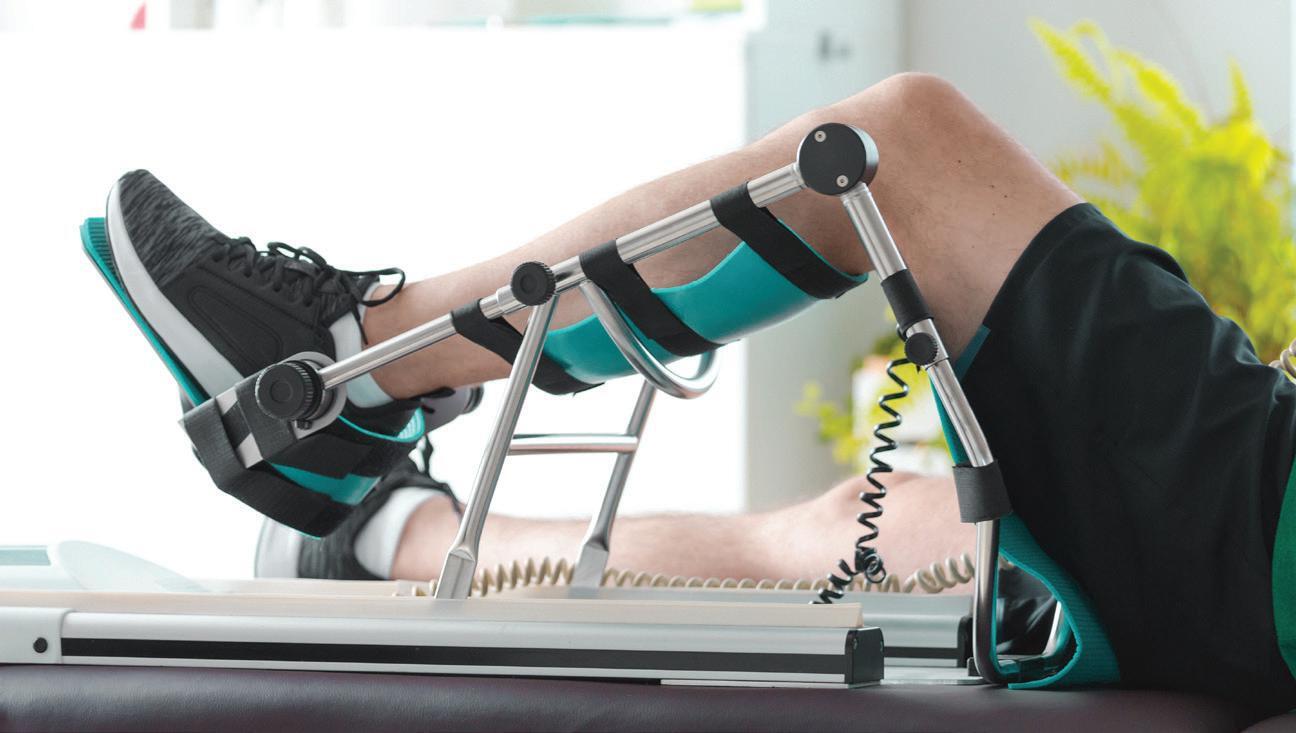
“CPM really calms down patients’ pain, and they appreciate the improvement it provides in the early days after surgery,” says Dr. Benner.
The mid-thigh TED hose is applied over postoperative dressings in the operating room at the end of the procedure, along with the Knee Cryo Cuff, developed by K.Donald Shelbourne, MD, in collaboration
NEWS
FALL 2023 CONTINUED ON NEXT PAGE
1 SKC_Newsletter_Fall23_REV2.indd 1 9/21/23 3:00 PM
Shelbourne Knee Center | FixKnee.com
CONTINUED FROM PREVIOUS PAGE
LESS PAIN,MORE PROGRESS AFTER TKA: A MULTIMODAL
POSTOPERATIVE PROTOCOL
with Aircast. Like CPM, the Knee Cryo Cuff and the TED hose help control swelling and increase patient comfort.
Each patient has a personal physical therapist or athletic trainer who guides PT, which starts in the hospital. Three times daily, patients perform PT exercises to maximize ROM and maintain proper quadriceps and leg control. Therapy continues at home, with periodic visits to the center to measure progress and adjust the therapy.
Minimizing Use of Opioids
Limiting or avoiding the use of opioids is another key goal of the postoperative pain management and rehabilitation protocol. In the hospital, patients receive a lowdose continuous infusion of the NSAID Toradol (ketorolac) to control inflammatory pain and Tylenol. Using intravenous Toradol has enabled Shelbourne Knee Center to significantly reduce pain after TKA while reducing the use of opioids and their adverse effects.6
“We found an 85% reduction in the amount of narcotic pain medication patients needed while in the hospital and statistically significant pain reduction,” says Dr. Benner.
After completing Toradol, patients take another NSAID, Mobic (meloxicam). As needed, they can also take Tramadol or Norco (an opioid). Specific hospital staff members care for the center's TKA patients, following its protocol.
Teaching patients about the center’s TKA postoperative pain management and rehabilitation protocol before surgery helps them prepare mentally and physically for the procedure and the recovery process.
“We tell our patients what the pain regimen will look like and what we’ll do to control pain," says Dr. Benner. "It’s much easier when they know what to expect.”
Using Robotics to Reduce Pain
Robotic-assisted TKA reduces pain by enabling the surgeon to make smaller incisions and reduce tissue damage. Using Zimmer Biomet’s robotic surgical assistant ROSA enables surgeons to operate with meticulous precision and perform highly accurate resections and limb alignment. Robotic-assisted TKA also reduces the risk of complications, improves implant longevity and enhances patient satisfaction.
RE FERENCES
1. Eaton S and Benner R. Effects of 1-week Bedrest on Complication Rate and Range of Motion following Total Knee Arthroplasty. Presented at the Indiana American Physical Therapy Association virtual conference, September 2020. Lee SY, Ro DH, Chung CY, Lee KM, Kwon SS, Sung KH, Park MS. Incidence of deep vein thrombosis after major lower limb orthopedic surgery: analysis of a nationwide claim registry. Yonsei Med J. 2015 Jan; 56(1): 139-145.
2. Coutts RD, Toth C, Kaita JH: The role of continuous passive motion in the postoperative rehabilitation of the total knee patient. p 126. In Hungerford DS, Krackow KA, Kenna RV (eds): Total knee arthroplasty: a comprehensive approach. Baltimore: Williams & Williams, 1984.
3. Knapik DM, Harris JD, Pangrazzi G, Griesser MJ, Siston RA, Agarwal S, Flanigan DC. The basic science of continuous passive motion in promoting knee health: a systematic review of studies in a rabbit model. Arthroscopy. 2013 Oct;29(10):1722-31. doi: 10.1016/j. arthro.2013.05.028. Epub 2013 Jul 26. PMID: 23890952; PMCID: PMC4955557.
4. Salter RB, Simmons Df, Malcom BW: The effects of continuous passive motion on full thickness defects in articulator cartilage: an experimental investigation in the rabbit. J Bone Joint Surg Am. 1975; 57A: 570-1.
5. Salter RB, Simmonds DF, Malcolm BW, et al: The biological effect of continuous passive motion on the healing of full-thickness defects in articular cartilage: an experimental investigation in the rabbit. J Bone Joint Surg Am. 1980; 62A:1232-51.
6. Schwinghammer AJ, Isaacs AN, Benner RW, et al. Continuous Infusion Ketorolac for Postoperative Analgesia Following Unilateral Total Knee Arthroplasty. Ann Pharmacother. 2017 Jun;51(6):451-456. doi: 10.1177/1060028017694655. Epub 2017 Feb 1.
7. Werner BC, Carr JB, Wiggins JC, Gwathmey FW, Browne JA. Manipulation under anesthesia after total knee arthroplasty is associated with an increased incidence of subsequent revision surgery. J Arthroplasty. 2015 Sep; 30(9)(Suppl): 72-5.
Continuous Infusion Ketorolac: More Effective Than Opioids
Median pain scores and opioid consumption were significantly lower in patients who received continuous infusion (CI) ketorolac compared to those who received opioids at 48 hours post-TKA, according to a study conducted by Dr. Benner and colleagues.6 The retrospective, open-label cohort study analyzed 191 patients undergoing unilateral TKA (CI ketorolac, n = 116; OP, n = 75) using patient-reported pain scores, opioid consumption and safety outcomes. Patients were categorized into two groups based on postoperative management:
• CI ketorolac:
- Ketorolac 30-mg bolus followed by CI 3.6 mg/h
- Plus as-needed (PRN) opioid
• Opioid protocol:
- PRN narcotics in a tiered protocol.6
THE RESULTS
At 48 hours postoperatively the CI ketorolac group had significantly lower:
• Median pain scores (3 [2-4] vs 3.5 [2.5-5], P = 0.033)
• Cumulative morphine equivalent unit hours (33.9 ± 38.5 mg vs 301.6 ± 36.6 mg, P < 0.001).
Patients in the CI ketorolac group also:
• Experienced less respiratory depression (5.2% vs 25.3%, P < 0.001)
• Received less naloxone (0% vs 8%, P = 0.002)
Other adverse effects were similar among groups.6
TOTAL AMOUNT OF PAIN MEDICATION USED6
100 200 300mg
CI ketorolac group 5.2%
Opioid protocol group 25.3%
Opioid protocol group 3.5 CI ketorolac group 3 2 4 6 8 10 MEDIAN PAIN SCORES6 Opioid protocol group 301.6 milligrams CI ketorolac group 33.9 milligrams
20 40 60 80 100%
RESPIRATORY DEPRESSION6
KNEE TREATMENT NEWS FALL 2023 2 SKC_Newsletter_Fall23_REV2.indd 2 9/21/23 3:00 PM
UNIQUE OPPORTUNITY FOR AN ORTHOPEDIC SURGEON TO JOIN OUR PRACTICE
Shelbourne
SHELBOURNE KNEE CENTER is a comprehensive knee-only specialty clinic seeking a BE/BC orthopedic surgeon to specialize in knee care in Indianapolis, Ind. Subspecialty training in adult reconstruction/ joint replacement or sports medicine would be welcomed.

This unique opportunity allows the surgeon to engage directly in a joint-specific specialty that includes surgical practice, research and nonsurgical treatment. In addition to the clinical practice, this opportunity also includes a fully functional in-office physical therapy department with established, evidence-based protocols to enhance recovery and outcome, as well as a productive and fully staffed, dedicated research department with a director, coordinators and a statistician/ medical writer. Our surgeons and therapists are regular contributors to national and international meetings as recognized experts in knee problems.
Community Health Network
(CHN) and Shelbourne Knee Center have partnered for 10 years to provide a robust orthopedic practice focusing on knees. “Exceptional care simply delivered” is what sets Community Health Network apart and makes the organization a leading healthcare destination in central Indiana. CHN is one of the nation’s most integrated healthcare systems, with over 1,300 providers.
With an appealing blend of big-city amenities, cosmopolitan style and communities that boast top-notch school systems, the Indianapolis area is consistently ranked nationally among the best places to live. Indiana also maintains its place as one of the top five provider-friendly states.
Join a Unique and Highly Specialized Practice
Our practice currently consists of two surgeons, multiple physical therapists and athletic trainers in
office, RNs, clinical assistants, X-ray technicians and a supportive and loyal administrative team. Clinic and block surgical time is at Community Hospital East, which underwent a $175 million renovation in 2020. Other hIghlights:
• Competitive compensation and benefits package
• Block surgical time
• Highly collaborative surgical atmosphere
• Shared call
• Robust referral system
• In-office PTs and athletic trainers specially trained in knee care and rehabilitation
• In-office research staff includes director, coordinators and a medical writer/data analyst
Licensure and certification
• Board-certified/board-eligible in orthopedic surgery
• Indiana medical license
About CHN
With more than 16,000 caregivers and 200 sites of care, CHN puts patients first while offering a full continuum of healthcare services, world-class innovations and a new focus on population-health management. CHN’s values are represented by the acronym PRIIDE: Patients First, Relationships, Integrity, Inclusion, Diversity and Excellence. These values drive the work we do every day and the attitude we bring to every task.
For more information, contact Caitlin Gallagher,
Senior Network Physician Recruiter.Phone: 317-621-7502
Email: CGallagher2@ecommunity.com
Knee Center is hiring a BC/BE orthopedic surgeon. Competitive salary and benefits, plus the opportunity to be part of an exceptional outcomes-focused group with its own in-house research and PT teams.
SKC_Newsletter_Fall23_REV2.indd 3 9/21/23 3:00 PM
Shelbourne Knee Center | FixKnee.com
3
TO
LISTEN TO OUR NEW PODCAST ON APPLE PODCASTS!
to listen to the latest episode.
THE SHELBOURNE KNEE CENTER PODCAST targets clinicians who treat patients with knee pain or knee injuries. Rodney Benner, MD, orthopedic surgeon, and Scot Bauman, PT, DPT, physical therapist and clinical researcher, are joined each week by guests from around the world to discuss knee treatment with the goal of creating healthy discussion to improve patient outcomes. To listen, scan the code above
AT SHELBOURNE KNEE CENTER , we’ve been conducting research for 40+ years. More than 13,000 of our patients have participated in followup surveys and exams. The result? A trove of clinical information related to treating knee injuries and disorders. We’ve made much of this material available via our website, www.FixKnee.com
MEET
ORTHOPEDIC SURGEONS
n K. Donald Shelbourne, MD
n Rodney Benner, MD
CLINICAL TEAM
n Jean Fouts, RN, BSN
n Lee Linenberg, CA
n Emily Guy, PA
PHYSICAL THERAPISTS AND ATHLETIC TRAINERS
n Bill Claussen, MPT
n Emma Sterrett, LAT, ATC
n Darla Baker, PT, DPT, ATC/L
n Sarah Eaton, PT, DPT, ATC, LAT
n Jennifer Christy, PT
n Alana Gillenwater, PT, DPT
n Bryanna McKinstry, PT
n Noah Runyon, PT
RESEARCH TEAM
n Scot Bauman, PT, DPT


n Diane Davidson, BS, MBA, CCRC
n Adam Norris, ACRP-CP
SKC_Newsletter_Fall23_REV2.indd 4 9/21/23 3:00 PM

N Ritter Ave #500, Indianapolis, IN 46219 NONPROFIT U.S. POSTAGE PAID Indianapolis, IN PERMIT #PI-1345
1500
OUR
TEAM
n Heather Garrison CONSULT WITH ONE OF OUR SURGEONS, CALL 888-FIX-KNEE | 317-924-8636
Scan
Resources for Clinicians