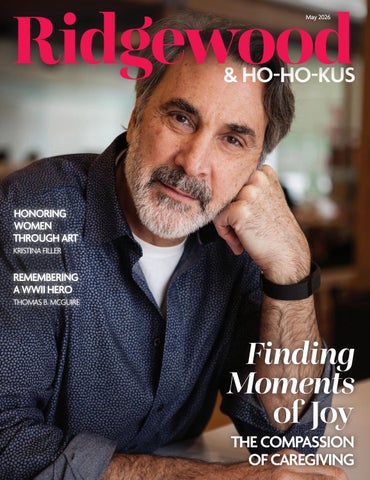
Ridgewood & HoHoKus May 2026

Page 1


HONORING WOMEN

THROUGH ART

KRISTINA FILLER

REMEMBERING A WWII HERO

THOMAS B. MCGUIRE

Finding Moments of Joy THE COMPASSION OF CAREGIVING

Find Your Place at The Shore

$1,595,000

Mark Porro’s memoir offers a reminder that love is often found not in grand gestures, but in showing up day after day with patience, humor, and, yes, sometimes, a cup of tea.

the Ridgewood Police Department, “community policing” goes far beyond policing the community—it starts in Village schools.

artist Kristina Filler honors remarkable women with her first solo art show.

aAFTER MONTHS OF cold-weather hibernation, the longer days and warmer air invite us to reconnect—with our community, our creativity, and one another. This month’s issue of Ridgewood Magazine is filled with stories that celebrate meaningful connections.

We begin with a closer look at the Ridgewood Police Department, highlighting the many ways officers engage with residents beyond the badge. From education initiatives to everyday moments of community outreach, the department’s work reflects a commitment not just to safety, but to building relationships and trust within the village.

You’ll also meet author Mark Porro, whose heartfelt and humorous memoir, “A Cup of Tea on the Commode,” has resonated with readers across the

country. Porro shares the deeply personal story behind the book— one rooted in family, caregiving, and the complicated blend of love and laughter that often accompanies life’s most challenging chapters.

Creativity takes center stage as well with Ho-Ho-Kus artist Kristina Filler. Her recent exhibition at the WorthPinkham Memorial Library honors inspiring women through striking and thoughtful artwork. It’s a reminder that art has a unique ability to tell stories, spark reflection, and celebrate the figures who shape our lives.

Finally, this month’s Q&A has a very special connection to my own heart.

About a year ago, my brother, Bill, an accomplished Air Force veteran and commercial pilot, recommended I write an article about Thomas B. McGuire, a decorated World War II fighter ace born in Ridgewood in 1920. Sadly, Bill passed away in December. Thus, I felt there was no better month than May to celebrate the courage of our veterans with this piece that so poignantly illustrates the true meaning of Memorial Day.

“They are not dead who live in the hearts they leave behind.” — Tuscarora Proverb

This Memorial Day, may we all strive to live lives worthy of their sacrifice.

Warmly,

Editor

editor@ridgewoodmag.com

ridgewoodmag.com @ridgewoodmag

Publisher Karen Stires

karen.stires@wainscotmedia.com

Editor Kris Pepper

Writers

Alix Newton

Kris Pepper

Harris Fleming

Rebecca Bleich

Sarah Nolan

Stacey Antine, RD Lorri Steinbacher

WAINSCOT MEDIA

Chairman Carroll V. Dowden

President and CEO

Mark Dowden

SVP, Group Publisher

Thomas Flannery

VP, Content Strategy

Maria Regan

Creative Director

Kijoo Kim

Art Director

Rosemary O’Connell

Executive Editor

Elaine Paoloni Quilici

Associate Editor

Sophia Carlisle

Advertising Services Director

Jacquelynn Fischer

Operations Director

Catherine Rosario

Production Designer

Chris Ferrante

Print Production Manager

Fern Meshulam

Advertising Production Associate

Griff Dowden

Ridgewood Magazine is published by Wainscot Media. Serving residents of Ridgewood and Ho-Ho-Kus, the magazine is distributed monthly via U.S. mail. Articles and advertisements contained here in do not necessarily reflect the opinions of the publishers. Copyright 2026 by Wainscot Media LLC. No portion of this magazine may be reproduced in any form without written consent.

Have a story idea?

Email the editor: editor@ridgewoodmag.com

PHOTOGRAPH BY

Brighten Your Days with Local Springtime Events

Experience all the joys of spring with friends and family in Ridgewood and Ho-Ho-Kus this May.

OLIVER R. TWIST COOK ‘N BOOK CLASS

When: Wednesday, May 13, 2026; 7 to 9:30 p.m.

Where: 34 Wisley Square, Ridgewood

Calling all foodies and wannabe chefs! Oliver R Twist and the Ridgewood Chamber of Commerce are hosting a special cooking and book discussion class. Take part in a memorable culinary experience in making a Primadonna-inspired recipe and then share a meal over a book discussion.

For more information, visit ridgewoodchamber.com.

ST. BART’S PERFORMING ARTS SPRING WORKSHOP TRUNK SHOW PERFORMANCE

When: Friday, May 8, 2026; 6:30 p.m.

Where: 70 Sheridan Ave., Ho-Ho-Kus

Join St. Bartholomew’s Church in their Performing Arts Spring Workshop Trunk Show and be a part of the one-of-a-kind performance inspired by “Alice in Wonderland.” Have an evening full of fun and watch everyday items become magical moments brought to life onstage.

For more information, visit stbartshhk.com.

SCOOPS NIGHT AT BEN & JERRY’S

When: Wednesday, May 6, 2026; 5 p.m. to 8 p.m.

Where: Ben and Jerry’s 104-106 Franklin Ave., Ridgewood

The West Bergen Mental Health Awareness Committee invites residents and nonresidents to “get served.” Stop by Ben & Jerry’s to get served ice cream by “celebrity” scoopers like West Bergen CEO and West Bergen Board Members. 10% of all sales will be donated to West Bergen.

For more information, visit westbergen.org.

PUBLIC PLANT SALE

When: Saturday, May 9, 2026; 10 a.m. to noon

Where: On “the green” where the gazebo is next to the Ho-Ho-Kus tavern

The HHK Garden Club is bringing back its annual Plant sale, offering residents and non-residents the chance to get into the garden. The sale features perennials, annuals, hanging baskets, and gently used gardening tools/items of interest.

For more information, visit hohokusgardenclub.com.

MEMORIAL DAY PARADE AND CEREMONY

When: Monday, May 25, 2026; 10:30 a.m.

The Borough of Ho-Ho-Kus will host its annual Memorial Day parade that begins at Ardmore Road and Sheridan Avenue and concludes at the War Memorial, where a Remembrance Ceremony will follow.

For more information, visit hhkborough.com.

GLOBAL CLIMATE/LOCAL EFFECTS DISCUSSION

When: Monday, May 18, 2026; 7:30 p.m. to 9 p.m.

Where: 32 Sycamore Ave., Ho-Ho-Kus Admission is free

Want to learn more about gardening and our ecosystem? Join the Ho-Ho-Kus Garden Club in a discussion on climate presented by Licensed Tree Expert Ray Slaman. Get exclusive information on the impacts of climate change on the ecology of New Jersey. Participants in the discussion will qualify for 1.0 CEU.

For more information, visit hohokusgardenclub.com.

TOUCH-A-TRUCK

When: Thursday, May 14, 2026; 9 a.m. to 2 p.m.

Where: Memorial Park at Van Neste Square, Ridgewood

Imagine sitting behind the wheel of a police cruiser or a shiny red fire truck, as well as other public works vehicles you have only seen from a distance. Treat your family to a day of hands-on adventure and activities featuring opportunities to climb aboard trucks used by your local heroes. Take part in this event sponsored by the Ridgewood Chamber of Commerce and the Village of Ridgewood for an afternoon of fun.

For more information, visit: ridgewoodnj.net.

RIDGEWOOD HISTORICAL SOCIETY MURDER MYSTERY

When: Thursday, May 21, 2026; 7 p.m.

Where: Park West Loft, 30 Oak St., Ridgewood

Registration Required; $100 for a ticket/ for tickets contact: museum@ ridgewoodhistoricalsociety.org

Are you a history or murder mystery fan? Join the Ridgewood Historical Society for their special Murder Mystery event, A Revolutionary Affair. With a costume contest, immersive experience, and a night full of scandal, secrets, and suspense—you won’t want to miss it.

For more information, visit ridgewoodchamber.com.

Rebecca Bleich is a recent graduate of Ramapo College, where she majored in journalism and writing.

ARS MUSICA CHORALE 60TH ANNIVERSARY SEASON CONCERT

When: Saturday, May 30, 2026; 7:30 p.m.

Where: West Side Presbyterian Church 6 South Monroe St., Ridgewood

Tickets Required: Adult $40, Seniors/Special Needs $35, Under 12 Free

Ars Musica Chorale closes its landmark 60th Anniversary Season with a celebration of music, spirit, and community. The program features Francis Poulenc’s “Gloria” paired with André Thomas’ “Mass: A Celebration of Love and Joy.” Join them as we honor six decades of song with this exhilarating concert—a true celebration of love, life, and choral excellence.

For more information, visit arsmusica.org.

The Missing Ingredient

Why connection is the nutrient we need most.

AFTER RETURNING from the Andrew Weil Center for Integrative Medicine Conference last month, one message rang loud and clear among health professionals: we are living in a state of social malnourishment.

We often think about nourishment in terms of food—proteins, fiber, vitamins, and hydration. But what if one of the most essential nutrients for our wellbeing isn’t on our plate at all?

WHAT IS SOCIAL MALNOURISHMENT?

Social malnourishment is the chronic lack of meaningful human connection. Despite being more digitally connected than ever, many of us are:

• Eating meals alone or on the go

• Replacing conversations with scrolling

• Experiencing surface-level interactions instead of deep relationships

• Feeling isolated—even in busy households or communities

This isn’t just emotional—it’s biological. Research shows that loneliness and social isolation can increase the risk of anxiety, depression, heart disease, weakened immunity, and even shorten lifespan. Connection is not a luxury. It is a fundamental human need.

A MISSING LINK

Recently, I had the honor of leading a nutrition workshop for 65 seniors at the Village of Ridgewood Community Center. Together, we created a living “values board”—a reflection of what truly matters most.

Their words filled the space: family, friends, faith, music, dancing, independence, purpose, learning, hobbies, volunteering, and more. It was inspiring—and also revealing.

When we paused and looked closer, many participants realized that although these values were deeply important to them, they were not engaging in them regularly—some not even once over the course of a full week.

This is the heart of social malnourishment.

It’s not that we don’t have values. It’s that we’re not consistently living them.

STEP #1: TAKE A PERSONAL INVENTORY

Before we can nourish ourselves socially, we need awareness. Ask yourself:

• What do I truly value?

• Which of these values involves connection with others?

• How often am I actually living them—daily, weekly, or rarely? This simple inventory can be eye-opening. Just like we might realize we’re low in fiber or hydration, we may

NOURISHING OUR COMMUNITY

When individuals begin to live their values, communities transform. They become:

• More connected

• More compassionate

• More resilient

Belonging grows when people show up—not just physically, but meaningfully.

discover we are deficient in connection, joy, or shared experiences.

WHY THIS MATTERS FOR OUR FAMILIES AND CHILDREN

Children, especially, are growing up in a world where:

• Screens often replace face-to-face play.

• Overscheduled lives crowd out unstructured connections.

• Family meals are becoming less frequent.

But just like whole foods nourish growing bodies, shared experiences nourish developing brains and emotional resilience.

When children see adults living their values—prioritizing relationships, community, and purpose—they learn to do the same.

HOW DO WE NOURISH OURSELVES SOCIALLY?

Think of connection like a daily nutrient. It requires intention.

1. Align Your Calendar with Your Values. If you value friendship, are you making time for it in your week? If you value family, are you creating moments to laugh, play, and be together?

2. Bring Back the Family Table. Even a few shared meals a week can make a profound difference. Turn off devices, slow down, and create an

Stacey Antine, MS, RDN, is the founder of Ridgewood’s HealthBarn USA and author of “Appetite for Life.” She is a national expert in family nutrition and has appeared on the Rachael Ray Show, CNN, PBS-TV, and hundreds of broadcast, print, and social channels.

environment for real conversation.

3. Cook and Gather (my favorite!)

Food is one of the oldest forms of connection. Invite a neighbor for soup, host a potluck, make pizza on a Friday night, or enjoy homemade popcorn during family movie night.

4. Reconnect with Joy. Music, dancing, hobbies—these aren’t extras. They are expressions of living fully and often bring us together with others.

5. Pick up the phone. Pause before sending that text. Make the call instead—connect in real time, voice to voice, no emojis needed.

6. Engage with Purpose. Volunteering, mentoring, or simply helping a neighbor builds both connection and meaning to everyone.

A NEW WAY TO THINK ABOUT HEALTH

We’ve spent years focusing on what’s missing from our diets. Maybe it’s time to ask: What’s missing from our days? And are we living what matters most?

Social nourishment begins with awareness—and grows through action. As we move into the warmer months, it’s the perfect time to reconnect— with our values, our families, and our community.

Because in the end, the healthiest lives aren’t just well-fed, they are welllived and deeply connected.

Bergen New Bridge Health

Your Body. Your Needs. Your Physician.

Charlsie Celestine, MD, Gynecology

Brewing a Lifetime of Love

Mark Porro’s memoir offers a reminder that love is often found not in grand gestures, but in showing up day after day with patience, humor, and, yes, sometimes, a cup of tea.

Genevieve and Mark enjoy the day together. Mark’s memoir, “A Cup of Tea on

WWHEN MARK PORRO became the primary caregiver for his nearly 90-yearold mother, Genevieve, in 2011, he stepped into a role still more commonly associated with women. He didn’t see himself as exceptional; he simply saw himself fulfilling a much-needed role for his family—and his dear mother.

“Yes, the role of caregiver generally falls on the women of the family, but the men are catching up,” he says. “I didn’t think too much about the distinction, nor did I let it affect me. Many thought I was a hero. I didn’t agree. To me, this was how our parents raised us. It was the right thing to do.”

Determined to care for her as fully and respectfully as possible, he immersed himself in learning. “I wanted to learn

how to best take care of her for as long as she wanted to be here, days, weeks, or months,” he says. “So, I spent a lot of time with the hospice nurses who taught me the tips and tricks of eldercare. I knew a bit of what I was getting into.”

Upon making the decision—supported by his siblings and his mother—there was no half-measure. “Once I decided to move back to take this on full-time, I jumped in 100%.”

Drawing on his background as an actor, Porro learned to manage his own emotions so as not to burden his mother. “Yes, I’m still her son, but I’m also her caregiver, and I didn’t want my mother to feel guilty about me taking on this role. I did my best to keep my discomfort and my emotions out of the room.”

the Commode,” is available on Amazon.

RESTORING DIGNITY, ONE GESTURE AT A TIME

If Porro’s caregiving philosophy could be condensed into one word, it would be dignity. He was determined to bring back what age and illness had slowly eroded.

“My approach might be unconventional,” he says, “but what can I say? I’m a romantic. I wanted to restore her dignity, which I felt had been whittled away over the years.”

That meant buying his mother a new wardrobe—an experience that delivered its own experience of

wry humor. “What I didn’t take into consideration as a middle-aged man shopping for his 90-year-old mother was dealing with the curious stares that accompanied my transactions. Not so much fun, but I had a job to do.”

It also meant recreating the beauty parlor rituals his mother loved.

“I tried to give her a real beauty salon experience at home. I called it ‘Day of Beauty,’” he says, listing a routine that included sponge baths, Epsom salt foot soaks, shampoo, massage, fresh nightclothes, and carefully styled hair.

Post-makeover, Porro caught his

mom beaming at her reflection in the mirror. “The effect on me was profound because I realized that the small gestures we often take for granted are not small for others. I also realized that wanting to feel pretty doesn’t end at 90 years old. We all deserve dignity, and that desire also doesn’t fade with age.”

“My mother’s favorite beverage was a cup of hot tea, skimmed milk, no sugar,” he recalls. “Mobility was an issue, so to make things easier for all involved, I set a commode in her bedroom. One day, when Mother Nature took longer than was comfortable for either of us, I asked her, in jest, if she’d like a cup of tea while we waited. She, of course, said, ‘Yes.’ It was a hit and became one of our morning rituals.”

What emerged from that tender moment became the title of his memoir and a symbol of a journey that reshaped his understanding of love, dignity, and devotion.

Empathy and patience became essential as Porro cared for his mother. “She was no longer as mentally sharp as she once had been, though every so often she’d surprise me with a perfectly timed zinger. Once she asked, ’Why do you treat me so well?’ I replied, ‘Because you’re my mother, and you deserve to be treated like a queen.’ She promptly burped. ‘But queens don’t do that,’ I said. Without missing a beat, she shot back, ‘How do you know?’”

Genevieve shows off her silly side at granddaughter Rachel’s wedding.
247 Emmett Place. The Porro family’s former home address in Ridgewood.

After a cognitive test, a doctor told Porro that he believed his mom had Alzheimer’s. Porro recalls, “I turned to Mom and asked, ‘You don’t have Alzheimer’s, do you?’ She looked at me, paused, and said, ‘I don’t remember.’ It was priceless.”

THE EMOTIONAL CORE

Porro’s memoir balances humor with piercing emotional honesty. One such moment was when his mother asked a question that stopped him cold.

“After a particularly stressful day, Mom shot me a curious look and asked, ‘Why are you doing this?’” His response came without hesitation. “‘Because it’s an honor for a son to take care of his mother.”

Her surprise—“‘It is?’”—forced Porro to examine the deeper meaning of caregiving. He writes candidly about stalled careers, missed opportunities,

and the longing for purpose, arriving at a simple truth: “She never once gave up on me. So, I committed myself not only to her but to my five siblings. The rewarding experiences spoke for themselves, and her smile, a witty comeback, or a warm kiss consistently reaffirmed Porro’s life choices.

“My parents always taught us all to do the right thing. When I stepped up for Mom, I didn’t think it was a big deal. It was just the right thing to do.”

Caregiving, Porro cautions, can easily consume you if you let it.

Professionals consistently stress the importance of self-care and stepping away when needed—much like the familiar airplane instruction to put on your own oxygen mask before helping others. A caregiver has to be mentally, physically, and emotionally steady to do the job well. Porro admits he didn’t always follow that advice, and had

Left: Genevieve as a child.

Above and below: The Porro kids in the early days

a health crisis of his own during his caregiving days. “My mother almost outlived me,” he says, “so it’s important to take breaks.”

He’s equally candid about emotional boundaries. If certain tasks feel overwhelming or uncomfortable, he believes it’s better not to take them on—or, if you must, to manage your reactions privately. “You do not want your loved one to feel guilty or think they’re a burden,” he says. At its core, caregiving is an honor.

RIDGEWOOD, THEN AND NOW

For Porro, caregiving also meant coming home—literally and emotionally—to Ridgewood. His parents moved to 247 Emmett Place in 1950, where they raised six children over 65 years.

“I was very fortunate to grow up in the Village of Ridgewood,” he says,

recalling mass at Our Lady of Mount Carmel, summers and winter ice hockey at Graydon Pool, Veterans Park concerts, fishing in the Duck Pond, and being a student at Ridgewood High School.

Moving back into his childhood home was “a bit surreal,” but nostalgia brought back memories of places that shaped them both. “Mama Rosa’s Pizza, Dairy Queen (his first official job), and Fishel’s Bakery cream donuts and strawberry shortcake were amazing! Sealfon’s candy counter was always tempting, and I remember Woolworth’s had balloons with prices for their banana splits inside. I once picked and popped one for 25 cents. And, most of my clothes came from Mac Hughs!”

WRITING AS HEALING

Porro didn’t set out to write a book. He began by taking notes, wanting to

preserve moments for his siblings. But when his experience helped a friend beginning her own caregiving journey, he realized the story might serve a wider purpose.

“This was my way of processing my grief,” he says. “I had little time to grieve during my journey.”

Distance helped—both emotional and geographic. After moving to France, writing helped clarity emerge, and he finished the memoir overseas.

A LASTING MESSAGE

What does Porro hope readers take away?

“I hope to inspire, educate, and entertain readers,” he says. “It’s not a ‘how-to’ book, it’s a ‘what I did book.’”

Along with a long resume of patient care skills and expertise, Porro came away from the experience recognizing what it taught him. “Even

though patience is not a New Jersey virtue, I believe I’m now more patient with myself and others. I’m certainly more empathetic toward older adults and seem to gravitate to them. Looking back, I found a lot of joy in the process.”

And if his mother could read the book? He laughs. “Well, as a seasoned proofreader who had a long career at the Bergen Record, she would first read it for errors! There was one small error in the book that got past my editors, the publisher, and me. She most definitely would have caught it. As for content, she would have objected to my including her stealing my ice cream and cheating at cards.”

After all, Mom always has the last word.

For more information on Porro’s book, visit: acupofteaonthecommode.org

Left: Starting the day with a fresh look out the window.
Above and below: A quiet moment with Mom. Vive La France—complete with French beret and French Toast!

A Matter of Trust

For the Ridgewood Police Department, “community policing” goes far beyond policing the community—it starts in Village schools.

EEACH MAY, communities across the country pause to observe National Police Week—a time to honor the service and sacrifice of law enforcement while strengthening the connection between officers and the people they serve. In Ridgewood, that spirit is evident year-round, as the Ridgewood Police Department goes beyond its public safety role to actively educate, inform, and engage residents. Through outreach programs, community events, and open dialogue, the department fosters trust and partnership, helping ensure that Ridgewood remains safe and connected.

CONNECTING WITH CHILDREN

When Ridgewood Police Department Detective Sergeant Anthony Mormino speaks to schoolchildren and youth groups, he likes to ask a deceptively simple question: What’s the most important item on a police officer’s toolbelt?

The kids will give him the onceover, paying close attention to his own belt, and most often the first guess is “your gun.” Wrong. Well, it must be the handcuffs, then—right? No, still wrong.

“It’s the radio,” he tells them. “Without the radio, I don’t know that you need help. I can’t call for help. We can’t help anybody.”

And that opens the door to a discussion that goes well beyond police work into insights that can help kids from elementary school through high school not only stay safe but deal with challenges of every kind.

“I always tell the kids, ‘Listen, I know you don’t carry a radio on your belt, but you have a mouth. So if you are having a problem, if you don’t talk about your problem, if you don’t ask for help, that problem is never going to get better’,” he explains. “And you almost see the brainwaves, and you see the kids thinking, ‘Ah, that’s a good point!’”

Helping kids make connections like that, both within their own minds and

Officers and cadets on the ferry to Liberty Island during the Jr. Academy.

outwardly with police officers, is more than just good PR for the RPD. Such interactions reflect a strategy to build trust in the police while also encouraging cooperation that makes the officers’ job easier and the public safer.

“It’s a cornerstone of Chief Lyons’s vision,” Mormino says, referring to RPD Chief Forest Lyons. “We understand that cooperation with the community, especially with the kids, makes our job easier. It’s give and take. That’s why every decision we make is meant to try to better the community, and to protect that trust between the community and the police department.”

The strategy is drawn from a concept known as community policing, in which engaging, nonenforcement-oriented contact between the police and the public is meant to foster trust and transparency for the benefit of all.

“It’s the school resource officer, it’s the presentations, it’s the preventive things,” Mormino says. “It’s putting yourself out there and being human.”

And Mormino really puts himself out there—literally, sometimes, such as when he sat on the edge of a dunk tank at a community event until a few well-thrown balls tripped the lever, causing his ultimate splashdown.

A DIFFERENT APPROACH

For other officers, such as Sean Amaruso and Hector Perez, helping the public see the person behind the badge can mean heading up events like Pull-Over Properly (POP). Conducted with special-needs advocacy groups Access Ridgewood and Spec Wired, POP simulates traffic pullovers in the Graydon Pool parking lot to help new and learning drivers who have developmental disabilities understand what to do when they’re pulled over.

As with many of the RPD’s outreach initiatives, POP serves multiple objectives. While the stated purpose of preparing the special-needs driver to know what to expect and, therefore, suffer less anxiety and dread when they get pulled over by police is essential, that same preparation may lessen the risk for an interaction that puts both the driver and the police officer in danger.

“They go through the steps in a motor vehicle stop, and that’s important. These kids may not be the most vocal or the most communicative, but it gives them a little bit more courage to say,

‘Hey, officer, I’m on the spectrum,’ or however they want to explain it to us, ‘and the lights are making me anxious’,” Mormino says. “Nine times out of 10, that’s going to help the officer understand what’s going on and not take some furtive movement as a negative one, or as a sign of disrespect or noncompliance.”

RPD personnel are training to learn more about working with neurodiverse populations in every situation, all the time. Again, it’s not an image campaign but a forwardthinking approach to providing the best, safest public service for every member of the Ridgewood community.

“We’re seeing a lot more call volume concerning children on the spectrum, and we’re learning to think outside the box.” Mormino says. “Usually, from a law-enforcement perspective, we want to isolate, we want to contain, and we want to control. And that’s not always the best when communicating with a resident who may have challenges communicating in a way the officer is accustomed to.”

Left to right: July 4th Sgt. Mormino and his children after marching with the Honor Guard. A school presentation at Orchard School with EZ-Ride and police collaboration.

Academy

marching

July

Police Department collaboration at Michael Feeney’s Best Day Ever event. Officer Sean Amoruso at Super Science Saturday fingerprint exploration. Officers running during the Special Olympics Torch Run. New Jersey State Police Aviation Unit at the Chief Michael Feeney Jr. Police Academy.

Clockwise from right: Jr. Police
cadets
on
4th. PBA/

A PLACE FOR ALL

Community policing, working with specialneeds youth, and even taking a turn in the dunk tank may seem like activities that are inherently beneficial to the community, but there’s another side to them.

Consider the interactions law enforcement professionals typically have with the public. “Normally, as a police officer, you’re going call-to-call, you’re answering 911 calls, you’re doing motor vehicle stops—all important stuff, but it’s not necessarily the stuff that people want to see you for. Something bad is going on, or you wouldn’t be there,” Mormino points out. “That is the reality of being a police officer. You’re never going to be everyone’s best friend; no one wants to get a ticket, and we get that. But you’re seeing the worst of people for the majority of your day, of your career.”

Tasks that provide an officer with a break from those more typical, infinitely more serious law enforcement duties could actually help ward off stress-related burnout and other mental health issues for which they are at higher risk than most of us. A research paper published

in the journal Police Quarterly found that police personnel are nearly twice as likely to experience symptoms of post-traumatic stress disorder and depression, as well as lower quality of life, compared with the general population.

Positive interactions essentially flip the script. “Rather than dealing with people on their worst day, or the 5% I had to take an enforcement action on, you’re dealing with the 95% of good people,” Mormino says. “It changes your thought process. When somebody comes up to you, it’s not like, ‘Oh no, what is this going to be?’ Instead, it becomes: ‘This is probably just someone who wants to have a conversation with me. I’m very lucky. I love my job’.”

For more information, visit rpd.ridgewoodnj. net/159/police.

Harris Fleming is a freelance writer who lives in Waldwick with his wife (a Ridgewood elementary school teacher) and teenage son. He once worked part-time for the University of Richmond campus police, checking IDs to ensure only students and staff used the track facility. And, he was entrusted with a radio.

From left: Chief Forest Lyons with our honorary Chief of the day. Officer Patrick Daly and Officer Christopher Schumann collecting holiday gifts for the Santa Response Team.

AvanteGarden

Ho-Ho-Kus-based artist Kristina Filler honors remarkable women with first solo art show.

KKRISTINA FILLER’S portraits of the nine exceptional women that she chose to illustrate for her first solo art show have a true presence.

At Worth-Pinkham Memorial Library, where the show called “Avante-Garden” is currently on display, the diverse group of women are each drawn in an archway silhouette that Filler says adds a regal vibe, mimicking a hall of busts.

Their strength, “otherworldly” auras, and accomplishments jump off the page, leaving viewers all at once impressed (dare I say, even a little intimidated), inspired, and comforted.

It’s the juxtaposition of grit and softness women possess that Filler hopes to capture, including meaningful flowers in each portrait to punctuate the belief that women’s tie to nature is a strength rather than a weakness, as it has been more commonly depicted, the artist says.

“I want people to feel the power of these women but also appreciate their tenderness and poise from the inclusion of flowers,” Filler says. “Each woman is shown looking to the right, to express that they are looking towards a better future for women.”

Artist Kristina Filler held her first solo art show at the Worth-Pinkham Memorial Library in Ho-Ho-Kus. She’s pictured with several of the portraits she made.

EVERYTHING HAS MEANING

Filler says it was total happenstance and a dose of procrastination that dictated the show’s theme. She was approached in late fall by Ho-HoKus library staff members about displaying her work.

She was interested, but with the impending holiday season and the chaos that comes with it, she knew she needed time to develop a theme or thesis and create the art. March sounded far enough off, and it happens to be Women’s History Month.

Filler, a multidisciplinary artist and writer known for her murals, says she has primarily concentrated on client work throughout her career and was thrilled to share her art in her hometown, while telling the stories of incredible women in celebration of Women’s History Month.

“I am used to taking assignments

from people and being given a direction or story to tell,” she says. “I love making art, but it’s rare that I’m in my house just painting for me. I had a bit of imposter syndrome surrounding the idea of an art show, but there was something about doing it at the library. I know a library; I get the vibe. ‘I can do it,’ I thought.”

The show wasn’t Filler’s first foray into women’s history. She co-hosted a feminist podcast called “Women Crush Weekly” with a friend several years ago, and says it was exciting to have a subject she was familiar with and could instantly picture.

She began by choosing women with whom she feels a connection.

“There are so many feminist books and inspiring women—you could pick anyone, but I find my art turns out better when I personally feel something,” Filler says.

The first portrait she made was of Jane Goodall, a beloved and renowned primatologist and anthropologist known for six decades of field research in Tanzania exploring the social and family

life of wild chimpanzees.

Filler was first inspired by Goodall when she did a book report on her as a child, and says her desire to draw the icon following her death in October at age 91 is partially what inspired this series.

From there, she went on to draw Ejae, a South Korean-American singer and songwriter who co-wrote the earworm “Golden,” featured in KPop Demon Hunters, for which she is the singing voice of the main character, Rumi. Partially raised in Fort Lee, Ejae has broken many records for co-writing and singing the first K-Pop track to win an Academy Award, Grammy, and Golden Globe. (This portrait has been a fan favorite among young library patrons, library staff members say.)

More women came to mind: American figure skater and Olympic champion Alysa Liu; beloved children’s entertainer and humanitarian Ms. Rachel (Rachel Accurso); American painter Amy Sherald; Anne Frank, whose diaries were

Above, left: Filler hangs the portrait she made of Jane Goodall. Above, right: Filler with Ho-Ho-Kus Library Director Morgan Taylor.

published after she was murdered in the Holocaust; Lily Gladstone, an actress, Indigenous activist and queer supporter of the LGTBQ+ community; Supreme Court Justice Sonia Sotomayor; and finally Hoboken mayor Emily Jabbour.

As details of the show and the work she wanted to create began to take shape, Filler says she focused not only on women who meant something to her personally, but also on those who had made headlines for one reason or another over the past year.

The portraits were created using digital painting, Filler says. Everything is hand-drawn just as it would be on paper or canvas, the only difference being that it saves time, she says. Each piece took her between one and a half to two days,

whereas drawing on paper would have taken at least a week for each portrait, Filler says.

Creating the art digitally also makes it easier to play, Filler says. You can “undo” on an iPad, or easily change out colors.

Filler says she initially drew the women on white backgrounds—she wanted them to be the focus—but it looked a little plain or unfinished, she says. She began to play with abstract, “funky” backgrounds, which she says gave her another element to represent the women in addition to the flowers (for example, the pattern on the background of Anne Frank’s portrait is the same as the cover of one of her diaries).

“Everything has meaning,” Filler says.

When it came to the flowers, some were more obvious than others, the artist says. If a flower came to mind, she would look up its significance to make sure it coincided with what she was trying to say and reflected the subject’s personality, culture, or career. If not, she’d explore other options. The flowers are an important element of Filler’s message.

“Women do have hormonal weaknesses—it’s true, but I think because of that our other strengths that come from nature, that come from within us, like a mother’s intuition, get undervalued or disregarded,” she says. “Look at all the amazing things we can do. Our emotional cores can be a strength, providing deeper feelings, intuition, and empathy.”

Filler says she’s appreciative of the opportunity to potentially spark conversations surrounding feminism (a topic she says sometimes gets a bad rap) and women’s accomplishments and duality.

“I tried to make this a joyful viewing experience that hopefully tunes people into the topic of feminism,” she says. “It might inspire them to talk about it, ask questions, or dive deeper and understand why people feel so fiercely about the fight for equal rights.”

On a personal note, Filler, also a mom to two small kids, says she is proud to have accomplished creating her first solo show on such a meaningful topic (despite sick days and snow days). “I really encourage people to share their work—it’s scary, and it’s hard, but it’s worth it.”

Visit the library to see Avante-Garden in person or find the digital version on the artist’s website, kristinafiller.com. For more about Filler, visit her Instagram page @kstar810.

Sarah Nolan is a writer with a passion for telling people’s stories. A Ho-Ho-Kus native, she believes in the power of local journalism to connect and inform residents and foster a sense of community.

A May Matcha Cake

Celebrate spring with the perfect sweet treat.

IF MAY had a flavor, it would be Strawberry Matcha. Balancing earthy notes of matcha and sweet bright strawberries, this 4-inch mini centerpiece is the perfect way to celebrate spring.

Strawberry Matcha Cake

Serves: 6

Prep time: 20 minutes

Bake time: 25 minutes

INGREDIENTS

Matcha Cake

• 1 ½ cups (300 grams) granulated sugar

• 10 tbsp (140 grams) unsalted butter, softened

• 3 eggs, at room temperature

• 1 tablespoon vanilla

• 2 ¼ cups (280 grams) plain flour

• 2 tbsp (8 grams) ceremonial grade, bright green, matcha powder

• 1 ½ teaspoon baking powder

• ¼ teaspoon baking soda

• ½ teaspoon salt

• 1 cup (240 milliliters) buttermilk

Strawberry filling and buttercream

• 1 cup (150 grams) unsalted butter, softened

• 3 tablespoons strawberry jam

• 2 ½ cups (300 grams) powdered sugar

• 1 cup (25 grams) freeze-dried strawberries

• 1 tablespoon warm milk

• Fresh strawberries, to decorate

INSTRUCTIONS

1. Preheat the oven to 350°F (175°C). Grease two 4-inch cake tins and line them with baking paper.

2. In a medium bowl, add the softened butter, granulated sugar, and cream together until fluffy and pale.

3. Add the eggs and vanilla and combine well, then fold in the flour, matcha powder, baking powder, baking soda, and salt.

4. Before all the flour is combined, pour in the buttermilk and mix that through until everything is evenly mixed.

5. Pour the batter into the prepared pan. Bake the cake for 20 to 25 minutes or until a toothpick comes out clean from the center

6. Let the cake cool in the pan on a wire rack for 30 minutes, then pull up on the parchment paper to release it from the pan. Let the cake continue cooling on the cooling rack until completely cooled.

To make the buttercream

1. Add the softened butter to a large bowl and beat with an electric mixer on high speed until fluffy, 1 to 2 minutes.

2. Add the freeze-dried strawberries to a food processor. Pulse until finely ground, then

pass the ground freeze-dried strawberries through a sieve to remove the seeds.

3. Add in the powdered sugar and finely ground freeze-dried strawberries to the butter and mix until fluffy. Add milk to loosen if required. Move the mixture to a piping bag and snip a small hole from the end.

4. To decorate, place one of the cooled cake layers onto a serving board and pipe around the edge to create a border. Fill the center with strawberry jam, then top with the second cake layer.

5. Coat the cake with the remaining buttercream using an offset spatula, then finish with a few sliced strawberries.

6. Serve and enjoy. This cake will keep for 4 to 5 days if kept somewhere cool and dry, but it’s best eaten within 24 hours.

Alix Newton is a baking blogger and photographer who, along with her family, recently moved to Mueller from the United Kingdom. Sharing her tasty food creations is her way of giving back to the community that has welcomed her. Visit Alix online at mykitchensdrawer.com and follow her on social media @mykitchendrawer.

Ridgewood’s SKY HERO

In recognition of Memorial Day, we are saluting Ridgewood-born Major Thomas B. McGuire Jr. McGuire Air Force Base, now known as Joint Base McGuire-Dix-Lakehurst near Wrightstown, New Jersey, was renamed in his honor in 1948.

ABOUT A YEAR AGO, my brother, Bill, an Air Force veteran and accomplished commercial pilot, recommended I do a piece on Major Thomas McGuire for Ridgewood and Ho-Ho-Kus Magazine. The month of May is the perfect time to publish it in observance of Memorial Day. This story is in honor of all the service men and women who made the supreme sacrifice for their country.

Who was Thomas B. McGuire Jr.?

Major Thomas Buchanan McGuire Jr. (1920 to 1945) was a U.S. Army Air Force fighter pilot and one of the most decorated airmen in American history. Born in Ridgewood, he became the second-highest scoring American fighter ace of World War II with 38 confirmed aerial victories, only two victories behind Major Richard Bong.

Thomas B. McGuire in the Southwest Pacific theater during World War II.

How did he become a pilot?

McGuire left Georgia Tech University in his third year to join the U.S. Army Air Corps in 1941. His first combat assignment in World War II was flying patrols over the Aleutian Islands and Alaska, flying the P-30 Airacobra, where he honed his natural and instinctive piloting skills.

What made him an exceptional airman?

McGuire’s combat record is legendary. He became an “ace” (more than five victories) in just two days of combat flying, counting toward his total of 38 aerial victories in just 17 months. He was known for tactical brilliance and fearless leadership. He wrote a highly regarded book on combat tactics for the entire 5th Air Force. Fun Fact:

Charles Lindbergh bunked with him and flew as his wingman several times.

He was only 24 when he lost his life. What happened?

On January 7, 1945, while attempting to protect a fellow pilot in a dogfight over the Philippines, his aircraft stalled and crashed. His death came just two victories shy of becoming America’s top ace.

Did he ever receive the Medal of Honor?

He did. Posthumously. McGuire repeatedly risked his own life to protect his fellow pilots, and he was awarded the Medal of Honor for extraordinary heroism during missions over the Philippines in 1944.

Thomas McGuire’s legacy stands as a powerful reminder that extraordinary courage can be born from an “ordinary” hometown.

Wishing you all a meaningful Memorial Day, and on behalf of the team at Ridgewood and Ho-Ho-Kus Magazine, our gratitude to all who serve.

Kris is the editor of Ridgewood Magazine and the proud sister of William Bosma III, who flew the C141 Starlifter at McGuire A.F.B., and served as a reservist with the 702nd and 225th Squadrons. Bill continued piloting commercial aircraft until his retirement in 2016, receiving the Wright Brothers Master Pilot Award for 50 years of aviation safety. He passed away on December 15, 2025.

McGuire (left) with Charles A. Lindbergh in 1944.

BOOK NOOK

Fiction in Bloom

Step into stories where gardens bloom, secrets take root, and lives quietly change.

THE SIGNATURE OF ALL THINGS

A brilliant botanist’s life unfolds alongside her obsession with the natural world. This novel explores themes of ambition, love, and family.

THE GARDEN OF EVENING MISTS

Eng

In a secluded garden, memory, grief, and beauty are carefully, quietly cultivated.

A story of post‑war trauma, grief, and the process of rebuilding a life after catastrophe.

THE LANGUAGE OF FLOWERS

A young woman uses her gift for flowers to help change the lives of others as she struggles to overcome her own troubled past.

THE FORGOTTEN GARDEN

A long abandoned garden holds the key to a woman’s hidden family history.

BITTER ORANGE

Misfit middle aged woman meets a carefree bohemian couple at an abandoned English country manor. Drama ensues—some of it creepy, some of it weird, all of it psychological. The story goes exactly where you think it will—until it doesn’t.

THE ORCHARDIST

A solitary orchard owner’s quiet life is upended when two vulnerable girls arrive, setting off a haunting story about care, loss, and the fragile bonds that grow between people.

THE ENCHANTED APRIL

Four women escape to an Italian villa where sunlight and gardens gently transform their lives.

Lorri Steinbacher is the director of the Ridgewood Public Library and facilitator of the Book Circle and Cover 2 Cover book groups at the library.

THE FRIENDS FOUNDATION of the Ridgewood Public Library supports students’ hunger to learn with free pizza at the Library during Finals Week each June.

To learn more, donate or volunteer, visit supportridgewoodlibrary.org.

Have a great image for Photo Op? Submit your high-resolution shot to editor@ridgewoodmag.com

PHOTO
Natalia Tobaccowala, Tammy Juco, and Melissa Fluet

This is Hospice, Too.

Hospice care is more than just the final moments – it’s about living fully, with comfort and connection. By choosing hospice earlier, you and your loved ones can benefit from a range of services designed to enrich life:

Art therapy

Friendly visitor volunteers

Home health aides

Music therapy

Social work

Spiritual care

Virtual reality journeys

The earlier you choose hospice care, the more time you have to focus on what matters most to you, while our care team focuses on creating meaningful experiences, offering personalized care, and providing holistic therapies that enhance your quality of life. Valley Hospice is here to help you live every day to the fullest.

Turn static files into dynamic content formats.

Create a flipbook
Ridgewood & HoHoKus May 2026 by Wainscot Media - Issuu