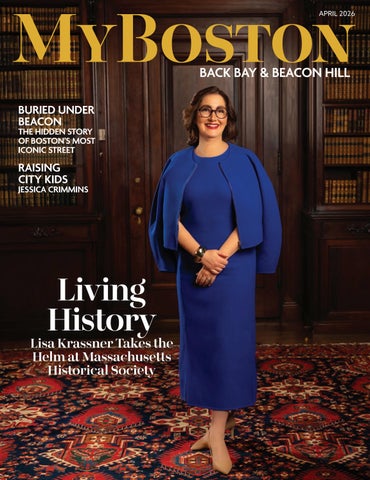
Lisa Krassner Takes the Helm at Massachusetts Historical Society
FEATURES
12 Living History
Lisa Krassner, the newlyappointed president of the Massachusetts Historical Society, is the latest steward of some of America’s greatest treasures.
18 Should We Stay or Go?
Mom and longtime Beacon Hill resident Jessica Crimmins weighs in on the benefits of raising kids in the city.
COLUMNS
4 PUBLISHER’S NOTE Boston is My City
6 LOCAL PULSE
Community Calendar
10 LOCAL TASTES
Big Buzz on Boylston
22 5 BEST Bookstores and Bookstore Cafes
24 LOCAL TREASURE Buried Back in the Bay
28 ASK THE EXPERT Setting the Stage for a Home Sale
30 LOCAL SOCIAL Community Gatherings
31 MY SUNDAY
Leslie Parsons
32 PHOTO OP Hang with the Nasturtiums
COVER
Lisa Krassner, President of Massachusetts Historical Society
Photography: Oleg Bolotov
Styling: Tara West
Wardrobe: Akris
Eyewear: Blink
Hair and make Up: Dahab Nazmy, Stilisti Salon
Photographed at Massachusetts Historical Society
a BOSTON IS MY CITY
AS LISA KRASSNER, the newly appointed president of the Massachusetts Historical Society, recently shared, Boston has a way of becoming your city. I understand exactly what she means. I arrived here two years ago, and Boston has absolutely claimed my heart. There is something about this city—its intellectual curiosity, vibrant neighborhoods, community feel, and the way history quietly hums beneath every street. In our April issue, we are bringing you just that.
Our cover feature introduces Lisa’s journey and the story of the remarkable institution she now leads. The Historical Society is not only one of Boston’s great libraries, but also a place where history comes alive. Currently on view is the exhibition “1776: Declaring Independence,” featuring rare drafts, manuscripts, and early printings that reveal how the founding document took shape.
Raising kids in the city?
Contributor Jessica Crimmins reflects on what it means to truly live as local and be part of a community. With parks, sports, cultural events, and neighborhood businesses all within walking distance, Boston turns everyday life into connection and discovery. Also in this issue, we’ll find out if we are truly “Buried Back to the Bay,” in a story that explores the origins of one of our neighborhoods.
As spring arrives, we look forward to celebrating Easter with family traditions. Soon after, we’ll be cheering on the runners of the Boston Marathon—a moment that always reminds us of what Boston Strong truly means. As always, I love hearing from you, whether you want to share a story, contribute, or simply say hello if you see me out walking and talking with neighbors.
See you in the neighborhood.
Renata Coker Publisher, MyBoston
mybostonmag.com @mybostonmag
Publisher
Renata Coker
Renata.Coker@mybostonmag.com
Editor and Photographer
Claire Vail editor@mybostonmag.com
Writers
Arturas Malinauskas
Eva Hu
Jessica Crimmins
Krystal Clarke
Lead Photographer
Oleg Bolotov
Advisory Board
Collin Bray
Leigh Harrington
John Michael Kennedy
Lisa Mulman
Sharin Schober
David Sharff
Cindy Sullivan
Zach Kinnard
WAINSCOT MEDIA
Chairman
Carroll V. Dowden
President and CEO
Mark Dowden
SVP, Group Publisher
Thomas Flannery
VP, Content Strategy
Maria Regan
VP, Director of Digital Media
Nigel Edelshain
Creative Director
Kijoo Kim
Advertising Services Director
Jacquelynn Fischer
Operations Director
Catherine Rosario
Production Designer
Chris Ferrante
Print Production Manager
Fern Meshulam
Circulation Manager
Kathy Wenzler
Advertising Production Associate
Griff Dowden
Photograph by Ben Flythe Styling by Tara West Wardrobe provided by AKRIS
Custom Jewelry by Cynthia Britt Hair and Makeup by Niambi Strickland, Salon Stilisti
Photographed at The French Library
2025 COVER OF THE YEAR!
You voted, we counted, and the results are in.
THANK YOU TO everyone who took the time to vote for their favorite cover of 2025! We’re pleased to announce the winner and two runners-up below. With so many talented friends and neighbors featured, we weren’t surprised to see that every cover received votes. But when the tallying was done, December came out on top, followed closely by November and March. Thank you to everyone who appeared on one of our covers in 2025, and to the photographers, stylists, and hair and makeup teams who helped them get cover-photo ready. It takes a village to shoot our own covers, but we feel it’s well worth the time and effort, and we’re gratified to know that our readers agree!
WINNER
Pamela Madigan of the Beacon Hill Ringers
Photograph by Claire Vail
Location: Nichols House
Hair and make-up by Dahab
Nazmy, Stilisti Salon
2ND PLACE
Kathryn Craig and Chris Barber, autioneers at the new Doyle gallery at The Vendome on Dartmouth Street.
Photograph by Claire Vail
Styling by Tara West
Men’s jacket by Mr. Sid
Women’s suiting by Max Mara
Hair by Carla Derrico, Stilisti Salon
Make-up by
Niambi Strickland, Stilisti Salon
3RD PLACE
Lia Davis Lombara and her daughter
Lexi Colby Lombara of local jewelry brand
Colby Davis of Boston.
Photograph by Ben Flythe
Community CALENDAR
Rain and taxes aside, April is burgeoning with live music, arts and crafts, local walking tours, and other exciting events happening in Back Bay, Beacon Hill, and beyond.
A Special April Boating Offer, From Handel and Haydn
George Frideric Handel’s “Water Music” was first performed in 1717 at a lavish Royal boating party hosted by King George I, with musicians playing on a barge floating down the River Thames. On April 10 and 12, Handel and Haydn will present Handel’s brilliant composition, among other pieces, at Boston Symphony Hall. This all-orchestral program of Baroque delights will be led by Artistic Director Jonathan Cohen and will feature a special performance by the high school singers of the inaugural Handel and Haydn Youth Choruses Chorale Festival, as well as festivities to celebrate Pride. Call 617-262-1815 or email info@handelandhaydn.org for more information and tickets.
To honor the unique premiere of this brilliant piece of music, Handel and Haydn and Community Boating, America’s oldest public sailing organization, have partnered on a special offer. Get 20% off kayak rentals in April with Community Boating when you use the code “Watermusic26” and float down the River Charles with a song in your heart!
April
Isabella Gardner Museum: Picturing Isabella Just in time for Isabella’s birthday on April 14, the exhibit “Picturing Isabella” uses a lifetime of photographs to trace Boston icon and museum founder Isabella Stewart Gardner’s complicated and evolving relationship with her image, fame, and legacy. As a young woman, she was photographed in the formal style typical of her time. As she grew older, she deliberately cultivated a public persona that was both dramatic and enigmatic. “Picturing Isabella” collects girlhood and travel photos, candids with friends and pets, posed studio images, newspaper clippings, and other archival materials to create a sketch of Isabella, whose camerashy behavior guaranteed her Museum as her most enduring portrait. Isabella Stewart Gardner Museum, 25 Evans Way. Call 617-278-5156 for tickets.
On April 7, join the French Library and writer Elaine Sciolino to hear the latest about the recent Louvre heist.
April 7
French Library: Night at the Louve— Art, Intrigue and a Modern Heist
For this special event, Elaine Sciolino returns to Boston to present the newly updated edition of her book “Adventures in the Louvre,” released in the wake of the dramatic Louvre heist that shocked France and made international headlines. With fresh perspectives from her recent reporting for The New York Times, as well as appearances on NPR and other major outlets, she will offer fresh insight into what the theft reveals about the museum’s history, vulnerabilities, and enduring power. This event is in English. Open to the public; registration required. This author talk will be followed by a Q&A with the author, a book signing, and a reception with light refreshments. From 5:30 to 8:30 p.m., the French Library, 53 Marlborough St.
April 9
Gibson House Museum: Historical Portraiture Night at The Loov
Join the Gibson House Museum and Life Drawing Boston for a Victorian-themed Historic Portrait Drawing night at The Loov in East Somerville. 6:30 p.m., The Loov Art Center, 72 Joy St., Somerville. Call 240-678-4399 for more information.
April 12, 21
Vilna Shul Walking Tour: Jewish Beacon Hill
Journey to Beacon Hill’s North Slope at the turn of the 20th century. Explore the lives of its Jewish residents during a period of cultural and architectural change. Uncover how Boston’s Jewish immigrants created an active community that blended customs from Eastern Europe and changes to the new world around them. Discover sites where Boston’s Jewish West End residents worked, lived and worshiped, including the sites of three synagogues within a few blocks of each other. Presented in partnership with Boston By Foot. The Vilna Shul, 18 Phillips St. Tickets are $30.
April 15
Gibson House Museum: Masquerade (A Gibson Soiree)
The Gibson House Museum will hold its 29th Annual Benefit at the historic St. Botolph Club on April 15, 2026. The Museum’s primary fundraising event, the Benefit raises funds critical to maintaining the house and its collections and providing public educational programming. Come for
cocktails, hors d’oeuvres, piano music, an exciting raffle, and good company. Masks and “Edward-Goreyesque” Victorian or Edwardian touches are encouraged as part of your cocktail attire. From 6 to 8 p.m. at St. Botolph Club. Find out more at thegibsonhouse.org.
April 16, 17
Berklee Performance Center: The Prince Project
The Prince Project student ensemble at Berklee College of Music pays tribute to one of the most visionary, groundbreaking, and prolific artists in modern music. Conceived by Julian Scott and Brayden Cranford, the large-scale production is produced and directed by Grammy-nominated professor Tia Fuller, alongside an all-star team of ensemble faculty. Anthony Burrell joins as choreographer and co-creative director, bringing together a talented cohort of dancers from Boston Conservatory at Berklee. 8 p.m., Berklee Performance Center, 136 Massachusetts Ave. Call 617-747-2261 or email boxoffice@berklee. edu for information.
Support the Gibson House Museum by joining them at their 29th Annual Benefit on April 15.
Photograph by Claire Vail
April 18
The School of Fashion Design: Tatted Lace Making Workshop
Discover the timeless art of creating tatted lace in this hands-on workshop! Students will learn foundational stitches and be ready to craft your own lace designs— whether it’s delicate ornaments, jewelry, or elegant trims to elevate your wardrobe. $120 for all-day workshop from 9:00 a.m. to 3:00 p.m. at the School of Fashion Design, 31 St. James Ave., 2nd floor. Visit schooloffashiondesign.org or call 617-5369343 for more information.
April 24, 26
Boston Lyric Opera: Daughter of the Regiment
Laughter meets revolutionary spirit in BLO’s staging of Donizetti’s glorious comedy. Inspired by the life of Deborah Sampson, the Massachusetts revolutionary who disguised herself as a man to fight for independence, this production transports us to Revolutionary-era Boston, telling a heartfelt tale of love and loyalty to celebrate America’s 250th anniversary. With a new English dialogue by Kirsten Greenidge, it’s a patriotic toast to America at 250—and to the rebels who shaped it. For tickets, call the box office at 617-5426772 or visit ticketing.blo.org.
April 26
30th Annual Greek Independence Day Parade of Boston
The yearly celebration of Greek Independence includes a lively parade featuring nearly 100 registered Hellenic groups and the historic return of the Presidential Guard of Greece (Evzones) to Boston—visiting for the first time in 25 years—proudly marching along Boylston Street starting at 1 p.m. at Exeter Street until Charles Street. The event is followed by an eruption of Greek music, dancing, and food at the Boston Common immediately afterwards.
This month, The Prince Project student ensemble at Berklee College of Music will pay tribute to one of the most visionary artists of our time.
Don’t miss the 30th Annual Greek Independence Day Parade of Boston on April 26.
Photographs by John Deputy
FINE DINING GUIDE
BIG BUZZ ON Boylston
The new Cactus Club is Back Bay’s newest “it” spot, drawing big crowds from downtown and beyond.
BY KRYSTAL CLARKE
THE NAME CACTUS Club may be familiar to longtime Bostonians who remember the Tex Mex spot near Berklee that closed in 2014. The new Cactus Club at 500 Boylston, however, shares nothing beyond the name.
On a recent Friday night, a line of diners stretched out on the sidewalk despite the freezing temperatures. Couples stepped out of cabs, dressed for a fun night out; chatty groups of workers drifted over from surrounding businesses.
At roughly 9,500 square feet and seating 325 guests across lounge, dining, and patio space, the Vancouver-based Cactus Club Cafe’s Back Bay outpost leans upscale and contemporary.
Just inside the snug entry, the space opens into a sprawling, multi-level dining room that feels more metropolitan lounge than traditional restaurant. Warm amber light reflects off wood beams, caramel leather banquettes, and polished brass. The ceiling curves overhead, guiding you from the entry to your seat. Contemporary artwork punctuates the walls, while greenery softens the edges.
The room unfolds in layers, with bold canvases and digital installations giving way to quieter compositions. Designed by Jeffrey Beers International, the space balances dramatic architectural gestures with tactile warmth. Boston
artist Giovanni DeCunto contributed commissioned works specific to the Back Bay location, reinforcing that this isn’t a copy-and-paste interior. Nearly every sightline offers something worth pausing for—even the restroom walls command attention.
In the lounge, a DJ spins a steady track of house beats into a comfortably dense crowd. Guests lean into conversation as the music hums beneath. No one is policing movement or confining anyone to a two-foot square of table space. It’s grown-up nightlife: high energy without the chaos.
TASTY BITES AND SIPS
Executive Chef Greg McCallum’s menu follows the same relaxed philosophy. Sushi sits beside truffle fries, curry,
burgers, and Prime steaks. Culinary purists may crave a narrower focus, but the crowd here is after a good time, and likes seeing their favorite dishes on the menu. The sushi set, yuzu crab, dynamite roll, tuna temaki, and flame-torched salmon aburi, arrived neatly composed. The salmon was clean and perfectly torched, but the tuna temaki was the standout: bright, balanced, and the kind of bite you order again without overthinking it. While Cactus Club may not be vying to be a top sushi destination, it’s a perfectly good social one.
A sleeper hit was the butternut squash ravioli with shrimp and truffle butter. Toasted pine nuts and crisp sage added the crunch the dish needed, lifting it from comforting to craveable.
The spacious dining room at Cactus Club Photographs courtesy of Cactus Club
The flavors land, though the plating could be tighter—a minor note in an otherwise satisfying dish.
The photogenic cocktails are around $20 each. The Blood ’N Blanco arrives a romantic pink, smooth, and citrus-bright with enough heat from the tequila to anchor the sweetness. The frozen bellini with a sangria float makes you briefly forget it’s cold outside.
The zero-proof program deserves equal attention. In a city where alcoholfree drinks cost nearly as much as cocktails, effort matters. The Little Pearl, bright with kiwi, cucumber, mint, and passion fruit pearls, delivers. The pearls burst with an unexpected snap, playful enough to make you grin but polished enough to stay civilized.
The team behind Cactus Club cites an average guest check of $50, but that’s optimistic. A full night out may be a different story, but in Back Bay, that’s no surprise.
Boston diners are demanding, and this stretch of Boylston has seen concepts arrive loudly and vanish just as quickly. Cactus has arrived already polished and full of energy, a large space that brings social oxygen back into a neighborhood. It’s big enough to accommodate groups, fancy enough to
satisfy fashionable people, relaxed enough to attract regulars. In Back Bay, Cactus feels intelligently calibrated to the way people actually spend their evenings out.
Bostonians will always show up for something new, but staying power is different. If Cactus can keep the energy up and the execution tight, it won’t just survive this stretch of Boylston. It will own it.
Krystal Clarke is a Michelin-trained chef and founder of FoodSaucy, a private chef service known for bringing bold, globe-traveled flavors to intimate dinners, retreats , and high-touch events across Boston. When she’s not cooking for clients, she’s eating her way through Boston with the enthusiasm of someone who’s seen the world and still gets excited about every kind of cuisine.
Top right: Butternut squash ravioli with prawns
Bottom left: A jewel-like Bellini cocktail
Bottom right: Cactus Club’s swanky lounge
B Living History
Photograph by Oleg Bolotov, Wardrobe by Akris, Eyewear by Blink
/ MyBoston BACK BAY & BEACON HILL
Lisa Krassner, the newly-appointed president of the Massachusetts Historical Society, is the latest steward of some of America’s greatest treasures.
BY CLAIRE VAIL
BBOSTON IS WHERE the whole business of being American began, so it’s not surprising that the country’s oldest historical society is located here, in an 1899 Colonial Revivalera building at the intersection of Hemenway and Boylston. This is the Massachusetts Historical Society’s seventh home, and it suits them. Even the lobby oozes old new world charm. Lisa Krassner, the organization’s newest president, leads me up the spiral marble staircase into a hallway lined with gleaming colonial-era furniture to an elegant circular chamber that looks out on a corner of the Emerald Necklace and the Fenway’s endless construction projects.
Over tea and a basket of breakfast treats, Krassner explains that Mass Historical was founded just 15 years
after the Revolution by Jeremy Belknap, an energetic clergyman whose life’s work was a rigorously researched three-volume history of New Hampshire. The book sold poorly, but would come to be appreciated many decades later, even earning praise from the worldly French diplomat and political philosopher Alexis de Tocqueville, who analyzed the character of our young republic in his runaway bestseller “Democracy in America.”
Belknap’s other major pastime was composing a who’s who dictionary of distinguished Americans. His networking with notable people resulted in an impressive collection of documents and objects that he and nine of his friends thought worth preserving. Others of Belknap’s mindset continued to enrich the
collection over the ensuing years, and today Mass Historical is a priceless gem—a library and archive with more than 14 million manuscript pages, along with books, maps, photographs, newspapers, paintings, and decorative arts. There’s also stunning exhibition space, extensive public programming, and a robust online presence with searchable databases of information.
“In 1791, our name was simply ‘the Historical Society,’” says Krassner. “We were collecting the nation’s history.”
It’s an eclectic collection full of surprises, spanning several centuries of the country’s great—and not so great—moments. As one might expect, the archive contains national treasures such as the personal papers of Thomas Jefferson, John Adams,
Left: This watch, made by master clockmaker Daniel Quare of London circa 1680, belonged to the Puritan clergyman Cotton Mather. Right: A miniature portrait of Elizabeth Freeman, painted by Susan Anne Livingston Ridley Sedgwick in 1811. The painting shows Freeman wearing a typical Federalist period dress as well as a necklace of gold beads that were later made into a bracelet, which is also in Mass Historical’s collection.
and John Quincy Adams. But there are also items documenting stories deserving of wider recognition, such as a portrait of Elizabeth Freeman, an African American woman who sued for and won her freedom from slavery in 1781, a landmark case that led Massachusetts to outlaw slavery two years later. There’s plenty of diverting side trails off well-worn historical paths: for example, Paul Revere’s firstperson handwritten narrative of his ride to Lexington and his capture by the British, Cotton Mather’s pocket watch, and a wistful 1917 photograph of the last horse-drawn streetcar in front of Old South Church.
“Old things tell stories,” Krassner says. “They’re imbued with meaning.
We don’t think of these items as relics. They’re relevant to our lives today.”
There’s also an enormous amount of “everyday history” in the collection—accounts of ordinary lives recorded in family papers, diaries, and photographs, all deep undercover sources for historical sleuths.
Krassner and her staff are eager to share these items, and the stories they tell, with as many people as possible.
A LIFE IN MUSEUMS
Krassner is exuberantly qualified to raise MHS’s profile. She has spent her career at some of the East Coast’s most lauded cultural institutions,
shaping how those organizations attract and treat visitors. Self-effacing and sharply observant, she seems unfazed by large-scale challenges, tackling them with a practical approach grounded in empathy and common sense.
She grew up in South Florida, the daughter of two culturally hungry New Yorkers. Classical music concerts and visits to museums were the norm, alongside scavenger trips to flea markets with her father, an antiques dealer who specialized in estate jewelry. When she was only five, her parents took her to the groundbreaking 1977 “Treasures of Tutankhamun” exhibit at Chicago’s Field Museum.
Krassner admires Phyllis Wheatley’s writing table. Wheatley was an American poet who is considered the first African American to have her work published. Photograph by Claire Vail
“I remember feeling completely transported,” she says. “All those gorgeous sarcophagi.”
At 16, Krassner was accepted to the exclusive international United World College program. A BA from Bryn Mawr and an MBA from Simmons followed. Early stints at the Unitarian Universalist Association and GBH convinced her that nonprofits were the right fit.
In 1999, she took a job at the Museum of Fine Arts and stayed for 13 formative years, playing a part in the planning and opening of the new American Wing and contemporary art galleries. As Senior Director of Visitor Experience, she introduced a training program called “The Fine Art of Service,” which put the visitor’s needs first.
“There was this notion that some staff didn’t deal with the public. We changed that. If you were in a public space inside the museum, you were responsible to the visitor,” says Krassner.
She demonstrated that simple changes had a big impact on visitor satisfaction. For example, having museum guards walk lost visitors to their destination rather than just pointing down a hallway, and ensuring “handoffs” of visitors from one staff member to another were handled gracefully, with friendly smiles. The program’s recommendations are still followed today.
In 2012, she left for Manhattan and the Metropolitan Museum of Art, where she worked alongside two of Boston’s current museum heads: the MFA’s Pierre Terjanian and Isabella Stewart Gardner Museum’s Peggy Fogelman. There, she helped steer a major rebranding effort and streamlined the museum’s complex membership program.
By 2019 she was COO at the Museum of Natural History, managing a 400-person staff and more than 1000 volunteers. When the pandemic hit, Krassner had six months to strategize and execute massive changes to systems that had been in
place for decades. They even opened a vaccination center in the iconic Hall of Ocean Life.
“We helped 100,000 New Yorkers get their COVID shots under the big Blue Whale,” she says, smiling. “How awesome is that?”
BACK TO BOSTON
When the Executive Director position at Massachusetts’s Concord Museum opened up in 2022, Krassner jumped on it. Though she loved New York, it was time to come home. “I just feel like Boston is my city,” she says.
Krassner set to work building the museum’s profile. There was no strategic plan, so she started one. She got the museum re-accredited. And she began planning for Concord’s 250th anniversary in 2025.
“Concord had an exciting opportunity to lead the story because of the first battle at the North Bridge, the famous ‘shot heard around the world.’ We created a rich array of programs and three exhibitions over an 18-month period,” says Krassner.
In 2023, the Museum’s 250th-anniversary exhibitions and published catalog of the American Revolutionary War collection won Krassner and her colleagues the
Decorative Arts Trust Prize for Excellence and Innovation. Not long after, she secured a $5 million gift, the largest donation the museum had ever received. Last spring, USA Today named the Concord Museum one of the best small-town museums in the country.
“We were firing on all cylinders. It was exciting. And then Mass Historical reached out and said, we have an opening. Are you interested? I said, yes!”
CUTTING THROUGH THE NOISE
Krassner calls Mass Historical’s curators “stewards of history.”
“I think the way to capture hearts and minds is really through storytelling. People do have a lot of distractions these days, it’s true. But they’ll also binge watch a Netflix program for hours on end,” she says.
Faux history costume dramas like Bridgerton rack up fans easily enough, but making real history relatable for broad audiences takes a special gift.
In their March “Object of the Month,” a regular MHS website installment about a collection item, the curators hit the mark with a playful gloss on a 1792 poem written by one Jonathan Plummer, a
Two visitors examine one of only 25 existing copies of the Declaration of Independence.
tinker from Newburyport who was perpetually unlucky in love.
The poem, entitled “Unrequited Love in the Time of Smallpox,” is dreadful, but its literary quality isn’t the point. Plummer’s story of love and loss is totally cringe, as Gen Z might say, and it’s wittily and clearly presented. Everyone knows a Plummer. Many have been in his shoes.
Krassner agrees that history needs to resonate with people to stick. “I think people want an emotional connection. People will always stop in their tracks for
something that’s really interesting or beautiful or complex to understand it better.”
Krassner is adamant that history is a living thing, with useful lessons to teach us if we have the ears to hear them. As Boston heads into a year of 250th commemorations and celebrations, there is no better time to listen to voices from the past.
“History education is not about nostalgia and civics education is not about partisanship. I mean, there’s real reasons we do this work,” she says. “During the Revolution people had to figure out what it meant to go
from being a British subject to being an American citizen. Now, 250 years later, we’re at another very polarized time in our history. I think it’s important to look back at the values that we built this nation on and think about what it means to be a citizen of this country. How do we find common ground? How do we value one another and our differences?” she asks.
One way to explore these questions is to visit “1776: Declaring Independence,” Mass Historical’s thought-provoking exhibit about the Revolution, which examines
Krassner looks back at Jeremy Belknap, who founded Mass Historical in 1791.
Photograph by Claire Vail
private letters, diaries, and newspaper accounts to reveal how the Declaration of Independence evolved over time.
The exhibit showcases texts that influenced popular thinking, such as “Common Sense,” Thomas Paine’s masterful indictment of tyranny, and John Adams’s “Thoughts on Government,” which outlined how to build a new republic from the ground up. There’s also the famous letter from Abigail, the other half of the Adams power couple, asking her husband to “Remember the Ladies,” who had little legal recourse if their own husbands proved tyrants.
On display are several rare
drafts of the Declaration, one of the history’s most audacious and radical documents. Each version’s differences demonstrate shifts in thinking, as the founding fathers argued and reworked their vision of this brave new world. These are words that actively shape our lives today. Consider Adams’s late June 1776 copy and Jefferson’s copy, too, which had a passage denouncing slavery as a cruel war against human nature itself. The Continental Congress took that part out, and millions of men, women, and children would suffer in bondage for nearly another century before emancipation in 1865.
The “1776: Declaring Independence” exhibit, which
runs until mid-December of this year, is an absolute must-see, but that applies to so much of Mass Historical’s collection. Krassner underscores that anyone can engage with the organization, and everyone is welcome in the library. Seeing a specific item requires an appointment, but anyone can make a request. Visiting the library is free, as is much of the programming.
“In the reading room, you can find a Pulitzer Prize-winning scholar sitting next to a high school student. We have something for everyone—we want our visitors to discover that special something that stirs their curiosity.”
The entrance to the exhibit “1776: Declaring Independence,” a testament to the power of words.
Should We STAYor GO?
Mom and longtime Beacon Hill resident Jessica Crimmins weighs in on the benefits of raising kids in the city.
BY JESSICA CRIMMINS
m
MANY PEOPLE THINK they have to move out of the city after having children, but why? I’m all for raising city kids. They’re smart, savvy, and open to new experiences. My husband and I chose to raise our daughter in downtown Boston. Here’s why it was one of the best decisions we ever made.
A Convenient Lifestyle
Being able to walk everywhere is a very big deal, as anyone who has moved to the suburbs from the city or vice versa will tell you. My husband, daughter, and I walked to work and to school every day. We had lower stress levels because we didn’t have to sit in cars in nerve-racking traffic. We saved time driving place to place and avoided the headache of searching for parking. Instead, we spent that time living. It was a gift. We walked to dinner, whether it was down the block or across the city, did all our errands on foot, and mapped out our course for the day to pick up essentials or specialty items. The city is convenient. Everything is right there, or a short walk away. My daughter experienced the beauty of the parks every season. In the winter, I pulled her on a sled to school, and
Photographs by Sharin Schober
on big snow days, we’d go sledding in the Boston Common with all of the neighbors, which was our shared “backyard” instead of some golf course miles away. Within less than a mile, there were any number of restaurants with many different kinds of food. The pleasure of being able to walk to dinner, and back home again is hard to overstate.
Then there’s commutes. If you work in the city, living here gives you time back. Forget traveling an hour or more to get home from the airport. Having time with your children is the greatest luxury.
People in Your Neighborhood
There is something so joyful about walking down the street and running into a neighbor. There are so many people you see every day, though you may not always know their names, you know their faces. You’re a local, a friend. On Charles Street, the owner of the hardware store and his staff greet you with a big hello and drop everything to help you. Since the boutique owners hand out dog treats (clever!), your dog will lead you into every business with treats, and there’s a lot of them! My daughter walked to school most of her childhood, and there were wonderful neighbors I could call on whom she could safely visit after school while my husband and I were still at work.
Getting Schooled
There are both public and private schools in the city. I have met many people who move into town from the suburbs because their kids are already in private schools, so why stay in the suburbs?
Expensive private schools aren’t the only option in the city. Many families who can afford it go private until middle school
and then, provided their kids can pass the test, send them to Boston Latin, one of the most prestigious and highly ranked public schools in the country. Boston Latin lets in more than 2,000 kids a year—a considerable number.
There’s also Boston Latin Academy, another well regarded public school that requires only a test and Boston residency to attend. So many people have explored the options for sending kids to school in the city, and there is a lot of information online about this topic.
World on a String
Museums, theatre, the symphony— Boston has some of the best cultural offerings of any North American city. Free music at the Hatch shell, seasonal festivals, and other frequent fun happenings round out city life. You don’t have to make a
major effort to come into the city. You can just walk down the street or hop on the subway.
You can stumble across an outdoor concert, see Shakespeare in the park, get last minute tickets for live theatre and take a walk or quick T-ride to premier museums like the MFA, the Isabella Stewart Gardner Museum, or the ICA. Or you can go see the seals at the aquarium while doing errands in the North End.
Or—one of our favorites—take the Red Line to Harvard Square and visit the Harvard Coop bookstore, then cross Harvard Yard to the Natural History Museum.
Visiting the North End for a feast or Chinatown for some amazing dim sum gives kids a worldly awareness that is a neighborhood away. My daughter loves cuisine from all corners of the globe because she was exposed to it her
Jessica Crimmins has raised her family in the city she loves.
whole life, and I think she appreciates it now more than ever! Boston is a diverse city, and it’s good when kids are exposed to people from all walks of life. They learn there are other cultures, and other ways of thinking, and they add to their view of the world. It’s an important matrix.
Staying fit
Boston is one of the best running cities in the world. I can name eight great loops off the top of my head that breathe life into me every season of the year. I ran through seven months of pregnancy, then ran with a baby jogger, and now my daughter is a marathoner and overall fitness enthusiast. On weekends in the fall and winter, we ran together on the Charles River, swam at the University Club or played squash and then went to lunch and shopping or to a museum.
When the kids are little, the
numerous playgrounds around the city and in every neighborhood make it easy to get out of the house and meet new people without the dreaded planning of ‘play dates’! We had instant play dates by heading to the playground, to the Frog Pond for ice skating or sledding down Mt. Vernon St. during the real big nor’easters when everyone is out in the streets because we are snowed in! Magical.
So, before you leave our great city, consider staying right where you are or maybe try a different local neighborhood. They all have unique and charming differences. My daughter is still a Bostonian, currently living in the Fenway, pursuing a full life of work, sports, creative interests, volunteer work, and travel.
Jessica Crimmins has lived in Beacon Hill for over 30 years. She serves on several nonprofit boards, including the International Tennis Hall of Fame in Newport, Rhode Island, and the Nichols House Museum. She helped raise funds for the Park Street School in Beacon Hill, which her daughter attended. Jessica has held executive level marketing roles at MetLife, John Hancock, and Santander and is currently a marketing and communications consultant and advisor. Find her at @beaconhillre or @Jpcrimmins.
The author and her daughter at Fenway Park.
Jessica, her husband, and daughter in the 1990s in the Public Gardens.
Bookstores and Bookstore Cafes
You don’t have to travel far from home to experience a whole new world.
BY EVA HU
BEACON HILL BOOKS and CAFÉ
71 Charles St.
Perhaps the ultimate Beacon Hill brownstone, Beacon Hill Books and Cafe is beloved for its cozy atmosphere and whimsical interior. Its charm invites visitors to intimately experience a fantasy out of one of the very books it carries, with a squirrel-sized door placed alongside the main entrance and cheerfully wallpapered rooms full of literary trinkets. One can imagine they are peeking into the home of a well-read, well-traveled benefactor.
The cafe below allows afternoon tea guests to bring home a tin of their custom blend. At the very top floor, for children’s and young adult publications, two particular delights can be found: a red button that activates a miniature New England train that runs above the shelves, and a miniature print vending machine with Beacon Hill Books and Cafe designs. Singular for its representation of Beacon Hill as a neighborhood, this newer establishment inhabits the longevity and character of Boston itself.
Photographs by Eva Hu
Afternoon light in Beacon Hill Books and Cafe.
A SANCTUARY CAT CAFÉ
80 Charles St.
T.S. Eliot once declared: “Books. Cats. Life is good.” A Sanctuary Cat Cafe embodies this philosophy, serving indeed as a sanctuary for readers, members of cafe society, and cat people, jointly and severally. A display in the bookstore side includes a selection of cat-centric works as well as Boston reads. The cats of 80 Charles are a permanent and bonded family, and visitors can book appointment reservations (cafe drink included) to play with them. Because the cat side is separated from the bookstore and cafe portion, visitors can sip while browsing bookseller recommendations allergen-free, whether or not they share the founder’s affinity for felines.
PARKSIDE BOOKSHOP
260 Shawmut Ave.
From the team behind Provincetown Bookshop, Parkside Bookshop is the South End’s newest literary location, and is nestled, self-referentially, by Peters Park. One of its unique decorative features is a split flapboard that displays literary quotes and adages. As a true community spot, Parkside offers local events, including book club meetings, craft nights, and mahjong club. Its warm ornate fireplace, diner-style tin ceiling tiles, scenic South End wall mural, and welcoming outdoor bench seamlessly blend together aesthetic and historic elements of the neighborhood it resides in with the book-finding experience.
POSMAN BOOKS
127 Newbury St.
Accessible by Newbury Street, Posman Books offers not only books but souvenirs of the city and all manner of delightful knicknacks. Its book selection encompasses niche nonfiction subjects, from specialty cookbooks to film reviews. Readers of all ages can find something for them, and shoppers may be pleased to discover an abundance of useful goods with a memorable twist: an umbrella designed to look like a baguette, a coffee cup that’s actually a stuffed animal, and bookmarks shaped like food items.
TRIDENT BOOKSELLERS and CAFÉ
338 Newbury St.
Maze-like in the best ways, two-story Trident Booksellers and Cafe offers a reader a lifestyle component in addition to actual books. Trivia nights, open mics, book signings, and watch parties keep patrons returning. Trident’s cafe operates on both floors, allowing diners to people-watch and converse both indoors and outdoors. Readers interested in literary publications and unique editions are in luck! Small-circulation magazines and special-edition clothbound classics alike are almost always in stock here. And of all the bookstores on this list, Trident offers the only sale section.
Eva Hu is a third-year law student and book reviewer based in Beacon Hill. She enjoys hosting Mad Women Book Club at various literary locations around the city, including the Boston Athenaeum, the French Library, and Parkside Bookshop. She also promotes the Boston Public Library’s Special Collections and public events as a Literary Influencer for the Associates of the Boston Public Library.
A Sanctuary Cat Café features cat-themed recommendations.
Posman Books has a wide range of genres.
Parkside Books is true local establishment.
Buried Back in the Bay
Boston’s most beautiful street has deep roots.
BY ARTURAS “PARTY ARTY” MALINAUSKAS
BEACON STREET is an anomaly.
It is straight. It is wide. For five immaculate miles, Beacon Street cuts a rare clean line across a city famous for doing the opposite. With countless confusing corners, strange streets, and twisted turns, how is Beacon Street so defiantly even?
To find the answer, look beneath Beacon street’s pavement.
THE LAZY RIVER
Before the Brownstones, before Boston, in the beginning, there was Quinobequin.
Pronounced “KWIN-OH-BEHKWIN” this Indigenous name for the Charles River translates roughly to “Long-SlowRisingWater-Long.” This wide river was a tidal beast: Twice daily, the water level would rise and fall by 10 feet as Atlantic tide surged around Boston. “Back Bay” was the literal description for the Charles, where it flowed around the backside of the Boston
Before 1821, “the Boston Neck” was the only land connection linking the mighty head of Boston to the body of this Commonwealth. In the highest
An illustration of Quinobequin, precursor of Back Bay Hand colored by the author
of tides and during deluges of rain, the slow and steady river would wash over that thin neck, stranding Boston’s wagon and horse traffic. This flooding was dreadful! About as chaotic as DoorDash scooters nowadays. Like today’s scooters, the river’s flow was far more powerful than any ordinary man.
URIAH COTTING
By 1812, a bold Bostonian named Uriah Cotting dreamed of taming the temperamental Quinobequin.
Back then, Beacon Street was short. A stub. Not even half a mile. Beacon street went west from King’s Chapel, abruptly ending at the River (where today’s Charles Street intersects). Standing on Beacon Street at the river’s edge, Cotting looked across the vast shimmering back bay and saw a golden opportunity. Here, he imagined how one straight extension of Beacon Street would serve two lucrative purposes.
First, a permanent reliable road. The first toll road out of Boston. Second, a tidal dam. By splitting the river into three parts, Uriah imagined harnessing incredible power from the natural tides. By buffering tides, sawmills and textile factories could be powered where the normal river current was too weak.
Uriah, like many other Bostonians, was anxious about the brewing War of 1812. Making muskets and building battleships was top of mind, so the local government soon approved Uriah’s pitch. This plan was not universally praised. One local newspaper foreshadowed the consequences of Uriah’s dam scheme: “What think you of converting the beautiful sheet of water which skirts the Common into an empty mud-basin, reeking with filth, abhorrent to the smell, and disgusting to the eye?”
When the dam was finished in 1821, it was a stinking failure.
Creating a stagnant pool of muddy water was a rightly questionable idea. Even worse, sewage pipes in the south end of Boston were not extended through the new dam, so sewage once washed away by the river began piling up. At age 53, Uriah died two years before his dam began fouling Boston’s atmosphere. While Beacon Street’s extension was useful as a road, the dam’s tidal power was weaker than predicted. Hope of healthy industry faded while vile smells from the basin intensified.
FILLING OVER FAILURE
What began as an industrial miscalculation ended as one of the most exclusive residential spaces in American history.
So, how did Boston’s best real estate rise from a stinking swamp?
Like many extravagant failures, it was covered up. Here, the cover up was literal. While the dam was almost useless, it was never destroyed. Boston buried the dam and buried the entire stagnant basin, filling in 500
acres of land between 1856 and 1886. The motivations and methods of this work are intense. Uriah’s Beacon Street extension would remain the boundary between Back Bay land and Charles River water until 1910. In that year, the Charles River Dam was constructed, isolating the Charles from the tides of the Atlantic.
The grandest, richest street in the city is literally built on a foundation of failure. It’s a classic Boston lesson: The path to progress is often paved over our most embarrassing actions. Next time you admire the views on Beacon Street, take a deep breath—and be grateful it doesn’t smell like the 1820s.
Arturas “Party Arty” Malinauskas started Scrolls & Strolls (scrollstroll.com) sightseeing tours to bring people together with the liveliest explorations of Boston’s brightest stories. When not giving tours, you may find him meditating in a yoga class, riding his 52” Penny Farthing bicycle around town, or tinkering with new designs for his other venture, the Breezey Machine Company.
An illustration from the 1850s that shows a view of Beacon Street
FEBRUARY HOME SALES
Back Bay and Beacon Hill
Setting the Stage for a Sale
Home staging expert Danielle Khitrik knows how to make properties shine, to the delight of buyers and sellers alike.
BY MYBOSTON STAFF
Why should sellers consider staging their home?
Staging is an essential piece of the selling process when listing a home. Sellers should understand that staging can maximize the home’s selling price by potentially 1% to 10% or more while reducing time on the market. Staging creates an emotional move-in ready appeal that allows buyers to visualize living in the space. It is highly effective to show key features and create a strong first impression.
What are the typical steps involved in staging a home?
The first and most important step is to have a consultation. A consultation is essential to understand the scope of the project. The consultation is to evaluate the property’s current condition, identify
target buyers, and discuss goals. A strategy is developed to highlight the home’s best architectural features and minimize flaws. Next, an estimate is created based on the scope of work, amount of inventory needed, and timeline. After all parties have agreed to the terms, designing will begin and installation will be conducted.
How do you know what kind of decor buyers want to see?
Buyers generally prefer neutral, bright, and uncluttered spaces that feel like a calm move-in ready home. Buyers are drawn to spaces that feel grounded and connected to nature— for example using green or brown accents which include decorative elements such as greenery and florals. Tasteful items such as pillows and simple art pieces can help make the space feel inviting. Furniture placement is also imperative for buyers to see the functionality of each room without having to guess what size furniture would fit in the home.
Do most home staging businesses provide furniture and decor items?
Generally speaking, that is the purpose of a home stager. Regardless of how they source the inventory, most professional home staging businesses own their furniture and decor. Particularly for vacant homes,
home stagers maintain inventory and store it in a warehouse. Unlike occupied staged homes, they often use existing furniture but supplement with their own inventory to improve the aesthetic.
How should sellers choose a home staging business?
Sellers should choose a home staging business by reviewing portfolios for style versatility. In addition, ask their listing agent for a list of their preferred stagers. Choose a stager that understands what buyers are looking for in your specific area. Ask for testimonials or check online reviews to gauge their professionalism and success rate.
With 20 years of experience in real estate and a true passion for design, Danielle Khitrik knows how to make properties shine. She understands the critical role of first impressions in today’s market and is dedicated to enhancing your home’s appeal to captivate potential buyers. Call 508-934-9773 for more information or email djkhomedesign@gmail.com.
Top right: A living room staged to best advantage Bottom right: Danielle Khitrik in her office. Bottom left: A space staged to look spacious and welcoming
Spellbound at the Boston Ballet Gala
THE 2026 BOSTON BALLET Ball “Spellbound” Gala was held on Saturday, Feb. 7, 2026. This memorable evening, with a theme inspired by Sir Frederick Ashton’s ballet “The Dream,” celebrated the Ballet’s artistic achievements and the dedication of its many supporters. Rooms were resplendent in deep crimson and cherry red roses, and guests, all dressed to impress, were treated to thrilling dance performances and a lavish dinner, while an auction helped to raise a record-breaking amount for one of Boston’s most brilliant cultural gems.
Photographs by Claire Vail
Anne McQuade and Laura Sen
Left: Kevin and Patti
Jeanne Barry Right: Principal dancer Jeffrey Cirio with his wife Anjuli Hudson
Principal Dancers Lia Cirio and Paul Craig
Colin Hill, Alexis Borisy, John Maraganore
Frank Wisneski and Lynn Dale
Stunning crimson décor, floral centerpieces, and displays
Leslie PARSONS
Leisurely Sunday afternoons in Back Bay are a favorite for this local.
BY LESLIE PARSONS
I USUALLY KICK OFF Sunday mornings in Back Bay with a best-inclass workout at my Prudential gym with my favorite trainer, Kadidjha. This is followed up with a stroll down Boylston Street to Bistro du Midi, our family’s favorite restaurant, for brunch with my daughter and son-in-law. Surrounded by neighborhood friends, we catch up over the best French omelet in Boston. Sometimes I indulge in their Salmon Benedict, which features smoked grapefruit tea-cured salmon topped with lemon-chive hollandaise. Afterwards, we walk to Boston Common and power walk up Beacon Hill and back down to Newbury Street, where the shops are opening for the day.
My favorite Back Bay places to explore are the Massachusetts Historical Society and American Ancestors, where you can find out about your family history, are both closed on Sundays, so I start my Newbury Street Sunday stroll with a visit to Ralph Lauren. I sip complimentary champagne by the
fireplace (they have two!) and browse their latest collection. Then I head next door to Contessa to catch up with friends for coffee with an unmatched view of the Public Gardens. On special occasions, we meet friends for a mother-daughter Sunday afternoon tea at the Boston Public Library, a special treat planned in advance but completely worth the wait!
After tea, we explore Newbury Street’s unique collection of art galleries and boutiques, which are ever-changing and never disappointing. I like to visit SITKA, where the paintings have so much gorgeous color. They really lift my spirit!
The best way to wrap up such a lovely day is with an early evening walk
through Copley Square and a visit to L.A. Burdick’s. While I’m relaxing with a cup of their single-source extra dark hot chocolate and nibbling on their freshly baked, warm chocolate chip cookie, I reflect with gratitude on what a very special place this is that I call my home.
Leslie grew up on the North Shore. After a career in International Health in the Middle East and raising her family in the Atlanta area, she and family returned to her Boston roots. Leslie is a clinical consultant for Harvard Pilgrim HealthCare, and her passion is living in the Back Bay while exploring her family’s deep roots in the settling of precolonial Massachusetts.
Top right: Relaxing by the fireplace in the women’s Purple Label section at the Ralph Lauren store on Newbury Street. Middle right: At Contessa, where the views of Back Bay are superb!
Bottom right: Tea with (left to right), Marilyn and Lori Zartarian, daughter Lara Shuqom Gehl, and Parsons.
APRIL BRINGS SHOWERS, but not always flowers, with many buds just peeking through the soil in Boston. For a bounty, visit Isabella Stewart Gardner Museum’s courtyard display, where there’s always flowers blooming. The displays rotate 10 times a year, an homage to Isabella’s love of gardens. April is dedicated to cascades of colorful but ephemeral Nasturtiums, which only last about three weeks.
Have a great image for Photo Op? Submit your high-resolution shot to editor@mybostonmag.com.
Photograph by Troy Wade
Classic Beauty Classic Beauty
ANNA PETROPOULOS, MD, FRCS
A good realtor knows the area.
A good realtor knows the
A great realtor knows it like the back of his hand. Like Peter Hill. He has extensive knowledge of both Beacon Hill and Back Bay, not to mention, the best of everything each has to offer. And not only is Peter smart, he also has a vetted list of helpful resources, a commitment to offering solicitous client service and a personality that makes him friends everywhere he goes. And as part of the exemplary team at MGS Group Real Estate, Peter has 12 top agents to rely on.
So, if you want to work with an agent who’d win Boston if real estate were a marathon, just give Peter a call at (508) 353-9721. Call (or text!) Peter at (508) 353-9721, or email him at peter@mgsgrouprealestate.com.
So, if you want to work with an agent who’d win Boston if real estate were a marathon, just give Peter a call at (508) 353-9721. Call (or text!) Peter at (508) 353-9721, or
So, if you want to work with an agent who’d win Boston if real estate were a marathon, just give Peter a call at (508) 353-9721. Call (or text!) Peter at (508) 353-9721, or email him at peter@mgsgrouprealestate.com.