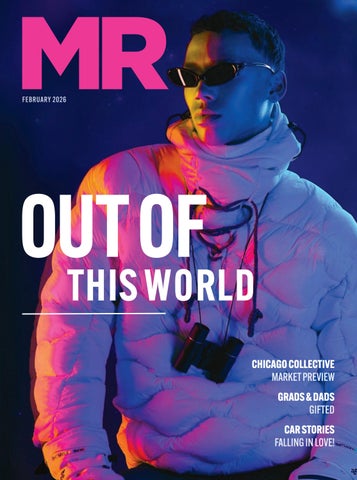
MR Magazine February 2026

Page 1


CHICAGO COLLECTIVE MARKET PREVIEW GRADS & DADS GIFTED CAR STORIES FALLING IN LOVE!

EDITORIAL

Editor-in-chief KAREN ALBERG GROSSMAN

Managing Editor JOHN RUSSEL JONES

Web & Content Editor BRETT EDWARD STOUT

Art Director MIKE STEVEN FRANÇOIS

Contributing Editors

CRAIG CRAWFORD | MICHAEL FISHER

Contributing Creative Directors

TREVETT MCCANDLISS | NANCY CAMPBELL

Group Publisher LIZETTE CHIN

Publisher CHARLES GARONE

ADVERTISING PRODUCTION

Production Managers

LAURIE GUPTILL | FERN MESHULAM | KATHY WENZLER

Marketing & Production Specialist

CATHERINE ROSARIO

Office Manager

MARIA MARTUCCI

Accounting

KASIE CARLETON | URZULA JANECZKO

SCOTT KATIRACHI

WAINSCOT MEDIA

Chairman CARROLL V. DOWDEN

President & Ceo MARK DOWDEN

Senior Vice Presidents

LIZETTE CHIN | RITA GUARNA | EDWARD BURNS

Chief Financial Officer/Vice President

STEVEN RESNICK

Vice Presidents

NIGEL EDELSHAIN | THOMAS FLANNERY

NOELLE HEFFERNAN | MARIA REGAN

CORPORATE OFFICE

DEFINE YOUR MESSAGE!

What inspires your customers to spend more than they planned to? ” “

Congratulations MR readers on making it through the 2025 Holiday Season! Despite worldwide uncertainty, total holiday sales increased by four to five percent; online shopping was up between five and eight percent. In-store sales were down slightly but still contributed a good three-quarters of holiday revenue. That said, total apparel spending for the year was down four percent, and 2025 was the worst year of job growth since 2003.

My biggest takeaway (after struggling to make sense of contradictory statistics) is the widespread belief that income alone is no longer a reliable predictor of apparel spending. As confirmed by MR retailers, high-income spenders are becoming more selective, shifting to brands with a clear value proposition. “Companies with a well-defined brand message will have the advantage,” analysts predict, citing Ralph Lauren, Cartier, and Coach as prime examples of strong branding that leads to loyalty.

So I’ve been asking my retailer friends about their store branding and what truly differentiates their store from the competition. What’s most memorable or unique about the shopping experience you’ve created? What inspires your customers to spend more than they intended in your store? If you can sum it up in a well-chosen line or two, why not use this tagline in an aggressive ad campaign?

But thinking way back, I can’t recall a truly memorable slogan since George Zimmer’s “You’re going to like the way you look, I guarantee it!” and Sy Syms’ “An educated consumer is our best customer…” (Read our Last Word interview with Marcy Syms.)

But in my search, I discovered a great example of a creative mission statement on the website of MP3 Minneapolis: “Where style is limitless, where the curious are rewarded, and where everyone is welcome to find pieces of themselves amongst our distinctive assortments.” Nick Hilton at Hilton’s Princeton has also come up with a strong and concise tagline: Fewer, Better Things. “It’s not great for TV,” Nick confides, “but in print, I believe it conveys our philosophy: careful, informed curation; insistence on quality and value; respect for the environment.”

In this our Chicago Collective issue, in addition to previewing the exceptional product you’ll find at the show, check out our category analysis (knitwear, outerwear, footwear), a retail radar piece on two great stores, a Dads & Grads gift guide, an in-depth feature on Customer Retention (did you know that acquiring a new customer costs five times as much as retaining an existing one?), an interview with Dan Orwig (did you know that Peerless now has an ownership position in Paul Stuart?), and lots of fabulous fall ’26 fashion. Oh, and how could I forget our Valentine’s Day feature: love letters from industry execs to their cars.

In closing, I’m hoping you like MR’s 2026 message statement: “Showcasing top products and personalities, giving retailers and manufacturers a voice.” So let us hear from you!

Look forward to seeing you in Chicago, Lizette, Charles, John, Brett, and Karen

THE RETENTION REVOLUTION:

WHY YOUR NEXT BEST CUSTOMER IS ALREADY IN YOUR BOOKS

For years, the American menswear industry has been obsessed with the chase. Big budgets are poured into social media ads, search engine optimization (SEO), and aggressive street-level marketing, all aimed at capturing the attention of a new face. But as we move into 2026, the economic landscape has shifted. Customer acquisition costs (CAC) have skyrocketed—up over 220% in the last decade—meaning that for many independent retailers, the cost of buying a new customer often eclipses the profit of their first purchase.

The smartest players in menswear are no longer focusing on the chase. They are focusing on cultivation and on using technology to make this effective and effortless.

The High Cost of the Stranger

The math is unyielding: acquiring a new customer costs five times as much as retaining an existing one. In a world of tightening margins and digital noise, spending your way to growth is a race to the bottom.

True profitability lies in the database you’ve already built. Consider the compounding value of a loyal client: loyal customers are five times more likely to repurchase, four times more likely to refer their inner circle, and seven times more likely to try a new offering. When you launch a new line of Italian knitwear or a private-label denim, your regulars aren’t just your best bet—they are your only guaranteed win.

And by focusing on your existing database, your marketing budget works harder.

• Current State: Spending $50 in ads to get one $200 sale (25% Marketing Cost).

• Retention State: Spending $2 (the cost of a CRM platform/SMS) to get one $200 sale from a regular.

• The Result: You can take the money you didn’t spend on Facebook ads and reinvest it into a Loyalty Event (like a Spring Trunk Show) that converts at a much higher rate.

The Revenue Multiplier: The 5% Shift

Increasing retention by just 5% doesn’t just add 5% to your bottom line; it can improve your overall profitability by 25% to 95% because the cost of those sales is so much lower.

When you retain 5% more of your customers year-on-year, you aren’t just getting one more sale. You are unlocking the 7x Multiplier:

• The Math: If you have 1,000 active customers spending an average of $500/year, and you retain 50 more of them than you did last year, that is a baseline of $25,000 in found revenue.

• The Upsell: Because these 50 people are loyal, they are 7x more likely to buy your new high-margin Spring leather goods or Italian knits. This typically increases their Average Order Value (AOV) by 15-20%.

Understanding the Modern Man’s Wardrobe Habits

To unlock this opportunity, consider how the American man’s shopping habits have evolved. The modern male shopper is notoriously mission-driven. Unlike the browsing-heavy habits often seen in womenswear, men tend to shop for specific needs: the wedding-season suit, the return-to-office blazer, or the weekend-getaway polo.

However, once a man finds a fit, a brand, and a salesperson he trusts, he is remarkably loyal. He doesn’t want to shop around; he wants a wardrobe partner who reduces his cognitive load. Knowing who your customer is and what they want wherever they shop is crucial to maintaining customer loyalty. Whether he’s clicking buy on your E-commerce store at midnight or walking into your brick-and-mortar shop on Saturday, he expects you to know his size, his preference for double-vents, and his aversion to polyester.

REINVENTING THE CONCEPT OF TAILORING SARTORIO.STORE

Timing the Opportunity: The Spring/Easter Surge

While Christmas remains the undisputed heavyweight of the retail year— often accounting for up to 30% of annual revenue—smart menswear retailers are looking more closely at the Spring and Easter seasons. Is it larger than Christmas? No. But is it more strategically important for menswear? Quite possibly.

Easter and the surrounding Spring window represent the first major wardrobe refresh of the year. Per capita spending for Easter has surged in recent years (hitting nearly $180 per person). For menswear retailers, this is the season of high margin tailored clothing, linen blends, and social event dressing. While Christmas is often about gifting (where the buyer is not the wearer), Spring/Easter is about self-purchase. This is when your loyal clients buy for themselves, making it the perfect time to activate your retention strategies.

Tech-Powered Nurturing: From Black Books to Clienteling

The days of the handwritten black book are gone. To nurture existing clients at scale, you need a technology stack that makes personal service feel effortless. Here are the three essential tiers of technology for 2026:

1. Unified Customer Relationship Management (CRM)

Your Point of Sale (POS) and E-commerce data must be a single source of truth. Solutions like Shopify Plus integrated with Klaviyo allow you to segment your audience with surgical precision. You shouldn’t be sending a New Suit Arrival email to a guy who just bought a suit last week; you should be sending him a Complete the Look email featuring the perfect silk tie and pocket square.

2. Modern Clienteling Platforms

Tools like Apple’s Own Kind or Tulip empower your sales associates to be proactive. These apps allow your team to send personalized shoppable lookbooks via SMS or email directly from the store floor. When a regular’s favorite brand drops a new collection, your associate can send a text: “Hey John, I know you love the Paisley & Grey Johnny Collar Polo. We just got three new colors in—I’ve saved a Large for you in the back. Want to stop by?” This is the digital equivalent of the old-school haberdashery experience.

3. AI-Driven Predictive Analytics

Newer AI integrations can now flag at-risk customers—regular shoppers who haven’t visited in six months. Instead of waiting for them to disappear, your system can trigger a “We Miss You” incentive or alert a manager to reach out personally.

The Bottom Line

In the menswear business, we aren’t just selling clothes; we are selling confidence and convenience. If you can prove to your existing customers that you understand their style and respect their time, they will reward you with a lifetime of high-margin business. Stop looking for the next customer. Start looking at the one standing right in front of you.

THE 2026-2027 STRATEGIC ROADMAP

Q1-Q2

2026: The Data Cleanse Phase

GOAL: Reach a 90% data capture rate.

ACTION: Implement a Client Profile Template for every single transaction.

METRIC: By June, 100% of your top-spending Loyalists should have a dedicated Sales Associate assigned to them in your CRM softwarer

Q3-Q4 2026: The Behavioral Phase

GOAL: Move from Bulk Emails to Triggered SMS.

ACTION: Set up automated alerts for birthdays and 6-month Lapsed customers.

METRIC: Achieve a 20% Referral Rate (loyalists bringing in friends) to lower your average acquisition cost.

GOAL: Maximize the Spring/Easter Self-Purchase window.

ACTION: Execute the 4-Week Easter Countdown with a database that is now 12 months warm.

METRIC: Compare your Spring 2027 revenue to Spring 2026. With a 5% higher retention rate, you should see a double-digit increase in net profit.

Q1 2027: The Profit Harvest The Bottom Line for 2027

By the end of next year, your shop should operate on a 60/40 RULE:

60% of your revenue should come from Existing Clients (high margin, low cost).

40% of your revenue should come from New Clients (lower margin, higher cost).

Most struggling retailers are at 20/80 Move from just selling clothes to building recession-proof assets.

Craig Crawford is a two-time Tabbie award-winning author and founderprenuer of Crawford IT (https://crawfordit.com), a London-based consulting firm specializing in the digital transformation of brands. He’s on Instagram and X, @getamobilelife; or call +44 07834584785.

A SUITING EVOLUTION

A conversation with Peerless president DAN ORWIG

As we start a new year, what are you most excited about?

The tailored clothing category is moving beyond rigid definitions toward modern dressing that reflects how people live today—blending polish with comfort and purpose. When executed well, tailored apparel remains one of the most powerful ways to help consumers feel confident and prepared. The dress-up category is evolving, not disappearing.

What most worries you, going into a year of global conflict and rising prices?

In 2026, tailored clothing must work hard to earn every sale. Guys are shopping far more selectively than they once did. The winning brands will be those that deliver versatility, quality, and fit while respecting the consumer’s sensitivity to price and relevance.

Can you discuss your investment in Paul Stuart and what your involvement will look like?

We’re thrilled and honored to be partnering with such an iconic brand, and we look forward to sharing more information in the coming months.

What were your best sellers for fall/holiday 2025?

We have a portfolio of strong global brands, each operating within a clearly defined lane— from luxury to opening price points, spanning modern to traditional styling, as well as classic to slim fits. That breadth allows us to serve customers across price levels and evolving preferences, while maintaining continuity as their needs change.

Rather than one standout brand, the lead category for fall/holiday 2025 was suiting. Both core and fashion-forward suits performed well, with fashion suiting delivering a particularly strong season.

What looks will be key for spring/summer 2026? For fall/holiday 2026?

and heritage patterns, anchored by a strong neutral story. Across both seasons, silhouettes are relaxed yet refined, with higher rises, fuller pleats, and double-breasted jackets evolving into standalone pieces.

What’s needed to jumpstart sales in the stores?

I wouldn’t characterize the current environment as needing a “jumpstart,” but rather a continued focus on fundamentals. We work with some of the best retail stores in the business. What I consistently see working is a strong emphasis on the customer experience. Stores that make it easy and enjoyable for customers to shop are outperforming the norm.

Tailored clothing must work hard to earn every sale.

Spring/Summer ‘26 focuses on soft construction, pastel palettes, and innovative linen, with tailoring updated through deco plaids, checks, and stripes. Fall/Holiday ‘26 blends luxury tailoring with casual textures

Can you address the impact of tariffs? Are you noticing price-resistance on more expensive goods?

2025 was a challenging year from a supply-chain perspective. We’re fortunate to have an owned and operated factory in Montreal that provides a high level of control, flexibility, and stability. For product sourced outside of Montreal, we work with long-standing strategic partners who collaborate closely with us to respond quickly to the ever-changing tariff environment.

Our focus remains on delivering the best overall value to our customers—balancing fashion, quality, and service—while thoughtfully managing cost pressures. While we’re seeing increased price sensitivity across all businesses, consistency and quality remain our priorities.

What do you find most frustrating/rewarding about clothing business these days?

One frustrating aspect is that the quality, craftsmanship, and fit we offer—along with the time and investment required to achieve our high standards—are not always fully recognized. The more we can educate men about all that goes into designing and producing today’s tailored clothing, the stronger the category will become. Think about it: Tailored clothing has the power to make men feel confident and put-together in a way few other garments can. When we get it right, it’s not just about selling a suit—it’s about helping guys show up at their best to become their best.

Smitten with KNITTIN’

The ever-popular ¼-zip has captured our hearts, but luxury is the true love of the season.

Concrete, anecdotal, and the now all-important TikTok-based evidence indicate that the men’s knitwear sector is currently sailing along pretty much snag-free.

For example, take the recent quarter-zip fashion furor, an online movement that has undoubtedly boosted men’s sweater sales of late. Influencer Jason Gyamfi’s November 2025 “I’m a Quarter Zip Dude Now” TikTok viral video (currently with more than 1.7 million views) in which the 21-year-old declares his disdain for Nike Tech suits while wearing a classic-style knit navy sweater with a zipper that runs one-fourth down its front, has prompted countless Gen Z and Alpha guys to buy (or at least covet) Gyamfi’s look.

“The quarter-zip has always been a very instrumental silhouette in the market but, yes, it is blowing up and is very popular in all the fabrications for us,” notes Raffi’s EVP Kareen Shaya Safier. “We have it in merino wool, which is a very consistent top-selling yarn for us; we offer it in jersey style that has beautiful trim detail on the placket, and we have also expanded to an English rib knitting style and a waffle knit.”

Aside from this sweater-ofthe-moment, there are plenty of other indicators that knitwear is indeed now-wear. A recent study by research consultancy Verified Market Research says that the U.S. men’s knitwear market was valued at about $14.6 billion in 2024 and, at a CAGR of 6.3%, is expected to reach $23.6 billion by 2026.

Established well-known brand names also offer verification of the sector’s robustness. Vince said in its Q1 report released in May 2025 that cashmere sweaters were the number one bestsellers in its now fully expanded men’s collection and Madewell introduced and heavily promoted The Chalet Shop, an Alpine-inspired curated sweater collection, this past holiday season. In addition, Jason Schott, the COO of Schott NYC, says that its nearly 10-year-old men’s knitwear assortment continues to make good traction, especially in the case of a recent Donegal-style model that quickly sold out after being worn by the character Steve in the latest season of Stranger Things “Knitwear has been a steadily growing category for us,” he notes. “In the past year, sweaters accounted for approximately 15% of our unit sales, though they

represented under 5% of total revenue, reflecting their role as a complementary category within the broader [mostly outerwear-driven] collection.”

This sweater surge is also sparking renewed interest in some lesser-known names that offer luxury-like quality at prices that are significantly lower than, say, Brunello Cucinelli, which charges upwards of $8,000 for some of its knits, and Loro Piana or Zegna, both of which have sweaters that can cost $6,000-plus. Two of them also happen to be Italian.

Based in Biella in the Piedmont region, which is also the home of Loro Piana and Zegna, Piacenza 1733 has the unique distinction of being a member of Member Henokiens Association, an international group of companies that are at least 200 years old and still owned and operated by members of their founding families. Now helmed by two brothers, Visily and Ettore Piacenza, who are the 14th generation to oversee the business, the label has made significant retail inroads in the U.S. since the New York-based Black Dog 8 wholesale showroom began representing it there three and a half years ago. “They are now in the top specialty stores in America,” says Black Dog 8 co-owner Katie Liu. “It’s a real ‘Who’s Who.’”

Employing high-quality materials such as 12-gauge cashmere, ultra-fine 18-merino, and a newly introduced cashmere-linen blend and proprietary cotton produced in partnership with Supima, Piacenza 1733 has pivoted from its longtime traditional offerings thanks to its fraternal co-CEOs. “The knitwear has become more modern–a little bit more fashion-oriented. It’s not just a V-neck and crew neck in cashmere. Plus, they have extended their knitwear to different yarns as well, like silks and wools, and all the luxury fabrics you can think of,” says Liu.

She adds that because it’s a vertical business the savings can be passed down to retailers and

From Piacenza’s Fall/Winter 2026/2027 Collection
Settefilli, as styled by menswear guru Nick Wooster.
Layers of luxury at Piacenza 1733
Loose and drapey at Lars Andersson

end consumers. “I say the word ‘luxury’ because the quality is superior,” she says as she holds up a scrumptious cashmere overshirt. “For other brands, it would be $1,300 to $1,500 and up. For us, it would be like $995.”

The other up-and-coming—at least in the U.S.—Italian knitwear label to know is Settefili Cashmere (the name translates to “seven yarns”), which recently signed Components by John McCoy to be its American wholesaler. Since 2009 Michele Pagliero has owned and designed the Ferrera-based collection (he previously repped it in his multibrand sales showroom before scooping it up), which offers about 30 to 40 fashion pieces each season as well as a wide variety of “basics,” which is really a misnomer because of their unique color palettes and yarn blends such as the one that combines wool, cashmere, alpaca and polyamide.

“Michele can take a milk color yarn and a sand color yarn and combine, combine, and come up with a totally new color that’s never been seen in the marketplace, and his direction, model, and design is totally something fresh and new,” says McCoy proudly.

With retail prices that range from $395 to $1,295, the label is already stocked in numerous U.S. specialty stores including, among others, Button Down in San Francisco, Axel’s in Vail, Pockets in Dallas, and Martin Patrick in Minneapolis.

Another knitwear maven from overseas who

is earning raves for his work is Swedish designer Lars Andersson, who launched his eponymous collection in the early 2000s in New York and then transferred his studio and all production to Kathmandu, Nepal, about a decade ago. The designer’s emphasis is clearly on womenswear–it’s in 60 stores versus just four worldwide that carry his men’s pieces–but that quartet of stockists (Maxfield in LA and three in New York State: If in SoHo, Mikel Hunter in Hudson, and Burkelman in Beacon) rave about its luxurious craftsmanship and bang for the buck.

Jesse Clinton, a sales specialist at Maxfield, says, “It’s pure luxury comfort minimalism, but not boring minimalism. It’s the perfect blend of approachable and conceptual. And the price is extremely good considering the fabric.”

Adds Burkelman co-owner Kevin Burke: “Our customers don’t come to us for yet another basic cashmere sweater in this season’s colorway. They want statement pieces! Standout knitwear like Lars Andersson’s timeless-chic silhouettes, CMMN SWDN’s oversize modern shapes, or Kawakey’s whimsical designs fill that need.”

Retailing from $250 to $1900 for a hooded long cashmere coat, Andersson’s items all use all-natural fibers such as Mongolian cashmere from China and Italian cottons and wools. Most are hand loomed on flat-bed machines by a team of Nepali craftspeople in the studio. “The crew are amazing, they are my family and I want to keep them as busy as possible,” he says. “The craft of making by hand is diminishing–for both good and bad. Knitting is tedious work. But I love the handmade aspect of it.”

In the meantime, Andersson’s New Yorkbased sales agent, Michael Gabriel, implores retailers to diversify their assortment as they inevitably stock up during the current and furtherly forthcoming knitwear boom. “If I had my own store, I wouldn’t buy any of the brands that everyone else is pursuing,” he says. “I wouldn’t follow the well-worn path except for maybe two to three brands to make it clear that I’m a directional store. I would not be a label whore. Unfortunately, I just find that to be the case with so much today.”

Christopher Blomquist is a longtime mostly fashion-based journalist. He is also an adjunct professor at Parsons and FIT and his personal collection of sweaters is extensive.

Knit Bits

WHAT SOME INSIDERS ARE SAYING RE: THE SECTOR…

“A man will always need his knitwear. It’s kind of like the bread at the table. Like when you come to a restaurant, and you need the bread, and then you can add all the extra complements to it. It’s your underlayings, your T-shirts, and even your sweaters.”

—Kareen Shaya Safier, Raffi

“Super soft cashmere that can be dressed up or down , and sweater jackets that serve instead of a blazer in cashmere/ wool. Brands: Crossley, Fioroni, Marni.”

“While solids will always be foundational, we expect patterned knitwear to gain greater relevance, particularly geometrics, refined novelty patterns like plaids, and textured techniques such as cabling. These details add visual interest while maintaining versatility.

—Cecile Revah, Bugatchi

“There’s Frenckenberger with insanely soft cashmeres and oversized fit with a bright monochromatic color palette, and Elder Statesman–classic Americana meets California beach hippie, oversized and soft luxury cashmere with lots of trippy prints and graphics.”

—Maxfield sales specialist Jesse Clinton

—Jason Somerfeld, owner of Letter J (NYC) On current bestsellers and what he’ll be betting on in 2026 On some of his favorite knitwear brands in the store

“Knitwear requires knowledge, understanding, and love.”

—Michael Gabriel

Raffi’s 1/4-zip is a perennial favorite layering piece.
Texture detail from Schott cardigan.

PRAYERS ANSWERED

Heritage and performance power outerwear sales.

What’s the key to successful outerwear sales? As Gruner president Caroline Massel says, “Pray for cold weather!”

Many U.S. retailers must have been saying their prayers in 2025, because an early cold snap hit at just the right moment, driving sales across the country. As Kevin Reardon of Franco’s in Richmond, Virginia, put it in December, “We had more snow than Boston!”

As the industry heads into the Chicago market—hopefully without a deep freeze—and into a full slate of regional shows, the outerwear category appears to be coalescing around two clear ideas: heritage styling and performance. Like nearly every category today, brands that succeed are also those delivering a focused, consistent message that can cut through an increasingly crowded media and retail landscape.

Winter Heritage

“We’ve been experiencing some extreme cold and inclement weather, so many people are looking for true winter coats, from performance-oriented brands like The North Face and Arc’teryx, heritage labels like Barbour, and fashion outerwear labels like Moncler,” says Jian DeLeon, Nordstrom Men’s Fashion Director. “The resurgence of heritage style in menswear has brought a lot of awareness to labels like Barbour, which is relatively timeless, but it’s able to reinforce its legacy and give it a bit of fashion authority.

“An earlier turn in weather has certainly contributed to giving customers an immediate reason to buy outerwear. Couple that with menswear trends rooted in heritage labels and classic outdoor sportswear and it’s the ideal recipe for where everyday function and modern fashion conveniently intersect.”

Reardon concurs, noting that the country look of Barbour and Tom Beckbe has been particularly strong. “A few years ago, some young ladies here started wearing the style, and it has just taken off since then. I wish I could get more of them!” he says, adding that he sold out of those pieces during a November cold snap. “In outerwear, we’ve always done well with Johnnie-O jackets and quilted vests, as well as Peter Millar.”

Gubernatorial Style

Performance-driven outerwear isn’t a major category for Reardon, but traditional models with subtle twists, such as plaids or textured solids, continue to resonate. With Virginia inaugurating its 75th governor, the Honorable Abigail Spanberger, in January, and Richmond serving as the state capital, Reardon also saw strong demand for classic black and dark gray topcoats.

“Our specialty is dressy clothing, so we always have top coats on hand,” he says. “We do a Hart Schaffner Marx in basic black, charcoal,

and navy, as well as a 3/4-length camel coat. The Corneliani I.D. car coat also does well, especially close to the holidays.”

“Our number one trend for fall is heritage, but heritage combined with tech,” says Massel. “We’re selling raglan shoulder coats, a vintage look we haven’t seen in years. Patterns are back, with updated, muted plaids and mini-checks. In rainwear, our Roderick, a wool-blend raincoat treated for water repellency, is a big hit, as are classic trenches. We’re also seeing more double-breasted styles, continuing growth from last year. We have faux-fur collars that are a real throwback. Lengths are getting longer. Linings are important, including faux fur and printed flannel for warmth. We use faux down (easier to have cleaned!) and zip-out linings.”

In casual outerwear, Massel points to rugged, country-inspired styles with an “old English” sensibility. Waxed cotton bodies remain key, but with an updated approach. “Of course, we do it with a PFAS-free coating that offers the waxed feeling and is treated for waterproofing, but you don’t have to worry about the wax getting all over your other clothes.”

An homage to Canada at Nobis

Faux suede is also gaining traction. “A real suede jacket is nice, but what if you get caught in the rain?” Massel says. “What’s great about these, too, is that, at this price point, a guy can treat it like his fun piece, and own several of them.”

Shirt jackets continue to perform well. “Our Nick Graham coats have a younger vibe, with lots of corduroy, and linings that are inspired by the brand’s shirts. They have a tailored feeling and include graphene linings for extra warmth.”

“Two outerwear trends feel especially strong right now: oversized, voluminous coats, and retro, nostalgic statements,” says Bill Chang of AW Chang. “Our Con.Struct collection is leaning into volume with wool-blend coats that layer effortlessly over tailoring yet still feel modern over a turtleneck. The FE Apparel brand is answering the nostalgia wave with varsity jackets that look classic at first glance, then hit you with elevated, luxury details, from wool-blend melton bodies and pebble-grain vegan leather sleeves to vintage NHL logos executed in chenille, digitally printed patches, and embroidery.”

Technical Warmth, Refined

Nobis is marking its 20th anniversary with a refreshed design direction that emphasizes clean silhouettes and a warm, cohesive palette. The brand is introducing what it calls “Technical Apparel Systems,” a modular layering concept that allows consumers to add or subtract pieces as temperatures fluctuate.

“The outerwear market has evolved a lot over the last 20 years,” says David Archer, Nobis’s VP of marketing. “We’ve always focused on the blend of form and function, creating technical outerwear that can take you through a winter. Performance is paramount to the brand, so when we introduced this new range of mid-layers, we incorporated new tech called X-Reflex: typically, 60% of body heat is lost to the outdoors, so this tech reflects internal body heat back to the wearer, allowing us to make the product lighter yet just as insulating. You’ll get the same performance as if you were wearing a Nobis parka.”

He adds, “We’re also seeing that vintage feeling in the outerwear space, but it also feels ultra modern. Our design team was focused on the ‘going home’ theme, so it’s all focused on shades of maple, a subtle nod to our Canadian DNA. We wanted to evoke a sense of warmth, both emotionally and functionally, so you’ll see things like our new corduroy fabric, which has a vintage feel without sacrificing performance. It’s a luxury product, and performance is luxury.”

The brand has introduced Ridgeline corduroy and wool-and-cashmere blends in silhouettes ranging from classic bombers to long topcoats. While Nobis’s retail sweet spot remains $995 to $1,395, new brushedfleece categories allow consumers to enter the brand at $300.

Staying on Message

“Cold weather is undefeated in terms of driving consumer demand. But we think durability and versatility are really important now, too,” Archer says. “Customers want something that works for them from Monday through Sunday, both in the city and outdoors. I think having a clear message and clarity around your collection is important. It makes it easier for retailers to train their staff and sell the brand.”

Paul & Shark’s Alessandro Dini echoes that sentiment heading into Fall/Winter 2026. Outerwear, he says, is not only the brand’s fastest-growing category, “It’s the clearest expression of what Paul & Shark stands for today. In a world defined by volatility and visual noise, clarity has become a luxury. Retailers and consumers are gravitating toward brands that show a precise vision, strong identity, and consistency over time. Retailers who are able to build trust in what they can provide to their customers are winning.

“At the same time, P&S outerwear is where our internal technological know-how becomes visible in an elegant, tangible way. Our strength is not ‘technical fashion,’ but elegant performance.”

At Nobis, the brand continues to see growth in transitional pieces, including light cashmere, wool, and hybrid constructions. “With weather becoming unpredictable, customers no longer buy seasonal pieces; they buy trans-seasonal solutions. Our hybrids merge knitwear and outerwear. I believe the great value they have is because they are versatile, refined, and usable across more moments of life.”

That may be the clearest message yet: offer consumers the ability to meet the whims of the weather, no matter how cold or warm it may be. But, just in case—since everything heritage is new again—we’re keeping Dial-a-Prayer on speed dial.

Paul & Shark’s clear luxury offers a twist of heritage.
Photos by Marko Kalfa

PORTUGUESE FOOTWEAR KNOWS HOW TO PIVOT

INVESTMENT TARGETS MODERNIZING AN ARTISANAL SHOE-MAKING TRADITION.

The city of Porto—where the Douro River cuts across northern Portugal and flows into the Atlantic Ocean— famous for its artisanal footwear, is making huge strides forward with investment and innovation. There is a revolution that can be seen and felt as the industry enhances centuries-old craftsmanship with advanced technology.

It’s a new era for one of Portugal’s most important sectors. The Government, trade associations, and factories have accelerated the juxtaposition of artisanal vs. automated production through bold execution, blending creativity with state-of-the-art fabrication. This past November, APICCAPS (the Portuguese footwear components, leather

goods manufacturers’ association) celebrated its 50th anniversary of galvanizing the sector at home and abroad. The organization shared its strategic plan and progress with press and dignitaries at a two-day conference entitled “Welcome to the Industry of the Future” at the majestic Palácio da Bolsa.

Admittedly, China accounts for approximately 88% of the global footwear-making market, followed by India and Vietnam. Europe’s relative market share hovers around 12.6% (2024), with Portugal poised to help grow that figure. Beyond statistics lies a multi-project strategy driven by stakeholders who embrace the future and envision accelerant growth and long-term competitive gains. Specifically, by strengthening global value

chains, increasing green processes, and attracting fresh talent.

All eyes are still on tariffs. In August of 2025, the U.S. implemented a cost structure that capped duties on EU goods at 15% in most cases but imposed significantly higher tariffs (28% to 50%) on footwear from other major countries, such as Vietnam, India, and Brazil. Portuguese footwear has become price-competitive relative to Asian and South American partners, potentially allowing Portuguese producers to expand their market share in the U.S.

The goal is to become the benchmark for high-quality on a larger scale, with the idea that the future of footwear will prioritize the expansion of expertise over low-cost volume—a refined alternative.

From “A Story About Shoes,” Portuguese Soul Magazine, August 2025. Shoes: Ambitious; Coat and trousers: Luis Carvalho
PAOLO VITALE
PLOUMANAC’H
GARRETT
PASHMERE
PORTOFINOPIAZZETTA
SERÀ FINE SILK
PASOTTI
SALVATORE MARTORANA
VITALIANO
MARIO PORTOLANO
TOMBOLINI

AGF MAROSTICA

ANDREA BOSSI – ITAL WEAR

ARCURI TIES

CAMOUFLAGE AR AND J
ARMERIA MESCHIERI
DEBERNARDIS SARTORIE
ENZO PISANO NAPOLI
ASTORFLEX
DEL DUCCIO
FLY3
FIORONI

AERONAUTICA MILITARE

ALESSANDRO GILLES

ANGELO ROMA
FUGÀTO
GALÀ
FEFÉ NAPOLI
CAMICERIA SANNINO
CORDONE1956
DI BELLO BY FONTANI
CALVARESI
BIGI CRAVATTE MILANO
BOB
BRETELLE & BRACES
ARTICO
ATHISON
BARMAS
EDO CAMICIE SARTORIALI
EMANUELE MAFFEIS
ERRICO FORMICOLA

L’IMPERMEABILE

MYTHS
TORRAS LUXURY
SCUDERI
PAOLO ALBIZZATI
VIBE – SCIAMAT
SILVIO FIORELLO
PIETRA SALATA NAPOLI
VOGLIO
STEFANO CAU
MD11VDC
MONTECHIAROIMPULSO-LORENZONI
GUERCILENA 1944
ITALO FERRETTI
KB NAPOLI
GIANNI GALLUCCI
MARTIN ZELO
MASSIMO CORRADO NAPOLI
MAURO BLASISARTORIA PARTENOPEA

Wrapped Up in Italy

CHICAGO IN

CHICAGO

COLLECTIVE | JAN 31-FEB 3, 2026

The Italian Trade Agency presents 64+ Italian menswear collections, featuring tailored clothing, sportswear, outerwear, denim, footwear, leather goods & accessories. While at the show, don’t forget to visit the ITA lounge; to rest, re-group & refresh!

AERONAUTICA MILITARE | 2104

AGF MAROSTICA | 2120

ALESSANDRO GILLES | 2116

ANDREA BOSSI – ITAL WEAR | 5100

ANGELO ROMA | 6105

ANT45 | 3111

ARCURI TIES | 3101

ARMERIA MESCHIERI | 5094

ARTICO | 2102

ASTORFLEX | 4094A

ATHISON | FRONT ROW 13

BARMAS | 2118

BIGI CRAVATTE MILANO | 4093

BOB | 4094

BRETELLE & BRACES | 3109

CALVARESI | 5103

CAMICERIA SANNINO | 4100

CAMOUFLAGE AR AND J | 5101

CORDONE1956 | 2096

DEBERNARDIS SARTORIE | 3103

DEL DUCCIO | 2106

DI BELLO BY FONTANI | 4096A

EDO CAMICIE SARTORIALI | 5106

EMANUELE MAFFEIS | 5096

ENZO PISANO NAPOLI | 3105

ERRICO FORMICOLA | 5102

FEFÈ NAPOLI | 2108

FIORONI | 2100

FLY3 | 6099

FRAY | 3100

FUGÀTO | 3121

GALÀ | 3115

GARRETT | 3117

GERMANO 1952 | 2122

GIANNI GALLUCCI | 4096

GUERCILENA 1944 | 4099

ITALO FERRETTI | 3095

KB NAPOLI | 3093

L’IMPERMEABILE | 3099

MARIO PORTOLANO | FRONT ROW 15

MARTIN ZELO | 2114

MASSIMO CORRADO NAPOLI | 4100A

MAURO BLASI – SARTORIA PARTENOPEA | 2126

MD11VDC | 2110

MONTECHIARO – IMPULSO – LORENZONI | 5099

MORGANO | 3094

MYTHS | 6101

PAOLO ALBIZZATI | 3123

PAOLO VITALE | 3113

PASHMERE | 6093

PASOTTI | 5093

PIETRASALATA NAPOLI | 2124

PLOUMANAC’H | 2094

PORTOFINOPIAZZETTA | 2112

SALVATORE MARTORANA | 6095

SCUDERI | 3107

SERÀ FINE SILK | FRONT ROW 14

SILVIO FIORELLO | 3119

STEFANO CAU | 5095

TOMBOLINI | 3125

TORRAS LUXURY | 5104

VIBE – SCIAMAT | 6103

VITALIANO | 4095

VOGLIO | 3096

Fluent in Modernization

Despite a recent 2.1 billion Euro (nearly 2.5 billion USD at press time) uptick in exports, with 68 million shoes sold to 170 countries in 2024 (a marked increase over 2023), there is a sharp, collective realization that Portugal must become more self-reliant and vertically integrated. The country is betting big on success by providing financial backing to the industry. According to Luis Onofre, President of APICCAPS and creator of his own line of luxury handmades, the funneling of 120 million euros into robotics, automation, and eco-conscious operations over the next three years will be the largest investment cycle in its history. It will ensure “one of the most modern industries in the world.”

The first phase, the FAIST project, an acronym for Factory, Agility, Intelligence, Sustainability, Technology, was co-opted as a joint venture involving footwear companies, component manufacturers, scientists, software developers, and tech institutions. A 50 million

euro infusion that will deliver innovative solutions. With 75% of the initiative already complete, the consortium is positioned to optimize processes through digital transformation. The win: increased efficiency, a more rapid market response, improved customization, greater profitability, less waste, and better working conditions. The mission is to lead, rather than survive. The modifications will allow larger-scale, skilled, and augmented end-to-end production, from component manufacturing to modular assembly.

Technology alone is not a panacea, and it will not replace people. The factories are looking to reskill and upskill, inspiring a younger generation and maximizing output through speed, agility, and shorter lead times. Human talent must remain at the core.

What does this mean for the high-end retailer? More opportunity to pursue private label, easier customization, and attention to bespoke detail. Economies will ripple through the supply chain, making small-batch production more affordable and sustainable, better aligning with consumer preferences.

What does this look like in measurable and actionable items? Thirty new machines, over twenty software solutions, five integrated assembly lines across fifteen footwear and component product lines. Three hundred new jobs, information-sharing across multiple channels, including webinars, podcasts, and videos. Doubling the use of renewable energy and halving the emission of greenhouse gases.

Bringing the Past into the Future

Sanjo is a “new old brand” that started in 1933, making hats. They learned to adapt early with creative grit, like many Portuguese manufacturers who survived decades. When hats got old,

they found new techniques and a use for vulcanized rubber: Portugal’s first sneakers. From sports to streetwear, they became the biggest sneaker manufacturer in the country, but once Portugal joined the EEC, competition became fierce. Sanjo declared bankruptcy in the late ’90s, but its sneakers remained loved by fans. They made a comeback, stayed true to original styles, and introduced new materials, colors, and textures. Today’s soles are glued and come from recycled materials. They have eliminated chemicals and optimized production to lower water and energy use. Challenging the status quo, Sanjo reaches new audiences through the zeitgeist, drawing inspiration from skate culture, music, and fashion, collaborating with Portuguese designers and artists. The result is a blend of current, cool, and industrial heritage that makes them unique.

Portugal Around the World

Shoe buyers looking to diversify can discover iconic Portuguese brands at Pitti Uomo. Zardus has made premium handmade items since 1919. Ambitious owns a progressive take on tradition, and Algori embodies retro, sporty, ethical, and eco-conscious in sneakers. All of the above are timeless, effortless, with a sharp focus on design.

In the U.S., buyers can find the latest naturally unique, laid-back cork-bottomed shoes and sandals from Asportuguesas at the Atlanta Shoe Show. There, you can also take your trendy pick from Fly London’s sophisticated and edgy ankle boots, espadrilles, sandals, shoes, and sneakers.

From luxury to urban wear to elevated athleisure, when you nail fit and personal style, everybody wins. It’s a plus when you can raise the bar for production.

The Kyaia factory floor in Guimarães, the “birthplace” of Portugal. Leading footwear and lifestyle manufacturer of several brands, including Fly London, Asportuguesas, and Softinos.
Internal stitching and insole fabric of a shoe taken from a factory tour of Carité in Felgueiras, Portugal. A FAIST leader.

WHAT MEN WANT!

A New Store in Issaquah, Washington Gets it Right

Herringbone Sage opened its doors just two months ago, but store owner Mihyon Ahn is no stranger to fashion retail.

Moving from South Korea with her parents and three sisters when she was 15, she first worked in sales at Nordstrom, then spent almost 20 years at Butch Blum. Sometime later, after Butch Blum had closed its doors and Mihyon had immersed herself in art and staging homes for real estate sales, a 1350 square foot store came on the market. It was 12 minutes from her home and owned by one of her former clients. Clearly, this was meant to be!

Mihyon is described by those who know her as a true talent. Says good friend Ken Haruta. “As soon as you meet her, you can feel her passion for the business: she loves the product and she loves the people.”

Butch Blum raves about her work ethic and sophisticated taste level. “It would be extremely difficult to find a harder working or more loyal employee. Mihyon’s greatest skill is her ability to relate to all types of people. Her enthusiasm and magnetic personality are her strongest attributes.

“From the beginning, she was an excellent salesperson, and as her taste became more sophisticated, she became diligent about learning our POS system and how everything worked together to create a comprehensive inventory management system. We slowly integrated her into the men’s

buying team, which led her to becoming Kay’s most trusted employee and lead buyer on the women’s team.

“I was so very proud walking into Herringbone Sage for the first time! She’s created a true destination store that is a mini version of Butch Blum: the fixtures, layout and merchandising are perfect, with much attention to detail. It’s a great location in a small shopping section in Issaquah, a thriving upscale suburb about 15 miles outside of Seattle, but not at all in conflict with Seattle stores.”

Mihyon is grateful for how much she learned from Butch and Kay over two decades. “Butch taught me about finance, about the importance of inventory control. Better to have sold out of something than to have leftover inventory. If sold out, it’s often possible to special order from the vendor’s in-stock programs. This extra effort shows customers how much you value their business.”

Mihyon’s fashion focus is on soft sport coats, fine cashmere knits, sport shirts, activewear, grooming and accessories. Her top sellers include pants from Ballin and Masons, Hiltl clean denim, Fly 3 Italian knit sweaters, Raffi and Autumn Cashmere, Bugatti, Ballin, Sartoria Partenopea, Luciano Visconti, and more. On her wish list: Luciano Barbera and LBM.

Mihyon Ahn and her menswear store, Herringbone Sage.

ALAN DAVID BESPOKE:

Obsessed with Fit in New York City

Bespoke has many definitions: tailored, tailor-made, personalized, custom-made, commissioned, made to order, made to measure, and more. For Alan David Horowitz, grandson of legendary retailer Moe Ginsburg, Bespoke means perfection, or as near to perfection as is humanly possible.

Of course, perfection doesn’t come cheap, nor does 9500 square feet of prime Madison Avenue real estate. “Bespoke clothing requires a Bespoke setting,” Alan explains, showing me around his fabulous showroom/offices. We’re accompanied by his lovely daughter Shelley, who joined the business in 2021, proud to continue the legacy. Famous for fit, Alan describes a process that includes digital imaging and 23 measurements taken by skilled tailors. From this, a try-on muslin garment is crafted which enables tailors to assess fit and comfort in an unfinished form, allowing for precise adjustments before final assembly. “There used to be a 2-3 percent re-do on basted fittings, now it’s .5 percent,” notes Alan, explaining that his garments feature hand-basted shoulders, perfectly matched stripes and plaids, thousands of meticulous hand stitches and tremendous attention to detail. “Finished garments include a lightweight full-canvas interior, hand-pressed throughout the process so the fabric won’t shrink, bubble or pucker. Collars are first

basted, then hand-sewn into the jacket; trousers are lined with a rubber grip inside the waistband to hold the shirt in place.”

Ticket prices for Alan David Bespoke start at $1395, and average $2800. Of course, they can run higher, depending on fabric. Luxury fabric options include Zegna, Loro Piana and Scabal. “My first $50,000 suit sale was 90% vicuna,” Alan recalls. “The guy who bought it also purchased a $25,000 topcoat. I’d say 10 percent of our business is now in women’s tailored clothing, and this segment is growing.”

Alan is proud to note that most of his production is here in the States, centering on IAG’s Rochester facility and the Oxxford factory in Chicago. Recently named the sole distributor in Manhattan for Oxxford Clothing, Alan credits his 25 employees. His in-house tailors have at least 20 years of experience, and range in age from 40-60. One exceptionally talented master tailor still crafts perfect clothing at age 80!

Alan has dealt with every fit challenge imaginable, adapting for colostomy bags, for guns, for amputees, for obesity. Although he’s deathly afraid of dogs, he recently measured a Best Dog to scurry down the aisle in a wedding tux. And since he guarantees free lifetime alterations, the Ozempic craze is costing him, especially when guys bring in entire wardrobes to be modified.

Alan David Horowitz respects his multi-generation clothing heritage, no pressure on daughter Shelley!

What Men Want

Although Northwest guys are known for their outdoors-y style, Mihyon hopes to uplift it just a bit, showcasing heritage brands with emerging designers at pricepoints from moderate to luxury. “I want to create a more contemporary interpretation of classic menswear that is elevated, enduring, and very personal,” Mihyon explains. Sounds like a winning strategy indeed!

Alan David Bespoke

Atrack record of on-time delivery brings well-deserved bragging rights. “In 25 years, we’ve never missed a promised delivery time,” Alan reports. “During Hurricane Sandy, we located back-up generators. When Covid hit, we outsourced unfinished wedding suits to local tailors. We’ve spent $900 on an uber from Rochester to NYC. We’ll do whatever it takes to meet our promised delivery dates. In general, it’s 5 to 6 weeks but we offer rush service as needed.”

“We’re not real estate tycoons,” Alan concludes. “We work hard seven days a week. We’re tailors by family history and we chose this business because we love it. With Bespoke the most profitable part of tailored clothing these days, I’m grateful to have found this niche. I thank my dad and my grandfather for all that they taught me.

I want to create a more contemporary interpretation of classic menswear.

Most shops rely on salesmen to measure; here, it’s master tailors and patternmakers.

WELCOME TO CHICAGO

Chicago Collective: Men’s

As the song says, “you’ll lose the blues in Chicago,” and the Chicago Collective: Men’s team continues to keep exhibitors and retailers happy and coming back for more. This season promises to be as successful as ever, with a calendar focused on order-writing and just enough special events to keep things interesting. We caught up with show runners Monique Kielar and Danielle Owen to find out what’s new in the Windy City.

Has anything changed with the Chicago Collective and what can we expect for the upcoming show?

The Chicago Collective Men’s Edition continues to thrive, and we are grateful for the ongoing success. Our primary goal has always been to discover innovative ways to evolve the show while remaining true to our foundation. Feedback indicates that retailers are very happy with our core selection of brands, which continues to resonate in terms of quality.

We have also seen positive results from adding the 4th floor. The brands located there cater to similar clients and appreciate the space’s exclusivity, enhancing the overall experience for everyone. Since first launching the space, we have refined the layout, resulting in a more natural flow of traffic for buyer navigation.

What are some of the opportunities you see that haven’t been explored yet?

We think the best opportunities for growth are with international retailers. We have already tapped into Canada, Mexico, Italy, Japan, and Puerto Rico, but we feel there is more opportunity to engage buyers outside the US.

Are there opportunities for crossover with other markets that share space in the Mart? The only intersection between Men’s and any of our other events is The National Bridal Market Chicago, within the Tuxedo category.

However, because we have enjoyed three consecutive years of sold-out Bridal shows, this has limited our ability to blend the two markets.

We are excited about something we are trying with the Interiors Market, particularly the Kitchen and Bath showrooms on the first floor of THE MART. In February 2026, we will launch the first of many Dinner Series events, where we will co-host an intimate gathering with a menswear brand - this time, Triluxe. They will invite 12-15 retailers to join us at the Bosch/Thermador Gaggenau showroom, located in the historic vault of the Merchandise Mart National Bank, established in 1930. We believe there are significant opportunities to introduce Chicago Collective attendees to THE MART showrooms, creating a mutually beneficial experience for all involved.

What are you hearing from retailers? What are the challenges in the current market?

What are the benefits?

Retailers are telling us they’re being far more intentional with their buying decisions. They are looking for brands with a clear point of view, strong product stories, and assortments that feel focused and proven, while also valuing

flexibility around order sizes and delivery timing. The biggest challenges in the current market are cautious consumer spending, margin pressure from rising costs, and the need to carefully manage inventory after several unpredictable seasons. At the same time, it seems retailers are open to discovering new brands that feel authentic, in-person connections are more important than ever, and categories that offer versatility, quality, and strong value are continuing to perform well.

Is there anything specific on your mind as the trade show host that you’d like to let retailers (and brands) know about?

One of the core pillars of the Chicago Collective is its sense of community. In an increasingly technological world, we remain committed to our identity and core values: supporting retailers and brands and bringing them together for an enjoyable and productive experience. We’re prioritizing a well-curated mix of brands and creating an environment that encourages meaningful, face-to-face connections and real business.

Chicago Mart Exterior Photo by Zander Betterton

EXPLORE MORE.

CHICAGO COLLECTIVE

MEN’S EDITION

SAT/SUN/MON/TUE

JANUARY 31 - FEBRUARY 3, 2026

THE MART | FLOORS 4 & 7

The Chicago Collective is the premier menswear show in North America. On 2 floors at THE MART, Chicago Collective hosts the top brands and retailers from around the world. Shop the best brands, attend the iconic opening night party, enjoy exciting events and amenities.

SHOW HOURS:

SATURDAY PREVIEW DAY: 12:00 - 6:00 PM

SUNDAY: 8:00 AM - 6:00 PM

MONDAY: 8:00 AM - 6:00 PM

TUESDAY: 8:00 AM - 3:00 PM

chicagocollectivemens.com

WOMEN’S EDITION

WED/THU/FRI

FEBRUARY 11 -13, 2026

THE MART | FLOOR 7

The Women’s Edition features everything you love about Chicago Collective. Enjoy a great selection of brands, an easy to shop floor, a fun opening night party, special pop-up events and our popular buyer hotel reimbursement program.

OPENING NIGHT PARTY SPONSORED BY OPENING NIGHT PARTY SPONSORED BY

SHOW HOURS: WEDNESDAY: 9:00 AM - 6:00 PM

THURSDAY: 9:00 AM - 6:00 PM

FRIDAY: 9:00 AM - 1:00 PM

chicagocollectivewomens.com

PAINT THE TOWN RED

Keep checking ChicagoCollectiveMens. com for the latest updates, but here are just a few of the events that we’re looking forward to this season. The show gets off to a soft launch with a preview day on Saturday, but things will really get rolling on Sunday at 8:00 am. Don’t miss the legendary opening night party—sponsored by DL1961—on Sunday, from 6 to 8 p.m. at Marshalls Landing.

Winter Games

As mentioned in our January issue, the Italian Trade Agency will offer a head start on the Milano Cortina Winter Olympics Opening Ceremonies (scheduled for Friday, February 6), with a ski chalet experience daily at the Italian Pavilion. (Landing a backflip while on ice—and after an Aperol Spritz—will be totally optional.) Prove you’re up to the challenge and join the UYN X Chicago Collective: Winterproof Run. RSVP at ChicagoCollectiveMens.com to get a UYN Baselayer Top, BIOMORPH Balaclava, and Winter ONE Running Socks for the run on Sunday, February 1, 2026 at 6 AM (Brrrr. Wake us when it’s over).

Switch it Up

As always, look for the Barbour Coat + Luggage Check on the first floor, but we’ll look forward to toasting with a well-earned cocktail during the Travis Mathew Happy Hour on Saturday, Sunday, and Monday from 2 to 6 pm. Warm up with breakfast and lunch at the Barbour Café on the second floor, or join Piloti for a coffee bar and espresso martinis on the 4th floor. [Find me at the Liverpool booth at 10 am for Hot Apple Cider and Donuts.]

There will also be beer bars, Irish Coffee, Bloody Marys, Margaritas, Negronis, and so much more scattered throughout the show, all to help keep your spirits up and relax after a hard day of writing orders. Stay happy and healthy at the Tutti Amici Olive Oil tasting, sponsored by Gionfriddo (booth 1046) on Sunday and Monday from 2 to 4 pm. Keep those popsicle toes warm and cozy at the Cozy Earth’s sock giveaway, which starts on February 1, while supplies last. And no, you haven’t been working too hard: those are walking hot dogs (Chicago style, of course) that you’ll see on Sunday afternoon. —JRJ

Event sponsors, clockwise from top, DL 1961, UYN, AG, and Barbour.

The New Rules of SUMMER GIFTING

Graduates, Fathers & the Rise of the Thoughtful Add-On

Once an afterthought in many men’s stores, gifting has become one of the most dynamic—and profitable—categories on the floor. As graduations, Father’s Day and summer celebrations converge, non-apparel gifts and accessories are no longer just “nice extras.” They’re traffic drivers, margin builders and brand storytellers in their own right.

Today’s customer isn’t just looking for a tie to go with the suit or a polo to wrap up for Dad. He’s searching for something personal. Something useful. Something that feels considered.

And increasingly, he’s finding it in men’s stores that have embraced gifting as a core part of the experience.

From Transactional to Emotional

Post-pandemic, men’s gifting behavior has shifted in a meaningful way. Shoppers are leaning into items that feel intentional, lasting and expressive—less novelty, more narrative. Recent market data shows personalization and practicality driving purchase decisions, with consumers now planning to spend 30% more on personalized gifts compared to previous years.

“We’re seeing a big shift toward emotional connection through sensory experiences in gifting,” says Matthew Mathiasen, NY NOW Group Show Director. “Personalization plays a role, but it goes far beyond monogramming— though that’s having a major moment, too. Shoppers are leaning into comfort and wellness, whether that’s a custom scent blend or skincare designed for a specific need. What’s especially inspiring is how makers are responding to a more uncertain economy and a quieter holiday season by getting creative—helping people spend thoughtfully while still feeling joyful, generous, and deeply connected through their gifts.”

For graduates, gifting is about signaling adulthood—upgrading from dorm life to real

life. Think leather goods, desk accessories, grooming upgrades, travel pieces and elevated everyday tools. For Father’s Day, it’s less about another gadget and more about small luxuries: a beautiful bar tool, a premium candle, a handthrown mug, a coffee table book that reflects his interests.

The throughline? Thoughtfulness.

The Power of the Add-On

Non-apparel gifts shine because they’re impulse-friendly and size-free. No fitting room. No hemming. No exchange anxiety. They invite discovery—and often, delight.

Retailers seeing the strongest performance in gifting are curating tight, eclectic assortments: handcrafted ceramics, artisanal food, elevated grooming, vintage objects, heritage accessories, design-forward desk pieces. The mix doesn’t have to be large—it has to be interesting. “Many of our makers have incredible stories to tell—and today’s consumers are actively seeking them out and rewarding brands that lead with transparency, intention, and values-driven storytelling. Expect to see a preference among consumers for pieces that make people look

twice,” says Mathiasen.

One store owner recently shared that some of their best-selling items aren’t the most expensive, but the most unexpected: a hand-forged bottle opener, a locally made leather valet tray, a vintage-inspired match striker. These are the pieces customers didn’t know they needed until they saw them.

Graduates: A New Chapter, A New Aesthetic

Graduation gifting is less about celebration and more about transition. Customers are looking for items that say, “Welcome to the next phase” and are a bit more timeless in their impact.

Lisa Brown, the regional manager for Bosca Accessories tells us, “We’re seeing consumers continue to prioritize timeless design and versatility in men’s bags—clean silhouettes, rich materials, and thoughtful functionality that transition easily from work to travel. While trends come and go, classic backpacks with elevated details are resonating most, especially as gift purchases tied to milestones like graduation.”

Watches go Ivy League at Preppy Straps

Key categories to watch:

Small leather goods: card cases, key rings, tech sleeves

Desk & home: pen holders, bookends, trays, frames

Travel & lifestyle: dopp kits, packing cubes, fashion weekender accessories

Grooming: elevated skincare, shaving tools, fragrance

This is also where storytelling matters. A well-placed placard about the maker, the process, or the origin can turn a $48 item into a meaningful purchase.

Father’s Day: Subtle Luxuries Win

Today’s dad doesn’t necessarily want novelty. He wants quality. He wants something he wouldn’t buy himself. Little luxuries aren’t just for Gen Z either, with more men seeking everyday opulence in their surroundings.

According to National Retail Federation data, 79% of women shopping for Father’s Day are purchasing for both a spouse and a father or stepfather, making women a crucial demographic for men’s retailers. Additionally, RetailWire says that 47% of Father’s Day shoppers in 2025 expected to spend more than the previous year, with average spending reaching $224 per person—and males spending notably more ($275) compared to females ($185).

Top performers this season:

Bar & entertaining: decanters, elevated glassware, conversational cocktail tools

Home fragrance: masculine-leaning scents, clean formulations

Books & objects: coffee-table titles, sculptural pieces, vintage finds Wellness & ritual: candles, teas, grooming upgrades

There’s also a strong emotional layer here. Many shoppers are seeking gifts that reflect shared experiences—golf, travel, music, cooking, design. Current trends show that 44% of consumers prioritize finding a gift that is “unique or different,” while 37% focus on creating a special memory. Curating by lifestyle rather than category can be especially powerful. With most of us spending more time than ever in the home, look for items that transport consumers to other experiences—like Assouline’s new Library Candles collection,

which evoke the atmosphere of inspiring places in each scent.

Why Gifting Works (and Why It’s Growing)

Beyond emotional appeal, the business case is strong. Gifts typically carry higher margins, lower return rates and faster turn. They create moments of discovery in-store and online. They encourage add-on behavior. And they give sales associates a natural way to build a basket.

In a climate where customers are more selective with apparel spend, gifting offers a low-commitment entry point into the brand. It’s also one of the most effective ways to bring in new customers—especially women shopping for men, who represent a significant portion of Father’s Day purchases.

Men’s gifting preferences in 2026 emphasize personalization, practicality and self-care, with market analysis showing growing interest in premium grooming kits, stylish accessories and hands-on tools. The shift reflects a broader trend away from generic gifts toward curated,

experience-driven choices that align with individual interests and lifestyle.

Curate, Don’t Clutter

The most successful gifting floors aren’t packed—they’re edited. They feel like collections, not convenience stores. There’s cohesion, even when the assortment is eclectic. There’s intention in the mix.

Whether it’s a dedicated gift wall, a table at the front of the store, or integrated moments throughout the space, gifting works best when it’s treated with the same care as apparel.

Because at its best, gifting isn’t just about product. It’s about connection.

And in a season defined by milestones— graduation, Father’s Day, summer gatherings— those connections matter more than ever.

Clockwise, from top, Lorenzi Milano, Bosca, Secrid and Preston Lane.
Michael
Snoops.

Outerwear boldly goes back to the future, mixing tech, heritage and stellar style for fall/winter 2026/2027 and beyond.

Photography by Marko Kalfa • Styling by Jahn Hall
On Henry: Kappy hoodie, Kardo jacket and vest, Gentle Monster sunglasses.
This page, on Kyle: Hugo pants and jacket, NN.07 Hat. Right page, on Henry: Kappy hoodie and pants, Kardo jacket and vest, Allied Feather + Down parka, Gentle Monster sunglasses.
This page, on Henry: Universal Works parka, vest, and shirt; Kappy pants, Merrell shoes, and Innerking goggles.
Right page, on Kyle: Paisley & Gray coat, Universal Works jacket, Far Afield sweater.
On Jacoby: Paisley & Gray pants and sweater, Universal Works parka, Canali scarf.
This page, on Kyle: all by Hold NYC, shoes by Merrell. Right page, on Jacoby: Brunello Cuccinelli jacket and pants, and NN.07 jacket.

Left page, on Jacoby: Paisley & Gray pants and sweater, Universal Works parka. On Henry: Canali jacket, Hugo Boss pants, NN.07 sweater, hat, and bag.

This page, on Jacoby: Isaia shirt, pant, and jacket, Ravazzolo coat, and DiBianco hiking boot.

Styling & Production: Jahn Hall is a Brooklyn-based fashion veteran with a multidisciplinary career spanning the entire spectrum of menswear. His expertise ranges from award-winning retail and large-scale installation design to casting, styling, production, and photography. jahnhall.com

Photographer: Marko Kalfa is a photographer and creative director from New York City. His images have appeared online and in print for publications including Flaunt, GQ, Interview, Nylon, The Fashionisto, and L’Officiel. kalfaco.com

Styling Asst: Dave Gustafson

Photo Asst: Georgi James

Models: Henry Mills@State Models; Jacoby@Fusion, Kyle@ The Society.

BABY, YOU CAN DRIVE MY CAR

Sharing stories of the one that made a difference.

Sophisticated silhouettes, lively hues, a comfortable fit… no, we’re not talking about menswear. We’re talking about cars, our other perpetual obsession. Fashion and the automotive world have always shared a space in our hearts: from luxury labels suiting up F1 drivers to NASCAR merch, to designers obsessing over paint colors and interiors as if they were choosing the season’s latest fabrics. Case in point: Giorgio Armani refining a Fiat, Virgil Abloh rethinking MercedesBenz, and yes, the unforgettable Lincoln Mark V Bill Blass Edition, proof that style once came with a V8. Here, we ask a few industry luminaries to pop the hood and share the personal car—or other vehicle— stories that still get their engines running.

Love Hurts

Deleon, Kiton, Chicago

Sure, she had a name, but she wasn’t my real love. She had a place in my heart, of course. She was the first one. I learned most of everything I know because of her, but she’s not the one who left a scar on my heart. She’s a fond memory; someone I’ll always look back on from time to time. But she’s not the one I will speak of today.

My true love was my Beaut.

Sure, Vespolina was sweet, and to be fair, we had some incredible experiences together. In many ways, she opened my eyes to this big world. She inspired me to seek out more travel, more curiosity. Unfortunately, like many relationships, our time came to an end. We no longer shared the same ideas about travel or how to spend our time together. I needed something more serious—more committed to the hard ride. Vespolina liked convenience, feared the unknown. She didn’t really take chances.

And like many perfect storms, I met Beaut at the right time and in the right place. I immediately knew she was the one. I knew instantly it was time to say goodbye to Vespolina. Although it was a hard breakup, Beaut and I settled in quickly. She gave me everything I wanted and expected. Our time together was precious and beautiful. No regrets, no negative energy. I would do it all over again.

She was perfect for that time in my life. But Beaut and I eventually parted ways, too. It was a somewhat messy ending—one that almost killed me—but in the end, I don’t blame her. It was simply another chapter that reached its end sooner than I anticipated. We parted with love, and with an understanding that it was time to move on to new things. Of course I still love her. Like a memory that once was.

The French Connection Eliot Rabin, Peter Elliot, New York City

I was always a car freak. My first car was a Triumph TR3 (Ralph Lauren has one in his collection), and from there I went to a Chevrolet Corvair: a white coupe, four-onthe-floor, Hurst shifter, with a 180-turbo engine, paid around $2,300 for it. The Army shipped that to Amsterdam for me, and I took it to Munich, where I was stationed on the way to Vietnam. The insurance company guy, who sold insurance to all of us officers, tried to sell me his Porsche 911 for $4,000. I said, “What am I going to do with it? I might come back dead! Why do I need a Porsche?” Long story, but I never made it to Vietnam because we thought we were going to have trouble with the Russians. I drove my little Corvair to the south of France to a place called Juan-les-Pins. I’m staying at this beautiful little hotel, and this Frenchman walks up and falls in love with my car. “I want to buy it now. How much you want?” I said, “$4,000,” which is what the guy wanted for the Porsche! So I headed back to Munich and bought the car. I ended up staying in Munich (where I opened a men’s store called Harry’s Bar) for two years. When I came back in 1971, I sold the Porsche for $8,000. I looked up the VIN number recently, and the car was worth $232,000...

Keep on Truckin’

Julie Lansky, Lansky Brothers, Memphis, Tenn.

This 1950 Chevy 3100 panel truck is special because it brings back the spirit of the one Bernard Lansky drove in the 1950s. We restored it to honor his legacy, and the handpainted letters make it feel authentic—like stepping back into our family’s history. We use this truck to promote our business in local Memphis parades and car shows. We also park it at Graceland and The Peabody Hotel for special events.

Dream a Little Dream

Jarett Reicher, Scott Barber, East Stroudsburg, Pa.

About seven years ago, I was on a long road trip through the Midwest, visiting some of my best customers and friends, heading toward a great customer in Traverse City, Mich., Captain’s Quarters.

Somewhere in northern Michigan, on a quiet back road, I passed a car that made me slam on the mental brakes. It wasn’t the fastest, not the flashiest, not some overthe-top showpiece; just a classic 1950 Chevy Coupe Deluxe in a perfect mint-green—the kind of car that makes your chest tighten a little with nostalgia. Five miles down the road, I realized I’d regret it forever if I didn’t turn around. I turned back, and that’s when I saw the little sign in the window: For Sale. I called my wife, Rosie, and said, “Wire the money. Cancel the road trip. I’m bringing home a surprise.”

There was just one problem—I didn’t know how to drive a “three on a tree” stick shift. The owner laughed and said he’d teach me. Ten minutes later, I was behind the wheel, and I knew this car was coming home. But I didn’t drive it back: I rented a U-Haul and pulled that mint-green beauty all the way back from Michigan to Pennsylvania.

Right after buying the car, I made one more stop before heading home. I drove to Maurie Allen, the owner of Captain’s Quarters, and asked if I could park the trailer in front of his house and run one final appointment at his store before leaving. He was thrilled. Even better, it turned out this car had been his wife’s all-time favorite—and seeing it in front of his house made her day.

And the bonus? The license plate said, Coach’s Dream. This was the car of a former football coach from Michigan State University, and somehow it felt made just for me.

The Birds meets Zen and the Art of Lawn Mower Maintenance

Dallas

“Early on, members of the Dallas Market Center leadership team and I spent a lot of time on the road visiting retailers across the United States. One trip to Denver took an unexpected turn when a passing train startled a flock of birds—several of which flew straight into the grill of our car. Bill Winsor, DMC’s CEO at the time, calmly announced we’d had a ‘bird strike,’ and when we arrived at the hotel, a security guard let us know there were several dead birds on the front of the car. We quickly ran inside, embarrassed, as people pointed…one young girl even cried. By morning, there was no sign of the birds, and nature had taken care of the evidence.

“These days, my favorite ‘ride’ looks a little different. I treat myself to quiet time on my John Deere zero-turn mower while tending to the two acres at our lake house. What started as a practical purchase to keep the property in shape has become something more. When I’m riding the mower, there are no questions and no schedule—just time to decompress, clear my head, and see the results of my work. It’s a simple, grounding way to slow down and appreciate a job well done.”

Bad to the Bone

Ken Shaia, Shaia’s, Homewood,

Ala.

The story goes like this: I thought I was a speed demon, a race car driver. I used to go to another part of town and hang out at the mall and cruise, basically looking for girls and other trouble. I became friends with a group of kids from an area called Hoover. Little did I know that all the mischief I was getting into was being monitored by the police chief, and the cops were taking Polaroids of our cars when we would leave them parked. One day, I get picked up, and they’re walking me down this dimly lit, narrow hallway with a bare light bulb hanging from the ceiling. I was kind of freaking out! They interrogated me and sent me home, but a few days later, they called me, and they said I would have to come to court for some crimes I’d supposedly committed in the city of Hoover! My dad had to come up to meet the judge, who asked my father, in front of the police chief, if I had a job. My dad said “No, but he will at 3 o’clock today!” So that’s how I got my job at Shaia’s! The crazy part is that the police chief, Nick Dervis, is now the mayor of the city of Hoover, and everybody loves him. I give him credit for giving me my job.

MARCY SYMS on retailing, mentoring, and life.

Who of a certain age doesn’t remember the brilliant tagline: “An educated consumer is our best customer”?

The brainstorm of Sy Syms, store founder and leader for 55 years, his daughter Marcy once expressed concern that the word ‘educated’ sounded elitist, possibly offending customers who lacked a college degree. As it turned out, Sy won that battle: the tagline remained for 40+ years exactly as Sy created it, featured regularly on television, radio, and in print ads.

As in most family businesses, Sy and Marcy did not always agree on strategy, but as Marcy explains, they’d disagree with respect. “These days, when I speak to groups of young people (as founding trustee and president of the Sy Syms Foundation), I talk a lot about aligning values. I suggest no one work for a company where corporate values don’t match their personal values. Sadly, statistics show that 30 percent of today’s workers feel invisible, so they’re not fully engaged in their work. Unless values align, it’s rarely a good match…”

Fog) and help suppliers move unwanted inventory. We’d buy at 25% off wholesale, sell within 10% of wholesale, and run the business at 35% markup. Of course, this was pre-9/11, preCovid, pre-internet, pre-manufacturer outlets, pre-casual Fridays and pre-casual every day… An entirely different world.”

Some interesting insights:

• Marcy dealt with several serious health challenges on her career path; she was also primary caregiver for her mom, a sister and a brother.

• Sellers at Syms (called educators) were not on commission; selling was considered a quintessential team effort.

• Syms at one point owned and operated A. Sulka & Co.

Marcy Syms “”

• Syms at one point launched an upscale division (Marcy’s Place) where you could buy a $2000 Brioni suit for $699.

Our goal at Syms: to become so important to our suppliers that they’d want to see us grow.

In her provocative new book, Leading with Respect, Marcy shares Syms’ original success formula: “We’d buy overruns (seconds, last-season goods) from top brands (Gant, Jockey, London

• Only once in Syms’ history were coupons distributed: when throngs of customers showed up for a store opening that was suddenly cancelled. Marcy and Sy commandeered a car hood in the parking lot and wrote out $10 coupons for everybody…

• A 2011 store count totaled 47 stores and 4 distribution centers.

• Syms first went public on the NYSE at 30x earnings in 1983, making Marcy the youngest female president of a NYSE company. Asked what in her career she’d change if she could go back, Marcy admits that she might not have taken the company public, or at least not given up their majority share when they did. Although Sy and Marcy disagreed on the merger of Syms with Filene’s Basement, (Sy favoring it; Marcy reluctantly going along), Marcy now sees a clear clash in cultures. “Syms was fiscally conservative; Filene’s funded from debt. They lunched at fancy restaurants; we had sandwiches in the store. They had a corporate jet; we had a few cars...”

Marcy vividly recalls a 1996 meeting with investment bankers, called to close a deal. “My dad phoned me at 7:00 a.m. explaining that he’d had a bad dream that we’d be unable to pay our debt so he’s not coming to the meeting. I’d worked closely with the bankers and was certain that even a worst-case scenario (a notable drop in sales) would not preclude payment. I knew the tide was turning and that multi-brand off-price stores like ours would be increasingly challenged, so this was likely the moment to get out. Instead, we endured a secondary public offering so the same investors who took us public soon owned 51 percent of the company…

“We finally closed our doors in December 2012,” she recalls with emotion. “As owner of the largest number of private shares, I was able to pay back every one of our vendors 100 cents on the dollar. Being able to trade my equity for the ability to look myself in the mirror—this is what I’m most proud of.”

Leading with Respect is a compelling guide for family businesses, available at MarcySyms.com.

Marcy Syms: Her father’s daughter.

Turn static files into dynamic content formats.

Create a flipbook
Issuu converts static files into: digital portfolios, online yearbooks, online catalogs, digital photo albums and more. Sign up and create your flipbook.