THE CHANGING OF OUR ENVIRONMENT WITHIN TAINUI WAKA
On the marae, we remember when the mornings began slowly Before the sun climbed, before the day demanded anything of us, the fog (kohu) would arrive It came up from the awa, from the repo, from the low-lying whenua that held water gently overnight. It wrapped itself around the marae, settled along the ground, and stayed. Sometimes it stayed until the middle of the day. Sometimes longer. No one rushed it away. It belonged here. That fog told us something.
It told us the whenua had cooled properly. It told us the night had done its job. It told us the land had rested, and because the land had rested, so could we. Breathing felt easier. Sleep had worked. Bodies woke without strain. The day began with balance.
We don’t see that kohu like we used to. On the marae, we notice this not because we are watching the weather, but because we are watching our people. Mornings now arrive already warm and the air feels heavy instead of fresh. Our whaanau wake tired even after a full night in bed. Our kaumaatua sit quietly, catching their breath sooner than they once did Our tamariki are restless and no one needs to say it out loud We can feel it
The kohu was one of the whenua first warnings. When it came, it told us the season was changing. Summer was loosening its grip and winter was stepping forward The kohu marked those handovers gently, without shock It slowed things down and softened the shift
Now the seasons arrive without knocking. The disappearance of kohu tells us the whenua is no longer letting go of heat the way it once did. The night no longer cools the ground enough for moisture to settle back down Instead of kohu, the moisture stays in the air as heaviness Instead of cool mornings, we get warm ones. Instead of relief, we carry yesterday’s heat into today.
Kohu was also a protector In earlier times, it allowed our people to move unseen, to stay safe, to let the land shield them It followed the contours of the whenua because it knew them. Its presence reminded us that the land could still hold us when conditions were right. But its absence tells us that the land is carrying too much heat.
We write this not to alarm, but to remind; To remind our people that what they are feeling is real. To remind us that the marae has always noticed first; and to remind us that caring for our people means listening when the land speaks differently than it used to.
From here, the rest of this book follows naturally — not as instruction, but as marae talking to marae; whaanau talking with whaanau about how we continue to look after each other as the world around us changes.
Before heat becomes dangerous, it becomes noticeable. Indigenous climate knowledge does not begin with alerts, thresholds, or instruments It begins with people who live in the same place long enough to recognise when something that once worked no longer does This booklet is grounded in the understanding that heat stress is first detected through lived experience through the body, the land, the water, and the behaviour of other living beings long before it is confirmed by formal systems
What gives Indigenous knowledge its strength is not a single observation, but the ability to recognise patterns across time Heat stress does not begin in the body It arrives there last
For many whaanau, the earliest signs are subtle and easily dismissed Sleep becomes lighter and less restorative Fatigue carries through the day. Breathing feels heavier during still, humid conditions Tamariki become unsettled Kaumaatua slow their pace without an obvious cause Indigenous observation understands these experiences not as individual issues, but as early environmental signals when they appear repeatedly across people and places
Scientific research increasingly supports this lived understanding Extreme heat risk is driven not only by air temperature, but by the interaction of humidity, rainfall timing, land condition, wind, and the failure of night-time cooling (Seneviratne et al , 2010; Parsons, 2014; Met Office, 2025) These interacting factors explain why heat now feels different than it did in the past, even on days with similar temperatures
To understand heat stress, it is necessary to understand how heat moves – and how it is felt.
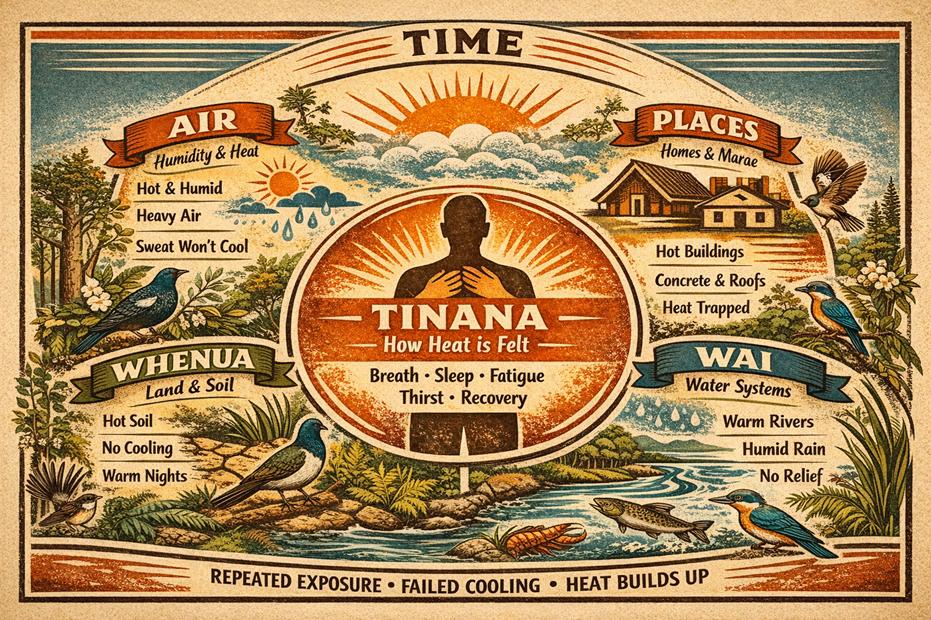
Heat stress does not move through the world in neat steps, and it is not experienced one piece at a time. Changes in air, land, water, and place occur together, reinforcing one another. The tinana does not wait for these changes to be separated or explained. It registers their combined effect (Seneviratne et al., 2010; Parsons, 2014).
When the air becomes warmer and more humid, it is felt first as heaviness in breath and skin. Sweat no longer cools as it once did, and the body’s primary mechanism for releasing heat becomes less effective. Sleep becomes restless, and the cardiovascular system works harder to compensate, even on days that do not appear extreme (Kjellstrom et al., 2016; Met Office, 2025). This sensation does not come from the air alone.
That heaviness is strengthened by the whenua beneath us. Soils that once absorbed moisture and cooled after rain now hold warmth closer to the surface. Compacted or degraded soils reduce evaporative cooling and increase near-ground humidity, particularly after rainfall. The land releases heat slowly, especially at night, removing the relief that once allowed bodies to recover (Robock et al , 2004; American Geophysical Union, 2017; World Economic Forum, 2022) People experience this as ongoing fatigue rather than sharp discomfort.
Water, which once brought cooling, can now deepen the strain Rivers, wetlands, and rainfall add moisture to already warm air, increasing humidity and slowing the body’s ability to cool itself. Scientific studies show that warm water bodies and high soil moisture under hot conditions can amplify humid heat and reduce night-time cooling (Seneviratne et al., 2010; ScienceDirect, 2024). Nights remain warm, and mornings no longer reset the body.
The places where we live and gather hold these conditions in place. Homes, marae aatea, roads, and hard surfaces absorb heat during the day and release it slowly overnight. Built environments with limited airflow and high thermal mass intensify heat exposure and prevent recovery, particularly during humid conditions (Parsons, 2014; NZMJ, 2023)
The tinana experiences all of this at once (see Figure 1). It does not separate air from land, or water from place. Breath, sleep, thirst, patience, and energy become the record of what the environment is doing These bodily responses align closely with physiological evidence showing cumulative strain on cardiovascular, renal, and respiratory systems during prolonged humid heat exposure (Kjellstrom et al., 2016; Shanmugasundaram et al., 2025).
What gives these sensations meaning is time When they arrive earlier in the season, last longer, and no longer resolve overnight, a pattern becomes visible Repeated exposure without recovery is now recognised as a key driver of heat-related illness and mortality (Kjellstrom et al., 2016; ScienceDirect, 2024).
This is why our marae and their whaanau observation remains so powerful and what does that look like at the marae when the air feels heavy It does not ask which layer comes first. It understands that heat is produced through relationship, and that the body feels those relationships before they are named (National Indigenous Climate Resilience Network, 2023).
2 | Whenua: Soil, Vegetation, and the Land’s Role in Holding or Releasing Heat
2.1
Why
the Whenua Matters for Heat Stress on the Marae
When whaanau talk about heat stress, it is easy to focus only on the air temperature because that is what weather apps show us. But at home and on the marae, people often describe something more specific: that the heat feels like it rises up from the ground, that the air becomes heavy after rain, that the nights do not cool down properly, and that the heat seems to “stick” around the whare and the aatea. Those experiences point to the same thing climate science explains: the land surface strongly controls whether heat is released quickly, stored for later, or moderated through cooling processes such as evaporation (Bonan, 2019; Seneviratne et al., 2010).
From a practical home and marae perspective, the whenua influences heat stress because it determines whether the environment offers relief If the whenua is able to hold moisture, support shade, and cool itself overnight, people tend to sleep better and recover more fully. If the whenua is dry, compacted, or sealed by hard surfaces, it warms faster during the day and releases that warmth through the evening, which increases cumulative exposure for kaumaatua, peepi, and anyone already living with health conditions (IPCC, 2023) In other words, the whenua is not just background; it is an active part of the heat pathway that reaches the body.
2.2 How Solar Energy Is “Shared Out” Across the Whenua
When sunlight hits the ground, the energy does not all become “hot air.” Some is reflected away, some moves into the soil, some warms the air directly, and some is used to evaporate water This “sharing out” of energy is called the surface energy balance, and it is one of the key reasons the same temperature can feel very different in two places (Bonan, 2019). Where there is adequate moisture in soil and vegetation, more energy is used for evaporation, which cools the surface because evaporation requires heat energy to convert liquid water into vapour. This cooling pathway is called latent heat flux.
Where moisture is limited, the evaporation pathway is reduced and more energy becomes sensible heat flux, meaning the surface and near-ground air heat up more quickly (Seneviratne et al , 2010) This is why dry bare ground, compacted paddocks, or unshaded open areas can feel harsh even when the temperature “doesn’t look too high.” The heat is not only in the air; it is radiating from the surface because the land has fewer ways to convert energy into cooling
This matters for marae because many marae environments include a mix of surfaces grass, soil, trees, sealed driveways, concrete areas, and buildings The balance of these surfaces influences how quickly the area heats up during the day and how much warmth remains in the evening. When large portions of a site are exposed and dry, the land behaves like a heat store When a site has shade, vegetation, and moisture-holding soils, the land behaves more like a cooling system (Bonan, 2019).
2.3 Soil Structure, Compaction, and Why Water Stops Going Where It Used To
Soil is not just dirt It is a structure made of particles and organic matter with pore spaces that hold both air and water Those pore spaces are what allow rain to soak in and be stored. When soil becomes compacted through heavy machinery, repeated stock pressure, or ongoing disturbance those pore spaces collapse, infiltration decreases, and water runs off instead of soaking in (Manaaki Whenua – Landcare Research, 2020) That means the whenua dries out faster after rain, and when the whenua dries, its cooling capacity declines.
The loss of soil moisture is not only a farming issue; it is a heat issue. Soil moisture is one of the strongest controls on whether the land can cool itself through evaporation (Seneviratne et al , 2010) Where compaction is present, the land tends to swing toward hotter extremes because it cannot store and cycle water effectively This can be felt on the marae as hotter afternoons, warmer ground surfaces, and shorter windows of relief after rain
2.4 Organic Matter, Soil Carbon,
and the Whenua’s Ability to Buffer Heat
Organic matter acts like a sponge It supports soil aggregation and increases water-holding capacity, which improves the whenua ability to store moisture between rain events (Brady & Weil, 2016). Soil carbon also matters for temperature regulation because it supports structure and water retention, and water retention supports evaporative cooling When soil organic matter is lost through erosion or long-term depletion, soils become less resilient to both drought and heat (Lal, 2004) In practical terms, this means the whenua becomes more likely to heat quickly and less likely to cool itself efficiently.
For marae and whaanau, this is relevant because it links climate resilience to land care. When people observe that the ground cracks earlier in summer, that grass browns sooner, or that the whenua seems “hard” after rain, those are not only signs of dryness They also indicate reduced water retention and reduced cooling capacity, which contributes to the heat load that the tinana must carry (Seneviratne et al , 2010; IPCC, 2023)
2.5 Vegetation, Shade, and Microclimate Protection
Vegetation protects people from heat in two major ways: shade reduces incoming radiation, and transpiration turns heat energy into latent heat by moving water from plants into the air (Bonan, 2019). Under trees, ground temperature is lower, and air temperatures can also be moderated because less energy is absorbed by soil and hard surfaces
Riparian vegetation is particularly important because it reduces stream temperature, protects water quality, and supports cooler microclimates near waterways (NIWA, 2019). Where canopy has been removed, the ground heats more intensely and water warms more easily, which matters because warmer water changes humidity patterns and ecological health (NIWA, 2019; Diaz & Rosenberg, 2008).
On the marae, this is experienced as practical comfort and safety Shade around gathering areas, shaded paths between wharenui and wharekai, and vegetation that reduces afternoon sun exposure can reduce the physical stress placed on whaanau, especially during tangihanga and hui held through the hottest parts of the day.
3.1 Water as a Heat Regulator and a Heat Amplifier
Water plays two roles in the heat story When water is present in the whenua and ecosystems in the right way, it regulates temperature because it stores heat energy slowly and supports evaporative cooling (Clarkson et al., 2013). But when heat and moisture combine under warm conditions, water can also amplify heat stress by increasing humidity, which reduces the body’s ability to cool through sweat evaporation (Sherwood & Huber, 2010; Kjellstrom et al , 2016)
This is important for marae because many marae are closely connected to awa, repo, and low-lying whenua. Whaanau often notice that humid heat can feel worse than “dry heat,” particularly after rain or when the air is still Climate science supports this: heat risk increases when humidity is high because evaporation becomes less effective and core temperature rises more quickly (Sherwood & Huber, 2010).
3.2
Wetlands, Evapotranspiration, and Catchment Cooling
Wetlands provide ecosystem services that include cooling the local environment through evapotranspiration and water storage (Clarkson et al , 2013) When wetlands are drained, the landscape loses a major moisture reservoir and a cooling mechanism In the Waikato region, wetland loss has been extensive, and freshwater assessments recognise the scale of wetland decline (Ministry for the Environment, 2022) This matters because soil moisture deficits are strongly linked to heat amplification through land–atmosphere feedbacks (Seneviratne et al., 2010; IPCC, 2023).
When wetlands are intact, moisture is cycled through vegetation into the atmosphere and can contribute to dew and fog formation under suitable night-time cooling conditions When wetlands are degraded, moisture cycling changes, and the land can shift toward heat storage behaviour For whaanau, this change may be experienced as reduced morning relief, less frequent fog, and a sense that heat “hangs around” longer into the evening.
3.3 Rivers, Water Temperature, and Oxygen Decline
As rivers warm, oxygen solubility declines, and aquatic organisms experience stress because their oxygen demand often increases with temperature (Diaz & Rosenberg, 2008). Riparian shading reduces stream temperature and is widely recognised as important for freshwater health (NIWA, 2019). When shade is reduced and air temperature rises, rivers can warm more quickly, which can affect ecological indicators that marae already observe, such as shifts in tuna behaviour, altered seasonal timing, and changes in water feel
This ecological stress is not separate from human heat stress Warmer water bodies can also influence local humidity and microclimate conditions, especially in still weather In humid heat, the body’s cooling capacity is reduced, so the same warm day can become more physiologically stressful when moisture persists in the air (Sherwood & Huber, 2010)
6 | Time: Why Duration, Repetition, and Warm Nights Change Everything
6.1 Heat Risk Is a 24-Hour Cycle, Not a Daytime Problem
A common misunderstanding is to treat heat as something that happens only in the afternoon. Heat stress risk is better understood as a 24-hour cycle because the body requires night-time cooling to reset. If night temperatures remain elevated, core temperature does not fall as it should, sleep quality declines, and cardiovascular strain carries into the next day (Ministry for the Environment & Stats NZ, 2023; IPCC, 2023). This is one reason public health research consistently finds that consecutive warm nights increase illness and mortality risk during heat events (IPCC, 2023).
For marae, warm nights matter because gatherings do not stop at sunset People sleep on-site, care for others through the night, and remain inside buildings that may retain heat. If night-time cooling is limited, whaanau can experience cumulative strain across several days of a hui or tangihanga
6.2 Cumulative Exposure and Why “Not That Hot” Can Still Be Dangerous
Heat stress is not only about extreme peaks. Repeated moderate heat with high humidity and poor night-time recovery can create a greater health burden than a single very hot afternoon. Climate-health research increasingly emphasises cumulative exposure because the body’s risk increases when recovery is incomplete (IPCC, 2023). That is why people sometimes feel worse on the third or fourth warm day than on the first day. The body is starting from a stressed baseline
This understanding makes marae observation extremely important. When whaanau say that heat is arriving earlier in the season, lasting longer, and not clearing overnight, they are describing the critical variables that determine health impact: duration and repetition.
lationship with the climate of Aotearoa manuwhiri, cooking mourning these erations of lived while sometimes and predictable.
ng and Aotearoa is eriencing more hot changes in humidity onment & Stats NZ, on Climate Change bines with humidity, omes harder for our comes harder for mes harder for food table.
g marae what to do so that marae and nformed decisions kaitiakitanga, and
7.1 Caring for Tuupaapaku in Hot and Humid Conditions
Tangihanga is sacred The presence of our tuupaapaku in the wharenui connects us across generations. We sit with them, speak to them, cry with them, and honour them. That closeness is part of our identity as Maaori
However, we must understand what heat and humidity do to the human body after death When a person passes, natural biological processes begin. These processes are influenced by temperature. The warmer the environment, the faster those processes occur (Parsons, 2014) When humidity is high, moisture in the air supports bacterial activity and slows drying. This means that in hot and humid conditions, tissue breakdown can happen more quickly.
Even when embalming has been carried out, temperature still affects how the body responds over time. International research confirms that high heat accelerates decomposition processes and increases strain on mortuary systems during heat events (IPCC, 2023).
In a crowded wharenui during summer, internal temperatures can rise well above the outdoor temperature. Body heat from many people in one space adds to the warmth. If ventilation is limited, humidity builds When indoor temperatures rise above approximately 26 or 27 degrees Celsius, biological processes and heat stress risks increase (Kjellstrom et al., 2016; Parsons, 2014).
This is not about fear. It is about dignity. If temperatures are high, whaanau may notice stronger odour, increased moisture, or faster visible changes. These are natural biological responses to heat. They are not a failure of tikanga. They are environmental effects.
So, what can marae do without compromising tapu? Cooling the space is an act of manaakitanga. Portable air-conditioning units, fans that circulate air (not just move hot air around), and dehumidifiers can reduce temperature and moisture Monitoring temperature with a simple indoor thermometer helps marae leaders make decisions early rather than reacting when discomfort appears.
If a severe heat event is forecast, it may be wise to shorten viewing intervals or ensure overnight cooling systems are in place. Night-time heat is particularly important. Research shows that when nights remain warm, both living bodies and environments struggle to recover (Sherwood & Huber, 2010)
Some marae are already beginning these conversations, exploring alternatives such as adjusting layering, using lighter coverings beneath korowai, increasing airflow discreetly, or rotating coverings during extreme heat. Any such changes must be decided by the marae itself, grounded in its own tikanga, but heat makes it clear that doing nothing is also a decision, and sometimes a harmful one
For whaanau wanting to understand the effects of heat on the human body after death and why temperature matters, accessible explanations can be found through funeral care and health sources, such as the New Zealand Funeral Directors Association’s general guidance on body care and environment: https://www fda org nz
Additional plain-language information on how heat affects bodies, relevant to understanding the tuupaapaku context, can also be found through health education resources like: Extreme Heat
These are not tikanga guides, but they help whaanau understand the physical realities that tikanga must work alongside
Protecting the dignity of the tuupaapaku in a warming climate may require practical adjustments That is not a weakening of tikanga It is an expression of care
7.2 Sleeping Spaces, Heat, and the Hidden Issue of Mattress Rooms
One of the quietest but most important impacts of heat on marae life appears in the mattress rooms. During Poukai and Tangihanga, these rooms are used intensively. Mattresses are stacked, laid out, slept on, folded, and reused over many days In summer, heat and humidity create ideal conditions not only for human discomfort but also for pests such as bed bugs. There is a lot of fear about bed bugs, and a stigma surrounding them that can keep some people from seeking help with a bed bug infestation. Bed bugs have been hanging around humans for a long time and aren’t going anywhere anytime soon
Warm, enclosed rooms that are rarely aired become perfect environments for insects to survive and spread Tamariki and kaumaatua are often the most affected, experiencing bites, irritation, disrupted sleep, and embarrassment. Because bed bugs carry stigma, whaanau may say nothing, allowing the problem to grow quietly until it becomes widespread and costly to resolve.
Heat solutions and pest solutions overlap Airing out mattress rooms regularly, especially during hot weather, reduces humidity, lowers internal temperatures, and disrupts pest habitats. Opening windows and doors during the day, lifting mattresses to allow airflow, and exposing bedding to sunlight where possible all support both heat management and hygiene.
Accessible guidance on preventing and managing bed bugs can be found through public health resources such as Health New Zealand’s advice at Pests and bed-bugs and general environmental health information through local councils. Again, these are practical supports that marae can adapt to their own tikanga and spaces.
7.3 The Wharekai and Food Safety in Hot Weather
As our summers grow hotter and dry periods last longer, the way we prepare and handle kai on the marae needs extra care Heatwaves and droughts do not arrive suddenly like floods or storms, but their effects quietly build up. Over time, high temperatures and reduced water supply can create food safety risks that are easy to miss if we are not looking for them
For marae, this matters deeply. Kai is central to manaakitanga. Whether we are hosting Poukai, tangihanga, hui, or everyday gatherings, the safety of that kai is part of how we care for our people. Heat stress challenges this care, not because marae are careless, but because conditions are changing.
Whether for Poukai or tangihanga, the wharekai becomes a critical pressure point during hot periods. When tangihanga last several days, the kitchen operates continuously Heat accumulates inside enclosed cooking spaces as ovens, boiling water, steam, and human bodies raise the temperature hour after hour. Kitchens become heat traps. Ovens, boiling pots, steam, and bodies working in close quarters increase internal temperatures far above outdoor levels
At the same time, climate data shows that warm nights are becoming more common (Ministry for the Environment & Stats NZ, 2023) That means food does not cool as quickly as it once did.
Bacteria multiply rapidly when food sits in temperatures between approximately 5°C and 60°C (Parsons, 2014). In humid environments, this process accelerates. What might once have been safe for several hours may now become unsafe more quickly. This is not about being overly cautious It is about preventing whaanau from getting sick after gathering to honour loved ones.
Practical steps include monitoring food temperatures with simple probes, reducing how long food sits out on buffet tables, ensuring adequate refrigeration, and using shaded areas for preparation when possible. Rotating fresh trays instead of leaving large quantities exposed reduces risk Manaakitanga includes food safety
7.4 Water
One of the most important questions during hot, dry periods is whether the water we are using is safe Drought conditions can affect water quality, especially for marae that rely on rainwater tanks, bores, or small local supplies. Sometimes councils issue “boil water” notices when water quality cannot be guaranteed
If a boil water notice is in place, all water used for drinking or as an ingredient in food must be boiled first or replaced with sealed bottled water. This includes water used to make tea, coffee, juice, soup, or ice. Many people are surprised to learn that most coffee machines do not heat water enough to make it safe, as they usually operate below boiling temperature. In these situations, machines must be filled with pre-boiled water or turned off until the notice is lifted Ice machines, slushie machines, drink fountains, and self-service drink dispensers should also not be used, as they rely on untreated water flowing directly through the system
When a boil water notice is lifted, it is important not to rush straight back into normal use Running taps for a period helps flush old water from the pipes. Sometimes water suppliers carry out extra treatment after droughts, which can change the taste, smell, or appearance of water If water looks cloudy, smells unusual, or tastes different, it is safest not to use it until the supplier confirms it is safe.
Whaanau wanting to understand more about safe drinking water during emergencies can read further through the Ministry of Health’s guidance here: Emergency drinking-water
Preparing marae for Dry Periods
Many marae are now thinking ahead about how they can store more water when rain does come. Adding extra roof catchment tanks, improving existing storage, or identifying alternative water sources can make a big difference during summer. If stored water is going to be used in food preparation, it must be managed carefully to ensure it remains clean and safe.
There is good, plain-language guidance available on water storage, pumps, and tanks that whaanau can explore if their marae is considering upgrades. Useful resources include information on safe household water collection and storage provided through HealthEd and the Ministry of Health, such as: Water collection tanks and safe household water.
When water is limited, it is also important to remember that clean water must still be prioritised for handwashing, food preparation, and cleaning food contact surfaces. Toilets can sometimes be flushed using grey water, but hands must always be washed with clean, safe water
Making Water Safe When Supply Is Uncertain
If water quality is uncertain, there are simple ways to make it safe for use Boiling water until it reaches a rolling boil for at least one minute, then allowing it to cool, makes it safe for drinking and food use. Bottled water is another option if it is available and affordable
In some situations, treated water can be delivered by tanker, which can support marae during extended dry periods Water can also be disinfected using plain, unperfumed household bleach in the correct amounts, or sterilising tablets, though these methods may affect taste. Understanding these options ahead of time helps marae respond calmly rather than scrambling during an emergency
The Ministry of Health provides detailed advice on emergency water treatment methods that whaanau may find helpful: https://www health govt nz
7.5 Growing and gathering Food During Heat and Drought
Heat and water shortages also affect the kai we grow and gather. Gardens may struggle, yields may be reduced, and alternative water sources may be needed for irrigation. When watering or spraying crops, it is important to continue following good agricultural practice so that produce remains safe to eat, especially for ready-to-eat vegetables and greens
Inland and freshwater environments also change under heat stress. Rivers run lower, lakes warm, and stagnant conditions can lead to toxic algal blooms These blooms can be dangerous for people and animals, especially dogs, and they can contaminate water used for gathering food. Whaanau should be cautious around waterways during hot periods and avoid collecting kai where water quality looks poor or warnings are in place. Information about toxic algal blooms and how to recognise them is available here: https://www.lawa.org.nz.
Similarly, shellfish should never be collected from areas where biotoxin warnings have been issued. Warmer water increases the likelihood of toxic algae building up in shellfish, which can cause serious illness if eaten Symptoms can range from nausea and vomiting to paralysis and breathing difficulties. Up-to-date shellfish safety information can be found at: Shellfish Biotoxin alert.
For marae-specific guidance on gathering kai safely, including puhaa and kaimoana, whaanau can refer to the Te Kai Manawa Ora Marae Food Safety Guide
7.6
Protecting
Kaumaatua During Tangihanga and Poukai
Heat does not affect everyone equally. Kaumaatua are more vulnerable to heat stress because the ageing body does not cool itself as efficiently (Kjellstrom et al., 2016). Sweating reduces with age. The heart works harder under heat strain. Many kaumaatua live with conditions such as diabetes, heart disease, or kidney stress, which increases vulnerability (Ministry of Health, 2022).
High humidity makes things worse When the air is moist, sweat does not evaporate properly. That means the body cannot cool itself effectively (Sherwood & Huber, 2010). Even if a person feels they are sweating, they may still be overheating internally
During long tangihanga or Poukai, kaumaatua often remain seated for extended periods They may not wish to move out of respect They may be focused on koorero and whanaungatanga. However, prolonged exposure to heat can cause fatigue, dizziness, confusion, swelling, and in severe cases, collapse
Simple measures can prevent harm. Providing a cooler side room. Ensuring regular hydration Encouraging quiet rest breaks without being whakamaa. Adjusting seating to allow airflow. These are expressions of manaaki, not special treatment.
7.7 Wearing Black in the Heat
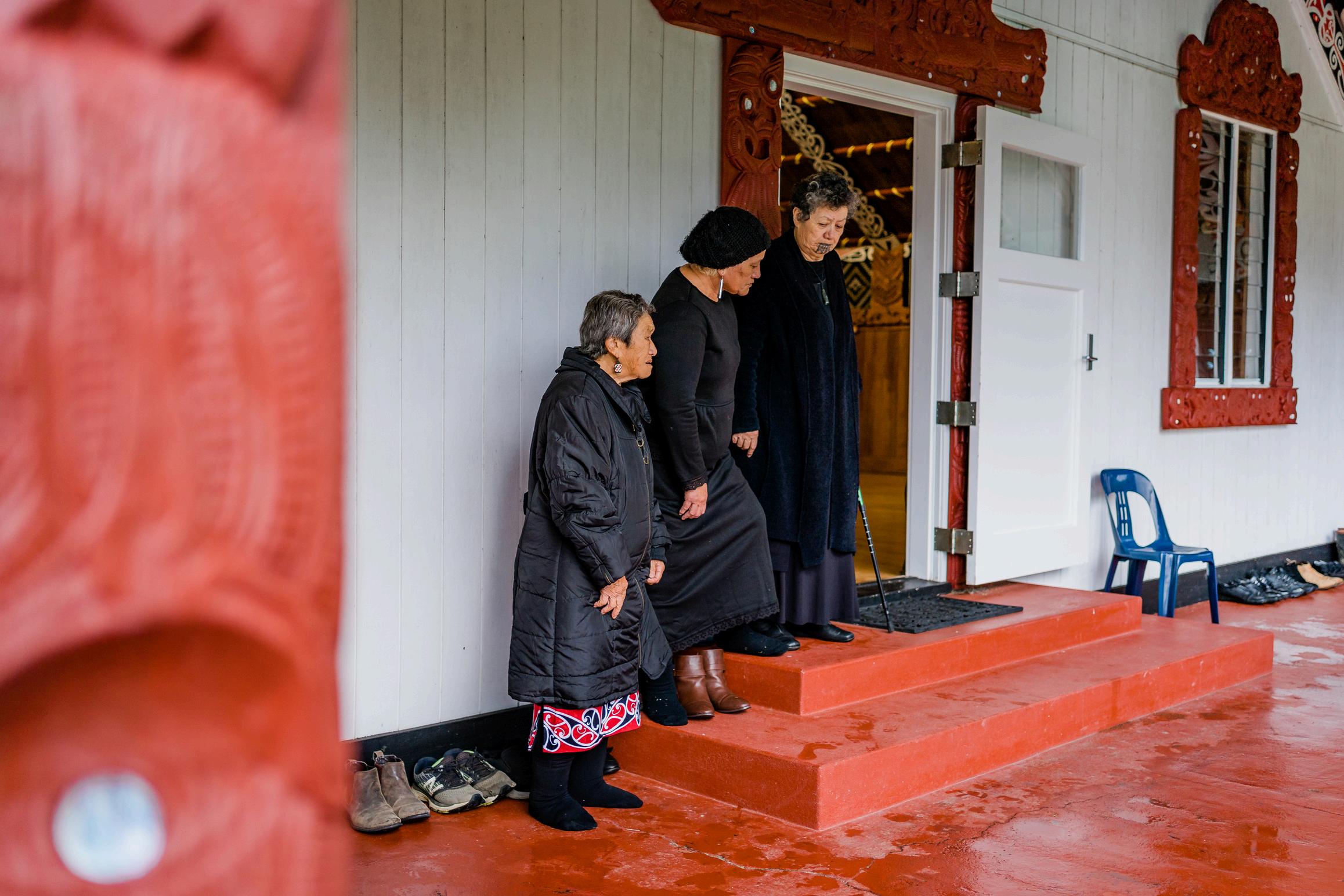
Wearing black during tangihanga and Poukai is deeply symbolic. It reflects mourning, unity, and respect However, black fabric absorbs more solar radiation than lighter colours, meaning it heats more quickly under direct sunlight (Bonan, 2019).
During outdoor poowhiri or urupaa visits in summer, clothing can become significantly hotter than the surrounding air. Combined with humidity, this can increase core body temperature and strain the cardiovascular system (Kjellstrom et al., 2016).
This does not mean abandoning black It means thinking about breathable fabrics, shade structures, hydration, and timing of outdoor activities during peak heat. Sometimes shifting a ceremony slightly earlier or later in the day reduces exposure without compromising tikanga Tikanga has always adapted to circumstances. Adaptation is not disrespect.
7.8 Tikanga as Living Practice
Climate change is not an abstract scientific discussion. It is something our marae are already feeling The IPCC (2023) confirms that heat extremes are intensifying globally. National reporting shows that Aotearoa is warming and experiencing more humid conditions (Ministry for the Environment & Stats NZ, 2023)
If we do not talk openly about how this affects our tikanga practices, we risk harm to both our tuupaapaku and our living whaanau Our tuupuna adapted to volcanic eruptions, shifting coastlines, new resources, and colonisation. They made decisions grounded in survival and collective wellbeing. We are being called to do the same in response to climate change
Cooling systems, hydration protocols, food safety vigilance, shaded areas, and environmental monitoring are not Western impositions They are tools How we use them remains guided by tikanga and marae leadership. The decisions belong to whaanau, and this chapter simply provides the information needed so those decisions can be made with clarity and confidence.
American Geophysical Union. (2017). Land–atmosphere interactions and climate extremes. Reviews of Geophysics. https://agupubs onlinelibrary wiley com/doi/full/10 1002/2017RG000557
Bonan, G. B. (2019). Climate change and terrestrial ecosystem modeling. Cambridge University Press. https://doi.org/10.1017/9781107339217
Brady, N C , & Weil, R R (2016) The nature and properties of soils (15th ed ) Pearson
Clarkson, B R , Ausseil, A -G , & Gerbeaux, P (2013) Wetland ecosystem services in New Zealand Journal of the Royal Society of New Zealand, 43(2), 69–90 https://doi org/10 1080/03036758 2013 792316
Diaz, R J , & Rosenberg, R (2008) Spreading dead zones and consequences for marine ecosystems Science, 321(5891), 926–929 https://doi org/10 1126/science 1156401
Glaser, J , Lemery, J , Rajagopalan, B , Diaz, H F , Garcia-Trabanino, R , Taduri, G , Madero, M , Amarasinghe, M , Abraham, G , Anutrakulchai, S , Jha, V , & RoncalJimenez, C (2016) Climate change and the emergence of chronic kidney disease of unknown origin Kidney International, 90(4), 824–830 https://doi.org/10.1016/j.kint.2016.06.032
Government of New Zealand, Ministry for the Environment (2022) Our freshwater 2023 https://environment govt nz/publications/our-freshwater-2023/
Government of New Zealand, Ministry for the Environment & Stats NZ (2023) Our atmosphere and climate 2023 https://environment govt nz/publications/ouratmosphere-and-climate-2023/
Government of New Zealand, Ministry of Health (2022) Māori health data and statistics https://www health govt nz
Intergovernmental Panel on Climate Change. (2023). Climate change 2023: Impacts, adaptation and vulnerability (AR6 Working Group II contribution).
https://www ipcc ch/report/ar6/wg2/
Kjellstrom, T., Briggs, D., Freyberg, C., Lemke, B., Otto, M., & Hyatt, O. (2016). Heat, human performance, and occupational health. Industrial Health, 54(5), 387–399.
https://doi org/10 2486/indhealth 2016-0098
Lal, R. (2004). Soil carbon sequestration impacts on global climate change and food security. Science, 304(5677), 1623–1627.
https://doi org/10 1126/science 1097396
Manaaki Whenua – Landcare Research. (2020). Soil compaction and land management in New Zealand. https://www.landcareresearch.co.nz
Met Office (2025) Humidity and how it affects health https://www metoffice gov uk/blog/2025/humidity-and-how-it-affects-health
National Indigenous Climate Resilience Network (2023) Climate and health in tribal communities https://www nicrn org/climate-health-in-tribal-communities
National Institute of Water and Atmospheric Research. (2019). Riparian shading and stream temperature. https://niwa.co.nz
New Zealand Medical Journal (2023) Climate change impacts on health in Aotearoa New Zealand: A scoping review New Zealand Medical Journal, 136(1573) https://nzmj.org.nz/media/pages/journal/vol-136-no-1573/f0ca0e7bd2-1696470805/vol-136-no-1573.pdf
Parsons, K (2014) Human thermal environments: The effects of hot, moderate, and cold environments on human health, comfort and performance (3rd ed ) CRC Press.
Reid, P , Cormack, D , & Paine, S -J (2019) Achieving health equity in Aotearoa: Strengthening responsiveness to Māori New Zealand Medical Journal, 132(1492), 43–60. https://nzmj.org.nz
Robock, A , Mu, M , & others (2004) Soil moisture feedback on climate Journal of Geophysical Research: Atmospheres, 110(D07), D07110 https://doi.org/10.1029/2004JD005087
ScienceDirect (2024) Heat stress, humidity, and physiological limits https://www sciencedirect com/science/article/pii/S2772655X24000582
Seneviratne, S I , Corti, T , Davin, E L , Hirschi, M , Jaeger, E B , Lehner, I , Orlowsky, B , & Teuling, A J (2010) Investigating soil moisture–climate interactions in a changing climate: A review Earth-Science Reviews, 99(3–4), 125–161 https://doi org/10 1016/j earscirev 2010 02 004
Shanmugasundaram, R , et al (2025) Extreme heat and kidney disease in South Asia International Health https://academic oup com/inthealth/advancearticle/doi/10 1093/inthealth/ihaf153/8405057
Sherwood, S C , & Huber, M (2010) An adaptability limit to climate change due to heat stress Proceedings of the National Academy of Sciences, 107(21), 9552–9555 https://doi org/10 1073/pnas 0913352107
World Economic Forum (2022) How soil health affects climate resilience https://www weforum org/stories/2022/08/drought-five-ways-soil-climate-change/
QR Code to links for further readings.