Teacher’s feedback more effective than AI Vici: what’s that virus doing?
Works
Councils Do you have a choice? | p.12
New minor: Decolonizing Science
Greenery a priority in party manifestos
Students go further for exchange
Freedom
Discussing your dark past on your birthday doesn’t sound like much fun, but that is what WUR did on its 108th Dies Natalis (which means ‘birthday’). Historian Larissa Schulte Nordholt explained how in the past Europeans, including people from Wageningen, appropriated knowledge and labour for their own ends. She held up a mirror for the attendees, and got complete freedom to do so (page 23).
Another example of something that enjoys complete freedom on campus is telling the Executive Board if you think decisions that affect employees are not the right ones. That is one aspect of the work of the consultative bodies. Ideally, their members keep the Executive Board on their toes. Here too, people are free to join a consultative body – or not (enthusiasm is tepid once again in the run-up to the elections, see page 12). We undoubtedly don’t realize this enough. Three WUR students do, though (page 16). They are from Iran and they talk movingly about their situation. ‘Iranians all over the world dream of freedom.’ The fact that we don’t have to do that here is something we should remember every day.
Willem Andrée Editor-in-chief
TOAD TREK
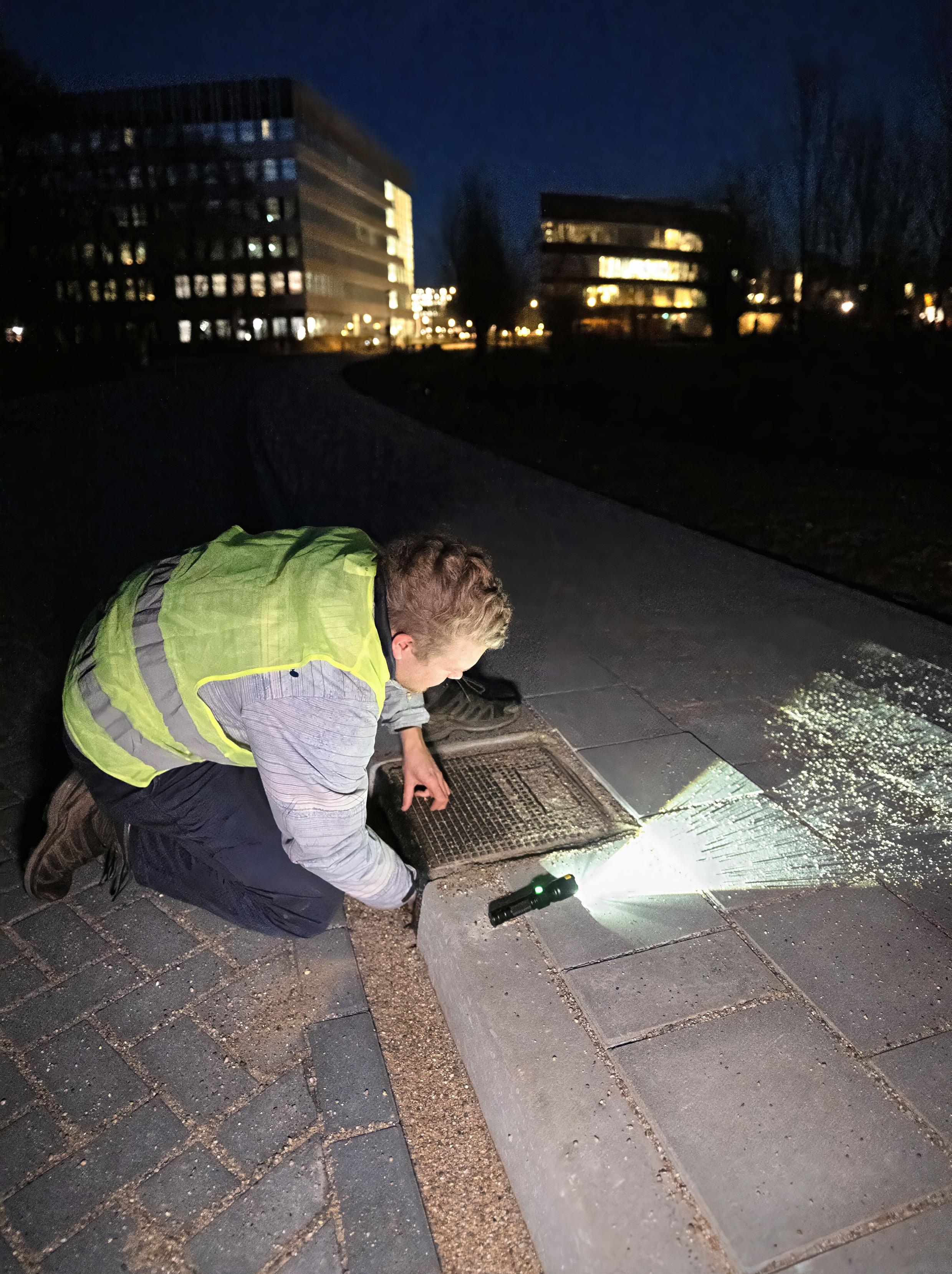
The toad assistants emerge shortly after sunset. Equipped with a bucket and a torch, they search for frogs, toads and newts. From early March, these animals migrate to ponds and pools where they reproduce. But they have other things on their mind than the hazards of traffic and drains. Forest & Nature Conservation student Daan Duterloo has helped them cross roads safely for the past five years. Resource accompanied him one evening at work along the new west campus road. Read the article at resource-online.nl. cj
Photo Guy Ackermans
New minor
Decolonizing Science and Development
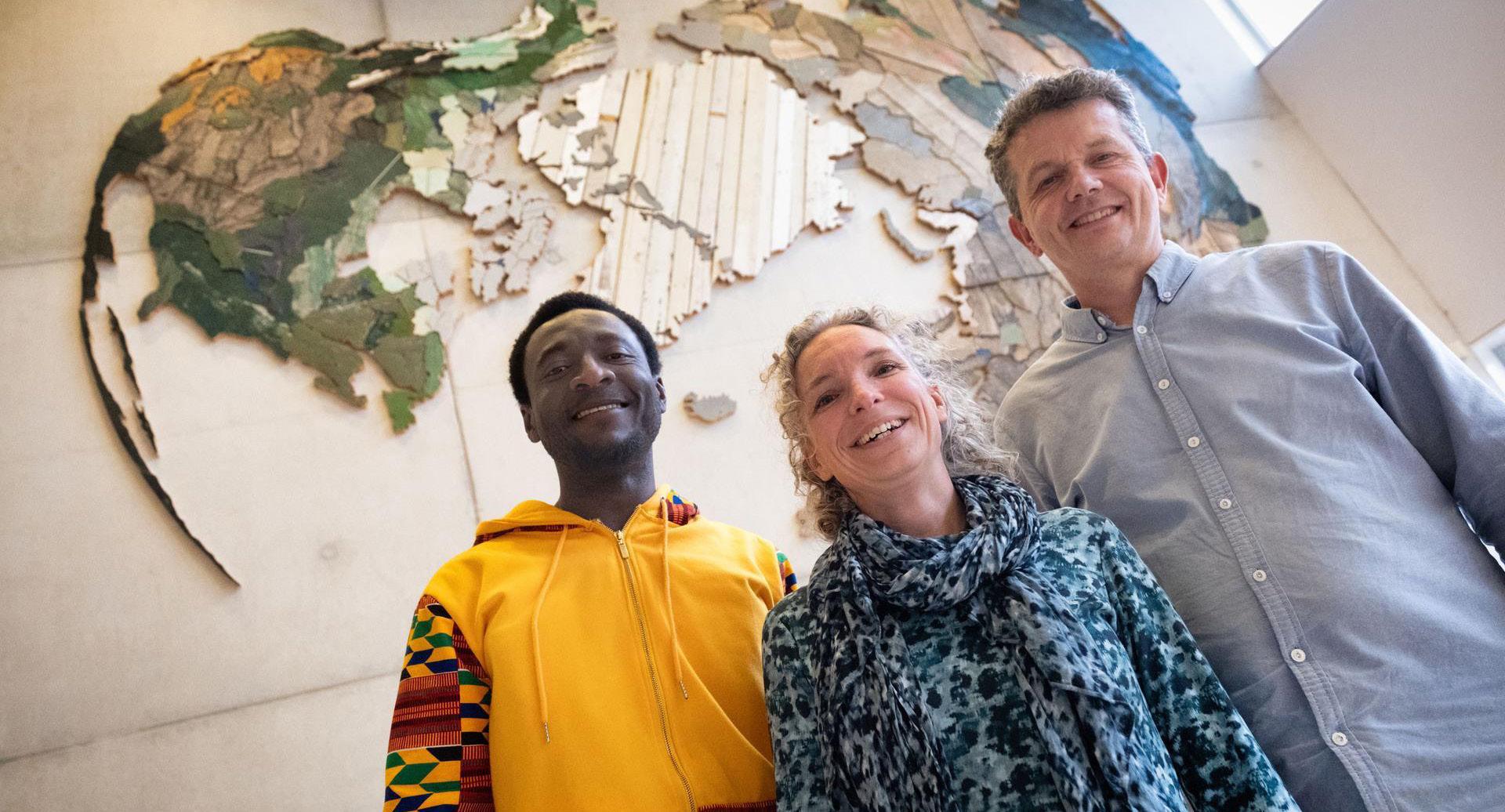
The new minor ‘Decolonizing Science and Development’ will start in the 2026-27 academic year. This minor explores the histories of colonialism and slavery and how they continue to shape present-day realities of inequalities and injustices. The minor consists of five courses, taught by four different chair groups.
Royal Household
‘The current generation of students wants to reflect on the colonial past’
The minor is open to Wageningen students in the third year of their Bachelor’s or higher. Coordinator Birgit Boogaard says it fits well with the changes WUR is currently going through. ‘There is an increasing awareness that we need to do something about our colonial past and dominant Western perspective, and that we need to educate students about this. They should know what they are talking about and understand where arguments come from. The students themselves want this too. The current generation of students wants to reflect on the colonial past and has the courage to do things differently from now on. They deserve to be properly educated. Of course, it is also important for the wider public debate that students are informed about the topic.’
Optional courses
The minor has two compulsory courses: ‘Decolonizing Science and Technology’, which recently won an Excellent Education Award, and ‘Colonialism and Slavery in World History’. The students also have to take at least two optional courses, where they can choose between Boogaard’s own ‘African Philosophy’ course (with an African co-teacher again next year), ‘Climate Crisis, Resources, Rights and Resistance’, taught by Elisabet Rasch and Gemma van der Haar, and ‘Transformative Encounters’, where students go off campus with teachers Emmanuel Adu-Ampong and Karolina Doughty to study how the past and the present come together. Boogaard: ‘All three optional courses have creative assignments where students are invited to reflect on their own pictures of the world, how those impressions were formed and what their most important sources of knowledge are.’ me
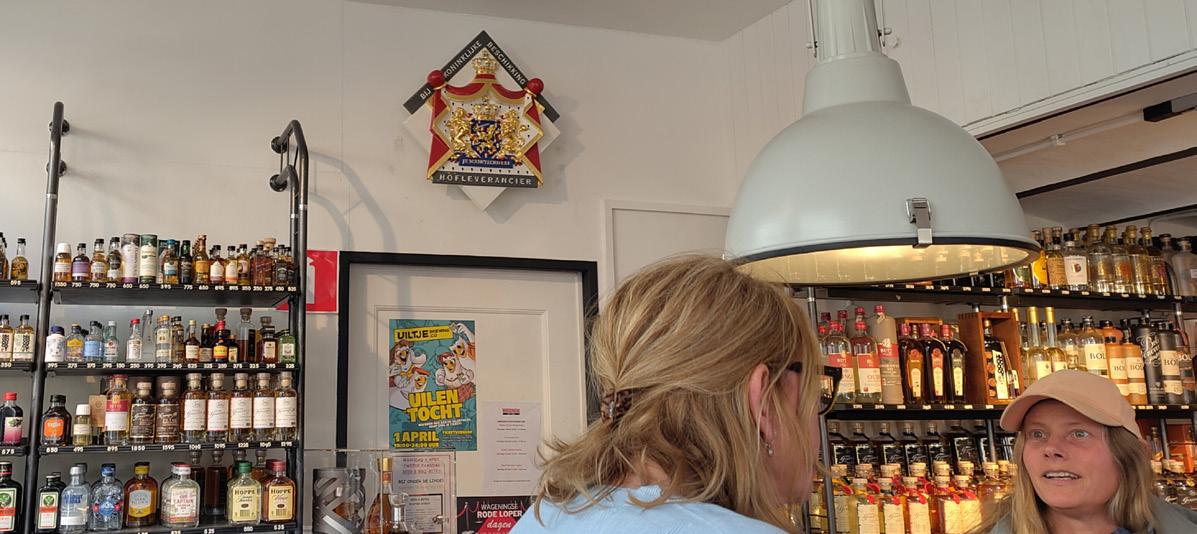
Wine merchant Woudenberg, leading supplier of alcoholic beverages to students, also became an official supplier of the Royal Household in March. That doesn’t mean Willem-Alexander and Máxima now order their gin from Wageningen. It does mean the company has been going for 100 years, is important to Wageningen and is of impeccable conduct. Woudenberg is the third Wageningen business to get this accolade, after the butcher Elings and Albers Alligator (industrial liquids storage). The shield indicating the honour is displayed inside the shop — and not outside, as is usual, because the risk of it being stolen as a student jape is too great, says the owner. rk
Sixty employees have to find new jobs
As part of the effort to find savings of 80 million euros by 2028, 60 employees in the corporate staff departments and Facilities & Services will lose their position at WUR. These departments currently employ 1,400 people. The corporate staff departments have to contribute 35 million in savings, while the remaining savings of 45 million will come from education and research. The 60 ‘redeployment candidates’ will get support from HR in finding a new job within WUR or elsewhere. WUR’s planned cuts are not affected by the recent government decision to reverse cutbacks in education. wa
Support for Iranian students
Iranian students in Wageningen are worried about their friends and family back home, and also about whether they will be able to continue their studies next year. Inflation has reduced the value of their savings, which will make it harder for them to pay the tuition fees.
WUR is looking at the options for helping Iranian students with financial problems, says spokesperson Vincent Koperdraat. It is considering a payment scheme that allows payments to be deferred subject to certain conditions. ‘Student counsellors are available to give advice and help the students decide. We advise students in financial difficulties or with other problems to contact a student counsellor.’ lz
Read about the experiences of Iranian WUR students on page 16
Photo Resource
200
Students increasingly want to travel further away for their exchange. This year, 200 students gave a non-European country as their first choice — over one third of the 582 students who will be going on an exchange next year. Last year, that number was 181 and the year before it was 138. Even so, Norway is the most popular destination (79 students), followed by Italy (70). lz
See resource-online.nl for more info on the exchange preferences of WUR
students
Playing with stress
Greenery a key issue in party manifestos
Greenery in public spaces was a prominent issue in this week’s municipal elections, shows a study by Wageningen Environmental Research. Joop Spijker and Jaap van Raffe were commissioned by the Ministry of Agriculture to go through 550 manifestos of the political parties competing in the elections in 44 Dutch cities (but not Wageningen); that included 145 manifestos for local parties. They found that 96 per cent of the manifestos mentioned specific targets for greenery in and around the city. That is a big increase compared with previous elections, when the figure was 85 per cent at most. More trees was a goal in three quarters of the manifestos. rk
Many researchers and teachers feel their lives are dominated by stress. How can you stay healthy mentally in those circumstances? To help, assistant professor Jente Ottenburghs (Wildlife Ecology & Conservation) designed a game called The Slow Professor, where you have to find the right balance between burning ambition and a burnout. Illustration Valerie Geelen
The Slow Professor refers to the book of the same name by Maggie Berg and Barbara Seeber, in which they criticize the competitive culture of research and education. Ottenburghs read that book and Slow Productivity by Cal Newport, which advocates working at an appropriate pace, with more quality and less quantity, as the best way of preventing a burnout.
Ottenburghs got the idea of designing a game after a colleague told him about vibe coding, a method where AI software takes over the task of coding. ‘So you no longer need to be able to write code yourself. I started playing around with it and that was when I got the idea for The Slow Professor.’
Stress cards
The online game simulates an academic career from assistant professor to professor. ‘In each round,
you get six cards with tasks. Some are compulsory, for example marking 200 exam papers. A task like that gets you stress points. Other activities reduce your stress, such as a weekend break or a holiday.’ Tasks earn you points that let you get a
promotion. But if you build up too much stress, you get a burnout and lose three turns. It is all reminiscent of a traditional board game. There are also cards for ‘random events’, such as a paper being rejected (extra stress) or a research project going viral.
The game involves roles and you can play it as a data analyst, lecturer, fieldworker and so on. The winner is the person who has the lowest average level of stress during the whole game. ‘So it is about finding the right balance,’ says Ottenburghs. ‘The main aim is to get a conversation going about the pressure of work.’ rk
Scan the QR code to access the game.
letter to the editor
D&I is an essential component of education, not only an opinion
We were disheartened to read the letter to the editor ‘WUR should not force opinions on students’, published in the previous issue of Resource. The author tells a story that we do not feel reflects the wider WUR community. To us, it is an example of how ‘Academic Freedom’ can be used to steer debates towards reactionary standpoints. As educators, teaching our students compassion and integrity is vital. By encouraging us to critically reflect on our institutions, the principles underlying the promotion of diversity actually strengthen academic freedom.
It is important to recognize that universities cannot be separated from values. Nearly every course and certainly every study programme reflects normative commitments such as scientific integrity, non-discrimination and public responsibility. Thus, recognizing diversity and inclusion as a skill does not introduce politics into education; it is only an additional component of how we situate students in the society in which science operates. Students
are increasingly seeking direction on how to counter forces that defund their futures and do not respect them and their peers. Aside from the morality of a more inclusive society, promoting D&I among students makes them more effective scientists. Research clearly shows that diverse groups are more productive, make better predictions, and lead to greater long-term change. Rather than an ideological enforcement or compelled belief, ‘promote’ indicates professional responsibility in a variety of settings. The increasing role of global collaboration across differing communities makes this skill increasingly important. It is antithetical to science and collegiality, and disadvantages students, to remove these realities from their education and frame it as ‘freedom from politics’.
Ben Auxier, assistant professor, Laboratory of Genetics . Kelley Leung, postdoctoral fellow, Laboratory of Genetics . Mark Vicol, associate professor, Rural Sociology Oona Morrow, associate professor, Rural Sociology . George Apostolidis, MSc student, Bioinformatics and Systems Biology
Advertisement
Vacancy
Cover_subtite
The BoE is the legal board of all accredited study programmes at Wageningen University & Research (WUR) and consists of 4 professors and 4 students. The activities of the BoE take up about one day a week. This includes a meeting every two weeks on Wednesdays between 9:00 and 12:30.
Do you have a passion for education?
From July 2026, a student seat on the Board of Education will be vacant
Your responsibilities / opportunities
• To represent students from WUR in the board that decides upon the content and quality of accredited study programmes and advises the Executive Board on various educational issues.
• To deal with a variety of topics, such as new study programmes, quality of courses and teachers, new education policies and education innovation.
• To take an in-depth look at the management of your university.
• To enrich your curriculum vitae with education management experience.
Interested?
Your qualities
You have a passion for education and ideas to develop and innovate WUR education. You are proactive and you have a critical attitude. Preferably, you have prior experience on a (programme) committee, a board or similar.
You study in the domain of Environment & Landscape (BBN, BES, BIL, BLP, BSW, MCL, MEE, MES, MFN, MGI, MIL, MLP, MTO, MUE).
Compensation consists of three months of FOS per year and €80 per month. The appointment is for at least one year, with the possibility of reappointment.
Send your CV and motivation letter, in English, before 27 April 2026 to boardofeducation.secretary@wur.nl An introductory meeting is planned for the week of 11 May to get to know each other and discuss your goals and expectations. wur.eu/boardofeducation
TRACKING THE SAND
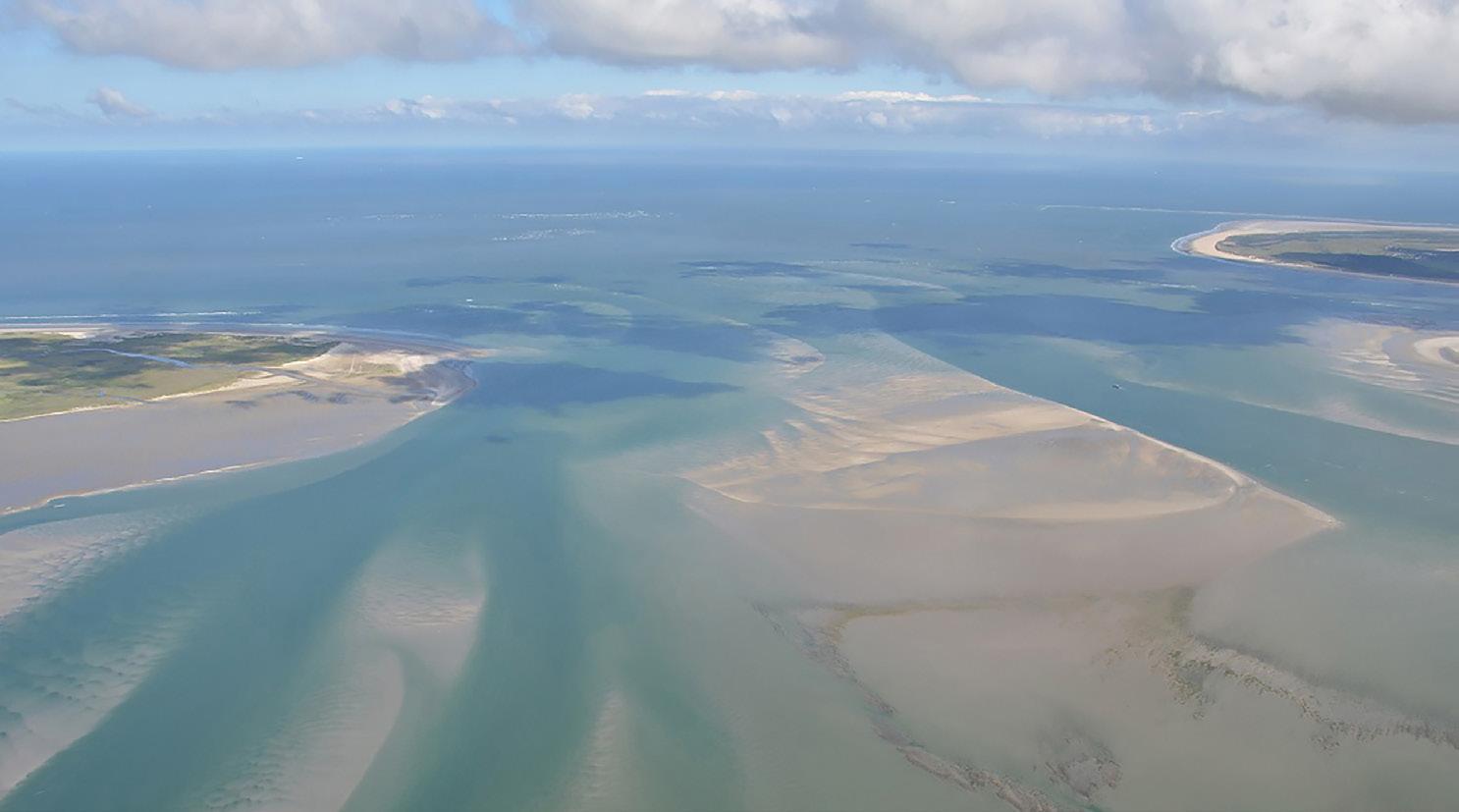
Five million cubic metres of sand were dumped in the Amelander Zeegat, the passage between Terschelling and Ameland islands, in 2018. Waves, currents, weather and wind were expected to spread the sand and reinforce the coastline. This Sand Motor, as it is known, does indeed work. But where did the sand go? Text Roelof Kleis
Well, a small fraction ended up on the cover of Anna Maartje de Boer’s thesis. The cover shows an old map of the Amelander Zeegat. She glued a little of the fine sand precisely where the replenishment sand was tipped into the sea in real life. Her thesis (which was awarded a distinction) is about where the rest of the sand went.
De Boer developed a completely new application for the luminescence signal of sand. That signal builds up in the dark as a result of natural radioactivity in the soil. When exposed to light or heat, that signal is released in the form of light. The sand then literally lights up a little. The luminescence signal from sand –or more precisely from the quartz and feldspar in sand – has until now primarily been used for dating sand layers, as the longer the sand lies somewhere, the
stronger the accumulated signal gets. Now De Boer’s research has added something completely new to it. She focused on discharging the accumulated signal. ‘So it’s about how quickly the sand batteries get emptied,’ she explains. ‘The process of resetting the luminescence signal, draining the batteries in the sand grains, gives me information about how the sand was transported.’
Camera
For these measurements, De Boer used a special extremely sensitive camera, which is also new. The camera takes photographs (in the dark) of the light emitted by a small disc containing a hundred grains of sand. Those grains are from sand samples taken around the Amelander Zeegat. No fewer than six different luminescence signals are measured for each grain of sand. Combining these measurements with sand transport models from Delft
University of Technology lets De Boer map the route taken by the sand. In theory, at any rate; it proved to be more difficult in practice. ‘I do find patterns, but it turns out to be impossible to trace them precisely
‘Tracking it precisely is impos-
sible with this sand because
there isn’t enough difference in the luminescence signals’
with this sand. The replenishment sand, which came from the North Sea, seems to be too similar to the sand that’s already there. There isn’t enough difference in the luminescence signals.’
‘But the method does work,’ emphasizes De Boer, ‘and I’m pleased about that. We were able to show that some sediments were much older and had therefore built up much stronger signals. In terms of the luminescence, it’s important that the accumulated signals are sufficiently distinct. But that wasn’t the case for the sand used for the replenishment, which is a pity.’
De Boer will be starting a two-year postdoc in Cologne in April. ‘I’ll be using the same camera to study whether luminescence can be used to get a better understanding of the weathering process for stone. In this case, the stone used for Cologne Cathedral. It’s never been tried before, so I don’t know whether it will work. We’ll see.’
See resource-online.nl for a video and information about De Boer’s natural sciences antiquarian bookshop Gaia.
Amelander Zeegat Photo RWS
Live&Learn
A botched experiment, a rejected paper: such things are soon labelled as failures in academia. As for talking about them — not the done thing! But that is just what WUR scientists do in this column. Because failure has its uses. This time, it’s Chizu Sato, a teacher and researcher in Cultural Geography and Intersectional Gender Studies.
Text Nicole van ’t Wout Hofland Illustration Mathijs Megens/ SeaBlueBird Studio
‘I am a feminist. Have been for years. And yet I sometime make precisely those mistakes that I believe we should no longer be making.
‘It happened during my PhD, when I joined a committee as a doctoral representative to appoint a new assistant professor. I was active in feminist networks, conducted research from a feminist perspective, and my mentors were lesbian feminist professors who had trained me with care. ‘We were sitting with a small group in a meeting room, surrounded by CVs and motivation letters. One of the candidates on our shortlist had indicated that she would only come if her partner could also be appointed, in what is termed a partner hire. When we discussed this in the committee, I referred to the partner as “he”. I didn’t know the candidate and simply assumed her partner was a man. That turned out not to be the case. One of the professors corrected me immediately. Her tone was kind but firm. It felt as if a bucket of ice-cold water had been poured
over me. As a feminist, I should have known better. Since I was so consciously engaged with gender and power, that mistake hit me hard.
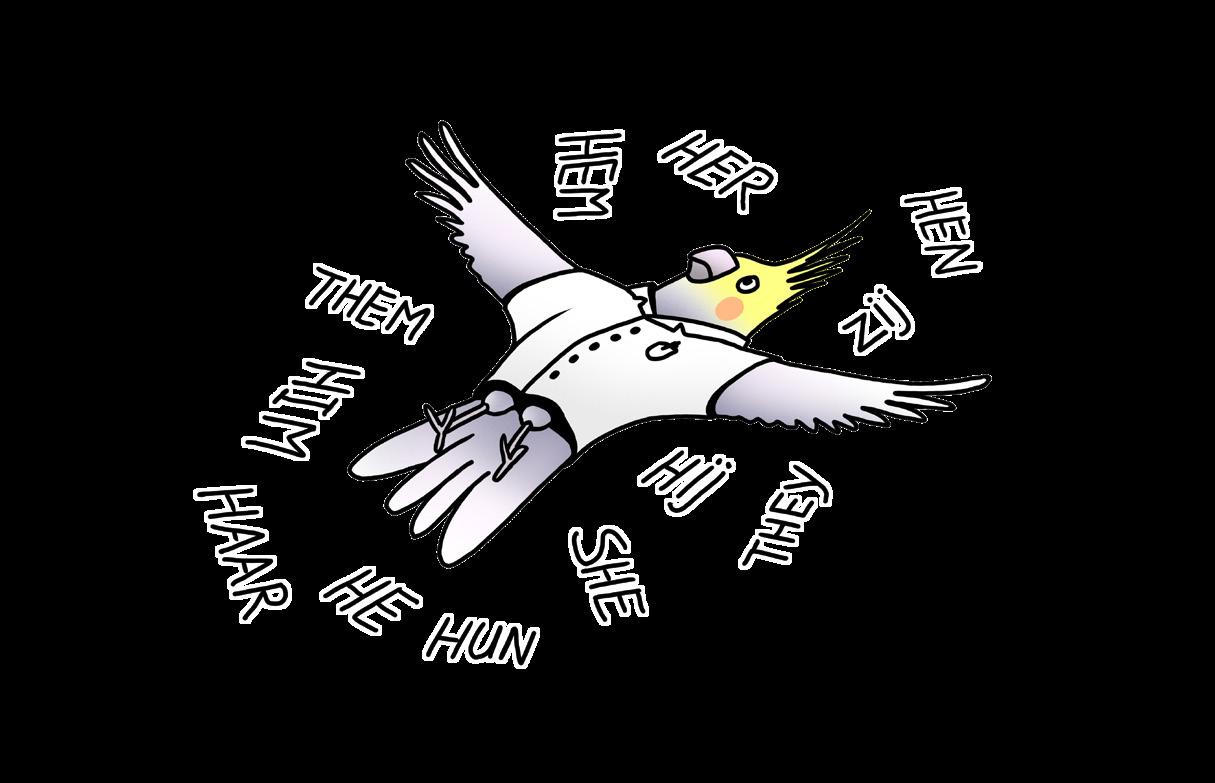
‘Nowadays, I pay close attention to pronouns, but sometimes things still go wrong. Recently, for example, with students in my classes. Afterwards, the students themselves suggested starting with a round of introductions in which pronouns (he, she, they or something else) could be shared. Since then, I use name cards on the tables, optionally including pronouns.
‘It felt as if a bucket of ice-cold water had been poured over me’
It may sound small, but it is not. It is about being seen and feeling safe. And yes, I occasionally still make mistakes myself. I am cisgender and heterosexual, and I carry those privileges with me constantly, no matter how trained or aware I am. But I keep listening and learning.’
WHAT’S
THAT VIRUS DOING THERE?
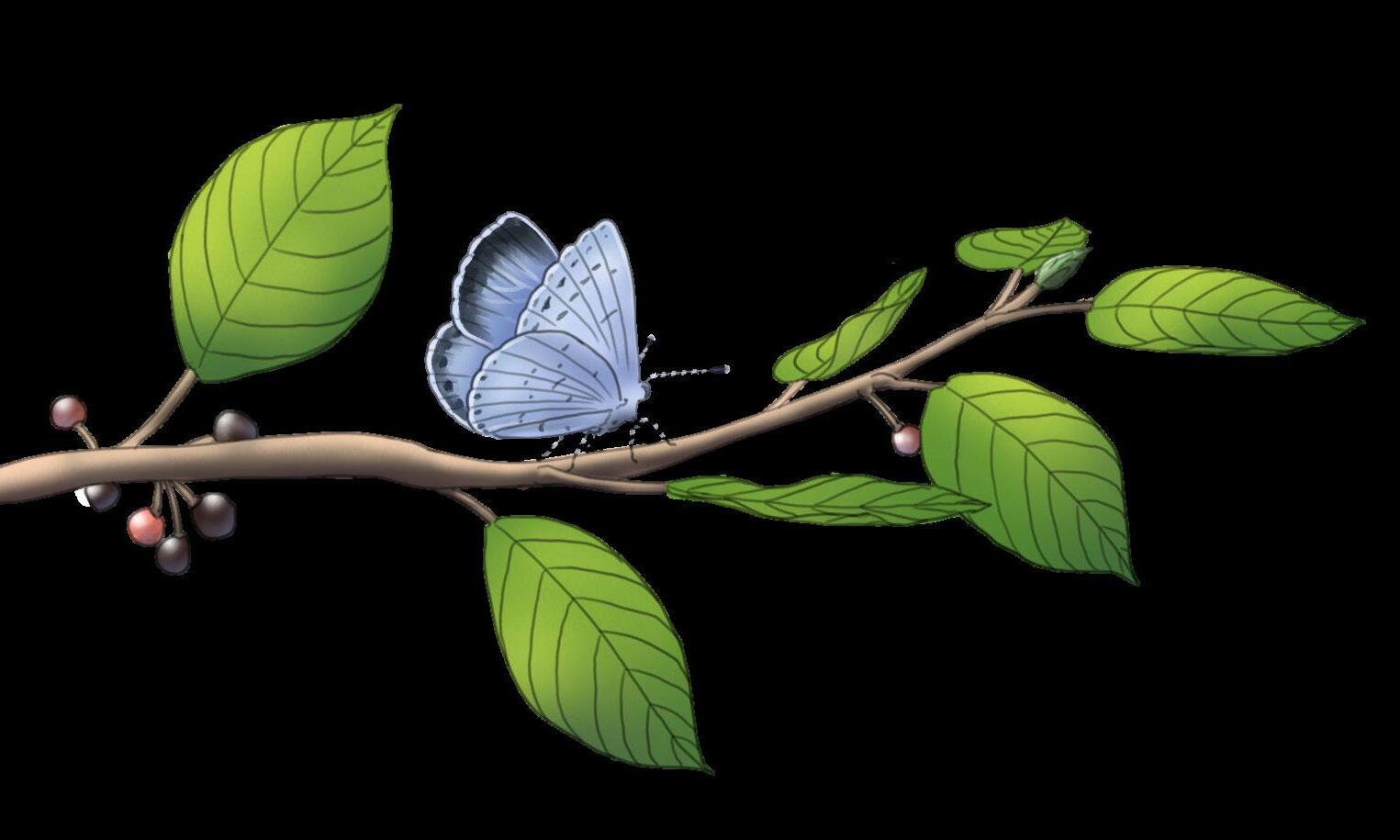
Insects are full of viruses. Some are prominent and pathogenic, others are latent and at first glance, well, wouldn’t harm a fly... But is that true? How do these viruses influence their hosts and each other? The virologist Vera Ros has been given a Vici grant (1.5 million euros) to dive into a world that has remained largely hidden until now.
‘Viruses don’t have an immune memory’
‘What effects do viruses have on the lives of insects?’ Ros wonders. ‘That intrigues me. How do they influence infections from other incoming viruses, for instance?’ Ros previously got a Veni grant and a Vidi. ‘In my Vidi research, my primary focus was on baculoviruses and how they are sometimes a latent, unseen presence in a cell. My Vici grant is going to let me expand that research to include all viruses.’
Viruses reside in the cells of their host. ‘So there has to be an interaction with the cell’s immune system,’ says Ros. ‘But insects don’t produce antibodies as we do and they don’t have an immune memory. Despite that, their immune systems get primed by an infection, protecting them better against repeat infections. How that “memory” works is still a black box.’
Behavioural changes
In addition to the ‘how’ of priming, Ros is also looking at the consequences of an infection on the fitness and behaviour of the insect.
‘Some viruses trigger behavioural changes in the host, but you don't always see that – it isn’t black and white. The presence of other viruses might have an effect too.’
Other Vici grant recipients in addition to Ros were entomologist Eveline Verhulst (for research on parasitic wasps), nutritional researcher Sanne Boesveldt (for a study on the link between the sense of smell and health) and philosopher David Ludwig (for alternative forms of practising science). rk
SOCIAL SKILLS THANKS TO BROTHERS AND SISTERS
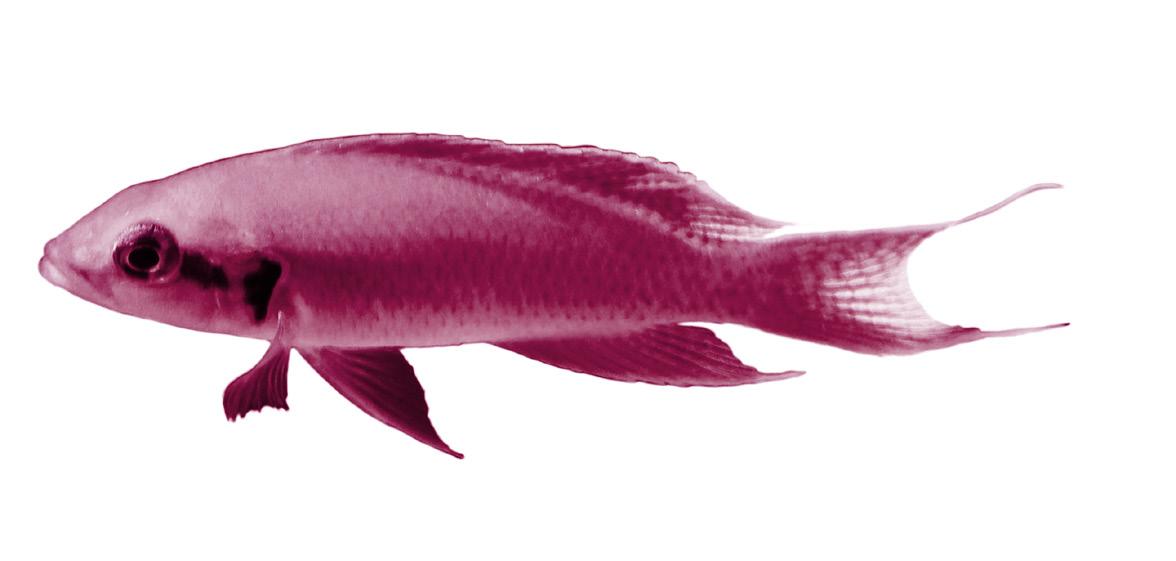
How young fish interact with their siblings in the first few months after birth determines their social skills later in life. That, at any rate, is the case for the tropical freshwater fish Neolamprologus pulcher Text Marieke Enter Photo Shutterstock
This finding is based on experimental research by Bruno Camargo dos Santos, a visiting PhD candidate in the Behavioural Ecology chair group. He published a paper about this in PNAS earlier this month. Brothers
and sisters are an important aspect of the social environment of many animals in the earliest stage of life. Previous studies had already shown how that environment plays a key role in the animal’s further development,
but it was unclear which was the determining factor: the number of siblings or their interactions with one another. Camargo dos Santos designed an experiment with Neolamprologus pulcher, a cichlid species, to shed more light on the question. Young fish from the same clutch of eggs were assigned randomly on birth to one of three different social environments.
Contact
We congratulate Luis Angel with his Engineering Doctorate!
The post-master programme in which candidates work on innovative solutions for a sustainable future
His research improves barn cleaning through collaborative robots while balancing e ciency and animal welfare
One group consisted of 32 brothers and sisters with no restrictions on their interactions. The second group had no restrictions either but there were only eight siblings. The third group also consisted of 32 siblings, but they were divided into four compartments containing eight fish each. The fish could see and smell their brothers and sisters in the other compartments but they only had contact with their siblings in their own subgroup. Differences were seen even in the first three months of life. The fish in the first group displayed less aggression and submissive behaviour. They
also spent more time together and followed one another more often. When the fish were five months old, the researchers put their social skills to the test by introducing a larger member of their species, a stranger, into their territory to trigger competition. The fish in the first group dealt with the interloper best. They were more likely to de-escalate when faced with aggression (through submissive behaviour) and were less aggressive themselves, and therefore more likely to be accepted. The fish in the small group were least skilled. ‘Social competence is a fundamental skill in social animals, including humans,’ says Camargo dos Santos. ‘Our results show that this doesn’t develop automatically; it is formed by the social interactions in the first months of life, in particular with siblings.’ With the nuance that having lots of brothers and sisters isn’t enough in itself; they also have to be able to interact with one another.
PhD theses in a nutshell
More light for lettuces
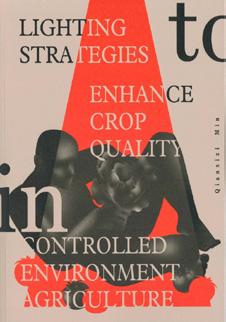
Growers do everything they can to maintain the quality of their products for as long as possible after harvesting. Qiangxixi Min (from China) investigated the effects of administering extra light to lettuce plants in the final days before harvesting. Her experiments show that this has a positive effect, working best if you spread that extra light out over a longer period of time. This can as much as double the shelf life. The reason is obvious enough: extra light means extra photosynthesis and therefore more energy storage and higher production of antioxidants such as vitamin C. rk Lighting strategies to enhance crop quality in controlled environmental agriculture. Qianxixi Min Supervisors Leo Marcelis and Ernst Woltering
Nutrition app
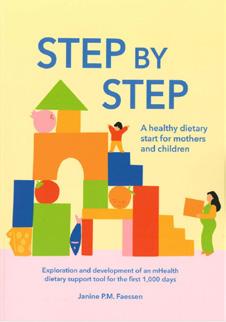
There are plenty of apps to help pregnant women and new mothers with nutritional advice for the baby, but they are not much use according to Janine Faessen, who studied 57 of them. The majority are not based on expert knowledge and have not been scientifically tested. Faessen produced one herself, based on extensive research into what the women needed. She then studied whether it was fit for purpose. Which it indeed is, but lasting behavioural change requires more than just the mother rk Step by step, a healthy dietary start for mothers and children. Janine Faessen Supervisor Edith Feskens
THE PROPOSITION
PhD candidates explain their most thought-provoking proposition. This time it’s Valentina Attiani, who received her PhD on 8 Dec 2025 for her study of the microbiology of slow sand filters and optimization of these biological systems for drinking water treatment. Text Ning Fan
A can of worms
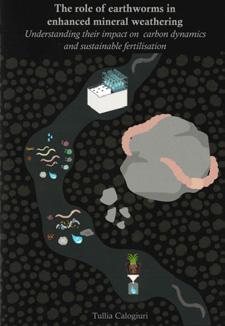
Silicates from rocks can bind carbon dioxide. Rocks can thus naturally capture CO2 as they weather. Tullia Calogiuri (from Italy) investigated the role of earthworms in this process, as key soil processors. The worms do indeed have a role, but strangely enough primarily once they are well and truly dead. More carbon is sequestered then. But how is that possible? Dead worms lead to large numbers of bacteria, which increase carbon sequestration. So the worms do it from beyond the grave rk
The role of earthworms in enhanced mineral weathering Tullia Calogiuri Supervisor Willem van Groenigen
Like a ballroom dance, the collaboration between AI and scientists only works when both partners move in rhythm, harmony and coordination
‘During the pandemic years, I had to switch from lab work to bioinformatics because of the limited access to the lab. Bioinformatics was completely new to me, and learning it while in isolation was really tough and time-consuming.
‘After AI was introduced, I realized it could be a useful partner, especially for correcting small errors or answering specific questions. But there is also a risk: people might just ask AI to generate code and copy-paste the results without understanding the logic behind them. Coding is very intricate. If you copy-paste everything at once, it can become chaotic because you don’t know if the steps will work. It is better to ask AI to guide you step by step. That’s how you can learn from
AI without letting it lead you.
‘Sometimes AI can also give wrong answers. For coding, you still need to read every line to make sure it’s correct. AI can be a supportive tool, but you always need to verify its output.
‘I think this resonates with ballroom dancing. When I was a child, I often went with my grandparents to a ballroom dancing place. I saw how dancers collaborated without speaking: one person leads, the other follows, and together they create a nice dance. But if no one leads, it becomes chaos. It is the same with AI. It is a powerful tool, but the researcher must stay in charge, directing the flow of the work.’
MORE EFFECTIVE FEEDBACK FROM TEACHER THAN FROM AI
With the right prompts, the quality of AI-generated feedback can be higher than what a human teacher provides. However, students were better at utilizing feedback from teachers.
That is what Omid Noroozi, an associate professor of Education and Learning Sciences, concludes after a recent study. Seventy students wrote essays for the experiment and were given feedback from an experienced teacher or based on either a simple AI prompt or a detailed one. The students did not know the source of their feedback, says Noroozi. The feedback quality was then evaluated using various criteria, including whether it identified the essay’s weaknesses, gave a rationale for the weak points it highlighted, and offered suggestions for improvement.
Changes
‘Teachers can tailor their feedback to what individuals need’
In the first part of the experiment –providing feedback – the quality of feedback from the advanced prompt was significantly above what either the simple AI prompt or the teacher gave, says Noroozi. ‘For the second part, we wanted to see if better feedback would also yield better changes in the essays.’ If so, the students who got feedback from the advanced AI prompts ought to have improved their essays the most.
That did not happen, though. ‘AI-generated feedback covers all aspects of the essay in detail, whereas a teacher often zooms in on the most critical issues,’ explains Noroozi. ‘On top of that, teachers know the students’ backgrounds and can tailor their feedback to what the individuals need. Simply put, at present a good teacher has a clearer understanding of just what a student needs to improve.’ lz
Parkinsonism
A few weeks ago, there was a ‘parkinsonism map’ in the news, the result of research carried out in Utrecht. Parkinsonism (or Parkinson’s disease) is a brain disorder in which nerve cells that produce dopamine are lost, making patients experience difficulties with movement and cognition. The new map uses colours to show the prevalence of the condition in the Netherlands, revealing surprising differences. For instance, parkinsonism is commoner in Groningen and Friesland but rarer in Zeeland and Limburg. This is generating new understandings of which environmental factors play a role in the condition developing. I don’t know if you noticed, but there’s something odd with the map. The colour representing the highest intensity of parkinsonism cases occurs exactly once in the whole of the Netherlands. The shape of the black patch is unmistakable: Wageningen. We’re out there all on our own.
None of the newspapers (NRC, Trouw or the Volkskrant) mentioned this rather surprising fact, so we’re in the dark as to what we owe this dubious honour to. I asked the researchers, but they too were unable to explain why Wageningen has ‘more cases of the condition than expected’. They had simply shown the geographical clusters based on death registrations, health insurance claims, hospital data and medication data, but were
unable to draw any conclusions about possible causes.
‘Remember that the incubation period can be decades, so people in Wageningen who have the condition may have acquired it elsewhere.’
So we’re going to have to speculate ourselves. The study does not reveal any clear links with agricultural pesticides, air pollution or heavy metals, but the researchers do mention other factors. People with a higher socioeconomic status are at
‘The shape of the black patch is unmistakable: Wageningen’
greater risk, so we may be too highly educated, too wealthy or too sociable in this town. Men are almost twice as likely to be affected as women: do we have a gender balance problem? The risk increases with age: are we perhaps becoming too old? Or might the university be attracting a disproportionate number of students and staff from high-risk areas? Perhaps we don’t have enough dopamine in our systems anyway and we ought to get a bit more addicted – that’s when you produce dopamine. Or is there natural selection in Wageningen favouring poor memories?
Sjoukje Osinga
Sjoukje Osinga (58) is an assistant professor of Information Technology. She sings alto in the Wageningen chamber choir Musica Vocale, has three sons who are students and enjoys birdwatching with her husband in the Binnenveldse Hooilanden.
Works Council elections
Looking for the least imperfect solution
Since the beginning of this month, employees have been able to put their names forward as candidates for the consultative body elections at the beginning of June. There has not (yet) been a surge in nominations, as was also the case in previous elections. Unfamiliarity, work pressure and career concerns all play a role. But those who do stand will be helping to build better employee participation, according to ‘participation insiders’ Blair van Pelt and Ernst van den Ende. Text Marieke Enter Illustration Valerie Geelen
Not all that long ago, in 2015, university staff across the Netherlands took action to demand more and better staff participation in decision-making. In Amsterdam, that even led to the occupation again (briefly) of the iconic Maagdenhuis, the university headquarters famously occupied during the 1969 student protests. It seems incredible that the Ministry of Education, the Dutch universities
Participating the Wageningen way
association UNL and the Dutch National Students’ Association (ISO) should feel the need to launch a campaign to recruit enough candidates for the consultative council elections less than ten years later. But that is what has happened.
In the most recent elections, in 2023, a nationwide campaign focused on the
WUR has a mix of decentralized and centralized consultative bodies.
At the decentralized level, there are Works Councils for each of the five science groups (involving and representing WU and WR employees), Wageningen Food Safety Research (WFSR), the Corporate Staff and Facilities & Services. These decentralized bodies advise their own management. Then there are three additional centralized consultative bodies, which discuss things with the Executive Board:
The Central Works Council, comprising 15 members delegated from the decentralized Works Councils mentioned above.
The Student Council, consisting of 12 students who sit for a term of one year.
• The Student Staff Council, the central consultative body for Wageningen University. It consists of five WU employees delegated by the Central Works Council plus two directly elected WU employees, two directly elected PhD candidates and a maximum of six students delegated by the Student Council.
The Student Staff Council and the Central Works Council meet jointly as the WUR Council. Legally speaking, the WUR Council has no participatory rights; those are held by the Central Works Council and Student Staff Council. The WUR Council discusses WUR-wide organizational issues and policy issues with the Executive Board.
consultative body elections under the slogan ‘Choose better education’. The forthcoming elections will once again see a nationwide campaign by the consultative bodies at educational institutions.
Least imperfect
The tepid enthusiasm for the consultative bodies is also evident in Wageningen. In previous elections, there was little de facto choice in some science groups because the number of candidates was equal to or less than the number of seats (see inset). Blair van Pelt and Ernst van den Ende, who know Wageningen’s consultative bodies from the inside as chair of the WUR Council and director of Animal Sciences respectively, acknowledge that this is problematic.
‘If you want a strong organization, you need strong consultative bodies,’ says Van den Ende. ‘It simply improves the decision-making process.’ Van Pelt immediately adds a nuance to that. ‘It’s our job to help managers make the least imperfect decisions. That’s because there may be no such thing as the “best decision”: there’ll always be employees who a decision doesn’t work out nicely for. The aim
‘There’s a lot of ignorance about the role of the consultative bodies in decision-making’
is to keep that group as small as possible and strike the right balance between the interests of the employees and those of the organization.’
That last point is explicitly stated as a task in the Works Councils Act (WOR). A works council is not a trade union that unilaterally represents the interests of the staff; it is also expected to help the organization function properly. Not everyone keeps that clearly in mind. The same applies to other aspects of employee participation too. Van Pelt: ‘Lots of employees would like to be involved in policy-making but don’t know how. There’s a great deal of ignorance about how decision-making works at WUR and what role the consul-
tative bodies play. For instance, it’s not widely known that the consultative bodies offer a way to raise issues with the Executive Board. That’s a missed opportunity.’
Improving the consultative bodies
This relative obscurity is not helped by the fact that employee participation at WUR is, to say the least, rather complex, with different consultative bodies for decentralized and centralized employee participation (see inset). Van den Ende: ‘It surprises even me sometimes, despite working here for a long time. Issues sometimes drop by the wayside because it’s unclear who should be assessing what, who has the relevant documents, who is giving the advice and who has a say. Nobody does that maliciously, but it still happens. Both from
the management side and from the consultative bodies, I think that’s something that needs to be resolved.’ He also thinks it is a problem that employee participation at the decentralized level is overrepresented in terms of Wageningen Research (WR) members, while at the central level there is an overrepresentation of Wageningen University (WU) members. ‘WU and WR are different worlds, though. This disproportionate representation can make the discussions unbalanced.’
Work is being done on a remedy for these issues in the form of a working group that is exploring the future of the Wageningen consultative bodies. Both Van den Ende and Van Pelt are members of it. They expect the working group to publish its
Enthusiasm for the consultative bodies is lacklustre in Wageningen. In the 2023 elections, there was little de facto choice in some science groups because the number of candidates was equal to or less than the number of seats.
report this summer. The initial effects could then become noticeable fairly quickly. Van den Ende: ‘If the consultative bodies and directors agree on the improvements, they can simply decide that this is what we are going to do. WUR won’t have to wait for anything.’ The Works Council members who are elected this summer will therefore see an interesting change at first hand, he confirms. ‘It’s more than that, even: you’ll be helping to improve the consultative bodies.’
Workload and compensation
There are other factors in addition to the relative unfamiliarity and complex structure that explain the lack of enthusiasm. Van Pelt: ‘Everyone everywhere has a huge workload. There are cultural issues too: questions about what being a Works Council member means for your career and your chair group.’ She believes that the last two issues should no longer be an obstacle. ‘The university now uses the Academic Career Framework. I know that many staff members don’t feel they have much scope for providing the “academic services” mentioned in it, as that is almost always on top of existing tasks.
‘Proper employee participation keeps the directors on their toes’
The situation with the consultative bodies is different, though, as chair groups get financial compensation for participatory work done by Works Council members. There is compensation at WR too, so there’s scope for Works Council members to reduce their teaching, research or staff duties temporarily.’
From a career perspective, Van Pelt thinks a stint on a Works Council is a good idea. ‘You’re in a totally different role and so you have to draw on different skills than in your regular job,’ she thinks. She has also seen that it can take a bit of getting used to. ‘New Works Council members sometimes have trouble letting go of their academic mindset. Although being a Works Council member entitles you to the information needed for a recommendation or decision, it doesn’t mean that you can always get all the information you want – but academics are trained to seek out the most complete information possible. How do you decide where to draw the line and how do you discuss that with the director?’
New Works Council members get assistance in their new role, she explains, such as further training. ‘For example, on how to assess reorganization plans. Or courses teaching you how to be tough and say no. It’s something I found rather awkward, partly because the WUR Council has a good relationship with the Executive Board.’
Complicit
Speaking of that good relationship: might it also be one factor in the waning enthusiasm? In that it creates a perception that Wageningen’s consultative bodies are always in agreement with the management and ‘therefore’ not critical enough? Both Van den Ende and Van Pelt dismiss that idea. ‘A good relationship helps maximize the influence you can exert,’ says Van den Ende. ‘Getting the consultative bodies involved in plans early on is valuable, but it has to be underpinned by trust. A director won’t share things if it means they’re risking plans becoming public knowledge.'
They argue that a good relationship does not mean that the consultative bodies become ‘complicit’. Van Pelt: ‘At WUR, it’s crystal clear that the consultative bodies and the management have to seek out and identify areas of friction: which issues do we disagree on and why, and what are the underlying issues? One well-known pitfall is that consultative bodies tend to assume the role of the management. But that’s not our role. The perspectives we bring to the table are meant to make the management’s decision-making less imperfect. And that’s quite a responsibility.’ Van den Ende: ‘Employee participation is a legal obligation, but there’s more to it than that for me: any organization benefits from effective employee participation. It keeps the directors on their toes.’
AI FOR THE DETAILED CHORES
Reviews are essential in science. A review gives a summary and analysis of recent scientific publications on a particular topic. Producing a review involves a lot of detailed work that can feel like a real chore, given that an awful lot of articles are published. Could AI perhaps help? Our new regular feature ‘AI – What’s new?’ looks at what AI can do in research and education. Text Roelof Kleis Photo Shutterstock
Yes, AI can help. In fact, a study by Yanning Qiu in Professor Bart Koelmans’ microplastics group (Aquatic Ecology & Water Quality Management) shows that it works very well. She and a couple of colleagues tried it out by using ChatGPT and Gemini to score and rank studies on plastics using a large number of quality criteria. Koelmans and his group developed those criteria on behalf of the World Health Organization (WHO).
The presence of microplastics in drinking water is a potential health hazard, so it is the subject of a lot of research. According to Koelmans, more than 1000 studies on human exposure to microplastics in drinking water were published in the space of only three years. It would be quite a chore sorting out the good ones from the bad.
‘Sometimes AI had a different opinion and turned out to be right, but not always’
To see whether the large language models used in AI could help, Qiu used a review of 43 studies that Koelmans’ group carried out in 2024. The studies were screened by three researchers independently using quality criteria such as how the samples were taken, treated and stored, whether controls were used and so on. ‘A score was assigned for each criterion: 0 if inadequate, 1 if adequate but with limitations and 2 if good. Then we got the AI programs to do the same.’
High correlation
Carefully chosen prompts were used to get ChatGPT and Gemini to retrieve the relevant sections from the text and assess them. The programs performed surprisingly well, says Koelmans. ‘There is significant statistical correlation between the scores. The accuracy was about 90 per cent, so the scores weren’t exactly the same. Sometimes AI had a different opinion and turned out to be right, but not always. Our final con-
clusion was that you still need a human check. On the other hand, human checks aren’t perfect either.’ The study was published in the journal Environmental International. ‘The idea of doing this is not new,’ says Koelmans. ‘Yanning Qiu soon found a dozen papers in various scientific disciplines doing something similar. However, we’re the first to apply this in research on microplastics.’
Koelmans mainly sees applications in review studies where you need to extract information from a large number of articles. ‘For example, if you have 7000 articles and want to select the best 10 per cent. If you have a well-trained AI program, you can soon get a ranking. The chance that the top 10 per cent of that ranking really are the best is very high. If you want to do a check as the human in the loop, you can take a sample from the 7000 articles to see if you can find anything that was missed. Or you can take a sample from the top 10 per cent to check for errors, depending on the purpose of your check.’ ■
Between hope and fear
How do you study when your country is on fire and you are constantly worrying about the safety of family and friends? Three WUR students from Iran share their struggles, hopes and fears. Text Luuk Zegers
Sara*
‘Nothing good comes from war’
‘I was in Teheran during the January protests. First, we heard people chanting, almost like a football stadium. Then there were loud bangs, and the shooting started. We thought: what is happening? Later, we found out that they were killing people in the streets randomly.
‘At the time, there was no internet, no cell phone connection, nothing. When the internet returned, the shock was enormous. After the shootings in the streets, people from the regime went to hospitals to kill wounded protesters. They even shot doctors who tried to
‘Humans are placing themselves above nature again. We are totally messing things up’
help the injured. Body bags were lying everywhere, and parents were looking for their sons and daughters.
‘After all that, now the bombing has started. People can’t sleep, their houses are trembling. They haven’t recovered from what happened in January. Even I cannot comprehend the current pain and trauma because I moved to Wageningen just before the bombing began. I feel guilty, because my friends and family are still there while the country is being
bombed.
‘My parents help me with the tuition fee, but I need to work to pay for my living expenses. With the current inflation, I don’t know if we can afford next year’s tuition fee.
‘Nowadays, I find it hard to focus on anything at all. I missed one or two classes when the war broke out. I hope I passed the exams, even though it was impossible to study for them.
‘Some people hope that this war will help set us free. I don’t share that hope. Nothing good comes from war. And nobody thinks about the environment. If you bomb a nuclear power plant or burn all the oil, that has an impact.
There were reports of acid rain that was purely black. Humans are placing themselves above nature again. We are totally messing things up.’
Yasmin*
‘Hope is all we have’
‘During the January protests, I couldn’t reach my friends and family for a week. I couldn’t sleep for three nights in a row. Over 36,500 people were killed by the regime in a matter of days. Why? Because they wanted basic freedoms that are denied to them. Now, with the bombing, it is a really scary situation. But at the same time, it gives me hope,
because the regime is being attacked. I feel like freedom has never been closer.
‘Some people don’t understand why many Iranians are celebrating the bombing. Imagine that your own government kills 36,500 people in two days. So far, the US and Israel are killing way
‘I’m not wearing a hijab during this interview. In Iran, I could be arrested and locked up for months just because my hair is showing’
fewer people in this war. At least they warn us where they will strike. Our so-called enemies who are bombing our country treat us better than our own government.
‘I’m not wearing a hijab during this interview. In Iran, I could be arrested and locked up for months just because my hair is showing. Iranians all over the world dream of freedom. Just look at the recent protests in Munich: hundreds of thousands of people coming together to demand liberty. Hope is all we have.
‘In the third period, we had a lot of group work. My fellow students supported me, both with the assignment and emotionally. Professors and study advisers are helping me out in any way they can.
‘Focusing on studying is impossible if you are worried about whether your family and friends are alive or not.
Another cousin was arrested.
Still, I do my best to pass the courses because it took a lot of effort to come here to study.
‘When I came here, I could afford two years of tuition. I work every weekend so I can pay my rent and other living costs. Because of inflation, I’m afraid I won’t be able to afford next year’s tuition fee. That would be a nightmare.’
Soraya*
‘My body is here, but my mind is there’
‘During the Twelve-Day War last June, I started having panic attacks for the first time. In the January uprising, I couldn't reach my family because the regime shut down the internet. It took more than two weeks before my mum could reach me. She said that the family was doing okay, but my dad and my cousin got injured.
‘I can’t reach my Persian therapist because of the internet blockade. I recently started using medication to calm down, which helps with the panic attacks, but also makes me dizzy and sleepy. Since January, I have temporarily stopped studying altogether to protect my mental well-being.
‘All Iranian students are struggling not only mentally, but also financially. Because of inflation, our savings are diminished. It seems almost impossible to afford the tuition fee for next year. I’m now looking at options together with my study adviser. She really cares and tries to reduce the pressure on me.
‘Fellow students can’t understand what I’m experiencing. I’m constantly worrying about family and friends back home. My body is here, but my mind is there.
‘Sometimes I think that people here don’t fully understand how precious freedom is. For many people in the world, it is not a given. It is hard to live in the Islamic Republic. There is no
freedom, especially for women. During the January uprising, people were asking for a better economic system because they are hungry. The regime’s answer to that was mass murder. It is so evil, you cannot imagine.
‘Nobody wants war, but this feels like the only chance my people will get to
‘Nobody wants war, but this feels like the only chance my people will get to break free from this regime’
break free from this regime. So while I’m worried, I’m also hoping that this can be the start of a free Iran.’ ■
* Fictitious names for security reasons.
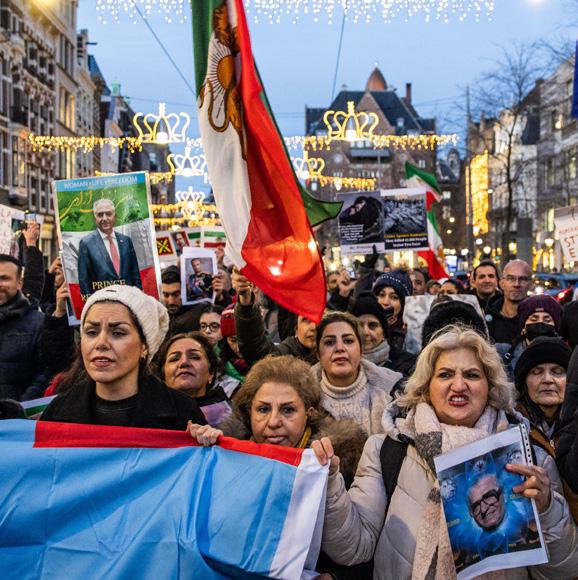
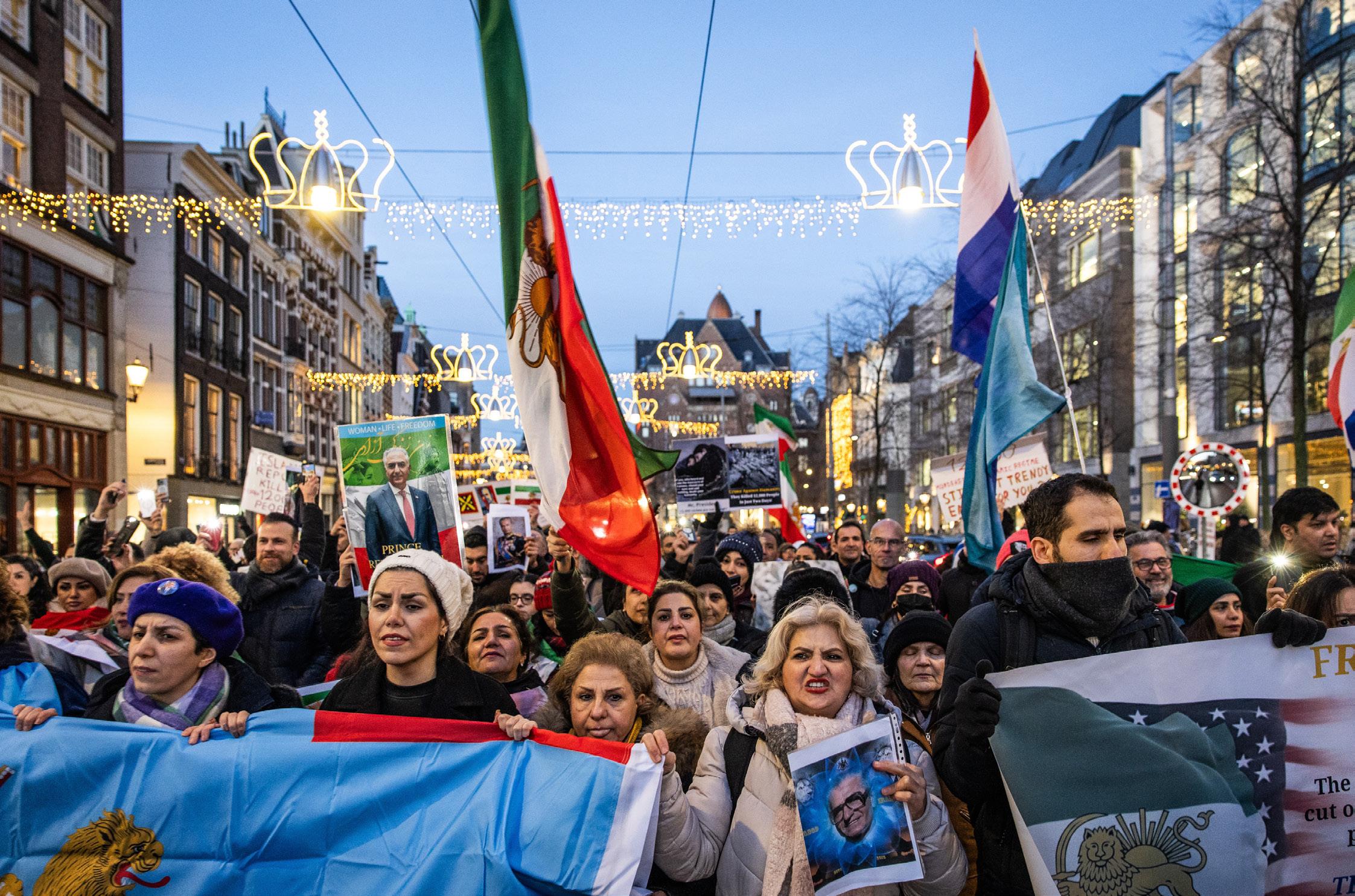
Iran solidarity march in Dam Square, Amsterdam, in January Photo ANP/Dingena Mol
BORROWING JACKETS FOR CV PHOTOS
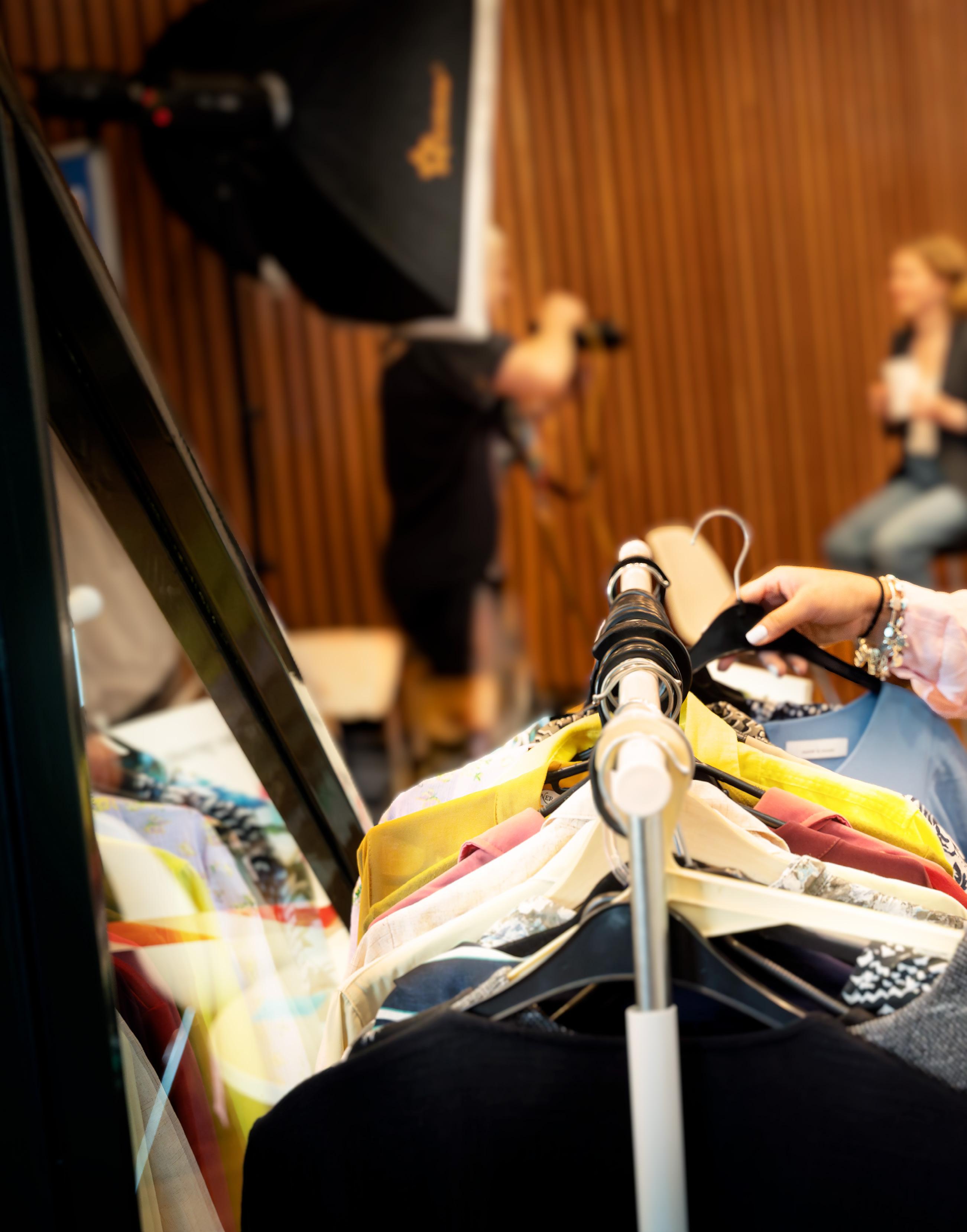
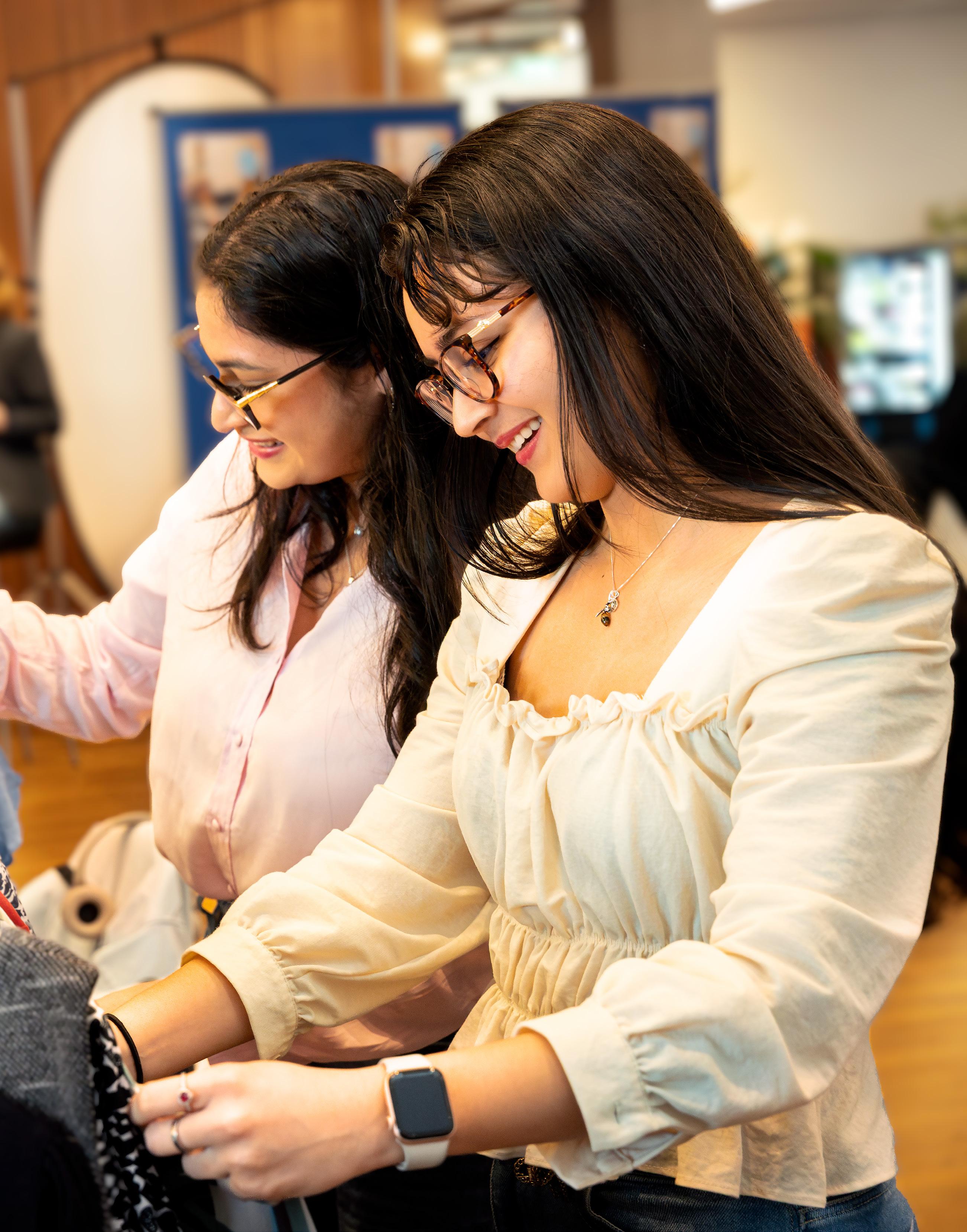
During the Career Week at the end of last month, staff and students could get a professional photo taken for use in their CV or on LinkedIn. Anyone who didn’t have something sufficiently businesslike in their wardrobe could borrow one of the ‘semi-formal outfits’ Wageningen Environmental Platform had hanging on two clothes racks. dv
Photo Ruben Eshuis
Embrace exotic species
Invasive exotic species tend to be outlaws, the target of a licence to kill. But how did that term ‘invasive exotic species’ originate? And were pioneering plants always treated with suspicion? No, says botanical philosopher Norbert Peeters in a new book. Text Roelof Kleis
The book, a hefty tome of more than 400 pages, is called Exoot (‘Exotic species’). It got WUR lecturer Peeters his PhD in Leiden in January. The subtitle translates as ‘The history of the concept of invasive ecology from Linnaeus to Darwin’. This book on the origins of the invasive exotic species is written in an accessible style for both academics and the general public. Peeters had shown before that he writes well, for example in his successful books Botanische revolutie (‘Botanical revolution’) and Plantaardig (‘Plantbased’). He co-wrote Plantaardig with his mentor, Professor Wouter Oudemans. ‘Don’t bother getting a doctorate, lad,’ said this same mentor, riling him appropriately. The professor nearly got it right
too. Exoot is Peeters’ third attempt to produce a doctoral thesis. The first two efforts failed for various reasons. In tackling the invasive exotic, he finally had a topic that he could work with. The idea for this topic can be traced back to Plantaardig. ‘That was the first time I explored the debate about invasive exotic species. I found the way they were dealt with and the language used weird and bizarre. People in general are not that interested in plants, and yet some plants really bug everyone. Why is that and where did that notion of indigenous and exotic come from? And why did we start calling them “invasive”? That’s an interesting philosophical topic because it is about the relationship between humans and plants.’
You mention an illustrious pair in the subtitle: Linnaeus and Darwin, no less.
‘They are the spiritual fathers but they didn’t invent the academic discipline of invasive ecology. That discipline only became established in the academic world fairly recently, in the 1980s and 90s. Linnaeus and Darwin developed ideas that have been hugely influential in how we think today about plants and animals that cross boundaries.’
The first step was taken by Linnaeus when he introduced the concept of a colonist?
‘The first important step was the distinction between indigenous and foreign. Linnaeus started this when he described Sweden’s flora. He only wanted to list plants that are found naturally in Sweden. However, he had to deal with the fact that new plants were appearing. To understand what was happening, he introduced the concept of the colonist,
‘I found the way invasive exotics were dealt with and the language used weird’
which he took from Roman law. Veterans from the Roman army were entitled to plots of land in newly conquered territories where they could settle with their families and start farming. Those settlements were called colonies. Linnaeus applied that image to the plant kingdom. He used domestic and political metaphors by talking about a second home and citizens’ rights for successful species. He also used military metaphors by seeing colonists as foreign legions that arrive to reinforce the indigenous veteran army. He saw that as a positive development.’
Did that surprise you?
‘Yes. Linnaeus is often thought to have believed in a kind of divine order, where species and ecological relation -
ships are fixed and connected to specific places. This reveals a different side to his thinking. He reflected on how you can combine a dynamic plant kingdom with being endemic to a certain extent. Plants spread away from their original area. Creation is incomplete and there are still migrations. Paying attention to what is indigenous let him develop an interest in what is foreign. He got a grip on that with the metaphors he used.’
That neutral or even positive attitude to newcomers came to an end when Darwin visited Argentina’s pampas during his voyages on the Beagle . He saw large numbers of the cardoon plant ( Cynara cardunculus ), which was normally found in European gardens, that had run wild. ‘I doubt whether any case is
on record of an invasion on so grand a scale of one plant over the Aborigines,’ he wrote in his diary.
You call this ‘the most significant moment in the history of invasion ecology’. ‘That’s right. This is when the two terms come together. Darwin doesn’t literally say “invasive exotic species” but he does talk about a foreign species, the cardoon, running wild on the pampas. And as a consequence, the indigenous species are crowded out. Darwin used the word “invasion”. That too is a military metaphor, but quite different to the notion of
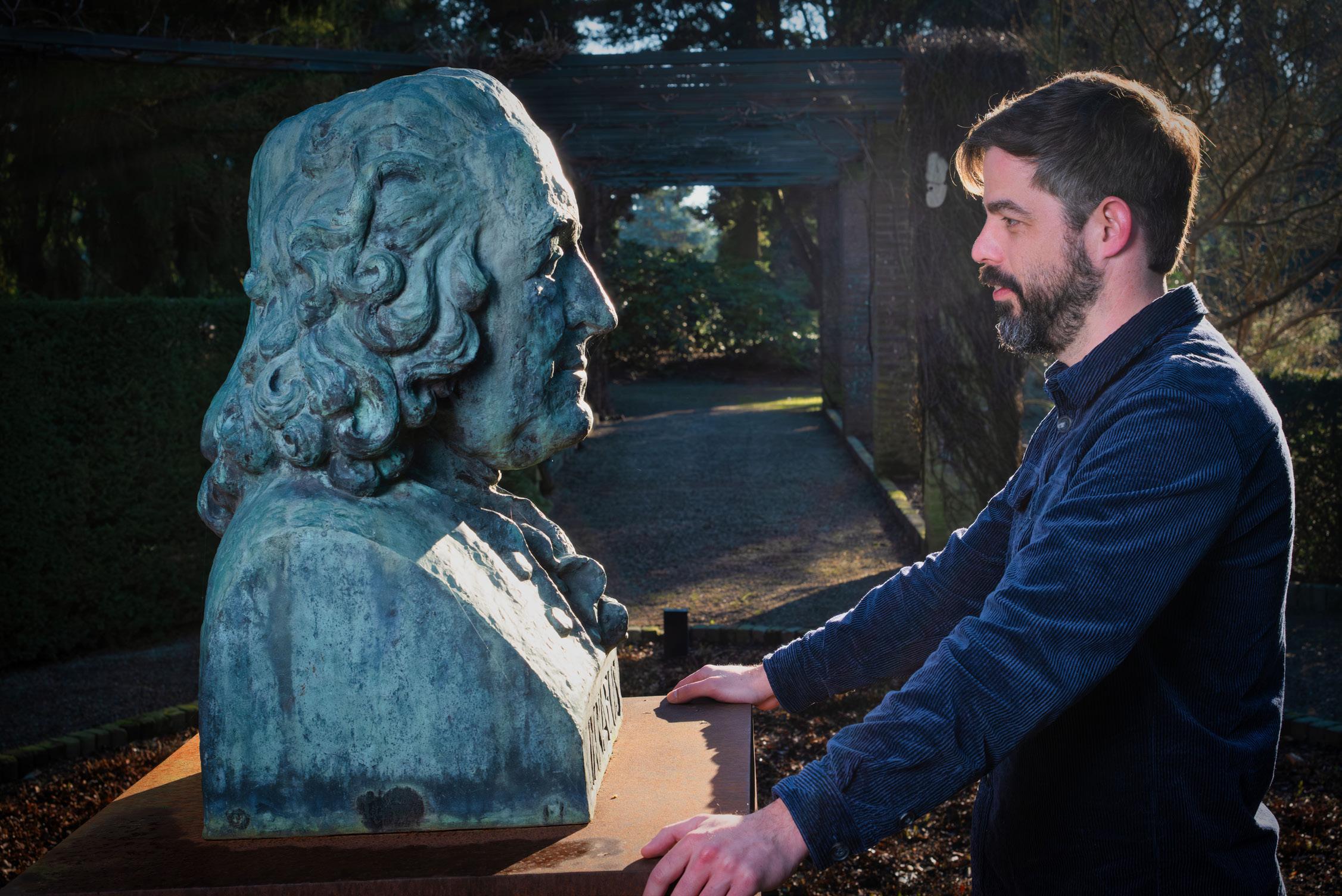
Norbert Peeters (right): ‘Linnaeus and Darwin developed the ideas that have been hugely influential in how we think today about plants and animals that cross boundaries.’ Photo Guy Ackermans
reinforcing the existing army. By using the word “invasion”, he focused attention on the struggle for life. The geologist Charles Lyell used it in the second volume of his Principles of Geology, when talking about plant geography. In fact, Darwin was reading that book during his trip through the pampas. As had happened with the word “colonist”, a military term was once again being applied to the plant kingdom. That has remained the case to this very day.’
Did the word ‘invasion’ have a negative connotation for Darwin?
‘Observing such an invasion made an impression on him, but Darwin had only just started on his long voyage. From that point on, he started to look out for such colonists. He even drew up a table of colonists in England and America. He copied the word and figurative language from Linnaeus. He was also talking about nature as a household and political entity, but it is a more disorderly household in Darwin’s interpretation. It is the survival of the fittest, where the species that adapts best wins. A kind of anarchy rules in his political entity. There are ecological relations that are complex and of long standing but they are not eternal. A species can not only become extinct but can also lose its position. That is why Darwin was so interested in invasive exotic species. He used them to show there is a natural history of migration.’
In Exoot , Peeters devotes an entire chapter to the first public uproar about a weed that was running wild and turned out to be an invasive exotic species. This was the Canadian waterweed ( Elodea canadensis ). Like a war
‘There are lots of exotic species in the Netherlands but only a few are labelled invasive’
‘Take the word weed — a strange concept’
correspondent, he describes the plant’s march forward, landing first in England and then conquering the rest of Europe. The plant is now on the Red List for the Netherlands.
What lesson can be learned from this?
‘Be patient. Ecology is a long-term venture. Some plants travel a long way and thrive, such as the Canadian fleabane (Erigeron canadensis), the thorn apple (Datura stramonium) and the ivy-leaved toadflax (Cymbalaria muralis). But there can come a point when attitudes to the exotic plant turn negative and it gets described as a kind of plague, a weed that has to be eradicated. You get medical metaphors then. The media and the government start getting worried about it, not just biologists. The plant is reviled and alarming imagery is used. The waterweed was shown as a many-headed monster. Darwin too was interested in that particular plant. He pondered various ecological questions, such as whether there were birds that ate the plant and spread it upstream. I don’t always see that ecological interest in the professionals who are purely interested in conservation. There is not much insight into the positive aspects of invasive exotic species.’
Such as?
‘We blame invasive exotic species for doing what plants do naturally: reproducing and spreading very effectively.
Every plant was an invasive exotic species at some point in its existence. In talking about citizens’ rights, Linnaeus meant that if a plant is found in large numbers somewhere, it belongs there. That was also Darwin’s attitude. Exotics are interesting plants. They spread everywhere, but you never know which ones will thrive in the long run. It is not easy to put down roots in foreign soil. There are a lot of exotic species in the Netherlands but only a small proportion are labelled invasive.’
Should we stop using that word? Would pioneer be a more appropriate term?
‘Why the urge to weed out words? We would be better off reflecting on the word “invasive”. What do we mean by that? What assumptions are implicit in it? Take the word “weed” — a strange concept. Everyone knows it and everyone has weeded a garden. We are gardening apes. You have a plan for your garden or field and a certain plant isn’t part of that plan. So it’s a weed. Invasive exotic species are like weeds in nature. But what then is that nature? And where does it end? You can’t pin one particular meaning onto a word. The same applies for invasion; it’s not unambiguous. The great thing about words is that they too run wild. Words also behave like exotic species.’ ■
WUR DOES NOT MINCE WORDS ABOUT ITS COLONIAL ROOTS
With the theme ‘WUR in the World’ and an invitation to historian Larissa Schulte Nordholt to give a talk on WUR’s colonial past, the university showed courage in its celebration of the 108th Dies Natalis (Foundation Day). Text Marieke Enter
During the Dies Natalis celebration, Schulte Nordholt gave a talk on WUR’s colonial roots (see inset on page 25). Professor of Global Environmental Governance Aarti Gupta spoke about knowledge and power structures (‘Knowledge is power, but for whom really?)’ Bert Bruins (lecturer and director of the International Land & Water Management programme) reflected on WUR’s educational slogan of ‘educating responsible change-makers’, noting that WUR alumni have always seen themselves as responsible change-makers, ‘even in colonial times’.
Resource attended the event in the company of Emmanuel Adu-Ampong, Birgit Boogaard and Harro Maat, three Wageningen scholars who recently co-authored a letter to the editor in Resource entitled ‘Wageningen’s awkward colonial legacy’. In it, they argued that ‘colonialism is a sensitive topic that requires careful consideration of its historical complexity and the emotions it evokes today’. What stood out to them during the Dies Natalis ?
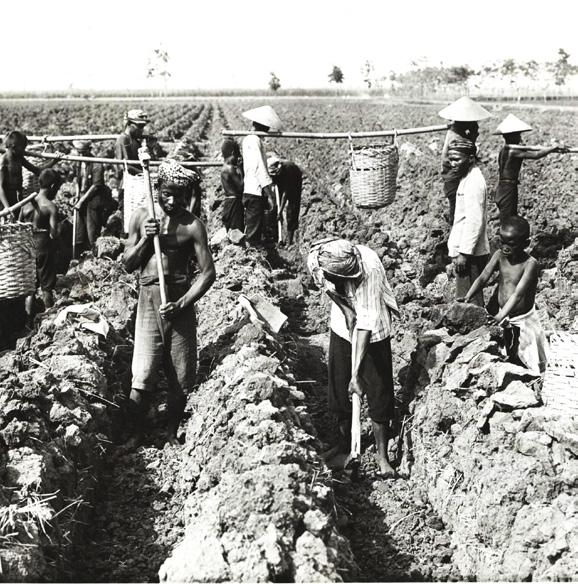
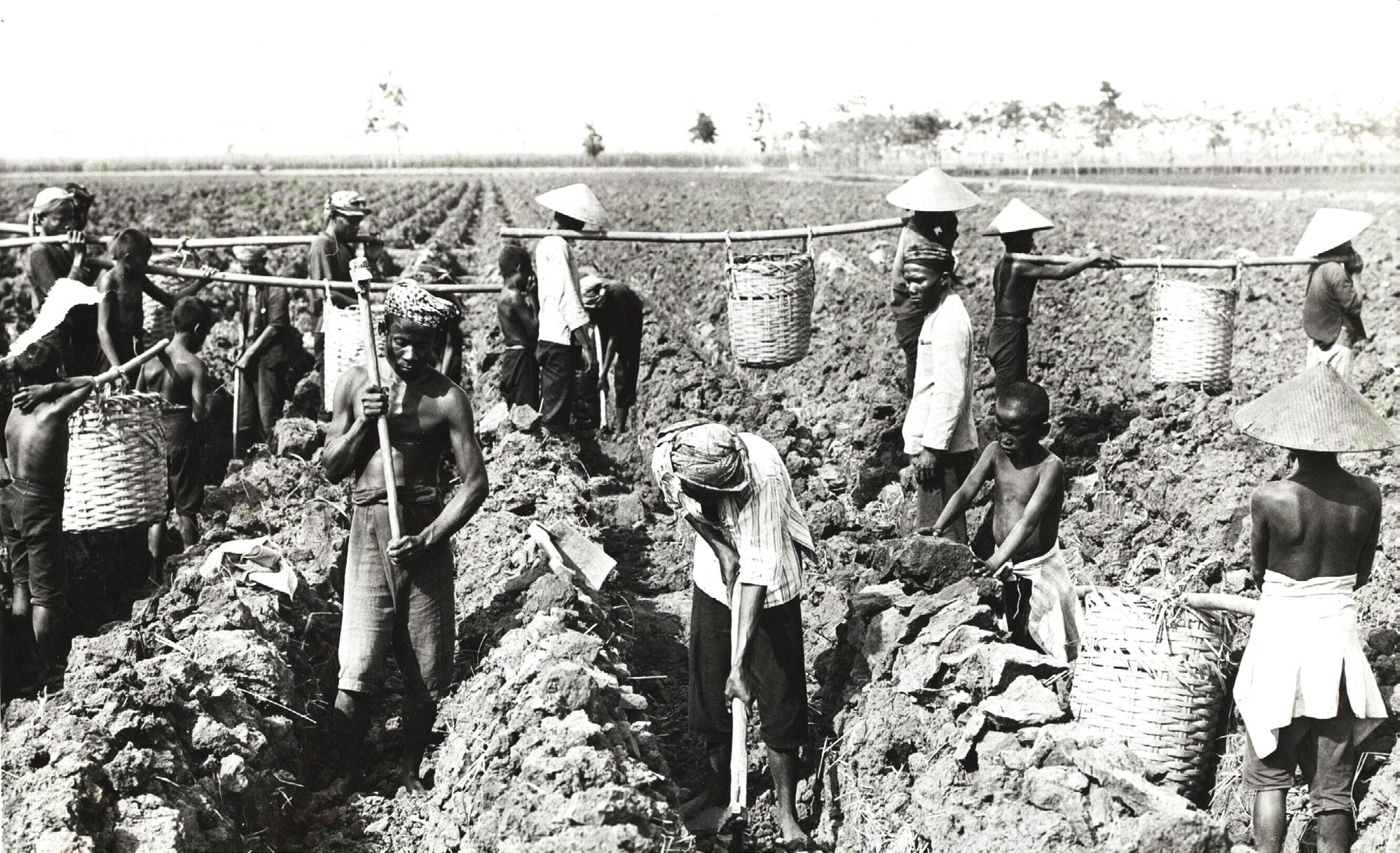
In Wageningen, agricultural knowledge was often produced in plantation settings, with unequal power relations and extractive economies. Scientific knowledge about sugar was impossible without the help and knowledge of local people and migrants. The photo is of the ‘Kemanglen’ sugar plantation on Java. Photo National Archives
The tip of the iceberg
Schulte Nordholt holds up a much-needed mirror
Adu-Ampong: ‘Beforehand, I was expecting Larissa’s 12-minute talk to be fairly relaxed and laissez-faire. But I actually found it quite strong, even confronting, in a sense – in your face.’
Boogaard: ‘It reminded me of a quote by Professor Ramose, the South Africa-born philosopher who is an important inspiration to me: “We have to look in the mirror, especially when we know we are ugly.” That is exactly what Larissa did. She is holding up the mirror, and she is courageous for doing so. It is also courageous of Carolien (rector magnificus Carolien Kroeze, ed.) and the Executive Board to create the conditions and set the tone that allows Larissa to hold up that mirror to us.’
Emmanuel Adu-Ampong is an associate professor of Cultural Geography. He researches how tourism engages with slavery and colonial history. Birgit Boogaard is a lecturer in the Knowledge, Technology and Innovation chair group and one of the initiators of the new minor Decolonizing Science and Development. Harro Maat is an associate professor in the same chair group and has conducted extensive research on colonial agriculture.
Boogaard: ‘It is important to realize that Larissa only showed the tip of the iceberg. That matters because WUR is very solution oriented. The risk is that we look at this topic from the tip of the iceberg and say: okay, we know it was bad; now let’s move on and do things differently. But first we must understand the wider structures and how the colonial past is still part of the university today. Otherwise we risk turning this into something individual like “tweak your course a little and then it’s done”. We need to look critically at what we are doing and teaching now, and ask whether some of the same ideas are still conveyed implicitly, in new or reinvented forms. That is an invitation to all of us.’
Adu-Ampong: ‘The question is how long there will be a willingness to map out the size of the iceberg. You need to understand how big it is and estimate what we can realistically do to deal with it. And then deal with it gradually, rather than assuming this process will take only a year or two.’
Emmanuel Adu-Ampong, Birgit Boogaard and Harro Maat at the Dies Natalis celebration on 6 March Photo Guy Ackermans
For WUR, colonialism is more than a chapter in its history
Maat: ‘I think Larissa did a great job summarizing many of the issues related to colonialism. She showed that the legacy we are dealing with is much broader than we often realize. Colonialism is a deeply embedded social system. It shapes our trade relations, how our campus is organized, how our knowledge structures are set up. We are a wealthy university in Europe, yet very little money or knowledge flows back to the places we once took it from.’
Boogaard: ‘A key observation is that colonialism is not
just a chapter in WUR’s history, but the very foundation of the university. Its legacies are still present, and we need to understand them before we can move forward. We all strive for a future that is just, diverse, inclusive and equal. But if we are not aware of how colonial legacies still shape the present, we may reinforce some of these inequalities in the future.’
Adu-Ampong: ‘One quote that stuck with me was that the colonial past is not a closed chapter. Larissa clearly explained how the Dutch Empire created systems of rule that still shape the present.’
Don’t jump to conclusions
Maat: ‘What makes the colonial history truly awkward is exactly what Larissa explained: the names may have changed – from “colonial” to “tropical” to “development” –but some of the practices have continued.’
Adu-Ampong: ‘If students are more aware of these continuities, they won’t take everything at face value but will pause to reflect: if this has been the history, how should we move forward? Continue as before, or is there room for approaches that are more beneficial? What I try to warn students about is that we shouldn’t be in a hurry to change things. We need to take the time to fully understand the present conditions and how they came to be. In addition to doing nothing, there is also the danger of wanting to act too quickly. But there is no quick fix.’
Boogaard: ‘Rather than jumping to conclusions, it is important to stop and consider that feeling of discomfort. I really appreciated how Larissa’s talk was introduced by the rector, who invited us to listen with open minds and open hearts, knowing that maybe not everybody has that mindset yet.
From a university to a pluriversity
Boogaard: ‘I liked how Bert ended his speech with the idea of turning WUR into a pluriversity of knowledge. I sensed a bit of relief in the room’s response, the laughter — realizing there is a way to relate to this difficult topic. Despite the laughter, Bert’s recommendation is a serious one. How to actually get there, and how a pluriversity of knowledge would change our research and teaching, are the next fundamental questions as we move forward.’
Maat: ‘And as we move forward, it is important not to focus on individual projects or well-intended initiatives. Those are small compared with the much larger networks and knowledge infrastructures in which Wageningen is embedded: connections that link today’s university to structures with roots in the colonial past.’ ■
Larissa Schulte Nordholt’s talk in a nutshell
‘Colonialism is about more than just overseas rule. It was a system in which Europeans governed other territories through the extraction of land, labour and knowledge, while simultaneously producing ideas about race that created legitimization for this rule. (…) Wageningen quickly became a part of this system.
From the 1890s onwards, it started to train young men for careers in the Dutch East Indies (now Indonesia) and to a lesser extent Suriname. So the empire helped build Wageningen, both institutionally and by giving it easy access to tropical nature. (…) Wageningen in return helped sustain this empire by supplying agricultural science for plantation economies and colonial administration.
(...) Agricultural knowledge was often produced in plantation settings, with unequal power relations and extractive economies. Colonial science was presented as objective while actually reinforcing Eurocentric assumptions about development hierarchy. Scientific knowledge about sugar was impossible without the help and knowledge of local people and migrants. (…) In the late 1920s and early 1930s, around 70 per cent of Wageningen students were enrolled in colonial study programmes. Wageningen functioned to a significant extent as an imperial training institute for imperial administration and plantation economies.
After the Second World War, the world changed drastically, as independence movements swept across the Global South. (…) Wageningen adapted and reinvented itself, turning itself from a colonial college to an international college; from the producer of specific tropical agricultural knowledge about Indonesia and Suriname to the creator of universal solutions for the entirety of the Global South. But there was never a complete break with the past: colonial knowledge infrastructures were translated into development frameworks.
Becoming aware of these legacies and of WUR’s colonial past does not have to mean rejecting international engagement entirely. But it does require serious reflection.’
The complete text can be found at Resource-online.nl. You can also view the video of the Dies Natalis at wur.nl
MEGENS SEES NATURE’S BEAUTY
Mathijs Megens is doing a degree in Forest & Nature Conservation. He always wanted to do ‘something with nature’. That rather vague ‘something’ is now clear: he will be an illustrator. Illustrations Mathijs Megens/SeaBlueBird Studio
Mathijs Megens grew up in Hummelo in the Achterhoek region, a beautiful spot surrounded by woods and meadows. It’s where he got his love of nature. After school, he decided to do a Bachelor’s in Forest & Nature Management at Van Hall Larenstein in Velp. ‘Right, so you’re going to be a forest warden,’ said his friends and family, a little too often. ‘I don't want to become a forest warden,’ he wrote in his final yearbook. Not that he has got anything against them. On the contrary. But he has recently made up his mind to become an illustrator. It is his way of protecting nature. ‘My aim is to get people enthusiastic about nature and raise awareness for nature conservation
through my work. I want to show how beautiful nature is. I’m an illustrator and ecologist. I can combine those two things to create realistic ecosystems.’
A quick look at his work shows how talented he is. He inherited that skill from his mother, who studied fashion design at art school. ‘She taught me the fundamentals of drawing and I’ve actually been drawing ever since. For the last few years, that’s been with the help of a computer. But I never seriously considered earning a living that way. It didn’t seem possible either, not until a couple of years ago when I had the opportunity to create a brochure about
managing small-scale forests. It was my first big paid job. That’s when I got the idea that it might be possible after all.’ For the past few months, Megens has also been producing illustrations for Resource, such as the one on page 8 (Live & Learn).
Despite the digital drawing process, Megens’ pictures will remind many Dutch people of the pre-war classroom nature posters. He describes his style as ‘realistically cartoonish’. ‘The clear lines and fields of colour make it cartoonish, though I actually think that’s an ugly word.’ Megens uses the Clip Studio Paint program. It does not bother him that the end product looks digital. ‘If I’m not using actual paint, I don’t mind it not looking like paint. That’s my philosophy. But the style is genuinely my own. It took quite a while for me to find my own style and working method.’
Colour-blind
A striking fact is that Megens is colourblind. ‘Red-green colour-blind: I’m not very good at telling red and green apart. It’s awkward to explain what I see. At a distance, a green shrub with
Text Roelof Kleis
‘I’m an illustrator and ecologist. I want to show how beautiful nature is’
red flowers just looks green all over to me. That’s also why I picked the digital approach: if I mix paints, I haven’t got a clue what I’m doing. On the computer, I can use a colour wheel and know exactly where each colour is. That makes it a lot easier for me. I’ve got to admit that colour-blindness makes creating nature illustrations quite difficult, though.’ ‘What I find particularly tricky is getting the right colours for the skies,’ he continues. ‘My skies have a tendency to be purplish.’ He discovered this through his hobby project, an imaginary planet called Kirr Tahan. Megens practises ‘speculative biology’, an art form that designs alternative ecosystems. ‘I can let my imagination run wild, but the idea is that there must be a logic behind it. I use my understanding of ecology to create plausible animals, places and ecosystems. The skies on my planet are
purple. The funny thing is that everyone thought that was what I’d intended, whereas I was just drawing blue skies.’ What he has no problem with, however, is the deep blue of his favourite bird, the bluethroat. In fact, it inspired the name of his studio: SeaBlueBird. ‘I thought long and hard about a nice name, until I took a course on Terschelling for my studies and saw this small bird for the first time in the dunes. I liked it so much that my studio is now called that. Robins – redbreasts rather than blue – aren’t easy for me to see well, but I have no trouble with this blue. The same bird is in my logo too.’
Kirr Tahan is a hobby project. Megens isn’t worried about earning money from it, although he would like to publish his imaginary world in book form. With the rise of AI, is there still money to be made from illustrations? ‘I’m a conservationist,’ says Megens. ‘I want to use my skills and knowledge to make some kind of a difference. Nature illustration is a niche market. AI is causing trouble for many artists. Even so, I’m sure that there will be renewed appreciation for art made by humans at some point. And even if the profession disappears and I can’t earn a living from it any longer, I won’t ever stop illustrating, because it’s important to me as a person.’ ■
Inspirational women
From Granny to Obama
International Women’s Day on 8 March is a good occasion not only to underline the need for equal rights for women but also to highlight individual inspiring women. Resource asked people around campus to name their female role models. Illustration Shutterstock
Anneke Valk Biology lecturer and Teacher of the Year
‘My grandmother, Corry Valk, is my role model. She grew up in a time when women clearly didn’t get the same opportunities as men. She wasn’t able to go to university, for instance. When more opportunities became available for women later on, she grabbed those chances to make up for lost time. While her children were at secondary school, she studied Social Work at a college and an applied university, and she followed that with courses on history, art history and various cultures. She knew such a lot about the world. My grandmother inspired me to never stop learning
‘She was also very involved in the community — half of Zwolle knew Mrs Valk. She also set an example for me of “being present in the moment”. When you talked to her, she focused all her attention on that conversation. She remembered your birthday, what was going on in your life and so on. That woman knew so much and had so much energy. Amazing!’ lz
Janneke Troost Teacher and PhD candidate in Wildlife Ecology & Conservation
‘Jane Goodall is someone whose example inspires and encourages me to chase my dreams. Her research on chimpanzees was exceptional — especially for a woman in those days . She became world famous, but that was not something she wanted. She saw it as unfortunate but necessary to make a genuine difference. She died last year, but her example is still inspiring people to protect nature. In the Netherlands, for example, her Roots & Shoots programme runs workshops in schools to foster a love of nature in children and teenagers, where they learn that they too can take action to make the world a better place. As she said, “Together we can, together we must!”’ lz
Mangala Srinivas Professor of Cell Biology & Immunology
‘My female role models are Rianne Letschert, the Minister of Education, Culture and Science, and Michelle Obama. I admire both women for being strong and assertive people while remaining very approachable and kind. What I find especially inspiring about Michelle is how she talks so openly about the struggles throughout her journey to get to where she is now. I think that it is very important to have examples of successful people who share this side of success publicly.
‘I have never met Michelle Obama in person, but I do know Rianne Letschert. I first met Rianne when I was chair of the Young Academy of Europe between 2015 and 2020. In 2017, we awarded her our Annual Medal. She started as an academic and became the youngest female rector magnificus in the Netherlands, at Maastricht University. What struck me most was her courage to apply for such a high-level position. Many people, particularly women, might hesitate and question whether they are qualified.
‘ I find it really inspiring that, in addition to her various career accomplishments, she’s also just a very kind person . She once coached me on how to introduce myself more confidently, saying that I should really own my titles. That advice was important for me at that moment in my career and it still influences me today.’ lh
Philip Timmers
International Development Studies Bachelor’s student
‘My fellow student Nienke Kooij is someone I think deserves to be put in the spotlight. I’d prefer not to say “female role model” because that automatically emphasizes gender roles. In my view, feminism is precisely about being independent and not following someone else’s example. Nienke is my independence model because she doesn’t let anyone else tell her what to do and if she doesn’t agree with something, she isn’t afraid to say so. This attitude means she gets criticized sometimes for being “too rigid” or “too serious”, but she doesn’t let that get to her. I really value her ability to think for herself and I’m proud to call her my friend!’ pt
Meghann Ormond Associate professor of Cultural Geography
‘Lynn Staeheli, professor at the School of Geography and Regional Development in the University of Arizona, was a pioneer in the field of feminist geography. She didn’t just bring gender or women’s perspectives into what she studied, but also brought it into practice, into how she worked with people. She really walked the walk, caring for and mentoring those she worked with. She nurtured people’s potential, going the extra mile to create opportunities for them. For example, she didn’t only give me my first academic research job at the University of Colorado-Boulder but also helped me get a scholarship so I could study in Europe. I’m a geographer in Europe today because of her. She also created a community wherever she went – for instance gathering staff and students together for an annual end-ofthe-academic-year bonfire at her house. Whenever I’m in doubt about how to work with colleagues and students, I ask myself what Lynn would do.’ cj
Willemijn Smits
Rural Development & Innovation Master’s student
‘My female role model is my grandmother. I didn’t know her very well because I was four when she died, but I heard a lot of stories about her from my grandfather — her independent spirit and her determination to work. She wanted to be ahead of the pack, which was unusual back then. My aunt, her daughter, is another role model for me. She was the Netherlands’ first woman ambassador to Panama. She often tells me I’m like her mother and then I feel even more of a connection with my grandmother. I try to live in accordance with my grandmother’s philosophy: you have to do things yourself and take action! That encouraged me to become the chair of the tennis club board, for example. I thought: my Granny would have done that.’ lh
Ten years of online MSc degrees
Remote learning
Family commitments, a full-time job or a partner posted abroad: for some students, an online Master’s programme is the only way to study in Wageningen. The first online Master’s degree was launched ten years ago. Resource spoke to two students studying remotely. Text Luuk Zegers
‘We live all over the place’
Andrea Adler (45), originally from Germany, is doing an online Master's degree in Nutritional Epidemiology & Public Health. She lives in Sri Lanka with her husband and three children.
‘Back in 2018, while I was on maternity leave with my second child, I started the online Master’s in Nutritional Epidemiology & Public Health. I wanted to challenge myself intellectually and learn something interesting that I could also use in my career. I have over 15 years of experience in international development as a project manager and independent evaluator. The programme had to be online because as a family we live all over the place: sometimes in Germany, now in Sri Lanka, and I have worked in Bangladesh, India and the UK as well.
‘The year is divided into four-week courses. Each course builds upon the others. There are lectures, readings, case studies, individual assignments, group work, and so on. You can find everything you need on Brightspace. It works really well. The students are of different ages, come from different countries and have different backgrounds. Even though we only meet online, I was surprised by how close I feel to the fellow students and teachers.
‘Since I started with the programme, I have been studying on and off. You are meant to finish it in
‘Honestly, pursuing a Master’s degree alongside a career and family life is not easy’
four years, but that wasn’t possible for me. With my work, I am providing for my family, and we have three young kids. Sometimes unexpected things happen that disrupt my study schedule. When I wasn’t able to study, I deregistered for a while, and I picked it up again later.
‘An online Master’s is not for everybody. It is tough. You need to motivate yourself, free up time for it and be willing to spend a lot of time alone with your computer and books, diving into statistics software and other complicated things. Honestly, pursuing a Master’s degree alongside a career and family life is not easy, especially as an older student. As a result, I am studying a bit more slowly than the rest. However, I am still very determined to finish it.’
‘You do bond together’
Marco Gozzini (29) started the online Master’s programme in Plant Breeding in 2023. He lives in Bergamo, Italy, and works at Syngenta in the R&D team.
‘While I was studying Agricultural Science in Milan, I developed a passion for plant breeding. After my graduation, I started working at Syngenta. But after a while, it felt like I wasn’t specialized enough for my job. So I wanted to increase my knowledge and experience in this field. When a colleague told me about the online Master’s programme at WUR, I decided to enrol.
‘Studying online is different to studying on campus. You can’t go for a cup of coffee with your fellow students every day, for example. But it works well for people who already have a job and know where they want to go, career-wise. Some courses are more independent, while others are more team-focused, with group assignments. So it’s not like you have to do everything by yourself. And once a year, everybody comes to Wageningen campus for two weeks, which is really fun: having lunch and dinner together, getting to know each other, and bonding.
‘In Italy, people sometimes think that an online degree is not as good as a regular degree in terms of learning outcomes and knowledge. My experience is different. I learn a lot, not just academically but also soft skills like time management, organizational skills and how to
‘In Italy, people sometimes think that an online degree is not as good as a regular degree. My experience is different.’
Online Master’s
The online Master’s in Nutritional Epidemiology & Public Health was launched ten years ago, says adjunct programme director Amanda Jager. ‘Plant Breeding started then too. The online version of Food Technology was added two years later.’ Every year, each degree programme has about 20 students starting. ‘They come from all over the world,’ says Jager, ‘often combining the study with a career and sometimes with raising a family.’ Instead of lectures at fixed times, the students get knowledge videos that
collaborate with people with different backgrounds. ‘Combining a 40-hour work-week with 20 hours of studying is a bit much. After the first year, I told my manager that I was doing this Master’s and asked for help. He gave me extra days off, which I could spend on my studies. That was really helpful. Still, it is difficult to find a balance. You have to be very consistent and show up every week. Maybe I also make it more difficult for myself, because I am trying to finish a fouryear programme in just three years.’ ■
they can watch whenever they want. ‘All the study materials can be found in Brightspace,’ says Jager. ‘That means you’re quite flexible in how you study, but you can expect to put in about 20 hours a week.’ Students work together a lot despite the different time zones, explains Jager. ‘If they live on opposite sides of the world, for example one in Canada and the other in Australia, when one goes to bed the other can work further on the assignment.’ The first two years are focused on courses, explains Jager. ‘The students
come to Wageningen once or twice during this period, depending on which Master’s they are doing. That might be for lab work or to write research proposals in groups supervised by lecturers — important skills that you can’t develop online.’ The third and fourth years are for an internship and the thesis.
EU students pay the standard tuition fees for the online Master’s. Non-EU students pay the university-specific tuition fees. If they study part-time, they pay the parttime rate.
Limelight
An organist and a DJ walk into a church... It sounds like the start to a joke, but it really will happen on 10 April. DJ Gerwe and organist Alexander de Bie will be performing together at a dance event in the Grote Kerk.
Text Coretta Jongeling
FRI
10-04-26
Grote Kerk Wageningen 21:00
Admission: 20 euros 15 euros for students
Organ meets house
Alexander de Bie first heard a church organ when he was three, and he fell in love with the sound immediately. ‘I thought it was amazing. Both my parents are musicians, so there was always a lot of music at home, and I learned to play the piano and organ.’
More than 20 years later, De Bie is studying the organ at the conservatoire in Leipzig.
‘Most people only hear organ music during church services, and I want to change that. It’s a really cool instrument and many organs are also works of art as objects.
It would be a shame if people never experienced any of that.’
DJ Nout Gerwe and Alexander de Bie have been friends for years. De Bie: ‘I have a classical music background whereas he mainly plays house music, but we’re each open to the other’s music scene. We’ve often thought it would be great to do something together at some point. But how do you arrange that?’ The answer came from the Flow foundation, which organizes events around the historic Flentrop organ in the Grote Kerk.
It was open to putting on a dance event in the church.
De Bie and Gerwe created songs together specifically for the event.
‘That wasn’t easy. I recorded my part in Leipzig at the conservatoire and then Nout worked further on the number in the Netherlands, and we sent it back and forth. I’m currently back in the Netherlands, so we can finally rehearse together.’ In addition to the new numbers, they will be performing their own versions of dance tracks and classic organ pieces. ‘I’m surprised at how well the two genres go together and how many elements from classical music you can use in house.’
For more information and tickets, see:
TIPS
Thursday 2 April
‘Almost Sane’ Storytelling Night De Wilde World
Saturday 4 and Sunday 5 April
12 years of the Ecodorp Ppauw Festival Music, workshops
Friday 10 April
Asociaal Kabaal, GOEIEMIDDAG! en the Happy Suspended (ska) JV Unitas
DJ Gerwe (left) and organist Alexander de Bie rehearsing in the Grote Kerk Own photo
Every year, about 3,500 students get their Bachelor’s or Master’s degree from Wageningen. In Thesis Life, they talk about this particular milestone — the content and the ups and downs. This time, it is Ayla Brouwers, a Master’s student in Tourism, Society & Environment. Text Eva Hamers
Your thesis in 40 words?
‘I investigated tourists’ perceptions of true-crime guided tours using “existential authenticity”, a method that focuses on personal experience. My findings were that these tours can trigger fear and tension, yet still be experienced as entertainment. That is interesting, because they seem to be opposites.’
How did you come up with your topic?
‘I went on a Dark Tourism tour in Amsterdam: instead of focusing on “this cathedral is so many years old”, it was all about “such and such a person was murdered in this cathedral”. Research into Dark Tourism – visiting places associated with tragic historical events or deaths – always focuses on the motivations of the tourists and almost never on their experiences. And true crime tours have never been studied using existential authenticity.’
Best work-evasion moment?
‘I started doing a lot of sports during the period when I had to write loads. It was nice for a change, sure, but at one point I was in the gym thinking that I could have been writing for two hours by now. I found highly specific, academic writing quite challenging at times.’
Did you get a golden tip from a teacher or student?
‘There wasn’t really much of a click with the supervisor of my Bachelor’s thesis. When I started this Master’s thesis, my supervisor and I drew up a contract – on her initiative – setting out our expectations. It avoids a situation where you wait three weeks for a response, for instance, or your feedback isn’t taken seriously. That worked well.’
What tip would you give?
‘Choose a topic that you really like. I’m very pleased with both my subject and the method; it suited me well. My method was auto-ethnographic, with myself as the primary data source: I took guided tours in Amsterdam, Bruges, London, Liverpool, Edinburgh and Glasgow.’
You find all the flavours of the world in Wageningen. Dutch Food Technology student and keen cook Caspar van Arkel shares a recipe for roasted conical cabbage.
Flavours of WUR
Roasted cabbage with herby yoghurt sauce and chilli butter
‘This is a delicious, creamy dish, with vegetables playing the leading role. It’s not tricky, but you can make quite an impression with it. These conical cabbages are cheap and available all year round. I make it with yoghurt and butter, but vegans can replace those with soya yoghurt and plant-based hard butter.’
1 Cut the cabbage into quarters and rub the pieces generously with olive oil, salt and pepper.
2 Bake for 30 minutes in a preheated oven at 180°C, until the cabbage is cooked and lightly caramelized.
3 Prepare the sauce in the meantime: put all ingredients except the yoghurt in a blender and blend until smooth.
4 Then add yoghurt, plus salt and pepper to taste.
5 For the chilli butter: melt the butter in a small pan over medium heat.
6 Add the paprika powder and stir well.
7 Brown the butter slightly, then add the chilli flakes and remove from the heat immediately.
8 Spread the herb sauce generously on a plate and put the roasted cabbage on top.
9 Drizzle the chilli butter decoratively over the cabbage. For extra crunchiness, sprinkle sesame seeds or pine nuts if wished.
Ingredients (for 2 people):
Cabbage:
• 1 conical cabbage
• salt and pepper
• olive oil
• toasted sesame seeds or pine nuts if desired
Herb sauce:
• 1 whole bunch of parsley
• 1/2 a bunch of coriander
• 2 cloves garlic
• juice of 1 lemon
• 4 tbsp maple syrup
• 3 tbsp tahini
• 2 tbsp water
• 250 ml Greek yoghurt
• salt and pepper
Chilli butter:
• 50g butter
• 1 tsp chilli flakes
• 1 tsp paprika powder
Caspar van Arkel Food Technology student
Scan the QR code for Caspar’s video.
Meanwhile in… Indonesia – Ramadan
WUR is incredibly diverse, with hundreds of internationals working and studying here. In the Meanwhile In column, we ask one of them to comment on events in their home country. This time, Animal Sciences Bachelor’s student Cyra Irawan (20), from Indonesia, talks about Ramadan. Text Philip Timmers
‘Ramadan is a month-long tradition in Islam, based on the lunar cycle. In this tradition, Muslims fast between sunrise and sunset for a month. The festival of Eid al-Fitr marks the end of Ramadan. This year, Ramadan is from 18 February to 18 March.
‘After Ramadan, I always go forward with more religion in my heart and the motivation to do better’
‘I started joining in with Ramadan in elementary school. At first, the kids get to do a lighter version of fasting to get used to the idea. In primary school it even became a bit of a competition to see who could do the full fasting, because it was seen as a sign of maturity.
‘For me, Ramadan is a time of reflection on the past year, forgiving your sins and committing yourself to religion again. After Ramadan, I always go forward with more religion in my heart and the motivation to do better. At home, my family
Column Youssef el Khattabi
Chef as study adviser
It’s period 5 in Wageningen. That means the question you’ve been able to postpone for months suddenly becomes urgent: what will your thesis be about?
As a student of International Land & Water Management, you can do research almost anywhere in the world. For some people (me), that was exactly the reason to choose this programme.
At first glance, the decision process seems rational. You look at the topic and ask yourself whether it interests you. You look at the location and think about where you would like to go. You consider whether you can work well with that supervisor. And of course there’s the method. Will you conduct interviews in a village, take soil samples, or program a model that calculates whether a city will sink a few
normally wakes up together to have the last meal before the fast starts, but here in Wageningen I do this alone. Breaking the fast, on the other hand, is something I prefer to do with friends in Wageningen. We always try and organize some sort of gathering to break the fast together, either with friends, SEA SAW (South-East Asian Student Association), or the Indonesian community in Wageningen.
‘This year, Ramadan is going quite well for me. My body is getting used to it now and I wake up automatically at the times when I have to eat. I have been prepping my meals to make sure the food I eat is nutritious and filling. Because if you only eat twice a day, you have to make sure you eat healthily. Uni is also going well, especially now in the study week, where I have more control over the way I organize my time. I normally plan most of my work in the morning, when I don’t yet feel the effects of the fasting. In the afternoon, I often just feel like closing my laptop and not doing too much work until the sun sets.’
centimetres in the coming years? However, I’m taking something else into account in my choice. A lesson from Anthony Bourdain, an American chef, presenter and writer who travelled the world. He was just as comfortable sitting on a plastic chair at a street stall as he was in a Michelin-starred restaurant. He spoke with fishermen, taxi drivers and grandmothers who cooked the way their families had for generations. His talent was not only in finding good food, but in listening to everyone. He showed that travelling is about curiosity. About the conversation you didn’t expect, understanding how other people live, like a kind of hobby anthropologist. You could say the same applies to thesis research, as you enter someone else’s world for a moment.
So I hope not only to choose a good research topic, but also to choose a place where I can learn something beyond the theory, and where I leave something meaningful behind. Wherever my thesis may take me.
Youssef el Khattabi (22) is a Master's student in International Land & Water Management. In his spare time, he likes to travel and go to the cinema. He also enjoys reading and long after-dinner conversations.
WEEKLY UPDATES ON STUDENT LIFE AND WORKING AT WUR?
Go to resource-online.nl
(Subscription page) and subscribe to our digital newsletter.
SIGN UP
WUR from within: straight, sharp, transparent
Colophon
Resource is the independent medium for students and staff at Wageningen University & Research. Resource reports and interprets the news and gives the context. New articles are posted daily on resource-online.nl. The magazine is published once a month on a Thursday.
Contact Questions and comments for the editors: resource@wur.nl | resource-online.nl
Editorial staff Willem Andrée (editor-in-chief), Helene Seevinck (managing editor), Roelof Kleis (editor), Luuk Zegers (editor), Marieke Enter (editor), Coretta Jongeling (online coordinator), Dominique Vrouwenvelder (editor).
Translations Tessera Translations S.L.
Design Alfred Heikamp, Larissa Mulder
Overall design Marinka Reuten
Cover illustration Valerie Geelen
Printing Damen Drukkers BV, Werkendam
Subscription A subscription to the magazine for one academic year costs 59 euros (135 euros if abroad). Cancellations before 1 August.
ISSN 1874-3625
Publisher Corporate Communications & Marketing, Wageningen University & Research
FIRST EASTER EGG FOUND ON CAMPUS
Frisian Rural Sociology student Tjitske Tjepkema is the proud winner of the first Golden Easter Egg. She won the trophy for finding the first Easter egg on campus, a delicately coloured egg in the sack of the Sower statue.
‘We are incredibly proud of Tjitske and this Wageningen first,’ says Wierd Weinum, chair of Wageningen’s foremost Frisian student society Wageningen Talks Frisian (WTF). The society is the driver behind the revival of the great tradition of hunting for Easter eggs. That tradition has been on the wane for years, but Easter eggs are still being spotted — only these days they’re in movies and video games.
Now WTF wants to revive the real-world version of the Easter egg hunt... and claim it as a Frisian tradition. That is needed, says Weinum, now that other great Frisian traditions such as the Eleven Towns Skating Marathon are being killed off by climate change. ‘All we’ve got left is pole vaulting over ditches.’
Weinum says the Easter egg hunt is an activity that actually benefits from environmental impacts, as pressure on their rural habitat is forcing Easter bunnies to lay their eggs in urban areas. ‘Easter bunnies are becoming increasingly brazen. The fact that an Easter egg was found on the Sower in the middle of the campus says it all. But fantastic PR for us.’
The Easter bunny’s reputation as cute and cuddly has
‘Easter bunnies are becoming increasingly brazen’
taken a hit, though, with the increased urban presence. There have been reports of aggressive Easter bunnies threatening kids in kindergarten playgrounds. Some political parties want measures to curb the Easter bunny population, known for breeding like rabbits, but this is impossible under current EU rules; the Easter bunny is a protected species. WUR scientist Bert Vroegindewei has recently started a research project aimed at getting a better picture of the impact of the Easter bunnies. The plan is to fit some bunnies with transmitters. ‘But that is not easy. You approach them and they seem friendly, but then they rabbit on so much that you get bored and your attention wanders, at which point they run away.’
This year, the Easter egg hunt was for WTF students only, but Weinum has expansion plans. ‘Next year, we want to make it a competition for all WUR students. The Easter egg hunt has the potential to be a typically Wageningen event that fosters cohesion and inclusion, like our worm-charming and soil-drilling traditions.’