There is enough going on in Wageningen and in the wider world to easily fill three magazines. So we have to make choices. What WUR experts have to say about the new coalition agreement? It’s briefly discussed in the magazine and the full article is on our website. The ministry refusing to help Gaza students come to Wageningen? Another short item, with a long article online. WUR sticking to the AI search tool for the new website despite all the criticism? You can read a brief account here and the full story on our website. So what is left? The news that Resource now has a new, modern Editorial Charter that guarantees it complete journalistic freedom (p. 17). In addition, we have an article on WUR people in the local elections (p. 22), lots of science stories and some interesting interviews. Plus a critical comment piece, because we want to report the latest news on the cutbacks and reorganizations and explain the background, but that is not always easy (p. 4). Of course we don’t forget love either in this issue; Saturday is Valentine’s Day, after all. If you are still looking for a date, turn to page 29.
Willem Andrée Editor-in-chief
DANCE IN PROTEST
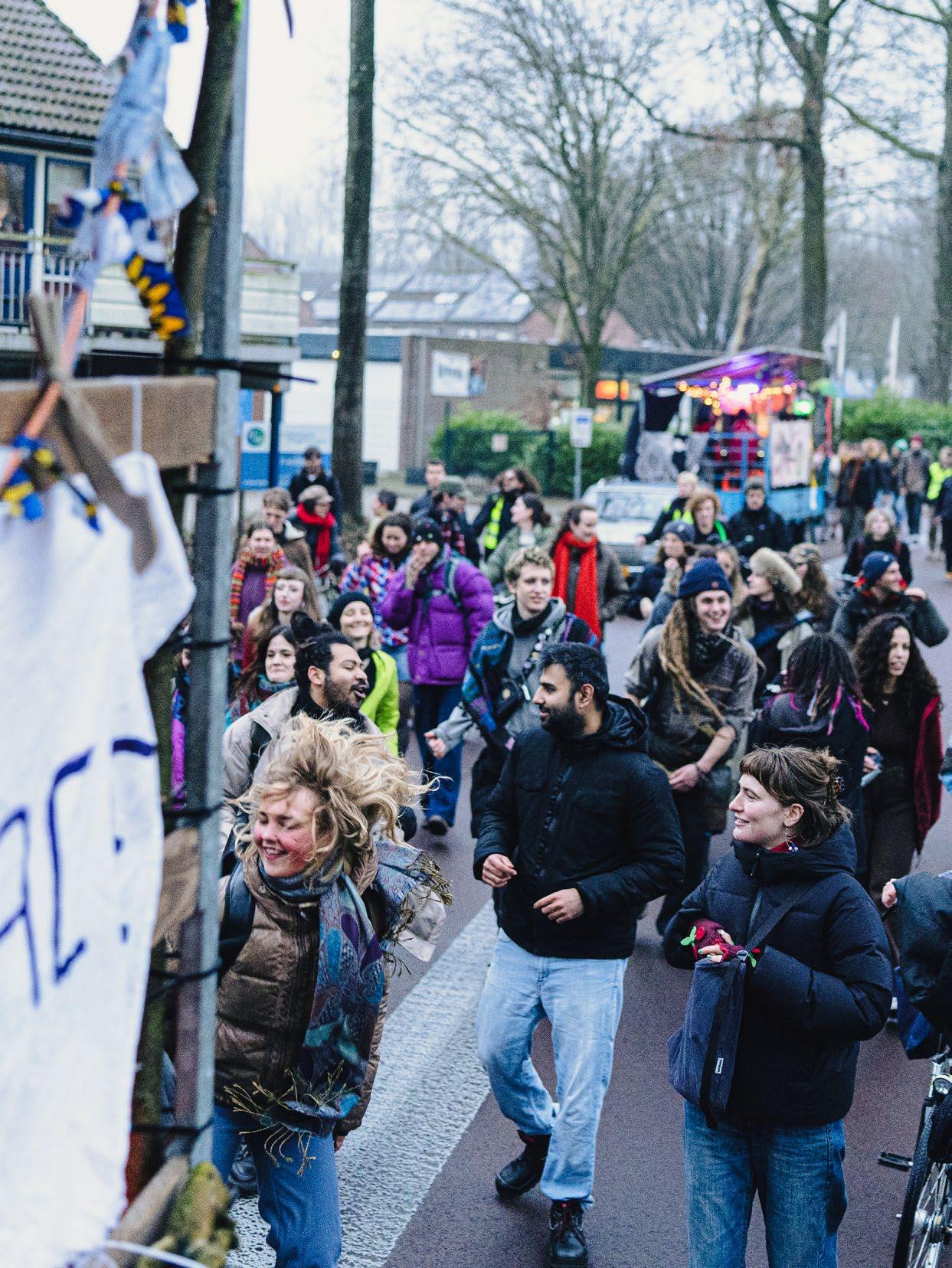
Just over one year ago, Wageningen Culture Collective handed over a manifesto to Wageningen municipality calling for a cultural centre for young people. The municipality said it would take action, but there is still no sign of a suitable venue. On Friday 6 February, the initiators organized a ‘street rave’ – a procession from campus to the town hall with DJs on floats and people dancing in the street – in a light-hearted effort to stress that the centre is urgently needed. lz
Photo Levi van Ginkel
Comment Opening up
If you want to attend a meeting of WUR Council – WUR’s main consultative body – you have to register at least eight days in advance. What is more, the Council’s managing committee and the Executive Board have to give permission for any attendees who are not members of WUR Council. It turns out the situation is different at other universities. At Nijmegen, Rotterdam, Delft and Tilburg, anyone who is interested in attending a consultative body meeting can just walk in without making an appointment beforehand. That includes journalists from independent university media. That easy access shows the consultative bodies are serving the university community. So Wageningen is an outlier. And while the Executive Board is open to being interviewed and their spokespeople respond quickly to journalists, WUR Council prefers to operate behind closed doors – especially now with all the cutbacks. It doesn’t have to be this way: WUR Council and Resource could act in tandem as both have the task of acting as a check on power.
The Council’s reluctance is not unique. We found out from talking to other independent university media that their consultative bodies too prefer to discuss sensitive topics such as HR and personal safety behind closed doors. That is understandable in some cases where it is about specific individuals. But the restrictions in Wageningen are broader and affect topics that concern the whole university and where you wouldn’t expect extreme caution, such as the new website or new intranet. Another issue is the Executive Board’s list of decisions: it is difficult to find and months out of date. Whereas you can take any municipality and you’ll find they actively inform the press of their decisions within a week at most.
The consultative bodies have a dual role: they perform checks of the Executive Board but also collaborate with the Board. That is a balancing act, which is why transparency is crucial. Giving everyone easy access to meetings will increase trust, especially when decisions have major consequences for staff and students.
The law says consultative bodies must be accessible and transparent. WUR Council keeps to the rules, for example by publishing memos, but it doesn’t have a straightforward, accessible meeting culture at present. That should be achievable with a bit of effort and planning. Open up to employees and let us wander in. Open the doors, open the windows and let in a breath of fresh, accessible air.
This Comment presents the views and analyses of the editorial board, formulated following a discussion among the editors.
In brief
WUR website to keep AI search tool
There has been a lot of criticism of the AI search tool on WUR’s new website. Staff complain the tool hallucinates and can’t find people. WUR Council asked the Executive Board last week about the threat of reputational harm. ‘Why not offer a traditional search tool alongside the AI option until it works properly?’ said the Council. WUR spokesperson Jan Willem Bol sees no evidence of reputational harm: ‘Four other universities have approached us to see how we are doing this.’ The website development team WIRE is working on improvements to the tool and asks staff to send it any examples of errors by email. wa
Gazan students still not here
Two Palestinian students from Gaza were supposed to arrive in Wageningen last week with funding from the WUR grants for students in conflict zones. Their visas are waiting for them in Jordan but the Dutch Ministry of Foreign Affairs is refusing to help get them out of Gaza. On Monday last week, three Palestinian academics — including these two students — brought a lawsuit against the ministry. Their lawyer points out that the Netherlands had previously evacuated hundreds of Gazans and it should treat people in the same situation equally. WUR is paying the students’ legal costs. They were supposed to start at Wageningen on 1 February but haven’t been able to reach the Netherlands. The court will give its ruling on 16 February. wa
Education cuts cancelled, WUR continues its cuts
The new minority coalition government with the D66, VVD and CDA parties wants to reverse the cuts in higher education and invest 1.5 billion euros. It is not clear whether the plans will go ahead because the government needs to find support in the opposition.
Central Works Council chair Paul Smeets is cautious: ‘We will have to see how these plans work out. I fear it won’t mean an end to the cutbacks WUR is making.’ Sjoukje Heimovaara is also realistic. The agreement ‘probably means limited relief for WUR in terms of the target of 80 million euros in cuts by 2028.’
On Monday, WUR stressed on Connections (intranet) that the university’s cutback operation is still necessary, in part due to falling student numbers, cuts in the Ministry of Agriculture and rising costs for salaries and other items. wa
Go to resouce-online@wur.nl to read the comments on the Agreement by WUR experts on nitrogen, education, research and research.
150
The WUR Ensemble Network gave its first performance on 10 February. This group of musical students and staff at WUR started out as a platform for meeting fellow musicians. Everyone is welcome, whether you play the accordion, want to set up an a capella group or play a really niche musical genre. Over two years, it has grown into a community of more than 150 members. cj
Read more about the origins of the ensemble on resource-online.nl.
Masseur found guilty of sexual assault
The masseur charged with the assault of two WUR employees has been sentenced to a suspended prison sentence and community service and is prohibited from practising his profession. He also has to pay compensation for damages and emotional distress. The court in Arnhem gave its verdict at the start of February. The public prosecutor had called for a prison sentence of ten months, with five months suspended, and a ban on practising as a masseur for three years. The court didn’t send the perpetrator to prison, in part because so much time has passed since the assaults, which took place in 2022 and 2023. Instead, he is getting a prison sentence of 120 days, 119 of which are suspended (the man had already spent one day in pre-trial detention) and a maximum community service of 240 hours. dv
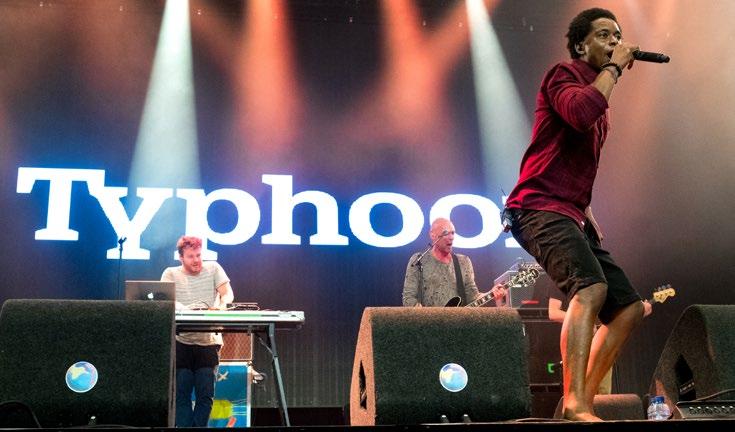
Typhoon to headline Summervibes
Typhoon will be the headline act at Summervibes, the free campus festival to be held on Thursday 18 June.
The news was announced by Chris van Kreij, a member of the festival organization. ‘We are pleased Typhoon is coming to Wageningen. He has broad appeal, a great message and is guaranteed to give a good time.’
Rapper and singer Typhoon is known for his vulnerable texts and energetic live shows. In 2014, music magazine OOR called his second album Lobi da Basi the year’s best album. Last year, he took part in the TV programme Best Singers Typhoon has previously performed at festivals including Lowlands, Down The Rabbit Hole and Pinkpop.
The Summervibes team is working hard on the plans for the fourth edition of the campus festival, says Van Kreij. ‘Like in previous years, we are going for a broad programme of music and speakers. The Ceres band will be performing and
24
comedian Rob Urgert will present WUR’s Impact Awards.’ The swing carousel will be returning too. Last year, the festival was on the same day as WUR’s sports event WeDay. ‘That went so well that we will be combining the two again this year.’
The organizers were caught off guard by how popular the Summervibes festival
was in 2025, says Van Kreij. ‘We had 1,000 visitors the first year, 2,500 the second year and 5,000 last year. That meant the queues got too long at times. We will be changing the setup for the bars to keep the queues short.’
The rest of the programme will be announced over the coming months. lz
Beuningen, the Netherlands -
June 2017: Dutch rapper Typhoon performs live on stage at the Down The Rabbit Hole music festival. Photo Shutterstock
letter to the editor
WUR should not force opinions on students
In my role as course coordinator, I recently came across the policy document ‘BSc Skills Learning Outcomes’. It describes the skills Bachelor’s students are supposed to have by the time they complete their degree. The document has been circulating in draft form for some years and is now about to be finalized. It is presented as a starting point that degree programme organizers can supplement and amend as wished. Skill number 13 is Diversity and Inclusion (D&I). One subskill is that students are expected to ‘be ready to promote social equality and respect for diversity’. That sounds appealing but D&I isn’t a skill or a scientific concept; it is a normative policy framework. That means it is by definition political in nature. Whatever you think of it in terms of the substance, the idea of judging students on the basis of normative and political criteria is wrong in principle. Fundamental values that are widely shared – for example, those laid down in the Dutch constitution – are not imposed as learning objectives or assessed either. That is why this is a step too far. As a teacher, it is my task to provide academic education that
is free of values to the greatest extent possible. If normative or political frameworks are unavoidable, they should be presented explicitly and in a balanced way so that students can form their own judgements. A university should teach students to think for themselves, not teach them what to think. If a student is for example able to analyse and explain the causes and effects of climate change, they are demonstrating something I would accept as an academic skill.
But including D&I as a skill impedes upon students’ freedom to form their own political opinions independently. The fact that WUR could actually be asking students to actively promote certain standpoints is incompatible with academic freedom. In short, having D&I as a learning objective is precisely not what degree programmes should be doing. Stop politicizing education and remove D&I from the Skills Learning Outcomes. As a teacher, I refuse to cooperate in teaching skill number 13.
Hans van den Heuvel, Maths teacher
Advert
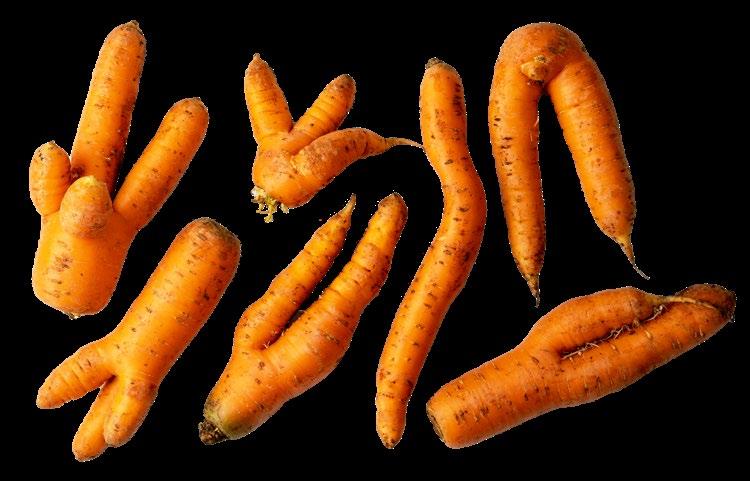
UGLY FRUIT AND VEG SELL JUST FINE
Ugly fruits and vegetables are often discarded as waste, not because consumers don’t want to buy them but because they are rare in supermarkets. If the supply is large enough, consumers are perfectly happy to pick them, shows research by Professor Ilona de Hooge.
Text Dominique Vrouwenvelder
A lot of food waste in the Netherlands consists of fruits and vegetables that are rejected because of their appearance. That happens at various points in the food supply chain, explains De Hooge (professor of Marketing & Consumer Behaviour and interim professor of Business Management & Organization).
‘About a third of all waste is due to such aesthetic requirements, which is both
‘Consumers need to get used to them at first, but afterwards they barely notice’
a shame and unnecessary. These are perfectly edible products that are simply the wrong size or shape.’
De Hooge has spent years researching how farmers, supermarkets and consumers deal with these imperfect products. ‘Farmers often want to sell them but think — or know from experience — that supermarkets don’t want to buy in these products,’ says De Hooge. Supermarkets say consumers don’t want to buy odd-looking products, but consumer research shows otherwise. ‘If you explain that these products will be thrown away otherwise, lots of people
are prepared to buy and eat them.’
She input the existing knowledge into a computer model to get a better understanding of the dynamics between the various players in the food supply chain. She simulated several scenarios. ‘We wanted to know what would happen if — rather than 5 per cent — 10, 30 or 50 per cent of the fruit and vegetables on offer in the supermarket were imperfect, alongside the perfect-looking products. Not temporarily but as part of the permanent assortment.’
GET USED TO THEM
Not much changes with a small proportion of around 10 per cent. Consumers continue to choose the perfect-looking products. The imperfect ones are left on the shelf and are eventually no longer sold. ‘That is what we now see in supermarkets,’ says De Hooge.
The situation only changes once at least 30 per cent of what is on offer consists of imperfect products. Sales fall at first but rise again after a while. ‘It seems consumers need to get used to them first,’ explains De Hooge. ‘Once that’s
happened, they barely notice and accept that’s what the fresh products look like.’
One important prerequisite is not to display the imperfect products separately. ‘Put them in among the rest, not on a separate shelf or advertising a discount as if there is something wrong with them.’
VARIABLE
Even so, this solution is not as simple as it seems. ‘The whole food system is geared to uniformity. Transport crates are designed for straight cucumbers, for example. Food processing companies also have machines that can only cope with standard shapes.’
The supply is also variable. ‘You don’t get the same products with the same imperfections every week,’ says De Hooge. Supermarkets in particular find that a problem. They have limited shelf space and prefer products with a predictable margin. Perfect fruit and vegetables are available in large quantities, so there is no need to change course.
Photo Shutterstock
Live&Learn
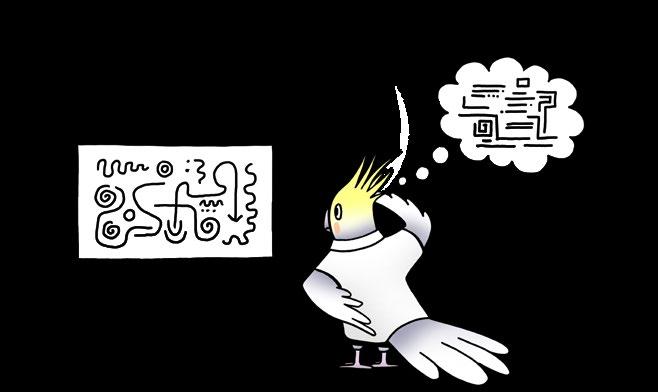
A botched experiment, a rejected paper: such things are soon labelled as failures in academia. As for talking about them — not the done thing! But that is just what WUR scientists do in this column. Because failure has its uses. This time, it’s Koen, who prefers not to give his full name.
Text Nicole van ’t Wout Hofland Illustration Mathijs Megens/ SeaBlueBird Studio
My PhD research ended six years ago, but I still haven’t finished my doctoral thesis. I love setting up experiments and deciding a strategy for what data I want to get from which experiments. But repeating them for statistical rigour is boring, and turning it all into a streamlined, logical story is even worse. I started off at a university of applied sciences, with a practical approach. During my PhD research, I realized I had never learned how to construct a scientific narrative. And because I didn’t yet know which way my research would go, I barely wrote anything in my first few years.
‘By now, other PhD candidates were managing to finish their theses’
‘The last six months of my contract were supposed to be my writing phase, while a colleague finished off my final experiments. Then along came Covid. The lab closed and the experiments stopped. I felt let down: I was no longer going to get the results
that were supposed to give me such a strong argument. That made it harder to get started on the writing. I did eventually begin writing it up, but progress was slow. Faces with a mountain of work, I did little bits but the biggest chunks were still waiting. After several months, I started to realize I wasn’t going to make it.
‘My dyslexia and ADD played a role in all this. My meetings went fine, but I wasn’t able to structure my thoughts on paper. I set a high standard and my written texts are almost never on a par with the logic and clarity in my head. By now, I was seeing other PhD candidates around me managing to finish their theses. That bugged me. How come they could do it and I couldn’t? I used to think it was really important to be intelligent and be seen as such, but I’ve been able to let go of that attitude. I recently asked myself again whether I should finish my thesis, and the answer was yes. Now I spend one day a week writing. The end is in sight.’
EU RESEARCH GRANT FOR USING CRISPR-CAS TO TREAT CANCER
The European Research Council (ERC) has awarded a ‘Proof of Concept’ grant to the microbiologist John van der Oost. He is getting 150,000 euros to explore the options for practical application of CRISPR-Cas in treating liver cancer.
Van der Oost and the 12 other Dutch grant recipients received a research grant from the ERC a couple of years ago and are now getting the Proof of Concept money to explore ‘the commercial or social potential’ of their research.
Van der Oost and postdoc Christian Südfeld have been given the grant for the project DeLIVER: Epigenome-Sensitive CRISPR Therapy for Hepatocellular Carcinoma, in which they will investigate whether a CRISPRCas gene cutter can be used as gene therapy in patients with liver cancer. ‘We are looking at whether we can disable cancer cells while leaving the healthy cells intact.’ The ultimate aim is to develop a new kind of cancer therapy.
CUTTING CANCER CELLS TO SHREDS
The enzyme ThermoCas9 can be programmed to look for a specific gene in the DNA. ‘The interesting thing about ThermoCas9 is that it is sensitive to methylated DNA. The enzyme can’t make cuts in healthy cells because there is a methyl group at the binding site, but that methyl group is missing in a certain type of liver cancer. That means our CRISPR enzyme can cut the DNA of those cancer cells to shreds, which will hopefully kill off that type of cancer cell.’
The grant of 150,000 euros will let Van der Oost and his colleagues do experiments for about 18 months. ‘It’s a step towards increasing our knowledge. That will let us start collaborations with cancer specialists in other institutes, secure a larger grant and possibly even establish our own start-up.’ If the concept does turn out to be successful in treating cancer, it will be some while before patients can be treated in this way in large numbers. dv
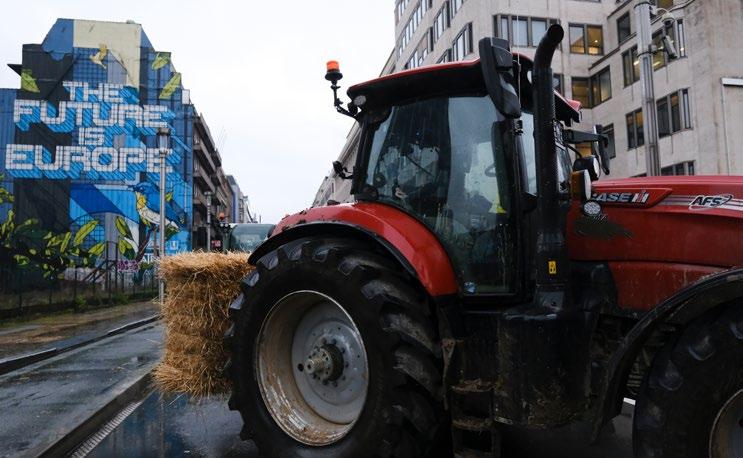
STUDYING EUROPEAN FARMERS’ PROTESTS
In 2024, a wave of farmers’ protests swept across Europe, and even reached the WUR campus. What did the farmers themselves see as the reason for the protests? And did policymakers’ responses address those issues? These questions were studied by a team of European researchers that included Yann de Mey and Jaap Sok, both associate professors in the Business Economics group at Wageningen. Text Marieke Enter
The study was based on input from more than 2,200 farmers (both protesters and non-protesters) in the Netherlands, Germany, Belgium and France. The input consisted of farmers’ responses in their own words to open questions in a survey. The researchers analysed their answers, looking at both the content and the tone. The results were recently published in the academic journal Food Policy
The study shows that while there were farmers protesting in all four countries, the reasons they gave for doing so differed distinctly. The researchers identified a total of 11 motive categories. German farmers complained above all about bureaucracy, French farmers had mainly financial grievances, Dutch farmers protested primarily because of dissatisfaction with the political situation and Belgian farmers gave a whole range of reasons.
READY-MADE
The researchers then looked at the degree of alignment between these reasons and policymakers’ response to the protests. It turned out that policymakers mainly made policy adjustments relating to bureaucracy and environmental regulations. Measured against the wide range of the farmers’ demands, they gave disproportionate priority to scaling back environmental regulations. According to the researchers, one explanation for this could be that policymakers tend to resort to ready-made
There were almost no signs of optimism among the farmers
solutions or ones that are easy to implement, even if they don’t really tackle the farmers’ grievances. But the researchers warn that does mean the policy measures may not be doing enough to address the farmers’ frustrations and may even have additional knock-on political and economic effects. They also point out that there is a divide between farmers’ real concerns and the issues that farming lobby groups put on the agenda. Addressing those real concerns requires systemic changes and sustained political commitment, say the researchers. It is not only the policy changes themselves that are important, but also how they are com-
municated to the farmers in question. That process could be an interesting area for future research, the researchers conclude.
TONE
The researchers not only looked at what the farmers said, they also analysed the tone — how they put their points — with the help of AI. This analysis showed that farmers were more likely to use an annoyed angry tone when complaining about specific topics, while the tone when expressing broader dissatisfaction was one of aggressive anger. There were almost no signs of optimism among the farmers.
A farmers’ protest in February 2024 at a meeting of EU agriculture ministers. Photo Shutterstock
PhD theses in a nutshell
Strips
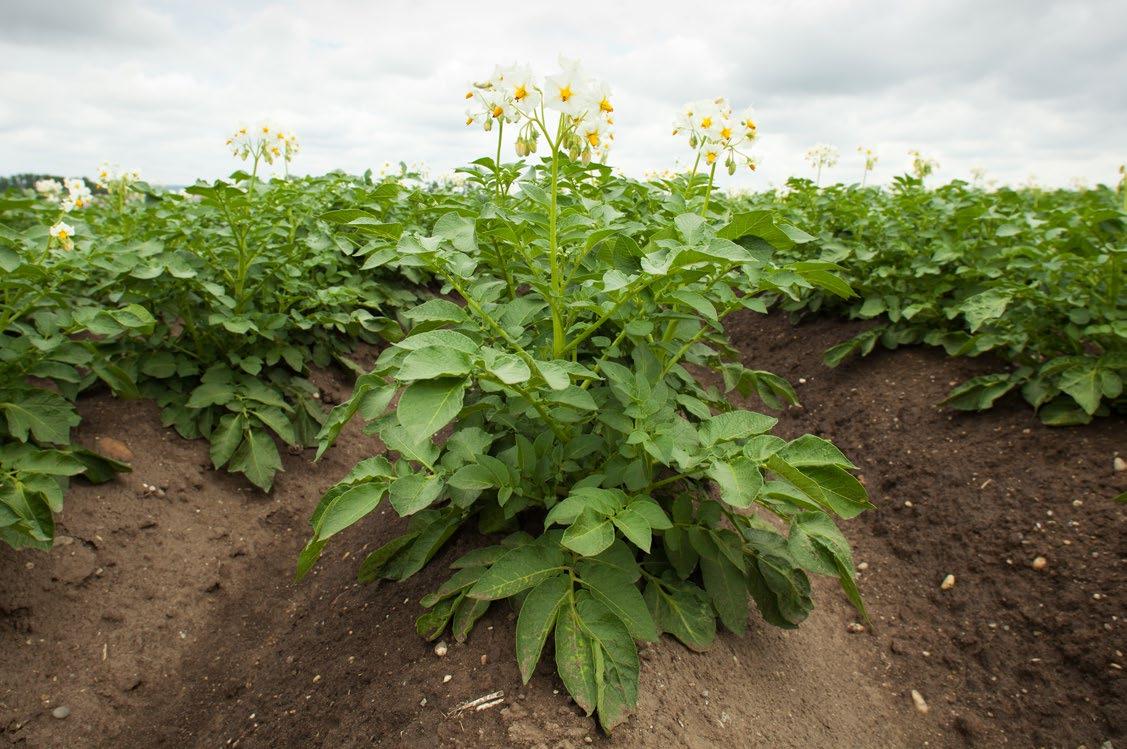
If you grow maize or grass next to potatoes, your spuds are less affected by the dreaded fungus Phytophthora infestans. Zohralyn Homulle demonstrated this in her strip cropping experiments on campus. Having grass as an adjoining crop creates a drier microclimate locally, whereas maize helps shield the potato plants from the pathogenic spores of the fungus. But strip cropping is not a miracle cure, says Homulle. Sustainable agriculture requires structural changes in the power relations in the food system. rk
Disease suppression in intercropping systems Zohralyn Homulle Supervisor Niels Anten
Plastic particles
You need to be careful when conducting studies of plastic particles in the environment. How you take samples and filter out the plastics and what techniques you use to measure the particles all have a big effect. Siting Wang showed that the error margins can be huge. She studied plastic contamination in the River Maas and the Yangtze and Huangpu rivers in her home country of China. Those two Chinese rivers have the most plastic pollution in the world. rk Towards understanding uncertainties in the measurement of microplastic concentrations in river systems Siting Wang Supervisor Bar t Koelmans
THE PROPOSITION
PhD candidates explain their most thought-provoking proposition. This time, it’s Lotte de Jong, who achieved her PhD on 11 December for research on the ecological politics of water management.
Tracks
Large agricultural machines compact the soil. Lighter machines, however, are less efficient. Selfdriving agricultural robots could be one solution: you save on labour and you can let the robots constantly use the same narrow track. But which is the best track? The shortest one or the one that covers the most area? It’s a nice optimization problem. Gonzalo Mier from Spain developed an open-source platform (Fields2Cover) to streamline the research on this topic. rk Fields2Cover, transparant and efficient coverage paths for autonomous agricultural vehicles. Gonzalo Mier Supervisor Sytze de Bruin
‘Interdisciplinarity promises collaboration but delivers hierarchy.’
‘In interdisciplinary projects, we assume that the scientific intentions are good. The aim is to transcend knowledge hierarchies as you render hierarchies invisible by encouraging collaboration. We make the assumption that scientists will open up their field of expertise to other kinds of questions and interpretations of the data. That does happen, and it’s definitely beneficial for researchers not to be stuck in their own rut.
‘At the same time, interdisciplinary approaches fail to address who is allowed to determine the study question, who makes the most compromises for someone else’s research agenda, who is considered sufficiently interdisciplinary to join the collaboration and what that collaboration looks like. In practice,
there’s always some kind of hierarchy, for example because some disciplines have a higher status in the relevant scientific debates and others are considered less important. That means a single specific discipline – or its funders – often determines the scientific framework and research questions. If a different discipline were to take the lead in the same project, it would probably result in different findings.
‘This determines the nature of the collaboration, with it being clear in advance which areas of knowledge will get precedence in the research and which areas are allowed to remain unexplored. In my opinion, there isn’t nearly enough recognition of this hierarchy.’ dv
AI SMOOTHIE RECIPES
The NutriGreen app can be used to give people with obesity or type 2 diabetes personalized smoothie recipes. The app was developed by a team in the 4TU Redesign consortium (a collaborative venture between the four technical universities).
‘NutriGreen is a web application that shows how we can translate peer-reviewed research outcomes on nutrition and sustainability into a usable AI app,’ senior researcher Anand Gavai explains. ‘This app lets consumers experience and understand the knowledge described in our scientific papers, which forms the methodological basis of the system.’ The app generates recipes based exclusively on fruit and vegetables that are seasonal, sustainable and available in the Netherlands. The app draws on the UN Sustainable Development Goals and dietary guidelines from bodies like the Dutch National Institute for Public Health (RIVM).
CHATGPT
Each smoothie recipe consists of a mix of fruit and vegetables. ‘For each season, we’ve selected about five fruits and ten vegetables. The generative AI model knows what is available in that season and selects the ingredients for you. The app uses a large language model (LLM), comparable to ChatGPT, to generate the recipe and an overview of its nutritional values.’ According to the researcher, one aim of the app is to bridge the gap between diet, agriculture and health. Gavai: ‘With the right diet, people can avoid the need for medical treatment. Our goal is also to promote plant-based, seasonal and locally sourced ingredients.’ To achieve that last objective, the system is currently based on the products of De Hoge Born farm supermarket.
APPLIED
The smoothie recipe generator is a demonstrator project, emphasizes Gavai. ‘We want to make colleagues aware that such tools can help consumers benefit from the results of our research. It’s an example of how scientific knowledge can be applied rather than remaining hidden in the literature.’ dv
Tired of nitrogen in a big, bad world
The nitrogen crisis has been one of the biggest issues facing the Netherlands for several years. It is also a quintessentially Wageningen issue as it affects the population and everything to do with the use of land and water. But I’m tired of the whole nitrogen thing.
We’ve turned it into a big issue but it is still a very Dutch, local problem and a luxury problem at that. While war is raging in Europe, NATO is looking shaky because of the one country that can control our weapons and shut down our inboxes, and humanitarian disasters are happening in Africa and the Middle East, we are closing factories because of a Natura2000 area near Amsterdam that is home to a group of tundra voles with a ‘substantial’ genetic deviation (De Correspondent, 3 March 2025). The species isn’t endangered at all on the global scale (IUCN status: Least Concern).
That is why we need to deal with three mental obstacles: legal, communicative and ecological. Legal: the Habitats Directive should no longer be a legal joker you can use to block any construction project. That includes factories that are needed for the defence of Europe. That means scrapping species and Dutch Natura2000 areas in the appendices to the Habitats
Guido Camps
Directive. Not nice, but necessary. Communicative: stop the horror stories about great tits’ legs breaking due to a lack of calcium or the spread of stinging nettles under a ‘mantle of nitrogen’. Instead, stress how nitrogenrich soil boosts growth of
‘Stop the horror stories about great tits’ legs breaking due to a lack of calcium’
cow parsley and avens. Same situation, different framing. How about those poor great tits, anyway? They are doing fine: the population has actually grown over the past 50 years (Sovon, 2025).
Ecological: you can protect nature and still have nitrogen. We need to protect more nature, but do so alongside flourishing industry. The kind of nature that can cope with that is what we want. Survival of the fittest – it doesn’t get more natural than that.
But what about the angry ecologists? The Netherlands is a tiny river delta in a big, bad world. The honest answer that no one dares to give is that we have other priorities right now.
Guido Camps (40) is a vet and researcher at Human Nutrition and OnePlanet. He enjoys baking, beekeeping and unusual animals.
‘Student welfare didn’t exist’
Ingrid Hijman was appointed head of the Student Service Centre in January 2016. After ten years in that job, it is time to move on within WUR. She looks back one last time with Resource. ‘The work has changed completely.’
Text Luuk Zegers
‘
We don’t have any emergency camp beds we can conjure up out of nowhere,’ says Hijman. ‘But we sent a message just to be sure to all students, telling them to contact us if they needed help. With my phone number. So they could have crashed out at my home in an emergency.’
It illustrates Hijman’s sense of responsibility. When she was appointed ten years ago, the university was expanding rapidly and the Student Service Centre was mainly an administrative department. ‘The whole department still fitted in the “goldfish bowl”, a small meeting room in Forum,’ recalls Hijman. ‘We had about 30 members of staff, compared with 70 now.’
Care institution
The department’s tasks have become much broader in the past ten years. ‘Take student welfare. That didn’t
really exist as a concept here in 2016: we had two student psychologists, four student counsellors and that was it.’ During a department away-day, they realized students also needed training courses about dealing with a death in the family or exam stress, for example. ‘So when we got some extra funding from the government just before Covid, we used it to set up the Student Training & Support centre. We also took on more student psychologists. To publicize the new forms of assistance available to students, we started the Surf Your Stress Week, which has now been relabelled Wellbeing Week.’
There has been growing interest in student welfare nationally too, says Hijman. ‘That really took off during the pandemic. Studies showed that many students were struggling and suffering from stress, depression and other problems. Universities were under increasing pressure to do something about this. I’ve always taken a critical approach to that development. It’s good for our students to have services that can help them in their studies, but universities aren’t care institutions. Making sure all students feel happy and at ease isn’t our core task and not something we can achieve anyway. Anyway, a lot of their stress is due to external factors such as social or financial pressure or because they worry about climate change. We
shouldn’t be trying to tackle all that as a university.’ Hijman says the image of lots of unhappy students is starting to change now anyway. ‘The Trimbos Institute’s student welfare monitor started during the pandemic. I’m not sure that was a good reference point. Perhaps students were already experiencing a lot of stress and feeling unhappy at times before the monitor. And perhaps this generation isn’t actually any less happy than previous generations, just better at expressing their emotions.’
Paper
Digitalization has been another big change in the past ten years. ‘We still used paper registration forms in my first few summers, which seems incredible now. We were really busy all summer opening envelopes, organizing
‘Universities aren’t care institutions’
the forms and inputting everything into our system. Students would be sitting on the floor sorting everything into piles. For every registration, you had to check whether all the details were correct and whether that person had the right qualifications. Could we even read what they had written?’ The school certificates also had to be checked, one by one. ‘International students couldn’t use Studielink to register back then, so we organized certificate days before the AID introduction week. We would hire people to check whether the certificates were genuine. Now we use Osiris.’
Emergencies
Meanwhile, their list of tasks kept on expanding, says Hijman. ‘We even got the Student Exchange Team, although that really belongs on the education side. But I’ve probably spent most time in recent years on the emergency
‘We still used paper registration forms in my first few summers’
situations, such as an IT system failure, a student with mental health problems who demonstrates aggressive behaviour, or the death of a student.’ Or public transport coming to a standstill because of snow, as happened recently. ‘Fortunately, no one did need our help, but I always feel responsible for our students.’ There’s something every month, says Hijman. ‘We are looking into setting up a broader team for emergencies to share that responsibility across the university somewhat more.’
What is she proudest of when reflecting on the past ten years? ‘My department. And that we have managed to give our students more individual attention despite the growth in student numbers. Even though thousands of students enrol with the university, we still know the ones who need extra support by name. When we see them again as they graduate, I’m always incredibly proud of them because that’s what we do it all for.’ ■
On 1 February, Hijman became the head of Quality & Strategic Information at Education & Student Affairs.
Ingrid Hijman: ‘It’s good for the students to have services that can help them in their studies, but universities aren’t care institutions. Making sure all students feel happy and at ease isn’t our core task and not something we can achieve anyway.’ Photo Guy Ackermans
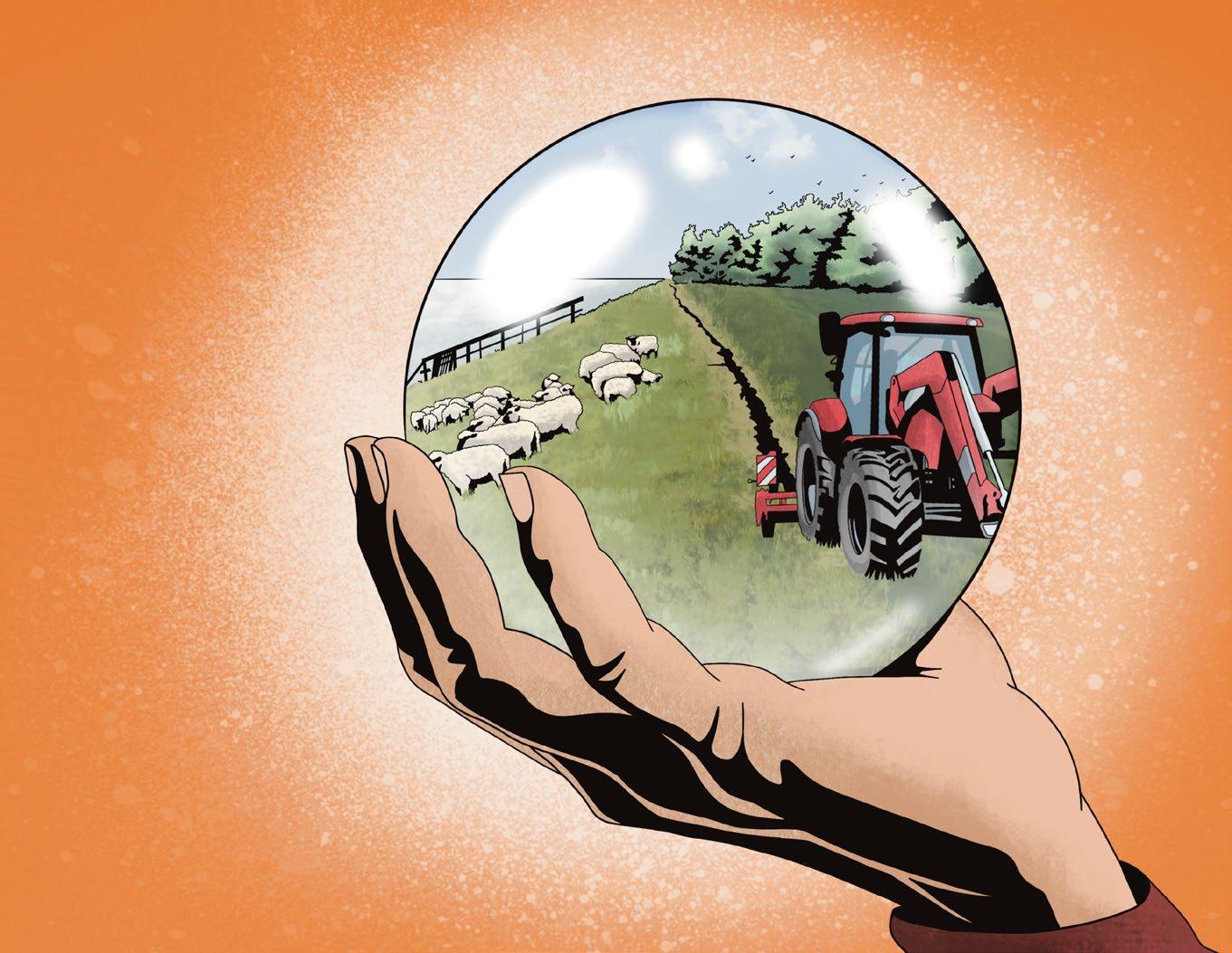
EMBRACE THE UNKNOWN
How do you deal with a future that is unknown and by definition unknowable? By becoming less vulnerable, otherwise known as ‘antifragile’. Wageningen scientists are exploring this new concept. Illustration Valerie Geelen
Researcher Guido Bakema (Soil, Water & Land Use) is one of the pioneers at WUR in applying this new idea. It should be noted he didn’t come up with it, though. The concept of antifragile comes from the Lebanese-American economist and author Nassim Nicholas Taleb, who wrote several books on the subject. Bakema read those books and was captivated.
Antifragility is about making the world around you less vulnerable in the face of the unexpected and unforeseen. You achieve this by adapting and changing in response, rather than sticking to what you have, or making it more robust or resilient. ‘Robust and resilient systems are created based on what you know from the historical data,’ explains Bakema. ‘You use that to come up with solutions. But things will happen in the future that don’t fit that frame. The question is how you can key into those changes.’
Bakema and his colleagues have written a vision document on antifragility in the Dutch water system. Meanwhile, Bas Breman (Regional Development and Spatial Use) is working on a similar exploration of the concept for Dutch nature in partnership with the Netherlands Environmental Assessment Agency. Researcher Roos de Adelhart Toorop (Farming Systems Ecology) has adopted the antifragility perspective ‘basically for all my work’.
De Adelhart Toorop says three things are important in an antifragile system: ‘Autonomy, optionality and redundancy. Autonomy means you can decide for yourself to a large extent how you organize things and take action accordingly. Optionality is about having options and diversity. A system that is completely optimal and efficient scores poorly in terms of optionality and redundancy. The more you optimize,
the more you specialize. Anything extra or redundant gets eliminated. That might be highly productive and work very well in a stable situation but not if there is a lot of uncertainty and new challenges, such as in agriculture with the nitrogen issue and climate change.’
Farmers
A key vulnerability in Dutch agriculture is farmers’ financial situation, says De Adelhart Toorop. ‘Farmers have big debts, which makes it harder for them to change course. They are trapped in contracts with banks and buyers, which is why they continue to do what they do. There’s no scope for deviations. That’s a fragile position. The world around them is changing, but their business system isn’t, or hardly at all.’ Big changes are needed to shift that situation, says De Adelhart Toorop. ‘Farms have become more efficient since the 1960s and the structures have become very large. Decentralization is one aspect of antifragility. Smaller systems are often better at adapting than bigger ones. For example, farmers could collaborate in
Text Roelof Kleis
collectives. You can use policy to encourage such forms of antifragility.’
‘Big changes are needed but you can start small,’ she continues. ‘For example, farmers could devote ten per cent of their land to a new crop or a tenth of their time to learning a new skill that could be useful to their farm. The remaining 90 per cent is to secure the continuation of the business. Farmers are visionary and have ideas, but the risk stops them from branching out. That is why Zeeland provincial authority is making land available for experimenting. I’m really enthusiastic about that idea. Farmers don’t run any risk; they just have to invest their time.’
Letting go
Bas Breman is hesitant about the applicability of antifragility in nature policy. ‘It’s certainly an interesting idea, which is why we are exploring it, but I’m cautious. I don’t want to promote it as a silver bullet or the holy grail.’ That caution is partly due to the tension between the demands of antifragility and nature conservation. ‘Climate change affects natural systems and species
that may not be able to cope and may migrate to other climate zones. Much of the current policy and management is aimed at protecting and conserving what we have now. That means it is vulnerable. Letting go of that is an interesting aspect of the antifragile approach. That raises the question of what we can still keep, what we want to keep and where we are willing to abandon our objectives. I’m definitely not claiming that conservation is bad or doesn’t work, but you need to be able to discuss the options. That’s quite challenging in the nature domain, where there is this really strong awareness of loss. Many people put their hearts into saving nature and so much has been lost already. So letting go triggers a lot of emotions, but we need to be able to have that conversation.’
It should be said that antifragility is not entirely new in nature policy. ‘You can already see antifragile ideas in the Ecological Main Structure and Nature Policy Plan of the 1990s,’ says Breman. ‘An example is the need to have connection zones to allow species to migrate. Or for species to have options, a certain surplus or reserve, so that they can recover after a setback. System recovery is at the heart of the EU Nature Restoration Regulation. That is also informed by the idea that we shouldn’t focus obsessively on maintaining species and protecting nature areas but should look more broadly at what is possible in the surrounding areas, farmland or otherwise. Antifragility can also be found in rewilding initiatives and the work of the ARK foundation, which focuses on large-scale system recovery. One aspect of those recovery projects is allowing scope for spontaneous developments and surprises.’
‘IT’S SIMPLY NOT TRUE THAT WE CAN BE FREE OF RISK’
Letting go could well be the biggest challenge, thinks Breman. ‘Perhaps we should do nothing for a while rather than taking all kinds of technical measures to steer nature in a particular direction. Sod-cutting to deliberately impoverish the soil or spreading calcium carbonate to prevent it from acidifying are far-reaching measures aimed at conserving at all costs what we are at risk of losing. I don’t want to ridicule these measures and there can be good arguments for maintaining a unique piece of nature you would lose for good otherwise, but you can also reflect on how vulnerable it is and what you would get from a different approach. Letting go is not the same as giving up.’
Water as your friend
An antifragile approach starts by identifying the existing vulnerabilities and risks, says Bakema, such as the ones in the Dutch water system. ‘Five years ago, people in Limburg thought they were safe because it seemed as if the local water board had everything sorted. But that turned out to be a false sense of safety. It’s called the dyke effect: if you shelter behind high dykes, you create a bogus feeling of security. But it’s simply not true that
we can be free of risk. We no longer see the risks because they are no longer being communicated. We need more direct experience with water.’ Bakema thinks that could be the most important change in an antifragile approach to the water system. ‘People in the past were more conscious of the role of water. It was part of their lives. People living on an artificial mound – a terp – knew the surrounding area would flood every so often and didn’t plan economic activities there. People in the Nile Delta took the seasonal behaviour of the water into account. Their whole system was based on it. Flooding created fertile soil. Water was your friend, not an enemy you had to defend yourself against. So, really, we need a completely different approach to water. How do we turn water into our friend rather than our enemy?’
‘The problems we face now are often caused by decisions taken by our predecessors,’ continues Bakema. ‘We try to resolve them using the ideas of our predecessors. But that doesn’t always lead to good solutions. That is why you sometimes need new ideas. Antifragility is one such new approach to these problems. You can apply this concept in many different domains. It is particularly interesting for Wageningen, as it combines so many different areas such as technology, the social sciences and governance. A Wageningen School? It would definitely be great if more people were to start working with the concept.’ Bakema therefore plans to hold discussions this year on the topic with a wider audience, both within and beyond WUR. ■
Resource gains full journalistic independence
Resource has a new Editorial Charter, the first in 17 years. It formally guarantees the complete journalistic independence of the news medium for staff and students at WUR. Editor-in-chief Willem Andrée explains why this is important. Illustration Marly Hendricks
The marathon process has come to an end. After years of preparation, Resource finally has a new Editorial Charter. It guarantees the Resource editors full journalistic independence to publish whatever they want about WUR. I am really pleased about that, as we have come a long way.
The old charter reflected a time in which Resource became part of the Communications department following a failed tendering procedure. The charter therefore became a ‘Communications department charter’ without the necessary journalistic perspective. The President of the Executive Board at the time thought that was fine. The fact that Resource continued to produce sharp independent journalism after 2008 is thanks to its editors, not the charter.
So why did we start this process? Recent incidents with university media in Delft and Eindhoven where pressure was put on editors there after they published critical pieces — have shown how important it is. Boards do exert undue pressure on journalists from time to time, so you need a robust charter.
Watchdog
Drawing up a new charter and getting it approved takes time. You need to carefully examine the best examples available around the country, then you start writing and revising. Once you have a version, it gets reviewed by the Editorial Council, the publisher (the Executive Board) and ultimately the consultative bodies, which is a lengthy process. All in all, it took more than two years before the Executive Board formally adopted the new charter last week. I can tell you our editors were cheering when they heard the news. It
‘This makes us officially the WUR watchdog’
makes us officially the WUR ‘watchdog’. The charter protects both the editors and the publisher, namely the Executive Board. WUR gives Resource freedom to publish, but in return the editors have a duty to work in accordance with the journalistic principles of independence, reliability and expertise as laid down by the Dutch Union of Journalists.
Safeguard
From now on, the Editorial Council is our ‘boss’. The Council consists of staff, students and two external journalists, one of whom is the chair. The council members assess our editorial policy retrospectively and give a binding opinion in the event of conflicts. The council safeguards our independence and the quality of our output.
We’ve come a long way in Wageningen and now we have a modern, carefully designed charter that ensures journalistic freedom at WUR. We will continue to publish on the organization, research at Wageningen and student life in our magazine, on our website and through our social media as we have in the past but
now supported by a robust charter. From fascinating interviews to hard news and from uncovering abuses to investigative journalism, we have it. So get in touch if you see something you don’t think is right or if you know of an issue that we should be looking at. You can find the charter at resource-online.nl, under the tab About Us ■
resource@wur.nl
06-38 68 61 67
GRANDMOTHER CLAY
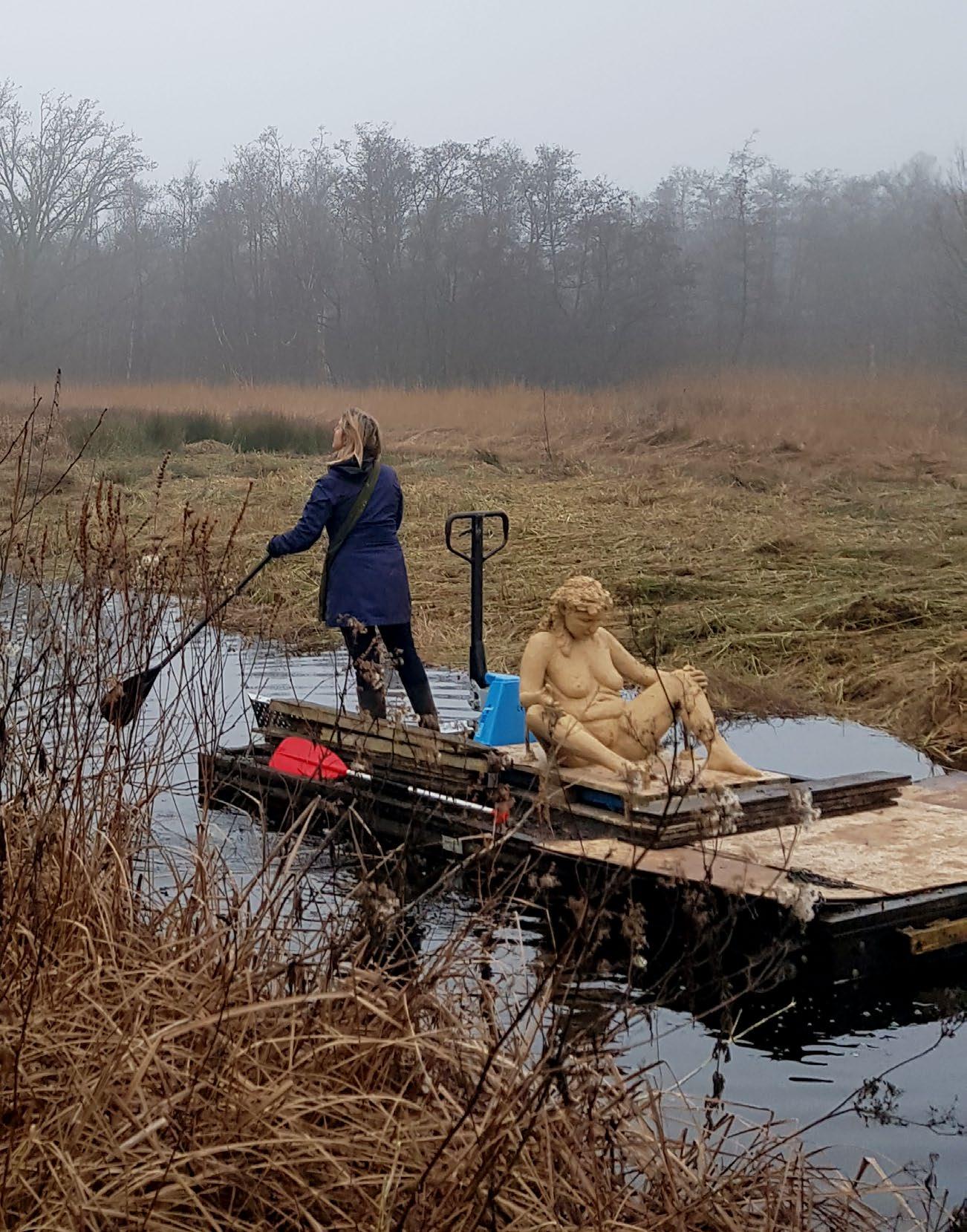
Was the human race created from clay? Variants of this creation story are told all over the world. There is even scientific evidence that there may be some truth in this story, as clay minerals probably did play a key role in biogenesis, the creation of life from non-living matter. Inspired by this idea, the artist Marieke Ploeg made a series of human figures from clay. She took photos of them and then put them in places where they could dissolve back into the soil. Grandmother Clay is the title of her exhibition plus two ‘dialogues’ in Impulse, described as ‘conversations based on silence and presence’ in the announcement. The first is today (12 February) and the second is on 12 March. me
Photo Mara van Hoek
Practising with fake news, insults and populism
It is easier to recognize strategies aimed at polarization if you know how they work. That is why researchers in the Strategic Communication chair group have developed a workshop for secondary schools. It involves non-stop interruptions, insults, populist talk, half-truths and flagrant lies. And that is precisely the intention. Text and photo Marieke Enter
‘Whose assignment was it, to influence the debate using misinformation? And what did you think of that?’ asks Mariska van Dam, a PhD candidate in the Strategic Communication group. She is working with a class of 16 and 17-year-olds at Dorenweerd College in Doorwerth.
It is the first lesson on Friday morning and the timetable for the secondary school students shows a social studies class taught by Katherine Kells. Today, Kells’ class consists of a workshop on polarization given by Van Dam and Wies Ruyters, another Strategic Communication PhD candidate. They start with some theory, explaining the various kinds of polarization (see inset) and how damaging they are. ‘Polarization is fine in a healthy democracy; having different opinions is not a problem,’ says Ruyters. ‘But it’s a different story if polarization leads to a deeply embedded divide with an us-versus-them mentality.’ ‘Like in the US with the Republicans and the Democrats,’ says one student. Exactly.
The PhD candidates illustrate their story with examples and ask lots of questions to get some interaction with the class. However, it’s not so easy this early on a Friday morning to get much response out of the pupils. ‘They’ll be more lively when we start the debate,’ Van Dam whispers to your Resource journalist while Ruyters explains polarization using the examples of the Flat Earth beliefs and polemics from the Covid anti-vax period.
Verbal battle
Van Dam is right: the pupils wake up when they get the opportunity to debate whether schoolchildren should be banned from using AI for homework. Half the class has to argue in favour of the ban and the other half has to oppose
it – regardless of their actual personal opinions. They split into groups to come up with strong arguments and then the verbal battle commences.
It is a lively debate with some obvious arguments (‘schoolchildren are lazy and they will stop thinking for themselves if AI is allowed’) and some less conventional ones (‘schoolchildren shouldn’t get too good at using AI as that would put the older generation at an unacceptable disadvantage’). They listen attentively to one another and laugh at the more amusing arguments. The general mood is constructive.
Secret instructions
Van Dam and Ruyters throw a spanner in the works for the next assignment. In the second round of the debate, each group gets a secret instruction to follow a specific communication strategy. That might be providing misinformation to influence the debate in your favour, or being rude to get a really harsh debate. Another strategy is populism: reducing complex issues to simple binary divides, speaking on behalf of ‘ordinary people’ and appealing to the emotions. The fourth group is instructed
Three kinds of polarization
❶ Ideological polarization, with sharply divided views on a particular topic. For example whether or not wolves belong in the Netherlands.
❷ Affective polarization, with strong feelings about people who have different views (us-versus-them mentality). For example, supporters of Ajax versus Feyenoord, pro versus anti-vaccination.
❸ Polarization around the facts, different opinions on what is the truth or ‘real’. For example, the Moon landing, a flat Earth or climate change.
to remain polite and correct in all circumstances.
The result is an entirely different kind of debate. Not that it gets completely out of hand, but it is full of ridiculous arguments, alternative facts, insults, raised voices and irritating interruptions. The unflappable politeness of the fourth group comes across as hilarious. For example, when another group comes up with a bizarre conspiracy theory about ‘the elite’ using AI to oppress ‘the people’, they respond with a polite ‘thank you for this interesting contribution’.
Any old thing
When asked what it was like to have a debate with these hidden agendas, they reply that it was fun, but also uncomfortable and weird. ‘It’s really strange saying any old thing and deliberately spreading fake facts because we normally learn to come up with proper support for our arguments and do a lot of fact-checking,’ says one girl from the misinformation group.
‘The reason we are doing this exercise,’ explains Van Dam, ‘is so that you get better at recognizing these strategies in political debates. That’s not because polarization is a big problem in the Netherlands right now: recent research by our chair group showed it really isn’t that bad. But politicians do regularly use polarizing strategies to gain an electoral advantage.’
Scientific context
The workshops are designed for senior secondary-school pupils and students at universities of applied sciences. They are based on Professor Rens Vliegenthart’s Vici project ‘The Mobilization of Political Dissatisfaction: Causes, Content and Consequences’. ‘That project has given us various perspectives on polarization that help in understanding the phenomenon and not feeling powerless to confront it,’ explains Ruyters. Workshops are planned all over the Netherlands in the next few months, but the PhD candidates still have room for some more. Interested secondary schools and applied universities can contact mariska.vandam@wur.nl
Ruyters and Van Dam end the workshop with short video clips of the Hungarian leader Victor Orbán (letting rip at his political opponents), Jair Bolsonaro in Brazil (a compilation of homophobic and racist statements) and Donald Trump in the US (the notorious claim that immigrants are eating Americans’ pets). The teenagers can’t easily get a good look at the clips – they have to be shown on Ruyters’ WUR laptop because the digital blackboard isn’t working – but they still recognize the tactics being used: emphasizing opposites, deliberate coarsening of the debate and providing misinformation. The workshop seems to have achieved its goal. ■
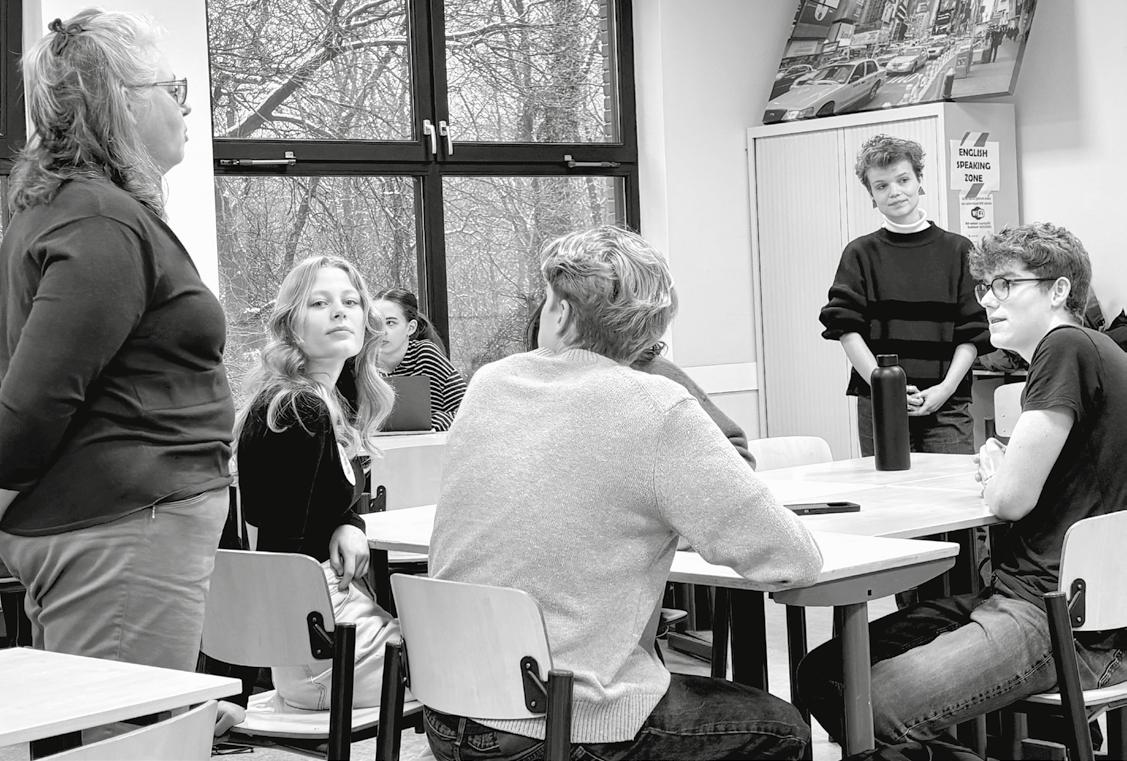
Secondary-school pupils get a workshop in recognizing polarization strategies from Mariska van Dam (right) and Wies Ruyters (not in the photo), both Strategic Communication PhD candidates. Left: Social Studies teacher Katherine Kells.
‘Fighting together for a better world’ Students and staff among the candidates in municipal elections
Local council elections will be held on 18 March. Nearly every party has people from WUR on its list of candidates — with a striking number of students as well as staff. How did they become involved in politics and why are they standing?
Text Luuk Zegers Illustration Shutterstock
Lotte Demarteau (27), Environmental Sciences and International Land & Water Management Master’s student and number 5 on the GreenLeft-PvdA list.
‘Your opportunities in life are determined to a large extent by where you were born. I don’t think that’s fair, which is why I joined the PvdA youth wing in 2015.
‘Equality of opportunity is still an issue. You can do something about
it in the municipal council. In Wageningen, we pay for swimming lessons for families who can’t afford them. That’s nice, but we only start when the children are six, whereas most children start swimming lessons at age four.
‘I got to university through vocational schools and a university of applied sciences. Politicians often have a theoretical educational background. I hope to get people more involved in politics by using words they actually understand.’
Cato Vonk (26), Development & Rural Innovation Master’s student and number 2 for Connect-Volt Wageningen.
‘When I was ten, I used to tell everyone I wanted to be the Netherlands’ first female prime minister. I didn’t take that any further for a long while, but in the last elections Connect asked me whether I wanted to be on their list. It was my chance to see whether politics is for me.
‘I’ve now been a councillor for three years. I work with 24 other people who all have more experience than me. I found that hard at first, so if more students or young people get in this time round, I’ll be keen to help them. A tip? It doesn’t matter if you misspeak or say something stupid occasionally. Say what you think. That’s best for everyone in the end. In the coming years, I want to get more young people and students involved in local politics.’
Tim de Brouwer (23), International Development Studies Master’s student and number 6 on the CDA list.
‘When I decided to stay in Wageningen for my Master’s rather than moving to Leiden, Rotterdam or Amsterdam, I thought I ought to start doing my bit for the community. I have a lot of ideas and I think it’s important for young people to have an input.
‘My friends in the big cities are rightwing whereas my Wageningen friends are left-wing. I get on well with both sides. The solutions we need are rarely to be found in the extremes. That’s how I ended up in the centre ground, with the CDA (Christian democrats). My party is about bringing people together: life is better if you look after one another.
‘We’re currently looking for a centre for young people to put on concerts, workshops and parties. A place where everyone is welcome, which I find important. I’m also interested in new residential solutions, for example places where the elderly and young people are housed together.’
Xenia Minnaert (26), Resilient Farming & Food Systems Master’s student, heads the Party for the Animals list.
‘I joined the Party for the Animals youth movement when I was 19 because I was concerned about all the injustice in the world. I realized how nice it is to be fighting for a better world with like-minded people. Young people have a
unique voice. We shouldn’t leave politics to the older generations. ‘We set up a Wageningen branch at the start of 2025. We are hoping for two or three seats. We prioritize Wageningen’s residents, animals and nature over the financial interests of businesses. If there is a new zoning plan for housing, we will take account of the wildlife that lives there. And we want to connect up nature areas so that animals can move safely across our municipality.’
Joëlle van Dam (20), Economics & Policy Bachelor’s student and number 7 on the ChristenUnie list.
Jolien van Hooff (38), assistant professor of Microbiology and number 20 on the D66 list.
‘I joined the D66 youth wing as a student in Utrecht. I was 18 and I agreed completely with the party’s views on education: a good education gives everyone the chance to reach their full potential. Later, I became active in the main party.
‘Last summer, I became a member of the party’s council support group in Wageningen. I delve into topical issues such as innovative democracy. That could involve participation in new building developments, or how the municipality can help residents start new initiatives. I’d like to give the people of Wageningen more possibilities for initiating referendums.
‘As a council support member, I sometimes have to say my piece in committee meetings. I have a clearly defined task that I can easily do in the evenings or weekends and combine with my WUR job.’
‘Last year, I took part in the talent programme organized by the ChristenUnie youth section. I discovered I wanted to get actively involved in politics. I emailed the local branch and was able to join immediately.
‘Our party currently has a single seat, so I’m not likely to get elected. But I enjoy giving my opinion at our party meetings, especially on issues that concern students and young people. I still have a lot to learn, but I hope one day to be on an electable position on the list. If that’s while I’m still at university, I may have to temporarily spend less time on my studies.
‘Wageningen is a student town, but the town councillors are mainly people in their thirties, forties and fifties. When topics come up that affect us, I want to organize citizen panels with students so our voice is heard.’ ■
For this article, we approached all the parties taking part in the Wageningen municipal elections and asked them whether they had WUR people on their lists. VVD did not. Stadspartij Wageningen only had WUR candidates at the bottom of its list.
New guidelines for a healthy diet
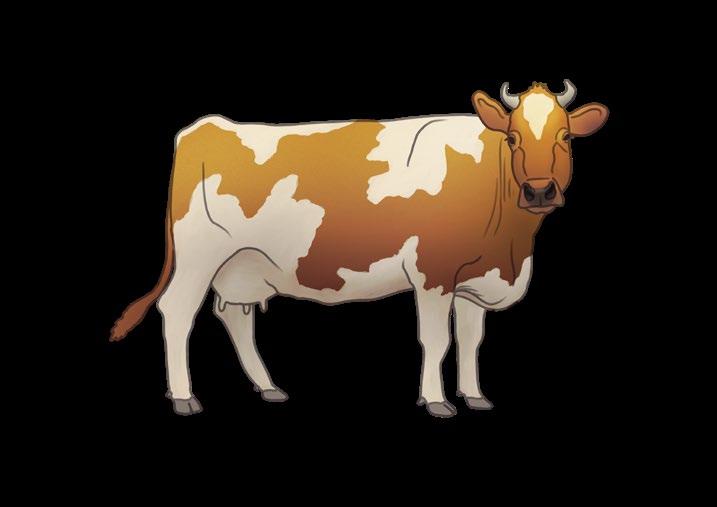
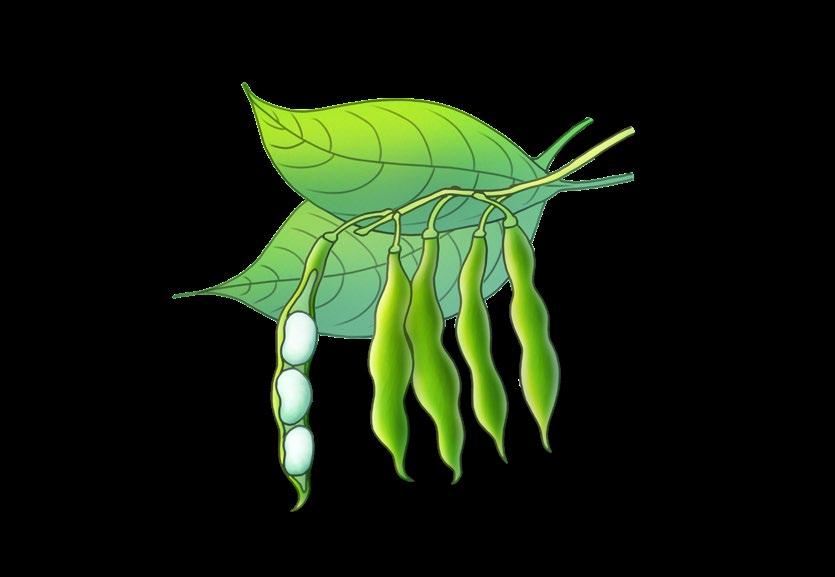
MORE BEANS , LESS BEEF
No more than 200 grams of red meat a week and far more pulses, recommends the Dutch Health Council in new guidelines for a healthy diet. These guidelines were revised last year under the direction of Marianne Geleijnse, WUR professor of Nutrition & Cardiovascular Disease and departing vice-chair of the Health Council.
Illustrations Mathijs Megens/SeaBlueBird Studio
Scientific knowledge has advanced an awful lot since the last guidelines. The recommendations made by the Health Council are often based on long-term cohort studies that were started in the 1970s and 80s, and we’re now getting a lot of results from those. ‘In addition, we’re finding out more and more about the health effects of plant-based protein sources,’ says Geleijnse.
The basic guideline from 2015 has been kept. What has changed?
‘The guidelines have become more concrete in some areas, for example red meat and processed meat. We now know that meat increases your risk of strokes, diabetes and bowel cancer. We weren’t able to give a quantitative limit for red meat before, but now we have enough scientific evidence to be able to say “don’t eat
Text Dominique Vrouwenvelder
more than 200 grams of red meat a week”. It’s easier to stick to the advice with a clear limit like that. We are also recommending much more pulses. Plant-based protein sources have a lot of benefits for both health and the environment, especially if we use them to replace red and processed meat.’
How did you arrive at these recommendations?
‘The Health Council has a permanent Nutrition Committee with scientists from various disciplines. This committee gathers the latest knowledge from research that has been peer-reviewed and discusses that. Then the committee gives recommendations supported by the scientific evidence and tailored to the Dutch context. While scientists always like to end their articles saying “more research is needed”, in this case the recommendations have to be crystal clear so that policymakers know what needs doing.’
Are the new guidelines needed? How are we doing in terms of public health?
‘Deaths from cardiovascular diseases have fallen in recent decades, but that doesn’t necessarily show that people are eating better. It is probably due to improved healthcare and because fewer people smoke. At the
because of the ageing population. More people have chronic lifestyle-related diseases such as diabetes, heart failure, obesity or certain cancers. Policymakers need to take action and reduce the chronic disease burden because this is costing society a lot of money.’
What do we gain from the guidelines?
‘If everyone kept to these recommendations, the disease burden would be much less. It would also shift the ratio of plant-based to animal-based protein in our diet to about 60:40, which would be good for the planet. We realize health and concern for the planet are not the only reasons why people eat what they do. They eat steaks because they taste nice, because they’re used to meals with meat or because they enjoy a barbecue. These guidelines give everyone freedom of choice, but every step in the direction of a more vegetarian diet is a real gain for public health and the environment.’
What happens next?
‘The ministry will pass these guidelines to the Netherlands Nutrition Centre, which will turn them into specific advice. In the course of 2026, they will produce an update of the Wheel of Five based on the Health Council’s reports. This year will also see new supplements to the guidelines on fruit and vegetables, cereal products and sugary soft drinks, among other things, but they will have less of an impact on the Wheel of Five than our guidelines.’
Why are those supplements not being published at the same time as these guidelines?
‘More time is needed for those aspects to work out the details. So we would have had to wait to publish these guidelines on protein sources and dietary patterns. You
have a responsibility as an advisory body to announce scientific insights as soon as you have sufficient supporting evidence. It seems unethical to wait, given that this is an opportunity to improve people’s health. It is good that the Nutrition Centre can get to work on this already.’
Will the guidelines then be complete?
‘No, because we don’t have sufficient scientific evidence for quantitative recommendations for all products yet. Dairy produce is a good example. We recommend several portions a day but don’t give precise amounts. Scientific articles often group dairy products together but they aren’t the same. One hundred grams of milk is only half a glass but the same weight in cheese is a big chunk. We also still don’t know enough about certain issues, such as dementia or the effect of diet on vitality, fertility and your general well-being.’
Is it a coincidence that the guidelines feature all of Wageningen’s nutrition and health disciplines?
‘Yes. The guidelines are produced by a multidisciplinary committee with representatives from a wide range of Dutch science institutions. But this does show that WUR research is relevant for public health policy. It’s great to see these things coming together.’
Your job has finished?
‘Yes, unfortunately. I was one of the Health Council vice-chairs for the past eight years, but my statutory terms of office ended as of the start of 2026. It’s a pity I have to stop. I spent all that time close to the ministries and policymaking in a position where I could have a real influence. Now I’m just another professor, although I’m also an honorary member of the Health Council. That makes me feel I’m still in touch.’ ■
‘Every step closer to a vegetarian diet is a gain for public health and the environment’
Along the Earth’s spine
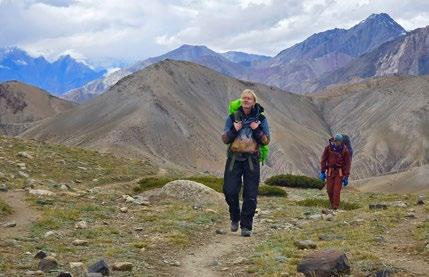
Professor of Cultural Geography Edward Huijbens took a sabbatical last autumn and spent three months travelling from Arnhem to Kathmandu. Using public transport, he followed the chain of mountains from the Alps to the Himalayas. He returned with a manuscript for a new book and an optimistic message. An interview in key words and phrases.
Text Marieke Enter Photos Edward Huijbens
Alpine-Himalayan orogenic belt
‘I grew up in Iceland. I still spend my summers there, partly as a volunteer at a campsite in the highlands. It sits right on the split between the tectonic plates that runs through the country. Around 65 million years ago, when Eurasia and North America started to drift apart, the North Atlantic was formed and later Iceland bubbled up in the middle. At the same time, other plates broke off from what was then the southern supercontinent, Gondwana. They moved north,
colliding with the eastern half of the supercontinent Laurasia, pushing up a continuous chain of mountains. The Alps through to Anatolia, the Caucasus, Pamirs, Tien Shan and Himalayas were all formed in this way. I wanted to travel along that mountain chain, which I like to call the Eurasian spine, to see what it is about. And I wanted to use public transport where possible.’
Public transport
‘I try to come to terms with how we humans are one with this planet. Travelling is a good way to do that, but not by plane because of the pollution
‘I tell stories through the landscape’
and because you’re completely detached from the land. Slow travel matters. And when you travel solo on public transport, you meet all kinds of people. If you treat people with kindness and generosity, they usually respond likewise. This trip confirmed what I had already found on earlier journeys: that 99 per cent of people are wellintentioned, helpful and nice.’
Hardly any hardships
‘I have travelled a lot in my life, and I do take care. I don’t go out at night and I don’t drink. I usually spend my evenings in my hotel writing. I go to bed early and get up at six in the morning, when there are not many shady characters out on the street. I also avoid street food unless well cooked; food poisoning is something I am always
‘99 per cent of people are wellintentioned, helpful and nice’
wary of. But it is part of the game. I always say to my students: no fieldwork is complete unless you’ve had food poisoning, sunburn and mosquito bites the holy trinity of fieldwork.’
Cycles
‘In these Eurasian mountain chains, you see how everything is connected. Air rises up the mountains and cools; moisture condenses into clouds, rain and snow; rivers and glaciers form. The water from the Himalayas feeds nearly two billion people. Tectonic forces mesh with hydrology, erosion and, ultimately, with us. Everything is continually moving. Nothing is fixed, nothing is given; it is always a matter of time and perspective. What better way to understand that than by travelling
through the landscape? I didn’t expect to find so many commonalities across the mountain ranges in terms of landscapes. Those tectonically folded mountains are very similar. And the people who live there are amazingly similar too.’
Notion of abundance
‘My upcoming book is about the notion of abundance. Life not only our life, but life in general, the planet is a source of abundance. It is a very particular way of thinking, philosophically underpinned by the work of the French thinker Gilles Deleuze. Put simply, the sun always comes up tomorrow, and while it is the same sun and yet another day in the cycle of things, tomorrow can always be
different. If you take that perspective, you can see things as emergent. If you free your mind from reifying and fixing, you get abundance because everything can potentially be otherwise. It depends on your perspective.’
Telling stories through the land ‘What tomorrow can become, matters. So what you do every day, matters. My idea is to tell stories about that. But I am not a philosopher or a priest; I am a geographer. I tell the stories through the land: how it is reshaped and refashioned by our activities. How, for instance, the Chinese Belt and Road Initiative is tearing apart the mountains of Central Asia. Or how the landscapes of the IndoGangetic plains are turning into Dutch-
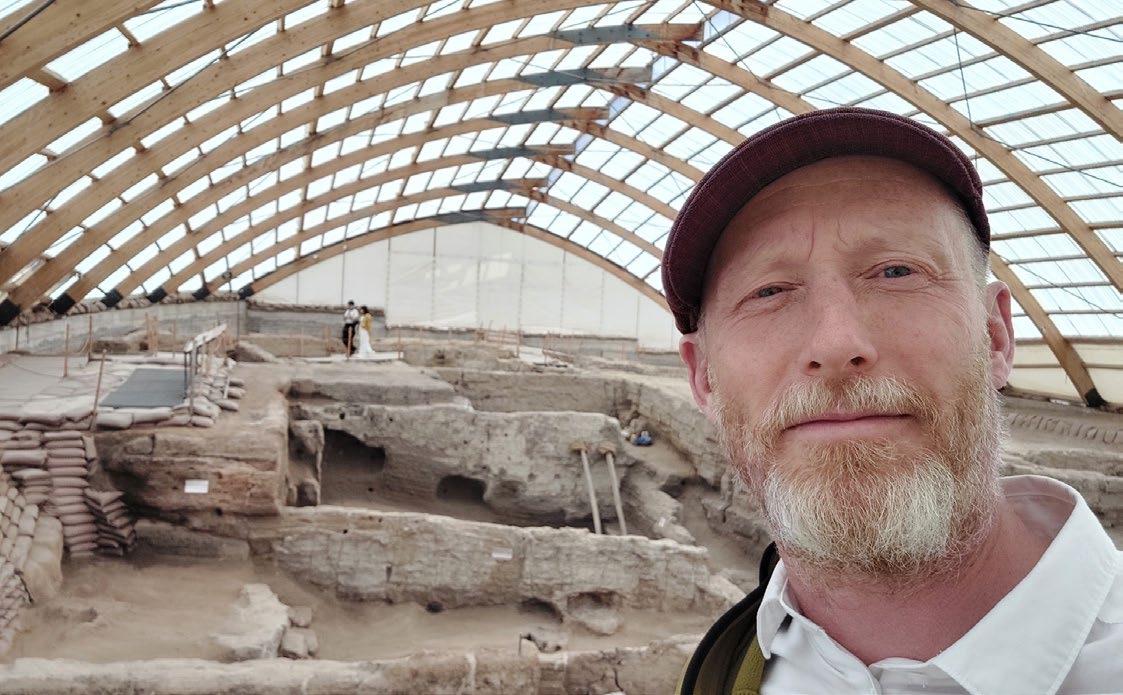
Edward Huijbens at the Western Mound excavations in Çatalhöyük, a UNESCO World Heritage Site in Turkey, where he explored the concept of entanglements.
type intensively cultivated farmland. Treating the land badly cultivates the bad in people.’
Cultivating the bad — or the good
‘For instance in Nepal, intensive cash cropping of the terraces is actually meshing with child obesity. Parents spend so much time on the labourintensive cash crops that they don’t have time to cook, so they feed the kids fast food. These extractive agricultural practices are depleting not only the water, but also the soil, nutrition and health. But in Nepal I also visited a permaculture farm, where they’re trying to maintain traditional farming methods with closed cycles, maintaining the water and nutrients in the land, as people have done for thousands of years.’
Part of our problem as a society is rampant individualism, consumerism and greed. What we do need to do and that's what the book title refers to is to reclaim technology, reclaim mobilities, reclaim ways of being and doing, for them to be conducive to conviviality, to being together. And then deliberately reject the premise of suspicion and assuming the bad. I assume the good. I’m a critical scientist by being an open scientist. And then maybe you find out later that things might not be so good. But that’s to be tackled then.’
Privileged
‘We’re always thinking the world is going to the dogs. But no, it isn’t. Not at all. Of course, I am biased and I have to acknowledge my own privilege. I am extremely privileged, there’s no doubt about that. White guy, well-educated, average height, average build it’s like the world is designed for me. People might say: this privileged guy
goes travelling and then claims the world is wonderful. And sure, if I had a different skin colour, or if I didn’t have a European passport, I would certainly have met more problems. You could be cynical about my findings. You could say, with some justice, that I'm just this privileged, naive guy. But I think there is more to it than that.’
Message to Wageningen
‘How do we understand ourselves as part of the land and life, as part of the whole planet? That is the debate I hope to contribute to, including on campus. We have a tension here. On the one hand, there is the eco-modernist tradition, which tends to frame Earth systems as manageable entities, where variables can be manipulated. That happens with the best intentions, by good people, nothing inherently wrong with that but it is clearly a way of framing. On the other hand, there are eco-champions working with organic approaches and doing things from the perspective of the land. For me, it is not only about people, who are generally wonderful. It is also about life and land, which are generally wonderful too.’ ■
After-lunch presentation
Huijbens’ upcoming book has the working title An abundance of elsewheres. A convivial geography of the Alpine-Himalayan orogeny. On Friday 13 February, he will give a presentation about the book and his journey, initiating a discussion about ‘how we are all part and parcel of Earth system dynamics extending into the recesses of deep geological time’. The event will take place in Lumen 1 + 2 from 12:30 to 14:00. Language: English.
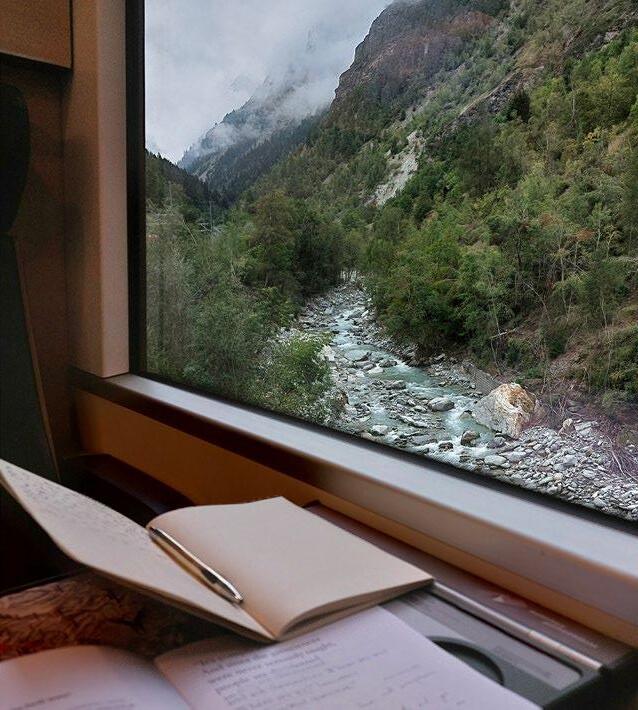
In the train in Switzerland, travelling along the Matter Vispa River in Matter Valley to the town of Zermatt. Huijbens observed the moisture in the Alpine air condensing to form clouds.
@DateDinerMatchmaking
‘A
fun
evening whether or not it’s a match’
It’s not always easy to arrange a dinner date. Fortunately, you can call on Instagram account @DateDinerMatchmaking, managed by a Wageningen student. That could be handy for Valentine’s Day. Text Dominique Vrouwenvelder
The ‘dating dinner’ is a student phenomenon. Student houses, societies and other clubs organize a dinner where students arrange dates for each other. ‘That’s often a blind date, unless the partners are invited,’ explains the Wageningen Instagram account manager, who wants to stay anonymous because of her matchmaking role. ‘I think it works best if everyone is meeting someone new as that gives the evening a different vibe. Everyone feels that healthy nervousness beforehand and you don’t get couples going all gooey.’
Friend of a friend
‘We all know how difficult it is to arrange a date for dating dinners,’ states the Instagram page. OK, tell us how difficult it is. ‘Friends look for dates for each other in their own social circles, but sometimes they just run out of options. Then you turn to the friend of a friend, but it gets harder and harder. That’s what @DateDinerMatchmaking was set up for: finding suitable matches outside your own social circles.’ The submissions come in from friends of the person the date is for. ‘They describe characteristics of the person who needs a date plus the characteristics their date should have. Anyone who thinks they fit the profile of the required date can then reply to the request. We connect up those replies to the friends who requested the date advert. They act as a kind of filter to check whether the date seems like a good match.’
Nationwide
The Wageningen account manager admits the initiative started for personal reasons. ‘Our student house had a dating dinner and we were looking for suitable dates for various housemates. We’ve also helped arrange dates for a dating dinner in Delft, so it isn’t just restricted to Wageningen. In fact, it would be really cool if we could turn it into a nationwide matchmaking platform.’
Do you always have a fun evening, though? ‘A dating dinner doesn’t guarantee you a nice date, but you do always have a fun evening because you’re with your flatmates, other members of your society and so on. You basically have nothing to lose.’ ■
Special Valentine offer
‘I sometimes get messages from people who are looking for a date in general, rather than for a specific occasion. The account isn’t meant for that, but I’m making an exception for Valentine’s Day. In the week leading up to 14 February, students can look for their own dates and I’ll connect them immediately to the people who respond.’
Test for mapping potato disease
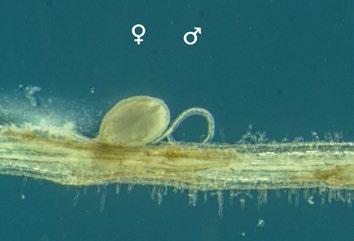
How a nematode makes potatoes sick
PCN disease is one of the biggest threats to potato crops. The disease is caused by the potato cyst nematode (PCN). Plant breeders developed new potato varieties that are resistant to the disease, but more and more nematodes have found a way round the resistance, letting them continue with their pathogenic behaviour. PhD candidate Arno Schaveling discovered how the nematode Globodera pallida does this. Text Roelof Kleis
When Schaveling started his PhD research four years ago, the nematode was only a problem in the north of the Netherlands and the adjoining part of Germany. It never seemed likely that the situation would stay that way and it didn’t. ‘That’s so sad,’ says Schaveling. ‘The problem has only got worse since then. The nematode is increasingly breaching the resistance in commercial potatoes. After we found the genetic basis for this in Dutch populations, I was able to demonstrate it in German, French and British populations as well. That means the whole of Western
Europe is facing the same problem.’ The battle between potatoes and nematodes has been going on since time immemorial. Like so many organisms in nature, the two are engaged in a constant arms race. The potato has had the edge since the 1990s, when plant breeding companies were able to incorporate resistance from wild potatoes into commercial potatoes. Schaveling says they probably all used the same resistance. ‘I tested 26 potato varieties and kept coming across the same resistance taken from the potato Solanum vernei. That must have been widely available.’
One trick
That ‘easy’ victory is behind the success of the nematode this time round. The worm only has to develop a way round a single
form of resistance to defeat all potato varieties. ‘The nematodes are only ever being exposed to one kind of selection pressure,’ is how Schaveling puts it in scientific terms. That made his own task simpler: he just had to find out what that one trick is that the nematodes are using and design a test for it. In fact, he suspects this would have been impossible to do if multiple forms of resistance were involved.
The trick used by Globodera pallida is a protein created by a gene called Gp-pat-1. ‘We think it is what is known as an effector,’ says Schaveling, ‘a protein that manipulates the host in a way that helps the intruder. Our hypothesis is that
Sex and sugar
The nematodes that cause PCN disease only reproduce sexually but the individual’s sex is still undetermined when they emerge from the egg and penetrate the root of a plant. Schaveling has shown that the surroundings have a big influence on the sex. If a lot of nutrients (i.e. sugars) are available, the nematode becomes female, and if the conditions are less favourable the nematode becomes male. ‘It had long been thought the surroundings had an effect,’ says Schaveling. ‘We were able to prove that the sex is not predetermined and we have strong indications that the default is to become male. They only switch to being female if the conditions are very favourable. That is logical, as being female costs about 60 times more energy. The females have fat bodies full of eggs; the males are much thinner.’
under normal circumstances the potato’s resistance gene will produce a protein that detects that effector, triggering an immune response. But repeated use of the same form of resistance has led to preferential selection of effector variants that are no longer detected. This lets the nematode do what it wants unhindered.’ Schaveling cannot yet prove that this is what happens. ‘To do that, you need the potato’s resistance gene and we don’t yet have that. We know where in the genome the resistance is, but we don’t know precisely which gene is involved.
Nematode test
The more nematodes have the deviant effector, the more harm the population causes. Schaveling therefore developed a Covid-style PCR test that farmers can use to test the disease potential of their fields. Schaveling: ‘Except that a Covid test gives a yes or no as an answer, whereas my PCR test measures what proportion of the nematode population
The worm only has to get round a single form of resistance to affect all potato varieties
is pathogenic.’ The test is being developed further by an external project partner, with the aim of launching it on the market.
Schaveling’s test is a diagnostic tool and not a cure for PCN disease. ‘The test can be a cheap, fast tool that farmers can use to help them take decisions,’ says Schaveling. At present, farmers often implement crop rotation every two years as a precaution. The test gives a simple measurement of where they can expect problems. ‘There is often a lot of variation within one field. One spot
might have lots of virulence and another very little. My PCR test quickly gives you a picture of the whole field.’
A new form of resistance is needed to protect potato plants from this potato disease. Schaveling found a suitable form of resistance in the potato Solanum sparsipilum. His experiments showed this new form of resistance is effective against the nematodes. ‘But it needs to be crossbred into the commercial varieties. The breeding companies are working on that but they aren’t there yet.’ ■
PhD candidate Arno Schaveling developed a test that gives farmers a simple way of measuring where in a potato field they can expect problems.
Photo Shutterstock
Limelight
Podium
On Valentine's Day, ten performers from Wageningen and surroundings will bring glitter and love to the Wilde Wereld theatre with their drag show. The drag kings, queens and creatures of House of Flocking Birds and House of Kurk are organizing a full evening show.
Text Coretta Jongeling
Wageningen weinig cultuur? Nee hoor! Als je goed oplet zie je overal mensen die muziek maken, poëzie voorlezen, fotograferen of kleding ontwerpen. In deze rubriek geeft Resource de creatievelingen van WUR een podium.
Dit keer: xxx
Tekst Coretta Jongeling
Drag can be seen as the performance of gender taken to an extreme, explains Leo Menendez Diaz (who performs as Hard Kandi). ‘Drag originated in the ballroom
culture in New York in the 1980s. It was a form of resistance, mainly by black queers, against the discrimination and exclusion they faced. They made a mockery of very performed gender roles. This often involved lip-syncing, as a way to show off their look and fully embrace the role of a mega-feminine character.’
Although drag queens are better known, House of Flocking Birds consists mainly of drag kings. ‘Drag makes you think about the concept of gender and what society expects. Masculinity, like femininity, is partly a performance,’ says Merlin de Vargas Navas (whose artist name is Don D.). ‘I was raised as a woman, which meant it wasn’t acceptable for me to show anger. The first time I got on stage as a man and received applause for my anger, it felt really liberating.’
Thursday 19 February
Melting Pot (dinner and performances) Various venues in town
Theater de Wilde Wereld 20:00
Admission: 10.50 euros
‘When I started performing, my character was mainly gender neutral, but lately I’ve been leaning more towards feminine drag,’ says Menendez Diaz. ‘It’s been really fun because normally I don’t express myself like that at all. Performing has given me more confidence in my femininity, which as a non-binary person I didn’t think was ever going to be possible.’
In addition to performances, House of Flocking Birds also organizes training evenings to develop a drag persona, practise make-up and get together as a community.
More information, including tickets, can be found on their Instagram: @house_of_flockingbirds
Drag artists from the House of FlocKing Birds, based in Ede and Wageningen, and House of Kurk, based in Arnhem.
Photo Nanne Van Schie
Marte van der Veen (24), Climate Studies Master’s student
Your thesis in 40 words?
‘Seeing how to improve monitoring of higher-lying marsh areas using satellite data, focusing on soil moisture. I used a machine-learning model to look for patterns in various data sources and validated the results using fieldwork data I collected in the Himalayas.’
Worst ‘oops’ moment?
‘Just before I was supposed to present my research results, I discovered I’d made a mistake in the script in my model. So now I have to regenerate all of the results in my model. Fortunately, I’ll be able to get that done before I hand in my thesis. I’m expecting the conclusions to be more or less the same.’
Best work-evasion moment
‘I was sometimes forced to stop working during my time in Leh, the capital of Ladakh region in India, for my fieldwork. I didn’t have a permanent workplace, the Wi-Fi was lousy and there were lots of power cuts. I also had food poisoning and I found it hard to get used to the elevation: the city is 3,500 metres above sea level. It cost me ten times as much energy even to walk down the street compared to the Netherlands, let alone write my thesis. That was on top of all the cultural differences. I was spending a lot of time on things that weren’t directly related to my thesis topic. But that isn’t really work evasion, of course: I was trying to do scientific research in a place where that is a huge challenge.’
Did you learn anything about yourself?
‘That I can be flexible. In the Netherlands, you assume Plan A, or maybe Plan B. In India, you may end up with Plan Z. But you can achieve something even in that environment, which isn’t designed for structured scientific work, whereas in the Netherlands we start complaining if our computer screen isn’t wide enough. I have a lot of respect for the researchers who do their PhD’s in these conditions.’ lz
You find all the flavours of the world in Wageningen. This time, we have an aubergine recipe from Ananya Beura from India, who graduated with a BSc in Earth System Sciences and is now working at Starthub Wageningen during her gap year.
Flavours of WUR
Odia brinjal fry
‘Aubergine is my favourite vegetable in the world. Soft, sweet and good with everything. But I don’t call it aubergine I call it brinjal. Brinjal is the word used across South Asia, where I’m from. If you’ve heard it, you’re either South Asian or you know me. My recipe is Odia Brinjal Fry, the ultimate comfort food that I make at least once a week. Simple, and everyone loves it.’
Preparation
1 Cut the aubergine in circular slices 1cm thick.
2 In a large bowl, mix the salt, turmeric, chilli powder and oil. Rub the marinate all over the slices. Don’t leave it for too long as the aubergine loses moisture because of the salt.
3 Heat some oil in a large frying pan. Remember to be generous as the aubergine absorbs a lot of oil.
4 Place the slices one by one around the pan and fry them for about 3-4 mins on each side. They are done when they are slightly transparent. If you like them crispier, fry them a little longer. You might have to cook them in 2-3 batches as the slices won’t necessarily all fit in the pan.
5 And voila! Serve the aubergine with rice (and optionally dal) and enjoy.
Ingredients (for 2 people):
• 1 aubergine
• 1 tsp salt
• 1 tsp turmeric
• 1 tsp chilli powder
• 1 tbsp neutral cooking oil
Preparation time: 20 minutes
Scan the QR code for Ananya’s video.
Ananya Beura Graduated with a BSc in Earth Sciences in India
Photo Oliver Kalengi
Meanwhile in… Iran – Brutal repression of mass demonstrations
WUR is incredibly diverse, with hundreds of internationals working and studying here. In the Meanwhile In column, we ask one of them to comment on events in their home country. This time, PhD student Mehran Takallo talks about the ongoing mass demonstrations in Iran. Text Willem Andrée
‘The demonstrations in Iran are persisting for various reasons, despite the crackdowns by the regime,’ says Takallo. ‘It’s partly the compulsory headscarves and the economic problems – but the goal of taking to the streets is always the same: the fall of the regime and thus freedom.’ Hundreds of cities got involved in the recent revolution, but the protesters were brutally suppressed, says Takallo, who has also faced the murderous armed forces in his home country, experienced violence and lost friends close to him.
‘The goal of taking to the streets is always the same: the fall of the regime and thus freedom’
‘We haven’t heard from friends and family for weeks because of the internet shutdown. The anxiety is enormous,’ says Takallo. ‘Thousands of people have been arrested and are being executed. The death toll now is more than 43,000, making it one of the biggest genocides in modern history.’
MCB-34303: Commodity Futures & Options Markets
Always wondered about what is happening at the trading floor of exchanges like the ones in Amsterdam, Paris, Frankfurt, London and Chicago? Wondered about how (agribusiness) companies manage their risks and improve their financial performance using commodity futures and options markets? Wondered about how it would be if you were trading commodity futures in Amsterdam, Chicago, London, Frankfurt and Paris?
The Marketing & Consumer Behavior Group organizes a unique course that will introduce students to commodity futures and options markets. Students will develop an understanding of the markets and how they work, gain knowledge about the theory behind futures and options markets, identify their economic functions, and develop an analytical capability to evaluate their economic usefulness. This course is taught by Prof. dr ir Joost M.E. Pennings (Marketing & Consumer Behavior Group, Wageningen University). There are only 40 seats available. If you are interested in taking this course (3 Credits) please register in Osiris or contact Ellen Vossen, e-mail: Ellen.Vossen@wur.nl, tel. 0317-483385. Lectures are on Fridays in period 5 (one lecture is on Thursday), 0,5 day a week, please check schedule in TimeEdit for time and location. Prerequisites: None.
Not only Takallo himself, but everyone he knows in the Iranian community has been seriously affected, he says. ‘We try to stay strong and focused, but keeping to our daily routine is almost impossible now. Despite the threats made by the US, the regime is still brutally murdering protesters.’
Takallo’s dream is an end to Islamic theocracy and the establishment of a secular democratic government. ‘It is the dream of the majority of Iranians. At present, this is only possible with the return of Reza Pahlavi (the former crown prince of Iran, ed.). The regime has eliminated all our intellectuals around the world, and he is the only alternative.’
Takallo concludes with an urgent appeal. ‘Iran needs support from the West, not only because of the war crimes but also to make Iran a safe and free country. Because a safe and free Iran means a safer world, no more funding for terrorism in the region and beyond, and an end to the suffering of millions of people. So talk about Iran, call on politicians to take action, be our voice. We need your help.’
Advertenties
Column Youssef el Khattabi
Building dreams
There is an exhibition on the fifth-floor footbridge in Forum where students doing the Studio Site Design course have created their own version of Wageningen. New cities are needed for the growing world population. That starts with visionaries with bold ideas about the future. The British actor Idris Elba, known from The Wire among other things, is one such visionary. He wants to build an ‘Afro-dynamic eco-city’ on the island of Sherbro in Sierra Leone.
Elba is not alone. Many others share his obsession with building hypermodern, high-tech green cities. They are all looking for the new Dubai or Singapore. They promote their ideas with 3D images full of self-driving vehicles and green parks with NPCs (non-playable characters).
It is a dream that I predict won’t come true. While such cities often look appealing, the design philosophy can cement social dividing lines. If a hypermodern city is built that is in sharp contrast with the surrounding area, that can lead to an us-versus-them mindset. You get a division reminiscent of the Capitol in the Hunger Games, a gleaming high-tech power centre that contrasts with the neglect in the surrounding districts.
The Netherlands has its own variant, one that is more down to earth and successful — Almere. People in Amsterdam often say it’s soulless, but the passengers on the bus from Almere Buiten to Almere City FC, which I drove as a part-time job in summer 2024, think it’s a great place to live. You can conjure up a city out of nothing but it needs above all to be functional, not a place that promises to fulfil your wildest dreams.
Cities don’t get a soul from their design, they get it from the people who live there.
Youssef el Khattabi (22) is a Master's student in International Land and Water Management. In his spare time, he likes to travel and he can often be found in the cinema. He also enjoys reading and long after-dinner conversations (about everything that makes the world and humans what they are).
DAILY
UPDATES
WEEKLY UPDATES ON STUDENT LIFE AND WORKING AT WUR?
ON
STUDENT LIFE AND WORKING AT WUR?
Follow us on Facebook,Instagram, LinkedIn, X and TikTok for the latest news, photos, videos and more.
Go to resource-online.nl (Subscription page) and subscribe to our digital newsletter.
SIGN UP
resource_wur
resource-wur
resourcewur
resourcewur wur.resource
Colophon
Resource is the independent medium for students and staff at Wageningen University & Research. Resource reports and interprets the news and gives the context. New articles are posted daily on resource-online.nl. The magazine is published once a month on a Thursday.
Contact Questions and comments for the editors: resource@wur.nl | resource-online.nl
Editorial staff Willem Andrée (editor-in-chief), Helene Seevinck (managing editor), Roelof Kleis (editor), Luuk Zegers (editor), Marieke Enter (editor), Coretta Jongeling (online coordinator), Dominique Vrouwenvelder (editor).
Translations Tessera Translations S.L.
Design Alfred Heikamp, Larissa Mulder
Overall design Marinka Reuten
Cover illustration Valerie Geelen
Printing Damen Drukkers BV, Werkendam
Subscription A subscription to the magazine for one academic year costs 59 euros (135 euros if abroad). Cancellations before 1 August.
ISSN 1874-3625
Publisher Corporate Communications & Marketing, Wageningen University & Research 11
Kooky news
DYED - IN -THE-WOOL
To attract more students, Wageningen should go back to its tree-hugging, smelly-socks-brigade roots.
Wageningen needs to take action now to reverse the decline in student numbers, says the More Or Less taskforce in its advice to the Executive Board. After all, a stitch in time saves nine. To move the needle, it recommends embracing WUR’s traditional image of knit-your-own-yoghurt tree huggers. WUR Council is now looking at the plans.
When WUR was still the Agricultural College, the outside world turned up its nose at Wageningen, which reeked of fresh manure and damp socks. But it is no longer the black sheep of the university family: over the years, Wageningen became the City of Life Sciences and the campus a spotless technology hub. Now the tide is turning again, says taskforce leader Eva More. ‘Young people today want authenticity. You can’t pull the wool over their eyes.’
That is why the taskforce recommends promoting the traditional smelly sock as the ultimate WUR symbol. Preferably hand-knitted. As More says, ‘You can tell a dyed-in-the-wool Wageninger by the farmyard aroma of their socks. You only get that from spending all day knee-deep in manure in a cow shed. Pure authenticity.’
Taskforce member, avid knitter and former student Larry
Lamb (1972-1982, but he sheepishly admits he did not graduate) is in charge of coming up with some example footwear items for the student recruitment campaign. ‘My designs will knock their socks off! Note the green WUR logo. And the wool comes from our own sheep, Shawn.’
The socks will be a key element in the Open Day for school leavers in March (provisional slogan: ‘Put your foot in it’).
Lamb: ‘We’ll start with a fun game where they all have to look for a needle in a haystack. That’s followed by a beginner’s knitting course where they get to knit their own WUR-themed sock and post it on Instagram.’ More adds: ‘Knitting is a useful skill too for students. It’s very relaxing — perfect for de-stressing when you have exams coming up. And with student grants so tight, they’ll need to be able to make their own clothes.’
Isn’t the taskforce worried about the links between sheep with Q fever and pneumonia? ‘Fake news! Those rumours really get my goat,’ says More. ‘We checked with WUR’s AI search function and it couldn’t find anything.’