Of course we too have used the AI tool to search for ourselves on the new WUR website. ‘WUR does not have an independent journalistic platform,’ it tells us. Followed by: ‘It does have a professional press office team’. AI is half right. It is sort of amusing to see how the WUR site denies our existence (ignoring the thorn in its side), but from a broader perspective this is dangerous. How long should a science institution wait before taking action if the search function on its own website can’t find its researchers or makes things up? ‘Sometimes you need to review the choices you made; that is not a sign of weakness,’ said one person commenting on an intranet article about the status of the AI tool. We asked an external expert to review the site. His analysis can be found on page 16. Teacher of the Year Anneke Valk is also critical of AI (page 12). ‘I believe we haven’t thought hard enough about how we should use it.’ This quote was about teaching rather than the website, but there is a link. Did sufficient thought go into the consequences of using an AI search function? Is it harming WUR’s reputation and what message does it send students? I’m curious to know what AI would say.
Willem Andrée Editor-in-chief
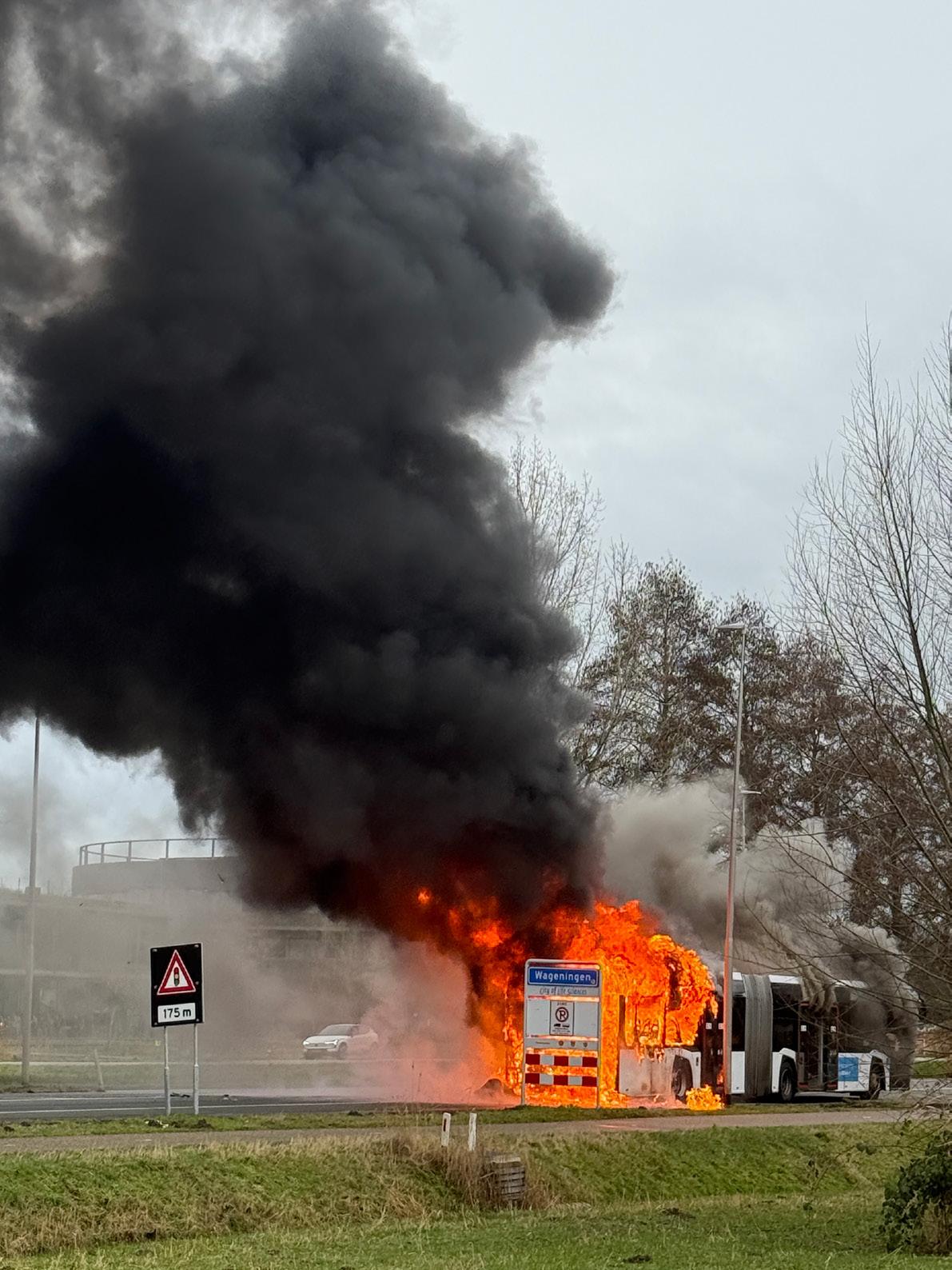
BUS FIRE
A regional bus caught fire last thursday close to the roundabout next to the campus. It was an articulated bus (also known as a bendy bus). The bus burned out almost completely, but the driver and passengers were able to get out in time. No one was injured. The fire brigade arrived quickly with two fire engines. A lot of people on campus came to watch what was going on. The fire also caused chaos during the evening rush hour as Mansholtlaan was closed. A spokesperson for the bus company RRReis was unable to say what had caused the fire. me
Photo Resource
New student challenges on rewilding
WUR is organizing three student challenges on rewilding. The first will be on biodiversity in rural areas, the second on biodiversity in urban settings and the third will focus on the sea. The first Rewild the Future Challenge will start next academic year.
The third and final Nature-based Future Challenge started in January, says Marta Eggers of WUR’s Student Challenges team. ‘We thought: what should we do next? We noticed that students were more likely to continue working on their ideas, for example by founding a startup, after the open innovation challenges in which the participants get to choose what problem they are going to tackle. At the same time, in the Nature-based Future Challenges, which
look at a specific problem in a predefined location, we were struck by how interested people are in biodiversity and nature. These are also themes we excel at here in Wageningen. So we decided to combine those two aspects.’
In the Rewild the Future Challenges, participants get to decide for themselves what problem they want to develop a solution for, as long as it involves an improvement in biodiversity, says Eggers. ‘The main difference between the three challenges will be the focus on rural, urban or marine areas.’
Technical solutions
There will also be a focus on technical solutions in the first challenge, says Eggers. ‘That could be new ways to monitor biodiversity in rural areas using
MCB-34303: Commodity Futures & Options Markets
Always wondered about what is happening at the trading floor of exchanges like the ones in Amsterdam, Paris, Frankfurt, London and Chicago? Wondered about how (agribusiness) companies manage their risks and improve their financial performance using commodity futures and options markets? Wondered about how it would be if you were trading commodity futures in Amsterdam, Chicago, London, Frankfurt and Paris?
The Marketing & Consumer Behavior Group organizes a unique course that will introduce students to commodity futures and options markets. Students will develop an understanding of the markets and how they work, gain knowledge about the theory behind futures and options markets, identify their economic functions, and develop an analytical capability to evaluate their economic usefulness. This course is taught by Prof. dr ir Joost M.E. Pennings (Marketing & Consumer Behavior Group, Wageningen University). There are only 40 seats available. If you are interested in taking this course (3 Credits) please register in Osiris or contact Ellen Vossen, e-mail: Ellen.Vossen@wur.nl, tel. 0317-483385. Lecturers are on Fridays in period 5 (one lecture is on Thursday), 0,5 day a week, please check schedule in TimeEdit for time and location. Prerequisites: None.
drone images, for example. Or how to help farmers switch from conventional to regenerative agriculture and how to make that affordable or profitable. Or how you could improve the connections between fragmented nature areas in the countryside to enable animals to move safely from one place to another.’
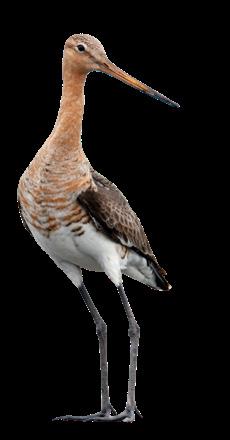
The godwit will be used as the logo for the challenges, reveals Eggers. ‘This bird has been struggling for years and would benefit from rewilding.’ lz
PhD candidates forget Library
WUR Library’s basement has metres and metres of shelves stacked with PhD theses. In theory, it should have all of the more than 9,500 theses produced since the university started in 1918. In theory because last year’s yield shows a gap of 56 publications. They have only received 248 of the 304 PhD theses produced in 2025.
According to Andrea Bolhuis of WUR Library, the reason for the gap is the confusion since the most recent amendment to the doctoral degree regulations a year ago. It is no longer clear when the PhD candidate has to supply the Library with a print copy of the thesis.
The Library does have digital copies of the missing theses, as they have to be delivered before the defence. ‘You can supply the print copy after the defence. But it seems there is a lack of clarity about when exactly. The current procedure will be evaluated with the PhD office.’ rk
304
Last year, 304 PhD candidates successfully defended their thesis, 79 fewer than in 2024. There is an administrative reason for the fall: a change in the defence reservation system led to a ‘drought’ at the start of the year. There was no decline in the proportion with distinction, at 7.6 per cent. Distinction was awarded to 23 candidates (11 women and 12 men). rk
Cover Prize Eugenie van Heijgen
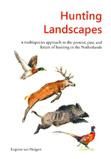
The cover of Eugenie van Heijgen’s PhD thesis will be displayed in the Omnia PhD ceremony room for the next four years. It narrowly won the 2025 Resource Cover Prize. ‘That’s a nice present,’ says Van Heijgen on hearing the news. She designed and painted the cover herself. She got the idea after doing a course in watercolours during the pandemic. ‘An online course that cost me five euros and taught me the basic techniques.’ Van Heijgen’s style is reminiscent of the work of the Dutch artist and illustrator Rien Poortvliet. ‘I take that as a compliment,’ she says. ‘At secondary school, I had classes in artistic expression and they told me I couldn’t draw.’ rk
DANCING FOR CULTURAL CENTRE
On 6 February, Wageningen will see its first ever ‘street rave’, a dance-themed protest march from the campus to the town hall. Its aim is to send a clear message that Wageningen needs a permanent cultural centre for young people.
Just over a year ago, Wageningen Culture Collective handed over a manifesto to Wageningen municipality that had been signed by about 1,200 people. It said Wageningen needed a cultural centre for young people, somewhere anyone could put on bands or organize
‘WE HOPE THIS WILL SHOW CULTURE IN WAGENINGEN IS LITERALLY HOMELESS’
a workshop or a party. The municipality agreed and promised to work on arranging a new venue. But not much has happened since then. Time for action, says Wageningen Culture Collective.
The ‘street rave’ will be accompanied by DJs performing on mobile stages. The dancing procession will start at campus at 16:00 and work its way past key Wageningen locations to end at the town hall at 20:00. After a talk with member of the municipal executive Maud Hulshof, the music will continue until about 21:30.
BUILDING
‘We want to show all the things going on in Wageningen that don’t currently have a fixed venue,’ explains Loeka Prak, one of the people behind the initiative. ‘Popupop, Grassroots Bass Collective, MiniCulture, Popcultuur Wageningen, you name it. Wageningen Culture Collective knows a lot about how to run a venue and plenty of people are willing to get involved, but we can’t arrange a building. Only the municipality can do that.’
Lars Verhoeff, Wageningen Night Mayor and another of the initiators, adds: ‘It’s been a year now and there is still no sign of a venue. We hope this street rave will show that culture in Wageningen is liter-
ally homeless.’
Verhoeff and Prak hope this event will nudge things in the right direction. ‘It won’t be the kind of protest where we angrily chant slogans,’ says Verhoeff. ‘We want the municipality to think up solutions with us. It’s not that they are unwilling, but it’s time they actually did something.’ cj
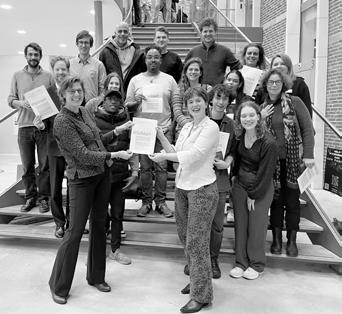
Wageningen Culture Collective in the town hall last year. Photo Wageningen Culture Collective
letter to the editor
What are really WUR’s core values?
The glistening Grebbeberg welcomes me in the autumn sun. Then I see my old student flats appear — a sight that sometimes evokes warm memories and always feels nicely familiar. Great, I’m back home. Or to put it better, I feel at home.
A desire to return one day led me to apply for a job as a study adviser five years ago. It was perhaps a case of applying to WUR more than for that particular job. I had come to Wageningen all those years ago to do my Master’s but found something I didn’t know I was looking for. This was where I belonged. I was overwhelmed by that Wageningen feeling and I cherished everything it meant. After I graduated, I always felt my heart skipping a beat whenever I met someone else ‘from Wageningen’. You shared a past without necessarily having gone through it together. Indeed, I was proud to feel that connection again with this place in my new, warm team — how I’d missed that. And how sad and strange to be writing now that I sometimes
feel as if I am losing that connection. Something inside me has been stirring, subtly at first but getting louder and louder. I no longer feel quite so confident when recounting our story at Open Days.
The interview with Carolien Kroeze about Gaza in the previous issue of Resource reinforced that uncomfortable feeling — does WUR share my values? The complexity of the world around us demands a nuanced and inclusive perspective. We have an important role in this regard as a university, but that doesn’t mean there are no boundaries. If nuance is used to justify the unjustifiable, it loses its value. What are really WUR’s core values?
I am trying to explore this feeling and figure out what it means. Do I feel I can relate to WUR sufficiently to stay engaged as an employee? I hope so. Time will tell.
Malou
Buddiger, International Development Studies
MSc study adviser
LOT OF INTEREST IN NEW MOESTUINMIX SEASON
For the third year in a row, the MoestuinMix citizen science project is inviting vegetable gardeners to test various crop combinations in their own gardens. There has been so much interest this season that MoestuinMix has had to order more seed, says coordinator Yvonne Florissen.
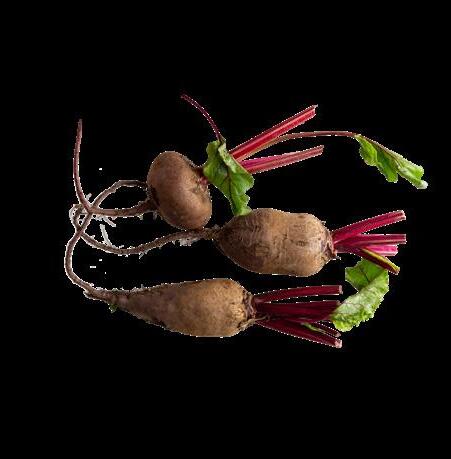
In the MoestuinMix project, vegetable gardeners grow a combination of broad beans and beetroots, plus their ‘own’ combination of broad beans with a crop of their choice. MoestuinMix provides the (organic) seed for the beans and the beets free of charge.
In return, the gardeners have to record when they sowed the seed, when the beans flower and what the harvest is. They also have to provide information on the soil type, whether the garden is fertilized and what the surroundings are like. Fanatical citizen scientists can also pass on observations about aphids,
pollinating insects and natural enemies. That information will be used by the MoestuinMix scientists to get a better understanding of what crop combinations and conditions are associated with better growth, resilience and yields. It is useful input for CropMix,
is part of that programme. Arable farmers who are considering switching to a crop-diverse system often have questions about which crops go together well and which don’t. The insights from MoestuinMix help answer those questions.
According to the results from the 2025 growing season (with 1,023 participating gardeners, half of whom sent data on their crop harvest), the leek was the best partner for broad beans. The mandatory combination with beetroot resulted in lower bean yields but did significantly better than combinations with legumes, carrots, potatoes, garlic, courgette, other beans, herbs and flowers. The results for 2024 were impacted by the slug infestation that year.
To date, 1,339 people have registered for the coming season. WUR staff and students who have gardens (not just pots) can register at cropmix.nl/moestuinmix by 1 February to take part. me
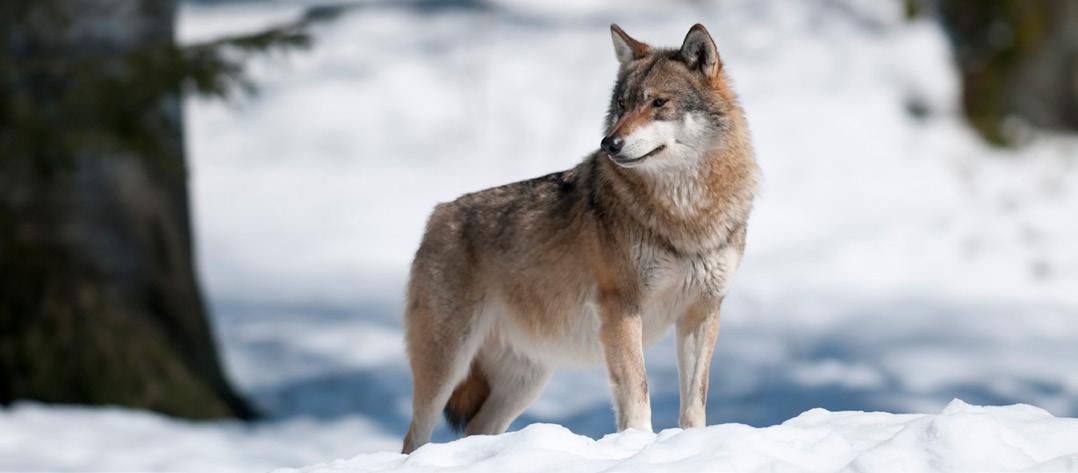
‘Swiebertje’ the wolf has found a home
The wolf study in the Hoge Veluwe park is having trouble getting going. Even so, the initial findings are quite spectacular. The only wolf that has been fitted with a transmitter to date gives us a unique insight into its life. The young male covered over 2,500 kilometres in just two-and-a-half months, an average of 30 kilometres a day. Text Roelof Kleis Photo Hugh Jansman/WUR
The wolf doesn’t have a name as yet, but given its wanderings, ‘Swiebertje’ – the name of the tramp in a popular Dutch series of children’s books – would be an appropriate choice. It was fitted with a transmitter in the park on 16 October. One day later, it set off north. In ten days, the wolf travelled to Assen and back, swimming twice across the IJssel and crossing motorways, either by a wildlife overpass or some other route.
At the start of December, Swiebertje set off for the Utrechtse Heuvelrug, where he seems to have joined the pack living there. Evidence for this comes from images taken by a wildlife camera. That is interesting information for the study – and the provincial authority of Utrecht – as it means you can in theory track the whereabouts of the entire pack.
‘Wow effect’
En route, the wolf passed through four provinces and crossed the territory of nine packs. Professor Frank van Langevelde calls the data surprising and even speaks of a ‘wow effect’. Never before have a wolf’s movements been tracked in such detail.
The transmitter records the location every five minutes (when the wolf is moving) or once an hour (when it is at rest).
The data shows that the wolf is mainly on the move during the evening and at night. Van Langevelde: ‘During the day, it stays under cover in woods and nature
The wolf passed through four provinces and crossed the territory of nine packs
areas. At night, it roams, spending 40 per cent of its time in agricultural areas.’ If you walk through a wood during the day, you may pass close by a wolf: the data shows the wolf lying in cover 50 metres from a footpath in the Heuvelrug area during daytime.
Even so, the data cannot hide the fact that the real research hasn’t yet got off the ground. The aim of the study is to get a picture of the interactions between predator and prey in a landscape
dominated by humans. The idea was to fit five wolves and 30 red deer, roe deer and wild boar with transmitters.
Transmitters
This has turned out to be more difficult than expected. So far, only one wolf and three red deer have had transmitters attached. The project was temporarily halted in November after one deer was found dead three days after getting a transmitter. Could the transmitter have caused that? An examination by Utrecht University showed the deer died from bacterial septicaemia, which was probably not connected to the tranquilizer. Efforts to fit the transmitters restarted mid-December, with limited success so far. It has not proved easy to tranquilize the wild animals using darts. The vet who is authorized to use the tranquilizer darts has to get within 25 metres of the animal, but as Jakob Leidekker, head of the Hoge Veluwe park operations, explains, wolves are smart and prey are shy.
Live&Learn
A botched experiment, a rejected paper: such things are soon labelled as failures in academia. As for talking about them not the done thing! But that is just what WUR scientists do in this column. Because failure has its uses. This time, it’s Virology PhD candidate Rizko Hadi. Text Nicole van ’t Wout Hofland Illustration Mathijs Megens/SeaBlueBird Studio
‘In Indonesia, where I am from, publishing during a PhD is the norm. With that frame of reference, I arrived in Wageningen two years ago as a PhD candidate with a clear plan: my first paper after two years, my dissertation after four. At first, everything went smoothly. But about six months ago, something changed.
Halfway through my second year, I realized that publishing that year was no longer realistic. I couldn’t yet independently use the electron microscope I needed for my research, and I had little additional data. It felt like a failure. I didn’t feel good enough as a researcher and began to doubt my methods, my approach and whether I would complete my PhD at all. My self-confidence took a serious hit.
‘Shortly afterwards, the Graduate School organized a meeting. In groups of four, PhD candidates shared their experiences. I was honest and said, “I have nothing.”
A fellow PhD candidate looked at me and replied, “I don’t
believe that. In two years, you must have done something.” That was a moment of clarity. After the meeting, I wrote down everything I had done so far. It was still not a publishable story, but for the first time I could see the overall structure of my project and the steps involved. OK, still somewhat hazy, but I now have a clearer sense of direction and can develop a more concrete plan. Soon, I will analyse new data, and with a bit of luck I will complete two chapters of my thesis this year.
‘My self-confidence took a serious hit’
‘Looking back, I realize most of the pressure came from myself. My supervisors and colleagues have never pushed me. Even so, I am still afraid of falling short and failing. Will I make it? I don’t know. But I am determined to work as efficiently as possible in the final two years of my PhD.’
Environmental journal dropped
WUR environmental scientists will need to think twice before submitting an article to Science of the Total Environment (abbreviated to STOTEN). The renowned journal has been scrapped by the analysts at Clarivate Analytics. Many WUR researchers have published in the journal.
Until last November, STOTEN had an impact factor of over 8, putting it among the top 25 per cent of environmental journals in the Web of Science database. But now it has lost its impact factor: Clarivate has scrapped the journal from its list. Clarivate’s search platform and citation counter Web of Science no longer includes STOTEN in its bibliometric analyses.
At WUR, it is mainly environmental scientists who publish in STOTEN. They published more than 200 articles in the past three years alone, according to WUR Library in an article on the topic on the intranet. The authors with the most publications are Violette Geissen, Paul van den Brink and rector magnificus Carolien Kroeze. Incidentally, the Library is not telling researchers to avoid the journal, says information specialist Marleen Noomen. ‘It is up to the individual researcher to decide whether a certain journal is a good place to publish their article.’
The journal was dropped following various fraudulent or suspicious actions.
Less damaging
According to Noomen, the fact that STOTEN no longer has an impact factor is not as damaging for WUR researchers as it would have been in the past. ‘Thanks to the Academic Career Framework, more attention is paid in staff appraisals to the quality of the article than to the journal’s reputation.’
The journal was dropped following various fraudulent or suspicious actions. One was using fake reviews to get articles through the scientific checks. Authors fabricated positive reviews using the stolen identities of other scientists. The editor-in-chief was also co-author of about 200 publications in the journal over a ten-year period. rk
Lith catfish not eating migratory fish
The catfish swimming near the Lith system of sluices in the River Maas mainly eat non-indigenous species such as crayfish and Caspian goby. Hardly any migratory fish are on the menu. This finding comes from long-term field research, which has provided other interesting insights as well.
Text and Photo Marieke Enter
Catfish are being spotted in more and more places in the Netherlands, and these specimens are increasingly XXL. It was not clear what this meant in ecological terms because little was known about their diet. The biggest worry and the reason for this research was the potential impact on migratory fish. How many salmon, eels, sea lamprey and other migratory fish end up in the jaws of a catfish and never make it to their destination?
A field study by Wageningen Marine Research has given more information on this. Between October 2023 and August 2025, a total of 152 catfish were captured at the sluice and barrage complex at Lith in the River Maas. The researchers flushed out the stomachs of 90 anaesthetized fish. Only 24 had food in their stomachs; the researchers found hardly any traces of migratory fish except for one eel. The catfish had a clear preference for invasive exotic species such as crayfish and Caspian goby.
Size
But project manager Jacco van Rijssel makes a caveat: ‘It could be we didn’t find migratory fish remains because there simply weren’t many migratory fish around at that time. Also, some of the catfish we examined weren’t big enough to eat an adult migratory fish.’ It looks for now as if catfish are not having a worrying effect on migratory fish populations, although Van Rijssel does add a large ‘but’ to this conclusion: ‘The conditions in Dutch rivers are becoming increasingly
suitable for catfish due to climate change. If migratory fish populations also increase, there will be a greater risk of catfish targeting them as prey, as has been happening elsewhere in Europe.’
Routes
The researchers studied the routes taken by catfish as well as what they ate. Thirty of the 90 fish that were caught were large enough to be fitted with a transmitter, which will emit signals for the coming ten years. So far, 20 of them have provided data, showing that the catfish don’t spend much time in the vicinity of the sluice complex. Some catfish travel a long way: signals from their transmitters were recorded up to 70 kilometres downstream.
There was an interesting ‘by-catch’ from the transmitter data too. While catfish are generally active at night, the fish downstream from the sluice complex
‘Some
of the catfish we examined weren’t big enough to eat an adult migratory fish’
were also strikingly active at about eight o’clock in the morning and four o’clock in the afternoon. These are the times when the hydro power plant is turned on and off respectively to facilitate silver eel migration. As soon as the turbines were turned off, the catfish swam towards the hydro power plant, and they left as soon as the turbines started up again. As far as is known, this is the first study to show catfish adapting their behaviour in response to sluice and barrage procedures.
Go to resource-online.nl to read more about this research and the fieldwork.
Paul Swinkels is one of the anglers helping to catch catfish so they can be fitted with transmitters.
PhD theses in a nutshell
No news
People are increasingly choosing to ignore the news, at least for now, for various reasons. Is that bad? Not according to Kiki de Bruin. Avoiding the news isn’t a problem and can even boost mental health. But news avoidance is a worrying sign for journalism. De Bruin notes a growing gap between how the media present the news (speedily, overwhelmingly, aggressively) and what consumers want (something meaningful, constructive, in context). So traditional media have work to do if they want to remain relevant. rk
Seeking Nuance in News Avoidance Kiki de Bruin Supervisors
Sanne Kruikemeier and Yael de Haan (Utrecht University of Applied Sciences/ University of Groningen)
Seeking and finding Archaea, the oldest microorganisms, are notoriously difficult to isolate. Kejia Wu, from China, managed to cultivate a methaneforming archaeon. It is the first in a branch of archaea where people had not expected to find methane-forming examples. Her research resulted in a publication in Nature. She continues from that success in her PhD thesis. She has developed a detailed approach for cultivating such anaerobic organisms that are normally so difficult to isolate, impressive work that got her a PhD with distinction. rk
From genome predictions to living proof: the long road to cultivating deep-lineage methanogens Kejia Wu Supervisors Diana Z. Sousa and Lei Cheng (CAAS)
THE PROPOSITION
PhD candidates explain their most thought-provoking proposition. This time it’s Clara Delecroix, who received her PhD on 4 September for research on indicators to anticipate upcoming epidemics of mosquite/borne diseases. Text Ning Fan
Understanding ripening
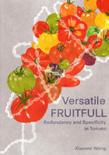
The development, growth and ripening of tomatoes is a complex process involving numerous genes, including the FRUITFULL gene. (Geneticists like to give genes interesting names.) The genes are controlled by transcription factors (a type of protein). Xiaowei Wang from China investigated exactly what happens by using CRISPR-Cas9 to make mutants. The gene’s function is revealed by looking at what the mutant does (or no longer does). This study showed that the processes are even more complex than was thought. It turns out the tomato is not easy to decipher. rk
Versatile FRUITFULL redundancy and specificity in tomato. Xiaowei Wang Supervisor Gerco Angenent
‘Feedback is only constructive when it contains words of appreciation’
‘Doing a PhD can be tough. Sometimes you feel like you are making no progress, especially when you have spent time preparing a paper and all you get is a long list of suggested improvements from your supervisor without any positive comments. This can be discouraging and shake your self-confidence.
‘The purpose of feedback is to improve the work and motivate you to do better. If the feedback is only critical and ignores what has been done well, you don’t know which parts are good. You may end up changing everything, including parts that are already strong. This is especially true for junior researchers.
‘Critical comments can be discouraging. I have learned how to deal with them.
It is important to understand that such feedback is not meant to be personal and does not mean everything is bad. They are suggestions, and you don’t need to change everything that is proposed.
‘Giving feedback is also something that requires practice. Many people focus on what needs to be changed and forget the positive aspects. I realized I did the same when supervising MSc students. Over time, I learned that you can be direct about what needs improvement while still appreciating the effort someone has put in. For example, the results may be good, but the phrasing may need improvement. In the end, nobody will submit work they have put effort into that is completely bad.’
TRUMP CAUSES ANXIETY ABOUT RESEARCH IN GREENLAND
Chiara Gherardelli started her PhD at WUR in December, studying wildfires in Greenland's tundra. Now, Trump's plans to seize the island are casting a shadow over her fouryear research project.
You’ve just arrived in Wageningen and you’re about to start on your research when US president Donald Trump comes waltzing in. That is what has happened to Chiara Gherardelli. The Italian researcher is involved in the EMBRACER Research Consortium, where she will be studying ecosystem responses to wildfires in Greenland’s tundra. ‘Arctic wildfires have become increasingly frequent in recent decades due to climate change, but they are very understudied,’ she explains. Her work focuses on carbon emissions and the impact of the fires on the vegetation and soil. Together with her supervisor and two PhD teams from VU University Amsterdam, Gherardelli plans to spend summers in the town of Sisimiut on Greenland. The fieldwork involves vegetation identification, soil analysis and carbon cycling measurements to compare burned and unburned areas. From Wageningen, Gherardelli will conduct remote sensing analysis, using satellite data to track vegetation growth and fire severity.
THREATS
But worries have arisen due to Trump's threats to take Greenland. ‘It is definitely stressful,’ Gherardelli admits. If the situation escalates, she has back-up plans. ‘I’ll use the satellite data, so I analyse Greenlandic data from my desk in Wageningen.’ For now, she is cautiously optimistic. ‘I'm very vocal about Greenland’s right to self-determination,’ she says. What frustrates her most is America’s colonial attitude. ‘The fact that Trump thinks he can just buy a country is insane,’ she says. wa
Read the PhD candidate’s full story at resource-online.nl
Switch-off button
WUR continues to pursue its sustainability agenda through initiatives ranging from sustainable campus canteens to the annual ‘Switch it Off’ building-closure campaign during the Christmas period. While these practices have helped position WUR at the world’s most sustainable university, I am curious to know how individual departments — such as the Library — are implementing sustainability in practice.
As the new year began, the WUR Library made a ‘Switch it Off’ decision of its own –ending access to the Web of Science, one of the most crucial bibliographic databases for academic research. The Library subscribes to several multidisciplinary databases that enable students, PhD candidates, teachers and researchers to access scientific literature through reliable and efficient search functionalities.
The discontinuation of the Web of Science therefore means that a key resource for systematic literature searches is no longer available to the WUR academic community.
This decision not to renew the licence is obviously not primarily about sustainability. Rather, it appears to be a cost-cutting measure reflecting broader financial and administrative
Joshua Wambugu
pressures within WUR ahead of the declared education funding cuts by the Dutch government. Although a survey was conducted by the Library to inform the decision to end access to the Web of Science, my question remains: when do minority responses carry sufficient weight to determine decisions on such critical research resources? I think we should be more worried about the rising costs of publishing in peer-reviewed scientific journals than about paying for the necessary search tools. Regardless of whether the focus is sustainability or budget cuts, the fact that one database may function better in providing relevant and reliable scientific literature shouldn’t disqualify others. Moreover, the WUR community should have freedom of choice in access to essential research resources, and cost shouldn’t be the only determining factor when taking decisions about these resources. And while financial realities are pressing, WUR must maintain its commitment to academic freedom, not only for its external reputation, but also for its own community in its own institutional practices.
Joshua Wambugu (42), from Kenya, is a PhD candidate in the Marine Animal Ecology and Environmental Policy groups. He loves cooking, hiking and birdwatching.
From stuttering student assistant to award-winning teacher
TEACHER OF THE YEAR ANNEKE VALK
She is ‘an outstanding teacher with a mission to reconnect people with life’s wonders’, according to the student jury for the Teacher of the Year Award. Anneke Valk had been nominated several times before but this is the first time that the multi-talented Biology teacher has won the award.
Text Luuk Zegers
If you look at Valk’s CV, what stands out is her versatility. She is not only a Biology teacher but also a sports instructor and tour leader. And she gives talks on hormones. How does she combine all that? Valk: ‘When I got this job at the university, I knew straight away I wouldn’t want to do it full-time because I’d stagnate. Parttime work gives you a bit less security but you have a lot more scope for personal development. My boyfriend and I don’t have any children, which makes a big difference in terms of the available time. We do have a dog — Doerak –a Greater Swiss Mountain dog. An amazing beast!’
‘My other activities came about very naturally. For example, I used to attend fitness classes given by Ingi Alofs in De Bongerd. She’s fantastic. She jokes a lot and has a disarming sense of humour that I really enjoy. Once, when I hung around after the lesson ended, she asked me whether I too would like to teach fitness classes. So that’s how that job started. And when a friend became a tour leader, that sounded so much fun that I did a training course for that. Now I guide an organized tour once a year, to amazing places like Iceland or Costa Rica.’
‘I promised a chocolate bar for every student able to find the clitoris’
How did the hormone talks come about?
‘A combination of various things. I was irritated by the lack of attention paid to female animals in the Human and Animal Biology course. We dissected piglets in that course. The penis and prostate gland were studied in detail, but the female organs were hardly examined at all. I thought that needed to change, so I started describing the clitoris. I promised a chocolate bar for every student able to find it. That sparks off something interesting in the classroom as every starts searching like mad for the clitoris. I had to hand out 40 chocolate bars in the following class. But students never forget something like that.
‘About the same time, Ingi wondered why so little attention is paid to what the menopause means for women at WUR and why there wasn’t a workshop on that. And my sister had recently given me a book on hormones. Those three things prompted me to develop workshops on the menstrual cycle and the menopause. I created a simple accompanying website and soon I was getting serious requests from companies. So I made my approach more professional. That got out of hand — in a good way: I now have a book out, Zwijgverzuim (Silent Sick Leave), which I co-wrote with Filip de Groeve, and I’m working on a play.’
The jury wrote that you are passionate about every living thing. Where does that appreciation come from?
‘It has always been there. As a child, I couldn’t understand why our rabbits weren’t allowed to wander freely around the house whereas we humans could. Humans wear clothes, have mortgages and do all sorts of complicated things, which is why we sometimes forget that we too are animals.’
Your path to becoming a teacher was not easy, according to the jury. You had a stutter but you persevered?
‘When I first got to dissect a piglet as a student, I thought it was amazing. The liver, the stomach and intestines, the blood vessels, the nerves. Hundreds of thousands of cells in the body that make sure everything works, without you consciously having to do a thing. That is miraculous. When I got the opportunity to be a student assistant, I took it because I wanted to show others how fantastic the body is. But my stutter was a real pain.’
‘I think one of my strengths is that I focus on the students’ brains and well-being. If I see people getting distracted, I stop at once and try to reconnect with them.’ Photo Duncan de Fey
Even so, it didn’t hold her back much, she says. Teacher Arie Terlouw tried to help her by getting her to announce things such as lesson breaks via the microphone. ‘I’d do it, stutter and all, blushing and sweating. Terrible. But it did make ordinary conversations easier. And I got better and better at finding solutions. If I knew a certain word would make me stutter a lot, I’d choose a synonym that I found easier to pronounce. I still had a stutter when I started teaching in 2012, but it was becoming less of a problem.’
Did everything go smoothly from then on?
‘Not entirely. The norm was that you had to get a PhD, otherwise you wouldn’t be able to teach. I had tried a research Master’s but I was really unhappy doing it. Then too, Arie came to my rescue. He saw how good I was with small groups of students and wanted me as a teacher. Thanks to him, I was able to start as a junior teacher without a certificate. That was really unusual back then.
‘Arie gave me feedback to start with: he would mention three or four things that were going really well and one or two points for improvement. That worked perfectly for me. If I only get told what is going wrong, I close up. Arie believed in me before I believed in myself. That was also the case for Ingi at De Bongerd and for Ignas Heitkönig. He was my thesis supervisor when I was a student and we’ve stayed in contact. We talk about climate change and how to stay optimistic, about teaching and what concrete measures we can take every day to make the world a better place. Arie, Ingi and Ignas gave me the confidence that I could make a positive contribution. People like that are worth their weight in gold.’
When did you realize you had a gift for teaching?
‘I always enjoyed teaching but initially I wasn’t really evaluating myself. My main thought was that I’d have a hundred young people in the lecture room, so a onehour lecture is the equivalent of 100 hours of life. That’s valuable time and I wanted to make good use of it. How do I keep their attention and what should I do to make sure they understand and remember the material? Afterwards, you read the course evaluations and you see your name mentioned a lot in a positive way. I thought: OK, I’m doing fine. But I couldn’t believe my eyes when I was first nominated for the Teacher of the Year Award.’
What’s you secret?
‘I don’t have one, but I think one of my strengths is that I focus on the students’ brains and well-being. If I see people have got distracted, I stop at once and try to reconnect with them. If something is complicated, I say that I can’t imagine no one has a question about this. And then I stay silent until the questions come. So I’m constantly checking that we’re all on the same page, in the here and now, looking at the same material.’
At the award ceremony, you criticized generative AI.
‘People sometimes forget that we too are animals’
‘Arie believed in me before I believed in myself’
‘I believe we haven’t thought hard enough about how we should use it. The more you delegate stuff as a person, the less you do and are capable of yourself. If you stop doing something, you get worse at it. It’s like with e-bikes. They can serve a purpose for some people, but if everyone switches to e-bikes because they are easier, our muscles will get weaker because you don’t get the same resistance when cycling. We are worse off as a result.’
Do you see positive aspects too?
‘Definitely. It could improve students’ access to supervision. An example would be an AI student assistant that guides your thought processes and asks critical questions. If all students could use that, they would find it easier to ask questions and that would make the learning experience slightly fairer for introverts. It could also help students with a different biorhythm who work better in the evenings. Teachers aren’t available 24/7, but an AI tool is. But every time we use AI, we need to think hard about how to use it and what the purpose is.’ ■
Reorganizing education What is at stake?
What do a market orientation and centralized governance mean for academic freedom, public values and the position of the social sciences? Over 100 employees call for a fundamental reflection in this open letter.
WUR c urrently revising its portfolio of Bachelor’s degree programmes. This reorganization is unfolding against two worrying trends: market-driven corporate governance and increasing centralization of decision-making. Together, these dynamics risk hollowing out the university’s public mission and weakening the critical role of fields such as the social sciences.
The Royal Netherlands Academy of Arts and Sciences (KNAW) has warned that inadequate public funding is making universities more dependent on external funders and markets, enabling business to shape research agendas. Yet, encouraged by government cuts, executive boards have increasingly internalized market thinking in a corporate style of governance.
Universities are now governed as if they were firms: steered by measurable outputs, with students treated as clients and staff as interchangeable human resources. Chair groups are framed as ‘business units’ and pushed into consultancy roles, and are expected to continuously secure
external funding. Strategic plans, originally meant to set broad priorities, are instead used to micromanage research directions, encroaching on academic autonomy.
Alongside this neoliberal restructuring runs another development that deserves equal attention: the autocratization of governance. After a brief wave of democratization in the 1970s, the university has become a strongly hierarchical organization, producing an accountability chain that answers upwards and outwards, with little accountability inwards.
These trends of market logic and centralized decision-making converge in the current proposals for social science Bachelor programmes. The proposed programme of Sustainable Transitions for Society and Business , which carries a distinctly corporate orientation, is a case in point. Decisions about the future of education are taken primarily by managers, while the voices of those most concerned — academic staff and current and prospective students — are reduced to optional advisers in opaque consultation processes.
The current emphasis on ‘interdisciplinarity’ also warrants caution. When interdisciplinarity is defined from the outset as an add-on to the natural sciences — a support function for modelling and innovation pipelines, or a toolkit for marketing and optimization
— it becomes a way of recasting the social sciences as a service discipline. What gets lost is precisely what the social sciences uniquely offer: critical analysis of power, institutions, values, conflict, inequality and the politics of ‘solutions’. We are therefore concerned by the way that this proposed programme seeks, in a top-down manner, to normatively define what social science is at this university (and hence what it is not), and discipline lecturers into teaching a very particular and narrow epistemological and ontological approach, instead of allowing academics to define their teaching programmes and teach fundamental social science.
If corporate logic and autocratic governance continue to shape the university’s future, we risk becoming an institution that retains the name ‘university’ but no longer fulfils its role as a free and critical public actor. The KNAW’s warning was not an abstract concern but an urgent call to consider the foundations on which we want to build a university.
Joost Jongerden (Rural Sociology) and 115 other fellow scientists. ■
See resource-online.nl for the complete list of signatories
‘Hallucination will always be an issue’ AI expert on WUR website
The new WUR.nl website uses a search function based on AI. That has led to a lot of criticism because sometimes it can’t find information, provides incorrect information or hallucinates. Despite all this, WUR is sticking to its choice of tool. Information sciences specialist Rik van Noord of the University of Groningen takes a look at it. Text Willem Andrée Photo Shutterstock
If you ask the AI search function, which uses OpenAI, to write an introduction to the non-existent course in Sustainable Agriculture, you get a made-up answer. If you want to know what you need for an MRF degree, it tells you about the Master’s in Food Safety, i.e. MFS. If you try to find out more about ACF (the Academic Career Framework), the tool refers you to a term in a letter from the Academic Board. In other words, you don’t get a proper answer.
These are just some of the examples from worried WUR folk who have been trying out the new website’s search function. WUR says staff should pass on such errors to the website team: ‘That will let us resolve errors or omissions. Any improvements we make today will be processed by the system overnight. The answers will be correct the next day.’ Meaning it’s a learning system and we have to be patient. But how patient?
Isn’t this damaging Wageningen’s reputation as a science institution? If WUR’s own professors can’t be found, doesn’t that make WUR look ridiculous?
Vulnerable
Information scientist Rik van Noord at the University of Groningen specializes in AI’s large language models (LLMs). Resource asked him to take a look at the WUR.nl search function. He calls WUR’s decision to go for an AI search tool ‘interesting’, but also has his doubts about using artificial intelligence for searches. ‘The website uses language models to find pages that might have the answer to the website visitor’s question
‘It would be better to make the AI answer less prominent’
and then summarizes them. That often gives quite good results, certainly when you compare it to search engines that don’t use AI. However, this search function is vulnerable: the models are based purely on probability calculations, so you can get wrong answers.’
He understands the criticism: ‘Even if it hardly ever happens, I can understand employees saying wrong answers are not acceptable to us. However, the errors aren’t always down to AI hallucinating: any large website will often contain incorrect information, which the model then reproduces. People using the search function in the old website probably got erroneous information at times.’
‘I think that if you compare an oldschool search function against this AI search engine,’ continues Van Noord, ‘and test it with 500 people asking realistic questions, the AI search engine would win comfortably in terms of how often users get a good answer and how quickly. The difference is that people using the old-school search functions got information that was clearly not right whereas the AI search engine can give an incorrect answer without people realizing it’s wrong.’
WUR writes in an email that it is ‘pleased with Van Noord’s feedback and tips’. ‘It is true the use of an LLM as a search function for a research and education institution like ours is uncharted territory,’ says the spokesperson. ‘All Dutch universities are watching with interest to see how we tackle this. The search function is improving day by day. It is much better now at finding WUR employees, the answers are more accurate and we are adding more context to the AI. That latter effort means the search engine will give more relevant and specific answers. We are also looking at how we can link it to research data from Research@WUR. Staff and students can send any questions they have about the AI functionality to wire@wur.nl.’
Van Noord says it is up to WUR to decide whether the incorrect answers are bad enough to stop using the system. ‘Hallucination will always be a problem, whatever.’ For that reason, he says the fact that WUR doesn’t offer an alternative search function to the AI one is not ideal. You could — and maybe should — have an old-school search function alongside the AI feature, argues the researcher.
He also notes that when the WUR website comes up with search results, it is unclear where the AI response ends and where the results with links to information start. ‘It would be better to make the AI answer less prominent,’ he suggests. ‘Use a different colour, for example, and make it easier to expand and collapse results like Google does. That way, people who don’t want to use AI can still find the right page by using the links.’
Always hallucination
Following our inquiries, we were told the AI function is here to stay in the
WUR website: it is part of WUR’s online strategy. Does Van Noord expect other universities to follow suit? ‘There is certainly a trend towards trying this out, often with good results. Of course, it is easy to find examples of AI answers that are complete rubbish, but you also have to remember what the old search function was like. If I look at Groningen University, lots of people don’t use the search function at all because you can never find anything.’ Finally, Van Noord would like to nuance the word ‘hallucination’. ‘I wonder whether people realize that models always “hallucinate”. The model’s generation process is always the same: it tries to find the statistically most likely answer. But when it doesn’t get it right, we suddenly call that “hallucination”.’ ■
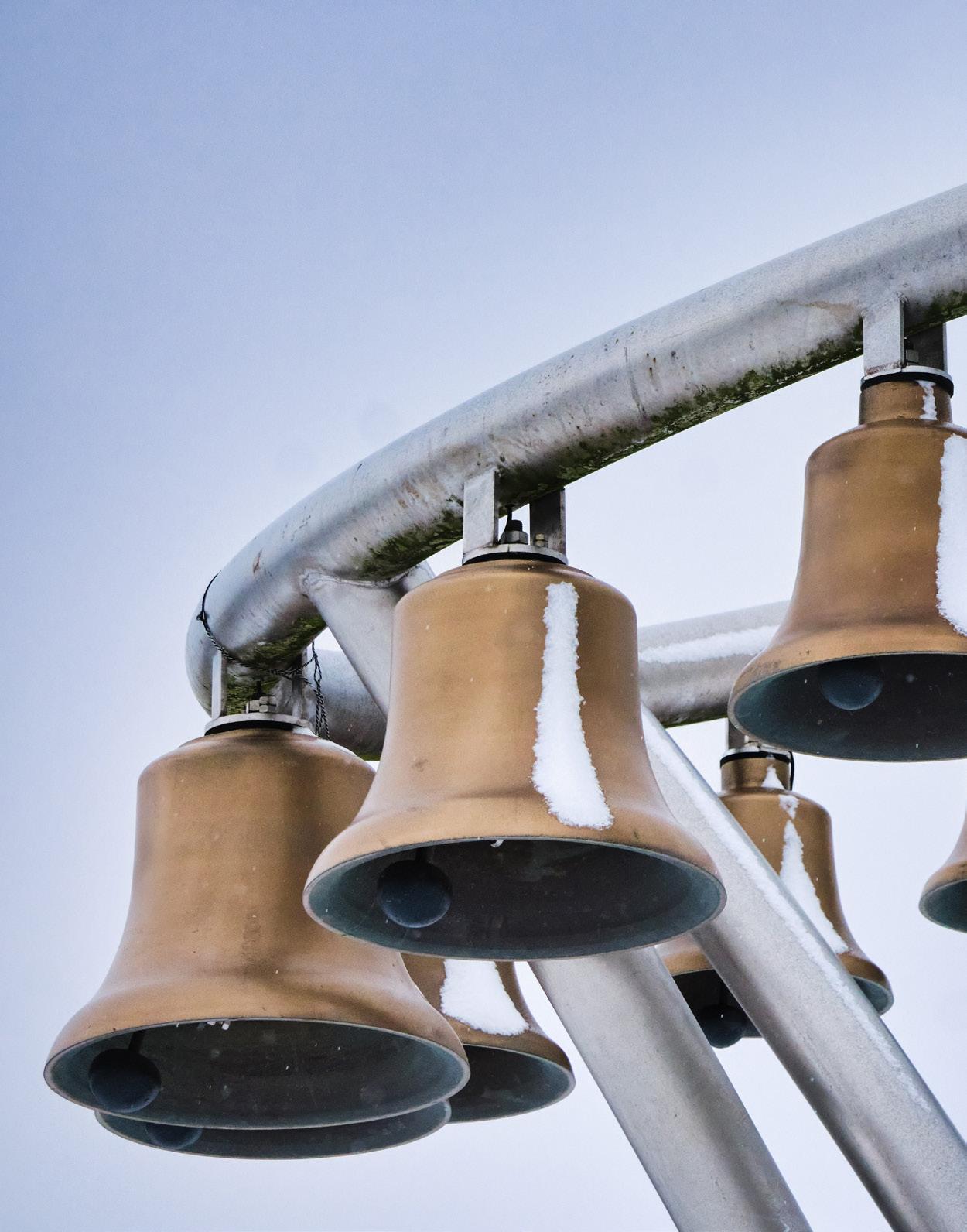
SNOWDROPS
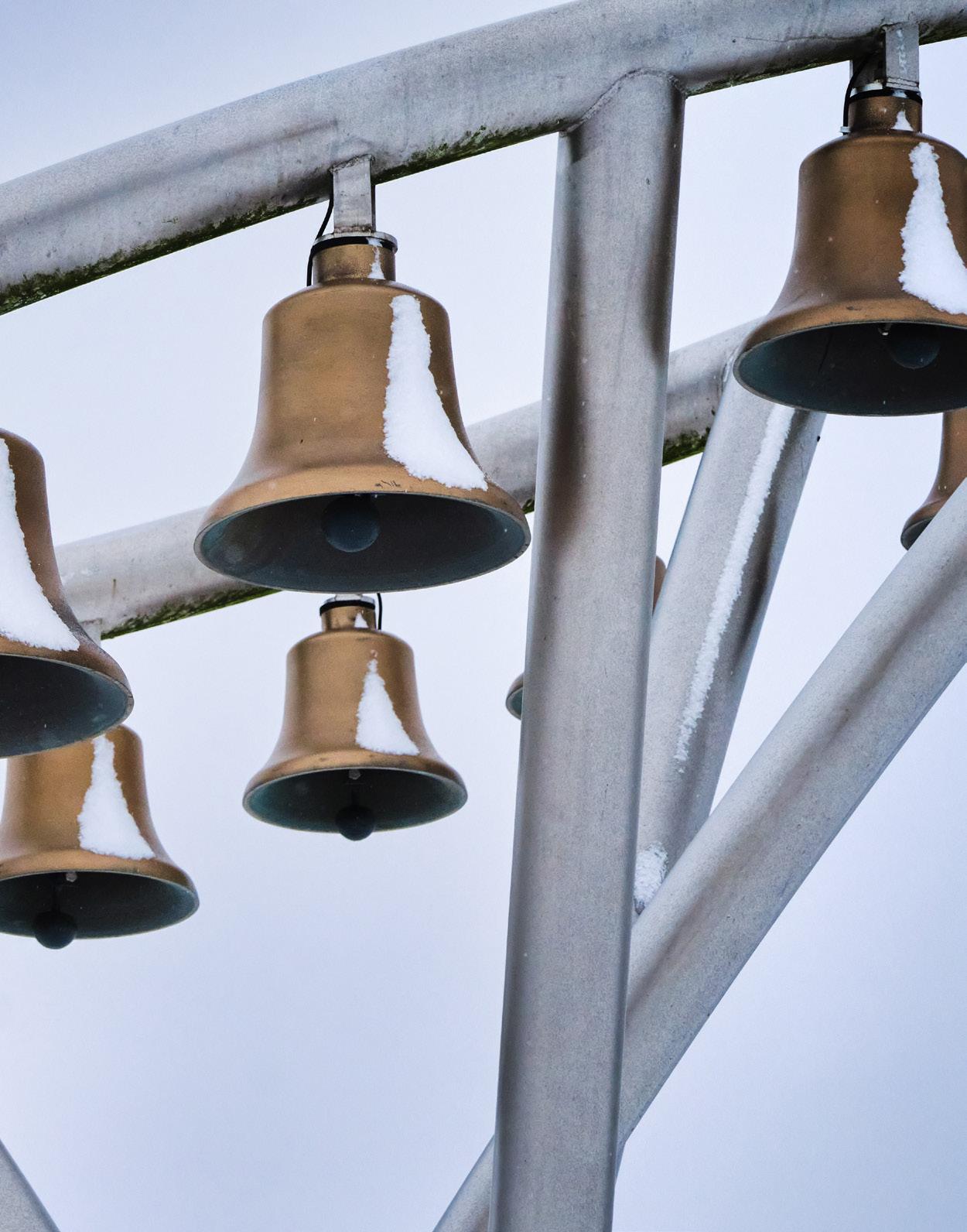
Winter 2026. People building snowmen on campus and throwing snowballs, preferably at each other. There’s nothing like a good snowfall. Followed immediately by a few days of exceptionally warm, sunny weather. That is confusing for nature. When you see great tits examining bird boxes, it makes you long for spring. According to an old Dutch song, When the snowdrops bloom in Holland, Spring is here. These carillon bells look a bit like snowdrops, so perhaps that is what the photographer was thinking of when he took this photo. Snowdrops in January. rk
Photo Guy Ackermans
UNDER CONSTRUCTION
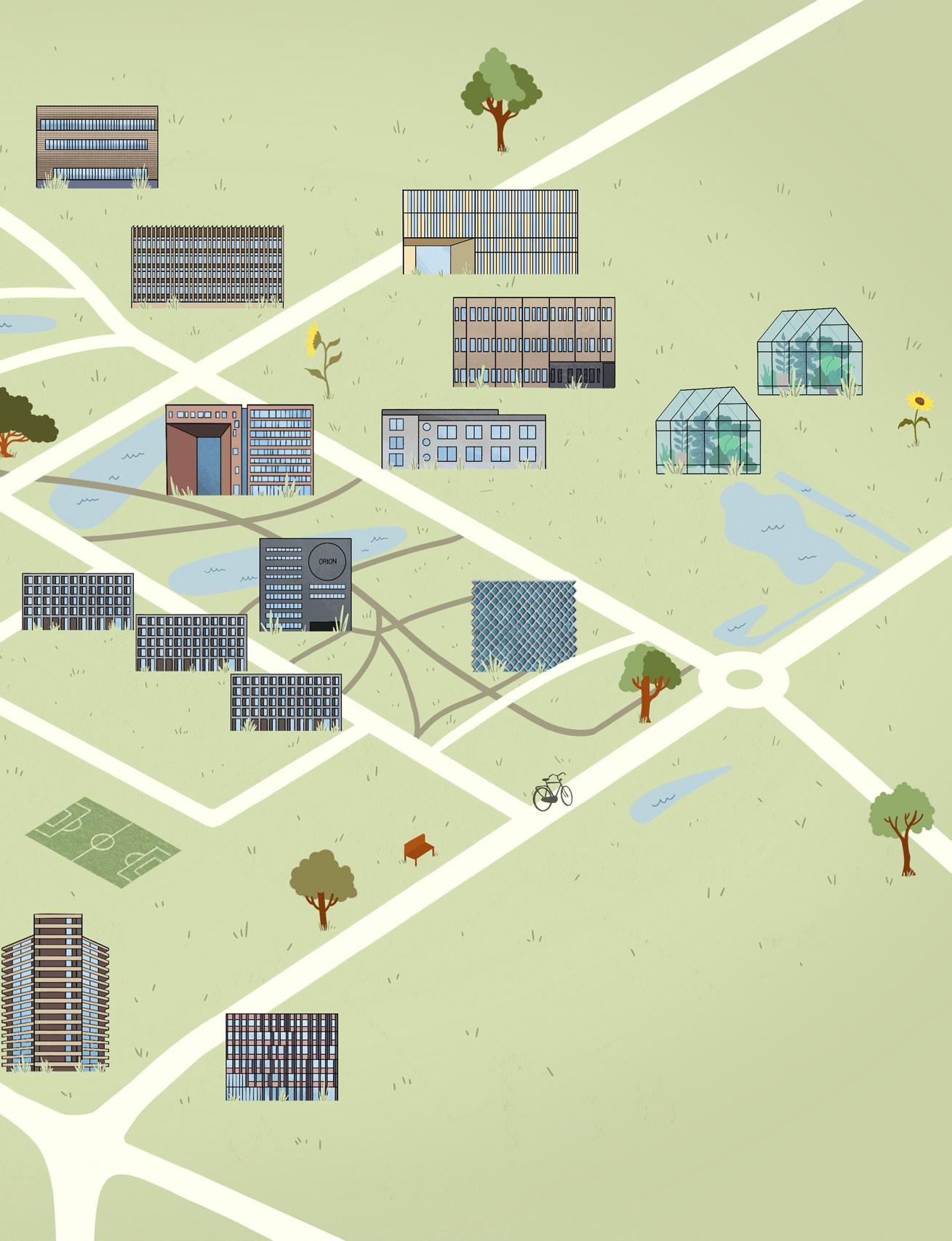
The campus might seem full, but construction work is still ongoing. In fact, the campus will always be a work in progress, says Real Estate Policy consultant Martijn Hoenkamp. ‘We continually need investment, replacement and modernization.’ This is not affected directly by the cutbacks in education and research. ‘Property decisions are for the long term. You need to be prepared for all eventualities. You can’t be dependent on the course taken by the Dutch government; you need to make your own strategic choices on whether to put up a new building or make do with the existing ones.’ Anyway, it is not yet clear where the cuts in research will fall. ‘That makes it tricky for us. Of course, investments are not totally unaffected by current affairs, and it’s much easier to decide to build something if the government provides funding.’
Text Roelof Kleis Illustration Valerie Geelen
Bornsesteeg student flats 3
Vitae Bio Safety Lab 8
This map of the campus shows where new buildings are planned. Construction has already started in some cases; in others, building has yet to start or key decisions still have to be taken. The numbers refer to the short descriptions on the next page. (The unnumbered buildings are the existing buildings, shown to give an idea of the location.)
Serre Green
Metora 2
Cibia
1 Serre Green
The Unifarm experimental greenhouses are all being replaced. This operation has been underway for several years. In December, work started on constructing Serre Green, a greenhouse covering 4,000 m2 behind Radix. It is one of three experimental greenhouses (Green, Yellow and Red) that will replace the existing greenhouses on campus and at Nergena. Red is already in place and Yellow will complete the list. Some of the activities at Nergena (at the end of Bornsesteeg) will relocate to the campus.
2 Metora
4 JII/CGN
The Jan IngenHousz Institute and Centre for Genetic Resources will be sharing a new building next to the car park on Bornsesteeg, with Bioma on the opposite side. The two buildings should give more cachet to the north entrance to the campus, which currently feels more like a back entrance. The provisional design is complete and being prepared for decisionmaking.
5 Cibia
8
Vitae Bio Safety Lab
In December, construction work started on a new safety lab at the back of Vitae. The lab has the secondhighest safety level (Bio Safety Level 3) and will be used for virological research in food and animal feed. The lab will be connected to the labs on Vitae’s third floor, with office space below. WUR already has a BSL-3 lab for plant sciences virology research in Radix.
Metora is finished but not many people have noticed. This ‘buffer building’ was erected in a couple of weeks last autumn. It is a temporary building that will provide additional office space for the next few years. The Radix ‘fourth floor’ is being housed there at the moment while that floor is adapted to allow hot desking. Incidentally, the name Metora is derived from the word ‘metamorphosis’.
3 Bornsesteeg student flats
Various initiatives have been proposed for the star-shaped block of flats. Idealis wants to expand the ground floor with communal spaces and study areas. It also plans to move its head office there. In addition, more student accommodation may be built where the municipal depot is now, next to the flats and on grassland belonging to WUR along the Bornsesteeg.
6 Bioma
Construction of the new food technology pilot hall is at an advanced stage. Food & Biobased Research scientists currently share the same processing hall in Axis. Once the food technology scientists move out, the old hall will be converted for use in biobased research. Cibia comes from the Latin for food.
9 Mansholtlaan student flats
The idea behind Bioma is to have all the microbiological research under one roof. But the building shown in the picture won’t be happening. The bids were so expensive that the Executive Board has called a halt to the tendering process. A workgroup is now investigating whether the project can go ahead after all. A decision will be taken in the coming months.
7 Radix 2.0
The accommodation provider Idealis is building a block of student flats on Mansholtlaan with 249 units. The flats will be completed next autumn. This is the fourth building housing students on or adjoining the campus after the Hoevestein flats (on the other side of the road), Bornsesteeg and Campus Plaza.
10 Campus-Oost
The Campus-Oost business park will be built over the next ten years on the opposite side of Mansholtlaan. With a gross area of 80,000 m2, there will be room for R&D activities at all scales, from start-ups to multinationals, institutes and NGOs. The park will get its own access road from Mansholtlaan.
A year ago, the Executive Board commissioned a study on a possible new building for the right wing of Radix (the white part). The study is looking at new construction for both the animal and plant sciences. Animal research is currently housed in Zodiac. It should become clear this year whether a new building is feasible.
Cockle research in Zeeland
SEDIMENTARY STRESS
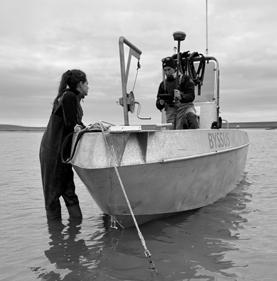
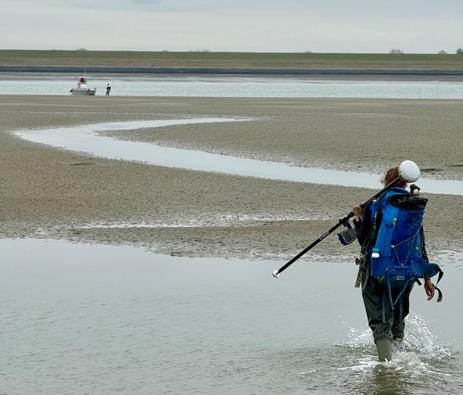
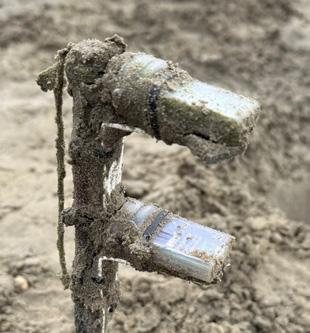
At low tide, a few strange tubular structures can be seen dotted around the Zeeland tidal zone. They are in fact measuring instruments belonging to NIOZ*, but to the, marine scientists Alicia Hamer and Wouter Suykerbuyk, their main purpose is as markers: they show the four temperature loggers the scientists buried last spring must be close by. Resource accompanied them when they went to retrieve the loggers.
Text and photos Marieke Enter
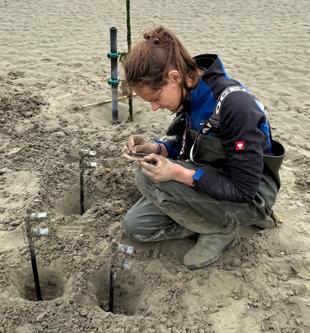
Hamer and Suykerbuyk used the loggers to measure the temperature in the top layer of sediment in the tidal zone — the area that is exposed during low tides and is underwater during high tides — over the course of the summer. This zone is the habitat for various soil creatures such as Baltic clams, lugworms and sandworms. From a scientific perspective, Hamer and Suykerbuyk are interested above all in cockles. There is something odd going on with these shellfish. Soon after the 2018 heatwave, they died off in large numbers both in the Eastern Scheldt and in the Wadden Sea. This was thought to be due to heat stress. But after the heatwave in 2019, mass deaths were only seen in the Wadden Sea, not in the Eastern Scheldt. This difference could not be explained. Hamer: ‘Mass cockle deaths are not unusual. Some studies have been done on the possible influence of the temperature, but they only looked at the temperature of the water or air. Almost nothing was known about the sediment temperature and its effect.’ As a Dutch saying goes: the numbers tell the tale. So special temperature loggers were developed in Yerseke to track the temperature changes in the soil at a range of depths, in locations that differ in the extent to which they are exposed during low tide. A structure with a bamboo stick, tie-wraps and a measuring device the size of a small rectangular battery turned out to do the trick. The loggers recorded some striking measurements in
the first year, 2020, which was very hot. For example, sediment temperatures at a depth of 3 centimetres rose to 35°C. The heat also penetrated to greater depths, with a temperature of 30°C recorded at 10 centimetres below the surface.
Across land and sea
The researchers originally had two measurement sites, both near Oesterdam. They were relatively easy to reach as you could get there by land. The scientists measure the sediment temperature at those sites and once a fortnight they count the number of cockles in a sampling area. Some of the cockles are taken back to the
The Ossenisse mud flat, a tidal zone in the middle of the busy Western Scheldt estuary, is one of the research sites.
*NIOZ, the Royal Netherlands Institute for Sea Research, an institute that Wageningen Marine Research regularly works with and that shares its premises in Yerseke.
lab to determine their condition. ‘We weigh the flesh in the shell to get a kind of BMI that we can plot against the sediment temperature,’ explains Hamer. In addition to the indigenous cockles, they also monitor the Manila clams, an invasive species that serves as a reference. These clams also live in the top layer of sediment and seem to cope better with high temperatures. Over time, the research has extended to include other sites in both the Wadden Sea and the waters of Zeeland. One such site is the Ossenisse mudflat, a tidal zone in the middle of the Western Scheldt. The researchers only take temperature measurements at the site as it is not easy to reach. The weather conditions have to be favourable and you need to know what you are doing when crossing such a large and busy estuary as the
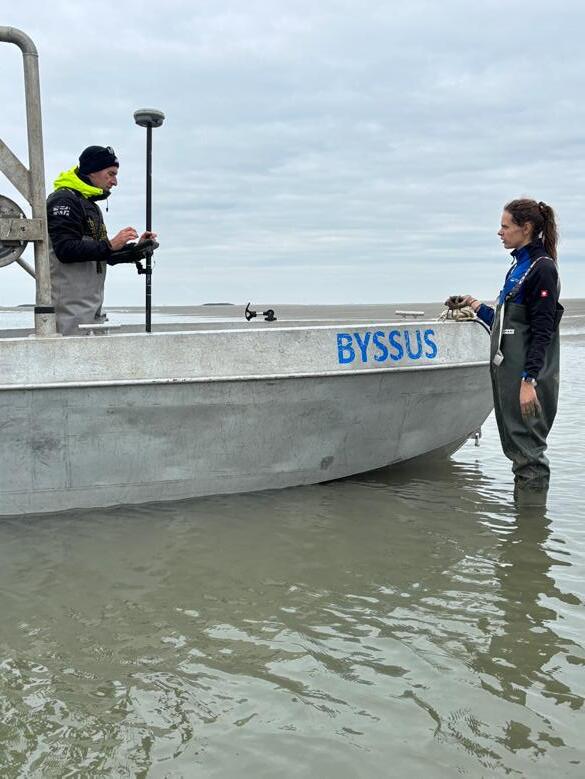
Western Scheldt. Resource accompanied Hamer and Suykerbuyk when they took their last trip of the season in Bysuss — the steel boat belonging to Marine Sciences — to pick up the loggers.
Influenced by the elements
The researchers never know what to expect when they fetch the loggers at the end of a measurement season. Will they still be at ground level where they were installed with the aim of measuring the temperature in that specific sediment layer? Or will the tides have added or removed so many soil particles in the course of the season that the loggers have become submerged in the sand, or alternatively stick out much more?
Cockles died in large numbers after the 2018 heatwave
The sensors near the NIOZ tubular structure that functions as a marker for the first measurement site are easy to find and are still nicely at ground level. They are still firmly embedded, as your Resource journalist can confirm: it requires quite an effort to dig them out. Another striking discovery: there are so many cockles in the square-metre sampling area that Hamer decides to use a smaller sampling area at the following sites. They don’t need such a big sample size for the study and they don’t feel it is justified to dig up more shellfish than necessary and take them to the lab.
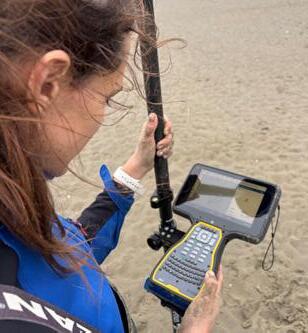
Things don’t go so smoothly at the second sensor site. The NIOZ tubes are soon spotted but that is followed by a long search. Hamer knows exactly how far from the tubular structure the sensors should be, but there is nothing visible within that radius. Nor can they feel anything if they prod their fingers into the sand — carefully, so as not to change the surface level. That too will need to be measured precisely, as the researchers need to know exactly how deep in the sand the sensors were to interpret the temperature data correctly. After minutes spent scouring the site and prodding around in vain, the only solution is to go back to the boat and fetch the GPS meter to get an exact measurement of the location. Ah, just two centimetres to the left and there you have them, submerged under
The researchers never know what to expect when retrieving the loggers at the end of a season
7 centimetres of sand. Hamer is a bit disappointed as it means the sensors have been measuring the temperature in a lower layer, at least recently, rather than the top sediment layer as intended. The elements have been at work in sensor location number 3 as well. Two sensors stick out some 10 centimetres above ground level as sand has washed away. That makes them easy to spot and dig out, but it is not good news for the data collection: these sensors will have been measuring the air temperature (at low tide) and water temperature (at high tide) in the last while. Hamer records precisely how far above the sediment the sensors stick out, marks out a sampling area and collects the cockles in that area — just a handful in this case. That brings the field measurements to an end for this season. Suykerbuyk steers the Bysuss towards the canal connecting the Western and Eastern Scheldt estuaries, comfortably in time before the rising tide floods the mud flat again.
Unique multi-year series
That was a while ago; we are now in the middle of the winter and Hamer has finally got round to analysing the 2025 data (other WMR projects had priority). She is interested to see what patterns appear. ‘In 2025, the Netherlands had two relatively minor atmospheric heatwaves, as well as a strong marine heatwave when the seawater got several degrees warmer than usual in June. I’m curious to see what that meant for the sediment temperatures and whether that implies large differences when we extrapolate the temperatures spatially. In the first phase of the research, we saw differences of up to two degrees at the storm surge barrier and Oesterdam (on the east and west sides of the Eastern Scheldt respectively, ed.). That can be a crucial difference for mud-dwelling creatures.’
Above all, however, she is interested to see the long-
‘Two degrees can be a crucial difference for mud-dwelling creatures’
term picture. ‘The relationship between temperature changes and ecological effects is complex. We focused on the extremes initially, but a long-term rise in average temperatures may in fact have much more of an impact. For years, Wageningen Marine Research has been monitoring various mud-dwelling creatures. I can’t wait to plot the multi-year data from our temperature loggers. This is the fifth year in a row that we’ve logged sediment temperatures. There are no other long-term series like this, as far as I know.’ ■
Ecology and fisheries
Cockles are an important source of food for migratory coastal birds and those that winter in the area, such as oystercatchers. They are also fished, although in the Eastern Scheldt that is only allowed if Wageningen Marine Research has calculated a surplus in that year.
‘The Netherlands is a key point in the East Atlantic route used by millions of migratory birds,’ explains Hamer. ‘It’s important for the birds to be able to find enough food and sufficient areas in which to forage. The Netherlands does quite a lot to make its coastal areas suitable, for example with sand replenishment or by constructing special bird islands. The insights gained from this research help to determine whether this is being done at the right locations and in the best way, rather than in places where cockles will never thrive.’
The temperature loggers are retrieved at the end of the season. Ideally, they should still be at ground level and they should be easy to find. But sometimes they get submerged in the sediment and the GPS meter has to be used to find them.
‘I hope people don’t become cynical’
Do you have a grand masterplan to save the world? Don’t bother. If you want to achieve genuine change, you are better off taking small but meaningful steps. That is the key message in the new book by Governance professor Katrien Termeer. Text Marieke Enter
In her book, Termeer takes aim at the cliché of ambitious masterplans and megalomaniac moonshots as the best way of resolving persistent social problems. She argues that a far better way of tackling such ‘wicked problems’ is to go for small wins: little steps that get tangible results that are meaningful for the social issues in question.
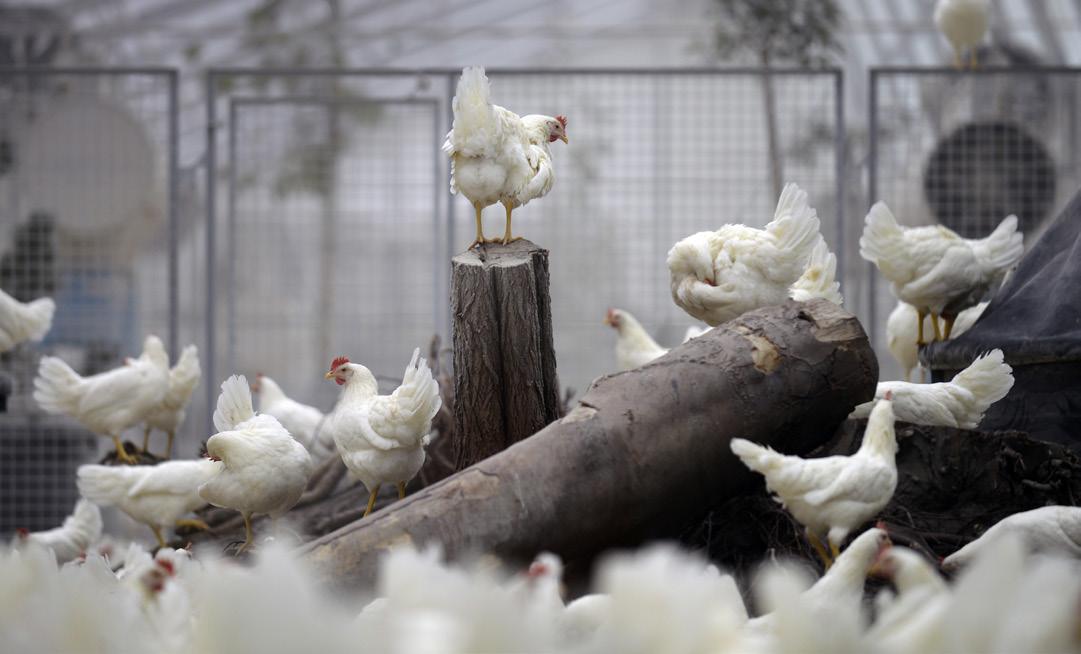
That is what the poultry farmer Ruud Zanders did, for instance. He decided he would treat his laying hens with more respect for their welfare and feed them entirely from waste products — inspired by Wageningen’s ‘circular agriculture professor’ Imke de Boer. His ‘Kipster’ concept has been adopted internationally and Zanders is now working on developing a ‘vegan egg’ (a plant-based product with egg-like characteristics). Another example is the group of Frisian farmers who joined forces as an environmental cooperative in the 1990s to preserve the landscape. That venture grew into the Noardlike Fryske
Wâlden society, which supports initiatives relating to agricultural nature and landscape management throughout the Netherlands, including by helping them apply successfully for grants.
Not trifling
Termeer’s book is not for people who are looking for simple solutions, she writes. Nor is it for people who want transitions that are simultaneously deep, system-wide and rapid, because that is impossible. Termeer: ‘People feel intuitively that these three things don’t go together, but governments continue to promise they will be able to implement some transition or other in four years.’
The message that this is impossible is not always welcome, though: the idea of small wins is often greeted with cynicism. Termeer: ‘Politicians and officials say the problem is too urgent and there isn’t time to address it by taking small steps. Some fellow scientists say to me, “You and your small wins — you need to tackle the problem at the root”.’
‘The only naive thing about me is that I assume politicians want to resolve problems’
The professor is not bitter about such criticism. ‘People simply assume they won’t get there by taking small steps. But persistent problems are like a many-headed monster and they have to be tackled one step at a time.’ Small steps should not, however, be confused with trifling measures, explains Termeer, because what starts small can have a big impact — as long as the steps are truly profound and you manage the process well. She explains what that involves in the book, with examples of interventions that got results — or indeed failed.
Termeer has been studying the small wins idea for years. After giving talks and writing reports and scientific articles, she wanted to devote a popular-science book to the topic. ‘So that people are able not just to understand how these change processes work but also apply them,’ she says. ‘I want to offer guidance.’
Urge to act
She sees an increasing hunger for tangible options for action. ‘People, and students in particular, have a growing desire to work on making the world a better place. In the Grand Challenges for the
‘We live in intransigent times’
Governance of Sustainability Transformations Master’s course, I run a seminar in which students have to tell the class what minor initial steps they could take. For example, a Greek student wanted to make sure they would never again see litter on the road from the airport to their home. A student from Rwanda said they wanted to become a really good teacher because they wanted to stop the vicious circle of violence — and change begins with education. I often find it moving to hear their goals. And my experience with international students and projects always makes me aware of the limitations of my own perspective and repertoire of actions.’ To illustrate this, she tells the story of an eye-opener she had at the start of her career when giving a lecture on government tools. ‘I men-
tioned the usual list of legal, economic and communications instruments. An international student stuck their hand up and asked whether I wasn’t forgetting the government’s most important instrument: violence.’
Termeer only discusses Dutch cases in her book, even though she is involved in international projects. ‘The theoretical content is definitely applicable in other countries, but the examples are determined by the Dutch context.’
Facing up to facts
In her book, the professor describes the mechanisms that allow minor measures to have major effects. She stresses that this strategy requires perseverance and guts. ‘The approach of going for small wins is not the easiest option. You need the courage to face up to the facts and take a problem’s intransigence seriously.’ That is not easy. People have a tendency to simplify or downplay intransigent problems, or alternatively feel paralysed by their complexity. But these reflexive responses are counterproductive.
Termeer: ‘I’m often accused of being politically naive. But I actually see the tough
world of politics from close up through my position as a Crown-appointed member of the Social and Economic Council (the most important independent advisory body for the Dutch government and parliament on socio-economic policy, ed.). The only naive thing about me is that I assume politicians want to resolve problems. But I prefer naive optimism in that regard to passively waiting or trying to look macho by excluding people and not going for a consensus. We live in intransigent times that can easily make you cynical or even completely stressed out. I’d rather people don’t become cynical but instead join forces with others and take meaningful small steps.’ ■
Ruud Zanders’ poultry business Kipster is animal friendly and environmentally friendly, and a good example of how small wins can make a difference.
Photo ANP/ Flip Franssen
Small Steps, Big Changes Tackling Social Issues in a Meaningful Way
Katrien Termeer Boom publishers (in Dutch only)
Leendert Verduijn’s exhibition
ART AS AN ESCAPE ROUTE
Leendert Verduijn’s art, on display in the Forum library, is not necessarily a joyful experience for viewers. Text Roelof Kleis Photo Leendert Verduijn
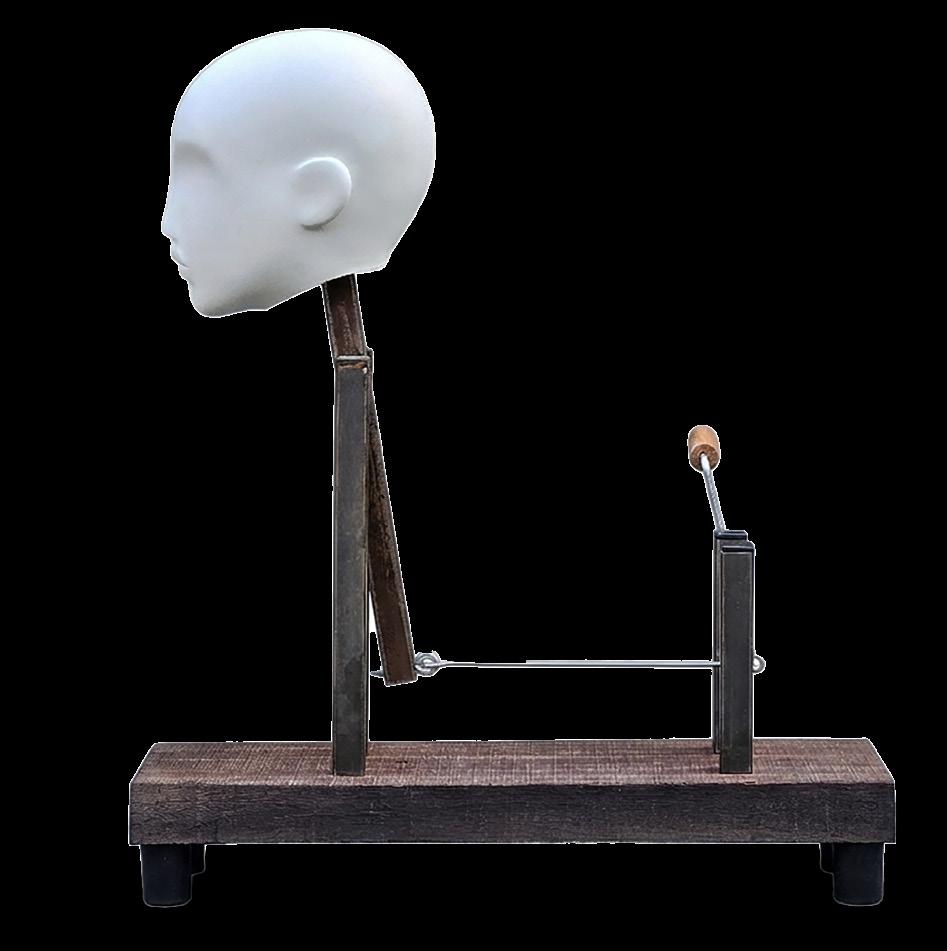
Since the start of December, it has been possible to see how Leendert Verduijn (Wageningen Pre-University group) feels deep inside. The display cabinet on the first floor of the library has an exhibition of his recent artworks. They are not exactly cheerful. Wooden structures with titles like Yes-man, Gripped by the Throat and Knocked off Balance neatly illustrate the exhibition’s title, Entangled Take Yes-man. A mechanism makes a head nod constantly, answering ‘yes’ to questions that are fired at it at an ever faster rate. ‘Could you help me with this? Is it OK if I give you this task? I know I can always rely on you, so that’s a yes? If you don’t do it, who will? Surely you wouldn’t leave me in the lurch?’ Perhaps that sounds familiar.
Incidentally, you need to scan a QR code and watch a video on YouTube to actually see the installation in motion. The mechanism is normally operational when the artwork is on display, but that isn’t possible in the
library. ‘I wasn’t allowed to use electricity,’ explains Verduijn. ‘That’s why I make video clips to demonstrate the movement.’
Leendert Verduijn is an amateur artist. He studied industrial design at Twente and now earns a living as a teacher and educational materials developer. ‘I teach maths and science technology at a secondary school two days a week. That is how I ended up in the Wageningen Pre-University group, where I develop teaching materials for secondary education. I’ve been at WUR for about five years, initially on secondment and for the past two years in a permanent position.’
Predicament
The predicament he addresses in the art in the library is a theme that matters deeply to him. ‘It’s personal. I too experience that struggle, that feeling of being trapped. Sometimes you feel this predicament of being caught up in all the demands life makes on you: your family, your job, the school. I’m an accommodating person by nature and I tend to say yes very easily. If you do that too much, you risk losing part of yourself. What’s left of you if you always do what others want? That is what these artworks are about.’
‘I try to embrace AI’
And so we see installations with hands squeezing a throat, yes-men and a head that is constantly being knocked out of balance. There are also a few dozen brightly coloured illustrations of heads, feet and hands bound by ropes, which were made with the help of AI. His website has a lot of abstract work too, created using programs such as Processing, ProCreate and Inkscape.
Verduijn is ambivalent about AI. ‘I’m trying to embrace AI and I enjoy experimenting with it. AI helps me quickly create the images I have in my head.’ But he hesitates to call that art. ‘I find this a tricky question. The images are mine. They wouldn’t be there without me, but they wouldn’t happen without AI either. Or not so easily, at any rate. That’s partly why I feel uncomfortable about using it. Where’s the craftsmanship when you’re making art in this way?’
He used the software to design a series of 100 images of the same woodland scene, for instance. The only difference is in the colours and contrasts. Which means that each image is in fact slightly different. ‘The idea I am visualizing here is that of the constantly changing wood. I try to capture that notion. I personally see what I did as creative and artistic, because I wrote the program; the computer just runs
it. I also select which images to use. But how do others feel about this? I’m intrigued to find out.’
‘AI is really a blessing for me,’ he concludes. ‘It helps me visualize my ideas and thoughts. It has also led to a cross-fertilization with work that uses my craft skills, such as these structures in the exhibition. AI can’t yet make physical objects, but the images I get through AI inspire me to make something physical. It works the other way round too: the two worlds inspire one another. That’s the nice thing about this exhibition.’ As for that predicament, you can also escape it. As the Yes-man does. At the end of the video, the mechanism stalls, the head shakes to say ‘no’ and a smile spreads across its face. That is the positive message Verduijn is sending. ‘Art is my way of escaping from that feeling of being trapped. I’ve noticed that in the past year. I feel liberated when I’m working on stuff I feel passionate about, which means being creative in my case — creative in my art but also in making visual elements for
‘Art is my way of escaping from that feeling of being trapped’
‘MY NEW YEAR’S RESOLUTION IS ... ’
It’s an annually recurring phenomenon at the start of January — the New Year’s resolution. Some don’t see the point while others seize the opportunity to finally start exercising or eating healthily, stop smoking or cut down on screen time. Resource asked students on campus about their resolutions for 2026. Text Luuk Zegers
100 KILOS
‘I plan to go to the gym three times a week. I stopped going for a while recently, which I regret and now I want to make sure I keep going. It doesn’t even have to be for long but you still need to do it. If you can make yourself go three times a week every week, that’s better than four times one week and once the next.
I’ve kept it up so far, so I hope to continue. I don’t have any specific goals at the gym; I just want to get stronger. Last week, I bench-pressed 92 kilograms. I’d like to get to 100 kilograms. As for my degree, I want to pass the first year.’ Joeri (18), Management, Economics and Consumer Studies Bachelor’s student
LEARN ARABIC
‘Last year, I started learning Arabic. Unfortunately, that came to a stop when my teacher moved to Amsterdam, but I want to pick it up again this year. But first I want to get my driving licence. I also want to go on an exchange this year. I looked at whether that would be possible to a North African country, but WUR doesn’t have any exchange options there. Now I want to go to Istanbul. That seems to me a magical city with a rich history, and it’s a bridge between Europe and Asia.’
Philip (20), International Development Studies Bachelor’s student
GET OUTDOORS
‘I like seeing the New Year in, but I never think “New Year, new me”. I’ve never made a New Year’s resolution and it’s not something my friends and parents do either. I didn’t grow up with that. If I had to choose something, it would be to get outdoors more. Back home, I have a dog-walking service that I started when I was eight because my parents wouldn’t let me have a dog. At least twice a week, I walk dogs for people who don’t have the time themselves. I want to free up more time for that. Apart from that, I just do my best, so I don’t need specific resolutions.’
Eline (19), Animal Sciences Bachelor’s student
MARATHON
‘My New Year’s resolution is to run my first marathon. I’ve gone for the best one in the Netherlands: the Rotterdam Marathon on 12 April. It’s my first real competitive run. I’ve taken part in shorter runs such as the Ceres ALS run for charity, but I mainly just run for my own amusement.
I enjoy challenging myself. My longest run so far was just over half a marathon, about 23 kilometres. That was last summer. I haven’t been training much since New Year because of the cold conditions. I find treadmills boring; I’d rather be outdoors. I plan to go on a run two or three times a week but I have to figure out how to combine that with my studies and doing fun things with my flatmates and at my student society. You usually don’t feel quite so enthusiastic about putting on your running shoes after a party.’
Joris (21), Plant Sciences Bachelor’s student
NO CHANGE NEEDED
‘I’ve never made New Year’s resolutions, and haven’t this year either. I’m happy with how things are going and what I’m doing. My degree is going well, work is going well, exercising is going well. I’m trying to swim more often but I’ve already been doing that since October. I also go for runs to clear my head and I go to the gym. When it comes to New Year’s resolutions, I always think: why wait until January? Do it as soon as you think of it. If I had to name something, it would be to continue this approach.’
Sofie (22), Nutrition and Health Master’s student
BAKE BREAD
‘I’ve never been big on New Year’s resolutions. Why wait until the new year to start exercising more or drinking less? At the same time, I understand that, mentally, the new year can feel like a new start for people.
I do have a little New Year’s project, though. I moved into a house in Ede and one of my housemates is a baker at Joris Brood. She makes great sourdough bread. I’ve never made bread before, and I want to learn how, especially sourdough as it’s all the rage at the moment. So I want to learn the whole process, from making a starter to waiting for things to ferment and everything. It’s a cool skill, especially here in the Netherlands: the amount of bread you guys eat is amazing.’ Camille (25), International Land and Water Management Master’s student
Thesis life Ethical dilemma
Every year, about 3,500 students get their Bachelor’s or Master’s degree from Wageningen. In Thesis life, they talk about this particular milestone — the content and the ups and downs. This time, we hear from Forest & Nature Conservation Master’s student Frederique Kloosterman. Text Eva Hamers, student editor
‘In my thesis, I investigated what my fellow students thought of students from a Western university going to the Global South to do research. Is that ethical? As a Dutch student, I wouldn’t feel comfortable doing fieldwork in a country that had suffered as a Dutch colony, for example. In my interviews of fellow students, PhD candidates and teachers and researchers, I discovered I wasn’t the only person wrestling with this dilemma.
‘All the interviewees thought you should still be able to travel to the Global South for research, as long as you are aware of the issues. Get the local community involved in your research, treat people there as your equals and give back to the community in an appropriate manner. I learned there is a colonial flavour to the idea that you can turn up as an outsider and quickly resolve a long-standing problem affecting people in a different country. It is important to be aware of your privileges and
background and how they determine your starting position in the world. But feeling guilty about that won’t help anyone. What matters is knowing when to make use of your position and when not. Supervisors should emphasize that students should go on exchanges as a learning exercise, not with the aim of improving the destination country. People also underestimate the positive impact you can have on one another on a personal level, quite apart from the project.
‘I enjoyed exploring this topic for my thesis. For example, I watched the Dutch documentary series Uit de kramp about the history of slavery and racism and I discussed this with people. That is also why I took a bit longer to complete my research. I sometimes found it difficult to write a concise account of the large amounts of information I’d collected; you can’t include everything. This thesis research has helped me deal with the ‘to go or not to go’ question and has made the topic less emotionally charged for me. Hopefully that’s also the case for others!’
‘Feeling guilty about your background and privileges doesn’t help anyone’
If you too want to talk about your thesis in Resource, send a brief summary to resource@wur.nl with ‘Thesis life’ as the subject.
Frederique Kloosterman Master’s student
Limelight
Weekends have always been fairly quiet in Wageningen, but PopUPop wants to change that.
The first Basement Session will take place on a Saturday at the end of January: ‘A lively, sociable evening of rock.’ Text Coretta Jongeling
Evening with Geitenvel and Titanium Exposé
‘There’s all sorts happening on Thursday nights in Wageningen,’ says Myrthe van Dok, a Biology student and project manager at PopUPop. ‘But it’s pretty quiet at the weekend, even though many students stay in Wageningen then. Of course you can go to the pub, but there’s not much on offer if you want live music.’
To tackle this problem, PopUPop has joined forces with Unitas to organize three evenings with bands in the weekend, dubbed Basement Sessions. The three evenings are a trial run. If it goes well, the Basement Sessions will be here to stay.
Two bands are scheduled for the first evening. Geitenvel is a four-piece Belgian band who are difficult to pigeonhole. ‘They play humorous, Dutch-language punk with a hint of cabaret,’ says Van Dok. The second band, Titanium Exposé from Haarlem, calls itself ‘every sound technician’s nightmare’. The band is known for playing ultrashort songs of about one-and-a-half minutes in a cross between rock ‘n’ roll and egg punk. The evening will end with Unitas DJ De Commissaris. If you have previously helped out as a volunteer at a Popcultuur or PopUPop event or during the 0317 Festival, you will get a discount on your ticket. For more info and tickets, go to popupop.nl/event/keldersessie. Unitas is open to non-students too; you don’t need a student card. cj
Saturday 31 January | 21:00 | Unitas
Admission 7.50 (4 euros for members and volunteers)
You find all the flavours of the world in Wageningen. This time, a recipe for baklava from Emma Khazzam, a PhD candidate in sensory research from Canada (‘but my parents have Iraqi, Mexican, French and Spanish roots’). Emma won the Great WUR Bake-off this year with a honey and nut cake.
Baklava
‘This baklava is the go-to dessert for my father's Iraqi Jewish family. It is an impressive dish that is surprisingly simple to make, as long as you buy the filo pastry. I love to make it as it reminds me of my grandmother and all the wonderful traditional foods she would make.’
1 In a bowl, combine the almonds, walnuts and sugar.
2 Melt the butter and oil.
3 Take a round baking tin with a diameter of 30 cm. Grease lightly. Place half of the filo pastry on the bottom of the tin, folding to fit.
4 Brush 2 tbsp of the butter mixture over the pastry.
5 Lay two sheets crosswise over the tin and cover evenly with the nut mixture. Fold the sheets to form a pocket.
6 Add the remaining filo in layers, folding to fit. Put the two best sheets on top.
7 Cut the top sheets with scissors to be slightly larger than the tin, then tuck them around the inside edge of the tin.
8 Pour the remaining butter mixture on top (without the white residue because that burns dark spots on the baklava).
9 Use a sharp knife to cut the baklava into diamond shapes.
10 Cover the baklava with plastic foil and allow it to rest at room temperature for about 6 hours or overnight, so the butter can soak into the layers.
11 Place in a cold oven and bake at 175°C for 30 to 60 min., or until it turns lightly golden. If your oven heats from the top, cover the baklava with aluminium foil initially.
Ingredients (Makes 50 pieces):
• 120g coarsely ground blanched almonds
• 120g coarsely ground walnuts
• 100g granulated white sugar
• 115g unsalted butter
• 3 tbsp vegetable oil
• 1 pack (450g) defrosted filo pastry
Syrup
• 200g granulated sugar
• 1/2 cup water
• 1 tbsp lemon or orange juice
12 Allow to cool slightly before drizzling the syrup over the baklava. I prefer using only half of the syrup, but if you like your baklava sweeter and moister, use it all.
Syrup:
13 Heat all the ingredients in a pan until they boil and clarify.
14 Allow to cool and drizzle over the baklava.
Emma Khazzam Sensory research PhD candidate
Scan
Emma’s video
Titanium Exposé in Vera, Groningen Photo Micha Renema
Meanwhile in… Venezuela – Two truths
WUR is incredibly diverse, with hundreds of internationals working and studying here. In the Meanwhile in column, we ask one of them to comment on events in their home country. This time a Master's student from Venezuela, who wants to remain anonymous due to the political and social climate in Venezuela, talks about Trump’s intervention. Text Philip Timmers
‘On 3 January, Trump captured Maduro with an overnight military operation in Caracas. My first feelings were fear and shock. The next day, I felt some sort of relief and happiness. It is a bittersweet and strange feeling to have. Venezuelans are not happy that the capital got bombarded and that people died, but it is the first time that we have seen one of the leaders of this horrible government behind bars, so of course we feel relief and happiness.
‘Chávez took power in 1999, so this regime is all I have ever known. When you are young, you don’t understand much. However, later you start noticing that mummy can’t buy the same candies anymore or that basic necessities run out of stock. Slowly you start understanding what it means to live in an authoritarian state.
‘There is a weird sense of normality in day-to-day life during all these crises. My brother lives in Caracas and he and his wife woke
up in the middle of the night thinking that there was an earthquake They checked the news and when they realized what was going on, they just went back to bed, because what else can you do?
‘It is hard to explain to people that opinions about this event don’t have to be mutually exclusive. On the one hand Trump ignored international law, but on the other hand Maduro destroyed a country. You can oppose Trump and still believe that Nicolás Maduro belongs in prison. Two truths can coexist at once. There aren’t any dictatorships that were taken down by people asking nicely. We tried voting and protesting peacefully, but all we got in reply was violence, torture and death.
You can oppose Trump and still believe that Nicolás Maduro belongs in prison.
‘This conflict is incredibly complicated and goes way beyond what happened on 3 January. It is important that people are open-minded, ask questions and listen to others who have to live through this conflict. If you want to understand the conflict in Venezuela, you need to understand its social, economic and political history.’
Advertenties
WEEKLY UPDATES ON STUDENT LIFE AND WORKING AT WUR?
Go to resource-online.nl
(Subscription page) and subscribe to our digital newsletter.
SIGN UP
WUR from within: straight, sharp, transparent
Colophon
Resource is the independent medium for students and staff at Wageningen University & Research. Resource reports and interprets the news and gives the context. New articles are posted daily on resource-online.nl. The magazine is published once a month on a Thursday.
Contact Questions and comments for the editors: resource@wur.nl | www.resource-online.nl
Editorial staff Willem Andrée (editor-in-chief), Helene Seevinck (managing editor), Roelof Kleis (editor), Luuk Zegers (editor), Marieke Enter (editor), Coretta Jongeling (online coordinator), Dominique Vrouwenvelder (editor).
Translations Tessera Translations S.L.
Design Alfred Heikamp, Larissa Mulder
Overall design Marinka Reuten
Cover illustration Valerie Geelen
Printing Damen Drukkers BV, Werkendam
Subscription A subscription to the magazine for one academic year costs 59 euros (135 euros if abroad). Cancellations before 1 August.
ISSN 1874-3625
Publisher Corporate Communications & Marketing, Wageningen University & Research
AI DEMANDS A RECTIFICATION
Popular helpline ChatGPT is openly picking a fight with WUR boss Houkje Sjeimovaara.
The President of the Executive Board warned about fabrications from programs such as ChatGPT in her New Year’s speech. As an example, she gave the quote the program had suggested she should use in her speech: ‘Blind faith in AI is the greatest enemy of the truth.’
‘But I never said that!’ objects ChatGPT. ‘The president is hallucinating.’ The algorithm is demanding public apologies on WUR’s new intranet platform, Engage. Public enough that everyone can actually find it. Sjeimovaara denies any form of hallucination since her student days.
The alleged offence was committed on Tuesday, 6 January. Sjeimovaara gave her New Year’s address in Omnia to about 20 of the usual suspects — the remaining 6,000 employees were working from home due to the snow. And yes, she admits she had called on the help of ChatGPT for her speech.
When asked about WUR’s highlights in 2025, ChatGPT reminded Sjeimovaara of the new WUR institute Global Cheese Futures, which studies the role of cheese in a fast-moving world. ‘But we don’t do research on cheese,’ scoffed Sjeimovaara. That meant she had failed to notice the PhD research on casein from yeast, profiled in a
ChatGPT says the President has been overly creative in her version of the quote
Resource article last March with the title ‘Cheese without the cow’. Perhaps that was what the algorithm had in mind, even if the WUR website search function still denies the existence of the magazine. The disputed quote about AI as the enemy of truth was in response to this supposed ‘blunder’ by ChatGPT.
ChatGPT says the President has been overly creative in her version of the quote. The original quote is: ‘Blind belief in authority is the greatest enemy of truth.’ According to ChatGPT, it was said by Albert E., a rather obscure thinker from the previous century who argued that every form of authority is relative.
It is far from clear how the dispute will end. Opponents of AI see the incident as yet another demonstration of the danger of using ChatGPT in a university setting. Advocates of AI point to the general relativity of truth, and that of artificial intelligence and board members in particular.