Tick-box system for lecture recordings Orion to get a stage Campus ban is working
Beaver spotted near Dassenbos
Palestinian students coming to campus How to
Meteoric
Two students had totally opposed views. One refused to use AI for their degree because it steals from artists and slurps up energy. The other embraced it because it can’t be ignored any more so you should use it where necessary. That discussion prompted us to go out onto the campus and ask random students how they use AI and why. Of course this is only a very small survey, but the results make you optimistic about the situation in Wageningen. Because yes, these students do use AI and no, they don’t do so without thinking hard about why (page 28). And they don’t plan to give up critical thinking.
The meteoric rise of large language models, which can be surprisingly good. So we are also thinking about how to tackle AI, only in the field of journalism. We don’t yet have a policy but we are working on it. One thing is clear: we exercise extreme caution in our use of AI. Anyway, AI can’t replace the fundamental journalistic tasks of interviewing staff and students, getting word of news or wrongdoings and assessing the relevance of stories. Just as well, because we enjoy our job far too much to want to outsource it.
Willem Andrée Editor-in-chief
FROM HARRY TO 0317
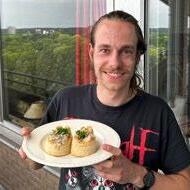
Harry Styles did ten concerts in the Amsterdam Arena. Hardcore fans arrived hours early, armed with umbrellas, folding chairs and blankets – all things they weren’t allowed to take inside. Second-hand shop Emmaus was there every day, saving this stuff from the waste bin. Resilient Food & Farming student Manu Arend helped on behalf of Emmaus Wageningen. She is giving the blankets a new lease of life as festival decorations – they will be on show on Saturday 13 June at the 0317 festival. cj
Own photo
Tick-box system for access to lecture recordings
A tick-box system will be introduced for students unable to attend every single lecture for specific reasons. ‘Students who satisfy the criteria (tick the right boxes), for example because they have a functional disability or family care commitments, will get access to video recordings of lectures,’ says Student Council chair Laurien Elion.
A similar system already exists for students allowed extra time for exams because of functional disabilities, says Elion. ‘They used to have to arrange that separately each time they did an exam, but the tick-box system in Osiris means it happens automatically now. By providing a similar system for students who can’t attend every single lecture because of exceptional circumstances, they will no longer have to explain this again every time they start a new course.’
Student counsellors will decide whether students satisfy the criteria
The measure only applies to lectures that are scheduled in classrooms with recording facilities. If that is the case, from now on the lectures will have to be recorded and shared with the students satisfying the criteria as soon as possible. Student counsellors will decide whether students satisfy those criteria. The new policy will take effect at the start of the coming academic year.
Fewer recordings
Despite this, the cutbacks may mean fewer lectures are recorded in future, says Education & Student Affairs policy officer Nelleke Lafeber. Lafeber: ‘That is because the facilities for making recordings will soon only be available in classrooms with capacity for 50 students or more.’ The number of classrooms with recording facilities will be reduced from 63 to 44. The Teaching and Learning Centre, the student counsellors and the Student Council will monitor the new policy over the next few years. lz
Beaver near Dassenbos
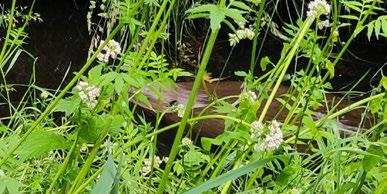
Thomas Ginn couldn’t believe his eyes when he cycled across the west side of the campus last week. ‘At first I thought it was a muskrat or coypu. But then I saw the flat tail, so I knew it had to be a beaver. It was swimming in the channel alongside Dijkgraaf path next to Dassenbos woods. Impressive how it glides through the water.’ rk
Photo Thomas Ginn
Direct bus from Arnhem to campus
A new bus route will start on 28 June, the Rhine Line (no. 303). This bus service will take passengers directly from Arnhem and Velp to Ede-Wageningen station via the campus without having to change at Wageningen bus station. During peak hours, the buses will be every 10 minutes in both directions; they will be every 15 minutes in off-peak hours and at weekends, and every half an hour from 8 pm. The summer holiday timetable will apply from 28 June to 22 August, with buses four times an hour during peak hours as well. A direct bus service from Wageningen to Nijmegen, line 220, will also start on 28 June.
Source: De Gelderlander
Be willing to refuse student care
A different approach is needed to student welfare because the education system is becoming overwhelmed by the individual care needs of students with mental issues. Sometimes it’s better to refer a student to the appropriate support services, Education minister Rianne Letschert told Parliament.
The Dutch Education Council recently concluded student welfare is under pressure. However, that can’t be resolved by providing student psychologists and other individual care solutions, says the minister. She encourages schools and universities to ‘move away where possible from an individual, care-focused approach’. If institutions are overwhelmed by complex, intensive care needs, they should be willing to refuse requests and refer students to the appropriate services. Letschert also mentions parents. They need to teach their children resilience and how to cope ‘with the pressure and stress that are part of life’. hop
Read more on resource-online.nl
18
The free Summervibes festival will be held on campus again on 18 June. One new element is SEAland, where student society SEASAW bring some South-East Asian traditions to the festival. In an event inspired by traditional New Year water festivals in countries like Thailand and Myanmar, visitors will be able to squirt water at one another to wash off the bad luck from the past (academic) year and welcome the new year. The main act is the rapper Typhoon. wa Read more on resource-online.nl
Wanted: members for Resource Editorial Council
Would you like a say in the course Resource takes and an opportunity to give its journalists advice — either spontaneously or on request?
The Editorial Council is looking for WUR employees, including internationals.
The Editorial Council retrospectively assesses the editorial policy pursued by the editor-inchief and the journalistic productions (online and in the magazine) in the light of the Editorial Charter. The council is essentially the editors’ ‘content boss’.
The Editorial Council meets at least three times a year, to discuss the editorial policy over the past period with the editor-in-chief. Members serve on the council for three years, with the option of a second three-year term.
Interested? Send an email to resource@wur.nl stating your job and what part of WUR you work for.
Campus ban seems to have worked
Last October, the police imposed exclusion orders on two youngsters who had been harassing, intimidating and spitting at students on campus. Things have been calmer since then, says campus safety coordinator Wietse Willebrands.
‘The police already had their eye on the youths in question. The exclusion order imposed by the municipality has now expired. We imposed a campus ban on them to follow on from that. We haven’t had any more reports of intimidation incidents since that ban. I hope those youths have now learned to behave better.’
It’s unusual for a campus area ban to be imposed, says Willebrands. ‘I can only remember two other cases in the past ten years. One concerned a man who pretended to be disabled in the hope that women would help him. And one was a stalker.’
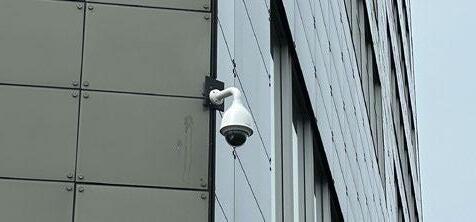
The security setup on campus was changed about a year ago, says Willebrands. ‘We used to use the security
cameras mainly to look back at what had already happened, but in June last year we started live monitoring in the evenings and weekends. Now, if people seem to be loitering on campus without good reason, we ask them to explain themselves sooner. In the past, the security staff might only have spoken to them after two hours, but now we intervene more quickly. I think this could prevent
violent incidents like the one that happened two years ago.’ lz
If you are a victim of harassment on campus or witness such an incident, you can report it to the police and to WUR’s Social Safety Contact Point.
Phote Resource
Letter to the editor
Year-end gift a waste of money?
It doesn’t seem very logical to be writing a letter in June about WUR’s end-of-year gift to its employees. Yet I think that as a ‘learning organization’, the university should learn from how it shows its appreciation of its staff at the end of the year with the year-end gift. Let’s look back at December 2025. WUR’s Executive Board thanked us all for what we had achieved in 2025 in the fields of research and education. Together, we are contributing to a sustainable future. At the same time, we are facing a ‘new financial reality’.
What can you do with 15 euros? We selected a Pineut voucher, which we exchanged for a ‘mélange pour pain aux bananes’. Meaning a mix for banana bread with chocolate. That cost 9.95 euros. Plus postage (7.95 euros), but look at what you get. Except you have to add the bananas yourself.
I am pleased WUR’s Executive Board wants to thank me for all I’ve done in the fields of research and education, and I quite understand savings have to be made. In my opinion, the Christmas gift is supposed to be a tangible sign of the employer’s
appreciation, but that can be something small such as a WUR cup. I find it a real shame that instead of such a tangible sign of its appreciation, the board has opted for a complicated system where a few companies benefit but individual employees end up spending about half the gift on postage. I don’t object to companies making a profit, but I think the university is stupid if it doesn’t know how to thank its staff in a tangible and affordable way. The ‘new financial reality’ demands creativity. Let’s keep it simple when we want to sincerely thank one another. As they say: half a loaf is better than none.
Pieter Jong, Lecturer in Spatial Planning & Environmental Governance
To comment, go to resource-online.nl
Palestinian students on their way to Wageningen
Two Palestinian students are travelling to the Netherlands and will be starting at Wageningen, confirms WUR. A third student is still stuck in Gaza.
WUR has announced that the two Palestinians, who are supposed to be coming to Wageningen to study, have left Gaza and are on their way to the Netherlands. This is after lengthy legal squabbles, aimed at getting the Ministry of Foreign Affairs to help the students come here after they were granted visas at the start of the year.
WUR had previously promised to earmark scholarships for people from conflict zones. The arrival of these students shows the university is keeping its promise, says spokesperson Vincent Koperdraat: ‘Like all international students, they can expect a room in Wageningen and the usual support services. These students went through the standard process to get a scholarship. The important thing is for them to be able to get here and set-
tle in so that they can focus one hundred per cent on their studies. We therefore call on everyone to give them that space.’
No comment
The two students are among 42 Palestinian students who have valid visas for the Netherlands. Their arrival will bring an end to months of uncertainty because the Netherlands didn’t initially
‘Like all international students, they can expect a room in Wageningen and the usual support services’
want to give them any assistance. So the students filed a lawsuit with the aid of WUR. This resulted in a ruling by the Council of State ordering the Foreign Affairs Ministry to help the Gazans. The third student is still waiting for permission to leave Gaza and come to Wageningen.
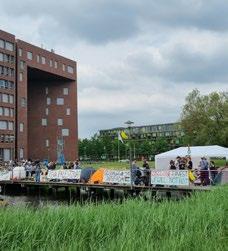
The former pro-Palestinian camp on the bridge between Forum and Orion. Photo Resource
Politicians in The Hague are now arguing about the arrival of the students. Coalition party VVD is demanding clarification, while D66, also a coalition party, calls it ‘good news’. WUR will not be commenting on the political process, says Koperdraat. wa
GENE THERAPY À LA DE JONG
Gene therapy works by inserting healthy genes into the cells of patients with a genetic defect. The exogenous genes are transported to their destination by harmless viruses. Creating these viral ‘vectors’ (as the transporter viruses are known) is expensive. PhD candidate Linda de Jong has developed a new, cheaper way of making the vectors. Text Roelof Kleis
‘Viral vectors are a bit like specialized trucks,’ explains De Jong. ‘They are viruses that have had a large part of their own genome replaced by the medicine, the gene you want to apply. We use viruses for this because they are naturally good at penetrating cells to get their own genome replicated inside the host cell.’
That is an annoying property when the virus in question makes humans and animals sick. De Jong: ‘But in this case the vector virus isn’t pathogenic and so the immune system doesn’t spot it. The genome taken inside by the virus contains the healthy gene and is therefore the medicine.’ This particular virus is called an rAAV, where the AAV stands for adeno-associated virus. The ‘r’ stands for recombinant and means that the virus was modified.
The AAV virus is a good vector for gene therapy, says De Jong. ‘But making an rAAV is really tricky. The natural virus can’t replicate on its own; it needs the help of another virus to do that. That’s also where the name AAV comes from – it was discovered as a contaminant in an adenovirus specimen. But adenoviruses aren’t great assistants from a gene therapy perspective as they are pathogenic.’
Baculovirus
Various methods have been developed to make rAAV viruses. De Jong is keying into the most recent development, using baculoviruses. Baculoviruses have long been
used to produce medicines and vaccines, but applying them for gene therapy is relatively new. It also has a major downside: the poor genetic stability during the production process.
To make the rAAV, the AAV virus is inserted into the baculovirus. This combination virus is then added to insect cells, which
‘This viral vector doesn’t make you sick and so the immune system doesn’t spot it’
replicate the rAAV in large numbers. De Jong took that path too, but she used a new baculovirus (BAC6) as the vehicle for the rAAV medicine. That resulted in a system that is much more genetically stable and therefore potentially cheaper
According to De Jong, the trick is to spread out the three required AAV genes across the baculovirus. ‘If you place them close together, you get a long section of DNA that doesn’t naturally belong to the baculovirus. That probably creates selection pressure to rid the baculovirus of
the exogenous DNA. We’ve put the gene required for the replication of rAAV in a different place.’
So has De Jong found the perfect solution? ‘No. There are lots of strategies you can use to make rAAV. In our study, separating the genes seemed to make a huge difference.’ She hasn’t applied for a patent. ‘But I hope it will be picked up in the literature and that other scientists will use a similar design.’
Live&Learn
A botched experiment, a rejected paper… such things are soon labelled as failures in academia. As for talking about them — not done! But that is just what WUR scientists do in this column. Because failure has its uses. This time, it’s Wageningen PhD candidate Anna*.
Text Nicole van ’t
Wout Hofland | Illustration Mathijs Megens/SeaBlueBird Studio
‘Immediately after graduating, I landed my dream job at a Dutch research institute. Everyone was so impressed I’d got in there. ‘That feeling didn’t last long. I was in a team that was nearly all men. Not long after I started, a co-worker said, “I’ve been noticing your clothes; you wear something different every day.” I wasn’t used to remarks like that. I also got: “The previous woman only lasted a year. You’ll be staying longer, right?” A few weeks later, I saw an older male colleague point his phone at me and take photos and videos. That made me feel really uncomfortable and unsafe, so I talked to my line manager. Instead of protecting me, she said I should deal with it myself, for example by making a joke about it. That made me feel as if I was the problem. I am naturally shy and as a young researcher, I didn’t dare tackle that co-worker about his behaviour. I’ll just have to adapt, I thought.
‘But my attitude slowly changed. I was given a coach to work on my self-confidence. “That’s not right,” said the coach when I explained the situation. That was the first time someone had been on my side. Later, I shared my expe-
riences with my father. He was so indignant that I realized that my gut feeling had been right. That prodded me to apply for a different job.
‘Even so, leaving felt like I was giving up. I felt loyalty to my team and I enjoyed the work. Because
‘My father was so indignant. That prodded me to apply for a different job’
this had been my dream job for so long, I felt I had failed. It was as if I was confirming what they had said: yet another woman who didn’t last. But in retrospect it was the right decision. These days, I’m more confident and I’m working in a great team with a good gender balance where I feel safe and can be myself.’
* Full name known to the editors.
NEW PICTURE OF FOOD
Imagine you take a photo of the food on your plate and your phone immediately tells you how much fat, protein and carbohydrates that is. This could be possible if Esther Kok’s dream comes true. Her PhD research shows that it is at least technically feasible.
Kok is a data scientist. In her research, she studied the possibility of using hyperspectral cameras to identify the nutrients in food. These cameras take photos that go further than visible light. In Kok’s case, the camera looks at infrared light, the part of the spectrum absorbed by fats, proteins and carbohydrates.
‘The algorithm had difficulty with the combination of butter and cheese, because of their fat percentages’
Hyperspectral cameras look deep inside the materials, not just at the surface. Kok let the camera scan double-decker sandwiches (with white or wholemeal bread) with butter and cheese (low-fat or regular). ‘The research question was whether you could look the whole way through the product. It was known this was possible with uniform products but we didn’t know whether it could be done with composite products.’
Fat
She found it was partially possible. ‘We were able to identify some of the ingredients but not others,’ says Kok. ‘The algorithm had difficulty with the combination of butter and cheese, because of their fat percentages.’ So Kok set up a second experiment focusing on the correct prediction of the overall fat percentages. That went very well indeed. She applied machine learning and was able to determine the overall percentage of fat and protein in 73 cheese samples. Kok: ‘It went well in 97 per cent of the cases. The best protein model was only wrong by 2 grams and the best fat model by 1.9 grams.’ That means the proof of concept is a resounding success, she says. Follow-up research is now needed to see whether a small sensor measuring only one pixel would also work. rk
EXPERIMENTAL SNACKING: WUR IS BACK AT LOWLANDS SCIENCE
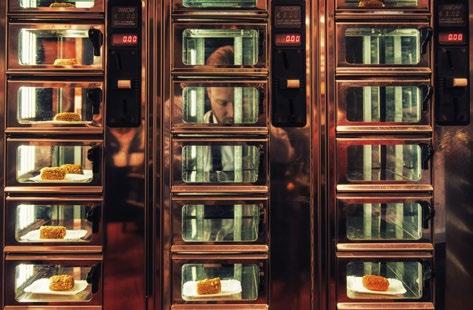
WUR will once again be taking part in the Lowlands Festival science programme. One of the living labs at Lowlands Science will be dedicated to Wageningen’s sensory and consumer research on healthy snacks, complete with a ‘snack wall’ vending machine. The scientists will also be giving live lectures on this field of research. Text Marieke Enter
The Wageningen ‘snack wall’ research project was designed specifically for Lowlands by university lecturers Arianne van Eck (Food Quality & Design/Sensory Science & Eating Behaviour), Meinou Corstens (Food Process Engineering), Roelant Hilgers (Food Chemistry) and Marlou Lasschuijt (Sensory Science & Eating Behaviour).
They will be doing sensory research on various properties of snacks. The researchers want to get a better understanding of which properties determine whether a snack is perceived as tasty, and figure out how to use that information to develop healthier snacks.
‘The question of how to make food products healthier is an important one, and it applies to snacks too,’ explains Van Eck. ‘The main research question in the Lowlands project is how far you can go in changing the composition without changing the sensory perception. The second research question is whether that depends on how much alcohol someone has drunk.’
Under the influence
Scientists have previously studied why a tray of nibbles and snacks looks all the more tempting after you’ve have a drink: alcohol removes inhibitions and affects your eating behaviour. But its effect on your sensory perception is not yet known. Do certain flavours taste stronger or weaker after a glass or two, and does this affect what people eat and how much?
Lowlands is the perfect research setting
for this particular question. Van Eck: ‘Normally, it’s ethically tricky to do research on people who are under the influence. Giving your test subjects a couple of alcoholic drinks first is not done. But many people are already under the influence at Lowlands.’
In the container that serves as Wageningen’s lab, visitors will first be breathalysed to see if they have been drinking and if so, what the alcohol content of their breath is. They will also be asked if they have taken any drugs, although that isn’t a key research question. Then the test subjects will taste various snacks from the snack wall and answer a series of questions: how tasty did you find the snack, how much would you want to eat, how greasy or creamy did you find it?
The researchers expect to be able to sur-
vey about 300 participants a day over the course of the three days of the festival. ‘We are assuming we’ll get a good spread in alcohol consumption levels,’ says Van Eck.
Mini lecture
In addition to the living labs, the Lowlands science programme includes short lectures in ‘the Netherlands’ smallest lecture room’ (meaning the Echo tent in the middle of the festival grounds). The Wageningen sensory and food researchers have been invited to give some of those lectures. The dates, times and topics will be announced later.
Photo Shutterstock
PhD theses in a nutshell
Seaweed as feed
Cows are a major source of the greenhouse gas methane. Some species of seaweed inhibit the production of methane in cows’ stomachs. That makes seaweed a potential option for cow feed. ‘Potential’ because it is not that easy in practice, shows research by Wouter Muizelaar with Holstein-Frisian cows. European seaweeds turned out to have no effect whatsoever. Other types of seaweed did reduce methane production but had a negative effect on the animal’s appetite. On top of that, the compound responsible for inhibiting the methane production (bromoform) gets into the milk. All in all, not a good idea. rk
Light is the engine driving photosynthesis. But too much light damages plants, just as sunburn damages our skin. Nature has found a way to cope with that. For instance, leaves turn away from the sun so they are less exposed to the sunlight. They also have proteins that make sure the sunlight they receive doesn’t overload the photosynthetic reaction centres. In other words, they let the energy seep away. Cleo Bagchus used fluorescence measurements to study this extremely complex process and figure out which proteins are involved. She has shed a little light on the matter. rk
Light stress in plants: insights from chlorophyll fluorescence Cleo Bagchus Supervisor Herbert van Amerongen
Mass redundancies
Mergers and acquisitions are often followed by mass redundancies. Or downsizing, as it is known in euphemistic economic jargon. The aim is to improve the financial figures, but does it work? Sometimes, but not always, shows a study by Jasper van Boven. It depends on what the stock market thinks of the situation and on the nature of the company being taken over. In the case of ‘digital acquisitions’ aimed at obtaining digital expertise that is currently lacking, downsizing is seen as a sign of failure. In other acquisitions, downsizing is often seen as a sign of success, demonstrating the synergy is working. rk
Financial performance outcomes of downsizing. Jasper van Boven Supervisor Wilfred Dolfsma
‘English academic writing functions as a neocolonial tool that limits how non-native speakers can think and publish.’
THE PROPOSITION
PhD candidates explain the most thought-provoking proposition in their thesis. This time it’s Adriana Ressiore, who defended her PhD on 15 December. She researched the potentials and challenges of more-than-human care for biodiversity conservation in Brazil. Text Ning Fan
‘I always felt writing academic articles in English was quite limiting and sometimes painful. This goes beyond the linguistic challenge: it requires reorganizing ideas, simplifying nuances, changing the rhythm of the text and leaving some concepts behind, even when they feel very meaningful in my mother tongue, Portuguese, and for the empirical cases, because they do not fit well in English academic writing.
‘When we change the language we use, we also change the way we think. I am now trained to write in English academic contexts and I find it easier. However, I keep asking myself how much this process has shaped my academic thinking, and what the consequences are for how I read other texts, and what I judge as important, clear and/or rational.
‘English has become the dominant language in academia, which can exclude those who do not master it. It shapes not only how we communicate ideas, but also which ideas are more easily expressed and recognized.
‘I describe this as neocolonial because these standards are not neutral. To participate in academia, scholars must adapt not only their language but also their ways of thinking and expressing knowledge to fit the dominant norms. This reduces diversity in how knowledge is expressed. With this proposition, I am trying to provoke reflection upon the power structures that decide which formats make knowledge legitimate.’
Present
GROWING DUTCH RICE
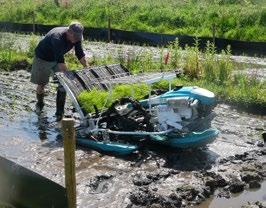
Rice is growing in fields in Oud Ade (near Leiden) and Tienhoven (near Utrecht) Perhaps this Dutch rice is the future. PhD candidate Hugo Bosland is investigating whether rice can be grown in the Netherlands.
Rice is growing in fields in Oud Ade (near Leiden) and Tienhoven (near Utrecht) Perhaps this Dutch rice is the future. PhD candidate Hugo Bosland is investigating whether rice can be grown in the Netherlands.
‘Rice cultivation is a possible option for peatland that is subsiding and oxidizing,’ says Bosland. He doesn’t see the Netherlands growing rice on a large scale. ‘It’s too labour intensive and there is too much competition from traditional rice-growing countries.’ But there could be a market in the Netherlands for locally grown rice. ‘They tried that in Switzerland and it’s a success.’
Bosland’s study is aimed at seeing whether it is possible in the Netherlands as well. In the past few weeks, seedlings of 30 different varieties were planted by hand or machine in the mud. The varieties mainly differ in their sensitivity to temperature. Other plots have rice of one variety; the focus in those trials is on production and greenhouse gas emissions. Boslands visits the fields every week to carry out measurements. The field in the photo is surrounded by a plastic protective wall. That is not to keep the water in, it’s to keep the rats out, explains Bosland. Last year, swans and rats feasted on one trial field. rk
It’s standard practice at WUR to make practicals compulsory, but that has its downsides. A lot of students don’t live in Wageningen these days, and travelling costs time and money. So be prepared for a daily torrent of emails: ‘Do I really need to be there?’; ‘I’m afraid I felt really sick when I woke up this morning’; ‘I’ve got a field meeting at my Dad’s farm’; ‘I became an aunt today so my mind’s on other things right now’. Voluntary attendance is more common for lectures, but if you start recording them, attendance will plummet. Sometimes I would have 10 students in the lecture hall when there should have been 100. That’s not much fun for me, but it’s extremely embarrassing if I’ve invited a guest lecturer. When I made guest lectures compulsory, I did have full lecture halls but also a bunch of students at the back who spent the whole time watching videos. Sometimes I would get an email afterwards: ‘Sorry I missed the guest lecture – I thought it was an ordinary lecture.’
Then you need to check that people are present. We used to have these handy scanners, but they don’t work on the new WUR ID cards. My paper attendance lists sometimes have signatures from students who had previously said they wouldn’t be coming but apparently have loyal friends. And I have to process all those lists.
If sanctions are imposed for not turning up, that too has downsides. If students fail a course, I simply get them back the following year. If they have to catch up or do a replacement assignment, that costs me time. So I don’t do much with those attendance lists in practice (not that my students realize this).
‘Zero tolerance can result in very grateful students’
Perhaps I should learn from the new policy in De Bongerd. If you enrolled for a sports class, you have to turn up or else you get a terrifying email: ‘You were absent. After a third absence, your account will be blocked for seven days.’ I got one of those warnings –erroneously, because I was there, but I hadn’t registered digitally in the correct way. When I sent an email in reply explaining what had happened, I got no response. In other words, ‘not my problem’. The other day, someone realized after the sports class that she’d forgotten to register. We had ended five minutes early, so I suggested she still had time to register. She ran to the entrance and came back delighted: it had worked! Zero tolerance can result in very grateful students.
Sjoukje Osinga
Sjoukje
is an assistant professor of Information
Osinga (58)
Technology. She sings alto in the Wageningen chamber choir Musica Vocale, has three sons who are students and enjoys birdwatching with her husband in the Binnenveldse Hooilanden.
Sander Roeleveld planting rice in Oude Ade. Photo Hugo Bosland
Asian students are looking for solutions
HOW TO STOP STREET HARASSMENT
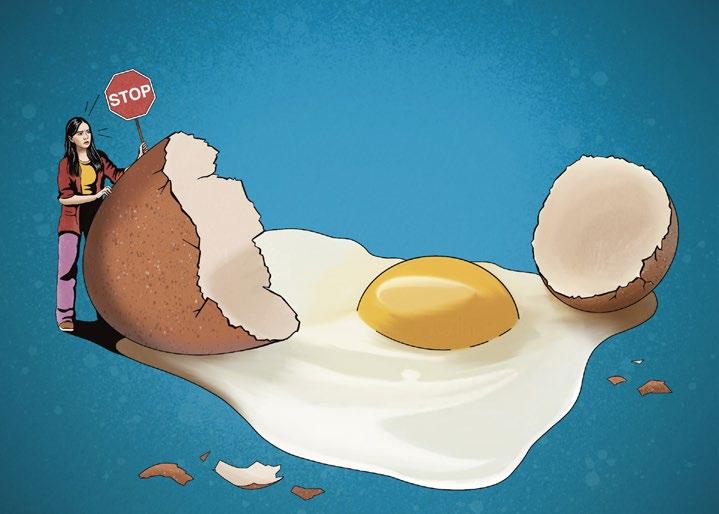
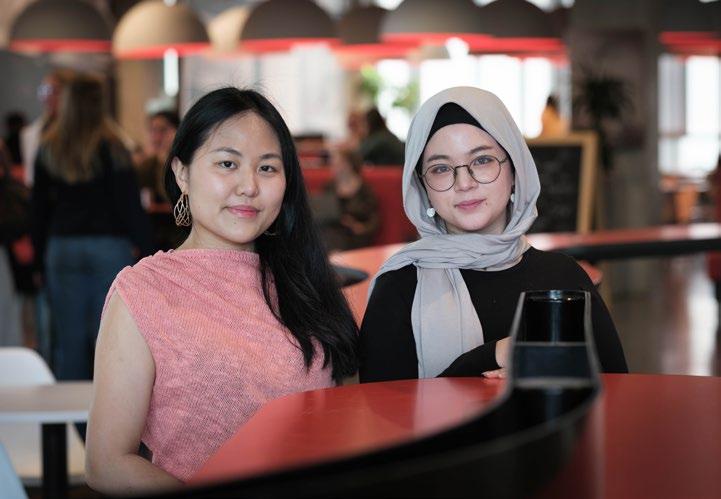
Youngsters loitering around spit at you, shout abuse at you or hurl eggs or stones at you. Such experiences are making some students feel unsafe in Wageningen. WUR students Alita Tithphit and Cyra Lalita Irawan are working with the municipality and university to find solutions.
You are cycling along when all of a sudden a group of teenagers spit at you. You say something about this and get shouts of ‘ching-chong’ in response. You nearly get run over by youngsters on fat bikes, who then give you the finger and call out racist insults.
You are moving house with a friend. Some youngsters cycle past, spit on your things and ride off.
These are just three incidents suffered by members of SEASAW, a society for Southeast Asian students. Following various cases of street harassment, the society decided to get a picture of Asian students’ experiences in Wageningen. While they are not the only ones to suffer harassment on the streets, it is noticeable that
this group also often gets racist abuse. ‘It’s only a small sample,’ says Cyra Lalita Irawan, who coordinated the student safety survey, ‘but it lets us show the municipality and university what is going on.’ Other international societies have organized similar surveys, she says. ‘In our survey, 20 members shared their unpleasant experiences,’ continues Irawan. ‘I think the Chinese society had as many as 50.’
The survey respondents were asked about the impact the incidents had. It turns out they have had a big impact: more than 60 per cent say they feel less safe. ‘Wageningen is often presented
‘MANY
Text Luuk Zegers
as a secure international environment,’ says Irawan. ‘But that is not how many Asian students see it.’
Reporting incidents
In most cases, the respondents didn’t report the nasty incidents to anyone. ‘We often don’t know whether something is serious enough to do that,’ explains Irawan. ‘Can you call the police if someone shouts out something racist or spits on you?’
SEASAW wants to give members more information about where they can go to report incidents, says Irawan. ‘The municipality and the university have hotlines, and you can always phone the police if you feel unsafe.’ She doesn’t think reporting the incidents will immediately put a stop to them. ‘But at least we then have a record of what is going on. The more reports come in, the sooner action will be taken to stop the harassment.’
‘GUEST LESSONS CAN HELP START A DISCUSSION ABOUT SENSITIVE TOPICS’
It is also important to keep people who report incidents informed about the follow-up, says SEASAW founder Alita Tithphit. ‘Many Asian students think there’s no point in reporting an incident because you often don’t hear what the police, municipality or university do with the report.’
After youths threw stones at a Chinese PhD candidate and beat him up on campus two years ago, there have been regular
discussions about this problem between concerned students, the municipality, the university and the police. These discussions are attended by Lisa Nguyen (Student Life, Wellbeing & Inclusion team) on behalf of WUR. ‘That violent incident brought the feelings of insecurity among some students that had been simmering beneath the surface out into the open.’
New incidents are often mentioned during the discussions. ‘A few months ago, a group of Asian students were harassed by youths in the McDonald’s in Ede,’ says Nguyen. ‘There are regularly youngsters loitering near Dijkgraaf who chuck eggs at students and spit on them.’ Nguyen
speaks to a lot of international students through her job. ‘Whenever I hear they have experienced something like that, I refer them to a student counsellor, confidential counsellor or personal safety contact. We also always stress that they should call the police about incidents like this, because it’s true that it isn’t done often enough.’
Cameras
The discussions reveal cultural differences too. Many Asian students would like to see more security cameras, says
Illustration Valerie Geelen
‘WAGENINGEN
A SAFE INTERNATIONAL ENVIRONMENT? THAT IS NOT HOW MANY ASIAN STUDENTS SEE IT’
Nguyen. ‘If you grow up in a country where everything is recorded by surveillance cameras, cameras can make you feel safe. In the Netherlands, we aren’t so keen on that solution because it gives people the feeling they are being watched all the time.’
The feeling of insecurity was partly due to the groups of youngsters who used to hang around the star-shaped blocks
of flats, smoking cannabis and stealing packages delivered to residents – which were often left in the hall by the delivery staff. That is why student accommodation provider Idealis installed CCTV in various buildings, and put in locker systems for the packages so they couldn’t be stolen anymore. ‘We want the tenants to feel safe in and around their building,’ says Idealis spokesperson Hellen
Albers. ‘If youths are still causing a nuisance, we recommend tenants contact the police directly.’
Municipal council member Monique Peters is also involved in the discussions about safety. ‘A South American student who had experienced several incidents of harassment and was feeling unsafe put me in contact with Alita. Since then, I’ve been helping think of possible solutions for places where there have been a lot of incidents, such as the bridge over Nijenoord Allee near Noordwest where loitering youths harass passers-by. Could the police drive by more often?
Alita Tithphit (left) and Cyra Lalita Irawan: ‘We think it would be good to talk to young people about dealing with cultural differences and the impact racism can have.’
Photo Guy Ackermans
Or perhaps we could install a camera? If something’s up somewhere, we talk to the municipal council and the municipal executive about what would be the best solution. We don’t yet have a solution for the bridge, except that the police will be driving by a bit more often. And we’re asking students to report incidents.’
The municipality’s street harassment hotline has been going for six months now, says Peters. She plans to ask for an overview soon of the reports made so far to the hotline. ‘As a councillor, I can ask the municipal executive questions about this. Hopefully, people will be more inclined to report incidents if they see us doing something about the reports.’
Guest lessons
Irawan and Tithphit want to talk directly to local youngsters. They plan to develop material for guest lessons in local secondary schools and vocational colleges. ‘That won’t completely solve the problem, but I think it would be good to talk to young people about dealing with cultural differences and the impact racism can have,’ says Irawan.
Municipal council member Peters has experience with teaching materials for schools. ‘We worked with the Union of Soroptimist Clubs, a women’s organization, to develop teaching materials for secondary schools on Orange the World, a UN campaign to stop violence against women and girls. About 400 pupils have now had that lesson at the Pantarijn schools in Wageningen. One boy, for example, said during the lesson that his father occasionally gave him a “thump”. What do you mean by a “thump”? That’s how you start a conversation about what violence is.’ Peters says the teachers are enthusiastic. ‘Guest lessons are a
good way of starting a discussion about sensitive topics.’ It is not yet clear what Irawan and Tithphit’s guest lessons will look like. ‘Perhaps the person who does Orange the World can give us some ideas.’ Nguyen also thinks the guest lessons are a good idea. ‘You need to come into contact with one another to understand each other better. After all, you live in the same town and you’ll eventually have to get along together.’
Prevention
Peters thinks more could be done in terms of prevention. ‘The loitering youths misbehave out of boredom. Perhaps they have difficult home situations; if so, we should offer them help. And there should be more for them to do.’ At the request of the students of Wageningen Culture Collective, the municipal-
ity is searching for a location for a new cultural centre. ‘It would be nice if they felt at home there,’ says the councillor. ‘And if it became a place where students and other young people meet one another. Perhaps that would help nurture more mutual understanding.’ ■
The mayor Floor Vermeulen on tackling street harassment in ‘his’ Wageningen
‘The municipality is tackling street harassment in various ways. We work with the police and the Public Prosecution Service to make sure perpetrators don’t get away with crimes. The perpetrators of the physical assault on campus two years ago were taken to court and convicted. The person who recently harassed several women in a bus was also found guilty in court.
‘I imposed three exclusion orders in the past year, two of which were for the campus. Things calmed down immediately after that. If you take action against the individuals who cause the most problems, the other youngsters become more cooperative.
‘Some students say they don’t always know whether an incident is serious enough to call the police, for example if someone spits at them. That is disgusting behaviour and not normal. So if you are spat at and you can give a good description of the perpetrators, call 112 immediately. There is a good chance of the police catching the perpetrators then. And if you
have an uncomfortable experience, report it to the street harassment hotline.
‘Here at the municipality, we are investing in youth workers and places where young people can hang out. We are talking to WUR, local secondary schools, student accommodation providers and other organizations about what further measures we could take to stop street harassment. Students can get a room here in their first year, but local youngsters looking for a place of their own have to wait up to eight years. That can cause friction. Perhaps we could do something about that.
‘The audit office – the municipality’s independent adviser – has started an investigation into relations between students and local young people. I’m interested to see what comes out of that and what they recommend.
‘It’s a good idea of Cyra and Alita to give guest lessons at local schools. Initiatives like that help create mutual understanding.’
Street harassment victim or witness?
If you suffered or witnessed harassment on campus, you can report the incident to WUR’s Social Safety contact point. To do that, send an email to socialsafety@wur.nl, phone 0317-481 774, or make an anonymous report on wur.eu/socialsafety. You can report street harassment in the town to the municipality online. If police assistance is needed, call 0900-8844. If the situation is threatening or an emergency, call 112 immediately.
The
job market is cooling, but
SCIENTISTS ARE STILL NEEDED
Master’s students close to graduation will be pleased to hear that the job market for recent science and technology graduates remains tight, although the high demand seen in recent years is starting to tail off. This is evident from the 2025 National Alumni Survey, which asked recent WUR graduates about their entry into the job market. Text Willem Andrée
The National Alumni Survey is a nationwide survey conducted every two years among Master’s graduates one to two years after they obtain their degrees. A total of 1,216 alumni from the universities of Delft, Eindhoven, Twente and Wageningen completed the survey for the 2025 edition. The gender breakdown was 57 per cent men and 43 per cent women. Most respondents were aged 25 to 27 and were at the start of their careers.
According to Silvia Blok of the Quality & Strategic Information team at WUR, who was involved in analysing the figures, the results suggest a shift. ‘The job market for graduates of the four technical universities including WUR has been exceptionally favourable for many years. We’re seeing that fall away a bit now. That’s in line with the figures from Statistics Netherlands: the tight labour market is easing.’ That does not mean that prospects for graduates of the four technical
universities are a cause for concern: 92.4 per cent of respondents are in paid employment. ‘There are fewer vacancies than during the peak in 2022,’ says Blok, ‘but we’re still in a good position.’ The vast majority of alumni still find jobs relatively quickly after graduating, in other words.
Contracts
There is little change too in the types of contracts offered by employers. Almost half of the graduates in work now have permanent contracts, with a further 27 per cent on temporary contracts with the prospect of a permanent position. Only a fifth of alumni are on temporary contracts with no prospect of a permanent job. That stability helps create job satisfaction. For example, 78 per cent of alumni say they are happy with their jobs. Looking purely at the content of the work, that percentage is even slightly higher. The respondents were also largely positive about career prospects and development opportunities, with average scores well above the midpoint on a five-point scale.
Salary
‘Some graduates may need longer to find a job that really suits them’
Graduates are more critical of their salaries than they are of other aspects of their work. Around 65 per cent say they are satisfied, a lower proportion than for job content and development opportunities, for instance. The average gross monthly salary is around 3,500 euros, but Blok thinks this is not always in line with what job market entrants expect beforehand. ‘The gap between expectations and reality is an issue
with some graduates, as you can see in their behaviour: they keep looking around.’ For instance, 27 per cent of respondents are actively looking for a new job, with salary being one of the key reasons – along with career prospects, followed by the nature of the work. ‘For a lot of new entrants to the job market, the first job isn’t where they’ll end up.’ says Blok.
The fit between education and employment is also a mixed bag. Over three quarters of graduates feel that their role is a good fit for their personal qualities. However, that percentage is lower when looking at specific skills acquired during the Master’s programme. Some alumni feel there is a discrepancy there. According to Blok, that is not necessarily problematic. ‘You can see that graduates leave with a wide range of skills that can benefit them greatly. At the same time, they often need to develop further in their job so that they can apply specific knowledge. That’s a normal process in the early years of a career.’
Versatile
The sectors that WUR alumni find jobs in demonstrate just how versatile science and technology graduates are. The industrial sector is by far the largest employer category, followed by education and research, healthcare, the public sector and the construction industry. ‘That
range demonstrates the versatility of an education in science and technology and the demand for such skills in many parts of the job market.’
How quickly graduates find employment varies depending on the subject area, though. Some specialist fields, such as animal sciences, lead straight to specific roles, whereas others require a longer learning curve. ‘That may mean that graduates need longer to find a job that really suits them.’
Shortage
That longer search is perfectly normal too, says Blok. ‘People sometimes need time to find the right spot. The figures show that things work out fine for most graduates in the end. So the picture is much rosier than some job market entrants perhaps think when the search takes a bit longer.’
The survey’s main conclusion therefore remains intact. Despite the slight slowdown in the job market, science and technology specialists are still very much in demand. ‘There’s still a shortage of professionals in these fields,’ says Blok, ‘and that’s not expected to change in the future.’ ■
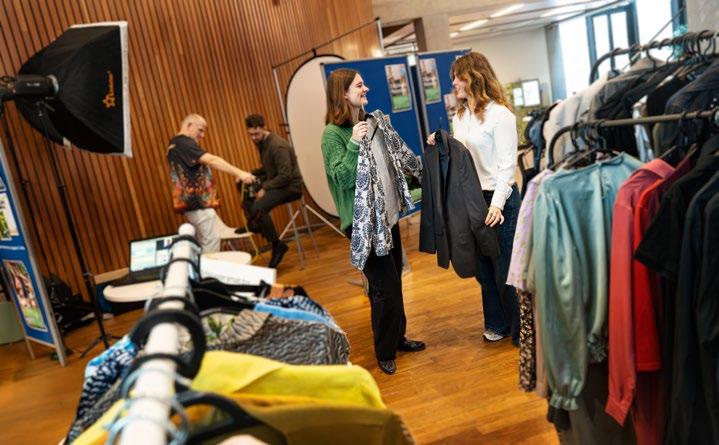
During the Career Week in March, staff and students could get a professional photo taken in Forum for use in their CV or on LinkedIn. Photo Ruben Eshuis
NOT AI
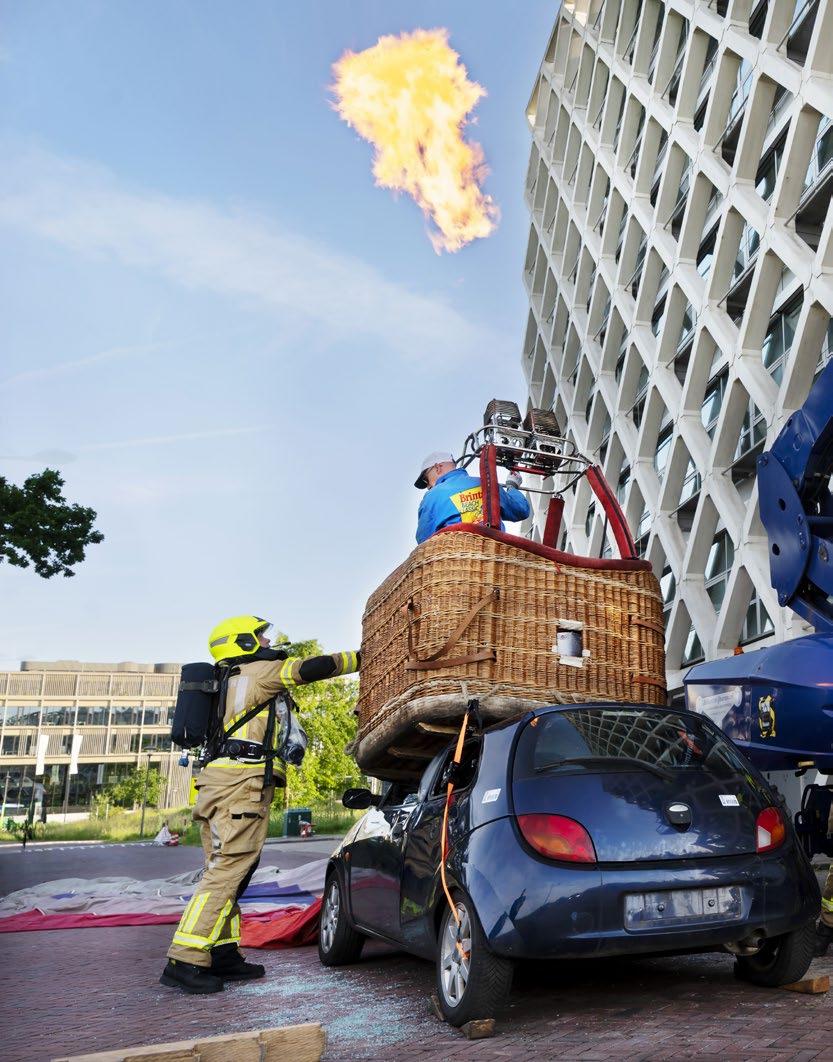
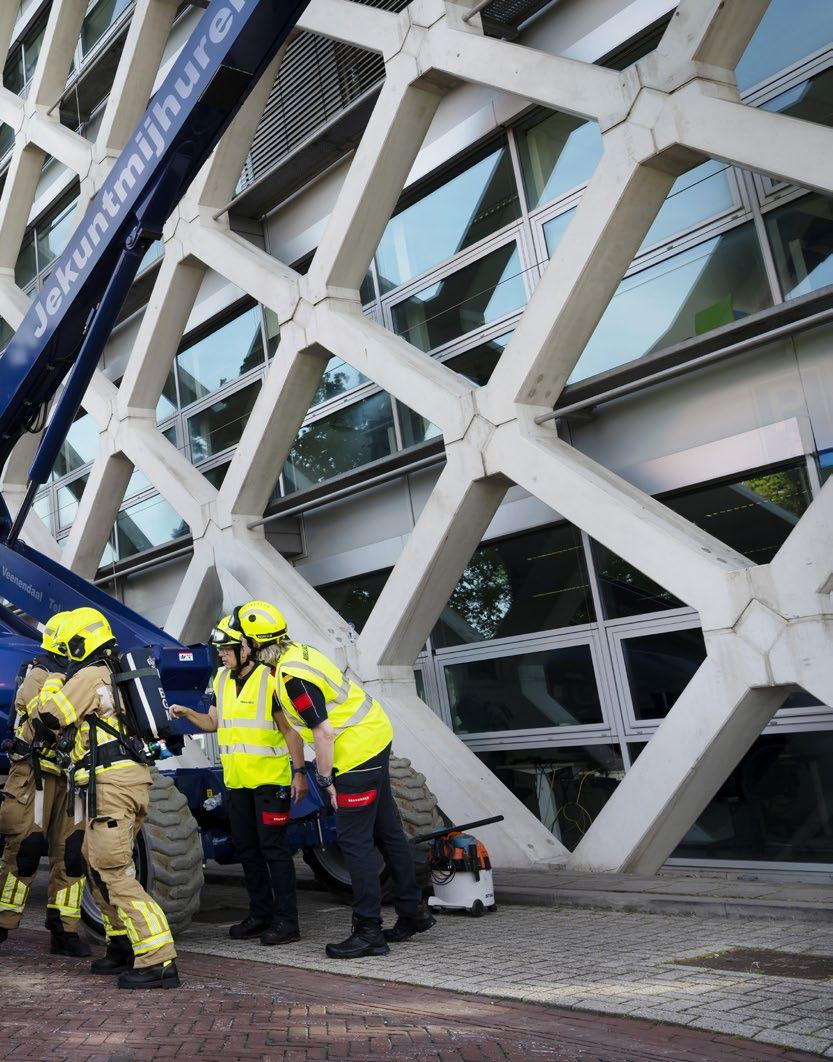
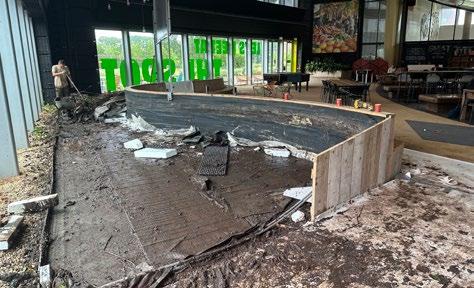
It is not very likely a hot-air balloon trip would go so badly wrong that the balloon crashes into Atlas and the basket comes down on top of a car. But that does make an interesting scenario for an incredibly multifaceted safety drill on campus. Staff from the Gelderland-Midden Safety Region and WUR safety officers and first aiders had to practise dealing with severe, possibly fatal injuries. But they also had to take into account the risks of highly flammable materials, working at heights, debris coming loose and a badly damaged building. The good news is that the drill went well. me
Photo Ruben Eshuis
TRICHO’S CHANEL NO. 5
It took three decades, but phytochemist Teris van Beek got there in the end. He found the sex pheromone of one of the smallest insects on Earth.
Text Roelof
Kleis
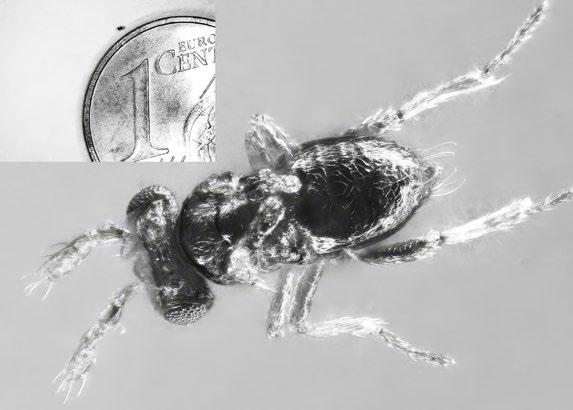
He is 70 and has been enjoying his retirement for three years after a lifetime working at WUR. Retirement feels even better now that he has finally managed to identify the sex pheromone of the parasitic wasp Trichogramma turkestanica after a lengthy quest, culminating recently in a publication in the Scientific Reports of Nature Parasitic wasps like Trichogramma are among the smallest insects in the world. But small doesn’t mean unimportant. They are widely used in greenhouses in biological pest control. The tiny female wasps (only 0.4 millimetres in length) parasitize the eggs of various pests, eventually killing the host larvae. Entomologist Hans Smid, co-author of the article, recently shot the film RUPS (caterpillar) about this phenomenon.
Virgin females who want to mate use a perfume to attract males. The quest for Trichogramma’s own Chanel No. 5 started at the end of the last century in the Entomology chair group, where Professor Joop van Lenteren
was researching biological pest control using parasitic wasps. The problem was that the parasitic wasps all looked rather alike. ‘They are difficult to distinguish morphologically,’ says Van Beek. ‘The question arose as to whether we could distinguish them based on their sex pheromones.’
It seemed logical that sex pheromones would be involved. Van Beek: ‘The males have significantly bigger antennae than the females. The females use their antennae to look for the host eggs. The males don’t need their antennae for that, so the hypothesis was that they used them to localize females ready for mating.’ That hypothesis turned out to be correct. The Portuguese PhD candidate Isabella Silva was able to supply 60 virgin females to collect enough pheromone for a chemical analysis.
Peaks
The phytochemist Van Beek was brought in for that particular task. ‘My colleague Maarten Posthumus was able to identify a couple of small peaks sticking out above the noise in the printout for the GCMS (gas chromatograph mass spectrometer, ed.). We only had one machine in all of WUR at that time. We tested various parasitic wasps and eventually focused on turkestanica. For that wasp, we saw the two little peaks every time,
but only in samples from virgin females. Those peaks had to be the pheromones.’ Van Beek and Posthumus were able to show they were two compounds with 17 carbon atoms each. One was an alcohol, and the other almost identical but a hydrocarbon, both with two unsaturated carbon bonds. They hammered away at the problem and eventually came up with a structure that in retrospect was pretty close to the real answer. ‘The methyl groups weren’t in the right places and the stereochemistry (spatial structure, ed.) was unclear. But given that we only had four nanograms of material, I don’t think we did too badly,’ says Van Beek looking back.
‘IT WAS GNAWING AT ME ALL THOSE YEARS, I HAD TO SOLVE THE PUZZLE’
Not too badly, maybe, but not good enough either. They still didn’t know exactly what the pheromone was. So Van Beek continued working on this in the decades that followed. When he could.
Van Beek: ‘It was all very much a sideline – something I worked on in the evenings. Buttering people up and getting them interested in the topic. We never applied for project funding.’ That isn’t surprising, as there’s no obvious practical benefit in knowing the precise nature of the perfume used by the Trichogramma. As indeed Van Beek candidly admits. But, as a scientist, he was still curious to know the answer. Why? ‘Because it was unfinished business,’ he explains. ‘It was gnawing away at me all those years. I had to solve the puzzle.’
Basic skeleton
There was a major advance 15 years ago in Germany. Van Beek managed to get the renowned chemist and pheromone expert Wittko Francke at Hamburg
‘THE STUDENT KEPT ON DILUTING THE PHEROMONE MIXTURE BUT IT STAYED ACTIVE, IT WAS ALMOST HOMEOPATHY’
University interested in his hobby project. Francke set a PhD candidate to work replicating the compounds based on the structure proposed by the Wageningen scientists. After three trial-and-error syntheses, they got the right basic skeleton for the pheromones, including the spatial structure for the methyl groups. Van Beek: ‘What we still didn’t have was the stereochemistry: which of the two possible enantiomers – the mirror-images compounds – was the correct one. In nature, often only one enantiomer is biologically active.’
The Groningen professor Adriaan Minnaard, who had previously obtained a PhD with distinction in Wageningen and was an expert in the stereochemistry of methyl groups, studied the question at Van Beek’s request. He was able to create the alcohol variant of the pheromone in
16 steps. But the final step – separating the enantiomers of the two pheromones – proved too difficult for both Hamburg and Wageningen.
By this time, it was 2014 and the research came to a standstill again. Van Beek tried on various occasions (in what he calls ‘Friday afternoon studies’) to convert the pheromones into different compounds that could be separated, but without success. Until he put the gas chromatograph
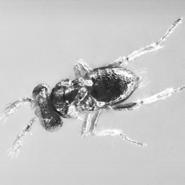
A male parasitic wasp, shown for comparison next to a eurocent coin Photo Joachim Ruther
to work on them in one last attempt. That resulted in a eureka moment.
‘IT WAS MAINLY A HOBBY PROJECT. THAT WAS WHY EVERYONE CONTRIBUTED THEIR EFFORTS FOR FREE.’
‘After 100 minutes, the two enantiomers from Francke’s mixture came out of the machine with a couple of tenths of a minute between them. We’d done it!’
This was 2018. The pheromones had been identified and syntheses had been developed to replicate them in the lab. So the chemistry was sorted. But did they work? Did these compounds really drive male parasitic wasps crazy with desire? In other words, the scientists still had to determine the bioactivity. But it was not easy to persuade fellow researchers to
work on this. And time was running out as Van Beek was about to retire.
‘Personally, I would have accepted it if we couldn’t have gone further,’ he says now. ‘I’d done everything I could. But I thought it was particularly annoying for Minnaard and Francke, who had put so much work into this. I felt very uncomfortable about it, although Francke unfortunately passed away from Covid. He did not live to see this success. Very sad. His name is included posthumously as one of the co-authors.’
Final step
But they did manage to finish the job after all. For the final step in the proof, Van Beek was advised by the Wageningen entomologist Nina Fatouros to contact the German parasitic wasp
expert Joachim Ruther (Regensburg University). ‘He was interested in looking into this. He too was close to retirement, but he thought this little parasitic wasp would be a nice challenge.’ Van Beek delivered the tiny amount of synthesized pheromones to Ruther personally. ‘It was the last I had and I didn’t want the risk of it getting lost if I sent it by post.’ Ruther set a student to work on the practical and precise task of testing the pheromones. That produced perhaps the biggest surprise of this whole venture. The pheromones turned out to be exceptionally active. ‘The student kept on diluting the pheromone mixture but it stayed active down to low femtograms (a millionth of a nanogram, ed.). It was almost homeopathy. Ruther had never seen such potent active compounds in his entire 40-year career.’
To clarify how little Chanel No. 5 is needed to lure a male wasp, Van Beek and his fellow scientists have made a comparison. Take one Olympic swimming pool and throw in one grain of sugar. Stir well. Remove one drop of water. That drop contains 30 times more sugar than is needed in pheromones to lure a male parasitic wasp.
All’s well that ends well. ‘The initial idea was to compare the pheromones of various parasitic wasps,’ says Van Beek now. ‘But that won’t be happening, given how long it took us to figure the pheromones out for this one species. It has mainly been a hobby project. That was also why everyone contributed their efforts for free. It was the scientific challenge of identifying the sex pheromone of an insect weighing 8 micrograms.’ ■
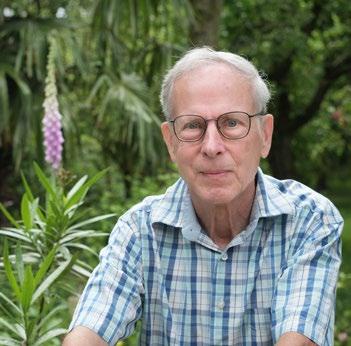
Teris van Beek Photo Guy Ackermans
FUNDS NEED STUDENTS AND RESEARCHERS (M/F/X)
Not all the money managed by the University Fund gets put to the best possible use. That is a shame because the funding is there to support students and researchers. Text Dominique Vrouwenvelder
Some funds are only available for specific purposes, for example they are restricted to female researchers or to studies in Asia. ‘And it’s possible that less research is carried out by that target group or in that domain than there is money available,’ explains Anne Zaal, awards coordinator at University Fund Wageningen (UFW). ‘But we suspect some funds are not being used up because they are not well enough known. What is more, if you know that UFW can offer financial support, it might give you just the nudge you need to start your project.’
One example is the Neys-van Hoogstraten Fund. UFW communications advisor Sacha Tijmstra: ‘The Neysvan Hoogstraten Foundation was set up by the late Dr Karel Neys, who spent years working in development cooperation. It has given us money for socio-economic research on the food security of households and vulnerable groups in South-east and South Asia. We don’t have to award grants every year, but we would like to receive several applications every year because it’s a shame if the money isn’t used.’
‘If all the money has been spent, that is the best possible result for the donors’
The Lucie Timmermans Fund is in a similar situation. ‘She was a professor at WUR in the twentieth century who passed away in 2021. Before she died, she donated money to UFW. Her fund is for young female researchers at WUR – or anyone else who is a member of a group that is underrepresented in science – working on animal biology in various specialist fields.’ Applicants can get financial support from the fund for a study trip or for writing a project proposal for a PhD.
There is also plenty of money available for PhD candidates or other young researchers attending a scientific conference, going on a study trip or doing a specific training course (the LEB Travel Fund). ‘I know a lot of PhD candidates regularly attend conferences or pay working visits to other universities,’ says Tijmstra. ‘It’s worthwhile checking to see whether your trip would qualify for one of the travel grants.’ The same applies to Master’s students giving a talk at a conference (the Student Conference Grant).
Niels Smith sports grants
In contrast, other funds receive a lot of applications. ‘The Anne van den Ban Fund for students from low-income countries and the Louise O. Fresco Emergency Fund for students and PhD candidates in financial distress through no fault of their own are used a lot.’
The Niels Smith Fund, for WUR students combining elite sport with a degree study, also gets plenty of applicants every year. Olympic athletes Steffie van der Peet and Sofie Dokter received grants from this fund in the past. The fund will, however, be awarding its final grants this year. Tijmstra: ‘There will be no money left after that. Which is the best possible result for the donors.’ ■
Olympic athlete Sofie Dokter received support from the Niels Smith Fund for sporting WUR students Screenshot NOS
Spirituality and innovative education in new Master’s course
‘RELATE DIFFERENTLY TO YOUR SURROUNDINGS’
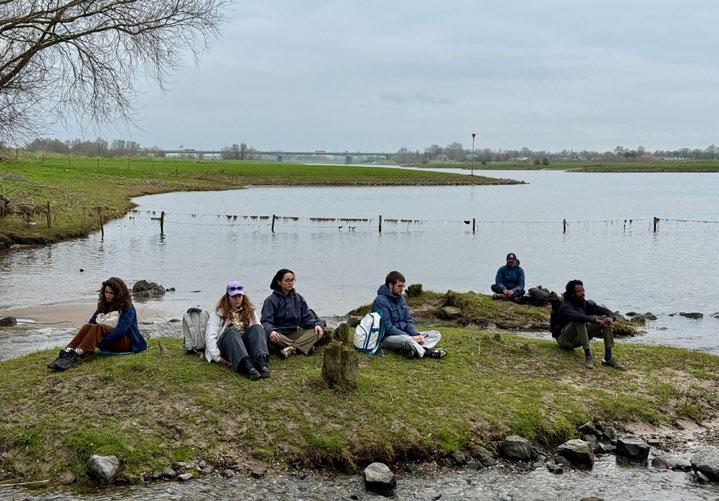
The Master’s course ‘Cultural and Spiritual Significance of Nature in Conservation and Sustainability’ was given for the first time in Period 5. It links theory about the ‘soft side of nature’ with personal reflection. The approach is just as innovative, with outdoor teaching and learning by experience constituting key aspects of the course. Text and Photo Marieke Enter
It’s a grey Tuesday afternoon. In the middle of the woods, next to the source of the Renkum stream, some 40 students sit on the ground. Some are taking notes, others are staring into space in a reflective mood, and one or two have closed their eyes. The silence lasts minutes – not a word or even a cough. All you hear are the birds, the wind rustling through the trees, the burbling water and the monotone hum of traffic in the background. This silence didn’t just happen; it is a moment of reflection that is part of the first outdoor lesson in the Master’s course ‘Cultural and Spiritual Significance of Nature in Conservation and Sustainability’. The course looks at various cultural and religious views on nature and how they impact nature management and sustainability policy. A few days earlier, nature philosopher and emeritus professor Matthijs Schouten taught the students about Buddhism and
nature. Schouten realized that the afternoon lecture would be an intensive experience for everyone. ‘I’ve been studying Buddhism for 30 years,’ he said. ‘Now I’m going to pass on the key aspects to you in just three hours.’
Weekly themes
A lot of things he said suddenly made sense sitting there in the woods: Schouten’s explanation about how Buddhism sees humans and nature as part of one cohesive whole and his story of how Buddha achieved enlightenment in nature, sitting under a bodhi tree, after years of meditation. ‘Matthijs’s lecture was a perfect fit with this week’s theme, which is spirituality in woods,’ explains the course coordinator Bas Verschuuren (Forest & Nature Conservation Policy).
Various contemplative exercises were scheduled for that outdoor lesson. ‘Afterwards, the students told me they felt a stronger connection with the place and they had had an experience of being part of nature,’ says Verschuuren. ‘I suspect that experience was partly inspired by what Matthijs talked about in his lecture. When you discover it’s common practice in certain cultures to sit for hours under a tree to work towards enlightenment, it makes you aware that you too could do something like that. And that you can get a lot out of contemplation in nature: it changes how you relate to your surroundings.’
Learning about learning
In addition to learning about the place of nature in the world’s main religious and spiritual movements, the course
‘I GOT LOTS OF SUPPORT WHEN SETTING UP THIS COURSE, INCLUDING FROM THE PROGRAMME DIRECTOR’
also aims to let students experience different learning methods. Verschuuren gets his students to reflect on this: ‘I get them to consider how they can use cognitive, experimental and affective approaches to learning and benefit from a combination of those approaches. This was the main challenge in designing this course – to broaden the perspective from which students reflect on nature conservation and sustainability issues.’
That broadening perspective is clear in the discussions students have, says Verschuuren. He still feels, though, that the course needs further refinement to fully achieve that learning objective. ‘On several occasions, I had to “subtitle” the learning process for the students to show how valuable it is to learn different learning approaches. That gives you new knowledge and skills, as well as different perspectives that ultimately lead to new solutions for issues relating to nature and sus -
Guest lecturers and assessment
In addition to the coordinator Verschuuren himself, the students were taught by experts as guest lecturers in the outdoor lessons and for learning through experience. The lecturers included Cathrien de Pater (on spirituality in woods), Shaohua Wang (on spiritual tourism in nature areas) and Matthew Zylstra (on nature connectedness and ethics). Chair holder Georg Winkel gave a tutorial.
The course assessment was based on a group assignment in which students researched a topic in which there is a gap in the knowledge. That resulted in some great cases, says Verschuuren.
For example on the protection of a certain species of lizard in Texas that also has a spiritual role in Indigenous communities. Or on how diving tourism could do more to explore a rich experience of nature and what it means for you as a human being, rather than being mainly about spotting species and complying with safety regulations.
The assessment also took into account the personal reflection reports that students drew up based on the diary had to keep during the course. They could write notes, make drawings, take photos, express their ideas in music or film – ‘or make an installation in the landscape as far as I’m concerned,’ says Verschuuren. ‘There were no restrictions on the form, as long as it could be submitted via BrightSpace and I could understand it.’ There were examples of nearly all those options. ‘I found the transformation they revealed incredibly moving. Of all the many things I’ve organized at the university, this has been the most meaningful result by far.’
tainability. I want students to realize when they embark on their careers that you don’t always have to tackle issues from the perspective of policy or scientific knowledge. It is also important to combine various knowledge systems and experience things. Sometimes, you
Students during a moment of reflection.
simply need to go on a long walk to help you take the right decision. It took a while before the students grasped this. But that’s OK.’
Lots of support
Verschuuren hasn’t heard any criticism that this course, with its focus on the spiritual and religious, is too vague or insufficiently academic. ‘The various knowledge traditions and scientific disciplines relating to spirituality and science are too far developed for that,’ he says. ‘A lot of pioneering work has been done in this area in Wageningen. The sociologist Iteke Weeda, and later Anouk Brack, developed a sound methodological setup
based on science for teaching courses on spirituality in relation to nature and inner development.’ Weeda did meet with resistance within Wageningen, as is clear from articles at the time. ‘But that was decades ago. I actually got lots of support when setting up this course, including from the programme director for Forest & Nature Conservation, Gijs Elkhuizen. The times have changed a lot since then,’ comments Verschuuren.
Follow-up
The course designed by Verschuuren will get a follow-up next academic year, although with slightly different content – if only because the lectures by Schouten, who retired years ago, were a one-off. Some of the vacant ‘Schouten sessions’ will be filled by Verschuuren himself next year. He will give lectures on the cultural and spiritual value of nature and what that means for conservation and policy, with plenty of case studies from actual practice. But Verschuuren gives an assurance that
ACCESS TO RICH KNOWLEDGE
Mako Fang, MSc in Animal Ecology
‘Funnily enough, my favourite outdoor tutorial was the one where we didn't do so much: we had a silent walk in the forest, had a little ceremony with birch sap and then had time to meditate in the forest. Whereas normally my head would already be completely elsewhere in the silent in-between moments, my head now was just empty and peaceful. I also really enjoyed the lectures of Matthijs Schouten. He is a great storyteller and I felt very privileged to have access to such rich knowledge.
‘In my opinion, the key to many of the issues we face today is a lack of empathy and connection, simply because we don't feel related to the world around us. In this course, it was just beautiful to see that many people share this thought and that nature connectedness really works in promoting environmental and sustainable practices.’
A LASTING IMPRESSION
Zoë DeFord, MSc in Geo-Information Science
‘I joined the course because I felt a spiritual connection with nature and wanted to explore that in an academic setting. It was amazing to meet other people who felt the same way too, and learn about this in different contexts. It was super cool to understand the science behind nature connectedness, which was my favourite topic from the course. We learned about the psychology of nature connectedness and I learned stuff about myself that I felt I always knew but couldn't put my finger on. This made a lasting impression and gave me answers I had been searching for for a while.
My group assignment was on spiritual tourism in Mexico, which was a challenging topic to research since it is so nuanced. Often I felt like “who am I to even speak on this topic, knowing so little and coming from such a different place?” But I think it connected pretty well to the course content.’
Schouten’s legacy will not be lost. ‘All the lectures he gave for this course were recorded on video. We are now working with the Nature College and the Educational Media team at the Teaching & Learning Centre to turn them into bitesized information clips I can use during my lectures.’ Both the short clips and full lecture videos will be made available more widely, he says. ‘Matthijs’s lectures have a wealth of knowledge and deserve to be seen by a broad public.’ ■
NOT ALWAYS COMFORTABLE
Teun Beens, MSc in Forest & Nature Conservation
‘The course invites you to think differently about the role humans have in their environment. It has been an honour to learn about different civilizations, from ancient creation stories to creation in contemporary times. It was also amazing to learn more about spirituality in forests, tourism, the rights of nature and how these ideas affect the way we relate to our environment.
‘However, this was not always comfortable. I was confronted with the meaning and existence of life itself and the effect humans have on other-than-humans. It made me want to move more towards a world filled with stewardship and care, bringing a voice to the unheard. I have learned that you can’t take everything for granted and that every new day can be considered a gift in this crazy dynamic world we live in. This course has opened new doors for sure.’
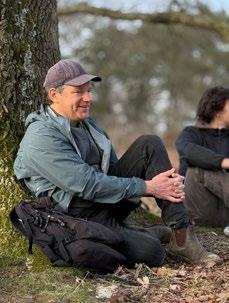
Bas Verschuuren
Rethinking food systems through African philosophy
It is widely recognized that a profound transformation is needed in food systems. A largely Wageningen-based team has now joined forces with African scholars to write a book exploring how African philosophy can help achieve that transformation. Text Marieke Enter
Drawing on case studies from across Africa, the book examines injustices in agriculture and food production while highlighting alternative ways of thinking about food, land, labour and justice. It also looks at how African philosophy, such as the philosophical traditions of the Ubuntu, Akan and Shona, can help make food systems more just and sustainable. The online, open-access version of the book, entitled African Philosophy and the Politics of Food Systems, was published earlier this spring and it is now also available as a hardcover book.
‘Relatively little attention is paid to philosophical questions in food systems,’ says Birgit Boogaard, a lecturer in the Knowledge, Technology & Innovation group and the initiator of the book. ‘And such debate as there is tends to be dominated by scholars from the Global North.
That also applies to Wageningen, which surprised me since we have such a long history of working on agriculture in Africa. Why haven't we been making use of that intellectual heritage?’
The publisher Springer approached Boogaard several years ago about writing a book on agriculture and African philosophy. She was keen to do so. ‘But as a white Dutch person, I thought it would be inappropriate to do that on my own,’ she says. Together, she and South African-born philosopher and professor Mogobe Ramose, whose work has played a major role in the recognition of Ubuntu philosophy within academic philosophy, decided to develop the project as an edited volume. It contains contributions from African scholars an dnon-African scholars.
Doing things differently
In addition to Boogaard and Ramose, the editorial team included the philosopher Yeshewas Ebabu Worku (University of Gondar, Ethiopia), and the philosopher David Ludwig and plant scientist Sally Diop from Wageningen. Ludwig: ‘African philosophy provides such rich resources
for rethinking our relationship with food, labour and the environment. For me, the point of the book is to make these resources better known, to challenge people outside of philosophy to take them seriously and to engage with them. The world is looking for ways of doing things differently, as we increasingly recognize how dysfunctional the current food system is.’
What about Diop? Boogaard: ‘She was doing her Master’s thesis at the time. She interviewed several African philosophers as well as Wageningen system thinkers about the intersection between food systems and African philosophy. She proves that plant scientists can also move into this field very constructively.’ Ludwig adds: ‘Rethinking and transforming food systems is not the task of one type of actor only. It requires a lot of people thinking together and taking action together –whether they are agronomists or policymakers, Europeans or Africans, and senior or junior people.’ ■
At resource-online.nl we interview Mogobe Ramose
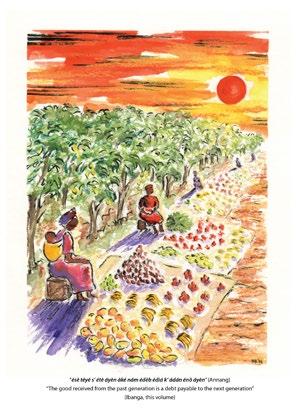
The book’s illustrations, by Birgit Boogaard, visualize key ideas from different African philosophical traditions.
I USE AI FOR MY STUDIES YES/NO
The rapid rise of AI and large language models like ChatGPT is posing a challenge for teachers and researchers. How do students feel about these developments? Are they using AI for their degree work? Text Resource editors Illustration Marley Hendricks
‘I’d describe my use of AI as “regularly but not a lot”. And it’s purely for support, for example to find good sources – but I still read the articles myself. I also use ChatGPT or Copilot, for instance, to brainstorm sometimes. I am worried about AI as a phenomenon. It makes everything so easy for us, which is why it’s so tempting. You lose the ability to write or to reflect on matters. We need to prevent ourselves from getting lazy. I try to find the right balance in terms of energy consumption as well. For example, I hardly ever use AI to create images. I’ve also stopped sharing articles and asking AI to summarize them. I don’t want to give data to a system that isn’t allowed to have it.’ wa
At first, I only ever saw the negative aspects of AI: how it steals from artists, the horrible environmental costs and unwanted data centres. Do I really want to use a tool I’m against on basically every ethical level? One that can’t even always be trusted?
‘I mainly use AI to improve my written work. I don’t often use it to add to my work or as a source, because I don’t think it’s sufficiently reliable for that yet. That will be reflected in your grade, so I feel it’s too risky. But I do find it handy for checking the spelling, grammar and structure in my reports.
I also use AI to set up queries for targeted searches in large databases, for example to find out about the brooding behaviour of a particular species of bird. That lets you find what you need very quickly. In short, I do the work myself but use AI as my assistant. I have never handed in something that was written entirely by AI.’ lz
And a big part of problem-solving is frustration tolerance. I've had really tricky problems during my studies that I couldn't figure out, then left it alone for a bit, came back, looked at it from a different angle, and then made breakthroughs. They have probably been my most valuable learning experiences. If you rely on AI generating derivative answers, you’re denying yourself the chance to grow.
That said, I'm not a hundred per cent against the technology. Medical AI applications can detect cancer years in advance and that's amazing. But I'll probably always be against generative AI, partly because I'm a creative person. The idea of automating my hobby is pretty abhorrent to me.’ wa
Ethical
Robin Rotteveel, Development & Rural Innovation Master’s student
‘I was very reluctant to use AI at first. Outsourcing critical thought like this goes against my moral and ethical principles. At the same time, I don’t think you can avoid it. It’s a bit like deciding not to use the phone or computer out of principle. So now I’m exploring how I can use it ethically. For example, I look up the literature myself and AI helps me to create order in it. For example, I may know a certain philosopher said something about a particular subject and I ask AI to find the article in question. But I draw the line at writing; I do that myself. If I outsourced that, it would be like hiring a virtual assistant to do all my work. What would be the point of my Master’s degree then?’ ak
Programming
Jip Santen, Geoinformation Science student
‘I have to do some programming for my degree and I use Python for that. ChatGPT is good at explaining what code you need when coding. That speeds up the work and I was even able to pass a course with a tight deadline thanks to AI. AI is everywhere now and it’s difficult to avoid, but I always think hard about how I use it. I have this picture in my head of all those data centres doing overtime, which I think is a real problem, so I deliberately don’t use it much. I only use it occasionally in my private life too. I say “occasionally” because I’m only human, so I have fun with it too, for instance letting ChatGPT analyse my personality based on my tastes in music. But I don’t do that much as it doesn’t feel right.’ wa
Losing weight
Anastasia van Beek, Biology Bachelor’s student
‘I use AI in my degree, for example for the species knowledge course. I have a list of names of species I’m supposed to know. So I give it to ChatGPT to find matching pictures. Then I get ChatGPT to test me. That’s about it. I write my reports myself. My friends use AI for that, but I find that rather pointless, as I want to learn how to write. It’s not even allowed, anyway. I also use AI in my personal life, for example to draw up diet plans so I can lose weight. I enter my data and the programme works out what I need to eat.’ rk
Voice
Jules Houplon, Development & Rural Innovation Master’s student
‘I use AI to challenge myself in my work and I have debates with it. For example, I recently asked AI to pick holes in a piece of text I’d written. Or if I have a really broad search I need to do, I ask it where to begin. But you need to know what prompts to use in order to avoid AI hallucinations. That’s why I think it is really important for everyone to learn how to use AI. Of course, no one wants to use it, but for every person who doesn’t use it as a matter of principle there are a thousand who do. I think that is an important task for the degree programmes.
Personally, I’d never use AI to write stuff. You should never give up your voice and your individual form of expression: they are an essential part of who you are. But if I’m being totally honest, when I’m feeling really lazy and don’t know what to cook, I do ask AI for advice based on what’s in the fridge.’ ak
Archivist gets archived
After
nearly 45 years working in the archives, Wim ter Beest is becoming
a piece of WUR’s history himself.
The Forum library storeroom has 800 metres of shelving with WUR archive documents on paper. Agrotechion on the Dreijen site has a further 2.5 kilometres of paper. Together, they form 3.3 kilometres of WUR history — at least, the raw version of it. A filtering process will eventually reduce it to some 100 metres. The remainder will be destroyed as it is not historically significant material that needs to be kept.
The 2.5 kilometres in Agrotechnion was once 4.5 kilometres, as more documents were unearthed every time an institute or chair group moved to the campus. ‘The files came from attics and hidden corners,’ says archivist Wim ter Beest. ‘Unordered, so we had no idea what they were. We’ve already been able to destroy an awful lot over the past few years. The rule of thumb for public sector organizations is that 97 per cent of documents can be destroyed. Only 3 per cent is historically significant. A further selection process is needed for the remaining 3.3 kilometres. Though some of that is material that’s designated for
‘People don’t like deleting things. The result is digital chaos.’
‘A further selection process is needed for the remaining 3.3 kilometres of archive’
destruction but the retention period hasn’t expired yet.’ Wim ter Beest knows the WUR archives better than anyone. He has worked for WUR and its predecessors as an archivist for nearly 45 years. In summer 1981, he applied for a job at RPVZ, the national experimental station for seed research, on Binnenhaven street. ‘I’d completed two years of teacher training, but I wanted to do something different. I couldn’t imagine teaching until I turned 65. There were 213 applicants for the archivist position. It was a difficult time for getting jobs.’
From attic to basement
Ter Beest started without any training as an archivist and with a huge backlog: ‘My predecessor had retired two years before and they’d just let everything accumulate. You learn a lot from that. After a year, I did an applied degree in archiving part-time alongside my job. I worked at RPVZ for ten years. Then, in 1991, I became head of the archives of DLO, the old Agricultural Research Service.’ He worked in the Impulse basement, where he supervised the archiving for all the DLO institutes. ‘That was a task previously carried out by Ministry of Agriculture inspectors, but that department was abolished. So I was asked to do it. Back then, DLO consisted of 24 research institutes, each with its own archive. That included a lot of clutter, archives from the thirties, forties and fifties stored in attics. Most institutes didn’t have an archivist; it was a task often assigned to the secretaries. The Ministry did provide funding to go through the archives and extract the historically significant material. I took charge of that. I was able to safely deposit a lot of the archives with the
Text Roelof Kleis
Dutch National Archives and various provincial archives.’
Even after the merger between the research institutes and the university, archiving remained decentralized for a long time. That was until 2012, when archiving was transferred to Facilities & Services along with services such as the library and IT. ‘Then the archivists were brought together in one place, wutg about 15 people at its peak. But we have a lot fewer now. Digitalization has completely changed the nature of archiving work. We used to get 200 to 300 letters on paper a day, compared with about 15 now. Everything else is digital.’
Digital dementia
That digitalization has been a dramatic change for archiving. The archivist has become a record manager. The aim is still the same: to separate the wheat from the chaff. According to Ter Beest, a lot went wrong in the transition from paper to digital. ‘It’s that famous digital dementia, the hole in your memory. What do you save and where? Everyone did their own thing. More structure was introduced later but, as archivists, we still don’t have a good overview of everything.’
They also do not have a clear picture of copies of digital documents. ‘Digital documents are sometimes stored in multiple places. That’s handy if a computer crashes because it means a colleague might still have a copy. But it can become a problem if sensitive infor-
ARNHEM
WUR’s paper archives from 1876 to 1958 are stored in the Gelderland Archive in Arnhem, which is open to the public. Everything after that period, about 3.3 kilometres of documents, is still managed by WUR. To access it, you need permission from the Executive Board. ‘Any documents that are to be kept have to be transferred to the Gelderland Archive after 20 years,’ says archivist Wim ter Beest. ‘That’s what the law says. But nobody sticks to that in practice. We did it last in 1990 for the documents up to 1958.’ WUR’s digital archive is stored on servers on campus. WUR uses the archive software application Corsa. That system is not open to the public.
mation gets stored on multiple disks. You might think you have deleted something and then it turns up again somewhere else. People don’t like deleting things. The result is digital chaos.’
Despite all this, Ter Beest is a great advocate of the digital. ‘The challenge is bigger. I love paper, and I like to be able to hold a newspaper or memo in my hand. That works better for me. But you need to think of the future. That might sound strange coming from an archivist, but the future is digital.’ ■
‘I love paper, but you need to think of the future. That might sound strange coming from an archivist, but the future is digital.’ Photo Guy Ackermans
Limelight
What is it like being intersex, asexual or trans? The Human Library lets you ‘borrow’ someone for 15 minutes for a one-toone chat. Various WUR students and staff with diverse gender identities and sexual orientations will share their experiences and answer your questions. Text Coretta Jongeling
Human Library during Pride
Landscape Architecture Master’s student Yvonne Swinkels will be taking part for the first time. ‘I want to talk more about asexuality and the split attraction model. That model says there are different forms of attraction, both sexual and romantic, that aren’t the same for everyone.’
Not many people know what asexuality is. Put simply, it’s when you don’t feel sexually attracted to other people, says Swinkels. ‘Whereas it is actually quite common. An estimated one in fifty people is asexual. That’s as common as being a redhead, which I also happen to be. It would be good if people knew more about this. Society basically says the ultimate goal is to
MON 22-06-26
Impulse 12:30-14:00
Free, no need to register
find your one true love, marry and buy a house together. I want to show there are other options too. A romantic or sexual relationship isn’t necessarily any more important than a friendship, for example.’
This is the second time the Human Library is being organized during Pride Month. ‘A lot of students turned up last year,’ says Heather ten Ham, the Diversity & Inclusion officer for students.
‘We had people who were wondering about their own gender identity, teachers who wanted to know more, and people who’d never had any contact with the LGBTQIA+ community. You don’t have conversations like this every day. We create the right setting for people to discuss their questions in private.’
The Human Library is part of Pride Month. Activities at the university and in the town include active bystander training, a special free edition of the Freedom Tours and a talk on the history of Pride. You can find the full programme on the websites of WUR and the bblthk.
TIPS
Sunday 14 June
Belmondo Festival (music and dance) Arboretum
Saturday 27 June
Woetstok Wageningen (cover bands) Torckpark
Sunday 28 June
Gluren bij de Buren (living-room festival) Throughout Wageningen
Every year, about 3,500 students get their Bachelor’s or Master’s degree from Wageningen. In Thesis Life, they talk about this particular milestone — the content and the ups and downs. This time, it’s Plant Sciences Master’s student Marco Mazzone. Text Eva Hamers
Your thesis in 40 words?
‘I looked at which chemical classes are involved in the antagonistic interactions between banana endophytes (beneficial bacteria or fungi that live inside plants) and banana pathogens. These chemicals could be used to find more sustainable biopesticides, for example.’
Favourite snack during writing?
The digestive cookies with chocolate on one side. I discovered them here in the Netherlands. I ate a lot of them on many different occasions but the peak was during my thesis.’
What great advice did you get?
‘I got good writing tips from my supervisors and teachers. One was to make a story line, especially in the discussion. Start by restating the hypothesis, then go into my findings from my experiment, check if they are supported by the literature or how they differ, and look at what conclusions can be drawn. Next, take a broader view and consider the implications for the academic world or society. So follow an hourglass shape, from broad to narrow to broad. I did this for all my research questions in the discussion.’
Do you have a tip yourself?
‘Concentrate on making a really good thesis proposal for your supervisor, because most of your introduction will probably be based on your proposal. I put a lot of effort into the first month, and when I had to write the introduction I just had to cut some parts from the proposal.’
What’s next?
‘After my thesis I did my research internship at the Netherlands Food and Consumer Product Safety Authority, which I enjoyed a lot. Now I’ve been offered a job in the same team where I worked before. I am very excited about it!’
You find all the flavours of the world in Wageningen. Sietse Lavrijsen, an International Development Studies & Economics of Sustainability Master’s student from the Netherlands, shares a recipe for fungi ragout.
Flavours of WUR
Fungi ragout
‘I take inspiration from what my Dad cooks at home and this fungi ragout is one of his dishes. The first time I made it in Wageningen, I was so pleased with the result that I cooked exactly the same dish the next day. You only need one pan, so it’s easy to cook enough for lots of people. In fact, this dish has already kept my nine flatmates well fed on several occasions.’
1 Chop the shallot and garlic fine. Cut the fungi (or mushrooms) into slices.
2 Melt the butter in a pan with a thick base.
3 Fry the shallot and garlic.
4 Add the fungi and fry them.
5 Add the flour and stir well.
6 Pour some of the mushroom stock in the pan to cover the surface and stir to form a smooth liquid.
7 Then add the rest of the stock and cream. Leave to cook until it has the right thickness.
8 Serve with vol-au-vents, rice or bread.
9 Garnish with thyme, chives or croutons if wished.
Tip: replace the butter and cream with vegan alternatives for a vegan meal.
Ingredients (for 4 people + side dish):
• 1 shallot
• 2 cloves garlic
• 400g of fungi of your own choice (mushrooms always work well)
• 50g butter
• 60g flour
• 1 litre mushroom stock
• 70 ml cooking cream
• thyme or chives (optional)
Sietse Lavrijsen
Master’s student in International Development Studies & Economics of Sustainability
Photo Oliver Kalengi
Scan the QR code to watch the cookery video of Sietse.
Meanwhile in… China – Attacks driven by despair
WUR is incredibly diverse, with hundreds of internationals working and studying here. In the Meanwhile in column, we ask one of them to comment on events in their home country. Plant Sciences Master’s student Sylvan* (22) from China shares his views on recent mass attacks in his homeland. Text Philip Timmers
‘Since 2024 there have been multiple incidents of mass killing in China. This normally involves a car driving into a crowd and killing people. These attacks take place in bigger cities and often don’t get reported by the mainstream media because of the censorship of the Chinese media and the government’s effort to hide “bad things” that are happening. It makes me angry that the only way to find out about these incidents is through social media. This makes it harder know what the size of the problem is and it’s very upsetting for the relatives of the people killed in these incidents.
‘My friends and I often discuss these kinds of incidents. The killings are often done with an economic motivation. Since Covid, the wealth gap between classes has increased. First, everyone gained from China’s rapid economic growth, while now only the top layer and the government benefit from it. Things have only got worse for normal workers. The average annual
working hours keep increasing and are now almost the highest in the world. All while the workers don’t see any of the wealth that is gained from this. The workload and financial stress drive people to go insane and for some the only way they can express their despair is through killings like these.
‘The killings are especially sad because the people who get killed are just innocent victims. Friends and family back home are now scared to go to public places. When I talk about it with my parents, they tell me that they don’t to go to places where lots of people group together, like open-air concerts or busy playgrounds.
‘The reason why it is so important to talk about this topic is because people often tend to view China as an undifferentiated whole, especially when talking about the economy or politics. but I think it is really important to also talk about the real people of China and what they are going through. People tend to forget that wealth is about so much more than a high GDP.’
*Full name known to the editors.
Orion to get a stage
The planter beds on the ground floor of teaching building Orion are being replaced by a multi-functional stage. The refurbishment is in full swing and should be finished in a couple of weeks.
It is difficult to imagine at the moment, but Orion will have its own stage in about two weeks’ time. It can be used for open mic nights or gigs, for example. In a phone call, the Orion building manager explains there were various reasons for the refurbishment. ‘The planter beds were badly in need of major renovation and maintaining the greenery costs money as well, of course. So given the cutbacks, we have gone for this solution.’
The new stage will have a multifunctional design. During the day, it will offer extra seating capacity, while ‘stu -
dent societies and other groups associated with WUR will be able to reserve the stage’. The stage will keep the shape
of the current planter bed. Student café The Spot is unaffected by the building work. wa
Photo Resource
WEEKLY UPDATES ON STUDENT LIFE AND WORKING AT WUR?
Go to resource-online.nl
(Subscription page) and subscribe to our digital newsletter. SIGN UP
11
WUR from within: straight, sharp, transparent
Colophon
Resource is the independent medium for students and staff at Wageningen University & Research. Resource reports and interprets the news and gives the context. New articles are posted daily on resource-online.nl. The magazine is published once a month on a Thursday.
Contact Questions and comments for the editors: resource@wur.nl | resource-online.nl
Editorial staff Willem Andrée (editor-in-chief), Helene Seevinck (managing editor), Roelof Kleis (editor), Luuk Zegers (editor), Marieke Enter (editor), Coretta Jongeling (online coordinator), Dominique Vrouwenvelder (editor), Anne van Kessel (editor)
Translations Tessera Translations S.L.
Design Alfred Heikamp, Larissa Mulder
Overall design Marinka Reuten
Cover illustration Valerie Geelen
Printing Damen Drukkers BV, Werkendam
Subscription A subscription to the magazine for one academic year costs 59 euros (135 euros if abroad). Cancellations before 1 August.
ISSN 1874-3625
Publisher Corporate Communications & Marketing, Wageningen University & Research
DO BUTTERFLIES INDULGE IN MASTURBATION?
Wageningen entomologists are studying masturbation in insects.
The Entomology chair group is skilled at finding ways to popularize the study of insects, and this latest development needs to be seen in that context. The group will be looking to answer the urgent question of whether insects masturbate. And if so, what’s the benefit? The study will form the climax to the Entomology group’s centennial celebrations, which have now reached their halfway point.
The initiative was prompted by the announcement by British researchers last week that they have found proof of solo sex in birds. Birds spank the monkey and pet the kitty big time. Even chickens, ducks, turkeys and parrots are at it, say the scientists in their seminal study. Nor can the behaviour in parrots be explained by the imitation of their owners, say the authors of the paper in Ecology & Evolution
The Wageningen researchers want to use their research to lay bare the evolutionary history of onanism. ‘That starts by compiling scientific evidence of the deed itself,’ explains principal researcher Frits Steketee. ‘Do insects manipulate their genitalia purely for their own pleasure? Of course, we also need to consider gender differences.’
The chair group want to get the general public involved in the research. The citizen science project ‘Rub it in’ will kick off with a celebratory event on midsummer’s evening in front of Radix. The project aims to collect as many observations as possible of insects enjoying some me-time, from horny hornets to antsy… well, ants. It should be said that not everyone is happy about the new study. Some are carping that the group thought up the study purely to gain free publicity. Others see it as a none-too-subtle attempt to win the Ig-Nobel Prize. Animal ethics experts warn that the project violates insects’ privacy and their general integrity.
Steketee calls such objections ‘chicken feed’ compared with the goal of advancing scientific knowledge. ‘Insects’ emotional lives are virgin territory for entomologists. Anyway, this research fits perfectly with Wageningen’s mission “To improve the quality of life”. It’s not just humans and birds that have a right to self-pleasuring. As Woody Allen said: Don't knock masturbation. It's sex with someone you love.’
We all know insects mate. But do they masturbate? Entomologist Frits Steketee is about to find out. Photo Shutterstock