This auction is subject to Waddington’s Conditions of Sale. Photography & design by Waddington’s. All rights reserved.
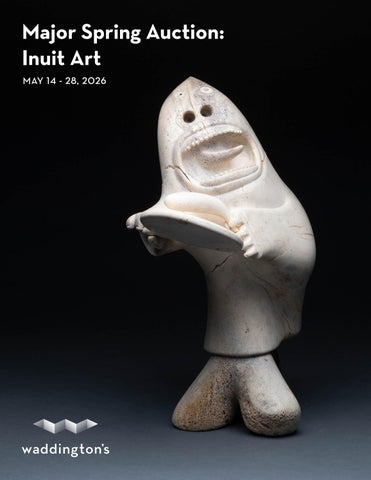
front cover
Lot 235
Karoo Ashevak
Drum Dancer, ca. 1973
front inside cover
Lot 209
Kenojuak Ashevak
Untitled (Ravens), ca. 2000 (detail)
opposite
Lot 238
Kenojuak Ashevak
Mother and Three Children, ca. 1975
back inside cover
Lot 210
Jessie Oonark
Woman, 1970 (detail)
back cover
Lot 221
Pauta Saila
Dancing Bear, ca. 1984
Waddington’s is proud to present our spring 2026 major auction of Inuit Art featuring the important lifetime collection of Dr. Norman Epstein.
We are likewise proud to include ancient and historical Inuit artworks from the Lavrov-Costakis collection, alongside select works from the collections of former Northwest Territories Arts and Crafts Development Officer David Sutherland, and the S. Family.
Exceptional collections are built through perseverance and passion. We would like to express our gratitude to both our consignors and to the connoisseurs and collectors who share these twin virtues. It is your dedication and enthusiasm which continues to support the exceptional art of the Arctic’s diverse and resilient peoples.
Palmer Jarvis, Senior Specialist
Elizabeth Gagnon, Consignment Specialist
Lot 225
Niviaxie
Two Bears Hunting, 1959 (detail)
The Collection of Dr. Norman Epstein
A dedicated enthusiast and influential advocate of Inuit art, Dr. Norman Epstein was among the first generation of passionate Canadian collectors of Inuit sculpture.
Publicly known for lending works from his collection to numerous provincial and national exhibitions, Dr. Epstein also shared his collection with patients and friends. In 1990, an interview with Dr. Epstein was published in Inuit Art Quarterly (IAQ) as part of a three-part profile on collectors, alongside interviews with important contemporaries Samuel Sarik and Peter Millard. In the article, Dr. Epstein speaks about both the public and personal side of his collecting.
Dr. Epstein first encountered Inuit art while working as a resident in paediatrics at the Montreal Children’s Hospital in the 1950s, where Inuit children were brought south for medical treatment. Frustrated by what he perceived as an unusually slow improvement in the children’s health, Dr. Epstein and his colleagues thought that the children might benefit from an opportunity to work with their hands, and started a sculpting program for the young patients. Quickly impressed and fascinated Image courtesy of the consignor.
by their carvings, he sought out Inuit art at the Canadian Guild of Crafts Shop in Montreal, and made his first purchase that year for fifteen dollars—half a month’s salary for a resident doctor in 1956.
Dr. Epstein would go on to purchase more Inuit artwork, guided by pioneering figures in the Canadian art scene, including Avrom Isaacs, Harold Seidelman, and M.F. (Budd) Feheley. However, he remained true to his own sensibilities and personal preferences, building a collection almost solely composed of sculpture, preferring the medium's “tactility” and “spiritual warmth” over Inuit graphics.
Dr. Epstein displayed artworks in his offices for the pleasure of his many patients, selecting mother and child scenes for his waiting room, and including bears in his office. His passion also extended to artworks in ivory and whalebone. Over the years, Dr. Epstein owned several significant works by Karoo Ashevak and kept the most important, Drum Dancer, which was exhibited in the small but influential show The Spirit of the Land at the Koffler Gallery in Toronto, in 1986. Dr. Epstein’s important collection of small ivory sculpture by Arviliqjuaq (Pelly Bay) artist Augustin Anaittuq was the subject of a solo exhibition
at The Art Gallery of Ontario in 1985, and later exhibited alongside one of his favourite Pauta bears in the landmark 1988–1991 Canadian Museum of History exhibition In the Shadow of the Sun.
The significance of holding national exhibitions was part of Dr. Epstein’s firm conviction about the cultural value of his chosen collecting field, stating emphatically in the 1990 IAQ interview, “Inuit art is a Canadian heritage”. Ever passionate, Dr. Epstein drove the point home, recollecting with gusto a story about once selecting an Inuit mother and child sculpture over a “beautiful Emily Carr painting” offered to him by a dealer.
By the 1990s, Dr. Epstein was making fewer changes to his collection. While often shared with the public, the collection was also deeply personal for him, treasured through its many iterations over 60 years. Dr. Epstein notes of his sculptures at the close of the article, “I love them so much, which may be a sickness for which there is no cure”.
stone, signed in syllabics; dated 6.25 x 3.5 x 3 in — 15.9 x 8.9 x 7.6 cm
PROVENANCE: Private Collection, Ontario
$2,000—4,000
VIEW LOT
DAVIE ATCHEALAK
Few sculptors have been able to capture fluidity of posture or richness of anatomical detail with the apparent confidence and ease of Davie Atchealak. One of the great sculptors to come out of southern Baffin Island, Atchealak is much renowned, particularly for his expertly engineered dancing bears, and his exuberant, muscular shamans.
Atchealak’s seemingly effortless engineering and expert use of cantilever is on marvellous display in this iteration of his iconic dancing bears.
HENRY EVALUARDJUK ᐃᕙᓗᐊᔪ (1932-2007), IQALUIT (FROBISHER BAY)
WALKING BEAR, 1980s
stone, signed in Roman and syllabics
5.25 x 12 x 3.25 in — 13.3 x 30.5 x 8.3 cm
PROVENANCE:
Private Collection, Ontario
$3,000—4,000
VIEW LOT
DAVID RUBEN PIQTOUKUN
Tunik was exhibited in the Winnipeg Gallery of Art’s important 1997-98 solo exhibition Between Two Worlds: Sculpture by David Ruben Piqtoukun, and was published in the accompanying catalogue.
Tunik, like many of David Ruben’s sculptures, has a deeply personal connection for the artist, who often investigated stories from his own life and family history. Speaking of the work, David Ruben said:
The face on Tunik is single eyed...when I was young, I was taken in by a family. The father was a man with only one eye. Tunik represented my bear helping spirit and my one-eyed guardian.1
1 Darlene Coward Wight, Between Two Worlds: Sculpture by David Ruben Piqtoukun</em> (Winnipeg: Winnipeg Art Gallery, 1996), 31, pl. 53.
205
DAVID RUBEN PIQTOUKUN
(1950-2026), PAULATUK TUNIK, 1995 stone, signed in Roman; dated 7.75 x 15.5 x 4.5 in — 19.7 x 39.4 x 11.4 cm
PROVENANCE: Private Collection, Ontario
EXHIBITED: Between Two Worlds: Sculpture by David Ruben Piqtoukun, Winnipeg Art Gallery, Winnipeg, MB, 26 May-26 Aug, 1996
$4,000—6,000
VIEW LOT
JOHNNY INUKPUK ᔭᓂ ᐃᓄᐸ, RCA (1911-2007), INUKJUAK (PORT HARRISON)
MISCHIEVOUS DOG, 1960s
stone, unsigned; disc number inscribed
9 x 5 x 6 in — 22.9 x 12.7 x 15.2 cm
PROVENANCE:
Private Collection, British Columbia
$900—1,200
VIEW LOT
207
FLOYD KUPTANA (1964-2021), PAULATUK
BEAR IN TUXEDO, 2002
stone, steel, signed in Roman; dated
11.5 x 6.25 x 2.75 in — 29.2 x 15.9 x 7 cm
PROVENANCE:
Private Collection, Alberta
$1,500—2,500
VIEW LOT
TUDLIK ᑐᓕ
Tudlik is primarily remembered as a carver of owls, as is the artist’s son, Latcholassie Akesuk. While both artists favoured sculpting birds, they did work with other subjects. Latcholassie most notably carved seals, and Tudlik bears, such as the present example made from rugged stone of the type quarried in the years before Cape Dorset became synonymous with lustrous green serpentine.
As elsewhere in Tudlik’s carving, Striding Bear is defined by the artist’s signature sign-like reductive treatment of his subjects.
stonecut and stencil, artist’s name in syllabics; titled, dated, and numbered 7/40 verso; artist’s and printers names in Roman verso; also inscribed verso “20/85” sheet 25 x 31 in — 63.5 x 78.7 cm
stone, unsigned; “Canada Eskimo Art” sticker to underside of foot
5.5 x 8.75 x 2 in — 14 x 22.2 x 5.1 cm
PROVENANCE:
Private Collection, New Mexico
$1,500—2,500
VIEW LOT
DAVID RUBEN PIQTOUKUN
(1950-2026), PAULATUK PEREGRINE FALCON, 1983
stone, catlinite, signed in Roman and syllabics; dated 15.75 x 11.5 x 6 in — 40 x 29.2 x 15.2 cm
PROVENANCE:
S. Family Collection, Toronto, ON
EXHIBITED:
Out of Tradition: Abraham Anghik/David Ruben Piqtoukun, Winnipeg Art Gallery, Winnipeg, MB, 1989
$1,500—2,500
Speaking of the present work, published in Darlene Wright’s Out of Tradition: Abraham Anghik/ David Ruben Piqtoukun in 1989, Piqtoukun said:
One of my favourite subjects is the peregrine falcon. The eyes and claws are symbols of determination. I once had my own falcon when I was traveling with my sister and brother-in-law out on the land. I became deathly ill and was feverish for several days. My bird stayed by my side constantly in the tent and covered me with its wings for protection. I’ll never forget that time.
VIEW LOT
PAUTA SAILA ᐸᐅᑕ ᓯᓚ
Perhaps the consummate sculptor of bears, Pauta Saila found a delightful range of emotions and postures in the animal. Like his audience, Pauta clearly enjoyed the various nuances of his many iterations of the subject, explaining:
I carve bears with longer and shorter necks, some that are fat or lean. They are in different positions because bears are always doing something. Sudden moves are possible with shorter necks. Polar bears are like human beings. If they are not distracted they can see better, even when they move fast…I like to carve what I feel, not merely what I see. It is the feeling that goes along with whatever one is doing. I also think about the material, the stone. I like to think how to carve it so that it does not break. I do what the Creator wants me to do, not merely by seeing but by feeling too. Carving is very different from making a photograph. I think and feel that the bear has a spirit to be put into the carving. But each person has different thoughts when he is carving.
Today I am not worrying about making an amulet or a charm. I have to be pleased with what I am doing as does the person who is asking for the carving. I have to please myself and the buyer. At times I feel like keeping some of my carvings. In fact I have even said good-bye to some. 1
Dancing Bear is cut from beautifully mottled and polished serpentine, and dates circa 1984. The work was exhibited in the landmark 1988–1991 touring exhibition In the Shadow of the Sun: Perspectives on Contemporary Native Art, and is published in the accompanying 1988 text Im Schatten Der Sonne: Zeitgenossische Kunst der Indianer und Eskimos in Kanada
1 Bernadette Driscoll, Uumajut, Animal Imagery in Inuit Art (Winnipeg: The Winnipeg Art Gallery, 1985), 46
DANCING BEAR, CA. 1984 stone, ivory, signed in syllabics
21.5 x 16.5 x 7 in — 54.6 x 41.9 x 17.8 cm
PROVENANCE:
Collection of Dr. Norman Epstein, Toronto, ON
EXHIBITED:
In the Shadow of the Sun: Perspectives on Contemporary Native Art, Museum Am Ostwall and Museum Fur Kunst Und Kulturgeschichte, Dortmund, Germany, 9 Dec 1988-27 Feb 1989, Canadian Museum of History, Gatineau, QC, 29 Jun 1989-2 Jan 1990, Art Gallery of Nova Scotia, Halifax, NS, 20 Apr-24 June 1990, Rijksmuseum Voor Volkenkunde, Leiden, NL, and the Museon, The Hague, NL, 31 Aug-28 Oct 1991.
$20,000—30,000
VIEW LOT
NUNA PARR ᓄᓇ ᐸ
The adopted son of the graphic artists Parr and Eleeshushe, Nuna Parr has enjoyed considerable popularity as a sculptor of bears and other Arctic wildlife, and was an active carver from the late 1960s until his passing in 2026.
Nuna’s simple, often subtly reductive figures often exhibit a distinctive stylized implication of movement. This signature characteristic is particularly evident in the present monumental Diving Walrus, whose considerable bulk is suspended mid-thrust above its downward facing body. The sculpture’s surface has been polished to a high lustre, giving the variegated green body a watery sheen. Diving Walrus is notably among larger iterations of the subject by the artist.
222
NUNA PARR ᓄᓇ ᐸ (1949-2026), KINNGAIT (CAPE DORSET)
DIVING WALRUS, 1990s
stone, ivory, signed in Roman
28 x 21 x 6.5 in — 71.1 x 53.3 x 16.5 cm
PROVENANCE: Private Collection, Ontario
$15,000—25,000
VIEW LOT
HENRY EVALUARDJUK ᐃᕙᓗᐊᔪ (1932-2007), IQALUIT (FROBISHER BAY)
Darlene Coward Wight, Kiugak Ashoona: Stories and Imaginings from Cape Dorset (Canada: Friesens Corporation, 1977), 80-81.
LOT
VIEW
NIVIAXIE ᓂᕕᐊᓯ
Niviaqsi’s legacy will forever be intertwined with polar bears. It is an animal which he is said to have favoured for his carvings, is the subject of only two of twelve prints associated with Niviaqsi, and is part of the powerful myth of the artist. Notably Niviaqsi’s mysterious death occurred during a polar bear hunt, and was reported in a now widely repeated and much stylized account in Time Magazine. 1
Two Bears Hunting was printed in two types, in green, or—as in the present example— blue. Both variations were inked in a rich gradient of colour from dark to light, using the negative space of the paper to represent the wayfaring animals, and to add a texture to the background which evokes snowfall, or perhaps a celestial phenomenon. It is notable that the Aurora Borealis is closely associated with the spirits of ancestors among many Inuit.2
Released as part of the Dorset Series, a collection of approximately seventy prints also referred to as the Dorset Collection, Northern Collection, or Northern Releases, works in the series were only made available locally to visitors to the Cooperative, and were never distributed in the south.3 The present example was acquired in Kinngait circa 1960, and has been preserved with its original and vibrant colour intact.
1 Time Magazine “Art: Land of the Bear”, Vol. LXXV No. 8, Monday, 22 February 1960.
2 Asgeir Brekke and Alv Egeland, The Northern Light: From Mythology to Space Research (Oslo: University of Oslo, 1979), 1.
3 Richard Crandall, Inuit Art, A History (Jefferson: McFarland & Company, 2000), 143.
225
NIVIAXIE ᓂᕕᐊᓯ (1909-1959), KINNGAIT (CAPE DORSET)
TWO BEARS HUNTING, 1959
stonecut, titled, dated, and numbered 44/50; artist’s name in Roman sheet 19.5 x 16 in — 49.5 x 40.6 cm
PROVENANCE:
Purchased from West Baffin Eskimo Co-operative Ltd., ca. 1961, passed by descent to the present Private Collection, Ontario
stencil, titled, dated, and numbered 19/50; artist’s name in syllabics sheet 23.75 x 19 in — 60.3 x 48.3 cm
PROVENANCE:
Private Collection, Ontario
$3,000—5,000
VIEW LOT
227
NINGIUKULU (NINGEOKULUK) TEEVEE
ᓂᒋᐅᑯᓗ ᑎᕕ (B. 1963), KINNGAIT (CAPE DORSET)
TWOSOME, 2017
coloured pencil and felt tip on paper, signed in syllabics; titled and dated sight 9.5 x 10.5 in — 24.1 x 26.7 cm
PROVENANCE:
Private Collection, British Columbia
$700—900
VIEW LOT
TIM PITSIULAK ᑎᒻ ᐱᓯᐃᓚ (1967-2016), KINNGAIT (CAPE DORSET) LEGENDS, CA. 2000
coloured pencil on paper, signed in Roman and syllabics and titled sight 18.5 x 24 in — 47 x 61 cm
PROVENANCE:
Private Collection, British Columbia
$4,000—6,000
VIEW LOT
229
SIMON OLEEKATALIK ᐅᓕᑲᑕᓕ (B. 1942), TALOYOAK (SPENCE BAY)
STANDING FIGURE WITH HEART, CA. 1990s
stone, leather, sinew, signed in syllabics
16.25 x 6.75 x 3.5 in — 41.3 x 17.1 x 8.9 cm
PROVENANCE:
Galerie d’Art Vincent, Ottawa, ON Private Collection, Ontario
$800—1,200
VIEW LOT
HENRY EVALUARDJUK ᐃᕙᓗᐊᔪ (1932-2007), IQALUIT (FROBISHER BAY)
YOUNG WOMAN, 1980s
stone, signed in Roman and syllabics
13.25 x 4.5 x 5 in — 33.7 x 11.4 x 12.7 cm
PROVENANCE:
Private Collection, Ontario
$3,000—5,000
VIEW LOT
TUTUYEA IKKIDLUAK ᑐᑐᐃᔭ
A rising star among Inuit artists in the 1980s, Tutuyea Ikkidluak’s talent for figuration, eye for detail, and his ambitious, complex compositions promised to make the artist an important name in the Kinngait (Cape Dorset) art scene. However, the tragic untimely death of Ikkidluak in 1989 cut short his career at the age of 27, only two years after his first solo show at The Innuit Gallery of Eskimo Art in Toronto in 1987.
Although Ikkidluak’s work is much sought out by collectors, few works are well known to the broader public, perhaps with the exception of his culture-bridging statement on poverty and starvation, Starving Ethiopian, carved during the famine in Ethiopia in 1983-1985 and published in Inuit Art Quarterly in 2021.1
1 Napatsi Folger, “How One Inuit Sculpture Links Two Very Different Parts of the World”, Inuit Art Quarterly, 17 Nov 2021.
One of the most distinctive talents in circumpolar art, Karoo Ashevak’s body of work has had an outsized impact for a career that lasted only five years. His untimely death in a fire at the age of 34 brought an abrupt end to a surge of creative output that continues to draw interest and admiration from both Canadian and international art collectors.
Born in the Canadian high north of Taloyoak (Spence Bay), Karoo developed a style that fused his unique vision of dreams, spirituality, and shamanism with the distinctive raw material available to him in Taloyoak. Karoo chose the material for his sculptures carefully. The artist benefited from a relative abundance of time-cured whalebone left in deposits on the land by 19th century whalers, and also in ancient middens and dwelling sites long pre-dating Europeans arrival in the Arctic.1
A work of exceptional balance and proportion, Drum Dancer is among the great sculptures by Karoo. The arching body of the figure captured in the confines of the whalebone evokes the swaying motion of the dancer. The face of the figure is realized with exceptional clarity distinctive to a handful of works from Karoo’s mature period. Drum Dancer epitomizes the wild and exuberant presence so associated with Karoo’s creations, and for which the artist himself is remembered by those who knew him.2
Acquired by dedicated collector and influential advocate of Inuit art Dr. Norman Epstein, in 1983 from the Inuit Gallery of Vancouver, Drum Dancer was from the outset a key work in his important collection. Although Epstein owned at least four sculptures by Karoo over his more than sixty years collecting, Drum Dancer was the one work by the artist which Epstein kept close since its initial acquisition. An exception was made only in 1986, when the work was lent for the small but influential Inuit art exhibition at the Koffler Gallery, Toronto, The Spirit of the Land. Drum Dancer was published on the cover of the catalogue for the exhibition.
1 Pamela Harris, Karoo Ashevak Spirits (New York: American Indian Arts Center, 1973), unpaged.
2 Ibid; Jean Blodgett, Karoo Ashevak (Winnipeg: The Winnipeg Art Gallery, 1977), unpaged; Personal correspondence of the author with former residents of Taloyoak
whalebone, baleen, signed in syllabics; accompanied by the original The Spirit of the Land exhibition catalogue from Koffler Gallery; also accompanied by the original invoice from Inuit Gallery of Vancouver
19.75 x 12.5 x 10.5 in — 50.2 x 31.8 x 26.7 cm
PROVENANCE:
Inuit Gallery of Vancouver, Vancouver, BC, 22 Feb 1983
Collection of Dr. Norman Epstein, Toronto, ON
EXHIBITED:
The Spirit of the Land, The Koffler Gallery, Toronto, ON, 6 May-6 Jun 1986
$50,000—70,000
LOT
OVILOO TUNNILLIE ᐅᕕᓗ ᑐᓂᓕ, RCA (1949-2014), KINNGAIT (CAPE DORSET) HAND, 1994 stone, signed in syllabics
stone, signed in syllabics; Dorset Fine Arts sticker verso
8.25 x 8.25 x 3 in — 21 x 21 x 7.6 cm
PROVENANCE:
Private Collection, Ontario
$1,500—2,500
VIEW LOT
KENOJUAK ASHEVAK ᑭᓄᐊᔪᐊ
Even before the success of the print program at Kinngait (Cape Dorset), Kenojuak Ashevak expressed her visions in stone in the mid to late 1950s. Never a prolific sculptor, she continued with only occasional forays into the medium over her career.
The present work is carved in marble quarried at Andrew Gordon Bay, fifty kilometers east of Kinngait (Cape Dorset). The material was predominantly used in the early to mid 1970s, and ranged in colour from luminous white, to green, to salmon pink. In the present sculpture, Kenojuak has used the difficult to work with Bay stone to great effect, the tremendous weight and size of the sculpture emphasising the protective strength of the mother over her children—a favoured theme in Kenojuak’s three dimensional works.
stone, antler, hide, signed in Roman and syllabics; dated
34.5 x 16 x 16 in — 87.6 x 40.6 x 40.6 cm
PROVENANCE:
S. Family Collection, Toronto, ON
$7,000—9,000
VIEW LOT
241
PARR ᐸ (1893-1969), KINNGAIT (CAPE DORSET)
UNTITLED (7 GEESE, 4 PEOPLE, 2 DOGS), 1964
stonecut, dated and numbered 2/45; artist’s name in Roman sheet 21.5 x 24.25 in — 54.6 x 61.6 cm
PROVENANCE: Private Collection, Ontario
$3,000—4,000
VIEW LOT
The present rare print Untitled (7 Geese, 4 People, 2 Dogs) was never included in an official release from West Baffin Co-operative, having been rejected by The Canadian Eskimo Arts Council (CEAC) circa 1964.
Rejected prints were the subject of a brief series of articles published in 2022 by Inuit Art Quarterly titled What Gets Lost: The Canadian Eskimo Arts Council’s Rejected Prints
242
PARR ᐸ (1893-1969), KINNGAIT (CAPE DORSET)
GEESE, DOG, AND WALRUS, 1963
stonecut, titled, dated, and numbered 23/50; artist’s name in syllabics; pencil inscription verso sheet 29 x 21 in — 73.7 x 53.3 cm
MOTHER WITH BUNDLE AND JOYOUS CHILD, CA. 1989 ivory, signed in syllabics
3.75 x 1 x 1.5 in — 9.5 x 2.5 x 3.8 cm
PROVENANCE:
S. Family Collection, Toronto, ON
$400—600
VIEW LOT
248
UNIDENTIFIED ARTIST, WESTERN ARCTIC MAN ON KOMATIK, CA. 1980s ivory, wood, copper, vinyl, unsigned; old inventory sticker to underside excluding thong 3.75 x 5 x 2 in — 9.5 x 12.7 x 5.1 cm
PROVENANCE: Collection of Dr. Norman Epstein, Toronto, ON
$300—500
VIEW LOT
249
PAUTA SAILA ᐸᐅᑕ ᓯᓚ, RCA (1916-2009), KINNGAIT (CAPE DORSET) DANCING BEAR, CA. 1970 stone, ivory, signed in syllabics
16 x 11 x 8.5 in — 40.6 x 27.9 x 21.6 cm
PROVENANCE:
Collection of Dr. Norman Epstein, Toronto, ON
$15,000—25,000
VIEW LOT
250
TOONOO SHARKY ᑐᓄ ᓴᑭ, RCA (B. 1970), KINNGAIT (CAPE DORSET) OWL AND OWLET, 2011 stone, signed in syllabics 19 x 19 x 12.5 in — 48.3 x 48.3 x 31.8 cm
stone, antler, signed in Roman and syllabics; dated 9 x 11 x 4.5 in — 22.9 x 27.9 x 11.4 cm
PROVENANCE:
Private Collection, British Columbia
$5,000—7,000
VIEW LOT
LUKE ANGUHADLUQ ᓗᐅᒃ ᐊᒐᓴᓗ (1895-1982), QAMANI’TUAQ (BAKER LAKE)
UNTITLED (GEESE IN FLIGHT), CA. 1976 coloured pencil on paper, signed in syllabics; disc number inscribed sheet 22.25 x 30 in — 56.5 x 76.2 cm
PROVENANCE:
Private Collection, Hamilton, ON
$3,000—4,000 VIEW LOT
The present original drawing is closely related to the following lot in the auction, Anguhadluq’s iconic Geese in September, dated to 1972. The subject of birds in flight appears in several of the artist’s exceptional images as late as the 1980s, and exhibits the artist’s sometimes unpredictable use of colour—a characteristic not always translated into Anguhadluq prints.
254
LUKE ANGUHADLUQ ᓗᐅᒃ ᐊᒐᓴᓗ (1895-1982), QAMANI’TUAQ (BAKER LAKE)
GEESE IN SEPTEMBER, 1972
stencil, titled, dated, and numbered 42/50; artist’s and printer’s name in Roman and syllabics sheet 25.75 x 40 in — 65.4 x 101.6 cm
stonecut and stencil, titled, dated, and numbered 17/50; artist’s name in Roman sheet 24 x 30.5 in — 61 x 77.5 cm
PROVENANCE: Private Collection, Alberta
$1,500—2,500 VIEW LOT
PIERRE KARLIK ᑲᓕ
A gifted sculptor with a talent for surface detail and fine finishing, Pierre Karlik was much lauded in his own time, and benefited from several important commissions.1 In recent years, however, his talents have sometimes been unfairly overlooked in favour of the elemental, abstract sculpture of his Kangiqliniq (Rankin Inlet) contemporaries, most notably John Tiktak and John Kavik.
The present sculpture, Basking Walrus, is a clear example of Karlik’s distinctive and skillful realism. Fine lines on the surface of the walrus suggestive of guard hairs run the length of the animal’s monotone black body—a rhythmic density emphasizing its swells and depressions with precision reminiscent of a David Blackwood etching.
1 Pierre Karlik, accessed 16 April, 2026, https://katilvik.com/browse/artists/3144-pierre-karlik/
257
PIERRE KARLIK ᑲᓕ (1931-2013), KANGIQLINIQ (RANKIN INLET)
BASKING WALRUS, CA. 1967 stone, ivory, signed in syllabics; disc number inscribed; accompanied by a “Canada Eskimo Art” tag inscribed “Rankin Inlet / Karlik”
12.5 x 21 x 12.5 in — 31.8 x 53.3 x 31.8 cm
PROVENANCE:
Collection of Dr. Norman Epstein, Toronto, ON
$4,000—6,000
VIEW LOT
NUNA PARR ᓄᓇ ᐸ (1949-2026), KINNGAIT (CAPE DORSET) POLAR BEAR, CA. 1993 stone, signed in Roman 12 x 21 x 8 in — 30.5 x 53.3 x 20.3 cm
PROVENANCE:
Purchased directly from the artist, 1993 Private Collection, Ontario
AUGUSTIN ANAITTUQ, IVORIES FROM PELLY BAY, THE COMPLETE SOLO EXHIBITION, 1975 forty sculptures, comprised of ivory, antler, whalebone, and stone various sizes
PROVENANCE:
The Innuit Gallery of Eskimo Art, Toronto, ON, 9 Jun 1979 Collection of Dr. Norman Epstein, Toronto, ON
EXHIBITED:
Miniature Ivories by Anaituq of Pelly Bay, The Innuit Gallery of Eskimo Art, Toronto, ON, 9-23 Jun 1979
Augustin Anaittuq, Ivories from Pelly Bay, The Art Gallery of Ontario, Toronto, ON, 1985
In the Shadow of the Sun: Perspectives on Contemporary Native Art, Museum Am Ostwall and Museum Fur Kunst Und Kulturgeschichte, Dortmund, Germany, 9 Dec 1988-27 Feb 1989, Canadian Museum of History, Gatineau, QC, 29 Jun 1989-2 Jan 1990, Art Gallery of Nova Scotia, Halifax, NS, 20 Apr-24 Jun 1990, Rijksmuseum Voor Volkenkunde, Leiden, NL, and the Museon, The Hague, NL, 31 Aug-28 Oct 1991
$15,000—25,000
A skilled carver and highly original talent, Augustin Anaittuq is known by collectors for his spirit sculpture in whalebone and mixed media, and for his refined miniature ivories. Both are characterized by novel and uncommon imagery, and in his ivories, by sometimes unusual, even startling subject matter.
Anaittuq began carving circa 1966. A successful and prosperous hunter, it is said that in his early years he actually carved very little, and was never prolific.
In 1975, Anaittuq made a group of forty sculptures which were acquired by the pioneering Canadian art dealer Avrom Isaacs, and exhibited at his Toronto gallery dedicated to Inuit art, The Innuit Gallery of Eskimo Art, in 1979. The sculptures were all exceptionally finely finished miniature ivories, and typical of the style and size made in Arviliqjuaq (Pelly Bay). Speaking of their subject matter of the works, curator and scholar Jean Blodgett noted a unique “diversity of subjects from the everyday to the supernatural, from the whimsical to the starkly realistic, from the humorous to the tragic.”
Mundanities of Arctic life such as congresses of birds, drying fish, and people tanning skins take on a special appeal at the hands of Anaittuq. Other more conflicting subjects such as the arrival of Qallunaat (the whites), abuse of alcohol, contemplation of mortality, and even suicide and murder are investigated in minute detail. It is notable that not until Bill Nasogaluak in the early 2000s have such subjects, invariably accompanied by discomfort, and sometimes shame, received mainstream approval in the world of Inuit art.
Depictions of otherworldly or mythical events are also present in several sculptures, notably including stories well known to collectors such as the tale of the man and the giant (lot 22), dogs barking to frighten off malevolent spirits (lot 23), and the story of Natturalik(a kidnapping bird spirit) (lot 24), but also lesser known stories associated with the Netsilikmiut, the people who reside in the region of Arviliqjuaq. An example of the latter being an obscure variation on an episode in the myth of Aviliayuk, the sea goddess, known elsewhere in the Arctic as Sedna, Nuliajuk, Taleelayo etc. (lot 25).
Believing in the significance of the collection as a whole, devoted collector and Inuit art enthusiast Dr. Norman Epstein purchased the entire 40 piece collection, and in 1985 lent a selection of 32 of the sculptures for a dedicated solo exhibition of the collection at the Art Gallery of Ontario (AGO). In 1988-91, four sculptures were exhibited in the landmark traveling exhibition In The Shadow of the Sun: Perspectives on Contemporary Native Art. Works from the collection have subsequently be published both in Jean Blodgett’s catalogue for the AGO exhibition, and in the German edition of the catalogue for In The Shadow of the Sun, Im Schatten Der Sonne: Zeitgenossische Kunst der Indianer und Eskimos in Kanada.
Singularly important in the oeuvre of Anaittuq, curator Jean Blodgett noted a broader significance to the collection of 32 works exhibited, observing the humanizing aspect of a body of work which which shows the Inuit not as a romantic ideal, but as “fellow human beings who have strengths and weaknesses, who suffer or laugh; [seeing the collection] we go beyond viewing them simply as an alien culture with different beliefs and practices.”
At the time of the AGO exhibition in 1985, Anaittuq was asked whether he wanted to say anything to people who viewed the 32 sculptures in the exhibition. He replied: “Someday I will no longer be carving. Now I’m not getting any younger. I want people to remember me after I’m dead. But my carvings will be here forever if they are well looked after.”
Jean Blodgett, Augustin Anaittuq (Toronto: Art Gallery of Ontario, 1985)
UNIDENTIFIED ARTIST, WESTERN ARCTIC UMIAK WITH HUNTERS, CA. 1900
ivory, unsigned
1.5 x 6 x 1.5 in — 3.8 x 15.2 x 3.8 cm
PROVENANCE:
Collection of Dr. Norman Epstein, Toronto, ON
$800—1,200
VIEW LOT
264
UNIDENTIFIED ARTIST, EASTERN ARCTIC SKELETAL DRUMMER, CA. 1980s
ivory, wood, beads, unsigned
6.25 x 2.75 x 1.5 in — 15.9 x 7 x 3.8 cm
PROVENANCE:
Collection of Dr. Norman Epstein, Toronto, ON
$500—700
VIEW LOT
JOHN TIKTAK ᔭᓐ ᑎᑕ
Head, circa 1966 has all the characteristics of Tiktak’s early classic style. Executed on an impressively large scale, the slot-like narrow eyes give the impression of a figure squinting against the sun, which imbues the face with an intense feeling of realism despite its angular form, and features characterized by a reductive abstraction. Like old Okvik heads, whose weatherbeaten surfaces are scarred with scattershot lines, Head seems all the more compelling and expressive for its exceptional surface.
Sold by Marion Scott Gallery in 2009, Head had previously been acquired at Waddington’s in our November 5th 2007 Auction of Inuit Art, where our catalogue note read:
The vendor’s parents lived and worked as teachers in various communities in the North, including Chesterfield Inlet, Rankin Inlet, and later Grise Fiord, Hall Beach and Frobisher Bay. They collected Inuit art during the early 1960s to the mid 1970s. Many of the artists they collected from were known as friends and the entire family including the vendor were well versed in Inuktitut, having been brought up in the Arctic.
265
JOHN TIKTAK ᔭᓐ ᑎᑕ, RCA (1916-1981), KANGIQLINIQ (RANKIN INLET)
HEAD, CA. 1966
stone, unsigned
7.5 x 5 x 4 in — 19.1 x 12.7 x 10.2 cm
PROVENANCE:
Private Collection, British Columbia Waddington’s Auctioneers, Toronto, ON, 5 Nov 2007, lot 283
Marion Scott Gallery, Vancouver, BC, 2009
Private Collection, Ontario
$15,000—20,000 VIEW LOT
JOHN KAVIK ᔭᓐ ᑲᕕ (1897-1993), KANGIQLINIQ (RANKIN INLET)
MOTHER WITH CHILD AND DOG, 1970s stone, unsigned
13 x 6.25 x 4 in — 33 x 15.9 x 10.2 cm
PROVENANCE:
Private Collection, Ontario
$4,000—6,000
VIEW LOT
267
THOMAS UGJUK ᑕᒥ ᐅᔪ (1921-2012), KANGIQLINIQ (RANKIN INLET)
SWIMMING BIRD, 1970s stone, signed in syllabics; accompanied by a “Canada Eskimo Art” tag inscribed “Oshowetok / Cape Dorset” 4.25 x 7.25 x 2 in — 10.8 x 18.4 x 5.1 cm
JOHN TIKTAK ᔭᓐ ᑎᑕ, RCA (1916-1981), KANGIQLINIQ (RANKIN INLET)
SEATED FIGURE, CA. 1964
stone, signed in syllabics
11 x 8 x 3.25 in — 27.9 x 20.3 x 8.3 cm
PROVENANCE:
Acquired directly from the artist, ca. 1964 By decent to the present Private Collection, Florida, USA
$15,000—20,000
An important and compositionally distinctive work by the artist, Seated Figure, circa 1964 exemplifies John Tiktak’s inventive incorporation of negative space in his compositions. Closely related to a smaller circa 1964 sculpture formerly in the collection of James and Alma Houston (lot 62 of Waddington’s May 2021 Inuit Art auction), the present work is further notable for its scale, the refinement of the facial characteristics, and upturned cast of the head.
Seated Figure was acquired circa 1964 by John Westerberg on a fishing trip to Haningayok (Black River), in present day Nunavut, and passed by descent to the present collection. The lot is accompanied by a facsimile copy of an eight-page article documenting the trip as published in the July 1964 issue of the American outdoor magazine Sports Afield.
VIEW LOT 273
274
GEORGE ARLUK ᐊᓗ (1949-2023), ARVIAT (ESKIMO POINT)
SPIRITS, CA. 1978
stone, signed in Roman 6.25 x 4.5 x 3.25 in — 15.9 x 11.4 x 8.3 cm
PROVENANCE:
Collection of Dr. Norman Epstein, Toronto, ON
$400—600
VIEW LOT
275
JOHN PANGNARK ᔭᓐ ᐸᓂ (1920-1980), ARVIAT (ESKIMO POINT)
FIGURE, CA. 1975
stone, unsigned; inventory number inscribed 2.5 x 7.5 x 2.5 in — 6.4 x 19.1 x 6.4 cm
PROVENANCE: Private Collection, Ontario
$700—900
VIEW LOT
JOHN KAVIK ᔭᓐ ᑲᕕ (1897-1993), KANGIQLINIQ (RANKIN INLET)
MAN IN DISTRESS, 1970s
stone, unsigned
8.75 x 6.25 x 4 in — 22.2 x 15.9 x 10.2 cm
PROVENANCE:
Private Collection, Ontario
$4,000—6,000
VIEW LOT
THE LAVROV-COSTAKIS COLLECTION OF ANCIENT AND HISTORICAL INUIT ART
Waddington’s is honoured to offer fifteen works of ancient and historical Inuit art from the collection of Igor Lavrov and George Costakis, lots 277-291 in the present auction.
While little information is readily available in English regarding Igor Lavrov, his involvement with Chukchi and Yupik craft workshops in Uelen, on the Russian side of the Bering Strait between 1955 and 1958 echoes the work of James Houston in the Canadian Arctic. Lavrov built a rural craft industry, laboured to improve the working conditions of Inuit carvers, and encouraged the telling of old myths and stories through their creations. He both reacquainted carvers with their heritage, as well as recorded and shared their own stories among them. The undertaking was fraught with danger amidst the conflicting imperatives of the Soviet Government, which encouraged a craft program rooted in Inuit history, but were opposed to anything too closely associated with religion. While in Chukotka, Lavrov collected a small number of ancient and historical artworks in wood and ivory, dating from as early as the Okvik period (1,926 - 2,200 years old as of 2026), to as late as the first quarter of the 20th century. The collection later passed to Lavrov’s close friend, George Costakis.
Costakis is now well known for his semi-mythical collection of artwork by the early Soviet avant-garde. Almost single-handedly, Costakis preserved their legacy for future generations through his acquisition and care of their artworks, which, under Stalin, were at best regarded as outmoded, and at worst as counter-revolutionary.
Costakis would almost exclusively come to focus on collecting art of the early Soviet avant-garde and its precursors. His early collecting, however, was omnivorous, and included silver, Dutch School landscape painting, and other areas, which he later perceived as a distraction from his chosen subject. Eventually forced to leave the USSR in 1977, Costakis’ collecting, divisive under the repressive Soviet state, was made possible in large part by the diplomatic immunity he was granted by working for over thirty years at the Canadian embassy in Moscow, an opportunity for which he expressed great gratitude to Canada.
Image courtesy of The Costakis Collection.
UNIDENTIFIED BERING SEA REGION ARTIST
FIGURAL FIRE BLOCK, FIRST QUARTER 20TH CENTURY OR EARLIER
wood, hide, glass beads
15.75 x 3.13 x 2.25 in — 40 x 8 x 5.7 cm
PROVENANCE:
Collected by Igor Lavrov, Russia, ca. 1940s
George Costakis, Russia and Greece
Thence by descent
$5,000—7,000 VIEW LOT
UNIDENTIFIED BERING SEA REGION ARTIST
FIGURAL FIRE BLOCK, FIRST QUARTER
20TH CENTURY OR EARLIER wood
16.5 x 3.5 x 2.25 in — 41.9 x 8.9 x 5.7 cm
PROVENANCE:
Collected by Igor Lavrov, Russia, ca. 1940s
George Costakis, Russia and Greece
Thence by descent
$5,000—7,000
VIEW LOT
UNIDENTIFIED BERING SEA REGION ARTIST
THREE FACED FIGURE, FIRST QUARTER 20TH CENTURY OR EARLIER wood
6 x 2.75 x 3 in — 15.2 x 7 x 7.6 cm
PROVENANCE:
Collected by Igor Lavrov, Russia, ca. 1940s
George Costakis, Russia and Greece
Thence by descent
$4,000—6,000
VIEW LOT
UNIDENTIFIED BERING SEA REGION ARTISTS
FIFTEEN BEAR, FOX, WEASEL AND OTHER QUADRUPED EFFIGIES, FIRST QUARTER 20TH CENTURY OR EARLIER
wood
PROVENANCE:
Collected by Igor Lavrov, Russia, ca. 1940s
George Costakis, Russia and Greece
Thence by descent
$7,000—9,000
VIEW LOT
UNIDENTIFIED BERING SEA REGION ARTIST
LONG NECKED BIRDS DISH, FIRST QUARTER 20TH CENTURY OR EARLIER
wood
2.25 x 14.25 x 4 in — 5.7 x 36.2 x 10.2 cm
PROVENANCE:
Collected by Igor Lavrov, Russia, ca. 1940s
George Costakis, Russia and Greece
Thence by descent
$3,000—4,000
VIEW LOT
UNIDENTIFIED BERING SEA REGION ARTIST
TAPERING FIGURE (POSSIBLY SEDNA)
FIRST QUARTER 20TH CENTURY OR EARLIER
wood
8.25 x 2.13 x 1.5 in — 21 x 5.4 x 3.8 cm
PROVENANCE:
Collected by Igor Lavrov, Russia, ca. 1940s
George Costakis, Russia and Greece
Thence by descent
$1,000—2,000
VIEW LOT
UNIDENTIFIED BERING SEA REGION ARTIST
MASKETTE OF A WOMAN, FIRST QUARTER 20TH CENTURY OR EARLIER wood
7.5 x 3.75 x 1.5 in — 19.1 x 9.5 x 3.8 cm
PROVENANCE:
Collected by Igor Lavrov, Russia, ca. 1940s
George Costakis, Russia and Greece
Thence by descent
$4,000—6,000
VIEW LOT
UNIDENTIFIED BERING SEA REGION ARTIST
CLOTHED FIGURE, FIRST QUARTER 20TH CENTURY OR EARLIER
wood
6.5 x 2.75 x 1.25 in — 16.5 x 7 x 3.2 cm
PROVENANCE:
Collected by Igor Lavrov, Russia, ca. 1940s
George Costakis, Russia and Greece
Thence by descent
$2,000—3,000
VIEW LOT
UNIDENTIFIED BERING SEA REGION ARTIST
STANDING BEAR OR TRANSFORMATION FIGURE, FIRST QUARTER 20TH CENTURY OR EARLIER
leather
6.5 x 4 x .25 in — 16.5 x 10.2 x 0.6 cm
PROVENANCE:
Collected by Igor Lavrov, Russia, ca. 1940s
George Costakis, Russia and Greece
Thence by descent
$2,000—3,000
VIEW LOT
UNIDENTIFIED BERING SEA REGION ARTISTS
FIGURES, FIRST QUARTER 20TH CENTURY OR EARLIER wood
largest 5.75 x 1.25 x .75 in — 14.6 x 3.2 x 1.9 cm
PROVENANCE:
Collected by Igor Lavrov, Russia, ca. 1940s
George Costakis, Russia and Greece
Thence by descent
$2,000—3,000
VIEW LOT
287
UNIDENTIFIED BERING SEA REGION ARTIST
UNIDENTIFIED QUADRUPED, FIRST QUARTER 20TH CENTURY OR EARLIER
wood, iron
10.77 x 4 x 2.5 in — 27.4 x 10.2 x 6.4 cm
PROVENANCE:
Collected by Igor Lavrov, Russia, ca. 1940s
George Costakis, Russia and Greece
Thence by descent
$1,000—2,000
288
UNIDENTIFIED BERING SEA REGION ARTIST BIRD’S HEAD, FIRST QUARTER 20TH CENTURY OR EARLIER
wood
1.5 x 5.5 x 1.25 in — 3.8 x 14 x 3.2 cm
PROVENANCE:
Collected by Igor Lavrov, Russia, ca. 1940s
George Costakis, Russia and Greece
Thence by descent
$500—700
VIEW LOT VIEW LOT
289
UNIDENTIFIED BERING SEA REGION ARTIST
SWIMMING BIRD EFFIGY, FIRST QUARTER 20TH CENTURY OR EARLIER
wood
3 x 5.5 x 2.5 in — 7.6 x 14 x 6.4 cm
PROVENANCE:
Collected by Igor Lavrov, Russia, ca. 1940s
George Costakis, Russia and Greece
Thence by descent
$500—700
290
UNIDENTIFIED BERING SEA REGION ARTIST
KILLER WHALE EFFIGY, FIRST QUARTER 20TH CENTURY OR EARLIER
wood
3 x 6 x 1.13 in — 7.6 x 15.2 x 2.9 cm
PROVENANCE:
Collected by Igor Lavrov, Russia, ca. 1940s
George Costakis, Russia and Greece
Thence by descent
$500—700
LOT VIEW LOT
UNIDENTIFIED BERING SEA REGION ARTIST
WHALE EFFIGY, FIRST QUARTER
20TH CENTURY OR EARLIER
wood
1.5 x 7 x 1.25 in — 3.8 x 17.8 x 3.2 cm
PROVENANCE:
Collected by Igor Lavrov, Russia, ca. 1940s
George Costakis, Russia and Greece
Thence by descent
$500—700 VIEW LOT
292
UNIDENTIFIED ARTIST, NAUJAAT (REPULSE BAY)
BEAR, CA. 1960s
stone, unsigned
3.25 x 8.25 x 2.5 in — 8.3 x 21 x 6.4 cm
PROVENANCE:
Collection of Dr. Norman Epstein, Toronto, ON
$300—500
VIEW LOT
293
PARR ᐸ (1893-1969), KINNGAIT (CAPE DORSET)
THREE HUNTERS WITH WALRUS, 1967
stonecut, titled, dated, and numbered 30/50; artist’s name in Roman sheet 24 x 33.5 in — 61 x 85.1 cm
PROVENANCE:
Private Collection, Montreal, QC
$2,500—3,500
VIEW LOT
JAMES ARCHIBALD HOUSTON
Before the creation of the legendary 1959 print release at Kinngait (Cape Dorset), James Houston travelled to Japan to gain knowledge about traditional Japanese printing techniques that would be invaluable in the development of printmaking in the Arctic.
Intent on studying with master printmaker Un’ichi Hiratsuka, Houston also worked with other Japanese printmakers including Shiko Munakata, Shoji Hamada, Keisuke Serizawa, Kichiemon Okamura, Sadoa Watanabe, and Yoshito Mori.1
Back in Kinngait, Osuitok Ipeelee, Iyola Kingwatsiak, Eegyvudluk Pootoogook, Kananginak Pootoogook, and Lukta Qiatsuk worked with techniques brought back by Houston, manipulating, adapting, and developing them to suit their needs and preferences. An artist himself, and eager to teach by example, James Houston was not to be left behind. Houston made prints of his own, including his iconic 1959 portrait of the mysterious artist Niviaksiak.
1 Norman Vorano et al., Inuit Prints: Japanese Inspiration: Early Printmaking in the Canadian Arctic (Gatineau: Canadian Museum of Civilization, 2011), 9.
VIEW LOT
294
JAMES ARCHIBALD HOUSTON, OC, FRSA (1921-2005), CANADIAN
ESKIMO BOAT IN ICE, 1958
woodcut, signed, titled, dated, and numbered #29
sight 9.75 x 12.25 in — 24.8 x 31.1 cm
PROVENANCE: Private Collection, Ontario
$800—1,200
295
PARR ᐸ (1893-1969), KINNGAIT (CAPE DORSET)
FOUR WOMEN, 1963
engraving, titled, dated, and numbered 21/50; artist’s name in syllabics
12.25 x 18 in — 31.1 x 45.7 cm
PROVENANCE:
Private Collection, Alberta
$1,000—1,500
VIEW LOT
296
PARR ᐸ (1893-1969), KINNGAIT (CAPE DORSET)
INNUKSHUKS AT PLAY, 1968
stonecut, titled, dated, and numbered 17/50; artist’s name in Roman sheet 17.25 x 24.5 in — 43.8 x 62.2 cm
stonecut and stencil, titled, dated, and numbered 24/35 verso; artist’s and printer’s name in Roman and syllabics
sheet 25 x 30.25 in — 63.5 x 76.8 cm
PROVENANCE:
Private Collection, Hamilton, ON
$2,000—3,000
299
LUKE ANGUHADLUQ ᓗᐅᒃ ᐊᒐᓴᓗ (1895-1982),
QAMANI’TUAQ (BAKER LAKE)
A TIME FOR CELEBRATION, 1974
stonecut and stencil, titled, dated, and numbered 19/50; artist’s and printer’s name in Roman and syllabics
sheet 25.25 x 38.5 in — 64.1 x 97.8 cm
PROVENANCE:
Private Collection, Hamilton, ON
$1,000—2,000 VIEW LOT VIEW LOT
300
LUKE AIRUT ᐊᐃᕈ (1942-2018), IGLULIK (IGLOOLIK) SHAMAN TRANSFORMED BY DANCE, CA. 1990s stone, antler, hide, signed in Roman 10.5 x 12 x 10.5 in — 26.7 x 30.5 x 26.7 cm
stone, signed in syllabics 12 x 13 x 6.5 in — 30.5 x 33 x 16.5 cm
PROVENANCE:
Private Collection, New Mexico
$1,000—2,000
VIEW LOT
303
ABRAHAM ETUNGAT ᐊᐃᐊᔭᑲ ᐃᑐᒐ, RCA (1911-1999), KINNGAIT (CAPE DORSET)
BIRD WITH CATCH, 1988
bronze, stamped in syllabics; numbered 21/500; also inscribed “ABI”
9 x 13.75 x 3 in — 22.9 x 34.9 x 7.6 cm
PROVENANCE:
Private Collection, Montreal, QC
$600—900
VIEW LOT
304
BARNABUS ARNASUNGAAQ ᐸᓇᐸᓯ ᐊᓇᓴᒐ (1924-2017), QAMANI’TUAQ (BAKER LAKE) MUSK OX, 1970s stone, signed in syllabics
4.75 x 8.5 x 2.25 in — 12.1 x 21.6 x 5.7 cm
PROVENANCE:
Collection of Dr. Norman Epstein, Toronto, ON
$900—1,200
VIEW LOT
305
ABRAHAM APAKARK ANGHIK ᐊᐃᐊᔭᑲ ᐊᐸᑲ ᐊᒋ, OC (B. 1951), PAULATUK
MAN/OWL TRANSFORMATION, CA. 1983
stone, unsigned
12.5 x 11.5 x 6.5 in — 31.8 x 29.2 x 16.5 cm
PROVENANCE:
Collection of Dr. Norman Epstein, Toronto, ON
$1,000—2,000
VIEW LOT
306
ABRAHAM APAKARK ANGHIK ᐊᐃᐊᔭᑲ
OC (B. 1951), PAULATUK SHAMAN, CA. 1990s
stone, unsigned
20.25 x 15 x 15 in — 51.4 x 38.1 x 38.1 cm
PROVENANCE:
Collection of Dr. Norman Epstein, Toronto, ON
$2,000—3,000
VIEW LOT
ABRAHAM APAKARK ANGHIK ᐊᐃᐊᔭᑲ ᐊᐸᑲ ᐊᒋ, OC (B. 1951), PAULATUK WOMAN WITH CHILD MEDITATING, CA. 1984 stone, synthetic inlay, unsigned; mounted to base overall 15.75 x 10 x 7 in — 40 x 25.4 x 17.8 cm
PROVENANCE:
S. Family Collection, Toronto, ON
EXHIBITED:
Out of Tradition: Abraham Anghik/David Ruben Piqtoukun, Winnipeg Art Gallery, Winnipeg, 1989
$3,000—5,000
VIEW LOT
LUKE AIRUT ᐊᐃᕈ (1942-2018), IGLULIK (IGLOOLIK) COMPOSITION OF ANIMALS, CA. 2000
walrus jaw, hide, signed in Roman
9 x 8.75 x 4.25 in — 22.9 x 22.2 x 10.8 cm
PROVENANCE:
Private Collection, Toronto, ON
$2,000—3,000 VIEW LOT
309
UNIDENTIFIED OKVIK (OLD BERING SEA) ARTIST, SIVUQAQ (ST. LAWRENCE ISLAND)
HEAD, OLD BERING SEA II, 100 - 300 CE
ivory, accompanied by the original handwritten invoice from Jeffrey R. Myers Primitive Arts
2.25 x 1.5 x 1.25 in — 5.7 x 3.8 x 3.2 cm
PROVENANCE:
Jeffrey R. Myers Primitive Arts, New York City, NY, 22 Mar 1988
Collection of Dr. Norman Epstein, Toronto, ON
$3,000—5,000
310
UNIDENTIFIED OKVIK (OLD BERING SEA) ARTIST, SIVUQAQ (ST. LAWRENCE ISLAND)
TATTOOED HEAD, OLD BERING SEA II, 100 - 300 CE ivory, accompanied by the original handwritten invoice from Jeffrey R. Myers Primitive Arts
2.75 x 1.75 x 1.75 in — 7 x 4.4 x 4.4 cm
PROVENANCE:
Jeffrey R. Myers Primitive Arts, New York City, NY, 25 Mar 1988
Collection of Dr. Norman Epstein, Toronto, ON
$2,000—3,000
311
UNIDENTIFIED PUNUK ARTIST, IVETOK (ST. LAWRENCE ISLAND)
WALRUS HEAD, LATE PUNUK, CA. 1000 CE
ivory, accompanied by the original handwritten invoice from Jeffrey R. Myers Primitive Arts
2.5 x 2.75 x 1.75 in — 6.4 x 7 x 4.4 cm
PROVENANCE:
Jeffrey R. Myers Primitive Arts, New York City, NY, 24 Mar 1988
Collection of Dr. Norman Epstein, Toronto, ON
$2,000—3,000
LOT
312
UNIDENTIFIED PUNUK ARTIST, KUKULUK (ST. LAWRENCE ISLAND) TOGGLE WITH TWO FACES, LATE PUNUK, CA. 1000 CE ivory, accompanied by the original handwritten invoice from Jeffrey R. Myers Primitive Arts
2.5 x 1 x .75 in — 6.4 x 2.5 x 1.9 cm
PROVENANCE:
Jeffrey R. Myers Primitive Arts, New York City, NY, 25 Mar 1988
Collection of Dr. Norman Epstein, Toronto, ON
$1,000—2,000
UNIDENTIFIED ARTISTS, SIVUQAQ (ST. LAWRENCE ISLAND)
TWO FIGURES, 17TH CENTURY ivory, accompanied by a copy of the original handwritten invoice from Jeffrey R. Myers Primitive Arts
4
.75
PROVENANCE:
Jeffrey R. Myers Primitive Arts, New York City, NY, 10 Jan 1985 Collection of Dr. Norman Epstein, Toronto, ON
$1,000—2,000 VIEW LOT
UNIDENTIFIED BERING SEA ARTISTS
SIX IVORY FIGURES, 19TH CENTURY AND EARLIER ivory, two with old inventory numbers “190” and “217” inscribed; two with old inventory stickers inscribed “201”
largest 3 x 1 x .75 in — 7.6 x 2.5 x 1.9 cm
PROVENANCE:
Collection of Dr. Norman Epstein, Toronto, ON
$1,000—2,000 VIEW LOT
UNIDENTIFIED WESTERN ARCTIC ARTIST BEAR, 19TH CENTURY OR EARLIER ivory
1.5 x 5 x 1 in — 3.8 x 12.7 x 2.5 cm
PROVENANCE:
Collection of Dr. Norman Epstein, Toronto, ON
$200—300
316
UNIDENTIFIED THULE ARTIST FOX AMULET, 1500-1800 CE ivory, old inventory number “92” inscribed; accompanied by a hand-written collector’s noted reading “Thule - Fox Amulets 1500 - 1800 A.D. $450.00 each”; also accompanied by an acrylic base 0.5 x 3.75 x .5 in — 1.3 x 9.5 x 1.3 cm
PROVENANCE: Collection of Dr. Norman Epstein, Toronto, ON
$400—600
VIEW LOT VIEW LOT
UNIDENTIFIED WESTERN ARCTIC ARTIST
PICK INCISED WITH HUNTING AND ANIMAL SCENES, 19TH CENTURY OR EARLIER
ivory, old inventory number “228” inscribed
1.5 x 9 x 1.25 in — 3.8 x 22.9 x 3.2 cm
PROVENANCE:
Collection of Dr. Norman Epstein, Toronto, ON
$700—900 VIEW LOT
UNIDENTIFIED YUP’IK OR IÑUPIAT ARTIST
INCISED TUSK, CA. 1880s
ivory, pigment, old label to inside of tusk inscribed “Bering Sea c. 1880”; inscribed with collection number “116” to the inside and outside of the tusk
stencil, titled, dated, and numbered 47/50; artist’s name in syllabics sight 22.5 x 27 in — 57.2 x 68.6 cm
PROVENANCE:
Private Collection, Illinois
$1,000—2,000
VIEW LOT
330
JUTAI TOONOO ᔪᑌ ᑐᓄ (1959-2015), KINNGAIT (CAPE DORSET) COMPOSITION (TWO FACES), 2000s oil stick on paper, signed in syllabics sheet 18 x 24 in — 45.7 x 61 cm
PROVENANCE:
Private Collection, Toronto, ON
$1,500—2,500
VIEW LOT
KENOJUAK ASHEVAK ᑭᓄᐊᔪᐊ ᐊᓯᕙ, CC, RCA (1927-2013), KINNGAIT (CAPE DORSET) TIKINIQ (THE ARRIVAL), 2007 etching and aquatint (six panels), titled, dated, and numbered 6/12; artist’s name in Roman and syllabics; polyptych overall 27.75 x 202.5 in — 70.5 x 514.4 cm
PROVENANCE:
Private Collection, Ontario
$8,000—10,000 VIEW LOT
The depiction of Arctic animals as rhythmic patterns of interconnected forms appears in Kenojuak’s earliest known imagery. Prints such as Rabbit Eating Seaweed, Dogs See the Spirits, and Bird of the Sea embody an ethereal, dream-like atmosphere conjured by this early style.
Although Kenojuak experimented with many techniques throughout her career, it was in the mid-1990s that many of Kenojuak’s themes were substantially reinvigorated by etching and aquatint processes introduced to the artist by printmaker Paul Machik.1
The sprawling six panel Tikiniq (Arrival) is particularly notable among her late period etching and aquatint works. Created in an edition of only twelve, it is distinctive for its amorphous, wandering line, and ambitious scale—the largest work that was part of an official release by the artist.
1 Leslie Boyd Ryan, Cape Dorset Prints: A Retrospective Fifty Years of Printmaking at Kinngait Studios (Petaluma: Pomegranate Communications, 2007), 242.
stone, signed in Roman; dated 8 x 15 x 4.25 in — 20.3 x 38.1 x 10.8 cm
PROVENANCE:
Collection of Dr. Norman Epstein, Toronto, ON
EXHIBITED:
Museum of Inuit Art, Toronto, ON, 2012
$800—1,200
VIEW LOT
335
GEORGE ARLUK ᐊᓗ (1949-2023), ARVIAT (ESKIMO POINT)
SPIRIT FIGURE, 1980s
stone, signed in Roman 7.25 x 5 x 2 in — 18.4 x 12.7 x 5.1 cm
PROVENANCE:
Collection of Dr. Norman Epstein, Toronto, ON
$300—500
VIEW LOT
NOAH SIAKULUK (B. 1924), SANIRAJAK (HALL BEACH)
MOTHER WITH CHILD, 1970s stone, signed in Roman 22 x 20 x 12 in — 55.9 x 50.8 x 30.5 cm
PROVENANCE:
Collection of Dr. Norman Epstein, Toronto, ON
$2,500—3,500
VIEW LOT
JOHNNY INUKPUK ᔭᓂ ᐃᓄᐸ, RCA (1911-2007), INUKJUAK (PORT HARRISON) WOMAN WITH ULU, 1978 stone, unsigned; dated; also inscribed “5-90970” 16.5 x 12 x 6.5 in — 41.9 x 30.5 x 16.5 cm
PROVENANCE:
Collection of Dr. Norman Epstein, Toronto, ON
$3,000—4,000
VIEW LOT
ABRAHAM TALIRUNILI POV ᐊᐃᐊᔭᑲ
ᑕᓕᕈᓂᓕ ᐱᐅᕕ
The son of sculptor Joe Talirunili, and nephew of Davidialuk Alasua Amittu, Abraham Talirunili Pov is recognized as an accomplished artist in his own right. The present finely polished sculpture is typical of Pov’s mature classic style, and is particularly notable for its unusually large scale.
The now well known moniker of “Pov” was given to the artist by Hudson’s Bay Company officials who sometimes assigned the name (or abbreviation) of individual’s adjacent region to them if their name was difficult for administrators to pronounce or distinguish from other residents of the area.1
1 Darlene Coward Wight, Early Masters: Inuit Sculpture 1949-1955 (Winnipeg: Winnipeg Art Gallery, 2006), 71.
339
ABRAHAM TALIRUNILI
(1927-1994), INUKJUAK (PORT HARRISON)
INTRUDER, 1979 stone, signed in syllabics; dated; also inscribed “5 111440” 20.5 x 12 x 7.5 in — 52.1 x 30.5 x 19.1 cm
PROVENANCE:
Collection of Dr. Norman Epstein, Toronto, ON
$1,500—2,500
VIEW LOT
ABRAHAM TALIRUNILI POV ᐊᐃᐊᔭᑲ
ᐱᐅᕕ (1927-1994), INUKJUAK (PORT HARRISON)
MOTHER AND CHILD, 1970s
stone, signed in syllabics; dated; also inscribed “5 111203”
16.5 x 8.5 x 6 in — 41.9 x 21.6 x 15.2 cm
PROVENANCE:
Collection of Dr. Norman Epstein, Toronto, ON
EXHIBITED:
Museum of Inuit Art, Toronto, ON, 2012
$800—1,200
VIEW LOT
341
ISA AQIATTUSUK SMILER
ᐊᐃᓴ ᐊᑭᐊᑐᓱ ᓯᒪᐃᓚ (1921-1986),
INUKJUAK (PORT HARRISON)
HUNTER AND BEAR, 1960s
stone, antler, signed in syllabics; disc number inscribed; old inventory sticker to underside
8.5 x 9.5 x 4.75 in — 21.6 x 24.1 x 12.1 cm
PROVENANCE:
Private Collection, Toronto, ON
$1,500—2,500
VIEW LOT
342
JOE ADLAKA ACULIAK ᔪᐅ (1936-1993), INUKJUAK (PORT HARRISON)
MAN AND WOMAN, CA. 1960 stone, each signed in syllabics and disc number inscribed; each with old tags inscribed “Port Harrison P.Q. / Joe / E9-1595”
5.75 x 4.75 x 3.5 in — 14.6 x 12.1 x 8.9 cm; 5.25 x 5 x 4 in — 13.3 x 12.7 x 10.2 cm
stone, musk ox horn, ivory, sinew, signed in syllabics; accompanied by a “Canada Eskimo Art” tag inscribed “Judas Ullulaq / Gjoa Haven / 20/3/85 / Man eating seal”
overall 4.5 x 7.5 x 3.5 in — 11.4 x 19.1 x 8.9 cm
PROVENANCE:
Collection of Dr. Norman Epstein, Toronto, ON
$700—900
VIEW LOT
345
MARC ALIKASWA ᒪᐊᒃ ᐃᓕᑲᓴ (1928-2008), QAMANI’TUAQ (BAKER LAKE)
MOTHER AND CHILD, 1970s
stone, unsigned
4.5 x 4 x 3.5 in — 11.4 x 10.2 x 8.9 cm
PROVENANCE:
Private Collection, Ontario
$700—900
VIEW LOT
346
ELIZABETH NUTARALUK AULATJUT ᐃᓕᓴᐸ ᓄᑕᕋᓗ (1914-1998), ARVIAT (ESKIMO POINT)
MOTHER WITH BRAIDED HAIR AND CHILD, 1989
stone, unsigned; accompanied by a “Canada Eskimo Art” tag inscribed “Elizabeth Nootooraloo / Eskimo Point / 1989 / Mother + Child”
9 x 6.25 x 2 in — 22.9 x 15.9 x 5.1 cm
PROVENANCE:
Private Collection, Toronto, ON
$700—900
VIEW LOT
347
ADA EYETOAQ ᐊᑕ ᐃᔨᑐᐊ (1934-2014), QAMANI’TUAQ (BAKER LAKE)
FIGURES EMBRACING, 1980
stone, signed in syllabics; accompanied by a “Canada Eskimo Art” tag inscribed “Eda Iyituaq / Baker Lake / 1980 / Group of Children”
5.5 x 3.5 x 3 in — 14 x 8.9 x 7.6 cm
PROVENANCE:
Private Collection, Manitoba
$300—500
VIEW LOT
348
MATHEW AQIGAAQ ᒪᑐ ᐊᑭᒐ (1940-2010), QAMANI’TUAQ (BAKER LAKE) HUNTER WITH FISH, 1970s stone, signed in syllabics
9.25 x 7 x 5.5 in — 23.5 x 17.8 x 14 cm
PROVENANCE:
Private Collection, Ontario
$1,000—1,500
VIEW LOT
349
ATTRIBUTED TO HENRY EVALUARDJUK ᐃᕙᓗᐊᔪ (1932-2007), IQALUIT (FROBISHER BAY)
STRIDING BEAR, CA. 1980s
stone, unsigned
2.5 x 5.75 x 2 in — 6.4 x 14.6 x 5.1 cm
PROVENANCE:
Collection of Dr. Norman Epstein, Toronto, ON
$700—900
VIEW LOT
350
ABRAHAM ETUNGAT ᐊᐃᐊᔭᑲ ᐃᑐᒐ, RCA (1911-1999), KINNGAIT (CAPE DORSET) BIRD OF SPRING, 1970s stone, signed in syllabics
3.75 x 5.5 x 1.25 in — 9.5 x 14 x 3.2 cm
PROVENANCE:
Collection of Dr. Norman Epstein, Toronto, ON
$600—900
VIEW LOT
351
UNIDENTIFIED YUP’IK OR IÑUPIAT ARTIST
INCISED CRIBBAGE BOARD (WITH TWO FISH), CA. 1900
ivory, pigments, unsigned; old inventory number inscribed “102.25”; old inventory stickers to underside inscribed “S714 / 377 / IMT / 23”
0.75 x 5.25 x 2.25 in — 1.9 x 13.3 x 5.7 cm
PROVENANCE:
Collection of Dr. Norman Epstein, Toronto, ON
$100—200
LOT
352
UNIDENTIFIED YUP’IK OR IÑUPIAT ARTIST INCISED SEAL-FORM CRIBBAGE BOARD, CA. 1890s
ivory, wood, pigment, unsigned; old inventory number “145.38” inscribed 1 x 5.5 x 1 in — 2.5 x 14 x 2.5 cm
PROVENANCE:
Collection of Dr. Norman Epstein, Toronto, ON
$100—200
LOT
VIEW
VIEW
MARK TUNGILIK ᒪᑭ ᑕᒐᓕ (1913-1986), NAUJAAT (REPULSE BAY) THREE MINIATURE SCENES (FIGURES AND ANIMALS), 1970s stone, ivory, signed in syllabics; signed in syllabics; unsigned
1.5 x
PROVENANCE:
Collection of Dr. Norman Epstein, Toronto, ON
$400—600
VIEW LOT
354
ANDY MIKI ᒥᑭ (1918-1983), ARVIAT (ESKIMO POINT)
FIGURE, CA. 1975
stone, signed in syllabics; accompanied by “Canadian Eskimo Art” tag inscribed “Micki / Eskimo Point / Abstract Bear”