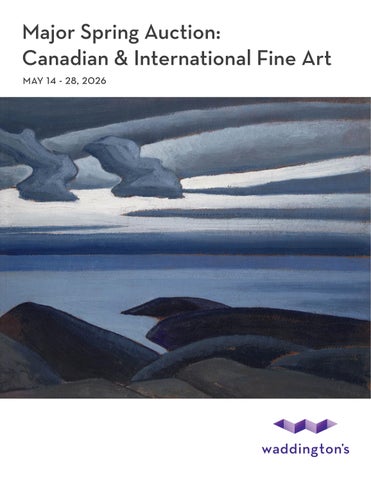
Frederick Arthur Verner emerged as one of the most distinctive painters of the Canadian West, despite spending much of his mature career in England.
After brief training in England in the 1850s, Verner returned to Canada and opened a studio in Toronto. Initially working in photography and photocolouring, he soon turned to painting scenes of Indigenous life and the prairie landscape, subjects that were already being impacted by settlement and industrial expansion. During the 1860s and 1870s, Verner travelled west to sketch buffalo herds, camps, and river scenes, gathering material that he would later rework into finished oils and watercolours.
In August 1880, Verner relocated permanently to England. As Joan Murray explains: “except for three trips home, he stayed there for the rest of his life. Probably his move to London was an indication of the growing popularity of his work. As a painter of the North American frontier, he was a rara avis in London. His canvases ‘have all the charm of complete novelty to most of the British public,’ Toronto’s The Globe said in 1908. He did not wish to stay in Canada and eke out a meagre existence like his friend Paul Kane, [...or] George Catlin. Verner wanted to do better.”1
Painted in 1887, probably while Verner was living in England, this watercolour depicts a serene wilderness scene at sunset. Verner had worked consistently in watercolour since the 1850s, and, as Murray notes, after 1877 many of his finest works were executed in the medium.2 Here, the setting sun marks a calm transitional moment as night approaches. The sky dominates the composition, reflecting what Paul Duval identified in 1967 as a defining feature of Verner’s work: “the sky [is] an omnipresent symbol to the unroofed frontier traveller and Verner conveys its significance in watercolour in a manner rare among his contemporaries.”3
1 Joan Murray, The Last Buffalo. The Story of Frederick Arthur Verner, Painter of the Canadian West, Pagurian Corporation, 1984.
2 ibid.
3 https://www.klinkhoffart.com/verner-frederick-a
FREDERICK ARTHUR VERNER, OSA, ARCA (1836-1928), CANADIAN SHORELINE, SUNSET, 1887
watercolour on wove paper signed and dated lower left
12.5 x 25 in — 31.8 x 63.5 cm
PROVENANCE:
Sotheby’s Canada, Toronto, 13 May 1974, lot 134
Private Collection, Toronto, ON
$7,000—9,000
VIEW LOT
JOHN WILLIAM BEATTY
Before 1906, Beatty had painted mostly landscapes, typified by low horizons, vertical trees, heightened colours, and linear definition. In the words of D.M. Farr: “Trees are silhouetted against the sky on one half of the canvas, while on the other, one’s eye travels through into the distance, to find a flickering band of horizontal light below a dark horizon. The strong verticals of the trees and the very straight horizontals of geography create great stability in both compositions. The use of silhouette enhances the sense of depth.”1
After 1910, Beatty rejected these European scenes for more Canadian landscapes and a different use of colours: “the colour is relatively muted in soft grays and mauves. The pigments are mixed on the palette, not on the canvas, and are spread with even, smooth strokes of a relatively small brush, to cover the canvas evenly and completely. The paint layers were built up gradually in academic fashion, with heavy impasto only in the clouds as highlight.”2
The painting Sunset, Haliburton, likely painted around 1915, showcases Beatty’s signature style as well as his artistic evolution as he broke free from European influence and established a strong, densely coloured impasto.
1 D. M. Farr, Beatty, J. W., & Centre, A. E. A. (1981). J.W. Beatty, 1869-1941, Kingston, Ont, Agnes Etherington Art Centre. p.24.
2 ibid. p.22.
2
JOHN WILLIAM BEATTY, OSA, RCA (1869-1941), CANADIAN SUNSET, HALIBURTON, CA. 1915 oil on panel
signed lower right; titled to gallery label verso
8.5 x 10.5 in — 21.6 x 26.7 cm
PROVENANCE:
Laing Fine Art Galleries Limited, Toronto, ON Private Collection, Toronto, ON
$6,000—8,000
VIEW LOT
LÉON AUGUSTIN LHERMITTE
Wind, Water, and Rushes presents a rare moment of rest and tranquillity in Lhermitte’s body of work, otherwise known for poignant displays of labour and life before the effects of the industrial revolution. In this pastel on paper, Lhermitte highlights the serenity of the French countryside, seemingly untouched by human intervention.
In 1874, at the age of 30, Léon-Augustin Lhermitte obtained his first medal at the Salon in Paris. His reputation was cemented with the oil on canvas La Paye des Moissonneurs (Paying the Harvesters) presented at the Salon in 1882 and purchased by the French government for the Musée du Luxembourg in Paris. In opposition to Romanticism, the Naturalist movement—to which Lhermitte belonged—emerged in France during the 1870s, building on the Realist wave shaped by Gustave Courbet and Jean-François Millet.
With the second industrial revolution beginning in 1870, there was a great push towards a new way of life in the French capital with the arrival of electricity, gas, and abundant fuel. This race towards progress was largely limited to Paris and other large cities, eluding the French countryside until the beginning of the 20th century. In search of pristine landscapes and views, Lhermitte preferred to depict the rural parts of France he viewed as unsullied.1
Lhermitte’s depictions of modernization in repose caught the attention of prominent Canadian financier and patron of the arts, Sir Byron Edmund Walker (1848-1924), who purchased Wind, Water, and Rushes at the turn of the twentieth century. Walker, inspired by his business trips and subsequent visits to the museums and galleries of New York, London, and Paris, was largely responsible for the creation of the Royal Ontario Museum and an early patron to the Art Gallery of Toronto (now Art Gallery of Ontario).2 By collecting international works by renowned artists such as Lhermitte, Walker aimed to share a world-class sensibility with the city of Toronto.
1 Gabriel Weisberg, Léon Lhermitte: Creativity in Context, in Léon Lhermitte, ex. cat. Galerie Michael, 1989.
2 Fern Bayer, Sir Byron Edmund Walker, C.V.O., LL.D., D.C.L. 1848-1924, Ontario Heritage Trust, accessed March 20, 2026.
3
LÉON AUGUSTIN LHERMITTE (1844-1925), FRENCH WIND, WATER, AND RUSHES
pastel on wove paper laid on board signed lower left; titled to nameplate
10 x 12.8 in — 25.5 x 32.5 cm
PROVENANCE:
Collection of Sir Byron Edmund Walker, Toronto, ON By descent to the current Private Collection, Toronto, ON
$8,000—12,000
VIEW LOT
CLARENCE ALPHONSE GAGNON
Clarence Gagnon (1881-1942) spent five years in Baie St. Paul, Quebec from 1919-1924. He had spent time painting in the region before, but he returned this time with a renewed approach to materials and matrimony. In June 1919, he married his second wife Lucile Rodier, whose labels affixed to the reverse of Gagnon’s little pochades are a mark of authenticity and have served scholars and collectors well in the identification of both date and place of execution of her husband’s work.
While Baie St. Paul remained a rural and somewhat isolated place, certainly in contrast with Montreal, which had been Lucile’s hometown, or Paris where Gagnon had been living on and off since 1904, the newlyweds enjoyed the company of many fellow painters while there. They were houseguests of Horatio Walker, with whom they stayed while on honeymoon, and once they settled into their own place, welcomed guests of their own. Among the many friends who came to call were A.Y. Jackson, Randolph Hewton, Mabel May, Edwin Holgate, Albert Robinson and Lilias Torrance Newton.
Around 1919, Gagnon began experimenting with various painting techniques which involved grinding his own pigments, having become disenchanted with commercial preparations which he refused to use. Art historian Hélène Sicotte notes that this involved “a considerable investment of time and energy” but allows that it was demonstrably worth it because paintings from this period “are notable for their vivacity and purity of colours”.1
While atmosphere is not completely absent from pictures from this period, the air is often noticeably crisper. It is clear that Gagnon metabolized the comments of British critics, who in 1910 had chided Canadian painters who had participated in a Liverpool exhibit for picturing their country through the filter of a European lens, urging them instead to develop their own approach to painting by “throwing off the yoke of (foreign) influence”.
As A.K. Prakash notes of the works from the 1919-1925 Baie St. Paul period, with their vivid colours “applied with smooth, even brushstrokes, increasingly in blocks and patches”, that “it was this difference that belonged exclusively to his hand and went beyond the formulae of the French post-Impressionists.”2
1 A.K. Prakash, Impressionism in Canada: A Journey of Rediscovery, Arnoldsche Art Publishers, Stuttgart, Germany, 2014, page 583.
2 Hélène Sicotte and Michèle Grandbois, Clarence Gagnon, 1881-1942: Dreaming the Landscape, Musée national des beaux-arts du Québec, 2006, pages 102, 136, 150, 152, 156, and 338.
4
CLARENCE ALPHONSE GAGNON, RCA (1881-1942), CANADIAN AUTOMNE, BAIE ST PAUL, CA. 1923 oil on panel titled and dated to certificate of authenticity by Lucile Rodier Gagnon inventory no. 610 verso 7 x 5 in — 17.8 x 12.7 cm
PROVENANCE:
Private Collection, Toronto, ON
$8,000—12,000
VIEW LOT
5
CLARENCE ALPHONSE GAGNON, RCA (1881-1942), CANADIAN GRANGE À LA MARE, BAIE ST PAUL, CA. 1923 oil on panel titled to certificate of authenticity by Lucile Rodier Gagnon inventory no. 325 verso 8 x 6 in — 20.3 x 15.2 cm
PROVENANCE:
Private Collection, Toronto, ON
$8,000—12,000
VIEW LOT
t
ANNE
DOUGLAS SAVAGE
In Untitled, (Landscape) Savage offers two different compositions on this doublesided panel, both typical Quebec scenic landscapes rendered with an almost impressionistic touch. Art historian Katrie Chagnon writes: “what particularly stands out is the rigour and diligence with which [Savage] carried out her aesthetic research. Exploring specific colour palettes and often returning to a fixed set of subjects (trees, rocks, forests, lakes, hills, sunflowers, buildings, animals, etc.), Savage usually organized these elements on different planes according to recurring compositional schemas. Her work thus demonstrates a particular attention to composition and formal aspects of the painting’s surface, rather than to spontaneous representation of landscape per se.”1
According to Anne McDougall: “Anne Savage sought light and rhythm and had a sure hand with a purple shadow...”2 This composition takes us to the early spring season where the snow melts in the sun but refuses to recede under the protection of the trees. Savage shared a deep relationship with A.Y. Jackson, and their kinship is evident in this panel through the choice of colour palette and subject. In Untitled, (Landscape), Savage put the emphasis on the specific Quebec landscape.
Surely painted not long after the front side of this double sided panel, the back portrays a completely different landscape. Here a small hill covered by pines, in a deep green palette, sits on top of a cold blue sparkling river. Savage spoke in 1967 about the diversity of the Quebec landscape and her attachment to the region: “The part of the country which is my real locale is a little lake in the Laurentians… this beautiful little lake. A very deep, clear, cold water… And the country around this puddle was very undulating. It seemed to have little hills, and little ravines so that, without going for more than a very short distance, you could sit down, turn your back and you would have a complete new composition.”3
1 Anne Savage a Latent Collection: https://ellengallery.concordia.ca/annesavage/en/
2 Anne McDougall, Anne Savage: The Story of a Canadian Painter, Montreal, 1977, page 44.
3 Anne Savage in https://www.beaux-arts.ca/node/3180
ANNE DOUGLAS SAVAGE (1896-1971), CANADIAN UNTITLED (LANDSCAPE) double-sided oil on panel 16 x 17.75 in — 40.6 x 45.7 cm
PROVENANCE: Private Collection, Montreal, QC
NOTE: Accompanied by copy of Certificate of Authenticity from Alan Klinkhoff Gallery.
$15,000—20,000
VIEW LOT
DAVID BROWN MILNE
Milne had been living and working in New York City for ten years when five of his paintings were selected for inclusion in the 1913 Armory Show. An early landmark for the artist, his work was shown alongside works by the titans of the 20th century – Hopper, Cassatt, Matisse, Redon, Gauguin, Cézanne, and Van Gogh, to name a few. Of Milne’s paintings selected, three were watercolours – a reminder of the primacy of the medium at the turn of the century.
Heavy Forms, also painted in 1913, perfectly encapsulates Milne’s style from this period, particularly in the restricted palette. In the present work, only four colours are used – green, red, purple, and blue. Of note is the royal blue used in Heavy Forms, quite rare in his oeuvre – only a few watercolours from this period display this intense colour.
Milne was known for the detail he left out rather than included in his compositions, relying instead on strong linear structure to evoke space and mood rather than describe it literally. Snowy hillsides, forest ponds, and modest interiors become almost abstract arrangements, balancing emptiness with a few carefully placed marks. This “less is more” approach led critics to describe him as the “Master of Absence,” capturing emotional depth with striking visual understatement.
Another hallmark of Milne’s work evidenced in Heavy Forms is the application of watercolour pigment almost straight from the tube, using barely-diluted, heavy brushstrokes. Art historian David P. Silcox explains that “perhaps it was Cézanne’s example that encouraged Milne to lay himself open to new and dangerous ideas, to ‘split himself apart by making something no one had made before, to see things as they had never been seen before.”1 Cézanne’s use of colour and empty space triggered in Milne a new approach in his work, specifically an economy of colour and brushstrokes.
Also of note in this painting is Milne’s use of white space to heighten the composition’s visual impact. The negative spaces enhance the artist’s gestures and let the composition breathe. This technique is one of Milne’s major achievements of the early 1910s, setting him apart from the rest of his Canadian contemporaries.
Milne’s selection for the Armory Show led to better recognition. In 1915, the critic for the New York Times said the following about Milne’s works: “Some of his figures are boldly and richly outlined in color and the rhythm of these flexible lines contributes to the charm of the composition. The whole is very brilliant, very animated, conceived with vigor and executed with dexterity but not entirely free from the suggestion of separate effects brought together but not fused in one impression. Another picture by the same artist which he calls “Tri-Color” is even more brilliant and direct with its childlike pattern of red and blue and white, but the cleverly varied touches of the brush, the play of the strong red and strong blue over the white ground, the finely suggested perspective make it a subtler performance despite its apparently primitive structure and drastic division of tones. Here the fusion takes place at a proper distance and the effect is one of artistic unity.”2
1 1 D. P. Silcox, Painting place: The Life and Work of David B. Milne, University of Toronto Press, 1996, p.36. 2 “we met Cézanne, van Gogh, Gauguin, Matisse, Brancusi. For the first time, we saw courage and imagination bare, not sweetened by sentiment and smothered in technical skill.” Milne quoted in Silcox. p.48.
DAVID BROWN MILNE (1882-1953), CANADIAN HEAVY FORMS, 1913 [SILCOX 105.20]
watercolour on wove paper titled by Patsy Milne and inscribed “325” by the Duncan estate verso; titled and dated to gallery label verso, with statement of authenticity from David Milne Jr., Estate of David Milne 21.75 x 18 in — 55.2 x 45.7 cm
PROVENANCE:
Milne Family Collection
Mira Godard Gallery, Toronto, ON Private Collection, Toronto, ON
EXHIBITED:
Mira Godard Gallery, Toronto, David Milne, 1991.
Mira Godard Gallery, Toronto, David Milne, 1994.
LITERATURE:
David Milne Jr. and David P. Silcox, David B. Milne: Catalogue Raisonné of the Paintings, Volume 1: 1882-1928, Toronto, 1998, no. 105.20, repro. 101. David Milne, Mira Godard Gallery, Toronto, 1991, (exh. cat.), 24, repro. 9.
$80,000—120,000
VIEW LOT
ROBERT WAKEHAM PILOT
Robert Wakeham Pilot (1898–1967) is widely recognized as one of the last great Canadian Impressionists, celebrated for his atmospheric views of Quebec and the St. Lawrence region. Born in St. John’s, Newfoundland, and later based in Montreal, Pilot developed a style that captured the quiet poetry of urban streets, harbors, and rivers, often at dusk or in winter light.
Raised in the studio of his stepfather, Maurice Cullen, Pilot was immersed in the world of professional art from an early age. He later built on this foundation with formal training in Montreal and in Paris at the Académie Julian. By 16, he was already exhibiting at the Art Association of Montreal and quickly gained attention for landscapes that blended French Impressionist influences with a distinctly Canadian feel. His mature work is known for its soft brushwork, gentle shifts of light, and muted, often twilight tones that give his landscapes a quiet, reflective mood.
In March Day - North River - Sainte-Adèle Country - P-Que, Pilot employs his palette to depict a transitional winter landscape that anticipates the long awaited arrival of spring in the Quebec Region. Snow remains accumulated along the riverbanks, while freshly melted water runs its wild course. Here, Pilot depicts the gradual shift in seasonal conditions and captures a brief intermediate phase between winter and spring.
8
ROBERT WAKEHAM PILOT, PRCA (1898-1967), CANADIAN MARCH DAY - NORTH RIVER - SAINTE-ADÈLE COUNTRY - P-QUE oil on panel signed lower left; titled in ink verso 12.5 x 16.75 in — 31.8 x 42.5 cm
PROVENANCE:
Continental Galleries of Fine Art, Montreal, QC Collection of A.E. MacAuley, Winnipeg, MB Private Collection, Manitoba By descent to the present Private Collection, Ontario
$6,000—8,000
VIEW LOT
ALFRED JOSEPH CASSON
Casson retired in 1958 after a 45-year career in commercial art at Sampson Matthews Limited, a career in which he was respected for his perfectionism and his refined understanding of colour and linear design. In his post-retirement role as an artist, Casson pushed these effects to new heights and achievements distinct in Canadian landscape painting.
It was around the time that this painting was made that Casson agreed to work with Roberts Gallery in Toronto. His first solo commercial exhibition opened in 1959 – Casson was 61. The partnership would be a success, and by the mid-1960s, his shows were selling out.
Some of the artist’s best-known works date from the 1950s, showcasing his mature style: simplified forms, cleanly structured compositions, and clear light. The period also saw Casson begin to experiment with modernist approaches. This dovetailed with his interest in pattern and structure, though Casson was quick to reject any interpretations of his work as theoretical exercises. Retirement from commercial work also allowed Casson to paint more winter scenes, as the demands of his employment meant that sketching trips could only be taken during summer vacations.
Of a comparable work, Beech Leaves in Winter, art historians Margaret Gray, Margaret Rand and Lois Steen write that “This small oil, with paint laid on so sketchily that the brush strokes on the prepared board, the pencil sketch and the umber undercoat all show beneath the final painting, is almost a demonstration piece, yet Casson with a few crisp strokes has abstracted the essence of an Ontario beechwood in winter.”1 Indeed, the restricted palette, simplified composition, and economical brushstrokes of Beech Sapling speak to the skills honed during his commercial career, with concept and form clearly defined.
1 Margaret Gray, Margaret Rand, Lois Steen, AJ Casson: Canadian Artists 1, (Ontario: Agincourt), 1976, p. 40.
9
ALFRED JOSEPH (A.J.) CASSON (1898-1992), CANADIAN BEECH SAPLING, CA. 1958 oil on board
signed lower right; signed and titled verso; also titled to exhibition label verso 12 x 15 in — 30.5 x 38.1 cm
PROVENANCE:
Roberts Gallery, Toronto, ON Private Collection, Toronto, ON, acquired Dec 1958 By descent to the present Private Collection, Vancouver, BC
$18,000—22,000
VIEW LOT
t
LAWREN STEWART HARRIS
Elemental and precise, Lake Superior Sketch VI is a powerful work from the height of Lawren S. Harris’ landscape career. Painted in the late 1920s, the brooding serenity of the piece captures the artist’s carefully honed ability to translate the majesty of one of Canada’s grandest landscapes onto his sketching panels. A calm is exuded as clouds pass over a silent and deep body of water, with the dark and distant horizon suggesting the foreboding possibility of more ominous weather to come. There is a carefully calibrated minimalism to the composition, and an interplay between the lake and sky that brings a unity, with the cloud forms mimicked by the patterns on the surface of the water. The result, as with other of Harris’ monumental Lake Superior works, draws the viewer into a heightened and dramatic world, inviting reflection and a renewed appreciation. In Lake Superior Sketch VI, Harris has been able to pull the landscape, built on ancient, Precambrian shield, into the modern artistic realm, distilling a universal essence that he felt could resonate with the underlying truth he sought on a spiritual and personal level.
In the period between 1915 and 1930, Harris’ landscape work evolved rapidly, often catalyzed by his shifting subject matter. In 1921, Harris discovered a new opportunity imbued with an expansive and powerful sensibility – the north shore of Lake Superior. It would become the site of many of his most transformational and important works, and he would return to it almost annually until the end of the 1920s, always in the Fall, to explore the recently burnt-over headlands and their varied vistas looking out over the massive lake. From meditative calm to violent storm, the energy of Lake Superior pushed Harris’ work into new territory, expanding the boundaries of Canadian artistic expression.
While Harris’ style is unmistakably his own, it continued to develop and change throughout his career as he became increasingly engaged with the development of abstraction and international modernism. Lake Superior Sketch VI, a bold and commanding work, was painted in the years between 1925 and 1928, a period where Harris began to transcend his ambitions of fostering a distinctly Canadian approach to art and integrate with wider, international modernist approaches. In 1926, he was the sole Canadian representative in The International Exhibition of Modern Art in Brooklyn, New York, arranged by Société Anonyme. While Harris’ artistic ambitions had expanded to a larger audience, at the core was still the mission of depicting his home country, highlighted in his exhibition catalogue biography: “Rightly or wrongly Lawren Harris feels that a people can be united only through its creations and therefore they must create their own artistic idioms before they can become articulate as a people and commence to live in profound reality.”1
The austere and dignified simplicity of Lake Superior Sketch VI’s composition is a prime example of the novel work that Harris was originating in Canada, where modern art sensibilities manifested through highly local and grounded subjects. His approach to painting was deeply connected to time spend in these environments, a process he felt advanced his development, writing: “One can almost guarantee that two months in our North country of direct experience in creative living in art will bring about a very marked change in the attitude of any creative individual.”2 Painted at one of his favoured sketching sites near Port Coldwell, Harris uses his familiarity with the region to distill its essence to its most critical elements.
For this composition, we view the perspective looking south from atop Premier Mountain, the highest hill in the area, which Harris and his fellow artists referred to colloquially as ‘Old Bill’. One the right side of the picture, the edge of Foster Island overlaps with Sullivan Island beyond. The two create a path into the expanse of the inland sea, with several smaller islands excluded from the composition in an act of artistic liberty. This vantage point produced a series of important Harris sketches in the late 1920s, all of them showcasing slightly different methods of selection. From this collection of panels, he also created at least four major canvases: Lake Superior III (Thomson Collection at Art Gallery of Ontario), Lake Superior No. IV (Art Gallery of Ontario), Lake Superior (National Gallery of Canada) and Clouds, Lake Superior (Winnipeg Art Gallery). Through his selections, and their varying atmospheric and temporal conditions, they each provoke distinct and unique responses, while remaining quintessentially Harris, illuminating the viewer with his pared down and distilled perspective.
At this point in his career, Harris was confident in his works being presented without artifice or elaboration, instead allowing them to speak directly for themselves to the audience, open to their interpretation and response. Therefore, this work, like many others, was not given a title by the artist, but instead is referred to by the number assigned by Doris Mills in a 1936 Inventory of works Harris left in his studio in Toronto when he moved to the United States.
1 Katherine Dreier, International Exhibition of Modern Art arranged by the Societe Anonyme for the Brooklyn Museum. November - December 1926. p. 7.
2 Bess Harris and R.G.P. Colgrove, editors, Lawren Harris, 1969, p. 48.
Contributed by Alec Blair. Blair is the director of the Lawren S. Harris Inventory Project, working with the estate of the artist to put together a catalogue of the artist’s works.
10
LAWREN STEWART HARRIS (1885-1970), CANADIAN
LAKE SUPERIOR SKETCH, VI, CA. 1925-1928 oil on panel titled to gallery labels verso; inscribed with the Doris Mills inventory no. 4/6 for Group 4, catalogue #6 verso 12 x 15 in — 30.5 x 38.1 cm
PROVENANCE:
Laing Fine Art Galleries Limited, Toronto, ON Private Collection, Toronto, ON By descent to the present Private Collection, Toronto, ON
LITERATURE:
Doris Mills, L.S. Harris Inventory, 1936, Lake Superior Sketches, Group 4, catalogue #6, with a drawing by Hans Jensen, location noted as the Studio Building.
$700,000—900,000
VIEW LOT
11
ROBERT WAKEHAM PILOT, PRCA (1898-1967), CANADIAN
FISHERMAN, ST HELEN’S ISLAND, MONTREAL, 1957 oil on canvas board signed lower left; titled and dated verso; titled to gallery label verso
12.5 x 16.75 in — 31.8 x 42.5 cm
PROVENANCE: Walter Klinkhoff Gallery, Montreal, QC Private Collection, Toronto, ON
$8,000—12,000
NOTE:
The present work exemplifies his refined handling of tone and his ability to translate mood and place on canvas. Before Expo 1967, Sainte-Hélène Island, adjacent to Montreal, was a park accessible to Montrealers only by car via the Jacques-Cartier bridge, a place to experience nature just outside the busy city. In this composition, fishermen cast lines into the St. Lawrence River, while in the background, Montreal, encased in impressionistic smoke, can be seen in light gray and green.
VIEW LOT
EDWARD SEAGO
Edward Seago amassed a devout following in Canada that began with his first exhibition, held at one of the foremost Canadian galleries, Laing Galleries in Toronto, in 1951. So noteworthy was his introduction to Canadian collectors that Earl Alexander, then the Governor General of Canada, opened the exhibition. Collectors would queue to attend Seago’s sell-out exhibitions hosted by Laing Galleries until the 1970s.
Waddington’s is privileged to be the market leader of Seago’s works in Canada, having auctioned many of the 70 important oil paintings and watercolours recorded since the early 1990s. One of these works is featured in the present auction.
In Early Morning, The Bay of Porto Cervo, a quintessential sailing scene is bathed in the sun’s first blush of morning over the coast of Sardinia. Art historian James W. Reid divulges the artist’s astute depiction of light and leisure in his 1991 monograph on Seago’s mastery of the landscape.
“Seago’s paintings of Sardinia mirror [his] carefree, relaxed mood. Their colours are cheerful olive-greens, oranges, yellow ochres, brilliant whites and vivid blues. The human figure is rarely present, except for pleasure-seekers along the quayside or on the jetty at Porto Cervo. Compositions appear effortless… The paint is applied with a confident, light-hearted insouciance… The artist’s mastery of light and atmosphere is much more in evidence in representations of early morning, evening and dusk.”1
1 James W. Reid, Edward Seago: The Landscape Art, London: Sotheby’s Publications, 1991, 203-204.
12
EDWARD SEAGO (1910-1974), BRITISH EARLY MORNING, THE BAY OF PORTO CERVO oil on board signed lower left; titled verso 16 x 24 in — 40.6 x 61 cm
PROVENANCE: Laing Galleries, Toronto, ON Private Collection, Toronto, ON $20,000—30,000
VIEW LOT
t
EDOUARD CORTÈS
Born in 1882 into a lineage of Spanish court painters in Lagny-sur-Marne, France, Cortés began his career exhibiting at the Paris Salon at the young age of sixteen. It was not until a decade later, though, that the artist would develop his hallmark Post-Impressionist scenes of Paris, epitomized in Paris; Porte Saint-Denis au couchant and Paris; Rue Royale et la Madeleine après la pluie.
“In 1906, Cortès exhibited the painting Le Boulevard de la Madeleine, soir d’automne, an early example of what would become his signature image of a Paris streetscape. He chose the same type of image for the next Salon as well, submitting Soir de neige près du square Montholon. By 1907, he was confident enough of his painting to organize an auction of his own works at the Hôtel Drouot in April 1907, where he earned 250 francs. Having achieved a certain success as a painter, Cortès began to broaden his scope, exhibiting his work throughout France at regional salons beginning with the Toulouse International Industrial Salon in 1908. There, he received a third-class medal for La Port de Pantin soir de neige,[…] In the following years, Cortès established a pattern of exhibitions throughout the country.”1
The success of his Paris street scenes continued to grow through the First World War, as locals, soldiers, and tourists alike were drawn to Cortès’ idyllic depictions of the city. This success eventually led to the artist’s first commercial representation abroad, here in Toronto.
“The late 1920s brought an international client, the T. Eaton Company Limited of Toronto[…] In 1928, Eaton commissioned thirty paintings by Cortès to be shown in Toronto, Winnipeg, and Montreal between November and December. Eaton’s remained a steady client until the Great Depression of the 1930s. More importantly, it introduced Cortès to the North American commercial art market.”2
The appeal of Cortès’ Parisian streetscapes and international success still stands nearly a century after his introduction to the broader art world. These charming and timeless scenes are sure to continue to entice collectors and aficionados for decades to come.
EDOUARD CORTÈS (1882-1969), FRENCH PARIS; RUE ROYALE ET LA MADELEINE APRÈS LA PLUIE oil on canvas signed lower right
13.2 x 18.1 in — 33.5 x 46 cm
PROVENANCE:
The Cooling Galleries, London, UK & Toronto, ON Private Collection, Toronto, ON
$16,000—18,000
NOTE:
This lot is accompanied by a certificate issued by the Comité Édouard Cortès, under N°EC-CEC-2026/83. It will be included in the supplement to the catalogue raisonné of Edouard Cortès’s work, which is currently being prepared.
VIEW LOT
14
EDOUARD CORTÈS (1882-1969), FRENCH PARIS; PORTE SAINT-DENIS AU COUCHANT oil on canvas signed lower left; titled to nameplate 13.2 x 18.1 in — 33.5 x 46 cm
PROVENANCE:
The Cooling Galleries, London, UK & Toronto, ON Private Collection, Toronto, ON
$16,000—18,000
NOTE:
This lot is accompanied by a certificate issued by the Comité Édouard Cortès, under N°ECCEC-2026/84. It will be included in the supplement to the catalogue raisonné of Edouard Cortès’s work, which is currently being prepared.
VIEW LOT
FLORIS ARNTZENIUS
Floris Arntzenius is best known for his serialized depictions of the bustling streets of Holland’s administrative capital, Den Haag. Born in 1864 in the then-Dutch colony of Java (present-day Indonesia), he came to epitomize the younger generation of the Hague School. Studying at the Rijksacademies and exhibiting alongside Isaac Israels, George Hendrik Breitner, and Willem Witsen, the School mastered the atmospheric melancholy of the seemingly constant grey of the lowlands.
Anchoring his scenes in the main thoroughfares of the city, Arntzenius captures the familiar dynamism and anonymity of urban life in an impressionistic fashion. Like his other depictions of The Hague, in Spuistraat, Den Haag, figures meld into their setting, contributing to the familiar armature of the metropolis. Spuistraat, one of the main pedestrianized shopping areas in the city centre, offered the artist a constant flux of activity. Arnntzenius renders his figures in a fairly democratic fashion, as various walks of society are portrayed in muted tones and in similar stature. Depicted mid-step, with one foot hovering above the pavement, with indistinguishable facial features, the figures’ only discernible class signifier is their style of clothing. Arntzenius credited these minute pops of colour in the clothing and signage as adding a sense of whimsy to an otherwise monotone environment.1
1 The Spuistraat, Haags Historisch Museum, December 11, 2025, https://haagshistorischmuseum.nl/en/ collectie/masterpieces/the-spuistraat/.
15
FLORIS ARNTZENIUS (1864-1925), DUTCH
SPUISTRAAT, DEN HAAG oil on canvas signed lower right
22.4 x 17.3 in — 57 x 44 cm
PROVENANCE: Roberts Gallery, Toronto, ON Private Collection, Toronto, ON By descent to the present Private Collection, Ontario
$12,000—18,000
VIEW LOT
t
THOMAS DEVANY FORRESTALL
Forestall was highly attuned to the artistic potential of the quotidian, and through his eyes, was able to render it extraordinary. An edge of mystery was central to his paintings, leaving the exact meaning and storyline up to the audience. Elissa Barnard writes that “like Colville and the Pratts, Forrestall draws on his daily life and environment for subject matter. “Wherever you choose to live you draw the universal out of that area. It’s not regional or backwater, it’s what you make of it,” [Forestall] says. “I create a universal from what’s at hand.””1
The Foundation reminds us that construction was a core part of Forestall’s upbringing, as his father was a carpenter. In 1942, the family moved to Dartmouth, where his father found work at the Victoria General Hospital. His grandmother owned a house there, which sat next to a property next door, which Forestall’s father renovated for their family to live in. Forestall recalls: “It forever was being built. We loved it. There were always blocks and chunks of wood we put to creative use.”2
Forrestall often paints in egg tempera, a method he was introduced to by Alex Colville. Forestall recalled: “For some reason it twigged with me. I don’t know if it was the way Alex taught it. He did use egg tempera himself and I’ve always admired Alex.”3 The method which requires the artist to mix pigments with a binder, provided by the yolk of an egg. Pre-dating oil paint, egg tempera examples from the first century still exist. The paint must be carefully monitored to ensure the right consistency, with the artist balancing water and yolk in the mixture both during the painting and the drying process. Egg tempera is not flexible, and requires a stiff surface to prevent cracking. The paint itself cannot be stored long term, adding to the primacy of the process, well suited to an artist who, like Forrestall, enjoyed creating work en plein air.
THOMAS DEVANY FORRESTALL, RCA (1936-2024), CANADIAN THE FOUNDATION (ABOVE THE ISLAND), 1986-1987 egg tempera on canvas signed lower left; signed, titled, and dated “1986/1987” verso; titled “Above the Island” to gallery label verso 37 x 54.5 in — 94 x 137.2 cm
PROVENANCE:
Marlborough-Godard Gallery, Toronto, ON Private Collection, Toronto, ON
$5,000—7,000
VIEW LOT
PHILIP HENRY HOWARD SURREY
What Edward Hopper did for New York City, Surrey did for Montreal — conjuring up an evocative sense of place. In 1937, Surrey chose to settle in Montreal, a city whose streets, cafés, and working-class neighbourhoods would become central to his artistic vision for over five decades.
Ile Bizard is located in the northwest of Montreal. This painting showcases the ambiance of a summer on the edges of the city, through Surrey’s controlled, smooth, and deliberately understated brushstrokes. With softly blended edges, a subtle modelling of light, and the discreet detailing of figures, Surrey presents a quiet scene of an afternoon at the beach.
La Plage, Ile Bizard was exhibited at the Montreal Museum of Contemporary Art in 1971 and then at the Centre Culturel Canadien in Paris in 1972, under the number 34. In the catalogue of the exhibition, Gilles Corbeille wrote: “In the current context of painting, Philip Surrey is difficult to situate... He lived outside the major pictorial movements that marked his era. He is a local painter. I like to think that he does not see himself otherwise. [...] Surrey’s great achievement is that he knew, with admirable consistency and uncommon clarity, how to remain master of his talent and to carry it to the limits of its possibilities. What more could one ask of him?” 1
1 Gilles Corbeille, Philip Surrey, Le Peintre dans la Ville, Montreal Museum of Contemporary Art, 1971, p. 16.
17
PHILIP HENRY HOWARD SURREY, RCA (1910-1990), CANADIAN LE PLAGE, ILE BIZARD, 1966 oil on board signed lower left; signed and titled verso; titled to gallery label verso; titled and dated to exhibition label verso 32 x 48 in — 81.3 x 121.9 cm
PROVENANCE:
Collection of The Morris Gallery, Toronto, ON Galerie Mazarine, Montreal, QC Joyner Waddington’s, Toronto, 3 Jun 2003, lot 62 Private Collection, Vancouver, BC
EXHIBITED:
Philip Surrey, Le Peintre dans la Ville, Montreal Museum of Contemporary Art, 28 Oct - 28 Nov, 1971.
Philip Surrey, Le Peintre dans la Ville, Centre Culturel Canadien, Paris, 20 Jan - 20 Mar 1972.
LITERATURE:
Philip Surrey, Le Peintre dans la Ville (exh. cat.) (Montreal: Montreal Museum of Contemporary Art, 28 Oct - 28 Nov, 1971; Paris: Centre Culturel Canadien, 20 Jan - 20 Mar 1972), p. 30, no. 34.
$20,000—30,000
VIEW LOT
MOLLY LAMB BOBAK
Molly Lamb Bobak loved painting groupings of people in both intimate and vast settings. Instead of detailed faces, her skill lay in the suggestion of figures, depicted with a few lively brushstrokes, allowing her to turn groups into flowing patterns of colour and movement. In her words, “I simply love gatherings, mingling.... It’s like little ants crawling, the sort of insignificance and yet the beauty of people all getting together.” 1
The first official Canadian female war artist sent overseas, Lamb Bobak’s time spent in the Second World War and observing women’s experiences of military life would shape her subsequent artistic output. Her time as a war artist taught her to watch how people move in unison: marching, lining up, standing in formation. Those wartime scenes of women soldiers practising drills evolved to become peacetime crowds at civic events, protests, and community gatherings.
Molly and her husband Bruno Bobak travelled to Europe with their two young children in 1950. They lived in Paris, where Lamb Bobak was exposed to the work of modernist painters, including Paul Cézanne, Henri Matisse, and Pablo Picasso. She also spent time with Canadian artist Joseph Plaskett, who was living in Paris at the time. Several other grants allowed the Bobaks to live in Europe from 1957-1961. Lamb Bobak made it a practice to sketch on paper every day, and “wherever they travelled, Lamb Bobak was influenced by the changing scenes around her.”
The couple eventually settled in Fredericton, New Brunswick in 1960. The city became central to both her daily life and her art. Both artists taught at the University Art Centre and exhibited frequently at the Beaverbrook Art Gallery, which had opened to the public in 1959. The region gave her constant access to the kinds of everyday scenes she loved to paint. Skaters at Fredericton and Strollers on the Beach are both works produced in Fredericton, most likely painted during the late 60s or early 70s. Lamb Bobak uses a slightly elevated viewpoint in both of these works, accentuating the perspective and a sense of rhythm with her active figures.
1 Michelle Gewurtz, Molly Lamb Bobak: Life & Work Life & Work, accessed Jan. 6, 2026, https://www.aci-iac.ca/art-books/molly-lamb-bobak/biography/
18
MOLLY LAMB BOBAK, RCA (1920-2014), CANADIAN STROLLERS ON THE BEACH oil on canvas board signed lower right; titled to gallery label verso 7 x 11 in — 17.8 x 27.9 cm
PROVENANCE: Galerie Walter Klinkhoff, Montreal, QC Private Collection, Toronto, ON
$8,000—12,000
VIEW LOT
19
MOLLY LAMB BOBAK, RCA (1920-2014), CANADIAN SKATERS AT FREDERICTON oil on canvas laid on board signed lower right; titled to gallery label verso 7 x 11 in — 17.8 x 27.9 cm
PROVENANCE:
Cassel Galleries, Fredericton, NB
Galerie Walter Klinkhoff, Montreal, QC
Private Collection, Toronto, ON
$8,000—12,000
VIEW LOT
JOHN GEOFFREY CARUTHERS LITTLE
John Little’s winter scenes have become a visual autobiography of Quebec’s and its people. Winter gave Little both atmosphere and structure: snowbanks defined the geometry of sidewalks, roofs, and streets, while a grey or milky sky threw facades into relief. He was fascinated by how people adapt to the cold, showing children trudging in heavy coats, adults carrying bags through slush, buses and cars leaving brown tracks in packed snow, laundry still hanging in backyards despite freezing weather – and of course, that most Canadian of games – hockey.
The skating rink was a particular cultural touchstone for Little and his generation. “His lifelong love of sports fuelled an ambition to play for the Canadiens, but a stronger talent for drawing took him down a path that bypassed the Forum and led to the Art Association of Montreal (now Montreal Museum of Fine Arts), where he studied under three of Canada’s most venerated painters — Arthur Lismer, Anne Savage and Goodridge Roberts.” 1
The artist painted several hockey scenes, which he imbued with a feeling of immediacy. One viewer noted that “he felt as if he had been there and that he could lace up his skates and walk into it.”2 From impromptu shinny games in Montreal’s laneways to more maintained rinks, Little believed these hockey scenes were integral to his “family album” of a disappearing Quebec. In Little’s words, “I loved hockey, but it’s a hard thing to paint except if you isolate a little rink in the back yard, these little homemade rinks made out of old doors for the boards and old signs and stuff, and one little light bulb hung in the back. The big game is more difficult to make it work.”3
Little’s gallerist, Alan Klinkhoff, noted that Little’s hockey paintings “became popular for fashionable homes only a couple of decades after Little first began painting them. This popularity was the reason for Little to compose them only rarely. For other artists more commercially oriented than Little, it became a reason to paint them repetitiously.”4 As such, collectors will enjoy the opportunity to own one of these iconic hockey scenes.
1 National Gallery of Canada, in. https://www.canadianartgroup.com/historical-artists/john-little/
2 Alan Klinkhoff, John Little: City Life From 1951 (Alan Klinkhoff Gallery: Toronto, 2017), 42.
3 ibid, 60.
4 ibid, 51.
JOHN GEOFFREY CARUTHERS LITTLE, RCA (1928-2024), CANADIAN CHARLEVOIX COUNTY HOCKEY GAME, 1970 oil on canvas
signed lower right; titled and dated to stretcher verso; titled to gallery labels verso 24 x 30 in — 61 x 76.2 cm
PROVENANCE:
Continental Galleries, Montreal, QC
Galerie Walter Klinkhoff, Montreal, QC
Private Collection, Toronto, ON
$10,000—15,000
t
ANNE McCORD'S ALBUM
Coming to Waddington’s from a private collection, lot 21 in our major auction of Canadian and International Fine Art is an exceedingly rare album composed of 66 original watercolours, oils and drawings dated to the 19th century. Rich in historical value, this album tells a story of early Montreal – though it is somewhat of an enigma, a curious artistic puzzle from early Canadian history that perhaps raises more questions than it answers.
The folio was likely assembled by Anne McCord, née Ross (1807-1870). Anne was the daughter of David Ross (1770–1837) the Seigneur of St. Gilles de Beaurivage, who by the mid 1820s was the fifth-largest private property owner in Montreal. Anne married John Samuel McCord (1801–1865), a judge of the Supreme Court. Together they had several children, the fourth of whom was David Ross McCord (1844-1930), a lawyer and the founder of the McCord Museum in Montreal. In 1919, David donated his extensive holdings of art and artefacts to McGill University, which led to the opening of the McCord Museum, established to house the collection. David’s passion for art was fostered by his parents: his father John was an avid art collector and his mother Anne was an accomplished watercolour painter.
Included in the album are works by noted early Canadian artists including Cornelius Krieghoff (1815-1872), Otto Reinhold Jacobi (1812-1901), and James Duncan (1806-1881), as well as by less well known artists including Anne McCord and other figures whose accomplishments have not been as well recorded. The earliest dated work in the album, a watercolour of flowers by Anne herself, appears to be dated 1835. A large percentage of the other paintings and sketches date to the following year, though works were added to the album as late as 1878 – some 40 years after the collection was started. Some of the works depict Canadian views, while others appear to have been made abroad.
Anne McCord is known to have studied painting with James Duncan. During the period, watercolour was an encouraged pursuit for ladies of the upper and middle classes, and McCord’s high status would have given her access to some of the best teachers. Click here to browse the full portfolio
CORNELIUS KRIEGHOFF (1815-1872), JAMES DUNCAN (1806-1881), OTTO REINHOLD JACOBI (1812-1901) AND VARIOUS ARTISTS, CANADIAN SCHOOL, MID-19TH CENTURY
ALBUM CONTAINING 66 ORIGINAL WATERCOLOURS, OILS AND DRAWINGS
This important Canadian historical document was likely assembled by Anne McCord (née Ross) the mother of David Ross McCord, the founder of the McCord Museum. Featuring original works by Cornelius Krieghoff (1815-1872), James Duncan (1806-1881), Otto Reinhold Jacobi (1812-1901), and others, sketches of Canadian scenes including Montreal, Montmorency Falls and the Eastern Townships, and European copy paintings and scenes including the eruption of Mount Vesuvius in 1838.
Additionally, a fine painting of a group of flowers signed “A. McC. 1835”, thought to be the hand of Anne McCord (née Ross), 1807-1870. Featuring an elaborately decorated frontispiece by A. Leblanc (Paris, 1839) and bound in tooled and gilt green Morocco binding. Artworks include both works directly executed, and tipped in.
14 x 11 in — 35.6 x 27.9 cm
PROVENANCE:
By descent to Private Collection, Nova Scotia
Waddington’s Auctioneers, Toronto, ON, 29 May 2024, lot 50 Private Collection, Quebec
$10,000—15,000
GIOVANNI BATTISTA TIEPOLO
This image originates from a seminal album entitled Sole Figure Per Soffit sold at Christie’s on 14 July 1914, as lot 49. These works came from a group of more than 170 studies of figures seen from below, conceived for ceiling decoration, and rendered in pen-and-wash.1 The British Museum notes that “These drawings are normally dated to 1755-1762, the years preceding Tiepolo’s trip to Spain but they could have been executed over a longer period. Knox suggested that such studies may have been made to provide his two sons - Domenico and Lorenzo - with graphic material to help their work as painters, but it is just as likely they were made for their own sake.”2
The series is an inventive body of graphic work by a European master. Their dramatic foreshortening is characteristic of Tiepolo’s work, a technique he used from early on in his career, notably his first known ceiling fresco, in the Palazzo Sandi in Venice, painted in the early 1720s. These figures, rendered “sotto in su” (seen from below) and hovering weightlessly over the viewer, would appear in his frescos until the end of his long career.
Pen-and-wash works by Tiepolo perhaps best typify his genius. Rendered quickly and with great virtuosity, the effect is spontaneous yet masterful – with great economy, the artist is able to evoke volume and light. Though ostensibly conceived as preparatory sketches, these works have become autonomous—at once studies and masterpieces—translating the grandeur of Tiepolo’s frescoes into intimate and inventive forms.
Examples of these works are held in the collection of the Yale University Art Gallery, Metropolitan Museum of Art, and Harvard University Art Museums.
A GODDESS SEATED ON CLOUDS, FROM SOLE FIGURE PER SOFFITI
black chalk, pen, brown ink, and brown wash on laid paper
7.5 x 6 in — 19 x 15 cm
PROVENANCE:
Probably Count Bernardino Corniani, until 1852
Probably Edward Cheney, and by inheritance to A. Capel Cure
Sotheby’s, London, 29 Apr 1885, part of lot 1024
Collection of B.T. Batsford, London, UK
Christie’s, London, 14 Jul 1914, part of lot 49
Estate of Lawrence Hilliard
Christie’s, New York, 28 Jan 1999, lot 77
Private Collection, Toronto, ON Old Master Gallery Inc., Toronto, ON
$10,000—15,000
VIEW LOT
NATALIA SERGEEVNA GONCHAROVA
These two drawings by Natalia Sergeevna Goncharova were made to illustrate the famous book Die Mär Von Der Heerfahrt Igors, published in 1923. They feature the work by Arthur Lüther from the epic poem “The Tale of Igor’s Campaign” (Slovo o plŭku Igorievě), considered the oldest literary work of the Eastern Slavs, written at the end of the 12th century. It recounts the failed military campaign led in 1185 by Prince Igor Sviatoslavich against the Cumans of Khan Konchak. 2 Designs were part of the exhibition The Russian AvantGarde Art from the Schreiber Collection exhibition held in 1986 at The William Benton Museum of Art in Connecticut. These two works are made in the typical Goncharova fashion: gouache highlighted with silver paint, and pen and ink.
Jillian Suarez mentions the following about the artist and her relationship to the Russian avant-garde: “Goncharova, like her partner Mikhail Larionov, was closely associated with the literary avant-garde. She illustrated several Russian Futurist and poetry books. Gorod: Stikhi, an illustrated octavo of poems published in 1920, contains lithographs by her, including numerous vignettes and nine fullpage illustrations. Goncharova also provided the celebrated Futurist designs for the front and back covers (in Russian and French, respectively).
Another example of Goncharova’s illustrations is Die Mar von der Heerfahrt Igors, an artist’s book with hand-colored pochoir prints on ivory wove paper published in 1923. The pochoir process, characterized by its crisp lines and brilliant colors, produces images that have a freshly printed appearance.”1
1 Jillian Suarez, Artists’ Books Illustrated by Natalia Goncharova, The Guggenheim Museums and Foundation, accessed April 8 2026, https://www.guggenheim.org/articles/findings/artist-booksillustrated-by-natalia-goncharova
NATALIA SERGEEVNA GONCHAROVA (1881-1962), RUSSIAN 2 DESIGNS FOR DIE MÄR VON DER HEERFAHRT IGORS, CA. 1923 gouache, silver paint, and pen and ink on wove paper signed to lower right image; titled and dated to museum label verso each 9.75 x 6.75 in — 24.8 x 17.1 cm
PROVENANCE:
Schreiber Collection, United States Sotheby’s, New York, 21 Apr 2005, lot 96
Private Collection, Quebec
EXHIBITED: Russian Avant-Garde Art from the Schreiber Collection, The William Benton Museum of Art, Storrs, CT, 20 Jan - 9 Mar 1986.
$10,000—15,000
VIEW LOT
tRUDOLF ERNST
The realism achieved in Rudolf Ernst’s Orientalist paintings stems from his astute use of the then-emerging medium of photography and understanding of architecture.
Born in Vienna in 1854, the son of Austrian architect Leopold Ernst Rudolf Ernst was encouraged to explore his artistic talents at a young age. Enrolling in the Academy of Fine Arts Vienna at 15, Ernst began his artistic career as a genre painter, focusing on the portraiture of children and musketeers.1 It was the artist’s travels and eventual move to Paris and French naturalization that broadened his artistic horizons and exposed him to the North African and Arab diaspora of France.
The academic yet purely imagined scenes of Orientalism – fueled by colonialist ventures – which filled the halls of Paris’ Salon, eventually inspired the artist to travel to North Africa in 1885 to experience these cultures firsthand. Ernst was immediately struck by the opulence of pattern and design that was integrated into everyday life and promptly devoted his career to what is often termed the second wave of French Orientalism.2 This second wave was born from the recent interest in Realism and the proliferation of cultural exhibitions, such as the Universal Exhibitions, in which Ernst took part. So immersed in the movement, he began collecting Islamic objects.
By visually documenting his travels by photograph and acquiring souvenirs along the way, Ernst was able to meticulously recreate intricate details on panel and canvas while back in his Paris studio.
Finishing Touches is one such painting, detailing the final moments of the bride’s dressing prior to her wedding. From the bride’s beaded headdress to the mother-of-pearl inlay on the jewelry box, Ernst renders the individual textures and surfaces in the room with painstaking precision. The architectural details of the room, such as the Moorish alcoves and faience-tiled room divider, envelop the subjects, transporting the viewer into the sumptuous turn-of-the-century North African scene that leads the eye to discover new details with every glance.
RUDOLF ERNST (1854-1932), AUSTRIAN/FRENCH FINISHING TOUCHES oil on cradled panel signed lower right; titled to nameplate
30.75 x 25 in — 78.1 x 63.5 cm
PROVENANCE: Fredrick W. Thom Limited, Toronto, ON Private Collection, Toronto, ON
$100,000—150,000
LOUIS-PHILIPPE HÉBERT
Portraits of notable French-Canadian figures are a recurring and defining theme in Louis-Philippe Hébert’s work. The artist sought not only to record history but to interpret it through his own artistic perspective in an effort to commemorate often overlooked historical figures and events. Many of the figures found in his sculptures had been forgotten and later rediscovered by 19th-century historians and writers. Hébert refrained from depicting religious subjects, instead drawing his inspiration from pivotal historical moments of the 17th-18th centuries under the French regime.
This work portrays the French-Canadian historical figure Adam Dollard des Ormeaux (1635-1660) during the Battle of Long Sault in 1660. Hébert presents Dollard des Ormeaux in a commanding, heroic pose at the centre of the composition with his sword towards the sky, conveying both resolve and a moment of victory. The work draws inspiration from Louis Fréchette’s poem, La légende d’un people, 1887, in which Dollard des Ormeaux is shown as unwavering in the face of impossible odds:
“But Daulac [Dollard] was brave and quick to respond, Without retreating a step, solid as a rock, The weak garrison stood firm under the shock.”1
Executed in 1916, Dollard des Ormeaux was commissioned by Patrick Martin Wickham, an insurance executive and mayor of St. Lambert, who developed a close personal friendship with the artist. Wickham later requested that the artist produce smaller versions of select sculptures originally created for the National Assembly Building. This work is one of the bronzes produced specifically for the Wickham collection and has remained in the family until now.
1 Daniel Drouin,
Louis-Philippe Hébert, (Quebec: Musée du Québec et Musée des BeauxArts, Montréal, 2001), 298.
LOUIS-PHILIPPE HÉBERT, RCA (1850-1917), CANADIAN DOLLARD DES ORMEAUX, 1916 patinated bronze signed, titled, dated, and numbered “8”, with foundry mark “Hohwiller Fondeur” stamped to base, incised 36 x 19 x 13.5 in — 91.4 x 48.3 x 34.3 cm
PROVENANCE:
Collection of Patrick Martin Wickham, Quebec, commissioned in 1916 Private Collection, Toronto, ON, by descent from the above
LITERATURE:
Daniel Drouin, Louis-Philippe Hébert, (Quebec: Musée du Québec et Musée des Beaux-Arts, Montréal, 2001), 295-296.
$10,000—15,000
VIEW LOT
MARC-AURÈLE DE FOY SUZOR-COTÉ
This work is one of only two female nude sculptures produced by Marc-Aurèle de Foy Suzor-Coté (1869-1937), and while the edition size is not indicated on the work, art historian Laurier Lacroix lists only three bronze casts and four plaster versions of other known casts besides this one. The present example was included in the National Gallery of Canada’s 2002 exhibition “Suzor-Coté: Light and Air.”
According to Pierre L’Allier, this 1925 bronze was originally called La Modèle but became known as Démangeaison (or The Itch) by 1926.
L’Allier notes that the new title “is not without ironically evoking the prohibitions of the era concerning the representation of full nudity.”1
In conservative Quebec during this period, when the nude female form was rendered in art, the subject was often “clothed” with an allegorical allusion or classically themed title. Not so for “The Itch,” which Suzor-Coté presents unabashedly and uncensored.
Lacroix writes effusively about the work: “Here the body’s helicoidal position makes the sculpture interesting from all angles. The laughing, almost flirting figure with her long hair streaming down her back is the personification of lightness and grace. The trivial gesture that gives the work its title becomes an excuse for the revelation of beautiful forms.
Suzor-Coté multiplies the planes and viewpoints, and the arrangement of the arms inscribes a wide oval around the body that guides the spectators eyes over the entire height of the sculpture.”2
1 Pierre L’Allier, Suzor-Coté, L’Oeuvre Sculpte, Musée du Québec, Québec, 1991, p. 85 and p. 84-85 for the painted plaster of La Modèle, reproduced.
2 Laurier Lacroix, Suzor-Coté: Light and Air, National Gallery of Canada, Ottawa, 2002, p. 290, p. 294 and 350, cat. no.126 for The Itch (The Model), reproduced in colour.
MARC-AURÈLE DE FOY SUZOR-COTÉ (1869-1937), CANADIAN LE MODÈLE, DÉMANGEAISON, 1925 patinated bronze signed, dated, and inscribed “Roman Bronze Works NY” / “Copyright Canada & United States” 16 x 17 x 10 in — 40.6 x 43.2 x 25.4 cm
PROVENANCE:
Private Collection, Montreal, QC
EXHIBITED:
Suzor-Coté: Light and Air, National Gallery of Canada, Ottawa, 2002, cat. no. 126, another model.
LITERATURE:
Pierre L’Allier, Suzor-Coté, L’Oeuvre Sculpte (Quebec: Musée du Québec, 1991), 84-85, the painted plaster of La Modèle, repro in b/w. Laurier Lacroix, Suzor-Coté: Light and Air(Ottawa: National Gallery of Canada, 2002), 290, 294 and 350, cat. no.126 for The Itch (The Model), repro. in col.
$12,000—18,000
VIEW LOT
WILLIAM HODD McELCHERAN
Walking Businessman is part of William McElcheran’s larger body of work, using the businessman as a universal symbol. Author David P. Silcox notes that McElcheran creates an “everyman”, with figures that are symbolic rather than individual. Initially amusing, upon reflection they come to evoke deeper sentiments, carrying a sense of irony, as well as a compassionate, understanding view of life.1
In an interview with Dr. Inge Lindemann, conducted in Italy in 1990, McElcheran elaborates on the figure of the businessman:
Lindemann: How did you come to the image of the businessman?
McElcheran: There was this period in my work where I became very deeply involved with Catholicism. During that period, I was using skinny figures to express the thin equals of spirituals - later, the fat businessmen as a corporal expression for loneliness. When I was working with religious sculptures, I was always trying to relate my treatment of the subject matter, particularly the treatment of the passion, to contemporary life. There I had this figure of an Everyman with a blank look on his face expressing a sort of impotence. I was trying to relate this idea of the Passion of Christ to contemporary life: how responsible are we for the sufferings of Christ? I was showing in my Everyman, who developed into my businessman, this grey character, who was witnessing it and even trying to figure out what was happening. But I lost my Catholic faith, and with it a part of my art which was connected with this symbolizing of the spiritual. And so what I’m really doing now is trying to find a classical image. My businessman replaces the classical hero. All the classical artists were dealing with the heroic and how they could find images for this that were larger than life. I, on the other hand, am trying to find my image for the anti-ideal, my anti-hero. So the whole idea of my businessman is that he is exactly that sort of Everyman, the ubiquitous non-hero.
1 Gerhard Finckh and David P. Silcox, William Mac, Hôcherl-Verlag, Munich, 1991, p. 26-28.
WILLIAM HODD MCELCHERAN, RCA (1927-1999), CANADIAN WALKING BUSINESSMAN, 1987 patinated bronze signed with initials, dated “87”, and numbered 4/9 to base, incised 15 x 7.5 x 5.5 in — 38.1 x 19.1 x 14 cm
PROVENANCE:
Private Collection, Toronto, ON
$15,000—20,000
LOT
VIEW
t
WALTER JOSEPH PHILLIPS
For Phillips, water itself was a constant wonder: “Water is the most expressive element in nature. It responds to every mood from tranquillity to turbulence. The bubbling spring engenders and supports life; the raging torrent and the remorseless flood may be the instruments of its destruction. The surface of still water is our standard of horizontality, which is the well-spring of peace and repose. Even falling water induces little emotional disturbance for vertical lines are also static. Thus a waterfall may induce pleasurable thoughts and even its roar may be soothing.”1
Three Bathers, 1923, depicts the artist’s children in a body of water. Similar to some of his watercolours and woodcuts, such as Summer at the Lake from 1925 and The Bather from 1922, this painting uses Phillips’ techniques of reflecting light on water. He achieved this iridescence thanks to his medium: “One of the advantages of the water-colour medium is that it is possible to achieve with it a sparkling effect of opalescent colour rivalling that of sunlight. It is not achieved by mixing pigment on the palette, but by visual fusion — partial mixing on the paper.”2 Another of Phillips’ main motifs is displayed in Three Bathers: the figures are not facing the viewer, and instead turn away from the scene. Phillips details this as an influence of David Cox, a British painter and one of his biggest influences.3
1 In 1917, Phillips bought a printing press from his colleague Cyril H. Barraud. He worked for several years on his woodcuts and was deeply inspired by Japanese printmaking.
2 Walter Joseph Phillips in https://wjphillips.ca/the-landscape-painter/chapters-21-25/
3 Walter Joseph Phillips in. https://wjphillips.ca/wet-paint/wet-paint-5/: “The psychological effect of a figure turning away from a scene, and facing the spectator would tend to lessen its importance, and diminish its beauty, whereas one gazing in a specified direction tends to encourage others to do the same, and does not provide a superfluous point. The posture and employment of a figure is as important as its position. It is sufficient to depict a young lady peering rapturously at a tree-top to suggest a nightingale, or a group of archers craning their necks in unison, to express the flight of an arrow.”
28
WALTER JOSEPH PHILLIPS, RCA (1884-1963), CANADIAN THREE BATHERS, 1923
watercolour on wove paper laid on card signed and dated lower right; titled to exhibition label verso
20.75 x 14 in — 52.7 x 35.6 cm
PROVENANCE: Private Collection, Ontario
EXHIBITED:
British Empire Exhibition, Canadian Section of Fine Arts, London, UK, 1924-25.
LITERATURE:
British Empire Exhibition (exh. cat) (London: Canadian Section of Fine Arts), p. 27, no. 190.
$20,000—30,000
VIEW LOT
29
WALTER JOSEPH PHILLIPS, RCA (1884-1963), CANADIAN
NORMAN BAY, LAKE OF THE WOODS, CA. 1920
watercolour on strong wove paper initialed lower right
8.25 x 12.5 in — 21 x 31.8 cm
PROVENANCE:
Masters Gallery, Calgary, AB
Private Collection, Calgary, AB
$12,000—18,000
VIEW LOT
M. EMILY CARR
Canadian painter Emily Carr (1871 – 1945) is celebrated for her modern vision of the West Coast landscape. National acclaim arrived in 1927, when Carr was invited by Eric Brown, first Director of the National Gallery of Canada, to participate in the Exhibition of Canadian West Coast Art Native and Modern, co-organized by Marius Barbeau. Carr was featured along with Indigenous artists such as Fred Alexee, Charles Edenshaw and unnamed Tsimshian, Haida, Tlingit, Nootka, Nisga’a and Kwakiutl artists, as well as the Group of Seven who were influenced by Scandinavian modernism’s articulation of the symbolic within landscape painting.
In the mid-1930s, Carr focussed on forest subjects found close to home. She had purchased a caravan, which she nicknamed “The Elephant,” in 1933 which allowed her to spend weeks at a time in the forests near Victoria, working in areas nearby such as Metchosin or Goldstream Park. Her work began to move away from Indigenous iconography and subject matter that had distinguished it, replacing her highly modelled Post-Impressionist, Fauvist and Cubistinfluenced approaches to picture making with a more gestural form. Writing in her journal in 1933, Carr summarized the central aims of these new techniques: “Direction, that’s what I’m after, everything moving together, relative movement, sympathetic movement, connected movement, flowing, liquid, universal movement, all directions summing up in one grand direction, leading the eye forward, and satisfying.”1
Somewhere (ca. 1942), is exemplary of this later period and reflects her focus on the spiritual, an attempt to depict the life force within the forest itself. From 1933 to 1937, Carr’s paintings were distinguished by unifying gestural brushwork that moves across the entire picture plane, fusing individual forms within key sweeping movements. To achieve this, she had replaced watercolours with a new material inspired in part by the pragmatics of cheaper materials: using gasoline to thin her oil paints, Carr discovered that the density and viscosity of the medium allowed her to quickly achieve an expressive summary of the scenes in front of her. There is vibrancy within her repetitive strokes, where colour and tone provide the foundational structure for the painting. The compositions from this time have the energy of the forest itself as their subject, culminating in a suffused emanation of light from within the scene itself. Carr also found her new technique allowed her to retain the chromatic and textural range of oil on canvas along with the portability and ease of her earlier watercolour sketches.
M. EMILY CARR, RCA (1871-1945), CANADIAN SOMEWHERE, CA. 1942 oil on paper mounted to canvas signed lower left; titled "Somewhere" to label verso, likely in the hand of Emily Carr 38 x 24 in — 96.5 x 61 cm
PROVENANCE:
M. Ledingham, British Columbia Winchester Galleries, Victoria, BC
Mr. A.K. Prakash, Toronto, ON Private Collection, British Columbia
EXHIBITED:
British Columbia Society of Fine Arts, Vancouver Art Gallery, May 15-31, 1942 (exh. cat.), no. 13.
LITERATURE:
British Columbia Society of Fine Arts, Vancouver Art Gallery, May 15-31, 1942 exhibition, purchased by M. Ledingham, British Columbia
$350,000—450,000
Somewhere (ca. 1935), reveals an artist at the height of her powers. In this painting, Carr animates and unifies the entire scene through rhythmic, translucent layers of brushwork. The marks are rapid and unfussy, indicating the confidence of a mature artist whose distillation of knowledge means that each stroke is an informed one. Tone is indicated through deft, efficient notations of light and dark calligraphic marks, ranging from white to neutral to dark umber. They also provide an overall structure: a straggling branch or tree trunk is viewed through a shimmering accumulation of directional marks. The resulting painting depicts the spiritual quality and joyful, energetic expression Carr sought, the ‘sympathetic, connected, flowing liquid, universal movement’ that was her aspiration. Somewhere takes as its subject matter, the transcendent force of a living, evolving, changing rainforest.
In Somewhere, the influence of her close friendship with Lawren Harris is evident. Their shared interest in spirituality formed a crucial part of their discussions of form and subject matter.
In Harris’s work, this was expressed through a belief in Theosophy while Carr’s approach was informed by Hinduism, the writings of American writers Walt Whitman, Henry David Thoreau, and Ralph Waldo Emerson, as well as Indigenous spirituality and her Christian faith. In 1933, Carr wrote, “I think we miss our goal very often because we only regard parts, overlooking the ensemble, painting trees and forgetting the forest…. A main movement must run through the picture…. A main movement must run through the picture, the movement and direction of lines and planes shall express some attribute of God—power, peace, strength, serenity, joy. The movement shall be so great the picture will rock and sway together carrying the artist and after him, the looker with it, catching up with the soul of the thing and marching on together.”2
Carr also met Georgia O’Keefe during a trip to New York City in 1930, whose work has similarly been associated with a spiritual framework derived from contemplation of the landscape. Carr’s friendships with West Coast artists Mark Tobey, Jack Shadbolt and Lee Nam were further influences: Nam’s traditional Chinese landscapes incorporated aerial perspectives and watercolour tonality, which moved her for its distillation of form. Carr organized an exhibition of his work. The American artist Mark Tobey was also an artistic influence, inspired by Zen Buddhism and trips to China and Japan. He joined Carr in Victoria in 1928 to teach a workshop out of her studio, where he outlined his development of a spiritual language through calligraphic-style mark making within an abstract field. These explorations of ‘all-over-ness’ focused on abstraction, rhythm and the spiritual nature of the landscape and influenced Carr as well as the later Abstract Expressionist movement.
By the mid-1930s, forest sketches produced in situ had evolved from studies into works such as Sunshine: fully realized works in their own right that demonstrate the powerful expressionistic forces she sought more directly. Paintings such as Heart of the Forest, (1935), Fir Tree and Sky, (ca. 1935-1936), Forest (Tree Trunks) (ca. 1938-39), Sunshine and Tumult, (1938–39), and later easel works such as Sombreness Sunlit, (ca. 1938–40), demonstrate her discoveries and represent some of Carr’s most iconic and affecting achievements.
1 Doris Shadbolt, ed, The Emily Carr Omnibus, (Vancouver/Toronto, Douglas and McIntyre: 1993). 701-702. 2 ibid.
Contributed by Lisa Baldissera. Baldissera has worked in curatorial roles in public art galleries in Western Canada since 1999, including Senior Curator (Contemporary Calgary), Chief Curator (Mendel Art Gallery) and Curator of Contemporary Art at the Art Gallery of Greater Victoria. She has produced more than seventy exhibitions of local, Canadian, and international artists and holds MFAs in Creative Writing (UBC), Art (University of Saskatchewan) and a PhD in Art Writing and Curating (Goldsmiths College). She is the author of Emily Carr: Art and Life (Art Canada Institute) and Convoluted Beauty: In the Company of Emily Carr (Mendel Art Gallery). She is currently the Director of Griffin Art Projects in North Vancouver, BC.
VIEW LOT
EDWARD JOHN HUGHES
Goldstream marked an important moment in Hughes’ life. The artist’s wife, Fern, passed away in December of 1974. Devastated, Hughes found himself unable to work for some three months. He relocated from their home in Cobble Hill to the town of Duncan, British Columbia, perhaps in search of a fresh start. By February 1975, he was able to again find solace in his work, and painted Goldstream, the first canvas completed after Fern’s death.1
In a letter dated 20 February 1975, sent to his dealer, Dr. Max Stern of the Dominion Gallery, Hughes wrote: “Although time has not yet eased the grief, I am starting to paint again, and hope to have a canvas ready to send to you on Mon. Feb. 24. It is called “Goldstream.””2 The two wrote at length about the painting, with Hughes explaining the composition and where it was painted from – the parking lot at Goldstream Park. In his letter, he reiterated his goal “to make all of my paintings clear and realistic, even more understandable than a photograph.”3
This tension between photography and painting was one that was central to Hughes’ practice. He wrote:
“I occasionally do a painting which appears much like a coloured photograph, and sometimes when I see a coloured photograph which is of a scene which is well composed, well, it almost knocks me for a loop, and I can’t paint sometimes for two days after I see this. Just wondering what is the advantage of my going on painting realistically like this. Then eventually, I realize, like I always do, that a painter can add something that the photograph hasn’t done which makes the painting durable.”4
In its lightened colour palette, Goldstream typifies Hughes’ works of the 1970s. Art historian Ian Thom describes work from this period as having “a more silvery tonality”5 while art historian Jane Young notes their “glassy light.”6 Though some writers attribute this shifted colour scheme to the artist’s grief after his wife’s death, Young notes that it was rather a means to improve his work through a better sense of atmospheric perspective and depth.
1 Ian M. Thom, E.J. Hughes (Vancouver: Douglas & McIntyre, 2002), 174.
2 E.J. Hughes to Max Stern, 20 February 1975, Dominion Gallery Fonds, National Gallery of Canada, Ottawa.
3 Thom, 158.
4 ibid, 181.
5 Jane Young, EJ Hughes 1931–1982 (Surrey: Surrey Art Gallery), 63.
6 ibid.
31
EDWARD JOHN (E.J.) HUGHES (1913-2007), CANADIAN GOLDSTREAM, 1975 oil on canvas
signed and dated lower left; signed, titled, and dated to stretcher verso; also titled to gallery label verso
32 x 40 in — 81.3 x 101.6 cm
PROVENANCE:
Dominion Gallery, Montreal, QC
Private Collection, Ontario, acquired from the above in Jan 1977
EXHIBITED:
E.J. Hughes, 1931-1982: An Exhibition, Surrey Art Gallery, 18 Nov - 11 Dec 1983; Art Gallery of Greater Victoria, 15 Mar - 29 Apr, 1984; Edmonton Art Gallery, 18 May - 2 Jul 1984; Glenbow Museum, 20 Jul - 2 Sep 1984; National Gallery of Canada, 21 Sep - 4 Nov 1984; Beaverbrook Art Gallery 23 Nov - 6 Jan 1985.
LITERATURE:
E.J. Hughes, 1931-1982: An Exhibition, (exh. cat.) (Surrey: Surrey Art Gallery, 1983-1985), p. 95, no. 39.
NOTE:
Accompanied by copies of purchase invoice and exhibition letters (purchaser name and address redacted).
$100,000—150,000
VIEW LOT
tALBERT HENRY ROBINSON
Albert Henry Robinson was one of three artists invited to exhibit at the first Group of Seven show in 1920. The other two guest artists were Stanley Hewton and Robinson’s good friend Robert Pilot. While often associated with the Group, Robinson never became a member. Nonetheless, writes art historian Jennifer C. Watson, “He surely contributed to the development of Canadian painting and the formation of a national style.”1
Born in Hamilton, Ontario, Robinson moved to Montreal in 1908 and began painting the city and the surrounding villages. He travelled to Europe with A.Y. Jackson in 1911 sketching Brittany and the U.K. He paused his artistic practice to work in a munitions factory throughout the First World War and in 1933 had to stop painting all together after experiencing a serious heart issue. This means there are only about twenty years worth of work from this highly sought after artist who so joyously painted his adopted province of Quebec in soft, high-key tones with a very modernist eye for both shape and colour.
A.K. Prakash positions Robinson as Canada’s foremost master of colour. Prakash writes that Robinson’s paintings of Quebec “are crucial to the understanding of Robinson’s contribution to Canadian art [...] they show a tension between the intellect and the senses, creating effects that were seldom achieved by any other Canadian painter at the time.”2
1 Jennifer C. Watson, Albert H. Robinson: The Mature Years, Kitchener-Waterloo Art Gallery, Kitchener-Waterloo, 1982, pages 14-18.
2 A.K. Prakash, Canadian Art: Selected Masters from Private Collections, Vincent Fortier Publishing, Ottawa, 2003, pages 131, 132 and 134.
32
ALBERT HENRY ROBINSON, RCA (1881-1956), CANADIAN HOUSE AT EASTERN TOWNSHIPS oil on canvas
signed lower right; titled to stretcher and indistinctly inscribed verso 15 x 18 in — 46 x 38.1 cm
PROVENANCE:
The Art Emporium, Vancouver, BC (acquired ca. 1974) Private Collection, Toronto, ON
$8,000—10,000
VIEW LOT
TED HARRISON
Painted in 1974, Yukon Snowball exemplifies Ted Harrison’s mature style, one typified by a highly simplified visual language of bold contour lines, flattened forms, and a hyper-saturated and often dissonant palette. Abandoning the academic realism learned in his earlier life in England, he began to amplify colour and pattern. Per Harrison, “I thought I’d simplify everything, because when I tried to paint the Yukon as is, it was too complicated and fiddly. So I said, ‘I’ll simplify it down – I’ll leave out the doorknobs.’” 1
Yukon Snowball reflects Harrison’s interest in representing everyday life in northern communities. In his work, the artist intentionally emphasizes the human element amidst the mighty landscape, in direct contrast to the empty wildernesses of the Group of Seven. Scenes of play and shared activities were important to Harrison, particularly their communal nature. Multiple vignettes exist in this painting’s tight composition.
Although the work is named for the giant snowball being rolled by three children, Yukon Snowball is ultimately a distributed narrative – a series of small, interrelated moments, reinforced by Harrison’s technique of compressing spatial depth to create a single, shared plane. Humans, animals, architecture and landscape all hold equal weight in his work. Rather than presenting winter life in the Yukon as cold and isolating, Harrison asks the viewer to see joy and social cohesion.
1 Genesee Keevil, “Ted Harrison: Loved and Snubbed,” Yukon News, August 26, 2009, https://www. yukon-news.com/2009/08/26/ted-harrison-loved-and-snubbed/
33
TED HARRISON, RCA (1926-2015), CANADIAN YUKON SNOWBALL, 1974
acrylic on canvas board signed and dated “74” lower right; titled to gallery label verso
21.5 x 27.5 in — 54.6 x 69.9 cm
PROVENANCE:
Private Collection, Mount Royal, QC
$15,000—20,000
VIEW LOT
KAREL APPEL
Appel’s works are widely considered to embody the spirit of post-war European art, characterised by bold use of colour, expressive brushwork and a style inspired by folk art, outsider art, and children’s drawings. Appel’s involvement with CoBrA, an avant-garde movement he founded in 1948 along with Asger Jorn, Constant, and Corneille, brought attention to the young artist’s work in both Europe and North America.
Though CoBrA disbanded in 1951, its spontaneous and colourful aesthetic has been credited with reinvigorating Dutch modern art and inspiring subsequent generations of artists. The playful spirit it promoted has also characterised Appel’s subsequent career, emblematized by thick impasto, energetic spontaneity, saturated colour and human or animal subjects. Appel recalls how formative the group was for him: “The CoBrA group started new, and first of all we threw away all these things we had known and started afresh, like a child – fresh and new. Sometimes my works look very childish, or childlike, schizophrenic or stupid, you know. But that was the good thing for me. Because, for me, the material is the paint itself. The paint expresses itself. In the mass of paint, I find my imagination and go on to paint it.”1
The 1960s marked a period of decline and tragedy for Appel, when painting went out of fashion and his second wife, Machteld, passed away. But Appel and his irrepressible style could not be kept down long – he remarried his third and last wife, began working again, and signed on with art dealer Annina Nosei, who also represented Jean-Michel Basquiat. Appel would find fresh inspiration in the flattened aesthetics of Pop Art, which he reinterpreted using his signature style.
Untitled (Head), 1973 recalls Appel’s early, playful interpretations of the wounded, human psyche while reviving interest in the two-dimensional medium of painting. The large swaths of mostly primary colours emphasize Appel’s childlike aesthetics, which are further heightened by the flat application of the acrylic paint on paper.
1 Margalit Fox. “Karel Appel, Dutch Expressionist Painter, Dies at 85.” The New York Times, May 9, 2006. Accessed April 2, 2024. https://www.nytimes.com/2006/05/09/arts/design/karel-appel-dutchexpressionist-painter-dies-at-85.html
34
KAREL APPEL (1921-2006), DUTCH
UNTITLED (HEAD), 1973
acrylic on paper laid on canvas signed lower left and dated lower right; titled to gallery labels verso 29.5 x 22.5 in — 74.9 x 57.2 cm
PROVENANCE:
Manny Silverman Gallery, Los Angeles, CA
Evelyn Aimis Fine Art, Toronto, ON Private Collection, Toronto, ON
$15,000—20,000
VIEW LOT
JACK HAMILTON BUSH
Jack Bush painted Green Diamond over a concentrated yet reflective threemonth period, beginning in December 1962 and concluding in February 1963. Although he inscribed “Feb 1963” on the back of the canvas, his studio record book lists the work as “painted Dec 1962” and includes a small thumbnail sketch. Bush’s paintings often emerged from an initial burst of inspiration, only to undergo a period of quiet refinement before reaching their final form. Given that Green Diamond was included in his April 1963 solo exhibition, Jack Bush: New Paintings, at the Robert Elkon Gallery on Madison Avenue in New York, it is reasonable to conclude that Bush revisited and perfected the composition in February with the upcoming show firmly in mind. Allowing a painting to “simmer” was characteristic of his practice, as demonstrated in paintings like Green Diamond which strike a balance between vitality and control.
The Elkon exhibition was notably selective, featuring only ten paintings. Within such a tightly curated group, Green Diamond stands out as a particularly choice example of Bush’s recent production. Its significance is underscored by the involvement of Clement Greenberg, one of the most influential art critics of the twentieth century, who participated directly in the exhibition’s installation. Alongside fellow Color Field painter Kenneth Noland, Greenberg helped determine the placement and presentation of the paintings. Bush himself acknowledged their expertise in a letter to Noland written shortly after the opening: “Many thanks for your interest and help hanging my show last week. I trust Clem’s judgment, and yours, much more than my own. Somehow you guys have a knack of placing the pictures so that they come out with their full impact.” (Letter from Jack Bush to Kenneth Noland [Easter Sunday, 1963], Kenneth Noland Foundation archives).
A photograph of Green Diamond as it appeared in the exhibition confirms the rigour of this approach. The installation is spare and direct, devoid of ornamentation, allowing the painting’s formal qualities to assert themselves without distraction. The emphasis is on pure visual experience: bold colour, and the tension between shapes. This aesthetic aligns with the broader aims of postwar abstraction, particularly the Color Field movement, which sought to distill painting to its most essential elements.
The painting’s early acquisition further attests to its prominence. It was purchased by Robert Elkon Sr., the father of the gallery owner. Given this close familial connection, it is plausible that Green Diamond was among the first works selected from the exhibition; first pick is a privilege typically reserved for discerning and well-positioned collectors. Such a purchase suggests not only confidence in the painting’s quality but also an immediate recognition of its significance within Bush’s evolving oeuvre.
Green Diamond also belongs to a distinct group of smaller works that Bush began in December 1962. These paintings—among them Red Hot, England Green, Festive, Green Square, and Gem share a restrained palette of three colours: red, green, and blue. Each composition features flat shapes deftly set against contrasting grounds. While generally similar, in terms of abstract style, these paintings mark a departure from Bush’s slightly earlier Flag series, which include expansive fields of colour punctuated by curious shapes or abstract emblems evocative of the countries they were inspired by. The December 1962 works are not diminished versions of those much larger canvases but rather explorations of a similar impact but in a more potent, single dose. While modest in scale (none exceeding 36 inches on any side), these works possess a striking intensity. Within this group, Green Diamond is the largest, and arguably the most commanding, demonstrating how Bush could achieve a sense of monumentality even within limited dimensions.
Importantly, this period of experimentation coincided with the holiday season. Throughout his career, Bush revelled in his time off. During Easter, Christmas and his summer vacation, he explored new ideas and painted prolifically. The catalogue raisonné of his work shows a pattern: paintings created during these periods tend to be smaller, more playful, and occasionally more daring. In this context, Green Diamond can be understood as the product of a moment of artistic freedom, when Bush allowed intuition to guide him. Liberty is sustenance for most artists and Green Diamond was the gem he produced under no pressure.
Contributed by Dr. Sarah Stanners, art historian and recently appointed Executive Director & Chief Curator of the Canadian Clay & Glass Gallery. Dr. Stanners dedicated 13 years to the recently published Jack Bush Catalogue Raisonné as both author and director.
Fig. 1 From left to right, paintings by Jack Bush installed in the exhibition “Jack Bush: New Paintings” at Robert Elkon Gallery, New York City, April 1963: England #2, Green Diamond, St. Ives.
JACK HAMILTON BUSH, OSA, ARCA (1909-1977), CANADIAN GREEN DIAMOND, 1962-63 [STANNERS 2.17.1962.31]
Magna and/or oil on canvas signed, titled, and dated “Feb 1963” verso; titled and dated to gallery label verso 30 x 35.75 in — 76.2 x 90.8 cm
PROVENANCE:
Acquired directly from the artist in 1963 by Robert Elkon Gallery, New York, NY
Collection of Mr. Elkon Sr., New York, NY
Private Collection
Hindman Auctions, Chicago, IL, 19 Apr 2023, lot 10
Private Collection, California
EXHIBITED:
Jack Bush: New Paintings, Robert Elkon Gallery, New York, NY, 1963.
LITERATURE:
Jack Bush: New Paintings, (exh. cat.) (New York: Robert Elkon Gallery, 1963) p. 348, no. 3. Sarah Stanners, Jack Bush Paintings: A Catalogue Raisonné (Toronto: David Mirvish Books in partnership with Coach House Press, 2024), 364–365 (col. illus.), Vol. 2, cat. no. 2.17.1962.31.
$60,000—80,000
JOHN GRAHAM COUGHTRY
1955 was an important year for Coughtry, marking his first exhibition – a two-man show with Michael Snow at the University of Toronto’s Hart House. Coughtry and Snow hit the jackpot when then-Mayor Nathan Phillips demanded their paintings be removed from public view on the grounds of obscenity, which catapulted the two artists to the forefront of the national conversation. The attention inspired Coughtry’s famous remark that “every damn tree in the country has been painted.” It would prompt impassioned and radical developments by his fellow artists at the Isaacs Gallery, a group that included Snow, Joyce Wieland, Gordon Rayner, Dennis Burton, and others. It is within this context that Coughtry saw fit to return repeatedly, and perhaps unexpectedly, to the figurative: to bodies at once abstracted and resolved by their own energy.
In Greek mythology, Danaë was a princess imprisoned by her father, King Acrisius, to prevent a prophecy that her son would kill him. She was then visited by Zeus, who took the form of a shower of gold; nine months later, Danaë gave birth to Perseus. By a twist of fate, Perseus accidentally kills Acrisius when a discus veers off course. Despite his best attempts, Acrisius proves that trying to avoid fate only ensures it happens.
Coughtry had graduated from the Ontario College of Art in 1953, and left immediately for a year in Europe, funded by the Eaton Travelling Scholarship. These European influences can be felt in Danaë, from the choice of classical subject – Danaë has been a popular subject since the Renaissance, interpreted by artists including Rembrandt, Titian, and Klimt – to the luminous colours and silhouetted forms inspired by Pierre Bonnard and Alberto Giacometti, whose works influenced Coughtry. In Danaë we see the artist balance figuration with abstraction, offering a compelling synthesis of classical narrative and modernist sensibility.
36
JOHN GRAHAM COUGHTRY (1931-1999), CANADIAN DANAË, 1955 oil on canvas
signed and dated “55” lower left; signed, titled, and dated “Nov. 1955” verso 34.25 x 40.5 in — 91.4 x 101.6 cm
PROVENANCE:
Private Collection, Toronto, ON
$8,000—12,000
VIEW LOT
tJOHN HARTMAN
Best known for his sweeping aerial views, in his early career, Hartman focused on the landscapes of the Midlands and Georgian Bay, Ontario, where he continues to spend his summers. This abstract piece belongs to an early body of work in which Hartman embraced elements of German Expressionism, characterized by a vibrant and expressive colour palette that stood in striking contrast to traditional Canadian landscape painting. In Untitled, 1987, we sense the bold intensity and dynamic construction that define this important period in his oeuvre.
37
JOHN HARTMAN (B. 1950), CANADIAN UNTITLED (LANDSCAPE), CA. 1987 oil on canvas signed with an initial lower left 44 x 60 in — 111.8 x 152.4 cm
PROVENANCE: Private Collection, Toronto. ON
$7,000—9,000
VIEW LOT
TAKAO TANABE
Marrying representation with abstraction, this painting was produced during Tanabe’s stay in Banff, Alberta, 1973-1980, while he was head of the Visual Arts Department at the Banff Centre. Travelling through the foothills and flat plains of the area, the artist was struck by the deceptive complexity of the Canadian Prairies. The super-flat horizon and the multi-layered washes of colour appealed to Tanabe, who would spend years painting and drawing these landscapes. Speaking to the CBC in 2011, he noted: “It’s so simple, but it’s very complicated. It’s not putting in mountains here and little bumps here – it’s absolutely flat with a little bit of plough lines, especially in the summer, the different colours of the field…and then there’s a big empty sky. It’s a challenge.”1
Nancy Tousley records that Tanabe likes to joke that in Banff, he painted the same picture over and over again.2 The Land employs Tanabe’s ‘oneshot’ technique, in which the artist would apply pigment with a single, rapid application, without adjustments once the paint has dried. In this they harken to Japanese ink paintings, which leave no room for revision. Tanabe began each painting not en plein air, but in his studio, having carefully thought out the painting’s form beforehand and using photographs, sketches and notes to guide him. Images that did not translate from mind to hand were rejected, and begun anew. Specific locations became generalised, reduced to their essence – a tenet that echoed Tanabe’s decades-long work in abstraction.
Per Tousley, “When the stripped-down image then met and paralleled the stripped-down essence of Tanabe’s one-shot painting process, the essential quality of each became emphatic, leading perhaps to the fact that many of his prairie landscapes give rise to the feeling that you, the spectator, like some longago explorer, are the first person ever to lay eyes on them.”3
1 CBC News. “Takao Tanabe’s Love Affair with Landscapes | CBC News.” CBC News, December 7, 2011. https://www.cbc.ca/news/entertainment/takao-tanabe-s-love-affair-with-landscapes-1.1038917.
2 Nancy Tousley, Takao Tanabe: The Prairie Paintings, Takao Tanabe, ed. Ian Thom. (Vancouver Art Gallery and Douglas & McIntyre: Vancouver, 2005), 71.
3 ibid, 85-91.
38
TAKAO TANABE (B. 1926), CANADIAN THE LAND/SKETCH M-74, 1974
acrylic on canvas
signed lower right; signed, titled, and dated verso
16 x 19.75 in — 40.6 x 50.8 cm
PROVENANCE:
Private Collection, Victoria, BC
$6,000—8,000
VIEW LOT
GORDON APPELBE SMITH
Arriving in Winnipeg as a teenager in 1933, Gordon Appelbe Smith pursued studies at the Vancouver School of Art. His earliest works and exhibitions were comprised of landscape paintings; however, seeing the abstract paintings of American artists Clyfford Still and Richard Diebenkorn when attending the California School of Fine Arts in the early-50s significantly shaped Smith’s future painting practice.1
Smith’s painting in the 1980s represents a mature, confident phase in the career of one of Canada’s foremost modernists. Having moved through hard-edge abstraction and colour-field experiments in the 1960s and 70s, Smith entered the 1980s with a fully integrated language that fused abstraction with the landscape of the West Coast. His works from this decade often center on sea, shore, forest and rock, but they are never simple descriptions of place.
In these paintings, Smith’s engagement with landscape becomes stronger. Per Ian Thom, “This unity of form, colour and subject is critical to any understanding of these works for they are far from representational. The brushstrokes and colour operate on a more elemental level, and we react viscerally to the shifts of form and mood. The images are richly evocative, suggesting the spiritual and emotional identification with nature...”2
Horizons, shorelines and tree forms may be suggested. The palette in the 1980s tends to cooler, more restrained harmonies, deep blues, greys, greens and earthy tones, evoking coastal rain, rock faces and shadowed forest interiors.
Tidal Pool Barclay Sound, painted in 1988, is a prime example of Smith’s work. Held in a private collection in British Columbia since its purchase, the painting reveals its subject through its title: a pool of deep blue water, the intense green of surrounding trees, and the muted colours of rocks found in Barkley Sound on the west coast of Vancouver Island.
Gesture became particularly important in Smith’s work during this period. In Tidal Pool Barclay Sound there is no hesitation in Smith’s hand. We can see the quick, controlled movement of his brush across a large canvas, seamlessly creating a current of waves.
1 Roald Nasgaard, Abstract Painting in Canada, (Vancouver: Douglas & McIntyre; Halifax: Art Gallery of Nova Scotia) 2007, 134.
2 I. M. Thom, G. A. Smith, A. Hunter, & Gallery, V. A., Gordon Smith: The Act of Painting, Vancouver, 1997. p. 49.
39
GORDON APPELBE SMITH, RCA (1919-2020), CANADIAN TIDAL POOL BARCLAY SOUND, 1988
acrylic on canvas signed lower right; titled and dated “88” to stretcher verso; faintly titled to gallery label verso 36 x 45 in — 91.4 x 114.3 cm
PROVENANCE:
Bau-Xi Gallery, Vancouver, BC Private Collection, West Vancouver, BC
EXHIBITED:
Bau-Xi Gallery, Vancouver and Toronto, Gordon Smith: Recent Works, Vancouver Art Gallery, 1988
$15,000—20,000
VIEW LOT
MARCELLE FERRON
Ferron returned to Quebec in 1966, after a 13-year stay in Paris. The influence of the city and its inhabitants cannot be understated, for it was there that Ferron truly developed her impactful style of abstraction, as well as the glassmaking practice that would cement her legacy.
Light and its applications had long been a central concern for Ferron. In Paris, she studied architecture with Piotr Kowalski, while also learning about stained glass from French master Michel Blum. These two interests culminated in her creation of immense stained glass windows, and a shift in focus towards glasswork rather than painting. With these new capabilities, Ferron produced important pieces of public art, including one for Expo 67, and another for the Montréal Champ-de-Mars metro station in 1968.
She completely stopped painting from 1966-1973, in order to better focus on glasswork, preoccupied with how art and architecture could be better integrated. In doing so, she was one of the first Quebecois artists to champion this kind of interdisciplinary collaboration, advocating for a seamless union between fields. For Ferron, the goal was “to lead to a true popular culture, to put an end to the artist-idol, so that art is truly in the street and that the street is beautiful, for a better life”.1
When she returned to painting in 1973, Ferron brought with her the insights and techniques she had gained from her work in glass. Compositions became calmer and more refined, more focused on materiality. Her work became more aligned with lyrical abstraction – though still true to her Automatiste roots – and was marked by spontaneous, emotionally driven gestures, emphasizing colour and personal expression rather than formalism. The Musée National des Beaux-Arts du Québec explains: “What also makes her works from this period so unique are the broad strokes of color applied with energetic and bold gestures, using spatulas and trowels of varying widths, custom-made by a carpenter. These generous impastos, which seem to have arisen from a controlled randomness, offer chromatic harmony and tonal contrasts within compositions that are both dynamic and structured.”2
Both De l’utopie no. 3, 1988 and Abstract, 1984 represent an artist at the height of her powers. Indeed, the two works come from a period when Ferron had solidified her place in the canon, having won the Prix Paul-Émile-Borduas in 1983. In these paintings, form and colour are synchronized, representing distilled abstraction shaped by light, verticality and calligraphic reduction. Using a contemplative visual language, compositions are reduced to a few decisive lines, emphasizing spatial clarity. The long, slender formats of the panels were chosen in part to accommodate the artist’s physical limitations, while also referencing East Asian pictorial traditions, as well as her definitive work in stained glass.
MARCELLE FERRON, RCA (1924-2001), CANADIAN LA DRÈVE NO. 15, 1984
acrylic on canvas signed and dated “84” lower left; signed, dated “84”, and titled to stretcher verso 12 x 60 in — 30.5 x 152.4 cm
PROVENANCE: Moore Gallery Ltd., Hamilton, ON Private Collection, Toronto, ON
$20,000—30,000
MARCELLE FERRON, RCA (1924-2001), CANADIAN DE L’UTOPIE NO. 3, 1988
acrylic on canvas
signed and dated “88” verso; titled to stretcher verso 58 x 11 in — 147.3 x 27.9 cm
PROVENANCE:
Private Collection, Toronto, ON
$20,000—30,000
VIEW LOT
VIEW LOT
MARC-AURÈLE FORTIN
“In the late 1940’s Marc-Aurèle discovered a new product in a tube, casein, a kind of gouache formed from a milk protein. Fortin was enthusiastic about this new medium and, inspired by his watercolor compositions, he experimented with its possibilities on wood fiber panels in his old studio in Sainte-Rose. Close to watercolor by its fluidity, what dazzles the artist with casein is its matte and opaque aspect. Casein hides the colors it covers, unlike watercolor which always lets the white of the paper and the underlying colors show through. To the colors available in tubes, Fortin adds one of his own. He created a specific recipe for the white. He buys cans of powdered milk that he mixes with water. This mixture creates denser impastos that he considers ideal for clouds.”1
During the 1910s, Fortin painted urban activity in Montreal, the port scenes busy with new industrial development added to the city, including grain silos, cargo or trains, emphasizing a feeling of activity.2 When Fortin’s health began to decline in the 1950s, he sometimes worked from his memories of this earlier period. In Untitled, (Bateaux au port), circa 1950, Fortin worked on a typical port scene on a strong wove paper with the Canadian provincial flags. This painting most likely represents the port of Montreal, a scene that he depicted many times in his work.
The boats are the focus of the painting, with no reference to the industrial revolution left in the composition. Despite the fluidity of the casein, his brushstrokes are used deliberately to create a specific reflection on the water in the foreground. The texture of the sky and its clouds differ again, thanks to the powdered milk mixed with water, creating stronger impasto. This scene feels nostalgic – we are pushed back to the turn of the century, with a calm, dense composition emblematic of the Quebec master.
1 Fondation Marc-Aurèle Fortin, https://fondationmafortin.org/en/marc-aurele-fortin-works/#casein , Accessed April 17, 2026.
2 Sarah Mainguy, Marc-Aurèle Fortin, L’expérience de la couleur, Éditions de l’homme, p. 77.
42
MARC-AURÈLE FORTIN, RCA (1888-1970), CANADIAN
UNTITLED (BATEAUX AU PORT), CA. 1950
casein on paper with the coat of arms of all the provinces laid on board signed lower right
29.25 x 38 in — 74.3 x 96.5 cm
PROVENANCE:
Estate of Henry Leslie Rowntree, former Minister of Financial and Commercial Affairs, Legislative Assembly of Ontario Private Collection, Toronto, ON
$30,000—40,000
VIEW LOT
JACK HAMILTON BUSH
The Canyon was included in Jack Bush’s solo exhibition in 1949 at the Gavin Henderson Gallery, Toronto, his first public show in two years. The Canyon comes from the period when Bush began developing the abstract language that would shape Canadian art for the next decade. Christine Boyanoski, in her groundbreaking exhibition at the Art Gallery of Ontario, Jack Bush: Early Work, described Bush’s work in 1948 and 1949 as part of a period of his most penetrating experimentation.1
On a personal level, the period was difficult for the artist. Aged 40, Bush found himself pressured by his commercial work, the need to support his wife and children, and his own artistic ambitions, all of which fueled his anxiety and depression. Bush himself recalls the period between 1945 and 1852 as being his darkest years.2
In 1947, Bush began seeing University of Toronto-based psychiatrist Dr. J. Allan Walters, which he continued for the next thirty years. Sarah Stanners writes that “From the outset, Dr. Walters encouraged Bush to access his psyche through painting. Therapy precipitated the artist’s transition from landscape painting to abstraction, and while his subjects remained mostly figurative for several years after he began his sessions with Dr. Walters, he was increasingly prioritizing emotional experience over observation as the basis for his paintings.”3
Bush noted the impact of Dr. Walters, writing: “Experimental works suggested by Dr. J. Allan Walters, and commenced in Sept. 1947. The idea being to paint freely the inner feelings and moods. Around March 1948 he further suggested starting from scratch on a blank canvas with no pre-conceived idea, and just let the thing develop in colour, form and content.”4 Though Bush pursued these directions, he did not show these new paintings until 1949. Stanners notes that the Gavin Henderson show in 1949 was a “coming out” or “announcement of his new direction in painting.”5
In her review of the exhibition, for the Globe and Mail, Pearl McCarthy wrote, “Jack Bust was recognized as a clever, liberal artist before he sank himself into this period of intensive, personal work. The results eminently justify the period, being on a higher level than any of his former work. He has been painting where there are canyons, and this vast subject matter gave him scope for the use of colour as an integral part of form, as well as for the romantic imagination which has always marked his pictures. While the new paintings tend towards the abstract, the canyons and mysterious figures will thrill even those usually afraid of the abstract. Contemplation, plus more profound use of form, make this Bush exhibition important.”6
1 Christine Boyanoski, Jack Bush: Early Work (exh. cat.) (Toronto, ON: Art Gallery of Ontario, 1985) 21.
2 Sarah Stanners, Jack Bush Paintings: A Catalogue Raisonné (Toronto: David Mirvish Books in partnership with Coach House Press, 2024), 31. 3-5 ibid, 32-36.
6 Pearl McCarthy, Art and Artists: Pictures by Jack Bush Typify Deeper Trends, The Globe and Mail, October 15, 1949.
JACK HAMILTON BUSH, OSA, ARCA (1909-1977), CANADIAN THE CANYON, 1949 [STANNERS 1.179.1949.77] oil on Masonite signed and dated “49” lower left; titled and dated to Estate label verso 30 x 40 in — 76.2 x 101.6 cm
PROVENANCE:
Estate of the artist, acquired in 1974 Private Collection, Toronto, ON
EXHIBITED: New Paintings by Jack Bush, 1949, Gavin Henderson Galleries, Toronto, ON
LITERATURE: Sarah Stanners, Jack Bush Paintings: A Catalogue Raisonné, (Toronto: David Mirvish Books in partnership with Coach House Press, 2024), 352-353 (col. illus.), Vol. 1, cat. no. 1.179.1949.77.
$25,000—30,000
VIEW LOT
t
BERTRAM BROOKER
The “bitter cup” of this title comes from the Agony in Gethsemane (Matthew 23), where Jesus asks that “this cup pass from me.” The symbolism conveys profound suffering, sacrifice, and submission to divine will, which was accepted by Jesus in atonement for human sin and in the service of salvation. Though much has been made of Brooker’s spiritualism, he was at his core a conservative Christian thinker, albeit one with a strong mystical bent. Brooker understood the artist’s role as being instructive, guiding others toward a connection with the divine through art.
James King, writing for the Art Canada Institute, explains that Brooker sought to meld known ideas with new forms: “While Brooker’s mystical leanings may be characterized as old-fashioned, he used twentieth-century means to realize his vision. In his critical writings he espoused many traditional values, but he always judged the works of other artists on their ability to encapsulate their ideas in modernist ways. For him, a modernist sought to find new formalist techniques to encompass contemporary ideas.
Just as Blake’s mystical leanings were inspired by a host of sixteenth- and seventeenth-century sources, Brooker’s spiritually charged illuminated books about the transcendent, such as ‘Elijah’ [a special edition of excerpts from the Book of Kings], 1929, were experimental and trail-blazing.”1
1 James King, Bertram Brooker: Life & Work, (Toronto: Art Canada Institute, 2018), https://www.aci-iac.ca/art-books/bertram-brooker/
44
BERTRAM BROOKER, RCA (1888-1955), CANADIAN BITTER CUP, CA. 1950 oil on hardboard signed lower right; titled to gallery label verso 30 x 24 in — 76.2 x 61 cm
PROVENANCE: Estate of the artist Kaspar Gallery, Toronto, ON Private Collection, Ontario
EXHIBITED: Exhibition of Contemporary Canadian Arts, The Art Gallery of Toronto, 3 Mar - 16 Apr 1950.
LITERATURE: Exhibition of Contemporary Canadian Arts, The Art Gallery of Toronto, 3 Mar - 16 Apr 1950 (exh. cat.), p. 7 no. 17.
$6,000—8,000
VIEW LOT
HANS HOFMANN
In Search for The Real, published in conjunction with the Addison Gallery exhibition of drawings from 1927 to 1930, Sara T. Weeks and Bartlett H. Hayes emphasize that Hofmann’s intensive drawing practice during these years was driven by a desire to simplify form. “When he arrived in California in 1930, the industrial activity and the vast expanse of the country made an overwhelming impression on Hofmann. To be realized and fully absorbed, these fresh experiences had to be drawn directly. Having finally become familiar with the new environment, he was free to simplify and select; once again the organization of space and form dominated his interest.”1
Barbara Rose extends this analysis by focusing on the years 1932 to 1935, highlighting a marked absence of colour in Hofmann’s work. After 1932, he did not paint in colour for approximately three years: “Ironically, in order to achieve an unprecedented style of colorful painting at the end of his life, Hofmann apparently had to go through a phase of renouncing color. During his early years in the United States, Hofmann did not paint in oil. So far as we know, between 1932, when he settled permanently in America, and 1935 when his student Mercedes Matter […] persuaded him to work from a still life she was painting, Hofmann eschewed color.”2
From 1930 to the early 1940s, Hofmann immersed himself in crayon studies as a way of resolving compositional challenges. These works played a crucial role in paving the way toward his full embrace of abstraction by 1945: “From 1941 to 1943 innumerable landscape studies, executed with children’s crayons, enabled Hofmann to resolve formal and spatial problems with those of color. In these drawings he frequently visualizes color as free standing, yet related, planes which define spatial intervals.”3 This practice, combined with his renewed engagement with colour, “became the agent which impelled him to experiment further with abstract composition for, not as closely associated as form with the description of recognizable objects, it allowed him greater freedom of invention.”4 Untitled, 1941, is part of this broader movement toward increasing abstraction, which became the central trajectory of Hofmann’s work between 1935 and 1950.
1 Hans Hofmann, Search For The Real, published by Sara T. Weeks and Batlett H. Hayes, Jr, M.I.T Press, 1973, 16.
2 Barbara Rose, Hans Hofmann, Drawings 1930-1944 in, Hans Hofmann, Drawings 1930-1944, André Emmerich Gallery, Dec 10 - Jan 11, 1977, 7.
3 Hofmann, 7.
4 Ibid, 22.
45
HANS HOFMANN (1880-1966), GERMAN/AMERICAN UNTITLED, 1941
crayon on wove paper initialled and dated “41” lower right; estate stamp verso with registration number “M-441/8” 11 x 13.8 in — 28 x 35 cm
PROVENANCE:
Andre Emmerich Gallery, New York, NY
Private Collection, Toronto, ON
$25,000—30,000
VIEW LOT
t
YVES GAUCHER
Art historian Roland Nasgaard describes the relationship Gaucher had with works on paper:
“Before 1970 Gaucher tended to work from drawings because the work allowed translation from small to large. After 1970, however, when structure and colour became inextricable, drawings were at best the initial step in exploring new ideas. There was no predicting how a particular balance of a yellow, red and grey at drawing size would work if blown up to 9 X 15 ft. Gaucher may occasionally start at the largest size, but his common working procedure is to work up to the final size in several stages. Often several sizes in the same series will be worked on simultaneously. [Gaucher explains] “The physicality of working a big painting, and the scale, is very different from a smaller one. I like to bounce between the big and the small, on the same premise basically, just to reassess where the problem is. Sometimes you get carried away with a very large painting and you try to convince yourself that it is working. But as soon as you bring the problem back to the small one you sense that there is something wrong which you have to settle in the small one before going back to the big one, or vice-versa. To work on more than one painting refreshes my head and forces me to keep it open in more than one direction.”1
Untitled, 1979, was made while the exhibition was still touring between the Art Gallery of Ontario and the Glenbow Museum of Calgary. Following the vertical and horizontal phases, the artist weighed his perspective with a new issue, “La diagonale”: “From 1976 the “complexe problématique de la diagonale’’ predominates. A number of paintings [...] which explore an asymmetrical diagonal arrangement of a colour scheme of yellows and oranges.”2 This interest in the diagonal would give birth to the painting Er-Rcha, 1978, creating a large truncated triangle in deep red colours in a rectangle canvas. Untitled, 1979 is clearly another step in Gaucher’s work to create tension and balance between the red triangle in the middle of the two truncated triangles in black and yellow, all enclosed in the square form with the restricted colour palette he used in the late 1970s.
1 Roland Nasgaard, Yves Gaucher, A Fifteen Year Perspective 1963-1978, Art Gallery of Ontario, 1979, p.111.
2 ibid, p.119.
46
YVES GAUCHER, RCA (1934-2000), CANADIAN
UNTITLED, 1979
acrylic on wove paper signed, dated “’79” lower left 20 x 26 in — 50.8 x 66 cm
PROVENANCE:
Gallery Theo Waddington, Montreal, QC Private Collection, Toronto, ON
$5,000—7,000
VIEW LOT
tSHARY BOYLE
Shary Boyle defines her practice as follows: “I feel the need to create an alternate world, a vision of what might be magical or beautiful or fantastic about being human”.1 Made in 2007, this drawing is sourced from Boyle’s experience in Edinburgh, Scotland where the artist “was surprised and delighted by paintings glorifying illustrious figures from Scottish history. This discovery, energized by the contradiction of her aversion to Celtic music and imagery, led her to structure her paintings according to various tartans that provide a compositional grid. If in the historical paintings we move from icon to portrait, the opposite occurs when Boyle’s portraits, through their fictional dimension, create icons.”2
Boyle has a deep relationship with sound. Her project “Music for Silence”, made for the 55th Venice Biennale in 2013, was made without sound, leaving the spectator alone with their own visual music. Here, the figure plays an enigmatic, soundless music for the viewer, the tune of which we can only guess. In Untitled, 2007, the mythological figure playing music in a cosmic, barren world may also evoke a feeling of loneliness, a theme in Boyle’s work.
Boyle’s practice focuses on pottery, canvas, installations and drawings. Her exhibition, “Shary Boyle: How We Are,” is currently on view at the Art Gallery of Hamilton.
1 Shary Boyle in https://www.artgalleryofhamilton.com/exhibition/shary-boyle-how-we-are/, accessed Apr 13, 2026.
2 Louise Déry, Shary Boyle, The Redemption of The Senses, in Shary Boyle, La chair et le sang, Gallery UQAM, Montreal, 2010.
47
SHARY BOYLE (B. 1972), CANADIAN UNTITLED, 2007
watercolour and gouache on paper signed and dated lower left 24 x 18 in — 61 x 45.7 cm
PROVENANCE: Private Collection, Toronto, ON
$3,000—5,000
VIEW LOT
ANTHONY CARO
Table Bronze Chant, 1980, epitomizes Anthony Caro’s unique mastery of abstraction in the traditional sculptural medium of bronze. Karen Wilkin outlines the significance of the artist’s ingenuity in the 1982 exhibition text for Gallery One’s solo exhibition of Caro’s work, Anthony Caro: Recent Bronze Sculpture: “Until recently, bronze seemed an impossible medium for modernist constructed sculpture. Construction demanded that sculpture be made directly, by joining parts in the manner of collage; bronze sculpture had to be pre-conceived as a maquette and then cast in a single unit. Bronze also seemed inextricably tied to the past, freighted with centuries of tradition, from the anonymous maker of the Charioteer of Delphi, to Ghiberti and Donatello, Rodin and Maillol, as well as the worst banalities of the 19th century academy.
Yet since about 1976, Caro has chosen bronze for some of his most provocative and original sculpture. He has devised a way of working in bronze which preserves directness and spontaneity, mainly as a result of his explorations of clay, at the University of Syracuse […] His new clay sculptures were collages of preformed shapes — sheets of clay, formed on canvas, for example - used exactly as he had metal [...] Caro is not the only contemporary modernist to test the possibilities of bronze, but he is the only one to work quite in this way […] Caro’s recent bronzes partake of both the legacy of modernist construction and the long history of the medium. His table pieces can evoke Chinese ritual vessels, not just because of their bowl and pot-derived components, but because of their alert, animate stances. Yet while the sculptures exploit the richness and beauty of bronze, and the possibility of varying its surfaces and colors, they do so in a way which turns its back on tradition. Caro’s surfaces are often blonde, pale and slightly rough, as opposed to traditional smooth patinas of dark or green tones. We are forced to look anew at the material itself, as well as its forms […] Caro’s bronzes are intimately related to his sculptures in steel, but they constitute a separate body of work, as revolutionary in its way as the steel pieces which first established his reputation. That reputation is secure. Caro is rightly acclaimed as a 20th century master. His recent bronzes simply enlarge the scope of his achievement.”1
Gallery One, Toronto, ON Private Collection, Toronto, ON
LITERATURE:
Dieter Blume, Anthony Caro: Catalogue Rasionné Vol. II: Table and Related Sculptures, Miscellaneous Sculptures, Bronze Sculptures 1974-1980, Verlag Galerie Wentzel, Cologne, 1981, no. 780, 177 (illustrated).
$25,000—35,000
VIEW LOT
t
JOYCE WIELAND
The 1980s marked a return to painting for Wieland, alongside a renewed engagement with landscape. Art historian Johanne Sloane writes that “the paintings from this period are very different, however, from the earlier assemblages and films, notably because the locations are no longer identifiably Canadian. With their intense colours and almost psychedelic effects, Wieland’s late landscapes are environments that reverberate across time and space.”1
The environment held deep resonance for Wieland, on both artistic and activist levels. She approached the subject from multiple angles, often avoiding the traditional landscape format. Sloane notes that “During the late 1960s and early 1970s Wieland’s experimental attitude toward landscape art was shared by fellow Canadian artists such as Jeff Wall (b. 1946), N.E. Thing Co., Jack Chambers (1931–1978), and Michael Snow. These artists might all have wilfully deviated from the wilderness paradigm associated with the Group of Seven, but it was Wieland more than any of her compatriots who seemed determined to reinvent the aesthetic category of “Canadian landscape.””2
1 Johanne Sloan, Joyce Wieland: Life & Work (Art Canada Institute), accessed April 8, 2026, https:// www.aci-iac.ca/art-books/joyce-wieland/significance-and-critical-issues/ 2 ibid.
49
JOYCE WIELAND, RCA (1930-1998), CANADIAN UNTITLED (TREES), 1988 oil on canvas signed and dated “88” lower right 20 x 31 in — 50.8 x 78.7 cm
PROVENANCE: Moore Gallery Ltd., Hamilton, ON Private Collection, Toronto, ON
$4,000—6,000
VIEW LOT
tDORIS JEAN McCARTHY
Perhaps Doris McCarthy’s most coveted motif, her Arctic landscapes are full of geometrical depth and blends of muted and vibrant colours. The artist retired from teaching in 1972 and made her first Arctic trip to Pond Inlet, Resolute Bay, Eureka and Grise Fiord in Nunavut. In later trips McCarthy also painted in Alaska, Yukon, Greenland, Antarctica, Newfoundland and Labrador. The present work originates from that first trip, and depicts Tasiujaq, formerly known as Eclipse Sound, which separates Bylot Island from Baffin Island, opening into Baffin Bay via Pond Inlet.
McCarthy’s iceberg illustrations are often compared to those of Lawren Harris; in the chapter entitled “Heart of Vision”, William Moore writes: “In the monumental arctic visions of Lawren Harris, we confront dense and dramatic portraits of the surfaces of the north. These are idealized structures and through them we feel the idea of place–but we see it from afar. McCarthy’s skilful compositional manoeuvres invite us to enter, share and wander within the experience of the artist. We share her place; her structures surround us and we enter into a communion not only with the landscape but also with the artist.”1
1 William Moore, Celebrating Life: The Art of Doris McCarthy, The McMichael Canadian Art Collection, Kleinburg, Ontario, 1999, page 205.
DORIS JEAN MCCARTHY, OSA, RCA (1910-2010), CANADIAN POLLY’S PUDDLE (GEORGIAN BAY LANDSCAPE), 1966 oil on hardboard signed lower right; titled to exhibition label verso; inventory no. “040812” verso 24 x 29.5 in — 61 x 74.9 cm
PROVENANCE:
Private Collection, Ontario
EXHIBITED:
Ninety-Fourth Annual Exhibition of the Ontario Society of Artists, Art Gallery of Toronto, Toronto, ON, 25 Mar - 24 Apr 1966, no. 45.
LITERATURE:
Catalogue of the Ninety-Fourth Annual Exhibition of the Ontario Society of Artists, (Toronto: Art Gallery of Toronto, 1966), no. 45, repro. in b/w (unpaged).
$8,000—12,000
VIEW LOT
51
DORIS JEAN MCCARTHY, OSA, RCA (1910-2010), CANADIAN
UNTITLED (MIDNIGHT SUN ON ECLIPSE SOUND), 1972
acrylic on panel
signed lower right; signed with inventory no. “720829” verso 12 x 15.75 in — 30.5 x 40 cm
PROVENANCE:
Private Collection, Ontario
$3,500—4,500
VIEW LOT
t
JULES OLITSKI
The Color Field movement, which emerged in the 1940s and 1950s, was a major development within Abstract Expressionism, emphasizing large, flat areas of colour as the primary means of artistic expression. Artists associated with Color Field, such as Mark Rothko, Barnett Newman, and Helen Frankenthaler, sought to evoke emotion and transcendence through the pure use of colour, often creating monumental canvases that invited deep contemplation. Prominent art critic Clement Greenberg played a pivotal role in the movement’s rise, championing these artists, as well as Olitski, in his writings. Qualified by Greenberg as the greatest painter alive1, Olitski investigated light, surface and colours in their relationship to the canvas across his whole career, making him one of Color Field painting’s most rigorous practitioners. His monochrome canvas from the 70s, with colours spread with a cloth or scraper or laid on with a roller to create thickly structured surfaces, led the artist to another major achievement: the Mitt paintings.
Created between 1988 and 1993, Olitski’s Mitt paintings were not often exhibited during the artist’s lifetime. The first large-scale exhibitions focusing on this era were held in 2024 by the Templon Galerie, Paris, and Yares Gallery, New York. Art historian Alex Grimley describes these works as “opulent and luxurious”. “[...] the Mitt paintings (so named for the housepainter’s mittens used to create them) are works of baroque exuberance, with inches-thick acrylic crests and troughs that belie their unique illusionistic effects. Olitski finished many of the paintings with fine mists of sprayed color applied at an oblique angle so that his scalloping gesture appears to materialize from within the surface. [...] The play of light and shade is fundamental to these paintings. The interference pigments Olitski employed in the works, translucent when viewed head-on, capture light and reflect color when viewed at different angles. Color quite literally invisible from one perspective appears radiant from another.”2
The 80s were indeed an era of experimentation with new media, with many of their discoveries pertaining to the artistic world, such as newly developed media, like the iridescent acrylic paint invented by Golden Artists Colors Inc., used by Olitski in this artwork. Paradise Flood, 1989, is part of this first wave of Mitt creations. After applying a large amount of material to the canvas, Olitski manipulated the paint using a rippling movement guided by the mitt’s gesture. He finished Paradise Flood with a dark enamel spray, creating an additional layer of movement and shine atop the jewel tones which lay beneath. The light lingers upon the surface from the crest to the hollow parts of the composition, revealing new colours on some parts while welcoming shadows in others.
1 Roberta Smith, The Great Beginning of Jules Olitski (Published 2021), New York Times, January 28, 2021, https://www.nytimes.com/2021/01/28/arts/design/jules-olitski-color-field-painter-yares-art.html
2 Alex Grimley, Jules Olitski: The Mitt Paintings 1988–1993, Brooklyn Rail, October 24, 2024, https://www.yaresart.com/news/jules-olitski-the-mitt-paintings-1988-1993
52
JULES OLITSKI (1922-2007), AMERICAN PARADISE FLOOD, 1989
water and oil-based acrylic on canvas signed, titled, and dated verso 56 x 44 in — 142.2 x 111.8 cm
PROVENANCE: Gallery One, Toronto, ON Private Collection, Toronto, ON
$45,000—65,000
VIEW LOT
53
JULES OLITSKI (1922-2007), AMERICAN KING JAMES I, 1987
oil and water-based acrylic on Plexiglas signed, titled, and dated verso
59.5 x 49 in — 151.1 x 124.5 cm
PROVENANCE: Gallery One, Toronto, ON Private Collection, Toronto, ON
$35,000—55,000
VIEW LOT
RONALD LANGLEY BLOORE
In 1962, Bloore received a Canada Council Senior Arts Fellowship Grant, allowing him to live and work abroad for a year. He travelled to Greece, Turkey, and Egypt, encountering numerous archaeological vestiges and remains. The shock was deep, and upon his return in 1963 Bloore disposed of his earlier works. Only a few of his paintings made before this date are extant, preserved in the National Gallery of Art in Ottawa. Bloore turned to a visual language shaped by the geometric forms and spiritual resonance of ancient architecture. His compositions are often expressed through delicate variations of white blend rhythmic textures with sculptural lines, creating a balanced and contemplative visual space.1
David Burnett wrote on Ronald Langley Bloore and his works: “[He] set rigorous parameters within which to work: a surely constructed abstraction limited in colour – white, blue, red, but above all, white and using with it a simple range of geometric forms. Many of his paintings comprise only linear forms; others include stars, circles, arches, or triangles, forms he has described as “symbollike elements,” not because he proposes specific meaning by them but because they are forms deeply embedded in the history of art. In structural terms, he has been greatly influenced by architectural forms, particularly those of ancient civilizations, whose currency has never been devalued.”2
Untitled (X On White), 1988, comes from the artist’s period of full artistic maturity. The restricted white colour palette is combined with the symbolic X partially repeated on the left part of the canvas. This large work, kept in private collections since its purchase, was probably shown at the Moore Gallery, Hamilton, in 1988 in the exhibition Ronald Bloore, Recent Paintings.
1 National Gallery of Art, Canada, accessed April 8th, https://www.gallery.ca/collection/artist/ronald-bloore
2 David Burnett, Masterpieces of Canadian Art from the National Gallery of Canada, p. 162.
54
RONALD LANGLEY BLOORE (1925-2009), CANADIAN
UNTITLED (X ON WHITE), 1988 oil on hardboard dated verso
48 x 35.75 in — 121.9 x 90.8 cm
PROVENANCE: Moore Gallery Ltd., Hamilton, ON Private Collection, Toronto, ON
$7,000—9,000
VIEW LOT
tHUNT SLONEM
Known for his vividly coloured paintings of rabbits and tropical flora and fauna, Neo-Expressionist artist Hunt Slonem presents works imbued with whimsy and playfulness. Beginning his career at Tulane University in New Orleans and then honing his craft at the Skowhegan School alongside the likes of Alex Katz, Slonem developed his unmistakable style amid New York’s Pop Art movement in the 1970s.
When he initially arrived in New York, Slonem’s oeuvre was centred on the depiction of religious scenes. It is from the foreground of these scenes, lush with greenery and adorable, allegorical animals, that his penchant for rabbits began. Slonem started painting rabbits as a warm-up exercise to ease his body into the fluidity of painting. With these “warmups” strewn across his studio, patrons took notice and started expressing interest in the works. With this unexpected success, the rabbits took on a spiritual meaning for Slonem.
“There is a lot of interesting folklore that is connected to rabbits. They have been mystical creatures for centuries and appear in all kinds of literature such as the White Rabbit in Alice in Wonderland… I view them as a kind of transcendental creature with the power of connecting us to different realities… I talk to mystics a lot about bunnies and one of them once said to me that rabbits would take me to places I have never been. It was true.”1
Midland (Diamond Dust), 2022, is a quintessential example of one of the seminal forms that thrust Slonem into the spotlight and has attracted collectors for decades. The addition of diamond dust to the work cements its status as a bluechip commodity in an exemplary yet contemporary Pop Art manner.
1 Benjamin Genocchio, ‘Hunt Slonem: On the Mystical Pleasures of Bunnies, Butterflies, Birds’: Incollect Articles, InCollect, July 26, 2023, https://www.incollect.com/articles/hunt-slonem-on-the-mysticalpleasures-of-bunnies-butterflies-birds
55
HUNT SLONEM (B. 1951), AMERICAN MIDLAND (DIAMOND DUST), 2022 oil, acrylic, and diamond dust on panel signed, titled, and dated verso 10 x 8 in — 25.4 x 20.3 cm
PROVENANCE: Private Collection, Ontario
$6,000—8,000
VIEW LOT
STANLEY BOXER
Dasroteschneewo (Redsnowwhere) belongs to the late work of Stanley Boxer. The artist’s much-discussed titles – distinctively compressed, compounded and often combining English with Germanic elements – were central to his practice. Inspired by the work of e.e.cummings, they are among the most distinctive in postwar American painting. In Dasroteschneewo (Redsnowwhere), Boxer’s titling strategy is made explicit through the hybridization of German and English: “das rote Schnee” (“the red snow”) and “wo” (“where”) are fused into “Dasroteschneewo,” then echoed in the English “Redsnowwhere.” The structure of the title does not clarify meaning but instead multiplies it through repetition.
Though classified by Clement Greenberg as a Colour Field painter, Boxer rejected this label, as he rejected the label of Abstract Expressionism. Strongly committed to abstraction and immersed in the language of Modernism, Boxer preferred to concentrate on the materiality of paint. In the Los Angeles Times, art critic Christopher Knight addresses the material density of Boxer’s paintings, describing the artist as a “sculptor of paint.”1 Texture, colour, and gesture were Boxer’s hallmarks. Later paintings are typified by heavily worked surfaces, often embedded with stones, seeds, wood, metal, string, and other materials.
Grace Glueck, reviewing the artist’s late work, notes that “Although the works could be read as landscapes, they seem to exist more purely in the realm of paint; the artist sensuously exploring its physical possibilities without script or program. As Boxer joked in his titles, these canvases, more than most, do not really lend themselves to verbal exposition. They live for the eye, to which they bring deep satisfaction.”2
1 Chris Knight, “Stanley Boxer; Artist Called ‘Sculptor of Paint,” Los Angeles Times, May 13, 2000, https://www.latimes.com/archives/la-xpm-2000-may-13-me-29645-story.html
2 Grace Glueck, “Art in Review; Stanley Boxer,” New York Times, April 23, 2004, https://www.nytimes. com/2004/04/23/arts/art-in-review-stanley-boxer.html
56
STANLEY BOXER (1926-2000), AMERICAN DASROTESCHNEEWO (REDSNOWWHERE), 1997 mixed media on canvas signed, titled, and dated “11/97” verso
17.4 x 60 in — 44.2 x 152.4 cm
PROVENANCE: Gallery One, Toronto, ON Private Collection, Toronto, ON