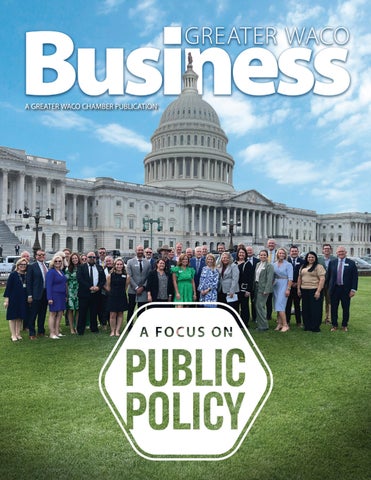
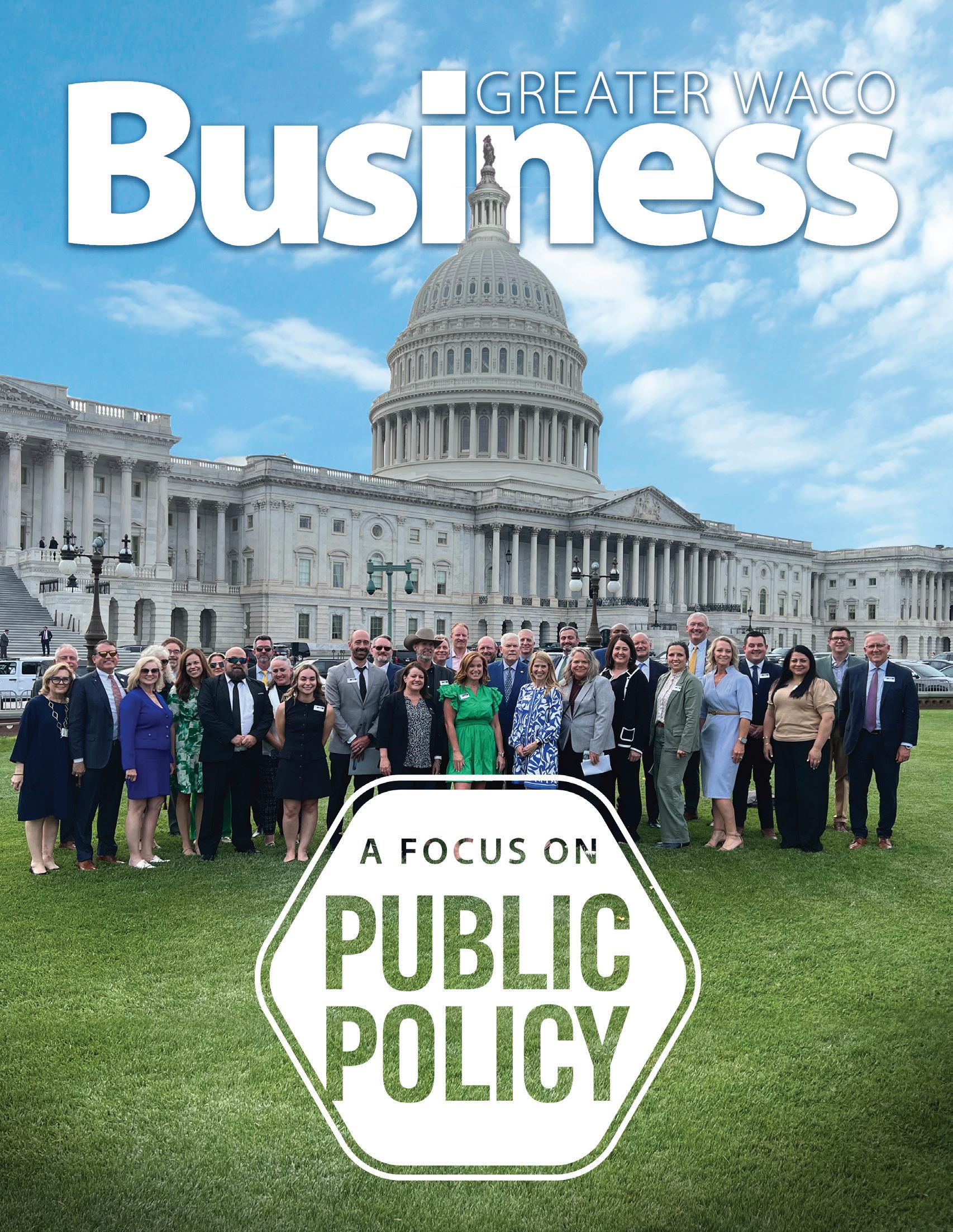
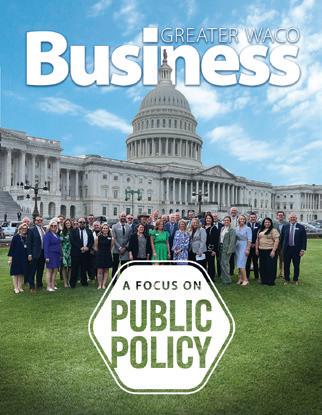
Greater Waco Business - Winter - A Focus on Public Policy
A GREATER WACO CHAMBER PUBLICATION
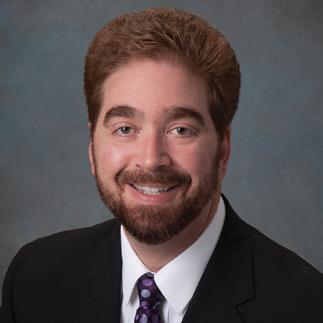
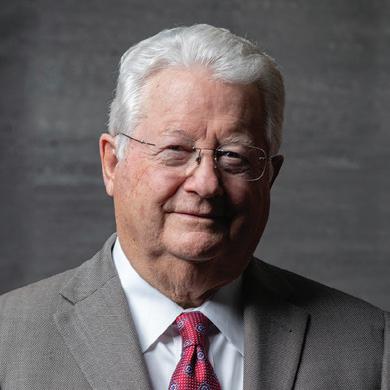
MATT MEADORS
President & CEO, Greater Waco Chamber
Economic development does not happen in a vacuum. It is shaped every day by the policies that govern how communities grow, how businesses operate, and how opportunity is created, which is why public policy matters so deeply to the work of the Greater Waco Chamber.
At its core, economic development is about creating the conditions for businesses to invest, innovate, and succeed. Public policy influences those conditions in very real ways.
In this issue of Greater Waco Business, we explore the critical intersection of public policy and economic development, and the role your Chamber plays in representing the voice of business across all levels of government. Advocacy is not a separate function from our economic development mission; it is a core part of it. When policy supports growth, innovation, and fairness, our businesses thrive, our workforce expands, people prosper, and our community benefits.
The Greater Waco Chamber approaches public policy with a clear focus: advancing policies that strengthen the regional economy and improve the overall business climate. Through research, collaboration, and strong relationships with policymakers, we work to ensure that the needs of employers, entrepreneurs, and investors are clearly understood and thoughtfully considered. Our Public Policy Committee, made up of leaders from across industries, helps guide this work so that our advocacy reflects the real priorities of those doing business in Greater Waco every day.
This issue highlights the importance of informed, strategic engagement in the policy process, and why business voices matter. Whether the topic is workforce readiness, infrastructure investment, emerging technologies, or regulatory clarity, thoughtful public policy helps set the stage for sustainable economic growth.
As you read this issue, I hope it reinforces an important truth: when business leaders engage in public policy, and when policy is shaped with economic impact in mind, communities like Greater Waco are better positioned to succeed.
As always, thank you for your continued support of your chamber of commerce.
With appreciation,
Matthew T. Meadors President & CEO
2026
EXECUTIVE COMMITTEE
CHAIR
Todd Moore
Alliance Bank Central Texas
CHAIR-ELECT
Keith Helpert
K4 Construction
VICE CHAIR
Dr. Jackson Griggs
Waco Family Medicine
VICE CHAIR
Stephanie Peters Cargill
IMMEDIATE PAST CHAIR
Carolyn Haferkamp
Central National Bank
PRESIDENT & CEO
Matt Meadors
Greater Waco Chamber
CHAMBER STAFF
Kacie Birkes
Director Signature Events
Kris Collins
Executive Vice President
Gabriella Colurciello Director Marketing & Communications
Nancy Gupton Director Resource Development
Jacob Hogan Vice President Public Policy & Chamber Foundation
Keith Kusler Art Director
Andrea Lail Director Workforce & Talent
Rachel Ligon Director Leadership Development
Rachel Martinez Senior Director Workforce & Talent
Matt Meadors President/CEO
Molly Merritt Vice President Business Development
Seth Morris Vice President Economic Development
Jason Powers Senior Vice President Finance & Operations
Lexy Reil Director Economic Development
Gil Salinas Research & Project Manager Economic Development
Rebecca Sheehy Manager Signature Events
Tori Sparks Coordinator Economic Development
Lupe Teichelman Manager Resource Development
Emily Vieregg Coordinator Resource Development
Michelle Williams Director Finance & Operations
Autumn Young Manager Marketing & Communications
inWaco was created to highlight the characteristics that make our community special with the ultimate goal of recruiting and retaining our most valuable resource: our people. inWaco comprises everything Greater Waco has to offer, including jobs. With an integrated job board and place for job seekers to post their resumes, the inWaco website offers a place for employers and potential employees to connect. Talent and workforce remains vital to the work of your Greater Waco Chamber and we are committed to being part of the solution.
ART
AD
Gabriella
Greater Waco Business is published and distributed to Chamber members and economic development prospects. Digital copies are available online at WacoChamber.com. This publication is printed on FSC-certified paper.
The Greater Waco Chamber reserves the right to reject editorial or
content in the Greater Waco
and via the organization’s full range of communications platforms, at its sole discretion.
SHAPING POLICY FOR A COMPETITIVE REGIONAL ECONOMY
by Jacob Hogan, Vice President, Public Policy & Chamber Foundation, Greater Waco Chamber
The Greater Waco Chamber is committed to cultivating a strong, resilient regional economy that can create opportunity and prosperity for all who call the Greater Waco region home. Our commitment extends beyond our traditional economic development activities. It includes strategic and proactive engagement in public policy at the local, state, and federal levels. In today’s competitive landscape, policy decisions significantly influence business success. It is essential for the voice of the business community to be clearly heard and thoughtfully represented.
The Chamber plays an active leadership role in helping to positively shape the policy environment in which our business community operates. Through research, relationshipbuilding, and coordinated advocacy, we work to ensure that Greater Waco’s economic landscape remains attractive, competitive, and positioned for long-term success. Our policy efforts are guided by the Greater Waco Chamber Public Policy Committee. The committee is a diverse group of business and community leaders across various sectors who provide insight, expertise, and strategic direction to our advocacy efforts. The committee informs our advocacy positions to ensure they reflect the needs and priorities of employers across the region.
Our approach is rooted in a simple but powerful goal: to strengthen the environment where businesses can grow, workers can thrive, and our community can flourish. By engaging directly with elected officials in Waco, Austin, and in Washington, D.C., we help communicate how legislation and regulatory decisions impact local businesses, regional competitiveness, and the economic landscape. These conversations allow us to highlight the unique strengths of the Greater Waco region, while also advocating for practical solutions to the challenges that businesses face.
To advance this mission, the Chamber’s public policy efforts are organized around four core pillars. Each reflects a critical area necessary for the long-term economic vitality of our community:
1. Workforce & Education
A skilled, adaptable workforce is the foundation of a strong economy. The Chamber works closely with education and community partners to ensure employers have access to the talent they need. This includes promoting policies that expand workforce training pathways, support career and technical education, and encourage collaboration between educators and industry. By aligning education systems with employer needs, Greater Waco is positioning itself as a destination where businesses can confidently invest and grow.
2. Business Climate
A healthy business climate is essential for economic growth, competitiveness, and innovation. The Chamber advocates for policies that reduce unnecessary regulatory burdens, encourage entrepreneurship, and support a fair and stable tax structure. We champion initiatives that streamline permitting processes, increase government efficiency, and protect the ability of businesses to operate effectively. A strong business climate does not just benefit employers, it drives job creation, strengthens our local economy, and enhances the overall quality of life for our residents.
3. Economic Development
Sustained prosperity requires strategic investment in both business recruitment and business retention. The Chamber supports policies that allow the Greater Waco region to attract new businesses while also helping our existing companies expand. This includes advocating for competitive economic development tools, incentives, and infrastructure investments that signal to companies that Waco is a smart and supportive place to do business. Our efforts help ensure that the region remains competitive not only within Texas but nationally and globally.
4. Infrastructure
Modern, reliable infrastructure is the backbone of economic growth. Whether it’s transportation networks, water systems, broadband connectivity, or reliable energy, the infrastructure that supports daily life and business operations must keep pace with the region’s increasing demand. The Chamber advocates for forward-thinking infrastructure planning and investment, recognizing that these systems are essential to mobility, industry expansion, supply-chain efficiency, and community resilience. A region prepared with dependable infrastructure is a region ready for future growth.
Across each of these focus areas, the Chamber remains committed to collaboration. It is often said that economic development is a team sport, and active public policy efforts play a key role in creating economic prosperity for all in our community. We regularly convene stakeholders, host policy events, organize legislative trips to Austin and Washington, D.C., and communicate with decisionmakers to ensure key issues facing the business community are clearly understood. We maintain strong relationships with policymakers and their staff in order to share the realworld experiences of employers, and to help shape informed decisions that benefit both our businesses and residents.
As the Greater Waco region continues to grow, develop, and attract new opportunities, the need for strong policy leadership will only increase. The Chamber is proud to serve as a trusted voice and advocate for the business community. We remain committed to championing policies that ensure our region thrives today and for generations to come. n
TEXAS ON THE FRONTIER OF ARTIFICIAL INTELLIGENCE: INNOVATION WITH RESPONSIBILITY
by Senator Tan Parker
Texas has always been defined by a willingness to cross new frontiers. Our history is the story of pioneers who pushed beyond the known world: building communities on open prairie, powering America through an energy revolution, and guiding mankind to the moon from Houston’s Mission Control. That spirit was never about geography. It has always been about mindset — the conviction that Texans do not wait for the future to arrive; we build it.
Today, our newest frontier is artificial intelligence (AI). Unlike past technological shifts, AI is not emerging quietly at the edges of society. It is arriving rapidly, touching every industry and community, while challenging us to answer big questions about innovation, ethics, and freedom. In Texas, we refuse to view AI as a technological disruption. We see it as a test of values and a moment in which leadership, courage, and responsibility must work together.
This new frontier is taking shape across our state. At Baylor University, SMU, Texas Christian University, and the University of Texas, for example, researchers are advancing machine-learning tools that support earlier disease detection and improve access to
high-quality medical care. In boardrooms and on manufacturing floors, business leaders are deploying AI to streamline operations, strengthen supply chains, and sharpen global competitiveness. And around kitchen tables, families are confronting new risks, from AIenabled fraud targeting seniors to manipulated images harming children. Texans are optimistic about what AI can make possible, but they’re also asking a critical question: How do we ensure innovation enhances human dignity rather than eroding it?
This moment calls to mind another era of technological competition. When the Soviet Union launched Sputnik in 1957, it sparked the space race and a contest of systems: freedom and control, possibility and fear. America’s answer was bold and strategic. We invested, innovated, and acted with purpose. Twelve years later, Neil Armstrong stepped onto the moon — and freedom prevailed.
Today’s race is digital rather than orbital. AI is reshaping markets, redefining security threats, and transforming daily life. Our competitors abroad are moving quickly, and authoritarian regimes, such as China, are using AI not for human advancement, but as an instrument of censorship and control. Their vision is one where technology enables obedience over opportunity. Texas rejects that vision. We believe AI should expand human freedom, not restrict it. During the 89th Legislative Session, we built one of
the nation’s most comprehensive state-level AI governance frameworks, anchored in innovation, transparency, and human dignity.
Our approach began with a simple principle: technology must never outpace values. We enacted first-in-the-nation protections against AIgenerated child exploitation. We also modernized tools for prosecutors and law-enforcement officers to combat deep-fake extortion, AI-enabled fraud schemes, and malicious impersonation which threatens families and businesses in every corner of our state.
However, guarding against harm is only part of the answer. Texas must lead with responsible innovation and smart governance, which is why we created the Texas Artificial Intelligence Advisory Council and established clear statewide standards for the use of AI in government services.
Those standards rest on common sense and timeless principles. When government utilizes
automated systems, Texans deserve transparency about when those tools influenced outcomes. They deserve a human touch to explain decisions and correct mistakes. They deserve safeguards and accountability. Most importantly, they deserve certainty that technology exists to serve our people, not the other way around.
In practice, this means an automated tool used for something routine — like filing a permit request or checking benefits status — is treated differently than a system involved in decisions affecting liberty, livelihood, or healthcare. Higherrisk systems face greater testing, monitoring, and human oversight. Software vendors who want to work with Texas must demonstrate ethical data practices, technical transparency, and clearly documented model behavior. If a system cannot be clearly explained, it cannot be deployed in Texas government. That is the standard that Texans expect — and the one that will accelerate innovation by rewarding those who build responsibly.
This balanced approach gives innovators confidence and citizens peace of mind. It also ensures Texas remains a magnet for AI talent and investment. Whether in Waco’s growing innovation corridor, Austin’s tech hub, or biomedical centers in Dallas and Houston, Texas is cultivating an ecosystem where AI helps doctors detect cancer earlier, assists farmers improve yields, protects energy infrastructure from cyber threats, and supports first responders as they work to save lives.
The story of AI in Texas, then, is not simply a story of regulation or research. It is a story of purpose. It is about ensuring that this technology, perhaps the most transformational tool since electricity, evolves in a way that lifts people up, strengthens free enterprise, and protects the dignity of the individual.
ways not aligned with freedom. If we meet this moment with the same grit and determination that carried Texans across oceans, plains, and into space, then we will build an AI future anchored in dignity, security, and boundless opportunity.
The stakes are generational. But so, too, is the promise. Texas has never feared the frontier, and this one is no different. We will protect our people, empower our innovators, and ensure that the story of AI, like the story of space, energy, and enterprise before it, is written in the language of liberty with a bold vision for a brighter tomorrow.
And when future generations look back at this era, I believe they will say what history has always said of Texas: When the frontier called, we led. n
The world is watching how states respond to this moment. Washington often moves slowly, but states serve as laboratories for innovation and efficiency. Policies move with speed and clarity, effectively serving as blueprints to guide the nation. And for Texas, we are choosing a course that defends liberty, encourages innovation, and reflects our enduring belief that free people, trusted and empowered, will always lead the way.
Artificial intelligence is the next frontier. And like frontiers before it, it will test our resolve, our vision, and our values. If we shrink from the challenge, others will define our future in
Senator Tan Parker of North Texas is a businessman who represents Senate District 12. He serves as Chair of the Senate Republican Caucus and Co-Chair of the Texas Artificial Intelligence Advisory Council and authored SB 1964, the landmark legislation establishing Texas’ statewide framework for responsible, ethical, and secure AI use across government.
Look around Waco and you might not notice it at first, but the signs of economic development are everywhere. From the $1 billion Graphic Packaging facility in Texas Central Park to Electrolit's $400 million facility, major investments are transforming the economy. But behind these headlinegrabbing projects lies a framework of state policies, local tools, and cooperative partnerships that make such transformations possible. The 89th Texas Legislative Session protected and expanded programs that enable Texas communities to attract investment and create quality jobs.
How the 89th Legislative Session Will Shape Our Economic Future
Understanding Economic Development
Before getting into the nitty-gritty legislative details, it's important we understand what economic development is and why it matters to residents. Economic development is a deliberate effort to improve a community or region's economy. It includes efforts to attract new businesses, assist existing companies in expanding, create quality jobs, and build a resilient economy that can withstand economic challenges. Economic developers are the professionals who make this happen. They work as problem solvers, collaborators, and community advocates.
Why does this matter to Waco residents? A strong economic development program directly affects their quality of life. It means more jobs for local families. It means investment from new industries that will bolster the tax base which funds schools and infrastructure. When Graphic Packaging International decided to invest $1 billion in Waco— the largest economic development deal in the city's history—it wasn't just luck. It was the result of strategic economic development efforts, including workforce development partnerships with Texas State Technical College and McLennan Community College, infrastructure planning, and targeted business incentives.
by Matt Abel, VP, Government Affairs, Texas Economic Development Council
The 89th Session: Playing Defense to Protect Local Tools
Our main goal coming into the legislative session was clear: protect the economic-development tools that allow local communities to shape their own futures. On that front, the session was a success.
Throughout the 140-day regular session, numerous proposals threatened to limit local flexibility or weaken key economic development programs. Several bills targeted Chapter 380 and Chapter 381 agreements, which are powerful tools that allow cities and counties to negotiate economic development deals with businesses. These agreements can include tax abatements, cash grants, or infrastructure improvements in exchange for job creation and capital investment. When the Legislature created Chapter 380 agreements in 1989, they wisely built a flexible program that any community could use: large or small, rural or urban (or suburban), industrial-focused or tourism-focused.
Opponents of these tools argued that they were being misused and pushed for overly burdensome requirements that would discourage investment. Economic developers and the business community responded that local control and flexibility are vital for competing with other states and countries for business investment. Thanks to coordinated advocacy efforts, including a coalition letter signed by over 50 local economic development organizations across Texas, none of these restrictive bills became law.
Missed Opportunities: Where the Session Fell Short
While protecting existing tools was essential, the 89th Session missed several opportunities to improve our competitive edge. The Jobs, Energy, Technology, and Innovation (JETI) program, created in the 2023 legislative session to replace the nowabolished Chapter 313 program, has fallen short of expectations. These programs offer a school district the opportunity to abate a portion of its property tax levy for a business making a significant capital investment in the region. In the first 22 months since its launch, only a few projects used the program. In comparison, the previous Chapter 313 program typically supported about 20 projects per year. Despite recognition that reforms were necessary, lawmakers made no changes.
Efforts to fund the Capital Access Program at the
Texas Department of Agriculture also fell short. This program offers rural communities financial support for necessary infrastructure projects to attract new development. Historically, this program has enabled smaller Texas communities to share in the state's economic growth.
Chairman Greg Bonnen (R-Friendswood) proposed using part of the state's Rainy Day Fund to invest in Texas-based companies, supporting local innovation and entrepreneurship. Our Rainy Day Fund is an important financial safety net for the state. It helps maintain "AAA" ratings from multiple credit rating agencies. That said, the roughly $27 billion in the fund can only be invested in low-risk assets that barely beat inflation. It is wise to invest a small portion of this fund in innovative Texas-based companies. Once these investments mature, the Rainy Day Fund will realize capital gains, thereby increasing the overall fund.
Significant Wins: Infrastructure & Workforce Development
Despite the defensive posture on economic development policy, the 89th Session delivered victories in areas that directly support economic competitiveness: infrastructure and workforce development.
Senator Charles Perry (R-Lubbock) and Chairman Cody Harris (R-Palestine) tirelessly worked on a transformative investment in water infrastructure, which is critical for a state that is experiencing rapid growth and recurring droughts. Texas voters overwhelmingly approved Proposition 4 in the recent election, which will allocate $1 billion per year from sales tax revenue to water projects over the next 20 years. Additionally, Chairman Bonnen and Senator Joan Huffman (R-Houston) authored House Bill 500, which provides an immediate $2.5 billion investment for repairing existing water systems and developing new water supplies. Reliable water infrastructure is essential to our continued ability to attract projects like Graphic Packaging International.
Energy infrastructure also received major support. Lawmakers allocated an additional $5 billion to the Texas Energy Fund, bringing its total to $10 billion. This funding supports dispatchable power generation and transmission infrastructure, which are vital to grid stability as Texas continues to attract energy-intensive industries such as data centers and advanced manufacturing.
Workforce development also received significant funding. Senator Brian Birdwell (R-Granbury) authored what became Proposition 1 on the recent ballot. Texas voters approved the creation of an $850 million endowment fund for Texas State Technical College. This permanent funding will support capital projects and equipment for workforce education programs in high-demand technical fields, precisely the kind of training needed for the skilled manufacturing jobs that Graphic Packaging, Electrolit, and other Waco employers will offer.
Sector-Specific Funding: Positioning Texas for Future Industries
The Legislature provided major funding for emerging industry sectors that support Texas' economic development strategy. The Texas Space Commission received $300 million in additional grant funding, the Texas Semiconductor Innovation Fund got $250 million, and a new Texas Advanced Nuclear Development Fund was established with $350 million. The motion picture industry received $250 million, with a commitment to $350 million every two years, providing stable, predictable funding that film production companies need to make long-term location decisions.
Waco is well-positioned to benefit from these investments. Regionally, it can attract semiconductor suppliers to support the large fabs in Texas, such
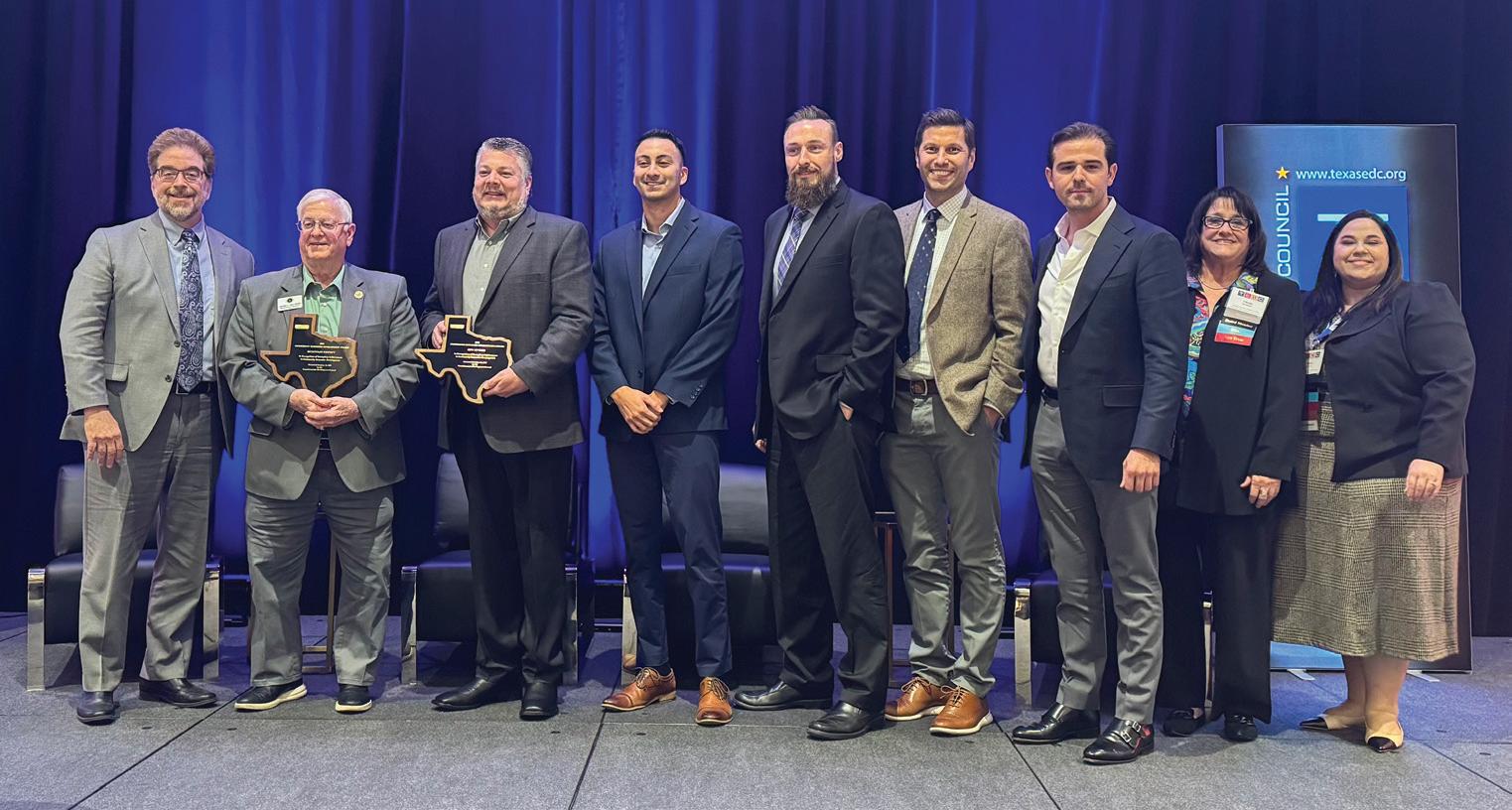
City of Waco and McLennan County receiving the Community Economic Development Award
as Texas Instruments in Sherman and Samsung in Taylor. This was evident when EFC Gases & Advanced Materials announced last year its plan to invest $210 million in a site in McGregor. Likewise, additional funding for the Texas Space Commission could attract new investment around SpaceX's McGregor facility. As these industries continue to develop, opportunities will continue to ripple through regions like Central Texas.
Waco's Recognition: A CEDA Award Success Story
The importance of strong economic development initiatives was recently recognized when the City of Waco and McLennan County received the Community Economic Development Award (CEDA) from the Texas Economic Development Council. This award acknowledges communities that make outstanding contributions to Texas's economic vitality through innovation, leadership, and collaboration in areas such as business retention, recruitment, and community enhancement.
"Our Community Economic Development Award is one of the ways in which our organization honors the excellent work done by our communities, their leaders, and their economic development professionals," noted Carlton Schwab, President & CEO, Texas Economic Development Council.
“ ECONOMIC DEVELOPMENT BRINGS IN MILLIONS OF DOLLARS IN ADDITIONAL TAX REVENUE THAT CAN BE USED TO FUND SCHOOLS, PARKS, AND PUBLIC SAFETY WITHOUT RAISING TAXES ON EXISTING BUSINESSES AND RESIDENTS.”
The City of Waco and McLennan County received a CEDA for their success in attracting Electrolit's $400 million state-of-the-art manufacturing facility. This project will create 200 well-paying jobs and generate nearly $100 million in new tax revenue for the community over the next 20 years.
Why Continued Focus Matters: The Road Ahead
As we move through the interim and prepare for the 90th Legislative Session (2027 will be here before you know it!), maintaining a focus on improving our economic development programs remains essential. The competition for business investment is becoming fiercer each year. Other states are not standing still; they are enhancing incentive programs, streamlining permitting processes, and investing heavily in workforce development and infrastructure.
Waco's recent successes show what's possible when state and local tools collaborate effectively. However, these victories shouldn't lead to complacency. The underperformance of the JETI program indicates that creating an economic development tool isn't enough. The program must genuinely address business needs and operate efficiently. The lack of funding for the Capital Access Program means rural Texas communities miss out on resources their counterparts in other states readily offer.
During the interim period, the TEDC and local communities must work with legislators to address concerns about economic development programs while preserving the flexibility and local control that make them effective. Sharing both success stories (like Waco's CEDA award) and honest assessments of what's not working (like JETI) will help lawmakers understand which reforms are needed and which restrictions would be counterproductive.
For Waco specifically, the ongoing $1.4 billion downtown redevelopment project, a 12 to 20-year initiative that will reshape the urban core with a new city hall, convention center, town square, ballpark,
and mixed-use development, will require sustained policy support at the state level. Water infrastructure funding from the 89th Session will help, but future phases will need continued state partnership.
The Bottom Line for Waco Residents
Economic development might seem abstract, focusing on tax policies, incentive programs, and legislative language. But its effects are real and personal. When Graphic Packaging International breaks ground on a $1 billion facility, it means 230 families gaining good-paying jobs. When Electrolit chooses Waco for its first U.S. production site, it creates 200 more jobs. It brings in millions of dollars in additional tax revenue that can be used to fund schools, parks, and public safety without raising taxes on existing businesses and residents.
The 89th Legislative Session protected the tools that made these wins possible. Lawmakers invested in the infrastructure and workforce development that businesses need. It was a session of steady, important work - preserving what works while planning for future improvements.
As legislators gear up for the next session, the lesson from Waco's success is clear: economic development isn't about government choosing winners and losers. It's about communities having the tools, flexibility, and resources to compete for opportunities that generate prosperity for all Texans. That's worth protecting and worth improving in future sessions. n
The Texas Economic Development Council (TEDC) is an Austin-based, statewide, non-profit professional association dedicated to the development of economic and employment opportunities in Texas. Our diverse members share a common goal: bringing new investment and jobs to Texas.
PROPOSITION 1 APPROVAL SECURES NEW ERA OF STABILITY FOR TSTC
The Texas State Technical College (TSTC) System received a powerful vote of confidence during November’s general election as more than two million Texas voters approved Proposition 1.
This milestone accentuates the statewide recognition of TSTC’s proven impact on the state’s economy and workforce. In the past decade, TSTC has graduated more than 33,600 students, supplying industry partners with skilled, jobready talent. With a 94% placement rate across its programs, the college continues to demonstrate a strong return on investment for students, employers, and the state. It reinforces why Texans overwhelmingly supported continued growth and funding for the system.
“We have never had a reliable source of capital funding,” said Joe Arnold, TSTC’s deputy vice chancellor for Government Relations. “As a state agency, we cannot levy taxes, so we do not have the tools that school districts and community colleges have to raise money for capital funds.”
The proposition creates two pools of money: an $850 million Technical Institutional Infrastructure
by Daniel Perry, Communication Specialist, Texas State Technical College
Fund (TIIF) managed by the Texas Comptroller of Public Accounts, with its interest going into the Available Workforce Education Fund that only TSTC’s Board of Regents can seek to draw down from. The first interest from the endowment is not expected until early 2027, with disbursements expected each year afterward. The funding will be for all of TSTC’s 11 campuses.
“The ability to plan is a game changer for us,” said Beth Wooten, provost of TSTC’s Waco campus. “With this opportunity, we can finally prioritize long-deferred maintenance projects that will modernize our existing facilities while also strategically preparing for new buildings. All of this positions us to grow by increasing capacity and placing more Texans in high-paying jobs.”
When voters approved the measure, it signaled that TSTC could move forward with greater certainty, accelerating future planning. The decision strengthens the college’s ability to respond quickly to industry needs, ensuring Texas employers continue to have access to a steady pipeline of highly trained graduates.
Richard A. “Tony” Bennett, president and CEO of the Texas Association of Manufacturers, said the college’s growth had been hindered with no access to property tax money and by the need to go to the state legislature each session to secure funding. Leaders of several of the state’s business
and industry organizations advocated for TSTC.
“We cannot grow the Texas economy without growing TSTC,” Bennett said. “We also support the other community colleges with their career technical programs. TSTC is valuable in that it narrows down to specific trades in high demand and short supply for young people and returning veterans to get in, get an education, and get out in the workplace.”
Bennett said there will be plenty of work for graduates to do, especially in artificial intelligence, industrial maintenance, and power distribution in modernizing the state’s transmission grid and distribution lines.
“That project is going to be massive and you just don’t walk in and start with high-powered wiring of that substantial voltage without being heavily trained,” Bennett said.
The legal structure of the endowment is designed to safeguard and focus the funds. Interest generated can only be used for deferred maintenance, purchasing land, building, and upgrading infrastructure and acquiring instructional equipment.
The proposition guarantees accountability by legally restricting the use of funds for general operational costs like advertising, marketing, salaries, and travel.
“It positions the college to respond to needs that will arise in the Greater Waco region,” Arnold said.
“We have a lot of manufacturers moving to Waco. Access to this reliable source of capital funding will now allow us to work with community leaders to plan for the growth in the Waco region.”
The idea of an endowment began in fall 2022 with a presentation made by TSTC leaders to business association representatives in Austin. A question was posed on how to scale up the work that TSTC does to train more people.
Legislation seeking a proposition question was approved by both chambers of the Texas Legislature in 2023, but there were differences in the bill, Arnold said. The legislative session ended before a compromise could be reached.
An effort was made to get the endowment proposition on the ballot during this year’s legislative session.
“You never take anything for granted,” Arnold said. “With so many new members in the legislature, our advocates had to work harder this time.”
TSTC was established by the state Legislature and opened for its first students in 1965. The campus has locations spread across the state from Sweetwater to Marshall and extending to Harlingen in the south. The Waco campus serves as the administrative home. TSTC is the only statesupported technical college system in Texas.
TSTC offers the Money-Back Guarantee for students enrolled in eligible technical programs. Students need to complete the HIRE 1100 class and receive a job offer within six months of graduation. Tuition can be refunded if students can prove the requirements were not met.
TSTC was the first higher education institution in the United States to adopt a returned-value funding model. This model calculates the economic value stemming from five years of graduate wages. This value is multiplied by a funding rate equaling the amount of state funding to be received in the state’s two-year budget cycle. The funding formula concept was created in 2011 during the 82nd Texas Legislature, which recommended that the Texas Higher Education Coordinating Board work with TSTC to recognize graduates’ job placements and earnings.
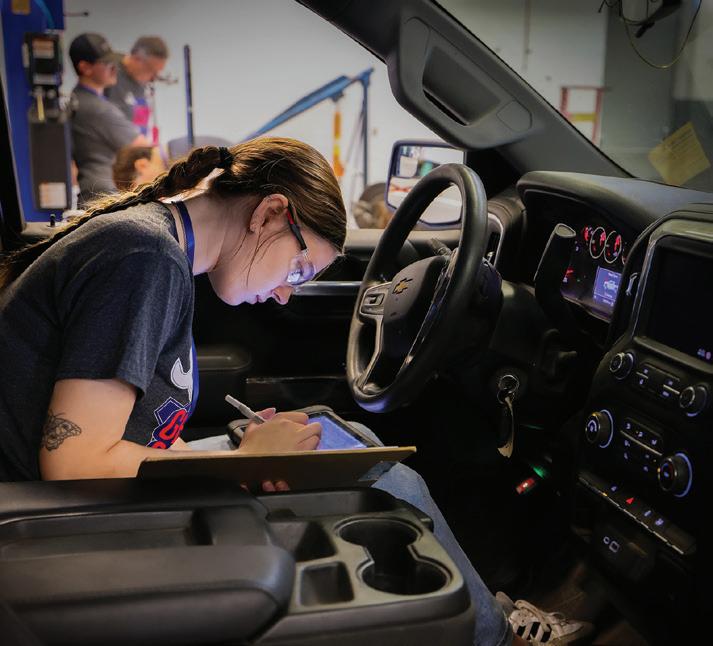
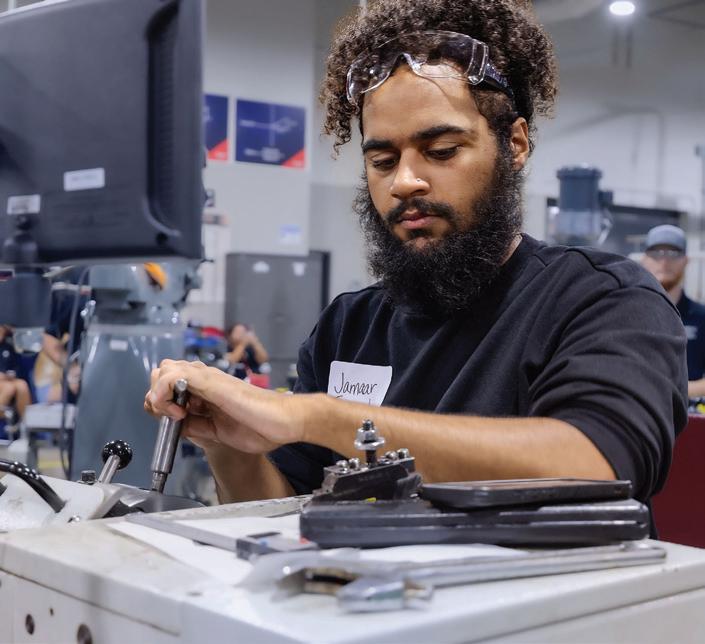
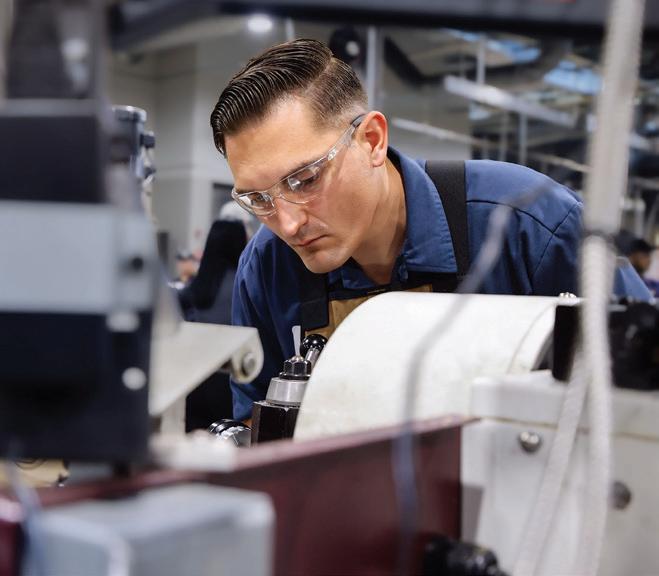
TSTC’s Waco campus offers more than 20 inperson and hybrid programs, along with several online options. These programs are strategically designed to align with the dominant industries of Central Texas, including aerospace, advanced manufacturing and transportation. The campus itself is a blend of history and progress, featuring both structures from its days as Connally Air Force Base, and newer facilities, such as the Construction Technologies Center scheduled to open in early 2026.
As of the spring semester 2025, the Waco campus had the largest enrollment among all of TSTC’s campuses with more than 2,900 students, according to the college’s Business Analytics and Reporting department.
“Waco and McLennan County are experiencing tremendous growth, and it’s important that TSTC grows right alongside them,” Wooten said. “The TIIF provides the stability and support we need to plan for that future with confidence. It ensures we can expand our capacity, strengthen our programs, and continue meeting the evolving needs of the industries we serve.”
For more information on TSTC, go to tstc.edu. n
With multiple locations across the state, Texas State Technical College helps to strengthen the Texas workforce with highly skilled, technically competent graduates. Operating on a unique funding model based on student employment outcomes, the college is celebrating 60 years of service to the state of Texas in 2025. For more information, visit tstc.edu.
McLennan County Continues Critical Water Supply Planning Efforts
Waco, McLennan County, and the entire state of Texas stand at the brink of significant water-supply challenges. These pressures are driven not only by rapid population growth—especially along the IH-35 corridor—but also by emerging, high-demand users such as data centers. McLennan County has been actively involved in county-wide water planning. In 2014, Waco and McLennan County formed the McLennan County Water Resources Group (McL WRG), an informal, non-regulatory gathering of city managers, water system managers, the Brazos River Authority, Baylor University and others with area water knowledge to examine the County’s water needs, propose a feasible approach to reduce arsenic levels in several rural systems, and develop McLennan-County-specific water plans. During the 2025 session of the Texas Legislature another tool was provided for regional water planning—and McLennan County took full advantage by supporting its formation, encouraging participation, and taking a place on the Board of Directors.
by J. Tom Ray, PE, D.WRE, Partner at Hicks-Ray Associates & Honorable Scott Felton, McLennan County Judge
During the latest session of the Texas Legislature, a new regional water alliance was established to facilitate the cooperative development and regional use of necessary watersupply projects. The Central Texas Water Alliance (CTWA) is a subdivision of the State of Texas and was created by the 89th Texas Legislature with the ability to develop water-supply, undertake regional water-supply projects, transport water, and plan, develop, build and operate water-supply systems and wastewater treatment facilities.
Senate Bill 1194 (SB 1194) establishes the CTWA “to help local governments and water districts work together in meeting long-term water needs through cooperation—not bureaucracy,” said State Rep. David Spiller, serving Texas District 68. “With the Governor’s signature, this legislation is now in effect, ensuring Central Texas is better prepared to manage and deliver water resources efficiently and responsibly for generations to come.”
The CTWA recently began its governance efforts. Following the statutory requirements of SB 1194, a Board of Directors has been established, bylaws initially approved, and initial guidelines on CTWA Membership (Sponsor) were approved. Sponsors can include local government as well as private entities. Non-voting membership categories for Affiliate and Ex Officio participants have also been established.
The current Board Members are Judge David Blackburn of Bell County, Judge Scott Felton of McLennan County, Dirk Aaron, former manager of the Clearwater Groundwater Conservation District, and Rick Garrett, the General Manager of Bell County WCID #1. The Brazos River Authority is an important supporting, ex officio member.
"If you do not have adequate water, you have to limit yourself in the kind of companies that you bring to your town, which could limit the opportunity for higher-paid jobs for our citizens and our community," McLennan County Judge Felton stated in support of the CTWA.
CTWA Facts:
• It is a regional water authority
• It will not have taxing authority
• It will be located in the counties identified in the enabling legislation
• It is a nonprofit corporation to act on behalf of local government
• Its founding sponsors are Bell and McLennan Counties, Clearwater Underground Water Conservation District, and the Bell County WCID #1
• It will finance projects using bonds or other revenuebased obligations financing and would be eligible for grants and loans
Over time, as more information about the Alliance becomes available, the CTWA will have multiple participants and members. Water purveyors, cities, water districts, and others with water local interests, from several central Texas counties, including Bell, McLennan, Falls, Milam, Coryell, and Lampasas, have expressed interest in joining the Alliance.
The Alliance will have the authority to issue bonds for water infrastructure projects and can impose fees and assessments to support its operations. However, officials stressed that there will not be any tax increases, as the group will operate solely on administrative fees.
The Alliance has been supported by a broad spectrum of entities, both public and private, to include Bell County, McLennan County, Lampasas County, Fort Cavazos, the Brazos River Authority, Clearwater Underground Water Conservation District, Bell County Water Control and Improvement District No. 1 (WCID 1), multiple cities, multiple water-supply corporations, and private entities.
McLennan County Water Resources Group (McL WRG)
Participation in the CTWA is nothing new for McLennan County. The county is unique in Texas for its collaborative approach to helping resolve water issues. Working with Waco and other cities, both large and small, and rural water systems throughout the County, meets to discuss and take action on water problems. This cooperation became critical in 2006 when the EPA set a new arsenic standard of 10
parts per billion—roughly equivalent to a single drop of ink in a large backyard swimming pool. Several rural systems that had relied on groundwater for decades found themselves marginally exceeding the new limit.
In response, the McL WRG was formed in 2014 through the leadership of County Judge Scott Felton and then-Waco City Manager Wiley Stem. Since its inception, the group has provided a vital forum for cities and water systems across the County to work together in addressing current and future water needs. The McL WRG applied for and received WaterSMART grant to prepare three key water planning documents:
• The McLennan County Drought Contingency Plan;
• Conjunctive Use of Groundwater and Surface Water Plan
• Arsenic Mitigation Guide for rural, arsenicimpacted systems.
Further, McLennan County Commissioners contributed $4 million toward rural water system projects to mitigate arsenic concentrations and
“This moment has been a long time coming,” said Bell County Judge David Blackburn. “There is no issue more important to all of us than water, and I’m confident the CTWA will positively impact not just the residents of Bell County, but the entire region for generations to come.”
provide emergency generators. The McL WRG will play a crucial role in reviewing and recommending potential CTWA projects to address McLennan County water needs.
Brazos G Regional Water Supply Planning
McLennan County’s regional outreach stretches beyond the McL WRG to include two seats on the Brazos G Regional Water Planning Group, held by McLennan County’s Judge Scott Felton and the City of Waco. They help to ensure water needs and the water strategies to meet those needs remain based on McLennan County needs, planning and input into the state’s Brazos G Water Plan.
Summary
From ongoing efforts here in McLennan County with the McL WRG, to board membership on the recently established CTWA, to a seat at the planning table for the Brazos G Regional Water Planning Group, McLennan County has and continues to address the current and future water needs of McLennan County. n
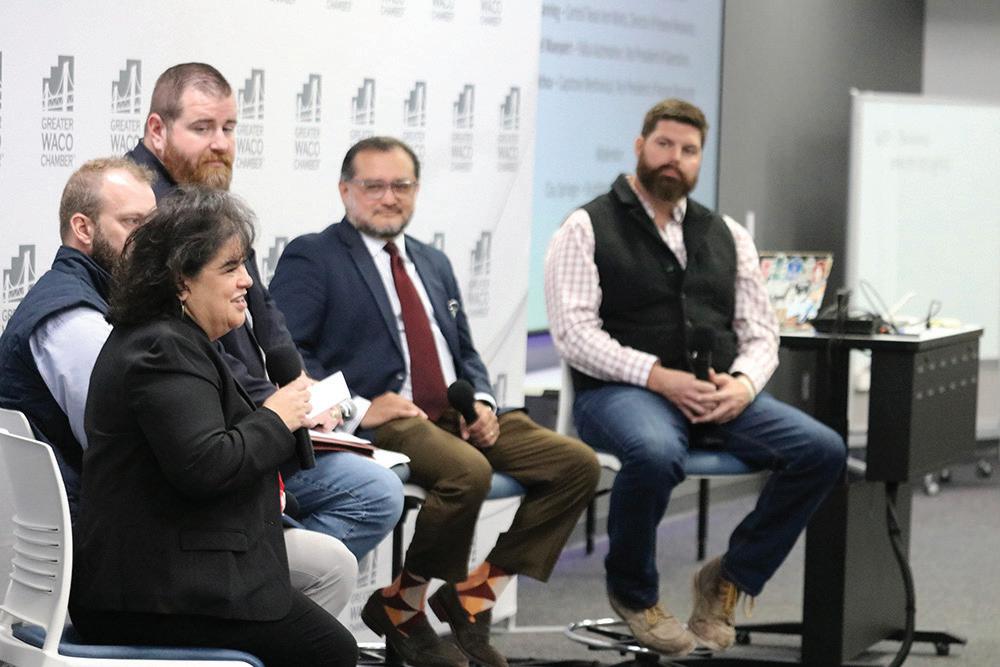
SHAPING WACO’S FUTURE: WHY BUSINESS LEADERS ARE STEPPING INTO PUBLIC POLICY
Across Greater Waco, business leaders are stepping into roles that influence how our community grows — from school boards to zoning commissions to workforce initiatives. Their professional experience gives them a front-row seat to the challenges and opportunities facing families and employers, and many feel a responsibility to give back. We sat down with a group of local leaders who are turning their day-to-day expertise into meaningful civic impact, asking what motivates them and why business engagement in public policy matters.
Broker/Owner, Kelly, Realtors
Greater Waco Chamber
Public Policy Chair
Taylor Bledsoe
President, Sturdisteel Grandstands & Press Boxes
Waco ISD School Board
Owner & President, K4 Construction
Jed Cole
Managing Partner, Brick Street Fund
Waco Planning & Zoning Commission and Waco Metropolitan Planning Organization
Frank Graves
Dean of Workforce and Public Service, McLennan Community College
McGregor ISD School Board
Jason Lavender
Executive Vice President, Board of Directors,
Director of Strategic Initiatives, TFNB Your Bank for Life
Lorena ISD School Board
Keith Helpert
Robinson ISD School Board
Leah Cox
WHY SHOULD BUSINESS-MINDED PEOPLE BE INVOLVED IN PUBLIC POLICY?
Public policy works best when boards, legislators, and other stakeholders come together and consider a broad range of perspectives and interests. Policymakers’ lived experiences, including their occupation, inform their perspectives on many issues. Business leaders absolutely need a seat at the table, as they understand how budgets and fiscal responsibility both protect the needs and interests of the taxpayers and allow for strategic investments in the local, state, or federal economy. As a business owner, I am faced every day with the challenge of doing right by people and by my business. That skill set is of vital importance when making largescale, public policy decisions.
Because the decisions being made at the local, state, and national level affect every part of how we live, work, and serve our communities. When business-minded people stay engaged, the conversation becomes more balanced and grounded in real-life experience.
We see firsthand how policy affects people. From hiring to housing to lending and development, we deal with the day-to-day impacts. Our perspective helps ensure policies actually work in the real world.
We care about strong, healthy communities. Thriving businesses create jobs, stability, and opportunity. When we’re involved, we can help shape policies that support growth instead of slowing it down.
Business people look for efficient, practical, and sensible ways to solve problems. That mindset brings much-needed accountability and clarity to policy conversations.
If we’re not at the table, someone else is; and they may not understand the realities our industries and communities face. Engagement doesn’t have to be complicated — voting, staying informed, and speaking up when it matters makes a difference. At the end of the day, good policy doesn’t happen by accident. It happens when people who care about their communities — and understand how things actually get done — show up.
Waco is growing fast, and the perspectives of those who invest locally and build their lives here can help guide that growth in a way that protects the character of our hometown. People working in business see firsthand what families and employers need to thrive — from infrastructure to housing to vibrant commercial areas. When community members with practical experience are willing to listen, collaborate, and contribute, it helps ensure decisions are grounded in what actually works for Waco.
Involvement in public policy provides an opportunity to advocate for community-wide priorities related to economic development, education, and workforce development at the state and national levels. These efforts ensure that our community’s needs are represented and help shape its ongoing success.
Business-minded people should be involved in public policy because they can provide real-world expertise to support economic growth and job creation. In the business world, they must focus on maximizing efficiency and results, which gives them the ability to help make government programs more effective and hold them more accountable. They can also help bridge the gap between the public and private sectors, ensuring that public policies are realistic and business-friendly. With innovative thinking, they can bring creative solutions to the table for complex social and economic challenges. Experience in managing budgets helps promote fiscal responsibility and smarter use of public funds. Overall, their involvement in public policy helps governments create policies that strengthen the economy, encourage innovation, and improve citizens’ quality of life.
Too often, people share opinions on social media but take little or no action in the real world. Public policy provides a meaningful way to turn beliefs into action—aligning decisions with both personal and corporate values. When business leaders engage in policy, they help shape solutions that impact communities, industries, and the economy. Rather than being passive observers, we should identify issues we’re passionate about and actively contribute to creating practical, sustainable solutions. This is how we move from conversation to real impact.
TAYLOR BLEDSOE
JED COLE
LEAH COX
FRANK GRAVES
KEITH HELPERT
JASON LAVENDER
WHAT MOTIVATED YOU TO GET INVOLVED IN PUBLIC SERVICE?
My parents, specifically my mom, are both civicminded people. I learned by watching them the importance of giving back to the community. Our family has firmly planted our flag in Waco and Waco ISD. I am a Waco ISD graduate, and my three children, plus our bonus, foster daughter, all attend Waco ISD. I understand the importance of a thriving Waco ISD to the overall health of our economy and community. My hope is that my experience as a Waco ISD graduate, parent, and local business owner provides an important and unique perspective as we think about the long-range plans for the school district.
Working in local businesses and real estate has given me a front-row seat to how Waco is changing and what thoughtful planning can unlock for families and neighborhoods. I’ve also seen how much of a difference committed public servants can make — their leadership has shaped the community we enjoy today. By serving, I hope to play a small part in helping Waco grow in a way that includes and benefits everyone.
Public policy shapes every corner of real estate. Commercial real estate, residential, property management —every bit of it is impacted by the laws and regulations of the municipality where it exists. Nothing we do in this industry sits outside the reach of public policy.
I’ve seen firsthand what happens when a community doesn’t stay engaged or when short-term decisions are made without any thought for long-term city planning. It can devalue properties, disrupt neighborhoods, and create non-conforming areas that ultimately hurt the very people who live around them.
This is exactly why involvement matters. When we pay attention, speak up, and stay connected to the process, we help protect property values, support healthy growth, and ensure our communities develop in a way that makes sense—not just for today, but for years down the road.
The desire to leave things better than I found them is one of the driving motivations that has led me to public service. If we all sit back and hope for someone else to dedicate their time and expertise to deserving causes (whether that be a Chamber of Commerce Board or a School Board of Trustees), we will not like what our community looks like in the decades to come. I also grew up with parents who gave of themselves constantly through volunteer work at our church, school and athletic programs, and they taught me the importance of serving others. The greater Waco area has been extremely blessed with great public service leaders for the last 150+ years; and I recognize that their service and sacrifice is why Waco and the surrounding areas are thriving like they are today. I thank God for the blessings and opportunities He has given me, and I feel that giving some of myself to help my community is the least I can do to show my appreciation.
My motivation for public service stems from a lifelong connection to my community and a desire to support McGregor ISD’s continued growth. Growing up here, my experiences in local schools and work at McLennan Community College have inspired my commitment to serve. I have seen firsthand how effective leadership and public service can open doors, and I want every student to have the same opportunity to achieve their full potential.
I’ve always believed that leadership extends beyond the walls of our businesses. Public service offers an opportunity to take the values we champion—integrity, responsibility, and innovation—and apply them to challenges that impact our communities and future generations. For me, it isn’t enough to simply have opinions; I want to be part of creating solutions. Public service allows us to move from conversation to action, ensuring that the decisions shaping our society reflect not only economic realities but also the principles we stand for. It is about making a tangible difference where it matters most, and we each bring our own uniqueness to every conversation.
JED COLE
TAYLOR BLEDSOE
LEAH COX
FRANK GRAVES
KEITH HELPERT
JASON LAVENDER
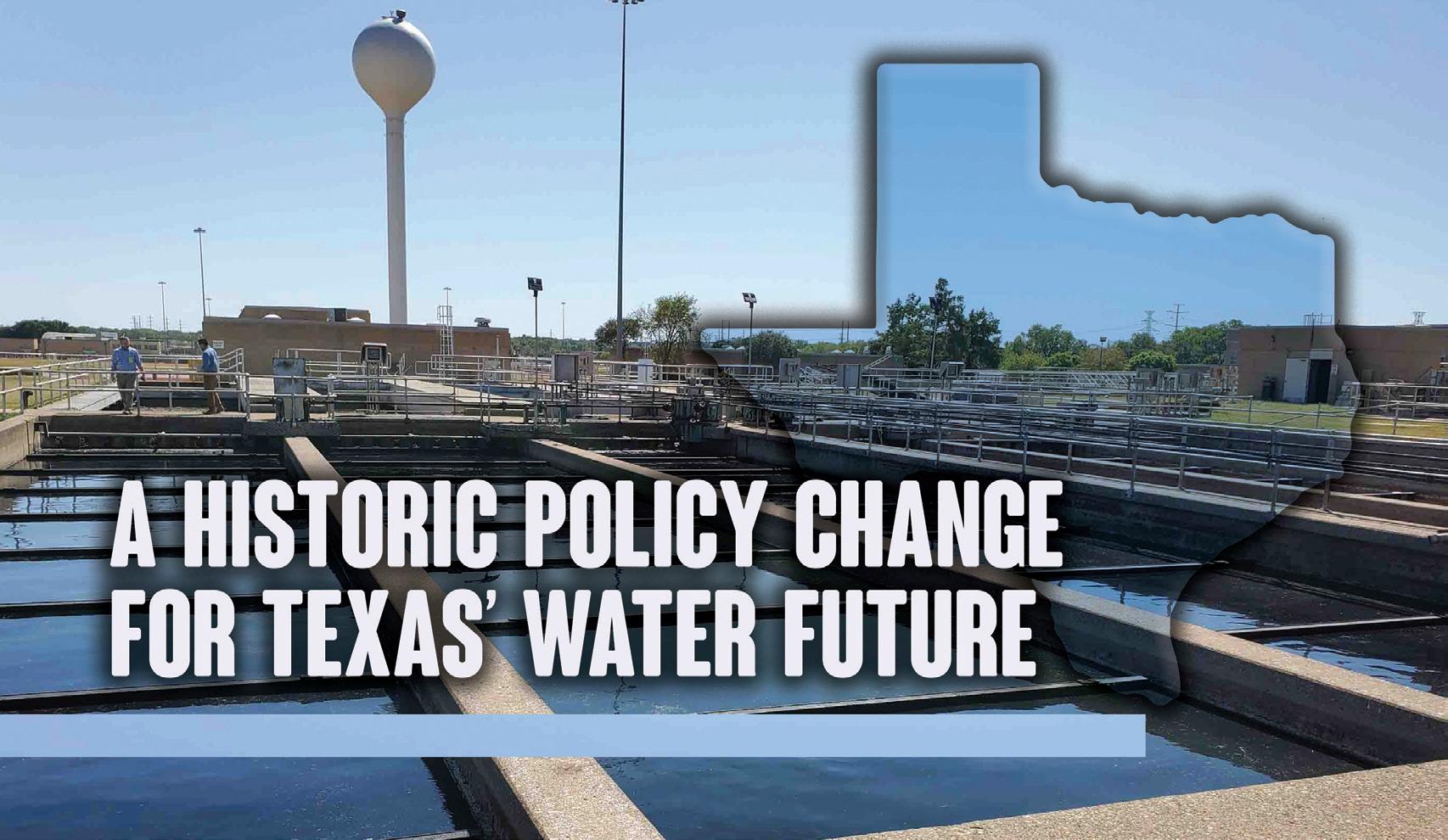
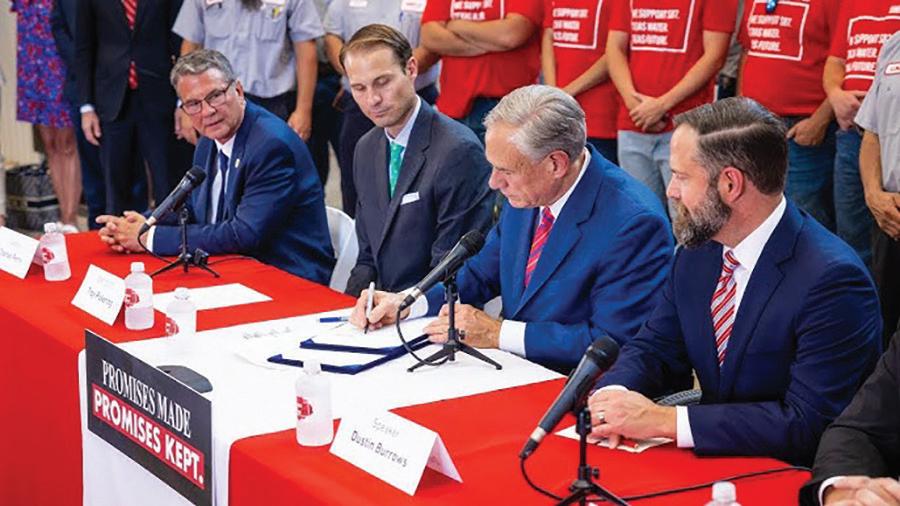
On June 18th, 2025, a small crowd gathered in an industrial warehouse in Lubbock to witness a historic change for Texas’ water future. The afternoon was sunny and hot, and the steady hum of electrical fans preserved the dignity of those gathered to witness the momentous occasion in business attire.
Texas Gov. Greg Abbott was there to sign Senate Bill 7 and House Joint Resolution 7, the signature water infrastructure funding measures from the recent legislative session. The governor was joined by state Sen. Charles Perry, SB 7’s author, and state Rep. Cody Harris, who penned HJR 7. Other legislative leaders, including House Speaker Dustin Burrows, flanked the governor at the signing table.
Just 135 days earlier, and speaking in another warehouse in Austin, Abbott called for the 89th Legislature to approve a “Texas-sized” investment in water infrastructure in his State of the State address. The Legislature delivered, approving the largest water infrastructure funding package in state history. After decades of discussion and varied attempts, Texas was to have a reliable, dedicated funding stream for its water infrastructure needs.
This was a momentous occasion for Texas’ economic miracle and state leaders keen on its preservation. Since 2000, Texas’ economy has exploded. State GDP surged from $742 billion in 2000 to $2.7 trillion in 2024, according to Federal Reserve Bank data. Key economic sectors, including energy, manufacturing, and information technology, to name a few, grew at a rapid pace as more families began to call Texas “home.” Reliable water infrastructure helped facilitate this economic miracle, and state policymakers recognized that a sustained investment effort was necessary for its preservation and perseverance.
Sobering lessons had been imparted in prior years through the economic toll attributable to unreliable infrastructure and its potential to tarnish Texas’ growth story. In early 2024, drought-induced water shortages precipitated the closure of a sugar mill in the Rio Grande Valley, eliminating hundreds of jobs and millions in economic activity.
Several Texas cities, including Conroe, Dripping Springs and Magnolia, grappled with the constraints
by Jeremy B. Mazur, Director of Infrastructure & Natural Resources Policy, Texas 2036
which water infrastructure can place on continued growth. As the towns of Marlin, Zavalla, and Toyah suffered from failed water systems, broken pipes and boil-water notices impaired business and civic activity in Odessa, Laredo, and Houston, to name a few places. Then there were the cold lessons from Winter Storm Uri in 2021, when electrical blackouts and water outages inflicted billions in economic losses.
In his comments before signing SB 7 and HJR 7, Abbott noted that the water infrastructure investment contemplated by the legislation was essential toward making the state more robust for business activity and city life. The investments were also recognized as being needed to solve very real problems attributable to potential water shortages and failing infrastructure.
What emerged from the 89th Legislature, and what Abbott signed in Lubbock, is arguably the most historic, consequential water legislation of this century.
SETTING THE TABLE: TEXAS’ WATER INFRASTRUCTURE CHALLENGES
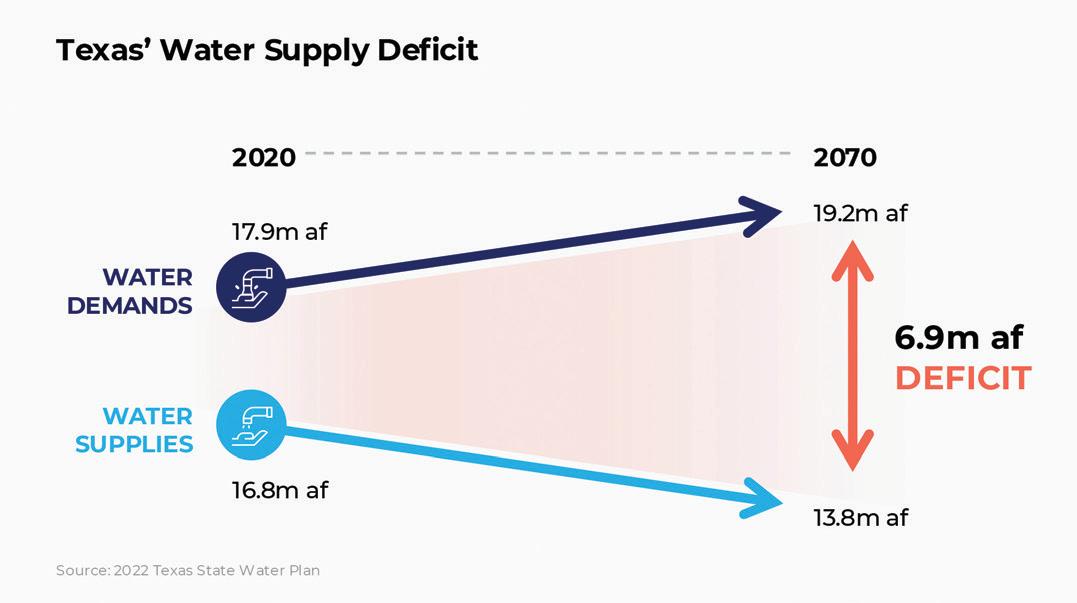
Texas faces two major water infrastructure challenges. The first involves the need to expand its water supply portfolio for a drought-prone and growing state. According to the 2022 State Water Plan, Texas faces a long-term water supply deficit of nearly 6.9 million acre-feet of water.
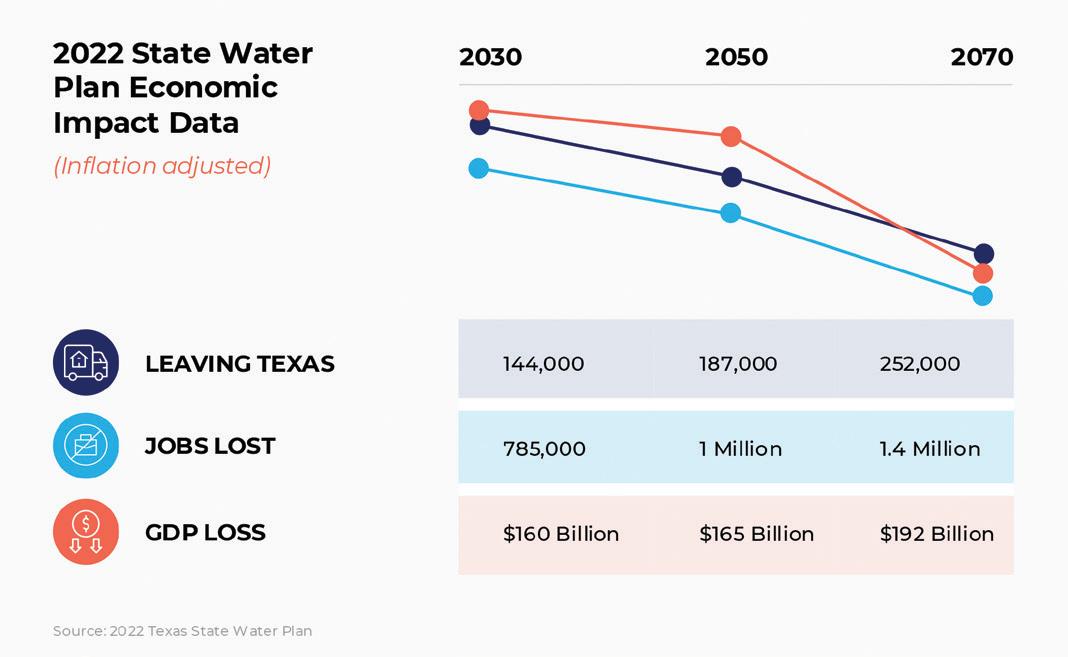
If Texas fails to develop the broad, diversified water supply portfolio needed for the next prolonged, severe drought, then as soon as 2030 the state will endure $160 billion in annual GDP losses, nearly 800,000 jobs lost, and an exodus of families seeking refuge — and water — elsewhere. These consequences rival those observed in Texas during the Great Recession of the late 2000s and the COVID-19 pandemic.
The second water infrastructure challenge entails addressing the aging, deteriorating, and failing drinking water and wastewater systems that are becoming liabilities to the communities that they serve.
Here, stories about boil water notices, system failures, and even extensive water loss as reported by the Texas Living Waters Project and the National Wildlife Federation served
as testament to systems in decline and in need of repair. In fact, Texas’ water infrastructure had degraded to a point where, in early 2025, the Texas Section of the American Society of Civil Engineers released a report card downgrading state drinking water and wastewater infrastructure. The engineers found that drinking water infrastructure declined from a C- to a D+, as wastewater dropped from a near-failing D to a just-about-to-fail D-.
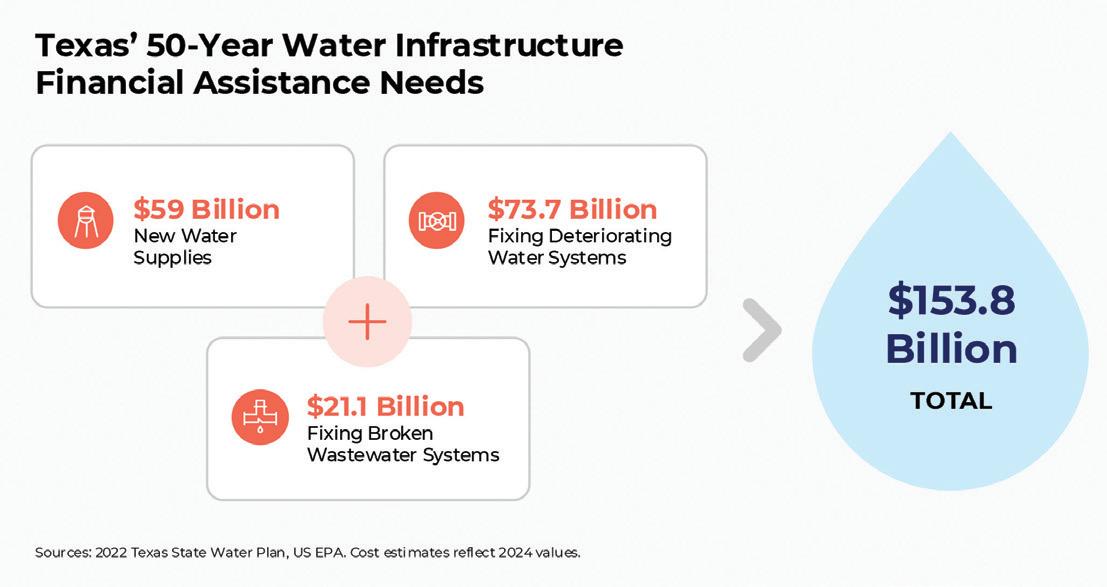
Texas 2036’s report found that Texas needs to invest at least $154 billion over the coming decades to address the state’s water infrastructure challenges. This price tag includes an inflation-adjusted $59 billion in state financial assistance for water supply projects and management strategies identified in the 2022 State Water Plan.
Rehabilitating aging, deteriorating drinking-water, and wastewater systems would require at least $95 billion over the next two decades. This includes $74 billion toward addressing drinking water systems, and just over $21 billion for wastewater infrastructure based on inflation-adjusted cost estimates from the U.S. Environmental Protection Agency.
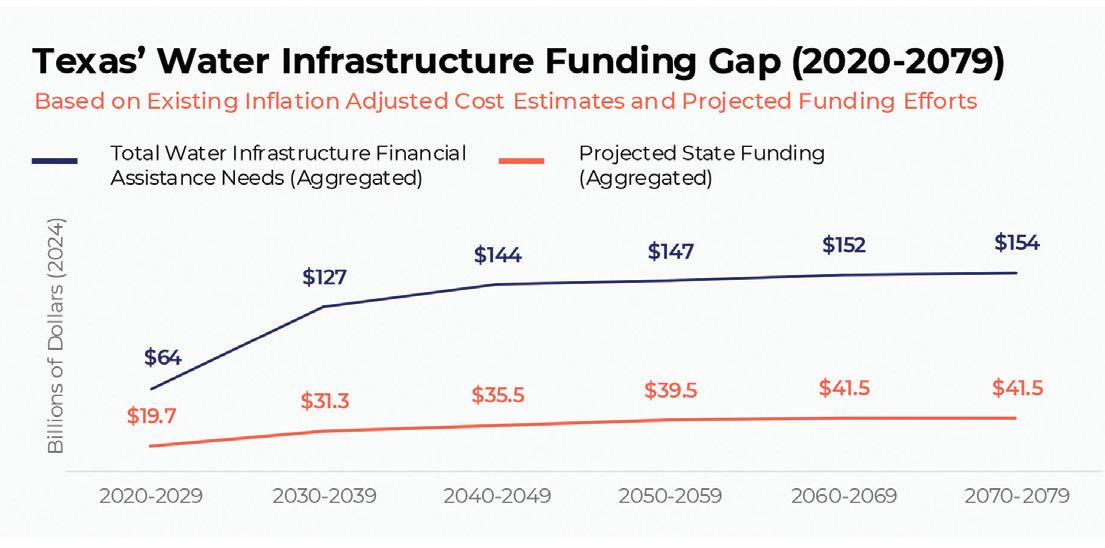
While existing state and federal funding programs would cover a portion of this cost, Texas 2036 estimated that Texas faces a long-term water infrastructure funding gap of just over $112 billion in the coming decades.
THE HISTORIC WATER SESSION
When the 89th Regular Session of the Texas Legislature began in January 2025, the political consensus pointed toward something big for water infrastructure funding. After Abbott’s call for a “Texas-sized” water infrastructure investment in his State of the State address, he made water infrastructure funding an emergency item for the Legislature’s consideration.
Lt. Gov. Dan Patrick identified increasing investments in Texas’ water supplies as a key priority, assigning the low bill number Senate Bill 7 toward this objective. House Speaker Dustin Burrows, who was elected by the chamber to the post on the first day of session, also emphasized the need for a historic investment in water infrastructure.
Given these messages from state leadership, the stage was set for a big policy discussion on the state’s financial strategy for addressing water infrastructure needs.
By the time the 89th Legislature adjourned on June 2, three bills were passed responsive to that call for a “Texas-sized” investment in water infrastructure. They were HJR 7 (Proposition 4), SB 7 and HB 500. Combined, these bills initiated the largest investment in state water infrastructure in Texas history, potentially inaugurating a new era of water infrastructure development on a scale not seen since the widescale development of new reservoirs across the state in the mid-20th century.
PROPOSITION 4 (HJR 7)
Proposition 4, which was approved as HJR 7 by Harris, R-Palestine, during the regular legislative session, represents the cornerstone of the 89th Legislature’s efforts. On Nov. 4, 2025, just over 2 million Texans voted to approve Proposition 4.
This historic measure amended the Texas Constitution to authorize the dedication of $1 billion in sales tax revenues to the Texas Water Fund for a period of 20 years starting in state fiscal year 2028. Assuming that the Legislature does not suspend this revenue dedication due to a disaster declaration, up to $20 billion will be used to pay for the water infrastructure Texas needs, including water supplies, infrastructure upgrades, and flood protection projects.
SENATE BILL 7
SB 7 by Perry, R-Lubbock, made changes to general law in anticipation of final approval of Proposition 4 in November's election. Where Proposition 4 provides the framework for providing dedicated funding to the Texas Water Fund, SB 7 makes several policy changes with regard to how those funds will be
allocated and for legislative oversight and performance accountability of the Texas Water Development Board’s (TWDB) administration of the Texas Water Fund.
Perhaps the most salient provision in SB 7 is the requirement that at least 50% of the $1 billion in annual dedicated revenues be allocated to water supply projects. This means that at least half, and possibly more, of the dedicated revenues from Proposition 4 will be used for water conservation, reuse, desalination, aquifer storage, permitted reservoirs, and infrastructure capacity expansion projects, among others. The remaining amount may be used for fixing aging infrastructure and developing flood protection projects.
In addition, SB 7 expanded the Legislature’s oversight of TWDB’s administration of the Texas Water Fund and introduced new performance measures to begin tracking Texas’ achievement and success with regard to addressing its long-term water infrastructure challenges. SB 7 created a permanent legislative committee, the Texas Water Fund Advisory Committee, that will review the overall operation, function and structure of TWDB’s administration of the Texas Water Fund.
SB 7 also requires that the TWDB report on the state’s progress toward addressing water infrastructure challenges. These performance measures will provide the Legislature and the public with better data on how the dedicated revenue stream is helping address the state’s long-term water infrastructure challenges. Moreover, these data are essential for informing both the Legislature and taxpayers of their return on investment from dedicating state revenues toward water infrastructure needs.
HOUSE BILL 500
While Proposition 4 and SB 7 establish a framework for a long-term, generational dedicated funding stream
for Texas’ water infrastructure needs, HB 500 by state Rep. Greg Bonnen, R-Friendswood, provides a substantive and meaningful down payment toward these needs. HB 500 appropriated over $2.5 billion — effective June 22, 2025 — toward state water infrastructure.
The timing of HB 500’s funding is important here. Proposition 4 requires that the dedication of $1 billion in state sales tax revenues to the Texas Water Fund begins in state fiscal year 2028, which starts on Sept. 1, 2027. These revenues must then be appropriated by the Legislature during the 2029 legislative session, making funding available for water infrastructure projects in late 2029.
The substantive appropriation in HB 500 provides an immediate interim endowment — the largest one time appropriation for water infrastructure in Texas history — that will help jumpstart water infrastructure development before the sales tax revenue dedication authorized by Proposition 4 begins.
A BRIGHT SIGNAL AND THE ROAD AHEAD
The outcome of the 2025 session and November’s election send a bright signal about what Texas is willing to do to secure its economic miracle. Just as the Legislature has approved significant investments for transportation, energy and workforce development — essential ingredients for continued economic growth and development — it has now done the same for water infrastructure.
To this author’s knowledge, no other state has committed to a level of investment in water infrastructure equal in magnitude to what Texas has done. That proverbial adage about the comparative size of all things Texan appears to ring true here.
Now that Proposition 4 has become law, both the Legislature and taxpayers will soon expect results and proof that they are getting what they paid for. The onus will be on state and local
water agencies, and the water industry as a whole, to show how this new financial strategy may be employed toward delivering water supplies for thirsty communities and fixing failing systems. Indeed, the performance measures in SB 7 will necessitate the thoughtful placement of “points on the board” when it comes to infrastructure development progress.
But while this revenue dedication is historic and generational, it only lasts for 20 years. Unlike existing constitutional funding dedications for parks and highways, the 89th Legislature did not give future legislatures the easy option to extend this funding stream without having to amend the Texas Constitution. This does not mean that they cannot try: come 2043 or 2045, a future legislature may attempt to repurpose or re-propose what was accomplished in 2025. If this future generation of leaders is to be successful, however, there must be evidence that this new financial strategy worked to make our water infrastructure challenges better. Hard choices and harder work will be needed sooner rather than later for this to happen. Future generations of Texans will depend on this in more ways than one. n
Jeremy B. Mazur is the director for infrastructure and natural resources policy at Texas 2036, a nonprofit organization building long-term, data-driven strategies to secure Texas’ continued prosperity for years to come. We engage Texans and their leaders in an honest conversation about our future, focusing on the big challenges. We offer nonpartisan ideas and modern solutions that are grounded in research and data to break through the gridlock on issues that matter most to all Texans. Smart strategies and systematic changes are critical to prepare Texas for the future.
TOTAL RAISED
$2,045,774
CAMPAIGN LEADERSHIP
2025 CAMPAIGN CHAIR
Scott Rogers, Alliance Bank Central Texas
2025 CAMPAIGN CHAIR-ELECT
Matt Reynolds, Tejas Logistics
2025 CAMPAIGN VICE CHAIRS
Mary Ellison, Cen-Tex Roof Systems
Christy Garrett, Ascension Providence
Chuck Sivess, American Guaranty Title
Since its start in 2005, the Greater Waco Chamber’s Total Resource Campaign (TRC) has significantly contributed to the Chamber's success. This annual capacity-building campaign enlists volunteers across industry sectors to educate the business community about your Chamber’s offerings and solicit investments in the organization. In 2025, over 90 dedicated volunteers raised over $2 million, which represents 112% of the goal.
Each year, during the 15week campaign, volunteers meet weekly to receive updates, celebrate successes and build relationships with each other.
In addition to the financial goals, the TRC team strives to involve new businesses. The Chamber was pleased to announce that its volunteers recruited over 150 new members through the campaign and increased the number of Chamber members that participate in the campaign.
“There’s a place and opportunities for your business to get involved,” said Nancy Gupton, Director of Resource Development. “Whether you’re interested in volunteering during the TRC in 2026 or you want to learn more about sponsorships, there are many ways to be part of this success.”
To learn more about getting involved with TRC, contact Nancy Gupton: (254) 757-5602 or ngupton@ wacochamber.com. n
Nancy Campaign nearly you’re learn success.”
contact
2025 TOP VOLUNTEERS
Jim Haller, Retired
Loren Schwartz , Morgan Stanley
Gary Vogel, Vogel Financial Group
Scott Rogers, Alliance Bank Central Texas
Peggy Jezek , Staybridge Suites Waco South - Woodway
2025 TOP TEAMS
The First National Bank of Central Texas
Alliance Bank Central Texas
Vogel Financial Group
Ascension Providence
Extraco Banks
VOLUNTEER TEAMS
Alliance Bank Central Texas
American Bank
American Guaranty Title
Ascension Providence
Baylor Scott & White Medical Center-Hillcrest
Baylor University
Cen-Tex Roof System
Community Bank & Trust
Extraco Banks
H-E-B
Home Abstract & Title Co.
Insurors of Texas
JRBT Kelly, Realtors
Pattillo, Brown & Hill, LLP
Premier ER & Urgent Care
Staybridge Suites Waco South - Woodway
The First National Bank of Central Texas
Vogel Financial Group
THANK YOU TO ALL OF OUR CAMPAIGN SPONSORS
GIFTS & DONORS
Abuelita’s Mexican Restaurant
Alliance Bank Central Texas
American Guaranty Title
Balcones Distillery
Be Kind Coffee
Ben E. Keith Beverages
Berties on the Roof – Hotel 1928
Blaine’s Restaurant Wine Shoppe
Black Rifle Coffee Company
Brooke Hanson
Dave’s Burger Barn
Gary Vogel
George’s Restaurant
Jorge’s Cantina Waco
Keith’s ACE Hardware
Mary Ellison
Nutone Cleaners – Lake Air
Papa Bears Catering
Partners of McLennan County
Rio Brazos Catering
Scott and Erin Rogers
Secret Chef
Spice Village
Staybridge Suites Waco South – Woodway
Swan Products
The Main Event
Tiff’s Treats
Tina Johnson Bartending Services
Vogel’s Texas Moxie Spices
Whataburger
ENVASES SELECTS WACO FOR SECOND U.S. PRODUCTION FACILITY
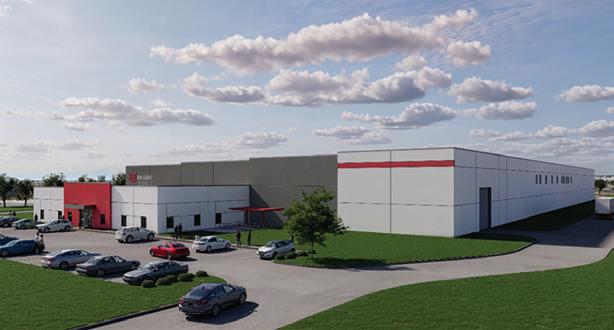
Envases, a global leader in packaging solutions, has announced plans to establish its second U.S. production facility in Waco, marking a significant milestone for the company and a major economic win for Central Texas.
The new 83,000-square-foot facility will focus on lid production and represents a substantial capital investment in the region. Envases will invest $10 million in real property and an additional $45 million in new equipment and machinery, underscoring the company’s longterm commitment to expanding its operations in the United States.
In addition to the financial investment, the project will bring 71 new full-time jobs to the Waco community. These positions will carry an average annual wage of $54,432, generating more than $3.8 million in new payroll each year. The influx of high-quality jobs is expected to stimulate local economic activity and support the area’s continued growth.
City and regional economic development leaders hailed the announcement as a strategic win for
MESSER ANNOUNCES $80 MILLION EXPANSION IN MCGREGOR
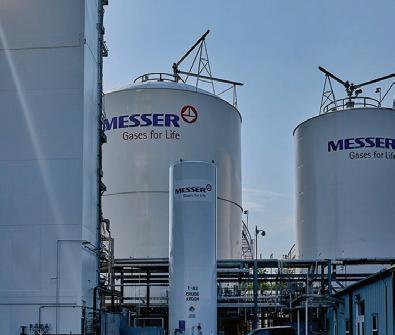
Messer is moving forward with a major expansion in McGregor, announcing the construction of a second Air Separation Unit (ASU) backed by an $80 million investment. To support the project, the company has purchased 57 acres in the McGregor Industrial Park from the City of McGregor, positioning the site for long-term industrial growth.
Construction of the new ASU is expected to be completed by 2030. As part of the agreement, the City of McGregor has committed to providing essential water infrastructure, including installation of the meter needed to support the facility’s operations.
Waco, aligning with ongoing efforts to attract advanced manufacturing and strengthen the local workforce.
Envases’ new facility is anticipated to enhance production capacity, improve supply chain efficiency, and meet the growing demand for high-quality packaging solutions across North America. Construction and equipment installation are expected to proceed over the coming months.
As Envases expands its footprint in Texas, the Waco community stands to benefit from increased employment opportunities, new capital investment, and long-term economic growth tied to the advanced manufacturing sector. n
Once operational, the expansion will create 20 full-time jobs, each offering an average annual wage of at least $60,000 plus benefits—a meaningful economic boost for the region.
Messer’s investment underscores the city’s growing role as a hub for advanced manufacturing and industrial development, strengthening McGregor’s economic landscape for years to come. n
SOUTHERN GERMANY FDI & IAA MOBILITY MISSION RECAP
The recent Southern Germany Foreign Direct Investment (FDI) and IAA Mobility Mission with the Transatlantic Business Investment Council (TBIC) proved highly productive, strengthening international relationships and advancing new opportunities for economic growth. Over the course of the mission, the delegation engaged with industry leaders, explored cutting-edge technologies, and generated new prospects for collaboration.
The team conducted 13 business and prospect meetings across the manufacturing, technology, service, and automation sectors, creating valuable connections with companies considering U.S. expansion. These discussions provided insight into emerging trends in advanced manufacturing, digitalization, and mobility innovation.
In addition to meetings, delegates completed five facility tours, gaining firsthand exposure to state-of-the-art operations throughout the region. The mission also included a key engagement with a Chamber of Industry & Commerce, helping strengthen institutional relationships and
SEMICON WEST 2025
SEMICON West 2025 proved to be a high-impact event for the semiconductor and microelectronics ecosystem, drawing global leaders, innovators, and suppliers from across the industry. This year’s conference featured a strong Texas presence, highlighting the state’s growing role in advanced manufacturing and supply chain resilience.
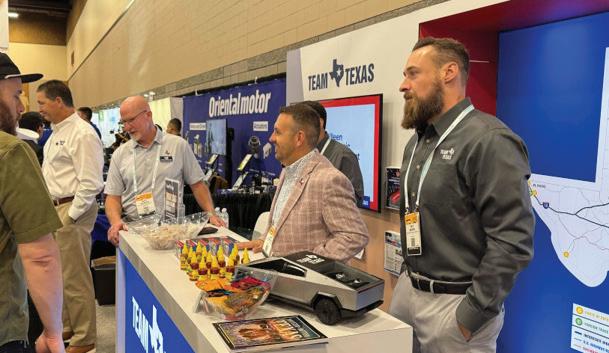
The event brought together 1,500+ exhibitors and attracted more than 35,000 attendees, creating an ideal environment for networking, industry insights, and business development. Representing the region’s capabilities and competitive advantages, the team participated as a co-exhibitor with TeamTexas and the State of Texas, reinforcing the state’s unified approach to attracting semiconductor investment and supporting industry expansion.
Throughout the conference, the delegation engaged directly with more than 200 booth
deepen understanding of the regional business environment.
The trip has already yielded tangible results, including one new Request for Information (RFI) with more opportunities expected to follow as conversations continue.
Over the course of the mission, the delegation traveled 1,537 kilometers (955 miles) and visited nine cities, reflecting the breadth of activity and the strategic importance of the region.
The Southern Germany FDI & IAA Mobility Mission reinforces the commitment to attracting highquality international investment and positions the region for continued growth in advanced manufacturing, mobility technologies, and global partnerships. n
visitors, including companies across equipment manufacturing, materials, R&D, and supply chain services. These conversations provided valuable insight into global market needs and offered opportunities to promote Texas as a premier location for semiconductor operations, workforce talent, and innovation. SEMICON West 2025 continues to serve as a critical platform for connecting with decision-makers, strengthening relationships across the microelectronics ecosystem, and positioning Texas as a leader in the future of semiconductor manufacturing. n
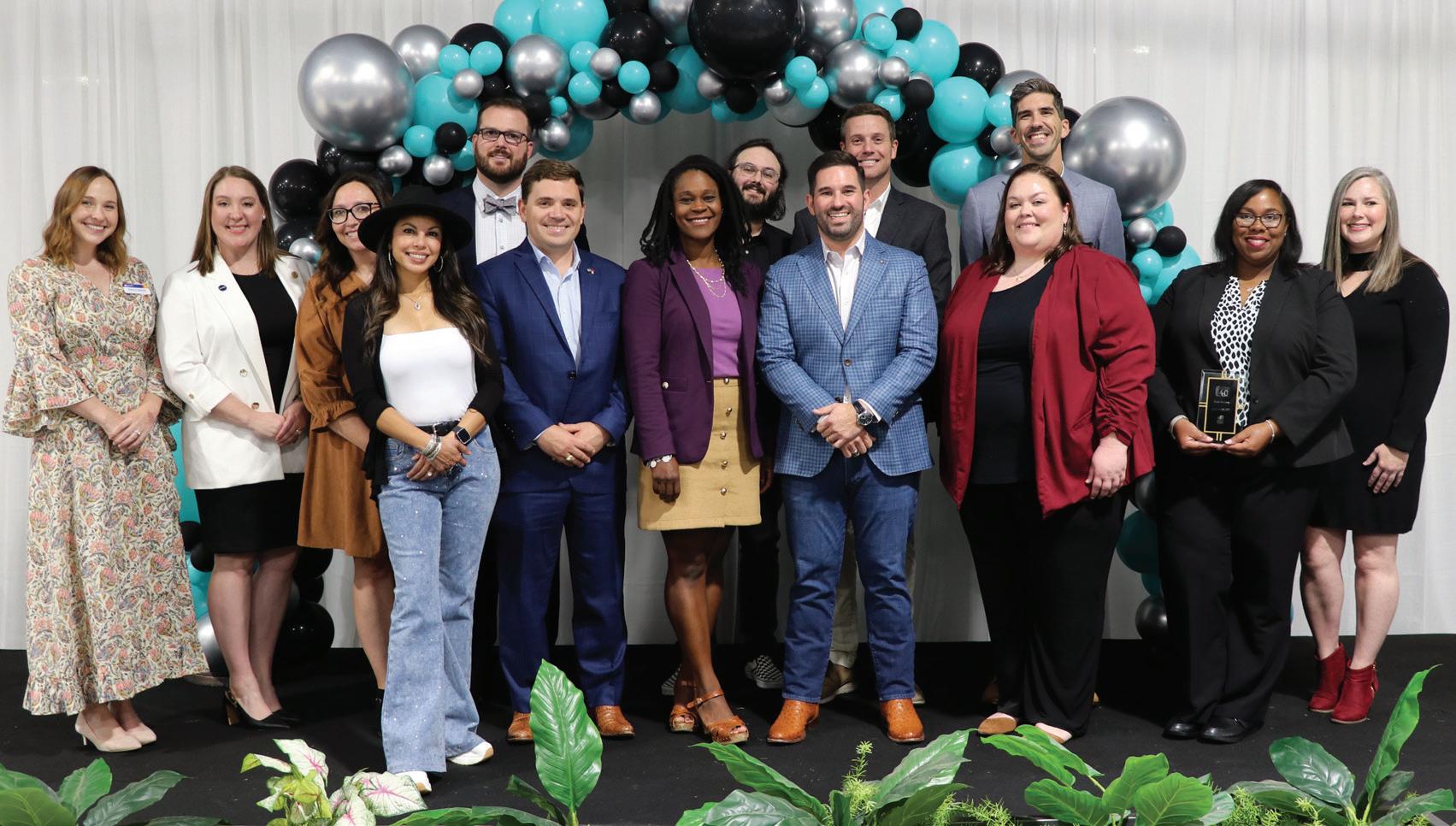
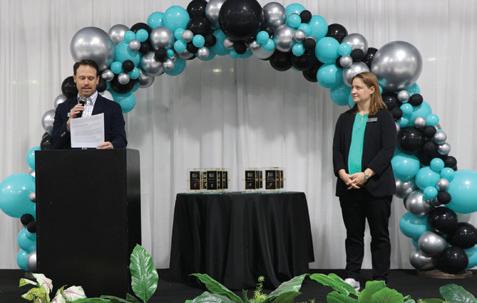
WACO UNDER 40 CELEBRATION
In October, your Chamber hosted its annual Waco Under 40 Celebration to honor the incredible individuals recognized through Waco Under 40. This initiative highlights dynamic young leaders—under the age of 40—who are making a lasting impact across McLennan County.
The presenting sponsor for Waco Under 40 is Bird Kultgen Ford. n
Left to right: Haley O’Connell, Sarah McDonald, Marilyn Brooks, Cecy Holubec, Dr. Corbin Gatlin, Mark D. Siegmund, Dr. Alexandra Jones Adesina, Maverick Moore, Kyle Citrano, Jason Young, Mike Vogelaar, Jessica Hopfenspirger, Susie Murray, and Kristi Webb
GREATER WACO CHAMBER CONCLUDES 2025 STATE OF SERIES
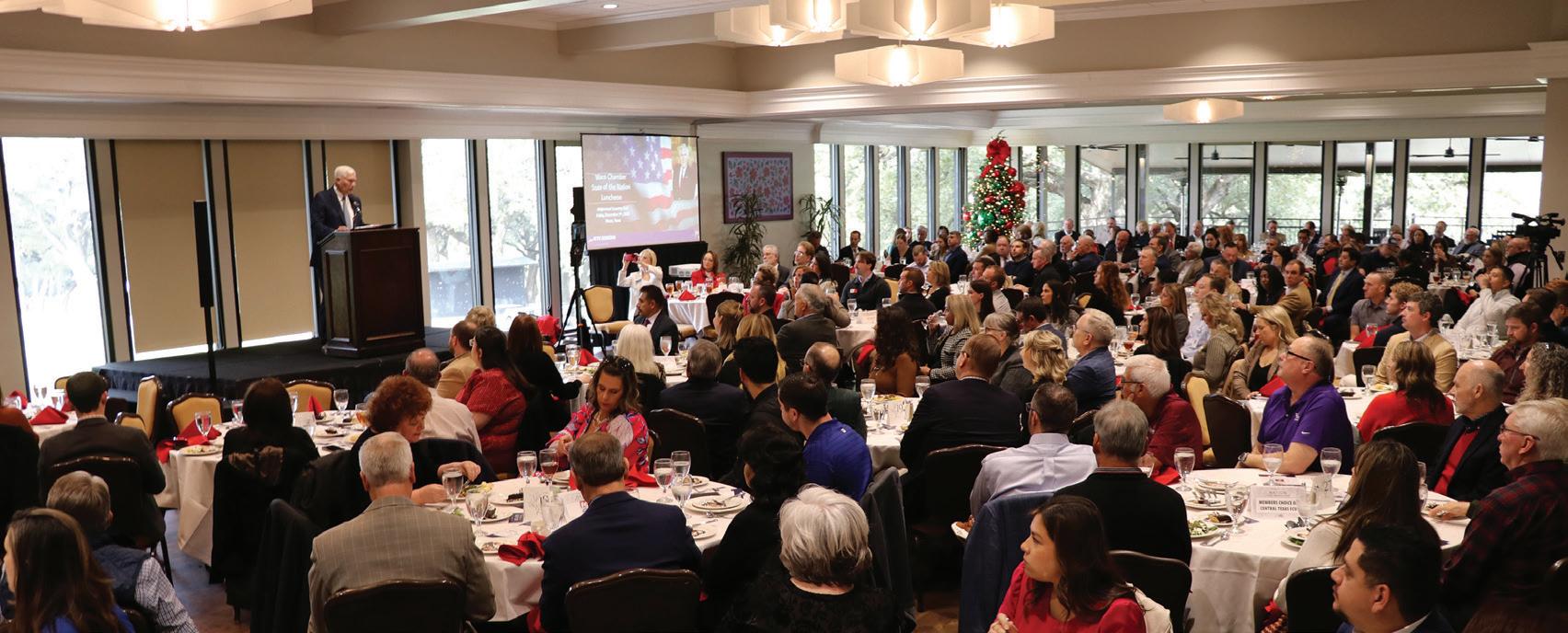
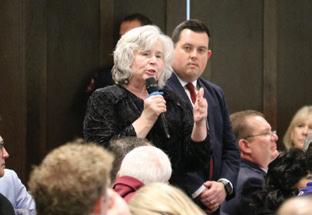
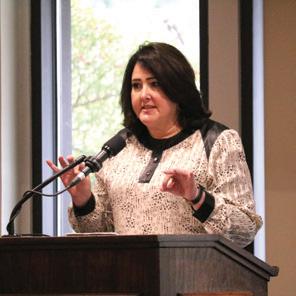
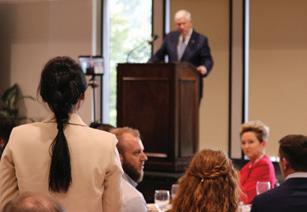
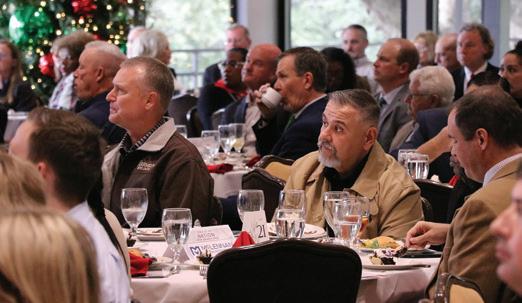
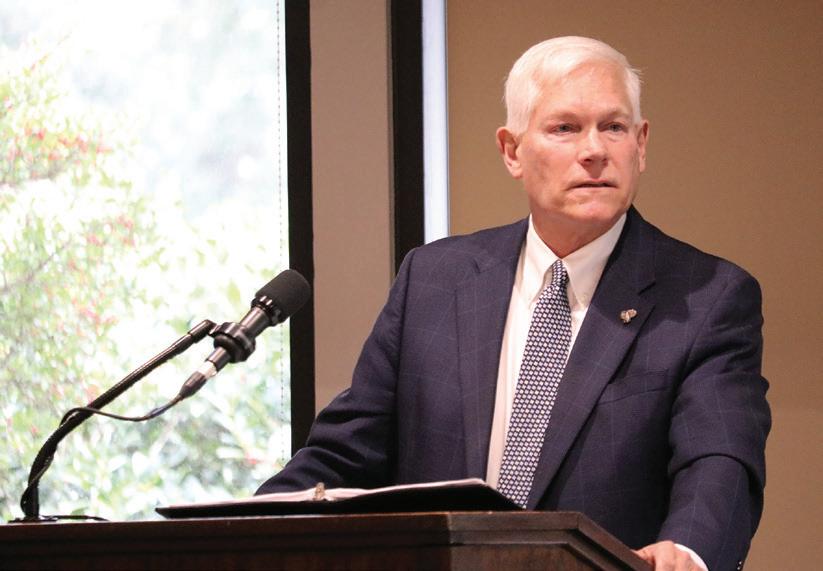
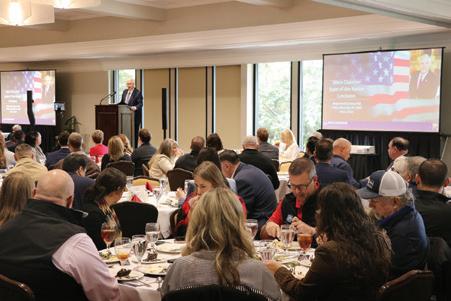
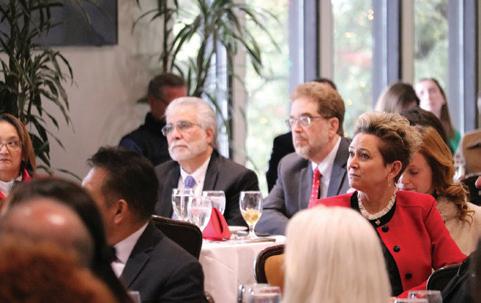
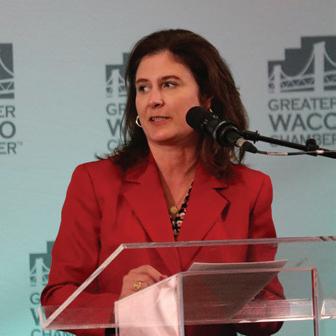
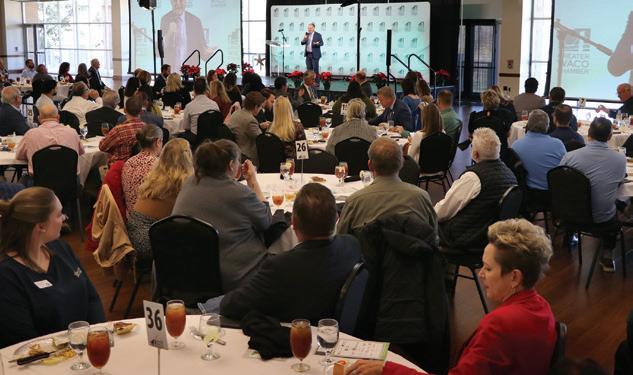
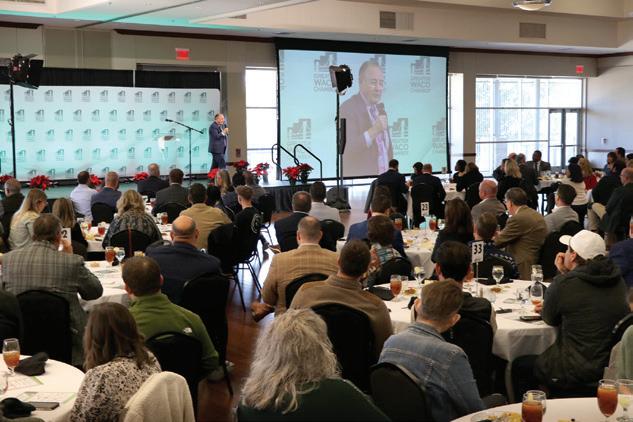
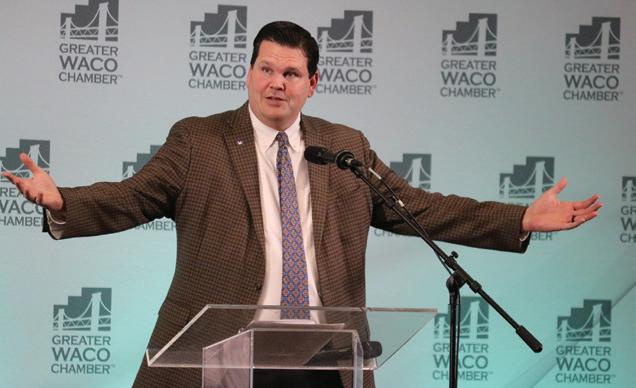
In December, the State Of Series concluded with the State of the Nation at Ridgewood Country Club. During the luncheon, attendees heard legislative updates from U.S. Congressman Pete Sessions. The presenting sponsor for the event was Texas State Technical College and gold sponsors were Ascension Providence and Waco Family Medicine. n
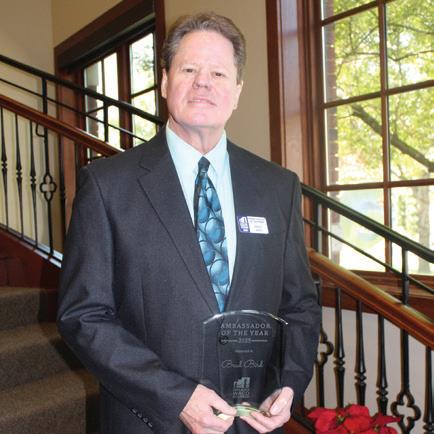
GREATER WACO CHAMBER NAMES 2025 AMBASSADOR OF THE YEAR
The Greater Waco Chamber is honored to recognize Brad Bird of Ubeo Business Services as the 2025 Chamber Ambassador of the Year, celebrating his loyalty, passion, and dedication.
For nearly a decade, Brad has been one of our most steadfast Ambassadors, and a familiar and welcoming presence at ribbon cuttings and Chamber events. His energy, sincerity, and big-hearted approach make him truly exceptional—a hallmark of Chamber celebrations.
Congratulations, Brad, on this well-deserved recognition! We are so grateful for your contributions and the positive impact you continue to have on our community. n
BUSINESS AFTER HOURS IN NOVEMBER – LA FIESTA’S FIESTA HOUSE
In November, your Chamber visited La Fiesta’s Fiesta House for its Business After Hours event. Guests enjoyed live music from Brian Brown, sampled La Fiesta catering, and entered to win door prizes. n
GREATER WACO CHAMBER HOSTS
TALENT FORWARD WACO
In October, the Greater Waco Chamber hosted its second annual Greater Waco Education to Workforce Forum in partnership with ESC Region 12. As Greater Waco’s economy continues to grow and diversify, the need to align talent development with employer demand remains a top regional priority. Today’s rapidly evolving workforce landscape requires strong collaboration between business and education to sustain economic growth and expand equitable economic mobility across our community. This year’s forum brought together business leaders, educators, and workforce development partners to deepen that alignment. Participants engaged in meaningful discussions, shared best practices, and explored new strategies to strengthen our talent pipeline. The event also provided valuable opportunities for networking and collaboration, reinforcing our region’s commitment to developing a skilled workforce ready to meet the needs of both today’s employers and the industries of the future. The presenting sponsor for the event was Texas State Technical College. n
BUSINESS AFTER HOURS IN DECEMBER – DOG HAUS WACO
In December, your Chamber visited Dog Haus Waco for its Business After Hours event. Guests enjoyed a festive atmosphere, an ugly sweater competition, and holiday-themed cocktails. n
GREATER WACO CHAMBER HOSTS ANNUAL ECONOMIC
OUTLOOK LUNCHEON
In December, your Chamber partnered with presenting sponsors Baylor University, The First National Bank of Central Texas, and Kelly, Realtors to host the annual Economic Outlook Luncheon. Attendees heard from esteemed economist Dr. Ray Perryman, who provided an in-depth look at regional and national economic conditions and offered an economic forecast to help inform strategic thinking and planning for the future. n
JACKSON O. GRIGGS, MD, RECEIVES
PHYSICIAN EXECUTIVE AWARD FROM THE TEXAS ACADEMY OF FAMILY PHYSICIANS
Jackson O. Griggs, MD, of Waco, Texas, was awarded the Texas Academy of Family Physicians inaugural Physician Executive Award during TAFP’s Annual Session and Primary Care Summit in Addison on Nov. 15. The award was created to honor member physicians in executive leadership positions whose leadership skills in organizations have contributed to excellence in health care.
Griggs is the Chief Executive Officer of Waco Family Medicine, where he is responsible for implementing the health and business plans of Waco's federally qualified health center. He is also chair of the board of directors for the Waco Family Practice Foundation and is the board chair and vice president of the McLennan County Medical Education and Research Foundation. His exceptional leadership and unwavering commitment to providing high-quality health care for vulnerable communities in and around Waco earned Griggs this year’s award. Through his dedication and commitment as CEO, the Waco Family Medicine FQHC has expanded greatly, including a new $65 million site.
While accepting the award, Griggs encouraged his peers in the room to become leaders in their own local communities. “I’m a believer that we need to continue to encourage family physicians who are so inclined to become leaders in the health care delivery system,” Griggs said.
Family physicians like Griggs are qualified to work in all major medical areas and trained to treat more than 90% of all cases they encounter. Family physicians care for patients of all ages.
The Texas Academy of Family Physicians is the premier membership organization dedicated to uniting the family doctors of Texas through advocacy, education, and member services, and empowering them to provide a medical home for patients of all ages. It has 33 local chapters and is a chapter of the American Academy of Family Physicians. Visit www.tafp.org for more information. n
WOODSPRING SUITES WACO SOUTH
Owned by Provident Hospitality, WoodSpring Suites Waco South provides budget-friendly accommodations designed for long-term travelers. Each guest suite is equipped with a full kitchen including a refrigerator, freezer, microwave, twoburner stovetop, and prep area. Additional amenities include an on-site laundry room and a fitness center.
Humidor on Austin is a luxury cigar lounge in the heart of downtown Waco, Texas. Featuring premium hand-rolled cigars from renowned houses worldwide, it offers an upscale space to relax or connect. Services include cigar catering, private buy-out opportunities, and a weekly networking social hour hosted by local businesses. Open seven days a week, Humidor on Austin is Waco’s destination for refined taste and community.
Neal Simpson
804 Austin Ave, Waco, TX 76701 (254) 717-8684
HumidorOnAustin.com
Harbor Christian Academy is Waco's newest and most innovative private school for children pre-K3 through Eighth grade. Established to address the need for personalized education rooted in faith, it offers skills-based promotion and the Dock program which is designed to support those with ADHD, Autism Spectrum Disorder, and Dyslexia. Its mission is to nurture students’ academic, social, and spiritual growth, helping them to Achieve, Believe, and Belong.
Dr. Kahrin Wessel, Head of School 300 S 13th St, Waco, TX 76701 (254) 262-6449 APlusHarbor.com
Boot Barn stands as the nation’s leading retailer of western and work wear. Guided by a simple vision—to offer a piece of the American spirit—the company is dedicated to supporting the local communities it serves. Boot Barn proudly provides the widest selection of cowboy boots, work boots, western wear, workwear, and western-inspired fashion.
Recently rebranded, this thriving apartment community offers spacious two-bedroom, two-bath townhomes just steps from Baylor University. Each unit includes in-home washer and dryer, and the pet-friendly property features two pools—one on each side of the community. With a small, close-knit feel and unbeatable convenience, it combines comfort, location, and lifestyle, making it an ideal choice for students and professionals alike.
Christi Solis, Property Manager 1300 S 11th, Waco, TX 76706 (254) 230-4714 liveatthebruin.com
SCOOTER’S COFFEE
Scooter’s Coffee – China Spring, locally owned by Bedford Coffee LLC, proudly serves premium coffee, espresso drinks, smoothies, and breakfast favorites through its fast, friendly drive-thru. Beyond great coffee, Bedford Coffee is deeply rooted in the Waco community—supporting local hiring, youth development, and the “Cup of Joe” scholarship program—creating opportunities and connection one cup at a time.
Marcus Bedford, Managing Partner 9516 China Spring Rd, Waco, TX 76708 (254) 294-8466
www.scooterscoffee.com
SOLUTIONS
JerNan Septic & Rainwater Solutions is a Central Texas company dedicated to protecting families, properties, and local water resources. They design, install, and maintain advanced septic and rainwater harvesting systems that exceed regulatory standards while promoting long-term reliability and environmental stewardship. With a focus on quality craftsmanship, education, and community values, JerNan helps homeowners and builders make responsible, lasting choices for their land and families.
Luke Snyder, President 7101 Bosque Blvd, Waco, TX 76710 (254) 848-4848 jernan.com
Victory Spinal Care offers precise upper-cervical chiropractic care to restore function and support natural healing. Their compassionate team provides individualized care to help patients experience long-term relief from neck and back pain, vertigo, migraines, sciatica, and ultimately better overall health in a welcoming, family-centered environment.
Dr. Alex Ibarra, DC & Dr. Allison Wakely, DC, Owners 5002 Lakeland Cir, Ste B, Waco, TX 76710 (254) 296-1325
victoryspinalcarewaco.com
VICTORY SPINAL CARE - WACO
JERNAN SEPTIC & RAINWATER
REVISION PHOTO RESTORATION
Since 2018, Revision Photo Restoration has specialized in restoring vintage frames and photographs by digitally repairing scratches, tears, fading, and discoloration and re-printing on archival quality paper. As the only location within 100 miles of Waco that develops any type of film, they also bulk digitize photos, slides, negatives, scrapbooks, VHS, and 8mm reels. Additional services include same-day prints, passport photos, professional headshots, and family portraits.
The team at Baylor Scott & White Clinic – McGregor Harris Creek provides comprehensive care for patients, creating personalized, patient-centered plans to support lifelong health. The pediatrics team at BSW McLane Children’s Clinic –McGregor Harris Creek offers checkups, immunizations, and more, with seamless access to BSW McLane Children’s Medical Center – Temple.
Family Medicine: (254) 202-6950 Pediatrics: (254) 724-5437 BSWHealth.com/locations/clinic/mcgregor-harris-creek
Daily provides honest, dependable heating, cooling, and electrical services for its neighbors. Proud to be Texan, the company brings the grit, reliability, and neighborly spirit the state is known for to every job. Whether it’s a sweltering summer day, a freezing cold night, or an electrical emergency that can’t wait, the Daily team tackles every challenge head-on. With its bold bison symbol as a reminder of determination, Daily is committed to keeping the community comfortable year-round.
Scott Daily, Owner 507 Sun Valley Blvd, Hewitt, TX 76643 (254) 754-5250 www.dailyserviceco.com
TRU JAMAICA RESTAURANT DAILY
Tru Jamaica Restaurant tempts Texas tummies with a taste of Jamaica, bringing authentic Jamaican cuisine to Waco, Texas. Serving dishes made from scratch and rooted in tradition, the menu features jerk chicken, savory patties, and flavorful plant-based options, all naturally gluten-free except baked goods. With warm hospitality and cultural spirit, Tru Jamaica delivers an unforgettable dining experience — Ya Man!!!
At Allied Wellness Centers, Dr. Ronald Linderman, Dr. Micah Mordecai, Dr. MaKalynn Sanders, and Dr. Zac Libby provide expert chiropractic care to Waco and surrounding areas. From accident recovery to chronic pain, they offer personalized plans using advanced treatments like Regenerative Medicine, PiezoWave Therapy, Spinal Decompression, Laser, and Massage Therapy. Discover how chiropractic care can restore balance, relieve pain, and help you move and feel your best every day!
Dr. Ron Linderman & Dr. Micah Mordecai, Owners 1300 Lake Air Dr, Ste 7, Waco, TX 76710 (254) 741-5992 alliedwaco.com
CANALES FURNITURE
Canales Furniture is a family-owned Texas retailer offering a wide selection of top-rated furniture, mattresses, vanities, appliances, and kids’ furniture at affordable prices for every home. Guests enjoy flexible financing, delivery and assembly services, and a price-beat guarantee. Their showrooms feature curated room packages and a dedicated kids gallery. Visit the Waco location at 300 N Valley Mills Dr., Waco, TX 76710.
Natalia Rodriguez and Alexander Ambriz, Owners 300 N Valley Mills Dr, Waco, TX 76710 (254) 313-1101 www.canalesfurniture.com/pages/waco
Allen Samuels Holdings, Inc. (254) 761-6800
1700 Lake Success Dr Waco, TX 76710
Allied Wellness Centers, PLLC (254) 741-5992
1300 Lake Air Dr Ste 7 Waco, TX 76710
AlliedWaco.com
Asher Point of Waco (254) 399-0109
3209 Village Green Dr Waco, TX 76710
AsherPointWaco.com
Benjamin Franklin Plumbing Waco (254) 340-2225
2801 S 21st St Waco, TX 76706
BenjaminFranklinPlumbing.com/waco
Boot Barn (254) 751-0029
2800 W Loop 340 Ste K Waco, TX 76711
BootBarn.com
Bowlero Waco (254) 772-6600
4565 W Waco Dr Waco, TX 76710
Bowlero.com
Brooki Cakes & Creamery (254) 732-0935
2324-1 Marketplace Dr Ste 1200 Waco, TX 76711 Facebook.com/SmallCakesWaco