Complimentary
2
WOMEN2WOMEN MICHIGAN • www.w2wmichigan.com
Our Mission: Women2Women Michigan was created to connect women with women for good to encourage, support, have fun, do business and provide links for women’s resources. DO YOU KNOW A MICHIGAN WOMAN AUTHOR WE SHOULD FEATURE? Submit your stories online at w2wmichigan.com. Article guidelines are under the magazine tab. WHY ADVERTISE WITH US? Women make the majority of purchasing decisions. They buy goods and services for their homes, gardens, businesses, entertainment, health and nutrition, the list is endless. They want to be informed and connected in their communities. Event-driven marketing makes education fun and rewarding. You can reach these women in a heartwarming environment at Women2Women Michigan events and through our magazine. READERSHIP & DISTRIBUTION Women2Women Michigan magazine is distributed to subscribers via US mail. It is also available at every Women2Women Michigan event, chamber events, and women’s organizations. It is professionally delivered to various locations throughout the area including restaurants, hospitals, retail locations and medical offices in southeastern Michigan. Interested in hosting a distribution location? Email us at office@w2wmichigan.com.
Women2Women Michigan magazine is published bimonthly. All rights reserved. No part of this publication may be reproduced whole or in part without the express written consent of the publisher. Office@w2wmichigan.com • w2wmichigan.com *The advertisements and articles included in this publication are independently developed by our customers and writers to inform others about their business, expertise and related activities. Women2Women Michigan is not aware of, and makes no representation as to, the truth or accuracy of such information and, therefore, makes no warranties of any kind, express or implied, with respect to the same. Accordingly, the respective advertisers and writers are solely responsible for the accuracy and contents of their own advertisements and for all claims, losses, costs, expenses or damages whatsoever, directly
covergirl
6
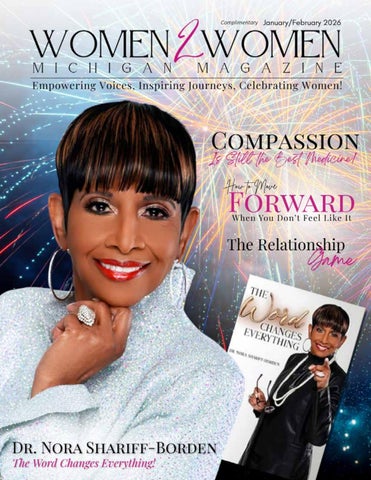
The Word Changes Everything featuring Nora Shariff-Borden
features
5 9 11 12 14 18 Back with Nurse T 20 Bounce Tarnesa Martin & Shine 22 Sparkle Mimi Matthews of Attraction Suzanne Young 25 Law Called to Create 26 Colleen Kilpatrick Life Meditation 28 Real Trice Berlinski
Girlfriend Getaways Jessica Brown Home & Garden Christine Stephens Your Health & Wellness Journey Debra Loader Aligned Living Jennifer Beard New Perspectives Joy Dettling The Diary of a Hairapist Jamie MacNeill
specials
8 17 24
Compassion is Still the Best Medicine Lynn Nicole Weathersby Are Your Hormones Affecting Your Relationships? Dr. Melissa Vandermissen The Happy Reading Book Review Meg of Balcony Row Books, Holly
January/February 2026 • WOMEN2WOMEN MICHIGAN
Would you like to subscribe? Subscribe online or email us at office@W2Wmichigan.com.
Contents
3
From Our Editor Theme Do You Dare? www.W2WMichiganc.om info@w2wmichigan.com
D
Debra K Collins
ear Readers,
Publisher/Editor in Chief Debra@w2wmichigan.com
The words “I dare you!” can be quite aggressive and lay on a lot of pressure! But our writers, instead, have turned this into a question encouraging you to live your best life. Do you dare to step boldly and bravely into your life?
Our cover girl, Dr. Nora Shariff-Borden, dared to believe in herself, and has become an amazing business woman and fifteen-time author! What stands out in her story is that her life was changed because of one person’s belief in her—which gave her courage to believe in herself, which set her course. And the rest, as they say, is history. Now she is helping others dare to do the same.
Mimi Matthews
Content Editor Mimi@w2wmichigan.com
Can daring to embrace a travel adventure actually change one’s future? Our travel columnist, Jessica Brown, says, “Yes!” in “How Saying Yes to the Dare Changed My Life”. Debra Loader in “See the Gift, Trust the Process” dares us to reach beyond life’s difficult situations to anticipate the gift tomorrow might bring. Kellie Pardi
Christine Stephens encourages us to depart from “resolution-setting” January and embrace the quiet stillness this time of year brings in order to reset and fine tune our lives for a fresh start. See her article “January: A Month for Recalibration”.
WOMEN2WOMEN MICHIGAN • www.w2wmichigan.com
The beginning of a new year is always a time for reflection. In Michigan we are often forced to slow down by the weather conditions. This makes for some really cozy home time, and we can use it for our good. Take a deep breath. Enjoy reading what our writers have given us, and perhaps something will resonate with you, encouraging you to dare try something new and helpful for the year ahead.
4
Most importantly, as Dr. Nora says, you have to believe in yourself. Then you can do great things! Wonderful readers, we believe in you. You are a special kind of amazing. May your 2026 be filled with belief, accomplishment, growth, and adventure!
Creative Director/Designer/Marketing Kellie@w2wmichigan.com
Trice Berlinski
Executive Assistant Trice@w2wmichigan.com
Blessings & joy to you,
, Editor Why not gift yourself a print copy subscription? Carry it with you to read during those times you are waiting for the next thing. Give one to your girlfriend—then discuss like a book club.
Stay informed of W2W happenings through our email newsletter. If you haven’t been receiving them, visit www.w2wmichigan.com and sign up!
Jennifer Gardner
Graphic Designer Jen@w2wmichigan.com
Contributing Writers Jill Carr • Suzanne Young • Joy Dettling • Colleen Kilpatrick Jamie McNeill • Jennifer Beard Debra Loader • Lynn Nicole Weatherby • Meg Zaderej Dr. Melissa Vandermissen
Girlfriend Getaways
How Saying YES Changed My Life! In memory of Lorrie Sage
Seven years ago was a pivotal point in my life. In March 2018 I lost my mom to a long battle with breast cancer. I admittedly was a bit lost - my life had been chaotic for years as a mom, wife, business owner and caretaker to both my mom and my husband’s parents. It felt like a good time to shake things up. In December, three friends and I - fellow business owners - decided to embark on an adventure. We traveled to Iceland in search of the Northern Lights. We didn’t find the Northern Lights but I did find a piece of myself that had been missing and it has led me to some pretty amazing places since!
"I couldn't. I wouldn't. I shouldn't.” All three immediate and strong responses when my friends - my "tribe" - came up with the outlandish idea of going on an adventure. Outlandish? How outlandish can four middle aged women from the Midwest be? Iceland! In December no less. Fairly outlandish I'd say! I couldn't leave my husband and thirteen year old daughter and go on vacation without them. I wouldn't pack up and head out - abandoning all of my daily tasks of
offer. I'm truly blessed to have gone and to be able to go with these women. I was even more blessed to come home to my best people.
My husband is a perfectly capable, grown up man who can handle himself and the needs (what few they are) of a teenage daughter. Sustenance and wifi. A ride to and from school. He could do it.
In the seven years since, this one trip continues to shape my life. Just three months later, one of my traveling companions and I purchased our Dream Vacations franchise. She has since moved on to retired life and I have continued to grow my franchise and design dream vacations for hundreds of clients each year. I am incredibly proud to say that this leap of faith has turned into a thriving business with close to $1 million in gross annual sales.
I'll admit they were both taken aback by the plan. Surprised, a little nervous. This was not a "normal" thing for me. He had to think quite a bit about how he felt about me adventuring out on my own. It's definitely not part of our routine. For almost fifteen years we've worked together, lived together, been TOGETHER. One of the things we love most about us. As the date got closer to departure, I wondered if I had made the right decision. It felt like I was abandoning them both for a selfish whim. I couldn't. I wouldn't. I shouldn't. It was a mantra in my mind and I could not stop it. Why do we do this to ourselves? Why is taking a moment for us so very hard? I told friends what I was doing - other women, wives, mothers. And all, to the last one, sighed and told me how wonderful it was to be going. How excited they were for me to have this time. My oldest daughter - who is deep in the trenches of toddler motherhood where you are convinced you'll never have another moment to yourself told me she was proud of me for going. I knew it was going to be ok. So, I COULD, I WOULD and I DID! It was an amazing trip filled with laughs, adventure and glory in what this amazing planet has to
Personally, I continue to prioritize ways to take time for myself - travel, walking, yoga, naps. In one seven day trip, I learned an invaluable lesson: I can’t be the best for everyone else when I’m not my best self. In the seven years since, I can honestly say, I feel more confident in myself than I ever have. I feel stronger in my marriage and more able to enjoy our family. Last year, one of my other traveling companions and dear friend on that trip passed away. I am so thankful that we had the memory of this adventure. I’m grateful that trip re-ignited a spark for my love of travel and prompted me to open my business. And I’m beyond blessed that we answered “Yes” when asked “Do I dare?” Jessica Brown is a full service travel agent and owner of Wayfinder Travel Group in Davison, Michigan. She specializes in travel for couples and groups to destinations all over the world. www. wayfindertravelgroup.com
January/February 2026 • WOMEN2WOMEN MICHIGAN
At forty-four I find myself a good twenty years away from the adventurous, carefree self I used to be. I happily put my family first, always. But what I've found is that it becomes a habit and you begin to put yourself dead last. While I wouldn't change a thing, every once in a while you have to take a minute and just be you. Because you can't put family first if there is nothing left of you! I wrote this on the plane home from Iceland and haven't shared it yet. Feeling the need to put this out into the universe and remind myself that I CAN and I SHOULD.
home and family to my husband. I shouldn't take the time and do something just FOR ME. And then a tiny thought, that kept gaining a voice. Why not?
5
The Word Changes Everything
Never make decisions out of desperation. Take a step back, reassess, and reevaluate your next move. When emotions run high or challenges seem overwhelming, it’s easy to act impulsively. But growth happens when you pause, pray, and allow wisdom to guide your steps. Every decision made from a place of peace, rather than panic, opens the door to progress and purpose.
Her passion for helping others goes far beyond words. It is fueled by years of proven success, lived experience, and an unwavering belief that God has greatness in mind for each of us. Nora is deeply committed to inspiring people to believe in themselves, recognize the gifts God has placed within them, and understand that they are capable of becoming everything they were created to be. She wants people to know that it is never too late to pursue their dreams or walk boldly into their purpose, firmly believing that when you work hard with intention, focus, and faith, success will follow. Her motto is simple yet powerful: practice believing and consistently hold a clear picture of your success in your mind. When you do this, you will be amazed at how God brings that vision to life in ways beyond what you could ever imagine.
WOMEN2WOMEN MICHIGAN • www.w2wmichigan.com
When Nora was in the sixth grade, the school principal informed her that she would be placed in a special needs classroom (a room for students who were mentally challenged, deaf or blind—none of which described her) because she had not passed the school’s testing. This decision left her deeply confused and damaged her self-esteem.
6
However, the following year God placed an extraordinary man, Mr. Nash, in her life. He told her, “You are smart, and you do not belong here. I am going to do everything in my power to help you get into a regular classroom.” And he did exactly that. The next year she was placed in an eighth grade class. She knows without a doubt that God sent Mr. Nash into her life. He was the answer to a prayer she didn’t yet know how to pray. The belief this teacher had in her, and the belief she learned to have in herself, fueled her to become a very successful business woman. Against the odds, Nora learned to believe in herself, and wants women to know that if you do the same, anything is possible for you. When life gets hard, she retreats to her prayer room, a sacred space where she can quiet her mind, shut out the noise of the world, and
tune her spirit to hear from God. She seeks divine direction and clarity for the next steps in her journey. This is also where she writes. She says, “Writing brings me peace. It’s my form of worship and restoration, a time when I can reconnect with my purpose and return renewed, refreshed, and refocused. My book, ‘The Word Changes Everything’, is a powerful book designed to help you focus on the life-changing power of your words. It reminds us that God intentionally blesses us through what we speak. Our words are not random or meaningless; they carry the ability to shape our lives and align us with what God has already created us to be. When we speak in faith and in agreement with God’s Word, we activate His promises and invite His purpose to unfold in our lives. Through the pages of my book I want you to see, feel, and truly capture the very essence of the power found in God’s Word. His Word is alive, active, and effective, and when it is spoken, believed, and lived out, it produces transformation. I want you to know, without a doubt, that you are destined for greatness. That destiny is not based on opinions, circumstances, or limitations—it is rooted in God’s truth. You may ask how I know this, and the answer is simple: because God said so. When we align our words with His Word, everything changes—our mindset, our direction, and ultimately, our lives.” Nora Shariff is the founder of Business Women on the Move for God (BWOTMFG), an organization dedicated to inspiring and empowering individuals to gain clarity about their goals and dreams—and to take purposeful steps toward achieving them.
Dr. Nora Shariff-Borden is the accomplished author of 15 books, each written with purpose, wisdom, and a heart for empowering others. Nora started Business Women On The Move For God (BWOTMFG) because she loves to see people own their greatness and learn how to walk in it every day!
She wants the next generation of young people to realize their greatness and to be unapologetic about it. Dr. Nora wants people to be able to get up when they have fallen and to learn the importance of continuing their journey. BWOTMFG is an organization that inspires and encourages people to become clear about their goals and dreams and how to achieve them. She also hosts a weekly online show, “Real Conversations With Dr. Nora”, which can be viewed on her TV Network, Spiritual Touch TV. Through transparent conversations this show focuses on the many issues that people face every day. She digs deep to help people recognize their issues, reclaim their authentic selves, and overcome their obstacles so they can navigate through life successfully. Most importantly they have a good time!
Great things happen when people have Great Expectations! Nora’s outcome and projection for the future of BWOTMFG is to establish a $10,000 scholarship program for young people who major in TV Media and business! At Teen TV Media, she aims to empower young minds to become creative and conscious media creators. Dr. Nora strives to provide a platform where teenagers can develop their storytelling skills and create four documentaries per quarter. She wants them to foster critical thinking and cultivate a sense of responsibility in the content they produce. By offering guidance, resources, and a supportive community, she strives to nurture the next generation of media influencers who will inspire, inform, and positively impact the world around them.
January/February 2026 • WOMEN2WOMEN MICHIGAN
TV Network: www.spiritualtouchtv.com Teen TV Media: www.bwotmfg.com/teen-tv-media Business website: www.bwotmfg.com Books: www.bwotmfg.com/store Facebook www.facebook.com/nora.shariffborden Instagram www.instagram.com/bwotmfg
7
WOMEN2WOMEN MICHIGAN • www.w2wmichigan.com
There is something about the holiday season that makes us long for gentleness—a moment where the world feels a little softer, a little kinder, and a little more human. The lights shine a little warmer, people move with a touch more grace, and the air fills with a quiet hopefulness that something good might happen, even in the smallest ways.
8
But for many women of color, especially when it comes to seeking medical care, that gentleness is far from promised. We walk into emergency rooms carrying not just our symptoms, but the weight of past experiences—moments when our pain went unnoticed, our voices felt muted, or our concerns were dismissed before we even finished speaking. That was the emotional baggage I carried with me on a cold December night when I found myself at Corewell Health’s Emergency Department in Grosse Pointe, Michigan. I expected to be treated, but not necessarily to be cared for. I hoped to be heard, but I didn’t assume I would be. I braced myself for the possibility of repeating past experiences, where compassion sometimes felt like a rarity
and dignity felt like something I had to earn. What I did not expect—what I could not have imagined—was that this visit would become an unexpected reminder of the true spirit of the season. From the moment Nurse Rina Dede and ER Tech Nicole Joerin entered my room, something shifted. The air felt calmer, as though these two women carried with them a quiet warmth that softened the edges of the night. Despite the fast pace and controlled chaos of a busy emergency department, they approached me with a presence that felt grounded, patient, and real. Their voices held a gentleness that instantly made me breathe a little easier. Their explanations were thoughtful and unhurried. Their willingness to listen didn’t feel forced or routine—it felt like a genuine choice. They didn’t rush through the assessment. They didn’t make assumptions about my pain. They didn’t dismiss my questions or treat me like a number on a chart. Instead, they treated me like a person who deserved time, care, and respect. In that small ER room, I felt something I hadn’t felt in a long time: seen. Compassion can be quiet, but its impact
is unmistakable. The warmth I felt from them wasn’t dramatic or loud—it wasn’t meant to be. It was steady, like a candle flickering in the dark, lighting just enough of the room to make you feel less alone. Every time I asked a question, they answered with patience. Every time I expressed fear or discomfort, they acknowledged it without judgment. They validated my pain in a way that felt almost revolutionary for someone who has known what it’s like to be brushed aside or spoken over in medical settings. To fully understand the depth of my gratitude, you must understand the emotional landscape that many women of color navigate in healthcare. We carry generations of lived experiences and undeniable statistics that tell us our pain may not be believed, our symptoms may be misread, and our concerns may be minimized. So, when we enter a medical space, even one filled with holiday decorations or cheerful greetings, a part of us remains on guard. We hope for compassion, but we prepare for dismissal. We hope for dignity, but we brace for the opposite. But on that December night, Rina and Nicole dismantled that guard with simple, powerful acts of humanity. Their care
Home & Garden reminded me that compassion is not just a nice addition to medical treatment—it is foundational. It is a lifeline. It is the difference between feeling like a burden and feeling like a human being deserving of care. Their kindness was not performative or hurried. It was intentional. They checked on me consistently without me having to ask. They reassured me when fear crept in. They kept me informed in a way that made me feel included rather than talked at. Their actions were small on the surface, but deeply meaningful in their effect. In a season that celebrates giving, these two women gave something invaluable: their presence, their empathy, and their sincerity. By the time my visit came to an end, the winter air outside felt colder than when I had arrived, but somehow, I felt warmer. The streets were quiet, lit with the soft glow of holiday lights, and I walked out holding more than a discharge summary. I carried with me a renewed sense of trust—something I hadn’t even realized had been slowly slipping away over the years. I carried a sense of gratitude strong enough to soften the memory of the pain I walked in with. And most importantly, I carried the reminder that even in busy, stressful, and emotionally charged environments, humanity can still shine through in the most unexpected ways.
Because at the end of the day—and especially during the holidays— compassion is, and always will be, the best medicine we have. Lynn Nicole Weathersby, CNLP, CLC, is a mental health professional and education specialist. She is a member of PSI CHI, international honor society in psychology and a president member of the National Society for Leadership and Success. She is a six-time published author and advocate for women’s rights. www.linkedin.com/in/lynnnturner
After the swirl of the holidays, many women tell me they feel both hopeful and exhausted. We flip the calendar expecting instant motivation, and when it doesn’t appear on schedule, we quietly wonder what’s wrong with us. But here’s the secret: January is not a starting line. It’s a recalibration. Nature doesn’t rush this time of year, and neither should we. Instead of setting resolutions out of obligation, consider choosing intentions rooted in joy. Not the joy we force with a smile for everyone else, but the joy that comes from meeting our own needs with compassion. Maybe joy looks like a daily walk that clears your head. Maybe it looks like saying no to one thing so you can say yes to something that actually feeds your spirit. Maybe it’s simply letting yourself rest without apology. In my day-to-day life, I run a home care company; work that allows people to age gracefully in the comfort of their homes. It can be demanding, yes, but profoundly meaningful. And while that work fulfills me, my passion has always been creating
moments of connection, beauty, and celebration. I encourage you to make everyday moments remarkable. Use your beautiful china for an ordinary lunch. Sit on your patio with a silver coffee server just because it delights you. Sip coffee in a grand hotel lobby, or spend an evening at the symphony. Visit a friend and bring something made by hand. Let this be the year you commit to living beautifully. Even sparkling water feels special when enjoyed from a champagne flute. What if, this year, we gave ourselves permission to begin slowly, to grow in the direction of what feels good rather than what looks good? What if we measured progress not by perfection but by presence? January and February may be cold, but they carry a beautiful promise: the small, quiet choices you make now will shape the warmth of the months ahead. Give yourself grace. Choose softness where you used to choose pressure. Let joy return in its own time. After all, you don’t need a new you this year. You just need room for the you that’s been waiting to breathe. Cheers!
Christine Stephens “For those who find beauty in the everyday - welcome to The Green Table.” - The Green Table Home & Garden.
January/February 2026 • WOMEN2WOMEN MICHIGAN
Rina and Nicole gave me something that could never appear on a chart or in a medical record. They gave me compassion at a time when I needed it most. And in a holiday season defined by gratitude, grace, and giving, their care felt like the truest gift I received.
January and February often arrive with a strange duality: the pressure of “new year, new you” ringing in our ears, while winter’s slow rhythm urges us to pause, rest, and return to ourselves. Somewhere between the resolutions and the cozy blankets is a quieter truth we don’t hear often enough: this season isn’t asking you to reinvent yourself; it’s inviting you to reconnect with yourself.
9
10
WOMEN2WOMEN MICHIGAN • www.w2wmichigan.com
Your Health & Wellness Journey
Do you dare to believe that what feels discouraging today might hold an unexpected gift tomorrow?
bad?” The neighbors were very confused with the farmer's response, and they all headed back home.
Life offers plenty of moments that test us—losing a job, missing a promotion we know we earned, getting stuck at a red light when we’re already late, being ghosted by a friend, making a mistake (even a big one) on a project, or butting heads with a spouse or child.
Well, the horse was not only beautiful, but he was also very intelligent! He figured out how to break out of the corral where he was being held and headed back home.
Most of us know the emotional wave that follows: discouragement, disappointment, frustration, anger, impatience, self-doubt, shame, guilt, procrastination, irritability. There’s no judgment here—only curiosity. We often label our circumstances as “good” or “bad” before we truly understand them, and then let those labels dictate our mood.
The story of the beautiful stallion winning the contest traveled far and wide and within a week a band of thieves came and stole the horse. The neighbors came over to console the farmer. The farmer said, “Who’s to say what is good or what is
After about a week or so, the farmer’s son decided to break in one of the wild horses. The horse bucked him off and the son broke his leg. The neighbors came quickly upon hearing the news and told the farmer how sorry they were to hear about the son’s leg. Yet again the farmer said, “Who’s to say what is good or what is bad?” Even though the neighbors were expecting this, they were sure the farmer was off his rocker! Not long after this a war broke out between 2 neighboring villages and the army came through the village conscripting able-bodied young men to fight in the war. The farmer’s son was spared—his broken leg disqualified him from serving.
Each perspective becomes a self-fulfilling prophecy. If we believe nothing good can come from a setback, we’re unlikely to find anything helpful in it. But if we intentionally look for the opportunity, the lesson, the unexpected benefit woven into a hard moment—we often discover something valuable.
So here is the challenge:
Do you dare to look beyond the surface? Do you dare to pause before labeling something as “bad”? Do you dare to look for the gift or opportunity hidden in the very situation you least wanted? Courage isn’t just about bold action—it’s about bold perspective, and sometimes the shift in how we see a situation is the very thing that changes our story. Debra Loader is a Christian Health and Wellness Coach, a Christian Life Coach, as well as a National Board Certified Health and Wellness Coach (NBC-HWC). She helps women integrate their Christian faith into their health and wellness journey to find greater motivation and resilience. You can contact Debra at debra@debraloaderlivingwell.com or 810-2874096
January/February 2026 • WOMEN2WOMEN MICHIGAN
Let me share a Chinese parable…. There once was a sage old farmer who decided to enter his horse in the local village contest. His horse was beautiful and won first place! When he went home his neighbors all came over to congratulate him on winning the contest. The farmer shrugged his shoulders and said, “Who’s to say what is good or what is bad?” The neighbors were completely stumped with this statement, but let it go and went home.
On the way he ran into a herd of gorgeous wild horses, and they all followed him back to the farmer’s place. When the neighbors heard the news, they came running over to congratulate the farmer on the whole herd of beautiful horses. Again, the farmer said, “Who’s to say what is good or what is bad?” By this time the neighbors doubted the sanity of the farmer and just decided to ignore his response.
The neighbors finally understood. This parable invites an honest question: Are we more like the neighbors or the old farmer? Do we react instantly to circumstances, convinced we already know their meaning? Or can we step back for a moment, breathe, and consider that even in difficulty, there may be a gift or opportunity taking shape?
11
12 12
WOMEN2WOMEN MICHIGAN • www.w2wmichigan.com
Aligned Living
The Truth About Motivation Motivation is not a prerequisite for action—it’s a byproduct of it. Every time you take a step before you feel ready, you strengthen your identity as someone who moves, someone who grows, someone who follows through. The morning was cold and gray, and the air in my living room felt just as heavy as my thoughts. I sat on the edge of the couch, staring at my running shoes across the room, trying to negotiate with myself. I told myself that I would feel more motivated in ten minutes. But ten minutes became sixty, and motivation never arrived. It wasn’t hiding under my blanket or swirling around in my coffee. It wasn’t going to tap me on the shoulder and whisper, “Now’s the time.” Eventually, I stood up anyway. One step toward the shoes. One step into the cold. Five minutes into the walk, my blood was moving, my mind was clear, and the heaviness had lifted. That’s when the truth hit me: You don’t need motivation to start. You just need to start—and motivation will meet you in motion.
The Motivation Myth
The real formula is far simpler—and far more empowering: Action → Motivation This is not just lived experience; it’s science. Psychologists call it behavioral activation—a principle showing that movement creates the emotional state we think we need before we begin. In other words, your body leads, your emotions follow. Reward, purpose, and fulfillment rarely arrive wrapped in comfort. They come
Before You Begin: Recharge Your Energy While you can absolutely act without motivation, acting without energy is much harder. A depleted brain will sabotage even the clearest vision. To support your momentum, strengthen your foundation: • Sleep: 7–9 hours on a consistent schedule • Hydration: A glass or two of water upon waking • Movement: A short walk or workout first thing in the morning • Nutrition: Foods that keep energy steady • Reduce drains: Less screen time, sugar, and multitasking If you’re living with chronic conditions or low vitality? Improve what you can—but move forward with the energy you have. Momentum itself becomes fuel.
What’s Possible
Paul Alexander’s story echoes this truth in a powerful way. Paralyzed from the neck down at age six and living most of his life in an iron lung, he refused to let his circumstances determine his future. He mastered a way to breathe outside the machine, earned a law degree, practiced law, and later wrote Three Minutes for a Dog. His life is proof that while circumstances vary, the human spirit is capable of extraordinary forward motion—even in the absence of ideal conditions or inspiration.
How to Move Forward When You Don’t Feel Like It
Here’s a simple process to get yourself out of waiting mode and into momentum: 1. Tell Yourself the Truth Journal an honest snapshot of where you are in your health, work, relationships, money, or emotional life. Highlight the 1–2 truths that sting the most. That discomfort creates the internal tension that sparks change. 2. Create an Inspiring Vision Describe your ideal life six months from now. What does your day look like? Who are you? What are you doing? Emotionally charged future imagery pulls your brain toward the version of you you’re becoming. 3. Create a Vision of Your Worst Life Write a short story of the future you refuse to live. Pain is a powerful motivator. Revisit this regularly—it strengthens your resolve. 4. Engineer Your Environment Set up your space and habits to make the right choice the easy choice. Put your gym clothes where you’ll see them, delete distracting apps, and surround yourself with people (in real life or online) who embody the life you’re working toward. 5. Shrink the First Step Reduce any goal to a 2–5 minute starting action. Walk around the block. Write one sentence. Small beginnings silence resistance. So stop waiting for motivation to knock. Put yourself in motion—and watch motivation rise to meet you. Jennifer Beard, owner of Bold Life & Bold Life Academy, guides individuals through transformative shifts in behavior, beliefs, andemotions, unlocking the path to their most extraordinary lives. Visit Jennifer at JenniferBeard.com. 13
January/February 2026 • WOMEN2WOMEN MICHIGAN
We’ve been conditioned to believe that motivation is the spark that precedes action. That we must “feel ready” before we begin. But waiting to feel like beginning is one of the most reliable ways to stay stuck.
dressed in work clothes. And the ability to move forward without the warm, fuzzy boost of motivation is one of the most life-changing skills you can develop.
13
November/December 2025 • WOMEN2WOMEN MICHIGAN
14 14
WOMEN2WOMEN MICHIGAN • www.w2wmichigan.com
New Perspectives
You've had the same argument with your partner a million times. Or maybe it's your mother, your sister, or coworker. Each scenario is different, but the dynamic stays the same. You know exactly what they're going to say next. You can feel your own words forming before they've even finished speaking. And you wonder: How did we get here again?
to play the ball game. If one person lets go of the ball, the game is over.
Here's what most of us miss: You're not in a conflict, you're in a game. And you've been playing it so long, you forgot it even started.
Next time, take a moment and step outside the situation and see the game. For example, you're in the middle of another argument, another silence, another round of the same conversation you've had a hundred times… However, this time you catch yourself and think: We've done this before. We always do this.
One of the simplest ways I understand relationship dynamics is like two people throwing a ball back and forth; each relationship pattern is a game. We all have patterns we fall into, roles we take on, familiar scripts we repeat. Some of these games have been running for decades… even an entire lifetime. We keep throwing the ball back and forth and oftentimes we don't even realize we are playing. We usually have many, many ball games all running at the same time.
What if in the midst of the next argument, the question shifts from "How do I get them to be different?" to "How do I stop playing the game?"
Start by Seeing the Game
That pause is everything. When you see it like a game, it almost starts to look a little funny and it releases some of its power
other person; even if it's uncomfortable in the moment, and even if it's going to be uncomfortable for a while. So this isn't about avoidance, running away, or not taking full responsibility for our own end of the issue. It's about becoming conscious about what you're participating in and choosing to change what no longer serves you. Here's what that might look like in practice: In the "Wrestling to be right" game, a healthy response might be: You're in a heated discussion, you feel the familiar need to prove your point and to win. Instead, you pause and say, "You know what? I think we remember it differently, and that's okay. What matters more to me than being right is that we can understand each other’s point of view." You've stopped playing—not by giving in or keeping score, but by refusing to treat the relationship like a competition.
Why do I need to win every argument? What In the "Caretaker / Victim" loop, a am I afraid will happen healthy change might look like: Your partner calls in distress about the Common games if I don't? Why do I same recurring problem. You feel the Wrestling to be right: There is a urge to drop everything and automatically take care of automatic metaphorical scoreboard in the room: fix it. Instead, you take a breath and say, who's right, who's smarter, who has the everyone else's problems? "I can hear this is really hard for you. moral high ground? Conversations stop What are you thinking about doing?" being about truth and start being about What am I avoiding in my You offer presence without taking winning. for solving what isn't own life? Where did this responsibility yours to solve. Domination / Subjugation: One pattern start? person's needs, moods, or opinions Sometimes the change is very actionquietly become the "rule of the house." The other person shrinks, edits themselves, or walks on eggshells.
Don't "rock the boat": You smooth everything over, swallow your truth, and manage everyone's emotions so there's no conflict. You look "easy to be with," but inside you're resentful and tense. Indirect communication: You don't ask directly for what you need; instead you hint, withdraw, get cold, or set traps. It's often a game built from fear of being too much or fear of being disappointed. Amongst all of these games, this is the most important thing to remember, and it may change your life: It takes two people
Here's what helps with this process: Get curious instead of critical. Ask yourself, "What role am I playing right now? What role are they playing? What would happen if I just didn't throw the ball back?" And if it no longer serves you, you can choose to stop playing it. Not by cutting off and avoiding, but by asking yourself: What change within me needs to happen so that this game no longer happens?
Letting go of the Ball Stopping the game in a healthy way comes from response, not reaction. It's well thought out and takes the big picture into consideration. It's recognizing that this is the best choice for you and the
led; there's something in the interaction you simply stop or start doing. Maybe you stop explaining. Stop over extending. Stop taking responsibility for what isn't yours. Other times the necessary change is something we need to shift internally. Often when looking internally the best place to start is by asking questions of yourself. Questions like: Why do I need to win every argument? What am I afraid will happen if I don't? Why do I automatically take care of everyone else's problems? What am I avoiding in my own life? Where did this pattern start? Maybe you learned to "not rock the boat" because conflict felt dangerous as a child. Maybe you learned to be the caretaker because it was the only way to feel valuable. The game made sense once, but now it's costing you more than it's giving you.
January/February 2026 • WOMEN2WOMEN MICHIGAN
Victim / Caretaker Loop: One person stays "in need" and the other stays overresponsible. The caretaker feels drained and resentful; the "victim" never has to fully stand up and change.
over you already. It's no longer an invisible cycle that repeats forever. You see the many iterations of it and its various forms, and you see it for what it is: A game.
Continued on next page. 15
When you do the inner work related to the pattern and the "game" and have a true internal shift, you become less available for the old pattern. You stop automatically reacting. You stop taking the bait. You stop rescuing. You stop needing to be right. You stop abandoning yourself. The result of this is that you are ready to “let go of the ball.”
When the Pattern Changes This isn't always about cutting off or walking away. Often it's about making small changes and sticking with it through discomfort, knowing it's a process for both of you. As you make changes, it's very common that the other person throws up their arms in retaliation or has a little freak-out. They might accuse you of "changing" or "not being yourself." They might escalate the behavior that used to hook you, trying harder to get you back into the familiar pattern.
September/October 2025 • WOMEN2WOMEN MICHIGAN
WOMEN2WOMEN MICHIGAN • www.w2wmichigan.com
If you've stopped caretaking, they might have a crisis that's even bigger than usual. If you've stopped fighting to be right, they might push harder to make you engage.
16 16
This is an unconscious recalibration for them because they're confused. The rules of engagement have shifted, and they don't know how to be in relationship with this new version of you…yet. That's totally okay. The other person will need to rewire; they will be doing their own unconscious inner work as they recalibrate to you. The best reminders to keep close in these moments are patience and grace. Sticking with it through discomfort means you might have to watch them be upset without rushing to fix it. You might have to tolerate their disappointment in you. You might have to repeat your new boundary twenty times before it lands. This is where the real transformation happens, in your commitment to it when it gets hard. What matters most is a greater perspective, and openness to things being radically different—for you and for the other person. My magic tip through this transition is to hold in your awareness the best image of yourself and the best image of the other person through the process, knowing that great positive
transformation is around the corner. When you successfully stop playing the game, something remarkable happens: space and potential opens up. The relationship can breathe again. New conversations happen. You find yourself laughing about things that used to trigger you for hours. You may discover that you actually like this person when you're not stuck in the same exhausting loop. And sometimes when the game stops, there isn't much left. It doesn't mean the relationship was meaningless or that you failed. It means the game was holding it together, and now you are free from the pattern that kept you locked in place. Most importantly, you discover yourself again. You claim your agency. You remember that you have a choice. And that choice changes everything. Joy Dettling of Ignite Life specializes in helping individuals release unseen stuck stress patterns and embody their true potential. To find out more, visit ignitelife.net or contact joy@ignitelife.net.
If you’re a woman over 40, it’s not a secret that you’ve noticed a shift in your psychological health. A lot of us laugh this off and just blame it on menopause brain, but did you know this is a real thing? Thanks to the plethora of recent research by Dr. Lisa Mosconi, we are learning a lot more about the impacts that menopause has on the female brain. So yes, it actually is in your head.
You may experience brain fog or mood disturbances, or you may also view some of your relationships through a different lens. This is because the specific brain centers that control these functions, or emotions, are impacted by the hormonal decline and will in turn, give you noticeable symptoms. If you are feeling more forgetful, this is because of the effects happening within the hippocampus. Or if you’re feeling mood changes, whether more anxiety or
But what can we as women do to try and make this transition happen more smoothly and decrease these pesky symptoms? According to the research, there are several things we can do to help protect your brain. Regular exercise has a positive impact not only on brain health, but overall health as you age. Ensuring you’re getting regular movement during the day, which may consist of walking or even household chores, can help protect you in many ways. Adding in 2-3 days of strength training can also have a positive impact throughout all bodily systems. I know there are a plethora of different trending diets, which can be very confusing to say the least. According to research, in terms of protecting brain health in women, the Mediterranean Diet is where we are seeing the most promising results. Eating plenty of healthy fat, protein, and antioxidants is what your focus should be. Of course, stress reduction is also of upmost importance
when looking to long- term brain health, though this one is much easier said than done. Another important factor to help your health during perimenopause and post menopause is to decrease your overall toxic load. This may consist of swapping out plastic for glass, switching to clean skin care, choosing organic food when possible, and even investing in water and air purifiers for your home. And of course, Hormone Replacement Therapy can be an option as well. This is something that should be properly discussed with your doctor to evaluate the risks versus benefits. It’s not all bad news when we look at menopause, as overall life satisfaction in women will reach a high when they are a 3+ years postmenopausal. So, if you’re not there yet, don’t worry…you will make it through this transition and may end up with an upgraded version of yourself. Dr. Melissa Vandermissen is a Chiropractor and Certified Functional Medicine Practitioner, as well as a wife and a mom. She operates a fully virtual clinic, where she works with women from preconception through menopause. Dr. Melissa utilizes the best of science and nature to formulate personalized protocols for her clients so they can live out their full potential. You can follow her on Instagram at drmelissavandermissen or at thedrmelissa.com. 17
January/February 2026 • WOMEN2WOMEN MICHIGAN
We know that one of the most common symptoms that we tie to menopause is hot flashes. Hot flashes happen because of the impact that our declining hormones have on the hypothalamus in the brain. Everything that is happening to the ovaries during the perimenopause and menopause transition, has a direct impact on the entire brain, and entire body for that matter.
low mood, this is because of the effects within the amygdala and prefrontal cortex of the brain. You may notice less ability to handle stress or are more easily frustrated or irritated. You may even notice a decrease in libido, which can negatively impact the relationship with your partner. These can all be attributed to the changes happening behind the scenes.
17
Diary of a Hairapist
There comes a moment in a woman’s life when she pauses over everything she is holding together and wonders who crowned her the emotional custodian of the universe. No one invited her into this role. No one sifted through her history to see how many unspoken feelings she could carry without breaking.
WOMEN2WOMEN MICHIGAN • www.w2wmichigan.com
She carries them anyway, as if pulled by some ancient tide. The mood of every room, the expectations. The disappointments resting beneath her ribs like small stones. The softness she keeps offering even when she feels thinned by too many seasons of giving. The ability to keep showing up anyway.
18 18
That moment is quiet, it slips in while you are rinsing off a plate or standing in the shower. It follows you into your car, it’s beside you on your commute, leans against the kitchen counter while you load the dishwasher. It comes to you in the night, it whispers all the questions you try to outrun. What do you want? Who would you be if you stopped making yourself small? What would you choose if you dared to choose just yourself? Women are raised to be grateful. Grateful for the love they get. Grateful for the scraps when they wanted a feast. Grateful for stability even when it feels more like a cage. Gratitude is beautiful until it becomes a mask. Women incessantly thank their way into invisibility. We convince ourselves and each other that we are the lucky ones, because someone out there has it worse. We use gratitude like armor so no one can accuse us of wanting too much. Partnership should not feel like begging for presence. Affection should not feel like
gold hidden in a locked safe. Connection should not require a scavenger hunt. Yet women shrink. We swallow our needs. We stay quiet, because quiet looks like strength if you squint hard enough. Or we get angry. A man with boundaries is strong, a woman with the same boundaries is bitter or even worse, lacking perspective. Survival masquerades as strength. Women know this better than anyone. Many women feel lonely inside relationships that look perfectly fine to those judging from the outside. We sleep beside someone who knows our routine but not our soul. We keep the peace because conflict costs more than our hearts can sometimes afford. We lie awake imagining a softer world where we are understood without having to translate ourselves. Sometimes it’s the truth of these questions that we fear most. We fantasize about someone who actually sees us, not the title we hold.
chosen instead of tolerated. Desire that arrives without prompting or negotiation. Desire that reminds you that you are still a living, breathing, luminous woman. Would you name the grief you pretend is background noise? The grief over the parts of yourself you buried so you could be convenient. So you could be loved without drawing too much attention. So you could move through the world without disturbing anyone else’s comfort. So you could escape criticism. Would you say out loud that you want more? Not because you are unappreciative, but because you are awake. Would you leave the job? Would you walk away from the relationship? Would you let the universe watch you step into your own life without apologizing?
softness? Would you tell someone their version of love is not enough to keep you alive? Would you walk away from friendships that drain you? Would you let yourself want joy without first proving how worthy you are of it? Would you take up space? Real space. Emotional space. Mental space. The kind of space men take without hesitation. Space that does not shrink so anyone else can feel bigger. Would you stop sanding down your edges to make yourself easier to love? Would you stop editing your personality so you do not overwhelm anyone? Would you stand in your power without shrinking to fit the mood of the room? Would you stop trying to fit in? Love becomes richer when women dare. Relationships deepen when women stop pretending. Intimacy grows in the presence of authentic, unfiltered humanity.
This is the real work. Existing without shame. Feeling without If you dare, you get to reclaim the apology. Wanting without Loneliness inside love feels like sitting parts of yourself you misplaced. You guilt. Trusting the full range get to return to the girl you were across from someone who knows how you like your coffee but not how the world told her to dim her of your womanhood. Messy. before you feel. It’s like brushing your teeth light! Before she was taught that beside someone who stopped seeing Emotional. Fierce. Soft. Hungry wanting is dangerous, before she your reflection a long time ago. It for connection. Capable of rising decided to hide her own fire. feels like living in a home where your If you dare, you choose yourself, body is present, but your spirit is again and again. in a world that benefits from your disassociating and on autopilot.
Love is not a trophy. Love is a living, breathing thing that needs tending. Not one grand gesture, daily gestures. Love is in the little things, we’ve all heard that. The type that never make it to Instagram because there is nothing glamorous about empathy or consistency or remembering each other’s humanity during the ninth argument about who should do the laundry. That kind of love is not photogenic, but essential. It is the soil relationships grow in.
So what would YOU be if you dare? Would you be honest about the resentment you carry? The resentment that grows from years of being the emotional engine that keeps the relationship moving. The resentment you hide under humor because humor stings less than truth. Would you admit you want desire? Real desire. The kind that makes you feel
Women are tired. Soul tired. A tiredness that lives in the bones. A tiredness built from years of doing and tending and smoothing and explaining. Women hold space while fraying at the seams. They bleed silently so everyone else can feel safe. Yet even with all that, women remain fire. We rise in the dark. We dream even when our dreams scare us. We carry hope like a secret ember that refuses to go out. Women want more not because they are greedy but because their spirits know there is more to life than endurance. We can see light in the bleakest of places. We crawl toward it, even when we have no strength left. So what would you be if you dare? Would you be louder? Would you speak your needs without packaging them in
If you dare, you become whole. Not perfect. Not polite. Whole. Fully you. Not curated for Instagram. Not shaped for approval. Alive in the most outrageous and beautiful way. This is the woman who has been softly whispering inside of you for years. This is the woman you were always meant to be! She is you! Please dare, my beautiful reader. The world will not collapse when you rise, it might even shift to make room for the woman who finally remembered her power! You’ll see.
January/February 2026 • WOMEN2WOMEN MICHIGAN
Women pour that kind of care into the world like it is oxygen. We offer it even when we are empty. We offer it because someone has to. Someone always has to. If we do not, everything falls apart.
Women treat longing like a character flaw. We apologize for needing affection. We apologize for needing rest. We apologize for needing help. We apologize for craving connection when we “should” be focusing on productivity and politeness. What an odd burden.
exhaustion. You ask for love that feels like home instead of a job. You build a life that fits your soul instead of your survival instincts.
In Diary of a Hairapist, Jamie MacNeill explores the sacred absurdity of modern womanhood, from the tangles in our hair to the tangles in our hearts. It’s wit with wisdom, scissors with soul, and proof that beauty and truth often come from the same messy place. Instagram: @jamiemacneill, 19 Facebook: Jamie MacNeill 19
Bounce Back with Nurse T
The Bible tells us that offenses will come but it also teaches us how to live free from them. Offense is not just an emotional reaction, it’s a spiritual distraction designed to pull us out of alignment, peace and purpose.
WOMEN2WOMEN MICHIGAN • www.w2wmichigan.com
Learning how to bounce back from offenses is essential for emotional healing, healthy relationships, and spiritual growth. Just like unaddressed stress affects emotional and mental health, when we carry offense, it shows up as tension, fatigue, anxiety, and strained relationships.
20
Offense doesn’t usually announce itself. It shows up quietly, in a comment that felt unnecessary, a tone that felt dismissive, or a moment where you felt unseen. Before you realize it, you are robbed of your peace, and your thoughts are racing, and something small has now taken your emotional space. Usually, most of us don’t get stuck because of what happened. We get stuck because we continue to carry the weight of the offense for days, months and even years. The real challenge isn’t avoiding offense; it’s learning how to bounce back without letting it derail our peace, purpose, or progress.
Offense is one of the most common, and damaging, emotional traps. It doesn’t just hurt feelings; it steals focus, disrupts relationships, and delays growth. Many people don’t realize that the reason they are stuck is not because of what happened, but because they never learned how to recover from being offended. Why Offense Is So Dangerous Unresolved offenses affect all aspects of life. When an offense is left unaddressed it drains emotional energy and clouds judgment and clarity. It interrupts communication and creates distance in personal and professional relationships. As mentioned, from a wellness perspective, unresolved offense can show up as stress, anxiety, irritability, fatigue, and emotional shutdown. Just like untreated physical pain affects the body, untreated emotional pain affects the heart and mind. One of the greatest dangers of offense is that it redirects focus. Instead of focusing on healing, purpose, work, or growth, the mind creates responses that may never be spoken. Offense pulls attention away from what truly matters and places it on something that often doesn’t deserve so
much power. You cannot move forward effectively while mentally living in a moment that has already passed. Don’t Take Everything to Heart Everything spoken does not need to enter your spirit. People speak out of stress, frustration, immaturity, and misunderstanding. Taking every word personally only increases offense and emotional exhaustion. Wisdom teaches us to filter what we hear and to guard our hearts, not harden them. How To Bounce Back from Offenses • Acknowledge the Hurt: Healing begins with honesty. Bouncing back does not mean pretending it didn’t hurt. Identify what hurts you and why it mattered. Unacknowledged hurt turns into resentment while acknowledged hurt opens the door to healing. • Pause Before Reacting: Offense often demands an immediate response. Growth requires a pause. Taking a moment before reacting allows emotions to settle and wisdom to lead. • Separate Facts from Feelings: Ask yourself three questions. (1) What happened? (2) What am I feeling? (3) What assumptions am I making?
• Guard Your Heart: Not everything deserves access to your inner world. Guarding your heart means choosing what you allow to take up space in your thoughts and emotions. • Communicate with Clarity: Some offenses require conversations. Healthy communication uses “I felt” statements rather than accusations. Not every offense needs confrontation, but unresolved offenses need release.
• Refocus on Purpose and Set Healthy Boundaries: Bouncing back does not always mean reconnecting the same way. Sometimes growth requires new boundaries and adjusted expectations. • Learn the Lesson: Every offense reveals something about triggers, boundaries, expectations, or that healing is still needed. Growth turns pain into wisdom. Choosing peace is a daily decision and bouncing back from offense is not a one-time decision, it’s a lifestyle. Peace is chosen when you decide not to replay,
Emotional maturity is choosing peace over being right, growth over grudges, and healing over holding on to what offends you. Feelings are real but they are not always right. When we live in our feelings, we react instead of responding. When we allow our emotions to lead, we speak, text, and act impulsively, which can create damage that is beyond repair. How often have you had to apologize for sending or saying the wrong message, and wished that you had just paused before you responded? When we live in our feelings it blurs the truth. Assumptions replace facts, intentions are misread and everything feels like a personal attack. It is important that we as women pay close attention to our emotional capacity, so that we can respond to situations in a way that benefits our mental, emotional and physical health. However, I do want to be clear about this: getting out of our feelings does not mean we suppress our emotions or that we stay silent. It simply means we take the pauses before responding so that our reactions are aligned with facts and the truth that works out best for our situation.
If you are reading this article and something stirred in your heart, pause for a moment. That reaction matters. It may be a sign that you are carrying out an offense that needs attention. This is a safe space for you to heal. Take a breath and ask yourself: • What am I holding onto right now? • Is this hurting me more than it’s helping me? • What would it look like to choose peace today? You don’t have to minimize what happened to move forward. Right now, you have a choice to replay the moment or release it. Final reflection: Offense will come, but it does not have to stay. You can acknowledge the pain without carrying the weight. You can learn the lesson without losing your peace. You Got This! Tarnesa Martin R.N. is a life and personal development coach who leads sessions in health awareness, education, and selfcare that focus on enhancing one’s capabilities for becoming a better version of themselves. She is an author, speaker, educator, and leadership mentor. Her business is Empower To Live Better, LLC, and she may be reached at empowertolivebetter@gmail.com.
January/February 2026 • WOMEN2WOMEN MICHIGAN
• Forgive for Your Own Freedom: Forgiveness is not excusing behavior, it is freeing yourself. Holding onto offense keeps you emotionally tied to the moment. Forgiveness breaks that tie and restores peace.
rehearse, or relive what hurts you.
21
Sparkle & Shine
“I just want to feel special,” whines a pre-teen full of angst and self-doubt. Unfortunately, in the quest to be “different” many end up dressing like and doing what everyone else is doing. What we didn’t realize at that age is that being different should pour out from who we are—our inner desires, our strengths, our heart. But most of us hadn’t even considered that we might have any strengths or special characteristics— unless someone had helped us see it.
WOMEN2WOMEN MICHIGAN • www.w2wmichigan.com
I was a product of the educational environment that demanded compliance and no disruptions. My creative and curious questions were squashed enough that I stopped asking.
22
As far as knowing my own heart and desires? Foreign concept that it was, it was not encouraged! Being seen, not heard, and doing what I was told were the priorities. My focus was not on who I am, but on how I performed in order to reach expectations. As an adult, I couldn’t have told you what my heart longed for. Could not have even told you what my strengths were, aside from being a loyal friend, an effective teacher and loving my students. In the throes of performance, discovering my heart, character, and strengths were never
a priority. Someone once told me that they couldn’t help me because I didn’t even know what I wanted. Do any of you understand? Does your story follow a very similar course? You can change that. I started asking myself the hard questions that I’d either avoided or didn’t know that I should consider. Scary as it was, I had to turn inward and begin assessing my feelings, desires, and dreams. I had to check in with my heart and spirit to begin to understand who I really am, consider how I was designed, what truly made me happy, and how I wanted to help others. Whew! What a lot of work! I needed to slow down and take time to be still in order to think and ponder on these things. I’m definitely not a life coach, nor did I work with one. I didn’t really Google “questions to ask myself”. But through taking the time to search inward, journaling, and asking my own hard questions I began to shake off the performance-and-expectations-driven behavior. I learned to see and believe truth about myself. One thing I realized is that becoming more “others” focused was part of my
growth—both an interesting byproduct and a choice. I had spent my life giving to others in my career and the people I’d lived with, but always conscious of their expectations. As I began to grow in selfunderstanding, resentment began to fade. My self-worth improved greatly. I began to celebrate my personality and strengths. Perhaps the little girl in me was relieved that someone was finally listening to her! I began to realize that I felt more compassion toward other women—the old “it takes one to know one” situation. I found myself wanting to help make their life better if I could. Because we all need a little “sparkle” in our lives, I found simple ways to do that intentionally. I’m sure you realize how one person can change the whole atmosphere in a room, someone’s mood, and possibly someone’s day. I truly enjoy being that “one person”! I’d like to share a few examples, not to bring myself recognition, but to encourage you to become more aware of other people and do something to brighten their moment. Our waitress was grumpy and stressed. It’s the holidays at a busy restaurant that was short-staffed. When she brought our food I addressed her by name and thanked her for working during this time.
She actually smiled and remarked that she was going to see her grandkids in a few days. With that simple sentence I’d reminded her she had something to look forward to, I expressed gratitude, and let her know that I saw her. People in service positions often feel invisible. I hope she remembers our exchange in the future when she’s having a hard day. When in public I try to have a pleasant expression on my face. Actually, I sometimes walk around humming an uplifting tune. I look people in the eyes. I talk to people—everywhere—in the checkout line, to the cashier, wherever I have a captive audience. These conversations often result in laughter. Talk about a mood lifter! One time the clerk in the hardware and I had laughed pretty loudly (well I did anyway) and the man behind me in line almost burst out with, “Laughter! Wow, I hardly hear that anymore!”. Isn’t that sad? What can you do about that? While standing in the returns line at a store, the clerk had to call me twice because several other ladies and I were laughing too much and having a party!
(Yes, of course I started it). I was at the Secretary of State when a woman’s number was called. She was struggling to walk, trying to hurry, but saying something about forgetting her walker when her daughter dropped her at the door. My heart was moved to compassion, especially since I’d gone through a period of time where walking was quite difficult. When she finished her business I walked up to her and offered my arm asking if she’d permit me to help her. She almost cried. None of these things took more than being aware and willing to reach out in kindness. So this is where my challenge begins: do you dare to be different—to bring sparkle into others’ lives? We are well aware of the way most people move through public places, with their stressed expressions, “me first” attitudes, entitlement, and complete indifference to those around them. Yuck! Doesn’t sound like someone who is spreading light and joy and lifting the mood. However, being different from the
majority requires bravery, and bravery means making yourself vulnerable. But brave looks good on you! You can do it! Here are some other ways to be bravely (differently) you: •Doing the hard work of self-discovery •Throwing off the old restrictions that don’t serve you well •Choosing to risk •Really seeing people around you •Following a non-popular path •Speaking out •Siding with the underdog •Being creative when you don't feel like it •Allowing the "real" you to shine •Keeping on when you are totally exhausted There are many, many other ways to be differently brave. What does brave look like
to you?
Mimi Matthews is in the “encouragement business” as the owner of Empowordment Cards by Mimi. She is also a speaker, workshop leader, writer, and our editor. Visit her shop at www.etsy.com/ shop/EmPOWordmentCards and her blog at www. particularpassions.me.
January/February 2026 • WOMEN2WOMEN MICHIGAN
23
Full Bloom by Francessca Serritella When was the last time you truly took a risk for personal growth? It is so easy to stay in our safe space, but where is the room for growth there?
WOMEN2WOMEN MICHIGAN • www.w2wmichigan.com
About a year and a half ago I quit my engineering career to start a community bookstore called Balcony Row Books in downtown Holly, MI. I’ll spare you the long story, but the drive for it was personal growth and connection. I’ve been known to make rash decisions in the blink of an eye. What is the point of being here, if it isn’t to love others and grow as people?
24
Growth can be something as small as taking an art class, going to a concert and dancing like a fool because you want to, going out to dinner alone, starting a hobby you’ve always felt too foolish to try, going back to school for something that truly sparks joy, the options are limitless. However, I feel that most people fail to grow because they are comfy, which by the way is totally valid, but what happens on the other side of personal growth is so much better. I recently read Full Bloom by Francessca Serritella as a buddy read with my dear friend Jess. If there is a better book to fit the theme “Do you dare”, I'm frankly not sure what it is. Throughout this book there is a strong sense of numbness, of moving out of the
body and into the mind and being stuck there. With trauma or stress, it is so easy to disassociate and become numb about our lives. We’ve all had a moment where we just feel off, complacent or maybe even broken. By daring to be your true self, you can get back into your body and make decisions, and find your most authentic self.
With every big jump, there is a splash. Deciding to move from a comfy job is not for the faint of heart. Financial stability, marriage responsibilities shifting, constant time away from home, there are some definite downsides to changing careers, but with that comes so much fulfillment, joy and community. By reading this book and reflecting on its themes I was able to take a step back and see how far I've come. How I now live in my body and make decisions that are best for my soul and can see how far I’ve come from that sad engineer, who was good at her job, but had a soul that was slowly dying day by day. If I didn’t dare to be happy, I'm not sure where I would be now. Truly.
This story follows Iris Sunnegren, recently single and feeling stuck and alone in New York City. She has a career she is really good at and is at a company that feels like family. Despite this, she feels passed over for every opportunity to some other dude in the office and is seriously considering freezing her eggs. She isn’t anywhere she thought she would be at this age, but here I would recommend this book to anyone she is. who is looking for fresh perspective on daring to be their truest authentic self. As a birthday gift, she is given a bespoke It's scary, of course it is, but by following bottle of perfume made specifically Iris on her journey, I think you’ll find that for her by a dear neighbor. With just a if you dare to jump, the net will appear. spritz, her inhibitions begin to fade, she Where in your life are you being asked to takes risks she normally wouldn’t, and dare a little more honestly? catches the eyes of men and women who Meg Zaderej is the owner wouldn’t look twice before. Within a few and founder of Balcony Row weeks of wearing the perfume she has a Books (BRB), an independent sexy new boyfriend, a great new job on a bookstore created as a safe, inclusive space for women top floor of a NY skyrise with benefits and to connect, learn, and grow a killer salary. While walking on air in her new reality, she looks a little too closely at how some got to where they are now. Taking risks and daring to be confident, she flies a little too close to the sun and starts to check on her moral compass. Is Iris going to comprise her new life to do what is right? While daring to be courageous is thrilling, it is also something not to be taken lightly.
through stories. BRB is a gathering space for many monthly genre-based book clubs, and thoughtful conversations. With a deep belief in the power of women’s voices, Meg curates stories that spark reflection, foster connection, and help readers discover their next meaningful read. To stay up to date on all things Balcony Row Books, follow along on Facebook and Instagram at @ balconyrowbooks, or visit www.balconyrowbooks. com. You can also follow Meg’s personal reading journey on Instagram at @megz_tbr. Balcony Row Books is located at 109 S. Saginaw Street, Holly, MI 48442.
Law of Attraction
Creative Offerings and the Roller Coaster Ride by Suzanne Young
During November and December, I experienced so many wide swings of emotions that I knew I wanted to understand myself better. As I sat down to journal, I began asking myself questions. What is happening? Why am I feeling this way? Why does my life feel like a roller coaster ride? Over the course of the next few days the things I (my inner being/higher self) wrote in my journal began to help me understand the emotional unsteadiness I went through over the holidays.
All emotions are valid, and our negative emotions are not something we want to judge, ignore, nor push against. Instead, any low frequency (anxiety causing) emotions are an important part of our emotional guidance system. When we embrace these emotions, they will
With this awareness, I decided to look at my roller coaster ride through the holidays as a “creatively" valuable experience. I asked myself more questions like: What is the message behind this experience? What is my Source-Self trying to tell me? What do I need to know from this experience? What limiting beliefs or disabling outdated thought patterns have I buried in my subconscious so that I can release them out into the universe where all thoughts exist? As usual, I wasn’t in a hurry to receive the answers to these questions because all messages I've ever received have shown up in Divine timing. I suddenly recognized that I had fallen back into my old habit of wanting to make sure everyone was happy over the holidays. What I became aware of at this time was that I still had an old, subconscious belief that happiness only came to me when I had control over the outcome. This false belief, which I had temporarily forgotten, opened the door for me to jump right onto a very wild roller coaster ride. Clarity arrived as I was reminded once again: it's time to release my worries out to the universe and let go and let God do
the heavy lifting for me. I can’t predict what 2026 holds for us, but what I do know is that I create my personal reality through the thoughts that I choose and their corresponding emotions. Therefore, my future can be peaceful and calm, no matter what happens in the outside world. I’ve fully proven to myself repeatedly that my emotional guidance system is always working…. thank you, Universe/God. My New Year’s resolution for 2026 is that when I feel my energy drop during my roller coaster ride in life, I will pause, breathe deeply for a few minutes, and turn inward. I will lift myself up by choosing a new perspective that brings me relief because I know every time I change the quality of my thoughts, I also change the quality of my life. Suzanne Young is an intuitive life coach who specializes in the Law of Attraction. She is also an inspirational speaker, author, and co-owner of Personal Success Programs, since 2007, with her husband Kevin Young.You can email her at suzanne@psprograms.com and their website is www.psprograms.com.
January/February 2026 • WOMEN2WOMEN MICHIGAN
The message that helped me find clarity was this: “Suzanne, let’s look at these ups and downs and extreme mood swings as “creative offerings” from the Divine. There is no need to judge this experience you are going through. One way God speaks to us is through our emotions and all experiences, whether they feel debilitating or exhilarating, are part of the great unfolding we chose to participate in on planet Earth.
become the springboard that launches us into our own personal growth and expansion”.
25
Called to Create
Each year, as the holidays approach, I take a small framed image from a shelf and place it where I can see it often. It’s the cover of a holiday card I sent years ago—one I loved so much I couldn’t part with it. The image is of an angelic child with wavy blonde hair and soulful, steady eyes. In her right arm she cradles a lamb; in her left, a baby lion. At the bottom, a banner reads simply: Peace on Earth. It’s a beautiful image, and a familiar sentiment. Every December, messages of peace flood our mailboxes, inboxes, and social feeds. We send cards, light candles, sing songs, and make wishes that the world might finally calm itself. Yet each year, as the decorations come down and daily life resumes, peace often feels as distant as ever. I’ve wondered why peace is such a popular holiday theme. Why do we reach for it so instinctively? Perhaps because, on some level, we want to believe we’re participating in it—even if only symbolically. Maybe sending a card about peace feels like a small act of hope in a world that often feels fractured and loud.
WOMEN2WOMEN MICHIGAN • www.w2wmichigan.com
But real peace, I’ve come to believe, asks more of us than seasonal sentiment. It asks to be practiced—in conversations, in moments of conflict, and especially in situations where we feel wronged.
26
When Peace Becomes Personal Several years ago, I found myself in a tense situation with a landlord whose business practices were, at best, questionable. The details aren’t important; what mattered was how I felt—defensive, indignant, and ready to make my case with precision and force. I sat down at my computer and began to write her a letter. My fingers flew across the keyboard as I documented every misstep, every justification, every carefully worded argument. I told myself I was being “clear” and “professional,” but the truth was less noble: I was enjoying the opportunity to be right.
When I finished the first draft, I leaned back, satisfied. And that’s when my eyes drifted out the window to my garden, where a statue of Saint Francis stands among the flowers. Saint Francis, the Italian monk known for his joy, humility, and deep reverence for all living things, is often associated with a prayer many of us know by heart—even if we don’t remember where we first learned it. Lord, make me an instrument of your peace… The words rose uninvited, and with them, an uncomfortable awareness. I reread my letter. It wasn’t dishonest, but it was sharp. Correct, but cold. It would win an argument—but at the cost of deepening the divide between us. Without much deliberation, I deleted it. Out loud, I said, “Lord, let me be an instrument of peace.” Then I began again. This time, the letter was still factual and firm, but it was also respectful. Clear without being cutting. As I wrote, something unexpected happened: my body softened. The tightness in my chest eased. By the time I sent the letter, I felt calm instead of combative. Just as importantly—the situation resolved. Not perfectly, but peacefully. The Quiet Power of Choosing Differently That experience reminded me that peace is not passive. It doesn’t mean tolerating injustice or silencing ourselves. It means choosing how we show up when we have every reason not to. The Prayer of Saint Francis has endured for more than 800 years because it speaks to a universal human struggle: the tension between being right and being kind; between protecting ourselves and preserving connection. Wayne Dyer once reflected on this prayer, writing that to ask for the strength to sow love where there is hatred and hope where there is despair is to ask to be free from the pettiness and judgment that imprison us.
In other words, peace is as much about our inner freedom as it is about outer harmony. This idea feels especially relevant for women—many of whom have spent decades navigating conflict quietly, holding families together, managing relationships, and absorbing stress without acknowledgment. By midlife, the fatigue is real. So is the temptation to harden, withdraw, or lash out. But peace doesn’t ask us to disappear. It asks us to respond with intention. Peace as a Daily Practice World peace isn’t forged only in treaties or grand gestures. It’s built in everyday moments: a difficult conversation handled with care; a boundary set without bitterness; a pause taken before reacting. Peace shows up as kindness, yes—but also as forgiveness, appreciation, understanding, encouragement, and even joy. It’s something we make, something we are, something we do—and something we give away. When we begin our days remembering that we have this capacity, our interactions change, and when our interactions change, so does the world immediately around us. Now that the holidays have passed and the decorations are packed away, we are left with a quieter invitation—one that doesn’t come wrapped in ritual or song. Long after we’ve gathered in sacred spaces—churches, synagogues, mosques, temples, and in our own quiet moments of reflection—the question remains: will we carry the spirit of peace beyond the season? Not as a wish, but as a daily practice. Let there be peace on earth, and let it begin with me. Colleen Kilpatrick is a speaker, storyteller, and wellness advocate. The author of Eliminate What You Tolerate (available on Amazon), she supports women as they navigate the brave work of letting go of what no longer serves them and making space for what truly lights them up.
10 Dares for Breaking Barriers Sparkle & Shine
Breaking barriers doesn’t always require grand gestures. Sometimes it begins with a single brave moment of presence, curiosity, or self-honesty. The question isn’t can you—it’s do you dare?
1
Dare to look yourself in the eyes. Practice mirror work for five uninterrupted minutes. Speak to yourself with honesty, compassion, and truth—even if it feels uncomfortable.
2
Dare to question what you were taught. Read about a philosophy or spiritual tradition unfamiliar to you—Hinduism, Buddhism, Taoism, or another worldview— and notice what resonates without needing to adopt it.
4
3
Dare to sit in silence. Meditate without music, guidance, or distraction. Let your thoughts rise and fall, and observe what emerges when there’s nowhere else to go.
5
“We are not here to fit in. We are here to break patterns and awaken.”
6
7
8
Dare to move your body differently. Try a form of movement you’ve never done—yoga, ecstatic dance, tai chi, cold exposure, or simply walking without a destination—and feel how it shifts your energy.
Dare to feel instead of fixing. When an emotion arises, resist the urge to explain it away. Sit with it. Let it speak. Emotional barriers dissolve when they are acknowledged.
Dare to speak a boundary out loud. Say “no” without overexplaining. Or say “this no longer works for me.” Watch how empowerment grows through clarity.
9
10
Dare to unplug from validation. Take a break from social media or external feedback and ask yourself: Who am I when no one is watching?
Dare to imagine yourself unbound. Journal about the version of you that exists beyond fear, conditioning, and limitation. Write as if she already lives inside you— because she does.
~ inspired by Dolores Cannon
Dare to interrupt your inner critic. Write down the harsh thoughts you repeat to yourself, then consciously replace them with statements rooted in truth rather than fear.
Jennifer Gardner is a wife and mother of two girls. She loves being creative with the ladies of Women2Women Michigan Magazine.
January/February 2026 • WOMEN2WOMEN MICHIGAN
Dare to explore altered states of awareness. Through deep meditation, breathwork, or guided visualization, explore expanded consciousness— not to escape reality, but to understand it more deeply.
27
Real Life Meditation
The name of the wine caught my attention. I was committed to choosing it as my favorite before I even tasted it. Deb Collins, the publisher of this magazine, and I were in “The Coop”, the wine tasting room at Damouni Farms in Flint. It was the beginning of the cider season and we were enjoying not just wine, but everything the season – and Damouni—had to offer: pumpkins, apples, and donuts. We eventually wandered to the patio area where we sampled the wine labeled “Do You Dare?”
WOMEN2WOMEN MICHIGAN • www.w2wmichigan.com
Deb and I were both in a flirty mood… enjoying being dressed up and having fun, engaging the staff in casual banter. Flash forward three months. I walk into my meeting with Deb feeling quite overwhelmed, and share my extreme challenge of juggling numerous commitments while staying calm, present and grounded—as I teach my clients to do through Mindfulness Meditation. As a result of my meditation practice, I am acutely aware of my energy and more often than not these days I can feel my shoulders drawn slightly forward in tension and my heart beating rapidly in a state of fight or flight. Most of the time I am able to come back to the present and return to calm, but before too long the chaos overcomes me again. As my publisher, Deb encouraged me to write about it. However I knew that the reason Damouni’s wine caught my attention in the first place is because of the persistent whisper urging me to share about something riskier than my hectic work life, something that scares me to share.
Do you dare write about pornography in a conservative woman’s magazine? What I’m about to share will empower, women and men and anyone who identifies 28 differently.
May this article be a wake-up call to all perpetrators. Who are those perpetrators? They include anyone, maybe even you, who got hooked on porn and found themselves no longer able to enjoy “vanilla” sex. The History of Porn Pornography didn’t always live in our pockets. For much of modern history, sexual imagery was slow, scarce, and socially mediated. In the mid-20th century, porn entered the mainstream through magazines like Playboy, which framed nudity as sophisticated, aspirational, and malecentered. Desire was curated, controlled, and—crucially—finite. That changed with home video in the late 1970s-early 1980s, with an explosion of video porn. Porn simultaneously became much more accessible and changed dimensions, seducing us in 3D. The combination resulted in an unspoken epidemic of addicted (mostly) men. Born in 1965, I was an adolescent during these years as were the boys I would end up dating. I didn’t know much about porn aside from the magazines I found in my uncle’s basement. I remained naïve, while the aforementioned boys were becoming addicted to the new wave of video porn. The internet completed the transformation to accessible porn. Suddenly, novelty was endless, access was instant, and arousal required no negotiation, vulnerability, or reciprocity. This technological evolution didn’t just change what people watched. It changed the way many people learned to relate. When Porn Scripts Enter Relationships Porn operates on a simple premise: one-sided desire and no consent needed. These scripts can quietly bleed into real relationships, where desire is
contextual, consent is ongoing, and trust is foundational. One of the least-discussed consequences is sexual manipulation—not always overt coercion, but subtle pressure shaped by porn-informed expectations. Consider a common scenario: one partner introduces the idea of a threesome. On the surface, it’s framed as fantasy or exploration. But underneath, porn has often done the groundwork—normalizing group sex, minimizing emotional impact, and portraying people as interchangeable or performative participants. The manipulation doesn’t usually look like force. It looks like persuasion: • “C’mon, be open-minded.” • “Other couples do this all the time.” • “It’s just sex—it doesn’t mean anything.” • “You’re the one I love; this is just for fun.” In some cases, the other partner is subtly encouraged to act as bait—flirting, recruiting, or “bringing in” another sexual partner. Their discomfort is reframed as insecurity. Their boundaries are treated as obstacles rather than signals. What makes this dynamic particularly damaging is that it often happens inside otherwise committed relationships, where trust and emotional investment already exist. Porn’s influence quietly shifts the power balance: one partner’s arousal becomes the priority (because they cannot become aroused without the novelty), while the other partner’s safety becomes negotiable. In one past relationship, my partner tried to get me intoxicated or high so that he could take provocative pictures of me to lure others in. In another relationship my partner blatantly stated that participating in unprotected sex with others wasn’t a very big risk because people don’t die from
AIDS anymore. This was after he transferred an immensely painful sexually transmitted disease to me. Why This Is Manipulation—Not Liberation
How to Spot Sexual Manipulation Disguised as “Fantasy”
True sexual exploration requires mutual desire, equal power, and the freedom to say no without consequence. Porn-driven pressure erodes all three.
Not every sexual fantasy is manipulative. But when desire is shaped by pressure rather than mutual curiosity, fantasy can quietly become a tool for control. Here’s how to tell the difference.
When you agree to something you don’t genuinely want in order to: keep your partner interested, avoid conflict, prevent your partner from seeking others, or prove you’re not “not controlling” the experience may look consensual from the outside, but internally it’s a compromise of self. Porn culture often reframes this as empowerment or progressiveness, while ignoring a key question: At what risk? The thirst for novelty becomes insatiable as dopamine is primarily the neurochemical of seeking and anticipation rather than actual satisfaction. The endless supply of novel content ensures the brain stays in a perpetual state of wanting without reaching a natural point of satiety. Frequent exposure to these surges causes the brain to adapt through a process called downregulation, where it reduces the number or sensitivity of dopamine receptors to protect itself from overstimulation. As receptors become less responsive, the user's "baseline" for pleasure rises. Everyday activities that previously brought joy—like hobbies or real-life intimacy—start to feel dull or unrewarding. To achieve the same dopamine "high" once the original content becomes familiar, users often seek out increasingly extreme, intense, or bizarre material. In the two relationships previously noted, one partner hid much of his behavior from me, while the other would rebuke me for shaming him if I commented on any of his requests as being bizarre.
It’s ok to set boundaries without defending them and to na me pressure, even when it arrives wrapped in the language of openness, experimentation, or keeping the spark alive. Intimacy isn’t measured by how much you’ll tolerate for love—but by how safe you feel being fully yourself.
•feeling responsible for their sexual fulfillment. •being told refusal will lead to resentment, distance, or infidelity Consent given under emotional threat isn’t consent—it’s compliance.
2. The Idea Is Reintroduced Until You Feel Worn Down
A pressured yes often brings: •dread •dissociation •self-silencing •a sense of needing to “get it over with” Your body often knows before your mind catches up.
When a partner repeatedly brings up a fantasy you’ve already declined—framing it differently each time—it’s not curiosity. It’s attrition. Common reframes include: •“I’m just being honest with you.” •“I thought you’d be more open by now.” •“I’m not asking—just sharing a thought.” Pressure that arrives gently is still pressure. 3. You’re Asked to Do the Emotional Labor. Manipulation often shows up when you’re expected to: •recruit another partner •initiate conversations you didn’t want •manage jealousy you didn’t create •reassure your partner after they crossed your boundary If you’re working harder than your partner to make the fantasy feel safe, the dynamic is off-balance. 4. The Outcome Benefits One Partner More Than the Relationship Ask yourself: •Does this primarily increase their arousal? •Does it expand their options while narrowing your safety? •Would they still want this if roles were reversed? Fantasy becomes manipulative when the cost is unevenly distributed. 5. Consent Comes with Conditions True consent is freely given—and freely withdrawn. Warning signs include: •fear of losing your partner if you say no
6. Your “Yes” Doesn’t Feel Like Relief A genuine yes brings curiosity or excitement—even if it’s nervous.
7. Boundaries Are Framed as Anti-Sex or Anti-Freedom One of the most subtle manipulations is equating boundaries with repression. But sexual agency includes the right to say: •“Not for me.” •“Not now.” •“Not ever.” Desire doesn’t require sacrifice of self. A Grounding Question to Ask Yourself “If I knew my partner would stay loving, committed, and attracted to me either way—would I still want this?” If the answer is no, something else is driving the decision.
Final Note
You don’t owe anyone access to your body, your fantasies, or your emotional labor in the name of being “openminded.” Sexual exploration should expand your sense of self—not shrink it. Fantasy becomes manipulation the moment your autonomy becomes negotiable. Trice is a Meditation Therapist, certified in Mindfulness Meditation and the Neuroscience of Meditation. Email her at Trice@presencetopupils. com for a free 20-minute consultation. www. presencetopupils.com
January/February 2026 • WOMEN2WOMEN MICHIGAN
Reclaiming Agency in a Porn-Saturated World Understanding the history of porn helps clarify the moment we’re living in. When sexual norms are shaped by media designed for consumption—not connection—it’s no surprise that manipulation can masquerade as fantasy. The answer isn’t shame, silence or pretending it doesn’t affect people.
1. Your Discomfort Is Reframed as a Personal Flaw If you’re told you’re “uptight,” “insecure,” “jealous,” or “not evolved enough” for hesitating, that’s a red flag. Healthy exploration welcomes questions and respects hesitation. Manipulation treats your boundaries as defects to be corrected.
29
Make it a Day of Dinos!
Buy COMBO TICKETS & SAVE!
WOMEN2WOMEN MICHIGAN • www.w2wmichigan.com
SloanLongway.org (810) 237-3450
30
January/February 2026 • WOMEN2WOMEN MICHIGAN
31
32
WOMEN2WOMEN MICHIGAN • www.w2wmichigan.com