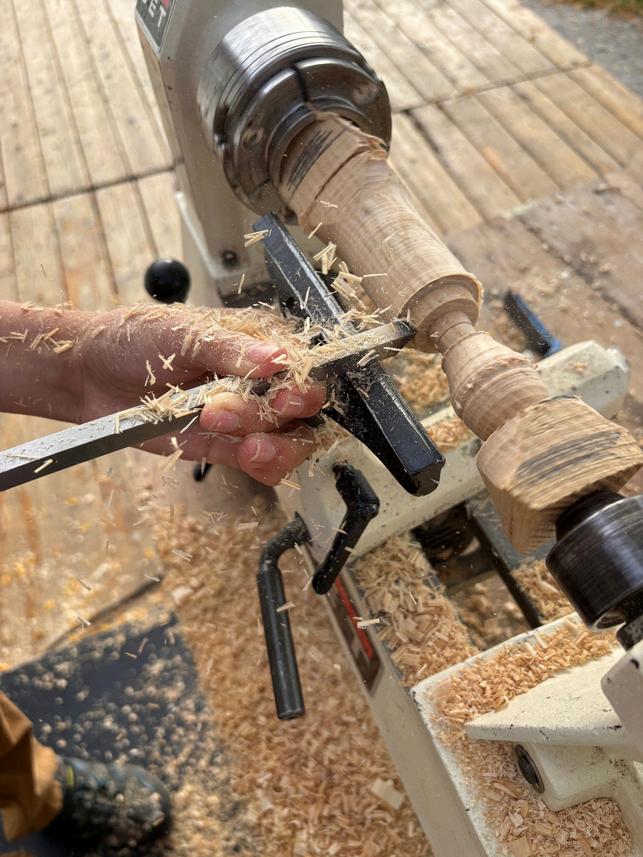
On my first day on the job at The Schoolhouse in South Burlington, Vermont, where I had just been hired as a preschool and afterschool director, the staff shared what we had done over the summer. I mentioned offhandedly that I enjoy woodturning as a hobby
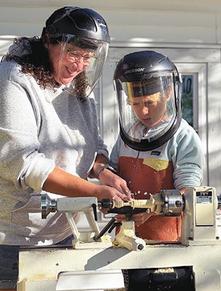
After the meeting, one of the middle school teachers pulled me aside and asked if I would consider offering woodturning lessons as part of the Project Based Learning program. I hesitated because my background is working with preschoolers, not middle schoolers, but I said yes. That yes has now turned into an annual tradition.
Each year, about fifteen middle schoolers participate. Everyone is included unless they choose to opt out. Some years we pick a particular project, like pens or spinning tops. Other years, the students decide what they want to try in a single forty-five minute session.
At first, I was not sure if they would listen, or care. But once I put the tools in their hands, the energy in the room shifted. They were hooked, and so was I.
Planting Seeds at the Lathe
Like many turners, I got started because someone made time for me. In my case it was Vermont turner Edwards Smith, who welcomed me into his shop and shared not just technique but the larger world of the craft. Edwards passed away recently, but the lessons he gave me live on every time I share turning with someone else What struck me most was how freely he gave his knowl edge. No strings attached, just a love of the craft and a desire to pass it on.
That kind of generosity is the heartbeat of woodturning. Every time we make ourselves available to someone else, we are planting a seed. Sometimes that seed takes root right away Other times, it waits quietly until the right moment. Either way, sharing keeps the possibility alive. Yes, teaching takes effort. It takes time, preparation, sharp tools, and often a bit of hauling and setup. But the smiles when someone holds up a fin ished piece make it all worthwhile. And even if they never turn again, they walk away with something valuable: a new understanding of just how much skill and patience go into every turned piece they will see from then on
Woodturning does not live in books or on YouTube, it lives in us and in what we share. I was fortunate that Edwards gave me that gift, and I am determined to keep doing the same for others. Each time we share what we know, it sends out ripples we may never see. A lesson, an afternoon in the shop, even just a word of encouragement, it all matters
Elsa Oppenheimer, President, Vermont Woodturners Guild (As seen in December 2025 Issue of American Wood Turner)
What in the Wood?!
Featured Wood: Black Cherry
Color: Light pinkish-tan when fresh → deep reddish-brown with age
Grain: Fine, straight, smooth texture
Pores: Small, evenly distributed (diffuse-porous)
Hardness: Medium (Janka ~950 lbf)
Scent: Mild, slightly sweet when cut
Tree Bark: Dark, flaky, “burnt potato chip” look when mature
Wood you consider making a donation? Give a little — it’s for a tree-mendous cause! Donate Here
https://woodchucksvt.org/
Safety First, Shavings Second
The Hazards of Wood Dust
Ted Fink
Growing up in the house my paternal grandfather built, my favorite room was his basement workshop. Professionally he was a pattern maker for a Rochester NY piano manufacturer. At home he spent his free time making fine furniture and stringed musical instruments often with exotic inlays. Wood dust was an ever present ignored hazard to which he developed allergies in his later years that caused him to break out in hives within minutes of entering his workshop.
The wonderful craft of woodturning can be enjoyed life-long but only if we become aware of and mitigate certain hazards. Wood dust is generated in a wide spectrum of sizes largely dependent on how it is machined. Woodturning itself generates shavings and large dust particles but sawing and especially sanding produce very fine dust which is most hazardous.
This is a case where size matters. Try this: in a darkened workshop after you have been sanding shine a flashlight and take note of the very smallest particle you can see in the beam of light. That particle is 20 microns in size (a micron is 1 millionth of a meter). Our exposure to the dust is our skin (17 – 20 sq.ft.) and our respiratory system (~ 1300 sq.ft.) The respiratory system is also much more reactive because all the surfaces are moist. The way the respiratory system handles inhaled particles which land on the mucous layer coating our airways is through the constant action of cilia (hairs) moving (except in smokers) this mucous sheet upward to eventually be swallowed or coughed out. In order for wood particles to get all the way into the deepest reaches of the lungs, the alveoli, where gas exchange takes place they need to be smaller than 5 microns. Once in the alveoli the only way to get rid of the dust is to have large scavenger cells, macrophages, come in and engulf them then move out to the mucociliary elevator. What all this means is that the most harmful wood dust you can’t even see. So the fact that the air in your shop may look clear doesn’t necessarily mean it is free of an airborne hazard.
Wood dust generated by machining and sanding imparts a positive charge to each particle produced. Since like charges repel each other the wood dust once airborne stays suspended longer and disperses more readily when disturbed e.g.by sweeping or air movement. This is particularly true of the very finest particles.
Although there have been rare reports of nasal cancer being caused by chronic exposure to wood dust the two main hazards are irritation and sensitization (allergies). Irritants can cause soreness and itching of eyes, nose, mouth and throat. Wood sensitizers can additionally cause skin rashes, blistering, hives and exacerbations of underlying conditions such as asthma and other chronic lung diseases. Various species of woods differ in their capacity to irritate or sensitize. In general tropical hardwoods such as mahogany, rosewood or padauk tend to be stronger irritants and sensitizers than our northern forest woods such as maple, birch and black cherry. This is due to the fact that over tens of millions of years of evolution the tropical trees had to develop chemicals to impede the unrelenting attacks of insects and fungi. The tropical forests get no respite (freezing winters) in this fight for survival. These protective chemicals, called extractives, tend to be oily and are often both irritating and sensitizing. This is not to dismiss the irritant and sensitizing potential of our northern forest woods but you are likely to develop an allergy to a tropical wood more quickly upon exposure. Take the time to look up on-line tables of the woods you use to assess the degree to which you are at risk.
One other hazard, though very rare, deserves mention because it is so catastrophic when it occurs, and that is wood dust explosions. The risk involves the simultaneous occurrence of five conditions:
1) Fuel: wood dust – the finer it is the more dangerous it is due to the increased surface area to volume ratio.
2) Oxygen – air
3) Ignition source – this might be a spark from an electric motor or an open flame.
4) Containment – the walls, floor and ceiling of your shop.
5) Dispersion – the wood dust must be airborne.
A wood dust explosion is actually a series of ever more powerful explosions milliseconds apart in a process call deflagration. The initial minor explosion’s shock wave disperses the wood dust from adjacent horizontal surfaces feeding more fuel into the air. Each subsequent stronger explosion perpetuates this chain reaction. To see a demonstration of this phenomenon google “wood dust explosions”.
Wood Dust Mitigation:
1) Personal Protection Equipment: Use an N-95 two strap respirator or mask which must make an air tight seal with your skin. (A beard prevents a good seal from being made.) If you wear glasses, as I do, an exhalation port helps minimize fogging. 3M makes a good one.
2) Source capture: Use a vacuum system with 4” hose as close to your turning as possible when sanding. For other machines like belt sanders, bandsaws and table saws make turned wooden couplers to hook up your vacuum system to the machine dust ports.
3) Install a ceiling mounted air filtration device, AFD, which removes particles as small as 1 micron from the air. Cost ~ $250. Turn it on whenever you are in the shop.
4) Good Houskeeping: Get in the practice of vacuuming your shop including all horizontal surfaces and cleaning or replacing dust filters as needed. Using a bench brush, broom or compressed air is fine for shavings but fine wood dust should be vacuumed.
5) Increase ventilation: In favorable weather open windows.
6) Use a ‘Shop Shirt’. This is an old long sleeved shirt you put on when you first enter your workshop and it is taken off before exiting so as to minimize bringing wood dust into the living areas of your home. Sleeves and front should be fully buttoned since loose clothing is a danger around lathes.
If you have questions you can reach the author (Ted Fink) at tjfturnings@gmail.com
Shop visits are welcome.
Last Month’s Demo
Small Turn, Big Impression
If you blinked, you might have missed it! At our last meeting, Hel demonstrated the art of offset turning and created a piece so tiny it could almost disappear in the shavings—a 1.5" offset chalice. Despite its small size, the demonstration was anything but small. Watching the careful setup and precise turning required for offset work was fascinating, and the finished piece was a perfect example of skill, patience, and creativity on the lathe. It was an amazing demo and a great reminder that sometimes the most impressive pieces come in the smallest forms.