Police officer accused of killing cyclist with cruiser is arraigned
Page 2


Police officer accused of killing cyclist with cruiser is arraigned
Page 2
WRITER
The Senate Committee on Health and Welfare moved a bill on Friday that aims to regulate hospital spending and, through that, bring down insurance premiums.
The bill aligns broadly with recommendations made in a report from the Green Mountain Care Board in December that outline the implementation of reference-based pricing, a model that would use Medicare rates as a baseline for the cost of hospital services.
While the bill is focused on the hospital infrastructure in Vermont, the stated goal of bringing down premiums speaks to the budgeting crunch that local municipalities and school districts have been under due to rising healthcare costs.
At Champlain Valley School District’s annual legislative breakfast last week, Chittenden Southeast Sen. Virginia “Ginny” Lyons, D-Williston, brought up the bill as a part of the solution for rising budget costs — the bulk of municipal and school budgets pay for staff compensation. Lyons is the chair of the Senate health committee.
According to Gary Marckres, the chief operating officer for the Champlain Valley School District, the district’s cost for a family plan has more than doubled from $17,000 to $40,000 over

the last few years. Although the district achieved an overall budget increase of less than one percent for next fiscal year, it will be eliminating nearly 40 staff positions.
Similarly, about 75 percent of the increase in South Burlington School District’s FY26 budget expenditures were due to an 11 percent increase in their health care costs. And in Shelburne, the selectboard considered asking employees to pay into their health care benefits for the first time to balance the almost 12 percent raise in costs they were experiencing.
According to the Green Mountain Care Board report from December, reference-based pricing could ease these financial burdens by “lowering prices paid on services, thereby reducing the need to increase taxes or reduce benefits to ensure the future solvency of the funds.”
As written in the bill, this would involve the state regulating some of what has been a private process: negotiations between hospitals and insurance companies.
“The contracts between hospitals and insurers and payers are in a black box. They’re not transparent. We don’t see them. So first of all, reference-based pricing is a way of saying, ‘This is how much you get paid at this level with respect to Medicare,’” Lyons said in an interview Friday.
See HEALTH CARE on page 12

BRIANA BRADY STAFF WRITER
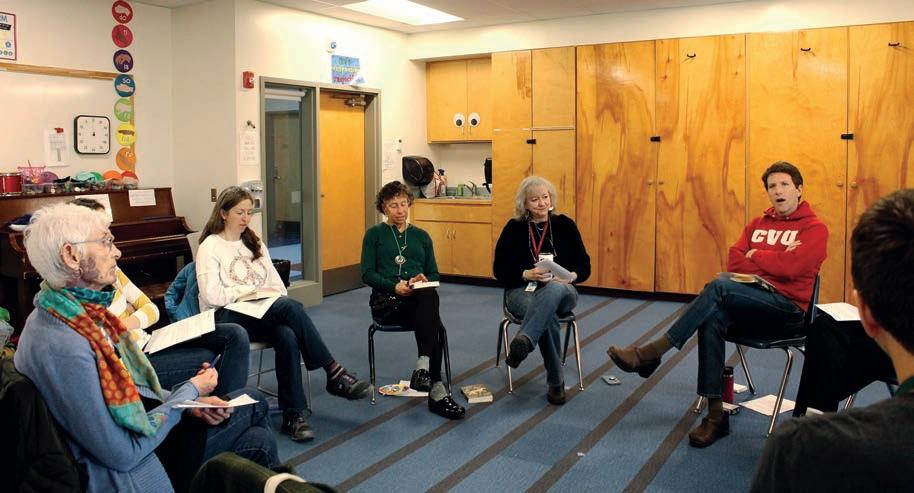
Last Friday morning, in a classroom at Shelburne Community School, a different kind of class was in session. A group of adults — a mix of parents, teachers, and community members — sat in a circle and scribbled away on the note cards in their laps. While the morning had started with pie and gabbing, the room was quiet while everyone gathered their thoughts.
Prompted by Champlain Valley

Union High School social studies teacher Brad Miller, each person wrote down three questions about the book they had all read: the young adult novel “Gather,” written by Vermont principal Kenneth Cadow from the perspective a 16-year old boy living in rural Vermont dealing with poverty and his mother’s substance abuse. Miller was there to facilitate discussion; the adults weren’t just going to hear about a book district students had read, they were going to participate.
The community discussion was organized by Christina Daudelin, the DEI Coach at Shelburne Community School, and Shelburne parent Wendy Eberhart. The book, which is the current Vermont Humanities’ Vermont Reads book, was one of the two common texts for Champlain Valley Union High School’s faculty this year as well as classroom reading for some of Shelburne’s 7th and 8th graders.
See BOOK GROUP on page 12

BRIANA BRADY STAFF WRITER
The Shelburne Planning Commission has been slowly working its way through a rewrite of their bylaws. Come May, chair Steve Kendall said, that process will come to an end.
“The town does not have endless resources to pay the consultants that we need to do this process. So, we are getting to the finish line. And we’re not done, but we are getting to the finish line,” he said.
The current draft of the regulations is 311 pages long.
The planning commission’s regulations inform town zoning and the development review process. The bylaws touch policies as diverse as the protection of forest blocks to standards for parking lots.
“Our existing regs are pretty ugly,” Kendall said. “That’s what started this whole process. They were inconsistent. They were hard to read. They were hard to understand.”
Although the commission has been undertaking a complete overhaul and rewrite of the regulations rather than a simple update, the length of time they’ve devoted to the process is unusual. According to Shelburne planning director Aaron DeNamur, most small towns might take a year to rewrite their bylaws. In the time that Shelburne has been addressing their regulations, South Burlington has updated their own multiple times.
Part of that can be explained through the commitment the commission has made to incorporating feedback. According to Kendall and DeNamur, the group has been receiving written feed-
back throughout the process, and especially in the last few months. DeNamur said feedback has ranged from short emails from individuals to pages of comments from larger organizations like Meach Cove or the O’Brien Brothers.
The large policies still under discussion are inclusionary housing and forest blocks. On April 3, the commission will be hearing a presentation from Arrowwood Environmental about their recommendations concerning forest blocks.
When it comes to smaller considerations, however, the commission may be past the point where it’s willing to relitigate matters.
At last week’s meeting, Kendall acknowledged that this might mean that the version of regulations that goes to the selectboard in June may be an imperfect document.
“This is an ever-evolving process. There’s going to be a feedback loop. There’s going to be things that we probably didn’t think of or missed,” Kendall said, suggesting that after the bylaw rewrite passed, the commission could return to those items in some kind of housekeeping update.
Although it’s possible the commission may have overlooked some aspect, over the past two years, they’ve shown meticulous attention to the details of the rewrite, as evidenced by the meeting on Thursday.
In going over the details of an edit to their inclusionary housing policy — whether the threshold for mandating inclusionary hous-
See BYLAWS on page 3


LIBERTY DARR STAFF WRITER
An on-duty Shelburne police sergeant who was allegedly playing a YouTube video in his police cruiser when he struck and killed a cyclist in South Burlington in November pleaded not guilty last week to a felony charge of grossly negligent driving with death resulting.
At an arraignment held last week in Chittenden County Superior criminal court, Sgt. Kyle Kapitanski’s lawyer, David Sleigh, argued against the felony charge,
saying there was no proof Kapitanski was actually watching the video when he struck and killed the cyclist, nor does looking at a video “momentarily” constitute gross negligence.
“Glancing at a video — there’s no evidence for that — but glancing at it, simple negligence,” Sleigh said at the hearing.
But Deputy State’s Attorney Matthew Dolezal argued that violating the speed limit, coupled with the violation of state law that forbids having a video playing where the driver of a vehicle can view it, provided enough evidence
to move the case forward.
According to a Vermont State Police affidavit, around 2:40 a.m., Kapitanski was driving a Shelburne Police SUV cruiser at 40 mph in a 35-mph stretch of Shelburne Road near Farrell Street when he struck and killed Sean Hayes, who had been riding a bicycle with a trailer attached to the back.
According to the affidavit, video footage obtained from the Mascoma Bank located near the


LIBERTY DARR STAFF WRITER
With the legislative session in full swing, Chittenden Southeast senators Kesha Ram Hinsdale, Thomas Chittenden and Virginia “Ginny” Lyons talked with dozens of constituents this weekend to discuss all things education reform, property taxes and healthcare.
The Legislature has some mighty tasks still at hand with a little over two months left of the session, including a massive plan proposed by Republican Gov. Phil Scott to reform the way that Vermont funds and ultimately plans for education. And last week the Senate voted 22-8 to confirm Zoie Saunders as the state’s secretary of education in the throes of the education reform talk. Saunders was appointed by Gov. Scott on an interim basis after the Senate rejected her approval 19-9 last April.
“There are not many commissioners or secretaries who have faced this much scrutiny and have been considered so much of a litmus test on the future of policy in that area,” Ram Hinsdale, D-Shelburne, said. “Some senators got up and said they’ve never heard from constituents about an appointment of the governor until now.”
Ram Hinsdale, Senate Majority Leader and a member of the Senate Committee on Education, was the only one of the three to vote against Saunders’ appointment last week.
“I think it’s really critical for us to all remember that her first job is to run the agency of education and to bring up our literacy test results and help our school districts share resources,” she said. “We are hearing that that’s simply not happening.”
Lyons, D-Williston, is the longest serving member of the Legislature among the three and currently chairs the Senate Committee on Health and Welfare. She said she voted in support of Saunders mostly after listening on the floor to presentations about her credentials and the work she has done in public schools in Florida before coming to Vermont.
“I think I listened to my colleagues on the Senate floor, one of whom is the chair of Finance, and she was very positive about her
continued from page 2
ing should be 25 units — the commission spent about 20 minutes discussing the pros and cons of lowering or raising the threshold and the impact of regulating the size of the inclusionary units. They considered factors from the choices that developers might make between triplexes and single-family homes to regulating around a multiple of 12 units, how developers are likely to build.
However, in digging into the details and taking their time over the last two years, the commission may have held some small but meaningful changes in limbo.
During public comment, childcare owner Sueann Campbell asked the board about the chances the zoning for her homebased childcare would change in time for next year’s registration. Campbell is working on her license, meaning that as far as state regulations go, she could move from caring for six children on her own to caring
working relationship with Secretary Saunders,” Lyons said. “She needs to do the work, and she needs to demonstrate to us that we can move forward in a way that doesn’t harm our school systems, doesn’t harm our teachers and, most importantly, promotes our children.”
Chittenden, D-South Burlington and vice chair of the Senate Committee on Finance, also voted to confirm Saunders.
“After reviewing her confirmation hearing yesterday in our newly constituted Senate education committee, I do now have the impression that Secretary Saunders has done her homework,” he wrote earlier this month.
“And the last year of her service in this role (as contentious as that path has been) is now experience relevant to the task at hand.”
But their votes to confirm Saunders might not translate to votes in support of the current education reform proposal. The plan, unveiled by Saunders earlier this year, looks to dissolve the 119 school districts spread across the state down to just five regional districts: Southwest Vermont, Southeast Vermont, Winooski Valley, Northeast Kingdom and Champlain Valley. Each district would have roughly 10,000-15,000 students, except for Champlain Valley, which would have closer to 34,000.
The proposal would also shift the way education is funded in Vermont to a foundation formula, currently used in several states across the country, by fiscal year 2028. The funding formula, which assumes a base per-pupil spending number for each district, would ultimately seismically shift more power to the state when it comes to how much schools spend each year.
While Chittenden agrees that reducing the number of districts within the state would create better economies of scale, having just five districts within the state is a non-starter for him.
He said he sees value in a foundation formula, but he is pushing back on the Governor’s time frame for implementation. He said he sees it taking between three and 10 years, with savings achieved through a gradual implementation plan.
“We can’t do this too fast, because if you do this, the harder and faster you push things,
the more friction you create,” he said. “And Vermont cares about its kids and its schools, and we have to do this right.”
Ram Hinsdale said the education committee is working on an alternative proposal that also utilizes a foundation formula, although one set higher than the base outlined in Scott’s proposal.
“Their foundation formula had a lot of holes in it, not a lot of money for support staff, for food service staff, for extracurriculars, for a lot of the things that students rely on,” she said.
Healthcare costs play a major component in the state’s growing. For the South Burlington school district alone, the district’s 7 percent spending increase next year is largely indicative of a roughly 11 percent increase in state-mandated district contributions to employee health benefit programs. The district is spending $900,000 more in healthcare than it was last year.
Lyons said there is no doubt the state is in the middle of a health care crisis, and her committee introduced a bill last week aimed at remedying some of those cost constraints (see related story pg. 1).
“If we could align everyone together and have Medicare for all, that would be the end of conversation,” she said. “We would be where we need to be. But it isn’t, especially given what the federal government is doing. That’s not an easy answer right now, but I continue to work with my committee to align as much as we can so we have something that mirrors what I know folks would think is best, and that’s Medicare for all.”
When thinking about property taxes, Lyons said the governor has indicated that he would like to invest close to $80 million in reserve funds to reduce property taxes this year, something the Senate Committee on Appropriations, which she is also a member of, will be looking at in the coming months.
Senators also voiced support for raising some revenues in the state through other means like taxing second homes. Ram Hinsdale noted that nearly 20 percent of the state’s entire housing stock consists of second homes, and Vermont is one of two states — Maine is the other — with the highest per capita number of second homes in the country.
“We have a lot of second home parcels which are underutilized roofs that we need in this state,” Chittenden said. “I think taxation policy that makes that more expensive to have a roof that’s not being used all year long for people wanting to contribute to Vermont’s economy is rational to me.”
While Senators focused on issues directly pertaining to Vermonters, the entire Legislature is also up against a brand-new federal administration that has wreaked some amount of havoc for state leaders in recent weeks with talks of federal funding cuts.
“I hate to end on this note, but I think next year is going to be a year of austerity,” Chittenden said. “We have a Republican governor that’s hesitant to approve new revenues, and it’s going to make the budgeting process next year, I think, very, very painful. We’re going to sharpen our pencils, and every dollar has a constituency.”
for 12 children with the help of an assistant. However, the current zoning regulations in Shelburne don’t allow for that where she lives.
In its current draft, the bylaw rewrite would change that for her. However, because the bylaw is not expected to go into effect until the summer, and with the time it would take Campbell to go through a review process, it seems unlikely that she will be able to register more children for the fall.
For DeNamur, this shows not only how important it is that the commission finish the bylaws, but also how essential the rewrite is in the first place.
“It’s an unfortunate side effect of our current zoning, which is so archaic that she can’t do that,” DeNamur said.
After its last few big policy decisions, the commission hopes to send its rewrite to the selectboard for approval in June.

continued from page 2
scene of the crime showed Hayes had gotten off his bicycle near the curb and was adjusting the attached trailer. He then began walking with his bike headed southbound when Kapitanski struck him.
The crash report states Kapitanski didn’t come to an immediate stop after hitting Hayes and traveled 85 feet before applying the brakes — about a 1.5 seconds, according to Dolezal. He also told a member of the South Burlington Fire Department who responded to the crash that Hayes “came out of nowhere.”
Hayes, according to the affidavit, had been wearing “inconspicuous clothing” with no reflective lights attached to the bike or trailer.
Additionally, Kapitanski’s body camera showed that he had been playing a YouTube video on a computer tablet mounted in the cruiser at the time of the crash. Review of the device showed that several YouTube URLs had been accessed between 2:29 a.m. and 2:40 a.m., but there is “no evidence of user interaction” with the device during those 11 minutes.

After the collision, Kapitanski can be seen in body-cam footage changing the tablet’s display screen from YouTube to Valcour, the computer-aided dispatch screen.
Superior Court Judge David Fenster was not convinced by Sleigh’s argument, affirming that the state had provided sufficient evidence to support the existence of probable cause for the charge. Kapitanski was released without bail. If convicted, he faces up to 15 years in prison.
Hayes’ family members, who have sued the Town of Shelburne in a separate civil lawsuit, packed the court room last week. The family’s lawyer, Brooks McAr-
thur, spoke outside the courtroom after the arraignment, calling Sleigh’s argument a “red herring.”
“I think that video was playing. I think he was watching it,” McArthur told reporters. “I think a reasonable person would conclude that if he was paying attention to the roadway, he would have seen Sean. I don’t think there is any doubt he was watching that video.”
Kapitanski has been on paid leave from the Shelburne police department since the crash.


Total reported incidents: 79
Traffic stops: 5
Warnings: 5
Arrests: 2
Medical emergencies: 32
Mental health incidents: 1
Suspicious incidents: 13
Directed patrols: 29
Citizen assists: 3
Motor vehicle complaints: 2
Car crash: 3
Animal problem:1
Noise disturbance: 1
Theft: 1
Harassment: 1
Vandalism: 1
Property damage: 1
Fraud: 3
Alarms: 6
Pending investigations: 7
911 Hang-up calls: 3
March 9 at 8:28 a.m., a caller reported a theft of items from their residence on Shelburne Road.
March 9 at 4:39 p.m., a caller on Ferndale Way reported a fraud complaint.
March 11 at 1 a.m., a caller reported that their residence or vehicle was vandalized on Sycamore Street. The case is pending additional leads.
March 11 at 2:17 p.m., a 911 caller reported domestic disturbances at the T-Bird Motel. The officers located the individuals involved and arrested Elizabeth Bowen, 41, of Rutland City, on an
outstanding warrant.
March 12 at 1 p.m., a caller reported a stray dog running loose on Bacon Drive. The pup was located and reunited with the owner.
March 13 at 8:07 a.m., a caller reported a fraud complaint on Railroad Lane.
March 13 at 10:02p.m., a caller reported a fraud complaint on Richmond Drive.
March 13 at 4:04 p.m., a caller on Spear Street requested a trespass order be issued against her ex-boyfriend for her property. Shelburne officers located the male, and he was issued a trespass order for the property.
March 15 at 1:05 a.m., a caller reported a verbal dispute between a male and a female at the T-Bird Motel. The officers assisted in mediating the dispute and Giovane Glosson, 26, of Burlington, was issued a citation for his outstanding warrant.
March 15 at 10:16 p.m., a 911 Caller reported hearing gunshots going off around Acorn Lane. Officers checked the area but were unable to locate the source.
Note: Charges filed by police are subject to review by the Chittenden County State’s Attorney office and can be amended or dropped.
Advertising Wendy Ewing wendy@shelburnenews.com (802) 238-4980
Advertising Director Judy Kearns judy@otherpapersbvt.com (802) 734-2928
Editor Tommy Gardner tommy@stowereporter.com (802) 253-2101 x25
Staff Writers Aaron Calvin Liberty Darr Patrick Bilow Briana Brady

Production/Design Stephanie Manning stephanie@shelburnenews.com Kristen Braley kristen@stowereporter.com
General Manager Katerina Werth katerina@stowereporter.com
Billing inquiries Leslie Lafountain leslie@stowereporter.com (802) 253-2101
Advertising submission deadline: Friday at 5 p.m. advertising@shelburnenews.com classifieds@shelburnenews.com
Editorial submission deadline: Friday at 12 p.m. news@shelburnenews.com
Calendar submission deadline: Friday at 12 p.m. news@shelburnenews.com
Contact: PO Box 489 Stowe, VT 05672 (802) 253-2101
Guest Perspective
Tanya Marshall
As the days are getting longer and snow is melting, it is fitting that this is Sunshine Week, an annual celebration of government records and information as the cornerstone of government accountability and transparency.
A government “of the people, by the people, and for the people,” as President Abraham Lincoln famously stated in his Gettysburg address, means people must have access to authentic and reliable records and information. Without this, we’re in the dark.
As we face an increasingly complex landscape of disinformation and misinformation, access to authentic, reliable and trustworthy government records and information is more important than ever.
actively engage Americans in the federal programs and services they rely on.
Federal civil servants responsible for the management, technologies and use of federal records and information are being fired or have “voluntarily” resigned or retired. Those recently affected include employees at the National Archives and Records Administration, United States Digital Service, 18F (a digital services team within the General Services Administration) and key federal agencies dedicated to data collection and research.
The effectiveness of all government programs and services relies on authentic and reliable information.
Sunshine Week coincides with a poignant time in our history. It is alarming that our fundamental rights as Americans are currently under threat from an unprecedented dismantling of the federal agencies and unauthorized destruction of federal records and information. Both are critical for ensuring government accountability and transparency, fiduciary responsibility to taxpayers, and the public’s right to know.
The effectiveness of all government programs and services relies on authentic and reliable information. Further, the public’s trust in these programs and services relies on transparency, accountability and civic engagement.
Yet, authentic and reliable records and information are being removed from federal websites, despite being an efficient and cost-effective way to provide publicly available information and
All told, the recent and ongoing loss of institutional and expert knowledge is staggering.
For Sunshine Week 2025, it is crucial to shed light on Vermont’s laws for a transparent and open government.
The State of Vermont’s commitment to manage and safeguard its local and state government records and information, especially from unauthorized destruction, was established by state law in 1937.
Following the Watergate scandal of 1972 and subsequent Congressional action to further ensure government accountability and transparency, while also balancing individual rights to personal privacy, state legislatures —including the Vermont General Assembly — shored up state laws to require the same.
Today, government accountability and transparency are governed by what is called the Vermont Public Records Act (1 V.S.A. §§ 315 – 320) and its importance cannot be overstated: access to authentic and reliable government records and information is a fundamental right.
The secretary of state’s office, through the Vermont State Archives and Records Administration, fulfills a relatively simple, yet essential, role in the Vermont Public Records Act. The Vermont State
Letters to the Editor
Crash report ‘bends over backwards’ for implication
To the Editor:
I read with interest your recent article about the state police’s crash report about the fatal nighttime collision near our home when a Shelburne police sergeant’s cruiser hit a stopped cyclist on Shelburne Road (“Police: Unsafe passing led to fatal Shelburne cruiser/bike crash,” March 6). The crash report determined that the officer was speeding, had a YouTube playing in the car, and did not stop right away after the crash. But then the report “only mentions a possible civil violation” and
contains “no evidence that (the officer) did not have his eyes on Shelburne Road.”
If I ran into someone with my car at night while speeding and playing a YouTube and did not stop right away, I hope no crash report bends over backwards to imply there was no evidence that I did not have my eyes on the road.
Long ago, our high school math teacher used to nudge our class when we did not see an obvious answer to a calculation on the board: “C’mon people, what color is the red mitten?”
Robert Spottswood South Burlington
Archives and Records Administration is charged with supporting Vermont government in systematically managing its records and information “to provide ready access to vital information, to promote the efficient and economical operation of government, and to preserve their legal, administrative, and informational value.” (1 V.S.A. § 317a). The archives, records and information professionals at the Vermont State Archives and Records Administration rise to this challenge without fanfare.
The baseline it sets for Vermont public agencies is compliance with all six parts of the Vermont Public Records Act — policy, access, exemptions, management, procedure, and enforcement — and with the specific laws and rules that govern each individual agency’s records and information.
This work is done in collaboration with managers, technologists, legal counsel and other agency stakeholders. The outcomes are effective policies and procedures for managing and safeguarding Vermont records and information and publicly available documentation of what types of records and information are

created or received by each public agency. Why is this important? Full transparency and accountability of what records and information are created or received and the requirements relating to their management are critically important, especially for legal certainty of their authenticity, reliability and trustworthiness. Government programs and services depend on them and the public does too. We, as a nation, stand to suffer profoundly if our nation’s “freedom of information,” “public records,” and “right to know” laws falter for any American. The secretary of state’s office is doing, and will continue to do, everything in its power to ensure that the public’s access to authentic, reliable and trustworthy government records and information is neither disrupted nor prevented. This includes preserving Vermont’s rights to a transparent and open federal government as well.
Tanya Marshall is the Vermont State Archivist and chief records officer and director of the Vermont State Archives and Records Administration, a division of the Vermont Secretary of State.



Guest Perspective
Cheryl Charles
Vermonters spoke loud and clear this Town Meeting Day: they support their public schools. With over 90 percent of school budget proposals winning voter approval and budgets passing in at least 101 districts, the message is undeniable — Vermont communities value their schools and want to see them strengthened, not dismantled.
The plan ignores Vermont’s history, school culture, and geographic realities.
While there is broad recognition that education finance reform is needed, Vermonters are not interested in a rushed, one-size-fits-all political fix. Instead, they seek thoughtful, well-planned reforms that prioritize the best interests of children, taxpayers, and the future of Vermont’s communities.
That is why the Vermont Rural School Community Alliance has come together to advocate for reform that considers the unique needs of rural schools while ensuring financial sustainability. The alliance represents Vermonters from all walks of life — educators, parents, school board members and community leaders who understand that Vermont’s public schools are the backbone of its rural communities.
The alliance acknowledges the financial challenges facing Vermont’s education system. However, we are deeply concerned about many elements of Gov. Scott’s education transformation proposal. The plan, as currently outlined, lacks necessary consideration for the potential adverse impacts on students, elementary schools, and local communities. The plan ignores Vermont’s history, school culture, and geographic realities, providing an out-of-scale approach that fails to account for significant regional differences.
Furthermore, the proposal relies on the expansion of school choice which could divert much-needed public funds to private institutions, increasing educational inequities rather than addressing them. And by relying on a hasty, top-down consolidation process, the Vermont Rural School Community Alliance fears this proposal will lead to widespread, unnecessary and harmful school closures, negatively impacting students and communities alike.
The alliance supports meaningful reform that strengthens, rather than dismantles, Vermont’s



LIBERTY DARR STAFF WRITER
What role does artificial intelligence have in Vermont’s local governments?
While not many towns or cities across Vermont are asking themselves that question yet, South Burlington, the state’s second largest city, is beginning to look at where this growing tool could expedite some of the tedious municipal minutiae.
Meanwhile, Shelburne’s town manager takes a dimmer view of the technology, saying he prefers human relationships over communicating with bots.
However, artificial intelligence makes up a large part of what Nick Gingrow, South Burlington’s IT director, and Anna Dabrowski, the city’s data manager, have been working on the last couple of months. The duo, along with the help of the city’s legal team, are putting the finishing touches on a new artificial intelligence policy that will guide how the city uses and implements AI going forward.
“We’re working on an AI policy so that we have good best practices set in place before people start using it to make sure that all of the city’s data — and (that of) everyone who lives in South Burlington — is used appropriately and safely before we start getting into utilizing it,” Gingrow said.
While a slew of AI tools — even those that wouldn’t be easily recognizable as such — are already readily available for the standard consumer, using the new technology in government is not as cut and dried. Since sensitive data and information is largely a part of the work a local municipality does, ensuring each tool is up to government security standards is on the forefront of city employees’ minds.
Gingrow has been collaborating with a San Jose, California-based initiative known as GovAI Coalition, a coalition of municipal governments around the country that are looking into how to responsibly, appropriately and efficiently use AI for government. South Burlington is the only Vermont city or town in the coalition.
One of the first projects the city has been looking into is an artificial intelligence tool from Microsoft known as Copilot, which integrates with apps like Word, Excel, PowerPoint,
Outlook and Teams.
South Burlington’s city staff, across all departments, gathered last week for their first training session on the topic. Gingrow said the topics ranged from using artificial intelligence to take meeting minutes or drafting request for bid proposals for certain projects throughout the city.
“That’s one of the first things that we’re looking at,” he said. “Creating (a request for proposals) from scratch can take a lot of work. So, if you could use AI to create a draft version based on three or four or five other RFPs you’ve done in the past, you could maybe get a draft version in minutes that might have taken you all day before.”
For Dabrowski, artificial intelligence could open even greater doors for analyzing data in ways that may not have been doable before.
But part of the draft policy, Gingrow said, asks staff to still go through everything generated by AI to ensure its accuracy. The tools, after all, are exactly that: tools meant to enhance staff skillsets, not replace them.
into any language that Google Translate supports.
He noted the city might add a chatbot to the website, which would make navigating to certain tabs easier for people.
“It’s just making our information more accessible,” he said.
Not bots?
Not all towns share the same thoughts about the growing tool. For the neighboring town of Shelburne, town manager Matt Lawless said the town does not have any major AI projects in motion and overall, he remains relatively skeptical about the topic.
Like South Burlington, Shelburne is also a Microsoft shop, and while some Copilot tasks might help staff with research and drafting, there are no plans in the works to move towards looking at AI on the same scale as its neighboring city.
“I hate the idea of bots making complaints and bots answering them.”
— Matt Lawless
“We want to be careful with how we’re using these tools as well and making sure that they’re working correctly for the kinds of things people want to be doing with their data,” she said.
Dabrowski noted that, as a part of the work, the city is rolling out an internal pilot program that could allow troubleshooting for each proposed ideas in a given department.
“So, we’ll take those kinds of proposals, and then we’ll take a look and review those internally and say, ‘Okay, does this make sense for a pilot project?’” she said. “When we say pilot, we mean a project with a pretty tight time balance and a short turnaround so we can get feedback directly from those users to understand is this tool actually helping or not.”
But Gingrow said, the advanced technology is not just going to benefit city staff, it also is geared toward helping city residents. He noted a feature on the city website already in use that is technically an artificial intelligence tool that allows the entire website to be translated


Lawless noted that some of the town’s contract engineers and attorneys are beginning to use automated research assistants and as the city upgrades its financial software, the new system will be able to autofill invoices, which does save staff time.
“I think the greater governance challenge is one of human relationships,” he said. “From Town Meeting Day to my opendoor policy, building trust among neighbors is key to our success. I hate the idea of bots making complaints and bots answering them.”
That’s a relatively common concern shared across all spectrums, Gingrow said, and one the city of South Burlington has thought long about. On a macro scale, Gingrow noted that as AI continues to grow it is likely to threaten some jobs, just as other advancements in technology has done in the past.
South Burlington remains focused on streamlining processes while creating more capacity for its employees as they navigate their endless to-do lists.
“If you can save two hours here or there by using this tool, it just gives you two hours to work on another project,” he said. “There’s a lot of ideas and projects that people have to work on.”


VTCNG.com/ShelburneNews/digital_edition
Sign up for our Friday EMAIL NEWSLETTER
Headlines and news sent directly to your inbox every Friday at 10 a.m.
Sign in and add your weekly newsletter: VTCNG.com/users/admin/mailinglist

Concert brings music of Joel and
On Saturday, March 28, Town Hall Theater, 76 Merchants Row, Middlebury, presents the live music hits of Elton John and Billy Joel, played by Massachusetts-based band Billy + The Jets. This concert, which celebrates the songwriting and piano-playing-genius of two music legends, is sponsored and presented in partnership with WVTK-92.1FM Radio.
“There are concerts that showcase the brilliance of Town Hall Theater’s baby grand Steinway piano. The work of John and Joel, exceptional piano men, will be on mind-blowing display by Billy + The Jets’ talented pianist. Sharing the experience of these beloved tunes with fellow audience members is sure to send spirits soaring,” said Town Hall Theater executive and artistic director Lisa Mitchell.
Dance floor and seating available. Cash bar available throughout the event. Tickets range from $15-$20 and may be purchased via townhalltheater.org. Patrons may also buy tickets in person at the box office from Monday-Friday from 12-5 p.m., or via phone at 802.382.9222.
Band information at billyandthejetstribute.com/.
A special Ukrainian concert fundraiser is set to take place at the All Souls Interfaith Gathering in Shelburne on March 22. It will feature a family of Ukrainian musicians and singers, led by Jurji Fedynskyj, a leading Kobzar performer. The group will share Ukrainian cultural heritage while raising funds to bring the Kobzar Armada to the Ukrainian frontlines.
The family will play traditional, sacred

Ukrainian instruments, which Fedynskyj handcrafts in his workshop in Ukraine. These include several plucked-string Ukrainian folk instruments, the torban, kobzar and bandura.
The traveling troupe includes Fedynskyj, his wife, Mariya Fedynska, and their five children. Together, they will sing and perform historic Kozak polyphonic village songs, spiritual hymns of the Kozak Baroque and village dance songs, as well as European and American historical songs of freedom and spiritual upliftment.

“The goal of this tour is to unite Ukraine and America as defenders of the free world. The war in Ukraine has recently entered a new phase, full of uncertainties for both Ukraine and the United States alike. Enemies of the free world are working hard to divide us. The truth of Ukraine must be told. The soul of Ukraine must be felt,” Fedynskyj said.
Fedynskyj will also narrate Ukrainian history and share updates on what is happening in Ukraine during Russia’s ongoing, full-scale invasion.
For the past 15 years, the family has lived in the village of Kryachkivka in Ukraine’s Eastern Poltava region. There, Fedynskyj leads the Poltava Kobzar Guild and hosts the Drevo Rodu Kobzarskoho summer music festival. Over the past three years, he
has conducted more than 600 free concerts in Ukraine and on the frontlines.
The free performance begins at 6 p.m. Doors open at 5:30. No tickets or reservations needed. Donations are very welcome. All proceeds from donations will go to the Fedynskyj Family Tour, the Poltava Kobzar Guild in Ukraine, and bringing the Kobzar Armada directly to the Ukrainian frontlines.
The Junior League of Champlain Valley presents “Discovery After Dark!” a night for adults 21 and over on April 18 at 6 p.m. at Echo, Leahy Center for Lake Champlain, 1 College Street, Burlington.
The evening will feature interactive exhibits, including a hands-on experience inspired by the whimsical creations of Pulitzer Prize-winning cartoonist Rube Goldberg. Discovery After Dark will include a cash bar, live music, axe throwing, light appetizers, raffle prizes and a volunteer fair highlighting some of community partners.
The “Virtuous Fall of the Girls from Our Lady of Sorrows,” by Gina Femia, will be performed April 3-5 in the Wright Memorial Theatre on the campus of Middlebury College will be presented on Middlebury College campus.
Taking place at a Catholic girls’ school in Brooklyn, six students work on an adaptation of Shakespeare’s “Measure for Measure” while evaluating the moral complexities of their own lives. As the Catholic Nuns who run the school attempt to straitjacket them into denying their own identities, the girls must decide what they stand for and who they stand with in a complicated, post-9/11 landscape.
Funny, poignant and at times downright bawdy, “The “Virtuous Fall of the Girls


Julie Kervick
Julie M. “Windsong” Kervick died Feb. 21, 2025, with her family noting she “gently journeyed home to Spirit,” with her family and friends around her.
Windsong was born April 4, 1937, in New York City to a young mother, unable to care for her. She was placed in an orphanage where she lived for a year before she was adopted. In an article written about her, Windsong said her experience at the orphanage served to make her “a compassionate person who could, firsthand and with clarity, understand what abuse and neglect can do to one’s mind and body.”
As an adult, Windsong dedicated her life to assisting others in their healing journeys, holistically.
Adopted by Chester T. and Persis McClennen Lane, Windsong spent her early years in McLean, Va., and Nyack, N.Y., where she studied piano from a young age with Jho Waxman. As a teen she designed sets for school and local theatre productions, performed in numerous musical and non-musical plays and was voted “Most Artistic” upon her graduation from Nyack High School in 1955.
The family spent summers on Pleasant Bay on Cape Cod, where she was enrolled privately at a young age with renowned artist Vernon Smith. While further pursuing her art at Skidmore College and the Boston Museum Art School, she studied sculpture and began her lifelong love of pottery. She was an integral part of the community at Shelburne Craft School for many years and a longtime craft seller at the Waldorf Christmas Fair.
After college, she toured the country in a VW bus with her first husband before they settled in Vermont. They parted when their child, Tucker, was two, and Windsong parented her son alone.
Being mother to Tucker was Windsong’s pride and joy. They shared a love of adventure and travel and had wonderful trips together over the years. She often spoke of how proud she was of his accomplishments and that he was a great husband to Natalya and a fabulous dad to Zander. Windsong was so delighted to spend time with Zander during the almostfive years of his life journey so far, delighting in the video photo album set up by his parents for her.
While raising her son, Windsong became a respected mindbody practitioner and was a leader and organizer in Vermont’s holistic health movement in the 1960s and ‘70s. Drawn to working with her hands, she studied massage and Trager Psychophysical Integration, and, along with Don Wright,
started the Vermont Institute of Massage in 1976. Her body-mind approach was influenced by the work of Ron Kurz, founder of the Hakomi method of body-centered psychotherapy.
In 1978, Windsong, Wright and Bea Bookchin founded Pathways to Wellbeing in Burlington, the first holistic health center on the East Coast. It was here Windsong met Paul Kervick, who would become her lifelong beloved spouse and co-creative partner.
During the many years of its existence, Pathways’ practitioners offered massage, Rolfing, homeopathy, naturopathy and psychotherapy for all ages. Windsong invited practitioners of new modalities to the state, organized speakers and holistic health fairs and offered workshops to the medical and lay communities.
Windsong helped found the Vermont Women’s Health Center in Burlington, the first women-run legal nonprofit clinic to perform abortions in the United States. Windsong was the cofounder and director of the Awakening Center in Shelburne, also a holistic healing center. With her husband, Paul, she co-founded the Awakening Sanctuary non-profit educational and healing center for community upliftment at their property in Monkton.
Windsong had a particular passion for conscious language and its effect on physical and spiritual dimensions. She would point out to friends and family the power of words and taught classes on the subject.
In addition to pottery, Windsong held a reverence for dance and for many years hosted monthly full-moon circle dance gatherings at the Awakening Sanctuary. Windsong and Paul also became ordained ministers through the Universe Brotherhood Movement and conducted sacred ceremonies, marriages, civil unions and passing to spirit ceremonies.
Windsong was an adventurer and loved visiting different cultures around the world. She was the first woman in the United States to achieve a black belt in the Korean Taoist Qigong practice — Kuok Sun Do — and she solo climbed a sacred mountain in Korea and visited and assisted villagers in northern Thailand. In the Vermont winter, you could find her cutting a hole in the ice in Lake Champlain in February, while practicing Qi Gong breathing until she regulated her body temperature.
Her gardens were her happy place, and she would spend long hours creating beauty not just with plants but with natural fences and trellises and thoughtful placements of stumps, shells, rocks and

gemstones. Her and Paul’s crowning achievement on their land at their home in Ferrisburgh was a labyrinth they both created and built together.
Windsong’s favorite word was “yes,” which formed the logo for their Awakening Sanctuary. Yes to life and living one breath at a time. Windsong helped midwife the awakening and healing of thousands of community members and people from around the planet
during her 22 years at Awakening Sanctuary and throughout the 87 years of her life. She was a true creator of beauty and love in this world.
More recently, she was a key inspiration and support for Paul and a new project in their lives of co-creating a nonprofit low-power community radio station in Bristol. WVVT (Fireside Radio: the Voices of Vermont) will give voice to and support local communities in creating the world we all want in our hearts. Paul and co-founders, Jim Holway and Jonathan Corcoran, are so very motivated to share this with the world.
Windsong was predeceased by her parents, Chester T. Lane Sr., and Persis McClennen Lane, and her brother Chester T. Lane Jr. She is survived by her husband, Paul; her son, Tucker (Natalya) McLane and grandson, Zander; Paul’s children, Colby (Garth Allen) Kervick, Robyn (Sean Balon) Kervick, Drew (Elizabeth) Kervick; and grandchildren, Turner, Declan, Abigail, Henry, Sam and Char-
lie; Paul’s sister, Lindsay, and brother, Bob, and his family (Jan, Kris, Tara, Kelly, Jake, Jimmy, Emma); and Windsong’s sister, Dinah (John Ketchum) Lane; brother David Lane; nieces and nephews, Clover, Oakley, Allegra, Hannah, Cory, Rachel; and many great-nieces and nephews.
Windsong also stayed close with Tucker’s fathers’ family and will be missed by many McLanes: Gigi, Towner, Katie, Duncan; Bonnie, Jessica and Elizabeth Foz.
A celebration of life gathering will be held later this summer. People may reach out by email to songlight@gmavt.net if they are interested in being notified once a date and location have been decided.
Donations in Julie “Windsong” Kervick’s memory and supporting her life’s passion for creating inspiration and a beautiful world, may be sent to either or both of the following organizations: WVVT — Fireside Community Media in Bristol or the Shelburne Craft School.







As steam rises from sugarhouse cupolas and early morning coffee pots, sugar makers are working overtime to turn maple sap into golden syrup. But as it turns out, they aren’t alone: other living things are sugaring too, and their stories affect the syrup that is poured on your pancakes or into your morning coffee.
Many sugar makers’ most familiar — and troublesome — non-human coworkers are red squirrels, which chew holes in the soft plastic lines of sugarbush tubing networks to get at the sap inside.
In a 1992 study, biologist and author Bernd Heinrich found that red squirrels are not just sap thieves: they also “tap” their own sugar maples, biting through the trees’ outer bark and returning to lick up partly dried streaks of candied sugar and syrup. Heinrich noticed that his local red squirrels had much in common with human sugar makers: they selected sugar maples almost exclusively, got up early to check their taps, and sugared only on warm days in late winter and early spring.
Some winter birds, including the evening grosbeak, Bohemian waxwing and cedar waxwing, also enjoy maple sap, which they sip from the broken ends of sugar maple twigs — but only as part of a balanced winter diet. Grosbeaks eat a healthy mix of tree seeds, buds, and overwintering insects, while waxwings have a serious sweet tooth (or beak?) for the fruits of trees such as crabapple, hawthorn, and cedar.
Yellow-bellied sapsuckers, our most creatively named woodpeckers, excavate rows of shal-
low “wells” in the bark of a few favored tree species. Their taste in trees changes through the year, and in late spring, maples are on the menu. During frequent visits, they renew their wells, lap up sap, and gobble insects trapped within it.
As sapsuckers seem to understand, insects are probably the biggest group of sap-eaters in our northern forests. One Canadian study documented 28 species of winter-active beetles, caddisflies, fireflies and moths at sap pails, including multiple owlet moths in the family Noctuidae.
Although the noctuids, which some sugar makers call “sap moths,” are dressed in unassuming browns and grays, they have a remarkable trick up their sleeves: flying and feeding in near-freezing temperatures, even though they are cold-blooded.
In another study, Heinrich found that noctuid moths were shivering themselves up to temperatures as hot as 95 degrees Fahrenheit, and then using their dense, fuzzy coats and clever circulatory systems to hold onto the warmth. If you’re a moth, this is a pretty good trick, as most of your avian predators are still on vacation in late winter and early spring.
All this maple drama is visible to the naked eye but put a drop of maple sap beneath a microscope, and you’ll find a whole world of very small organisms enjoying their own maple feast. Studies find that bacteria and yeasts with names like Pseudomanus tolaasii and Mrakia gelida live on maple bark and inside the tubing of sap collection networks. As the days warm, these microorganisms proliferate, eventually turning sap brown and mucky and spoiling late season syrup.
But the maple microbiome isn’t
all bad. Many of those wonderful, elusive flavors — the ones that evoke notes of vanilla, pine, butter and even flowers — get their start when microorganisms break the sucrose in maple sap into other forms of sugar like glucose and fructose, as well as aromatic compounds like vanillin and syringaldehyde. While these names may sound strange, they taste delicious; and they’re important enough that they explain much of the change in syrup flavor and color, from “golden-delicate” to “dark-robust,” as spring progresses.
Maples also derive surprising benefits from the microorganisms in their sap. Research shows that some strains of bacteria and yeast in maple sap act like a biological band-aid, proliferating at the site of injuries and staunching the “bleeding” of broken sap vessels until the tree can heal. This response can be frustrating if you’re a sugar maker and the injury is a freshly drilled taphole, but as far as the tree’s concerned, it’s just what the doctor ordered.
As the sugaring season continues, remember you’re not the only one enjoying the bounty of maple trees, and take a moment to think of the yeasts, birds, squirrels and moths. While some might be stealing a taste of maple sap, others have helped give your syrup that special, nuanced flavor.
Sam Blair is a graduate student at the Yale School of the Environment, where he is pursuing a Master of Environmental Science. Illustration by Adelaide Murphy Tyrol. The Outside Story is assigned and edited by Northern Woodlands magazine and sponsored by the Wellborn Ecology Fund of New Hampshire Charitable Foundation: nhcf.org.
This year, the time to be ‘bear aware’ comes earlier than usual
The Vermont Fish and Wildlife Department has begun to receive reports of bears coming out of their dens and is urging Vermonters to remove their birdfeeders and take additional steps now to prevent conflicts with bears over the spring and summer.
“Do not wait to take down your birdfeeders and bearproof your yard until a bear comes to visit,” Jaclyn Comeau, the Vermont Fish and Wildlife Department’s bear biologist, said. “You need to act now to head off bear conflicts over the spring and summer, even if you have never had a bear visit your property before.”
Bear incidents have been on the
rise over the past several years. Officials believe this trend is a result of Vermont’s healthy black bear population learning to associate people and food over multiple generations. Even with a steady increase in the number bears harvested by hunters in recent years — including a record harvest in 2024 — Vermont’s bear population has been stable over the past two decades and shows signs of growth over the past five years.
Shorter winters also mean that bears are emerging from their dens earlier in the spring. In recent years, bear activity has begun in mid-March. This is roughly two weeks earlier than what is traditionally considered the start of “bear-
aware season” in northern New England.
“Preventing bears from having access to human-related foods is key to successful coexistence with these long-lived and intelligent animals,” Comeau said. “Bears can be found in every corner of Vermont other than the Champlain islands. Put bluntly, most Vermonters live in bear country.”
The department asks Vermonters to take the following proactive steps for coexisting with bears:
• Take down birdfeeders between mid-March and December.
• Store garbage in bear-resistant containers or structures, trash cans alone are not enough.
• Follow the steps on the department web page for composting in bear country.
• Use electric fences to keep chickens and honeybees safe.
• Request a bear-resistant dumpster from your waste hauler.
• Feed pets indoors.
• Never feed bears; it is illegal.
Taking these precautions will also help reduce the chance of attracting other wildlife species such as raccoons, skunks and rodents.
The Fish and Wildlife Department also asks Vermonters to submit reports of bears engaging in potentially dangerous behavior like targeting birdfeeders and
garbage, feeding on crops or livestock or investigating campgrounds. Reports can be submitted on the department’s Living with Black Bears web page, tinyurl. com/4s8hp9t9. The data help biologists keep track of bear incidents and provide early interventions to head off conflicts.
“At the end of the day, purposely feeding a bear is not just bad for the bear,” Comeau said. “It is also dangerous for you, it causes problems for your neighbors, and it is illegal. If bears are finding food on your property, it is your responsibility to remove that attractant and report a problem before the situation gets worse.”

PHOTO BY AL FREY
LAUREN READ CORRESPONDENT
With a young roster and a brand-new coach, the Champlain Valley girls’ basketball team could have had a rebuilding year. Instead, the Redhawks continued their run of excellence with another appearance in the Division I semifinals — the program’s 14th in 15 years.
That is where it ended, though, as No. 4 CVU fell to top-seed St. Johnsbury 34-23 on Wednesday night at the University of Vermont’s Patrick Gym.
“I’m very proud of who we’ve shown we are,” CVU coach Dom Bryant said. “I’m proud that we held St. J to one of their lowest scoring games of the year and I’m really thankful for all the trust that they’ve had in me as a coach. This one loss doesn’t show a full picture of our year, but I’m really, really proud.”
Zoey McNabb led the way for the Redhawks (14-8) with 12
points. Seniors Rose Bunting and Alexandria Montgomery each chipped in four points to close out their CVU careers.
“(Our seniors) were fantastic. I couldn’t ask for a better group of players to come in and trust a new coach in your last year of playing,” Bryant said. “I’m really, really thankful for who they are and proud of who they are. They’ve laid the groundwork of what we have to try to achieve for next year.”
After the Hilltoppers ran out to 15-4 lead in the first quarter, CVU came back with an 8-0 run in the second frame to close it to 20-14 gap at halftime.
But defensive effort and turnovers defined the second half for both teams. Two key baskets at the end of the third quarter from McNabb helped the Redhawks narrow the St. Johnsbury lead to 24-20 heading into the fourth quarter.
The Hilltoppers got two key baskets to open the final frame
Here’s what Shelburne Parks and Recreation has coming up for activities.
The Shelburne youth lacrosse deadline for boys and girls in grades K-2 is March 31, with a $15 fee after that. Parent volunteer helpers are needed for this level and can sign up at time of registration.
The kindergarten program will provide a basic skills introduction to our youngest players in a safe and controlled environment. Players will enjoy a fun clinic from 8-9 a.m. on Saturday mornings. This program starts May 3and ends June 7. A mini stick is included in the price of registration! Mouth guard is recommended.
The grade 1-2 program is designed to give the basic skills to these young beginners in a safe, controlled environment. Players will practice on Wednesday evenings from 5:30-6:30 p.m. and then will be split into teams for small, sided games on Saturday mornings from 9-10 a.m. This program starts on April 30 and ends June 7.
Registration, $60, includes mini stick. Uniform fee, $15 If you already have a mini stick from last year and don’t want a new one, the registration cost is $35. Mouth guard is recommended.
Online Registration can be found on the parks and recreation website, shelburnevt.
— a layup from Anna Ebert and three-pointer from Adrianna Hever — to pull away for good.
Cassidy Kittredge led all scorers with 13 points for the Hilltoppers, nine of which came off three-pointers in the first quarter. Hever added seven points.
“I think we were the better defensive team. We held them to a very low score,” Bryant said. “We had the shots. I do think it was nerves and, obviously, St. Jay is a very good team. We played our game plan; the shots just didn’t fall.”
For the Redhawks’ younger players and first-year coach, it was a chance to get some experience on the big stage and turn the focus to improving next season.
“CVU has such a high caliber of players and high expectations on ourselves,” Bryant said. “We proved to everyone where we belong. And now we’re just going to take it a step further next year.”
Champlain Valley wrapped up the season with a 14-8 record.
org/160/Parks-Recreation, or paper forms are available to print off the website and available at the office. Scholarships available if needed. Call 802-985-9551 for more information.
Lake Champlain Yacht Club’s junior sailing camps are designed to create a lifelong love of sailing, teach safe on water practices, have fun and foster a sense of stewardship for Lake Champlain. There are half-day and full-day opportunities for junior sailors who are just starting out or who are experienced sailors.
Lake Champlain Yacht Club’s program is a great way to build confidence and independence in a fun and safe setting. Instructors are U.S. Sailing certified and maintain Red Cross first aid and CPR qualifications. For more information or to register, go to lcyc. info/junior-sailing and click on Junior Sailing.
The camps are week-long and are held June 16-Aug. 8. Cost per week: Half-day, $250 or full day, $500. Shelburne residents use Coupon Code SHELBURNE for a 20 percent discount.
Check out all summer camps, youth and adult classes, and upcoming special events at shelburnevt.org/160/Parks-Recreation, or call the office at 802-985-9551.
Spacious rural home to share with vibrant woman in her 70s who enjoys yoga, book groups, and hiking. Seeking a housemate who might enjoy walks or occasional meals together! $650 plus utilities. Private bath. Must be catfriendly! 6 miles to Vergennes.
Join a fun family of four! Help with meals twice a week and occasional childcare in exchange for a modest rent and large bedroom space. Beautiful views, space to garden. Located 15 minutes from Shelburne.
Professional woman who enjoys outdoor activities, seeks housemate to share a home convenient to I-89 and heart of Richmond. Rent-only homeshare. No services needed. $625/month plus utilities.
HomeShare Vermont brings Vermonters of all ages and incomes together to share their homes

BOOK GROUP continued from page 1
The idea to bring in the wider community to read the novel came out of discussions Daudelin had with the DEI parent committee.
They had the books, Daudelin said, so why not?
In his author’s statement, Cadow says the book was inspired by his years as an educator and the lives of students he’s encountered. In that way, the book is not just a tale of one child’s survival in a difficult situation, but a way to look at Vermont itself — the school system, the impact of the opioid crisis on children, economic disparity, and the way we build community.
Daudelin described reading books like “Gather” as the difference between a mirror and a sliding glass door — a concept she said is often used in literacy.
“Do you want (a book) to be a mirror into your life, so you feel seen? Or do you want it to be like a door that you can open into another world? This allows our population to have a look into what of some of our students experience, and more broadly, what students across the state are experiencing,” she said.
The questions raised by the group last Friday reflected a willingness to step through that door
and discuss the issues the book raised.
What did the relationship Ian had with his teachers say about the role of schools as a social safety net? What did others think of Ian’s anger over the loss of his family’s farm and outsiders moving into Vermont? Was Ian’s character, and the way he portrayed class stratification in Vermont, realistic?
For Daudelin, and some of the other teachers in the group, the answer to the last was yes — mostly. Over her years as an educator, Daudelin has worked with a number of students with lives similar to Ian’s. She said the book stands as a testament to the difficulties teachers in different districts face in supporting their students.
“To me, this is a book he wrote to the other principals and superintendents in the state, to be like, ‘This is my reality. That’s not your reality in your schools. This is what I’m doing. You don’t understand. We have different worlds,’” she said.
Daudelin pointed out in discussion that even in towns like Shelburne, which ranks high in terms of the socioeconomic background of its students and community, there are still students impacted by
Here’s what’s happening in the next week at Shelburne’s Pierson Library, 5376 Shelburne Road. To register for programs, call 802-985-5124.
• Do Anything but Sit-up Straight: Feldenkrais with Gilian Franks, Thursday, March 20, 6:30-7:30 p.m. Yes, the teacher said to do it. Your mother insisted you do it. But do you know how to? Come listen to Feldenkrais instructor Gillian Franks and find out some new ways to have fun and sit. In this class you will wriggle, slump, slouch and hang out to find ways that really help you. Wear warm, loose comfortable clothes. Call ahead to register or just drop-in.
• The Great Puzzle Race, Saturday, March 22, 10:30 a.m.-12:30 p.m. Love a good jigsaw puzzle? Put your puzzling skills to the test at the great puzzle race. Teams of 2-4 puzzlers compete to complete a 500-piece puzzle in under two hours. Prizes provided for the fastest team. Call to register your team and get a “piece” of the action. Recommended for teens & adults
poverty.
Part of Daudelin’s hope in opening this discussion to the community at large, beyond teachers, students, and parents, is to draw people into the conversations that are happening in schools. Bringing community members
continued from page 1
• Tolkien Day, Tuesday, March 25, 3:30-5 p.m. Join us in celebrating the anniversary of Sauron’s defeat this Tolkien Day at the library. Attendees are encouraged to wear their finest Middle-earth-inspired attire for our costume contest. The event will feature a variety of activities, including a scavenger hunt, fantasy board games, Tolkien trivia and an Elvish-language immersion corner. There will also be name tags and ice-breaker questions for a wizard meet-up, a screening room for “The Fellowship of the Ring,” a Middle-earththemed craft station, and a reading of a chapter from The Hobbit by Ydrggl. Enjoy second breakfast and immerse yourself in the world of Tolkien.
• Zentangle Workshop, Tuesday, March 25, 6:30-8 p.m. Julia Davenport is back at the Pierson library to share the relaxing forgiving art form that is Zentangle. With few tools and a small scale, she will guide us in a 90-minute tangle to find creativity and calm our neural networks.
The proposed bill sets up a system in which the Green Mountain Care Board would review the budgets and circumstances of each hospital, including what services they offer, staff compensation and the population they serve. Based on the needs of each hospital, the board would then regulate what they’re allowed to charge for services, with Medicare rates as a benchmark.
According to Lyons, this might mean 200 percent of the Medicare rates, or even 250 or 300 percent, depending on the hospital.
into the school for a book group doesn’t just engage them with the content of the book, but with the school itself.
“When you walk into a school, no matter what school it is, there’s a different type of energy, and it would be nice to expose that energy to more community members,” she said.
As the discussion wrapped up and people helped themselves to a little more pie – it was Pi Day, after all – they were already discussing what book they might be able to do next.
“We know that hospitals and providers can make out fairly well with Medicare payment, but it’s still not enough to support the services that they offer or the people who work for them, and particular hospitals need a little bit more money,” Lyons said. By capping rates, Lyons said, commercial insurers would end up paying less for services, which would bring down premium costs. The text of the bill states, “The Board, in collaboration with the Department of Financial Regulation, shall monitor the implementation of reference-based pricing to ensure that any decreased prices paid to hospitals result in commensurate decreases in health insurance premiums.”
institute a state-wide medical information sharing system and a state-wide healthcare delivery plan as well as creating a healthcare delivery advisory committee.
“Reference-based pricing is just one step in the direction that we’re going to get to global budgets,” Lyons said.
According to Lyons, the bill continues to work toward overall healthcare system reform in Vermont. In addition to reference-based pricing, it would also
Global hospital budgets would eliminate a fee-for-service system with insurers in favor of payments from Medicare, Medicaid, and participating commercial payers in line with their budget. The proposed bill would see global budgets introduced by 2030.
Whether, if adopted and implemented, the bill will affect next year’s municipal and school budgets, remains to be seen.

from our Lady of Sorrows” is a contemporary play with a timeless and timely message.
The production features choreography by Middlebury alumnus Miguel Alejandro Castillo, recently named one of Dance Magazine’s “25 to watch” and is supported by the design team of guest artists Todd Canedy (sets), Sophia Lidz (costumes) and Dan Ribaudo (sound).
A post-show talkback and discussion follows the Friday evening performance.
Ticket sales open two weeks before show opening and are $15 for the public. For tickets or information, call 802-443-6433 or go to middlebury.edu/college/box-office.
The Middlebury College Performing Arts Series presents the Isidore String Quartet on Friday, March 28 at the Mahaney Arts Center. The Quartet will make its Middlebury debut in this free concert, an annual gift to the community, made possible by the Sunderman Family Concert Endowment Fund.
The concert, entitled “Unrequited,” explores the intersection of treasured classics and contemporary perspectives, providing a path into the complicated labyrinth that is human compassion and love. The program includes Mozart’s “String Quartet No. 19 in C Major, K. 465, (Dissonance),” Beethoven’s “String Quartet No. 12 in E-flat Major, Op.127,” and Billy Childs’ “String Quartet No. 3, (Unrequited).” This concert is free and open to all; no tickets are required.
Winners of a 2023 Avery Fisher Career Grant and the 14th Banff International String Quartet Competition in 2022, the New York City-based Isidore String Quartet was formed in 2019 with a vision to revisit, rediscover, and

reinvigorate the chamber music repertory.
Outside the concert hall, the quartet has worked with Project: Music Heals Us, providing encouragement, education, and healing to marginalized communities— including elderly, disabled, rehabilitating incarcerated and homeless populations—who otherwise have limited access to high-quality live music performance.
For information, call -802-4436433 or go to middlebury.edu/arts.
The “Cresta Alta Film Tour” is March 21, at 7 p.m. at the Ferrisburgh Town Hall, 3279 US-7, Ferrisburgh.
The tour features Risan Media’s expedition-based climate change documentary film, “Cresta Alta,” which chronicles a journey to Alaska, Iceland, Chile and Peru to document glaciological research expeditions and sustainability.
The Risan Project commences
the show with a screening of Risan Media’s short documentary film titled, “Northward,” which shares the origin story of Todd Anders Johnson’s socially conscious Colorado band, Salem, while touring and backcountry snowboarding throughout Alaska. The screenings are followed by a discussion with producer and director Todd Anders Johnson on Friday, Tickets are $15 in advance. For tickets or more information, unionmeetinghall.org/programming-and-events.
The Chandler Music Hall in Randolph announces auditions for the thirteenth annual Next Generation performance on Sunday, April 27, beginning mid-morning. Auditions are open to area middle and high school age students who are seriously studying classical music of all genres — instrumental, ensemble, or vocal, as soloists
or in groups. The concert will be presented on Saturday evening, May 24 at 7:30 at Chandler Music Hall in Randolph. Since 2009, dozens of talented teenagers from the Champlain Valley, Central Vermont, and the Upper Valley have made this event — with a brief Covid hiatus — an annual smash hit in Randolph, performing classical music. Students should come prepared to audition the piece they would perform on May 24. In the interest of providing a performance opportunity for as many qualified students as possible, works should not exceed five or six minutes in duration. Instrumentalists and vocal soloists need to provide their own accompanist and page turner.
The Steinway concert grand is available, and the auditions and performance will take place on Chandler’s main stage. A modest production fee will be charged for those students chosen to perform.
If interested, contact Janet Watton for the required audition application form at musburd@

gmail.com or 802-728-9402 or 802-505-0472 cell. The deadline for audition application is April 18.
Seeking a part-time year round caretaker in Shelburne. Responsibilities include maintaining security, building and property maintenance oversight, and other maintenance support for owners of a property on Lake Champlain. One to two days a week depending on seasonal and work demands. Provide resume and/or statement of relevant experience and skills along with contact information to PO Box 129 Shelburne, Vermont 05482. Starting date is late May/early June.


At last week’s Shelburne Selectboard meeting, Will Moran from the of Vermont Agency of Human Services presented an award to Shelburne Rescue chief Andrew Kehl for efforts helping Shelburne become a “Heart Safe Community,” and Chelsie Dubie presented the “Pediatric Safe Agency” award for the rescue department’s efforts in that arena. Moran spoke about the value and importance of rapid intervention for cardiac arrests. Dubie noted she got her start in EMS with Shelburne Rescue. Also in attendance were longtime Rescue members Megan Cross and Devin Major.
Champlain Water District’s main service header replacement project requires the main service pumping system to be offline for the duration of the project.
The main service pressure zone, which serves the town of Shelburne and city of South Burlington, will be fed through alternative sources while the pumping system is offline. Beginning at 6 a.m. on Monday, March 24, through 6 p.m. on Monday, March 31, the Champlain Water District is requesting all customers curtail all non-essential water use.
This includes any outdoor water usage and non-essential indoor uses during this period.
CHARLES continued from page 6
public education system. Instead of an overly broad, top-down approach, we urge policymakers to consider alternative solutions that respect Vermont’s unique educational landscape.
The alliance is eager to work with legislators and communities to promote balanced, researchbacked solutions that truly benefit Vermont students, families, taxpayers, and communities. We propose:
• Supporting elementary schools as community hubs that enhance early learning and contribute to local economic development.
This conservation effort will allow Champlain Water District to maintain adequate storage volumes and fire protection in its water storage tanks, strategically located within Shelburne and South Burlington.
These respective municipal fire departments have been reminded to call Champlain Water District in the event of fires or other water related emergencies, and municipal water systems have been asked not to perform any hydrant flushing or fire flow testing. Visit champlainwater.org for periodic updates on the status of the project. The district will post when the facility is back to normal operations.





• Encouraging regional collaboration for secondary school education while maintaining flexibility for local needs.
• Evaluating laws passed over the last 15 years to highlight lessons learned.
• Retaining local voice and decision making which adds value to our education system at little cost.
• Addressing critical issues such as skyrocketing healthcare costs, teacher shortages, school infrastructure needs, and access to student mental health services without further destabilizing the education system.
Vermonters have shown their commitment to public education. Now it is up to policymakers to listen and ensure that any proposed changes to the system reflect the values and needs of the people they serve. Education finance reform should be a collaborative process that strengthens Vermont’s schools, not an out-of-scale experiment that risks harming rural students and their communities.
Cheryl Charles is an organizational executive, author and educator. She is chair of the Steering Committee for the newly formed Vermont Rural School Community Alliance.
If it’s important to you or your community look for it in the
News.