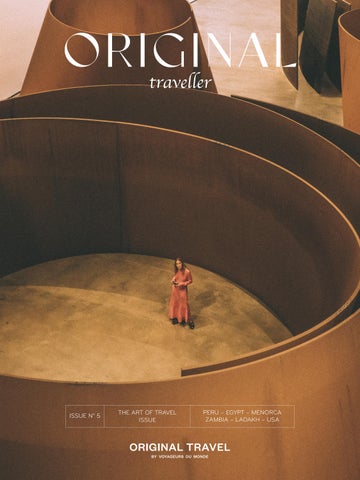
ISSUE No 5
THE ART OF TRAVEL ISSUE
PERU – EGYPT – MENORCA ZAMBIA – LADAKH – USA
Cover shot by Nuria Val and Coke Bartrina, taken inside Richard Serra’s sculpture The Matter of Time, at the Guggenheim Museum Bilbao.
Original Travel 111 Upper Richmond Road London SW15 2TL +44 (0) 20 3911 5900 www.originaltravel.co.uk
ORIGINAL traveller Spring - Summer 2026
E d i to r ’ s L e t te r Welcome to the latest edition of Original Traveller. Inside, you’ll find the usual blend of insightful travel writing, beautiful photography and upcoming travel trends. The theme this time? The Art of Travel. At its most fundamental level, travel is a science. After all, logistics, planning and the careful coordination of multiple moving parts into one seamless whole demands real skill and experience. Yet truly tailor-made travel is more than a sequence of met deadlines and smooth connections. It requires genuine thoughtfulness, the finely tuned instincts of true travel artisans and a deep understanding of our clients’ wishes and desires. That combination can elevate travel beyond science to make it an art form – and not just a flat two-dimensional canvas but a perfectly proportioned sculpture made just for you. Thank you for trusting us with such precious commissions as your holidays. If you buy a product and it fails, you can return it. Holidays are different. They matter on a far more personal level. We know this and relish the responsibility. Enjoy Original Traveller.
TOM BARBER, CO-FOUNDER OF ORIGINAL TRAVEL
original traveller
4
tips
INSIDE TRACK Original Traveller n°5 — Spring - Summer 2026
9
19
68 – 75
MEMENTO
24 HOURS IN...
THE WISDOM OF THE WORLD
Pounamu carving from New Zealand
Athens, with our clued-up Concierge
Travel to broaden the mind
20 — 21
TOP TEN...
Destinations for art lovers 22
HEROES
Project Hiu in Indonesia
10 — 13
76 – 85
ON THE RADAR
THE HEALING HEIGHTS
14
86 – 99
Coming soon to a planet near you
Traditions and rituals in Ladakh
SECRET SAFARI
TRAVEL TRENDS
Wondrous wildlife in Zambia
What’s hot (and what’s not)
100 – 111
THE BASHFUL BALEARIC Menorca comes of age 112 – 125
STATE OF THE ART
23
New Mexico’s creative crucible
FINE LINES
A Saudi design gem 24 — 25
FOOD FOR THOUGHT
The ultimate hopper recipe from Sri Lanka 26 — 27
THE BIG PICTURE
Explore Jane Goodall’s Tanzania 28 — 31 15
BETTER KNOWN
Take a peak at Mozambique 16 — 17
TRIED & TESTED
Good gear means great travel 18
TRAVEL HACK
A clever lunch hunch
INTERVIEW
Voyageurs du Monde CEO Jean-Francois Rial 42 – 55
OUR MAN IN THE ANDES Perusing Peru
126 – 135
OKINAWA
A photostory 136 – 147
NEW WORLD, NEW CREATIVITY The Americas making great again
56 – 67
148
DESERT DREAMS
Exploring Egypt’s oases 5
STAY CURIOUS
Until next time...
original traveller
C o n t r i b u to r s PIE AERTS
TOM BARBER
ANNABEL BRIENS
photographer
co-founder, editor
illustrator
Dutch photographer Pie Aerts captures humanity’s bond with nature through his evocative travel portraits. His photos accompany the Zambia story, written by his wife, Jessica Wintz.
Tom Barber is one of the Co-Founders of Original Travel, which he launched in 2003 after a previous life as a magazine journalist. He edits Original Traveller.
French illustrator Annabel Briens creates elegant, expressive works blending fashion, travel and nostalgia for clients ranging from Hermes to Vogue and now Original Traveller.
CARLOTA DEL SOL
MATHIEU RICHER MAMOUSSE
MIGUEL PALOMINO
photographer
photographer
photographer
Spanish photographer Carlota Del Sol captures intimate, sun-drenched moments across travel, lifestyle and fashion and shot the Menorca story.
Mathieu Richer Mamousse is a Paris-based documentary photographer whose rich, colourful work explores folklore, tradition and life in remote locations like Ladakh.
Miguel Palomino is a Peruvian photographer and professor of photography who lives and works between Lima and Cusco, and chronicles ancestral Andean and Amazonian cultures.
PIA RIVEROLA
STANLEY STEWART
JESSICA WINTZ
photographer
travel writer
writer
Pia Riverola is a Mexico City-based photographer and regular Original Traveller contributor whose poetic compositions and capturing of light really make the New Mexico story.
Stanley Stewart is the award-winning author of many travel books and articles. His contributions regularly appear in Original Traveller, including two features in this edition, on Peru and Egypt.
Jessica Wintz is a German writer whose work spans travel, culture and brand storytelling. She is also one half of a writer/photographer dream team with Pie Aerts.
6
Original Traveller Spring-Summer 2026 Editor Tom Barber Creative Directors Faustine Poidevin-Gros, Olivier Romero Picture Editors Marie Champenois, Daria Nikitina Contributing Editor Ella Mawson Copy Editor Kate Robinson Contributors Pie Aerts, Gigi Aly, Nick Andrews, Francois Armanet, Baptiste Briand, Annabel Briens, Julie Crouzet, Carlota Del Sol, Alexis Doyle, Zoe Isle de Beauchaine, Romain Lapradre, Rebecca Lowe, Mathieu Richer Mamousse, Miguel Palomino, Anna Pihan, JeanFrancois Rial, Pia Riverola, Elisabeth Quin, Stanley Stewart, Brindley Wijesooriya, Jessica Wintz Original Travel 111 Upper Richmond Road London SW15 2TL +44 (0) 20 3911 5900 www.originaltravel.co.uk
By using Carbon Balanced Paper for this magazine Original Travel has balanced the equivalent of 4,401 kgs of carbon dioxide. This support will enable World Land Trust to protect 9,052 square feet of critically threatened tropical forest. Certificate number CBP033381.
original traveller
AROUND THE WO R L D in 24 pages
Carve out some good luck in New Zealand; orientate yourself with the new Orient Express; eat on the cheap in Italy; enjoy both ‘bush and beach’ in Mozambique; take the Seoul plane and a celestial balloon ride; see the best of Athens; help save sharks in Indonesia; hop to Sri Lanka for delectable hoppers; dive into Saudi’s Red Sea and follow a chimp champ to Tanzania. 8
memento
Pounamu j ad e c a r v in g FROM NEW ZEALAND ‘A pounamu jade carving from New Zealand isn’t a typical souvenir – in Maori culture, pounamu is a taonga (treasure), with each design carrying particular meaning: the koru (fern frond) symbolises new beginnings, while the hei matau (fishhook) is thought to bring prosperity and ensure safe passage. This one represents tiki, a figure from Maori mythology associated with fertility, ancestry and good fortune. In Hokitika, on the South Island, we can arrange a workshop with an expert artisan who will carve a piece just for you. The key consideration is that a pounamu gains mana (spiritual power) in the act of giving, so it should be received as a gift, with a simple koha (offering) made to the carver for the workshop.’
Jacqui Brooks, Head of Asia originaltravel.co.uk
9
original traveller
On The Radar INCOMING SOON...
The travel world never sits still, and we keep pace with every shift. Visionary hoteliers, exciting new flight routes, glittering cultural openings and eye-catching design launches are reshaping how and where we explore. From celestial horizons to continent-spanning rail, here is the buzziest news to take your wanderlust to new heights.
L i fe i n T h re e A c t s
Old Brand and Brand New
French hospitality visionary Thierry Teyssier named his company 700,000 heures Impact – in reference to the number of hours in the average lifespan – as a reminder to live life to the full. After creating the enchanting Dar Ahlam kasbah in Morocco, he launched the world’s first nomadic hotel, which settles temporarily in extraordinary destinations around the globe. In 2026, that destination is Rwanda, where Teyssier has added a theatrical twist with performances that unfold across three settings: a lakeside artist’s retreat, a Mukura Forest village and a fishing community. The cast includes nearly 200 actors, dancers, musicians and villagers, and guests are invited to join the story.
Orient Express is arguably the most famous brand in travel, but – confusingly – it’s now actually a tale of two brands, differentiated by a hyphen. First, the Venice Simplon-Orient-Express, owned by French luxury giant LVMH via its Belmond arm, which already whisks guests between London and Paris or Venice in polished mahogany splendour. The hyphen-free Orient Express belongs to another French heavyweight, Accor, guardian of the original 19th-century brand. Accor has already launched its La Dolce Vita trains in Italy and, in 2026, will unveil 17 1920s– 30s carriages restored in a ‘neo-Belle Epoque’ style to reprise the legendary Paris–Istanbul route.
10
on the radar
Sosei, S o n u a n d Ev a
N e w to Namibia
The visionaries behind the Soneva brand redefined luxury travel with two enduring ideas – a genuine commitment to sustainability and the idea of ‘barefoot luxury’. Now Sonu and Eva Shivdasani are innovating once again, as they scout the planet for suitable locations for their new hotel brand, Sosei. Named after the Japanese word for ‘rebirth’, Sosei will encompass both city hotels and remote retreats, each designed to reflect the spirit of its surroundings while adhering to the new brand’s emphasis on wellbeing and sustainability. The search stretches from the Arctic to Japan and beyond, with early whispers of extraordinary sites already under review.
From summer 2026, the award-winning Vestige Collection will unveil four intimate lodges across northern Namibia, creating a circuit through salt pans, savannah and desert. Expect the same understated elegance, meticulous craftsmanship and deep sense of place that define Vestige’s Mediterranean properties. Whether you’re tracking desert-adapted lions at Sorris Sorris, gazing across vast horizons at Omantedeka, exploring the private edges of Etosha National Park at Sheya Shuushona or finding solitude on a prehistoric sand dune at Xaudum, these new retreats promise adventure and refinement in perfect harmony.
11
original traveller
A P ro m i s i n g Ko re a
S u i te D re a m s Down Under
Thanks to the runaway success of Netflix’s K-Pop Demon Hunters, the West’s fascination with Hallyu – the ‘Korean Wave’ of pop culture – shows no sign of abating, as a new generation happily surfs along. Virgin Atlantic is set to join the movement with the launch of daily direct flights between London and Seoul starting in March 2026. Hot on its heels, Aman’s younger sibling brand, Janu, will open a Seoul property in 2027, aimed squarely at the Gen Z travellers who helped spark the K-frenzy. From music and fashion to film and food, Korea’s creative tide keeps rising – and everyone wants in.
In a country famed for its long-distance railways, one of the best ways to truly appreciate the scale of Australia is aboard its most iconic trains. The Ghan travels from Adelaide to Darwin through the Red Centre, while the Indian Pacific crosses the continent between Sydney and Perth. Both will soon unveil a new level of luxury with the launch of the Australis and Aurora Suites in 2026. Inspired by contemporary residential design, the suites feature bespoke timber, stone masonry and iron filigree with softly coved ceilings. Each includes a separate bedroom, personalised minibar, pillow menu, dedicated butler service and exclusive off-train experiences that redefine luxury rail travel in Australia. 12
on the radar
M o to w n ’ s G re ate s t H i t
Celestial Vision
Until recently the acme of urban decay in the United States, Detroit is a phoenix rising from the ashes. Once famous for its car industry, Motor City (hence Motown) is staging a comeback, and the Motown Museum stands at the heart of that revival. The birthplace of soul music’s greatest hits is expanding dramatically, and in summer 2026 the museum will unveil a glittering new 40,000-sq-ft building behind the original Hitsville USA house. Visitors will step through a soaring lobby adorned with portraits of legends like Marvin Gaye and Diana Ross, then explore immersive exhibits, the Ford Motor Company Theater, a cafe and music recording studio. Motown’s hits are Detroit’s new engine of cultural tourism.
Celeste is forging a new frontier in luxury travel: a stratospheric balloon experience from French start-up Zephalto, founded by aerospace engineer Vincent Farret d’Asties. Designed by architect Joseph Dirand, the pressurised capsule will carry six guests in three intimate cocoons 15 miles above Earth and into the dark of inner space. There they’ll dine on fine French cuisine while watching the planet curve away beneath them. The six-hour journey includes a slow ascent, three hours at altitude and a gentle return to ground. Launching in 2026 from a spaceport in France, Celeste promises the ultimate luxury – silence, and the rare privilege of seeing the world from a genuinely different perspective. 13
travel trends
Tr av e l Tre n d s The Original Travel team have their fingers firmly on the pulse of travel. Find out what’s hot, and what’s not. TA K I N G O F F
Dr Sweden will see you now >
<
Racontourists Love turning your travels into stories? Then you’re what we dub a ‘Racountourist’ – part of the growing tribe using trips for journaling, blogging, social media and dinner party fodder. <
Sweden is positioning itself as ‘the world’s first travel destination on prescription’. Its tongue-in-cheek ad campaign promotes the country’s clean air, pristine nature and culture of ice baths and saunas as the ultimate in well-being holidays.
Catching the Night Bus
First, sleeper trains made a comeback; now the (luxury) night bus is having its revival. To the delight of Destination X fans everywhere, Swiss operator Twiliner has just launched a new cross-continental service.
< Sleep Tourism
Sleep tourism is on track to be a £132-billion industry by 2030. The world’s savviest hotels are already in on the act, offering sleep programmes where the only thing on the itinerary is a blissful dose of nothing.
If you prefer a home-from-home experience while travelling, you’re in luck; we work with a network of exclusive hire properties that you can book through us for the wraparound care and safety net of a tour operator.
Group Trips
<
< Homes from Home
Gen Z is ghosting group tours in favour of solo travel. Wander at your own pace, eat what you want, nap whenever – freedom trumps forced fun every time.
< Flight Guilt
Forget flight guilt. Next-gen hydrogen planes are going to change the game, slashing emissions while keeping the thrill of travel alive.
<
Single-Use Trips
Come for the gig (or wedding, tournament, biennale) and stay for the holiday. More than ever, people are travelling abroad for an event or occasion and then staying on for an ‘Encore Escape’.
Jet Lag >
Qantas’ Project Sunrise features the launch of a non-stop London-Sydney flight, alongside research aimed at combating the physical effects of long-haul travel. Expect to see circadian cabin lighting, smarter catering and more space to move.
Safari Chauvinism >
GROUNDED 14
Safaris are evolving – and women are at the helm. Demand for solo female travel has surged 230 percent, while more women are training as guides with all-female initiatives in Botswana, Kenya and Zambia.
better tips known
B e t te r K n o w n MOZAMBIQUE The extraordinarily beautiful Quirimbas Archipelago in northern Mozambique, home to elegant eco-lodges and world-class dive sites, sadly remains off-limits due to security concerns. Worse still, that FCDO guidance has unfairly tainted the rest of the country. It’s time to set the record straight. The south coast, and Benguerra Island in particular, remains very much open and picture-perfect. The clear waters and thriving reefs of the Bazaruto Archipelago National Park offer shelter to dugongs, whale sharks, manta rays, dolphins and nesting turtles. Better yet, Mozambique is now a genuine ‘bush and beach' destination, with a short flight linking Vilanculos (gateway to Bazaruto) and the newly restored Gorongosa National Park. After a remarkable conservation revival, Gorongosa once again embodies the ‘Serengeti of the South’, as it was known in its heyday, where lions, elephants, buffaloes, hippos and antelopes roam free. Aman has noticed too, and intends to open its first sub-Saharan property soon in nearby Karingani Game Reserve. Mozambique is back, and we’ll gladly take the credit for saying so. This section is inspired by the podcast Better Known, where Ivan Wise asks a guest to name six things that currently fly beneath the radar but that should be firmly on it. We think Better Known should be, well, better known, so tune in at betterknown.co.uk
15
original traveller
1
4
5
6
8
Tr i e d a n d Te s te d
2
A selection of the kit the team swear by on their travels. 1) Walking boots, Tom. ‘My Vivo Barefoot Trackers are the best – incredibly lightweight with thin soles that let you feel connected to the ground but comfortable. Every scuff tells a story.’ 2) Water bottle, Holly. ‘My lightweight stainless-steel Bambaw water bottle has rattled around rickshaws and even travelled by yak on my trek around Mount Kailash in Tibet – and it’s still going strong.’
3
3) Journal, Ella. ‘While I’m away, I jot down the date, location and highlights from each day in my Waterstone’s vegan-leather notebook. It’s a lovely way to remember the small details from a trip.’ 4) Dive mask, Rachel. ‘I always buy Mares masks. The shape gives a wide field of view, and a perfectly fitted mask is the single most important piece of dive kit you’ll ever own.’ 5) Waboba ball, Oliver. ‘Travelling with two sporty young sons makes a Waboba ball a packing-list essential as it bounces off water for daring, diving catches. Top tip: always take two – one inevitably disappears.’ 7
6) Carabiner, Owen. ‘This trusty carabiner has summited the highest peaks on three continents – Kilimanjaro in Tanzania, Elbrus in Russia, and Aconcagua in Argentina – and made it to Everest Base Camp for good measure.’ 6
7) Satellite communicator, Andy. ‘I often venture well beyond mobile coverage, and I’ve used my lightweight Garmin to check maps at 18,000ft in the Himalayas and send texts from a dive boat 550 miles off Costa Rica.’ 8) Camera, Tom. ‘I know, I know – phone cameras are brilliant now – but the Canon PowerShot G16 is a classic. A proper camera that slips easily into a jacket pocket and takes beautifully crisp photos.’ 9) Lanyard, Valeria. ‘My lanyard means I can slip my phone into my pocket. It once proved its worth when someone tried to snatch my phone – only to discover it was firmly attached to me!’
9
10) Kikoy, Jamie. ‘A kikoy (I get mine from Kenya Kanga Collection) is the ultimate travel companion: skirt, scarf, head or face covering, nightwear, makeshift towel, or an extra layer on a chilly morning safari drive.’
10
travel hack
Tr av e l H a c k MICHELIN LONG LUNCHES
‘
Italy is home to a constellation of Michelin-starred restaurants. Eating at one of them on your trip is a great way to experience the country’s most innovative culinary creations, but excellence comes at a price. Our cunning travel hack? Book a table for lunch instead of dinner, and you can dine like royalty for far less, with lunch tasting menus often half the price. Not all of Italy’s Michelinstar restaurants offer a set lunch, but we can recommend those that do. Try Il Pagliaccio in Rome (the fourcourse lunch menu served on Saturdays is to die for) or Osteria del Viandante, near Modena, in the gastronomic heartland of Emilia-Romagna, for the three-course seasonal tasting menu and world-class wine list. Long lazy lunches never tasted better – and you’ll still have the evening free for aperitivo.
’
© Belmond/Splendido
EMILY RISTER, ITALY SPECIALIST
18
24 hours
24 H o u r s i n . . . At h e n s WITH OUR CONCIERGE
Our clued-up local Concierges are the ultimate insiders. Who better to plan the perfect day?
9.00am
10.00am
11.30am
Walk (or take a cab) to the top of Lycabettus Hill for a small, strong Greek coffee at Prasini Tenta and wonderful views of the city and sea beyond. It's a great way to get your bearings.
Visit the Benaki Museum and its shop, where you can buy amazing replicas of ancient Greek pottery and sculpture. Don't worry, I'll arrange for everything to be delivered to your hotel!
Walk to the perfectly preserved Panathenaic Stadium, first used in the fourth century BC, then rebuilt in marble by the Romans, before being restored for the first modern Olympics in 1896.
1.00pm
C o n c i e rg e
4.00pm
Head to Cherchez la Femme for lunch. There’s always a great atmosphere and the keftedes (meatballs) with spearmint and yoghurt are great with a cold NYMFI lager, brewed in Thessaloniki.
A traveller at heart, Julie followed her wanderlust through China and Europe before settling in Athens. She spends her time exploring the city and sharing her experiences.
Walk to the Temple of Hephaestus in the Agora, and then the Acropolis. Go late afternoon, when the cruise ship crowds have gone, the heat has eased and the light is beautiful.
7.00pm
8.30pm
10.30pm
You’ve earned a drink! The GB Roof Garden at Hotel Grande Bretagne has incredible views of the sun setting behind the Acropolis – best enjoyed while sipping an Athens Spritz (vermouth, prosecco, white peach and jasmine soda).
Although it's a bit outside the city, AbraOvata restaurant, beside Vouliagmeni Lake, is worth a visit – especially at night, when the lighting and reflections on the water are particularly beautiful. The sea bass tempura is reason enough to make the trip.
Krabo, a beachfront bar on the glamorous Athenian Riviera, serves very good seasonal cocktails concocted by the resident mixologist. And the people watching is even better.
19
4
6
9
5
2
8
10
3
1 7
1
21
BRAZIL (4) Brazil redefines creativity on its own terms. Oscar Niemeyer’s sweeping modernist architecture in Brasília and Rio remains a monument to visionary design, while the Museu de Arte do Rio and the vast outdoor collection at Inhotim channel that same bold, free-flowing spirit.
EMILIA-ROMAGNA, ITALY (3) Emilia-Romagna is Italy’s under-the-radar art hub. In Parma, Leonardo da Vinci’s La Scapigliata (known as the ‘lady with dishevelled hair’) glows quietly in the Galleria Nazionale – small, exquisite and often yours to appreciate alone. Ravenna’s Byzantine mosaics, widely considered among Europe’s greatest masterpieces of early Christian art, shimmer with celestial light.
TASHKENT & BUKHARA, UZBEKISTAN (2) Uzbekistan is emerging as Central Asia’s unexpected art powerhouse. In Bukhara, a dynamic biennale sets contemporary works against ancient mosques and madrassas. Far to the west, the Karakalpakstan State Museum of Arts in Nukus – the so-called ‘Louvre of the Steppe’ – houses the remarkable Savitsky Collection of once-banned Soviet avant-garde masterpieces.
NAOSHIMA & THE INLAND SEA, JAPAN (1) Cutting-edge contemporary art meets traditional fishing villages on Naoshima Island in Japan’s Seto Inland Sea. Yayoi Kusama’s famous pumpkin sculpture and Tadao Ando’s minimalist architecture make for an art pilgrimage like no other. Be sure to visit the neighbouring islands of Teshima and Inujima, also part of the Benesse Art Site Naoshima, and home to remarkable museums and installations.
THE BASQUE COUNTRY, SPAIN (7) Bilbao’s Guggenheim Museum, designed by starchitect Frank Gehry, sits alongside the city’s old docks like a shimmering titanium vessel, a nod to the Basque capital’s ship-building past. Meanwhile, Basque artist Eduardo Chillida eschewed buildings altogether, placing his large steel sculptures along the coast around his beloved San Sebastian. Chillida-Leku, his open-air museum, is home to many more monumental works.
THE SOUTH OF FRANCE (6) The South of France was modern art’s greatest muse, its light and landscape inspiring the likes of Van Gogh, Matisse and Picasso. In Saint-Paul de Vence, the Fondation Maeght houses one of Europe’s finest modern collections, while at the legendary Colombe d’Or Picasso, Miro, Calder and Chagall once paid their tabs with the paintings that still adorn the walls. Stay at Chateau la Coste for the on-site exhibitions and the amazing Art and Architecture walk.
MARFA, TEXAS, USA (5) A mirage of minimalist art suffused with frontier spirit, Marfa is a desert outpost turned cultural pilgrimage site. Donald Judd’s visionary installations transformed this once-sleepy ranching town into a modern art mecca, where concrete cubes punctuate the landscape, vast hangars hold monumental works and the iconic Prada Marfa store stands as both sculpture and satire against the expansive Texas horizon.
Contact one of our destination specialists on: +44 (0) 20 3911 5900
MEXICO CITY, MEXICO (10) From Frida Kahlo’s Casa Azul to Diego Rivera’s vast murals to the cutting-edge galleries of Roma and Condesa, Mexico City hums with an irrepressible artistic energy. The Museo Tamayo and Museo Jumex champion contemporary global voices and local talent, while a vibrant street art scene transforms neighbourhood walls into open-air galleries.
CAPE TOWN & THE WINELANDS, SOUTH AFRICA (9) Cape Town is Africa’s contemporary art capital. At its heart, the Zeitz Museum of Contemporary Art Africa occupies a soaring converted grain silo, while galleries in Woodstock and the V&A Waterfront champion bold new voices from across the continent. Beyond the city, the Winelands pair fine art with fine wine – think sculpture gardens on Stellenbosch estates and elegant galleries among the vineyards of Franschhoek.
VIENNA, AUSTRIA (8) Vienna wears its artistic legacy with effortless grandeur. The golden-domed Secession building still declares ‘to every age its art and to every art its freedom’ above Klimt’s shimmering Beethoven Frieze, while the Kunsthistorisches Museum houses Old Masters on an imperial scale. In the MuseumsQuartier, contemporary galleries now fill former stable blocks, and the Leopold Museum – home to works by Schiele, Kokoschka and more – is an unsung gem.
Seeing great art remains one of travel’s most rewarding pursuits. And while the usual suspects – Paris, New York, Madrid, Amsterdam – still maintain their allure, true connoisseurs look further afield. We’ve mapped an atlas of alternative destinations for art lovers that deserve a visit of their own.
DESTINATIONS FOR ART LOVERS
To p Te n . . .
top ten
P ro j e c t H i u HEROES Based in Lombok, Indonesia, Project Hiu (hiu means ‘shark’ in Bahasa Indonesian) was founded by ocean conservationist Madison Stewart to tackle one of marine conservation’s lesser-known crises: shark fishing. As apex predators, sharks are vital to maintaining balance in marine ecosystems, helping to keep populations of other species in check. Unfortunately, generations of local fishermen have caught sharks to survive, their livelihoods bound to a trade that threatens both the species and the surrounding reefs. Rather than condemn them, Project Hiu offers an alternative: tourism. Through education and collaboration, former shark fishermen are retrained as guides, skippers and snorkel instructors, sharing their knowledge of the sea with visitors, who come to swim alongside living sharks rather than see them hauled ashore. The initiative provides new income streams that protect these ecosystems while supporting coastal communities. Project Hiu stands as a model of pragmatic conservation – proving that empowerment, not punishment, is the surest way to preserve Indonesia’s extraordinary ocean life for generations to come.
22
fine lines
Architecture
Fine Lines
SHEBARA HOTEL, RED SEA, SAUDI ARABIA Saudi Arabia is a new destination for Original Travel in 2026. We will be curating tailor-made trips to the likes of the old oasis city of Al-ula and the Nabatean tombs at Hegra, but Saudi’s Red Sea coast is also shaping up to be a hugely promising destination. It’s early days yet, but this pristine stretch of coastline is set to host 50 new resorts, each designed by world-renowned architects in spectacular locations. Of the handful open so far, Shebara is the most astonishing. Located off Sheybarah Island, this futuristic resort – by Killa Design – embraces full UFO aesthetics, with villas and restaurants housed in stainless steel overwater orbs that mirror the ever-shifting colours of the sea and sky. Inside, Studio Paolo Ferrari has paired high-tech detailing (bar cabinets that open at a touch) with exquisite craftsmanship in leather and ebony. Yet for all its space-age brilliance, the real wonder lies beneath the waves: a pristine reef system, teeming with marine life and coral that has thrived undisturbed for millennia. Contact one of our Saudi Arabia specialists on: +44 (0) 20 3911 5900 23
Fo o d fo r T h o u g h t In Sri Lanka, food is as much about ritual as it is nourishment, and few dishes embody that spirit better than the humble hopper – the endlessly adaptable, bowlshaped rice pancake known locally as appa. Equally satisfying at breakfast or dinner, made sweet or savoury, and served from a street stall or at a smart brunch, the hopper is the defining dish of one of the world’s great cuisines. Chef Brindley Wijesooriya remembers his grandmother making hoppers for her 11 grandchildren: ‘Instead of chilli condiments, we had them with butter and strawberry jam – something I probably shouldn’t admit I still enjoy to this day.’ The classic egg hopper is best with seeni sambol, a glossy, sweet-spicy relish of caramelised onions, though a spoonful of dhal and a rich chicken or fish curry take it to another level. ‘You can use a small wok,’ Wijesooriya says, ‘but ideally hoppers should be cooked in a half-spherical appa thaachchiya pan – its gentler heat distribution and curved sides make for lacy edges crisped to perfection.’ If you’re staying in Colombo, we can arrange a hopper masterclass with Wijesooriya himself.
SRI LANKAN HOPPERS MAKES 8 INGREDIENTS
250g rice flour, 200ml coconut water, 2g dry yeast, 250ml coconut milk, 2 tablespoons sugar, 1 teaspoon salt, 1 egg per serving (for a classic egg hopper)
METHOD
1 Combine the rice flour, coconut water and yeast into a dough-like paste. Cover and set aside to ferment for 24 hours. The mixture has fermented when you begin to see bubbles on the surface. Gradually add the coconut milk to form a very thin batter.
2 Cover the batter and set aside for a further 30-40 minutes, then add the sugar and salt and mix thoroughly.
3 Warm a pan over medium heat and pour in a ladle of batter. Swirl it around to coat the inside, then cover and cook for about 45 seconds. Remove the lid and cook until you achieve those perfect crisp edges. 24
food for thought
25
original traveller
T h e B i g P i c t u re LAKE TANGANYIKA, TANZANIA Jane Goodall was a true pioneer. Her celebrated career began in 1960 when, at just 26 and without a university degree, she arrived in the ancient forests on the shores of Tanzania’s Lake Tanganyika to study wild chimpanzees – work that would revolutionise our understanding of our closest relatives. Through patient observation, Goodall discovered that chimps make and use tools, maintain complex social hierarchies and display emotions in ways remarkably similar to humans. She gave the chimpanzees names rather than numbers – David Greybeard, Flo, Frodo – and documented their distinct personalities, approaching them not as research subjects but as individuals. Her deep empathy and unconventional methods, initially criticised by the scientific establishment, revealed profound truths about the blurred line between human and animal. Today, just a few miles from where she worked lies a glorious lakeshore lodge backed by mountain slopes. From here, you can trek into thick forests with expert trackers and sit with a group of habituated chimpanzees. In this faraway Eden, time slows, nature reigns supreme and Goodall’s decades of devotion to this place suddenly make perfect sense. Contact one of our Africa specialists on: +44 (0) 20 3911 5900
26
the big tips picture
27
original traveller
J e a n - Fr a n c o i s Rial CEO OF VOYAGEURS DU MONDE
interview
Jean-Francois Rial is the CEO of Voyageurs du Monde, the French tour operator that has been Original Travel’s parent company since 2017. He is an ardent campaigner for a global environmental policy, proposing solutions to make the travel sector part of a sustainable approach. He also has an organic vegetable farm in the Orne region of France. INTERVIEW WITH TOM BARBER, CO-FOUNDER OF ORIGINAL TRAVEL
28
interview
What is the origin story behind Voyageurs du Monde? In 1992, I spent a month, alone, in the Algerian Sahara exploring places like Tassili n’Ajjer, home to extraordinary prehistoric cave art, and the amazing rock formations of Tin Akachaker. I felt such a profound aesthetic and spiritual shock that I decided to change my life. When I returned to Paris, I left finance (I was managing director of Fininfo, a financial data company) to take over the small travel company Deserts and then, in 1996, Voyageurs du Monde, with four friends, Alain Capestan, Lionel Habasque, Frederic Moulin and Loic Minvielle, who are still the core management of the company.
It’s very simple. We were looking to expand into the English-speaking market, starting with the UK, and I researched all the British tour operators. Original Travel immediately stood out as the one that most resembled us. With its sense of aesthetics, attention to detail and personalisation, there was no doubt that we spoke the same language. As a former magazine journalist, I have always appreciated your focus on the aes t hetic side of travel. Our aesthetics are designed to help reveal the truth about a country. Plato said, ‘beauty is the splendour of truth’, and I believe the purpose of beauty is to illuminate truth and reveal deeper realities. I remain convinced that beauty is not subjective but instead universal: for instance, everyone agrees that sunrise over the Nile is beautiful.
30 years later, how would you describe the essence of Voyageurs du Monde? At the heart of everything we do is a simple belief: we should help our clients truly understand a destination. Our job is to offer maximum authenticity, shaped entirely around their interests. This approach is rooted in the core values that shape Voyageurs du Monde and, of course, Original Travel – especially our refusal to deal in clichés. That spirit filters through everything, from how we develop new destinations to how we think about our services, sustainability and storytelling. On the subject of storytelling, we are very excited to have a lovely Assouline coffee table book coming out this year to celebrate our 30th anniversary.
As someone who has had the great pleasure of seeing sunrise from our flagship, Steam Ship Sudan, I completely agree with that. In all my travels, that cruise is one of the most memorable experiences I have ever had. Tell us the story of how you found her. In 2001, Alain and I were wandering along the quayside one night in Cairo when we came across a dilapidated ship. You could see a faded name on her hull: Sudan. We soon discovered that this was the last surviving Thomas Cook paddlesteamer from the Belle Epoque of Nile travel and the very boat on which Agatha Christie sailed before writing Death on the Nile. This was the
Please share the story of how you invested in Original Travel. What did you see in us?
29
original traveller
And what does our group do differently regarding sustainability? Our commitment plays out on two fronts. First, we look at ways we can reduce the carbon footprint of our passengers and staff. For example, we always recommend trains when they are a realistic alternative to planes – especially in Europe. With flights, we have developed a new carbon calculator which consultants use to compare the levels of emissions generated by each flight, using data like flight plans, target occupancy rate and aircraft type. On an otherwise seemingly identical flight, the difference in emissions can be as much as 50 percent, so we can definitively calculate the difference in emissions and present them to our clients to make an informed decision.
beginning of an extraordinary 15-year restoration project, drawing on ancestral skills and craftsmanship to preserve the soul of the boat. In the engine room, a small technical revolution reduced Sudan’s impact on the environment. This wild gamble has turned out to be a success because its guiding principle was love, not profit. To me, this vessel has irreplaceable emotional value, because the project was guided by my father, Odilo, together with other people who are very dear to me: Christine, Nathalie, Alain, Amir, Fabien, Philippe. A ‘crew’ whose efforts are still writing the story of the SS Sudan today. You mention the efforts to make Sudan more sustainable, and the subject is clearly close to your heart, but as people who work in the travel industry, can we really justify encouraging our clients to fly around the world? My answer is a firm ‘yes’. To consider banning air travel or restricting its use would be a serious denial of democracy. Conversely, doing nothing about CO2 emissions related to air transport as a whole –on the pretext that other activities represent a much worse factor in global warming – is just as absurd. I support a blend of solutions.
In destination, we offer, where possible, electric vehicles. In terms of accommodation, we try to always favour hotels with small capacity, and responsible environmental and social policies. At Satyagraha House, our lodge in Johannesburg, once home to Gandhi, 50 percent of electricity consumption is provided by a solar installation. Our two boats on the Nile – Flaneuse du Nil and Steam Ship Sudan – have undergone major technological transformations aimed at reducing their energy consumption. The Flaneuse du Nil is now equipped with 50 solar panels and an ingenious system powered by recycled electric vehicle batteries which continuously optimises electricit y consumption. On Steam Ship Sudan, solar panels and new generators and electrical networks have
Such as? The switch to synthetic fuels proposed by various airlines. Not hydrogen or biofuels, because neither is ready yet, but a mixture of green hydrogen and CO2 which has the technical advantage that it can be used by existing planes, without modification.
30
interview
seen a fourfold reduction in fuel consumption since 2001.
need to reduce greenhouse gas emissions at the same time with a revised goal of carbon neutrality by 2075, and the maintenance of the +2°C target from the Paris Agreement. I know this vision will be seen as utopian, but we need to deal in solutions!
What is the second approach you mentioned? The aim is to help absorb all the carbon emissions linked to our client and staff travel through reforestation projects. We have now achieved 100 percent absorption and want to go further. Despite residual skepticism, tree planting remains one of the most effective solutions. Mangroves are a particularly beneficial ecosystem: they help absorb carbon, desalinate soil, increase biodiversity and help to revive local fishing industries. The projects are controlled by independent auditors, and exist in South America, India and Indonesia via our Foundation. Sadly, the IPCC’s global objectives to limit climate rise, even by two degrees, will not be met, so we must accelerate our reductions in CO2 emissions. I propose planting 180 billion trees over ten years around the world. This would make it possible to ‘buy time’ and to keep targets achievable.
What next? The release of the book is designed to start the conversation. I would like to see heads of state, both those in power and retired, take charge of the project. It must be managed by a private structure coordinating with nations, NGOs, companies and wealthy individuals. Elsewhere, the airlines must show what they are doing to reduce their footprint and not give in to the ‘ayatollahs’ of ecology who criticise those who act more than those who do nothing! We must defend the global position that we propose.
An English edition of Jean-Francois's new book, Defy Climate Chaos, is out now.
This is the subject of your new book, Defy Climate Chaos, co-authored with Matthieu Belloir, right? Indeed. My firm conviction – and I am not saying that it will be simple – is that planting billions of trees is the only realistic solution. Professor Tom Crowther, from the Zurich Institute of Technology, calculated that the number of trees we could add to the existing 3,000 billion, without disturbing farmland and human activities, was 900 billion trees. What we propose in my book is to be realistic and ‘only’ plant 180 billion trees. Even at this rate, we
31
original traveller
Our C o n c i e rg e Service Our clued-up local Concierges take your trip to the next level. Your local hero, your fixer, your eyes and ears, your far-flung friend, your informed insider, your right-hand man, your wing woman; your Concierge is on hand 24/7 to help, advise, reserve, modify and generally anticipate your every need while you’re in their beloved destination. They also love a challenge, so go ahead: put them to the test. Want the address of the best bar in town, far off the tourist trail? Or a suggestion for a truly original souvenir to remember the trip by? Ask away. Nothing’s too much trouble or too trivial for them to handle. They can, and will, take an already stellar trip to even greater heights. Before you even set off on your adventure, your dedicated Concierge will have been sent all of your trip details and your likes and dislikes. When you arrive, they’ll be in touch to remind you that they’re on hand to help (via phone, WhatsApp etc) with everything from last-minute changes, to tips on where to go and what to see and do. Thanks to their in-depth knowledge and passion for their destination, and taking your individual profile into account, your Concierge will be able to help with any requests. They can find you the best babysitter in the area, choose a guide best suited to your specific interests and, if needed, change a flight, find a room and iron out any kind of issue while you focus on having as fun and fascinating a trip as possible. As part of Voyageurs du Monde, Original Travel is the only travel company in the UK to offer such a comprehensive concierge service.
Contact one of our specialists on: +44 (0) 20 3911 5900
32
tips
Spain
CO N C I E R G E CASE STUDIES FROM AROUND THE WORLD
Upon returning from hiking in Donana National Park, James and Anna realise they’ve locked the car keys in their hire car. Our Concierge, Maria, orders them a taxi and tells the couple to go ahead with their lunch plans nearby while she takes care of it. After a wonderful lunch, James and Anna return to the car to find a locksmith with the keys and their car unlocked.
India
Australia
As huge Bollywood fans, David and Emily are on a private guided tour of a Mumbai film set. Our Concierge, Alisha, surprises them with the opportunity to act as extras on a live film set. Ecstatic, the couple are dressed in traditional costume and join the cast. Alisha later sends them a memory stick with video evidence for posterity!
After enjoying a family surf lesson on Bondi Beach, the Greenwood family rush back to their hotel to be in time for their dinner reservation. On arrival, they read a note from our Concierge, Denis, saying, ‘I hear your surf lesson ran over, so I moved dinner back by an hour. I thought you might like more time to celebrate catching your first waves!’
South Africa
Indonesia
The Brayshaw family wake up in Cape Town ready to start their beach day, only to open the curtains and discover that it’s raining. They call local Concierge, Carol, to find out what there is to do in the area with their girls (aged five and seven). Carol recommends they head to the Cape Town Science Centre, which has lots of indoor activities and interactive exhibitions for children.
Charlie and Jenny are in Java visiting Yogyakarta when our Concierge, Eloise, informs them that there is a ballet performance of the great Hindu epic the Ramayana that evening at the beautiful ninth-century Prambanan Temple. The couple are eager to go, so Eloise sorts out a pair of VIP tickets and transfers from and back to their hotel.
Colombia While travelling in Tayrona, Tom discovers his son’s laptop has failed, just as he needs to finish his dissertation. Tom calls Luis, the Concierge, who quickly secures an emergency Apple repair appointment in Cartagena and an English-speaking guide to accompany them. The issue is resolved, the deadline is met and the trip continues smoothly. History is silent on the dissertation grade. 33
original traveller
100% Carbon Absorption We absorb 100 percent of the carbon footprint generated by our client and staff flights and ground transportation through our financing of large reforestation projects around the world. As part of Voyageurs du Monde, our participation – alongside eight other European groups – in the €100m Livelihoods Carbon Fund fights global warming by taking a highly practical approach and having a strong local social and economic impact. We believe that we are the first company in the UK travel market to be taking such a step.
3 KEY
IDEAS
Each trip made by our clients and staff has a measurable impact on global warming. We can calculate precisely the amount of CO 2 emissions related to our clients’ and team’s travels. This makes it possible to know the exact number of trees that need to be planted in order to absorb the CO2 created.
spotlight
What is carbon neutrality?
Today, air transport accounts for three percent of global greenhouse gas emissions, and this is rising exponentially. If technology continues to advance, it will become increasingly difficult, over the next few years, to travel ‘clean’. The only concrete option is to absorb C02 emissions, particularly through tree planting. By financing reforestation projects around the world, we contribute to the absorption of carbon dioxide. Every day, nearly 1,400 trees are planted, or about 500,000 trees a year.
2 03 0 i n t h e
1,400 TREES PLANTED DA I LY
How does carbon absorption work?
According to the IPCC (Intergovernmental Panel on Climate Change), we only have until 2030 to reduce our CO2 emissions by 50 percent to stay below a temperature increase of 1.5°C – the critical threshold of global warming. The second phase involves achieving carbon neutrality by the year 2050, an extreme goal but one that is achievable if all countries and industries work together... starting today.
Solutions exist! The airline industry already has the means to reduce its ecological impact. We encourage tourism stakeholders to follow three essential points: • Develop technology to reduce the use of aviation fuel • Fund the transition to green hydrogen • Absorb the CO2 balance through reforestation projects financed by a targeted tax
3 MAJOR
R E FO R E S TAT I O N
P R O J EC T S
100%
CARBON NEUTRAL
2.87
TO N N E S
OF
CO 2
This is the carbon footprint of a return flight from London to New York – one-and-a-half times the annual quota that each person should meet in order to maintain a reasonable level of global warming. To absorb CO2 emissions from these flights, approximately 20 trees should be planted.
1 4 0 P R O J EC T S s u p p o r te d
Our Foundation, created in 2009, supports a number of humanitarian projects in developing countries in Africa, Asia and South America. Since 2009, nearly £1.5m has been invested in the support of over 140 projects in 30 countries.
In Indonesia
In Senegal
In Rwanda
The island of Sumatra has lost 50 percent of its forest in 40 years. NGO Yagasu has replanted 18 million trees. It also carries out social actions, participates in scientific research and contributes to mammal protection.
Since 2006, the association Oceanium has worked for the protection of the environment and the restoration of the mangrove. In total, 80 million trees have been planted.
In Rwanda, the NGO ARCOS’s agroforestry project aims to plant 3.7 million trees, train 30,000 farmers in sustainable agriculture and sequester more than 2.2 million tonnes of CO2 over 20 years.
Contact one of our specialists on: +44 (0) 20 3911 5900 34
tips
35
original traveller
At Original Travel, we believe travel and tourism should be a force for good and have a pos itive im pact on the destinations we visit. As pa rt of Voyageurs du Monde, our Foundation, created in 2009, supports a number of humanitarian projects in developing countries in Africa, Asia and South America. Since 2009, nearly £1.5 million has been invested in the support of 140 humanitarian projects across 30 countries. 5 KEY AREAS
15% OF OUR BUDGET
Our Foundation Committee meets annually to select the programmes we will support. We focus on five key areas: child protection, vocational training, economic development assistance, preservation of cultural and natural heritage, and safeguarding the lifestyles of Indigenous peoples.
In addition, we also look to support emergency relief efforts in the face of large natural and humanitarian disasters. We spend almost 15 percent of our Foundation's budget each year on emergency humanitarian aid.
36
our foundation tips
In practice
In practice
CASE STUDY N°1
CASE STUDY N°3
In Bolivia
In India
We’re working to improve the living standards of village communities in the province of Jose Manuel Pando, where 98 percent of the population live in poverty. We support the ‘Weave the Future’ project, which trains local farmers to turn wool into high quality local crafts and textile products they can sell to supplement their income.
Due to climate change, the number of mangroves in India’s Sundarbans region is rapidly declining. Our project aims to plant more than 16 million mangrove trees to protect the local communities’ homes and farmland from flooding and to restore local biodiversity. So far, over 12,300 acres have been replanted, positively impacting 250,000 locals and counteracting 700,000 tonnes of CO2.
In practice CASE STUDY N°2 In Morocco Education For All (EFA) runs boarding houses near secondary schools in Morocco’s Atlas Mountains so that girls from remote villages can continue their education. The boarding houses all have comfy dormitories, hot showers, communal areas with computers and books, and kitchens where the inhouse team rustle up nutritious meals. Since they launched in 2007, over 200 EFA-assisted girls have enrolled in university, and the organisation averages a 90 percent pass rate for the Baccalaureate exam – well above the country average. Our Foundation contributes the monthly rent for the boarding house in Asni.
Contact one of our specialists on: +44 (0) 20 3911 5900 37
original traveller
Original Services Our Original Services set us apart from the competition. Book a holiday with Original Travel and all of these services come as standard...
Detailed Dossiers Our destination dossiers highlight restaurants, shops, museums and more, and only feature places we’ve visited ourselves
AT THE AIRPORT
B E FO R E YO U R H O L I DAY
Contact one of our specialists on: +44 (0) 20 3911 5900
Fa s t- Tr a c k Services At UK airports, our greeter will speed you through check-in and security where possible
Financial P ro te c t i o n
24 - H o u r Helpline
C h i l d re n ’ s Fu n P a c k s
With our ATOL and ABTA licences, your holiday is fully protected
For the unexpected and the unplanned, we’re on call 24/7 to offer assistance
Specially designed and destinationspecific quizzes and games for every child aged three to ten
38
tips
O n e Po i n t of Contact
Hold Airline S e at s
B o a rd i n g Passes
Our destination expert will create a perfectly tailor-made itinerary for you
While fine-tuning your itinerary, we’ll be holding airline seats to make sure you’re all sitting together on the plane
We check you in for your flight and send your boarding passes the day before departure
Pe r fe c t Picks
B o r ro w a G o P ro
We provide you with destination-specific reading lists and music playlists
Borrow one of our GoPro cameras if you’re going on an Original Diving holiday
UK Airport Lounges
DURING YO U R H O L I DAY
Enjoy the comfort of an airport lounge with free drinks and snacks, even if you’re flying economy
Expert Guides
Re l i a b l e Wi-Fi
Our App
We use the best guides in the business, many of whom work exclusively for us
We provide you with a virtual eSIM card, so you have Wi-Fi access no matter how remote your destination
Access your itinerary, maps, live updates and detailed destination dossiers on our mobile app
39
LIFE
is in the Detail
Take a deeper dive into some of our favourite destinations.
42 – 55
OUR MAN IN THE ANDES
Stanley Stewart hits the heights in Peru... 56 – 67
THE OTHER OASES REUNION
... and follows in Alexander the Great’s Egyptian footsteps 68 – 75
THE WISDOM OF THE WORLD An illustrated guide to the globe 76 – 85
THE HEALING HEIGHTS
Zoe Isle de Beauchane in Ladakh 86 – 99
SECRET SAFARI
Jessica Wintz explores under-rated Zambia 100 – 111
THE BASHFUL BALEARIC
Tom Barber falls for Menorca 112 – 115
STATE OF THE ART
Elisabeth Quin & Francois Armanet in New Mexico 116 – 135
OKINAWA ON CAMERA
Romain Lapradre captures Japan’s southern archipelago 136 – 147
NEW WORLD, NEW CREATIVITY The Americas making great again
original traveller
42
tips
Our Man in the Andes
Stanley Stewart hits the heights in the Peruvian Andes.
words by STANLEY STEWART photos (from a separate trip) by MIGUEL PALOMINO
43
original traveller
S
omewhere near the top of the pass, we met Laura. A child, aged perhaps seven or eight, she was with her mother, Alicia. The two were dressed identically, Alicia, in a riot of material: layers of wide pollera skirts, bands of puyto embroidery, a rustcoloured woollen jacket, cummerbunds, woven bags, multicoloured shawls known as k’eperina. Laura, a miniature version of her mother, was draped in the same patterns, the same layers of intricate design and colour, and wore the same tasselled hat. Side by side on the mountain path, they looked like two stages of a set of Russian nesting dolls. He ads tilted together, they spoke to one another in Quechua, the soft sibilant language of the Incas.
It seemed remarkable to meet anyone up there, on foot, in that remote place. Austere summits reared against the sky, shredding banks of cloud. Below us, empty valleys stretched away, tipping over distant horizons. A deep stillness settled on that high place, the kind of stillness you draw deep into your lungs with each breath. Laura and her mother seemed to materialise out of the clouds, out of the mountain air.
I was setting off on the Lares Trek, the kind of soft Andean adventure that wouldn’t involve drying my socks on tent poles. Days would be spent striding across mountainsides that were extraordinarily picturesque but not overly arduous, followed by evenings in comfortable lodges, enjoying good food and wine, log fires and hot tubs, and silent nights between crisp linens.
Then something odd happened. Laura wanted to shake hands, rather formally, as though she was some kind of welcoming committee. Her hand felt small and cold and chapped in mine. And then she introduced herself with what was her only phrase of English. ‘My name is Laura,’ she said, simply and earnestly, as we stood there together at the top of the pass in that wilderness of Andean summits.
Aside from the luxury of high-end lodges, the cunning plan here was flexibility. Though the treks were set up as small group tours, each day could be tailored to an individual guest’s ability and interests, such as mountain biking, rafting or bird-watching. Other options included archaeological excursions and cultural visits to remote villages to discover the region’s astonishing weaving traditions. The intensity of the actual trekking could be
44
peru
adjusted daily to one of three levels – easy, moderate or strenuous. Should the day’s exertions leave you feeling creaky, you can even opt for a leisurely drive to the next lodge. But it’s unlikely you would. For who would want to miss the condors’ slow-motion gliding as they circle the summit of Pitusiray, or the hike down the Inca stairway to the citadel of Pisac, or the chance to meet Laura on a remote mountain pass, walking home with her mother? The immensity of these mountains can shake you out of yourself, challenge your presumptions and change your perspectives – they can make you wonder. From Cusco – meaning ‘navel of the world’ in Quechan – we had taken the high road across an altiplano of golden wheat. Then,
with the kind of drama that passes for normality in the Andes, the road plunged suddenly downward through red gorges to the Sacred Valley and the river the Inca called Willkamayu, the ‘sacred river’. At midday, we rolled into Pisac to find the market in full swing. Dark-skinned chaps in cowboy boots lingered in the arcades of the main square, discussing potato crops, while beneath the boughs of the ancient pisonay tree in front of the church sat clusters of women in spectacular skirts, colourful vests and striking hats. A thesis could be written on Peruvian hats; Peru is the world capital of millinery. There are bowler hats and stevedore caps, and the kind of homburg Churchill waved to
45
cheering crowds at the end of WWII. There are elaborate floral hats that would have been met with approval in Kansas on Easter Sunday in the 30s. There are hats resembling fruit bowls, tea cosies, upturned jelly moulds and tasselled lampshades. I bought a modest Indiana Jones job, just to fit in, and then set off to explore the Inca citadel of Pisac, overlooking the old town and the valley. Tiers of intricate stone walls rise to the Templo del Sol, a match for anything at Machu Picchu. At the top, the Incas – and here, perhaps, is the first whisper of delusion – had carved a hitching post for the sun. Though the Inca may feel like an ancient civilisation – the mammoth stone works,
46
47
original traveller
‘
The Inca citadel of Pisac, overlooking the old town and the valley, has tiers of intricate stone walls that rise to the Templo del Sol, a match for anything at Machu Picchu.
‘ the go d -like em p er o r s, t he hu man sacrifices – their empire only reached its peak in the late 15 th century, when the Renaissance was already becoming yesterday’s idea. But the fact that they seem to inhabit the wrong epoch is just part of their uncanniness. To the untutored eye, the Inca look like the eccentrics of world civilisations, and it’s not just the repeated attempts at brain surgery and skull modification. So much about the civilisation doesn’t quite seem to make sense. Even that seminal moment – when fewer than 200 exhausted Conquistadors routed an Incan army of over 40,000 at Cajamarca – reads like farce. Perhaps the most obvious example of derangement was a kind of stone masonry OCD. Walls could never be perfect enough. The Inca were obsessives: they built without mortar, fitting colossal blocks of cut stone together so precisely that, five centuries on, you still couldn’t slide a cigarette paper between them. Had the Inca not spent so much time and effort smoothing stones, they might have got round to inventing writing or the wheel. Had they put the chisels down for a moment, they might have prevented Pizarro’s rag-tag band from overwhelming an empire of 20 million souls.
But if the Inca were odd, it is the oddness of artistic genius. The temples are ravishing, their locations breath-taking, the masonry stunning. The vast walled terraces, with their intricate irrigation systems, sculpting whole mountainsides in places like Pisac, are the measure of their achievement. They are magnificent feats of engineering but they are also works of landscape art. No other civilisation has shaped nature with such elegance, and at Pisac it is in full flower. The next day, a four-hour trek across the Cruzocasa Pass brought us to a narrow valley and the Huacahuasi Lodge. With a single stride, we stepped from Andean wilderness to underfloor heating, power showers, panoramic windows and a dinner menu that wouldn’t have been out of place in Soho. Oh, and a wooden hot tub on the balcony of my room. The lodge is a joint venture between a luxury adventure company and the local villages of Huacahuasi and Arariwa that provides employment to villagers. The project will eventually return 25 percent of its profits to the community. Other villages, suspicious of such projects in the past, are now beginning to understand that tourism, when properly managed, can be a tool to help make their
48
remote communities sustainable. All of which made for a great hot tub experience. As I sank into the water, clutching a glass of Merlot, I got a warm fuzzy feeling knowing that I was doing good. In the morning, clouds were nosing about the village of Huacahuasi, below the lodge. The lanes and fields became a series of appearances and disappearances. Curling mists swallowed a house where a woman was spinning wool in a doorway. The fog parted momentarily to reveal a woman in a cape chasing a llama, while further up the slope a farmer materialised in a field, hoeing potatoes. After a hearty breakfast, a small group of us set off towards Patacancha, climbing a mountain pass on narrow paths. A lacework of silver streams splayed across the hills above us. Tiny crofts of stone houses and walled fields dotted slopes of lichen-patinated rock. The sounds of the lower valley – trailing voices, dogs barking, water cascading – followed us as we climbed. At first glance, this mountain valley seemed like a monochrome world, muted in shades of brown and mossy green. But rainbow colours thrived in the details: in the intricate mineral
original traveller
50
tips
51
peru
‘
In the stillness of the immense vista, only the weather moved. Clouds tumbled across mountain faces, sudden squalls of rain drenched distant corners of the valley, provinces of light and sun pushed one another across vast distances.
‘ shading of the rock, in the bright lichens that covered them, in the carpets of tiny heathers and vibrant wildflowers. Above us, an amphitheatre of spectacular stoney-faced summits; below, miniature butterflies searching out their treasure among delicate blue flowers.
folds of Alicia’s clothing – two apples, a knife to peel them, a bag of sweets, a live trussed chicken. Finally, a baby’s head appeared – four-month-old Armeta, cocooned somewhere in her mother’s k’eperina. She wanted to see who their strange new friends were.
As we climbed, villages, fields and trees all fell away. By midday we had reached Ipsaycocha Pass, a long saddle slung between two heights at over 14,500ft. Beyond the pass, a new world opened. Towered over by fresh mountain ranges, a long valley stretched down to what looked like the edge of the world. In the stillness of the immense vista, only the weather moved. Clouds tumbled across mountain faces, sudden squalls of rain drenched distant corners of the valley, provinces of light and sun pushed one another across vast distances.
When I asked where they lived, Laura pointed out their house, one of three distant homesteads on the far side of a deep canyon, still several hours away. We produced a thermos and shared cups of hot tea with them, and biscuits. Finally, they rose and said goodbye and went away into their world, following a trail slanting northward towards the canyon. They walked hand in hand. I watched them for a long time, two marks of colour diminishing on the vast dun-coloured slopes, beneath mountain peaks.
It was at the top of Ipsaycocha that we met Laura and her mother. Our Quechanspeaking guide arrived to translate. They were on their way home from a market, Alicia said, and had been walking for several hours. One of the joys of Andean clothes are the storage opportunities. A lamb peered out between the buttons of Laura’s woollen jacket. Various items emerged from the inner
We turned and followed the valley downwards towards Patacancha, past stone houses and bemused caravans of llamas. Squalls of misty rain came and went. After a time, I stopped and looked again for the two figures. For a moment, I could not find them in that vast sweep of landscape and when I did – the tiniest specks of colour on the flanks of a towering mountain on the far side of the gorge – I felt myself suddenly tearful.
53
Mountains dwarf and unsettle us. It’s no wonder the Inca thought of them as gods. They look like gods. And like gods, they can seem indifferent to us, to the tiny figures stepping slowly across their lower slopes. Watching Laura and her mother, far away on distant ridges, making their way homeward, looking so small and vulnerable in this vastness, their simple stoicism, their uncomplaining dignity, seemed incredibly moving. Travel encounters often have a curious dynamic, strangers from different worlds, m e e t i n g a n d c o n n e c t i n g b r i e f l y. Such encounters always feel like a privilege. I am not sure why little Laura, with her single touching phrase of English, affected me so. But for reasons I can hardly explain, I fervently hoped Laura got home safely and that she is settled with her pet lamb by her mother’s fireside. And that the world, and the gods, will be gentle with her. •
Contact one of our Peru specialists on: +44 (0) 20 3911 5900
original traveller
N e e d to K n o w ABOUT PERU L I F E I S I N T H E D E TA I L Why us? Our Americas team, including Conde Nast Traveler Top Travel Specialist Oliver Rodwell, knows Peru inside and out. Oliver only recently returned from a research trip where he (re)discovered the classics, as well as the under-rated north, home to amazing Inca and pre-Inca ruins and exciting new hotel openings.
Mancora
Your Concierge Born and raised in Lima, Edith is passionate about Peru’s rich history, diverse cuisine and cultural heritage. She can suggest the best nature trails or the most authentic markets to visit.
Kuelap
LIMA
Fast Facts • Size: 496,450 square miles • Capital: Lima • Population: 34,600,000 (Sept ‘25) • Density: 70 people/square mile • Pick a Number: 84. Peru has 84 of the world’s 117 recognised ecological zones, including everything from tropical rainforest and alpine tundra to coastal desert and cloud forest. • When to Go: May–September is Peru’s dry season, bringing clearer skies and better wildlife sightings in the Amazon, plus ideal conditions for trekking in the Andes and visiting Machu Picchu. July and August are busiest, so May, June or September offer the best balance of weather and crowds. It’s also the sunniest time on the coast.
Sacred Valley Colca Canyon
Lake Titicaca
One point of contact Contact one of our Peru specialists on: +44 (0) 20 3911 5900
THE UNSPOILED NORTH Suggested Itinerary
T r u j i l l o & C h i c l ay o
C a j a m a rc a
C h a c h a p o ya s & K u e l a p
After time in Lima, uncover the Moche and Chimu civilisations through temples, tombs (including that of Huaca Rajada, the Lord of Sipan) and museums showcasing Peru’s extraordinary pre-Inca artistry.
Next, visit Cajamarca, site of the Inca Empire’s downfall and home to colonial architecture, thermal baths and breathtaking highland landscapes.
Discover the ‘Machu Picchu of the North’, explore ancient ruins in cloud forests and marvel at towering waterfalls in misty Andean valleys.
Days 1 - 3
Days 4 - 5
54
Days 6 - 7
peru tips DOSSIER
C U LT U R E H I T Read
Watch
Listen
Mario Vargas Llosa’s Death in the Andes (1993) weaves together mystery and myth to explore the peculiarities of Peruvian society in a story set in the ghostly beauty of the Andean highlands.
Anthony Bourdain’s Parts Unknown (S1, E7) on Peru explores the country’s extraordinary cuisine and culture, from Lima’s ceviche bars to Andean villages and Amazonian rituals.
Singer Araceli Poma explores Peru’s musical heritage on her podcast SinDistancias (‘Without Distance’) , introducing listeners to traditional Andean and Afro-Peruvian music.
W H AT T O D O
Sleep Puqio, in Colca Canyon, is a chic tented camp inspired by a 1930s Nat Geo expedition, and offering remote wilderness, cultural immersion and fine Peruvian food.
Eat Dine at Mil Centro, in the Sacred Valley, for a remarkable culinary experience where altitude, ecology and Andean ingredients unite in chef Virgilio Martinez’s pioneering ‘vertical’ cuisine.
Do Head to Mancora, the hippy hangout in the northern coastal desert, for surfing and beautiful beaches.
Amazon rainforest
Lima’s culinary scene
People often forget that Peru contains a vast stretch of the Amazon Basin. Visit to spot monkeys, sloths, caimans and countless bird species from remote jungle lodges or luxurious river cruises.
Don’t miss the capital’s extraordinary culinary scene, where Japanese precision meets Andean tradition to create one of the great gastronomic cities, home to several of the world’s top-ranked restaurants.
Tackle a two-day rafting adventure on the Apurimac River near Cusco, camping on a river beach overnight. Take a train – either the luxury Belmond trains (Andean Explorer or Hiram Bingham) or one of the less fancy but equally memorable local locos.
PERU WITH TEENAGERS Suggested Itinerary
Days 1 - 5
Days 6 - 8
Cusco
Lake Titicaca
From Lima, strike out east to the Sacred Valley. Visit the Inca fortress of Ollantaytambo, and mountain bike between the salt mines of Maras and terraces of Moray to discover more Inca history.
Explore Pisac market en route to Cusco, the former capital of the Inca Empire, and also home to Spanish churches and palaces. Don’t miss the huge ruins of Sacsayhuaman on the edge of the city.
Take the train (either day or sleeper) from Cusco to Puno, on the shores of Lake Titicaca, and explore the floating islands, made of totoras (reeds) and used for sailing and fishing by the Titinos tribe.
T h e S a c r e d Va l l e y
55
Days 9 - 11
original traveller
The Other Oasis Re u n i o n Stanley Stewart (again) follows in the footsteps of Alexander the Great on a visit to Siwa.
words by STANLEY STEWART photos (from separate trips) by ANNA PIHAN, ALEXIS DOYLE and GIGI ALY
tips
57
original traveller
P
eople fall for deserts. Some even go slightly mad for them. Lawrence of Arabia never really recovered from his obsession with the desert, claiming it was the only place he felt free. Wilfred Thesiger, who crossed the Empty Quarter in 1946, wrote of being hypnotised by it, and the way its elemental beauty engendered a strange state of euphoria. In the great Egyptian deserts, people always seemed to be looking for something – for God, for dinosaurs, for ancient sea beds, for solitude, for victories, for peace, for the lost army of Cambyses, for the lost oases of Zerzura. The ambiguity of all that empty space offers room for hopes and dreams, myths and miracles, discoveries and opportunities.
I was heading for the fourth-century monasteries of Wadi Natrun, which stand in the desert halfway between Cairo and Alexandria. At Deir Al-Suryani, I had tea with the lovely Father Elarion. Jolly, rotund and whitebearded, he was a happier soul than those early desert fanatics. Privation seemed to be off the menu in the modern monastery, if you don’t count the early starts. The monks wake every morning at 3am for two and a half hours of chanting and prayer in churches that have not yet caught on to the fashion for pews. In the monastery church, its walls covered with the startled faces of saints and apostles, Father Elarion beckoned me into a tiny space at the back. This was the cave where Bishoi, an early monk, had lived. A chain was suspended from the ceiling. Bishoi would tie his hair to the chain to prevent him nodding off during long days of prayer. This could only be the desert – things were getting weird.
If you don’t think of Egypt as a desert country, it’s because of the Nile. Egypt is part of the eastern Sahara. It’s only the Nile River, flowing from the mountains of Central Africa, that brings life and greenery to the country. Most visitors cruise up and down the river, staggering through the great monuments of Pharaonic Egypt, hardly aware that another world lies beyond the riverbanks and green fields – the desert.
From Wadi Natrun, I headed towards the oasis of Bahariya. My driver, Muhammad Mursi, a swashbuckling figure in ragged turban and dark shades, was in high spirits. He loved the desert and the sense of freedom it provided, though I felt he really meant freedom from traffic police. Beyond the car windows, the desert stretched away to unfathomable distances; scarred, pockmarked, desiccated, like the staked hide of some mythic beast. Watery mirages shimmered from afar.
The desert attracts unusual people: adventurers and explorers, monks and mad men, dreamers and fanatics, chaps with rich imaginations and thousand-yard stares. Even Alexander the Great turned up, head bowed, in a remote oasis, hoping to hear his fate from a mysterious desert oracle. In a world of mirages, reality can become a little slippery.
Deep in the dry heart of the Egyptian deserts, palaeontologists have come looking for the past. Millenia ago, the Sahara was a savannah much like east Africa. In Prehistoric rock art we can see rhinoceroses and giraffes, elephants and hippopotamuses, buffaloes and antelopes. But long before that, in the Eocene period, over 35 million years ago, these regions were a shallow sea, a place of mangroves, clams, shellfish, turtles and whales. At Wadi Al-Hitan, a UNESCO protected area, desert winds have acted as a scouring tool, stripping the surface by an inch a century as carefully as a palaeontologist’s trowel, revealing 200 skeletons from the Eocene period. Among them are archaeoceti, the scientific name for ancient whales. I followed the marked footpaths through the site, from one skeleton to another. Gazing down at the delicate bones of their rear limbs, I could see feet where one might expect fins. Tens of
I started at the beginning, with the men who went to the desert looking for God. Christian monasticism began in the Egyptian deserts. In the third century, a nervous young man named Anthony went to live in an empty desert tomb. There, he spent most of his waking hours wrestling with the devil, who came to tempt and torture him in a variety of supernatural forms, from lascivious women to wild beasts. Oddly, the idea went global. By the fourth century, young converts from Ireland to Russia were retreating to caves and beehive huts for lives of denial and stale bread, fingers crossed for visions as rich as Anthony’s.
58
tips
original traveller
tips
‘Beyond the car windows the desert stretched away to unfathomable distances, scarred, pockmarked, desiccated, like the staked hide of some mythic beast.’
egypt
millions of years before the ancestors of humans stood upright, walking whales were fossilised here.
pigeonholes for post, the whole establishment, including the antique doorman, seems to have been transported intact from 1932. On the seafront, I dined in a boisterous fish restaurant overlooking the harbour and the long necklace of lights running round the dark bay.
The next day, we headed across the open desert, beyond Bahariya, the car swaying and rolling in the sea of sand. Shifting gears, Muhammed roared up dunes. On the ridgelines, the car paused, tipped dramatically, then tobogganed down the other side. Around us, the desert blossomed into fantastical forms. In the so-called Black Desert, the surfaces were covered with black volcanic basalt, charred outcrops and stands of quartz. Further on, in the White Desert, the Sahara suddenly became a world of limestone and soft white chalk, eroded into bizarre shapes – towers and pyramids and crescents, domes and pinnacles and giant misshapen outcrops erupting from the hard white surface. When the moon rose, the whole desert floor glittered with ancient seashells.
Following the coast road west, I came to El Alamein, the scene of two important WWII battles between the Allied forces and the Germans, led by Erwin Rommel, known as the ‘Desert Fox’. The gruelling campaign played out across the arid reaches of the Western Desert, lasting a month short of three years. Casualties were high. Almost 400,000 Allied and Axis troops were killed, lost or injured. At El Alamein, there’s a quirky museum surrounded by a garden of tanks, planes and anti-aircraft guns. Inside, be sure to look at the mannequins representing soldiers of different nationalities. An English soldier in a woollen uniform looks miserably sunburnt, scowling as he prepares to tuck into his mess tin, while in the next room, a handsome Italian mannequin, hand on hip, is dressed in beautiful tropical whites, modelling a dashing head scarf. The war graves lie just across the road, where 7,300 white crosses, marking Allied graves, are aligned as perfectly as a parade ground.
One oasis in Egypt’s western desert has always attracted more fascination than others. Siwa is the most remote and the most exotic, an almost mythical destination for desert travellers. The direct route from Bahariya is currently closed, so we had to double back to Cairo and Alexandria, then follow the coast road to Marsa Matruh before striking across the sand to Siwa.
At Marsa Matruh, we turned our backs on the sea and started across the desert, driving southwest on a paved desert road invaded by drifts of blowing sand. Siwa is still a long way from anywhere. We came upon it eight hours after leaving Alexandria, and it appeared the way all oases do, with a sudden explosion of greenery – thick palm plantations, fields of alfalfa, bubbling water channels, birdsong, shade, repose.
The detour meant a welcome return to Alexandria. Until the early 1950s and Nasser’s nationalist revolution, ‘Alex’ was multi-cultural, as much Greek as it was Egyptian. A Mediterranean atmosphere still clings to the city; it belongs to neither the river nor the desert, but to the sea, wrapping itself around the great bay of its Eastern Harbour, whose waters shelter the remnants of Cleopatra’s palace and the stones of the Pharos, one of the wonders of the ancient world. As well as the scent of the ocean, you’ll catch a hint of the nostalgic atmosphere of Lawrence Durrell’s Alexandria Quartet wafting through its streets.
I was travelling in the footsteps of two people who had followed this old caravan route, both looking for something in Siwa: Lee Miller, the former Vogue model in search of a new career, hoping to become a photographer; and Alexander the Great, the former difficult son of Philip of Macedon, part way through conquering the known world, and seeking legitimacy for his actions.
I stayed in the splendid Cecil Hotel, built in the 1920’s. Egyptian writer Naguib Mahfouz likened staying in the Cecil to being on a ship. From my balcony I watched the waves crashing along the Corniche as promenaders skipped away from the sea spray. The old hotel has seen a roll call of famous guests, from Agatha Christie to Al Capone and Muhammad Ali to Noel Coward. With its old-fashioned lift and its reception desk fitted with
Lee Miller had married a businessman from Cairo in 1934. She came to Siwa with friends, travelling in a big American Packard car along sand tracks twisting across the desert. Alexander the Great travelled with a small band of companions on camels. He had broken off from battles with the Persian King to make this journey.
63
original traveller
egypt
À Vev ey, l ’ h ôte l d e s Tro i s - C o u ro n n e s vu depuis le lac Léman.
65
original traveller
On his way, he got lost in a sandstorm. He was saved by a fortuitous encounter with a couple of talking snakes who pointed him in the right direction. So Ptolemy tells us.
As for Alexander’s visit to Siwa, it has always been surrounded by a great deal of mystery. He came here to consult a famous oracle. Tradition insists Alexander was looking for two things at Siwa: to be recognised as a God, a son of Amun, the sacred deity here; and to know if he would succeed in becoming master of the world.
Lee’s visits to Siwa are recorded in a wonderful series of photographs. They capture the early stirrings of her talent for photography, a career that she went on to pursue famously during WWII. The images are now on display in an exhibition in Siwa – black-and-white photographs in simple frames on blank adobe walls, the windows open to the desert. The photographs are full of the sensual delight of the desert, the flowing dunes, the spiky palms, the simple architecture, the white-robed figures. There are pictures of Miller and her bohemian friends, smiling into the sun, intoxicated by the place, and pictures of old Siwa, donkey carts and crumbling adobe architecture. It was these photographs that made her realise her future was as a working photographer, not as a Cairene wife.
I went to find the oracle’s Temple of Amun, now a crumbling ruin. I stood in the forecourt, where Alexander would have waited over 2,000 years ago. Then I climbed the steps to the main chamber, where he would have been ushered into the presence of the oracle – a statue of the God. It was late, and bats were already swooping through the dusk, in and out of the ancient ruin. In the walls of the main shrine, I could see the hole through which, it is said, temple priests spoke the oracle’s responses, like some early Wizard of Oz.
‘ I went to find the Temple of Amun, now a crumbling ruin. I stood in the forecourt, where Alexander the Great would have waited to visit the oracle over 2,000 years ago.
The organiser of the exhibition is Mounir Neamatalla, an environmental engineer from Cairo, who has a long relationship with Siwa. Some decades ago, he created Adrere Amellal, a unique hotel. Built in a vernacular style, it resembles a traditional qasr, a cross between a sprawling mansion and a fortress, and overlooks a salt lake, a white mountain rising behind it. The rooms are simply furnished and have a rustic elegance, yet the hotel felt on a par with the most luxurious places I have stayed in. Neamatalla has chosen not to have electricity at Adrere Amellal, so at night the whole place is lit by hundreds of candles, mimicking the dense constellations of a desert sky.
’
Alexander never revealed what prophecies were given to him by the oracle at Siwa, saying only that ‘I heard what pleased me’. He did go on to conquer most of the known world but seems to have lost himself – all too mortal it turned out – in the process, his behaviour increasingly marred by drunkenness. He died at the age of 34, eight years after his visit to Siwa, in the palace of Nebuchadnezzar in Babylon, after a prolonged bout of drinking, beset by anxieties that Siwa’s oracle had done little to placate. His empire did not survive his death. Whatever pleasing prophecies he was looking for in the Egyptian desert proved to be another mirage. • Contact one of our Egypt specialists on: +44 (0) 20 3911 5900
66
egypt
67
original traveller
THE
WISDOM OF THE WO R L D One of the joys of travel is encountering new cultures and new ideas. From ancient traditions to modern philosophies, the world is rich in beliefs that have the power to expand our outlook. We’ve spun the globe and cherry-picked some of our favourites, from the conviction that every activity should involve a little fun, to the celebration of joint effort over individualistic action. Take your seat for a conceptual circumnavigation of the world.
words by ELLA MAWSON illustrations by ANNABEL BRIENS
68
world wisdom
1.
Meraki
Greece
This untranslatable Greek word describes the act of creating with love, devotion and attention to detail. Meraki is the supper spread lovingly laid out for friends and family; the fresh flowers arranged in a vase; or the gift wrapped in beautiful paper and accompanied by a handwritten note. The phrase often carries connotations of craftsmanship, but high art isn’t the aim. Meraki is about heartfelt effort and the idea that the simplest of tasks can be infused with passion and soul.
69
original traveller
2.
Moana South Pacific
You might know this word from the eponymous 2016 Disney movie, but moana (literally meaning ‘ocean’ in many Polynesian languages) is celebrated as both a living entity and connecting force between humans, their ancestors, islands and the sea. Rather than viewing the sea as a barrier, island dwellers in the region consider it a pathway creating one huge and interconnected world. On a more spiritual level, moana mirrors life’s journey, one strewn with challenges requiring courage and resilience.
70
world wisdom
3.
Shokunin
Japan
In its simplest form, shokunin can be understood as ‘craftsperson’ or ‘artisan’. But on a deeper level, it signifies an unwavering devotion to one’s craft. The word emerged during the Edo period, when guilds of carpenters, potters and blacksmiths formed to sustain traditional crafts, and it still has relevance today. The spirit of shokunin is about doing your best work, and on any trip to Japan you will notice it everywhere, from a highly skilled sushi chef’s presentation skills to a calligrapher making a single perfect brushstroke.
4.
Sanuk
Thailand
It’s no surprise that the ‘Land of Smiles’ has a life philosophy dedicated to joy. The belief behind sanuk is that every activity, from studying to socialising, should involve a little fun. Even the workplace should be a place of laughter and group spirit. After all, it’s proven that productivity improves when people enjoy what they do. Travel around Thailand and you’ll see sanuk in street markets, where vendors chat and laugh with customers; at festivals, where communities come together to celebrate; and in family homes, where chores are enjoyed rather than endured. 71
original traveller
6. Sobremesa Spain
In Spain and throughout Latin America, sobremesa (meaning ‘over the table’) refers to the custom of lingering at the dining table after a meal. Instead of rushing off after the food is finished, people commonly continue sitting for half an hour or more – with a cup of coffee or digestif – to enjoy the company and conversation. Sobremesa links to the belief that meals aren’t just about food – they are moments to build relationships and community, to slow down and savour the moment.
5.
Harambee Kenya Adopted as Kenya’s national motto after independence in 1963 – and even appearing on the country’s coat of arms – harambee is the nation’s guiding belief, deeply embedded in Kenyan culture. The S wahili word translates as ‘all pull together’ and is a celebration of joint effort over individualistic action. In modern-day Kenya, this philosophy can be seen in action from the city to the countryside and from a company’s staff supporting a colleague going through a tough time to a village pooling labour to build a school.
72
world wisdom
7.
Marhaba Jordan
While travelling in Jordan and the wider Middle East, marhaba (meaning ‘welcome’) is a word you’ll soon recognise in hotels, restaurants and markets. Though common in daily interactions, the greeting has a more profound meaning, reflecting deep-rooted values of openness and hospitality. Marhaba comes from the Arabic root rahaba, meaning to be spacious or open, so marhaba is, in essence, to make space for someone in your world. No surprise there, given Bedouin culture developed in the desert, where survival depended on mutual aid and the sharing of shelter, food and water.
73
original traveller
Pura Vida
Costa Rica
8.
Pura vida, meaning ‘pure life’ or ‘simple life’, is the informal motto of Costa Rica and embodies the nation’s optimism. The phrase was popularised in the 1950s after the release of the comedy film Pura Vida, and appears in daily interactions as a catch-almost-all greeting, farewell or thank you. The associated hand gesture (the shaka: a waggling fist with thumb and little finger outstretched) is used both to celebrate and commiserate, whether over a successful surf session or a stressful time at work. The message? It’s all good.
Pachamama Andean regions
Translated as ‘Mother Earth’ from the Quechua and Aymara languages, pachamama embodies the importance of living in harmony with nature. In preInca cultures, pachamama was worshipped as a deity – sustaining the soil, mountains and natural world – and was central to agricultural and fertility rituals. To this day, pachamama continues to be honoured in Peru, Bolivia and Ecuador, whether by farmers making offerings at the beginning of the planting season or eco-lodges championing sustainable practices and living with the land instead of exploiting it.
74
9.
world wisdom
10.
Ubuntu South Africa
Equating to ‘I am, because we are’, the word ubuntu, from South Africa’s Bantu languages, expresses the philosophy that we are all interconnected through our common humanity. Day to day, this means acting with care and consideration towards those around you, whether by volunteering to help a neighbour after a flood, sharing food with those less fortunate or treating junior colleagues with respect. Despite occasional stress-testing, ubuntu has helped South Africa’s post-apartheid regime recovery, guiding social and foreign policy and helping to rebuild the Rainbow Nation.
75
original traveller
The Healing Heights
Landlocked in the Himalayan Mountains, India’s Ladakh region has been open to tourists for just 50 years. The landscapes here are a sanctuary for Tibetan culture, preserved in particular by amchis, physicians who practice an ancient medicine infused with spirituality. words by ZOE ISLE DE BEAUCHAINE photos by MATHIEU RICHER MAMOUSSE
76
tips
77
original traveller
T
he room is dark and hazy with incense. Stone walls rise from the earthen floor, and a single image adorns the room: Bhaishajyaguru – the Medicine Buddha or Buddha of Healing, thought of as a supreme physician who helps sentient beings overcome ignorance. At his feet is a table strewn with Tibetan prayer books. A man in his thirties sits cross-legged in the light of the only window, taking the pulse of an elderly woman at least three times his age. Eyes closed, he murmurs several questions before examining her tongue. The consultation lasts just a few minutes, and when it’s over, they both rise. He gives her a warm smile; then she leaves, brushing past a sack of dried medicinal plants on her way out.
We get off the plane and head straight to our hotel for 24 hours of mandatory rest, which we’ll need if we hope to acclimatise to the 11,500ft altitude. It’s a welcome invitation to slow down. The Dolkhar hotel, named after the owner’s grandmother, is built around an orchard she planted several decades ago. Each year, the first apricot blossoms signal the start of spring celebrations, and we have happily arrived just in time to catch them flowering. The few villas at the hotel each have expansive windows framing sweeping views, a collage of layered landscapes stretching into the distance. For lunch, we pull up chairs in the willow-lined dining room and tuck into some local specialties – steamed momo dumplings, a broth made from highland herbs and an apricot tart dripping with sunshine.
A long queue stretches beyond the open door. Some patients converse quietly while others run through the 108 beads of their rosary, repeating a mantra with each breath. Many have travelled far, in some cases hundreds of miles, for a consultation with Karma Rabsel, whom they call amchi – the term for a qualified Rigpa practitioner. A desire to learn about this ancient form of Tibetan medicine is what brought us to Ladakh.
Then it’s time for a massage – our first introduction to local holistic traditions. The therapist combines tsampa (roasted barley flour) with yak butter, shaping the mixture into warm cakes, which he then gently places on energy points. To offset the butter’s strong odour, he coats us in apricot oil (pressed by his aunts). It smells like almonds and makes for a blissful experience.
For much of the world, Ladakh remains shrouded in mystery. Long disputed by both Pakistan and China, this remote region in the Himalayas now belongs to India and has only been open to tourism since 1974. This isolation has allowed Ladakh to preserve its longheld traditions and pristine landscapes. To this day, its valleys are a sanctuary of Tibetan culture, hence the nickname ‘Little Tibet’.
The next day, we set out to explore Leh. Early spring is a time of quiet reawakening; residents prepare to welcome in the milder summer season and the tourists who, for the past 20 years, have been a main source of income for the region. The call to prayer sounds from a nearby mosque, reminding us that a large portion of the city’s population is Muslim. Leh was once a major staging post on the Silk Road. At the foot of the former royal palace lies a bazaar where traces can be found of the merchants who, for centuries, arrived in caravans to trade their goods. In its winding alleys, the locals we meet greet us with a smile and a cheerful: ‘Julley!’ – a Ladakhi word that functions as greeting, farewell and thanks. Few phrases capture the spirit of Ladakh so well.
Our journey begins in Leh, the capital of Ladakh. The one-hour flight from Delhi has us mesmerised by views across snow-capped mountain ranges stretching as far as the eye can see. Leh, a tumble of clay and stone houses, lies just beyond these serrated peaks, an ochre-hued city in a desert of sand and rock, its streets draped with colourful Tibetan prayer flags fluttering in the wind.
78
80
ladakh
81
ladakh
Leh is also a centre of the Tibetan medical tradition known as Sowa Rigpa, and Karma Rabsel is among its most renowned practitioners. We first meet him at his home, where he receives patients each evening while his mother sells herbal remedies. The next day, we meet him again at the Central Institute of Buddhist Studies, on the outskirts of the city, where he teaches Sowa Rigpa. Ten years ago, he tells us, the students of the tradition could be counted on one hand. That number has multiplied tenfold since the Indian government officially recognised traditional medicine in the 2010s. The university is home to a clinic where consultations are carried out and diagnoses made based on pulse, tongue and urine analysis. Some patients stay several nights to receive treatments which might include steam baths with mountain herbs or poultices of plants and minerals applied to joints as warm compresses to ease pain and improve mobility. Karma Rabsel insists that Sowa Rigpa is inseparable from Buddhism. ‘The amchi is the “doctor of the Buddha”. This is why, even though modern medicine now plays an important role, the amchis are still greatly respected.’
medicine is limited, the amchis are invaluable. At weddings, the seat of honour is reserved for amchis (alongside astrologers, who are equally revered). After a few days in the city, we drive west to meet the amchis of the Indus Valley. We wind through the mountains to a soundtrack of local hits curated by our driver. Shades of ochre and olive give way to crimson and plum as we descend into the valley. Suddenly, the Indus River emerges, a turquoise ribbon snaking its way through the rocky desert landscape. Life flourishes along its banks, where wheat stalks bend in the breeze and apricot trees drip with flowers.
‘Lamayuru is the oldest Tibetan monastery in Ladakh. Perched In Likir, we’re invited into the 11,500ft above sea level, colourful living room of a local man and served nourishing it seems to soar straight bowls of chutagi (pasta soup). out of the rock. Silence Afterwards, we meet his neighbour, a young amchi named reigns here, broken only Rigzin Angdus. His tiny dispensary is stacked with jars by the soft whir of containing remedies, and one prayer wheels turned by wall has been transformed into a herbarium. Every corner of the visitors chanting house is dedicated to medicinal plants, and the vegetable garden mantras.’
supplies whatever Rigzin cannot forage in the high mountains. Even the small cabin at the bottom of the garden is put to work: Rigzin uses it to dry plants under the watchful gaze of the Dalai Lama, whose photograph hangs from the ceiling.
In Ladakh, religion is written into the landscape. On every corner, we come across stupas – sacred monuments dedicated to the Buddha that practitioners walk around, clockwise. There are numerous monasteries and nunneries, and their occupants remain closely connected with society. During our visit to Hemis Monastery, one of the largest in Ladakh, we watch a family sharing news from their village with a monk over tea.
Natural medicines are the beating heart of Tibetan healing. Most of the plants used are sourced from the mountains of Ladakh and picked by hand to protect the ecosystem. They are then prepared by amchis according to meticulous protocols. Each variety is harvested at a specific time of year and processed in a particular way: some are roasted, others cooked in milk. The amchis also extract minerals from rock, which they combine with plants to create fine powders and small pellets the size of blueberries that are swallowed with water.
Some young monks are also training to become amchis. When they graduate, they will join a clinic or a government post, although some choose to remain in villages. In these remote rural areas, where access to modern
83
original traveller
Rigzin supplies many amchis across Ladakh. A system of exchange has been set up to compensate for the scarcity of certain plants – a consequence of shrinking high-altitude meadows caused by rising temperatures. On his desk, next to his mortar, sits a photograph of Rigzin’s ancestor, also an amchi. The Rigzin family has been practicing Sowa Rigpa medicine for seven generations. We also meet his father, who, at 85, has been a practitioner for over 60 years. His son trained under him, and this generational transmission of knowledge is considered essential.
level, the pass is one of the highest – and bumpiest – roads in the world. Locals call the journey a ‘Himalayan massage,’ smiling sympathetically at rattled new arrivals. When we reach the Nubra Valley, we’re greeted by a captivating panorama of windswept sand dunes. The Ladakh and Karakoram mountain ranges rise on either side of the wide river. The ‘capital’ is the village of Diskit, home to a monastery whose 106ft-tall Buddha statue is visible for miles. Here, the resident amchi sees patients just two mornings a week, before returning to his home in the mountains where he tends his medicinal plants. His time is in high demand, and the queue outside his pharmacy snakes down the street.
Near Likir, we meet an amchi woman, Kunzes Dolma, who travels 35 miles every day to Leh, where she works in a government-run medical centre. She also receives patients at home in the mornings and evenings; she says they prefer to be treated by a woman. Her family has practiced for nine generations, but Kunzes became a nun a few years ago and will not have children, leaving the future of this long-held family tradition hanging in the balance.
We pass four women dressed in sulma robes who greet us with another ‘julley!’ They have walked several hours from their village to catch the first bus to Diskit. In the autumn, two of them will accompany the amchi to Panamik, a nearby village renowned for its hot springs. For several weeks, they will enjoy the therapeutic benefits of the waters, which, when combined with certain herbs, are said to work wonders for the joints. Later, we sink our feet into the springs and feel almost immediately relaxed.
Kunzes is attached to the convent of Tingmosgang, in her village, which lies downstream of the Indus. Her sisters welcome us there with cups of the region’s famous beverage, gurgurtcha, a salted tea made with yak butter. We sip in the sun while cats weave lazily in and out of the nuns’ robes. The youngest of them is barely six years old. She insists she will become an amchi when she’s older, a mischievous glint in her eye.
When we ask the amchi for a consultation, he gently declines. ‘What's the point?’ he says. ‘Your ailments cannot be cured in a single session. I must reserve my medicine for the people of the valley, who can see the treatments through.’ This is the secret of traditional Tibetan medicine: taking your time. Treatments in Sowa Rigpa can last from a few months to several years, with patients consulting their amchi regularly.
Tingmosgang is only a few miles from Lamayuru, the oldest Tibetan monastery in Ladakh. Perched 11,500ft above sea level, it seems to soar straight out of the rock. Silence reigns here, broken only by the soft whir of prayer wheels turned by visitors changing mantras. The surrounding region, nicknamed ‘Moon Land’, is barren but beautiful. It’s easy to imagine a lunar landscape in its ochre hills and wind-carved ridges.
Karma Rabsel tells us that the highest source of healing is achieved by taming the feverish mind. ‘I always tell my patients to meditate’, he explains. ‘The effects on the body and health are priceless.’ The most powerful form of meditation, he says, is found here, in the mountains of Ladakh. It’s hard to argue with him. After two weeks in these majestic landscapes, it’s impossible to say whether the Ladakhis owe their vigour to the amchis or to the healing power of nature. •
From here, we follow the old road, a narrow rutted track which takes us past a few sprigs of khamchu, a highly fragrant local variety of artemisia favoured by the amchis for its many medicinal properties. Leaving the Indus behind, we continue toward the Nubra Valley, the final stage of our journey. This part of Ladakh, reached over the Khardung La Pass, has only been accessible to tourists for about 30 years. At some 18,000ft above sea
Contact one of our India specialists on: +44 (0) 20 3911 5900
84
Sac red Indi a From the high deserts of Ladakh to the tropical shores of Kerala, India’s spiritual map spans many millennia and beliefs. In Varanasi, Hindu pilgrims bathe in the Ganges at dawn, seeking moksha, or liberation from the cycle of rebirth. In Ajmer, the Sufi Muslim shrine of Khwaja Moin-ud-din Chishti welcomes devotees of all faiths beneath its marble dome. In Srinagar, the gleaming white Gurdwara Chatti Patshahi shrine, b es i d e D a l L a ke , e m b o d i es Sikhism’s grace and resilience. Further south, in Gujarat, the Shatrunjaya Hills near Palitana are home to hundreds of marble Jain temples, where each step of the ascent marks a pilgrim’s symbolic journey toward purity. Along the same coast, Udvada shelters the sacred fire of the Parsis, said to have burned for over a thousand years – a living testament to the Zoroastrian exiles from Persia. And in Cochin, where Christianity first took root in India, St Thomas’s legacy endures in whitewashed churches and the ancient traditions of Syrian Christian worship. Words by Tom Barber
85
A S e c ret S af a r i
Compared to many safari destinations, Zambia remains resolutely under the radar. Jessica Wintz and Pie Aerts enjoy a genuine walk on the wild side.
written by JESSICA WINTZ photos by PIE AERTS
87
original traveller
L
ike a bateleur eagle, the little propeller plane flies low over the cliffs of the Zambezi Escarpment, bouncing on the thermals of a hot, dusty sky. I tighten my seatbelt as we jolt through a sudden pocket of turbulence, but the butterflies in my stomach have nothing to do with the bumpy ride – they flutter with anticipation of what lies ahead. Through the haze, the Zambezi River emerges. The pilot dips lower, and below us a herd of elephants cross the shimmering water. Half-submerged, they use their trunks like snorkels, making their way to one of the many emerald islands where lush grasses grow in fertile soil. Dense forests of winter thorn trees cling to the riverbanks. Crocodiles the size of tree trunks bask on
golden sandbars while hippos wallow in the deeper channels. I glance left at frequent safari-goer and photographer (and husband) Pie Aerts, who is watching in silent fascination. I can’t help but wonder: what is it about the wilderness that enchants both our souls? Zambia flies under the radar. Less commercialised than other parts of Africa, it offers wildlife encounters without the attendant crowds. Some 33 percent of the country falls within protected areas spanning a wide variety of habitats, and few places in Africa can match the diversity of experiences, from boat rides, canoeing trips and scenic flights to game drives and walking safaris. Our first stop is the 1,580-square-mile Lower Zambezi National Park, which hugs the northern bank of the Zambezi River. The
88
region was the private game reserve of Zambia’s president before being declared a national park in 1983 and remains relatively pristine. ‘When we arrived in 1989, we were the only operators in the park,’ recalls Grant Cumings, a former guide and now owner of Chiawa Camp, the first safari camp in the Lower Zambezi. The park was once the family’s weekend playground but they soon realised its potential. ‘Each game drive was a journey of discovery. We came across resting lions, brilliant flashes of birdlife, great herds of elephants and a precious population of wild dogs.’ Chiawa is central to the park’s conservation efforts, pioneering eco-tourism and supporting the local NGO – Conservation Lower Zambezi (CLZ) – with Grant as one of the founding members.
zambia
About an hour downstream from Chiawa lies Old Mondoro, Grant’s second camp, established in 2002. This intimate bush camp, overlooking a maze of channels that are a haven for hippos and groves of winter thorn trees, is the most magical place I’ve ever stayed. At sunrise, golden light pours across the floodplains, igniting the treetops. Lions, leopards and wild dogs all hunt in this land of giants, where elephant herds find sanctuary in the dappled shade of towering trees and feed on fallen seedpods (nicknamed ‘elephant cookies’).
‘Back in the day, 90 percent of the guides in Zambia were white guys, mostly from Zimbabwe. There were almost no local guides. Grant was the one to change that,’ Christopher recalls. When Grant was a professional safari guide, his Lower Zambezi guiding license was the very first to be issued: number 001. In 1995, he began training locals, developing a rigorous programme which was adopted by the government in 2018. Today, he is one of Africa’s most renowned guides.
We’re visiting the Lower Zambezi in early October, when the heat is heavy and elephants and buffaloes crowd the riverbanks. Our days are spent in the bush or out on the water, guided by Christopher Farao. He has been a guide for 22 years, the last eight of them spent at Chiawa Camp.
During long days in the bush and on the water, we encounter lions, leopards, wild dogs and large elephant herds, documenting everything as we go. Christopher urges us to slow down. One morning, while watching a lone elephant bull taking a dust bath, Christopher motions for us to put our cameras and notebooks aside.
89
‘Come here, sit with me,’ he whispers. ‘What do you see? I mean, what do you really see? This is not just an elephant taking a dust bath. This is a 50-year-old elephant who has lived a life. Maybe he’s always called this place home. Maybe he was pushed out from his old habitat. Maybe he has seen wars or fought for survival. And yet here he is, allowing us to co-exist.’ For half an hour we sit in silence, observing. We’ve had plenty of elephant encounters during our stay, often with bigger numbers and more drama, but this quiet moment stays with me long after we leave. Thanks to Christopher. Guides make or break a safari. A great guide has knowledge of wildlife and conservation, but it takes more than a professional license to be exceptional. ‘Guiding is an art,’ Grant says. ‘The best guides are storytellers –
zambia
‘
Tracking skills and competent driving can be taught, but good instincts, charming storytelling and genuine companionship are qualities only the best safari guides possess.
‘
they can turn even the smallest encounter into moments of wonder.’ I think about our elephant encounter with Christopher. Tracking skills and competent driving can be taught, but good instincts, charming storytelling and genuine companionship are qualities only the best safari guides possess. ‘I am a guide at heart,’ Grant continues. ‘We still run training courses every year. We bring in specialists, but we also focus on soft skills. You can have all the information, but what matters is how you deliver it.’ Luke Evans and Kyle Branch, founders of Tusk & Mane safaris, share a similar ethos. After spending a decade guiding in some of southern and eastern Africa’s most sought-after sanctuaries, these two young men wanted
to do things differently. Their vision included mobile tented camps on the banks of the Zambezi River, with excellent guiding, cold drinks, hot bucket showers, comfortable beds, homemade food and a deep passion for the Zambian wilderness. On our first morning with him, Luke shares the moment he realised what a safari should be. ‘After a successful day in the bush with my guests, I climbed into my king-size bed with its silk sheets and thought, wow, this is beautiful. But as I lay there scrolling through my photos, something was missing. I couldn’t see outside. I couldn’t hear anything. Surrounded by human comforts, I’d lost the bush.’ Staying in a canvas tent with just a mosquito net between us and the wilderness, our senses are activated. Floor-to-ceiling gauze
91
lets in a cool breeze and nocturnal noises: a frog chorus, the rumble of lions, branches snapping as elephants feed nearby. It’s a true immersion in the bush. The next day, we float along the channels of the Zambezi River in a mokoro, a dugout canoe, savouring the quiet – no engine noise, just the sounds of the wild. The slender wooden hulls are all that separate us from the water where crocodiles and hippos lurk. The experience is thrilling and deeply humbling. ‘Sometimes, tourists arrive expecting to be driven at high speed across the plains in search of the “Big Five.” But they don’t take the time to really see. Nature has its own pace and we embrace that,’ Kyle explains. ‘And when we break the camp down at the end of the season, there’s no trace.’
original traveller
92
tips
93
original traveller
‘
On foot, the bush feels different. Every rustle, every snap of a twig heightens your awareness. We spend most of our time here walking – watching bee-eaters darting for insects, hornbills flapping clumsily across the sky and martial eagles soaring high above.
‘
One of the most important figures in Zambia’s guiding history was Norman Carr, the ‘grandfather of safari’. His legacy lingers around every campfire, in every story told beneath the stars. Fifty or more years ago, he championed a principle now central to African safaris: their success depends on sustainability, and local communities must share in the benefits. He also pioneered modern-day walking safaris, for which Zambia is now famous. Norman believed you never truly know a place until you have walked it. South Luangwa National Park, our second destination, is considered the birthplace of the walking safari. The park is remote and untamed, its landscapes shifting from vast plains and dry riverbeds to lush
riverine forests and dense scrub. We’ve come here to walk on the wild side. We stay at Puku Ridge, part of the Chiawa Safaris brand, and wake to the dawn chorus of what sounds like hundreds of birds. Our guide, Andrew Mweetwe, is waiting for us bright and early. He has been guiding for nearly 16 years and his advice is invaluable. Stepping out from camp, he gives us a final tip: ‘Just remember, never run in the bush. You can do that in the gym.’ On foot, the bush feels different. Every rustle, every snap of a twig heightens your awareness. We spend most of our time here walking – watching bee-eaters dart for insects, hornbills flapping clumsily across the sky
94
and martial eagles soaring high above. By the river, we find three lions stretched out on the sand, about 100ft ahead. We sit quietly, watching them doze, occasionally lifting their heads to glance in our direction. Andrew pulls out a notebook. Curious, I lean closer. Page after page is filled with handwritten notes. ‘What’s this for?’ I whisper. For more than a decade, Andrew has been recording every predator and special sighting he comes across. This is his way of getting to know the animals – their characters, their patterns, their family lines. ‘First, I try to identify the individual animal, then I adjust my approach to ensure both the animal and my guests have the best possible experience.’
tips
95
zambia
‘
The afternoon is a masterclass in identifying animal tracks. The sweep of a crocodile’s tail, the scrape marks of a hippo’s chin bristles in the sand, the footprints of elephants large and small, even signs of elusive nocturnal creatures like honey badgers and aardvarks. Traces of life in the bush that go unseen when no one is looking.
‘ The afternoon is a masterclass in identifying animal tracks. The sweep of a crocodile’s tail, the scrape marks of a hippo’s chin bristles in the sand, the footprints of elephants large and small, the tracks of leopards and hyenas, even signs of elusive nocturnal creatures like honey badgers and aardvarks. Traces of life in the bush that go unseen when no one is looking.
thousands of them. ‘They look like fat pork sausages,’ laughs John Coppinger.
While walking, Christopher’s words echo in my mind, the way he taught us to look at the lone elephant bull with new eyes. On foot, we witness things we would have missed in a vehicle – dung beetles rolling their treasures home, intricate weaver nests, lion tracks in the dust. Always from a safe distance, yet close enough for our pulses to quicken.
In the early days, before satellite phones or the internet, the little aircraft was their lifeline. The region’s remoteness was what drew them, but it came with complications. ‘John would fly to the nearest airport to download emails, with our computer strapped into the seat behind him,’ Carol recalls fondly. ‘And we’re talking a desktop, not a laptop.’
From the ground, the Luangwa Valley is beautiful. From the air, it’s a work of art. Rivers snake, oxbow lakes sparkle, emerald lagoons dot the plains, and seemingly endless riverine forests and stands of mopane stretch to the horizon. And there are hippos too,
John and his wife, Carol, founders of Remote Africa Safaris, have lived and worked in the Luangwa Valley for over 30 years, raising their two daughters here. John used to be a commercial pilot and, after settling in their own camp, he bought a microlight.
John still flies to this day, assisting the Zambian Wildlife Authority as he looks for poachers, bush fires or large herds. We’re fortunate enough to join him in his microlight on a particularly mesmerising morning.
97
From above, the mopane forest seems to go on forever. Channels crammed with hippos flow below us. Herds of elephants, Africa’s largest mammal, are dwarfed by the vastness of the landscape. From the air, the land assumes a timeless quality. Patterns and textures emerge. All worries fall away as the plains unfurl to the horizon. Whether on foot, on water or in the air, whether staying in a luxury lodge, a simple bush camp or beneath the stars, wild Africa is all around you. The trip taught me that what matters most is not where you stay or how you travel – it’s how you choose to experience it. •
Contact one of our Zambia specialists on: +44 (0) 20 3911 5900
original traveller
N e e d to K n o w ABOUT ZAMBIA
L I F E I S I N T H E D E TA I L Why us? We can plan the perfect Zambia trip, whether that includes romantic dinners in the wild or learning about local culture on a village visit. We work with fantastic local guides who can teach you the medicinal properties of plants or organise sundowners under the stars. Zambia’s hospitable people and incredible camps set it apart, and we work with vetted properties to suit everyone, from 3G (Three Generational) families to honeymooners. South Luangwa NP
Kafue NP
Your Concierges We have several Concierges who cover southern Africa, including Sandrine, originally from France, who has lived in the UK, and is now based in South Africa, from where she makes regular trips to Zambia. She’ll be your main contact on the ground, ready to offer the right advice at the right time, whether it’s arranging a helicopter flight over Victoria Falls or a special anniversary dinner in the South Luangwa National Park.
LUSAKA Lower Zambezi NP Victoria Falls
Fast Facts • Size: 290,587 square miles • Capital: Lusaka • Population: 21,900,000 (Sept ‘25) • Density: 75 people/square mile • Pick a Number: 354. The height, in feet, of Victoria Falls. The landmark’s width makes it the largest waterfall in the world by total area of falling water. • When to Go: June to November is prime time for game viewing and clear skies, while April and May offer lush post-rains scenery.
One point of contact Contact one of our Zambia specialists on: +44 (0) 20 3911 5900
A ZAMBIAN FAMILY ADVENTURE Suggested Itinerary
S o u t h L u a n g wa
V i c t o r i a Fa l l s
Z a m b e z i R ive r
Introduce your children to the wonders of safari. A typical day could involve an early 4x4 game drive, before returning to camp for a swim, lunch and siesta. Older children can enjoy walking safaris and ranger training.
Soak up (sometimes quite literally, given the spray) epic views of Victoria Falls, take a helicopter ride for a different perspective and enjoy a picnic near grazing zebras.
Enjoy a canoe paddle on the Zambezi with expert guides or take a boat out to try your hands at catch and release fishing. We can arrange a visit to a local village or schedule art sessions for the children to learn to draw safari animals.
Days 1 - 4
Days 5 - 6
98
Days 7 - 9
tips zambia
C U LT U R E H I T
DOSSIER
Read
Watch
Listen
Set close to Victoria Falls, The Old Drift (2019), by Zambian author Namwali Serpell, is a multigenerational epic influenced by magical realism and spanning the colonial era to the near future.
The BBC series Kingdom (2025), narrated by Sir David Attenborough, follows families of lions, leopards, wild dogs and hyenas over five years in South Luangwa National Park.
Known as Zambia’s troubadour, Mumba Yachi fuses Bantu rhythmic traditions with jazz and acoustic folk, singing about identity, nature and everyday Zambian life.
Sleep Chongwe House is an exclusive open-air safari retreat at the confluence of two rivers in Zambia’s Lower Zambezi National Park, blending organic design and family-friendly wilderness experiences.
W H AT T O D O
Shop Tribal Textiles creates handpainted, ethically made homeware in Mfuwe, South Luangwa, using traditional techniques and bold Zambian patterns, and crafted by local artisans.
Do
Flight over Vic Falls
Canoeing on the Zambezi
Take a thrilling 15-minute flight over Victoria Falls, tracing the Zambezi’s winding gorges and vast spray plume for breathtaking views, unforgettable photographs and a true sense of the scale of ‘The Smoke That Thunders’.
Paddle quietly along the upper Zambezi’s tranquil channels. Drift past crocs on sandbanks, abundant birdlife, and elephants and hippos at the water’s edge, before ending with sundowner cocktails on the riverbank.
Take the three-night, four-day Rovos Rail train from Vic Falls (admittedly the Zimbabwean side) to Pretoria, in South Africa. Kafue National Park is a birdwatcher’s paradise, home to Pel’s fishing owls, African finfoots and black-cheeked lovebirds in a diverse, uncrowded habitat.
THE ULTIMATE ZAMBIA SAFARI Suggested Itinerary
S o u t h L u a n g wa N at i o n a l Pa r k
Z a m b e z i R ive r
V i c t o r i a Fa l l s
Stay in a remote bush camp and enjoy walking safaris in South Luangwa’s savannah grasslands, home to four of the ‘Big Five’ (lions, leopards, elephants and buffaloes; there are rhinos in North Luangwa), as well as over 400 bird species.
Explore the river by canoe or boat. On dry land, enjoy day and night 4x4 game drives. You'll see elephants and buffaloes galore and, if you’re lucky, lightning-fast cheetahs, spotted hyenas and big lion prides.
Visit this majestic landmark. Consider a plane or helicopter flight to appreciate the full scale of the falls or try your hand at adrenaline adventures, such as bungee jumping or whitewater rafting.
Days 1 - 4
Days 5 - 6
99
Days 7 - 9
original traveller
The B a s hf u l Balearic Island Tom Barber traces Menorca’s deep history and quiet allure to reveal a Balearic island that whispers rather than shouts.
words by TOM BARBER photos (from a separate trip) by CARLOTA DEL SOL
100
tips
menorca
I
’m standing in a darkened art gallery watching a film projection. In the video, playing on a loop, a woman’s hand smacks a vivid pink jelly that wobbles satisfyingly before receiving another smack for good measure. I sneak a sideways peak at the other visitors standing next to me, and from their bemused expressions, it’s safe to assume they are not regular visitors to contemporary art galleries.
When archaeologists excavated it in the 1950s, they discovered the remains of more than 100 people buried with grave goods, including bronze bracelets and pottery. The dry-stone vaulted roof remains perfectly intact, a feat of prehistoric engineering that continues to mystify archaeologists 3,000 years on. The Talayots were the first of many peoples to migrate to, and subsequently mould, Menorca, part of the Balearic Islands. The Carthaginians recruited Menorcan slingers – a unit of elite warriors famed throughout the ancient world – to Hannibal’s army, where they proved even more effective than his war elephants (most of whom perished while crossing the Alps) in invading Italy. These warriors gave their name to the archipelago: ‘Balearic’ derives from the Greek ballo, to throw. The Romans eventually exacted their revenge, conquering the island and formally naming it Insula Minor (meaning ‘small island’, hence Menorca in Spanish). But it was the Moors who left a more lasting legacy during their subsequent 400-year rule, which brought significant innovation, including cutting-edge irrigation systems and the introduction of citrus fruits, figs, pomegranates and almonds.
I’m in the new(ish) Hauser & Wirth gallery in Mahon, the capital of Menorca, but I’m instantly reminded of 1997 and the opening of Frank Gehry’s shimmering titanium Guggenheim Museum in Bilbao. The building transformed a fading port into a global art destination, giving rise to the ‘Guggenheim Effect’: proof that a single audacious art project can put a city on the cultural map. The gallery has put Menorca squarely in the frame, although the line between cause and ‘Hauser Effect’ is hard to discern as the island has also enjoyed a thoughtful wave of new hotel openings, creating a genuinely virtuous circle. Combine that with Menorca’s many other charms and the island becomes almost impossible to resist. I haven’t been so smitten with a place in years.
In their towns and cities, the Moors built narrow shaded alleys, like the ones you’ll find in Ciutadella, the island’s one-time capital. Walk up from the narrow harbour and through the city’s honey-stone lanes and you’ll see palaces glowing in the afternoon sun, while hidden courtyards hint at the Moorish past. The Reconquista in 1287 brought Moorish rule to an end and Christianity to the island, but Menorca remained profoundly Catalan – rather than Spanish – even after Spain’s long, slow unification. Menorquin, the local dialect, is essentially Catalan with an accent; the difference can be likened to the distinctions between London English and West Country English.
The island’s Circe-like seduction begins immediately on arrival. The total absence of plastic water bottles and consequently of litter; the welcome lack of unsightly resort developments; the astonishing quality of the light; the latticework of beautifully maintained dry-stone walls, a grid of golden stone that seems to hold the landscape gently in place. Many of these walls were constructed by the ancient Talayotic civilisation and their immediate forebears, who left an astonishing legacy dating from 1600 BC to 300 BC. In fact, Menorca is home to more megalithic sites per square mile than anywhere else in Europe – over 1,500 in total. We wandered around Torre d’en Galmes, a labyrinth of dry-stone walls, circular dwellings and mysterious megaliths in a spectacular hilltop setting. Even older is Naveta d’Es Tudons, a two-storey burial chamber built entirely without mortar and resembling the hull of an upturned stone boat.
And on that subject, we come to the Brit bit. Any fans of Patrick O’Brian’s Master and Commander books will know that, from 1708 and for nearly a century, Mahon was – on and off – Britain’s main naval base in the Mediterranean. While Ciutadella’s snug natural inlet might have suited ancient trireme warships, it was Mahon’s harbour, at the island’s eastern tip, that proved ideal for the Royal Navy’s hulking ships of the
103
original traveller
original traveller
line. The vast natural harbour – one of the deepest and most sheltered in the world – could conceal the entire Mediterranean fleet, described by historian Tom Holland as the most formidable fighting force ever assembled to that point in history.
central post. The effect is an organic symmetry, as if the island itself were sketching a Rorschach ink blot – those curious shapes once used by psychologists to draw out the hidden workings of the mind. My own will always associate Menorcan gates with extreme happiness.
Today, the Georgian architecture, gin distilleries and Menorca Cricket Club remain, as does the Cami de Cavalls – a 115-mile coastal path that circumnavigates the island. The trails were originally an unconnected network used by mounted troops (Cami de Cavalls means ‘path of horses’) to warn of impending Moorish or pirate raids. The British joined the dots to create a single unitary path around the entire island that would guard against their contemporaneous (and equally dastardly) enemies, the French and the Ottomans.
Speaking of happiness, if you love a long, lazy lunch, you’ve come to the right place. After wandering through Hauser & Wirth’s galleries, and pausing to admire Eduardo Chillida’s graceful sculptures, we settled in at Cantina restaurant. Beneath the dappled shade of more olive trees, lunch unfolded slowly and beautifully, and three hours drifted by before we even thought about leaving. The seasonal shared (and sensational) dishes are a nod to Menorcan cuisine and made with local produce, paired with a fine wine list. Top tip: plump for anything by the excellent local winery Binifadet. Incidentally, the names of the many Menorcan places beginning with ‘Bini-’ are also trace elements from Moorish times, derived from the Arabic Ibn, or ‘son of’.
Today, walking at least one, and ideally two, stretches of the trail is a Menorcan must-do; preferably one in the wild, elemental, sandstone and volcanic north, and one in the softer, more pastoral limestone south. We managed both, and while the northern section of the Cami de Cavalls was busily beautiful, the southern stretch was among the most memorable walks we’ve ever done. It was May, and the well-marked trail threaded past fields filled with rolled hay bales stretching down to white sand beaches and through aromatic scrub of rosemary, thyme, lavender, fennel and myrtle. Nightingales sang from the woods and kites wheeled overhead, while the air hummed with the constant chatter of sparrows. Each headland rounded revealed another flawless cove – one with a fishing boat bobbing gently at anchor, another with two riders cooling their horses in the shallows, an homage to the path’s ancient equine spirit. Over four blissful hours, much of it spent in the welcome shade of Aleppo pines, holm oaks and wild olive trees, we met just one tortoise and four fellow walkers – astonishing on a route of such beauty.
It was a scorchingly hot day, but in the shade, looking out across the water from Illa del Rei (Hauser & Wirth’s outpost in Mahon’s harbour is an island within an island) we felt distinctly cooler than on the ‘mainland’. The Tramuntana wind funnels down the harbour, channelling a constant, sea-scented breeze. Menorca is home to several sublime hotels located outside of Mahon, many of which have recently been converted from grand old estates or fincas. Perhaps most notable is Vestige Son Vell, the setting for another deeply civilised lunch (this time turbot, a local speciality) in the gardens of the exquisite manor house. After lunch we cycled down to the sea, past fields and olive groves grazed by flocks of sheep. In the heat of the day they shelter in barraques, dry-stone structures built using the same corbelled tapering wall technique found in their Talayotic forebears. The whole place has faint echoes of the venerable estate in The Leopard, but given a new lease of life by the Vestige Collection. This admirable new Spanish-owned group are putting together a wonderfully sophisticated portfolio in places that align perfectly with the Original Travel ethos – Menorca and Asturias in Spain and then Namibia, another destination famed for its light and landscapes.
Those olive trees provide not only shade but also the wood for the traditional gates ubiquitous in Menorca. They are my new obsession and one of the most elegant emblems of place I’ve ever encountered. Local arader carpenters fashion the gates using techniques unchanged for centuries, although sadly their craft is dying out. The horizontal rails and diagonal stiles are made from sinewy olive branches, each split lengthways and set in mirrored opposition on either side of a
106
original traveller
108
menorca
109
menorca
As Sebastian Styger of Vestige Collection says, their ethos embraces using local and original materials, collaborating with the region’s artisans and creating an environment that is in complete harmony with its setting. Amen to that. The group has since opened two more properties – Vestige Ermita and Binidufa – on the island’s north end, surrounded by beautiful countryside and in easy reach of several beaches and the charming whitewashed fishing village of Fornells, the best place to sample Menorcan lobster.
long been more liberal and left-leaning than its neighbours, with a strong tradition of smallholder farmers and artisans rather than large conservative landowners. The cosmopolitan port of Mahon, shaped by its British connections, tended towards the progressive and anticlerical. Menorca remained loyal to the Republic almost until the war ended – the only Balearic island to do so – and Franco never forgot it. In the post-war decades, while Franco channelled investment into Mallorca and Ibiza – building airports and roads, and encouraging mass tourism – Menorca was deliberately starved of funds, left to economic stagnation as punishment for its Republican sympathies. What was intended as retribution became, ironically, the island’s salvation. While concrete hotels marched along Mallorca’s coast and Ibiza morphed into a party destination, Menorca remained quiet, undeveloped and largely forgotten. Then, in 1993, the whole island was designated a UNESCO Biosphere Reserve. In denying Menorca the inexorable march of ‘progress’, Franco unwittingly spared the island’s greatest assets: an undeveloped landscape, cherished rural traditions, a coastline largely untouched by mass tourism – all preserved in perpetuity.
In general, the food served in the island’s hotels and restaurants is excellent. A special mention must go to the superb dinner we enjoyed at the lovely hotel Son Blanc, another manor house transformed into an understated sanctuary of pale stone, linen and light, and with organic gardens that supply many of the ingredients. It’s no coincidence that Menorca’s new-found focus on fabulous food coincided with the arrival of the French, fashionably late as always, in the 2010s. Seeking alternatives to Ibiza and Mallorca, discerning Parisians began to look east for something quieter and more authentic. They found it in the beautifully restrained architecture, elegant aesthetic and skilled artisans of Menorca – the very definition of gout juste: go o d t a st e t h r o u gh s i m p l i c i t y. Atelier du Pont, a Paris-based architecture and interior design studio, have since collaborated with the Fontenille hotel group to create Torre Vella, a charming farmstead surrounded by wild countryside, and Santa Ponsa, a beautifully restored 18th-century palacio set in lush terraced gardens.
Back at Hauser & Wirth, as the pink jelly received yet another smack and visitors wandered off to lunch at Cantina, I found myself thinking about all the layers that make Menorca so compelling. The Talayotic walls still standing after three millennia, the shaded Moorish courtyards in Ciutadella’s heat, the British legacy in Mahon, Franco’s inadvertent gift – all have helped shape an island that has kept its identity. In a world of overtourism and overdevelopment, Menorca stands as proof that sometimes the best thing that can happen to a place is to be overlooked just long enough to remember what matters. •
Despite all the influences that have shaped Menorca over the centuries, perhaps the greatest was an invasion that never happened: that of the unscrupulous and unregulated developers who have so blighted parts of Spain’s mainland coast and neighbouring Mallorca and Ibiza.
Contact one of our Spain specialists on: +44 (0) 20 3911 5900
When the Spanish Civil War broke out in July 1936, Mallorca was seized almost immediately by Nationalist officers loyal to Franco, but Menorca’s Republican garrison managed to arrest them before they could take control. This wasn’t accidental – the island had
111
original traveller
tips
St ate of the Art Painter Georgia O’Keeffe, writer Mabel Dodge Luhan and bohemian style pioneer Millicent Rogers all left a mystical and enduring mark on New Mexico. words by ELISABETH QUIN & FRANCOIS ARMANET photos by PIA RIVEROLA
113
new mexico
N
orth of Santa Fe, east of the Rio Grande Gorge and watched over by the snowcapped peaks of the Sangre de Cristo Mountains, Taos is without doubt one of the most beautiful pueblos (villages) in the world. Inhabited for thousands of years and now a UNESCO World Heritage site, little has changed since the conquistadors came calling. Time itself seems to tint Taos’s adobe walls, the centuries-old clay and straw facades a vibrant pink at dawn. The Pueblo Indians (mainly Hopi and Zuni) take their name from this singular architectural style, so beautifully preserved in Taos. Pueblo houses are a labyrinth of terraces, stepped roofs and kivas – underground chambers, reached via a ladder, where sacred objects are kept. This mystical and striking style has long fascinated photographers and painters. In the central courtyard of each pueblo, or in its kivas, festivals and rituals unfold to call for rain, a bountiful
harvest, a good hunt, a beautiful death or – once upon a time – courage in war.
freedom and community as the Old World was collapsing.
The town – home to one of the continent’s oldest Native American communities – has just reopened to visitors after two months of traditional ceremonies. This is a deeply sacred place. The veil between this world and what lies beyond feels thinner. Spirits still seem to dance.
Mabel’s path soon crossed with Tony’s, and she immediately fell for him, claiming to have seen his face and dark eyes in a Jungian dream. In June 1918, they bought a piece of land bordering the reservation and built a house that blended Pueblo architecture with m o d e r n c o m f o r t . I t w a s c h r i st e n e d Los Gallos (‘The Roosters’), a playful ode to Mabel’s self-styled role as ‘queen of the farmyard of Taos’. Georgia O’Keeffe would later paint one of the ceramic roosters adorning its roof.
Framed in a doorway, one can imagine the ghost of Tony Lujan, the Taos Indian who scandalised polite society a century ago by leaving his wife for the wealthy East Coast heiress Mabel Dodge Sterne. Muse to the New York glitterati, and already with three marriages to her name by the age of 38, Mabel was a feminist force, fascinated by free love, bisexuality, poetry and politics. In December 1917, she travelled to Taos Pueblo, drawn by the vision of a village seemingly unchanged since the dawn of time. Here she discovered the true New World – a place to pursue her quest for
115
The doors of Los Gallos were always open and Mabel’s guest list read like a roll call of American creativity: Mary Austin, Willa Cather, Tennessee Williams, Witter Bynner, Ansel Adams, Edward Weston, Paul Strand and Marsden Hartley. Aldous Huxley and Greta Garbo added international glamour.
original traveller
‘In the central courtyard of each village, festivals and rituals unfold to call for rain, a bountiful harvest, a good hunt, a beautiful death or – once upon a time – courage in war.’
original traveller
For 40 years, Mabel was the catalyst and patron of Taos’s artistic life; a bridge between two cultures and tireless defender of the Pueblo cause against federal appropriation. With the help of her husband Tony, reformer John Collier (founder of the American Indian Defense Association) and writer Mary Austin, she fought to preserve a lost paradise and save the Pueblo.
S t r a n d ’s p h o t o g r a p h s o f Ta o s a n d intrigued by the transformations of Mabel Dodge Luhan, Mary Austin and Dorothy Brett – feminist adventurers fleeing puritanical constraints – O’Keeffe crossed the continent. But two ‘tough cookies’ (Mabel and Georgia) under one roof proved impossible. Learning to drive in a week, she fled to Abiquiu – and found revelation.
Later, Dennis Hopper discovered Taos while filming Easy Rider (1969) and, flush with success, became the new custodian of Los Gallos, which he renamed The Mud Palace. It was here that the space cowboy made his doomed, delirious film The Last Movie (1971). For him too, Taos was a spiritual home.
Supernaturally vast and untamed, New Mexico’s table-top mesas and sandstone cliffs were a source of enchantment and inspiration for O’Keeffe. She explored the deserts of Piedra Lumbre, Chama Canyon, Black Mesa and Cerro Pedernal, painting tirelessly – horse skulls levitating in the sky, cliffs and canyons turned to pure form. ‘It’s my mountain,’ she said of Pedernal. ‘God told me that if I painted it enough, he would give it to me.’ When she died in 1986, her ashes were scattered there.
Today, the perfectly preserved house lives on as an idyllic guesthouse. Away from the bustle of the Plaza, shaded by ponderosa pines and filled with birdsong, it’s an enchanting oasis. Inside, the furniture – much like the town – is original and unchanged: Mabel’s carved bed, Tony’s terrace and solarium, a fairytale bathroom with decorative glasswork by D. H. Lawrence and the painter Lady Dorothy Brett.
the century-old rock’n’roll general store, there’s a rusted gate, a cow horn drawn on a wooden sign and a dusty track. At the end of this lies Ghost Ranch, once a (supposedly haunted) dude ranch, and now an educational retreat famed for its association with the great modernist artist Georgia O’Keeffe, affectionately known in these parts as ‘Miss O’Keeffe’.
Two hours from Taos lies Abiquiu. The small rural settlement is a place of stillness and contemplation. A sanctuary for creatives and dreamers. B eyond B ode’s,
Ghost Ranch is still steeped in the spirit of the 1920s, when O’Keeffe arrived, aged 42, and declared she had found her ‘faraway’, her end of the world. Captivated by Paul
118
Later, frustrated by wartime shortages, O’Keeffe bought a ruined adobe house in Abiquiu with a single black door. ‘I couldn’t be at peace until I had that house with its black door,’ she said. Today, the door remains her emblem – minimalist, sensual, meditative. An angular form in the soft clay walls. She moved there permanently in 1949, three years after the death of her husband,
new mexico
119
original traveller
‘Supernaturally vast and untamed, New Mexico’s table-top mesas and sandstone cliffs worked on the artist Georgia O’Keeffe like an elixir of truth.’
new mexico
121
original traveller
Alfred Stieglitz. Her monastic home – with its Noguchi lamp, Calder mobile and enormous windows opening to the mesas – still feels alive with her presence. From Abiquiu, the road leads north to the D. H. Lawrence Ranch in San Cristobal. Once owned by Mabel Dodge Luhan, it was gifted in 1922 to Frieda Lawrence so that she and her husband could settle in New Mexico. They lived there with the eccentric English painter Lady Dorothy Brett, each in a log cabin in the forest. Lawrence wrote several works there beneath a great pine – including St. Mawr, his poetic treatise on humankind’s bond with nature. When O’Keeffe visited in 1929, she lay beneath the same pine and later painted it, its branches spread like protective arms beneath the stars. The tree is still standing, serene and seemingly eternal. Back in Taos, a road bears the name Millicent Rogers, whose adobe home now
houses her museum. Within its sunlit courtyard lie 7,000 treasures: Navajo, Hopi and Zuni jewellery, pottery, basketry and santos – wooden saints once carried by missionaries. In just five years, Rogers – the granddaughter of the co-founder of Standard Oil – assembled a collection that defined the Southwestern style: pleated velvet skirts, silver butterfly brooches, turquoise necklaces and concho belts. ‘I felt that I was part of the Earth,’ she wrote to her son Paul in 1952. ‘I felt the sun and the rain. I felt the stars and the growth of the moon; under me, rivers ran.’ A leading light of the mid-20 th century ‘Cafe Society’ social set, courted by princes and playboys, muse to Ian Fleming and friend to Elsa Schiaparelli and Diana Vreeland, Rogers was another who found in Taos a spiritual home. Watching the Pueblo dances, she felt herself become, as she wrote, ‘a free human being.’
122
On New Year’s Day 1953, Rogers died and was buried in the cemetery beside Taos Pueblo wrapped in an Indian blanket and still wearing a turquoise necklace. Like all the heroines of New Mexico, she was free to the end and forever inspiring. • Contact one of our USA specialists on: +44 (0) 20 3911 5900.
original traveller
N e e d to K n o w ABOUT NEW MEXICO
L I F E I S I N T H E D E TA I L Why us? From New York to California and Alaska to Hawaii, our team know the US incredibly well. Dave alone has visited 42 (and counting) of the 50 states and loves finding under-the-radar regions. Whether you’re travelling as a family or a couple, road trips are the ultimate way to explore the US, and we'll suggest ways to improve the journey, from scenic route options to photogenic stop-off points.
Yellowstone
WASHINGTON DC
Your Concierge Christophe and his team (a continent-sized country needs a deep bench) are long-time US residents and true connoisseurs. They’ll help secure the best tables, suggest the right Broadway shows and share insider tips throughout your trip. You can call anytime to change a flight, arrange a private visit or find a babysitter. Your Concierges are there to make travel effortless.
New York
Taos
Los Angeles
Fast Facts • Size: 3,796,742 square miles • Capital: Washington, DC • Population: 347,300,000 (Sept ‘25) • Density: 92 people/square mile • Pick a Number: 58. The number of national parks in the US, one of the country’s greatest conceptual contributions to the world. • When to Go: June–August brings long days ideal for hiking, wildlife spotting and coastal escapes. For cities or quieter travel, visit March–May or September–October. In Alaska, summer offers near-endless daylight for exploring Denali and spotting bears and whales, while Hawaii is warm year-round, with calmer seas from April–October.
New Orleans Alaska
Hawaii
One point of contact Contact one of our USA specialists on: +44 (0) 20 3911 5900
A CALIFAMILY ROAD TRIP Suggested Itinerary
Yo s e m i t e Days 1 - 4
From San Francisco, head to Yosemite National Park for wildlife spotting walks, whitewater rafting and family mountain bike rides in spectacular surroundings.
T h e C a l i fo r n i a n C o a s t Days 5 - 7
Swing by Monterey for whale watching and Santa Barbara for people watching and surf lessons. Enjoy beach buggy rides through the Pismo Beach dunes and spot sea lions among the rocks.
124
Los Angeles Days 8 - 10
Welcome to the home of Hollywood. Cruise in a classic car, wander the Walk of Fame, cycle the boardwalk on Venice Beach and visit Universal Studios, the ultimate day out for teens and adults.
new mexico DOSSIER
C U LT U R E H I T Read
Watch
Listen
AA Gill’s The Golden Door is a series of sharp, affectionate essays exploring American identity, freedom, contradictions and optimism through an outsider's perceptive lens.
Forrest Gump (1994) stars Tom Hanks as a simple soul journeying through post-war America and embodying an innocence the era couldn't sustain.
Rhapsody in Blue (1924) is a modernist musical masterpiece. Gershwin brilliantly fused jazz, classical and blues into something entirely new and distinctly American.
Sleep Stay at The Swag, a secluded mountaintop hideaway on the edge of the Great Smoky Mountains, in North Carolina, for warm hospitality, chef-led feasts, big-sky scenery and wonderful walking.
W H AT T O D O
Eat In 2026, Route 66 celebrates its centennial, so join the party at iconic diners and restaurants en route. Try the Big Texan Steakhouse in Amarillo, Turquoise Room in Winslow and Pops on 66 in Oklahoma City.
See
Cooking Class in New Orleans
Commune with Mantas
The Deep South has perhaps the most distinctive cuisine in the States. Learn how to make some of the classics – think jambalaya, shrimp etouffee and gumbo – at a Cajun cookery class in a lively kitchen with expert local chefs.
Snorkel at night off Hawaii’s Big Island and watch graceful manta rays glide and loop in the beams of your torches. An otherworldly, up-close encounter with one of the ocean’s most mesmerising giants.
For cherry blossoms every bit as amazing as in Kyoto in March and April, visit Washington, DC. Witness brown bears in Alaska from June–September. If you want the classic ‘bears fishing for salmon’ snapshots, mid-July to mid-August is ideal, but you need to book at least a year ahead.
RANCHES & NATIONAL PARKS Suggested Itinerary
Ranching in Montana
Ye l l o w s t o n e N at i o n a l Pa r k
Jackson Hole
Kick off your adventure by fully embracing the cowboy life. Try your hand at riding, roping, cattle work, tomahawk axe throwing, fly fishing and horse grooming.
Explore Yellowstone’s excellent walking trails and Old Faithful geyser, which erupts 180ft in the air every hour. In Lamar Valley look out for wolves, bears and elk.
Visit Grand Teton National Park, home to bison, bears and bald eagles, and have a go at everything from mountain biking and horse riding to hiking and fly fishing. You can even pick up a Stetson at Beaver Creek Hat Company.
Days 1 - 7
Days 8 - 10
125
Days 11 - 13
original traveller
Okinawa photostory by Romain Lapradre
While unmistakably Japanese, the 160 islands of Okinawa prefecture still feel distinctly ‘other’. Once known as the independent Ryukyu Kingdom, the archipelago is defined by its distinct cultural heritage and longevity-boosting lifestyle (thanks in part to a diet rich in seaweed, tofu and vegetables) that has earned the region a place among the world’s Blue Zones. Travellers tempted to explore beyond the highlights of Honshu (Japan’s main island) can expect a balmy subtropical climate, laidback culture and idyllic landscapes, from pristine beaches to evergreen forests ringing with birdsong. Meanwhile, the diving and snorkelling are genuinely outstanding, with excellent visibility, thriving reef systems and a wealth of marine life that includes mantas, whale sharks, nudibranchs and more. Our Secret Series is all about shining a light on lesser-visited parts of popular destinations, and Okinawa perfectly embodies the concept.
126
tips
127
original traveller
128
okinawa
129
original traveller
130
okinawa
131
original traveller
132
okinawa
133
original traveller
134
okinawa
135
FIRST
MOVERS
original traveller
136
A new generation of Indigenous talent from North and South America is stepping proudly onto the global stage. Their work in fashion, food, sport and more offers inspiration that feels both contemporary and deeply rooted.
words by BAPTISTE BRIAND 137
original traveller
Fa s h i o n NEW FACES From the Amazon rainforest to the catwalks of New York, Brazilian model Zaya Guarani (pictured) is in the spotlight. The proud, piercing eyes gazing out from the pages of Vogue Brazil belong to an activist who uses her platform to advocate for her people – the Kamurape and Guarani Mbya – and their struggle for land rights, as well as broader issues of deforestation and climate change. In the United States, Quannah Chasinghorse is following a similar path. Descended from the Han Hwech'in (‘people of the (Yukon) river’) in Alaska and the Sicangu and Oglala Lakota of South Dakota, this young model proudly displays her yidiiltoo (traditional facial tattoos) and uses her platform – nearly 600k Instagram followers – to focus attention on the environment and Arctic Indigenous peoples. The rise of Guarani and Chasinghorse reflects a broader revolution in fashion led by Indigenous designers. In Mexico, Gabriel Brandon-Hanson and Jesus Herrera – the duo behind the fashion label Les Jesus – weave history into their creations, producing garments using Mexican textiles and artisanal embroidery techniques. Meanwhile, Brazilian designer Flavia Aranha is acclaimed for her use of traditional plantbased dyeing techniques.
138
tips
Fo o d ANCESTRAL FLAVOURS What if the best way to travel back in time was to adopt an ancient diet? That’s the experiment unfolding in the Andean highlands, near the Inca archaeological site of Moray, in Peru. The Mater Iniciativa research centre, founded by world-renowned Peruvian chef Virgilio Martinez and his wife, Pia Leon, works with local communities to study ancestral ingredients and reinterpret them for contemporary cuisine. In 2023, Central – one of their restaurants in Lima – topped the World’s 50 Best Restaurants (the first time for a Latin American establishment), cementing the appeal of their ‘archaeological gastronomy’. Elsewhere, pre-Hispanic flavours are being revived. In Guatemala, chef Debora Fadul (Diaca restaurant) sees ancestral recipes as the purest expression of sustainable, local cuisine. In Mexico, farmers in the Xochimilco wetlands are rehabilitating chinampas – floating vegetable gardens and orchards invented by the Aztecs – which help to supply the countr y ’s most celebrated chefs: Elena Reygadas, Enrique Olvera and Jorge Vallejo.
139
original traveller
Spirituality SACRED PRACTICES As the world wavers in the face of environmental crises, Indigenous belief systems are finding new followers. Shamans have long been at the heart of animist cultures, acting as mediators between spirits and humans. Once only consulted by their immediate communities, they are increasingly welcoming seekers from afar. In Teotihuacan, Mexico, one uses obsidian (a naturally occurring volcanic glass sacred to the Aztecs) to restore energies. In Bolivia, yatiri healers assess luck and mediate communication with the gods. In Guatemala, on the shores of Lake Atitlan, ajq’ij spiritual guides interpret the Mayan calendar and help navigate life’s questions. Central to these shamanic rituals are plants and mushrooms. Peyote, a small cactus, is considered sacred in Mexico and the American Southwest, and has been used by Indigenous peoples in spiritual ceremonies for thousands of years. In the Amazon, particularly Peru, ayahuasca – a traditional brew made with psychotria viridis leaves – continues to be used for healing, introspection and creativity. Once associated with Beat writers like Allen Ginsberg and visionary filmmakers like Jan Kounen, the ‘vine of the dead’ is now discussed at international conferences and featured in major museums.
140
tips
Design NATURAL FIBRES Will corn replace plastic? In Mexico, maize, revered by the Aztec and Mayan civilisations, is inspiring contemporary creation. Along with other natural materials, maize is receiving special attention from designers seeking ways to create products that benefit local communities. For her ‘Articles of Protection’ project, Taina Campos collaborated with Mujeres de la Tierra, an association of women who have survived domestic violence, to transform maize waste into reusable lunchboxes and bags. Meanwhile, Gabriel Calvillo uses beeswax from Melipona bees, a family of stingless Yucatan species, to create delicate wax objects that celebrate interspecies collaboration. In the state of Jalisco, Paloma Moran Palomar is reviving a traditional technique of weaving tamarind fibres, while in Colombia, Lucia Echavarria is transforming iraca palm leaves into contemporary furniture, inspired by artisanal techniques around the country. The Mexican studio Mestiz take inspiration from craft heritage for their lighting design. And in the UK, a team at University College London, spearheaded by an architect and an anthropologist, are mapping the endangered Amazonian language Tariana onto 3D-printed objects.
141
original traveller
142
N at u re
BACK TO THE ROOTS Forest bathing, off-grid retreats, animal tracking: today’s back-to-nature movement looks to cultures that have always lived in harmony with what the pre-Inca Tiwanaku civilisation called pachamama – Mother Earth (see p. 74). In Chile and Argentina, Tompkins Conservation – founded by Doug Tompkins, who died in 2015, and his wife, Kristine McDivitt Tompkins – spearheads one of the world’s most ambitious conservation projects, working to transform hundreds of thousands of square miles into national parks. Good news is also coming out of Brazil. Lula's government has created a Ministry of Indigenous Peoples, led by activist Sonia Guajajara, and launched an international forest-preservation fund. And around the world, birdwatching is on the rise. In Colombia, bioacoustician Benjamin Gottesman and composer Alejandro Bernal have even created a symphony from birdsong recordings – El Canto Vuela, an ode to the biodiversity found in the country.
original traveller
144
tips
Art CARTE BLANCHE In recent years, Indigenous art has gained global visibility. Brazil is leading the way with its new Museum of Indigenous Cultures in Sao Paulo (MIC) and a vast exhibition dedicated to Indigenous arts at Museu de Arte de Sao Paulo (MASP), the country’s temple of contemporary art. In the USA, the choice to make Jeffrey Gibson – a Cherokee artist – the nation’s sole representative at the 2024 Venice Biennale was another milestone, highlighting a growing community of Indigenous artists present in galleries around the world. Indigenous painting has also found a foothold in the contemporary art scene, represented by artists including the late Brazilian conceptualist Jarbas Lopes and Mexican artist Hilda Palafox, whose women wearing braids symbolise the cultural significance of hair in Mayan society. And across the Americas, weaving – a practice which has threaded together Indigenous communities for centuries – is now finding new expression among artists like Melissa Cody, who fuses Indigenous craft with contemporary abstraction. In 2024, New York’s ISLAA presented ‘Threads to the South’, showcasing 20 South American artists, including the dramatic fabric works of Peruvian creator Cristina Flores Pescoran.
145
original traveller
Sport INTO THE ARENA Among the sports returning to the Olympics in 2028 is lacrosse, a game rooted in Native American tradition. The Haudenosaunee Confederacy team – comprising six nations straddling the US–Canadian border (Cayuga, Mohawk, Oneida, Onondaga, Seneca and Tuscarora) – remains one of the strongest in the world. Yet their participation in global competitions depends on recognition by the International Olympic Committee, which may soon take a conciliatory stance. It would be a historic moment of symbolic importance: a sport tied to Indigenous identity stepping into the Olympic arena. When it comes to longdistance running, the Indigenous Raramuri people of Mexico’s Sierra Madre mountains have garnered global attention. Capable of running the equivalent of a dozen marathons in one go, through rugged mountains in the blistering heat and wearing only sandals and loincloths, they are legendary for their endurance (see Christopher McDougall’s Born to Run). In Bolivia, the once-marginalised Cholitas – Aymara women from the countryside – are also turning heads, bringing their traditional dress (layered pollera skirts, shawls and bowler hats) into extreme sports. Today, they scale Aconcagua, the Andes’ highest peak (see Jaime Murciego and Pablo Iraburu’s 2019 documentary, Cholitas) and dominate La Paz skateparks, skirts flying proudly. 146
tips
A rc h i te c t u re BUILDING ON ANCIENT WISDOM On a hill in the lively Los Feliz district of Los Angeles stands a villa resembling a Mayan temple. Built in 1924 by Frank Lloyd Wright, the Ennis House is emblematic of the neo-Mayan style – featuring block-like buildings with complex geometry and varied motifs – that set California ablaze in the 1920s and 30s. A century later, Mesoamerican countries are reclaiming the architecture of their ancestors. A spectacular example in Mexico is Javier Senosiain’s El Nido de Quetzalcoatl, an organic structure dedicated to Quetzalcoatl – the half bird, half snake Aztec deity In Merida, French architect Ludwig Godefroy created the spectacular Casa Dzul with his signature brutalist touch. And in Chile, celebrated architects like Alejandro Aravena and Guillermo Acuna are drawing inspiration from traditional architectural techniques. Beyond aesthetics, ancestral methods – such as natural ventilation – provide strikingly modern solutions. Also in Chile, Eliseo Huncho has spent decades highlighting the architecture of the country’s first peoples, the Aymara and Mapuche, and the social role of their circular structures. In Curarrehue, the Trawupeyum Intercultural Village lets visitors experience this heritage firsthand.
Contact one of our Americas specialists on: +44 (0) 20 3911 5900
147
original traveller
See you soon
148
By using Carbon Balanced Paper for this magazine Original Travel has balanced the equivalent of 4,401 kgs of carbon dioxide. This support will enable World Land Trust to protect 9,052 sq ft of critically threatened tropical forest. Certificate number CBP033381.
Photo Credits: Alex Wieteska/Kintzing (p 2-3) ; Silvia Gil-Roldán/Kintzing (p.4) ; Pie Aerts, Mathieu Richer Mamousse, Pia Riverola, 700 000 heures (p.5) ; Amelia le Brun/Kintzing (p.7) ; Nick Andrews (p.9) ; 700 000 heures, New Orient Express/Accor (p.10), Sosei hotel group, Vestige Namibia (p.11) ; Olivier Romano, Rhiannon Taylor (p.12) ; Archive PL/Alamy, Céleste (p.13) ; Urvish Oza/Unsplash, Miren Alos, Salmon Creek Farm, Gregor Lengler/ STERN-LAIF-REA, Giulia Squillace/Unsplash, Bobby, Jackie Cole, Great Plains Conservation, Supersonic (p.14) ; Pie Aerts (p.15) ; Nick Andrews (p.16-17) ; Belmond/Splendido (p.18); Liza Zhukovska/Unsplash, Benaki Museum, Dmitry Limonov/Unsplash, Pexels Brokenadmiral/ Pexels, Semina Psichogiopoulou/Unsplash, Cherchez la Femme, Sbam/Pexels, Abra Ovata, Krabo bar (p.19) ; Kirill/nsplashbis, Nuria Val Coke Bartrina, Alix Pardo, Dominik Agregus/Pexels, Ivan Kahl/ Pexels, John Laurie/Kintzing, Carmen Chan/Gallery Stock, Nico Siegl/Pexels, Sebastien Calvet/REA, Alix Pardo (p.20), Project Hiu (p.22) ; Shebara Hotel (p.23) ; Holly Farrier/Kintzing, Stijn Dijkstra/Pexels, Sasha Pritchard/Adobe Stock, Fredrik Ohlander/Unsplash, Morgan/Unsplash, Chef Brindley Wijesooriya (p.24-25) ; Nomad Greystoke Mahale (p. 26-27) ; Boby (p.29) ; Boby (p.30) ; Boby, Paloma Saint-Léger (p.31) ; Pia Riverola (p.32) ; Hans Isaacson/Unsplash, Fabien Voileau, Alexandre Chambon/Unsplash, Hotel Corazon, Fabien Voileau (p.33) ; Olivier Romano (p.35) ; Pia Riverola (p.37) ; Julia Nimke, Elliot Beaumont (p.38, 39) ; Ain Raadik (p.40-41) ; Miguel Palomino (p.42,52) ; Ellen Ebenau/Fotolia, Max Griss/Unsplash, Jérôme Galland, Christopher Plunkett/OT Promperu, Maurizio De Mattei/Adobe Stock, Leckerstudio/Adobe Stock, Forcdan/Adobe Stock, Jérôme Galland (p.54-55) ; Kintzing/Anna Pihan (p.57) ; Gigi Aly (p.59) ; Alexys Doyle (p.60, 61, 62) ; Gigi Aly (p. 64-65) ; Alexys Doyle, Gigi Aly (p.67) ; Illustrations by Annabel Briens (p.68-75) ; Mathieu Richer Mamousse (p.76-85) ; Pie Aerts (p.86-96) ; Coke Bartrina, Nuria Val, Alberto Nicoletta/Unsplash, Pie Aerts, Catia Dombaxe/Unsplash, Fabio Lamanna/Adobe Stock, Misha Martin/Adobe Stock, Andy, Robson/Unsplash, Dane Deaner/Unsplash (p. 98-99) ; Carlota del Sol (p.100-111) ; Pia Riverola (p.112-123) ;Alec Favale/Unsplash, Eliannedipp/Pexels, Katie Mukhina/Pexels, Cody Mclain, Barbare Kacharava/Unsplash, Documerica/Unsplash, Getty Images, Isaac Quick/Unsplash (p.124-125) ; Romain Laparade (p.126-135) ; Max Tardio / Quannah Chasinghorse , Kate Berry, Mathieu Richer Mamousse/Les Jesus, Molly Berry (p.137) ; Johnson Lui (p.138) ; Chef Debora Fadul/resturant Diacá (p.139) ; Troi Anderson/REDUX-REA (p.140) ; Leandro Bulzanno/Mestiz/Maye Ruiz (p.141) ; Anna Heimkreiter /Adobe Stock (p.142-143) ; Daniel Kukla/Pedro Reyes (p.144) ; Hilda Palafox (p.145) ; Celia D.Luna (p.146) ; Jasson Rodriguez/Casa Azu (p.147) ; Pia Riverola (p.148)
SHARE YOUR LOVE OF TRAVEL Scan to send a complimentary copy of Original Traveller to a friend. If you enjoyed the latest issue of Original Traveller, we can send a copy to your friends and family. Scan the QR code to provide us with their details, and we’ll send them a copy of the magazine with a personal note letting them know it came from you. +44 (0) 20 3911 5900 • www.originaltravel.co.uk
PASS ME ON OR RECYCLE ME