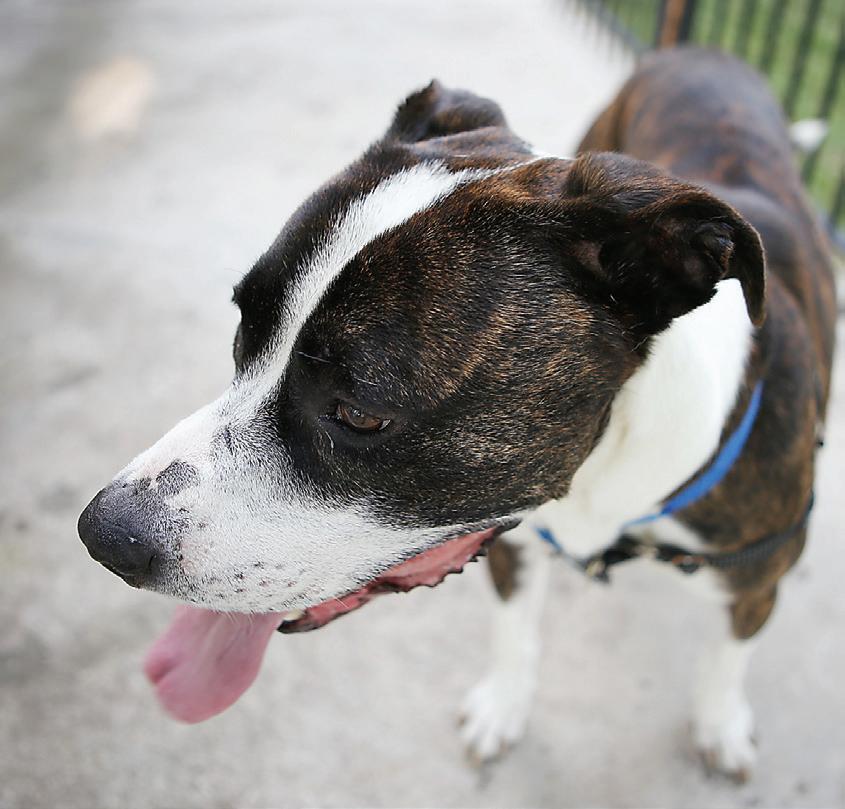
A loveable canine’s journey from restrictive chains to a hopeful future PAGE 6
DRIVING IN CIRCLES
Fun fact: Columbia has 38 roundabouts and plans to create more PAGE 4
HAVE IT YOUR WAY
Local restaurants cook special-diet items for every meal of the day PAGE 5 06.23.16
IN THIS ISSUE
FEATURE
Max’s friendly demeanor and never-ending grin mask his past abuse. Max was cruelly tethered around a tree when he lived in North Carolina. Now, the 6-year-old boxer mix waits in comfort for adoption and a new home in Missouri. PAGE 6
NEWS & INSIGHT
The people in the cars go round and round. Columbia is roundabout-obsessed, and its oldest traffic-guiding circle is getting redone. PAGE 4
THE SCENE
Restaurants have to keep up with ever-evolving dietary needs. Four Columbia eateries feature tasty menu items that embrace the limitations of varying diets. PAGE 5
MUSIC
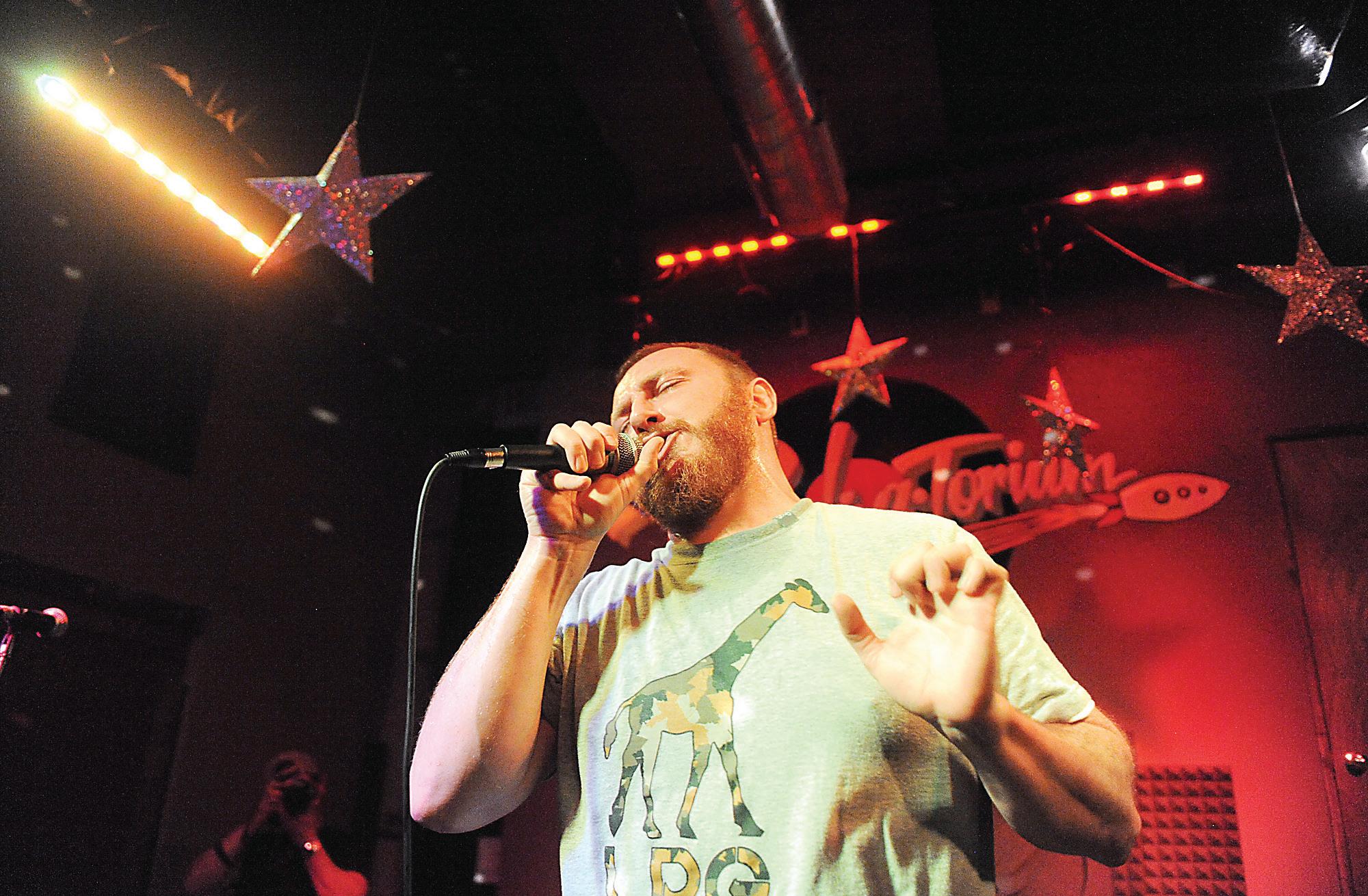
Local rapper Dallas independently produces his music, but that’s not the part of rap he enjoys the most. Live shows and the crowd’s cheers fuel this Midwestern lyricist. PAGE 12
ARTS & BOOKS
Sager Braudis’ 2016 Summer Exhibit displays work from five Missouri artists who have their own ways of interpreting traditional styles. PAGE 13
Q&A
Matthew Crook of Dismal Niche Tapes sat down with Vox to talk about the benefits of cassette tapes and why he co-founded the label. PAGE 14
COVER DESIGN: JULIA TERBROCK
COVER PHOTO: RYAN BERRY
VOX STAFF
Rowe Office Manager: Kim Townlain
TINY TOWN TASTES: PLATE OF HISTORY
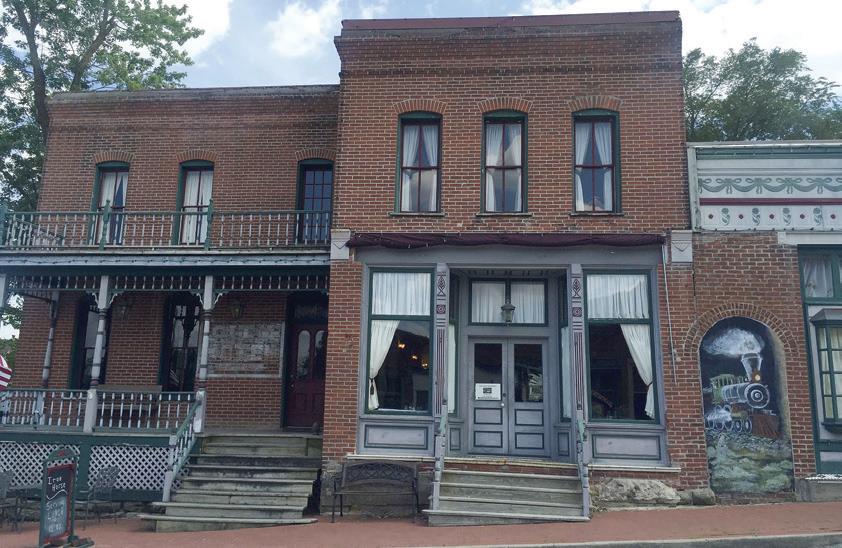
New Orleans native and Italian-trained chef Tracy Russell cooks up delicious food such as chicken-and-waffle sandwiches and bananas foster cheesecake in the itsy-bitsy town of Blackwater.
BOSS CUTS
M.Boss Barber and Salon is new to town, but it’s carving its niche among the other barbershops. The addition to downtown Columbia opened up June 8 and serves up fresh styles and cold beer.
SPEARING THE CRAVING
The search for Columbia’s most satisfying fried pickles continues. This time, it’s to Como Smoke and Fire, where the dipping sauces are a must-have.
MAKING BURGERS LIKE A SEMIPRO
Impress your peers and relatives this summer with three gourmet burgers that you can make at home: a pineapple-barbecue burger, a queso burger and a healthy veggie burger.
EDITOR’S LETTER
CHRISTINE JACKSON EDITOR-IN-CHIEF
JUNE 23, 2016
VOLUME 18 ISSUE 22 | PUBLISHED BY THE
I’ve never owned a dog. My mother never wanted one when I was growing up in St. Louis, and now my budget and living situation make getting one irresponsible.
Luckily, there have always been other people’s pets around. When I was little, it was a pair of Labradors named Sugar and Daisy. My neighbors would leave them alone all day in their fenced-in backyard, where they would spend their time in the shade near our shared fence and occasionally wander to their back door for a drink.
They always seemed a little sad. As a 10-year-old who wanted a dog more than anything, I took it upon myself to play with them whenever I had the time.
I would call them and Sugar, the more energetic of the two, would bring a Kong to the fence for me to throw. Daisy would plod over and lounge against the chain links so I could pet her through the gaps.
I always felt a little sorry for Sugar and Daisy, but they had it pretty good compared to some other Missouri dogs. Their owners came home around dinnertime every day and let them inside. They had plenty of food and water. They were free to roam their yard and come to the fence to play with me. Not all dogs are so lucky.
This week’s feature (Page 6) tells the story of Max, a boxer mix who was chained up outside for most of his life and has the scar to prove it. His rescuers at Unchained Melodies Dog Rescue are working to change the laws that allow such abuse, but these things take time.
For now, pay attention to the dogs around you. Are they tethered all day in the summer heat? Do they seem like they need help? The law might not always be on your side, but there are resources that can help. You might just save a dog like Max.
Editor: Christine Jackson Managing Editor: Hannah Pederson Digital Managing Editor: Jenna Fear Art Directors: Madalyne Bird, Julia Terbrock Photo Editor: Ashley Reese News & Insight/ The Scene Editors: Ben Landis, Claire Lardizabal Music/ Arts & Books Editors: Mary Kaleta, Mike Tish Contributing Writers: Laura Davis, Keeley Dority, Gerard Edic, Max Havey, Madison Kelley, Brooke Kottmann, Madeline McClain, Maya McDowell, Jared McNett, Shane Sanderson Editorial Director: Heather Lamb Executive Editor: Jennifer
COLUMBIA MISSOURIAN
WORD OF THE WEEK
Calamity (n.): an event causing great and often sudden damage or distress; a disaster.
Rio de Janeiro declared a state of “public calamity” this week and received $850 million (2.9 trillion Brazilian reais) from the Brazilian government to keep the 2016 Olympic Games from falling into chaos. Public calamity sounds pretty far from the Olympics’ mission “to create a way of life based on the joy found in effort, the educational value of good example and respect for universal fundamental ethical principles.”
A CENSURE AND A SENTENCE
This week saw continuing action on two fronts stemming from the events on Mizzou’s campus last November.
The American Association of University Professors added MU to its censure list. Sounds bad, and a bit confusing, right? Censure means the AAUP is calling out MU for “violations of academic freedom and tenure,” in this case related to the UM Board of Curators firing Melissa Click without following the university’s disciplinary process. Censure can make it difficult to recruit new faculty and staff — especially as the university strives to increase diversity. Universities typically work to be removed from it. For instance, the University of Illinois at Urbana-Champaign remains on the list despite efforts to address hiring issues that resulted in its censure last year.
Meanwhile, former University of Missouri S&T student Hunter Park has been convicted of a Class C felony for making terroristic threats. (Yes, terroristic is a real word.) Park received five years probation and a three-year suspended sentence after he posted racially charged threats of violence on the anonymous app Yik Yak. As a felon, he won’t be able to vote or buy a gun.
Do you remember your Ticketmaster password?
Anyone who bought tickets from the ticket vendor between 1999 and 2013 could be eligible for free ticket vouchers, thanks to a $400 million class action settlement. Check under the “active vouchers” tab on your account to see if you have a couple.
Written by: Ben Landis, Claire Lardizabal, Mike Tish
PHOTOS
Safety in numbers
Know your way around Columbia’s roundabouts BY CLAIRE LARDIZABAL
Interstate 70 exits are getting makeovers in Columbia. A new roundabout is in place on Rangeline’s exit, and the West Boulevard exit will have two multi-lane roundabouts by the end of July. Nearby, the roundabout by Creasy Springs and Business Loop 70 was the first in the state built by the Missouri Department of Transportation in 1996, says Trent Brooks, MODOT district traffic engineer. The second-busiest intersection in Columbia is located on the other side, at Business Loop 70 and I-70 Drive Southwest, which is used by an average of 24,000 to 25,000 cars per day, says Travis Koestner, assistant district engineer for MODOT’s Central District.
Roundabouts originated in Europe and have been improved over the years. Columbia began constructing modern roundabouts in 1998, which have yield signs and larger entry angles to decrease speeds, Brooks says. Roundabouts are much safer than four-way intersections for pedestrians and motorists alike. According to the Washington State Department of Transportation, roundabouts reduce fatal collisions by 90 percent and injury collisions by 75 percent.
HOW TO USE MULTI-LANE ROUNDABOUTS:
According to MODOT, the main confusion with roundabouts is due to not knowing how to use one. To prevent accidents, both lanes inside the roundabout must be clear before entering. Giving the vehicles inside the roundabout the right of way will allow them to exit efficiently.
Reduce speed.
Yield to all traffic inside the roundabout as they have the right of way.
Get in right lane to make right turns.
Stay in left lane to make left turns or U-turns.
Stay in your lane.
Don’t cut corners.
Don’t change lanes in a roundabout.
Don’t drive next to trucks or buses because they might not see you.
20–25 mph is the average speed limit in a roundabout.
THROW ME A BONE, HERE
Columbia’s newest roundabout, located on Rangeline Street, has been dubbed the “dog bone” because the shape resembles one.
ROUNDABOUTS IN THE COLUMBIA AREA
Barry Dalton, City of Columbia’s Public Works public information officer, says there are 38 total in the area. They are owned by:
Boone County: 2
City of Columbia: 26
Missouri Department of Transportation: 10
CONFLICT POINTS: This is the number of places an accident can occur. According to MODOT, accidents on four-way intersections are right angle accidents such as getting t-boned. On a roundabout, common accidents found are side swipes or getting rear ended.
ROUNDABOUTS
8 conflict points for vehicles
HOW TO CROSS A ROUNDABOUT AS A PEDESTRIAN:
Follow pedestrian marks, and stay on the splitter island between lanes.
Look for motorists, and make sure they can see you. Don’t assume motorists will notice you.
Stay on the sidewalk.
Don’t walk in the roundabout, or cross into the center island.
24 conflict points for vehicles
32 conflict points for pedestrians
8 conflict points for pedestrians VS. INTERSECTIONS
THREE TYPES OF ROUNDABOUTS IN COLUMBIA
According to MODOT, the three kinds of roundabouts are:
Mini roundabout: Located at the intersection of Fairview and Rollins roads. Size varies. Center circle is 2 to 3 inches high.
Single-lane roundabouts: Originally at Business Loop 70 and Creasy Springs Road. Diameter is 128 feet across. Multi-roundabouts: The first one, found on the exit by Rangeline Road and Interstate 70, is 180 feet across.
CENTER ISLAND
TRUCK APRON
SPLITTER ISLAND
A cleaner plate Eat worry-free dishes at downtown CoMo’s local eateries BY BROOKE KOTTMANN PHOTOS BY ASHLEY REESE
The sweet, buttery #Waffle from Range-Free Café is a gluten-free option.
Nourish Café and Market’s Broadway Bowl is packed with quinoa balls, sweet potatoes and sautéed kale.
It started with gluten. Then it was substituting for other ingredients such as soy, peanuts or dairy.
An increased awareness of food allergens has led to two new restaurants dedicated to dishes that are free of certain ingredients: Range-Free Café, Columbia’s first allergen-free establishment, and Nourish Café and Market, which is gluten-, soy- and GMO-free. Other restaurants in Columbia have already replicated delicious creations that the allergen-free community (and the rest of us) can eat without worry. Here’s our list of tasty options to try throughout the day.
BREAKFAST:
#Waffle
Breakfast can be limited without dairy or eggs.
Range-Free’s #Waffle is here to save the morning. It’s free of the top eight allergens: milk, eggs, fish, shellfish, tree nuts, peanuts, gluten and soy as well as vegan. The recipe calls for quinoa, tapioca, coconut flour, flax seeds and apple sauce. The waffle is served with melting butter and fresh seasonal fruit, which is currently strawberries. Price: $10
Coconut Matcha Smoothie
Nourish Café and Market combines matcha green tea, toasted coconut, vanilla almond milk, vanilla soy
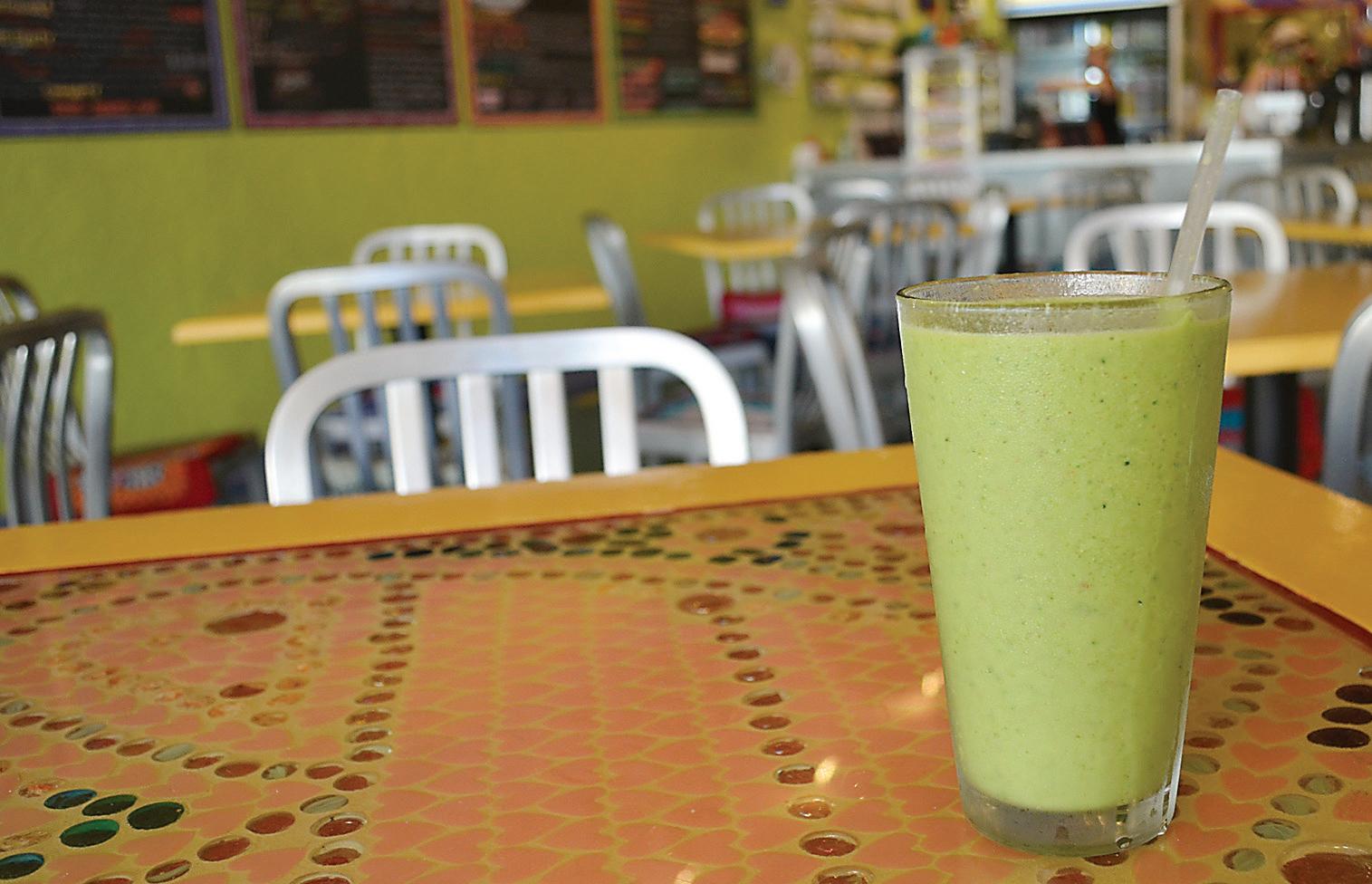
The Braveheart Smoothie from Main Squeeze is made from a mixture of kale, flax seeds, banana, pineapple and coconut milk.
The Velvet Cupcake can make any of its 85 cupcakes gluten-free upon request.
powder and banana to produce its vegan smoothie. It’s gluten- and dairy-free Price: $7
The Braveheart Smoothie
Main Squeeze blends a refreshing mix of organic coconut milk, kale, banana and pineapple to create the perfect vegan and non-GMO power potion protein smoothie. Its namesake is a nod to its heart-healthy ingredients and the Mel Gibson movie. Price: $6.50
LUNCH OR DINNER:
Broadway Bowl
Nourish Café and Market’s Broadway Bowl, named after the cafe’s location, is a concoction of quinoa balls, hummus, sautéed kale, roasted broccoli crowns and sweet potato, so it’s packed with protein. The Broadway Bowl is gluten-, dairy-, soyand corn-free, and vegan. Price: $9
Buddha Bowl
Main Squeeze’s vegan and gluten-free Buddha Bowl is a mixture of organic brown rice, seasoned tofu and steamed veggies. It features a homemade sesame ginger dressing that owner Leigh Lockhart says is the “sauce that built Main Squeeze.” The
tofu isn’t a meat replacement, but it provides customers with a similar texture. Price: $8.50
DESSERT:
Velvet Cupcake Café
What’s better than a gluten-free cupcake?
Velvet Cupcake Café has 85 different flavors that can be made gluten-free, including the fan-favorite peanut butter cupcake and the triple chocolate cupcake. Lactose intolerant? The vanilla cupcake can be made dairy-free upon request. Price: $3
Triple Tiger Lemon Cupcake
MAIN SQUEEZE
28 S. Ninth St.
NOURISH CAFÉ AND MARKET
1201 E. Broadway
RANGE-FREE CAFÉ
110 Orr St., Apt. 101
VELVET
CUPCAKE CAFÉ
23 S. Eighth St.
Range-Free espouses Tiger spirit with a dense, moist and sweet specialty cupcake. The Triple Tiger Lemon Cupcake is a refreshing vegan vanilla cake with lemon filling and topped with a chocolate drizzle. The vegan cake is also free of the top eight allergens Price: $4
BREAKING THE CHAINS
One dog’s story reveals a nationwide problem worth barking about
BY ELAINA STEINGARD PHOTOS BY RYAN BERRY
The long white stripe is Max’s most distinct feature. It spans the length of his slender frame, thicker on his torso and thinner down his face. The stripe runs all the way to his muzzle and past his neck. It complements his chocolate-colored eyes and the little pink heart-shaped birthmark above the wet, curious nose that is distinct to a boxer or boxer mix.
His paws stand out, too. They’re large, even for a boxer mix with his build, roughly the size of an open palm. Max has grown into brown brindle, but his paws still signify a puppyhood he never got.
The stripe highlights a discolored circle around Max’s neck, a stomach-churning wound that worsened and deepened with each of the six years he spent choke-chained to a tree. Although the scar is healing, the gray-brown ring around his neck might never fade. Growing hair peeks out of the place where the chain used to be.
Melody Whitworth and her nonprofit dog-rescue organization, Unchained Melodies Dog Rescue, have allowed Max to live out a puppyhood that was taken away by a chain.
It was that chain that brought him to Columbia. This past February, Max’s rescuer drove him 14 hours from North Carolina to his safe haven. But Missouri is not a haven for all dogs.
“Missouri has the most puppy mills in the United States,” says Bob Baker, the director of the Missouri Alliance for Animal Legislation. “At the same time, pet shops are looking for cheap sources for dogs. It’s become a perfect storm.”
MAAL spearheads the fight for animal welfare legislation in Missouri. “We’ve put 1,200 puppy mills out of business,” Baker says. “There were about 2,000 and now there are about 800. We still have more than the next three states combined.”
Although organizations such as MAAL are fighting for proper treatment of animals in Missouri, there are dogs like Max all over the state feeling the brunt of antiquated ideologies about dogs, including beliefs on tethering and chaining.
The Humane Society defines tethering and chaining as: “The practice of fastening a dog to a stationary object and leaving him unattended. These terms are not meant to refer to an animal being walked on a leash, or cases of supervised, temporary tethering while an owner is present.”
One of the most-needed steps against tethering came in 1996 when the U.S. Department of Agriculture issued a statement that read: “Our experience in enforcing the Animal Welfare Act has led us to conclude that continuous confinement of dogs by a tether is inhumane. A tether significantly restricts a dog’s movement. A tether can also become tangled around or hooked on the dog’s shelter structure or other objects, further restricting the dog’s movement and potentially causing injury.”
Max is a 6-year-old boxer mix from North Carolina. His rescuer drove 14 hours to Missouri to find him a home.
Eleven years later, in 2007, California became the first state to adopt legislation that limited dog chaining and tethering.
Known as the Tethering Law, it creates restrictions for dog owners including making the practice of tying a dog to a stationary object for more than three hours in a 24-hour period illegal, according to the City of Los Angeles Department of Animal Services.
Twenty-five states, including Illinois, Indiana, Tennessee and Texas, have dog-tethering laws that outline time restrictions, severe weather codes and movement clauses for a dog’s safety while he or she is chained. Several major cities, including San Jose, Austin and Dallas, have created outright bans on tethering, according to People for the Ethical Treatment of Animals.
Unlike California, which has made strides on a statewide level, Missouri’s tethering and chaining codes are largely city-by-city, with some far stricter than others.
According to the St. Louis Department of Health, dog chaining in St. Louis is punishable by a $100 fine. In Springfield, tethering is restricted to daylight hours. In the Kansas City suburb of Raytown, tethering code states that “tethered animals must be free from danger of becoming entangled, and must have access to food, water and shelter.” The law doesn’t specify how frequently the food or water should be replenished, what constitutes “adequate” food and water or outline what an appropriate shelter is for the chained animal.
Despite a nationwide push for more proactive legislation, there are dogs all over Missouri dealing with the emotional, mental and physical repercussions of tethering, some who might never fully heal.
The Humane Society states that continuously chained or tethered dogs are much more likely to experience insect bites and parasites. The dogs are also at risk of entanglement, strangulation and harassment from other dogs or people.
Sugar, a 10-year-old Labrador mix, was rescued after someone cut her torso with a knife to stop her from barking. Sugar was continuously chained for 10 years. Jax, a 2-year-old pit bull mix, was chained as a puppy after his owner got frustrated trying to housebreak him. Jax’s owners gave him a puppy-sized collar that wasn’t adjusted or replaced as he grew. Immediately after he was rescued, Jax underwent emergency surgery to remove the embedded collar from his neck. Luther, a 3-year-old Great Dane, was rescued after neighbors noticed that his water had turned dark-green.
Max was born in North Carolina. His owner purchased him from a litter sale at six months and chained him to a tree almost immediately. As a young dog, Max was let off the chain only sporadically. As he got older, the chain got shorter, and he was eventually tethered full time.
A young woman who lived across the street from Max purchased hay from his owner, and she saw the dog chained outside. From then on, she would check up on him each time she purchased hay. When she noticed that Max’s chain had gotten shorter, she decided to approach his owner and asked him to release Max into her custody.
Whitworth says his former owner agreed to give him up and relinquished custody that same day. Max was finally free but had no place to go.
His rescuer initially sent him to a boarding facility, but Max required more attention than was provided. After two weeks, his rescuer began to call organizations across the Southeast to find help.
But one thing failed him: breed.
A boxer mix with a bulky build and a square face, Max fits the physical description of what is called a “bully breed.” According to Animal Planet,
the term “bully breed” is derived from the dogs’ origin and history, not their temperament. The dogs are descendants of Molossers and include breeds such as American pit bull terriers, American Staffordshire terriers, Boston terriers, bulldogs and boxers. “Molossers were big dogs with large bones and muscles, pendant ears and short muzzles,” according to Animal Planet’s website. The Molossers were then bred with other breeds like the Old English bulldog or matiff breeds to create the bullies that we know today.
The dogs, who have origins that date back to ancient Greece, were originally bred to protect livestock and property. But this function of the breed changed over time. In 19th century England, for example, Molossers were used in blood sports including bull baiting, which is where the name “bully breed” was coined. And in the 1980s, gangs began using bully breeds for protection and as a symbol of status.
“People use the term really loosely,” Whitworth says. “It’s a slang term for the breed. But the problem is that they just generalize the dogs, but there are some really great dogs out there that are wonderful, well-behaved family pets.”
According to The American Society for the Prevention of Cruelty to Animals, dog breed behaviors should not be generalized: “While a dog’s genetics may predispose it to behave in certain ways, genetics do not exist in a vacuum. Rather, behavior develops through a complex interaction between environment and genetics.”
But most rescue organizations, even nonprofits such as state-sponsored humane societies and federally funded animal shelters have strict regulations — even restrictions — against bully breeds. Whitworth learned about Max through photos of him that his rescuer had posted on social media.
“I found her online, and she said, ‘No one will help me,’” Whitworth says. “I emailed her, and I said, ‘I will help you. If you can get the dog here, I will take him.’” His rescuer agreed.
Before she moved to Missouri, Whitworth volunteered with a dog rescue organization in Florida that advocated against tethering.
“We moved up here looking for a house with some property because I had horses, and while we were out in the rural areas looking for houses, I saw dogs just chained to trees,” Whitworth says.
Max is ready for a permanent home thanks to the care and training he has received from Unchained Melodies Dog Rescue. Part of his success is because of volunteers such as Demitrios Raftopoulos, who has given Max a safe and friendly foster home.
Unchained Melodies functions primarily out of Columbia and Jefferson City, with a facility and training center in Columbia. Whitworth works with a team of volunteers, and foster families feed the dogs, take them on walks and play with them. But the process of rescuing dogs isn’t limited to volunteers, Whitworth says.
Whitworth has received calls from countless anonymous people who were concerned about the well-being of dogs in their communities.
Unchained Melodies was founded in 2008 under the name Dogs Deserve Better. Since becoming Unchained Melodies Dog Rescue in November 2015, the organization has been able to help more than 100 dogs. There are typically 25 to 35 dogs in their care that can spend anywhere from one day to a month at the organization’s training facility. Whitworth says she upholds the same standard of care for every dog, and that’s exactly what she gave Max.
“One house that we were looking at had this beautiful Siberian husky chained to a tree with nothing but dirt around it and a beat up metal pot that was upside down, no water in it.”
Whitworth says that seeing the dog’s situation triggered her rescue instinct.
“I tried to find help for that dog.” Whitworth says. “And I couldn’t find any help. Animal Control said it was legal, and I didn’t really know anybody here because I hadn’t moved yet. I called the sheriff, and they said, ‘Nothing we can do. It’s legal.’”
Whitworth didn’t buy the home but doesn’t think that seeing the house was a waste.
“That’s how it all started,” Whitworth says. “As soon as my eyes were opened to that Siberian husky, I started seeing chained dogs everywhere: nice houses, dilapidated houses, apartments, trailers, in the city, in subdivisions, out in the country — everywhere. It just blew my mind, so it was kind of my calling, I think.”
Unchained Melodies runs based on voluntary relinquishment. This process can be tricky. Whitworth says the most effective way to convice dog owners to give up custody includes addressing his or her concerns with understanding and without judgment.
“I don’t knock on the door and say, ‘Hey dude, what are you doing with your dog in the pen? That’s abuse,’” Whitworth says. “What are they going to do? They’re going to close the door and tell me to mind my own business.”
“First thing I like to do is give him a big bowl of food,” Whitworth says. “He (Max) had traveled a long way, so pretty much we just took him out to go potty and gave him some food and bedded him down for the night so that he could chill and take it all in.”
Although some facets of Max’s previous life were unclear, Whitworth was certain about one thing.
“It was a chain,” Whitworth says. “It was a chain that did that to his neck.”
Then the adjustment began.
“He was scared, scared, scared after the first night,” Whitworth says. “We had a hard time getting him to get out the door. He would walk out the door but wouldn’t go past the doorstep.”
Whitworth says Max also had issues when volunteers would try to take him on walks using a leash. “When he first went out on a leash, he would just plant himself, and he wouldn’t move, so we started taking him out on the long line and just kind of letting him have space.”
Even though he was no longer on the chain, Max was still recovering. “The minute there was tension on the leash, he would plant himself,” she says. “When dogs are on the chain, they run to the end and get bounced back. It’s definitely a trust issue.”
Whitworth says that at first Max was uncomfortable in his new environment. This is typical for dogs who have been chained or tethered.
The Humane Society’s website states that dogs unable to retreat from threatening situations are more likely to lash out due to their protective instincts over their territory. When this space is invaded, their natural fight-or-flight response is triggered and they cannot leave; they must settle with the former.
Melody Whitworth of Unchained Melodies Dog Rescue stops during a walk to pet one of her rescued dogs, Spirit. The 7-year-old husky mix came to Unchained Melodies from Wentzville about four months ago.
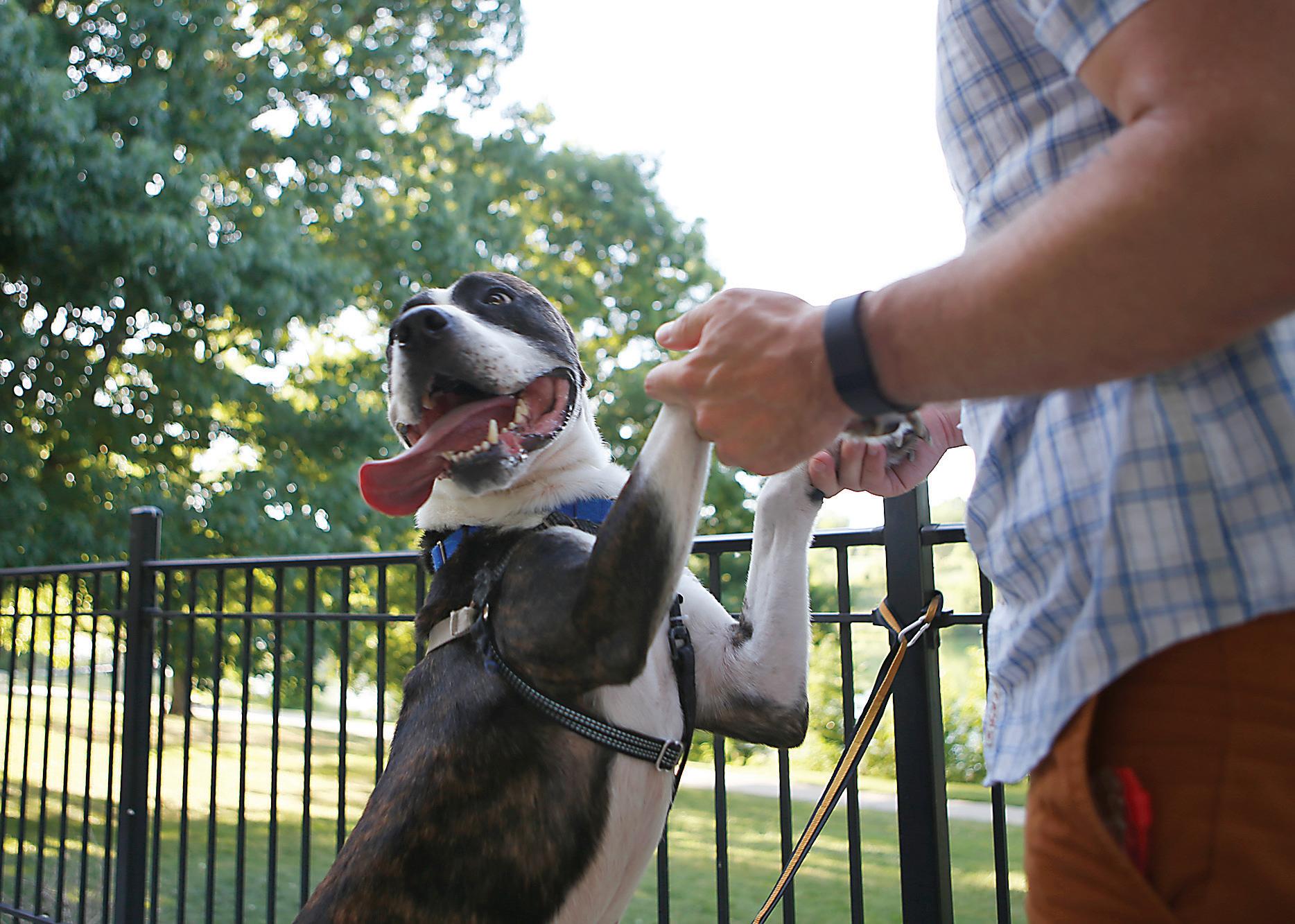
When Max was rescued, he had trouble trusting volunteers to take him on walks. Today, Max enjoys being outdoors and visiting Columbia’s parks.
“The first few days, he was pretty cagey,” Whitworth says. “If he didn’t know you, he would kind of lash out. A couple of the volunteers texted me and said, ‘Hey what do I do with this dog?’ And I said: ‘Just open the door and let him come out on his own. Give him some treats, and then he’ll be fine.’ He just needed to know you’re OK. It probably took four or five days to get acclimated to everyone.”
Once Max began to trust Whitworth and her volunteers, he began to change. Whitworth noticed his strides.
“One of the biggest breakthroughs was the first night he didn’t poop or pee in his crate,” Whitworth says. “He wouldn’t go outside because he was so scared, and then he would come in and immediately poop or pee in his crate. Those seem like small things, but they are huge.”
Whitworth said Max stopped having accidents in his crate entirely and would lead volunteers outside when he wanted to go on walks. He also grew more comfortable on the leash and continued to follow and learn new commands. This training and growth prepared Max for fostering and adoption.
“He’s treat-motivated, so that was good,” Whitworth says of the training process. After just two weeks with Whitworth — four weeks after he was unchained — Max was able to sit, lie down and bark on command.
Unchained Melodies has a rigorous adoption and fostering process, which includes a home check and a family meet-and-greet, where every member of the family — including any other pets — are expected to meet the prospective dog. Whitworth says she wants to make sure that all of Unchained Melodies’ dogs are ready for families, and that the families are ready for the dogs.
“It’s important that the dog meet all members of the family and all of their pets because we want to make sure that they all get along,” Whitworth says. “And if that’s fine, then we go forward with the adoption.” For Whitworth, this is one of the most crucial steps in the process.
“I had a large dog that was really unruly,” Whitworth says. “I really didn’t think he should be around small children. The applicant said he didn’t have any children. We get there to do a home check, and there were two toddlers sitting on the living room floor.”
Whitworth refused to continue with the adoption.
Apart from finding homes for Unchained Melodies’ rescues, Whitworth also works to make strides with Missouri politics.
“We have been involved with other groups to lift breed bans,” Whitworth says. “Hallsville was successful in lifting the breed ban and so was Boonville. And Boonville, in conjunction with the breed ban, also has an anti-chaining ordinance, as well.”
Whitworth teaches seminar courses throughout mid-Missouri to help concerned citizens get involved with establishing and legislating ordinances to be passed in Columbia.
“You need to know how your body of government works,” Whitworth says. “Because different places have different forms of government. For us (Columbia), it’s city council. So I needed to get to know our city council members. Who is an animal-lover? Who isn’t? Who might actually have a chained dog in their backyard? Just Google Earth them.”
With increased community involvement and awareness, Whitworth says there has been more progress with breed bill HB 1811, which would be an important step for Missouri to take in furthering animal welfare legislation by banning breed restrictions.
Whitworth says she is not stopping at the local level. “Right now we’re trying to get the word out about the breed bill, and then at some point, we would like to have a bill written for a statewide anti-chaining ordinance. So we would definitely like to spearhead that.”
Missouri’s animal legislation is still a work-in-progress, but Max has blossomed into a dog with a bright future, thanks to Whitworth and her dedicated volunteers.
“We tested him with four cats, and he did great,” Whitworth says. “He’s gained weight, which is good. As far as his fear issues go, he had a hard time going out the door, but now he runs around the backyard off the leash, and his recall is really good. He goes out into the play yard now. He loves everybody he meets.”
Max is currently being fostered by Demitrios Raftopoulos and has been in his new home since April. Raftopoulos says that he had never fostered before he got Max, but it has been a good experience.
“When I brought him into my house for the first time, it took a while for him to realize that this was a place for him to be comfortable,” Raftopoulos says.
It took Max a few days to acclimate to his new environment, but Raftopoulos says he is adjusting to his new life indoors.
“He just wants to be on my lap even though he is way too big to be a lap dog,” Raftopoulos says.
Despite his troubled past, Max’s future is bright thanks to Whitworth and Unchained Melodies. Now, he is
waiting to be adopted. Despite this last step sometimes being the longest in the process, Whitworth is confident that Max will find a loving family and home of his own.
“Once he gets out and about, he will get adopted very quickly because he is doing so well,” Whitworth says.
So, until then, Max will wait for his family in style: on a couch, a bed or a carpet — but never again on a chain.
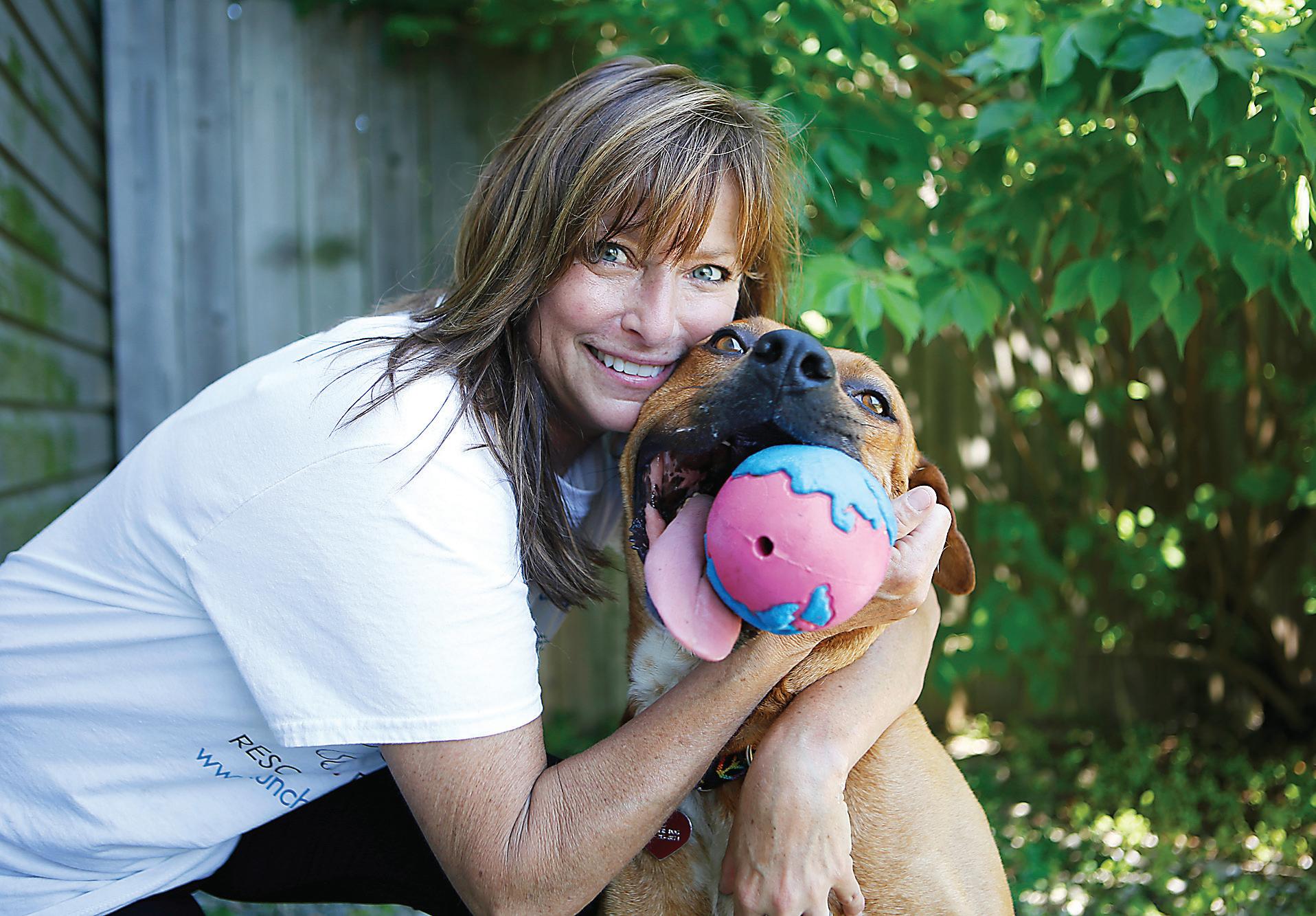
Melody Whitworth of Unchained Melodies Dog Rescue hugs Maxwell, a Rottweiler-Amstaff mix who came to Columbia two months ago from Cairo, Missouri. “We work really, really hard, and the work we do is daunting,” she says. “But we have fun, and we are really just a big family.”
With his past behind him, Max is able to enjoy his adulthood like any other dog.
The improvements Max has made since his rescue show that he is ready to be adopted by a new family and make Missouri his forever home.
COLUMBIA’S LAWS UNLEASHED
Laws for dog tethering and abuse vary by state, county and city. Columbia’s anti-tethering rules under the city’s ordinances state that a tether cannot be the primary method of restraining an animal, and that there needs to be a shelter that is “properly ventilated, sanitary, dry and weatherproof.” Whitworth says the current ordinance is hard to enforce because it requires the authorities to constantly check on the animal, and those who report the misconduct are required to appear in court as a witness.
HOW YOU CAN HELP
• Check your city’s ordinance for laws against tethering. If one doesn’t exist, speak with law enforcement or animal control about establishing one.
• Approach the dog’s current caretaker. “I can’t iterate enough that being friendly and helpful is the best way to approach an owner,” Whitworth says. “Don’t accuse an owner without knowing the facts. Avoid harmful words because they will close the door, and it cannot be opened again.”
• Ask how you can be of help, and provide solutions and resources to the owner. Use relinquishment of the dog as the last offer.
• Never offer to buy the dog or attempt to steal it.
• Contact the authorities if you notice the animal’s owner breaking several laws.
If you know of a dog needing help or are interested in adopting or fostering a dog, Unchained Melodies Dog Rescue can help: P.O. Box 7018 Columbia, MO 65205 (239) 213-8174, unchainedmelodies.org
Mia is a pit bull terrier mix who is also deaf. Like Max, Mia spent most of her life outside on a chain until she was rescued. But today, she is happily living with her foster family while she awaits adoption.
And the beat goes on
Local rapper Dallas began his music career with a harmonica.
The musician played the small wind instrument, along with the bongos, for the East Ash Street Band after moving to Columbia in 2001. But it wasn’t long before he transitioned to rapping. Dallas performed in local shows, wrote his own music and eventually joined the record label Indyground Collective.
As a rapper, his beats were a hit. Dallas released three albums under Indyground Collective, and he garnered more than 100,000 downloads for his sophomore effort, Faces Vol.1, in 2010.
After he released his third album in 2011, Dallas left Indyground Collective. It wasn’t long before he started independently producing his music, and he is working on the production of two new albums, one called Faces Vol. 2.
But for Dallas, nothing compares to the thrill of a live show. He recalls his favorite performance was in 2010, when
he opened for the indie hip-hop group Doomtree in Omaha. Dallas fed off the energy of having 800 pairs of eyes on him — 800 people who didn’t recognize much, if any, of his music. He says they ate the show up.
“(People in Columbia) know me as a local,” he says. “It was neat rolling into a town with an established group (where) we were not local to that crowd.” He was so energized he drove back to Columbia that same night and could barely sleep when he arrived at home.
Ultimately, Dallas says he wants to rely solely on his rapping career to support his family.
WHEN YOU HEAR DALLAS ON A SONG, YOU’LL INSTANTLY FEEL IT.
–TIM HANSON
Dallas’ career has been a roundabout journey. He’s married and raising two stepsons. On any given day, he’s working three to five jobs, all while preparing his comeback following a 2-and-a-half-year musical hiatus from January 2013–June 2015.
The only caveat: He doesn’t want to bow to the pressure of an increasingly commercialized rap industry. His style aligns with backpack rappers who stray from the themes commonly associated with gangster rap. Dallas elongates his vowels, throws in Midwestern twang and raps about what’s relevant to him, such as his family, irritation with the government or monetary problems. “I get therapy by doing this,” Dallas says. Luckily, he has the unwavering support of his biggest fan: his wife, Hiedi. She critiques his new music, attends shows and constantly pushes him to increase his visibility in the community.
WHAT’S A BACKPACK RAPPER?
Backpack rappers steer clear of mainstream motifs in their lyrics, such as wealth, violence and flashy fashion trends.
Hiedi says she knew her husband had raw talent when he first began rapping in 2001. She says he’d grab the microphone at house parties and had everyone’s attention. “It was those days that I was like, ‘He has something,’” she says.
Tim Hanson, owner and head engineer of North Village Recording, will record, mix and master the rapper’s upcoming albums. Hanson says Dallas is full of potent energy and sophisticated lyrics. “When you hear Dallas on a song, you’ll instantly feel it,” he says. “You’ll know it’s him.”
It’s this energy that he brings to his lyrics, and the expressive meaning behind them, that he hopes will propel him to the next level.
Dallas performs at The Social Room on March 18. The Columbia rapper is currently in the process of producing two albums.
An underground rapper prepares for his comeback BY CASSA NIEDRINGHAUS
Traditions get a new twist at Sager Braudis
The gallery features five local artists in its Missouri showcase BY
The Sager Braudis Gallery gives Columbia’s art enthusiasts a chance to enjoy clever takes on a variety of conventional art styles at its 2016 Summer Exhibit.
The gallery includes artwork from Missouri artists Cody McLouth, Ken Nichols, Elise Rugolo, Joel Sager and Vicki Weaver. Oil paintings, vases and other works are free to view, but cost anywhere from $600 to $2,400 to buy.
Nichols creates his artwork through a process called action painting. This style is commonly associated with abstract expressionists such as Jackson Pollock. But instead of dripping the paint onto the canvas, as Pollock did, Nichols relies more on the natural transformations that color pigments go through as they change from liquid to solid. The work’s meaning comes from within the painter and represents his or her internal concepts and feelings, hence the abstract nature of the work.
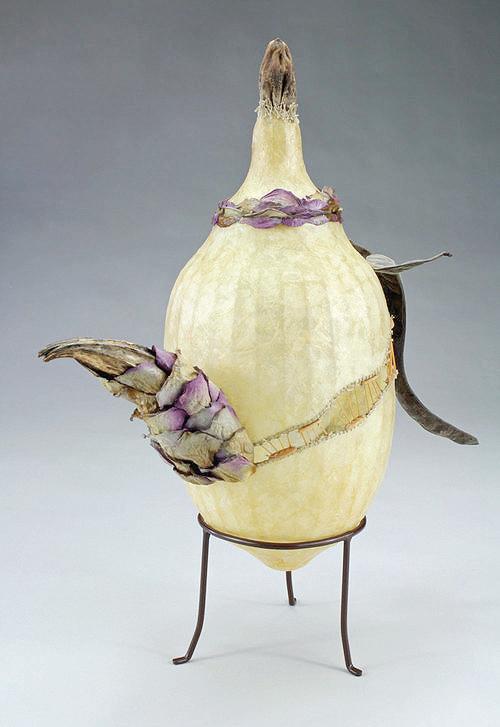
Weaver, the only artist who isn’t from Columbia, is far more visceral with her work than Nichols — in the literal sense, that is. The Sedalia-based artist uses guts from animals to create home decorations. Her art is based on traditions that date back to the mid-1800s, when the Inuit tribes of Alaska would use sea mammal intestines to make parkas or store food. Weaver uses a similar process to make items such as tea kettles, vases and bowls. But she uses intestines from sheep rather than sea mammals.
traced back to the chiaroscuro techniques used by Italian Renaissance painters to create theatrical scenes depicting human figures. McLouth’s art, though, is devoid of human life.
Instead, he focuses largely on carnivals and scenes from rural America. The lights of a carousel, as well as street lamps, are set against the night sky. Places that most of us expect to be filled with people are desolate, and viewers might find themselves with a sense of eerie solitude.
THAT’S A PROFOUND THING FOR ME, THAT HUMAN TOUCH.
Rugolo’s primary media are traditions of encaustic and collage. Encaustic painting, also known as hot wax painting, is done using heated beeswax and adding colored pigments. For Greek artists, basic encausting was an established practice by the fifth century B.C. Traditionally, encaustic art was done on prepared wood. But Rugolo has taken the classic style and placed it onto vintage LP covers. Those covers also act as inspiration for the artwork, which is far more vibrant than its historical predecessors. The resulting art will catch your eye as it pops off of the canvas.
– VICKI WEAVER
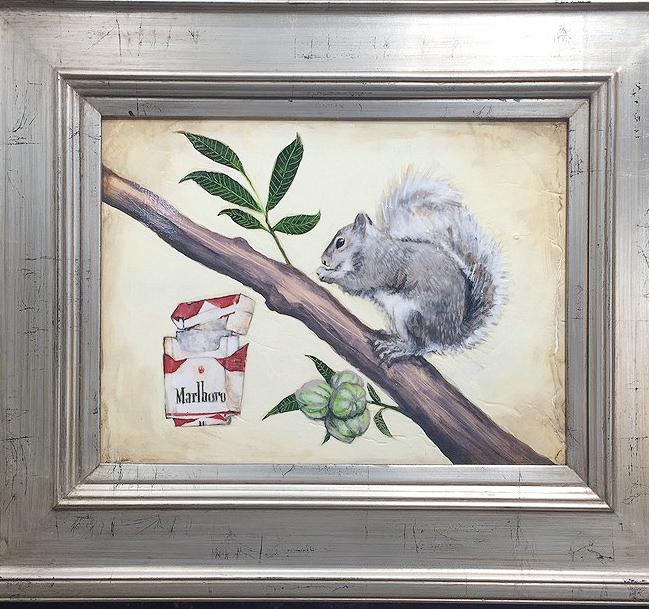
Sager, an artist and co-owner of the Sager Braudis Gallery, rounds out the exhibit with a series of oil paintings that take inspiration from flora and fauna. This is a theme that can be found in the art history of several East Asian countries, including the Koreas, China and India.
Historically, this kind of art focuses on the harmonious relationship between animals and plants, but Sager’s work adds in one more element: garbage.
MADDIE KELLEY
“I really admire utilitarian objects,” Weaver says. “I love the history of who made a tool and the people using that tool and passing it down from one generation to the next. That’s a profound thing for me, that human touch.”
Weaver began sculpting as a graduate student at Arizona State University. There, she started working with leather and experimented with rawhide but wasn’t sold on the appearance of either media. After she saw a demonstration from artists that used animal intestines, Weaver felt like she had found the right material.
McLouth, an oil painter, likes to set his work in the evening to establish a mood of uncertainty. Incidently, his focus on the night actually ends up emphasizing the presence of light. This contrast between dark and bright can be
A ketchup packet, a crumpled Coca-Cola can and a flattened packet of cigarettes, among other things, find their homes next to small animals and plants. It serves as a fairly humorous series as he juxtaposes a romantic idea of nature with the slightly less attractive reality of humanity’s impact on the natural world.
“I feel like art, like a lot of other things, is kind of grounded in the rudiments,” Sager says. “There are all these foundational elements. And if you can kind of elaborate in your own voice on top of those things, then that is how you become an artist.”
2016 SUMMER EXHIBIT
June 1–July 30
Sager Braudis Art Gallery 1025 E. Walnut St. 11 a.m. to 6 p.m.; Free 442-4381; sagerbraudisgallery.com
1. Ken Nichols, We Found Water. Nichols’ art is relatively random, but he controls the space where his art takes form.
2. Cody McLouth, Glasgow Riverfront. McLouth’s art is depicted at night, which creates an air of uncertainty.
3. Cody McLouth, Carousel. Although his scenes are largely in the dark, McLouth’s use of light results in vibrant colors.
4 Joel Sager, Squirrel, Hickory, and Cigarette Box. His latest works place trash in otherwise pleasant, natural scenes.
5. Elise Rugolo, LP-AGLI-1965. Rugolo’s art is inspired by the vintage LPs she uses as a canvas.
6. Vicki Weaver, Teapot #3. Weaver uses natural materials, such as gut, rose petals, seedpod, bamboo, thread, resin and wax, which she then turns into visually appealing art.
MATTHEW CROOK of Dismal Niche Tapes discusses cassettes and bringing experimental music to mid-Missouri
Tapes and experimental music sit at the fringe of the mainstream music industry. One Columbia music label specializes in both. Dismal Niche is a Columbia-based cassette-tape label that focuses on high quality, lo-fi experimental music. The label is the brainchild of co-founders Ben Chlapek and Matthew Crook.
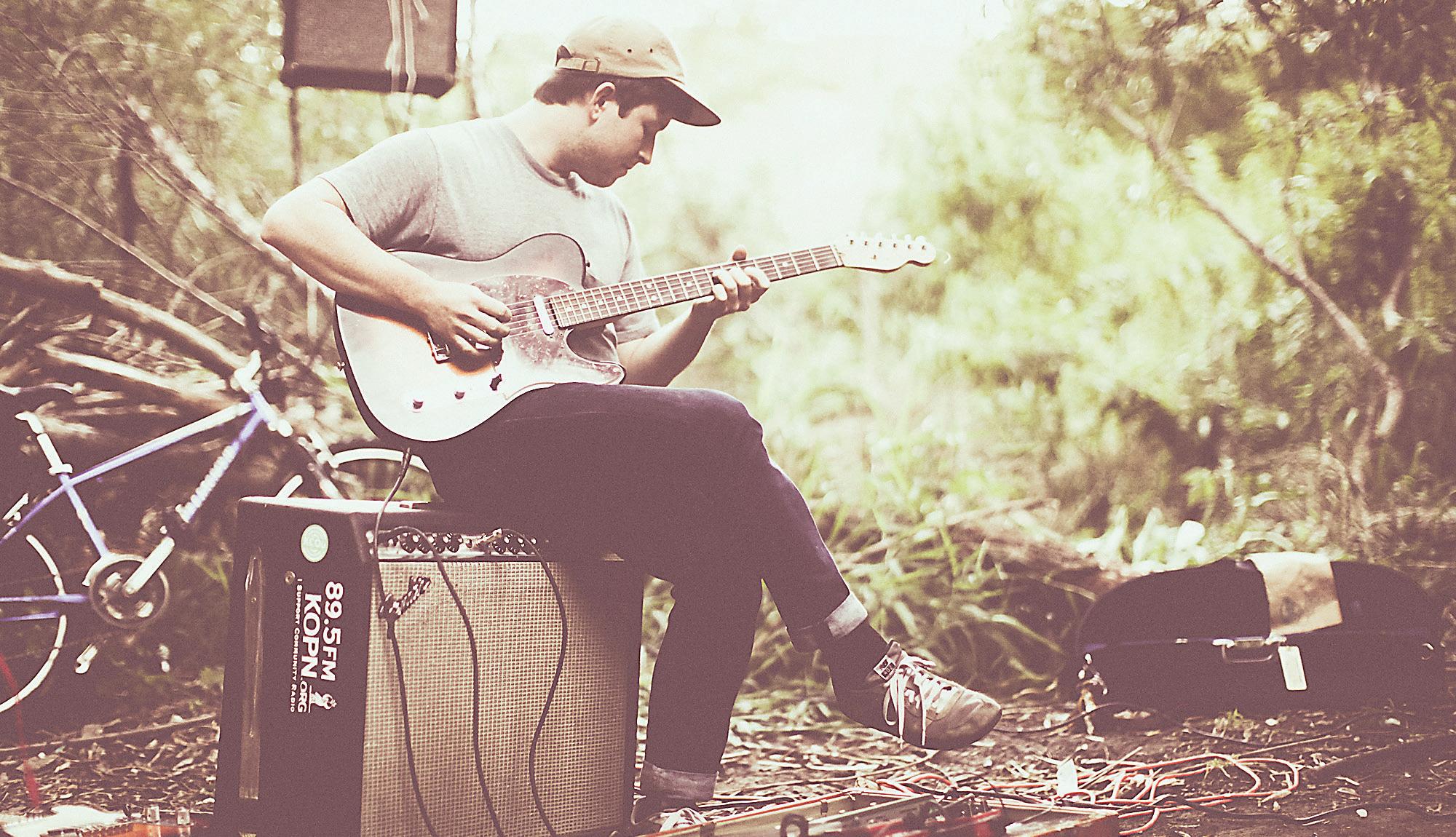
The duo met during a mixtape exchange in the basement of Columbia’s KOPN radio station in 2011. Mixtape trading is a long-standing tradition in cassette-tape culture. Crook and Chlapek started their label with the hope that they could highlight that part of the local music scene. Dismal Niche has grown to include 17 artists and bands, such as Hush Arbors, Neatly Knotted and Nevada Greene. The label will host its second music festival at small venues around the city from October 6–9.
Crook sat down with Vox to discuss how cassette tapes help DIY musicians, what he looks for in experimental music and how he and Chlapek combined the two into a business.
What was going on in Columbia that made you want to start this project?
When we started, Columbia was in a transition. It kind of always is as far as the music scene goes. It’s a pretty transient town. A lot of people come here for college and then leave. We had a DIY space where a lot of bands were playing and shows were happening (at the Hair Hole, located at 104 Orr St.
It was torn down in 2013). That was demolished to make way for more student housing, so when we started Dismal Niche, we felt like we needed to capture what was happening at the moment before it was demolished and everybody was gone.
Do you hope cassettes make a comeback?
As far as a cassette-tape comeback, I don’t think we were looking to tap into any kind of trendy markets or anything to make a quick buck. That’s never been the goal. We wanted to release music from artists around town and regionally.
Why do tapes continue to be the medium of choice among experimental artists?
It’s a good way for bands to release things in a way that’s financially feasible. As a touring DIY musician, I found that people buy tons of tapes. It’s a really good way to sustain yourself while you’re on tour. They cost about $1.50–$2 apiece to make and then you can sell those on the road, so even if you don’t sell them, it’s not like you’re out a whole lot. They have a durable quality that CDs don’t. They also have a portable quality that records don’t.
How did you and Chlapek turn the project into a successful venture?
We both had a lot of energy to make this happen. Ben’s a great designer. That’s what he does for a
living in Chicago. I have good, gregarious people skills and a passion to get out and do music and help people out.
Which artists first drew you to the experimental music genre?
I grew up on Neil Young. The deeper you dig into his catalog, the more experimental he gets. I’ve always really liked the soundtracks to old spaghetti Western movies that my dad would watch like The Good, the Bad and the Ugly and stuff like that. The Ennio Morricone soundtracks and Ennio Morricone’s music were a huge influence.
What qualities do you look for to separate experimental music from what some may consider just weird?
I wouldn’t say I’m looking for any one thing in particular. I guess I’m drawn to things with cadences that a lot of times don’t really agree with Western standards of music: songs that go on way too long, wander and don’t really seem to have structure or songs that seem to have a structure that don’t agree with standard Western and pop music. I just like things that move me in a deeper way rather than just nodding my head to it.
— MADELINE MCCLAIN PHOTO COURTESY OF MATTHEW CROOK
Sean Gaskell Family Concert
The globe-trotting musician plays one of the most storied instruments in West African culture. The 21-stringed kora holds a special status and is played by a griot, or storyteller. Today, 2–3 p.m.; 6:30–7:30 p.m., Daniel Boone Regional Library, Free, 443-3161
Columbia Shape-Note Singers
Take a deep breath, and join the chorus of Columbia’s Shape-Note Singers. The 200-year-old American tradition of Shape-Note singing is a version of a capella that focuses on religious folk melodies. Tuesday, 7:30 p.m., Trinity Presbyterian Church, Free, 446-1075
CIVIC
Prairie Point Quilting
It’s quilting time. Show up ready to learn as local expert Janet Mamert demonstrates how to create prairie points, which are folded triangles typically used as an edge. Tonight, 6–7:30 p.m., Daniel Boone Regional Library, Free, 443-3161
Party With the Stars Plus Paper Airplanes
Throw a paper airplane from the library’s balcony, and join Val Germann and
the Columbia Missouri Astronomical Association for a night with the stars. Hope for clear skies so you can see Mars, Jupiter and Saturn. Friday, 7–9 p.m., Daniel Boone Regional Library, Free, 443-3161
FOOD & DRINK
Fat Tire and Friends
With temperatures reaching the high 90s, you could probably use something ice cold and tasty to cool you off. How about a good beer? Fat Tire and Gunter Hans “collabeerate” for an evening that’ll make you forget the heat. Tonight, 5–8 p.m., Gunter Hans, Free to attend; Food and beverages for purchase, 256-1205
MUSIC
’80s vs. ’90s vs. ’00s
Head over to The Blue Note and defend your favorite music era with this decades battle. Whether it’s Madonna, Britney Spears or Eminem, show your support and vote at midnight. Dress up in the big hair of the 1980s, the grunge of the 1990s or the colorful fashion of the 2000s. Friday, 9 p.m., The Blue Note, $5, 874-1944
Tom Sauk and Jailbox
Mellow out Saturday night with Jailbox and Tom Sauk. The former opens with a heavy dosage of dream-pop, and Sauk follows
it up with a sound that’s a cross between alternative and country. Saturday, 8 p.m., Café Berlin, $5, 441-0400
SPORTS
Annual Heritage Days 5K
Walk, run or sprint at the Annual Heritage Days 5K in Boonville. All proceeds go to the construction of Central Missouri Cancer Memorial Park. Saturday, 7:30–9 a.m., Thespian Hall, $25, (660) 882-2721
SCREEN
April and the Extraordinary World (PG)
A girl seeks her missing scientist parents in this animated fantasy set in steam-powered France.
RT, RUNTIME = 1:45
Free State of Jones (R)
Newt Knight (Matthew McConaughey) leads a rebellion to secede from the Confederacy during the Civil War. He’s joined by slaves and locals from Jones County, Mississippi.
R, RUNTIME = 2:19
Independence Day: Resurgence (PG-13)
The aliens were never gone; they were waiting. Using alien technology, humans join together and fight to avoid annihilation.
R, F RUNTIME = 2:00
The Shallows (PG-13)
Rule 1: Don’t go surfing or when there are sharks in the water. 200 yards from shore, Nancy (Blake Lively) rides the waves of a secluded beach that happens to be the home of an aggressive, territorial great white shark.
R, F RUNTIME = 1:27
Weiner (PG-13)
Get your mind out of the gutter. This revealing documentary about former congressman Anthony Weiner lets you into the debacle-filled farce that was his New York City mayoral campaign.
RT RUNTIME = 1:36
Still playing
Captain America: Civil War (PG-13), R
Central Intelligence (PG-13) F, R
The Conjuring 2 (R) F, R
Finding Dory (PG) F, R
The Lobster (R) RT
Love and Friendship (PG) RT
Me Before You (PG-13) F, R
The Meddler (PG-13) RT
Now You See Me 2 (PG-13) F, R
Teenage Mutant Ninja Turtles: Out of the Shadows (PG-13) R