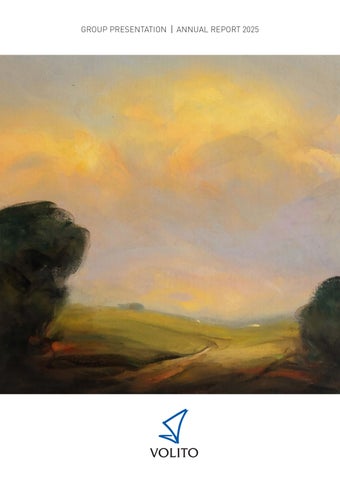
Peter Frie was born in Lysekil in 1947, and lives and works in Båstad and Thailand. He works in one of the oldest traditions in art, painting in oils on canvas. He repeats his motifs again and again with small variations in endless series. They are all vast timeless landscapes, like the scenography of dreams, but without any traces of people. With technical expertise, Peter Frie conveys the silence and tranquillity that has become a rare commodity in a confused and changing world.
The cover art is entitled “Landscape” and Peter Frie says “Memories from happy moments of my childhood out in nature with my mother have made an indelible impression. Time stood still under the huge trees, in the glade, on the sunlit meadow or along the narrow path. They were moments that made me realise the tremendous power and importance of nature. Seeing the ability of nature to heal and the striving to wake up time after time and bloom, and to then slowly fade away to make way for the new. I am inspired by all this in my art and am not much influenced by contemporary art trends.”
Peter Frie’s work is represented in many public and private collections such as Moderna Museet in Stockholm, Kiasma in Finland, Malmö Art Museum, Sven-Harry’s Art Museum in Stockholm, Haggerty Museum of Art and Caldic Collection in Rotterdam.
Peter Frie was the recipient of the Finnish art prize, the ARS Fennica Award in 1998.
2024 Andreas Glad
2023 Peter Sternäng
2022 Anita Viola
2021 Bertil Vallien
2020 Carlos Capelán
Volito is a privately owned group with a strong focus on growth, in which a balanced approach to risk and reward and a long-term perspective provide the basis for creating value. The Group is active in three business areas: Real Estate, Industry and Portfolio Investments, which all pursue their own development through business units, segments and subsidiaries. The adjusted equity amounts to approximately SEK 6 billion and Volito’s head office is located in Malmö.
The name Volito stems from the Latin word volare, which means to strive upwards. Volito’s vision is to strive towards new heights by developing businesses and people with an aim to improve the world and build value across generations. The flying metaphor and vision is a reminder of both the Group’s origins in aircraft leasing and of the importance of constantly developing with a view to the future.
CONSTANT DEVELOPMENT WITH A VIEW TO THE FUTURE
VOLITO’S VALUES
Our main asset is the trust of our stakeholders. To build trust, we value good relationships and act with professionalism.
Our professionalism is the foundation for business success today and in the future, and is built on competence, flexibility and dedication.
As a family business, we care strongly about our relations with all stakeholders; this is the key to creating value across generations. We create value together with our stakeholders through loyalty, honesty and sustainability.
VOLITO’S VISION
We strive towards new heights, by developing our business and people in order to improve the world around us and create value across generations.
VOLITO’S HISTORY
The Granlund family come from Eslöv, where the family ran a successful trading business. This created a good understanding of business and entrepreneurial operations. After graduating with a Master of Science in Engineering, Industrial Engineering and Management, Karl-Axel Granlund chooses to work in the business sector.
Milestones on the way to today’s Volito
Financial statement for the fiveyear expansion plan: adjusted equity increased during the period from SEK 1.8 billion to SEK 3.9 billion.
In line with a carefully tailored plan, the succession of Volito AB from Karl-Axel to sons Axel, Peter and Karl-Fredrik is implemented.
Volito Industry establishes itself in Norway with the acquisition of Hyd Partner A/S.
The five-year plan is summed up and adjusted equity increased during the period to SEK 5.7 billion. Volito Fastigheter acquires its first property in Lund.
A new five-year plan with a focus on growth and increased diversification goes into effect.
Volito Industry establishes itself in Finland with the acquisition of Hydrosystem Oy.
Volito Industry is formed and begins an acquisition journey in automation with its acquisition of HydX AB.
After some tough years, Volito adopts its first five-year expansion plan with a focus on expansion and good profitability. A new CEO is appointed.
The Nyckeln aircraft leasing business is acquired by AB Axel Granlund.
Volito is formed to diversify the business and spread risk. The first investment is made the following year.
Volito Fastigheter takes shape, with a total of eight properties in Malmö.
Financier Lennart Blecher becomes a co-owner of Volito.
The aircraft leasing business is listed on the stock exchange. Most of the ownership is divested.
Our biggest asset is, and has always been, trust capital. It’s not in the balance sheet, but it’s oh so important.
Karl-Axel Granlund
A FOCUS ON LONG-TERM VALUE CREATION
Volito is a growth-oriented group based on a balanced approach to risk and reward and a long-term perspective with three business areas: Real Estate, Industry and Portfolio Investments.
Business Area Real Estate owns, manages and develops commercial premises and residential properties in attractive areas of Malmö and Lund. The property portfolio consists of 22 properties with a total area of 92,000 m2, and two jointly-owned properties.
22
PROPERTIES
92,000 M2, TOTAL AREA
3,473 SEK M, PROPERTY VALUE
Business Area Industry starts up, acquires and develops knowledgeintensive industrial companies in three business segments: Motion & Drives, Automation & Electrification Technologies and Industrial Solutions. The 10 portfolio companies have a strong position in the Nordic region with a focus on continued expansion.
10 INDUSTRIAL COMPANIES IN 3 COUNTRIES
911 SEK M, SALES
58 SEK M, EBITDA
Business Area Portfolio Investments consists of significant positions in listed and privately owned companies in which the Group sees potential for stable and long-term growth. The portfolio is well diversified and the Group strives for an active ownership role.
THE YEAR IN BRIEF
• Volito’s adjusted equity increased by 7.5 per cent to SEK 6 168 million.
• Volito’s profit after financial items amounted to SEK 514.2 million (334.3).
• Volito’s adjusted equity ratio was 61 percent (59).
• Volito Fastigheter reduced its vacancy rate and increased operating profit by 4.7 per cent to SEK 112.8 million.
• Volito Fastigheter initiated planning for three development properties included in the City of Malmö’s first adopted local plan for Nyhamnen.
• Volito Industry increased turnover to SEK 910.6 million with an EBITDA of SEK 58.4 million.
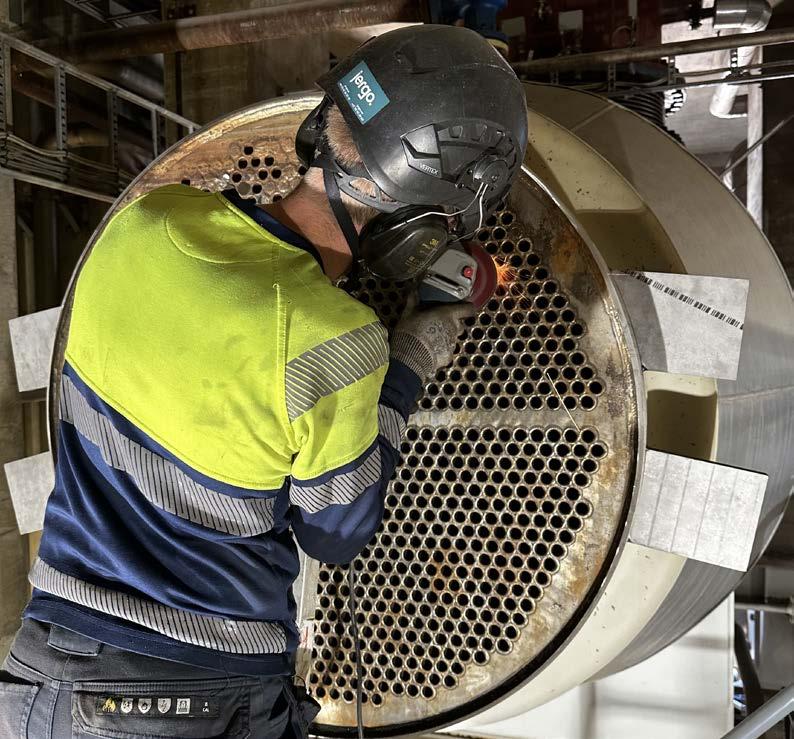
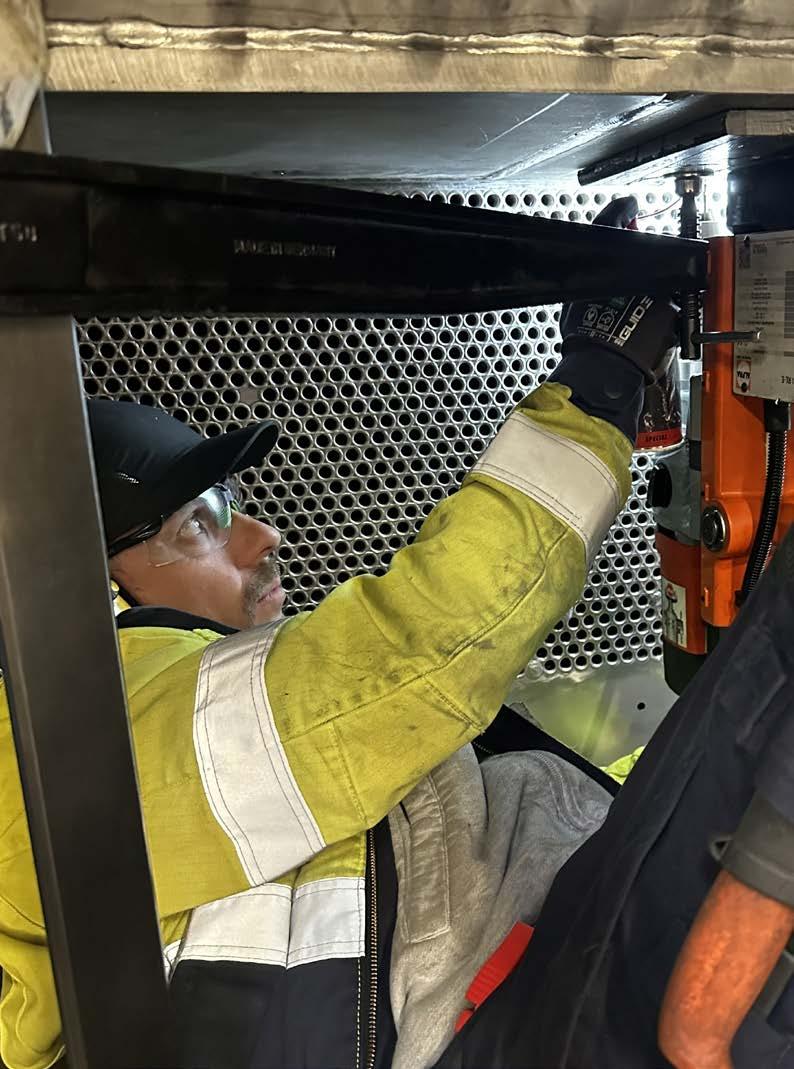
• Volito Industry acquired Jergo with operations in Sweden and Norway in the business segment Industrial Solutions.
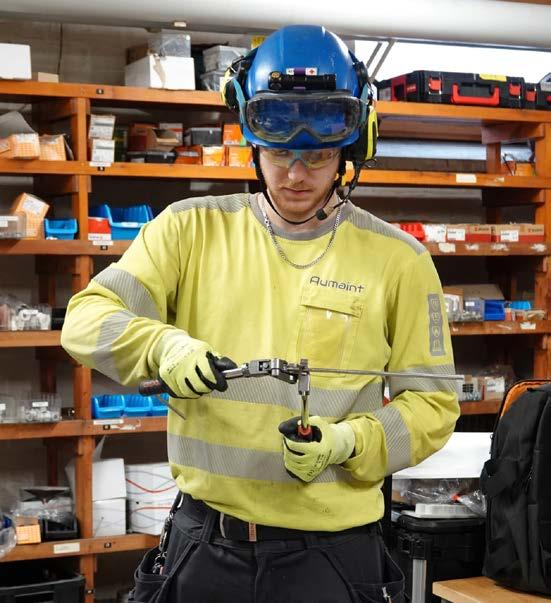
• Volito Industry strengthened its presence in Finland with the acquisition of Aumaint Oy in the business segment Automation & Electrification Technologies.
• Volito Portfolio Investments divested the holdings in Annehem Fastigheter and Avensia, reduced the holding in Peab and increased
in Alfa Laval.
Comments from the CEO
Ulf Liljedahl President and CEO
Volito AB
The year 2025 was characterised by a cautious business climate and a market that moved sideways, which limited growth opportunities for the Group’s business units. Volito’s adjusted equity amounted to SEK 6.2 billion at year-end and the profit for the year was SEK 421 million. For Volito, the year was characterised by continued change management – during 2025 the Group took important steps forward and laid a stable foundation for the future.
Volito’s operations
Volito’s vision is to develop businesses and people with an aim to improve the world and build value across generations. Today, Volito is a well-diversified group with three business areas: Real Estate, Industry and Portfolio Investments. This structure enables us to balance risk and reward. Our strength lies in combining a long-term perspective and flexibility – we build value that remains over time, but are prepared to reassess and adjust operations when there are changes in the
world around us. We are convinced that a strong corporate culture is crucial for ensuring the company develops in line with the vision of the owners and management.
Clear plan with a 2030 horizon
Volito’s business plan for the period 2025-2030 focuses on increased freedom of action, profitable growth and sustainable development of our wholly-owned businesses. This means that we will have a more flexible and liquid portfolio, can act quickly on new business opportunities and continue to develop our wholly-owned businesses Looking ahead, we envisage that the Group’s property portfolio will be further refined, that the industry side grows and that the portfolio of listed and unlisted holdings becomes more diversified. Our focus on value-creating business will intensify and become even clearer.
A year of changes
The year 2025 was a period of continued transformation and preparation for future growth. During the year we initiated work on changing and strengthening the Group’s portfolio with the aim of increasing freedom of action. We have implemented strategic changes to increase diversification and reduce exposure relating to individual holdings. Despite geopolitical tensions and economic challenges, we have succeeded in maintaining stable earnings and strengthened our position in all business areas. When the business climate improves, we are ready to take the next step in our growth journey. Volito’s ability to make good and well-founded decisions has been crucial. Our ownership structure and effective corporate governance helps our ability to respond constructively and quickly to changes in the market situation.
Our business areas
Volito Real Estate
Business Area Real Estate continued to develop positively during the year. With a focus on long-term value creation and sustainability, we have refined our property portfolio and taken important steps towards making it even more climate-friendly. Investments in project development and environmental certification have been key elements. During the year we obtained environmental certification for our first building and went one step closer to starting construction on our development properties in central Malmö. We also continued to renovate and develop our properties, with the aim of contributing to the city’s development and create pride in our portfolio.
Volito Industry
Business Area Industry has grown considerably in recent years and now accounts for a significant share of the Group’s turnover. Through strategic acquisitions and organic growth, we have built a strong industry operation, focusing on a long-term perspective, proven business models and clear cash flows. In 2025 we acquired two more companies, expanding our business to new areas in Norway and Finland. Jergo, a part of Industrial Solutions, opens up the Norwegian market. Aumaint in Finland strengthens our electrification offering and extends our reach in northern Finland.
Volito Portfolio Investments
The portfolio of securities underwent a strategic transformation which, among other things, reduced our exposure relating to properties and increased flexibility. Our investment philosophy is based on diversification of risk, a long-term perspective and value creation. In 2025 we divested our holding in the property company Annehem as well as parts of the construction and civil engineering company, Peab, and chose to invest more in Alfa Laval, a company with risk exposure relating to food, water treatment and energy recovery.
The portfolio company, Bulten, which is also in a transformation phase, was negatively affected by a loss of sales in the second half of the year due to a cyberattack aimed at one of their largest customers. In June 2025 the company initiated an extensive strategic review in order to restructure their business. EQT continued to focus on creating value through disciplined investments, close cooperation with the portfolio companies, wellexecuted divestments and the continued raising of capital. For Peab, the year was characterised by a cautious market, while the portfolio company’s four business areas provide breadth, a strong position in the Nordic region and many business opportunities.
The future
Volito is well equipped for 2026 and has a stable platform for managing the opportunities and challenges that await. The transformation of the portfolio will continue, and all business areas are prepared to benefit from an improved business climate.
Uncertainty continues to prevail in the world around us, with geopolitical risks, economic challenges and rapidly changing markets. Our strength lies in our ability to make fast decisions in close dialogue with the owners, board and management. This gives us the capability to cope with fluctuations and create value, even in more challenging times. With innovation, flexibility and a clear strategy, we are ready to face the future and continue to build value.
I would like to thank all our staff members, customers and partners for your commitment and trust during the year. Together we will continue to lift Volito towards new heights!
VOLITO ON THE MAP
Volito has a well-diversified portfolio consisting of property holdings in the Malmö-Lund region, industrial companies based in the Nordic region and significant blocks of shares in Swedish listed companies with a global or Nordic focus. The head office is in Malmö.
Business Area Real Estate consists of Volito Fastigheter, which owns and manages commercial premises and residential properties in Malmö and Lund. The business is characterised by a long-term perspective, diligent management, a high level of service and close relations with customers and partners. Volito Fastigheter has continuously developed its portfolio in order to strengthen its presence in the region’s most attractive areas and today’s portfolio includes some of Malmö’s most distinctive buildings.
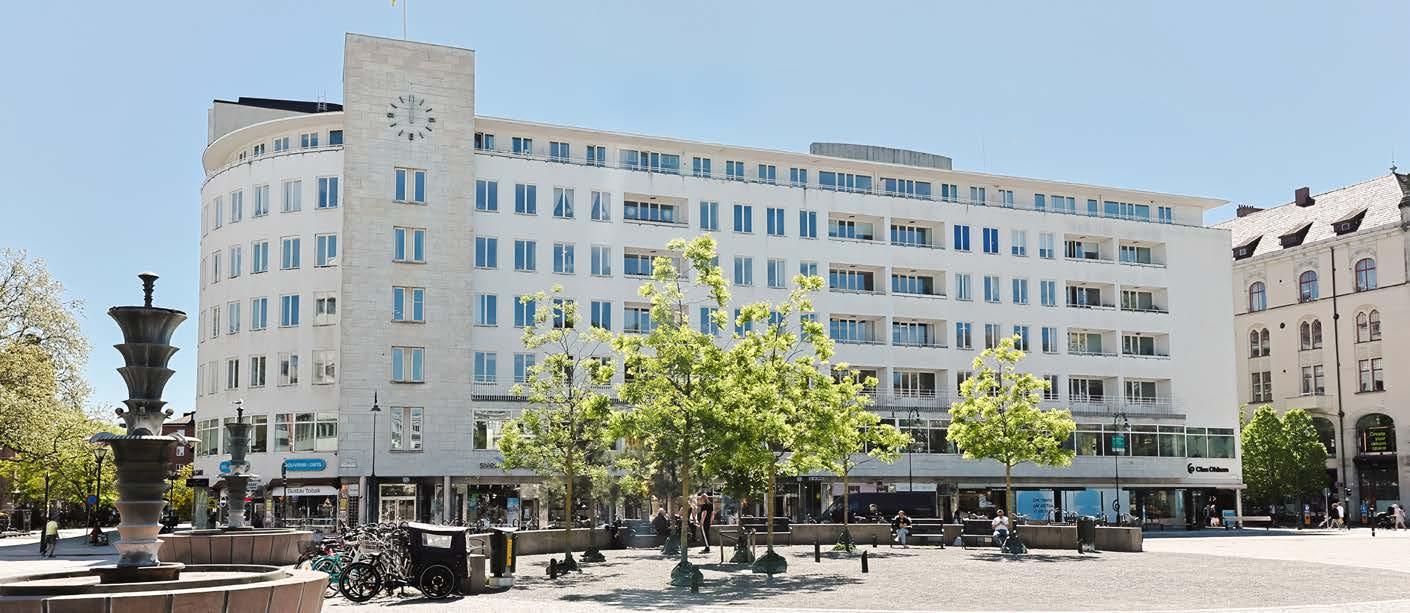
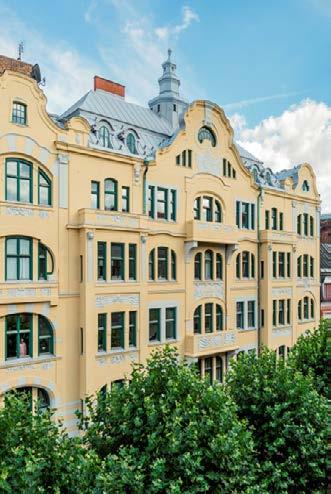
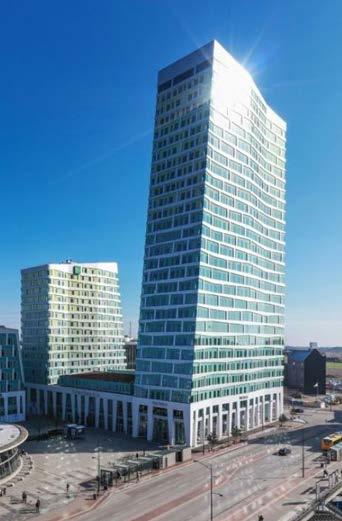
Volito Fastigheter’s portfolio is located in central Malmö, Limhamn, Hyllie and Lund.
Volito Fastigheter STRONGER PERFORMANCE IN A TOUGH MARKET
Marie Persson Managing Director, Volito Fastigheter
The world situation in 2025 was marked by change and uncertainty, but also by progress and continued positive developments for Volito Fastigheter. Despite a challenging rental market and weak business climate, our vacancy rate continued to decrease. With the security that stems from a long-term strategy in combination with diligent management, we made great strides forward during the year.
A property company with strong local anchoring
Volito Fastigheter is a company with strong local anchoring – we own and manage 22 properties in Malmö and Lund. In addition, we are also responsible for the management of two jointly-owned properties at Hyllie Stationstorg. Our business is based on active development of the property portfolio with a long-term focus. We work closely with customers using our own technical and financial property management in which creating relationships and good service are the highest priorities.
Market developments
One market trend is that businesses are clearly prioritising efficient and value-creating premises, in which the office is a part of brand-building, as well as addressing new and flexible working methods. After the pandemic, companies are placing a great emphasis on making it attractive for staff to come into the office. We fulfil customer requests by offering flexible solutions identified through close dialogue. Central Malmö and Hyllie have both continued to be strong locations and we have had good success in attracting companies to our premises.
Developments in 2025
Volito Fastigheter has reduced the vacancy rate for several years in a row and the trend continued in 2025, despite challenging conditions in the world around us. Thanks to a lower vacancy rate and reduced interest rate costs, we delivered earnings over budget, while continuing to refine and develop our portfolio. During the year we welcomed, among others, White Arkitekter, Hypergene, Careium, IDÈ House of Brands, Wictor Family Office, Veho and Weibull M&A as new customers. In addition, we have extended cooperation with customers such as VR, Client Solutions and Vianor.
We achieved a profit, which after financial items amounted to SEK 59 million. The market value of our properties decreased by SEK 4 million during the year and together with the year’s investments of SEK 76 million resulted in an unrealised change in value of SEK -80 million.
Progress in our projects
Volito Fastigheter owns several development properties in Nyhamnen in Malmö that in time will become new offices and housing. The City of Malmö’s City Planning Board decided in September 2025 to begin planning work for the Polstjärnan area, where we now look forward to being involved in developing this exciting part of tomorrow’s Malmö. At Västerbro in Lund we own Gustavshem 2, existing light industry premises with development potential in the longer term.
Overall, we see good opportunities to increase and refine our portfolio through our own project development.
Our first environmental certification
During 2025 we worked on the environmental certification of the Central Post Office in accordance with the Miljöbyggnad iDrift system. It is the first building in our portfolio to obtain
certification in line with our decision in 2024 to certify all the properties in the portfolio by 2030. The work involves large parts of the organisation, in which both property managers and technical staff contribute to drive the certification process forwards.
Within the framework of our sustainability management, we also work to increase reuse and enable more efficient energy use at our properties. The work on improving the energy efficiency of the properties is an important part of our longterm efforts, in which we create property-specific transition plans for energy. The aim is to reduce our total consumption year-on-year and thereby also our climate impact.
The future
Volito Fastigheter has an ambition to double the value of the real estate holding by 2030, from SEK 4 billion to SEK 8 billion. We have the resources required for growth and see opportunities both through refining our existing portfolio and by new construction and property acquisition. Our ambition is to continue to be a long-term and reliable actor in the market, with a focus on sustainable development and close relations with customers and partners.
I would like to extend my thanks for the past year to all our customers, partners and dedicated staff. I look forward to continuing our exciting journey with you in the new year!
We fulfil customer requests by offering flexible solutions identified through close dialogue.
VÄSTRA HAMNEN
NYHAMNEN
* The properties are jointly owned by Volito Fastigheter and Peab.
Delfinen 17, Malmö Aegir 1, Malmö
Värdshuset 4, Hyllie
WHITE ARKITEKTER CREATES TOMORROW’S
OFFICES
WITH NOMADIC ARCHITECTURE IN UNIQUE PREMISES
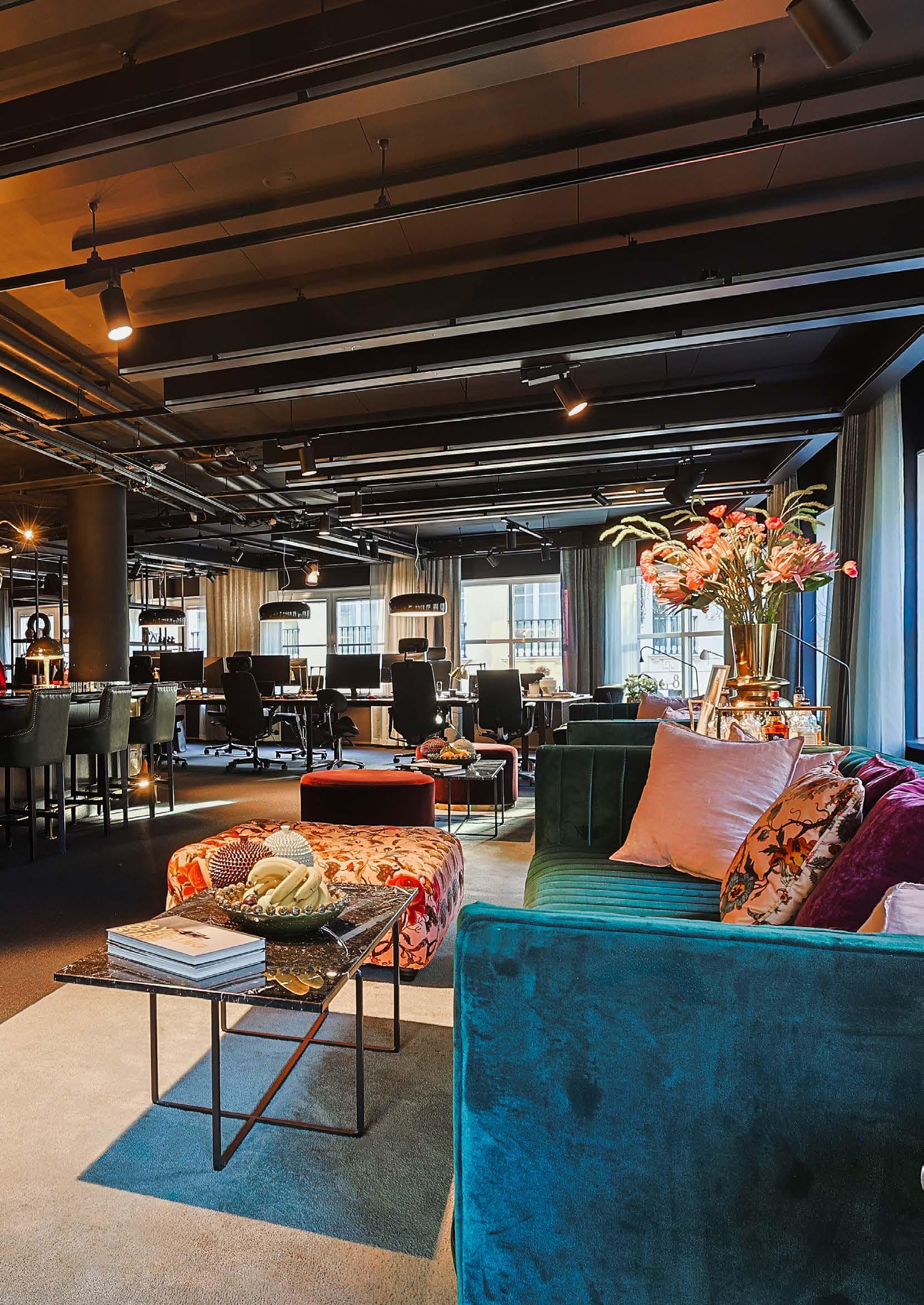
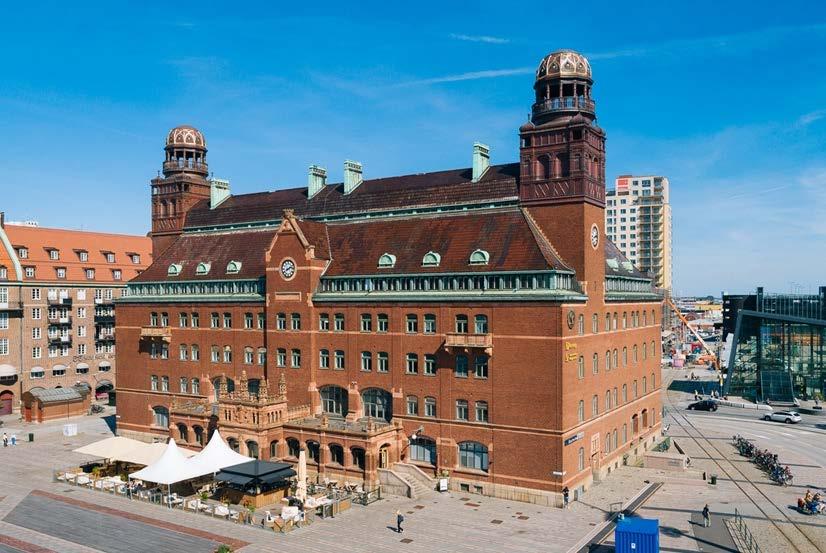
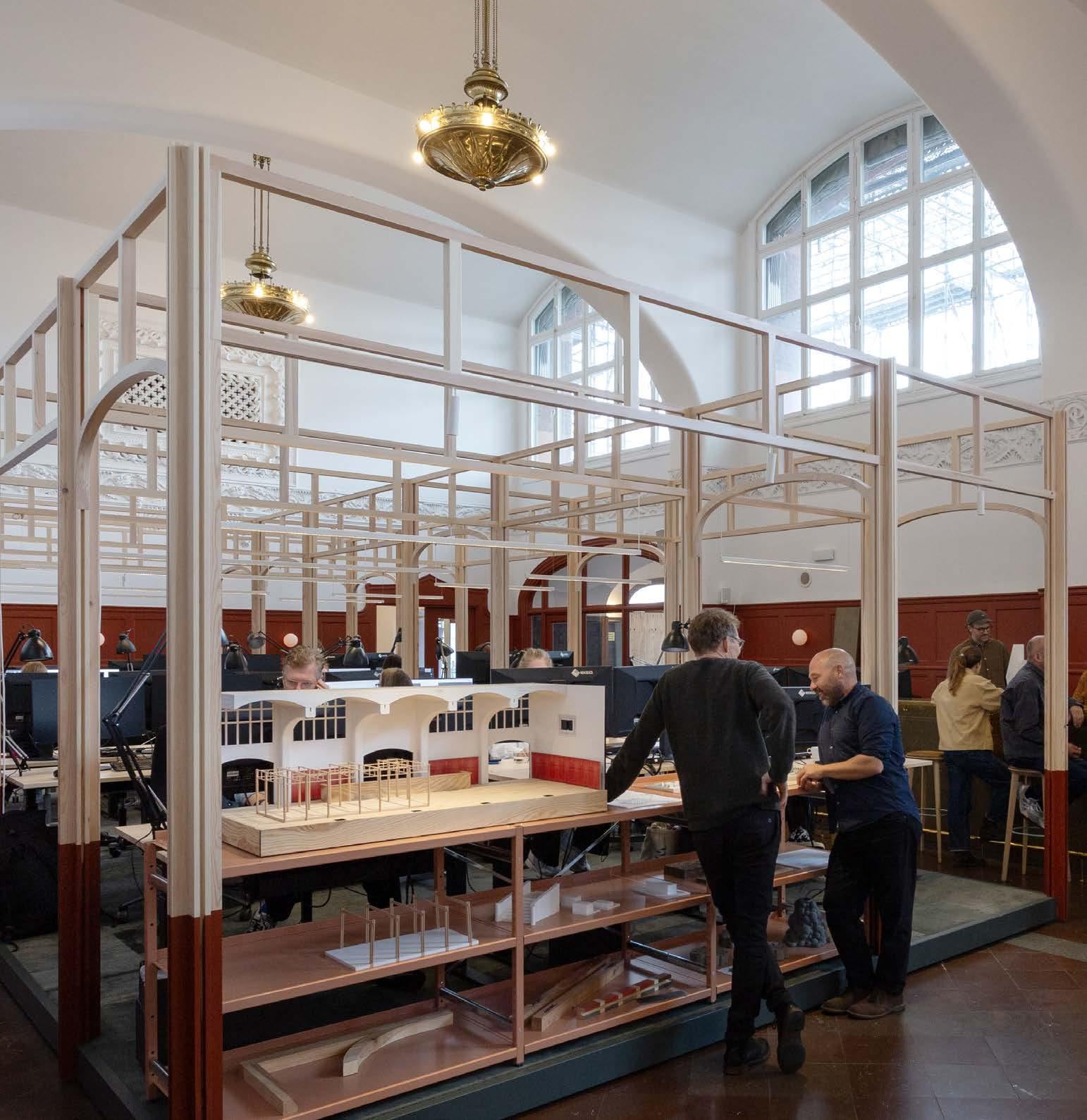
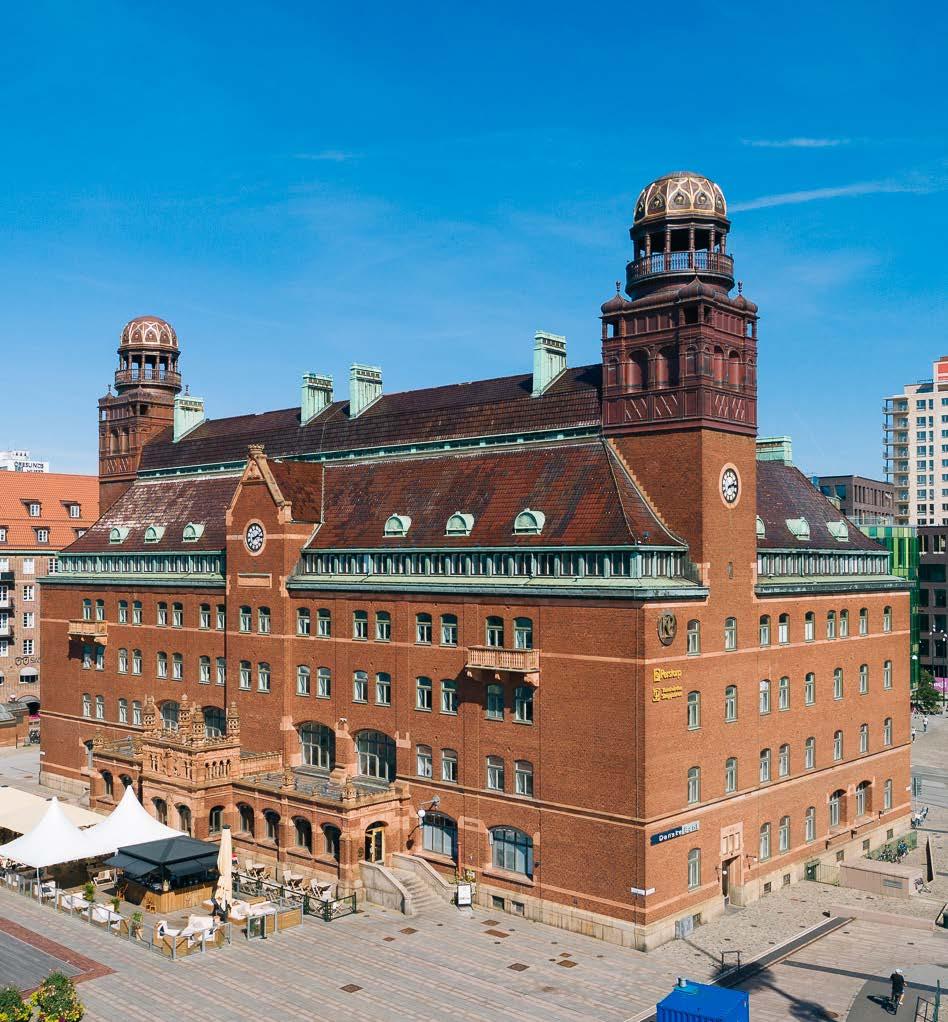
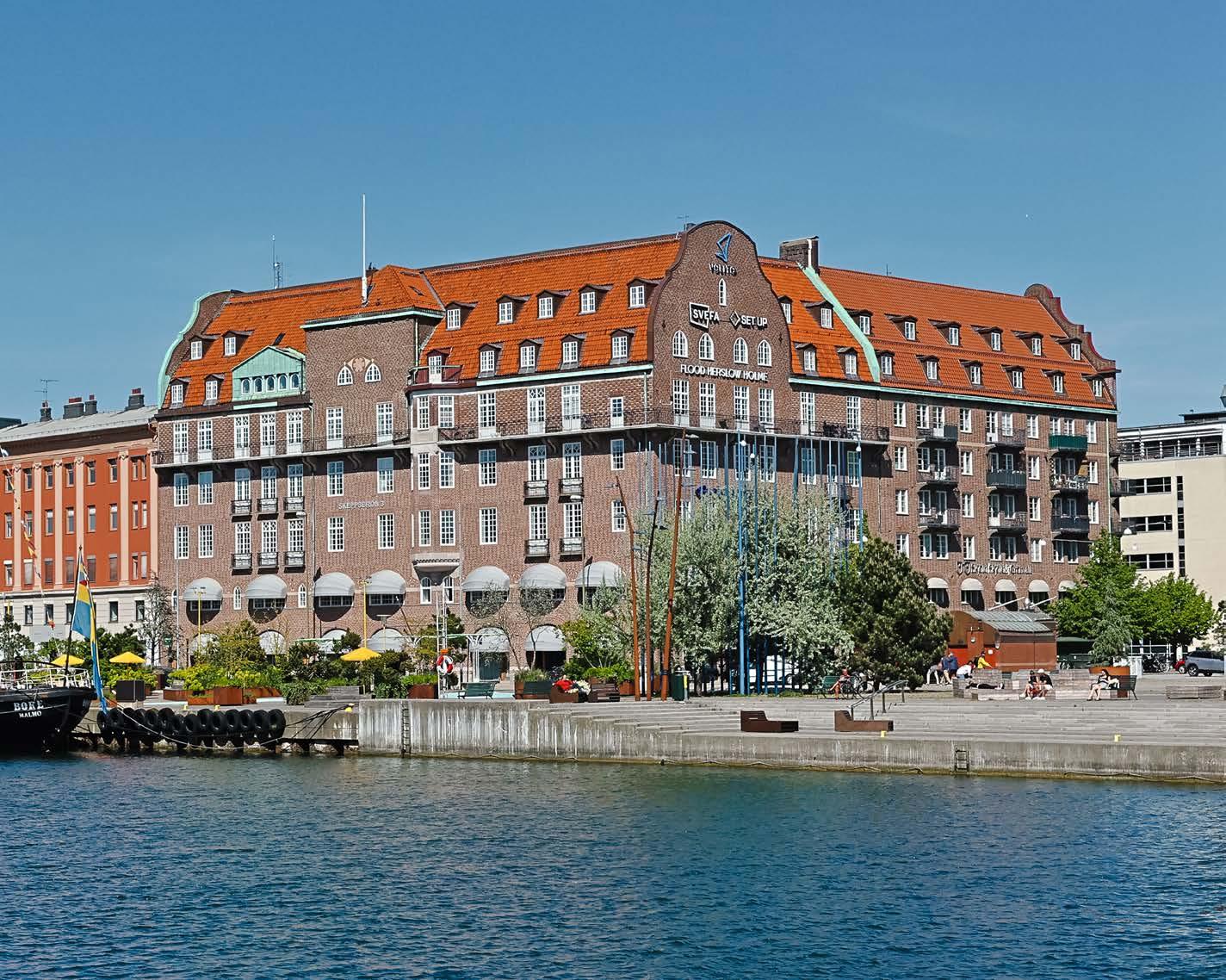
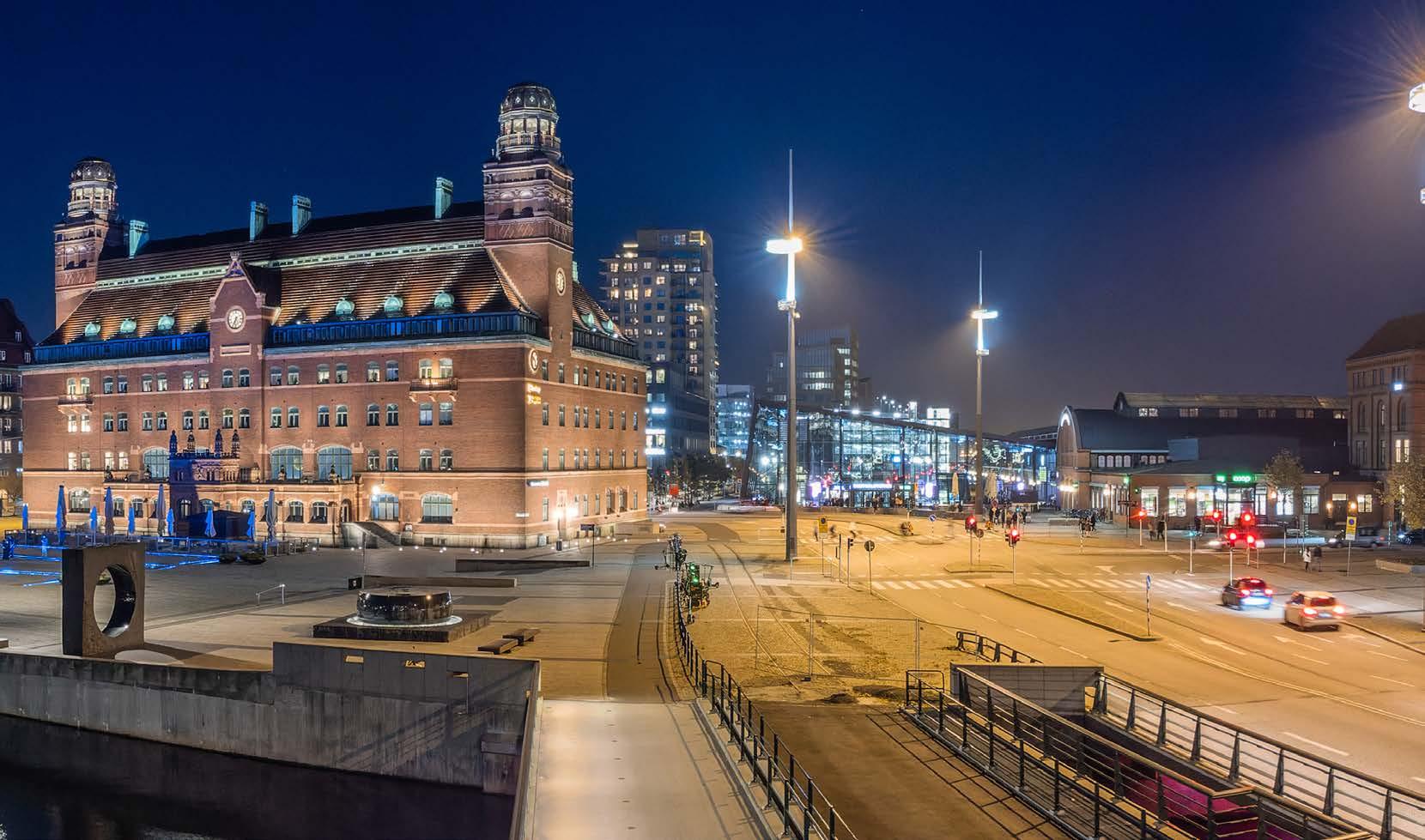
The Central Post Office, located between Malmö Central Station and the harbour, was completed in 1906. The architect was the legendary Ferdinand Boberg. Post office operations ceased in 2006, and in 2013 a restaurant was established in the unique former cashiers’ hall on the ground floor. Now, White Arkitekter has created Malmö’s most exciting office with the smallest possible climate impact.
During a discussion between Martin Sundberg, Office Manager at White Arkitekter Malmö, and Martina Davidsson, Project Development Manager at Volito Fastigheter, which owns the property, the thought arose that White could look into what an office on the ground floor of the Central Post Office could entail.
“For thirteen years, we were on the seventh floor looking out over Varvsstaden,” says Martin. “We could follow the extensive
changes, but ultimately it felt wrong to be so high up. We get contact with the city and the people of Malmö at street level.”
White had therefore been talking for a long while about moving its office to the ground floor and were particularly interested in the connection between office and restaurant.
“We had looked at various premises, mainly restaurants and cafés, where it was easy to invite people to exciting events.
Because when you rent on the ground floor, we consider that you have a responsibility to also arrange events in the evenings and at the weekends. When Volito said the ground floor of the Central Post Office was empty, it was exactly what we were looking for,” continues Martin.
“We then started to plan to jointly explore new ways of sustainably adapting this gem into a workplace in the centre of the city with a minimal impact and maximum utilisation,” says Martina Davidsson.
“We decided to take over the premises as they were,” says Martin. “We didn’t expend a lot of resources on renovation and in late summer 2025 we moved in with our 50 employees.”
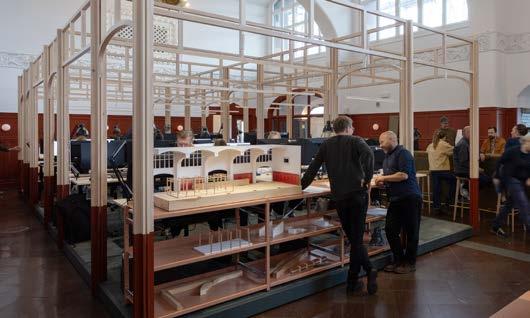
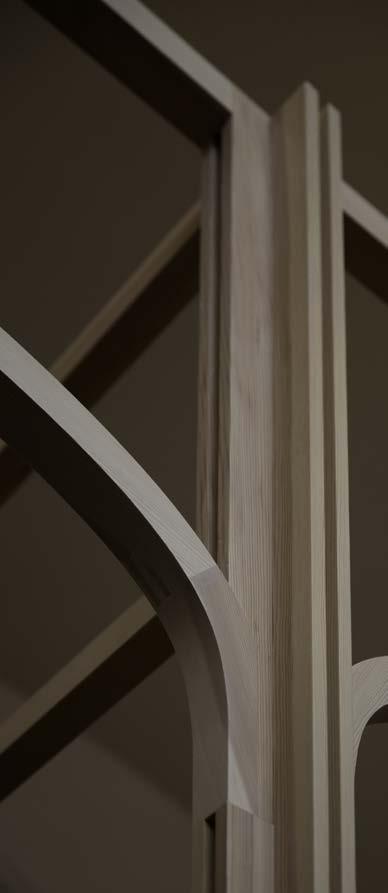
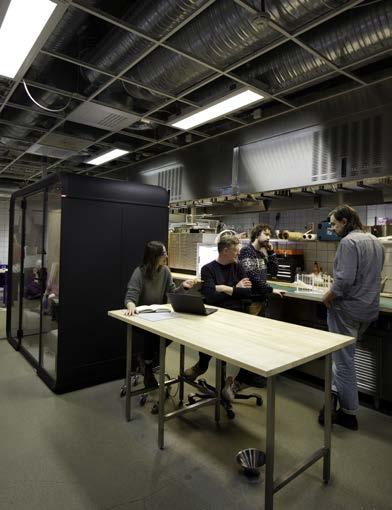
The cashiers’ hall – part of White’s premises – has been protected as a listed building for 90 years. The label is a secure way to protect the spirit of the period, which means it is not permitted to make alterations or major changes. This preserves a lot of the character but has also been a challenge. To make workplaces possible, despite the limitations, White opted for an internal freestanding wood construction and acoustically-sealed meeting spaces, known as meeting pods. Everything can be taken down in 24 hours. White calls it “nomadic architecture”.
“This means we apply a concept to the premises that’s easy and fast to change, while showing respect for the building’s architecture and supporting creativity, innovation and cooperation. Older buildings must find new roles as the city changes,” considers Martin.
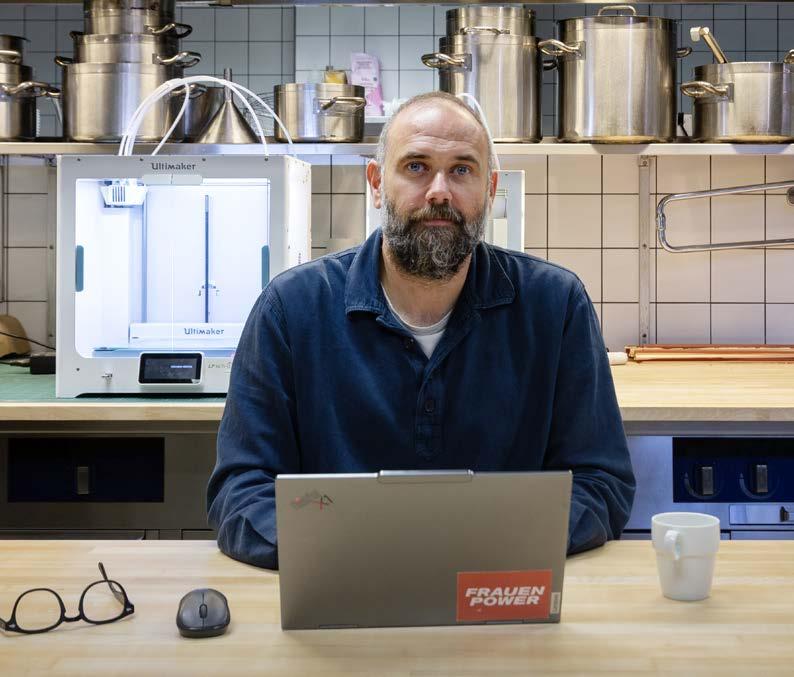
White went from around 1,500 m2 to 600 m2, from fixed workplaces to a completely flexible way of working. Everything at the premises has been preserved. White and their guests sit in the restaurant kitchen and the eleven-metre-long bar is a natural gathering point. The office is open and inviting in order to be a meeting place for boundary-crossing cooperation.
“The premises involve working methods and solutions that we have not seen before, that can strengthen us and give something back to Malmö,” says Martina. “We had a close dialogue with White throughout the process and this is clear from the results. It’s inspiring to develop new ways to use our premises and the potential to reopen for the serving of food and drink still remains for us to explore together.”
When Volito said the ground floor of the Central Post Office was empty, it was exactly what we were looking for.
CENTRAL POST OFFICE – OUR FIRST PROPERTY TO OBTAIN ENVIRONMENTAL CERTIFICATION
As a long-term property owner, Volito Fastigheter wants to contribute to a better society. Through environmental certification, solutions are identified that consider people, finances and the environment. The Central Post Office is our first property to obtain certification, and the aim is for all properties to be certified by 2030.
Volito Fastigheter’s sustainability management is based on four focus areas in which the company sees potential to make the greatest possible difference: climate, building culture, greenery and people. The climate focus area includes certification, improving energy efficiency and reducing total climate impact. In the certification work, the Central Post Office, Volito Fastigheter’s flagship and one of Malmö’s most iconic buildings, is the first to be certified.
The property is a listed building, which entails special challenges in the certification process, but the team have implemented several measures in order to meet the requirements.
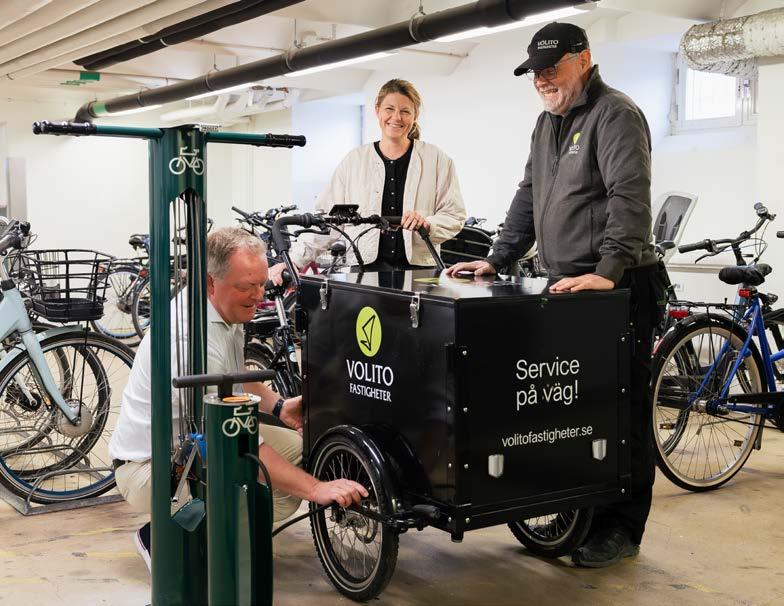
The property is a listed building, which entails special challenges in the certification process, but the team has implemented several measures in order to meet the requirements. This includes installation of water-saving fixtures, LED lighting in all public spaces and a bicycle workshop to promote sustainable travel. In addition, procedures for energy control and documentation have been improved.
“We want to make our sustainability management more structured and measurable in all the properties. Certification is a way to show that we are doing the right thing. We involve all property managers and technical staff in the certification processes for the different properties, so that we spread knowledge and awareness throughout the organisation,” says Martina Davidsson, Project Development Manager.
The certification itself is according to Miljöbyggnad iDrift, a Swedish system that is well-known among customers and partners. The aim of obtaining at least the Silver level was fulfilled – an ambitious target for a building with limited possibilities for making physical changes. Certification provides an independent stamp of quality and creates order in management through clear indicators for indoor climate, health, energy consumption and use of resources.
Certification also strengthens Volito Fastigheter’s sustainability management in the eyes of customers and financiers. With certification of the Central Post Office, work will continue on the properties Elefanten, Diana, Claus Mortensen, Carl Gustaf and Visenten in the next few years.
Another important focus area is building culture. With a property portfolio that includes several historic buildings, it is important to work actively on preserving the properties’ qualitative character and attributes, and in this way contribute to an attractive and diverse city. It concerns preserving architectural qualities in properties from different periods, while the company is also to be able to provide premises that meet modern requirements and offer technical solutions.
A further element of sustainability management is green rental agreements. Within the framework of these agreements, Volito Fastigheter and the tenants cooperate to reduce the use of resources and jointly find improvement areas. The green rental agreements were introduced in connection with completion of The Point but have since been offered at other properties.
“The green rental agreements makes sustainability management more concrete for both parties. Having a dialogue about sustainability and finding solutions together is very effective,” says Carl Brodelius, Property Manager and Rental Manager.
In addition, Volito Fastigheter wants to contribute to a greener, pleasanter urban environment through the greenery focus area by creating environments for biodiversity and enriching all properties with greenery and plant life. In the fourth focus area, people, active efforts are made to ensure fair working conditions for all, and targeted social initiatives are also carried out with Skåne Stadsmission. Activities that, as a property owner, contribute to a better society.
MOTION & DRIVES
Business Area Volito Industry starts up, acquires and develops companies in Motion & Drives, Automation & Electrification Technologies and Industrial Solutions. Volito Industry is a knowledgeintensive and growth-oriented group with a strong market position in the Nordic region. The group is prepared for continued expansion and the establishment of further operations focused on valuecreating solutions for industry.
Solutions in hydraulics and pneumatics that improve process efficiency, increase precision and enhance operational reliability in modern production.
AUTOMATION & ELECTRIFICATION TECHNOLOGIES
Solutions that support electrification in society, in which electric powertrains and batteries reduce energy consumption and enable efficient control.
INDUSTRIAL SOLUTIONS
Solutions and products that help companies in industry to improve manufacturing processes, quality and products.
A YEAR OF IMPLEMENTATION AND STRATEGIC ADVANCES
Johan Frithiof, Managing Director, Volito Industry
The year 2025 was characterised by implementation, structure and long-term decisions. In a world where many industrial customers have been more cautious and investment decisions have taken a long time, Volito Industry has succeeded in maintaining a stable business at the same time as important strategic steps have been taken for the future.
Our decentralised business model has once again shown its robustness. With each company assuming full responsibility for their business and earnings, in combination with a clear group-wide focus on structure, acquisition and development, we have been able to act quickly and for the long term in a more uncertain market situation.
Clear business units with strong positions Volito Industry is organised in three clear business units with good potential for continued profitable growth: Motion & Drives, Automation & Electrification Technologies and Industrial Solutions.
Within Motion & Drives we have a strong position in industrial automation, where we combine hydraulics, cutting-edge technical expertise, system solutions and service for both OEMs and the aftermarket. Through solutions for critical operations that enhance availability, energy efficiency and performance, the business constitutes a stable platform for continued profitable growth.
Automation & Electrification Technologies continued to grow in importance, driven by industry’s increased need for modernisation, improved energy efficiency and electrification of processes. The business unit covers electrical automation, system integration and advanced technical solutions that support customers’ transition to more efficient and sustainable production environments.
Within Industrial Solutions we assist our customers with specialised solutions that boost efficiency, quality and availability in their production. The business segment is characterised by stable profitability and close customer relations.
Together, the business units create a clear and attractive whole in which Volito Industry can meet demanding industry customers’ needs with cutting-edge expertise and high delivery capacity.
Market situation and operational focus
In market terms, 2025 can be described as an interim year. Many customers, particularly small and medium-sized industrial companies, have been cautious about large investments. At the same time, our exposure relating to global customers and more stable segments helped enable us to maintain a good level of activity.
Development has been relatively stable in Sweden and Norway, but the market in Finland continues to be impacted by external factors. Despite this, we have kept our market shares and strengthen our relationships with several key customers.
In parallel with this, the year has been characterised by a clear internal focus on implementation. One of the most important initiatives was the restructuring of HydSupply, where we addressed both the cost level and organisation. Through consolidation of the business and clearer processes, we create a stable platform for profitable growth in the years to come.
Development within our OEM operation was positive during the year. HydX reported the highest orders received to date on an annual basis, despite a more cautious market situation, which confirms both our technical position and our capacity to deliver over time.
Volito Industry’s turnover amounted to SEK 911 million (829) with an operating profit (EBITDA) of SEK 58 million (84).
Strategic acquisitions that strengthen the offering Acquisition is a key part of Volito Industry’s growth strategy. We focus on well-run companies with proven business models, stable cash flow and good profitability, where we can assist through long-term ownership and industrial development.
In 2025 we implemented two strategically important acquisitions. The acquisition of Jergo strengthens our offering in Industrial Solutions and gives us an established platform in the Norwegian market.
In Finland we continued to build a ”Power House” through the acquisition of Aumaint, which strengthens our presence in northern Finland and complements our offering in the business segment Automation & Electrification Technologies.
People, structure and sustainability
Sustainability is an integrated part of our offering and way of working. The focus is on solutions that create clear customer value through improved energy efficiency, increased operational reliability and reduced environmental impact, particularly in automation and electrification.
We also continued to develop our work within People & Culture. An internal training programme is under development, and a new HR system is being implemented for the entire
Volito Industry is well prepared
for the future with clear business units, a more stable operational platform and a continuing active acquisition agenda.
organisation. During the year we also strengthened our financial function, which improves our governance and monitoring in an increasingly complex business.
Future prospects
Volito Industry is well prepared for the future. With clear business units, a more stable operational platform and a continuing active acquisition agenda, we maintain our goal of reaching a turnover of SEK 3 billion by 2030.
By continuing to develop our existing companies, combining decentralised responsibility with structured monitoring and implementing strategic acquisitions, we see good conditions for creating long-term value for our customers, staff and owners.
In conclusion, I would like to extend my thanks to all staff, customers and partners for your commitment and trust. Together we continue to build Volito Industry for the future.
EFFICIENT TOTAL SOLUTION FOR MODERNISED VEHICLE RAMP IN THE PORT OF HELSINKI
In autumn 2025 a collaborative project carried out by three Volito Industry companies – HydSupply, LSA and FAP Automation – modernised and increased the operational reliability of a vehicle ramp at the Katajanokka Terminal in the port of Helsinki. Due to the breadth of Volito Industry’s offering, the customer received a total solution – hydraulics, electrics and automation – from a single supplier.
The project shows a combination of Volito Industry’s local strength and broad technical expertise.
The port of Helsinki will implement major restructuring in the next few years. Among other things, the Katajanokka Terminal will become the centre for traffic to Sweden. The vehicle ramp in question will be crucial in handling car traffic to and from the ferries at the terminal.
“The ramp is used for both cars and lorries, and its height needs to be adjusted depending on the size of the vessel and the sea level,” says Jussi Klasila, Field Service Manager at HydSupply. “The old system consisted of one hydraulic cylinder and a simple automation system but needed to be overhauled as issues such as leakage had arisen. The customer therefore asked for a modernisation and upgrade in order to increase operational reliability and reduce maintenance needs.”
The project shows a combination of Volito Industry’s local strength and broad technical expertise in which modernisation and digitalisation helped to increase operational reliability, reduce maintenance needs and improve customer service.
“From the customer’s perspective, the project was implemented completely according to plan and cooperation between all parties worked smoothly. The result is a reliable, modern solution that totally fulfils the terminal’s operational requirements,” says Petri Ruuskanen, Maintenance Specialist at the port of Helsinki.
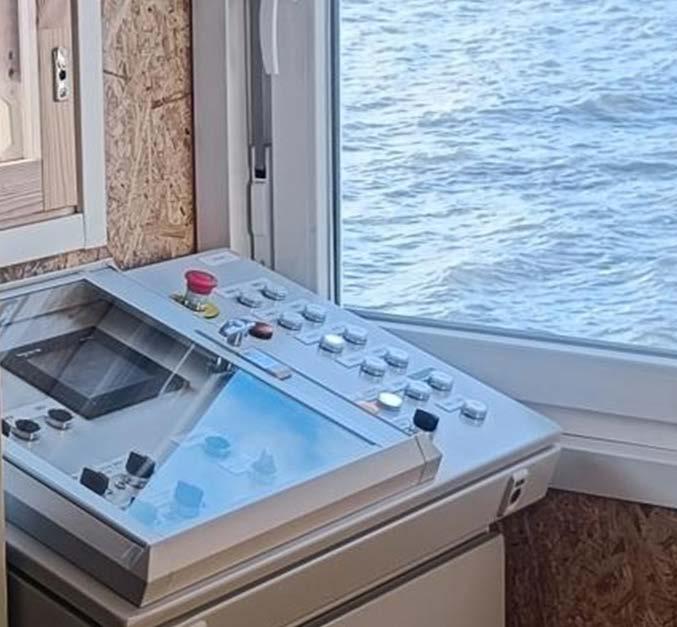
The customer can now control the height of the ramp via a panel, and the system has been fitted with an external connection for remote monitoring and rapid troubleshooting from FAP Automation’s facility.
“We have a connection to the customer’s system and can carry out maintenance and support them if a fault arises,” says Christer Lindqvist, Sales Manager at FAP Automation. “This makes it possible to quickly rectify several different problems from our office, without going out to the site.”
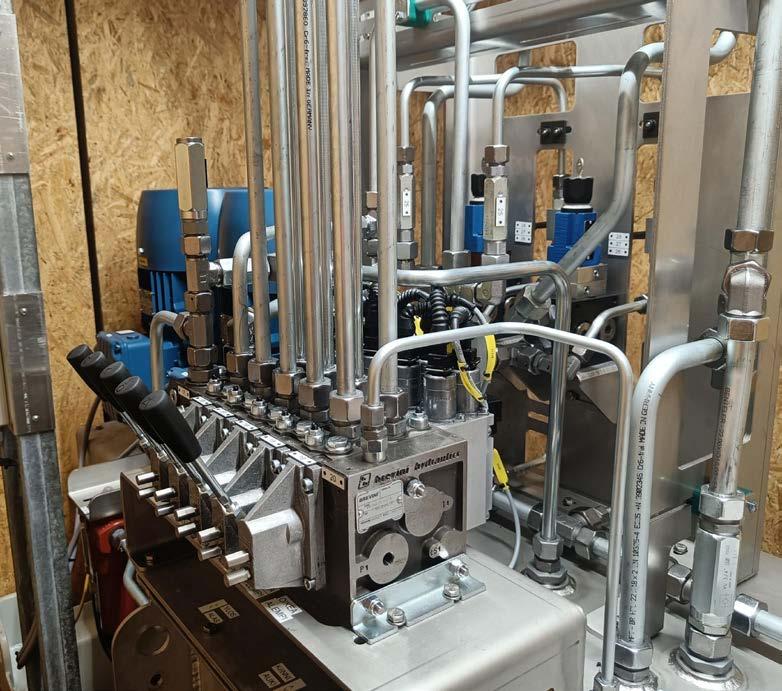
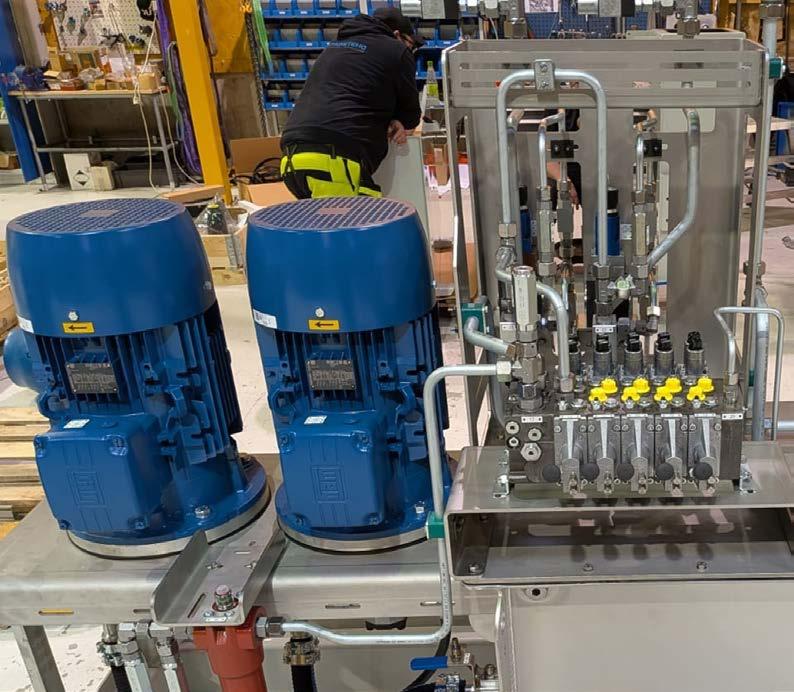
HydSupply was responsible for the hydraulic design and assembly at its workshop in Kuopio, LSA manufactured the panel board, carried out the electrical installation on site and managed the commissioning, and FAP Automation supplied the programming and designed the necessary automation plans, including remote monitoring. The result was a turnkey solution in which hydraulics and electrics are integrated with advanced instrumentation and automation systems.
ACQUISITION OF JERGO CREATES AN IMPORTANT PLATFORM FOR CONTINUED GROWTH IN NORWAY
Through the acquisition of Jergo AB, with headquarters in Höganäs and Norwegian subsidiary in Bergen, Volito Industry took a further important step in its Nordic growth strategy. The acquisition strengthens the position in industrial solutions, creating a solid platform for continued growth in Norway.
Becoming a part of Volito Industry is an exciting new chapter for Jergo.
“The acquisition of Jergo is a natural step in our ambition to build leading positions throughout the Nordic region. It strengthens our offering in Industrial Solutions and above all provides an important platform for continued growth in Norway,” says Johan Frithiof, Managing Director of Volito Industry.
Jergo, founded in 1989, has built a strong reputation as a supplier of technical solutions and products for the power and processing industries. Due to its expertise and broad product portfolio, the company became a leading actor in the Nordic region and now has a broad geographical customer base, both in and outside Europe. In recent years the company has shown good growth, mainly in the Norwegian and Swedish markets.
“Becoming a part of Volito Industry is an exciting new chapter for Jergo,” says Kjetil Hatlebrekke, CEO of Jergo. “With Volito behind us and the potential to cooperate with other group companies, we are even better equipped to take the next step in our development. In Volito, we have also found a corporate culture that aligns with our values.”
Through the acquisition, Volito gains access to Jergo’s expertise and strong customer relations, particularly in segments such as industrial hydraulics, metal processing, pressure testing and torque tools. Jergo’s combination of sales, hire and on-site support provides stability regardless of the business climate, which was shown not least during the pandemic when the hire side grew considerably and has continued to be an important trend ever since.
With Volito as owner, Jergo has an opportunity for expansion through greater resources and new networks. It creates conditions for framework agreements with new, bigger customers and for attracting more partners. Shortly after the acquisition, Jergo signed agreements with new partners in the Netherlands, which shows the positive effect of Volito’s ownership.
“Another important aspect is the increased professionalisation and efficiency enhancement that the acquisition brings,” says Kjetil Hatlebrekke. “In addition, new collaborations are created within the group, and here we see opportunities in the oil, gas and defence industries.”
The aim is for Jergo’s growth to be achieved through a combination of organic growth and new company acquisitions.
ACQUISITION OF AUMAINT STRENGTHENS POSITION IN FINLAND
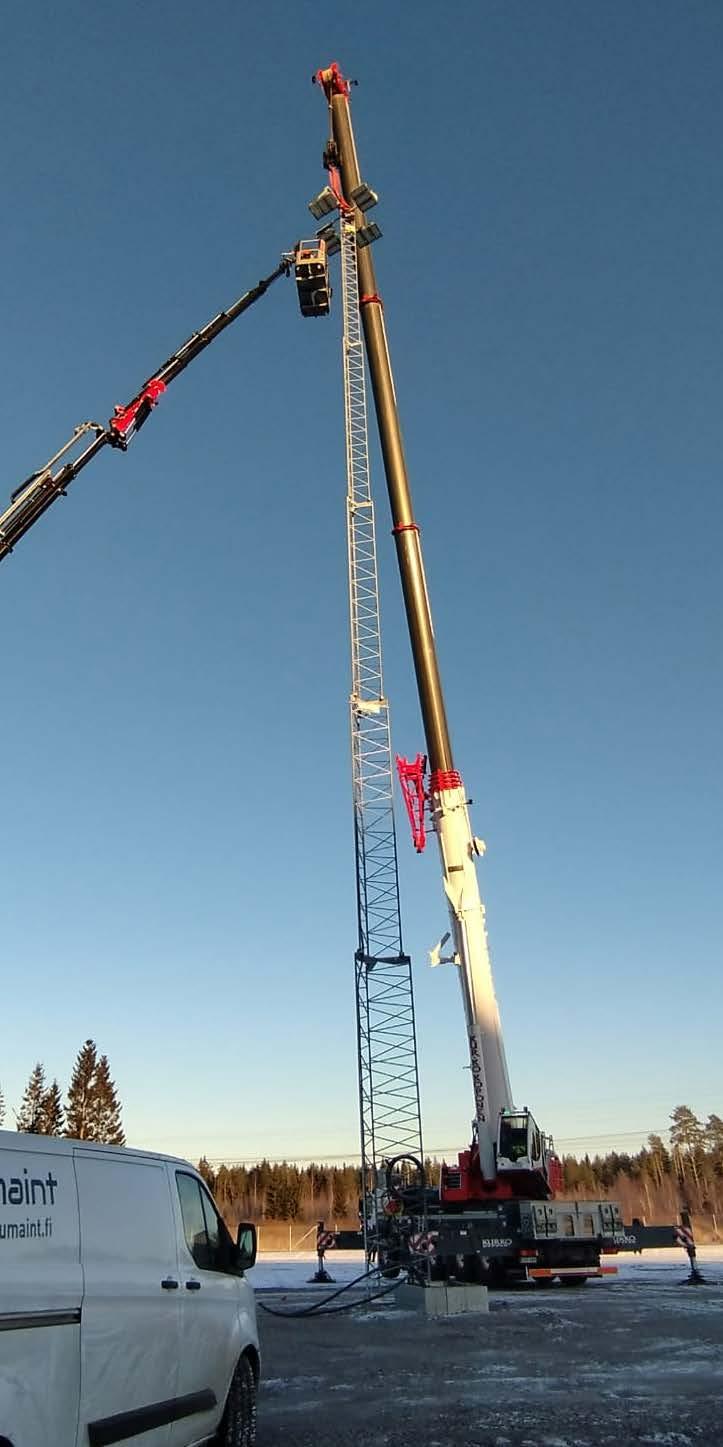
In 2025 Volito Industry took another important step in its growth journey with the acquisition of Aumaint Oy. The acquisition strengthens the capacity to supply electrical and automation services throughout the Nordic region, above all in the increasing important market in northern Finland. By integrating Aumaint’s experts, competence is broadened and the potential to offer larger automation solutions increases.
With Aumaint in our organisation we can meet our customers’ requirements for even greater efficiency and flexibility,” says Jukka Sahi, who heads Volito Industry’s electrification initiative. “Volito Industry’s growth strategy is based on combining organic growth and carefully selected acquisitions, and here Aumaint’s technical expertise and corporate culture is an exciting reinforcement.”
Aumaint shares our ambition in terms of quality and growth, and historically the company has shown continuous good growth.
Aumaint is involved in electrical and automation operation, mechanical maintenance and projects throughout Finland and in Sweden. Its customers are in several market segments, including the chemical and defence industries.
“Aumaint adds customers from new sectors, but there are also synergies in offering Aumaint growth opportunities through our existing customers,” says Jukka Sahi.
Aumaint is based in Uleåborg, in northern Finland, and complements Volito Industry’s geographical presence in the Finnish market. The geographical location was an important factor in the acquisition.
“Aumaint is located close to a number of potential customers and where future investments are expected to be made,” says Jukka Sahi. “Proximity to the customers is crucial for being able to offer daily maintenance and rapid responses.”
The acquisition doubles Volito Industry’s team in electrification and enhances the capacity to take on larger and more complex projects.
What make the acquisition particularly exciting is the common corporate culture and vision for the future. Aumaint provides new energy and perspectives and, together with Volito’s resources and experience, new value for customers can be created, all the way from design to implementation. It also increases opportunities in innovation work for smarter and more sustainable automation solutions.
“The daily operations of the company will continue to be run by the previous owners,” says Jukka Sahi. “They are genuine entrepreneurs and we can support each other in our joint growth journey. Aumaint shares our ambition in terms of quality and growth, and historically the company has shown continuous good growth.”
To sum up, Volito Industry’s acquisition of Aumaint Oy is a clear example of how strategic initiatives, geographical expansion and collective expertise can create new opportunities in the Nordic market.
Within Business Area Portfolio Investments, Volito has significant ownership interests in listed companies. The Group’s ownership philosophy is based on active ownership and, in certain cases, involvement on the boards of portfolio companies.
Volito strives for good risk diversification by spreading investments over several sectors to reduce dependence on individual industries, markets and companies. Risk and reward potential is also balanced with regard to the Group’s other holdings. By regularly reviewing and, if necessary, adjusting the portfolio, the right mix is created to achieve both stability and long-term value growth.
A NEW RECORD-BREAKING YEAR FOR ALFA LAVAL
Alfa Laval is a new holding in Volito’s portfolio, an investment that contributes to increased diversification and a better spread of risk. Alfa Laval’s innovative and efficient solutions address several of the major global challenges of our time, such as needs for energy, clean water, sustainable food production and carbondioxide-free shipping.
Alfa Laval in brief
Alfa Laval is a leading global supplier of top-class products in heat transfer, separation and fluid handling. With these important technologies as a basis, Alfa Laval makes it possible to use natural resources responsibly, reduce the environmental impact of industrial processes, improve energy-efficiency, recycle heat, purify water and lower emissions. The group is known for improving customers’ productivity and competitiveness worldwide – mainly in the energy, food, water and marine industries.
The Alfa Laval share
Alfa Laval has been listed on Nasdaq Stockholm in the Large Cap segment since 2002. At year-end 2025 the share price was SEK 465.70, a rise of 0.7 percent compared with the OMX30 index, which increased by 14.9 percent.
2025
– The group’s performance in brief
For Alfa Laval, 2025 was a record year in many ways, and all of the new – and for the first time in 20 years adjusted upward – financial targets announced in October 2025 were exceeded. The structural growth trends continued to be strong. Alfa Laval is engaged in supporting customers and partners in capturing in-demand trends and investing for future growth. Invoicing for the full year grew organically by 8 percent to a new record level of SEK 69,674 million (66,954).
Adjusted EBITA increased by 11 percent to a new record level of SEK 12,334 million (11,089), which corresponds to an adjusted EBITA margin of 17.7 (16.6) percent. Earnings per share increased to SEK 20.0 (17.9).
OVERVIEW
FINANCIAL KEY FIGURES
A CHALLENGING YEAR WITH A POSITIVE ENDING FOR BULTEN
Volito is the main owner of the listed portfolio company, Bulten, and sees it as a company with great potential. Bulten has a background as a traditional subcontractor in fasteners but is now undergoing a strategic change with a focus on new and growing industries, increased value content and improved profitability.
Bulten in brief
Bulten, a global leader in fasteners, delivers both standardised and customised solutions. Through high quality, competitive costs, sustainability and strong innovation capability, Bulten creates added value for customers worldwide. In line with Bulten’s new strategic orientation, dependency on vehicle manufacturers and contract manufacturing is being reduced. Instead, the group is focusing on niche products, services and total responsibility in areas such as consumer electronics, medical devices, aviation and defence.
The Bulten share
Bulten has been listed on Nasdaq Stockholm in the Small Cap segment since 2011. At year-end 2025 the share price was SEK 51.40, a fall of 29.3 percent compared with the OMX30 index, which increased by 14.9 percent.
2025 – The group’s performance in brief
For Bulten, 2025 was a challenging year. However, in the fourth quarter, the group noted a recovery that exceeded expectations, with volumes that reverted to more normal levels. At the same time Bulten made important commercial progress, which reflects a clearer focus on carefully selected customer relations and a value-creating offering in line with the new strategic orientation. For the full year 2025 Bulten achieved net sales of SEK 5,045 million (5,807), a fall of 13.1 percent. The operating profit (EBIT) amounted to SEK 141 million (301), which corresponds to an operating margin of 2.8 (5.2) percent. Earnings per share amounted to SEK -0.55 (6.45).
OVERVIEW
FINANCIAL KEY FIGURES
HOLDING
CONSIDERABLE
PROGRESS AND IMPROVED FINANCIAL RESULTS FOR EQT
EQT is one of the world’s leading actors in private equity and second-largest in the world in terms of incoming capital over recent years. Volito has a significant holding as an owner of the EQT share but has also invested in several of EQT’s funds, which contributes to good risk diversification.
EQT in brief
EQT is a purpose-driven global investment organisation that manages capital for institutions and private individuals with an aim to develop strong, sustainable and future-oriented companies. With roots in the Nordic region and operations worldwide, EQT invests in companies in areas such as industry, healthcare, technological services and infrastructure. Through active ownership, digitalisation and a focus on sustainability, EQT creates long-term value for investors and society.
The EQT share
EQT has been listed on Nasdaq Stockholm in the Large Cap segment since 2019. The share price developed positively in 2025 and reached SEK 363.80 on the last trading day of the year, a rise of 18.9 percent compared with the OMX30 index, which increased by 14.9 percent.
2025 – The group’s performance in brief EQT made considerable strategic progress and delivered strongly in 2025. Total revenue (according to IFRS) amounted to EUR 2,632 million (2,653) and the operating profit increased to EUR 953 million (888), which corresponds to an operating margin of 36 percent (34). EQT navigated well in a volatile world, delivered its strongest fund exit year ever, continued to invest in thematic opportunities globally and strengthened its customer focus. Earnings per share increased to EUR 1.1 (0.9). Coller Capital, acquired after the end of year, gives EQT access to one of the fastest-growing areas in the private investment market.
OVERVIEW
KEY FIGURES (IFRS)
STABLE
ORDER SITUATION AND POSITIVE OUTLOOK FOR PEAB
Peab is one of the leading building contractors in the Nordic region with considerable breadth, geographically and in terms of the group’s business areas. For Volito, Peab continues to be an important holding in the portfolio that contributes exposure relating to the Nordic construction market.
Peab in brief
Peab is the leading community builder in the Nordic region with a local presence in Sweden, Norway, Finland and Denmark. Through its 13,000 employees and four collaborating business areas – Construction, Civil Engineering, Industry and Project Development – Peab delivers everything from housing and public buildings to infrastructure such as roads, bridges and ports. With over 60 years of experience and a business model in which operations strengthen each other, Peab creates long-term value and contributes to sustainable, locally produced community building in the entire Nordic region.
The Peab share
Peab has been listed on Nasdaq Stockholm in the Large Cap segment since 2019. The share price developed positively in 2025 and reached SEK 85.35 on the last trading day of the year, a rise of 7.8 percent compared with the OMX30 index, which increased by 14.9 percent.
2025 – The group’s performance in brief
Peab ended 2025 with a continued increase in both net sales and operating margin in construction contract operations, along with strong development of the Swerock/Asphalt operating margin. Net sales for 2025 amounted to SEK 58,581 million (61,283). The operating profit was SEK 2,693 million (3, 163) with an operating margin of 4.6 percent (5.2). Civil engineering operations, local construction and large parts of Business Area Industry continued to develop strongly, whereas the low level of housing construction affected operations in project development and construction systems. Earnings per share amounted to SEK 4.74 (8.32). The group enters the new year with a strong financial position.
OVERVIEW
FINANCIAL KEY FIGURES (IFRS)
SUSTAINABILITY
Vision and core values
Volito’s vision is to strive towards new heights by developing businesses and people with an aim to improve the world and build value across generations. Volito’s greatest asset is the trust of its current and future partners, which enables Volito and its staff to achieve the company’s vision. Trust is gained through a balance between two fundamental elements of the company’s core values – relations and professionalism.
Good and sustainable relations with employees, customers and other partners are created through loyalty, honesty and sustainability. A professional approach forms the basis for good business that benefits all parties, and rests on competence, flexibility and dedication.
A part of society
The parent company, Volito AB, and Volito’s subsidiaries have strong relations with, and a considerable effect on, society at large. Overall, the Group employs a large number of people and makes decisions that have a direct and indirect influence on how society develops. It is important for Volito to make a positive contribution to society and to act with a strong local anchoring.
Governance and reporting
Volito is not currently subject to the requirements set in accordance with the EU’s Corporate Sustainability Reporting Directive (CSRD), the Omnibus Package presented by the EU Commission during the year. However, the organisation has worked according to the conditions covered by the new requirements and has strengthened processes and procedures in order to act in line with the requirements.
The parent company also draws up and maintains rules and regulations, policies and functions for the Group as a whole regarding, among other things, the code of conduct, corporate governance, IT and information security, whistle-blower function and social engagement. The subsidiaries are responsible for implementation, follow-ups and internal reporting.
Volito AB – the Parent Company
Volito AB is an investment company headquartered in Malmö. The company strives for an economically, environmentally and socially sustainable approach in all parts of its everyday operations. Direct impact on the environment, as well as exposure to environmental risks, primarily relates to business travel.
Business Area Real Estate
Volito Fastigheter has identified focus areas for its sustainability management as well as the Global Goals for which the business has the greatest potential to make a contribution. This concerns, among other things, climate impact including carbon footprint, diligent management of buildings from different periods, boosting biodiversity, and consideration for people. Environmental certification of all properties in accordance with the Miljöbyggnad iDrift system has started, with the first certification obtained in 2025. The aim is for the process to be completed by 2030. Volito Fastigheter is a member of the LFM30 network – Local Road Map Malmö 2030 – one of Sweden’s most extensive sustainability initiatives. Within the framework of LFM30, Volito Fastigheter has committed to minimise climate impact with an aim to be net climate neutral by 2030. In the area of social sustainability, Volito Fastigheter is a proud partner of Skåne Stadsmission, among others.
Strategy for sustainability and its implementation
Both the Parent Company and subsidiaries have a commitment to constantly develop and improve in a way that is economically, environmentally and socially responsible. Among other things, the companies are to comply with the code of conduct for good business ethics, offer an attractive and safe workplace, take the UN’s Global Goals into account in their operations, work to improve the impact within the Global Goals that have a direct connection with the business and work for a good long-term return for shareholders. The Group’s companies are also to make a positive contribution to society through sponsorship and donations, with a primary focus on youth education and recreation, enterprise and entrepreneurship for young people, and research that contributes to a better future. Both the parent company and the subsidiaries exercise strong social engagement.
Within Business Area Portfolio Investments, Volito has significant ownership interests in listed companies. Volito strives for active ownership with a focus on companies that have strong similarities with Volito in terms of business and core values, and an ownership philosophy that corresponds to Volito’s and is characterised by a long-term, responsible and sustainable approach.
Business Area Volito Industry
Volito Industry contributes directly and indirectly to a large number of areas for sustainable development, with a focus on the Global Goals for gender equality, sustainable energy for all, decent working conditions and economic growth, sustainable industry, innovations and infrastructure, and sustainable consumption and production. The company’s primary contribution to achieving these goals is through the continuous development of its products and services. Some examples are the development of sustainable solutions in hydraulics, pneumatics and electric operation, systems for cleaning oil, digital monitoring of machines and equipment for optimised lifetime, efficiency enhancement of manufacturing processes and the reconditioning of components to reduce the carbon footprint.
Business Area Portfolio Investments
The portfolio companies conduct independent and ambitious sustainability management. Detailed information is available at www.alfalaval.se, www.bulten.se, www.eqt.se and www.peab.se
VOLITO’S CORPORATE GOVERNANCE
Volito’s corporate governance aims to ensure transparent, responsible and effective management of the Group. Governance is based on a clear organisational structure, well-defined areas of responsibility and established processes for follow-ups and control. The board bears overall responsibility for the Group’s strategic orientation, risk management and internal control systems, while the executive management is responsible for operational activities in accordance with the board’s guidelines and decisions.
Volito supplements its governance model with group-wide policies and guidelines. Regular follow-ups, external auditing and transparent communication with stakeholders ensure high quality in governance and reporting, which contributes to long-term value creation and a high level of trust. Ultimately, everything rests on Volito’s core values: that relations and professionalism build trust that lifts the Group towards its vision.
Independent business areas
Volito is organised in three business areas – Real Estate, Industry and Portfolio Investments – that act with a high degree of independence. Each business area is responsible for business development and implementing their part of the strategic plan within the framework of the Group’s overall goals. This model combines clear ownership responsibility and governance with entrepreneurial flexibility, which enables fast decision-making and a strong focus on financial results within each business.
BOARD OF DIRECTORS
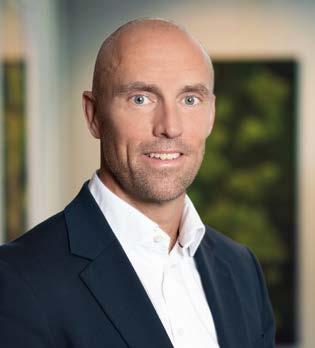
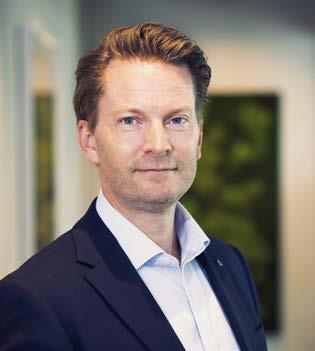
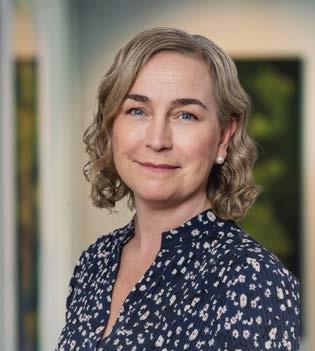
Karl-Axel
MANAGEMENT
Axel Granlund Board member
Patrik Melin CFO Volito AB
Peter Granlund Board member
Johan Frithiof Managing Director Volito Industri AB
Karl-Fredrik Granlund Board member (Board member, of Bulten AB)
Marie Persson Managing Director Volito Fastigheter AB
Ulf Liljedahl President and CEO Volito AB. (Chairman of Bulten AB)
Granlund Chairman of the board
Lennart Blecher Board member (Chairman Real Assets, EQT)
Veronica Blecker Deputy board member
FINANCIAL INFORMATION VOLITO GROUP
49 Directors’ report
52 Group
52 Consolidated income statement and other comprehensive income for the Group
53 Consolidated statement of financial position for the Group
55 Report on changes in equity for the Group
56 Consolidated statement of cash flows for the Group
57 Supplement to consolidated statement of cash flows for the Group
58 Parent company
58 Income statement for the Parent company
59 Financial position for the Parent company
60 Report on changes in equity for the Parent company
61 Cash flow statement for the Parent company
61 Supplement to the cash flow statement for the Parent company 62 Notes with accounting principles and notes to the accounts
DIRECTORS’ REPORT
Business in brief Group
Volito AB (556457-4639) is the Parent company in a Group that conducts operations in the business areas Real Estate, Industry and Portfolio Investments.
Volito Fastigheter owns and manages commercial and residential properties in the Malmö region. Volito Industry starts, acquires and develops companies within industrial automation. Within Business Area Portfolio Investments, Volito has significant ownership interests in both listed and unlisted companies.
The year in brief
The past year was characterised by a cautious economy and a market that moved sideways, which limited the growth opportunities for the group’s business areas. For Volito, the year was marked by ongoing change work, and in 2025 the group has taken important steps forward and laid a stable foundation for the future.
During the year, we have started the work to change and strengthen the group’s portfolio with a view to increased flexibility. We have implemented strategic changes to increase diversification and reduce exposure to individual holdings. Despite geopolitical tensions and economic challenges, we have managed to maintain stable earnings and have strengthened our position in all business areas.
Volito Fastigheter has continued to develop positively during the year. With a focus on longterm value creation and sustainability, Volito Fastigheter has refined its property portfolio and taken important steps to make it even more climate smart. Investments in project development and environmental certification of properties have been central elements. During the year, the first property was environmentally certified, and we have continued to renovate and develop the properties, with the ambition to contribute to the city’s development.
Volito Industry has grown significantly in recent years and today accounts for a substantial part of the group’s revenue. Through strategic acquisitions and organic growth, a strong industrial operation has been built with a focus on long-term sustainability, proven business models, and clear cash flows. During the year, two additional companies were acquired, expanding the business into new geographies in Norway and Finland. Jergo, which is part of Industrial Solutions, opens up the Norwegian market. Aumaint in Finland strengthens the offering in electrification and provides greater reach in northern Finland.
The portfolio of securities has undergone a strategic transformation, where we, among other things, have reduced our exposure to real estate and increased flexibility. During the year, the holding in the real estate company Annehem has been divested as well as parts of the construction and civil engineering company Peab, while the investment in Alfa Laval has been increased.
At year-end, the Volito Group’s adjusted equity amounted to SEK 6,168.3 million (5,739.0).
Income
The Group’s turnover amounted to SEK 1,121.8 million (1,028.4). The operating profit was SEK 129.8 million (150.4).
The profit after financial income and expense was SEK 514.2 million (334.3). The profit participation in Bulten amounted to SEK -35.7 million (33.6). The result from other financial income and expense includes dividends, mainly from Peab and EQT, SEK 47.0 million (28.7), as well as unrealised changes in value in the EQT funds, SEK 448.6 million (230.5).
Considering the year’s investments and rebuilding, the unrealised change in value of Volito Fastigheter’s portfolio was SEK -79.8 million (-30.5).
Interest rate swaps are used for protection against interest rate risks relating to Volito Fastigheter’s borrowings. These are measured at fair value in the statement of financial position and unrealised changes in fair value of interest rate swaps of SEK -6.3 million (-2.2), were reported in the profit or loss for the year. The profit before tax for the Group amounted to SEK 428.2 million (301.7).
The value development of the Group’s portfolio investments led to a change in value of the holdings of SEK 164.7 million (404.3) in other comprehensive income, as well as SEK 448.6 million (230.5) in the result from financial income and expense. The market values of the holdings are outlined in Note 26.
Financial position and cash flow
The Group’s balance sheet total amounted to SEK 9,902.3 million (9,461.1) and equity relating to the Parent company’s owners amounted to SEK 5 972.6 million (5 534.8).
The Group’s total cash flow amounted to SEK 71.6 million (11.5). The cash flow from operating activities generated a surplus of SEK 62.2 million (91.6). The year’s net investments amounted to SEK 71.7 million (-45.1). The net outflow from financing activities amounted to SEK -62.2 million (35.0).
Parent company Operations
The Volito Group’s Business Area Portfolio Investments is administered and reported mostly in Volito AB. Some of the Group’s funds are administered by Volito Kapital AB. Besides this, the Parent company manages group-wide functions for administration and finance.
Income
The turnover of SEK 11.5 million (11.0) relates primarily to the sale of services to other companies within the Group. The operating loss was SEK -39.0 million (-39.3).
The result after financial income and expense was SEK 350.3 million (-60.2). The result is mainly related to gains from the sale of securities holdings.
The result before tax amounted to SEK 380.9 million (-37.5).
Financial position and cash flow
The balance sheet total amounted to SEK 3,339.7 million (3,158.3) and equity to SEK 2,052.6 million (1,711.9).
The total cash flow for the Parent company amounted to SEK 65.3 million (0.0), of which the cash flow from operating activities amounted to SEK -145.8 million (-36.4). The year’s net investments amounted to SEK 245.9 million (23.8), of which the largest investments concerned investments in Alfa Laval and EQT funds. The cash flow from financing activities amounted to SEK -35.0 million (12.6).
Real Estate Operations
Volito Fastigheter owns and manages commercial and residential properties in the Malmö region. The business is characterized by long-term orientation, careful management, high level of service and close relationships with both customers and partners.
Volito Fastigheter’s strategy is to own and develop attractive commercial and residential properties – always in the best locations – with a management philosophy based on receptiveness to tenants’ needs and a genuine commitment to contribute to living urban environments. In consultation with tenants, adaptations are implemented that range from minor adjustments of floor plans to major conversions.
The global situation in 2025 was characterized by change and uncertainty, but also by progress and continued positive development for Volito Fastigheter. Despite a challenging rental market and a weak economy, the reduction in vacancy rates continued during the year. Thanks to lower vacancy rates and reduced interest expenses, results exceeded the budget, while the refinement and development of the property portfolio continued.
During 2025, Volito Fastigheter has worked on environmental certification of the Central Post Office in accordance with Miljöbyggnad iDrift. It is the first property in the portfolio to be certified in line with the 2024 decision to certify all properties in the portfolio by 2030. The work involves large parts of the organization, with both managers and technicians participating in driving the certification process forward.
Fastigheter owns, together with Peab, the Hyllie Point group, which is operated as a joint venture.
The market value of Volito Fastigheter’s property portfolio was evaluated at year-end by an external assessor at SEK 3,472.6 million (3,477.0). The vacancy rate at year-end was 10.6% (11.7%).
Income
Volito Fastigheter’s turnover amounted to SEK 210.8 million (198.8). The operating profit amounted to SEK 112.8 million (107.8).
The profit after financial income and expense was SEK 59.3 million (56.2). The income from participation in joint ventures amounted to, SEK 8.6 million (14.7). Decreased interest expense led to a net interest expense for 2025 of SEK -62.1 million (-66.3).
The result, after changes in value for the year of investment properties and derivatives, amounted to SEK -26.8 million (23.6). Adjusted for investments and rebuilding, the unrealised change in value of Volito’s own properties amounted to SEK -79.8 million (-30.5). Volito Fastigheter uses interest rate swaps as protection against interest rate risks relating to borrowings. These are measured at fair value on the balance sheet and unrealised changes in the fair value of interest rate swaps amounting to SEK -6.3 million (-2.2), were reported in the profit or loss for the year.
Financial position and cash flow
The balance sheet total amounted to SEK 4,001.0 million (4,049.6) and equity amounted to SEK 1,804.6 million (1,842.9). Operating activities generated a positive cash flow of SEK 95.0 million (48.7). The year’s net investments amounted to SEK -69.0 million (-20.5) and the cash flow from financing activities amounted to SEK -26.0 million (-28.2), which includes a dividend paid to Volito AB of SEK 10.0 million (10.0).
Industry
Operations
Volito Industry starts up, acquires and develops companies in Motion & Drives, Automation and Electrification Technologies and Industrial Solutions. Volito Industry is a knowledgeintensive and growth-oriented group with a strong market position in the Nordics. The Group is prepared on continued expansion and establishment of additional operations with focus on value added solutions for the industry.
The year 2025 has been a year marked by execution, structure, and long-term decisions. In a world where many industrial customers have been more cautious and investment
decisions have been delayed, Volito Industry has managed to maintain a stable operation while important strategic steps have been taken for the future.
Volito Industry continued its strategic expansion through acquisitions. During the year, two strategically important acquisitions have been carried out. The acquisition of Jergo strengthens the offering within Industrial Solutions and provides an established platform in the Norwegian market. In Finland we have continued to build a “Power House” through the acquisition of Aumaint, which strengthen our presence in Northern Finland and complete our offer within the business segment Automation & Electrification Technologies.
Sustainability is an integrated part of Industri’s offerings and way of working. The focus is on solutions that create clear customer value through energy efficiency, increased operational reliability, and reduced environmental impact, particularly in automation and electrification.
During the year, we have continued to develop our work within People & Culture. An internal training program is being established and a new HR system is being implemented for the entire organization.
Volito AB owns 99 % (95) and the Volito Industry CEO owns the remaining 1 % (5) of the shares in the Volito Industry group.
Income
Volito Industry’s turnover amounted to SEK 910.6 million (828.5). The operating profit was SEK 52.0 million (80.9) and the profit after financial income and expense was SEK 42.4 million (69.3).
Financial position and cash flow
The balance sheet total amounted to SEK 703.2 million (724.1) and equity to SEK 232.0 million (217.4).
Operating activities generated a positive cash flow of SEK 8.3 million (70.9). The year’s net investments amounted to SEK 34.1 million (-52.2) and cash flow from financing activities amounted to SEK -36.0 million (-7.3). The total cash flow for the year was SEK 6.4 million (11.5).
Portfolio Investments
Within Business Area Portfolio Investments, Volito has significant ownership interests, mainly in listed companies. Volito has an ownership philosophy of involvement that focuses on stable, long-term growth. The Group strives for active ownership with involvement on the companies’ boards. The portfolio consists of Volito’s holdings in Peab AB (publ), Bulten AB (publ), EQT AB (publ), Alfa Laval AB (publ) and EQT’s funds.
During the year, Volito’s portfolio has undergone a strategic transformation, where among other things, all shares in Annehem Fastigheter AB (publ) and Avensia AB (publ) as well as parts of Peab AB (publ) have been divested and Volito has chosen to invest more in Alfa Laval AB (publ).
Peab AB (publ)
Peab is one of the leading construction and civil engineering companies in the Nordic region, operating in Construction, Civil Engineering, Industry and Project Development. The company’s share is listed on Nasdaq Stockholm.
Volito’s holding in Peab amounted to 10,000,000 (16,700,000) shares on 31 December 2025, of which 10,000,000 (15,200,000) are class B shares, which corresponds to 3.38 % (5.64) of the capital and 1.64 % (4.99) of the votes. Volito has divested all shares throughout the year with series A.
The market value of Volito’s total holding at year-end was SEK 853.5 million (1,322.6). During the year, Volito received a dividend of SEK 41.9 million (25.1).
Bulten AB (publ)
Bulten is one of the largest suppliers of fasteners for the international automotive industry. The product offer encompasses a broad range of standard products and customised fasteners. Bulten also offers a full-service concept or parts thereof. The company’s share is listed on Nasdaq Stockholm.
Volito is the largest owner of Bulten AB with a holding of 5,220,000 (5,220,000) shares on 31 December 2025, which corresponds to 24.8% (24.8) of the capital and votes.
The market value of Volito’s total holding at year-end was SEK 268.3 million (379.5). Bulten is consolidated as an associated company. The Volito Group’s profit participation amounted to SEK -35.7 million (33.6) and is reported in net financial income/expense. Reported at Volito was SEK -53.3 million (30.7) from Bulten’s other comprehensive income. The group value of the participants amounted to SEK 426.9 million (530.2). Volito received a dividend of SEK 14.4 million (12.8).
EQT AB (publ)
EQT is a purpose-driven global investment organisation focusing on active ownership. EQT manages and advises funds and investment units that invest worldwide. The company manages capital divided between two business segments, Private Capital and Real Assets. The company’s share is listed on Nasdaq Stockholm.
Volito’s holding in EQT on 31 December 2025 amounted to 1,000,000 (1,000,000) shares, which corresponds to 0.08% (0.08) of the capital and votes.
The market value of Volito’s holding at year-end was SEK 363.8 million (306.1). Volito received a dividend of SEK 4.3 million (3.6).
Alfa Laval AB (publ)
Alfa Laval is a leading global provider of first-class products in the areas of heat transfer, separation and fluid handling. With these as its base, Alfa Laval aims to help enhance the productivity and competitiveness of its customers in various industries throughout the world. Alfa Laval delivers sustainable products and solutions that meet customers’ requirements – mainly in energy, the environment, food and the marine industry. The company’s share is listed on Nasdaq Stockholm.
Volito’s holding in Alfa Laval on 31 December 2025 amounted to 1,000,000 (35,000) shares, which corresponds to 0.24 % (0) of the capital and 0.01 % (0) of the votes. The market value of the holding amounted to SEK 465.7 million (16.2).
EQT funds
Volito has interests in 17 of EQT’s funds. At year-end, the value of these amounted to SEK 2,947.1 million (2,482.7). During 2024, the fund EQT IX was divested.
EQT has a long-term, responsible and sustainable approach to its investments and has strong and close relations with all its portfolio companies. EQT offers key expertise in strategic business development, structural changes and financial analysis. A strict model of corporate governance is applied at all the majority-owned companies.
Other holdings
The combined value of other holdings at year-end was SEK 22.0 million (14.8).
Expectations concerning future developments
Group
Volito is well prepared for 2026 and has a stable platform to handle both the opportunities and challenges ahead. The transformation of the portfolio continues, and all business areas are prepared to take advantage of an improved economic climate. The external environment remains uncertain, with geopolitical risks, economic challenges, and rapidly changing markets. Volito’s strength lies in being able to make fast decisions in close dialogue with owners, the Board, and management. This provides opportunities to manage fluctuations and create value even in challenging times.
With innovative strength, flexibility, and a clear strategy, we are ready to face the future and continue building value.
Group information
Volito AB is a Swedish-registered limited company with registered office in Malmö. The address of the registered office is Skeppsbron 3, 211 20 Malmö.
The consolidated financial statements for 2025 consist of Volito AB and its subsidiaries, together referred to as the Group. The Group also includes a share of holdings in associated companies and joint ventures.
The company is a subsidiary of AB Axel Granlund, org.no. 556409-6013 with registered office in Malmö. AB Axel Granlund owns 88.0% (88.0%) of the capital and votes in the Volito Group and draws up consolidated financial statements for the largest group.
Information on risks and uncertainty factors
Group
Volito’s income, cash flow and financial position are affected by several factors that are to varying degrees influenced by the company’s own actions.
Risk management
Exposure to risks is a natural part of a business enterprise and this is reflected in Volito’s approach to risk management. This aims to identify risks and prevent and limit the adverse consequences that arise because of these risks. Management of the operational risks is a continuous process. The operational risks are managed within the organization by the respective business areas. The financial risks are linked to the organisation’s tied-up capital and capital requirements, mainly in the form of interest rate risks and refinancing risks. See Note 35.
Material risks
Changes in the value of properties depend partly on Volito Fastigheter’s own ability, through changes and refinements to properties as well as agreement and customer structures, to increase the properties’ market value, and partly on external factors that affect property supply and demand. In general, property value is less volatile for concentrated portfolios of property in good locations. Volito’s properties are predominately concentrated in the central and most expansive parts of Malmö. Most of Volito Fastigheter’s long-term lease agreements contain an index clause that means annual rent adjustments are based either on changes in the consumer price index or on a fixed percentage increase. Property valuations are calculations made according to established principles based on certain assumptions and affect the Group’s financial results considerably. For more information on property valuations, see the Valuation principles section in Note 16.
Credit risks
Credit risks refer to the risk of losing money due to another party being unable to fulfil their obligations.
Vacancy risks and credit risks in accounts receivable
Demand for premises is affected by changes in general business conditions.
Volito Fastigheter’s activities are concentrated in Malmö, which is deemed to be attractive in the long-term regarding location, population growth, employment and general communications. A broad portfolio of contracts reduces the risk of large fluctuations in vacancies. Leases are divided between commercial properties 90 % (91) and residential properties 10 % (9). The commercial rental revenue is divided between 143 (143) contracts within several different sectors. A combination of good local knowledge, active involvement and a high level of service creates conditions for long-term rental relations and thereby a reduced risk of new vacancies. A certain level of vacancies provides opportunities in the form of new leases and flexibility for existing tenants who want to expand or reduce their premises. Furthermore, Volito Fastigheter bears the risk that tenants are unable to make rent payments. Regular follow-ups are carried out on the tenants’ credit ratings to reduce exposure to credit losses. A credit rating of tenants is carried out for all new leases and, if required, the lease agreement is complemented by personal guarantees, rent deposit or bank guarantee. All rents are paid quarterly or monthly in advance.
Within Volito Industry, risks are linked to project management. Many projects are customised and Volito Industry bears the risk that customers cannot fulfil their obligations. Customers make advance payments on major projects to reduce the risk of credit losses.
Financial risks
In its business activities, the Volito Group is exposed to various types of financial risks. Financial risks relate to changes in exchange rates and interest rates that affect the company’s cash flow, financial results and thereby associated equity. The financial risks also include risks associated with financial instruments as well as credit and refinancing risks.
The Group’s finance policy for managing financial risks has been designed by the Board and creates a framework of guidelines and rules in the form of risk mandates and limits for the business. Responsibility for the Group’s financial transactions and risks is managed centrally by the Group’s Finance department, which is within the Parent company. The overall aim of the Finance department is to provide cost-efficient financing and to minimise negative effects on the Group’s financial results that stem from market risks. Reporting is conducted on a regular basis to the CEO and the Board, which have overall responsibility for financial risk management. See Note 35.
Liquidity and financing risks
Liquidity and financing risks refer to risks of not being able to fulfil payment obligations because of insufficient liquidity or difficulties in arranging new loans. Volito is to be able to carry through business transactions when the opportunity arises and always be able to fulfil its obligations. Refinancing risks increase if the company’s credit rating deteriorates or a large part of the debt portfolio becomes due on a single, or relatively few, dates.
Liquidity risks are managed through both regular liquidity forecasts and Volito’s access to credit or liquid assets that can be raised at short notice to even out fluctuations in payment flows.
Borrowing risks refer to risks that financing is unavailable or available on unfavourable conditions at a certain time. To limit financing risks, Volito strives to spread final due dates regarding credit over the longest possible period allowed by prevailing market conditions.
Part of Volito’s borrowing is linked to fulfilling financial ratios (covenants) in the form of the interest coverage ratio, loan-to-value ratio and equity ratio, which is customary for this type of borrowing. These ratios are followed up continuously and make up a part of the management’s framework for financial planning of the business.
Currency exposure
The Volito Group’s exposure to risks relating to exchange rate changes has increased in line with an increased presence in the Finnish and Norwegian market.
Interest rate exposure
The Volito Group is exposed to changes mainly in short-term interest rates through its involvement in the Volito Fastigheter group. The Parent company, Volito AB, also has risk exposure relating to short-term interest rates. Volito’s policy regarding interest rates is that fixed rate terms for the portfolio shall be well balanced and adjusted to the company’s current view of the fixed income market at that time.
Interest rate expense is the largest single expense item for Volito Fastigheter. How much and how fast a change in interest rates makes an impact on financial results depends on the chosen fixed interest term. A rise in interest rates is often initiated by higher inflation. In commercial rental contracts, it is normal that the rent is index-adjusted upwards for inflation.
A combination of loans with short fixed-interest terms and utilisation of financial instruments in the form of interest rate swaps enables flexibility to be achieved, and the fixed-interest term and interest rate level to be adjusted so that the aim of the financing activity can be achieved with limited interest rate risk. This is without underlying loans needing to be renegotiated. To manage the interest rate risks and achieve even development of net financial income/expense, the average fixed interest term for Volito’s interestbearing liabilities is adjusted according to the assessed risk level and interest rate expectations. Interest rate derivatives are valued at fair value. If the agreed interest rate for the derivative deviates from the expected future market interest rate during the derivative’s duration, a change in value arises that affects the company’s statement of financial position and income statement, but not the cash flow. The risk reduction in interest payments from long fixed-interest terms often creates a larger risk in derivative
value, due to the time factor. When the term of the derivative has expired, the value of the interest rate derivative is always zero.
Overall, the Volito Group’s total loans exposed to short-term interest rates amount to SEK 2,030.4 million (1,922.5). Hedging relating to 59.8 % (63.7) of the debt portfolio of the Volito Fastigheter group, corresponding to 34.4 % (37.4) for the entire Volito Group, is managed with swaps, something that gives the company a higher degree of flexibility in terms of future debt management.
The nominal amount of Volito Fastigheter’s outstanding interest rate swaps on 31 December was SEK 1,066.0 million (1,147.0). On 31 December, the fixed interest rates varied from 0.41 % (0.33) to 3.68 % (3.68) and the floating interest rates are STIBOR 3-months with a supplement for a margin relating to borrowing in SEK.
Market Risk
Volito’s portfolio investments consist of the management and ownership of listed and unlisted companies on the Swedish market. Market risk is the risk that the value of a financial instrument varies due to changes in market prices. Volito is exposed to the risks associated with financial instruments as well as the financial development of underlying companies that affect the value of each holding. Volito mitigates the risk by having a structured and continuous follow-up of each holding and acts on opportunities and risks on an ongoing basis. Volito invests in a diversified portfolio of holdings, which reduces the risk that negative outcomes in one security will have a significant impact on the total portfolio.
Refinancing risks
The Volito Group depends on a functioning credit market. The Group has a need to regularly refinance parts of its business, see Note 33. The Group has a satisfactory equity ratio and borrowing capacity. It is therefore Volito’s assessment that there is at present no problem concerning the credit that is due for refinancing.
Taxes
Volito’s current tax expense (Note 14) is lower than the nominal tax on the pre-tax profit or loss, which is due to:
• Changes in value relating to investment properties, shares in listed companies and derivatives are not included in the taxable profit or loss.
• Tax deductible depreciation for buildings does not affect the Group results.
• Directly tax-deductible amounts relating to certain rebuilding investments for properties do not affect the Group results.
• Tax-wise utilized loss carryforwards do not affect the Group results.
• Non-deductible interests.
Operational risks
Good internal control procedures for important processes, fit-for-purpose administrative systems, professional development and reliable valuation models and principles are methods for reducing operational risks. Volito works continuously to monitor, evaluate and improve the company’s internal control procedures.
Volito’s staff
The Volito Group is an organisation that handles large amounts of capital. In view of this, the well-being and development of the staff are of vital importance for the long-term development of the Group.
Volito primarily uses employment conditions as a competitive factor for attracting skilled staff with suitable profiles. Different activities are regularly organised within the Group’s various companies to further strengthen team spirit and company loyalty.
Proposed allocation of the company´s profit
The Board of Directors and CEO propose that the unappropriated earnings, SEK 1,787,567,696.69 are allocated as follows:
Dividend, [2,440,000 * 29.00 kronor per share] 70,760,000
Retained earnings carried forward 1,716,807,697
Total 1,787,567,697
Other profit allocations
The Group’s equity has been calculated in accordance with the EU-developed IFRS standards and interpretations of these (IFRIC), and in accordance with Swedish law through the application of the Swedish Corporate Reporting Board’s recommendation RFR 1 Supplementary reporting rules for groups.
The Parent company’s equity has been calculated in accordance with Swedish law through the application of the Swedish Corporate Reporting Board’s recommendation RFR 2 Reporting for legal entities. The proposed dividend reduces the Parent company´s equity ratio to 59.34 % from 61.46 % and the Group´s equity ratio to 59.60 % from 60.32 %. The equity ratio is prudent, since the company’s activities continue to operate profitably. Liquidity in the Group is expected to be maintained at a similarly stable level.
The Board’s understanding is that the proposed dividend will not hinder the company from carrying out its obligations in the short or long term, nor from conducting necessary investments. The proposed dividend is thus defensible with consideration to what is stated in ABL chapter 17, section 3, paragraph 2-3 (prudence principle). For further information on the company’s financial results and position, refer to the following income statements and statements of financial position, and related notes to the financial statements.
Consolidated income statement and other comprehensive income for the Group
Consolidated statement of financial position
Consolidated statement of financial position
Report on changes in equity for the Group
Consolidated statements of cash flows
1) The amount in the cash flow includes the purchase of a share in Volito Partner SEK 14,475 thousand (-), which is not considered an acquisition but as a transaction between owners.
Supplements to consolidated statements of cash flow
Income statement for the Parent company
In the Parent company there is no other comprehensive income, which is why the total comprehensive income for the Parent company corresponds with the profit for the year.
Financial position for the Parent company
Financial position for the Parent company
Report on changes in the equity of the Parent company
Cash flow statement for the Parent company
Supplement to cash flow statement for the Parent company
The following components are included in liquid funds
Accounting principles and notes to the accounts
Amounts are in SEK thousands (K), unless otherwise stated.
Not 1 Significant accounting principles
Agreement with standards and laws
The consolidated financial statements have been drawn up in accordance with International Financial Reporting Standard (IFRS) issued by the International Accounting Standards Board (IASB) as well as interpretations from the IFRS Interpretations Committee such as have been enacted by the EU. Furthermore, the group has applied the Swedish Corporate Reporting Boards’s recommendations RFR 1 Supplementary accounting rules for groups.
The Parent company’s annual accounts are drawn up in accordance with the same principles as the Group’s except for cases noted below in the section “The Parent company’s accounting principles”.
The consolidated financial statements and annual accounts of Volito AB (Parent company) for the financial year 2025 were approved by the Board and CEO on March 12th, 2026 and will be presented to the Annual General Meeting on May 21st, 2026 for adoption. The Parent company is a Swedish limited company with registered office in Malmö.
Valuation basis applied in the drawing up of the Parent company’s and Group’s financial statements
Assets and liabilities are reported at historical acquisition value, except investment properties and certain financial assets and liabilities that are measured at fair value. Financial assets and liabilities that are measured at fair value comprise derivative instruments, listed and unlisted shares and holdings in mutual funds.
Functional currency and reporting currency
The Parent company’s functional currency is SEK, which is also the reporting currency for the Parent company and the Group. This means that the financial statements are presented in SEK. All amounts are rounded to the nearest thousand, unless otherwise stated.
Changed accounting principles
Changes in IFRS applied as of January 1st, 2025 have not had any significant effect on the Group’s accounting.
New IFRS that have not yet come into effect
The new or changed IFRS that come into effect during the coming financial year have not been applied in advance in the drawing up of these financial statements. There are no plans to apply in advance new standards or changes that will apply in the future.
IFRS 18, Presentation and disclosure in Financial Statements, which has been adopted by EU 16th of February 2026, will replace IAS 1 and be applied to financial years beginning on or after January 1st, 2027. The company has begun the work of evaluating the effects of the introduction of IFRS 18 and this will affect the presentation and disclosures in the Group´s financial statements going forward. The work of evaluating the effects will continue during 2026.
Other new and changed IFRS for application in the future are not expected to have a significant effect on the Group´s financial statements.
Classification, etc.
Fixed assets, long-term liabilities and provisions essentially consist only of amounts that are expected to be recovered or paid after more than 12 months calculated from accounting year-end. Current assets and short-term liabilities consist essentially only of amounts that are expected to be recovered or paid within 12 months calculated from accounting year-end.
Valuation principles, etc.
Assets, provisions and liabilities have been valued at cost unless otherwise stated below.
Consolidated financial statements
Subsidiaries
Subsidiaries are reported according to the acquisition method.
Conditional purchase prices are reported at fair value from the acquisition date. In cases where the conditional purchase price is classified as an equity instrument, no revaluation and regulation are reported in equity. For other conditional purchase prices, revaluation is made for each reporting period and the change in value is reported under other operating income or other operating expenses in profit or loss for the year.
Acquisitions from holdings with non-controlling interest
Acquisitions from holdings with non-controlling interest are reported as a transaction within equity, i.e. between the Parent company’s owners (within retained earnings) and the holding with non-controlling interest.
Sales to holdings with non-controlling interest
Sales to holdings with non-controlling interest, in which the controlling interest remains, are reported as a transaction within equity, i.e. between the Parent company’s owners and the holding with non-controlling interest.
Participation in joint ventures
Participation in joint ventures in accounting terms are those companies for which the Group, through cooperation agreements with one or more parties, has a joint controlling interest in operational and financial management. From the point when joint controlling interest is gained, participation in joint ventures is reported in accordance with the equity method in the consolidated financial statements.
Associated companies
Associated companies are those companies in which the Group has a significant interest, but not a controlling interest, over operational and financial management, generally through shareholdings with between 20 % and 50 % of the votes. From the point when significant influence is gained, participation in associated companies is reported in accordance with the equity method in the consolidated financial statements.
The equity method
The equity method means that the book value of joint ventures and associated companies reported in the Group corresponds to the Group’s share of the joint ventures or associated company’s equity, as well as group-wise goodwill and any other residual value in the group-wise surplus value or undervalue. The Group’s participation in the respective companies’ profit after tax and expenses adjusted for any amortisation, write-downs or resolution of acquired surplus or under value is reported in the profit or loss for the year under “Participation in joint ventures’ profit or loss” and “Participations in associated companies’ profit or loss”. These profit participations received less dividends from joint ventures and associated companies made up the main changes in the book value of participation in joint ventures and associated companies. The Group’s participation in other comprehensive income in associated companies is reported in a separate line in the Group’s other comprehensive income.
Acquisition of property via a company
The company acquisitions regarding properties that have taken place after the formation of the Group have been treated as asset acquisitions.
Revenue
Rental revenue
Rental revenue from investment properties with notification in advance is reported linearly in the profit or loss for the year based on the conditions in the leasing agreement. Included here is the customary debiting of rent including index as well as supplementary debiting for investments and property tax. Rents and rent rebates that are only debited during a certain part of a contract’s duration have been allocated over the respective contract’s entire duration.
Rental contracts relating to investment properties are considered as operational leasing agreements. These agreements are reported in accordance with the principles for revenue recognition above. Volito has one property that is leased out through a financial leasing agreement, see Note 28.
Sales of goods and services
Recognition of revenue other than rental revenue from property management is done in accordance with IFRS 15 Revenue from contracts with customers. Revenue from sales of goods and services is recognised in the profit or loss for the year when control of the goods or services has been transferred to the buyer. Revenue is reported net after discounts. Advances from customers are reported as a debt until the goods have been delivered or the service has been carried out. The most common payment terms within the Volito Group vary between 30-90 days.
Expense
Real estate expenses
The term real estate expenses cover all expenses for the investment properties. This includes direct property expenses, such as expenses for operation, maintenance, ground rent and property tax. The term also covers indirect property expenses, such as expenses relating to leasing and property administration.
Financial income and expenses
Interest rate swaps are used for hedging against interest rate risks linked to the Group’s borrowings. The Group does not at present apply hedge accounting for these instruments. Interest rate swaps are measured at fair value in the statement of financial position. In the profit or loss for the year, the interest rate coupon component is reported continuously as a correction of interest expense. Unrealised changes in the fair value of interest rate swaps are reported in a specific line in the profit or loss for the year.
Taxes
In the valuation of tax loss carryforwards an assessment is made of the probability that the losses can be utilised. The basis for deferred tax assets includes confirmed tax loss carryforwards to the extent that they can with certainty be utilised in relation to future profits. Deferred taxes are reported at the nominal applicable tax rate without discounting.
Intangible fixed assets
Goodwill
Goodwill is valued at the acquisition value minus any accumulated write-downs. Goodwill is designated to cash generating units and is tested for write-down requirements annually or as soon as indications arise which show that the asset in question has fallen in value.
Goodwill that has arisen in the acquisition of joint ventures and associated companies is included in the book value for participation in joint ventures and associated companies.
Other intangible assets
Intangible assets that are acquired by the company are reported at the acquisition value minus accumulated depreciation and write-downs.
Depreciation is linear over the asset’s period of utilisation and reported as expense in the income statement. Depreciation begins from the date when assets become available for use.
The estimated periods of utilisation are: Group Parent company
Software 3–5 years 5 years
Other intangible assets 5 years –
An assessment of an asset’s period of utilisation and residual value is carried out annually.
Tangible fixed assets
Tangible assets that are acquired by the company are reported at the acquisition value less accumulated depreciation and any write-downs.
Depreciation principles for tangible fixed assets
Depreciation according to plan is based on the original acquisition value reduced by the calculated residual value. Depreciation is linear over the period in which the asset is expected to be utilised.
The following depreciation periods are applied: Group Parent company
Industrial buildings 20–25 years
Plant and machinery 5–10 years
Industrial buildings account for a negligible amount and depreciation for various parts is over a period of 20-25 years.
Investment properties
Most of the properties in the Group are classified as investment properties, as they are owned with an aim to generate rental revenue or value increases, or a combination of the two. Investment properties are reported initially at acquisition value, which includes expenditure directly attributable to the acquisition. Thereafter, investment properties are reported at fair value in the statement of financial position, in accordance with IAS 40. Changes in value are reported in a specific line in the income statement. The Group’s properties are reported in the statement of financial position as fixed assets. As the properties are reported at fair value, depreciation is not reported for these properties in the consolidated financial statements. The investment properties are valued annually by an independent external appraiser with recognised and relevant qualifications. The applied calculation model is based on long-term return evaluation, which factors in the present value of future payment streams with differentiated return requirements per property, depending on aspects such as location, purpose, condition and standard.
Unrealised and realised changes in value are reported in profit or loss for the year. Rental revenue is reported in accordance with the principles described in the revenue recognition section.
Additional expenditure – investment properties reported according to the fair value method
Additional expenditure is added to the book value only if it is probable that the future economic benefits associated with the assets will be gained by the company and the acquisition value can be calculated in a reliable way. All other additional expenditure is reported as expense in the period it arises. A decisive factor in assessing when additional expenditure is added to the book value is if the expenditure refers to the exchange of identified components, or parts thereof, which activate such expenditure. Expenditure on any newly created components is also added to the book value. Expenditure on repairs is expensed in the period it arises.
Properties under construction that are intended for use as investment properties when the work is completed are also classified as investment properties.
Note 16 contains further information on the external property valuation and a statement on classification of the property portfolio and its book value.
Inventories
Inventories are valued at the lowest of either the acquisition value or the net realisable value. The acquisition value is calculated according to the first-in, first-out principle and includes expenditure that has arisen in the acquisition of inventory assets and transport of these to their present location and condition. The Group applies an obsolescence scale for goods that have not been sold for two years or more.
Net realisable value is the estimated sales price in the current operations, after deductions for estimated costs for completion and to achieve a sale.
Financial instruments
Financial instruments that are reported in the statement of financial position include on the asset side; liquid funds, accounts receivable, participation in funds, listed and unlisted shares, derivatives and other receivables. On the liability side are accounts payable, borrowings and derivatives.
Holdings of unlisted funds
The Group has participations in unlisted funds. Participation in funds does not fulfil the criteria for equity instruments and the cash flows from the funds do not consist solely of payments of principals and interest. The funds are therefore measured at fair value via the profit or loss.
Holdings of unlisted shares
The Group’s holdings of shares and participations in unlisted companies (that are not subsidiaries, associated companies or joint ventures) are measured at fair value via profit or loss.
Holdings of listed shares
The holdings of listed shares are measured at fair value via other comprehensive income.
Derivative assets
Derivatives are financial instruments that according to IFRS 9 are measured at fair value in the statement of financial position. Changes in the value of interest rate derivatives are reported under the heading “Change in value of derivatives” in the income statement. If the agreed interest rate for the derivative deviates from the expected future market interest rate during the derivative’s duration, a change in value is entered into Volito’s statement of financial position and income statement but does not affect the cash flow. The reduced risk in interest payments through long fixed interest rates often creates a larger risk in derivative value due to the time factor. When the duration of the derivative has expired, the value of the interest rate derivative is always zero.
Derivatives that have a positive fair value for Volito are reported as assets in the statement of financial position and measured at fair value via the income statement. Derivatives are made up of interest rate swaps that are used to financially hedge interest rate risks. Changes in value are reported in a specific line in profit or loss for the year. Volito does not apply hedge accounting.
Other financial assets
All other financial assets are reported at the amortised cost.
Classification and subsequent measurement of financial liabilities
Financial liabilities are classified as being measured at amortised cost or measured at fair value via the profit or loss. The financial liabilities that are measured at fair value via the profit or loss consist of derivatives that have a negative fair value for Volito. Changes in value are reported in a specific line in profit or loss for the year. Derivatives are made up of interest rate swaps that are used to financially hedge interest rate risks. Volito does not apply hedge accounting. All other financial liabilities are reported at the amortised cost with the application of the effective interest method.
Write-downs
Write-down tests for tangible and intangible assets, and participations in subsidiaries, joint ventures, associated companies etc.
If there is an indication that a write-down is required, the asset’s recoverable amount is calculated in accordance with IAS 36. For goodwill and other intangible assets that are not yet ready for use, the recoverable amount is also calculated annually.
Write-down tests for financial assets
The Group reports a loss allowance for expected credit losses on financial assets measured at amortised cost. The loss allowance for accounts receivable is measured at an amount that corresponds to the expected losses for the remaining duration. For other receivables, the loss allowance is measured at an amount that corresponds to 12 months of expected credit losses, provided that the credit risk has not increased significantly since the time when the receivable was first reported. If the credit risk has increased significantly since the time when the receivable was first reported, the loss allowance is instead measured at an amount that corresponds to the expected credit losses for the remaining duration.
Remuneration to employees
Remuneration to employees in the form of salaries, paid holiday, paid sick leave, etc. is reported at the rate that it is earned. Regarding pensions and other remuneration after employment ends, these are classified as contribution-based or benefit-based plans. The commitment regarding the contribution-based plans is fulfilled through contributions to independent authorities or companies that administer the plans. A number of employees in the Volito Group have ITP plans with rolling payments to Alecta/Collectum. In accordance with IFRS, these are classified as benefit-based plans that cover several employers. As there is not sufficient information to report these as benefit-based plans, they are reported as contribution-based plans.
The Parent company’s accounting principles
The Parent company has drawn up its annual accounts in accordance with the Swedish Annual Accounts Act (1995:1554), and the Swedish Corporate Reporting Board’s recommendation,
RFR 2 Accounting for a legal entity. RFR 2 means that the Parent company in the annual accounts for the legal entity shall apply all the EU-developed IFRS and pronouncements as far as this is possible within the framework of the Annual Accounts Act, the law on safeguarding pension commitments, and with consideration taken for the connection between accounting and taxation. The recommendation states the exceptions and additions to IFRS that are to be made.
Changed accounting principles
The Parent company’s accounting principles are unchanged compared with the previous financial year.
Differences between the Group’s and Parent Company’s accounting principles
The differences between the Group’s and Parent Company’s accounting principles are given below.
Classification and format
The Parent company’s income statement and statement of financial position are drawn up according to the Annual Account Act’s scheme. The differences compared with IAS 1, Presentation of financial statements, which have been applied in the presentation of the Group’s financial statements, are principally reporting of financial income and expense, fixed assets, equity and the presence of provisions as a specific heading in the statement of financial position.
Financial instruments
The Parent company does not apply IFRS 9 as a legal entity.
In the Parent company, financial assets are measured at acquisition value minus any write-down, and financial current assets according to the lowest value principle. The acquisition value for interest-bearing instruments is adjusted for the allocated difference between what was paid originally, after deductions for transaction expenses, and the amount that was paid on the due date.
Subsidiaries, participation in associated companies and jointly controlled companies
Participation in subsidiaries, associated companies and jointly controlled companies are reported in the Parent company according to the cost method. This means that acquisition expenditure is included in the book value of participation in subsidiaries.
The book value is reviewed continuously against the fair value of assets and liabilities in the subsidiaries, associated companies and jointly controlled companies.
Financial guarantees
The Parent company’s financial guarantee agreements consist mainly of guarantees for the benefit of subsidiaries, associated companies and jointly controlled companies.
In the reporting of financial guarantee agreements, the Parent company applies one of the Swedish Financial Accounting Standards Council’s permitted exemptions compared with the rules in IFRS 9.
Group contributions
Paid and received group contributions are reported as appropriations.
Shareholders’ contribution
The shareholders’ contribution is taken up directly against equity at the recipient and activated in shares and participations at the donor, to the extent that write-downs are not required.
Leased assets
In the Parent company, all leasing fees are reported as an expense linearly over the leasing period.
Financial assets
In the Parent company, all financial assets are reported at the acquisition value with deductions for any write-downs.
Taxes
In the Parent company, untaxed reserves are reported including deferred tax liabilities. However, in the consolidated financial statements, untaxed reserves are divided between deferred tax liabilities and equity.
Note 2 Important estimates and assessments
The company management and the Board have discussed the development, choice and information regarding the Group’s important accounting principles and estimates, as well as the application of these principles and estimates.
Certain important accounting-related estimates that have been used in the application of the Group’s accounting principles are described below.
The sources of uncertainty in the estimates stated below refer to those that involve a risk that the value of the assets or liabilities may need an adjustment to a significant extent in the coming financial year.
Investment properties
Investment properties are reported in accordance with the options in IAS 40 at fair value. This value is established by company management based on the properties’ market value at accounting year-end, with changes in fair value reported in the profit or loss. Therefore, the profit or loss can be considerably affected by changes in the fair value of investment properties. The fair value has been calculated by an independent appraisal institution in accordance with good appraisal practice. Important assessments have therefore been made regarding aspects such as the cost of capital and yield requirement that are based on the appraisal institutions’ experience of assessing the market’s yield requirements for comparable properties. The assessments of cash flow for operation, maintenance and administration costs are based on actual costs, but consideration has also been given to experiences relating to comparable properties. Future investments have been assessed based on the actual needs that exist and with the support of the investment plans that have been drawn up. See Note 16 for a more detailed description of assumptions and assessments connected with the appraisal process.
Write-down testing of goodwill
The Group’s total goodwill amounts to SEK 336,920 thousand (284,068). In the calculation of the cash-generating units’ recoverable amounts for assessment of any write-down requirement for goodwill, several assumptions about future conditions and estimates of parameters have been made. A description of these is presented in Note 15. As can be understood from the description, changes exceeding what can reasonably be expected in 2026 relating to these assumptions and estimates could have an effect on the value of goodwill. However, this risk is very low as the recoverable amounts exceed to a great extent the book value in those cases where the goodwill values are a significant amount.
Note 3 Net sales by type of revenue
Contract liabilities and assets
The Group has contract liabilities in the form of advance payments from customers, which are reported in other short-term liabilities. The amount is SEK 14,596 thousand (6,792). The Group has no significant contract assets. For information on accounts receivable, see Note 35.
Order book
The order book within Volito Industry companies amounted at year-end to SEK 249,721 thousand (217,926). The orders will be delivered in 2026. For information on the durations in Volito Fastigheter’s contract portfolio, see Note 16.
Note 4 Other operating income
Note 5 Auditing: fees and expenses
Audit assignments refer to the scrutiny of the annual accounts, accounting, and the Board’s and CEO’s administration, as well as other tasks that fall to the company’s auditor to carry out, and consultation or other assistance resulting from observations of such scrutiny or the carrying out of such other tasks. Tax consultations include consultations concerning income tax and valued added tax. Other assignments refer to consultations that are not applicable to any of the above-named service categories.
Note 6 Staff and personnel costs
1) Of the Parent company’s pension costs, SEK 1,961 thousand (1,887) refers to the company’s Board and CEO. The company has no outstanding pension obligations to them.
2) Of the Group’s pension costs, SEK 6,782 thousand (6,954) refers to the subsidiaries’ Boards and CEOs. Outstanding pension obligations to them amount to SEK 66 thousand (46).
Salaries and other remuneration by senior executives and other employees in the Parent company
Parent company
Senior executives (6 people, Ceo and Board)
Salaries and other remuneration
(of which, bonuses and similar)
(9,326) Social security expenses
(of which, bonuses and similar)
Other employees
and other remuneration
(of which, bonuses and similar)
security expenses
company, total
and similar)
Salaries and other remuneration by senior executives and other employees in the Group
Group
Senior executives
(of which, bonuses and similar)
Group,
Remuneration to senior executives Principles
The Chairman of the Board receives no remuneration. The other Board members receive a fee of SEK 350 thousand according to the Annual General Meeting’s decision. There is no agreement concerning future pension/severance pay for either the Chairman of the Board or other Boardmembers. Remuneration to the CEO and other senior executives consists of basic salary, other benefits and pension. There is an agreement with the CEO of the Parent company regarding a bonus scheme and severance pay corresponding to one year’s salary.
Remuneration and other benefits
Other benefits refer to company cars. Pension costs refer to the costs that affect the profit or loss for the year. For the CEO and other senior executives, premium-based pension plans apply, and the retirement age is 65. Costs for the CEO’s pension consist of a premium of 35% of the pension-qualifying salary during the period of employment. For other senior executives, ITP plans or equivalent apply, and the retirement age is 65.
Other senior executives
On termination of employment from the company’s side, other senior executives have the right to severance payments amounting to between six months’ and 12 months’ salary.
Note 7 Other operating expenses
Note 8 Profit or loss from participation in subsidiaries
Note 13 Interest expenses and similar profit/loss
Note 9 Profit or loss from participations in joint ventures
Note 10 Profit or loss from participations in associated companies
Of interest expenses, SEK 134,397 thousand (172,694) is attributable to instruments measured at amortised cost and SEK -3,022 thousand
Note 14 Taxes
Note 11 Profit or loss from other financial income and expense
Note 12 Interest income and similar profit/loss items
The Group reports current tax of SEK -7,627 thousand (-12,199). Current tax is calculated based on the fiscal results of the companies included in the Group. The tax is lower compared with the Groups reported profit before tax and differs due to the below:
• Changes in value relating to investment properties, shares in listed companies and derivatives are not included in the taxable profit or loss.
• Tax deductible depreciation for buildings does not affect the Group results.
• Directly tax-deductible amounts relating to certain rebuilding investments for properties do not affect the Group results.
• Tax-wise utilised loss carryforwards do not affect the Group results.
• Non-deductible interest.
The nominal tax rate is 20.6% in Sweden, 20.0% in Finland, 22.0% in Norway and 7.8% in Switzerland.
In addition to what is reported above, there is also within the Group a tax expense attributable to the components in other comprehensive income amounting to SEK -16,920 thousand (-6,217). Group
in fair value of equity instruments
at fair value via other comprehensive
Note 15 Intangible fixed assets
Goodwill
Write-down testing of goodwill in cash-generating units
The Volito Group´s financial position on December 31st, 2025 includes goodwill of SEK 336,920 thousand (284,068). The entire amount is attributable to acquisition within the Volito Industry group. During the year, FAP Automation Oy was merged into LSA Systems Oy. The goodwill item has therefore been transferred to LSA Systems Oy.
During the year, 100% of Jergo AB incl subsidiary Jergo AS and Aumaint Oy was acquired.
Write-down of goodwill
The Group has during the year carried out a calculation of the recoverable amount for all cash-generating units and no write-down requirement was identified. It is the company management’s assessment that no reasonable possible changes in important assumptions would cause the recoverable amount to fall below the book value.
Metod for calculating recoverable amounts
For all goodwill values, the recoverable amount has been measured through a calculation of the value in use for the cash-generating unit. The calculation model is based on a discounting of future forecast cash flows that are set against the unit’s book value. The future cash flows are based on 3-year forecasts compiled by the management of the respective cash-generating unit. In testing of goodwill, an infinite horizon has been assumed and extrapolation of the cash flow for years after the forecast period has been based on a growth rate from year 4 of approx. 2%.
Important variables for calculating value in use:
The following variables are significant and common for all cash-generating units in the calculation of value in use.
Turnover:
The competitiveness of the business expected business climate trend for the hydraulic sector, general socio-economic development, interest rates and local market conditions.
Operating margin:
Historical profitability level and efficiency of the business, access to key people and qualified workforce, ability to cooperate with customers, access to internal resources, cost trends for salaries and materials.
Operating capital requirements:
An assessment on a case-by-case basis of whether the operating capital level reflects the business’s requirements or needs to be adjusted for the forecast periods. For future development, a cautious assumption is that it follows growth in turnover. A high level of internally developed projects may mean a greater need for operating capital.
Investment requirements:
The investment needs of the business are assessed based on the investments required to reach forecast cash flows at the base level, i.e. without investments in expansion. In normal cases, the investment level has corresponded to the depreciation rate on tangible fixed assets.
Discount rate of interest:
The discount rate of interest is determined through a balanced average cost of capital for the hydraulic sector and reflects current market assessments of the money’s time value and the risks that apply in particular to the assets for which the future cash flows have not been adjusted. For cash-generating units, a discount rate of interest estimated as a WACC of 9.48-11.10 % (8.39-10.40 %) is used.
Sensitivity analysis
Sensitivity analysis has been conducted where the variables included in the value-in-use model were changed and the effect analysed. The sensitivity analyses show that the remaining goodwill value for all cash-generating units would still be defendable if the discount rate were to be increased by 1.5 %.
Note 16 Investment properties
The greater part of Volito Group´s properties has been classified as investment properties. Investment properties are properties held with an aim to generate rental revenue or value growth, or a combination of the two. Investment properties are reported in the statement of financial position at fair value.
Volito rents offices in Malmö in its own properties. The rental value for internal renting makes up a negligible part of the respective property´s total rental value, which is why no classification as real estate used in business operations has been made for these properties.
Volito holds no property that has been acquired or rebuilt for subsequent immediate sale, which is why not property has been reclassified as a property held for resale.
Investments for the year amounted to SEK 75.4 million (98.9), and refer to completed investments during the year and fixed assets under construction, see Note 21.
Leasing revenue relating to operational leasing
Rental and leasing revenue is based on rental and leasing agreements that are regarded as operational leasing agreements in which the Group is the lessor.
Within the Volito Fastigheter group, there is a property that is leased out through a finance lease agreement, see Note 28 for further information.
Real Estate
Rental revenue from investment properties with notification in advance is reported linearly in the profit or loss for the year based on the conditions in the leasing agreement. Included here is the customary debiting of rent including index as well as supplementary debiting for investments and property tax. Rents and rent rebates that are only debited during a certain period of a contract’s duration have been allocated linearly over the respective contract’s entire duration. Of rental revenue, SEK 4,186 thousand (4,126) consist of turnover based revenue.
Calculation of fair value
On 31st of December 2025, the company carried out an external market valuation of the Group’s properties. The fair value of the investment properties has been assessed by external, independent property appraisers with relevant professional qualifications and experience of both current market areas and the type of property that is being valued. Volito has used Malmöbryggan Fastighetsekonomi AB.
The valuation has been done in accordance with the guidelines applied in the SFI/IPD Swedish Real Estate Index. Fair value has been estimated through the application of the present value method, which is calibrated against comparable purchases and other available, relevant market information. The present value method is based on the present value calculation of future actual cash flows that is successively market-adjusted, normally over five to eight years, and the present value of assessed residual value at the calculation
period’s end. Valuation of the investment properties has been categorised as belonging to level three in the fair value hierarchy, as non-observable input data used in the valuation has a significant effect on the assessed value. The properties’ values are individually assessed to correspond to the fair value of the respective property.
The value is calculated as an average yield of 4.99% (4.86).
Reconciliation of property valuation
Properties´value according to external appraiser 3,472,600 3,477,000
The amount includes fixed assets under construction of SEK 23,457 thousand (7,003).
Change in book value for the year
in value of remaining properties at year-end
Valuation date 5–10 years 5–11 years
Calculation period In normal cases, five years for most properties. However, certain properties have other calculation periods due to the length of contracts.
Operating and maintenance costs Assessed normalised cost levels SEK 350-635/m2 (SEK 325-627/m2) based on outcome 2021-2024, forecast 2025 and budget 2026.
Inflation forecast CPI assessed to rise by 1.0 % för 2026 and thereafter by 2.0 % per year.
Investment properties – Effect on profit or
The durations in the contract portfolio for commercial premises within the Volito Group on 31st of December 2025 expire according to the table below. Stated amounts refer to contracted closing annual rents in the portfolio:
one and five years
Counterparty risks in rental income
According to the contract portfolio at year-end, rental revenue was divided between 90 % (91 %) commercial properties and 10 % (9 %) residential. The commercial rental revenue was divided between 143 (143) contracts in several different sectors. With the aim of limiting exposure to credit losses, regular follow-ups are made of tenants´ credit ratings. No sector or tenant accounts for more than 10 % of the rental revenue.
During the year, no properties were acquired or divested. In 2024, a property in Lund was acquired.
At every year-end all properties are valued externally. Malmöbryggan Fastighetsekonomi AB carried out a valuation of Volito’s properties on 31st of December 2025. The properties’ values are individually assessed to correspond to the fair value of each property. See above.
Note 17 Industrial premises
Group
Of which, land Group
according to plan
Accumulated aquisition value
Note 18 Leasing agreements
Leasing agreements in which the company is the lessee
The Group´s tangible fixed assets consist of owned and leased assets. Leased assets consisting of investment properties are reported as a financial leasing agreement in a specific item.
Extension and termination options
Leasing agreements contain extension and termination options that the Group can utilise or not utilise up to one year before the expiry of the non-cancellable leasing period. When it is practical, the Group tries to include such options in new leasing agreements, as they contribute to operative flexibility. The options can only be utilised by the Group, not the lessor. Whether it is reasonably certain that an extension option will be utilised or not is determined on the leasing agreement’s start date. The Group reviews whether it is reasonably certain that an extension option will be utilised or not in the event of an important event or significant change in circumstances that lies within the Group’s control.
The Group’s rental agreements for both office premises and other premises consist mainly of non-cancellable periods of one to three years that are extended by further periods of one to three years, if the Group does not terminate the agreement with a six-month to one-year period of notice. The agreements contain no definitive end date. For agreements that have shorter non-cancellable periods than five years, it is assessed that it is reasonably certain that a further period will be utilised, resulting in leasing periods of up to six years. The reported leasing liability amounts to SEK 39,061 thousand (50,625).
Significant changes may occur in the future in the event of a review of the leasing period being carried out regarding one of the Group’s significant property agreements.
Other leasing agreements
The Group leases vehicles and equipment with leasing periods of three years in normal cases. In certain cases, the Group has the option to purchase the asset at the end of the leasing period. In other cases, the Group guarantees the leased asset’s residual value at the end of the leasing period. Extension options occur only to a limited extent.
Estimated residual value guarantees are reviewed at each accounting year-end in order to revalue the leasing liability and right-of-use asset. The estimated value on 31st of December 2025 was SEK 13,214 thousand (11,526).
In some individual cases, machinery and IT equipment are also leased with leasing periods of one to three years. These leasing agreements and/or leases are of low value. The Group has chosen not to report the right-of-use assets and leasing liabilities for these leasing agreements.
Lease agreements where the company is the lessor
The Group leases several types of assets. No leasing agreements contain covenants or other limitations in addition to security for the leased asset.
Financial leasing agreements
Within the Group is a property that is leased out via a financial leasing agreement, see Note 28. The Group classifies the sub-leasing agreement as a financial leasing agreement, as the sub-lease extends over the main leasing agreement´s entire leasing period.
Addition to right-of-use assets in 2025 amounted to SEK 34,093 thousand (84,609). This amount includes the acquisition value of newly acquired right-of-use assets during the year as well as additional amounts from the review of leasing liabilities due to altered payments as a result of the leasing period having changed.
liabilities
For duration analysis of leasing liabilities, see Note 35, Financial instruments and financial risk management in the section on liquidity risks.
leasing
The Group leases building for its office premises. The leasing agreement for office premises normally has a duration of one to three years. All agreements contain an option to renew the leasing agreement at the end of the leasing period by a further period of the same duration. Certain leasing agreements contain leasing fees based on changes in local price indexes or the Group´s turnover in the leased premises during the year. Some leasing agreements require that the Group pays fees connected with the property taxes that apply to the lessor. These amounts are determined annually.
The parent company´s lease agreements runs until 30th of June 2029, without special restrictions and with an option to extend. Other lease agreements are distributed across smaller agreements and amount to immaterial amounts.
Note 19 Machinery and other technical fixed assets
Note 20 Equipment, tools and installations
Note 21 Fixed assets under construction and advances regarding tangible fixed assets
Borrowing expenses
No activated interest is including in the acquisition value.
Note 22 Participations in subsidiaries
Specification of the Parent company’s and Group’s holdings of shares in subsidiaries
Subsidiary / Corp.ID No./ Registred office
Volito Aviation AB, 556603-2800, Malmö
Volito Fastigheter AB, 556539-1447, Malmö
Volito Fastighetsutveckling AB, 556375-6781, Malmö
Volito Fastighetsförvaltning AB, 556142-4226, Malmö
HB Ran Förvaltning, 916766-5224, Malmö
Volito Fastighetskupolen AB, 556629-1117, Malmö
Fastighets AB Centralposthuset i Malmö, 556548-1917, Malmö
Volito Leisure AB, 556541-9164, Malmö
Volito Mosippan AB, 556631-7979, Malmö
Volito Delfinen AB, 556630-7988, Malmö
Volito Proveniens AB, 556758-2415, Malmö
Volito Sankt Peter AB, 556658-6904, Malmö
Volito Claus AB, 556758-3090, Malmö
Volito Laxen AB, 556758-3975, Malmö
Volito Stjärnan AB, 556758-3074, Malmö
Volito Södra Porten AB, 556758-3108, Malmö
Volito Söderhavet AB, 556758-3561, Malmö
Volito Visenten AB, 556749-9636, Malmö
Volito Elefanten AB, 559125-9766, Malmö
Volito Gustavshem AB, 559068-5383, Lund
Volito Industri Holding AB, 556662-5835, Malmö
Volito Industri AB, 556669-2157, Malmö
HydX AB, 556791-5326, Ystad
HydSupply AB, 556718-2091, Malmö
ETP Kraftelektronik AB, 556589-7609, Partille
Hyd Partner A/S, 913929616, Krokkleiva, Norge
Hydsupply Oy, 0606351-2, Jyväskylä, Finland
LSA Systems Oy, 2267267-6, Lojo, Finland
Kvalitest Industrial Oy, 2262140-6, Muurame, Finland
Kvalitest Industrial AB, 559106-5098, Göteborg
Jergo AB, 556641-9551, Höganäs
Jergo AS, 993644641, Bergen, Norge
Aumaint Oy, 2823093-2, Oulu, Finland
Volito Kapital AB, 556671-0140, Malmö
Volito Partner AB, 559248-8240, Malmö
1) Refers to the ownership share of
Acquisitions in 2025
On April 1st, the Group acquired 80 % of the shares in Volito Partner AB which owns 5 % in Volito Industri Holding AB. On April 11th, the Group acquired 100 % of the shares in the company Jergo AB. On October 30th, the Group acquired 100% of the shares in the Finnish company Aumaint Oy. The acquisition calculation includes all the acquisitions that were consolidated during the year. Costs related to acquisitions of SEK 1,207 thousand is included in other external expenses in the Group´s income statement for 2025.
Effects of acquisitions in 2025
Volito Industry has during 2025 completed two strategically important acquisitions. We focus on well-managed companies with proven business models, stable cash flow and good profitability, where we can contribute with long-term ownership and industrial development.
The acquisition of Jergo strengthens our offering within Industrial Solutions and gives us an established platform in the Norwegian market.
In Finland we have continued to build a ”Power House” through the acquisition of Aumaint, which strengthens our presence in northern Finland and complements our offering within the business segment Automation & Electrification Technologies.
Together, the acquisitions contribute to an even clearer and more attractive whole, where Volito Industry can meet the demanding needs of industrial customers with specialized expertise and high delivery capability.
The acquired companies contributed SEK 72 million of Volito Industry´s turnover and SEK 14 million to the profit before appropriations and tax. If the acquisition had happened on 1st of January 2025, the company management estimates that the Group´s revenues would have increased by a further SEK 48 million and profit before appropriations and tax SEK 3 million higher.
Volito AB has, with the acquisition of Volito Partner AB, which owns 5 % of Volito Industry, further strengthened its holding in Volito Industry. With the acquisition, the Group now owns a total of 99 % of Volito Industry (95 % directly och 4 % indirectly). The purchase of additonal shares in Volito Industry is regarded as a transaction between owners.
Net
of the acquired operation
Acquisitions in 2024
On April 1st, 2024, the Gruop acquired 100 % of the shares in the Finnish company FAP Automation Oy. On May 31st, 2024, the Group acquired 100% of the shares in the property Gustavshem 2 in Lund. On November 18th, 2024, the Group acquired 100% of the shares in the Finnish company Kvalitest Industrial Oy. The acquisition calculation includes all acquisitions that were consolidated during the year. Costs related to acquisitions of SEK 489 thousand are included in other external expenses in the Group’s income statement for 2024.
Effects of acquisitions in 2024
Volito Industry continued its strategic expansion during the year through acquisitions. These acquisitions strengthen the Group´s position and broaden the offering in industrial automation, electrification and sustainable solutions. During the year, Volito Industry acquired FAP Automation Oy, which further strengthens the position in electrification and enables an expanded scope in field services, component sales and total solutions for electric automation. Furthermore, Volito Industry, through the acquisition of Kvalitest Industrial Oy and its subsidiary Kvalitest Industrial AB, established a new business unit, Industrial Solutions. This acquisition further broadens the offering and creates a strong platform for delivering value-creating solutions in industrial maintenance, testing and quality assurance.
The acquired companies contributed SEK 19,1 million of Volito Industry´s turnover and with SEK 1.1 million to the profit after tax. If the acquisition had happened 1st of Januari 2024, the company management estimates that the Group´s revenues would have increased by a further SEK 33 million and the profit after tax for the period would have been SEK 5 million higher.
Volito Fastigheter continued its expansion in the Malmö region during the year and acquired a property in Lund. The property, Gustavshem 2, is in the central Västerbro district of Lund and marks the start of a new phase that reflects the ambition to offer first-class locations in more dynamic areas.
Gustavshem contributed SEK 1.1 million of Volito Fastigheter’s turnover and SEK 10.5 million to the profit after tax (which entails a change in value after tax of approximately SEK 10 million). If the acquisition had happened on 1st of January 2024, the company management estimates that the Group’s revenues would have increased by a further SEK 0.9 million and the profit after tax for the period would have been SEK 0.6 million higher.
Net assets of the acquired operation
and
Note 23 Receivables
from subsidiaries
Note 24 Participations in joint venture
The Group owns 50 % in Point Hyllie Holding AB, 559023-4034, Malmö. A joint venture that operates The Point – a combined office and hotel property in Hyllie. The holding is reported in the Group in accordance with the equity method. Below is specified financial information (IFRS) as well as a reconciliation of the value of the equity in the group (SEK thousand). The company is considered a significant joint venture.
Point Hyllie Holding AB does not have any contingent liabilities where the Group has a corresponding commitment.
1) The Group´s share of profit for the year is reported on row ”Profit or loss from participations in joint ventures” in the consolidated income statement. The value of the equity interest at the end of the year is reported on row ”Participations in joint ventures” in the consolidated statement of financial position.
Volito Aviation AG, CHE - 111.972.238, Zug, Schweiz
Spec, of the Parent company´s and Group´s Holdings of shares in associated companies
Indirectly owned
Volito Aviation AG, CHE - 111.972.238, Zug, Schweiz 49.0
Kiinteistö Oy, 1107347-5, Porin Pienteollisuustalo, Finland
Below is a specification of the group-wise value relating to owned participations in associated companies’ revenue and expenses, as well as assets and liabilities.
Note 27 Deferred tax assets/tax liabiliy
Note 29 Other long-term receivables
The Group’s derivative instruments consist of interest rate swaps, which are utilised to cover risks of changes in interest rates. Derivative instruments are reported continuously at fair value in accordance with IFRS 9. The change in value of interest rate derivatives is reported in the income statement on a separate line “Change in value of derivatives”. The change in value for the year amounts to SEK -6.3 million (-2.2).
Swaps value IFRS 7, level 2
start of the year
Note 28 Financial leasing agreements
One of the properties in the Volito Fastigheter group is leased out through a financial leasing agreement.
Group Reconciliation of the gross investment and the present value of receivable relating to future minimum leasing fees:
Note 30 Prepaid expenses and accrued income
On 31 December, the breakdown of the remaining durations was as follows:
Gross investment
Note 31 Liquid funds
Liquid funds consist of cash and bank balances, SEK 84.3 million (13.2). Unutilised bank overdraft facilities that are not included in liquid funds amount to SEK 300.0 million (146.3), of which SEK 250.0 million (146.3) pertains to the Parent company.
Class B shares
Number of issued shares
Fully paid Not fully paid Quota value
2,440,000 – 100
All shares have the same voting rights, one vote per share.
Other contributed capital
Refers to equity that is contributed by the owners. This includes premiums paid in connection with share issues.
Reserves
Translation reserve
The translation reserve includes all the exchange rate differences that arise from translating financial statements in a currency other than the currency used to present the consolidated financial statements. The Parent company and the Group present their financial statements in SEK. Furthermore, the translation reserve includes the exchange rate differences that arise in expanded investment in foreign businesses as well as reloans from foreign businesses. When a foreign subsidiary is liquidated or sold, its share of the translation is transferred to the profit for the year.
Fair value reserve
The fair value reserve includes the accumulated net change in fair value after tax of equity instruments that are reported at fair value via other comprehensive income.
Retained earnings including profit for the year
Retained earnings including profit for the year consists of profits from the Parent company and its subsidiaries, jointly controlled companies and associated companies.
Parent company
Reserve fund
The aim of the reserve fund has been to save a part of the net profit that is not designated for covering losses carried forward. The reserve fund also includes amounts that, prior to 1st of January 2006, were transferred to the premium reserve. The reserve fund is not to be reduced through paying a dividend.
Retained earnings
Includes the previous year’s profit or loss brought forward after paying a dividend. Constitutes together with profit for the year the total non-restricted equity, i.e. the amount that is available for dividends to shareholders.
Proposed allocation of the company´s profit
The Board of Directors and CEO propose that the unappropriated earnings, SEK 1,787,567,696.69 are allocated as follows:
Dividend, [2,440,000 * 29.00 kronor per share]
Retained earnings carried
Other profit allocations
70,760,000
Note 33 Interest-bearing liabilities
Group
Due date, up to 1 year from accounting year-end
Due date, 1-5 years from accounting year-end
Due date, more than five years from accounting
Parent company
Due date, up to 1 year from accounting year-end
Due date, 1-5 years from accounting
liabilities
The Group’s equity has been calculated in accordance with the EU-developed IFRS standards and interpretations of these (IFRIC), and in accordance with Swedish law through the application of the Swedish Corporate Reporting Board’s recommendation RFR 1 Supplementary reporting rules for groups.
The Parent company’s equity has been calculated in accordance with Swedish law through the application of the Swedish Corporate Reporting Board’s recommendation RFR 2 Reporting for legal entities. The proposed dividend reduces the Parent company’s equity ratio to 59.34 % from 61.46 % and the Group’s equity ratio to 59.60 % from 60.32 %. The equity ratio is prudent, since the company’s activities continue to operate profitably. Liquidity in the Group is expected to be maintained at a similarly stable level.
The Board’s understanding is that the proposed dividend will not hinder the company from carrying out its obligations in the short or long term, nor from conducting necessary investments. The proposed dividend is thus defensible with consideration to what is stated in ABL chapter 17, section 3, paragraph 2-3 (prudence principle).
Note 34
Measurement of financial assets and liabilities at fair value
For a description of how the Group’s financial assets and financial liabilities are classified under IFRS 9, see Note 1 “Significant accounting principles”. The table below shows the book value compared with the assessed fair value per type of financial asset and liability.
The fair value of listed shareholdings has been calculated according to the closing rate at accounting year-end. The fair value of fund participations is based on the Net Asset Value (NAV) that has been provided by the administering institution. For other holdings of unlisted holdings, the acquisition value is considered to essentially correspond to the fair value. The fair value of interest rate swaps is based on the present value of future cash flows discounted with a market rate of interest for remaining durations.
For the Group’s interest-bearing liabilities, the book value is a reasonable approximation of the fair value. The same applies for other items that are not measured at fair value in the statement of financial position, such as accounts receivable and accounts payable.
The effects of measuring financial instruments at fair value is included in the Groups’ profit or loss with a total of SEK
swaps and fund participations.
Fair value
Fair value is determined though categorisation based on three levels.
Level 1: according to the quoted price in an active market for the same instrument.
Level 2: based on direct or indirect observable market data that is not included in level 1.
Level 3: based on input data that is not observable in the market.
The table below shows the division by level of the financial assets and liabilities that are reported at fair value in the statement of financial position.
Reconciliation of fair value in level 3
The table below presents a reconciliation between incoming and outgoing balances for financial instruments measured in level 3.
* Reported in profit or loss from other financial income and expense in the income statement.
Sensitivity analysis for level 3 holdings
Fund holdings
For holdings of unlisted funds, the Group does not have access to the input data used by the administering institution in the valuation of fund participations. A sensitivity analysis that shows the effects of reasonable possible changes in input data can therefore not be provided.
Note 35 Financial instruments and financial risk management
Framework for financial risk management
In its business activities the Volito Group is exposed to various types of financial risks. Financial risks relate to changes in exchange rates and interest rates that affect the company’s cash flow, income and thereby associated equity. Financial risks also include credit and refinancing risks.
The Group’s finance policy for managing financial risks has been designed by the Board and creates a framework of guidelines and rules in the form of risk mandates and limits for the business. Responsibility for the Group’s financial transactions and risks is managed centrally by the Group’s Finance department, which is within the Parent company. The overall aim for the Finance department is to provide cost-efficient financing and to minimise negative effects on the Group’s income that stem from market risks. Reporting is conducted on a regular basis to the CEO and the Board, which have overall responsibility for financial risk management.
Management of financial risks
Liquidity and financing risk
Liquidity and financing risks refer to the risks of not being able to fulfil payment obligations because of insufficient liquidity or difficulties in arranging new loans. Volito shall be able to carry through business transactions when the opportunity arises and always be able to fulfil its obligations.
Liquidity risks are managed through both regular liquidity forecasts and Volito’s access to credit or liquid assets that can be raised at short notice to even out fluctuations in payment flows.
Borrowing risks refer to risks that financing is unavailable or available on unfavourable terms at a certain time. To limit financing risks, Volito strives to spread final due dates regarding credit over as long a period as possible according to the prevailing market conditions.
Refinancing risks increase if the company’s credit rating deteriorates or a large part of the debt portfolio becomes due on one or only a few dates. The Volito Group depends on a functioning credit market and has a need to regularly refinance parts of its business, see Note 33. The assessment is that at present there are no problems concerning the credit that is due for refinancing.
Volito’s Fastigheter’s borrowing is linked to fulfilling financial ratios (covenants) in the form of interest coverage ratio, loan-to-value ratio and equity ratio. Volito Fastigheter’s total external credit covered by covenants amounts to SEK 1,710 million. Volito Industry’s external credit of SEK 146 million is linked to the fulfilment of the covenant Net Debt/ EBITDA. In Volito AB’s loan agreement with external banks, there is a covenant, loan-tovalue ratio (LTV)’ and that loan amounts to SEK 1,168 million. The loans subject to covenants are reported under short- or long-term liabilities to credit institutions. All of the Group´s covenants are monitored and reported quarterly and form part of management´s framework for the financial planning of the business. Volito’s policy regarding borrowing is that the maturities of the loans should be spread over time. The policy regarding interest rates is that the fixed terms of the portfolio should be well balanced and weighted against the company’s current view of the interest rate market. At year-end 31st of Dec 2025, all covenants were fulfilled and are estimated to be fulfilled for the 12 months ahead.
Duration analysis of financial liabilities, non-discounted cash flows including interest: 2025-12-31 Nominal amount in original currency 1 year or less 1-5 years > 5 years Total
Interest-bearing fin. liabilities
bearing fin. liabilities
Currency exposure
The risk that fair value and cash flows relating to financial instruments may fluctuate when the value of foreign currencies change is called currency risk. The Volito Group has exposure to changes in EUR and NOK through its holdings in subsidiaries in Finland and Norge, including EQT funds that are nominated in EUR.
The Board of Volito has decided to accept the exposure to the above-mentioned currencies, as this exposure constitutes a risk diversification within the Volito Group. The extent of this exposure will be decided according to continuous review.
Interest rate exposure
Interest rate risk is the risk that Volito’s cash flow or the value of financial instruments vary due to changes in market interest rates. The interest rate risk can lead to changes in fair value and changes in cash flows.
The Volito Group is exposed to changes mainly in short-term interest rates through its involvement in the Volito Fastigheter group. The Parent company, Volito AB, also has risk exposure relating to short-term interest rates. Volito’s policy regarding interest rates is that fixed rate periods for the portfolio shall be well balanced and adjusted to the company’s current view of the fixed income market at that time. How much and how fast a change in interest rates makes an impact on financial results depends on the chosen fixed rate term.
A rise in interest rates is often initiated by higher inflation. In commercial rental contracts it is normal that the rent is index-adjusted upwards for inflation.
A combination of loans with short fixed-rate periods and utilisation of financial instruments in the form of interest rate swaps enables flexibility to be achieved and the fixed rate period and interest rate level to be adjusted so that the aims of financing activities can be achieved with limited interest rate risk and without underlying loans needing to be renegotiated. To manage the interest rate risks and achieve even development of net interest income, the average fixed rate period for Volito’s interest-bearing liabilities is adjusted according to the assessed risk level and interest rate expectations.
Overall, the Volito Group’s total loans exposed to short-term interest rates amount to SEK 2,030.4 million (1,922.5). Hedging relating to 59.8 % (63.8) of the debt portfolio in Volito Fastigheter group, corresponding to 34.4 % (37.4) of the entire Volito Group, is managed with swaps, something that gives the company a higher degree of flexibility in terms of future debt management.
The nominal amount of Volito Fastigheter’s outstanding interest swaps on 31 December amounted to SEK 1,066.0 million (1,147.0). On December 31st, the fixed interest rates varied from 0.41 % (0.33%) to 3.68 % (3.68 %) and the floating interest rates are STIBOR 3-months with supplement for a margin relating to borrowing in SEK.
The company has not offset any amounts in the statement of financial position relating to 2025 or 2024.
Note 36 Accrued expenses and prepaid income
Fair value has been calculated as the costs/revenues that would have arisen if the contracts had closed at accounting year-end. For this, the banks’ official rates has been applied.
Below is a summary of the Group’s interest rate swaps by duration.
Note 37 Pledged assets and contingent liabilities
Credit risks
Credit risks refer to the risks of losing money due to another party being unable to fulfil their obligations.
Credit risks in accounts receivable
Demand for premises is affected by changes in general business conditions. Volito Fastigheter’s activities are concentrated in Malmö, which is deemed to be attractive in the long-term regarding location, population growth, employment and general communications.
A broad portfolio of contracts reduces the risk of large fluctuations in vacancies. Leases are divided between commercial properites 90 % (91) and residential 10 % (9). The commercial rental revenue is divided between 143 (143) contracts within several different sectors.
A combination of good local knowledge, active involvement and a high level of service creates conditions for long-term rental relations and thereby a reduced risk of new vacancies.
A certain level of vacancies provides opportunities in the form of new leases and flexibility for existing tenants who want to expand or reduce their premises. Furthermore, Volito Fastigheter bears the risk that tenants are unable to make rent payments. Regular followups are carried out on the tenants’ credit ratings to reduce exposure to credit losses.
A credit assessment of tenants is carried out for all new leases, and, if required, the rental agreement is supplemented with personal guarantees, rent deposit or bank guarantee. All rents are paid quarterly or monthly in advance.
Within Volito Industry, risks are linked to project management. Many projects are customised and Volito bears the risk that customers cannot fulfil their obligations. Customers make advance payments on major projects to reduce the risk of credit losses.
Offsetting agreements and similar agreements
The Group has entered into a derivative agreement under the International Swaps and Derivatives Association (ISDA) master netting agreement. The agreement means that when a counterparty cannot regulate their obligation according to all transactions, the agreement is broken and all outstanding dealings shall be regulated with a net amount. The ISDA agreement does not fulfil the criteria for offsetting in the statement of financial position. This is because offsetting in accordance with the ISDA agreement is only permitted if the counterparty or Group cannot regulate their obligations. In addition, it is not the counterparties or the Group’s intention to regulate dealings on a net basis or at the same juncture.
Note 38 Related parties
Related party relationships
The Group is owned by AB Axel Granlund, 88.0 % (88,0), and Lennart Blecher (through company), 12.0 % (12). As a result of this, transactions with the companies listed below are noted as transactions with related parties.
Peab AB (publ)
Volito AB owns 3.38 % of the capital and 1.65 % of the votes in Peab AB (publ).
Bulten AB (publ)
Ulf Liljedahl is chairman of the board in Bulten AB (publ) and Karl-Fredrik Granlund is board member in Bulten AB (publ). Volito AB owns 24.8 % of the capital and votes in Bulten AB (publ).
EQT AB (publ)
Lennart Blecher is a partner in EQT AB (publ).
Hjortseryd Skogar AB
Karl Axel Granlund with family own shares in Hjortseryd Skogar. Purchases from and sales to have only been made for minor amounts.
Granlunden AB
Karl Axel Granlund with family own shares in Granlunden AB. Purchases have been made amounting to SEK 0.0 million (0.0). Volito has co-investment agreements with Granlunden AB regarding nine of the EQT funds.
Joint ventures/associated companies
In addition to the closely related parties stated above, the Group has close relations with its joint ventures/associated companies, see Note 24 and 25.
Subsidiaries
In addition to the closely related parties stated for the Group, the Parent company has close relations that involve a controlling interest in its subsidiaries, see Note 22.
Of the Parent company’s total purchases and sales measured in SEK, 34 % (33) of purchases and 100 % (100) of the sales relate to other companies within the entire group of companies to which the company belongs.
Transaction conditions
Sales between the Group’s different segments relate to administration fees and rents. Administration fees have been set based on actual costs and utilisation. The rents are according to market conditions.
Loans between subsidiaries have interest rates set in accordance with the current finance policy. The interest rates are according to market conditions.
with Peab AB (publ)
The Group and Parent company Transactions with EQT Volitokoncernen has holdings and interests in 17 (17) of EQT’s funds, as well as outstanding commitments. Volito AB has invested in 13 funds and Volito Kapital in 4 funds. For 12 of the 17 funds there are co-investments agreements with AB Axel Granlund and/or Granlunden AB. Capital placed in these funds during the year amounted to SEK 70.1 million (50.1). Repaid capital incl realised profit amounted to SEK 50.9 million (45.0). The group-wise value of the holding in these funds on 31 December 2025 was calculated at SEK 2,947.1 million (2,482.6), while the book value at the Parent company amounted to SEK 1,630.6 million (1,655.1). In 2024 the EQT fund EQT IX was divested externally.
Transactions with key employees For salaries and other remuneration, expenses and obligations concerning pensions and similar benefits, and agreements concerning severance payments to the Board and the CEO, see Note 6.
Note 39 Events after accounting year-end
No further significant events occurred after accounting year-end.
SIGNING
The Board of Directors and the President and CEO has approved the annual report and the financial statements for publication on March 12, 2026.
Malmö, March 12, 2026
Karl-Axel Granlund Chairman of the Board
Lennart Blecher Member of the Board
Axel Granlund Member of the Board
Peter Granlund Member of the Board
Karl-Fredrik Granlund Member of the Board
Our Audit Report was submitted on March 12, 2026 Ernst & Young AB
Ulf Liljedahl President and CEO
Martin Henriksson
Authorised Public Accountant Principal Accountant
The Group’s income statement and balance sheet, as well as the Parent Company’s income statement and balance sheet will be submitted for adoption at the Annual General Meeting on May 21, 2026.
AUDITOR’S REPORT
To the general meeting of the shareholders of Volito AB, corporate identity number 556457-4639
Report on the annual accounts and consolidated accounts
Opinions
We have audited the annual accounts and consolidated accounts of Volito AB for the year 2025. The annual accounts and consolidated accounts of the company are included on pages 49-80 in this document.
In our opinion, the annual accounts have been prepared in accordance with the Annual Accounts Act and present fairly, in all material respects, the financial position of the parent company as of 31 December 2025 and its financial performance and cash flow for the year then ended in accordance with the Annual Accounts Act. The consolidated accounts have been prepared in accordance with the Annual Accounts Act and present fairly, in all material respects, the financial position of the group as of 31 December 2025 and their financial performance and cash flow for the year then ended in accordance with IFRS Accounting Standards, as adopted by the EU, and the Annual Accounts Act. The statutory administration report is consistent with the other parts of the annual accounts and consolidated accounts.
We therefore recommend that the general meeting of shareholders adopts the income statement and balance sheet for the parent company and the group.
Basis for Opinions
We conducted our audit in accordance with International Standards on Auditing (ISA) and generally accepted auditing standards in Sweden. Our responsibilities under those standards are further described in the Auditor’s Responsibilities section. We are independent of the parent company and the group in accordance with professional ethics for accountants in Sweden and have otherwise fulfilled our ethical responsibilities in accordance with these requirements.
We believe that the audit evidence we have obtained is sufficient and appropriate to provide a basis for our opinions.
Other
Information than the annual accounts and consolidated accounts
This document also contains other information than the annual accounts and consolidated accounts and is found on pages 1-48, 81 and 84-88. The Board of Directors and the Managing Director are responsible for this other information.
Our opinion on the annual accounts and consolidated accounts does not cover this other information and we do not express any form of assurance conclusion regarding this other information.
In connection with our audit of the annual accounts and consolidated accounts, our responsibility is to read the information identified above and consider whether the information is materially inconsistent with the annual accounts and consolidated accounts. In this procedure we also take into account our knowledge otherwise obtained in the audit and assess whether the information otherwise appears to be materially misstated.
If we, based on the work performed concerning this information, conclude that there is a material misstatement of this other information, we are required to report that fact. We have nothing to report in this regard.
Responsibilities of the Board of Directors and the Managing Director
The Board of Directors and the Managing Director are responsible for the preparation of the annual accounts and consolidated accounts and that they give a fair presentation in accordance with the Annual Accounts Act and, concerning the consolidated accounts, in accordance with IFRS Accounting Standards as adopted by the EU. The Board of Directors and the Managing Director are also responsible for such internal control as they determine is necessary to enable the preparation of annual accounts and consolidated accounts that are free from material misstatement, whether due to fraud or error.
In preparing the annual accounts and consolidated accounts, The Board of Directors and the Managing Director are responsible for the assessment of the company’s and the group’s ability to continue as a going concern. They disclose, as applicable, matters related to going concern and using the going concern basis of accounting. The going concern basis of accounting is however not applied if the Board of Directors and the Managing Director intend to liquidate the company, to cease operations, or has no realistic alternative but to do so.
Auditor’s
responsibility
Our objectives are to obtain reasonable assurance about whether the annual accounts and consolidated accounts as a whole are free from material misstatement, whether due to
fraud or error, and to issue an auditor’s report that includes our opinions. Reasonable assurance is a high level of assurance, but is not a guarantee that an audit conducted in accordance with ISAs and generally accepted auditing standards in Sweden will always detect a material misstatement when it exists. Misstatements can arise from fraud or error and are considered material if, individually or in the aggregate, they could reasonably be expected to influence the economic decisions of users taken on the basis of these annual accounts and consolidated accounts.
As part of an audit in accordance with ISAs, we exercise professional judgment and maintain professional skepticism throughout the audit. We also:
• Identify and assess the risks of material misstatement of the annual accounts and consolidated accounts, whether due to fraud or error, design and perform audit procedures responsive to those risks, and obtain audit evidence that is sufficient and appropriate to provide a basis for our opinions. The risk of not detecting a material misstatement resulting from fraud is higher than for one resulting from error, as fraud may involve collusion, forgery, intentional omissions, misrepresentations, or the override of internal control.
• Obtain an understanding of the company’s internal control relevant to our audit in order to design audit procedures that are appropriate in the circumstances, but not for the purpose of expressing an opinion on the effectiveness of the company’s internal control.
• Evaluate the appropriateness of accounting policies used and the reasonableness of accounting estimates and related disclosures made by the Board of Directors [and the Managing Director].
• Conclude on the appropriateness of the Board of Directors’ [and the Managing Director’s] use of the going concern basis of accounting in preparing the annual accounts and consolidated accounts. We also draw a conclusion, based on the audit evidence obtained, as to whether any material uncertainty exists related to events or conditions that may cast significant doubt on the company’s and the group’s ability to continue as a going concern. If we conclude that a material uncertainty exists, we are required to draw attention in our auditor’s report to the related disclosures in the annual accounts and consolidated accounts or, if such disclosures are inadequate, to modify our opinion
about the annual accounts and consolidated accounts. Our conclusions are based on the audit evidence obtained up to the date of our auditor’s report. However, future events or conditions may cause a company and a group to cease to continue as a going concern.
• Evaluate the overall presentation, structure and content of the annual accounts and consolidated accounts, including the disclosures, and whether the annual accounts and consolidated accounts represent the underlying transactions and events in a manner that achieves fair presentation.
• Plan and perform the group audit to obtain sufficient and appropriate audit evidence regarding the financial information of the entities or business units within the group as a basis for forming an opinion on the consolidated accounts. We are responsible for the direction, supervision and review of the audit work performed for purposes of the group audit. We remain solely responsible for our opinions.
We must inform the Board of Directors of, among other matters, the planned scope and timing of the audit. We must also inform of significant audit findings during our audit, including any significant deficiencies in internal control that we identified.
Report on other legal and regulatory requirements Opinions
In addition to our audit of the annual accounts and consolidated accounts, we have also audited the administration of the Board of Directors and the Managing Director of Volito AB for the year 2025 and the proposed appropriations of the company’s profit or loss.
We recommend to the general meeting of shareholders that the profit be appropriated in accordance with the proposal in the statutory administration report and that the members of the Board of Directors and the Managing Director be discharged from liability for the financial year.
Basis for Opinions
We conducted the audit in accordance with generally accepted auditing standards in Sweden. Our responsibilities under those standards are further described in the Auditor’s Responsibilities section. We are independent of the parent company and the group in accordance with professional ethics for accountants in Sweden and have otherwise fulfilled our ethical responsibilities in accordance with these requirements.
We believe that the audit evidence we have obtained is sufficient and appropriate to provide a basis for our opinions.
Responsibilities of the Board of Directors and the Managing Director
The Board of Directors is responsible for the proposal for appropriations of the company’s profit or loss. At the proposal of a dividend, this includes an assessment of whether the dividend is justifiable considering the requirements which the company’s and the group’s type of operations, size and risks place on the size of the parent company’s and the group’s equity, consolidation requirements, liquidity and position in general.
The Board of Directors is responsible for the company’s organization and the administration of the company’s affairs. This includes among other things continuous assessment of the company’s and the group’s financial situation and ensuring that the company’s organization is designed so that the accounting, management of assets and the company’s financial affairs otherwise are controlled in a reassuring manner. The Managing Director shall manage the ongoing administration according to the Board of Directors’ guidelines and instructions and among other matters take measures that are necessary to fulfill the company’s accounting in accordance with law and handle the management of assets in a reassuring manner.
Auditor’s responsibility
Our objective concerning the audit of the administration, and thereby our opinion about discharge from liability, is to obtain audit evidence to assess with a reasonable degree of assurance whether any member of the Board of Directors or the Managing Director in any material respect:
• has undertaken any action or been guilty of any omission which can give rise to liability to the company, or
• in any other way has acted in contravention of the Companies Act, the Annual Accounts Act or the Articles of Association.
Our objective concerning the audit of the proposed appropriations of the company’s profit or loss, and thereby our opinion about this, is to assess with reasonable degree of assurance whether the proposal is in accordance with the Companies Act.
Reasonable assurance is a high level of assurance, but is not a guarantee that an audit conducted in accordance with generally accepted auditing standards in Sweden will always detect actions or omissions that can give rise to liability to the company, or that the proposed appropriations of the company’s profit or loss are not in accordance with the Companies Act.
As part of an audit in accordance with generally accepted auditing standards in Sweden, we exercise professional judgment and maintain professional skepticism throughout the audit. The examination of the administration and the proposed appropriations of the company’s profit or loss is based primarily on the audit of the accounts. Additional audit procedures performed are based on our professional judgment with starting point in risk and materiality. This means that we focus the examination on such actions, areas and relationships that are material for the operations and where deviations and violations would have particular importance for the company’s situation. We examine and test decisions undertaken, support for decisions, actions taken and other circumstances that are relevant to our opinion concerning discharge from liability. As a basis for our opinion on the Board of Directors’ proposed appropriations of the company’s profit or loss we examined the Board of Directors’ reasoned statement and a selection of supporting evidence in order to be able to assess whether the proposal is in accordance with the Companies Act.
Malmö, March 12, 2026
Ernst & Young AB
Martin Henriksson Authorized Public Accountant
KEY FIGURES AND DEFINITIONS
The measurements of performance and definitions below are used to describe the development of operations and to enhance comparability between periods. These correspond to the methods applied by the executive management and Board of Directors to measure the company’s financial performance
FAUM
Fee-generating assets under management.
Return on equity
The total comprehensive income for the year in relation to average equity attributable to the Parent company’s owners.
Return on adjusted equity
The total comprehensive income for the year in relation to average adjusted equity attributable to the Parent company’s owners.
EBIT
Earnings Before Interest and Taxes.
EBITDA
Earnings Before Interest, Taxes, Depreciation and Amortisation.
EBITDA margin
Earnings Before Interest, Taxes, Depreciation and Amortisation as a percentage of net sales for the year.
EBIT margin (Operating margin)
Earnings Before Interest and Taxes as a percentage of net sales for the year.
Equity
Recognised Equity attributable to the Parent Company’s owners.
Adjusted balance sheet total
Balance sheet total including surplus and/or under value of assets, less tax and holdings with non-controlling interest.
Adjusted equity (NAV – Net Asset Value)
The Group’s equity attributable to the Parent company’s owners adjusted for the market value of assets that are not measured at fair value in accordance with IFRS.
Adjusted equity ratio
Adjusted equity ratio including holdings with non-controlling interest in relation to the adjusted balance sheet total.
Average number of full-time equivalent employees (FTE)
The total number of hours worked divided by normal annual working hours, expressed as the number of full-time positions.
MOIC
Multiple Of Invested Capital.
MRO
Maintenance Repair and Overhaul
Within the Volito Group, the term MRO includes
• Installations and repair services within automation solutions
• Sales and distribution of components via stores, direct orders and webshops
Net investments
The change during the period of the recognised value of assets (CB-OB) plus depreciation and write-downs.
Net debt
Interest-bearing liabilities less liquid funds and interestbearing assets at year-end.
OEM
Original Equipment Manufacturer
• Design and assembly of automation solutions for e.g. mobile, industrial and marine applications
• Manufacturing of units and component systems and distribution of related components
Organic growth
Annual net sales compared with the previous year’s net sales, adjusted for currency effects, acquisitions and divestments.
Orders received
The sum of orders received during the period. Measures how new orders replace produced work.
Order book
The value at the end of the period of the remaining income in ongoing production plus orders received that will be produced/delivered.
Interest coverage ratio
Pre-tax profit plus interest expenses in relation to the interest expenses. Measurement applied to show how well the interest expenses can be covered.
Working capital
Current assets less short-term non-interest-bearing liabilities.
Operating margin
Operating profit as a percentage of net sales.
Debt/equity ratio
Interest-bearing net liabilities in relation to equity. Shows financial position.
Equity ratio
Equity including holdings with non-controlling interest as a percentage of the balance sheet total at year-end. Shows financial position.
Vacancy rate
Calculated as income reduction due to vacancies in relation to total rental income.
ADDRESSES
Volito AB
Skeppsbron 3, SE-211 20 Malmö
Phone +46 40 660 30 00
E-mail info@volito.se
Org.no 556457-4639 www.volito.se
Volito Fastigheter AB
Skeppsbron 3, SE-211 20 Malmö
Phone +46 40 664 47 00
E-mail info@volito.se
Org.no 556539-1447
www.volitofastigheter.se
Volito Industri AB
Skeppsbron 3, SE-211 20 Malmö
Phone +46 40 660 30 00
E-mail info@volito.se
Org.no 556669-2157 www.volitoindustri.se
This English version is a translation of the Swedish original. In case of any dispute as to the interpretation of this document, the Swedish version shall prevail.
Volito is a privately owned investment group headquartered in Malmö. The business was founded in 1991, with an initial focus on aircraft leasing. After achieving rapid early success, Volito broadened its activities and started to expand.
Today, Volito is a strong, growth-oriented group based on a balanced approach to risk and reward, and a long term perspective. The Group’s activities are divided into three diversified business areas: Real Estate, Industry and Portfolio Investments, areas that develop their own business units, business segments and subsidiaries.